Category Archives: Mediaeval History

Part 3: Misericords in the Chester-Wrexham area – Miracles, myths, demons, and the occasional grin

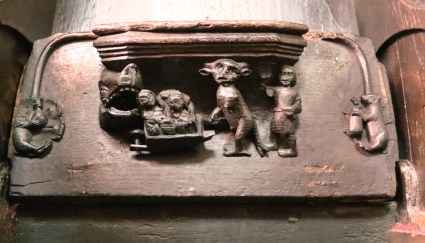
Creature wheeling two women in a barrow towards a hellmouth. All Saints’s Gresford

Apologies that it has taken a couple of weeks for part 3 to appear.  The subject is so massive and it seems impossible to do it justice in a blog post but eventually that big, accusing Publish button just has to be clicked 🙂

Part 1 introduced misericords and described some of the themes captured in the choir of St Werburgh’s Abbey (Chester Cathedral).  Part 2 described the misericords at Gresford, Malpas and Bebington.  This 3rd and final part addresses who might have been responsible for the themes chosen, who may have paid for the misericords, why they were contained within the most sacred part of the church and how they might be understood.  Finally I have added some visiting details for the cathedral and the three churchs, plus a list of references for all three parts.

Selecting the misericords

How were the topics selected and by whom; who carved them; and who paid for them?

How themes were selected
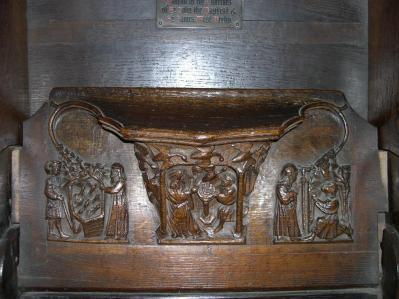
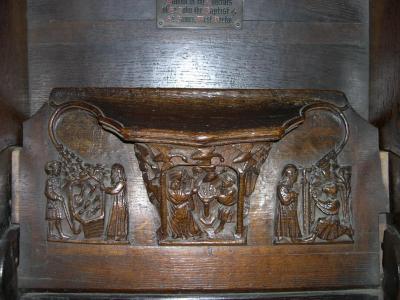
Scene showing in both the main scene and the supporters St Werburgh’s miracles. Source: Dominic Strange, World of Misericords

Each misericord showed a different subject matter, and whether there were 48 (as at Chester) or 14 (as at Gresford) there could be great diversity in the themes selected.  The patron saint of an abbey or church might dictate the subject matter in a single misericord, like the miracle of St Werburgh at Chester, but this accounts for only one misericord of any one corpus.  Some themes are commonly found throughout misericord collections and are evidently part of a popular repertoire or corpus of themes.  As Anderson says in his survey of gothic art, “The subjects of misericords did not have to be consistent, so any good design, from whatever source it came from, could be used on them,” but particular themes and ideas were probably favoured in each different establishment, leading to a different character and ambience from one set to another.  The enthusiasm for certain themes will have changed over time, reflecting both popular and intellectual fashions, but all were chosen from similar types of source material.
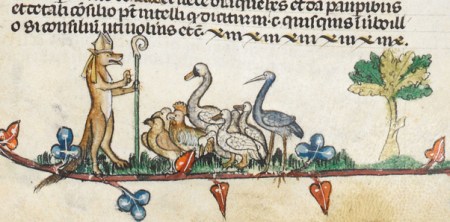
Folio 49v from the Smithfield Decretal showing a fox, with mitre and crozier, preaching to a flock of birds. Source: British Library

Manuscripts were an obvious source of ideas.  Bestiaries such as the beautiful MS Bodley 764, referred to in parts 1 and 2, provided a wealth of ideas, as did travelogues. Both Old and New Testaments, missals and hagiographies (biographies of saints, often at least partly fictional) were also alternative sources.  The Golden Legend by Jacobus de Voragine in the 13th century was a particularly popular account of the lives of saints, which even today is a good read.  The marginal scenes shown on various religious illuminated manuscripts including psalters (books of psalms) and books have hours (personal books for private worship) probably supplied others, which included so-called drolleries and grotesques.  The Luttrel Psalter and the Smithfield Decretals are good examples.  Contemporary chivalric romances, popular narratives and collections of stories like the 14th century French Cy Nous Dit (which contained versions of the tales of Tristan and Isolde, Alexander carried over the edge and the exploitsof the knight Yvain – all of which are at Chester) were good sources of stories with a moral thread. Towards the end of the Middle Ages it has been demonstrated that some themes were inspired by woodcut images that were circulating in Europe following the success of the printing press in the mid-15th century.

Image and supporters copied from earlier examples. The model for the central image was first carved at Lincoln in the 1370s (top), then reproduced with much more gusto and exuberance at St Werburgh’s Chester in the 1380s (middle) and finally, with much less energy than either, at St Mary’s Nantwich in the 1390s (bottom). All sourced from Christina Grössinger, The World Upside-Down, p.47 (see Sources at end)

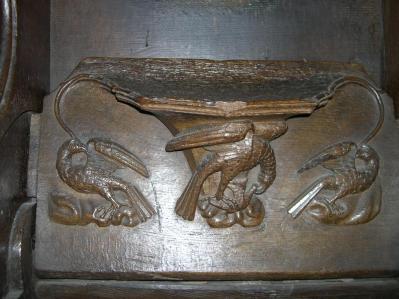
Carvers almost certainly brought ideas with them from other abbeys, cathedrals and churches, which they could share with their new employers.  Some topics are clearly copied from one ecclesiastical establishment to another, probably introduced by carvers who moved to new building projects as they became available.  Sixteen designs in Chester were based on those from Lincoln, and six in the the impressive parish of St Mary’s church in Nantwich, were copied from Chester.  The herons on a misericord in St Werburgh’s, for example, were very nearly clones of a misericord at Lincoln Cathedral, although the supporters are different.  An even more striking example is a crowned head with wild hair and beard, flanked by two heads in profile. This appears first in Lincoln Cathedral, then at St Werburgh’s Abbey in Chester.

Although St Werburgh’s may have been expected, by virtue of its proximity, to have provided the inspiration and basic model for the later examples at Gresford, Malpas and Bebington, none of the misericords are copies of surviving Chester examples.  There are indeed shared themes, but there are no attempts at replication.  This suggests that in each case the choices made drew on other sources for their ideas, perhaps reflecting the time gap between the Chester and later misericords, or otherwise reflecting local choices or preferences.

———
———–
Who would have been involved in the choice of themes?
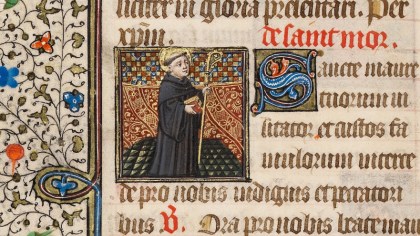
Abbot with staff and book. MS. Ludwig IX 6 (83.ML.102), fol. 222v. Source: Getty Museum

It is not known exactly how the topics depicted on individual misericords were chosen, but there are a number of possibilities.  At an abbey or independent priory, the superior (abbot or prior) and the senior personnel may have dominated the decisions, but individual monks from the larger monastic community may have contributed to the selection process too.  External patrons, whose financial input would have been necessary for a project on the scale of the Chester quire are likely to have wanted to contribute to their own favoured themes.  In a parish church both the senior clergy and the bishop would probably have dominated the decision process, but external, private financial contributors such as local landowners may also have had a vested interest in the selection of themes.  Multiple sources of finance, each perhaps buying a vote in the selection process, would help to explain the diversity of the subject matters chosen both within a single choir, and the differences from one church to another.

It is sometimes suggested that misericords were the brainchildren of the craftsmen who carved them, indulging themselves with creative and sometimes (to the Victorian mind) off-colour designs without any direct input from the clergy.  Being confined to the choir in the most sacred part of the church, however, it seems unlikely that anything could have been selected and installed without the permission of a head cleric, such as the abbot in the abbey, or a parish priest (or his bishop) in a church.  It also seems implausible that an abbot or bishop would sit back and allow expenditure to be used unchecked on fantastic frivolities that would have to be accounted for to both superiors and inferiors alike.  Although carvers probably suggested certain popular themes based on their own experience, the misericords and their themes must have been sanctioned at the highest levels.

Who carved the misericords?

Stained glass portrait, thought to be Master Carpenter Hugh Herland. Source: Upchurch Matters

Remarkably little is known about the wood carvers who created these remarkable vignettes.  For prestigious projects carvers seem to have moved from building to building.  Christina Grössinger identifies a single London workshop as having been responsible not only for the Chester and Lincoln wood-carvings, but also for those that at St Katherine’s in Stepney (London) and the former Carmelite friary in Coventry.  John Harvey had formerly identified the hand of famous Master Carpenter Hugh Herland, who worked on a number of royal and prestigious college projects in the 14th century, at Lincoln and particularly Chester, but Grössinger rejects this suggestion, and a quick look at Herland’s list of responsibilities for the decades in which the Lincoln and Chester misericords were made (1370s and 1380s respectively), suggests that he was probably far too busy on prestigious works elsewhere to oversee these two projects as well.  Present in Chester between 1377 and 1411, however, was William Newell the king’s chief carpenter who was probably involved with the work on the choir, at the very least in an advisory capacity.  For a Benedictine monastery like St Werburgh’s it was important not merely to raise the status of the individual abbey, but to contribute to the prestige of the Benedictine order as a whole, particularly in a period when monastic orders were becoming much less influential in society and politics.  Whoever was responsible for overseeing the project, many carpenters will have contributed to the misericords and canopies, and both the designs and the work are certainly exquisite.

St Andrew’s, Bebington

The preference for the most prestigious carvers available in the country suggests that where prestige was important and the finance available, only the best carvers would do and could be hired from places at considerable distance from the institution concerned.  The impressive churches of Malpas, Gresford and Bebington would not have had the same scale of financial resources, nor the same ambitions for national prestige reached for by the abbot Chester abbey, but quality was still important.  Carvers were more likely to have been sourced closer to home, but even so the skills required may still have required importing specialists to oversee and ensure high quality. In his paper on the carvers of the Oxford colleges, Gee says that during the 14th century the pay for a Master Carpenter, was around 4d monthly.  For a nationally recognized and prestigious Master Carpenter of whom the above-mentioned Herland is an example, this rose to around 1s. There was therefore a wide scale of pay for different levels of skill and creativity.  work.

Who paid for them?

Canopies above the choir stalls in Chester Cathedral

Elaborate choir stalls with misericords were luxury items for a church, raising the prestige of the incumbent clergy and the establishment as a whole either nationally for an abbey or cathedral, or regionally for a collegiate or parish church.  They were, in functional terms, unnecessary but for some monasteries and churches, the investment may have been important for institutional and social reasons, reinforcing the position of the church in the wider community at a time when ecclesiastical influence was in decline.  Status and vanity projects always come with a substantial bottom line, and the funds would have been acquired from a number of different income streams and one-off sources.

A monastic establishment like St Werburgh’s might have any number of income streams. The Benedictines, the longest established monastic order of the Catholic tradition in Britain, had been endowed with enormous estates and resources.  Monasteries were amongst Britain’s greatest landowners, owning huge swathes of the rural landscape.  This level of royal and significant magnate  investment had trailed off by the early 1300s, so monastic establishments were forced to make the most of the property they already owned and attempt to secure smaller but still significant bequests and investments, and one-off donations for special projects.  Ongoing sources of funding included tithes (funds appropriated from churches that it adopted), the often impressive output of produce sold from a network of monastic farms, private bequests in wills, and contributions by living benefactors.  Appropriating churches, and securing their income, was increasingly important throughout the later medieval period.  Chantries were also an excellent source of income for urban monasteries.  These were financial foundations set up by individuals to pay for an ordained monk, or several monks, to recite multiple prayers for himself/herself after death, as well as for his or her family and ancestors;  These were invaluable income-generators for monasteries.  Pilgrim shrines could also be very lucrative for monasteries with appropriate relics, particularly if they were reputed to perform miracles.
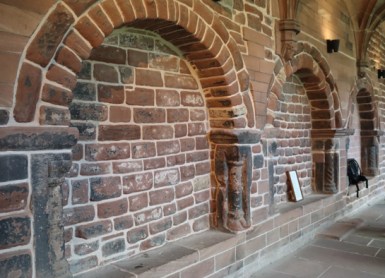
Probable burial places of some of  the medieval abbots in the cloister at St Werburgh’s, Chester

The abbot and monks themselves, might contribute to prestigious projects.  Although the earliest Benedictine monastic orders had been based on vows of poverty, and the reforming orders of the late 11th and early 12th centuries renewed these vows and intentions, by the late 14th century the Benedictine monks had lost their ambition for poverty, and were  rarely self-effacing.  Although it was a particular thorn in the side of Henry V in the early 15th century, abbots and their monks might well be considerably wealthy in their own right.  This was in spite of St Benedict’s proscription against the ownership of private property in the Rule on which the Benedictines were supposed to base their monastic lives.  An abbot’s subordinates too might have access to personal wealth. To ensure his own personal legacy an abbot of an important urban monastery might invest in a prestigious project that, in the case of St Werburgh’s included not only the choir stalls but the elaborate and intricate canopies above.  The abbot would probably be able to secure contributions from his community of brethren as well, and would certainly attempt to secure donations from beyond the cloister.  For those both within the community and those outside it, there was the hope that by contributing their mite to the glorification of God, they might serve less time paying for their sins in purgatory.  Even where in-house monastic funding was available, the gifts of patronage might be important to  elaborate monastic improvement, and for a project as immense as the St Werburgh’s quire, significant investment would have been welcome.

In an urban environment although there might be additional opportunities for securing funds, there might be competition with other establishments.  For example, St Werburgh’s charged for burials within its cemetery, and was in competition with other ecclesiastical establishments in Chester to secure those payments.  However, there was a particular prestige to being buried in a monastic context, and more importantly the possibility of being as close as possible to the divine.  Any wealthy Chester resident who wanted to be buried within the of the abbey precinct, and particularly the abbey church itself, would have to pay a very steep price for the privilege.

Elaborate and costly wood carving on the screen at the entrance to the choir at All Saints’ Gresford.

Perhaps more intriguing are the sources of the investment for the three parish churches.  These might also include tithes, which were a type of tax due from every household to fund the parish church (in the form of produce for much of the Middle Ages), if there was any surplus remaining after the clergy had been paid and church costs defrayed.  Another form of income were chantries that were set up in parish churches as well as monasteries, particularly the more prestigious parish churches.  These too might provide an income from which a surplus could be saved for special projects.  A more promising source of sufficient funds for a  was likely to be bequests and donations made by a number of particularly wealthy benefactors and patrons, either individuals, families or organizations.  For parish, collegiate and cathedral churches crowd-funding by the congregation might have been a possibility. Although most of the congregation was excluded from the chancel, (within which the choir was located), Nicholas Orme makes it clear that wealthy and influential parishioners, as well as choristers, might be given access.  These more privileged members of the congregation would have access to any work within the chancel to which they contributed either large one-off gifts or piecemeal funding, even if they were not primary benefactors or members of founding families.  It is also possible that access to the chancel was an incentive for anyone who had the money to invest in ecclesiastical projects.  Access to the chancel, and burial within its confines, were highly desirable as this was the closest that most people would come to the divine prior to death.  If the parish priest was independently wealthy, he too much contribute to the costs, as might the bishop.

Little of the abbey church survives at Basingwerk

A different possibility is the purchase, wholesale or piecemeal, of the misericords from another building.  If an abbey or priory church went out of use, a set of choir-stalls might become available for purchase at a fraction of the price of commissioning a new set from scratch.  A parish church with wealth of its own, or with patrons who wished to make a mark, might benefit from the unexpected windfall.  The Dissolution of the Monasteries under the reign of Henry VIII from 1535 to around 1540 liberated many church furnishings for purchase by less exalted establishments.  In Lancashire, for example, choir stalls from Whalley Abbey found their way into a local parish church, whilst in Lancaster itself the misericords may have come from a nearby Premonstratensian establishment.  There has been a suggestion that the Gresford misericords might have been sourced from Basingwerk Abbey at Holywell following its 1535/1536 dissolution.  However, the impressive Monastic Wales research portal states that the choir stalls from Basingwerk actually went to St Mary’s on the Hill in Chester, presumably complete with misericords, a claim echoed in the ChesterWiki page for the church (but unsupported by any citation) as part of a general refurbishment. I have not seen the original sources and their arguments for either proposal.  If the stalls were once at St Mary’s on the Hill they are not there now.  Gresford All Saints’ seems, anyway, to have had both the ambition and the funds if it wished to comission its own choir stalls during the 15th century when the church was substantially remodelled.
———

The role of misericords

A sense of meaning
All Saints’, Gresford

In spite of the genuinely fascinating and academically impressive work carried out on the subject, there are no definitive answers about how a corpus of misericords is best understood.  There is so much variety and as Gombrich observes, for some of these images “[t]here are no names in our language, or categories in our thought, to come to grips with this elusive dream-imagery in which ‘all things are mixed’. . .  It outrages both our ‘sense of order’ and our search for meaning.”  The overtly religious themes on some misericords are accompanied by far less obviously appropriate scenes including on the one hand horror, myth, fantasy and the monstrous and, on the other hand, humour, farce, ribaldry, Colish’s “red thread” of satire and, perhaps, some very early forerunners of schadenfreude and even burlesque.  Misericords are one of the few ecclesiastical contexts in which the lower echelons of society can be observed. The acrobats at Gresford have already been mentioned in Part 2, and entertainers and sports of various sorts are common.

St Werburgh’s Abbey, Chester

In spite of the difficulties it is irresistible to try to address some of the questions.  For example, why was highly irreligious imagery, some of it very funny, included in the most sacred of ecclesiastical spaces? Why were naked human private parts, women beating men, foxes lecturing geese, upright cats, writhing dragons, strange beasts, wildmen and ugly monsters shown side by side with, on the one hand, lowly peasants and jesters and, on the other hand, saints, angels, kings and heraldic symbols of the nobility?

Whilst parts 1 and 2 demonstrated how individual misericords can successfully communicate certain stories and convey specific ideas, an entire corpus of misericords is rather more interesting as a sum of the various parts, presumably containing somewhere within it the religious, ideological and cultural motivations, the very heart of why these carvings existed in the first place.

A framework for living
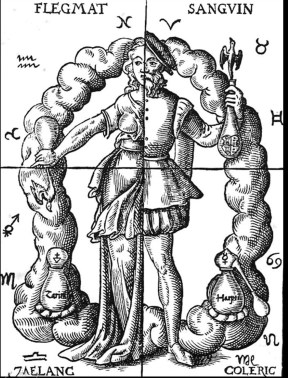
Alchemic approach to four humours in relation to the four elements and zodiacal signs. Book illustration in “Quinta Essentia” by Leonhart Thurneisser zum Thurn (gen. Leonhard Thurneysser). Source: Wikipedia

From today’s perspective, the world of the Middle Ages encompassed a very different set of experiences, and this has to be factored into any attempt to understand medieval imagery.  These many challenges of the Middle Ages were understood within a descriptive and explanatory framework that helped to give a sense of order.  As well as the overarching structure provided by Christianity, there was a framework for neatly organizing existence into manageable chunks.  The natural world was divided into four primary elements: air, fire, earth and water, with air opposite earth and water opposite fire.  The human body was divided into four “humours,” and the human condition was divided into four “states.”  All were characterized in terms of heat and moisture, and were influenced by both the four seasons and the 12 astrological points of the zodiac.  In Christian terms, the presence of the devil and his demons, the reality of purgatory and hell, and even the performance of saintly miracles were all aspects of a world that for most people, were a reality in which the supernatural was entwined with the everyday.  Structuring the world in this complex way formed a model for understanding it and operating within it.

There were also less structured but equally useful mechanisms for coping with a life in which more nebulous anxieties and worries did not fit neatly within the conventional framework.  The supernatural had its own role, which did not always dovetail smoothly with other explanatory models.  Superstition, the rumblings of magic and divination and the presence of evil in the dark corners of the supernatural all had a role to play.

The realities of medieval life

The central theme of this misericord is a two-bodied monster with a single head. The supporters are also monsters, their tails connecting them to the misericord.

Everyday life in the later Middle Ages, and the 14th century in particular (the century in which the Chester misericords were carved) was hard. The 14th century was not merely a matter of political change and social unrest, but incorporated the Great Famine of 1315-17 the arrival of the terrible Black Death of 1348-1350, and the recurrence of plague outbreaks in 1361-2, 1369, 1374-9 and 1390-3 during which thousands of people died and entire villages were permanently abandoned, and following which economic challenges inevitably occurred.  Other notable events included the relocation of papal power from Rome to Avignon in 1309; the Ordinances of 1311, which imposed limits on Edward II’s power;  Robert de Bruce’s defeat of Edward II at Bannockburn in 1314; a period of political and military turmoil followed by Edward II’s forced abdication and probable murder in 1327; Scottish independence in 1328; the beginning of the 100 Years War in 1337 under Edward III, which brought with it periods of purveyance and heavy taxation; the 1341 parliamentary crisis; the 1351 Statue of Labourers (Edward III’s attempt at wage-fixing); the death of Edward III in 1377;  the Papal Schism of 1378; John Wycliffe’s anti-Catholic writing (inspiring his Lollard followers) and his vernacular English editions of the Bible in the mid to late 14th century; the Peasants’ Revolt of 1381; and the removal of Richard II from the throne in 1399.  For Cheshire and northeast Wales, the appointment of Edward III’s son the Black Prince as Earl of Chester in 1333 and Prince of Wales in 1343 were also particularly relevant.  A great many more dates could be added to this brief and selective list, but this is probably sufficient to highlight the social and political turbulence of these decades.  The late 14th century misericords in British monasteries and churches, with their often threatening and subversive themes may say as much about social anxiety as spiritual fervour.

Lion fighting a dragon flanked on each side by a wildman (wodehouse), one riding a wyvern and the other killing some form of dragon-like creature. St Werburgh’s Abbey, Chester

Writing about the monsters, hybrids, wildmen and grotesques populating the margins of the Luttrell Psalter (dating to the 1320s-30s), Michelle P. Brown could also be commenting on the 14th century misericords when she says:  “They reflect the neuroses of a society in flux, one rightly concerned in the face of political corruption, international warfare, civil war, famine and demographic decline.”  Some of these anxieties and concerns are translated into analogous images on the misericords, which became vehicles for representing the extreme aspects of both familiar realities and potential realities that link life as it is lived and the “other.”  Here the familiar meets the unfamiliar in the liminal, teetering right on the edge of the unknown beyond where mermaids, dragons, wyverns, unicorns, strange humanoid beings and the unknown lurked.  These territories on the edges and margins of observable reality are places of high risk, where strange beings and actions are not only possible but plausible.

This was obviously not a simple matter of juxtaposing conventionally opposing ideas like saints-and-angels versus devils-and-demons.   In the medieval period the there was a recognition of the border spaces between the sacred and the profane, the religious and the domestic, a blameless life and a misspent one, good and evil, life and death, death and rebirth.  This in-between existence is space that is neither hell nor purgatory and might act as a reminder that between this world and that occupied by the divine, there was significant uncertainty.

Bearded man at St Andrew’s, Bebington. Source: Dominic Strange, World of Misericords

Although the unusual, the mythical and the allegorical stand out, ordinary people may also be represented.  They do not feature prominently at either St Werburgh’s or Gresford’s St Oswalds, where most of the original misericords are present, but ordinary people occur on misericords outside the Chester area.  The obviously religious themes interlock with scenes of everyday life, some allegorical, some empirical, some scurrilous. Michael Camille suggests that misericords are like the Mystery plays in that they allow “anecdotal details and the depiction of social manners” including folk stories and fables and scenes of domesticity and seasonal activities.  The inclusion of peasants engaged in hard work, such as those shown in the Labours of the Months, (the most complete example of which is at a church in Ripple, Worcestershire, shifted there from Whalley Abbey after the Dissolution) may represent a dependence on the annual cycle, but may equally capture the nature of the social order itself, with saints at the top and serfs at the bottom, all equally important at least in God’s eyes.

Woman as a tornado of anger with cowering man, flanked by two very cross characters. Chester St Werburgh’s

As Grössinger says, however, most of the everyday people shown on misericords are engaged not in the domestic realm or in serious pursuits, but in “a subversive view of everyday events that can both entertain and teach.”  These depictions include acrobats, contortionists, hunting, wrestling, feasting, brawling, bear-baiting and music making.  When ordinary people begin to behave in a challenging way, there may have been a great deal of unease about the reality of God’s creations humans being less than perfect specimens who were unable or unwilling to use free will for good.  Misericords depicting women beating men, foxes preaching to geese,  gymnasts displaying their private parts, may well represent the use of derision and humour to mediate the uncomfortable realities of everyday social discord, another aspect of the subversion of an idealized view of life.  This was perhaps just as true of medieval creative thinking as it is of today’s, and ties in with an explanatory framework in which both monsters and monstrous behaviours were part of God’s creation, and should be included in any understanding of reality as it is perceived and the liminal areas beyond our immediate vision or geographic location.

The lovers Tristan and Isolde. St Werburgh’s, Chester

Heroic, chivalric and romantic tales bear testimony to the rewards of idealized behaviour in the face of such challenges, but clearly comment too on the risks confronted by good people who encounter evil, temptation and other dangers.  These narratives offer approaches to handling danger and mechanisms for defeating fear and the fearsome.

Interestingly, the misericords do not tend to focus on the image of death itself and only rarely give death a voice, unless it is to remind the onlooker of Christ’s sacrifice for humanity.  Demons, hell and people being delivered to the hellmouth are certainly represented, but these are more a threat to the living, teetering on the edge of the abyss, than a characterization of death itself.  Depictions of skeletons, the personifications of death,  fairly unusual, even in the 15th century when the Danse Macabre (and John Lydgate’s derivative Dance of Death) and cadaver monuments, and in particular transi tombs, became popular.

Fox preaching to cockerel and geese. All Saints’, Gresford

Finally, there is always the matter of tradition.  Whilst the 14th century misericords at places like Lincoln, Chester and Nantwich may have been a response to the difficulties of the times, it is quite likely that much later misericords were seen more in the light of a connection with the historical integrity of the church, the honouring of an ecclesiastical tradition and a form of validation of more modern works, as well as a resistance to ecclesiastical change, by reference to the past.

Why were carved misericords incorporated into sacred spaces?

View of the choir from steps to the central altar, Gresford All Saints’. The carved screen divides the sacred space of the choir, the choir-stalls and the misericords from the public nave beyond.

In a church the choir is divided from the long nave, where the congregation gather, by a screen.  Perhaps the dangerous and threatening was best contained and restricted within the choir, where religious rituals were concentrated, and where the clergy and monks could contemplate and learn from the disruptive and unsettling scenes before (and under) them.  It must have been accepted at some point that the inclusion of irreverence and crudity sitting alongside religious themes had a useful role and would not, most importantly, be offensive to God.  If the themes were essentially a coping strategy consisting of fashionable morality tales and derisive warnings against bad behaviour, such forms of expression probably needed to be safely contained, segregated from those who might misinterpret them and retained for the benefit of those who could contemplate them and understand their role.  Acknowledging risk and conceptualizing it in the form of margins and misericords was a way of bringing a wit and energy to the unknown world of the “other” that sat beyond the edges of medieval life, but it was not suitable for everyday consumption.

One of the Victorian replacements at Chester St Werburgh’s showing one of Aesop’s fables, the fox and the stork.

It is worth remembering that at least in the context of monastic establishments and collegiate churches, and probably in the greater majority of the parish chancels, the choir was the domain of men alone.  It is all too likely that the more risqué of these themes were considered far too warm and witty for delicate female sensibilities and, in the majority of cases, for their inferior intellects too.  Confining such scenes to the choir would normally guarantee an exclusively male audience.

Context:  Themes that reflect the misericords in other forms

Delightfully grotesque creature, one of many clinging to the walls of All Saint’s, Gresford. Its beautifully chosen red sandstone skin against the pale yellow masonry makes it particularly ghastly!

Very briefly, where misericords are found, it is worth having a look around to see what other types of similar imagery may exist both within the church and on the exterior.  The subject of architectural gargoyles and related grotesques has already arisen on this blog in connection with Gresford All Saints’ church, where the twisted, deformed, ugly and bizarre look down on gathering congregations and passers by, marching in sequence along the string-course, spewing out water, or apparently poised to pounce from window corbels and string courses. There was no limit to medieval imagination, and the exteriors of many medieval churches display some of the most extraordinary and creative monsters anywhere in the late medieval world.

Pilgrim and bench end, St Werburgh’s Abbey, Chester

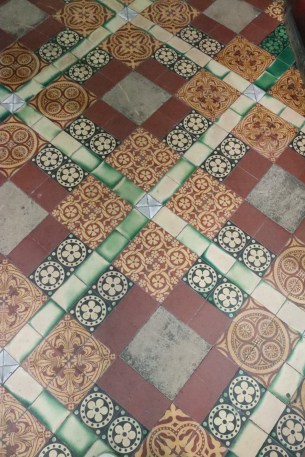
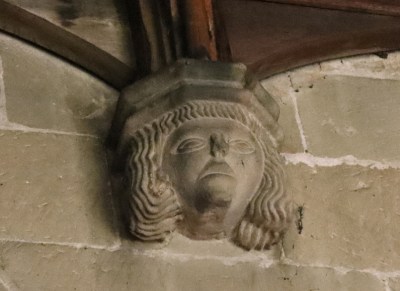
Interior imagery includes choir-stall arm rests, bench-ends and bench-end carvings and sculptural components such as corbel supports. In some big ecclesiastical establishments the ceiling bosses and vaulted arch corbels are also used to capture the mythological, the fantastic and the entertaining.  Camber bream ceilings may be accessorized with sculptural components in wood or stone where the ceiling beams meet the walls.  Baptismal fonts sometimes display elaborate imagery, and where original medieval floor tiles remain, these too often display images and symbols.  Medieval stained glass, where it survives, although better known for its display of the great and the good sometimes captures subjects from the margins.  These may or may not be contemporary with misericords, but add to the story that successive generations of clergy and congregations could read in their place of worship.

Together, all these carved forms, whether in wood or stone, formed a complex ecclesiastical world in which miracles, judgement, purgatory and the apocalypse were the stuff of fact, and in which saintly shrines channelled divine power, and where the unregulated performance of domestic solutions were probably manifestations of harmful superstition and demonic magic inspired by the devil.  The messages of risk and uncertainty, coped with by following Christ’s example and ameliorated by belief in the love of God, were carried throughout the church, inside and out.
xxxxxxx

Final Comments

Over the three posts in this small series I have barely touched the surface of what misericords meant to churches and their clergy and why they merited their cost.  That is partly because the topic is so rich and the corpus in Britain alone so massive.  There have been many attempts to get to the root of what the misericords, in each corpus, are intended to do, what role they are designed to perform.   It is possible in each place to pick out key themes in misericords, including religious and miraculous scenes; domestic, seasonal and everyday activities; kingly and knightly pursuits and adventures, many of them referencing popular chivalric romance and courtly love; the fantastic, monstrous, mythical and legendary; and the seriously crude and scatological.  The medieval interest in the “other” is very conspicuous.

All Saints’, Gresford

Misericords did not shy away from even the most bawdy elements of human existence, challenging the binary, recognizing the complexities of Christian lives.  Rather than simple black and white contrasts of good versus evil, the misericord vignettes capture an entire kaleidoscope of social and cultural perception and commentary.  It does not matter in which order the overall message is read, but it does matter that it incorporates a deeply felt form of reality beyond the immediately observable, which may offer both opportunity and risk.  Whether amusing, tender or shocking, misericords have the ability to tell a moral tale, carrying real impact in their didactic role, encouraging introspection and self-awareness.

Arm rest. St Andrew’s, Bebington

Between life as it was lived every day, the the supernatural as it was imagined, and those strange foreign lands and invisible realities with with strange monstrous beings, there was plenty to worry medieval people.  These are sources of potential anxiety and stress that paid no respect to social standing.  Misericords represent the diversity and unending variability of living things and their experiences, both natural and supernatural along the entire continuum of human and divine life.   Although sometime based on stories captured in manuscripts, and sometimes loose copies of paintings and prints from northwest Europe, the misericords have a voice of their own.  Approaching them as embodiments of layered meaning can add depth and richness to each individual piece, but they are equally appealing for their visual splendour, and can be appreciated simply for their beauty, mischief, boldness and charm.

Visiting (as of December 2023)

The layout of the choir stalls and description of their misericords. Source: Stephen Smalley 1996 (see “Sources” at end)

On my multiple visits to Chester Cathedral in 2022 and 2023  the misericords have usually been available to view.  Although they are sometimes roped off, particularly when an event is upcoming, you can usually go between the lower choir benches to lean over and see some of the misericords, and there are usually cathedral staff around to ask if you can get a little closer.  On my visits to Gresford and Malpas, the misericords were accessible to view when the church was open to visitors and not being used for services and events.  St Andrew’s in Bebington can only be visited by appointment (see below) but again the three misericords are on unrestricted display.

None of the locations have obligatory entry fees, but Chester always has someone at its reception requesting a voluntary donation into a big perspex box (or by swiping a debit/credit card).  There is also a gift shop and very good café in the former abbey refectory, which is a wonderful space in its own right.

Swordplay. St Oswald’s, Malpas

Gresford, Malpas and Bebington do not have reception staff, but as village churches they are even more in need of voluntary donations.  Given how beautifully these churches are maintained, it is well worth giving them support.

Gresford All Saints’ and Malpas St Oswald’s are still open for services, weddings and funerals, as well as community activities, but are generally also open daily for visitors. You can park outside All Saints’ on the road.  At St Oswald’s it is better to find the car park, just five minutes away, and walk.

Bebington St Andrew’s is only open for Sunday services and other formal events, and visiting is by appointment only.  My thanks to the office for making arrangements for me to visit.  I’ll be writing up the entire church on another occasion.  There is plenty of parking on the road when the church is not in use for services, weddings etc.

I have included the What3Words location for those with the app installed (it works beautifully with the free Google satnav).  Check the individual websites for services, opening times and other details:


Sources

My thanks again to Dominic Strange and his World of Misericords website for allowing me to use so many of his images. He is an absolute star, and his website is a fabulous resource, one of the best examples of how websites can really contribute to research projects.

Each of the three posts in this short series was originally a lot longer, and some of the references below relate to those chunks that I cut out, but in case the full bibliography is of interest, I’ve left it unaltered.  I have not managed to track down all the references that I might have found of use, so there are gaps.  If you are looking into misericords and want the references that I have noted down for future reference but have not used here, just let me know and I will email them over.

Books, booklets and papers

Anderson, M.D. 1954. Misericords. Medieval Life in English Woodcarving.  Penguin

Anderson, M.D. 1971. History and Imagery in British Churches. John Murray.

Asma, Steven T. 2009. On Monsters. An Unnatural History of Our Worst Fears. Oxford University Press

Avilés, Alejandro García 2019.  The Visual Culture of Magic in the Middle Ages.  In (eds.) Sophie Page and Catherine Rider. The Routledge History of Medieval Magic. Routledge, p.402-431

Barber, Richard. 1992. Bestiary. MS Bodley 64. The Boydell Press

Baxter, Ron. 1998. Bestiaries and their Users in the Middle Ages. Sutton Publishing
https://www.researchgate.net/publication/340870845_Bestiaries_and_their_Users_in_the_Middle_Ages_Sutton_Publishing_1998_ISBN_0_7509_1853_5

Bench end “poppy head,” Gresford All Saints’

Beal, Timothy K. 2002. Religion and Its Monsters. Routledge

Bennett, Carol. 2015. Lincoln Cathedral Misericords and Stalls in St Hugh’s Choir.  Lincoln Cathedral.

Bildhauer, Bettina. 2003. Blood, Jews and Monsters in Medieval Culture. In Bildhauer, Bettina and Mills, Robert (eds.), The Monstrous Middle Ages.  University of Wales Press.

Bildhauer, Bettina and Mills, Robert. 2003. Introduction: Conceptualizing the Monstrous. In Bildhauer, Bettina and Mills, Robert (eds.), The Monstrous Middle Ages.  University of Wales Press

Broughton, Lynne. 1996. Interpreting Lincoln Cathedral: The Medieval Imagery. Lincoln Cathedral Publications

Brown, Michelle, P. 2006. The World of the Luttrell Psalter. The British Library

Burne, R.V.H. 1962. The Monks of Chester. The History of St Werburgh’s Abbey. SPCK.

Camille, Michael. 1992. Image on the Edge. The Margins of Medieval Art. Reaktion Books

Chunko Betsy L. 2011. Vernacular Imagery on English Misericords:  Framing Interpretation. St Andrew’s Journal of Art History and Museum Studies, 2011, vol.15, p.5-12
https://ojs.st-andrews.ac.uk/index.php/nsr/article/download/255/264/

Clifton-Taylor, Alec. 1974. English Parish Churches as Works of Art.  B.T. Batsford Ltd.

Colish, Marcia L. 1997. Medieval Foundations of the Western Intellectual Tradition 400-1400. Yale University Press

Davies, Owen. 2012. Magic. A Very Short Introduction. Oxford University Press

Dickinson, John. 2008. Misericords of North West England.  Their Nature and Significance. Centre for North-West Regional Studies, University of Lancaster.

Fry, Nick. 2009.  Chester Cathedral.  Scala

Fudgé, Thomas. 2016.  Medieval Religion and its Anxieties.  History and Mystery in the Other Middle Ages.  Palgrave Macmillan

Gee, E.A. 1953. Oxford Carpenters 1370-1530. Oxoniensia, vol 17-18, 1952-3, p.112-184

Gombrich, E.H. 1979, 1984. The Sense of Order. A Study in the Psychology of Decorative Art. Phaidon Press Ltd.

Green, Richard Lancelyn (revised by Roberts, Alan) 2018. St Andrew’s Bebington. St Andrew’s Heritage Committee

Greene, J.Patrick. 1992.  Medieval Monasteries. Leicester University Press

Grössinger, Christa. 2007.  The World Upside-Down. English Misericords.  Harvey Miller Publishers

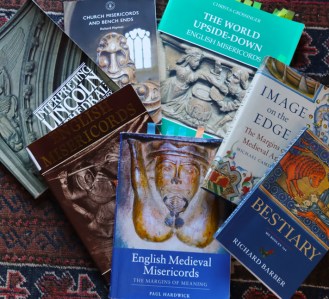
Hardwick, Paul. 2011. English Medieval Misericords. The Margins of Meaning. The Boydell Press, Woodbridge

Hardwick, Paul. 2017. Chaucer’s Friar John and the Place of the Cat. The Chaucer Review, 52(2), p. 237-252

Harte, Jeremy 2003. Hell on Earth: Encountering Devils in the Medieval Landscape. In Bildhauer, Bettina and Mills, Robert (eds.), The Monstrous Middle Ages.  University of Wales Press

Harvey, John. 1947. Gothic England. A Survey of National Culture 1300-1550. B.T. Batsford

Hiatt, C. 1898. The Cathedral Church of Chester.  A Description of the Fabric and A Brief History of the Episcopal See.  George Bell and Sons. Available on the Internet Archive

Jones, Bethan. 1997. All Saints Church Gresford. ‘The Finest Parish Church in Wales’. The Friends of the Parish Church of All Saints Gresford.

Jones, Malcolm Haydn. 1991. The Misericords of Beverley Minster: A Corpus of Folkloric Imagery and its Cultural Milieu, with Special Reference to the Influence of Northern European Iconography on Late Medieval and Early Modern English Woodwork. Unpublished PhD thesis.
https://pure.plymouth.ac.uk/ws/portalfiles/portal/38446601/303331.pdf

Laird, Marshall. 1996.  English Misericords. John Murray

Luxford, Julian. 2005. The Art and Architecture of English Benedictine Monasteries, 1300-1540. A Patronage History. Studies in the History of medieval Religion Volume XXV. The Boydell Press

Orme, Nicholas. 2021. Going to Church in Medieval England. Yale University Press

Page, Sophie. 2017. Medieval Magic. In: Davies, O, (ed.) The Oxford Illustrated History of Witchcraft and Magic, Oxford University Press, p.29-64

Riches, Samantha J.E. 2003. Encountering the Monstrous. Saints and Dragons in Medieval Thought. In Bildhauer, Bettina and Mills, Robert (eds.), The Monstrous Middle Ages.  University of Wales Press.

Rider, Catherine. 2012. Magic and Religion in Medieval England. Reaktion Books.

Roberts, Alan. 2018. St Andrew’s Bebington. Church and Churchyard Tours. St Andrew’s Heritage Committee

Ryands, T.M. (no date). An Illustrated History of St Oswald’s Malpas.

Smalley, S. (with additional research, Fry, S.) 1996. Chester Cathedral Quire Misericords. The Pitkin Guide. Chester Cathedral

White, Carolinne. 2008. The Rule of Benedict. Penguin.

Williams, David. 1996.  Deformed Discourse. The Function of the Monster in Medieval Thought and Literature. Liverpool University Press.

Woodcock, Alex. 2018 (2nd edition). Of Sirens and Centaurs.  Medieval Sculpture at Exeter Cathedral. Impress Books

Websites

All Saints’ Church, Gresford
https://www.allsaintschurchgresford.org.uk/about-us/our-history/

Bodleian Library
MS Bodley 964 (Bestiary)
https://digital.bodleian.ox.ac.uk/objects/e6ad6426-6ff5-4c33-a078-ca518b36ca49/

British History Online
Chester Cathedral – A History of the County of Chester: Volume 3. Originally published by Victoria County History, London 1980, pages 188-195
https://www.british-history.ac.uk/vch/ches/vol3/pp188-195

The Camelot Project, University of Rochester (New York)
The Legend of Yvain.  By Dongdong Han, 2010
https://d.lib.rochester.edu/camelot/text/han-the-legend-of-yvain

Clwyd and Powys Archaeological Trust
Church of All Saints, Gresford (although note that this has no mention at all of the misericords)
https://cpat.org.uk/Archive/churches/wrexham/16785.htm

Internet Archive
Liber monstrorum. A translation of the Old English text. By Andy Orchard, taken from Pride and Prodigies: Studies in the Monsters of the Beowulf Manuscript, University of Toronto Press; 2nd ed. edition (19 April 2003)
https://web.archive.org/web/20050118082548/http://members.shaw.ca/sylviavolk/Beowulf3.htm

The Medieval Bestiary. Animals in the Middle Ages
https://bestiary.ca/

The National and University Library Slovenia
The Elaborate Details in a Medieval Manuscript. Treasures of the National and University Library of Slovenia
https://artsandculture.google.com/story/the-elaborate-details-in-a-medieval-manuscript-national-and-university-library-of-slovenia/aAXhCkz6RxgiIw?hl=en

San Francisco State University
Ywain and Gawain. (Editors: George W. Tuma, Professor Emeritus of English, and Dinah Hazell, Independent Scholar, hosted by the English Department, San Francisco State University)
https://www.sfsu.edu/~medieval/romances/ywain_gawain_rev.html

St Oswald’s Church, Malpas
https://www.malpaschurch.co.uk/st-oswalds-malpas/

Princeton University
The Elaine C. Block Database of Misericords
https://ima.princeton.edu/digital-image-collections/collection/block/intro

World of Misericords
https://www.misericords.co.uk/ by Dominic Strange

Misericords in situ within choir stalls at St Werburgh’s Abbey (Chester Cathedral)

Part 2: Miracles, myths, demons and the occasional grin: Misericords in the Chester-Wrexham area

Gresford All Saints’

In Part 1 of this 3-part series, the subject of misericords in choir stalls was introduced, the four churches covered in this three-parter were identified, and the St Werburgh’s Abbey (Chester Cathedral) misericords were discussed.  Part 2 takes a look at the misericords in the smaller churches of Gresford All Saints’, Malpas St Oswald’s and Bebington St Andrew’s.  References for all three parts can be found at the end of Part 3.

——–
Chester, Gresford, Malpas and Bebington (continued)

Basic data about the misericords at the four churches

The misericords carved for St Werburgh’s Abbey (Chester Cathedral) were discussed in Part 1.  All Saints’ church in Gresford, St Oswald’s at Malpas and St Andrew’s in Bebington were considerably more modest in scale than St Werburgh’s Abbey, but all were impressive when measured against other parish churches in the region, and obviously had access to relatively substantial funding.  The table above was also posted in part 1 and provides some of the vital statistics of all four sets of misericords.

All Saints’, Gresford

All Saints’ Church in Gresford

All Saints’ Church in Gresford is unexpectedly big for such a small and unimposing village.  The stone church was founded in the 13th century and underwent a major revamp in the 15th century, and is still busy today. I have written about All Saints’ on two previous posts, one about the history of the church in general, and the other about the 15th century gargoyles and grotesques that inhabit its exterior.  It has been suggested that the misericords were sourced from Basingwerk Abbey at Holywell in north Wales and added to All Saints’s after the abbey was dissolved in the early 1500s, but although this remains a possibility, it is also probable that All Saints’ was sufficiently well provided for to pay for its own misericord carvings.

Choir stalls at Gresford All Saints’

Neither the All Saints’ guidebook nor the CPAT survey suggest a date for the misericords, and the church’s web page does not mention them.  Based on the presence of a preaching fox, a theme thought to represent mendicant friars who were only present from the 14th century, they must have carved after the late 14th century.  It is also very probable that they post-date those at St Werburgh’s (1390) as there was nothing else nearby to provide a model.  Although the Gresford misericords could plausibly have been associated with the major rebuild of the church in the 15th century, when two new aisles were added and many other changes were made, Dominic Strange’s misericord timeline places the misericords in the late 15th or early 16th century, over 100 years after the Chester misericords.  If correct, it demonstrates the durability of themes that were popular in earlier periods.

Sketch plan of the Gresford misericords.

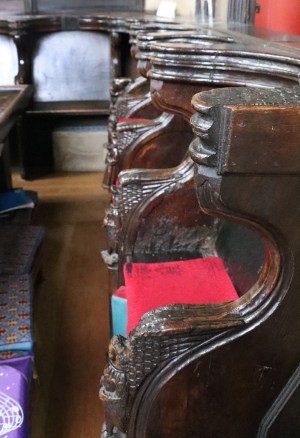
The choir stalls provide a good example of a three-sided arrangement in a squared U-shape.  In total there were originally fourteen misericords, four on the north, four on the south and two lots of three on the west.  The latter flanked the entrance from the nave to the choir.  Today two are blank, either because they were never completed, or because they were removed due to inappropriate content or severe damage (I can find nothing to help determine which).  Some are quite badly damaged, but the entire group indicate great skill and include some varied topics.

The choir, Gresford All Saints’

The misericords are separated by arm rests that curl up the sides of the chairs and along the backs, each one featuring a small human figure at the front of the arm rest.  Exceptions are at the corners between the north and west rows and the west and south rows, which feature fantastic beasts.

As in St Werburgh’s, a fox is dressed as a friar but this time he is in a pulpit preaching to chickens and geese, demonstrating that this theme was of interest not merely to monastic establishments but to churches as well.  The allegedly venal of some elements of the mendicant cause may be the theme here. The earliest mendicant friars were poor and itinerant, begging for alms.  By the later middle ages they were comfortably established in friaries of their own, the recipients of patronage, gifts and wills. The apparent hypocrisy was a source of grievance for the clergy beyond the seclusion of the cloister.  The parish priest may also have felt threatened by the powerful public sermons and the more evocative style of engagement with the general public delivered by the friars.  In the parish church, as well as in the heart of the monastery, friars might be seen as a threat to the role of the conventional clergy, to be satirized, derided and, if possible, undermined.

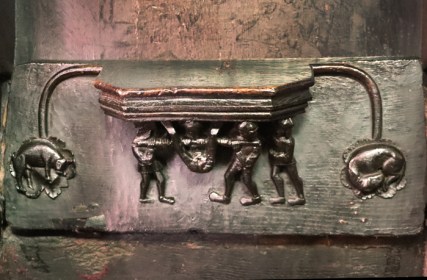
One of the more puzzling themes that occasionally appears on misericords (but is missing from Chester, possibly due to removal in the Victorian period) is the revealing of male nether regions. At Gresford this is given a context.  The misericord shows an acrobat hanging over a pole held by two men, ostentatiously exposing his undercarriage, apparently during a performance, possibly a form of slap-stick entertainment.  Quite what these were doing on misericords is uncertain, although there is a lot of speculation on the subject.  Whilst there may have been a warning against lewdness and impurity, it is difficult to deny that at least some of these depictions were intended to include a degree of crude humour.

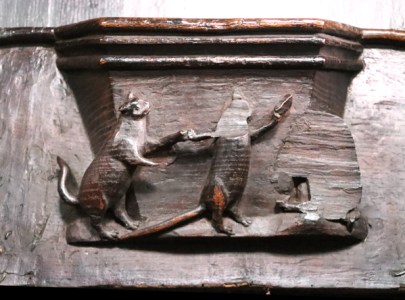
A badly damaged misericord shows two cats, both standing on their hind legs in front of something that is now missing but appears to show a mouse hole at the base, with a tiny mouse with pointed ears to its right.  The cats are holding hands, with one apparently leading the other.  The leading cat seems to have been holding something in its outstretched paw.  Perhaps the upright stance reflects the cat’s commanding, self-possessed and often self-satisfied view of its position within its own universe.  An alternative interpretation is that when animals are shown adopting human behaviour, it is a reminder of human failings.  Similarly standing on their hind legs are the cats in MS. Bodley 764 (folio 50r), which also shows cats on the hunt.

Cats from MS Bodley 764, folio 50r. Source: Medieval Bestiary

Wheelbarrows feature quite frequently in misericords, and one of the Gresford misericords shows two women seated side by side in a wheelbarrow being pushed towards the open jaws of a monster’s head by a creature with staring eyes and a forked tail.  The cavalcade is followed by a man.  All the participants in the scene stare out at the onlooker.  The open jaws of the monster represent the gateway to hell.  This is a much simpler version of a well-known example at St George’s Chapel, Windsor Castle, which shows two monks being wheeled towards the hellmouth by either a demon or the devil himself, leading to the suggestion that the two wimpled women on the Gresford misericord may be nuns (but bearing in mind that wimples were not exclusive to nuns).  The supporters appear to be small rodents, but it is difficult to see how they might relate to the central narrative.

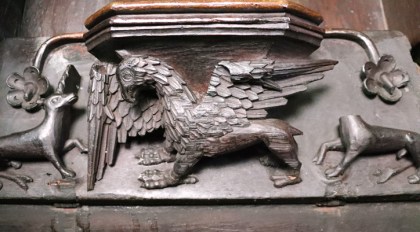
A splendid winged griffin, facing left, is positioned between two delicate unicorns, one of which is missing its head. The griffin has the head and wings of an eagle, the body of a Lion and is four-legged.  Like the lion, which can exert its power for either good or evil, depending on the context.  When Alexander the Great encounters the enclave of griffins in his voyage to the end of the world, the creature is a true monster, ugly, frightening and vicious.  On the other hand it is a pair of griffins that carried Alexander over the edge of the world.  The griffin is often used to represent rival ideas and can, in different contexts, represent such opposing individuals as Satan and Christ.  The griffin also represents the combination of the opposing elemental forces of air (eagle) and earth (lion).  It is difficult to know what, in this context, the griffin is intended to convey.  The presence of unicorns, which are often associated with Christ, may either be supportive companions, opposing forces, or hapless victims, and there is nothing to help determine which. The supporters are decorative flowers.

Another misericord, also quite unlike its companions, seems to refer to the gargoyles and grotesques so strongly featured on the exterior of the building.  It may have had no specific symbolic meaning.  It is a monster’s face with vaulting emanating from its head.  The vaulting may be intended to evoke the magnificent screen that separates choir from nave at All Saints’, although the flowers at the intersections on the misericord are not present on the screen. Perhaps it is intended to bring indoors the collective message that the gargoyles and grotesques were communicating from the exterior of the church (discussed briefly in an earlier post).

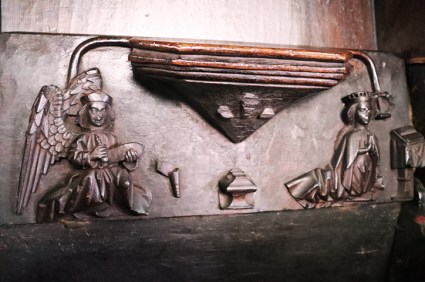
Some of the All Saints’ misericords are very badly damaged, leaving the core subject matter very difficult to identify.  A particularly frustrating example is the misericord whose central subject matter is completely missing.  Flanking it there is a wonderful winged angel on the left and, on the right, a lady in an elaborate dress kneeling before a personal altar with the soft folds of her dress flowing behind her on the floor.  Perhaps this was either the Annunciation or the Coronation of the Virgin, particularly as there are no other overtly religious stories included in the All Saints’ corpus.

Another badly damaged misericord shows a woman on a four-legged animal, the head of which is missing and is therefore unidentifiable.  It is short, has particularly bandy legs and ill-defined feet, none of which suggest a horse.  Two carvings, one in front of the woman and animal, and one behind, are lost.  The one behind is almost certainly another figure in a long garment, but the one in front may or may not be.

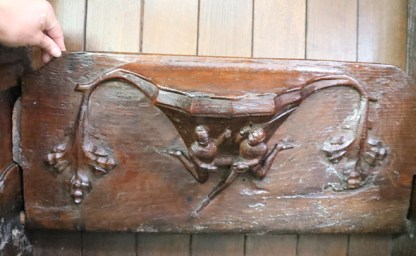
Some of the misericords contain no narrative or obviously symbolic component.  One misericord has no central subject matter and no obvious sign of damage, with just two images as supporters, right on the edge of the underside of the seat.  These are two three-quarter partial heads, almost sketches, looking towards one another.  The meaning of this, if there was any, is lost.  If there was a central carving, there is not even a shape left to suggest a subject matter.  It is possible that it was carved at a much later date to replace one of the original misericords that might have been damaged or whose subject matter was considered inappropriate.  These lost stories are very frustrating.

All of the misericords at Gresford are shown on the World of Misericords website at https://www.misericords.co.uk/gresford.html, with short descriptions at https://www.misericords.co.uk/gresford_des.html.

St Oswald’s, Malpas

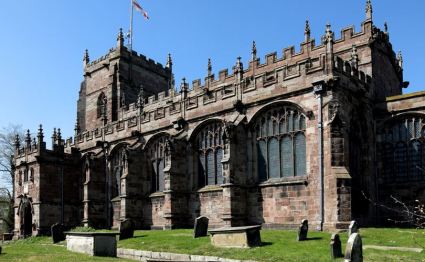
St Oswald’s Church in Malpas. Photograph by Alan Marsh. Source: Historic England

St Oswald’s Church in the village of Malpas was founded in the late 1300s.  The church underwent a similar modernization in the 15th century to that at Gresford, including a similar camber beam roof.  It has a great many features that continue to impress, particularly the spectacular tomb effigies of the 15th and early 16th centuries, but its remaining misericords are disappointingly confined to three choir stalls.

There is a set of three choir stalls with three misericords, in a single row, still displayed in the choir area in St Oswald’s.  The visitor guide to the church says that there were “at least twelve” 15th century choir stalls with misericords, with only nine surviving and six “much restored.”  Given that there are only three on display, it is something of a puzzle as to what happened to the remaining six of the nine surviving.  There are no descriptions of any of the misericords, and nor does the booklet say where the surviving misericords (other than the three still in the choir at Malpas) are located today.

The remaining row of choir stalls at St Oswald’s with the misericords hidden beneath the seats.

The choir stalls have carved armrests, although they less elaborate than those at Gresford, and have no carved bench ends.  This may suggest that carved choir stalls were never a very important component of the chancel at St Oswald’s, or that the funds required for a more ambitious project were not available.  All three remaining misericords are described here, with the disclaimer that they represent only a very small sample of the original corpus.  Two of the three are damaged.

I particularly like the mermaid.  Mermaids appear on many misericords in Britain.  Mermaids resembled Greek sirens, representing both the temptation and lust that men might find hard to resist on the one hand, and the dangers represented by the deformation of the human image in the form of a hybrid creature on the other.  They were usually shown, as at Malpas, with bared breasts, with a comb in one hand and a mirror in the other, warnings not merely of seduction but of the vice of vanity.  The Malpas mermaid looks down and seems to be moving gently to her right.  Her tail has been lightly carved to suggest fish scales. Her bare chest is distinctly flat and smooth, unlike most misericord mermaids, perhaps to avoid encouraging carnal thoughts amongst the Malpas choristers.  She holds the comb  in her left hand, which rests on her thigh (separated from her upper arm by breakage), and the mirror in the other, overlapping one of the supporters.  Both supporters are three-lobed leaves.

A winged monster has one head, shown facing outward, but two bodies that are shown in profile either side of the head.  This is probably the simplest and least worked of all three, with minimal details carved into the image, although there are shallow markings to suggest the scaled nature of the wings, and clawed feet.  The face is shown in more detail, with three protrusions from the head, which may or may not depict serpents.  It is clearly a monster with affinities like the wings, tails and claws that are shared with dragons. Dragons, wyverns and related monsters may represent paganism, power, uncontrolled violence or lust, the Devil himself and unspecified evil and sin that must be confronted and neutralized, or at the very least rationalized.  As such creatures are usually associated with remote, often hostile landscapes, they may also represent fear of the unknown.  It may also offer a shifting geographical component, so that the dragon may be feared in the remote landscape but is only confronted when it threatens human habitation and safety. The three-lobed leaf supporters are nicely done, with clearly defined edges.  A much more elaborate version of a single-headed and double-bodied monster is shown in the Luttrell Psalter (folio 195v), but is evidently part of the same family of images familiar and available to medieval illuminators, carvers and sculptors.

Single-headed two-bodied monster from the Luttrell Psalter (Add MS 42130 f.195.v). Source: Groteskology

Finally, two knights are shown engaged in an athletic, almost balletic fight with swords. Of the three this is by far the most complex, compositionally.  At first glance it is very difficult to see exactly what is going on, and whose limbs belong to whom, vividly capturing movement.  The pointed shoes, generally confined to the well-to-do, emphasize the mobility and athleticism of the figures.  Perhaps it refers to a scene from a chivalric romance, such a the Chester examples that show scenes from stories of Yvain and Tristan and Isolde. Again, the supporters are foliage.

St Andrew’s, Bebington

St Andrew’s, Bebington

As I was just about ready to hit the Publish button on this post I had a whizz through Dominic Strange’s Timeline and Gazetteer, which revealed that St Andrew’s in Bebington on the Wirral possesses misericords in three choir stalls, plus two that have survived being separated from their choir stalls, now serving as corbels.  Although the church is not open except for Sunday services, weddings etc., Karen from the church office very kindly arranged for me to visit when volunteers were working there.

Choir stalls in St Andrew’s, Bebington

It is particularly nice to have found these misericords because, as with St Oswald’s in Malpas, the misericords at St Andrew’s rarely appears in books about misericords, always overshadowed by Chester Cathedral and Gresford All Saints’.  It is clear that they should be included here not only because they are local and under-sung but because they show some themes that are not shown in the misericords at the other locations discussed in these posts.

The pelican in her piety

Dominic Strange places all five misericords in the 15th century.  The guidebook to the church, by Richard Lancelyn Green, says that there were originally twelve of them, with six surviving until 1847 when they were split up due to damp and dry rot.  Presumably the other six were discarded.  Initially, in 1871, they were split into pairs and then, in 1897, three of them were reassembled into the row that survives today in the chancel, just to the side of the main altar. Two of them have been removed from their original choir stalls and are deployed as corbels but there is no mention of the sixth 1847 survivor.

At the far left of the choir stall is the pelican in her piety plucking her breast (shown above), already described in connection with Chester in part 1, but flanked here with foliage.

Bearded man. Source: Dominic Strange, World of Misericords

The head of a man with beard and hat or other form of head covering may or may not be a portrait.  Many misericords show human faces, some characterized by particular expressions or actions, but many contain no clues about the significance.  The supporters feature pomegranates.  Pomegranates are associated with numerous ideas from antiquity onwards.  The symbolism attached to them ranges from fertility, regeneration and good luck to representing the shedding of the blood of Christ and as a symbol of the church and its congregation.  Without knowing quite what the man’s head represents it is difficult to interpret the entire message of the misericord.

The third in the row is a splendid dolphin flanked by equally splendid seahorses, presumably designed by someone who had seen neither dolphin or seahorse. The dolphin is a rather terrifying looking creature, but there seem to be no negative narratives associated with it. The bestiary in MS Bodley 764 includes the dolphin, but attaches no special meaning to it, stating that “they follow men’s voices, or gather in shoals when music is played . . . if they go in front of the ship, leaping in the waves, they appear to foretell bad weather.”  The only other misericord dolphins that I’ve seen in my online travels are at Norwich Cathedral and St Laurence’s Church in Ludlow.

The remaining two misericords, now used as corbels, show what may be a bull’s head, and a sow with a litter.  You can see them on the World of Misericords website.  The sow with a litter is a theme also featured on one of the St Werburgh misericords.  MS Bodley 764 is quite clear on the negative connotations:  “The sow that was washed and returns to her wallowing in the mire is filthier than before; and he who weeps for his admitted sins, but does not desist from them, earns a graver punishment, condemned by his own misdeeds which he could have prevented by repentance; and he descends as if into murky waters because he removes the cleanness of his life by such tears, which are tainted before the eyes of God.”  Sows represent unclean spirits and are often associated with gluttony and, more disturbingly, heresy.  And in the medieval mind, where heresy lurks, paganism may be lurking nearby.

Contributors to knowledge

Even in such small numbers, the churches at Malpas and Bebington contribute to the body of information about Medieval misericords, helping to build up a database of knowledge about the themes that were of interest to those who commissioned them for the most sacred parts of their monasteries and parish churches.  Unless an early report describing or illustrating some of the other misericords emerges, the legacy of those who commissioned, funded and carved the misericords at Malpas and Bebington are confined to just these three and five examples respectively.  Although the themes were represented elsewhere, none of the topics shown replicate any of those surviving at St Werburgh’s.

Other churches in the region with misericords

Grapevine misericord at Nantwich St Mary’s. Source: Dominic Strange, World of Misericords

The above are the only churches with misericords in the Wrexham-Chester area, but there are others in the general region.  For example, there is a set of fourteen dating to the late 14th century in St Mary’s Nantwich to the east, in the town centre.  There are 20 dating to the late 15th century in St Asaph’s Cathedral to the west in north Wales. Another set of sixteen dating to the late 15th century can be found in St Bartholemew’s in the village of Tong to the southeast (where the A41 meets the M54).  Finally, there are two fine sets of 15th century misericords (the first of sixteen in 1425 the second of twelve in 1447) in St Laurence’s church in Ludlow.

The distinctive Nantwich examples can be seen on Dominic’s World of Misericords, as can those at St Asaph’s, but the Tong ones have yet to be added to the site, and I cannot find images of more than one or two of them elsewhere.  There is a section of the Ludlow Palmers website dedicated to the St Laurence’s misericords in Ludlow, and you can see sixteen of them on World of Misericords.

Next

Part 3 wraps up the series, looking at who was involved in the creation of misericords, how they were paid for, and why they featured so frequently in the most sacred part of a church, often hidden from view but containing a mixture of messages that in each case contributed to the sense of a church’s identity.  Visitor details and references are also added at the end of part 3.


Miracles, myths, demons and the occasional grin: Misericords in the Chester-Wrexham area #1

Introduction

I first encountered the fabulously inventive misericords, an integral part of some church choir stalls, in Chester Cathedral, founded as St Werburgh’s Abbey.  At the abbey they were installed in the late 14th century, and in all cases, from the late 12th to the early 16th century the choir stalls were located in the holiest section of a church, where sacred liturgies and rituals were performed.

Two choir stalls from St Andrew’s Bebington. On the left the hinged seat is in the down position, hiding the misericord beneath. On the right, the seat is tipped up, leaning on the seat back, and reveals the carved misericord on the underside of the seat (my photo Creative Commons licence CC BY-NC-ND 4.0)

Misericords are hinged wooden seats set into the choir stalls.  When folded down to provide seating, the seat has a plain, flat surface, but when folded up to rest against the seat back, a small platform on the underside of the seat allows the standing chorister to rest his rear end.  The word misericord derives from the Latin misericordia (mercy or pity) and for the tired or aged monk or chorister looking for some respite for weary and arthritic legs, it probably was mercifully welcome.

The central theme of this misericord is a two-bodied monster with a single head. The supporters are also rather wonderful monsters, the one on the right also a double-bodied creature, the one on the left possibly a wyvern (Chester Cathedral, my photo Creative Commons licence CC BY-NC-ND 4.0)

In some cases, these misericords were decorated with elaborate carvings.  They are flamboyant, skilfully carved and conceptually clever, covering a variety of themes, with individual scenes capturing a seemingly bottomless pit of information about medieval ideas, anxieties, beliefs and even humour.  They consist of a central scene and two “supporters.”  The central scene is the main subject matter, and the supporters may relate to it, but may simply perform the job of ornamental complements.  Although many western European countries also display misericords, the supporters are a British feature.  The earliest misericords known in Britain date to the 13th century, with the most complete examples being at Exeter and Salisbury.

The themes of misericords may be religious, mythological, fantastical, domestic, seasonal, humorous, crude and even scatological.  Unlike gargoyles, and the figures on arm rests and bench ends, which are individual sculptures, the misericords often make up quite complex scenes, and may be have a narrative component.  Particularly skilled carvers produced sophisticated forms and structures which not only engage the viewer but stand out as works of art in their own right.  Whilst some were evidently intended to amuse or surprise, others were layered with meaning, creating galleries of real character and adventure.

Canopies above the choir stalls in Chester Cathedral (my photo Creative Commons licence CC BY-NC-ND 4.0)

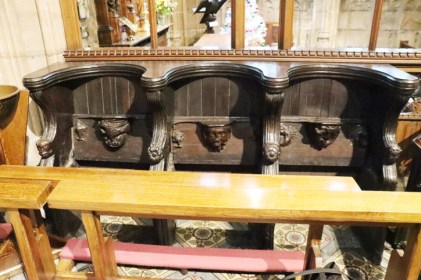
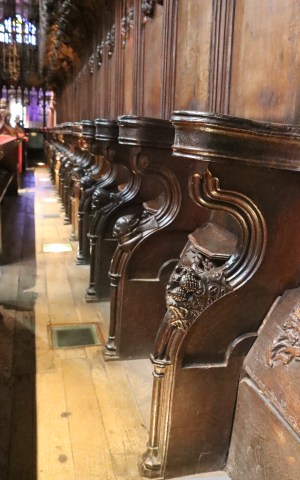
Misericords, just one component of the choir stalls, are usually accompanied by carved arm rests and often magnificent bench-ends, and in the wealthier establishments sit beneath elaborate canopies, as at Chester Cathedral, making up a fascinating ensemble of images, ideas and aesthetics.  Arm rests sit between each of the choir stalls, often running partially up the side of the stall too, creating the sense that each choir stall was an individual unit, and are often carved, usually into human, animal and imaginary figures.  Bench ends are panels at the ends of each row of choir stalls, and desks, in front of choir stalls, for holding books and music were also decorated.  Panels were carved with scenes and they were topped with little carved sculptural elements called finials.  Other sculptural features complemented and supported them.

The bigger, most prosperous establishments could afford more ambitious creations, in terms of both the quantity and quality of the misericords, but smaller establishments with suitably generous patrons often have some excellent and surprising examples to offer.  One of the features of British misericords that is not often seen in Europe is the addition of secondary carvings called supporters.  These are sometimes purely decorative, and sometimes contribute to the central subject matter.

The u-shaped choir at All Saints’ Gresford with choir stalls and misericords at north, south and, with a gap to allow access from the nave, the west (my sketch Creative Commons licence CC BY-NC-ND 4.0).

Rows of choir stalls with misericords, each with a row of narrow desks in front of them for holding music and manuscripts, face one another across the choir, as at Chester Cathedral.  In some cases there may be a third set of choir stalls at the west end, up against the screen that separates choir from nave to form a squared U-shaped choir, as at All Saints’ in Gresford.

Inevitably some establishments had misericords which have now been lost.  Peterborough Cathedral retains only three of what must have been an impressive collection of misericords rivalling other great ecclesiastical establishments.

Choir stalls at Chester Cathedral (my photo Creative Commons licence CC BY-NC-ND 4.0)

Part 1 introduces misericords and explains what they are.  Examples from Chester Cathedral are discussed.  Part 2 looks at the examples from Gresford All Saints’, Malpas St Oswald’s and Bebington St Andrew’s.  Part 3 looks at who chose the themes on misericords, where the ideas came from, who paid for them, and why some often profane images were housed in such sacred places.  Also in part 3, some final comments are followed by visitor details and a full list of the references used for all three parts.

All three parts are already written.  Part 2 has now been posted on the blog  and Part 3 will be posted shortly.  If you would like to see the list of references before part 3 is posted, please get in touch and I will email them.

On these posts, some of the photographs are mine, but others, particularly for Chester Cathedral where I didn’t use flash, have been taken from Dominic Strange’s remarkable World of Misericords website, with Dominic’s permission and my sincere thanks.  His copyright statement is here.  Please see the captions for the correct attributions.  I have included some images from all the churches discussed, but to see the complete medieval corpus of each, do visit Dominic’s site, which has complete images from all the churches mentioned in this post, plus a great many other monastic churches, cathedrals and churches in Britain and Europe. This is the type of ever-growing online resource that makes the most of the web as a platform for building  shared resources from which both professionals and enthusiasts can benefit and to which they can contribute.
xxxxxxxxxxxx

Chester, Gresford, Malpas and Bebington

St Werburgh’s Abbey in Chester was the first of these four medieval churches to have misericords installed along with their choir stalls.  Chester, being an abbey with massive financial resources, had 48 misericords of which 43 survive.  All Saints’ in Gresford had 14, St Oswald’s in Malpas 12, and it is unknown how many there were at St Andrew’s in Bebington.  A summary of the vital statistics is shown below.

Basic data about the misericords at the four churches

Chester

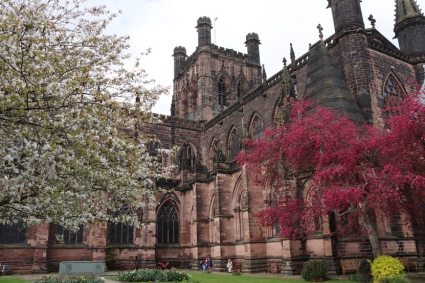
Chester Cathedral. (my photo Creative Commons licence CC BY-NC-ND 4.0)

Chester Cathedral was founded as St Werburgh’s Benedictine Abbey by Hugh Lupus in c.1092 but the choir stalls and their misericords were not installed until the 14th century, in about 1380.  The delicately crafted choir (or quire) was the exclusive domain of the monks and their daily rituals, visited only rarely perhaps by the most generous of the abbey’s patrons.  The monks were called to the choir seven times a day and once at night.  The object of the exercise was to honour and worship the glory of God.  This makes the choir the spiritual heart of a monastery.  And yet it is here that profane and irreverent images of many misericords were also resident, as fully integrated components of the monks’ devotional and liturgical lives.

The timing of the new choir stalls is particularly interesting as it follows a period of enormous national hardship, beginning with crop failure and famine, and climaxing with the Black Death.  The abbey clearly had funds at its disposal, even during such a difficult period, because the choir represents an enormous investment.  With its choir stalls, desks, benches and elaborate canopies, all carved in oak, the choir’s components were not merely functional.  Today the choir and its many flourishes are valued not only for the considerable skill demonstrated by its carvers and for its considerable aesthetic merit, but for the symbolic character of many of its representational carvings.

The layout of the choir stalls and description of their misericords. Source: Stephen Smalley 1996 (see “Sources” at end).  Click to enlarge.

Although Chester Cathedral appears at first glance to have a complete set of medieval misericords, 5 out of the 48 were, as mentioned above, replaced by Victorian restorers either to replace damaged ones or to replace those that were considered to have inappropriate themes, such as nudity or poor taste.  It is not known what happened to the missing misericords, but they were probably destroyed at the time.  Given that the Puritan soldiers of the English Civil War defaced many features of Chester Cathedral in 1645 it is astonishing that the 48 survived so long.

The St Werburgh’s Abbey examples are justifiably famous, very similar to the examples at Lincoln Cathedral, built a decade earlier, which probably provided some templates for Chester, and with which they may have shared a workforce.  Shown to the right is the layout of the misericords and the topic of each one, copied from a small and invaluable booklet that used to be sold in the cathedral shop.  It is now presumably out of print and has become very difficult to source (thanks for the loan Katie!).  Note that those misericords shown in italics are Victorian replacements.

The themes present at Chester’s St Werburgh Abbey are a phenomenal mix, so only a few can be picked out to represent some of the ideas on show.

Scene of St Werburgh’s miracles. Source: Dominic Strange, World of Misericords

Obviously religious themes and personalities are often in a minority on misericords, but where a monastery or church is named for a particular saint,  a misericord may be dedicated to that saint.  The Anglo-Saxon saint Werburgh was an 8th century nun and abbess from the Midlands.  One of the misericords focuses on St Werburgh’s miracle.  There are various versions of the story but all agree that geese were damaging the convent fields. Werburgh ordered them to be gathered up before commanding them to leave.  The convent steward, Hugh, was angry with the geese for devastating his field of corn.  One version says that whilst Werburgh was away Hugh captured and cooked one of the geese, and when she returned the remaining geese had refused to leave, forming a delegation to inform her of the event and ask for her help.  Werbugh ordered that the bones and feathers of the carcass should be gathered up, and the missing goose was reborn.  The supporter to the left shows Hugh and Werburgh rounding up the geese.  In the centre Werburgh resurrects the goose, which flies away with its companions.  On the right supporter Hugh is on his knees, repentant, and is forgiven by Werburgh.

Coronation of the Virgin in Chester. Source: Dominic Strange, World of Misericords

The infrequency of religious topics is perhaps due to a general feeling that it as unsuitable to a) hide them away and b) sit on them.  However they do occur and at Chester another obviously religious topic that requires no interpretation is the Coronation of the Virgin.  The Chester example is not the carved equivalent of a delicate Fra Angelico, being a rather chunky rendition, but it has real charm and the supporters, cittern-playing winged angels, are lovely.   The Virgin and Child is the subject of another misericord.  St George and the Dragon is another popular religious topic for misericords, an action scene that shows an uncompromising approach to demonic danger, but the one at Chester is Victorian.

The rear end of Yvain’s horse captured in the portcullis in Chester. Source: Dominic Strange, World of Misericords

Popular romance stories provide the theme for some misericords, such as the 12th century Arthurian story “The Knight of the Lion” by Chrétien de Troyes about Sir Yvain.  A snapshot from the story is captured on a really entertaining vignette.  The central scene shows a walled town with its entrance arch flanked by two slender towers.  Look closely, and you see that the rear end of a horse faces you.  As Yvain chased his opponent into the gatehouse, the portcullis was activated by a secret device as Yvain’s horse stepped on it.  The portcullis dropped, narrowly missing Yvain and chopped the horse in two.  The portcullis at the other end of the gatehouse also dropped, trapping Yvain.  All of this, and the rest of the story, would have been immediately recognizable, without showing Yvain himself, from the image of the half-horse on the outer side of the portcullis.  The horse’s arse approach to a story that had plenty of other events from which to select probably raised many smiles as well as evoking the rest of the story.  The supporters show another aspect of the tale involving two men-at-arms.

Alexander in Flight in Chester. My photo Creative Commons licence CC BY-NC-ND 4.0

Alexander the Great, very small part history and a much greater part legend and fiction, was a very popular character in the Middle Ages.  At Chester a misericord captures the notorious “flight” of Alexander.  The great leader, having reached the edge of the world, wished to explore the unknown beyond, rising both to the heights and to the depths. Perched on what looks like a piece of wood in this misericord is his throne, supported on ropes held by two griffins.  Fully equipped to take flight, he was carried over the edge of the known world to explore the unknown.

Alexander in Flight shown in the mid-15th century Talbot Shrewsbury Book, officially known as Royal MS 15 E VI (folio 20v). Source: British Library.

Having acquainted himself with the unknown world, and finding nothing left for him to conquer, Alexander returned to the known world.  Alexander’s flight to the unknown may be more favourite story than morality tale, although it can also be taken to represent the folly of all-encompassing ambition.  Alexander goes on to conquer Babylon and build himself a massive golden throne. In Babylon, he dies.  As David Williams says “Alexander is both the force that battles the monsters as he attempts to extend civilization to the ends of the earth, and he is the monster itself, demolisher of cities, reviser of history.”  The misericord’s supporters also show griffins.  Griffins are discussed further with reference to a splendid example at Gresford in Part 2.

Angry woman berating a cowering man in Chester. Source: Dominic Strange, World of Misericords

Scenes of domestic life on British misericords include some startling vignettes of women attacking men, presumably their husbands.  The marvellous example at Chester involves a woman with a dress resembling a tornado, sweeping her much smaller, cowering husband aside with a wooden implement, apparently in a garden or rural setting.  The Chester Cathedral Quire Misericords booklet describes this as “fighting couple,” which seems like something of an understatement for a scene showing a whirlwind of fury breaking loose.  Some of these many British and European woman-abusing-man misericords have been interpreted as depicting the physical, carnal and uncontrolled aspect of women.  It has also been suggested that some of them may represent male anxiety in the face of increasing female emancipation.  Perhaps, in the male-only environment of the choir, a humorous subtext was that the monastery is a much safer place for a man than a marital home.  The supporters, which appear at first glance to be floral, have angry faces at their centres, reinforcing the message of conflict and hostility.

A page from the 13th century MS Bodley 764, showing the tigress with the mirror at the top (see below). Source: Bodleian Library, Oxford

Real world animals, fish and birds shown on misericords, either local or exotic, are frequently very beautiful, but often have symbolic roles as well.  “Bestiaries” were encyclopaedia type books produced in the middle ages that not only produced information about animals (some of them mythological or imaginary)  but also put them into religious context.  An example is the fascinating bestiary now known as manuscript MS Bodley 764 available to view on the Bodleian Library website or available in print, translated by Richard Barber (see Sources at the end of Part 3).  This describes characteristics of familiar, exotic and mythological animals, many of which appear on misericords.  There is also the splendid Medieval Bestiary website, an excellent resource that lists animals (again, real, exotic and mythological) and examines medieval perspectives on each, including their symbolic value.

Herons with sinuous necks. Source: Dominic Strange, World of Misericords

The MS Bodley 764 bestiary says that a familiar British bird, the heron, symbolizes “the soul of saints or the elect, who, scorning the turbulence of this world, lest they should become ensnared in the traps of the devil, raise their minds above things to the serenity of heaven where they could see God face to face.”  A Chester misericord shows two fabulous herons, their necks sinuously curved and their heads facing upwards as though feeding off the underside of the misericord.  They are flanked by supporters that are less easy to interpret, but possibly representing demonic influences: a winged dragon with claws on one side, and on the other side a man-headed dragon with beard and an elaborate hat, scaled body and hooves.

Herons and supporters. Source: Dominic Strange, World of Misericords

The knight stealing a cub and deceiving the tigress with a mirror. My photo Creative Commons licence CC BY-NC-ND 4.0

An exotic animal displayed on a misericord was the tiger, something impossible for most people to experience, much like a unicorn, but known to be the living product of distant lands.  In this particular narrative it is at the heart of a morality tale, which is described in the bestiary.  A knight lies flat on his horse’s back, holding a stolen tiger cub in his left hand.  From this apparently perilous position he reaches to the ground and drops a mirror in the path of the tigress that pursues her stolen cub.  The tigress stops when she sees the mirror, believing that her own reflection is the stolen cub.  Together, the knight and the mirror represent demonic trickery and deceit, whilst the inclusion of the tiger provides an exotic flavour to the scene.  Admittedly the tiger doesn’t look like a tiger (no stripes either on the misericord or on the blue creature in the bestiary, shown in MS Bodley 764 above) but this was a well known scene that would have been familiar to educated medieval onlookers. 

The Pelican in her Piety. Source: Dominic Strange, World of Misericords

Some animals have specifically religious associations.  The “Pelican in her Piety” is a recurring theme and is shown on one of the misericords at Chester, as well as one of the associated carvings, representing the sacrifice of Christ to redeem humanity.  The pelican, attacked by her hungry children (representing ungrateful humanity), retaliates and accidentally kills them.  Remorsefully, she pecks her own breast until she bleeds, and this revives her chicks (representing Christ’s sacrifice for humanity).

The unicorn, his head cradled in the lap of a virgin whilst killed by a knight. My photo Creative Commons licence CC BY-NC-ND 4.0

Mythological animals on the Chester misericords also often have specific ideas associated with them, which may sometimes be an odd blending of imaginary animals with Christian ideas.  For example, there is a carving of a really lovely unicorn with a curly mane, its head in the lap of a woman (above).  Even as it lies there it is attacked and killed by a man in armour with a sword.  The woman is a virgin, and the voluntary submission of the unicorn symbolizes its respect for her pure condition, like the Virgin Mary, whilst the killing of the unicorn represents Christ’s sacrifice and the martyrdom of the innocent.  The supporters show a wyvern with scaled wings, and one with bat wings, probably demonic characters representing the eternal threat of evil.   This scene is a popular one, not confined to misericords.  Below it is an illustration in a manuscript, showing exactly the same components.

The 13th century Rochester Bestiary: British Library, Royal 12f. XIII, fol.10v. Source: Wikpedia

A friar-fox preaching to a woman. Source: Dominic Strange, World of Misericords

Animals mimicking human actions normally incorporate a particular comment on the human world, often derisive or satirical.  In St Werburgh’s Abbey, the wily fox in a friar’s habit, preaching to a woman, possibly a nun, probably represented the new mendicant friars preaching to the gullible general public.  The orders of friars in Chester were Franciscans, Dominicans and Carmelites.  These were the new kids on the block in the 13th century who, unlike the established Benedictine monks, were preaching in the streets, and mingling with people where they lived and worked, diverting donations to their own establishments and raising questions about the value of monks who were hidden away.  These scenes at several churches demonstrate Benedictine contempt for the mendicants, putting a clever and often amusing spin on their activities (the friar-foxes are often shown preaching to geese and cockerels), but almost certainly demonstrate a certain amount of anxiety about how their popularity would impact the conventional, secluded monks in their cloisters.  Another, closely related interpretation is that the fox represents the anti-establishment Lollards, deeply troubling to the church in the 14th century.

Wildman and lion. Source: Dominic Strange, World of Misericords

Mythological people also have a place on misericords.  Wildmen are a popular subject, of which there are three examples at Chester, each dealing with a slightly different theme. A Wildman (or wodehouse) is distinguished from other men by being covered from head to foot with a curly or shaggy pelt.  Only the bearded upper face, hands and feet are fur-free.  Wildmen were nearer to nature than to civilization, and accordingly had powers over the natural world.  One of the examples, known from a number of sites, shows a lion (often God) fighting a dragon (often Satan) with the supporters showing Wildmen riding, and thereby controlling, dragons.  A second example, shown here, shows a Wildman (with head damaged) riding a lion, holding its chain in one hand.  The pair are flanked by two different types of dragon or monster.  Wildmen riding dragons and lions represent nature tamed, but may also suggest the taming of passions like love and lust.

Scene from the romance of Tristan and Isolde. My photo Creative Commons licence CC BY-NC-ND 4.0

Finally, some churches have scenes that are unique or found only rarely.  Chester has a misericord showing a scene from the early 13th century Arthurian romance of Tristan and Isolde (or Iseult), which it shares only with Lincoln Cathedral.  The misericord at Chester shows the lovers in front of a tree with a dog at their feet.  In or behind the tree is Isolde’s justifiably suspicious husband King Mark, spying on the lovers.  Tristan’s dog at the feet of the lovers represents loyalty and love in most versions of the tale, but in one version of the story it is revealed that blind loyalty can be dangerous, when the dog betrays the disguised Tristan by recognizing him.  One of the difficulties of deciphering a scene like this is that there may be several versions of a popular story that include the same lead characters and supporting roles, but with different narrative twists and outcomes.

Sow and piglets. Source: Dominic Strange, World of Misericords

The misericords at Chester help to demonstrate the variety of themes and ideas that were in play in the Middle Ages, and successfully demonstrate the imagination, creativity and skill that went into the misericords in a prestigious religious institution.  They do not capture the complete range of  typical subject matters that might be found on misericords throughout Britain.  Five of them are, of course, missing, either because of damage or, perhaps more likely, because the Victorian restorers considered their themes to be inappropriate.  Even so, the massive variety of misericord subjects chosen across the many ecclesiastical institutions in Britain point to different interests and ideas in the many places in which they appear.

All of the Chester misericords are shown on the World of Misericords website at https://www.misericords.co.uk/chester.html, with short descriptions at https://www.misericords.co.uk/chester_des.html

Next

Emulating their more prestigious cousins much smaller churches could also follow ecclesiastical fashion and demonstrate, on a more modest scale, their ability to produce fine misericords and other sculptural elements of their own.  In Part 2 the twelve of fourteen misericords at Gresford, and the remaining examples at Malpas (three of twelve) and Bebington (five of twelve) are discussed.


A visit to Dafydd ap Gruffydd’s 1278 castle at Caergwrle in northeast Wales

Caergwrle Castle. Source: RCAHMW

On the top of a small hill formed of sandstone and grit, with good surrounding views, and relying partly on steep drops for its primary defence, Caergwrle Castle is ruined but contains the remains of well-built stone walls and a defensive ditch that is still quite deep in spite of the build-up of both castle and natural debris.

Caergwrle Castle, also known as Hope Castle and Queen’s Hope, was started in 1278 by Dafydd ap Gruffydd with support from Edward I.  Dafydd was the brother of the better known Llywellyn ap Gruffydd (or Llywellyn the Last) who was the last native Prince of Wales to be recognized by the English crown.  Both Llywellyn and Dafydd were grandsons of Llywelyn the Great. For a description of the ongoing conflicts between the Welsh factions represented by Llywelyn the Great, his children and grandchildren on the one hand, and the English crown under Henry III and Edward I on the other, see the post on this blog, in which I have made a stab at summarizing the complex background history.

Caergwrle Castle, c.1795 by John Ingleby showing the natural defences provided by steep drops at the west and south. Source: National Library of Wales, via Wikipedia

Today the main visible  features of the site consist of an outer double ditch and some surviving sections of curtain wall and towers.  The loss of masonry was partly due to the slighting of the site in 1282 when Dafydd abandoned it, but it was also severely damaged by accidental fire in August 1283.  Although it passed through various hands thereafter, no attempts to restore it were made, and much later it was subjected to extensive stone robbing for building projects in the valley below.  Given the indignities imposed on the castle in the past, what remains today is really quite impressive.  The main source for this post is John Manley’s 1994 Excavations at Caergwrle Castle, Clwyd, North Wales: 1988-1990 (full details and a link to the PDF in Sources at the end of the post).

Dafydd ap Gruffydd, Edward I and Caergwrle Castle

North Tower

The fortifications enclose an area some 110m x 120m.  The scale of the castle is entirely consistent with its Welsh-built siblings of the 12th and 13th centuries. When compared with Edward I’s contemporary and enduring monsters at Flint, Rhuddlan and Denbigh, Caergwrle Castle looks very modest.  The castle was started in 1278, just one year after the foundation of Edward’s first castles in Wales at Flint and Rhuddlan.  Welsh political power under Llywelyn ap Gruffudd had been pushed back to Gwynedd in the west, and although Llywelyn was still permitted to hold the title Prince of Wales, with Edward’s consent, this title was nominal, a mere consolation prize, and Llywelyn’s territory, power and status had been terminally undermined after his defeat in 1276, agreed in the Treaty of Aberconwy.

Daffydd had been a wildcard in the Anglo-Welsh conflict.  Embittered by being denied his rightful inheritance by his brother Llywelyn ap Gruffydd, in 1263 Daffyd sided with Edward’s father Henry III against Llywelyn.  Welsh law of the period demanded that when a landholder died, his property should be divided between his heirs, but when Gruffydd ap Llywelyn died, Llywelyn seized control over land that should have been divided between all four brothers, and it is not surprising that Dafydd felt betrayed and infuriated by Llywelyn’s usurpation of his birthright.

Northeast Wales, showing the cantrefi of Rhwfoniog and Dyffryn Clwyd

Following his support of Edward, and in the aftermath of the Treaty of Aberconwy, Dafydd was rewarded by Edward with lands in northeast Wales (specifically the cantrefi of Rhwfoniog and Dyffryn Clwyd), but he was aggrieved that the treaty failed to grant him his ancestral lands in Gwynedd. Llywelyn was permitted to retain all of western Gwynedd, which Dafydd felt again denied him the territory that he should have inherited from their father.  John Manley suggests that this was deliberate, encouraging a perpetual conflict between the two men, creating a psychological barrier that would discourage any attempt at an alliance between them against Edward, as well as a geographical buffer between Llywelyn’s Gwynedd and England.  Edward contributed token funds to the construction of Caergwrle Castle, and may have loaned Dafydd architectural advisors to assist with the design.  Manley draws a number of parallels between Edward’s castles and that of Caergwrle, including  corner towers, D-shaped towers, and the massive walls.

Curtain wall between the north tower and the east tower

Any real hopes that Edward’s might have had that these measures might help to seal the peace were frustrated.  Edward’s castles and the accompanying towns, all of which were being populated by English migrants, reinforced Edward’s foothold, and he must have known that the resentment generated by his annexation of Welsh land was a real risk.  Although Caergwrle Castle was built with Edward’s blessing and aid, ostensibly to defend Dafydd’s newly acquired territories against potential hostilities from native aggressors, slippery Dafydd turned against Edward in 1282.  Dafydd’s uprising must have taken Edward by surprise in a way that an uprising from Llywelyn or any of the other Welsh landholders might not have done. 

The well

Confronted with his brother Dafydd’s rebellion, Llywelyn ap Gruffydd, stuck between a rock and a hard place, threw in his lot with his brother rather than honouring the peace treaty with Edward. He was killed in battle on 11th December in 1282.  Dafydd adopted the title Prince of Wales but by early 1283, Edward I’s vast English army had hemmed in the Welsh heartland and Dafydd’s ambitions were clearly doomed.

In the event, Caergwrle escaped involvement in the rebellion.  Although Edward sent a detachment to secure it, the castle had already been abandoned by Dafydd and “slighted ” (i.e. deliberately damaged to prevent easy re-use). Dafydd shifted first to Dolwyddelan Castle in southwest Conwy whilst the English took Bangor, Caer-yn-Arfon and Harlech.  Castell-y-Bere, near the coast in mid-west Wales, was the last of the Welsh strongholds to withstand Edward’s armies, falling in April 1283.  Faced with such a comprehensive annihilation, Dafydd fled.  He was captured later that year and was tortured and put to death.  The grizzly design of Dafydd’s death is some measure of how personally Edward had taken this new revolt.  Llywelyn’s battlefield death was probably a lucky escape.

Never one to waste a resource, Edward ordered repairs to be carried out to Caergwrle Castle, as he did at a number of the other Welsh-built castles that he conquered.  This policy improved his grip on Wales at a cost that was minimal when compared to the eye-watering expense of his newly founded state-of-the-art castles.  Manley gives details of the accounts kept by John of Lincoln at the castle between June and November 1282, recording payments to men working on the castle.  Amongst the personnel receiving payments were officials, knights, archers, crossbowmen, carpenters, masons, diggers and sundry workmen. As with Edward’s newly established castles in Wales, Caergwrle’s restoration was to be accompanied by a new town and populated by English migrants.  The road layout was established, and when the castle was gifted by Edward to his wife, Queen Eleanor, a licence to hold a market was granted, but the plans for an English migrant settlement at the foot of a newly fortified Welsh-built castle were never completed.

In 1283 a fire broke out at the castle whilst Edward and Queen Eleanor were in residence, and even though excavations failed to produce evidence of a catastrophic fire, the castle was so badly damaged that it was apparently decided that additional resources should not be invested in extensive repairs.  Even when Madog ap Llywelyn rebelled in 1294 the castle was not refortified. Madog, a distant cousin of Llywelyn, apparently undeterred by Edward’s uncompromising treatment of Dafydd, decided to test the king in one final 13th century uprising.  The rebellion was suppressed.  Nearly a century later the castle was ignored by both sides during the rebellion of Owain Glyndŵr in the early 1400s.  During the 17th Century Civil War it was not one of the Welsh castles refortified for housing garrisons and storing supplies.  In all these cases, it was probably decided that the castle was too ruinous, too small or in an unsuitable location – or a combination of all three.

Features of the 13th century castle

Caergwrle Castle. Plan showing the excavations 1988-1990 shaded in grey, the standing remains in black, and the outer enclosure to the east. Source: Manley 1994, Fig. 3, p.87

The main source of information about the castle is the 1994 report of the three-season excavation that took place between1988 and 1990 (see Sources at the end of the post).  This detailed account by John Manley and contributors clarified the relationship between many of the visible and hidden remains to build up a partial picture of how the castle was designed and developed and what sort of diet the workers and inhabitants enjoyed.  

The castle is strategically well positioned on a hilltop with near-vertical drops to the west and southwest. It sits above the river Alyn, and would have had excellent views over the surrounding area.   Today the views are partially hidden by woodland. The river is not visible from the castle today, but runs along the base of the hill to its east, providing a readily available source of potable water during times of peace.

A suggested reconstruction of Caergwrle Castle from the east, showing the vulnerable aspect of the castle, defended with the help of a deep ditch. Source: Manley 1994, fig.23, p.129

As you approach the castle along the footpath from the road below, you find yourself confronted by a wooden stair-stile that crosses a ditch, as shown in the reconstruction on the left and on the plan below.  This was once a double ditch, the outer one much shallower and less easy to see today. The ditches were an important component of the castle fortifications, providing protection on the side of the castle that was not protected by the steep drop.

The red dot shows the usual visitor entry to the castle, via the footpath that begins next to the war memorial. The yellow dot shows the usual exit, which allows you to walk back down via a footpath through the wooded area.

Having crossed the ditch, you enter with castle with the North Tower on your right, with a tiny section of curtain wall beyond; and the east-facing curtain wall on your left, with the round stone top of the well clearly visible at the foot of the wall.  The wall is linked to the East Tower via the remains of an archway.  Another small section of wall connects the East Tower to the South Tower.  Opposite you, the original western curtain wall is missing in its entirety.  Even given the ruinous nature of the castle, it is easy to see how solidly it was built, with thick, tall walls and impressively big towers, showing the influence of Edward’s architects and civil engineers.

Manley identifies six different styles of wall construction at Caergwrle.  Masonry that could be most finely worked was used in prestigious areas and for specific architectural features, whereas internal walls, which would have been plastered anyway, were far less refined.  Between the inner and outer wall faces, the interior was filled with rubble.  A large quarry was identified to the northwest of the castle, and part of the hilltop itself was probably used during work to level the surfaces.

The North Tower, once D-shaped, is thought to have included a staircase and latrines.  Below ground level was a storage basement or dungeon.  Above, on the first floor, is evidence for a large fireplace.  This is linked to the East Tower by a section of curtain wall terminating in an arch.  The sandstone-faced well is clearly visible today, and right up against it excavations revealed that a lean-to building once stood against the wall.  The once D-shaped East Tower, right on the edge of a steep slope down to the valley, was , and is also thought to have housed a latrine, as well as other chambers.  The South Tower was a substantial round structure, although this is difficult to see from what remains today.  Where the East Tower meets the section of curtain wall leading to the South Tower was a bread oven made of local sandstone, a common feature in medieval castles, its internal diameter around 3m.  It is uncertain whether this belonged to Dafydd’s castle, or to Edward’s rebuild.  The excavation discovery of mortar mixing and metal working areas as well as the very basic nature of the internal structures “make it difficult to imagine that the interior of Caergwrle castle looked like anything other than a building site between 1278 and 1283.”

Metal objects found at the site. Source: Manley 1994, fig15, p.113

Finds from the castle, found during the excavations included a small amount of  medieval pottery, all hand coiled (none of it wheel-thrown), representing jugs, jars, pots and bowls.  Comparisons with assemblages from Beeston Castle suggest a 13th century date, consistent with work carried out at Caergwrle by both Dafydd and Edward.  Iron objects were few and far between but interesting, including construction materials, tools and weapons, and there were a few items of copper alloy.  Five coins were found, including three from the reign of Edward I.  Animal remains include cattle, sheep/goat (being difficult to distinguish archaeologically) and pig as well as wild species such as fish, bird and roe deer, suggesting a fairly broad range of meat dishes.

Combining all the data from the architecture and excavation, Manley conclude that Caergwrle was intended to be defended by spear “thrust or thrown” rather than by crossbow or longbow.

Visiting

Caergwrle Castle is free of charge to access and is open all year round. It is a popular destination for local dog-walkers, families and children, in spite of a moderately steep route up from road level.  There is no information about the castle at the site.  The surviving display frames, probably erected following the excavations in the late 1990s, are still standing but are empty.

Although the surrounding region is rural, the castle sits within woodland above a very built-up extended ribbon development of shops and housing along the busy Wrexham Road, and is easy to miss in the car.  I used my Google SatNav to let me know when I was passing, which notified me just in time for me to spot a sign on the right (I was heading south to north) marking the way up.  This way up is next to a conspicuous war memorial on the side of the road, just short of a Spar corner shop. You can find the pathway up on What3Words in your SatNav at ///fencing.chariots.prom.  I parked on a nearby road, but I later noticed, when driving past it after my visit, that there was a car park for the High Street further along.

The walk from the road up to the castle is trouble-free, but moderately steep, starting with a metalled ramp and then wood-boxed steps. although it only took me about 10 minutes, if that, to walk from bottom to top.  It is probably slippery in wet weather.  The top is grassy and the track to the castle is quite muddy at this time of year, and there is a stepped stile to climb into the castle.  If taking unwilling legs into account, the steepness and stile might be deterrents,  There is a seat half way up that may help if not already occupied.

I combined this short visit with a walk at the lovely Waun y Llyn country park, approximately 15 minutes away by car, providing some splendid views over the surrounding lowland hills on a fine day.

Sources

Books and papers

Davies, J. 2007 (3rd edition). A History of Wales. Penguin

Davis, Paul R. 2021. Towers of Defiance. The Castles and Fortifications o the Princes of Wales. Y Lolfa

King, D. J. Cathcart. 1974. Two Castles in Northern Powys: Dinas Bran and Caergwrle. Archaeologia Cambrensis 123.
https://journals.library.wales/view/4718179/4746669/152

Manley, John. 1994.  Excavations at Caergwrle Castle, Clywd, North Wales: 1988-1990. Medieval Archaeology, 38
https://archaeologydataservice.ac.uk/archiveDS/archiveDownload?t=arch-769-1/dissemination/pdf/vol38/38_083_133.pdf

Websites

Aberdovey Londoner
Castell-y-Bere (1221-1295) in the Dysynni Valley. By Andie Byrnes, October 31st 2018
https://aberdoveylondoner.com/2018/10/31/a-visit-to-castell-y-bere-1221-1295-in-the-dysynni-valley/

Ancient and Medieval Architecture
Caergwrle – Castle.  By Janusz Michalew.
https://medievalheritage.eu/en/main-page/heritage/wales/caergwrle-castle/

Cadw
Caergwrle Castle
https://cadw.gov.wales/visit/places-to-visit/caergwrle-castle

Coflein
Caergwrle Castle
https://coflein.gov.uk/en/site/95099/


Day trip: Edward I’s 1282 Denbigh Castle and Town Walls

Introduction

Aerial view of Denbigh Castle. Source: Coflein

The substantial remains of Denbigh Castle and its walls represent an important slice of Anglo-Welsh history, and are truly beautiful to visit on a sunny day when the castle walls and the surrounding landscape are bathed in bright, lovely light. It is thought, partly because of the original name Dinbych meaning ‘little fort’, that a previous castle, along much more modest lines, had been on the site at least from the 12th century.  The new castle at Denbigh was built by Edward I (1239-1307, reigning from 1272).  It was started in 1282, and given to Henry de Lacy to complete and defend in the same year.  It survived the 1294 rebellion by Madog ap Llywelyn, the rebellion of Owain Glyndwr in 1400 and held out under siege for six months during the Civil War in 1646, before being slighted at the end of that war in 1659.  The ruins attracted a number of painters, examples of whose work are shown towards the end of the post.  On a visit to the town, and making it a good day out, there are also impressive heritage sites to see in Denbigh, some of which I have included in the Visitor details at the end of the post.

Llywelyn the Last paying homage to Edward, sitting on Edward’s left.

It is probably impossible to fully understand Edward I’s castles in Wales without getting to grips with the longstanding conflict between the English Crown and the Welsh princes in the 13th century.  I did my best to summarize the background in a post on this blog in which, as well as discussing the conflicts, I have tried very hard to distinguish the different generations of Welsh princes from one another coherently, which is something of a challenge due to their repetitive naming conventions.  Apart from a short introduction in the next paragraph, all my comments on Edward’s military strategy, and the reasons for it, are on that post, and are not covered here.

Map of Wales showing Edward I’s new castles in Wales. Source: By Eggishorn on Wikipedia

Denbigh Castle was Edward I’s sixth castle in Wales as he headed relentlessly west to subdue Wales.  His castles at Flint, Hawarden, Rhuddlan and Builth (unfinished) in the northeast, and Aberystwyth in mid-west Wales were already underway, all started in 1277. Henry III and Edward had been troubled throughout Henry’s reign by rebellions in Wales, masterminded by Llywelyn ap Gruffud, known as Llywelyn the Last (not to be confused with Llywelyn the Great, his grandfather).  Several treaties had failed to achieve long term peace, and although the Treaty of Montgomery of 1267 looked as though it might hold, Llywelyn ap Gruffud was labelled an outlaw in 1276, and war was declared in 1277. A peace was brokered, marked by the Treaty of Aberconwy of November 1277, but although Edward had every reason to believe that the new treaty might secure peace between England and Wales, he was taking no chances and began to build a series of castles in northeast Wales, beginning at Flint in 1277, with Rhuddlan Castle started later in the same year.  These costly and invasive measures were vindicated in 1282 when war broke out again, instigated by Dafydd ap Gruffyd, Llywelyn’s brother, whom Llywelyn joined in the new uprising.  Both were killed during the war, and peace lasted until 1294 when a distant cousin of Llywelyn’s, Madog ap Gruffud, again took up arms against Edward, marking the last of the 13th century attempts to regain both lost territory and lost dignity.

Why here? The location of Denbigh Castle

Strategic importance of the castle

Denbigh in the Vale of Clwyd with the River Conwy to the west and the Clwydian range and the Dee estuary to the east.  Source:  Google Maps

Denbigh Castle was built on a Carboniferous limestone outcrop overlooking the flat plain of the Vale of Clwyd and the lowlands of the Clwydian Range of hills, rising to 468ft (142m) above sea level.  There may have been an earlier castle on the same spot.  From the point of view of visibility of the surrounding landscape it is an excellent site for a castle.  The Dee estuary lies over the hills to the northeast, and the River Conwy to the west.  The Conwy marked a natural border between east and west Wales, a border that was a frequent bone of contention between the Welsh princes of Gwynedd and the English crown, as the Welsh attempted to push west in the face of the determination of the English crown to hold them safely contained in the west.   

The Four Cantrefi. Source: Wikipedia

Denbigh lies in what was Rhufoniog, one of the so-called Four Cantrefi, four areas of north Wales that Henry III wrested from Wales and were allocated under the Treaty of Woodstock in 1247.  Following grievances with the English governorship of the Four Cantrefi, Llywelyn the Last took up the cause against Edward I. Following Llywelyn’s surrender, Rhufoniog had been granted under the 1267 Treaty of Montgomery to Llywelyn’s treacherous brother Dafydd ap Gruffudd, together with Dyffryn Clwyd, but Dafydd rebelled against Edward.  Llywelyn threw in his lot with his brother, and was killed in battle in 1282.  Dafydd was captured and then tortured and killed in 1283, after which the cantrefi reverted to the English crown, a source of bitter resentment for the Welsh. 

Edward granted land in Wales to favoured supporters, and allocated Denbigh to Henry de Lacy, Earl of Lincoln, together with the cantrefi of Rhos and Dinmael, the latter having been wrested from the rulers of northern Powys.  These three regions were combined to become Denbigh, a massive English footprint in northeast Wales.  Henry de Lacy certainly set out to make the most of his new possession, evocatively expressed by R.R. Davies:

The seal of Henry de Lacy, Earl of Lincoln

Henry Lacy, earl of Lincoln: in his new, vast lordship of Denbigh not only did he create a brand new manor (with a brand new name) for himself from forfeited and other lands, grant out sizable estates for his followers and servants (including his chamberlain and his cook), establish two studs for his horses, and carve out parks for his pleasure and stock them with deer from Cheshire; but he also declared majestically that the new land measurement to be used in Denbigh was to be a perch of twenty-one feet as gauged by the length of his own foot.

Edward’s chain of castles, the so-called ring of iron, consisted of both both fortifications and a communication network.  It was put to the test not only during the Middle Ages but in subsequent the early 1400s and the 17th century, highlighting the strategic importance of each castle. 

Economic potential of the area

View from the castle’s main gate house

Edward’s castles were not standalone constructions.  Communication networks were vital for a peripatetic king and court, but also for the movement of troops and the commercial viability of new settlements.  Each castle connected to Edward’s growing network of roads and was accompanied by a new town. Areas in which castles and their towns were located had to be economically viable to attract English settlers to potentially volatile locations.  Additional benefits were low rentals, exemption from tolls, and, in the case of Denbigh and some other towns, Edward granted the town a monopoly.  The towns were monetized, using coinage for purchases, rather than the traditional Welsh system of exchange.  Edward established mints at Rhuddlan and elsewhere to enable the urbanization of Wales.

View over fields beyond the castle walls today

Denbigh was one of the few castles built by Edward that was not a port, and did not have river access to a port.  However the land was suitable for agricultural activities and livestock rearing.  Cattle prefer good quality grazing, but sheep, which are less fussy about their food source, could be converted not merely into meat and dairy, but sheared for the thriving 14th century trade in wool and inexpensive cloth centred in nearby Ruthin.  Stevens says that the in the Denbighshire lordship of Dyffryn Clwyd, “the lord’s demesne [productive land attached to the manor] flock numbered 2,000 – 3,000 and the aggregated tenant flocks nearly as many, with several private flocks numbering between 100 and 240.”  In Dyffryn Clwyd it is known that weaving on a piecemeal basis in farmsteads supplemented other income.

The design

Burgess Gate, from the castle side

It is thought that the castle was designed and its build overseen by James of St George, who was responsible for Edward’s most spectacular castles in Wales.  It was built mainly of local limestone, with some components built in local yellow and Triassic red sandstone.  For the Green Chambers, the two-storey building with chambers over a wine cellar and meat store, a different type of sandstone was sourced from a site 16 miles (25km) north of the castle.

Today, as in Edward’s day, the castle was approached primarily via the Burgess Gate, which sits along the town walls, north of the castle.  This is a thoroughly substantial piece of architecture with the power to intimidate and impress as well as to defend.  Its original portcullis has long gone but when you stand beneath the arch you can see the carefully cared square holes in the masonry above you, which shows where the portcullis was raised.  The mechanism that operated it was on the first floor.

St Hilary’s Tower with the remnants of the church still attached to its eastern side.

Passing through the gate and heading uphill brings you to the castle, with St Hilary’s tower on your left.  St Hilary’s was a chapel with a tower at its west end dating to the early 14th century, only two decades after the castle was founded, and was altered a number of times, but the church itself was taken down in 1923.  The chapel had fallen out of use when a new church was built in the town beyond the walls in 1874.  The tower with its contemporary west doorway and its 15th century battlements are all that remains to commemorate the church.

The castle is still fairly awe-inspiring, but must have been magnificent when towering over the valley, particularly when compared to the smaller and less solidly built Welsh castles.  L.A.S Butler describes three main phases of construction work.  Initially what are now the outer defences on the south and west were built to provide a defensible enclosure within which the main building activity could be carried out.  Once the outer defences were completed, the castle was built on rather more massive lines.  The curtain walls are taller and thicker, and were interrupted by hexagonal and octagonal towers, the postern gate almost opposite the main gate and a hidden passage called the sally port allowing pedestrian movements during times of siege.

A CGI impression of the three towers that make up the gate house, showing some of the internal passageways and the locations of the three portcullis gates. Source: Castle Studies Group Journal 2015

The entrance to the castle proper is an extraordinary construction consisting of three octagonal towers, on a triangular plan, with internal passages and staircases. It was protected by a portcullis over a ditch, and contains a statue in a niche above, which may be a later addition depicting Edward II (1307-1327).  Following the attack of 1294 additional protective walls were added, with semi-circular towers at weak points.  The areas between these outer walls and the later inner walls are referred to as mantlets and offered additional protection to the completed castle. Construction work continued after the attack, both to undertake repairs and to complete most of the original design.

Today the castle walls surround a large green area along the edge of which are the foundations and partial ruins of a number of structures essential to the castle, including two wells, a great hall, apartments, a kitchen with two splendid 16ft (5m) wide fireplaces, a combined treasury and muniments tower, and a pigeon house.  The open area of green grass, the ward or bailey, was once the place where troops could muster and train, and might be used for storage.  Interestingly, Neaverson comments that the well sunk into the Carboniferous limestone would have been unreliable, with the many joints in the rock allowing water to escape, and notes that there were medieval records describing this problem.

For information about the building process involved in Edward’s early castles in Wales, see my post on Flint Castle, which quotes former mayoress Vicky Perfect’s excellent research on the subject.


The town and the walls

The town

Photograph of a wall poster from the Denbigh Castle shop, showing what the castle may have looked like in the 14th century.  Also shown in the Cadw guide book.

Like his first Welsh castle and town in Flint in 1277, the new castle-town at Denbigh,  was Edward I’s replication of a French “bastide” of the sort he had already built in Gascony, in which both the castle and the town were planned as a single entity, each supporting the other.  These new English castle-town arrangements were deeply unpopular in Wales because the land appropriated from the Welsh for the town and associated land-use was reserved for the English, part of Edward’s plan to undermine the Welsh occupation and domination of key strategic places.  Pioneer settlers were expected to help defend the town should it come under attack, but were granted commercial privileges as incentives in these troubled areas, and might attract those who were unable to generate similar opportunities in more peaceful places.  

Artefacts on display in the visitor shop at Denbigh Castle.

One of the primary activities of the new settlers was agriculture. The Welsh inhabitants were ousted and English settlers were given the most productive land.  Other settlers would have been traders and middlemen, sourcing luxury goods and other desirable produce and goods from elsewhere for sale both to the castle and townspeople.  Service industries will also have grown up, like grain mills, blacksmith forges and tanners, as well as food outlets such as butchers, bakeries and breweries and would all have been vital to a successful town.  A church and courthouse would have been essential, and would have required their own officials.

John Speed’s map of 1610. Source: Cadw

Once the land within the town walls had filled to capacity with homes and businesses, other buildings grew around the exterior of the walls, forming a very large settlement site.  Butler says that the original layout of the town in c.1282 incorporated 63 burgesses (a free citizen of the borough) each with its own burgage plot (property and attached land held by ownership or tenure).  By 1305 only 52 houses were within the walls and up to 183 were outside, the latter taking advantage of the flatter land and the easier access to water.  By 1476 there were 276 burgages beyond the walls.  A tile kiln dating to the 14th or 15th-century was found during the 1930s during building work.  15th century records refer to town routes including High Street, Beacon’s Hill, Pepper Lane and Sowter Lane, and during both late 15th and 16th centuries craftsmen included a draper, glovers, shoe-makers, mercers and weavers.  Leland, writing in the 1530s, comments that the walled town was largely abandoned in favour of lower land beyond the walls where water could be accessed and “maany welles” had been established.

The battered remains of the Carmelite Friary on the edge of the medieval town. Source: Coflein

All that remains of the medieval town within the walls is the tower of St Hilary’s Chapel, started in the early 1300s.   Beyond the castle walls, the CPAT survey dates the cruck-framed Friesland Hall House (later the Old Castle Arms and now Bryn Awelon) to the 14th century.  The same survey states that The Plough in Bridge Street was originally an L-shaped timber-framed building with a medieval rock cut cellar below.  An outlier in the medieval town was the Carmelite friary dating to c.1289.  In the current town all the other ordinary wood-built buildings will have been replaced many times over, although some of the stone cellars may date to the late-15th century during the War of the Roses, when townspeople may have decamped from within the town walls after Jasper Tudor burned the town in 1468 (about which more below).

Robert Dudley’s courthouse, now the library

In 1536 the Act of Union promoted Denbigh to one of four administrative capitals in Wales. Surviving buildings from the reign of Elizabeth I in the 16th century are the courthouse of 1571 and the incomplete church of 1578, both built by Robert Dudley, earl of Leicester, who was granted the lordship of Denbigh in 1563.   The courthouse was built in the lower town, whilst the new church took advantage of the empty spaces within the town walls.  Dudley appears to have done very little to restore the castle.  A 1610 map of Denbigh by John Speed shows only a handful of building, including the two churches, within the town walls, and a sprawling town beyond, with the 1289 Carmelite friary (the only one in Wales, and marked on the map as “The Abbey”) on the outskirts.

The walls

Walking the town walls of Denbigh

The walls were built to contain the new town and were started at the same time as the castle.  Unlike Flint’s long-gone rectangular town walls, Denbigh’s loop around in an irregular sub-circular shape, enclosing enclosing c.9.5 acres (3.8 ha), again supplied with defensive towers, offering good views over the surrounding area.  Access into the town was via two main gates in the walls, the Burgess Gate mentioned above to the north and the Exchequer Gate to the west.  You can walk a section of the walls, but you need to pick up a key to the gate from either the library or the castle shop.

The castle under attack during the reign of Edward I

Tombstone of Madog ap Llywelyn in Gresford All Saints’s Church

In September 1294 a distant cousin of Llywelyn the Last and Dafydd ap Gruffudd, named Madog ap Llywelyn, made one last- ditch attempt to repel the English before Owain Glyndŵr’s attempt over a century later.  His reasons were not simply territorial but had much to do with the English tax burden of 1/15th imposed on the region.  Madog successfully captured a number of castles, including Denbigh, forcing their defenders to retreat, but only three months later Madog was forced out of the castle, and by April 1295 the castles had been restored to the hands of their English lords.  The plan might have worked had Edward, who had mustered an army on the coast for action in Gascony, and should have been absent when the revolt took place; unfortunately for the rebels, bad weather delayed departure and Edward temporarily abandoned his campaign in Gascony and headed for Wales.  Madog was taken to London where he was held in captivity, probably until his death in around 1312.  For those in the Wrexham-Chester area, Madog was buried in Gresford All Saints’ Church (described on this blog here), where his tomb, showing an effigy of him in armour with his shield, can still be visited.  Gresford Church is very well worth a visit in its own right.

Tombstone of Madog ap Llywelyn in Gresford All Saints’s Church


Back in the wars after Edward I

Owain Glyndŵr’s Rebellion (1400 – c.1410)

Banner of Owain Glyndwr. Source: Wikipedia

By 1400 the castle had passed through a number of hands under the reigns of Edward II (reigned 1307 to 1327), Edward III (reigned 1327 to 1377) and Richard II (reigned 1377 to 1399).  In 1399 Henry Bolingbroke became Henry IV and ruled until 1413, and one of the earliest challenges of his reign was the rebellion of Owain Glyndŵr in 1400.  Glyndŵr was the last Welsh national to claim the title Prince of Wales, which had actually been conferred on Edward I by his father Henry III.  By this time the lordship of Denbigh had passed into the hands of the Mortimer family, but Roger Mortimer died in battle when his son Edmund Mortimer was a minor.  Henry IV therefore appointed Henry Percy to take charge of Denbigh, together with other administrative responsibilities in the area.  In 1400 Glyndŵr attacked the town of Denbigh, although apparently did not attempt to take the castle.  Percy, popularly known as Hotspur, planned a rebellion of his own and was interested in forming an alliance with Glyndŵr.  Fortunately for the king, Hotspur died in battle in 1403.  The preservation of the castle was possibly due to a strategic marriage between Sir Edmund Mortimer (young Edmund’s uncle) and Glyndŵr’s daughter Catrin in November 1402.  As Denbigh was part of young Edmund’s inheritance, the agreement to preserve of Denbigh’s castle from destruction might have been part of the marriage negotiation.

The War of the Roses (1455 – 1485)

Still in the hands of the Mortimer family, who supported the Yorkist cause, Denbigh Castle became the target of Jasper Tudor, who had been granted the role of constable (high official) of Denbigh, but was unable to fulfil the role until he gained access to the castle.  He made his attempt first in 1460, when he successfully took the castle for a number of months before being ousted, and again in 1468 when he failed to take the castle, but breached the town walls and set fire to the town.  The castle was again repaired after the end of the war, and as mentioned above, it appears that the area within the town walls was abandoned rather than rebuilt.

The English Civil War (1642 – 1651)

Charles I. Source: Royal Museums Greenwich

The slow decay of the castle under the earl of Leicester continued unchecked until the castle suddenly resumed strategic importance during the English Civil War, beginning in 1642, when it had to be made fit to garrison 500 royalist soldiers.  This task was allocated to Colonel William Salesbury of Rhug near Corwen (whose colourfully decorated Rhug chapel is now one of the real gems of north Wales).  Butler says that although off the beaten track in terms of the main centres of fighting, Wales was nevertheless under threat.  Its relative proximity to Chester proved useful in 1645 when Charles I’s royalist siege of Chester was unsuccessful, and the king headed to Denbigh, staying for three nights, as a royalist force assembled at the castle prior to making another attempt on Chester.  Charles and the additional royalist force were attacked by Sir William Brereton and Sir Thomas Mytton, and were defeated in the land around the Carmelite friary on the outskirts of the Denbigh town.  Within the castle, Colonel Salesbury remained under siege with 500 men from April to October 1646, only surrendering when he received a written command to do so from Charles I.  Following a brief royalist reoccupation in 1659 the castle was slighted (demolished) by the parliamentarians to prevent it being of any further value to the royalists.  It instantly became a source of very useful building material, and no attempt was made to restore it under Charles II when the crown was restored to the throne in 1660.

Denbigh Castle in Art

Denbigh Castle by Edward Dayes 1715. Source: Art Fund

All of the artworks here were painted in the 18th century, a period when an interest in the Classical ruins of the Mediterranean had also turned British artistic eyes towards ruins on the doorstep. Each  of the paintings has its own very distinctive personality, but all are part of a tradition that responded to the ruins of grand buildings, particularly castles and abbeys, as symbols of a lost grandeur, fallen kingdoms and abandoned dreams.  The Romantic fascination with aesthetically-pleasing icons of loss and decay also highlighted the inevitability of entropy as something sympathetic and pitiable.  Although unimpeded by the facts and figures behind these vast structures, there is a sense that the artists of the 18th century were finding their own way of grappling with the past.  The result was often poignant, usually striking, evoking magnificence and beauty blended with regret, redefining castles in their 18th century setting as something not merely benign but infused with a certain special value conferred upon them by their very antiquity.


Click to expand.  Denbigh by John Boydell 1750 showing the castle, the Burgess gate, some of the city walls, St Hilary’s Chapel and the Earl of Leicester’s incomplete Protestant church. Source: Peoples Collection Wales

A View of Denbigh Castle by Francis Towne, 1777. Source: francistowne.ac.uk

The Gatehouse of Denbigh Castle: Colour Study 1799-1800 by J.M.W. Turner 1775-1851. Source: The Tate Research Publications

Final Comments

Denbigh Castle ticks all the boxes as a part of the story of Anglo-Welsh conflicts in the 13th century, as an excellent example of James of St George’s architectural imagination, and as an imposing and impressive component of Edward I’s chain of castles in north Wales.  There are sufficient structural remains still visible within the castle walls to understand some of the key features regarded as necessary to the running of a castle in times of both peace and war.  Denbigh Castle also demonstrates how medieval castles could be adapted for use during the English Civil War.  As a ruin it inspired a number of 18th century artists who appreciated it more for its sense of the romantic than its military past.  As a visitor destination it offers lovely views over the surrounding landscape, and provides the opportunity to explore a small multi-period market town which has a great deal to offer in terms of its architecture and its personality. There is even an annual plum festival in autumn, which this year was held on 7th October, and which we only just missed.  At the castle, don’t miss the stairs in one of the gate towers up to the upper walkway, which gives you a birds-eye view over the interior of the castle and down into the town, across the valley and into the hills.  

Visiting

First you need to check the opening times on the Cadw website. Particularly in autumn and winter, the site is only open on certain days.  There is an entry fee unless you are a member of Cadw or an affiliated organization (again, check the Cadw website for up to date information).  If you want to walk the town walls you will need to collect the key, available with a refundable deposit from either the library in the town or in the castle ticket office and shop. The library is currently shut on Thursdays at time of writing (October 2023).

If you want to park at the castle, it has a dedicated car park that you can find by following the occasional signage, and the access to which is at What3Words address ///craftsman.obstinate.explain.  Instead of going straight to the castle we followed a leaflet, available to download from the Northeast Wales website, which took us around all of the key sites of Denbigh town (some of which are mentioned at the start of this post), so we parked behind the High Street and walked up to the castle after visiting other sites.  There are lots of other parking options that are well signposted.  A great and detailed source of information about the town is the official Cadw analysis of the town’s heritage, Denbigh: Understanding Urban Character, available for download as a PDF.  At the castle there is information signage, but if you want detailed information it is best to do the reading in advance.  There is a comprehensive Cadw guide book by L.A.S Butler dedicated to the castle, which is stuffed full of information with some really excellent maps and illustrations and is available from the castle shop, or from the usual online retailers.

There is plenty to see in the town itself.  As well as the castle and walls, medieval sites include the Burgess Gate (once the main gateway through the town walls), St Hilary’s Chapel tower (the remnant of the early 14th century church), and the ruins of the Carmelite friary dating to c.1289.  The CPAT survey dates the cruck-framed Friesland Hall House, otherwise known as Bryn Awelon with a 14th-century doorway in its southern side to the medieval period, as well as The Plough in Bridge Street, which was originally an L-shaped timber-framed building with a medieval rock cut cellar below.  Elizabethan buildings from the 16th century include the Earl of Leicester’s courthouse (now the library) and his ambitious but incomplete 10-bay church, and there are other survivors of the 16th and 17th centuries in the town.  The attractive town has plenty of substantial and Georgian homes and Victorian civic and residential projects that bring to life the wealth and confidence of the former market town.  Be sure not to miss the fabulous statue of Dr Evan Pierce on his 72ft (22m) Tuscan column.  

For those with unwilling legs:  Please note that there are pros and cons with the castle and the walls.  For the castle, I would suggest that you will miss getting up close and personal with some of the castle’s key features because many of them require going up or down slippery stone steps.  On the other hand, if you confine yourself to the grass you can still see down into most of the features and up to others, and you will still get an excellent sense of the castle’s perimeter and personality, and the views over the surrounding landscape are simply spectacular in good weather.  The upper rampart walk, reached via an original stone staircase, could be a potential difficulty, although there is a solid metal banister to grip.  The town walls are also risky when there has been even a little rain due to the unavoidable shiny stone-work underfoot and the very real potential of slipping.  I would say it is well worth the visit even if you cannot do it all.

Sources

Books and papers

Butler, L.A.S. 1990, 2007 (2nd edition). Denbigh Castle. Cadw

Davies, J. 2007 (3rd edition). A History of Wales. Penguin

Davies R. R. 2000. The First English Empire: Power and Identities in the British Isles 1093-1343. Oxford University Press (https://academic.oup.com/book/7027 requires institute access)

Morris, M. 2008. A Great and Terrible King. Edward I and the Forging of Britain. Penguin

Neaverson, E. 1947.  Mediaeval Castles in North Wales. A Study of Sites, Water Supply and Building Stones.  the University Press of Liverpool, Hodder and Stoughton Ltd.

Stephenson, W. 2019. Medieval Wales c.1050-1332. Centuries of Ambiguity. University of Wales Press

Stevens, M.F. 2019. The Economy of Medieval Wales 1067-1536. University of Wales Press

Walker, D. 1990. Medieval Wales. Cambridge Medieval Textbooks

Websites

Cadw
Denbigh Castle
https://cadw.gov.wales/visit/places-to-visit/denbigh-castle
Denbigh Town Walls
https://cadw.gov.wales/visit/places-to-visit/denbigh-town-walls
Denbigh: Understanding Urban Character (PDF)
https://cadw.gov.wales/sites/default/files/2019-05/Denbigh-%20Understanding%20Urban%20Character_0.pdf

Castle Studies Group
CSG Annual Conference Proceedings, Wrexham 2015, Individual Site Summaries. CSG29 2015 Wrexham Conference.  Castles of North East Wales – Denbigh.  Journal no.29 2015-2016.
http://www.castlestudiesgroup.org.uk/page153.html
http://www.castlestudiesgroup.org.uk/CSGJournal2015-16X8-pp1-120Final-Denbigh-58-89-low-res.pdf

Clwyd Powys Archaeological Trust
Denbighshire Historic Settlements (index)
https://cpat.org.uk/ycom/denbigh/denbigh.htm
Denbigh

https://cpat.org.uk/ycom/denbigh/denbigh.pdf

Ancient and Medieval Architecture
Denbigh – Castle

https://medievalheritage.eu/en/main-page/heritage/wales/denbigh-castle/

Enjoy Medieval Denbighshire (PDF) leaflet
https://www.northeastwales.wales/wp-content/uploads/2022/03/medieval-denbighshire.pdf


The splendid Grade-1 listed Llangar Church, Cynwyd, near Corwen

The small Llangar Church is exceptional.  It is Grade-1 listed and a Scheduled Monument located in the Dee valley not far from Corwen. From its lovely lime-washed white walls and its small but well-filled churchyard to its painted interior and box pews, all set in the middle of a field, there is so much that is unexpected in Llangar Church. It has been subjected to detailed historical and archaeological research, and is accordingly much better understood than many other churches in north Wales.  This work, looking at over 500 years of use, means that there is far too much information to include here.  We were shown round by visitor guide Heather on the day, who was excellent, but there is not always a tour available, so the official Cadw guide book is certainly one way go to if you want a more informative account, with 18 pages dedicated to Llangar Church.  The survey and excavation report published in Archaeologia Cambrensis in 1981 (pages 64-132)  is the most detailed report available, and can be accessed online.  See Sources at the end of this post for both.

Visiting details and a map are at the end, but do note that this can be combined with a visit to the brightly painted 17th century Rhug Chapel, which is a 5-10 minute drive away, also on the map at the end (and about which I have posted here).

The meaning of the church’s name remains uncertain.  One interpretation suggests that it it can be translated as “Church of the White Deer,” whilst another suggestion is that it might refer to the name of a neighbouring Iron Age hillfort.  The Coflein website refers to it as “All Saints.”

Whatever the meaning of its name, the first documented evidence of it dates to 1291 and the church was probably founded earlier in the 13th century, serving local farms and the services that supported them.  It escaped the destructive attentions of the Reformation, and was used until 1856, when it was replaced by a new church in Cynwyd that was both bigger and far more conveniently located.  Although abandonment of the church, combined with its relatively inconvenient location, led to neglect, decay and damage, it fortunately escaped being plundered for building materials, and avoided the indignities of Victorian restoration work that usually augmented and remodelled what was found rather than merely preserving an architectural legacy.

It was not until the 1970s that conservation work accompanied by survey and research projects began to rescue the site and uncover some of its complex architectural and social history.  The church was not a time capsule of a single particular period, but a palimpsest of multiple periods.  This was a living, breathing community resource for over the 500 years, and as people and ideas changed, so did the church.  The Cadw analysis of the architectural development of the church identifies five main phases:  Medieval, Early 17th century, Mid to Late 17th century, early 18th century and later 18th and 19th centuries.  The scatter of painted and engraved dates through the church from the 17th century suggest that that this was a period when the church underwent a number of repairs and modifications.

The churchyard

The entrance to the churchyard is marked by an attractive and remarkably solid 18th century stone lych gate, with double wooden doors.  Like all lych gates it provided a shelter for coffin bearers and a place to rest the coffin bier until the service began, and also served as a formal entrance to the churchyard.  The slate roof has two tiers of decorative pointed tiles on the churchyard side.

The churchyard is on a slope.  To provide a flat surface on which to build the church, material was removed from the east and transferred to the west end.  The dangers of this scheme, leaving one end much more consolidated and compressed than the other, resulted in later structural problems on the north side (opposite the porch side) and at the west end.  Over the the decades, many of the headstones have started tilting downhill.

The cemetery has a particular charm all of its own, which is difficult to define but has something to do with the simplicity of the grave monuments, and the general absence of ostentation. The earliest of the monuments in the churchyard date to around 1600.  Chest tombs of the 17th and earlier 18th centuries cluster close to the church itself, whilst those further away were later.  These later graves were both chest tombs and graves marked by a headstone and footstone.  The cemetery went out of use in the 1870s, when the church was abandoned.  The church and churchyard, built into the side of a hill, are rather exposed and some of the inscriptions are very worn.  Interestingly, most of those graves before 1825 were inscribed in English, whereas later ones were largely in Welsh.

18th century

1821

1841

There is also a sundial base just beyond the church porch.

Llangar Church and churchyard showing the northwest corner, by the Dee, completely free of graves. Aerial view. Source: RCAHMW Coflein

In general the north side of a churchyard was the last to receive graves, either because it had previously been in use for community activities or because, being darker and colder, it was less attractive for visiting.  In the case of Llangar the northwest corner remained entirely free of burials right up to the moment of its abandonment, but this is probably because of problems with subsidence, a theory supported by various changes made to the church’s architecture to counter structural difficulties.

The church exterior

The guide book has a step by step tour of the exterior as revealed by the survey work.  It is a fascinating detective story over two pages, perfect for anyone doing a self-guided tour on a dry day.  The short version is that the south wall (porch side) dates to the Middle Ages, and the north wall was medieval but was modified over the centuries, with some windows blocked and others added. The north wall is now propped up by a modern retaining wall added during the renovation, but it is worth looking out for a top-to-bottom jagged line like a crack at the west end, which shows where structural work was carried out in the second half of the 17th century.  The west wall was rebuilt in the early 18th century.  The porch was added in the early 17th century, re-roofed in 1702, and the big ornamental window in the Perpendicular gothic style probably dates to around the same time.   

The interior

Visitors enter the church via the porch with two stone benches, probably dating to the early 17th century.  There is paintwork and various pieces of graffiti carved into wood and stone. Take note too of the noticeboard showing some of the restoration work.

As you walk in to the church, you are confronted with a fabulous red-painted life-sized skeleton representing Death, at gallery level on the opposite wall.  As a reminder that a church is the interface between the living and the dead, and that life is only a temporary condition before interment and Judgement Day, this can scarcely be beaten.  There are more details about this image below.

The ground floor is a single space with a floor covered in stone slabs and a small overhead gallery at the west end, which was probably used for the musicians.  There are no aisles or other architectural divisions.  The space beneath the gallery was clearly reserved for parts of the congregation that had the lowest status, at the furthest distance from the sacred east end, and was very dark and cramped beneath the low ceiling.

The earliest parts of the wooden beamed ceiling are thought to date to the 15th century, although timbers were replaced and repaired in subsequent centuries, and today most of them are modern, from the 1970s restoration.  The east end, traditionally the sacred end of a church, is marked by a “canopy of honour” dating to the late 15th or early 16th century, a barrel-shaped ceiling that would have shown sacred themes in paintings that have now been lost.  It is thought that they may have looked like those at St Benedict’s Church at Gyffin near Conwy showing the twelve apostles (its website is here, complete with a virtual tour).  

The only feature that would have furnished the church of the Middle Ages to survive is the simple font set into a niche, which has been moved from its original position, probably in the 18th century.  Most of the surviving fittings date to the early part of the 18th century.

From the 18th century, the public sat in the surviving box pews along the north wall and on backless bench pews on the south wall.  Four of the elegant box are dated 1711 (belonging to the Hughes family of Gwerclas, 1759, 1768 and 1841.  One preserves the initialse of one of its occupants.


Another pew, at the south side of the 18th century altar and dated 1841, was used by the rector’s family.  Opposite, on the other side of the altar, is a painted 18th century cupboard topped with a winged angel.  It is set into the north wall dating to the 18th century, with three keyholes, requiring three keyholders.    The altar itself dates to the 18th century but was built of 17th century wood.  The window above the altar is flanked by two panels, which between them show the Ten Commandments, in Welsh.  Originally the east end would also have housed a pulpit, but this was moved to part way along the south wall.  It is  a three-tiered pulpit, which was probably moved from the east end sometime after 1732 to allow the altar rail to be employed for the giving of the sacrament.

Like nearby 17th century Rhug, Llangar’s interior wall paintings escaped the whitewashing vigour of the Reformation, but unlike Rhug, the paintings represent different time periods, from the 14th to late 18th centuries. Some images were overpainted with new ones, and many are very faint.  One of the paintings has been removed to preserve it and is now in the exhibition area at Rhug Chapel.  The Cadw guide contains a full description of all of the paintings, by A.J. Parkinson, but here are some highlights.


North wall

Most of the images were intended to provide visual material to support sermons, which Parkinson refers to as “teaching aids.”  The fabulous skeleton is brandishing time’s arrow in one bony hand and a winged hour-glass in the other.  Between his legs are a shovel and pickaxe, tools of the gravedigger. He is dated tentatively to 1748, the death of rector Edward Samuel, who was a notable Welsh scholar and poet.  Looking to his left, on the front of the gallery, are some elegant yellow frames with floral motifs, containing texts that are now too faint to read, but may by Biblical.  


To the right of the skeleton, over the window, is the name of the rector in 1730, and to the right of this was the Royal Arms of the same period, now in the Rhug Chapel visitor centre.

The rest of the north wall above the box pulpits contains overlapping images, the earliest of which, possibly 14th century, is a bishop (very difficult to make out) in the doorway of a substantial and rather exotic church, the towers of which can be easily seen.

The red frame possibly dates to the 15th century and probably contained a narrative, such as the life of Christ, or scenes from the lives of saints.  Other decorations along the wall were painted over in the 18th century.

On the south wall are a series of morality-themed panels outlined in red, probably dating to the 15th century.  All are very faint.  Some of them show representations of the Seven Deadly Sins, in which each sin is personified and is shown riding an appropriate animal.  These are very difficult to make out, but are almost unique.  Jane Durrant’s reconstruction below shows what they may have looked like in the late medieval period (scanned from the Cadw guide book).

Cutaway reconstruction showing teh south wall panels as they may have looked in the 15th century. By Jane Durrant. Source: Cadw guide book by W. Nigel Yates (full details at end, p.28).

On the left is a stag, representing lechery, and on the right is a wild boar representing gluttony, two of the Seven Deadly Sins

The gallery with benches, at the west end, is reached by a flight of stone stairs. It probably housing the musicians and singers, retains a very unusual four-sided music stand.

Abandonment of the church

Llangar church with a temporary roof. Source: RCAHMW https://coflein.gov.uk/en/site/93771/images

From the Middle Ages to the 19th Century populations changed, and parish boundaries often ceased to be representative of where people were concentrated and wanted to worship.  In the middle 19th century Llangar and Gwyddelwern were neighbouring parishes, but Llangar’s population did not exceed 251 people dotted around the parish, whereas Gwyddelwern’s population had reached 1,118, of which nearly half lived in Cynwyd, near to Llangar.  In 1853 the decision was made to redraw the parish boundaries so that Cynwyd was in the parish of Llangar, but at the same time it was also decided that a new church should be built at Cynwyd to replace the inconveniently located Llangar Church.  Llangar Church had gone out of use by the mid 1870s except for occasional burials.  Some abandoned buildings are robbed for their materials, but Llangar survived intact, although as its roof deteriorated, so the rest of it came under threat.

Restoration

Noticeboard in the church porch

The importance of Llangar was recognized in the 1960s, and it was taken into care by the Welsh Office in 1967.  Restoration work began in 1974.  There is a noticeboard in the porch of the church showing some of the restoration work, as well as on the Coflein website.  Amongst many other restoration activities, one of the big structural changes accomplished during the restoration was the addition of a retaining wall on the outside of the original wall on the eastern end of the north side.  This should continue to stabilize the church to secure its future.  The roof was largely rebuilt, and most of the interior required conservation work.  Survey work, involving a number of different specialists, began to reveal the history of the church and churchyard.

Final Comments

More than any other church that I have visited in recent years, Llangar provides a sense of a place of social congregation.  This was off the beaten track, even for rural people who came from their farms and forges to attend the Sunday service.  Many of them will have met at market, but a sense of real community probably only developed on the back of the weekly congregation, which was a social as well as a religious activity, attended by entire families.   The paintings on the walls, changing over time to suit different needs, helped to involve the congregation in the Christian narrative, surrounding them with key messages and providing them with a sense of context.  The painting here was not merely decorative, like Rhug, but invested with shared articles of faith.  It is a small place, but it has a real impact.

Visiting

Source: Google Maps (with my annotations).  Llangar Church is at the bottom of the map, Rhug at the top.

Before setting out, it is vital to check the website, because the church is open only on certain days of the month in the spring and summer, and is closed during autumn and winter.  Do note that opening times are timed to coincide with those of nearby Rhug Chapel, so you can do both at the same time. https://cadw.gov.wales/visit/places-to-visit/llangar-old-parish-church

Llangar Church and its churchyard are located in the Dee valley in a field just off the B4401, a well-used tourist route to the eastern side of Lake Tegid (sometimes referred to as Lake Bala).

Map sourced from the Coflein website with my annotations

There is a large lay-by opposite the farm track that gives access to the church.  The church is sign-posted, but when I was there the sign was hidden by tree branches.  There is a small post box on a pole next to the farm track that leads to the church, and a sign on the open gate for Station Cottage.  The track leads downhill for a minute or two, past farm buildings on the left. The road goes hard right and then hard left.  At the left turning, there is a gate on the right hand side (with a sign to its left saying Guide Dogs Only) that takes the visitor across a field, complete with mud and cow-pats, through a small gate on to a grassy footpath flanked by upright slates.  This leads to the lych gate and the churchyard beyond.

For those taking unwilling legs into account, although it is only about 5-10 minutes from car to lych gate this is very slippery underfoot after rainfall, meaning that this would almost certainly be better approached during a dry period.  Part of the graveyard is on a steep slope, which would make exploring it challenging, and there are steps up to the gallery within the church, but otherwise there should be no difficulties.

If you want to get the most out of the visit, the guide book is very helpful (see Sources below), covering both Llangar Church and Rhug Chapel as well as Gwydir Uchaf Church near Betws-y-Coed, which I have not yet visited, but looks fabulous.  The guide book is particularly strong on Llangar Church.  It can be purchased at Rhug Chapel, or ordered online from the usual sources.

If you plan to include a walk in your visit, the farm track from the road leads to a public footpath that runs along the disused railway track, which a couple who had arrived early recommended.  There are many good walks in the Corwen area, some of which are detailed in an excellent leaflet, which can be downloaded here as a PDF.

Sources:

Books and papers

Parkinson, A.J. 1993. The Wall Paintings. In Yates, N.W. Rug Chapel, Llangar Church, Gwydir Uchaf Chapel. Cadw, p.37-39.

Yates, N.W. 1993. Rug Chapel, Llangar Church, Gwydir Uchaf Chapel. Cadw

Additional reading:

Shoesmith, Ron 1981.
Llangar Church. Archaeologia Cambrensis vol.129, January 1981, p.64-69
https://journals.library.wales/view/4718179/4748029/87#?xywh=-163%2C-2%2C2584%2C3638
Llangar Church. The Graveyard Survey

Archaeologia Cambrensis vol.129, January 1981, p.70-132
https://journals.library.wales/view/4718179/4748029/93#?xywh=-169%2C-8%2C2584%2C3638

Although I haven’t yet managed to get hold of it Heather, the Cadw visitor guide, also recommended R. Suggett’s Painted Temples: Wallpaintings and Rood-screens in Welsh Churches, 1200–1800. RCAHMW 2021.

Another book that I haven’t yet seen, to which Peter Carrington alerted me, is Archaeologies and Antiquaries: Essays by Dai Morgan Evans edited by Howard Williams, Kara Critchell and Sheena Evans. Archaeopress 2022, which has four chapters dedicated to Llangar.
https://www.archaeopress.com/Archaeopress/Products/9781803271583

Websites

Coflein
All Saints Church, Llangar
https://coflein.gov.uk/en/site/93771/
All Saints Church, Llangar, Images
https://coflein.gov.uk/en/site/93771/images

National Churches Trust
St John the Evangelist, Cynwyd
https://www.nationalchurchestrust.org/church/st-john-evangelist-cynwyd

Gresford All Saints’ Church – exterior gargoyles and grotesques

A previous post took a quick chronological hike through All Saints’ church in Gresford, which dates mainly from the 15th century but includes features dating back to the 13th century.  As with many gothic churches, the exterior may be architecturally consistent with what is going on inside, but often has a rather different character that seems scarcely in keeping with the sacred, the holy and the peaceful ideas associated with a monument to the divine.  The photographs on this page are a small selection from All Saints’ Church, dating to the 1400s or later, shown at random.  If you want to visit the church, maps and visiting details are on the previous post.

There is a lot of writing about gargoyles and grotesques, much of it descriptive, and there are some terrific books of photographs to show what these creatures looked like, but there are no definitive answers about what these external features were actually doing there.  So far, a job description remains elusive.

Gargoyles and grotesques each has a slightly different definition.  Both are usually made of stone, and are high up on on or under the rooflines of church, cathedral and abbey, or clustered around windows and door openings.  Some may be highly sculptural and elaborate, and others are less complex, but all make up a landscape of the unknown.  They are all carved into fantastic forms, some fearsome, some weird, occasionally crude, and every now and again borderline pornographic.  Gargoyles are usually grotesques, but not all grotesques are gargoyles.  A gargoyle is a carving that draws water away from the building, spewing rainwater out through its mouth or rather more unusually its rear end via a water spout.  A grotesque is any ecclesiastical carving that merits the term, something from another world, a creature from an alternative reality or a reality just out of sight, something of nightmares and fears.  Some may be monsters of the imagination, some grotesquely distorted human faces, some composites of recognizably human and animal features, others simply odd.

Grotesques and gargoyles occupy liminal spaces, between heaven and earth at the top of buildings, and at boundaries between interior and exterior at windows and doors.  Notre Dame Cathedral in Paris is famous for its gargoyles and grotesques, and vividly demonstrates how in the bigger ecclesiastical constructions, many of these features are invisible from ground level and always would have been.  This may imply that some of these creatures were intended not only for human audiences, but for supernatural observers too.

One evocative piece of contemporary writing on the subject survives.  The vigorous Cistercian  monk, abbot and mystic Bernard of Clairvaux was unimpressed by gargoyles in the following oft-quoted 12th century piece, but what is interesting is that he seems to have been just as ignorant of their actual symbolic purpose as researchers today:

What are these fantastic monsters doing in the cloisters under the very eyes of the brothers as they read? What is the meaning of these unclean monkeys, strange savage lions and monsters? To what purpose are here placed these creatures, half beast, half man? I see several bodies with one head and several heads with one body. Here is a quadruped with a serpent’s head, there a fish with a quadruped’s head, then again an animal half horse, half goat … Surely if we do not blush for such absurdities we should at least regret what we have spent on them.

Although different types have been identified and named, creating a terminology to enable discussion of the different forms that appear, this is a matter of categorization rather than comprehension.  Identification of recurring themes such as hunky punks, chimeras, and sheela na gigs help to navigate the landscape of the grotesques, but do not explain what they are doing there.  A number of explanatory approaches have been attempted, but these simply serve to underscore that there is no consensus on the role of grotesques and how they should be understood.  Here are a few examples, in no particular order:

  • Depictions of demons or heretics as a warning against sin and depravity , and as an aid to church teachings, to reinforce the campaign against sin
  • Demons vanquished and expelled by the Church
  • Illustrations of specific Christian texts
  • A vivid contrast to the divine and the angelic: “The gargoyle is all body and no soul – a pure projector of filth, the opposite of the angel whose body is weightless and orifice-less” (Michael Camille).
  • Representations of paganism
  • Warnings to intruders not to violate the holy space within
  • Figments of the imagination
  • Critiques of human monstrosity, reflections of imperfections in humanity and the individual
  • Devices to reinforce religious hierarchy:  “These glimpses of the impossible, in their absurdity, work to safeguard the established order and whatever is promoted as normal and morally right” (Alex Woodcock)
  • Copies of earlier forms that have lost their meaning over time

Alex Woodcock comments:  “If there is no definitive answer to the question fo why they are there, then it is because the carvings themselves are too full of possible meanings, and paradoxical ones at that, to be comfortably explained – and perhaps that is the point.  In his book Medieval Religion and Its Anxieties, which looks at “the other Middle Ages”, Thomas Fudgé suggests, apart from St Bernard, we have no real way of reaching what people in the Middle Ages saw and thought they looked on grotesques: “It seems clear that viewing medieval art through modern yes is fatal and that creating artificial categories with the use of terms such as marginal, official, high, low, and so on when referring to art is a form of hegemony by posterity on the past.”

Yet although they may not be marginal, in the pejorative sense of the word, the grotesque and the peculiar often do occupy the margins, not only in architecture, where they occupy distant spaces and boundaries, but also in illuminated manuscripts, rather like subversive or thought-provoking comments on the main message.  This idea of the strange and inexplicable occupying the margins is explored by Michael Camille, in his book Image on the Edge.  Here the margins are an active component of the core text, be that text an illuminated manuscript or an architectural narrative, or indeed a social situation.

Fudgé traces a chronological trend within grotesques, describing 13th century gargoyles as terrifying, whilst in the 14th century “they took on comedic dimensions that by the fifteenth century gave way to amusement.”  As Camille says, “The medieval image-world was, like medieval life itself, rigidly structured and hierarchical.  For this reason, resisting, ridiculing, overturning and inverting it was not only possible.  It was limitless.”  During the process, fear was replaced by fun, and monstrous elements of human nature and activity became the targets of satire.  Grotesques disappear during the Renaissance, when their role was apparently no longer relevant.

The gargoyles and grotesques on the exterior at All Saints’ in Gresford are carved a mix of forms and sizes, and date to when the church was re-designed and given two new side aisles in the 1400s.  Some of the grotesques look down from the roof and tower, a lot are arranged in a line above a string course just beneath the roof of the side aisles, whilst others sit on finial bases or above window corbels, much nearer to the observer, and perhaps most threatening, although as the photo to the left shows, not all of the carvings were fearsome monsters; some were unalarming representations of human faces.  I have photographed all those that can be seen from ground level, some rather more successfully than others, and as a corpus it is quite a remarkable collection of images.  Only a small selection are shown here.  They are delightful to the modern eye, perhaps rather less so to the late Medieval church-goer.
——–
—–

There are more photographs, high quality images taken at the level of the gargoyles and grotesques, on the Images tab of the All Saints’s page on the Coflein website, together with images of statues amongst the pinnacles.  See  more too on the Archives page. Some of them provide an excellent overview of the imagery that exists at roof level.

Sources:

Camille, Michael 2019 (2nd edition).  Image on the Edge. The Margins of Medieval Art.  Reaktion Books.

Fudgé, Thomas, 2016.  Medieval Religion and its Anxieties.  History and Mystery in the Other Middle Ages.  Palgrave Macmillan

Woodcock, Alex, 2011.  Gargoyles and Grotesques.  Shire Publications

Big and bold: All Saints’ Church in the small village of Gresford

All Saints’ Church in Gresford is such a short hop from my parents’ home in Rossett that I should have visited years ago, but somehow never got around to it.  I tried a couple of times earlier this summer, but the church was busy in its role as a community resource, which was good to see.  The church is big.  Although it is difficult to imagine when driving along the Chester-Wrexham road, Gresford was originally a small village, noted in the Domesday survey as part of Duddestan in the Cheshire Hundred.  A sense of village life still remains in the buildings that surround the churchyard, together with the charming village pond just down the road, complete with lazy ducks sunbathing on warm summer days.  All Saints’, reaching most of its present extent in the 15th century, was an imposing presence, and must have been a source of considerable local pride.

The location of the Church of All Saints in Gresford. Source: streetmap.co.uk

For a detailed account of the church’s history, see the history page on the Gresford All Saints’ website.  This post provides a short overview of some of the key features, with photographs.  First, a note on the name.  Most churches in the area are named after particular saints, but All Saints refers, as it name suggests, to all Christian saints.  The saints represented by “all,” however, include not only those who are known but those who remain unrecognized.  All Saints’ Day is celebrated in Catholic and some Protestant churches on 1st November annually.  The owner of the Church of England Saint Dedications web page calculates that it is the second most popular church dedication in England, after St Mary.  Although Gresford is in Wales, just over the border, it switched hands between England and Wales throughout its earlier history.

The Grade 1 listed All Saints’ is unexpectedly impressive for its understated setting.  Much bigger for example, than Worthenbury’s St Deiniol’s, with which it shares a sense both of ambition and commitment.  Today both are clearly much-loved by their communities, and both vie for the title of the finest parish church in north Wales.  The significant difference between the two is that whereas St Deiniol’s was built between 1736-9 by Richard Trubshaw with real Georgian panache, All Saints’ is thought to have been founded in the 13th century and was in almost continuous use from at least the 14th century.  The 11th century Domesday survey mentions a church and priest, but this church was apparently replaced by the establishment of the Gresford church, either in the same or slightly different location.  All surviving walls are made of local high-quality Cefn yellow sandstone, which is used for many of the municipal buildings in Wrexham.  A separate post about the exterior gargoyles and grotesques has been posted on the blog here.

The late 13th and 14th centuries were a period of energetic church building in England and Wales.  It is thought that the remarkable gothic architectural projects carried out at two notable sites created a tidal wave of enthusiasm for architectural projects in religious establishments. One was the new and remarkable shrine created for Archbishop Thomas Becket in Canterbury Cathedral, murdered on 29th December 1170, who was canonized only three years later and therefore required a shrine worthy of his status, into which his remains were transferred (translated) in 1220.  The other was the ambitious shrine built by Henry III for St Edward the Confessor at Westminster Abbey, completed in 1269.

When All Saints’ Church was built in the 13th century, prestigious contemporary religious buildings included, for example, St John the Baptist Church in Chester founded in 1075, St Werburgh’s Abbey, founded in 1093 and Basingwerk Abbey founded 1132.

Subsequently All Saints’ underwent many alterations and embellishments in the centuries that followed, including the 14th century addition of the tower to a lower level than today, together with a south aisle.  There was an almost total rebuild in the 15th century and the upward extension of the tower in the 16th century.  The dominant style, following the 15th century rebuild, is known as Late Gothic Perpendicular, a peculiarly English style that emphasized the tall and thin aspects of the Gothic, mainly exhibited in the stone tracery of the stained glass windows, which make up an enormous part of the interface between interior and exterior.

The only clue to the original appearance of the church lies in a 16th century document that claims that it had been “strangely and beautifully made erect,” which is intriguing but not particularly helpful.  The church is rectangular in plan with a tower protruding at the west end and two porches.

All Saints’ sits within a churchyard.  The earliest grave marker dates to 1696, and there are some from the 18th century.  Most date to the 19th century.  There is a good mixture of chest tombs and gravestones of different designs and styles of engraving. The churchyard’s oldest occupant is in fact a lovely yew tree (Taxus baccata), estimated to be 1600 years old.  The other yew trees were planted in 1726.  Often associated with churchyards, yews have a mixed reputation, seen both as symbols of immortality and indicators of impending disaster, the latter association perhaps because of its toxicity.  In this context, it seems clear that the yews are intended to represent life everlasting.

The exterior features of the church include crenulations, and follows the gothic tradition of adding gargoyles, which draw water away from the roof, and decorative sculptural elements, including small beasts, real and imaginary, and tortured faces, usually referred to as grotesques, as well as floral themes. Some of these sit on the stringcourse, a few of which are positioned under hood-moulds (projecting reliefs to protect the underlying features from rainwater).  They are worth a post in their own right, if only to capture some of them with a telephoto lens so that they can bee seen much more easily than with the eye, which I will do in the next month or so.

Internally, the church is divided into traditional sections. The nave (the main body of the church where the public sit in pews) is flanked by two side aisles at ground floor level, marked by two 7-bay arcades.  A clerestory (row of windows above the level of the aisle) provides the nave with much more light than the stained glass alone.  A screen, erected in the 15th century, divides the nave from the sacred end of the church, the chancel with the choir and high altar.  The chancel is flanked by two chapels, which can be reached from the aisles.  The north aisle, shown above, used to run directly into one of the two chapels that flank the choir and altar, but is now partially interrupted by a 19th century organ.

The church has seen continuous use since the 13th century.  The main surviving feature of the 13th century is the crypt, closed to the public but accessed via the north chapel. The 14th century is represented by a number of key internal features. In the south aisle, the effigy of Madog ap Llywelyn ap Griffith, who died in 1330, lies in a niche, shown in full armour with a lion rampant on his shield.  The inscription reads HIC IACET (here lies) MADOC AP LLYWELYN AP GRIFFI

Almost opposite, and dating to the same period, is another niche, this time showing the beautifully engraved gravestone of Goronwy ap Iowerth.

The inscription, with thanks to  the ArchaeoDeath blog of Professor Howard Williams (where you can find more 14th century engravings from the church) reads:

HIC:IACET:GRONW:F’:IORWERTH:F’:dd’.CVI’:AIE:DS’:/ABSO/LWAT
Here lies Goronwy son of Iorwerth son of David, whose soul may God absolve.

The raised 14th century sanctuary with the high altar, approached via a flight of steps, sits over the 13th century crypt.

From the 15th century are the fabulous misericords (carved scenes on the undersides of seating in the choir) and one of the church’s real treasures, the  gorgeous wainscoted screens (the central panel of which was vaulted, photograph further down the page), and a very fine stained-glass window behind the high altar donated by Thomas Stanley, Earl of Derby and step-father of Henry VII.  The font, at the west end, with its eight panels that include depictions of the Virgin Mary with the baby Jesus, the lion of St Mark, and possibly St Leonard, also dates to the 15th century.

Don’t forget to look up. The ceiling is a particularly fine camberbeam structure, crossed with rafters, with painted panels and bosses.  At the ends of the rafters are carved wooden angels.

So why was the medieval church so popular that it could afford a new tower in the 14th century and a major rebuild to include new aisles and new features in the 15th century?  In her booklet about All Saints’, Bethan Jones suggests that the gifts showered on the church, including furnishings, might suggest that it had acquired a relic and had become a pilgrim destination.  Relics generated considerable incomes for cathedral, monastery and church alike.  In Chester, the Rood of St John’s Church was a popular pilgrim destination, and in the 14th century the shrine of St Werburgh in the Chester abbey had become popular.  To the west, the shrine of St Winefrede at Holywell and the church at St Asaph were also on the pilgrim circuit.  No record survives of such a relic at Gresford, but it is difficult to account for the size of the church in any other way, other than a major investment by a donor who wished to make his mark on the church during the period of the Reformation, but neither is there any record, documentary or material, of such a benefactor.

16th century features include the fine stained glass windows in east and north walls of the Lady Chapel, reached via the north aisle. In the Trevor Chapel there is a superb painted 1589 memorial to John Trevor (Sion Trefor), lying as though still alive, with his head propped thoughtfully on one hand.  His coat of arms is above and a winged skull beneath.  An inscription conceals the central portion of his body.

The church continued to be well used throughout its history.  Dating to the 17th century, the Trevor Chapel a charming memorial to John Trevor’s daughter-in-law with her daughters dates to 1602, and another, rather more monumental piece, shows her with her husband (shown further down this post) and dates to 1638.  Other memorials in the church also date to the 1600s.


In the 18th century, a number of additions were made.  The two chandeliers in the nave date to the mid and late 18th century.  The south porch (the main entrance to the church today) had stained glass panels added in the 18th century to commemorate local deaths during the First World War.  The first mention of the bells is in 1775, when three of the bells were mentioned I the parish register having been returned after being recast at Gloucester, meaning that there were at least three bells in the tower at that date, the tenor, third and treble bells, although in 1873 six bells are listed so it is possible that there were six bells in 1775.

In the 19th and early 20th centuries a number of alterations and additions were made, mostly sympathetic to the original structure. The 15th century east window was restored during the 19th century, using additional glass, but has remained true to the original.  In St Catherine’s Chapel, better known as the Trevor Chapel, there are two hatchments for George Boscawen (who died in 1833) and Thomas Griffith (who died in 1856), both shown immediately below.  The Hill and Son organ was installed in 1912. The addition of the north porch in 1921 to serve as a war memorial included old fragments of glass.  A painting in the Trevor Chapel commemorates the Gresford Colliery Disaster of 1934 and serves as a memorial to the 266 men who died.  This is shown at the very end of the post, following the list of sources.

An intriguing object in the church is a short square column, made of stone and carved with a figure holding a pair of shears.  It may date to the Roman occupation, and it is possible that one face represents Atropos, one of the three Moirai or Fates, responsible for cutting the “thread of life” (the metaphor for a human lifespan).  It was found during excavations at the east end of the church.

Final Comments

There is too much to say about Gresford All Saints’ on a single post, and I will revisit the church on future posts to look specifically at the choir and misericords, the gargoyles and grotesques that accessorize the exterior of the church, and the churchyard itself.  Apologies for the highly granular photographs of the interior, including some which are slightly blurred around the edges, both of which were caused by having to photograph in very low light.  I hope that the images are good enough to give a sense of the magnificence of the church and some of its features.

Here are a few more photos, in completely random order, and please see Visitor Information below them.


Visitor Information

The church is open daily, but is a living church and may not always be available for visitors.  It has services on a Sunday and on Thursday mornings, marriages and funerals during the week and on Saturdays, and may be used as a community resource for events such as the annual craft fair.  Check the church website for it’s opening times and events.  It took me three attempts to find it free of activities, which is great news for the church and its future, and no bother for me as I live locally, but check the website for information, and it may be worth emailing the contact address on the website if you are coming from further away.

There are plenty of information boards throughout to explain the key features, but not so many or so big that they intrude on the atmosphere of the church.  If you are interested in the history, the colour booklet by Bethan Jones provides a tour of all of the key features.  It can be purchased (cash only) at the church, where there are a number of leaflets and postcards available on the shelves to the right as you enter, including one devoted to the bells.

The Trevor Chapel on the south of the church (right as you look towards the altar) is used for private prayer, but is accessible to visitors when it is not in use. The crypt, with an entrance from the Lady Chapel, is closed to the public.

For those with unwilling legs, it’s an easy to access church, with no steps needed to negotiate the entrance via the porch on the north side.  The nave, the choir and the chapels can all be accessed without using steps.  Being an active church, there are plenty of pews in the nave on which to sit down and absorb the atmosphere.

Sources

Books and booklets

Bethan Jones, 1997.  All Saints Church Gresford. ‘The Finest Parish Church in Wales’.  The Friends of the Parish Church of All Saints Gresford.

Hubbard, E. 1986. The Buildings of Wales: Clwyd (Denbighshire and Flintshire). Penguin Books

Roberts, F.H. 2013.  All Saints’ Gresford. Tower and Bells. All Saints Church, Gresford

Wooding, J.M. and Yates, N. (eds.) 2011.  A Guide to the Churches and Chapels of Wales. University of Wales Press

Websites

All Saints Church Gresford
Home Page
https://www.allsaintschurchgresford.org.uk/
History Page
https://www.allsaintschurchgresford.org.uk/about-us/our-history/

ArchaeoDeath blog by Professor Howard Williams
Gresford’s Medieval Monuments
https://howardwilliamsblog.wordpress.com/2018/03/04/gresfords-medieval-monuments/

Clwyd and Powys Archaeological Trust
Church of All Saints, Gresford
https://cpat.org.uk/Archive/churches/wrexham/16785.htm

Church of England Saint Dedications
https://blanchflower.org/cgi-bin/qsaint.pl

Imaging the Bible in Wales Database
Church of All Saints, Gresford, Wrexham
http://imagingthebible.llgc.org.uk//site/188

A roof boss in Chester Cathedral: the murder of Thomas Becket

The Thomas Becket ceiling boss in the Lady Chapel, Chester Cathedral. Photograph by Andie Byrnes

  • Introduction
  • Who was Thomas Becket?
  • The Becket Boss in the Lady Chapel of St Werburgh’s Abbey
  • Final Comments
  • Sources

Introduction

Chester Cathedral plan (annotated). Source: Wikipedia

In the 13th century, Abbot Simon de Whitchurch (1265-1291) began the construction of Lady Chapel in St Werburgh’s Abbey (which is today Chester Cathedral, and about which I have posted here, with visiting information including accessibility).  It was dedicated to the Virgin Mary. In the ceiling, where the vaulting ribs meet, three round ceiling bosses high above the floor show religious themes.  One shows the Holy Trinity and the second shows the Virgin Mary and the baby Jesus.  The third, shown above, shows shows the murder of Thomas Becket, Archbishop of Canterbury, by four knights loyal to Henry II on 29th December 1170 in Christ Church Cathedral in Canterbury.  It is one of only two Becket ceiling bosses known to survive in Britain; the other is at Exeter Cathedral (shown below left).

Exeter Cathedral’s Thomas Becket ceiling boss. Source: Feasts, Fasts, Saints and the Medieval Church blog

What these two busy little scenes in Chester and Exeter depict was a brutal and savage act of great violence.  The murder of Becket was a violation one of England’s holiest precincts, a modern martyrdom, and an affront not only to the ecclesiastical hierarchy in England but to the papacy itself.  All eyes turned towards Henry II.  This was not the sort of attention that Henry wanted, and he spent the rest of his reign attempting to distance himself from the event.

The news of the murder spread swiftly and was deeply shocking to 12th century English and European society.  The terrible events were captured by eye witness accounts, not least that of the clerk Edward Grim who attempted to intervene and protect Becket. Almost immediately miracles were attributed to Becket, and only three years later he was canonized by the pope, becoming St Thomas.  His story was told in biographies of the saint, and his scenes of his life, martyrdom and miracles were rendered in wood, stone and paint, whilst relics were assiduously collected and displayed. In a world where martyrs and their deeds were factual events but remote, the real-time martyrdom of the head of the English church by representatives of the king was religious persecution in action, fresh and alarming in a way that past events might not be.  It was unthinkable.

Document dating to around 1180, around a decade after the event, showing the murder of Becket, from an eye-witness account by John of Salisbury (Cotton MS Claudius BII f.341r). Source: British Library.

From the moment of his murder, people were attracted to Christ Church cathedral to commemorate Becket.  His canonization made Christ Church Cathedral a formal and very desirable pilgrim destination.  The shrine itself, completed 50 years after Becket’s death, became one of Europe’s top pilgrim sites.

The saint was still attracting pilgrims in the 16th century when Henry VIII, identifying the cult of Becket as a challenge to his absolute control over religious as well as secular matters, ordered that every image of the martyr should be destroyed.  The systematic annihilation of Becket shrines and images contributed to the demise of Becket’s legacy, which was reinforced by further systematic defacements of Catholic artistic and architectural themes during the Reformation, including various monuments in Chester Cathedral, including the St Werburgh shrine.

Who was Thomas Becket?

Becket’s early career

Map of Medieval Cheapside, Medieval London in the 1560s. Source: Medieval London, Fordham University

Thomas Becket was the son of a Norman merchant who moved from Normandy (northwest France) to take up opportunities in London following the invasion of William I in 1066.  Gilbert and his wife Matilda lived in commercial area of London called Cheapside.  Gilbert rose to the position of sheriff, climbing several rungs on the social and political ladder.  It is thought that Thomas Becket was born around 1118-1120.

Becket was was born into the period of civil war between King Stephen and the Empress Matilda (mother of Henry II).  He received a good formal education, first at Merton Priory (now in southwest London), and later at a school in London.  In his late teenage years he went to Paris to study, in a Parisian heyday of scholarship and artistic endeavour.  His studies included some of the most popular scholastic topics, including grammar, rhetoric and canon (church) law, which were essential tools for anyone wanting to make their mark on the world, but did not include any formal religious education.  He returned to England in the early 1140s under the reign of Henry II, who was crowned as monarch on the death of Stephen in December 1154.

Seals of Archbishop Theobald and of Christ Church, Canterbury. Source: “Theobald. Archbishop of Canterbury” by Avrom Saltman via the Internet Archive

In the mid 1140s Becket was recommended to the Archbishop of Canterbury Theobold of Bec (c.1090-1116) and obtained a role as a clerk in the cathedral, a mainly administrative position which, however, offered opportunities for advancement. A cathedral is both the principal church of the diocese and the seat of the bishop and, as at Christ Church, often included a monastic establishment.  Becket’s Paris education was probably attractive to Theobold, who had a number of similarly educated young men in his employ.  Like most incumbents of the Canterbury archbishopric, Theobold was both a cleric and a diplomat, closely involved in crown matters, but had twice been exiled by King Stephen due to his intervention in political matters.  He sent Becket to Auxerre in France and Bologna in Italy to study law.  Law, divided into Church (canon) law and state law, was rapidly becoming an important topic in Medieval England.

Becket’s rise to power

The 12th-century Topographica Hiberniae (Topology of Ireland) by Gerald of Wales shows a rare contemporary image of the king. Source: Wikipedia

In 1154 Becket was promoted to the role of Archdeacon of Canterbury. As well as the financial rewards that enabled him to satisfy his love of luxury, his new position was sufficiently prestigious for Theobold to recommend Becket to the 21-year old Henry II as the new royal chancellor.  Henry’s coronation at Westminster Abbey, following the death of Stephen, had taken place in the same year.  Their professional relationship evolved into a friendship over a period of eight years as Becket flourished in a position of enormous responsibility.  It was a mark of Becket’s success in this role that on the death of Theobold in 1161 Henry moved to appoint him Archbishop of Canterbury, to hold both positions simultaneously.  Becket had no religious ambitions, had received no clerical training and consequently had never been ordained into the priesthood.  In spite of these drawbacks, Becket was elected to the role by the monks of Canterbury and the bishops of southern England.  Ordination was rushed through, and Becket was consecrated as Archbishop on 3rd June 1162.  His appointment was confirmed by Pope, who sent him a pallium, a vestment that symbolized his new office and status.

Needless to say, the appointment was not universally celebrated.  Quite apart from the fact that Becket had made enemies on his rise to power, decisions such as the appointment of an archbishop was one of the areas of conflict between Crown and Church.  The Church thought that it should have complete autonomy over its own affairs, answerable only to the papacy and  to God; but the Crown, conscious of the power and wealth wielded by the ecclesiastical institutions, wanted to exercise its own authority over the activities of the most important institutions, including Canterbury.  The right to appoint the most senior ecclesiastical personnel, was only one bone of contention.  The right of the Church to operate under its own canon law was another.

King Henry II and Thomas Becket arguing. Peter of Langtoft’s Chronicle, Royal 20 A II, f.7v. Source: British Library

There was no reason to think that Thomas Becket would not continue to remain completely committed and loyal to the Crown.  It was therefore a very unpleasant surprise to Henry II when Becket began to take his new role seriously, resigning his position as chancellor to focus on promoting the rights of the Church and representing the authority of the papacy.  From this point forward, Becket and Henry had opposing interests.  Becket’s training in law put him in an excellent position for arguing that the Church, rather than the Crown, should be in charge of ecclesiastical justice, in which Church clerics who committed even violent crime would be judged not by secular courts but by the far more lenient ecclesiastical courts.  There were many other disputes between the two, when Becket took a stand not only where ecclesiastical interests were involved, but in matters of state as well.  Henry attempted to resolve the situation by imposing a set of “customs,” or rules adhered to in the era of Henry I, Henry II’s grandfather, assembled in the Constitutions of Clarendon to which he commanded that Becket and all the bishops defer.  Although Becket at first refused to ratify the document, he and the bishops eventually submitted to pressure and signed.  However, Henry was seriously annoyed and began to investigate Becket, finding grounds for ordering him to court to address a number of charges.  When Becket refused first to accept the charges against him and then to reject the resulting sentence, he made the decision to flee to France.

The Abbey Church of the monastery of Pontigny. Photo by Mediocrity. Source: Wikipedia

Becket lived in exile at the Cistercian monastery of Pontigny in France from November 1164 until 1170.  In exile he attempted to drum up support, but alienated Henry still further by excommunicating a number of his advisers. Pope Alexander sent papal legates to try to resolve the dispute instructing Becket to refrain from taking any more actions against the king and his court, but in April 1169 Becket excommunicated another ten royal officials.  In 1170 Henry’s son Henry was crowned as the Young King, in a secondary role to Henry II order to settle any potential succession disputes.  The coronation was presided over by the Archbishop of York, Roger de Pont L’Évêque.  It was the right of the Archbishop of Canterbury to preside over coronations, and Becket responded to this insult by laying an interdict on England, with the pope’s permission.  This forced Henry back to the negotiating table, and he came to terms with Becket on 22nd July 1170.  Becket returned to England in the December of that year. One might have thought that Becket would count his blessings, but before he arrived he could not resist excommunicating the three individuals most closely associated with the coronation of the Young King, one of whom was the Archbishop of York.  The three appealed to the king, who was in his Normandy territory, and it was at this point that Henry, in a rage, expressed his frustrations about Becket’s latest act of rebellion.  What Henry II actually said is not recorded, but it spurred four of his knights to set off for Canterbury from Normandy.
———-

Murder in the cathedral

One of the earliest known representations of the murder of Becket (c.1175–1225). British Library Harley MS 5102, f.32. Source: Wikipedia

The knights rode from London to Canterbury.  They left their armour and weapons outside the cathedral precinct, intending to arrest Becket and return him to London for trial.  Becket was having none of it.  Eye-witness accounts state unambiguously that Becket’s behaviour was that of a very angry man under serious threat, confronting the knights on the steps of the cathedral.  Goaded by Becket’s verbal retaliation and refusal to back down, they retreated to put on their armour and retrieve their weapons, returning to slaughter the unarmed archbishop in rage.  Blows of the sword to his head killed him relatively swiftly, producing an alarming amount of gore that spilled onto the floor around him.  One of the swords struck him so powerfully that the sheer momentum carried it to the ground, snapping the end off the blade.  Edward Grim, who attempted to intervene, was badly injured.

His murderers were Reginald FitzUrse, William de Tracy, Richard Brito (or le Breton) and Hugh de Morville.  FitzUrse, whose name means “son of bear,” is often marked out on images of the murder with the image of a bear’s head on his shield.  He is shown on both the Chester and Exeter bosses.   Having committed the crime, the knights headed for Yorkshire where they remained for a year.  Curiously, Henry made no move against them, but in 1171 Pope Alexander III excommunicated them, and 1172 they headed for Rome to seek absolution from the pope.  It is thought that they were probably sent on crusade, and either died on their way, or in battle, although there are a number of unsubstantiated traditions about their ultimate fates.

The Christ Church was closed for nearly a year so that Pope Alexander III could be consulted on how to proceed so that the cathedral could be re-consecrated and returned to normal use, rejuvenated as a destination for pilgrims.

Miracles and legacy

Detail of the Canterbury Christ Church Cathedral miracle window, which shows some of Becket’s miracles. Source: Reverend Mark R Collins blog

Until his death, Becket had been a political creature, and a representative of ecclesiastical interests.  He did not position himself as a man of the people, but as a newly inspired champion of the rights of the Church.  This did not prevent the place of his death becoming a destination for pilgrims of all social scales, even before he was officially canonized.  Curiously, Becket was not merely an emblem of devotion to the Church and a promoter of its rights in the face of opposition from the Crown, but a saint who produced miracles for the everyday person, becoming an unlikely saint to act on behalf of the general populace.

A reconstruction of the Thomas Becket shrine in Canterbury Cathedral. Source: Smithsonian Magazine

The first miracles reported following the death of Becket took place at his tomb.  Hundreds of others soon followed, 703 being reported within the first 10 years, many recorded by Benedict of Peterborough.  Within twenty years of the murder, no less than twenty biographies had been written about the saint including contemporary accounts including, for example, those by John of Salisbury, Edward Grim and Benedict of Peterborough, the latter listing many of his miracles.  Images of him in various media appeared all over Europe, and his relics spread just as far.  As the Oxford History of Saints comments laconically, “His faults were forgotten and he was hailed as a martyr for the cause of Christ and the liberty of the Church.”  In short, Becket and the miracles associated with him went viral.

Thomas Becket pilgrim badge. Source: Museum of London

Fifty years after his death, a new shrine was opened with great ceremony, and St Thomas was moved into a new tomb within the shrine.  It was a spectacle of gold and precious gems, and was surrounded by stained glass windows telling the story of his life and miraculous works. At the height of its popularity, it attracted over 100,000 pilgrims a year. In the Jubilee year of 1420 the shrine earned £360 for Canterbury Cathedral, which equates today to around £231,483, which could have purchased 83 horses or 620 cows (data from the National Archive’s Currency Convertor) or could have been used to build a new section of cathedral.  Images and symbols of St Thomas were moulded into ampullae and badges for the hundreds of pilgrims who visited his Canterbury shrine.  The shrine no longer survives; it was destroyed in 1538  under the orders of Henry VIII.
——–

The Becket boss at St Werburgh’s Abbey

The Lady Chapel

The Lady Chapel, Chester Cathedral

St Werburgh’s Abbey featured many architectural-sculptural elements which embellish the core structure of the building, providing focal points, colour and a hint of glamour.   The Lady Chapel was built under Abbot Simon de Whitchurch (1265-1291).  In Burne’s words, “He was evidently an outstanding character and under him the abbey flourished exceedingly.”  It was a period of great prosperity for the abbey, with an income derived from, amongst other things, church pensions (a sort of tax), appropriated church tithes, gifts of houses and lands, and possibly pilgrimage to the reliquary-shrine of St Werburgh, although the new shrine  to the saint was not built until the 14th century, and it is unclear how important it was as a pilgrim destination before then.

Although the earliest known Lady Chapel predates the Norman invasion, the Lady Chapel became particularly important in the 13th century when the Virgin Mary was undergoing a resurgence of devotion.  The elegant, vaulted Lady Chapel St Werburgh’s was built in the 13th century.  Like most Lady Chapels it was built to the east of the High Altar, projecting from the main building.  Here clerics performed daily services to the Virgin Mary. It is easy to forget that most architectural elements would have been brightly painted, but the Lady Chapel in Chester Cathedral, restored to a typical colour scheme of green, blue, red and gold in the 1960s, provides an excellent example of how these components would have looked.  The lancet windows at the end of the chapel date to 1869, when Gilbert Scott removed the later Perpendicular window to be more faithful to the 13th century vision.

The Holy Trinity, with God holding the arms of the crucifix in his hands

Some Lady Chapels are large and ornate, but in some cases they form smaller, more private and tranquil spaces than other chapels within a monastery or cathedral.  The Chester example is delectable, its small footprint and relative height giving a sense of both intimacy and space.  The reconstructed shrine of St Werburgh, a victim of the Reformation’s hostility to reliquaries and idolatry, is located at its east end, but according to Jessica Hodge was probably originally at the east end of the quire.

The ceiling bosses form a row across the centre of the chapel, from east to west.  The east end was symbolically the most sacred, and it is at the east end of the chapel that the ceiling boss showing the Holy Trinity is located.  In the centre is, the Virgin Mary is depicted, and at the west end is the Becket boss.  The chapel was created during a period of great religious significance during the reign of Henry III, who had been crowned for the second time in 1220, the same year in which Becket’s remains were moved to a custom-built shrine on July 7th 1220, reinvigorating the already vibrant cult. The spectacular event was used by both the Archbishop of Canterbury, Stephen Langton, and the king to help to heal the ongoing rift between the Church and the king.  In 1225 Henry ratified the Magna Carta, granting the freedom of the Church.  This was a momentous decade in the Church’s history and religious houses throughout Medieval England rode the crest of this remarkable period during the rest of the century with new architectural projects, rebuilding, expanding and celebrating.  By 1260-1280 when the Chester Lady Chapel was built, it was the centenary of Becket’s death.  It is possible that the Becket boss was installed to commemorate this event following an ecclesiastically bright start to the century.

The St Thomas ceiling boss

Ceiling bosses are both architectural and sculptural elements, usually circular or sub-circular, positioned in the ceiling where the vaulting ribs that form arches meets, either to hide the join, or acting as keystones to add structural integrity to the complex set of tensions and stresses. There can be much more to them than first glance suggests, and behind the decorated end, an undecorated portion of the boss may be inserted into the join.  Examples on the floor of the cloisters provide a good idea of this, showing the decorated section that would face down, and the plain stump that would be inserted into the join.

Three relatively large stone vaulting bosses were provided at the point where seven or eight stone ribs of the slender vaulting meets, each carved and painted with a different aspect of Christian iconography.  Smaller bosses were also added to at vault joins, where three or four ribs meet, sculpted into beautiful foliage, and gilded.  Corbels, where the vaulting ribs begin, are also decorated with foliage.  These carved stone features would all have been carved and painted prior to installation.  The white painted ceiling and walls between the brightly coloured features are the perfect foil for them, providing them with reflected light and emphasizing the  rich colours.

The Becket scene offers a sanitized version of the traumatic event on 29th December 1170, recycling a scene that bears only a passing resemblance to the terrible violence of reality, one version of a standardized formula for representing this event, an overstuffed and static little scene that looks rather like a posed portrait, with all of the protagonists shown full face, as though looking towards a camera. The composition is curious.  Three knights dominate the scene.  Sir Reginald FitzUrse is identifiable, as he is in the Exeter ceiling boss of this scene, by the bear’s head on his shield.  One knight at the front strikes at Becket’s head.  At the back of the group is clerk Edward Grim holding a cross and appears to preside over the scene.  Becket is squashed into the lower right hand section of the scene, kneeling behind an altar, his hands held, palms outwards, in front of him.  Behind him, even more squashed and barely visible, is the fourth knight, striking at Becket’s head, his sword converging with the sword of the knight in the foreground.  In spite of all four swords, the most dynamic element of the scene is the way in which Becket’s hands are raised in front of him, either in prayer, supplication or in a gesture of surrender.

Exeter Cathedral ceiling boss. Source: Feasts, Fasts, Saints and the Medieval Church blog

By contrast, the Exeter ceiling boss, which Burne says is about a century later, makes rather more compositional sense, placing Becket at the centre of the scene, looking out at the viewer with his hands raised, whilst the knights crowd in on him, intent on their deadly purpose while Grim does his best to ward them off.  It has far more dramatic impact, and is easier to understand as a narrative.  Both bosses share the same formulaic approach to the event.

When the chapel was built between c.1260 and 1280, over a century had passed since the martyrdom of Becket, and the detail of the real event had become less important than its symbolism and the theological narrative built around it.  Becket shown praying in front of an altar conveyed the sense of Becket’s purity and holiness far more efficiently than the actual scene of anger, shouting and resistance that preceded the murder. Similarly, the Grim was not a cross-bearer clerk.  However, there is an obvious dramatic advantage to showing him holding the cross as he confronted the knights in support of Becket.  It remains a peculiarity of the scene that the knights and Grim are the central characters, whilst Becket is squeezed to the side.

Who was the intended audience?

Lady Chapel, Chester Cathedral

In the 13th century the eastern end of the abbey church was the exclusive domain of the abbey monks, and it is unlikely that the Lady Chapel was seen by anyone else.  By the 14th century, the pilgrim status of Chester, with the miraculous holy rood in St John’s, and nearby pilgrim destinations at Holywell and St Asaph, lead to a reinvigorated interest in the Anglo-Saxon St Werburgh.  A new shrine to St Werburgh was built in the 1300s and according to Jessica Hodge, was situated at the east end of the quire, presumably accessed via the nave and the north aisle.  Pilgrims to the shrine would therefore have been granted access to the usually private east end, and they may have been shown the neighbouring Lady Chapel and the Becket boss as part of their pilgrimage.  Some of them may have included a visit to the Nunnery of St Mary in their travels, which possessed a relic in the form of the girdle of Thomas Becket.

Lady Chapel corbel

When they were new, the monks would have been well aware of the subject matter of the ceiling bosses.  As time went by they may have been repainted and repaired, but there will have been periods when they receded into the background.  Even today, people don’t always look up, and even when they do, they are not always sure what they are looking at.  Even if access had been generally available, the ceiling bosses are so high up that it is difficult to see the detail without either a telephoto lens or a ladder.  When I was last there, I pointed the Becket boss out to a lady who asked what I was photographing, and the only way that she could make it out, even with her distance glasses on, was to see the enlarged image on the screen of my digital camera.  Similarly, I only really got to grips with the subject matter on the other two bosses by photographing them and bringing them up on my computer screen later.

If one factors in the available lighting in the Middle Ages, which was confined to any light that passed through the stained glass windows, supplemented by candles, it is unlikely that these bosses were generally very visible from the ground.  Compare them with those in the enclosed walkway (cloister), which are much closer to the ground and therefore much easier to appreciate.

Why were images of Becket purged during the 16th century?

The Becket boss prior to restoration. Source: Godfrey W. Matthews, The Becket Boss in the Lady Chapel, Chester Cathedral

Chester became a cathedral after the Benedictine monastery of St Werburgh was dissolved by Henry VIII.    In spite of this lucky escape, it is possible that the ceiling boss was deliberately defaced at this time. Godfrey W Matthews, writing in 1934, described it as follows:  “It is very badly worn, which is curious, as the two bosses to the east of it are in a good state of reservation.  It is possible that some attempt had been made to deface it, for the figures suggest chipping.” Henry VIII imposed a policy of extreme prejudice against Becket, ordering all images of him to be destroyed.  The tomb and pilgrim shrine in Canterbury were removed in 1538 and Becket’s mortal remains disposed of.  Images throughout the country were removed.

Chester Cathedral also came under fairly savage review during the Reformation, when various architectural features and monuments were maimed or destroyed to remove overtly Catholic themes.   Most of the survivors are in high places that were difficult to reach.

Are ceiling bosses works of art, or mere architectural flourishes?

Stonemason, artist and researcher Alex Woodcock, whose PhD focuses on Exeter stone sculptures, highlights how the bright colours and dark shadows at Exeter were contrasted to give reveal a sense of depth and to emphasise the three dimensional character of the bosses and corbels.  This can be seen at Chester as well, where the depth of the three dimensional aspect of the sculpted forms provides a sense of theatre and allows simple shapes to be very skilfully highlighted.  Woodcock points out that architectural sculpture “is often assumed to be secondary to free-standing sculpture, possibly because of its very architectural function” and that because the boss would have been there anyway, the images are seen less as art than mere decoration.  As he points out, however, “in terms of the hours needed to complete the carving using hand tools, their production would appear almost prohibitive in terms of expense today.”  Not all ceiling bosses and corbels are good art, but many of them are tremendous and well worth the time taken to appreciate them as stand-alone works.

Final Comments

The Lady Chapel in the 1870s. Source: Blomfield 1879

Most of us learned a version of the “turbulent priest” story at school.  This was a man who stirred up hornets’ nests in his role as Archbishop of Canterbury, both within the royal court and within the cathedral.  He divided opinion in his own lifetime, finding friends and making enemies.  His immediate legacy was to generate a healthy income for Canterbury Cathedral, as pilgrims flocked to share in the wonders of the miracle-worker.  Politically, he became an ongoing reminder of the conflict between royalty and the Church, a symbol not merely of spiritual martyrdom, but carried with him a morality tale about the dangers of the crown having absolute power over both the church and the people.

On a vaulting boss in Chester Cathedral, accompanied by the Virgin Mary and the Holy Trinity, Becket and his murderers look down on the visitor.  Representing a scene of appalling violence, Becket, Grim and the errant knights are a reminder that throughout the early Middle Ages, the Church and the King were equally powerful, and serious conflicts ran the risk of monstrous outcomes.

After nearly 400 years of popularity, Becket and his legacy were terminally undermined by Henry VIII and the Reformation, destroying his images in cathedral, church, monastery and private residence.  Queen Mary briefly restored both Catholicism and Becket’s status, but Elizabeth I followed her father’s lead.  Although Becket is remembered today, the split from the papacy and the tidal wave of the Reformation swept away his significance and his popularity in Britain.  Having said that, the lady I was chatting to in the Lady Chapel in Chester Cathedral told me that in the congregation of her Liverpool Anglo-Catholic church they follow the missal, and continue to commemorate the date of Becket’s murder.  Although he survives mainly as a historical figure, Thomas Becket has not vanished from view.

Sources:

Books and papers

Bartlett, R. 2013. Why Can the Dead Do Such Great Things? Saints and Worshippers from the Martyrs to the Reformation.  Princeton University Press

de Beer, Lloyd, and Speakman, Naomi 2021. Thomas Becket,  Murder and the Making of a Saint.  The Trustees of the British Museum

Blomfield, Reverend Canon 1859. On the Lady Chapel in Chester Cathedral. Courant Office. Digitized by Project Gutenberg
https://www.gutenberg.org/files/61922/61922-h/61922-h.htm

Burne, R.V.H. 1962. The Monks of Chester. The History of St Werburgh’s Abbey. SPCK.

Crouch, D. 2017. Medieval Britain, c.1000-1500. Cambridge University Press

Farmer, D. 2011 (5th edition). The Oxford Dictionary of Saints. Oxford University Press

Guy, J. 2013. Thomas Becket. Warrior, Priest, Rebel, Victim.  A 900-Year-Old Story Retold.  Penguin

de Hamel, C. 2020.  The Book in the Cathedral. The Last Relic of Thomas Becket. Allen Lane

Hamilton, B. 2003.  Religion in the Medieval West.  Arnold.

Hamilton, S. 2021. Responding to Violence: Liturgy, Authority and Sacred Places c.900-c.1150.  Transactions of the Royal Historical Society 2021, 31 (202), p.23-47.

Hodge, Jessica 2017.  Chester Cathedral. Scala Arts and Heritage

Jenkins, J. 2023. Who Put the ‘a’ in ‘Thomas a Becket? The History of a Name from the Angevins to the Victorians, Open Library of Humanities 9(1) https://olh.openlibhums.org/article/id/9353/

Luxford, Julian 2005. The Art and Architecture of English Benedictine Monasteries, 1300-1540.  A Patronage History. The Boydell Press p.21-27

Matthews, G.W. The Becket Boss in the Lady Chapel, Chester.  Historic Society of Lancaster and Cheshire 86, 1934, p.41-46

Orme, N. 2017. The History of England’s Cathedrals. Impress

Schmoelz, M. 2017. Pilgrimage in medieval East Anglia.  A regional survey of the shrines and pilgrimages of Norfolk, Suffolk, volume 1.  Unpublished PhD thesis, University of East Anglia, June 2017

Webster, P. 2016. Introduction. The Cult of St Thomas Becket: An Historiographical Pilgrimage.  In Gelin, M and Webster P. (eds.) The Cult of St Thomas Becket in the Plantagenet World, c.1170-1220.  Boydell and Brewer.

Williams, Godfrey W. 1934.  The Becket Boss in the Lady Chapel, Chester.  Historic Society of Lancaster and Cheshire 86, 1934, p.41-46

Woodcock, A. 2018 (2nd edition). Of Sirens and Centaurs.  Medieval Sculpture at Exeter Cathedral. Impress Books

Websites

British Museum
A Timeline of Thomas Becket’s Life and Legacy
https://www.britishmuseum.org/exhibitions/thomas-becket-murder-and-making-saint/timeline-thomas-beckets-life-and-legacy
Who Killed Thomas Becket? (by curators Lloyd de Beer and Naomi Speakman)
https://www.britishmuseum.org/blog/who-killed-thomas-becket

Museum of London
Thomas Becket: a life and death in badges. By Kirstin Barnard.  13th February 2020
https://www.museumoflondon.org.uk/discover/thomas-becket-life-and-death-badges#/

Smithsonian Magazine
Researchers Digitally Reconstruct Thomas Becket’s Razed Canterbury Cathedral Shrine. By Meilan Solly.  9th July 2020.
https://www.smithsonianmag.com/smart-news/researchers-digitally-reconstruct-thomas-beckets-lost-canterbury-cathedral-shrine-180975280/

An visit to the working Stretton Water Mill

The Grade 2 listed Stretton Water Mill is recorded from the 14th century, and was in almost continuous use until 1959.  It was restored by Cheshire Council in 1975 and became a museum in 1977.  It is located not far from Farndon and Holt, in Cheshire, very near to the villages of Stretton and Tilston.  Today it is a museum, with working water wheel, gears and related machinery, looking like an enormous clockwork toy, but powered wholly by water.  The mill still produces flour, but this cannot be purchased because the methods used, which are entirely authentic, contravene modern health and safety regulations.  However, flour from Walk Mill, near Chester, is sold in the shop.

This tiny vernacular cottage-type building, part red sandstone, part weather-board, is approached down a single track road (lots of passing places) and sits in an attractive rural setting.  It lies to the east of the well-manicured village of Stretton and its rural environs.

As well as the mill building, the two water wheels and the mill machinery, there is a big millpond, a picnic area, a car park (in a small field), and access via both external steps and disabled-friendly slopes between the two floors.  There is more visitor information at the end of this post.  

Stretton Mill is is a splendid remnant of rural architecture and at the same time tells a story about the industrial importance of water power in the lives of rural areas from the Middle Ages into the 20th Century, working around the clock during the Second World War.

—–
Getting your bearings: The waterworks

If you find that the tour is already in progress when you arrive (the tour is obligatory due to health and safety considerations) it would be a good use of the waiting time to get your bearings.  If you go straight into the tour, don’t forget to have a look around afterwards.  Simply walk up the short footpath from the car park towards the first storey of the mill, and look at the large, motionless expanse of water behind the building.  This is the millpond, which is fed by the Carden brook.  The brook is out of sight, but can be seen running under the road just a little further up the road towards Carden from the mill.

Sluice from the millpond into the by-wash

The job of the millpond is to feed the two water wheels.  The mill pond’s level can be controlled by a sluice into a wide by-wash,which drains the water into a tail-race or escape channel that eventually meets up with the main stream.  On the other side of the mill is a short flight of steps leading up to the other side of the mill, with some picnic tables.  Sluice equipment also controls the volume of water reaching the wheels from the millpond by raising or lowering the paddles (rectangular pieces of wood that can be dropped to stop water flow or raised to allow it).  When the wheels are out of use, for example when the mill is closed to visitors or to permit repairs to be carried out, the paddles can be dropped to stop the water entirely.

A typical watercourse layout. Source: Traditional Corn Milling Windmills by Nigel S. Harris, drawings by John Brandrick, fig. 12, p.9


A Short History of British Milling

Grinding grain

Roman water wheel replica in the grounds of the Museum of London (at its Barbican location). Source:  Geograph, by Martin Addison CC BY-SA 2-0

Harvested grains of wheat and barley are rock solid on the outside, and there is very little that one could imagine doing with them for nutritional purposes, except perhaps soaking and fermenting them.  The prehistoric solution, and one that was followed by subsequent millers, was to break them up and reduce them to powder by grinding them between stones, by hand.  By the Roman period, water wheels had been invented, and in the Medieval period, when Stretton Mill was built, these had been turned into both an industry and an art form, using vast carved stone wheels driven by water and a series of gears in an end to end process that introduced grain at one end and produced flour at the other.

Medieval mills

The mill at Stretton dates at least to 1350.  Water-powered mills were the dominant industrial mechanism during the Middle Ages, and were widespread, rescuing householders from the time-consuming, back-breaking and tedious task of grinding corn by hand.

A mill with an overshot wheel like the one at Stretton, and mill race.  Further up the stream there are eel traps, shown in the 14th century Luttrell Psalter (Add MS 42130, British Library).  Source: Wikipedia

The millstones in a watermill, one set over the top of the other, were coarse.  They were carefully and skilfully carved with a set of precise grooves called furrows that helped not only to grind the grain but to move it from the centre of the millstone to the exterior.  The coarse stone cracks open the seed grains to allow the release of the kernel, and the grooves allow it to escape down a chute to be collected in bags below. 

Millstones were sourced both from within Britain and beyond, with imports of millstones made from particularly desirable stone areas overseas recorded at ports around the coast.  The cost of the millstone itself could be considerable, and the additional expenses of transportation and fitting meant that these were high value items that were carefully maintained.   

Millstones, laid in pairs, one over the top of the other, contain a complex series of grooves, called furrows, that grind the grain and move it towards the edge.  This is one of a former pair on display at Stretton.

Some mills with twin wheels would operate different milling activities simultaneously, such as corn processing and wool processing (known as fulling).  A mill was built by the lord of the manor (the term manor referring to the estate rather than just the house), who charged tolls called soke rights for its use.  Initially this was in form of a share of the corn and later was on a cash basis. Corn mills were used for reducing grains into products suitable for human and livestock consumption.  The term “corn,” which is generally used in conjunction with mills, refers not to the New World corn but was used as a generic term for wheat, barley, oats and rye.  The soke rights paid for the initial capital outlay and maintenance costs, and provided an income for the manor.  The use of the mill by manor tenants was not optional.  Manual milling at home was banned and anyone owning private milling equipment could be fined.  It is estimated that estates could extract as much as 5% of the estate’s total income from watermills.

Run-off channel (tail race) from the overshot wheel

In the mid 14th century after a period of severe famine, the Black Death arrived and obliterated around 25% of the population.  Once recovery was underway with a much smaller population, there was competition for labour and a rise of wages.  Instead of operating mills themselves, lords of manors often leased out their mills to private tenants such as the minor gentry, merchants and specialist millers and craftsmen who found themselves in a world of expanding opportunity.   At the same time, the abrupt decline in population meant that many other mills were abandoned, and fell into disrepair before either being revived at a later date or being allowed to decay.  In the case of Stretton it is not known precisely what happened, but subsequent records indicate that enough of the local population survived to either maintain or restore that the mill after the traumas of the 14th century.  Indeed, the use of the mill to save on manual flour processing during a population crisis would probably have assisted economic recovery.
———

Stretton Mill

The Medieval and Early Tudor Mill

Carden Brook, which supplies the water for the millpond and waterwheels

From 1281 the manor (estate) of Stretton was owned by the Warren family, who held it until the 15th century. The mill at Stretton dates at least to 1350, when it is first recorded in a transfer deed, meaning that it was built before this date.  Given that the Black Death was sweeping through Britain in 1348, it was probably built before that date.  It is not known exactly what the mill would have looked like before the 17th century.  The mechanism in the mid 14th century would have been very much the same as the one still working today, with the waterwheel operating via gears to turn the millstones.  There was only one waterwheel until the 18th century, positioned to the left as you face the mill, and this would have been on the outside, and was not incorporated into the interior of the building until the 19th century.

Stretton was dedicated to the processing of grain, mainly barley, oats and rye with some wheat.  Wheat bread was the most expensive, and used only for bread for the better off.  Barley could be used for an inferior bread, oats could be used to make porridge and oat cakes and rye was used bread and beer.   Barley, oats and rye could all be used for animal fodder too.

In the 1500s, Stretton Mill was purchased by the Leche family of Carden Hall.

Stretton Mill 1600-1900

Stretton Mill as it would have looked in the 1600s. Source: Author Uncredited – West Cheshire Museums

The oldest part of the mill dates to 1630.  In the 17th century the building is thought to have been made of a timber framework, filled with wattle and daub.  Wattle and daub is a mixture of thin wooden strips woven like basketry to form into a lattice, which provides a base to which a material can be added to create panels that form the walls of the building between the timber frames.  The mill was almost certainly thatched, the materials for which were easy to source in a rural agricultural location.  The fixtures that attached the wattle and daub to the frame can still be seen at the mill, and an example was pointed out on the guided tour. The windows, vital not only for visibility but to allow the flour-filled air to clear, would have been provided with shutters.  The water wheel was known as a breast-shot, and was located on the east end of the mill, to the left as you face it from the road.

The main types of waterwheel. Source: Guide to Ford End Watermill

There are four main categories of water wheel, the undershot, pitchback, overshot, and breast-shot. The main difference between them is how water is fed to the wheel, how the wheel uses this water to turn, and what sort of power this delivers to the machinery.  Each has benefits depending on a number of factors.  The overshot wheel is fed from an overhead channel, requiring a water source that is at least as high as the top of the wheel, runs counter clockwise and is the most efficient when plenty of water is available.  It is also an  expensive solution, requiring extensive installation work.  The undershot is powered by a low level water source that works by capturing the water between the wheel and the wheel pit, and is the least efficient.

The breast-shot wheel when it was under repair

The breast-shot design sits between the overshot and undershot, receiving water from a higher level than the undershot but a lower level than an overshot.  The main advantage of the breast-shot over the overshot is that it can use lower levels of water, allowing a mill to continue output even during periods of drought.

The breast-shot wheel at Stretton is unusual in that the sluice controlling access of water to the wheel has three paddles, each of which can be operated to let water into the waterwheel’s buckets at different levels.  This makes it very flexible when the water level of the millpond changes.

The water for the breast-shot wheel vanishes under the east wall of the building’s extension, into the wheel-housing, shown to the right.  Look out for this feature when you are outside at the level of the millpond’s surface.

The oldest local extant contemporary buildings in the area are Stretton Lower Hall, which was built in 1660 on a site that had been apparently been moated, and Stretton Old Hall, built in the 17th century and extended in the 19th century. 

By the 18th century, Stretton was one of a great many watermills and several windmills dotted throughout Cheshire and the Wirral.  As the map below shows, water power dominated in Cheshire whereas on the Wirral wind power was source of power for milling.  As the Industrial Revolution began to gain momentum, mechanization, mainly dependent on a water source, spread rapidly.

Map of water mills and wind mills in the 1770s. Source: Phillips and Phillips 2002, p.67

At Stretton there is an inscription commemorating major structural changes to the mill in 1770.  Improvements included a sandstone base, topped with weatherboard and finished off with a slate roof, still with a new overshot wheel added to the west end, together with a window overlooking it, on the right as you face the mill.  The breast-shot wheel at the east end was still on the outside.

Stretton Mill in 1770. Source: Author Uncredited – West Cheshire Museums

The addition of the overshot wheel was an important one.  The breast-shot wheel has been explained above.  The overshot wheel, which delivered water directly to the top of the wheel via a trough, was far more efficient when the millpond was full.  There is considerable drop from the millpond to the trough in which the overshot wheel sits.  This drop is known as the head.  The higher the head, the more powerful the potential of the waterwheel.

The water is taken away from the mill after passing through the wheels. Each has a tailrace that takes the spent water under the road, and if you cross the road you can see it leaving via small natural-looking channels that wend through the fields to re-join the Carden Brook.

The overshot wheel

The combination of the two wheels gave the mill the ability to function at maximum efficiency when rainfall provided a healthy supply of water, allowing both wheels to be operated, with the overshot wheel being particularly productive.  At the same time, when drought lowered the level of the millpond, putting the overshot wheel out of action, the breast-shot would still be viable.  The combination of two wheels was a very good risk-management strategy.

Contemporary with the mill at this period is Stretton Hall, brick-built in 1763 for John Leche (1704 – 1765) of Carden.  There were actually nineteen men at the head of the Leche family named John, and this was the fourteenth of them.

In the early 19th century the building was extended to the east to incorporate the breast-shot wheel, which could be inspected from the small arched window shown in the illustration below, and which survives today.

Stretton Mill in 1819. Source: Author Uncredited – West Cheshire Museums

The extension was built of red sandstone, but the weather-board was retained on the older section of the mill.  This is very like the mill building that survives today, albeit with less  red sandstone and more weatherboard than today’s building.  As well as the original wooden shutters, glass was probably fitted into the windows at this time.

The 1940s

The watermill was in 24 hour use during the Second World War, milling grains for both bread and animal feeds. It was in continuous use until 1959, when its last miller died, and it fell into disrepair.

The modern era

Millstone leaning against a wall in the stone room of Stretton Mill

The mill was acquired in 1975 by Cheshire County Council and was renovated in 1977 and given Grade 1 listing.  Stretton Mill as it stands today is part red sandstone, part weatherboard, and has a brick-built extension.  The fact that it incorporates earlier features of the mill building is a particularly attractive aspect of the mill that helps its history to be recreated, and apart from repairs it has changed very little since the 19th Century.  It is still fully functional, and produces flour which, unfortunately, does not conform to modern health and safety standards so cannot be purchased from the shop.
—–

What you see today

The exterior

Much of what can be seen of the building’s exterior today has been described above, but there are two notable exceptions.  One is the red sandstone-built chimney at far right, which connects to the hearth on the ground floor of the mill.  The hearth is a particular mystery given the risk of fire in an environment in which dry goods were being milled and could fill the atmosphere with combustible material.  The other is the brick-built extension in the middle of the three photographs above. The dates of both are unknown.  The use of brick does indicate a date after the mid 1700s, but is likely to be much later.

The water wheels

You can see both the overshot wheel on the outside, at the west end, and the breastshot wheel on the inside at the opposite end.  Of the two water wheels, only the overshot water wheel was working in late summer 2022, and was doing a great job.  The other was under repair but in June 2023, when I drove past, was not operating although the mill was open at the time, although the overshot wheel was trundling away.

The machinery

Stretton’s purpose was to grind grain.  The internal gearing translated the power of the big water wheel, via a series of interconnected wheels to turn the millstones.

The ground floor (meal floor)

If you look at the wall opposite the doorway, you will see that it is damp.  This is because the millpond is on the other side, and in the ground floor room you are well below the surface of the pond, as you can see when you walk up to the first floor level.

Spurwheel drive for two pairs of millstones. The vertically mounted pitwheel is connected to the waterwheel outside, and translates the power of the waterwheel to the smaller horizontal wallower above, and the large horizontal spurwheel above that.

The ground floor contains the drive machinery for both wheels, and on the tour the machinery for the overshot wheel is clearly visible.  When you enter the ground floor, you can see how the water wheels connect to the rest of the machinery that drives the mill via a series of toothed wheels, which interlock with one another to send power to the millstones above.  The Stretton arrangement is known as an underdriven spurwheel arrangement, where the water wheel links to a much smaller vertical pitwheel wheel that is fitted on the same axis and turns at the same rate.  This has teeth that interlock with a small horizontal wallower wheel, above which is the spur wheel, all of which can be seen in the above photograph.

This is also the room into which the processed grain falls from the stone room, so it both begins the process and ends it.

The top (bin room) and middle (stone room) floors

We were able to visit two floors, but originally three floors were in use, which is the usual arrangement for a watermill.  The top floor, the bin floor, is inaccessible to visitors, located in the eaves of the roof, and reached by a stepladder.  This is where grain was stored before being tipped into a grain bin that released the grain into a chute that entered the hoppers of the stone room below.

Source: Medieval Technology and American History

The stone floor, which is at the level of the mill pond surface houses the machinery and devices for funnelling grain.  It feels rather like being inside an enormous clockwork toy, with interlocking cogs and gears controlling the turning of the millstones and the grinding of grain, as well as the lowering and raising of the top millstone (the runner) and the raising and lowering of sacks.  With hindsight it seems extraordinary that so much equipment could be fitted into such a small space.

The meal floor gearing enters the stone floor and interlocks with two pinions called stone nuts, which turn the millstones.  There are two pairs of millstones at Stretton, each pair driven by its own wheel. The stones are contained within wooden containers called tuns.  There is a small gap between the upper millstone, the runner, millstone and the lower millstone, bedstone.  This gap is called the nip.  The nip was adjusted by the miller in response to the type of grain being processed and the fineness required.  According to the West Cheshire Museums Booklet about the mill, the breas-tshot stones are currently French burr stone from the Paris Basin and the overshot stones are millstone grit from the Peak District.

The millstones are contained within the octagonal tun. Above it, the square-mouthed hopper sits on a frame and feeds grain into the millstones

The grain falls from the bin floor, into a large wooden funnel on the stone floor called a hopper, which sits on a horizontal wooden frame called a horse.  It is funnelled down a chute called a meal ark into the millstones where it is ground before being forced down the to the edge of the millstones where it is funnelled down a meal spout into a meal bin or ark on the meal floor.

Visiting details

It is a short drive from Farndon and is shown on brown heritage signs from the main roads in the vicinity.  If you are relying on the brown signs, look out for them carefully, as some of those closest to the mill are often partly concealed behind foliage.  The postcode for satnav systems is SY14 7JA.  The road to the mill, from either direction, is single track but has plenty of passing places.

Do check out the opening times on the Chester and Cheshire West web page for Stretton Mill before visiting because the mill is only open in afternoons and only on certain days of the week.   There is a small entrance fee, £3.70 at the time of writing.  Please note that it is cash-only.  Here’s the web address:
https://strettonwatermill.westcheshiremuseums.co.uk/visit-us/

The by-wash

The site is partially suitable for those with mobility issues.  There is a footpath that winds very gently up the slope that leads to the upper level of the mill, avoiding stairs, but this would probably be a struggle for wheelchair users during or after wet weather.  There are seats at all key points for those who are mobile but need to rest legs.

Because of very valid health and safety issues, you will need to be accompanied around the interior of the building on a guided tour (see below).  You can walk around the exterior without a chaperon, and there is step-free access, as well as some nicely located picnic areas for those who wish to linger and enjoy the view over the mill pond.  It is a really lovely location.  There is a gift shop, selling postcards, books, posters, and flour (milled at Walk Mill, not far from Chester because Stretton Mill is not a commercial milling enterprise and falls below rigorous modern health and safety standards).

Walking further along the road in the opposite direction from Stretton village, approaching Carden, the rural scene gives way to golf, as you find yourself around the back of the Carden Park Hotel and its immense golf course, which spans both sides of the road.


The guided tour

Steplader leading to the top, bin floor

The guide on the day provided us with a creative version of the birth of agriculture in the Near East.  If you want to prime yourself beforehand with the basics of the spread of agriculture from the Near East through Europe to and throughout Britain see the Britannica’s Origins of Agriculture web pages, if you can put up with the adverts.

At the end of this talk our guide gave us some hard wheat grains to hold and examine.  The inner kernel is contained within a hard husk that protects it, and the husks demonstrate unambiguously why processing is so necessary.  They are extremely tough.  We were then taken on a fascinating tour of the building, starting with the water wheels. Only the overshot wheel was working when we visited, due to repairs on the breast-shot wheel.  Next, we proceeded to the first floor “stone room” to look at where the milling happens. There is a long curving ramp that enables those who cannot manage steps to reach the top floor.  We then returned downstairs to look at where the external overshot wheel meets the internal gears, and to see where the milled flour was collected.

The tour of the mill equipment was very informative and extremely useful.  Unless you are familiar with how all the pieces fit together, it is helpful to have an explanation of the entire process as it would have happened in real time.

Final Comments

The video below was taken during our first visit in summer 2022.  I drove past in June 2023 and had a look to see if the breast-shot wheel, which had been under repair in 2022, was running again, but it was not.  The overshot wheel, however, is terrific, issuing a rhythmic rumbling noise that it is difficult to describe, but can be heard in the video.

It was an absolute treat to see a working watermill, and this one is a particularly engaging example in a lovely location.


Sources:

Books, booklets and papers

The by-wash, which can be used to lower the level of the millpond

Author uncredited.  Historical Background to Stretton Watermill and the Milling Process. West Cheshire Museums.

Dyer, C. 2005.  An Age of Transition?  Economy and Society in England in the Later Middle Ages.  Oxford University Press

Harris, N.S. Traditional Corn Milling Watermills, with drawings by John Brandrick. Written and published by Nigel Harris

Phillips, A.D.M. and Phillips, C.B. 2002. A New Historical Atlas of Cheshire. Cheshire County Council and Cheshire Community Council Publications Trust

Singleton, William, A. 1952. The Traditional House-Types in Rural Lancashire and Cheshire, off-print from The Transactions of the Historic Society of Lancashire and Cheshire, Volume 104, p. 75-91.

Watts, M. 2000.  Water and Wind Power.  Shire Publications

Watts, M. 2006. Watermills. Shire Library

Wenham, P. 1989. Watermills. Robert Hale

Websites

British Listed Buildings
Stretton Mill and Steps, Millrace and Sluice Adjoining
https://britishlistedbuildings.co.uk/101279423-stretton-mill-and-steps-millrace-and-sluice-adjoining-stretton

Cheshire Live
The 700-year-old ‘idyllic’ Cheshire watermill that’s like stepping back in time by Angela Ferguson, 12th March 2023
https://www.cheshire-live.co.uk/whats-on/700-year-old-idyllic-cheshire-26422639

Geni
Carden Hall, Cheshire (for details of the Leche family)
https://www.geni.com/projects/Carden-Hall-Cheshire-England/27610

Mills Archive
https://catalogue.millsarchive.org

Stretton Mill at West Cheshire Museums
Stretton Mill – Visits
https://strettonwatermill.westcheshiremuseums.co.uk/visit-us/

Wikipedia
Listed Buildings in Stretton, West Cheshire and Chester
https://en.wikipedia.org/wiki/Listed_buildings_in_Stretton,_Cheshire_West_and_Chester