

Gresford All Saints’
In Part 1 of this 3-part series, the subject of misericords in choir stalls was introduced, the four churches covered in this three-parter were identified, and the St Werburgh’s Abbey (Chester Cathedral) misericords were discussed. Part 2 takes a look at the misericords in the smaller churches of Gresford All Saints’, Malpas St Oswald’s and Bebington St Andrew’s. References for all three parts can be found at the end of Part 3.
——–
Chester, Gresford, Malpas and Bebington (continued)

Basic data about the misericords at the four churches
The misericords carved for St Werburgh’s Abbey (Chester Cathedral) were discussed in Part 1. All Saints’ church in Gresford, St Oswald’s at Malpas and St Andrew’s in Bebington were considerably more modest in scale than St Werburgh’s Abbey, but all were impressive when measured against other parish churches in the region, and obviously had access to relatively substantial funding. The table above was also posted in part 1 and provides some of the vital statistics of all four sets of misericords.
All Saints’, Gresford

All Saints’ Church in Gresford
All Saints’ Church in Gresford is unexpectedly big for such a small and unimposing village. The stone church was founded in the 13th century and underwent a major revamp in the 15th century, and is still busy today. I have written about All Saints’ on two previous posts, one about the history of the church in general, and the other about the 15th century gargoyles and grotesques that inhabit its exterior. It has been suggested that the misericords were sourced from Basingwerk Abbey at Holywell in north Wales and added to All Saints’s after the abbey was dissolved in the early 1500s, but although this remains a possibility, it is also probable that All Saints’ was sufficiently well provided for to pay for its own misericord carvings.
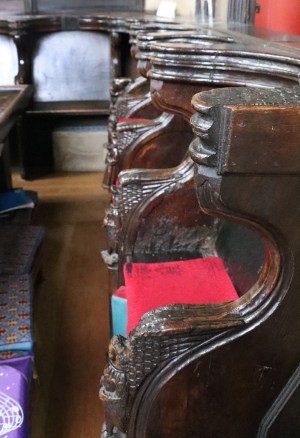
Choir stalls at Gresford All Saints’
Neither the All Saints’ guidebook nor the CPAT survey suggest a date for the misericords, and the church’s web page does not mention them. Based on the presence of a preaching fox, a theme thought to represent mendicant friars who were only present from the 14th century, they must have carved after the late 14th century. It is also very probable that they post-date those at St Werburgh’s (1390) as there was nothing else nearby to provide a model. Although the Gresford misericords could plausibly have been associated with the major rebuild of the church in the 15th century, when two new aisles were added and many other changes were made, Dominic Strange’s misericord timeline places the misericords in the late 15th or early 16th century, over 100 years after the Chester misericords. If correct, it demonstrates the durability of themes that were popular in earlier periods.

Sketch plan of the Gresford misericords.
The choir stalls provide a good example of a three-sided arrangement in a squared U-shape. In total there were originally fourteen misericords, four on the north, four on the south and two lots of three on the west. The latter flanked the entrance from the nave to the choir. Today two are blank, either because they were never completed, or because they were removed due to inappropriate content or severe damage (I can find nothing to help determine which). Some are quite badly damaged, but the entire group indicate great skill and include some varied topics.

The choir, Gresford All Saints’
The misericords are separated by arm rests that curl up the sides of the chairs and along the backs, each one featuring a small human figure at the front of the arm rest. Exceptions are at the corners between the north and west rows and the west and south rows, which feature fantastic beasts.
 As in St Werburgh’s, a fox is dressed as a friar but this time he is in a pulpit preaching to chickens and geese, demonstrating that this theme was of interest not merely to monastic establishments but to churches as well. The allegedly venal of some elements of the mendicant cause may be the theme here. The earliest mendicant friars were poor and itinerant, begging for alms. By the later middle ages they were comfortably established in friaries of their own, the recipients of patronage, gifts and wills. The apparent hypocrisy was a source of grievance for the clergy beyond the seclusion of the cloister. The parish priest may also have felt threatened by the powerful public sermons and the more evocative style of engagement with the general public delivered by the friars. In the parish church, as well as in the heart of the monastery, friars might be seen as a threat to the role of the conventional clergy, to be satirized, derided and, if possible, undermined.
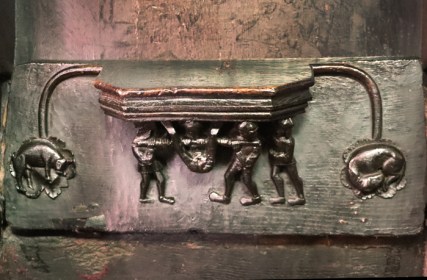 One of the more puzzling themes that occasionally appears on misericords (but is missing from Chester, possibly due to removal in the Victorian period) is the revealing of male nether regions. At Gresford this is given a context. The misericord shows an acrobat hanging over a pole held by two men, ostentatiously exposing his undercarriage, apparently during a performance, possibly a form of slap-stick entertainment. Quite what these were doing on misericords is uncertain, although there is a lot of speculation on the subject. Whilst there may have been a warning against lewdness and impurity, it is difficult to deny that at least some of these depictions were intended to include a degree of crude humour.
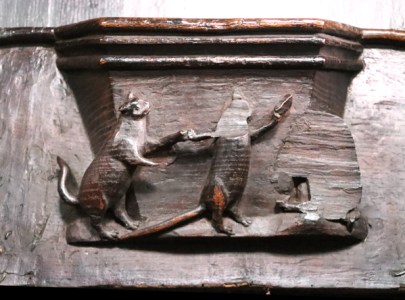 A badly damaged misericord shows two cats, both standing on their hind legs in front of something that is now missing but appears to show a mouse hole at the base, with a tiny mouse with pointed ears to its right. The cats are holding hands, with one apparently leading the other. The leading cat seems to have been holding something in its outstretched paw. Perhaps the upright stance reflects the cat’s commanding, self-possessed and often self-satisfied view of its position within its own universe. An alternative interpretation is that when animals are shown adopting human behaviour, it is a reminder of human failings. Similarly standing on their hind legs are the cats in MS. Bodley 764 (folio 50r), which also shows cats on the hunt.

Cats from MS Bodley 764, folio 50r. Source: Medieval Bestiary
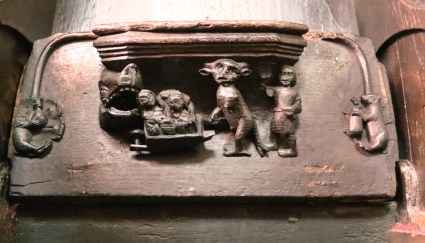 Wheelbarrows feature quite frequently in misericords, and one of the Gresford misericords shows two women seated side by side in a wheelbarrow being pushed towards the open jaws of a monster’s head by a creature with staring eyes and a forked tail. The cavalcade is followed by a man. All the participants in the scene stare out at the onlooker. The open jaws of the monster represent the gateway to hell. This is a much simpler version of a well-known example at St George’s Chapel, Windsor Castle, which shows two monks being wheeled towards the hellmouth by either a demon or the devil himself, leading to the suggestion that the two wimpled women on the Gresford misericord may be nuns (but bearing in mind that wimples were not exclusive to nuns). The supporters appear to be small rodents, but it is difficult to see how they might relate to the central narrative.
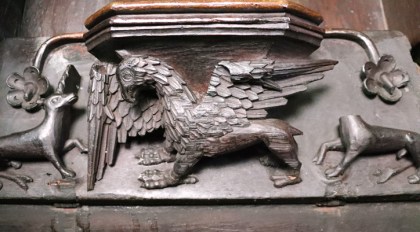 A splendid winged griffin, facing left, is positioned between two delicate unicorns, one of which is missing its head. The griffin has the head and wings of an eagle, the body of a Lion and is four-legged. Like the lion, which can exert its power for either good or evil, depending on the context. When Alexander the Great encounters the enclave of griffins in his voyage to the end of the world, the creature is a true monster, ugly, frightening and vicious. On the other hand it is a pair of griffins that carried Alexander over the edge of the world. The griffin is often used to represent rival ideas and can, in different contexts, represent such opposing individuals as Satan and Christ. The griffin also represents the combination of the opposing elemental forces of air (eagle) and earth (lion). It is difficult to know what, in this context, the griffin is intended to convey. The presence of unicorns, which are often associated with Christ, may either be supportive companions, opposing forces, or hapless victims, and there is nothing to help determine which. The supporters are decorative flowers.
 Another misericord, also quite unlike its companions, seems to refer to the gargoyles and grotesques so strongly featured on the exterior of the building. It may have had no specific symbolic meaning. It is a monster’s face with vaulting emanating from its head. The vaulting may be intended to evoke the magnificent screen that separates choir from nave at All Saints’, although the flowers at the intersections on the misericord are not present on the screen. Perhaps it is intended to bring indoors the collective message that the gargoyles and grotesques were communicating from the exterior of the church (discussed briefly in an earlier post).
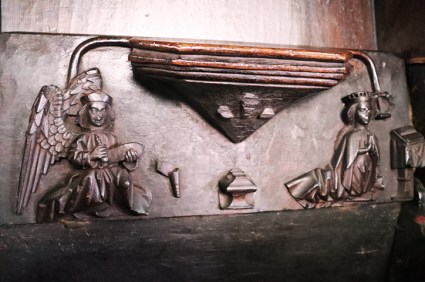 Some of the All Saints’ misericords are very badly damaged, leaving the core subject matter very difficult to identify. A particularly frustrating example is the misericord whose central subject matter is completely missing. Flanking it there is a wonderful winged angel on the left and, on the right, a lady in an elaborate dress kneeling before a personal altar with the soft folds of her dress flowing behind her on the floor. Perhaps this was either the Annunciation or the Coronation of the Virgin, particularly as there are no other overtly religious stories included in the All Saints’ corpus.
 Another badly damaged misericord shows a woman on a four-legged animal, the head of which is missing and is therefore unidentifiable. It is short, has particularly bandy legs and ill-defined feet, none of which suggest a horse. Two carvings, one in front of the woman and animal, and one behind, are lost. The one behind is almost certainly another figure in a long garment, but the one in front may or may not be.
 Some of the misericords contain no narrative or obviously symbolic component. One misericord has no central subject matter and no obvious sign of damage, with just two images as supporters, right on the edge of the underside of the seat. These are two three-quarter partial heads, almost sketches, looking towards one another. The meaning of this, if there was any, is lost. If there was a central carving, there is not even a shape left to suggest a subject matter. It is possible that it was carved at a much later date to replace one of the original misericords that might have been damaged or whose subject matter was considered inappropriate. These lost stories are very frustrating.
All of the misericords at Gresford are shown on the World of Misericords website at https://www.misericords.co.uk/gresford.html, with short descriptions at https://www.misericords.co.uk/gresford_des.html.
St Oswald’s, Malpas
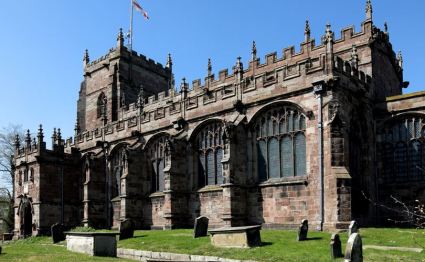
St Oswald’s Church in Malpas. Photograph by Alan Marsh. Source: Historic England
St Oswald’s Church in the village of Malpas was founded in the late 1300s. The church underwent a similar modernization in the 15th century to that at Gresford, including a similar camber beam roof. It has a great many features that continue to impress, particularly the spectacular tomb effigies of the 15th and early 16th centuries, but its remaining misericords are disappointingly confined to three choir stalls.
There is a set of three choir stalls with three misericords, in a single row, still displayed in the choir area in St Oswald’s. The visitor guide to the church says that there were “at least twelve” 15th century choir stalls with misericords, with only nine surviving and six “much restored.” Given that there are only three on display, it is something of a puzzle as to what happened to the remaining six of the nine surviving. There are no descriptions of any of the misericords, and nor does the booklet say where the surviving misericords (other than the three still in the choir at Malpas) are located today.

The remaining row of choir stalls at St Oswald’s with the misericords hidden beneath the seats.
The choir stalls have carved armrests, although they less elaborate than those at Gresford, and have no carved bench ends. This may suggest that carved choir stalls were never a very important component of the chancel at St Oswald’s, or that the funds required for a more ambitious project were not available. All three remaining misericords are described here, with the disclaimer that they represent only a very small sample of the original corpus. Two of the three are damaged.
 I particularly like the mermaid. Mermaids appear on many misericords in Britain. Mermaids resembled Greek sirens, representing both the temptation and lust that men might find hard to resist on the one hand, and the dangers represented by the deformation of the human image in the form of a hybrid creature on the other. They were usually shown, as at Malpas, with bared breasts, with a comb in one hand and a mirror in the other, warnings not merely of seduction but of the vice of vanity. The Malpas mermaid looks down and seems to be moving gently to her right. Her tail has been lightly carved to suggest fish scales. Her bare chest is distinctly flat and smooth, unlike most misericord mermaids, perhaps to avoid encouraging carnal thoughts amongst the Malpas choristers. She holds the comb in her left hand, which rests on her thigh (separated from her upper arm by breakage), and the mirror in the other, overlapping one of the supporters. Both supporters are three-lobed leaves.
 A winged monster has one head, shown facing outward, but two bodies that are shown in profile either side of the head. This is probably the simplest and least worked of all three, with minimal details carved into the image, although there are shallow markings to suggest the scaled nature of the wings, and clawed feet. The face is shown in more detail, with three protrusions from the head, which may or may not depict serpents. It is clearly a monster with affinities like the wings, tails and claws that are shared with dragons. Dragons, wyverns and related monsters may represent paganism, power, uncontrolled violence or lust, the Devil himself and unspecified evil and sin that must be confronted and neutralized, or at the very least rationalized. As such creatures are usually associated with remote, often hostile landscapes, they may also represent fear of the unknown. It may also offer a shifting geographical component, so that the dragon may be feared in the remote landscape but is only confronted when it threatens human habitation and safety. The three-lobed leaf supporters are nicely done, with clearly defined edges. A much more elaborate version of a single-headed and double-bodied monster is shown in the Luttrell Psalter (folio 195v), but is evidently part of the same family of images familiar and available to medieval illuminators, carvers and sculptors.

Single-headed two-bodied monster from the Luttrell Psalter (Add MS 42130 f.195.v). Source: Groteskology
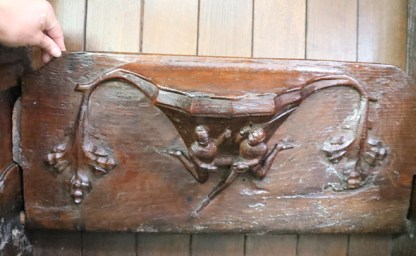 Finally, two knights are shown engaged in an athletic, almost balletic fight with swords. Of the three this is by far the most complex, compositionally. At first glance it is very difficult to see exactly what is going on, and whose limbs belong to whom, vividly capturing movement. The pointed shoes, generally confined to the well-to-do, emphasize the mobility and athleticism of the figures. Perhaps it refers to a scene from a chivalric romance, such a the Chester examples that show scenes from stories of Yvain and Tristan and Isolde. Again, the supporters are foliage.
St Andrew’s, Bebington

St Andrew’s, Bebington
As I was just about ready to hit the Publish button on this post I had a whizz through Dominic Strange’s Timeline and Gazetteer, which revealed that St Andrew’s in Bebington on the Wirral possesses misericords in three choir stalls, plus two that have survived being separated from their choir stalls, now serving as corbels. Although the church is not open except for Sunday services, weddings etc., Karen from the church office very kindly arranged for me to visit when volunteers were working there.
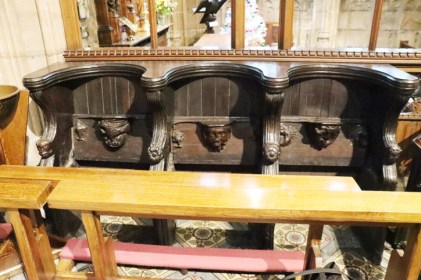
Choir stalls in St Andrew’s, Bebington
It is particularly nice to have found these misericords because, as with St Oswald’s in Malpas, the misericords at St Andrew’s rarely appears in books about misericords, always overshadowed by Chester Cathedral and Gresford All Saints’. It is clear that they should be included here not only because they are local and under-sung but because they show some themes that are not shown in the misericords at the other locations discussed in these posts.

The pelican in her piety
Dominic Strange places all five misericords in the 15th century. The guidebook to the church, by Richard Lancelyn Green, says that there were originally twelve of them, with six surviving until 1847 when they were split up due to damp and dry rot. Presumably the other six were discarded. Initially, in 1871, they were split into pairs and then, in 1897, three of them were reassembled into the row that survives today in the chancel, just to the side of the main altar. Two of them have been removed from their original choir stalls and are deployed as corbels but there is no mention of the sixth 1847 survivor.
At the far left of the choir stall is the pelican in her piety plucking her breast (shown above), already described in connection with Chester in part 1, but flanked here with foliage.

Bearded man. Source: Dominic Strange, World of Misericords
 The head of a man with beard and hat or other form of head covering may or may not be a portrait. Many misericords show human faces, some characterized by particular expressions or actions, but many contain no clues about the significance. The supporters feature pomegranates. Pomegranates are associated with numerous ideas from antiquity onwards. The symbolism attached to them ranges from fertility, regeneration and good luck to representing the shedding of the blood of Christ and as a symbol of the church and its congregation. Without knowing quite what the man’s head represents it is difficult to interpret the entire message of the misericord.
The third in the row is a splendid dolphin flanked by equally splendid seahorses, presumably designed by someone who had seen neither dolphin or seahorse. The dolphin is a rather terrifying looking creature, but there seem to be no negative narratives associated with it. The bestiary in MS Bodley 764 includes the dolphin, but attaches no special meaning to it, stating that “they follow men’s voices, or gather in shoals when music is played . . . if they go in front of the ship, leaping in the waves, they appear to foretell bad weather.” The only other misericord dolphins that I’ve seen in my online travels are at Norwich Cathedral and St Laurence’s Church in Ludlow.
 The remaining two misericords, now used as corbels, show what may be a bull’s head, and a sow with a litter. You can see them on the World of Misericords website. The sow with a litter is a theme also featured on one of the St Werburgh misericords. MS Bodley 764 is quite clear on the negative connotations: “The sow that was washed and returns to her wallowing in the mire is filthier than before; and he who weeps for his admitted sins, but does not desist from them, earns a graver punishment, condemned by his own misdeeds which he could have prevented by repentance; and he descends as if into murky waters because he removes the cleanness of his life by such tears, which are tainted before the eyes of God.” Sows represent unclean spirits and are often associated with gluttony and, more disturbingly, heresy. And in the medieval mind, where heresy lurks, paganism may be lurking nearby.
Contributors to knowledge
Even in such small numbers, the churches at Malpas and Bebington contribute to the body of information about Medieval misericords, helping to build up a database of knowledge about the themes that were of interest to those who commissioned them for the most sacred parts of their monasteries and parish churches. Unless an early report describing or illustrating some of the other misericords emerges, the legacy of those who commissioned, funded and carved the misericords at Malpas and Bebington are confined to just these three and five examples respectively. Although the themes were represented elsewhere, none of the topics shown replicate any of those surviving at St Werburgh’s.
Other churches in the region with misericords

Grapevine misericord at Nantwich St Mary’s. Source: Dominic Strange, World of Misericords
The above are the only churches with misericords in the Wrexham-Chester area, but there are others in the general region. For example, there is a set of fourteen dating to the late 14th century in St Mary’s Nantwich to the east, in the town centre. There are 20 dating to the late 15th century in St Asaph’s Cathedral to the west in north Wales. Another set of sixteen dating to the late 15th century can be found in St Bartholemew’s in the village of Tong to the southeast (where the A41 meets the M54). Finally, there are two fine sets of 15th century misericords (the first of sixteen in 1425 the second of twelve in 1447) in St Laurence’s church in Ludlow.
The distinctive Nantwich examples can be seen on Dominic’s World of Misericords, as can those at St Asaph’s, but the Tong ones have yet to be added to the site, and I cannot find images of more than one or two of them elsewhere. There is a section of the Ludlow Palmers website dedicated to the St Laurence’s misericords in Ludlow, and you can see sixteen of them on World of Misericords.
Next
Part 3 wraps up the series, looking at who was involved in the creation of misericords, how they were paid for, and why they featured so frequently in the most sacred part of a church, often hidden from view but containing a mixture of messages that in each case contributed to the sense of a church’s identity. Visitor details and references are also added at the end of part 3.

