
 The small Llangar Church is exceptional. It is Grade-1 listed and a Scheduled Monument located in the Dee valley not far from Corwen. From its lovely lime-washed white walls and its small but well-filled churchyard to its painted interior and box pews, all set in the middle of a field, there is so much that is unexpected in Llangar Church. It has been subjected to detailed historical and archaeological research, and is accordingly much better understood than many other churches in north Wales. This work, looking at over 500 years of use, means that there is far too much information to include here. We were shown round by visitor guide Heather on the day, who was excellent, but there is not always a tour available, so the official Cadw guide book is certainly one way go to if you want a more informative account, with 18 pages dedicated to Llangar Church. The survey and excavation report published in Archaeologia Cambrensis in 1981 (pages 64-132) is the most detailed report available, and can be accessed online. See Sources at the end of this post for both.
 Visiting details and a map are at the end, but do note that this can be combined with a visit to the brightly painted 17th century Rhug Chapel, which is a 5-10 minute drive away, also on the map at the end (and about which I have posted here).
The meaning of the church’s name remains uncertain. One interpretation suggests that it it can be translated as “Church of the White Deer,” whilst another suggestion is that it might refer to the name of a neighbouring Iron Age hillfort. The Coflein website refers to it as “All Saints.”
 Whatever the meaning of its name, the first documented evidence of it dates to 1291 and the church was probably founded earlier in the 13th century, serving local farms and the services that supported them. It escaped the destructive attentions of the Reformation, and was used until 1856, when it was replaced by a new church in Cynwyd that was both bigger and far more conveniently located. Although abandonment of the church, combined with its relatively inconvenient location, led to neglect, decay and damage, it fortunately escaped being plundered for building materials, and avoided the indignities of Victorian restoration work that usually augmented and remodelled what was found rather than merely preserving an architectural legacy.
 It was not until the 1970s that conservation work accompanied by survey and research projects began to rescue the site and uncover some of its complex architectural and social history. The church was not a time capsule of a single particular period, but a palimpsest of multiple periods. This was a living, breathing community resource for over the 500 years, and as people and ideas changed, so did the church. The Cadw analysis of the architectural development of the church identifies five main phases: Medieval, Early 17th century, Mid to Late 17th century, early 18th century and later 18th and 19th centuries. The scatter of painted and engraved dates through the church from the 17th century suggest that that this was a period when the church underwent a number of repairs and modifications.
The churchyard
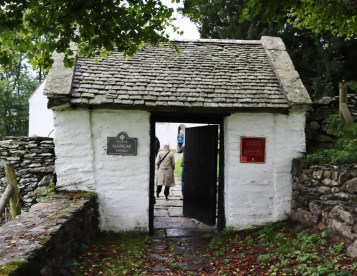
 The entrance to the churchyard is marked by an attractive and remarkably solid 18th century stone lych gate, with double wooden doors. Like all lych gates it provided a shelter for coffin bearers and a place to rest the coffin bier until the service began, and also served as a formal entrance to the churchyard. The slate roof has two tiers of decorative pointed tiles on the churchyard side.
 The churchyard is on a slope. To provide a flat surface on which to build the church, material was removed from the east and transferred to the west end. The dangers of this scheme, leaving one end much more consolidated and compressed than the other, resulted in later structural problems on the north side (opposite the porch side) and at the west end. Over the the decades, many of the headstones have started tilting downhill.
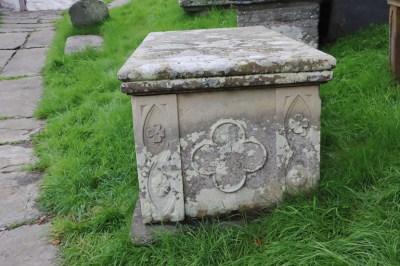
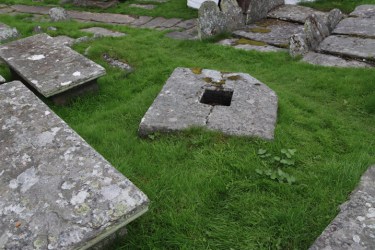
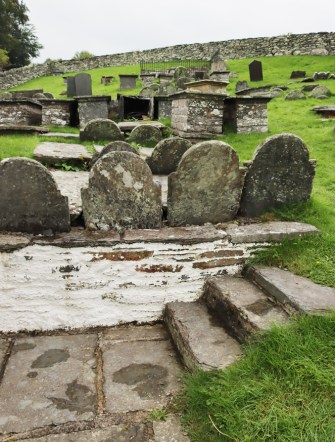 The cemetery has a particular charm all of its own, which is difficult to define but has something to do with the simplicity of the grave monuments, and the general absence of ostentation. The earliest of the monuments in the churchyard date to around 1600. Chest tombs of the 17th and earlier 18th centuries cluster close to the church itself, whilst those further away were later. These later graves were both chest tombs and graves marked by a headstone and footstone. The cemetery went out of use in the 1870s, when the church was abandoned. The church and churchyard, built into the side of a hill, are rather exposed and some of the inscriptions are very worn. Interestingly, most of those graves before 1825 were inscribed in English, whereas later ones were largely in Welsh.


18th century


1821

1841
There is also a sundial base just beyond the church porch.

Llangar Church and churchyard showing the northwest corner, by the Dee, completely free of graves. Aerial view. Source: RCAHMW Coflein
In general the north side of a churchyard was the last to receive graves, either because it had previously been in use for community activities or because, being darker and colder, it was less attractive for visiting. In the case of Llangar the northwest corner remained entirely free of burials right up to the moment of its abandonment, but this is probably because of problems with subsidence, a theory supported by various changes made to the church’s architecture to counter structural difficulties.
The church exterior
 The guide book has a step by step tour of the exterior as revealed by the survey work. It is a fascinating detective story over two pages, perfect for anyone doing a self-guided tour on a dry day. The short version is that the south wall (porch side) dates to the Middle Ages, and the north wall was medieval but was modified over the centuries, with some windows blocked and others added. The north wall is now propped up by a modern retaining wall added during the renovation, but it is worth looking out for a top-to-bottom jagged line like a crack at the west end, which shows where structural work was carried out in the second half of the 17th century. The west wall was rebuilt in the early 18th century. The porch was added in the early 17th century, re-roofed in 1702, and the big ornamental window in the Perpendicular gothic style probably dates to around the same time.
The interior
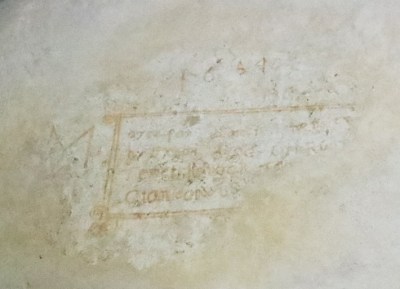
Visitors enter the church via the porch with two stone benches, probably dating to the early 17th century. There is paintwork and various pieces of graffiti carved into wood and stone. Take note too of the noticeboard showing some of the restoration work.

As you walk in to the church, you are confronted with a fabulous red-painted life-sized skeleton representing Death, at gallery level on the opposite wall. As a reminder that a church is the interface between the living and the dead, and that life is only a temporary condition before interment and Judgement Day, this can scarcely be beaten. There are more details about this image below.

The ground floor is a single space with a floor covered in stone slabs and a small overhead gallery at the west end, which was probably used for the musicians. There are no aisles or other architectural divisions. The space beneath the gallery was clearly reserved for parts of the congregation that had the lowest status, at the furthest distance from the sacred east end, and was very dark and cramped beneath the low ceiling.

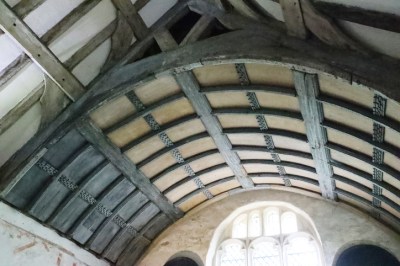
 The earliest parts of the wooden beamed ceiling are thought to date to the 15th century, although timbers were replaced and repaired in subsequent centuries, and today most of them are modern, from the 1970s restoration. The east end, traditionally the sacred end of a church, is marked by a “canopy of honour” dating to the late 15th or early 16th century, a barrel-shaped ceiling that would have shown sacred themes in paintings that have now been lost. It is thought that they may have looked like those at St Benedict’s Church at Gyffin near Conwy showing the twelve apostles (its website is here, complete with a virtual tour).
The only feature that would have furnished the church of the Middle Ages to survive is the simple font set into a niche, which has been moved from its original position, probably in the 18th century. Most of the surviving fittings date to the early part of the 18th century.

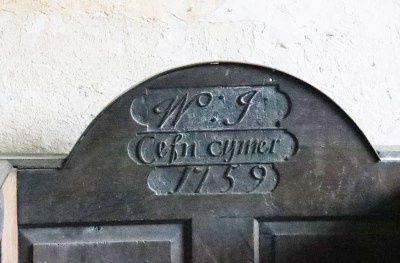
From the 18th century, the public sat in the surviving box pews along the north wall and on backless bench pews on the south wall. Four of the elegant box are dated 1711 (belonging to the Hughes family of Gwerclas, 1759, 1768 and 1841. One preserves the initialse of one of its occupants.
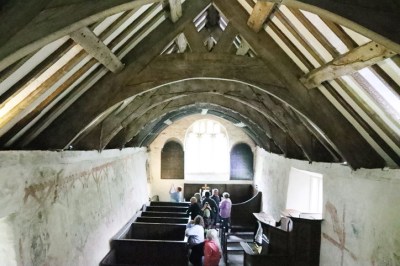
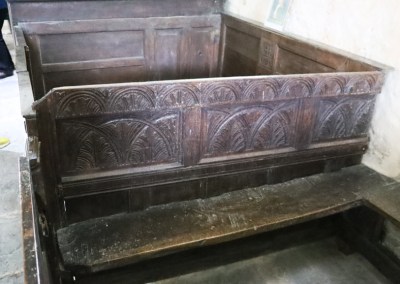

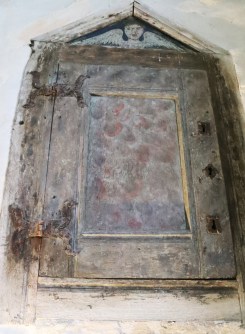 Another pew, at the south side of the 18th century altar and dated 1841, was used by the rector’s family. Opposite, on the other side of the altar, is a painted 18th century cupboard topped with a winged angel. It is set into the north wall dating to the 18th century, with three keyholes, requiring three keyholders. The altar itself dates to the 18th century but was built of 17th century wood. The window above the altar is flanked by two panels, which between them show the Ten Commandments, in Welsh. Originally the east end would also have housed a pulpit, but this was moved to part way along the south wall. It is a three-tiered pulpit, which was probably moved from the east end sometime after 1732 to allow the altar rail to be employed for the giving of the sacrament.
Like nearby 17th century Rhug, Llangar’s interior wall paintings escaped the whitewashing vigour of the Reformation, but unlike Rhug, the paintings represent different time periods, from the 14th to late 18th centuries. Some images were overpainted with new ones, and many are very faint. One of the paintings has been removed to preserve it and is now in the exhibition area at Rhug Chapel. The Cadw guide contains a full description of all of the paintings, by A.J. Parkinson, but here are some highlights.

North wall
Most of the images were intended to provide visual material to support sermons, which Parkinson refers to as “teaching aids.” The fabulous skeleton is brandishing time’s arrow in one bony hand and a winged hour-glass in the other. Between his legs are a shovel and pickaxe, tools of the gravedigger. He is dated tentatively to 1748, the death of rector Edward Samuel, who was a notable Welsh scholar and poet. Looking to his left, on the front of the gallery, are some elegant yellow frames with floral motifs, containing texts that are now too faint to read, but may by Biblical.


To the right of the skeleton, over the window, is the name of the rector in 1730, and to the right of this was the Royal Arms of the same period, now in the Rhug Chapel visitor centre.

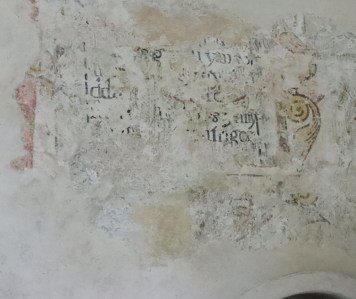
The rest of the north wall above the box pulpits contains overlapping images, the earliest of which, possibly 14th century, is a bishop (very difficult to make out) in the doorway of a substantial and rather exotic church, the towers of which can be easily seen.

The red frame possibly dates to the 15th century and probably contained a narrative, such as the life of Christ, or scenes from the lives of saints. Other decorations along the wall were painted over in the 18th century.

On the south wall are a series of morality-themed panels outlined in red, probably dating to the 15th century. All are very faint. Some of them show representations of the Seven Deadly Sins, in which each sin is personified and is shown riding an appropriate animal. These are very difficult to make out, but are almost unique. Jane Durrant’s reconstruction below shows what they may have looked like in the late medieval period (scanned from the Cadw guide book).

Cutaway reconstruction showing teh south wall panels as they may have looked in the 15th century. By Jane Durrant. Source: Cadw guide book by W. Nigel Yates (full details at end, p.28).

On the left is a stag, representing lechery, and on the right is a wild boar representing gluttony, two of the Seven Deadly Sins

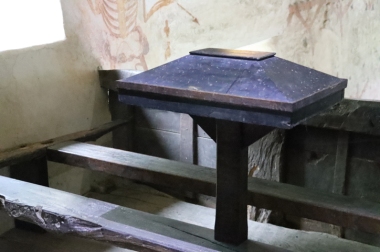
The gallery with benches, at the west end, is reached by a flight of stone stairs. It probably housing the musicians and singers, retains a very unusual four-sided music stand.
Abandonment of the church
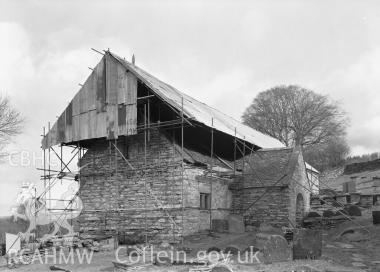
Llangar church with a temporary roof. Source: RCAHMW https://coflein.gov.uk/en/site/93771/images
From the Middle Ages to the 19th Century populations changed, and parish boundaries often ceased to be representative of where people were concentrated and wanted to worship. In the middle 19th century Llangar and Gwyddelwern were neighbouring parishes, but Llangar’s population did not exceed 251 people dotted around the parish, whereas Gwyddelwern’s population had reached 1,118, of which nearly half lived in Cynwyd, near to Llangar. In 1853 the decision was made to redraw the parish boundaries so that Cynwyd was in the parish of Llangar, but at the same time it was also decided that a new church should be built at Cynwyd to replace the inconveniently located Llangar Church. Llangar Church had gone out of use by the mid 1870s except for occasional burials. Some abandoned buildings are robbed for their materials, but Llangar survived intact, although as its roof deteriorated, so the rest of it came under threat.
Restoration

Noticeboard in the church porch
The importance of Llangar was recognized in the 1960s, and it was taken into care by the Welsh Office in 1967. Restoration work began in 1974. There is a noticeboard in the porch of the church showing some of the restoration work, as well as on the Coflein website. Amongst many other restoration activities, one of the big structural changes accomplished during the restoration was the addition of a retaining wall on the outside of the original wall on the eastern end of the north side. This should continue to stabilize the church to secure its future. The roof was largely rebuilt, and most of the interior required conservation work. Survey work, involving a number of different specialists, began to reveal the history of the church and churchyard.
Final Comments
 More than any other church that I have visited in recent years, Llangar provides a sense of a place of social congregation. This was off the beaten track, even for rural people who came from their farms and forges to attend the Sunday service. Many of them will have met at market, but a sense of real community probably only developed on the back of the weekly congregation, which was a social as well as a religious activity, attended by entire families. The paintings on the walls, changing over time to suit different needs, helped to involve the congregation in the Christian narrative, surrounding them with key messages and providing them with a sense of context. The painting here was not merely decorative, like Rhug, but invested with shared articles of faith. It is a small place, but it has a real impact.
Visiting

Source: Google Maps (with my annotations). Llangar Church is at the bottom of the map, Rhug at the top.
Before setting out, it is vital to check the website, because the church is open only on certain days of the month in the spring and summer, and is closed during autumn and winter. Do note that opening times are timed to coincide with those of nearby Rhug Chapel, so you can do both at the same time. https://cadw.gov.wales/visit/places-to-visit/llangar-old-parish-church
Llangar Church and its churchyard are located in the Dee valley in a field just off the B4401, a well-used tourist route to the eastern side of Lake Tegid (sometimes referred to as Lake Bala).

Map sourced from the Coflein website with my annotations
There is a large lay-by opposite the farm track that gives access to the church. The church is sign-posted, but when I was there the sign was hidden by tree branches. There is a small post box on a pole next to the farm track that leads to the church, and a sign on the open gate for Station Cottage. The track leads downhill for a minute or two, past farm buildings on the left. The road goes hard right and then hard left. At the left turning, there is a gate on the right hand side (with a sign to its left saying Guide Dogs Only) that takes the visitor across a field, complete with mud and cow-pats, through a small gate on to a grassy footpath flanked by upright slates. This leads to the lych gate and the churchyard beyond.
For those taking unwilling legs into account, although it is only about 5-10 minutes from car to lych gate this is very slippery underfoot after rainfall, meaning that this would almost certainly be better approached during a dry period. Part of the graveyard is on a steep slope, which would make exploring it challenging, and there are steps up to the gallery within the church, but otherwise there should be no difficulties.
 If you want to get the most out of the visit, the guide book is very helpful (see Sources below), covering both Llangar Church and Rhug Chapel as well as Gwydir Uchaf Church near Betws-y-Coed, which I have not yet visited, but looks fabulous. The guide book is particularly strong on Llangar Church. It can be purchased at Rhug Chapel, or ordered online from the usual sources.
If you plan to include a walk in your visit, the farm track from the road leads to a public footpath that runs along the disused railway track, which a couple who had arrived early recommended. There are many good walks in the Corwen area, some of which are detailed in an excellent leaflet, which can be downloaded here as a PDF.
Sources:
 Books and papers
Parkinson, A.J. 1993. The Wall Paintings. In Yates, N.W. Rug Chapel, Llangar Church, Gwydir Uchaf Chapel. Cadw, p.37-39.
Yates, N.W. 1993. Rug Chapel, Llangar Church, Gwydir Uchaf Chapel. Cadw
Additional reading:
Shoesmith, Ron 1981.
Llangar Church. Archaeologia Cambrensis vol.129, January 1981, p.64-69
https://journals.library.wales/view/4718179/4748029/87#?xywh=-163%2C-2%2C2584%2C3638
Llangar Church. The Graveyard Survey
Archaeologia Cambrensis vol.129, January 1981, p.70-132
https://journals.library.wales/view/4718179/4748029/93#?xywh=-169%2C-8%2C2584%2C3638
Although I haven’t yet managed to get hold of it Heather, the Cadw visitor guide, also recommended R. Suggett’s Painted Temples: Wallpaintings and Rood-screens in Welsh Churches, 1200–1800. RCAHMW 2021.
Another book that I haven’t yet seen, to which Peter Carrington alerted me, is Archaeologies and Antiquaries: Essays by Dai Morgan Evans edited by Howard Williams, Kara Critchell and Sheena Evans. Archaeopress 2022, which has four chapters dedicated to Llangar.
https://www.archaeopress.com/Archaeopress/Products/9781803271583
Websites
Coflein
All Saints Church, Llangar
https://coflein.gov.uk/en/site/93771/
All Saints Church, Llangar, Images
https://coflein.gov.uk/en/site/93771/images
National Churches Trust
St John the Evangelist, Cynwyd
https://www.nationalchurchestrust.org/church/st-john-evangelist-cynwyd
 Based in Churton
Hi Andie
Are you aware of the chapters on LLangar church in Howard Williams’ volume of collected papers of Dai Morah Evans, which I reviewed in JCAS vol 92 (2022)?
All the best
Peter
LikeLiked by 1 person
Hi Peter. No I wasn’t aware of them, but have just updated the bibliography in a Further Reading section. Thanks so much for pointing them out.
LikeLike