
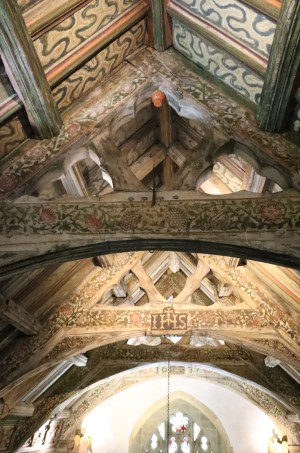
 Having visited Grade-1 listed Rhug (pronounced “rig”) Chapel around 20 years ago, I had always meant to return because I found it such a joyous place. A small building, it is a jack-in-a-box full of surprises. Although fairly plain on the exterior, it escaped Reformation erasure as well as any major Victorian remodelling. The interior retains all of its 17th Century charm, an extravaganza of bright paintwork, wonderful patterns and motifs, and lively carvings. It is a celebration of colour, very unusual in most of Britain’s attractive but sombre post-Reformation Anglican buildings.
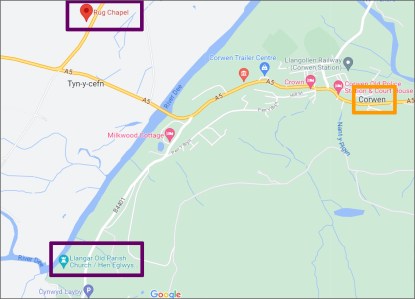
The chapel is in a rural setting, just to the west of Corwen in the Dee valley, with plenty of footpaths in the immediate area. You might consider visiting the nearby and remarkable little Llangar Church at the same time (which I have posted about on this blog here). Both are open only a few times a month for a part of the year, closed for the rest of the year, but their opening times are co-ordinated so that they can be visited on the same days. Visiting details for both are at the end of the post.
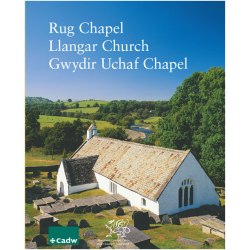
 Many thanks to Cadw guide Heather for a great introductory talk, and for pointing out many details that we might otherwise have missed, and there was plenty of time to ask questions and wander around afterwards. There is not always a guided talk available. I’ve written up some of the top level details of the visit below, but I recommend buying the Cadw guide book, which is stuffed full of information and great photos. It also has the details of Llangar Church and Gwydir Uchaf Chapel. I haven’t yet visited Gwydir Uchaf near Betws-y-Coed but it is one on my list.
Apologies for the poor quality of the interior photographs, which are very grainy and occasionally a bit blurred, due to the low lighting that helps to preserve the paintwork. Hopefully they will still suggest that the chapel is very much worth a visit.
Background

Cross at Rhug, brought by William Salusbury from Denbigh
Rhug Chapel, properly the Chapel of Holy Trinity, was built as a private chapel by Colonel William Salusbury (1580-1660), set apart from Rhug Manor. The land in which Rhug sits belonged to descendants of Prince of Powys Madog ap Merdudd (who died in 1160) until it passed to a daughter, who married into the Salesbury family. Sir Robert Salusbury, the son of this marriage, added the lordship of Glyndyfrdwy to the family’s property, once in the ownership of the rebel Owain Glyndwr. Robert died in 1599, and his only son, who had no children of his own, died only nine years later in 1608. The estate passed to Sir Robert’s brother instead, Captain John Salusbury. He too died without children, only three years later, in 1611 and was in turn succeeded by his brother, William Salusbury.
William Salusbury was once a privateer (a type of state-authorized pirate) in the East Indies, and most importantly a royalist governor of Denbigh Castle, who was known in old age as “Hen Hosanau Gleision,” which translates as “Old Blue Stockings.” He is best known for his defence of Denbigh Castle for the royalist cause during the Civil War. Denbigh fell to the parliamentarians but not until after six months under siege when he was ordered by the king to surrender.

Denbigh Castle. Source: Cadw via Wikipedia
Inheriting the Rhug estate in 1611, William Salusbury found himself saddled with heavily encumbered estates, mortgaged to the hilt, and spent the next 30 years turning this situation around. The chapel was built for his family’s private worship. His religious preferences leaned towards the Anglican “high church” of Charles I, which accounts for the bright colours and the sense of celebration. The services were carried out in Welsh, and many of the texts within the chapel are in Welsh as well as Latin.
 On his death at the age of 80, having lived long enough to see the restoration of the monarchy, William left a deed of endowment dated 3rd January 1641 so that services should be maintained, and continue to be delivered in Welsh. He also required that the curate was dedicated to the chapel and was not employed elsewhere as well. The endowment was provided with portions of land that would provide the chapel with an income, managed by trustees. The original requirements were ignored some time after William’s death, and the vicars of Corwen or Llangar usually took Rhug into their existing domains and delivered the service in English. In the mid 19th Century an additional sum was bequeathed to the bishopric of St Asaph in order to reinforce the original stipend to the chaplain.
The Exterior
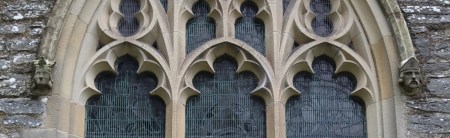
Approaching the church we paused at a tall cross, around 6ft (1.8m) tall, on a plinth and three steps. This is not contemporary with the construction of the church, but predates it, having been brought by William Salusbury from Denbigh Castle. Both the east window and the western door are accessorized with sculptural features. At the east end these are two heads, one with a crown and one with a mitre; at the west end they are carved into a loosely floral or leafy motif. The tracery in the windows was a 19th century addition, as was the small belfry.

 In the churchyard there is a circular fenced area with three large headstones, and two secondary ones. These are headstones from the 1860s belonging to the Wynn family. The central one features a lighthouse on top and a horseshoe at bottom left, belonging to a daughter who died after falling from her horse. The lighthouse, of unusual four-sided construction, represents the one on Bardsey Island, once the property of the estate.
The church is surrounded by a lovely Potentilla hedged walkway. Some of the Potentilla, yellow and white, was in flower. I have never seen it used as hedging before, and it works beautifully.

The Interior
 Open the door, and you will find yourself given the option of climbing a staircase to the gallery on the left, or opening interior doors to proceed in to the nave (main seating area) and the chancel beyond (the sacred east end) on your right. The lighting is very low, so it is worth sitting in one of the many pews for a minute or two to let your eyes adjust, particularly if it is a bright day outside. Upstairs, the gallery was probably used by musicians. It provides a superb view of the ceiling and beam decoration.
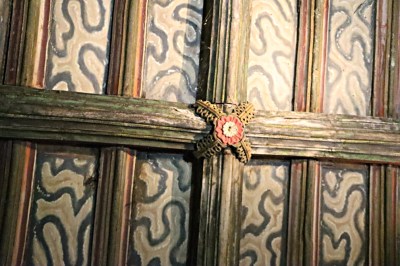
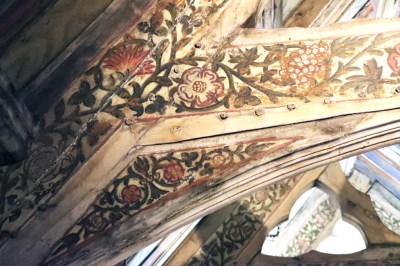 The beams and trusses of the hammerbeam ceiling are painted with flowers, grapes and foliage in bright colours. One of the cross-beams shows the date of construction, 1637. The 16 and 37 are either side of the abbreviation IHS, which stands for the first three letters of the name of Jesus in Latin and is frequently sees on gravestones in the area. The same IHS motif is found elsewhere in the church. The beams themselves are painted with flowers and grapes vines that spread vigorously towards the painted sky. Ceiling bosses, wooden features that traditionally sit over the meeting of beams, are also beautifully painted with a variety of motifs.


Between the beams, the ceiling is also painted. Over the nave the sinuous shapes emulate wispy clouds. Over the chancel a “canopy of honour” is provided by a wonderful heavenly scene of angels and stars on a blue background.


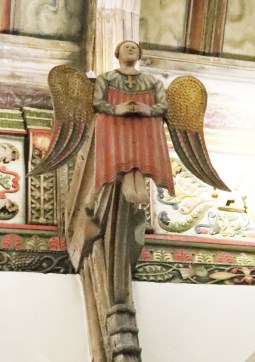
Angels are a recurring theme in the small chapel, with four wooden sculpted angels suspended at the base of roof trusses and others decorating the fabulous wooden, candle-holding chandelier hanging from the centre of the church.

The optimism of angels with their promise of heavenly mercy is balanced by the grim reality of impending death. The skull and skeleton are accompanied by candles burning down, an hourglass with the sands draining, and a dial, both signifying the passing of time. At the base of the dial the words “hora fugit” (the hour flies). In the centre of the hourglass and dial is the phrase “ut hora sic vita” meaning “as with the hour, so with life.” The welsh inscriptions below this are translated, courtesy of the Cadw guide book , as follows:
- “as the flame gradually consumes the tallow of the lighted candle, so life on the orbit (earth) perishes daily” (from a 16th century carol)
- “lifetime, however long its stay, will come to an end by night and by day” (from the Englynion y Misoedd, Stanzas of the Months)
- “my nose and my face are perished, very dumb am I, no-one knows me” (from a poem attributed to Ieuan ap Rhydderch)
- “every strong one is weak in the end” (a 16th century proverb)

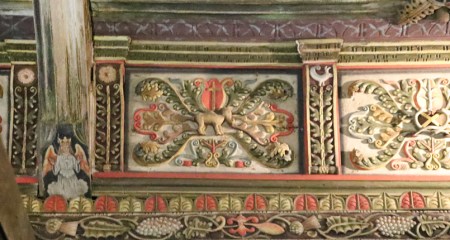
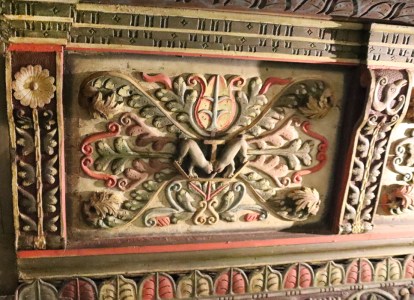
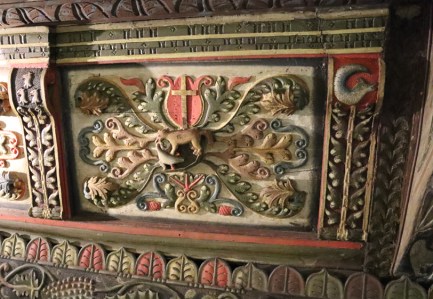
One of the most celebrated features of the chapel is the frieze that runs at the top of both north and south walls, consisting of a series of rectangular pieces, highly coloured and very ornate, each showing a small creature at its centre, some identifiable as either from nature or myth, and one which is completely unidentifiable.


In the chancel, flanking the altar, are two unusual canopied benches looking rather like four-poster beds. The role of these has been much-discussed and although it is not known exactly how they were used, a plausible suggestion is that at least one was a family pew. The other might also have been a family pew but in the absence of a pulpit may have served as a place from which the service could be delivered.
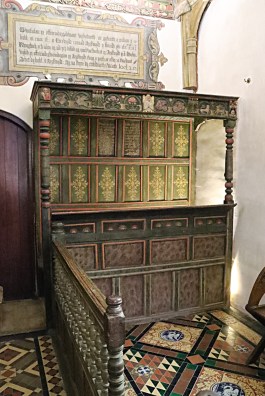
The pews themselves were plain benches when the church was first built, but back rests were added a little later. On each side, from front to back, each of the pews was connected with a single piece of wood, with scallop-shaped openings carved out to provide access to the pews. Facing into the aisle, the sections between these access points are carved with images, quite difficult to see in the low light without a torch, depicting birds, animals and imaginary creatures. The carvings were fairly difficult to make out in the light conditions on the day so I tortured the photos below both in the camera’s settings and in Photoshop. Even so, they are still fuzzy.

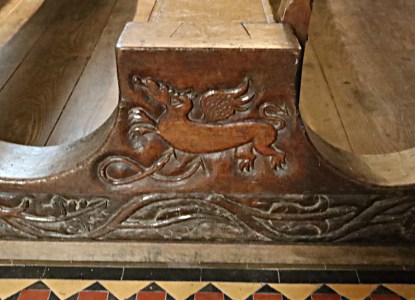

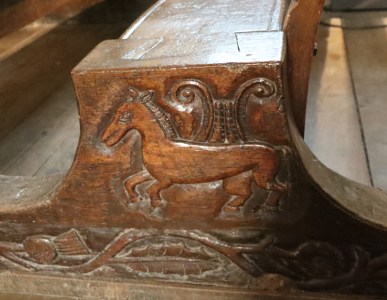
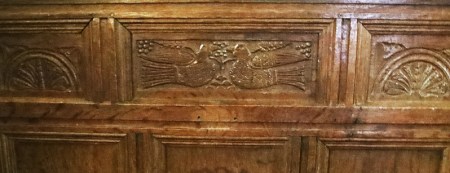
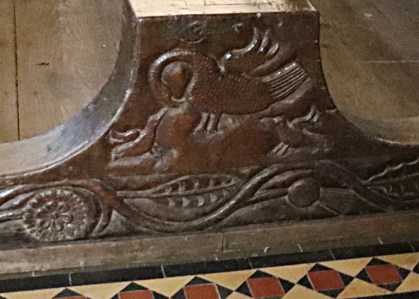 The frieze along the top of the wall and the carvings on the side of the pews seem somewhat reminiscent of misericords. Misericords at Chester Cathedral (from its monastery days), and both Gresford and Malpas parish churches are part of a Medieval tradition that includes the grotesque, the humorous, and the fabled in the holiest sanctuaries of their Christian homes. Although the images at Rhug are at least two hundred years later than those at Chester Cathedral, they do echo this earlier medieval Catholic tradition of combining Christian icons and motifs with wild, mythological and completely invented imagery. The world of the “other,” neither sublime heaven nor the realm of pedestrian human reality, is where demons, the unexplained and the unknown reside. Positioning them alongside Christian images, like the pelican plucking her breast to feed her young (immediately above, a Christian symbol representing the sacrifice of Christ for humanity) emphasizes how humans negotiate a world of conflicting experiences and demands, opportunities and pitfalls, both natural and supernatural. This glorious little chapel balances the beauty of nature, the strangeness of the unknown, the fear of impending death, and the promise of angelic eternity.
Additions and restoration work
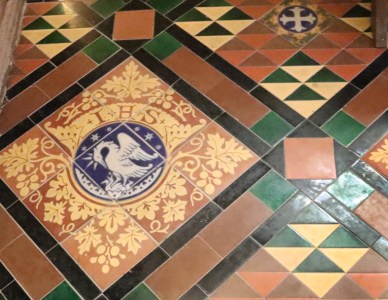 Inevitably, some restoration work was required and there were a number of tweaks to William’s original vision. In 1854-55 the bell turret was added by Sir Robert Vaughan, some floor tiles were laid in the nave and chancel, and a mock-Jacobean chancel screen incorporating a lectern were added (compensating for the lack of pulpit in the original church). The windows were remodelled. Originally, according to a visitor in 1849, the windows had mullions (vertical divisions), but no gothic style ornamental tracery. All the windows now have tracery. As in many small churches, a lean-to vestry was added to the north side.
The font, at the rear of the south side, was added in 1864. The altar itself, and the stained glass windows, belong to the later 19th century. The window on the north side (right as you look down from the entrance) has a particularly Pre-Raphaelite look to it.
William’s architectural legacy has only been altered very slightly. Rhug Chapel is now under the care of Cadw who have done a lot of work to make the chapel and its surrounding site a pleasure to visit.
———–
Visiting Rhug Chapel (and Llangar Church)
 First, you need to check the opening times, as the Rhug Chapel and Llangar Church are only open on certain days, and are closed entirely over the winter period.
For Rhug the opening times and other details are available on the Cadw website: https://cadw.gov.wales/visit/places-to-visit/rug-chapel. The chapel lies just off an A-road and has its own car park. There are toilets and a picnic area, as well as a gift shop and a small exhibition area that is well worth visiting, which contains information about Rhug, Llangar and Gwydir Uchaf. For those with unwilling legs there are no problems here. From the car park to the church is all on the flat. You may not want to go upstairs to the gallery, because the steps are quite steep, but this will not spoil your visit. There are no steps to access the gift shop or the small exhibit. For disabled access, see the Facilities section on the Rhug web page.


Llangar Church
If you want to visit Llangar Church at the same time, around a 10 minute drive away, its Cadw web page is at: https://cadw.gov.wales/visit/places-to-visit/llangar-old-parish-church. At the time of writing there is no information about facilities or disabled access on the above web page, but although I haven’t yet posted about Llangar Church following my visit (working on it) there is reasonable parking in a large layby opposite. I would not recommend it for unwilling legs after rainfall, which was when I visited, because the entire approach (slippery farm track, muddy section after the farm track, and slippery gravestones laid as pathways) was causing people to slide and slip more than somewhat as they walked. Like Rhug it is fine once inside, except for the stairs up to the gallery. I would give it a flat negative for wheelchair access.

Caer Drewyn. Source: Peoples Collection
As you are leaving and are pulling out of the car park, pause before turning on to the road and take a moment to look up at the hill in front of you. Towards the peak you can make out the fortifications of an Iron Age hillfort, the well-preserved Caer Drewyn. The stone rubble perimeter that defines it is particularly clear in bright sunshine or under snow, but even in bland light you can still make it out. The hillfort is open to the public and can be reached by a number of footpaths. I’ve written about it on another post here.
——-
Sources
 Books and papers
Yates, W.N. 1993. Rug Chapel, Llangar Church, Gwydir Uchaf Chapel. Cadw
Although I haven’t yet managed to get hold of it Heather, the Cadw guide, also recommended R. Suggett’s Painted Temples: Wallpaintings and Rood-screens in Welsh Churches, 1200–1800. RCAHMW 2021
Websites
BasedInChurton
The splendid Grade-1 listed Llangar Church, Cynwyd, near Corwen
https://basedinchurton.co.uk/2023/09/30/the-splendid-grade-1-listed-llangar-church-cynwyd-near-corwen/
Coflein
Rug Chapel
https://coflein.gov.uk/en/site/43855/
Dictionary of Welsh Biography
SALUSBURY, SALESBURY family, of Rug and Bachymbyd
https://biography.wales/article/s-SALU-RUG-1525
 Based in Churton