
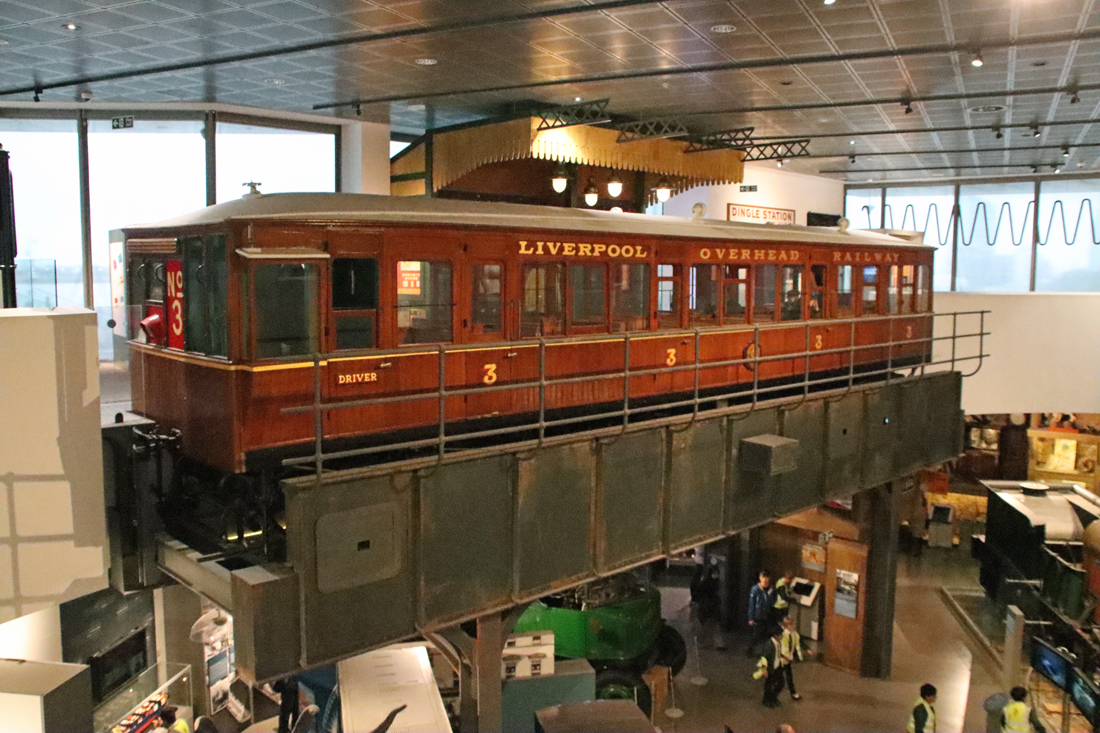
Carriage 3 of the Liverpool Overhead Railway, preserved in the Museum of Liverpool
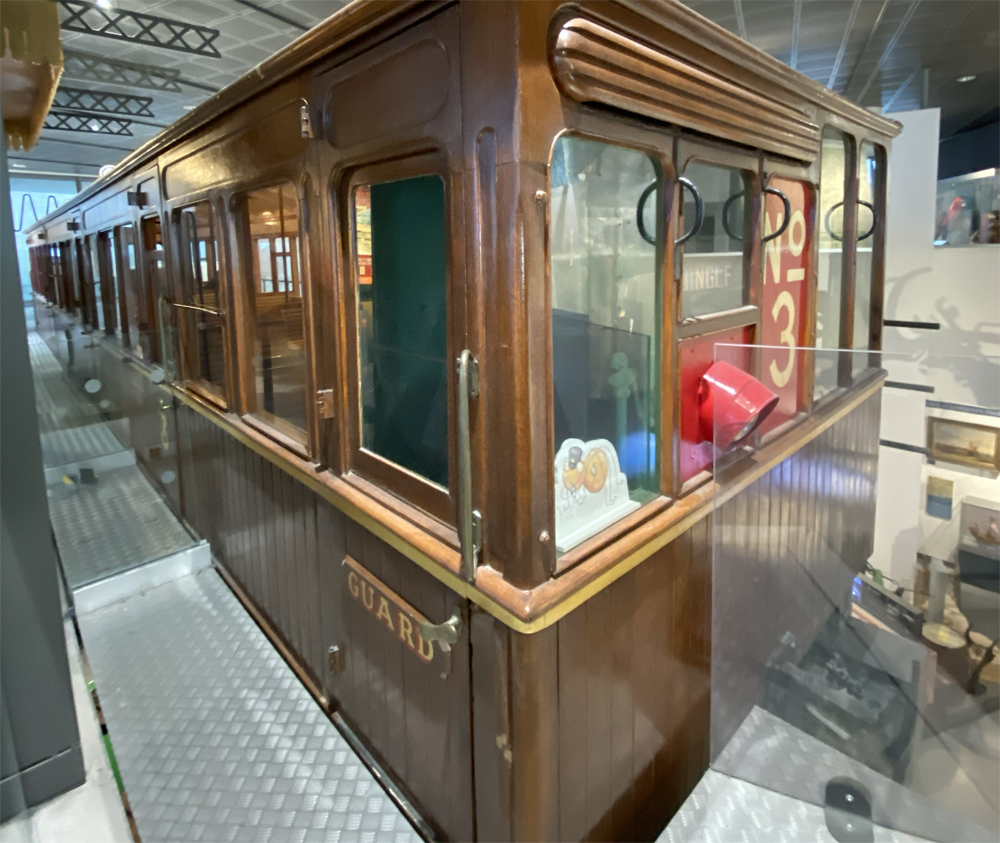
On a recent visit to the Museum of Liverpool on the Mersey waterfront, Carriage No.3 of the Liverpool Overhead Railway made a real impression. It is the only significant surviving artefact of the Overhead Railway, fully restored and displayed on a replica of the railway’s raised infrastructure. It was one of the original 1893 carriages, and surrounding it on the first floor of the museum is a section dedicated to the Liverpool Overhead Railway (LOR). Carriage No.3 is a glossy delight, and because it is displayed on an infrastructure reflecting its actual height of 16ft (4.8m) above the ground, it conveys some idea of how the Overhead railway originally looked, and how it acted as a sheltered walkway for the dockers moving between different docks and both company and administrative buildings on or near the waterfront. Carriage No.3 is the last remaining carriage of the Overhead Railway’s trains, where it is the centre of a display about the Liverpool Overhead Railway.
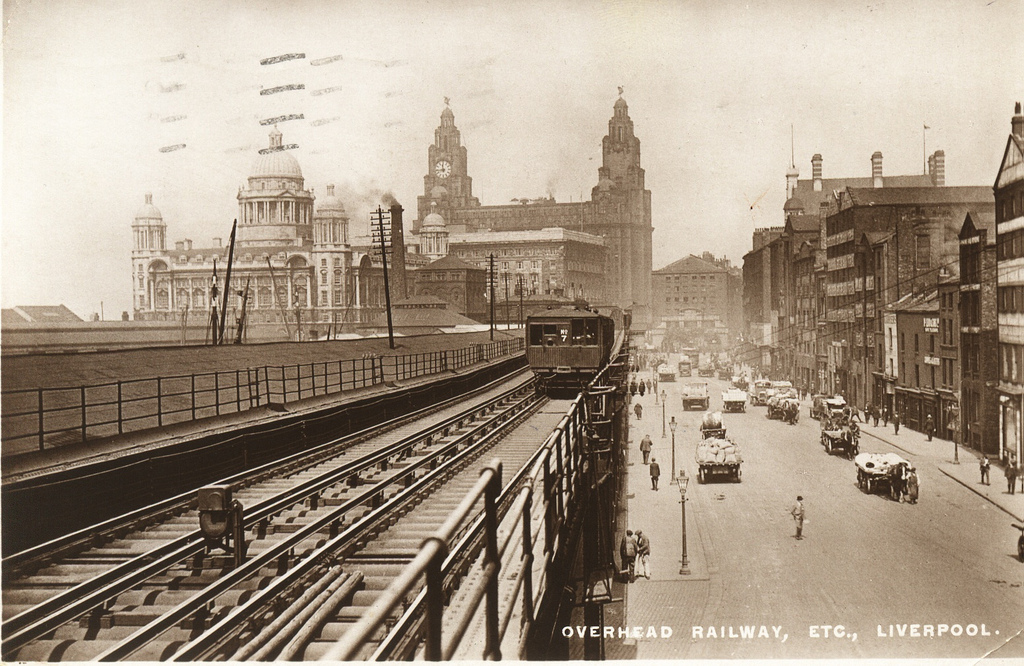
Overhead Railway running past the Port of London Building, the Cunard Building and the Royal Liver Building, sometime after 1917, with horse-drawn carts still very much in evidence. Source: Gutted Arcades
Of all the heritage losses in Liverpool, one of the most painful has to be the Liverpool Overhead Railway (LOR), affectionately known as “The Dockers’ Umbrella” or “The Ovee.” The world’s very first overhead electric railway, it opened in 1893 with thirteen stations, and was extended over the following, serving both workers and tourists. The Overhead was damaged a number of times during the Second World War due to its proximity to the docks, but it was always swiftly repaired. The announcement of its closure was made in 1955 and in spite of considerable protest it was shut down in December 1956, and was dismantled from September 1957.
The railway ran the length of Liverpool’s docks, the earliest of which, built by Thomas Steers in 1715, is now known as “Old Dock” (the subterranean remains of Old Dock can now be visited – see my post here). It initiated the steady growth of Liverpool’s docks in a chain along its long, relatively straight waterfront This gently curving, linear chain was the key to the viability of a single passenger transport system that would help to integrate all the docks and, most importantly, relieve severe traffic congestion at street level.
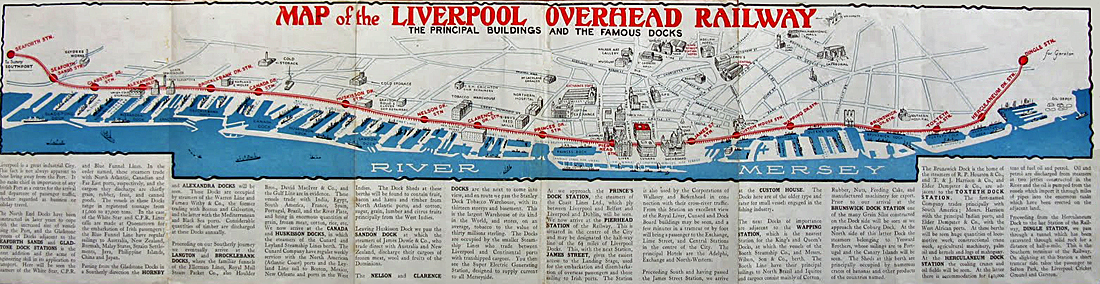
A 1930s map of the Liverpool Overhead Railway
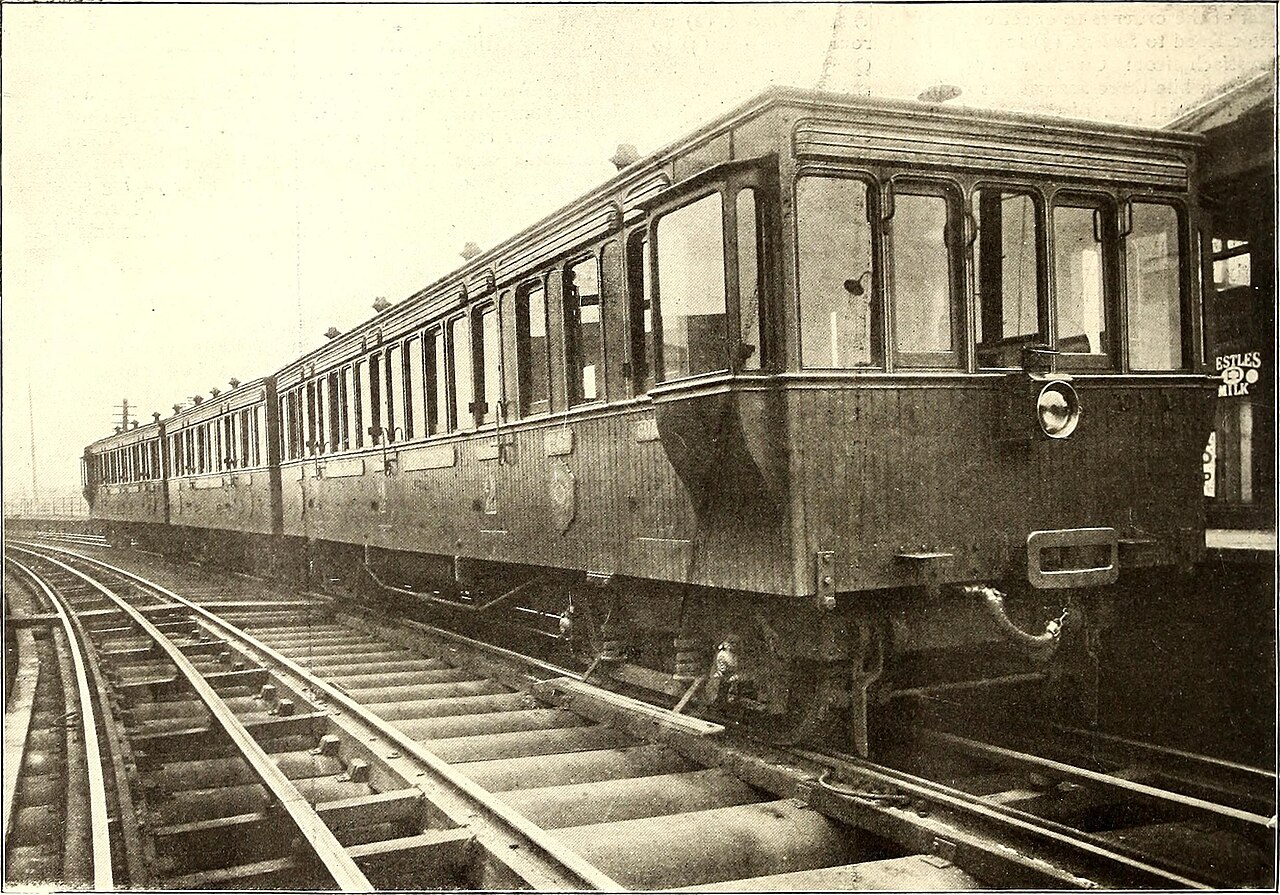
Electric train on the LOR, 1902. Source: Wikipedia
The port of Liverpool was expanding and increasing amounts of cargo and passenger traffic were putting a strain on the waterfront transport infrastructure, which was becoming increasingly congested with horse-drawn vehicles including carts, buses, omnibus- trams, cabs and carriages, as well as trucks and lorries and two horse-drawn goods railways. In 1850 alone 3.5 million tons of shipping entered Liverpool, entering docks that ran along a densely packed waterfront that by 1890 reach 7-miles, more than double the length from the 1840s. Most of the dock shipping consisted of sailing ships but an increasing number of steam-powered vessels were making their presence felt and were slowly replacing sail, becoming all-important with the opening of the Suez Canal in 1869. All vessels had to be offloaded and then reloaded with an onward cargo, nearly all moved by horse-drawn cart. Huge numbers of dockers, labourers and craftsmen as well as ship passengers (including emigrants) and transient sailors were putting enormous pressure on the city’s transport systems. As the docks continued to be built along the waterfront it was becoming more difficult to transport dock workers, administrators, labourers, local and foreign sailors and passengers (including significant numbers of emigrants until c.1920) to their respective docks, ships and warehouses, whilst office workers in buildings on the waterfront found it increasingly difficult to get to and from work, with the all-important Dock Road becoming the most congested road in Liverpool.
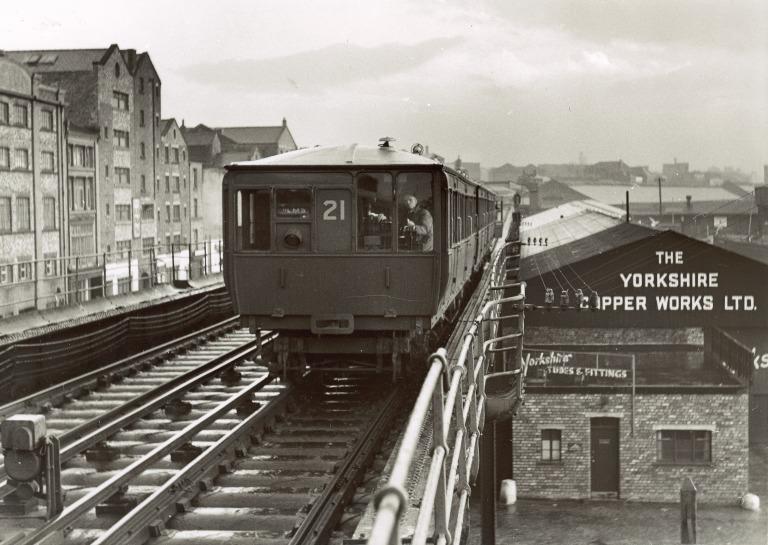
Approaching James Street Station. Source: National Museum of Liverpool
An elevated steam railway in New York provided a suitable model for a transportation system that might help to solve Liverpool’s traffic problems, and was first proposed for Liverpool in 1853 by engineer John Grantham. However, it was not until after the docks had expanded even further and the traffic congestion reached crisis point that the idea was revived by the Mersey Docks and Harbour Board and dock engineer George Lyster was sent to New York to inspect the elevated railways that had operated so successfully there since 1872. Shipping magnate Alfred Holt, a former member of the Mersey Docks and Harbour Board, put his name behind the project and in 1882 George Lyster presented a convincing report to the Board, which decided to proceed with an overhead railway. The initial Act of Parliament that enabled the work to proceed were the Mersey Docks and Harbour Board Acts of 1879, 1882 and 1887, the latter enabling a double line to be built after the Board of Trade refused consent to the initial, more modest proposal for a single line with passing places. This was followed by the incorporation of the Liverpool Overhead Railway Company (LORC) in 1888. Sir William Forwood, who had been President of the Chamber of Commerce between 1872 and 1877 was placed in charge. In 1889 the new company issued a prospectus issuing £450,000 in £10.00 shares.
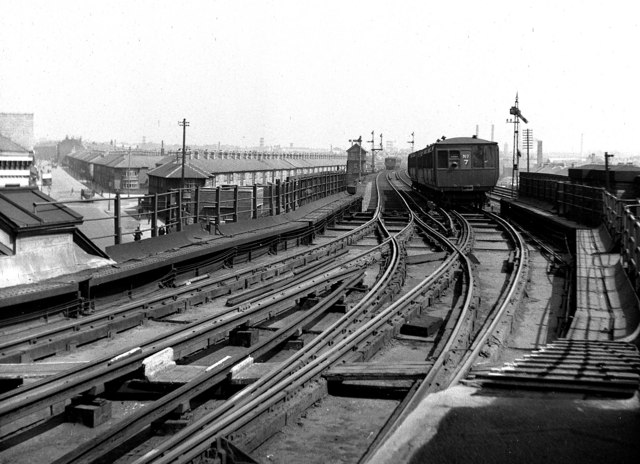
The approach to Seaforth Sands Station. Source: Wikipedia
The first task was to source land, and this was leased from the Mersey Docks and Harbour Board (MDHB) for a period of 999 years, after which the engineers Douglas Fox and James Henry Greathead were appointed to oversee the development of the new overhead railway. Although New York had provided the initial idea for the LOR, its trains were steam-powered. This was rejected in favour of an electric railway , which would avoid a number of difficulties associated with steam, including the weight of steam engines, the danger of falling oil, coals and sparks on people, horses and vehicles below as well as the risk of fire to warehouses and sheds, particularly those that contained highly flammable sugar, rum and cotton. There was some precedent for electric services. In America there were nearly 2500 miles of electric tramways in service, in England the first electric railway was the City and South London line in 1890, an electric tramway was working in Blackpool, and in Liverpool the Electric Supply Company had built a small electricity generating station in the area where Liverpool’s commercial and administrative offices were based, and this was very successful.
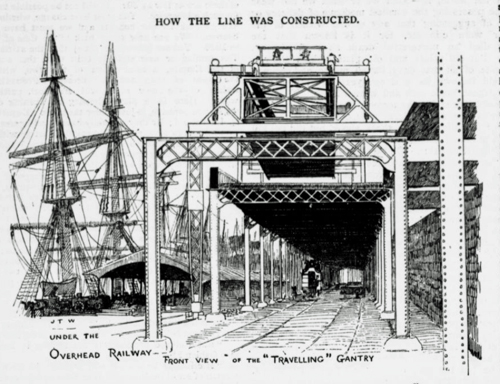
The LOR under construction. Pall Mall Budget 1893. Source: British News Online
Work started in November 1889. Iron columns were erected and spans of the main infrastructure, based on iron girders, were pre-assembled in the yard. The standard span length was 50ft, but other sections had to be adapted to the needs of the railway line. The structures had to be stiff to withstand the impacts of the moving carriages, and this was supplied primarily by steel decking that was riveted into position. Each span was raised on to a trolley on the railway and lifted into place by an ingenious mobile gantry and its cranes, with the gantry moving along the route as the assembly took place. Steel rail tracks were then bolted on to sleepers. The rails were laid according to a standard gauge track, 4ft 8ins in width. As it was raised 16ft (4.8m) off the ground, it acted as an “umbrella” for pedestrians and vehicles, whilst roads and tramlines criss-crossed beneath it. Four movable bridges were built into the plan, to allow tall loads to pass through the railway.
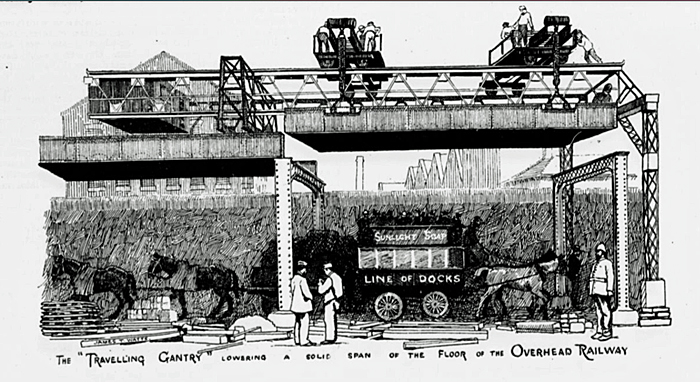
The moving gantry with a horse-drawn train beneath it. Pall Mall Budget 1th January 1893. Source: British Newspapers Online
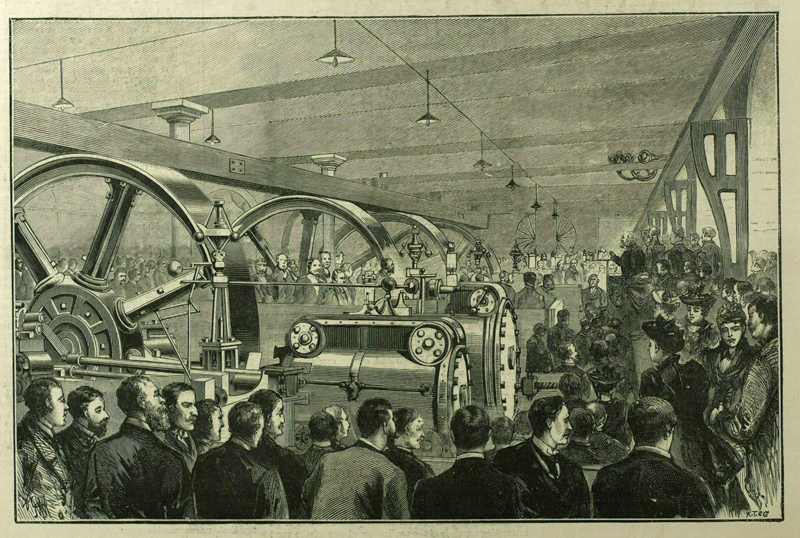
Prime Minister Lord Salisbury turning on the electricity to the LOR. From the Illustrated London News 11th February 1898. Source: British Newspapers Online
The build took four years, and when it was completed in January 1893 it had thirteen stations over an initial five mile route from Alexandra Dock in the north to Herculaneum Dock in the south and had its own electricity generating station at Bramley-Moore Dock. The first official trip was undertaken by dignitaries on the 7th January 1893. This was followed by a ceremony on 4th February to declare the Overhead Railway open, when no lesser personage that the the Prime Minister Lord Salisbury flicked the switch at the electricity generating station. The railway opened to the public on 6th March 1893.
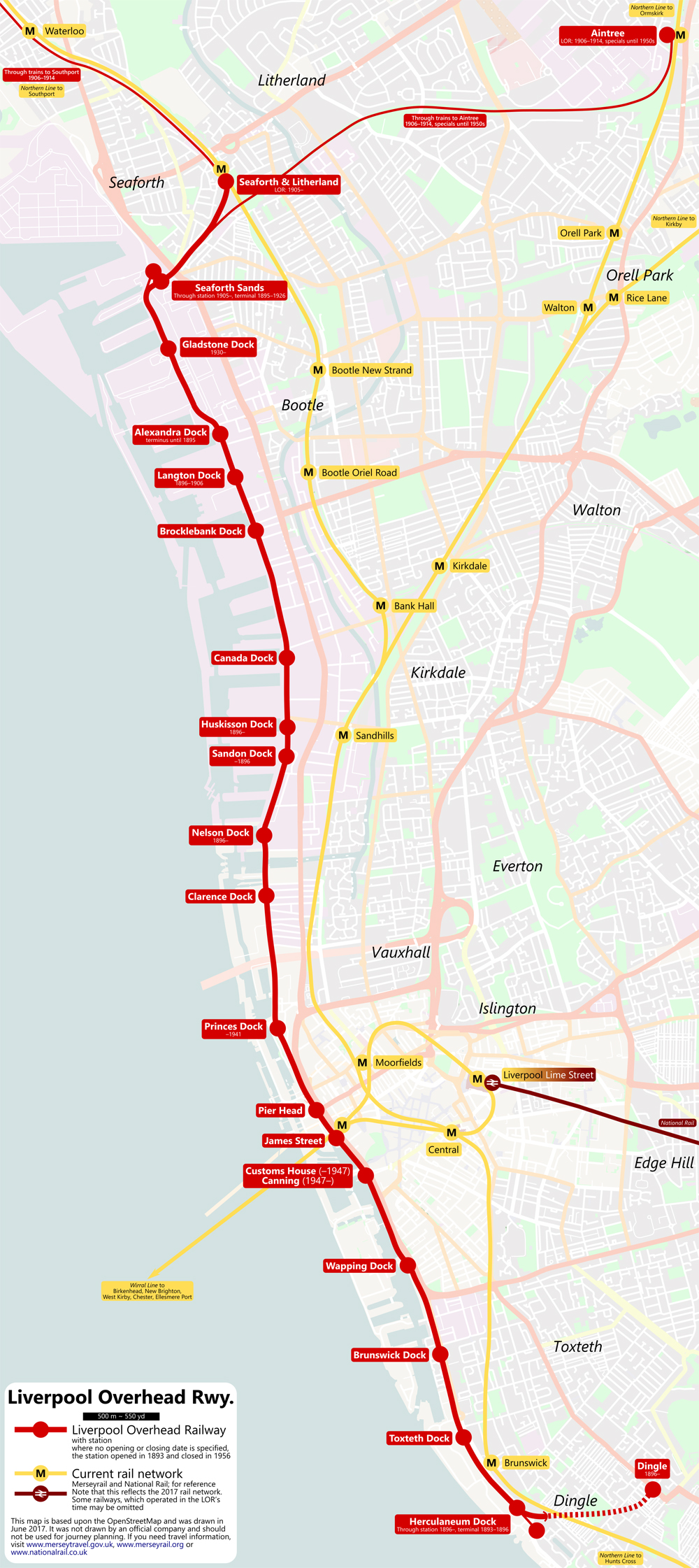
Map of the Liverpool Overhead Railway in relation to the modern Metro rail line (click to enlarge). Source: Wikimedia
The LOR became an instant hit, an artery that connected all the docks along the waterfront. It also connected all the important dock-related buildings that related to the docks, such as shipping companies, bonded warehouses, H.M. Customs, forwarding houses, provisioning merchants (supplying food to ships), hotels, hostels, pubs and other food and drink outlets, ship repair yards, transport depots, and stabling for horses. It must have created a sense of integration and cohesion quite unlike that in any other British dock system. The line was extended first in 1894 to Seaforth Sands in the north, partly to generate more income from residential areas in the evenings when the railway was under-employed in the more central areas, and to encourage an untapped tourist trade to the beaches beyond the docks (see below). The LOR was extended again in 1896, this time to the south to Dingle at Park Road. The Dingle station required the excavation of a new tunnel, its blocked entrance one of the last surviving features of the LOR, and was the only station on the line to have been underground.
The route was short, totalling just over seven miles, including its extension; its connections with other railways were unimportant, and its traffic was based on a very large number of passengers paying, on average, low fares . . . Compared with most railways, its customer base, rooted in the business of the port, was not so much changeable as positively volatile (Adrian Jarvis, 1996, p.6)
All of the overhead platforms required stairs from ground level. Most of these were very basic, but the more popular stations, like Pier Head and Seaforth were more elaborate, with covered staircases and platforms. At Gladstone Dock Station there were two bridges over the track to enable people to change platforms.
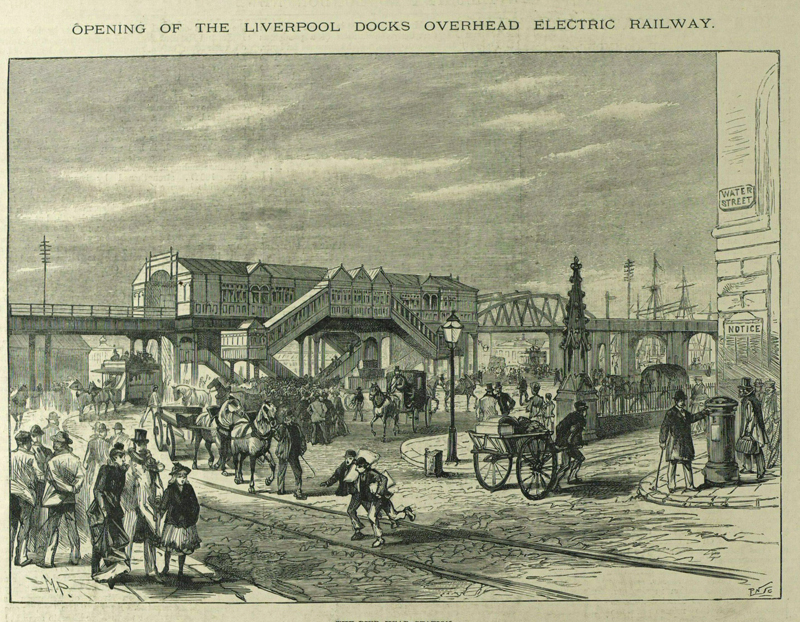
Pierhead Station at the time of the station opening, showing one of the movable bridges and a range of ships’ masts beyond. A horse-drawn tram can be seen under the LOR at left. Illustrated London News, 11th February 1893. Source: British Newspapers Online
The earliest carriages were not pulled by a separate engine, because each carriage had its own engine installed. Initially each train was composed of two carriages, each of which had a 60hp engine enabling a speed of 13 miles per hour. The two powered carriages consisted of one 3rd class (for 40 passengers) and one 1st class (for 16 passengers).
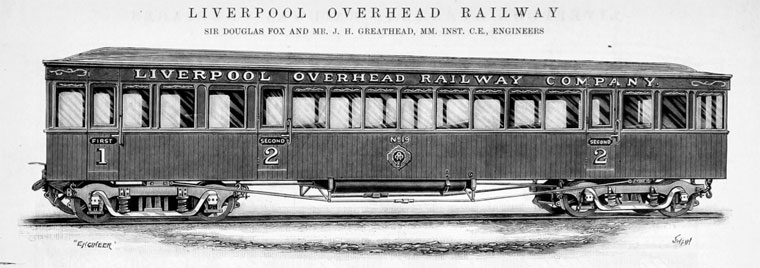
An original illustration of the LOR carriage design. Source: Grace’s Guide
Later on, a third carriage was added between the two powered ones with two 3rd class carriages flanking an unpowered middle one that was 1st class. Combined, the three carriages could carry up to 140 people. A single small steam engine named “Lively Polly” was employed in the initial construction phases and was retained for maintenance work, including removal of ice from the tracks.
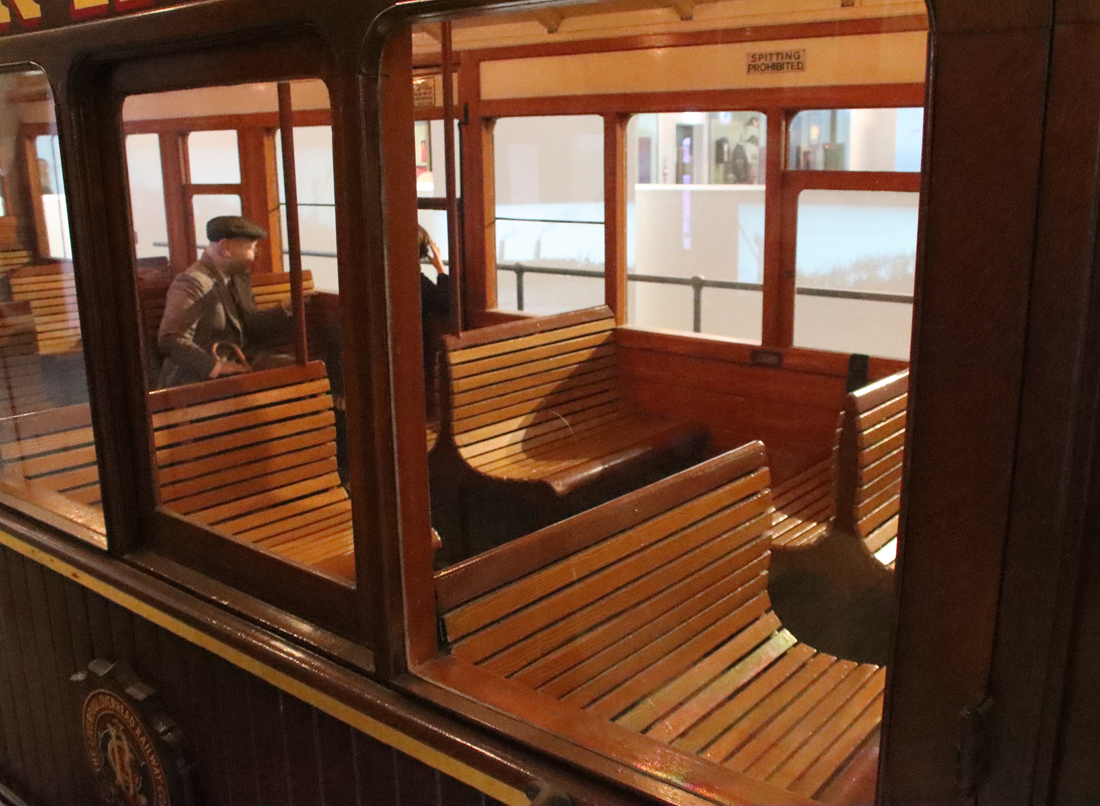
The curved seats made of wooden slats in 3rd Class were apparently very uncomfortable, but look great. Carriage 3 in the Museum of Liverpool
The carriages were manufactured in Birmingham by Brown, Marshall and Co. Carriages like Coach 3 at the Museum of Liverpool were made of Burmese teak. An initial order of 30 carriages was made for the LOR in 1892. After the initial build they were sent to the Carriage Shed at Seaforth Sands for fitting with the electrics, with the motors installed under the floors. Two classes were originally envisaged, a 1st and 2nd class but after 1905 only 1st and 3rd classes were employed to avoid confusion when the LOR joined forces with the Lancashire and Yorkshire Railway.
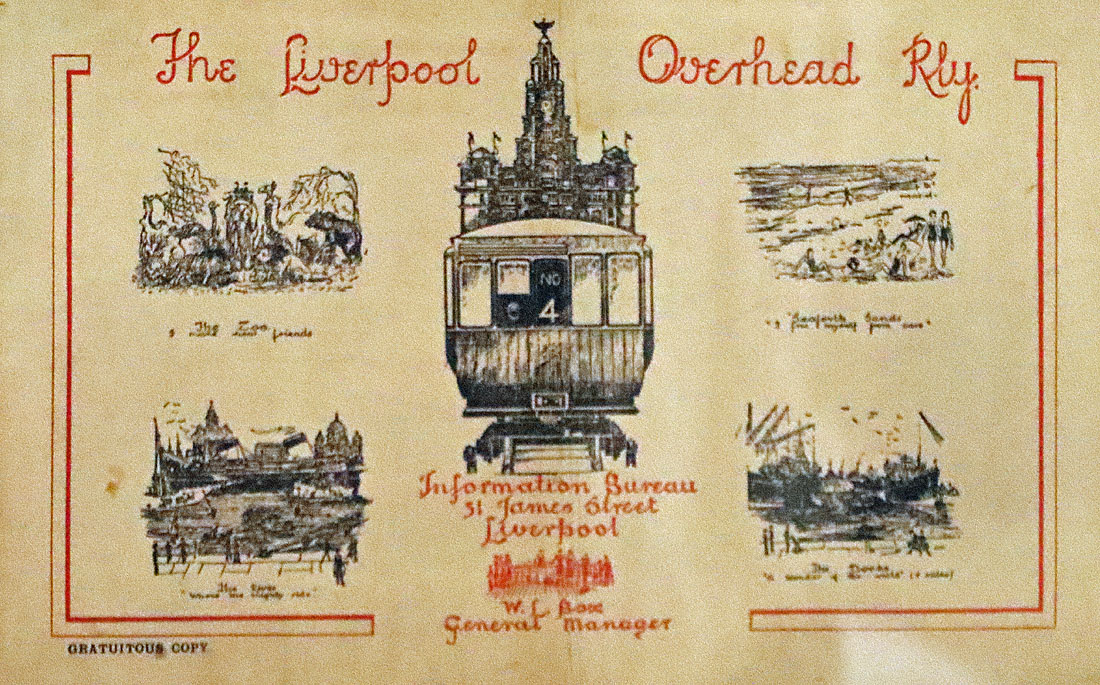
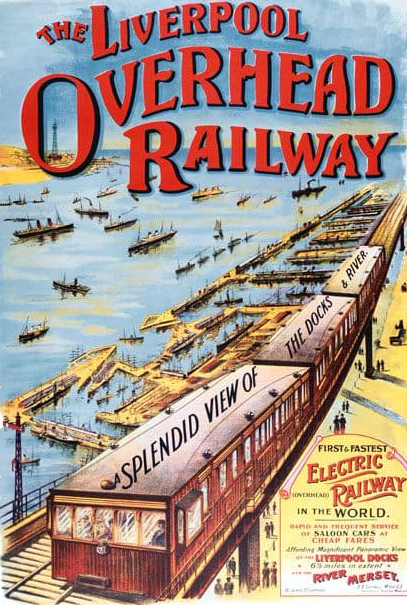
An advert for sightseers in the Museum of Liverpool. It is sensibly displayed behind glass, and as a result of the low light and reflections my photograph is very fuzzy, but clockwise from top left it advertises Mossley Hill Zoo (open between 1932 and 1938), the beach at Seaforth Sands, the docks themselves (“a wonder of the world”), and the River Mersey with all its exciting shipping traffic
As well as creating a transport link between the docks, corporate and administrative buildings and the residential areas of the city, the LOR provided sightseeing tours at weekends for Liverpool families. Not only was the LOR initially a novelty, but it also provided superb views of the Mersey docks with all their cranes, masts and funnels, with ships of all shapes and sizes, from sailing ships to steamers, and from small tramp steamers to magnificent ocean liners. The Liverpool Overhead Railway Company, with a keen eye to making the most of the railway, made arrangements with shipping lines for visitors with special tickets to enter the docks to visit some of the luxurious ocean liners that came into dock, providing local people with a sense of the unreachable, glamorous lifestyles of their fashionable passengers and of the far-off sophisticated and exotic places that the ships visited.
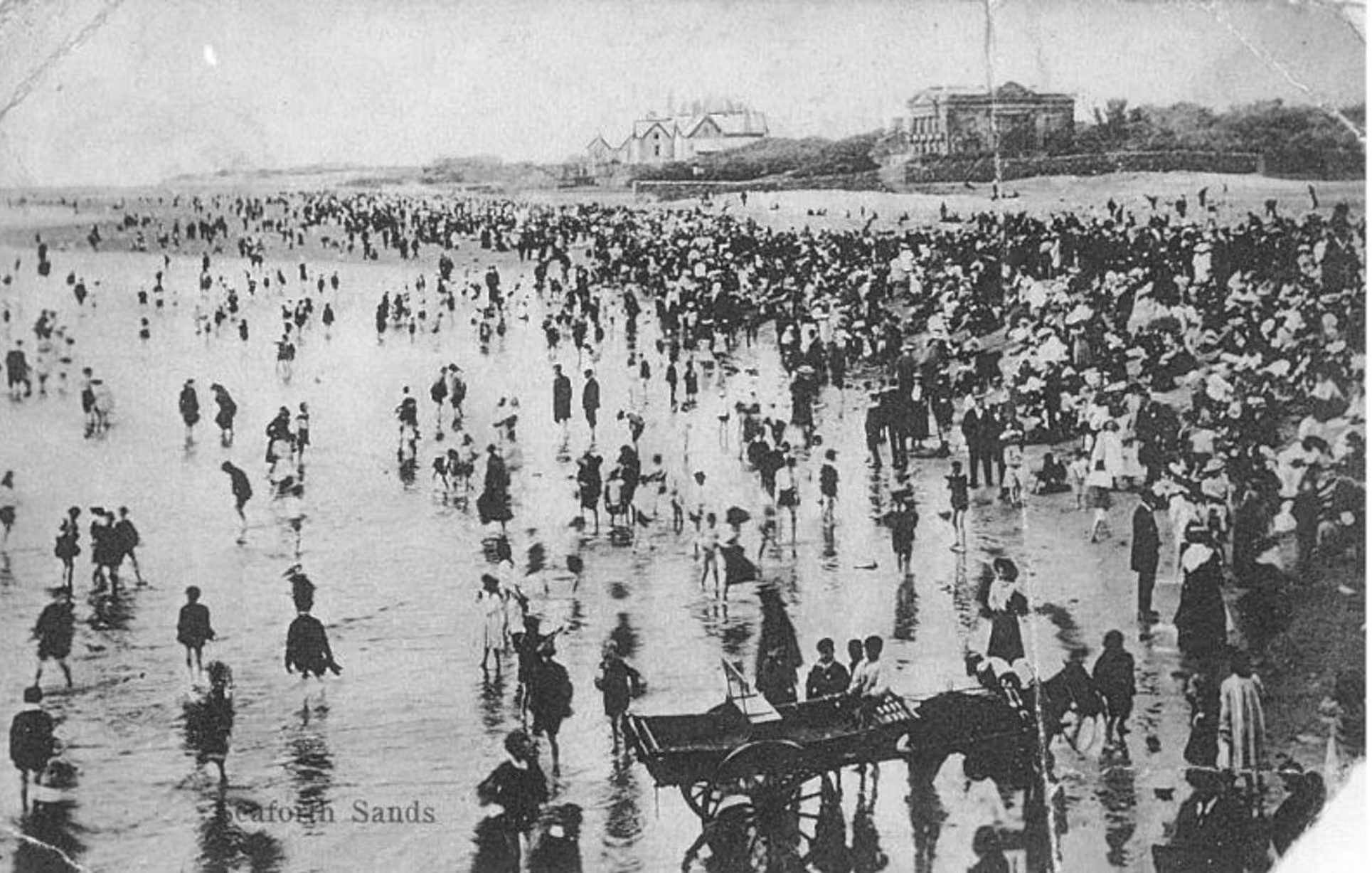
Seaforth Sands. Source: Sefton Council Archives
The northernmost stop after 1894 was Seaforth Sands, and this gave access to the beaches to the north of the docks, providing a more conventional day out at the seaside with the day-trip staples of sand, sea and ice-cream. Special tickets allowed dogs to board the trains for family outings. Links from the LOR to tram routes allowed visits to tourist destinations both within Liverpool and further afield.
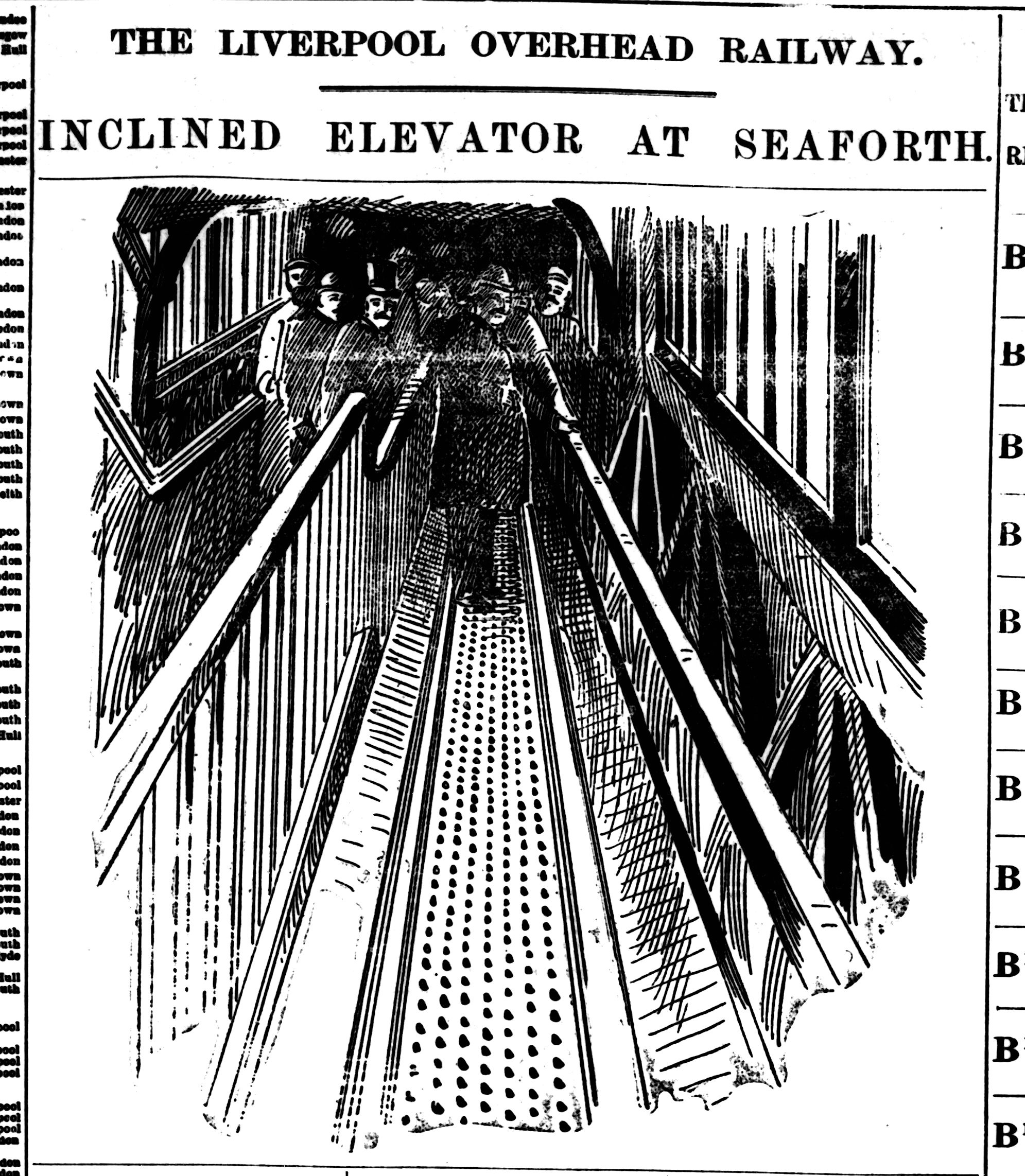 In 1901 Seaforth Sands was the first ever railway station in England to have an escalator (a “Reno inclined elevator”) installed in a roofed-in passageway from ground floor to platform level. It had wooden slats 3 inches wide that were faced with India rubber, with each tread running on wheels in continual motion, with a handrail that moved in tandem. Although escalators had been in use for some time in Manhattan, New York, it was only the second to be installed in the UK, after Crystal Palace in London, and the first used on a railway. A lovely piece in the Journal of Commerce in 1901 argues both the health and cost benefits:
An ingenious estimate is that the average passenger climbs in the ordinary way of travel on elevated roads some 24,000ft vertically per annum, thus spending 13 1/2 hours in climbing and expending 1.85 horse-power. With the inclined elevator this will be avoided, and will result in longer life to passengers, thereby retaining their customer longer to the railway,
Sadly, it had to be taken out of service when it became a real hazard due to women catching their long dresses in the moving parts.
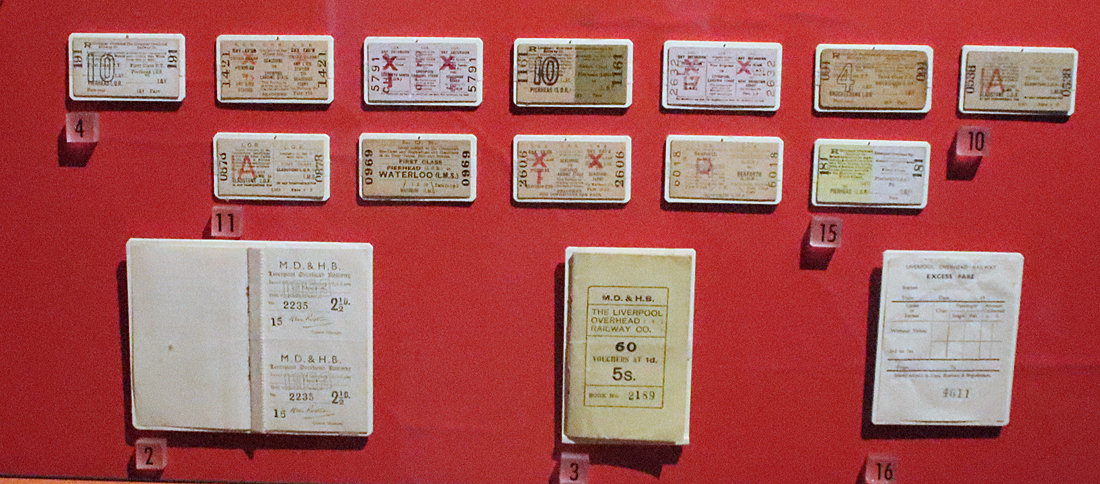
Tickets from the LOR at the Museum of Liverpool
In 1902 the LOR was forced to respond when the previously horse-drawn trams were replaced by electrified trams, which also carried passengers into the shopping areas that were beyond the reach of the railway. In fear of the competition, the company increased the speed of their trains by upgrading their engines from 60hp to 100hp. After some time the running costs proved to be prohibitive, and the increased strain on rolling stock also raised concerns, so in 1903 the trains were slowed to a more cost-effective speed. Other costs were incurred from the wear and tear on wheels due to the curve line, but this was addressed by the LOR’s General Manager and engineer E.J. Neachell who innovated an automated lubrication system that significantly improved their longevity.
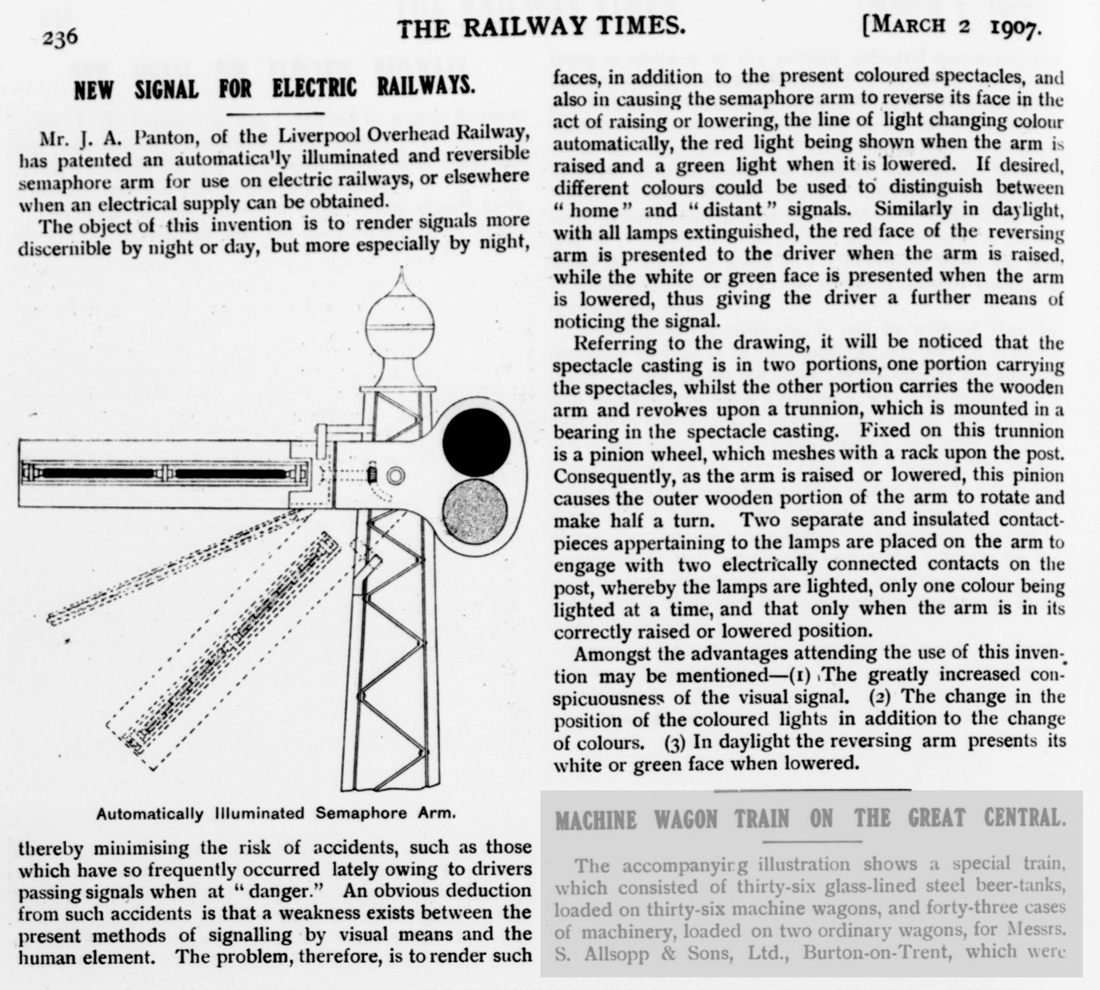
“New signal for Electric Railways” Railway Times, 2nd March 1907
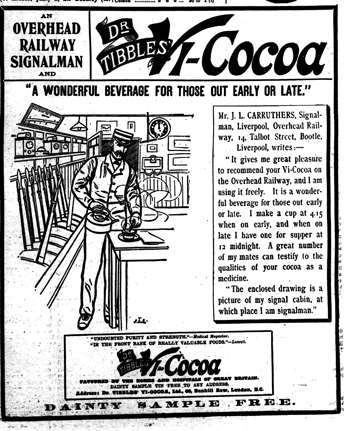
Another important innovation on the LOR in 1902 included an automatic semaphore signalling system to replace manual signals. The company was the first railway to install an automatic signalling plant in Britain after it was approved by the Board of Trade in December 1891. It came into service in March 1893.
In 1905, in another attempt to maximize revenue, a direct connection was made to the Lancashire and Yorkshire Railway’s North Mersey Branch at the far north of the LOR a through-train was run to Southport, and in 1906 a link was made to Aintree. It was hoped that the direct through service might produce more passengers travelling first class. Although the through-train service to Southport was never sufficiently successful, and ceased in 1914, passengers could still change from the LOR to the Lancashire and Yorkshire to travel to Southport, and the link to Aintree continued to be popular for race meetings. By this time, just before the outbreak of the First World War, the LOR was carrying some 10 million passengers. The railway continued in its role as a passenger service during the war years, but it also saw some changes, servicing the passengers from the troop and supply ships coming into dock.
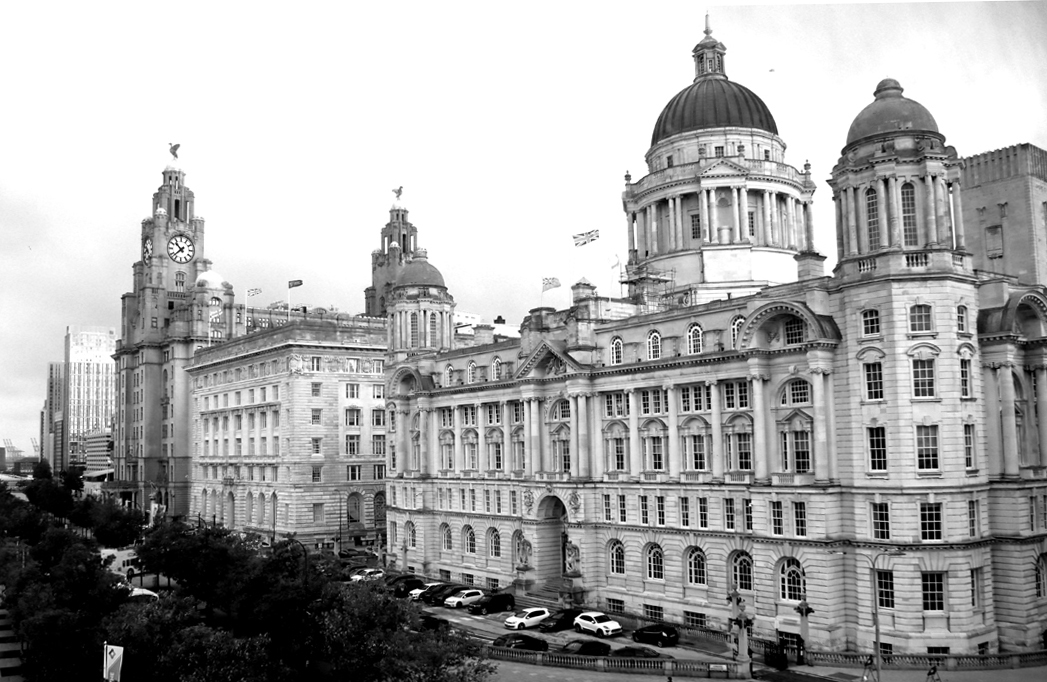
The Three Graces: The Royal Liver Building at left, the Cunard Building in the Middle and the Port of Liverpool Building at right.
Some of the most remarkable of Liverpool’s buildings had to adapt to the LOR. Sitting behind it, the striped White Star Line building was finished in 1898, five years after the opening of the LOR. Even more dramatic than that iconic building, the waterfront was changed forever between 1907 and 1917, the trio of buildings known as “The Three Graces” were built after the LOR had been running for nearly a decade on the site of the 1777 George’s Dock, which was still in situ in 1893, but was in-filled in 1900. The Port of Liverpool Building (the headquarters of the Mersey Dock and Harbour Board) was completed in 1907, the Royal Liver Building in 1911 and the Cunard Building in 1917. The LOR ran, uninterrupted, behind the new buildings. Other notable buildings that would have been in view of the Overhead Railway as Liverpool’s impressive waterfront continued to evolve are the Art Deco style George’s Dock Building (1934) and the India Buildings (1932).
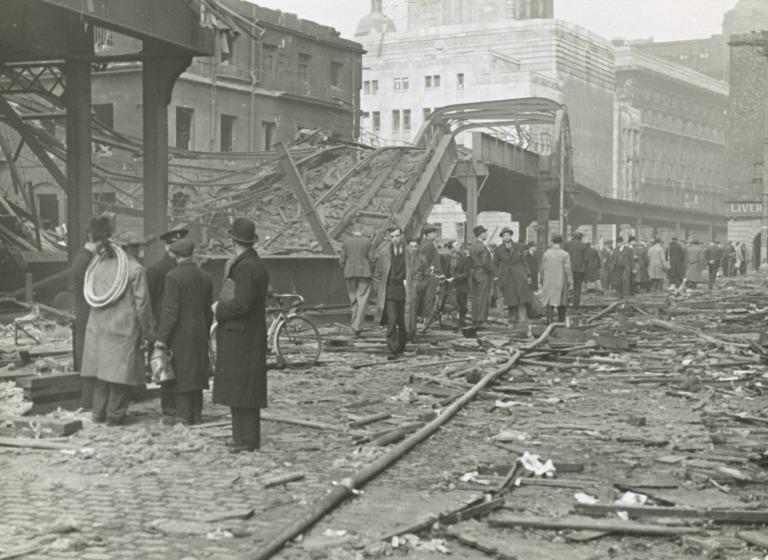
Bomb damage at James Street Station. Source: National Museums Liverpool
In the early years of the railway, both manned signal boxes at key junctions and automated semaphore signals were used. An innovation was introduced in 1921 when Westinghouse coloured light signals were introduced.
During the Second World War the LOR continued to serve as a vital link between all the docks. Due to its proximity to the Liverpool docks, which were targetted by German bombers, the Overhead Railway was damaged during these raids several times. James Street Station was almost levelled in 1942, for example, and Canada Dock Station was hit twice, but most of these attacks were at night and no trains were lost. In all cases the bombed-out sections were brought back into service very quickly. During repairs a bus service was introduced to transport passengers between stations either side of damaged sections. As with many other services, for the first time women were employed in ticket offices and as conductors on trains to replace the men who went to war. Standard maintenance was severely reduced during the war, and it is probable that this neglect was partially responsible for the financial difficulties in which the Liverpool Overhead Railway Company found itself after the war.
Source: British Newspapers Online
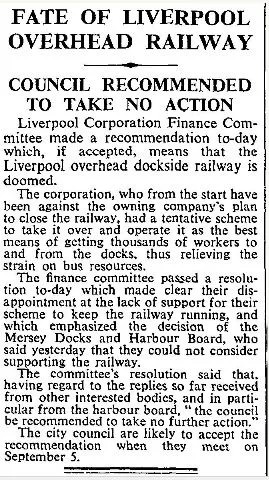
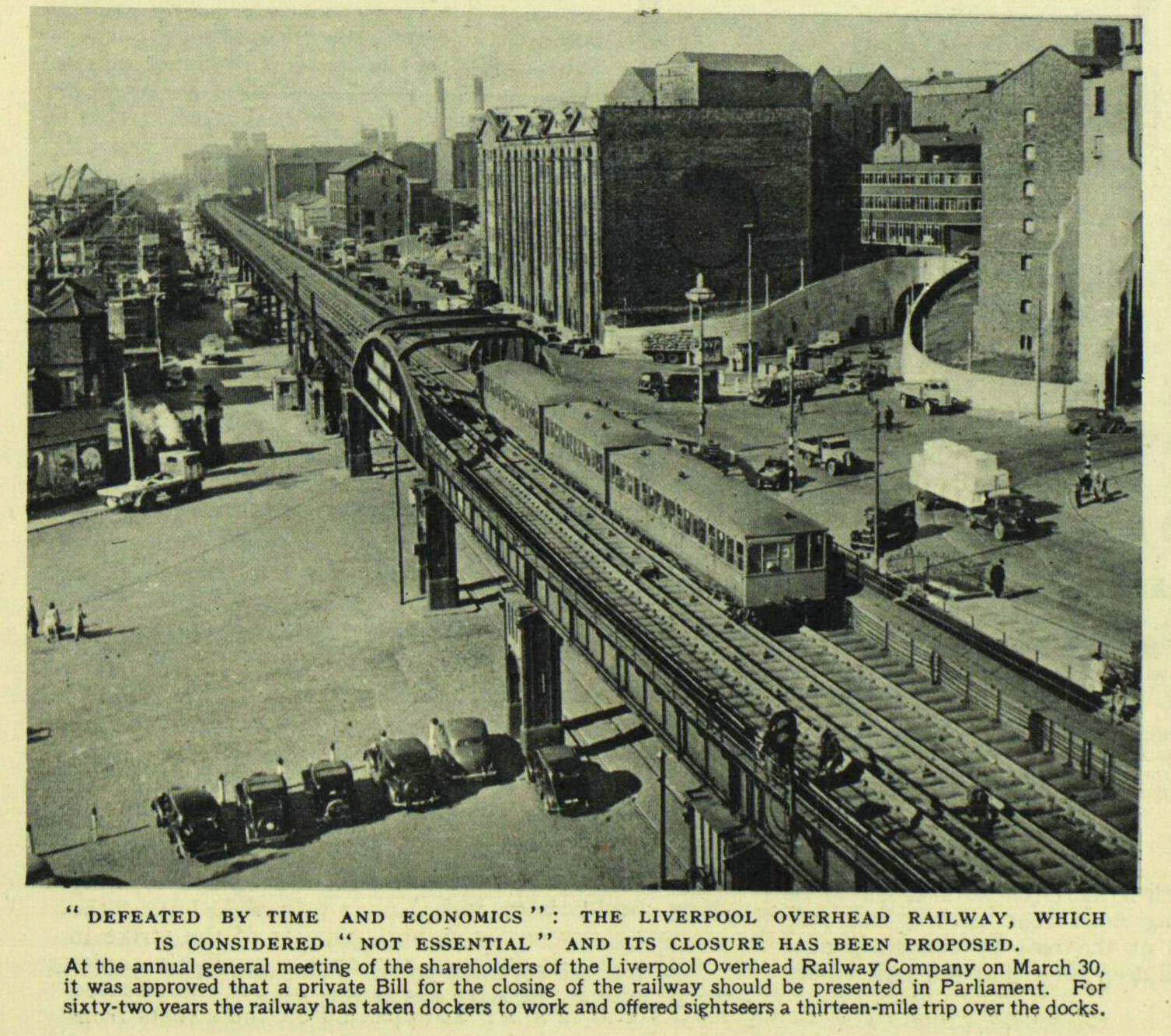
In 1955 the decision to close the Overhead Railway was made. The announcement of the closure was made in the February of that year, and the authorities remained immovable, in the teeth of vocal public opposition. The main reason was the rust corrosion of the iron and steel that carried the railway. For a private company with limited resources, raising the estimate sum of over £2 million to renovate the railway was inconceivable for the Liverpool Overhead Railway Company in the post-war period, and the city authorities made the decision not to rescue it, whilst nationalization of the main railway companies in 1948 under the Transport Act 1947 excluded the LOR because it was not part of the main railway network.
The Liverpool Overhead Railway finally closed on December 30th in 1956 and the Liverpool Overhead Railway Company was forced into voluntary liquidation. Demolition began at the south end of the LOR in 1957. The iron bridges were all dismantled and purchased by scrap dealers for recycling. The Liverpool Corporation provided a bus service to replace the railway.
Source: British Newspapers Online
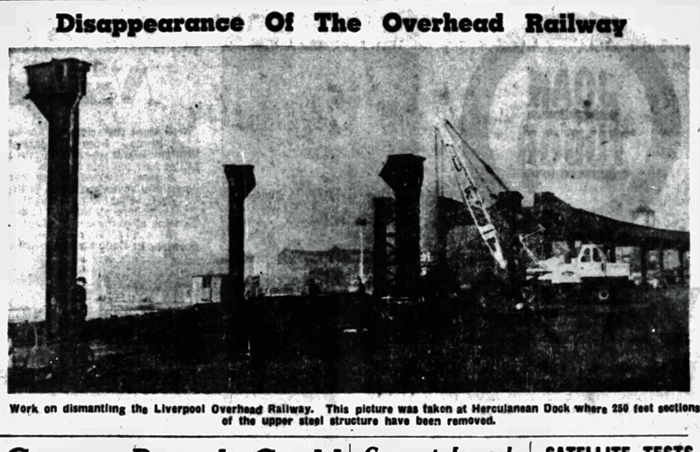
Disappearance of the Overhead Railway, with the supports in the foreground and the railway being dismantled in the background. Liverpool Echo, 27th September 1957. Source: British Newspapers Online
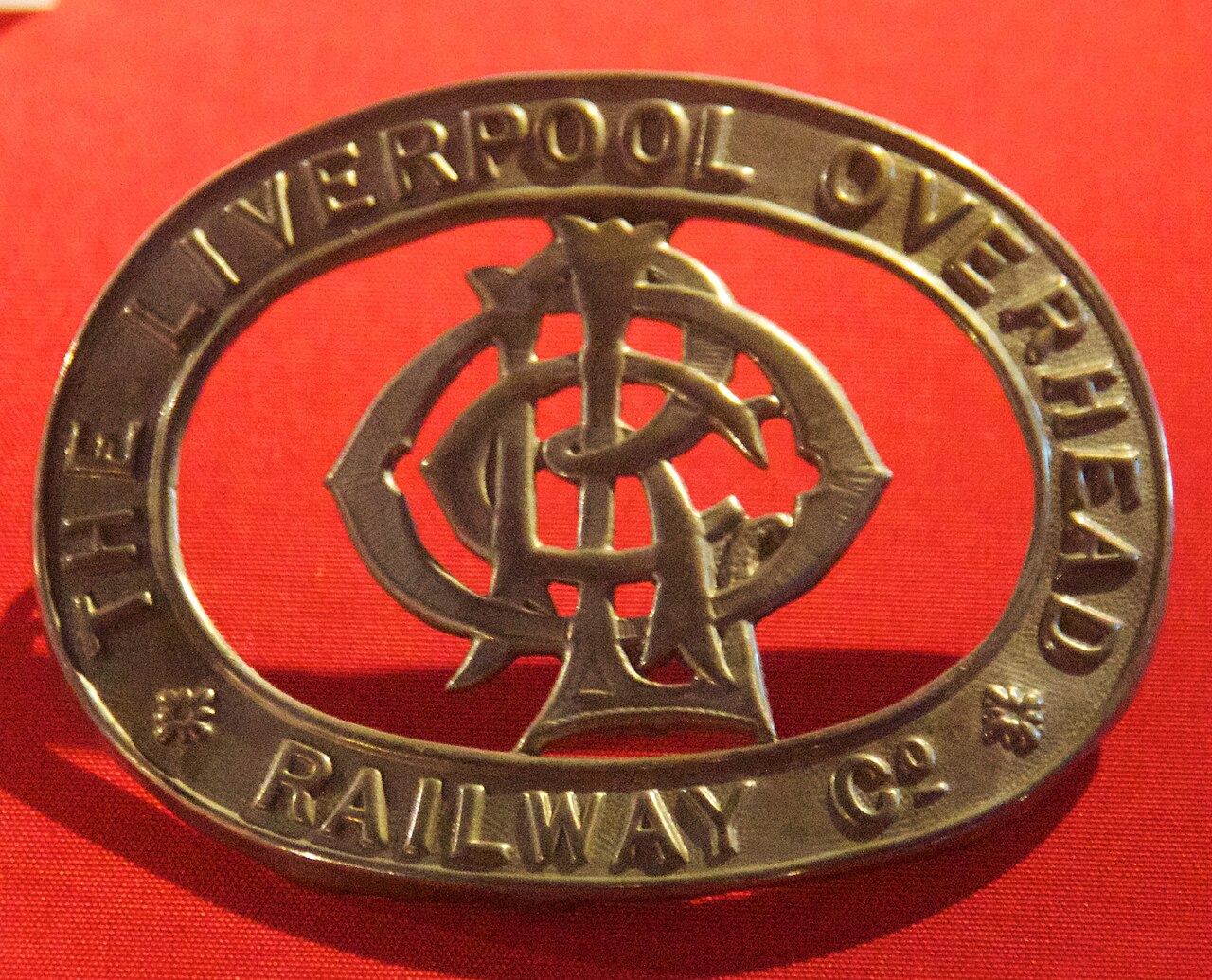
Cap badge from the Liverpool Overhead Railway. Source: Wikipedia
Final Comments
The Liverpool Overhead Railway was viable because of the arrangement of the docks along an almost straight waterfront. As a comparison, London’s docks were dotted along the Thames in separate, discrete systems that spread inland on both sides of the river due to the extreme u-shaped bends, rendering them unsuitable for anything like the Overhead Railway. Transport and communication between the different London dock systems was often laborious. See the London and Liverpool dock maps below for comparison, showing the dramatic difference between the two systems, demonstrating how Liverpool’s waterfront development made the LOR a very suitable solution, creating a fluid means of carrying passengers between different docks and related warehousing, commercial and government buildings.
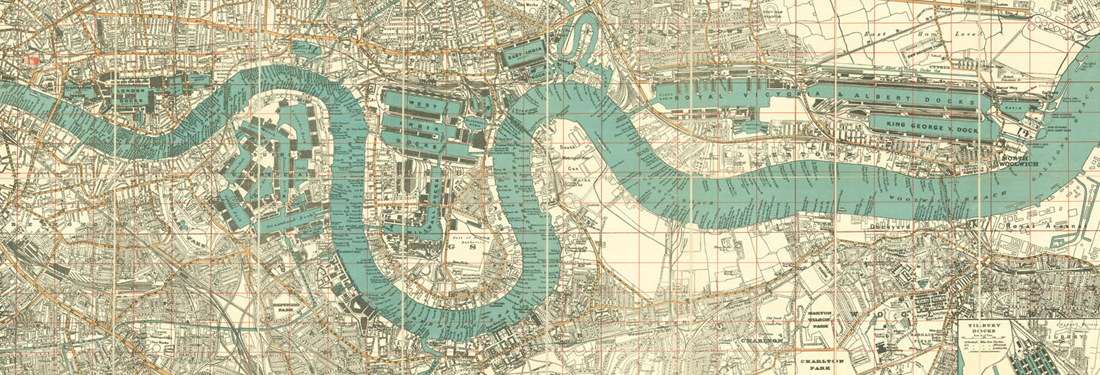
1904 map of the London docks by Edward Standford
A map of the Liverpool Overhead Railway in the 1930s, showing the layout of the docks
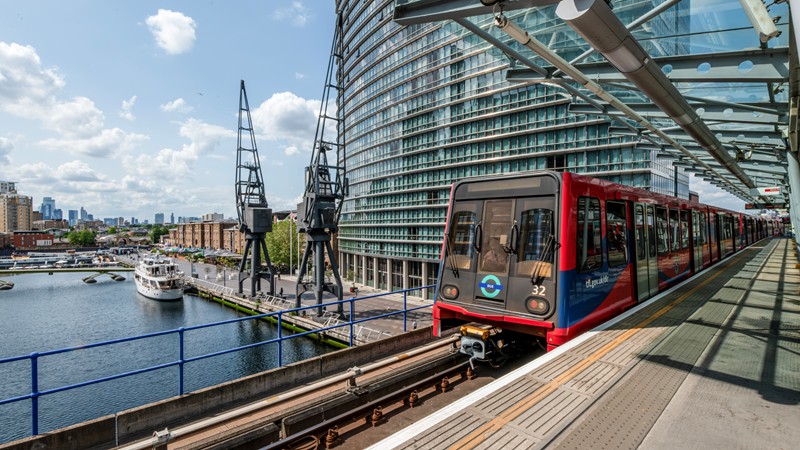
The Docklands Light Railway. Source: Visit London
As well as being the world’s first electric elevated railway, the Liverpool Overhead Railway was the first to install an escalator, the first to introduce automatic semaphore signals and the first to introduce colour signalling lights. As well as being important to local history, the Liverpool Overhead Railway remains an important part of British dockland history, partly because of its innovative approach as a feat of electrical engineering, with its ongoing committent to innovation, but also because of its role in Liverpool’s social and economic history. It influenced many other elevated railways including London’s driverless Docklands Light Railway, which opened in 1987 to link parts of the newly developed financial centre in London Docklands with the City and the underground network. In some ways, London’s Docklands Light Railway serves a similar function today, although with a lot less personality, linking business and commercial centres that need to be connected to each other and to the City.
 Even though the LOR was demolished in 1956, its loss is still deeply regretted in Liverpool, with many local people who were children at the time retaining memories of how it looked and sounded. The Museum of Liverpool has some recorded memories to listen to, and Peter Grant’s book (see Sources below) has compiled some excellent short accounts of people’s experiences. My great-grandfather, who was a French sailor from Toulouse, was on shore leave in Liverpool after his ship docked in Liverpool when he met my great grandmother. When his ship left, it left without him. Following marriage, he settled into life in Liverpool, not as a sailor or docker but as a driver on the Liverpool Overhead Railway, reinventing himself as one of the many moving parts of Liverpool’s dockland infrastructure. His was one of a great many lives shaped by the Liverpool Overhead Railway.
When the LOR was first built most of the road traffic was horse-drawn, but by the time it was demolished, only a few horses remained, and cars and trucks were the order of the day. It seems inevitable that as lorries became bigger and more numerous in the following decades, a dockland-wide 16ft height limit would eventually have made transporting goods to and from the docks impossible, but it is a great shame that a portion of it was not preserved as a matter of heritage preservation. One sympathizes with the Liverpool Overhead Railway Company, but the city council seems, with hindsight, to have been rather more accountable for failing to preserve a portion of the overhead railway for posterity.
Visiting
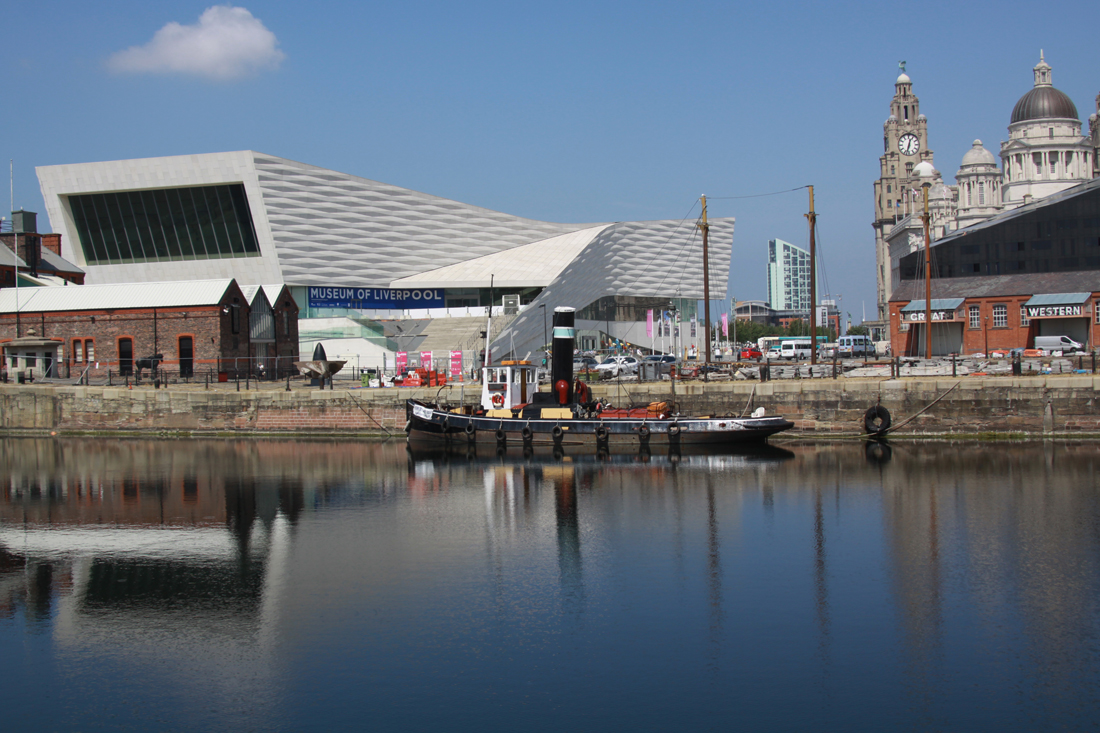
Museum of Liverpool
Given that the Liverpool Overhead Railway was demolished without leaving a single section in tact for heritage purposes, visiting might seem like a tall order. There is, however, a section at the Museum of Liverpool devoted to the Railway, which preserves the last of the original 1893 LOR carriages, Carriage 3, and has been placed on a piece of replica railway infrastructure, 16ft above the ground just as the original was, to give a good sense of how it must have looked. The museum is free to access.
The opening of the tunnel from Herculaneum Station to Dingle Station is still visible and there are also a number of truncated support uprights preserved where they were incorporated into sections of wall along the line of the old LOR.
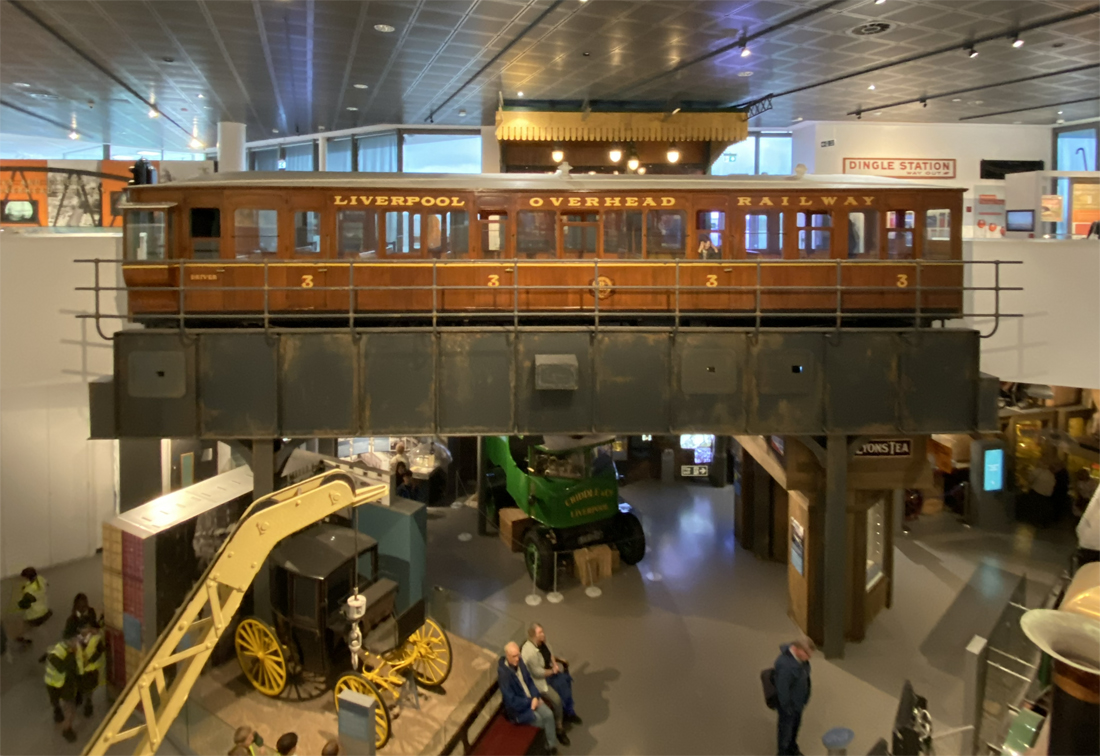
Carriage 3, one of the original batch of carriages to be ordered, now on display in the Museum of Liverpool
Sources
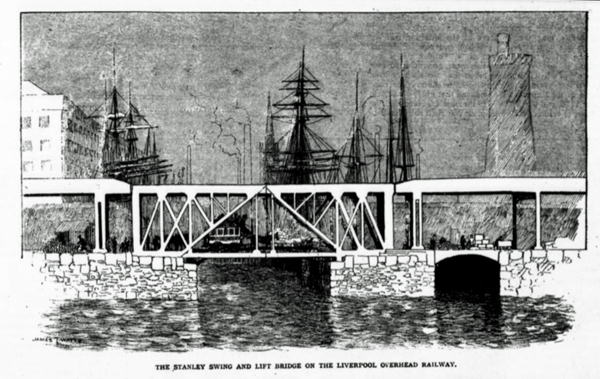
Stanley Swing and Lift Bridge. Pall Mall Budget 12th September 1893. Source: British Newspapers Online
The above is a massive simplification of a very complicated story, in which political agendas and competition with road-based systems were perhaps just as important as engineering considerations. If you want the full story, I found Adrian Jarvis’s book the most useful, with a very insightful analysis of the Company’s financial challenges. For a short history with some splendid photographs see Peter Grant’s book, produced for the Liverpool Echo. The other titles listed also contributed very useful information, with C.E. Box’s being the most technical for those interested in engineering details.
Books and papers
 Anon 1901. Inclined elevator at Seaforth. The Journal of Commerce, January 20th 1901, p.3
Box, Charles E. 1984 (Revised by Adrian Jarvis). The Liverpool Overhead Railway. Ian Allan Ltd
Gahan, John W. 1982. Seventeen Stations to Dingle. Countryvise / Avon-Anglia
Grant, Peter (compiler) 2011. The Liverpool Overhead Railway. Trinity Mirror Media
Jarvis, Adrian 1996. Portrait of The Liverpool Overhead Railway. Ian Allan Publishing
Neachell, E.J. 1916. The Liverpool Overhead Railway. The Railway News, 5th February 1916, p.231-232
Websites
The British Newspaper Archive
https://www.britishnewspaperarchive.com/home
BFI
Liverpool Overhead Railway 1893-1956 (video)
https://replay.bfi.org.uk/video/d6a0f2a3-fa48-5487-b722-d0e2a4997aa7
British History Online
Liverpool: The Docks
https://www.british-history.ac.uk/vch/lancs/vol4/pp41-43
Grace’s Guide to British Industrial History
Liverpool Overhead Railway
https://www.gracesguide.co.uk/Liverpool_Overhead_Railway
1923 Visit to the Works
https://www.gracesguide.co.uk/Liverpool_Overhead_Railway:_1923_Visit_to_the_Works
National Museums Liverpool Collections
Liverpool Overhead Railway
https://www.liverpoolmuseums.org.uk/collections/social-history/overhead-railway
Wikimedia Commons
Liverpool Overhead Railway map
https://upload.wikimedia.org/wikipedia/commons/c/c2/Liverpool_Overhead_Railway_map.png?utm_source=commons.wikimedia.org&utm_campaign=index&utm_content=original
Videos:
1) Liverpool Overhead Railway (including rare footage). A documentary about the LOR (37 minutes long)
https://www.youtube.com/watch?v=2xg0EAJ7OAk
2) “Liverpool Scenes 1896” begins in the city with a scene of milling horse-drawn trams, and then moves to the Overhead Railway where footage is taken from one of the carriages over the docks – wonderful to see all those masts.
3) Five-minute footage of the LOR in colour


