
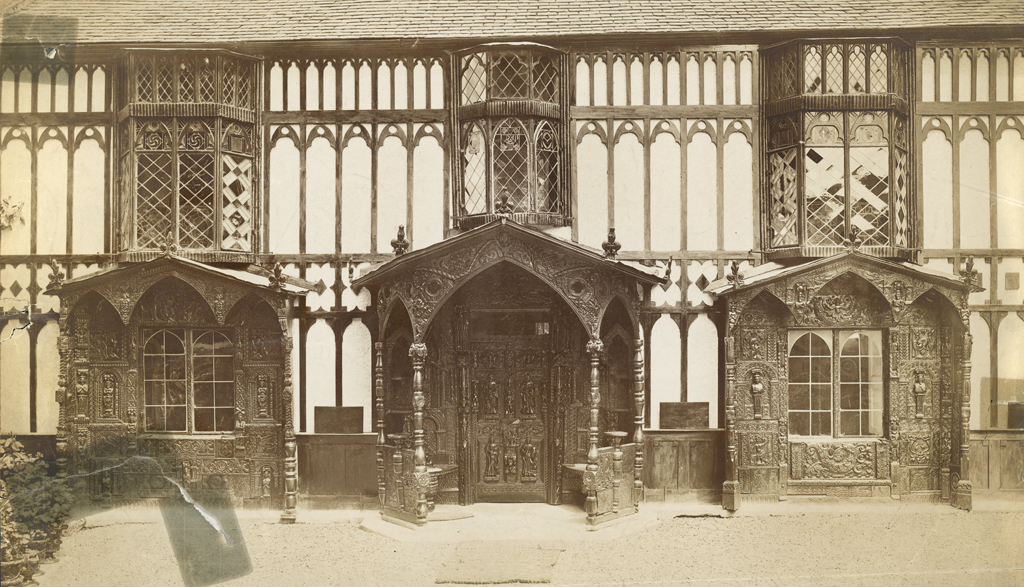
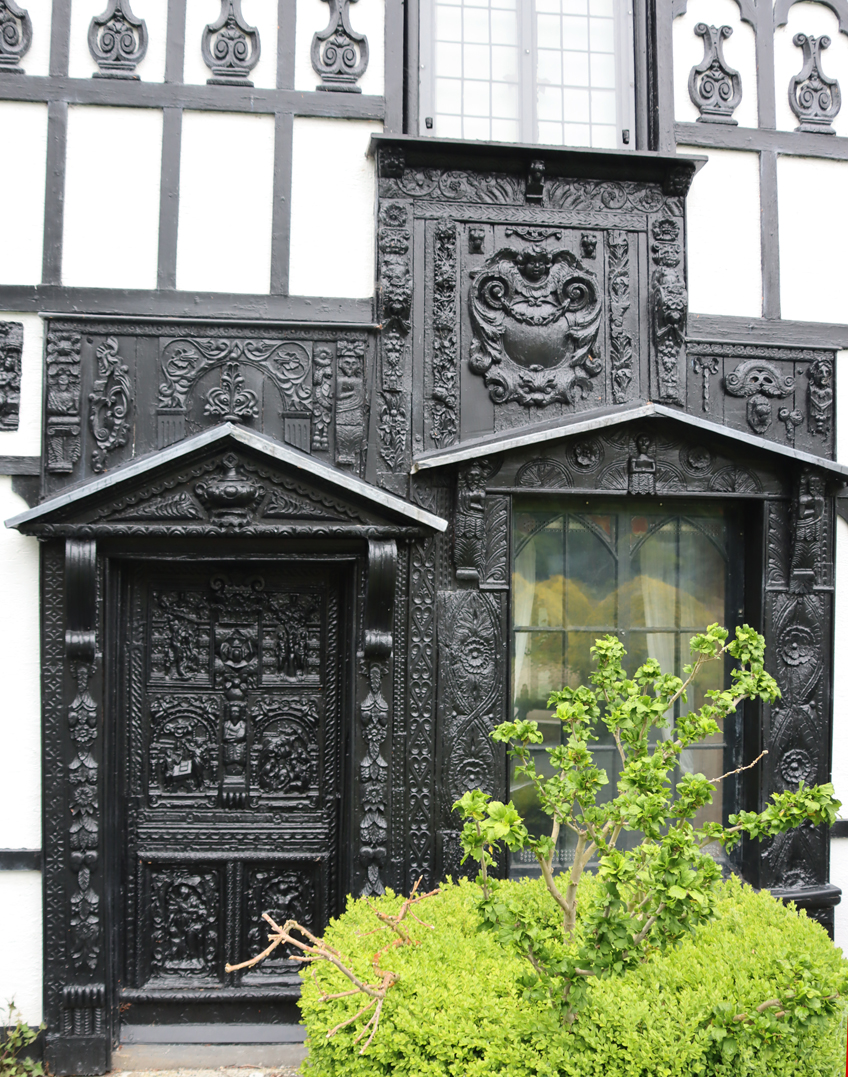
Plas Newydd showing the exterior wood carvings with the porch, scene of the porch-warming party, at centre; and the canopies and carvings around the gothic-styled windows. Source: RCAHMW
Introduction
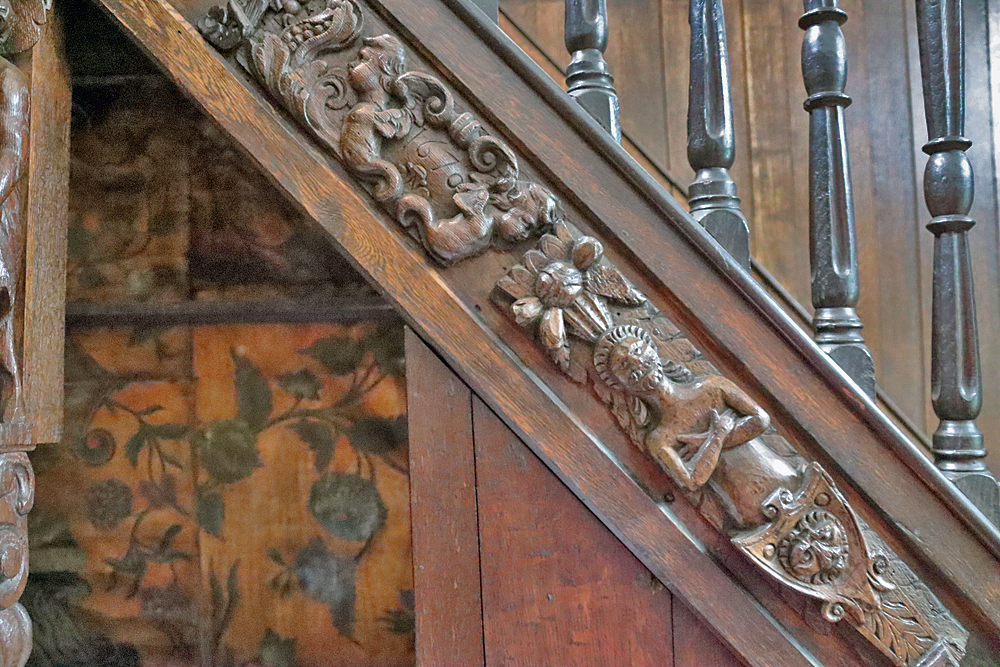
 Lady Eleanor Butler and Miss Sarah Ponsonby moved into an unassuming Welsh cottage on a hill a short distance from the centre of Llangollen in 1780, having abandoned their respective homes in Ireland to find a new life free from family pressures. They soon began to transform the cottage and its gardens, and in the early 1800s added an extravagant porch and matching window canopies outside, composed of ornamental wood carvings. This continued in the interior, where walls, doors, lintels and patches of ceiling, and even stair bannisters and stair treads, were covered with ornamental wooden panels. The majority of the carvings date to the 17th century and display all the exuberance that characterize the decorative arts of that period. In 1876, four decades after the deaths of the ladies in 1829 and 1831, the house was purchased by General John Yorke who not only maintained the house, but added a new wing and continued to develop the cottage along the lines envisioned by the ladies. Although the new wing was demolished due to dry rot, his additions to the cottage survive, primarily the Oak Room where the kitchen had been located and which became a richly decorated drawing room. Subsequent owners also made changes, but preserved the wood carvings and other decorative features in the original cottage.
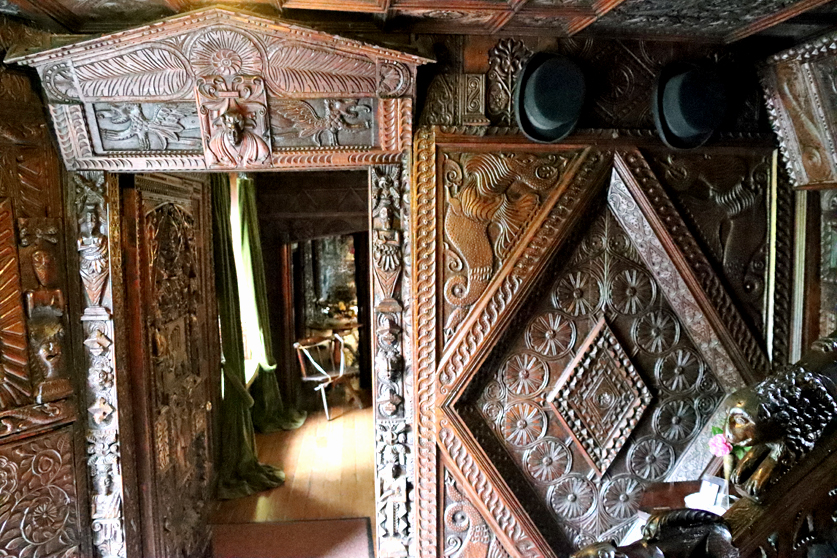
Th entrance hall, looking through to the Oak Room
The sheer amount of ornamental carving used as wall coverings in a chaotic patchwork throughout the place is remarkable. Although it is nearly all unprovenanced, it is an extraordinary survival of period pieces, having escaped woodworm, damp or dry rot, and it is beyond fortunate that a series of owners continued to appreciate and care for this very rare resource.
 This post is the 6th in a series about Plas Newydd and looks only at the wood carvings at the house. It follows on from five other posts about Plas Newydd.
Part 1: The introduction to Plas Newydd, introducing Lady Eleanor Butler and Sarah Ponsonby and their lives, tracing what happened to Plas Newydd following the death of Sarah in 1831, and how General John Yorke purchased the house in 1876 and continued to build on the ideas of the two ladies.
Part 2 talks about the patchworks of stained glass at Plas Newydd
Part 3 discusses the Delftware tiles, gilt leather wall hangings and intricate moulded ceilings
Part 4 focuses on the Gorsedd circle in the garden of Plas Newydd, and the Eisteddfod of 1907-8
Part 5 is a short piece looking at the possible links, in material terms, between Brynkinalt and Plas Newydd
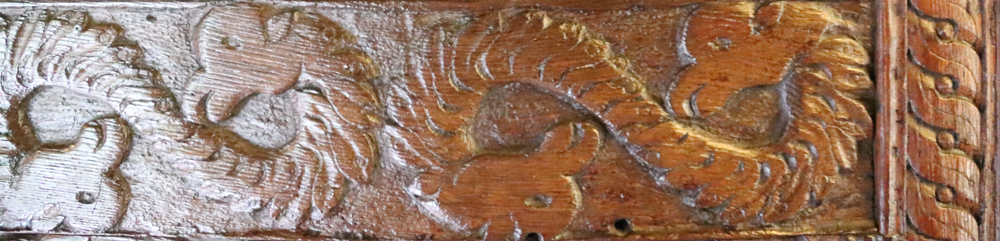
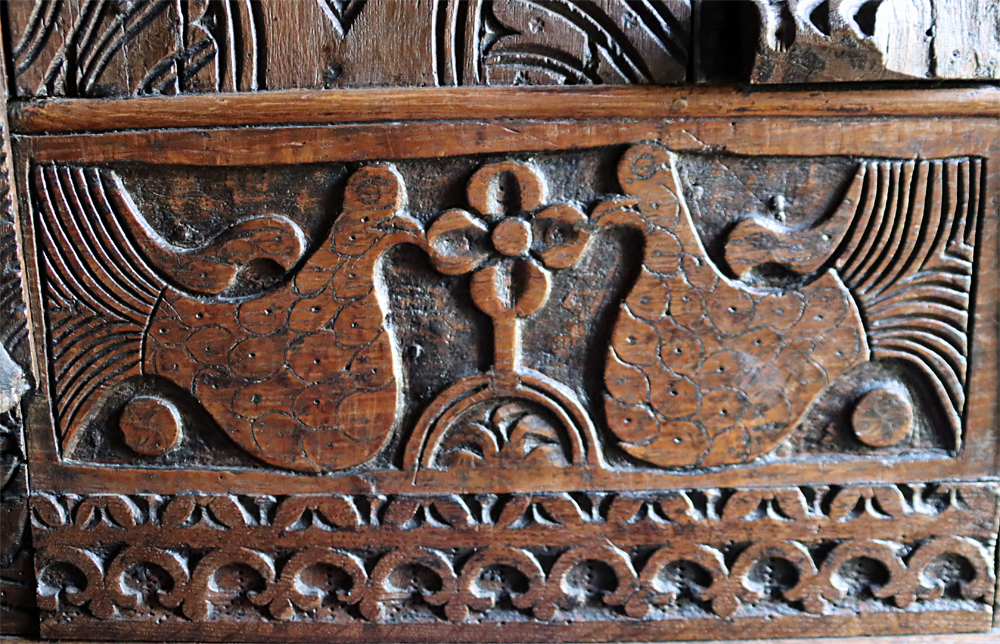
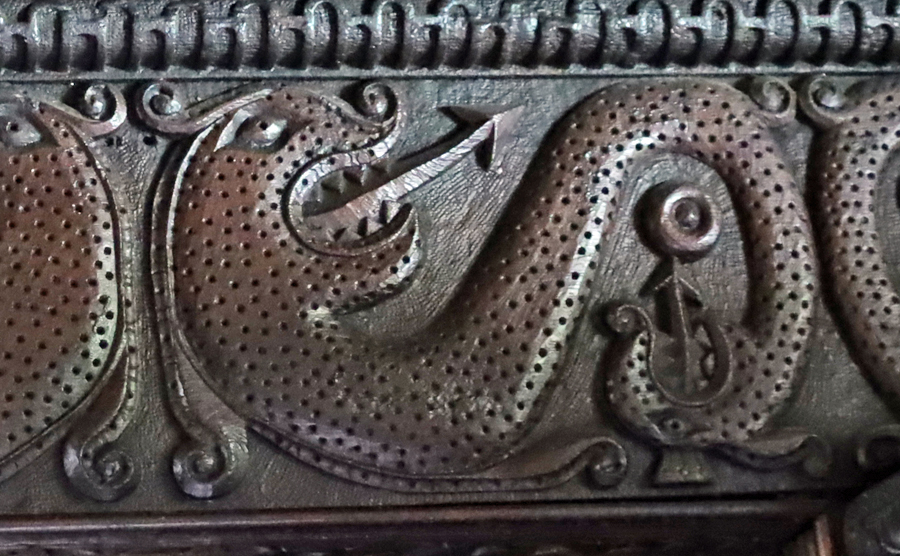
Twin amphisbaena (mythical creatures with a head at each end)
====
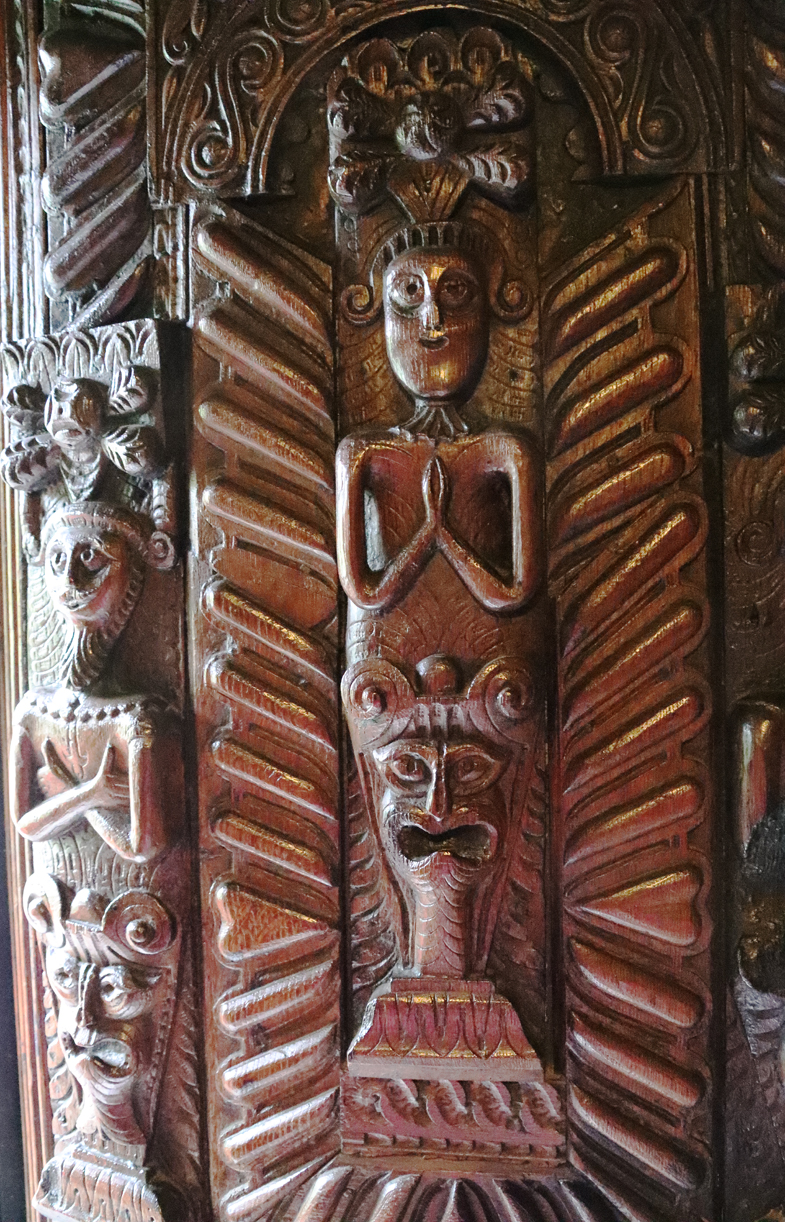 Lady Eleanor’s journal and various letters describe how the ladies pursued their new obsession with enthusiasm in a period of changing tastes. This sort of elaborate carving at Plas Newydd, often showing scantily clad figures and strange creatures, was thought to be antithetical to the newly celebrated neoclassical style. Much of the now unfashionable furniture and wainscotting (panelling) was stripped out and lost forever. The remarkable collection, assembled in the years prior to around 1814, preceded the revival of interest in what Philip Larkin called “the Jacobethan” by some years, meaning that the cost of salvaged wood from the period was probably still comparatively low. The result is somewhat astonishing and the sheer quantity can be baffling. It is a real patchwork with pieces from many different sources, most of them unrelated, all jammed together to form a single new identity. It will not be to everyone’s taste but I find it irresistible.
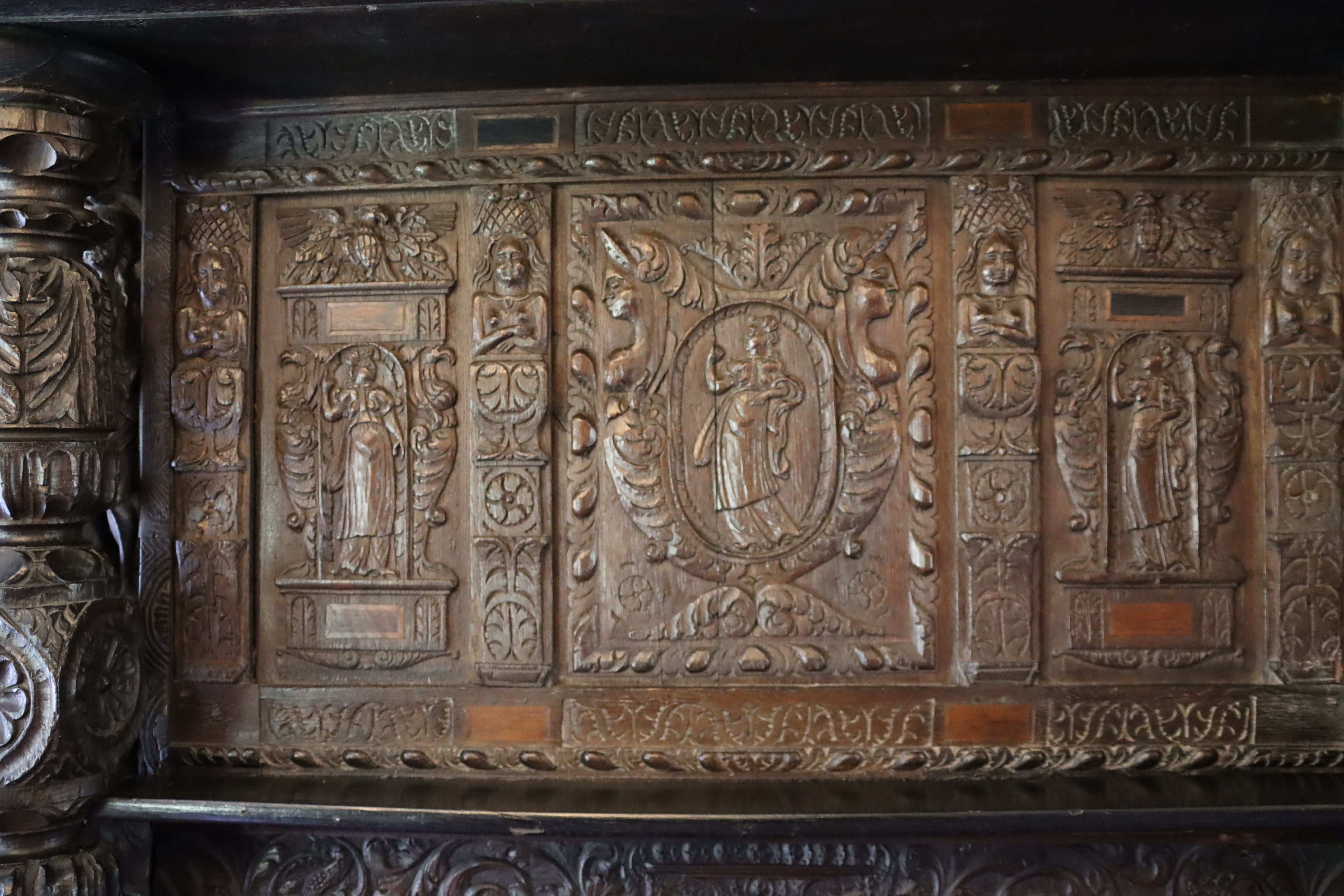
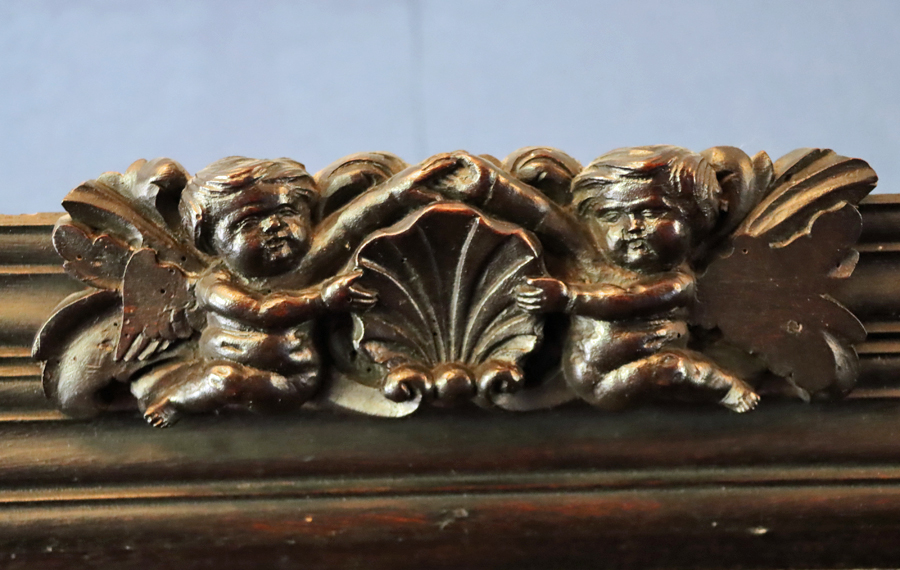
Many of the carvings consist of deconstructed furniture – chair backs, bedsteads, bed posts, cupboard sides, table legs, church chests and pews, roof bosses canopies and more, as well as original pieces of wainscotting, all reassembled into a brand new customized kaleidoscope decorative arts. A local carpenter was employed to fix the assembled panels to the walls, stairs and ceilings. Most of it was carved in oak, the most popular material of the Jacobean period when most of these pieces were probably crafted. It is probable that some Victorian imitations were also thrown in for good measure by General Yorke, suggested by inferior carving in lighter wood that was often associated with the leather wall coverings that he installed, but these too contribute to the sense of a grand medley of different themes, styles and textures.
Background: Historic carved wood and the grotesque
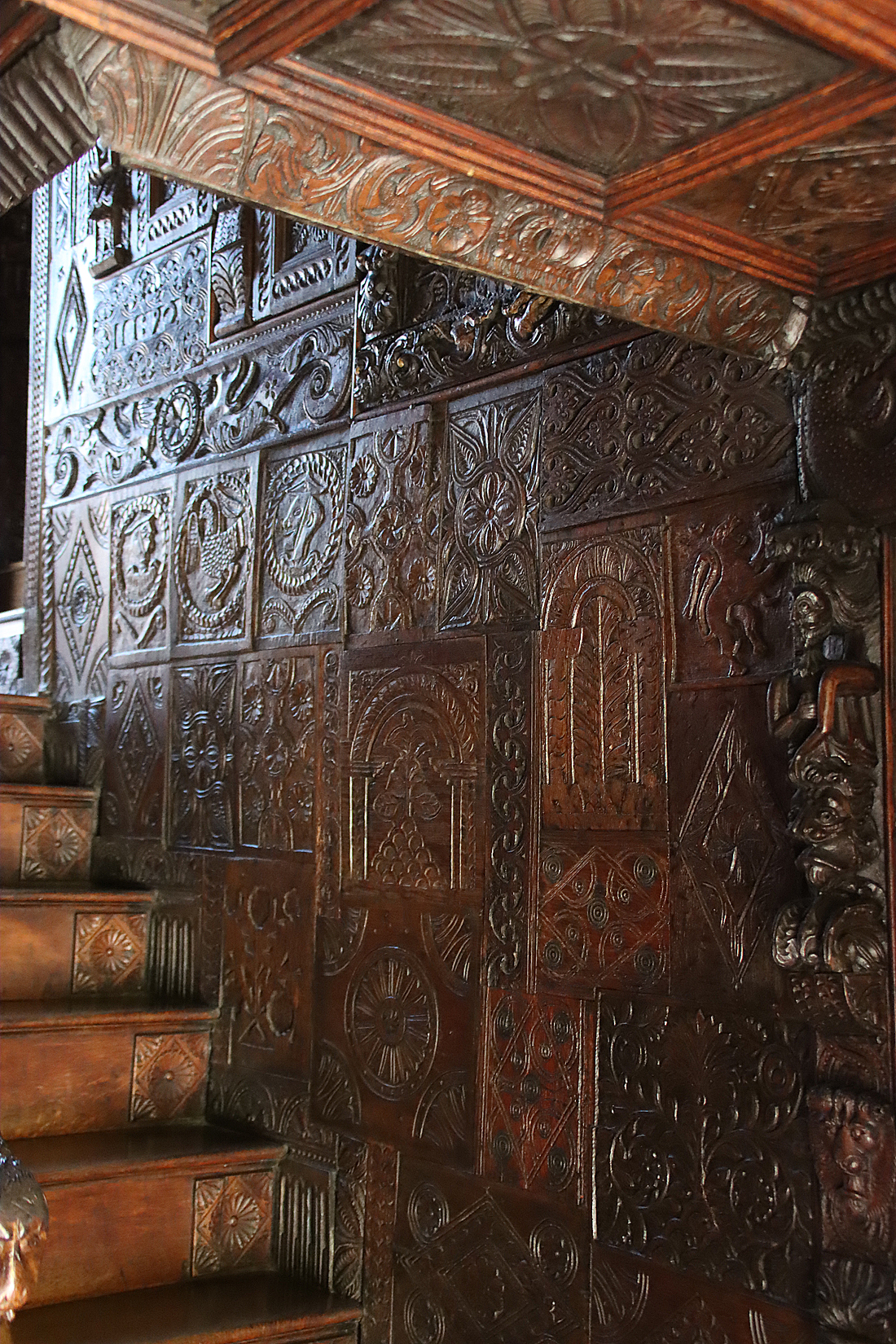 The unpublished 2001 analysis of the carved wood at Plas Newydd by specialist David Bostwick is available to view at Plas Newydd in a file of useful material in the room known as the library. It is not yet available online but has been summarized on the Early Tourists in Wales website on the Plas Newydd Wood Carving page by the website’s owner Michael Freeman. David Bostwick dates the majority of the carvings to the 17th century, corresponding to the late Tudor and Stuart reigns, but he also found examples of earlier 15th and 16th century carvings as well as 19th century pieces that were mainly used to frame older work. The only period apparently completely unrepresented by the carvings is the 18th century. The main material used was oak although there is a very small minority of other woods employed. Two items composed of inlay were also identified. Bostwick’s assessment was that although some pieces were made by skilled craftsmen, others were the mass-produced output of inferior workshops. Unsurprisingly, he commented that there were clearly multiple sources for most the carvings, although he was able to identify that a small number of pieces had been produced by a single unidentified workshop.
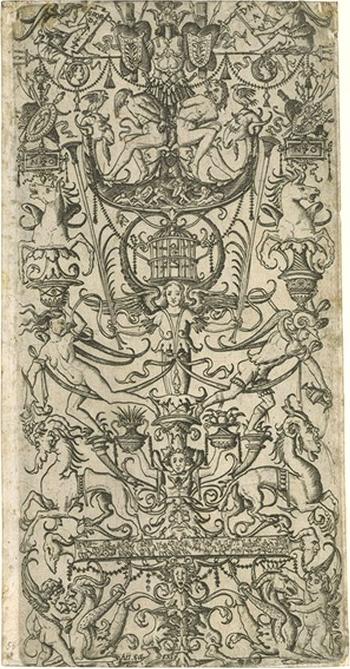
Grotesque composition c.1500-1512. V&A Museum no. E.180-1885. Source: Wikimedia
In spite of the eclectic mix of dates and sources, there is a cohesion to the entire collection, that it might be expected to lack given its blatantly patchwork quality. It coalesces around what has become known as the “grotesque,” a term referring to an artistic style that emanated from Italy and the discovery in 1485 of the Roman paintings in the Domus Aurea (golden palace) in Rome itself, lost after Nero’s suicide and subsequently built over by Trajan’s bath-house. The 15th century term “grottesca” (plural grotteschi) derived from the idea that the Domus was “grotto-esque” due to the cave-like conditions in which it was found, and the term “grotesque” has since been used retrospectively to refer to any form of art, whether carved, moulded, painted, stitched or otherwise, that focuses on subjects that are in some ways fantastic or exotic, sometimes fearsome, sometimes funny, frequently bizarre and always imaginative.
This popular new style arrived in England particularly via prints from the Flemish lowlands and fused with the earlier but still ever-present Gothic grotesque, developing in secular rather than ecclesiastical contexts, helping country home owners to express their status and sense of their own achievements and grandeur.
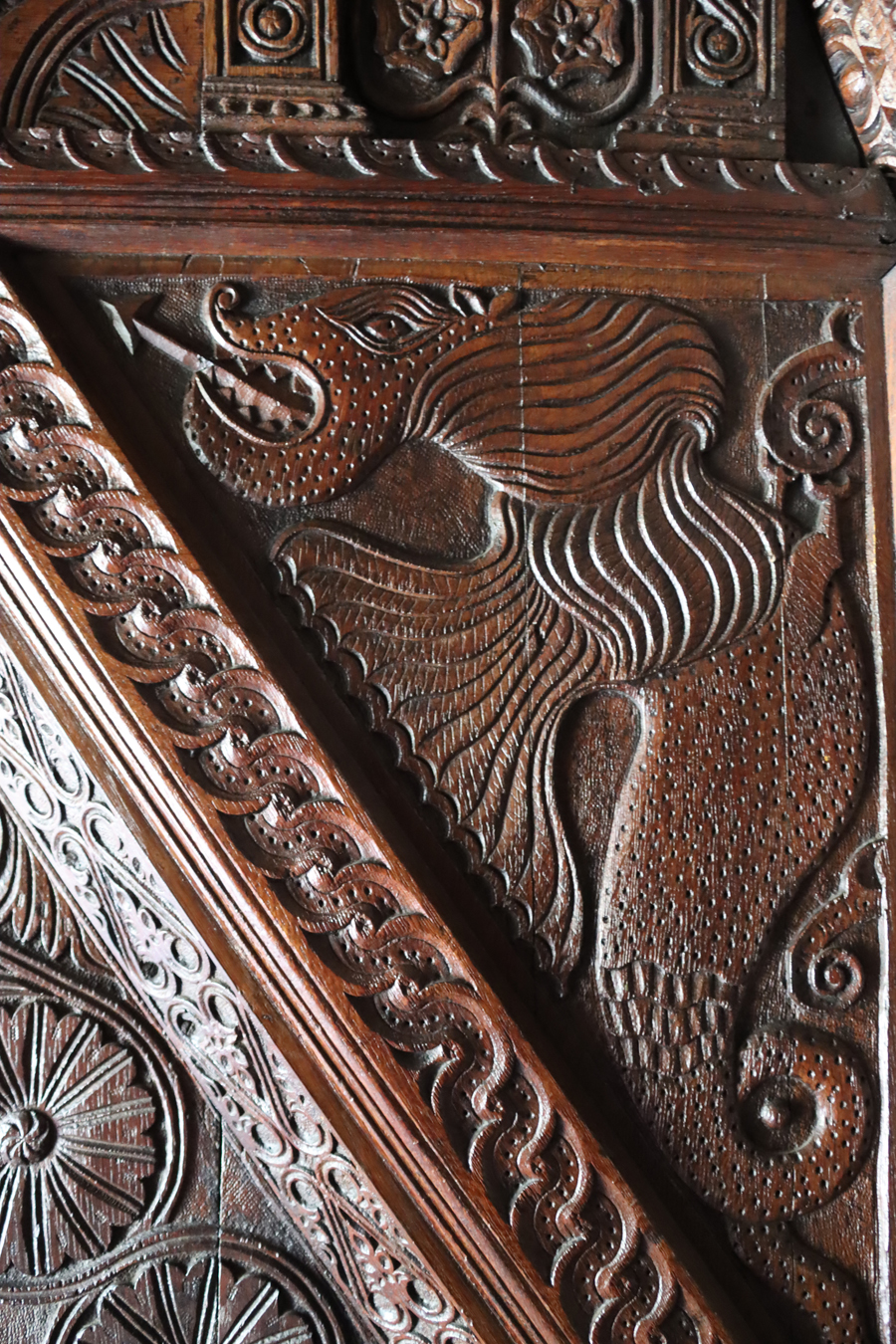 It is intriguing how these two strands, the Italian grotesque and the Gothic, carried through so strongly into Elizabethan and Jacobean Britain, and how a lot of these themes dispersed into rural areas and were re-interpreted in vernacular terms, with new and distinctive styles emerging. It is this fusing of grotesque traditions in the 17th century, re-interpreted with regional inflections, that found its way in such profusion into Plas Newydd. Whilst by no means all of the Plas Newydd carvings fall into the category of the grotesque, they are conspicuous throughout the house. At the same time, as the new styles spread throughout England and Wales, Classical motifs were re-interpreted in a vernacular style, with a panache that would undoubtedly have startled the Romans.
The examples at Plas Newydd represent most of the full range of various shapes, themes and subjects produced in the Jacobean period, and include a wide panoply of characters that were much-loved in medieval imagery and survived well into the Jacobean period, including dragons and wyverns, wildmen, Green men, mythological and fantastical beings, as well as Old Testament, Christian and Chivalric topics.
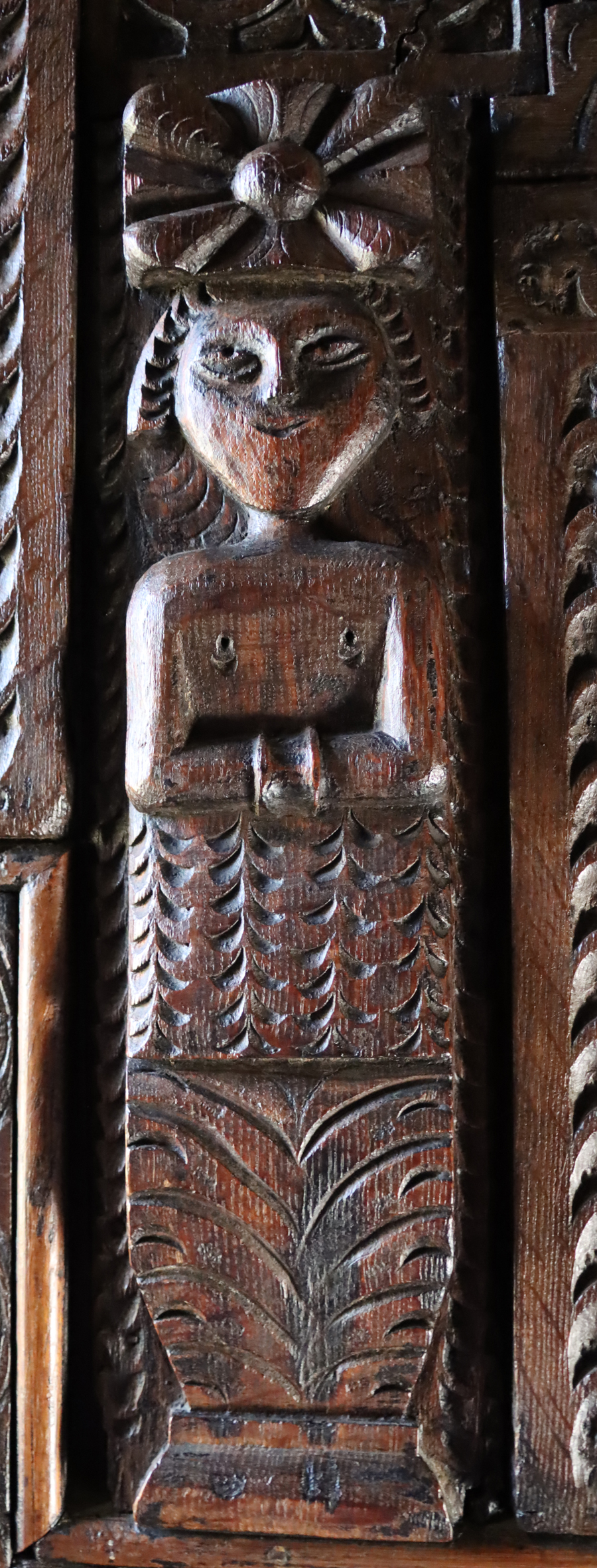 The Jacobean had its own sell-by date, and as the Baroque, Roccocco and Neoclassical styles replaced it, the darkness of oak panelling and furnishings, and the dominance of ornamental carvings that featured on every available architectural feature and item of furniture seemed clunky, ungainly and and over-ornate. A new craving for elegance and light saw churches and manor houses being stripped of their wood and reinvented in the new fashionable, lighter styles. This stripping of religious and secular buildings continued well into the Georgian and Victorian periods, and some collectors took advantage of the intermittent availability of this suddenly unfashionable decorative artwork. It is of course best when a building survives in tact with all of its architectural and decorative features in situ, but it is also a treat when a museum or private collection preserves the decorative artwork of the 17th century. Plas Newydd is a superb example of an ex situ home for late Elizabethan, Jacobean, and both derivative and similar styles of decorative arts.
Lady Eleanor and Miss Ponsonby seem to have had a really good feel for just that continuum of the bizarre, the humorous, the striking and the fantastic, without being too fussed about either time period or provenance, and a great many carvings that fit within the broad definition of the grotesque are to be found at Plas Newydd, and their lead was followed most capably by General John Yorke.
The Plas Newydd Carvings
Installation of the Plas Newydd Carvings
 A number of documents indicate that the collection of the carved wood began sometime in the first decade of the 1800s, when Elizabeth Mavor reports that Sarah had written that their collecting had become a “mania.” The work, both inside and out, required that the ladies temporarily move all their furniture and other possessions from the ground floor to the upper storeys. This implies that they had been accumulating the carved wood for some time and had it installed in one hit. It must have been chaos!
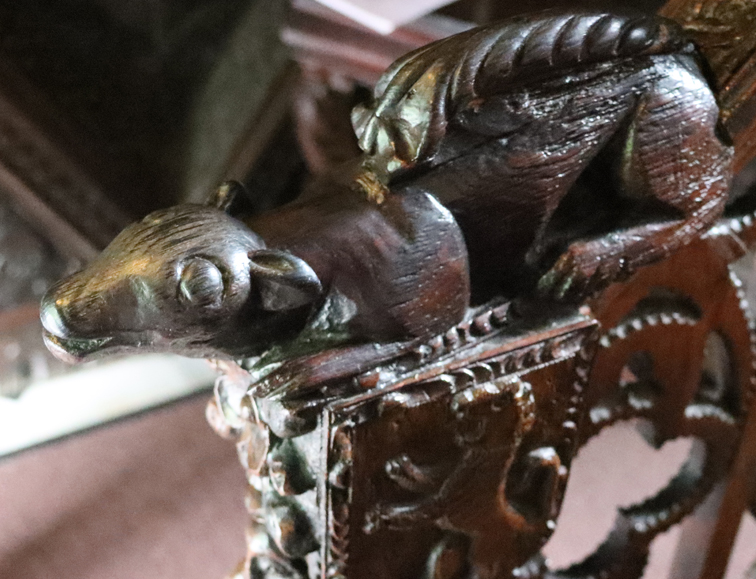
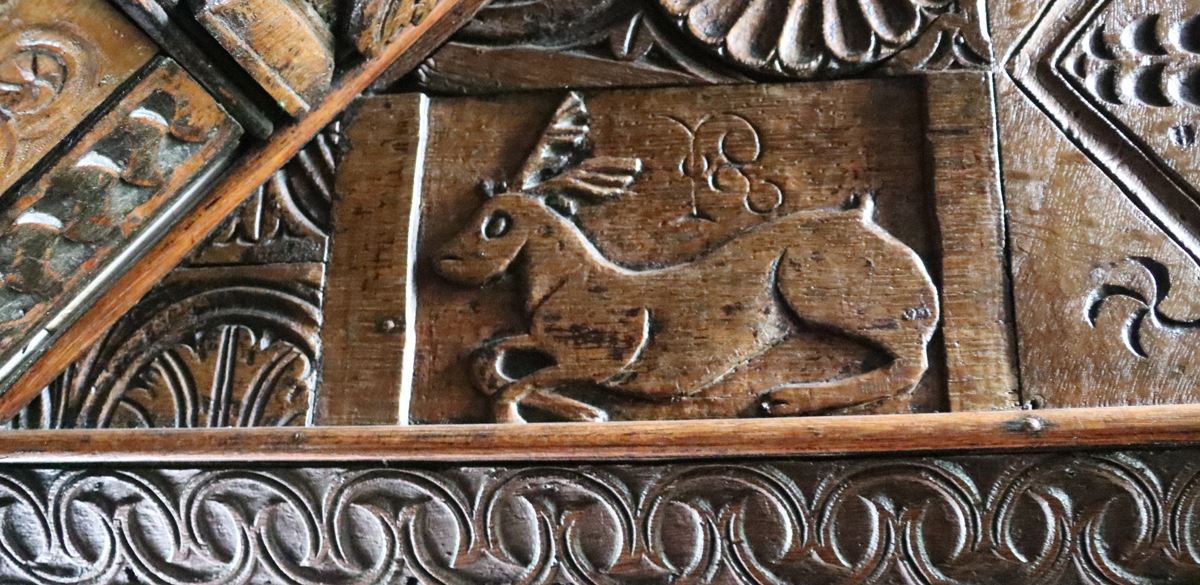
The squirrel carving at the base of the bannister
Mavor refers to an October 1814 porch-warming party to celebrate every installation of the carving-rich porch as this was the last major piece of the work that they envisaged. In August 1816 Lady Maria Josepha Stanley wrote in a letter that “[t]he entrance to the cottage, a Gothic porch, the inner entrance, staircase and kitchen are just fitted up with old carvings of wood.” In the same year 1816 Captain Henry Hanmer and his wife Sarah described that as well as the staircase and banisters indoors and the carvings around the door outside, the windows had also been done by this time. That the ladies continued to collect after this date is suggested by references in Eleanor’s journal where she reports on pieces of carving being presented for consideration by various tradesmen in the region.
Both internal and external woodwork was varnished, and the exterior woodwork seems to have been given particularly thick layers of black paint both for decorative reasons and, presumably, to protect it from the Welsh weather.
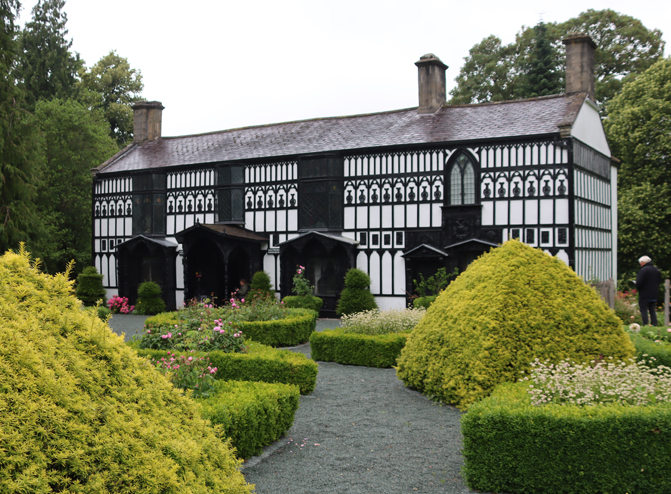
Plas Newydd exterior today
More chaos must have ensued when General Yorke moved in, built a new wing and remodelled some of the original cottage, including replacing the kitchen with a drawing room called the Oak Room, and adding more carving as well as 17th century leather wall hangings. In so far as the indoor carvings are concerned, although it is clear that the ladies installed most of the carvings, sometimes it is impossible to know for sure where the installations of the ladies ends and those of the General begins, except for the obvious case of the Oak Room. The General had a major impact on the exterior, adding the decorative themes to the exterior walls and many of the motifs at the west end of the building.
What motivated the collection of woodwork chosen for Plas Newydd?

Gothic style lancet-shaped windows at Plas Newydd
When tourist Anna Lister met Lady Eleanor at Plas Newydd in Tuesday 23 July in 1822 Eleanor told her that “it had been their humble endeavour to make their place as old as they could,” a clear statement of intent. The ladies seem to have been attracted at first as much by the gothic as by the Jacobean, with their adoption of gothic features like lancet windows and lancet-shaped book cases and their exterior wood porch and canopies. It was later that they began their collection of elaborately carved wood. The tastes of the ladies were informed both by their education and by ongoing voracious reading, but there is no reason to believe that there interests were in any way confined by a preference for any one period. The ladies were also collecting stained glass and beautiful objects, and do not seem to have been unduly influenced by the age of an architectural or artistic style, focusing instead on colour, texture and perhaps subject matter.
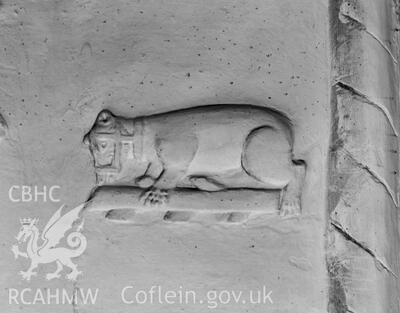
Bear moulding at Plas Mawr, Conwy
The ladies may have been influenced by their travels. They had certainly encountered the Elizabethan-Jacobean style in Conwy at the 16th century Plas Mawr, then in a very poor state, when they visited on their travels before settling at Llangollen. Plas Mawr was described by Sarah in her travel diary in 1778 (copied on the Curious Travellers website), including her comment that “The Whole House is built & Floord (sic) with Oak.” A carved bear at Plas Newydd closely resembles one at Plas Mawr, and there are other similarities due to the fashion for popular themes. The ladies also saw St Deiniol’s Cathedral in Bangor, where Sarah was impressed by the “Roses &c. of Carved Wood.” They visited Chirk Castle, the Grade-1 listed Halston Hall, built in around 1690, and Wynnstay Hall in Ruabon, part of which was built in the 16th century, although it is not clear what sort of decorative paradigms were in place at the time of the visits.
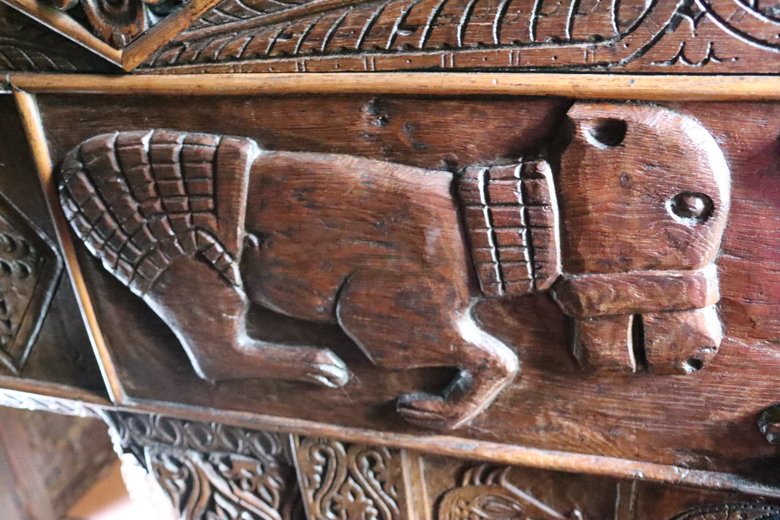
Bear carving at Plas Newydd

Brynkinalt from the rear, showing some of the lancet windows installed in around 1808
A house with which the ladies were very familiar with was their friend Lady Dungannon’s Brynkinalt, completed in 1612. This underwent seriously remodelling in 1808, and it seems as though this was both inside and out, with most of the earlier decorative scheme replaced by the more fashionable neoclassical, but the ladies may have seen it before the remodelling was started, and they may have been impressed by the Gothic features that were added during the remodel. At least one small pane of stained glass at Plas Newydd seems to have come from Brynkinalt, as an almost identical light remains in situ at the house.

A wyvern in a stained glass patchwork at Plas Newydd, mirroring one at Brynkinalt, from where it may have been sourced
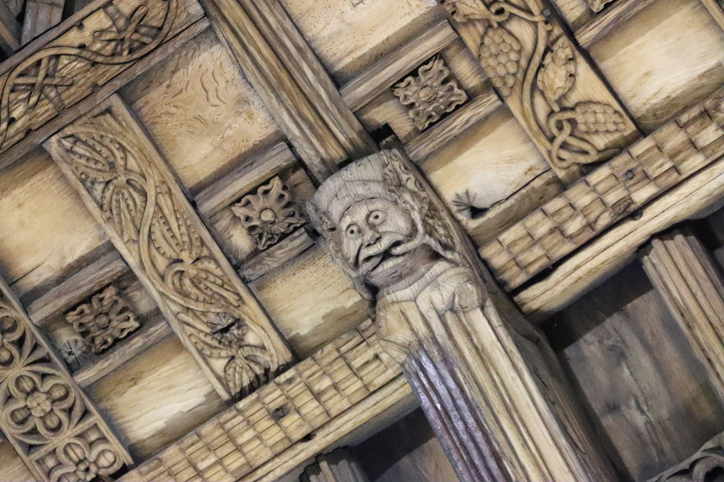
Detail of St Collen’s Church roof over the nave, Llangollen
One example that was (and remains) very close at hand, and which crosses the boundaries between the medieval period and the English and Welsh Renaissance by having much in common with both periods, is the roof of St Collen’s Church in Llangollen. This contains a rich and fascinating mixture of religious and pagan motifs, much like the subject matter shown on Romanesque capitals and medieval misericords. Although much of the church underwent serious modification in the Victorian period, the ladies would probably have visited it before the alterations, and would certainly have seen the roof.
 Nothing really leaps out to explain why, in 1814 when Eleanor was 75 years old and Sarah 59, and 34 years after they had moved in to Plas Newydd, they were suddenly “seized” with a “mania” for collecting carved oak in the Elizabethan-Jacobean style, much of it featuring a wide variety of grotesques and fantastic creatures. I thought that it might have something to do with purchasing the house, which they formerly rented, but that did not happen until 1819, five years after the peak of their collection “mania.” Perhaps it was something as simple as a single first purchase that grew into a desire to source more of the same that grew into a passion for collecting.
Themes in the Plas Newydd carvings
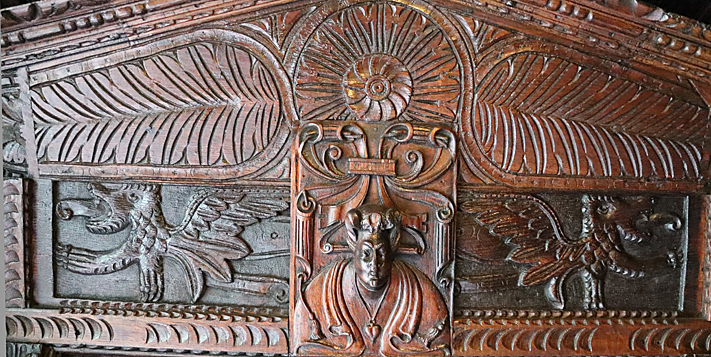 All sculptural elements in the medieval period acted as symbols and emblems that could be read and understood, and by the later 16th century ornamental country house carvings and plasterwork usually formed a connected series of ideas and messages that needed to be decoded. Although the message and themes might be relatively obvious, quite often the decoding was often deliberately enigmatic, requiring a good education, creativity and a willingness to bend the intellect towards deciphering hidden meanings. In this sense they could be like visual riddles and acrostics. Once a collection was split up and sold off in parts, the intended message of the combined visual clues would have been lost. The lack of context, meaning that there is no provenance, no narrative context to explain meaning, and a complete absence of chronological integrity means that the Plas Newydd carvings cannot be understood as a coherent assemblage of meaning. However, although the broader subtleties and grander narratives may be lost, some of the general themes can be identified. David Bostwick picks out a list of specific items represented in the carvings. This includes a mixture of secular and religious themes, including:
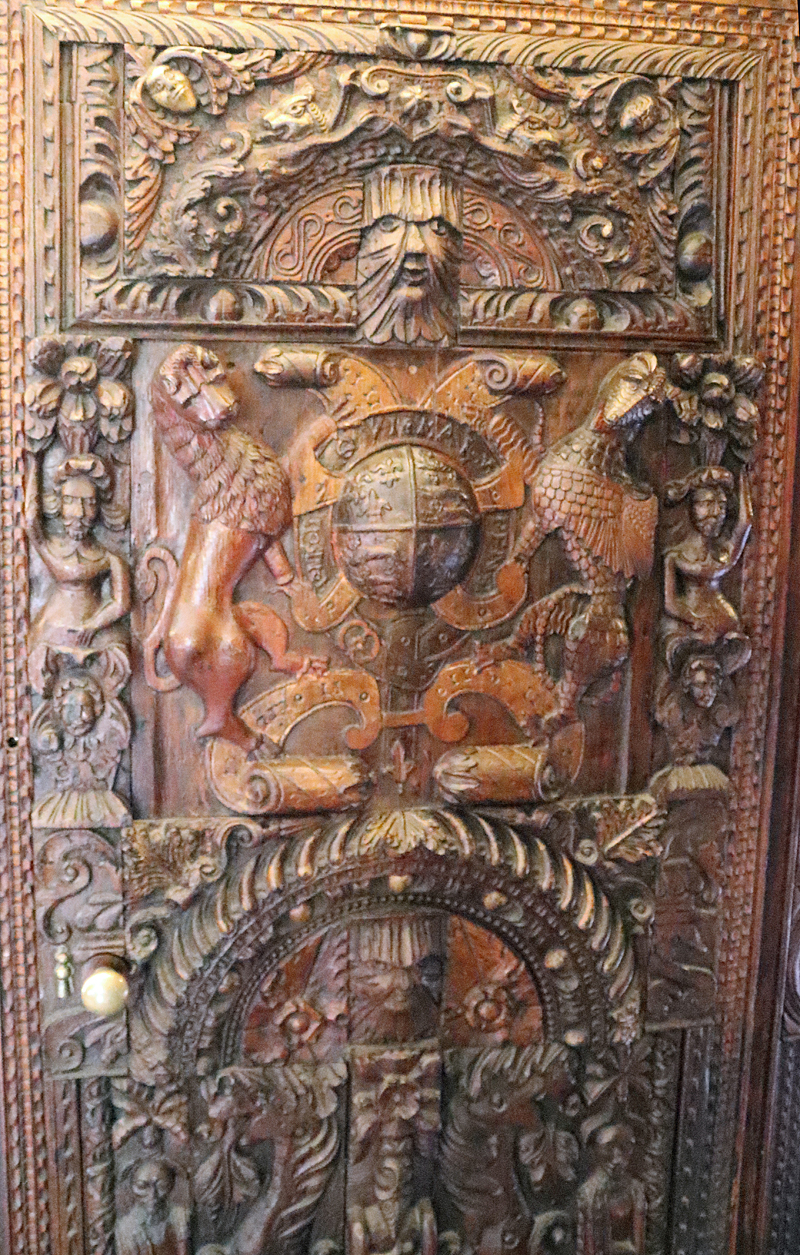 Human faces
- Armorial shields
- Birds
- Animals
- Flowers and other plants
- Dragons, wyverns, amphisbaena and other mythological creatures
- Male atlantes and female caryatids (human figures supporting architectural components)
- Green Men
- Symmetrical patterns
- Ecclesiastical themes
David Bostwick observes that there are comparatively few geometric patterns, very popular in the period, with only 4 linenfold panels, although these should have been quite widely available at the time that the ladies began collecting. At Plas Newydd the 44 dragons identified by Bostwick are clear indicators that the grotesque was a major feature of the wood carving at Plas Newydd, but there are an incredible variety of other characters, including 103 atlantes and caryatids (figures supporting architectural elements). Ecclesiastical themes are mainly confined to the porch doorway, but there are others in the building, and the doorway at the west end shows religious themes. Bostwick suggests that some of the Biblical scenes represented at Plas Newydd were Flemish imports. This would not be at all unexpected, as a lot of art work and furniture was being imported from the Netherlands and the Lowe Countries at this time.
This suggests that the ladies made choices both in terms of the themes selected, rather than collecting whatever was available, and in the placement of their collection.
The quality of the carvings
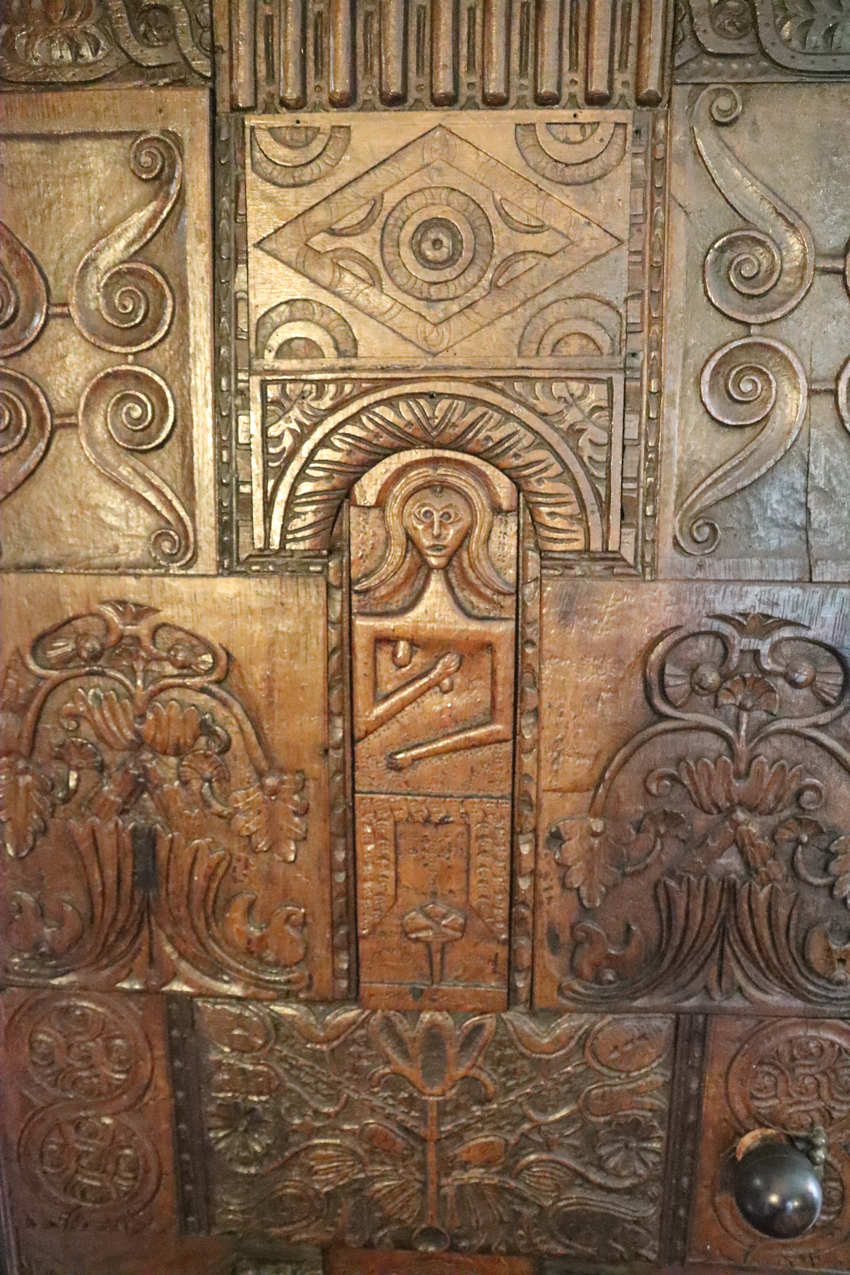
Plas Newydd door with inferior quality carvings
The quality of the carving is very variable. In this section of the door into the spare bedroom, two botanical arrangements flank the startled looking woman in the centre. The two botanical arrangements should in theory be identical, but the clumsiness of the execution has lead to flattened curves in the example on the left, and a failure to create a mirrored pattern. It looks like a practice exercise rather than something that would be sold to a happy customer. Beneath the lady is a more accomplished, although still not perfect, attempt at mirroring on two sides of a central motif.
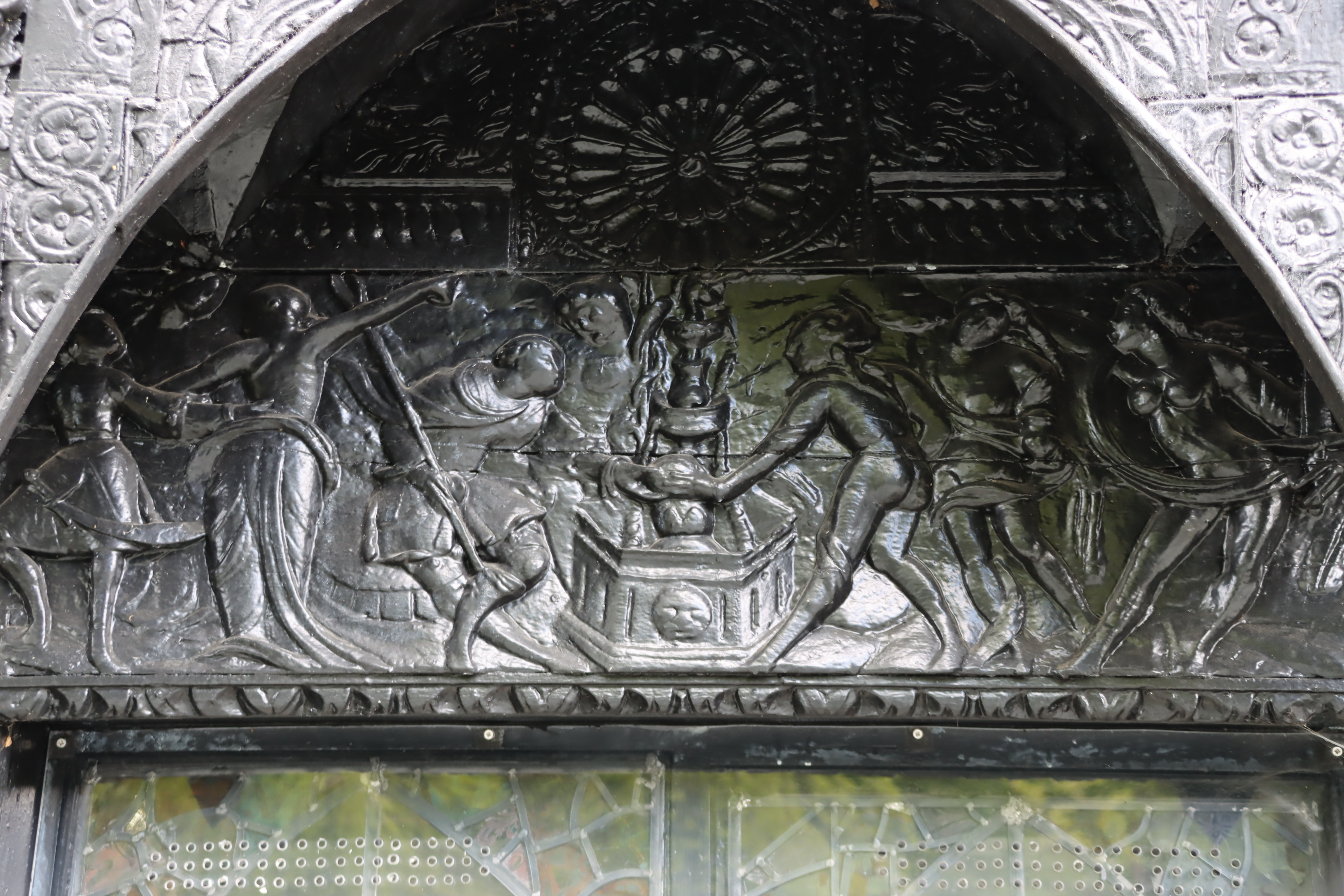
Most of the carvings come from items of furniture, and are very variable in quality, but some show great skill. A few examples show quite complex scenes, and demonstrate the versatility of wood as a medium for expression.
As much as anything else, this great variability of skill and quality of craftsmanship demonstrates the wide variety of sources from which the carvings must have been sourced.
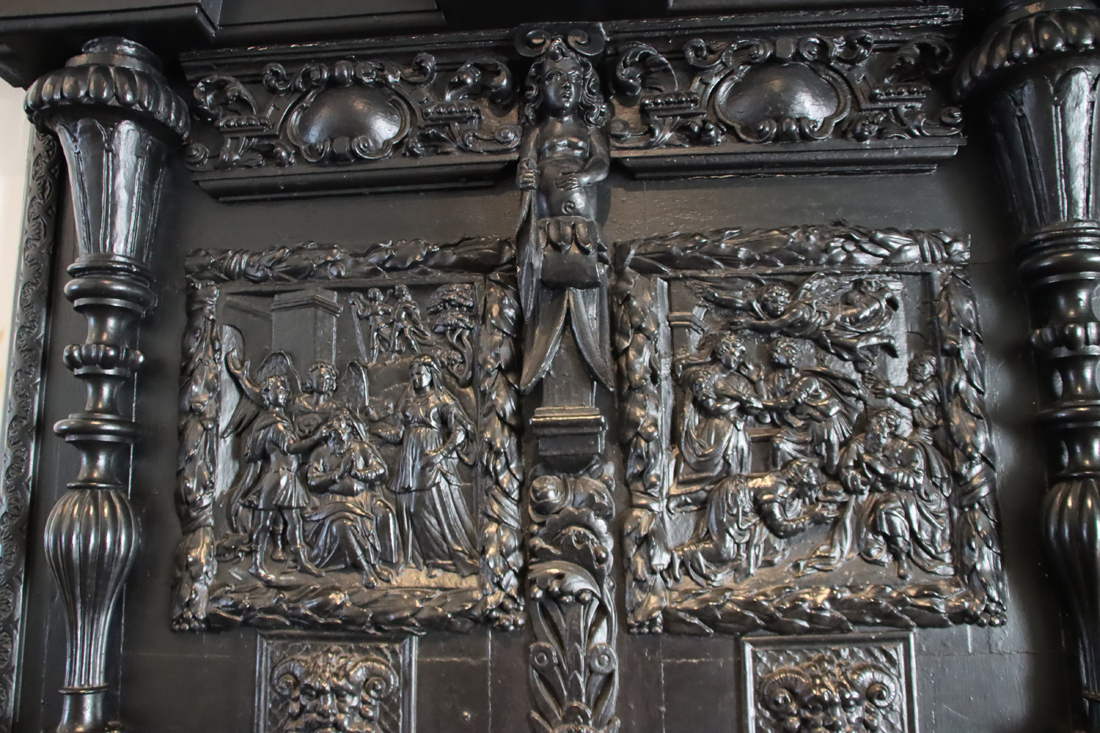
Sources for the Plas Newydd carvings
 The 2001 survey by David Bostwick states that the Plas Newydd carvings were clearly sourced from multiple locations, although he detected the work of a single workshop amongst some of the pieces, suggesting that these at least came from the same place, whether that was a single building or a geographical area. None of the sources for their carvings were recorded by the ladies or Richard Yorke themselves in the surviving documentation. This may be because they saw no value in recording where where any of it was sourced from, seeing it as purely decorative rather than historical, but it may equally be that a separate record was maintained by each owner and that these have now been lost along with a lot of other paperwork. Provenance is therefore a general problem with the Plas Newydd carvings, and it does not seem as though this is going to be resolved in the near future.
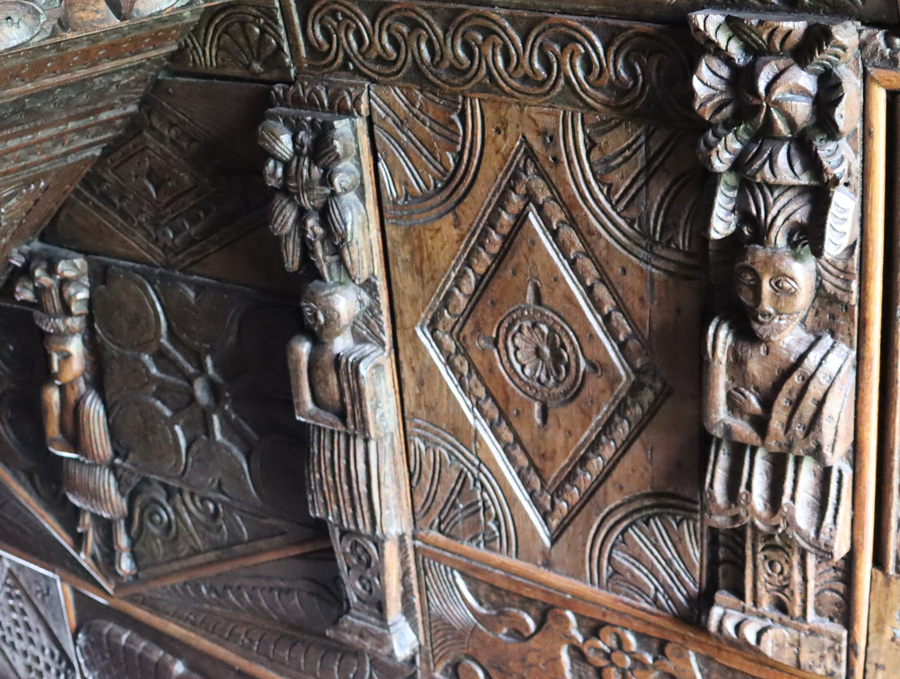 All of the carvings, whether installed by the ladies or General Yorke represent salvage – materials that were carved for somewhere else and have been brought here to be incorporated into an entirely new, patchwork-type arrangement. Some of the carvings chosen for the exterior have more religious themes than in the interior, suggesting an ecclesiastical origin, whereas those in the interior look as though they were more likely to have been in secular contexts.
Eleanor Butler and Sarah Ponsonby
 In some cases Eleanor’s journal provides the name of the people who supplied or offered pieces but not where the pieces themselves came from. For example on 16th February 1819 Eleanor records that the vicar of Ruthin the Reverend Richard Newcombe sent them the gift of a “a beautiful Lion couchant carved in oak – some centuries old.” Sir Foster Cunliffe of Acton Park (near Wrexham) provided an “old carved oak head,” mentioned on 27th February 1819. On 12th April 1819 she wrote that “The so long expected hamper sent by Miss Dorothy Wilmot Sitwell to Liverpool was brought this morning from Chester . . . it contained fine old oak carving the most ancient & curious of all we possess.” In none of these cases is it mentioned which locations had supplied the offerings.
An exception is the identification in the journal on 4th April 1819 in which she says that a Captain and Mrs Hanmer had sent them “some fine carvings of Gibbons from the old stalls of the Knights of the Garter in St Georges Chappel [sic].” The owner of the Early Tourists in Wales site contacted the Archivist and Chapter Librarian of St George’s Chapel in Windsor, who informed him that an altar rail in the chapel was paid for by a Mir Gibbons in 1681 but that no other work connected with the name is known to be there. Eleanor may have thought that the work was that of Grinling Gibbons, the famous wood carver, but there is no evidence to support this.
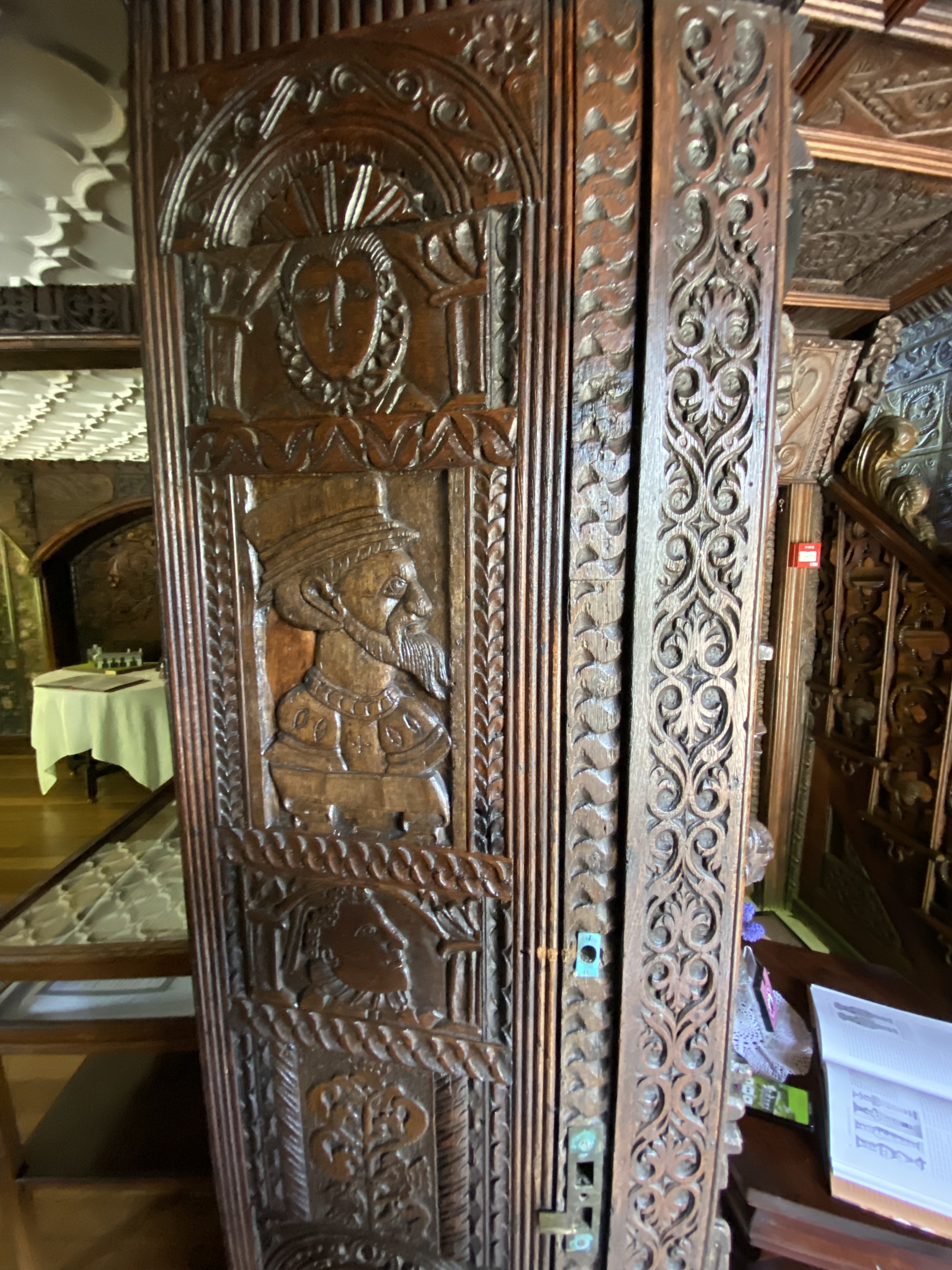 Several of Eleanor’s journal entries indicate that local people were aware of their interest in carved wood and contacted them to offer any examples that might interest them. There are 24 references to carvings acquired in 1819 and 4 in the 1821 journal. As mentioned above, these are the only two journals surviving after 1807, so the record is extremely incomplete, but they do demonstrate that local people were supplying them with odds and ends: Roberts the Glazier, John Davis the Shoemaker, Roberts the Shrewsbury Gardener, Thomas Davies the Glazier, J.Gill the upholsterer, Edward the Marble Mason, and Brace the Carrier, as well as “a poor woman from Glynn.” The ladies were obviously able to use their tradesmen’s presence in many buildings in the area to source items of interest. The implication is that they were purchased, although Eleanor only makes this explicit once when she says that they “purchased some fine old oak carving from a woman near Corwen.” One journal entry mentions that some of their stained glass came a dealer and perhaps some of the carvings that were not supplied by visitors or local tradesmen were sourced in the same way, although no purchases are listed in the accounts so diligently kept by Sarah Ponsonby.
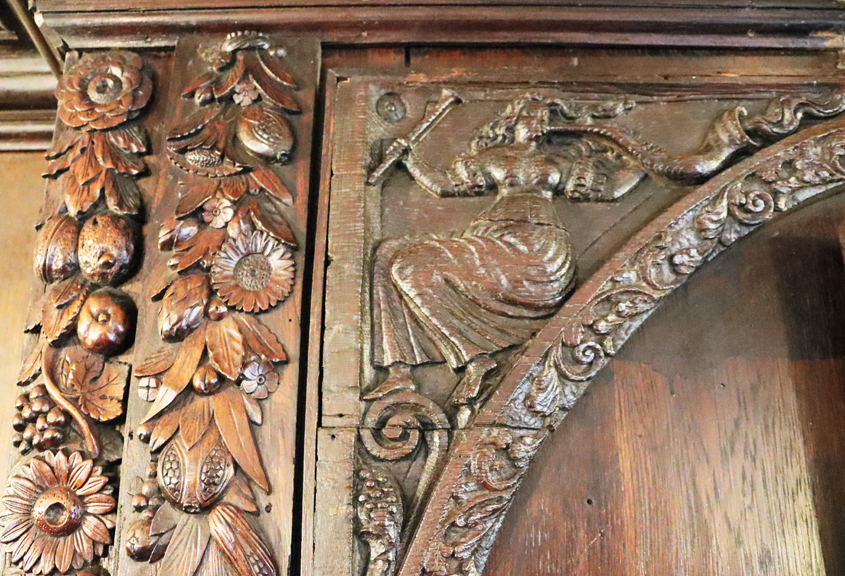 Two of the third party comments about sources of carvings were made whilst the ladies were still alive, and the information may or may not have been imparted by one or other of the ladies. In 1819, for example, Philadelphia Cotton’s Tour Through North Wales mentioned that “a large piece from Speke hall Lancashire” had been taken there by Colonel Norris “plunderer of Stirling Castle after the battle of Flodden.” In 1827 traveller Eliza Rand recorded that she had been told that the Duchess of St Albans had provided the ladies “with a great deal of the carving.” Neither, however mention where this information originated from or whether it had been verified in any way. It is said that Arthur Wellesley (later the Duke of Wellington) supplied the two lions that still help to hold up the porch.
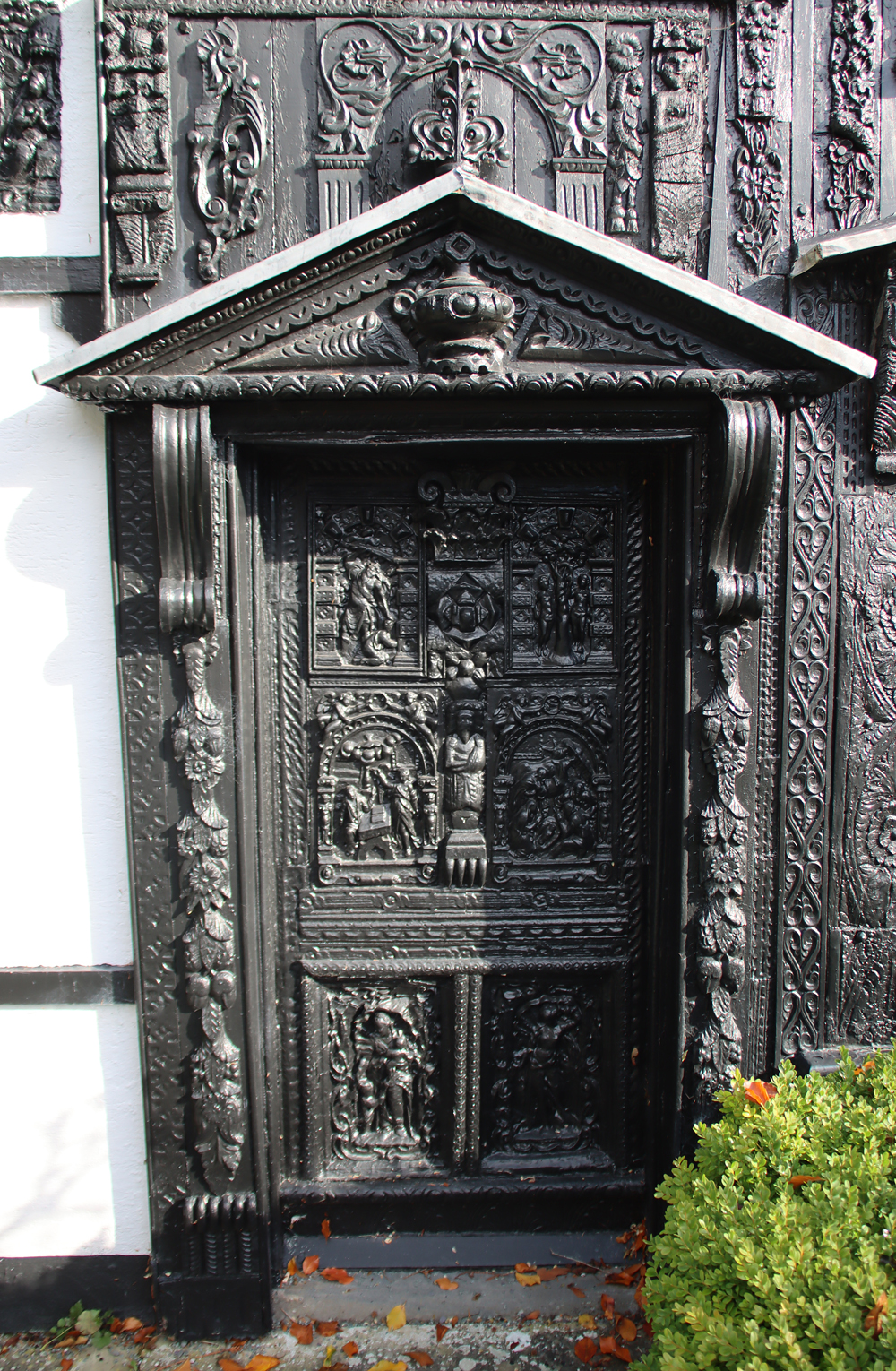 In General John Yorke’s 1882 publication Plas Newydd as it was and as it is; with A Catalogue of its contents; and a few reminiscences of Lady Eleanor Butler and the Hon Sarah Ponsonby by one who received their welcome in his younger days, he says that “All statesmen and nobles paid tribute and homage at Plas Newydd, and none ventured a second visit without bringing a contribution of carved oak which was the regular passport,” a comment that is unverified by anything that the ladies themselves wrote in the surviving journals, accounts or letters, but which has been repeated by writers ever since. An oak pew installed in a recess in the Oak Room was said to have been used by the ladies in Llangollen Church until it was transferred to the house.
Other items that General Yorke identifies are a portal door which he says is composed of oak from both Llangollen and Llantysilio churches, the latter also said to have provided the doorway below the west gable. Llantysilio church did undergo the addition of a new transept in 1718, but that was a century before the ladies started collecting. The Victorian alterations did not begin until 1869. It is difficult to see how, unless repairs were made that lead bits of furniture or panelling to be rejected, the ladies could have acquired carvings from the church. It was, however, conveniently local. The claims that some of the carvings came from St Collen’s in Llangollen do not seem too far-fetched given the splendid roof carvings in the church, and the fact that the church underwent many modifications in the 19th century. The General also identifies a number of other sources, from as far afield as London, but these are unverified.
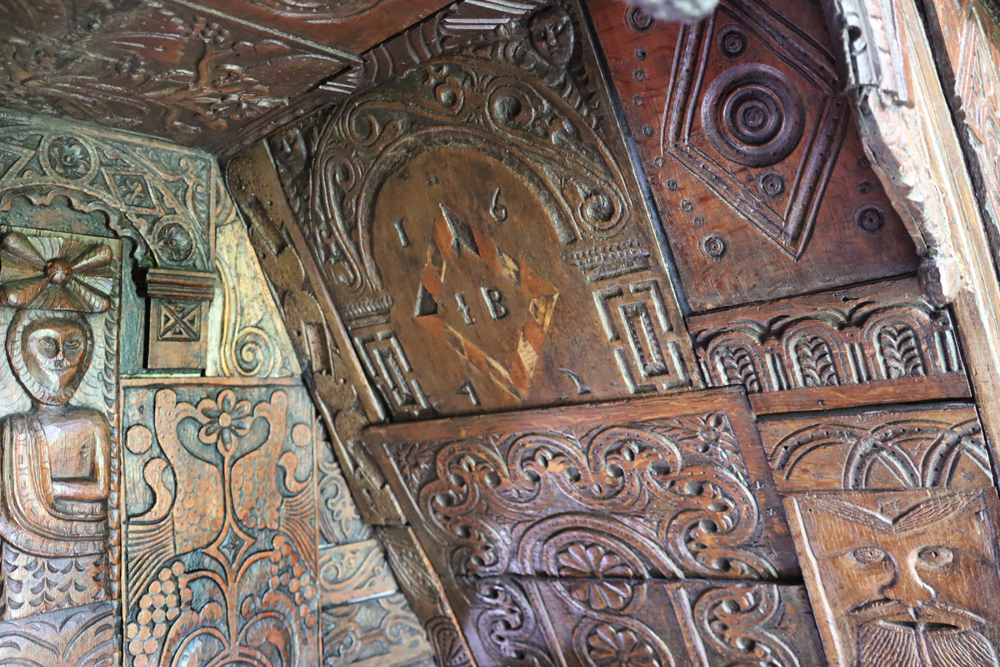 Wherever they came from, 17th century carvings had gone out of fashion in the 18th century and it was not until the second quarter of the 19th century that the revival of what John Betjemen referred to as the “Jacobethan” became popular. This may mean that there was only a very limited market for the type of ornately decorated carving collected by the ladies, and that this was not outrageously expensive, meaning both that they could afford to purchase locally unwanted salvage, and that it made for an inexpensive gift from others. Much carved woodwork with family arms and motifs would be retained by families even when they upgraded their decorative schemes, and this would be less likely to be circulated, which would account for why there is so little of this at Plas Newydd.
General Yorke
 General Yorke bought Plas Newydd in 1876. Although he had mentioned various sources for carvings collected by the ladies, interestingly and disappointingly there is nothing to indicate where General Yorke himself sourced his antique purchases. Perhaps his papers were lost or were disposed of at the time of his death. By the time he bought the house in 1876 the trade in architectural salvage was in full swing, with the area around Oxford Street and Wardour Street in London becoming the English locus for dealing in architectural imports that could be broken down into cargo-sized components. Italy and Germany provided some supplies, but London’s imports were mainly from France and the Low Countries, and mainly from ecclesiastical buildings. John Harris’s work on the subject provides an eye-opening insight into the sheer scale of the trade, which soon moved beyond exporting to Britain and began to export to the United States.
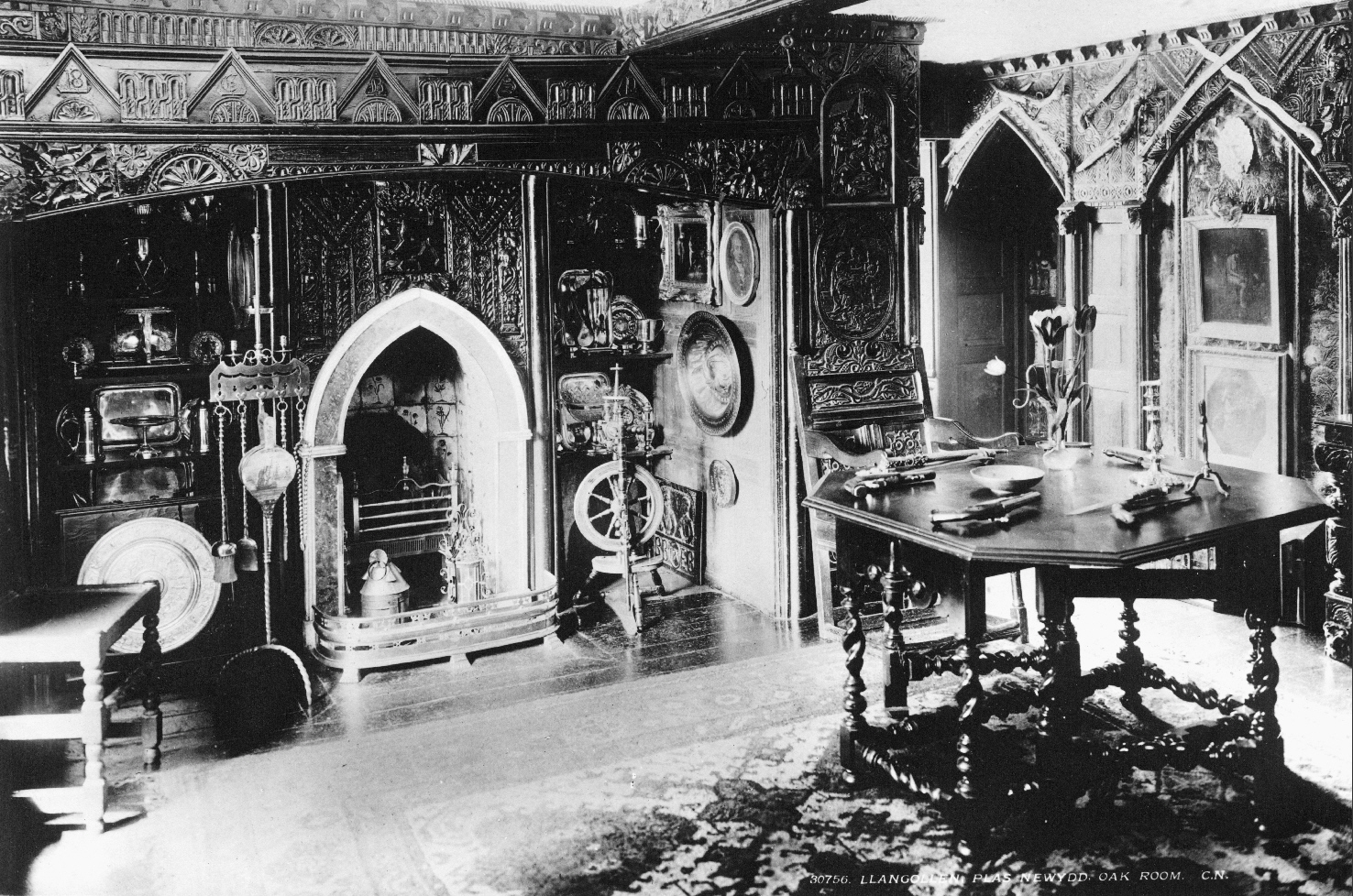
General Yorke’s Oak Room in 1905. Source: People’s Collection Wales
When he arrived at Plas Newydd with many more financial resources available to him than the two ladies could have realistically dreamed of, he may have looked to a very wide network of dealers for his acquisitions. It would certainly not be difficult for General Yorke to have made arrangements with both London and more local centres to acquire sufficient carvings, painted leather and plaster to furnish not only the remaining gaps in the cottage but also in his ambitious new wing. His main innovation at the original cottage was the Oak Room, with its richly carved oak features and its painted and leather wall hangings, which he introduced elsewhere in the cottage as well. Built in what was the kitchen when the ladies were alive, the oak room became both a drawing room and another display area for his collections. An article dated to 1890 in The Builder, vol.59, suggested that in the Oak Room an elaborate chairs, which it refers to as The Confessional Throne, came from a Spanish monastery. The article states that the second chair, almost as elaborate, was made out of an oak tree from Sulgrave in Northamptonshire. The reference to Sulgrave in particular is very specific, but again there is nothing in the article to suggest how the its author obtained this information and whether there is any substance to it.
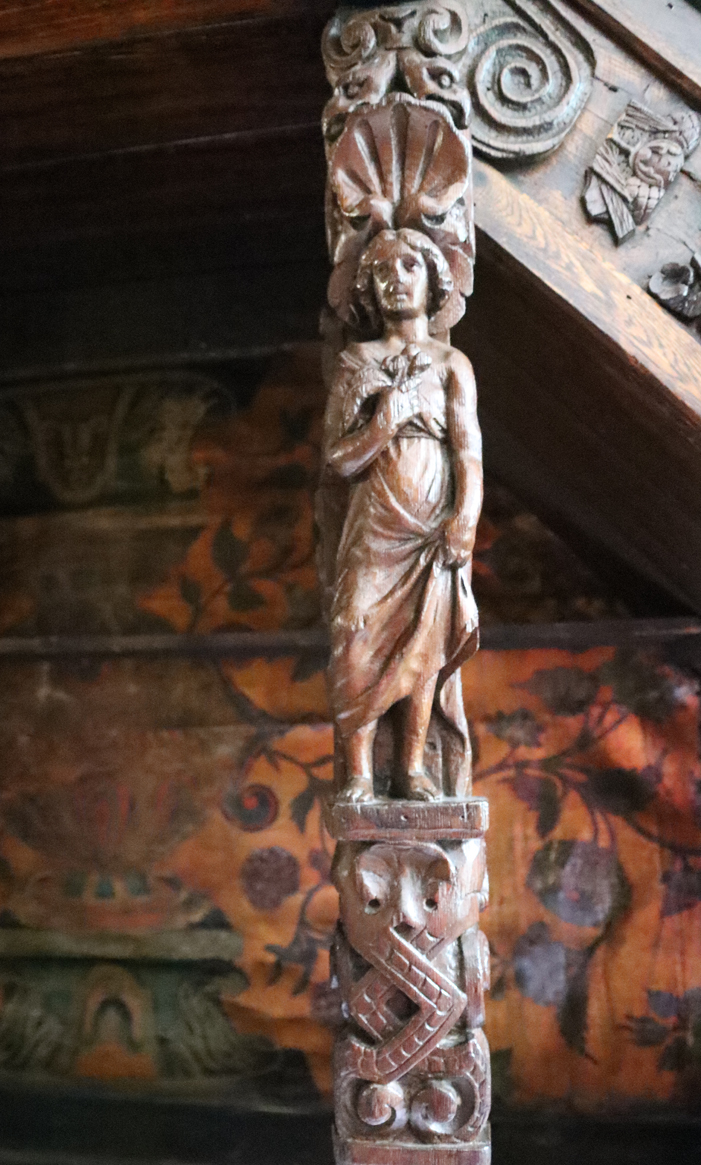 There remains one of many puzzles. A reference on the Coflein website states unambiguously that part of the oak roof of St Derfel’s Church in Llandderfel was brought to Plas Newydd after a fire. The Coflein account is quite comprehensive, fairly well cited, and seems convincing: “The oak roof was damaged by fire in 1758. A small portion of it was made into a chair, presently situated in the sanctuary, but most of it was removed to Plas Newydd, Llangollen.” But 1758 was 22 years before the ladies arrived, so either the date is wrong, because there is no reason why the owners of the cottage would have wanted bits of a wooden roof before the arrival of the ladies, or the roof was stored elsewhere before being moved to Plas Newydd two decades later, which seems very improbable. Alternatively, the reference to Plas Newydd was presumably incorrect. Thoughts anyone?
Future research
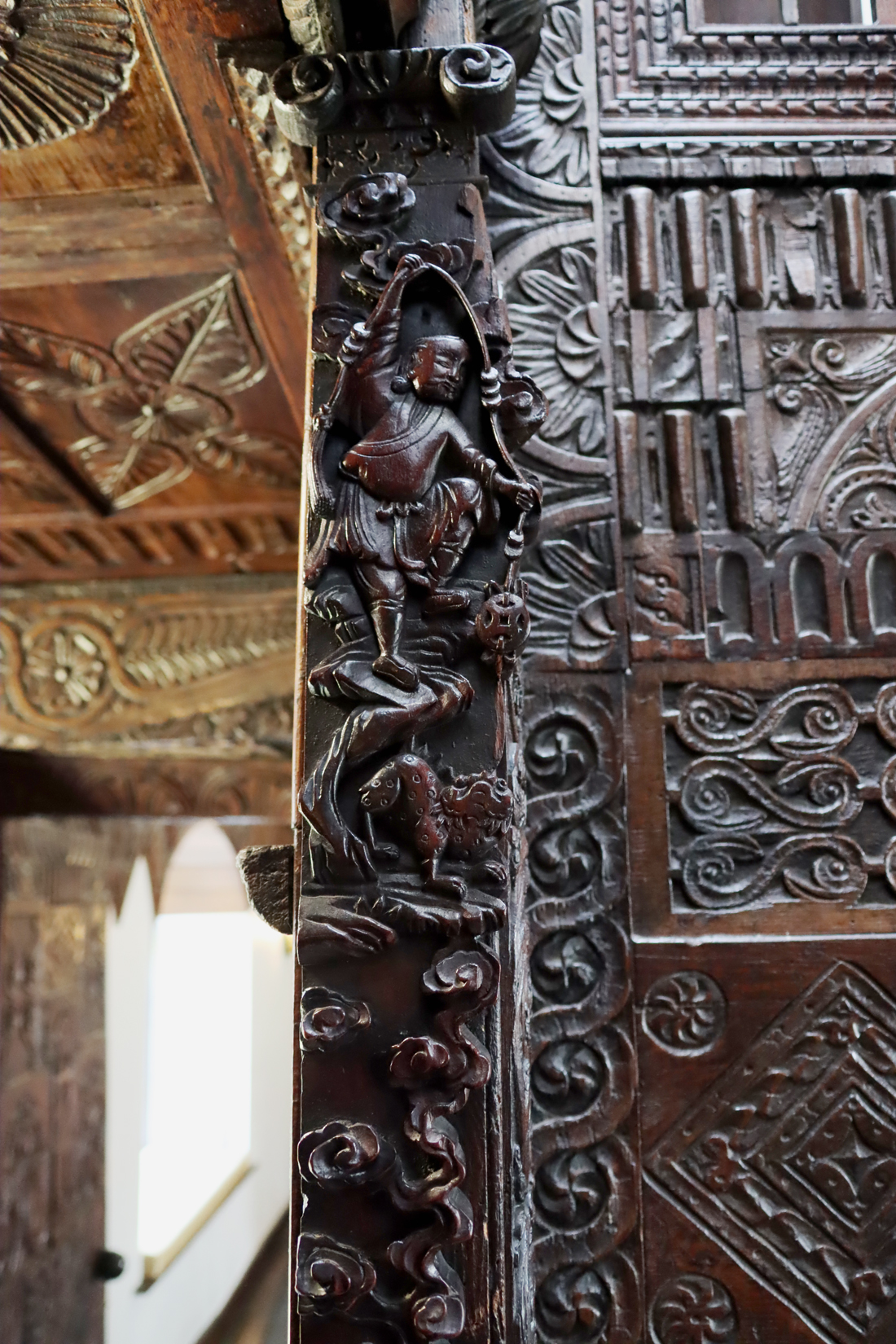
Oriental carving
The carvings are thoroughly enjoyable in their own right, but they also present a number of puzzles, and there is considerable potential for future research.
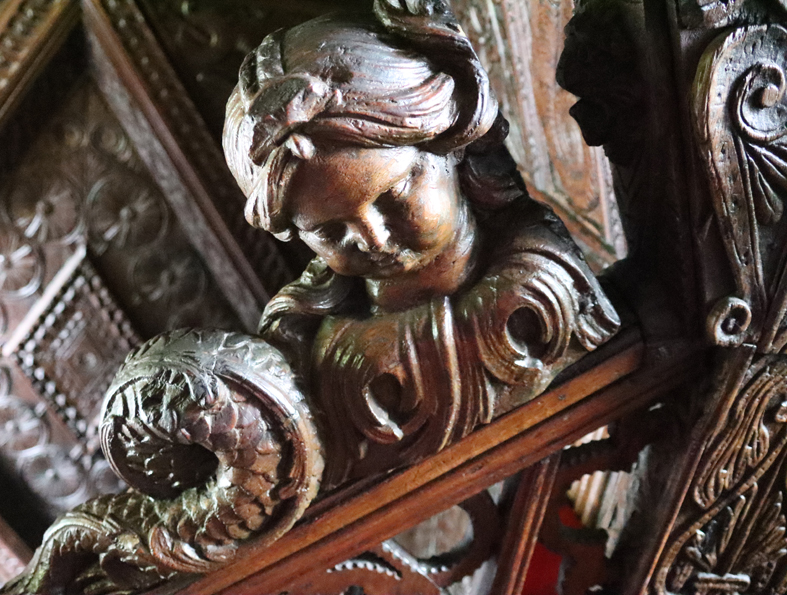
Although at first glance it is difficult to see that some of the items are related, some of the pieces dotted around the house are clearly parts of the same piece of furniture, which may help to consolidate carvings into batches to reduce the sense of it being an unrelated mixture of pieces. This may help to approach the as-yet unanswered questions about which workshops and which individuals were responsible for the carvings. David Bostwick has suggested that idiosyncrasies associated with certain workshops are visible in the style and the motifs selected. Certain styles of distinctive motif, such as types of dragon, wyvern, amphisbaena and other dragon-like creatures, caryatids and atlantes (male caryatids), and natural animal life may belong to vernacular traditions of certain regions, which may help in this task. Investigations of the records of local church and large nearby houses such as Brynkinalt, particularly those known to have undergone renovation or restyling in the 18th century may shed some light on some sources of more skilled pieces of carving.
 The house is generally seen as a reflection of the work of Eleanor Butler and Sarah Ponsonby, but there are questions to ask around this. General Yorke, for example, was responsible for converting the cottage kitchen into the Oak Room, and added various pieces of carved woodwork elsewhere inside and outside the house. It is also possible that subsequent owners also had made repairs and minor changes. The way in which Plas Newydd evolved under different owners is not well understood and it would be useful to improve this knowledge of the chronology of the house and all of its decorative arts.
Final comments
 There are more questions than there are answers about the collection of wood panelling, pieces of furniture and panels made of furniture, as well as some of the more splendid sculptural items at Plas Newydd.
The probability is that the majority of the carvings at Plas Newydd were originally components of furniture and wainscotting, mainly from residential buildings and some ecclesiastical buildings that were either re-envisioned, stripping out old woodwork to be replaced by new ideas of interior decoration, or demolished. Most of it dates to the 17th century, but there are examples from earlier periods as well as 19th century pieces. Wealthy country homes and churches were both contenders for providing the carvings. Churches were often simply remodelled rather than demolished, stripped out but saved, but some of the grand country houses of the Tudor-Stuart periods required expensive maintenance and often suffered terminal neglect as owners found themselves unable to keep up with costs. The number of late Elizabethan and Jacobean buildings that survive are few and far between, but furnishings and decorative features have experienced a better survival rate simply by virtue of their portability. An extreme example is Emral Hall in West Cheshire, near Worthenbury, where the ballroom, complete with its marvellous ceiling, was removed just before demolition in the mid-1930s and was reinstalled in Portmeirion’s Town Hall.
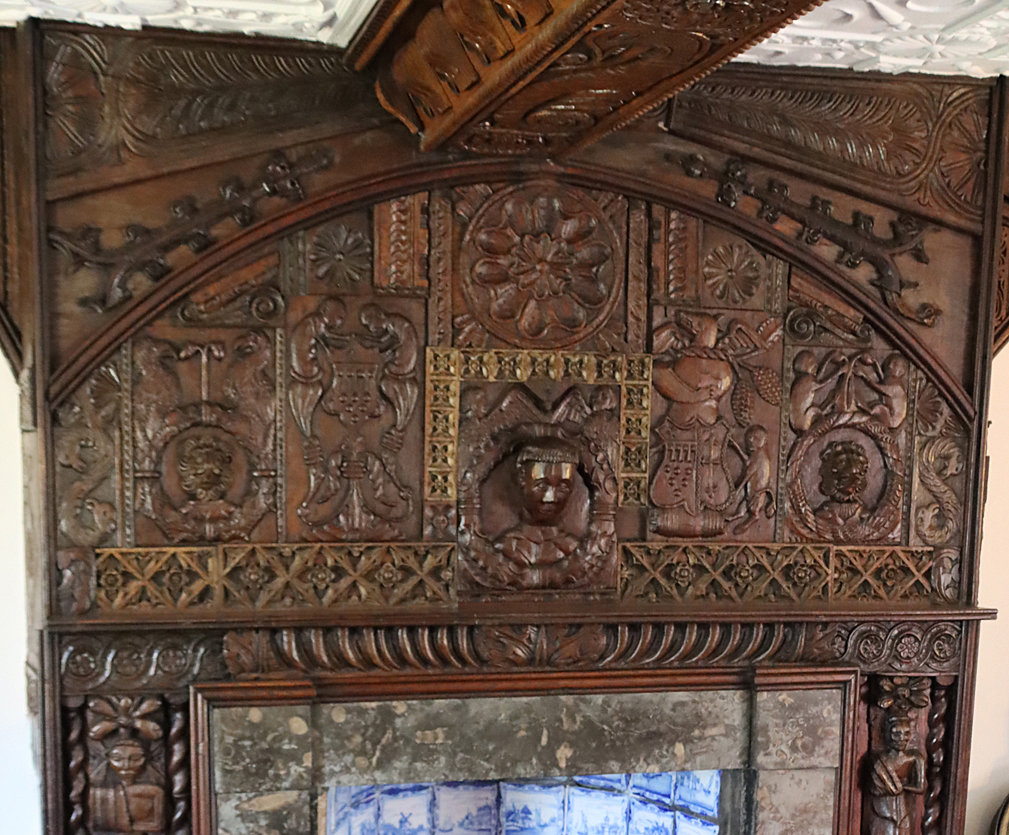 Some individual pieces are quite extraordinary, harking back to ideas derived from the Italian Grotteschi and the use of grotesque motifs in the western European Romanesque and the British Gothic. Some later pieces may have been commissioned in the 19th century in order to piece the patchwork together. However there is almost no specific provenance for any of it, and there is no indication why, in or just before 1814, Lady Eleanor and Miss Ponsonby suddenly began to collect it. In spite of these puzzles, it remains a splendid collection of diverse pieces featuring figurative and natural themes, fantastical animals, geometrical patterns, and the occasional line of text. Although it makes a stunning collective impression, it is also rewards taking your time to introduce yourself to as many of the individual pieces as you have time to view. Together with all the other decorative arts in the house, the impact is quite astonishing and very memorable.
With thanks
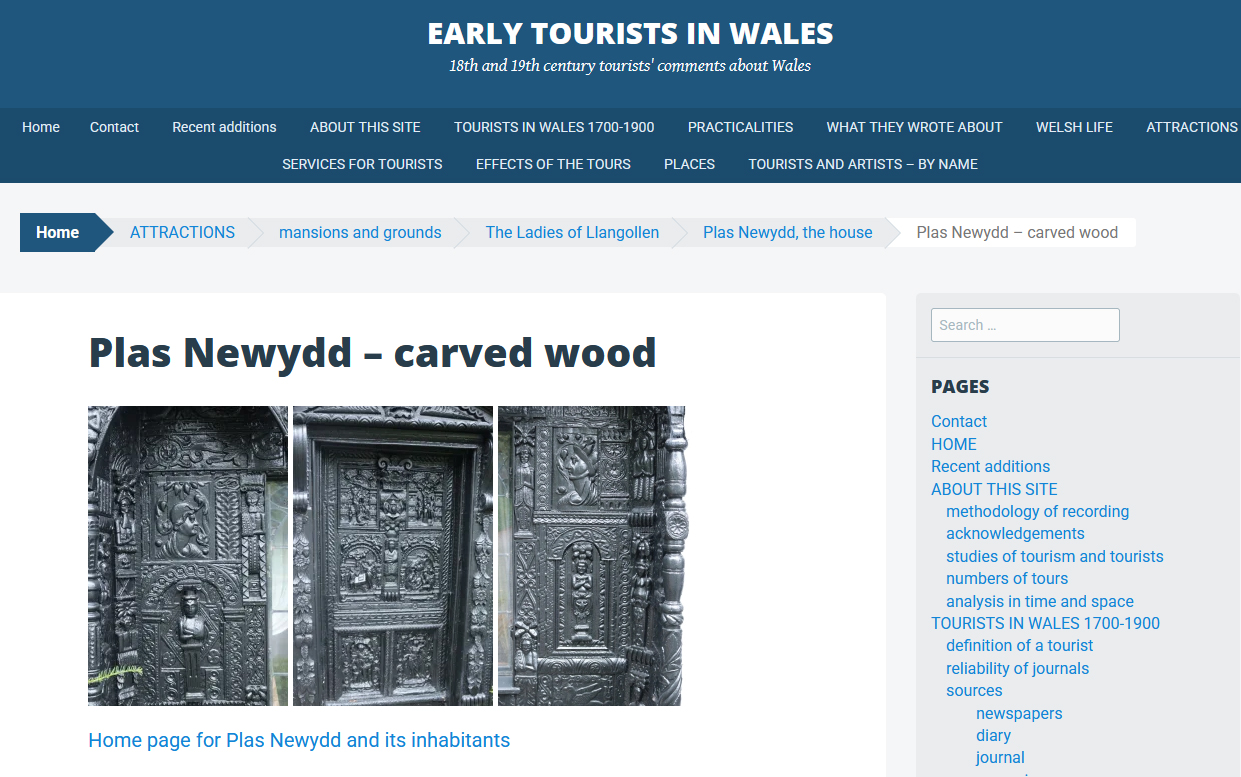
Early Tourists in Wales – The Plas Newydd Carved Wood page
With sincere thanks to Michael Freeman’s for his Plas Newydd pages on the Early Tourists in Wales website, where all the principal sources for information on Plas Newydd carvings have been collated and made accessible online, some of them not otherwise available either in published or digitized form. I was very kindly given carte blanche to use that information in my own research into the history of Plas Newydd. A very useful summary of DavidBostwick’s findings can be found on the Early Tourists in Wales website on the Plas Newydd Wood Carving page, which is particularly useful as Bostwick’s paper is not currently available online (although it is available to peruse as a hard copy at Plas Newydd).

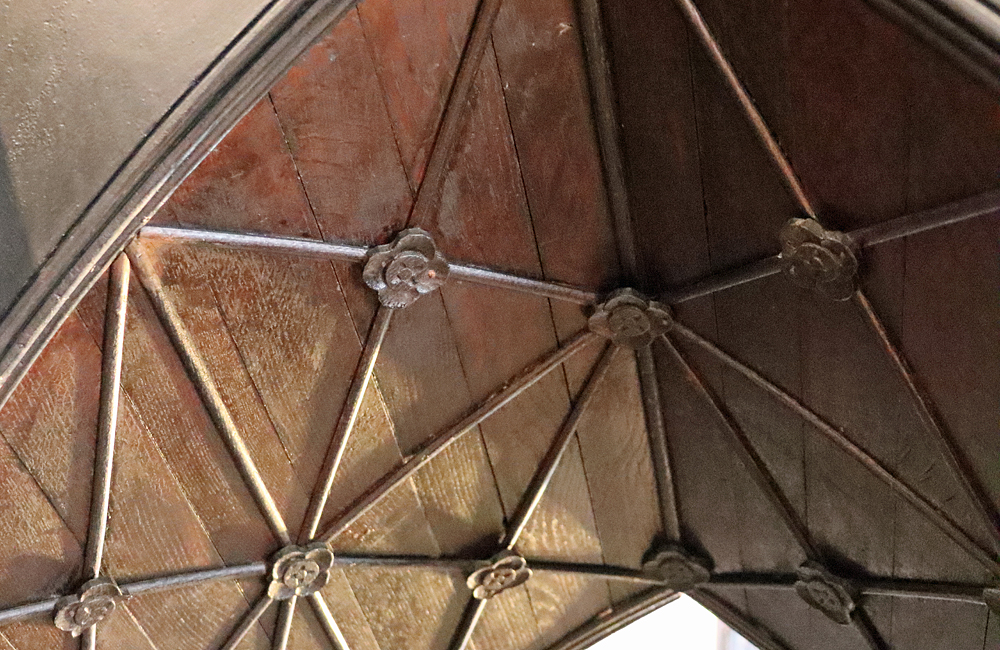
Sources
See part 1 for a general introduction to Plas Newydd, including visiting details and a general bibliography. The sources mentioned below are specific to this post.
Online catalogues, National Library of Wales archives and Plas Newydd on-site information
There are records at the National Library of Wales in Aberystwyth that have not yet been digitized and are therefore not available online. I have not had the chance to go to Aberystwyth in person, so these have not been consulted for this post. Much of it has been expertly summarized on the Early Tourists in Wales website.
The 1792 catalogue of the titles in the Plas Newydd library belonging to Lady Eleanor and Miss Ponsonby includes volumes in English, French and Italian. They also, but possibly at a later date as they are not recorded in the catalogue, owned titles in Spanish. This is available on the National Library of Wales website at https://viewer.library.wales/6043853#?xywh=-2808%2C-244%2C9066%2C4877
The 1832 auction catalogue that sold off the portable contents of Plas Newydd following the death of Sarah Ponsonby, two years after Eleanor Butler’s own death, has been very usefully précised on the Early Tourists in Wales website at https://sublimewales.wordpress.com/attractions/mansions-and-grounds/ladies-of-llangollen/ownership/auction-catalogues-1832/
In addition, Plas Newydd has information in loose-leaf folders that can be leafed through on a visit. As well as samples from Lady Eleanor’s journals, these include David Bostwick’s paper about the carvings.
Books, booklets and papers
d’Alembert, Jean Le Rond 1751. Melanges de litterature, d’histoire, et de philosophie.
https://ia802207.us.archive.org/1/items/MelangesDArcheologieDHistoireEt2/Melanges_d_archeologie_d_histoire_et_2.pdf
Andrews, John 1989. British Antique Furniture. Price Guide and Reasons for Values. Antique Collectors’ Club
Aymonino A, and M. Guerci 2016. The Architectural Transformation of Northumberland House under the 7th Duke of Somerset and the1st Duke and Duchess of Northumberland, 1748–86. The Antiquaries Journal, p.315–361
Bebb, Richard 2007 . Welsh Furniture 1240-1950. Volume 1. Saer Books
Bebb, Richard 2007. Welsh Furniture 1240-1950. Volume 2. Saer Books
Brewer, J.J. 1825. The Beauties of Ireland. Being original delineations, topographical, historical, and biographical, of each county. Sherwood, Jones and Co.
https://archive.org/details/b29350505_0001/page/416/mode/2up?q=kilkenny
Ching, Francis D.K. 1995. A Visual Dictionary of Architecture. John Wiley and Sons
Chinnery, Victor 1979, 2016 (Revised Edition). Oak Furniture. The British Tradition. Antique Collectors’ Club.
Edwards, Ralph 1964. The Shorter Dictionary of English Furniture. Country Life
Fiske, John and Lisa Freeman 2005. Living with Early Oak. The Belmont Press
Fleming, John and Hugh Honour 1989 (2nd edition). Penguin Dictionary of Decorative Arts. Viking.
Harris, John. 2007. Moving Rooms. The Trade in Architectural Salvages. Yale University Press
Hearn, Karen (ed.) 1995. Dynasties: painting in Tudor and Jacobean England, 1530-1630. Introduction, p.9-10. Rizzoli International Publications
Hopkins, Owen 2012. Reading Architecture, A Visual Lexicon. Laurence King Publishing
Hubbard, Edward and Pevsner, N. 1986. The Buildings of Wales. Clwyd (Denbighshire and Flintshire). Penguin Books
Lupu, Mircea-Ioan 2013. Grotesque as Aesthetic Identity: From Medieval Illumination to Contemporary Art. EIRP Proceedings, Volume 8, Number 1, 2013, pp. 263-278(16)
https://www.academia.edu/46975596/Grotesque_as_Aesthetic_Identity_From_Medieval_Illumination_to_Contemporary_Art
Mavor, Elizabeth , 2011 (previously published 1971, 1979). The Ladies of Llangollen. A Study in Romantic Friendship. Moonrise Press. (Mavor does not always cite her sources for particular comments cited, attributed to the ladies and others, and often widely quoted by other authors)
Mavor, Elizabeth 1984. Life with the Ladies of Llangollen. Viking (hardback). N.B. This was published, word for word and page for page, image for image, in Penguin in 1986 in paperback as A Year with the Ladies of Llangollen. Do not make my mistake of buying the same book twice just because the titles are different!
The format is rather strange, in that the books list first by month and then by year, so all the journal entries for January in any given year are listed in the first chapter, and then February and so on. I suppose it gives a sense of how each month in a year passed, but it gives no sense of the cumulative passing of time over the lives of the ladies.
Mowl, Timothy 1993. Elizabethan and Jacobean Style. Phaidon Press.
Ogle, George 1737. Antiquities explained. Being a collection of figured gems illustrated by similar descriptions taken from the classics.
https://archive.org/details/bim_eighteenth-century_antiquities-explained-b_ogle-george_1737/mode/2up
Osborne, Harold (ed.) 1970. The Oxford Companion to Art. Clarendon Press
Osborne, Harold (ed.) 1975. The Oxford Companion to the Decorative Arts. Clarendon Press
Squire, Michael 2012. “Fantasies so varied and bizarre”: The Domus Aurea, the Renaissance, and the “grotesque”’, in (eds.) M. Dinter and E. Buckley, The Blackwell Companion to the Age of Nero Wiley-Blackwell, p.444–464
Sinclaire, Catherine 1838. Hill and Valley, or Hours in England and Wales, 1833 (a second edition was released in 1839).
Singleton, Esther 1907. Dutch and Flemish Furniture. The McClure Company
https://www.gutenberg.org/files/54552/54552-h/54552-h.htm
Turner, Rick 2008 (revised edition, first published 1997). Plas Mawr, Conwy. Cadw
Wells-Cole, Anthony 1997. Art and Decoration in Elizabethan and Jacobean England. Paul Mellon Centre for Studies in British Art / Yale University Press
Veysey, A. Geoffrey and David Freeman 1988. Plas Newydd and the Ladies of Llangollen. Glyndwr District Council. (Based on the booklet by Veysey, County Archivist for Clwyd County Council, published in 1980. Two sections were substantially updated by Freeman in 1988 – the Oak Room and the Ladies’ Bedchamber).
Wainwright, Clive 1989. The Romantic Interior – The British Collector at Home 1750–1850. Yale Center for British Art -Studies in British Art, Yale University Press
Wither, George 1635. A collection of emblemes, ancient and moderne. London
https://archive.org/details/collectionofembl00withe/page/n11/mode/2up
Zamperini, Alessandra. 2008. Ornament and the Grotesque. Fantastical Decoration from Antiquity to Art Nouveau’, Thames and Hudson, London and New York—
Websites
Based In Churton
Grotesques and Misericords. By Andie Byrnes, various dates. Series of posts looking at mainly medieval Grotesques and misericords in the Chester-Wrexham area, plus one example from Tong in Shropshire.
https://basedinchurton.co.uk/category/grotesques-and-misericords/
Building
From the archives: The demolition of Northumberland House, 1874. By Tom Lowe, 3rd February 2023
https://www.building.co.uk/our-history-180-years-of-building/from-the-archives-the-demolition-of-northumberland-house-1874/5121589.article
Cadw
Plas Mawr
https://cadw.gov.wales/visit/places-to-visit/plas-mawr
Rug Chapel
https://cadw.gov.wales/visit/places-to-visit/rug-chapel
Coflein
St Derfel’s Church, Llandderfel
https://coflein.gov.uk/en/site/43870
Emral Hall, Worthenbury
https://coflein.gov.uk/en/site/35805/
Town Hall, Portmeirion
https://coflein.gov.uk/en/site/407060/
Curious Travellers
Anne Lister’s diary, tour of North Wales 11-27 July 1822
https://editions.curioustravellers.ac.uk/doc/0023?ref=pe0954#footnoteref53
Eleanor Butler and Sarah Ponsonby, Account of a Journey in Wales; Perform’d in May 1778 By Two Fugitive Ladies. Edited with an introduction by Elizabeth Edwards in Curious Travellers
https://editions.curioustravellers.ac.uk/pages/show.html?document=0004.xml
Early Tourists in Wales
Plas Newydd home page
https://sublimewales.wordpress.com/attractions/mansions-and-grounds/ladies-of-llangollen/
Plas Newydd – Carved Wood
https://sublimewales.wordpress.com/attractions/mansions-and-grounds/ladies-of-llangollen/plas-newydd-the-house/plas-newydd-carved-wood/
Plas Newydd – Illustrations
https://sublimewales.wordpress.com/attractions/mansions-and-grounds/ladies-of-llangollen/plas-newydd-the-house/plas-newydd-illustrations/
English Heritage
Stokesay Castle
https://www.english-heritage.org.uk/visit/places/stokesay-castle/things-to-do/
Historic England
Interior view of the Solar at Stokesay Castle, showing a fireplace with carved wooden panelling above the mantle and a table in the foreground with drawings and plans of the castle
https://historicengland.org.uk/images-books/photos/item/UXC01/01/01/0065/32
Kilkenny Castle
http://www.kilkennycastle.ie
Explore the Castle
https://www.kilkennycastle.ie/about/explore-the-castle-new/
Audio Guide
https://www.kilkennycastle.ie/audio-guide/
Visitor’s Guide leaflet
https://www.kilkennycastle.ie/wp-content/uploads/2023/06/Visitors-Leaflet-English_compressed.pdf
The National Archives
The Ladies of Llangollen. By Hanna Griffiths. Tuesday 8th February 2022
https://blog.nationalarchives.gov.uk/the-ladies-of-llangollen/
The National Library of Wales
Plasnewydd Library Catalogue 1792
https://viewer.library.wales/6043853#?xywh=-2355%2C-1%2C8159%2C4390&cv=
The Open University – UK Reading Experience Database
Lady Eleanor Butler
https://www.open.ac.uk/Arts/reading/UK/browse_reader_readings.php?s=Butler&f=Lady+Eleanor
Ornapedia Decorative Arts Glossary
https://www.ornapedia.org/glossary
The Public Domain Review
Flemish Mask Designs in the Grotesque Style (1555)
https://publicdomainreview.org/collection/flemish-mask-designs-in-the-grotesque-style-1555/
smarthistory
The rediscovery and impact of the Domus Aurea, in Smarthistory, by Jessica Mingoia, May 14, 2023
https://smarthistory.org/rediscovery-domus-aurea-renaissance-grotesque/.
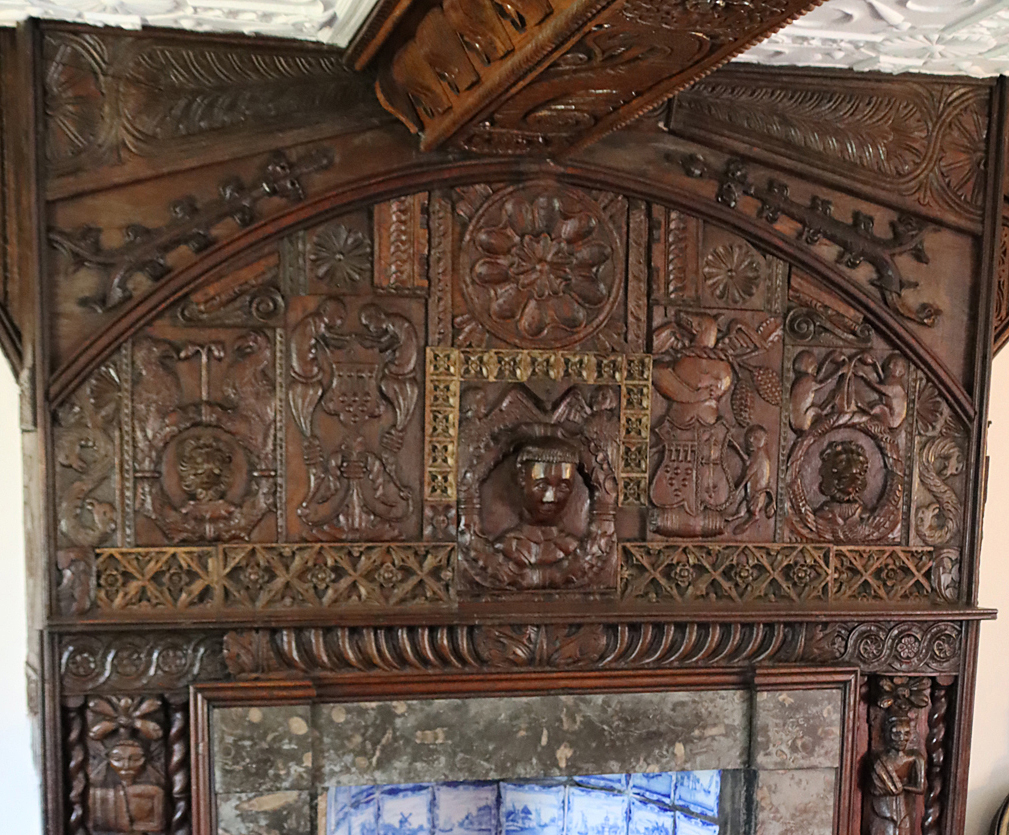

Plas Newydd after 1814. Source: People’s Collection Wales


