Category Archives: History

The magnificent aqueduct and viaduct at Chirk, and a very, very dark tunnel

Chirk aqueduct and viaduct on an old postcard. Source: History Points

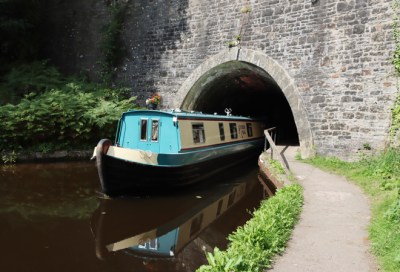
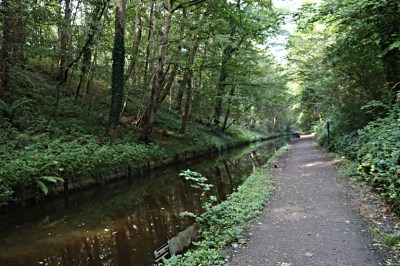
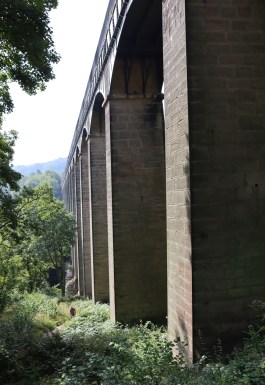
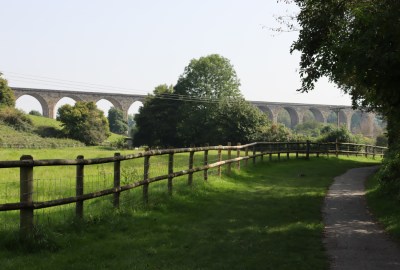
Having engaged in a two-bridge extravaganza with a visit to the Cefn viaduct and the Pontcysyllte aqueduct via the footpaths in the Tŷ Mawr Country Park recently, I decided to complete the local big-bridge experience with the beautiful Chirk viaduct and aqueduct.  The aqueduct (lower) and viaduct (higher) run parallel within a few feet of one another, high above the floodplain of the river Ceiriog.  A towpath accompanies the LLlangollen Canal across the aqueduct, doubling as a footpath, giving great views over the viaduct and the valley below.  Even better, the aqueduct and towpath vanish into a 1381ft / 420m tunnel under the hill.  The railway, running alongside over the taller and slightly longer viaduct, does not vanish underground and carries on over the top of the hill, where there is a station.  This was a short walk because I had an appointment elsewhere, although it didn’t have to be because once you are on the canal towpath you can simply keep walking in either direction until you feel that it’s time to get back to wherever you have abandoned your car.

Cleaning the Chirk aqueduct in 1954 showing the cast iron plates. Source: History Points

The aqueduct and viaduct, at different heights, seem like such a good pairing but they were not built at the same time, and nor were they designed by the same civil engineer or built by the same contractor.

The aqueduct was built to carry the Llangollen Canal, which was part of a complex plan, only partially realized, to connect north Wales to the large national canal network, about which I have already talked in detail on my post about the building of Pontcysyllte.

As typical with the Jessop and Telford partnership, the  aqueduct had an innovative design.   (https://www.pontcysyllte-aqueduct.co.uk)

As part of this immense canal project the  Chirk aqueduct was built in 1801, four years earlier than the better known Pontcysyllte aqueduct. The aqueduct was a collaboration between William Jessop and the younger Thomas Telford, who had been hired to assist Jessop, but had proved himself an innovator in his own right, even though he had lacked canal experience when taken on.  It is unsurprising, therefore, that the the aqueduct was an innovative design. The weight of the water and its traffic were carried on 10 masonry arches with hollow sections, and a water channel provided with a flat bed of iron plates, its brick sides sealed with hydraulic mortar.  The successful deployment of iron plates inspired the construction of the even more innovative Pontcysyllte aqueduct.  The canal travels under the hill via a tunnel to maintain its level, from where it parts company with the railway, which travels at a higher level than the aqueduct.

The railways came later than the canals, eventually replacing them as the primary form of transport, and the Chirk viaduct came 47 years after the aqueduct as part of this vast expansion and eventual domination of rail.  The viaduct, designed by Henry Robertson who also designed the nearby Cefn viaduct, was built by Thomas Brassey for the Shrewsbury to Chester Railway in1848 (to whom a chapel is dedicated in Chester Cathedral).  It was 710ft (220m) long and 70ft (20m) above the valley floor, with a total of 16 arches.  Look out for the nice decorative niches at either end, the sort of flourish that demonstrated the pride with which such massive civil engineering enterprises were regarded.  It must have felt as though they were changing the world, which they were.

The view from the aqueduct is mainly of the river Ceiriog floodplain, a vast grassy area.  The Ceiriog runs to one side, like something of an afterthought.  The vast expanse of green, although lacking any ooh-ah factor gives a real sense of how much land is being traversed by the arches, and how far above the ground level it is.  And it’s a long way down!  The peace seems so complete that a train suddenly rumbling so closely to the towpath is just a little disconcerting.


If you are planning to walk through the tunnel  you absolutely must take a torch, but do note that you do not have to go through the tunnel to continue along the tow-path.

If you want to avoid the tunnel but proceed to the other side of towpath, stop at the information sign near the tunnel entrance.  There’s a ramp up to the road, and you can walk the length of the tunnel over-ground (a couple of minutes along a quiet road) and rejoin the towpath on the other side.  More about this over-ground route, and other visiting details, are below.


There’s a great view of the aqueduct from a viewing platform at the end of Station Road, if you walk back that way, and you can also reach it from the aqueduct side by going up the slope.

Visiting Details

There are various options for parking, depending on how close to the bridges you want to be, and which side of the tunnel. You could park in Chirk itself or at the Chirk marina, for example, and head south towards the tunnel (the bridges are on the other side of the tunnel, north to south).  Or you could park west of the bridges and head north, which means that you reach the bridges before the tunnel.  I followed the latter strategy and parked in the small car park (10 cars max, no charge) actually on the towpath opposite Canal View, just before a very pretty canal bridge.  Canal Way itself is on the towpath, but has homes along it and is strictly private parking.  The photo of the information board above is fairly dismal due to the light and shade, but if you click it to enlarge it you should be able to make out the main parking areas, plus other features.

If you park where I parked opposite Canal View, walk from the car park along the towpath, with your back to the road.  If you park up and then cross the road on to the towpath opposite, you are going in the wrong direction.  It’s a nice, stretch of metalled canal towpath through woods on either side, passing a couple of houses on the right.  You will suddenly find yourself on the aqueduct over the Dee floodplain, with the viaduct running parallel a very short distance to your left.  The tunnel is at the end of the aqueduct.

The towpath over the aqueduct has a nice safe railing with tightly woven wirework, preventing any chance of falling into the valley.  Like Pontcysyllte, however, the canal trough has nothing on the other side.  Those travelling by narrow-boat, kayak or canoe have a far more interesting time of it.

Signage on the towpath

I have mentioned that you do not have to walk through the tunnel to walk the full length of the canal towpath.  When you reach the tunnel entrance (at both ends) there is a pathway up to a road that runs parallel, and another that runs back down to the towpath, so if you don’t fancy the pitch dark (no lighting unless you bring a torch), there is a perfectly viable alternative.  I came from the Chirk Bank direction on the sign right, and vanished into the tunnel just after the You Are Here label and emerged with he blue arrow.  I took the slope up from the towpath to the road, turned left across the railway and then right down Station Road, as far as the roundabout.  Crossing the road at the roundabout, there is an excellent viewing point for the aqueduct (and a seat to sit on). Just to the left of the viewing point is the slope down to the aqueduct.

When you enter the tunnel, switch on your torch, and be prepared for drips from above even during fine weather.  The towpath in the tunnel will let two people pass, and there is a handrail along the water’s edge.  If you have small children you will probably want to go up to the road level instead, and rejoin the towpath on the other side of the tunnel because although there is a handrail to prevent adults falling into the canal, it is not a fence or barrier, just a handrail on posts.  Dogs should be on a lead.

This is suitable for unwilling legs if you stick to the towpath because it is level all the way.  If you want to avoid the tunnel and are up for some gentle slopes, the two ramps up from the towpath to the road should be okay and the roads themselves are on the flat.

Sunshine and great views at Caer Drewyn Iron Age hillfort at Corwen

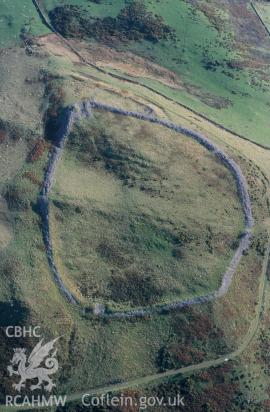
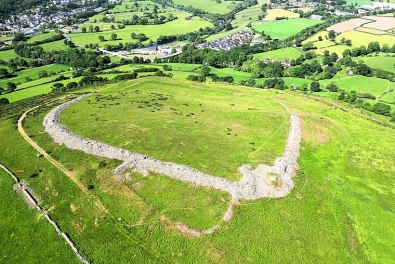
Caer Drewyn aerial photograph. The entrance at the top is at the northeast. Source: Cadw

Caer Drewyn is an Iron Age hillfort located a mile north of Corwen, with remarkable stone-built defences all around its perimeter, and terrific views in all directions.  Every fortnight for two years I drove past Caer Drewyn on my way to my father’s in Rossett, and again on my way back to Aberdovey.  It was so obviously a late prehistoric hillfort that I didn’t investigate what might be known about it for some time, but every time I passed I reminded myself that I really must find out if it was accessible to the general public.  It is.

This post begins with a brief description of Caer Drewyn the Iron Age archaeological site (it is worth reading either this or another description before you visit, as there is no information signage at the site), and finishes with the the walk and views, from the car park via the farm track to the top, and back partly via the track, but also using a different, steep footpath that shortens the route.

If you use the What3Words app, which is invaluable for both locating a site and, most importantly, for giving an exact location to emergency services in the event of an accident at a site, you can find the hillfort at ///kitchen.quaking.segments.

Caer Drewyn

Willoughby Gardner’s 1922 sketch of the position of Caer Derwyn on the slope rather than around the peak of the spur.

Caer Drewyn is the most southerly of the well-known Clwydian range hillforts, The site is located on a spur projecting south and west into the Vale of Ederinion in the upper valley of the river Dee, some 800-985ft above sea level and, at its south, 500ft (152m) above the Dee floodplain.  The aerial photo shown at the top of the post gives some idea of the way in which the site dips fairly steeply from east to west over two loosely defined natural terraces. 

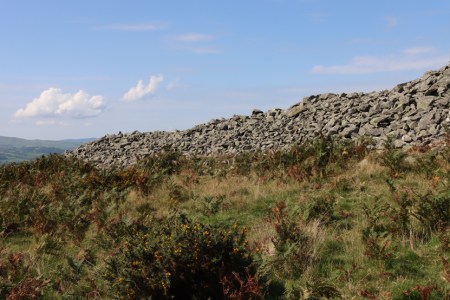
What differentiates Caer Drewyn from its Clwydian range peers is that instead of banks and ditches, it is defended by vast stone defences, spreading to beyond 15ft wide in places.  The Caer Drewyn stone defences are remarkable in that they do not merely defend a particular weak point; they enclose the entire perimeter – and there is an awful lot of perimeter to defend (3 hectares / nearly 7.5 acres, measuring c.629ft / c.192m north-south by 705ft / 215m east-west).  This sort of stone defence is not unique.  There are a number of examples in Ceredigion and in south Merioneth (e.g. Craig yr Aderyn, and Castell y Gaer) both on or near the mid-west Wales coast, with which the area may have had contact via the route that follows a geological fault-line. Other similar examples are further afield in northwest Wales including the famous Tre’r Ceiri on the coast of the north Llyn Peninsula, which has a complete stone perimeter and includes very clearly visible hut circles within.

Although parts of the stone walls were cleared of bracken and other vegetation in the late 19th and early 20th centuries, Caer Derwyn hillfort has not been excavated, so all knowledge is based on observation of the extant features.  According to the Coflein website, the hillfort was probably developed over at least three phases.  

The earliest phase is thought to have consisted of a smaller curvilinear earthwork at the northeast of the hillfort that stands today, and survives in part as an earthwork outside and to the east of Caer Drewyn.  This can be seen on the aerial photograph at the very top of this post.

The next phase is the vast rubble-walled site that dominates the hill today.  This later hillfort was defined by the stone rampart, which Willoughby Gardner describes  in his 1922 paper as  consisting “of a core of rubble stones, faced on either side with a wall of dry masonry.”  These surviving patches of stone facing may suggest that the rampart may have been equipped with an inner wall-walk.

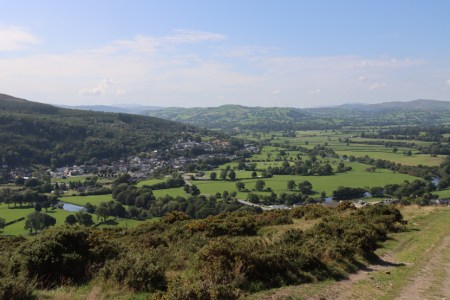
Instead of sitting around the peak of the spur, the hillfort actually sits on the slope, meaning that the interior can be seen from below.  Like many hillforts, it is ideally located for visibility over the landscape, in this case with views over the surrounding area, including the valleys of the rivers Dee and Alwen, which meet just to the east, the Berwyns to the south and the north and east across to the rest of the Clwydian range.  These views are wonderful on a clear, bright day.  Toby Driver points out that in spite of the defences, the above-mentioned fact that the interior of the hillfort can be viewed from below somewhat undermines its strategic value.

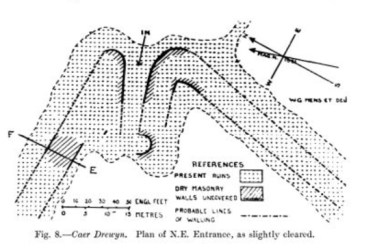
Willoughby Gardner’s 1922 plan of the northeast entrance of the hillfort

The hillfort could be approached from the west and the northeast, where the two entrances were in-turned, a typical feature of many hillforts that helps to control access to the interior.  Willoughby Gardner says that there was a spring a short way down from the west entrance.  The entrance in the northeast corner where the cairn is located, which is the highest point of the site and shown clearly bottom right of the aerial photo below, may have featured a guard chamber, another characteristic feature, suggested by the complex jumble of stone that implies at least one additional feature at the entrance.  Willoughby Gardner estimates a 12ft diameter. So-called guard chambers are recesses in the entrance passages hillforts, mainly in north Wales and the Welsh Marches, but the name does not mean that the function of these recesses is actually understood, and they may have been used for some sort of religious or alternative function.

You can see circular dips dotted here and there in the walls.  These may or may not be relatively modern features.  They were there in 1887 when the Reverend Hugh Pritchard was investigating.  One interpretation is that they could have been grouse butts (small enclosures used as grouse-shooting positions), but this is unsubstantiated.  You can see some of them most clearly in the aerial image below.

Caer Drewyn showing northeast entrance, annex, and circular depressions in walls. Source: Peoples Collection Wales

The interior surface has been examined by Willoughby Gardner in 1922 and by the Engineering Archaeological Services (EAS) in 2006.  Willoughby Gardner comments that there are circular structures within the hillfort.  He casts doubt on them being original because in his experience wattle-and-daub or wood was the favoured material for hut circle construction.  The EAS, acting on behalf of the Heather and Hillforts Landscape Partnership Scheme (Denbighshire County Council) carried out a topographical survey which identified eight possible hut platforms within the walls.  Apparently aerial photographs taken in low winter light confirm hut-like shapes in the central and eastern parts of the enclosure.  I had a poke around for anything resembling them on the ground, but could find nothing amongst the bracken.  Winter, when the vegetation has died down a bit, would be a better time for that sort of optimistic activity.  

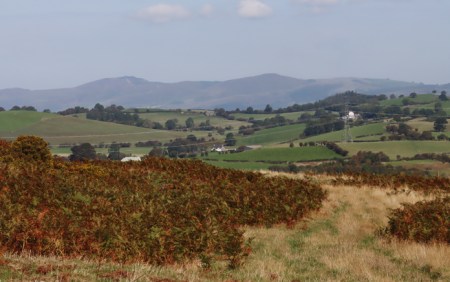
To the south and southwest there are views over Corwen, the Berwyns and into the far distance.  There is excellent line of sight from Caer Drewyn to other hilltops, some of which housed contemporary hillforts.  I walked all the publicly accessible hillforts in the southern Merioneth area in mid west Wales a couple of years ago my write-ups here), and each of them had a clear line of sight to one or more neighbouring hillforts, which would make sense both for mutual support and maintaining lines of communication amongst friendly neighbours, and for keeping an eye on any hostile neighbours.

Caer Drewyn. Photograph by Llywelyn2000, CC BY-SA 4.0. Source: Mapcarta

A third phase apparently added a small  trapezoidal annex to the north-east of the fort, which employs the earliest earthwork of the hillfort.  In the aerial photograph above and to the right you can see one very clearly on the left, but there are others visible on some photographs, much fainter, which may also be hut circles.  There is nothing to indicate a date, but Coflein suggests that it may have been added after the hillfort had gone out of use in the Romano-British period, presumably because of the  possible hut circles, but it could equally have been much later.

Without excavation it is impossible to know how the interior of either earlier or later hillfort forms, or the annex were used, or to know for sure the period over which they were used. 

The term “hillfort,” combined with defensive structures such as banks, ditches, stone walls, defended entrances give the impression that these were built primarily for exclusively military purposes, but it is by no means certain that this was there only purpose or even, in some cases, their primary purpose.  Secondary uses could include storage of agricultural output, protection for livestock, and a visible territorial marker in the landscape. There is no room here to enter into a discussion on the subject, but if you are interested have a look at Toby Driver’s 2018 online paper on the subject (free to access): New Perspectives on the Architecture and Function of Welsh Hillforts and Defended Settlements.  Whatever their primary and secondary purposes, the sheer amount of work that goes into an enterprise like this, or a banked-and-ditch hillfort is considerable, and there was certainly a very desirable outcome in mind when a hillfort was embarked upon.

The site continues to be used for grazing sheep, and it is recorded that it was used as a hafod (seasonal grazing) in around 1600.  It is reputed to have been used as temporary bases for Owain Gwynedd in the 12th century during his conflict with Henry II, and by Owain Glyndwr during his rebellion in 1400.  There is no actual data to support either theory.
———-

Visiting details: parking, the walk and the views

I was advised that it was acceptable to park at the Corwen Leisure Centre, just to the north of Corwen (via Green Lane from the A5, postcode LL21 9RW).  When I arrived, there were only three other cars there, and no signage to indicate that parking was restricted.  By the time I returned to the car a couple of hours later mine was the only car in the car park, so I didn’t feel that I was intruding.

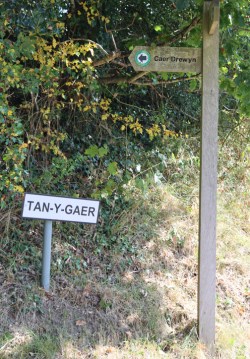
Walking up to the road from the car park, turn left (east).  There is no pavement, just a narrow grass verge, but you are going a very short distance, just a few metres, before a wide farm track is clearly signposted to Caer Drewyn on your left.

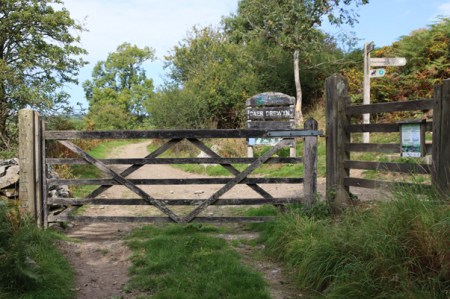
Follow the attractive track for a few minutes, past a couple of farm buildings on your right.  You will reach a gate.


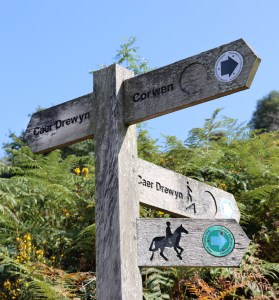
On the other side of the gate is another signpost that gives a few options.

—–

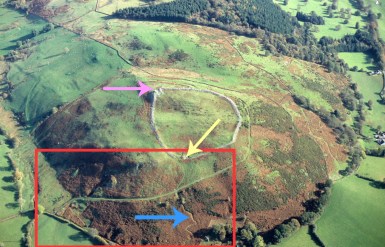
The red box shows part of the farm track taking the easy route up the side of the hill towards the highest part of the hillfort and the northeast entrance (pink arrow). The blue arrow shows the steep footpath that cuts off a corner of the easier route. The yellow arrow shows the lowest point of the hillfort, which is also an access/exit point. Click image to enlarge. Copyright CPAT. Source: Britnell and Sylvester 2018

For Caer Drewyn you can either turn left and follow the farm track, or go straight ahead on a very small footpath straight uphill, which intersects with the farm track at a much higher level. Looking at the aerial photo to the left, it should be possible, although I didn’t realize at the time, to cross over the farm track (or, if you are on the farm track turn left at the point where it intersects with the footpath) to go up to the very lowest point of the hillfort defences and the western entrance.  I wouldn’t, myself, because I really enjoyed the views from the farm track.  It would make a shorter and easier walk for anyone who follows the track to the northeast entrance but doesn’t want to do a full circuit of the hillfort, to follow one set of walls down to the bottom of the hillfort and exit back to the farm track or footpath via the lower entrance.

The farm track is the easy option, so I decided to follow this and, on my return journey, take the footpath down.  I would strongly advise that you take the farm track either on your ascent or descent, because the views are so terrific, and you will miss some of them if you confine yourself to the footpath.

The farm track heads west for a short distance on the level, and then you will reach another signpost that points you right, uphill through a gate that has a walk-around on its right.  Take the uphill option that takes you relatively gently across the side of the hill towards the northeast entrance.  This is uphill all the way and although not particularly steep on the seethingly hot day on which I walked it, it was noticeable.


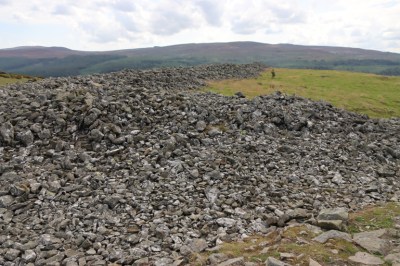
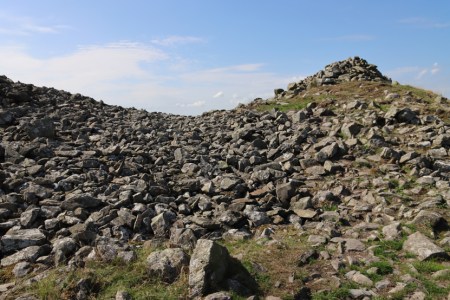
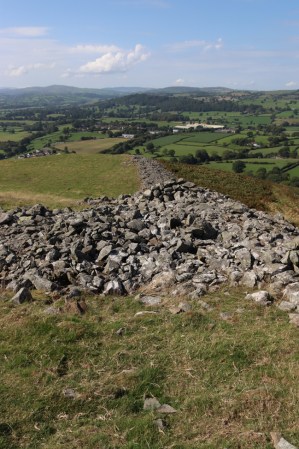
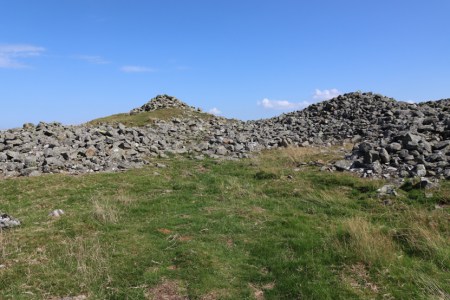
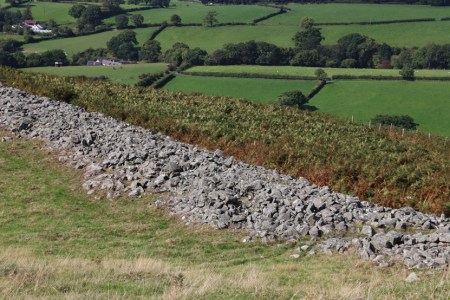
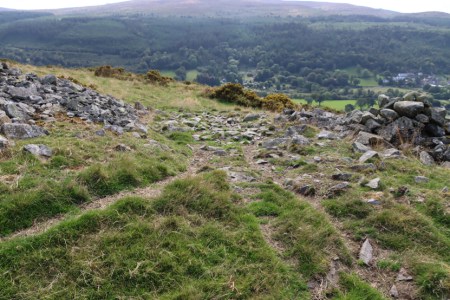
As you climb towards the top of the hill, you will suddenly see some stone rubble on the left, like a massive fallen drystone wall.  This is the hillfort perimeter.  Continue to follow the farm track, running parallel to the walls.  You will eventually reach a gate, which is the end of the line.  Ahead of you is a superb view to the east, and on your left, just a few metres behind you, is a mass of stonework including a roughly conical pile of stone which is a useful point to orient yourself.  This is the northeast corner and marks the following in-turned entrance and possible guard house.  From the cairn you can see for miles and miles around.  The landscape is truly stunning.  You can also see the stone defences heading out in both directions, plunging away to your right down the slope and following the ridge left before then, too, plunging downhill.

It is easy to walk the entire perimeter because all you have to do is follow the stone boundaries, but do take into account when you are heading downhill towards the far eastern extent, that you will have to walk all the way back up again if you want to do the full perimeter back to the cairn!  Alternatively, head out of the well-worn exit at the bottom end of the hillfort to rejoin the farm track.

View over the enclosure towards the west

Looking back up the hill along the northern rampart

The interior showing the topographical tilt to the west

Although there are tracks inside the hillfort, many of them created by sheep, there are no formal pathways and if you leave the trackways, it is very uneven underfoot, with the danger of turning an ankle.  I was wearing tried and tested breathable but very solid hiking trainers that are fabulous on hot days, but it would have been better to have worn summer-weight hiking boots with good ankle support.

Well worn access to and exit from the hillfort at the bottom

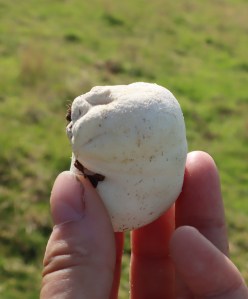
Puff ball

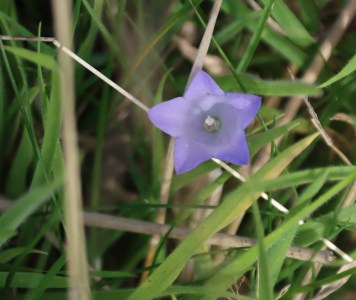
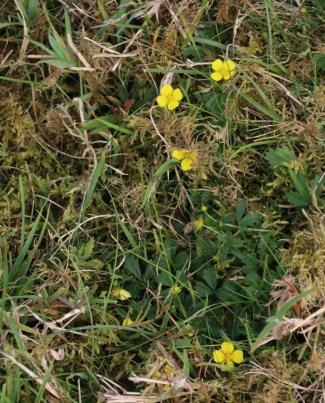
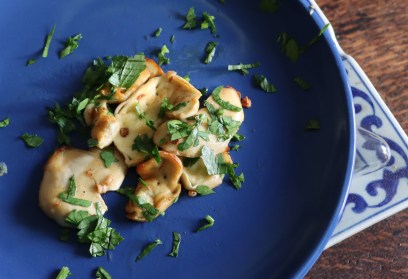
There is not a lot in the way of wildlife, but there is plenty of bright yellow gorse in flower at the moment.  I found a perfect white puff-ball (mushroom) which I later cooked in garlic butter, and some other unidentifiable mushrooms.  There were some very occasional and very pretty wild flowers, including some wonderful harebells dotted around, but there was little else to see at this time of year.  Bird song was all around, but the singers were well hidden.  Judging from the endless rabbit droppings, this is bunny nirvana.  If you are interested in lichen, there seemed to my inexperienced eye to be many different types on the stone defences and the interior rocks and boulders and later that day I read on the Clwydian Range and Dee Valley AONB website that over 60 species of lichen were identified in a 1993-1994 study.


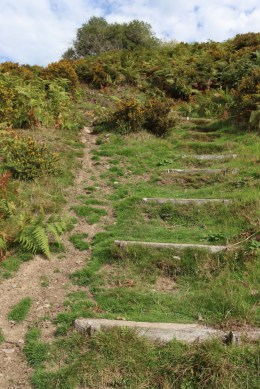
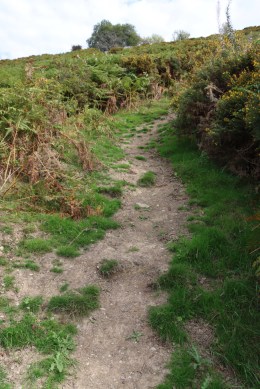
On the way down I kept a close eye out for a signpost for the footpath down, which chops off the corner that the farm track takes (the blue arrow on the above annotated photo).  There is no full-sized signpost, just a little way-marker on the left/south that you need to look out for.  There is a big boulder opposite, which is a useful landmark.  The first part of the footpath, from the top, consists of some quite deep steps reinforced with wood.  It then becomes a fairly steep narrow track – much steeper than it looks in my photographs below.  I suspect that the whole thing becomes a muddy stream during wetter weather, as there are plenty of signs that water courses have made their way down.  The footpath drops you at the gate back down to the road and the car park.

It only took me about half an hour to get up to the hillfort, with lots of stops to enjoy the spectacular scenery, take photos and top up with water.  Once up there, you can spend as long as you like, of course, and it is a great place for a picnic.  I had it to myself, even on a sunny Saturday.

Hopefully the photos will speak for themselves, but I recommend this as a far from strenuous walk, mixing fascinating late prehistoric heritage with terrific views.  If you time your visit to coincide with stunning Rhug Chapel’s opening times (the chapel’s website is here), that would make a great second visit, just a ten minute drive away.

UPDATE:

After I posted about this walk, I found an official leaflet that includes a longer walk incorporating the hillfort, which looks really great.  The relevant page is shown below, but you can download the entire leaflet, with some other really excellent-looking walks too at https://tinyurl.com/2fecwr8c.


——–


Sources

Books and papers

Bowden, M. 2006.  ‘Guard Chambers’: An Unquestioned Assumption in British Iron Age Studies. Proceedings of the Prehistoric Society, 72, p.423-436 [NOT free to view]
https://www.cambridge.org/core/journals/proceedings-of-the-prehistoric-society/article/abs/guard-chambers-an-unquestioned-assumption-in-british-iron-age-studies/E6D627EE54566C400B07C0F42CB5F18C

Britnell W.J. and Silvester, R.J. 2018. Hillforts and Defended Enclosures of the Welsh Borderland. Intarch Issue 48 (2018). Iron Age Settlement in Wales. https://intarch.ac.uk/journal/issue48/7/index.html

Driver, Toby 2018. New Perspectives on the Architecture and Function of Welsh Hillforts and Defended Settlements. Intarch Issue 48 (2018). Iron Age Settlement in Wales. https://intarch.ac.uk/journal/issue48/9/toc.html

Gardner, Willoughby. (1922). The Ancient Hill Fort known as Caer Drewyn, Merionethshire. Archaeologia Cambrensis – The Journal of the Cambrian Archaeological Association. Vol. 77. Seventh Series. 2. Vol 77, p.108-125

Savory, H.N. 1958.  Caer Drewyn. Archaeologia Cambrensis – The Journal of the Cambrian Archaeological Association. Vol 107, p.135-6

Websites

Clwydian Range and Dee Valley Area of Outstanding Natural Beauty
Hillfort: Caer Drewyn
https://www.clwydianrangeanddeevalleyaonb.org.uk/projects/hillfort-caer-drewyn/

Coflein
Caer Drewyn; Caer Drewen – Details
https://coflein.gov.uk/en/site/95431
Caer Drewyn; Caer Drewen – Images
https://coflein.gov.uk/en/site/95431/images
Tre’r Ceiri
https://coflein.gov.uk/en/site/95292

People’s Collection Wales
Caer Drewyn
https://www.peoplescollection.wales/items/5482

Aberdovey Londoner
Iron Age hillforts in South Merioneth
https://aberdoveylondoner.com/category/iron-age-hillforts-in-south-merioneth/

—–

The puff ball as a delicious minimalist starter. Divine.

Tŷ Mawr Country Park, including the Cefn viaduct, the Pontcysyllte aqueduct and some lovely walks


The Tŷ Mawr Country Park, just ten minutes south of Ruabon (LL14 3PE / What3Words ///disprove.dart.isolated) in the Vale of Llangollen, consists of walks through fenced fields, woodland tracks and views over the river Dee and the surrounding countryside.  Most spectacularly, its starting point lies almost underneath the monumental stone-built Cefn railway viaduct, from where a circular walk begins, whilst a less formal there-and-back branch off a circular walk takes in the iron-built Pontcysyllte aqueduct.

Map on the outside of the visitor centre showing all the route options (click to enlarge). At far left is the Cefn viaduct and at far right is the Pontcysyllte aqueduct.

The circular walk begins and ends at the Tŷ Mawr car park (pay and display, but only £1.00 for the day at time of writing, and with two power points for electric cars), visitor centre and café (both closed when I visited yesterday, Wednesday 6th September), and toilets (which were open).

Behind the visitor centre there is a picnic area with excellent views over the countryside and the Cefn viaduct.   There is also a small children’s farm with chickens, goats and other farmyard animals, and a children’s play area.  The circular walk is a metalled pathway through small fields and woodland, which takes in the river Dee, with a small picnic area near a tiny “beach” and has a number of picnic areas. I haven’t found an online PDF of the map above, but you can download my photograph of it as a PDF here (sorry that the text is not particularly clear).

You can go either way around the walk, but the recommended route on the map fixed to the outside of the visitor centre is anticlockwise, which finishes at the Cefn viaduct and the memorial dovecot.  Although there are some inclines, I would suggest that it is entirely suitable for those with unwilling legs.  It was certainly okay for a group of women with pushchairs.  It probably takes no more than half an hour to 40 minutes to walk, with stops to admire the river and the viaduct.  There are occasional benches, a picnic area by the Dee and further picnic areas with lovely views at the top of the walk behind the visitor centre.

The real star of the circular walk, missing off the leg to Pontcysyllte, is the Grade II listed Cefn viaduct, which can be seen around much of the circular walk.  The walk goes right up to and along the base of the viaduct, which really is an awesome sight as you approach it and begin to get a sense of its scale.  The Cefn viaduct was designed by civil engineer Henry Robertson, who had purchased the Brymbo Ironworks, and was built in yellow Cefn sandstone and red brick by contractor Thomas Brassey (to whom there is a chapel dedicated in Chester Cathedral). It was built surprisingly quickly over a two year period to carry the Shrewsbury and Chester Railway over the Dee valley.  It opened in 1848, 43 years after the opening of Pontcysyllte, at a cost of £72,346.  It has twenty one arches, nineteen of which are 60ft (18m) wide, and two of which, one at either end, are 30ft (9m) wide.  If you approach the country park from the Ruabon direction, you will pass under one of the two narrow ones.  The arches span 1508ft (466m) and at their most dizzying tower 147ft (45m) above the level of the river. 

The additional leg of the walk to the Pontcysyllte aqueduct along the path of the Dee is not suitable for anyone who cannot handle steps, as there is a flight down from the circular walk to near the level of the river, with no handrail.  There is a signpost and small Pontcysyllte-themed bench indicating where you have to turn off the path down the stairs to a more informal section towards the aqueduct.


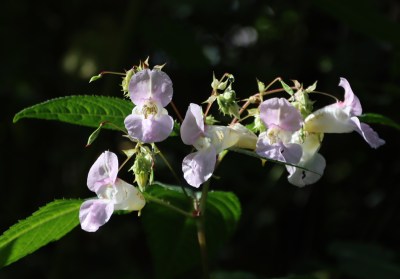
I enjoyed this more informal section, which after a wending track following the path of the Dee through woodland and open field leads to steps at the other end that take the walker to the level of the aqueduct and the Trevor Basin, with fully open visitor centre and other facilities (including boat trips across the aqueduct).  The section along the river to Pontcysyllte will be highly seasonal, with different vegetation allowing or blocking views to the river, offering seasonally variable wildlife.  Yesterday it was very attractive, with glimpses of the river through the tall plant life, and occasional tracks through the vegetation to get down to admire the river itself, much-used by dog walkers whose canine friends were doing a lot of swimming.  The dominant floral element was Himalayan balsam, with orchid-like flowers in pinks and pinkish whites, which is terminally invasive, a complete monster which, given half a chance, takes over its entire environment, but is endlessly pretty and no bother at all in the massive acreage of the park.


Viewing point for the Pontcysyllte aqueduct

The narrow track follow a well sign-posted route, although there are only a few places where choices are required.  When you reach the aqueduct viewing-point that is marked by a metal sculpture of a camera (which acts as a frame for taking photographs of Pontcysyllte) there is a choice to go straight on to the main steps, or turn right to approach the aqueduct from a different angle.  If you are not interested in going up to the canal and aqueduct level but are happy to enjoy some terrific views of the remarkable structure from below, by the side of the river, go straight on.  You can still change your mind and walk up to canal aqueduct level, but be warned that it’s a fairly long and steep flight.  You can always drive back via the Trevor Basin, at the beginning of the aqueduct, where you can park up at the level of the aqueduct.  A better option when you reach the “camera” is to turn right to go up a much shorter and less strenuous flight of steps, which brings you out onto a wooded path that both includes a viewing point and  then delivers you to the canal, Trevor Basin and the aqueduct. You can then then return to Tŷ Mawr via the steeper staircase which is a lot easier going down than up, turning this final section into a circular walk.

The glorious aqueduct, built by Thomas Telford and opened in 1805, is always a joy.  I have written up a summary of Pontcysyllte’s history and visitor information on a previous post.  It is worth going on a bright, cloud-free day, because the views from the aqueduct down to the Dee valley are enhanced by the sun glinting off the water, and by the brightness of the green fields and trees that flank the river.  The towpath along the aqueduct trough is quite narrow, but wide enough for people to pass one another.  The iron railings are high to prevent accidental falls, but not so high that you cannot see over them.  This really is one of the highlights of the area for visitors.

Once done with the aqueduct and Trevor Basin and the visitor centre, going down the longer set of steps to return back to Tŷ Mawr is a great option, walking down the side of the aqueduct and getting a real sense of its scale.  The Dee is particularly delectable here too, bubbling over shallows and glistening in the sun.  A great place to plonk down on the river bank and enjoy an ice cream.

Having retraced your steps, and once back on the more formal circular walk, the star of the show is the Cefn viaduct that looms every close.  There is an option to stop at a picnic area where a small beach is a great spot for admiring the river.  There are tracks that let you walk just a little bit further along the river before heading back to the circular walk, or you can simply pause on the path, admire the view, and keep going up the slope towards the base of the viaduct.  The viaduct is amazing.  You can see it for most of the circular walk.  At first just a few arches appear, and then gradually the entire 19-arch run of the stunning structure is revealed until you arrive at the top of the slope and at the foot of one of its enormous columns.  Look up.  Wow!  At the very top of the arch at the top of the yellow stone-faced columns, the underside of the arches are formed of red brick-built, providing a contrast with the yellow Cefn sandstone.

There is a bench where you reach the viaduct, and a signpost.  The left option continues the circular walk along the foot of the viaduct, which you will have to do anyway to return to the car park.  The right option requires you to cross a stile, and allows you to walk just a few metres in order to see down to the feet of some of the arches in the river, albeit through the vegetation, and to stand right under one of the arches and get up close and personal with the stone work.

When you return to the last stretch of the circular walk, following the viaduct along its base, you eventually reach the attractive dovecot.  This looks much older older than it is, rather like the 18th century example at Erddig, but it is modern, built in 1993 as a memorial.

It’s a short and largely undemanding but seriously enjoyable walk.  Including the walk to Pontcysyllte, the walk only took about two hours to and from Tŷ Mawr car park, with lots of stops for photos and 10 minutes sitting overlooking the river at the foot of the aqueduct with a much-appreciated ice cream.  Apart from the steps, it’s an easy walk, and there is much to see.  I arrived at Tŷ Mawr at 11 and left shortly after 1pm, so it’s not a day-eater.  A great place for a stroll, rather than a hike.  Up-to-date visitor information is available on the Wrexham County Borough Council website.

The name Tŷ Mawr translates as “big house” or “great house.”  There’s no sign of a house, and no mention of one on any of the websites that talk about the country park.  Many old houses have been lost, but I can find no mention of one associated with the country park.  Does anyone know if there was once a property associated with the site?


Gresford All Saints’ Church – exterior gargoyles and grotesques

A previous post took a quick chronological hike through All Saints’ church in Gresford, which dates mainly from the 15th century but includes features dating back to the 13th century.  As with many gothic churches, the exterior may be architecturally consistent with what is going on inside, but often has a rather different character that seems scarcely in keeping with the sacred, the holy and the peaceful ideas associated with a monument to the divine.  The photographs on this page are a small selection from All Saints’ Church, dating to the 1400s or later, shown at random.  If you want to visit the church, maps and visiting details are on the previous post.

There is a lot of writing about gargoyles and grotesques, much of it descriptive, and there are some terrific books of photographs to show what these creatures looked like, but there are no definitive answers about what these external features were actually doing there.  So far, a job description remains elusive.

Gargoyles and grotesques each has a slightly different definition.  Both are usually made of stone, and are high up on on or under the rooflines of church, cathedral and abbey, or clustered around windows and door openings.  Some may be highly sculptural and elaborate, and others are less complex, but all make up a landscape of the unknown.  They are all carved into fantastic forms, some fearsome, some weird, occasionally crude, and every now and again borderline pornographic.  Gargoyles are usually grotesques, but not all grotesques are gargoyles.  A gargoyle is a carving that draws water away from the building, spewing rainwater out through its mouth or rather more unusually its rear end via a water spout.  A grotesque is any ecclesiastical carving that merits the term, something from another world, a creature from an alternative reality or a reality just out of sight, something of nightmares and fears.  Some may be monsters of the imagination, some grotesquely distorted human faces, some composites of recognizably human and animal features, others simply odd.

Grotesques and gargoyles occupy liminal spaces, between heaven and earth at the top of buildings, and at boundaries between interior and exterior at windows and doors.  Notre Dame Cathedral in Paris is famous for its gargoyles and grotesques, and vividly demonstrates how in the bigger ecclesiastical constructions, many of these features are invisible from ground level and always would have been.  This may imply that some of these creatures were intended not only for human audiences, but for supernatural observers too.

One evocative piece of contemporary writing on the subject survives.  The vigorous Cistercian  monk, abbot and mystic Bernard of Clairvaux was unimpressed by gargoyles in the following oft-quoted 12th century piece, but what is interesting is that he seems to have been just as ignorant of their actual symbolic purpose as researchers today:

What are these fantastic monsters doing in the cloisters under the very eyes of the brothers as they read? What is the meaning of these unclean monkeys, strange savage lions and monsters? To what purpose are here placed these creatures, half beast, half man? I see several bodies with one head and several heads with one body. Here is a quadruped with a serpent’s head, there a fish with a quadruped’s head, then again an animal half horse, half goat … Surely if we do not blush for such absurdities we should at least regret what we have spent on them.

Although different types have been identified and named, creating a terminology to enable discussion of the different forms that appear, this is a matter of categorization rather than comprehension.  Identification of recurring themes such as hunky punks, chimeras, and sheela na gigs help to navigate the landscape of the grotesques, but do not explain what they are doing there.  A number of explanatory approaches have been attempted, but these simply serve to underscore that there is no consensus on the role of grotesques and how they should be understood.  Here are a few examples, in no particular order:

  • Depictions of demons or heretics as a warning against sin and depravity , and as an aid to church teachings, to reinforce the campaign against sin
  • Demons vanquished and expelled by the Church
  • Illustrations of specific Christian texts
  • A vivid contrast to the divine and the angelic: “The gargoyle is all body and no soul – a pure projector of filth, the opposite of the angel whose body is weightless and orifice-less” (Michael Camille).
  • Representations of paganism
  • Warnings to intruders not to violate the holy space within
  • Figments of the imagination
  • Critiques of human monstrosity, reflections of imperfections in humanity and the individual
  • Devices to reinforce religious hierarchy:  “These glimpses of the impossible, in their absurdity, work to safeguard the established order and whatever is promoted as normal and morally right” (Alex Woodcock)
  • Copies of earlier forms that have lost their meaning over time

Alex Woodcock comments:  “If there is no definitive answer to the question fo why they are there, then it is because the carvings themselves are too full of possible meanings, and paradoxical ones at that, to be comfortably explained – and perhaps that is the point.  In his book Medieval Religion and Its Anxieties, which looks at “the other Middle Ages”, Thomas Fudgé suggests, apart from St Bernard, we have no real way of reaching what people in the Middle Ages saw and thought they looked on grotesques: “It seems clear that viewing medieval art through modern yes is fatal and that creating artificial categories with the use of terms such as marginal, official, high, low, and so on when referring to art is a form of hegemony by posterity on the past.”

Yet although they may not be marginal, in the pejorative sense of the word, the grotesque and the peculiar often do occupy the margins, not only in architecture, where they occupy distant spaces and boundaries, but also in illuminated manuscripts, rather like subversive or thought-provoking comments on the main message.  This idea of the strange and inexplicable occupying the margins is explored by Michael Camille, in his book Image on the Edge.  Here the margins are an active component of the core text, be that text an illuminated manuscript or an architectural narrative, or indeed a social situation.

Fudgé traces a chronological trend within grotesques, describing 13th century gargoyles as terrifying, whilst in the 14th century “they took on comedic dimensions that by the fifteenth century gave way to amusement.”  As Camille says, “The medieval image-world was, like medieval life itself, rigidly structured and hierarchical.  For this reason, resisting, ridiculing, overturning and inverting it was not only possible.  It was limitless.”  During the process, fear was replaced by fun, and monstrous elements of human nature and activity became the targets of satire.  Grotesques disappear during the Renaissance, when their role was apparently no longer relevant.

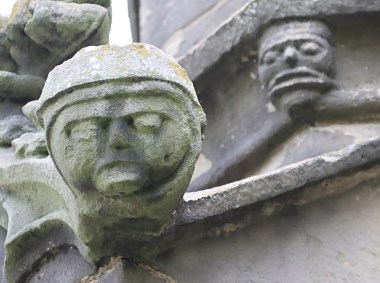
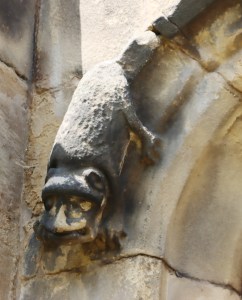
The gargoyles and grotesques on the exterior at All Saints’ in Gresford are carved a mix of forms and sizes, and date to when the church was re-designed and given two new side aisles in the 1400s.  Some of the grotesques look down from the roof and tower, a lot are arranged in a line above a string course just beneath the roof of the side aisles, whilst others sit on finial bases or above window corbels, much nearer to the observer, and perhaps most threatening, although as the photo to the left shows, not all of the carvings were fearsome monsters; some were unalarming representations of human faces.  I have photographed all those that can be seen from ground level, some rather more successfully than others, and as a corpus it is quite a remarkable collection of images.  Only a small selection are shown here.  They are delightful to the modern eye, perhaps rather less so to the late Medieval church-goer.
——–
—–

There are more photographs, high quality images taken at the level of the gargoyles and grotesques, on the Images tab of the All Saints’s page on the Coflein website, together with images of statues amongst the pinnacles.  See  more too on the Archives page. Some of them provide an excellent overview of the imagery that exists at roof level.

Sources:

Camille, Michael 2019 (2nd edition).  Image on the Edge. The Margins of Medieval Art.  Reaktion Books.

Fudgé, Thomas, 2016.  Medieval Religion and its Anxieties.  History and Mystery in the Other Middle Ages.  Palgrave Macmillan

Woodcock, Alex, 2011.  Gargoyles and Grotesques.  Shire Publications

Big and bold: All Saints’ Church in the small village of Gresford

All Saints’ Church in Gresford is such a short hop from my parents’ home in Rossett that I should have visited years ago, but somehow never got around to it.  I tried a couple of times earlier this summer, but the church was busy in its role as a community resource, which was good to see.  The church is big.  Although it is difficult to imagine when driving along the Chester-Wrexham road, Gresford was originally a small village, noted in the Domesday survey as part of Duddestan in the Cheshire Hundred.  A sense of village life still remains in the buildings that surround the churchyard, together with the charming village pond just down the road, complete with lazy ducks sunbathing on warm summer days.  All Saints’, reaching most of its present extent in the 15th century, was an imposing presence, and must have been a source of considerable local pride.

The location of the Church of All Saints in Gresford. Source: streetmap.co.uk

For a detailed account of the church’s history, see the history page on the Gresford All Saints’ website.  This post provides a short overview of some of the key features, with photographs.  First, a note on the name.  Most churches in the area are named after particular saints, but All Saints refers, as it name suggests, to all Christian saints.  The saints represented by “all,” however, include not only those who are known but those who remain unrecognized.  All Saints’ Day is celebrated in Catholic and some Protestant churches on 1st November annually.  The owner of the Church of England Saint Dedications web page calculates that it is the second most popular church dedication in England, after St Mary.  Although Gresford is in Wales, just over the border, it switched hands between England and Wales throughout its earlier history.

The Grade 1 listed All Saints’ is unexpectedly impressive for its understated setting.  Much bigger for example, than Worthenbury’s St Deiniol’s, with which it shares a sense both of ambition and commitment.  Today both are clearly much-loved by their communities, and both vie for the title of the finest parish church in north Wales.  The significant difference between the two is that whereas St Deiniol’s was built between 1736-9 by Richard Trubshaw with real Georgian panache, All Saints’ is thought to have been founded in the 13th century and was in almost continuous use from at least the 14th century.  The 11th century Domesday survey mentions a church and priest, but this church was apparently replaced by the establishment of the Gresford church, either in the same or slightly different location.  All surviving walls are made of local high-quality Cefn yellow sandstone, which is used for many of the municipal buildings in Wrexham.  A separate post about the exterior gargoyles and grotesques has been posted on the blog here.

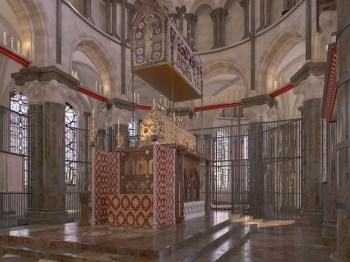
The late 13th and 14th centuries were a period of energetic church building in England and Wales.  It is thought that the remarkable gothic architectural projects carried out at two notable sites created a tidal wave of enthusiasm for architectural projects in religious establishments. One was the new and remarkable shrine created for Archbishop Thomas Becket in Canterbury Cathedral, murdered on 29th December 1170, who was canonized only three years later and therefore required a shrine worthy of his status, into which his remains were transferred (translated) in 1220.  The other was the ambitious shrine built by Henry III for St Edward the Confessor at Westminster Abbey, completed in 1269.

When All Saints’ Church was built in the 13th century, prestigious contemporary religious buildings included, for example, St John the Baptist Church in Chester founded in 1075, St Werburgh’s Abbey, founded in 1093 and Basingwerk Abbey founded 1132.

Subsequently All Saints’ underwent many alterations and embellishments in the centuries that followed, including the 14th century addition of the tower to a lower level than today, together with a south aisle.  There was an almost total rebuild in the 15th century and the upward extension of the tower in the 16th century.  The dominant style, following the 15th century rebuild, is known as Late Gothic Perpendicular, a peculiarly English style that emphasized the tall and thin aspects of the Gothic, mainly exhibited in the stone tracery of the stained glass windows, which make up an enormous part of the interface between interior and exterior.

The only clue to the original appearance of the church lies in a 16th century document that claims that it had been “strangely and beautifully made erect,” which is intriguing but not particularly helpful.  The church is rectangular in plan with a tower protruding at the west end and two porches.

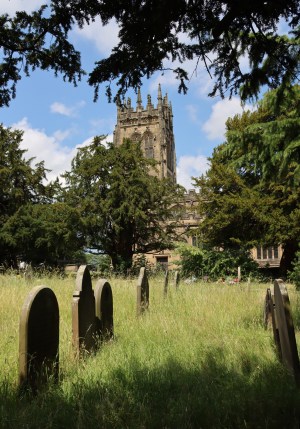
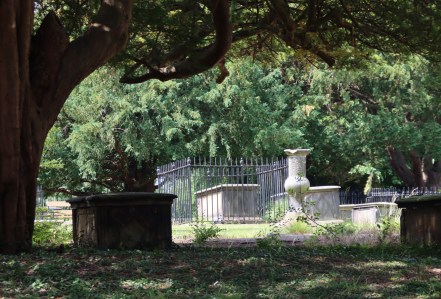
All Saints’ sits within a churchyard.  The earliest grave marker dates to 1696, and there are some from the 18th century.  Most date to the 19th century.  There is a good mixture of chest tombs and gravestones of different designs and styles of engraving. The churchyard’s oldest occupant is in fact a lovely yew tree (Taxus baccata), estimated to be 1600 years old.  The other yew trees were planted in 1726.  Often associated with churchyards, yews have a mixed reputation, seen both as symbols of immortality and indicators of impending disaster, the latter association perhaps because of its toxicity.  In this context, it seems clear that the yews are intended to represent life everlasting.

The exterior features of the church include crenulations, and follows the gothic tradition of adding gargoyles, which draw water away from the roof, and decorative sculptural elements, including small beasts, real and imaginary, and tortured faces, usually referred to as grotesques, as well as floral themes. Some of these sit on the stringcourse, a few of which are positioned under hood-moulds (projecting reliefs to protect the underlying features from rainwater).  They are worth a post in their own right, if only to capture some of them with a telephoto lens so that they can bee seen much more easily than with the eye, which I will do in the next month or so.

Internally, the church is divided into traditional sections. The nave (the main body of the church where the public sit in pews) is flanked by two side aisles at ground floor level, marked by two 7-bay arcades.  A clerestory (row of windows above the level of the aisle) provides the nave with much more light than the stained glass alone.  A screen, erected in the 15th century, divides the nave from the sacred end of the church, the chancel with the choir and high altar.  The chancel is flanked by two chapels, which can be reached from the aisles.  The north aisle, shown above, used to run directly into one of the two chapels that flank the choir and altar, but is now partially interrupted by a 19th century organ.

The church has seen continuous use since the 13th century.  The main surviving feature of the 13th century is the crypt, closed to the public but accessed via the north chapel. The 14th century is represented by a number of key internal features. In the south aisle, the effigy of Madog ap Llywelyn ap Griffith, who died in 1330, lies in a niche, shown in full armour with a lion rampant on his shield.  The inscription reads HIC IACET (here lies) MADOC AP LLYWELYN AP GRIFFI

Almost opposite, and dating to the same period, is another niche, this time showing the beautifully engraved gravestone of Goronwy ap Iowerth.

The inscription, with thanks to  the ArchaeoDeath blog of Professor Howard Williams (where you can find more 14th century engravings from the church) reads:

HIC:IACET:GRONW:F’:IORWERTH:F’:dd’.CVI’:AIE:DS’:/ABSO/LWAT
Here lies Goronwy son of Iorwerth son of David, whose soul may God absolve.

The raised 14th century sanctuary with the high altar, approached via a flight of steps, sits over the 13th century crypt.

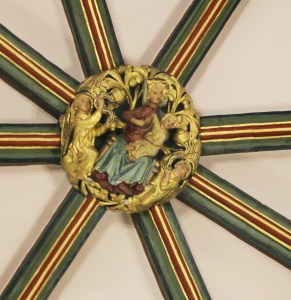
From the 15th century are the fabulous misericords (carved scenes on the undersides of seating in the choir) and one of the church’s real treasures, the  gorgeous wainscoted screens (the central panel of which was vaulted, photograph further down the page), and a very fine stained-glass window behind the high altar donated by Thomas Stanley, Earl of Derby and step-father of Henry VII.  The font, at the west end, with its eight panels that include depictions of the Virgin Mary with the baby Jesus, the lion of St Mark, and possibly St Leonard, also dates to the 15th century.

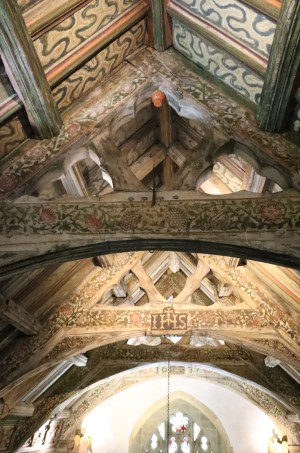
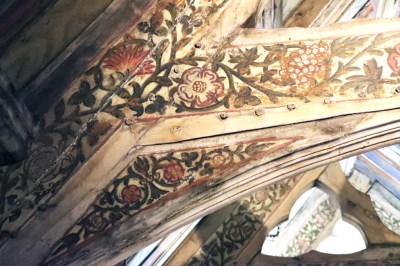
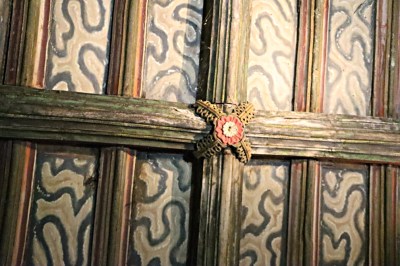
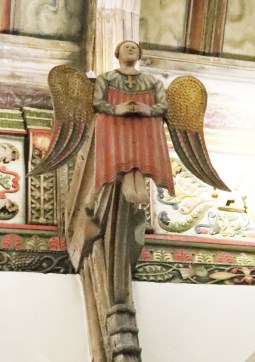
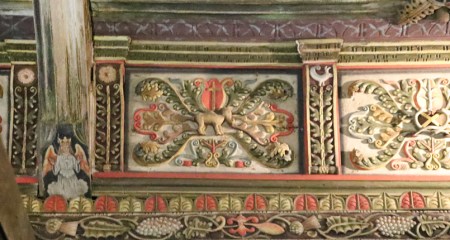
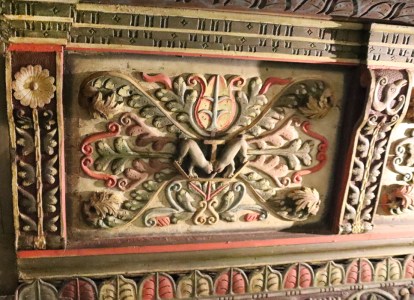
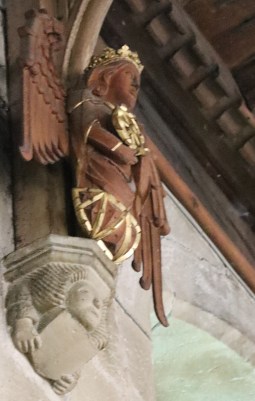
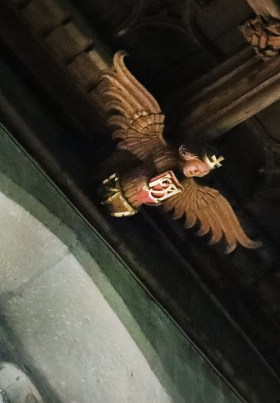
Don’t forget to look up. The ceiling is a particularly fine camberbeam structure, crossed with rafters, with painted panels and bosses.  At the ends of the rafters are carved wooden angels.

So why was the medieval church so popular that it could afford a new tower in the 14th century and a major rebuild to include new aisles and new features in the 15th century?  In her booklet about All Saints’, Bethan Jones suggests that the gifts showered on the church, including furnishings, might suggest that it had acquired a relic and had become a pilgrim destination.  Relics generated considerable incomes for cathedral, monastery and church alike.  In Chester, the Rood of St John’s Church was a popular pilgrim destination, and in the 14th century the shrine of St Werburgh in the Chester abbey had become popular.  To the west, the shrine of St Winefrede at Holywell and the church at St Asaph were also on the pilgrim circuit.  No record survives of such a relic at Gresford, but it is difficult to account for the size of the church in any other way, other than a major investment by a donor who wished to make his mark on the church during the period of the Reformation, but neither is there any record, documentary or material, of such a benefactor.

16th century features include the fine stained glass windows in east and north walls of the Lady Chapel, reached via the north aisle. In the Trevor Chapel there is a superb painted 1589 memorial to John Trevor (Sion Trefor), lying as though still alive, with his head propped thoughtfully on one hand.  His coat of arms is above and a winged skull beneath.  An inscription conceals the central portion of his body.

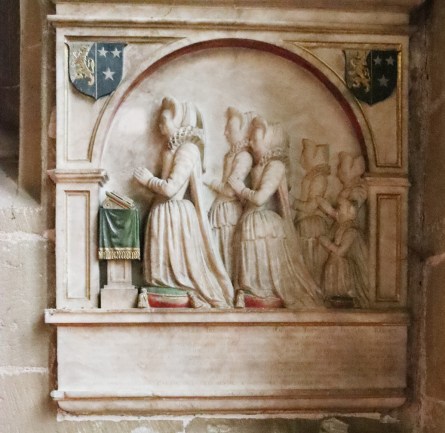
The church continued to be well used throughout its history.  Dating to the 17th century, the Trevor Chapel a charming memorial to John Trevor’s daughter-in-law with her daughters dates to 1602, and another, rather more monumental piece, shows her with her husband (shown further down this post) and dates to 1638.  Other memorials in the church also date to the 1600s.


In the 18th century, a number of additions were made.  The two chandeliers in the nave date to the mid and late 18th century.  The south porch (the main entrance to the church today) had stained glass panels added in the 18th century to commemorate local deaths during the First World War.  The first mention of the bells is in 1775, when three of the bells were mentioned I the parish register having been returned after being recast at Gloucester, meaning that there were at least three bells in the tower at that date, the tenor, third and treble bells, although in 1873 six bells are listed so it is possible that there were six bells in 1775.

In the 19th and early 20th centuries a number of alterations and additions were made, mostly sympathetic to the original structure. The 15th century east window was restored during the 19th century, using additional glass, but has remained true to the original.  In St Catherine’s Chapel, better known as the Trevor Chapel, there are two hatchments for George Boscawen (who died in 1833) and Thomas Griffith (who died in 1856), both shown immediately below.  The Hill and Son organ was installed in 1912. The addition of the north porch in 1921 to serve as a war memorial included old fragments of glass.  A painting in the Trevor Chapel commemorates the Gresford Colliery Disaster of 1934 and serves as a memorial to the 266 men who died.  This is shown at the very end of the post, following the list of sources.

An intriguing object in the church is a short square column, made of stone and carved with a figure holding a pair of shears.  It may date to the Roman occupation, and it is possible that one face represents Atropos, one of the three Moirai or Fates, responsible for cutting the “thread of life” (the metaphor for a human lifespan).  It was found during excavations at the east end of the church.

Final Comments

There is too much to say about Gresford All Saints’ on a single post, and I will revisit the church on future posts to look specifically at the choir and misericords, the gargoyles and grotesques that accessorize the exterior of the church, and the churchyard itself.  Apologies for the highly granular photographs of the interior, including some which are slightly blurred around the edges, both of which were caused by having to photograph in very low light.  I hope that the images are good enough to give a sense of the magnificence of the church and some of its features.

Here are a few more photos, in completely random order, and please see Visitor Information below them.


Visitor Information

The church is open daily, but is a living church and may not always be available for visitors.  It has services on a Sunday and on Thursday mornings, marriages and funerals during the week and on Saturdays, and may be used as a community resource for events such as the annual craft fair.  Check the church website for it’s opening times and events.  It took me three attempts to find it free of activities, which is great news for the church and its future, and no bother for me as I live locally, but check the website for information, and it may be worth emailing the contact address on the website if you are coming from further away.

There are plenty of information boards throughout to explain the key features, but not so many or so big that they intrude on the atmosphere of the church.  If you are interested in the history, the colour booklet by Bethan Jones provides a tour of all of the key features.  It can be purchased (cash only) at the church, where there are a number of leaflets and postcards available on the shelves to the right as you enter, including one devoted to the bells.

The Trevor Chapel on the south of the church (right as you look towards the altar) is used for private prayer, but is accessible to visitors when it is not in use. The crypt, with an entrance from the Lady Chapel, is closed to the public.

For those with unwilling legs, it’s an easy to access church, with no steps needed to negotiate the entrance via the porch on the north side.  The nave, the choir and the chapels can all be accessed without using steps.  Being an active church, there are plenty of pews in the nave on which to sit down and absorb the atmosphere.

Sources

Books and booklets

Bethan Jones, 1997.  All Saints Church Gresford. ‘The Finest Parish Church in Wales’.  The Friends of the Parish Church of All Saints Gresford.

Hubbard, E. 1986. The Buildings of Wales: Clwyd (Denbighshire and Flintshire). Penguin Books

Roberts, F.H. 2013.  All Saints’ Gresford. Tower and Bells. All Saints Church, Gresford

Wooding, J.M. and Yates, N. (eds.) 2011.  A Guide to the Churches and Chapels of Wales. University of Wales Press

Websites

All Saints Church Gresford
Home Page
https://www.allsaintschurchgresford.org.uk/
History Page
https://www.allsaintschurchgresford.org.uk/about-us/our-history/

ArchaeoDeath blog by Professor Howard Williams
Gresford’s Medieval Monuments
https://howardwilliamsblog.wordpress.com/2018/03/04/gresfords-medieval-monuments/

Clwyd and Powys Archaeological Trust
Church of All Saints, Gresford
https://cpat.org.uk/Archive/churches/wrexham/16785.htm

Church of England Saint Dedications
https://blanchflower.org/cgi-bin/qsaint.pl

Imaging the Bible in Wales Database
Church of All Saints, Gresford, Wrexham
http://imagingthebible.llgc.org.uk//site/188

The 1991 discovery of an important Roman inscription in Holt

By Andie Byrnes and Helen Anderson, August 4th 2023

The discovery in 1991

The Holt inscribed fragment, now in the Grosvenor Museum. Photograph by Dr Roger Tomlin, University of Oxford, with many thanks for allowing Helen to use it.

In 1991 artist and archaeology enthusiast Helen Anderson was driving over the Farndon-Holt bridge, about 11 miles (c.18km) south of Chester, when she noticed some activity and bare soil surfaces in the normally grassy nearby field associated with the Roman tile-works and its ancillary buildings overlooking the Dee.   She had recently started to focus on Roman archaeology and to visit Roman sites, and although she had spent her childhood locally in Churton, she had only recently been reading about the Holt tileworks site for the first time.  She had been intending to go and look at the site but hadn’t yet done so, and thought this might be an interesting opportunity to go and see it. She received permission from the landowner to walk over the newly-stripped surface of the field.

On the  recently exposed soil surface that day, as well as sundry fragments of imbrex and tegula (roofing tiles), two of which were marked with cat and dog paw-prints and one with a finger print, she found the wonderful piece of inscribed brick shown in the photograph above right. Here is Helen talking about discovering the piece:

As I was walking through the field, which had been stripped for turf that was still being rolled and loaded, I saw a large piece of orange tile lying on the muddy surface, picked it up, turned it over and found what appeared to be writing on the underside.  I could hardly believe my eyes – it was an extraordinary and quite eerie moment!  My immediate thought was who I should tell about it.  Later, gently cleaning it in the kitchen sink, the excitement of the incised letters appearing clearly as the soil washed out of them was something I will never forget. It felt a bit like time travel.

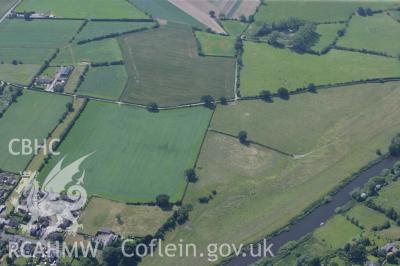
Aerial view of the farmland at Holt next to the River Dee where the tile-works were located

The piece was clearly broken, with a bit of the inscription missing.  Helen returned to Holt a few days later, to show it the to the farmer and to see if the rest of the fragment was lying about in the field, but by then it had all been rotovated – if she hadn’t picked up the brick it probably would have been further damaged. She reckons the gods must have been with her that day!

This was six years before the establishment of the Portable Antiquities Scheme, so after after showing the find to the landowner, who gave Helen permission to keep the object, Helen sent photographs to the British Museum.  The resulting correspondence offers a terrific insight into how an understanding of the significance of the object was reached. It emerged that the fragment of Helen’s brick on which the inscription was made was re-used as a form of notepad to make a quick record.  At first it was thought that the fragment was a tile, but it is more likely to be a piece of lydion or sesquipedalis; these look rather like tiles because they are very thin compared with modern brickwork.  Some of the letters have been sliced off at the far right, but what we are looking at is part of a coherent piece of text, a list with signatures.  It was a small-sized record, containing only a few details.  It measures 32cms, by 30cms, and is around 6mm thick.

Helen hard at work at the Rossett Roman Villa excavation in 2021. Photograph courtesy of Dr Caroline Pudney, University of Chester

The inscription is now recorded in various books and papers contributing to knowledge about Roman activities and everyday life in the Chester area.  Although Holt is just over the Welsh border, the tiles and bricks were created for the Roman occupation in Chester.

Following very fine lunches at Pant Yr Ochain near Gresford and the White Horse in Churton, where we pored over both the artefacts and documents that Helen has assembled, including her original correspondence with Catherine John and Roger Tomlin, we decided to write a post about the inscribed fragment.  Helen has now been investigating the Romans in the Chester area for three decades, and as her knowledge has grown she has excavated as a volunteer at Chester amphitheatre, the Heronbridge Roman settlement, and most recently the Rossett villa.  All the documentation cited here has been provided by Helen.

First, a quick look at the Holt tile-works, which produced the inscribed brick.

The early 20th century discovery of the Holt Tile-works

The Holt brick and tile works site was recognized in the early 1600s when landowner Thomas Crue of Holt Hill suffered repeated damage to his plough and was forced to investigate.  He discovered that his plough was encountering a series of fifty 2ft-tall posts, and his finding found its way into the book Roman Cheshire by W. Thompson Watkins (1886).  This was noted by retired chemist and keen amateur historian Alfred Neobard Palmer who, in 1905, decided to hunt for the remains that Crue had found, accompanied by local vicar Jenkyn Jones, having sought permission from the landowner.  A series of field-walking expeditions followed, uncovering plentiful fragments of Roman brick, roof tile and pottery over an area of some 20 acres.

Fold-out plan of the kilns at Holt, published by Grimes in 1930. (Scanned from my copy of “Holt, Denbighshire”)

Palmer was not an archaeologist, and the task of excavating the site was taken on by Wrexham solicitor and amateur archaeologist Arthur Acton.  Work began in 1907 and continued until 1915.  Although he delivered numerous lectures about the site, Acton never published his work.  Fortunately a portion of his records survived, and he sold the excavation finds to the National Museum of Wales, where William F. Grimes used the data to compile a comprehensive report, complete with site plans, photographs and object illustrations.  Work did not stop there, and during the 1970s Geoffrey Bevan conducted both field walking activities and an excavation, finding Roman material that filled dozens of boxes, which were donated, this time, to the Grosvenor Museum in Chester.  Helen’s field-walking in 1991 added the inscription to the list of important finds, and in 2018 Holt Local History Society commissioned Archaeological Survey West to carry out a geophysical survey of the site, to fix the positions of the known buildings and, with luck, to identify any unexcavated and previously unknown structures.  This demonstrated that the Holt complex was even bigger and more complex than Grimes, via Acton, had been able to determine.  There is, of course, the potential for future field research, and recent work in Farndon, summarized on local historian Mike Royden’s website is beginning to expand the story over to the other side of the Dee.

What was the Holt tile-works like?

Site plan of the Roman tile and pottery work displayed in the Hidden Holt exhibition. Also in the excellent booklet accompanying the exhibition, full details in Sources below. The features shown in blue are unrecorded / unexcavated.  Those in dark brown are the building locations fixed in 2018, and those in paler brown those estimated by Grimes based on Acton’s work.  Click to see a bigger version with fully legible text.  Source: Wrexham Heritage Service, 2021

The 20th Legion, Valeria Victrix, of the Roman army, was stationed at Chester, Roman Deva, from AD87, and the Holt works appears to have been established shortly afterwards to supply the fort and settlement at the legionary fortress.  Holt’s industrial activities reaching their peak output at around AD135, and began falling out of use in the mid 3rd Century.  The site was clearly a fully integrated operation combining industrial, public and domestic components.

A senior manager had his own house, complete with hypocaust (under-floor central heating), there was a public bath house, a series of kilns for the manufacture of tiles, bricks and pottery, and a barracks that may have housed workers, or alternatively a detachment of the Roman army based at Chester at this time.

The hypocaust below the drying shed. Source: National Museum of Wales

The main kiln plant at Holt, published by William Grimes in 1930.

The kilns formed two main units, a larger (139ft / 52m long, consisting of a row of six kilns) and smaller twin-kiln built on the natural bed-rock.  Each kiln was rectangular and tile-lined with an arched stoke-hole for access.  A round pottery kiln was also located on the edge of the main kiln complex.  The oven floor consisted of a raised floor of tiles plastered with clay that were pierced with holes that acted as vents.  The drying shed was provided with a hypocaust, of the same sort used in villas and bath houses.  These, like the kilns, were stoked and kept hot to ensure that the tiles, pottery and bricks were dried through after firing.

Map marked by Helen to show the approximate findspot of the inscribed fragment

All of the output manufactured at the works was sent by boat downriver to Chester on the river Dee.  It provided direct access to Chester, 12 miles / 19km away, passing the civic settlement at Heronbridge.  The generally flat environment meant that building of roads, where needed, was not exceptionally laborious.
—–

Corresponding about the tile in 1991

The imposing facade of the British Museum. Source: Wikimedia Commons by Paasikivi

Helen wrote to the British Museum in April 1991 describing how she had found the fragment, and enclosing a high resolution photo in which the inscription could be seen clearly.  The first person to reply to Helen’s letter to the British Museum was Catherine Johns F.S.A., at the time Curator of Roman Britain in the Department of Prehistoric and Romano-British Antiquities in the British Museum in London.  In a letter dated 18th June 1991, Catherine Johns begins “Thank you for your letter and the excellent photographs and drawing of the inscribed tile from Holt in your possession.  This is an interesting and important find.”  She goes on to explain that the inscription is in cursive Latin, “that it is to say, it is handwriting rather than formal lettering.”  She was unable to translate the text, which is a specialist task, and sent it to Dr Roger Tomlin of Wolfson College, University of Oxford.  She warned Helen that the fragmentary nature of the text might impede translation.  She finished by suggesting that Helen might consider presenting the piece to the National Museum of Wales, where most of the Holt material excavated in the early 20th century is held.

Helen then received a letter dated 25th June 1991, only a week after the letter written by Catherine Johns, from Dr Roger Tomlin.  Dr Tomlin explained that it was by no means straightforward to decipher and transcribe the fragment, partly because of the several examples of handwriting inscribed, and the fact that it was clearly incomplete.  He suggested that this was a record of expenses, with the star symbol indicating the unit of payment in denarii, and that several individuals were involved. He referred to the inscribed brick as “a welcome addition” to the corpus of Roman inscriptions in Britain. In a later letter, dated 1st July 1991, he thanked Helen for offering to take the the object to him in Oxford, for translation, whilst on a family break, and expressed the hope to meet up with Helen to discuss it.  He suggested that the fragment was probably part of a lydion (or sesquipedalis), rather than a tile, a brick used for bonding-courses.  When Helen met Dr Tomlin for coffee, he departed on his bicycle, in typical Oxford style, with the inscription propped up in the bicycle’s basket.  ———

The inscription

The same photo of the inscribed tile found by Helen Anderson in Holt in 1996 as above, shown again so that you can review the cursive text Copyright Helen Anderson

The brick was inscribed in the still-soft surface of the wet clay before firing.  The translation of the inscription by Dr Tomlin is a great example of the sort of scholarship and academic detective work that go into understanding a single object.  The inscription was abbreviated, typical for this sort of note, where space was limited and standardized abbreviations were recognizable to all.  As already noted, the slab was broken, possibly by ploughing, so parts of the inscription are missing, but this apparently presented few problems for Dr Roger Tomlin.

Just by looking at it, you can see that there is more than one person’s handwriting, and that’s because each person wrote his own signature.  All three were men, named  1) Junius, 2) Maternus and 3) Bellettus.  The final s is missing in each case due to the break.  In the official transcription below, Tomlin has completed words where he knows them.  The slab is a record of expenses they had incurred, but does not say how they were incurred.  Junius was paid at least 4 denarii, probably more, but the break carried the other details away.

Notes about the inscription on the left, on the back of the photo above, followed ultimately by the publication of the inscription in Tomlin 2018, p.290

Front cover of Tomlin’s 2018 “Britannia Romana. Roman Inscriptions and Roman Britain.” Oxbow Books (see Sources below)

Dr Tomlin wrote about the inscription in the journal Britannia, vol.26, 1995, p.387, where it is numbered no.28 (and Helen’s role in the discovery is referenced in the footnotes).  It was later included in Tomlin’s comprehensive Britannia Romana, published in 2018, which lists over 400 epigraphic inscriptions from Roman Britain.  The inscription is listed on page 290 as number 11.14.  Dr Tomlin observed that the three men listed were probably legionaries (although he does not rule out in the 1995 publication that they may have been auxiliaries).  He says that two of the three names were commonplace Roman names, and the third, Bellettus, may have been a variant on the name Bellicus, which he describes as “popular in Celtic-speaking provinces.”  All three signed their own names, meaning that they were literate.

Tomlin is particularly interested in the word sumtuaria, which is missing its p, and is the plural of the noun sumptuarium.  The word is very rare, with the only example known by Tomlin appearing on a legionary pay-sheet in Masada, Israel, where it refers to food expenses.  Tomlin speculates that this was a record of expenses that were to be reimbursed by headquarters at a later date, but he does question how this was supposed to work when the record took the form of a brick (which, after all, could not be divided between the three men!)

Roman soldier’s payslip from Masada, Israel. Source: Arkeonews.net

This find, recording something of the lives of three men who lived in Roman Holt, has something of the air of the Vindolanda tablets.  The thin leaves of wood used at Vindolanda on Hadrian’s Wall recorded many aspects of everyday life, also written in cursive.  A selection of them are on display in London’s British Museum.  One of them had a similar content to the Holt example, showing a list of people who owe money.  Although it is incomplete and undated, it was possible to identify Vitalis the balniator or bath house keeper and Tagomas, one of a number of cavalrymen from northern Spain who appear on the list (also mentioning the latter’s contubernalis, or unofficial wife).

Text from vindolanda showing a list of people who owe money. Source: Vindolanda.com

————–

Publications mentioning the brick

The inscription became something of an emblem of local Roman social history, being referred to not only in academic publication, but also heritage newsletters and leaflets in Chester.  Dr Tomlin suggested that it be included on the Roman Inscriptions of Britain website, and it has very recently been added to the site here, where it has been given the identifier Brit.26.28.

Here are two examples of publications aimed at the general public, collected by Helen, that mention the find and give a good idea of how it was regarded:

Source: Revealing Cheshire’s Past series: From Farms to Fortress leaflet, page 6 Industrial Activity. Cheshire County Council

Connecting with the past

The inscribed brick in the Grosvenor Museum, Chester. Copyright Helen Anderson

You can see the inscribed fragment today in the Grosvenor Museum in Chester, where it is on display in the ground floor Newstead Roman gallery, thanks to Helen requesting that it be displayed locally rather than in the National Museum of Wales in Cardiff.  Not only would it have been difficult for local people to visit it easily in Cardiff, but the tile-works were directly connected with the legionary fortress in Chester, so this seemed like the perfect home for the inscription.  Generations of local schoolchildren can have their imaginations fired by seeing the handwriting of several different Romans who lived here nearly 2000 years ago.

Helen explains that her own children were so excited and proud of her discovery of this piece of heritage that they somehow persuaded her that it should be on loan to the museum rather than donated, but she has since donated it outright, rightly deciding that it’s a piece of history that belongs to everyone.

If anyone wants to chat with Helen about the find, you can contact her via Twitter: @Helenus_.  You can also contact Andie on the Contacts Page, via Twitter @BasedInChurton, or leave a comment (the Leave a Reply link is immediately under the title of the post).

Other posts on this blog about Roman Chester and Holt can be found here.
———-

Final Comments

The object that Helen found in a field in Holt, during a short window between when turf was removed and new grass sown, has multiple identities.  Archaeologically and historically, it is one of a number of records of Roman Britain that together provide insights into Roman settlement and industry and particularly contribute to the narrative about the Holt tile-works.  At another level it is both a clue about record keeping in Roman Holt, and an ephemeral glimpse into the everyday life of three literate Roman men who were working at the tile-works and were claiming expenses.  Today, as well being a significant part of the Roman display in the Grosvenor Museum in Chester, it has made a claim for a position in Helen’s own family history.  Not a bad set of achievements for one inscribed object found lost in a field.  One wonders if the three soldiers ever did receive their expenses?———————

Sources:

Letters (in the private archive of Helen Anderson)

From Catherine Johns, Curator, Department of Prehistoric and Romano-British Antiquities, British Museum. To Helen Anderson, dated 18th June 1991

From Dr Roger Tomlin, Wolfson College, University of Oxford.  To Helen Anderson, dated 25th June 1991

From Dr Roger Tomlin, Wolfson College, University of Oxford.  To Helen Anderson, dated 10th July 1991

Books and papers:

Grimes, W.F. 1930.  Holt, Denbighshire:  Twentieth Legion at Castle Lyons.  Y Cymmrodor.  Society of Cymmrodorion.

Tomlin, R.S.O. 1995. 11.14 Holt (? Bovium), in (eds.) B. C. Burnham, L. J. F. Keppie, A. S. Esmonde Cleary, M. W. C. Hassall, and R. S. O. Tomlin Roman Britain in 1994. Britannia, Vol. 26 (1995), p. 325-390

Tomlin, R.S.O. 2018.  Britannia Romana. Roman Inscriptions and Roman Britain. Oxbow Books (Chapter 11, no.14, p.290-1)

Leaflets and newsletters:

The Past Uncovered, Autumn 1996
http://www.cheshirearchaeology.org.uk/wp-content/uploads/The-Past-Uncovered-Autumn-1996.pdf

Revealing Cheshire’s Past series: From Farms to Fortress leaflet, page 6 Industrial Activity.  Cheshire County Council

Holt: Legacy of the Legions, available from the museum, or can be downloaded.
http://old.wrexham.gov.uk/assets/pdfs/heritage/holt_castle/holt_legacy.pdf

Websites:

Coflein
Holt Roman Site NPRN 307201
https://coflein.gov.uk/en/site/307201?term=holt&pg=2

National Museum of Wales
Request for Information – Freedom of Information Request Relating to Collections – Reference 17-002, 14th February 2017
amgueddfa.cymru/media/41203/response-web-17-002.pdf

Roman Inscriptions of Britain Online
https://romaninscriptionsofbritain.org/
The Holt inscribed brick now has its own page at:
https://romaninscriptionsofbritain.org/inscriptions/Brit.26.28

Vindolanda Charitable Trust
Writing Tablets
https://www.vindolanda.com/blog/fact-file-writing-tablets

Vindolanda Tablets Online
http://vindolanda.csad.ox.ac.uk/


A roof boss in Chester Cathedral: the murder of Thomas Becket

The Thomas Becket ceiling boss in the Lady Chapel, Chester Cathedral. Photograph by Andie Byrnes

  • Introduction
  • Who was Thomas Becket?
  • The Becket Boss in the Lady Chapel of St Werburgh’s Abbey
  • Final Comments
  • Sources

Introduction

Chester Cathedral plan (annotated). Source: Wikipedia

In the 13th century, Abbot Simon de Whitchurch (1265-1291) began the construction of Lady Chapel in St Werburgh’s Abbey (which is today Chester Cathedral, and about which I have posted here, with visiting information including accessibility).  It was dedicated to the Virgin Mary. In the ceiling, where the vaulting ribs meet, three round ceiling bosses high above the floor show religious themes.  One shows the Holy Trinity and the second shows the Virgin Mary and the baby Jesus.  The third, shown above, shows shows the murder of Thomas Becket, Archbishop of Canterbury, by four knights loyal to Henry II on 29th December 1170 in Christ Church Cathedral in Canterbury.  It is one of only two Becket ceiling bosses known to survive in Britain; the other is at Exeter Cathedral (shown below left).

Exeter Cathedral’s Thomas Becket ceiling boss. Source: Feasts, Fasts, Saints and the Medieval Church blog

What these two busy little scenes in Chester and Exeter depict was a brutal and savage act of great violence.  The murder of Becket was a violation one of England’s holiest precincts, a modern martyrdom, and an affront not only to the ecclesiastical hierarchy in England but to the papacy itself.  All eyes turned towards Henry II.  This was not the sort of attention that Henry wanted, and he spent the rest of his reign attempting to distance himself from the event.

The news of the murder spread swiftly and was deeply shocking to 12th century English and European society.  The terrible events were captured by eye witness accounts, not least that of the clerk Edward Grim who attempted to intervene and protect Becket. Almost immediately miracles were attributed to Becket, and only three years later he was canonized by the pope, becoming St Thomas.  His story was told in biographies of the saint, and his scenes of his life, martyrdom and miracles were rendered in wood, stone and paint, whilst relics were assiduously collected and displayed. In a world where martyrs and their deeds were factual events but remote, the real-time martyrdom of the head of the English church by representatives of the king was religious persecution in action, fresh and alarming in a way that past events might not be.  It was unthinkable.

Document dating to around 1180, around a decade after the event, showing the murder of Becket, from an eye-witness account by John of Salisbury (Cotton MS Claudius BII f.341r). Source: British Library.

From the moment of his murder, people were attracted to Christ Church cathedral to commemorate Becket.  His canonization made Christ Church Cathedral a formal and very desirable pilgrim destination.  The shrine itself, completed 50 years after Becket’s death, became one of Europe’s top pilgrim sites.

The saint was still attracting pilgrims in the 16th century when Henry VIII, identifying the cult of Becket as a challenge to his absolute control over religious as well as secular matters, ordered that every image of the martyr should be destroyed.  The systematic annihilation of Becket shrines and images contributed to the demise of Becket’s legacy, which was reinforced by further systematic defacements of Catholic artistic and architectural themes during the Reformation, including various monuments in Chester Cathedral, including the St Werburgh shrine.

Who was Thomas Becket?

Becket’s early career

Map of Medieval Cheapside, Medieval London in the 1560s. Source: Medieval London, Fordham University

Thomas Becket was the son of a Norman merchant who moved from Normandy (northwest France) to take up opportunities in London following the invasion of William I in 1066.  Gilbert and his wife Matilda lived in commercial area of London called Cheapside.  Gilbert rose to the position of sheriff, climbing several rungs on the social and political ladder.  It is thought that Thomas Becket was born around 1118-1120.

Becket was was born into the period of civil war between King Stephen and the Empress Matilda (mother of Henry II).  He received a good formal education, first at Merton Priory (now in southwest London), and later at a school in London.  In his late teenage years he went to Paris to study, in a Parisian heyday of scholarship and artistic endeavour.  His studies included some of the most popular scholastic topics, including grammar, rhetoric and canon (church) law, which were essential tools for anyone wanting to make their mark on the world, but did not include any formal religious education.  He returned to England in the early 1140s under the reign of Henry II, who was crowned as monarch on the death of Stephen in December 1154.

Seals of Archbishop Theobald and of Christ Church, Canterbury. Source: “Theobald. Archbishop of Canterbury” by Avrom Saltman via the Internet Archive

In the mid 1140s Becket was recommended to the Archbishop of Canterbury Theobold of Bec (c.1090-1116) and obtained a role as a clerk in the cathedral, a mainly administrative position which, however, offered opportunities for advancement. A cathedral is both the principal church of the diocese and the seat of the bishop and, as at Christ Church, often included a monastic establishment.  Becket’s Paris education was probably attractive to Theobold, who had a number of similarly educated young men in his employ.  Like most incumbents of the Canterbury archbishopric, Theobold was both a cleric and a diplomat, closely involved in crown matters, but had twice been exiled by King Stephen due to his intervention in political matters.  He sent Becket to Auxerre in France and Bologna in Italy to study law.  Law, divided into Church (canon) law and state law, was rapidly becoming an important topic in Medieval England.

Becket’s rise to power

The 12th-century Topographica Hiberniae (Topology of Ireland) by Gerald of Wales shows a rare contemporary image of the king. Source: Wikipedia

In 1154 Becket was promoted to the role of Archdeacon of Canterbury. As well as the financial rewards that enabled him to satisfy his love of luxury, his new position was sufficiently prestigious for Theobold to recommend Becket to the 21-year old Henry II as the new royal chancellor.  Henry’s coronation at Westminster Abbey, following the death of Stephen, had taken place in the same year.  Their professional relationship evolved into a friendship over a period of eight years as Becket flourished in a position of enormous responsibility.  It was a mark of Becket’s success in this role that on the death of Theobold in 1161 Henry moved to appoint him Archbishop of Canterbury, to hold both positions simultaneously.  Becket had no religious ambitions, had received no clerical training and consequently had never been ordained into the priesthood.  In spite of these drawbacks, Becket was elected to the role by the monks of Canterbury and the bishops of southern England.  Ordination was rushed through, and Becket was consecrated as Archbishop on 3rd June 1162.  His appointment was confirmed by Pope, who sent him a pallium, a vestment that symbolized his new office and status.

Needless to say, the appointment was not universally celebrated.  Quite apart from the fact that Becket had made enemies on his rise to power, decisions such as the appointment of an archbishop was one of the areas of conflict between Crown and Church.  The Church thought that it should have complete autonomy over its own affairs, answerable only to the papacy and  to God; but the Crown, conscious of the power and wealth wielded by the ecclesiastical institutions, wanted to exercise its own authority over the activities of the most important institutions, including Canterbury.  The right to appoint the most senior ecclesiastical personnel, was only one bone of contention.  The right of the Church to operate under its own canon law was another.

King Henry II and Thomas Becket arguing. Peter of Langtoft’s Chronicle, Royal 20 A II, f.7v. Source: British Library

There was no reason to think that Thomas Becket would not continue to remain completely committed and loyal to the Crown.  It was therefore a very unpleasant surprise to Henry II when Becket began to take his new role seriously, resigning his position as chancellor to focus on promoting the rights of the Church and representing the authority of the papacy.  From this point forward, Becket and Henry had opposing interests.  Becket’s training in law put him in an excellent position for arguing that the Church, rather than the Crown, should be in charge of ecclesiastical justice, in which Church clerics who committed even violent crime would be judged not by secular courts but by the far more lenient ecclesiastical courts.  There were many other disputes between the two, when Becket took a stand not only where ecclesiastical interests were involved, but in matters of state as well.  Henry attempted to resolve the situation by imposing a set of “customs,” or rules adhered to in the era of Henry I, Henry II’s grandfather, assembled in the Constitutions of Clarendon to which he commanded that Becket and all the bishops defer.  Although Becket at first refused to ratify the document, he and the bishops eventually submitted to pressure and signed.  However, Henry was seriously annoyed and began to investigate Becket, finding grounds for ordering him to court to address a number of charges.  When Becket refused first to accept the charges against him and then to reject the resulting sentence, he made the decision to flee to France.

The Abbey Church of the monastery of Pontigny. Photo by Mediocrity. Source: Wikipedia

Becket lived in exile at the Cistercian monastery of Pontigny in France from November 1164 until 1170.  In exile he attempted to drum up support, but alienated Henry still further by excommunicating a number of his advisers. Pope Alexander sent papal legates to try to resolve the dispute instructing Becket to refrain from taking any more actions against the king and his court, but in April 1169 Becket excommunicated another ten royal officials.  In 1170 Henry’s son Henry was crowned as the Young King, in a secondary role to Henry II order to settle any potential succession disputes.  The coronation was presided over by the Archbishop of York, Roger de Pont L’Évêque.  It was the right of the Archbishop of Canterbury to preside over coronations, and Becket responded to this insult by laying an interdict on England, with the pope’s permission.  This forced Henry back to the negotiating table, and he came to terms with Becket on 22nd July 1170.  Becket returned to England in the December of that year. One might have thought that Becket would count his blessings, but before he arrived he could not resist excommunicating the three individuals most closely associated with the coronation of the Young King, one of whom was the Archbishop of York.  The three appealed to the king, who was in his Normandy territory, and it was at this point that Henry, in a rage, expressed his frustrations about Becket’s latest act of rebellion.  What Henry II actually said is not recorded, but it spurred four of his knights to set off for Canterbury from Normandy.
———-

Murder in the cathedral

One of the earliest known representations of the murder of Becket (c.1175–1225). British Library Harley MS 5102, f.32. Source: Wikipedia

The knights rode from London to Canterbury.  They left their armour and weapons outside the cathedral precinct, intending to arrest Becket and return him to London for trial.  Becket was having none of it.  Eye-witness accounts state unambiguously that Becket’s behaviour was that of a very angry man under serious threat, confronting the knights on the steps of the cathedral.  Goaded by Becket’s verbal retaliation and refusal to back down, they retreated to put on their armour and retrieve their weapons, returning to slaughter the unarmed archbishop in rage.  Blows of the sword to his head killed him relatively swiftly, producing an alarming amount of gore that spilled onto the floor around him.  One of the swords struck him so powerfully that the sheer momentum carried it to the ground, snapping the end off the blade.  Edward Grim, who attempted to intervene, was badly injured.

His murderers were Reginald FitzUrse, William de Tracy, Richard Brito (or le Breton) and Hugh de Morville.  FitzUrse, whose name means “son of bear,” is often marked out on images of the murder with the image of a bear’s head on his shield.  He is shown on both the Chester and Exeter bosses.   Having committed the crime, the knights headed for Yorkshire where they remained for a year.  Curiously, Henry made no move against them, but in 1171 Pope Alexander III excommunicated them, and 1172 they headed for Rome to seek absolution from the pope.  It is thought that they were probably sent on crusade, and either died on their way, or in battle, although there are a number of unsubstantiated traditions about their ultimate fates.

The Christ Church was closed for nearly a year so that Pope Alexander III could be consulted on how to proceed so that the cathedral could be re-consecrated and returned to normal use, rejuvenated as a destination for pilgrims.

Miracles and legacy

Detail of the Canterbury Christ Church Cathedral miracle window, which shows some of Becket’s miracles. Source: Reverend Mark R Collins blog

Until his death, Becket had been a political creature, and a representative of ecclesiastical interests.  He did not position himself as a man of the people, but as a newly inspired champion of the rights of the Church.  This did not prevent the place of his death becoming a destination for pilgrims of all social scales, even before he was officially canonized.  Curiously, Becket was not merely an emblem of devotion to the Church and a promoter of its rights in the face of opposition from the Crown, but a saint who produced miracles for the everyday person, becoming an unlikely saint to act on behalf of the general populace.

A reconstruction of the Thomas Becket shrine in Canterbury Cathedral. Source: Smithsonian Magazine

The first miracles reported following the death of Becket took place at his tomb.  Hundreds of others soon followed, 703 being reported within the first 10 years, many recorded by Benedict of Peterborough.  Within twenty years of the murder, no less than twenty biographies had been written about the saint including contemporary accounts including, for example, those by John of Salisbury, Edward Grim and Benedict of Peterborough, the latter listing many of his miracles.  Images of him in various media appeared all over Europe, and his relics spread just as far.  As the Oxford History of Saints comments laconically, “His faults were forgotten and he was hailed as a martyr for the cause of Christ and the liberty of the Church.”  In short, Becket and the miracles associated with him went viral.

Thomas Becket pilgrim badge. Source: Museum of London

Fifty years after his death, a new shrine was opened with great ceremony, and St Thomas was moved into a new tomb within the shrine.  It was a spectacle of gold and precious gems, and was surrounded by stained glass windows telling the story of his life and miraculous works. At the height of its popularity, it attracted over 100,000 pilgrims a year. In the Jubilee year of 1420 the shrine earned £360 for Canterbury Cathedral, which equates today to around £231,483, which could have purchased 83 horses or 620 cows (data from the National Archive’s Currency Convertor) or could have been used to build a new section of cathedral.  Images and symbols of St Thomas were moulded into ampullae and badges for the hundreds of pilgrims who visited his Canterbury shrine.  The shrine no longer survives; it was destroyed in 1538  under the orders of Henry VIII.
——–

The Becket boss at St Werburgh’s Abbey

The Lady Chapel

The Lady Chapel, Chester Cathedral

St Werburgh’s Abbey featured many architectural-sculptural elements which embellish the core structure of the building, providing focal points, colour and a hint of glamour.   The Lady Chapel was built under Abbot Simon de Whitchurch (1265-1291).  In Burne’s words, “He was evidently an outstanding character and under him the abbey flourished exceedingly.”  It was a period of great prosperity for the abbey, with an income derived from, amongst other things, church pensions (a sort of tax), appropriated church tithes, gifts of houses and lands, and possibly pilgrimage to the reliquary-shrine of St Werburgh, although the new shrine  to the saint was not built until the 14th century, and it is unclear how important it was as a pilgrim destination before then.

Although the earliest known Lady Chapel predates the Norman invasion, the Lady Chapel became particularly important in the 13th century when the Virgin Mary was undergoing a resurgence of devotion.  The elegant, vaulted Lady Chapel St Werburgh’s was built in the 13th century.  Like most Lady Chapels it was built to the east of the High Altar, projecting from the main building.  Here clerics performed daily services to the Virgin Mary. It is easy to forget that most architectural elements would have been brightly painted, but the Lady Chapel in Chester Cathedral, restored to a typical colour scheme of green, blue, red and gold in the 1960s, provides an excellent example of how these components would have looked.  The lancet windows at the end of the chapel date to 1869, when Gilbert Scott removed the later Perpendicular window to be more faithful to the 13th century vision.

The Holy Trinity, with God holding the arms of the crucifix in his hands

Some Lady Chapels are large and ornate, but in some cases they form smaller, more private and tranquil spaces than other chapels within a monastery or cathedral.  The Chester example is delectable, its small footprint and relative height giving a sense of both intimacy and space.  The reconstructed shrine of St Werburgh, a victim of the Reformation’s hostility to reliquaries and idolatry, is located at its east end, but according to Jessica Hodge was probably originally at the east end of the quire.

The ceiling bosses form a row across the centre of the chapel, from east to west.  The east end was symbolically the most sacred, and it is at the east end of the chapel that the ceiling boss showing the Holy Trinity is located.  In the centre is, the Virgin Mary is depicted, and at the west end is the Becket boss.  The chapel was created during a period of great religious significance during the reign of Henry III, who had been crowned for the second time in 1220, the same year in which Becket’s remains were moved to a custom-built shrine on July 7th 1220, reinvigorating the already vibrant cult. The spectacular event was used by both the Archbishop of Canterbury, Stephen Langton, and the king to help to heal the ongoing rift between the Church and the king.  In 1225 Henry ratified the Magna Carta, granting the freedom of the Church.  This was a momentous decade in the Church’s history and religious houses throughout Medieval England rode the crest of this remarkable period during the rest of the century with new architectural projects, rebuilding, expanding and celebrating.  By 1260-1280 when the Chester Lady Chapel was built, it was the centenary of Becket’s death.  It is possible that the Becket boss was installed to commemorate this event following an ecclesiastically bright start to the century.

The St Thomas ceiling boss

Ceiling bosses are both architectural and sculptural elements, usually circular or sub-circular, positioned in the ceiling where the vaulting ribs that form arches meets, either to hide the join, or acting as keystones to add structural integrity to the complex set of tensions and stresses. There can be much more to them than first glance suggests, and behind the decorated end, an undecorated portion of the boss may be inserted into the join.  Examples on the floor of the cloisters provide a good idea of this, showing the decorated section that would face down, and the plain stump that would be inserted into the join.

Three relatively large stone vaulting bosses were provided at the point where seven or eight stone ribs of the slender vaulting meets, each carved and painted with a different aspect of Christian iconography.  Smaller bosses were also added to at vault joins, where three or four ribs meet, sculpted into beautiful foliage, and gilded.  Corbels, where the vaulting ribs begin, are also decorated with foliage.  These carved stone features would all have been carved and painted prior to installation.  The white painted ceiling and walls between the brightly coloured features are the perfect foil for them, providing them with reflected light and emphasizing the  rich colours.

The Becket scene offers a sanitized version of the traumatic event on 29th December 1170, recycling a scene that bears only a passing resemblance to the terrible violence of reality, one version of a standardized formula for representing this event, an overstuffed and static little scene that looks rather like a posed portrait, with all of the protagonists shown full face, as though looking towards a camera. The composition is curious.  Three knights dominate the scene.  Sir Reginald FitzUrse is identifiable, as he is in the Exeter ceiling boss of this scene, by the bear’s head on his shield.  One knight at the front strikes at Becket’s head.  At the back of the group is clerk Edward Grim holding a cross and appears to preside over the scene.  Becket is squashed into the lower right hand section of the scene, kneeling behind an altar, his hands held, palms outwards, in front of him.  Behind him, even more squashed and barely visible, is the fourth knight, striking at Becket’s head, his sword converging with the sword of the knight in the foreground.  In spite of all four swords, the most dynamic element of the scene is the way in which Becket’s hands are raised in front of him, either in prayer, supplication or in a gesture of surrender.

Exeter Cathedral ceiling boss. Source: Feasts, Fasts, Saints and the Medieval Church blog

By contrast, the Exeter ceiling boss, which Burne says is about a century later, makes rather more compositional sense, placing Becket at the centre of the scene, looking out at the viewer with his hands raised, whilst the knights crowd in on him, intent on their deadly purpose while Grim does his best to ward them off.  It has far more dramatic impact, and is easier to understand as a narrative.  Both bosses share the same formulaic approach to the event.

When the chapel was built between c.1260 and 1280, over a century had passed since the martyrdom of Becket, and the detail of the real event had become less important than its symbolism and the theological narrative built around it.  Becket shown praying in front of an altar conveyed the sense of Becket’s purity and holiness far more efficiently than the actual scene of anger, shouting and resistance that preceded the murder. Similarly, the Grim was not a cross-bearer clerk.  However, there is an obvious dramatic advantage to showing him holding the cross as he confronted the knights in support of Becket.  It remains a peculiarity of the scene that the knights and Grim are the central characters, whilst Becket is squeezed to the side.

Who was the intended audience?

Lady Chapel, Chester Cathedral

In the 13th century the eastern end of the abbey church was the exclusive domain of the abbey monks, and it is unlikely that the Lady Chapel was seen by anyone else.  By the 14th century, the pilgrim status of Chester, with the miraculous holy rood in St John’s, and nearby pilgrim destinations at Holywell and St Asaph, lead to a reinvigorated interest in the Anglo-Saxon St Werburgh.  A new shrine to St Werburgh was built in the 1300s and according to Jessica Hodge, was situated at the east end of the quire, presumably accessed via the nave and the north aisle.  Pilgrims to the shrine would therefore have been granted access to the usually private east end, and they may have been shown the neighbouring Lady Chapel and the Becket boss as part of their pilgrimage.  Some of them may have included a visit to the Nunnery of St Mary in their travels, which possessed a relic in the form of the girdle of Thomas Becket.

Lady Chapel corbel

When they were new, the monks would have been well aware of the subject matter of the ceiling bosses.  As time went by they may have been repainted and repaired, but there will have been periods when they receded into the background.  Even today, people don’t always look up, and even when they do, they are not always sure what they are looking at.  Even if access had been generally available, the ceiling bosses are so high up that it is difficult to see the detail without either a telephoto lens or a ladder.  When I was last there, I pointed the Becket boss out to a lady who asked what I was photographing, and the only way that she could make it out, even with her distance glasses on, was to see the enlarged image on the screen of my digital camera.  Similarly, I only really got to grips with the subject matter on the other two bosses by photographing them and bringing them up on my computer screen later.

If one factors in the available lighting in the Middle Ages, which was confined to any light that passed through the stained glass windows, supplemented by candles, it is unlikely that these bosses were generally very visible from the ground.  Compare them with those in the enclosed walkway (cloister), which are much closer to the ground and therefore much easier to appreciate.

Why were images of Becket purged during the 16th century?

The Becket boss prior to restoration. Source: Godfrey W. Matthews, The Becket Boss in the Lady Chapel, Chester Cathedral

Chester became a cathedral after the Benedictine monastery of St Werburgh was dissolved by Henry VIII.    In spite of this lucky escape, it is possible that the ceiling boss was deliberately defaced at this time. Godfrey W Matthews, writing in 1934, described it as follows:  “It is very badly worn, which is curious, as the two bosses to the east of it are in a good state of reservation.  It is possible that some attempt had been made to deface it, for the figures suggest chipping.” Henry VIII imposed a policy of extreme prejudice against Becket, ordering all images of him to be destroyed.  The tomb and pilgrim shrine in Canterbury were removed in 1538 and Becket’s mortal remains disposed of.  Images throughout the country were removed.

Chester Cathedral also came under fairly savage review during the Reformation, when various architectural features and monuments were maimed or destroyed to remove overtly Catholic themes.   Most of the survivors are in high places that were difficult to reach.

Are ceiling bosses works of art, or mere architectural flourishes?

Stonemason, artist and researcher Alex Woodcock, whose PhD focuses on Exeter stone sculptures, highlights how the bright colours and dark shadows at Exeter were contrasted to give reveal a sense of depth and to emphasise the three dimensional character of the bosses and corbels.  This can be seen at Chester as well, where the depth of the three dimensional aspect of the sculpted forms provides a sense of theatre and allows simple shapes to be very skilfully highlighted.  Woodcock points out that architectural sculpture “is often assumed to be secondary to free-standing sculpture, possibly because of its very architectural function” and that because the boss would have been there anyway, the images are seen less as art than mere decoration.  As he points out, however, “in terms of the hours needed to complete the carving using hand tools, their production would appear almost prohibitive in terms of expense today.”  Not all ceiling bosses and corbels are good art, but many of them are tremendous and well worth the time taken to appreciate them as stand-alone works.

Final Comments

The Lady Chapel in the 1870s. Source: Blomfield 1879

Most of us learned a version of the “turbulent priest” story at school.  This was a man who stirred up hornets’ nests in his role as Archbishop of Canterbury, both within the royal court and within the cathedral.  He divided opinion in his own lifetime, finding friends and making enemies.  His immediate legacy was to generate a healthy income for Canterbury Cathedral, as pilgrims flocked to share in the wonders of the miracle-worker.  Politically, he became an ongoing reminder of the conflict between royalty and the Church, a symbol not merely of spiritual martyrdom, but carried with him a morality tale about the dangers of the crown having absolute power over both the church and the people.

On a vaulting boss in Chester Cathedral, accompanied by the Virgin Mary and the Holy Trinity, Becket and his murderers look down on the visitor.  Representing a scene of appalling violence, Becket, Grim and the errant knights are a reminder that throughout the early Middle Ages, the Church and the King were equally powerful, and serious conflicts ran the risk of monstrous outcomes.

After nearly 400 years of popularity, Becket and his legacy were terminally undermined by Henry VIII and the Reformation, destroying his images in cathedral, church, monastery and private residence.  Queen Mary briefly restored both Catholicism and Becket’s status, but Elizabeth I followed her father’s lead.  Although Becket is remembered today, the split from the papacy and the tidal wave of the Reformation swept away his significance and his popularity in Britain.  Having said that, the lady I was chatting to in the Lady Chapel in Chester Cathedral told me that in the congregation of her Liverpool Anglo-Catholic church they follow the missal, and continue to commemorate the date of Becket’s murder.  Although he survives mainly as a historical figure, Thomas Becket has not vanished from view.

Sources:

Books and papers

Bartlett, R. 2013. Why Can the Dead Do Such Great Things? Saints and Worshippers from the Martyrs to the Reformation.  Princeton University Press

de Beer, Lloyd, and Speakman, Naomi 2021. Thomas Becket,  Murder and the Making of a Saint.  The Trustees of the British Museum

Blomfield, Reverend Canon 1859. On the Lady Chapel in Chester Cathedral. Courant Office. Digitized by Project Gutenberg
https://www.gutenberg.org/files/61922/61922-h/61922-h.htm

Burne, R.V.H. 1962. The Monks of Chester. The History of St Werburgh’s Abbey. SPCK.

Crouch, D. 2017. Medieval Britain, c.1000-1500. Cambridge University Press

Farmer, D. 2011 (5th edition). The Oxford Dictionary of Saints. Oxford University Press

Guy, J. 2013. Thomas Becket. Warrior, Priest, Rebel, Victim.  A 900-Year-Old Story Retold.  Penguin

de Hamel, C. 2020.  The Book in the Cathedral. The Last Relic of Thomas Becket. Allen Lane

Hamilton, B. 2003.  Religion in the Medieval West.  Arnold.

Hamilton, S. 2021. Responding to Violence: Liturgy, Authority and Sacred Places c.900-c.1150.  Transactions of the Royal Historical Society 2021, 31 (202), p.23-47.

Hodge, Jessica 2017.  Chester Cathedral. Scala Arts and Heritage

Jenkins, J. 2023. Who Put the ‘a’ in ‘Thomas a Becket? The History of a Name from the Angevins to the Victorians, Open Library of Humanities 9(1) https://olh.openlibhums.org/article/id/9353/

Luxford, Julian 2005. The Art and Architecture of English Benedictine Monasteries, 1300-1540.  A Patronage History. The Boydell Press p.21-27

Matthews, G.W. The Becket Boss in the Lady Chapel, Chester.  Historic Society of Lancaster and Cheshire 86, 1934, p.41-46

Orme, N. 2017. The History of England’s Cathedrals. Impress

Schmoelz, M. 2017. Pilgrimage in medieval East Anglia.  A regional survey of the shrines and pilgrimages of Norfolk, Suffolk, volume 1.  Unpublished PhD thesis, University of East Anglia, June 2017

Webster, P. 2016. Introduction. The Cult of St Thomas Becket: An Historiographical Pilgrimage.  In Gelin, M and Webster P. (eds.) The Cult of St Thomas Becket in the Plantagenet World, c.1170-1220.  Boydell and Brewer.

Williams, Godfrey W. 1934.  The Becket Boss in the Lady Chapel, Chester.  Historic Society of Lancaster and Cheshire 86, 1934, p.41-46

Woodcock, A. 2018 (2nd edition). Of Sirens and Centaurs.  Medieval Sculpture at Exeter Cathedral. Impress Books

Websites

British Museum
A Timeline of Thomas Becket’s Life and Legacy
https://www.britishmuseum.org/exhibitions/thomas-becket-murder-and-making-saint/timeline-thomas-beckets-life-and-legacy
Who Killed Thomas Becket? (by curators Lloyd de Beer and Naomi Speakman)
https://www.britishmuseum.org/blog/who-killed-thomas-becket

Museum of London
Thomas Becket: a life and death in badges. By Kirstin Barnard.  13th February 2020
https://www.museumoflondon.org.uk/discover/thomas-becket-life-and-death-badges#/

Smithsonian Magazine
Researchers Digitally Reconstruct Thomas Becket’s Razed Canterbury Cathedral Shrine. By Meilan Solly.  9th July 2020.
https://www.smithsonianmag.com/smart-news/researchers-digitally-reconstruct-thomas-beckets-lost-canterbury-cathedral-shrine-180975280/

An visit to the working Stretton Water Mill

The Grade 2 listed Stretton Water Mill is recorded from the 14th century, and was in almost continuous use until 1959.  It was restored by Cheshire Council in 1975 and became a museum in 1977.  It is located not far from Farndon and Holt, in Cheshire, very near to the villages of Stretton and Tilston.  Today it is a museum, with working water wheel, gears and related machinery, looking like an enormous clockwork toy, but powered wholly by water.  The mill still produces flour, but this cannot be purchased because the methods used, which are entirely authentic, contravene modern health and safety regulations.  However, flour from Walk Mill, near Chester, is sold in the shop.

This tiny vernacular cottage-type building, part red sandstone, part weather-board, is approached down a single track road (lots of passing places) and sits in an attractive rural setting.  It lies to the east of the well-manicured village of Stretton and its rural environs.

As well as the mill building, the two water wheels and the mill machinery, there is a big millpond, a picnic area, a car park (in a small field), and access via both external steps and disabled-friendly slopes between the two floors.  There is more visitor information at the end of this post.  

Stretton Mill is is a splendid remnant of rural architecture and at the same time tells a story about the industrial importance of water power in the lives of rural areas from the Middle Ages into the 20th Century, working around the clock during the Second World War.

—–
Getting your bearings: The waterworks

If you find that the tour is already in progress when you arrive (the tour is obligatory due to health and safety considerations) it would be a good use of the waiting time to get your bearings.  If you go straight into the tour, don’t forget to have a look around afterwards.  Simply walk up the short footpath from the car park towards the first storey of the mill, and look at the large, motionless expanse of water behind the building.  This is the millpond, which is fed by the Carden brook.  The brook is out of sight, but can be seen running under the road just a little further up the road towards Carden from the mill.

Sluice from the millpond into the by-wash

The job of the millpond is to feed the two water wheels.  The mill pond’s level can be controlled by a sluice into a wide by-wash,which drains the water into a tail-race or escape channel that eventually meets up with the main stream.  On the other side of the mill is a short flight of steps leading up to the other side of the mill, with some picnic tables.  Sluice equipment also controls the volume of water reaching the wheels from the millpond by raising or lowering the paddles (rectangular pieces of wood that can be dropped to stop water flow or raised to allow it).  When the wheels are out of use, for example when the mill is closed to visitors or to permit repairs to be carried out, the paddles can be dropped to stop the water entirely.

A typical watercourse layout. Source: Traditional Corn Milling Windmills by Nigel S. Harris, drawings by John Brandrick, fig. 12, p.9


A Short History of British Milling

Grinding grain

Roman water wheel replica in the grounds of the Museum of London (at its Barbican location). Source:  Geograph, by Martin Addison CC BY-SA 2-0

Harvested grains of wheat and barley are rock solid on the outside, and there is very little that one could imagine doing with them for nutritional purposes, except perhaps soaking and fermenting them.  The prehistoric solution, and one that was followed by subsequent millers, was to break them up and reduce them to powder by grinding them between stones, by hand.  By the Roman period, water wheels had been invented, and in the Medieval period, when Stretton Mill was built, these had been turned into both an industry and an art form, using vast carved stone wheels driven by water and a series of gears in an end to end process that introduced grain at one end and produced flour at the other.

Medieval mills

The mill at Stretton dates at least to 1350.  Water-powered mills were the dominant industrial mechanism during the Middle Ages, and were widespread, rescuing householders from the time-consuming, back-breaking and tedious task of grinding corn by hand.

A mill with an overshot wheel like the one at Stretton, and mill race.  Further up the stream there are eel traps, shown in the 14th century Luttrell Psalter (Add MS 42130, British Library).  Source: Wikipedia

The millstones in a watermill, one set over the top of the other, were coarse.  They were carefully and skilfully carved with a set of precise grooves called furrows that helped not only to grind the grain but to move it from the centre of the millstone to the exterior.  The coarse stone cracks open the seed grains to allow the release of the kernel, and the grooves allow it to escape down a chute to be collected in bags below. 

Millstones were sourced both from within Britain and beyond, with imports of millstones made from particularly desirable stone areas overseas recorded at ports around the coast.  The cost of the millstone itself could be considerable, and the additional expenses of transportation and fitting meant that these were high value items that were carefully maintained.   

Millstones, laid in pairs, one over the top of the other, contain a complex series of grooves, called furrows, that grind the grain and move it towards the edge.  This is one of a former pair on display at Stretton.

Some mills with twin wheels would operate different milling activities simultaneously, such as corn processing and wool processing (known as fulling).  A mill was built by the lord of the manor (the term manor referring to the estate rather than just the house), who charged tolls called soke rights for its use.  Initially this was in form of a share of the corn and later was on a cash basis. Corn mills were used for reducing grains into products suitable for human and livestock consumption.  The term “corn,” which is generally used in conjunction with mills, refers not to the New World corn but was used as a generic term for wheat, barley, oats and rye.  The soke rights paid for the initial capital outlay and maintenance costs, and provided an income for the manor.  The use of the mill by manor tenants was not optional.  Manual milling at home was banned and anyone owning private milling equipment could be fined.  It is estimated that estates could extract as much as 5% of the estate’s total income from watermills.

Run-off channel (tail race) from the overshot wheel

In the mid 14th century after a period of severe famine, the Black Death arrived and obliterated around 25% of the population.  Once recovery was underway with a much smaller population, there was competition for labour and a rise of wages.  Instead of operating mills themselves, lords of manors often leased out their mills to private tenants such as the minor gentry, merchants and specialist millers and craftsmen who found themselves in a world of expanding opportunity.   At the same time, the abrupt decline in population meant that many other mills were abandoned, and fell into disrepair before either being revived at a later date or being allowed to decay.  In the case of Stretton it is not known precisely what happened, but subsequent records indicate that enough of the local population survived to either maintain or restore that the mill after the traumas of the 14th century.  Indeed, the use of the mill to save on manual flour processing during a population crisis would probably have assisted economic recovery.
———

Stretton Mill

The Medieval and Early Tudor Mill

Carden Brook, which supplies the water for the millpond and waterwheels

From 1281 the manor (estate) of Stretton was owned by the Warren family, who held it until the 15th century. The mill at Stretton dates at least to 1350, when it is first recorded in a transfer deed, meaning that it was built before this date.  Given that the Black Death was sweeping through Britain in 1348, it was probably built before that date.  It is not known exactly what the mill would have looked like before the 17th century.  The mechanism in the mid 14th century would have been very much the same as the one still working today, with the waterwheel operating via gears to turn the millstones.  There was only one waterwheel until the 18th century, positioned to the left as you face the mill, and this would have been on the outside, and was not incorporated into the interior of the building until the 19th century.

Stretton was dedicated to the processing of grain, mainly barley, oats and rye with some wheat.  Wheat bread was the most expensive, and used only for bread for the better off.  Barley could be used for an inferior bread, oats could be used to make porridge and oat cakes and rye was used bread and beer.   Barley, oats and rye could all be used for animal fodder too.

In the 1500s, Stretton Mill was purchased by the Leche family of Carden Hall.

Stretton Mill 1600-1900

Stretton Mill as it would have looked in the 1600s. Source: Author Uncredited – West Cheshire Museums

The oldest part of the mill dates to 1630.  In the 17th century the building is thought to have been made of a timber framework, filled with wattle and daub.  Wattle and daub is a mixture of thin wooden strips woven like basketry to form into a lattice, which provides a base to which a material can be added to create panels that form the walls of the building between the timber frames.  The mill was almost certainly thatched, the materials for which were easy to source in a rural agricultural location.  The fixtures that attached the wattle and daub to the frame can still be seen at the mill, and an example was pointed out on the guided tour. The windows, vital not only for visibility but to allow the flour-filled air to clear, would have been provided with shutters.  The water wheel was known as a breast-shot, and was located on the east end of the mill, to the left as you face it from the road.

The main types of waterwheel. Source: Guide to Ford End Watermill

There are four main categories of water wheel, the undershot, pitchback, overshot, and breast-shot. The main difference between them is how water is fed to the wheel, how the wheel uses this water to turn, and what sort of power this delivers to the machinery.  Each has benefits depending on a number of factors.  The overshot wheel is fed from an overhead channel, requiring a water source that is at least as high as the top of the wheel, runs counter clockwise and is the most efficient when plenty of water is available.  It is also an  expensive solution, requiring extensive installation work.  The undershot is powered by a low level water source that works by capturing the water between the wheel and the wheel pit, and is the least efficient.

The breast-shot wheel when it was under repair

The breast-shot design sits between the overshot and undershot, receiving water from a higher level than the undershot but a lower level than an overshot.  The main advantage of the breast-shot over the overshot is that it can use lower levels of water, allowing a mill to continue output even during periods of drought.

The breast-shot wheel at Stretton is unusual in that the sluice controlling access of water to the wheel has three paddles, each of which can be operated to let water into the waterwheel’s buckets at different levels.  This makes it very flexible when the water level of the millpond changes.

The water for the breast-shot wheel vanishes under the east wall of the building’s extension, into the wheel-housing, shown to the right.  Look out for this feature when you are outside at the level of the millpond’s surface.

The oldest local extant contemporary buildings in the area are Stretton Lower Hall, which was built in 1660 on a site that had been apparently been moated, and Stretton Old Hall, built in the 17th century and extended in the 19th century. 

By the 18th century, Stretton was one of a great many watermills and several windmills dotted throughout Cheshire and the Wirral.  As the map below shows, water power dominated in Cheshire whereas on the Wirral wind power was source of power for milling.  As the Industrial Revolution began to gain momentum, mechanization, mainly dependent on a water source, spread rapidly.

Map of water mills and wind mills in the 1770s. Source: Phillips and Phillips 2002, p.67

At Stretton there is an inscription commemorating major structural changes to the mill in 1770.  Improvements included a sandstone base, topped with weatherboard and finished off with a slate roof, still with a new overshot wheel added to the west end, together with a window overlooking it, on the right as you face the mill.  The breast-shot wheel at the east end was still on the outside.

Stretton Mill in 1770. Source: Author Uncredited – West Cheshire Museums

The addition of the overshot wheel was an important one.  The breast-shot wheel has been explained above.  The overshot wheel, which delivered water directly to the top of the wheel via a trough, was far more efficient when the millpond was full.  There is considerable drop from the millpond to the trough in which the overshot wheel sits.  This drop is known as the head.  The higher the head, the more powerful the potential of the waterwheel.

The water is taken away from the mill after passing through the wheels. Each has a tailrace that takes the spent water under the road, and if you cross the road you can see it leaving via small natural-looking channels that wend through the fields to re-join the Carden Brook.

The overshot wheel

The combination of the two wheels gave the mill the ability to function at maximum efficiency when rainfall provided a healthy supply of water, allowing both wheels to be operated, with the overshot wheel being particularly productive.  At the same time, when drought lowered the level of the millpond, putting the overshot wheel out of action, the breast-shot would still be viable.  The combination of two wheels was a very good risk-management strategy.

Contemporary with the mill at this period is Stretton Hall, brick-built in 1763 for John Leche (1704 – 1765) of Carden.  There were actually nineteen men at the head of the Leche family named John, and this was the fourteenth of them.

In the early 19th century the building was extended to the east to incorporate the breast-shot wheel, which could be inspected from the small arched window shown in the illustration below, and which survives today.

Stretton Mill in 1819. Source: Author Uncredited – West Cheshire Museums

The extension was built of red sandstone, but the weather-board was retained on the older section of the mill.  This is very like the mill building that survives today, albeit with less  red sandstone and more weatherboard than today’s building.  As well as the original wooden shutters, glass was probably fitted into the windows at this time.

The 1940s

The watermill was in 24 hour use during the Second World War, milling grains for both bread and animal feeds. It was in continuous use until 1959, when its last miller died, and it fell into disrepair.

The modern era

Millstone leaning against a wall in the stone room of Stretton Mill

The mill was acquired in 1975 by Cheshire County Council and was renovated in 1977 and given Grade 1 listing.  Stretton Mill as it stands today is part red sandstone, part weatherboard, and has a brick-built extension.  The fact that it incorporates earlier features of the mill building is a particularly attractive aspect of the mill that helps its history to be recreated, and apart from repairs it has changed very little since the 19th Century.  It is still fully functional, and produces flour which, unfortunately, does not conform to modern health and safety standards so cannot be purchased from the shop.
—–

What you see today

The exterior

Much of what can be seen of the building’s exterior today has been described above, but there are two notable exceptions.  One is the red sandstone-built chimney at far right, which connects to the hearth on the ground floor of the mill.  The hearth is a particular mystery given the risk of fire in an environment in which dry goods were being milled and could fill the atmosphere with combustible material.  The other is the brick-built extension in the middle of the three photographs above. The dates of both are unknown.  The use of brick does indicate a date after the mid 1700s, but is likely to be much later.

The water wheels

You can see both the overshot wheel on the outside, at the west end, and the breastshot wheel on the inside at the opposite end.  Of the two water wheels, only the overshot water wheel was working in late summer 2022, and was doing a great job.  The other was under repair but in June 2023, when I drove past, was not operating although the mill was open at the time, although the overshot wheel was trundling away.

The machinery

Stretton’s purpose was to grind grain.  The internal gearing translated the power of the big water wheel, via a series of interconnected wheels to turn the millstones.

The ground floor (meal floor)

If you look at the wall opposite the doorway, you will see that it is damp.  This is because the millpond is on the other side, and in the ground floor room you are well below the surface of the pond, as you can see when you walk up to the first floor level.

Spurwheel drive for two pairs of millstones. The vertically mounted pitwheel is connected to the waterwheel outside, and translates the power of the waterwheel to the smaller horizontal wallower above, and the large horizontal spurwheel above that.

The ground floor contains the drive machinery for both wheels, and on the tour the machinery for the overshot wheel is clearly visible.  When you enter the ground floor, you can see how the water wheels connect to the rest of the machinery that drives the mill via a series of toothed wheels, which interlock with one another to send power to the millstones above.  The Stretton arrangement is known as an underdriven spurwheel arrangement, where the water wheel links to a much smaller vertical pitwheel wheel that is fitted on the same axis and turns at the same rate.  This has teeth that interlock with a small horizontal wallower wheel, above which is the spur wheel, all of which can be seen in the above photograph.

This is also the room into which the processed grain falls from the stone room, so it both begins the process and ends it.

The top (bin room) and middle (stone room) floors

We were able to visit two floors, but originally three floors were in use, which is the usual arrangement for a watermill.  The top floor, the bin floor, is inaccessible to visitors, located in the eaves of the roof, and reached by a stepladder.  This is where grain was stored before being tipped into a grain bin that released the grain into a chute that entered the hoppers of the stone room below.

Source: Medieval Technology and American History

The stone floor, which is at the level of the mill pond surface houses the machinery and devices for funnelling grain.  It feels rather like being inside an enormous clockwork toy, with interlocking cogs and gears controlling the turning of the millstones and the grinding of grain, as well as the lowering and raising of the top millstone (the runner) and the raising and lowering of sacks.  With hindsight it seems extraordinary that so much equipment could be fitted into such a small space.

The meal floor gearing enters the stone floor and interlocks with two pinions called stone nuts, which turn the millstones.  There are two pairs of millstones at Stretton, each pair driven by its own wheel. The stones are contained within wooden containers called tuns.  There is a small gap between the upper millstone, the runner, millstone and the lower millstone, bedstone.  This gap is called the nip.  The nip was adjusted by the miller in response to the type of grain being processed and the fineness required.  According to the West Cheshire Museums Booklet about the mill, the breas-tshot stones are currently French burr stone from the Paris Basin and the overshot stones are millstone grit from the Peak District.

The millstones are contained within the octagonal tun. Above it, the square-mouthed hopper sits on a frame and feeds grain into the millstones

The grain falls from the bin floor, into a large wooden funnel on the stone floor called a hopper, which sits on a horizontal wooden frame called a horse.  It is funnelled down a chute called a meal ark into the millstones where it is ground before being forced down the to the edge of the millstones where it is funnelled down a meal spout into a meal bin or ark on the meal floor.

Visiting details

It is a short drive from Farndon and is shown on brown heritage signs from the main roads in the vicinity.  If you are relying on the brown signs, look out for them carefully, as some of those closest to the mill are often partly concealed behind foliage.  The postcode for satnav systems is SY14 7JA.  The road to the mill, from either direction, is single track but has plenty of passing places.

Do check out the opening times on the Chester and Cheshire West web page for Stretton Mill before visiting because the mill is only open in afternoons and only on certain days of the week.   There is a small entrance fee, £3.70 at the time of writing.  Please note that it is cash-only.  Here’s the web address:
https://strettonwatermill.westcheshiremuseums.co.uk/visit-us/

The by-wash

The site is partially suitable for those with mobility issues.  There is a footpath that winds very gently up the slope that leads to the upper level of the mill, avoiding stairs, but this would probably be a struggle for wheelchair users during or after wet weather.  There are seats at all key points for those who are mobile but need to rest legs.

Because of very valid health and safety issues, you will need to be accompanied around the interior of the building on a guided tour (see below).  You can walk around the exterior without a chaperon, and there is step-free access, as well as some nicely located picnic areas for those who wish to linger and enjoy the view over the mill pond.  It is a really lovely location.  There is a gift shop, selling postcards, books, posters, and flour (milled at Walk Mill, not far from Chester because Stretton Mill is not a commercial milling enterprise and falls below rigorous modern health and safety standards).

Walking further along the road in the opposite direction from Stretton village, approaching Carden, the rural scene gives way to golf, as you find yourself around the back of the Carden Park Hotel and its immense golf course, which spans both sides of the road.


The guided tour

Steplader leading to the top, bin floor

The guide on the day provided us with a creative version of the birth of agriculture in the Near East.  If you want to prime yourself beforehand with the basics of the spread of agriculture from the Near East through Europe to and throughout Britain see the Britannica’s Origins of Agriculture web pages, if you can put up with the adverts.

At the end of this talk our guide gave us some hard wheat grains to hold and examine.  The inner kernel is contained within a hard husk that protects it, and the husks demonstrate unambiguously why processing is so necessary.  They are extremely tough.  We were then taken on a fascinating tour of the building, starting with the water wheels. Only the overshot wheel was working when we visited, due to repairs on the breast-shot wheel.  Next, we proceeded to the first floor “stone room” to look at where the milling happens. There is a long curving ramp that enables those who cannot manage steps to reach the top floor.  We then returned downstairs to look at where the external overshot wheel meets the internal gears, and to see where the milled flour was collected.

The tour of the mill equipment was very informative and extremely useful.  Unless you are familiar with how all the pieces fit together, it is helpful to have an explanation of the entire process as it would have happened in real time.

Final Comments

The video below was taken during our first visit in summer 2022.  I drove past in June 2023 and had a look to see if the breast-shot wheel, which had been under repair in 2022, was running again, but it was not.  The overshot wheel, however, is terrific, issuing a rhythmic rumbling noise that it is difficult to describe, but can be heard in the video.

It was an absolute treat to see a working watermill, and this one is a particularly engaging example in a lovely location.


Sources:

Books, booklets and papers

The by-wash, which can be used to lower the level of the millpond

Author uncredited.  Historical Background to Stretton Watermill and the Milling Process. West Cheshire Museums.

Dyer, C. 2005.  An Age of Transition?  Economy and Society in England in the Later Middle Ages.  Oxford University Press

Harris, N.S. Traditional Corn Milling Watermills, with drawings by John Brandrick. Written and published by Nigel Harris

Phillips, A.D.M. and Phillips, C.B. 2002. A New Historical Atlas of Cheshire. Cheshire County Council and Cheshire Community Council Publications Trust

Singleton, William, A. 1952. The Traditional House-Types in Rural Lancashire and Cheshire, off-print from The Transactions of the Historic Society of Lancashire and Cheshire, Volume 104, p. 75-91.

Watts, M. 2000.  Water and Wind Power.  Shire Publications

Watts, M. 2006. Watermills. Shire Library

Wenham, P. 1989. Watermills. Robert Hale

Websites

British Listed Buildings
Stretton Mill and Steps, Millrace and Sluice Adjoining
https://britishlistedbuildings.co.uk/101279423-stretton-mill-and-steps-millrace-and-sluice-adjoining-stretton

Cheshire Live
The 700-year-old ‘idyllic’ Cheshire watermill that’s like stepping back in time by Angela Ferguson, 12th March 2023
https://www.cheshire-live.co.uk/whats-on/700-year-old-idyllic-cheshire-26422639

Geni
Carden Hall, Cheshire (for details of the Leche family)
https://www.geni.com/projects/Carden-Hall-Cheshire-England/27610

Mills Archive
https://catalogue.millsarchive.org

Stretton Mill at West Cheshire Museums
Stretton Mill – Visits
https://strettonwatermill.westcheshiremuseums.co.uk/visit-us/

Wikipedia
Listed Buildings in Stretton, West Cheshire and Chester
https://en.wikipedia.org/wiki/Listed_buildings_in_Stretton,_Cheshire_West_and_Chester

Part 2: Who was Brymbo Man, what was the Mold Cape and why do they matter?

What do we know about Bryn y Ffynon and Brymbo Man?

The skull of the Brymbo skeleton. Source: detail of a photo from the Wrexham County Borough Museum website.

In Part 1 of this four-part series, two Late Neolithic – Early Bronze Age burial sites were introduced: Bryn y Ffynon (the grave of the so-called Brymbo Man), and Bryn yr Ellyllon (the grave in which the Mold gold cape was found).  A map of their locations was shown, the circumstances of their discovery was described, and the two graves were set in the context of similar sites in northeast Wales.

This post looks more closely at the Bryn y Ffynon, best known as the grave of Brymbo Man, one of the star exhibits in the Wrexham County Borough Museum.  Part 3 looks at Bryn yr Ellyllon, the grave that produced the Mold Cape.  I the fourth and final part, the various strands will be brought together in a conclusion, together with visiting notes.  The bibliography for all four parts can be found at present at the end of part .

Contents of Part 2:

  • The grave
  • The grave goods
  • The skeleton
  • Funerary rituals
  • Dating
  • What did Brymbo Man look like?
  • Who was Brymbo Man? Was he important?
  • How did he make a living?
  • Final comments on Part 2
  • (Sources are listed at the end of Part 1)


The grave

Brymbo Man was buried in a stone-built grave called Bryn y Ffynon (Well on the Hill)  on the north side of Ruabon Mountain, now the site of a housing estate in Brymbo to the northwest of Wrexham.  No burial mound, either of earth or stone, has survived, and it is not known if there ever was one.  In the northeast of England there were cemeteries of flat graves, so a burial mound might not have been essential everywhere, but in northeast Wales mounds of earth (barrows) or stone (cairns) were usual, even though not all of them remain.  Some mounds were built in complex layers using different materials, and importantly could contain secondary burials, usually cremation burials, that were added to the mound, sometimes involving the extension of the mound. The loss of a burial mound often equates to the loss of valuable data.  Stone cairns in particular were often robbed for their stone for much later building material, sometimes leaving a hidden cist unsuspected beneath the surface.  Given the upland location of the site, if the grave was covered, it probably lay under a cairn.

The cist (burial chamber) itself was made of roughly hewn slabs of local stone lining the walls and floor of the grave, and measured 96 x 79cm (38 x 31 inches).  The cist was aligned north-south.  A very large and uneven slab of stone, called a capstone, was placed over the top of the cist, sealing the burial before any burial mound was built over the top, itself measuring 5ft 6ins (167cm)  long, 3ft 3ins wide (c.1m) and 9ins (23cm) thick.

The Grave Goods

There were only two items found in the grave with Brymbo Man, which are on display with the skeleton.  One is a ceramic vessel known as a Beaker and the other is a flint tool.  This is fairly typical of Early Bronze Age graves.  Without access to the excavation report (unpublished) one assumes that the relationship between the objects and the skeleton in the cist was recorded, and that this is what has been reproduced by the museum, with a flint knife placed not far behind the skull and the Beaker placed towards at the base of what remains of the skeleton.

The Beaker

On the left: The Bryn y Ffynnon Beaker. Source:  Rebecca Van Der Putt (with congratulations, because I couldn’t get any sort of angle on it). Source: The Modern AntiquarianOn the right:  Savory’s photograph of the Bryn y Ffynnon Beaker.  Source: Savory, H. N. 1959.

Brymbo Man was accompanied in his grave by a very distinctive ceramic form known as a “Beaker,” more precisely a short-necked Beaker.  The Beaker tradition was an import from Europe, marking one of the changes in the centuries at the end of the Neolithic and beginning of the Early Bronze Age.  Where a Beaker is buried with the individual, it may be accompanied by a variety of other goods, but is often the only object found.  This suggests that the beaker itself was pivotal in establishing the identity and purpose of the grave and its owner.  Skeletons in Beaker graves were flexed / crouched, (with their knees bent and their legs pulled up to their chests).

The process by which Beaker burial traditions arrived in Britain is still poorly understood.  Options are that the tradition was imported by visitors or immigrants; or that it was brought back from the continent by British (using the term loosely) travellers who found certain affinities with the funerary practises that they observed.  The idea of foreign people being buried with the new Beaker style burial is given some credence by beaker burials from the Stonehenge region, and in particular the Amesbury Archer, who was buried with a range of goods traditionally associated with beakers, and was subjected to isotope analysis that indicated his origins were probably in the Alps.  In addition, a multi-disciplinary DNA analysis research project in 2017 proposed that a significant percentage of the indigenous population of Britain was, by the Middle Bronze Age, replaced by those who brought the Beaker tradition with them at the end of the Neolithic:  “the genetic evidence points to a substantial amount of migration into Britain from the European mainland beginning around 2400 BCE.” (Olalde et al).  As is so often the case with this sort of DNA research, as highlighted in the study itself, there are questions remaining about the extent to which it is possible to extrapolate from the data used, including sampling issues (statistical, geographical and relating to the quality of the material).

The Beaker on the left is from Balblair in eastern Scotland, is not dissimilar from the Brymbo Beaker. althoug its neck is shorter, the carination less pronounced and the decorative incisions slightly different. Source: Inverness Museum and Art Gallery

The new burial tradition found favour, whatever it represented.  The new funerary regime could not have spread so far and and wide throughout Britain and Ireland without people in all those regions being complicit.   Whatever the mechanism of transmission, by the end of the Neolithic the continental Beaker and associated objects had become desirable, and were found extensively under round barrows, as well as occasionally in other contexts, in many parts of Britain.

Beakers were hand-made (i.e. not wheel-thrown), built up from a single ball of clay that was hollowed out and shaped before being fired.  There is a video at the end that demonstrates how Beakers may have been assembled and decorated.  A certain amount of skill went into the construction, which is a very specific shape, and the decoration must have taken considerable patience, but what is most remarkable about it is its faithful reproduction of an idea that had spread through Europe and was now perfectly at home in burials of northeast Wales.  The Beaker may have had slightly different ideas associated with it different areas, but it clearly imparted a message either about the deceased, the role or status enacted by the deceased in life, the status conferred upon the deceased after death, the place where the burial was made, as well as ideas and ideologies inherited with the Beaker tradition.

The flint knife

On the left. The plano-convex stone tool found in Bryn y Ffynnon, illustrated in Savory 1959. On the right, a photograph of the same, although note that the photograph appears to have been accidentally inverted (i.e. it is the wrong way round, which sometimes happens when photos are digitized). Source: Wrexham County Borough Museum

A flint tool was found in the grave.  It is plano-convex (flat on one side and curved on the other).  Flint was the preferred stone for tool manufacture in Britain.  In Cheshire, and less frequently in northeast Wales, it could be found locally in river beds and on beaches as pebbles, which are useful for making small tools, but for more ambitious pieces it would be imported from areas where flint was part of the geological fabric.  The reason for its popularity is the way in which it responds when it is struck in order to shape it into a tool.  The term for it is conchoidal fracturing, which means that the shock-wave of its fracture creates a slightly concave “bulb of percussion” from which concentric lines that ripple out from the point of impact.  The waste products left over from tool manufactured, undifferentiated flakes, are usually referred to as “debitage.”  Some of these could be further worked into other smaller tools, but others might be abandoned and are useful datasets about tool manufacture in their own right. Some tools are very distinctively shaped, like barbed and tanged arrowheads, but others are far more generic, like the one accompanying Brymbo Man.  Stone tools were often hafted in wood to make, for example, arrows, spears and axes.

Terminology used to described features of worked prehistoric tools. Source: Martingell 2001, p.10

Small plano-convex tools were common in the Late Neolithic and Early Bronze Age, particularly from the northeast, and often towards the end of the period.  When the edges are worked to form a sharp edge, they are usually termed knives, but many, including this one, were probably multi-purpose tools.  A particular industry referred to as “plano-convex” tools, formerly “slug knives,” is characterized by tools made with specialized pressure-flaking over one face of the tool, which have a very distinctive appearance and are particularly associated with the northeast and food vessels.  Nothing special went into the manufacture of this item, which is a very everyday piece, and although it is technically plano-convex, it is not characteristic of the more elaborate objects that are usually associated with the term.  I cannot find an image of the reverse side of the flint, but it looks more like a flake (a piece struck from a core piece of flint without much additional work) than a properly manufactured and shaped tool.

The Skeleton

Skeleton of “Brymbo Man” in the Bryn y Ffynnon cist. Source: Wrexham County Borough Museum

The skeleton as it survives today is incomplete, as shown in the photograph on the left.  Even with only a partial skeleton to study it could be determined that the deceased was a male who, at the time of his death, was 5ft 8ins/173cm tall, and was strong and powerful, indicated both by the shape of his skull and by the muscle attachments to both his skull and his leg bones.

Brymbo Man is thought to have been 35 years of age at the time of his death. There are different estimates of life expectancy for this period, but it is probable that 35-40 was a good age.  His age was determined both by the degree to which the bones in his skull had fused and by the wear of his teeth.  He had once suffered a wound above hairline on his forehead, thought to have been caused by an arrowhead, but this had healed and was not the cause of his death.  No cause of death was identified.  He could, for example, have died from an injury that left no traces on what remains of his skeleton, or from illness or disease.

Illustration to help explain strontium isotope analysis. Source, and helpful article: PBS Time Team America

Isotope analysis has not been carried out on the Brymbo skeleton.  Isotopic ratio analysis has become very popular for an increasingly popular for the study of past human and livestock migrations.  The technique was used, for example, on the tooth enamel of a skeleton found near Stonehenge, known as the Amesbury Archer, and indicates that this person spent his childhood in the Alps.  It has also been used by the Beaker People Project, which has concluded that dsfsadfsd.  It also be used on livestock remains, helping to show patterns of mobility such as transhumance.  Like radiocarbon dating, isotopic analysis requires a sample of human material, which is destroyed in the process, and so far Wrexham County Borough Museum has decided not to subject the Brymbo remains to avoid harming the remaining bones.  The choice between preservation and knowledge is a difficult one to make.

Funerary Rituals

Rituals for the dead can be important for ensuring that  the living transition successfully into an afterlife, but they may also be important for the living, allowing communities to come to terms with the loss of a community member, to create ancestral links with a particular landscape, and to formalize any exchange of role from the dead person to a living replacement.  These ideas are familiar from the rituals that we engage in today when we attend a funeral.  In prehistory, it is likely that there were other reasons and meanings embedded into the ritual activities accompanying the deposition of the dead.  There was certainly an internal logic to the burials contained within the stone chambers during this period, and the Brymbo burial shares many of these features.

The presence of the Beaker puts it within a burial tradition that is quite distinctive.  The dead were buried by themselves, usually under a barrow or cairn, in a small chamber (cist) with a Beaker vessel and sometimes other objects.  This European tradition was adopted slowly throughout Britain, and Beakers were adapted by local people to conform to their own traditions.  There are numerous variants.  Quite what this tradition meant to living communities is unknown.  It may have indicated some sort of specific role in society for the deceased, and it may even indicate, in this case, that the the deceased was either involved in networks of communication and exchange with other areas, or was not native to the northeast Wales or border area.

Savory’s 1959 illustration of the cist and capstone in the excavation report, showing the objects and skeletal remains in situ.

The skull was laid on its side, with the head to the north, facing east and, if the museum display reflects how the skeleton was found, the rest of the bones were apparently laid to give the impression of a crouched burial.  Although there are exceptions, males were usually laid with their heads facing east, females with their heads facing west.

Only 13% of the Bryn y Ffynnon skeleton was interred in the grave.  This is not an accident of survival of decay, but a deliberate decision by those who buried the remains.  This is not unusual.  Analysis of the skeletal remains by osteology specialist Corinne Duhig found that  some of the bones bore cut marks that had been made by a sharp tool, which may indicate de-fleshing the bones.  The disarticulation  of the skeleton, the missing bones, and and the signs of defleshing imply that between death and interment multiple activities took place.  None of this was by any means unusual in the period, or indeed from the preceding Early Neolithic.   One explanation for this type of activity is that the person died some distance from home and that the body was prepared somewhere else for travel prior to burial;  another is that the practices were part of a set of rituals that marked the transition from life to death, possibly including a transition to an afterlife.  It is also entirely possible that the body may have been laid to rest elsewhere and moved here at a later date.

Splitting of bodies between multiple places is not as strange as it sounds and has parallels, for example, in Medieval Britain. For example, when Earl Ranulf III of Chester (1170-1232) died away from home, his body was eviscerated (internal organs removed) so that it could buried in three locations.  His entrails were buried where he died in Wallingford, his heart was buried at Dieulacrès Abbey in the Midlands and his embalmed body was then returned to Chester for burial in St Werburgh’s Abbey. This was completely consistent with the traditions of the period.

The pre-interment activity at Brymbo does beg the question of how close the association between the dead person and the objects in the grave actually was.  If there was a considerable period between death and interment, it may be that the objects had more to do with the living than the dead, and that they were simply conventional contributions in which ideas were embodied in the artefacts about the site itself, rather than statements about the deceased.

Dating

Chronology of ceramics in Britain, Late Neolithic and Early Bronze Age. I have indicated the Beaker type most similar to the one in the Brymbo grave. Source: Parker-Pearson et al 2016

The skeleton has not been subjected to radiocarbon dating, but is thought to date to around 1900BC on the basis of artefacts that accompany the burial.  Relative dating of this sort is achieved by comparing the objects in graves with similar graves that have been subjected to radiocarbon dating.  Radiocarbon dating is a scientific method, known as absolute dating, that measures the amount of atmospheric carbon-14 remaining within organic materials such as bone or wood to obtain a date.  A brief but useful explanation can be found Oxford Radiocarbon Accelerator Unit website.  A sample of organic matter (such as skeletal or plant material) is required for the dating procedure, and this sample is destroyed in the process of obtaining a date.  Recent improvements in the technique need much smaller samples, but some curators are reluctant for even small samples to be destroyed.  Signage at the Wrexham County Borough Museum explains that the museum has decided, at the time of writing, not to have the Brymbo Man scientifically dated.  Instead, the relative (inferred) date given above has been based mainly on the Beaker.  Beakers have been studied extensively.  They appear from 2500BC, and there are multiple different styles, some of which can be charted over time.  The Brymbo Beaker, placed at around the 1900BC mark, is well into the Early Bronze Age and on the edge of the period when this style of pottery was going out of fashion.

What did Brymbo Man look like?

The Brymbo skull was used by facial reconstruction expert Dr Caroline Wilkinson at the Unit of Art in Medicine at Manchester University, to create an estimate of Brymbo Man’s appearance.   Although the skull is incomplete, what remained was enough for Dr Wilkinson to use.  The skull itself was fragile, but robust enough for a cast to be made.  The position and size of the muscle attachments helped to build a sense of the musculature in the face which, along with bone structure and overall body weight, help to determine the shape of the face.  The shape and size of all apertures in the face, such as eyes, mouth and nose, and the spatial relationship between them, also contribute to how a face would have looked.  Once the underlying structure of the face had been determined, the skin, represented by clay, was added.  There are some things that are not determined by the underlying structure, like lips and ears.  Once the model head was completed, a make-up artist was responsible for hair and the colour of eyes, complexion and hair.  This is not a definitive representation, but it is based on the available data, and it gives an excellent sense that the skeleton was once a living man.

Who was Brymbo Man?  Was he important?

Given that 1000s of people during the Bronze Age were not buried (the landscape would have been stuffed full of mounds if they had), we know that a selection process had been implemented, and this selection process put Brymbo Man in this grave.  Unfortunately we do not know the selection criteria for those who were deposited in graves.

One might wonder if he was the leader of his community, but he might equally be an elder respected for his experience and knowledge, a ritual specialist responsible for the religious well-being of the community, or a wealthy trader who conferred status on the group without necessarily having a position of hierarchical power.  Perhaps it was not his place in society that marked him out, but an action or event in which he took part.  Or was his death itself significant in some way?  Perhaps he was the first person to die after the establishment of a claim over a new territory.  Equally he might be a person or an idea regarded by the community for reasons that we might never imagine, because we can never know how people were categorized or how they related to the ideas of the community and the broader social conventions to which they were connected.

The capstone that sealed the stone grave, 5ft 6ins (167cm)  long, 3ft 3ins wide (c.1m) and 9ins (23cm) thick.

Whatever he represented, whether as a valued family member, an important representative of the community, or a symbol of something rather less conceivable, the burial itself was clearly important.  Assembling the grave was no light-hearted exercise.  Even without a barrow, cutting the stone for the the stone-lined cist, which would then have to be assembled, would have been a significant activity.  Even more impressive, the quarrying of the stone for the capstone and moving the capstone into position would have required many hands, probably some lifting technology, and a great deal of incentive and determination.

We know that Brymbo Man had sustained an injury to his skull, which he survived.  The nature of the injury suggests that it might have been made by an arrow, which could have been received in a hunting accident, or in conflict.  There are numerous reasons why people might resort to violence, including livestock raiding, disputes over territory as well as personal grievances, but there is no matching data from other burials in the area, such as evidence of similar injuries, to indicate wider scale disputes.  Although his injuries could have been connected to his role or status, and might have been a criterion by which he was selected for a round barrow burial, we simply have no way of knowing whether or not this was the case.

This photo shows a cairn that is better preserved than many located in exposed positions. Cefn y Gader 1 near Llangollen. Source: Megalithic Portal, photograph by “Postman”

Beyond speculation there is little information that the presence of a burial with a single Beaker and a single stone tool can divulge about who the deceased may have been in life.  It is not even clear whether he was important in his own right or whether his burial represented a set of ideas and traditions, quite unlike our own, that led to his burial in this location.  As things stand, we cannot form an opinion about whether he was any more important to his contemporaries than the event that placed him in the grave.  What can be stated with some confidence is that the grave itself, and the dome of earth or stone that probably encased it, were significant to the people who built it, standing proud on a landscape that was inhabited by people, and to whom it would have communicated messages that we can no longer read.

What do we know about how Brymbo Man made a living?

We know something about Brymbo man’s vital statistics, and how he was treated after death, but so far we have not had the opportunity to look at how he may have lived his life.  In Britain, Late Neolithic and Early Bronze Age resources potentially included cereal (wheat and barley) and legume crops, as well as livestock, primarily cattle and sheep.  In the earlier Neolithic period, after an initial burst of agrarian activity, livestock herding became dominant over cereal cultivation, possibly because of teething problems with the establishment of cereal farming in new territories by inexperienced farmers.  Cattle herding increased, and soon sheep also contributed to the subsistence mix, with dairy products rising in importance.  Before the end of the Early Bronze Age, cereal farming resumed on floodplains and other suitable land.  Although different areas had access to different types of land and both wild and domesticated resources, there is no reason to doubt that the inhabitants of northeast Wales could obtain access to subsistence assets when they required them, choosing the best combination of crops and livestock for the conditions in which they lived.  Hunting wild game probably supplemented the diet.

How much of this applies to the Brymbo area?  We know that the grave was on a hillside above the River Alyn.  The hillside is used used for sheep farming.  Given that Brymbo Man was buried in this location, it can be assumed that he lived and worked here for at least a portion of the year, but whether this was a settled or mobile life is unknown.

Topographic map of Brymbo. The meandering blue shows the Alyn valley. Click to show the bigger image.  Source: topographic-map.com

The point was made above that Brymbo Man was a sturdy individual with no obvious health defects, that 35 was a respectable age for the period, and that these observations suggest that he was healthy and probably had a nutritious diet.  We can state with some confidence is that Brymbo Man was once part of a family, and a larger community, made up of farmers and/or herders, as well as stone and pottery workers who exploited the fertile lowlands and highland pastures of northeast Wales, possibly on a transhumant or otherwise seasonal basis. These were the people who buried him.  There would have been many other men, women and children in the area when he was alive and making a living, each with a specific role within the community.  

It is possible that some members of the community split away from the rest on a seasonal basis, following a pattern of taking up livestock onto the hills to take advantage of summer pasture, before returning in the autumn to help with the harvest.  If the burial on the edge of Ruabon Mountain is an indication of an affiliation with this particular part of the landscape, Brymbo Man was probably involved in sheep or cattle herding, and was in easy reach of the Alyn valley for other agrarian activities.  Climatic indicators suggest that the weather was warm and relatively dry, and although lowland areas could be freed up for agriculture by the clearance of often dense woodland before they could be cultivated, upland areas were often used for both cultivation and herding.

Coming back once again to the Beaker, it is as far as one can tell from other excavated sites in the region, something of an unusual object in northeast Wales and the borders.  This one in particular seems to have affinities with other areas and it seems unlikely that it was made locally.  The presence of the copper mine on the Great Orme indicates that there was significant trading activity from there to other parts of Britain, and that the development of complex overland and seagoing trade routes were established had been established by the Early Bronze Age.  It is in not, therefore, far-fetched to suggest that this grave, overlooking the Alyn valley and only a few kilometres from the Dee valley, might have had connections further afield, and that the Beaker may not have been made by native potters, but was an import, either in trade, or in company with Brymbo Man.  This is highly speculative and more data is required.  Perhaps the beaker itself, and analysis of the clay from which it was made, could add additional data. Isotopic analysis of the skeleton might also well help to clarify some of these distance-related questions.  As noted above, however, this would involve inflicting damage on the Brymbo remains.

Final Comments on Part 2

Brymbo Man remains elusive.  One grave on its own, even containing a skeleton and grave goods, provides insufficient data for judging what the grave meant to the people that buried a man there, and covered his burial chamber with a giant capstone and, probably, a barrow or cairn.  Isotope data could probably get us a little further, but only as far as assessing whether this man was likely to have travelled.  All we can say for sure is that he had no obvious signs of ill health, that his physique, height and age suggest that he was well nourished, that he had received an injury apparently inflicted by another human, and that the hilly surroundings of his burial place might imply that he was involved in livestock herding or that this was a route he travelled in the course of another economic activity.

The real value of Brymbo Man, the objects in his grave and his burial mound is as a data source in comparative research to enable the development of a greater understanding of all these burials, the features they shared, and how they were differentiated from one another.  Once sufficient data has been accumulated, probably not until decades from now, it may be possible to return to Brymbo Man, better informed, with more knowledge to hand, to ask some of the above questions again.

Next

Bryn yr Ellyllon, the Early Bronze Age burial cairn that produced the Mold Cape, are discussed in a similar vein in Part 3.

Part 1: Who was Brymbo Man, what was the Mold Cape and why do they matter?

From left to right.  The Mold Cape and strings of amber beads superimposed on a digital sketch, which could be man or woman (Source: British Museum Partnership Programme); Photograph of the Wrexham County Borough Museum hologram of the reconstructed head of Brymbo Man (my photo); The recreated grave and capstone with original skeleton and grave goods of Brymbo Man in the Wrexham County Borough Museum (my photo).


Bryn y Ffynon (Brymbo) and Bryn yr Ellyllon (Mold) indicated by yellow markers, shown in relation to Chester and Wrexham. courtesy of Google Earth. Click to enlarge.

This is part 1 of a four-part overview of two Early Bronze Age graves and how they contribute to an understanding of  the archaeology of the period in northeast Wales and the borders. All four parts have been written, and will be released over the next couple of weeks.

The series has been divided up as follows:

Part 1 (this post) – Introduction to the Late Neolithic and Early Bronze Age in northeast Wales:

  • Introduction
  • Some Background to the Late Neolithic and Early Bronze Age
  • A rich heritage in northeast Wales
  • Discovering the graves
  • Sources (bibliography) for all four parts 

Part 2 – What do we know about Bryn y Ffynnon, the grave of ‘Brymbo Man’?

Part 3 – What do we know about Bryn yr Ellyllon, where the Mold cape was found? 

Part 4 – Bringing the threads together, plus visiting details


Part 1: Introduction

The series is based on two burial finds in northeast Wales, Bryn yr Ellyllon, near Mold and Bryn y Ffynnon at Brymbo, Wrexham.  These two sites have been chosen 1) because excavated sites are comparatively unusual in northeast Wales, 2) the contents of both sites can be visited in museums, and 3) because of the differences between them, and the opportunity for assessing different types of knowledge about the Late Neolithic and Early Bronze Age in northeast Wales.  In spite of the differences between them, both represent variants of the broader burial tradition, and therefore have the potential to add their own unique voices to the discussion of how this period manifests itself in the region.

The Mold Cape (British Museum 188,0514.1) from Bryn yr Ellyllon near Mold. Source: British Museum

Bryn yr Ellyllon (which translates as Hill of Goblins or Fairies) was discovered by labourers in 1833 a few miles to the east of Mold.  It was a round cairn (a mound of stones) that contained a badly decayed skeleton together accompanied by a number of very fine artefacts, one of which is the magnificent gold Mold Cape made of paper-thin gold and embossed with a decorative theme that emulates multiple strings of beads.  The other objects included around 300 amber beads (the exact number found remains unknown, and only one survives), other pieces of gold that appear to have belonged to a second cape, and some poorly preserved items of bronze.  These are now in the British Museum in London and are discussed further below and in part 3.  Even though the objects were pulled from the site as pieces of treasure, the location of the site is known, and the objects form a relatively coherent assemblage.  These are valuable details when understanding how objects were chosen to accompany the dead, and where burial sites were located in the landscape.

The partial remains of Brymbo Man and his two grave goods from the Bryn y Ffynnon cist. Source: Peoples Collection Wales

In 1958 a stone-line cist called Bryn y Ffynnon, was found 10 miles to the northwest of Wrexham at Brymbo, containing the well-preserved remains of a partial skeleton, a flint tool and a ceramic vessel known as a Beaker.  The name means Hill of the Well or Spring (with many thanks to Reginald Iain de Crawford-Griffin for the translation).  It seems to have been named for a small farm of the same name on Brymbo Hill.  The site was excavated in 1958, and the results published in an excavation report in 1959.  The man to whom the skeleton belonged, now nick-named Brymbo Man, was around 35 years old when he died some 3600 years ago.   The burial, including the skeletal remains, is now on display in the Wrexham County Borough Museum, together with a reconstruction of the skeleton’s face.  The site is discussed further below, and in detail in part 2.

Each burial offers contrasting insights into the Late Neolithic / Early Bronze Age, and they are worth looking at both individually and together to highlight how different sites may produced different types of knowledge.  Every individual site has something to say for itself, and as more sites are investigated, each feeds in turn into our knowledge about the period in which they were constructed, and during which they formed an integral part of the human landscape.  It is the  understanding of the period as a whole, rather than individual objects, that is important to archaeologists, who work to recreate past societies from the sites and objects that survive.

Some Background to the Late Neolithic and Early Bronze Age

Chronology of ceramics in Britain, Late Neolithic and Early Bronze Age. Source: Parker-Pearson et al 2016

The Late Neolithic and Early Bronze Age are usually discussed together.  The period lasts from around 2900-1600 BC.   The division from the earlier Neolithic lies in transformations visible in the material record, which may in turn reflect revisions of ideology, social organization and/or economic activity.  These changes coincide with a period of climatic change.

Riverine connections during British prehistory, showing how the river network links from Wessex, the Thames valley and the Humber estuary. Source: Bradley 2019, p.20

The climate, cooler than in the earlier Neolithic, was still favourable for agriculture, and in particular may have supported agricultural development in hilly areas in the summer months.  Astrid Caseldine’s analysis of environmental indicators suggests that this was a period of deforestation in many parts of upland north Wales, probably indicative of agricultural expansion into these upland areas.  This is supported both by the notable increase in cereal pollen in these environments, and by the flowering of Late Neolithic – Early Bronze Age monuments across the upland landscape.  This expansion could not have lasted indefinitely; the soils were simply not of sufficiently robust quality to sustain long-term agricultural expansion.  Valleys were also popular locations for these sites, indicating that communities were adept at making the best of various different environments.  The valley of the river Alyn, along which several sites are located including Bryn yr Ellyllon and the Llong, is one example.

Foremost amongst the transformations in material culture, suggesting social as well as economic changes, is a different form of burial  practise, suggesting changes in the way that communities defined themselves and related to both others and the landscape.  Although there were a number of tomb styles prevalent in the earlier Neolithic, most burial sites contained the remains of multiple individuals, but at the end of the Neolithic and the beginning of the Bronze age, smaller round barrows and cairns were favoured, usually containing a single burial in a small subterranean chamber at its centre, sometimes with a new form of pottery known as a Beaker.  Sometimes additional burials added into the mound itself at a later date.  At the same time, settlements became less substantial, more ephemeral, and much less easy to find archaeologically, the sites often consisting of little more than household debris with few, if any, signs of the circular structures that once contained them.

A suggested reconstruction of the 100s of beads found in the cairn at Llong, near Mold. Source: Curious Clwyd

Pottery styles also changed at this time, with the introduction of the new Beaker form from Europe and the replacement of earlier Neolithic styles with new home-grown Grooved Ware, Food Vessels and Collared Urns.  As the name Bronze Age suggests, this was also the period during which metal-working began, first copper and gold, and later bronze itself, an alloy of copper and tin.  North Wales was well placed as a base for the exploitation of mineral sources, an industry that gained momentum during the Early Bronze Age before becoming an important centre for copper and other resources in the Middle Bronze Age.  The earliest copper tools in Wales were flat axes that had been cast in an open mould, a basic technology that improved over time.  Decorative items, such as items of jewellery also appear much more frequently.  The amber beads in Bryn yr Ellyllon and the jet and shale beads in the necklace found in a cairn at Llong, near Mold, both in the valley of the river Alyn, are both examples from northeast Wales.

Although these are the top-level identifiers of the new Late Neolithic and Early Bronze Age material culture, there is considerable regional variation, and even within a region no two graves are identical.  Although inhumations (burials) are typical of barrow graves, cremation steadily gained momentum, eventually replacing inhumation as the preferred method for disposing of the dead.

A rich Early Bronze Age heritage in northeast Wales

The Maesmor Estate macehead from near Corwen (near Llangollen). Found in 1840. Source: National Museum of Wales

Northeast Wales was a recipient of these new ideas, perhaps deriving them from earlier versions in south Wales, or perhaps more plausibly from similar manifestations in northern England with which the northern Welsh material appears to have certain affinities.  The Bryn y Ffynnon Beaker, for example, bears a close resemblance to examples in northeast England, and stone maceheads from northeast Wales are comparable with those from the north of England, including a remarkable example from the Maesmor Estate at Llangwm near Corwen in the Ceirw river valley, not far from the Dee (shown left).  Good quality flint pieces for more mundane stone tools are unavailable in north Wales, and this appears to have been imported from elsewhere.  Yorkshire jet appears in northeast Wales during the Late Neolithic, as does amber. The nearest source of amber was the Baltic, but it also washed up on beaches along the Yorkshire coast.  Amber was found in Bryn yr Ellyllon with the golden cape;  jet (and black stone resembling jet) appears in the necklace, found scattered in a the stones of cairn at Llong, 1.5 miles (2.4km) southeast of Mold, overlying the burial of a crouched female skeleton. Although sea routes had dominated during the earlier Neolithic, the indications are that land and river routes now assumed a new importance, transforming networks of communication.

Distribution of round barrows and cairns in Wales. Source: Burrow 2011, p.106

However they arrived, the Early Neolithic and Early Bronze Age burial practices soon colonized northeast Wales, mainly round barrows (mounds of earth or turf) and cairns (mounds of stone) the majority of which, but by no means all, are thought to have been burial sites.  Here there were none of the earlier Neolithic monumental burials such as the so-called portal dolmens found in northwest Wales and on Anglesey.  There are 100s of mounds all over Wales, north and south, and there are particular concentrations in the northeast of Wales, and along the Welsh borders.  See the map right.  There are also a few other types of ceremonial monuments from the period, including stone circles and so-called henges.  Sadly, as explained above, there is a severe dearth of settlement sites.  Nearly all of the archaeological data available about the period in northeast Wales is derived from these round mounds, built of earth, turf, or stones.  Most have not been excavated, and many have become very overgrown over the millennia, making it difficult to differentiate between them.  Where they have been investigated, a number of different types have been identified, based on features like kerb stones, berms and ditches.  Some round barrows and cairns are completely empty of burials, but may perform a similar function in terms of looking like a burial site and establishing a presence in the landscape.

Source: Prehistoric Funerary and Ritual Monuments in Flintshire and Wrexham, by Frances Lynch 2003

Of the round barrows found in northeast Wales, some have been recorded but are no longer visible.  Others are visible, either as monuments or as crop marks in aerial photographs, but have not been examined.  Some were excavated before sound archaeological techniques were developed, and just a few have been subject to modern archaeological investigation.  In all, it’s a very mixed bag of data, but it all points to a very busy Welsh heritage during the Early Bronze Age period.

When Frances Lynch discussed the survey of Bronze Age monuments in Flintshire and Wrexham in 2003, she included a table that listed 284 monuments, capturing particular concentrations of Early Bronze Age burial activity on Ruabon Mountain and in the Alyn Valley. What is interesting about her list is the sheer number of round barrows when compared to any other type of contemporary monument.  A single stone circle and a possible henge (ceremonial monuments) are recorded.  Lynch makes the point that sites located side by side may or may not be directly related to one another, but even so, a landscape stuffed full or more or less contemporary monuments is a notable phenomenon.

1991 map showing the distribution of scheduled Bronze Age barrows and major finds spots in Clwyd.  Scheduled monuments are those that are under state protection, but there are many more that are not scheduled, so this shows only those sites deemed to be most important. Source: Manley et al 1991, p.66

To understand the Late Neolithic and Early Bronze Age, other types of site would normally be taken into consideration, a mix of domestic, funerary and ritual sites.  These include other ceremonial sites, industrial sites like kilns, quarries and mines, and settlements.   A combination of sites helps to create a sense of what the lived area was like.  The profusion of round mounds argues that northeast Wales was clearly well populated, but settlement and industrial sites remain very rare, although the copper mine at the Great Orme stands out as a notable and welcome exception.  In spite of these gaps, prehistorian Frances Lynch, who specializes in Welsh archaeology, suggests that these prolific barrow builders were far from insular, and that they were part of larger networks of communication

“Although the social character of Wales was perhaps more conservative than that of many parts of Britain, the country was not isolated.  The presence of exotic beads made of amber, faience and jet demonstrates that even quite remote communities could obtain luxuries from a distance and that fashions in clothes, as far as we can reconstruct them, changed in step with those elsewhere.” (Lynch 2000 p.138)

I will be talking more about grave distribution and how these two graves fit into the general picture in part 4.

Discovering the graves

The two sites under discussion were found 125 years apart.  That 125 years accounts for how differently each site was treated by its finders. Both sites were discovered by workmen.  Bryn yr Ellyllon, which contained the Mold Cape, was found in 1833 and Bryn y Ffynnon (Brymbo) was found in 1958.  The grave at Bryn yr Ellyllon on the eastern outskirts of Mold, was discovered on the banks of the River Alyn, by accident by workmen in 1833, using stones from the cairn (stone mound) that covered the cist and its contents to fill in a disused gravel pit at the side of a road.  Similarly, Bryn y Ffynnon, was found by workmen building a new housing estate.  They were laying pipes, for which they were digging a new trench  in Cheshire View in the village of Brymbo.

Bryn yr Ellyllon (containing the Mold Cape and accompanying grave goods)

Imaginative reconstruction of the discovery of the Mold Cape at Bryn yr Ellyllon by Tony Daly.  It is far more likely that the skeleton was lying on its side, and we know that the cape was in pieces.  Still, it is a useful way of visualizing how the site was uncovered.  Source: British Museum Partnership Programme

An early 19th century discovery is almost inevitably bad news for a site in terms of excavation techniques, the proper recording of archaeological finds and the finding and preservation of delicate organic remains, such as, for example, very small pieces of human skeletal material, animal bones, plant remains, foodstuffs and any fabrics or bits of basketry.  Even so, if the Bryn yr Ellyllon grave had been subjected to any form of contemporary archaeological investigation it would have fared better than it did.

When the labourers at the Bryn yr Ellyllon grave found the treasures that accompanied a decayed skeleton, they simply disposed of the bones and divided the spoils between themselves and the landowner John Longford.  No records were made of the skeleton, and any contents that could be expected within the cairn itself, such as any secondary burials or artefacts within its structure, were lost. It is possible that other more pedestrian objects like stone tools may have been in the grave but, like the skeleton, were disposed of at the time.  Had it not been for the Reverend Charles Butler Clough, the vicar of Mold, the find might never have come to academic light, and its discovery by a team of labourers would have been the kiss of death.  Fortunately, the Reverend Clough heard of the find and took great interest in it, writing a letter to John Gage, in which he described the find, referring to the cape as a corselet:

I regret to say, that the Corselet suffered considerable mutilation. Mr. Langford, upon its discovery, having no idea of its value, threw it into a hedge, and told the workmen to bring it with them when they returned home to dinner. In the mean time several persons broke small pieces off it, and after I saw it, one piece of gold, apparently a shoulder strap, which was entire (or piece passing over the shoulder from the front to the back of the arm) was taken away ; two small pieces, of what I believe to have been (from its similarity to what I had seen) the other shoulder strap, with several small pieces of copper upon which the gold was fixed, are still in Mr. Langford’s possession; several rings and breast pins have been made out of the pieces carried away.

Illustration of the Mold Cape  and fragments of a different cape from the same grave, all found in 1833. Source: Gage 1835

Hair-raising stuff.  It was common for the clergy to write up this sort of discovery, as they were frequently the most scholarly and informed people around, and often had a profound interest in history.  It is because of the Reverend Clough that anything at all is known about the grave beyond the surviving grave goods. His report was published in the journal Archaeologia in 1836, three years after the discovery, and the British Museum picked up on it and went to Mold to see if they could rescue the finds.  It took over a century for enough of the pieces of the cape to be assembled for a reconstruction to be made (in the 1960s).  Some fragments are still missing presumably those that Clough said had been recycled into rings and pins.

A geophysical survey was carried out in 2013, hoping to find either the site itself or anything associated with it, but its findings were limited to the discovery of the possible original site of the cairn, estimated at 25m in diameter.

The grave contents are now in the British Museum in London and the cape itself was featured in Neil MacGregor’s radio series (and the book that followed) “A History of the World in 100 Objects,” based on objects in the British Museum.  In 2013 it was loaned to Wrexham County Borough Museum where it was put on display for five weeks, together with Llong shale and jet necklace, discovered in another burial nearby.  It is is decorated with impressed designs, and absolutely remarkable for the skill required to work something so thin.

Bryn y Ffynnon (the grave of “Brymbo Man”)

The 1950s Brymbo housing estate, during the construction of which the Bryn y Ffynnon grave was found.  Its rural surroundings are clearly visible. Source: Archwilio

Bryn y Ffynnon was found in 1958, and was very soon the subject of professional excavation.  The workmen laying pipes for a new housing estate on the outskirts of Brymbo had stumbled across the corner of a vast slab of stone when they dug down to create a trench, about 30 cm (1ft) below the modern surface.  When they investigated further, they found that it was the roughly hewn capstone (lid) of a cist (stone-lined rectangular grave)., which contained a burial and two artefacts:  a pot and a flint tool.  They removed the long bones and the beaker, for reasons unknown, but left the rest undisturbed.

Even in 1958, archaeology had not come of age in Britain.  Radiocarbon dating had been invented but was still giving inaccurate dates, and was not calibrated (corrected) until 1967, after which many further modifications were made.  Field techniques had not yet been fully refined, although they were improving all the time.  Nor was there the same awareness that there is today of the value of leaving discoveries like this in situ, like a crime scene, so that they objects can be understood in relation to one another as they were deposited, in keeping with the intentions of those who interred the deceased and the grave goods.

The importance of relationships between objects, such as placement of finds near the head, hands or feet, help archaeologists to understand the lost language of ritual practises, just as the positioning of the skeleton itself, including its orientation (e.g. north-south) and the direction in which it was facing (e.g. east or west)  help to understand how widespread these traditions and ideas actually were.

It is particularly nice, therefore, that in spite of the fact that the burial was found in the middle of a construction site, the details were passed over to the Grosvenor Museum in Chester, who in turn passed the news over to the National Museum of Wales to enable them to send a team and excavate the site as a rescue dig.  The aim of rescue archaeology is to recover as much data and material as possible at a site in the allotted time before the halted construction or other activity must resume.  Many rescue digs were carried out in the countryside during the 1950s due to the expansion of housing on formerly rural land.  Without a cairn or barrow to signal its presence, the cist was only found whilst work was already underway, and work had to stop to allow the site to be excavated.

Plan and elevation by H.N. Savory published in 1959, showing the grave, together with its contents, as it was found in 1958.  Source: Transactions of Denbighshire Historical Society

When they arrived on site, the National Museum of Wales archaeologist H.N. Savory and his team were able to replace the bones in their original position and went on to record the entire grave in situ before removing the grave, slabs and all, to enable the pipe-laying to proceed.

The following year Savory published a short but comprehensive excavation report with illustrations in 1959 in the Transactions of Denbighshire Historical Society, not yet digitized but available today in the public library in Wrexham.  The plan and elevation of the grave is taken from that publication.

The grave and its contents were initially sent to Cardiff, where they were put on display in the National Museum of Wales, but are now in the Wrexham County Borough Museum.  The grave is excellently displayed.  The skeleton has been nick-named Brymbo Man.  A reconstruction of the head, based on the remains of the skull, gives Brymbo Man a possible face, also on display in the museum.

In Part 2, both Savory’s excavation, together with the later post-excavation work that took place, will be discussed.

Final Comments on Part 1

Northeast Wales is home to 100s of round barrows.  There are even two in Wrexham itself, miracle survivors of urban development.  Not enough sites have been excavated to be able to talk in terms of a typical site, but both both sites stand out for the quality of their artefacts.  Although the Beaker in Bryn yr Ffynon is not a rare piece, it is certainly unusual in this area, at least in the context of our current knowledge, and the Mold cape is acknowledged as a national treasure.

Photograph on display in the Wrexham County Borough Museum of Bryn y Ffynnon being excavated during the construction of a new housing estate.

Neither site was found under ideal circumstances, but Bryn y Ffynnon fared much better than Bryn yr Ellyllon, due almost entirely to the 125 years between the two discovery dates, and the much greater awareness of the value of archaeological sites, and their protection by law.  In a field where funding is always an uphill battle, it is often due to accidental findings during construction work that result in excavations.  Ironically, given that it signals the destruction of a site, rescue archaeology is enormously helpful in filling out the picture of archaeological periods, but it is relatively rare that such rescue work is required in rural areas.  It was only because of the expansion of Brymbo into the surrounding countryside that Bryn y Ffynnon was discovered and rescued.  What this means, in practical terms, is that the recovery of the archaeology of northeast Wales will inevitably remain piecemeal, as funding for excavation (and post-excavation analysis) is secured on a case by case basis, or as other rescue opportunities arise.

Each burial and its accompanying objects will be discussed in much greater depth in the next two posts, Bryn yr Ffynon (Brymbo) posted in part 2 and Bryn yr Ellyllon (Mold), posted in part 3.  In part 4 all the strands are brought together to talk about how the two sites contribute to what is known of the archaeology of northeast Wales and the borders.


Sources:

Books, booklets and papers:

Armit, I., and Reich, D. 2021. The return of the Beaker folk? Rethinking migration and population change in British prehistory. Antiquity, 95 (384), 1464-1477
https://www.cambridge.org/core/journals/antiquity/article/return-of-the-beaker-folk-rethinking-migration-and-population-change-in-british-prehistory/ABF13307796A0476353FA8D2DA38A21A

Bradley, R. 2019 (2nd edition).  The Prehistory of Britain and Ireland. Cambridge University Press

British Museum Partnership Programme, (no date). The Mold Cape. A Prehistoric Masterpiece from North-East Wales. (Dual language, Welsh and English). National Museum of Wales and Wrexham County Borough Museum.

Brück, J. 2004. Material Metaphors. The Relational Construction of Identity in Early Bronze Age Burials in Ireland and Britain.  Journal of Social Archaeology, vol.4(3), p.307-333

Brück, J. 2008. The Architecture of Routine Life.  In Pollard, J. (ed.) Prehistoric Britain. Blackwell, p.248-267

Brück, J., & Booth, T. 2022. The Power of Relics: The Curation of Human Bone in British Bronze Age Burials. European Journal of Archaeology, p.1-23
https://www.cambridge.org/core/journals/european-journal-of-archaeology/article/power-of-relics-the-curation-of-human-bone-in-british-bronze-age-burials/54F72F3A23123CE92393929753F6765D

Burrow, S. 2011.  Shadowland. Wales 3000-1500BC.  Oxbow Books / National Museum of Wales

Caseldine, A. 1990.  Environmental Archaeology in Wales. Department of Archaeology, St David’s University College, Lampeter
https://archive.org/details/environmentalarc0000case/page/n1/mode/2up

Clark, J. 1932. The Date of the Plano-Convex Flint-Knife in England and Wales. The Antiquaries Journal, 12(2), p.158-162.

Clarke, D.V., Cowie, T.G. and Foxon, A. 1985.  Symbols of Power at the Age of Stonehenge. National Museum of Antiquities, Scotland.

Clwyd-Powys Archaeological Trust.  Mold Gold! Newsletter Autumn 2007
https://cpat.org.uk/wp-content/uploads/2018/12/CPAT-Autumn-2007-1.pdf

Duhig, Corinne. n.d. The Skeleton from Bryn-Y-Ffynon, Brymbo (“Brymbo Man”), Unpublished, Wolfson College, Cambridge. (With many thanks to Rhiannon Pettitt for sending it to me)

Dutton, A., Fasham, P., Jenkins, D., Caseldine, A., & Hamilton-Dyer, S.,1994. Prehistoric Copper Mining on the Great Orme, Llandudno, Gwynedd. Proceedings of the Prehistoric Society, 60(1), p.245-286

Frieman, C. 2012. Going to pieces at the funeral: Completeness and complexity in early Bronze Age jet ‘necklace’ assemblages.  Journal of Social Archaeology, 0(0), p.1-22
https://www.researchgate.net/publication/258157952_Going_to_pieces_at_the_funeral_Completeness_and_complexity_in_early_Bronze_Age_jet_%27necklace%27_assemblages

Fowler, Chris, 2013.  The Emergent Past. A Relational Realist Archaeology of Early Bronze Age Mortuary Practices. Oxford University Press

Gage, J. 1835.  XXII. A Letter from JOHN GAGE, Esq. F.R.S., Director, to Sir HENRY ELLIS, K.H., F.R.S., Secretary, accompanying a Gold British Corselet exhibited to the Society, and since purchased by the Trustees of the British Museum.  Read 17th December, 1835
[includes extracts from Reverend Clough’s and Mr Langford’s letters]

Harris, C. and Kaiser, A. 2020. Burying the Hatchet.  Revue d’Économie Politique, November-December 2020/6 (vol.130), p.1025-1044
https://papers.ssrn.com/sol3/papers.cfm?abstract_id=3701375

Harris, S. 2019. Chapter 7 – The Challenge of Textiles in Early Bronze Age Burials: Fragments of Magnificence. In: The Textile Revolution in Bronze Age Europe.  Production, Specialisation, Consumption, ed. Sabatini S. and Bergerbrant, S. Cambridge University Press, p.154-196. 

Hoole, M, Sheridan, A, Boyle, A, Booth, T, Brace, S, Diekmann, Y, Olalde, I, Thomas, M, Barnes, I, Evans, J, Chenery, C, Sloane, H, Morrison, H, Fraser, S, Timpany, S and Hamilton, D 2018 ‘“Ava”: a Beaker-associated woman from a cist at Achavanich, Highland, and the story of her (re-)discovery and subsequent study’, Proceedings of the Society of Antiquaries of Scotland 147:
73-118.
http://journals.socantscot.org/index.php/psas/article/view/10106

Hurcombe, L.M. 2014. Perishable Material Culture in Prehistory. Investigating the Missing Majority. Routledge

Johnson, N. 2017.  Early Bronze Age Barrows of the Anglo-Welsh Border. BAR British Series 632

Jones, A. 2008. How The Dead Live:  Mortuary Practices, Memory and the Ancestors in Neolithic and Early Bronze Age Britain and Ireland.  In Pollard, J. (ed.) Prehistoric Britain. Blackwell, p.177-201

Jones, N.W. 2000. Prehistoric Funerary & Ritual Sites:  Flintshire and Wrexham. Project Report.  Clwyd-Powys Archaeological Trust, March 2000.
http://www.walesher1974.org/herumd.php?group=CPAT&level=3&docid=301338460

Lanting, J.N. and van der Waals, J.D. 1972. British Beakers as seen from the Continent, Helinium 12, p.20-46

Lewis A 1990, Underground exploration of the Great Orme copper mines in (eds.) Crew, P. and Crew, S., Early mining in the British Isles, Plas Tan y Bwlch, p.5-10

Lloyd, J.Y.W. 1885. The History of the Princes, the Lords Marcher and the ancient nobility of Powys Fadoc and the Ancient Lords of Arwystli, Cedewen and Merionydd.  Whiting and Co, London.
https://archive.org/details/historyofprinces05lloy

Lynch, F. 1983. Report on the Excavation  of a Bronze Age Barrow at Llong, near Mold.  Journal  of Flintshire Historical Society, 31, p.13-28

Lynch, F. 1991. The Bronze Age.  In Manley, J., Grenter, S and Gale, G. (eds.) The Archaeology of Clwyd. Archaeology Service Clwyd, p.55-81

Lynch, F. 2000.  The Later Neolithic and Earlier Bronze Age.  In. Lynch, F., Aldhouse-Green, S., and Davies, J.L. (eds.) Prehistoric Wales. Sutton Publishing

Lynch, F. 2003. Prehistoric Funerary and Ritual Monuments in Flintshire and Wrexham, Flintshire Historical Society Journal, Vol 36 (2003), p.19-31

MacGregor, N. 2020.  A History of the World in 100 Objects.  Penguin

Morgan, D.E.M. 1990. Bronze Age Metalwork from Flintshire. North West Archaeological Trust, Report No.4

Morgan, V. and Morgan, P. 2004.  Prehistoric Cheshire.  Landmark Collections Library

Needham, S. 2012, Putting capes into context: Mold at the heart of a domain. In Britnell, W. J. & Silvester, R. J. (eds.) Reflections on the past: essays in honour of Frances Lynch. Welshpool, Cambrian Archaeological Association, pp. 210-236

O’Brien, W. 1996.  Bronze Age Copper Mining in Britain and Ireland. Shire Archaeology.

Olalde, O. 2017. The Beaker Phenomenon and the Genomic Transformation of Northwest Europe.  bioRxiv May 2017
https://www.biorxiv.org/content/10.1101/135962v1.full.pdf

Parker-Pearson, M., Chamberlain, A., Jay, M., Richards, M., and Sheridan, A., Curtis, N., Evans, J., Gibson, A., Hutchison, M., Mahoney, P., Marshall, P. Montgomery, J. Needham, S. O’Mahoney,  S. Sandra, Pellegrini, M. and and Wilkin, N. 2016.  Bell Beaker people in Britain: migration, mobility and diet. Antiquity., 90 (351), p. 620-637
https://www.researchgate.net/publication/303316762_Beaker_people_in_Britain_Migration_mobility_and_diet

Powell, T.G.E. 1953. The Gold Ornament from Mold, Flintshire North Wales.  Proceedings of the Prehistoric Society 19, p.161-79

Ray, K. and Thomas, J. 2018.  Neolithic Britain. The Transformation of Social Worlds.  Oxford University Press

Savory, H. N. 1959. A Beaker Cist at Brymbo. Transactions of Denbighshire Historical Society, Iss. 8, Vol.8, p.11-17

Sheridan, A. 2008. Towards a fuller, more nuanced narrative of Chalcolithic and Early Bronze Age Britain 2500-1500 BC.  Bronze Age Review. vol.1, British Museum
https://britishmuseum.iro.bl.uk/concern/articles/28723733-e7b7-4726-aa04-1d89ad647048

Taylor, J. 1985. Gold and Silver. In (eds.) Clarke, D.V., Cowie, T.G. and Foxon, A.  Symbols of Power at the Age of Stonehenge. National Museum of Antiquities, Scotland
https://archive.org/details/symbolsofpowerat0000clar/page/n359/mode/2up

Taylor, J.A. 1980. Environmental changes in Wales during the Holocene period in Taylor, J.A. (ed.) Culture and Environment in Prehistoric Wales.  British Archaeological Reports British Series 76

Thomas, J. 1991.  Reading the Body.  Beaker Funerary Practice in Britain. In (eds.) Garwood, Jennings, D., Skeates, R and Toms, J.  Sacred and Profane: Proceedings of a Conference on Archaeology, Ritual and Religion, Oxford, 1989.  Oxbow Books

Thomas, J. 2007, Three Bronze Age Round Barrows at Cossington: A History of Use and Re-Use. Transactions of Leicestershire Archaeological and Historical Society 81 (2007), p.35-63
https://www.le.ac.uk/lahs/downloads/2007/2007%20(81)%2035-63%20Thomas.pdf

Timberlake, S. and Marshall, P. 2014.  The beginnings of metal production in Britain: a new light on the exploitation of ores and the dates of Bronze Age mines.  Historical Metallurgy 47(1), p.75-92
https://hmsjournal.org/index.php/home/article/download/112/109/109

Young, T. 2013.  GeoArch Report 2013/20, Geophysical survey of the supposed findspot of the ‘Gold Cape’, Bryn-yr-ellyllon, Mold, Flintshire (pt 2), 29th September 2013
https://museum.wales/media/30592/2013-20-Geophysical-survey-at-Mold-pt2.pdf

Waddinton, C. 2004. The Joy of Flint. Museum of Antiquities, University of Newcastle upon Tyne
https://www.archaeologicalresearchservices.com/wp-content/uploads/2022/06/JoyofFlint_1.pdf

Woodward, A. 2000.  British Barrows: A Matter of Life and Death.  Tempus.

Woodward, A. 2002. Beads and Beakers: heirlooms and relics in the British Early Bronze Age. Antiquity 76, p.1040-47

Websites:

Advanced Amber Kretaceous Zoologia (AAKZ)
British Amber
http://www.aakz.com/British-and-Irish-amber.html

ARCHAEO-death by Howard Williams
Questions for Brymbo Man
https://howardwilliamsblog.wordpress.com/2015/08/05/questions-for-brymbo-man/

Archwilio
CPAT Regional Historic Environment Record Mold: Bryn-yr-ellyllon, Geophysical survey, 2013
https://archwilio.org.uk/her/chi3/report/page.php?watprn=CPAT166880&dbname=cpat&tbname=event&sessid=CHI39bx3hf5&queryid=Q883547001681323677

BBC News
Great Orme: Rare Bronze Age axe mould declared treasure, June 1st 2022
https://www.bbc.co.uk/news/uk-wales-61663012

British Museum
Cape
https://www.britishmuseum.org/collection/object/H_1836-0902-1

Clwyd-Powys Archaeological Trust
Mold Gold!
CPAT Newsletter, Autumn 2007, p.6-8
https://cpat.org.uk/wp-content/uploads/2018/12/CPAT-Autumn-2007-1.pdf

Current Archaeology
December 1st 2016
The Cist on Whitehorse Hill
https://archaeology.co.uk/articles/features/cist-whitehorse-hill.htm
October 1st 2018
Spinning the tale of prehistoric textiles
https://archaeology.co.uk/articles/news/spinning-the-tale-of-prehistoric-textiles.htm

Dartmoor National Park
Whitehorse Hill
https://www.dartmoor.gov.uk/wildlife-and-heritage/heritage/bronze-age/whitehorse-hill

The Fire on the Hill
Index of Brymbo Placenames
https://thefireonthehill.wordpress.com/index-of-places/

Getty Museum
The Properties of Amber
https://www.getty.edu/publications/ambers/intro/6/

The Independent
Discovery of vast treasure trove of fine textiles shows importance of fashion to Bronze Age Britons by David Keys, 14th July 2016
https://www.independent.co.uk/news/science/archaeology/vast-treasure-trove-of-fine-textiles-shows-importance-of-fashion-to-bronze-age-britons-a7135786.html 

Mellor Archaeological Trust
Necklace of Amber Beads
https://www.mellorarchaeology-2000-2010.org.uk/archaeology/finds/amberbeads.htm

PBS Time Team America
Isotope Analysis
http://timeteam.lunchbox.pbs.org/time-team/experience-archaeology/isotope-analysis/

Wrexham County Borough Museums and Archives
Brymbo Man Revealed
https://www.wrexhamheritage.wales/brymbo-man/