Category Archives: Churton

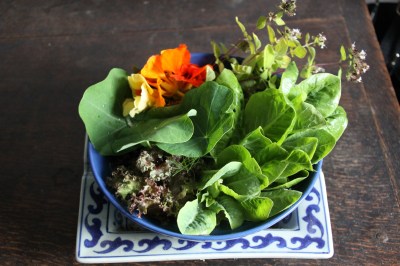
Grown in my garden last week and already eaten

For no better reason than I am so chuffed that I actually grew vegetables, lettuces and cucumbers in this, the first summer after moving in.  Showing off, in other words, although none of them are ever going to win any prizes.  I don’t actually have a vegetable plot, because I have turned everything over to flowers, shrubs and a small orchard, so these were grown in pots on a small south-facing side-patio.

The marrow speaks for itself (my fourth so far).  At the back, the little yellow globes are cucumbers (I promise you).  At the front is one of many golden beetroot, which have the lovely earthy taste of purple beetroot, perhaps a little more subtle, but don’t leak colour into everything you eat.  I like them steamed or roasted.  Once steamed, they are great cold too, with vinaigrette.

The salad and vegetable plants, except for the globe cucumbers, were all bought as tiny plugs from Bellis in Holt, but my goodness they grew!  The cucumbers were bought from the Grosvenor garden centre.  All were planted in general purpose compost, with mycorrhizal and bonemeal (in a ratio of 1:3 handfuls) placed in the hole in the compost before the plant was added.  Then slow-release plant food was scattered over the top.   

I have grown herbs outside in pots for years, as well as nasturtiums.  The ones above are lollo rosso and little gem.  Oregano, marjoram, mint, thyme and particularly lovage and the fluffy bits of fennel foliage make for a really special salad.  The round nasturtium leaves and flowers are excellent in salads, and their seeds are a little like capers.  I have also grown lettuces in the past, but not on such a grand scale.  

Feeling rather pleased with myself 🙂


Look what’s coming to dinner: giant puffballs found on a grass verge

If you are lucky enough to find puffballs, especially giant puffballs (Calvatia gigantea), in your travels they must be eaten almost immediately as they simply don’t keep.  Put them in the fridge, and they will last maybe two days, perhaps three if your fridge is very cold.  Freezing them on the same day is also possible but they are not nearly as good as when eaten fresh.  I used to harvest them from the golf course when I lived in Aberdovey, but never did I collect any this enormous!  My father had a couple, I had a couple and a neighbour had one.  These came from a local grass verge that I was driving past, and I pulled over to go and retrieve them.  Because puffballs reproduce during the decay of the puffball (at which point it puffs off its spores), always leave one behind to ensure that there is a chance of them coming back next year.

A giant puffball looks a little like chicken breast when you slice through it.

As always, collecting wild mushrooms comes with a health warning.  It is easy to mistake puffballs for mildly poisonous earthballs when they are both very small and white, although earth balls quickly become dark as they grow whereas puffballs look pure white throughout their growth cycle, until they mature and the spores (like seeds) are ready to depart when they go creamy yellow.  They are pretty well unmistakeable when they reach a size bigger than a golf ball, but read more about them here on the excellent Forager Chef website.

Puffballs have a subtle mushroomy taste and a soft texture, both of which are quite unique and utterly delicious.  When they are big enough, they are fabulous cut into big slices and tossed in  sizzling butter and fresh sage.  Small ones can be cooked whole.

Slices of giant puffball at the base were topped with smoked bacon, black pudding, crispy sage leaves, spinach and a poached egg.  A terrible photo – I really cannot take photographs in artificial light!  I need to sort out a mini home studio.

There are a million ways of serving them, some gastronomic, others rather more down to earth.  Last night I had mine fried in butter (yes, I know, but how delicious), served at the bottom of a stack made up of a rasher of smoked back bacon, a slice of excellent black pudding, both done on an iron griddle plate over a high flame, with a handful of steamed spinach over the top and a poached Churton egg on the top of that.  Bliss.  I’ve been a bit off food recently, but I couldn’t wait to cook this.

For a vegetarian version, the puffball slices would be excellent cooked in garlic oil, and served on griddled sourdough toast with the spinach, courgettes, and crispy sage leaves, or with asparagus, perhaps with a drizzle of cream.  For me, the poached egg is a must with this meal.

However you cook giant puffballs, be careful not to overwhelm their delicate flavour.  I would not, for example, do them in a red wine sauce, but they go well in a white wine and cream sauce, or in a pasta carbonara.  They are also sensational as an accompaniment for steak, and go very well with chicken or pork.  As tapas, they are divine cooked in garlic and sherry.


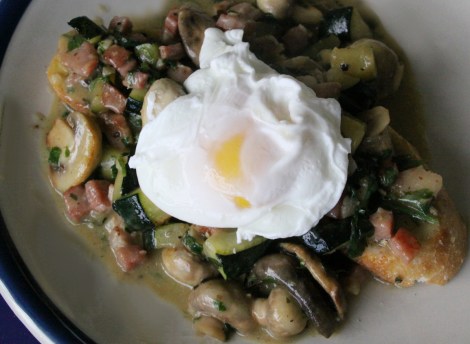
Adventures with Churton Honesty Eggs: Garlic mushrooms, pancetta and courgette on toast, topped with a poached egg

After a divine curry last night, both invented and cooked by my father, whose approach to all cuisines is always creative and full of glorious flavour, I went for something rather more conventional tonight.  Mushrooms and garlic are a classic combination.  Some diced courgette, pancetta, finely sliced spring onions, parsley, oregano or tarragon and, if you fancy it, spinach (or wild garlic in spring) are great additions, as is a good dollop of cream or crème fraîche.  The poached egg on top is essential, as it rounds things off beautifully.

The mushrooms and pancetta are fried in butter until beginning to brown, at which point the diced courgette is added until it too is golden. The finely chopped garlic is then added, and when cooked through, some flour is sprinkled over the top of the mixture and stirred until it is invisible, helping to thicken the stock, which goes in as soon as the flour has been absorbed, just a little bit at a time, stirring constantly.

When the sauce reaches the consistency that you like, you might consider adding the following:  finely sliced spring onions or chives, chopped parsley and oregano and a few turns of the pepper mill. I also like to add a slosh of dry sherry  at this stage.   Mushrooms and sherry are a frequent combination in Spanish cooking, and work deliciously together.  I also like to add a handful of spinach at this point if I have some, which cooks through quickly as the egg is poached.   If the sauce is too thick at this stage, again add some more stock or water, a little at a time, and stir well to incorporate anything that might be sticking at the bottom of the pan.

Whilst this is gently heating through, the egg is poached and a slice of rustic bread or sourdough is griddled or toasted.  Poaching eggs is easy if a few basic rules are followed.  The eggs should be fresh and at room temperature.  The water should be boiled, and a glug of white wine vinegar added.  The vinegar helps the whites to solidify.  Create a swirl in the water, which helps to spin the egg whites around the egg yolk, and take off the heat.  It will now poach in the hot water, the whites becoming opaque as the egg begins to cook.  It takes about two minutes depending on the size of the egg.  Drain the eggs well in a slotted spoon or on kitchen paper to remove the traces of vinegar.

Back to the mushroom mix.  At the last minute, a small dollop of whatever cream you have to hand goes in.  I like either crème fraîche or sour cream, but ordinary single or double cream works perfectly well too.  Heat it through gently.  Then place the toasted bread on the plate (buttered if required), spoon the mushroom mix over the top of the toast and then place the the poached egg carefully on top of the mushrooms.  Scatter sea salt over the top of it all, and add a few turns of the pepper mill, and dig in!  It’s incredibly filling, so I don’t serve it with anything else.

Lots of variations are possible. If you have access to wild mushrooms, that makes it even better, but I had button mushrooms that needed using up.  Nearly all herbs will work, including sage, lovage, chervil and marjoram.  Diced aubergine goes well instead of or as well as courgette.  Bits of bacon or parma ham can substitute for pancetta.  Cream sherry can be used instead of dry if you fancy a slight hit of mellow sweetness.  Alternatively, instead of sherry, Marsala wine, which is utterly divine in all sorts of sauces, is excellent with this dish. It is not always easy to get hold of, and must be used with care or it takes over entirely.

A vegetarian version can be done by leaving out the pancetta.  If often do the vegetarian version, and it is delightful.

If you want to make it into a bigger main course, the mix works wonderfully as an accompaniment for pork or chicken.

More adventures with Churton Honesty Eggs


Object histories in my garden #6: A piece of a Hamilton / torpedo bottle

On the left is a complete Hamilton or torpedo bottle now in the Dumfries Museum. On the right is the fragment of a torpedo bottle found in my back garden. Source of image of Dumfries Museum bottle: Future Museum

I suspect we are coming to the end of the most interesting finds in my garden.  The new beds have been dug out and apart from three lilacs that are destined for the lawn, which will each have a circular bed around them for flowers, the digging has mainly stopped and we are now into laying membrane around trees and shrubs, over the top of which we are putting slate, wood bark and gravel.  This will help to keep down the weeds, and provide a variety of textures throughout the garden, but will seal any remaining objects in the ground, perhaps for future gardeners to find.  There are, however, still one or two pieces worth talking about in the existing collection of objects derived from the garden.

The torpedo bottle fragment from the garden

One of these finds, distinguished by the twist in the glass and its distinctive shape, is a fragment of a Hamilton / torpedo bottle.  Like the Codd bottle, described in a previous post, it was designed to keep gas in bottles of fizzy water.  The Codd bottle in some cases replaced the torpedo, which died out in the 19th Century and early 20th Century. Both were eventually replaced by crown caps that still seal many fizzy drinks today, particularly beers.

Joseph Priestley by Henry Fuseli. Source: The Bridgeman Art Library, Object no.42670, via Wikipedia

Fizzy (aerated, effervescent or carbonized) water, occurs naturally in the form of springs.  My favourite is San Pellegrino.  In 1772 Joseph Priestly set out to produce an equivalent of the natural sparkling water from a famous spring in Pyrmont in Germany, and achieved success by dissolving carbon dioxide in water.  This achievement was considered so important that Priestly, a radical minister, was awarded the Copley Medal, the Royal Society’s most prestigious honour.  The Science History Institute’s website describes the process as follows: “He had dripped a little oil of vitriol (sulfuric acid) on a mixture of chalk and water, caught the fixed air (carbon dioxide) that fizzed from the chalk in a bladder, and bubbled the fixed air through a column of water, which he then agitated at intervals.”  Natural spring waters, each with different properties, were used for their medicinal and therapeutic benefits from antiquity, and were similarly popular in Europe in the 17th and 18th Centuries.  Artificially produced carbonated water was also initially sold for its medicinal properties by pharmacists like J.F. Edisbury of Wrexham, who had his own mineral water works in Llangollen (and who has been discussed on a previous post), it was eventually mixed with fruit-flavoured syrups and sold to general consumers as a soft drink.

J.F. Edisbury and Co (Wrexham) advert showing a range of the carbonated waters that was stocked.  Source: The Wellcome Collection

It quickly became obvious that a solution was needed to keep the gas in the water once it was placed in a container.  At first earthenware bottles were employed by early producers such as Joseph Schweppe (the founder of Schweppes, of course), who set up his business in Bristol in 1794.  At that time, Bristol was a thriving port, third in importance only to London and Liverpool, and a hub for businesses of all sorts.  As Schweppe and other discovered, in earthenware bottles the gas soon escaped and the drink went flat.

Glass bottles closed with corks followed, but there were two potential problems with this approach.  First, a build-up of pressure in the bottle could cause the corks to fly out, resulting not only in a mess but, again, a flat drink.  Second, if the corks were not kept moist they shrank, with the same result – a flat drink and an unhappy customer.  This caused something of a problem between supplier and retailer.  The solution was to store bottles on their sides, but retailers were reluctant to go to this trouble because of the problems of stacking the bottles.

In 1809, William Francis Hamilton of Dublin filed a patent for a method of producing mineral water, which included a description of storage devices employed, one of which was a torpedo-shaped bottle with a tapering, rounded end that had to be stored on its side.  Torpedo-shaped bottles had already been in existence before Hamilton’s patent, and he seems to have been using torpedo bottles as one of a number of storage solutions.  However, the torpedo obviously won out and he apparently went into production of the bottles in 1814.  It took time for them to become popular, but by  the 1840s they were widely in use and they were used until the First World War.

Not all bottles are marked with manufacturer details.   Embossing only became popular in the latter half of the 19th Century, when it became something of a mania following the introduction of hinged moulds.  Usually the manufacturer’s name was added to the bottle, and was sometime accompanied by details of the product that the bottle contained.  The one in the photograph at the top of the page had none, but my fragment has embossed letters, which were built into the mould into which the molten glass was poured to produce the bottle.  The letters on my bottle are incomplete and show either “TERE” or “IERE” (the bottom of the T or I is missing).  It is possible that, if TERE, it read CHESTER, MANCHESTER, LEICESTER etc (all areas where mineral waters were produced), with the E representing the beginning of a new word.   Equally, the TER could be the last letters of WATER, and the E again the beginning of a new word.  The fragment of the final letter can only be a B, D, E, F or P.  Any guesses, anyone?
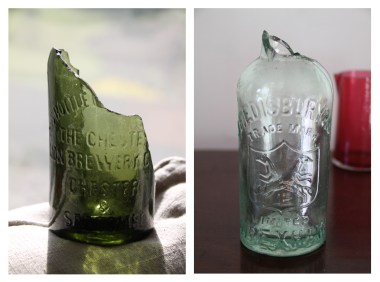
Lion Brewery (Chester) and Edisbury Chemist (Wrexham) bottles

The heavy embossing of the bottle indicates that this bottle was made in the late 19th Century, or later.  This is in keeping with the other bottles found in the garden:  from the Lion Brewery, Chester, J.F. Edisbury, Wrexham (both heavily embossed, the latter with a crossed-fox logo) and the Codd bottle.  Both the Hamilton / torpedo and Codd bottles were eventually made redundant with the introduction of crown caps, which Joseph Schweppe first employed in 1903.

For anyone new to this occasional series on objects extracted from my garden during everyday gardening activities, see the History in Garden Finds page.  These are not objects used in the garden, but objects, usually fragments, lost or disposed of in the garden and found during digging, troweling and planting.

Sources:

Books and papers

Hedges, A.A.C. 1975. Bottles and Bottle Collecting.  Shire Publications Ltd.

Hamilton, W.F. 1810.  Specification of the Patent granted to William Frances Hamilton.  The Repertory of Arts, Manufactures, and Agriculture, Sixteenth Volume, Second Series.
Available on Google Books: https://tinyurl.com/35bcf5tm

Websites

Future Museum
Hamilton Bottle
http://www.futuremuseum.co.uk/collections/life-work/social-history/home-life/housekeeping/hamilton-bottle.aspx

Science History Institute
Powerful Effervescence
https://www.sciencehistory.org/distillations/powerful-effervescence

Adventures with Churton Honesty Eggs: Seafood frito misto with tartare sauce

In Italy, frito misto usually describes food that has been given a coating of batter and then deep-fried.  On this occasion I deep-fried my seafood, but it was coated with flour rather than batter, so I may be playing fast and loose with the terminology.  Irrespective, it was delightfully crispy on the outside and beautifully hot and moist in the middle, which is at least in perfect keeping with the spirit of a frito misto.

In so far as tartare sauce is concerned, I often welcome the easy life that sauces in bottles provide, but tartare is always a problem for me as the bottled stuff is so very sweet.  I like my tartare sauce to be creamy but tart, with a lot of acidity.  Too much sugar ruins it for me, and by making the sauce myself I can modify the ingredients to suit my preferences.

This combination of crisp seafood and a soft but tart sauce can be served with whatever you fancy, which in my case is a salad based on garden lettuce and herbs supplemented with shop-bought items like cucumber and tomatoes that I have not yet started to grow (next year).

First, ensure that you have some kitchen roll to hand.  You will be using it a lot.

Next, dig out your eggs and make your mayonnaise (see my earlier post on how to make mayonnaise).  Lemon juice and/or white wine vinegar and a hit of mustard are standard components.  In the final stages of making the mayo, just as it begins to be fully emulsified, I add some herbs.  It’s a personal choice, but I like fresh dill, chives and parsley.  Don’t worry if the sauce becomes very solid, because that’s what you really need.  It needs to be structurally robust in order for the other ingredients to be absorbed without turning it all to liquid.  This is because other solid  ingredients are either wet or acidic.  Acid interferes with the emulsion and makes it much less viscous.

Your sauce should still be thick and gooey, so that when you touch it, it forms peaks like thoroughly whipped cream (just keep adding oil very slowly until it becomes nice and thick).  In the photograph it looks rather too solid for tartare sauce, but you are about to add sour cream and pickled veg to it, which will loosen in up a lot will and provide you with something a lot less viscous.  It is really important to have a good firm  base with which to work.

Sliced gherkins or cornichons and chopped capers are a great combination for tartare sauce.  If you add them straight from the jar, they will add the vinegar from the jar to the emulsion, and will loosen it up, causing it to become runny.  So I drain mine on multi-folded kitchen paper,  wrapping them and turning them now and again for a few minutes.  This removes the excess liquid and leaves you with all of the flavour.  The photo on the right looks a little ungenerous, but I was making a tartare for one.  Once dry, it can be added to the mayonnaise in the food processor and given a very quick whizz.  Remove from the processor and add to a bowl.

Add the sour cream a teaspoon at a time and gently fold it in.  The sour cream is glorious in the mayonnaise base, working with the dill, chives and parsley to provide a deliciously creamy setting for the the lemon, vinegar capers and gherkins, the combination providing real balance.  But do go slowly with the sour cream or you will end up with a soup rather than a sauce.  It will thicken up a bit in the fridge, but not sufficiently to rescue something completely liquid.  Here’s what it looks like, and do remember that although it firms up in the fridge it will relax and become more liquid as soon as it reaches room temperature.

My frito misto was based on seafood, using razor clams, prawns and whitebait, all delivered via Amazon from Morrisons.  Sadly, Amazon doesn’t deliver Morrisons products to Churton, but they do deliver to Rossett, and having a superior parent handily located there, I was able to place an order.  The razor clams are very difficult to source from anywhere else, and both their flavour and texture are unique.   All shellfish need to be extracted from their shells and dried in kitchen roll.  The patting dry will considerably reduce the spitting of the oil.

If you are cooking more than one batch you will also need to have the oven on, so that when you take out one batch and add another, you can keep the original batch warm.

The technique is very simple.  I have a deep-fryer but I rarely use it for fish, because it takes an awful lot of oil to fill it, and once used to cook fish, the oil cannot be used for anything else.  So I do mine in a saucepan large enough to handle whatever it is that I am planning to cook.  The key with floured fish is to get the oil really hot, or the flour falls off and you end up with naked fish and oil swimming in flour.  If you are using a thermometer the oil should be 350F or 180C, but if not just put in a piece of seafood and when it starts to sizzle instantly, you should be good to go.  I do have a kitchen thermometer but its batteries are dead since I moved in, back in February, so I have been using the latter system recently with great success.  Make sure that whatever you throw in is sizzling enthusiastically, because the moment you add another batch of seafood, the temperature will drop.  When you remove the first batch, put it in the oven to stay warm, and allow the oil to heat up again before putting in the next batch.

The fat from each batch needs to drain from the seafood, so have a plate covered in kitchen roll prepared in advance and keep tossing the seafood in the kitchen roll to reduce the oil remaining on the seafood.  It is never going to be a healthy meal, but removing the worst of the oil will improve both the flavour and alleviate a sense of guilt 🙂

Tip it all onto a pre-heated plate, tons of tabasco sprinkled over the top, your salad either on the plate or in a separate bowl (probably best if you have pre-heated your plates) and your tartare sauce on the side, with a chunk of lemon to sprinkle over the top and ENJOY! 

If you want to re-use your oil for another seafood dish, you can filter it through kitchen paper placed in a funnel into a jug or bottle.  The kitchen paper, acting as a filter, picks up all the bits of burnt flour and fish, leaving you with a clear oil.  It will still smell of fish, so seal it well.  I re-use an oil bottle with a screw top for mine.  Make sure that you label it clearly so that you don’t use it by accident for something else.  The fishiness could devastate another dish.  I only re-use it once before throwing it away, which means that this is a special occasion meal.

A lovely summer meal for al fresco dining.

More adventures with Churton Honesty Eggs

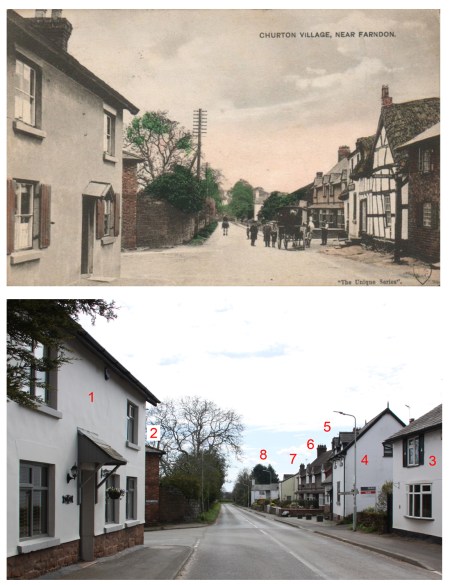
Comparing a Churton village postcard, the 1911 map and a modern photograph

1, Fourways. 2, Cross Cottage. 3, Hob Cottage. 4, The Old Red Lion, extension or combined with the earlier building?. 5, The Old Red Lion (former pub with half-timbered section, barely visible here but marked by three square planters). 6, Rowley Place (1-4). 7, New Cottage. 8, Stone House (formerly Stone Cottage and Lilac Cottage, now one house). On the other side of Stone House, and out of view in both postcard and photograph, is Cherry Tree Cottage, dating to 1610 and beyond it Wayside Farmhouse, Highway Farm and The Byre.

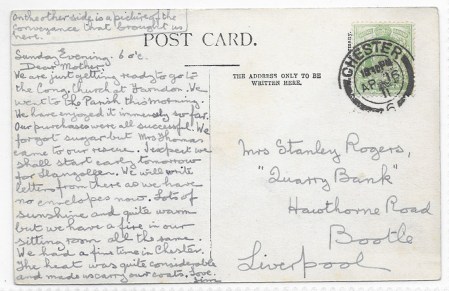
This is a tinted version of a black and white photograph used for this distinctive postcard of Churton.  I have seen several for sale on eBay, but all of them were unposted and unmarked, whereas I like to see the stamp, post mark, recipient address and to read the message.   This is a particularly good example.  The postcard was printed in Germany as many early postcards were. It has a Edward VII Halfpenny stamp (Edward VII came to the throne on the death of his mother, Queen Victoria, on 22 January, 1901, and died on 6 May 1910) and bears a Chester postmark dated April 16th 1911.  It was destined for an address in Bootle.  See the message at the end of the post.

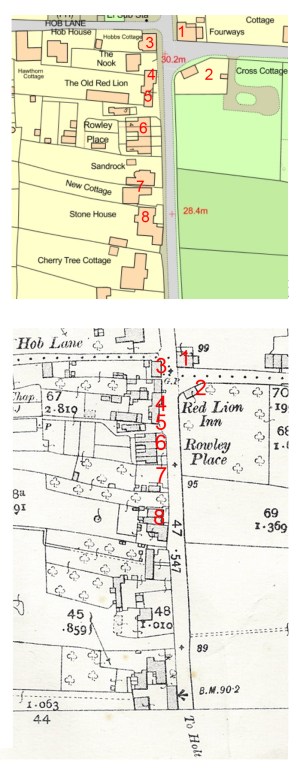
On the photograph above and on the maps below, the red numbers have been added for ease of identification, but do not relate in any real-world way to the buildings themselves, none of which, apart from the homes that make up Rowley Place, were allocated Chester Road numbers, and all of which are known instead by their house names.  Several buildings are set back from the road today, and are not visible in the postcard, so have not been mentioned here but are shown on the top of the two maps below.  Note that numbers 4 and 5 refer to what make up the same residence today, but were clearly built at different times in the past.

Modern map of Churton from the Public Map Viewer, compared with the 1911 map (Cheshire Sheet LIII-3, a 1909 revision of the 1872-4 and 1897 -1898 surveys).  Between 3 (Hobbs Cottage) and 4 (part of the Old Red Lion), the thatched half-timbered house is still shown.

Many of the buildings and features shown in the photograph are still present today, but there is one notable omission. Eventually I hope to get to grips with the histories of individual buildings, including my own, but for the time being I have confined myself to playing “spot the difference” between the early 20th century postcard and the photograph I took in March 2021.

The most notable of the buildings that was in the postcard but is absent in the photograph is the half-timbered thatched building that sits between Hobbs Cottage (3)  and the Red Lion (4 + 5) on the photograph, a wonderful looking place that may date to the same period as Churton Hall Farm (in Pump Lane).  It was built directly onto the red sandstone bedrock, and has a small flight of stairs over the bedrock to reach the front door.  If anyone has any information about it, please get in touch.  Its site is now the driveway that gives access to The Nook, which is set back from the road.  A startling sight in the postcard is the regiment of telegraph polls, with seven rows of crossarms.

Almost completely hidden in the postcard is the Old Red Lion, which seems to have been thatched at that time.

Two buildings post-date the 1911 map:  Sandrock and New Cottage on the plot marked 7.   Most other changes are cosmetic, but like the the usual modernizations of window frames but a A  number of minor embellishments have been made to existing properties. The shutters have been removed from Fourways (1).  A sympathetic roof conversion has been fitted to  part of the former Red Lion (4), the porch over Fourways (1), has been changed for something a bit more effective and Hobbs Cottage (3) has been fitted with a small bay window on the ground floor and its brickwork has been rendered and painted.  A road sign for Pump Lane has been added to Cross Cottage since the photo in the postcard was taken (2).  At first glance I thought that the  same signpost pointing down Pump Lane to Coddington had been retained, but it has either been replaced or moved, because it is no longer in front of Hobbs Cottage.

Do get in touch if you have further insights.

As to transport, a novelty of the image compared to today is that there is no traffic thundering up and down!  Instead, there is a one man on horseback retreating down the road at a plodding pace, and a horse-drawn carriage with a small group of people around it, together presenting a very peaceful rural scene.  Ron Parker, who was born in the village, told me that when he was a child they used to play ball in the road.  Heaven help anyone who tried it now.

The note on the postcard was written on a Sunday evening at 6pm in April 1911 by one Jim (presumably Jim Rogers) to his mother Mrs Stanley Rogers.  It  says that they were just going out to attend the Congregational Church at Farndon, having been to “the Parish” in the morning.  This was presumably the Congregational chapel built in 1853, now a home named Chapel House.  The Parish church would have been either St Chad’s in Farndon or St John the Baptist Church in Aldford, depending on whether they were staying in Churton by Farndon or Churton by Aldford.  The two civil parishes were only combined to form a single parish in 2015.  The visitors had already been to Chester on a sunny day, when it was so warm that they had had to carry their coats, and on the following day they were making an early start for a trip to Llangollen.  It must have been quite a trek by horse-drawn carriage. Even with the warm weather, they were enjoying a fire in their sitting room on that Sunday evening.  Jim finishes the card by pointing out that “on the other side is a picture of the conveyance that brought us here”.

Churton seems like a rather remote spot for a holiday break, particularly when the means of getting there was horse and carriage, but that’s very much what this message appears to indicate.  It would be interesting to know the details of the end-to-end journey that ended in a horse and carriage ride into Churton.

If you own a used copy of this postcard (i.e. one that has been posted and has a stamp, postal mark and message), do share the details of it either by commenting here, or by getting in touch with me.  It would be good to build up a picture of the sort of experiences people had when they visited Churton, and to know why they visited in the first place.


Some photos from my 15 minute contribution to the Big Butterfly Count

A couple of weeks ago I posted about the Big Butterfly Count.  It goes on for another two days, so if you want to participate, have a look at their website.  It is an initiative to learn about what is happening with butterfly populations in the UK.  Well worth contributing.

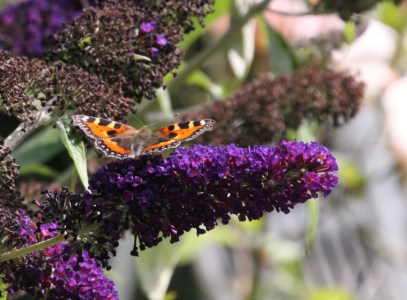
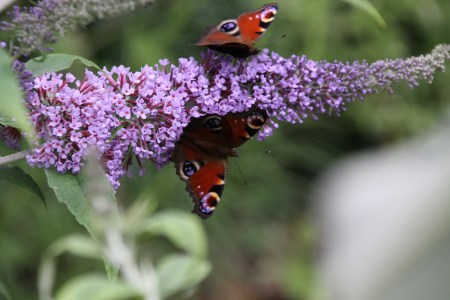
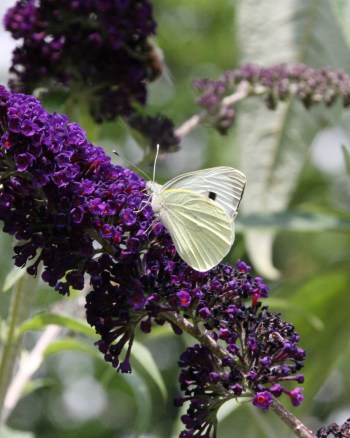
I’ve submitted my count for my 15 minute slot, staring fixedly at the bed in which my two buddleias reside, along with roses, poppies and various other floral beauties.  In 15 minutes the Black Knight buddleia won hands-down in both the butterfly and bee popularity stakes, and the scent of the flowers was almost overpowering.  Here are some of the photographs that I took.

It was interesting to note that apart from the comma, these showy, large butterflies were completely different from the ones that I saw the other day at the lower end of the footpath that heads to the Dee from Knowl Lane.  Those were small, more understated butterflies, enjoying the hedgerows, including gatekeepers, speckled woods, meadow browns and small coppers.  Photos of some of them are on my earlier post about that walk, but a lot of them refused to land and be photographed.

Small tortoiseshell

Comma

Peacock, conspicuously bigger than anything else that turned up

Small White

Holly Blue. I had just watered the rose bed, and the Holly Blue
seems to have landed to take a drink.

Red Admiral

I was amazed by how big the peacocks were, compared with other visitors. How super to be asked to do something so enjoyable that happens to be useful too.  The small whites were the dominant visitors, followed by the peacocks.  There was only one holly blue during the 15 minute section, although I see them quite regularly in a given week.  There was also only one red admiral.  Like the holly blue, they are not infrequent visitors to the garden, but I generally see more of them when out and about.  Their caterpillars like nettles, and I have gone to an awful lot of trouble to remove all traces of nettles from the garden.


Lovely footpaths through the fields between Churton and Farndon – Part 2

The return leg of the walk from Churton to Farndon, starting at Brewery Lane. Source of map: Public Map Viewer

The return leg of the walk from Churton to Farndon described in Part 1, heading back from Farndon to Churton, was just as lovely in the mid-July heatwave, but was not the same, and had some added extras.   It all looked very different from today’s endless drizzle, but at least the garden is deliriously happy.

On the return leg of my walk, instead of retracing my steps along Townfield Lane, I turned into Brewery Lane, just a little further to the north, which turned out to be a short stretch of road behind Brewery Motors with some nice views.  It segues into a the public footpath that is narrow but very safe underfoot before it joins up with the track along which I had originally walked into Farndon.  The footpath offers  a novel view over a gate of the wildflower field at the Barnston Monument to its east.  I have marked the route on the map on the left (from the Public Map Viewer website), a shorter route than on the first leg.  The red dots are explained in Part 1, marking the approximate positions of possible prehistoric sites.

At Knowl Plantation, a track is marked on the Public Map Viewer that skirts it to the west instead of heading back up the footpath to the east.  It links up with the Knowl Lane footpath that leads to the Dee.  After I returned home I realized that on the Public Map Viewer although marked as a track it is not shown as a public footpath, so I am not sure if it is actually a right of way, but I was careful to stick to the edges and do no damage.

Dove’s foot’s crane’s-bill, its leaves declaring it to be a form of geranium.  Like the speedwell below, all along the edge of the corn, it spreads in huge swathes.

Common field speedwell, which grows everywhere in great, low carpets.

Thistledown, spreading itself in carpets along the path and hanging in the nearby trees

Redshank

When I was a child, anything that looked like a flower, with lots of petals arranged around a clearly defined core, was accordingly categorized in my head as a flower, but anything that failed to look sufficiently floral was always a weed.  Redshank came firmly into my childhood  weed category.

Elder (Sambucus)

Reaching the main footpath back to Churton, that leads from the Dee to Knowl Lane. I was enchanted to be surrounded by butterflies.  They stubbornly refused to settle, and the few that did settle sat with their wings firmly closed, so there were very few photographs, but it was a lovely experience.

Small heath butterfly

Gatekeeper

Common red soldier beetle  (Rhagonycha fulva) on hogweed flowers

Comma

Speckled wood

It was on the return leg of the walk that that I noticed three lovely flowers on this walk that I had never seen before.  The tiny, tiny violas shown below, the flower just a few millimeter high (just a little bigger than speedwell flowers) is the field pansy (Viola arvensis).  They behave much like speedwells, spreading on straggling stems, but there were much fewer flowers per plant, and I only saw a small number of them.

Field pansy in company with common field speedwell

The Hedge Woundwort below, Stachys sylvatica, is a member of the Lamiaceae (mint) family.  It looks very like the common spotted orchid, but the leaves are wrong.  With the orchid, the leaves are smooth-sided and long and sprout from the base, but the woundwort has jagged- or serrated-edged leaves that are much shorter and sprout from all along the stem.  With the Hedge woundwort, the colour leans more towards purple or red than towards the common spotted orchid’s pink, and the woundwort lacks the “wings” that top the orchid flowers.  The distinctive white markings are thought to attract bees to help with pollination.

Hedge Woundwort

This creeping and climbing perennial, here wrapping itself around a blackberry bramble with a lovely pink flower, is White Bryony (Bryonia dioica).  It is not uncommon as a garden weed, and is beast to eliminate as it has long, deep tubers that have to be pulled out in their entirety to kill the plant.  In the wild, however, they are lovely, colonizing hedgerows and scrubland, spreading by coiled stem-tendrils that latch on to the stems of other plants to enable it to travel in all directions.  When it has finished flowering, the white/yellowish-green flower is replaced by a small red berry.

White Bryony

At no point on either walk can one actually see the river from the footpaths, so this is a matter of enjoying the fields in their own right.


The Big Butterfly Count 2021

The Big Butterfly Count runs i Britain between 16th July to the 8th August, so we are just in time to join in.  Every year I do the Big Garden Birdwatch, counting birds that land in the garden in a given hour.  It ran this year in January 2021, before I moved to Churton, but I’ll be talking about that next year when it comes around again.

I had not, however, heard of the Big Butterfly Count.  It was reported in the latest edition of the magazine New Scientist, so I fired up my web browser to get the details.

The Big Butterfly Count “is a UK-wide survey aimed at helping us assess the health of our environment simply by counting the amount and type of butterflies (and some day-flying moths) we see.”  The idea is to sit in a promising spot (for example, in your garden, in a park or along a footpath) for 15 minutes and take note of everything you see in that time.

You will need to register for an account, which is free, after which you can download and print off a butterfly identification chart (which also lists the species in which they are interested), and then send in your results.  You can do this via a free smartphone app or via your web browser (computer, tablet, etc).

I am going to spend my 15 minutes in front of my Black Knight buddleia, which is a great butterfly attractor.  A tremendously good excuse for abandoning the weeding and mellowing out with the wildlife 🙂  I had to chase out a peacock butterfly from the living room only this morning.  On a recent walk there were many types in the hedges flanking the footpath section of Knowl Lane at its western end as it approaches the Dee, and I suspect that I will find that the species that prefer those hedges and the ones gracing my garden will be very different.

Find out the details on the Big Butterfly Count website.


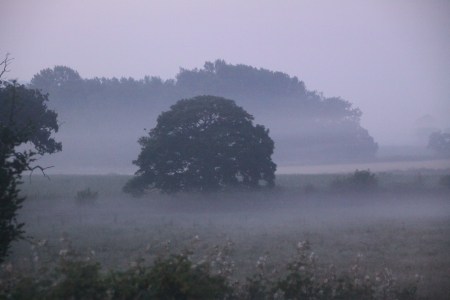
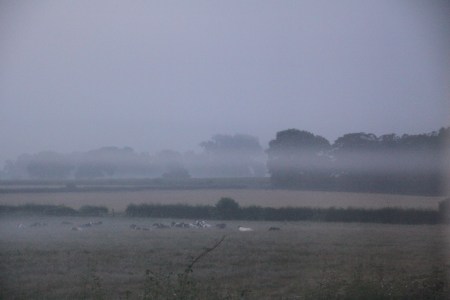
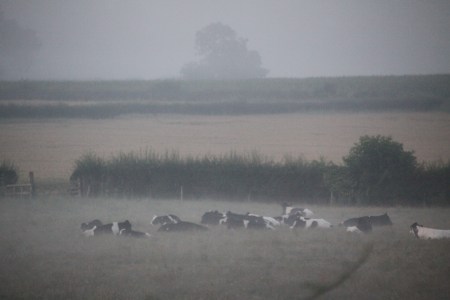
Early morning mist over my favourite tree

My favourite tree is over the road, usually visible from the room I use as a home office, often list up in full golden sun, sometimes pink in the sunrise or sunset, but occasionally shrouded in mist.  The mist always fascinates me because sometimes it forms in thin bands hanging bizarrely over the fields, but at other times it forms dense sheets.  First thing on Wednesday morning I watched the tree and the neighbouring field, complete with recumbent cows, drifting in and out of bands and sheets of mist that continually changed along a narrow colour continuum between pure white and pale grey that included faint shades of pink and olive green.  At about 5.30am the tree became almost invisible behind a discrete, almost impenetrable mantle.  Eventually a silver sun slowly lifted the pale, gentle veil and the monochrome scene was gradually transformed into its everyday guise.