Category Archives: Wildlife

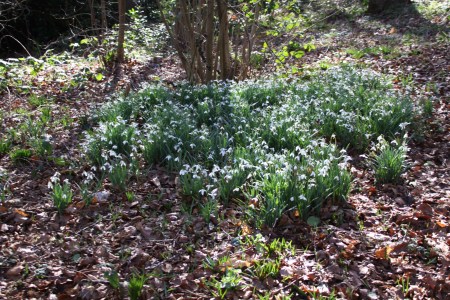
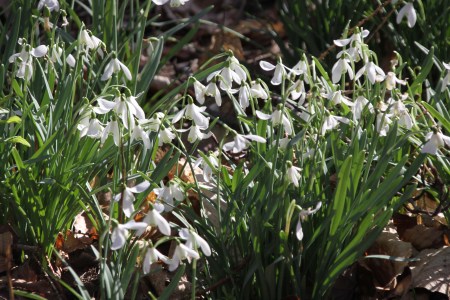
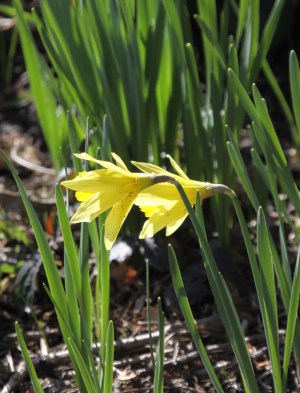
A visit to Chirk Castle yesterday for the snowdrops and daffodils

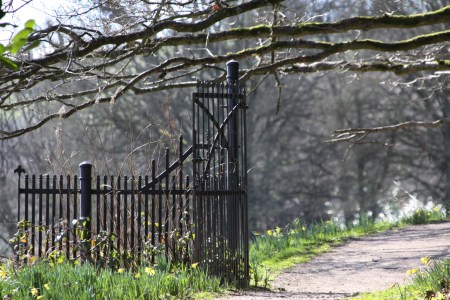
It was such a gloriously sunny day yesterday that even though I had marked today for giving the house a much-need top-to-toe clean, I abandoned the whole project, jumped in the car, and  stopped off to pick up my Dad before driving down to Chirk Castle to enjoy the pristine garden and the walks in the small woodland.  It is a great time of year for it.  The castle, the only one of Edward I’s Marcher fortresses still inhabited today, always a little intimidating in its block-like immobility, is far less bellicose in the bright sun.

The topiary is great at any time of year, and the colours of new foliage and bright heather give a real lift to everything, whilst the daffodils and snowdrops, popping up everywhere but particularly good in the woodland, are a joy.  The snowdrops are all in full swing, but although a lot of daffodils are out and looking terrific, there are still more to break out of their buds.  We stopped off on a perfectly placed bench for a blissful half hour in the sun to look out beyond the ha-ha over the rolling hillside towards the view below.  It’s only a short outing, but a very agreeable one.   I’ll let the pictures speak for themselves.


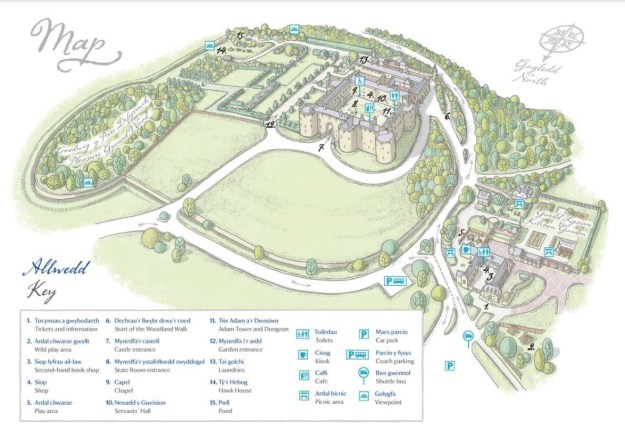
Plan of Chirk Castle grounds. Most of the snowdrops are in the Pleasure Ground Wood, but the daffodils are everywhere.  Source:  Chirk Castle, National Trust (website and free leaflet available in the ticket office)

Details of visiting are on the Chirk Castle website (National Trust).  Regarding my usual comment on access, a wheelchair user might be able to see some of the gardens, but the woodland is probably not advisable.  As for unwilling legs, yes if you keep in mind that the ground is uneven.  There is a shuttle from the car park to the castle entrance, as the walk up can be challenging for unwilling legs.


Big Garden Birdwatch 2022

I only started doing the Big Garden Birdwatch when I moved out of London, but it has become a real pleasure since then. This is my fourth go at it, but my first in Churton, done on 30th January.  At this time of year with the unpredictable weather, it can be a bit hit or miss, particularly as we now experience so many more storms.  Luckily, in spite of Storm Malik, in which one of my bird feeders vanished completely in spite of my efforts to locate it, there have been long dry periods and the birds have been out and about, stocking up with calories whilst the going is good.  Because it has been so dry, I had to refill the bird bath, and they were soon drinking from it.

Of the birds that paraded themselves for one hour this year, there was nothing rare, but that’s not what it’s all about.  Any and all Birdwatch observations contribute importantly to the statistics that have been collected by the RSPB for over 40 years and help to chart trends in bird populations.  In 2021 over a million people took part.

Just a selection of my visitors on the day. My kitchen windows seriously need cleaning 🙂

I was in the kitchen, looking out of the window due to the cold, so I was mainly watching the bird feeders on the Japanese maple about 10ft away.  The robin that fights for the patio territory with ferocity was there, scooping everything that the almost ubiquitous blue tits and great tits drop so untidily on the floor.  Male and female house sparrows have mastered the bird feeders, some even performing the rudimentary forms of gymnastics that the tits perform so sublimely.  Male and female blackbirds bounced around the ground, scattering the smaller birds.  I was so pleased to have three chaffinches, a male and two females, for the first time ever, and they arrived very handily in the hour that I was doing my official watch.  They scurried around underneath the bird feeders in the shade of the shrubs, and I couldn’t capture  them with the camera.  Another time.  Missing from the usual suspects were the collared doves and the  sole dunnock that often visits.

My garden is quite long so I could not see what else was dashing around in the trees and shrubs in the rest of the garden, but splendid magpies, raucous crows and enormous waddling pigeons were all visible in a patch of fugitive sunshine at the end of the garden, as were two squirrels competing for territory in the beech tree. 

One of my recent visitors

Over the last few weeks, I’ve had some more unusual visitors recently.  A week ago I saw a spotted woodpecker who was sitting in the big Japanese maple on my patio, trying to work out whether or not the bird feeders were at all feasible (not).  On the same day I walked downstairs to find a pheasant standing at my back door looking in.  I assume that someone else is feeding him from their back door, because he looked so expectant.  In my last house, in Aberdovey (west Wales) I had a community of pheasants daily in my garden during the winter, which I used to feed on peanuts, but although pheasants roam the fields around here, I’ve never before seen one in the garden.  Once in a while I hear and then see a thrush, but so far none have established a territory here.  I have been trying to encourage goldfinches into the garden with nyjer seeds, because I had a community of them at my last house and they are enchanting, but so far they are resistant to all my efforts, although I saw some splashing in a pool of water in Pump Lane last year.
——

Look what’s coming to dinner: giant puffballs found on a grass verge

If you are lucky enough to find puffballs, especially giant puffballs (Calvatia gigantea), in your travels they must be eaten almost immediately as they simply don’t keep.  Put them in the fridge, and they will last maybe two days, perhaps three if your fridge is very cold.  Freezing them on the same day is also possible but they are not nearly as good as when eaten fresh.  I used to harvest them from the golf course when I lived in Aberdovey, but never did I collect any this enormous!  My father had a couple, I had a couple and a neighbour had one.  These came from a local grass verge that I was driving past, and I pulled over to go and retrieve them.  Because puffballs reproduce during the decay of the puffball (at which point it puffs off its spores), always leave one behind to ensure that there is a chance of them coming back next year.

A giant puffball looks a little like chicken breast when you slice through it.

As always, collecting wild mushrooms comes with a health warning.  It is easy to mistake puffballs for mildly poisonous earthballs when they are both very small and white, although earth balls quickly become dark as they grow whereas puffballs look pure white throughout their growth cycle, until they mature and the spores (like seeds) are ready to depart when they go creamy yellow.  They are pretty well unmistakeable when they reach a size bigger than a golf ball, but read more about them here on the excellent Forager Chef website.

Puffballs have a subtle mushroomy taste and a soft texture, both of which are quite unique and utterly delicious.  When they are big enough, they are fabulous cut into big slices and tossed in  sizzling butter and fresh sage.  Small ones can be cooked whole.

Slices of giant puffball at the base were topped with smoked bacon, black pudding, crispy sage leaves, spinach and a poached egg.  A terrible photo – I really cannot take photographs in artificial light!  I need to sort out a mini home studio.

There are a million ways of serving them, some gastronomic, others rather more down to earth.  Last night I had mine fried in butter (yes, I know, but how delicious), served at the bottom of a stack made up of a rasher of smoked back bacon, a slice of excellent black pudding, both done on an iron griddle plate over a high flame, with a handful of steamed spinach over the top and a poached Churton egg on the top of that.  Bliss.  I’ve been a bit off food recently, but I couldn’t wait to cook this.

For a vegetarian version, the puffball slices would be excellent cooked in garlic oil, and served on griddled sourdough toast with the spinach, courgettes, and crispy sage leaves, or with asparagus, perhaps with a drizzle of cream.  For me, the poached egg is a must with this meal.

However you cook giant puffballs, be careful not to overwhelm their delicate flavour.  I would not, for example, do them in a red wine sauce, but they go well in a white wine and cream sauce, or in a pasta carbonara.  They are also sensational as an accompaniment for steak, and go very well with chicken or pork.  As tapas, they are divine cooked in garlic and sherry.


Some photos from my 15 minute contribution to the Big Butterfly Count

A couple of weeks ago I posted about the Big Butterfly Count.  It goes on for another two days, so if you want to participate, have a look at their website.  It is an initiative to learn about what is happening with butterfly populations in the UK.  Well worth contributing.

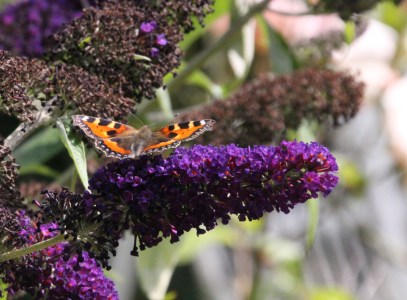
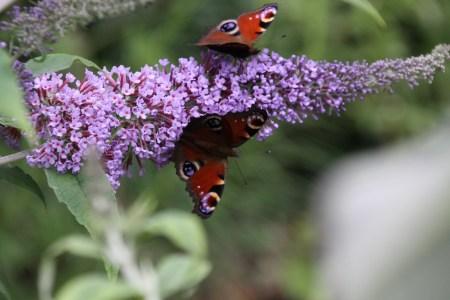
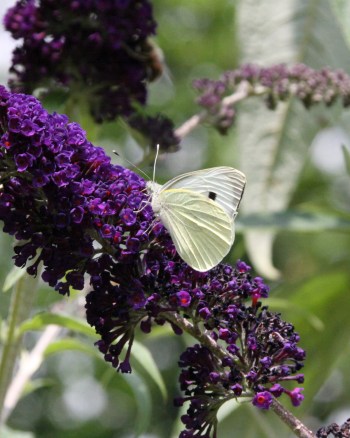
I’ve submitted my count for my 15 minute slot, staring fixedly at the bed in which my two buddleias reside, along with roses, poppies and various other floral beauties.  In 15 minutes the Black Knight buddleia won hands-down in both the butterfly and bee popularity stakes, and the scent of the flowers was almost overpowering.  Here are some of the photographs that I took.

It was interesting to note that apart from the comma, these showy, large butterflies were completely different from the ones that I saw the other day at the lower end of the footpath that heads to the Dee from Knowl Lane.  Those were small, more understated butterflies, enjoying the hedgerows, including gatekeepers, speckled woods, meadow browns and small coppers.  Photos of some of them are on my earlier post about that walk, but a lot of them refused to land and be photographed.

Small tortoiseshell

Comma

Peacock, conspicuously bigger than anything else that turned up

Small White

Holly Blue. I had just watered the rose bed, and the Holly Blue
seems to have landed to take a drink.

Red Admiral

I was amazed by how big the peacocks were, compared with other visitors. How super to be asked to do something so enjoyable that happens to be useful too.  The small whites were the dominant visitors, followed by the peacocks.  There was only one holly blue during the 15 minute section, although I see them quite regularly in a given week.  There was also only one red admiral.  Like the holly blue, they are not infrequent visitors to the garden, but I generally see more of them when out and about.  Their caterpillars like nettles, and I have gone to an awful lot of trouble to remove all traces of nettles from the garden.


The Big Butterfly Count 2021

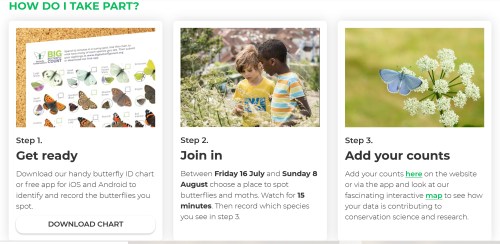
The Big Butterfly Count runs i Britain between 16th July to the 8th August, so we are just in time to join in.  Every year I do the Big Garden Birdwatch, counting birds that land in the garden in a given hour.  It ran this year in January 2021, before I moved to Churton, but I’ll be talking about that next year when it comes around again.

I had not, however, heard of the Big Butterfly Count.  It was reported in the latest edition of the magazine New Scientist, so I fired up my web browser to get the details.

The Big Butterfly Count “is a UK-wide survey aimed at helping us assess the health of our environment simply by counting the amount and type of butterflies (and some day-flying moths) we see.”  The idea is to sit in a promising spot (for example, in your garden, in a park or along a footpath) for 15 minutes and take note of everything you see in that time.

You will need to register for an account, which is free, after which you can download and print off a butterfly identification chart (which also lists the species in which they are interested), and then send in your results.  You can do this via a free smartphone app or via your web browser (computer, tablet, etc).

I am going to spend my 15 minutes in front of my Black Knight buddleia, which is a great butterfly attractor.  A tremendously good excuse for abandoning the weeding and mellowing out with the wildlife 🙂  I had to chase out a peacock butterfly from the living room only this morning.  On a recent walk there were many types in the hedges flanking the footpath section of Knowl Lane at its western end as it approaches the Dee, and I suspect that I will find that the species that prefer those hedges and the ones gracing my garden will be very different.

Find out the details on the Big Butterfly Count website.