Category Archives: Scenery

Ranulf III’s Beeston Castle #1 – Who was Ranulf?

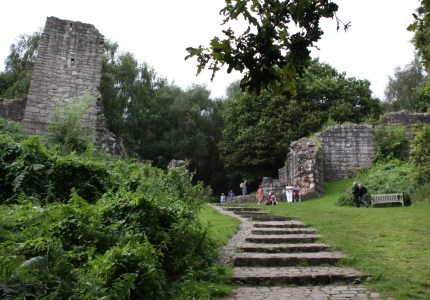
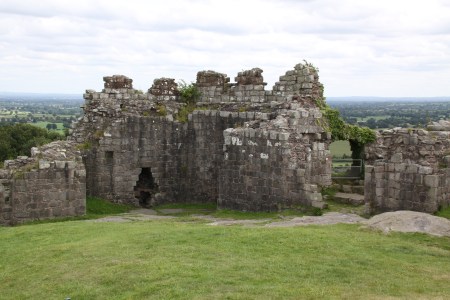
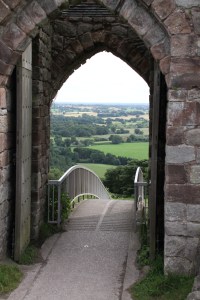
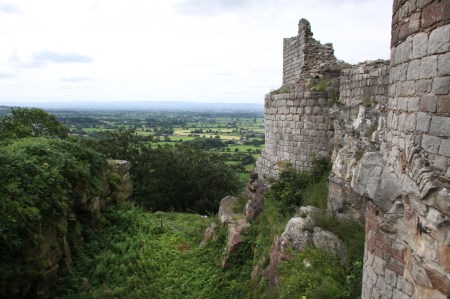
The approach to the inner ward (or bailey) seen from the bridge, with the vast ditch below, part quarry and part defensive device, and a slice of the superb panoramic view in the background.

The English Heritage Guidebook to Beeston Castle opens with the following statement:  “Standing on a rocky crag high above the Cheshire plain, Beeston is one of the most dramatically sited medieval castles in England.”  Organizations keen to puff off the virtues of their sites are often guilty of hyperbole, but in this case, the guide book speaks nothing but the truth.  On a bright mid-August day, with the sky a silvery pale blue, it was absolutely spectacular, both on the approach to the solidly impressive fortifications from below, and standing in the inner ward above the plain, gazing east to the Welsh foothills and northwest to the Pennines, with the floor of the world reaching out in all directions, lovely and fabulously impressive.  All this and history too.

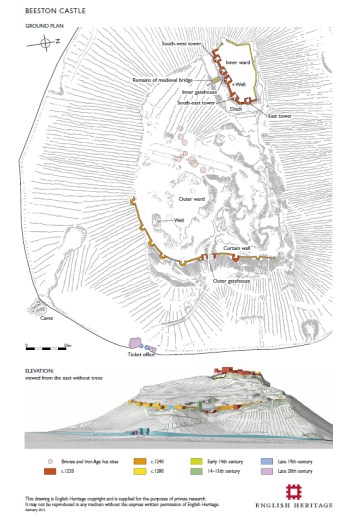
This post has been split into two parts, with Part 1 looking at Ranulf III himself, and Part II tackling the castle itself, looking at how it was built, used and perceived, covering 600 years from the 13th to 19th Centuries.

If you would prefer to download parts 1 and 2 as single a PDF, please click here.

Ranulf III

Although Beeston Castle was altered several times since its original construction, it was the brainchild of Ranulf III (Ranulf de Blondeville), the 6th Earl of Chester and first Earl of Lincoln (1170-1232).  Ranulf’s castle building phase came fairly late in his very busy and dangerous life as the most powerful magnate in England.   The first work on Beeston Castle took place c.1220, only 12 years before his death, so this needs to be understood in the context of the rest of his life. 

Hugh de Kevelioc’s coat of arms, featuring five wheatsheaves.  Source:  Wikipedia

Ranulf was a descendent of the powerful Norman Marcher Lords installed by William the Conqueror to provide a buffer against the perceived chaos across the border in Wales.  Wales was at that time a set of territories controlled of powerful families headed by chieftains who were often in armed dispute with one another as well as with England  The Marcher lords, acting as guardians of the border, were incentivized with land, title and, perhaps most importantly, a great deal of autonomy.  Originally intending to shift the border further into Wales, the Marcher lords found the mountainous territory of the Welsh chieftains a serious impediment to progress and instead consolidated their positions in the lowlands.  However, the give and take of land and lives continued throughout Ranulf’s life, in spite of both reprisals and peace treaties.  It was not until after his death, during the reign of Edward I, that attacks by the Welsh chieftains were eventually squashed.  The loss of Crown lands in France by previous kings meant that Edward had had plenty of time to devote to the problem.

Ranulf’s official seal, reading “Seal of Ranulf Count of Chester and Lincoln.” The wheatsheaf emblems were later adopted by the Grosvenor family and can be seen on the outside of Churton-by-Aldford’s former school.  Source:  Wikipedia’s Ranulf III page

Ranulf, being of Norman stock, probably thought of himself primarily as Norman rather than English.  His mother was Bertrada de Montford, a cousin of Henry II from Evreux in eastern Normandy.  His father was the 5th Earl of Chester, Hugh de Kevelioc.  Hugh de Kevelioc was born in 1147, the son of Ranulf II, 4th Earl of Chester and Maud, the daughter of Robert the 1st Earl of Gloucester, who was an illegitimate son of King Henry I.  When his father died in 1181, Ranulf became a royal ward of Henry II and was sent to Henry’s court in Normandy, accompanied by his mother and four sisters.  When he came of age, knighted as Earl of Chester, he had inherited Chester Castle and the important trading port of Chester, together with valuable territories in Normandy until these were lost in 1204-5 by King John.  Sadly, there are no images of him.

Chester had been established as a palatine by William the Conqueror, granted special powers, removing it from of the direct control of the Crown, but Ranulf’s other estates could be redistributed at the whim of the king, to reward or punish, or merely reorganize.  Although Ranulf’s holdings expanded and contracted throughout his adult life he remained one of the most powerful men in England.  

Henry II

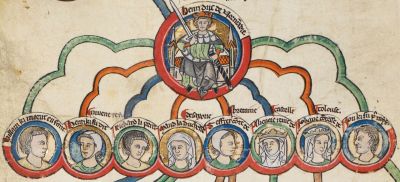
Henry II and his children.  From left to right – left to right: William, Henry, Richard, Matilda, Geoffrey, Eleanor, Joan and John.  Source:  Wikipedia

Ranulf, brought up in the court of Henry II, was loyal to the kings Henry II, Henry’s sons Richard I and (eventually) John, followed by John’s son Henry III.   These rulers were collectively known as the Angevin kings.  The period leading up to Henry II’s death was one of conflict, with his sons, Richard, Geoffrey and John turning on him due to the uncertainties of succession. 

At Henry II’s request Ranulf  married Constance of Brittany in 1189 at the age of 19, giving him the right to call himself Duke of Brittany.  Constance was widow of Geoffrey of Brittany, and mother of Arthur of Brittany who was next in line to the Duchy of Brittany.  Henry wanted to diffuse a situation in which Brittany was supporting his son Richard against him.  1189 was also the year in which Ranulf was knighted Earl of Chester by Henry.  Ranulf was now in control of his estates in England and Normandy.   Unfortunately, Ranulf and Constance soon developed a mutual loathing that lead to their separation within five years.  1189 was also the year in which Henry died and Richard I “the Lionheart” came to the throne, without further hostilities being required to assure the succession. 

Richard I

Richard I painted c.1250–55 by Matthew Paris in his Historia Anglorum. Source: Dorling Kindersley findout

Under Richard the Lionheart, the newly knighted Ranulf, connected to Richard via their relationship to Henry I, was given a role of key importance role in the coronation procession, carrying the jewel-encrusted crown.  Richard departed on crusade just a year later, having appointed a number of officers to oversee  his interests in England during his absence.   He also named his heir in case he perished during the crusade.  Instead of his younger brother John, he named Ranulf’s stepson, heir to Brittany, Constance’s son Arthur.  Unsurprisingly, Prince John’s nose was now firmly out of joint and he attempted to take the crown, supported by the king of France, Philip Augustus.  He was opposed by a number of powerful barons, including Ranulf.  Learning, weeks after the fact, of trouble at home, Richard decided to return, but he was humiliatingly delayed when he was recognized on the return leg of the journey, captured and held hostage in Germany.  Following an eye-watering payment Richard was freed, and his return settled the matter of John’s ambitions.  Richard underwent a second coronation just to push home the point.  Ranulf remained loyal to the king and followed Richard into war in Normandy and Brittany, where his estranged wife Constance was now stirring up rebellion.  In a rather botched attempt to split Arthur from Ranulf’s estranged wife Constance, both were ambushed in a trap set up by Richard with Ranulf’s help.  Constance was taken prisoner by Ranulf, who was now able to refer to himself one again as Duke of Brittany, but Arthur fled to the comparative safety of the King of France, Philip Augustus.

Whilst Ranulf was fixed in Normandy, Llewelyn the Great attacked and took Mold (then known as Montalt).  Mold was retaken but Ranulf’s trusted supporter, Ralph de Montalt, died in the conflict.  Ranulf was powerless to do anything about this, but it was just one more indication that something needed to be done about Wales.

Richard died in 1199 in a minor dispute (allegedly over rights to a Roman treasure), and with Arthur now allied with France, John succeeded to the throne. 

John

King John painted c.1250–55 by Matthew Paris in his Historia Anglorum. Source: TLS

Ranulf, having opposed John’s attempted coup, needed to prove his loyalty in the face of John’s notorious paranoia.  Ranulf was now about 29 years old.  He spent a lot of time early in the reign shifting between his territories in Normandy and England, while John reconciled himself with Arthur by naming him Duke of Brittany (ending Ranulf’s tenure) and Earl of Richmond.  The reconciliation was short-lived.  Arthur attacked Angers, taking a key Angevin castle, a terrible shock to John, who took instant revenge by taking the castle at neighbouring Le Mans, where Arthur’s mother Constance was staying.  He razed both castle and village to the ground. 

Arthur fled back to Philip Augustus.  Ranulf, joining John, swore loyalty to him at a big gathering in eastern Normandy in 1199, but John remained suspicious of him and it took time to win his trust.  This was not helped when, in 1200, Ranulf married Clemence de Fougeres, whose family had connections to both Brittany (via her father) and Normandy (via her mother).  John had a personal interest in Clemence himself, and was also concerned that Ranulf’s loyalties might be divided.  Ranulf doggedly pursuing his policy of demonstrating loyalty to John, stayed at court and accompanied the king on his travels throughout his territories. 

Arthur paying homage to Philip Augustus of France. Chroniques de St Denis, British Library.  Source:  Wikipedia

Constance, mother of Arthur, died in 1201 from leprosy.  Arthur, attacking another Brittany castle, was captured and imprisoned.  In 1202 he disappeared, probably having been murdered.  In response, Brittany rose up in revolt backed by Philip Augustus, king of France, who began to move against Normandy.  After an initial serious hiccough, when John charged Ranulf with treason, Ranulf was reinstated and his briefly confiscated estates returned to him.  He set about proving his loyalty during the campaigns in Brittany and French-occupied Normandy.

Staggered by the speed at which Philip Augustus was moving, and anticipating defeat, John left for England in December 1203, leaving his followers to defend his territories as best they might.  Ranulf followed shortly afterwards, similarly leaving his castles to defend themselves.   Although the war in France had continued in both John’s and Ranulf’s absences, Normandy was lost by 1205.  Ranulf, at court in England with John since late 2003, managed to weather the storms of John’s suspicions and continued to travel with the court, accompanied John in military expeditions to Poitou and Gascony and supported John in the face of the First Baron’s War.  Ranulf had, however, lost his five great castles in Normandy, together with the small private army that supported them. 

After another hiccough, when Ranulf’s loyalty was once again questioned in early 1205 by John, Ranulf again successfully challenged the accusations levelled at him.  Given John’s suspicions, it seems bizarre that only a year later John was so impressed by Ranulf’s loyalty that he rewarded him with so many titles and “honours” (estates) that he became the most powerful and wealthy man in England.  By 1208 Ranulf was not only Earl of Chester but also Earl of Lincoln, Earl of Richmond and had rights over Lancaster and Leicester.  The land and income associated with these honours were vast. 

Henry III

The coronation of Henry III. Source: Wikipedia

Following John’s death in 1216, the 46 year old Ranulf paid homage to the new king, the 9 year-old Henry III, and went to war in his name against Louis of France.  The king’s first Justiciar (effectively an acting regent) was Earl Marshall, a friend of Ranulf’s, and the transition seemed to go smoothly for Ranulf.  Fulfilling a promise to King John, Ranulf took an important part in the siege of Damietta in Egypt in 1218 during the 5th Crusade, returning after two years of battle.  He left Egypt in July 1220, arriving in England a month later.

Ranulf returned, having lost many friends to the crusade, to find that his friend Earl Marshall had been replaced as Justiciar by Hugh de Burgh, a long-standing enemy.  With two years of accumulated business to take care of, including repairs to some of his properties, he was kept busy with his own estates, but Henry also awarded him with new estates.  Disruptions over the rights to a number of castles involved Ranulf in military activity on behalf of the Crown in Northamptonshire, and then again on both his own and the Crown’s account at the Welsh borders, the latter at least partly resolved in the case of the Chester border with the marriage of Ranulf’s nephew John le Scot to Llewellyn’s daughter Helen in October 1223. 

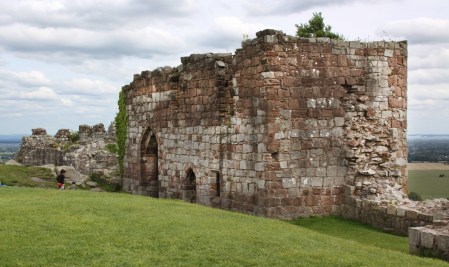
Section of the outer ward’s curtain wall with remains of one of the D-shaped towers

Ranulf soon embarked on a major programme of castle-building, rebuilding castles at Bolinbroke Castle in Lincoln, Chartley in Staffordshire and  establishing a new castle Beeston in Cheshire.  Of the three, Beeston was by far the largest.  Ranulf’s reasons for wanting these castles, particularly Beeston Castle, which competed in scale and ambition with those of the kings themselves, have been much debated.  It has often been assumed that Beeston Castle, which was started in around 1220, was erected as a deterrent to the Welsh princes, but this was apparently not the case.  Not only is Beeston too far east of the Welsh border for this to be practical, but before building his castle, Ranulf had made his peace with Llewellyn the Great, whose territories met Ranulf’s along the Welsh border.  He felt sufficiently safe after the signing of this treaty to leave on the 5th Crusade in 1218 without any risk to his territory from Wales.  Although there had been a brief disruption after Ranulf’s return, this was at least partially resolved by the marriage of his nephew John le Scot to Llewellyn’s daughter, sealing peace if not actual friendship between Llewellyn and Ranulf.   Nor does Wales explain his other two castle-building enterprises.

The approach to the gateway to the inner ward with remains of the curtain walls and D-shaped towers

Perhaps surprisingly, the English crown represented a far greater risk to Ranulf’s security than Wales.  Henry III did not assume control of his government and territories until 1227, seven years after Ranulf started the building works at Beeston.  During this period control remained with Henry III’s Justiciar, Hubert de Burgh,  Ranulf’s enemy.  Disapproving of the way in which so much Crown territory had been given away as favours under previous reigns, Hubert de Burgh had started to claw back land and assets wherever he saw weakness.  It was now that Ranulf started to make improvements to his existing properties and to build his three new castles: Beeston Castle in Cheshire,  Bolinbroke Castle in Lincoln and Chartley in Staffordshire.  The new castles were probably intended to be Ranulf’s insurance against a royal land-grab happening to him, mainly acting as a statement of political authority and independence.

The great ditch around the inner ward, used for quarrying building fabric for the castle, as well as defence.

By raising taxes, Ranulf could easily afford these great projects.  Iain Soden describes Ranulf’s properties at this time:

Ranulf continued to hold the largest number of lands of any magnate in England; with them came the bulk of the armed forces.  Besides his ancestral earldom of Chester, the Honour of Chester stretched right across the Midlands, out into Gloucestershire and across Staffordshire and Warwickshire into Northamptonshire.  Outlying lands attached to the honour lay as far south as Devon and as far north as Derbyshire.  His earldom of Lincoln was intact, stretching from Yorkshire to Leicestershire, white the honour of Leicester linked his norther n lands with those in Northamptonshire.  To these, of course, could be added the family lands.  His brother-in-law Ferrers held the earldom of Derby and now the honour of Lancaster while his nephew was Earl of Huntingdon.

As his castles were being built, Ranulf continued to be in attendance at court and again returned to battle in France in 1230, this time against Louis IX, remaining until 1231, with a successful outcome.  He returned to England later that year.

Ranulf died on 26th October 1232 at the royal castle in Wallingford, 12 years after he began work on Beeston Castle.  Consistent with the traditions of the time, when he died his body was eviscerated (internal organs removed) so that it could buried in three locations.  His entrails were buried at Holy Trinity Priory at Wallingford.  His heart was buried at Dieulacrès Abbey, the Cisterian monastery that he had relocated, in 1214, from Poulton on northeast Wirral to Leek in the Midlands.  His  embalmed body was then returned to Chester and buried in the chapter house of the Benedictine Abbey, St Werburgh’s, next to his father and grandfather. He had no children.

Ranulf was a really fascinating historical figure, a powerful magnate, and a key figure in the lives of the Angevine kings.  Although he was swept up in the royal imperative to hang on to existing territories, retrieve lost ones, and acquire new ones, as well as meet the crusading demands of the Pope, he stands out as someone who was immensely powerful in his own right, loyal to the Angevine kings but perfectly confident to engage in strategic planning on his own behalf.  Sadly, in spite of the skilled work of his biographers, who have delved into difficult contemporary documents, Ranulf as a personality remains elusive, lost in the accounts of military and courtly engagements, actions and deeds.  He respected, cared for and supported his friends, detested his first wife, apparently rubbed along well with his second one, and engaged in bitter conflict with one of Henry III’s key advisors.  He had a passion for hunting.  He had a quick temper, was an excellent project manager, a compelling leader of men and was unafraid of exposing himself to the genuine horrors of war, often engaging in fearsome hand-to-hand combat.  There is the suspicion that his final phase of castle building had as much to do with vanity as a fear of having his estates confiscated, but that remains pure speculation. There is not even a surviving image of him to give one an impression of what he looked like.  What Ranulf was is fairly clear.  Who he was remains veiled.

For anyone wanting to read more about Ranulf III, whose extraordinary and complicated life cannot be more than touched upon in a post of this length, I recommend Iain Soden’s “The First English Hero,” details of which are in Sources, at the end of this post.

Part 2 looks at the castle itself, both how it was used and how it was perceived, from the 13th to 19th Centuries.

Sources

Books and papers

Alexander, J. 1982. RANULF III OF CHESTER: An Outlaw of Legend?  Neuphilologische Mitteilungen, 83(2), p.152-157.
http://www.jstor.org/stable/43343443 (available free with registration)

Gillingham, J. and Griffiths, R.A. 1984. Medieval Britain.  A Very short Introduction.  Oxford University Press

Liddiard, R. and Swallow, R.E. 2007. Beeston Castle. English Heritage Guidebooks

Rubin, M. 2014.  The Middle Ages.  A Very Short Introduction.  Oxford University Press

Soden, I. 2021 (second edition). The First English Hero: The Life of Ranulf de Blondeville. Amberley

Ward, S. 2013 (second edition). Chester. A History.  The History Press

Websites

English Heritage
Description of Beeston Castle
https://www.english-heritage.org.uk/visit/places/beeston-castle-and-woodland-park/history/description/
Research
https://www.english-heritage.org.uk/visit/places/beeston-castle-and-woodland-park/history/research/
History
https://www.english-heritage.org.uk/visit/places/beeston-castle-and-woodland-park/history/
Sources for Beeston Castle
https://www.english-heritage.org.uk/visit/places/beeston-castle-and-woodland-park/history/sources/

Oxford Dictionary of National Biography (locked)
Ranulf (III) [Ranulf de Blundeville], sixth earl of Chester and first earl of Lincoln (1170–1232) by Richard Eales
https://www.oxforddnb.com/view/10.1093/ref:odnb/9780198614128.001.0001/odnb-9780198614128-e-2716;jsessionid=A550860211C96B6006DE6E8E327F88A1
Lovely footpaths through the fields between Churton and Farndon – Part 1

I have been meaning to do this walk every since I moved here in February, but there is so much to do in the garden that I feel guilty abandoning it on nice days when I really should be working at it.  The stickiness of the otherwise delectable heat-wave meant that digging holes for plants and weeding on an industrial scale was becoming seriously unpleasant, so today I abandoned ship and walked the footpaths to the west of Churton, through the fields to Farndon. It was idyllic.

The route taken from Churton to Farndon. The red blobs are the approximate locations of (top) the proposed prehistoric barrow cemetery and (below) the proposed Neolithic long barrow.  Source of map:  The Public Map Viewer, rather untidily stitched together by me.

This is part one of the walk (Churton to Farndon).   The slightly different return leg of the walk (Farndon to Churton) is described in Part 2.

In both directions, this is going to be an incredibly useful way of avoiding Chester Road to walk into Farndon.  I did once walk in to Farndon along Chester Road and it felt incredibly unsafe as the pavement is so narrow, it was very overgrown and the traffic moves so fast.  On that occasion I cut my losses and took the bus back.

This route through the fields is a perfectly viable alternative with lots to see and some lovely views, although it will be interesting to see how soggy it becomes underfoot in autumn and winter.  A track called Knowl Lane extends from Hob Lane and eventually turns into a footpath that heads through a plantation and reaches the Dee.  There are two footpaths off it to the left (south towards Farndon).

I went into Farndon via one and came back on the other.  The route is shown on the map above, thanks to the Public Map Viewer.  A Barnston Estate signboard next to the first turn shows the route of the footpath and has some of the details about the wildlife to be seen.  This footpath is shown on the Public Map Viewer as a track, and it is indeed used by tractors to move from field to field, which means you may find yourself flattening yourself into a hedge to let one or more pass.  Other than a tractor on the way out, and two on the way back, I saw no-one.  Perfect peace.  I took far too many photographs.


Once out in the fields, there were lots of wild flowers, three of which I had never encountered before, all described in Part 2, and there were butterflies and bees were everywhere, as well as great carpets of wind-transported furry seed fluff that was new to me.  The views towards the Welsh foothills were gorgeous.  The fields were full of young sweetcorn, displaying every shade of green that one could possibly imagine, wonderful in the sun, occasionally swaying in the slightest of breezes.


One field was planted with wheat, a great sweep of palest gold, each ear so beautifully and precisely structured that it looked almost artificial, the whole field organizing itself like a military review.  It was a superb contrast to the floppy sweetcorn plants that, no matter how regularly spaced, still managed to look rakish, jaunty and determinedly laid back.

Proposed barrow cemetery at Knowl Plantation. Source: Google Maps (location marked by the Megalithic Portal)

In theory, this route passes two prehistoric sites, which I was keen to track down.  Both sites are known only from aerial photographs, having been completely ploughed out, but sites are not just about physical presence but context within the landscape, and that’s something one can only get a real feel for by going to the location.  The Knowl Plantation site is described on the Megalithic Portal as a “nucleated Bronze Age barrow cemetery consisting of four ring ditches.”   I’ve had a look at various aerial photographs (see above, for example), but it’s not terribly promising so far.  If it is indeed a site, it is on a fertile slope that runs down to the Dee with views over the Welsh foothills.

A proposed Neolithic long barrow next to the radio mast at Bowling Alley Plantation is rather more convincing, with a lot of other interesting pits and ditches visible from the air in the surrounding field.  It too was always going to be invisible from the footpath.  Still, when I rounded the corner to the field in which it is supposed to be located I laughed out loud: the corn was growing so tall that I couldn’t actually see anything of either the field or the view, in spite of climbing a gate.  It must overlook a very similar view to the Knowl Plantation site.  Winter will be more informative.  The Google Maps aerial view of the site is to the left, and today’s view of the field in which it is located is below.  I really need a drone to be my eyes with some of these sites!  I will be writing soon about the area’s prehistory, some of it verified (by survey and excavation) and some speculative (like the aerial photograph shown here), and will talk about what one might make of it all.

Field in which the possible remains of a Neolithic barrow are located

Happy, but a bit heat-weary, I stopped for a fizzy water and a divine flat white in Lewis’s, sitting outside on the terrace and watching the world go by.  I was updating some notes as my coffee cooled down, but I am like a truffle hound where clotted cream is concerned and looked up to see that the chap at the next table was being served a scone with strawberry jam and, of course, clotted cream.  It looked utterly irresistible.  I am so relieved that I didn’t see it on the blackboard when I went it, or I would have been there for a lot longer, and progress back to Churton would have been a great deal slower.  Next time.  Nice to see the progress being made opposite at The Raven. 

Suitably revived following my coffee, I secured some of the Farndon butcher’s (Griffiths) truly excellent pork and apple sausages (second only in my estimation to his pork and leek sausages) before wandering down to look at the Dee and then returning back up the hill to head back through the fields.  My return course followed a slightly different route, using some other footpaths, which I will post about soon.  Just as super.  In all, it is a superb walk that will be an excellent route into Farndon, at least in drier phases, and will provide a very nice insight into the changing seasons.


Himalayan balsam ((Impatiens glandulifera), a relative of the busy Lizzie but over head height, and a pernicious weed in the wrong place.

Sources:

Megalithic Portal

Churton Long Barrow
https://www.megalithic.co.uk/article.php/mapserve/mapserve/asbmap.php?sid=5584&desktop=true

Knowl Plantation
https://www.megalithic.co.uk/article.php?sid=40380


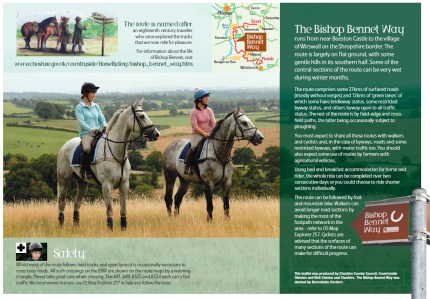
Who was Bishop Bennet and why do we travel his Way?

The official 10-page Bishop Bennet Way leaflet can be downloaded at the end of this post

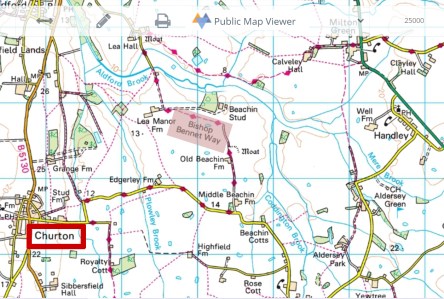
Threading its way all around the immediate area is the Bishop Bennet Way.  It is completely unavoidable on maps of the area, picked out in the lines of green horizontal triangles that mark a “Recreational Route” on the OS map, or the pink diamonds on the Public Map Viewer.

The Bishop Bennet Way follows a most circuitous route incorporating both roads and footpaths, and has been established mainly for the benefit of horse riders and mountain bike riders, but is very also popular with walkers.

Section of the Bishop Bennet Way near Churton. Cheshire West and Chester Public Map Viewer.

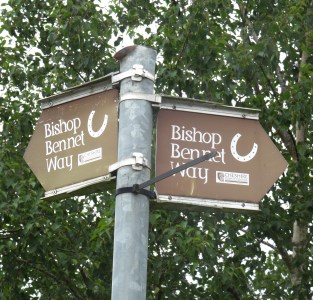
I first noticed it when walking down Pump Lane in Churton.  Where the road takes an abrupt turn to the north, there are small brown signposts pointing north, along Edgerley Lane and east along Marsh Lane to something called the Bishop Bennet Way.  Whichever of the two options it takes, it loops and switches in all sorts of crazy directions, a diabolically inefficient way of getting from A to B, and eventually it falls off the edges of my OS map, still going.  Once you’ve noticed the little brown Bishop Bennet Way signposts, they seem to pop up all over the area.  So who was Bishop Bennet, where does the Bishop Bennet Way go and why, for that matter, has that route been so carefully preserved in maps and on signposts?

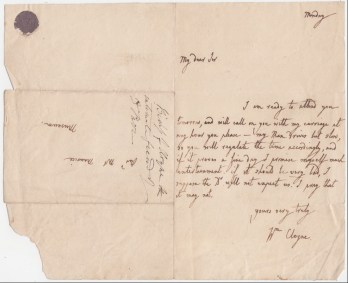
A signed letter from Bishop Bennet to his friend the Reverend Maurice

The first thing to establish was whether Bishop Bennet was a real person rather than a fictional character, and indeed he was.  William Bennet was a “prelate of high character and estimation.”  He was born, according to the Dictionary of National Biography, in the Tower of London on 4th March 1745. Clergymen were usually very well educated with a good academic knowledge of both Classical and British history, and many doubled up as antiquarians, explorers of all things ancient.  Although some of their excavations were distressingly destructive, their surveys often provided invaluable foundations for future work.  Bishop Bennet conformed to this model.  He was educated at Harrow School and then went on to study at Emanuel College, Cambridge, where he later became a fellow and tutor and “distinguished himself by his compositions in Latin, as well as in English, in which he discovered not only great fluency , but a lofty taste, both in prose and verse.”

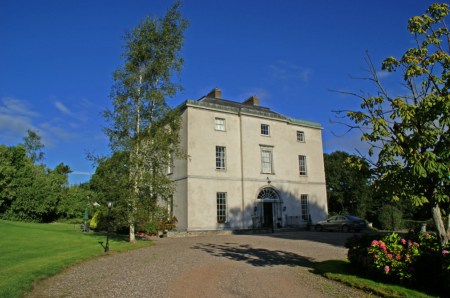
Episcopal Palace, Cloyne in Cork, Ireland. Photograph by colin.boyle4.
Source: Flickr Photos.

One of his students, in whom he took a particular interest, was John Fane, the 10th Earl of Westmoreland.  The Earl went on to become Viceroy of Ireland and remembered his former mentor by appointing him first as chaplain, then promoted him to Bishop of Cork and Ross from 1790–1794 and finally Bishop of Cloyne from 1794–1820, resident in the Episcopal Palace of Cloyne.  The episcopal see (jurisdiction) of Cloyne eventually became united with that of Cork and Ross in 1835, after which the Palace was leased to a private tenant.

Bishop Bennet was a member of the House of Lords, was elected Fellow of the Society of Antiquaries in 1790 and married the daughter of a  fellow clergyman in 1791.  He died in London in 1820.  In his lovely, deeply affectionate and appreciative eulogy, his friend Dr Parr commented on this career path:  “From the retirement of a college he stepped at once in the circle of a court;  but has not been dazzled by its glory nor tainted by its corruptions.”

One of Bishop Bennet’s contributions to Magna Britannia, volume 2, part 2.

None of this, of course, explains what the Bishop Bennet Way was all about.  After some hunting around, I found that Bishop Bennet was a very early driving force behind the investigation and publication of some of England’s Roman roads, something that became his own personal mission, all carried out in his summer vacations.  He contributed valuable work on the subject to published histories, of various areas including those of Lincolnshire and Cornwall.  He also contributed to the multi-volume work produced by the Lysons brothers, Magna Britannia, in which they set out to explore most of England’s counties in a series of dedicated volumes.  In West Cheshire, one of the roads that he had surveyed was the path now taken by the A41, from Chester (Roman Deva) to Whitchurch (Roman Mediolanum), and his investigations were incorporated into the Roman section of the history of the Palatine City of Chester published in Magna Britannia volume 2, part 2, 1810.

Map from the official 10-page Bishop Bennet Way leaflet that can be downloaded at the end of this post

The Bishop Bennet Way was officially opened in May 1998 incorporating restored byways and bridleways, and includes sections of country roads.  It is  of course very popular with walkers too.  Cheshire Live says that it was the inspiration of Bernadette Harden who was working on a temporary basis at Beeston Castle and began to take an interest in Bishop Bennet and his exploration of the area. It took her the best part of twenty years to campaign for the restoration of bridle paths and byways, but the Bishop Bennet Way is a very suitable reward for all her hard work.

The Way starts near Beeston Castle and finishes near Wirswall on the Cheshire–Shropshire border, just to the north of Whitchurch, although it might be extended in the future.  The route covers 55km/34 miles, and 27km of that route are on minor roads, only some of which have pavements and verges.  If you are a walker trying to avoid traffic, it is worth checking the Ordnance Survey map for public footpaths along the route that bypass road.  There is often another route possible for those of us on two legs rather than four, albeit rather more circuitous.  The official route crosses some seriously busy roads, like the A41 at Milton Green, and anyone planning to do the whole route is advised to plot their track on OS Map Explorer 257.  In 2006 Bishop Bennet Way was linked to Jack Mytton Way in Shropshire, between them creating a 125km/78 mile route.

The official 10-page Bishop Bennet Way leaflet can be downloaded by clicking here (but do check for updates on the Visit Cheshire website if you are reading this after summer 2021, in case a new edition is issued). 

Section of the Bishop Bennet Way as it heads north along the edge of Middle Beachin Farm, part way between Churton and Coddington.

Sources:

Books and Papers:

The Annual Biography and Obituary for the Year 1821
No.XVI. The Right Reverend Father in God, William Bennett, D.D. MRIA. Lord Bishop of Cloyne. , Volume V, p.263-266.  Longman, Hurst, Rees, Orme and Brown
tinyurl.com/3vr2y4fh

Codrington, C. 1919.  Roman Roads in Britain. Society for Promoting Christian Knowledge.

Lysons, D., and Lysons, S. (eds.) 1810.  Cambridgeshire and the County Palatine of Chester.
Magna Britannia, being a concise topographical account of several counties of Britain, Vol 2, Part 2.
https://archive.org/details/magnabrittanicab02lyso/page/n3/mode/2up?view=theater
https://ia802608.us.archive.org/27/items/magnabrittanicab02lyso/magnabrittanicab02lyso.pdf

Websites:

Cheshire Live
Walker turns trail-blazer in route revamp
https://www.cheshire-live.co.uk/news/chester-cheshire-news/walker-turns-trail-blazer-route-revamp-5246941

Dictionary of National Biography
William Bennet
https://en.wikisource.org/wiki/Dictionary_of_National_Biography,_1885-1900/Bennet,_William_(1746-1820)

Fastest Known Time
Bishop Bennet Way
https://fastestknowntime.com/route/bishop-bennet-way-united-kingdom

Historical Autographs
William Bennet, Bishop of Cloyne
https://www.historicalautographs.co.uk/autographs/bennet-william-bishop-of-cloyne-17093/

North Wales Live
Campaign uncovers long lost bridleway
https://www.dailypost.co.uk/news/local-news/campaign-uncovers-long-lost-bridleway-2898100

Visit Cheshire
Bishop Bennet Way
https://www.visitcheshire.com/things-to-do/bishop-bennet-way-p176521


Marvellous mist – this morning’s view from my home office

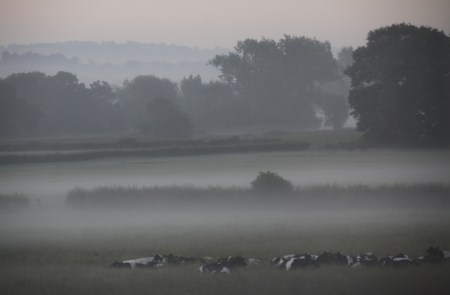
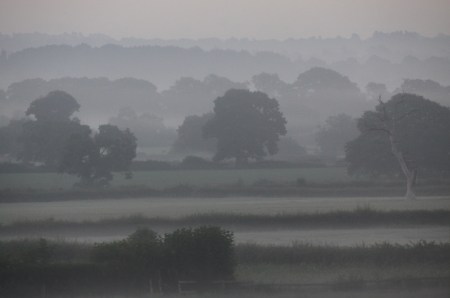
I love the view over the fields, and have become fascinated both with the light on the big tree to the left, as well as the antics of the black and white cattle that rush, at certain times of day, from the field in front of the tree back to the farm at a fast canter, and at other times sit and mellow in the grass.  I had no idea that dairy herds could be so thoroughly interesting.  Today, however, is the first time that I have seen the view look as eternal as this, the light and mist creating a shifting continuum between pale grey and charcoal, with only faint hints, now and again, of darkest green.   I’ll let the landscape speak for itself, the photos taken between 4am and 6am.


Wildflowers at the Barnston Monument

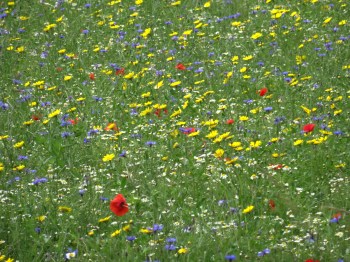
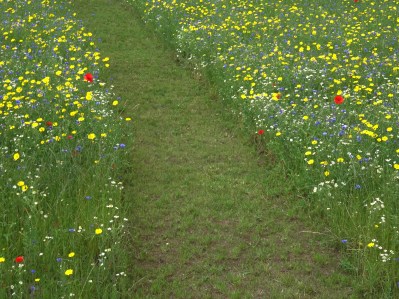
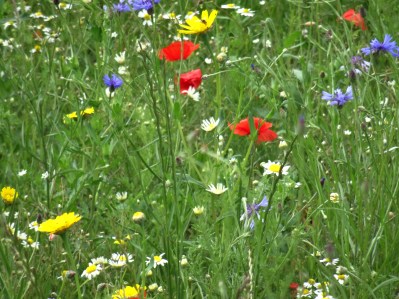
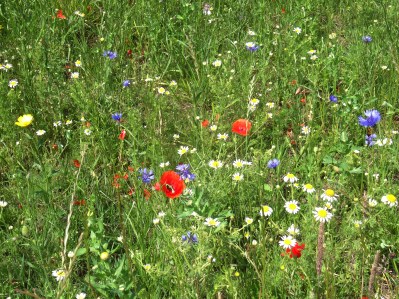
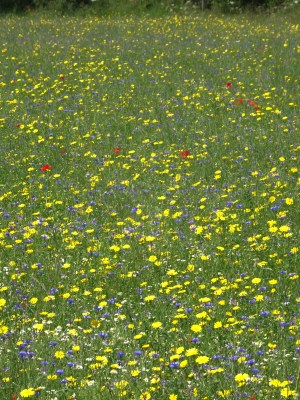
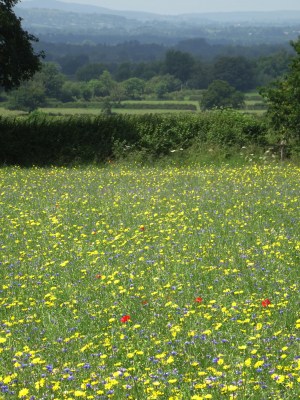
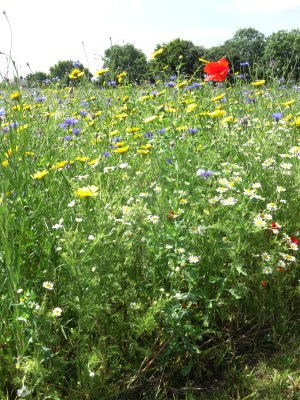
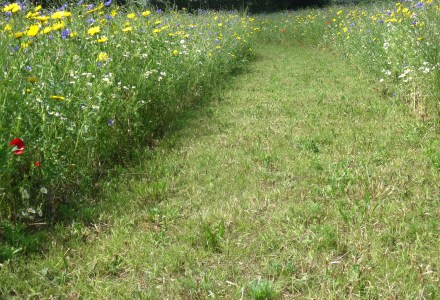
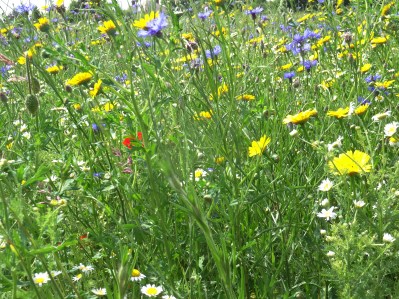
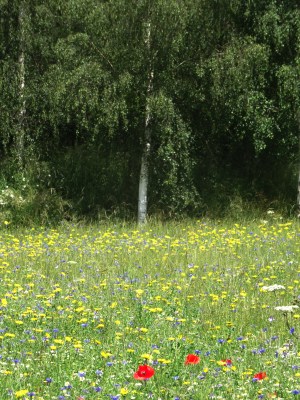
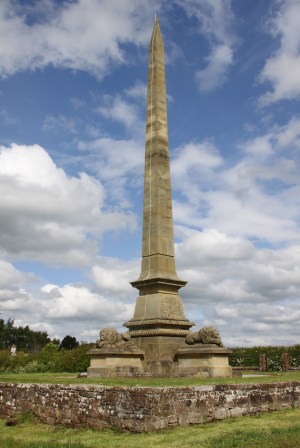
Today we dropped in at the Barnston Monument (about which I wrote a couple of weeks ago), because every time I drove past it I saw a blast of bright colour – yellows blues, reds and bright whites on a deep green backdrop.  Phenomenal.  It is on one of the Barnston Estate fields, part of the new Monument Meadow Natural Burial Ground, which will replace the churchyard cemetery at St Chad’s in Farndon. The burial ground will have no markers, and caskets will be made of natural materials.  The car park, surrounded by small saplings, and the wooden pavilion are already in place.   We bumped into a lady having her lunch there.  I cannot think of a better place for it.

The photos are a bit fuzzy, because I only had the little camera that I keep in my handbag with me, but they are enough to give an idea of the beauty of the wild flower meadow at the moment.  The cornflowers are particularly superb, a dazzling, intense blue.


Sources:

Chester Standard
Barnston Estate near Farndon to build burial ground
https://www.chesterstandard.co.uk/news/18611529.barnston-estate-near-farndon-build-burial-ground/

Walking from Eaton Hall Bridge north towards Chester

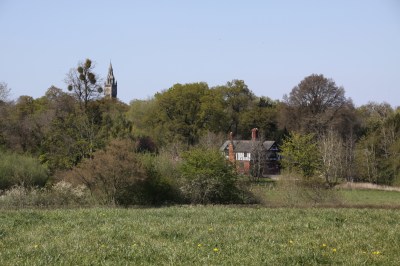
Another walk along the Dee, this time to the north of Aldford, on another glorious sunny spring day.

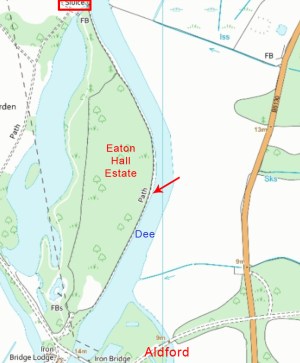
The walk from Churton heading north along the east bank of the river Dee to the Eaton Hall bridge at Aldford was described here a few weeks ago, and was followed a few days later with a look at the story behind Eaton Hall Bridge itself.  This walk picks up the footpath from Aldford and heads north.  The footpath crosses the bridge from the east to the west bank, and turns right sharply to follow the river to the north.  For those of you following local footpaths on the Cheshire West and Chester Public Map Viewer, see the map below as copied from the site.

Crossing the bridge from Aldford, follow signs right to walk northwards along the Dee along the side of the Eaton Hall estate. I turned back at the sluice, after about half an hour.  Source of map:  Public Map Viewer, with my annotations

If you are driving to Aldford, it seems to be okay to park outside the Aldford church.  There were certainly a number of dog walkers parked there, and there is no signage or road markings to indicate that this would be unwelcome.

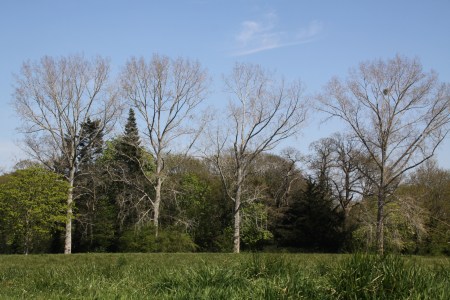
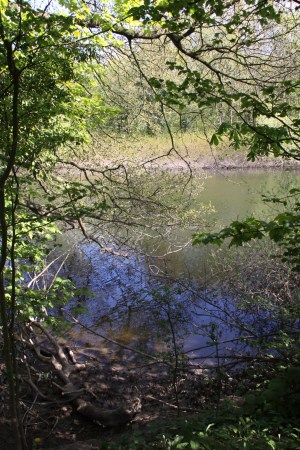
It was only a short outing because a serious amount of garden weeding awaited, and when I reached the Eaton Hall sluice gate, which empties a small canal into the river, I turned around and came back (about half an hour each way), but it was enough to establish that this section of the riverbank has a rather different character from the east bank between Churton and Aldford.  Instead of the fields that follow the Churton to Aldford section of the Dee to the east, the presence of Eaton Hall estate, fenced off all along that stretch of the path, creates a more contained and intimate feel to the footpath.

If you are starting from Aldford, go to the church and head through the white gate next to it, along the footpath that dissects the field, and over the bridge.

View from the bridge looking upriver, to the south.

As soon as you cross the bridge, you will see a sign indicating that the roadway ahead is private, and that you need to turn right.  Almost immediately, there is a second sign warning of flooding.  This is clearly no joke.  Even though it was bone try on this occasion, there are long sections that preserve deep sections that were clearly deep mud, endlessly trampled by boots.  As the sign says, there is clearly a risk of being cut off in wet weather, as much of the footpath sits in a narrow section between the river on the one side and a big fence along the Eaton Estate on the other.

Ramsons (wild garlic) just beginning to flower.


A walk along the Dee from Churton to the fabulous Eaton Hall Bridge at Aldford

Ordnance Survey Landranger 117, annotated with route details.

On yet another lovely spring day I again neglected the garden in favour of discovering one of the local walks, again from Churton to Aldford, but via a much longer route and this time to the west of the villages.  A couple of weeks ago I described short a walk from Churton towards the Dee, actually my first walk from Churton, but on that occasion I stopped short of actually reaching the river.  On Saturday I walked down the same track to the  Dee and headed north as far as Thomas Telford’s wonderful 1824 iron-built Eaton Hall Bridge at Aldford, before walking back through Aldford, over the B5130 and across the fields to Churton.

I’ll talk about the bridge on a separate post because it deserves some special attention, but here are details of the walk, which took over 3.5 hours at a fairly fast pace, but with stops to take photographs, chat to others and drop in at the Aldford village shop.  Although it is a short 45 minute walk by the shortest route across the fields from Churton to Aldford, the path along the Dee takes over twice as long to walk because it follows all the bends in the river.  The footpath numbers quoted throughout are derived from the Cheshire West and Cheshire Public Map Viewer.

The walk is very straightforward.  The start is reached by walking down the footpath that runs in a straight line from Hob Lane in Churton is “Churton by Aldford FP2.”  The track is wide and inviting, heading downhill as Hob Lane itself vanishes round a corner.  The hedges that flank the track are full of interest, but they form a fairly solid wall, so there’s not much else to see beyond.  The footpath simply follows the course of the river until Aldford comes into view on the right, and shortly afterwards the Eaton Hall Bridge becomes visible through the trees to the left.  The OS map (Landranger 117, the relevant section of which is shown above) indicates a short cut just north of the woodland section, eliminating a somewhat angular bend in the river, but I didn’t follow it.  In the future, given that it would cut out most of the less scenic portion of the river, I would take this short cut.

It is a nice walk from Churton to the Dee and as on my previous walk a couple of weeks ago, the high hedges largely block views of the fields but are very beautiful in their own right, with an increasing number of bluebells and campions at their feet.  By the Dee itself, there are dense zones of wild garlic, which is delicious.

Wild garlic, which will produce lovely star-like white flowers soon.

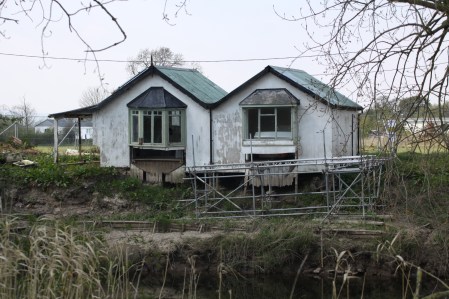
This less scenic section is immediately visible when you emerge from the track beyond Hobs Lane and turn right along the Dee.  It is really rather dispiriting.  There is a lot of flood damage in the form of fallen trees, branches and washed up debris, but rather more off-putting is on the opposite of the river, a stretch characterized by small chalets, many of them in a poor state of repair or completely derelict, with a series of messy landing stages made of pieces of scaffolding.  Not a promising start, but once that stretch ends, the rest of the walk is thoroughly enjoyable.  As I said above, there is a short cut that eliminates some of this section.

It is not always possible to see the river, because the footpath is set back from the edge and after the recent dry weather, the river is currently sitting rather low in its river bed, a couple of metres below the riverbank.  There are a lot of trees and shrubs growing on the bank, all now coming into leaf, and these hide the river from view along some sections, but where the river is visible it is very fine.  The riverbank trees are lovely in their own right, the spring leaves and catkins picked out in the sunshine.  The views across the well-maintained fields and hedgerows to the east give a sense of openness and order, the dark green crops a contrast to every light spring colour surrounding them.


Most of the footpath is very open, and there were a lot of butterflies, mainly red admiral, small tortoiseshell, painted lady and peacocks, although most refused to sit still long enough to be photographed.  There are also some small tracts of attractive woodland clearly marked on the Ordnance Survey map, one of which, just outside Aldford, is absolutely carpeted with more delicious Ramsons (wild garlic) that is just about to come into flower, after which it should be a spectacular sea of white blooms.  


A 10-year scrub clearance  and tree replacement scheme managed by the Eaton Estate along the banks of the Dee, which is a Site of Special Scientific Interest (SSSI), has resulted in the planting of very young saplings supported in green tubes flanking the path in single, double or triple rows like a very short guard of honour.   The clearing of scrub, as well as flood damage, should considerably improve the river bank.  It will be interesting to see how it develops in the future. 


The Eaton Hall bridge just outside Aldford (discussed here) is an absolute treat.  It first emerges as brief glimpses through the trees before its fully glory becomes apparent, a thing of industry and restrained fantasy, solid and intricate, functional and decorative.  Above all, with ironwork picked out in pale blue and white, and with smart, narrow railings along the top of the bridge, it achieves an most refined elegance.  It spans a particularly well-manicured section of the Dee, linking two highly-polished parts of the Eaton Estate, itself part of the Grosvenor Estate.

Map and overlays copied from the Cheshire West and Cheshire Public Map Viewer. Poulton FP4 is the Telford bridge and the black dot in Aldford is the church.

Again using the online map viewer, the footpath (Aldford FP13) leaves the bridge road and crosses a field diagonally, heading for the impressive remains of a motte and bailey castle (of which more on a future post) and, just beyond, Aldford’s distinctive St John the Baptist church.  I walked from there along School Lane and turned left into Rushmere Lane, which flows into Green Lake Lane.  There, I paused to buy a few supplies from the well-stocked Aldford village shop before heading over the B5130 and threading my way through the fields, along footpaths Aldford FP6, Aldford FP4 and Churton By Aldford FP7 to Churton, swinging a particularly divine brown cob loaf for which there was no room in my rucksack.

It is an excellent circular walk if you have a few hours to spare.  In total, it will take about 3.5 to 4 hours depending on how fast you walk. It took me about 3.5 hours, but even pausing to photograph and chat, I’m a bit of a route-marcher.  If you prefer to stroll, it will take longer.

After having spent a winter in semi-hibernation (I truly hate the cold), by the time Churton was in sight my poor legs felt like a pair of old dogs that just wanted to curl up and sleep in front of the fire.  On the back of that thought, I remembered that on my way back from the Roman road last week, I was walking along Edgerley Road and ahead of me saw a man and a golden Labrador.  They were standing in the middle of the road engaged in an obviously fraught dialogue.  The dog, not old but clearly miffed about something, was refusing to move.  All four feet were glued firmly to the floor, and he was deaf to argument, persuasion and entreaty alike.  He simply wasn’t moving any further.  I did grin.  After giving the dog the usual ear massage and some general fuss, which was rewarded with soft eyes and a wagging tail, I offered commiserations to his owner and moved on.  My amused sympathies were with the owner at the time, but after today’s walk I have switched allegiances, and my empathy is now firmly the Labrador who didn’t want to move one more step.


A touch of Rome just east of Churton #1 – Background

Yesterday I went to find the section of the Roman road that runs from Chester, through Aldford, and down to the east of Churton.  I have divided this post into two parts.  The first part, below, looks at the background to Roman roads in Britain.  Part 2 describes the walk itself.

The Cuppin Street excavation one lunchtime, 1986 or 87. My photo.

As mentioned in the introduction to this blog, I trained as an archaeologist and spent my summers in the 1980s digging up various parts of England and Wales. Although technically a prehistorian, my early excavation experience also included the Roman temple site at Caerwent (Venta Silurum in southeast Wales), the basilica at Silchester (Calleva Atrebatum in Hampshire) and three consecutive seasons with the Grosvenor Museum team on the multi-period Cuppin Street site in Chester (Deva). Whenever modern building work takes place in Chester, the city’s archaeologists are given time to undertake excavations. Before we started digging it up, under the capable direction of Dr Simon Ward, the site was an informal, roughly surfaced car park that was destined to become the Magistrates Courts, originally just outside the Roman town’s walls.

A collapsed road was one of many important features that made up a truly fascinating site. The metalled road had a central dip along its depth, which we set out to investigate. Black tar from a defunct Victorian gasworks oozed into a very deep trench, where a friend and I were excavating what lay beneath the road. A wood-lined drain beneath the road had slowly collapsed over time, becoming blocked with general waste, the middle of the well-made road had gently subsided into the void, creating a bizarre concave profile. Drains in Deva were often located under roads, and could be up to 5ft deep. The Cuppin Street example was one of several major and minor roads and lanes that punctured Deva from all directions. I’ve had something of an interest in Roman roads ever since.

Deva (later Deva Victrix) was at the far northwestern edge of the roman Road network Where England and Wales met at the point where the Dee emptied into its estuary. It was a strategically important Roman base with a large command area over much of the northwest and north Wales. The legionary fortress was established by at least AD79 in the territory of the Cornovii who were based at Wroxeter (Virconium Cornoviorum), although Rome’s presence in the Chester area predates the permanent fortress by two decades. There is no indication of violence, and it is possible that the Cornovii had already come to terms with the Roman invaders, perhaps as early as AD43 when Claudius entered into treaty relationships with a number of kings. Whatever Roman presence had been here previously, the fortress was established in AD79, having been started in around AD74-75, and was built by the Second “Adtiutrix” Legion. In AD86 the second legion was sent to the Danube and was replaced by the Twentieth “Valeria Victrix” Legion, which remained until the withdrawal of the Roman army from Britain in AD 410.

One of Julian Baum’s stunning impressions of Deva, showing the
beginning of Watling Street West (Margary 6a) and the Dee
crossing. Source: Julian Baum, Take27 Ltd.

When completed, the Deva fortress covered over 60 acres (24 hectares) on the standard playing-card plan (see site plan below), and eventually housed up to 6750 soldiers, servants and slaves, and was the headquarters of the local legion. It was a sizeable entity, 20% larger than both Caerleon (Isca) and York (Eboracum), which were both permanent legionary fortresses that were built at much the same time as Deva. It has been suggested that this size may have been needed to accommodate some unusually grand buildings under orders from an important official resident at the fortress, perhaps the provincial governor who, appointed by the emperor himself, would have required a more impressive portfolio of amenities than the usual fortress would have provided. A civilian entourage followed the military, including merchants, service providers and families of the soldiers (legionnaires were not permitted to marry until AD212, but this did not prevent them having partners and children). They were not permitted to live within the fortress so settlements (canabae legionis) grew up as suburbs immediately in the vicinity of the fortress. Also near to the fortress were the site’s cemeteries. Other small civil settlements growing up further afield at Heronbridge, a farming community, and the smaller Saltney. A tile and pottery works was established further down the Dee at Holt.

Roman roads of the Chester area. 6a and 6aa leave Chester and head south, meeting at Alford. 6a continues south, passing to the east of the Dee and the villages of Churton and Farndon. Map source: The excellent “Roads of Roman Britain” online gazetteer.

The fortress was in a good strategic position, convenient both for subjugating fractious groups in north Wales and for maintaining control over the northwest, where subjugation of the troublesome Brigantian tribe had become a priority. It was built on a rise in the land within a bend in the river Dee, meaning that it had natural defences on two sides, which contributed substantially to the security of the walled fort. The racecourse, on the Roodee, sits on the location of what was once a natural harbour, enabling a busy port to flourish on the Dee just beneath the fort. This was a natural extension of the road network, enabling the fort to be provisioned, with both soldiers and supplies being brought in from Europe, and for local commerce to develop along the coast. The Romans brought a wide selection of foods to Britain that we now think of as everyday, but were then luxury items, including apples, pears, cherries, grapes, asparagus, cabbages, carrots, onions, turnips, cucumbers, fennel and dill. High value perishables like these were much better transported by sea than road, which was both slower and could seriously jolt fragile produce. Other luxury items usually trusted to sea rather than road were high quality but delicate or costly objects like samian pottery, glass and vessels of wine. To link north and south, the river required the provision of a bridge, and this was erected where Lower Bridge Street crosses the Dee into Handbridge. In its place is now the Old Dee Bridge, dating to the 14th Century. The road went on to Whitchurch and Wroxeter, from where a number of destinations were possible. Today it is known as Watling Street West. Other roads out of Deva headed north, east and west, as shown on the map below.

The vast and complex road network was the glue that bound the impressive imperial infrastructure of forts, fortresses, fortlets, towns, inns, way-stations, camps and industrial centres. It is a remarkable cat’s-cradle of long straight stretches, most metalled or paved, others very rough, with some following much older trackways. Today many modern roads follow these original Roman routes, like Watling Street, along which the A5 now travels. Roman roads were planned out by teams of engineers and surveyors.  There are no documents detailing how the task was achieved, but the first step was probably to establish the line of the road, which was planned as a more or less straight line, as the crow flies, from a to b (in this case Chester to Whitchurch).   Just as today, the army had trained surveyors and engineers.  A map would probably have been prepared, and the required line would have been staked out

The profile of Stane Street in Surrey offers a good idea of how many roads were built in Roman Britain. Source: Epsom and Ewell History Explorer website.

Although the local geology, geomorphology and soil structure determined the exact construction of roads, they followed a basic conceptual idea of how a road should be built.  Roads were flanked by drainage ditches, which carried rainfall runoff and provided quarry material for a raised section along the road.  In profile, the roads were were usually built up above the level of the surrounding landscape and were cambered, with a curved top and sloping edges to aid drainage.  Many modern accounts describe four or more levels of construction, but Hugh Davies says that this belief, widespread but incorrect, was probably a misreading of the work of a famous Roman architect called Vitruvius who certainly describes for successive layers, but was actually referring to paved areas around prominent buildings rather than roads.  In the case of roads,  a standard arrangement was usually much simpler, consisting of two levels, although road construction methods differ from one place to another.   The standard arrangement consisted of an agger (a built-up section of road between the two drainage ditches), a layer of rough metalling consisting of stones, cobbles, pebbles  and smaller infill, and then a top layer of smaller stones and/or gravel.  Some were then topped with paving stones, which helped to preserve them.  The agger could be up to 1.2m (4ft) but was often raised only just above the level of the surrounding landscape.  Like forts and temples, roads were not strictly standardized.  Today some remarkable examples survive, but the greater majority have been destroyed or eroded.  Re-use for modern roads and expansion of urban settlement have destroyed sections of roads, while weather damage and compaction over the centuries have flattened many of the surviving roads and broken up their surfaces.

Sasha Trubetskoy’s schematic map of Roman Britain, based on
Harry Beck’s London Underground map of 1933. Click image to see a bigger version. Source:  Sasha Maps

Modern knowledge of this vast network, extending from the south coast into mid Scotland, has been built up by extensive detective work from the 18th Century onwards. Initial research into the British Roman road network was based on the “Antonine Itinerary,” written in c.AD 200, one of handful of surviving Latin documents that provide records names and other data that can help to located both and the routes of roads. The document is made up of a series of lists, and each list, or iter, provides details about the start and end point of each route, its total mileage (mille passus or m.p, meaning 1000 paces) and notes places distributed along the routes. The lists only cover about 25% of British roads, and are by no means complete, but they have been an invaluable research tool. Today, with dedicated work on foot, together with the use of remote sensing technologies from the air, each year new discoveries help to fill the obvious gaps and to reveal unsuspected stretches. One of the most important organizations contributing to this task of identifying sections of the road network is the terrific Roman Roads Research Association, which builds on work pioneered by Roman road expert Ivan D. Margary. Margary devised a numbering system to both identify and categorize Roman roads, publishing his comprehensive “Roman Roads in Britain” in 1955, which continues to be an invaluable reference. The Roman Roads Research website includes an invaluable online gazetteer, the Cheshire section of which has been assembled by David Ratledge and Neil Buckley, with many thanks for such a great resource. The outcome of all of this research is nicely captured on a cleverly conceived schematic map designed by cartographer Sasha Trubetskoy, using the London Underground of map of 1933 designed by Harry Beck as a template.

The Roman road that starts in Chester and passes to the east of Churton is Margary’s road number 6a, also known as Watling Street West. On the Cheshire West and Chester’s Public Map Viewer, the section of it that passes through Aldford and passes Churton is public footpath “Aldford FP8.”  This is the subject of part 2.


Sources:

Books and journals:

Davies, H. 2008. Roman Roads of Britain. Shire Archaeology

Frere, S.S., Hassall, M.W.C. and Tomlin, R.S.O. 1988. Roman Britain in 1987. Britannia, Vol. 19 (1988), p.415-508

Jones, G.D.B. and Webster P.V. 1968. Mediolanum: Excavations at Whitchurch 1965–6. Archaeological Journal, 125:1, p.193-254

Lathan, F.A. 1981.  Farndon. The History of a Cheshire Village.  Local History Group

Margary, I. 1973 3rd edition). Roman Roads in Britain.  John Baker 1973.

Mason, D.J.P. 2001, 2007. Roman Chester. City of the Eagles. Tempus

Mason, D.J.P. 2007. Chester AD 400-1066. From Roman Fortress to English Town. Tempus.

Peel, J.H.B. 1976. Along the Roman Roads of Britain. Macmillan

Shaw, M. and Clark, J. 2003a. Cheshire Historic Towns Survey. Aldford Archaeological Assessment. Environmental Planning, Cheshire County Council

Shaw, M. and Clark, J. 2003b. Cheshire Historic Towns Survey. Farndon Archaeological Assessment. Environmental Planning, Cheshire County Council

Ward, S. 2013. Chester. A History. The History Press

Website resources:

Cheshire West and Chester – Public Map Viewer
https://maps.cheshirewestandchester.gov.uk/cwac/webmapping

Roman Roads Research Association http://www.romanroads.org/

The Roads of Roman Britain
http://roadsofromanbritain.org/index.html
http://www.romanroads.org/gazetteer/cheshire/cheshire.html

A Web-enhanced version of Roman Roads in Britain by Thomas Codrington,
published by the Society for Promoting Christian Knowledge, London, 1903
https://tinyurl.com/75ujdd43

Walking from Churton to Aldford on “Churton and Aldford Footpath FP6”

Still exploring routes between Churton and Aldford after my walk along Churton by Aldford FP4, today I went along FP6.  The FP numbers refer to the interactive Cheshire West and Chester’s Public Map Viewer, from which the map at the foot of this post is copied.

From Churton, head down Pump Lane, turn left into New Lane and then right along the footpath that passes the stud farm.  Keep going past the the metal kissing gate on the left, staying on the metalled road until the left-hand corner.  Then climb the stile into the field and head straight on.  There are a number of stiles on this part of the walk.  Shortly you cross a small stream, cross over a field diagonally and then pop out on Edgerley Road, where there are two footpath choices on your left.  Choose the one on the left, following the path of the stream.  This is footpath FP6 and you can follow it in a straight line all the way to Aldford.

FP6 is a particularly interesting as well as scenic route at this time of year, taking in views over the rapeseed fields, Grange Farm where tall, slender trees (possibly poplar?) flank a wide track north and were shining bright and light in the sun.  The little cluster of lovely buildings at Brooklands on Lower Lane is particularly nice, and immensely peaceful.  Most of my walks are circular, but this time I enjoyed it so much that when I reached Aldford I turned around and came back again.

I walked it later in the year, early August, and found it very overgrown with nettles and huge umbellifers.  The fields had been planted with corn, which was likewise very tall, so views over the fields very limited.

For notes on accessibility (for those with legs that don’t necessarily want to climb over stiles and gates) and for what it’s like underfoot, see my notes at the end of this post.


From the Cheshire West and Chester’s Public Map Viewer, with my arrows added in blue.

Accessibility.  There are a number of stiles to cross as you head west to east along the first stretch of the route, but if you go along Pump Lane and follow the road left into Edgerely Road, you will find yourself at the gate that takes you due north past the farm and to Aldford.  It’s a climb-free walk from there onwards.

A note on walking conditions.  Although there has been standing water on other walks, this one was very dry except for a bit of hoof-trampled mud around the stile from the field into Edgerley Road, and this was easy to walk around.  It is all on the flat, and although the first part to Edgerley Road is partly field, most of it is track and metalled road.  It is very easy-going underfoot.

Across the fields from Churton towards Aldford

I had noticed a footpath sign whilst delivering My Village News in the eastern section of the village, pointing past the stud farm.  So yesterday, on another bright, sunny day I went to investigate the possibilities.  It was bitterly cold with a sharp, unforgiving wind, but very beautiful. I hadn’t bothered looking up the footpath on a map, so was just happy to go wherever it went, but was surprised to find myself heading north rather than east, as the footpath took an abrupt left-hand turn in the rough direction of Aldford.

The north of Churton, and as well as being a picture village with an interesting history (about which there will be details on a future post), has the twin benefits of a village shop and the excellent Grosvenor Arms.  Chester Road, that links the two villages with Chester to the north and Farndon to the south, is very busy and there are large stretches with no pavements, so walking along the road is not viable.  It had always been my plan to see if there was a footpath through the fields to Aldford, so it was therefore good news that I had found myself on a footpath heading in that direction.  Helsby hill was ubiquitous to my right, and eventually the spire of St John\’s church at Aldford came into view.

Having seen various signs to other footpaths, all clearly officially sponsored by the council, when I returned home I had a scoot around on the Internet and found the Cheshire West and Chester Public Map Viewer, a really invaluable resource for walkers (and horse riders).  It showed me where I had erred in my attempt to reach Aldford (ending up at Glebe Farm) and introduced me to the vast network of footpaths that criss-cross the West Cheshire area.  Impressive and a promise of great walks to come.  I was initially somewhat confused by the repetition of footpath numbers, but you have to check the placename that precedes the number.  At first it made me go slightly cross-eyed, but I soon go the idea. I started off on Churton by Alford (CbA) FP1 and turned left into CbA FP4. That  segued seamlessly into CbA FP7.  I next crossed on to Aldford (A) FP6, which leads via Lower Lane to Aldford.  On the return leg, walking back down FP6, I saw that there was a footpath to the left and when I looked it up on the map viewer this was another FP7, but this was an Aldford FP7, not a Churton by Adford FP7.   It can be a tad confusing at first.  I have circled both on the map to the left, to clarify matters.  The red arrows show the route I took.

Skirting the edge of fields and through a young patch of woodland, the original path bifurcated, and it became clear that there was a complex network of well-marked paths, with excellent signage provided by Cheshire West.  My first route took me on a path that emerged on the main road at Glebe Farm on a section with no pavement, so I retraced my steps and took one of the other branches, which linked to a narrow lane that led to Aldford.  A great find. I had had the footpaths almost completely to myself, but the lane was clearly a favoured promenade, with a lot of dog walkers out and about.

It was a remarkably diverse walk.  The fields were all quite different.  One was turned over to neat little rows of small saplings, including tiny conifers and fruit trees just coming into blossom.  Another, a deep lush green with a baked red track dramatically bisecting it, had clearly been used for growing sweetcorn, as aged husks remained on the track.  Desiccated and skeletal remains of last years verges ran along one field, a meter tall.  I look forward to identifying them when they emerge later in the year.  Farmhouses in the traditional local red brick Grosvenor Estate style looked out over the rolling landscape, and in a dip a large patch of blue water glistened alluringly.  A field of ransoms provided a lovely yellow contrast to all the green, brown and blue.  In the patches of woodland there were big rabbit sets, and the sunlight filtered through the mainly deciduous bright new leaves, but there were also carpets of pine cones. The walk back, providing a different perspective on things, was equally rewarding.  The little patches of woodland,  in geometrically precise shapes, were young and presumably planted deliberately, and were small jungles of bright new growth.  The further I walked, the more I realized that Cheshire, or at least this western edge of the Cheshire Basin, is not as flat as I had expected it to be.  The term “undulating” seems to fit the bill.


Sources:

The footpaths on the walk are shown on the Ordnance Survey maps of the area, but Cheshire West and Chester Council has developed the Cheshire West and Chester Public Map Viewer, a really invaluable resource for walkers (and horse riders).   it is free to use, and there is no need to register.  On the ribbon at the top of the screen, you can click the + symbol in the ribbon at top left, which gives you a drop-down menu.  From the Leisure and Culture tab, you can chose which options you want to display on the map.  I chose Bridleways, Footpaths, Restricted Byways and Walking, which gave me the tracks shown on the above map.   It is worth playing around with the features to find out how to get the most out of the site.