Category Archives: Museums and galleries

Part 1: Who was Brymbo Man, what was the Mold Cape and why do they matter?

From left to right.  The Mold Cape and strings of amber beads superimposed on a digital sketch, which could be man or woman (Source: British Museum Partnership Programme); Photograph of the Wrexham County Borough Museum hologram of the reconstructed head of Brymbo Man (my photo); The recreated grave and capstone with original skeleton and grave goods of Brymbo Man in the Wrexham County Borough Museum (my photo).


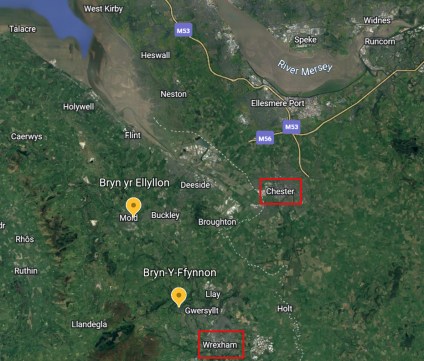
Bryn y Ffynon (Brymbo) and Bryn yr Ellyllon (Mold) indicated by yellow markers, shown in relation to Chester and Wrexham. courtesy of Google Earth. Click to enlarge.

This is part 1 of a four-part overview of two Early Bronze Age graves and how they contribute to an understanding of  the archaeology of the period in northeast Wales and the borders. All four parts have been written, and will be released over the next couple of weeks.

The series has been divided up as follows:

Part 1 (this post) – Introduction to the Late Neolithic and Early Bronze Age in northeast Wales:

  • Introduction
  • Some Background to the Late Neolithic and Early Bronze Age
  • A rich heritage in northeast Wales
  • Discovering the graves
  • Sources (bibliography) for all four parts 

Part 2 – What do we know about Bryn y Ffynnon, the grave of ‘Brymbo Man’?

Part 3 – What do we know about Bryn yr Ellyllon, where the Mold cape was found? 

Part 4 – Bringing the threads together, plus visiting details


Part 1: Introduction

The series is based on two burial finds in northeast Wales, Bryn yr Ellyllon, near Mold and Bryn y Ffynnon at Brymbo, Wrexham.  These two sites have been chosen 1) because excavated sites are comparatively unusual in northeast Wales, 2) the contents of both sites can be visited in museums, and 3) because of the differences between them, and the opportunity for assessing different types of knowledge about the Late Neolithic and Early Bronze Age in northeast Wales.  In spite of the differences between them, both represent variants of the broader burial tradition, and therefore have the potential to add their own unique voices to the discussion of how this period manifests itself in the region.

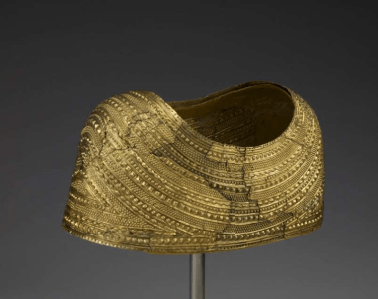
The Mold Cape (British Museum 188,0514.1) from Bryn yr Ellyllon near Mold. Source: British Museum

Bryn yr Ellyllon (which translates as Hill of Goblins or Fairies) was discovered by labourers in 1833 a few miles to the east of Mold.  It was a round cairn (a mound of stones) that contained a badly decayed skeleton together accompanied by a number of very fine artefacts, one of which is the magnificent gold Mold Cape made of paper-thin gold and embossed with a decorative theme that emulates multiple strings of beads.  The other objects included around 300 amber beads (the exact number found remains unknown, and only one survives), other pieces of gold that appear to have belonged to a second cape, and some poorly preserved items of bronze.  These are now in the British Museum in London and are discussed further below and in part 3.  Even though the objects were pulled from the site as pieces of treasure, the location of the site is known, and the objects form a relatively coherent assemblage.  These are valuable details when understanding how objects were chosen to accompany the dead, and where burial sites were located in the landscape.

The partial remains of Brymbo Man and his two grave goods from the Bryn y Ffynnon cist. Source: Peoples Collection Wales

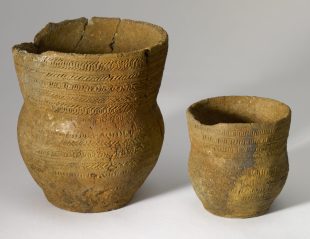
In 1958 a stone-line cist called Bryn y Ffynnon, was found 10 miles to the northwest of Wrexham at Brymbo, containing the well-preserved remains of a partial skeleton, a flint tool and a ceramic vessel known as a Beaker.  The name means Hill of the Well or Spring (with many thanks to Reginald Iain de Crawford-Griffin for the translation).  It seems to have been named for a small farm of the same name on Brymbo Hill.  The site was excavated in 1958, and the results published in an excavation report in 1959.  The man to whom the skeleton belonged, now nick-named Brymbo Man, was around 35 years old when he died some 3600 years ago.   The burial, including the skeletal remains, is now on display in the Wrexham County Borough Museum, together with a reconstruction of the skeleton’s face.  The site is discussed further below, and in detail in part 2.

Each burial offers contrasting insights into the Late Neolithic / Early Bronze Age, and they are worth looking at both individually and together to highlight how different sites may produced different types of knowledge.  Every individual site has something to say for itself, and as more sites are investigated, each feeds in turn into our knowledge about the period in which they were constructed, and during which they formed an integral part of the human landscape.  It is the  understanding of the period as a whole, rather than individual objects, that is important to archaeologists, who work to recreate past societies from the sites and objects that survive.

Some Background to the Late Neolithic and Early Bronze Age

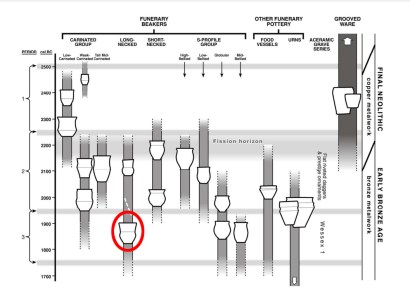
Chronology of ceramics in Britain, Late Neolithic and Early Bronze Age. Source: Parker-Pearson et al 2016

The Late Neolithic and Early Bronze Age are usually discussed together.  The period lasts from around 2900-1600 BC.   The division from the earlier Neolithic lies in transformations visible in the material record, which may in turn reflect revisions of ideology, social organization and/or economic activity.  These changes coincide with a period of climatic change.

Riverine connections during British prehistory, showing how the river network links from Wessex, the Thames valley and the Humber estuary. Source: Bradley 2019, p.20

The climate, cooler than in the earlier Neolithic, was still favourable for agriculture, and in particular may have supported agricultural development in hilly areas in the summer months.  Astrid Caseldine’s analysis of environmental indicators suggests that this was a period of deforestation in many parts of upland north Wales, probably indicative of agricultural expansion into these upland areas.  This is supported both by the notable increase in cereal pollen in these environments, and by the flowering of Late Neolithic – Early Bronze Age monuments across the upland landscape.  This expansion could not have lasted indefinitely; the soils were simply not of sufficiently robust quality to sustain long-term agricultural expansion.  Valleys were also popular locations for these sites, indicating that communities were adept at making the best of various different environments.  The valley of the river Alyn, along which several sites are located including Bryn yr Ellyllon and the Llong, is one example.

Foremost amongst the transformations in material culture, suggesting social as well as economic changes, is a different form of burial  practise, suggesting changes in the way that communities defined themselves and related to both others and the landscape.  Although there were a number of tomb styles prevalent in the earlier Neolithic, most burial sites contained the remains of multiple individuals, but at the end of the Neolithic and the beginning of the Bronze age, smaller round barrows and cairns were favoured, usually containing a single burial in a small subterranean chamber at its centre, sometimes with a new form of pottery known as a Beaker.  Sometimes additional burials added into the mound itself at a later date.  At the same time, settlements became less substantial, more ephemeral, and much less easy to find archaeologically, the sites often consisting of little more than household debris with few, if any, signs of the circular structures that once contained them.

A suggested reconstruction of the 100s of beads found in the cairn at Llong, near Mold. Source: Curious Clwyd

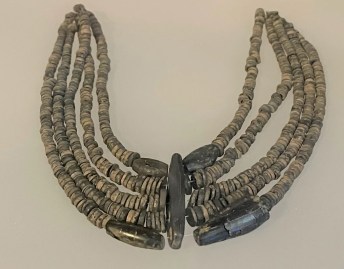
Pottery styles also changed at this time, with the introduction of the new Beaker form from Europe and the replacement of earlier Neolithic styles with new home-grown Grooved Ware, Food Vessels and Collared Urns.  As the name Bronze Age suggests, this was also the period during which metal-working began, first copper and gold, and later bronze itself, an alloy of copper and tin.  North Wales was well placed as a base for the exploitation of mineral sources, an industry that gained momentum during the Early Bronze Age before becoming an important centre for copper and other resources in the Middle Bronze Age.  The earliest copper tools in Wales were flat axes that had been cast in an open mould, a basic technology that improved over time.  Decorative items, such as items of jewellery also appear much more frequently.  The amber beads in Bryn yr Ellyllon and the jet and shale beads in the necklace found in a cairn at Llong, near Mold, both in the valley of the river Alyn, are both examples from northeast Wales.

Although these are the top-level identifiers of the new Late Neolithic and Early Bronze Age material culture, there is considerable regional variation, and even within a region no two graves are identical.  Although inhumations (burials) are typical of barrow graves, cremation steadily gained momentum, eventually replacing inhumation as the preferred method for disposing of the dead.

A rich Early Bronze Age heritage in northeast Wales

The Maesmor Estate macehead from near Corwen (near Llangollen). Found in 1840. Source: National Museum of Wales

Northeast Wales was a recipient of these new ideas, perhaps deriving them from earlier versions in south Wales, or perhaps more plausibly from similar manifestations in northern England with which the northern Welsh material appears to have certain affinities.  The Bryn y Ffynnon Beaker, for example, bears a close resemblance to examples in northeast England, and stone maceheads from northeast Wales are comparable with those from the north of England, including a remarkable example from the Maesmor Estate at Llangwm near Corwen in the Ceirw river valley, not far from the Dee (shown left).  Good quality flint pieces for more mundane stone tools are unavailable in north Wales, and this appears to have been imported from elsewhere.  Yorkshire jet appears in northeast Wales during the Late Neolithic, as does amber. The nearest source of amber was the Baltic, but it also washed up on beaches along the Yorkshire coast.  Amber was found in Bryn yr Ellyllon with the golden cape;  jet (and black stone resembling jet) appears in the necklace, found scattered in a the stones of cairn at Llong, 1.5 miles (2.4km) southeast of Mold, overlying the burial of a crouched female skeleton. Although sea routes had dominated during the earlier Neolithic, the indications are that land and river routes now assumed a new importance, transforming networks of communication.

Distribution of round barrows and cairns in Wales. Source: Burrow 2011, p.106

However they arrived, the Early Neolithic and Early Bronze Age burial practices soon colonized northeast Wales, mainly round barrows (mounds of earth or turf) and cairns (mounds of stone) the majority of which, but by no means all, are thought to have been burial sites.  Here there were none of the earlier Neolithic monumental burials such as the so-called portal dolmens found in northwest Wales and on Anglesey.  There are 100s of mounds all over Wales, north and south, and there are particular concentrations in the northeast of Wales, and along the Welsh borders.  See the map right.  There are also a few other types of ceremonial monuments from the period, including stone circles and so-called henges.  Sadly, as explained above, there is a severe dearth of settlement sites.  Nearly all of the archaeological data available about the period in northeast Wales is derived from these round mounds, built of earth, turf, or stones.  Most have not been excavated, and many have become very overgrown over the millennia, making it difficult to differentiate between them.  Where they have been investigated, a number of different types have been identified, based on features like kerb stones, berms and ditches.  Some round barrows and cairns are completely empty of burials, but may perform a similar function in terms of looking like a burial site and establishing a presence in the landscape.

Source: Prehistoric Funerary and Ritual Monuments in Flintshire and Wrexham, by Frances Lynch 2003

Of the round barrows found in northeast Wales, some have been recorded but are no longer visible.  Others are visible, either as monuments or as crop marks in aerial photographs, but have not been examined.  Some were excavated before sound archaeological techniques were developed, and just a few have been subject to modern archaeological investigation.  In all, it’s a very mixed bag of data, but it all points to a very busy Welsh heritage during the Early Bronze Age period.

When Frances Lynch discussed the survey of Bronze Age monuments in Flintshire and Wrexham in 2003, she included a table that listed 284 monuments, capturing particular concentrations of Early Bronze Age burial activity on Ruabon Mountain and in the Alyn Valley. What is interesting about her list is the sheer number of round barrows when compared to any other type of contemporary monument.  A single stone circle and a possible henge (ceremonial monuments) are recorded.  Lynch makes the point that sites located side by side may or may not be directly related to one another, but even so, a landscape stuffed full or more or less contemporary monuments is a notable phenomenon.

1991 map showing the distribution of scheduled Bronze Age barrows and major finds spots in Clwyd.  Scheduled monuments are those that are under state protection, but there are many more that are not scheduled, so this shows only those sites deemed to be most important. Source: Manley et al 1991, p.66

To understand the Late Neolithic and Early Bronze Age, other types of site would normally be taken into consideration, a mix of domestic, funerary and ritual sites.  These include other ceremonial sites, industrial sites like kilns, quarries and mines, and settlements.   A combination of sites helps to create a sense of what the lived area was like.  The profusion of round mounds argues that northeast Wales was clearly well populated, but settlement and industrial sites remain very rare, although the copper mine at the Great Orme stands out as a notable and welcome exception.  In spite of these gaps, prehistorian Frances Lynch, who specializes in Welsh archaeology, suggests that these prolific barrow builders were far from insular, and that they were part of larger networks of communication

“Although the social character of Wales was perhaps more conservative than that of many parts of Britain, the country was not isolated.  The presence of exotic beads made of amber, faience and jet demonstrates that even quite remote communities could obtain luxuries from a distance and that fashions in clothes, as far as we can reconstruct them, changed in step with those elsewhere.” (Lynch 2000 p.138)

I will be talking more about grave distribution and how these two graves fit into the general picture in part 4.

Discovering the graves

The two sites under discussion were found 125 years apart.  That 125 years accounts for how differently each site was treated by its finders. Both sites were discovered by workmen.  Bryn yr Ellyllon, which contained the Mold Cape, was found in 1833 and Bryn y Ffynnon (Brymbo) was found in 1958.  The grave at Bryn yr Ellyllon on the eastern outskirts of Mold, was discovered on the banks of the River Alyn, by accident by workmen in 1833, using stones from the cairn (stone mound) that covered the cist and its contents to fill in a disused gravel pit at the side of a road.  Similarly, Bryn y Ffynnon, was found by workmen building a new housing estate.  They were laying pipes, for which they were digging a new trench  in Cheshire View in the village of Brymbo.

Bryn yr Ellyllon (containing the Mold Cape and accompanying grave goods)

Imaginative reconstruction of the discovery of the Mold Cape at Bryn yr Ellyllon by Tony Daly.  It is far more likely that the skeleton was lying on its side, and we know that the cape was in pieces.  Still, it is a useful way of visualizing how the site was uncovered.  Source: British Museum Partnership Programme

An early 19th century discovery is almost inevitably bad news for a site in terms of excavation techniques, the proper recording of archaeological finds and the finding and preservation of delicate organic remains, such as, for example, very small pieces of human skeletal material, animal bones, plant remains, foodstuffs and any fabrics or bits of basketry.  Even so, if the Bryn yr Ellyllon grave had been subjected to any form of contemporary archaeological investigation it would have fared better than it did.

When the labourers at the Bryn yr Ellyllon grave found the treasures that accompanied a decayed skeleton, they simply disposed of the bones and divided the spoils between themselves and the landowner John Longford.  No records were made of the skeleton, and any contents that could be expected within the cairn itself, such as any secondary burials or artefacts within its structure, were lost. It is possible that other more pedestrian objects like stone tools may have been in the grave but, like the skeleton, were disposed of at the time.  Had it not been for the Reverend Charles Butler Clough, the vicar of Mold, the find might never have come to academic light, and its discovery by a team of labourers would have been the kiss of death.  Fortunately, the Reverend Clough heard of the find and took great interest in it, writing a letter to John Gage, in which he described the find, referring to the cape as a corselet:

I regret to say, that the Corselet suffered considerable mutilation. Mr. Langford, upon its discovery, having no idea of its value, threw it into a hedge, and told the workmen to bring it with them when they returned home to dinner. In the mean time several persons broke small pieces off it, and after I saw it, one piece of gold, apparently a shoulder strap, which was entire (or piece passing over the shoulder from the front to the back of the arm) was taken away ; two small pieces, of what I believe to have been (from its similarity to what I had seen) the other shoulder strap, with several small pieces of copper upon which the gold was fixed, are still in Mr. Langford’s possession; several rings and breast pins have been made out of the pieces carried away.

Illustration of the Mold Cape  and fragments of a different cape from the same grave, all found in 1833. Source: Gage 1835

Hair-raising stuff.  It was common for the clergy to write up this sort of discovery, as they were frequently the most scholarly and informed people around, and often had a profound interest in history.  It is because of the Reverend Clough that anything at all is known about the grave beyond the surviving grave goods. His report was published in the journal Archaeologia in 1836, three years after the discovery, and the British Museum picked up on it and went to Mold to see if they could rescue the finds.  It took over a century for enough of the pieces of the cape to be assembled for a reconstruction to be made (in the 1960s).  Some fragments are still missing presumably those that Clough said had been recycled into rings and pins.

A geophysical survey was carried out in 2013, hoping to find either the site itself or anything associated with it, but its findings were limited to the discovery of the possible original site of the cairn, estimated at 25m in diameter.

The grave contents are now in the British Museum in London and the cape itself was featured in Neil MacGregor’s radio series (and the book that followed) “A History of the World in 100 Objects,” based on objects in the British Museum.  In 2013 it was loaned to Wrexham County Borough Museum where it was put on display for five weeks, together with Llong shale and jet necklace, discovered in another burial nearby.  It is is decorated with impressed designs, and absolutely remarkable for the skill required to work something so thin.

Bryn y Ffynnon (the grave of “Brymbo Man”)

The 1950s Brymbo housing estate, during the construction of which the Bryn y Ffynnon grave was found.  Its rural surroundings are clearly visible. Source: Archwilio

Bryn y Ffynnon was found in 1958, and was very soon the subject of professional excavation.  The workmen laying pipes for a new housing estate on the outskirts of Brymbo had stumbled across the corner of a vast slab of stone when they dug down to create a trench, about 30 cm (1ft) below the modern surface.  When they investigated further, they found that it was the roughly hewn capstone (lid) of a cist (stone-lined rectangular grave)., which contained a burial and two artefacts:  a pot and a flint tool.  They removed the long bones and the beaker, for reasons unknown, but left the rest undisturbed.

Even in 1958, archaeology had not come of age in Britain.  Radiocarbon dating had been invented but was still giving inaccurate dates, and was not calibrated (corrected) until 1967, after which many further modifications were made.  Field techniques had not yet been fully refined, although they were improving all the time.  Nor was there the same awareness that there is today of the value of leaving discoveries like this in situ, like a crime scene, so that they objects can be understood in relation to one another as they were deposited, in keeping with the intentions of those who interred the deceased and the grave goods.

The importance of relationships between objects, such as placement of finds near the head, hands or feet, help archaeologists to understand the lost language of ritual practises, just as the positioning of the skeleton itself, including its orientation (e.g. north-south) and the direction in which it was facing (e.g. east or west)  help to understand how widespread these traditions and ideas actually were.

It is particularly nice, therefore, that in spite of the fact that the burial was found in the middle of a construction site, the details were passed over to the Grosvenor Museum in Chester, who in turn passed the news over to the National Museum of Wales to enable them to send a team and excavate the site as a rescue dig.  The aim of rescue archaeology is to recover as much data and material as possible at a site in the allotted time before the halted construction or other activity must resume.  Many rescue digs were carried out in the countryside during the 1950s due to the expansion of housing on formerly rural land.  Without a cairn or barrow to signal its presence, the cist was only found whilst work was already underway, and work had to stop to allow the site to be excavated.

Plan and elevation by H.N. Savory published in 1959, showing the grave, together with its contents, as it was found in 1958.  Source: Transactions of Denbighshire Historical Society

When they arrived on site, the National Museum of Wales archaeologist H.N. Savory and his team were able to replace the bones in their original position and went on to record the entire grave in situ before removing the grave, slabs and all, to enable the pipe-laying to proceed.

The following year Savory published a short but comprehensive excavation report with illustrations in 1959 in the Transactions of Denbighshire Historical Society, not yet digitized but available today in the public library in Wrexham.  The plan and elevation of the grave is taken from that publication.

The grave and its contents were initially sent to Cardiff, where they were put on display in the National Museum of Wales, but are now in the Wrexham County Borough Museum.  The grave is excellently displayed.  The skeleton has been nick-named Brymbo Man.  A reconstruction of the head, based on the remains of the skull, gives Brymbo Man a possible face, also on display in the museum.

In Part 2, both Savory’s excavation, together with the later post-excavation work that took place, will be discussed.

Final Comments on Part 1

Northeast Wales is home to 100s of round barrows.  There are even two in Wrexham itself, miracle survivors of urban development.  Not enough sites have been excavated to be able to talk in terms of a typical site, but both both sites stand out for the quality of their artefacts.  Although the Beaker in Bryn yr Ffynon is not a rare piece, it is certainly unusual in this area, at least in the context of our current knowledge, and the Mold cape is acknowledged as a national treasure.

Photograph on display in the Wrexham County Borough Museum of Bryn y Ffynnon being excavated during the construction of a new housing estate.

Neither site was found under ideal circumstances, but Bryn y Ffynnon fared much better than Bryn yr Ellyllon, due almost entirely to the 125 years between the two discovery dates, and the much greater awareness of the value of archaeological sites, and their protection by law.  In a field where funding is always an uphill battle, it is often due to accidental findings during construction work that result in excavations.  Ironically, given that it signals the destruction of a site, rescue archaeology is enormously helpful in filling out the picture of archaeological periods, but it is relatively rare that such rescue work is required in rural areas.  It was only because of the expansion of Brymbo into the surrounding countryside that Bryn y Ffynnon was discovered and rescued.  What this means, in practical terms, is that the recovery of the archaeology of northeast Wales will inevitably remain piecemeal, as funding for excavation (and post-excavation analysis) is secured on a case by case basis, or as other rescue opportunities arise.

Each burial and its accompanying objects will be discussed in much greater depth in the next two posts, Bryn yr Ffynon (Brymbo) posted in part 2 and Bryn yr Ellyllon (Mold), posted in part 3.  In part 4 all the strands are brought together to talk about how the two sites contribute to what is known of the archaeology of northeast Wales and the borders.


Sources:

Books, booklets and papers:

Armit, I., and Reich, D. 2021. The return of the Beaker folk? Rethinking migration and population change in British prehistory. Antiquity, 95 (384), 1464-1477
https://www.cambridge.org/core/journals/antiquity/article/return-of-the-beaker-folk-rethinking-migration-and-population-change-in-british-prehistory/ABF13307796A0476353FA8D2DA38A21A

Bradley, R. 2019 (2nd edition).  The Prehistory of Britain and Ireland. Cambridge University Press

British Museum Partnership Programme, (no date). The Mold Cape. A Prehistoric Masterpiece from North-East Wales. (Dual language, Welsh and English). National Museum of Wales and Wrexham County Borough Museum.

Brück, J. 2004. Material Metaphors. The Relational Construction of Identity in Early Bronze Age Burials in Ireland and Britain.  Journal of Social Archaeology, vol.4(3), p.307-333

Brück, J. 2008. The Architecture of Routine Life.  In Pollard, J. (ed.) Prehistoric Britain. Blackwell, p.248-267

Brück, J., & Booth, T. 2022. The Power of Relics: The Curation of Human Bone in British Bronze Age Burials. European Journal of Archaeology, p.1-23
https://www.cambridge.org/core/journals/european-journal-of-archaeology/article/power-of-relics-the-curation-of-human-bone-in-british-bronze-age-burials/54F72F3A23123CE92393929753F6765D

Burrow, S. 2011.  Shadowland. Wales 3000-1500BC.  Oxbow Books / National Museum of Wales

Caseldine, A. 1990.  Environmental Archaeology in Wales. Department of Archaeology, St David’s University College, Lampeter
https://archive.org/details/environmentalarc0000case/page/n1/mode/2up

Clark, J. 1932. The Date of the Plano-Convex Flint-Knife in England and Wales. The Antiquaries Journal, 12(2), p.158-162.

Clarke, D.V., Cowie, T.G. and Foxon, A. 1985.  Symbols of Power at the Age of Stonehenge. National Museum of Antiquities, Scotland.

Clwyd-Powys Archaeological Trust.  Mold Gold! Newsletter Autumn 2007
https://cpat.org.uk/wp-content/uploads/2018/12/CPAT-Autumn-2007-1.pdf

Duhig, Corinne. n.d. The Skeleton from Bryn-Y-Ffynon, Brymbo (“Brymbo Man”), Unpublished, Wolfson College, Cambridge. (With many thanks to Rhiannon Pettitt for sending it to me)

Dutton, A., Fasham, P., Jenkins, D., Caseldine, A., & Hamilton-Dyer, S.,1994. Prehistoric Copper Mining on the Great Orme, Llandudno, Gwynedd. Proceedings of the Prehistoric Society, 60(1), p.245-286

Frieman, C. 2012. Going to pieces at the funeral: Completeness and complexity in early Bronze Age jet ‘necklace’ assemblages.  Journal of Social Archaeology, 0(0), p.1-22
https://www.researchgate.net/publication/258157952_Going_to_pieces_at_the_funeral_Completeness_and_complexity_in_early_Bronze_Age_jet_%27necklace%27_assemblages

Fowler, Chris, 2013.  The Emergent Past. A Relational Realist Archaeology of Early Bronze Age Mortuary Practices. Oxford University Press

Gage, J. 1835.  XXII. A Letter from JOHN GAGE, Esq. F.R.S., Director, to Sir HENRY ELLIS, K.H., F.R.S., Secretary, accompanying a Gold British Corselet exhibited to the Society, and since purchased by the Trustees of the British Museum.  Read 17th December, 1835
[includes extracts from Reverend Clough’s and Mr Langford’s letters]

Harris, C. and Kaiser, A. 2020. Burying the Hatchet.  Revue d’Économie Politique, November-December 2020/6 (vol.130), p.1025-1044
https://papers.ssrn.com/sol3/papers.cfm?abstract_id=3701375

Harris, S. 2019. Chapter 7 – The Challenge of Textiles in Early Bronze Age Burials: Fragments of Magnificence. In: The Textile Revolution in Bronze Age Europe.  Production, Specialisation, Consumption, ed. Sabatini S. and Bergerbrant, S. Cambridge University Press, p.154-196. 

Hoole, M, Sheridan, A, Boyle, A, Booth, T, Brace, S, Diekmann, Y, Olalde, I, Thomas, M, Barnes, I, Evans, J, Chenery, C, Sloane, H, Morrison, H, Fraser, S, Timpany, S and Hamilton, D 2018 ‘“Ava”: a Beaker-associated woman from a cist at Achavanich, Highland, and the story of her (re-)discovery and subsequent study’, Proceedings of the Society of Antiquaries of Scotland 147:
73-118.
http://journals.socantscot.org/index.php/psas/article/view/10106

Hurcombe, L.M. 2014. Perishable Material Culture in Prehistory. Investigating the Missing Majority. Routledge

Johnson, N. 2017.  Early Bronze Age Barrows of the Anglo-Welsh Border. BAR British Series 632

Jones, A. 2008. How The Dead Live:  Mortuary Practices, Memory and the Ancestors in Neolithic and Early Bronze Age Britain and Ireland.  In Pollard, J. (ed.) Prehistoric Britain. Blackwell, p.177-201

Jones, N.W. 2000. Prehistoric Funerary & Ritual Sites:  Flintshire and Wrexham. Project Report.  Clwyd-Powys Archaeological Trust, March 2000.
http://www.walesher1974.org/herumd.php?group=CPAT&level=3&docid=301338460

Lanting, J.N. and van der Waals, J.D. 1972. British Beakers as seen from the Continent, Helinium 12, p.20-46

Lewis A 1990, Underground exploration of the Great Orme copper mines in (eds.) Crew, P. and Crew, S., Early mining in the British Isles, Plas Tan y Bwlch, p.5-10

Lloyd, J.Y.W. 1885. The History of the Princes, the Lords Marcher and the ancient nobility of Powys Fadoc and the Ancient Lords of Arwystli, Cedewen and Merionydd.  Whiting and Co, London.
https://archive.org/details/historyofprinces05lloy

Lynch, F. 1983. Report on the Excavation  of a Bronze Age Barrow at Llong, near Mold.  Journal  of Flintshire Historical Society, 31, p.13-28

Lynch, F. 1991. The Bronze Age.  In Manley, J., Grenter, S and Gale, G. (eds.) The Archaeology of Clwyd. Archaeology Service Clwyd, p.55-81

Lynch, F. 2000.  The Later Neolithic and Earlier Bronze Age.  In. Lynch, F., Aldhouse-Green, S., and Davies, J.L. (eds.) Prehistoric Wales. Sutton Publishing

Lynch, F. 2003. Prehistoric Funerary and Ritual Monuments in Flintshire and Wrexham, Flintshire Historical Society Journal, Vol 36 (2003), p.19-31

MacGregor, N. 2020.  A History of the World in 100 Objects.  Penguin

Morgan, D.E.M. 1990. Bronze Age Metalwork from Flintshire. North West Archaeological Trust, Report No.4

Morgan, V. and Morgan, P. 2004.  Prehistoric Cheshire.  Landmark Collections Library

Needham, S. 2012, Putting capes into context: Mold at the heart of a domain. In Britnell, W. J. & Silvester, R. J. (eds.) Reflections on the past: essays in honour of Frances Lynch. Welshpool, Cambrian Archaeological Association, pp. 210-236

O’Brien, W. 1996.  Bronze Age Copper Mining in Britain and Ireland. Shire Archaeology.

Olalde, O. 2017. The Beaker Phenomenon and the Genomic Transformation of Northwest Europe.  bioRxiv May 2017
https://www.biorxiv.org/content/10.1101/135962v1.full.pdf

Parker-Pearson, M., Chamberlain, A., Jay, M., Richards, M., and Sheridan, A., Curtis, N., Evans, J., Gibson, A., Hutchison, M., Mahoney, P., Marshall, P. Montgomery, J. Needham, S. O’Mahoney,  S. Sandra, Pellegrini, M. and and Wilkin, N. 2016.  Bell Beaker people in Britain: migration, mobility and diet. Antiquity., 90 (351), p. 620-637
https://www.researchgate.net/publication/303316762_Beaker_people_in_Britain_Migration_mobility_and_diet

Powell, T.G.E. 1953. The Gold Ornament from Mold, Flintshire North Wales.  Proceedings of the Prehistoric Society 19, p.161-79

Ray, K. and Thomas, J. 2018.  Neolithic Britain. The Transformation of Social Worlds.  Oxford University Press

Savory, H. N. 1959. A Beaker Cist at Brymbo. Transactions of Denbighshire Historical Society, Iss. 8, Vol.8, p.11-17

Sheridan, A. 2008. Towards a fuller, more nuanced narrative of Chalcolithic and Early Bronze Age Britain 2500-1500 BC.  Bronze Age Review. vol.1, British Museum
https://britishmuseum.iro.bl.uk/concern/articles/28723733-e7b7-4726-aa04-1d89ad647048

Taylor, J. 1985. Gold and Silver. In (eds.) Clarke, D.V., Cowie, T.G. and Foxon, A.  Symbols of Power at the Age of Stonehenge. National Museum of Antiquities, Scotland
https://archive.org/details/symbolsofpowerat0000clar/page/n359/mode/2up

Taylor, J.A. 1980. Environmental changes in Wales during the Holocene period in Taylor, J.A. (ed.) Culture and Environment in Prehistoric Wales.  British Archaeological Reports British Series 76

Thomas, J. 1991.  Reading the Body.  Beaker Funerary Practice in Britain. In (eds.) Garwood, Jennings, D., Skeates, R and Toms, J.  Sacred and Profane: Proceedings of a Conference on Archaeology, Ritual and Religion, Oxford, 1989.  Oxbow Books

Thomas, J. 2007, Three Bronze Age Round Barrows at Cossington: A History of Use and Re-Use. Transactions of Leicestershire Archaeological and Historical Society 81 (2007), p.35-63
https://www.le.ac.uk/lahs/downloads/2007/2007%20(81)%2035-63%20Thomas.pdf

Timberlake, S. and Marshall, P. 2014.  The beginnings of metal production in Britain: a new light on the exploitation of ores and the dates of Bronze Age mines.  Historical Metallurgy 47(1), p.75-92
https://hmsjournal.org/index.php/home/article/download/112/109/109

Young, T. 2013.  GeoArch Report 2013/20, Geophysical survey of the supposed findspot of the ‘Gold Cape’, Bryn-yr-ellyllon, Mold, Flintshire (pt 2), 29th September 2013
https://museum.wales/media/30592/2013-20-Geophysical-survey-at-Mold-pt2.pdf

Waddinton, C. 2004. The Joy of Flint. Museum of Antiquities, University of Newcastle upon Tyne
https://www.archaeologicalresearchservices.com/wp-content/uploads/2022/06/JoyofFlint_1.pdf

Woodward, A. 2000.  British Barrows: A Matter of Life and Death.  Tempus.

Woodward, A. 2002. Beads and Beakers: heirlooms and relics in the British Early Bronze Age. Antiquity 76, p.1040-47

Websites:

Advanced Amber Kretaceous Zoologia (AAKZ)
British Amber
http://www.aakz.com/British-and-Irish-amber.html

ARCHAEO-death by Howard Williams
Questions for Brymbo Man
https://howardwilliamsblog.wordpress.com/2015/08/05/questions-for-brymbo-man/

Archwilio
CPAT Regional Historic Environment Record Mold: Bryn-yr-ellyllon, Geophysical survey, 2013
https://archwilio.org.uk/her/chi3/report/page.php?watprn=CPAT166880&dbname=cpat&tbname=event&sessid=CHI39bx3hf5&queryid=Q883547001681323677

BBC News
Great Orme: Rare Bronze Age axe mould declared treasure, June 1st 2022
https://www.bbc.co.uk/news/uk-wales-61663012

British Museum
Cape
https://www.britishmuseum.org/collection/object/H_1836-0902-1

Clwyd-Powys Archaeological Trust
Mold Gold!
CPAT Newsletter, Autumn 2007, p.6-8
https://cpat.org.uk/wp-content/uploads/2018/12/CPAT-Autumn-2007-1.pdf

Current Archaeology
December 1st 2016
The Cist on Whitehorse Hill
https://archaeology.co.uk/articles/features/cist-whitehorse-hill.htm
October 1st 2018
Spinning the tale of prehistoric textiles
https://archaeology.co.uk/articles/news/spinning-the-tale-of-prehistoric-textiles.htm

Dartmoor National Park
Whitehorse Hill
https://www.dartmoor.gov.uk/wildlife-and-heritage/heritage/bronze-age/whitehorse-hill

The Fire on the Hill
Index of Brymbo Placenames
https://thefireonthehill.wordpress.com/index-of-places/

Getty Museum
The Properties of Amber
https://www.getty.edu/publications/ambers/intro/6/

The Independent
Discovery of vast treasure trove of fine textiles shows importance of fashion to Bronze Age Britons by David Keys, 14th July 2016
https://www.independent.co.uk/news/science/archaeology/vast-treasure-trove-of-fine-textiles-shows-importance-of-fashion-to-bronze-age-britons-a7135786.html 

Mellor Archaeological Trust
Necklace of Amber Beads
https://www.mellorarchaeology-2000-2010.org.uk/archaeology/finds/amberbeads.htm

PBS Time Team America
Isotope Analysis
http://timeteam.lunchbox.pbs.org/time-team/experience-archaeology/isotope-analysis/

Wrexham County Borough Museums and Archives
Brymbo Man Revealed
https://www.wrexhamheritage.wales/brymbo-man/

A terrific visit to the Lion Salt Works in Northwich

The Pump House

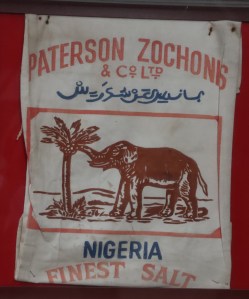
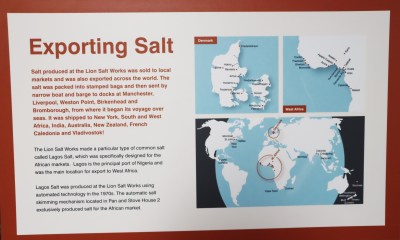
What a brilliant place! The Lion Salt Works in Northwich is not only the last open-pan salt works in Cheshire but one of only four remaining in the world.  I had really very little idea of what to expect, but of all the places I have visited, this one most resembles an industrial time capsule.  It is as though things were left just as they were when the Works closed, which is more or less what happened.  The biggest market for Lion Works salt was West Africa, but when the Nigerian Civil War broke out in the late 1960s, and the political situation that followed it failed to improve matters, the Lion Salt Works struggled to survive, and the business closed in 1986.  The decision was made to convert the Works into a museum of salt working, and what a good decision that was.  There are lots of information boards, models and sound effects, all excellent, but what really grips is the sense that this could all start up again tomorrow.

Roman and Medieval salt pans

Another extraordinary aspect to the place is how for just under a century, between 1894 and 1986, the method of making salt from brine hardly changed.  In fact, the method used was pretty much the same as that employed by the Romans in the same area.  Open-pan salt manufacturing is just what it says – the salt-carrying water, brine, was pumped up from two levels of rock-bearing beds from below the surface and then fed into huge rectangular iron pans, which were heated from below to drive off the water, and then dragged to the side of the pan to help them drain

Salt beds beneath the Lion Salt Works

The Cheshire salt was once suspended in sea water.  In the Triassic Period, c.220 million years go, the Cheshire Basin was a tropical lagoon in which seawater became trapped.  As the water evaporated from the lagoon, it left behind a rock salt known as halite (Sodium Chloride).  Two bands of of salt lie under Northwich and were tapped by the Lion Salt Works.  The first is 40m (131ft) down and is 20m thick (65ft), then there is a 10m (33ft) layer of marlstone and then a second, 30m (90ft) layer of salt.  When rainfall entered the water table and washed over the salt layers, it dissolved the salt again, and created subterranean streams of highly salted water known as brine.  Natural forces pushed these salty streams to the surface in the form of natural springs, but the streams themselves could be tapped by drilling down to them and pumping the brine out at the pump house.

Inside the Pump House

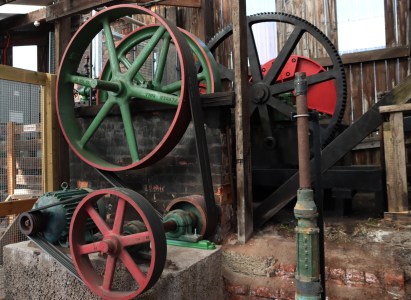
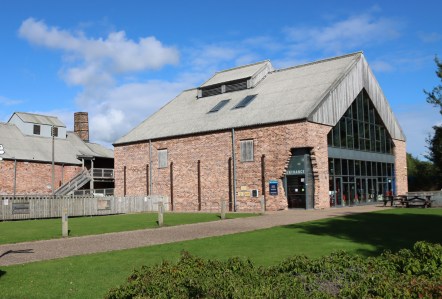
The pump house is a good place to start your visit on the way from the car park to buy your ticket in the former Stove House, now containing a brightly modern shop and café.  The brine, once extracted from the borehole,  was stored first in a tank and from there it was distributed to the salt pans for processing.  A steam engine powered the pump, and both the engine and its boiler are still visible in the pump house.  The pump was known as the “nodding donkey” due to the motion of the overhead beam as it rose and fell.

Once beyond the ticket office, you follow the signs to enjoy a self-guided tour.  There are plenty of disabled elevators for the leg-challenged and for wheelchair users, which you can operate yourself.

The first building that you come to is a former terraced house, the Red Lion Inn.  The original Red Lion Hotel was knocked down in order to expand the mining operation, so two terraced houses were purchased in order to give the workers somewhere to relax after the heavy labour in the stove and pan houses.  This building is now used to show Roman and Medieval versions of the pans (just smaller, not actually any different in how they were used) and to show a reconstruction of the works office, complete with clocking-in machine, and the Red Lion bar.

Indoor salt pan on the first floor

It is difficult to get one’s head around the salt pans.  The concept is childishly simple, but the sheer hands-on labour involved even as late as the 1980s is truly remarkable.  There are displays showing the role of each of the workers.  The Lion Works was set up and run by six generations of the Thompson family, and the workers were all local people.   At first both men and women were employed in the heavy duty work of the Works, but later women were confined to the less strenuous work of packing up the salt and carrying out administrative tasks.

The two main initial tasks were to rake up the salt in the pans once the water had been evaporated off (creating steam-heavy rooms), and to feed the fires in the stove houses.  Here’s a somewhat eye-popping excerpt from the guide book:

Salt-making was a ‘dark art’ and the salt workers would add all sorts of things to make the salt crystals form.  These included strong ale, bullock’s blood and eggs, but these were replaced by soft soap and glue

First floor stove room

Workers known as wallers worked in the outdoor pans, pulling the salt along the edges of the pan to form large walls to drain it.  Inside, lumpers worked on smaller (but still huge) pans to rake the salt to the sides where it drained, before pacing it into blocks or lumps. The lumps were taken on barrows to the stove rooms to dry out.  From here they went through a crushing mill, a splendid piece machinery that was steam-powered until the 1950s when it was converted to electricity.  The resulting salt grains were graded from fine to coarse before being packed up in bags or small plastic packs.

The salt that was processed outside was inferior to that made inside, not due to the original brine or the work of the crushing machine, but due to the temperature at which it was heated in the pans.  This is because of the multiple uses of salt, from fine-dining to packing fish caught at sea.  The Trent and Mersey Canal runs alongside the works.  Coal to power the engines and to heat the pans was delivered by narrowboat and the packaged salt was also sent out by narrowboat.  The canal network was huge, and even though canal travel was slow compared to the railways that eventually replaced them, was well equipped for transporting heavy, bulk products reliably to towns, cities and ports.

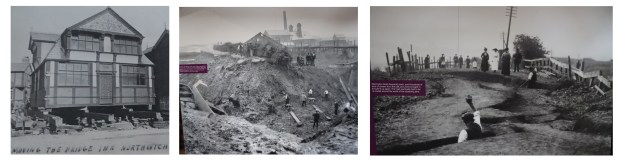
The mining works had a dramatic knock-on effect on the structural stability of the town of Northwich.  The story of the subsidence caused by the mining is another aspect to the story that is truly compelling.  On the approach to the Lion Works, one of the mines subsided so thoroughly in 1928 that two flashes now flank the road.   The subsidence had a truly transformative impact on buildings and infrastructure, and not in a good way.  Buildings shifted, some tilting backwards or forwards, others dividing slowly into two, the brickwork forming great fissures as the subsiding and pulled them in opposite directions.  The solution was to go back to Medieval domestic building traditions, creating light-weight frames and building in jacks points into which levers could be inserted, in order to persuade buildings back into position.  Other buildings, like the Bridge Inn, could simply be moved in their entirety.  This gives the town today a half-timbered look.  It is an astonishing idea that to respond to the conditions, buildings became just as shiftable as furniture. Roads too subsided, and one collapse caused a major breach in the neighbouring canal.

Left: The Bridge Inn in Northwich on the move, giving new meaning to nomadic settlement strategies. Middle: The Marston Hall mine collapse caused part of the canal to subside in 1907. Right: Warrington Road frequently sank and 1000s of tons of salt pan cinders were used to build it up again.

There is lots more to find out at the museum, and I recommend it for anyone interested in industrial heritage.  As well as the Works themselves, there are plenty of really excellent information boards, some interactive displays aimed mainly at children, and some absolutely splendid photographs.

Visiting

We piled out to Northwich along the M56, and it was easy to find the Lion Alt Works by leaving at Junction 10, but we had intended to return via the A51, taking in the Anderton Boat Lift on our way back.  In our dreams.  At the time of writing (September 2022) Northwich is up in extensive roadworks, and the diversion signs must lead somewhere, but heaven knows where.  A sign half-buried in an overgrown verge directed wannabe Boat Lift visitors to follow the diversion signs, which was hysterically funny as the diversion signs were, as stated,completely unfathomable.  We just about found our way to the A51 to Chester (although not by following the diversion signs), but we never did find the Boat Lift, in spite of several attempts, both with and without the SatNav.

At the museum there is a car park, café and shop.  A free map is given out, but a really useful guide is available for purchase too.  The opening times on the website state that the museum is closed on Mondays except bank holidays, and there is an entrance fee.  For up to date information check out their website.
https://lionsaltworks.westcheshiremuseums.co.uk/

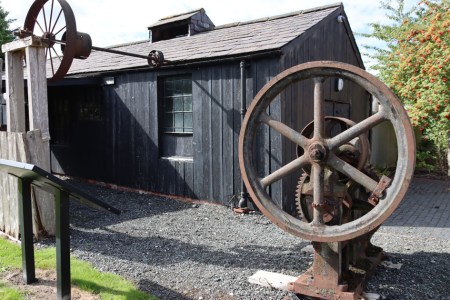
The smithy

The staff at the museum were friendly and helpful.  We were chatting to one of them at the end of our visit when we were sitting in the café.  His knowledge was immense, and he knew the answers to all the questions that we fired at him.  I failed to catch his name, but my sincere thanks.

The coffee came from a push-button machine, but was absolutely fine, and the tea was served in a lovely little pot.  The coffee was a particularly nice surprise after the undrinkable swill that was being served with breakfast in the Novotel in Greenwich (London), where I was staying recently!

For disabled and mobility-challenged visitors, there are wheel-chair friendly lifts to the upper floors, and you can operate these yourself.   The whole museum is intended to be disabled friendly, and at least to my eyes, looked very well thought out.

Feeding the ovens beneath salt pan 3

I wanted to see if there was any edible (as opposed to ornamental) local salt for sale, but forgot.  I am real salt enthusiast and always have several types at home for both cooking and seasoning at the table, so I am a tad miffed that I forgot to look!  If you go, do let me know if they were selling any.  There were blocks of ornamental salt for sale, in beautiful shades of pink, but I have no idea if it was edible too.

Manager’s house

Northwich town itself looks as though it will be well worth visiting after all the roadworks have come to a close, particularly if you are a fan of inland waterways and the architecture and civil engineering that goes with them (which I am).  Make sure that the Anderton Boat Lift is open if you want to see it, as its opening times seem to be something of a movable feast.


The crushing mill

Interior of the smithy


Exhibition: “The Tailor’s Tale” at Tŷ Pawb gallery, Wrexham

Image source: Tŷ Pawb website, with original image © Amgueddfa Cymru (National Museum Wales). The giraffe is sublime, but the panther is bliss.

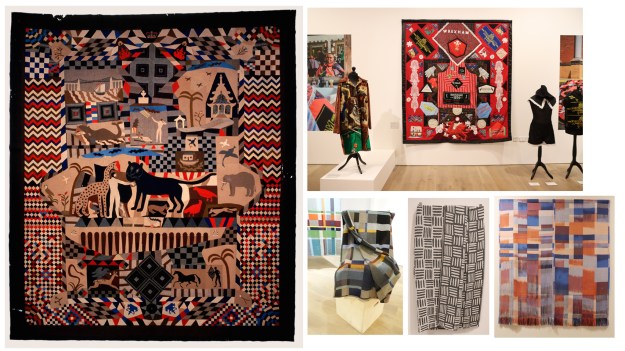
The Tailor’s Quilt, by James Williams. Click to see the larger, clearer image. Image source: Tŷ Pawb website, with original image © Amgueddfa Cymru (National Museum Wales).

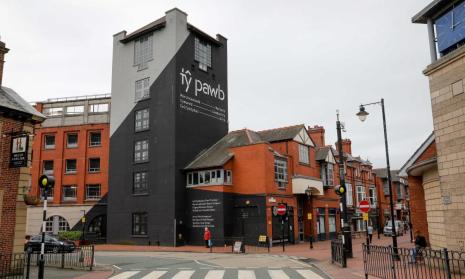
The Tailor’s Tale exhibition, at the Tŷ Pawb gallery in Wrexham, is on until September 24th 2022.  It is a rare opportunity to see the mid-19th century “Tailor’s Quilt” without having to go to south Wales to see it in its usual home.  The exhibition is showing at the same time as the exhibition Blanket Coverage, in the same gallery, about which I have already written here.

The Tailor’s Quilt was made by master military tailor James Williams of Wrexham (c.1818 – 1895). It is on loan from the St Fagan’s National Museum of History in Cardiff.  The museum bought it in 1935 from Williams’s grandson during the economic depression, where it joined a national folk art collection, which now has over 200 examples of Welsh quilting and patchworks.   

As well as the quilt itself, which is a complete joy, the exhibition features modern art works, including designer clothing and accessories by Sarah Burton (fashion house Alexander McQueen) and fashion designer Adam Jones;  a range of items  by Mark Herald, based on the quilt and commissioned by Tate Britain; and a set of four small pieces by Quilter’s Guild of the British Isles members Judy Fairless, Anne Gosling, Barbara Harrison and Helen Lloyd.  It is one of the pleasures of The Tailor’s Tale, that 19th and 21st century approaches to patchwork and quilting by local textile specialists can be seen side by side, with all the implications of social and economic change that each implies.
afdasfsd

The Tailor’s Quilt

First, a bit of terminology.  A quilt is generally defined as at least two layers of fabric with padding, called wadding, between them, all stitched together either with straight lines crossing each other to form squares or diamonds, or in more elaborate designs.  A patchwork consists of pieces of fabric sewn together.  A patchwork quilt is a patchwork that has been provided with a wadding and backing, and has been sewn together at multiple places across the surface to connect all three levels, to form a patchwork quilt.  The Tailor’s Quilt, technically, is a patchwork, because it is made up of different fabrics sewn together but is not sewn over to join all the layers together.  It is made using the intarsia method, as described by Dr Clare Rose of the V&A:  “This technique, also known as ‘cloth intarsia’, ‘mosaic needlework’, ‘inlaid patchwork’, ‘inlay patchwork’ and ‘stitched inlay’, involves cutting motifs out of wool cloth and stitching them directly to each other with no seam allowances and no backing fabric.”  Features like the panther’s very smug smile, are picked out in silk thread.

James Williams, Draper, located opposite another draper and a boot maker at the gates to the church. Source: @Tiffypox on Twitter

As modern as it looks, and as imaginative as it is, the Tailor’s Quilt was crafted by James Williams in his downtime over a period of 10 years between 1842 and 1852, using leftover fabrics from the suits and military outfits that he made, as well as from textile sample books that were no longer of use.  It is truly astounding for its scale, imagination and the splendid combination of representational scenes and abstract designs.  The quilt is surprisingly huge, and framed behind glass it is a real presence.

It is thought that Williams was born in 1818.  His name is listed in trade directories between 1850 and the year of his death in 1895.  A photograph survives of his shop sign with the church in the background, which is supposed to show a shopfront on 8 College St., Wrexham.  I went to have a look to see if the original building is still there.  The view shown left, which shows a sign with the legend “J. Williams Draper,” cannot possibly be College Street, which approaches at a very awkward side angle to the church tower.  This is without question Church Street.  Perhaps Williams moved from one premises to another at some point in his business life.

A view down Church Street today.

The Tailor’s Quilt measures 2.34m high by 2m wide (7.6 x 6.5ft) and contains over 4,525 pieces of material.  It is far bigger than I was expecting, even knowing the measurements.  It uses a fairly limited but perfectly harmonized palette of colours, drawn from what Williams had to hand.  It shows scenes from the Bible such as Adam naming the animals, Noah’s Ark,  Jonah and the whale (fabulously, with only the legs showing out of the whale’s mouth), and Cain and Abel, with the sky filled with lightning.  It also features motifs symbolizing Wales (a leek), England (a rose), Scotland (a thistle), and Ireland (a shamrock).  Giving the composite scene a really modern twist, the Menai Suspension Bridge and Cefn Viaduct (with a steam engine and two carriages passing over it) are also prominently featured.  The significance of the Chinese pagoda seems to escape most commentators, but perhaps (speculating recklessly) it was inspired by Chinese ceramics, which had become mainstream in 19th century Britain at the time. Part of the fun of the piece, with a huge, self-satisfied black panther dominating the composition, is looking for the vignettes and enjoying the details in each one.

Image source: Tŷ Pawb website, with original image © Amgueddfa Cymru (National Museum Wales).


The combination of abstract, symbolic and representational takes time to absorb, and it works perfectly both on the level of the detailed vignettes and as a complex composition that instantly creates an attractive and appealing impression.  It is difficult to imagine how, over a 10 year period, Williams was able to keep hold of the compositional elements to create something so beautifully balanced and proportioned. 
As the Tŷ Pawb website puts it, “The quilt is now widely regarded as one of the best surviving examples of Welsh folk art.”

It was exhibited at the Art Treasures Exhibition of North Wales in 1876 and the National Eisteddfod in 1933, both held in Wrexham, and in the British Empire Exhibition in Wembley in 1925.  Although its travels were put on hold for conservation work, it is now fit for travel once again, and was displayed in the Victoria and Albert Museum’s Quilts 1700-2010 exhibition in 2010, and was loaned to the Wrexham Museum for a temporary exhibition in 2017.  Its return to Wrexham at Tŷ Pawb in 2022 is very welcome.

Modern Responses to the Tailor’s Quilt

One of the reasons that this exhibition is so appealing is that it explores how The Tailor’s Quilt influenced and inspired other artists working in the same medium. It offers an opportunity not merely to see a sublime example of the genre, but to see how modern textile artists have incorporated design elements of the quilt in their own work.

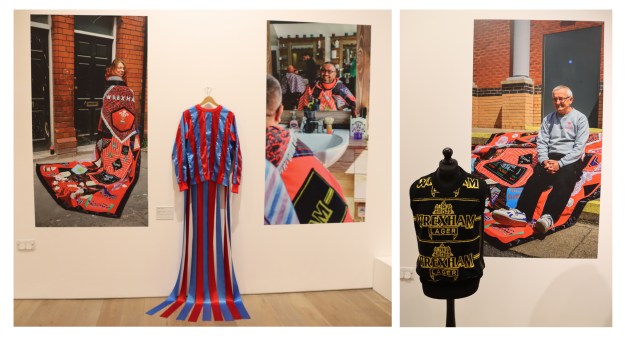
The most original of the contributions is that made by fashion designer Adam Jones, who was commissioned by Tŷ Pawb to make a quilt of his own to be displayed adjacent to the Tailor’s Quilt.  It works superbly, because Adam Jones has a style that is quite unlike that of James Williams.  His bright, often garish clothes are attention-grabbing and regularly make use of clashing colours, textual elements and pub-themed motifs to make often loud, sometimes kitschy and frequently humorous statements.  Adam Jones is from Froncysyllte near Wrexham, but is now based in London.   Although there are garments from Adam’s collection in the exhibition, to demonstrate some of his creative range, his quilt is particularly interesting in this context.  It combines the inspiration of the Tailor’s Quilt with a unique vision of Wrexham, its football team and pubs, and has its own intense personality.  The composition is set against a bright, shiny red background (Wrexham FC’s dominant colour), and is full of references to Wrexham, and in particular Wrexham Lager.  Contrasting textures, like lace and towelling, and everyday objects like a butcher’s apron and a pair of gloves are intertwined with abstract geometric shapes inspired by the Tailor’s Quilt.  Instead of all four nations, Wales is given pride of place with the dragon at its base.  Flanking Jones’s quilt are huge photographs of the quilt with local people, one man sitting on it, another draping it around her shoulders, removing textile art from the clean walls of the gallery and taking it back to its spiritual home.  Great fun.

fasdfs
Painter and printmaker Mark Herald was commissioned by Tate Britain to create some pieces based on the Tailor’s Quilt for the Tate’s shop.  Mark’s sketchbook is displayed here, together with some of the items that he created for Tate Britain (some of which are currently for sale in the Wrexham Museum, a short walk away).  His pieces include pictures, mugs, plates and bags.  He takes motifs and themes from the Tailor’s Quilt, gives them a bright hit of colour, and arranges them in harmony on the new surfaces.  They work superbly, echoing the Quilt, the motifs unmistakeably lifted from its progenitor, but given a bright, modern twist on the surface of everyday objects.  Although none of his other works are shown in the exhibition, a quick web search shows why Tate Britain chose him.  His own artworks are similarly full of light, often referencing the animal world, full of bright colours and dynamic shapes.


The name that pops up repeatedly when you do a search on the Tailor’s Quilt is clothes Sarah Burton, Creative Director of the fashion house Alexander McQueen.  Sarah Burton was inspired by the Tailor’s Quilt on a visit to St Fagan’s Museum, and incorporated its themes into her Autumn/Winter 2020 collection.

Her work provides yet another contrast.  Just as the Tailor’s Quilt is the product of a professional tailor working in Wrexham, and Adam Jones’s quilt and clothing specifically reference the small town environment of the 70s and 80s that were part of his upbringing, Sarah Burton’s clothing is self-consciously aimed at the catwalk and is the product of the couture design world.  Angular shapes and big panels of fabric are imprinted with motifs lifted directly from the Tailor’s Quilt, but given a new colour palette and an entirely new feel.

Four small pieces exhibited together are by Judy Fairless, Anne Gosling, Barbara Harrison and Helen Lloyd, who each made a piece as a response to the Tailor’s Quilt for the Llangollen Quiltfest in 2017.

From top left, clockwise: Ann Gosling “What a busy life I lead;” Helen Lloyd. “Jump,” Barbara Harrison, “The world around me,” and Judy Fairless, “All Stitched Up”

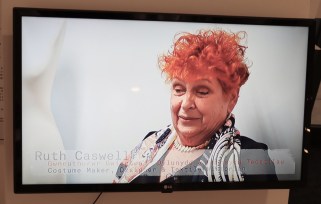
Although every exhibition has a curator and a team of skilled assistants, the general public does not often hear much about them.  This exhibition was the brainchild of the late Ruth Caswell, to whom the exhibition is dedicated.  She was a very remarkable and award-winning costumier, designer, artist and teacher, as well as a skilled curator of exhibitions, of which this was her last.  The Tŷ Pawb website explains how she started out:

Ruth moved to London in the 1960s, when she met and married her husband actor Eddie Caswell. Ruth said: “When we married and moved to London, we had only £12.50 to our name so I made clothes in my back bedroom and sold them in Kensington Market on a stall next to Freddie Mercury’s. I delivered them on the 73 bus each Friday and they sold instantly.”  Ruth’s clothes were photographed for Vogue and worn by model Jean Shrimpton.

There is a video in the exhibition showing Ruth talking at fascinating length about textile design, and her enthusiasm, eloquence and generosity of spirit are very evident.
rewrwe

Final Comments

Quilting and patchwork, as craft activities, have a long tradition in domestic contexts, either for daily use or to mark special occasions from the Medieval period onwards.  The Tailor’s Quilt, imagined and hand-stitched by a professional tailor, was very much the product of a professional skill, but was also created within a domestic context.  The exhibition makes it clear how craft activities are now gaining traction in the fields of design and textile arts, featuring on catwalks and in art galleries.  The liminal position held by textile arts for at least a century, is slowly being eroded, and textile is coming of age in a number of commercial contexts where they are recognized as both design and art.

It was a particular stroke of genius to organize The Tailor’s Tale and Blanket Coverage at the same time, and provide them with a single space to share.  Whilst quite different in their content and their style of display, both raise questions about how textiles are regarded today, and what they bring to the world of art.  Both of the exhibitions, the one exploring the impact of a single magnificent piece (the patchwork quilt) and the other exploring the multiple facets of a single genre (blanket weaving), work beautifully both in isolation and together.

With this new exhibition, the Tŷ Pawb gallery has again provided the perfect venue for bringing together modern art and local history, whilst also exploring more universal themes.  The exhibitions The Tailor’s Tale and Blanket Coverage run at Tŷ Pawb until September 24th 2022 between 10am and 4pm Monday to Saturday.  Entry is free of charge.


Sources:

Books and papers

Jones, J. 2016. Welsh Quilts. Seren

Rose, C. 2011. A patchwork panel ‘shown at the Great Exhibition.  V&A Online Journal, Issue No. 3 Spring 2011
http://www.vam.ac.uk/content/journals/research-journal/issue-03/a-patchwork-panel-shown-at-the-great-exhibition/#:~:text=This%20technique%2C%20also%20known%20as,allowances%20and%20no%20backing%20fabric.

Ty Pawb handouts, 2022.
– Artist Biographies
– Ruth Caswell

Websites

175 Heroes
Ruth Caswell
https://175heroes.bradfordcollege.ac.uk/ruth_caswell.html

Build Hollywood
Your Space or Mine: Adam Jones
https://www.buildhollywood.co.uk/work/adam-jones/

National Museum of Wales
Patchwork Bedcover
https://museum.wales/collections/online/object/4ce80b8d-182e-3822-8038-54080af6b0b8/Patchwork-bedcover/

Tŷ Pawb
https://www.typawb.wales
The Tailor’s Tale / Blanket Coverage at Tŷ Pawb 02/07/22 – 24/09/22
https://www.typawb.wales/exhibitions/the-tailors-tale-blanket-coverage/

Based in Churton
Exhibition write-up: The luxuriant “Blanket Coverage” at Tŷ Pawb gallery, Wrexham. By Andie Byrnes
https://wp.me/pcZwQK-2F8

An impressive exhibit of decorated Roman tombstones in Chester’s Grosvenor Museum

Introduction

Chester’s role as an important Roman military headquarters surrounded by a growing settlement, known as Deva, is very well understood, but there is not a great deal to see on the ground.  This means that Chester’s Roman legacy is largely preserved in excavated archaeological remains, some of which are on display in local museum spaces.  There is a small gallery of Roman objects in the Grosvenor Museum in Chester showing a wide variety of artefact types, from elite pottery to drainage pipes, but to display some of the large number of Chester tombstones, a special exhibition space was was created for them in a dedicated room in the museum, showing them off to great effect.

The display opens with a Roman style couch under a canopy, setting the scene for a walk down a path between the tombstones, emulating one of the Roman roads heading out of Deva.  The walls behind the tombstones capture the sense of the surrounding landscape, part military installation, part civilian settlement, and part rural vistas.  The tombstones are organized either side of the “road,” each one facing out towards the visitor.  Low level information boards, great for wheelchair users and children, show useful illustrations of key examples, together with translations of the texts.

In the discussion of tombstones below, each example is accompanied by an RIB (Roman Inscriptions of Britain) number.  Each inscription in Britain has been given a unique number.  When I was at university studying the Antonine Wall, the Roman Inscriptions In Britain were recorded in print, but this was obviously the sort of content that was best suited to a database, and one of the best online resources for Roman Britain is Roman Inscriptions in Britain online.  As a resource it has been developed and expanded, and the user interface is excellent.  If you want to know more about any of the tomb stones mentioned below, this is a great place to start, with translations, illustrations and further references all available.

Burials and memorials

Altar RIB 3149, found at the Chester amphitheatre

The Romans disposed of their dead in a variety of ways that included both inhumation (deposition in the ground) and cremation.  Wealthier Roman inhumation burials in Britain were traditionally accompanied by this sort of memorial, and might include tomb stones and commemorative slabs.  In terms of how they were used, tombstones are much like the grave stones and chest-like tombs found in Christian churchyard cemeteries today, but dedicated to different deities and with far more elaborate scenes depicting the owners of the graves engaged in activities that showed them in activities that they enjoyed, or which highlighted particular qualities.

Collectively, these memorials are a useful source of information about Roman life and death in Britain, but individual memorials also have the potential to tell their own stories about the owners, the way in which the owners wanted to be remembered and the ideas with which they wanted to be associated.  Although the Grosvenor Museum’s display primarily features tombstones, there are some altars too.  Altars could be found in similar contexts, but might also be found in homes, public buildings and at religious sites.  The above example from the museum’s exhibit, RIB 3149, was found in a room behind the amphitheatre arena’s wall during excavations in 1966, and reads, in translation, “To the goddess Nemesis, (from) Sextius Marcianus, centurion, in consequence of a vision.”

Roman cemeteries

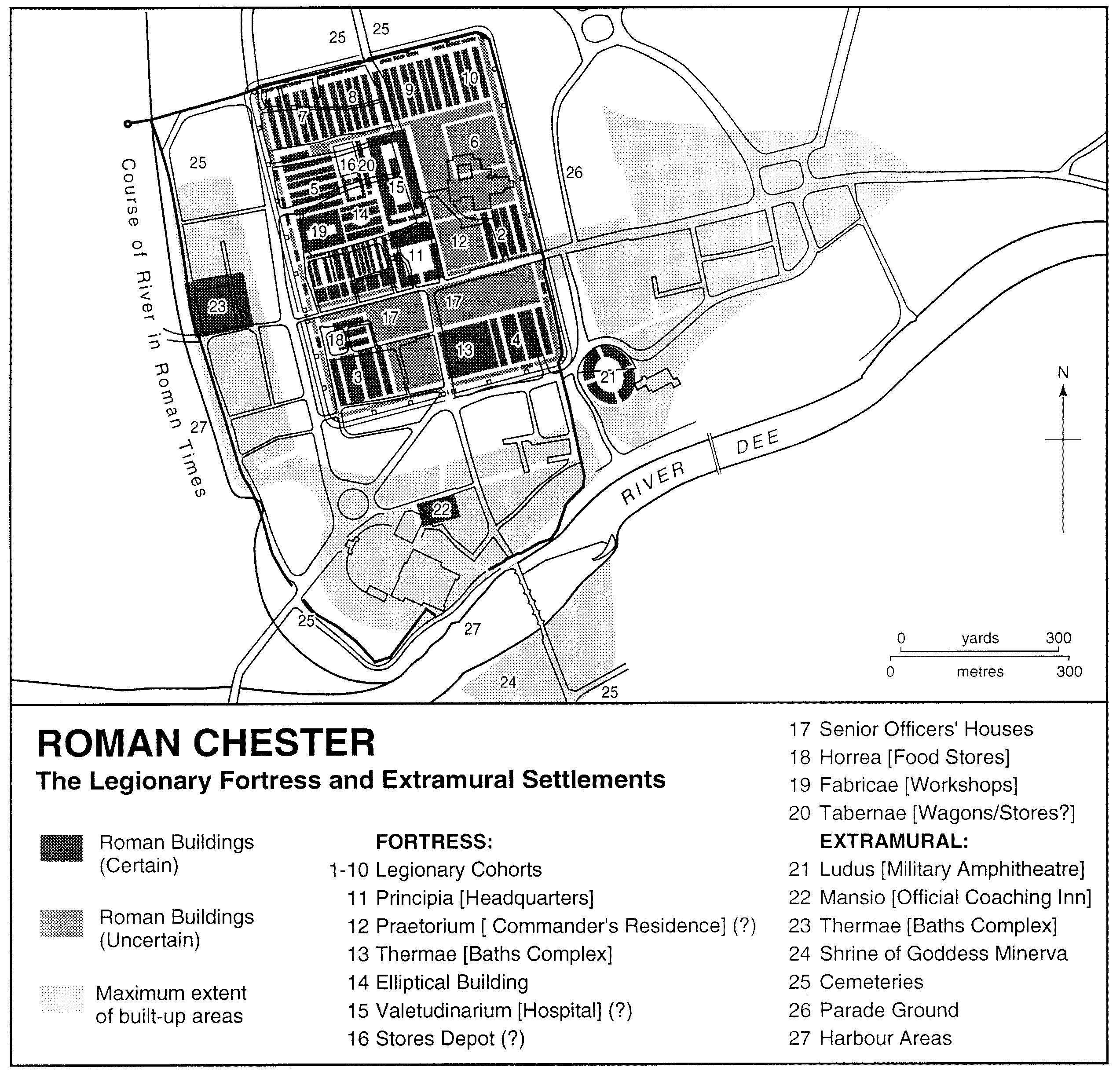
Roman Chester with modern roads superimposed (click to enlarge). Source: British History Online

The area around the fortress was under military control and the location of the cemeteries was decided by the Praefectus castorum (camp prefect), who decided where civilian quarters and various facilities were to be located.  Roman law was very strict on the matter of refusing burial with in urban and residential areas.  Roman cemeteries were built outside towns and cities, and depending on the size of the urban centre there might be a number of them.  The earliest tombstones and altars were erected along the sides of roads, but more formal cemeteries would have been established over time.   These will have been destroyed as Chester spread out in all directions during subsequent centuries.  Most of the stones in the museum, sculpted or inscribed, or both, had therefore originally come from one or more Roman cemeteries, and were probably dumped somewhere together to make space for urban spread.

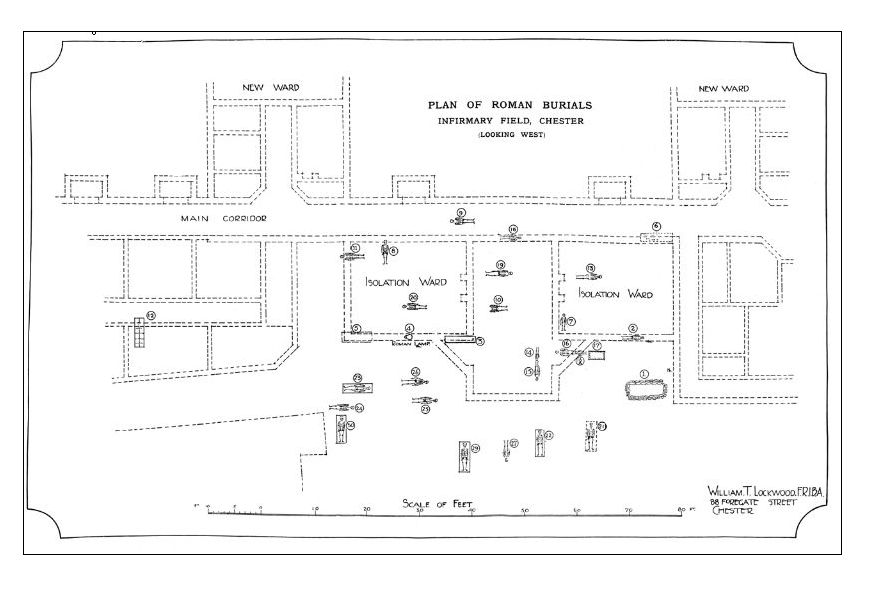
Plan of part of the Infirmary Field excavation. Source: Chester ShoutWiki

One cemetery was revealed during rescue excavations carried out between 1912 and 1917 by Professor Robert Newstead.  It was located at Infirmary Field to the west of the fortress, the site of a planned new wing for Chester Royal Infirmary.  The presence of a possible cemetery  had been known since the mid 19th century due to the discovery of burials adjacent to the Infirmary in 1858 and 1863.  During his excavations Newstead found that the cemetery contained men, women and children who, judging from the objects in graves, were both military and civilian.   

The tombstones in the walls

Section of the Chester City walls thought to be Roman, sitting on bedrock above the canal.

The high sandstone walls that surround the city of Chester were originally established in the Roman period, but were built upon in subsequent periods to repair damage and to raise the overall height of the walls.   There are only a few places where Roman phases can be clearly identified with confidence, such as that shown on the right.  The repair of the walls over time incorporated both newly quarried stone, and whatever stone was lying around from earlier collapses.

Although tombstones and altars are known from various locations around Chester, most of the Chester tomb stones in the Grosvenor display are from a cache found incorporated into the Chester city walls, completely divorced from their original funerary context, but would once have come from one or more cemeteries. The re-use of ancient building materials is common the world over.  In ancient Egypt, the Pharaoh Horemheb re-used painted blocks from palace buildings of the heretic Pharaoh Akhenaten as rubble fill to create the thick walls of his monumental gateway at the temple of Karnak on the Nile.   In both the Chester and Karnak cases, these items used as building materials have enormous historical value to us today as information about the past, but were simply unwanted rubbish when they were employed as building materials.

Plate A from Cox’s publication of his excavations in 1891

In 1883 the Chester City Surveyor Mr Matthew Jones was overseeing repairs to a section of the lower courses of stonework in the walls and the fill behind them near to Morgan’s Mount.  As they prepared the site for the work he realized that he was looking at pieces of Roman stonework and that one was clearly part of a tomb stone, and he retrieved what he could see.  Although no further investigations were carried out in1883, further repair work was required in 1887 between Northgate and the King Charles Tower, this time rather more extensive, and more Roman funerary pieces were found.  Again, they had been used to repair the lower courses of the wall.  So many were found this time that it was decided to extend the work and locate more of Chester’s Roman heritage.  The Chester Archaeological Society, founded in 1849 (and still going strong today), was brought in to supervise the investigation of the wall to the west of the Northgate between 1890 and 1892.  Taking all the finds from 1883, 1887 and the 1890-92 excavations, more than 150 stones were found, of which the Grosvenor exhibit is a tiny sample showing some of the best of the examples.

Key features of tombstones

Tombstone of Flavius Callimorphus and Serapion. RIB 558

The earliest tombstones and altars known from Chester date to the 1st century.  For example, the tombstone of Flavius Callimorphus showing him with his son or nephew Serapion (aged 42 and 3 ½ years old respectively) was discovered at the Roodee in 1874, in situ over a grave, and was erected by Flavius’s brother Thesaeus (RIB 558).  These are Greek names which may indicate that they were freedman and/or traders who had settled in Chester.  Flavius is shown reclining on a funeral couch, and the elaborate nature of the decoration indicates that this was a wealthy family.  Within the grave were two skeletons accompanied by a gold ring and a coin of the emperor Domition, dating to the latter half of the 1st Century A.D.  Callimorphus and Serapion, the former lying on a couch with the latter in his arms, shown in the photograph to the left.  On a small table in the foreground is a bird, which is a metaphor for the journey into the afterlife.  Next to the table is an amphora that may or may not suggest that Callimorphus was an importer of wine.  Although it is speculation that he was a wine importer, the family names indicate that they were of eastern Mediterranean origin, where Greek was preferred to Latin, and could well have been traders who settled locally.  The name Serapion is of particular interest, as it refers to the god Serapis, who was venerated during the Ptolemaic (Greek) and subsequent Roman occupation of ancient Egypt.

Altar from Watergate Street. RIB 445. Source: British Museum BM 1836,0805.1.

Amongst other Roman finds, a 2nd Century A.D. stone altar was found in lower Watergate Street when Georgian terraces were built in 1778.  It was dedicated to Fortuna Redux (Fortune, who brings travellers home safely, including soldiers and traders) and gods of healing and health Aesculapius and Salus.  It was raised by freedmen and slaves of a Roman imperial legate, perhaps a provincial governor, who has the longest recorded name in Roman Britain:  Titus Pomponius Mamilianus Rufus Antistianus Funisulanus Vettonianus.  This is the only example shown here not on display in the Grosvenor Museum. It is now in the British Museum (BM 1836,0805.1; RIB 445)

Nearly all the memorials on display in the Grosvenor are made of red sandstone.  The quality of the stone chosen was important, both for engraving scenes and text, and for durability.  The raw material selected was not the most locally available sandstone, but according to Wilding was sourced some 8 miles away where better quality red sandstone was available.

The tombstone of Caecilius Avitus, RIB 492. On the left is the original as it was found. On the right is the replica with its bright paint, both on display in the museum.

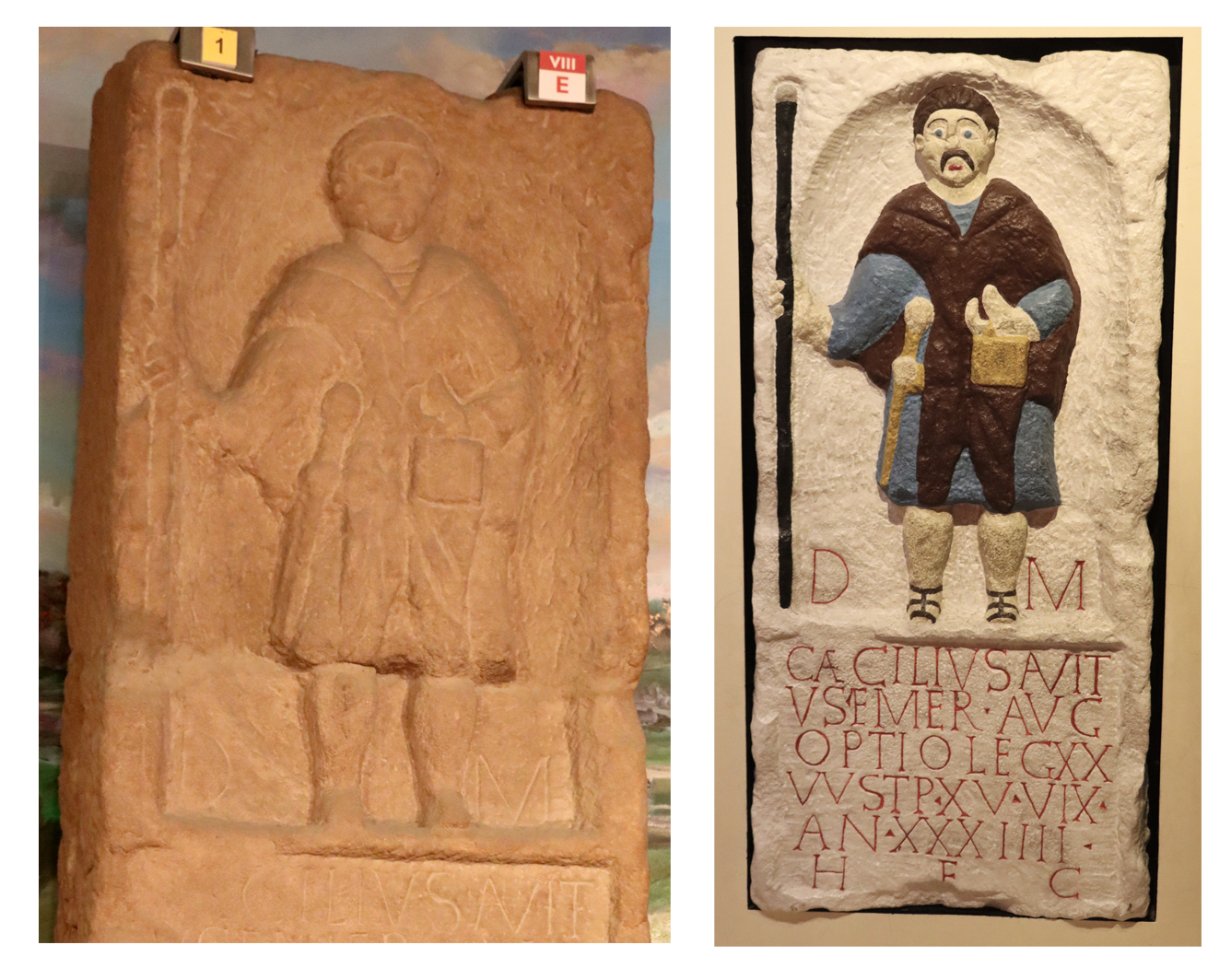
The stones would originally have been brightly painted, which is a strange thought.  A cemetery would have been a colourful place, new memorials brighter than older ones, creating a dazzling visual spectacle.  At the entrance to the Grosvenor Museum exhibit there is a facsimile of one of the Chester grave stones showing how it might have looked in full colour, and when compared with the original unpainted version that is also on display, it is a completely different entity.  It shows an optio (junior officer who was an accountant-adminstrator, second in command to a centurion) called Caecilius Avitus, wearing a cloak, a staff of office, a legionary sword and  a writing tablet (RIB 492).  It is like seeing the Lady Chapel in Chester Cathedral, painted to show how it would have looked in the Medieval period, or the glorious 17th century decoration of Rug Chapel at Corwen, near Llangollen, both of which are similar eye-openers, revising how we look at past objects and architecture.  To modern eyes, so accustomed to seeing the past in subtle monochrome, the bright paintwork of Caecilius’s tombstone is almost shocking, but Roman life was anything but dull, either at work or at play, and the colours of the stones reflected this multi-hued existence.

Between the moment of death and the burial itself there were ceremonies, rituals and processions that marked the transition from this world to the next.  For the very rich, this could be ostentatious and elaborate, involving music and theatrical performances, but for the poor it was a much more mundane affair.  Often a Roman might provide for their funeral in his or her will, but if not the responsibility fell to the person who inherited the rest of the property of the deceased.  When the deceased was buried, graves could be visited by the living, and at the end of February during the Feralia festival offerings were made to dead ancestors at their graves.

Tombstone of Curatia Dinysia. RIB 562, described below

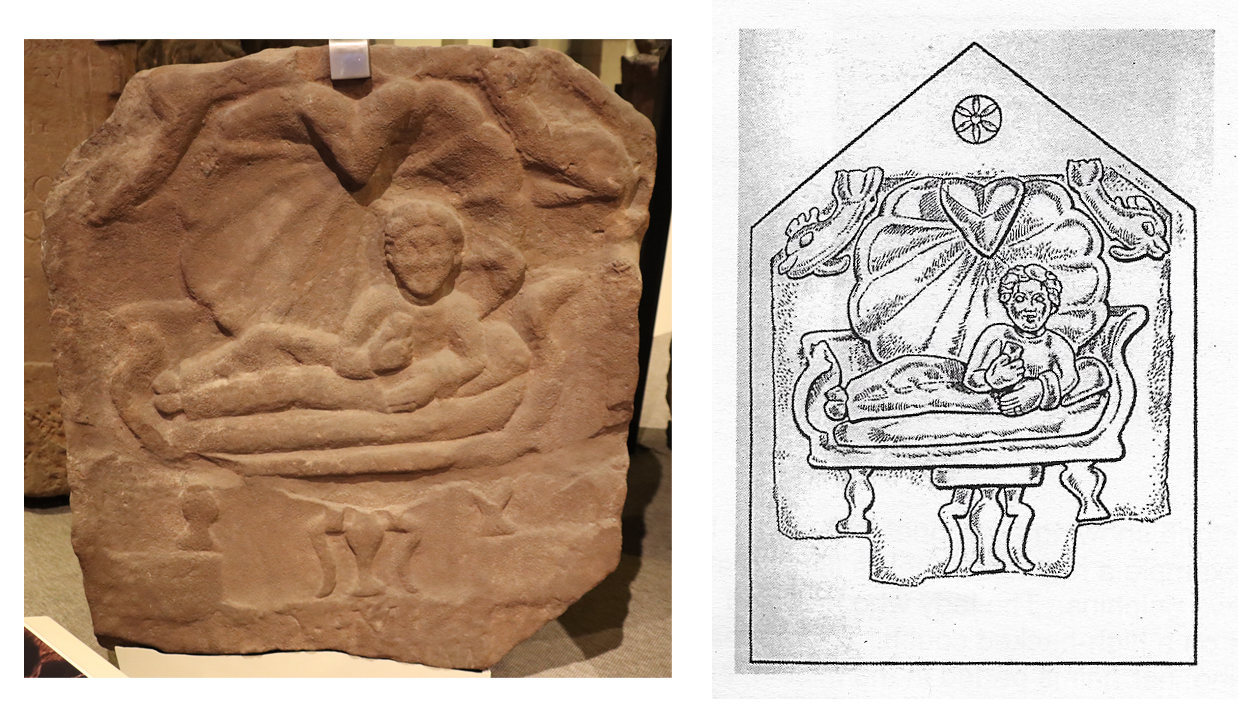
Popular themes on the Chester tombstones are dedications to certain deities, symbolism surrounding the afterlife and depictions of the deceased lying along a banqueting couch.  Reclining on a couch was a popular eating position used by wealthy Romans, and the couch represents a banquet in the afterlife, indicating eternal wellbeing.  Some objects in scenes may hint at the profession of the deceased.  Where an inscription is included, in Latin, the names can give an indication of the origins of the individual.

Text on tombstones is always highly abbreviated, which would not have been a problem for literate contemporaries (or for researchers today) because the abbreviations were standardized and the texts were highly formulaic.  Many of the inscriptions begin DM, standing for Dis Manibus (To the spirits of the departed), and finish HFC, standing for Heres Faciendum Curavit (the heir had the stone made). The heir often adds his or her name and relationship to the deceased.  Between these topping and tailing devices there may be additional information about who died including, for example, the name of the deceased, the age at which they died, who erected the stone in their honour, the place from which the person originated, the role that the person performed, a legion or auxiliary unit in which a soldier served and the number of years for which he served.

The Grosvenor Museum tombstones

Showing some of these features is a woman reclining on a couch, framed within two columns and an arch. She is shown in the photograph immediately above.  Her name is Curatia Dinysia (perhaps a mason’s error for the name Dionysia), holding a drinking cup, with a three-legged table in the foreground (RIB 562).  Sadly the head and face are damaged. She sits between two garlands or swags of ivy leaves, sacred to the deity Bacchus, each of which supports a dove, signifying the release of the soul.  Above this scene, incorporated into the architecture of the arch, are two tritons (half men, half fish, like male mermaids, but sometimes shown with horse forelegs) blowing trumpets, representing the journey to the Isles of the Blessed where Bacchus resided.  The drinking cup, probably filled with wine, may also reference Bacchus.  As with Calimporphus and Serapion, the name Dinysia/Dionysia is  thought to be Greek.   The inscription reads, in translation, “To the spirits of the departed, Curatia Dinysia lived 40 years; her heir had this erected.”

The illustration on the right is by Dai Owen (Grosvenor Museum 2010)

Another woman is shown on a very worn tombstone, also cleverly recreated by illustrator Dai Owen (RIB 568).  The woman’s name is damaged, but ends “-mina”  She reclines on the banqueting couch with the familiar three-legged table in the foreground, a drinking cup in hand and a ring on the little finger of her left hand.  Most remarkably, behind her, on the the high-backed couch, is a giant sea shell flanked by dolphins, again a reference to her journey to the Isles of the Blessed.  Only part of the inscription has survived, with the DM of Dis Manibus (to the spirits of the departed) legend just beneath the three-legged table, and the end of the lady’s name just below that at far right.

Tombstones featuring women are usually found in this sort of military context, where many were wives, (more rarely mothers or daughters) of soldiers, and could communicate their own status alongside their husband’s, making statements about their own identity.  It is good to have these as they are a distinct minority. Allason-Jones, for example, estimates that inscriptions dedicated to women make up only around 10% of the total inscriptions found in Roman Britain.  These represent only the middle and upper echelons of those living in Roman areas.  As with low status men, those women who could not afford any form of memorial have been lost.

The auxiliary cavalryman (equitis) Aurelius Lucius, who has a Latin name, but was probably not of pure Roman origins is an interesting case (RIB 552).  Aurelius is shown with a moustache, beard and big hair.  Again, he is reclining on a couch, and like Curatia Dionysia, he holds a drinking cup in one hand, whilst in the other he holds a scroll of paper that represents his will.  Behind his legs are his plumed helmet and the top of his sword, and in the foreground is a small three-legged table and a boy holding a detached head.  Auxiliaries were often recruited from conquered lands and were not Roman citizens.  After 25 years in service they could apply for Roman citizenship. The uncharacteristic hair and the severed head, perhaps a war trophy, may refer to a background from one of these conquered regions, but Aurelius also chose to depict himself in a traditional Roman pose, with a traditional Latin inscription.  Perhaps he had become a citizen, incorporating his career as a foreign cavalryman but opting for a Roman afterlife.

One of the most remarkable of the Grosvenor’s tombstones is this rider on a horse carrying a flying standard.  It is thought to represent a a Sarmatian from an area now occupied by southern Ukraine and northern Romania.  The Sarmatians were nomadic hunters and pastoralists, excellent horse breeders and riders and formidable warriors.  No inscription survives, but he was almost certainly an auxiliary, as the Sarmatians were conquered in AD 175, and some are known to have been present in Britain.  Although none are known from Chester, there were Sarmatians in a regiment deployed at Ribchester in Lancashire, and it is not unlikely that a detachment of that regiment was present in Chester when this individual died.  The tall helmet is distinctive, and he holds a standard which he holds in both hands.  If he was indeed Sarmatian, this would have been topped with a fearsome dragon’s head with brightly coloured fabric flying to its rear.  When wind ran through the dragon’s jaws at speed, it made a terrifying noise to put fear into the hearts of the enemy.  His sword is in its scabbard at his side.

Another cavalryman is depicted on a scene that has lost its inscription, other than the letters DM (Dis Manibus) (RIB 550).  It is very worn, and the top of the head and the hand (and whatever it is holding) are missing but the scene is full of energy.  The horse, with its bridle and a blanket serving as a saddle clearly visible, is galloping with its mane blown back, and the rider’s legs hold tightly to its flanks.  The rider’s right arm is raised above his head, probably holding a spear, whilst his left hand, hidden from view, holds the rein or the bridle.  Trodden beneath the hooves of the horse is a naked victim who lies gripping a six-sided shield that has demonstrably failed to protect him.

Marcus Aurelius Nepos and his wife. RIB 491

A rather more domestic scene is provided by Marcus Aurelius Nepos and his wife.  The stone is right at the rear of the exhibit, and the inscription is difficult to see (it was not particularly clearly engraved in the first place) and is confined to the left, beneath the figure of Marcus Aurelius, centurion of the XXth Legion Valera Victrix, who died aged 50 years old.  There is a space beneath the figure of his wife for an inscription, but for reasons unknown this was never added.  As it was she who commissioned the stone, she was clearly still alive when the carving was made and may have left the space for an inscription of her own when she herself died, but perhaps she died elsewhere.  Marcus Aurelius is bearded, carrying a staff and has a prominent belt, a cloak over his shoulders with a small brooch attached.  His wife is holding a cup, and lefts the hem of her dress with one hand to reveal the skirt beneath.  Not visible in the photograph is an engraving on the side that shows a mason’s hammer and set square and the words SVB ASCIA D[edicatum], meaning “dedicated under the axe,” perhaps a formula to deter vandals. The tombstone dates to the 3rd century AD.

RIB 560. Tombstone of the child slaves Atilianus, Antiatilianus and Protus

The tombstones with elaborate or contained scenes are plentiful, but are still a minority in the context of British funerary memorials, representing only the most wealthy purchasers. Some tombstones merely showed a little decorative work to accompany the text.  This example (RIB 560), although still very fine, was provided with ornamental features but no elaborate scene.  It was dedicated by a master to three young slaves.  It reads, in translation, “To the spirits of the departed, Atilianus and Antiatilianus, 10 years old; and Protus, 12 years old.  Pompeius Optatus their master had this made.”  It is possible that the 10 year olds were twins. Although the thought of slavery always sits uncomfortably in today’s world, it should not be forgotten that in a period when slavery was the norm, it was by no means uncommon for masters and slaves to develop relationships of mutual affection and respect.  Perhaps that is what we are seeing here.

sdffsa

Final Comments

Architectural detail showing a male gorgon, with four snakes emanating from each side of his head.

The tombstones described above represent only a a small sample of the total number of engraved stones preserved from Chester.  Of those that were not tombstones, some were pieces of altars and others were fragments of bigger pieces of architecture, many of which also came out the 19th century excavations in the Chester walls, some showing Roman deities.  They are out of the scope of this post but, do watch out for those too in the display if you visit the museum.

The tombstones are particularly evocative and hopefully the small sample provided here gives an idea of what sort of themes were common, and how people like to have themselves depicted.  Death in the Roman empire was an integral part of a soldier’s life, and in the military life of Chester, death had its own role and its own places, with its own objects and iconography.  Most of the individuals represented here were of relatively high status, except for the slaves of their master Pompeius Optatus, but they came from a variety of backgrounds, all either stationed here or drawn here for commercial reasons by the military stronghold, and it is good to be able to see some of the variety that made up Deva society.

19th century illustrations from Chester Archaeological Society reports of the tombstones and other engraved stones excavated from the walls (click image to enlarge). Sources, left to right: de Gray Birch 1887, Watkin 1887, de Gray Birch 1888, Jones 1887, all in the Journal of the Chester Archaeological Society volume 2 (references below).

fdfsdfsd
For those who are interested in seeing something of Rome under foot in Chester, to supplement what can be found in museums, there are a number of guided tours available (some lead by Roman Centurions!).  If you prefer a self-guided tour, the Royal Geographic Society’s “Discovering Britain” website provides one, which can be downloaded as a a PDF or as an app for your mobile device: https://www.discoveringbritain.org/activities/north-west-england/trails/chester-trail.html.


Sources:

Those that were of particular use for this post are shown in bold

Books and papers

Allason-Jones, L. 2012.  Chapter 34, Women in Roman Britain. In (eds.) James, S.L. and Dillon, S. A Companion to Women in the Ancient World. Wiley

Bell, C.E. 2020. Investigating the Autonomy of Power: Epigraphy of Women in Roman Britain. Dissertation Submitted for the Master’s Degree in Archaeology, University of Liverpool
https://www.academia.edu/44879704/Investigating_the_Autonomy_of_Power_Epigraphy_of_Women_in_Roman_Britain

Brock, E. P Loftus. 1888) The age of the walls of Chester, with references to recent discussions; The discussion on the above paper; Mr Brock’s reply to the various speakers. Journal of the Chester Archaeological Society 2. Vol 2, p. 40-97.
https://archaeologydataservice.ac.uk/archiveDS/archiveDownload?t=arch-2910-1/dissemination/pdf/JCAS_ns_002/JCAS_ns_002_040-097.pdf

Cox, E.W. 1891. Notes on the sculptures of the Roman monuments recently found in Chester. The Historic Society of Lancashire and Cheshire, vols.43044, 1891-92, p.91-102

Eckardt, H. 2014. Objects and Identities. Roman Britain and the North-Western Provinces.  Oxford University Press

de Gray Birch, W. 1888. Notes on a sculptured stone recently found in the North Wall of the city of Chester. Journal of the Chester Archaeological Society 2. Vol 2, p. 25-39.
https://archaeologydataservice.ac.uk/archiveDS/archiveDownload?t=arch-2910-1/dissemination/pdf/JCAS_ns_002/JCAS_ns_002_025-039.pdf

de Grey Birch, W. 1888. The inscribed Roman stones recently found at Chester, during the second series of repairs to the North Wall.  Journal of the Chester Archaeological Society, vol.2, p. 98-131.
https://archaeologydataservice.ac.uk/archiveDS/archiveDownload?t=arch-2910-1/dissemination/pdf/JCAS_ns_002/JCAS_ns_002_098-131.pdf

Grosvenor Museum 2010. A Guide to Roman Stones at the Grosvenor Museum Chester. Illustrations by Dai Owen.

Henig, M. 2002.  Tales from the Tomb. In (ed.) Carrington, P.  Deva Victrix; Roman Chester Re-Assessed  papers from a weekend conference held at Chester College 3-5 September 1999.  Chester Archaeology
https://archaeologydataservice.ac.uk/archiveDS/archiveDownload?t=arch-2910-1/dissemination/pdf/CAS_DevaVictrix/CAS_DevaVictrix_075-078.pdf

Jones, I. Matthews. 1888. Official report on the discoveries of Roman remains at Chester, during the first repairs to the North Wall, in 1887. Journal of the Chester Archaeological Society 2. Vol 2, p. 1-10.
https://archaeologydataservice.ac.uk/archiveDS/archiveDownload?t=arch-2910-1/dissemination/pdf/JCAS_ns_002/JCAS_ns_002_001-010.pdf

Mason, D.J.P. 2007 (2nd edition). Roman Chester. City of the Eagles. Tempus

Thompson Watkin, W. T. 1888. The Roman inscriptions discovered at Chester, during the first repairs to the North Wall, in 1887. Journal of the Chester Archaeological Society 2. Vol 2, p.11-24.
https://archaeologydataservice.ac.uk/archiveDS/archiveDownload?t=arch-2910-1/dissemination/pdf/JCAS_ns_002/JCAS_ns_002_011-024.pdf

Wilding, R. 2006. Graham Webster Gallery of Roman Stones at the Grosvenor Museum, Chester: Explore the Hidden Mysteries of the ‘lost’ Roman Gravestones.


Websites

Roman Inscriptions of Britain (RIB)
https://romaninscriptionsofbritain.org/

Chester Archaeological Society
Professor Robert Newstead F. R. S. Lecture given to Chester Archaeological Society, 5th December 2009.  By Elizabeth Royles, Keeper of Early History, Grosvenor Museum
http://chesterarchaeolsoc.org.uk/wp-content/uploads/2016/11/LRoyles-NewsteadLecture_05-12-09.pdf

Roman Baths
You can decode tombstones at the Roman Baths, Bath
https://www.romanbaths.co.uk/sites/roman_baths/files/heritage/SECONDARY%20SCHOOL%20Decoding%20Roman%20tombstone%20leaflet_0.pdf

Encylopedia Britannica
“Sarmatian.” The Editors of Encyclopaedia, 29 Mar. 2018. https://www.britannica.com/topic/Sarmatian

Exhibition: “Tales from Terracottapolis” at Tŷ Pawb gallery, Wrexham

Tŷ Pawb, meaning “Everyone’s House,” is a small but well thought out community and arts hub in the heart of Wrexham.  I had never been to Tŷ Pawb before, simply because I didn’t know of its existence.  Although I have been permanently installed in Churton for over a year now, I am still finding my way around.  The photographs below are my own unless otherwise stated in the caption.

Ty Pawb in Wrexham. Source: Wrexham Leader

For those who have never encountered Tŷ Pawb, it was formerly a covered market with a car park on top.  Apparently the market was hanging on to life by a thread before it was closed and as usual with this sort of change, the plans unsurprisingly met with some resistance. Often, the words “arts” and “community” when put together in the same sentence are enough to set any number of warning bells ringing, but in this particular case, there has been a strong dose of common sense and a real feel for the town thrown into the mix. The car park and the open space occupied by the market are still there, but the exterior and the former market space have been given a very smart and modern facelift.  Small retail units and a food hall and modern benches and chairs making it an an excellent place to meet and grab a bite.  It is an impressive initiative, and looking at it today, it seems to be working very well.

Source: Ty Pawb

The  gallery fits in very nicely into this arrangement.  The market space with its creatively designed modern signage and bright frontages and furnishings give the whole place a contemporary edge, which segues nicely with the inclusion of the gallery, which is so well blended into the space that at first we couldn’t see it.

We were there to see Tales from Terracottapolis.  It is on until 4th June (open Monday to Saturday, 10-4, free of charge), and I recommend it wholeheartedly.  It is a small exhibit, a single gallery, but makes brilliant use of the space with its excellent light.  Using objects from the Wrexham Museum and elsewhere, together with art works from a number of local artists, it combines 19th Century with 21st Century ideas to explore the local production of architectural flourishes and glazed tiles that formed the character of an older, more confident and prosperous Wrexham.  Some of the decorative twiddles, like capitals, finials and long decorative panels, could be ordered from catalogues, but others were custom made.

There is an excellent video that provides the background to the industry, and explains how the terracotta was made, from kneading the clay by hand via being formed into moulds before firing, a highly skilled process from beginning to end.  It would have been really great to be able to re-see the video online.
asfsdfsdfsd

The front part of the gallery, where you walk in, is dominated by the modern pieces, many of which are very striking and engaging, and which aim to complement the story of Wrexham’s brick, tile and terracotta industry by offering new responses to it.

The first thing that draws the eye is The Brick Man by Antony Gormley, best known for his Angel of the North. It is (or would have been) one of his most tactile pieces, and a true celebration of brick.  This is a scale model of a piece that was originally planned as a 120ft (36.5m) monument in the run down Holbrook area of Leeds, near the Leeds City Station.  There was some public outcry against it, which is such a shame, as it resulted in the planning application being rejected by city planners.  As well as the scale model, itself a solidly impressive celebration of brickwork, there is an archive of documentation following the sources of the statue, from the original proposal to the official rejection of the the proposal.

There is a fascinating letter from the Partnership Manager of the British Railways Board, who supported the idea of the project, to a disgruntled objector, which really hits the nail on the head for me.  You can click on the image to see a legible version.  I am often amongst the first to grumble about inappropriate and poorly thought out modern sculpture installed in urban or rural locations as some form of random art statement, because such initiatives can actually alienate people from art and frequently undermine the impact of the heritage in which they are being installed.  By contrast, The Brick Man actually had real merit (originally, I typed “legs”), not only as an art work, but as a way of contributing to urban regeneration, both by drawing attention to the monument and the area, and by attracting visitors.  It is also a good piece of art, which is important.  I was previously unaware of The Brick Man, and it was a really good opportunity to see the scale model and some of Gormley’s original plans.

Display of pottery sherds by Paul Eastwood

Immediately on the right as you walk in to the gallery is a section of wall covered by rows of ceramic sherds that the artist, Paul Eastwood, had collected from riverside locations during lockdown.  It was so familiar, looking eerily like some of the stuff I have been collecting from my garden, and posing exactly the same sort of questions.  Eastwood, based in Wales, specializes in capturing how memory is created through objects and language and, in this case, what abandoned sherds tell us about the people who discarded them and the places they were found.  There were other pieces of his work on the same wall.

A set of large stand-alone pieces in the main space of the gallery, hanging panels and tall curving sections, captured the images of walls and arches, surface-traced like brass-rubbings from the derelict walls of buildings that had produced the bricks, moulded works and tiles.  I had not worked my way round to these Lesley James pieces when I was welcomed to the exhibit by one of the curators, who pointed them out to me, and I was glad she had as I would certainly have missed their textural connection with the 19th century manufacturers:

Lesley James surfaces traces

At the far end of the gallery is a floor-to-ceiling map showing the location of all the major brickworks.  It is an excellent way of showing just how important the area was for the production of bricks, tiles and terracotta.

In this section of the gallery, the focus shifts from present to past, and some of the marvellous tiles and moulded terracotta pieces are located here, together with the video.  This is where the exhibition makes a slight gear change from modern art gallery to beautifully displayed items of heritage.  Both flanking the map and at its foot, are examples of locally made bricks, each one marked with the name of the works that produced it, with a key to identify which name related to which manufacturing works.  In Farndon, on Brewery Lane, there is a Llay Hall brick more or less randomly incorporated into the left side of the road, all on its own, face up.  I have no idea what it is doing there, but it was great to see two of its relatives on display, from Llay Hall Brickworks in Sydallt.

sdfsadfasdf

J.C. Edwards ceramic tiles, rescued from a condemned property on the Air Products factory site in 1989, and restored and reconstructed in 1993.

The main manufacturers represented at the exhibition are Dennis Ruabon Ltd and  J.C. Edwards of Ruabon, both important local producers of bricks, tiles and terracotta.

J.C. Edwards tiles were particularly valued and were installed locally at Liverpool’s Pier Head, and at the Lever Brothers village Port Sunlight on the Wirral, and were bought from as far away as Singapore, Egypt, Panama and India.  Edwards also provided the floor tiles for the kitchens on the Titanic. There is at least one of his tiles in the British Museum, designed by Lewis Foreman Day.

Examples of Dennis Ruabon Ltd terracotta work can be seen locally in Chester at the Westminster Motor Car and Coach Works and the Central Arcade in Hope Street, Wrexham.  Further afield, the Grand Metropole Hotel in Blackpool and Wellington House, at Buckingham Gate in London are high profile examples of  Dennis Ruabon Ltd work.  Whilst Edwards specialized in brickworks based on the Etruria Marl unique to the area, Dennis had interests in a variety of industries, including  quarries, coal pits, waterworks, brickworks and a tramway.

Tiles by J.C. Edwards

Tiles by J.C. Edwards, Henry Dennis, Monk and Newell and the Pant Works

The use of clay pressed into moulds was an excellent way of enlivening buildings, giving them celebratory flourishes without all the costs involved in stone masonry.  The use of moulds that could be re-used many times, enabled manufacturers to produce catalogues for architects, from which their customers could choose appropriate features, which not only made decorative flourishes affordable, but resulted in their proliferation, particularly on roofs.  Once you have seen the items on display, as well as those more elaborate versions shown in the video, it encourages you to look up in places like Wrexham and surrounding villages to spot the terracotta work that gave many local towns a real sense of pride.

Dennis Ruabon Ltd chimney

The layout of the works was elegant and well thought out, with each item widely spaced from the next, allowing it to be appreciated without distraction.  The combination of modern art works and 19th century heritage objects worked beautifully.

All the signage was in Welsh and English, and there was a  handout introducing the modern artists whose works were on display, together with  the 19th century manufacturers J.C. Edwards and Dennis Ruabon Ltd.  I picked up the Welsh version, assuming that it was bilingual; presumably there was an English version as well, so if you don’t read Welsh, look out for it.  I was rescued by Google Translate 🙂

The friendly and helpful curator of the exhibition, whose name I failed to catch, told me that over 2000 people had visited since the exhibition opened in March, with a number of them either former workers or their families sharing experiences.  Certainly, from my own perspective of things I have found in my garden, the Llay Hall brick randomly set into the side of a lane in Farndon, and my enormous affection for 19th century tiles in general and the Westminster Car and Coachworks (now the public library) in Chester in particular, it was very easy to relate to this exhibition.  The modern art pieces also work really well, balancing the older pieces and offering a new way of looking at this type of heritage, as well as engaging the visitor in their own right with thoughts about how heritage can be remembered, explored and, when necessary, lamented.

There was a school party arriving as we left, and on the table by the door I noticed that there was a pile of A4 sheets showing illustrations of three different statues, with an empty space for children to add their ideas for a monumental work.  We flipped through the completed sheets, and they were brilliantly inventive.  They made me remember what it was like to be a child with all that flying, chaotic, no-holds-barred imagination.  I particularly liked the giant robin with a big mouth in its side were its wing should be, complete with a healthy set of teeth.  The giant jelly fish statue was also rather terrific, but they all had something to offer.  Some were surprisingly very abstract.  It was a marvellous idea.

The gallery is a welcoming place, completely unintimidating. I both admired and enjoyed the entire feel of the place.  My only actual grumble about  it is that apart from seating for watching the video there was no seating in the gallery for those who have less than perfectly functioning legs, or who just want to sit and soak up the exhibits.

Practicalities:

The gallery is open 10-4, Monday to Saturday and the exhibition is free to visit.  We didn’t investigate what else the gallery has to offer, so it would be worth checking what else is available and whether there is a ticket charge if you want to visit anything other than the exhibition space (Gallery 1).  Full details for visitors and future exhibits are at https://www.typawb.wales/plan-your-visit.  You can also follow them on Twitter at https://twitter.com/TyPawb

We parked in the multi-storey carpark on Market Street, which has lifts down to the ground floor where the gallery and the food /retail space are located.  It was easy to find, and unlike some multi-storeys, the spaces were generous.  Do not leave your carpark ticket in the car – the pay station is on the ground floor outside the doors to the elevators, and access to the elevators requires you to put your car park ticket into a ticket reader by the side of the door.

Tŷ Pawb has been shortlisted for Art Fund Museum of the Year, the winner of which will be announced in July 2022.  Here’s hoping!
afadfs

Source: Ty Pawb

Sources:

Ty Pawb
Exhibition: Tales from Terracottapolis
www.typawb.wales/tales-from-terracottapolis

Exhibition handout in Welsh:  Chwedlau o Terracottapolis 19/03/22 – 11/06/22


More re Wrexham’s brick, tile and terracotta manufacturing history:

Wrexham Leader
There was gold in the red of Dennis Ruabon
https://www.leaderlive.co.uk/news/20131331.gold-red-dennis-ruabon/

Old Bricks – History at your feet
Ruabon Area
https://www.brocross.com/Bricks/Penmorfa/Pages/ruabon1.htm

Coflein
Hafod Red Brick Works; Dennis Ruabon Brickworks, Rhosllanerchrugog
https://coflein.gov.uk/en/site/40776/

Wrexham History
Henry Dyke Dennis and the Red Works, by John Davies
https://www.wrexham-history.com/henry-dyke-dennis-red-works/

Pontcysyllte
Brickworks
https://www.pontcysyllte-aqueduct.co.uk/object/brickworks/

Hansard 1803 – 2005
Brick and Tile Industry, Wrexham Area: Motion made, and Question proposed, That this House do now adjourn.—[Colonel J. H. Harrison.] – Mr. J. Idwal Jones (Wrexham)
https://api.parliament.uk/historic-hansard/commons/1958/jun/10/brick-and-tile-industry-wrexham-area


More on Ty Pawb:

Ty Pawb
“About” page
https://www.typawb.wales/about/

The Guardian
Tŷ Pawb review – an art gallery that truly is everybody’s house. By Rowan Moore
https://www.theguardian.com/artanddesign/2018/sep/01/ty-pawb-review-art-gallery-everybodys-house-wrexham-market

Architect’s Journal
Something for everybody: Ty Pawb art gallery by Featherstone Young
https://www.architectsjournal.co.uk/buildings/something-for-everybody-ty-pawb-art-gallery-by-featherstone-young

Wrexham Leader
Ty Pawb, Wrexham, shortlisted for Art Fund museum of the year
https://www.leaderlive.co.uk/news/20126804.ty-pawb-shortlisted-museum-year/


More on artists in the exhibition mentioned in this post

Paul Eastwood
https://www.paul-eastwood.net/

Lesley James
https://www.lesley-james.com/

Antony Gormley
https://www.antonygormley.com/


Hidden Holt: An illuminating must-visit exhibition currently at Wrexham Museum

Cover of the free English/Welsh booklet accompanying the exhibition published by Wrexham Heritage Service, 2021.

My thanks to Brian Payne of the Holt Local History Society for alerting me to the fact that the Hidden Holt exhibition has been launched at the Wrexham County Borough Museum, running until 29th January 2022.  I went last week my father, and we were both bowled over by how good it was.

The exhibition introduces the Roman tile, brick and pottery works that were spread across a number of fields to the northwest of Holt, next to the river Dee.  It uses an excellent combination of original artefacts, video,  information boards and both old and new photographs and diagrams to track the twin stories of the site itself and the history of its discovery and excavation.  Holt Local History Society has a long-standing interest in the Roman works, and commissioned the most recent geophysical survey work at the site, so it’s great to see their contribution to the story being celebrated.

The exhibition (free to enter) is in Gallery 3, to the left as you move beyond reception and the café to enter the display areas.  I’ve given an overview below, but I seriously recommend that you just go – it is a tremendous, professionally-produced and beautifully designed little exhibition with some superb objects on display and some excellent information boards that explain what you are looking at.  You won’t regret it.  If you’re in the mood, the café serves a great coffee and what looks like a rather delicious lunch 🙂

Survey and excavation

Arthur Acton –  page 5 of the booklet accompanying the exhibition.  Source: Wrexham Heritage Service, 2021

The story of how the site was recognized and investigated begins in the early 1600s when landowner Thomas Crue of Holt Hill suffered repeated damage to his plough on broken brickwork and eventually discovered a series of fifty 2ft-tall posts and recorded this in a letter now in the British Museum.  The letter was mentioned in the book Roman Cheshire by W. Thompson Watkins (1886).  Retired chemist and keen amateur historian Alfred Neobard Palmer read the book, and in 1905 decided to hunt for the remains that Crue had found.  He tracked down the original letter and accompanied by local vicar Jenkyn Jones, and with the permission of the landowner Mr Beard, he engaged in a series of fieldwalking expeditions that found plenty of fragments of Roman bricks, roof tiles and pottery over an area of some 20 acres.

Fold-out plan of the kilns at Holt, published by Grimes in 1930. (Scanned from my copy of “Holt, Denbighshire”)

Palmer was not an archaeologist, and the task of excavating the site was taken on by Wrexham solicitor and amateur archaeologist Arthur Acton.  Work began in 1907,  in Wall Lock Field, and continued until 1915.  Although he lectured prolifically about the site, Acton never published his work.  Fortunately some of his records survived, and he sold the finds to the National Museum of Wales.  After five years of admirable work, the Assistant Keeper of Archaeology at the National Museum, William F. Grimes who was better known as a prehistorian, published a comprehensive 235-page report on the site, complete with site plans, photographs and object illustrations.

Photograph and logo from the Archaeological Survey West website: http://www.archaeologicalsurveywest.co.uk/

Work did not stop there, and during the 1970s Geoffrey Bevan conducted both field walking activities and an excavation, finding Roman material that filled dozens of boxes, which were donated to the Grosvenor Museum in Chester.  Most recently, Holt Local History Society commissioned Archaeological Survey West to carry out a geophysical survey of the site,  to accurately fix the positions of the known buildings and to identify any unexcavated and previously unknown structures.  This was successfully completed in 2018, and demonstrated that the Holt complex was even bigger and more complex than Grimes, via Acton, had been able to determine.  There is, of course, the potential for future field research.

The exhibition

Piece of a colander manufactured at Holt, on display at the exhibition

The exhibition is based mainly around discoveries made during the Acton excavations, using the Grimes and later reports to explain what was found and what has been discovered since.  Between them, Crue, Palmer, Acton, Grimes, Bevan, Holt Local History Society and Archaeological Survey West have produced a history of what lies beneath those lush green fields, and this is what the exhibition introduces.

As usual usual the exhibition’s narrative is arranged in a clockwise direction, so turn left as you walk in to Gallery 3.  The exhibition begins with a video that explains the history of survey and excavation and then talks about the site itself.  It is well worth taking a seat and watching.  It lasts about 15-20 minutes and is chock-full of information with some terrific photographs, diagrams and artist impressions of what various structures may have looked like.   The technique of superimposing building plans over a modern aerial view of the fields is particularly useful for understanding how the site was composed and what each element consisted of.   From there, the excellently designed displays take the visitor through the site’s history.

Site plan of the Roman tile and pottery work displayed in the exhibition. Also in the excellent booklet accompanying the exhibition, full details in Sources below. Click to see a bigger version with fully legible text.  Source: Wrexham Heritage Service, 2021

The site was more elaborate than I realized, composed of a number of buildings as well as the kilns.  The image on the right is shown at full size in the exhibition, and shows how big a complex the Holt tile, brick and pottery works actually was.  This is a bang-up-to-date site plan, combining the information provided by Grimes in 1930 with the details obtained by Archaeological Survey West in 2018. What this and a lot of Acton’s photographs makes clear, is that the site was a fully integrated operation combining industrial, public and domestic architectural components. A senior manager had his own house, complete with hypocaust (under-floor) central heating, there was a public bath house, presumably for workers, a series of kilns for the manufacture of mainly tiles and pottery, and a barracks that may have housed workers, or alternatively a detachment of the Roman army based at Chester at this time.  The features shown in blue are unrecorded / unexcavated.  Those in dark brown are the building locations fixed in 2018, and those in paler brown those estimated by Grimes based on Acton’s work.

The main kiln plant at Holt, published by William Grimes in 1930. Scanned from my copy.

Although now the archaeological remains are covered with fields, Acton used photography extensively, and his site plans were detailed, many published by Grimes, and used in the exhibition to reveal and explain the different components of the site.  This is very helpful not only for understanding how the site worked as an end to end operation, but is invaluable for putting the objects into context.  Objects on their own tell a limited story, but when contextualized in terms of the buildings in which they were produced and used, come to life.  The exhibition does this brilliantly.

It was a good location for a tileworks.  Building stone was available in the immediate locality thanks to the Bunter sandstone, alluvial clay was available locally, woodlands were present for the provision of fuel to feed the kilns, and the river Dee provided direct access to Chester, 12 miles / 19km away, passing the civic settlement at Heronbridge.  The generally flat environment meant that building of roads was not particularly laborious.

The visitor is taken step-by-step through the production process, explaining how the kilns and drying sheds  were built and how they functioned. The kilns formed two main units, a larger (139ft / 52m long, consisting of a row of six kilns) and smaller twin-kiln built on the natural bed-rock.  Each kiln was rectangular and tile-lined with an arched stoke-hole for access.  A round pottery kiln was also located on the edge of the main kiln complex.  The oven floor was fascinating, consisting of a raised floor of tiles plastered with clay that were pierced with holes that acted as vents.  I was fascinated to see that the drying shed was provided with a hypocaust, better known as the under-floor heating system that was used in villas and bath houses.  These, like the kilns, were stoked and kept hot to ensure that the tiles, pottery and bricks were dried through after firing.

The exhibition displays a number of artefacts, including a roof tile, a brick and a triangular atefix tile marked with the letters LEGXXVV, an abbreviation for the twentieth legion, known as Valeria Victrix (valiant and victorious).  The antefix tile, one of which is shown in the exhibition (photo left and illustration below) also shows Legio XX’s dramatic running boar symbol.   Legio XX was stationed at Chester from AD87, and the Holt works appears to have been established shortly afterwards, reaching its peak output at around AD135, and falling out of use in the mid 3rd Century.

Antefix tiles from Holt. Source: Grimes 1930

A display board shows the vast range of products that were made at the site, including floor and roof tiles, and a variety of different pottery forms.  There is a good explanation of how the roof tiles, called imbrex and tegula (plural imbrices and tegulae), worked.  A good memory for me – I dug up a lot of these tiles at my first ever dig in Silchester.  The arched imbrices, sit snugly over the upright edges of two facing tegula tiles, as shown in the above photograph, and the the triangular antefix tiles were placed to cover the ends of the imbrex.

Green-glazed ware found at Holt. Source: National Museum of Wales

Examples of the pottery found at the site are on display, with some really fine examples, including ollae (jars), urcei (jugs), lagenae (flagons), cattili (plates), calices (drinking bowls), and testa (lids).  I particularly liked a partly preserved ceramic colander and a mortarium (the latter working like a modern mortar, but with bits of stone embedded into the interior base of the pot to create a rough surface for grinding spices and seeds).  Green-glazed pottery, a luxury ware that I had never come across before, was also made at the site.  It is rare in Britain, so it was excellent to see examples of it on show.  A photograph of the green glazed pottery found at Holt (from the National Museum of Wales website) is shown below.

The workers also turned their hands to other types of objects made from clay – one cabinet shows a marvellous piece of shaped water pipe that was manufactured at the site.

Section of water pipe manufactured at Holt

All of the output manufactured at the works was sent by boat downriver to Chester, the exhibition suggests that a short may have been dug out at Holt in order to make loading the ceramics easier, its course marked today by annual floodwaters that, as they recede, leave a line of floodwater in what could well be a Roman channel.

Samian pottery found at Holt. Source: Grimes 1930

Interestingly, the exhibition shows that even though huge amounts of pottery was being made on-site, there were particularly favoured types of ceramic being imported.  Samian (terra sigillata), a truly gorgeous luxury dark red ware that has moulded decoration on its lustrous surfaces, was found in surprising quantities.  This was usually imported from south-eastern Gaul (France); a Roman experiment with samian production in southern England produced inferior pottery and was very short-lived.

Imported black-burnished ware was also found at Holt, which the exhibition explains was made in Dorset.  At sites in southern England it is common (we found bucket-loads of it at Silchester), but when found at northern sites, it was probably imported to fulfil a particular need or desire.  The works manager might have wanted high-status ceramics, and any soldiers at the site may have craved the comforts of home, but another option is that it was being imported for use by a nearby settlement.  One of the findings of the 2018 geophysical survey was the presence of a possible Roman fort or marching camp to the west of the site, suggesting that the site may have been on the edge of an unidentified vicus settlement, or village.

Coins on display in the exhibition.

The coins at the site are invaluable for their contribution to creating a timeline for development of the site, but are works of art in their own right.

The exhibition provides another insight into the inhabitants of the site by displaying some of the other objects they owned, like small pieces of jewellery made of bronze, manicure equipment, a beautifully crafted needle and a delectably delicate silver spoon.  These are objects that people chose and kept on them, intimate reminders that these were real people who lived complicated lives in which personal appearance had an important role.

Silver spoon from Holt on display at the exhibition. Source: Grimes 1930

A map at the end of the exhibition was riveting, showing how widespread Roman presence in northeast Wales actually was, showing everything from single find-sites to industrial sites like that at Holt, the settlements at Heronbridge and Plas Coch, and the villa at Rossett, the latter two sites both recent discoveries.  It looks as though there will be more Roman discoveries in the future, filling out a picture not merely about the activities of Romans in Britain, but on their interactions with local communities, something which remains poorly understood.

Museum details

The museum is an excellent resource, a small but modern with excellent displays and a lot of great information on professionally produced display boards into context. At the time of writing (August 2021) masks must be worn and you need to leave your name and telephone number with reception.  For opening days and times, plus directions, see the Wrexham County Borough website:
http://old.wrexham.gov.uk/english/heritage/wrexham_museum.htm

A booklet accompanying the exhibition is available both in the museum foyer and under the video screen in Gallery 3.  The cover and some of the pages from the booklet are shown at the top of the post, and full details are in Sources, below.   A leaflet, Holt: Legacy of the Legions, is also available from the museum, or can be downloaded.

It is a real shame that the Hidden Holt gallery is only a temporary feature, but Wrexham Museum has a lot more to see, and I will be posting about some its permanent displays in the future.

Sources:

Books and papers

Grimes, W.F. 1930.  Holt, Denbighshire:  Twentieth Legion at Castle Lyons.  Y Cymmrodor.  Society of Cymmrodorion.

Ward, M. 1998. A collection of samian from the legionary works-depot at Holt.  In (ed.) Bird, J. Form and Fabric.  Oxbow Monographs 80.
https://www.researchgate.net/publication/333155555_A_collection_of_samian_from_the_legionary_works-depot_at_Holt

Ward, M. 1998. Some finds from the Roman works-depot at Holt.  Studia Celtica 32:43-65
https://www.researchgate.net/publication/311789557_Some_finds_from_the_Roman_works-depot_at_Holt

Booklets / leaflets
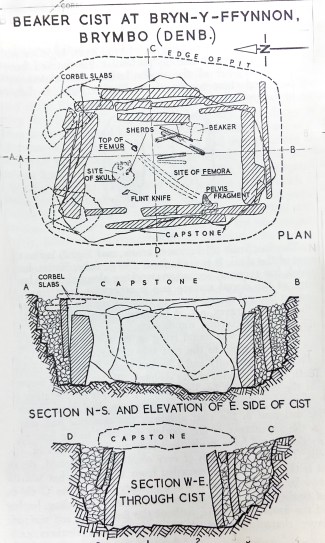
Wrexham Heritage Service 2021.  Hidden Holt.  The Story of a Roman Site.  The Discovery of a Roman Legionary Tile and Pottery Works at Holt, near Wrexham.  (Booklet accompanying the exhibition in both English and Welsh)

Holt Castle Conservation and Interpretation Project.  Holt. Legacy of the Legions.  An introduction to the history of the Legionary Works Depot at Holt. (Leaflet, including site plan, available from the museum)
http://old.wrexham.gov.uk/assets/pdfs/heritage/holt_castle/holt_legacy.pdf

Websites

Hidden Holt
Wrexham Museum
https://www.wrexhamheritage.wales/?exhibition=hidden-holt-the-story-of-a-roman-site

Hidden Holt – Roman history revealed in a new Wrexham Museum exhibition
Wrexham Council News
https://news.wrexham.gov.uk/hidden-holt-roman-history-revealed-in-new-wrexham-museum-exhibition/

Holt Local History Society
https://holtlhs.weebly.com/

National Museum of Wales
https://museum.wales/

Roman Glazed Pottery from North Wales
National Museum of Wales
https://museum.wales/articles/1327/Roman-glazed-pottery-from-North-Wales/

The Pottery Kilns of Roman Britian by Vivien Swan (database)
https://romankilns.net/