Category Archives: Industrial history

Object histories in my garden #7: Little fragments of willow pattern china – what are the stories?

Willow Pattern sherds found in a Churton garden

I defy any gardener, even in a modern home, to do any digging without finding a few pieces of willow pattern china.  It is so common that one barely notices it, whether it is found as garden fragments, encountered in antique shops or viewed as eBay listings.  It comes in all forms – plates, jugs, bowls, cups, saucers, tureens in all sorts of shapes and sizes, varying in quality from fine early examples to increasingly poor imitations as well as a few modern reinventions on fine china.  Early examples were hand-painted on porcelain, but as it became popular, transfers (described below) were used to cheaply replicate their finer predecessors.

Pieces of willow pattern found in a garden in Darland

The examples shown in the photo at above left were all found in my garden, and could date to any time between the 19th Century to relatively recent times.  None of them are fine porcelain, all stoneware, which means that they were built to be durable.  This does not mean that they were any less valued by their owners than finer bone china pieces, which are almost translucent, but either that their purchasers were unable to afford finer pieces, or that these were intended for everyday use.  In either case the sheer volume of china that we have dug out of the garden argues that if finer pieces were purchased, they were kept safely on display or only used for special occasions, because so far we have only found two finer pieces of translucent china.  It is a similar story with china dug out of a Darland garden by my parents (shown right).  In that early Georgian garden, belonging to a large house built by a prosperous land-owner, the pottery was all fairly coarse, although there is no reason to suppose that the owners did not purchase finer wares that were better cared for.

1930s willow pattern in red on white

In America, willow pattern is known as “blue willow,” but although the vast majority produced was in cobalt blue on white, there are also examples of red or brown, and even green on white, and there are some much later examples that were painted with multiple colours (and look both exceedingly odd and rather unpleasant).  Today willow pattern has fallen out of fashion, presumably because it is so formulaic and so commonplace, in spite of  attempts by some modern producers to reinvent it, but the history of willow pattern is an interesting one, even if the design itself has become rather tedious to the modern eye.

There are two strands to the invention of willow pattern, three stories to tell.  The first is how and when willow pattern developed, what influenced it, and why it became so ubiquitous.  The second story concerns the tale told by the pattern itself, which narrates a forbidden romance, a dictatorial father and an unwanted, ultimately vengeful suitor.

At the end I have a look at why the tale embedded into the willow pattern is fundamentally in opposition to Chinese morality, using two examples from Chinese literature.

I have already used the terms “china” and “porcelain,” and will go on to mention stoneware, so here are some quick and dirty definitions:

  • Ceramics:  all items made by clay and hardened by heat.  A generic term used interchangeably with pottery.
  • China:  another generic term, referring to ceramics that have a pure white fabric, of the sort first seen in Europe on items imported from China
  • Porcelain:  from the Italian “porcellana.”  Porcelain is made of fine-grained clay which is then fired at very high temperatures that causes a transformation of the material called vitrification.  It is very thin, and semi-translucent.
  • Pottery:  objects made of fired clay
  • Stoneware:  fired at much lower temperatures than porcelain using inferior clays, and made into much thicker fabrics without any translucence.  Similar to earthenware, which is also made with coarse clays but fired at a higher temperature than earthenware and is superior in quality.
  • Transfers (discussed in more detail below):  Replacing hand-painting to speed up the process of pottery manufacture, transfers produce a cheaper, less refined method of decorating ceramics.  A copperplate engraved with the required design is inked and pressed on to paper that, while still wet, is in turn pressed on to a ceramic surface.  The design left on the piece of pottery is the transfer.

The development and spread of the willow pattern design

This or a similar type of Nanking ware scene could have been the prototype for English willow pattern. Source: The Culture Concept Circle

I had always assumed that the willow pattern design was invented in China for the European export market in the late 18th Century, but this is not true.  It is certainly true that decorated china had been finding its way into Europe and America for two centuries before willow pattern was invented.  The East India Company began to purchase Chinese blue and white ceramics for the British market in the 16th Century when it was a luxury item.  It swiftly became very popular and continued to be in high demand even after the East India Company was deprived of its right to trade in 1833.  Private ships that began to import Chinese tea, still a high value import during the 19th Century, also brought back ceramics that were increasingly standardized and mass-produced for the European market.  Chinese producers had swiftly developed a sense of what themes, colours and designs Europeans and Americans liked, and they began to make them in great quantities.  Willow pattern was inspired by a type of blue and white porcelain called Nanking or Nankin Pattern.  It was made at Ching-te-chen / Jingdezhen and then sailed down the river Yangtze to the coastal port of Nanking from where it was shipped to Canton.  Canton was the main port at which foreign ships were allowed to trade, (the sole trading port until 1842) and here it was loaded on to European and American ships for the export market.  

An early design similar to the willow pattern on a creamware teapot.  Attributed to John Warburton, Staffordshire, England, c. 1800. Victoria and Albert Museum, London.  Source: Encyclopaedia Britannica

Although influenced by Nanking,  willow pattern was not imported from China; it was an English invention based on Chinese patterns.  The first version appears to have been produced in 1779 for Thomas Turner and his Caughley works in Shropshire, originally for a teapot, and then in the late 1780s on other objects, probably by apprentice Thomas Minton. 

Robert Copeland, in Spode’s Willow Pattern, acknowledges Caughley but points out that this was not the standard willow pattern, which he argues persuasively was developed by Josiah Spode, and initially called the Mandarin pattern.  It is not known if Turner, Minton or Spode had a particular story in mind when they began to produce their versions of the formulaic pattern, but a story soon emerged, and probably helped sales, raising the decoration from the level of a  mere pattern to the encapsulation of an exotic legend (albeit one thought up in an English porcelain factory).  It would otherwise be difficult to account for how popular the design became.  Other manufacturers also went on to make willow pattern.


The main features of the willow pattern design

The plates shown above exemplify the most common arrangement of the motifs that make up the willow pattern design, although there are sometimes minor variations.

A 19th century anonymous poem, of which there are numerous versions, summarizes the main themes as follows:

Two birds flying high,
A Chinese vessel, sailing by.
A bridge with three men, sometimes four,
A willow tree, hanging o’er.
A Chinese temple, there it stands,
Built upon the river sands.
An apple tree, with apples on,
A crooked fence to end my song.

The story behind the features on the plate can be fairly short or tediously long, but the essentials of the story can be summarized quite briefly.  Let’s have a closer look first at the main motifs that provide the cues for narrating the story.

The main anchoring feature of the composition is a two- or occasionally three-storey pagoda, usually just right-of-centre, approached by a path and a short flight of steps.  To the left of it is a smaller pagoda on the edge of the river.  A fence zig-zags across the front of the scene, blocking access to the approach path to the pagoda in its garden.

Behind the pagodas is a tree with big round discs that look like enormous pizzas.  Susan Ferguson has researched these and concludes that although they are usually referred to as apples (heaven help you if an apple of that size landed on you), and sometimes oranges, they are probably abstractions of circular spans of a Chinese conifer (needle clusters), a design that over the centuries has become so simplified that on the willow pattern the species of tree is completely unidentifiable.  In the absence of any other explanation that makes sense, I’m convinced.  A lush arboretum surrounds the pagoda.

A huge willow tree leans over the bridge, to the left of the pagoda, which gives the design its name, and usually has some sort of rosette- or round-shaped growths on the trunk.  Its long branches appear to blow lightly in the breeze.

The bridge crosses a narrow strait of water, met by a small building on the other side.  The bridge is being crossed by a woman at the front, a man in the middle holding a long thin box, and another man raising a stick at the rear.

Above left of the willow is a large expanse of water crossed by a man navigating a boat, heading towards the pagoda.  One or more cabins on the boat suggests that another person is inside.

In the distance at top left is an island with another pagoda, again surrounded by lush vegetation.

Overhead in the sky are a pair of birds facing each other, their wings spread to catch the breeze.

If the composition graces a plate, a tureen or a lid, the whole thing is usually circled with a loosely Chinese-themed geometric pattern, sometimes elaborated with leaves and flowers.  On teapots, cups and jugs only favoured portions of the entire composition may be shown.


The story of a forbidden romance and how to read a plate

The story is an invention, and English interpretation of scenes on Chinese export ceramics that had no such narrative.  It is probable that the story gained momentum as the willow pattern became more popular, becoming more elaborate over time.  The basics are these, although there are multiple alternatives:

  1. The pagoda, right-of-centre, the garden, and the weeping willow:  Once upon a time, there was a beautiful girl named Koong-see who lived in a palace in China, a delightful sprawling pagoda in lovely ornamental gardens, with cherry blossom, apple trees, willows, streams, wildlife and birdsong.  Hidden within the pagoda, she is in love with a lowly office clerk named Changwho serves her father, a mandarin (senior official), and is far beneath her social standing. They meet every night beneath the willow.  Forbidden to marry by the Mandarin, she and Chang are in despair.  Both console themselves by caring for the birds in the garden, to which they are devoted and which are, in turn, devoted to them
  2. The mandarin’s daughter is promised to a warrior duke against her wishes:  The Mandarin has arranged for Koong-see to be married to the warrior Duke (a Ta-jin), who is even now approaching.  Much older than Koong-see, he brings a treasure chest as a gift for his future bride.  Deaf to Koong-see’s pleas, her father insists on the marriage, erects a huge fence around the house and garden and imprisons her in a small pagoda overlooking the lake.  When the cherry blossom eventually blooms on the tree in the garden, the marriage will take place. 
  3. Three individuals are seen crossing the bridge.  When the Duke arrives, he, the Mandarin and guests celebrate with an excess of food and alcohol.  Chang enters the compound and seeing that the inebriated gathering has fallen asleep, he goes to Koong-see and they flee, taking with them the duke’s treasure, crossing the bridge over the river.  Koong-see is at the front, carrying a staff, the emblem of virtue.  Chang follows her, carrying the stolen treasure in a rectangular box.  They are pursued by the mandarin, brandishing a whip.  Sometimes a a fourth figure is shown, and this is the duke seeking to retrieve both his bride and, probably more importantly, his treasure.
  4. The pagoda in a distant land, top left.  Chang steals a small boat, and they couple sail to the north.  Having made good their escape, the couple sell the duke’s treasure and buy a pagoda in a distant place.  Having failed to find his daughter in spite of employing spies to track her down, the mandarin has the brilliant idea of releasing the birds that were so loved by Koong-see and Chang. The birds fly straight to the couple, with the mandarin’s warriors following close behind.  When the warriors discover the hideaway they set it alight. 
  5. The turtle doves in the sky.  Koong-see and Chang die in the flames, but unspecified gods looking down on the scene take pity on the devoted couple and transform them into birds so that they can remain together for eternity. 

The boat shown crossing the sea is alternatively interpreted as the approach of the duke, steered by a boatman, or as the departure of the lovers, steered by Chang.

An extended version, tears-and-all version of the tale, was published in The Family Friend, volume I, in 1849, and is extremely long-winded and tedious (as well as slightly sickly), but obviously pushed some of the right buttons in the 19th Century.  As well as the anonymous poem quoted above, there were a number of others as well, some of which are posted on the Potteries website here and the Willow Collectors website here.

Chinese morality versus English romanticism

The willow pattern design that grew out of these imports was not merely an English invention, but the romantic tale of runaway lovers that was developed to sell the design would almost certainly have offended Chinese morality.  The story was born of an unmistakeably western tradition, recognizable in the narrative concerns of star-crossed lovers, persecution by unwanted suitors and unreasonable parents, all of which are solidly  familiar from the Classical Greek tale of Hero and Leander, the 16th Century Os Lusíadas by Luís de Camões, Shakespeare’s 1597 Romeo and Juliet, and many, many more.

The Butterfly Lovers. Source: ShenYunShop

There are some tales from Chinese literature that are superficially somewhat similar, but a closer look at them reveals culturally significant differences.  Two good examples are “The Butterfly Lovers” and “Han Ping and His Wife.”  

The story of the butterfly lovers concerns a rather complicated story about a woman disguised as a man, Zhu Yingtai, and her unsuspecting friend Liang Shanbo who eventually fall in love with one another.   Although women were usually prevented from becoming scholars, Zhu was allowed to study in the guise of a young man.  She meets a fellow scholar, and they become close friends, studying together for the following three years.  Liang remains none the wiser, but Zhu begins to fall in love with him.   Although tolerant enough to allow his daughter to study as a man, Zhu’s father expects her to return when he writes to tell her that he is ill.  She departs, and Liang accompanies his dear friend for part of the route.  Although she drops hints about her true sex, Zhu is unable to reveal her secret to Liang directly and intend invents a sister to whom she proposes that Liang should become betrothed.  She offers to set up a meeting.  Liang eventually visits Zhu, and finds that there is no sister and that Zhu is a woman.  Liang realizes he loves Zhu and they are both overjoyed for a brief period, but Zhu now reveals that her father’s illness was a ruse and he has betrothed her to a wealthy merchant.  Liang leaves, heartbroken, and although he tries to lead a normal life, soon dies.  Zhu, meanwhile, is prepared for her wedding.  The wedding procession forms, its route due to pass Liang’s grave.  As they reach the grave, a great wind blows up, stopping the marriage party in its tracks.  Taking the opportunity to pay her final respects to Liang at his grave, she begs for the grave to swallow her too, and in response to her pleas, it opens up and takes her in.  Zhu and Liang rise as butterflies, and fly away together for eternity.  

A second tragic romance, from a collection of early legends (The Man Who Sold A Ghost), is the tale of Han Ping and his wife also concerns lovers who were transformed into birds following the successful completion of their suicide pact.  Han Ping and his wife were deeply in love.  Han Ping worked for Prince Xang as steward.  His wife was very beautiful and the king, inevitably attracted, took her for himself.   Han Ping’s anguished protests were answered with imprisonment and hard labour.  Eventually his wife managed to send Han Ping a letter, a cryptic message written using allusions to lay out her plan for suicide, which each carried out.  In a separate letter to the king, she requested burial alongside her husband, but this was denied her.  They were buried in the same cemetery but far apart.  All was not lost. Two trees sprung up overnight and within only days were tall and strong, leaning towards each other, their branches intertwining.  Two inseparable lovebirds nested in the branches of the entwined trees, the spirits of the wronged Han Ping and his  wife.

A silk bed covering from Canton, showing the type of artistic device used to represent clusters of fir spines.  This might be the source of the enormous disks in the trees behind the pagoda in the willow pattern design  Source: Ferguson 2017

Although Chinese literature has stories of star-crossed lovers, acting on a forbidden love was counter to Chinese ideas of obedience and arranged marriage and would never be celebrated.  In the first case, even though Zhu is in love with someone else, she obediently, albeit unhappily, accepts marriage.  The gods intervene to allow the couple to live together as butterflies, but only after Zhu has behaved with honour according to her father’s wishes.  Although the couple were not married, they came to represent fidelity in marriage.  In the story of Han Ping and his wife, the two are already married and it is only when the wife is dishonoured by the prince that they are reunited as birds, again demonstrating the power of marital fidelity.

All of this is far more subtle than the rather simplistic willow pattern narrative, which celebrates love conquering all, but ignores the Chinese morality that would have seen the willow pattern story and its outcome as abhorrent.  Daughterly disobedience and unmarried, prohibited love would have been a serious breach of decency and integrity.  Fleeing paternal control would have been unthinkable, particularly as it left behind and honourable and broken-hearted father.  The theft of the Duke’s treasure would have appalled most Chinese people; the Duke, after all, was not the bad guy in the scenario, because arranged marriages were perfectly normal and his gift to his prospective bride was a gesture of great generosity.  A happy-ever-after outcome for the disobedient and ungrateful runaways, even in the form of turtle doves, would not have been sanctioned by Chinese moralists or the authors of Chinese literature.

Stoneware and transfers

Mid 19th Century transferware willow pattern trivet. Source: Inessa-Stewart’s

All of the willow pattern from my garden is robust transferware.  We have found porcelain pieces in other designs, some of them very fine, but the vast majority of it, including all of the willow pattern, is transfers applied to stoneware and earthenware.  Porcelain, almost translucent, was time-consuming to produce, often shattered during production, was usually hand-decorated and was therefore expensive to buy.  Stoneware an earthenware were much easier to manufacture, fired at lower temperatures and not hand-painted.  These solid wares were far more robust and suitable for everyday domestic use.  

It is often possible to find the edge of the transfer on bigger pieces of transferware, as on this corner of a large 1930s red-on-white Royal Venton plate.

Replacing hand-painting to speed up the process of pottery manufacture in the second half of the 18th Century, transfers produce a cheaper, less refined method of decorating ceramics that could be produced by relatively unskilled workers rather than craft specialists.  Chinese-influenced ceramics, like many product that were once luxury products due to their exotic source and/or their expensive manufacturing process, began to be produced in inferior fabrics, became more affordable, and were therefore in more demand, both in Britain and America.  Once an appropriate fabric was developed, a quicker way of decorating the ceramics was required, and transfers were developed to meet this need.  A copperplate engraved with the required design is inked and pressed on to paper that, while still wet, is in turn pressed on to a ceramic surface.  The design left on the piece of pottery is the transfer.  The meeting of the demand for transfer wares was helped by the roll-out of the canal network and the improvement of trade networks that accompanied the Industrial Revolution.  

Final Comments

A more recent interpretation of willow pattern (microwave safe, dishwasher proof).  Although it is a nice, clean design, there is a gap in the fence in front of the path to the pagoda, which rather defeats the object (and is more evocative of an English country cottage than a defensive barrier to prevent a daughter escaping).

The history of the willow pattern design is far more interesting than the design itself and its narrative.  Some of the earliest patterns, evoking original Chinese designs, had considerable charm, but very soon a fairly rigid formula was developed that was repeated over and over again, with only a little occasional variation from one piece to the next.  As such it is more than a little tiresome.

It is anything but tiresome when the story emerges piece by piece from one’s garden, all of them minute fragments contributing to the house’s own narrative.  Over time, the people who lived here broke an awful lot of pottery!  The house, originally two neighbouring cottages, was probably occupied by families working for the local farms in the 19th and early 20th centuries, with a sign of increased prosperity when the two cottages were linked up to become a single building.   The earliest finds from the garden belong to the later 19th Century, well into the period when most willow pattern was stoneware.   Not the sort of thing that a farm labourer’s family would be able to indulge in, but probably affordable as Sunday Best for a slightly more affluent rural family.  I need to find out a lot more about who lived in the house before speculating further. 

Pealrich clock in the form of a willow pattern plate. Source: Amazon UK

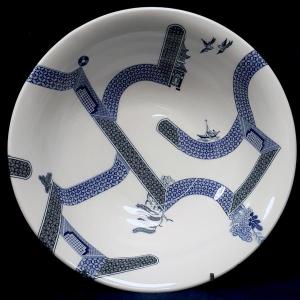
It is interesting that willow pattern continues to be made and purchased.  The above picture shows a simplified version of the traditional formulaic design, much less elaborate than earlier versions, much cleaner but also more sterilized.  I would not have thought that it is  the sort of story that would carry much appeal today, but the design itself obviously continues to be attractive to a modern audience.  A quick search on Amazon produced willow pattern oven gloves, a willow pattern mug that could be personalized, an embroidery kit, a large tea set, a “collectible” thimble, a cushion cover and even a clock in the form of a willow pattern plate (shown left).  A company called PRSC specializes in “deconstructed” willow pattern products, which take the motifs and arrange them in aesthetically pleasing combinations that abandon the narrative completely.

Deconstructed willow pattern. Source: PRSC

In the 18th, 19th and early 20th centuries, willow pattern obviously spoke to something in people’s imaginations.  Perhaps the very standardization and mass-production of the design enabled the more exotic to become both familiar and comprehensible, even offering some level of reassurance by its very familiarity.  By developing new and improved ways of manufacturing pottery and decorating it, and taking advantage of new modes of transport and communication, potteries making ceramics in the English Midlands were able to spread willow pattern throughout the UK and into America.  A decorative phenomenon, it is difficult to account for its success, but a success it certainly was.  It has left a legacy that continues to attract collectors and re-interpreters alike.

For anyone new to this occasional series on objects extracted from my garden
during everyday gardening activities, see the History in Garden Finds page.
These are not objects used in the garden, but objects, usually fragments,
lost or disposed of in the garden and found during digging, troweling and planting.


Sources:

Books and papers

Copeland, R. 1999 (3rd edition). Spode’s Willow Pattern And Other Designs After the Chinese.  Studio Vista

Ferguson, S. 2017.  “Blue Willow”: Apples or Oranges?  Transferware Collectors Club Bulletin, 2017 Vol. XVIII No. 1.
https://www.transferwarecollectorsclub.org/bulletin_previews/articles/17_TCC_XVIII_No1_Blue_Willow_Apples_or_Oranges.pdf

Hsien-Yi, Y. and Yang, G. 1958.  The Man Who Sold A Ghost.  Foreign Language Press
Available online at:  https://www.bannedthought.net/China/MaoEra/Arts/Literature/TheManWhoSoldAGhost-ChineseTalesOfThe3rd-6thCenturies-1958.pdf

O’Hara.  P.  “The Willow Pattern That We Knew”: The Victorian Literature of Blue Willow.  Victorian Studies. Vol. 36, No. 4 (Summer, 1993), pp. 421-442
Available online with the academic site JSTOR digital library if you register (free): https://www.jstor.org/stable/3828644?seq=1

Websites

East India company at home 1757-1857, University College London
The Willow Pattern Case Study:  The Willow Pattern Explained
https://blogs.ucl.ac.uk/eicah/the-willow-pattern-dunham-massey/the-willow-pattern-case-study-the-willow-pattern-explained/comment-page-1/

Encyclopaedia Britannica
Willow pattern pottery
https://www.britannica.com/art/Willow-pattern#ref235738

Popular Culture in Modern China
The Butterfly Lovers – Response.  By Dr Liang Luo
http://chi430.blogspot.com/2014/01/the-butterfly-lovers-response.html

The Potteries – An A-Z of Stoke on Trent Potteries
The Willow Pattern Story
http://www.thepotteries.org/patterns/willow.html

Spode History
Spode and Willow Pattern. By Pam Woolliscroft
https://spodehistory.blogspot.com/2013/06/spode-and-willow.html

Transferware Collectors Club
What is transferware?
https://www.transferwarecollectorsclub.org/news-information/faqs

Victoria Gallery and Museum, University of Liverpool
Story of the Willow Pattern, 15 January 2021 by Amanda Draper
https://vgm.liverpool.ac.uk/blog/2021/willow-pattern/


Object histories in my garden #6: A piece of a Hamilton / torpedo bottle

On the left is a complete Hamilton or torpedo bottle now in the Dumfries Museum. On the right is the fragment of a torpedo bottle found in my back garden. Source of image of Dumfries Museum bottle: Future Museum

I suspect we are coming to the end of the most interesting finds in my garden.  The new beds have been dug out and apart from three lilacs that are destined for the lawn, which will each have a circular bed around them for flowers, the digging has mainly stopped and we are now into laying membrane around trees and shrubs, over the top of which we are putting slate, wood bark and gravel.  This will help to keep down the weeds, and provide a variety of textures throughout the garden, but will seal any remaining objects in the ground, perhaps for future gardeners to find.  There are, however, still one or two pieces worth talking about in the existing collection of objects derived from the garden.

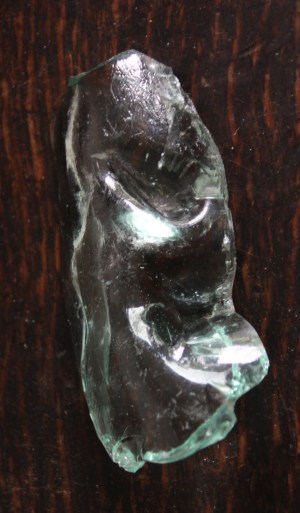
The torpedo bottle fragment from the garden

One of these finds, distinguished by the twist in the glass and its distinctive shape, is a fragment of a Hamilton / torpedo bottle.  Like the Codd bottle, described in a previous post, it was designed to keep gas in bottles of fizzy water.  The Codd bottle in some cases replaced the torpedo, which died out in the 19th Century and early 20th Century. Both were eventually replaced by crown caps that still seal many fizzy drinks today, particularly beers.

Joseph Priestley by Henry Fuseli. Source: The Bridgeman Art Library, Object no.42670, via Wikipedia

Fizzy (aerated, effervescent or carbonized) water, occurs naturally in the form of springs.  My favourite is San Pellegrino.  In 1772 Joseph Priestly set out to produce an equivalent of the natural sparkling water from a famous spring in Pyrmont in Germany, and achieved success by dissolving carbon dioxide in water.  This achievement was considered so important that Priestly, a radical minister, was awarded the Copley Medal, the Royal Society’s most prestigious honour.  The Science History Institute’s website describes the process as follows: “He had dripped a little oil of vitriol (sulfuric acid) on a mixture of chalk and water, caught the fixed air (carbon dioxide) that fizzed from the chalk in a bladder, and bubbled the fixed air through a column of water, which he then agitated at intervals.”  Natural spring waters, each with different properties, were used for their medicinal and therapeutic benefits from antiquity, and were similarly popular in Europe in the 17th and 18th Centuries.  Artificially produced carbonated water was also initially sold for its medicinal properties by pharmacists like J.F. Edisbury of Wrexham, who had his own mineral water works in Llangollen (and who has been discussed on a previous post), it was eventually mixed with fruit-flavoured syrups and sold to general consumers as a soft drink.

J.F. Edisbury and Co (Wrexham) advert showing a range of the carbonated waters that was stocked.  Source: The Wellcome Collection

It quickly became obvious that a solution was needed to keep the gas in the water once it was placed in a container.  At first earthenware bottles were employed by early producers such as Joseph Schweppe (the founder of Schweppes, of course), who set up his business in Bristol in 1794.  At that time, Bristol was a thriving port, third in importance only to London and Liverpool, and a hub for businesses of all sorts.  As Schweppe and other discovered, in earthenware bottles the gas soon escaped and the drink went flat.

Glass bottles closed with corks followed, but there were two potential problems with this approach.  First, a build-up of pressure in the bottle could cause the corks to fly out, resulting not only in a mess but, again, a flat drink.  Second, if the corks were not kept moist they shrank, with the same result – a flat drink and an unhappy customer.  This caused something of a problem between supplier and retailer.  The solution was to store bottles on their sides, but retailers were reluctant to go to this trouble because of the problems of stacking the bottles.

In 1809, William Francis Hamilton of Dublin filed a patent for a method of producing mineral water, which included a description of storage devices employed, one of which was a torpedo-shaped bottle with a tapering, rounded end that had to be stored on its side.  Torpedo-shaped bottles had already been in existence before Hamilton’s patent, and he seems to have been using torpedo bottles as one of a number of storage solutions.  However, the torpedo obviously won out and he apparently went into production of the bottles in 1814.  It took time for them to become popular, but by  the 1840s they were widely in use and they were used until the First World War.

Not all bottles are marked with manufacturer details.   Embossing only became popular in the latter half of the 19th Century, when it became something of a mania following the introduction of hinged moulds.  Usually the manufacturer’s name was added to the bottle, and was sometime accompanied by details of the product that the bottle contained.  The one in the photograph at the top of the page had none, but my fragment has embossed letters, which were built into the mould into which the molten glass was poured to produce the bottle.  The letters on my bottle are incomplete and show either “TERE” or “IERE” (the bottom of the T or I is missing).  It is possible that, if TERE, it read CHESTER, MANCHESTER, LEICESTER etc (all areas where mineral waters were produced), with the E representing the beginning of a new word.   Equally, the TER could be the last letters of WATER, and the E again the beginning of a new word.  The fragment of the final letter can only be a B, D, E, F or P.  Any guesses, anyone?

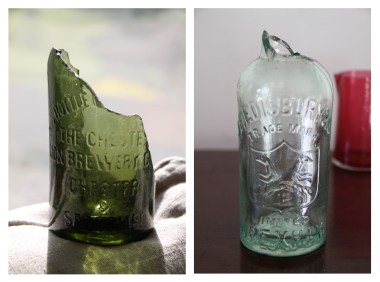
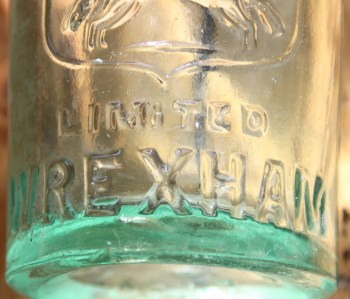
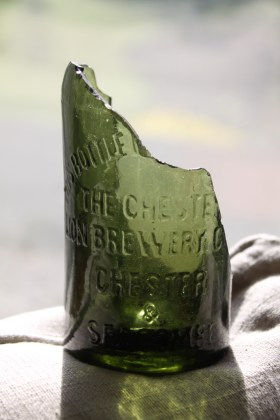
Lion Brewery (Chester) and Edisbury Chemist (Wrexham) bottles

The heavy embossing of the bottle indicates that this bottle was made in the late 19th Century, or later.  This is in keeping with the other bottles found in the garden:  from the Lion Brewery, Chester, J.F. Edisbury, Wrexham (both heavily embossed, the latter with a crossed-fox logo) and the Codd bottle.  Both the Hamilton / torpedo and Codd bottles were eventually made redundant with the introduction of crown caps, which Joseph Schweppe first employed in 1903.

For anyone new to this occasional series on objects extracted from my garden during everyday gardening activities, see the History in Garden Finds page.  These are not objects used in the garden, but objects, usually fragments, lost or disposed of in the garden and found during digging, troweling and planting.

Sources:

Books and papers

Hedges, A.A.C. 1975. Bottles and Bottle Collecting.  Shire Publications Ltd.

Hamilton, W.F. 1810.  Specification of the Patent granted to William Frances Hamilton.  The Repertory of Arts, Manufactures, and Agriculture, Sixteenth Volume, Second Series.
Available on Google Books: https://tinyurl.com/35bcf5tm

Websites

Future Museum
Hamilton Bottle
http://www.futuremuseum.co.uk/collections/life-work/social-history/home-life/housekeeping/hamilton-bottle.aspx

Science History Institute
Powerful Effervescence
https://www.sciencehistory.org/distillations/powerful-effervescence

Hidden Holt: An illuminating must-visit exhibition currently at Wrexham Museum

Cover of the free English/Welsh booklet accompanying the exhibition published by Wrexham Heritage Service, 2021.

My thanks to Brian Payne of the Holt Local History Society for alerting me to the fact that the Hidden Holt exhibition has been launched at the Wrexham County Borough Museum, running until 29th January 2022.  I went last week my father, and we were both bowled over by how good it was.

The exhibition introduces the Roman tile, brick and pottery works that were spread across a number of fields to the northwest of Holt, next to the river Dee.  It uses an excellent combination of original artefacts, video,  information boards and both old and new photographs and diagrams to track the twin stories of the site itself and the history of its discovery and excavation.  Holt Local History Society has a long-standing interest in the Roman works, and commissioned the most recent geophysical survey work at the site, so it’s great to see their contribution to the story being celebrated.

The exhibition (free to enter) is in Gallery 3, to the left as you move beyond reception and the café to enter the display areas.  I’ve given an overview below, but I seriously recommend that you just go – it is a tremendous, professionally-produced and beautifully designed little exhibition with some superb objects on display and some excellent information boards that explain what you are looking at.  You won’t regret it.  If you’re in the mood, the café serves a great coffee and what looks like a rather delicious lunch 🙂

Survey and excavation

Arthur Acton –  page 5 of the booklet accompanying the exhibition.  Source: Wrexham Heritage Service, 2021

The story of how the site was recognized and investigated begins in the early 1600s when landowner Thomas Crue of Holt Hill suffered repeated damage to his plough on broken brickwork and eventually discovered a series of fifty 2ft-tall posts and recorded this in a letter now in the British Museum.  The letter was mentioned in the book Roman Cheshire by W. Thompson Watkins (1886).  Retired chemist and keen amateur historian Alfred Neobard Palmer read the book, and in 1905 decided to hunt for the remains that Crue had found.  He tracked down the original letter and accompanied by local vicar Jenkyn Jones, and with the permission of the landowner Mr Beard, he engaged in a series of fieldwalking expeditions that found plenty of fragments of Roman bricks, roof tiles and pottery over an area of some 20 acres.

Fold-out plan of the kilns at Holt, published by Grimes in 1930. (Scanned from my copy of “Holt, Denbighshire”)

Palmer was not an archaeologist, and the task of excavating the site was taken on by Wrexham solicitor and amateur archaeologist Arthur Acton.  Work began in 1907,  in Wall Lock Field, and continued until 1915.  Although he lectured prolifically about the site, Acton never published his work.  Fortunately some of his records survived, and he sold the finds to the National Museum of Wales.  After five years of admirable work, the Assistant Keeper of Archaeology at the National Museum, William F. Grimes who was better known as a prehistorian, published a comprehensive 235-page report on the site, complete with site plans, photographs and object illustrations.

Photograph and logo from the Archaeological Survey West website: http://www.archaeologicalsurveywest.co.uk/

Work did not stop there, and during the 1970s Geoffrey Bevan conducted both field walking activities and an excavation, finding Roman material that filled dozens of boxes, which were donated to the Grosvenor Museum in Chester.  Most recently, Holt Local History Society commissioned Archaeological Survey West to carry out a geophysical survey of the site,  to accurately fix the positions of the known buildings and to identify any unexcavated and previously unknown structures.  This was successfully completed in 2018, and demonstrated that the Holt complex was even bigger and more complex than Grimes, via Acton, had been able to determine.  There is, of course, the potential for future field research.

The exhibition

Piece of a colander manufactured at Holt, on display at the exhibition

The exhibition is based mainly around discoveries made during the Acton excavations, using the Grimes and later reports to explain what was found and what has been discovered since.  Between them, Crue, Palmer, Acton, Grimes, Bevan, Holt Local History Society and Archaeological Survey West have produced a history of what lies beneath those lush green fields, and this is what the exhibition introduces.

As usual usual the exhibition’s narrative is arranged in a clockwise direction, so turn left as you walk in to Gallery 3.  The exhibition begins with a video that explains the history of survey and excavation and then talks about the site itself.  It is well worth taking a seat and watching.  It lasts about 15-20 minutes and is chock-full of information with some terrific photographs, diagrams and artist impressions of what various structures may have looked like.   The technique of superimposing building plans over a modern aerial view of the fields is particularly useful for understanding how the site was composed and what each element consisted of.   From there, the excellently designed displays take the visitor through the site’s history.

Site plan of the Roman tile and pottery work displayed in the exhibition. Also in the excellent booklet accompanying the exhibition, full details in Sources below. Click to see a bigger version with fully legible text.  Source: Wrexham Heritage Service, 2021

The site was more elaborate than I realized, composed of a number of buildings as well as the kilns.  The image on the right is shown at full size in the exhibition, and shows how big a complex the Holt tile, brick and pottery works actually was.  This is a bang-up-to-date site plan, combining the information provided by Grimes in 1930 with the details obtained by Archaeological Survey West in 2018. What this and a lot of Acton’s photographs makes clear, is that the site was a fully integrated operation combining industrial, public and domestic architectural components. A senior manager had his own house, complete with hypocaust (under-floor) central heating, there was a public bath house, presumably for workers, a series of kilns for the manufacture of mainly tiles and pottery, and a barracks that may have housed workers, or alternatively a detachment of the Roman army based at Chester at this time.  The features shown in blue are unrecorded / unexcavated.  Those in dark brown are the building locations fixed in 2018, and those in paler brown those estimated by Grimes based on Acton’s work.

The main kiln plant at Holt, published by William Grimes in 1930. Scanned from my copy.

Although now the archaeological remains are covered with fields, Acton used photography extensively, and his site plans were detailed, many published by Grimes, and used in the exhibition to reveal and explain the different components of the site.  This is very helpful not only for understanding how the site worked as an end to end operation, but is invaluable for putting the objects into context.  Objects on their own tell a limited story, but when contextualized in terms of the buildings in which they were produced and used, come to life.  The exhibition does this brilliantly.

It was a good location for a tileworks.  Building stone was available in the immediate locality thanks to the Bunter sandstone, alluvial clay was available locally, woodlands were present for the provision of fuel to feed the kilns, and the river Dee provided direct access to Chester, 12 miles / 19km away, passing the civic settlement at Heronbridge.  The generally flat environment meant that building of roads was not particularly laborious.

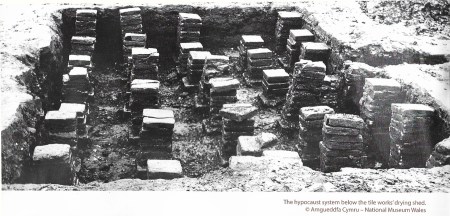
The visitor is taken step-by-step through the production process, explaining how the kilns and drying sheds  were built and how they functioned. The kilns formed two main units, a larger (139ft / 52m long, consisting of a row of six kilns) and smaller twin-kiln built on the natural bed-rock.  Each kiln was rectangular and tile-lined with an arched stoke-hole for access.  A round pottery kiln was also located on the edge of the main kiln complex.  The oven floor was fascinating, consisting of a raised floor of tiles plastered with clay that were pierced with holes that acted as vents.  I was fascinated to see that the drying shed was provided with a hypocaust, better known as the under-floor heating system that was used in villas and bath houses.  These, like the kilns, were stoked and kept hot to ensure that the tiles, pottery and bricks were dried through after firing.

The exhibition displays a number of artefacts, including a roof tile, a brick and a triangular atefix tile marked with the letters LEGXXVV, an abbreviation for the twentieth legion, known as Valeria Victrix (valiant and victorious).  The antefix tile, one of which is shown in the exhibition (photo left and illustration below) also shows Legio XX’s dramatic running boar symbol.   Legio XX was stationed at Chester from AD87, and the Holt works appears to have been established shortly afterwards, reaching its peak output at around AD135, and falling out of use in the mid 3rd Century.

Antefix tiles from Holt. Source: Grimes 1930

A display board shows the vast range of products that were made at the site, including floor and roof tiles, and a variety of different pottery forms.  There is a good explanation of how the roof tiles, called imbrex and tegula (plural imbrices and tegulae), worked.  A good memory for me – I dug up a lot of these tiles at my first ever dig in Silchester.  The arched imbrices, sit snugly over the upright edges of two facing tegula tiles, as shown in the above photograph, and the the triangular antefix tiles were placed to cover the ends of the imbrex.

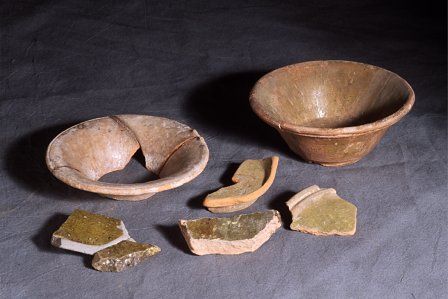
Green-glazed ware found at Holt. Source: National Museum of Wales

Examples of the pottery found at the site are on display, with some really fine examples, including ollae (jars), urcei (jugs), lagenae (flagons), cattili (plates), calices (drinking bowls), and testa (lids).  I particularly liked a partly preserved ceramic colander and a mortarium (the latter working like a modern mortar, but with bits of stone embedded into the interior base of the pot to create a rough surface for grinding spices and seeds).  Green-glazed pottery, a luxury ware that I had never come across before, was also made at the site.  It is rare in Britain, so it was excellent to see examples of it on show.  A photograph of the green glazed pottery found at Holt (from the National Museum of Wales website) is shown below.

The workers also turned their hands to other types of objects made from clay – one cabinet shows a marvellous piece of shaped water pipe that was manufactured at the site.

Section of water pipe manufactured at Holt

All of the output manufactured at the works was sent by boat downriver to Chester, the exhibition suggests that a short may have been dug out at Holt in order to make loading the ceramics easier, its course marked today by annual floodwaters that, as they recede, leave a line of floodwater in what could well be a Roman channel.

Samian pottery found at Holt. Source: Grimes 1930

Interestingly, the exhibition shows that even though huge amounts of pottery was being made on-site, there were particularly favoured types of ceramic being imported.  Samian (terra sigillata), a truly gorgeous luxury dark red ware that has moulded decoration on its lustrous surfaces, was found in surprising quantities.  This was usually imported from south-eastern Gaul (France); a Roman experiment with samian production in southern England produced inferior pottery and was very short-lived.

Imported black-burnished ware was also found at Holt, which the exhibition explains was made in Dorset.  At sites in southern England it is common (we found bucket-loads of it at Silchester), but when found at northern sites, it was probably imported to fulfil a particular need or desire.  The works manager might have wanted high-status ceramics, and any soldiers at the site may have craved the comforts of home, but another option is that it was being imported for use by a nearby settlement.  One of the findings of the 2018 geophysical survey was the presence of a possible Roman fort or marching camp to the west of the site, suggesting that the site may have been on the edge of an unidentified vicus settlement, or village.

Coins on display in the exhibition.

The coins at the site are invaluable for their contribution to creating a timeline for development of the site, but are works of art in their own right.

The exhibition provides another insight into the inhabitants of the site by displaying some of the other objects they owned, like small pieces of jewellery made of bronze, manicure equipment, a beautifully crafted needle and a delectably delicate silver spoon.  These are objects that people chose and kept on them, intimate reminders that these were real people who lived complicated lives in which personal appearance had an important role.

Silver spoon from Holt on display at the exhibition. Source: Grimes 1930

A map at the end of the exhibition was riveting, showing how widespread Roman presence in northeast Wales actually was, showing everything from single find-sites to industrial sites like that at Holt, the settlements at Heronbridge and Plas Coch, and the villa at Rossett, the latter two sites both recent discoveries.  It looks as though there will be more Roman discoveries in the future, filling out a picture not merely about the activities of Romans in Britain, but on their interactions with local communities, something which remains poorly understood.

Museum details

The museum is an excellent resource, a small but modern with excellent displays and a lot of great information on professionally produced display boards into context. At the time of writing (August 2021) masks must be worn and you need to leave your name and telephone number with reception.  For opening days and times, plus directions, see the Wrexham County Borough website:
http://old.wrexham.gov.uk/english/heritage/wrexham_museum.htm

A booklet accompanying the exhibition is available both in the museum foyer and under the video screen in Gallery 3.  The cover and some of the pages from the booklet are shown at the top of the post, and full details are in Sources, below.   A leaflet, Holt: Legacy of the Legions, is also available from the museum, or can be downloaded.

It is a real shame that the Hidden Holt gallery is only a temporary feature, but Wrexham Museum has a lot more to see, and I will be posting about some its permanent displays in the future.

Sources:

Books and papers

Grimes, W.F. 1930.  Holt, Denbighshire:  Twentieth Legion at Castle Lyons.  Y Cymmrodor.  Society of Cymmrodorion.

Ward, M. 1998. A collection of samian from the legionary works-depot at Holt.  In (ed.) Bird, J. Form and Fabric.  Oxbow Monographs 80.
https://www.researchgate.net/publication/333155555_A_collection_of_samian_from_the_legionary_works-depot_at_Holt

Ward, M. 1998. Some finds from the Roman works-depot at Holt.  Studia Celtica 32:43-65
https://www.researchgate.net/publication/311789557_Some_finds_from_the_Roman_works-depot_at_Holt

Booklets / leaflets

Wrexham Heritage Service 2021.  Hidden Holt.  The Story of a Roman Site.  The Discovery of a Roman Legionary Tile and Pottery Works at Holt, near Wrexham.  (Booklet accompanying the exhibition in both English and Welsh)

Holt Castle Conservation and Interpretation Project.  Holt. Legacy of the Legions.  An introduction to the history of the Legionary Works Depot at Holt. (Leaflet, including site plan, available from the museum)
http://old.wrexham.gov.uk/assets/pdfs/heritage/holt_castle/holt_legacy.pdf

Websites

Hidden Holt
Wrexham Museum
https://www.wrexhamheritage.wales/?exhibition=hidden-holt-the-story-of-a-roman-site

Hidden Holt – Roman history revealed in a new Wrexham Museum exhibition
Wrexham Council News
https://news.wrexham.gov.uk/hidden-holt-roman-history-revealed-in-new-wrexham-museum-exhibition/

Holt Local History Society
https://holtlhs.weebly.com/

National Museum of Wales
https://museum.wales/

Roman Glazed Pottery from North Wales
National Museum of Wales
https://museum.wales/articles/1327/Roman-glazed-pottery-from-North-Wales/

The Pottery Kilns of Roman Britian by Vivien Swan (database)
https://romankilns.net/

Object histories in my garden #5: Fragment of a Codd-neck bottle

The things we find in the garden, digging out new beds and extending old ones, have added to my knowledge of all sorts of random things.  Until Joe found the Edisbury bottle in the garden (Edisbury was a 19th century Wrexham pharmacist), I had no idea that during the 19th century, when sparkling carbonated water was a new concept, special bottles had to be designed to keep in the fizz.  The Edisbury bottle that we found was not for sparkling water, but a fragment of a bottle that we found a few weeks ago, which was a complete puzzle, turns out to be part of the new carbonated water revolution.  It was stopped with a marble that was held in place in the neck by the pressure of the gas from below.  Fantastic.

It doesn’t look like much, and has to be seen in the context of complete examples for it to make any sense at all.  Sorting out books from my move in February (it is still taking forever to organize my books), I found a long-forgotten Shire Publications book entitled Bottles and Bottle Collecting, which I bought during my Thames mudlarking phase.  Just flipping through it before deciding where it should go, and noting that it covers stoneware as well as glass bottles, I spotted a photograph on page 12 showing three Codd bottles, and it was perfectly obvious that my fragment matched the neck of the one on the far right.  So what on earth is a Codd bottle?

Photograph on page 12 of “Bottles and Bottle Collecting” (Hedges 1988), annotated to show the section of a similar bottle found in the garden

In 1772 Joseph Priestley began to manufacture carbonized waters, which fizzed.  Stoneware was the traditional vessel for mineral-based drinks and tonics, but the gas leached out through the fabric.  Cork-stopped glass was the obvious solution, but the gas could built up to the point where the cork blew out, which both wasted the valuable product and created a considerable mess in the process.  One solution was the torpedo- or amphora-shaped bottle with a pointed base that had to be stored on its side, keeping the cork and the fluid in contact, which kept the cork moist, preventing shrinkage, which kept the cork in situ.  These were considerably unpopular, as storage was always a problem.  Wired-on corks were one solution, also unpopular, and in 1875 Hiram Codd came up with an entirely novel way of solving the problem that became very popular.

Hiram Codd. Source: Findagrave.com

Hiram Codd was very much a man of his era.  His father had been a carpenter, but by his early 20s, Codd was establishing himself as a mechanical engineer and went to work for the British and Foreign Cork Company, working to improve the cork production process.  As a specialist in bottle closures he realized that corks had certain limitations, and began to look at alternatives, carrying out experiments in a small mineral water works in Islington.  In 1872 he secured backing by Richard Barrett, whose two sons owned the Malvern Mineral Water Co. in Camberwell.  With this investment, he was able to develop his globe-stopper.

Banta bottle from Kerala, India. Source: Wikipedia

Codd’s innovation used a thick-walled bottle, a cleverly shaped neck with lugs, and a glass marble-sized globe as a stopper, which was forced towards the opening of the bottle by the gases, where it was stopped by a rubber ring.  In order for this to work, the bottle had to be filled upside down so that the marble could rise to the top to seal.  Two lugs were designed into the bottle, as shown in the fragment, and to pour the drink the marble had to be pushed down to the flanking lugs, where it became trapped, enabling the drink to be poured.  He patented many different versions of the basic scheme in order to try and find the perfect and definitive solution.

In spite of other innovations for stopping bottles, the design was still in common use throughout the 1920s, going out of use in the UK by the end of the 1930s. Dad says that he can remember them during the Second World War.  Superbly, the Codd bottle is still in popular use in India, popular for a drink called Banta.  One of the staggering things of the years of the Industrial Revolution until the late 19th Century was the tidal wave of innovation and the thousands of inventions that emerged, many of them small but fascinating like this one, and all devised to solve specific problems that arose as new products and new ideas emerged.

The survival rate of Codd bottles is poor, as many were deliberately broken by children trying to get at the marbles they contained.  It is has been suggested that the term codswallop (meaning nonsense, something that makes no sense) is derived from Hiram Codd’s bottles.  I’m absolutely not convinced, but you can Google it.

Photograph showing the neck of a Codd bottle with a marble in situ. The pale blue marbles were much in demand by small boys 🙂 Source: Drinking Cup

For anyone new to this occasional series on objects extracted from my garden during everyday gardening activities, see the History in Garden Finds page.  These are not objects used in the garden, but objects, usually fragments, lost or disposed of in the garden and found during digging, troweling and planting.

Sources:

Books and papers:

Hedges, A. A. C. 1988.  Bottles and Bottle Collecting.  Shire Album 6.

Munsey, C. 2010. Codd (Marble-In-The-Neck) Soda-Water Bottles, Then and Now!
https://sha.org/bottle/pdffiles/coddarticleMunsey.pdf

Websites:

Banta
Wikipedia
https://en.wikipedia.org/wiki/Banta

Codswallop
Phrases.org
https://web.archive.org/web/20080913063340/http://www.phrases.org.uk/meanings/235250.html

Drinking Cup
The invention of soda water
http://www.drinkingcup.net/1767-from-volcanos-to-soda-pop/

Hiram Codd
Findagrave.com
https://www.findagrave.com/memorial/24680991/hiram-codd


Object histories in my garden #4: A Dinky Toy SEPECAT Jaguar

Not an adjective but a brand name, in this case dinky refers to Dinky Toys, a range of miniature toy vehicles, everything from engineering marvels like fighter planes such as this one, to life-like lawnmowers.  Dinky Toys were the brainchild of Frank Hornby, who was the innovator behind Hornby Trains and Meccano.  The Dinky Toys were made by Meccano Ltd.  They were produced in England between 1934 and 1979 at Meccano’s Binns Road factory in Liverpool.  They pre-dated other well known diecast brands, including the now better known miniature Corgi and Matchbox brands.

This particular object is a model of an Anglo-French SEPECAT Jaguar fighter plane, model number 731. The fighter on which the toy was modelled came into service in 1973, and the toy version was one of a series capitalizing on a new interest in modern warplanes.  It was one of the many curios pulled out of my garden during its ongoing revamp.  Most of the garden relics consist of fragments of decorated ceramic, but one or two are of particular interest (garden finds link).  Most of the later 20th Century items that we have found have been true rubbish, and every  object that we have found has been broken and was almost certainly dumped.  At first I thought that this toy was probably lost during play rather than deliberately disposed of, but on closer inspection it too is broken.

A promotional image of the Meccano Ltd. factory at Binns Road, Liverpool, taken from the back cover of the 1927 Hornby Book of Trains. Source: Brighton Toy Museum

The Dinky Toys company was the creation of Frank Hornby, whose name is forever associated with model train sets.  Hornby originally began with a vision of educating children wishing to teach  basic mechanical principles, which he translated into construction kits for children, the first of which were patented in 1901.  As Oliver Wainwright puts it,

With his “Mechanics Made Easy” sets he gave the system ultimate flexibility by punching holes on a regular grid across all of the pieces, allowing the parts to be bolted together as well as providing bearings for axles and gear shafts. Sold with a range of brass wheels and pulleys, gears and shaft collars, any number of complex mechanisms could be dreamt up – from bridges to cranes, to devices to ambush your unsuspecting sister.” 

The Meccano brand was launched in 1907, and went from strength to strength.   Hornby’s model train series came next, accompanied by all the accessories required to give them a real-life context.  The Hornby railway models, both mechanized and static, were so popular that Hornby’s next idea materialized itself as his Dinky Toy company, which was set up in 1934 to produce realistic model vehicles.  Wainwright again:

“The things he made didn’t look like toys, but precise versions of the real world, manufactured with exacting detail. His products were not packaged with the amoebic forms and infantilising colours of today’s toys, but gained their magical quality simply from taking things of fascination – industrial machines, trains, boats and planes – and shrinking them to the scale of 1:48, reducing the entire world to something that can fit in a box.”

The Dinky Toys were made from die-cast ZAMAK. Die casting is a manufacturing process that can be used to make geometrically complex metal parts in reusable molds called dies.  ZAMAK is a form of zinc alloy, described as follows on the DECO website:  “ZAMAK is a type of zinc alloy that consists of aluminum, magnesium, copper, and of course zinc. This alloy family contains copper, but is spelled with a K. This is because the acronym ZAMAK uses the German spelling: Zink, Magnesium, Aluminum, and Kupfer. That being said, ZAMAK is some times spelled ZAMAC with an English spelling. ZAMAK alloys are a separate family from the zinc aluminum (ZA) alloys although they both maintain a consistent composition of 4% aluminum.”

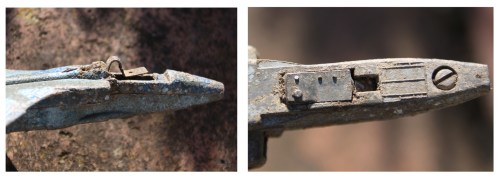
The Jaguar is 18cm long from nose to tail.  Although most of it is metal it also has small black plastic parts under the tail.  The top layer of paint is a fairly deep royal blue, and has slowly peeled off during its afterlife in my garden, revealing an undercoat of pale blue and the core dark metal grey beneath both. Comparing it with surviving examples online, it would have been painted with camouflage and other markings.  The whole thing is satisfyingly heavy to hold.  The canopy was spring-loaded to make it a moving part when depressed, and originally a plastic fighter pilot was positioned inside.  When the canopy spring was activated, it ejected the pilot.  Only a tiny piece of the canopy remains in situ, but the spring, a piece of cleverly bent metal, is intact and can be operated.  The plane once stood on three wheels, but all three wheels, plus the struts connecting them to the rest of the plane are now missing.  Two hollow spaces sit where the rear wheels would have been fitted.  The wheel struts were hinged so that the wheels could be folded into the main body of the plane.  There is a metal flap on the underside of the cockpit that may preserve the front wheel in situ, but cautious work to loosen it has failed and I really do not want to snap it.  The nose cone, originally black plastic, is missing.

Now if the garden would magically produce a Dinky Toy model 749, the delta-winged Avro Vulcan bomber (1955), I would be so happy.  I saw the XH558 Vulcan flying at Farnborough Airshow in 2014, and it was love at first sight.  Since then, I have fallen in love with the Vulcan all over again at Cosford Royal Air Force Museum, twice.  Irrespective of its ultimate purpose, it is a thing of awe and beauty.

For anyone new to this occasional series on objects extracted from my garden during everyday gardening activities, see the History in Garden Finds page.  These are not objects used in the garden, but objects, usually fragments, lost or disposed of in the garden and found during digging, troweling and planting.

Sources:

Books and articles

Wainwright, O. 2013. Frank Hornby:  The Man who put the World in a Box.  The Guardian, 15th May 2013
https://www.theguardian.com/artanddesign/architecture-design-blog/2013/may/15/frank-hornby-meccano-dinky-toys

Websites

Custompart.net
Die Casting
https://www.custompartnet.com/wu/die-casting

DECO
What is Zamak?
https://decoprod.com/zamak/

Dinky Site
Digital Museum
https://www.dinkysite.com/rare-dinky-toys

Wikipedia (very well referenced page)
Dinky Toys
https://en.wikipedia.org/wiki/Dinky_Toys#CITEREFGardinerO’Neill1996

Object Histories in my garden #2: A bottle by J.F. Edisbury and Co. Ltd. (Wrexham)

Damaged J.F. Edisbury bottle found in my garden

Last week I posted about a Chester Lion Brewery Co. bottle that we found in the garden, dating to the final years of the 19th Century, one of two bottles that were found in a part of the garden that was completely invisible beneath a tangle of dead trees, shrubs and weeds.  On the right is the second one that we found, labelled J.F. Edisbury and Co. Limited, Wrexham.

The J.F. Edisbury and Co. Ltd bottle is made of clear green-tinted glass, with seam lines running up each side.  The text “J.F. EDISBURY & CO. LIMITED WREXHAM is embossed in raised glass on one side of the bottle, as is the trademark, consisting of two crossed foxes within a frame in the shape of a shield.  The shield shape was a traditional frame for displaying the name of ingredients on jars that lined the shelves of pharmacy shop interiors.  The base has some slight damage, obscuring some raised text, but appears to end in the numbers 80 (or to start with the numbers 08).  Opposite it, on an undamaged section of the base, more raised text is clearly visible, and appears to read, C.S. and Co. Ltd. on one side of the base, about which more later.  Unlike the Chester Lion Brewery bottle, for which I could find no duplicate online, there are plenty of examples of Edisbury bottles of this type, with the same long necks.

James Edisbury , father of James Fisher Edisbury

The Edisbury family has a long connection with the Wrexham area, and the name pops up repeatedly, mainly because of Josiah / Joshua Edisbury, High Sheriff of Denbighshire, who was responsible for building the earliest version of Erddig Hall c.1684 overlooking the river Clywedog.  He went bankrupt in the process of building it.   The Dictionary of Welsh Biography says that Edisbury’s brother John Edisbury (c.1646 – 1713), ruined himself by misappropriating funds to help his brother. In 1716 Erddig was sold to a successful London lawyer Sir John Meller who bought out the mortgage and debts that Edisbury had incurred, finished the work and added two wings that remain today.

Bersham Hall, Wrexham, which is still standing. Source: Francis Frith Collection

The owner of J.F. Edisbury Co. Ltd., to whom the bottle belonged, was James Fisher Edisbury,  born in 1837.  His father James was very commercially successful first as a retailer in Holywell and then in Wrexham as an auctioneer.  James Edisbury senior was born in 1803, and in 1829 married Elizabeth Walker Ratcliffe, eldest daughter of the late Henry Walker Ratcliff, a grocer.  She died in 1832 and James was remarried in 1834 to Sarah Ratcliffe.  In the 1835 North Wales Directory for the Holywell & Bagillt areas,  James Edisbury is listed as “High St. Grocer &/or dealer in sundries, and tobacconist:  Tallow Chandler, Wine and Spirit merchant.”  A daughter, Emily Walker Edisbury, was born in 1834  and James Fisher Edisbury was born in 1837.  Emily died in 1839  and Sarah died a year later in 1840.  James Edisbury had more than his fair share of loss.  At some point before 1855, when he is next recorded, he made the decision to move to the outskirts of Wrexham, purchasing Bersham Hall, which sat in 11 acres of land.  In 1857 he decided to move into the town for business reasons, letting out Bersham Hall. He appears to have had a major career change, becoming an auctioneer and appraiser, living and working at Brook Street in Wrexham.  He died on 21st September 1859, leaving Bersham Hall to his son James Fisher Edisbury.

The pharmacy business in the 19th Century

Jacob Bell, founder of the Pharmaceutical Society in 1841. Source: Pharmaceutical Journal.

Pharmacies began to rise in importance in local communities as scientific research into the relationship between diseases, ailments and potential treatments began to make real improvements to medical knowledge in 19th century Europe.  The Pharmaceutical Society was established in 1841, which moved to establish schools to standardize training and to regulate the sale of pharmaceuticals, but apprenticeship remained the principal form of learning until the end of the century.  Synthetic drugs were being developed, but traditional remedies based on herbal preparations were still dominant.

Pharmacists combined the roles of chemists, health consultants and dispensaries.  They worked alongside and often in competition with physicians to develop treatments for an enormous range of real and imagined conditions, frequently undercutting their more formally trained and qualified colleagues.  As the adverts on this page demonstrate, the public were becoming increasingly interested in their own symptoms and any treatments that might alleviate them.  Ailments at all levels of society represented lucrative business opportunities.

A recreation of a 19th Century chemist at the York Castle Museum’s “Kirkgate Victorian Street,” York. Source and copyright: Crinoline Robot, Miriam McDonald

Every town had at least one pharmacy, sometimes more.  For example, as well as J.F. Edisbury and Co., another Wrexham pharmacy Francis and Co., with premises at 53 Hope Street and 22 Town Hill in Wrexham.   The shops were lined with shelves and cabinets that held clearly labelled glass and ceramic jars full of the raw materials for the manufacture of pills, potions, gels, ointments and medicines, looking much like a traditional sweet shop.  A workshop in the rear usually contained the equipment for assembling these products.  The above photograph by Miriam McDonald shows a recreation of an actual pharmacy in contemporary York, giving an excellent idea of what sort of experience a customer would have had when they walked through the door of a British pharmacy in the 19th Century.

James Fisher Edisbury, chemist and pharmacist 

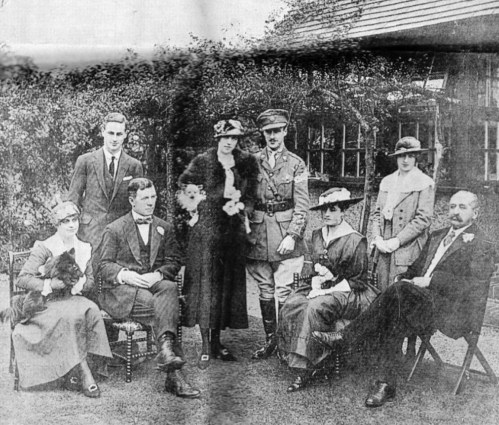
In this 1916 family photograph published in the Wrexham Leader, James Fisher Edisbury is at far right, four years before his death. Source: Wrexham History website

Top: 3 High St, Wrexham. Bottom: 4 Grosvenor Road. Source: Google Maps.

James Fisher Edisbury established himself as a pharmacist at 3 High Street, Wrexham.  The building is a remarkable survivor sandwiched between two deeply unattractive modern buildings.  By 1861 he is recorded as a master chemist and pharmacist in Wrexham.  James Fisher Edisbury married Harriet Jones in 1863.  She gave birth to a stillborn child in May 1864 and died herself two weeks later.  James Fisher remarried, to Minnie Jones, in 1867 and the couple lived in Bersham Hall, now sitting in only in 4.5 acres of land.  Like James Senior, they moved their home to Wrexham for business reasons, letting out Bersham Hall and settling at 4 Grosvenor Road.   In total they had seven children, one of whom died, and Minnie herself died at the age of 35 in 1882.   

These two generations of family history highlight the risk of death for mother and child during childbirth, as well as the high ongoing risk for babies and toddlers, demonstrating one aspect of how improved medical assistance was very much required.  For a long time the medical profession had been little better than the provision of quackery, but during the second half of the 19th Century health care was beginning to develop in new and eventually more scientifically exacting directions.

(Thanks to Annette Edwards for her article on the Wrexham History website for the information about two generations of the family’s history – please see that page for more James Fisher Edisbury’s family details).

James Fisher Edisbury’s business interests were embedded in the pharmaceutical industry, and he was a Member of the Pharmaceutical Society, (M.P.S.). The fascinating advert to the left gives a very comprehensive idea not just of the products that he was selling but the high quality of customer service that he offered to his valued customers.   The pharmacy offered a 24 hour service.  Although the shop was shut at night, those in need could obtain the services of the pharmacist by ringing the doorbell.  I don’t know what Chinese Floating Soap might be, but I want some!

According to his advertising, at some point in the late 1870s or early 1880s J.F. Fisher  and Co. became the proprietors of the North Wales Mineral Water Factory at Horse Market, Wrexham and seem to have owned the Penadur Spring Works also in Wrexham, perhaps towards the end of the century.   The company may  have bought the business from R. Evans and Co., as one advert refers to “J.F. Fisher and Co. (Late R. Evans and Co.)”.

By 1881 the company was producing mineral waters in Llangollen in a building adjoining the Cambrian Hotel, a coaching house in Berwyn Street, called the Mineral Water Manufactory.  Late Victorian Llangollen was enjoying an economic boom building on its existing stone and slate quarrying, manufacture of woollens and fabrics and tourist industry.  The canal network, the arrival of the railway and the construction of Telford’s Holyhead road all contributed to the success story, The Mineral Water Manufactory was a soft drinks business, which produced  aerated (fizzy) versions that were something of a late 19th Century novelty.  Edisbury bought the mineral drinks operation from Zoedone, together with nine vans, which delivered throughout Wales and had depots at Chester, Oswestry, and Birmingham.  In 1903 the Cambrian Hotel, Cambrian House and the mineral water factory premises were sold at auction in Llangollen but I do not know what happened to the drinks business, which may have moved elsewhere or have been absorbed into one or other of the Wrexham operations.

Back in Wrexham, adverts placed in various newspapers indicate that James Fisher Edisbury had a cure for just about every ailment from corns, warts and bunions to shortness of breath, bronchial problems, nervous afflictions and neuralgia.  An advert dating to 1883 indicates that he had also diversified into animal cures as the agent for a farm suppliers:  “IMPORTANT TO FARMERS. -J. F. EDISBURY is the authorised agent for the Pix Compo, Down’s Farmer’s Friend, and manufactures the celebrated Wheat Dressing for destroying slug, grub, and wire worm, and preventing the ravages of birds, 3, High-street, Wrexham.”  He also sold personal grooming and bathing products, such as hair brushes, tooth brushes, nail brushes, sponges and sponge-bags.  In one 1885 advert advertising sponges and gloves, there was also the mention of Cyprus Insect Powder as “the best exterminator of moths, beetles, fleas, &c.-non- poisonous and effectual, in Id, 2d, and 3d, packets, 6d and 9d tins.”  Another advert lists the “paints, oils, colours and varnishes” available to purchase from 3 High Street.

In 1887 J.F. Edisbury and Co. purchased a ginger beer company, A1 Stone Ginger Beer.  On last week’s post about the Chester Lion Brewery the topic of trademark infringement came up in connection with beer sales, and here is a similar example, with the company placing a notice in a local newspaper warning that the firm’s bottles were being used to pas off “very feeble and unpalatable imitations.”  A reward was offered to anyone bringing examples of such fraudulent products to the factory for testing.

In 1895 Ellis and Son from Ruthin ran a large advert in the Wrexham Advertiser and North Wales News advertising their own mineral waters.  They were mainly advertising their own operation in Ruthin, but in smaller letters also featured J.F. Fisher and Co. as an outlet for their products.  In the same newspaper, and next to the Ellis and Son advert, J.F. Fisher and Co. also had a large advert, focusing on their North Wales Mineral Water Co, which sold Penadur Spring Waters.  The latter advert mentions that the water had been exhibited in the Paris Exhibition and the London International Exhibition of 1891, reinforcing the sense of high-tech novelty.  At the same time, it emphasizes that this new product was very accessible, available not only via retail outlets, but also at railway station buffets at Chester, Birkenhead, Chester and Ruabon.  By diversifying, Edisbury may have been looking for a competitive edge to consolidate his position as he was not the only pharmacist operating in Wrexham in the late 19th Century.

Edisbury was also involved in the Aerated Water Manufacturing Company, which appears to have been another profitable Wrexham-based business.  The company’s Third Ordinary General Meeting in 1891 was held at the Wynnstay Arms, a few doors down from Edisbury’s premises at 3 High Street, and was reported in the Wrexham and Denbighshire Advertiser and Cheshire Shropshire and North Wales Register.  It was announced that the company was doing well. “On the year there was an increase, and due care having been exercised in the matter of expenses the net profit had proved to be in excess of what was stated in the prospectus. . . . That would be satisfactory to the shareholder.”  At the same time, it was revealed that “the Company had commenced the manufacture of British wines under Mr Hutchinson, who had special experience in the work, and he thought the wines produced were of high quality.”  These wines were medicinal rather than epicurean.  By 1895 James was selling the wines in his Wrexham premises:  “MEDICATED WINES.  J. F. Edisbury, M.P.S., 3, High-street, Wrexham. Coca Wine @ 2s 6d per bottle; Extract of Meat. and Malt Wine, ls 6d per bottle.”

James Fisher had a very strict record system for the supply of bottles of his products to customers, some of which were very expensive to manufacture, as explained in the second page below, taken from a J.F. Edisbury Co “pass book.”  The first and last pages of the pass book provided details of some of the company’s products, and the rest of it was a record of a customer’s account, tracking product deliveries and returns. You can flip through the pages of the book on the Internet Archive website here.  The outer envelope and cover of beautifully preserved pass book from the National Trust’s Erddig is shown below.

This sort of bottle return policy operated by Edisbury and other drinks suppliers probably accounts for why only two 19th Century bottles have so far been unearthed in my garden.

Green leatherette account book in a red leather-covered cardboard case. The account book is marked dated on the first page 1871.  Source: National Trust Collections

There are plenty of references to James Fisher Edisbury in the Wrexham local newspapers in the context of a number of civic activities.  He was a Justice of the Peace, was on a committee to organize the planning and building of a new retail arcade, which still stands, and was a Provincial Grand Officer of the Freemasons.   As well as a successful business entrepreneur and a Member of the Pharmaceutical Society, (M.P.S.), with fingers in several pies, he was clearly a solid and influential pillar of the Wrexham community.  James Fisher Edisbury died on 20th October 1920 at the age of 83.

Back to the bottle

J.F. Edisbury and Co trademark.

The bottle from my garden was unlikely to have been used for one of the aerated drinks, because these, being fizzy, had special storage requirements.  They were delivered in bottles with pointed bases that had to be laid horizontally, ensuring that the liquid inside would prevent the cork from drying out, ensuring that the gas was retained in the bottle.

This bottle, with its flat base, was not one of those  and could have contained any number of other J.F Edisbury products.  A the moment there it has not possible to narrow down which of the various wines, oils, medicines, tonics, and other potions that it may have contained.  Nor has it been possible to narrow down a date for the bottle.

Markings on the base of the bottle

The crossed foxes trademark is very distinctive and appears on many of J.F. Edisbury and Co. bottles and jars.  I was unable to find out where it came from or what, if anything, it refers to, but Adam Mercer, from the Wrexham Antique Bottles website (which launched in spring 2022) suggests that the crossed foxes were derived from the family crest of the Williams-Wynn family of the Wynnstay Estate, with the cross foxes coming from the Williams side.  I was also unable when I first posted this to discover what the markings on the base might refer to.  My guess that it was a bottle manufacturer was turns out to be correct.  My thanks to both Adam and to Maurice Handley for letting me know that C.S. and Co on the base stands for Cannington Shaw of St Helens.  Malcolm says that this was, at the time, the world’s largest makers of bottles during the late nineteenth century.  It as established in 1866 and amalgamated with other bottle makers to form United Glass Bottles or UGB.  For more about Cannington Shaw see https://www.canningtonshaw.org.uk.

The shape of the bottle, the presence of the cross-foxes trademark and the quality of the glass itself might help to narrow down a more specific date range for the bottle.  I do hope that some of these details will eventually emerge, and if you are reading this and have more information please get in touch.

Final Comments

This is a rather different story from the one I told last week about the Chester Lion Brewery bottle, and not merely because of the contrast between health drinks and beer.  Last week’s bottle was the story of big factory-style breweries, big investments in future technologies and large ambitions, and even a case of minor trademark fraud.  The Edisbury bottle, by contrast is the story of high street retail where success was achieved by offering wide product ranges and providing excellent customer service.  James Fisher Edisbury’s advertising speaks of a man who was highly organized, ambitious and driven to look for new ways to use his skills to find new markets, or to find new products for existing markets.  Where expedient he joined forces with other companies to retail their products and he invested in new infrastructure when required.  He saw the potential for health drinks and invested heavily in providing this to families who wanted to improve the quality of their lives and their overall well-being, and were attracted by novelty.  Looking around today at the proliferation of health-food stores and the growing interest in vegan diets, it is a far from unfamiliar story.

For other objects in the series,
see the History in Garden Objects page

Sources:

Books and papers

Robinson, J. 2016. Looking back at 175 years of the Royal Pharmaceutical Society. The Pharmaceutical Journal April 15th 2016, Vol. 296, No.7888, p.296
https://pharmaceutical-journal.com/article/feature/looking-back-at-175-years-of-the-royal-pharmaceutical-society

Wilson’s Trades Directory of Wales, 1885. William Wilson & Sons.
https://www.jstor.org/stable/10.2307/community.30136288

Cadw 2016. Llangollen. Understanding Urban Character.

Websites

Wrexham History, founded by Graham Floyd
James Fisher Edisbury, by Annette Edwards, August 2019
https://www.wrexham-history.com/james-fisher-edisbury-2/ 
Francis The Chemist by Annette Edwards, October 2018
https://www.wrexham-history.com/francis-chemist/ 

The Internet Archive
The North Wales Mineral Company. Pass Book
https://archive.org/details/b3047775x/mode/2up

The National Trust
Erddig, The Whole Story
https://www.nationaltrust.org.uk/erddig/features/erddig-the-whole-story

Welsh Newspapers Online.  National Library of Wales
https://newspapers.library.wales/

History Points
Former Cambrian Hotel, Berwyn Street, Llangollen
https://historypoints.org/index.php?page=former-cambrian-hotel-llangollen

The Dictionary of Welsh Biography
EDISBURY family, of Bedwal, Marchwiel, Pentre-clawdd, and Erddig (Denbighshire)
https://biography.wales/

Gravestones.info
J.F. Edisbury and Co.
https://www.gravestones.info/data/edisbury-j-f-co/ 

Center for the History of Medicine
Jars of “Art and Mystery”:  Pharmacists and Their Tools in the Mid-Nineteenth Century 
https://collections.countway.harvard.edu/onview/exhibits/show/apothecary-jars


Objects in my garden #1: A late 19th Century Chester Lion Brewery Co bottle.

It has been a family tradition to collect bits of broken china, metal and glass that have turned up in our various gardens over the years.  Since buying the house in Churton, which included a large and very neglected garden, we have done a massive amount of digging, resulting in the excavation of staggering amounts of rubble and general rubbish.  As well as all the stuff that was thrown in a large skip, fragments of pottery, glass and metal were retrieved and retained.  This little collection consists mainly of little sherds of blue and white china in all sorts of designs, but there are other fun odds and ends too. I’ve written more about these fragments and why I collect them on the Garden page.  Most of them are too uninformative to talk about, but one or two objects are worth comment, of which a broken green bottle is one example, shown to the right.

This green bottle (found by my gardener Joe, who manages to dig astoundingly large holes in my garden in a matter of minutes), is a remnant of the “Chester Lion Brewery Company”  The bottle is made of thick-walled green glass, and the text is picked out in raised lettering, reading “This Bottle [missing text] . . . Chester Lion Brewery Company of Chester and Seacombe.”  There are no markings on the base.  The other half of the bottle was not found, but this piece contains all the information needed to pin down a date range for its production, and the story has a nice link to the former brewery on Churton Road in Farndon, now Brewery Motors.

The fabulous Lion Brewery Co trademark lion, before it was removed from the Lions Brewery building in 1968, immediately prior to the demolition of the building.

The Lion Brewery Company was located at no.26 Pepper Street in Chester, with entrances  opening on to Park Street, very near to the Newgate, just within the city walls.  It was demolished in 1968 to make way for a particularly nasty multi-storey carpark, one of  a number of unfortunate architectural monstrosities imposed on Chester at that time.  Today, the building’s exterior would probably have been preserved and the interior converted into high-end apartments, which would have been a rather better use of it.  The trademark of the brewery was a lion, and a stone lion stood at the top of the brewery’s tower, now on top of the multi-storey carpark’s stairwell tower.  It makes my teeth itch to see it in such an inappropriate context, particularly as most people don’t even know that it is there, but at least it is relatively safe.

The Lion Brewery until 1893

John Lightfoot Walker, who owned the brewery in the 1880s, claimed that the brewery was founded in 1642, but what grounds he had for this belief is unclear.  The BreweryPedia page for the Lion Brewery states that in 1768 a Mrs Wilbraham took over the business following the death of her husband.  Paul Hurley in his book Cheshire Brewing adds that it was run by the partnership Whittle and Jones in 1846 and was sold to another partnership, Walton and Clare, in 1873.  It is unclear where these details come from, as neither source provides references.

By the late 19th Century there was certainly a brewery of this name on the site.  From contemporary advertising for the brewery it seems to have been in the hands of a G.F. Clough, who entered into partnership with Liverpool architect Thomas Henry William Walker, an architect from Liverpool, and his brother John Lightfoot Walker sometime around 1882 . In 1885 G. F. Clough withdrew from the partnership.  In December 1888 the Liverpool Mercury reported that the remaining partnership in The Lion Brewery was dissolved when Thomas Walker retired and John Lightfoot Walker (1851-1925) was left in sole charge.  

Chapter heading from Alfred Barnard’s “Noted Breweries of Great Britain and Ireland” volume IV, 1891

In 1891, volume 4 of Alfred Barnard’s Noted Breweries of Great Britain and Ireland was produced, and he describes the brewery in great detail, an invaluable source of information.   He himself describes his four volumes as “a tourist’s description” (his italics) but he was obviously highly knowledgeable and having produced three previous volumes was very familiar with all aspects of the brewing process.  Barnard visited when the brewery was owned by John Lightfoot Walker, whose grandfather, according to Barnard, had been an eminent brewer.   The date of 1642 for the establishment of a brewery on this spot clearly comes from Walker, because he included the date on his adverts, and this is repeated by Barnard.

Barnard describes the guided tour of the brewery on a floor by floor basis, and it is a real insight into late 19th Century brewing to follow his journey.  The brewery had been substantially rebuilt in 1875, when it was provided with a state-of-the-art tower brewhouse.  Tower breweries were innovated in Germany, combining the benefits of well ventilated higher floors, the use of gravity to move liquid between processes, and a cost-saving smaller geographical footprint.  Accompanying the tower, which was “fully equipped with modern plant” and new offices, were various ancillary buildings arranged around a courtyard approached through an arch onto Pepper Street, at the centre of which was a well with a pumphouse over the top, which took water into the brewery.  An even deeper well was being planned to ensure a “practically inexhaustible” supply.  Barnard was greatly impressed by the modern features and fittings, the cleanliness, comfort and the fireproofing of the building and the personal interest that Walker took in his employees and their welfare.

Etching of the Lion Brewery from Alfred Barnard’s noted Breweries of Great Britain and Ireland volume IV, 1891 (p.262)

Walker started Barnard’s tour at the top of the five storey brewhouse, where there were malt stores and two cast iron tanks for storing 2000 gallons of brewing water that was supplied by the well in the yard.  The first part of the brewing process, taking place in the well ventilated top of the tower, was to soak barley grains to start germination.  They were then dried  a kiln to prevent further growth and to add flavour and colour, a process known as malting.  On the same floor there was a steam hoist for loading grain from the yard, and in the floor was a hopper for feeding the mill below.  The mill itself and the steam engine that drove the mill machinery were on the fourth floor.  The mill was fitted with a patent malt screen “for thoroughly cleaning the malt before it reaches a pair of steel rollers, which crush it at the rate of fifteen quarters per hour.”  The result was grist, which went on to be mixed with water.  On the third storey was the head brewer’s shiny new office, next to the mashing room, which contained a 12ft diameter oak mash tun fitted with draining plates.  Grains were taken away by means of a chute into the yard, where it was taken away by farm wagon.  The liquid extracted from the mashing process, called the wort, was run through copper pipes heated by steam coils into the “copper” or brew kettle for heating.  The wort was then cooled, having been delivered via other filters and presses, in a horizontal refrigerator and run into “capacious fermenting squares, the newest among them being made of white cedar wood and fitted with tinned copper attenuators and patent rousing apparatus.”  The rousing apparatus helped to suspend the yeast and improve the  rate of fermentation and was driven by “a wheel of great diameter” housed in the cellar, itself driven by waste water from other parts of the brewing process.  From there the beer was carried by copper pipes to the racking house, a paved room some 50ft long, where it was stored in kegs.  There’s an excellent animated graphic of a similar operation on the Hook Norton Brewery website: https://www.hooky.co.uk/our-beers/brewing-process/

Barnard describes how various cellars and ground level storage rooms contained different beers (stout, porter and public house ales) at different stages of readiness.  The yard contained stables, harness rooms, hay and corn lofts, dray sheds, a cask-washing shed and a repairing cooperage.  The obligatory sampling produced positive remarks about the bitter ales, the brewery’s speciality (“a bright and nourishing drink”) and the tenpenny ale (“a delicious beverage, clean to the palette and well hopped.”   As well as the brewery itself, the company owned more than 20 public houses, and they made an additional, important income from supplying hotels and private families in the city and suburbs. Barnard concluded that “it is quite evident that Mr Walker means to wipe out the opprobrium attached some time ago to ‘local ales’,” and predicted that the Lion Brewery would become “one of the largest and best patronized breweries in this part of the country.”

1882 and 1885 adverts for the Lion Brewery Co.

There are a number of adverts for the Lion Brewery under John Lightfoot Walker, describing the company as a “Brewers and Maltsters.”  The adverts say that the company sold ales, stouts and porters.  As well as brewing their own beers, they were agents for other breweries as well.  The adverts above, both of which state “families supplied” corroborates Barnard’s comment that the Lion Brewery supplied private homes as well as public houses and hotels.

Thomas Montgomery, the Chester Lion Brewery and the Joseph Salmon Brewery in Farndon, 1893 – 1902

The brewery prior to its demolition in 1968/9. Source: A Virtual Stroll Around the Walls of Chester website

The brewery changed hands in 1893, with the appearance on the scene of entrepreneur Thomas Montgomery of Liverpool, who purchased the Lion Brewery in July of that year and incorporated it as The Chester Lion Brewery Co. Ltd in 1896.  It seems surprising that John Lightfoot Walker sold the business, as he was still investing in new equipment in the late 1880s, and Barnard gives the impression that he had ambitions to continue growing the business.  Perhaps he over-extended himself with his programme of modernization, as well as his architectural projects in Hoole in Chester.  He was only 42 at the time, so was not yet due for retirement, and did not die until 1925.

Thomas Montgomery seems to have made his fortune as a house painter and licensed victualler before diversifying and purchasing several public houses, as well as the New Brewery in Stone in the Midlands. Thomas Montgomery was clearly no angel and was taken to court for trademark infringement, attempting to pass his own beers off as  those produced by well-regarded Stone brewers John Joules and Sons.

According to Paul Hurley, the Chester Lion Brewery purchased the Joseph Salmon Brewery in Farndon in 1898, which is during the period when the Chester Lion Brewery was still owned by Montgomery.  The Joseph Salmon Brewery, on Churton Road, a converted red sandstone tithe barn shown on the 1735 tithe map, is today the garage Brewery Motors.

In 1902 the New Brewery in Stone the Chester Lion Brewery and the Joseph Salmon Brewery in Farndon were bought from Montgomery by Bent’s Brewery, a Liverpool-based company established in the 1790s.  The Stone brewery continued to operate but the Chester brewery closed shortly afterwards, perhaps because it was purchased as part of a job lot of Montgomery’s holdings but was unwanted.  After being offloaded by Bent’s, the building was used for other purposes.

The Seacombe connection

Grosvenor Brewery, Seacombe. Source: CAMRA What Pub? website

The reference to Seacombe on the bottle’s raised script was something of a puzzle at first, but provides an interesting narrowing of the date to within a year-long period.  Seacombe is a district of Wallasey on the Wirral, overlooking the river Mersey.  The former Grosvenor Brewery on Victoria Road (now Borough Road) at Seacombe was purchased by Montgomery in 1889, although the previous ownership is a bit of a tangle and it is unclear if he bought the business as a going concern, or whether it had ceased operating for a period.  Here’s what CAMRA’s What Pub website has to say on the subject:

“The brewery was owned/ operated by John Hall Wright & co in 1860 with various owners over the years (P Evans & Co, then with Octavius Leatham as a partner, Hamer & Co, John Cattle, Leatham & co, Montgomery & Co). Enlarged and rebuilt in 1876 by its then owner, Paul Evans. In 1883 it had 11 pubs. Aldous & Bedford were registered owners from May 1895 but the company wound up in December 1897 at which time the brewer appeared to be John W. D. King.”

Thomas Montgomery business card. Source: BreweryPedia

The brewery’s 1876 make-over in had transformed it into a state of the art operation, something that seems to echo the investment made at Lion Brewery in Chester.  Montgomery appears to have had a particular interest in businesses that had invested in modern infrastructure.  Even 15 years on, this brewery was probably still a desirable purchase, even if just to obtain the equipment.  Surprisingly, Montgomery sold the Grosvenor Brewery at auction in 1899, just a year after purchasing it, for reasons unknown.

The decline of brewing in Chester

According to Lewis and Thacker, brewing almost disappeared from Chester in the late 19th century.  In 1871 there were thirteen breweries in Chester, of which seven appear to have been public-house breweries but most had closed by 1892 and only one, the Northgate Brewery, survived beyond 1914.  They put this decline down to “the elimination of public-house breweries and the concentration of ownership among the commercial brewery companies.” The three largest commercial breweries were Edward Russell Seller & Co. (sold to the Albion brewery in 1889 and closed shortly afterwards), the Lion Brewery (sold to bent’s in 1892, closing in c.1902-1903), and the Northgate Brewery.  The authors conclude that the history of brewing  in Chester “illustrates a wider transition in the economy from small-scale production to business concentration and industrialized methods. The trend weakened the city’s manufacturing base and was only partly offset by developments in the limited number of modern industrial concerns.”

Back to the bottle

The bottle clearly belongs to that short period when Montgomery held the Lion Brewery in Chester, 1893-1902, because the bottle is clearly marked The Chester Lion Brewery Co, rather than simply The Lion Brewery.  However, the Seacombe connection narrows the date even further to between 1889 and 1899, the brief period during which The Chester Lion Brewery owned the Grosvenor Brewery at Seacombe.  It is rare to be able to obtain a date so precise for a piece of garden refuse, and that’s really rather fun.  At this time, Montgomery’s Chester Lion Brewery apparently owned the Joseph Salmon Brewery in Farndon, so this bottle may have been purchased from there.

It would be fascinating to know which company made these thick-walled bottles and where that factory was located.  Perhaps those details will eventually come to light.  Only two 19th century bottles have come to light in the garden to date, both broken.  I wonder whether the bottle deposit scheme applied to many local bottles at this time, a system whereby the price of a bottle containing a drink included a deposit, which was returned to the customer when the bottle was returned to the point of purchase.  There are many examples of this during the 19th Century.  This would account both for the low number of bottles in my garden and the fact that the only two so far found were broken; Broken bottles could not be returned.

This broken bottle has taken me on a splendid journey.  The people who lived in my house at the turn of the 19th/20th Centuries will have bought the bottle for its contents, probably with no knowledge of the complex network of activities and commercial deals that produced it, much as I have no idea what sort of commercial history and technical innovation has gone into a bottle of Aspall dry cider.  Once simply a vessel for a drink, my broken green bottle has become a piece of data, a footprint of history found discarded as rubbish in my back garden.  If the bottle was capable of having a viewpoint on the subject, I am sure it would be very surprised to find itself featuring as the star attraction on a blog post.  A very happy find.

A second late 19th Century bottle was also found in the garden, and is described here, this time from a Wrexham pharmaceutical company called J.F. Edisbury and Co. Ltd.

Post URL: https://basedinchurton.co.uk/2021/05/05/a-late-19th-century-bottle-in-the-garden-the-chester-lion-brewery-co/

For other objects in the series,
see the History in Garden Objects page

Sources

Books and papers:

Barnard, A. 1891. The Noted Breweries of Great Britain and Ireland, volume IV, p.264-267. Sir Joseph Caston and Sons
https://babel.hathitrust.org/cgi/pt?id=nnc1.0035544031&view=1up&seq=272&q1=lion

Hurley, P.  2016. Brewing in Cheshire. Amberley Publishing.

Latham, F.A.  1981. Farndon. The History of a Cheshire Village. Local History Group

Lewis, C.P. and Thacker, A.T. (eds.) 2003.  Late Georgian and Victorian Chester 1762-1914: The economy, 1871-1914, the limits of reorientation. In A History of the County of Chester: vol.5 part 1, the City of Chester: General History and Topography, p. 185-199.  Available at British History Online:
http://www.british-history.ac.uk/vch/ches/vol5/pt1/pp185-199

Pearson, L. 2019. The Brewing Industry.  A report by the Brewery History Society for English Heritage, February 2010. Historic England
https://historicengland.org.uk/images-books/publications/brewing-industry/bhs-brewing-ind-shier

Websites:

A Virtual Stroll Around the Walls
Vanished Pubs of Chester, by Steve Howe
https://chesterwalls.info/lionbrewery.html

BreweryPedia
History of Bent’s and Montgomery’s Breweries, Stone
http://breweryhistory.com/wiki/index.php?title=History_of_Bent%27s_and_Montgomery%27s_Breweries,_Stone
Montgomery and Co.
http://breweryhistory.com/wiki/index.php?title=Montgomery_%26_Co
Montgomery’s Brewery Company and Bent’s Brewery Co. Ltd. of Stone, Staffordshire, by Philip A Talbot

http://breweryhistory.com/wiki/index.php?title=History_of_Bent%27s_and_Montgomery%27s_Breweries,_Stone
Chester Lion Brewery Co. Ltd.
http://breweryhistory.com/wiki/index.php?title=Chester_Lion_Brewery_Co._Ltd

Liverpool Mercury, Friday, 17th December, 1875:
New Grosvenor Brewery, Seacombe
http://hiddenwirral.blogspot.com/2013/09/wallasey-news-19th-century.html

WhatPub?
Grosvenor Brewery, Seacombe
https://whatpub.com/pubs/WIR/831/grosvenor-brewery-seacombe

Hoole Road – South Side
Hoole History and Heritage Society
http://www.hoolehistorysoc.btck.co.uk/StreetsofHooleNewton/HooleRoad-LightfootStreettoShellGarage

Eaton Hall Bridge (Iron Bridge) at Aldford, built by William Hazledine to a Thomas Telford design

An idyllic section of the river Dee passes through the Eaton Hall estate, itself part of the Grosvenor estate, with Eaton Hall one side of the river and Aldford on the other.  Connecting the two parts of the estate across the river is the Grade-1 listed Eaton Hall Bridge (otherwise known as Iron Bridge), built in cast iron by William Hazledine (1763–1840) to a design by Thomas Telford (1757–1834).  Like Aldford village itself, also part of the Eaton Hall estate, the bridge and its immediate surroundings are manicured, coiffured, and meticulously polished.  Funny to think of the gracefully decorative bridge as a direct outcome of the innovative Industrial Revolution, one of the dirtiest, noisiest and most polluting episodes in history.  

The first Marquis of Westminster, Robert Grosvenor.  Source:  Wikipedia

A public footpath crosses the bridge from the south and continues to follow the river north on the western bank towards Chester (a few days ago, I described a walk to the bridge along the footpath from Churton, heading north along the eastern bank of the Dee). The bridge is still used for road traffic today, but because it is on a private estate, the daily load has always been very limited, and the bridge had remained in good condition since it was completed in 1824.  Repairs were required in 1980, when some of the iron struts (load-bearing beams) were replaced with steel.

The Eaton Hall Bridge was commissioned by the Marquis of Westminster, Robert Grosvenor who reinvented Eton Hall in an imitation and extravagant Gothic style (by William Porden) and simultaneously restored the gardens and driveways.  It seems surprising that he chose a traditional aesthetic for his house but a modern iron bridge to connect the two parts of the estate, and that may account for the ecclesiastical-style ornamental flourishes that embellish the bridge’s design, also derived from Gothic architecture.

Model of Craigelachie Bridge at the National Museum of Scotland, Source: Grace’s Guide

The Eaton Hall bridge was modelled not on Thomas Telford’s more ambitious suspension bridge projects over the Menai Straits and Conwy river, but on his earlier Bonar (completed 1812) and Craigellachie (completed 1815)  bridges.  It was a formula that worked, and was used again after Eaton Hall Bridge had been completed, with Telford’s Mythe and Holt Fleet bridges.

Like its predecessors, Eaton Hall Bridge was made of cast iron that was produced in William Hazledine’s iron foundry at Plas Kynaston at Cefn Mawr before being sent by canal to Chester and down the Dee to Eaton Hall.  Hazledine and Telford had met when Hazledine had a small foundry in Shrewsbury.  Telford arrived in Shrewsbury to become county surveyor for Shropshire, responsible for all public building works, and the two men, both Freemasons, became friends and professional collaborators.  Hazledine trained as a millwright, but  his family owned a small foundry  and Hazeldine went on to grow his iron casting business with the large Coleham Foundry at Shrewsbury.  He established the Plas Kynaston foundry to service the construction of the Pontcysyllte aqueduct (1794-1805), thereafter taking advantage of the canal network to carry his cast iron in segments to be transhipped by river or sea to where it was needed.  The civil engineer and surveyor for the Eaton Hall Bridge job was William Crosley (b.1802-d.1838), a well-respected canal and railway engineer who is not recorded as a contributor in previous Telford-related projects. The construction of Eaton Hall Bridge was supervised by Hazledine’s right hand man, William Stuttle, who implemented most, if not all, of Hazledine’s works on behalf of Telford.

The bridge consists of a single 150ft (46m) arched span, the same as that of the Bonar and Craigellachie bridges, formed of four ribs (30 x 2 ft / 9.15m x 62cm) that were cast in seven sections.  The ribs are connected with wrought iron bolts and braced by transverse plates.  It has open spandrels (the roughly triangular sections between arch and bridge top) featuring lattice bracing.  Over the top of the arch, the bridge is fitted with cast iron deck plates, which support the metalled roadway.  These are bolted together and lie over the full width of the bridge, 17ft (5.2m) wide.

The stone abutments at either end are made of plain, pale yellow ashlar sandstone, and curve outwards to meet the river bank. At the entrance to the bridge at either end, and on both sides, are short octagonal posts.   These posts are consistent with other Telford bridges, most of which have some sort of carved stonework detail flanking each end of the bridge, usually considerably more elaborate.

The Bonar, Craigellachie and the later but very similar Mythe and Holt Fleet bridges were elegant but rather plain.  At Eaton Hall bridge a lively ornamental element was added.   The spandrels, spandrel struts and outer arch ribs were provided with decorative cast iron motifs that give it a slightly frivolous edge, consisting of trefoils, quatrefoils and mouchettes.  Cast iron fretwork  (a repeating design of interlaced linear elements) is also bolted to the outer bracings, something that was done at other bridges but generally with a much simpler motif.   I don’t know what the original colour arrangement was supposed to be, but today it looks excellent in light blue and white.  The build date is cast into a the crown of the arch on the south side.  

None of Telford’s earlier or later bridges have this delicate ornamentation.  The only exception of which I am aware is Waterloo Bridge at Betws y Coed (1815), which has themed ornamental components in its large corner panels, as well as a bold statement spanning the full arch, commemorating the defeat of Napoleon at Waterloo.

The gently arching road crossing the bridge is flanked with lovely white cast iron railings with short “dogbar” intervals between  decorative features and decorative details beneath the rail adding real elegance to the overall impact.  At the apex of the bridge are a pair of cast iron double gates made to the same design, that today are usually kept open.  The railings terminate in the octagonal sandstone pillars.

Gates at the crown of the bridge.

It seems clear that although it was built to a Telford design, Telford himself was so busy with other projects that he was not involved with the contract.  William Hazledine presumably took responsibility for the job, using the designs for Bonar and Craigellachie bridges, for which Hazledine had cast the iron and implemented the build.  Hazledine himself was probably also rather busy on Telford projects at this time, and the work itself seems to have been carried out by the civil engineer William Crosley, who performed the essential survey work, with William Stuttle, Hazledine’s trusted Clerk of Works and Stuttle’s son William Westaby Stuttle helping to implement the build. Being  experienced in the building of this type of bridge, Hazledine and the Stuttles would have needed minimal input from Telford.  

Telford’s workload was certainly immense at this time.  Just a few of these projects include ongoing on the Mythe Bridge over the Severn at Tewkesbury (started 1823 and completed 1826), the reinvented 3000 yard / 2743m Harecastle canal tunnel (started 1822 and completed 1827) and the Holyhead road (started 1810 and completed 1829) that included Holyhead harbour and two fabulous suspension bridges crossing the Conwy and Menai Straits.  He was also involved in a number or road and railway surveys.  Hazledine’s foundry provided the cast iron and the construction expertise for these as well.  This probably accounts for the presence of William Crosley, who was not usually employed by Hazledine and seems to have been brought in specially for this job.

By this point in both Telford’s and Hazledine’s careers, Eaton Hall Bridge was a very small  private project, but its decorative flourishes means that it stands out from other Telford and Hazledine bridges for its fragile beauty.  That it was the subject of much pride by those most closely involved with its construction is indicated by the incorporation of the names of its key builders  into the bridge’s design, preserved in raised cast iron lettering in the far corners of the delicate ironwork:  “William Hazledine Contractor” (in the northwest corner), “William Stuttle, Founder” (in the southwest corner), “William Crosley Surveyor” (at the northeastern corner) and “William Stuttle Junior Founder” (southeastern corner).  Unfortunately, apart from one corner that is clearly visible from the footpath (William Stuttle Junior), the other three are partially concealed by tree branches, so I was unable to get clear photographs.  The absence of Telford’s name in these credits also suggests that Telford was not directly involved in the construction of the bridge.

Next to the bridge and to its south, on the west bank of the river is Iron Bridge Lodge, a typically polished Grosvenor Estate building.  It was commissioned by the first Duke of Westminster, designed by the Chester firm of architects Douglas and Fordham and completed in 1895.  The plastic-topped black shed next to it doesn’t contribute anything positive to the aesthetic, but I assume that it is only temporary, and the Lodge is an otherwise very attractive addition to the bridge and its surrounding scenery.  There is a full description of it on the Historic England website.

View from the bridge to the north


Sources: 

Books and articles

Ching, F.D.K. 1995. A Visual Dictionary of Architecture. John Wiley and Sons Ltd.

Glover, J.  2017.  Man Of Iron.  Thomas Telford and the Building of Britain. Bloomsbury

Rolt, L.T.C. 1958, 2007.  Thomas Telford. The History Press.

Pattison, A.  n.d. William Hazledine (1763-1840): A Pioneering Shropshire Ironmaster.  West Midlands History https://historywm.com/articles/william-hazeldine-1763-1840  (Pattison’s full 278-page M.Phil, on which the article is based, is available here: https://etheses.bham.ac.uk/id/eprint/3358/1/Pattison12MPhil.pdf )

Website resources

Grace’s Guide
Eaton Hall Bridge https://www.gracesguide.co.uk/Eaton_Hall_Bridge
William Hazledine https://www.gracesguide.co.uk/William_Crosley_(1802-1838)

Historic England
Eaton Hall Bridge
https://historicengland.org.uk/listing/the-list/list-entry/1129943 
Iron Bridge Lodge
https://historicengland.org.uk/listing/the-list/list-entry/1138387

Engineering Timelines
Eaton Hall Iron Bridge
http://www.engineering-timelines.com/scripts/engineeringItem.asp?id=785