Category Archives: Exhibtions and workshops

More decorative arts at Plas Newydd – Delftware tiles, gilt leather wall hangings and intricate plaster ceilings (#3)

Introduction 

Plas Newydd after 1814.  People’s Collection Wales

The local Llangollen builder of the unassuming little cottage of Plas Newydd could not have envisaged the cultural extravaganza that emerged from the plain and simple 5-room unembellished cottage rented by Lady Eleanor Butler and Miss Sarah Ponsonby from 1780.  The transformations introduced by the ladies was  embellished by General John Yorke, who had known the ladies as a boy and built a new extension to the house, running Plas Newydd as a museum.  This was in turn elaborated by George Robertson, who built his own extension.  Both extensions eventually had to be demolished due to dry rot, but the remaining cottage was saved.  Plas Newydd was eventually sold to Denbigh County Council, which now does an excellent job of caring for it.

The story of Plas Newydd is covered in Part 1, providing a general introduction to the house and its most notable owners.  Part 2 looked specifically at the stained glass.  Although the house is particularly noted for its fabulous carved wood (not yet discussed) and stained glass composites (discussed in part 2) it also features traditional delftware tiles in fireplaces, embossed leather wall hangings, Lincrusta wallpaper and elegant plasterwork ceilings. These make up the subject of this post.

It is not always at all clear which of the various owners added which decorative features.  Even more difficult, dating the different elements is not at all straight forward.  Whilst the stained glass and wood carvings represent a wide chronological range (from the medieval to the late 19th century), the tiles could date from the 17th to the 18th centuries, whilst the embossed leather could belong to the 16th to the 18th centuries.  Lincrusta wallpaper was invented and marketed only from the 1877.  The plaster ceilings are probably Victorian in date, rather than having been imported from older buildings, as they seem to have been made for the rooms in which they are installed.
xxx==

Dutch delftware tiles

Fireplace in the Oak room with floral themes in Green and red, with blue corner motifs

The Dutch tiles in the fireplaces at Plas Newydd are sometimes said to have been installed by General Yorke, but it slightly concerns me that the General does not mention the tiles in his Catalogues of 1884 and 1888, and it is possible that it was Mr Robertson who installed them.

Tiles, being ornamental and installed into the fabric of a building, are categorized with other installed decorative arts including plasterwork, wall coverings, decorative stonework, wooden craftwork, and stained glass.  The Plas Newydd tiles include some really lovely examples, showing characteristic themes including sailing boats, windmills, rural scenes and flowers.  Whoever acquired them had a good eye.  The tiles work splendidly well with the medley of other styles, shapes, textures and colours, providing an elegant, cooling and quiet balance to some of the darker and more exotic elements.  Most are blue and white but some have delicate reds and greens to pick out the natural shades of the flowers depicted.

Delftware (“delftware” when not at the beginning of a sentence) is a collective term for tin-glazed earthenware, both functional and ornamental pottery, that became synonymous with the Netherlands.   Although named for the potteries in Delft, which were the first in the Netherlands to produce this particular blue and white glazed earthenware, the style of ceramics takes its inspiration from Italian maiolica, also known as majolica, ware, which was imported into the Low Countries (today the Netherlands and Belgium) in the early 16th century, where it began to be copied.  The relationship between maiolica and delftware is very obvious.  Maiolica had a brighter and more colourful palette but a very similar emphasis on blue, white and small painted scenes.

Delftware is made using a tin glaze.  The importance of this is that unlike a plain lead glaze, which is clear and rather glossy after firing, tin oxide can be added to a lead glaze to provide an opaque, white glaze, which can then be painted with designs and re-fired.  This was a technique imported via the Mediterranean from the Middle East.

It is clear from the variety of corner motifs, and the absence of them in many cases,  that these were not a single batch, but they shared familiar delftware themes  – human everyday activities, rural scenes and shipping. Dining room

Although Delft became the most important centre for tile production, for both local consumption as well as for export, the tiles were amongst the most utilitarian products that did not require specialist techniques to form them and were made at a variety of locations, including Rotterdam.  As well as being highly decorative, they were easy to clean and durable.  The tiles, typically measuring 13cm x 13cm, were commonly used internally for lining walls and fireplaces, where they could withstand heat, and basements and cellars where they were largely impervious to chill and damp.  To ensure that they could withstand these conditions they were fired twice, first at 950-1000 degrees and after they had dried and were glazed and painted, were fired again at c.1000 degrees, which also fixed the glaze.

The Oak Room

The tiles soon became popular in prosperous middle-class homes but, like all fashions that emerged in the upper echelons, eventually trickled down to the general population, finding particular favour amongst the newly wealthy class of prosperous farmers in rural areas of the Netherlands.  Fashions in the countryside tended to lag behind those in more urban areas, meaning that factories continued to produce particular styles some decades after they had been replaced in the homes of towns and cities.

Although delftware is often thought of as blue and white, due to the popularity of this minimalist palette following the import of Chinese blue and white china by the Dutch East India Company (VOC) in the 17th century, a palette of pastel shades was also used.  Although China-inspired scenes were used for a while, there were soon replaced by the classic themes on delftware, including birds, flowers, rural scenery, people (including children) engaged in everyday activities and sea-going vessels.  Corner motifs (hoekmotiefs) became an important part of the overall design in many tiles, and the same motifs appear repeatedly on many of the tiles.  The corner motifs help to provide focus and act as a substitute frame.  Amongst the most popular of these were the ox-head motifs, as shown in the polychrome floral example from the Oak Room.

Different types of ox-head corner motifs. Source: Kamermans 2014

I have no idea what is going on in this scene, but would love to know! Do get in touch if you can explain it! Dining room

As they were easy to transport by road and water, making them an ideal export product, and there was a ready demand for them, tiles became a popular item in England, where they were imported in large numbers.   In the 16th and 17th centuries Dutch and Flemish potters migrated into England to escape religious persecution and began to manufacture delftware pottery and tiles, which they could sell directly to English markets, helping to spread their popularity.  An area of London now known as Potters Fields was named for the Dutch potters who, in around 1620, established the earliest delftware production in England, but others were slightly further afield, such as the 17th century factory established in Edward III’s ruined manor on the eastern edge of Bermondsey on the Thames in the shipbuilding area next to today’s Angel public house.

In the 18th century English potters began to open their own tile-works and this became an increasingly important industry centred on London, Bristol and Liverpool.  Until the middle of the century designs were typical of those from the Netherlands but soon began to become increasingly diverse to suit local demand.  Local production reduced costs, and when Sadler and Green of Liverpool developed transfer printing for tiles from the late 18th century, costs dropped even further, ensuring that delftware spread to lower income households.


Fireplace in the library
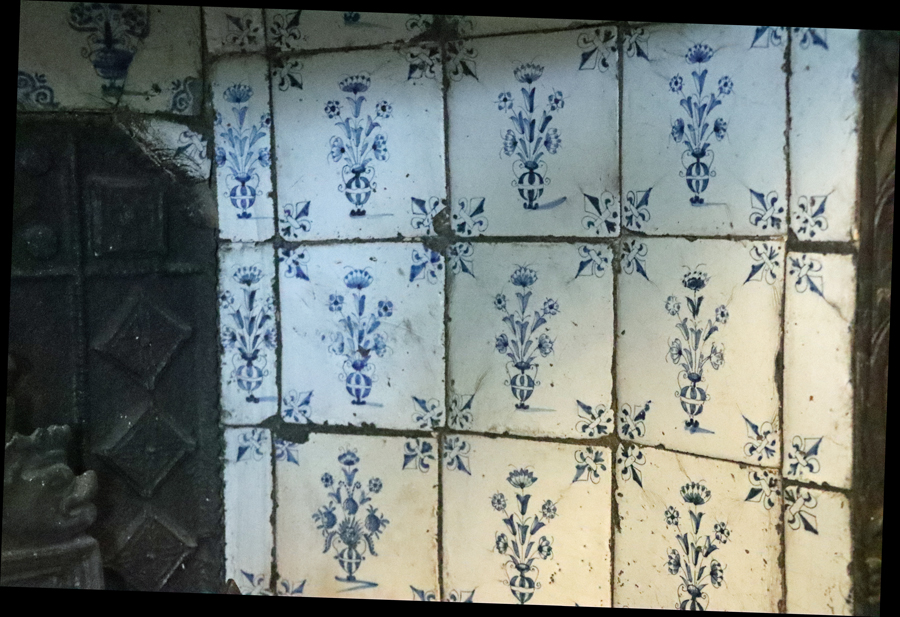
Detail of the fireplace in the library.  Every tile has the same decoration: a formal flower arrangement in a vase, with fleur de lys corner motifs.


A mixture of decorative topics are shown on the tiles in the main bedroom.

Trying to pin a date to any of the tile sets at Plas Newydd is not possible for a non-expert.  The most useful guide to the chronological development of delftware that I have found to date was produced by the Philadelphia Museum of Art by van Dam and Tichelaar in 1984, and provides an excellent overview of how delftware originated and how its popularity was split into urban and rural settings within the Netherlands, with different trends in each. For example, with particular reference to the tiles at Plas Newydd, tiles with frames such as those shown below tend to be earlier than those with only small corner motifs.  Tile thicknesses reduced from earlier tiles that were as much as 18m mm thick to only 6-7mm in the 18th century.  Polychrome examples such as those in the Oak Room were popular in the Netherlands in the mid-17th century but but went out of fashion in urban homes, surviving in rural homes for a while until here too they went out of fashion in around 1700.  Other chronological clues are the themes that made up collections of tiles.  For example, the number of landscapes and pastoral scenes increased at the expense of ships and sea monsters, whilst there was an increase of  wide landscapes, and the production of many more Biblical themes often framed in circles.  Finally, amongst various other clues, the Dutch tile was usually 13mm sq, and this was emulated by English artists, but some manufacturers began to produce 152mm sq tiles for the English market.  However, whether any of this is chronological direction is applicable to trends in English tile art I simply have no idea, and at the moment it is unknown whether the tiles are Dutch or English.
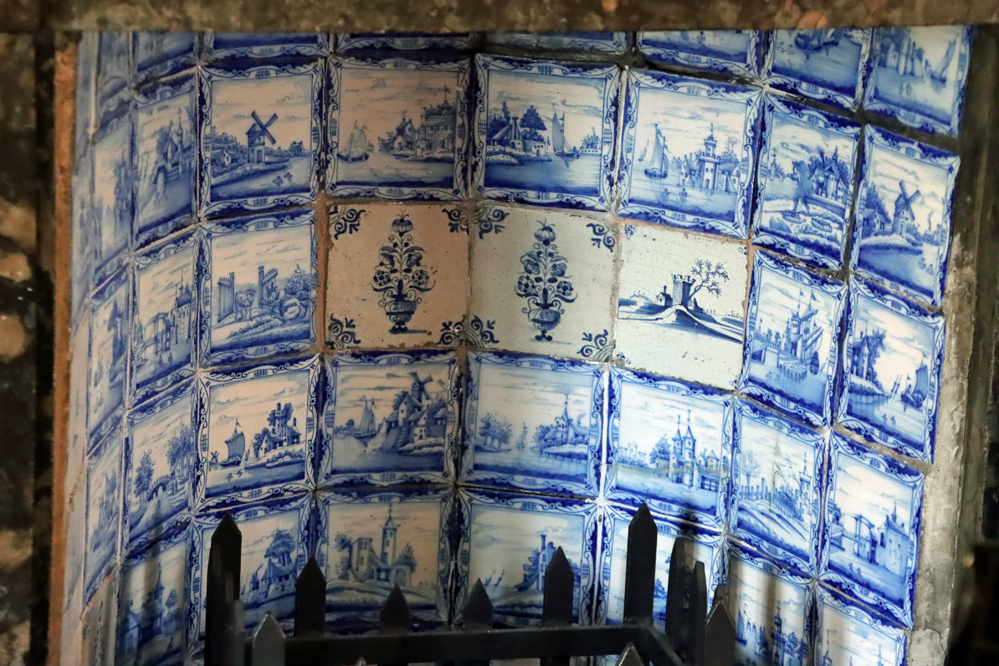
Main bedroom, including rural scenes and two identical floral arrangements in vases, fixed into position side by side.   The tower next to them is also anomalous; the others are all provided with a decorative frame and are rather more painterly in conception

xxx
Delftware pottery continued to be made into the 19th century, and indeed are still made today, but were replaced in popularity towards the end of the 18th century in England by new fashions.  Tiles continued to be used, but English manufacturers in Stoke on Trent and Jackfield began to innovate new styles of tile design, which soon became very popular.  In hearths backings of iron and brick were soon preferred.  At the same time other types of decoration became fashionable on other types of domestic pottery, such as willow pattern.

Dining room

When it became unfashionable delftware was removed and replaced, soon entering the salvage market, making it easy for dealers to scoop up and sell as collectibles.  At the same time, English  imitations of the Dutch examples, remained lower in cost.  There is no reason why General Yorke or Mr Robertson, both wealthy collectors, should not have been able to source Dutch tiles if so desired, but at the same time the more inexpensive and more easily accessible English tiles might have been preferred.
fdsfds

The Impressed, Gilded and Painted Leather

Detail of the Oak Room showing both carved oak, on the left and gilded and painted leather work on the right, with newer wood components fitted to tie in the wooden section, aesthetically, with the leather hangings.

The ornamental richness of the antique leather wall hangings installed in Plas Newydd by General Yorke are defined by bright colour and ornamental richness.  Sometimes referred to as Spanish leather or gilt leather (Dutch goudleer, Flemish goudleder, and French cuir doré), they are impressed or embossed and painted, and they combine many elements of wood carving, oil painting and tapestry, with themes that were all popular in the 17th century, but in a medium that is far less frequently preserved in British museums and period homes.  General Yorke, in his catalogues of the house dating to 1884 and 1888, puts them in the 16th century, but does not explain why he assigns this date to them.

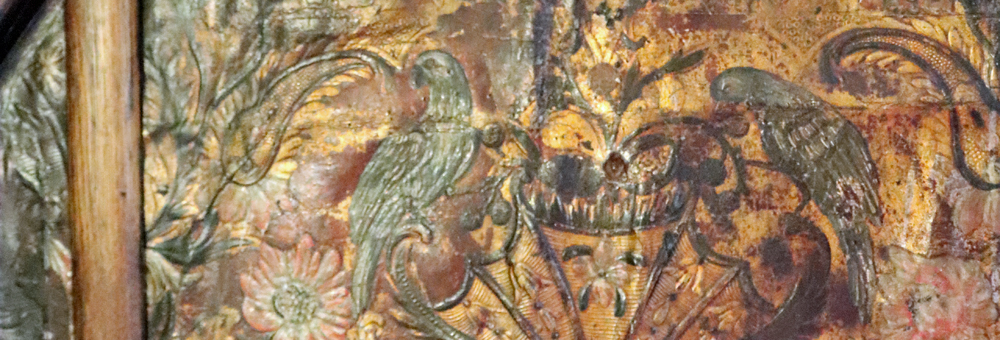
Parrots, such as the two green ones shown in this scene in the Oak Room at Plas Newydd, were very popular in Dutch art of the 17th century of all kinds, reflecting the exotic discoveries of the Dutch East India Company and representing the excitement of exploration and the luxuries, of which parrots are an example, that they returned to the Netherlands, associated with wealth, prestige and status.

Some of the best work was produced in the Netherlands, where the most accomplished gilt leather craftsmen, such as Martinus van den Heuvel the Younger (c.1647-1711), were recognized and celebrated as masters of the art.  There may have been many more leather wall hangings, also referred to as panels, in the new wing that General Yorke built adjacent to the original Plas Newydd cottage, but the examples that survive in the Oak Room and on the upper staircase are remarkable in their own right, surrounded by ornamental panelling, each distinctive piece retaining a character of its own.  The majority of examples in Britain are actually from the Netherlands, which was the main producer of gilt leather, and even where it was produced in other countries, it was strongly influenced by Dutch examples.

Tapestry and leather hangings were the most expensive of all of the decorative arts used as wall coverings, far more labour-intensive than wood panelling and wainscotting.  Sadly, there are remarkably few easily accessible sources of information about this extraordinarily rich medium. The art work is often glorious, emulating tapestry, embroidery and oil painting, but with the added splendour of the three-dimensional embossing, with often intense colours, including silver and gold, contributing a real sense of  luxury and wealth.  As well as its considerable visual impact, it was also practical, offering a durable layer of insulation.  The V&A adds the interesting thought that in dining rooms it had a particular value over tapestry, as leather hangings did not retain any of the smell imparted by food.  The examples at Plas Newydd demonstrate its value as a form of decorative art.

Gilt leather wall hanging. The Oak Room with a Flemish and Dutch style still life of flowers typical of the 16th to late 17th centuries.

Embossed and painted leather wall hangings became popular in the wealthiest households in the 16th century, first in Europe and then via the Low Countries into England.  Its popularity was rejuvenated once again during the 18th century, when it was particularly influenced by Indian and Oriental examples. The success of Dutch and Flemish gilt leather work is comparable to delftware and oil painting, and like both, there was a large export market for embossed leather.  In situ examples are still to be found throughout Europe and beyond and are an important component of museums specializing in the decorative arts.  Although leather wall hangings were considered to be durable when compared with tapestries, which were vulnerable to insect incursions and damp, their long-term survival rate has not been poor, and what remains represents a tiny percentage of what was produced.

The so-called gilding, which is incredibly convincing, is apparently not gold, but a cleverly devised concoction developed to resemble it:

The shiny surface on gilt leather is not real gold. The golden surface is created by silver leaves coated with an oil-resinous varnish intensely coloured with yellow substances such as aloe and saffron. These ‘gilded’ leather panels are subsequently decorated with fashionable ornamental patterns.  The designs and decorative motives are either directly transferred to the silver leaf (or the gold varnish) with inked wooden moulds, or they are directly impressed on moist leather, after the gilding, with wooden or metallic moulds, adequate to give the surface a more or less sharp relief.  The transferred designs are often painted with covering pigments, but mostly with transparent organic colours, lacquers and coloured varnishes in an oil medium.  [Gilt Leather Society]

The Gilt Leather Society also describes the steps that followed:

Gilt-leathers with a flat surface are further impressed with punches which border and enhance the scenes and motifs, often complete them, and make vibrant the unpainted gold or silver surfaces. The decoration obtained with plates and moulds is repeated skin after skin, or divided over a few skins, which once connected form a continuous design. The assembly of artefacts is completed by sewing or by gluing the decorated skins.

A design reminiscent of the Italian style of grotteschi pioneered by Raphael after the discovery of the Roman wall paintings in the Domus Aurea in Rome

Utterly fascinating. The Netherlands Institute for Conservation, Arts and Science (NICAS) divides gilt leather into three principal types: flat with decorative repetitive patterns, embossed with decorative or illustrative or representational depictions (figures 11-13), and lastly flat with painted scenes.  Although initially following designs developed in textile production, particularly silk brocades, in the 1620s Dutch leather craftsmen began to emboss leather to produce a three-dimensional element to their work, and they began to explore designs that were not derived exclusively from textiles, as described by NICAS:

Designs in the very fashionable auricular style were introduced. Exuberant naturalistic motifs, such as foliage, garlands, flowers, insects, birds and other animals, elegantly covered the whole surface, without a defined orientation. Allegorical or mythological figures were often used, with themes such as the five senses, the four seasons, the four elements and vanitas symbols.  This renewed gilt leather was in great demand, both inside and outside the Netherlands. By the end of the seventeenth century designs underwent a change in style. Patterns became symmetrical, the embossments diminished and subsequently disappeared, patterns again began to mimic textile designs. This reflected the French influence in the decorative arts and in architecture at the time. [Posthuma de Boer et al 2016 (NICAS), p.21]

Detail of floral still life shown further up the page

It seems remarkable that the leatherwork has survived as well as it has, given its inherent fragility over long periods of time, and its construction, which the  Gilt Leather Society describes as “a delicate sandwich of materials.”  Unsurprisingly, given the complexity of production and the resulting costs, gilt leather was gradually replaced by wallpaper after the mid 17th century, undergoing a brief revival in the 18th century.

I have been unable to find any analysis of the leather work at Plas Newydd, so have no idea what sort of date/s could be assigned to them.  All the examples in Plas Newydd are impressive for their richness and detail, although they represent a variety of styles, and possibly span more than one period.  Although leather panels were used in churches and other ecclesiastical institutions, they were also frequently employed in wealthy homes and high status civic settings, with themes appropriate to those contexts, used in a similar way to tapestries and later wallpaper.  There is nothing in the Plas Newydd wall hangings to suggest a religious connection.
xxx

Lincrusta wall coverings
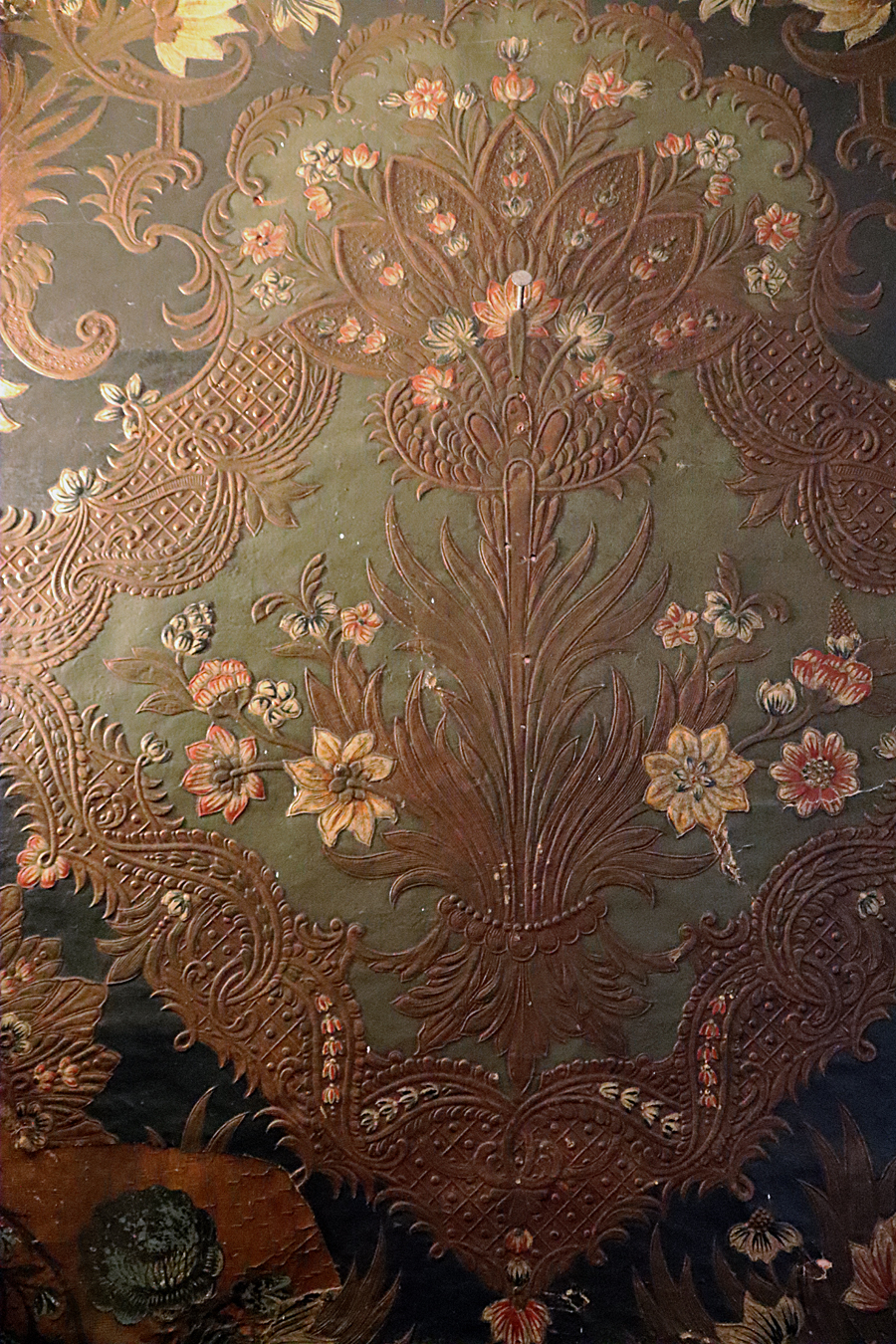
Lincrusta wallpaper in the dining room at Plas Newydd

The dining room at Plas Newydd was remodelled by General Yorke who panelled the room and provided it with its Lincrusta wallpaper, which is not unlike the rich colour of the gilt leather wall hangings in the Oak Room, but was far less expensive and was designed specifically to cover large areas.

In the 1860s Frederick Walton (1834 – 1928) created Linoleum as a floor covering, water-resistant and hard wearing.  In 1877 he followed this success with a patent for Linoleum Muralis (wall Linoleum) but it was marketed as Lincrusta-Walton.  The Lin was from the Latin Linum for linseed, from which Linoleum and Lincrusta were made, and Crusta meaning relief.  It was employed, as the Lincrusta website puts it “from royal homes to railway carriages,” replacing wainscotting, plasterwork and leather hangings, and is still sold today.  Not only was it was a new, attractive and durable solution to decorating walls, but it was water resistant too.  The manufacturing process combines gelatinous linseed oil and powdered wood, which is combined to form a paste that is first spread onto paper and then passed through steel rollers, one of which has the required pattern embossed on it.  At Plas Newydd it does a good job of emulating the leather wall hangings and providing a suitable background for carved furniture.
xxx

Plaster-work ceilings
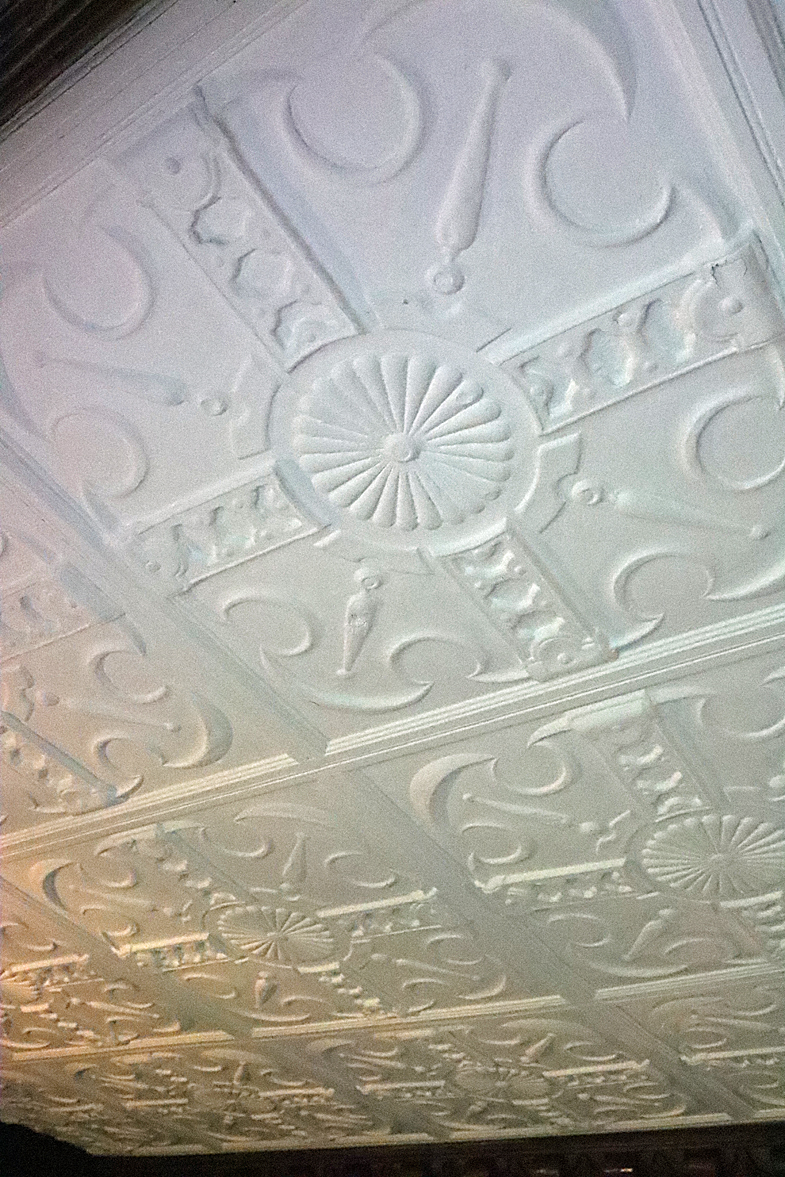
The main bedroom ceiling

Unlike the stained glass and the wooden panelling, it seems inconceivable that Lady Eleanor and Miss Ponsonby could have afforded even one plasterwork ceiling, but it was certainly not beyond the means of General John Yorke, whose purchase of the house was followed by elaborate additions of his own, including the decorative half-timbering of the original cottage that remains today as well as the addition of an entire new wing.  The same can be said for Mr Robertson.  I have not seen any record of what fitted in either General Yorke’s or Mr Roberston’s wings, so the ceilings in the cottage and the new wing cannot be compared.  Given that most of the interior wood and glass of Plas Newydd was assembled from decorative arts installed at other locations, the first question with the plasterwork ceilings is when were they added?

Removing ceilings from one building and transferring them to another sounds ambitious but was occasionally carried out.  For example, at Emral Hall near Worthenbury (Wrexham), the ceiling, together with panelling and stone carvings, were lifted from a room and transferred in their entirety to Portmeirion when Emral Hall was scheduled to be demolished.   An example from Hyde Abbey House in Hyde in Winchester had been curtailed to fit its new home, making it obvious that it had been transferred from another location because the design had had to be curtailed to fit its new home.  Most of the plasterwork ceilings at Plas Newydd, however, look as though they were designed for the rooms in which they were installed, rather than having been cut out of another building. This means that at least some of the ceilings were probably custom-made for Plas Newydd and probably date to the latter half of the 19th century. Even if this assumption is correct, it is unknown which company might have been responsible for the work.
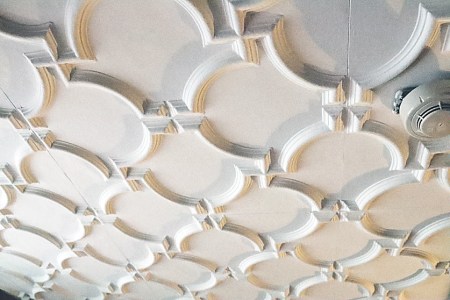
Ceiling in the second bedroom

In the 19th century a number of innovations were made in the manufacturing of ceiling plaster.  Gelatine moulds were introduced in the mid 1800s, and hessian began to be added to plaster with timber laths to make it simultaneously more light-weight and much stronger. This resulted in a product that was both a lot easier to move from a workshop and to install.  At the same time, the introduction of ornate wall papers created a demand for much simpler geometric ceiling plaster.  Without professional insights into the Plas Newydd ceilings, it is impossible to go much further, except to observe that the plaster ceilings are all very nicely made and consist of several different designs.  The pattern in the Oak Room is repeated in the second bedroom and the dining room, but the examples in the library and the main bedroom are unique to those rooms.  That in the main bedroom is particularly ornate.  If anyone has any expertise in this area and have an opinion about the Plas Newydd ceilings, I would be very interested in hearing from you.
xxx

The library

The library

Final Comments

I have not found anything published on the subject of the Plas Newydd decorative arts that have been covered in this post, so the above information is regrettably very short on details relating to the examples in the house.  If you are reading this and have an opinion about any of the subjects covered here, it would be great to hear from you.

Although the two wings added by the General and Mr Robertson respectively were demolished due to dry rot in the 1960s, the original cottage with all its embellishments has been beautifully preserved, and this provides insights not only into the achievements of Lady Eleanor and Miss Ponsonby but also into types of decorative art that were favoured by their successors and, in the case of Lincrusta, only became available long after the deaths of the ladies.

The sheer intensity and concentration of the decoration, even without furnishings and collected objects, would probably have stunned Elizabethan and Jacobean audiences, and would certainly have impressed 18th and early 19th century visitors, but although every item is divorced from its original context, each individual piece has a very distinctive voice of its own.  The resulting kaleidoscope of colours and textures is remarkable and very satisfying.  An amazing visual experience and, as described in the Visiting Details in Part 1, a great day out.


Sources

My thanks again to Michael Freeman for the Plas Newydd pages on his excellent Early Tourists in Wales website.

The audio guide for Plas Newydd, free with your ticket, is a useful introduction to all the different aspects of the house as you are walking around.

Books, booklets and papers

Brazil, Helena 2018.  Lincrusta 1877-1887:  The development, designs and character of Lincrusta-Walton.  Unpublished M.A. thesis.  University of Lincoln for the degree of MA by Research, September 2018
https://repository.lincoln.ac.uk/articles/thesis/Lincrusta-Walton_1877_-1887_The_Development_Design_and_Character_of_Lincrusta-Walton/24325975/1

Bostwick, David 1993. Decorative Plasterwork of the Yorkshire Region 1570-1670. Unpublished PhD Thesis, University of Sheffield
https://etheses.whiterose.ac.uk/id/eprint/1895/

van Dam, Jan Daniel and Pieter Jan Tichelaar 1984. Dutch Tiles in the Philadelphia Museum of Art.  Philadelphia Museum of Art
https://ia800201.us.archive.org/18/items/dutchtilesinphil00phil/dutchtilesinphil00phil.pdf

Durbin, Lesley 2005.  Architectural Tiles. Conservation and Restoration. From the Medieval Period to the Twentieth Century.  Elsevier Butterworth-Heinemann
https://www.academia.edu/34465762/Architectural_Tiles_Conservation_and_Restoration

Fleming, John. and Honour, Hugh 1977, 1989 (2nd edition). The Penguin Dictionary of Decorative Arts. Viking

Gapper, Claire, Karen Parker and Edward Roberts 2002.  Elizabethan and Jacobean Decorative Features at Hyde, Winchester.  Proceedings of the Hampshire Field Club and Archaeological Society (Hampshire Studies), 57, 2002, p.59-80
https://www.hantsfieldclub.org.uk/publications/hampshirestudies/digital/2000s/vol57/Gapper%26others.pdf

Kamermans, John 2014.  Developments in Research on Dutch Tiles.  In Susanna Varela Flor (ed.) A Herança de Santos Simōes Nova Perspectivas para o Estudo da Azuleraria e da Cerâmica.

van Lemmen, Hans. 2005. Delftware Tiles. Shire Album

Osborne, Harold (ed.) 1970. The Oxford Companion to Art. Oxford University Press

Osborne, Harold (ed.) 1975. The Oxford Companion to the Decorative Arts. Oxford University Press

Posthuma de Boer, Martine, Eloy Koldeweij, Roger M. Groves 2016. Gilt Leather Artefacts: White Paper on Material Characterization and Improved Conservation Strategies within NICAS, Delft. Netherlands Institute for Conservation, Arts and Science (NICAS)
https://www.academia.edu/32424868/Gilt_Leather_Artefacts_White_Paper_on_Material_Characterization_and_Improved_Conservation_Strategies_within_NICAS_Delft_2016

Pratt, Nigel 2020. Decorative Plasterwork in South-West England, c. 1550-1640, Unpublished PhD Thesis, University of Exeter
https://ore.exeter.ac.uk/repository/handle/10871/121309
Volume 1 https://ore.exeter.ac.uk/repository/bitstream/handle/10871/121309/PrattN%20Vol%201.pdf?sequence=1&isAllowed=y
Volume 2 https://ore.exeter.ac.uk/repository/bitstream/handle/10871/121309/PrattN%20Vol%202_TPC.pdf?sequence=3&isAllowed=y

Wells-Cole, Anthony 1997.  Art and Decoration in Elizabethan and Jacobean England.  Paul Mellon Centre for Studies in British Art / Yale University Press

Veysey, A. Geoffrey and David Freeman 1988.  Plas Newydd and the Ladies of Llangollen. Glyndwr District Council.  (Based on the booklet by Veysey, County Archivist for Clwyd County Council, published in 1980.  Two sections were substantially updated by Freeman in 1988 – the Oak Room and the Ladies’ Bedchamber).

Websites

Adorares
The History and Modern Revival of Spanish Leather Wallpapers
https://www.adorares.com/exploring-european-crafts/the-history-and-modern-revival-of-spanish-leather-wallpapers

British Listed Buildings
Lleweni Hall, including Stables to the NE. A Grade II* Listed Building in Denbigh, Denbighshire
https://britishlistedbuildings.co.uk/300001060-lleweni-hall-including-stables-to-the-ne-denbigh

British Renaissance Plasterwork – The web site of Dr Claire Gapper, based on her PhD research
British Renaissance Plasterwork
https://clairegapper.info/

Building Conservation
Lincrusta-Walton and Other 19th-century Raised Relief Wall Coverings, Building Conservation. By Helena Brazil and Paul Croft
https://www.buildingconservation.com/articles/lincrusta-walton/lincrusta-walton.html
Repairing Lime Plaster Ceilings. By Sean Wheatley
https://www.buildingconservation.com/articles/lime-plaster-ceilings/lime-plaster-ceilings.htm

Brynkinalt Estate
https://www.brynkinalt.co.uk/

Coflein
Emral Hall, Worthenbury
https://coflein.gov.uk/en/site/35805/
Town Hall, Portmeirion
https://coflein.gov.uk/en/site/407060/

Delfts Aardewerk (trans. Delft pottery – articles in English)
https://delftsaardewerk.nl/en
The city of Delft in the seventeenth and eighteenth centuries. By Céline Ariaans, 17th March 2020
https://delftsaardewerk.nl/en/learn/6691-the-city-of-delft-in-the-seventeenth-and-eighteenth-centuries

Driehaus Museum
“The Most Perfect and Beautiful of All Wall Decorations” October 16th, 2016
https://driehausmuseum.org/blog/view/the-most-perfect-and-beautiful-of-all-wall-decorations

Gilt Leather Society
What is gilt leather?
https://giltleathersociety.org/gilt-leather/what-is-gilt-leather/
Gallery
https://giltleathersociety.org/gilt-leather/gallery/

Heritage Plaster Services
Architecture & Plaster Design in the Victorian Period
https://www.heritageplasterservices.co.uk/blog/architecture-plaster-design-in-the-victorian-period

Historic England
Historic Fibrous Plaster in the UK Guidance on its Care and Management
https://historicengland.org.uk/advice/technical-advice/buildings/inspection-and-maintenance-of-fibrous-plaster-ceilings/
Or – https://cadw.gov.wales/sites/default/files/2019-07/Historic%20Fibrous%20Plaster%20Eng_0.pdf

Internet Archive
Catalogue of designs of Lincrusta-Walton manufactured by Fr. Beck & Co., branch of National Wall Paper Co. 1900
https://archive.org/details/gri_33125000661575/mode/2up

The Leiden Collection
Young woman in a niche with parrot and cage
https://www.theleidencollection.com/archives/artwork/GD-105_young-woman-in-a-niche-with-a-parrot-and-cage_2023.pdf

Lincrusta
Home page
https://lincrusta.com/
Brand Story

https://lincrusta.com/about-us/#brand-story

Lincrusta Heritage
Lincrusta-Walton
https://www.lincrustaheritage.co.uk/lincrusta-walton

Homes&Antiques
Tiles of style: why both antique and new Delftware will always be in fashion
https://www.homesandantiques.com/antiques/collecting-guides-antiques/delftware-tiles-collecting-guide

Netherlands Institute for Conservation, Art and Science
Project: Gilt Leather Artefacts
https://www.nicas-research.nl/projects/gilt-leather-artefacts/

Regts Delft Tiles
FAQ
https://www.regtsdelfttiles.com/faq#delfttiles
Where do you still find those antique Dutch Delft tiles?
https://www.regtsdelfttiles.com/blog/where-do-you-still-find-those-antique-dutch-delft-tiles.html

The Stained Glass Museum
Glossary
The Development of Stained Glass in England

https://stainedglassmuseum.com/glossary

V&A
‘Delftware’: tin-glazed earthenware tiles
https://www.vam.ac.uk/articles/delftware-tiles?srsltid=AfmBOoqHATTpRhhTIlBSCGJT3g2_qS8-qt5mh3L7xanNqOlu-Pmp2FG4
Gilt-leather Panel ca. 1650-1670
https://collections.vam.ac.uk/item/O370332/panel-martinus-van-den/

The Victorian Emporium
The Origin of Mouldings, August 4th 2011
https://www.thevictorianemporium.com/publications/history/article/the_origin_of_mouldings?srsltid=AfmBOoqiYBY6zNGjHqpghfsYyUY_xhR4TvZfS4t6S4GfZPrud4jOU-Sf


Lord Leverhulme’s multifarious collections at the Lady Lever Art Gallery in Port Sunlight, Wirral

The Lady Lever Art Gallery is in a fabulous location within the village of Port Sunlight.  Port Sunlight was the brainchild of William Hesketh Lever, who in 1911 became Baronet Lord Lever, and in 1917 Baron Lord Leverhulme, honoured for his contributions to industry, commerce and the economy. He was also remembered, amongst other achievements, for his three years as a Liberal M.P., his philanthropy and his art collections.  Just off the A41, an unattractive stretch of the road characterized by untidy industrial and retail parks, the village remains a genuinely surprising and perfectly charming near-utopia of green spaces, wide boulevard-style roads and a splendid mixture of compact homes with gardens and small civic buildings, all built in a variety of architectural styles, all vernacular.  Port Sunlight, named for one of the soap brands that Lever produced (Sunlight Soap), was built for the workers in the nearby factory.  The Neoclassical architecture of the art gallery stands out as a monument in its own right.  It was, indeed, a memorial to Lever’s late wife Elizabeth Ellen Hulme, who died in 1913, and whom he always stated was his inspiration.  Although the gallery served the practical purpose of housing the best of Lord Lever’s private collections, which had outgrown his own numerous homes, it was more importantly built  on his philanthropic urge to improve conditions and provide educational facilities for the working class families of his factory employees.

The Lady Lever Art Gallery. Photograph by Rich Daley, Wikimedia

Originally the museum was designed to be entered from the front, its big entrance overlooking the boating pond and the long green avenue beyond towards the massive war memorial.  Today the boating pond has been drained of water, with warning signs to prevent people climbing in (Julian, with whom I visited, predicts that it will become a flower bed!).  There is plenty of free parking in front of the museum, as well as on the surrounding roads.  Today the entrance to the gallery is at the side, left as you face the front, next to a ramp that leads to the basement with its excellent café and its little shop.  There is no charge for visiting the permanent collection.  You are offered a  map at the desk, and we did find that this was helpful, although once you have worked out that it is organized by rooms around a main hall, with a circular room at each end, each linking together another set of rooms, it’s very straight-forward to navigate.  Having said that, looking at the map at home after the visit I realized that there were two upstairs galleries, each a corridor that flanks the main hall, which we missed.  According to the map these apparently display 19th and 20th century art.  Next time!

===

===

Lion-headed table support, which would have been one of three or more. Roman. c.100AD

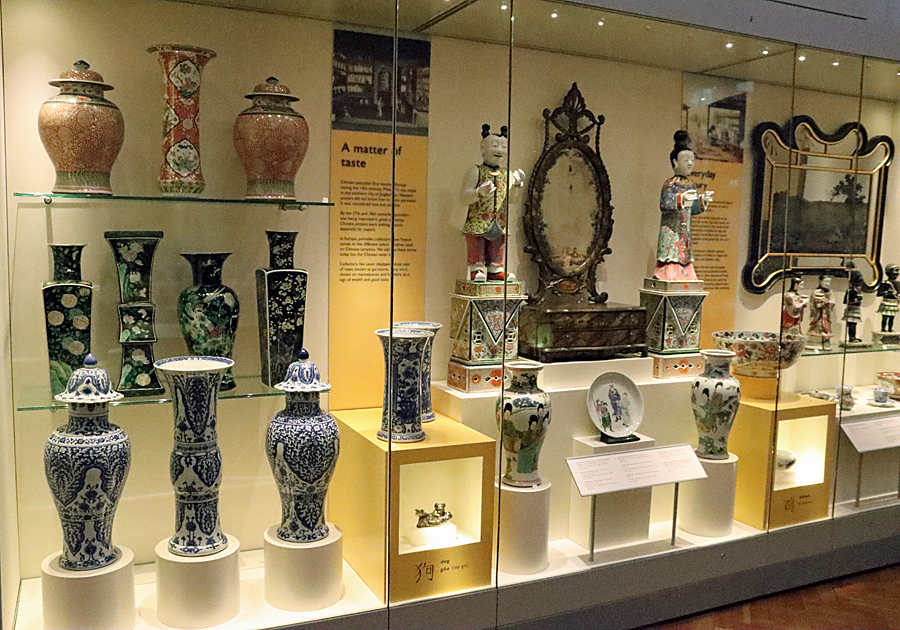
The easiest way to convey the overall impression of the Lady Lever Art Gallery is to characterize it as a miniature V&A.  Although there is a large collection of oil paintings and some water colours, there is also an emphasis on decorative arts including furniture, china, sculpture, tapestries, and embroidery.  The multinational character of the collection is impressive and begins, chronologically, with some Classical objects, as well as a couple of items from ancient Egypt.  Lord Lever had a great love of Chinese porcelain and his taste extended from the simplest of the blue and white patterns to the most elaborate and exotic polychrome extravaganzas.  There are a number of very fine Indian items, but perhaps not as many as there might have been given how long the East India Company had had its claws hooked into India’s social, economic and cultural landscape.  There is a small collection on display of ethnographic objects, although Lord Lever collected over 1000 pieces, and there are also a tiny number of ancient Egyptian objects, the bulk having been loaned to the Bolton Museum and Art Gallery.  He also collected a massive amount of Wedgwood, including fireplaces and pieces on which Josiah Wedgwood collaborated with George Stubbs.  Impressively, Lord Lever’s collection included Elizabethan and Jacobean furnishings, which are not always well represented in British museum and art gallery collections, and are really good examples of their types.

Oinochoe, used to pour wine into cups. Italian, in the style of a Corinthian vase. c.625-600BC.

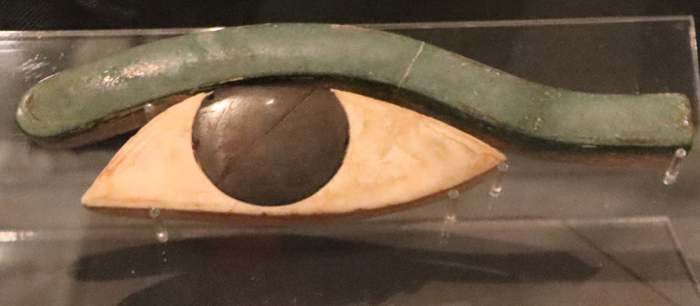
12th Dynasty Egyptian stone components of an eye

Anglo-Indian commode, 1770-80. Engraved ivory veneered on a sandalwood carcase, originally fitted with specimen draws (now missing). An English design made at Vizagapatam.

English or German “Nonsuch” chest dated 1592 (corresponding to the late Elizabethan period)

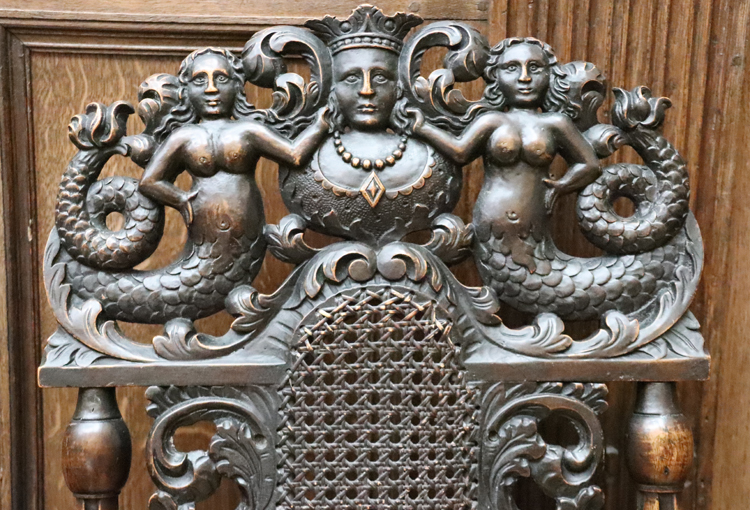
Detail of an English or Dutch chair (one of a pair), 1690-1710, emulating the Jacobean style, with mermaids and the bust of a crowned queen


Wedgwood

1780-90 Wedgwood Caneware teapot


The wall decoration in the Adam Room

There are five rooms that skilfully recreate a particular period in all its details, from wall treatments and light fittings to furnishings and art works which.  These recreated rooms are splendid today but in the days before the National Trust and day-trips to aristocratic houses must have been a real revelation to visitors.  Examples are the Adam Room and the William and Mary Room.  Both Julian and I were horrified by the Napoleon Room;  no matter how hard I tried, I was unable to find anything in it of aesthetic merit in it, although the sheer excess of it all did make me grin.  There is always something to love in mad committent to a particular passion.

Sculpturally, Lord Lever’s taste extended from the Classical to the modern including, very surprisingly, a Joseph Epstein sculpture, and the variety of forms and styles is remarkable, although I have the impression that the quality is far more variable than in other art forms in the gallery.  There are, however, some very fine Roman cineraria (small stone caskets that hold ashes of the dead).

In oil painting, Lord Lever’s taste focused mainly, but not exclusively, on contemporary and slightly earlier artists including George Stubbs, Joseph Mallord William Turner, William Etty, Thomas Gainsborough, Joshua Reynolds, Elizabeth Vigée Le Brun and George Romney, as well as a notable selection of those from the Pre-Raphaelite school including William Holman Hunt, John Everett Millais, Dante Gabriel Rossetti and Edward Burne-Jones.

Dante Gabriel Rossetti’s “The Blessed Damozel.” There is an article about the painting on the Lady Lever Art Gallery website.

The glorious “The Falls of the Clyde” by Joseph Mallord William Turner; Lady Lever Art Gallery. Source: ArtUK

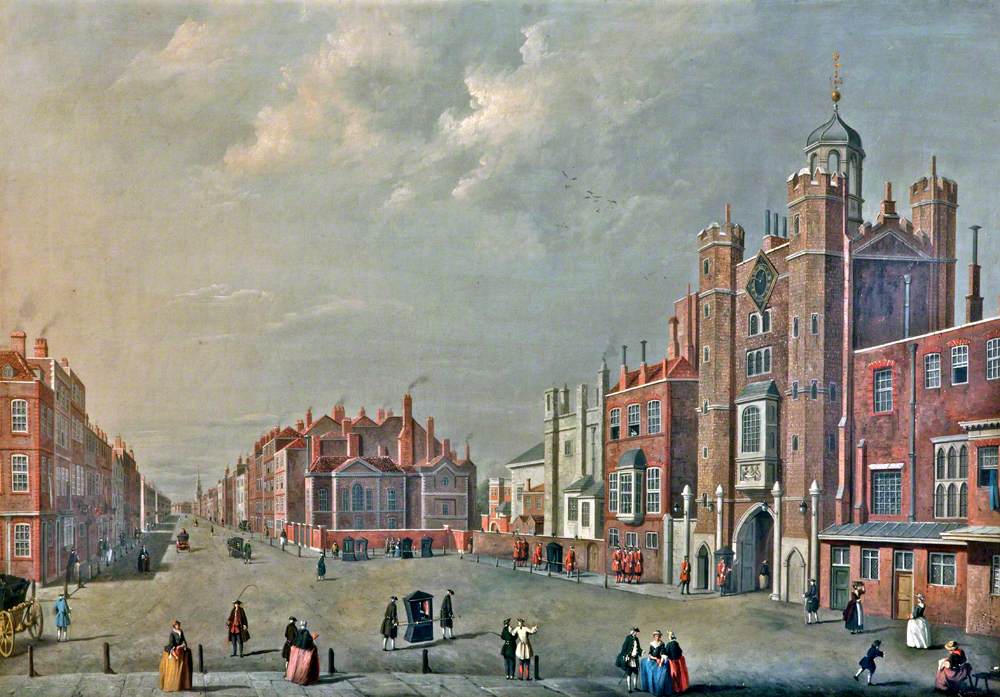
St James’s Palace. English School. Source: ArtUK

Emma Hamilton as a Bacchante. Elisabeth Vigée Le Brun.  Lord Lever’s tastes in art were usually consistent with popular opinion, but by modern standards some have not always stood the test of time. Although Vigée Le Brun produced some very accomplished pieces, others were not quite as refined.  Source: ArtUK


Painted mahogany writing desk by John Thomas Serres, 1792

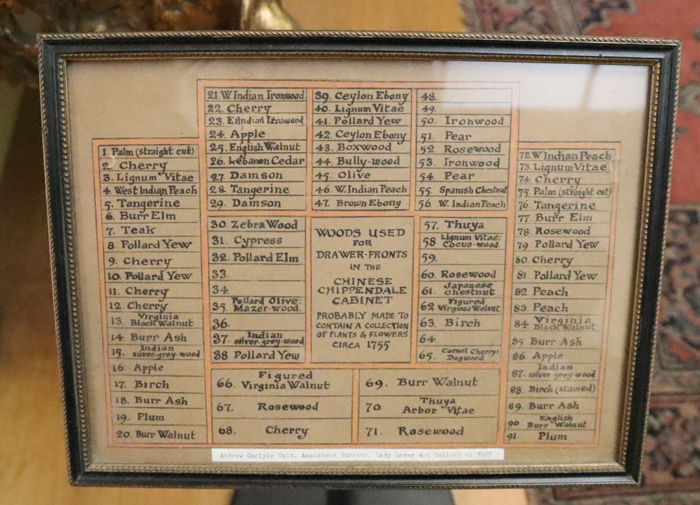
There are some items that don’t fit any particular category, such as 19th century copies of earlier Chinese cabinets (sometimes on hideously elaborate and inappropriate stands), a late 18th century cupboard decorated with thousands of tiny curls of coloured paper (filigree), late 18th century painted writing desks, and a staggeringly huge cabinet full of draws made with different types of wood; as a whole it is too big and ornate by modern standards, but the individual woods are very beautiful.  There is also a room dedicated to Lord Leverhulme and his achievements, essentially the activities that paid for the village and the gallery, together with some more examples of his collecting interests, such as his ethnographic and ancient Egyptian items.  Another room addresses the challenges of conservation.

Cabinet with multiple draws for collecting samples. 1830, but inspired by Thomas Chippendale (18th century)

On the missing list, it is most notable that there are very few Middle Eastern items, and that there are very few Medieval pieces, presumably reflecting Lord Lever’s taste.  It was of particular interest that some of the pieces had been reworked once if not more times either to repair them, reconstruct missing elements or reinvent the original concept to make it more appealing to contemporary tastes.  One of the Roman cineraria, for example, had lost its lid and had been provided with a new one in the 19th century, complete with twin Egyptian-style sphinxes.

Roman cinerarium with a 19th century lid.

Detail of Elizabethan/Jacobean wood inlay cabinet

Because preferences in art and decorative arts are so very personal, and some of the items are very much more 19th century than 21st century taste, not everything will appeal to everyone, but the skill represented by all items of all types is consistently excellent.  A shift of focus from a complete piece of furniture to the individual components that make it up not only help to reveal that skill that went into an object, but also draw attention to themes, symbols and ideas that were built into these otherwise functional items.

A fairly disastrous mismatch of styles. The Dutch cabinet, inspired by Japanese art, dates to 1690. It rests on a an over-elaborately decorative baroque stand, dating to c.1680, inspired by Louis XIV solid silver furniture from Versailles


Some of the rooms have received significant investment since I was last at the museum around a decade ago, with modern displays, excellent lighting and good information boards.  My impression is that there are fewer items on display in the Chinese and Wedgwood rooms, but that the focus on quality and representative types means that visitors are able to fully digest the collection without being overwhelmed by the sheer volume.

Perhaps more than anything else, the Lady Lever Art Gallery is an insight into the self-conscious 19th century perception of the world, including its values, hopes and ambitions.  As one of the information boards points out, although Lever was a brilliant and in many ways an admirable man, he was also part of the story of colonization, with interests in the Belgian Congo. This aspect of his activities is now a new field of research at the gallery, helping to place the story of Lord Lever and his commercial and philanthropic activities into a more global and sometimes troubling context.

Click to enlarge.  Artworks in the “Fresh Perspectives” exhibition. Clockwise from top left: Snowden Through a Lens by Jack Thompson; Gaudi in Paint by Freya Kennedy; Japanese Landscape by Millie Lawrensen Beckett; Seafoam Seaside by Isabelle Stockdale; Triptych by Indy Evans

The gallery often has special exhibitions, and these are worth watching out for on the gallery’s What’s On web page.  At the moment there is a really thought-provoking exhibition, Fresh Perspectives (on until 27th Apr 2025), a tri-annual exhibition of inspiring artworks by young people from Wirral secondary schools.  Julian and I chatted a lot as we were going around this about the differences between how art is clearly being taught in these schools and our own experiences of school art classes.  As a professional artist, Julian was particularly impressed with how students are being encouraged to explore a wide range of approaches and express themselves using non-verbal methods.  Here there is a lot of mixed-media being used in hugely creative and imaginative ways to produce some truly original artworks.  There is a lot of inventive portraiture, but some of the semi-abstract pieces are particularly interesting, featuring multi-cultural themes and the use of overlays to provide focused viewpoints.  It was heartening to see that even those who might not be able to draw were enabled to express themselves using other media to assemble evocative, expressive artworks.  It is an absolutely excellent initiative, and we both found it truly inspiring.  The exhibition also provides the gallery with a very modern component that it otherwise lacks (for obvious reasons!).

William Hesketh Lever. Source: Wikipedia

Check the gallery’s web page on the National Museums Liverpool website for opening times and other information.  Access to the main collection is free of charge, but some special exhibitions may be charged for.  You can preview some of the works on display, and read some articles about objects in the collection on the Collections page.  Note that the website is one of those maddening matryoshka (nested Russian doll) affairs, with multiple museums nested within a general museums website, and it is very easy to find yourself clicking on the wrong thing and finding yourself going off the Lady Lever gallery pages and ending up somewhere else within the general museums website.

There is a terrific coffee shop in the basement, which does a range of sticky buns and cakes, breakfasts and lunches, and serves a range of hot and cold drinks (I can recommend the excellent latte), and where Julian and I set the worlds of decorative and fine arts to rights. It was interesting how not only the objects in Lord Lever’s collection but Lord Lever himself dominated many aspects of the conversation. The shop sells souvenirs, books, greetings cards, postcards, etc, and is beautifully presented.

Overall, a great visit.

“Frightened Horse.” Blue jasper by Wedgwood, modelled by George Stubbs, 1780-85.

Splendid walnut travelling case with gilt metal mountings. 1850-1870

Commode, fascinatingly made up of 18th century parts in about 1880.

English chest c.1600-1625 (Jacobean). Oak inlaid with holly, rosewood, fruitwoods, and possibly sycamore and holly.

Detail of the above chest:


===

My battered copy of the site map

Day trip: The chaos of the Avanti train to and from Chester and Euston for “The Great Mughals” and “Silk Roads”

The Reading Room at the British Museum

One of the things I write about on this blog is how viable day trips to specific places actually are.  On Thursday December 5th my friend Helen and I went on a planned trip to London for the day to see two exhibitions and a quick touristy visit to Harrods Food Hall. The exhibitions are described briefly below, in case you are considering attending either and are interested in some insights, but this is mainly a story of an Avanti fiasco.

It’s the first time since moving to this area that I’ve been back to London by train, because on previous visits I took the car.  Virgin was still in charge of the west coast line when I was last traveling by train to visit my parents in the Chester area (when I was living in London), and although people complained about it, I used it a lot and found both the prices and the service very acceptable.  The line is now run by Avanti West Coast Trains.  A single return journey does not provide a valid sample of the service on an everyday basis, and perhaps this was not typical, but on a typically alternating dry-wet English day, not only were both direct trains that we should have been booked on, there and back cancelled, but there were other complications too.  It was a mess. Whether typical or not, this is certainly something to consider when planning a trip by train from Chester to London.

The Avanti Fiasco

A few weeks ago we both went to Chester to book the tickets on Chester railway station, in person, and that’s where the first problem occurred.  We wanted a direct fairly early train, and that limited us to three services – the 0732, the 0832 and the 0920.  Neither of us felt like an early rise for what was intended to be a very full but light-hearted day, so we selected the 0832, with return tickets booked on the 1902.  We learned later that we were supposed to have received a print-out of the travel plans, put none was given to us.  When we checked the tickets for the exact timings closer to the day of travel, we found that we had been booked on to the 0732.  In spite of Helen’s efforts to get our tickets changed, in person at the station, all the bookable seats on the the 0832 were already taken. The person at the station was apparently really helpful and apologetic but we were stuck with the 0732.  When we arrived we noticed that the 0832 had in fact been cancelled.  The passengers were presumably either heading to Crewe on the shuttle, or hanging around for the next 50 minutes because there is no direct train until 0920 (if that too was not cancelled).  On the upside, the train was clean and comfortable, stopping at Crewe and Stafford before arriving into Euston.

Avanti West Coast Train at Stafford. Source: Wikimedia Commons

When ready to take the train home, we returned to Euston with plenty of time to spare, and found that our train, the 1902, had been cancelled.  A station employee suggested that we take the 1833 to Manchester Piccadilly and change at Crewe.  We had to run for it but we made it.  It was absolutely packed but after walking through four carriages of a very busy train to try to find two seats together, we eventually installed ourselves.  The next bit of news, thanks to another passenger, was that no driver was currently available and we would not be leaving until 1900.  There were no announcements to this effect in the half hour that we were sitting there, so my thanks to that passenger for the information.  A few minutes after 1900 we slowly pulled off.  Nearing Crewe, having lost another 15 minutes en route there was an incredibly garbled announcement about people wanting to go to Crewe and Holyhead that involved platforms 5 and 6. No Avanti personnel came through the train, so there was no-one to ask for clarification.

We opted for platform 6 and once we had left the train at Crewe crossed the foot bridge and found the platform.  The overhead sign was reassuringly marked for Chester, leaving at 2103.   Just minutes before it was due to arrive there was an announcement to say that it was now coming in on platform 11, so we were again legging it along the platform towards the stairs to locate another platform (thanks very much to the knowledgeable fellow traveler who pointed us in the right direction).  We got back to Chester in the end, at something gone half past 9 (even that leg of the journey was late), rather later and much more stressed than we had planned.

In practice, both of the trains that we should have been on were cancelled. We were booked onto the wrong train on our outgoing journey, and on our return journey, instead of travelling direct to Chester in booked seats, we had to take pot luck on being able to sit together, and were forced to change and wait at wet and windy Crewe, adding yet more inconvenience to an already tiresomely unsatisfactory experience.

It is not yet over.  There is now the hassle of seeing if we can negotiate for some form of compensation.  I’ll update this post when the outcome has been decided.


The Great Mughals: Art, Architecture and Opulence at the V&A

This is a lovely, informative and eye-opening exhibition if you are in London before the 5th May 2025.  It has been on since November 9th 2024.  I didn’t take my camera so please note that all the photos below were either from the V&A website or were taken by Helen Anderson on her iPhone (see captions).

The great age of Mughal art lasted from about 1580 to 1650 and spanned the reigns of three emperors: Akbar, Jahangir and Shah Jahan. Hindu and Muslim artists and craftsmen from the northern regions of the Indian subcontinent worked with Iranian masters in the masculine environment of the royal workshops. Their very different traditions were combined to produce a radically new, and rapidly evolving style of art for the court. (V&A)

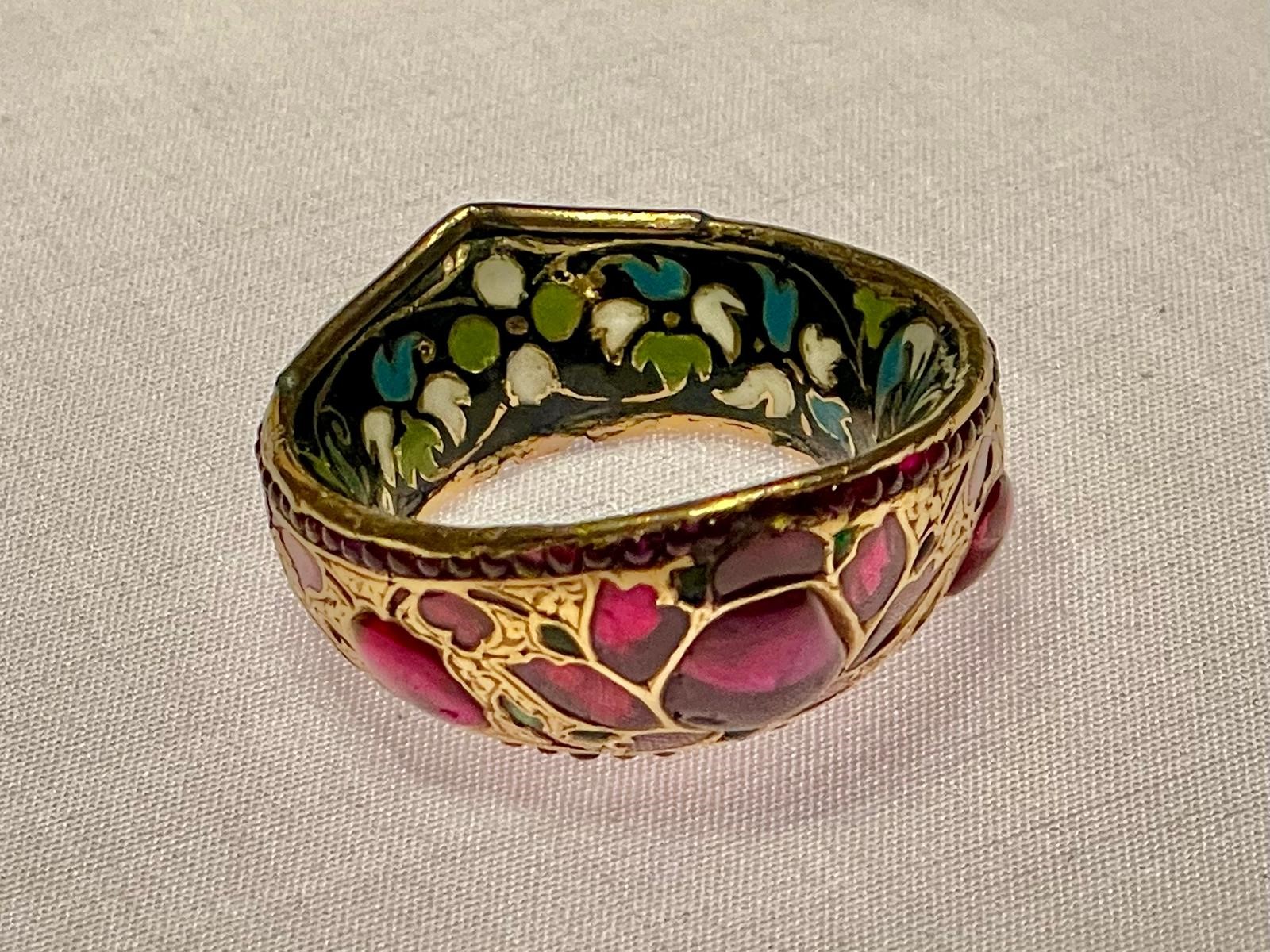
The exhibition covers the art of the reigns of three successive rulers on the Indian subcontinent.  Under each emperor the empire expanded and the resulting wealth funded a rich output of artistic work, including paintings, manuscripts, floor coverings, tiles, clothing, glass wear (including rock crystal) metalwork, jewellery, and other objects that made versatile use of gemstones and other raw materials such as mother of pearl and decorative stone.  A gold-hilted dagger and scabbard, for example, are studded with 1685 rubies This is very much the output of power and wealth.  The love of vibrant colour and glowing textures shines throughout.

Akbar’s entry into Surat in 1590-95. Source: V&A museum number IS.2:117-1896

Although it is a celebration of natural beauty, the overarching message is one of luxurious court living with its taste for the exotic and the religious all overlaid with by the idealism and expansionist determination of three imperial rulers.  Jahangir’s name means “World Seizer”, ahd he gave his son Khurram the title Shah Jahan, meaning “King of the World,” leaving no doubt that this is a story not merely of art and the skilled craftsmen that created it, but of political and territorial ambition.

The most astonishing thing, apart from the beauty of the artwork, is the sheer number of influences that were at play, producing a rich variety of styles and motifs.  Each region had its own characteristic approach to art and craft, as well as its own cultural motifs, but these were also mingled over time to create new portfolios of idea and expression.

The exhibition also includes pieces that express the influence of European ideas and art works on Mughal work.  The presence of merchants, diplomats, and Christian missionaries sometimes created a blend of Mughal and European concepts in art.

Each of the items, and the paintings in particular, reward examination on at least two levels: the overall subject matter on display, and then the individual details that make up these scenes. There are layers upon layers of patterning and motifs contained within the larger narrative, and each individual person, animal, bird, plant and building is a work of art in its own right.  This is clearly seen in the multiple layers of action, pattern and detail in Akbar’s entry into Surat above, and the glorious Squirrels in a tree, below. The sheer exoticism of some of the religious personalities are marvellous in their conceptualization.  As history, they also reveal a lot about court life, activities and and taste, and how extravagant and sensuous this all was.

by Abu’I-Hasan and Mansur. British Library Collection. Photograph by Helen Anderson, who holds the copyright

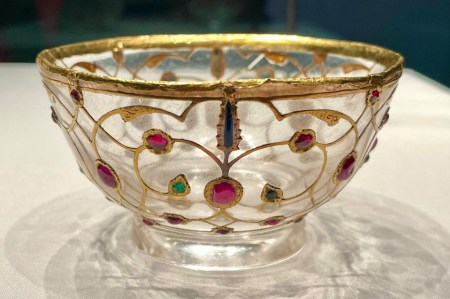
Rock crystal cup  studded with precious gems and kingfisher feathers, c.1620. Photograph by Helen Anderson, who holds the copyright

The rock crystal cup is an astonishing example of how different raw materials can be drawn together to produce a work of both breathtaking beauty and elaborate luxury, which can be enjoyed both as a single item and for its individual parts.  The rock crystal is set with rubies, emeralds and dark blue glass.  On the interior, the turquoise is provided by kingfisher feathers sealed under slithers of rock crystal, and the reverse sides of some of the stones are painted with tiny faces.   In spite of the luxurious components, all framed in gold, it miraculously conveys delicacy and charm rather than tipping into excessive ostentation and gaudiness.

Rock crystal cup showing interior with painted faces and kingfisher feathers, c.1620. Photograph by Helen Anderson, who holds the copyright

Some pieces seem much simpler at first sight, but contain such elegance and sophistication of design, form and shaping that they too sing out.  The wine cup of Shah Jahan is a particularly fine example of simplicity of concept and intricacy of design.

Wine cup of Shah Jahan, 1657. Source: V&A museum number IS.12-1962

This was a very well thought out and curated exhibition, making good use of the space in the several rooms and providing excellent information throughout.  It was quite busy at 1pm on a Thursday afternoon, but there was no sense of having to queue to see an item.  Whatever your taste in art, I would say that this is a must-see exhibition, because the quality of the objects is so high and the emphasis on natural beauty is delightful.  It is on until May 5th, and if I make it back to London before then, I will certainly visit again.

Man’s hunting coat with delicate colouring and splendid detail. Source:   V&A  For 23 more images see the V&A website

There is an excellent background to the history of this period on the V&A website, accompanied by many images from the exhibition, at:
https://www.vam.ac.uk/articles/the-arts-of-the-mughal-empire

Visiting details are on the V&A website here:

Photos are permitted without flash.

Gold thumb ring set with emeralds and rubies and enamelled on the inside, 1600 – 50, Mughal. V&A Museum no. IM.207-1920. Photograph by Helen Anderson, who retains the copyright


Silk Roads at the British Museum

Rather than a single trade route from East to West, the Silk Roads were made up of overlapping networks linking communities across Asia, Africa and Europe, from East Asia to Britain, and from Scandinavia to Madagascar. This major exhibition unravels how the journeys of people, objects and ideas that formed the Silk Roads shaped cultures and histories. The Silk Roads were in use for millennia, but this visually stunning show focuses on a defining period in their history, from about AD 500 to 1000. (British Museum)

The Silk Roads exhibition at the British Museum began on 23rd September 2024 and runs until February 2025.  Both Helen and I had reservations about it, each slightly different.  These are my thoughts.

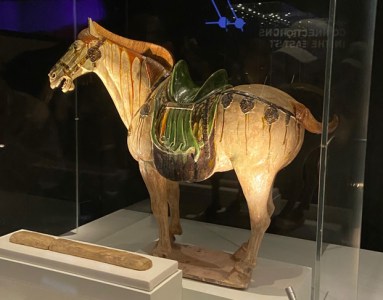
Tang Dynasty Horse

First, this was very busy at around 3pm on a Thursday afternoon, and the exhibition’s organization does not make the most of the space, which was not as extensive as I had expected for such a widely advertised event.  Glass display cabinets only face one way, which does not help to break up the bunching of groups of people in front of them.  If the objects had been visible and labled on both sides, it would have been much easier to get a view of them.  Instead, it was a matter of queuing painfully slowly until visitors had read the signage or listened to the running commentary in their smartphones.  The alternative was to dash between display cabinets as they became available, which I did, but completely breaks down the narrative value of the signage.

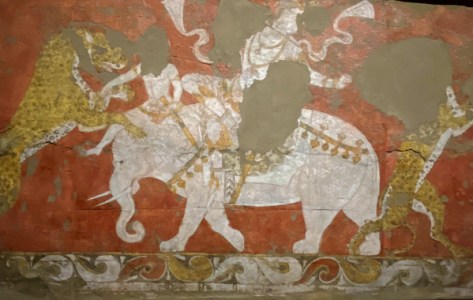
Section of a wall painting from the palace of Varakhsha Uzbek, c. AD730, showing a hero on an elephant fighting wild beasts. Collection of the State Museum of Uzbekistan

Because the silk roads cover a very wide area, and this was quite a small exhibition, there is not a great deal of connectivity between the objects on display,  and there is a great deal of variety, meaning that the information boards are essential to tie everything together.  This means that you really have to read the information boards in the order in which they are displayed to understand the role of the objects in the exhibition. The main problem was that it was far too busy at 3pm on a Thursday afternoon, with long slow crocodile queues of people trying to see objects and related signage.  An earlier or later time might have made the exhibition a far more enjoyable experience.

As well as the cultural-artistic aspect of the story, I had been hoping to learn more about the silk roads themselves, with the objects used to illustrate the commercial history of how the trade in silk operated and why it became so important, but there was very little on the subject.  It was not about the silk routes themselves, focusing instead on how these routes lead to the dispersal of objects, religious ideas and technical skills over large areas, mainly between east and west.  The narrative on the information boards does a good job of conveying the latter, if you are able to read them in the correct order, and there are some helpful maps.

To me, the narrative drawing all these objects together around the silk roads theme seemed rather forced. It felt more cobbled together than elegantly thought through, but as busy as it was, there were some very fine pieces on display, and if you see this as something of a kaleidoscope, an impressionistic view of the silk roads and the items and ideas that moved along it, there are some really nice individual pieces to enjoy.

For a more positive and much longer review see Jonathan Jones on The Guardian website gives The Silk Roads a big thumbs-up,  There’s also a good and positive overview by Josephine Quinn on The London Review of Books.

The British Museum’s own introduction to the exhibition can be found here:
https://www.britishmuseum.org/blog/beyond-sand-and-spices-introduction-silk-roads

Visiting details are on the British Museum website here:

Photos are permitted without flash.

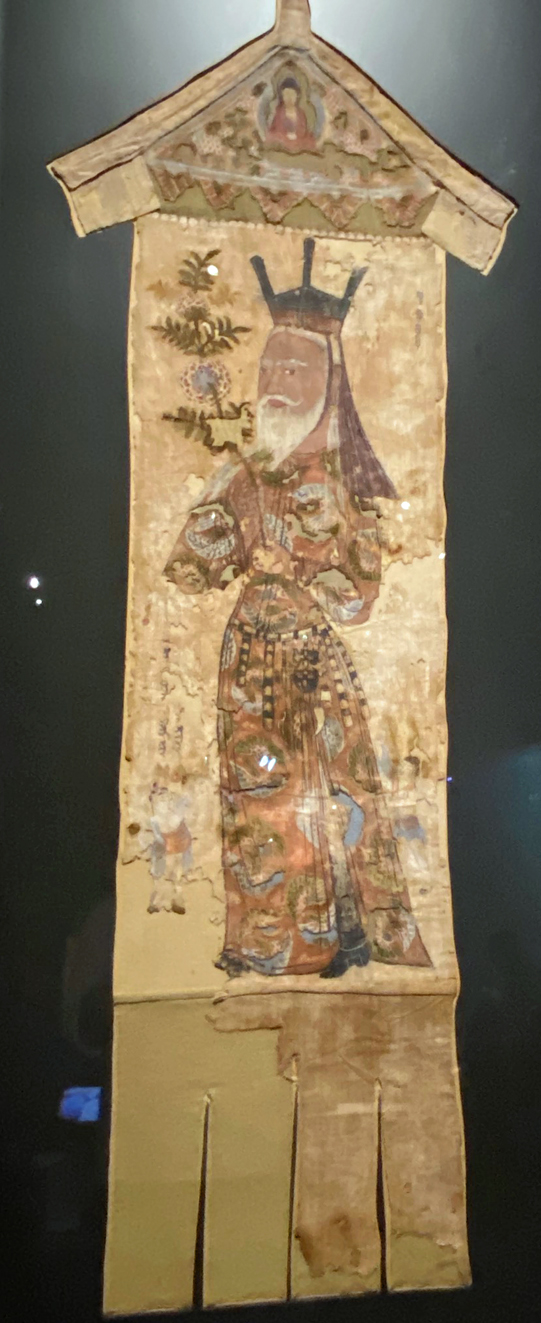
Funerary banner of a high-ranking Uyghur, perhaps a royal minister, named Kara Totok, wearing horse-riding attire. Museum fur Asiasfische Kunst.

—
Final Comments

Pilgrim vases from Abu Mina in Egypt AD 480-650. The one on the right is from Alexandria in Egypt; the one on the right was found in Kent. Both are in the British Museum collection (on show in the Silk Roads exhibition)

The booking of exhibition time slots makes the risk of train cancellations a more complex logistical factor than it should be.  Nowadays time slots for an exhibition are standard, and it clearly makes sense to give yourself a lot of wiggle room unless you are a paid-up member of an organization that allows members to enter without booking a slot.  Although most permanent collections (as opposed to temporary exhibitions) do not require you to book, the Courtauld Institute collection at Somerset House on The Strand is splendid but their website says that they will only let you visit their permanent collection with a booked, timed ticket.  I did email them to question if this was really the case, but they did not reply.  So I would suggest that after checking your destination museum or gallery, you book your train with a lot of wiggle-room built in.

If you have never visited the Food Hall at Harrods, it’s a fun destination at Christmas.  The prices are eye-watering, but as well as being stuffed full of indulgences, luxuries, it also stocks things that are very difficult to find elsewhere, and is a wonderful piece of pure tourism.  For a particular celebration I had wanted to pop in for white asparagus, which I cannot source up here, and snaffled the last pack that they had.  But after that vital piece of semi-sensible shopping, we then wandered through all the different rooms in the food hall, enjoying the beautiful displays, the fabulously packaged items and largely resisting the considerable number of temptations.

In spite of Avanti’s cancellation of both of the direct Chester ↔ Euston services that we chose, (which resulted in no seat bookings and the requirement to change at Crewe), it was a really good day and next time I will know that whatever I am / we are planning to do in London the best policy is to assume that the train service will go wrong, that Crewe will be involved even when you have tried to book a direct train, and that exhibition ticket slots need to be planned accordingly.

Good luck and enjoy!

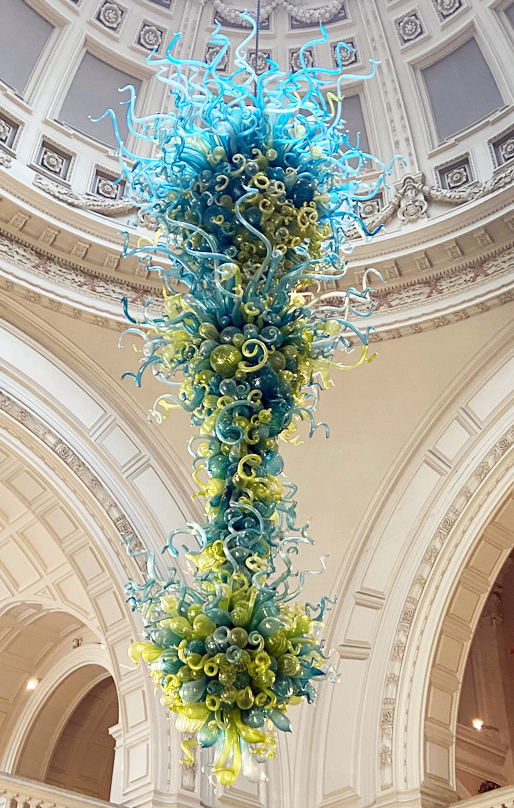
Dale Chihuly’s contemporary central glass sculpture under the dome at the V&A

Sun and Fire – Life and death at the dawn of history. Shrewsbury Museum and Art Gallery, 2/11/24 – 30/04/25

This looks like a must-see exhibition at the Shrewsbury Museum & Art Gallery. On my to-do list:

Sat 2 Nov, 2024 – Wed 30 Apr, 2025

From the museum’s website:

Experience life in Shropshire between 4500 and 2000 years ago. That’s roughly the time from 2500 BCE until the Romans invaded Britain in 43 CE.

Before the Romans came, people in Britain didn’t use writing. That means there’s a lot we don’t know about them. But they left many objects and other traces in the Shropshire landscape and by examining these closely, we can try to work out what their lives were like. Come and see how we can tell that heat was vital to them. Find out how they used fire to make beautiful and useful objects, to cook and to cremate their dead.

Explore our interactive exhibition and learn how we once celebrated the sun with huge stone circles and bright gold objects. We can’t be sure why they did some of these things. We can only guess what they thought and believed. But we do know that in lots of ways these people were like us, with bodies and senses like ours. They felt the heat of flames on their skin and the sun’s warmth on their faces. Their lives were full of sensations, sights, sounds and scents.

Full details, including opening times and ticket prices on the Museum’s website at:
https://www.shropshiremuseums.org.uk/event/sun-fire-life-and-death-at-the-dawn-of-history/

Chester in art in two exhibitions at the Grosvenor Museum: George Cuitt and Louise Rayner


Two versions of Bishop Lloyd’s Palace on Watergate Street. On the left George Cuitt and on the right Louise Rayner


Lower Bridge Street looking south. Louise Rayner

There are two exhibitions running concurrently in the Grosvenor Museum in Chester, both showing highly individual interpretations of Chester’s architecture.  The first, The Romance of Ruins – the Etchings of George Cuitt (Gallery 1 on the ground floor, accessible to wheelchair users) runs until 12 January 2025.  The second, Louise Rayner: Victorian Watercolours (Gallery 2, upstairs with no lift) runs until 9 February 2025. Both came from artistic families.  Cuitt (1779-1854) was the only son of painter George Cuit the Elder, becoming an art teacher in Chester, and Rayner’s (1832-1924) parents and several of her siblings were also artists. Cuitt added a second “t” to his surname to distinguish himself from his father.  If you visit both exhibitions at the same time, the most obvious contrast is that George Cuitt’s etchings are monochrome, whereas Louse Rayner’s watercolours are characterized by vivid colours, but in spite of the time differences between their work, and the chronological distance between them, there are a lot of similarities in their perceptions of Chester.  Both artists focus on detail, and both lean towards a picturesque and somewhat romanticized view of Chester, populated not merely by buildings but by a myriad of people and livestock.  Cuitt’s work is by its nature more linear and less impressionistic than Rayner’s, but both highlight key details of individual buildings, capturing much of the minutiae that makes Chester’s architecture so engaging, and the skills demonstrated by both are well-honed.  Rayner makes particularly good use of perspective to draw her viewers into her paintings.  Although this was not always a feature of Cuitt’s work, a particularly nice view of the cathedral cloister uses the same technique.

The Cloisters, Chester Cathedral, 1811. George Cuitt

Quite apart from their value as artistic interpretations of Chester, both the Cuitt and Rayner exhibitions provide insights into architectural details that no longer survive, lending themselves to historical research as well as art appreciation.  From Cuitt’s portfolio, an 1827 view through a ruined arch towards Chester Castle captures a surviving in situ feature of the medieval St Mary’s Benedictine Nunnery.  It is entitled “Chester Castle from the Nun’s Gardens,” (shown below)  It is also a nice juxtaposition of two contrasting architectural styles, and two equally contrasting states of preservation.  The arch has been moved to Grosvenor Park, where it is accompanied by other orphaned pieces of gothic architecture.  Another of his etchings shows the cloisters before the windows were added.  Louise Rayner’s corpus has provide a great many examples of buildings that are no longer standing, but I found the one showing St Werburgh’s Mount of particular interest, shown below, where St Werburgh Row, is now located.  Her painting of Lower Bridge Street is an eye opener, shown above, looking towards the Dee with some lovely buildings now demolished and replaced by a 1960s monstrosity, and the Harvie’s almshouses, also below, must have been a very attractive feature.

St Werburgh’s Mount, c.1873. Louise Rayner

Both exhibitions provide full information about both artists, providing insights into the influences acting on their work and how their careers developed.  The pictures displayed have been chosen to highlight not only how they each interpreted Chester but how their skills have been applied to such a rich subject matter.

Find details about opening hours and other visiting details on the Grosvenor Museum website.

View from St Mary’s Nunnery arch to Chester Castle, 1827. George Cuitt

Harvie’s Almshouses, Duke Street. Built 1692, demolished 1892

St Michael’s Church Porch, 1809. George Cuitt

The King Charles Tower and the Shropshire Union Canal. Louise Rayner


A splendid introduction to stained glass artist Trena Cox by Aleta Doran

Many thanks to Aleta Doran, Artist in Residence at Chester Cathedral for today’s introduction to stained glass artist Trena Cox, who was based in Chester for most of her long career.  Aleta is a brilliant and engaging presenter, currently working hard on the upcoming Trena Cox exhibition, which she is curating.  Although this was organized specially for Chester Archaeological Society, Aleta is doing more presentations during the Heritage Festival and if you get the chance to attend, do go.  It will give you a completely new insight into the world of 20th Century stained glass, as well as introducing you to a really creative part of the cathedral’s history.  I’ll keep this relatively short so as not to spoil the event for those of you who have tickets.

Trena Cox, apparently the least photographed artist in modern history, was born on the Wirral and trained at Birkenhead’s Laird School of art, learning her skills in traditional media before switching to stained glass.  She has created over 150 stained glass pieces that are known, but there are probably many more to be identified.  She worked mainly in the Cheshire and northeast Wales areas but her works are found further afield.  There are many in Chester itself, mainly in churches.  There are nine Trena Cox windows in the cathedral, one in the slype (a corridor) and the others arranged in groups of four, two at the top, two at the bottom, in adjacent aisles in the cloister (the walkway around the central garth or garden).

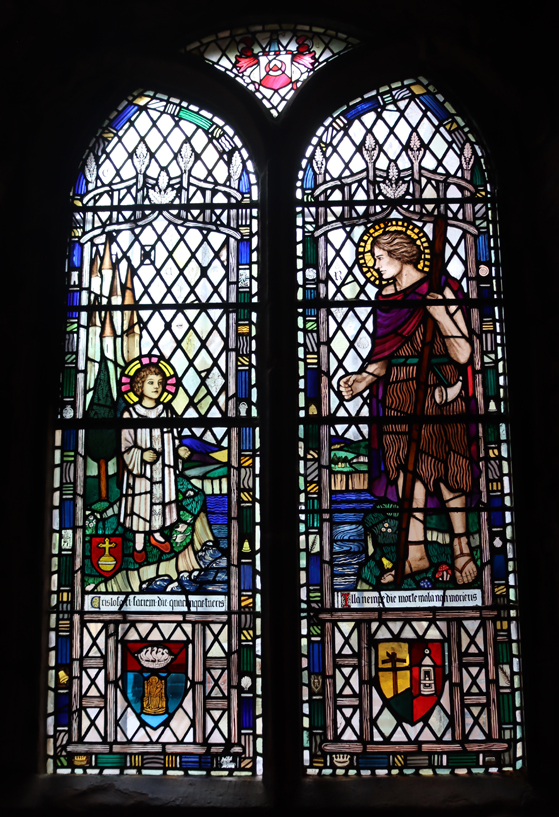
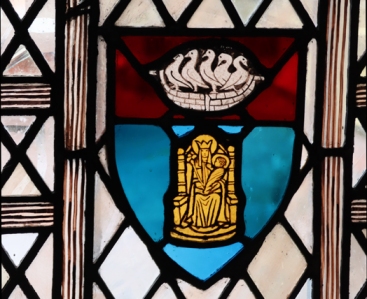
The big window in the slype shows the child Christ on one river bank, and St Christopher on the other.  This is very unconventional, as Christ is usually depicted being carried across the water on the shoulders of St Christopher.  Aleta described how this window clearly demonstrates many of the features of Trena Cox’s work, with the beautifully executed details of both figures, the surrounding landscape and the flowers, birds and animals that sit at the feet of the two figures.  Also typical are the portrait-style faces, which seem incredibly life-like.  The colouring of the glass, as in all her work, is vibrantly jewel-like and the background semi-opaque glass concentrates the eye on colours whilst allowing in light.  There are many emblems of international pilgrimage, known from badges purchased from the Middle Ages by pilgrims to commemorate their achievements.  As well as many others, these include St Thomas of Canterbury, St James of Santiago de Compostella, and of course Chester Cathedral’s own St Werburgh herself, her symbol being five geese in a basket. It is a rich and symbol-laden piece that rewards time taken to appreciate it.

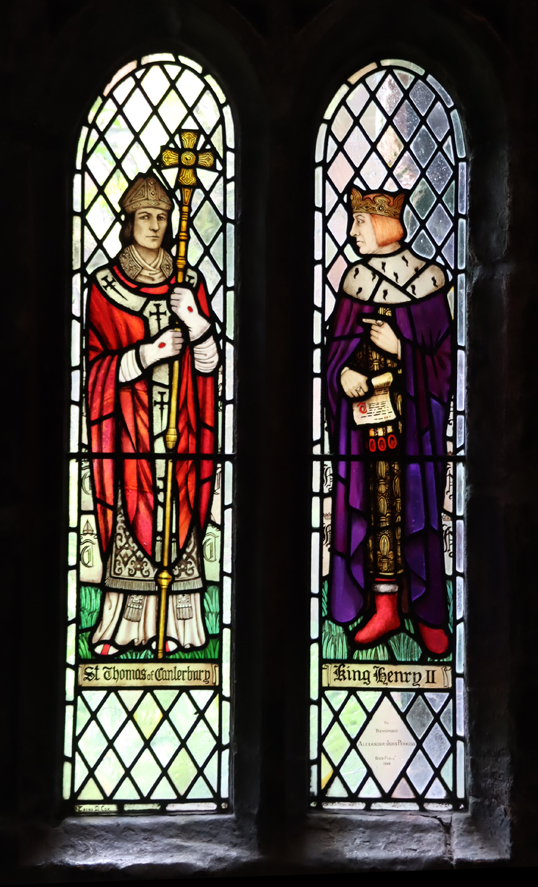
The cloister used to open out onto the garth, with a stone arcade forming a corridor with the buildings that surround the cloister.  In 1920 Dean Frank Bennet was appointed as the new head of the cathedral, and decided to take measures to improve the cathedral’s fortunes.  In order to glaze the arcade that surrounded the garth, the dean decided to raise public funds.  It is thought that some funds were raised by allowing donors for the cloister glass to add commemorations to loved ones in panes withing the windows, which survive today.  Each window represents a saint, religious festival or holy day.  Trena Cox contributed eight panels in two adjacent sections of the cloister, showing eight different saints.  In one set of four, the two at the top are Hugh Lupus who founded the abbey and St Werburgh’s mother St Ermengild  In the lower section are St Thomas Becket and King Henry II.  In the other set, the two figures at the top are Abbot Witchurch and Ralph Higden and the two below King Alfred and St Piegmund.  Aleta talked us through the significance of each of these saints, and why there were chosen.  These are much smaller and therefore much simpler compositions, but again the colours are vibrant, and the faces resemble portraiture.

Aleta wrapped up by telling us something about Trena Cox and her influence on Chester life, not only as an artist but as something of an activist for the protection of local heritage.  It seems remarkable that she is not better known, at least in Chester where she lived nearly all her life.  Hopefully, the upcoming the exhibition “Trena Cox: Reflections 100”, which begins on the 7th October, will bring this under-sung local personality and talented, prolific artist to much wider public attention.  Do take advantage of a tour of the glass with Aleta Doran if you have the opportunity.  As an artist herself, she offers a unique insight into the work of Trena Cox.

You can follow Aleta Doran on Twitter (@StargazingAleta), or via her blog at https://www.aletadoran.co.uk/

Part 2: Who was Brymbo Man, what was the Mold Cape and why do they matter?

What do we know about Bryn y Ffynon and Brymbo Man?

The skull of the Brymbo skeleton. Source: detail of a photo from the Wrexham County Borough Museum website.

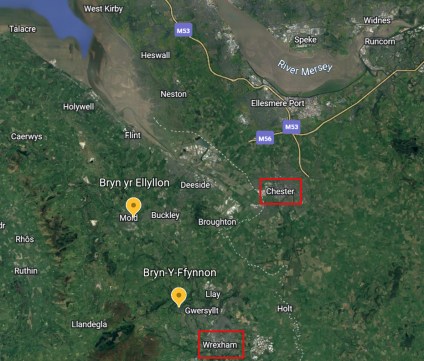
In Part 1 of this four-part series, two Late Neolithic – Early Bronze Age burial sites were introduced: Bryn y Ffynon (the grave of the so-called Brymbo Man), and Bryn yr Ellyllon (the grave in which the Mold gold cape was found).  A map of their locations was shown, the circumstances of their discovery was described, and the two graves were set in the context of similar sites in northeast Wales.

This post looks more closely at the Bryn y Ffynon, best known as the grave of Brymbo Man, one of the star exhibits in the Wrexham County Borough Museum.  Part 3 looks at Bryn yr Ellyllon, the grave that produced the Mold Cape.  I the fourth and final part, the various strands will be brought together in a conclusion, together with visiting notes.  The bibliography for all four parts can be found at present at the end of part .

Contents of Part 2:

  • The grave
  • The grave goods
  • The skeleton
  • Funerary rituals
  • Dating
  • What did Brymbo Man look like?
  • Who was Brymbo Man? Was he important?
  • How did he make a living?
  • Final comments on Part 2
  • (Sources are listed at the end of Part 1)


The grave

Brymbo Man was buried in a stone-built grave called Bryn y Ffynon (Well on the Hill)  on the north side of Ruabon Mountain, now the site of a housing estate in Brymbo to the northwest of Wrexham.  No burial mound, either of earth or stone, has survived, and it is not known if there ever was one.  In the northeast of England there were cemeteries of flat graves, so a burial mound might not have been essential everywhere, but in northeast Wales mounds of earth (barrows) or stone (cairns) were usual, even though not all of them remain.  Some mounds were built in complex layers using different materials, and importantly could contain secondary burials, usually cremation burials, that were added to the mound, sometimes involving the extension of the mound. The loss of a burial mound often equates to the loss of valuable data.  Stone cairns in particular were often robbed for their stone for much later building material, sometimes leaving a hidden cist unsuspected beneath the surface.  Given the upland location of the site, if the grave was covered, it probably lay under a cairn.

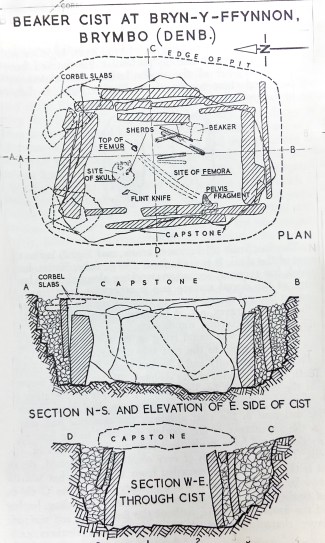
The cist (burial chamber) itself was made of roughly hewn slabs of local stone lining the walls and floor of the grave, and measured 96 x 79cm (38 x 31 inches).  The cist was aligned north-south.  A very large and uneven slab of stone, called a capstone, was placed over the top of the cist, sealing the burial before any burial mound was built over the top, itself measuring 5ft 6ins (167cm)  long, 3ft 3ins wide (c.1m) and 9ins (23cm) thick.

The Grave Goods

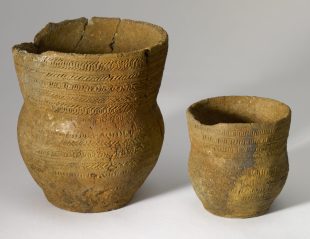
There were only two items found in the grave with Brymbo Man, which are on display with the skeleton.  One is a ceramic vessel known as a Beaker and the other is a flint tool.  This is fairly typical of Early Bronze Age graves.  Without access to the excavation report (unpublished) one assumes that the relationship between the objects and the skeleton in the cist was recorded, and that this is what has been reproduced by the museum, with a flint knife placed not far behind the skull and the Beaker placed towards at the base of what remains of the skeleton.

The Beaker

On the left: The Bryn y Ffynnon Beaker. Source:  Rebecca Van Der Putt (with congratulations, because I couldn’t get any sort of angle on it). Source: The Modern Antiquarian.  On the right:  Savory’s photograph of the Bryn y Ffynnon Beaker.  Source: Savory, H. N. 1959.

Brymbo Man was accompanied in his grave by a very distinctive ceramic form known as a “Beaker,” more precisely a short-necked Beaker.  The Beaker tradition was an import from Europe, marking one of the changes in the centuries at the end of the Neolithic and beginning of the Early Bronze Age.  Where a Beaker is buried with the individual, it may be accompanied by a variety of other goods, but is often the only object found.  This suggests that the beaker itself was pivotal in establishing the identity and purpose of the grave and its owner.  Skeletons in Beaker graves were flexed / crouched, (with their knees bent and their legs pulled up to their chests).

The process by which Beaker burial traditions arrived in Britain is still poorly understood.  Options are that the tradition was imported by visitors or immigrants; or that it was brought back from the continent by British (using the term loosely) travellers who found certain affinities with the funerary practises that they observed.  The idea of foreign people being buried with the new Beaker style burial is given some credence by beaker burials from the Stonehenge region, and in particular the Amesbury Archer, who was buried with a range of goods traditionally associated with beakers, and was subjected to isotope analysis that indicated his origins were probably in the Alps.  In addition, a multi-disciplinary DNA analysis research project in 2017 proposed that a significant percentage of the indigenous population of Britain was, by the Middle Bronze Age, replaced by those who brought the Beaker tradition with them at the end of the Neolithic:  “the genetic evidence points to a substantial amount of migration into Britain from the European mainland beginning around 2400 BCE.” (Olalde et al).  As is so often the case with this sort of DNA research, as highlighted in the study itself, there are questions remaining about the extent to which it is possible to extrapolate from the data used, including sampling issues (statistical, geographical and relating to the quality of the material).

The Beaker on the left is from Balblair in eastern Scotland, is not dissimilar from the Brymbo Beaker. althoug its neck is shorter, the carination less pronounced and the decorative incisions slightly different. Source: Inverness Museum and Art Gallery

The new burial tradition found favour, whatever it represented.  The new funerary regime could not have spread so far and and wide throughout Britain and Ireland without people in all those regions being complicit.   Whatever the mechanism of transmission, by the end of the Neolithic the continental Beaker and associated objects had become desirable, and were found extensively under round barrows, as well as occasionally in other contexts, in many parts of Britain.

Beakers were hand-made (i.e. not wheel-thrown), built up from a single ball of clay that was hollowed out and shaped before being fired.  There is a video at the end that demonstrates how Beakers may have been assembled and decorated.  A certain amount of skill went into the construction, which is a very specific shape, and the decoration must have taken considerable patience, but what is most remarkable about it is its faithful reproduction of an idea that had spread through Europe and was now perfectly at home in burials of northeast Wales.  The Beaker may have had slightly different ideas associated with it different areas, but it clearly imparted a message either about the deceased, the role or status enacted by the deceased in life, the status conferred upon the deceased after death, the place where the burial was made, as well as ideas and ideologies inherited with the Beaker tradition.

The flint knife

On the left. The plano-convex stone tool found in Bryn y Ffynnon, illustrated in Savory 1959. On the right, a photograph of the same, although note that the photograph appears to have been accidentally inverted (i.e. it is the wrong way round, which sometimes happens when photos are digitized). Source: Wrexham County Borough Museum

A flint tool was found in the grave.  It is plano-convex (flat on one side and curved on the other).  Flint was the preferred stone for tool manufacture in Britain.  In Cheshire, and less frequently in northeast Wales, it could be found locally in river beds and on beaches as pebbles, which are useful for making small tools, but for more ambitious pieces it would be imported from areas where flint was part of the geological fabric.  The reason for its popularity is the way in which it responds when it is struck in order to shape it into a tool.  The term for it is conchoidal fracturing, which means that the shock-wave of its fracture creates a slightly concave “bulb of percussion” from which concentric lines that ripple out from the point of impact.  The waste products left over from tool manufactured, undifferentiated flakes, are usually referred to as “debitage.”  Some of these could be further worked into other smaller tools, but others might be abandoned and are useful datasets about tool manufacture in their own right. Some tools are very distinctively shaped, like barbed and tanged arrowheads, but others are far more generic, like the one accompanying Brymbo Man.  Stone tools were often hafted in wood to make, for example, arrows, spears and axes.

Terminology used to described features of worked prehistoric tools. Source: Martingell 2001, p.10

Small plano-convex tools were common in the Late Neolithic and Early Bronze Age, particularly from the northeast, and often towards the end of the period.  When the edges are worked to form a sharp edge, they are usually termed knives, but many, including this one, were probably multi-purpose tools.  A particular industry referred to as “plano-convex” tools, formerly “slug knives,” is characterized by tools made with specialized pressure-flaking over one face of the tool, which have a very distinctive appearance and are particularly associated with the northeast and food vessels.  Nothing special went into the manufacture of this item, which is a very everyday piece, and although it is technically plano-convex, it is not characteristic of the more elaborate objects that are usually associated with the term.  I cannot find an image of the reverse side of the flint, but it looks more like a flake (a piece struck from a core piece of flint without much additional work) than a properly manufactured and shaped tool.

The Skeleton

Skeleton of “Brymbo Man” in the Bryn y Ffynnon cist. Source: Wrexham County Borough Museum

The skeleton as it survives today is incomplete, as shown in the photograph on the left.  Even with only a partial skeleton to study it could be determined that the deceased was a male who, at the time of his death, was 5ft 8ins/173cm tall, and was strong and powerful, indicated both by the shape of his skull and by the muscle attachments to both his skull and his leg bones.

Brymbo Man is thought to have been 35 years of age at the time of his death. There are different estimates of life expectancy for this period, but it is probable that 35-40 was a good age.  His age was determined both by the degree to which the bones in his skull had fused and by the wear of his teeth.  He had once suffered a wound above hairline on his forehead, thought to have been caused by an arrowhead, but this had healed and was not the cause of his death.  No cause of death was identified.  He could, for example, have died from an injury that left no traces on what remains of his skeleton, or from illness or disease.

Illustration to help explain strontium isotope analysis. Source, and helpful article: PBS Time Team America

Isotope analysis has not been carried out on the Brymbo skeleton.  Isotopic ratio analysis has become very popular for an increasingly popular for the study of past human and livestock migrations.  The technique was used, for example, on the tooth enamel of a skeleton found near Stonehenge, known as the Amesbury Archer, and indicates that this person spent his childhood in the Alps.  It has also been used by the Beaker People Project, which has concluded that dsfsadfsd.  It also be used on livestock remains, helping to show patterns of mobility such as transhumance.  Like radiocarbon dating, isotopic analysis requires a sample of human material, which is destroyed in the process, and so far Wrexham County Borough Museum has decided not to subject the Brymbo remains to avoid harming the remaining bones.  The choice between preservation and knowledge is a difficult one to make.

Funerary Rituals

Rituals for the dead can be important for ensuring that  the living transition successfully into an afterlife, but they may also be important for the living, allowing communities to come to terms with the loss of a community member, to create ancestral links with a particular landscape, and to formalize any exchange of role from the dead person to a living replacement.  These ideas are familiar from the rituals that we engage in today when we attend a funeral.  In prehistory, it is likely that there were other reasons and meanings embedded into the ritual activities accompanying the deposition of the dead.  There was certainly an internal logic to the burials contained within the stone chambers during this period, and the Brymbo burial shares many of these features.

The presence of the Beaker puts it within a burial tradition that is quite distinctive.  The dead were buried by themselves, usually under a barrow or cairn, in a small chamber (cist) with a Beaker vessel and sometimes other objects.  This European tradition was adopted slowly throughout Britain, and Beakers were adapted by local people to conform to their own traditions.  There are numerous variants.  Quite what this tradition meant to living communities is unknown.  It may have indicated some sort of specific role in society for the deceased, and it may even indicate, in this case, that the the deceased was either involved in networks of communication and exchange with other areas, or was not native to the northeast Wales or border area.

Savory’s 1959 illustration of the cist and capstone in the excavation report, showing the objects and skeletal remains in situ.

The skull was laid on its side, with the head to the north, facing east and, if the museum display reflects how the skeleton was found, the rest of the bones were apparently laid to give the impression of a crouched burial.  Although there are exceptions, males were usually laid with their heads facing east, females with their heads facing west.

Only 13% of the Bryn y Ffynnon skeleton was interred in the grave.  This is not an accident of survival of decay, but a deliberate decision by those who buried the remains.  This is not unusual.  Analysis of the skeletal remains by osteology specialist Corinne Duhig found that  some of the bones bore cut marks that had been made by a sharp tool, which may indicate de-fleshing the bones.  The disarticulation  of the skeleton, the missing bones, and and the signs of defleshing imply that between death and interment multiple activities took place.  None of this was by any means unusual in the period, or indeed from the preceding Early Neolithic.   One explanation for this type of activity is that the person died some distance from home and that the body was prepared somewhere else for travel prior to burial;  another is that the practices were part of a set of rituals that marked the transition from life to death, possibly including a transition to an afterlife.  It is also entirely possible that the body may have been laid to rest elsewhere and moved here at a later date.

Splitting of bodies between multiple places is not as strange as it sounds and has parallels, for example, in Medieval Britain. For example, when Earl Ranulf III of Chester (1170-1232) died away from home, his body was eviscerated (internal organs removed) so that it could buried in three locations.  His entrails were buried where he died in Wallingford, his heart was buried at Dieulacrès Abbey in the Midlands and his embalmed body was then returned to Chester for burial in St Werburgh’s Abbey. This was completely consistent with the traditions of the period.

The pre-interment activity at Brymbo does beg the question of how close the association between the dead person and the objects in the grave actually was.  If there was a considerable period between death and interment, it may be that the objects had more to do with the living than the dead, and that they were simply conventional contributions in which ideas were embodied in the artefacts about the site itself, rather than statements about the deceased.

Dating

Chronology of ceramics in Britain, Late Neolithic and Early Bronze Age. I have indicated the Beaker type most similar to the one in the Brymbo grave. Source: Parker-Pearson et al 2016

The skeleton has not been subjected to radiocarbon dating, but is thought to date to around 1900BC on the basis of artefacts that accompany the burial.  Relative dating of this sort is achieved by comparing the objects in graves with similar graves that have been subjected to radiocarbon dating.  Radiocarbon dating is a scientific method, known as absolute dating, that measures the amount of atmospheric carbon-14 remaining within organic materials such as bone or wood to obtain a date.  A brief but useful explanation can be found Oxford Radiocarbon Accelerator Unit website.  A sample of organic matter (such as skeletal or plant material) is required for the dating procedure, and this sample is destroyed in the process of obtaining a date.  Recent improvements in the technique need much smaller samples, but some curators are reluctant for even small samples to be destroyed.  Signage at the Wrexham County Borough Museum explains that the museum has decided, at the time of writing, not to have the Brymbo Man scientifically dated.  Instead, the relative (inferred) date given above has been based mainly on the Beaker.  Beakers have been studied extensively.  They appear from 2500BC, and there are multiple different styles, some of which can be charted over time.  The Brymbo Beaker, placed at around the 1900BC mark, is well into the Early Bronze Age and on the edge of the period when this style of pottery was going out of fashion.

What did Brymbo Man look like?

The Brymbo skull was used by facial reconstruction expert Dr Caroline Wilkinson at the Unit of Art in Medicine at Manchester University, to create an estimate of Brymbo Man’s appearance.   Although the skull is incomplete, what remained was enough for Dr Wilkinson to use.  The skull itself was fragile, but robust enough for a cast to be made.  The position and size of the muscle attachments helped to build a sense of the musculature in the face which, along with bone structure and overall body weight, help to determine the shape of the face.  The shape and size of all apertures in the face, such as eyes, mouth and nose, and the spatial relationship between them, also contribute to how a face would have looked.  Once the underlying structure of the face had been determined, the skin, represented by clay, was added.  There are some things that are not determined by the underlying structure, like lips and ears.  Once the model head was completed, a make-up artist was responsible for hair and the colour of eyes, complexion and hair.  This is not a definitive representation, but it is based on the available data, and it gives an excellent sense that the skeleton was once a living man.

Who was Brymbo Man?  Was he important?

Given that 1000s of people during the Bronze Age were not buried (the landscape would have been stuffed full of mounds if they had), we know that a selection process had been implemented, and this selection process put Brymbo Man in this grave.  Unfortunately we do not know the selection criteria for those who were deposited in graves.

One might wonder if he was the leader of his community, but he might equally be an elder respected for his experience and knowledge, a ritual specialist responsible for the religious well-being of the community, or a wealthy trader who conferred status on the group without necessarily having a position of hierarchical power.  Perhaps it was not his place in society that marked him out, but an action or event in which he took part.  Or was his death itself significant in some way?  Perhaps he was the first person to die after the establishment of a claim over a new territory.  Equally he might be a person or an idea regarded by the community for reasons that we might never imagine, because we can never know how people were categorized or how they related to the ideas of the community and the broader social conventions to which they were connected.

The capstone that sealed the stone grave, 5ft 6ins (167cm)  long, 3ft 3ins wide (c.1m) and 9ins (23cm) thick.

Whatever he represented, whether as a valued family member, an important representative of the community, or a symbol of something rather less conceivable, the burial itself was clearly important.  Assembling the grave was no light-hearted exercise.  Even without a barrow, cutting the stone for the the stone-lined cist, which would then have to be assembled, would have been a significant activity.  Even more impressive, the quarrying of the stone for the capstone and moving the capstone into position would have required many hands, probably some lifting technology, and a great deal of incentive and determination.

We know that Brymbo Man had sustained an injury to his skull, which he survived.  The nature of the injury suggests that it might have been made by an arrow, which could have been received in a hunting accident, or in conflict.  There are numerous reasons why people might resort to violence, including livestock raiding, disputes over territory as well as personal grievances, but there is no matching data from other burials in the area, such as evidence of similar injuries, to indicate wider scale disputes.  Although his injuries could have been connected to his role or status, and might have been a criterion by which he was selected for a round barrow burial, we simply have no way of knowing whether or not this was the case.

This photo shows a cairn that is better preserved than many located in exposed positions. Cefn y Gader 1 near Llangollen. Source: Megalithic Portal, photograph by “Postman”

Beyond speculation there is little information that the presence of a burial with a single Beaker and a single stone tool can divulge about who the deceased may have been in life.  It is not even clear whether he was important in his own right or whether his burial represented a set of ideas and traditions, quite unlike our own, that led to his burial in this location.  As things stand, we cannot form an opinion about whether he was any more important to his contemporaries than the event that placed him in the grave.  What can be stated with some confidence is that the grave itself, and the dome of earth or stone that probably encased it, were significant to the people who built it, standing proud on a landscape that was inhabited by people, and to whom it would have communicated messages that we can no longer read.

What do we know about how Brymbo Man made a living?

We know something about Brymbo man’s vital statistics, and how he was treated after death, but so far we have not had the opportunity to look at how he may have lived his life.  In Britain, Late Neolithic and Early Bronze Age resources potentially included cereal (wheat and barley) and legume crops, as well as livestock, primarily cattle and sheep.  In the earlier Neolithic period, after an initial burst of agrarian activity, livestock herding became dominant over cereal cultivation, possibly because of teething problems with the establishment of cereal farming in new territories by inexperienced farmers.  Cattle herding increased, and soon sheep also contributed to the subsistence mix, with dairy products rising in importance.  Before the end of the Early Bronze Age, cereal farming resumed on floodplains and other suitable land.  Although different areas had access to different types of land and both wild and domesticated resources, there is no reason to doubt that the inhabitants of northeast Wales could obtain access to subsistence assets when they required them, choosing the best combination of crops and livestock for the conditions in which they lived.  Hunting wild game probably supplemented the diet.

How much of this applies to the Brymbo area?  We know that the grave was on a hillside above the River Alyn.  The hillside is used used for sheep farming.  Given that Brymbo Man was buried in this location, it can be assumed that he lived and worked here for at least a portion of the year, but whether this was a settled or mobile life is unknown.

Topographic map of Brymbo. The meandering blue shows the Alyn valley. Click to show the bigger image.  Source: topographic-map.com

The point was made above that Brymbo Man was a sturdy individual with no obvious health defects, that 35 was a respectable age for the period, and that these observations suggest that he was healthy and probably had a nutritious diet.  We can state with some confidence is that Brymbo Man was once part of a family, and a larger community, made up of farmers and/or herders, as well as stone and pottery workers who exploited the fertile lowlands and highland pastures of northeast Wales, possibly on a transhumant or otherwise seasonal basis. These were the people who buried him.  There would have been many other men, women and children in the area when he was alive and making a living, each with a specific role within the community.  

It is possible that some members of the community split away from the rest on a seasonal basis, following a pattern of taking up livestock onto the hills to take advantage of summer pasture, before returning in the autumn to help with the harvest.  If the burial on the edge of Ruabon Mountain is an indication of an affiliation with this particular part of the landscape, Brymbo Man was probably involved in sheep or cattle herding, and was in easy reach of the Alyn valley for other agrarian activities.  Climatic indicators suggest that the weather was warm and relatively dry, and although lowland areas could be freed up for agriculture by the clearance of often dense woodland before they could be cultivated, upland areas were often used for both cultivation and herding.

Coming back once again to the Beaker, it is as far as one can tell from other excavated sites in the region, something of an unusual object in northeast Wales and the borders.  This one in particular seems to have affinities with other areas and it seems unlikely that it was made locally.  The presence of the copper mine on the Great Orme indicates that there was significant trading activity from there to other parts of Britain, and that the development of complex overland and seagoing trade routes were established had been established by the Early Bronze Age.  It is in not, therefore, far-fetched to suggest that this grave, overlooking the Alyn valley and only a few kilometres from the Dee valley, might have had connections further afield, and that the Beaker may not have been made by native potters, but was an import, either in trade, or in company with Brymbo Man.  This is highly speculative and more data is required.  Perhaps the beaker itself, and analysis of the clay from which it was made, could add additional data. Isotopic analysis of the skeleton might also well help to clarify some of these distance-related questions.  As noted above, however, this would involve inflicting damage on the Brymbo remains.

Final Comments on Part 2

Brymbo Man remains elusive.  One grave on its own, even containing a skeleton and grave goods, provides insufficient data for judging what the grave meant to the people that buried a man there, and covered his burial chamber with a giant capstone and, probably, a barrow or cairn.  Isotope data could probably get us a little further, but only as far as assessing whether this man was likely to have travelled.  All we can say for sure is that he had no obvious signs of ill health, that his physique, height and age suggest that he was well nourished, that he had received an injury apparently inflicted by another human, and that the hilly surroundings of his burial place might imply that he was involved in livestock herding or that this was a route he travelled in the course of another economic activity.

The real value of Brymbo Man, the objects in his grave and his burial mound is as a data source in comparative research to enable the development of a greater understanding of all these burials, the features they shared, and how they were differentiated from one another.  Once sufficient data has been accumulated, probably not until decades from now, it may be possible to return to Brymbo Man, better informed, with more knowledge to hand, to ask some of the above questions again.

Next

Bryn yr Ellyllon, the Early Bronze Age burial cairn that produced the Mold Cape, are discussed in a similar vein in Part 3.

Part 1: Who was Brymbo Man, what was the Mold Cape and why do they matter?

From left to right.  The Mold Cape and strings of amber beads superimposed on a digital sketch, which could be man or woman (Source: British Museum Partnership Programme); Photograph of the Wrexham County Borough Museum hologram of the reconstructed head of Brymbo Man (my photo); The recreated grave and capstone with original skeleton and grave goods of Brymbo Man in the Wrexham County Borough Museum (my photo).


Bryn y Ffynon (Brymbo) and Bryn yr Ellyllon (Mold) indicated by yellow markers, shown in relation to Chester and Wrexham. courtesy of Google Earth. Click to enlarge.

This is part 1 of a four-part overview of two Early Bronze Age graves and how they contribute to an understanding of  the archaeology of the period in northeast Wales and the borders. All four parts have been written, and will be released over the next couple of weeks.

The series has been divided up as follows:

Part 1 (this post) – Introduction to the Late Neolithic and Early Bronze Age in northeast Wales:

  • Introduction
  • Some Background to the Late Neolithic and Early Bronze Age
  • A rich heritage in northeast Wales
  • Discovering the graves
  • Sources (bibliography) for all four parts 

Part 2 – What do we know about Bryn y Ffynnon, the grave of ‘Brymbo Man’?

Part 3 – What do we know about Bryn yr Ellyllon, where the Mold cape was found? 

Part 4 – Bringing the threads together, plus visiting details


Part 1: Introduction

The series is based on two burial finds in northeast Wales, Bryn yr Ellyllon, near Mold and Bryn y Ffynnon at Brymbo, Wrexham.  These two sites have been chosen 1) because excavated sites are comparatively unusual in northeast Wales, 2) the contents of both sites can be visited in museums, and 3) because of the differences between them, and the opportunity for assessing different types of knowledge about the Late Neolithic and Early Bronze Age in northeast Wales.  In spite of the differences between them, both represent variants of the broader burial tradition, and therefore have the potential to add their own unique voices to the discussion of how this period manifests itself in the region.

The Mold Cape (British Museum 188,0514.1) from Bryn yr Ellyllon near Mold. Source: British Museum

Bryn yr Ellyllon (which translates as Hill of Goblins or Fairies) was discovered by labourers in 1833 a few miles to the east of Mold.  It was a round cairn (a mound of stones) that contained a badly decayed skeleton together accompanied by a number of very fine artefacts, one of which is the magnificent gold Mold Cape made of paper-thin gold and embossed with a decorative theme that emulates multiple strings of beads.  The other objects included around 300 amber beads (the exact number found remains unknown, and only one survives), other pieces of gold that appear to have belonged to a second cape, and some poorly preserved items of bronze.  These are now in the British Museum in London and are discussed further below and in part 3.  Even though the objects were pulled from the site as pieces of treasure, the location of the site is known, and the objects form a relatively coherent assemblage.  These are valuable details when understanding how objects were chosen to accompany the dead, and where burial sites were located in the landscape.

The partial remains of Brymbo Man and his two grave goods from the Bryn y Ffynnon cist. Source: Peoples Collection Wales

In 1958 a stone-line cist called Bryn y Ffynnon, was found 10 miles to the northwest of Wrexham at Brymbo, containing the well-preserved remains of a partial skeleton, a flint tool and a ceramic vessel known as a Beaker.  The name means Hill of the Well or Spring (with many thanks to Reginald Iain de Crawford-Griffin for the translation).  It seems to have been named for a small farm of the same name on Brymbo Hill.  The site was excavated in 1958, and the results published in an excavation report in 1959.  The man to whom the skeleton belonged, now nick-named Brymbo Man, was around 35 years old when he died some 3600 years ago.   The burial, including the skeletal remains, is now on display in the Wrexham County Borough Museum, together with a reconstruction of the skeleton’s face.  The site is discussed further below, and in detail in part 2.

Each burial offers contrasting insights into the Late Neolithic / Early Bronze Age, and they are worth looking at both individually and together to highlight how different sites may produced different types of knowledge.  Every individual site has something to say for itself, and as more sites are investigated, each feeds in turn into our knowledge about the period in which they were constructed, and during which they formed an integral part of the human landscape.  It is the  understanding of the period as a whole, rather than individual objects, that is important to archaeologists, who work to recreate past societies from the sites and objects that survive.

Some Background to the Late Neolithic and Early Bronze Age

Chronology of ceramics in Britain, Late Neolithic and Early Bronze Age. Source: Parker-Pearson et al 2016

The Late Neolithic and Early Bronze Age are usually discussed together.  The period lasts from around 2900-1600 BC.   The division from the earlier Neolithic lies in transformations visible in the material record, which may in turn reflect revisions of ideology, social organization and/or economic activity.  These changes coincide with a period of climatic change.

Riverine connections during British prehistory, showing how the river network links from Wessex, the Thames valley and the Humber estuary. Source: Bradley 2019, p.20

The climate, cooler than in the earlier Neolithic, was still favourable for agriculture, and in particular may have supported agricultural development in hilly areas in the summer months.  Astrid Caseldine’s analysis of environmental indicators suggests that this was a period of deforestation in many parts of upland north Wales, probably indicative of agricultural expansion into these upland areas.  This is supported both by the notable increase in cereal pollen in these environments, and by the flowering of Late Neolithic – Early Bronze Age monuments across the upland landscape.  This expansion could not have lasted indefinitely; the soils were simply not of sufficiently robust quality to sustain long-term agricultural expansion.  Valleys were also popular locations for these sites, indicating that communities were adept at making the best of various different environments.  The valley of the river Alyn, along which several sites are located including Bryn yr Ellyllon and the Llong, is one example.

Foremost amongst the transformations in material culture, suggesting social as well as economic changes, is a different form of burial  practise, suggesting changes in the way that communities defined themselves and related to both others and the landscape.  Although there were a number of tomb styles prevalent in the earlier Neolithic, most burial sites contained the remains of multiple individuals, but at the end of the Neolithic and the beginning of the Bronze age, smaller round barrows and cairns were favoured, usually containing a single burial in a small subterranean chamber at its centre, sometimes with a new form of pottery known as a Beaker.  Sometimes additional burials added into the mound itself at a later date.  At the same time, settlements became less substantial, more ephemeral, and much less easy to find archaeologically, the sites often consisting of little more than household debris with few, if any, signs of the circular structures that once contained them.

A suggested reconstruction of the 100s of beads found in the cairn at Llong, near Mold. Source: Curious Clwyd

Pottery styles also changed at this time, with the introduction of the new Beaker form from Europe and the replacement of earlier Neolithic styles with new home-grown Grooved Ware, Food Vessels and Collared Urns.  As the name Bronze Age suggests, this was also the period during which metal-working began, first copper and gold, and later bronze itself, an alloy of copper and tin.  North Wales was well placed as a base for the exploitation of mineral sources, an industry that gained momentum during the Early Bronze Age before becoming an important centre for copper and other resources in the Middle Bronze Age.  The earliest copper tools in Wales were flat axes that had been cast in an open mould, a basic technology that improved over time.  Decorative items, such as items of jewellery also appear much more frequently.  The amber beads in Bryn yr Ellyllon and the jet and shale beads in the necklace found in a cairn at Llong, near Mold, both in the valley of the river Alyn, are both examples from northeast Wales.

Although these are the top-level identifiers of the new Late Neolithic and Early Bronze Age material culture, there is considerable regional variation, and even within a region no two graves are identical.  Although inhumations (burials) are typical of barrow graves, cremation steadily gained momentum, eventually replacing inhumation as the preferred method for disposing of the dead.

A rich Early Bronze Age heritage in northeast Wales

The Maesmor Estate macehead from near Corwen (near Llangollen). Found in 1840. Source: National Museum of Wales

Northeast Wales was a recipient of these new ideas, perhaps deriving them from earlier versions in south Wales, or perhaps more plausibly from similar manifestations in northern England with which the northern Welsh material appears to have certain affinities.  The Bryn y Ffynnon Beaker, for example, bears a close resemblance to examples in northeast England, and stone maceheads from northeast Wales are comparable with those from the north of England, including a remarkable example from the Maesmor Estate at Llangwm near Corwen in the Ceirw river valley, not far from the Dee (shown left).  Good quality flint pieces for more mundane stone tools are unavailable in north Wales, and this appears to have been imported from elsewhere.  Yorkshire jet appears in northeast Wales during the Late Neolithic, as does amber. The nearest source of amber was the Baltic, but it also washed up on beaches along the Yorkshire coast.  Amber was found in Bryn yr Ellyllon with the golden cape;  jet (and black stone resembling jet) appears in the necklace, found scattered in a the stones of cairn at Llong, 1.5 miles (2.4km) southeast of Mold, overlying the burial of a crouched female skeleton. Although sea routes had dominated during the earlier Neolithic, the indications are that land and river routes now assumed a new importance, transforming networks of communication.

Distribution of round barrows and cairns in Wales. Source: Burrow 2011, p.106

However they arrived, the Early Neolithic and Early Bronze Age burial practices soon colonized northeast Wales, mainly round barrows (mounds of earth or turf) and cairns (mounds of stone) the majority of which, but by no means all, are thought to have been burial sites.  Here there were none of the earlier Neolithic monumental burials such as the so-called portal dolmens found in northwest Wales and on Anglesey.  There are 100s of mounds all over Wales, north and south, and there are particular concentrations in the northeast of Wales, and along the Welsh borders.  See the map right.  There are also a few other types of ceremonial monuments from the period, including stone circles and so-called henges.  Sadly, as explained above, there is a severe dearth of settlement sites.  Nearly all of the archaeological data available about the period in northeast Wales is derived from these round mounds, built of earth, turf, or stones.  Most have not been excavated, and many have become very overgrown over the millennia, making it difficult to differentiate between them.  Where they have been investigated, a number of different types have been identified, based on features like kerb stones, berms and ditches.  Some round barrows and cairns are completely empty of burials, but may perform a similar function in terms of looking like a burial site and establishing a presence in the landscape.

Source: Prehistoric Funerary and Ritual Monuments in Flintshire and Wrexham, by Frances Lynch 2003

Of the round barrows found in northeast Wales, some have been recorded but are no longer visible.  Others are visible, either as monuments or as crop marks in aerial photographs, but have not been examined.  Some were excavated before sound archaeological techniques were developed, and just a few have been subject to modern archaeological investigation.  In all, it’s a very mixed bag of data, but it all points to a very busy Welsh heritage during the Early Bronze Age period.

When Frances Lynch discussed the survey of Bronze Age monuments in Flintshire and Wrexham in 2003, she included a table that listed 284 monuments, capturing particular concentrations of Early Bronze Age burial activity on Ruabon Mountain and in the Alyn Valley. What is interesting about her list is the sheer number of round barrows when compared to any other type of contemporary monument.  A single stone circle and a possible henge (ceremonial monuments) are recorded.  Lynch makes the point that sites located side by side may or may not be directly related to one another, but even so, a landscape stuffed full or more or less contemporary monuments is a notable phenomenon.

1991 map showing the distribution of scheduled Bronze Age barrows and major finds spots in Clwyd.  Scheduled monuments are those that are under state protection, but there are many more that are not scheduled, so this shows only those sites deemed to be most important. Source: Manley et al 1991, p.66

To understand the Late Neolithic and Early Bronze Age, other types of site would normally be taken into consideration, a mix of domestic, funerary and ritual sites.  These include other ceremonial sites, industrial sites like kilns, quarries and mines, and settlements.   A combination of sites helps to create a sense of what the lived area was like.  The profusion of round mounds argues that northeast Wales was clearly well populated, but settlement and industrial sites remain very rare, although the copper mine at the Great Orme stands out as a notable and welcome exception.  In spite of these gaps, prehistorian Frances Lynch, who specializes in Welsh archaeology, suggests that these prolific barrow builders were far from insular, and that they were part of larger networks of communication

“Although the social character of Wales was perhaps more conservative than that of many parts of Britain, the country was not isolated.  The presence of exotic beads made of amber, faience and jet demonstrates that even quite remote communities could obtain luxuries from a distance and that fashions in clothes, as far as we can reconstruct them, changed in step with those elsewhere.” (Lynch 2000 p.138)

I will be talking more about grave distribution and how these two graves fit into the general picture in part 4.

Discovering the graves

The two sites under discussion were found 125 years apart.  That 125 years accounts for how differently each site was treated by its finders. Both sites were discovered by workmen.  Bryn yr Ellyllon, which contained the Mold Cape, was found in 1833 and Bryn y Ffynnon (Brymbo) was found in 1958.  The grave at Bryn yr Ellyllon on the eastern outskirts of Mold, was discovered on the banks of the River Alyn, by accident by workmen in 1833, using stones from the cairn (stone mound) that covered the cist and its contents to fill in a disused gravel pit at the side of a road.  Similarly, Bryn y Ffynnon, was found by workmen building a new housing estate.  They were laying pipes, for which they were digging a new trench  in Cheshire View in the village of Brymbo.

Bryn yr Ellyllon (containing the Mold Cape and accompanying grave goods)

Imaginative reconstruction of the discovery of the Mold Cape at Bryn yr Ellyllon by Tony Daly.  It is far more likely that the skeleton was lying on its side, and we know that the cape was in pieces.  Still, it is a useful way of visualizing how the site was uncovered.  Source: British Museum Partnership Programme

An early 19th century discovery is almost inevitably bad news for a site in terms of excavation techniques, the proper recording of archaeological finds and the finding and preservation of delicate organic remains, such as, for example, very small pieces of human skeletal material, animal bones, plant remains, foodstuffs and any fabrics or bits of basketry.  Even so, if the Bryn yr Ellyllon grave had been subjected to any form of contemporary archaeological investigation it would have fared better than it did.

When the labourers at the Bryn yr Ellyllon grave found the treasures that accompanied a decayed skeleton, they simply disposed of the bones and divided the spoils between themselves and the landowner John Longford.  No records were made of the skeleton, and any contents that could be expected within the cairn itself, such as any secondary burials or artefacts within its structure, were lost. It is possible that other more pedestrian objects like stone tools may have been in the grave but, like the skeleton, were disposed of at the time.  Had it not been for the Reverend Charles Butler Clough, the vicar of Mold, the find might never have come to academic light, and its discovery by a team of labourers would have been the kiss of death.  Fortunately, the Reverend Clough heard of the find and took great interest in it, writing a letter to John Gage, in which he described the find, referring to the cape as a corselet:

I regret to say, that the Corselet suffered considerable mutilation. Mr. Langford, upon its discovery, having no idea of its value, threw it into a hedge, and told the workmen to bring it with them when they returned home to dinner. In the mean time several persons broke small pieces off it, and after I saw it, one piece of gold, apparently a shoulder strap, which was entire (or piece passing over the shoulder from the front to the back of the arm) was taken away ; two small pieces, of what I believe to have been (from its similarity to what I had seen) the other shoulder strap, with several small pieces of copper upon which the gold was fixed, are still in Mr. Langford’s possession; several rings and breast pins have been made out of the pieces carried away.

Illustration of the Mold Cape  and fragments of a different cape from the same grave, all found in 1833. Source: Gage 1835

Hair-raising stuff.  It was common for the clergy to write up this sort of discovery, as they were frequently the most scholarly and informed people around, and often had a profound interest in history.  It is because of the Reverend Clough that anything at all is known about the grave beyond the surviving grave goods. His report was published in the journal Archaeologia in 1836, three years after the discovery, and the British Museum picked up on it and went to Mold to see if they could rescue the finds.  It took over a century for enough of the pieces of the cape to be assembled for a reconstruction to be made (in the 1960s).  Some fragments are still missing presumably those that Clough said had been recycled into rings and pins.

A geophysical survey was carried out in 2013, hoping to find either the site itself or anything associated with it, but its findings were limited to the discovery of the possible original site of the cairn, estimated at 25m in diameter.

The grave contents are now in the British Museum in London and the cape itself was featured in Neil MacGregor’s radio series (and the book that followed) “A History of the World in 100 Objects,” based on objects in the British Museum.  In 2013 it was loaned to Wrexham County Borough Museum where it was put on display for five weeks, together with Llong shale and jet necklace, discovered in another burial nearby.  It is is decorated with impressed designs, and absolutely remarkable for the skill required to work something so thin.

Bryn y Ffynnon (the grave of “Brymbo Man”)

The 1950s Brymbo housing estate, during the construction of which the Bryn y Ffynnon grave was found.  Its rural surroundings are clearly visible. Source: Archwilio

Bryn y Ffynnon was found in 1958, and was very soon the subject of professional excavation.  The workmen laying pipes for a new housing estate on the outskirts of Brymbo had stumbled across the corner of a vast slab of stone when they dug down to create a trench, about 30 cm (1ft) below the modern surface.  When they investigated further, they found that it was the roughly hewn capstone (lid) of a cist (stone-lined rectangular grave)., which contained a burial and two artefacts:  a pot and a flint tool.  They removed the long bones and the beaker, for reasons unknown, but left the rest undisturbed.

Even in 1958, archaeology had not come of age in Britain.  Radiocarbon dating had been invented but was still giving inaccurate dates, and was not calibrated (corrected) until 1967, after which many further modifications were made.  Field techniques had not yet been fully refined, although they were improving all the time.  Nor was there the same awareness that there is today of the value of leaving discoveries like this in situ, like a crime scene, so that they objects can be understood in relation to one another as they were deposited, in keeping with the intentions of those who interred the deceased and the grave goods.

The importance of relationships between objects, such as placement of finds near the head, hands or feet, help archaeologists to understand the lost language of ritual practises, just as the positioning of the skeleton itself, including its orientation (e.g. north-south) and the direction in which it was facing (e.g. east or west)  help to understand how widespread these traditions and ideas actually were.

It is particularly nice, therefore, that in spite of the fact that the burial was found in the middle of a construction site, the details were passed over to the Grosvenor Museum in Chester, who in turn passed the news over to the National Museum of Wales to enable them to send a team and excavate the site as a rescue dig.  The aim of rescue archaeology is to recover as much data and material as possible at a site in the allotted time before the halted construction or other activity must resume.  Many rescue digs were carried out in the countryside during the 1950s due to the expansion of housing on formerly rural land.  Without a cairn or barrow to signal its presence, the cist was only found whilst work was already underway, and work had to stop to allow the site to be excavated.

Plan and elevation by H.N. Savory published in 1959, showing the grave, together with its contents, as it was found in 1958.  Source: Transactions of Denbighshire Historical Society

When they arrived on site, the National Museum of Wales archaeologist H.N. Savory and his team were able to replace the bones in their original position and went on to record the entire grave in situ before removing the grave, slabs and all, to enable the pipe-laying to proceed.

The following year Savory published a short but comprehensive excavation report with illustrations in 1959 in the Transactions of Denbighshire Historical Society, not yet digitized but available today in the public library in Wrexham.  The plan and elevation of the grave is taken from that publication.

The grave and its contents were initially sent to Cardiff, where they were put on display in the National Museum of Wales, but are now in the Wrexham County Borough Museum.  The grave is excellently displayed.  The skeleton has been nick-named Brymbo Man.  A reconstruction of the head, based on the remains of the skull, gives Brymbo Man a possible face, also on display in the museum.

In Part 2, both Savory’s excavation, together with the later post-excavation work that took place, will be discussed.

Final Comments on Part 1

Northeast Wales is home to 100s of round barrows.  There are even two in Wrexham itself, miracle survivors of urban development.  Not enough sites have been excavated to be able to talk in terms of a typical site, but both both sites stand out for the quality of their artefacts.  Although the Beaker in Bryn yr Ffynon is not a rare piece, it is certainly unusual in this area, at least in the context of our current knowledge, and the Mold cape is acknowledged as a national treasure.

Photograph on display in the Wrexham County Borough Museum of Bryn y Ffynnon being excavated during the construction of a new housing estate.

Neither site was found under ideal circumstances, but Bryn y Ffynnon fared much better than Bryn yr Ellyllon, due almost entirely to the 125 years between the two discovery dates, and the much greater awareness of the value of archaeological sites, and their protection by law.  In a field where funding is always an uphill battle, it is often due to accidental findings during construction work that result in excavations.  Ironically, given that it signals the destruction of a site, rescue archaeology is enormously helpful in filling out the picture of archaeological periods, but it is relatively rare that such rescue work is required in rural areas.  It was only because of the expansion of Brymbo into the surrounding countryside that Bryn y Ffynnon was discovered and rescued.  What this means, in practical terms, is that the recovery of the archaeology of northeast Wales will inevitably remain piecemeal, as funding for excavation (and post-excavation analysis) is secured on a case by case basis, or as other rescue opportunities arise.

Each burial and its accompanying objects will be discussed in much greater depth in the next two posts, Bryn yr Ffynon (Brymbo) posted in part 2 and Bryn yr Ellyllon (Mold), posted in part 3.  In part 4 all the strands are brought together to talk about how the two sites contribute to what is known of the archaeology of northeast Wales and the borders.


Sources:

Books, booklets and papers:

Armit, I., and Reich, D. 2021. The return of the Beaker folk? Rethinking migration and population change in British prehistory. Antiquity, 95 (384), 1464-1477
https://www.cambridge.org/core/journals/antiquity/article/return-of-the-beaker-folk-rethinking-migration-and-population-change-in-british-prehistory/ABF13307796A0476353FA8D2DA38A21A

Bradley, R. 2019 (2nd edition).  The Prehistory of Britain and Ireland. Cambridge University Press

British Museum Partnership Programme, (no date). The Mold Cape. A Prehistoric Masterpiece from North-East Wales. (Dual language, Welsh and English). National Museum of Wales and Wrexham County Borough Museum.

Brück, J. 2004. Material Metaphors. The Relational Construction of Identity in Early Bronze Age Burials in Ireland and Britain.  Journal of Social Archaeology, vol.4(3), p.307-333

Brück, J. 2008. The Architecture of Routine Life.  In Pollard, J. (ed.) Prehistoric Britain. Blackwell, p.248-267

Brück, J., & Booth, T. 2022. The Power of Relics: The Curation of Human Bone in British Bronze Age Burials. European Journal of Archaeology, p.1-23
https://www.cambridge.org/core/journals/european-journal-of-archaeology/article/power-of-relics-the-curation-of-human-bone-in-british-bronze-age-burials/54F72F3A23123CE92393929753F6765D

Burrow, S. 2011.  Shadowland. Wales 3000-1500BC.  Oxbow Books / National Museum of Wales

Caseldine, A. 1990.  Environmental Archaeology in Wales. Department of Archaeology, St David’s University College, Lampeter
https://archive.org/details/environmentalarc0000case/page/n1/mode/2up

Clark, J. 1932. The Date of the Plano-Convex Flint-Knife in England and Wales. The Antiquaries Journal, 12(2), p.158-162.

Clarke, D.V., Cowie, T.G. and Foxon, A. 1985.  Symbols of Power at the Age of Stonehenge. National Museum of Antiquities, Scotland.

Clwyd-Powys Archaeological Trust.  Mold Gold! Newsletter Autumn 2007
https://cpat.org.uk/wp-content/uploads/2018/12/CPAT-Autumn-2007-1.pdf

Duhig, Corinne. n.d. The Skeleton from Bryn-Y-Ffynon, Brymbo (“Brymbo Man”), Unpublished, Wolfson College, Cambridge. (With many thanks to Rhiannon Pettitt for sending it to me)

Dutton, A., Fasham, P., Jenkins, D., Caseldine, A., & Hamilton-Dyer, S.,1994. Prehistoric Copper Mining on the Great Orme, Llandudno, Gwynedd. Proceedings of the Prehistoric Society, 60(1), p.245-286

Frieman, C. 2012. Going to pieces at the funeral: Completeness and complexity in early Bronze Age jet ‘necklace’ assemblages.  Journal of Social Archaeology, 0(0), p.1-22
https://www.researchgate.net/publication/258157952_Going_to_pieces_at_the_funeral_Completeness_and_complexity_in_early_Bronze_Age_jet_%27necklace%27_assemblages

Fowler, Chris, 2013.  The Emergent Past. A Relational Realist Archaeology of Early Bronze Age Mortuary Practices. Oxford University Press

Gage, J. 1835.  XXII. A Letter from JOHN GAGE, Esq. F.R.S., Director, to Sir HENRY ELLIS, K.H., F.R.S., Secretary, accompanying a Gold British Corselet exhibited to the Society, and since purchased by the Trustees of the British Museum.  Read 17th December, 1835
[includes extracts from Reverend Clough’s and Mr Langford’s letters]

Harris, C. and Kaiser, A. 2020. Burying the Hatchet.  Revue d’Économie Politique, November-December 2020/6 (vol.130), p.1025-1044
https://papers.ssrn.com/sol3/papers.cfm?abstract_id=3701375

Harris, S. 2019. Chapter 7 – The Challenge of Textiles in Early Bronze Age Burials: Fragments of Magnificence. In: The Textile Revolution in Bronze Age Europe.  Production, Specialisation, Consumption, ed. Sabatini S. and Bergerbrant, S. Cambridge University Press, p.154-196. 

Hoole, M, Sheridan, A, Boyle, A, Booth, T, Brace, S, Diekmann, Y, Olalde, I, Thomas, M, Barnes, I, Evans, J, Chenery, C, Sloane, H, Morrison, H, Fraser, S, Timpany, S and Hamilton, D 2018 ‘“Ava”: a Beaker-associated woman from a cist at Achavanich, Highland, and the story of her (re-)discovery and subsequent study’, Proceedings of the Society of Antiquaries of Scotland 147:
73-118.
http://journals.socantscot.org/index.php/psas/article/view/10106

Hurcombe, L.M. 2014. Perishable Material Culture in Prehistory. Investigating the Missing Majority. Routledge

Johnson, N. 2017.  Early Bronze Age Barrows of the Anglo-Welsh Border. BAR British Series 632

Jones, A. 2008. How The Dead Live:  Mortuary Practices, Memory and the Ancestors in Neolithic and Early Bronze Age Britain and Ireland.  In Pollard, J. (ed.) Prehistoric Britain. Blackwell, p.177-201

Jones, N.W. 2000. Prehistoric Funerary & Ritual Sites:  Flintshire and Wrexham. Project Report.  Clwyd-Powys Archaeological Trust, March 2000.
http://www.walesher1974.org/herumd.php?group=CPAT&level=3&docid=301338460

Lanting, J.N. and van der Waals, J.D. 1972. British Beakers as seen from the Continent, Helinium 12, p.20-46

Lewis A 1990, Underground exploration of the Great Orme copper mines in (eds.) Crew, P. and Crew, S., Early mining in the British Isles, Plas Tan y Bwlch, p.5-10

Lloyd, J.Y.W. 1885. The History of the Princes, the Lords Marcher and the ancient nobility of Powys Fadoc and the Ancient Lords of Arwystli, Cedewen and Merionydd.  Whiting and Co, London.
https://archive.org/details/historyofprinces05lloy

Lynch, F. 1983. Report on the Excavation  of a Bronze Age Barrow at Llong, near Mold.  Journal  of Flintshire Historical Society, 31, p.13-28

Lynch, F. 1991. The Bronze Age.  In Manley, J., Grenter, S and Gale, G. (eds.) The Archaeology of Clwyd. Archaeology Service Clwyd, p.55-81

Lynch, F. 2000.  The Later Neolithic and Earlier Bronze Age.  In. Lynch, F., Aldhouse-Green, S., and Davies, J.L. (eds.) Prehistoric Wales. Sutton Publishing

Lynch, F. 2003. Prehistoric Funerary and Ritual Monuments in Flintshire and Wrexham, Flintshire Historical Society Journal, Vol 36 (2003), p.19-31

MacGregor, N. 2020.  A History of the World in 100 Objects.  Penguin

Morgan, D.E.M. 1990. Bronze Age Metalwork from Flintshire. North West Archaeological Trust, Report No.4

Morgan, V. and Morgan, P. 2004.  Prehistoric Cheshire.  Landmark Collections Library

Needham, S. 2012, Putting capes into context: Mold at the heart of a domain. In Britnell, W. J. & Silvester, R. J. (eds.) Reflections on the past: essays in honour of Frances Lynch. Welshpool, Cambrian Archaeological Association, pp. 210-236

O’Brien, W. 1996.  Bronze Age Copper Mining in Britain and Ireland. Shire Archaeology.

Olalde, O. 2017. The Beaker Phenomenon and the Genomic Transformation of Northwest Europe.  bioRxiv May 2017
https://www.biorxiv.org/content/10.1101/135962v1.full.pdf

Parker-Pearson, M., Chamberlain, A., Jay, M., Richards, M., and Sheridan, A., Curtis, N., Evans, J., Gibson, A., Hutchison, M., Mahoney, P., Marshall, P. Montgomery, J. Needham, S. O’Mahoney,  S. Sandra, Pellegrini, M. and and Wilkin, N. 2016.  Bell Beaker people in Britain: migration, mobility and diet. Antiquity., 90 (351), p. 620-637
https://www.researchgate.net/publication/303316762_Beaker_people_in_Britain_Migration_mobility_and_diet

Powell, T.G.E. 1953. The Gold Ornament from Mold, Flintshire North Wales.  Proceedings of the Prehistoric Society 19, p.161-79

Ray, K. and Thomas, J. 2018.  Neolithic Britain. The Transformation of Social Worlds.  Oxford University Press

Savory, H. N. 1959. A Beaker Cist at Brymbo. Transactions of Denbighshire Historical Society, Iss. 8, Vol.8, p.11-17

Sheridan, A. 2008. Towards a fuller, more nuanced narrative of Chalcolithic and Early Bronze Age Britain 2500-1500 BC.  Bronze Age Review. vol.1, British Museum
https://britishmuseum.iro.bl.uk/concern/articles/28723733-e7b7-4726-aa04-1d89ad647048

Taylor, J. 1985. Gold and Silver. In (eds.) Clarke, D.V., Cowie, T.G. and Foxon, A.  Symbols of Power at the Age of Stonehenge. National Museum of Antiquities, Scotland
https://archive.org/details/symbolsofpowerat0000clar/page/n359/mode/2up

Taylor, J.A. 1980. Environmental changes in Wales during the Holocene period in Taylor, J.A. (ed.) Culture and Environment in Prehistoric Wales.  British Archaeological Reports British Series 76

Thomas, J. 1991.  Reading the Body.  Beaker Funerary Practice in Britain. In (eds.) Garwood, Jennings, D., Skeates, R and Toms, J.  Sacred and Profane: Proceedings of a Conference on Archaeology, Ritual and Religion, Oxford, 1989.  Oxbow Books

Thomas, J. 2007, Three Bronze Age Round Barrows at Cossington: A History of Use and Re-Use. Transactions of Leicestershire Archaeological and Historical Society 81 (2007), p.35-63
https://www.le.ac.uk/lahs/downloads/2007/2007%20(81)%2035-63%20Thomas.pdf

Timberlake, S. and Marshall, P. 2014.  The beginnings of metal production in Britain: a new light on the exploitation of ores and the dates of Bronze Age mines.  Historical Metallurgy 47(1), p.75-92
https://hmsjournal.org/index.php/home/article/download/112/109/109

Young, T. 2013.  GeoArch Report 2013/20, Geophysical survey of the supposed findspot of the ‘Gold Cape’, Bryn-yr-ellyllon, Mold, Flintshire (pt 2), 29th September 2013
https://museum.wales/media/30592/2013-20-Geophysical-survey-at-Mold-pt2.pdf

Waddinton, C. 2004. The Joy of Flint. Museum of Antiquities, University of Newcastle upon Tyne
https://www.archaeologicalresearchservices.com/wp-content/uploads/2022/06/JoyofFlint_1.pdf

Woodward, A. 2000.  British Barrows: A Matter of Life and Death.  Tempus.

Woodward, A. 2002. Beads and Beakers: heirlooms and relics in the British Early Bronze Age. Antiquity 76, p.1040-47

Websites:

Advanced Amber Kretaceous Zoologia (AAKZ)
British Amber
http://www.aakz.com/British-and-Irish-amber.html

ARCHAEO-death by Howard Williams
Questions for Brymbo Man
https://howardwilliamsblog.wordpress.com/2015/08/05/questions-for-brymbo-man/

Archwilio
CPAT Regional Historic Environment Record Mold: Bryn-yr-ellyllon, Geophysical survey, 2013
https://archwilio.org.uk/her/chi3/report/page.php?watprn=CPAT166880&dbname=cpat&tbname=event&sessid=CHI39bx3hf5&queryid=Q883547001681323677

BBC News
Great Orme: Rare Bronze Age axe mould declared treasure, June 1st 2022
https://www.bbc.co.uk/news/uk-wales-61663012

British Museum
Cape
https://www.britishmuseum.org/collection/object/H_1836-0902-1

Clwyd-Powys Archaeological Trust
Mold Gold!
CPAT Newsletter, Autumn 2007, p.6-8
https://cpat.org.uk/wp-content/uploads/2018/12/CPAT-Autumn-2007-1.pdf

Current Archaeology
December 1st 2016
The Cist on Whitehorse Hill
https://archaeology.co.uk/articles/features/cist-whitehorse-hill.htm
October 1st 2018
Spinning the tale of prehistoric textiles
https://archaeology.co.uk/articles/news/spinning-the-tale-of-prehistoric-textiles.htm

Dartmoor National Park
Whitehorse Hill
https://www.dartmoor.gov.uk/wildlife-and-heritage/heritage/bronze-age/whitehorse-hill

The Fire on the Hill
Index of Brymbo Placenames
https://thefireonthehill.wordpress.com/index-of-places/

Getty Museum
The Properties of Amber
https://www.getty.edu/publications/ambers/intro/6/

The Independent
Discovery of vast treasure trove of fine textiles shows importance of fashion to Bronze Age Britons by David Keys, 14th July 2016
https://www.independent.co.uk/news/science/archaeology/vast-treasure-trove-of-fine-textiles-shows-importance-of-fashion-to-bronze-age-britons-a7135786.html 

Mellor Archaeological Trust
Necklace of Amber Beads
https://www.mellorarchaeology-2000-2010.org.uk/archaeology/finds/amberbeads.htm

PBS Time Team America
Isotope Analysis
http://timeteam.lunchbox.pbs.org/time-team/experience-archaeology/isotope-analysis/

Wrexham County Borough Museums and Archives
Brymbo Man Revealed
https://www.wrexhamheritage.wales/brymbo-man/

Exhibition: “The Tailor’s Tale” at Tŷ Pawb gallery, Wrexham

Image source: Tŷ Pawb website, with original image © Amgueddfa Cymru (National Museum Wales). The giraffe is sublime, but the panther is bliss.

The Tailor’s Quilt, by James Williams. Click to see the larger, clearer image. Image source: Tŷ Pawb website, with original image © Amgueddfa Cymru (National Museum Wales).

The Tailor’s Tale exhibition, at the Tŷ Pawb gallery in Wrexham, is on until September 24th 2022.  It is a rare opportunity to see the mid-19th century “Tailor’s Quilt” without having to go to south Wales to see it in its usual home.  The exhibition is showing at the same time as the exhibition Blanket Coverage, in the same gallery, about which I have already written here.

The Tailor’s Quilt was made by master military tailor James Williams of Wrexham (c.1818 – 1895). It is on loan from the St Fagan’s National Museum of History in Cardiff.  The museum bought it in 1935 from Williams’s grandson during the economic depression, where it joined a national folk art collection, which now has over 200 examples of Welsh quilting and patchworks.   

As well as the quilt itself, which is a complete joy, the exhibition features modern art works, including designer clothing and accessories by Sarah Burton (fashion house Alexander McQueen) and fashion designer Adam Jones;  a range of items  by Mark Herald, based on the quilt and commissioned by Tate Britain; and a set of four small pieces by Quilter’s Guild of the British Isles members Judy Fairless, Anne Gosling, Barbara Harrison and Helen Lloyd.  It is one of the pleasures of The Tailor’s Tale, that 19th and 21st century approaches to patchwork and quilting by local textile specialists can be seen side by side, with all the implications of social and economic change that each implies.
afdasfsd

The Tailor’s Quilt

First, a bit of terminology.  A quilt is generally defined as at least two layers of fabric with padding, called wadding, between them, all stitched together either with straight lines crossing each other to form squares or diamonds, or in more elaborate designs.  A patchwork consists of pieces of fabric sewn together.  A patchwork quilt is a patchwork that has been provided with a wadding and backing, and has been sewn together at multiple places across the surface to connect all three levels, to form a patchwork quilt.  The Tailor’s Quilt, technically, is a patchwork, because it is made up of different fabrics sewn together but is not sewn over to join all the layers together.  It is made using the intarsia method, as described by Dr Clare Rose of the V&A:  “This technique, also known as ‘cloth intarsia’, ‘mosaic needlework’, ‘inlaid patchwork’, ‘inlay patchwork’ and ‘stitched inlay’, involves cutting motifs out of wool cloth and stitching them directly to each other with no seam allowances and no backing fabric.”  Features like the panther’s very smug smile, are picked out in silk thread.

James Williams, Draper, located opposite another draper and a boot maker at the gates to the church. Source: @Tiffypox on Twitter

As modern as it looks, and as imaginative as it is, the Tailor’s Quilt was crafted by James Williams in his downtime over a period of 10 years between 1842 and 1852, using leftover fabrics from the suits and military outfits that he made, as well as from textile sample books that were no longer of use.  It is truly astounding for its scale, imagination and the splendid combination of representational scenes and abstract designs.  The quilt is surprisingly huge, and framed behind glass it is a real presence.

It is thought that Williams was born in 1818.  His name is listed in trade directories between 1850 and the year of his death in 1895.  A photograph survives of his shop sign with the church in the background, which is supposed to show a shopfront on 8 College St., Wrexham.  I went to have a look to see if the original building is still there.  The view shown left, which shows a sign with the legend “J. Williams Draper,” cannot possibly be College Street, which approaches at a very awkward side angle to the church tower.  This is without question Church Street.  Perhaps Williams moved from one premises to another at some point in his business life.

A view down Church Street today.

The Tailor’s Quilt measures 2.34m high by 2m wide (7.6 x 6.5ft) and contains over 4,525 pieces of material.  It is far bigger than I was expecting, even knowing the measurements.  It uses a fairly limited but perfectly harmonized palette of colours, drawn from what Williams had to hand.  It shows scenes from the Bible such as Adam naming the animals, Noah’s Ark,  Jonah and the whale (fabulously, with only the legs showing out of the whale’s mouth), and Cain and Abel, with the sky filled with lightning.  It also features motifs symbolizing Wales (a leek), England (a rose), Scotland (a thistle), and Ireland (a shamrock).  Giving the composite scene a really modern twist, the Menai Suspension Bridge and Cefn Viaduct (with a steam engine and two carriages passing over it) are also prominently featured.  The significance of the Chinese pagoda seems to escape most commentators, but perhaps (speculating recklessly) it was inspired by Chinese ceramics, which had become mainstream in 19th century Britain at the time. Part of the fun of the piece, with a huge, self-satisfied black panther dominating the composition, is looking for the vignettes and enjoying the details in each one.

Image source: Tŷ Pawb website, with original image © Amgueddfa Cymru (National Museum Wales).


The combination of abstract, symbolic and representational takes time to absorb, and it works perfectly both on the level of the detailed vignettes and as a complex composition that instantly creates an attractive and appealing impression.  It is difficult to imagine how, over a 10 year period, Williams was able to keep hold of the compositional elements to create something so beautifully balanced and proportioned. 
As the Tŷ Pawb website puts it, “The quilt is now widely regarded as one of the best surviving examples of Welsh folk art.”

It was exhibited at the Art Treasures Exhibition of North Wales in 1876 and the National Eisteddfod in 1933, both held in Wrexham, and in the British Empire Exhibition in Wembley in 1925.  Although its travels were put on hold for conservation work, it is now fit for travel once again, and was displayed in the Victoria and Albert Museum’s Quilts 1700-2010 exhibition in 2010, and was loaned to the Wrexham Museum for a temporary exhibition in 2017.  Its return to Wrexham at Tŷ Pawb in 2022 is very welcome.

Modern Responses to the Tailor’s Quilt

One of the reasons that this exhibition is so appealing is that it explores how The Tailor’s Quilt influenced and inspired other artists working in the same medium. It offers an opportunity not merely to see a sublime example of the genre, but to see how modern textile artists have incorporated design elements of the quilt in their own work.

The most original of the contributions is that made by fashion designer Adam Jones, who was commissioned by Tŷ Pawb to make a quilt of his own to be displayed adjacent to the Tailor’s Quilt.  It works superbly, because Adam Jones has a style that is quite unlike that of James Williams.  His bright, often garish clothes are attention-grabbing and regularly make use of clashing colours, textual elements and pub-themed motifs to make often loud, sometimes kitschy and frequently humorous statements.  Adam Jones is from Froncysyllte near Wrexham, but is now based in London.   Although there are garments from Adam’s collection in the exhibition, to demonstrate some of his creative range, his quilt is particularly interesting in this context.  It combines the inspiration of the Tailor’s Quilt with a unique vision of Wrexham, its football team and pubs, and has its own intense personality.  The composition is set against a bright, shiny red background (Wrexham FC’s dominant colour), and is full of references to Wrexham, and in particular Wrexham Lager.  Contrasting textures, like lace and towelling, and everyday objects like a butcher’s apron and a pair of gloves are intertwined with abstract geometric shapes inspired by the Tailor’s Quilt.  Instead of all four nations, Wales is given pride of place with the dragon at its base.  Flanking Jones’s quilt are huge photographs of the quilt with local people, one man sitting on it, another draping it around her shoulders, removing textile art from the clean walls of the gallery and taking it back to its spiritual home.  Great fun.

fasdfs
Painter and printmaker Mark Herald was commissioned by Tate Britain to create some pieces based on the Tailor’s Quilt for the Tate’s shop.  Mark’s sketchbook is displayed here, together with some of the items that he created for Tate Britain (some of which are currently for sale in the Wrexham Museum, a short walk away).  His pieces include pictures, mugs, plates and bags.  He takes motifs and themes from the Tailor’s Quilt, gives them a bright hit of colour, and arranges them in harmony on the new surfaces.  They work superbly, echoing the Quilt, the motifs unmistakeably lifted from its progenitor, but given a bright, modern twist on the surface of everyday objects.  Although none of his other works are shown in the exhibition, a quick web search shows why Tate Britain chose him.  His own artworks are similarly full of light, often referencing the animal world, full of bright colours and dynamic shapes.


The name that pops up repeatedly when you do a search on the Tailor’s Quilt is clothes Sarah Burton, Creative Director of the fashion house Alexander McQueen.  Sarah Burton was inspired by the Tailor’s Quilt on a visit to St Fagan’s Museum, and incorporated its themes into her Autumn/Winter 2020 collection.

Her work provides yet another contrast.  Just as the Tailor’s Quilt is the product of a professional tailor working in Wrexham, and Adam Jones’s quilt and clothing specifically reference the small town environment of the 70s and 80s that were part of his upbringing, Sarah Burton’s clothing is self-consciously aimed at the catwalk and is the product of the couture design world.  Angular shapes and big panels of fabric are imprinted with motifs lifted directly from the Tailor’s Quilt, but given a new colour palette and an entirely new feel.

Four small pieces exhibited together are by Judy Fairless, Anne Gosling, Barbara Harrison and Helen Lloyd, who each made a piece as a response to the Tailor’s Quilt for the Llangollen Quiltfest in 2017.

From top left, clockwise: Ann Gosling “What a busy life I lead;” Helen Lloyd. “Jump,” Barbara Harrison, “The world around me,” and Judy Fairless, “All Stitched Up”

Although every exhibition has a curator and a team of skilled assistants, the general public does not often hear much about them.  This exhibition was the brainchild of the late Ruth Caswell, to whom the exhibition is dedicated.  She was a very remarkable and award-winning costumier, designer, artist and teacher, as well as a skilled curator of exhibitions, of which this was her last.  The Tŷ Pawb website explains how she started out:

Ruth moved to London in the 1960s, when she met and married her husband actor Eddie Caswell. Ruth said: “When we married and moved to London, we had only £12.50 to our name so I made clothes in my back bedroom and sold them in Kensington Market on a stall next to Freddie Mercury’s. I delivered them on the 73 bus each Friday and they sold instantly.”  Ruth’s clothes were photographed for Vogue and worn by model Jean Shrimpton.

There is a video in the exhibition showing Ruth talking at fascinating length about textile design, and her enthusiasm, eloquence and generosity of spirit are very evident.
rewrwe

Final Comments

Quilting and patchwork, as craft activities, have a long tradition in domestic contexts, either for daily use or to mark special occasions from the Medieval period onwards.  The Tailor’s Quilt, imagined and hand-stitched by a professional tailor, was very much the product of a professional skill, but was also created within a domestic context.  The exhibition makes it clear how craft activities are now gaining traction in the fields of design and textile arts, featuring on catwalks and in art galleries.  The liminal position held by textile arts for at least a century, is slowly being eroded, and textile is coming of age in a number of commercial contexts where they are recognized as both design and art.

It was a particular stroke of genius to organize The Tailor’s Tale and Blanket Coverage at the same time, and provide them with a single space to share.  Whilst quite different in their content and their style of display, both raise questions about how textiles are regarded today, and what they bring to the world of art.  Both of the exhibitions, the one exploring the impact of a single magnificent piece (the patchwork quilt) and the other exploring the multiple facets of a single genre (blanket weaving), work beautifully both in isolation and together.

With this new exhibition, the Tŷ Pawb gallery has again provided the perfect venue for bringing together modern art and local history, whilst also exploring more universal themes.  The exhibitions The Tailor’s Tale and Blanket Coverage run at Tŷ Pawb until September 24th 2022 between 10am and 4pm Monday to Saturday.  Entry is free of charge.


Sources:

Books and papers

Jones, J. 2016. Welsh Quilts. Seren

Rose, C. 2011. A patchwork panel ‘shown at the Great Exhibition.  V&A Online Journal, Issue No. 3 Spring 2011
http://www.vam.ac.uk/content/journals/research-journal/issue-03/a-patchwork-panel-shown-at-the-great-exhibition/#:~:text=This%20technique%2C%20also%20known%20as,allowances%20and%20no%20backing%20fabric.

Ty Pawb handouts, 2022.
– Artist Biographies
– Ruth Caswell

Websites

175 Heroes
Ruth Caswell
https://175heroes.bradfordcollege.ac.uk/ruth_caswell.html

Build Hollywood
Your Space or Mine: Adam Jones
https://www.buildhollywood.co.uk/work/adam-jones/

National Museum of Wales
Patchwork Bedcover
https://museum.wales/collections/online/object/4ce80b8d-182e-3822-8038-54080af6b0b8/Patchwork-bedcover/

Tŷ Pawb
https://www.typawb.wales
The Tailor’s Tale / Blanket Coverage at Tŷ Pawb 02/07/22 – 24/09/22
https://www.typawb.wales/exhibitions/the-tailors-tale-blanket-coverage/

Based in Churton
Exhibition write-up: The luxuriant “Blanket Coverage” at Tŷ Pawb gallery, Wrexham. By Andie Byrnes
https://wp.me/pcZwQK-2F8

Exhibition: The luxuriant “Blanket Coverage” at Tŷ Pawb gallery, Wrexham

Wallace Sewell

Blanket Coverage, the exhibition currently showing at Tŷ Pawb Gallery in Wrexham, is an exploration of sumptuous and subtle modern woven blanket textiles.  If you have never really considered blankets as an art form, or have never had the chance to experience them at first hand, this is a real opportunity to get up close to some examples of the most creative and skilled examples of modern British textile art.  Some of the artists included in the exhibition are very well known, with established businesses and works hanging in galleries, whilst others are just starting out.  Both individual artists and commercial mills are represented, and there is a good mixture of textures, colours and ideas on show.  It is a small exhibition, but full of rich content.

The curators of Tŷ Pawb have inventively and successfully combined the Blanket Coverage touring exhibition from Llantarmon Grange in south Wales with their own exhibition, The Tailor’s Tale, sharing the same gallery space.  The two small exhibitions, both specializing in textiles, work beautifully together, each complementing the other and offering contrast in terms of themes, styles, textures and colours.  I am talking about each on separate posts, because there is so much to say about each of them separately.   I have started with Blanket Coverage (just because I finished it first) and the post about The Tailor’s Tale will follow shortly.

Detail of Margo Selby’s “Kazo Throw” showing the subtlety of the colouring and the softness of the texture (click to enlarge and see the details).

Blanket Coverage has been curated by designer, weaver and curator Laura Thomas, and features works by a diverse collection of contributors who, at Tŷ Pawb, included (in alphabetical order) Llio James, Beatrice Larkin, Angie Parker, Sioni Rhys Handweavers, Margo Selby, Maria Sigma, Wallace Sewell, Meghan Spielman and Melin Tregwynt, as well as curator Laura Thomas.  All are available to purchase.  Both exhibitions opened on July 2nd and are running until September 24th 2022, between 10am and 4pm, Monday to Saturday.  Entry to the exhibition is free of charge.  There is plenty of parking above the gallery and public space, and it is a super, friendly place, so feel free to ask questions. Check the Tŷ Pawb website for any updates.  I have talked about the exhibition space and Tŷ Pawb itself in my previous post about the fabulous Tales of Terracottapolis.
fdsfsdf


The exhibition

Handwoven blanket by Llio James. 100% lambswool. 137×178 (upper) and 137×168 (lower)

Blanket Coverage is all about woven large scale blankets (weighty and warm) and throws (lighter weight and fluid).  The format of the blanket, which is big and rectangular, offers an opportunity to develop ideas on a large scale.  The blanket provides a flat, symmetrical area that can be filled with compelling patterns, colour combinations, and textures in combinations that display skill, creativity and often luminous imagination.  Perhaps more than any other medium, the woven work is produced within the constraint of the technology that defines it.  The loom, whether manual or mechanized, is both a restricting factor, confining the weaver to the format of the physical structure of the mechanism, and an appeal to the imagination of the artist to create magic within that confinement.   Just as a concert pianist is confined to wherever the grand piano happens to be, a weaver must build a relationship with the loom within its environment.  Before the sketched design can be translated into a woven textile, the loom must be threaded with the warp, the structural component of the weave into which the rest of the yarns, the weft, are woven.

Within those restrictions are a multitude of options that enable the weaver to express ideas and develop new forms of connection with the person who picks up the resulting textile, handles it and is lucky enough to luxuriate in it.  Some are lightweight throws that are full of movement; others are heavier, traditional blankets with more physical mass.  Mixing lighter and thicker yarns creates alternative fabric weights and textures, extending the repertoire.

Meghan Spielman “Interchange” showing the use if ikat dyes

Dyes too, varying in subtlety and complexity, give infinite possibilities for design.  Whilst some of them reference the environment in which they are made, with muted colours of the landscape, others are brightly independent of any particular context and celebrate the yarns, colours and textures with which they are created.  Others are splendidly monochrome or used a limited, pastel palette, focusing attention on the shapes and patterns that create an energy through the sense of rhythm, repetition and reinforcement.  The ikat dye technique, of which I was previously unaware, works by blanking off parts of the yarn and dying others, so that the dye leaches and creates the effect of colours bleeding into one another, and looks as though the surface has a liquid quality.  Just as a sculptor tests the limit of his or her chosen material, weavers are experts on how to make the most of their material resources.  

Laura Thomas. “Home blanket.” 100% lambswool. 150x200cm

As well as being visually stunning, each piece has a phenomenal tactile appeal that makes it difficult not to reach out and touch.  A lady with two children who was visiting when I was there was hissing “no, don’t touch!” every few minutes, and I felt total empathy with the children, because it is almost impossible not to reach out to sample the feel of the weaves.  The tactile temptation of textiles like this is different from nearly all other forms of art.  Just as luxurious fabrics like the soft warmth of a cashmere jumper and the cool, liquid smoothness of a silk scarf are just as attractive to the touch as they are to the eye, the finely woven blankets in the exhibition have their own special properties and personalities in which their very physical texture is important both to their functional role and their aesthetic appeal.

Left: Margo Selby. Right: Angie Parker.

The exhibition presents an excellent mix of hand-woven and mill-produced textiles.  Hand-woven pieces consume time, and are more expensive.  Those produced in a mill are less expensive,  and means that copies can be made, but most of them were first woven by hand and were then produced by the mill, building authenticity and originality into the process.  Mills, with their own economic challenges, have become increasingly flexible and adaptive, and work with individual designers and design companies to provide short runs, enabling the mills to develop new opportunities, and the designers to lower prices and reach a wider customer base.  The mills too have their own designers, some of them computerized, which add a new dimension to their works.  The relationship between artist and mill is probably the key not merely to the survival of weaving as an art, but of its development.


The exhibitors

Beatrice Larkin. Cut Throw. 148x195cm. &0% Merino lambswool and 10% cotton

The exhibitors in Blanket Coverage at Ty Pawb introduced below in alphabetical order.  One of the great things about the exhibition is that it combines some well known names like Wallace Sewell with relative newcomers like Beatrice Larkin.

Beatrice Larkin works first in pencil and ink to create her monochrome designs, and works with commercial mills to produce textile runs that capture the hand-drawn quality of her works.  Her patterns repeat over the surface of the blanket, and the way in which the designs are put together often creates a sense of motion.  Her blanket weaves are both eye-catching and attractive. I particularly like the way in which most of those in the exhibition have a rhythmic feel to them, which gives even repeat patterns a sense of being natural and spontaneous.  A good example is the double-sided “Cut Throw,” a monochrome twill weave blanket that looks as though a pattern of slashes has been reproduced across the surface.  It was inspired by West African mud cloth block designs.  Although she lives in Kent, Beatrice Larkin’s weaves are all produced in the north of England, and this example was woven on a jacquard mill in Yorkshire. The jacquard mill, patented in 1804 was an ingenious invention that used punched cards to speed up production and produce increasingly complex patterns, a bit like an early computer, and other weavers in the exhibition also have their designs made up on short runs on this type of loom.  

Margo Selby. “Kazo Throw.” 100% lambswool. 140x190cm.

Margo Selby specializes in hand woven bright colours and geometric designs.  Often inspired by graphic design and Japanese art, she examines the interplay between colours, exploring the relationship between the boundaries where colours collide.  Like some of the other designers in the exhibition she makes hand-woven objects and then works with a mill to produce her designs on a jacquard loom.  Her company makes both large- and small-scale pieces, the latter being particularly well suited to blanket design.  The pieces within the exhibition are not typical of her usual riotous colour palette, and instead focus on the interplay of blacks, whites and greys, creating an interplay between the mainly monochrome shades and textures.  Although her company specializes in handweaving they also collaborate with commercial mills.  As well as blankets and framed pieces, the studio produces rugs, fabrics for upholstery, soft furnishings, apparel, cushions, towels and scarves.

Wallace Sewell “Feilden.” 100% lambswool. 170x250cm

Wallace Sewell (established by established by Harriet Wallace-Jones and Emma Sewell) is a textile design company that produces items both to hang and to use, including scarves, cushions and throws, as well as art prints of some of their designs.  Their weaves are first created on a hand loom before going into production, and all are made using natural yarns.  They work closely with Mitchell Interflex, a mill that straddles the Lancashire-Yorkshire border.  The Mitchell family has been producing woven textiles since 1907, when they first acquired the mill.  Wallace Sewell are noted for the bright colour abstract combinations of their designs, which are fresh and full of light.  Although not on display in the exhibition, if you have hopped on a Victoria Line tube train in London and admired the lovely seating upholstery capturing famous London landmarks, this was one of their commissions, and a measure of both the company’s success and its creativity.

Left: Llio James. “Phaedra V2.” Pure new undyed British alpaca and dyed lambswool. 170x130cm. Right: “Acallis V2” baby blanket. Left: Phaedra V2. Pure new undyed British alpaca and dyed lambswool. 170x130cm

Maria Sigma is a Greek weaver trained in Britain and working in London and Athens.  She uses naturally coloured yarns, including alpaca, to produce hand-woven textiles with subtle and complex patterns and textures, and some surprising details like the blue edging of the ones in the exhibition, which contrast with the muted, natural colours of the yarns.   Her use of yarns that are only minimally processes gives each blanket a unique finish, where the texture is as much a part of the fabric, and of Maria Sigma’s ethical approach, as the design itself.

Llio James, a Welsh weaver who grew up in a village that supported two mills, specializes in using a palette of ecru, black, charcoal and reds to produce modern designs building on the tradition of Welsh weaving that is so familiar to her.  Those at the exhibition are hand-woven, but she also works with a mill for short production runs.  Most of her patterns don’t repeat, but use the rectangular blanket format as a canvas to develop abstract designs, which are best seen in full format rather than folded.  She starts the design process on paper before moving on to a loom to experiment with colours, patterns and yarns, before finalizing the designs, which are produced in a traditional Welsh mill, the Melin Teifi.  The photo of her two contributions to the exhibition are at the top of this section.

Melin Tregwynt. “St David’s Cross.”  100% lambswool.  240x250cm

Melin Tregwynt in Pembrokeshire is one of the best known Welsh weaving mills, which has been in the hands of the same family for over 100 years, and there has been a mill on the site since the 17th century.  The company has a huge archive of Welsh designs, and colours chosen often reflect the local landscape with its valley and moorland palettes.  As well as in-house and guest designers, they also make use of a computer programme called ScotWeave to develop new and complex patterns.   Their versatile product range includes Welsh woollen blankets and throws, woollen cushions, upholstery, items of clothing, accessories and bags.  Although most Welsh wool is too coarse for most weaves, the Cambrian Wool Initiative has been established to introduce softer fleeces back into Wales, and as partners in this project, Melin Tregwynt now have a source of Cambrian soft wools to use in their weaves. Have a look at their website to see a series of videos on the production process: https://melintregwynt.co.uk/watch-weaving.

Sioni Rhys Handweavers

The popular Sioni Rhys Handweavers, established by designer Dennis Mulcahy and weaver Stuart Neale, specializes in the production of traditional Welsh cartheni, patterned bed covers that are used as throws and blankets, frequently using the distinctive twill weave shown right.  Although they often reference the surrounding landscape of Brecon in their colour choices, other examples are bright and full of energy.  Their aim is to combine traditional techniques with modern ideas, and the four examples at Blanket Coverage show the versatility of their carthen range.

Detail of blanket by Angie Parker

Although Angie Parker specializes in woven rugs, she began making blankets during lockdown, inspired by the colours of some the painted buildings that she was walking past in her Bristol neighbourhood.  She specializes in complex combinations of bright, light colours, and this translates well into her blanket weaves, combining colours in very appealing geometrical arrangements that draw on her designs for rug weaves and costume design.  There was only one blanket in the exhibition, but it was well chosen for its visual impact and firm but fine texture.  It was made up by the Bristol Weaving Mill.  There is a photograph of it at the end of the previous section.

Meghan Spielman, “Interchange.”

Meghan Spielman trained in London and now lives in New York.  “Interchange” is a wall hanging rather than a blanket or throw, but uses the same format as the blanket, enabling the design to be worked over a large area.  Spielman works in a variety of materials,  often in combination, which give each of her pieces a distinctive quality.  The piece in the exhibition is a double cloth that uses the ikat dye technique to give parts of it something of the appearance of a watercolour, with colours bleeding into one another, whilst other blocks are far more linear, with clean edges, providing an attractive contrast to the more fluid areas of the surface.  The limited palette of colours, which work so well together, put the composition at centre stage.  It is composed of two sections, stitched down the centre.
fasdfafads

Laura Thomas. “Verdant blanket.” 100% lambswool.

Laura Thomas, the curator of the exhibition, is a well known and popular weaver, and has two of her own blankets on display, one a uniform colour in two shades of green with a pattern built into the weave itself, creating oval spaces evenly distributed across the surface.  A second piece, monochrome with a repeat pattern defined by a raised texture, was particularly successful as a design concept on Instragram, and was sent to Melin Tregwynt for production for a short run.  At the mill it was made of Cambrian Welsh wool, and creates a real sense of motion, like water, as you follow the design across the surface.  As well as designing individual pieces like these, she also works with graphic designers on commercial works, and has contributed to public art projects, which sometimes blend with architecture to create unusual spaces.  Like others in the exhibition, she has a real feel for bright, striking colours and experimental textures.

fdsafas

sdfsdfs

A fading tradition?

Melyn Tregwynt

In its introduction to Blanket Coverage, the Llantarmon Grange website comments “With traditional skills such as weaving in danger of being lost, the makers in the exhibition are ensuring that traditional crafts continue to not only survive but thrive, both celebrating and innovating the rich tradition of woollen blanket production.”

Weaving is rarely taught in schools, meaning that most children are simply not exposed to it. Those who go on to study art at college may have the opportunity to experience weaving and other textile arts, but they represent a select few, most of whom will not have been exposed to weaving before.

Developing a career or a business based on weaving also presents a challenge.  A fully hand-woven item is extremely time-consuming to make, and this translates into a much higher cost than an item produced on a commercial scale.  Although some of the weavers represented in the exhibition only weave by hand, others have chosen to build relationships with commercial mills that can produce their designs on a more commercially viable basis, which helps to lower costs and potentially find additional potential purchasers.  Perhaps one of the most difficult tasks is to find ways in which to market these products, and to locate suitable places to display them, where they will find these potential purchasers.

Wallace Sewell’s “Dorothy.” 100% lambswool. 105x165cm.

Some help comes from collaborative projects that support craft and design combine resources to help support practitioners and promote their interests.  A good example is Design Nation, which arranged the interview with exhibition curator Laura Thomas, shown below.  At the same time, galleries like Tŷ Pawb and Llantarmon Grange are important for showing us not only what skills remain but what traditions we should continue to support.

Blanket Coverage and The Tailor’s Tale, and similar exhibitions are at the heart of raising the profile of textile arts, and help to involve the visitor in challenging their own ideas about the importance of traditional skills and products in the modern world.  By combining the two exhibitions in a single space, one about quilting, patchwork and costume, the other about blanket weaving, the curators of Tŷ Pawb have given local people access to a world of colour and texture that, one hopes, will continue to grow and to find new purchasers who will find great pleasure in experiencing objects of real beauty on a daily basis.

Final Comments

Beatrice Larkin

The blanket makers in this exhibition are ensuring that traditional crafts continue to not only survive but thrive, both celebrating and innovating the rich tradition of woollen blanket production. The skills, traditions and symbolism wrapped up in blankets make them a prized procession in every home, providers of comfort and warmth, both physical and psychological, which are passed from generation to generation.

By combining its own exhibition, The Taylor’s Tale, with Llantarmon Grange’s Blanket Coverage, Tŷ Pawb has elegantly combined two textile genres to bring artists working in this medium into the public eye.  I loved it.

Both exhibitions opened on July 2nd and are running until September 24th 2022, between 10am and 4pm, Monday to Saturday. Entry is free.

There is an informative interview with curator Laura Thomas, who is talking to Design Nation‘s Development Manager Liz Cooper about the Blanket Coverage exhibition (55 minutes).

asfafasd


Sources and further reading:

Melin Tregwynt. “Knot Garden.” 100% lambswool.

Designers’ websites

In alphabetical order

Other Websites

Arts Council of Wales
Blanket Coverage goes on Tour
https://arts.wales/news-jobs-opportunities/blanket-coverage-goes-on-tour

Design Nation
http://designnation.co.uk/about-us/

Design Pool
Ikat: Definition, History & Design
https://www.designpoolpatterns.com/ikat-definition-history-design/

Llantarmon Grange
Touring:  Blanket Coverage
https://llantarnamgrange.com/blanket-coverage-at-shetland-art/
Blanket Coverage catalogue on Issuu
https://issuu.com/lgac/docs/blanketcoverage_eng
Interview by Design-Nation with curator Laura Thomas
https://vimeo.com/492333129

Margo Selby
Blanket Coverage
https://www.margoselby.com/blogs/stories/blanket-coverage

Melin Tregwynt

Series of videos on the their weaving production process
https://melintregwynt.co.uk/watch-weaving.

Tŷ Pawb
https://www.typawb.wales
The Tailor’s Tale / Blanket Coverage at Tŷ Pawb 02/07/22 – 24/09/22
https://www.typawb.wales/exhibitions/the-tailors-tale-blanket-coverage/

Detail of Beatrice Larkin’s “Cut Throw”