A few weeks ago, Chester Archaeological Society forwarded a request from Cheshire West and Chester (CWAC) for participants to attend a Local List Workshop. I volunteered, but at that time I had only the fuzziest idea of what a local list actually is. This post aims to clarify the subject of local lists and provides an account what happened during the fascinating Chester workshop.
A lot of county and city councils have programmes dedicated to local listing, and are running their own workshops and other forms of interaction with the public in order to launch their own local lists. So what is a local list when it emerges from its burrow?
What Local Listing is not

The Grade 1 nationally-listed Chester Cathedral. Shame about the big purple sign, which completely destroys the first impression. One of the lessons of Chester is that inappropriate signage and shop frontages can intrude very negatively on an otherwise beautiful city.
First, it’s useful to understand what local listing is not. Local listing is not the same as the more familiar sense of the term listing, which is where a building or monument is “graded.” Most of us are aware that when a building is officially listed and allocated a grade (Grade 1, grade 2 etc), it is given a special status and there are limits on what can be done to it and how it can be used. Here’s part of the English Heritage explanation: “Listing marks and celebrates a building’s special architectural and historic interest, and also brings it under the consideration of the planning system, so that it can be protected for future generations. The older a building is, and the fewer the surviving examples of its kind, the more likely it is to be listed.” There are currently 511 listed buildings (Grade 1, Grade 2* and Grade 2) in Chester City Ward alone. Chester Cathedral, for example, is Grade 1 listed. This is a national designation, and usually referred to as National Listing.
Local Listing
 Local listing is different. For a start, it is not a national designation and is not determined by a centralized national unit. It is organized on a local basis by the council. Here are some of the details on the Cheshire Local List Project website:
“In addition to the National designations, (including Listed Buildings, Scheduled Monuments, Registered Parks and Gardens and Registered Battlefields) local heritage can also be identified through the production of Local Heritage Lists of non-designated heritage assets. These enable the significance of any building or site on the list to be better taken into account in planning applications affecting the building or site or its setting.”
 As I discovered when contesting a planning application in London a couple of years ago, one of the sticking points in objecting to any planning application is the concept of a “material consideration.” A material consideration is something that a planning department takes into consideration when accepting or rejecting a planning application. More to the point, anything that is not a material consideration is ignored when objections are made. Local listing ensures that even those aspects of the built environment that are not nationally listed and have no grading are included as a matter of material consideration, which may make all the difference to communities attempting to care for their assets.
National, graded listing is designed to protect buildings and other sites, and ensures that when changes are proposed, a process of consultation takes place, but there are many other buildings, sites and objects that are not nationally listed, but nevertheless have an important role in communities, either because they contribute to community identity, or represent significant markers of local history. As locally listed entities, these become subject to material consideration in the planning process.
 The Cheshire Local List Project (CLLP) website goes on:
The Cheshire Local List gives importance to local heritage within the planning system, but also allows the expression of community identity, both through the list itself and through engagement in the research and designation process. It is a key component of conservation area management and Neighbourhood Plan development, and allows numerous stakeholders to better understand and appreciate the heritage of the county and its communities.
It would have been helpful if the word “listing” had been confined to national graded listing (such as when we refer to something as Grade 1-listed) to avoid any confusion, but hey-ho, we’re stuck with it, and whatever it is called it is a really good idea, assuming that it is well implemented and becomes an integrated part of local planning procedures. Local listing is a government initiative that sits at a level beneath graded listing, and is a much less formal designation, but could be just as important for communities if they work with councils to identify important local sites that cannot be nationally listed. It puts the onus on councils to engage with the idea, but my hour on Google suggests that many have taken up the gauntlet.
The idea of the workshop
 One of the Project’s aims is to be community-lead. Here’s the official wording: “We see the Cheshire Local List as a community-driven dataset. Rather than impose detailed criteria, which may be restrictive and exclusive, we have developed non-asset-specific criteria which we hope will enable local communities to define local heritage significance on their own terms.”
The term “community-driven” is often an indication that an organization intends to do nothing at all unless poked firmly in the ribs by some community-based pressure group, but here we had excellent James Dixon, Built Environment Officer (Conservation and Design) at CWAC, reaching out to Chester Archaeology Society, amongst other groups, for people to come and participate in a series of workshops. The objective, ongoing, is to understand sensory experiences of small groups of people walking the same route through Chester to see how this might help to build an idea of what the concept of local listing might contribute to a city that already has 511 nationally designated listed buildings. Rather than looking at the merit of individual buildings, this approach sought to develop an idea of how people respond to and interact with the city as a whole.
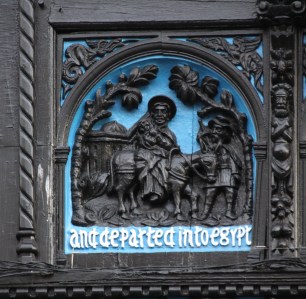 The approach is evidence-based. Evidence-based approaches have become popular in all sorts of research that involves human interaction, including archaeology, social science and economic development as well as urban planning. They have largely emerged from the basic idea of phenomenology – the way in which different living spaces are experienced and interpreted by individuals and communities – but are now a tool for developing strategies or policies. It takes the idea that how people live their lives and how they perceive their built, natural and cultural environment should influence what decisions should be made about those environments. First, of course, is the requirement to understand people’s responses, both conscious and subconscious to the context under discussion, in this case the city of Chester. In our workshop group at least, it produced some interesting results.
Another concept that has been incorporated into the Cheshire approach is “group value.” This divorces heritage in its own right from other things we appreciate, such as assets, objects and spaces and how we experience all of these in a sensory way. Valuable buildings are easy to put a finger on, describe and evaluate, but the open spaces in front of them, the odds and ends of modern sculpture, ancient architectural lumps and bumps, and the occasional well-positioned tree or cobbled footpath are more difficult to evaluate. And yet, they too are part of the heritage landscape, the built environment, the cultural context or whatever else we are calling it this year. My above whinge about the purple sign in front of Chester Cathedral is just as important to people’s perception of how we move through our cultural space as the building we want to engage with, because signage is an attention grabber, and it manages expectations.
 Archaeologists and historians are always flipping between what a site, building or object might have meant in the past and what it means in the present and how that distinction influences how we interpret the past. That’s the archaeologist in me talking, but it works for any entity that we look back on from the perspective of time. Cities and towns are accumulations, so we are reacting not to a single slice of time, but to an amalgamation that spans the oldest to the newest building and and is generally experienced by the user (shopper, visitor, worker) as something that instead of having many multi-layered and multi-temporal identities, has one single identity in their own minds, in this case the identity of being Chester.
 Because we humans are all so different from one another, a Chester identity is no single thing, because different people will respond to it in different ways depending on, for example, nationality, familiarity, personal interests, and the way in which they are intending to interact with it. So Chester actually has multiple identities, each person perceiving the city as single cohesive entity but each doing so from a different perspective, meaning that there are multiple identities of Chester, all of them compressing the complexities built up by time into a hurried present-day reality through which we pass, often in a tearing hurry.
In order to move beyond this sense of Chester being any single thing, James has come up with a method of directing participants in the workshop to look at Chester in an alternative way, something that had nothing to do with arranging its buildings chronologically or by function, but by asking us to think about how we reacted to different sensory aspects of it.
Participating in the workshop
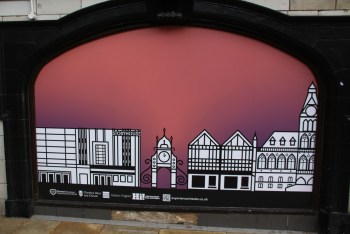
Post-Covid there are a lot of empty shops, looking abandoned and derelict, dragging down the image of their neighbouring shops. The entire of the St Werburgh Row is devoid of life, and tragic. This initiative, however, where empty shop windows are provided with imaginative Chester-themed boards is excellent, raising a smile. The one here is the former Patisserie Valerie on Bridge Street.
On the 18th of November, the 90 minute workshop started at the bottom of Bridge Street, where we received our instructions from James, an excellent, reassuring communicator who turns out to have a natural gift for herding cats. From the bottom of Bridge Street to The Cross, and then from The Cross to the top of Northgate Street, the workshop set out to build an evidence base of sensory experiences including, for example, colour, sound, smell and texture, and more elusive concepts like fun and solitude.
James handed each of us a 6x4inch card, at the top of which was written a single word. There were eight of us in the group, which was a good number for exploring some of the concepts, and enabled us to exchange notes on three occasions, once after we had walked Bridge Street, once after Northgate Street, and once in the town square, outside the town hall. The topics were, in no order, were texture, colours, sound, stillness, views, words, and mine was fun.
 There were Covid-aware latex gloves for those of us who wanted to explore texture by touch. We could partner up with someone else, we could proceed en masse, or we could go off individually. Apart from that we were given no direction so that the thoughts that came to us were not influenced in any way by James, or by the council’s objectives.
The idea was to write down words that occurred to us in relation to the given topic on the card. I have to say my heart sank because I had no idea how I was supposed to interpret “fun,” but it was hugely enjoyable once I got into the swing of it. The photos on this post are snaps that I took as I was walking around and thinking about my target word. It came in very handy for consolidating my thinking as I went along. If I had had a different word on my card, the photos would have been entirely different, which is an interesting thought in its own right. For example, if I had had “stillness” or “texture,” both my words and photos would of course have been quite different.
The record cards

The keywords are clever, because they avoid simple reductionist descriptions based on liking or disliking, positives and negatives and instead focus on more nuanced responses and descriptions.
When he set us off on our own, James said that there was no right or wrong thing to write down, that the whole point was to let us react and write accordingly. We had a card for Bridge Street and either the reverse side or a new card for Northgate Street. One of mine is shown here, annotated to make it legible. As well as capturing our thoughts so that we didn’t have to remember them, they helped us to marshal our thoughts when we gathered to discuss our findings. We handed the record cards in at the end, so that James could collate them with those of other workshops. The cards were an important part of the workshop. Several of us had to apologize for our handwriting 🙂
 Discussing the keywords
James was great at getting us together, on four separate occasions. Two of the discussions were about what we had written on our record cards. Here’s just a bit of that, but I am sure that James received radically different comments when running different workshop groups, so this is just a sample of a sample.
In all the discussions it was clear is that we were all looking in different directions, and that’s partly because of the keywords, which directed attention to different parts of the built environment, and partly because of how we interpreted those keywords and what took our interest.
The Cross
Our first stop to exchange notes was at The Cross, where Bridge Street meets with the other three primary roads preserved from the legionary fortress, Eastgate Street, Watergate Street and Northgate Street. We had at that stage walked only up Bridge Street. James asked us what struck as what we found surprising about Bridge Street, within the parameters of the keywords on our cards. I didn’t know anyone’s names, so these comments are all anonymous, and are shorter, simplified versions of what was discussed:

The Rows. There is a lot more stillness here than down on the streets, at least at the moment. It makes for a nicer experience, but I am sure that the shops would prefer greater footfall.
Views: As one looks up towards the Cross, the impression is of a great complexity pattern of walls and facades of buildings that forms an incredibly intricate pattern that frames the view from the floor up. Some bits stick out, some don’t, and all the buildings have their own character, but they lead unambiguously to The Cross, along a road that is surprisingly wide given its Medieval past. The rows give the whole thing a very distinctive feel, and means that the shops on those level are set back from the road. Everything converges on St Peter’s church, which is a big red sandstone building that draws the eye. The path from one end to the other, seen as a view, is almost too much for the eye to make sense of.
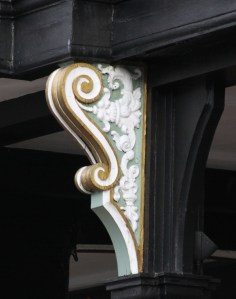
Touches of colour in the old buildings above shop level stand out and are welcome.
Colours: The biggest surprise was the contrast between the more or less uniform character of the builds above the shop frontages versus the brightly multi-coloured shop frontages themselves. There were only a few details in colour on the older half-timbered buildings, which made the colour stand out. Chester at street level is a torrent of colour, but when one captures a little of it in the buildings that soar above the shops, it is a lovely piece of deliciousness.
Sound: In this area, the biggest surprise was what could not be heard. There was such a cacophony of clinks, roadworks and street music, that the things that one could see going on around one, were lost in the other noise. A pair of hard heels could be heard, but trainers and other soft-soled shoes were lost in the overall sound. Even individual voices were difficult to make out.
Words: At shop level the impact of words, in the form of text, was impossible to avoid, and overwhelming. Branding and signage dominate, in a variety of lights and colours, and it is difficult to differentiate one from another. Silent, in terms of audibility, they still manage to form a cacophony.
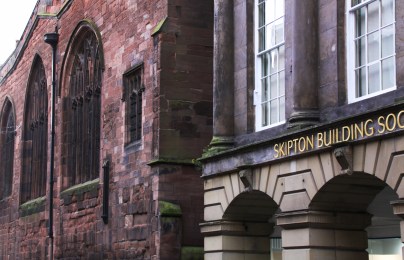
Different ideologies expressed in different building materials, different approaches, different design ideas, different colours and textures.
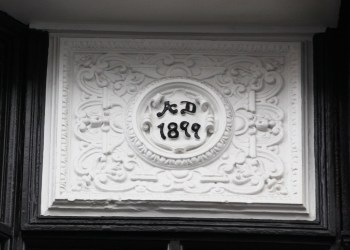
Texture: Texture occurs at every level. It changes underfoot, but is most obvious in the walls, which are red sandstone, yellow sandstone, brick, wood, concrete and many other materials, which each has its own personality. Decorative plasterwork is very distinctive and very fine, but not always noticed. Each texture has its own character – granular, soft, smooth, slippery etc. Each adds to the diversity of the buildings.
Stillness: This one was rather sad in many ways at this point. The main stillness was embedded in failed, closed-down shops. There had been several before Covid, but there have been some tragic losses since. These were all devoid of movement and interaction, dead areas that people walked past without looking. More amusingly, anywhere not selling coffee had a certain stillness, by contrast to those places that were, which were busy, noisy and drew attention to themselves.
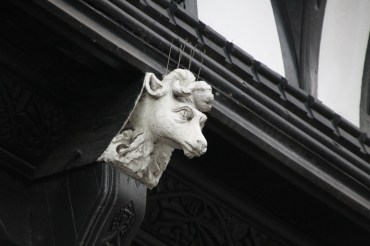
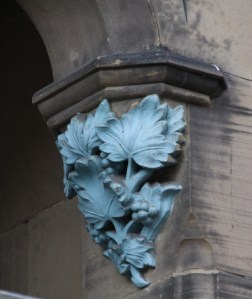
Fun: There is not a lot of fun at foot level because it is all shops with unlovely frontages, but look up and there is a lot to make one smile in the decorative architectural elements that embellish the buildings, particularly the 19th century facades, a bit like excessively ornate wedding cake decoration, and improbable towers and incredibly ornate ironwork. Often OTT, and very confident, these flourishes are always very finely crafted. They are both fine and truly great fun.
The Story House

The Story House is a thing of real ugliness, but even so I would defend it energetically if anyone were to threaten it because it is a monument to its era. Not all heritage is pretty. The same could be said for the telephone box in the foreground. The bollards, however, at the edge of the road, were agreed by all to be cultural as well as physical barriers.
Our next stop was at the Story House. Northgate Street had started out very like Bridge Street, with lots of engaging architecture similar to Bridge Street, again sitting on top of ordinary shop frontages, but as one proceeds, it opens out and there’s a lot of more architecture to see, some from more recent times, not all terribly positive. The four most dominant buildings as one filters through the narrow entry to the market square are Chester Cathedral, the Town Hall, the Motor Works, and the Story House. There is also a very conspicuous frontage to The Forum Shopping Centre, which incorporates the market. At the moment, the Christmas market dominates the public space, closely clustered and overwhelmingly full of cooking smells. We walked past the market and gathered in front of the Story House to discuss the walk up Northgate Street.
Inevitably and fascinatingly, we all talked about how interesting it was to compare the walk from the bottom of Bridge Street to The Cross with the walk from The Cross to the Story House.
Views: This was a story of constriction within fairly narrow confines to a sense of release in the big space in front of the Market Square and the Town Hall, but it was also a story of disappointment. The sense of being lead somewhere by views of trees beyond the narrow start of Northgate Street lead to nothing more than an untidy space that was undefined and offered nothing like the oasis that was suggested by the trees. At this time of year, particularly, the trees lend very little because they are deciduous and have dropped all of their leaves untidily onto the ground. The Christmas market did not improve matters. The cathedral, to one side, was a pleasant presence but did not dominate. The main dominating factor, in terms of being lead forward, was actually the Story House, not Chester’s most aesthetically pleasing building. Beyond the Story House, the symmetry collapses and there is nothing to tempt one forward.
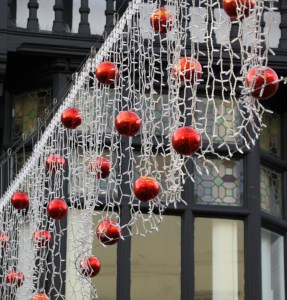 Colours: This is so dependent, just as it was on Bridge Street, on where you happen to look. Ground level is bright and full of aggressive colours, but although on Bridge Street these were very jarring, they are more restrained on Northgate Street. Looking up things are far simpler with black and white facades, and reddish-brown brickwork that provide a warmer feel. The Christmas decorations were felt, by everyone who expressed an opinion, to be just right, not overstated or understated, but entirely suitable for the job in hand.
Sound: In contrast with Bridge Street, Northgate Street was a far richer audio experience. There was tapping, humming, rattling, the sound of wheeled suitcases on cobbles, a bicycle, and more human traffic, as well as the inevitable street music. The sound of heeled shoes versus trainers was again particularly noticeable. Reaching the marketplace, the noise of people talking increased enormously, and there was more traffic.
Words: The plethora of promotional messages at street level was again dominant. It was all very urban and vibrant, but there was also text in the historic buildings above the shops, where there were other messages to be seen that were resonant of the past.
 Textures: There were so many textures to be seen including the old versus the new, tiles versus glass, wood versus brickwork and the incorporation of carvings and sculptures into building facades. As well as buildings, there were plants and trees to take into account, including moss on cobbles next to the cathedral.
Stillness: The cathedral, a former abbey, is an oasis of stillness in the city, and offers a gateway into an inner peace, including its gardens. The interface between the city and the peace beyond is provided by the Abbey Gate, and was probably the only entirely still place in the part of Chester that we walked on that day.
Fun: Again there were a lot of excellent architectural details that were functionally unnecessary but expressed real exuberance. Examples are the little sculptures in niches above the row of shops that includes Lakeland and Zara, little towers at the top of buildings and ornamental plasterwork on all sorts of buildings. The overall impression of certain attention-grabbing buildings, like the town hall and the motor works lift the spirits, and both these draw attention to the positive impact of colour in building materials.
We did not, of course, explore internal spaces, but the idea of exploring interfaces between external spaces and internal spaces is an interesting one. Little corridors leading from one space to another gave an almost secret feel to some of the city.
The good, the bad, and the highly nuanced
The other two discussions took place first in the public space in front of the Town Hall and the entrance to the market (The Forum Shopping Centre) and then at the point of Bridge Street where it becomes traffic-free and were less on what was on our cards than on our overall impressions.
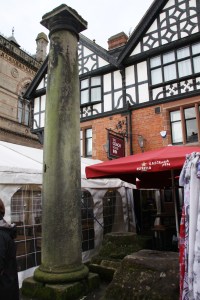 Market / Town Hall Square
When we paused in front of the Town Hall, in what is usually an open area, we were asked what our impressions were of that public space. The Christmas market was setting up, obscuring a sense of what it is like of most days of the week, but some interesting comments emerged.
Two of the dominant buildings, the Town Hall and the old Motor Works were exuberant, and were terrific examples of how whole buildings can express the enthusiasm and enjoyment (as well as ambition and pride) of those who created them. They, together with the Story House and the Cathedral, surround the public open space. The chap who was looking at “views” drew attention to how we had been funnelled from the lower end of Northgate Street, between buildings similar to those in Bridge Street into a space that, from a distance, with trees visible, had led to a sense of anticipation, but had very little to offer. There were random odds and ends dotted around, leading to the sense that there was no cohesion in the space. A very grubby Roman column here, a modern sculpture there, and an anti-terrorism barrier across the road. I think that we all had the sense that nothing seemed properly integrated, and that a public space that might have had real potential was actually very drab, in spite of being surrounded by some great buildings, each of a very different but superb character. We also looked at a bike rack that was very intrusive but could be placed somewhere less conspicuous and still be useful. This was no piazza or plaza, and there was really nothing to celebrate.
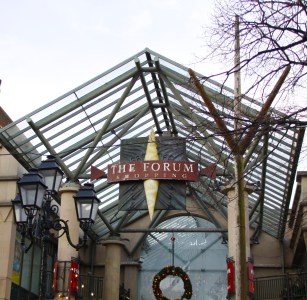
The entrance to the indoor market. A reminder of Chester’s Roman heritage, or just ugly?
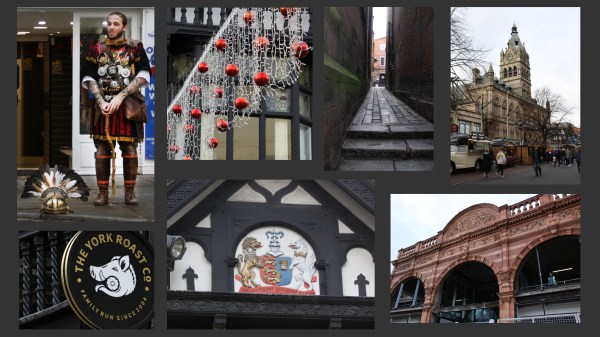
I found myself almost back to back with a Roman soldier who was explaining something to a small group of visitors. I love the soldiers, who certainly come under the heading of “fun,” because wherever they go they raise a smile, but these soldiers, whether giving guided tours to adults or leading long strings of children wearing cardboard armour and carrying cardboard Legio XX shields, are a terrific innovation. Some of us were also facing a Roman column that usually looks a little forlorn and isolated, and for which I have affection, but on that day looked more than a little farcical hemmed in on all sides by the Christmas market. In Chester, a great effort has been made to incorporate the city’s Roman past, and there are constant, excellent reminders that help to reinforce the fact that as well as the built environment, the buried environment also plays an important role. But that column could do with a rethink and a clean.

Little flourishes are worth looking out for.
Although the keywords on the record cards avoid simplistic likes and dislikes, positives and negatives, we found that in discussions value judgements were inevitable, because for every example of “fun” there is probably a “dull” in the next street, and for every ten tactile and aesthetically enjoyable examples of “texture” there is probably an edifice of brutal concrete nearby (the Pepper Street multi-storey car park springs to mind for both examples). One of the interesting things from the discussions was that there are so many positives that the negatives stand out as noticeable intrusions on the positives. One of the workshop members pointed out that anti-terrorist bollards, for example, are not only very ugly with their modern appearance and big lights, but give a misleading sense that there are better bits and less desirable bits of the city, separating areas in which one is safe and where there are good thing to visit from those which may be not quite as safe, and not quite as worth visiting. Once this was pointed out, everyone agreed, and we all understood that the city should not be seen in terms of what lies within and what lies beyond those bollards, but that the perception is difficult to avoid.
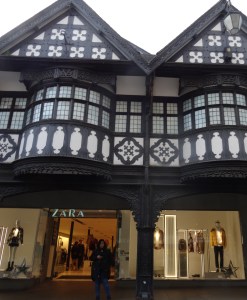
Upstairs or downstairs – where does the fun lie?
Response to the keywords is a hugely personal thing. I am guessing that many workshops would be required to capture even a small sample of what an entire community might think and feel about their living environment. I interpreted “fun” as anything that would make me smile spontaneously. I automatically looked away from the street level shopfronts to the upper levels where time, imagination and skill have wrought wonders. Some shop road level frontages are better than others, but for me all are brash, most of them frightfully ugly, and I hate shopping anyway, so nothing fun is to be found there. But I have friends for whom shopping is hugely enjoyable, and the bright lights and colourful window dressings are all part of the enjoyment, and some of them would be puzzled by me describing architectural exuberance and decorative flourishes as “fun.” So my interpretation of fun, confined to the upper levels where history looks down at me and I look back at it, would not be someone else’s.
 Pausing again on Bridge Street
We paused again on Bridge Street, just on the uphill side of the anti-terrorist bollards, to discuss our views. We were on borrowed time, as we had eaten up most of our 90 minutes, but we were all eager to point out the negatives of our immediate environment, because we all wanted to see improvement to encourage businesses to invest in that part of town. Everyone agreed that the anti-terrorist bollards seemed, again, to cut one part of the street from another, and that the area north of Bridge Street was rather more prestigious than that to the south of them. We also looked at some truly awful shop frontages, text-heavy, with lurid colours, tacky. We asked about planning permission for frontages, as we were standing in front of a particular shocker at the time, and it turns out that they are indeed subject to planning permission, but that some retail outlets do not follow the procedures. There is a lot of work to check up on those who ignore the rules, and it takes even longer to enforce the violated regulations.
The future
 James said that he will feed back to Chester Archaeological Society about the results of the workshops once they have all been completed, and I really look forward to that. Particularly, it will be interesting to know the answer to James’s own question – what can the local list do that designated graded listing does not already do in somewhere like Chester, which has listed buildings everywhere you turn?
The good news, even before the workshops have been completed and their findings collated, is that the Local List facility is already up and running and you can nominate an “asset” for local listing if you feel that it has particular community value and should be taken into account when planning and other issues are raised that might place it under threat. You can find out full details on the Chester Local List Project website at the following address:
https://local-heritage-list.org.uk/cheshire/guidance:
The Proposal Process
 When you make a proposal or proposals for the Cheshire Local List, you will first have the option of creating and revising a draft that will not be reviewed until you submit it. When you submit your proposal, a Conservation Officer will check it to see if more information is needed. If so, it will come back to you for revision, and if not it will be moved forward for approval.
Make a proposal for the Cheshire Local List here
Approvals for nominations to the Cheshire Local List will be done by a panel of Conservation, Planning and Built Environment officers from Halton, Cheshire West and Chester and Cheshire East.
The final list will be put forward for formal adoption by each of the three boroughs in due course as part of the development of new Supplementary Planning Documents for local heritage.
The Assessment Criteria are here:
https://local-heritage-list.org.uk/cheshire/assessment-criteria
The top-level asset categories are Buildings; Parks & Gardens; Landmarks, Art Works and Way Finders; Other Sites, Structures & Landscapes, but see the following page for more information on each category:
https://local-heritage-list.org.uk/cheshire/assessment-criteria-asset-type

If or when I hear more about the project, I’ll post about it on the blog.

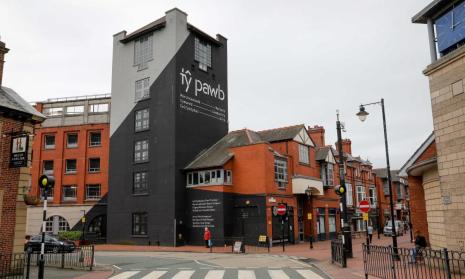
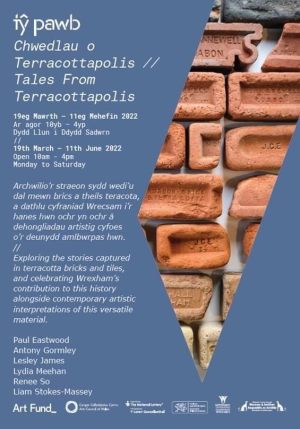


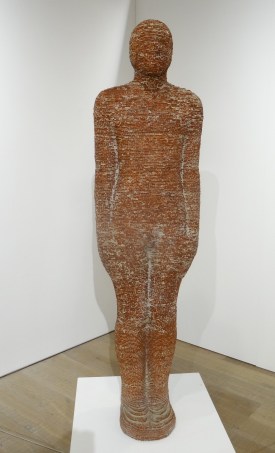 The front part of the gallery, where you walk in, is dominated by the modern pieces, many of which are very striking and engaging, and which aim to complement the story of Wrexham’s brick, tile and terracotta industry by offering new responses to it.
 There is a fascinating letter from the Partnership Manager of the British Railways Board, who supported the idea of the project, to a disgruntled objector, which really hits the nail on the head for me. You can click on the image to see a legible version. I am often amongst the first to grumble about inappropriate and poorly thought out modern sculpture installed in urban or rural locations as some form of random art statement, because such initiatives can actually alienate people from art and frequently undermine the impact of the heritage in which they are being installed. By contrast, The Brick Man actually had real merit (originally, I typed “legs”), not only as an art work, but as a way of contributing to urban regeneration, both by drawing attention to the monument and the area, and by attracting visitors. It is also a good piece of art, which is important. I was previously unaware of The Brick Man, and it was a really good opportunity to see the scale model and some of Gormley’s original plans.

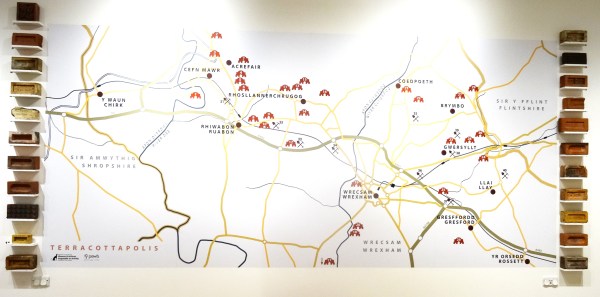
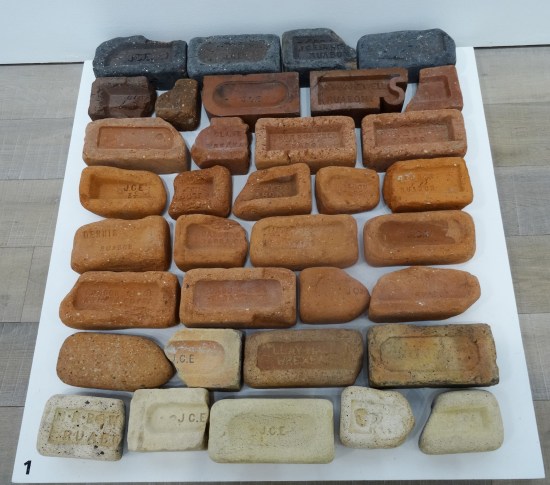 sdfsadfasdf


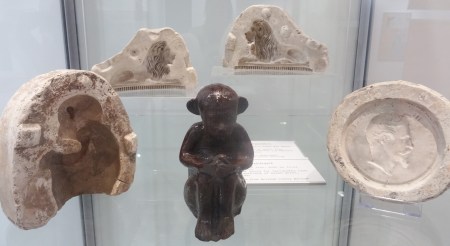 The use of clay pressed into moulds was an excellent way of enlivening buildings, giving them celebratory flourishes without all the costs involved in stone masonry. The use of moulds that could be re-used many times, enabled manufacturers to produce catalogues for architects, from which their customers could choose appropriate features, which not only made decorative flourishes affordable, but resulted in their proliferation, particularly on roofs. Once you have seen the items on display, as well as those more elaborate versions shown in the video, it encourages you to look up in places like Wrexham and surrounding villages to spot the terracotta work that gave many local towns a real sense of pride.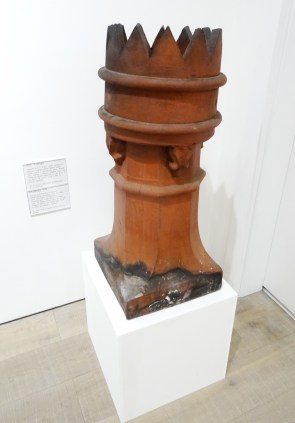


 The layout of the works was elegant and well thought out, with each item widely spaced from the next, allowing it to be appreciated without distraction. The combination of modern art works and 19th century heritage objects worked beautifully.
 The friendly and helpful curator of the exhibition, whose name I failed to catch, told me that over 2000 people had visited since the exhibition opened in March, with a number of them either former workers or their families sharing experiences. Certainly, from my own perspective of things I have found in my garden, the Llay Hall brick randomly set into the side of a lane in Farndon, and my enormous affection for 19th century tiles in general and the Westminster Car and Coachworks (now the public library) in Chester in particular, it was very easy to relate to this exhibition. The modern art pieces also work really well, balancing the older pieces and offering a new way of looking at this type of heritage, as well as engaging the visitor in their own right with thoughts about how heritage can be remembered, explored and, when necessary, lamented.
 The gallery is open 10-4, Monday to Saturday and the exhibition is free to visit. We didn’t investigate what else the gallery has to offer, so it would be worth checking what else is available and whether there is a ticket charge if you want to visit anything other than the exhibition space (Gallery 1). Full details for visitors and future exhibits are at https://www.typawb.wales/plan-your-visit. You can also follow them on Twitter at https://twitter.com/TyPawb