Category Archives: Conservation

Exploring Maiden Castle Iron Age Hillfort, Bickerton Hill (mid-Cheshire Sandstone Ridge)

Introduction

Maiden Castle, Bickerton Hill, Cheshire

Artist’s imaginative interpretation of how Maiden Castle may have looked, based on information from both the site itself as well as from other excavated hillforts. As no excavations have taken place in the interior beyond the entrance area, the roundhouses and accompanying square structures are largely speculative.  Produced by the Habitats and Hillforts Project 2008-2012. Source: Sandstone Ridge Trust

Further to last week’s walk on Bickerton Hill, Maiden Castle sits on the route of the Sandstone Trail, on the northeast edge of Bickerton Hill (once known as Birds Hill), which is one of the Triassic red sandstone outcrops that make up the mid-Cheshire Sandstone Ridge.  It is the southernmost of six hillforts along the ridge (see topographical map below). A visit to the hillfort makes for a great walk with lovely views over the Cheshire Plain.

Traditionally hillforts were associated with the Iron Age, and in general the early and mid Iron Age periods, but modern excavations have revealed that many had their origins in the Late Bronze Age, that not all of them were contemporary, and some were re-used in the post-Roman period.  Some have a long sequence of occupation and abandonment, and many may have performed different functions, both in terms of geographical distinctions and even within localized areas.
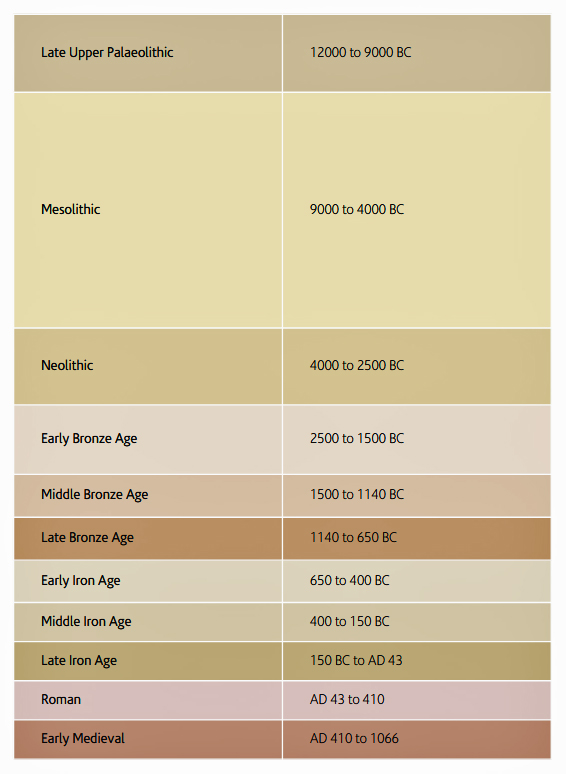
Chronology of Sandstone Ridge hillforts. Source: Garner 2012

Chronology of Sandstone Ridge hillforts. Source: Garner 2012, p.9

All hillforts make use of the natural topography in order to provide their enclosures with good defensive potential, including good views over the landscape. Many strategic locations are also shared, either actually or conceptually, by medieval castles.

Some hillforts surround the very top of a hilltop, such as Beeston Castle on the Sandstone Ridge to the north (a location used by Ranulph III, 6th Earl of Chester, for his medieval castle), but others like Maiden Castle are located to take advantage of a natural drop on one or more sides to provide some of the defences.  These are usually referred to as promontory hillforts, and Maiden Castle is a good example. The built defences form a dog-leg curve that meets on either side of a slight projection over the steep drop of the Sandstone Ridge where it plunges down to the Cheshire Plain.  As well as reducing the amount of work required to provide defences for the site,  promontory forts could be just as visible as those that circled hilltops.  In the case of Maiden Castle, the height of the site (c. 698ft/212m AOD) and the views from its banks at the east of the hillfort also provide good views to the east.  Although it is at the highest point of Bickerton Hill, Maiden Castle only occupies a part of the high ground, presumably its size, smaller than most of its neighbours, sufficient for its needs.
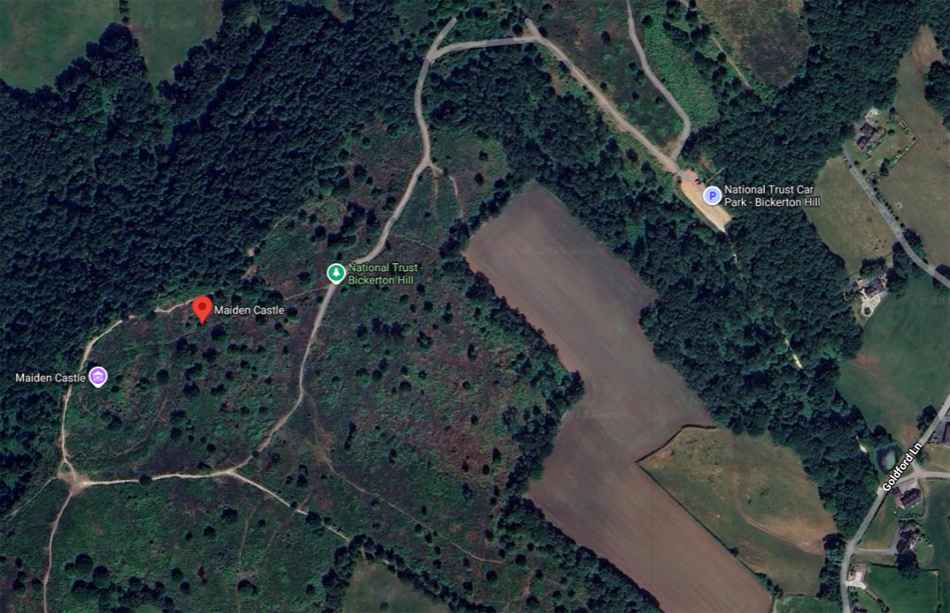
Google Map of Bickerton Hill and Maiden Castle

Google Map of Bickerton Hill and Maiden Castle. The purple marker shows the centre of the hillfort. The ditches between banks are visible as the darker arcing lines

Maiden Castle, in common with other hillforts, had no obvious source of water, and could not therefore withstand a prolonged siege, assuming that it had a defensive role.  In addition, any livestock herded on the outcrop would need to be returned to a water source.  Springs were available along other parts of the sandstone trail, many of which are now dry, and some wells mark access to water today, including Droppingstone Well at Raw Head, under 3km away, and the medieval well at Beeston Castle (now dry), but there were no rivers or streams nearby.  The nearest is Bickley Brook, around 2km to the east.  However, it is likely that there was a lot of standing water and ponds as well as a diversity of small and possibly seasonal wetland habitats that supported different types of wildlife, with a strong avian component.   It is interesting that of all the hillforts on the Sandstone Ridge, only Maiden Castle did not neighbour a river or well-sized mere, nor a well-fed stream or small mere.

Topographical map of the Cheshire Sandstone Ridge, showing Maiden Castle at the south end. Source: Garner et al 2012

The question of a water supply draws attention to the fact that the exact role of hillforts in this part of the country is not fully understood.  The often massive ditches and banks, the latter supporting additional structures such as palisades, were quite clearly intended to keep one set of people (and their possessions) in, and presumably another set of people out.  Specialized entrance designs reinforce this idea of controlled and limited access.  At some hillforts slingshot stones, usually interpreted as evidence of warfare, have been found including at the Sandstone Ridge hillforts Woodhouse and Eddibsury, made of rounded sandstone pebbles.  However, whether warfare is the correct model for the role of Cheshire hillforts is by no means clear.  Localized disputes such as cattle and grain raiding might be a more plausible scenario than all-out warfare, with the hillforts perhaps (speculatively) providing places of retreat from farmsteads dotted around the surrounding plains at times of threat.  The scale of investment in these structures certainly suggests that whatever their role, they were seen as necessary for local security, and probably for conveying territorial ownership and status as well.  An experiment to test inter-visibility between hillforts in northeast Wales and Cheshire, called the Hillfort Glow was undertaken in 2011 by the former Habitats and Hillforts. Sadly, the Habitats and Hillforts website is no longer available, but the experiment was reported on the BBC News website.  Ten Iron Age hillfort sites were included (on the Clwydian Range, Halkyn Mountain, the mid-Cheshire Sandstone Ridge, and at Burton Point on the Wirral).  It suggests that if allied groups wanted to communicate a threat to neighbours, they could do so quite easily, with Burton Point on the Wirral, for example, visible as far always as Maiden Castle 25km (15.5 miles) away, as well as nearer sites on the Clwydian Range.

Maiden Castle defences seen from the edge of the ridge

Maiden Castle defences as they look today, at the far south of the hillfort, seen from near the edge of the ridge, with the dark shadow marking the ditch, facing roughly to the east.

If you visit Maiden Castle in person (see Visiting details at the end for how best to locate it), you will find that the enclosure ditch between the two lines of rampart is clearly visible, although considerably less impressive than it would have been in the Iron Age, and you can walk along it very easily.  The photograph here shows it in late autumn afternoon light, with the ditch clearly marked by the line of shadow.

Excavations and surveys

Varley 1940, Maiden Castle plans, p.70-71

Varley 1940, Maiden Castle schematic plans, showing Varley’s illustrations of the defences, the entrance and the construction of the banks, showing the stone facings, figs.11 and 12, p.70-71

The Maiden Castle hillfort was first excavated by William Varley, (a geography lecturer at the University of Liverpool) and J.P. Droop (who was also involved in the Chester Amphitheatre excavations) over two seasons between 1934 and 1935, published promptly by Varley over two years in 1935 and 1936, after which Varley moved on to Eddisbury Hillfort near Frodsham.  In 1940, as the first of a new series of history books, The Handbooks to the History of Cheshire, he co-authored Prehistoric Cheshire with John Jackson, with illustrations, photographs, fold-out maps and a bibliography organized by archaeological period.

Varley’s published excavations at Maiden Castle were carried out to a very high standard.  As with the later book, he included plans and photographs of the entire site with particular emphasis on his excavations, which were focused on the northern end and included the entrance, and both outer and inner ramparts.

Maiden Castle showing how the inner bank was turned inwards to form a corridor entrance. Source: Varley 1936, Pl.XLIII

Maiden Castle, showing how the inner bank was turned inwards to form a corridor entrance. Source: Varley 1936

The excavations were very informative, confirming that there were two ramparts separated by a ditch and suggesting an additional ditch surrounding the entire defences.  A possible palisade trench under the outer of the two Iron Age ramparts is the only indication that he found of a possible pre-Iron Age line of defences.  The inner rampart was built using timber and sand, and was faced with stone on both sides.  The outer rampart was formed of sand and rubble, with the outer side also faced with stone.  The inner rampart enclosed an area of around 0.7ha, with an entrance at the northeast formed by turning both sides of part of the inner rampart inwards, to form a corridor c.17m long and 0.8m wide.  A pair of postholes set within the entrance area may have been gate posts.  The entrance in the outer rampart was a simple gap, lined up with the inner rampart entrance.  Varley believed that so-called guard chambers (by then identified at some other hillforts) once flanked the entrance, marked by archaeological surfaces, one of which produced a piece of Iron Age pottery.  However, no structural remains survived to substantiate this interpretation.  The ditch between the two ramparts is clearly visible today, particularly at the south end, but Varley also identified another ditch on the far side of the outer rampart, which appears to have been confirmed by the LiDAR survey carried out in 2010. Varley’s plans and photographs have contributed to more recent research and remain a useful resource.

William Varley’s photograph of the entrance of Maiden Castle. Source: Varley 1940, Plate VIII

xxx
Although no further excavations were carried out until 1980, a number of topographical surveys were undertaken in an attempt to clarify matters.  The 1980 excavation, published by Joan Taylor (University of Liverpool) in 1981, was undertaken in response to damage unintentionally inflicted on part of the ramparts by walkers, which revealed some of the internal burnt wooden construction material.  This was an opportunity to re-examine the construction methods and to send some of the charred wood for radiocarbon dating, which produced dates in two clusters, which were later calibrated (a form of correction) by Keith Matthews, then with the Chester Archaeology Service.  The results indicated that Varley’s instincts that the inner rampart predated the outer one were correct, producing a set around 860-330 cal.BC for the inner rampart and a set of 380-310 cal.BC on the outer rampart.

LiDAR clearly shows not only the banks and ditches but also the damage inflicted by stone quarrying both within and beyond the hillfort enclosure. Source: Garner 2012, p.50

LiDAR clearly shows not only the banks and ditches but also the damage inflicted by stone quarrying both within and beyond the hillfort enclosure. Source: Garner 2012, p.50

No further excavations have taken place at the site, but a the Habitats and Hillforts project undertook a number of non-invasive surveys of the site, reported in Garner’s 2016 publication.  The results of a LiDAR survey were reported, revealing that considerable damaged from later stone quarrying to the ramparts and the interior, as well as across the rest of the hill. It additionally confirmed that there were trenches from when the army had a training base and firing range at the site in the later 20th century.  Finally, geophysical surveys were carried out by Dr Ian Brooks in 2011, again reported in Garner 2016, which included both resistivity and magnetometry surveys, the latter producing signs of three possible roundhouses, one of which made up a full circle, their diameters measuring 6.9m, 7.8m and 9.2m.  This is a good indication of the potential of the site for producing further information, even with the probable  damage to parts of the archaeological layers from quarrying (marked on the LiDAR image below as irregularly shaped depressions), but not much else can be concluded without excavation.

Possible roundhouses revealed by geophysical survey. Source: Garner 2017, p.58

Possible roundhouses revealed by geophysical survey, shown in red, with irregularly shaped pits produced by later quarrying for stone. Source: Garner 2017, p.58

Summary of the amalgamated data

The structural character of the site
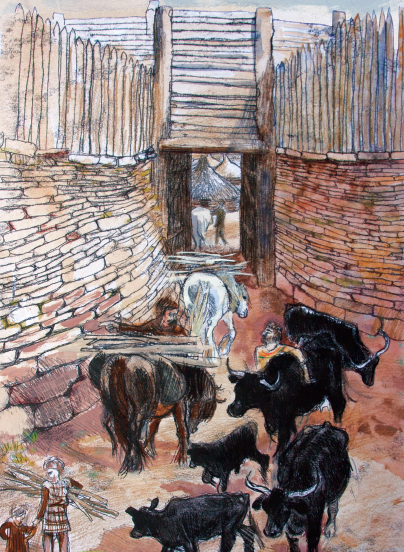
Artist's impression of how the main entrance into Maiden Castle may have looked.

Artist’s impression of how ta simple inturned entrance may have looked, with a palisade on what remains of the ramparts and a walkway over the gateway, with roundhouses just visible in the interior.  Source: Sandstone Ridge – Maiden Castle heritage leaflet

The site is defined by an interior sub-rectangular space enclosed on the east by a pair of ramparts, each with an external ditch, and on the west by an angled section of the precipice that once met up with either end of the ramparts, creating a complete defensible boundary.  There are good indications that when it was first built there was only one rampart.  A stone-faced entrance penetrated the ramparts at the northern end, with a corridor-style inturned section of the inner boundary, with postholes flanking the entrance suggesting that the interior was protected by gates.  Although the interior has been badly damaged by quarrying for stone, geophysical investigations have suggested that roundhouses were present within the enclosure.  The site had immensely clear views to the west, and good views to the east.

This is quite a small site compared to others nearby.  For example, it is around half the size of Helsby hillfort to which it is otherwise similar in appearance.  One suggestion is that it is more akin to an enclosed farmstead than a place for community aggregation and defence.  Having stone-lined ramparts, the site would have been both visible and impressive, perhaps a statement about social identity and affiliation with the land around the hill. Still, the addition of a second rampart argues that defence was an important aspect of the design.

Chronology

Walking along the ditch between the ramparts at Maiden Castle

Walking along the ditch between the ramparts at Maiden Castle

There is only faint evidence of a Late Bronze Age predecessor for the Iron Age hillfort, although this might be expected because Beeston Castle demonstrated clear Late Bronze Age structural features, and Woodhouse, Kelsborrow and Helsby all produced possible evidence of Late Bronze Age construction.  The only evidence is a possible palisade slot under the outer of the two Iron Age ramparts.  However, the level of disturbance created by stone quarrying in the interior may well have eliminated earlier data.  Unfortunately there were no diagnostic artefacts to assist with the question of dating but radiocarbon dates obtained during the excavations during the 1980s suggest that the inner rampart predates the outer rampart, with three radiocarbon dates from the inner rampart spanning 860 to 330 BC whilst those from the outer rampart included one of 380-10 BC.

Economic resources

There are few sites in the immediate area that provide insights into the economic activities in which the local communities were engaged, and what the local land might have supported, both in terms of lowland and upland exploitation of domesticated and wild resources.  The soil surrounding the outcrop was generally poorly drained leading to damp, sometimes seasonally waterlogged conditions.  That on the outcrop itself was shrubby heathland, good for livestock grazing but not for cultivation.

Beeston Castle as it might have appeared in the Iron Age. Source: Sandstone Ridge leaflet

Beeston Castle as it might have appeared in late prehistory. Source: Sandstone Ridge leaflet

There is no data about livelihood management and farming activity available from Maiden Castle, and it is anyway most likely that economic activity took place in the fields below, although it is possible that a site like Maiden Castle would be used to store edible and other resources.

A good idea of what might have been available to the occupants of all the hillforts on the Sandstone Ridge comes from excavations at Beeston Castle, the next hillfort to the north.  Between 1980 and 1985 soil samples were taken during the excavations, focusing on areas most likely to provide information about the use of structures. 60,000 cereal items were recovered.  Emmer and spelt wheat dominated.  Spelt is more tolerant of poor growing conditions, requires less nitrogen to grow, has better resistance to disease and pests, is more competitive against weeds, more tolerant of damp soil conditions, including waterlogging, and can be used to make bread without yeast.  On the other hand, the processing stage is very labour intensive.  Emmer wheat is only reasonably tolerant of damp growing conditions, makes a denser bread that is higher in protein, and is a lot easier to process.  They can be grown separately or as a mixed crop.  Grains of hulled barley were also found at Beeston, but in smaller numbers, possibly due to it being much less tolerant than either emmer or spelt to damp conditions.  Oat was found in the samples, although it is not know whether this was a domesticated or wild crop.  Wild species in the samples that could have been used as a food source were hazelnuts and fruits of the Rubus genus (blackberry, raspberry and/or damsons) and fruits of the Prunus genus (sloe, cheery, and/or plum) and elder berry.

View towards the Clwydian Range across the Cheshire Plain

View towards the Clwydian Range across the Cheshire Plain

There is a dearth of lowland sites known in the area.  Standing on the top of Maiden Castle’s ramparts and looking to the east and west, with views across both the flat stretches of the western part of the Cheshire Plain and the more undulating topography to the east, it is not difficult to imagine Iron Age farmsteads dotting the landscape in a similar way to modern farms today, either enclosed in a ditch and bank arrangement, or simply unenclosed. Even so, a number of such farmstead settlements are known to the west of the Cheshire Ridge as far as (and including) the Wirral, together with some very rare examples of field systems.

The nearest lowland site is Brook House Farm, Bruen Stapleford, around 11km (c.7 miles) away as the crow flies.  Very little animal bone was found, probably due to the acidic soil, but included a pig tooth, a piece of sheep/goat/roe deer-sized animal bone, and a few fragments of cow teeth.  The poorly drained damp plain would not have been suitable for sheep, although entirely suitable for cattle and pigs.  It is worth bearing in mind that the sort of higher ground represented by Bickerton Hill would have been ideal for allowing sheep to roam and feed off upland grasses and shrubs, representing a rare opportunity in Cheshire, should it have been required, for this type of economic diversification, but they would have required access to water when feeding lambs or if used for milk production.  Lowland conditions would also have favoured the herding of livestock, and would have been suitable too for raising pigs and horses.

Brook House Farm. Structures 3 and 4. Fairburn et al 2002, p.14, fig. III II.4

Brook House Farm. Structures 3 and 4. Fairburn et al 2002, p.14, fig. III II.4

Just as today, the underlying geology and soils would have placed limits on what could be grown agriculturally on the Cheshire Plain.  At Brook House Farm plant remains included bread-type wheat emmer or spelt, and some hulled barley.  There was a relatively high proportion of grassland species, suggesting that damp slow-draining grassland may have dominated in the area, which would be more suitable for hay production and livestock grazing than crop cultivation.

The combination of crops and livestock using both lowland and upland areas would have been a good way of diversifying economic output, making the most of the environment, and spreading the risk that subsistence strategies would have faced, even when planning on creating a certain amount of surplus for over-wintering and for trade. It has often been suggested that hillforts may have had multiple roles either simultaneously or consecutively over time, and one of those roles may have been storage of surplus grains, preserved meats, salt and items for trade.

Assuming that those sites to the west of Maiden Castle (and the other west-facing Sandstone Ridge hillforts) had clear lines of visibility to the lowland sites on the Cheshire Plain, and vice versa, it would have been just as straight forward to establish visual communication between the lowland sites and the hillfort, as it was between contemporary hillforts.

Final comments

View across to the east from the outer rampart

View across to the east from the outer rampart

At the moment, hillforts and lowland settlements during later prehistory are not well understood in the Cheshire area.  This is partly because relatively few have been comprehensively excavated, but also because lowland sites are particularly difficult to locate.  Where sites are excavated, local conditions are not favourable to the preservation of organic materials, and most of them produce few artefacts.

The relationship between hillforts and lowland settlements is also poorly understood.  As more of these small farmsteads are identified and excavated, the picture should eventually become a lot clearer, but a number of sites have been identified to date not by crop marks but by accidental discovery during construction works such as pipe and cable laying and housing developments.  It could be a long haul.

In the meantime, sites like Maiden Castle, with their earthworks dating back over 2000 years, are a pleasure to visit and to get to grips with.  When there are stunning views into the bargain, there is a lot to love!


Visiting

Google Map of Bickerton Hill and Maiden Castle

Google Map of Bickerton Hill and Maiden Castle approached from the Goldford Lane car park.

This is a very enjoyable and popular place to visit, managed by the National Trust, and provided with two car parks, one on each side of the hill.  Although not well sign-posted, there is plenty of parking provided by the National Trust.  I used the Goldford Lane car park, which is well-sized (copy over from my walk).  The hillfort can be incorporated into a circular walk that includes Brown Knowle.  The views from the top of the ridge are superb.  See full details, including the leaflet that describes the route for the Brown Knowle walk at the end of my previous post about walking on Bickerton Hill, including a What3Words address for the car park.

Information about Maiden Castle at the site. Click to enlarge.

Information panel at the site about Maiden Castle and the heathland in which it sits. Click to enlarge.

Finding the hillfort is a matter of keeping your eyes open for the information plinth where the footpath opens into in a wide clearing with a bench and terrific views, at the highest point of the hill. It can be seen in the Google satellite photograph above as the scuffed area to the bottom left of the picture.  If you take the lower of the two paths from the car park, skirting the bottom of the hillfort, you will see the information board easily, but if you take the upper path along the ridge, it is actually facing away from you downhill and is easy to miss.

Walking the ditch between the ramparts is easy enough, but note that the banks are covered in low shrubs and brambles that make it quite hard going underfoot, as the ground is completely invisible and very densely covered in a tight network of shrubby material.  However, the views to the east are impressive from the outer rampart.  The same can be said for the interior, which is also covered with dense low shrubs and bracken.  The thought of excavating it makes me ache all over!

You can read much more about Maiden Castle and other archaeology, geology and landscape on the Sandstone Ridge in the sources below.


Sources

Books and Papers

Driver, Toby 2013. Architecture Regional Identity and Power in the Iron Age Landscapes of Mid Wales: The Hillforts of North Ceredigion. BAR British Series 583

Ellis, P. (ed.) 1993.  Beeston Castle, Cheshire. Excavations by Laurence Keen and Peter Hough, 1968-1985. English Heritage
https://archaeologydataservice.ac.uk/archiveDS/archiveDownload?t=arch-1416-1/dissemination/pdf/9781848021358.pdf 

Fairburn, N., with D. Bonner, W. J. Carruthers, G.R. Gale, K. J. Matthews, E. Morris and M. Ward 2002. II: Brook House Farm, Bruen Stapleford. Excavation of a First Millennium BC Settlement.  Journal of the Chester Archaeological Society, new series 77, 2002, p.9–57
https://archaeologydataservice.ac.uk/archiveDS/archiveDownload?t=arch-2910-1/dissemination/pdf/JCAS_ns_077/JCAS_ns_077_008-057.pdf

Garner, D. (and contributors) 2012. Hillforts of the Cheshire Sandstone Ridge. Habitats and Hillforts Landscape Partnership Scheme. Cheshire West and Chester Council.
https://www.sandstoneridge.org.uk/lib/file-234636.pdf

Garner D. (and contributors) 2016. Hillforts of the Cheshire Ridge. Investigations undertaken by The Habitats and Hillforts Landscape Partnership Scheme 2009–2012. Archaeopress
Abridged version available online, minus appendices (there is no index in either print or online versions, but you can keyword search the PDF):
https://www.researchgate.net/profile/Peter_Marshall14/publication/313797404_Hillforts_of_the_Cheshire_Ridge_Investigations_undertaken_by_The_Habitats_and_Hillforts_Landscape_Partnership_Scheme_2009-2012/links/58a6860aa6fdcc0e078652a7/Hillforts-of-the-Cheshire-Ridge-Investigations-undertaken-by-The-Habitats-and-Hillforts-Landscape-Partnership-Scheme-2009-2012.pdf?__cf_chl_tk=hzbN0_un1j_np6Me4Z0bWxtROgI9juclGR.5XFzS5iY-1764184426-1.0.1.1-RsTsNKNPcI.Zt7JSR8rdabCJKMfRvmSXkjpGJZHx31c
Some of the unpublished reports commissioned during this project, as well as some of the tables that are too small to read properly in the printed versions are currently available at http://bit.ly/2ghWmze.

Matthews, Keith J. 2002. The Iron Age of Northwest England: A socio-economic model.  Journal of the Chester Archaeological Society 76, p.1-51
https://www.academia.edu/900876/The_Iron_Age_of_North_West_England_A_Socio_Economic_Model

Schoenwetter, James 1982. Environmental Archaeology of the Peckforton Hills. (2-page summary). Cheshire Archaeological Bulletin, No.8., p.

Schoenwetter, James 1983. Environmental Archaeology of the Peckforton Hills.
https://core.tdar.org/document/6256/environmental-archaeology-of-the-peckforton-hills

Smith, M., Russell, M., and Cheetham, P. 2025. Fraught with high tragedy: A contextual and chronological  reconsideration of the Maiden Castle Iron Age ‘War Cemetery’ (England). Oxford Journal of Archaeology, 44: p.270295
N.B. – This refers to Maiden Castle in Dorset.

Internet Archive: https://onlinelibrary.wiley.com/doi/epdf/10.1111/ojoa.12324

Taylor, Joan. 1981. Maiden Castle, Bickerton Hill, Interim Report. Cheshire Archaeological Bulletin 7, p.34-6

Varley, William 1935.  Maiden Castle, Bickerton: Preliminary Excavations, 1934. University of Liverpool Annals of Archaeology and Anthropology, vol.22, p.97-110 and plates XV-XXII
Internet Archive: https://archive.org/details/annals-of-archaeology-and-anthropology_1935_22_1-2/mode/2up

Varley, William 1936.  Further excavations at Maiden Castle, Bickerton 1935. University of Liverpool Annals of Archaeology and Anthropology, vol.23, p.101-112 and plates XLIII-L
https://dn720408.ca.archive.org/0/items/annals-of-archaeology-and-anthropology_1936_23_3-4/annals-of-archaeology-and-anthropology_1936_23_3-4.pdf

Varley, William 1948.  The Hillforts of the Welsh Marches.  The Archaeological Journal, vol. 105, p.41 – 66
https://archaeologydataservice.ac.uk/archiveDS/archiveDownload?t=arch-1132-1/dissemination/pdf/105/105_041_066.pdf

Varley, William and John Jackson 1940. Prehistoric Cheshire. Cheshire Rural Community Council

Websites

BBC News
North Wales hillfort test of Iron Age communication
https://www.bbc.co.uk/news/uk-wales-north-east-wales-11832323

Heritage Gateway
Maiden Castle, Bickerton, Hob Uid: 68844
https://www.heritagegateway.org.uk/Gateway/Results_Single.aspx?uid=68844&resourceID=19191

Historic England
Maiden Castle promontory fort on Bickerton Hill 700m west of Hill Farm
https://historicengland.org.uk/listing/the-list/list-entry/1013293?section=official-list-entry
Hillforts. Introductions to Heritage Assets
https://historicengland.org.uk/images-books/publications/iha-hillforts/heag206-hillforts/

Natural England
https://nationalcharacterareas.co.uk/

National Character Area 61 – Shropshire, Cheshire and Staffordshire Plain
Key Facts and Data

https://nationalcharacterareas.co.uk/shropshire-cheshire-and-staffordshire-plain/key-facts-data/
Analysis: Landscape Attributes and Opportunities
https://nationalcharacterareas.co.uk/shropshire-cheshire-and-staffordshire-plain/analysis-landscape-attributes-opportunities/
NE556: NCA Profile: 61 Shropshire, Cheshire and Staffordshire Plain, PDF
https://publications.naturalengland.org.uk/publication/6076647514046464?category=587130

National Character Area 62 – Cheshire Sandstone Ridge
Description

https://nationalcharacterareas.co.uk/cheshire-sandstone-ridge/description/
Key Facts and Data
https://nationalcharacterareas.co.uk/cheshire-sandstone-ridge/key-facts-data/
Analysis: Landscape Attributes and Opportunities
https://nationalcharacterareas.co.uk/cheshire-sandstone-ridge/analysis-landscape-attributes-opportunities/
NE551: NCA Profile: 62 Cheshire Sandstone Ridge, PDF
https://publications.naturalengland.org.uk/file/5228198174392320

Sandstone Ridge Trust
Maiden Castle: An Iron Age cliff edge fort (2-page PDF leaflet)
https://www.sandstoneridge.org.uk/lib/file-323322.pdf
Circular walks that include hillforts of the Cheshire Sandstone Ridge
https://www.sandstoneridge.org.uk/discovering/walks-february.html


A stunning late autumn sun-filled walk at Bickerton Hill, with lovely views

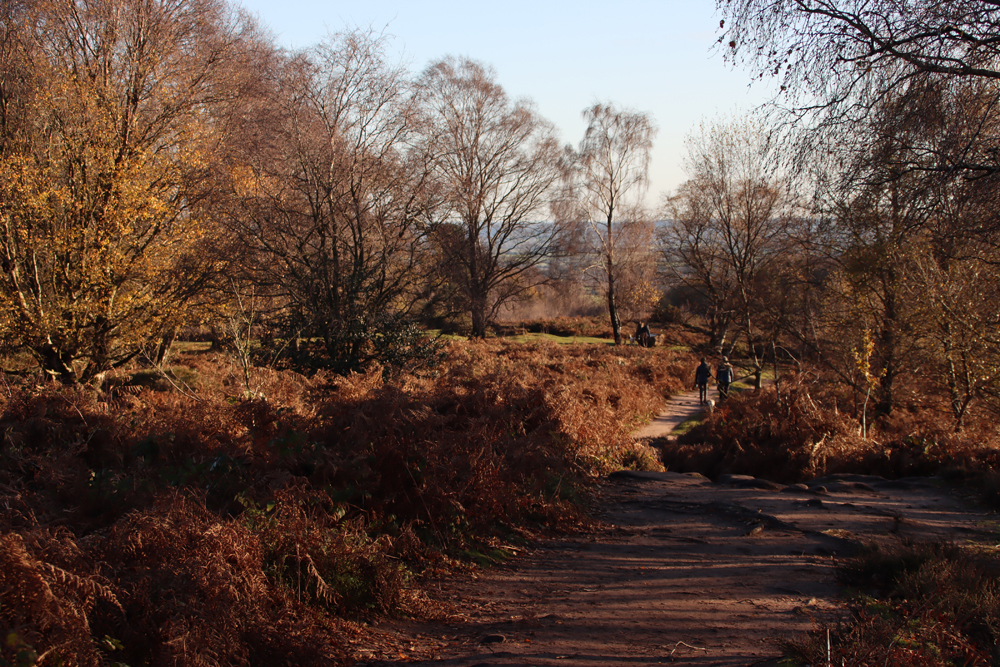
On Tuesday I took advantage of the beautiful sunshine, wrapped myself up like the Michelin Man, and went on an Iron Age hillfort hunt – Maiden Castle on the National Trust’s Bickerton Hill, to be precise.  The hillfort is, as they often are, rather easier to get to grips with from the air and in plans and illustrations, but it was still really good to see it on the ground.  I have written up Maiden Castle on a separate post here.  The real joy of the day were the deep blue skies and the slanting late autumn sunshine as it cut through the spectrum of reds, copper-oranges and yellows, and put a great golden spotlight on the bright, emerald green of the Cheshire plain below.  Utterly stunning.

The walk leads from the car park up to the ridge that overlooks most dramatically across the west Cheshire plain towards the Clwydian Range, with views too across east Cheshire.  I walked up from the Goldford Lane car park, a gentle slope across red sandy soil and sandstone slabs to the ridge, and then walked first in one direction towards and beyond the hillfort, and then retraced my steps to go along the ridge in the other direction, before returning to the car.  An alternative is to do one of a number of circular walks, one of which is shown below.  Whichever route you take, it is really spectacular on a sunny autumnal day.  Visiting details at the end.


Click to enlarge

Google Map of Bickerton Hill and Maiden Castle

Google Map of Bickerton Hill and Maiden Castle

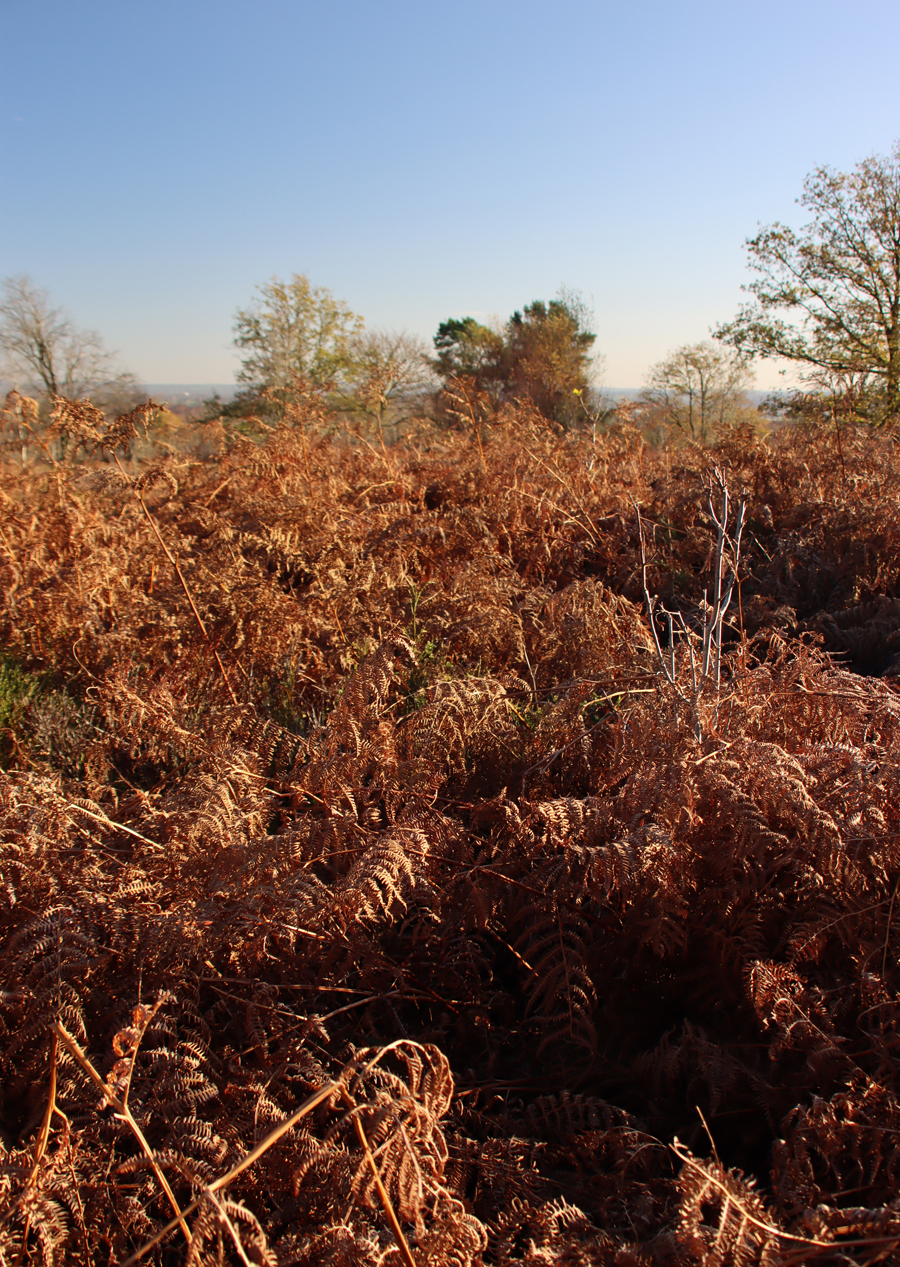
The hill was designated a Site of Special Scientific Interest (SSSI) in 1979.  Interestingly (and unfortunately) the former heathland environment underwent ecological change when cattle and sheep ceased to be  grazed on the hill during the 1950s, allowing birch, oak and endless swathes of bracken to gain a foothold, killing off the natural bilberries and heather.  Although very beautifully copper-coloured in the autumn sun, the bracken, Pteridium aquilinum, has a number of worrying ecological downsides to it, described here on the “Moorland Association” website.  Most of the silver birches and oaks are still very young, but in places the silver birch in particular forms dense clumps.  The National Trust has now initiated a project of long-term work to re-establish large areas of heathland on the hill.


Bickerton Hill nature conservation

Bickerton Hill nature conservation

Visiting is easy.  The hill is just south of the main Wrexham-Broxton-Nantwich road (the A534). There are two car parks, one on either side of the hill.  I used the one off Goldford Lane, which is a large free parking area, with a shallow slope uphill towards the ridge.  The What3Words location is ///device.emulating.upwardly.  The National Trust page for the site can be found at: https://www.nationaltrust.org.uk/visit/cheshire-greater-manchester/alderley-edge-and-cheshire-countryside/things-to-do-at-bickerton-hill#rt-visit-maiden-castle.

You can download a leaflet about the hill and the hillfort here, including what looks like an excellent walk taking in Brown Knowl, on the Cheshire Sandstone Ridge website: https://www.sandstoneridge.org.uk/lib/file-323329.pdf

The geology of the sandstone trail can also be investigated on the Cheshire Sandstone Ridge website at: https://www.sandstoneridge.org.uk/geology.html

My video from the top of the ridge:


The fabulous nature reserve at the RSPB’s Burton Mere Wetlands

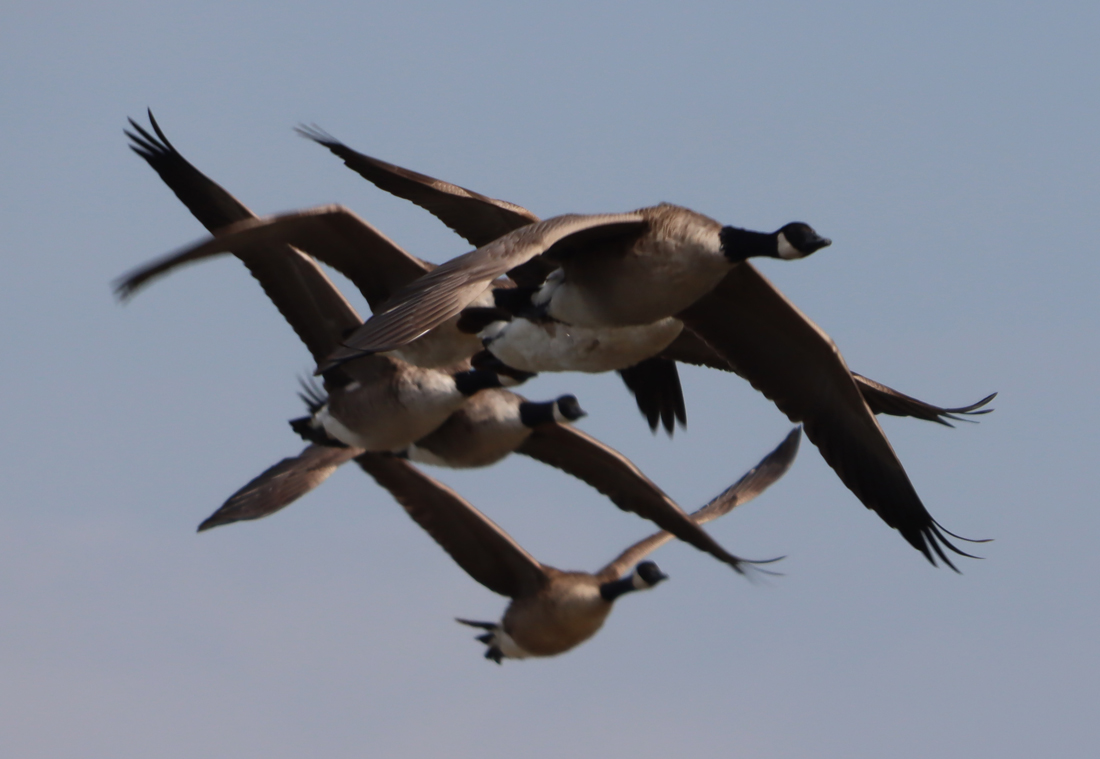
Flying Canada Geese at the RSPB's Burton Mere wildlife reserveWhen I got up this morning and saw what a beautiful day awaited, I decided on the spur of the moment to go to the RSPB nature reserve on the Dee estuary at Burton.

Burton village, well-kept and firmly manicured, is located on the southwest of the Wirral, about 20 minutes drive out of Chester, an area now better known for giving its name to the nearby wetlands.  The wetlands are divided into two separate entities.  The first is the splendidly well organized and laid out nature reserve operated by the Royal Society for the Protection of Birds (the RSPB) which was specially set up for the benefit of birds and bird watchers, but accommodates general visitors too.  There is also a route through the wetlands on the far side of the RSPB reserve, and extending well beyond it, which is the Sustrans route number 568, developed for cyclists but welcoming walkers. It crosses the wetlands from Connah’s Quay, meeting the Wirral peninsula at just above Burton Point, and continuing on to Neston.  They provide two very different but both marvellous experiences of the wetland scenery.  I have already posted a short piece about my short visit to the Sustrans cycle and walking route in the Burton Point area, although I want to walk the whole thing eventually.

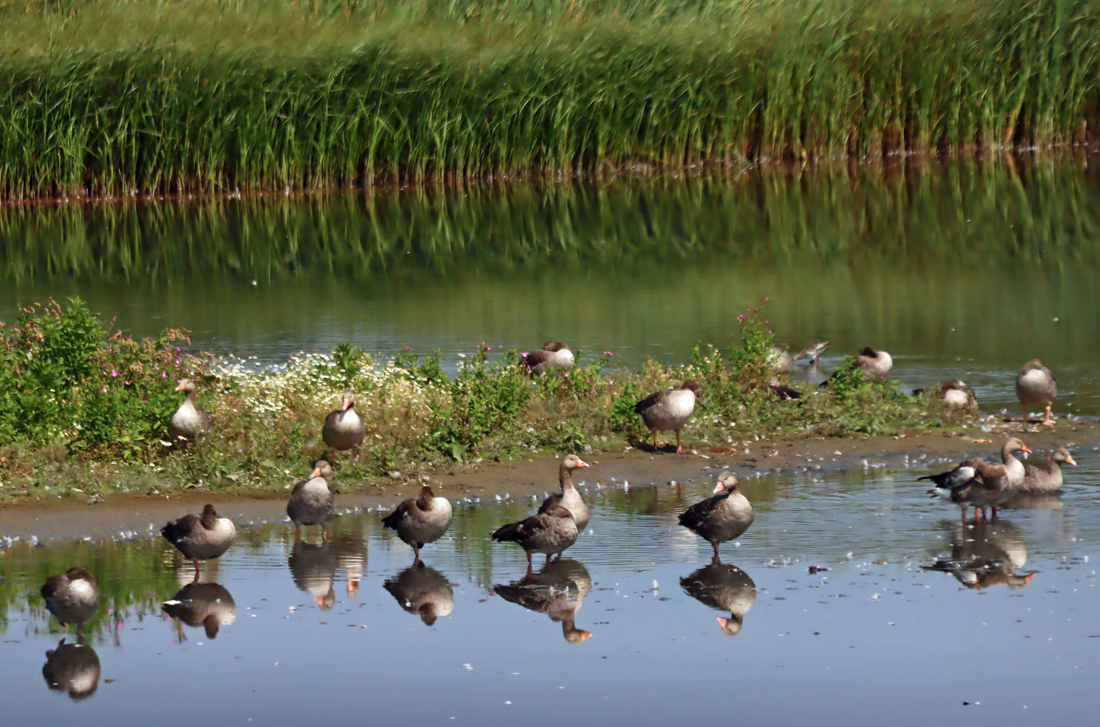
Greylag goose at the RSPB's Burton Mere wildlife reserve


A lapwing stretching its wings, whilst a common sandpiper stands by unimpressed

A lapwing stretching its wings, whilst a common sandpiper stands by unimpressed

The RSPB wetland reserve

Greylag geese with their bright orange beaks at the RSPB's Burton Mere

Greylag geese with their bright orange beaks at the RSPB’s Burton Mere

Several miles of wetland are enclosed within the RSPB reserve, which attract thousands of birds of many different species, with the river Dee invisible along the far edge of north Wales. The canalization of the Dee, completed in 1737, completely changed the environmental conditions of this part of the estuary, forcing the river to run along the Welsh edge of the estuary.  The canalized channel of the Dee is not visible from the nature reserve, but the miles of wetland are lovely.  There are huge expanses of pond and small lake, as well as flooded wetlands in the distance.  On a bright day with blue skies overhead it is gorgeous.  The reserve backs on to farmland at the rear, includes a woodland walk, and has a very attractive red sandstone railway bridge crossing the tracks below and even boasts the remains of an Iron Age hillfort which, if somewhat puzzling as an archaeological entity, has lovely views along the estuary towards Hilbre Island and across to north Wales.


xxx

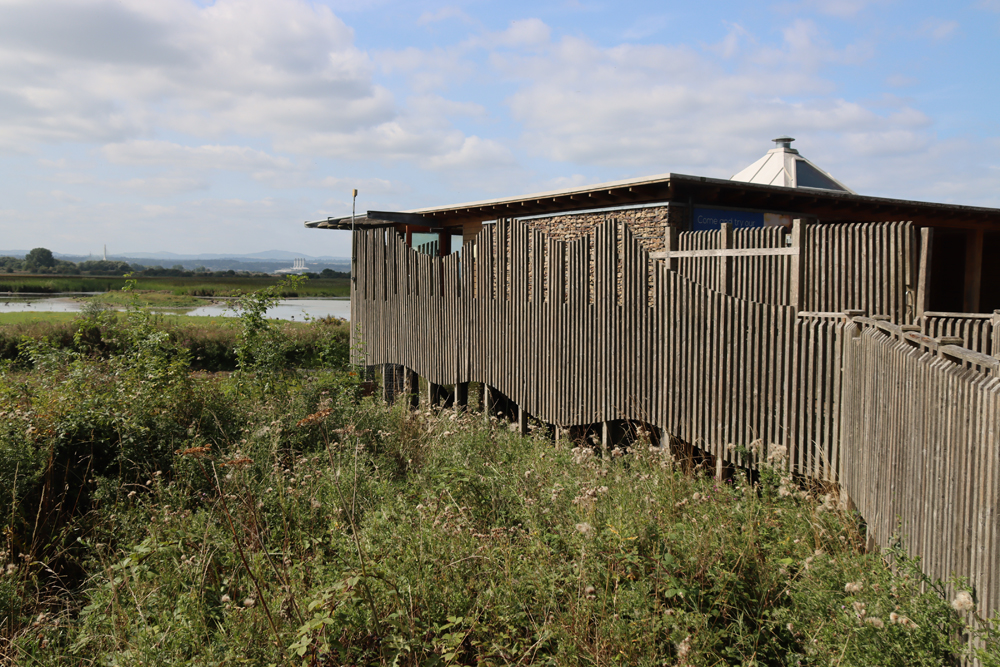
For bird watchers there is an enclosed viewing room where the ticket office is located, and throughout the reserve there are coverts and hides like the one above, all of them with benches, and all with windows suitable for both seated and standing visitors, and there are also viewing screens  and viewing platforms dotted throughout.

For less specialist visitors there are some splendid wending walks through the reserve, where water-loving plant and tree species abound, many in flower or producing berries at this time of year, and all providing a myriad of colours and textures over a base of deep greens and rich browns, which provide excellent resources for insect life.  The plants are so dense that where there is water running beneath boardwalks the water is scarcely visible.


The walks are all nice and even underfoot, many of the boardwalks coated in wire mesh to prevent them becoming slippery, and it is all beautifully maintained.  Being located on the side of the estuary, the nature reserve is nearly all on the flat.  All the main walks are wheelchair friendly, as are the hides and coverts.  There are actually four miles of signposted walks, as well as the woodland walk, which takes about half an hour.  There are plenty of benches dotted around for a moment of relaxation and contemplation.  Burton Point, at the furthest end of the nature reserve, is a tiny headland, which involves walking a short way up a slight slope and an informal footpath, and offers some great views along the estuary.  It is supposed to be the site of a small Iron Age promontory hillfort, but the evidence for this is difficult to see, although an interpretation sign does its best to offer a visualization of how it may have looked.

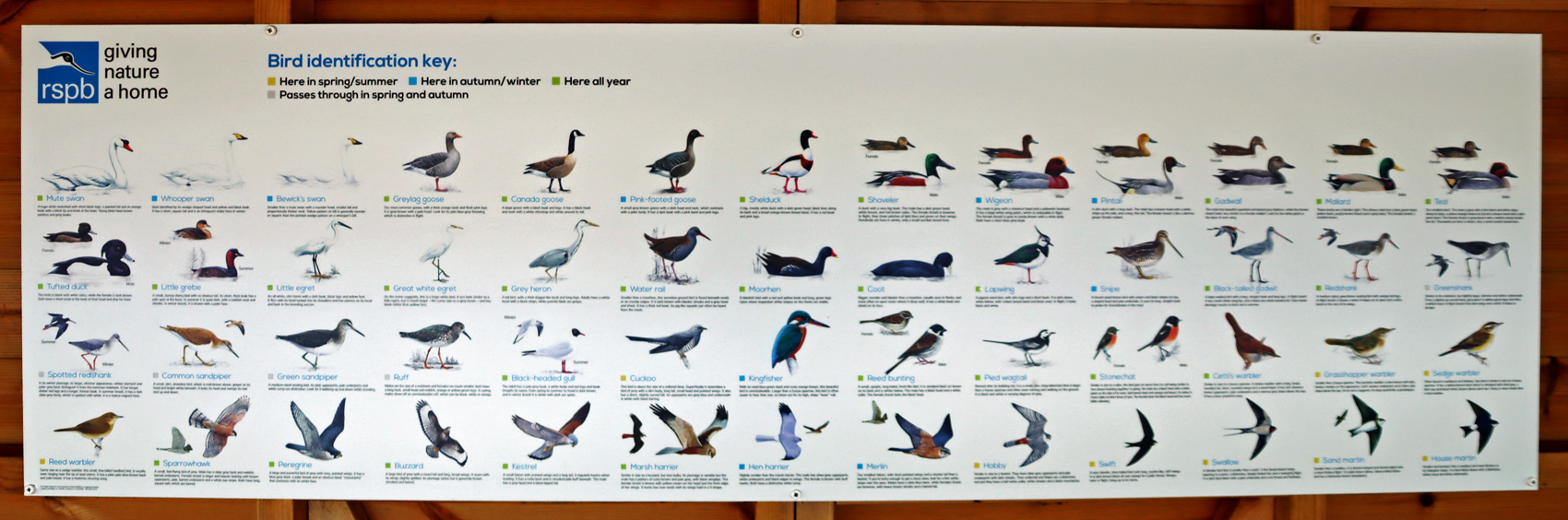
Even if you are not a regular bird watcher, the water birds are fascinating.  There are plenty of information boards showing what you are likely to see, and there is a whiteboard in the reception area showing a list of what has been spotted on a given and previous days.  Binoculars and cameras with enormous lenses (one of them in camouflage colours!) were very much in evidence and I soon found at why – my nice all-round lens, a 28-300mm zoom, was struggling desperately at its top end, and something much more powerful would have been helpful.  Do note that you can hire or buy binoculars from the reception area to get a better view of what birdlife is spending its time on the wetlands.   At this time of year the geese dominate, both in numbers and in voice.  Their honking can be heard wherever you are in the reserve, even when you can’t see them, There were Canada and greylag geese in great numbers, and a handful of Egyptian geese sunbathing on the far side of one of the stretches of open water, but there are plenty of other species too.

Greylag geese at the RSPB's Burton Mere nature reserve

There was something distinctly conversational, and rather cross, going on here, and you should have heard the honking!

Of the smaller water birds, as well as the familiar moorhens, coots and mallards, there were gorgeous lapwings and a variety of small wading birds, with slender legs and long beaks, including a common sandpiper that was distinguished by its rusty coloured plumage.  There were multiple grey herons looking like statues, waiting patiently for unsuspecting fish to swim by, and I spotted some tiny little fish in one of the ponds near the cafe which are presumably a popular part of the herons’ dietary intake.  There must be lots of reed-loving birds hidden in the wetlands, successfully shielding themselves from prying eyes.  There was apparently a spotted redshank, which was causing some excitement among the better informed bird watchers in one covert, but although I followed the directions that a father was giving his son (along the lines of – left of that greylag goose walking in front of that moorhen and then two back and one over) I was unable to spot it.  Bird feeders dotted around were attracting blue tits and great tits in great numbers and there were pied wagtails in some of the many trees that line the edges of some of the paths.  There’s an A-Z of bird species on the RSPB website.

One of many grey herons, on the hunt for unsuspecting fish at RSPB's Burton Mere

One of many grey herons, on the hunt for unsuspecting fish

This is a super place to visit, and seasonal changes in bird and plant life mean that there will always be something new to see, and there are plenty of butterflies, bees, dragonflies, damsonfiles and other insects to observe if you look carefully.  The grasshopper in the image below was particularly well camouflaged, and apparently there are sometimes lizards sunbathing in the sunnier patches.  On Burton Point there are rabbit warrens, and according to some of the signage (much of it directed at children, but still informative to older visitors) the local animals have a vibrant night life.

Spot the grasshopper

Regarding the hillfort on the promontory, Burton Point, there are websites that say that the small headland on which the site is located is privately owned and should not be entered without permission, but this is in fact now included in the RSPB reserve and is served by good footpaths and includes interpretation signage to give visitors some idea of what was here.  I’ll talk more about this site on a separate post.

Burton Point, a low promontory that overlooks the Dee estuary and is the possible site of an Iron Age Hillfort. In this photograph the footpath at far right leads into the woodland, where a vantage point looks down on the fortifications, but you can also see what remains of the fortifications at the far left of the photo where an earthwork is clearly visible

xxx

Visiting the RSPB reserve

Meadow Brown butterfly beautifully camouflaged at the RSPB Burton Mere nature reserve

Meadow Brown butterfly beautifully camouflaged

The RSPB reserve is very easy to find, although if you rely on that Google SatNav, please note that mine, having been asked to find “RSPB Burton” informed us we had reached our destination before we had actually arrived.  Fortunately, if you use the What3Words smartphone ap, which is stupendous (narrowing locations down to metre-sized locations) you can find it at ///readings.sideburns.handicaps.  Other details can be found on the RSPB website which includes the address, postcode, as well as details of the current ticket price and full details about what the nature reserve offers the visitor: https://www.rspb.org.uk/days-out/reserves/dee-estuary-burton-mere-wetlands.

The RSPB site has been very well thought out, and is very welcoming.  A single lane road from Puddington Lane has speed bumps and plenty of passing places, leading to a well-sized car park.  Entrance is via a building with a look-out over the estuary.  The entrance fee is £7.00 at the time of writing (July 2025), which helps to support the charity. There is a nice modern cafe on site, which sells tea, very good coffee, cold drinks and snacks. This is also where the toilets are located.  There is a small shop next to the ticket desk that sells gifts, books and bird food.

I have been following the RSPB Burton reserve on Twitter for a couple of years, without ever having managed to get there, and every day they take a photograph of their whiteboard to give you an idea of what species have been observed recently so that you know what to look out for.  You can find this at https://x.com/RSPB_BurtonMere.  There is a placeholder for them on Bluesky but no content just yet.

I rarely give an opinion about wheelchair use, but there were actually several wheelchairs users out and about today.  It would not be possible to get wheelchairs up to the Burton Point hill fort, or navigate them down one or two of the little tracks that run at the back of the reserve, but all of the coverts and hides are wheelchair friendly and, for both wheelchair users and children, the viewing windows extend from low to high for both seated and standing visitors.  The same comments go for those with unwilling legs.

Dogs are not permitted, and nor are drones.

Excerpt from the RSPB's leaflet about Burton Mere

Excerpt from the RSPB’s leaflet about Burton Mere, showing the top things to do on a seasonal basis


The Burton Marsh cycle and walking route 568 along the Dee estuary, Wirral

In 2013 a track across the wetlands from Connah’s Quay via Burton Point to Neston was opened.  As part of the Sustrans cycle network it is known as Route 568 or The Burton Marsh Greenway, and an information board at the point where the route meets Station Road (see map at end) says that this section is now also part of the “King Charles III England Coast Path.”  This section of the route, Burton Marsh, is partly made up of metalled lane, and partly boardwalk, and is a terrific walk.  I had never heard of it until I was standing in what remains of the hillfort on Burton Point headland, part of the RSPB reserve, and saw it passing almost at our feet and beyond into the distance.  It is an extraordinary sight, a mainly straight track across the landscape, and such a brilliant idea.

I parked on the section of Station Road that runs parallel to the estuary, which is part of the cycle route to Chester, and is separated from the rest of the Burton Marsh stretch of track by a gate to keep the sheep in.  There’s a map showing where the parking is located towards the end of this post.  This walks is all particularly beautiful on a sunny day with a blue sky stretching to the horizon. A shifting sky, which one moment produced sun and the next light shade, brought out the textures and colours for miles around.  Because the estuary is so flat and vast it can be very breezy or windy, which was no bad thing on a particularly sticky July day!


I headed through the gate in the Chester direction.  Starting out from this point you are on a metalled lane and have fields rising on your left, currently planted with palest yellow barley, whilst on your right are marshland habitats stretching all the way to the river Dee running along the Welsh side of the estuary, with every shade of green you can imagine, dotted with bright clumps of flowering plants and layer upon layer of different textures.

The barley fields are soon replaced by a fairly short red sandstone cliff edge, which has been heavily quarried over the centuries.  Where this red sandstone becomes much more uneven and comes out towards the lane, there is a sign on your right that explains that here are the remains of an Iron Age hillfort at the top of this small headland.  This is fenced off, as it is RSPB land.

Burton Point

The lane pulls away from the headland heading out into the wetlands, and soon you find yourself on a long section of boardwalk, which rattles splendidly when cyclists come along, with the marsh habitats either side of you.


On a clear day the views seem endless as far as the way to the Clwydian Range of Wales.  The track gives a sense of how big that landscape actually is, and why it is such a special environment for wildlife, with aquatic plant life as far as the eye can see, and bird life launching itself in and out at surprising and random moments.  As well as plenty of Canada and greylag geese, both on the ground and in the air, there were dozens of skylarks, terns flying overhead and birds of prey too high to identify.  Unsurprisingly there were plenty of seagulls too.  Beneath the surface, there must be an awful lot more going on.

The intention was to walk for an hour and a half, see where that took me, and then turn back to retrieve the car, but the sudden onset of fairly heavy rain both greyed out the landscape and blocked the view so I only walked for around half an hour before turning around.  Even during that short walk, the views were superb and the environment absorbing, and one of the nice things about this is that however far you want to go, and from wherever you start, it lends itself to any length of walk.  I was chatting to a man on a bike who had stopped to watch a group of greylag geese, who had cycled from the middle of Chester and was going to visit his father in Neston before turning around and coming back, and by contrast there were a couple who were just out walking a short way with their dog and a child in a pushchair.  All very civilized and a great way of introducing a wide range of people to an entirely new environment in a very easy way.


xxx

Visiting from near Burton Point

You can access the track free of charge from anywhere along its route.  Because it is all on the flat, it is suitable not only for walkers and cyclists but those with pushchairs, buggies, and wheelchairs.  There was even a man on one of those push-it-with-one-leg adult scooters.  There are gates at interfaces with roads because of the sheep.  Also because of the sheep there are frequent signs asking owners to keep dogs on short leads.   Having been followed for about half a mile by one particular sheep, which stopped and looked fixedly at me every time I turned around to see if it was still following me, I can confirm that sheep are a very likely to be encountered.

I have only done this from just north of Burton Point so far, a short drive from the A540 via the village of Burton, and you can park on the straight section of Station Road that runs along the estuary, and where there is plenty of room to park along the road (what3words: ///recur.films.dream if you have the Google-compatible app on your smartphone).  Station Road, as it leads back inland, also has some parking along its edges near to the estuary.  I have highlighted the main parking-friendly area on Station Road in the pink box below.

Convenient road-side parking near Burton Point marked in pink. Source: Streetmap.co.uk

If you fancy starting in Chester, you can set off from the Little Roodee car park, go around the Roodee itself, and then follow the track to Connah’s Quay and go from there.  Fortunately you don’t have to depend on my finger-in-the-air directions, because Sustrans has its own website with full details for Route 568, which you can find here.  It shows the sections where the route meets roads, and where it intersects with other routes in the network.


Lord Leverhulme’s multifarious collections at the Lady Lever Art Gallery in Port Sunlight, Wirral

The Lady Lever Art Gallery is in a fabulous location within the village of Port Sunlight.  Port Sunlight was the brainchild of William Hesketh Lever, who in 1911 became Baronet Lord Lever, and in 1917 Baron Lord Leverhulme, honoured for his contributions to industry, commerce and the economy. He was also remembered, amongst other achievements, for his three years as a Liberal M.P., his philanthropy and his art collections.  Just off the A41, an unattractive stretch of the road characterized by untidy industrial and retail parks, the village remains a genuinely surprising and perfectly charming near-utopia of green spaces, wide boulevard-style roads and a splendid mixture of compact homes with gardens and small civic buildings, all built in a variety of architectural styles, all vernacular.  Port Sunlight, named for one of the soap brands that Lever produced (Sunlight Soap), was built for the workers in the nearby factory.  The Neoclassical architecture of the art gallery stands out as a monument in its own right.  It was, indeed, a memorial to Lever’s late wife Elizabeth Ellen Hulme, who died in 1913, and whom he always stated was his inspiration.  Although the gallery served the practical purpose of housing the best of Lord Lever’s private collections, which had outgrown his own numerous homes, it was more importantly built  on his philanthropic urge to improve conditions and provide educational facilities for the working class families of his factory employees.

The Lady Lever Art Gallery. Photograph by Rich Daley, Wikimedia

Originally the museum was designed to be entered from the front, its big entrance overlooking the boating pond and the long green avenue beyond towards the massive war memorial.  Today the boating pond has been drained of water, with warning signs to prevent people climbing in (Julian, with whom I visited, predicts that it will become a flower bed!).  There is plenty of free parking in front of the museum, as well as on the surrounding roads.  Today the entrance to the gallery is at the side, left as you face the front, next to a ramp that leads to the basement with its excellent café and its little shop.  There is no charge for visiting the permanent collection.  You are offered a  map at the desk, and we did find that this was helpful, although once you have worked out that it is organized by rooms around a main hall, with a circular room at each end, each linking together another set of rooms, it’s very straight-forward to navigate.  Having said that, looking at the map at home after the visit I realized that there were two upstairs galleries, each a corridor that flanks the main hall, which we missed.  According to the map these apparently display 19th and 20th century art.  Next time!

===

===

Lion-headed table support, which would have been one of three or more. Roman. c.100AD

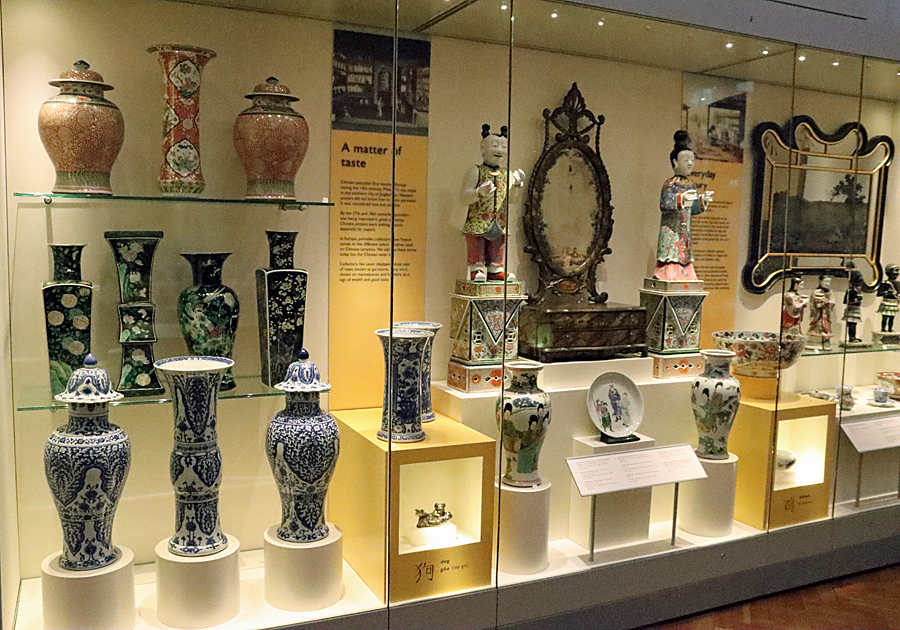
The easiest way to convey the overall impression of the Lady Lever Art Gallery is to characterize it as a miniature V&A.  Although there is a large collection of oil paintings and some water colours, there is also an emphasis on decorative arts including furniture, china, sculpture, tapestries, and embroidery.  The multinational character of the collection is impressive and begins, chronologically, with some Classical objects, as well as a couple of items from ancient Egypt.  Lord Lever had a great love of Chinese porcelain and his taste extended from the simplest of the blue and white patterns to the most elaborate and exotic polychrome extravaganzas.  There are a number of very fine Indian items, but perhaps not as many as there might have been given how long the East India Company had had its claws hooked into India’s social, economic and cultural landscape.  There is a small collection on display of ethnographic objects, although Lord Lever collected over 1000 pieces, and there are also a tiny number of ancient Egyptian objects, the bulk having been loaned to the Bolton Museum and Art Gallery.  He also collected a massive amount of Wedgwood, including fireplaces and pieces on which Josiah Wedgwood collaborated with George Stubbs.  Impressively, Lord Lever’s collection included Elizabethan and Jacobean furnishings, which are not always well represented in British museum and art gallery collections, and are really good examples of their types.

Oinochoe, used to pour wine into cups. Italian, in the style of a Corinthian vase. c.625-600BC.

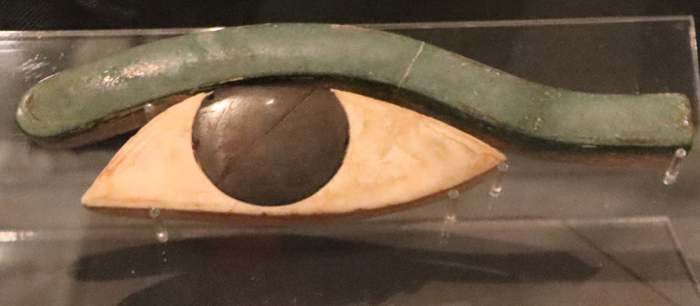
12th Dynasty Egyptian stone components of an eye

Anglo-Indian commode, 1770-80. Engraved ivory veneered on a sandalwood carcase, originally fitted with specimen draws (now missing). An English design made at Vizagapatam.

English or German “Nonsuch” chest dated 1592 (corresponding to the late Elizabethan period)

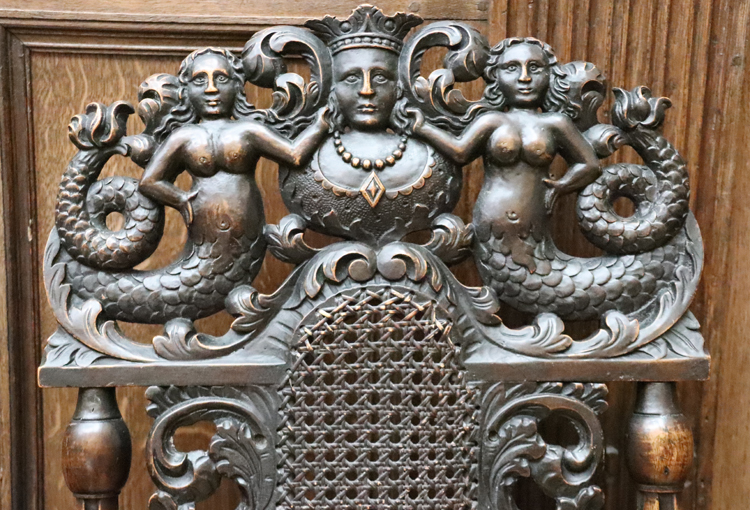
Detail of an English or Dutch chair (one of a pair), 1690-1710, emulating the Jacobean style, with mermaids and the bust of a crowned queen


Wedgwood

1780-90 Wedgwood Caneware teapot


The wall decoration in the Adam Room

There are five rooms that skilfully recreate a particular period in all its details, from wall treatments and light fittings to furnishings and art works which.  These recreated rooms are splendid today but in the days before the National Trust and day-trips to aristocratic houses must have been a real revelation to visitors.  Examples are the Adam Room and the William and Mary Room.  Both Julian and I were horrified by the Napoleon Room;  no matter how hard I tried, I was unable to find anything in it of aesthetic merit in it, although the sheer excess of it all did make me grin.  There is always something to love in mad committent to a particular passion.

Sculpturally, Lord Lever’s taste extended from the Classical to the modern including, very surprisingly, a Joseph Epstein sculpture, and the variety of forms and styles is remarkable, although I have the impression that the quality is far more variable than in other art forms in the gallery.  There are, however, some very fine Roman cineraria (small stone caskets that hold ashes of the dead).

In oil painting, Lord Lever’s taste focused mainly, but not exclusively, on contemporary and slightly earlier artists including George Stubbs, Joseph Mallord William Turner, William Etty, Thomas Gainsborough, Joshua Reynolds, Elizabeth Vigée Le Brun and George Romney, as well as a notable selection of those from the Pre-Raphaelite school including William Holman Hunt, John Everett Millais, Dante Gabriel Rossetti and Edward Burne-Jones.

Dante Gabriel Rossetti’s “The Blessed Damozel.” There is an article about the painting on the Lady Lever Art Gallery website.

The glorious “The Falls of the Clyde” by Joseph Mallord William Turner; Lady Lever Art Gallery. Source: ArtUK

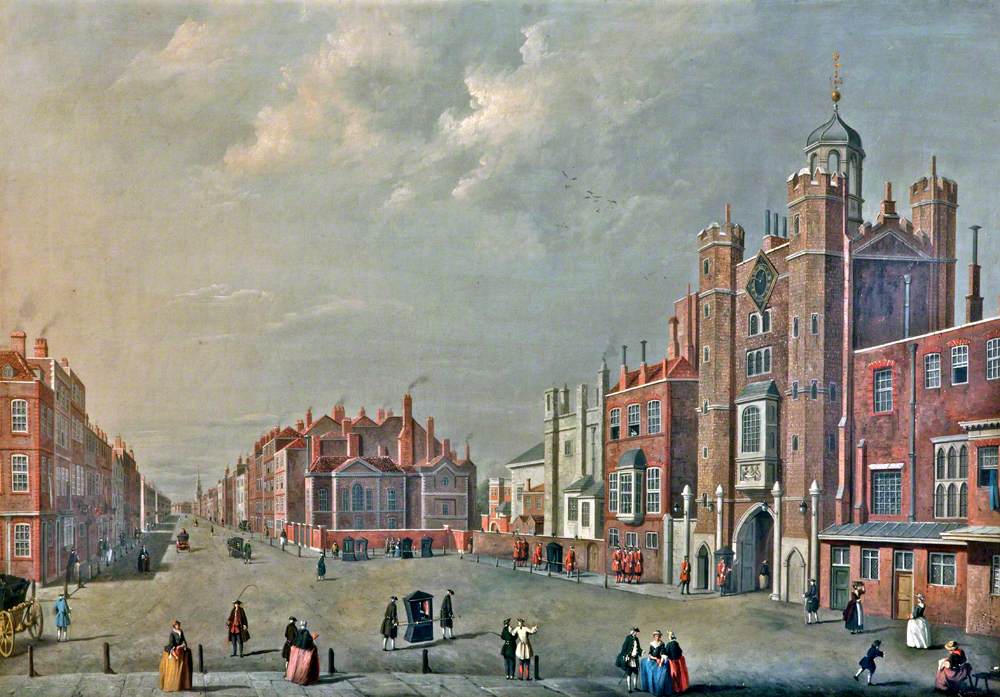
St James’s Palace. English School. Source: ArtUK

Emma Hamilton as a Bacchante. Elisabeth Vigée Le Brun.  Lord Lever’s tastes in art were usually consistent with popular opinion, but by modern standards some have not always stood the test of time. Although Vigée Le Brun produced some very accomplished pieces, others were not quite as refined.  Source: ArtUK


Painted mahogany writing desk by John Thomas Serres, 1792

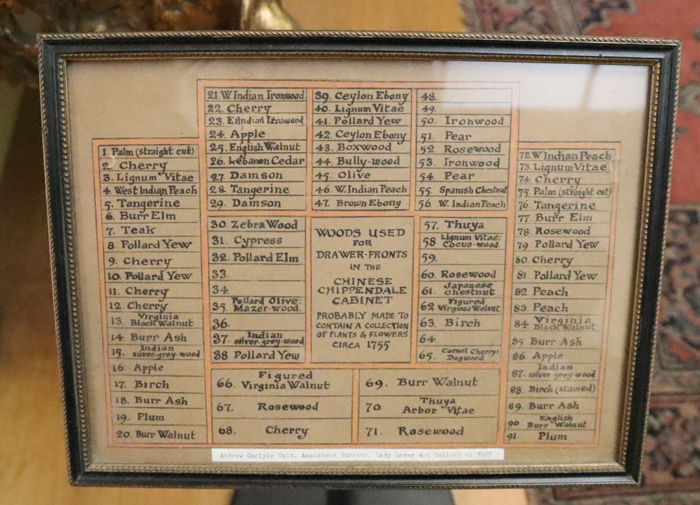
There are some items that don’t fit any particular category, such as 19th century copies of earlier Chinese cabinets (sometimes on hideously elaborate and inappropriate stands), a late 18th century cupboard decorated with thousands of tiny curls of coloured paper (filigree), late 18th century painted writing desks, and a staggeringly huge cabinet full of draws made with different types of wood; as a whole it is too big and ornate by modern standards, but the individual woods are very beautiful.  There is also a room dedicated to Lord Leverhulme and his achievements, essentially the activities that paid for the village and the gallery, together with some more examples of his collecting interests, such as his ethnographic and ancient Egyptian items.  Another room addresses the challenges of conservation.

Cabinet with multiple draws for collecting samples. 1830, but inspired by Thomas Chippendale (18th century)

On the missing list, it is most notable that there are very few Middle Eastern items, and that there are very few Medieval pieces, presumably reflecting Lord Lever’s taste.  It was of particular interest that some of the pieces had been reworked once if not more times either to repair them, reconstruct missing elements or reinvent the original concept to make it more appealing to contemporary tastes.  One of the Roman cineraria, for example, had lost its lid and had been provided with a new one in the 19th century, complete with twin Egyptian-style sphinxes.

Roman cinerarium with a 19th century lid.

Detail of Elizabethan/Jacobean wood inlay cabinet

Because preferences in art and decorative arts are so very personal, and some of the items are very much more 19th century than 21st century taste, not everything will appeal to everyone, but the skill represented by all items of all types is consistently excellent.  A shift of focus from a complete piece of furniture to the individual components that make it up not only help to reveal that skill that went into an object, but also draw attention to themes, symbols and ideas that were built into these otherwise functional items.

A fairly disastrous mismatch of styles. The Dutch cabinet, inspired by Japanese art, dates to 1690. It rests on a an over-elaborately decorative baroque stand, dating to c.1680, inspired by Louis XIV solid silver furniture from Versailles


Some of the rooms have received significant investment since I was last at the museum around a decade ago, with modern displays, excellent lighting and good information boards.  My impression is that there are fewer items on display in the Chinese and Wedgwood rooms, but that the focus on quality and representative types means that visitors are able to fully digest the collection without being overwhelmed by the sheer volume.

Perhaps more than anything else, the Lady Lever Art Gallery is an insight into the self-conscious 19th century perception of the world, including its values, hopes and ambitions.  As one of the information boards points out, although Lever was a brilliant and in many ways an admirable man, he was also part of the story of colonization, with interests in the Belgian Congo. This aspect of his activities is now a new field of research at the gallery, helping to place the story of Lord Lever and his commercial and philanthropic activities into a more global and sometimes troubling context.

Click to enlarge.  Artworks in the “Fresh Perspectives” exhibition. Clockwise from top left: Snowden Through a Lens by Jack Thompson; Gaudi in Paint by Freya Kennedy; Japanese Landscape by Millie Lawrensen Beckett; Seafoam Seaside by Isabelle Stockdale; Triptych by Indy Evans

The gallery often has special exhibitions, and these are worth watching out for on the gallery’s What’s On web page.  At the moment there is a really thought-provoking exhibition, Fresh Perspectives (on until 27th Apr 2025), a tri-annual exhibition of inspiring artworks by young people from Wirral secondary schools.  Julian and I chatted a lot as we were going around this about the differences between how art is clearly being taught in these schools and our own experiences of school art classes.  As a professional artist, Julian was particularly impressed with how students are being encouraged to explore a wide range of approaches and express themselves using non-verbal methods.  Here there is a lot of mixed-media being used in hugely creative and imaginative ways to produce some truly original artworks.  There is a lot of inventive portraiture, but some of the semi-abstract pieces are particularly interesting, featuring multi-cultural themes and the use of overlays to provide focused viewpoints.  It was heartening to see that even those who might not be able to draw were enabled to express themselves using other media to assemble evocative, expressive artworks.  It is an absolutely excellent initiative, and we both found it truly inspiring.  The exhibition also provides the gallery with a very modern component that it otherwise lacks (for obvious reasons!).

William Hesketh Lever. Source: Wikipedia

Check the gallery’s web page on the National Museums Liverpool website for opening times and other information.  Access to the main collection is free of charge, but some special exhibitions may be charged for.  You can preview some of the works on display, and read some articles about objects in the collection on the Collections page.  Note that the website is one of those maddening matryoshka (nested Russian doll) affairs, with multiple museums nested within a general museums website, and it is very easy to find yourself clicking on the wrong thing and finding yourself going off the Lady Lever gallery pages and ending up somewhere else within the general museums website.

There is a terrific coffee shop in the basement, which does a range of sticky buns and cakes, breakfasts and lunches, and serves a range of hot and cold drinks (I can recommend the excellent latte), and where Julian and I set the worlds of decorative and fine arts to rights. It was interesting how not only the objects in Lord Lever’s collection but Lord Lever himself dominated many aspects of the conversation. The shop sells souvenirs, books, greetings cards, postcards, etc, and is beautifully presented.

Overall, a great visit.

“Frightened Horse.” Blue jasper by Wedgwood, modelled by George Stubbs, 1780-85.

Splendid walnut travelling case with gilt metal mountings. 1850-1870

Commode, fascinatingly made up of 18th century parts in about 1880.

English chest c.1600-1625 (Jacobean). Oak inlaid with holly, rosewood, fruitwoods, and possibly sycamore and holly.

Detail of the above chest:


===

My battered copy of the site map

Overleigh Cemetery Self-Guided Geodiversity Tour

Many, many thanks to Paul Woods (Chester Green Badge Guide who leads the cemetery tour Stories in Stone) for sending me the scans of this leaflet by Cheshire RIGS and the Northwest Geodiversity Partnership, apparently published in 2012.  It looks at the most common types of stone used, gives some geological details about it, and discusses how some of it responds to environmental conditions.  I’ve shared the JPEGs below but I have also turned it into a PDF that you can download by clicking here.  I cannot wait to take it for a test drive!

A short comment on the missing past of St Mary’s Nunnery, Chester

I have been trying to find a publication of the excavations that took place when the profoundly ugly Chester HQ office development was built on the site of St Mary’s Nunnery and its cemetery. This lead me to the article by Professor Howard Williams below.  Outside the Chester HQ buildings is a very odd permanent display area made of red sandstone displaying bits and pieces of random archaeology.  I’ve thought it was peculiar for a very long time, one of these token gestures, neither fish nor fowl, that are usually funded by developers when they build over the top of heritage sites.  It has no cohesive message, no coherent linkage between any of the objects, and is anyway missed by most passers-by.  This excerpt from a very nicely written article by Professor Williams (University of Chester), posted in 2017, really gets to the nub of the matter.

https://howardwilliamsblog.wordpress.com/2017/03/22/unethical-medieval-nuns-on-display/:

I see the vision but I can’t really get my head around the reality in a sympathetic way. Rather than evoking a history of place, reporting on the contexts discovered and the rich and varied social, economic, political and religious history of the city and this site’s place within it, instead we get a transtemporal pastiche. This is little more than a banal and context-free open-air cabinet of curiosities that shamelessly aggrandises the corporate architecture of the 21st century and its construction facilitated by the rifling of past times.

He goes on to discuss the display of one particular object, a truly lovely medieval stone grave cover with a fabulous decorative theme that represented the Tree of Life.  It would have been laid horizontally over the grave, covering the deceased, but here is displayed vertically.  This is really well worth a read if you are interested in heritage management, respect towards funerary monuments and contexts, the activities of developers with respect to the heritage they impact and the role of object histories.  Loving the phrase ” transtemporal pastiche,” which gets it in one.  Professor Williams never disappoints.

Back on the subject of the archaeological excavations, it was also interesting to note that in a 2013 article Professor Williams notes the following:

Archaeologist Mike Morris of Cheshire West and Chester Council was forced to announce that the developer – Liberty Properties – was in breach of their agreement [Cheshire Live] by not funding post-excavation adequately following the excavations at the HQ building revealing graves from Chester’s Benedictine nunnery. The website of Earthworks Archaeology – the commercial archaeologists who excavated the remains associated with the Benedictine Nunnery – says that post-excavation is ‘under way’.

The Cheshire Live article says that not only were there remains of 100 individuals from the cemetery at the nunnery site, but “foundations for at least one large Roman town house were discovered including an undisturbed mosaic floor – the first to be found in Chester since 1909.”  The Earthworks Archaeology site announces:  “The practice is currently on sabbatical.”  There is no additional content and the website says nothing at all now.  If anyone has any information about the excavations I would be grateful?  But I suspect that it’s a horribly lost cause.

The last remaining structural feature of St Mary’s Nunnery – a 15th century archway that now stands in the Grosvenor Park.

Excavation without publication is an archaeological evil.  If the remains carefully troweled out of the ground are not professionally published, the information is lost forever, the data never contributing to knowledge about the city as a whole and about the nunnery’s history in particular.  It is the responsibility of an excavation not merely to extract data from the ground, but to share it. Anything else is an abdication of responsibility, and the loss of an important story.  If the excavation results are never published, how will we ever understand what there was to know about St Mary’s?  Where contracts are granted for this sort of work, surely the conditions of those contracts should be enforced.

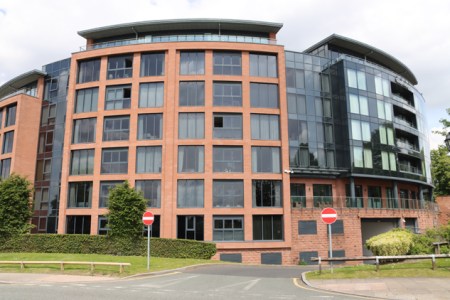
The Chester HQ building where the nunnery once stood

Lecture: Rosemary’s Baby: Adventures and Insights from Contributing to the Corpus of Anglo-Saxon Stone Sculpture in England

Rosemary’s Baby: Adventures and Insights from Contributing to the Corpus of Anglo-Saxon Stone Sculpture in England

Paul Everson, Keele University

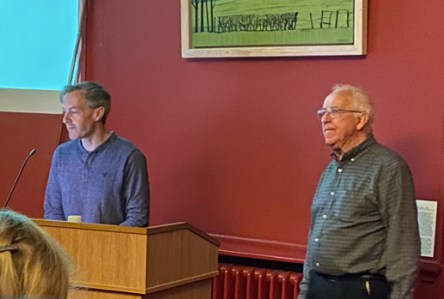
Tom Pickles, Chair of Chester Archaeological Society, introducing Paul Everson

On Saturday 4th May, in the last in-person Chester Archaeological Society lecture of the 2023/24 spring season in the Grosvenor Museum’s elegant lecture theatre, archaeologist and landscape historian Paul Everson introduced members and guests to the “Corpus of Anglo-Saxon Stone Sculpture (CASSS)”  project inaugurated in 1977 by Professor Dame Rosemary Cramp (https://corpus.awh.durham.ac.uk/).  With his long-time collaborator David Stocker, Mr Everson has published three volumes of the CASSS, and in this lecture explained how the decades-long project has not only provided us with a definitive catalogue of decorated stonework of the period but also stimulated new avenues of thought.

Professor Dame Rosemary Cramp’s name is synonymous with Early Medieval sculpture, combining her expertise in Old and Middle English with archaeological research, beginning her own excavations at Monkwearmouth in 1957.  Having identified an opportunity to create a corpus of early stone sculpture after working on examples in Durham Cathedral and the Wearmouth and Jarrow monastic sites, she developed a standardized format for the publication of the CASSS, and a “grammar” of Anglo-Saxon ornament (also used for knitting!). This enables each volume of the corpus to be used in the same way and, where required, directly compared, making the series invaluable as a cohesive research tool.  The first volume to be published was County Durham and Northumberland in 1984, and the last two, currently being compiled, are volumes 15, Leicester, Notrh Rutland and Soke Peterborough and volume 16, Norfolk and Suffolk.

Some examples of the types of Anglo-Saxon sculpture included in the Corpus (slide from Paul Everson’s presentation)

The corpus of Anglo-Saxon carvings, dating from the 7th to the 11th centuries and much of it previously unpublished, includes crosses, grave markers and grave covers, architectural detailing and inscriptions, both in original locations and in relocated positions. The compilation of the Corpus required the establishment of procedures for locating and recording both known and previously unidentified carvings. A mixture of archaeological, field survey and historical approaches are employed.  All churches in a Corpus volume area are inspected, inside and out.  Sketches, photographs, measurements and notes ensure that full details were recorded.  Lost items have been rediscovered by tracing records in publications produced by antiquarian and early scholars.  Antiquarian and early scholarship are always described and credited in the first chapter of each volume, reflecting their value.

As with most archaeological data, Anglo-Saxon sculptures often exist only in fragments and this requires virtual reconstruction work so that these too can be understood as whole pieces and included in the corpus.  It was interesting to note that, like Roman tombstones, the ornament was picked out in bright paints, exemplified by a replica from Neston which has been rendered in full colour, shown on the above slide.

Bringing to together substantial data across each area has led to an exploration distribution patterns, with some specific types distributed widely across a county and others being more localized, leading to a search for explanations  An example is Raunds Furnells where a small cluster of 10th century stone monuments may help to explain similar finds in east England, perhaps representing the founding families of churches, which in turn may represent the first stages of the development of the parochial system.  “Exceptional collections” also occur, where large numbers of sculptural stones are found in a particular location, and it has been found that these tend to be near river sites where markets were held, and where merchant communities with disposable incomes concentrated, such as Chester where an impressive collection is retained at St John’s Church, and at Neston on the Wirral.

The Hedda Stone, Peterborough Abbey

A surprising finding was that there may have been very little pre-Viking quarrying of new stone.  Instead, earlier stone masonry in church architecture and graves was often recycled and has become a much-debated topic.  Some of these re-uses are pragmatic and practical, making use of usefully shaped pieces.  The re-use of Roman masonry could explain, for example, some puzzling holes in the famous early Medieval Hedda Stone at Peterborough Cathedral.  Another form of recycling is described as “iconic,” where earlier scenes are appropriated and re-positioned in a new cultural context.  Interpretation of specific instances of recycling differ, and the resulting debates, although usually amicable, may be very animated! Discourse provided by differing perspectives, specialisms and sub-disciplines and by a new generation of researchers ensure that research into Anglo-Saxon sculpture continues to be a lively field.

At the other end of the chronological scale, studies of post-Conquest sculpture have helped to elucidate the continuity of earlier medieval traditions, and this too is an important research vector for understanding the period when Saxon and Norman interests vied for supremacy.

Making use of database technologies, an important leg of future work will include the Arts and Humanities Research Council (AHRC)-funded “Worked in Stone” project which will re-digitize all the volumes to make them into a fully searchable database, an important new initiative that will be hosted by the Archaeological Data Service (ADS) and will be free to access.).

The challenges of interpreting different syncretic and iconic schemes. (slide from Paul Everson’s presentation)

An enthusiastic round of applause marked the end of the lecture.  There was the opportunity for questions, and the audience took full advantage.  The topic of recycled Roman stonework lead to some discussion about how identity and meaning may have been syncretized or replaced.  Another question concerned how future discoveries might be incorporated into the corpus, and although nothing formal yet exists, the topic is obviously on the minds of those looking to the future of this research area.  At the end of the questions the audience again applauded loudly in appreciation.

By the end of the lecture, it had become clear that the loss of Dame Rosemary last year at the age of 93, and the publication of the final two volumes of CASSS will not draw any sort of line under the research into Anglo-Saxon sculpture.  The Corpus continues to be provide an invaluable resource.  The digitization of the corpus will make it readily available to support a new generation of researchers as they develop new ideas and perspectives and explore new directions. It is clear that in spite of her passing away last year, this project remains very much “Rosemary’s Baby.”

The first twelve volumes of the CASSS are available online at https://corpus.awh.durham.ac.uk/.  For Anglo-Saxon stone sculpture in Cheshire see volume IX. For a paper produced as an offshoot of the corpus work, see the study of the social background of the St John’s (Chester) crosses in the Members Area of the CAS website (https://chesterarchaeolsoc.org.uk/members-area/): P Everson & D Stocker. Transactions on the Dee: the ‘exceptional’ collection of early sculpture from St John’s, Chester
In: Cambridge, E & Hawkes, J eds. Crossing boundaries: interdisciplinary approaches to the art, material culture, language and literature of the early medieval world. Essays presented to Professor Emeritus Richard N. Bailey, OBE, in honour of his eightieth birthday. Oxford: Oxbow Books, 2017, 160–78.

Finally, the international ‘Worked in Stone: Early Medieval Sculpture in its International Context’ conference  takes place next year in Durham (https://corpus.awh.durham.ac.uk/wis.php).

Many thanks to Paul Everson for such am engaging and enlightening lecture.

Paul Everson in the Grosvenor Museum lecture theatre

The splendid Grade-1 listed Llangar Church, Cynwyd, near Corwen

The small Llangar Church is exceptional.  It is Grade-1 listed and a Scheduled Monument located in the Dee valley not far from Corwen. From its lovely lime-washed white walls and its small but well-filled churchyard to its painted interior and box pews, all set in the middle of a field, there is so much that is unexpected in Llangar Church. It has been subjected to detailed historical and archaeological research, and is accordingly much better understood than many other churches in north Wales.  This work, looking at over 500 years of use, means that there is far too much information to include here.  We were shown round by visitor guide Heather on the day, who was excellent, but there is not always a tour available, so the official Cadw guide book is certainly one way go to if you want a more informative account, with 18 pages dedicated to Llangar Church.  The survey and excavation report published in Archaeologia Cambrensis in 1981 (pages 64-132)  is the most detailed report available, and can be accessed online.  See Sources at the end of this post for both.

Visiting details and a map are at the end, but do note that this can be combined with a visit to the brightly painted 17th century Rhug Chapel, which is a 5-10 minute drive away, also on the map at the end (and about which I have posted here).

The meaning of the church’s name remains uncertain.  One interpretation suggests that it it can be translated as “Church of the White Deer,” whilst another suggestion is that it might refer to the name of a neighbouring Iron Age hillfort.  The Coflein website refers to it as “All Saints.”

Whatever the meaning of its name, the first documented evidence of it dates to 1291 and the church was probably founded earlier in the 13th century, serving local farms and the services that supported them.  It escaped the destructive attentions of the Reformation, and was used until 1856, when it was replaced by a new church in Cynwyd that was both bigger and far more conveniently located.  Although abandonment of the church, combined with its relatively inconvenient location, led to neglect, decay and damage, it fortunately escaped being plundered for building materials, and avoided the indignities of Victorian restoration work that usually augmented and remodelled what was found rather than merely preserving an architectural legacy.

It was not until the 1970s that conservation work accompanied by survey and research projects began to rescue the site and uncover some of its complex architectural and social history.  The church was not a time capsule of a single particular period, but a palimpsest of multiple periods.  This was a living, breathing community resource for over the 500 years, and as people and ideas changed, so did the church.  The Cadw analysis of the architectural development of the church identifies five main phases:  Medieval, Early 17th century, Mid to Late 17th century, early 18th century and later 18th and 19th centuries.  The scatter of painted and engraved dates through the church from the 17th century suggest that that this was a period when the church underwent a number of repairs and modifications.

The churchyard

The entrance to the churchyard is marked by an attractive and remarkably solid 18th century stone lych gate, with double wooden doors.  Like all lych gates it provided a shelter for coffin bearers and a place to rest the coffin bier until the service began, and also served as a formal entrance to the churchyard.  The slate roof has two tiers of decorative pointed tiles on the churchyard side.

The churchyard is on a slope.  To provide a flat surface on which to build the church, material was removed from the east and transferred to the west end.  The dangers of this scheme, leaving one end much more consolidated and compressed than the other, resulted in later structural problems on the north side (opposite the porch side) and at the west end.  Over the the decades, many of the headstones have started tilting downhill.

The cemetery has a particular charm all of its own, which is difficult to define but has something to do with the simplicity of the grave monuments, and the general absence of ostentation. The earliest of the monuments in the churchyard date to around 1600.  Chest tombs of the 17th and earlier 18th centuries cluster close to the church itself, whilst those further away were later.  These later graves were both chest tombs and graves marked by a headstone and footstone.  The cemetery went out of use in the 1870s, when the church was abandoned.  The church and churchyard, built into the side of a hill, are rather exposed and some of the inscriptions are very worn.  Interestingly, most of those graves before 1825 were inscribed in English, whereas later ones were largely in Welsh.

18th century

1821

1841

There is also a sundial base just beyond the church porch.

Llangar Church and churchyard showing the northwest corner, by the Dee, completely free of graves. Aerial view. Source: RCAHMW Coflein

In general the north side of a churchyard was the last to receive graves, either because it had previously been in use for community activities or because, being darker and colder, it was less attractive for visiting.  In the case of Llangar the northwest corner remained entirely free of burials right up to the moment of its abandonment, but this is probably because of problems with subsidence, a theory supported by various changes made to the church’s architecture to counter structural difficulties.

The church exterior

The guide book has a step by step tour of the exterior as revealed by the survey work.  It is a fascinating detective story over two pages, perfect for anyone doing a self-guided tour on a dry day.  The short version is that the south wall (porch side) dates to the Middle Ages, and the north wall was medieval but was modified over the centuries, with some windows blocked and others added. The north wall is now propped up by a modern retaining wall added during the renovation, but it is worth looking out for a top-to-bottom jagged line like a crack at the west end, which shows where structural work was carried out in the second half of the 17th century.  The west wall was rebuilt in the early 18th century.  The porch was added in the early 17th century, re-roofed in 1702, and the big ornamental window in the Perpendicular gothic style probably dates to around the same time.   

The interior

Visitors enter the church via the porch with two stone benches, probably dating to the early 17th century.  There is paintwork and various pieces of graffiti carved into wood and stone. Take note too of the noticeboard showing some of the restoration work.

As you walk in to the church, you are confronted with a fabulous red-painted life-sized skeleton representing Death, at gallery level on the opposite wall.  As a reminder that a church is the interface between the living and the dead, and that life is only a temporary condition before interment and Judgement Day, this can scarcely be beaten.  There are more details about this image below.

The ground floor is a single space with a floor covered in stone slabs and a small overhead gallery at the west end, which was probably used for the musicians.  There are no aisles or other architectural divisions.  The space beneath the gallery was clearly reserved for parts of the congregation that had the lowest status, at the furthest distance from the sacred east end, and was very dark and cramped beneath the low ceiling.

The earliest parts of the wooden beamed ceiling are thought to date to the 15th century, although timbers were replaced and repaired in subsequent centuries, and today most of them are modern, from the 1970s restoration.  The east end, traditionally the sacred end of a church, is marked by a “canopy of honour” dating to the late 15th or early 16th century, a barrel-shaped ceiling that would have shown sacred themes in paintings that have now been lost.  It is thought that they may have looked like those at St Benedict’s Church at Gyffin near Conwy showing the twelve apostles (its website is here, complete with a virtual tour).  

The only feature that would have furnished the church of the Middle Ages to survive is the simple font set into a niche, which has been moved from its original position, probably in the 18th century.  Most of the surviving fittings date to the early part of the 18th century.

From the 18th century, the public sat in the surviving box pews along the north wall and on backless bench pews on the south wall.  Four of the elegant box are dated 1711 (belonging to the Hughes family of Gwerclas, 1759, 1768 and 1841.  One preserves the initialse of one of its occupants.


Another pew, at the south side of the 18th century altar and dated 1841, was used by the rector’s family.  Opposite, on the other side of the altar, is a painted 18th century cupboard topped with a winged angel.  It is set into the north wall dating to the 18th century, with three keyholes, requiring three keyholders.    The altar itself dates to the 18th century but was built of 17th century wood.  The window above the altar is flanked by two panels, which between them show the Ten Commandments, in Welsh.  Originally the east end would also have housed a pulpit, but this was moved to part way along the south wall.  It is  a three-tiered pulpit, which was probably moved from the east end sometime after 1732 to allow the altar rail to be employed for the giving of the sacrament.

Like nearby 17th century Rhug, Llangar’s interior wall paintings escaped the whitewashing vigour of the Reformation, but unlike Rhug, the paintings represent different time periods, from the 14th to late 18th centuries. Some images were overpainted with new ones, and many are very faint.  One of the paintings has been removed to preserve it and is now in the exhibition area at Rhug Chapel.  The Cadw guide contains a full description of all of the paintings, by A.J. Parkinson, but here are some highlights.


North wall

Most of the images were intended to provide visual material to support sermons, which Parkinson refers to as “teaching aids.”  The fabulous skeleton is brandishing time’s arrow in one bony hand and a winged hour-glass in the other.  Between his legs are a shovel and pickaxe, tools of the gravedigger. He is dated tentatively to 1748, the death of rector Edward Samuel, who was a notable Welsh scholar and poet.  Looking to his left, on the front of the gallery, are some elegant yellow frames with floral motifs, containing texts that are now too faint to read, but may by Biblical.  


To the right of the skeleton, over the window, is the name of the rector in 1730, and to the right of this was the Royal Arms of the same period, now in the Rhug Chapel visitor centre.

The rest of the north wall above the box pulpits contains overlapping images, the earliest of which, possibly 14th century, is a bishop (very difficult to make out) in the doorway of a substantial and rather exotic church, the towers of which can be easily seen.

The red frame possibly dates to the 15th century and probably contained a narrative, such as the life of Christ, or scenes from the lives of saints.  Other decorations along the wall were painted over in the 18th century.

On the south wall are a series of morality-themed panels outlined in red, probably dating to the 15th century.  All are very faint.  Some of them show representations of the Seven Deadly Sins, in which each sin is personified and is shown riding an appropriate animal.  These are very difficult to make out, but are almost unique.  Jane Durrant’s reconstruction below shows what they may have looked like in the late medieval period (scanned from the Cadw guide book).

Cutaway reconstruction showing teh south wall panels as they may have looked in the 15th century. By Jane Durrant. Source: Cadw guide book by W. Nigel Yates (full details at end, p.28).

On the left is a stag, representing lechery, and on the right is a wild boar representing gluttony, two of the Seven Deadly Sins

The gallery with benches, at the west end, is reached by a flight of stone stairs. It probably housing the musicians and singers, retains a very unusual four-sided music stand.

Abandonment of the church

Llangar church with a temporary roof. Source: RCAHMW https://coflein.gov.uk/en/site/93771/images

From the Middle Ages to the 19th Century populations changed, and parish boundaries often ceased to be representative of where people were concentrated and wanted to worship.  In the middle 19th century Llangar and Gwyddelwern were neighbouring parishes, but Llangar’s population did not exceed 251 people dotted around the parish, whereas Gwyddelwern’s population had reached 1,118, of which nearly half lived in Cynwyd, near to Llangar.  In 1853 the decision was made to redraw the parish boundaries so that Cynwyd was in the parish of Llangar, but at the same time it was also decided that a new church should be built at Cynwyd to replace the inconveniently located Llangar Church.  Llangar Church had gone out of use by the mid 1870s except for occasional burials.  Some abandoned buildings are robbed for their materials, but Llangar survived intact, although as its roof deteriorated, so the rest of it came under threat.

Restoration

Noticeboard in the church porch

The importance of Llangar was recognized in the 1960s, and it was taken into care by the Welsh Office in 1967.  Restoration work began in 1974.  There is a noticeboard in the porch of the church showing some of the restoration work, as well as on the Coflein website.  Amongst many other restoration activities, one of the big structural changes accomplished during the restoration was the addition of a retaining wall on the outside of the original wall on the eastern end of the north side.  This should continue to stabilize the church to secure its future.  The roof was largely rebuilt, and most of the interior required conservation work.  Survey work, involving a number of different specialists, began to reveal the history of the church and churchyard.

Final Comments

More than any other church that I have visited in recent years, Llangar provides a sense of a place of social congregation.  This was off the beaten track, even for rural people who came from their farms and forges to attend the Sunday service.  Many of them will have met at market, but a sense of real community probably only developed on the back of the weekly congregation, which was a social as well as a religious activity, attended by entire families.   The paintings on the walls, changing over time to suit different needs, helped to involve the congregation in the Christian narrative, surrounding them with key messages and providing them with a sense of context.  The painting here was not merely decorative, like Rhug, but invested with shared articles of faith.  It is a small place, but it has a real impact.

Visiting

Source: Google Maps (with my annotations).  Llangar Church is at the bottom of the map, Rhug at the top.

Before setting out, it is vital to check the website, because the church is open only on certain days of the month in the spring and summer, and is closed during autumn and winter.  Do note that opening times are timed to coincide with those of nearby Rhug Chapel, so you can do both at the same time. https://cadw.gov.wales/visit/places-to-visit/llangar-old-parish-church

Llangar Church and its churchyard are located in the Dee valley in a field just off the B4401, a well-used tourist route to the eastern side of Lake Tegid (sometimes referred to as Lake Bala).

Map sourced from the Coflein website with my annotations

There is a large lay-by opposite the farm track that gives access to the church.  The church is sign-posted, but when I was there the sign was hidden by tree branches.  There is a small post box on a pole next to the farm track that leads to the church, and a sign on the open gate for Station Cottage.  The track leads downhill for a minute or two, past farm buildings on the left. The road goes hard right and then hard left.  At the left turning, there is a gate on the right hand side (with a sign to its left saying Guide Dogs Only) that takes the visitor across a field, complete with mud and cow-pats, through a small gate on to a grassy footpath flanked by upright slates.  This leads to the lych gate and the churchyard beyond.

For those taking unwilling legs into account, although it is only about 5-10 minutes from car to lych gate this is very slippery underfoot after rainfall, meaning that this would almost certainly be better approached during a dry period.  Part of the graveyard is on a steep slope, which would make exploring it challenging, and there are steps up to the gallery within the church, but otherwise there should be no difficulties.

If you want to get the most out of the visit, the guide book is very helpful (see Sources below), covering both Llangar Church and Rhug Chapel as well as Gwydir Uchaf Church near Betws-y-Coed, which I have not yet visited, but looks fabulous.  The guide book is particularly strong on Llangar Church.  It can be purchased at Rhug Chapel, or ordered online from the usual sources.

If you plan to include a walk in your visit, the farm track from the road leads to a public footpath that runs along the disused railway track, which a couple who had arrived early recommended.  There are many good walks in the Corwen area, some of which are detailed in an excellent leaflet, which can be downloaded here as a PDF.

Sources:

Books and papers

Parkinson, A.J. 1993. The Wall Paintings. In Yates, N.W. Rug Chapel, Llangar Church, Gwydir Uchaf Chapel. Cadw, p.37-39.

Yates, N.W. 1993. Rug Chapel, Llangar Church, Gwydir Uchaf Chapel. Cadw

Additional reading:

Shoesmith, Ron 1981.
Llangar Church. Archaeologia Cambrensis vol.129, January 1981, p.64-69
https://journals.library.wales/view/4718179/4748029/87#?xywh=-163%2C-2%2C2584%2C3638
Llangar Church. The Graveyard Survey

Archaeologia Cambrensis vol.129, January 1981, p.70-132
https://journals.library.wales/view/4718179/4748029/93#?xywh=-169%2C-8%2C2584%2C3638

Although I haven’t yet managed to get hold of it Heather, the Cadw visitor guide, also recommended R. Suggett’s Painted Temples: Wallpaintings and Rood-screens in Welsh Churches, 1200–1800. RCAHMW 2021.

Another book that I haven’t yet seen, to which Peter Carrington alerted me, is Archaeologies and Antiquaries: Essays by Dai Morgan Evans edited by Howard Williams, Kara Critchell and Sheena Evans. Archaeopress 2022, which has four chapters dedicated to Llangar.
https://www.archaeopress.com/Archaeopress/Products/9781803271583

Websites

Coflein
All Saints Church, Llangar
https://coflein.gov.uk/en/site/93771/
All Saints Church, Llangar, Images
https://coflein.gov.uk/en/site/93771/images

National Churches Trust
St John the Evangelist, Cynwyd
https://www.nationalchurchestrust.org/church/st-john-evangelist-cynwyd

Day trip: Flint Castle – Edward I’s first permanent Welsh foothold

Northwest “garrison” tower at far left, with the big detached southeast “Great” tower in the middle and the northeast “Eagle” tower at far right.  Out of sight, opposite the Great Tower, is the southwest “Prison” tower

A visit to Flint Castle is not really a day trip if your starting point is the Chester-Wrexham area because it’s only about half an hour away, but because we started out quite late, and decided to combine it with a visit to Basingwerk Abbey in Holywell (a 10 minute drive from Flint), and had a long, lazy coffee in the sun, it did turn into something of a day trip.  If you are into fascinating ruins, I recommend both Flint Castle and Basingwerk, particularly as they are such a short distance from one another and overlap chronologically.  Basingwerk Abbey was founded in 1132 and closed in 1535, so its inhabitants would have seen the first construction of Flint Castle.  I’ll be talking about Basingwerk on another occasion.

As Edward began his castle building extravaganza, Llywelyn at last paid homage to the king of England, sitting to the left of the king’s throne, with Alexander of Scotland at the king’s right.

I have already posted the background story to Edward I’s castle building programme in northeast Wales, describing how different generations of Llywelyn the Great’s descendants clashed with England and the Marcher lords in a fight for territory and prestige in Wales.  I have not repeated any of that here, so if you would like the background information, do have a look at my earlier post.

Flint Castle is right on edge of the river Dee estuary, with beautiful  views across to the Wirral, and even though it is on the edge of a busy town with somewhat chaotic traffic, the castle itself is set back from a quiet housing area and stands apart even from that.  Although the river has silted up in front of the castle today, when it was built, the river flowed up to the castle itself.  It has a sense of isolation and peace about it and is a lovely place to visit, and can be combined with sections of the Wales Coast Path.  See my notes about visiting the castle at the end of the post, together with maps.

The Who, When and Why of Flint Castle

Artist reconstruction of the southeast and northeast towers of Flint Castle by A. Hook. Source: Ancient and Medieval Architecture

When Henry III died in 1272, Edward was on his way home from an underwhelming crusade, having narrowly survived an assassination attempt, and he took his time to return to England.  He was not crowned until 1274.

Henry III and Edward had been troubled throughout Henry’s reign with rebellions in Wales, masterminded by Llywelyn ap Gruffud, known as Llywelyn the Last.  Several treaties had failed to achieve long term peace, and although the Treaty of Montgomery of 1267 looked as though it might hold, Llywelyn ap Gruffud was labelled an outlaw in 1276, and war was declared in 1277.  A peace was brokered, but although Edward had every reason to believe that the treaty might secure peace between England and Wales, he began to build a series of castles in northeast Wales, beginning at Flint in 1277 and rolling out along the coastlines throughout the next two decades.

Why here? The location of Flint Castle

Strategic importance of the castle

View down the Dee estuary towards Chester showing Flint Castle in the foreground. The build-up of marshland is a recent phenomenon. In the 13th century, the castle was right on the edge of the river, accessible by boat.  Source: Coflein

The unoccupied site for Flint Castle was chosen for its excellent views for miles around, and the slab of bedrock on the edge of the estuary, on which the castle would be built.  Although the castle was sited on a floodplain rather than on a more traditional hill, its location on the Dee floodplain still provided clear lines of sight in all directions.  It would be impossible to sneak up on Flint Castle unless it was foggy.  With tall towers on all four corners, any approach by land or water would be easy to spot, and the town that Edward had planned from the beginning sat on the landward side of the castle, preventing any large-scale onslaught from going unnoticed.

Map of the Welsh Cantrefi showing the location of Flint Castle. Source: Wikipedia.

Although Flint was in English hands in the heart of Llywelyn’s former territory, it was only a day’s march from Chester, one of the great earldoms along the Welsh border.  The castle could be supplied with food and other essentials from Chester by boat, and the estuary provided a potential, although not terribly reliable route of escape, should it be needed.  In addition, a small garrison was maintained at Ness on the Wirral, opposite the site of Flint Castle. When the tide was out, the river between Flint and Ness could be forded.  Most importantly, Flint Castle was a stepping stone into Wales, allowing Edward to build his series of castles one day’s march from one another.  This simple linear network, which could be supported by the sea, began to enclose Gwynedd, particularly as Edward and his magnates began to repair or rebuild Welsh castles that they had defeated.

Castles under siege were always at risk from running out of supplies, but the potential of being restocked from the sea was one form of additional security, and the castle had two wells, one in the centre of the inner ward, and one in the detached southeast tower.

Economic potential of the area

Flint Castle northwest corner

Although Flint Castle was a military installation, Edward intended for it to have a town accompanying it, to take advantage of the area’s natural resources.  A new town would need to attract inhabitants, and as well as incentives, the land itself would need to be able to support the town.

Although there was no settlement at Flint, which was named by either Edward or one of his entourage, it would be wrong to think of the land along the estuary as deserted when the castle was first thought up in 1277.  As far back as the Domseday survey of 1086 the nearby hamlet Atis Cross had a church, a corn mill and a a hide of land, something in the range of 120 acres, belonging to Hugh Lupus of Chester, and there was a lead smelting works here.  Nearby Coleshill (Cwynsyllt) was also mentioned in the Domesday book, and Hen Blâs motte and bailey castle at Bagillt, just over a mile away, which lies within the township of Coleshill Fawr, may have served as the llys (court) for the commote of Coleshill.  Archaeological excavations in the mid 1950s concluded that the castle was replaced by a fortified manor house in the early 13th century, which was in turn abandoned in the late 14th century.  In 1132 the abbey of Basingwerk was built here, and in the 13th century it had water mills and a nearby windmill.  This was potentially a prime area for water mills, as water dropped at speed from the hills towards the Dee, ideal for turning water wheels for processing grain or sheep’s wool.  The area was also suitable for agrarian development, sharing with Anglesey a lowland, fertile location that could be cleared for fields and farmed.

The designer and the design 

1919 plan of the castle grounds that were passed into state care, showing all four towers, the inner keep, the well and the remains of the connecting walls.  Only part of the outer keep is preserved.  The same area  remains under Cadw guardianship today. Source: Coflein

Although much of the castle was deliberately torn down following the civil war in the 16th century to prevent re-use, many of the key features are still visible on the ground.  Castle architecture has some basic requirements that are shared by all castles, but Flint itself showed a number of innovations that make it stand out today. Most of Edward I’s castles in Wales were designed primarily by Master James of St George, but Flint Castle was the brainchild of Richard L’Engenour (d.1315), a wealthy resident of Chester, an architect, master mason and military engineer, the owner of three farms in the Chester area, who in 1304 became Mayor of Chester.  It is probable that Edward’s input is reflected in features of the castle that resemble the castle of Aigues-Mort from which Edward left on crusade in 1270.

The wide open site placed few constraints on its designers and builders.  The castle has a number of notable features, including a double moat and the massive offset donjon, that were innovations in British castle building.  Although Flint began with the castle, a town was always part of Edward’s plan for Flint, so the layout of castle and town were conceived of together.

The castle comprised an inner ward (or bailey) and an outer ward, separated by a moat and drawbridge.  The outer ward protected the main gate into the castle and acted as an interface between the inner ward and the outside world.  It was shaped rather like a funnel, allowing access via a single gatehouse into what was effectively a holding area, narrowing into a path that connected it to a gate into the inner ward, which was overseen by the battlements and by the southwest and southeast towers.  It would have had buildings to house and feed troops stationed there, together with stables for horses and a gaol for holding prisoners.

The rectangular inner ward was made up of round towers built into the walls on three corners, and a detached round tower on the south-eastern corner.  Sturdy curtain walling connected all four towers, with the detached tower joined to the inner keep by a footbridge.  Some foundations remain within the inner ward, plus the all-important well.  On the day that I visited in mid June, the water of the well in the inner ward was clearly visible at about 5ft (152cm) below the ground surface.  Buildings within the inner keep would have included a bakehouse, brewhouse, kitchen, chapel and a hall.  Both wells, the one in the inner ward and the one in the donjon, were fed by the freshwater Swinchiard Brook.  Uniquely, the castle had two moats.  An inner moat protected the main castle and an outer moat protecting access from the town.

The southwest tower and a stretch of the curtain wall.

Each of the towers was different.  Although all had spiral staircases leading to battlements for defence, each had its own function.  The southwest tower is, according to Vicky Perfect, recorded in the payroll as the Prison Tower, so may have served as a gaol before a more formal building was added to the outer ward.  It originally had three storeys.  The basement, where prisoners were presumably held, had no steps, which would certainly have frustrated attempts at escape.  The northwest tower, also known as the Garrison Tower, had four points of access, which was useful for deploying troops to the battlements in a hurry, and its basement was probably the store for weaponry.  The northeast, Eagle Tower, was three storeys high, with a basement that was accessed via a trapdoor.  Guests and servants were housed here, and there was a fireplace on the second floor with a chimney up on to the battlements.  A spiral staircase ran up one side.  The potentially standalone southeast Great Tower (also known as the castle keep or donjon), is of particular interest.  Its isolation from the rest of the castle was an additional form of security against any successful incursion, accessible only via a drawbridge, now replaced by a permanent bridge. Sitting within its own portion of moat, it is unique in Britain.  It is a truly massive piece of architecture, about 20ms in diameter, was accessible only on the drawbridge, and contained a central space some 6m diameter.  It was several storeys high.

Southeast Great Tower, donjon or keep.  In the centre and on the right, images sourced from Coflein

The donjon or southeast Great Tower

On an everyday basis the Great Tower was the home of the Constable, but also housed the king’s chamber, which was completed in 1286.  The walls of the keep were 7 meters thick at ground floor level, but were still 5 meters thick at upper levels.  To add to its independence from the rest of the castle, and to provide the king with some privacy when he was in residence, it was provided by its own well.  Holes in the floors above it allowed water to be drawn rather than carried, and a wooden wheel was fitted to raise and lower the pail.  It was also provided with garderobes (toilets) and its own chapel.  Its basement, shown right, had a barrel-vaulted ceiling, limewashed to provide reflective light, but also illuminated by torches.  At times of siege, livestock could be moved into the tower to provide supplies on the hoof.

A watergate was built into the north wall, with steps down to the river frontage.   This was for loading and unloading boats directly into the castle.  A smaller watergate was also built into the donjon, again reflecting its design as a standalone unit.

Building the castle 

The first stage in the construction of the castle was to clear an overland route to Chester.  Although the castle could be supplied by boat, there was no road to Flint from Chester. The tidal character of the river meant that the castle could only be reached at high tides, so an overland route was vital.  More immediately Edward was unwilling to run the risk of penetrating the alien countryside where he could be attacked by those with superior local knowledge.  The road allowed him to travel with realistic protection to his new castle, and to enable his army advance unhindered along the Welsh coastline. A road was carved out of the densely vegetated coastal landscape.  It took 10 days to clear the route to Flint, and from there the castle was linked with routes to Rhuddlan, Degannwy and eventually to Conwy.

The next step was to dig a deep ditch around the chosen site at Flint to protect builders and visitors alike, which took three weeks.  The castle was to be built on bedrock, which gave it a solid base on the otherwise soft floodplain.

View from Flint Castle across the estuary and the River Dee to the Wirral

Wood for scaffolding, lifting equipment and for the defences that would surround the planned town was sourced mainly from the Forest of Toxteth (now part of Liverpool).  The fill of the walls of the castle was built mainly of yellow sandstone, much of which Vicky Prefect says was sourced from Ness on the Wirral, opposite, across the estuary, and other locations on the edge of the Wirral.  Ness could be reached over the sands when the tide was out by fording the river, but stone could also be brought in by boat.  Edward kept a small garrison at Ness.  Other sandstone was available locally, along with other natural resources including lead ore, lime for mortar and white limewash for walls (both lead and lime available from Halkyn Mountain).  Although yellow sandstone dominated, red sandstones were employed for some parts of the outer and inner walls, some of which came from Burton Point, a bit upriver from Ness, with the inner space between them filled with mixed rubble, including stones from the beach and broken building materials.

Many of the original payrolls for the construction of the castle have survived, meaning that details of names, home towns, job roles, and salaries of the workers who built the castle have survived.  Just as the king could demand that his noble subjects should provide men for his armies, he could assemble workforces of specialist craftsmen from across England, whether they wanted to go or not.  The building site and the craftsmen were protected by armed forces. This formula worked so well at Flint that the same model, and many of the same craftsmen, were used at the subsequent castles.  Here’s Vicky Perfect’s description of the first weeks of work in the summer of 1277:

The workforces were placed under the control of various knights, and split into groups under their twenty men (foremen). . . . In week one of the the build a total of 1858 men were involved in the first stage of the building of the castle.  Most were dykers who were required to help prevent the water from filling in the newly dug foundations.  The first order of 10,000 sandstone blocks was placed at the quarry of Ness prior to 25th July 1277.  Large numbers of carpenters and wood cutters were employed, some working in the forest s at Toxteth cutting the timber and building the 250 rafts needed to transport the stone across the water.  Many others were working on site, constructing the stockade required to keep the men safe and making the lifting machinery to move the sandstone blocks into place.  There were also numerous masons, working the stones delivered from Ness Quarry.  Smiths were employed to make and mend the metal tools required for the project.

By week two, the workforce had increased dramatically to 2,911, indicating the urgency of making the site safe.  More specialist workers were brought to the site, such as Carbonarii (miners) to mine the coal to fuel the smith’s fires.  The number of dykers working on the site doubled, including a group from Holland.

The well in the Great Tower.

The rest of that chapter is worth reading in its entirety, providing some fascinating facts and figures including lists of some of the workers, their trade, the number of them employed and how much they were paid.  For example, in the first two weeks, the castle employed dykers, smiths, carpenters, masons, woodcutters, miners, cinder carriers, masons and constables, paid from 2d to 8d a day, the latter reserved for the specialist Dutch dykers.  Other specialists were brought in as work progressed.  John le Blund, for example, was brought from London and paid 19 shillings for dressing stones for the well in the Great Tower.

The castle was not completed until the mid 1280s, by which time it had been painted with  white limewash, and the towers, which had been provided with temporary roofs of thatch, were now provided with lead roofing.  In 1302, following storm damage, lime was brought to repair the castle walls.  In 1304, wood from Ewloe produced 60 boards, 12,000 pieces of wood for tiling, 1000 lathes and four louvres for repairs so kitchen and stabling.

The town

John Speed early 17th century map of Flint. Source: Coflein. Click to enlarge.

An accompanying town, (or “implanted bastide”) was part of Edward’s original plan for the castle.  The idea of establishing defended new towns around castles in hostile territory came from Gascony, where Edward had already founded a number of new defended towns.  Pioneer settlers were granted considerable commercial privileges as incentives, and were expected to help defend the town should it come under attack.  These new towns reinforced the network of castles with economic as well as military foundations, and the enclaves of English commerce also introduced English urban traditions within rural Wales.  Flint and Rhuddlan were two of the earliest examples. 

Writing in 1924, Patrick Abercrombie commented that “There is no town in this country that is of greater interest to the student of Town Planning than Flint. Laid out by Edward I, in 1277 as an appendage to his mighty castle, it has preserved its mediaeval plan almost intact. Like most artificially planted communities, there was no fundamental human need in this place for a town, which accordingly grown in the past little beyond its original size.”  It is a fascinating idea that new towns, built from scratch, arrived with the Normans.  According to Francis Pryor, a total of 172 of these towns are known in England and 84 in Wales, and Edward was the “last great instigator” of the new towns.  As well as the layout of the towns, functional considerations were also important, and Edward believed that to support markets, good road links were vital.  Communications became one of his mantras, vital for a peripatetic king and court, but also for the movement of troops and the commercial viability of new settlements. 

Excavations in 2015 explored what are thought to be part of the town’s defences. Source: BBC News

An indication that the beginnings of the town, which  were already established by early in 1278, was a proclamation of a weekly market each Thursday and an annual fair.  Edward decreed that the burgesses of Flint should hold a market on Thursday of each week, and an annual week-long fair at the time of the Pentecost (50 days after Easter Sunday).  The castle constable was to serve as mayor, one of Edward’s own brothers was installed as chaplain at the castle, and agents were appointed to rent out plots of land to any pioneering English inhabitants who were prepared to chance their luck even though the defences were incomplete.  To encourage take-up, in 1282 these agents offered plots in the town free of rental for ten years, followed by a reduced rate in subsequent years, and residents came under English, rather than Welsh jurisdiction.  Burgesses (property-owning merchants) were exempt from the payment of tolls. In 1284 the town received its first royal charter, which conferred full English-style free borough privileges.  The settlers had their own guild and courts.  Conveyances of property suggest that many of the settlers were from Cheshire, who took advantage of the provision of land in the royal demesne and forests.  Others probably came from Shropshire.  A town mill was constructed, and permission was granted for another, which incurred an annual rate of ten pounds. Even with these benefits, it was obviously an uphill struggle to attract residents at first, in spite of the fact that by 1300 much available land in England was in use and the expansion of population during the 13th century meant that it was becoming increasingly difficult to find land.   By 1292, however, the town had taken off and there were 74 burgesses registered for tax in Flint.

The main source of information for the town’s layout is John Speed’s sketch of 1610, shown above.  The Norman new towns were built as grids.  The maps show that Flint still preserved its Medieval layout, and that it was one of the most symmetrical known, with a very precise underlying geometry.  Four parallel roads ran perpendicular to the river, whilst Edward’s coastal road passed through the middle of the town parallel to the river.  Whether the dog-leg was original or developed between the 1280s and Speed’s map of 1610 is unknown.  One of the four parallel roads, along the route of modern Church Street, connects the entrance to the town with the entrance to the outer ward, passing in front of the Church of St Mary’s and the town square.

Tithe map of Flint area, showing the original Medieval field systems. Flint castle is handily under the left-hand red blotch, and the grid layout of the town is easily seen, as are the neatly arranged fields.  Source: People’s Collection Wales

The economy of most of north Wales was based on livestock herding. Nearby Basingwerk Abbey depended for some of its locally derived income on its 53 heads of cattle and its 2000-strong herd sheep.  However, some lowland areas could be developed for mixed farming.  Anglesey was “the bread basket of Wales,” and the river lowlands at Flint were potentially ideal for agrarian land use.  In order for agriculture to underpin the activities of the settlers at Flint, clearance of neighbouring land took place to create new fields, the outlines of which survive, remarkably, on the 1839  tithe map, shown above.  This shows Flint town’s four parallel roads immediately in front of the castle, but extended on either side beyond the bissecting coast road.   The surrounding land is similarly divided up on a grid pattern of long, thin fields.  Although residential, commercial and industrial growth have obliterated much of this, some of it still survives to the south of Flint town.

Access from the outer ward into the inner ward

Writing about the design of Flint Castle’s town, Caroline Shillaber concludes that “Viewed in historical perspective, Edward I appears as the forerunner of British planners who regard the creation of new towns as a function of national government, who locate and plan the towns to serve an overall administrative policy, who lay out the towns  in accordance with the needs of the people, and who devise economic conditions conducive to their growth and development.”  Some areas were riskier than others, however, as the settlers in Flint discovered in 1294 when renewed hostilities between England and Wales resulted in the town being burned to the ground.  Even though residents received compensation and the town was rebuilt, it must have been a daunting thought to stay in a town where its supposed protectors were willing to burn it down if the need presented itself.

A tax assessment of the town had been made in 1293, naming residents like Adam the carter, Benedict the miner, Godfrey the carpenter and Nicholas the smith.  The assessment recorded 76 households.  Only five of those named were Welsh, like Madog ap Iorwerth and Einion Cragh, indicating that even in an English enfranchisement Welsh people held property.  Things changed after the town was burned down after 1294, perhaps due to bad feeling about the devastation of the town thanks to Welsh hostilities.  This is reflected in a petition of 1297, written when the town was still being rebuilt.  The English burgesses of Flint complained that in an English town, Welsh individuals had “bought land in the town and bake and brew, contrary to their charter and custom,” although there was actually nothing in the 1284 town charter to restrict the nationality of residents. 

Matthew Stevens gives an account of an Englishman named Richard Slepe who had been in Flint town from its inception, and had remained after the town had been burned down.  His daughter Agnes had married a Welsh man, Adda ap Einion.  When Richard died in 1327, Agnes and her husband inherited Richard’s properties, but because Adda was Welsh, they were confiscated by local officials.  They appealed the decision but were turned down.  Enfranchised Welsh towns, occupied by the English, made no concessions to a mixed-nationality marriage, a situation that continued until the 1536 Act of Union giving Welsh nationals equal rights to English.  

The castle under attack during the reign of Edward I

In March 1282 Llywelyn’s brother Daffyd launched a ferocious assault on Hawarden Castle, and this was followed by further attacks on Flint and Rhuddland castles, in which Llywelyn appears to have participated.  Attempts by Archbishop Pecham to negotiate a peace failed, and Edward through everything he had at the brothers, as described on my previous post.  Llywelyn was killed in battle in December 1282, and Dafydd was captured and put to death the following year.  The Flint area, including Basingwerk Abbey, was trampled underfoot, but Basingwerk was given significant compensation and Flint Castle was repaired and construction work completed by 1284.

As mentioned above, in September 1294, those who had been lured to settle in Flint met the dangers of living in the shadow of a strategic military facility head-on when the constable of the castle, William de la Leye, ordered that the town be set on fire to prevent forces led by Madog ap Llywelyn from using it as a protective screen.  Madog ap Llywelyn, one of Llywelyn the Last’s more remote cousins, considered himself to be a successor of Llywelyn and made a bid for power, supported by other Welsh landowners.  Some of them joined Madog on an opportunistic basis, with territorial claims in mind, but all of those who retaliated at this time acted in response to a massive tax demand, and a culling of Welsh men to supply troops for his activities in Gascony. Attacks were co-ordinated and took place at castles both built and appropriated by Edward, at Aberystwyth, Builth, Castell-y-Bere, Denbigh, Criccieth, Harlech, Caernarfon, Morlais, Flint and Rhuddlan.  It was a serious rebellion, and it demanded a serious response.  Edward immediately diverted the troops waiting to ship out to Gascony, sending them instead to Wales, where they advanced from three bases. Madog’s revolt was put down after some delay in March 1295, with Madog surrendering in July.  Edward compensated seventy five burgesses with £521.00, and the buildings were all re-built, but life next to a strategic outpost of an invading nation cannot have been particularly reassuring.  

View along the Dee towards the west from the inner ward

Edward I died in July 1307 at the age of 68 and was succeeded by his son Edward II (April 1284 – September 1327), who had been declared Prince of Wales in 1301.  Edward’s reign was colossally unpopular and he was forced to abdicate in January 1327 in favour of his 14-year-old son, Edward III. Following the quashing of the rebellion of Madog, North  Wales remained more or less at peace until the rebellion of Owain Glyndŵr under the reign of Henry IV in 1400.  Flint Castle continued to be strategically important, and retained a garrison.  The town, protected by the castle, was a financial and administrative centre during the 14th and 15th centuries, meaning that even in times of peace the castle retained its importance and was accordingly well maintained.  Future archaeological excavations may provide information about the original town, both before and after the fire.

Back in the wars after Edward I

Richard II 

Richard II at his coronation. Source: Wikipedia

In terms of great events after Edward, Flint Castle’s next claim to fame was as the venue for the abdication of Richard II (1367-1400) in favour of Henry Bolingbroke, who became Henry IV.  Richard II was the grandson of Edward III, and on the death of his own father, Edward the Black Prince, became heir to the throne, succeeding in 1377 at the age of 10.  He was deposed in 1399.  Flint Castle itself had had nothing to do with Richard II’s career up until that point.  Richard’s regency was managed by a number of councils.  One of his most important advisors was his uncle John of Gaunt. 

The regency councils saw England through the continuing eruptions of the Hundred Years War and the Peasants’ Revolt of 1381, and Richard himself was forced to deal with a number of substantial disruptions, including the threat of invasion from France.  As he came into his own power, Richard’s mistrust for the aristocracy lead him to select both his friends and personal guard with care, causing discontent amongst the powerful aristocracy.  When a group of them took control of the government in 1387, refereed to as the Lords Appellant, Richard was able to reinstate himself, but punished the conspirators with exile or execution.  One of the exiled was his cousin Henry Bolingbroke, son of his advisor John of Gaunt. 

The coronation of Henry IV, from a 15th-century manuscript of Jean Froissart’s Chronicles. Source: Wikipedia

On the death of John of Gaunt, Richard denied Henry Bolingbroke his inheritance, and this was enough to push Henry to open rebellion, landing in Yorkshire in June 1399. Richard II seems to have been very unpopular, and it does not appear to have taken Henry a substantial amount of effort to depose his cousin.  While Richard was in Ireland, Henry moved south.  Richard landed in Wales in July 1399 and entered negotiations with the Earl of Northumberland before surrendering to Henry on 19th August at Flint Castle.  Shakespeare puts these words into Richard’s mouth (Act 3, scene 3):

Cousin, I am too young to be your father,
Though you are old enough to be my heir.
What you will have, I’ll give, and willing too;
For do we must what force will have us do.

Henry Bolingbroke, in Shakespeare’s version, shows all due reverence and offers the king dignity and reverence, but the reality is that Richard was forced to resign in exchange for his life and was forced follow behind Henry to London, where he was incarcerated in the Tower of London.


Owain Glydwr 

Northwest tower

In 1400, a wealthy and London-educated Welsh nobleman was the source of the final great rebellion.  Owain Glyndŵr was the descendent of Llywelyn the Great and the princes of Powys, Owain Glyndŵr (c.1359–c.1415), and had served as a soldier under Richard II revolted against King Henry IV of England, using guerrilla tactics and his knowledge of the terrain to inflict damage on English forces. As with Madog in 1294, his primary grievances were unfair taxation, land disputes, and systematic neglect by the English government.  Owain’s first move was to attack key English castles, including Flint, placing it under siege in 1403.  The burgesses retreated into the castle whilst the town was plundered, inflicting damage that again took substantial time to repair.  Owain inflicted a number of defeats on the English forces with the aid of foreign assistance, and for a few years controlled most of Wales.  He called a parliament in Machynlleth in mid Wales, which was also attended by foreign dignitaries, where he named himself Prince of Wales, presented his plans for an independent Wales, which included building two national universities and the reintroduction of the traditional Welsh legal system.  In the long term, however, even with foreign military aid Owain was unable to compete with England’s superior forces and the king began to regain control of Wales.  Owain Glyndŵr continued to be a thorn in England’s side until 1412, when he disappeared after escaping a siege at Harlech.  He became something of a folk hero and a powerful symbol of Welsh nationalism and heritage.


The English Civil War (1642-1651)

Colonel Roger Mostyn (c.1623-90)

When Charles I acceded to the throne in March 1625, he came into conflict with Parliament from very early in his reign.  Like Henry III, he believed that the king ruled by divine right, and this in turn meant that he was answerable only to God, and not to any earthly authority.  His marriage to a Catholic did not help his popularity.  Constant bickering over religion and funds for Charles’s various projects, none of which Parliament was willing to fund to the king’s satisfaction led to the deterioration of the relationship, and in 1642 the country was torn in two, when civil war broke out.

By this time Flint Castle had been abandoned and was in very poor condition.  It was still, however, located in an excellent strategic position and local landowner Roger Mostyn made the decision to repair the castle and install a garrison as a contribution the Royalist cause.  A useful store for supplies for Chester, the castle changed hands several times during the conflict.  Back under Roger Mostyn, Flint found itself under Parliamentarian siege on 1st June 1646 and held out for nearly three months until all supplies had been exhausted and the garrison under Roger Mostyn surrendered rather than starve.  Although the Parliamentarians allowed them to leave unharmed, they were taking no chances regarding the castle, which was immediately slighted (rendered unusable).

The king was defeated at Rowton Heath, south of Chester, on September 24th 1645.  John Taylor in A Short Relation of a Long Journey, which he wrote in the summer of 1652, painted a thoroughly gloomy picture:.

Surely war hath made it miserable; the sometimes famous castle… is now almost buried in its own ruins, and the town so spoiled that it may truly be said of it, that they never had any  market (in the memory of man). They have no sadler, taylor, weaver, brewer, baker, botcher, or button maker; they have not so much as a signe of an alehouse . . . and this (me thinks) is a pitiful description of a shire town.

Future archaeological excavations may provide information about the original town, both before and after the 1294 fire.

An object of artistic interest

J.M.W.Turner’s painting of Flint Castle. Source: williamturner.org

Although it’s life was over as a military installation, Flint Castle joined other nearby ruined castles and abbeys, like Beeston Castle in West Cheshire and Valle Crucis Abbey near Llangollen, as popular tourist destinations, which were also popular with artists.  The best known of these was J.W.W. Turner (1775-1851), who painted both of the previously mentioned sites, and created a typically atmospheric view of Flint Castle too.  It is fairly typical of Turner’s paintings of this period, produced in the 1830s.  It shows the main subject of Turner’s interest in the background, with contemporary activities in the foreground.  Rather than place his ruins centre stage, Turner usually placed them where they eye was drawn to them, but in much less detail than the activities taking place in his foregrounds.  The man on the right looks towards the castle.  The sun rises at the castle’s side.  A line of blue-grey along the horizon draws the eye from left to right, tying the composition together.  The castle’s silhouette contrasts spectacularly with the yellows, reds, oranges and golds of the rest of the composition.  Everything in the painting draws the eye away from the more detailed and busy foreground to the static silhouette of the the castle’s profile.  Both beautiful and clever.  This was not Turner’s only study of Flint Castle, but it is my favourite.

View of Flint Castle by Richard Reeve 1812. Source:

I also very much like Richard Reeve’s earlier, far more prosaic and much less virtuoso portrait of Flint Castle.  Painted in 1801, instead of Turner’s juxtaposition of past and present, it blends the two, showing everyday life in in harmony with the ruins.  In Reeve’s view, the castle, the the beached boats drawn up on the shore alongside, the cottages in the foreground and the horse and cart driving away all occupy the same time zone without difficulty.  The men pulling in the nets are so accustomed to the castle’s looming presence that it is a mere backdrop to their activities.

Although no-one of Turner’s luminary talent has been drawn to the castle since the 19th Century, probably because of its urban and industrial surroundings, plenty of artists and photographers continue to find inspiration from Flint Castle.

Flint Castle today

Today the castle is a tourist attraction managed by Cadw.  It is beautifully maintained and money has been lavished on creating staircases that give safe access to and within the towers.  The views from both the inner ward and the towers are superb.

There is not much in the way of explanatory signage.  If you want to be informed, it is best to do the reading in advance.  There is a Cadw guidebook that takes in Ewloe castle as well, but it is out of print and difficult to get hold of.  Former mayor of Flint Vicky Perfect has dedicated a small but excellent book to Flint Castle, which is very well researched and written, and includes photographs, illustrations and maps (details of both books are in Sources at the end).

Visiting

Map showing the location of Flint Castle relative to Chester and Holywell (Basingwerk Abbey, marked as “Abbey” at the top left of this map, on the coast at Holywell, can be combined with Flint Castle for a visit). Source: streetmap.co.uk

You have to watch carefully for the road signs directing you to the castle (little Celtic cross symbols) because they are easy to miss.  Alternatively, as we did, check it on the map first to get an idea of the location and then just rely on GPS (I use the free Google Maps app on my iPhone, which works a treat).  There is a good car park overlooking the castle and estuary, with picnic benches on the grass below.

Short walk taking in Flint Castle, and suitable for those with mobility issues, although accessing towers within the castle requires the ability to tackle staircases.  Even without entering the towers, the sense of the castle from within the inner keep is excellent, and the views from the inner keep across the estuary towards the Wirral are lovely.  Source: Flintshire County Council

Flint Castle itself is a bit of a mixed blessing for those with unreliable legs.  One of the best things about Flint Castle is that it is possible to walk up staircases (both original stone ones and bright, modern metal ones), some of which are quite steep.  Although access is on the flat into the outer and inner wards, and the views from the inner ward are lovely, it is difficult to really experience all the components of the castle unless you tackle some stairs.  On the other hand, the walk shown here (from the Flintshire County Council website) shows a walk that includes that castle but could easily be done for those with unwilling legs.

Access to the castle is free, but check the Flint Castle pages on the Cadw website to check if it is closed for certain seasons or specific dates.  The car park is also free of charge.  There was a mobile café van whilst we were there, but there are no other café type facilities on the site.  There is a nice café at Basingwerk Abbey in Holywell if you are combining the two on a single visit to the area.

A section of the Wales Coast, marked with green diamonds, heading west from Flint Castle (marked at left with a white cross on a blue background). Source: Wales Coast Path interactive map

If you like walking, the castle is handily located on the Wales Coast Path, and although the Welsh side of the Dee is characterized by light industry, the views from the Wales Coast Path are across the estuary towards the Wirral.  We’ve not yet done any of the Wales Coast Path in that part of Wales, but the views from the castle argues that it has lots of potential, and I am hoping for sea and marsh birds too.  I cannot state whether or not it is suitable for those with unwilling legs, but it does seem plausible, because it is all on the flat.
asdfasdfa

1726 print of Flint Castle.  Source: Coflein

Sources

Books and papers

As usual, the main sources used are shown in bold.

Note:  Vicky Perfect’s book on the castle (listed below) is great guide to Flint Castle in one convenient publication, with excellent illustrations.  In particular, Chapter 3 “The Building of Flint Castle” makes excellent use of primary sources to provide a fascinating insight into the resources required, the techniques used and the men involved in the construction work (including details of some of their roles and daily pay).

Abercrombie, P. 1924.  Flint.  The Town Planning Review, Vol. 10, No. 4 (Feb., 1924), p.241-244
https://www.jstor.org/stable/40101411

Butlin, R.A. 1978. The Late Middle Ages, c.1350-1500.  In Dodgshon, R.A. and Butlin, R.A. (ed.) An Historical Geography of England and Wales.  Academic Press, p.119-150

Davies, J. 2007 (3rd edition). A History of Wales. Penguin

Dyer, C. 2002.  Making a living in the Middle Ages.  The People of Britain 850-1520.  Yale University Press

Jack, R.I. 1988. H. Wales and the Marches. In Chapter 4, Farming Techniques in Hallam, H.E. (ed.) The Agrarian History of England and Wales, Volume II, 1042-1350. Cambridge University Press, p.412-496

Jenkins, G.H. 2007. A Concise History of Wales. Cambridge University Press

Hume, P. 2020. The Welsh Marcher Lordships. I: Central and North. Logaston Press

Morris, M. 2008. A Great and Terrible King. Edward I and the Forging of Britain. Penguin

Perfect, V. 2012. Flint Castle. The story of Edward I’s first Welsh castle. Alyn Books

Pryor, F.  2010. The Making of the British Landscape.  How we have transformed the land, from prehistory to today.  Allen Lane

Renn, D.F. and Avent, R. 2001 (2nd edition). Flint Castle – Ewloe Castle. Cadw

Rowley, T. 1986. The High Middle Ages, 1200-1500. Routledge and Kegan Paul

Saul, N. 1997. The Oxford Illustrated History of Medieval England. Oxford University Press

Shillaber, C. 1947. Edward I, Builder of Towns. Speculum, Vol. 22, No. 3 (Jul., 1947), p.297-309
https://www.jstor.org/stable/2856866

Stephenson, W. 2019. Medieval Wales c.1050-1332. Centuries of Ambiguity. University of Wales Press

Vening, T. 2012. The Kings and Queens of Wales. Amberley

Walker, D. 1990. Medieval Wales. Cambridge Medieval Textbooks


Websites

Ancient and Medieval Architecture
Flint – Castle (particularly useful for images) (Janusz Michalew)
https://medievalheritage.eu/en/main-page/heritage/wales/flint-castle/

BBC News
Historic Flint Castle defences found under block of flats. June 7th, 2015
https://www.bbc.com/news/uk-wales-north-east-wales-33032562
Flint Castle: History behind castle chosen for sculpture. By Matthew Frank Stevens (Senior Lecturer in History, Swansea University). 1st November 2019
https://www.bbc.co.uk/news/uk-wales-50260758

Cadw
Flint Castle
https://cadw.gov.wales/visit/places-to-visit/flint-castle
Flint.  Understanding Urban Character.
https://www.flintshire.gov.uk/en/PDFFiles/SHARP/Flint-Understanding-Urban-Character-(Cadw-2009).pdf

Clwyd Powys Archaeological Trust
Historic Settlement Survey – Flintshire
https://cpat.org.uk/ycom/flints/flint.pdf

Coflein
Site Record: Flint Castle (with some excellent image and plans)
https://coflein.gov.uk/en/site/94448/

Curious Clwyd
https://www.mythslegendsodditiesnorth-east-wales.co.uk/

Halkyn Mountain
https://www.halkynmountain.co.uk/

Wales Coast Path
Home page
https://www.walescoastpath.gov.uk/?lang=en
Interactive Coast Path Map
https://www.walescoastpath.gov.uk/plan-your-visit/interactive-coast-path-map/?lang=en#