Perhaps it’s just me being unobservant, but I have seen very few good sunsets since I arrived here. This one, however, was lovely. Night before last.
fdsfads




Perhaps it’s just me being unobservant, but I have seen very few good sunsets since I arrived here. This one, however, was lovely. Night before last.
fdsfads
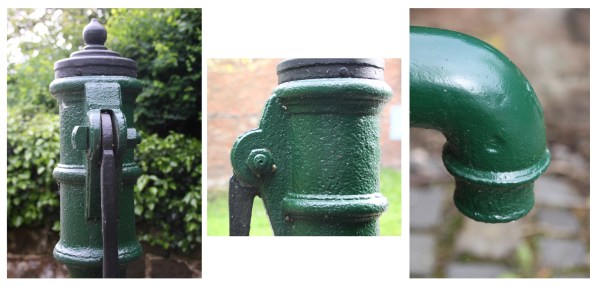
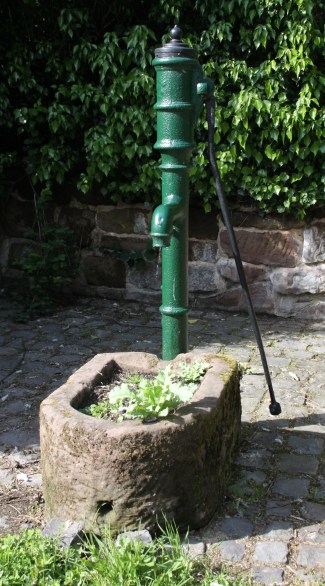
 A little way down Pump Lane, opposite Churton Hall in the village of Churton is a cast iron hand-activated water pump, in an alluring shade of bottle green. Its original manufacturer marking is almost illegible, but apparently reads “G. INGOLD B. STORTFORD,” referring to G. Ingold of Bishop’s Stortford. The modern paintwork makes this illegible today. I haven’t found any photographs of the pump prior to 2005 when it was renovated and reinstalled, but there must be plenty in local collections, so perhaps some will turn up. It looks as though it is in very good condition, at least externally, its paintwork glossy and its structure intact. Its What Three Words location is ///lance.alas.prune.
Pumps were installed from the 18th century, and began to replace wells in the latter half of the 19th Century. Wells in Churton are recorded at Churton Hall, Pump Lane, inside and out, and inside Cherry Tree Cottage on Chester Road, discovered during renovation work, the latter now sealed over. Latham says that well water was very hard in the Farndon area, and that most houses had some form of rainwater storage as a common supplement to use of the well, for washing clothes and other tasks were softer water was required.

Lift pump, c.1895. Source FCIT https://etc.usf.edu/clipart/20000/20080/liftpump_20080.htm
There were two primary types of upright pump commonly installed in Britain in the mid-late 19th Century: the lift pump and the force pump. The Churton pump is probably a lift type. These are relatively simple, with two valves opening and closing as a piston is lifted and dropped with the lever. When the handle is lifted, the lower vale opens and the upper valve closes. The barrel draws the water up the downpipe, filling the barrel below the piston. When the handle is pushed down, the lower valve closes and the upper one opens, forcing water into the barrel about the piston. The next upward pull of the handle pushes the water out of the spout, with water again filling the barrel below the piston.
Pumps relied on bringing water up from local aquifers via boreholes, which were the biggest part of pump installation. A simple screw-shaped auger could be used for soft soils (I use a small one for planting daffodil bulbs), but percussion drilling was required for sinking a borehole through stone, a far more laborious and expensive process.
The first village standpipe pumps were made of wood, which inevitably rotted, and later lead. Lead was malleable and enabled smaller pumps to be made, but it was expensive and was targeted by thieves for melting down for resale, in spite of the threat of transportation, which was the standard punishment for theft of village pumps. Cast iron, a new technology in the 18th century that spread during the 19th century, replaced both. Cast iron pumps were cheap to produce and far less prone to decay. They spread rapidly into villages that had not previously been able to afford a pump, and found their way into homes, inns, farms and public institutions such as schools and hospitals.
 Public pumps were not merely water sources but, much like the office water fountain today, places where people bumped into one another and where information, news and gossip were exchanged. Some activities were easier to carry out at the pump itself rather than carrying the water back to home or business, whilst some better-off residents paid for the water to be delivered to them. Comings and goings at the pump made it a social as well as a functional resource, and probably changed the dynamic of village life quite substantially once installed.
Servicing the pump was important, replacing the more vulnerable parts to ensure that it stayed functional. The pump would sometimes be out of commission during the winter months due to frozen water, and the pumps themselves might be chained up to prevent use, and wrapped against the cold to protect them from frost damage. I do much the same (wrapping, not chaining) with my high-tech hose reel and my outdoor taps.
fdfsdfsd
 So far a precise date for the installation of the Churton pump eludes me. Latham says that the village pump at Crewe-by-Farndon was installed by William and Mary Barnston in the 1850s, and the one in Farndon by Mary Barnston in about 1877. However the Churton pump is on the Churton-by-Aldford side of the road, inset into a field on that side of the road. This is relevant because Churton was divided at that time into two parts, Churton-by-Aldford and Churton-by-Farndon, the division between the two running down the middle of Pump Lane. Churton-by-Aldford came under the Grosvenor family’s Eaton Hall estate, and Churton-by-Farndon came under the Barnstons of Farndon, so the pump, if not paid for by public subscription, is more likely to have been donated by the Grosvenor family rather than the Barnstons of Crewe-by-Farndon. On the other hand, I can find no record of a village pump in Aldford at around the same time. Aldford, of course, was a model village, built from scratch by the 2nd Marquess of Westminster in the mid-19th Century, and the houses may have been supplied with running water. So the question of how and precisely when the Churton pump arrived remains, for the time being, unanswered, but there are clues to establishing a rough date.
 G. Ingold of Bishop’s Stortford (Hertfordshire), made pumps for a variety of locations, although usually in the south, including villages in Essex and Cambridge. The company had been founded in 1851 by John Ingold for sinking wells and manufacturing pumps. He was based at Rye Street with a workshop in Apton Road in Bishops Stortford. Following the death of John Ingold, the business was taken over by his son George, but the latter was marking pumps “G. Ingold” well before his father’s death. This seems to put our pump quite late in the 19th Century. This is born out by a number of wells and pumps in Uttlesford in Essex, where the date was recorded. The earliest marked as “G. Ingold” as opposed to merely “Ingold,” was in 1873, then 1886, with a cluster of five in the 1890s.
Where images are available, all of the Ingold pumps looked very similar. As far as I can tell from the Essex and Cambridge examples posted on the web, most Ingold pumps had handles to the rear, with only some, like the Churton pump, fitted with handles at the side. The Ingold spouts often had a thorn-like feature at the top of the bend, a bucket hook, often decorated. This is absent on the Churton pump, although there is an indentation where one might have been located, visible in the photograph above left.
 There are two modern signs on the walls flanking the Churton pump. One is a disclaimer notice drafted by a local solicitor, commenting on the quality of the water available from the pump, saying that it derives/derived from an artesian aquifer and warning that one drinks at one’s own risk. I did try to activate the pump, giving it a really good go after heavy rainfall when the aquifers were all filling up, but it produced nothing. Although I’ve never tried to use a village pump before, there was no feeling of resistance as you might expect of a lever raising a piston. Thanks very much to Irene Mundy and John Gallagher for the information that When the renovated pump was reinstalled it was discovered that the pipe delivering water up to the pump was deeper than expected. Half way down the pipe towards the water reservoir another, secondary pumping mechanism had been attached in the past. Although the pump initially drew water, it eventually ceased to function. It’s nice that it did work for a while, and it still looks great.
 The other sign refers to the restoration. Although it says that it was a Millennium project, commemorating the arrival of the 2000s, Latham comments that the renovated pump was not actually installed until 2005. The sign records that the project was supported by both Barnston and Grosvenor estates, both with vested interests in the village, as well as the Chester City Council. The engineering and installation work was carried out by A.E. and K.E. Jones, farmers near Pant yr Ochain (Gresford), and the welding by J. Vale. Someone must have a record of the project and the installation of the pump, including photographs of the installation and official opening, which would be really good to see. The Eaton estate repaired the stone wall that encompassed the pump. If any more details come to light, I will cover the restoration project on another post.
 It was super, late last summer, to see that the sandstone trough beneath the pump had been planted out, and that a very attractive display of bedding plants had replaced the straggling weeds (see also the photo at the top of this post). Many thanks to whoever took the trouble. It was great to see it looking so good. The photograph was taken in August 2021. The other photos on this post were taken in May 2021.
—-
For more information on village pumps I recommend the short book, Village Pumps by Richard K. Williams and the Village Pumps website (details of both below), both of which provided a lot of the general information in this post and are comprehensive resources on the subject of all types of village pump.
______
Books and papers
Latham, F. 1981. Farndon: the History of a Cheshire Village. Farndon Local History Society
Williams, R.K. 2009. Village Pumps. Shire Library
Websites
The Recorders of Uttlesford History
https://www.recordinguttlesfordhistory.org.uk/
Village Pumps website
http://www.villagepumps.org.uk
Village Pumps: Churton entry
http://www.villagepumps.org.uk/pumpsChesh.htm#C10C
Waymarking.com
Village Pump, Widdington, Essex
https://staging.waymarking.com/waymarks/wmC4MW_Village_Pump_Widdington_Essex_UK

A photograph of the collection of clay pipe pieces from the garden
Clay pipes are ubiquitous in Britain. The small collection from my garden, extracted from all over the garden over several months, is meagre but the fact that those bits were there at all is still interesting. Like willow pattern ceramics, I would be very surprised if there are not clay pipe pieces scattered in almost every garden in Churton, Aldford, Farndon and Holt.
For anyone new to this occasional series on objects extracted from my garden during everyday gardening activities, see the History in Garden Finds page. These are not objects used in the garden, but objects, usually fragments, lost or disposed of in the garden and found during digging, troweling and planting.
The pieces of clay pipe found in my garden are shown in the photo above left. I suspect that we missed quite a lot when we first started digging out old beds and introducing new beds. The stem fragments, which survive better than the more fragile pipe bowls (see diagram below right for terminology), are far easier to spot on a river bank where they have been washed back to their original white, than in gardens. In fields and gardens, they are earth-encrusted and the broken pieces of shaft look almost no different from short pieces of twig. I was used to looking for pipe pieces on the Thames foreshore, so at first did not notice them in the garden. After I spotted a broken pipe bowl in the garden, I realized that they were there to be found and started looking for them. Several more emerged, all pieces of stem, one including a mouthpiece. Most of the rest of the photos in this post are taken from elsewhere to illustrate the points made in the text. I found the Thames foreshore examples shown below when I lived in London.

Clay pipe terminology by D.A. Higgins. Source: National Pipe Archive http://www.pipearchive.co.uk/howto/date.html
A clay pipe consists of a long tube of white clay, which makes up the shaft, finishing in a bowl, which often has a small heel (also known as a spur) to keep it upright when placed on a table. As clay pipes were prone to snapping and could be easily replaced, their remains are littered throughout the country, turning up in fields, gardens, rivers and on building sites. When I lived in London I found many decorated pieces on the Thames foreshore, including two complete short pipes, but all of the bits I’ve found in the garden have been completely unmarked by either decoration or manufacturers’ marks.
Clay pipes first started being produced at the end of the 16th century, in the wake of Walter Raleigh’s introduction of tobacco as a luxury item from Virginia. Although tobacco was new in English society, it had been adopted on ships and was known in many parts of western Europe. Its rapid success after Walter Raleigh introduced it was due to his launch of it into the upper echelons of society. Much the same happened with Chinese tea in the late 17th Century. The Worshipful Company of Tobacco Pipe Makers and Tobacco Blenders was granted a charter by King James I in 1619 and although a duty on the sale of tobacco pipes imposed between 1695 and 1699 appears to have lead to a hiatus in clay pipe manufacturing, this did not prevent its success spreading. It rapidly found its way from the wealthiest to less privileged households.

Decorated bowl from the Thames foreshore with spur and floral decoration down the seam and on the bowl
The pipe making industry had spread throughout England by the end of the 17th Century, when there were very few towns without at least one pipe maker, and there were over 1000 clay pipe makers in London alone. As prices of tobacco fell and consumption expanded, the size of the pipe bowl increased. There was another hiatus in pipe manufacturing around in the 18th Century, this time due to interruption of tobacco imports during the American War of Independence. They came back into fashion in the 19th Century, when all sorts of decorations were applied, some of them real works of art. These more rarefied pipes became more collectable and less disposable, although plain, unmarked pipes still dominated in the less wealthy echelons of society. For many more examples of the sort of decoration that was fairly common, see the What The Victorians Threw Away website.

Makers’ marks. The two at the top are a single stem, with the name H. Dudnam from Plumstead clearly shown. At the bottom is a maker’s mark, EW, on the heel of a clay pipe bowl. All found on the Thames foreshore.
Some pipes were marked with the maker’s stamp, either on the shaft or on the base of the heel, enabling the manufacturer to be identified and a date to be assigned. Some manufacturers became particularly popular, their names a guarantee of quality, and their pipes were priced accordingly. Pipe-making dynasties sometimes emerged, with the skills being passed from one generation to another. There’s more about pipe marking on the National Pipe Archive website.
Longer pipes were more expensive than shorter pipes, because they more were difficult to make, and used more clay, although the shorter types were more practical, were easier to smoke without holding up, and were less prone to breakage. However, longer pipes were preferred by connoisseurs as they cooled the smoke as it travelled from the bowl. Other factors that commanded a higher price include the above-mentioned decorative embellishments, which became particularly popular during the 19th Century. Some very special ones had elaborate sculptural elements, but are very unlikely to be found in agricultural village gardens. A far greater number are unmarked in any way and are found everywhere, rural and urban. Of course, where only small pieces are found, it is entirely possible that a different portion of the same shaft would have been marked and its bowl decorated; there is no way of knowing.
Clay pipes began to be replaced by wooden ones in the early 20th Century, and all were largely replaced by cigarettes in the mid 20th Century.
Clay pipes were made in moulds, although they had to be pierced with a long metal rod before being fired. Any decoration or manufacturer mark was incorporated into the mould. The mould seam can usually be seen on the pipe’s underside and the front and back of the bowl. Often, the seam is disguised by being incorporated into a decorative motif, as shown in the thorn pipe photograph below where the seam becomes the stem of a plant and is flanked by leaves (click to expand to see the decoration on the bowl).

A short pipe that has little decorative bumps on the bowl and stem called “thorns” (pipes featuring this are referred to as thorn pipes). This one also has a button mouth piece and decorative leaf motifs along the mould seam at the front of the bowl. Found on the Thames foreshore.
The pipes were then left to dry before being fired in a kiln. Before being shipped, the mouth piece, the very end of which was often defined by an additional ring of clay, was painted with red or, less usually, yellow wax to prevent the smoker’s lips sticking to the clay. The wax, which presumably wore off quite quickly, didn’t do much to prevent damage to the teeth. Habitual pipe-smoking led to damage to the teeth, as well as the lungs. A Museum of London study of skeletal remains excavated from a Victorian cemetery in Whitechapel found that in many cases teeth had been worn down by pipe-smoking, with some having a circular hole when the jaws were closed, formed in two or four teeth.
The oldest objects to emerge from the garden so far have been later 19th Century, and that seems a probable date for these pieces too. It is impossible to extrapolate from a single pipe bowl, but that one example is so simple and basic, that it was not something that would have been singled out by someone wealthy. This was an everyday item, nothing special, like a lot of the decorated ceramics and embossed glass found in this garden.

Piece of a bowl with spur, and piece of a stem with button mouthpiece. From my garden in Churton
Having found many really fascinating examples on the Thames foreshore, the small crop of unmarked clay pipe remains from my garden seem a little underwhelming by comparison, but the pipe pieces tell a more localized story of their own. Without a maker’s mark to work with, there’s not a lot to be said about these specific examples, and that’s rather frustrating because there has been a lot of great research that has helped to develop clay pipes as archaeological tools to understand the pipe-making industry, the tobacco industry, and how both shed light on economic and social history over the centuries of their usage. Even simple questions of source and distribution are unanswerable when the maker cannot be identified. On the other hand, these pieces fit in with the general theme of the 19th century objects from my garden, which all of which are nicely made and look good, are robustly made and standardized, and fairly low cost. Still, they were nice-to-have, not must-have items and suggest that the people who lived in the house were sufficiently well off to indulge themselves from time to time.

Broseley Clay Tobacco Pipe Museum. Source: Visit Bridgnorth
I initially thought that at least some of the pipes from which the pieces came could have been made in Chester, where there were multiple pipe-makers, some of them producing pipes of very high quality that were in demand both within and outside the immediate area. Many were exported in great volume up until the 18th Century. An example is the clay pipe works where the Roman Gardens now stand, with the kilns lined up along the side of the city walls. It turns out, however, that by the early 19th Century the manufacture of clay tobacco pipes in Chester had collapsed. The main source of clay pipes in the general area in the 19th Century was Broseley in Shropshire, a few miles to the south of Telford, which had been producing clay pipes since the 18th Century. The Broseley Pipeworks, for example, was established late in pipe-making history, in 1881, and only closed in 1957, now a small museum. Realistically, unless I find something more diagnostic, there’s no way of knowing where these odds and ends originally came from.
 The National Pipe Archive website has some great resources for finding out more about clay pipes and finding out date ranges for anything you may find with diagnostic markings: http://www.pipearchive.co.uk/index.html. They have a “how to date” web page, on which they provide links to a range of typologies (images of clay pipes and their key characteristics with date ranges) at http://www.pipearchive.co.uk/howto/date.html.
For those in the Chester /northwest area, their typology for the northwest, which is impressively comprehensive, is at http://www.pipearchive.co.uk/pdfs/howto/Typologies/LIVNP_2014_01_100_CHESTER.pdf. The same website also provides recommended resources for Cheshire pipe studies, which you may be able to find through a library or the Chester Archives, and some may be available online if you do a Google search on the name of the title:
The County list shown above is a bibliography (at http://www.pipearchive.co.uk/archives/british.html#CHESHIRE).
If you are in the Churton, Aldford, Farndon and Holt general area, and you have found clay pipe remains in your garden, especially if there are any type of markings at all, it would be great to hear from you.
For other objects in the series,
see the History in Garden Objects page
Books and papers

Another photographs of Churton clay pipes from my garden
Ayto, E.G. 1994 (3rd edition). Clay Tobacco Pipes. Shire Publications
Cessford, C. 2001. The archaeology of the clay pipe and the study of smoking. Assemblage, Issue 6, August 2001
https://archaeologydataservice.ac.uk/archives/view/assemblage/html/6/index.html
Dagnall, R. 1987. Chester Pipes in Rainford. Society of Clay Pipe Research, Newsletter no.15, July 1987, p.10-12
http://scpr.co/PDFs/Newsletters/SCPR15.pdf
Davey, P. 1985. Clay pipes from Norton Priory, Cheshire. In (ed. Davey, P.) The Archaeology of the Clay Tobacco Pipe IX. More Pipes from the Midlands and Southern England British Archaeological Reports British Series 146i and ii. p.157-236.
Nevell, M.D. 2015. The industrial archaeology of Cheshire: an overview. Journal of the Chester Archaeological Society, 85 (IV), p.39-82
http://usir.salford.ac.uk/id/eprint/37519/
http://usir.salford.ac.uk/id/eprint/37519/1/Nevell%202015%20JCAS_ns_085_IndustrialArchaeologyInCheshire_textonly.pdf
Pearce, J. 2007. Living in Victorian London: The Clay Pipe Evidence.
Part of an Arts and Humanities Research Council funded study ‘Living in Victorian London: Material Histories of Everyday Life in the Nineteenth-Century Metropolis’ Award Number AH/E002285/1 led by Dr Alastair Owens in the Department of Geography at Queen Mary, University of London
https://www.academia.edu/737367/Living_in_Victorian_London_The_Clay_Pipe_Evidence
Sandy, J. 2019. Clay Pipe Making: The Victorian Way. Beachcombing Magazine, volume 11, March/April 2019
https://www.beachcombingmagazine.com/blogs/news/clay-pipe-making-the-victorian-way
Victoria County History 2003. Late Georgian and Victorian Chester 1762-1914: The economy, 1762-1840, the demise of old Chester. A History of the County of Chester: Volume 5 Part 1, the City of Chester: General History and Topography. Originally published by Victoria County History, London, 2003, p.172-177.
Websites
The National Pipe Archive
http://www.pipearchive.co.uk/
Victorian smokers had rotten teeth to match lungs
MOLA
https://www.mola.org.uk/blog/victorian-smokers-had-rotten-teeth-match-lungs
 Avgolemono, meaning egg and lemon in modern Greek, is both a soup and a sauce. As a slightly thickened sauce it goes wonderfully with fish or chicken, but it sings at its most sublime as a soup, with a handful of white long-grain rice and gently simmered, and a handful of chopped parsley thrown in at the end. It is an utterly divine and life-changing taste-bud experience.
I first had it on Kefalonia in 2004, preceding an equally divine order of flame-grilled octopus tentacles, sitting on the restaurant’s outdoor terrace, watching the sun set slowly and spectacularly over the hills, and although the wine was seriously rough around the edges, I cannot remember the last time that a meal felt so perfect in all its parts. It was on Kefalonia that I fell head over heals in love with Greek cuisine, but that particular meal remains my favourite.

Sunset on Kefalonia, 2004
I have reproduced the meal many times since. Frozen octopus tentacles were available prior to lockdown in a Portuguese shop in Wrexham. When I lived in Aberdovey my father used to lob a pack in his rucksack for me, and it was always terribly exciting to collect it. Octopus has to be tenderized before it can be eaten, and the freezer is one of the best ways to achieve this, so frozen octopus is always a good buy. Not having ventured into that part of Wrexham since lockdown eased, and unable to get it anywhere else, I’ve had to abandon octopus for the time being, but the avgolemono soup needs no special ingredients. It does need good quality ingredients, but not special ones, which is the usual story with Greek cooking.
 The recipe that I first used for avgolemono is the one that I still use. I bought The Complete Book of Greek Cooking by Rena Salaman and Jan Cutler on my return from Kefalonia, where there are two versions described. I use the first version, on page 96, although I note that the second one, on page 99, is very like Rick Stein’s version if you’ve ever tried producing that. The main difference is that the version that I use has egg yolks rather than whole eggs, as well as rice, whereas the other version uses whole eggs and has strips of chicken stirred into it rather than rice.
Here’s my preferred version of the two in the book, a perfect use for Churton Honesty Eggs (or any other eggs, of course 🙂 )
Serves 4
 900ml home-made chicken stock, (in my case made by poaching a lot of chicken in water with parsley , onion and peppercorns)
 Top tip: The trick here is to add the egg mixture to the soup without it curdling. Avoid whisking the mixture into boiling liquid. It is safest to remove the soup from the heat entirely and then whisk in the mixture in a slow but steady stream.
The recipe advises against reheating to avoid curdling, but I prefer the soup hotter than it is at this point, so I heat it VERY slowly and carefully.
Don’t be tempted to skip the rice, even if it sounds a little odd, because it is really gorgeous, but must be cooked through. 12-15 minutes from when it enters the simmering water. Rick Stein uses orzo instead, but I really don’t recommend it. Far too solid and intrusive.

Churton Honesty Eggs
You can see my previous Churton egg adventures by clicking here. Churton Honesty eggs are parked in a barrow by the side of the road, and operate on an honesty system where you drop coins into the barrow in return for the eggs. You can hear the cockerel crowing, and he sounds like a fine fellow. The eggs are excellent.
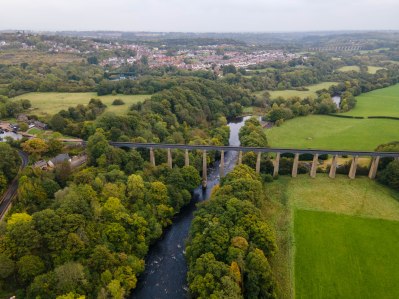
 It is without question a marvel of modern engineering and a remarkable sight, but what strikes most people when they first see the 1000ft (c.305m) Pontcysyllte canal aqueduct is that the handrail along the pedestrian walkway 127ft (38.5m) over the river Dee is only a few steps away from the other side of the narrow canal trough, which has no handrail at all to separate a boat user from a straight drop into the valley bottom. Until you lean over the towpath’s handrail and look straight down, 127ft is a rather abstract number. The photograph on the right shows me crossing it on a 40ft narrowboat in the 1990s on a two week canal holiday. What you cannot see are the white knuckles with which I am gripping the tiller for dear life, in spite of having absolutely no fear of heights, because there was absolutely nothing between me and that drop. The aqueduct, Grade I listed, and a UNESCO World Heritage Site since 2009, is the longest and highest in Britain. It’s a long way down.
The Pontcysyllte Aqueduct passing over the Dee valley at Trevor. Source: Dronepics Wales
Seen from below or from a distance, the Pontcysyllte aqueduct is a fabulous sight, not pretty but truly awe-inspiring, and it shows exactly what Pontcysyllte is: an iron trough built on 18 vast tapering brick piers, with 19 arches. It was all about function, nothing to do with aesthetics, and has no ornamentation to soften it, but the sheer ambition of it grips the imagination and makes one look beyond the factual details of the thing. It really is superb. There is a path leading down along the side of the approach to the aqueduct into the valley below, a long but well maintained track to the valley bottom, where you can walk along the Dee and get a long at the aqueduct from a distance. That’s one for another day.
 It was a beautiful day, absolutely flawless, with cerulean blue skies, a golden sun warming one’s face, and a brightness of autumnal colours that takes some beating. After attending the Remembrance Day commemoration at the Churton war memorial, with a memorable and moving address, and a two-minute silence filled with birdsong, I collected the car first, the parent next, and we proceeded towards Trevor, on the A539 to Llangollen. There’s a brown signpost pointing to the aqueduct’s pay-and-display car park at the Trevor Basin, which is the home of a number of canal boat companies today, but when it was built was used for the transhipment of coal, building stone, iron products, timber and bricks, much of which was brought to the canal wharf by horse-drawn waggons.
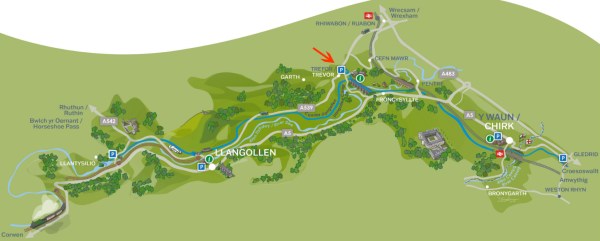
Map of the key canal features in the Vale of Llangollen. I have added a red arrow to show the best car park for Pontcysyllte. Click to enlarge. Source: Pontcysyllte Aqueduct & Canal World Heritage Site
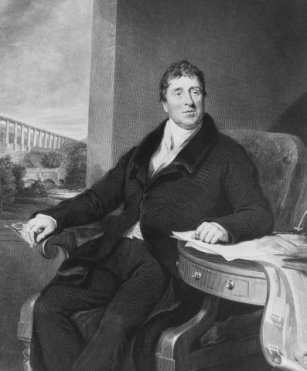
Portrait of Thomas Telford, who chose to be painted with the Pontcysyllte aqueduct in the background. Engraved by W. Raddon from a painting by S. Lane.
The aqueduct (built (1794-1805) was part of the Ellesmere Canal project. It is one of the many British civil engineering projects that has the names of Thomas Telford (1757-1834), ironmaster William “Merlin” Hazeldine (1763-1840) and master stonemason John Simpson (1755-1815) attached to it, three men who had brought their particular skills to many different joint projects and in doing so had developed an invaluable relationship of trust and mutual respect.
Thomas Telford started his career as a stone mason, working in London on buildings such as Somerset House, and had ambitions to develop his career as an architect. When he became the County Surveyor for Shropshire, he worked on a great variety of building projects including, by his own estimation, 40 road bridges between 1790 and 1796, two of which employed iron in their construction. Hazledine had initially trained as a millwright, but his family owned a small foundry and Hazeldine went on to grow his iron casting business with the large Coleham Foundry at Shrewsbury. Hazledine and Telford, both Freemasons, had met at Salopian Lodge in Shrewsbury in 1789 and become friends and professional collaborators. On one of his earliest projects in Shrewsbury Telford hired a childhood friend Matthew Davidson to oversee works, and Davidson employed master stonemason John Simpson who worked on many of Telford’s projects. Telford described Simpson as “a treasure of talents and integrity.”
Although Telford is by far the best known of the three, he, Hazledine and Simpson worked together frequently on many different projects to produce some of the great civil engineering constructions of their era, mainly bridges. All three were involved with the Pontcysyllte aqueduct, where Matthew Davidson also joined them, but the story of the canal starts before any of them were recruited to work for the Ellesmere Canal project.

The Trevor Basin today.
The big name in canal construction was James Brindley (1716-1772), who was responsible for building over 365 miles of canals by the time he died. Brindely realized that any inland waterway network would need to connect to all the great navigable rivers that connected to the sea, including the Thames, the Mersey, the Severn and the Trent, incorporating other important navigable rivers like the the Avon and the Dee. Most of his canals were contour canals, wherever possible built on the level and avoiding slopes so that locks and lifts could be avoided. The network was therefore a sprawling affair, but it revolutionized transport, avoiding roads that would become mired and impassable in winter, as well as unnavigable sections of rivers, and the riverine problems of drought and flood. Water into and out of the canal system was regulated and therefore predictable, and allowed year-round transport. The advantages became very clear very quickly, and manufacturing and trading businesses began to locate themselves at critical points on the canal network. Eagerness to invest in infrastructure resulted in a canal boom in the late 1780s and 1790s. Each new section of canal required an Act of Parliament, subject to Royal Assent, and Act after Act was passed as the network expanded.

The complex arrangement of the Ellesmere Canal and its branches is shown as a think blue winding line. The thick blue line is the Dee. The yellow lines are roads. Click to see a bigger version. Source: Wikipedia
In 1791 a proposal for a canal to link the Mersey at Netherpool (later renamed Ellesmere Canal) to the river Dee at Chester and the Severn at Shrewsbury was discussed by three Shropshire entrepreneurs, carrying mainly coal, iron and lime, supported by other goods as well. It was decided that a branch would be needed to Wrexham and Ruabon and onwards, via Chirk, bypassing Oswestry at its west, to Shrewsbury in the south with a branch to Whitchurch in the east and another to Llanymynech. Originally it was planned to run a branch from Ruabon to reach the Irenant slate quarries near Llantysilio, via Llangollen, but this was at first dropped and later revived for different reasons (discussed below). That branch would in turn connect to the Montgomery Canal from Frankton Junction via Welshpool to Newtown in mid Wales (for carrying limestone, coal, timber, stone and slates).
This seriously ambitious plan found sufficient support for a surveyor to be hired and possible routes to be explored. William Jessop, an experienced canal engineer, was hired to head up the project and oversee all of its different components. After disagreements over the final route were resolved (albeit not to everyone’s satisfaction), the Ellesmere Canal proposal went through parliament and received its Royal Assent in April 1793. There were still a lot of technical and logistical details to resolve, including how the canal was to cross the Dee and Ceiriog valleys.
 It was clear that Jessop needed help, and although the internal promotion of William Turner was Jessop’s first choice, Telford was brought in without his input. It is not certain how Telford, increasingly bored with life as a county surveyor, managed to insert himself into this ambitious engineering project, but the canal was already generating considerable excitement in the area and it looks as though he heard of the position and sought the support of one of Britain’s most prominent industrialists, John Wilkinson, to help him secure it. Jessop made it clear in his letters what he thought of having Telford, who he had never met, brought in against his wishes as his right hand man, and refused to attend the meeting that appointed Telford to the Ellesmere Canal Company. In spite of this rocky start, Jessop and Telford seem to have hammered out a decent working relationship, with Jessop teaching Telford what he needed to know about canal construction, and Telford injecting some ideas into the project. Like Jessop, Telford managed to broker a deal to enable him to carry out other projects when his personal presence was not necessary, and this enabled him to work on other civil engineering works whilst the Ellesmere Canal was being built.
 Work began at Netherpool on the Mersey, renamed Ellesmere Port, in 1793. The 9-mile canal ran down the Wirral to meet the Dee at Chester, and went so well that it opened for traffic in 1795 and was an immediate success. While this section was underway, discussions were underway about how the canal might cross the Dee. The original idea presented to the directors by Jessop and Turner, and apparently not opposed by Telford, was a relatively low level stone channel crossing three stone arches, with step locks either side to manage the ascent to and descent from the level of the canal to the aqueduct. This would have been an expensive option, requiring not only the locks but the management of the water that would feed the locks. Even after this had been agreed in principle, concerns resulted in a new plan for an iron channel on stone columns. It is likely that it was proposed by Telford and supported by Jessop partly because it would have reduced the cost as iron was lighter, easier to work and move, and cost less. A sketch by Telford from March 1794 survives showing an early version of this aqueduct design.
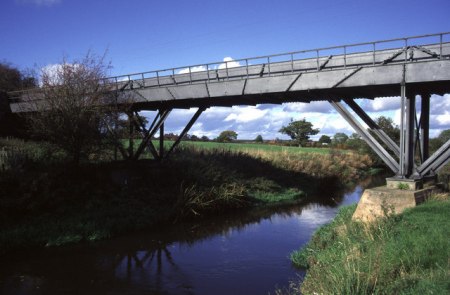
Telford’s Grade 1 listed Longdon-on-Tern aqueduct in Shropshire, 1796. Source: Chris Allen, Wikimedia
In early 1795 Telford had the opportunity to try out a smaller, less ambitious version of the design at Longdon-on-Tern on the new Shrewsbury Canal, on which Telford was also working, as replacement for the incumbent engineer who had died mid-project. Later in the same year he had built a fully navigable iron aqueduct on a canal that had none of the problems of leakage or shattering that had worried other engineers. Whether or not this was taken into account by the directors of the Ellesmere Canal Company, they decided in the same year to go for the iron trough on immense stone piers that was eventually built.
 Telford’s friend and frequent collaborator, master mason John Simpson soon joined him on the project. Telford also brought in Matthew Davidson, his childhood friend of Telford, a stone mason, civil engineer and excellent organizer, to oversee the bridge works. Telford and Davidson had worked successfully together on Telford’s Montford Bridge project of 1790 – 1792. Shortly afterwards, William Hazledine arrived to establish an ironworks and take charge of the construction work for the iron ribs and the trough. By assembling three men that he had worked with before and trusted absolutely, Telford was not only ensuring that the project was in good hands, but that he had a team who could operate in his absence. The foundation stone for the aqueduct was laid on 25th July 1795.
 Jessop and Telford made wooden models to test the design for the trough, finding that 1000s of iron parts would be needed. The cast iron for the aqueduct was made of cast iron that was produced in William Hazledine’s new iron foundry nearby at Plas Kynaston, Cefn Mawr. Hazledine established the Plas Kynaston foundry to service the construction of the Pontcysyllte aqueduct, thereafter taking advantage of the canal network to carry his cast iron in segments to be transhipped by river or sea to where it was needed. When he built the Eaton Hall Iron Bridge at Aldford on the river Dee (described on an earlier post) it was from Plas Kynaston that the iron was shipped by canal.
A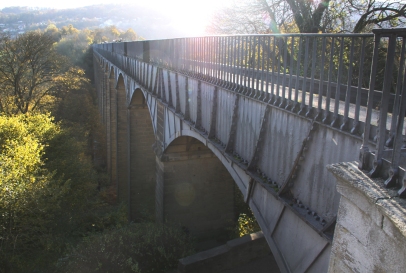 fter 1801 Jessop was much less involved and Telford also had interests elsewhere, and Telford was also involved in other projects, leaving Davidson, Hazledine and Simpson to run with the project. The piers rose steadily, each built in turn from south to north by, at the peak of the project, over 500 men. Jessop had been desperately worried from the beginning by the dangers to workmen’s lives of such tall piers, and safety precautions were taken very seriously, with the loss of only one life. The iron parts were manufactured as needed at Plas Kynaston, and were numbered according to the order in which they would be needed so that only pieces needed at any one time would be delivered to the site. First, ribs of iron were fitted to the piers, and then the trough was bolted on top, after which a wooden towpath was fitted to the side. The entire project was finished in 1805, and opened on a sunny afternoon on November 26th 1805 at a grandiose ceremony followed by a lavish feast. The entire cost for the aqueduct project was £47,018, which in today’s money translates as around £617,855 (National Archives Currency Convertor).
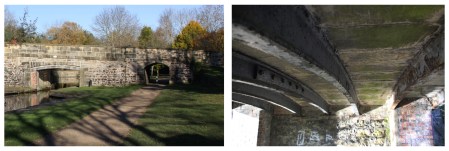
Metalwork over and under the arch at the left-hand Rhos y Coed bridge.
Although not as visible in the finished design, iron was also used in the Chirk aqueduct on the Llangollen canal where ten semi-circular masonry arches were crossed by a water channel with an iron bed plate and brick sides sealed using hydraulic mortar. As well as in the aqueducts, iron was used in various ancillary structures too. for example, Bridge 29, Rhos y Coed, at the Trevor Basin has visible iron metalwork supplementing the stone arch, and iron was used to cap the weir at the Horseshoe Falls.

Map from Nicholson’s Guide to the Central canal system, showing the stump end (framed in orange) of the planned Ruabon to Chester section of the canal, which was never built and now houses the attractive Trevor boatyard where the visitor centre is located. Source: Nicholson 1989
The Pontcysyllte aqueduct was almost immediately in danger of becoming something of a white elephant, because its original role as a direct route to Wrexham and Chester was never fulfilled. The section that led past Trevor Basin over the aqueduct was supposed to run straight on to the west of Ruabon, via Wrexham and on to Chester where it would link with the Wirral stretch leading to the Mersey and to the Dee and the Shropshire Union Canal. All that is left of the Trevor-Ruabon-Wrexham-Chester branch is a stump end occupied by the Trevor Basin, where the car park is located. This is clearly visible on Nicholson’s map left, where the main line of the canal comes to a sudden, abrupt end.
The abandonment of this important part of the original plan was due to both engineering problems and financial issues. There were only two obvious engineering options – an enormous tunnel or a series of locks climbing towards Wrexham and another descending into the Cheshire plain where the canal could run along the flat plain to Chester. The tunnel would have been appallingly costly, and it was difficult to know how the locks, by no means a low-cost option themselves, could have been supplied with the sufficient water. Although other technologies were considered, they were rejected for reasons of practicality and cost. This left the problem of where the water was to come from to feed the rest of the Ellesmere Canal and its branches.

Horseshoe Falls
At the far end of the Llangollen canal is Telford’s great arc of a weir, today known as the “Horseshoe Falls,” marking the point at which the Dee begins to feed the Llangollen canal. An original survey had considered using the water of the Dee as it fell from Snowndonia via Lake Tegid at Bala and through the Vale of Llangollen as a water source for the canal. The idea had been to link the canal to a slate works, feeding the canal at the same time. This proposal was now revisited. The owner of Lake Tegid gave his permission and the plan was actioned. At the Horseshoe Falls the canal is fed with water from the Dee via a sluice and meter, and today carries over 11 million gallons of Dee water a day, emptying it into Hurleston reservoir, just north of Nantwich, where the Llangollen Canal meets the Shropshire Union Canal. I will be posting more about the Horseshoe Falls weir on another day. There is no turning point for vessels over 10ft long beyond Llangollen, so the final stretch is only used by minimal traffic today.
 This means that the vast aqueduct, such a remarkable feat of civil engineering, would only ever lead to the relatively unimportant narrow section of canal and feeder to a complete dead end at Llantisilio after passing high through Llangollen. This navigable channel is approached from the aqueduct by negotiating a sharp left-hand corner just beyond the exit of the trough. Although this seems like a sad role for an aqueduct that should have carried many times the traffic that it eventually did, without the aqueduct there would have been no water to feed the rest of the system.
 Even without the Ruabon – Chester link, those wishing to carry all their goods by canal were still able to connect to the main canal system, although to reach Chester they had to take a very long way round, and Wrexham was excluded completely. The Llangollen canal still linked to the Shrophsire Union at its eastern end, from which the rest of the vast canal network could be reached.

The Cefn Mawr railway viaduct, which opened in 1848.
Along the line that the original canal would have taken, a cast iron tramway was built to connect local collieries and ironworks with the canal, the iron supplied by Hazledine. This made the Trevor Basin a particularly important hub of activity, taken delivery of bricks, tiles, coal, iron limestone, slate and sandstone for transhipping along the canal. It was also a boatyard, with working narrowboats being built and repaired by Hills Boatyard in the dry dock next to the Visitor Centre (now occupied by a floating take-away café). Later, there was an interchange with the steam railway.
 A small pay-and-display car park is available for visitors at the Trevor Basin, now the home of some canal trip and holiday companies. There is also a pub with outdoor seating, and a take-away small café on a little boat next to the visitor centre. There is a lot of disabled parking provided for in the small car park, which is reached from the A539 in Trevor, clearly signposted with brown heritage signposting. The aqueduct is a very short walk from the car park, and the towpath heads for miles in both directions.
 If, before or after crossing the aqueduct, you are interested in finding out more about the general context of the aqueduct and its location in relation to other parts of the canal, at the Trevor Basin there is a visitor centre, a small but nicely put together display space. As well as a map of the area that takes up a wall and shows all the main features of the landscape and the canal system itself, there is a display of some of the tools that were used in the construction of the aqueduct, which are startlingly basic, and photographs and artists’ impressions of some of the supporting works, including the foundry at Plas Kynaston. There are ring folders full of additional information, including facts and figures, that you can look through.
Walking the aqueduct itself is not for everyone. The towpath is rock solid, with a tall handrail on the valley side, but only wide enough for two people, so there is a lot of stopping still to allow others to pass and there is nothing to stop you falling into the canal. The canal is only just over 6ft (1.8m) wide, and beyond that is an unrestricted (no handrail, no nothing) drop 127ft to the valley floor. A couple who I passed told me that they were determined to walk the full length and back, but were conquering their fears to do so, and they were gripping firmly to the handrail.
 An alternative to walking is to cross by boat. There are a number of short cruises that leave the Trevor Basin and run for about 20 minutes before turning and coming back (depending on which one you take and the time of year).
For those with uncooperative legs, everything is on the flat, so it is a very good walk for those who find uphill sections of walks difficult. After rainfall, towpaths always become a bit muddy, and can be slippery, but even though we’ve had some rainfall recently, it was fine. The towpath between Trevor and Llangollen is beautiful, and a good choice if you can face the aqueduct.
I noticed that one of the passenger boats said that it was suitable for disabled passengers, but I would recommend getting in touch with them first to find out about timings, prices and suitability for different types of disability.
 Books and papers
Glover, J. 2017. Man Of Iron. Thomas Telford and the Building of Britain. Bloomsbury
Lynn, P. A. 2019. World Heritage Canal. Thomas Telford and the Pontcysyllte Aqueduct. Whittles Publishing.
Nicholson, R. 1989 (4th edition). Nicholson/Ordnance Survey Guide to the Waterways 2: Central. Robert Nicholson Publications and Ordnance Survey
Rolt, L.T.C. 1958, 2007. Thomas Telford. The History Press.
Pattison, A. n.d. William Hazledine (1763-1840): A Pioneering Shropshire Ironmaster. West Midlands History https://historywm.com/articles/william-hazeldine-1763-1840 (Pattison’s full 278-page M.Phil, on which the article is based, is available here: https://etheses.bham.ac.uk/id/eprint/3358/1/Pattison12MPhil.pdf )
 Canal and River Trust
Montgomery Canal
https://canalrivertrust.org.uk/enjoy-the-waterways/canal-and-river-network/montgomery-canal?gclid=CjwKCAiAp8iMBhAqEiwAJb94z7aIVzLoaYuqtwbDdRQsaUL73ssnmF_u1LpoURZmI9YxVUlrKi15whoCtxoQAvD_BwE
DronePics Wales
Pontcysyllte
https://dronepics.wales/pontcysyllte/
Engineering Timelines
Longdon-on-Tern aqueduct
http://www.engineering-timelines.com/scripts/engineeringItem.asp?id=308
Grace’s Guide to British Industrial History
James Brindley
https://www.gracesguide.co.uk/James_Brindley
William Hazledine
https://www.gracesguide.co.uk/William_Crosley_(1802-1838)
William Jessop
https://www.gracesguide.co.uk/William_Jessop
Pontcysyllte Aqueduct and Canal World Heritage Site
https://www.pontcysyllte-aqueduct.co.uk/


Willow Pattern sherds found in a Churton garden
I defy any gardener, even in a modern home, to do any digging without finding a few pieces of willow pattern china. It is so common that one barely notices it, whether it is found as garden fragments, encountered in antique shops or viewed as eBay listings. It comes in all forms – plates, jugs, bowls, cups, saucers, tureens in all sorts of shapes and sizes, varying in quality from fine early examples to increasingly poor imitations as well as a few modern reinventions on fine china. Early examples were hand-painted on porcelain, but as it became popular, transfers (described below) were used to cheaply replicate their finer predecessors.

Pieces of willow pattern found in a garden in Darland
The examples shown in the photo at above left were all found in my garden, and could date to any time between the 19th Century to relatively recent times. None of them are fine porcelain, all stoneware, which means that they were built to be durable. This does not mean that they were any less valued by their owners than finer bone china pieces, which are almost translucent, but either that their purchasers were unable to afford finer pieces, or that these were intended for everyday use. In either case the sheer volume of china that we have dug out of the garden argues that if finer pieces were purchased, they were kept safely on display or only used for special occasions, because so far we have only found two finer pieces of translucent china. It is a similar story with china dug out of a Darland garden by my parents (shown right). In that early Georgian garden, belonging to a large house built by a prosperous land-owner, the pottery was all fairly coarse, although there is no reason to suppose that the owners did not purchase finer wares that were better cared for.

1930s willow pattern in red on white
In America, willow pattern is known as “blue willow,” but although the vast majority produced was in cobalt blue on white, there are also examples of red or brown, and even green on white, and there are some much later examples that were painted with multiple colours (and look both exceedingly odd and rather unpleasant). Today willow pattern has fallen out of fashion, presumably because it is so formulaic and so commonplace, in spite of attempts by some modern producers to reinvent it, but the history of willow pattern is an interesting one, even if the design itself has become rather tedious to the modern eye.
There are two strands to the invention of willow pattern, three stories to tell. The first is how and when willow pattern developed, what influenced it, and why it became so ubiquitous. The second story concerns the tale told by the pattern itself, which narrates a forbidden romance, a dictatorial father and an unwanted, ultimately vengeful suitor.
At the end I have a look at why the tale embedded into the willow pattern is fundamentally in opposition to Chinese morality, using two examples from Chinese literature.
I have already used the terms “china” and “porcelain,” and will go on to mention stoneware, so here are some quick and dirty definitions:

This or a similar type of Nanking ware scene could have been the prototype for English willow pattern. Source: The Culture Concept Circle
I had always assumed that the willow pattern design was invented in China for the European export market in the late 18th Century, but this is not true. It is certainly true that decorated china had been finding its way into Europe and America for two centuries before willow pattern was invented. The East India Company began to purchase Chinese blue and white ceramics for the British market in the 16th Century when it was a luxury item. It swiftly became very popular and continued to be in high demand even after the East India Company was deprived of its right to trade in 1833. Private ships that began to import Chinese tea, still a high value import during the 19th Century, also brought back ceramics that were increasingly standardized and mass-produced for the European market. Chinese producers had swiftly developed a sense of what themes, colours and designs Europeans and Americans liked, and they began to make them in great quantities. Willow pattern was inspired by a type of blue and white porcelain called Nanking or Nankin Pattern. It was made at Ching-te-chen / Jingdezhen and then sailed down the river Yangtze to the coastal port of Nanking from where it was shipped to Canton. Canton was the main port at which foreign ships were allowed to trade, (the sole trading port until 1842) and here it was loaded on to European and American ships for the export market.

An early design similar to the willow pattern on a creamware teapot. Attributed to John Warburton, Staffordshire, England, c. 1800. Victoria and Albert Museum, London. Source: Encyclopaedia Britannica
Although influenced by Nanking, willow pattern was not imported from China; it was an English invention based on Chinese patterns. The first version appears to have been produced in 1779 for Thomas Turner and his Caughley works in Shropshire, originally for a teapot, and then in the late 1780s on other objects, probably by apprentice Thomas Minton.
Robert Copeland, in Spode’s Willow Pattern, acknowledges Caughley but points out that this was not the standard willow pattern, which he argues persuasively was developed by Josiah Spode, and initially called the Mandarin pattern. It is not known if Turner, Minton or Spode had a particular story in mind when they began to produce their versions of the formulaic pattern, but a story soon emerged, and probably helped sales, raising the decoration from the level of a mere pattern to the encapsulation of an exotic legend (albeit one thought up in an English porcelain factory). It would otherwise be difficult to account for how popular the design became. Other manufacturers also went on to make willow pattern.

 The plates shown above exemplify the most common arrangement of the motifs that make up the willow pattern design, although there are sometimes minor variations.
A 19th century anonymous poem, of which there are numerous versions, summarizes the main themes as follows:
Two birds flying high,
A Chinese vessel, sailing by.
A bridge with three men, sometimes four,
A willow tree, hanging o’er.
A Chinese temple, there it stands,
Built upon the river sands.
An apple tree, with apples on,
A crooked fence to end my song.
The story behind the features on the plate can be fairly short or tediously long, but the essentials of the story can be summarized quite briefly. Let’s have a closer look first at the main motifs that provide the cues for narrating the story.
The main anchoring feature of the composition is a two- or occasionally three-storey pagoda, usually just right-of-centre, approached by a path and a short flight of steps. To the left of it is a smaller pagoda on the edge of the river. A fence zig-zags across the front of the scene, blocking access to the approach path to the pagoda in its garden.
Behind the pagodas is a tree with big round discs that look like enormous pizzas. Susan Ferguson has researched these and concludes that although they are usually referred to as apples (heaven help you if an apple of that size landed on you), and sometimes oranges, they are probably abstractions of circular spans of a Chinese conifer (needle clusters), a design that over the centuries has become so simplified that on the willow pattern the species of tree is completely unidentifiable. In the absence of any other explanation that makes sense, I’m convinced. A lush arboretum surrounds the pagoda.
A huge willow tree leans over the bridge, to the left of the pagoda, which gives the design its name, and usually has some sort of rosette- or round-shaped growths on the trunk. Its long branches appear to blow lightly in the breeze.
The bridge crosses a narrow strait of water, met by a small building on the other side. The bridge is being crossed by a woman at the front, a man in the middle holding a long thin box, and another man raising a stick at the rear.
Above left of the willow is a large expanse of water crossed by a man navigating a boat, heading towards the pagoda. One or more cabins on the boat suggests that another person is inside.
In the distance at top left is an island with another pagoda, again surrounded by lush vegetation.
Overhead in the sky are a pair of birds facing each other, their wings spread to catch the breeze.
If the composition graces a plate, a tureen or a lid, the whole thing is usually circled with a loosely Chinese-themed geometric pattern, sometimes elaborated with leaves and flowers. On teapots, cups and jugs only favoured portions of the entire composition may be shown.
The story is an invention, and English interpretation of scenes on Chinese export ceramics that had no such narrative. It is probable that the story gained momentum as the willow pattern became more popular, becoming more elaborate over time. The basics are these, although there are multiple alternatives:
 The pagoda, right-of-centre, the garden, and the weeping willow: Once upon a time, there was a beautiful girl named Koong-see who lived in a palace in China, a delightful sprawling pagoda in lovely ornamental gardens, with cherry blossom, apple trees, willows, streams, wildlife and birdsong. Hidden within the pagoda, she is in love with a lowly office clerk named Chang, who serves her father, a mandarin (senior official), and is far beneath her social standing. They meet every night beneath the willow. Forbidden to marry by the Mandarin, she and Chang are in despair. Both console themselves by caring for the birds in the garden, to which they are devoted and which are, in turn, devoted to them
The boat shown crossing the sea is alternatively interpreted as the approach of the duke, steered by a boatman, or as the departure of the lovers, steered by Chang.
An extended version, tears-and-all version of the tale, was published in The Family Friend, volume I, in 1849, and is extremely long-winded and tedious (as well as slightly sickly), but obviously pushed some of the right buttons in the 19th Century. As well as the anonymous poem quoted above, there were a number of others as well, some of which are posted on the Potteries website here and the Willow Collectors website here.
The willow pattern design that grew out of these imports was not merely an English invention, but the romantic tale of runaway lovers that was developed to sell the design would almost certainly have offended Chinese morality. The story was born of an unmistakeably western tradition, recognizable in the narrative concerns of star-crossed lovers, persecution by unwanted suitors and unreasonable parents, all of which are solidly familiar from the Classical Greek tale of Hero and Leander, the 16th Century Os Lusíadas by Luís de Camões, Shakespeare’s 1597 Romeo and Juliet, and many, many more.

The Butterfly Lovers. Source: ShenYunShop
There are some tales from Chinese literature that are superficially somewhat similar, but a closer look at them reveals culturally significant differences. Two good examples are “The Butterfly Lovers” and “Han Ping and His Wife.”
The story of the butterfly lovers concerns a rather complicated story about a woman disguised as a man, Zhu Yingtai, and her unsuspecting friend Liang Shanbo who eventually fall in love with one another. Although women were usually prevented from becoming scholars, Zhu was allowed to study in the guise of a young man. She meets a fellow scholar, and they become close friends, studying together for the following three years. Liang remains none the wiser, but Zhu begins to fall in love with him. Although tolerant enough to allow his daughter to study as a man, Zhu’s father expects her to return when he writes to tell her that he is ill. She departs, and Liang accompanies his dear friend for part of the route. Although she drops hints about her true sex, Zhu is unable to reveal her secret to Liang directly and intend invents a sister to whom she proposes that Liang should become betrothed. She offers to set up a meeting. Liang eventually visits Zhu, and finds that there is no sister and that Zhu is a woman. Liang realizes he loves Zhu and they are both overjoyed for a brief period, but Zhu now reveals that her father’s illness was a ruse and he has betrothed her to a wealthy merchant. Liang leaves, heartbroken, and although he tries to lead a normal life, soon dies. Zhu, meanwhile, is prepared for her wedding. The wedding procession forms, its route due to pass Liang’s grave. As they reach the grave, a great wind blows up, stopping the marriage party in its tracks. Taking the opportunity to pay her final respects to Liang at his grave, she begs for the grave to swallow her too, and in response to her pleas, it opens up and takes her in. Zhu and Liang rise as butterflies, and fly away together for eternity.

A second tragic romance, from a collection of early legends (The Man Who Sold A Ghost), is the tale of Han Ping and his wife also concerns lovers who were transformed into birds following the successful completion of their suicide pact. Han Ping and his wife were deeply in love. Han Ping worked for Prince Xang as steward. His wife was very beautiful and the king, inevitably attracted, took her for himself. Han Ping’s anguished protests were answered with imprisonment and hard labour. Eventually his wife managed to send Han Ping a letter, a cryptic message written using allusions to lay out her plan for suicide, which each carried out. In a separate letter to the king, she requested burial alongside her husband, but this was denied her. They were buried in the same cemetery but far apart. All was not lost. Two trees sprung up overnight and within only days were tall and strong, leaning towards each other, their branches intertwining. Two inseparable lovebirds nested in the branches of the entwined trees, the spirits of the wronged Han Ping and his wife.

A silk bed covering from Canton, showing the type of artistic device used to represent clusters of fir spines. This might be the source of the enormous disks in the trees behind the pagoda in the willow pattern design Source: Ferguson 2017
Although Chinese literature has stories of star-crossed lovers, acting on a forbidden love was counter to Chinese ideas of obedience and arranged marriage and would never be celebrated. In the first case, even though Zhu is in love with someone else, she obediently, albeit unhappily, accepts marriage. The gods intervene to allow the couple to live together as butterflies, but only after Zhu has behaved with honour according to her father’s wishes. Although the couple were not married, they came to represent fidelity in marriage. In the story of Han Ping and his wife, the two are already married and it is only when the wife is dishonoured by the prince that they are reunited as birds, again demonstrating the power of marital fidelity.
All of this is far more subtle than the rather simplistic willow pattern narrative, which celebrates love conquering all, but ignores the Chinese morality that would have seen the willow pattern story and its outcome as abhorrent. Daughterly disobedience and unmarried, prohibited love would have been a serious breach of decency and integrity. Fleeing paternal control would have been unthinkable, particularly as it left behind and honourable and broken-hearted father. The theft of the Duke’s treasure would have appalled most Chinese people; the Duke, after all, was not the bad guy in the scenario, because arranged marriages were perfectly normal and his gift to his prospective bride was a gesture of great generosity. A happy-ever-after outcome for the disobedient and ungrateful runaways, even in the form of turtle doves, would not have been sanctioned by Chinese moralists or the authors of Chinese literature.

Mid 19th Century transferware willow pattern trivet. Source: Inessa-Stewart’s
All of the willow pattern from my garden is robust transferware. We have found porcelain pieces in other designs, some of them very fine, but the vast majority of it, including all of the willow pattern, is transfers applied to stoneware and earthenware. Porcelain, almost translucent, was time-consuming to produce, often shattered during production, was usually hand-decorated and was therefore expensive to buy. Stoneware an earthenware were much easier to manufacture, fired at lower temperatures and not hand-painted. These solid wares were far more robust and suitable for everyday domestic use.

It is often possible to find the edge of the transfer on bigger pieces of transferware, as on this corner of a large 1930s red-on-white Royal Venton plate.
Replacing hand-painting to speed up the process of pottery manufacture in the second half of the 18th Century, transfers produce a cheaper, less refined method of decorating ceramics that could be produced by relatively unskilled workers rather than craft specialists. Chinese-influenced ceramics, like many product that were once luxury products due to their exotic source and/or their expensive manufacturing process, began to be produced in inferior fabrics, became more affordable, and were therefore in more demand, both in Britain and America. Once an appropriate fabric was developed, a quicker way of decorating the ceramics was required, and transfers were developed to meet this need. A copperplate engraved with the required design is inked and pressed on to paper that, while still wet, is in turn pressed on to a ceramic surface. The design left on the piece of pottery is the transfer. The meeting of the demand for transfer wares was helped by the roll-out of the canal network and the improvement of trade networks that accompanied the Industrial Revolution.

A more recent interpretation of willow pattern (microwave safe, dishwasher proof). Although it is a nice, clean design, there is a gap in the fence in front of the path to the pagoda, which rather defeats the object (and is more evocative of an English country cottage than a defensive barrier to prevent a daughter escaping).
The history of the willow pattern design is far more interesting than the design itself and its narrative. Some of the earliest patterns, evoking original Chinese designs, had considerable charm, but very soon a fairly rigid formula was developed that was repeated over and over again, with only a little occasional variation from one piece to the next. As such it is more than a little tiresome.
It is anything but tiresome when the story emerges piece by piece from one’s garden, all of them minute fragments contributing to the house’s own narrative. Over time, the people who lived here broke an awful lot of pottery! The house, originally two neighbouring cottages, was probably occupied by families working for the local farms in the 19th and early 20th centuries, with a sign of increased prosperity when the two cottages were linked up to become a single building. The earliest finds from the garden belong to the later 19th Century, well into the period when most willow pattern was stoneware. Not the sort of thing that a farm labourer’s family would be able to indulge in, but probably affordable as Sunday Best for a slightly more affluent rural family. I need to find out a lot more about who lived in the house before speculating further.

Pealrich clock in the form of a willow pattern plate. Source: Amazon UK
It is interesting that willow pattern continues to be made and purchased. The above picture shows a simplified version of the traditional formulaic design, much less elaborate than earlier versions, much cleaner but also more sterilized. I would not have thought that it is the sort of story that would carry much appeal today, but the design itself obviously continues to be attractive to a modern audience. A quick search on Amazon produced willow pattern oven gloves, a willow pattern mug that could be personalized, an embroidery kit, a large tea set, a “collectible” thimble, a cushion cover and even a clock in the form of a willow pattern plate (shown left). A company called PRSC specializes in “deconstructed” willow pattern products, which take the motifs and arrange them in aesthetically pleasing combinations that abandon the narrative completely.
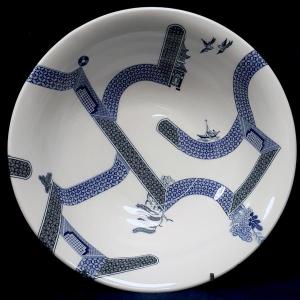
Deconstructed willow pattern. Source: PRSC
In the 18th, 19th and early 20th centuries, willow pattern obviously spoke to something in people’s imaginations. Perhaps the very standardization and mass-production of the design enabled the more exotic to become both familiar and comprehensible, even offering some level of reassurance by its very familiarity. By developing new and improved ways of manufacturing pottery and decorating it, and taking advantage of new modes of transport and communication, potteries making ceramics in the English Midlands were able to spread willow pattern throughout the UK and into America. A decorative phenomenon, it is difficult to account for its success, but a success it certainly was. It has left a legacy that continues to attract collectors and re-interpreters alike.
For anyone new to this occasional series on objects extracted from my garden
during everyday gardening activities, see the History in Garden Finds page.
These are not objects used in the garden, but objects, usually fragments,
lost or disposed of in the garden and found during digging, troweling and planting.
Copeland, R. 1999 (3rd edition). Spode’s Willow Pattern And Other Designs After the Chinese. Studio Vista
Ferguson, S. 2017. “Blue Willow”: Apples or Oranges? Transferware Collectors Club Bulletin, 2017 Vol. XVIII No. 1.
https://www.transferwarecollectorsclub.org/bulletin_previews/articles/17_TCC_XVIII_No1_Blue_Willow_Apples_or_Oranges.pdf
Hsien-Yi, Y. and Yang, G. 1958. The Man Who Sold A Ghost. Foreign Language Press
Available online at: https://www.bannedthought.net/China/MaoEra/Arts/Literature/TheManWhoSoldAGhost-ChineseTalesOfThe3rd-6thCenturies-1958.pdf
O’Hara. P. “The Willow Pattern That We Knew”: The Victorian Literature of Blue Willow. Victorian Studies. Vol. 36, No. 4 (Summer, 1993), pp. 421-442
Available online with the academic site JSTOR digital library if you register (free): https://www.jstor.org/stable/3828644?seq=1
East India company at home 1757-1857, University College London
The Willow Pattern Case Study: The Willow Pattern Explained
https://blogs.ucl.ac.uk/eicah/the-willow-pattern-dunham-massey/the-willow-pattern-case-study-the-willow-pattern-explained/comment-page-1/
Encyclopaedia Britannica
Willow pattern pottery
https://www.britannica.com/art/Willow-pattern#ref235738
Popular Culture in Modern China
The Butterfly Lovers – Response. By Dr Liang Luo
http://chi430.blogspot.com/2014/01/the-butterfly-lovers-response.html
The Potteries – An A-Z of Stoke on Trent Potteries
The Willow Pattern Story
http://www.thepotteries.org/patterns/willow.html
Spode History
Spode and Willow Pattern. By Pam Woolliscroft
https://spodehistory.blogspot.com/2013/06/spode-and-willow.html
Transferware Collectors Club
What is transferware?
https://www.transferwarecollectorsclub.org/news-information/faqs
Victoria Gallery and Museum, University of Liverpool
Story of the Willow Pattern, 15 January 2021 by Amanda Draper
https://vgm.liverpool.ac.uk/blog/2021/willow-pattern/
Bridge’s number 324, page 124

Dairy cattle relaxing at 4am on a misty morning in a Churton field in June 2021

Sheep on Craig yr Aderyn in midwest Wales
Bridge explains that this proverb refers to the fact that “sheep and cattle will not break through fences or try to wander if the pasture of the field in which they are grazing is very good.” He had obviously not run into any pigs, which are extreme escape artists.
Bridge wonders which came first – the English or the Welsh version of the proverb, but both Cheshire and north Wales are prominent areas for the grazing of livestock, so it could have come from either. Certainly around many areas of the Cheshire Plain the fields are full of rich pasture favoured by cattle, and the Welsh foothills and highlands are much better for sheep that graze on much sparser vegetation.
It sounds very much like the better known proverb in which the route to the male heart is reputed to be via his stomach.

Cattle grazing below Beeston Castle
A similar proverb in Bridge is “Hanged hay never does cattle” (Bridge 159, page 64). The word “does” in this context derives from doesome, which means “thriving,” and hanged hay for is feed bought from a supplier and will probably be supplied very meanly to the cattle because of the cost, to the detriment to the cattle.
Both proverbs also resemble another of Bridge’s Cheshire proverbs (no. 208 on p.80, and no.159, p.64): “A doesome child paises its pasture,” meaning that the health and wellbeing of a thriving child is credit to his or her food, and perhaps, by extension, to the care of the parents that provide the food. The word “paise” comes from late Middle English and means to be “balanced” or “poised,” but in this context it may be a mistaken reading of “praise.”
For more about J.C. Bridge and this Cheshire Proverbs series, see Cheshire Proverbs 1.
For the other proverbs in the series, click on the Cheshire Proverbs label in the right hand margin, or see the end of the Archaeology, Heritage and Art page, where they are listed.

Dairy cows grazing in a field in Churton
 For no better reason than I am so chuffed that I actually grew vegetables, lettuces and cucumbers in this, the first summer after moving in. Showing off, in other words, although none of them are ever going to win any prizes. I don’t actually have a vegetable plot, because I have turned everything over to flowers, shrubs and a small orchard, so these were grown in pots on a small south-facing side-patio.
The marrow speaks for itself (my fourth so far). At the back, the little yellow globes are cucumbers (I promise you). At the front is one of many golden beetroot, which have the lovely earthy taste of purple beetroot, perhaps a little more subtle, but don’t leak colour into everything you eat. I like them steamed or roasted. Once steamed, they are great cold too, with vinaigrette.
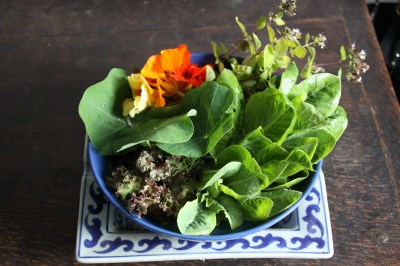 The salad and vegetable plants, except for the globe cucumbers, were all bought as tiny plugs from Bellis in Holt, but my goodness they grew! The cucumbers were bought from the Grosvenor garden centre. All were planted in general purpose compost, with mycorrhizal and bonemeal (in a ratio of 1:3 handfuls) placed in the hole in the compost before the plant was added. Then slow-release plant food was scattered over the top.
I have grown herbs outside in pots for years, as well as nasturtiums. The ones above are lollo rosso and little gem. Oregano, marjoram, mint, thyme and particularly lovage and the fluffy bits of fennel foliage make for a really special salad. The round nasturtium leaves and flowers are excellent in salads, and their seeds are a little like capers. I have also grown lettuces in the past, but not on such a grand scale.
Feeling rather pleased with myself 🙂
 If you are lucky enough to find puffballs, especially giant puffballs (Calvatia gigantea), in your travels they must be eaten almost immediately as they simply don’t keep. Put them in the fridge, and they will last maybe two days, perhaps three if your fridge is very cold. Freezing them on the same day is also possible but they are not nearly as good as when eaten fresh. I used to harvest them from the golf course when I lived in Aberdovey, but never did I collect any this enormous! My father had a couple, I had a couple and a neighbour had one. These came from a local grass verge that I was driving past, and I pulled over to go and retrieve them. Because puffballs reproduce during the decay of the puffball (at which point it puffs off its spores), always leave one behind to ensure that there is a chance of them coming back next year.

A giant puffball looks a little like chicken breast when you slice through it.
As always, collecting wild mushrooms comes with a health warning. It is easy to mistake puffballs for mildly poisonous earthballs when they are both very small and white, although earth balls quickly become dark as they grow whereas puffballs look pure white throughout their growth cycle, until they mature and the spores (like seeds) are ready to depart when they go creamy yellow. They are pretty well unmistakeable when they reach a size bigger than a golf ball, but read more about them here on the excellent Forager Chef website.
Puffballs have a subtle mushroomy taste and a soft texture, both of which are quite unique and utterly delicious. When they are big enough, they are fabulous cut into big slices and tossed in sizzling butter and fresh sage. Small ones can be cooked whole.

Slices of giant puffball at the base were topped with smoked bacon, black pudding, crispy sage leaves, spinach and a poached egg. A terrible photo – I really cannot take photographs in artificial light! I need to sort out a mini home studio.
There are a million ways of serving them, some gastronomic, others rather more down to earth. Last night I had mine fried in butter (yes, I know, but how delicious), served at the bottom of a stack made up of a rasher of smoked back bacon, a slice of excellent black pudding, both done on an iron griddle plate over a high flame, with a handful of steamed spinach over the top and a poached Churton egg on the top of that. Bliss. I’ve been a bit off food recently, but I couldn’t wait to cook this.
For a vegetarian version, the puffball slices would be excellent cooked in garlic oil, and served on griddled sourdough toast with the spinach, courgettes, and crispy sage leaves, or with asparagus, perhaps with a drizzle of cream. For me, the poached egg is a must with this meal.
However you cook giant puffballs, be careful not to overwhelm their delicate flavour. I would not, for example, do them in a red wine sauce, but they go well in a white wine and cream sauce, or in a pasta carbonara. They are also sensational as an accompaniment for steak, and go very well with chicken or pork. As tapas, they are divine cooked in garlic and sherry.
After a divine curry last night, both invented and cooked by my father, whose approach to all cuisines is always creative and full of glorious flavour, I went for something rather more conventional tonight. Mushrooms and garlic are a classic combination. Some diced courgette, pancetta, finely sliced spring onions, parsley, oregano or tarragon and, if you fancy it, spinach (or wild garlic in spring) are great additions, as is a good dollop of cream or crème fraîche. The poached egg on top is essential, as it rounds things off beautifully.
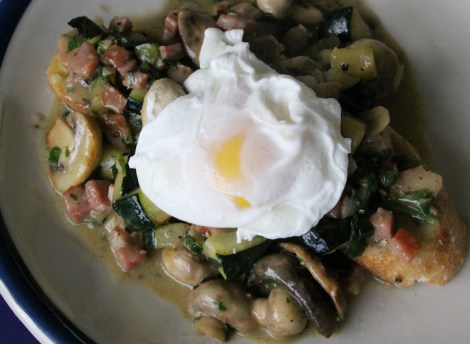 The mushrooms and pancetta are fried in butter until beginning to brown, at which point the diced courgette is added until it too is golden. The finely chopped garlic is then added, and when cooked through, some flour is sprinkled over the top of the mixture and stirred until it is invisible, helping to thicken the stock, which goes in as soon as the flour has been absorbed, just a little bit at a time, stirring constantly.
When the sauce reaches the consistency that you like, you might consider adding the following: finely sliced spring onions or chives, chopped parsley and oregano and a few turns of the pepper mill. I also like to add a slosh of dry sherry at this stage. Mushrooms and sherry are a frequent combination in Spanish cooking, and work deliciously together. I also like to add a handful of spinach at this point if I have some, which cooks through quickly as the egg is poached. If the sauce is too thick at this stage, again add some more stock or water, a little at a time, and stir well to incorporate anything that might be sticking at the bottom of the pan.

Whilst this is gently heating through, the egg is poached and a slice of rustic bread or sourdough is griddled or toasted. Poaching eggs is easy if a few basic rules are followed. The eggs should be fresh and at room temperature. The water should be boiled, and a glug of white wine vinegar added. The vinegar helps the whites to solidify. Create a swirl in the water, which helps to spin the egg whites around the egg yolk, and take off the heat. It will now poach in the hot water, the whites becoming opaque as the egg begins to cook. It takes about two minutes depending on the size of the egg. Drain the eggs well in a slotted spoon or on kitchen paper to remove the traces of vinegar.
Back to the mushroom mix. At the last minute, a small dollop of whatever cream you have to hand goes in. I like either crème fraîche or sour cream, but ordinary single or double cream works perfectly well too. Heat it through gently. Then place the toasted bread on the plate (buttered if required), spoon the mushroom mix over the top of the toast and then place the the poached egg carefully on top of the mushrooms. Scatter sea salt over the top of it all, and add a few turns of the pepper mill, and dig in! It’s incredibly filling, so I don’t serve it with anything else.
 Lots of variations are possible. If you have access to wild mushrooms, that makes it even better, but I had button mushrooms that needed using up. Nearly all herbs will work, including sage, lovage, chervil and marjoram. Diced aubergine goes well instead of or as well as courgette. Bits of bacon or parma ham can substitute for pancetta. Cream sherry can be used instead of dry if you fancy a slight hit of mellow sweetness. Alternatively, instead of sherry, Marsala wine, which is utterly divine in all sorts of sauces, is excellent with this dish. It is not always easy to get hold of, and must be used with care or it takes over entirely.
A vegetarian version can be done by leaving out the pancetta. If often do the vegetarian version, and it is delightful.
If you want to make it into a bigger main course, the mix works wonderfully as an accompaniment for pork or chicken.
More adventures with Churton Honesty Eggs
 Based in Churton

