
 All Saints’ Church in Gresford is such a short hop from my parents’ home in Rossett that I should have visited years ago, but somehow never got around to it. I tried a couple of times earlier this summer, but the church was busy in its role as a community resource, which was good to see. The church is big. Although it is difficult to imagine when driving along the Chester-Wrexham road, Gresford was originally a small village, noted in the Domesday survey as part of Duddestan in the Cheshire Hundred. A sense of village life still remains in the buildings that surround the churchyard, together with the charming village pond just down the road, complete with lazy ducks sunbathing on warm summer days. All Saints’, reaching most of its present extent in the 15th century, was an imposing presence, and must have been a source of considerable local pride.

The location of the Church of All Saints in Gresford. Source: streetmap.co.uk
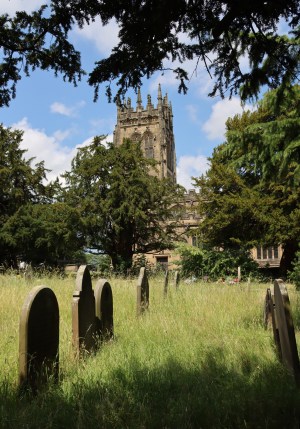
For a detailed account of the church’s history, see the history page on the Gresford All Saints’ website. This post provides a short overview of some of the key features, with photographs. First, a note on the name. Most churches in the area are named after particular saints, but All Saints refers, as it name suggests, to all Christian saints. The saints represented by “all,” however, include not only those who are known but those who remain unrecognized. All Saints’ Day is celebrated in Catholic and some Protestant churches on 1st November annually. The owner of the Church of England Saint Dedications web page calculates that it is the second most popular church dedication in England, after St Mary. Although Gresford is in Wales, just over the border, it switched hands between England and Wales throughout its earlier history.
The Grade 1 listed All Saints’ is unexpectedly impressive for its understated setting. Much bigger for example, than Worthenbury’s St Deiniol’s, with which it shares a sense both of ambition and commitment. Today both are clearly much-loved by their communities, and both vie for the title of the finest parish church in north Wales. The significant difference between the two is that whereas St Deiniol’s was built between 1736-9 by Richard Trubshaw with real Georgian panache, All Saints’ is thought to have been founded in the 13th century and was in almost continuous use from at least the 14th century. The 11th century Domesday survey mentions a church and priest, but this church was apparently replaced by the establishment of the Gresford church, either in the same or slightly different location. All surviving walls are made of local high-quality Cefn yellow sandstone, which is used for many of the municipal buildings in Wrexham. A separate post about the exterior gargoyles and grotesques has been posted on the blog here.
 The late 13th and 14th centuries were a period of energetic church building in England and Wales. It is thought that the remarkable gothic architectural projects carried out at two notable sites created a tidal wave of enthusiasm for architectural projects in religious establishments. One was the new and remarkable shrine created for Archbishop Thomas Becket in Canterbury Cathedral, murdered on 29th December 1170, who was canonized only three years later and therefore required a shrine worthy of his status, into which his remains were transferred (translated) in 1220. The other was the ambitious shrine built by Henry III for St Edward the Confessor at Westminster Abbey, completed in 1269.
When All Saints’ Church was built in the 13th century, prestigious contemporary religious buildings included, for example, St John the Baptist Church in Chester founded in 1075, St Werburgh’s Abbey, founded in 1093 and Basingwerk Abbey founded 1132.
 Subsequently All Saints’ underwent many alterations and embellishments in the centuries that followed, including the 14th century addition of the tower to a lower level than today, together with a south aisle. There was an almost total rebuild in the 15th century and the upward extension of the tower in the 16th century. The dominant style, following the 15th century rebuild, is known as Late Gothic Perpendicular, a peculiarly English style that emphasized the tall and thin aspects of the Gothic, mainly exhibited in the stone tracery of the stained glass windows, which make up an enormous part of the interface between interior and exterior.

The only clue to the original appearance of the church lies in a 16th century document that claims that it had been “strangely and beautifully made erect,” which is intriguing but not particularly helpful. The church is rectangular in plan with a tower protruding at the west end and two porches.
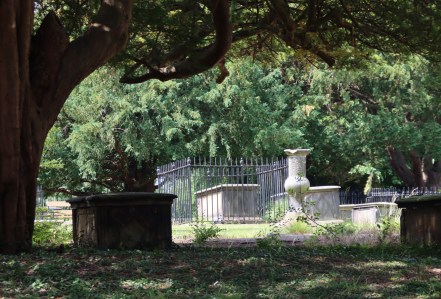
 All Saints’ sits within a churchyard. The earliest grave marker dates to 1696, and there are some from the 18th century. Most date to the 19th century. There is a good mixture of chest tombs and gravestones of different designs and styles of engraving. The churchyard’s oldest occupant is in fact a lovely yew tree (Taxus baccata), estimated to be 1600 years old. The other yew trees were planted in 1726. Often associated with churchyards, yews have a mixed reputation, seen both as symbols of immortality and indicators of impending disaster, the latter association perhaps because of its toxicity. In this context, it seems clear that the yews are intended to represent life everlasting.

 The exterior features of the church include crenulations, and follows the gothic tradition of adding gargoyles, which draw water away from the roof, and decorative sculptural elements, including small beasts, real and imaginary, and tortured faces, usually referred to as grotesques, as well as floral themes. Some of these sit on the stringcourse, a few of which are positioned under hood-moulds (projecting reliefs to protect the underlying features from rainwater). They are worth a post in their own right, if only to capture some of them with a telephoto lens so that they can bee seen much more easily than with the eye, which I will do in the next month or so.
 Internally, the church is divided into traditional sections. The nave (the main body of the church where the public sit in pews) is flanked by two side aisles at ground floor level, marked by two 7-bay arcades. A clerestory (row of windows above the level of the aisle) provides the nave with much more light than the stained glass alone. A screen, erected in the 15th century, divides the nave from the sacred end of the church, the chancel with the choir and high altar. The chancel is flanked by two chapels, which can be reached from the aisles. The north aisle, shown above, used to run directly into one of the two chapels that flank the choir and altar, but is now partially interrupted by a 19th century organ.
 The church has seen continuous use since the 13th century. The main surviving feature of the 13th century is the crypt, closed to the public but accessed via the north chapel. The 14th century is represented by a number of key internal features. In the south aisle, the effigy of Madog ap Llywelyn ap Griffith, who died in 1330, lies in a niche, shown in full armour with a lion rampant on his shield. The inscription reads HIC IACET (here lies) MADOC AP LLYWELYN AP GRIFFI

Almost opposite, and dating to the same period, is another niche, this time showing the beautifully engraved gravestone of Goronwy ap Iowerth.

The inscription, with thanks to the ArchaeoDeath blog of Professor Howard Williams (where you can find more 14th century engravings from the church) reads:
HIC:IACET:GRONW:F’:IORWERTH:F’:dd’.CVI’:AIE:DS’:/ABSO/LWAT
Here lies Goronwy son of Iorwerth son of David, whose soul may God absolve.
The raised 14th century sanctuary with the high altar, approached via a flight of steps, sits over the 13th century crypt.
 From the 15th century are the fabulous misericords (carved scenes on the undersides of seating in the choir) and one of the church’s real treasures, the gorgeous wainscoted screens (the central panel of which was vaulted, photograph further down the page), and a very fine stained-glass window behind the high altar donated by Thomas Stanley, Earl of Derby and step-father of Henry VII. The font, at the west end, with its eight panels that include depictions of the Virgin Mary with the baby Jesus, the lion of St Mark, and possibly St Leonard, also dates to the 15th century.
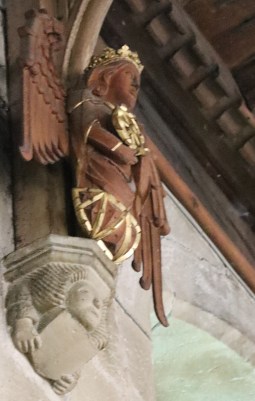
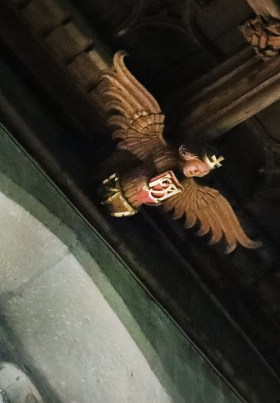
Don’t forget to look up. The ceiling is a particularly fine camberbeam structure, crossed with rafters, with painted panels and bosses. At the ends of the rafters are carved wooden angels.

 So why was the medieval church so popular that it could afford a new tower in the 14th century and a major rebuild to include new aisles and new features in the 15th century? In her booklet about All Saints’, Bethan Jones suggests that the gifts showered on the church, including furnishings, might suggest that it had acquired a relic and had become a pilgrim destination. Relics generated considerable incomes for cathedral, monastery and church alike. In Chester, the Rood of St John’s Church was a popular pilgrim destination, and in the 14th century the shrine of St Werburgh in the Chester abbey had become popular. To the west, the shrine of St Winefrede at Holywell and the church at St Asaph were also on the pilgrim circuit. No record survives of such a relic at Gresford, but it is difficult to account for the size of the church in any other way, other than a major investment by a donor who wished to make his mark on the church during the period of the Reformation, but neither is there any record, documentary or material, of such a benefactor.
16th century features include the fine stained glass windows in east and north walls of the Lady Chapel, reached via the north aisle. In the Trevor Chapel there is a superb painted 1589 memorial to John Trevor (Sion Trefor), lying as though still alive, with his head propped thoughtfully on one hand. His coat of arms is above and a winged skull beneath. An inscription conceals the central portion of his body.

The church continued to be well used throughout its history. Dating to the 17th century, the Trevor Chapel a charming memorial to John Trevor’s daughter-in-law with her daughters dates to 1602, and another, rather more monumental piece, shows her with her husband (shown further down this post) and dates to 1638. Other memorials in the church also date to the 1600s.
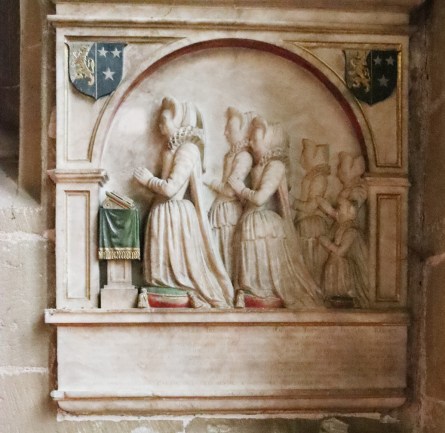
 In the 18th century, a number of additions were made. The two chandeliers in the nave date to the mid and late 18th century. The south porch (the main entrance to the church today) had stained glass panels added in the 18th century to commemorate local deaths during the First World War. The first mention of the bells is in 1775, when three of the bells were mentioned I the parish register having been returned after being recast at Gloucester, meaning that there were at least three bells in the tower at that date, the tenor, third and treble bells, although in 1873 six bells are listed so it is possible that there were six bells in 1775.
In the 19th and early 20th centuries a number of alterations and additions were made, mostly sympathetic to the original structure. The 15th century east window was restored during the 19th century, using additional glass, but has remained true to the original. In St Catherine’s Chapel, better known as the Trevor Chapel, there are two hatchments for George Boscawen (who died in 1833) and Thomas Griffith (who died in 1856), both shown immediately below. The Hill and Son organ was installed in 1912. The addition of the north porch in 1921 to serve as a war memorial included old fragments of glass. A painting in the Trevor Chapel commemorates the Gresford Colliery Disaster of 1934 and serves as a memorial to the 266 men who died. This is shown at the very end of the post, following the list of sources.

An intriguing object in the church is a short square column, made of stone and carved with a figure holding a pair of shears. It may date to the Roman occupation, and it is possible that one face represents Atropos, one of the three Moirai or Fates, responsible for cutting the “thread of life” (the metaphor for a human lifespan). It was found during excavations at the east end of the church.

Final Comments
 There is too much to say about Gresford All Saints’ on a single post, and I will revisit the church on future posts to look specifically at the choir and misericords, the gargoyles and grotesques that accessorize the exterior of the church, and the churchyard itself. Apologies for the highly granular photographs of the interior, including some which are slightly blurred around the edges, both of which were caused by having to photograph in very low light. I hope that the images are good enough to give a sense of the magnificence of the church and some of its features.
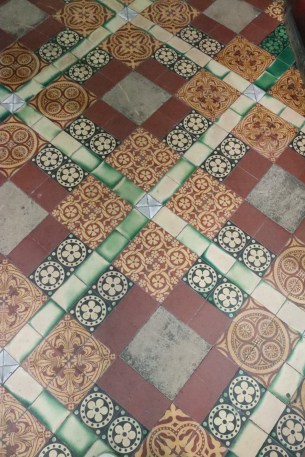
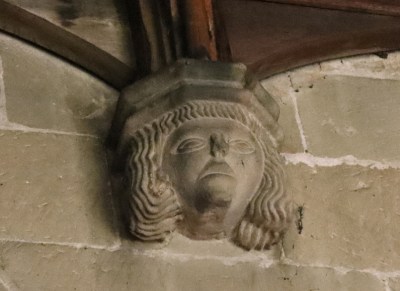
Here are a few more photos, in completely random order, and please see Visitor Information below them.






Visitor Information
 The church is open daily, but is a living church and may not always be available for visitors. It has services on a Sunday and on Thursday mornings, marriages and funerals during the week and on Saturdays, and may be used as a community resource for events such as the annual craft fair. Check the church website for it’s opening times and events. It took me three attempts to find it free of activities, which is great news for the church and its future, and no bother for me as I live locally, but check the website for information, and it may be worth emailing the contact address on the website if you are coming from further away.
 There are plenty of information boards throughout to explain the key features, but not so many or so big that they intrude on the atmosphere of the church. If you are interested in the history, the colour booklet by Bethan Jones provides a tour of all of the key features. It can be purchased (cash only) at the church, where there are a number of leaflets and postcards available on the shelves to the right as you enter, including one devoted to the bells.
The Trevor Chapel on the south of the church (right as you look towards the altar) is used for private prayer, but is accessible to visitors when it is not in use. The crypt, with an entrance from the Lady Chapel, is closed to the public.
For those with unwilling legs, it’s an easy to access church, with no steps needed to negotiate the entrance via the porch on the north side. The nave, the choir and the chapels can all be accessed without using steps. Being an active church, there are plenty of pews in the nave on which to sit down and absorb the atmosphere.


Sources
Books and booklets
 Bethan Jones, 1997. All Saints Church Gresford. ‘The Finest Parish Church in Wales’. The Friends of the Parish Church of All Saints Gresford.
Hubbard, E. 1986. The Buildings of Wales: Clwyd (Denbighshire and Flintshire). Penguin Books
Roberts, F.H. 2013. All Saints’ Gresford. Tower and Bells. All Saints Church, Gresford
Wooding, J.M. and Yates, N. (eds.) 2011. A Guide to the Churches and Chapels of Wales. University of Wales Press
Websites
All Saints Church Gresford
Home Page
https://www.allsaintschurchgresford.org.uk/
History Page
https://www.allsaintschurchgresford.org.uk/about-us/our-history/
ArchaeoDeath blog by Professor Howard Williams
Gresford’s Medieval Monuments
https://howardwilliamsblog.wordpress.com/2018/03/04/gresfords-medieval-monuments/
Clwyd and Powys Archaeological Trust
Church of All Saints, Gresford
https://cpat.org.uk/Archive/churches/wrexham/16785.htm
Church of England Saint Dedications
https://blanchflower.org/cgi-bin/qsaint.pl
Imaging the Bible in Wales Database
Church of All Saints, Gresford, Wrexham
http://imagingthebible.llgc.org.uk//site/188


