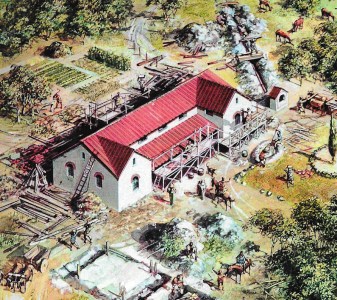
Ivor Mervyn Pritchard illustration showing elevation view of Valle Crucis. Source: Coflein
When I first visited Valle Crucis, I was so bound up in the architecture and its complexity that it took me some time to get to grips with the idea that this was a place not merely where people spent time in worship, but where they spent their entire lives, an enormous amount of it taken up with liturgies. The entire abbey complex is all about how those people’s lives were lived.
The foundation of Valle Crucis is covered in part 1. Monastic communities conformed to a vision of life in the 13th century that had been first conceived in the 6th century. The Cistercians were one of a number of reforming orders that were attempting to return to the 6th Century values of St Benedict. St Benedict was long on attention to detail, but devoted less time to the bigger picture, so there was plenty of scope for incorporating his Rule into a broader vision of monastic life. Each order approached the task differently, and the Cistercians did it by establishing remote communities where they could live out their lives, bound together by vocation, devotion and the cohesive regulations that laid down how their lives should be lived.

Plan of Valle Crucis. The buildings on the plan beyond the core abbey unit are all post-Medieval, mostly modern caravans and holiday chalets. Source: Coflein
The Cistercians, with their centralized approach to the management of their European network of abbeys, understood all about the bigger picture, and knew how to impose its vision via standardization and conformity. They had a system of government, and when they colonized a new country or region, they had mechanisms for ensuring that their operational procedures and their beliefs endured. One abbey supplied the abbot and monks of the next, and the new abbey was answerable both to its parent abbey and to the founding abbey in Citeaux. This was not just an idea; it was implemented. The abbots of all abbeys went to Citeaux each year to attend the General Chapter where all Cistercian decisions concerning the order were made, and each parent abbey was responsible for visiting its daughter abbeys each year to inspect and judge it. The Cistercian system was one not merely of self-discipline but of accountability.
The organization of the abbey, both its hierarchy and the functional components embedded into its architecture, promoted the Cistercian vision of monastic life. It was ambitious and powerful, and it attracted both founders and members.
The organization of the abbey

Early pencil sketch showing archway at Valle Crucis Abbey. Source: Coflein
An abbey, priory or nunnery combined a church with monastic buildings, making up a community in which all the residents chose to devote themselves not merely to religious observance, but to a set of commitments that seems fairly daunting today. Some must have been unnerving to the prospective novice even in the Middle Ages. Once a novice had passed through a number of stages and was ready to make this final vows, he or she entered a life of devotion, self-denial and hard work. The vows of personal poverty, celibacy and obedience were accompanied by the vow of stability, perhaps the most daunting vow of all. It was a commitment to remain at the abbey for life. All the vows were binding, and breaking them could result in punishments, including imprisonment for the most serious infractions.
As a novice, the future monk would experience the monastic code in practice, based on prayer (ora), manual labour (labora) and contemplative reading of religious texts (lectio divina). The Cistercian order was guided by the principle of opus Dei, God’s work, and their abbeys were laid out to meet the needs of regular devotion in church, scholarly activity, economic self-sufficiency, communal support, and, when required, punishment for transgressions.

Detail of a 13th Century illuminated manuscript depicting St Benedict of Nursia, showing him with a tonsure. Source: Cover of Carolinne White’s The Rule of St Benedict (Penguin Classics)
As well as providing a church, the abbey had to make provision for its inmates. The Cistercian hierarchy within each monastery was headed by the abbot or abbess, responsible for the smooth running of the abbey and the well-being of the monks. The strict discipline, clear regulations and multiple routines were essential for cohesion, consistency, reassurance and morale. Often there was a prior who was deputy to the abbot. The main community of abbeys like Valle Crucis was made up by “choir monks.” Like other Benedictine-based orders, the Cistercian choir monks were tonsured, meaning that the top of their heads were shaved bare, leaving a ring of hair that represented Christ’s crown of thorns. Up until the mid-14th Century, at the lowest level of the Cistercian abbey hierarchy, were the lay monks, conversi, who were allocated their own quarters within the monastic precinct. Some had supervisory duties, but the main body of the conversi carried out most of the agricultural labour. They did not have the tonsure. These roles, and others, will be discussed in part 4.

Aerial view of Valle Crucis (with caravan park). Source: Coflein
Each Cistercian abbey’s floorplan was an echo of the order’s founding abbey, Citeaux, which itself echoed the layout of earlier Benedictine monasteries. The earliest abbey in Britain to conform to this layout was St Dunstan’s at Glastonbury in the 10th Century. Although every abbey and priory is unique, all conform to the basic template. Valle Crucis provides a very useful example of this template, simple enough to illustrate the principles of the Benedictine model, but elaborate enough to demonstrate some the options exercised by individual abbots over time.

Annotated plan of Valle Crucis showing the central cloister around which all the other buildings were focused, including the church, the south wall of which makes up the north wall of the cloister. Source: Evans 2008
The above plan of Valle Crucis shows the main organizational elements of the abbey, with the church at the north, and the rest of the buildings arranged around the cloister. The monastic buildings surrounding one or more cloisters are called “ranges.” Each range consisted of several rooms with doorways out into the cloister. At the centre of the cloister was a garden or “garth.” Around the garth was a walkway, usually termed an alley or walk, linking all the rooms in all the ranges. The monks’ formal and domestic buildings made up two sides, to the east and south, and in Cistercian abbeys the rooms for the conversi made up the fourth, western side until the mid-14th century, after which the west range was used for different functions. Both the east and west ranges, facing each other across the cloister garth, were two-storey buildings. This formulaic plan was a very effective organizing principle.

Standing at the east end looking west. The dark block at centre marks the position of the original pulpitum, which divided the west end nave from the east end
In an ideal world, an abbey church would be orientated east-west, with the main entrance at the west opening into the nave, where general worshippers such as lay brothers and guests would attend services. The nave was separated from the east end choir, chapels and presbytery (the domain of the choir monks) by a stone screen called a pulpitum or a rood screen.
The church’s south wall would make up the north wall of the cloister. The cloister would ideally be located on the south side of the church to protect it from the wind and expose it to the sun. Valle Crucis exemplifies this arrangement, but there are monasteries where it was not possible to orientate the church west-east or to position the cloister to the south of the church, such as Tintern in south Wales, founded in 1131, the second Cistercian abbey in Britain and the first in Wales.

14th Century window tracery in the chapter house, east range, Valle Crucis. Source: Coflein
The early Cistercians valued simplicity and rejected ostentation, associating decorative features with adulation of the material, wealth, self-indulgence and a tendency to succumb to luxury. Monks who were supposed to be engaged on scholarly religious reading and profound, introspective contemplation needed no distractions, so the earliest buildings of the 13th Century had very few decorative flourishes. From the mid-14th Century, however, more elaborate architectural features common to other monastic orders were added, such as window tracery and stained glass. The chapter house in the east range, shown left, is an example of this elaboration of style.
No two abbeys were alike, which could be due to any number of variables including the richness of the original endowment, the preferences of the founding abbot, the accessibility of building materials, the availability of skilled craftsmen, financial constraints, changes in direction during the initial building phases, later re-building after fires or floods (common phenomena) and the incorporation of new ideas and technologies. However, all abbeys share enough features to make their layout instantly familiar, with the function of many of their main rooms immediately identifiable. Once you have got to grips with the layout of one abbey, you have the essentials for finding yourself around any other one.
The exterior

Rear view of the abbey’s east range. From left to right, the grand passage leading from the cloister towards the fish pond, the rear view of the east range with its three tracery windows of the chapter house (with the monks dormitory overhead), and the ground floor window of the sacristy

Valle Crucis west front. Source: Coflein
For Medieval monks and modern visitors alike, the main experience of Valle Crucis takes place in the interior, but the first impression was provided by the impressive west front. In the 376 years of the abbey’s life, local people will have seen little more than the imposing walls and tower, whilst pilgrims, guests and novices (trainee monks), will have had all the layered responses of a first impression when they arrived. Most had probably seen other abbeys, or at least substantial churches. For all, the view of Valle Crucis in its isolated valley setting was one of height, solidity and worthiness. The 12th and early 13th Century Cistercians eschewed most architectural decoration, their focus on the serious business of doing God’s work without distraction. The restored west front (which is the end at which today visitors enter the church) has the rose window and elaborate arch that were probably added after the fire that swept through the church 40 years after its foundation, and would have been considered trivia by those who founded the abbey in 1201. For those invited to enter the church, the early 13th Century doorway would have been big, but relatively plain. The overall impact of the ornamental details was more impressive, but less Cistercian. The east face, shown below, with its almost grim austerity, is far more consistent with early Cistercian ideas.

The innovative and austere east end of the abbey church, with the rose window of the west end showing through the left lancet window
On all of the church’s outer walls there are buttresses, long, flat vertical sections that sit against the wall, sometimes to its full height. You can see them right, imaginatively incorporated into the design of the east end of the church. and below on the north wall, in both cases with splayed bases. A buttress supports and reinforces a tall masonry wall, sometimes to the full height. It counteracts the outward force of a wall to prevent it buckling by providing a counteracting force, preventing a wall from bulging by pushing against it. These are often faced with fine stone (ashlar) or at least cornered with it (quoins). The photograph below shows the buttress bases along the north wall of the nave of the abbey church.
Ashlar covers most of the church and monastic buildings, although some was robbed for building material after the dissolution. The smooth surfaces, neatly carved lines, tightly fitting corners and fine joins give a much finer appearance to a building. Being far more expensive to make and install than the roughly carved interior stone, its use also communicate something about the abbey’s status. It really must have been quite a sight when first built.

The Virgin Mary

St Bernard of Clairvaux by Juan Correa de Vivar, 16th Century
Cistercian abbeys were dedicated to the Virgin Mary. St Bernard, the charismatic and highly influential abbot of the 12th Century Cistercian abbey, Clairvaux, promoted Mary as a personage who encompassed all the most important Christian virtues. She had a central role in the Christian story, she was sacred, approachable, empathetic and she had the ear of both Christ and God. “If you fear the Father, there is Christ the Mediator. If you fear Him, there is His Mother. She will listen to thee, the Son will listen to her, the Father to him.” This was St Bernard’s view of the matter, and one that he promoted energetically.
In spite of this, there is little sign of Mary in early Cistercian monastic establishments due to a Cistercian mistrust of effigies. In most of the other monastic orders there would have been architectural carvings, paintings, tapestries and sculptures to commemorate the most venerated religious figures, but in accordance with St Benedict’s view of monastic life as pared down and austere, Cistercians rejected art works and instead venerated the Virgin only in their liturgies and rituals. She was revered in their worship, and presumably in their hearts, but only occasionally in their architecture or art. When the abbey was dissolved, all its possessions were sold off to raise funds for the crown. It is thought that two chandeliers, one now at Llandegla parish church, and another at Llanarmon yn Ial may have been sourced from Valle Crucis. I have not seen a picture of the one at Llanarmon yn Ial, but the one at Llandegla is topped with a statuette of the Virgin Mary. If it was indeed from Valle Crucis, the depiction was from late in the abbey’s history, dating to the late 15th or early 16th Century.
Procession and Horarium

Artist’s impression by G.Pickering of monks in the east end of the Valle Crucis abbey church, having filtered down the night stairs from their dormitory, at far right. Source: Coflein
All buildings, whether religious or not, are about access, movement and visibility. Doorways, walls, screens, corridors, passages and stairways all constrain and direct the sort of movement possible. It is sometimes difficult to remember, when wandering around a roofless abbey, that the presence of windows, or the absence of them, impacts not only what can be seen from the inside out, but how clearly interiors can be seen based on the amount of light available, and whether candle light would be needed in key areas. With the Benedictine plan, control of movement and lighting were all about the main activities of the abbey. All abbey activities had to be scheduled around the daily liturgies, which were at fixed times of the day.
The canonical hours or horarium scheduled the daily liturgies. There were seven daytime gatherings, and one night-time gathering in the abbey church for prayer, psalms, chants, lessons, readings and hymns, as described by St Benedict in the Rule. Attendance was obligatory. In the Cistercian order these began at daybreak with Lauds, which was followed by Prime, Terce, Sext, None, Vespers (at around 6pm) and Compline (at Sunset) with Vigils (known in some orders as Matins) at night. Between these liturgical assemblies were the daily meeting in the chapter house, mass (once a day and twice on Sundays and feast days), eating (once a day in winter, twice in summer), manual labour and intermittent sleeping.

Cistercian monks shown on a mural in the Cistercian Abbey Osek, North Bohemia, before 1756. Source: Wikipedia, from the Cistercian Abbey of Osek, North Bohemia
Every Sunday, and on feast days, the abbot led a procession of the entire community from the east end of the church around the cloister. In larger abbey communities this must have been a spectacular sight as they monks lined up in pairs behind the abbot in their white habits and proceeded along the alleys of the cloister. First holy water was blessed at the high alter, and then the abbot led the whole procession through the eastern part of the church, spreading holy water on altars in chapels. Then they proceeded into the eastern alley of the cloister and walk the full circuit, sprinkling holy water into each of the rooms, before entering the nave at the west end of the church, again sprinkling altars with holy water, and finally returning, through the pulpitum, to the east end of the church.

Valle Crucis ground plan. Source: Valley Crucis Abbey by D.H. Evans (Cadw 2008)
In the order in which the procession visited them, here are the rooms at Valle Crucis, at least as it was when the abbey was suppressed in 1537, although the configuration was quite clearly somewhat different during the 13th Century. It might be worth opening the above site plan in a new window so that you can follow the descriptions on the plan.
The Abbey Church

Cadw sign at Valle Crucis showing a cutaway of how the church may have appeared, with the nave where the lay brothers worshiped, separated by a pulpitum from the area used exclusively by the monks.
The procession began and ended in the abbey church. The Valle Crucis church walls are preserved to a reasonable height throughout, and it is easy to see that its footprint was cruciform and orientated along the preferred east-west axis. St Bernard of Clairvaux is usually given the credit for certain aspects of the Cistercian plan, particularly popular during the second half of the 12th Century, which includes a short squared-off presbytery, low transepts, an aisled nave and a short tower.
The church was divided, physically, functionally and spiritually, into two main sections. The west end of the church was the nave, flanked by two aisles, achieved by building two runs of walls supported on arches of which only the piers (columns) remain. This is where the conversi, guests, and corrodians (permanent residents who were not choir monks) would attend services.

Cadw signage at Valle Crucis showing how the east end of the church may have looked in the early 16th Century. Note the undyed habits worn by Cistercian monks, giving them the name the “white monks.”
A screen, the pulpitum, divided the west end from the east end, the domain of the choir monks. Beyond this screen was the choir and the presbytery, where the monks would have carried out their liturgical ceremonies eight times a day (including one at night). Here there were a number of important architectural details shared by most Cistercian abbey churches. The base of a spiral staircase may have led to an organ. The pulpitum was moved towards the east end later in the church’s history, perhaps reflecting the decline in numbers of the resident choir monks.
The two arms of the cross formed wings to the south and north, the transepts. Each transept contained two chapels, side by side, originally both with rib-vaulted roofs, very beautiful. The south transept chapels are still present with much of the vaulting in tact. Chapels were required for ordained monks to give mass. Most monks were not ordained, and although many liturgies were required, mass performed separately. It was the duty of the ordained priest-monk, and had to be catered for with one or more chapels, each with its own altar.
Between the transepts is the crossing, the section at which the north-south and east-west axes cross. Here a short tower was built overhead. Beyond this section, forming the top of the cross, was the most sacred part of the church, the high altar. If you stand in the crossing facing the east end of the church, look right and there is a doorway hanging 10ft\3m above the ground. A flight of stairs from the first floor dormitory gave access to the east of the church for the night time liturgy. Offset from the dormitory entrance at ground level is the entrance into the sacristy.
The sacristy

13th Century sacristy
If you walk through the entrance into the sacristy, the room that housed the religious vessels and other items used in the liturgy and other ceremonies, you will find yourself in a remarkable barrel-vaulted room, worth a visit to the abbey in its own right. It is lit by two windows, a lancet window at the end and a peculiarly oblique square window in the opposite wall to the entrance from the south transept. In some Benedictine layouts this in turn had an entrance into the chapter house, but in this case it opens instead into the cloister at one end.
The cloister

Lavatorium in the garth, with a view to the remains of the west range on the far side, and the south wall of the abbey church, together with its west end
The cloister is the core organizing element of the abbey. It is made up of the garth (the lawn or garden) and the cloister alleys or walks that run along all four sides of the garth. The garth still contains the base of the base of the lavatorium, a raised stone basin, used by the monks to wash before proceeding to the refectory to eat. Drains under the west range were found during the 1970 excavation, running in the direction of the basin, perhaps fed by a hillside spring. The cloister walkway, which surrounded the garth and linked the buildings that surrounded it, is thought to have been covered by the 14th Century, with the roof fittings still visible on the wall of the east range. The left-hand illustration below by Chris John-Jenkins shows how it might have looked when the roofed arcade was first built. Later, it seems as though part of the roofed section was removed to enable a door and staircase to be added to the top floor of the east range, when it was the private quarters of the abbot. Again, Chris John-Jenkins’s illustration below shows how this may have looked.

Reconstruction of Valle Crucis east range and cloister in the mid-14th and early-16th centuries, showing how both the cloister walk and the upstairs dormitory may have changed over time. On the left, the cloister is surrounded by a roofed arcade, but this has been removed in the early 16th century and a staircase to the abbot’s new quarters has been added. By Chris John-Jenkins, in Evans 2008, pages 41 and 43.
 Like the layout of the church, the buildings that surrounded the garth also conformed to the basic Benedictine model and contained the functions of daily life, organized around the cloister in “ranges,” often in exactly the same order from one abbey to the next, with the chapter house and dormitory on the east range, the refectory on the south range and the conversi and cellarer (in charge of the monastic stores) occupying the west range. The ranges at Valle Crucis are described below. The east range is the most complete, partly protected by its use as a farmhouse after the dissolution, but the rest was robbed for stone, and only a few courses of stonework survive, which is just enough to give an idea of the layout just before the monastery was abandoned.
The East Range

Vaulted roof of the chapter house
The Sunday procession, having exited the church proceeded along the east range of buildings, which still stands to the original two storeys thanks to post-dissolution roofing. The ground floor has one of the most important room in the complex – the chapter house. Here the monks gathered daily to listen to the abbot read a chapter from the Rules of St Benedict, or a hagiography (the biography of a particular saint), to discuss the work of the day, and to hear confession and mete out punishments. Readings about saints could focus on any saint from anywhere in the Christian world, but it is likely that in a Welsh abbey populated mainly by Welsh monks, hagiographies would have focused mainly on the numerous Welsh saints. This beautiful room is rib-vaulted and contains various large niches, one of which was a fireplace. Windows at front and back, with fine tracery, provided views over the cloister and the narrow stretch of land that ran down to the river.

The ornate door leading into the book cupboard and, beyond, into the chapter house. The main entrance to the chapter house, for daily use, is on the right. The entrance to the sacristy, which also has access to the abbey church, is partly visible on the left.
Accessed from the chapter house was the book room, which at Valle Crucis could be seen through an arched window with elaborate tracery. This embellished entrance dates to the mid-14th century, and a simpler version of this would have been in place during the 13th century. The cupboard is where the most important documents belonging to the monastery were held, some of which may have been borrowed from other monasteries either for studying or copying. Two of the Valle Crucis books survive.
In the photograph below, the book room is flanked by the the entrance to the sacristy on the left and the main entrance to the chapter house at the right. The next entrance to the right, much smaller, led to the dormitory. Finally, the big arch at the end is a passage to the rear of the abbey, known as the slype. The roof was removed after the dissolution in 1536, but replaced in the later 16th century.
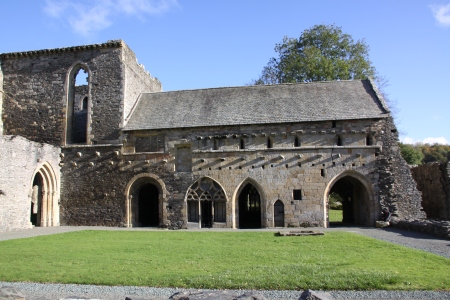
The east range
Over the top of the sacristy and chapter house were the 13th Century dormitory and the latrines. The dormitory can be seen in the illustration by Chris John-Jenkins above, at far left. The latrines were built over a drain that was intended to flush away the waste (see photograph below). These upper levels are still accessible but behind a locked door and would require special permission to visit. They are much altered from monastic times, due to having been used as a farm house after the dissolution, and one fireplace has a 13th century gravestone incorporated into its design. At the time of construction the dormitory was a communal room used by all of the monks. Initially it was one large open space, but in the later Middle Ages a demand for more privacy usually led to divisions between beds that provided individual spaces. The stone-lined drain that ran along the base of the latrines still survives at the south end of the east range.

Stone-lined latrine drain
Later in its history the dormitory was converted into a private dwelling area and grand hall for the abbot, heated with fire places. Evans makes the comment that so few monks were left that they could have lodged elsewhere within the monastic complex. An obvious candidate would have been the west wing, which had formerly housed the lay brethren. It seems peculiar that the abbey could have sustained the conversion of the dormitory into an ambitious private space for the abbot and his guests if there were so few monks remaining, but Evans does not comment on this.
The passageway at the end of the east range is located where the “parlour” was usually located, where the monks could meet up, but here it seems to have been merely a passageway. Originally it may have led to an infirmary, although no infirmary has yet been located. In its later form it is much more elaborate than usual passageways. Evans speculates that this was because it may have led to the abbot’s quarters at a time when the abbot was becoming a far more prominent figure. This end of the range was longer in the 13th century and it was clearly modified extensively. The far end, where it gives access to the rear of the monastery, the stream and the fish pond, has a 13th century arch that was removed from another part of the abbey and put in place here. Whatever the incumbent abbot’s reasons, he went to some trouble.
The part of the east range on the other side of the passage, which looks like a wall of unsorted rubble, is the inner stonework of the latrine. The latrines were on the first floor, at the end of the dormitory, and waste fell into the drain, where it was flushed away with water.
The South Range

Monks’ refectory with spiral staircase in the opposite wall. This will have lead to a pulpit for reading to the monks as they ate. Monks were rarely allowed to converse in the Cistercian refectory, but readings accompanied the meal.
Again following the procession, having turned right into the south range, the small room on your left may have been the calefactory, or warming room, in which the monks could warm themselves after work outdoors or in unheated parts of the abbey. No hearth was found here, so if it was indeed a warming room, it must have been heated by braziers. Alternatively, it may have been the access to the location of the day stair (the stairs that gave access from the dormitory to the cloister), later relocated.
The main room of note in the south range is the refectory, where the monks met to eat. In earlier claustral layouts the refectory was parallel to the walkway, but from around 1170, the refectory could be built perpendicular to the walkway, allowing for more seating, more windows for light, and the positioning of the kitchen alongside. The lavatorium, usually a raised basin in the garth containing water (for which the base survives at Valle Crucis), was always situated close by because the monks always washed before eating. Conversation at mealtimes was forbidden. Instead, readings might be delivered during meals. The remains of a short 13th century spiral staircase are visible, leading to a pulpit where a monk would have read from a religious text which, as in the chapter house, was often a hagiography.
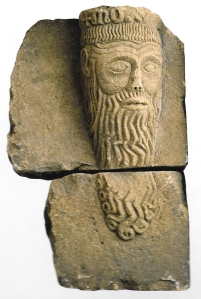
A very finely sculpted head was found during excavations of the refectory. Source: Evans 2008
A carving of a human head was found during the 1970 refectory excavations, now considered to be one of the finest pieces of Welsh Cistercian sculpture carved from sandstone that was used for all decorative features at the site. It may have fallen from the pulpit. It has an inscribed crown that reads “+MORVS.” It has been much debated, and in the absence of any princes or other local leaders with a similar name, is thought to represent either St Maurus, or early medieval religious scholar Rabamus Maurus. The excavator says that its style suggests a 13th Century date, and is a good example of the north Welsh school of stone carving. As with many objects of significant archaeological value deriving from North Wales, it was removed to the National Museum of Wales in Cardiff.
The last room in the south range was usually the kitchen, and this is no different at Valle Crucis where the kitchen not only linked to the south range refectory, but being on a corner, also served the west range refectory built for the conversi. In some refectories, such as Basingwerk in Holywell, the refectory was linked to the kitchen by a hatch, through which food could be passed, and it is possible that at Valle Crucis, built after Basingwerk and in a position to copy some of its most useful features, hatches in two of the kitchen walls were included for delivery of food to both south range and west range refectories.
The West Range

Part of the west range, showing the south wall of the abbey church at far right
There are only very few courses of the stonework left in the west range, making it difficult to get to grips with how it was used and what it looked like. In his 1976 excavation report, Lawrence Butler says that the west range was badly disturbed by Ministry of Works clearance of the site after they took it over, enthusiastically destroying archaeological levels and making it very difficult to determine historical sequences, and to tie sequences in with each other across the site.
In a typical Cistercian monastery, the west range was the domain of the conversi, at least at the time that the abbey was built in 1201. Butler’s 1970 excavations found four rooms, and parts of the abbey’s drainage system passing under the floors, one of which probably drew water from a natural spring further up the hill to make use of gravity to flush through the monastery’s drainage system. Most of the rooms were floored with small slate tiles.
There was a passage, and there was probably a day room. It is not entirely clear how day rooms were employed, but it is possible that when weather was poor or when an indoor location was required for the type of tasks carried out, they were where monks undertook craft work and other indoor activities. There was a refectory and there was a ground-floor cellar at the end of the range that served both conversi and choir brothers. Mirroring the east range, a second storey, which may have been half-timbered, contained a dormitory and latrine for the conversi.

The Black Book of Basingwerk, National Library of Wales reference NLW MS 7006D, probably copied at Valle Crucis. .Source: National Library of Wales
The tradition of using lay workers for maintaining abbey lands went into decline in the late 13th Century and early 14th century, and the Black Death wiped them out by the end of the century, so these premises would have undergone a change of use after that time. The dormitory probably served as sleeping quarters for the choir monks when the abbot took over the top storey of the east range. Some abbeys used the west range for extending their book collections and for copying books. As Valle Crucis was clearly an important centre for the production of Medieval literature, the west range may have been the most obvious place for the monks to work, once the conversi had left. The Black Book of Basingwerk, mainly containing the work of Welsh bard Gutun Owain, was kept at Basingwerk Abbey at the dissolution but is thought to have been copied at Valle Crucis. Remarkably it survives, and is the National Library of Wales
The North Range

The southern wall of the abbey church nave, marking the north alley of the cloister
The north alley of the cloister, which ran along the outer wall of the church, would have been fitted with desks along one wall, and used for reading Cistercian, hagiographic, historical and biblical texts. Reading, copying and meditating took up much of the monks’ time. Silent reading was uncommon, so a gentle murmur of sound would have accompanied the reading of texts, one of the few unregulated sounds that would have emanated from the otherwise quiet, if not completely silent Cistercians. There was an entrance here into the nave of the abbey church, into which the monks proceeded during their procession, and from there they returned to the east end, and their own inner sanctum.
The cemetery
 There is very little left to see of the cemetery. The best of the surviving tomb stones were moved into the former dormitory in the east range, and only a few token examples remain outside.
For 376 years monks had been living and dying at Valle Crucis, all of whom were granted burial rights within the abbey’s own cemetery, which lay to the south and east of the main buildings.
Original founding monks of the abbey, sent from their home abbey of Strata Marcella, would have been permitted to return to their home monastery to be buried, should they wish to do so. The abbots, priors and most notable donors would have been buried in the abbey itself.
Cleanliness and hygiene were built into the Cistercian way of life, and this will have helped avoid disease and illness, but the close proximity of monks leading the cloistered life must have led to much higher risks of transmission than those living in the surrounding countryside. Even with a infirmary on the doorstep, medicine was still in its very early infancy, and illness must have been endemic.
The abbey precinct

Artist’s impression of the Newry Abbey precinct. Newry was also Cistercian, another daughter of Whitland Abbey, founded nearly 50 years before Valle Crucis. Source: Philarm.com
Valle Crucis as it stands today, with its abbey church and four ranges, was the core of a much larger abbey precinct that would have contained a number of other buildings and features. A well house and a fishpond were preserved, but this is likely to be the tip of the iceberg. Unfortunately, no surveys or excavations have extended beyond the abbey itself.
A standard component of Cistercian monastic precincts was an infirmary, often with its own cloister, near to the main cloister, usually to the southeast. It would have been unusual for a Cistercian monastery to be without an infirmary, but so far none has been identified.
Typically, the precinct might include any of the following: a formal gatehouse; guest quarters; stables; a home farm with barns, dairy, hen house, animal sheds and slaughter house; a granary; a bakehouse; one or more mills; herb and vegetable gardens; an orchard; a smithy; a dovecot; and a brewhouse with malting lofts. Not all precincts with have had all of these, and some only a handful of them. Sometimes the entire precinct was surrounded by some sort of boundary that was more symbolic than defensive. Some abbeys and priories even had moats. Unfortunately it is not known whether Valle Crucis had any of these within its precinct.
Final Comments

The abbey’s fish pond. It is the only surviving monastic fish pond in Wales.
With an impressive church, substantial monastic ranges, a cemetery and a fish pond, Valle Crucis was a well built and admirably self-contained unit. It was built along the lines adopted by most Benedictine orders, and whilst it served the three main concerns of the Cistercian ethos: ora, labora, and lectio divina, it also served the economic, administrative and domestic needs of a community of monks bound together by the vow of stability for the duration of their lives.
The character of the rest of the abbey precinct remains unknown. There may have been an infirmary nearby, and there must have been a much larger precinct that could have included farm-related and other buildings, but it is not known where they were or how they were organized. A caravan park now covers part of the precinct area, and there is farmland on the other side of the stream, where other parts of the precinct may have been located.
There is considerable scope for future field investigations to understand at least some of the precinct and its limits.

Postcard of the interior of the abbey church, looking west, with gravestones lined up in the foreground (now in the former dormitory over the east range). Photochrom Print Collection. Source: Wikimedia.
Although the above description of the church and the ranges is a fair stab at the way in which the abbey was designed for monastic activities to be carried out, there are many unanswered questions about the exact layout in the abbey’s early history and how its drainage was organized (an important aspect of Cistercian monasteries). It is also unclear exactly how the west range was used after the demise of the conversi.
The next post, Part 3, takes a chronological romp through the architecture to see how the monastery changed physically over time, reflecting changes not only in Valle Crucis but in the Cistercian order itself during the 376 years of the abbey’s life. All parts are available, as they are written, by clicking on the following link: https://basedinchurton.co.uk/category/valley-crucis-abbey/
Bibliographic sources for parts the Vale Crucis series:
For sources see the end of part 1. Although I usually include a bibliography at the end of each post, the Valle Crucis posts have been rather long, so it seemed sensible to post all the sources used in the series on only the first and last posts.