Category Archives: Archaeology

100 years ago today: Finding Tutankhamen

Detail of an ivory box lid, showing Tutankhamen receiving flowers from his wife Ankhesenamun. Source: Wikipedia

Today in 1922, 26th November, Howard Carter broke the seals that protected the door to the tomb of a king called Tutankhamen, whose name had, until 1922,  been known from only a handful of small, relatively insignificant objects.  When he discovered the entrance to the tomb, Carter was full of hope that this was the longed-for culmination of his quest to find the only intact royal tomb in the Valley of the Kings in the religious centre of Egypt, now known as Luxor.

Peering through a small hole that he had broken through the door into the first chamber, and fearing that he would find yet another empty tomb robbed out in antiquity, the shimmering light of his candle picked out strange, shifting shapes, and the unmistakeable glitter of gold.  Carter spent the next decade cataloguing and conserving the fabulous, the fascinating and the downright staggering.  The king called Tutankhamen, little more than a name without a clearly understood identity, exploded into early 20th century consciousness and became an instant sensation.

In celebration of the centenary of this extraordinary find, the Royal Mint has released a Tutankhamen centenary £5.00 coin, and I am glad to see that Egyptologist and excellent author Joyce Tyldesley has published produced a new book about the king for 2022.  Otherwise the celebration of what was, for better or worse, a very British discovery seems to have confined itself to a few magazine articles and some largely recycled television shows.  Even in the wake of a somewhat lacklustre response to the annivrsary, it has been a good time to sit back and contemplate those heady days of the discovery 100 years ago, and to wonder why the entirety of the tomb’s contents remains unpublished today. 

Although the intention with the posts on this blog is to confine myself mainly to local subjects, this time there is no connection with the Chester-Wrexham area, but as I retain a personal interest in Egypt’s archaeology I decided to throw caution to the winds and go off-topic.  I started my working life as an archaeologist, but starvation forced me to find more predictable work.  It was many years later that a trip to the Eastern and Western Deserts of Egypt made up my mind to return to university to do a PhD on Egyptian prehistory. I was based at UCL, where I formed a long and ongoing relationship with the wonderful Petrie Museum of Egyptian Archaeology in London.  These, then, are my excuses for pure self-indulgence.  The Tutankhamen story is a great one and continues to be a marvellous and constantly emerging insight both into the history, archaeology and art of Egypt, and into how research is done and how history is written.

Biban el-Muluk (“Gates of the Kings”)

Frontpiece of Volume 1 of Description de l’Egypt. Source: Wikipedia

The discovery of the tomb of Tutankhamen tomb by Howard Carter in 1922 begins with Napoleon Bonaparte’s invasion of Egypt in 1798.  Along with his army, Napoleon sent his extraordinary team of “savants,” some 150 intellectuals and scientists who recorded everything they found about Egypt’s present and past.  The books produced by Napoleon’s savants, complete with beautiful illustrations of Egypt’s Pharaonic heritage, were now circulating in western Europe and America and being received with rapture.  Jumping on the bandwagon of this enthusiasm, museums started to send representatives to Egypt to secure items for their collections.  Some of these agents were little better than treasure hunters.  The objective was the discovery of beautiful objects to furnish museums, not the participation in historical research. 

Less than a quarter of a century after Napoleon’s arrival in Egypt, the French scholar and polymath Jean François Champollion (1790-1832) used the trilingual text on the Rosetta Stone to crack the translation of the ancient Egyptian hieroglyphic script, unlocking the door to Egyptian religious beliefs, social organization, political dealings and wars.  The year was 1822, a full century before the discovery of the tomb of Tutankhamen.  Many more decades of research were required to build up a body of translated texts, from which ancient Egyptian history might begin to be articulated and understood.

Although the man who eventually discovered the tomb of Tutankhamen was Howard Carter (1874-1939), who was a very different proposition from the run-of-the-mill glory hunters who had so often preceded him, it was not Carter but the retired American lawyer Theodore Davis (1838-1915) who had first stab at finding an intact tomb in Biban el-Muluk, Gateway of the Kings, more popularly known today as the Valley of the Kings.

Panorama of the Valley of the Kings. Photograph by Nikola Smolenski. Source: Wikipedia

The Valley of the Kings is located on the east bank of the Nile at Luxor. It had been the burial place of many New Kingdom (c.1550-1099BC) kings of Egypt since about 1490BC when Thutomse I selected it as his burial place.  The last king to be buried there was probably Ramesses X in around 1099BC.  Between these two burial events, some 390 years apart, around 65 royal and noble individuals were entombed in the Valley, but all of the known royal tombs had been robbed for their treasures, an activity that began during the ancient Egyptian period.  In spite of policing of the valley throughout the New Kingdom, and the promise of the death penalty for thieves, tomb robbery was endemic. Although some tombs were robbed via their entrances, other robbers had ignored the front doors, and instead tunnelled in from above or from the side to avoid detection.

Tomb robbery reached such a crisis point that In the 21st Dynasty (1070–945 BC, some 800 years after the death of Tutankhamen) the High Priests of the god Amen gathered together the mummified remains of the kings who had survived the tomb robbers, rewrapped them, provided them with labels and stored them safely in hidden tombs known today as caches.  The bodies were, themselves, rarely of little interest to tomb robbers, who were seeking the rich, valuable and easily accessible treasures that accompanied the dead, particularly precious metals that could be melted down and sold on, or jewellery incorporating precious gems, that could be broken up and re-used.

The East Valley. Source: Wikipedia

Robbing tombs was not, unfortunately, confined to antiquity, and as western interest in Egyptian art developed, new objects began to appear in the antiquities markets of Cairo and Alexandria.  Sir William Flinders Petrie, one of the pioneers of serious archaeological investigation in Egypt, was amongst those purchasing for research purposes, but others were hoovering up artefacts in much greater numbers to sell to both museums and private collectors.  The sudden appearance on the market of all these objects, some of them truly remarkable, raised obvious questions about who was delivering them and where they were coming from.  The burial grounds of the kings and nobles were all on the east bank of the Nile at Luxor, and nearby was a sprawling village.  It emerged that some local families had become expert at locating tombs, mainly of the nobility, some of which lay beneath their homes, and when there became a demand for ancient Egyptian objects, began to empty tomb contents piece by piece to earn a living from the sales.  By trickle-feeding objects into the antiquities market, they hoped to divert suspicion.

The possibility that there might remain an intact tomb was receding all the time.  Those royal tombs that had been opened by the early 20th century revealed splendid architectural achievements and stunning decorative schemes, capturing complex religious ideas, but relatively few objects had been found.  They hinted at former treasure troves, and that raised hopes in the minds of explorers.  This was the specific dream of Theodore Davis when he began his excavations in the Valley of the Kings in 1902.  Davis, a retired American lawyer, was granted the concession for the Valley of the Kings, in spite of his lack of archaeological training.  A concession is a type of license to excavate, and the system still operates in Egypt today.  When it is granted to an individual or institution, no-one else is permitted to excavate within the zone covered by the concession.


Funerary mask of Thuya. Source: Wikipedia

Davis was churning through the Valley of the Kings like a human bulldozer.  In 1905, three years after he was awarded the concession, the dream of an intact royal tomb suddenly became a realistic proposition when Davis found the tomb of Yuya and his wife Thuya, numbered KV46 (KV standing for King’s Valley). Yuya and his wife Thuya were non-royal nobles who were allocated a burial space within the Valley of the Kings because they were parents of Tiye.  Tiye became the wife of Amenhotep III, mother of Akhenaten and grandmother of Tutankhamen. The burial chamber of KV46 was was stuffed full of fabulous artefacts, an unambiguous but tantalizing indication that an intact royal tomb might yet be discovered.  In total, Davis is credited with discovering 30 tombs between 1902 and 1914.  He also found three items bearing the name of Tutankhamen, who appeared to be a missing king.  One of these was found in 1907 in the unpromisingly named Pit 54, which contained abandoned objects relating directly to the burial of the king, including embalming materials and storage jars.


Howard Carter (1874 –1939). Source: Wikipedia

In the meantime, Howard Carter could merely watch the work in the Valley unfold and keep himself busy elsewhere.  Carter was well respected in Egyptology circles both as an archaeologist and as a member of the Antiquities Service.  He had gone to Egypt as an illustrator and watercolour painter and excelled at both.  As an archaeologist he had trained under the most notable pioneer of archaeological techniques at that time, Sir William Flinders Petrie (1853–1942).  He had moved on to become Inspector-General of Monuments of Upper Egypt, as a much-valued member of the Egyptian Antiquities Service from from 1900 to 1904, when he resigned on a point of principal over an argument with a French tourist.  Carter remained in Egypt hoping for the right job to come along, hiring himself out in the interim for various projects, nibbling around the edges of ancient Egyptian exploration in Luxor.  One of the more useful short-term appointments that he picked up was the recording the objects from the tomb of Yuya and Thuya, which gave him an intimate understanding of both the contents of the tomb, and the potential of the valley.

George Herbert, 5th Earl of Carnarvon. Source: Wikimedia Commons

In 1906 Carter began excavating for the Earl of Carnarvon, who was in Luxor for his health,  Carnarvon had been digging on an amateur basis but had caught the archaeological bug and wanted to ally himself to a credible archaeologist who could help him to take his new interest on to a more viable and formal footing.  Carter and Carnarvon watched the discoveries being made in the Valley of the Kings with envious eyes.  After 12 years of excavation and discovery, Davis feared that the valley was exhausted.  It was only on his death in 1915 that the concession came up for grabs, and Lord Carnarvon moved fast to secure it for himself and Carter.  

The First World War interrupted all archaeological activity in Egypt, and Carter himself was employed as a diplomatic courier.  However, by 1917 life had settled down sufficiently for him to resume full time archaeological work in Luxor.  By the time that Carnarvon’s Valley of the Kings concession could be acted upon, Carter had a strategy.  He suspected that the fugitive references on objects to a king called Tutankhamen found by Davis, were far more important than anyone had yet understood.  Although various royal mummies had been identified in the 21st Dynasty caches, Tutankhamen was not amongst them.  Carter believed that the objects represented an as yet undiscovered tomb, one that might have escaped the attention of the ancient Egyptian tomb robbers, and he was sure that he could find it by digging down to the bedrock of the valley.

KV62

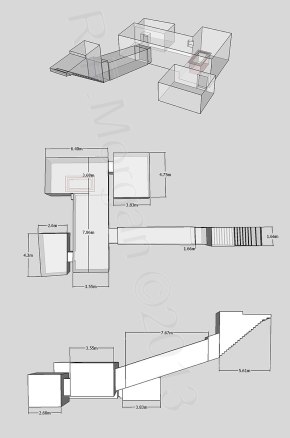
Isometric diagram showing the tomb of Tutankhamen, by R.F. Morgan. Source: Wikipedia

Carter’s first years of excavation in the valley were profoundly disappointing, both to himself as an archaeologist with hopes of making the ultimate discovery, and to Lord Carnarvon who was footing the bill.  Carter was taking no chances, and wherever he started a new excavation, worked down to the bedrock, but the untouched tomb remained elusive.   As Nick Reeves writes in The Complete Tutankhamun

Countless boys and men laboured to move thousands upon thousands of tones of limestone rubble by basked and hand-propelled Decauville railway.  But finds were few.

In 1922, after five years of fruitless investment in Carter’s hunt for an intact tomb, Lord Carnarvon was wearied of failure but Carter was able to convince him to fund one last season.  For Carter, knowing that he was the only person left believing that an intact tomb remained to be found, it was his last chance.  Carnarvon did not bother travelling to Egypt for the excavation season, so when Carter found a partially concealed tomb entrance on found 4th November 1922, Carnarvon was at home at Highclere Castle in Hampshire. 

Stephen Cross’s water flow diagram showing how flash floods cascaded into the central area where KV62, black dot on the far left, is located. Source:  Stephen Cross (reference in Sources)

In the event, the tomb’s doorway had been hidden not by some devious ancient Egyptian method of concealment but by the prosaic deposition of layers of liquid mud carrying loose stone and other debris.  Although it rains rarely in Luxor, when it does it, it does it properly, and the loose, dry sand, bits of stone and other surface materials dislodge instantly in the flash floods to become a thick, debris-bearing liquid that cascades down flood channels towards the floodplain below.  At the end of the 18th Dynasty (c.1292 BC), a particularly fierce flash flood is thought to have plunged into the central area from different directions to where tombs KV55, KV62 (Tutankhamen) and KV63 are located. Where the channels met, in a less steeply inclined part of the valley, it slowed, depositing some of its muddy load, 1m (3ft) thick, whilst the rest continued downhill, flooding KV7 (Ramesses II) and the enormous KV5 (the sons of Ramesses II).  The deposits then baked solid in the heat of the sun and looked very much like the surrounding natural bedrock.  Another royal tomb, dating to the 19th Dynasty, had subsequently been excavated over the top of Tutankhamen’s tomb, but had not breached it. Huts dating to a later pharaoh were built over the top of both tombs, keeping the entrance of KV62 safe for centuries.  

Carter’s policy of digging down through anything that stood in his way to reach the underlying bedrock was labour-intensive but rewarded him with the entrance to the tomb.  The seals that Carter could see on the partially uncovered doorway to the tomb were badly worn and there was nothing on the visible section to identify who the owner might have been. Even though those seals were unbroken, there was absolutely no guarantee that the tomb was intact, because robbers might have tunnelled directly into the chambers.  Frustratingly, Carter needed to notify Lord Carnarvon of the discovery, and await his arrival from England. He sent the following telegram to Carnarvon:

At last have made wonderful discovery in Valley; a magnificent tomb with seals intact; re-covered for your arrival; congratulations.

That night Carter wrote prosaically in his diary “Discovered tomb under tomb of Ramsses VI investigated same & found seals intact.”  The following day, he began to put in place some basic infrastructure to prepare for the opening of the tomb.  It must have been a period of terrible anxiety, but even with the limitations of travel in the early 1900s, Carnarvon and his daughter managed to arrive in Luxor less than three weeks later, on 23rd November 1922.  Work resumed immediately.

Once the door was fully cleared, the names framed in cartouches announced that this was the tomb of Tutankhamen, vindication for Carter, who had searched for the king for 5 years.  He must have been on Schrödinger-type tenterhooks, full of hope that he was about to make the biggest find in Egyptian archaeological history, but fearing that this was yet another robbed tomb.  The passage on the other side of the door had been blocked with rubble by its builders to protect it from potential tomb robbers, and this had to be cleared.  Another door was revealed. 

Inner coffin of Tutankhamen in the Egyptian Museum, Cairo. Source: Wikipedia

On 26th November 1922, the second door was breached with a hole large to act as an inspection hatch. Carter was probably expecting to find another corridor on the other side, a long slender pathway with wide shallow steps, sloping gently downwards and possibly flanked by one or two side chambers until it eventually reached a burial chamber.  These long, slender passage tombs, often with a dog-leg turn midway, were typical of a number of previous 18th Dynasty tombs.  Carter made the small hole in the new door, and pushed his candle through:

At first I could see nothing, the hot air escaping from the chamber causing the candle to flicker, but presently, as my eyes grew accustomed to the light, details of the room within emerged slowly from the mist, strange animals, statues and gold – everywhere the glint of gold.  For the moment – an eternity it must have seemed to the others standing by – I was struck dumb with amazement, and when Lord Carnarvon, unable to stand the suspense any longer, inquired anxiously, “can you see anything?” it was all I could do so get out the words, “Yes, wonderful things.”

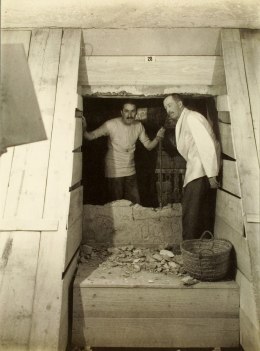
Howard Carter with one of his team examining the remains of Tutankhamen. Photograph by Harry Burton. Source: Wikipedia

Electric light was soon installed, a metal gate replaced the wooden grille in front of the door and a small but illustrious team of specialists was assembled to carry out the long, slow work.  Carter and his team continued to work in the tomb for six years, supervising the recording of the objects in situ, followed by their removal and accessioning into the Egyptian Museum in Cairo.

Now that he had found the tomb, Howard Carter was in no hurry.  He was organized and conscientious, taking years to empty the tomb, maintaining detailed visual and written records as he proceeded.  His diaries, notes  and record cards are still available, digitized for online use by the Griffiths Institute.  Perhaps the most immediately powerful record of the tomb content was provided by the photographer Harry Burton, who did a sublime job of capturing images of all that was found.  His photographs are works of documentary art, forming a superlative record of how the objects in the tomb were deposited.  Although the objects in glass cabinets in the Egyptian Museum in Cairo are beautiful, there is nothing like Burton’s photographs for understanding what the tomb looked like when it was found.

The antechamber of KV62 as it was found, photographed by Harry Burton. Source: Wikipedia

The tomb was emptied section by section.  It would take Carter another decade before the job of recording, removing and conserving the objects in the tomb was complete.  The sheer immensity of the task is hinted at by the photographs, but the simple fact that over 5000 objects had been crammed into that small set of rooms gives a better indication of the task facing Carter and his team.  The sheer richness of the just the smaller objects found in the tomb are indicated by this list in the book The Complete Tutankhamun by Nicholas Reeves, on the contents page for Chapter 5:

Guardian Statues; Ritual Figures and Magical Objects; the shabtis; Little Golden Shrine; Wooden Funerary Models; Ritual Couches; Jewellery, amulets and regalia; Clothing and Textiles; Cosmetic Objects; Games and Game Boxes; Musical instruments; Writing materials and equipment; ‘Heirlooms’; Chariots and chariot equipment; weaponry; Sticks, staves and fans; Bends and headrests; Chairs and thrones; Boxes and chests; Tools and lamps; Metal and stone vessels.; Faïence and glass; Wine jars and other pottery; baskets; foodstuffs.

Pectoral with a translucent Libyan Desert Glass scarab at its centre. Source: Archaeology Wiki

Some of the objects were more unexpected than others.  An iron dagger made of meteoric material that had presumably been found in the desert was included in the mummy bindings.  A huge piece of Libyan Desert Glass, probably created during meteorite impacts on the desert sand, was incorporated into a stunning “pectoral,”  a type of elaborate necklace that sat on the chest.  These materials are very rare, and clearly had a unique intrinsic value in the 18th Dynasty.

That all of this remained in the tomb, with an awful lot more besides, is very surprising given that the tomb had been robbed twice during the period that the valley remained in use, probably not long after the tomb was first sealed, and certainly before the flash food at the end of the 18th Dynasty.  Both incursions left evidence.  The first robbery accessed the tomb via the entrance, after which the corridor between the entrance and the first internal door was blocked with rubble and the door re-sealed.  The second robbers accessed the tomb via a tunnel excavated through the surrounding rock.  Carter’s description of the scene resulting in the Annexe is evocative:

One [tomb robber] – there would probably not have been room for more than one – had crept into the chamber, and had then hastily but systematically ransacked its entire contents, emptying boxes, throwing things aside, piling them one upon another, and occasionally passing objects through the hole to his companions for closer examination in the outer chamber.  He had done is work just about as thoroughly as an earthquake.

Carter estimated that some 60% of the jewellery was stolen, based on dockets made by the priests at the time of the burial which, when assembled, made up a form of inventory.  It makes sense that the robbers would have focused only on the objects that were both very valuable and most easily portable.  Items that could be easily sold on or melted down would have been prioritized.  Gold might be chipped off larger objects, but the bigger the object, the more likely it was to be left behind.  Still, a lot of small items and gold were left behind, so why did the robbers not return to complete the job?  It seems most likely that they were discovered and then dealt with as usual, being subjected to torture before being put to death, both as punishment for desecrating a royal religious site, and as a warning to others.  Once the tomb’s entrance was certainly resealed, the act of the muddy flood waters completed the job of disguising the entrance, until Carter came along.

A political time-bomb

Howard Carter and Lord Carnarvon at the door of the burial chamber. Source: Wikimedia Commons

As the tomb’s fame gathered a momentum all of its own, it also became a ticking bomb. Lord Carnarvon, in a bid to simplify dealings with the media, made the colossal diplomatic error of signing a contract with The Times newspaper to grant them exclusive rights to the news emerging from the tomb, offending both Egyptian and international media outlets.  Worse, it  endowed the enterprise an unlooked for and very undesirable air of colonialist arrogance that gave the governing Egyptian nationalists all the ammunition they needed to draw attention to unwelcome foreign interference in Egyptian state affairs. To all intents and purposes, Carnarvon and Carter were hijacking access to Egypt’s own heritage.  The tension was corrosive, and impacted the relationship between Carnarvon and Carter, who were deeply divided on how to deal with the situation.

When Lord Carnarvon died on 5th April 1923, aged 57, from an infected insect bite, Carter found himself without a buffer zone between himself and the various interested and aggrieved parties.  He was no diplomat, and contrived to alienate all the key government and administrative officials whose support he should have been seeking.  In a remarkable act of pique, Carter downed tools, stopped work, citing “the impossible restrictions and discourtesies of the Egyptian Public Works Department and its antiquity service.”  It was a foolish move that not only infuriated the Egyptian authorities but gave them the leverage they needed to oust him.  Carter had infringed the terms of the concession, and was now banned from the tomb.  Legal action failed, and Carter left the country, leaving the Egyptian government to declare that it intended to continue the work itself.

Tourists gathered around the entrance of KV62 in 1923, the year after the discovery. Source: Wikipedia

Carter was only permitted to return after a national emergency was triggered by the murder of a British diplomat, followed by the downfall of the nationalist government and the renewal of firmer greater British control over Egypt.  A new concession was granted in January 1925, but this time there was to be no exclusive deal with The Times, and there was to be no attempt to remove any of the tomb’s contents from Egypt.   Carter died in 1939, only seven years after completing his work on the objects found in the tomb. He had been planning a six-volume publication of the tomb, but it never happened.

Howard Carter and Lord Carnarvon had found the tomb of Tutankhamen, and a well-chosen team of specialists examined and emptied it, but there was still considerable research required to learn about the king himself, and to learn more about what the objects in the tomb could impart to researchers about 18th Dynasty Egypt itself.  Today, although many individual academic papers have been written by specialists in certain particular fields, like leather or jewellery, and dozens of coffee table books have been written, no single, centralized co-ordinated project based on the tomb has been masterminded.  Although Tutankhamen the tourist attraction and work of art are very familiar, Tutankhamen the ultimate resource for primary research has somehow fallen between the gaps.

There are seriously strong arguments for getting to grips with the entire collection as a single co-ordinated project, leveraging worldwide specializations and skills, with research underpinned by a strong theoretical and methodological approach.  Storing and exhibiting items is not the same as understanding them, and digging without publishing leads to dead ends.  Carter died before he could publish is planned 6-volume treatise, and although subsequent researchers have published piecemeal research papers according to their research interests, no centralized project has been attempted.  At the very least, an online relational database of the objects in the Tutankhamen inventory, listing all the existing publications based on it, would be a valuable resource, to complement the Griffith Institute’s excellent online databases of the original records made by Howard Carter, Harry Burton and others.

Final Comments

Howard Carter’s discovery of Tutankhamen, sponsored by Lord Carnarvon, remains a great story, well worth re-telling 100 years later.  Carter died before he could publish his 6-part planned treatise on the tomb, which remains a gap that has yet to be filled.  Even so, the discovery remains a sensational find, with works of art that even Carter could not have imagined finding, filling gallery after gallery at the Egyptian Museum in Cairo.  Flipping through a book of pictures of the tomb, I continue to be amazed at how it could all have fitted into such a tiny set of spaces.  Each piece is magnificent in its own right, and together the collection provides material confirmation of the story of the afterlife told in the hieroglyphic texts on tomb walls, building a vivid impression of the hopes and ambitions of ancient Egyptian royalty and nobility.  In so many ways, Carter gave Tutankhamen an afterlife that the young king could never have imagined.

sdfsadfsad

Note:  Tutankhamen versus Tutankhamun

The name of Tutankhamen. Source: pharaoh.se

Up until relatively recently the anglicized name of the king’s name was written as “Tutankhamun,” although Howard Carter spelled the name with an “e” instead of the more familiar “u” in his books about the tomb.  Ancient Egyptian script omitted vowels, and a series of conventions were therefore used to make ancient Egyptian words pronounceable today.   As standardization has become increasingly desirable, the new system of dealing with the problem of missing vowels is to use the letter “e” where no other clues are available.

To explain a little further for anyone interested in how this works, the process of anglicizing hieroglyphs goes through two steps.  The first step, which you can see in the above image from the pharoah.se website, shows a line in italics, and this is called transliteration.  A formalized set of characters and symbols are used to capture a writing system that may include elements not used in English (or German, French etc) but are recognizable to anyone studying ancient Egyptian texts.  As you can see in the italicized line of transliteration above, as well as familiar alphabet characters there is an apostrophe and an “h” with a curved line under it.  For publication and general chat, these are simplified into something that can be expressed using the English alphabet.

Alabaster vase from Gurob showing cartouches (name frames) of Tutankhamen. UC16021. Source: Petrie Museum of Egyptian Archaeology

In the case of Tutankhamen this breaks down as follows (keep looking back at the hieroglyphic name shown above, with transliteration and translation).

Tutankhamen’s name is composed of three separate words, which Carter wrote as Tut-Ankh-Amen but are today run together as Tutankhamun (older convention) or Tutankhamen (newer convention).  The middle hieroglyph in “Tut” (the little bird) is transliterated as a “w”, and the “a” in ankh is a hieroglyph  that has no real equivalent in English and is transliterated with the apostrophe symbol.  The third element of his name, which is the name of the great god Amen, is actually transliterated  “imn,” the “a” of Amen being a hieroglyph usually transliterated as an “i.”  In older books that tradition was to add a “u” between the “m” an “n” to make Amun, which made it easy to pronounce, but an “e” is the new standard. As this one name illustrates, the business of transliterating ancient Egyptian names into modern equivalents has a long way to go before real standardization is achieved.

You may be puzzled because the name Amen is written first.  The name of the king is always written in his cartouches in the order Amen-Tut-Ankh.  This is because the name of the god always takes precedence over the name of the king.  This is termed “honorific transposition.”  But his name was Tut-Ankh-Amen.  Go figure 🙂  

Finally, Tutankhamen was actually born Tutankhaten, and changed his name on the death of his father Akhenaten.  But that’s another story.


Sources

This was written for fun, so I wrote most of it off the top of my head.   I have, however, checked important details, dates and quotes in the books below.  Any errors are of course my own.

Books and papers:

  • Carter, Howard 1927, republished 2007.  The Tomb of Tutankhamen. Max Press (with an introduction by John Romer)
  • Carter, Howard and Mace, Arthur 1923, republished 2004. The Tomb of Tut Ankh Amen: Volume 1: Search Discovery and the Clearance of the Antechamber. Duckworth Egyptology
  • Cross, Stephen. W., 2008. The hydrology of the Valley of the Kings. The Journal of Egyptian Archaeology, 94(1), 303–310.
  • Frayling, Christopher 1993. Protecting Tutankhamun. Conservation Journal. July 1993, Issue 08
  • Reeves, Nicholas 1990.  The Complete Tutankhamun. The King, the tomb and the royal treasure. Thames and Hudson
  • Tyldesley, Joyce 2013. Tutankhamen’s Curse: The developing history of an Egyptian king. Profile Books
  • Tyldesley, Joyce 2022.  Tutankhamun. Pharaoh-Icon-Enigma.  Headline.

Websites:

Griffith Institute
http://www.griffith.ox.ac.uk

Harry Burton photographs
http://www.griffith.ox.ac.uk/gri/carter/gallery/

Excavation journals and diaries made by Howard Carter and Arthur Mace
http://www.griffith.ox.ac.uk/discoveringtut/journals-and-diaries/season-4/journal.html

Howard Carter watercolours, prior to the discovery of Tutankhamen. Griffith Institute.
http://www.griffith.ox.ac.uk/gri/Carter_birds.html

Mummy Bandage from Tutankhamun’s Embalming Cache (Pit 54) ca. 1336–1327 B.C.
https://www.metmuseum.org/art/collection/search/548838

The Amarna Project
https://www.amarnaproject.com/

The Theban Mapping Project
https://thebanmappingproject.com/

The Getty Conservation Institute: Conservation and Management of the Tomb of Tutankhamen (2009–2019)
https://www.getty.edu/conservation/our_projects/field_projects/tut/

Royal Mint Tutankhamun Centenary £5.00 coin
https://www.royalmint.com/shop/limited-editions/discovery-of-tutankhamuns-tomb/the-100th-anniversary-of-the-discovery-of-tutankhamuns-tomb-2022-5-brilliant-uncirculated-coin/

Egyptological
Libyan Desert Glass and the Breast Ornament of Tutankhamen
By Andie Byrnes. Published on Egyptological, September 9th 2011, Magazine Edition 2
http://lancastrian.net/kemet/2011/09/09/libyan-desert-glass-and-the-breast-ornament-of-tutankhamen-4291

The Dominican Friary at Rhuddlan

Introduction

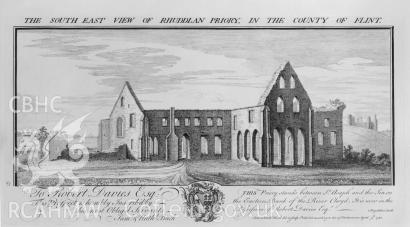
Rhuddlan Friary by Samuel and Nathaniel Buck 1742.  Click to see the larger image. Source: Coflein

Prior to visiting Edward I’s 1277 Rhuddlan Castle (upcoming) I was having a look on the Ordnance Survey map of Rhuddlan, and saw that a little way downriver from Edward I’s castle, and beyond the earlier motte-and-bailey castle of Twthill, there is a site marked as “remains of a friary.”  I was unaware of anything there, so I had a look through my books and on the Coflein website.  Sure enough, there was a substantial Dominican friary there, established in 1258 by Llywelyn ap Grufudd (Llywelyn the Last), 19 years prior to Edward I’s castleIt went the way of the greater percentage of monastic establishments, and was dissolved by Henry VIII in 1538.  In some texts it is referred to as a priory, but the friaries were originally quite different from abbeys and priories.

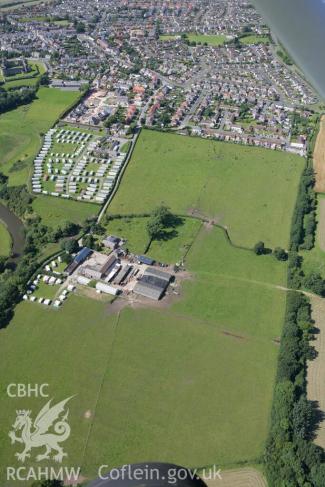
The site of the Rhuddlan Dominican Friary today. The farm in the foreground lies over the site, and some of the buildings incorporate elements from the Medieval building. Source: Coflein

Today there is almost no sign that it ever existed.  This is by no means an isolated case of a monastic or mendicant building being erased from the landscape.  Of around 270 friaries of the different orders, only 15 in England and Wales have survived well enough to determine their layout and appearance.  Some are known only from their archaeological remains and others have yet to be investigated archaeologically and therefore appear, for all intents and purposes, to have vanished.  In the case of Rhuddlan Friary, there are details of its past that can be recovered even without any ruins to examine, although it has been a jigsaw assembled by many people and published in different places.  The earliest useful account, by Harry Longueville Jones in 1847, worked hard to pull together the various tenuous threads, as its author describes:  “The unsatisfactory complaint, of fewness of materials for the history of Religious Houses in Wales, applies with peculiar force to that of the Priory of Rhuddlan; and the utmost that can, at present, be attempted, towards an account of it must consist in the stringing together of various brief uncorrected relics, scattered up and down in various books and a few manuscripts.”  It still feels a bit like that, but it is work like that of Jones that paved the way for people like me.

Over the site where it once stood there is now a working farm and caravan park, formerly Plas Newydd and currently called Abbey Farm.  It does, however, incorporate some stonework from the former friary, and parts of it are therefore of considerable interest.  The farm is private property and not open to visits from the general public, although a public footpath skirts it.  Fortunately, there are various accounts and photographs available of the surviving masonry and tomb slabs.  In addition, much of the friary church was still standing in the middle of the 18th century, when a drawing of it was made by Buck (above) showing a simple but substantial layout with gothic styling, with Rhuddlan Castle in the background, and this has allowed assessment of what was there at the time of the dissolution.  It has also been mentioned in a number of Medieval documents.

Rhuddlan. The map on the left shows the location of Rhuddlan (source: Google Maps). The map on the right shows the location of Rhuddlan Priory in relation to the 11th century Twthill motte-and-bailey castle and Edward I’s 1277 stone castle (source: Ordnance Survey Explorer 264 – Vale of Clwyd)———–

The Dominicans

Saint Dominic (c.1170–1221), portrayed in the Perugia Altarpiece by Fra Angelico. Galleria Nazionale dell’Umbria, Perugia. Source: Wikipedia

The Order of Preachers (Ordinis Praedicatorum), better known as the Dominicans, Black Friars or Preaching Friars were founded in Toulouse, France, in the early 13th century by Spanish priest Dominic of Caleruega.  Attwater describes a Dominican friar as “one who combines elements of the earlier monasticism – its dedicatory vows, its communal life, its daily round of praise of God in church – with the manifold works of the pastoral ministry.”  In a pre-plague era where overpopulation was a serious problem, and the poor and uneducated were clustered into many  towns, the role of the mendicant orders was conspicuous and often impressive.

The order of St Dominic (c.1170-1221) was officially recognised by the papacy in 1216.  Like the other monastic and mendicant orders they had strict rules, but unlike the majority of other British monastic establishments, they based themselves not on the rules of St Benedict but on the Rule of St Augustine.  They were therefore much closer in their practises and values to the Austins, Franciscans and Carmelites, also mendicants, than any of the orders based on the Rule of St Benedict that dotted the British rural landscape.  The three main focal points of the Dominicans were:

  1. Scholarship and intellectual integrity were seen as essential to salvation for heretics and the poor, whose ignorance led them astray.  Dominicans recruited amongst graduates and clerics. Robust theological training was given to all new Dominican friars, and education was essential to their ethos
  2. A vow of corporate as well as personal poverty was also integral, meaning that, at least in the first century of their activities, they could not engage in commercial activities and were dependent on charity for their survival, and would accept land and houses with which to establish themselves, or money with which to purchase them (unlike the Franciscans who rejected the ownership of property)
  3. A mission to both preach to and lend aid to the poor, weeding out heresy was fundamental to their ideas, following the example of the apostles to evangelize, leading the misguided and disadvantaged to salvation

St Dominic’s house, Maison Seilha,n at Place du Parlement Chapelle, Toulouse, France. Source: Wikipedia

The Dominicans organized themselves with a system of centralized government, an elected body that resembled the General Chapter of the Cistercian order (an annual conference to administer and rule the order).  The Dominican friaries were divided into provinces, each of which was headed by an elected provincial prior.  These answered to a master-general who was himself elected.  Each friary had a prior at its head who was elected by the chapter, and not only attended the annual chapter but was also accompanied by another member of the same priory whose role was, somewhat disconcertingly, to report on the prior’s performance.  This type of performance review and downward as well as upward accountability is very modern in concept.  It was this organization and accountability that turned the Dominicans from wandering clerics into a force to be reckoned with, which became important as the different mendicant orders found themselves increasingly in competition for donations, both with each other and the older institutions.

The Dominicans arrived in England in around 1221, and were known as the Black Friars or Friars Preacher.  They spread first to Ireland and then, in 1230, to Scotland. There were five Dominican houses in Wales, two of which, Bangor and Rhuddlan, were in north Wales.  By 1260 the Dominicans had persuaded both wealthy and poor that there was much to recommend them.  They had around thirty six houses in England, nine in Scotland and the five in Wales, and by the end of the 13th century there were around 60 in total.

The earliest preaching took place in public places like market squares where a sizeable audience could be gathered.  As they became established and increasingly popular, and were able to use donations to found churches to which audiences could be attracted, they began to preach on their own premises.  They tailored their preaching to their audience, and presented themselves as men of the people, sharing their poverty, quite distinct from both the upper echelons of society and the more established Benedictine monasteries.  At the same time they also appealed to the new commercial classes in the urban centres that they favoured.

Dominicans believed that ignorance was at the heart of heresy and defection from God, and that education would provide the ignorant and the poor with the tools to achieve salvation.  Throughout Europe the teaching of theology and logic continued to be of importance to the Dominicans, and each Dominican priory was responsible for setting up its own school to teach the basics, while they also set up regional schools for the further education of those friars who were academically promising. Leading Dominicans increasingly contributed to the development of Medieval universities.  Their mission to educate the laity was given an extra relevance by the decision of the Fourth Lateran Council of 1215, which required that every person should make confession to a priest at least once a year.  This required the general public to understand exactly what was required for a blameless life, and what steps were required in order to make a valid confession.

The extensive ruins of the massive Fountains Cistercian Abbey in Yorkshire. Source: Wikipedia, photograph by Mike Peel

Whereas Benedictine monks renounced all personal possessions and properties, the monastic houses in which they lived and worshipped could be very wealthy indeed, and were often fairly massive and elaborate structures.  Fountains Abbey (Benedictine, Yorkshire), Glastonbury (Benedictine, Somerset) and Lewes Priory (Cluniac, Sussex) are good examples.  The mendicants, by contrast, were permitted only to acquire enough resources to survive, via begging for alms or through charitable donations and bequests.  Even so, the friars of different orders were so popular, amongst the wealthy as well as the poor, that churches grew from simple places of worship to much grander affairs.  As J. Patrick Greene puts it “the more successfully the friars gave enabled the wealthy to gain spiritual grace through the vicarious experience of poverty, the less it became a reality for the friars themselves.”  This can be seen at the Franciscan friary in Oxford and the Dominican friary in Chester. Hinnebusch expands on this, and suggests that in the 13th century the Dominicans were also able to generate income of their own:  “Most houses had gardens, orchards, groves, and sometimes vineyards and fish ponds. Undoubtedly some houses were able to sell part of the produce from these sources and thus supplement the alms of the people.”  At least in the early years of their mission, their properties were not rented out, certainly as this was in direct violation of Dominican rules, which were strictly enforced.  There is more on this in connection with Rhuddlan Friary, below.  In the later Medieval period, however, matters changed as Hinnebusch explains:

Pope Gregory X. Source: Wikipedia

In 1261, a papal bull allowed the Order to accept revenues for the purchase of ecclesiastical ornaments, vestments, and books. In 1266 friars were allowed to accept inheritances which would have come to them if they had remained in the world. These could be held or converted into money for the maintenance of the community. In 1274 after the attack on the mendicant orders at the Council of Lyons, Gregory X declared that the friars could “accept properties with a safe conscience.” The bull Supra Cathedram of Boniface VIII, 1299, in obliging the friars to give a fourth of all legacies, bequests, funeral charges, and other donations to the parish church struck a death blow to mendicant poverty. Under these conditions the quest and voluntary gifts were no longer sufficient, and the Order was obliged to seek for fixed sources of income.

Inevitably the mendicants stepped on the toes of the secular clergy, those bishops and parish priests whose congregations and incomes were under threat by the arrival of the mendicants, particularly as the mendicant churches grew and incorporated larger congregations.  Papal intervention was sought on several occasions, but the tensions continued.

——–

The Dominican Friary at Rhuddlan

The foundation of the friary

The Dominican Friary at Rhuddlan was established by Llywelyn ap Gruffud (Llywelyn the Last) in 1258, 19 years before work began on Edward I’s castle nearby.  He is also thought to have founded the priory at Bangor in the mid-13th century.  It was a tradition amongst the Welsh princes to found monasteries.  Although Cistercian monasteries were particularly prestigious amongst the princes, with one in each of the main cantrefs, Llywelyn was not a lavish spender on elaborate monastic projects, although he occasionally made financial gifts to those houses established by his ancestors.  He became a benefactor of the very small Cistercian monastery at Cymer near Dolgellau that had been established by Gruffudd ap Cynan of Gwynedd in 1198, as well as of Beddgelert Augustinian Priory near Bangor, thought to have been established by one or more of the lords of Gwynedd in 1200.  He made a loan to an abbot of Valle Crucis Cistercian Abbey near Llangollen, which had been founded by Madog ap Gruffydd Maelor, ruler of Powys (north), in 1201.  Perhaps when it came to founding his own houses, he preferred the ideologies and practices of the Dominicans; it is also possible that they represented a rather less eye-watering investment.  It should be noted that Samuel Lewis, in his 1849 Topographical History of Wales, believed that it had been established in 1197 by Ranulf III of Chester, but he gives no explanation for his thinking.  

Rhuddlan Friary was established on the River Clwyd, 4.8km (3 miles) to the sea on the cost of North Wales, set above the floodplain, with a short cliff separating it from the valley below.  A town had been here since the Anglo-Saxon period, taking advantage of the best pace to ford the river.  William the Conqueror is thought to have ordered the building of the Twthill motte-and-bailey castle which was built in the 11th century and was probably still maintained for defensive purposes when the Dominicans set up their friary.

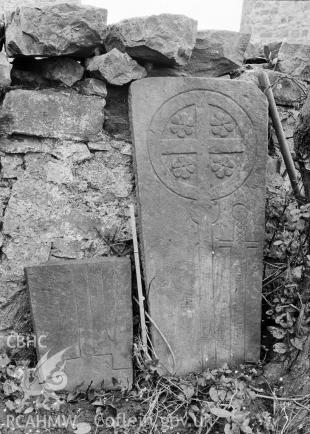
Inscribed tomb slab. Source: Coflein

There were only two Dominican houses in north Wales, the other being in Bangor, established in 1251, seven years earlier than Rhuddlan, again probably by Llywelyn ap Gruffud.  Wales was not strong on mendicant orders in general, primarily because they favoured urban areas, and Wales in the 13th century lacked the busy towns that were growing up in England.  There was only one Franciscan house in north Wales, on Anglesey, and a single Carmelite house, at Denbigh.  Given that there were so few mendicant orders represented in north Wales it would be interesting to understand why Rhuddlan, of all the possible towns in Wales, was selected as an attractive site for the Dominicans.  Although it may have had something to do with Llywelyn himself, it is also possible that the founding friar may have had input, and may have had a connection to Rhuddlan.

Whether parish church, abbey, priory or friary, all religious establishments came under the wing of a regional ecclesiastical body, a diocese, headed by a bishop.  By 1291 Rhuddlan Friary came under the diocese of St Asaph (in English), Llanelwy (in Welsh), together with other ecclesiastical deaneries (groups of parishes) like Aberconwy Cistercian Abbey, Strata Marcella Cistercian Abbey near Conwy, Valle Crucis Cistercian Abbey near Llangollen and Basingwerk Cistercian Abbey near Holywell.  Rhuddlan Friary, Valle Crucis Abbey and Aberconwy Abbey all provided St Asaph with bishops.  Rhuddlan’s Prior Anian II (or Einion II) became the bishop of St Asaph in 1268.

It is not known where the friars came from.  Dominican scholarship was an important component of their ethos, and the Rhuddlan friars would have received training when they joined the order, although Latin would have formed a common language, and a common bond.  Rhuddlan had passed between the English and Welsh through its history, but because friars mingled with communities, it is probable that at least some of the friars must have been Welsh speakers.  Attwater points to the dozen Dominican bishops that he knows of with English names, but says that the impression they give is misleading, and that Welsh friars predominantly had Welsh names.  Potential sources for friars to populate a new friary could have included the other Welsh friaries, but also reasonably nearby was Chester, where a Dominican friary had been established in 1236 and was doing very well.

The friary architecture

Although there is almost nothing left of the Dominican friary at Rhuddlan, it will have been built on the lines of other Dominican communal establishments.  Like the more numerous Benedictine monasteries and priories, a Dominican friary consisted of a church, which made up one side of a complex of buildings that were arranged in  square or rectangle around a garden, the garth.  The church would usually be on the north, and the domestic and administrative buildings were incorporated into the other buildings over one or two storeys.  The image below shows the layout of the mainly 14th century Dominican friary at Norwich, as an example, in this case fairly elaborate but, like most Dominican friaries, the church had no side transepts which makes them look significantly different from Benedictine-style abbeys and priories.

Ground plan of Norwich Friary. Source: Giraud, E.J. and Linde, .J.C. 2021 – via Google Books

The drawing by Buck shown at the top of the page and shown again below has been invaluable to architectural experts who have been able to clarify the main features.  The following is taken from Clapham, published in 1927, who has done an excellent job of deconstructing the image and reconstructing the friary, and concludes that the friary was built on a “much more ambitious scale than was usual among lesser friaries.”

Rhuddlan Friary by Buck. Source: Coflein

The whole length of the building shown was no doubt occupied by the dorter [dormitory] on the first floor and at its north end is some indication of the junction with the church, though even then this building had been entirely destroyed. Projecting eastwards from the range is a gabled structure, with three lancet-windows in the east end and three in the south return wall; this was undoubtedly the chapter-house with a room above it. Further south, in the main range, is the archway of a passage from the cloister, and still further south a chimney-stack, probably that of the fireplace in the warming-house.
At the south end of the range is a large doorway, at the dorter-level, evidently that leading to the rere-dorter [latrines], the ruins of which, with its connecting bridge, are also shown. Of the southern range of the cloister court, the eastern part of the inner or north wall is still standing and contains four small square-headed windows of red Chester stone, set high in the wall, above a string-course which probably marked the level of the cloister-roof. The rest of the range seems to have been rebuilt, but the south side of it is shown in
steep perspective in Buck’s view. The only other ancient portion of the existing buildings is the northern portion of the outer wall of an outbuilding on the west of the yard.
It appears to have projected westward from the original western range, as there is a return angle at the south end. It contains two pointed windows, probably of the fourteenth century, and blocked with ashlar. The rest of this range contains other pointed windows, but they appear not to be original and the walls themselves to be of post-suppression date.

Inscribed stones in vicarage wall at the Friary near Rhuddlan Church, taken by Leonard Monroe. Source: Coflein

At Abbey Farm today, the farmyard is thought to occupy the site of the cloister garth and part of the south cloister range, with the farmhouse occupying the site of the church, and the southern range perhaps incorporated into another farm building where blocked windows probably date to the 14th century.  Modern buildings have obscured what was probably the cloister, c.26-28m square.  Medieval building materials have been identified and in one of the farm buildings at the east of the farm complex, with some sepulchral slab fragments  incorporated into the walls, as well as a niche with a heavily eroded 14th century effigy still visible in it, shown below.  Clapham picks out details that were incorporated into the farm buildings that sit over the site, including bits of architectural and sepulchral masonry (tomb slabs).  Some of the tomb slabs are shown on this page, thanks to a digitization programme by Coflein, but with no attempt to put them in any particular order.  See captions for credits and links.

Built into the garden-wall, to the north of the yard, are portions of a moulded and cusped arch of early fourteenth-century date and probably part of a tomb recess. Of the various funeral monuments built into the walls of the buildings round the yard . . . .

Engraving incorporated into a wall.  Photograph taken by Leonard Monroe. Source: Coflein

On the east side of the yard: (a) effigy in high relief of a civilian in hood with flap, belt with skirt of gown tucked into it and holding in both hands a baton, or possibly a mace, probably fourteenth-century; (b) part of a coffin-lid with inscription.

On south side of yard: (a) incised slab with figure of an archbishop1 in mass-vestments with cross-staff and marginal inscription to William Freney, archbishop of Rages, c. 1290.
This slab has now been removed to the parish church; (b) slab with raguly cross in relief, head in a quatrefoil, sword at side and inscription to Robert, son of Robert de Bridelton, early fourteenth-century.

On west side of yard: coffin-lid with elaborately enriched cross on stem inscribed ‘Hie jacet [here lies] Snaisii,’ the rest of the inscription destroyed, thirteenth-century. The inventory of goods taken at the suppression mentions the quire with a table of alabaster on the altar and new stalls, two bells in the steeple and the kitchen.

There are references to the friary church having a particularly magnificent rood screen, which attracted pilgrims, about which more below.  In 1849, Samuel Lewis writes that “near it [the friary] is a fine spring, from which the priory derived water, conveyed to it by leaden pipes, that were taken up not many years ago: from this spring the town of Rhuddlan is now supplied during seasons of drought”

Unlike the better known Cistercian monasteries of north Wales, which were built in areas where the monks could worship in isolation, as separate from the world beyond the cloister as possible, the Dominicans always intended to be part of the local community and their friaries were built either on the edge of towns, like Rhuddlan, or within them, like Chester’s Dominican friary.  The friars’ lives were a balance between the communal living and worship that too place within their monastic premises and the preaching that they carried out in neighbouring communities.  They built their friaries in or near towns and the friars would have been familiar figures around the town of Rhuddlan where they would have mingling with townspeople and recruiting support in their missionary roles.

How the friary sustained itself

Inscribed stones in vicarage wall at the Friary near Rhuddlan Church, taken by Leonard Monroe. Source: Coflein

The friary appears to have been well provided for throughout the 13th century, and must have had significant status locally.  By 1283 there were 23 friars at Rhuddlan, a very healthy number.  In Cardiff and Haverfordwest, both Dominican friaries, numbers are recorded in 1285 as 30 and 39 respectively, but Rhuddlan was rather more remote.  In 1268 Rhuddlan Friary’s prior “Anian (Einion) of Nanneu” became Bishop of St Asaph, a significant honour.  It is unlikely that such an appointment would have been made from a minor establishment, a suggestion supported by other appointments to the position from the big Cistercian abbeys of Aberconwy and Valle Crucis in north Wales.  Records of payments to the monastery also give a sense of its importance, including a payment in 1281/1282 at the time of the birth of the princess Elizabeth at Rhuddlan, Edward and Eleanor’s 5th child, of 7s 8d to the friars of Rhuddlan and 1s 1d for the brethren of the hospital of Rhuddlan (about which more below); a bequest in the will of Bishop Gervase de Castro in 1370 of 60 shillings and another bequest, this time of 20 shillings, from Llewelyn ap Madoc, bishop of St Asaph, in 1373. 

The friary also appears to have been taking steps, beyond accepting alms and bequests, to care of itself.  Hinnebusch comments “At Rhuddlan in 1534, the prior leased several gardens and an apple orchard ; two years later a second apple orchard was leased. When the house was sup pressed, the sale of the effects of the priory included kine and pigs.”  Kine were a type of cattle.

Map showing Rhuddlan on the Welsh pilgrim routes, which link north and south Wales. See the following link for the full UK map. Source: The British Pilgrimage Trust

The excellently researched academic Monastic Wales Project website states that “Pilgrims flocked to visit the rood at Rhuddlan,” but does not expand on the comment.  The rood is the screen that divides the nave (where the public worship) from the chancel (the sanctuary at the eastern end of the church that was confined to the friars).  It is usually ornate, and made of open tracery in wood or stone (more likely wood at a Dominican friary like Rhuddlan, as it was much less expensive).  It was usually topped with a beam that held the rood (a depiction of the crucifixion), often accompanied by other key figures from the Christian story.  At Bangor, part of the rood survives, and symbols of the evangelists, the ox, eagle, lion and man, accompanied Christ.  Some rood screens attracted pilgrims either because of their particular design or because of associated miracles, In her PhD thesis, Lisa Garland says that many depictions of Christ became objects of pilgrimage, particularly in the 15th century, many gilded.  In north Wales, both Rhuddlan and Bangor had rood screens that attracted pilgrims, were celebrated in Welsh bardic poetry, and and were located on Welsh pilgrim routes, as shown on the map above right.  Pilgrims might be depended upon for offerings to a religious institution, helping to support them.  The rood at Rhuddlan was celebrated by the poet Gruffudd ab Ieuan ap Llywelyn Fychan, which would probably have been good PR for the friary.

The Impact of Rhuddlan Castle

Edward I saw himself as a devout Christian.  He had been on crusade, and he had made a vow to build a Cistercian monastery, which he founded in east Cheshire at Vale Royal in c.1270.  Edward I’s military activities often dragged monastic establishments in Wales into the conflict.  Being devout, or at least concerned about his status in the eyes of God, Edward compensated a number of monastic establishments in north Wales, both big and small, with significant sums of money and other gifts.  These included Basingwerk (near Flint Castle), Valle Crucis (near Llangollen), Aberconwy (near Conwy), and Cymer (near Dolgellau).

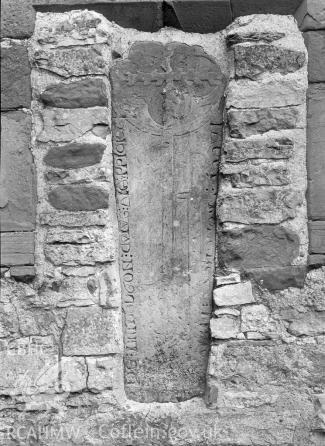
Inscribed tomb slab incorporated into the wall above a doorway. Source: Coflein

There is no surviving record of Rhuddlan Friary suffering damage to building or losing resources such as grain or livestock, but Llywelyn surrendered at Rhuddlan Castle in November 1277 and it seems improbable that the friary escaped entirely unscathed during the conflict.  The friars of Rhuddlan are credited with having organized the care of the wounded at that time, so were clearly in the thick of it.  Whether from guilt about harm inflicted or from appreciation of the Dominicans, Edward continued to finance the friary after Llywelyn’s death in 1282.  This is not particularly surprising, as both Edward’s father Henry III and Edward I himself were supporters of the mendicants in England, providing them with the much-valued stamp of royal approval.  In addition, Edward had a policy of compensating religious houses for damage inflicted during his conflicts with Llywelyn in Wales. By way of thanks for royal support, Rhuddlan Friary supplied Queen Eleanor with honey from its own hives. Queen Eleanor died in 1291, Rhuddlan Friary was a beneficiary from her will, which included a grant of 100 shillings each to the Dominican houses of Wales and England.  Rhuddlan Friary was also allocated 2 and 1/2 acres of land.

The community of Rhuddlan friary

The Danse Macabre or Dance of Death (1493) by Michael Wolgemut, from the Nuremberg Chronicle of Hartmann Schedel. Source: Wikipedia

Very little is known about the individuals who lived within the community of Rhuddlan Friary or any of the activities that were carried out, including their preaching.  Rhuddlan is considered to be a probable source of a version of the danse macabre (dance of death, also known as the dance of Paul’s). Several of the mendicant orders used the danse in their sermons, and the Dominicans were particularly enthusiastic about its terrifying imagery, often featuring death as a cadaver coming to claim the living, which was a warning of perils to come, and a reminder of the need to prepare one’s soul for the inevitable.  Here’s a flavour from a paper by Gray and Hale, translated from the Welsh, by poet Dafydd Ddu Hiraddug:

The corpse that was full of excess in a dirty closed place
As food for insects without worthy blessing …
The beautiful eyes now rounded holes
Full of maggots, in truth;
The comely mouth, which was so playful,
And was haughty, sad its form
A sardonic black hole, unlikely to be loved,
Black sorrowful nape, pathetic loneliness:
And the white teeth like old pegs
Dirty grey putrid bones
The long arms and the beautiful legs
Are sticks with gristle: offensive and putrid!

Enough to put the fear of God into anyone.

Only one of the community members is known for certain, and that is because he achieved prominence outside the friary’s walls as Bishop of St Asaph.  I have included his biographical details below because it is some indication of the level of seniority that the friary could attract.

Effigy of Anian in St Asaph Cathedral. Source: Wikipedia

Anian, the Rhuddlan prior who  became Bishop of St Asaph in 1268, was often a chosen intermediary between Llywelyn ap Gruffudd and both Henry III and Edward I, but he became alienated from Llywelyn as the relationship between the prince and Edward I deteriorated.  Towards the end of 1273 Anian he wrote to Pope Gregory X to make charges against the prince.  This put him in confict with the Cistercian order in Wales, whose abbots in turn wrote to the pope, on 7 March 1274 in defence of Llywelyn. His loyalties remained with the king and he continued to represent Edward’s interests against Llywelyn.  When Edward was defeated in 1277, Anian’s diocese, St Asaph passed to the control of the English Crown.  In 1281 Anian was given support from Edward in his bid to the papacy to move bishopric from St Asaph to the new royal castle and its accompanying town at Rhuddlan, a far higher status location, but this came to nothing.   During the resumption of hostilities between Wales and England in 1282, the cathedral of St Asaph was burned, infuriating Anian, who refused to lend the king further support and excommunicated the soldiers who attacked the cathedral.  The king seized his goods and denied him the diocese.  The rift was repaired in 1284 with the intercession of the Archbishop of Canterbury, Pecham.  Anian was granted the advowson (vacant ecclesiastical appointment) of Rhuddlan in return for a good will gesture of 500 marks.  Throughout this period he fell out with many other secular and religious dignitaries.  He died on 5th February 1293.

In 1284 some indication of the status of the friary is provided by the appointment of the prior of Rhuddlan by Archbishop Pecham to the commission of inquiry tasked with assessing the need for rebuilding and repair of churches damaged during the Edwardian wars in Wales.  This was not Anian, who was by now the bishop of St Asaph, but I have not yet tracked down his name.

St Mary’s Church on the River Clwyd, Rhuddlan, which now houses the tomb of William de Freney.  Edward I’s Rhuddlan Castle is shown in the bacground.  Source: photograph by Mike Searle on Geograph.

There would have been  cemetery at Rhuddlan Friary, where the inmates would have been buried.  There are various pieces of tombstone incorporated into stone walls at Rhuddlan, re-used as building materials.  Only one of the burials has been identified for sure, dating to c.1290: when William de Freney, archbishop of Edessa (Upper Mesopotamia), was buried at Rhuddlan.  His tomb was saved because it was removed to St Mary’s Church in the town, where it remains.  If this was done at the dissolution it is something of a puzzle why none of the other tombs were moved at the same time.  William de Freney was a Dominican monk, but although he was buried at Rhuddlan, his career unfolded far from north Wales, and although it is possible that he ended his days at the friary it is by no means certain.  He was a diplomat and skilled orator and linguist.  It is possible that when Edward went on crusade in 1270, de Freney went with him, but his movements are unclear until his death at Rhuddlan.  Edward I spent a lot of time in the 1270s and 1280s in Rhuddlan, and the presence of de Freney at Rhuddlan was almost certainly connected with Edward’s own movements.  The tomb slab is inscribed with a legend in Norman French:PRIEZ PVR LALME FRERE WILLIAM DE FRENEY ERCHEVESHE DE RAGES (Pray for the soul of Brother William de Freney Archbishop of Rages).  The name Rages appears to have been identified with Edessa.

The friary and the town

There are no records about interactions between the friary and the town, although they must have been frequent and various.  The friars must have been impacted just as much as the townspeople by the famine and then the plague, both of which swept through England and Wales in the first half of the 14th century.

Rhuddlan Castle. Source: Mike Searle, Geograph

Where Edward built castles in Wales, he changed the entire character of each of those areas. Oddly, the friary was not included in the new borough established by Edward in 1278, which went against usual practice.  I have read nothing to explain this.  Perhaps the exclusion was at the request of the friary itself, to maintain its independence, or for other reasons of its own.  The town that the friars attended before the arrival of Edward I in 1277 was a very different place from the one that Edward built for English immigrants, a Gascon-inspired planned town called a bastide, and the friary presumably extended its reach to the English newcomers, although it is very probable that the majority of the Dominican friars were in fact Welsh.  This could of course have changed over the decades as the town changed and new members were accepted in to the friary.

When Edward’s engineers and labourers had finished straightening out and deepening 2 miles of the River Clwyd to enable seagoing ships to reach the castle, the friars may have benefitted.  As soldiers and sailors arrived by ship, the friars would certainly have had new audiences for their preaching might, which might very well have been welcome as they contemplated war with Llywelyn, the privations of the terrain and the weather and their own mortality.

Unsurprisingly, given the order’s pastoral mission, during the Black Death of the 14th century, the order was very nearly wiped out as the friars throughout Europe mixed with their communities, attempting to bring support, and placing themselves at the highest possible risk.  Figures are highly elusive for Wales, but one estimate suggests that by the end of the 14th century the population of Wales had been reduced from a total of around 300,000 to under 200,000, a reduction of some 100,000 people. Although an earlier famine had some part to play in that figure, successive resurgences of the plague were the main cause.  Most of these would have been in the minority of lowland urban centres like Rhuddlan, rather than in the upland areas where the population was more dispersed, but its impact was still ferocious.

It is not known exactly how the Black Death impacted Rhuddlan, but enough of the population survived to enable both town and friary to survive. Under 100 years later, the senior occupants of the burgess and their land are recorded in a document dated 1428.  Most of the survivors noted are English names, probably those descended from Edward I’s settlers.  As well as recording that a community of burgesses had formed a landholding corporation, and that St Mary’s itself had land holdings.  No mention is made of the friary, but this was excluded from Edward’s new borough.

A public footpath connects the friary to the still-surviving motte of the 1073 Twthill motte-and-bailey castle, and Edward I’s 1277 stone castle beyond.   This part of the valley must have been quite a sight in the 13th and 14th centuries, with the canalized river running at the foot of friary and the cliff below both castles, new and old, with ships moored against the river.

The dissolution

The opening page of the Valor Ecclesiasticus, showing Henry VIII presiding over the valuation of the religious houses prior to their dissolution. Source: Wikipedia

The friary was dissolved in 1538, when six friars signed the Act of Surrender.  The surviving details of the abbey, as meagre as they are, have been discussed above.  The process of dividing the assets for sequestration and sale was overseen by Richard Ingworth, Bishop of Dover, who was ironically Dominican.  He recorded that he sold “cows and pigs for 22./-; paid for servants, and carried off a little chalice.”  The chalice would have contributed to the treasure trove being amalgamated from the dissolution by Henry VIII.  The premises additional to the church and cemetery are recorded at that time as a hall with three chambers, two other chambers, a kitchen and a stable.
——–

A monastic hospital?

Rhuddlan Castle in 1749 by John Boydell. Source: National Library of Wales via Wikipedia

There is considerable confusion about the presence of a hospital during the 13th century, when the friary was founded.  There are two references to it in documentation associated with Edward I, but it is by no means certain that it belonged to the Dominican friary.

In 1848 Harry Longueville Jones, in the second part of his piece on Rhuddlan Priory, gives a description of the hospital’s location, although he still gives no further idea of why he thought that a hospital was located here:  “The Hospital stood about a quarter of a mile to the NE of the priory on the southern side of the road leading to Diserth;  an old building, although perhaps not original, was standing here until within a few years.  It is now replaced by an ordinary cottage, in which all features of antiquity are disappeared.  Leaden pipes and conduits, leading from the hospital to the priory, have been dug up in the fields near that latter building” (p.48),  He goes on to suggest that it was “not improbable” that it could have been a “Lazarhouse” (a hospice for lepers), but this seems simply to be speculation.

Effigy in a wall at Abbey Farm. Source: Jones 1847

One of Edward I’s edicts states that the burial ground at the church of Rhuddlan had become inadequate, and that another site near the hospital should therefore be made available, suggesting at the very least that a hospital was in the vicinity.  One possibility is that references to a hospital refer not to a permanent facility, but to the work that the Dominicans are recorded as having carried out during the 1277 war, tending the wounded on a temporary basis.  The friars must have been involved again in Dafydd’s rebellion of 1282, and there is reference to money being granted to a hospital in the same listing where a much larger sum was also granted to the priory.  The friars were probably spared the violence in the national uprising led by Madog ap Llywelyn (in the north) and Morgan ap Marededd (in the south) in 1294-5 when English troops were garrisoned at Rhuddlan, but the castle was not one of those that was attacked by the rebels.

One idea, repeated by Harry Longueville Jones in July 1847, is that there might have been a Templar hospital at the site, perhaps adopted by the Dominicans after the closure of the Templar order.  A piece of data discussed in this context is the presence of a farmhouse near the friary that was called Spittal or Ysbythy, although the word Ysbyty (hospital) can simply identify land that belonged to the Knights Hospitallers or Templars, and does not always indicate the presence of an actual hospital. 

Excavations carried out to the east of the castle in 1978 as well as beyond Edward’s borough defences found no traces of a hospital, and so far remains have not showed up on aerial photographs.   It was presumably completely robbed out for building materials. 


Final Comments

It is easy to see why the mendicants, who combined secluded worship and pious austerity with community involvement the religious education and salvation of the poor would be attractive to the wealthy, their offering far more visible and easier to relate to than the older, more remote orders.

The remnant of a lovely tomb slab at the Abbey Farm (also shown above in black and white). Source: Geograph, by Mike Searle

The stories of Rhuddlan and former Rhuddlan friar Anian, who became Bishop of St Asaph, show how religion and politics are inevitably intertwined.  The Dominicans had no way of Knowing, when they established their new friary in Rhuddlan, that Edward I would follow a decade later, and the new royal castle and town would have changed the entire profile of the area, introducing not only a garrison but English settlers, and drawing a target on the town for the wars of 1277 and 1282, although it appears to have escaped attack in the uprising of 1294.  This would have raised the importance of the Dominican friars as a source of Christian values and salvation within a war zone, but in times of peace, a perhaps even more important role was attempting to help cement the different elements of the royal town and the local Welsh interests.

At the moment, there are many more questions than answers about the Rhuddlan Friary, but answers may lie under the surface.  Further excavations around Rhuddlan may clarify the remains of the friary, help to date of some of the fortifications, and clarify what other buildings may have existed during the Medieval period.

The surrounding former abbey precinct that once extended across the surrounding fields has suffered the same indignity as Valle Crucis Abby in Llangollen, being used a caravan and chalet park.  The friars would probably have been turning in their graves, had their graves survived.

Rhuddlan Abbey Farm. Over the lintel of the blue door on the far left the above tomb slab has been incorporated into the stonework of the wall.  Source: Geograph, by Mike Searle

There are no visitor details on this post, because the remains of the friary are on private land, and are not open to the general public, so I was unable to visit.  There is a footpath that runs around the outside of the farm. 

I have not yet visited Rhuddlan for well over a decade, and am looking forward to a visit to the castles.  The friary is a real insight into how much one can learn from published and online resources without visiting the site.  A big hats-off to those early illustrators and writers who have captured so much that later writers have used to recreate past buildings and landscapes.  I wrote this entire piece without leaving my house, and that’s a massive reflection on how much work others have done.


Sources

The sources that I have used are listed below.  For a full bibliography for Rhuddlan Friary, see the Monastic Wales Project website at
https://www.monasticwales.org/browsedb.php?func=showsite&siteID=61

Books and papers

Attwater, D. 1949.  The Black Friars in Wales.  Blackfriars, Vol. 30, No. 354 (September 1949), p.421-424 https://www.jstor.org/stable/43812856

Burton, J. 1994. Monastic and Religious Orders in Britain, 1000-1300. Cambridge Medieval Textbooks. Cambridge University Press

Clapham, A. W. 1927.  The architectural remains of the mendicant orders in Wales. Archaeological Journal, 84 (1927), p.96-7
https://archaeologydataservice.ac.uk/archives/view/archjournal/contents.cfm?vol=84&CFID=3f7f06e0-94cc-44a1-8b8d-c7796029e9c7&CFTOKEN=0

Clwyd Powys Archaeological Trust 2014.  Rhuddlan.  Historic Settlement Survey – Denbighshire – 2014. CPAT
https://cpat.org.uk/ycom/denbigh/rhuddlan.pdf

Cule, J. 1977. Early hospital development in Wales.  National Library of Wales journal. 1977, Winter Volume XX/2.
“Extracted onto the pages of GENUKI with the kind permission of the National Library of Wales. This is a complete extract of this article (Gareth Hicks May 2003):”
https://www.genuki.org.uk/big/wal/Archives/NLWjournals/EarlyHospitals.

Davies, J. 2007 (3rd edition).  A History of Wales.  Penguin.

Garland, L.M.2005.  Aspects of Welsh Saints’ Cults and Pilgrimage c.1066-1530.  Unpublished PhD Thesis, Kings College London
https://kclpure.kcl.ac.uk/portal/files/2935809/420753.pdf

Giraud, E.J.  and Linde, J.C. 2021.  A Companion to the English Dominican Province: From Its Beginnings to the Reformation.  Brill
Sample:  https://books.google.co.uk/books?id=8BkgEAAAQBAJ&printsec=frontcover&source=gbs_atb#v=onepage&q&f=false

Gray, M. and Hale, D. 2021. Dancing and Dicing with Death: literary evidence for some lost wall paintings in Wales. Ancient Monuments Society Transactions Volume 65 (2021), p.7-19

Greene, J.P. 1992. Medieval Monasteries. Leicester University Press

Gumbley, W. 1915. The Dominican Priory of Rhuddlan. Flintshire Historical Publications 5 (1915), p.34-35
https://journals.library.wales/view/1256711/1257147/46#?xywh=-936%2C-227%2C4106%2C4136

Gumbley, W. 1915. The Dominican Bishops of St Asaph. Flintshire Historical Publications 5 (1915), p.31-33
https://journals.library.wales/view/1256711/1257147/46#?xywh=-936%2C-227%2C4106%2C4136

Gumbley, W. 1915. The Dominican Friary of Rhuddlan. Flintshire Historical Publications 5 (1915), p.43-44
https://journals.library.wales/view/1256711/1257147/46#?xywh=-936%2C-227%2C4106%2C4136

Hayman, R. 2018. Rood Screens. Shire Library

Hinnebusch, W.A. 1944.  The Domestic Economy of the Early English Dominicans.  The Catholic Historical Review , Oct., 1944, Vol. 30, No. 3 (Oct., 1944), p. 247-270

Jackson, P. 2005. Freney, William (fl. 1263–1286). Oxford Dictionary of National Biography (Online [2014] ed.). Oxford University Press.
https://www.oxforddnb.com/view/10.1093/ref:odnb/9780198614128.001.0001/odnb-9780198614128-e-92436;jsessionid=11E5391F2DD975CD06FDDFAA92E58B14

Jones, H.L. 1847.  Priory of Dominican Friars, Rhuddlan, Flintshire. Archaeologia Cambrensis, July 1847, p.250-259
https://journals.library.wales/browse/2919943

Jones, H.L. 1848.  Rhuddlan Priory, No.II.  Archaeologia Cambrensis, January 1848, p.46-49
https://journals.library.wales/browse/2919943

Lewis, B.J. Gray, M., Jones, D.C. and Morgan, D.D. 2022.  A History of Christianity in Wales.  University of Wales Press

Lloyd, J.E. 1959.  Anian II (died 1293), bishop of St Asaph.  Dictionary of Welsh Biography.

Morris, M. 2008.  A Great and Terrible King.  Edward I and the Forging of Britain.  Penguin.

Platt, C. 1995 (2nd edition).  The Medieval Abbeys and Priories of Medieval England.  Chancellor Press

Taylor, A. 2004.  Rhuddlan Castle (abridged from a text by Arnold Taylor). Cadw

Walker, D. 1990.  Medieval Wales.  Cambridge University Press

Websites

Abbey Farm Caravan and Camping Park
History
https://abbeyfarmrhuddlan.co.uk/portfolio-item/history/#top

Based In Churton
Valle Crucis abbey (ongoing series of posts about the abbey). By Andie Byrnes
https://basedinchurton.co.uk/category/valley-crucis-abbey/

British History Online
A Topographical Dictionary of Wales. Originally published by S Lewis, London, 1849.
https://www.british-history.ac.uk/topographical-dict/wales/pp345-356

Cadw
Rhuddlan Castle
https://cadw.gov.wales/visit/places-to-visit/rhuddlan-castle
Rhuddlan, Norman Borough
https://coflein.gov.uk/en/site/303586

Coflein
Rhuddlan Friary (Dominican); Abbey Farm
https://coflein.gov.uk/en/site/157155/

Monastic Wales
Rhuddlan Friary
https://www.monasticwales.org/site/61


An impressive exhibit of decorated Roman tombstones in Chester’s Grosvenor Museum

Introduction

Chester’s role as an important Roman military headquarters surrounded by a growing settlement, known as Deva, is very well understood, but there is not a great deal to see on the ground.  This means that Chester’s Roman legacy is largely preserved in excavated archaeological remains, some of which are on display in local museum spaces.  There is a small gallery of Roman objects in the Grosvenor Museum in Chester showing a wide variety of artefact types, from elite pottery to drainage pipes, but to display some of the large number of Chester tombstones, a special exhibition space was was created for them in a dedicated room in the museum, showing them off to great effect.

The display opens with a Roman style couch under a canopy, setting the scene for a walk down a path between the tombstones, emulating one of the Roman roads heading out of Deva.  The walls behind the tombstones capture the sense of the surrounding landscape, part military installation, part civilian settlement, and part rural vistas.  The tombstones are organized either side of the “road,” each one facing out towards the visitor.  Low level information boards, great for wheelchair users and children, show useful illustrations of key examples, together with translations of the texts.

In the discussion of tombstones below, each example is accompanied by an RIB (Roman Inscriptions of Britain) number.  Each inscription in Britain has been given a unique number.  When I was at university studying the Antonine Wall, the Roman Inscriptions In Britain were recorded in print, but this was obviously the sort of content that was best suited to a database, and one of the best online resources for Roman Britain is Roman Inscriptions in Britain online.  As a resource it has been developed and expanded, and the user interface is excellent.  If you want to know more about any of the tomb stones mentioned below, this is a great place to start, with translations, illustrations and further references all available.

Burials and memorials

Altar RIB 3149, found at the Chester amphitheatre

The Romans disposed of their dead in a variety of ways that included both inhumation (deposition in the ground) and cremation.  Wealthier Roman inhumation burials in Britain were traditionally accompanied by this sort of memorial, and might include tomb stones and commemorative slabs.  In terms of how they were used, tombstones are much like the grave stones and chest-like tombs found in Christian churchyard cemeteries today, but dedicated to different deities and with far more elaborate scenes depicting the owners of the graves engaged in activities that showed them in activities that they enjoyed, or which highlighted particular qualities.

Collectively, these memorials are a useful source of information about Roman life and death in Britain, but individual memorials also have the potential to tell their own stories about the owners, the way in which the owners wanted to be remembered and the ideas with which they wanted to be associated.  Although the Grosvenor Museum’s display primarily features tombstones, there are some altars too.  Altars could be found in similar contexts, but might also be found in homes, public buildings and at religious sites.  The above example from the museum’s exhibit, RIB 3149, was found in a room behind the amphitheatre arena’s wall during excavations in 1966, and reads, in translation, “To the goddess Nemesis, (from) Sextius Marcianus, centurion, in consequence of a vision.”

Roman cemeteries

Roman Chester with modern roads superimposed (click to enlarge). Source: British History Online

The area around the fortress was under military control and the location of the cemeteries was decided by the Praefectus castorum (camp prefect), who decided where civilian quarters and various facilities were to be located.  Roman law was very strict on the matter of refusing burial with in urban and residential areas.  Roman cemeteries were built outside towns and cities, and depending on the size of the urban centre there might be a number of them.  The earliest tombstones and altars were erected along the sides of roads, but more formal cemeteries would have been established over time.   These will have been destroyed as Chester spread out in all directions during subsequent centuries.  Most of the stones in the museum, sculpted or inscribed, or both, had therefore originally come from one or more Roman cemeteries, and were probably dumped somewhere together to make space for urban spread.

Plan of part of the Infirmary Field excavation. Source: Chester ShoutWiki

One cemetery was revealed during rescue excavations carried out between 1912 and 1917 by Professor Robert Newstead.  It was located at Infirmary Field to the west of the fortress, the site of a planned new wing for Chester Royal Infirmary.  The presence of a possible cemetery  had been known since the mid 19th century due to the discovery of burials adjacent to the Infirmary in 1858 and 1863.  During his excavations Newstead found that the cemetery contained men, women and children who, judging from the objects in graves, were both military and civilian.   

The tombstones in the walls

Section of the Chester City walls thought to be Roman, sitting on bedrock above the canal.

The high sandstone walls that surround the city of Chester were originally established in the Roman period, but were built upon in subsequent periods to repair damage and to raise the overall height of the walls.   There are only a few places where Roman phases can be clearly identified with confidence, such as that shown on the right.  The repair of the walls over time incorporated both newly quarried stone, and whatever stone was lying around from earlier collapses.

Although tombstones and altars are known from various locations around Chester, most of the Chester tomb stones in the Grosvenor display are from a cache found incorporated into the Chester city walls, completely divorced from their original funerary context, but would once have come from one or more cemeteries. The re-use of ancient building materials is common the world over.  In ancient Egypt, the Pharaoh Horemheb re-used painted blocks from palace buildings of the heretic Pharaoh Akhenaten as rubble fill to create the thick walls of his monumental gateway at the temple of Karnak on the Nile.   In both the Chester and Karnak cases, these items used as building materials have enormous historical value to us today as information about the past, but were simply unwanted rubbish when they were employed as building materials.

Plate A from Cox’s publication of his excavations in 1891

In 1883 the Chester City Surveyor Mr Matthew Jones was overseeing repairs to a section of the lower courses of stonework in the walls and the fill behind them near to Morgan’s Mount.  As they prepared the site for the work he realized that he was looking at pieces of Roman stonework and that one was clearly part of a tomb stone, and he retrieved what he could see.  Although no further investigations were carried out in1883, further repair work was required in 1887 between Northgate and the King Charles Tower, this time rather more extensive, and more Roman funerary pieces were found.  Again, they had been used to repair the lower courses of the wall.  So many were found this time that it was decided to extend the work and locate more of Chester’s Roman heritage.  The Chester Archaeological Society, founded in 1849 (and still going strong today), was brought in to supervise the investigation of the wall to the west of the Northgate between 1890 and 1892.  Taking all the finds from 1883, 1887 and the 1890-92 excavations, more than 150 stones were found, of which the Grosvenor exhibit is a tiny sample showing some of the best of the examples.

Key features of tombstones

Tombstone of Flavius Callimorphus and Serapion. RIB 558

The earliest tombstones and altars known from Chester date to the 1st century.  For example, the tombstone of Flavius Callimorphus showing him with his son or nephew Serapion (aged 42 and 3 ½ years old respectively) was discovered at the Roodee in 1874, in situ over a grave, and was erected by Flavius’s brother Thesaeus (RIB 558).  These are Greek names which may indicate that they were freedman and/or traders who had settled in Chester.  Flavius is shown reclining on a funeral couch, and the elaborate nature of the decoration indicates that this was a wealthy family.  Within the grave were two skeletons accompanied by a gold ring and a coin of the emperor Domition, dating to the latter half of the 1st Century A.D.  Callimorphus and Serapion, the former lying on a couch with the latter in his arms, shown in the photograph to the left.  On a small table in the foreground is a bird, which is a metaphor for the journey into the afterlife.  Next to the table is an amphora that may or may not suggest that Callimorphus was an importer of wine.  Although it is speculation that he was a wine importer, the family names indicate that they were of eastern Mediterranean origin, where Greek was preferred to Latin, and could well have been traders who settled locally.  The name Serapion is of particular interest, as it refers to the god Serapis, who was venerated during the Ptolemaic (Greek) and subsequent Roman occupation of ancient Egypt.

Altar from Watergate Street. RIB 445. Source: British Museum BM 1836,0805.1.

Amongst other Roman finds, a 2nd Century A.D. stone altar was found in lower Watergate Street when Georgian terraces were built in 1778.  It was dedicated to Fortuna Redux (Fortune, who brings travellers home safely, including soldiers and traders) and gods of healing and health Aesculapius and Salus.  It was raised by freedmen and slaves of a Roman imperial legate, perhaps a provincial governor, who has the longest recorded name in Roman Britain:  Titus Pomponius Mamilianus Rufus Antistianus Funisulanus Vettonianus.  This is the only example shown here not on display in the Grosvenor Museum. It is now in the British Museum (BM 1836,0805.1; RIB 445)

Nearly all the memorials on display in the Grosvenor are made of red sandstone.  The quality of the stone chosen was important, both for engraving scenes and text, and for durability.  The raw material selected was not the most locally available sandstone, but according to Wilding was sourced some 8 miles away where better quality red sandstone was available.

The tombstone of Caecilius Avitus, RIB 492. On the left is the original as it was found. On the right is the replica with its bright paint, both on display in the museum.

The stones would originally have been brightly painted, which is a strange thought.  A cemetery would have been a colourful place, new memorials brighter than older ones, creating a dazzling visual spectacle.  At the entrance to the Grosvenor Museum exhibit there is a facsimile of one of the Chester grave stones showing how it might have looked in full colour, and when compared with the original unpainted version that is also on display, it is a completely different entity.  It shows an optio (junior officer who was an accountant-adminstrator, second in command to a centurion) called Caecilius Avitus, wearing a cloak, a staff of office, a legionary sword and  a writing tablet (RIB 492).  It is like seeing the Lady Chapel in Chester Cathedral, painted to show how it would have looked in the Medieval period, or the glorious 17th century decoration of Rug Chapel at Corwen, near Llangollen, both of which are similar eye-openers, revising how we look at past objects and architecture.  To modern eyes, so accustomed to seeing the past in subtle monochrome, the bright paintwork of Caecilius’s tombstone is almost shocking, but Roman life was anything but dull, either at work or at play, and the colours of the stones reflected this multi-hued existence.

Between the moment of death and the burial itself there were ceremonies, rituals and processions that marked the transition from this world to the next.  For the very rich, this could be ostentatious and elaborate, involving music and theatrical performances, but for the poor it was a much more mundane affair.  Often a Roman might provide for their funeral in his or her will, but if not the responsibility fell to the person who inherited the rest of the property of the deceased.  When the deceased was buried, graves could be visited by the living, and at the end of February during the Feralia festival offerings were made to dead ancestors at their graves.

Tombstone of Curatia Dinysia. RIB 562, described below

Popular themes on the Chester tombstones are dedications to certain deities, symbolism surrounding the afterlife and depictions of the deceased lying along a banqueting couch.  Reclining on a couch was a popular eating position used by wealthy Romans, and the couch represents a banquet in the afterlife, indicating eternal wellbeing.  Some objects in scenes may hint at the profession of the deceased.  Where an inscription is included, in Latin, the names can give an indication of the origins of the individual.

Text on tombstones is always highly abbreviated, which would not have been a problem for literate contemporaries (or for researchers today) because the abbreviations were standardized and the texts were highly formulaic.  Many of the inscriptions begin DM, standing for Dis Manibus (To the spirits of the departed), and finish HFC, standing for Heres Faciendum Curavit (the heir had the stone made). The heir often adds his or her name and relationship to the deceased.  Between these topping and tailing devices there may be additional information about who died including, for example, the name of the deceased, the age at which they died, who erected the stone in their honour, the place from which the person originated, the role that the person performed, a legion or auxiliary unit in which a soldier served and the number of years for which he served.

The Grosvenor Museum tombstones

Showing some of these features is a woman reclining on a couch, framed within two columns and an arch. She is shown in the photograph immediately above.  Her name is Curatia Dinysia (perhaps a mason’s error for the name Dionysia), holding a drinking cup, with a three-legged table in the foreground (RIB 562).  Sadly the head and face are damaged. She sits between two garlands or swags of ivy leaves, sacred to the deity Bacchus, each of which supports a dove, signifying the release of the soul.  Above this scene, incorporated into the architecture of the arch, are two tritons (half men, half fish, like male mermaids, but sometimes shown with horse forelegs) blowing trumpets, representing the journey to the Isles of the Blessed where Bacchus resided.  The drinking cup, probably filled with wine, may also reference Bacchus.  As with Calimporphus and Serapion, the name Dinysia/Dionysia is  thought to be Greek.   The inscription reads, in translation, “To the spirits of the departed, Curatia Dinysia lived 40 years; her heir had this erected.”

The illustration on the right is by Dai Owen (Grosvenor Museum 2010)

Another woman is shown on a very worn tombstone, also cleverly recreated by illustrator Dai Owen (RIB 568).  The woman’s name is damaged, but ends “-mina”  She reclines on the banqueting couch with the familiar three-legged table in the foreground, a drinking cup in hand and a ring on the little finger of her left hand.  Most remarkably, behind her, on the the high-backed couch, is a giant sea shell flanked by dolphins, again a reference to her journey to the Isles of the Blessed.  Only part of the inscription has survived, with the DM of Dis Manibus (to the spirits of the departed) legend just beneath the three-legged table, and the end of the lady’s name just below that at far right.

Tombstones featuring women are usually found in this sort of military context, where many were wives, (more rarely mothers or daughters) of soldiers, and could communicate their own status alongside their husband’s, making statements about their own identity.  It is good to have these as they are a distinct minority. Allason-Jones, for example, estimates that inscriptions dedicated to women make up only around 10% of the total inscriptions found in Roman Britain.  These represent only the middle and upper echelons of those living in Roman areas.  As with low status men, those women who could not afford any form of memorial have been lost.

The auxiliary cavalryman (equitis) Aurelius Lucius, who has a Latin name, but was probably not of pure Roman origins is an interesting case (RIB 552).  Aurelius is shown with a moustache, beard and big hair.  Again, he is reclining on a couch, and like Curatia Dionysia, he holds a drinking cup in one hand, whilst in the other he holds a scroll of paper that represents his will.  Behind his legs are his plumed helmet and the top of his sword, and in the foreground is a small three-legged table and a boy holding a detached head.  Auxiliaries were often recruited from conquered lands and were not Roman citizens.  After 25 years in service they could apply for Roman citizenship. The uncharacteristic hair and the severed head, perhaps a war trophy, may refer to a background from one of these conquered regions, but Aurelius also chose to depict himself in a traditional Roman pose, with a traditional Latin inscription.  Perhaps he had become a citizen, incorporating his career as a foreign cavalryman but opting for a Roman afterlife.

One of the most remarkable of the Grosvenor’s tombstones is this rider on a horse carrying a flying standard.  It is thought to represent a a Sarmatian from an area now occupied by southern Ukraine and northern Romania.  The Sarmatians were nomadic hunters and pastoralists, excellent horse breeders and riders and formidable warriors.  No inscription survives, but he was almost certainly an auxiliary, as the Sarmatians were conquered in AD 175, and some are known to have been present in Britain.  Although none are known from Chester, there were Sarmatians in a regiment deployed at Ribchester in Lancashire, and it is not unlikely that a detachment of that regiment was present in Chester when this individual died.  The tall helmet is distinctive, and he holds a standard which he holds in both hands.  If he was indeed Sarmatian, this would have been topped with a fearsome dragon’s head with brightly coloured fabric flying to its rear.  When wind ran through the dragon’s jaws at speed, it made a terrifying noise to put fear into the hearts of the enemy.  His sword is in its scabbard at his side.

Another cavalryman is depicted on a scene that has lost its inscription, other than the letters DM (Dis Manibus) (RIB 550).  It is very worn, and the top of the head and the hand (and whatever it is holding) are missing but the scene is full of energy.  The horse, with its bridle and a blanket serving as a saddle clearly visible, is galloping with its mane blown back, and the rider’s legs hold tightly to its flanks.  The rider’s right arm is raised above his head, probably holding a spear, whilst his left hand, hidden from view, holds the rein or the bridle.  Trodden beneath the hooves of the horse is a naked victim who lies gripping a six-sided shield that has demonstrably failed to protect him.

Marcus Aurelius Nepos and his wife. RIB 491

A rather more domestic scene is provided by Marcus Aurelius Nepos and his wife.  The stone is right at the rear of the exhibit, and the inscription is difficult to see (it was not particularly clearly engraved in the first place) and is confined to the left, beneath the figure of Marcus Aurelius, centurion of the XXth Legion Valera Victrix, who died aged 50 years old.  There is a space beneath the figure of his wife for an inscription, but for reasons unknown this was never added.  As it was she who commissioned the stone, she was clearly still alive when the carving was made and may have left the space for an inscription of her own when she herself died, but perhaps she died elsewhere.  Marcus Aurelius is bearded, carrying a staff and has a prominent belt, a cloak over his shoulders with a small brooch attached.  His wife is holding a cup, and lefts the hem of her dress with one hand to reveal the skirt beneath.  Not visible in the photograph is an engraving on the side that shows a mason’s hammer and set square and the words SVB ASCIA D[edicatum], meaning “dedicated under the axe,” perhaps a formula to deter vandals. The tombstone dates to the 3rd century AD.

RIB 560. Tombstone of the child slaves Atilianus, Antiatilianus and Protus

The tombstones with elaborate or contained scenes are plentiful, but are still a minority in the context of British funerary memorials, representing only the most wealthy purchasers. Some tombstones merely showed a little decorative work to accompany the text.  This example (RIB 560), although still very fine, was provided with ornamental features but no elaborate scene.  It was dedicated by a master to three young slaves.  It reads, in translation, “To the spirits of the departed, Atilianus and Antiatilianus, 10 years old; and Protus, 12 years old.  Pompeius Optatus their master had this made.”  It is possible that the 10 year olds were twins. Although the thought of slavery always sits uncomfortably in today’s world, it should not be forgotten that in a period when slavery was the norm, it was by no means uncommon for masters and slaves to develop relationships of mutual affection and respect.  Perhaps that is what we are seeing here.

sdffsa

Final Comments

Architectural detail showing a male gorgon, with four snakes emanating from each side of his head.

The tombstones described above represent only a a small sample of the total number of engraved stones preserved from Chester.  Of those that were not tombstones, some were pieces of altars and others were fragments of bigger pieces of architecture, many of which also came out the 19th century excavations in the Chester walls, some showing Roman deities.  They are out of the scope of this post but, do watch out for those too in the display if you visit the museum.

The tombstones are particularly evocative and hopefully the small sample provided here gives an idea of what sort of themes were common, and how people like to have themselves depicted.  Death in the Roman empire was an integral part of a soldier’s life, and in the military life of Chester, death had its own role and its own places, with its own objects and iconography.  Most of the individuals represented here were of relatively high status, except for the slaves of their master Pompeius Optatus, but they came from a variety of backgrounds, all either stationed here or drawn here for commercial reasons by the military stronghold, and it is good to be able to see some of the variety that made up Deva society.

19th century illustrations from Chester Archaeological Society reports of the tombstones and other engraved stones excavated from the walls (click image to enlarge). Sources, left to right: de Gray Birch 1887, Watkin 1887, de Gray Birch 1888, Jones 1887, all in the Journal of the Chester Archaeological Society volume 2 (references below).

fdfsdfsd
For those who are interested in seeing something of Rome under foot in Chester, to supplement what can be found in museums, there are a number of guided tours available (some lead by Roman Centurions!).  If you prefer a self-guided tour, the Royal Geographic Society’s “Discovering Britain” website provides one, which can be downloaded as a a PDF or as an app for your mobile device: https://www.discoveringbritain.org/activities/north-west-england/trails/chester-trail.html.


Sources:

Those that were of particular use for this post are shown in bold

Books and papers

Allason-Jones, L. 2012.  Chapter 34, Women in Roman Britain. In (eds.) James, S.L. and Dillon, S. A Companion to Women in the Ancient World. Wiley

Bell, C.E. 2020. Investigating the Autonomy of Power: Epigraphy of Women in Roman Britain. Dissertation Submitted for the Master’s Degree in Archaeology, University of Liverpool
https://www.academia.edu/44879704/Investigating_the_Autonomy_of_Power_Epigraphy_of_Women_in_Roman_Britain

Brock, E. P Loftus. 1888) The age of the walls of Chester, with references to recent discussions; The discussion on the above paper; Mr Brock’s reply to the various speakers. Journal of the Chester Archaeological Society 2. Vol 2, p. 40-97.
https://archaeologydataservice.ac.uk/archiveDS/archiveDownload?t=arch-2910-1/dissemination/pdf/JCAS_ns_002/JCAS_ns_002_040-097.pdf

Cox, E.W. 1891. Notes on the sculptures of the Roman monuments recently found in Chester. The Historic Society of Lancashire and Cheshire, vols.43044, 1891-92, p.91-102

Eckardt, H. 2014. Objects and Identities. Roman Britain and the North-Western Provinces.  Oxford University Press

de Gray Birch, W. 1888. Notes on a sculptured stone recently found in the North Wall of the city of Chester. Journal of the Chester Archaeological Society 2. Vol 2, p. 25-39.
https://archaeologydataservice.ac.uk/archiveDS/archiveDownload?t=arch-2910-1/dissemination/pdf/JCAS_ns_002/JCAS_ns_002_025-039.pdf

de Grey Birch, W. 1888. The inscribed Roman stones recently found at Chester, during the second series of repairs to the North Wall.  Journal of the Chester Archaeological Society, vol.2, p. 98-131.
https://archaeologydataservice.ac.uk/archiveDS/archiveDownload?t=arch-2910-1/dissemination/pdf/JCAS_ns_002/JCAS_ns_002_098-131.pdf

Grosvenor Museum 2010. A Guide to Roman Stones at the Grosvenor Museum Chester. Illustrations by Dai Owen.

Henig, M. 2002.  Tales from the Tomb. In (ed.) Carrington, P.  Deva Victrix; Roman Chester Re-Assessed  papers from a weekend conference held at Chester College 3-5 September 1999.  Chester Archaeology
https://archaeologydataservice.ac.uk/archiveDS/archiveDownload?t=arch-2910-1/dissemination/pdf/CAS_DevaVictrix/CAS_DevaVictrix_075-078.pdf

Jones, I. Matthews. 1888. Official report on the discoveries of Roman remains at Chester, during the first repairs to the North Wall, in 1887. Journal of the Chester Archaeological Society 2. Vol 2, p. 1-10.
https://archaeologydataservice.ac.uk/archiveDS/archiveDownload?t=arch-2910-1/dissemination/pdf/JCAS_ns_002/JCAS_ns_002_001-010.pdf

Mason, D.J.P. 2007 (2nd edition). Roman Chester. City of the Eagles. Tempus

Thompson Watkin, W. T. 1888. The Roman inscriptions discovered at Chester, during the first repairs to the North Wall, in 1887. Journal of the Chester Archaeological Society 2. Vol 2, p.11-24.
https://archaeologydataservice.ac.uk/archiveDS/archiveDownload?t=arch-2910-1/dissemination/pdf/JCAS_ns_002/JCAS_ns_002_011-024.pdf

Wilding, R. 2006. Graham Webster Gallery of Roman Stones at the Grosvenor Museum, Chester: Explore the Hidden Mysteries of the ‘lost’ Roman Gravestones.


Websites

Roman Inscriptions of Britain (RIB)
https://romaninscriptionsofbritain.org/

Chester Archaeological Society
Professor Robert Newstead F. R. S. Lecture given to Chester Archaeological Society, 5th December 2009.  By Elizabeth Royles, Keeper of Early History, Grosvenor Museum
http://chesterarchaeolsoc.org.uk/wp-content/uploads/2016/11/LRoyles-NewsteadLecture_05-12-09.pdf

Roman Baths
You can decode tombstones at the Roman Baths, Bath
https://www.romanbaths.co.uk/sites/roman_baths/files/heritage/SECONDARY%20SCHOOL%20Decoding%20Roman%20tombstone%20leaflet_0.pdf

Encylopedia Britannica
“Sarmatian.” The Editors of Encyclopaedia, 29 Mar. 2018. https://www.britannica.com/topic/Sarmatian

Telling Stories from Handling Medieval and Early Modern Objects

Many thanks to Chester Archaeological Society for circulating the news that Dr Katherine Wilson (Associate Professor in Later Medieval European History, University of Chester) was inviting CAS members to see and handle medieval objects in Chester from the Grosvenor Museum’s collections at two pop-up events.  Both were part of the Mobility of Objects Across Boundaries initiative.  The first event was on the day that I attended, the 3rd March at the Garret Theatre in the Story House, and another on the 4th March.  We were all greeted warmly by the team from Chester University, which included students who were seated in front of trays full of objects for us to go and investigate and learn about.

The format was very straightforward and worked perfectly.  A number of trays containing the objects were organized on a u-shaped table layout, so that we could easily move between them without being on top of each other.  In front of each tray was a University of Chester student, all of them helping us to explore the objects, encouraging discussions and real involvement with the objects in front of us and how they might lead us to understand more about the lives that left them behind.  Each tray had a selection of very different objects, so in each case there was a lot to talk about.  I didn’t catch the names of the students, but they were excellent.

Chester has a rich Medieval past, but as the team made clear, most people thinking about Medieval Chester focus almost exclusively in terms of the Cathedral and the half-timbered shop fronts, when there are not only other great buildings, like St John’s Church (Chester’s first cathedral), but there are also all the objects that have been excavated over the years, the items of every day life that people used, wore, carried with them or used in their daily work.  These items bring to life, at least in the imagination, the people who owned them.

Sole of a leather shoe, beautifully shaped. Source and copyright: The Mobility of Objects Across Boundaries (MOB)

Each object has a knack of opening windows into other parts of Medieval life that are no longer easily visible or reproducible.  The shoes were particularly evocative.  The first tray at which I sat down contained fragments of a black material, some very thin, one rather thick.  When I was asked what I thought they were, I said the first thoughts that came into my head: leather, protective, item of clothing.  I guessed a hood, perhaps because I was drenched from rain 🙂  They were, of course, fragments of shoes.  In the other boxes there were far more complete items, one sole with an additional patch of leather attached over the heel as a protective layer, much like a flat shoe today.  All of them bore the signs of wear, most of them were marked by tiny holes where one piece had been connected to another, and there was even a fabulous child’s shoe with an open toe.  These shoes, preserved in a waterlogged ditch just outside Chester, posed so many questions – how expensive were they (a goose, a sheep?), and in turn were they high status objects?  Were they everyday wear or were they only worn for best?  Where did their owners wear them?  How far did their owners, wearing their leather shoes, travel for trade, as messengers, or on pilgrimage?

Two of the keys in the object handling trays. Source and copyright: The Mobility of Objects Across Boundaries (MOB)

There were several keys, some of which had remarkably patterned and intricate ends or bits.  For every huge key there must have been a vast door, opening into home or business premises, whole worlds within worlds.  For every tiny key, each fascinating in its own complexity, there is a missing lock, a missing box and the missing contents to contemplate.  Perhaps such keys, each either looped or perforated at the tops, were carried on a string, worn around the neck when small enough or tied to a belt or locked in a draw, along with other keys.  Whilst the keys themselves were portable, and the small keys may have opened small and very portable chests, the big keys probably opened big doors, either room doors or cupboard doors, and whilst the keys themselves were portable, what they were opening was much less so.

The pieces of wheel-thrown pottery were impressively large and well made.  There was no sign of glazing, so these were probably very practical, every day items.  Being rim sherds, the diameters could be calculated to give an idea of the size of the pots.  There were no bases, so it was not possible to see if there was any sign of the sort of charring that would be expected for cooking.  Perhaps they were used for storage.  They were solid and designed to be moved around, re-used and to do a reliable, practical job.  A piece of handle probably belonged to an even bigger vessel, looking very like a Roman amphora handle, thick and ribbed, impressively chunky.  The contents of the vessel must have been heavy to require such big handles, perhaps a liquid of some sort.  If these items travelled, and were broken in the process, it was probably in the process of being shifted across a room or in the case of the thick-handled vessel, perhaps being carted from farm or port to market.

Medieval floor tile. Source and copyright: The Mobility of Objects Across Boundaries (MOB)

Medieval floor tiles seem like the antithesis of mobility or portability, but they too had travel tales to tell, as one of the students pointed out very vividly.  Between the pattern designers, the clay diggers, the mould-makers, the artisans and those who laid the floors, these pieces passed from hand to hand until they were eventually laid on the ground.  They are thick, about 3.5 cms from memory, and as the lady sitting next to me pointed out at one of the trays, there was little sign of inclusions in the fabric.  This presumably made them less prone to cracking, more able to bear the weight of people walking over them.  The tiles were splendid, the glazed ones with the indented moulded decoration capturing light as we moved them.  In candle light, the images, lions and griffins, must have appeared to shift and shimmer, providing them with a type of dynamism beyond the pattern that the contributed to on the floor.  I was looking at the Victorian floor tiles in Chester Cathedral last week, for which I have a guilty liking based on the hallways of countless terraced houses around the country, but when compared to the Medieval ones they seem very two-dimensional and glossy.  The Medieval ones have a texture, luminosity and energy that are truly remarkable.

There was one piece, possibly a tile, that was neither rectangular or glazed, but perfectly round with a lion’s head looking out.  The puzzle, the student told me, was that the rectangular ones were all mass-produced, because they would be laid on floor, just like modern ones, but round ones were most unusual.  This was small, only about 10cm in total diameter, and deeper than the square ones.  It was also, if memory serves, made of stone.  The lion’s head was painted on, not moulded, and although the disk itself would have been fairly tolerant of feet, I wonder about that lion.  A possibility is that it was the centre of a radiating design, but the radiating pieces would also have to be specially shaped, and if so, where are they?  As he said, a puzzle, but a very nice one.

A remarkable ampulla. Source and copyright: The Mobility of Objects Across Boundaries (MOB)

Some of the objects came from outside of Britain.  A gorgeous little cross within a circle, just a few centimetres across, was from Siena in Italy, and was probably sewn on to a piece of clothing, and would have looked like a brooch.  Other items may have worked their ways all the way down the Silk Road, eventually finding their way to Chester.  One particularly startling piece, featuring a very austere male face, is a tiny St Thomas Becket flask for containing holy water, called an ampulla (ampullae in the plural), the ears forming little loops for string attachment to a belt or clothing.  Its weight suggests that it was made of lead.  Some of these long-travelled objects were moulded, and easy to mass produce, but owning them would still have been precious, often representing a serious achievement, something to which others might aspire, and making the owner visibly one of a circle of similar achievers, irrespective of birth or background.
asdfasdfsd

Silver spoon handle with face of St Peter topped by a cockerel. Source and copyright: The Mobility of Objects Across Boundaries (MOB)

In another tray was a tiny but highly decorative little piece of metal, a devotional token. It is in the face of a head, and was broken below the neck, so certainly had once been somewhat longer.  It probably had something of a similar role to a pilgrim’s badge – the souvenir or, rather more importantly, an indication of pride, the sense of achievement with which a particular devotional religious task is associated.  There was also a very, very thin copper ring on the same tray that had a wide section at the front, with tiny little carved symbols marking it, thought to have been different events in the owner’s life.  In another tray was a silver spoon handle from Rome showing the face of St Peter and topped with a cockerel, representing Peter’s denial of Christ three times. These three items were so small and personal that they spoke of how people who made long journeys, perhaps people who did not have sufficient silver pennies to make many such journeys, valued these objects as emblems that declared numerous concepts – achievement, affiliation with an idea or an ideal, veneration of a religion or a preferred saint.  One student (wish I had known any of their names) had on his own jacket a replica pilgrim’s badge of geese in a basket, the symbol of St Werburgh, whose remains were moved to Chester Abbey (now Cathedral) in the 10th century, attracting  pilgrims.

Poppy worn by thousands of British people each year in memory of those lost and wounded in war. Photograph by Philip Stephens. Source: Wikipedia

Taking this a step further, people have been using objects to signify identity, nationality and membership since prehistory, and we still wear objects to communicate similar ideas.  Examples are badges of membership of a particular association or society; shirts supporting a particular sporting team; sweatshirts declaring an affiliation to a particular university; handbags advertising how elite they are by displaying their designers’ logos; poppies on Remembrance Sunday expressing our debt to those injured in war and, just recently MPs in the symbol-laden House of Commons wearing Ukrainian flag ribbons.  Today some of these icons and symbols travel the globe very easily, but travel was more difficult in the past, and some images that found there ways into Medieval society travelled from other parts of the planet via trade and pilgrim routes, copied and re-interpreted as they travelled.  The emblems of association with guilds, religions and the signals of achievement must have had a much greater depth to them, and new images and their ideas must have been both challenging and fascinating.

National Archives Currency Converter showing the results for the estimated value of £1.00 in 1440

Distributed through a number of the trays  were coins, tiny silver pennies, so thin that they were terrifying to handle and difficult to read.  One was a Henry VI penny, so beautiful and so subtle that it looked more like a piece of ornamentation than something one would do business with.  The question of how one measures value came up.  Many exchanges were done in kind, trading one set of skills or products for another in the form of services, foodstuffs and finished products but for  assessing those who had coinage, the National Archives has a fabulous Currency Convertor, enables you to put in a year, a monetary value (like a penny, pound or £10, 3s, 1d and press a button to calculate how many horses, heads of cattle, sheep wool, days of labour etc you would get for your money.  It goes back to 1270 and gives a vivid sense of what value something may have been in the past, and since I found it about 10 years ago has always made me think of historical coins in terms of what that would have purchased. If we plonk ourselves down somewhere in the middle of the king’s first reign, say 1440, when there were about 240 pennies to the pound, what would £1.00 have bought you? One horse, two cows or seven stones of wool.  That also equates to 33 days of a skilled tradesman’s labour.   All those little pennies added up to something very significant if only, just as today, you could save enough of them.

It’s amazing how one can get things so badly wrong.  One object, with a very sharp point and spurs of different sizes, I speculated might have been a device for cleaning sheep hooves.  I am a bit livestock-orientated, having specialized in livestock management in my own research.  On rethinking, I thought that it might have been used for both piercing and shaping leather or other materials.  Turns out that it was another key, presumably incredibly well worn 🙂  One of the great things about the object handling event was that there was absolutely no derision.  All ideas were welcomed.  Handling the objects, talking about them, thinking about them was a great way of bringing all that reading to life and imagining how people’s lives actually looked and felt.

Grosvenor Museum. Photograph by Dennis Turner. Source: Geograph via Wikipedia

There will be an exhibition based on a similar theme at the Grosvenor Museum in Chester beginning at the end of April.  I used to volunteer there, working on finds during the 1980s.  Dates and top-level details for the upcoming exhibition, which will probably be added to in the future as the exhibition nears, are at:
https://events.westcheshiremuseums.co.uk/event/medieval-chester-retold/

Repeated thanks to Dr Katherine Wilson and her excellent team, who did such an excellent job of talking us through the objects on the trays in front of them.  Thanks again too to Chester Archaeological Society for the email that told me that it was happening.  A great couple of hours.  For more about the Mobility of Objects Across Boundaries project, see the website at:
https://mob.chester.ac.uk/
https://mobilityofobjectsacrossboundaries.wordpress.com/

I went for a second wander around the cathedral afterwards, and was lucky enough to catch the organ in full swing.  Glorious.  Although this is a 19th century organ, with bunches of pipes popping up everywhere, there are records of an organ in the abbey since before the Dissolution, perhaps contemporary with some of the objects that we were handling today.
asdfsdfsdfsd
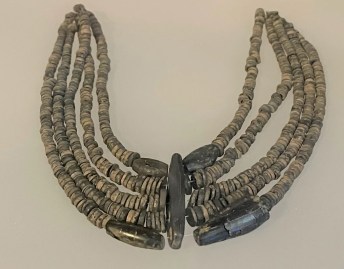
Links connected with Thursday’s event:

Mobility of Objects Across Boundaries website
https://mobilityofobjectsacrossboundaries.wordpress.com/

Mobility of Objects: Pilgrim badges and devotional tokens from the Grosvenor Museum, Chester (video)
https://www.openartsarchive.org/resource/mobility-objects-pilgrim-badges-and-devotional-tokens-grosvenor-museum-chester

Object Videos Pilgrimage Badges and Devotional Tokens (video)
https://mobilityofobjectsacrossboundaries.wordpress.com/object-videos-handling-session-2-pilgrimage-badges-and-devotional-tokens/

Education Object Boxes
https://mob.chester.ac.uk/activities/education-object-boxes-for-schools/

Other sources

Useful details about ampullae
Ampulla
https://medievallondon.ace.fordham.edu/collections/show/90

Beeston Crag Prehistory #1 – The Earlier Prehistory

Beeston crag is a superb landmark, a small outcrop of the Cheshire Sandstone Ridge that was first occupied by people during the post-glacial period. Today, Beeston crag’s main claim to fame is the ruined 13th Century castle of Ranulf III, 6th Earl of Chester, built to intimidate his enemies, impress his allies, and provide himself with a magnificent legacy.  Following the Ranulf III’s death in 1232 and the subsequent death of his heir in 1235, the castle was repaired and rebuilt on several occasions until the 17th century when it was deliberately destroyed.  After this, the romance of the ruins attracted artists and tourist alike.  Today it is managed by English Heritage and is an engaging visitor attraction.  This has all been covered on two previous posts. Ranulf III’s Beeston Castle Part 1 looks at the remarkable magnate Ranulf III;  Ranulf III’s Beeston Castle Part 2 describes the castle’s history and includes notes about visiting.

Beeston Castle, showing the excavated Bronze Age and Iron Age posthole locations, marking hut circles in the outer ward (pink circles).  The outer ward fortifications followed some of the lines of the Iron Age defences and the earlier Bronze Age banks.  Both contemporary and earlier prehistoric sites were also found in other parts of the site.  Source: Liddiard and Swallow 2007

Hidden beneath all of this rich Medieval and Civil War history is the archaeological story of the crag before history began.  The  impressive Medieval fortifications incorporate the remains of an invisible but remarkable prehistoric past, making the same use of a formidable location  that dominates the Cheshire plain, with clear views to the north, east and west, providing safety from predatory animals in what was dense woodland below.  Archaeologists between the 1960s and 1980s excavated these remains of the area’s prehistoric activity, some of it very exciting.

Although the Cheshire Sandstone Ridge as a whole is rich in prehistoric sites, in these two posts I simply want to get to grips with some of this particular crag’s prehistoric past.  I have divided Beeston’s prehistory into a post about the earlier  prehistory (in this part, part 1) and the later prehistory (in part 2).  Other sites on the ridge will be mentioned in passing, and future posts will discuss what all of the research on the Cheshire Sandstone Ridge contributes to our knowledge of prehistory in Cheshire.

For anyone wanting to find out more about each of the periods of British prehistory mentioned, some excellent books are listed in the Sources at the end of each of the two posts.

This post has been divided into the following sections:

  • Survey and excavation history
  • A note on the Three Age system
  • The role of the geology, geography and environment
  • The archaeological sequence at Beeston
  • Raw material acquisition at early prehistoric Beeston
  • Final comments
  • Next
  • Sources

Survey and excavation history

Aerial view over Beeston crag showing its prominent position over the landscape. Source: Sandstone Ridge Trust

Some of the hillforts on the Cheshire Sandstone Ridge were excavated in the mid-1930s by William Varley, an archaeologist with the University of Liverpool.  His excavations were focused on  hillforts, and although there were some inconsistencies is his approach, and his interpretations are sometimes questioned, he established that there was information under the ground along the ridge, and that it was worth investigating further.  Varley bypassed Beeston, but thirty years later new excavations filled this gap, focusing on both prehistoric and Mediaeval remains, a suitable endorsement of Varley’s initial exploratory work.

In the excavations of the 1960s-80s there were two main concentrations of excavation, one in the centre of the outer ward, and another by the outer gateway. Another fairly large area was opened to the south of the outer gateway, and some small cuttings were opened in other areas. Source: Ellis 1993 (with red circles added)

Two closely connected stretches of investigation are responsible for our understanding of the prehistory of the Beeston.  These are Laurence Keen’s work between 1968 and 1973 and Peter Hough’s work between 1975 and 1985.  These excavations found evidence of early as well as later prehistory, and made use of radiocarbon dating to establish a sound chronological sequence.    The account on this blog post makes extensive use of those excavations, reported in Beeston Castle, Cheshire. Excavations by Laurence Keen and Peter Hough, 1968-1985 edited by Peter Ellis and published by  English Heritage in 1993. Unfortunately, many of the tables and images were on microfiche, and although the core text is now available for download, the microfiches have presumably not been digitized.

Plan of the Outer Ward excavation findings. Source: Ellis 1993

Although a lot of interpretive schemes in archaeology extrapolate from very small samples of big sites, particularly hillforts, in the case of the Keen and Hough excavations, there were two reasonably large areas where the work was concentrated, a smaller but still significant trench and several useful cuttings to sample other areas within the locale.  It is by no means straightforward to collate all this information into a coherent narrative, even if that is actually desirable with this sort of sampling, but some very useful findings were reported.

Some of the results of one of the sub-surface surveys in 2010. Source:  an unpublished report, via Garner 2016.

No recent excavation has taken place at Beeston, but a series of geophysical and LiDAR (Light Detection and Ranging) surveys were carried out by the Habitats and Hillforts Project in 2009 and 2010, at the outer ward and outer gateway.  Although these produced no definitive results, they did identify some anomalies that could indicate where future excavation projects might concentrate their attentions.  Much of the Habitats and Hillforts work has been published.  Dan Garner’s 2012 short introductory booklet  Hillforts of the Cheshire Sandstone Ridge, which looks at multiple periods of occupation, is very useful for becoming acquainted with the Cheshire Ridge archaeology.  Garner’s 2016 academic volume Hillforts of the Cheshire  Ridge is of considerable value for understanding both previous and current survey and excavation works at the other Cheshire Sandston Ridge sites in greater detail, particularly Eddisbury Hillfort.

A note on the Three-Age system

Thomsen explaining the Three-age System in Copenhagen, 1846. Drawing by Magnus Petersen, Thomsen’s illustrator. Source: Wikipedia

The 19th Century vision of a Three Age System, (Stone Age, Bronze Age and Iron Age), devised by Danish antiquarian Christian Jürgensen Thomsen and published in 1836,  was a spirited attempt to create a chronological framework for Danish prehistory that was widely adopted.  It became associated with the idea that technological innovations were inextricably linked to human progress and, by extension, the superiority of industrial nations.

Although ideas have now changed, the Three Age system is still the main organizing framework within which prehistory is discussed.  Having noted that the early Neolithic (New Stone Age) is an extension of the Mesolithic (Middle Stone Age), that the later Neolithic segues into the Early Bronze Age, as does the later Bronze Age into the early Iron Age, it is possible to move on.  These issues are all dealt with comprehensively in the academic literature.  The Three Age model still provides a framework within which most prehistoric archaeology is bashed out and bullied into shape, and as long as its limitations are kept to the fore, it need not be a wholly unyielding strait-jacket.

The role of geology, geography and environment

The location of Beeston within the Cheshire Sandston Ridge. Source: Garner 2012 (with red ring added)

Beeston is part of the fabulous Cheshire Sandstone Ridge, and those who selected it as an ideal place to settle, either temporarily or in the long-term, were presumably attracted by its height 150m above sea level, its location in a vast area of mixed deciduous woodland and, eventually, its defensive potential.

From a distance this prominent piece of geology looks like a complete anomaly, rising like a fossilized dinosaur’s spine out of the Cheshire Sandstone Ridge, knobbly and incomplete, but obviously the product of the same geological engine, the rocky components of the same machine.  Beeston sits towards the southern end of the ridge.  The Cheshire plain spreads from its base in all directions, the hills of the Welsh foothills to the west and the Peak district to the northeast, visible only in the far distance.  The Cheshire Sandstone Ridge is made up of desert sands and pebbles up to 225 million years old.  Questions about how the ridge formed and why it looks as it does are going to have to be the subject of a future post, written by someone else, but its upstanding presence in the otherwise flat landscape tell us, on its own, something about the prehistoric communities that, on and off over a period of nearly 8000 years, decided that it was a good place in which to camp or settle.

Archaeologically speaking, the sandstone composition is interesting because sandstone does not contain any of the stone types used used for the manufacture of stone tools.  This means that the flint and chert used for such tools was brought here from somewhere else.  This suggests not only that people were here for something other than the raw materials for tool manufacture but that they had to bring either the stone for tool manufacture with them, or the tools themselves.

View from Beeston crag today west towards the Welsh foothills. In the Mesolithic and early Neolithic this would have been dense woodland. Clearance on the plain started in the later Neolithic but probably did not make significant changes to the patterns of vegetation until the mid Bronze Age to early Iron Age.

What the Cheshire Ridge has in abundance, other than sandstone, is height.  This provides truly impressive visibility across the landscape, as well as respite from the dense woodland below.  Whether or not the views across the plain would have been much use in earlier prehistoric phases is debateable, as the dense woodland would have disguised the approach of any but the largest groups of people.  Even after extensive woodland clearance had carved out agricultural fields,  this might have remained true.  On the other hand, lines of sight to other communities on other parts of the ridge might have been important, and clear views of weather fronts could also have been value.  Respite from dense woodland may have been relevant, especially when brown bear and wolves stalked the plains in hunt of meat of any description.  The best way to avoid becoming something else’s dinner is always to remove oneself from its preferred habitat.  It’s not a fool-proof strategy, but it’s certainly a step in the right direction.

Cattle grazing in a field below Beeston.

According to the Sandstone Ridge Trust, farming remains the major land use, with livestock farming dominating the area.  This is interesting, as it tends to confirm the general impression that the damp clays of the Cheshire plain would have been difficult to cultivate in the past, particularly in early prehistory when the environment was much wetter and the area around the ridge included a network of freshwater springs.  Woodland cover today exceeds 13%, which is high compared to nearby areas, but low compared to the probable coverage throughout most of prehistory.

A multi-period location

Archaeological chronology of the Cheshire Sandstone Ridge. Source: Garner 2012

Wherever there is a medieval castle perched on a hilltop, it is worth looking for an Iron  Age hillfort.  They are often there to be found.  It is also worth looking even further down the chronological funnel because some of the fortified prehistoric hilltops once synonymous with the Iron Age, are now known to have been built centuries before the Iron Age began.  So wherever there is an Iron Age hillfort, it is worth bearing in mind that there may be a late Bronze Age predecessor, as was the case at Beeston.   At Beeston the two phases of Iron Age hillfort were preceded by two phases of later Bronze Age settlement, one of which included an enclosing bank, and these were themselves preceded by even earlier prehistory – the Mesolithic, Neolithic and Early Bronze Age.

On the basis of previous work in the area, the excavators may have been hoping for prehistoric as well as Medieval finds, and they found evidence from the Mesolithic occupation from around 8000BC, dotted around all the way to the Romano-British period, which in Cheshire dates to c.70AD.  These were small outposts of earlier prehistoric activity Mesolithic (Middle Stone Age), Neolithic (New Stone Age) and Early Bronze Age, as well as more comprehensive discoveries of the later Bronze Age and Iron Age.  The earlier prehistoric phases will all be discussed below and the later prehistoric in Part 2.  Although there were discontinuities between the various occupations of Beeston, the crag was clearly of value to people of very different economic and social profiles over a very long period of time.

Archaeological periods at Beeston crag. Collated from Ellis 1993.

The Archaeological Sequence at Beeston

After the Ice Age, 9000-4000BC

Maximum extent of the Devensian ice-sheet. Much of the rest of southern England will have been encased in permafrost which only began to melt as the ice sheets retreated, starting at around 10,000BC. Source: Antarctic Glaciers

During the last Ice Age, the Devensian, glacial ice-sheets extended in an uneven line towards southern England, covering Wales and Ireland.  The ice sheets carved out the u-shaped valleys that we all remember from school geography lessons, transporting huge amounts of debris from north to south, dropping thick deposits of soil and gravel, and creating meltwater channels.  Vegetation was demolished either by the ice or by the temperatures, animals and people departed, and most of Britain was empty of life.  Connected to the continent by a substantial land bridge, Britain only began to revive when the climate started to warm, and the ice began to melt.  Vegetation, consisting of  deciduous woodlands, shrubs and grasslands slowly returned to the lowlands, followed across the land-bridge by, amongst others, red deer, wild cattle (aurochs), reindeer, elk, brown bear, wolf and lynx.  In their wake followed small communities of people who lived by hunting game, foraging for wild vegetables, roots, seeds, herbs and fruit, and fishing on the coast and in rivers.  Today the period during which these groups of people returned and occupied post-glacial Britain is known as the Mesolithic, or Middle Stone Age. As the ice continued to melt and sea levels continued to rise, Britain was eventually physically cut off from the mainland, but that did not prevent other types of connection being established.

Mesolithic tools found from Beeston Castle, all less than 5cm long. Source: Ellis 1993

The Beeston Mesolithic finds are restricted to a small handful of stone tools that had been dislodged from their original context.  These are very typical of the period, consisting of microliths (tiny stone tools), and other very small pieces.  They do not say much on their own, but other Mesolithic sites in the area argue that the Beeston finds are a very small part of a much bigger Mesolithic story in the area.  In particular, Harrol Edge near Frodsham produced over 1500 tools from the period and will be discussed further below.  Other small sites are dotted along the Cheshire Ridge although most are as ephemeral as those at Beeston.  These include an earlier and later Mesolithic phase at Carden Park near Broxton; Riley Bank Farm, Alvanley Cliff (all at the northern outcrop); and Seven Lows on the east edge of the central outcrop (a Late Neolithic/Early Bronze Age site where around 100 pieces of worked flint were found).  These are all surface scatters, not clearly defined and stratified sites, but they are valuable for indicating the presence of people at this time, suggesting the size of  individual occupations and the period of time over which visits were made.  Together, they argue for small, temporary stopping off points as the landscape was exploited for food, craft and tool manufacturing resources.  They combine with other evidence to give an impression of a very busy pattern of landscape use in the Cheshire Ridge area, probably on a seasonal basis.

The Neolithic, 4000-2500BC

The later Mesolithic did not come to an abrupt end, any more than the Neolithic began as a rocket launch.  The long period of transition between the two livelihood strategies were influenced by processes taking place on the continent, themselves innovated in the Near East.  These presented opportunities and options, perhaps attractive to some and not to others, and take-up was no overnight phenomenon.

Neolithic stone tools from Beeston crag.  Numbers 18 and 19 at the top of the image are earlier Neolithic leaf-shaped arrowheads. Source:  Ellis 1993.

The changes that help to define the Neolithic (New Stone Age), when they began to gather momentum in around the third millennium BC, were characterized by a number of transformations that took place over the following 2500 years.  The spread of the main features generally characterizing the Neolithic did not spread at the same rate throughout Britain, and not all characteristics were adopted at the same time, even in neighbouring areas.  The main components defining the Neolithic are new forms of technology, a change of food acquisition practices, accompanied by new types of social statements.  Continuities and discontinuities between the Mesolithic and Neolithic are eternally under debate, because they are central to the question of how the domesticated crops and livestock, stone tool technology and more nebulous spiritual ideas were introduced from the continent, adopted in Britain and then spread.  Whatever the mechanism of their arrival in Britain, they became cornerstones of everyday life, and eventually found throughout Britain and Ireland, taking different forms in different areas, but based on a similar package livelihood opportunities, both economic and conceptual.

Early Neolithic of the Grimston/carinated tradition in northern Britain. Source: Malone 2001.

In parts of Britain, the Neolithic represents the first foray into mixed agriculture, with domesticated cereal crops and livestock and the adoption of pottery, which helped to introduce new cooking techniques, and to increase the variety of foodstuffs that could be consumed.  It also improved storage of both solids and liquids, protecting them from insect and vermin, and  took on cultural as well as economic roles. It is possible that after an initial foray into cereal production, pastoralism became the dominant approach to Neolithic food production.  This was probably particularly true in areas like Cheshire, where the clays, meres, mosses and heathlands would have been anything other than ideal for crop cultivation, and where dairy and other livestock farming dominate today.

As people began to manage their livelihoods in new ways, novel ceremonial and funerary monuments were built, and pottery and stone tools began to enter the realm of the dead as well as the living.  Long distance relationships, already a feature of some Mesolithic communities, extended, as the trade in axes and exotic materials expanded.

Grimston Ware sherds from Beeston (Royle and Woodward in Ellis 1993). The lovely replica showing what a complete carinated Grimston bowl would look like, is by Potted History

Information about the Neolithic in Cheshire, and particularly the Cheshire Ridge, is at best fragmentary, and it is not yet possible to pull together a coherent narrative of what is happening.  As with the Mesolithic, settlement data, rarely in the form of structural remains and usually in the form of  secondary scatters of objects on the surface, are generally small and dispersed but together contribute to  distribution maps to indicate, at the very least, where Neolithic people were present, and what form their presence took.  

At Beeston, objects of both the earlier and mid Neolithic were placed by Ellis in his 1A phase.  Objects diagnostic of the earlier Neolithic include leaf-shaped arrowheads (above), and carinated bowls (right) that used to be referred to as Grimston or Grimston-Lyles Hill ware, generally in circulation from c.3750BC.  The carination here is the rim that circles the centre of the vessel, and in general refers to a vessel’s wall making a sharp change of direction.  At Beeston both leaf-shaped arrowheads and sherds of carinated bowl are present, although the pottery is very fragmentary.  Because clay was fired at relatively low temperatures, and because temper in the fabric was often organic or composed of stone pieces, the pots were relatively fragile and once abandoned, were vulnerable to frost and heat damage and to erosive forces.  It is therefore comparatively rare to find Neolithic pottery found in tact.  Although Grimston carinated wares continued to be used for hundreds of years in some areas, in most they were replaced by more regionally distinct styles. 

The leaf-shaped arrowheads that were spread widely through Britain had no antecedents in the Mesolithic, they suggest that hunting still formed part of subsistence activities.  The hand-made (as opposed to wheel-thrown) carinated pottery.  Carinated bowls were found in a wide range of contexts in Britain, from pits and middens to early burial contexts, but there is no evidence of burial sites of this date either at Beeston or nearby.

The early to mid Neolithic phase at Beeston’s outer entrance under excavation. You can see the stone walls of the Medieval castle in the background. This area is at the entrance to the outer ward, so when you pause to walk through the gap in the walls, remember that a Neolithic site was found underfoot. Source: Ellis 1993.

Another area of Neolithic at occupation at Beeston was found during the excavation at the outer gateway to the Medieval castle.  The Neolithic phase in this area was marked by terraces, hollows, pits and postholes.  There had clearly been an attempt to provide a level surface, implying some investment in the site, suggesting either the intention to stay put for some time, make repeat visits annually, or return at seasonally.  As well as this evidence of settlement, there were stone tools including small axe heads and the sherds of four types of Neolithic pottery, spanning the early to mid Neolithic. 

Additional Neolithic material was found on the plateau edge.  A deep pit cut into the bedrock and a smaller pit or posthole were accompanied by a single early-mid Neolithic sherd, at the base of the deep it.  It is difficult to assess, but the excavators suggest that it may mark a former entrance.  Finally, a single Late Neolithic sherd was found in Post-Medieval layers in the outer ward, where the Bronze Age and Iron Age hut circles were found.

Were these Neolithic occupants permanent cultivators who carved out fields in the woodland below, peripatetic livestock herders, or occasional visitors making use of the outcrop as a supplement to activities on the plain or elsewhere?  There are no plant or animal remains surviving to give us a hint.  The evidence from pollen analysis indicates that post-glacial Beeston developed in the context of mixed oak woodland and Ellis says that pollen data from north of Beeston suggests an initial clearance phase, but that this did not happen until the third millennium (i.e. between 3000BC and 2000BC, in the later Neolithic).   At Eddisbury hillfort, excavations in 2010 produced wood charcoal and other vegetation remains that suggest heath or moorland conditions that are generally associated with human manipulation of the landscape, in particular livestock grazing.  It is possible that the ridge outcrops were being used for seasonal upland herding activities.  Patches of grassland would have been ideal for grazing sheep, and coarse shrub for browsing goat, whilst cool woodland on the plain, particularly oak with its acorns, would have suited pigs perfectly.

Neolithic worked tools from Beeston Castle. Source: Liddiard and Swallow 2007

There are other explanations possible as well.  The small size of the assemblages may suggest scouting parties or small detachments engaged in resource aquisition tasks, heading east to west or north to south, and heading up hill for safety en route somewhere else.

All of the above is pure speculation, based on livelihoods practiced elsewhere, but it is the sort of speculation that ensures that when new data emerges, different models of occupation can be tested against the cumulative findings.

Although ceremonial and burial monuments are characteristic of some regions, nothing of this sort on the ridge or, to date, in the immediate landscape have been found in the early/mid Neolithic. Not until right at the end of the Neolithic and the beginning of the Early Bronze Age, when round barrows begin to appear on the sandstone ridge, and beaker remains were found at Beeston.  This is at least 2000 years after the leaf-shaped arrowheads that we looked at above.  I’ve covered beakers and round barrows in the Early Bronze Age section below, although they might just as well be termed Late or Final Neolithic.

Although only a small area of Neolithic land modification was identified, and there are only a handful of artefacts, it is worth remembering that only a small part of the entire crag was sampled.  That’s not anyone’s fault, because it would take decades to dig up the entire thing.  The excavation sample was actually impressive, and it does mean that there may well be other examples Neolithic land modification and objects to discover both on Beeston and other outcrops, as well as in the surrounding landscape.  Although it’s a trite analogy, every new site, however small, is an important part of the Neolithic jigsaw, not only allowing insights locally, but contributing to how we understand differences from and linkages between geographical areas in Britain.  Fortunately, excavation programmes are ongoing under Habitats and Hillforts Project and as all of this Cheshire Sandstone Ridge data is collated, it will hopefully provide an increasingly coherent understanding of Neolithic livelihoods on parts of the ridge and the surrounding area.

Early Bronze Age / Beaker period c.2500-1700BC

Earlier and Later Bronze Age sites along the Cheshire Ridge. Source: Garner 2012

In most parts of the country there is no clear delineation between the Late Neolithic and earliest version of the Bronze Age, sometimes referred to as the Copper Age or chalcolithic (roughly, the copper stone age) because copper appeared before bronze was introduced.  A new type of pottery, the Beaker, is also characteristic of this cross-over period, together with a range of associated objects.

It has been clear to archaeologists for a long time that the Beaker tradition was communicated to Britain and Ireland from the continent, where its geographical presence was widespread, found in Netherlands, Belgium, Germany, France, Italy, and the Iberian peninsula.  A  multi-disciplinary DNA analysis research project in 2017 proposed that a significant percentage of the indigenous population of Britain was, by the Middle Bronze Age, replaced by those who brought the Beaker tradition with them at the end of the Neolithic. Here’s an excerpt from the report (Olalde et al 2017).

The arrival of the Beaker Complex precipitated a profound demographic transformation in Britain, exemplified by the absence of individuals in our dataset without large amounts of Steppe-related ancestry after 2400 BCE. It is possible that the uneven geographic distribution of our samples, coupled with different burial practises between local and incoming populations (cremation versus burial) during the early stages of interaction could result in a sampling bias against local individuals. However, the signal observed during the Beaker period persisted through the later Bronze Age, without any evidence of genetically Neolithic-like individuals among the 27 Bronze Age individuals we newly report, who traced more than 90% of their ancestry to individuals of the central European Beaker Complex. Thus, the genetic evidence points to a substantial amount of migration into Britain from the European mainland beginning around 2400 BCE.

Cheshire’s only complete beaker, from Gawsworth. Source: Megalithic.co.uk

As is so often the case with this sort of DNA research, as highlighted in the study itself, there are questions remaining about the extent to which it is possible to extrapolate from the data used, including sampling issues (statistical, geographical and relating to the quality of the material).  However, although the question about how and why the continental Beaker objects and ideas became so popular remains open to some extent, it seems probable that as well as cultural dispersal of ideas and practices, some level of migration took place.  However it happened, at the end of the Neolithic the continental Beaker and associated objects did become desirable, and were found extensively under round barrows, as well as occasionally in other contexts, in many parts of Britain.  The cultivation of cereals also appears to have been resumed in some areas and intensified in others at this time, with new roundhouses being built in domestic contexts.

Distribution of some of the round barrows in Cheshire. Source: Morgan and Morgan 2004.

Beakers are not as common in northwest England as they were in the south, and only one complete Beaker, a long-necked type, has been found in Cheshire, in a round barrow burial Gawsworth, which is in the far east of the county, near Macclesfield.  The Beeston Beaker-related finds fall within Ellis’s 1B phase.   They were found at the Outer Gateway and in the Outer Ward.  In all cases they were found in amongst later material, within later prehistoric and Medieval material and postholes.  They consist of Beaker fragment, collared urn and/or pygmy cup fragments, a barbed and tanged arrowhead and four knife blades.  In Ellis’s collation of the excavations by Keen and Hough, the pottery analysis by Royle and Woodward interpreted the Beeston Beaker and its associated finds, as evidence for a vanished barrow burial.  There has been extensive use of the outer wards since prehistoric times with considerable quarrying and levelling on all areas of the plateau, so it is not impossible that a round barrow had been built and later destroyed. Beakers could, however, also be found as broken sherds in isolated pits, as well as in domestic contexts.  Other new forms of pottery followed in the Early Bronze Age, including food vessels, cordoned urns, collared urns and pygmy/accessory cups, of which a number of examples have been found along the Cheshire Ridge.

Seven Lows assemblage with Beaker sherds. British Museum 1862,0707.64. Source: British Museum

Round barrows with Early Bronze Age finds in them have been found in the Cheshire Ridge area.  Examples shown on the map above are Carden Park at Broxton, Castle Cob, Glead Hill Cob, Peckforton, High Billinge, Little Budworth and the Seven Lows barrow cemetery.  Few have been excavated in modern times, but most were cremations.  Only Clead Hill produced metal, in the form of a single bronze pin.  It was accompanied by two barbed and tanged arrowheads, collared urns and a pygmy/accessory cup, all consistent with Early Bronze Age burial assemblages.  The most common form of metal dating to the Early Bronze Age in the area was in the form of isolated finds of flat axe heads, but there are only four of those in the general vicinity.  The recent excavation report for Seven Lows has just been reported (it arrived through my letterbox yesterday) by Dan Garner in the Journal of the Chester Archaeological Society, so there will more on that site on a future post.

There is even less information for the Beaker-related presence at Beeston than the Neolithic, but what has been found is not inconsistent with other finds in the area, and it is to be hoped that further excavation will lead to a more complete understanding of the Beaker tradition in the Cheshire Ridge area.


Raw material acquisition at early prehistoric Beeston

Sourcing stone

Flint and chert were the materials used by the tool makers who left their tools at Beeston Crag.  Because of the way in which the stone fractures predictably when hit by a hard or soft object, flint and chert are favoured for flaked stone tool manufacture.  A remarkable amount of precision is achieved, meaning that multiple classes of foot types can be manufactured which, once identified by archaeologists, can be categorized and can contribute to an understanding of livelihood transformation and regional differentiation.

Mesolithic flint and chert tools from the Adams collection, collected at Harrol Edge, Frodsham. Source: Brooks, in Garner 2016

The sandstone ridge was not the source of the raw materials used in the earlier prehistoric period for stone tool manufacture.  At  Harrol Edge, near Woodhouse Hill at Frodsham, over 1500 pieces of Mesolithic worked stone pieces were gathered during unofficial fieldwalking in the 1950s by local resident J. Adams, since donated to the Grosvenor Museum in Chester.

For the flint, an analysis of the Harrol Edge tools by Ian Brooks identifies two sources, in chalk deposits of the Lincolnshire/Yorkshire wolds or Northern Ireland.  This does not necessarily mean that people had to go to either place or engage in trade to source the stone, because the ice-sheets transported considerable amounts of stone material to parts of the country to which it was not native, and Irish Sea till (unsorted material deposited by the movement of glacial ice) and associated gravels have been found in the valley of the River Weaver, which runs to the east of the sandstone ridge.

The nearest chert deposits were found in limestones in the Peak District and on the edge of the Vale of Clwyd (sometimes referred to as Gronant chert but properly part of the Pentre Chert Formation).  This means that however these stones were being sourced, they had to be transported to the site either as a raw material for working into tools, or as finished objects.

More Mesolithic stone tools from Harrol Edge, Frodsham. Source: Garner 2012

Hunter-forager-fishers of the Mesolithic were seasonally mobile, moving base camps to make the most of food and craft resources.  It is more than probable that in their seasonal rounds they were able to source chert and flint.  There is insufficient evidence from Beeston itself to suggest how stone was being processed, but of the 1500 pieces from the Harrol Edge collection, only 266 were actual artefacts, consisting of 232 blades and 34 scrapers, and the rest were by-products of the manufacturing process, representing multiple took making events.  This suggests that most of the artefacts were being made here, wherever the finished tools were eventually discarded, meaning that the raw material was brought to the site to be worked, rather than being worked where it was found.  Most of the objects were made on flint, mainly a distinctive banded variety, and only 8.6% were on a dark-coloured chert.  The chert tools may have been earlier in date than the flint examples.  Brooks says that the banded flint was not wholly ideal for knapping into shape, and probably would not have been the first choice if an alternative had been readily available.  Brooks felt that it probably came from the Peak District, but did not rule out north Wales as a possibility.

Knapped stone arrowheads from the Neolithic. Source: Malone 2001

In terms of the Neolithic stone use at Beeston, even early farmers were often far from sedentary, making their way through the landscape as they herded, seeking out craft materials on a seasonal basis and looking for new opportunities to exploit tracts of lowland and upland.  Early farmers were often far from sedentary, making their way through familiar landmarks of the landscape as they herded on a seasonal basis, seeking out craft materials on a and looking for new opportunities to exploit both lowland and upland environments.  It is possible that the local glacial tills provided the necessary flint for small tools, but even if travel had been required or the acquisition of raw materials, it would not have been necessary for the entire community to relocate.  For example, a dedicated resource acquisition group could have been dispatched from the group for this specialized task.  At the moment all we know for sure is that Neolithic groups were in the area, and that they imported flint and chert, either as raw material or as completed tools, from outside the area.

At Beeston the Early Bronze Age stone tool assemblage consists of a flint barbed and tanged arrowhead and four knives, all flint, and all nicely worked.  There is not much to be added to the above comments, but the knives were made of bigger pieces of flint than previous items, and it seems less likely that the raw material for such items would have been carried for any distances.  I have no idea whether or not flint pieces this size could have been found in the nearby valley gravels.

Sourcing materials for pottery

Collared urn sherds from Beeston (Royle and Woodward in Ellis 1993) and a photograph of collared urn from Seven Lows (source: Megalithic Portal)

The excavation report refers to three types of phase 1a and 1b pottery at Beeston.  All of them are made from local glacial drift clays characteristic of the Cheshire/Shropshire basin.  For example, the mineral inclusions (called temper) that were added to the collared urn clay during the pottery making process included quartz, sand, granite, rhyolite and basalt, all of which were common to other collared urns in Cheshire, and all of which could be sourced from local river valleys and glacial gravels in the area.  Because both the clay and the temper  were available locally, vessels could be manufactured within the immediate area, although there is no actual evidence to date for pottery manufacture at any of the Cheshire sites.  Although these vessels were hand formed rather than wheel-thrown, they still needed to be fired, and so far no evidence has emerged in the area for Neolithic kilns (usually simple pit kilns).


Final Comments

Although Beeston crag has produced the greatest evidence of early prehistoric occupation along the line of the Cheshire Ridge, this is probably due mainly to an accident of sampling.  Other hillforts were simply not excavated as extensively as Beeston, meaning that there could be plenty of early prehistory to be found at other Cheshire Ridge outcrops.  There have been some indications that there is more to be found.  At Eddisbury hillfort, for example, a possible late Neolithic cremation cemetery has been identified; at Seven Lows barrow cemetery at the eastern foot of the central outcrop, a recent excavation has just been published in the Chester Archaeological Journal (issue 8);  at Woodhouse  a small assemblage of Late Neolithic/Early Bronze Age stone tools were found, and at Helsby some early Neolithic activity has been identified.  Stray finds have been found elsewhere along the line of outcrops.

The so-called Beeston Hoard. Source: Varley and Jackson 1940

So far all the archaeological focus has been on the outcrops of the ridge, but that too is something of a sampling problem.  Because of the considerable agricultural value of the land across the Cheshire plain, it is unlikely that many upstanding sites are left to be found, and any settlement sites are likely to have been ploughed in. Aerial photography has proved to be of marginal value due to the water retentive properties of the glacial soil, which prevents it drying out sufficiently to show variations in the soil during dry weather.  However, there are hints that  prehistoric archaeology may yet be found.  On the plain not far from Beeston, the so-called “Beeston hoard” was found on the edge of a former freshwater spring, consisting of a Neolithic polished stone axe and an Early Bronze Age perforated stone axe-hammer.  The remains of a round barrow surrounded by a ring of stones and a circular ditch were found at Morreys garden centre at Kelsall, containing the cremated bones of a child in an inverted collared urn.  Unfortunately, discoveries like that have been few and far between.

Barbed and tanged arrowhead from Beeston – Late Neolithic/Early Bronze Age. Source: Ellis 1993

The discovery of earlier prehistoric sites along the course of the Cheshire Sandstone Ridge, many only excavated only briefly and some not excavated at all, establishes that there is the opportunity for further investigation, and hopefully further illumination.  There are a lot of questions remaining open about the earlier prehistory of both the ridge and the surrounding landscape.  Clearly, there is a lot of future potential for both non-invasive survey and excavation, should the funding be available.

Next

Following a visit to Beeston to enjoy the castle on a fine, sunny day last year, I became aware that Beeston had something of a prehistoric past, but I was surprised by how rich that past turns out to be, particularly when seen within the context of other sites on and around the Cheshire Sandstone Ridge.  At Beeston it begins with the Mesolithic occupation from around 9000BC, and then takes in the early Neolithic and the later Neolithic/earlier Bronze Age.  In Part 2, the very striking Bronze Age and Iron Age round-house and related discoveries on the Beeston crag take us all the way to the Romano-British period.


Sources for Parts 1 and 2:

Items in bold were used extensively in this post, with my thanks.

Books and papers:

Berridge, P. 1994. The Lithics.  In (ed.) Quinnell, H., Blockley, M.R. and Berridge, P. Excavations at Rhuddland, Clwyd, 1969-1973. Mesolithic to Medieval.  BAR 95, CBA.

Bradley, R. 2019 (2nd edition).  The Prehistory of Britain and Ireland. Cambridge University Press

Callaway, E. 2018.  Divided by DNA: The uneasy relationship between archaeology and ancient genomics.  Nature, March 28th 2018

Cunliffe, B. 1995. Iron Age Britain. English Heritage/Batsford

Cunliffe, B. 2005 (4th edition). Iron Age Communities in Britain. Routledge

Ellis, P. (ed.) 1993.  Beeston Castle, Cheshire. Excavations by Laurence Keen and Peter Hough, 1968-1985. English Heritage
https://archaeologydataservice.ac.uk/archiveDS/archiveDownload?t=arch-1416-1/dissemination/pdf/9781848021358.pdf 

Fairhurst, J. M. 1988.  A Landscape Interpretation of Delamere Forest. May 1988
http://delamereandoakmere.co.uk/wp-content/uploads/2017/03/fairhurst-delamere-landscape.pdf

Garner, D. 2012.  Hillforts of the Cheshire Sandstone Ridge. Cheshire West and Chester
https://www.sandstoneridge.org.uk/doc/D234636.pdf

Garner, D. and contributors 2016.  Hillforts of the Cheshire Ridge.  Archaeopress (appendices only available online)
http://www.archaeopress.com/ArchaeopressShop/Public/displayProductDetail.asp?id={2B433802-E7A0-4302-B2DD-95B7F3B2A493}

Garner, D. and contributors 2021. The Seven Lowes prehistoric barrow cemetery, Fishpool Lane, Delamere, Cheshire: a reassessment.  Journal of the Chester Archaeological Society, volume 91, 2021

Gibson, A. 2020. Beakers in Britain. The Beaker package reviewed. Préhistoires méditerranéennes no.8 (Ethnicity? Prestige? What else? Challenging views on the spread of Bell Beakers in Europe during the late 3rd millennium BC)
https://journals.openedition.org/pm/2077

Liddiard, R. and Swallow, R.E. 2007.  Beeston Castle.  English Heritage

LUC 2018. Cheshire East Landscape Character Assessment 2018. Land Use Consultants
https://www.cheshireeast.gov.uk/planning/spatial-planning/cheshire_east_local_plan/site-allocations-and-policies/sadpd-examination/documents/examination-library/ED10-Cheshire-East-LCA.pdf

Mackintosh, D. 1879.  Results of a systematic survey in 1878 of the direction and limits of dispersal, mode of occurrence and relation to drift deposits of erratic blocks our boulders of the west of England and east Wales, including a revision of many years’ previous observations.  The Quarterly Journal of the Geological Society of London 53, p.425-55

Malone, C. 2001.  Neolithic Britain and Ireland.  Tempus Publishing

Matthews, D. 2014.  Hillfort intervisibility in the northern and mid Marches.  In Saunders, T. (ed.) Hillforts in the Northwest and Beyond.  Archaeology NW new series, Vol.3, Iss.13 for 1998.  CBA NW.

Mayer, A. 1990. Fieldwalking in Cheshire.  Lithics 11, p.48-50
http://journal.lithics.org/wp-content/uploads/lithics_11_1990_May_48_50.pdf

Morgan, V.B. and Morgan, P.E. 2004.  Prehistoric Cheshire.  Landmark Publishing

Needham, S. 1993.  The Beeston Castle Bronze Age Metalwork and its Significance.  In Ellis, P. (ed.)  Beeston Castle, Cheshire. Excavations by Laurence Keen and Peter Hough, 1968-1985. English Heritage

Olalde, O. 2017. The Beaker Phenomenon and the Genomic Transformation of Northwest Europe.  bioRxiv May 2017
https://www.biorxiv.org/content/10.1101/135962v1.full.pdf

Ormerod, G. 1882.  The history of of the county palatine and city of Chester. Routledge

Ray, K. and Thomas, J. 2018.  Neolithic Britain. Oxford University Press

Royle, C. and Woodward, A. 1993.  The Prehistoric Pottery.  In Ellis, P. (ed.)  Beeston Castle, Cheshire. Excavations by Laurence Keen and Peter Hough, 1968-1985. English Heritage

Stuart, R. 1993. The flint.  In Ellis, P. (ed.)  Beeston Castle, Cheshire. Excavations by Laurence Keen and Peter Hough, 1968-1985. English Heritage

Varley, W.J. and Jackson, J.W. 1940.  Prehistoric Cheshire. Cheshire Community Council

Weaver, J. 1995 (second edition). Beeston Castle.  English Heritage


Websites

Habitats and Hillforts Project
https://www.sandstoneridge.org.uk/projects/habitats-hillforts.html

Sandstone Ridge Trust
Leaflets about the archaeology of the Cheshire Sandstone Ridge, available to download as PDFs
https://www.sandstoneridge.org.uk/about-sandstone-ridge-trust/publications.html

Archaeology

The Archaeology of Helsby Hill (PDF, 475KB)
The Archaeology of Woodhouse Hill (PDF, 487KB)
The Archaeology of Kelsborrow Castle (PDF, 495KB)
The Archaeology of Eddisbury Hill (PDF, 451KB)
The Archaeology of Beeston Crag (PDF, 498KB)
The Archaeology of Maiden Castle (PDF, 432KB)

Habitats

Broadleaf woodland (PDF, 352KB)
Meres and mosses (PDF, 391KB)
Lowland heath (PDF, 337KB)
Species-rich grassland (PDF, 331KB)

Insights Paper. The Sandstone Ridge Trust, 2018 (PDF, 7.6MB)
Sandstone Ridge Atlas. The Sandstone Ridge Trust (PDF, 22.3MB)
Delivery Model Options Appraisal. The Sandstone Ridge Trust (PDF, 2.4MB)

Ridge: Rocks and Springs

Ridge: Rocks and Springs Evaluation Report. The Sandstone Ridge Trust, 2017 (PDF, 37.4MB)
The Ridge: Rocks and Springs — a sandstone legacy. The Sandstone Ridge Trust, 2017 (PDF, 108.8MB)
Interim Report: Urchin’s Kitchen. The Sandstone Ridge Trust, 2017 (PDF, 67.5MB)
Ridge: Rocks and Springs Project Handbook 2015. A volunteer’s guide. The Sandstone Ridge Trust, 2015 (PDF, 7.7MB)

Habitats and Hillforts

Habitats and Hillforts Evaluation Report. Cheshire West and Chester Council, October 2012 (PDF, 12.5MB)
Hillforts of the Cheshire Sandstone Ridge. Dan Garner, Cheshire West and Chester Council, October 2012 (PDF, 10.8MB)
Captured Memories. Cheshire West and Chester Council, 2011 (PDF, 100.2MB)
Fertile Ground. Art & Photography inspired by Cheshire’s Sandstone Ridge. Cheshire West and Chester Council, 2012 (PDF, 66.5MB)

Geology
Introduction
Our Geological Heritage

https://www.sandstoneridge.org.uk/special-place/rural-land-uses.html


Valle Crucis #2 – How the abbey buildings were used

Ivor Mervyn Pritchard illustration showing elevation view of Valle Crucis. Source: Coflein

When I first visited Valle Crucis, I was so bound up in the architecture and its complexity that it took me some time to get to grips with the idea that this was a place not merely where people spent time in worship, but where they spent their entire lives, an enormous amount of it taken up with liturgies.  The entire abbey complex is all about how those people’s lives were lived.

The foundation of Valle Crucis is covered in part 1.  Monastic communities conformed to a vision of life in the 13th century that had been first conceived in the 6th century.  The Cistercians were one of a number of reforming orders that were attempting to return to the 6th Century values of St Benedict.  St Benedict was long on attention to detail, but devoted less time to the bigger picture, so there was plenty of scope for incorporating his Rule into a broader vision of monastic life.  Each order approached the task differently, and the Cistercians did it by establishing remote communities where they could live out their lives, bound together by vocation, devotion and the cohesive regulations that laid down how their lives should be lived.

Plan of Valle Crucis. The buildings on the plan beyond the core abbey unit are all post-Medieval, mostly modern caravans and holiday chalets.  Source: Coflein

The Cistercians, with their centralized approach to the management of their European network of abbeys, understood all about the bigger picture, and knew how to impose its vision via standardization and conformity.  They had a system of government, and when they colonized a new country or region, they had mechanisms for ensuring that their operational procedures and their beliefs endured.  One abbey supplied the abbot and monks of the next, and the new abbey was answerable both to its parent abbey and to the founding abbey in Citeaux.  This was not just an idea; it was implemented.  The abbots of all abbeys went to Citeaux each year to attend the General Chapter where all Cistercian decisions concerning the order were made, and each parent abbey was responsible for visiting its daughter abbeys each year to inspect and judge it.  The Cistercian system was one not merely of self-discipline but of accountability.

The organization of the abbey, both its hierarchy and the functional components embedded into its architecture, promoted the Cistercian vision of monastic life.  It was ambitious and powerful, and it attracted both founders and members.

The organization of the abbey

Early pencil sketch showing archway at Valle Crucis Abbey. Source: Coflein

An abbey, priory or nunnery combined a church with monastic buildings, making up a community in which all the residents chose to devote themselves not merely to religious observance, but to a set of commitments that seems fairly daunting today.  Some must have been unnerving to the prospective novice even in the Middle Ages.  Once a novice had passed through a number of stages and was ready to make this final vows, he or she entered a life of devotion, self-denial and hard work.  The vows of personal poverty, celibacy and obedience were accompanied by the vow of stability, perhaps the most daunting vow of all.  It was a commitment to remain at the abbey for life.  All the vows were binding, and breaking them could result in punishments, including imprisonment for the most serious infractions.

As a novice, the future monk would experience the monastic code in practice, based on prayer (ora), manual labour (labora) and contemplative reading of religious texts (lectio divina).  The Cistercian order was guided by the principle of opus Dei, God’s work, and their abbeys were laid out to meet the needs of regular devotion in church, scholarly activity, economic self-sufficiency, communal support, and, when required, punishment for transgressions.

Detail of a 13th Century illuminated manuscript depicting St Benedict of Nursia, showing him with a tonsure. Source: Cover of Carolinne White’s The Rule of St Benedict (Penguin Classics)

As well as providing a church, the abbey had to make provision for its inmates.  The Cistercian hierarchy within each monastery was headed by the abbot or abbess, responsible for the smooth running of the abbey and the well-being of the monks.  The strict discipline, clear regulations and multiple routines were essential for cohesion, consistency, reassurance and morale.  Often there was a prior who was deputy to the abbot.  The main community of abbeys like Valle Crucis was made up by “choir monks.” Like other Benedictine-based orders, the Cistercian choir monks were tonsured, meaning that the top of their heads were shaved bare, leaving a ring of hair that represented Christ’s crown of thorns.  Up until the mid-14th Century, at the lowest level of the Cistercian abbey hierarchy, were the lay monks, conversi, who were allocated their own quarters within the monastic precinct.  Some had supervisory duties, but the main body of the conversi carried out most of the agricultural labour.  They did not have the tonsure. These roles, and others, will be discussed in part 4.

Aerial view of Valle Crucis (with caravan park).  Source:  Coflein

Each Cistercian abbey’s floorplan was an echo of the order’s founding abbey, Citeaux, which itself echoed the layout of earlier Benedictine monasteries.  The earliest abbey in Britain to conform to this layout was St Dunstan’s at Glastonbury in the 10th Century.   Although every abbey and priory is unique, all conform to the basic template.  Valle Crucis provides a very useful example of this template, simple enough to illustrate the principles of the Benedictine model, but elaborate enough to demonstrate some the options exercised by individual abbots over time.

Annotated plan of Valle Crucis showing the central cloister around which all the other buildings were focused, including the church, the south wall of which makes up the north wall of the cloister.  Source:  Evans 2008

The above plan of Valle Crucis shows the main organizational elements of the abbey, with the church at the north, and the rest of the buildings arranged around the cloister.  The monastic buildings surrounding one or more cloisters are called “ranges.”  Each range consisted of several rooms with doorways out into the cloister.  At the centre of the cloister was a garden or “garth.”  Around the garth was a walkway, usually termed an alley or walk, linking all the rooms in all the ranges. The monks’ formal and domestic buildings made up two sides, to the east and south, and in Cistercian abbeys the rooms for the conversi made up the fourth, western side until the mid-14th century, after which the west range was used for different functions.  Both the east and west ranges, facing each other across the cloister garth, were two-storey buildings.  This formulaic plan was a very effective organizing principle.

Standing at the east end looking west.   The dark block at centre marks the position of the original pulpitum, which divided the west end nave from the east end

In an ideal world, an abbey church would be orientated east-west, with the main entrance at the west opening into the nave, where general worshippers such as lay brothers and guests would attend services.  The nave was separated from the east end choir, chapels and presbytery (the domain of the choir monks) by a stone screen called a pulpitum or a rood screen.

The church’s south wall would make up the north wall of the cloister.  The cloister would ideally be located on the south side of the church to protect it from the wind and expose it to the sun.  Valle Crucis exemplifies this arrangement, but there are monasteries where it was not possible to orientate the church west-east or to position the cloister to the south of the church, such as Tintern in south Wales, founded in 1131, the second Cistercian abbey in Britain and the first in Wales.

14th Century window tracery in the chapter house, east range, Valle Crucis. Source: Coflein

The early Cistercians valued simplicity and rejected ostentation, associating decorative features with adulation of the material, wealth, self-indulgence and a tendency to succumb to luxury.  Monks who were supposed to be engaged on scholarly religious reading and profound, introspective contemplation needed no distractions, so the earliest buildings of the 13th Century had very few decorative flourishes.  From the mid-14th Century, however, more elaborate architectural features common to other monastic orders were added, such as window tracery and stained glass.  The chapter house in the east range, shown left, is an example of this elaboration of style.

No two abbeys were alike, which could be due to any number of variables including the richness of the original endowment, the preferences of the founding abbot, the accessibility of building materials, the availability of skilled craftsmen, financial constraints, changes in direction during the initial building phases, later re-building after fires or floods (common phenomena) and the incorporation of new ideas and technologies.  However, all abbeys share enough features to make their layout instantly familiar, with the function of many of their main rooms immediately identifiable.  Once you have got to grips with the layout of one abbey, you have the essentials for finding yourself around any other one.

The exterior

Rear view of the abbey’s east range.  From left to right, the grand passage leading from the cloister towards the fish pond, the rear view of the east range with its three tracery windows of the chapter house (with the monks dormitory overhead), and the ground floor window of the sacristy

Valle Crucis west front. Source: Coflein

For Medieval monks and modern visitors alike, the main experience of Valle Crucis takes place in the interior, but the first impression was provided by the impressive west front.  In the 376 years of the abbey’s life, local people will have seen little more than the imposing walls and tower, whilst pilgrims, guests and novices (trainee monks), will have had all the layered responses of a first impression when they arrived.  Most had probably seen other abbeys, or at least substantial churches.  For all, the view of Valle Crucis in its isolated valley setting was one of height, solidity and worthiness.  The 12th and early 13th Century Cistercians eschewed most architectural decoration, their focus on the serious business of doing God’s work without distraction.  The restored west front (which is the end at which today visitors enter the church) has the rose window and elaborate arch that were probably added after the fire that swept through the church 40 years after its foundation, and would have been considered trivia by those who founded the abbey in 1201.  For those invited to enter the church, the early 13th Century doorway would have been big, but relatively plain.  The overall impact of the ornamental details was more impressive, but less Cistercian. The east face, shown below, with its almost grim austerity, is far more consistent with early Cistercian ideas.

The innovative and austere east end of the abbey church, with the rose window of the west end showing through the left lancet window

On all of the church’s outer walls there are buttresses, long, flat vertical sections that sit against the wall, sometimes to its full height.  You can see them right, imaginatively incorporated into the design of the east end of the church. and below on the north wall, in both cases with splayed bases.  A buttress supports and reinforces a tall masonry wall, sometimes to the full height.  It counteracts the outward force of a wall to prevent it buckling by providing a counteracting force, preventing a wall from bulging by pushing against it.  These are often faced with fine stone (ashlar) or at least cornered with it (quoins).  The photograph below shows the buttress bases along the north wall of the nave of the abbey church.

Ashlar covers most of the church and monastic buildings, although some was robbed for building material after the dissolution.  The smooth surfaces, neatly carved lines, tightly fitting corners and fine joins give a much finer appearance to a building.  Being far more expensive to make and install than the roughly carved interior stone, its use also communicate something about the abbey’s status.  It really must have been quite a sight when first built.


The Virgin Mary

St Bernard of Clairvaux by Juan Correa de Vivar, 16th Century

Cistercian abbeys were dedicated to the Virgin Mary.  St Bernard, the charismatic and highly influential abbot of the 12th Century Cistercian abbey, Clairvaux, promoted Mary as a personage who encompassed all the most important Christian virtues.  She had a central role in the Christian story, she was sacred, approachable, empathetic and she had the ear of both Christ and God.  “If you fear the Father, there is Christ the Mediator.  If you fear Him, there is His Mother.  She will listen to thee, the Son will listen to her, the Father to him.”  This was St Bernard’s view of the matter, and one that he promoted energetically.

In spite of this, there is little sign of Mary in early Cistercian monastic establishments due to a Cistercian mistrust of effigies.  In most of the other monastic orders there would have been architectural carvings, paintings, tapestries and sculptures to commemorate the most venerated religious figures, but in accordance with St Benedict’s view of monastic life as pared down and austere, Cistercians rejected art works and instead venerated the Virgin only in their liturgies and rituals.  She was revered in their worship, and presumably in their hearts, but only occasionally in their architecture or art.  When the abbey was dissolved, all its possessions were sold off to raise funds for the crown.  It is thought that two chandeliers, one now at Llandegla parish church, and another at Llanarmon yn Ial may have been sourced from Valle Crucis.  I have not seen a picture of the one at Llanarmon yn Ial, but the one at Llandegla is topped with a statuette of the Virgin Mary.  If it was indeed from Valle Crucis, the depiction was from late in the abbey’s history, dating to the late 15th or early 16th Century.

Procession and Horarium

Artist’s impression by G.Pickering of monks in the east end of the Valle Crucis abbey church, having filtered down the night stairs from their dormitory, at far right.  Source:  Coflein

All buildings, whether religious or not, are about access, movement and visibility.   Doorways, walls, screens, corridors, passages and stairways all constrain and direct the sort of movement possible.  It is sometimes difficult to remember, when wandering around a roofless abbey, that the presence of windows, or the absence of them, impacts not only what can be seen from the inside out, but how clearly interiors can be seen based on the amount of light available, and whether candle light would be needed in key areas.  With the Benedictine plan,  control of movement and lighting were all about the main activities of the abbey.  All abbey activities had to be scheduled around the daily liturgies, which were at fixed times of the day.

The canonical hours or horarium scheduled the daily liturgies.  There were seven daytime gatherings, and one night-time gathering in the abbey church for prayer, psalms, chants, lessons, readings and hymns, as described by St Benedict in the Rule.  Attendance was obligatory.  In the Cistercian order these began at daybreak with Lauds, which was followed by Prime, Terce, Sext, None, Vespers (at around 6pm) and Compline (at Sunset) with Vigils (known in some orders as Matins) at night.  Between these liturgical assemblies were the daily meeting in the chapter house, mass (once a day and twice on Sundays and feast days), eating (once a day in winter, twice in summer), manual labour and intermittent sleeping.

Cistercian monks shown on a mural in the Cistercian Abbey Osek, North Bohemia, before 1756. Source: Wikipedia, from the Cistercian Abbey of Osek, North Bohemia

Every Sunday, and on feast days, the abbot led a procession of the entire community from the east end of the church around the cloister.  In larger abbey communities this must have been a spectacular sight as they monks lined up in pairs behind the abbot in their white habits and proceeded along the alleys of the cloister.  First holy water was blessed at the high alter, and then the abbot led the whole procession through the eastern part of the church, spreading holy water on altars in chapels.  Then they proceeded into the eastern alley of the cloister and walk the full circuit, sprinkling holy water into each of the rooms, before entering the nave at the west end of the church, again sprinkling altars with holy water, and finally returning, through the pulpitum, to the east end of the church.

Valle Crucis ground plan. Source: Valley Crucis Abbey by D.H. Evans (Cadw 2008)

In the order in which the procession visited them, here are the rooms at Valle Crucis, at least as it was when the abbey was suppressed in 1537, although the configuration was quite clearly somewhat different during the 13th Century.  It might be worth opening the above site plan in a new window so that you can follow the descriptions on the plan.

The Abbey Church

Cadw sign at Valle Crucis showing a cutaway of how the church may have appeared, with the nave where the lay brothers worshiped, separated by a pulpitum from the area used exclusively by the monks.

The procession began and ended in the abbey church.  The Valle Crucis church walls are preserved to a reasonable height throughout, and it is easy to see that its footprint was cruciform and orientated along the preferred east-west axis.  St Bernard of Clairvaux is usually given the credit for certain aspects of the Cistercian plan, particularly popular during the second half of the 12th Century,  which includes a short squared-off presbytery, low transepts, an aisled nave and a short tower.

The church was divided, physically, functionally and spiritually, into two main sections.  The west end of the church was the nave, flanked by two aisles, achieved by building two runs of walls supported on arches of which only the piers (columns) remain.  This is where the conversi, guests, and corrodians (permanent residents who were not choir monks) would attend services.

Cadw signage at Valle Crucis showing how the east end of the church may have looked in the early 16th Century. Note the undyed habits worn by Cistercian monks, giving them the name the “white monks.”

A screen, the pulpitum, divided the west end from the east end, the domain of the choir monks.  Beyond this screen was the choir and the presbytery, where the monks would have carried out their liturgical ceremonies eight times a day (including one at night).  Here there were a number of important architectural details shared by most Cistercian abbey churches.  The base of a spiral staircase may have led to an organ.  The pulpitum was moved towards the east end later in the church’s history, perhaps reflecting the decline in numbers of the resident choir monks.

The two arms of the cross formed wings to the south and north, the transepts.   Each  transept contained two chapels, side by side, originally both with rib-vaulted roofs, very beautiful.  The south transept chapels are still present with much of the vaulting in tact.  Chapels were required for ordained monks to give mass.  Most monks were not ordained, and although many liturgies were required, mass performed separately.  It was the duty of the ordained priest-monk, and had to be catered for with one or more chapels, each with its own altar.

Between the transepts is the crossing, the section at which the north-south and east-west axes cross.  Here a short tower was built overhead.  Beyond this section, forming the top of the cross, was the most sacred part of the church, the high altar.  If you stand in the crossing facing the east end of the church, look right and there is a doorway hanging 10ft\3m above the ground.  A flight of stairs from the first floor dormitory gave access to the east of the church for the night time liturgy. Offset from the dormitory entrance at ground level is the entrance into the sacristy.

The sacristy

13th Century sacristy

If you walk through the entrance into the sacristy, the room that housed the religious vessels and other items used in the liturgy and other ceremonies, you will find yourself in a remarkable barrel-vaulted room, worth a visit to the abbey in its own right.  It is lit by two windows, a lancet window at the end and a peculiarly oblique square window in the opposite wall to the entrance from the south transept. In some Benedictine layouts this in turn had an entrance into the chapter house, but in this case it opens instead into the cloister at one end.

The cloister

Lavatorium in the garth, with a view to the remains of the west range on the far side, and the south wall of the abbey church, together with its west end

The cloister is the core organizing element of the abbey.  It is made up of the garth (the lawn or garden) and the cloister alleys or walks that run along all four sides of the garth.  The garth still contains the base of the base of the lavatorium, a raised stone basin, used by the monks to wash before proceeding to the refectory to eat.  Drains under the west range were found during the 1970 excavation, running in the direction of the basin, perhaps fed by a hillside spring.  The cloister walkway, which surrounded the garth and linked the buildings that surrounded it, is thought to have been covered by the 14th Century, with the roof fittings still visible on the wall of the east range.  The left-hand illustration below by Chris John-Jenkins shows how it might have looked when the roofed arcade was first built.  Later, it seems as though part of the roofed section was removed to enable a door and staircase to be added to the top floor of the east range, when it was the private quarters of the abbot.  Again, Chris John-Jenkins’s illustration below shows how this may have looked.

Reconstruction of Valle Crucis east range and cloister in the mid-14th and early-16th centuries, showing how both the cloister walk and the upstairs dormitory may have changed over time. On the left, the cloister is surrounded by a roofed arcade, but this has been removed in the early 16th century and a staircase to the abbot’s new quarters has been added.  By Chris John-Jenkins, in Evans 2008, pages  41 and 43.

Like the layout of the church, the buildings that surrounded the garth also conformed to the basic Benedictine model and contained the functions of daily life, organized around the cloister in “ranges,” often in exactly the same order from one abbey to the next, with the chapter house and dormitory on the east range, the refectory on the south range and the conversi and cellarer (in charge of the monastic stores) occupying the west range.  The ranges at Valle Crucis are described below.  The east range is the most complete, partly protected by its use as a farmhouse after the dissolution, but the rest was robbed for stone, and only a few courses of stonework survive, which is just enough to give an idea of the layout just before the monastery was abandoned.

The East Range

Vaulted roof of the chapter house

The Sunday procession, having exited the church proceeded along the east range of buildings, which still stands to the original two storeys thanks to post-dissolution roofing.   The ground floor has one of the most important room in the complex – the chapter house.  Here the monks gathered daily to listen to the abbot read a chapter from the Rules of St Benedict, or a hagiography (the biography of a particular saint), to discuss the work of the day, and to hear confession and mete out punishments.  Readings about saints could focus on any saint from anywhere in the Christian world, but it is likely that in a Welsh abbey populated mainly by Welsh monks, hagiographies would have focused mainly on the numerous Welsh saints.  This beautiful room is rib-vaulted and contains various large niches, one of which was a fireplace.  Windows at front and back, with fine tracery, provided views over the cloister and the narrow stretch of land that ran down to the river.

The ornate door leading into the book cupboard and, beyond, into the chapter house. The main entrance to the chapter house, for daily use, is on the right. The entrance to the sacristy, which also has access to the abbey church, is partly visible on the left.

Accessed from the chapter house was the book room, which at Valle Crucis could be seen through an arched window with elaborate tracery.   This embellished entrance dates to the mid-14th century, and a simpler version of this would have been in place during the 13th century.   The cupboard is where the most important documents belonging to the monastery were held, some of which may have been borrowed from other monasteries either for studying or copying.  Two of the Valle Crucis books survive.

In the photograph below, the book room is flanked by the the entrance to the sacristy on the left and the main entrance to the chapter house at the right.  The next entrance to the right, much smaller, led to the dormitory.  Finally, the big arch at the end is a passage to the rear of the abbey, known as the slype.  The roof was removed after the dissolution in 1536, but replaced in the later 16th century.

The east range

Over the top of the sacristy and chapter house were the 13th Century dormitory and the latrines.  The dormitory can be seen in the illustration by Chris John-Jenkins above, at far left.  The latrines were built over a drain that was intended to flush away the waste (see photograph below).  These upper levels are still accessible but behind a locked door and would require special permission to visit.  They are much altered from monastic times, due to having been used as a farm house after the dissolution, and one fireplace has a 13th century gravestone incorporated into its design.  At the time of construction the dormitory was a communal room used by all of the monks.  Initially it was one large open space, but in the later Middle Ages a demand for more privacy usually led to divisions between beds that provided individual spaces.  The stone-lined  drain that ran along the base of the latrines still survives at the south end of the east range.

Stone-lined latrine drain

Later in its history the dormitory was converted into a private dwelling area and grand hall for the abbot, heated with fire places.  Evans makes the comment that so few monks were left that they could have lodged elsewhere within the monastic complex.  An obvious candidate would have been the west wing, which had formerly housed the lay brethren.  It seems peculiar that the abbey could have sustained the conversion of the dormitory into an ambitious private space for the abbot and his guests if there were so few monks remaining, but Evans does not comment on this.

The passageway at the end of the east range is located where  the “parlour” was usually located, where the monks could meet up, but here it seems to have been merely a passageway.  Originally it may have led to an infirmary, although no infirmary has yet been located.  In its later form it is much more elaborate than usual passageways.  Evans speculates that this was because it may have led to the abbot’s quarters at a time when the abbot was becoming a far more prominent figure.  This end of the range was longer in the 13th century and it was clearly modified extensively.  The far end, where it gives access to the rear of the monastery, the stream and the fish pond, has a 13th century arch that was removed from another part of the abbey and put in place here.   Whatever the incumbent abbot’s reasons, he went to some trouble.

The part of the east range on the other side of the passage, which looks like a wall of unsorted rubble, is the inner stonework of the latrine.  The latrines were on the first floor, at the end of the dormitory, and waste fell into the drain, where it was flushed away with water.

The South Range

Monks’ refectory with spiral staircase in the opposite wall. This will have lead to a pulpit for reading to the monks as they ate. Monks were rarely allowed to converse in the Cistercian refectory, but readings accompanied the meal.

Again following the procession, having turned right into the south range, the small room on your left may have been the calefactory, or warming room, in which the monks could warm themselves after work outdoors or in unheated parts of the abbey. No hearth was found here, so if it was indeed a warming room, it must have been heated by braziers. Alternatively, it may have been the access to the location of the day stair (the stairs that gave access from the dormitory to the cloister), later relocated.

The main room of note in the south range is the refectory, where the monks met to eat.  In earlier claustral layouts the refectory was parallel to the walkway, but from around 1170, the refectory could be built perpendicular to the walkway, allowing for more seating, more windows for light, and the positioning of the kitchen alongside.  The lavatorium, usually a raised basin in the garth containing water (for which the base survives at Valle Crucis), was always situated close by because the monks always washed before eating.  Conversation at mealtimes was forbidden.  Instead, readings might be delivered during meals.  The remains of a short 13th century spiral staircase are visible, leading to a pulpit where a monk would have read from a religious text which, as in the chapter house, was often a hagiography.

A very finely sculpted head was found during excavations of the refectory. Source: Evans 2008

A carving of a human head was found during the 1970 refectory excavations, now considered to be one of the finest pieces of Welsh Cistercian sculpture carved from sandstone that was used for all decorative features at the site.  It may have fallen from the pulpit.  It has an inscribed crown that reads “+MORVS.”  It has been much debated, and in the absence of any princes or other local leaders with a similar name, is thought to represent either St Maurus, or early medieval religious scholar Rabamus Maurus.  The excavator says that its style suggests a 13th Century date, and is a good example of the north Welsh school of stone carving.  As with many objects of significant archaeological value deriving from North Wales, it was removed to the National Museum of Wales in Cardiff.

The last room in the south range was usually the kitchen, and this is no different at Valle Crucis where the kitchen not only linked to the south range refectory, but being on a corner, also served the west range refectory built for the conversi.  In some refectories, such as Basingwerk in Holywell, the refectory was linked to the kitchen by a hatch, through which food could be passed, and it is possible that at Valle Crucis, built after Basingwerk and in a position to copy some of its most useful features, hatches in two of the kitchen walls were included for delivery of food to both south range and west range refectories.

The West Range

Part of the west range, showing the south wall of the abbey church at far right

There are only very few courses of the stonework left in the west range, making it difficult to get to grips with how it was used and what it looked like.  In his 1976 excavation report, Lawrence Butler says that the west range was badly disturbed by Ministry of Works clearance of the site after they took it over, enthusiastically destroying archaeological levels and making it very difficult to determine historical sequences, and to tie sequences in with each other across the site.

In a typical Cistercian monastery, the west range was the domain of the conversi, at least at the time that the abbey was built in 1201.  Butler’s 1970 excavations found four rooms, and parts of the abbey’s drainage system passing under the floors, one of which probably drew water from a natural spring further up the hill to make use of gravity to flush through the monastery’s drainage system.  Most of the rooms were floored with small slate tiles.

There was a passage, and there was probably a day room.  It is not entirely clear how day rooms were employed, but it is possible that when weather was poor or when an indoor location was required for the type of tasks carried out, they were where monks undertook craft work and other indoor activities.  There was a refectory and there was a ground-floor cellar at the end of the range that served both conversi and choir brothers.  Mirroring the east range, a second storey, which may have been half-timbered, contained a dormitory and latrine for the conversi.

The Black Book of Basingwerk, National Library of Wales reference NLW MS 7006D, probably copied at Valle Crucis.  .Source:  National Library of Wales

The tradition of using lay workers for maintaining abbey lands went into decline in the late 13th Century and early 14th century, and the Black Death wiped them out by the end of the century, so these premises would have undergone a change of use after that time.  The dormitory probably served as sleeping quarters for the choir monks when the abbot took over the top storey of the east range.  Some abbeys used the west range for extending their book collections and for copying books.  As Valle Crucis was clearly an important centre for the production of Medieval literature, the west range may have been the most obvious place for the monks to work, once the conversi had left.  The Black Book of Basingwerk, mainly containing the work of Welsh bard  Gutun Owain, was kept at Basingwerk Abbey at the dissolution but is thought to have been copied at Valle Crucis.  Remarkably it survives, and is the National Library of Wales

The North Range

The southern wall of the abbey church nave, marking the north alley of the cloister

The north alley of the cloister, which ran along the outer wall of the church, would have been  fitted with desks along one wall, and used for reading Cistercian, hagiographic, historical and biblical texts.  Reading, copying and  meditating took up much of the monks’ time.  Silent reading was uncommon, so a gentle murmur of sound would have accompanied the reading of texts, one of the few unregulated sounds that would have emanated from the otherwise quiet, if not completely silent Cistercians.  There was an entrance here into the nave of the abbey church, into which the monks proceeded during their procession, and from there they returned to the east end, and their own inner sanctum.

The cemetery

There is very little left  to see of the cemetery.  The best of the surviving tomb stones were moved into the former dormitory in the east range, and only a few token examples remain outside.

For 376 years monks had been living and dying at Valle Crucis, all of whom were granted burial rights within the abbey’s own cemetery, which lay to the south and east of the main buildings.

Original founding monks of the abbey, sent from their home abbey of Strata Marcella, would have been permitted to return to their home monastery to be buried, should they wish to do so.  The abbots, priors and most notable donors would have been buried in the abbey itself.

Cleanliness and hygiene were built into the Cistercian way of life, and this will have helped avoid disease and illness, but the close proximity of monks leading the cloistered life must have led to much higher risks of transmission than those living in the surrounding countryside. Even with a infirmary on the doorstep, medicine was still in its very early infancy, and illness must have been endemic.

The abbey precinct

Artist’s impression of the Newry Abbey precinct.  Newry was also Cistercian, another daughter of Whitland Abbey, founded nearly 50 years before Valle Crucis. Source: Philarm.com

Valle Crucis as it stands today, with its abbey church and four ranges, was the core of a much larger abbey precinct that would have contained a number of other buildings and features.  A well house and a fishpond were preserved, but this is likely to be the tip of the iceberg.  Unfortunately, no  surveys or excavations have extended beyond the abbey itself.

A standard component of Cistercian monastic precincts was an infirmary, often with its own cloister, near to the main cloister, usually to the southeast.  It would have been unusual for a Cistercian monastery to be without an infirmary, but so far none has been identified.

Typically, the precinct might include any of the following:  a formal gatehouse; guest quarters; stables; a home farm with barns, dairy, hen house, animal sheds and slaughter house; a granary; a bakehouse; one or more mills; herb and vegetable gardens; an orchard; a smithy; a dovecot; and a brewhouse with malting lofts.  Not all precincts with have had all of these, and some only a handful of them.   Sometimes the entire precinct was surrounded by some sort of boundary that was more symbolic than defensive.  Some abbeys and priories even had moats.  Unfortunately it is not known whether Valle Crucis had any of these within its precinct.

Final Comments

The abbey’s fish pond. It is the only surviving monastic fish pond in Wales.

With an impressive church, substantial monastic ranges, a cemetery and a fish pond, Valle Crucis was a well built and admirably self-contained unit.  It was built along the lines adopted by most Benedictine orders, and whilst it served the three main concerns of the Cistercian ethos:  ora, labora, and lectio divina, it also served the economic, administrative and domestic needs of a community of monks bound together by the vow of stability for the duration of their lives.

The character of the rest of the abbey precinct remains unknown.  There may have been an infirmary nearby, and there must have been a much larger precinct that could have included farm-related and other buildings, but it is not known where they were or how they were organized.  A caravan park now covers part of the precinct area, and there is farmland on the other side of the stream, where other parts of the precinct may have been located.

There is considerable scope for future field investigations to understand at least some of the precinct and its limits.

Postcard of the interior of the abbey church, looking west, with gravestones lined up in the foreground (now in the former dormitory over the east range). Photochrom Print Collection. Source: Wikimedia.

Although the above description of the church and the ranges is a fair stab at the way in which the abbey was designed for monastic activities to be carried out, there are many unanswered questions about the exact layout in the abbey’s early history and how its drainage was organized (an important aspect of Cistercian monasteries).  It is also unclear exactly how the west range was used after the demise of the conversi.

The next post, Part 3, takes a chronological romp through the architecture to see how the monastery changed physically over time, reflecting changes not only in Valle Crucis but in the Cistercian order itself during the 376 years of the abbey’s life.  All parts are available, as they are written, by clicking on the following link: https://basedinchurton.co.uk/category/valley-crucis-abbey/

Bibliographic sources for parts the Vale Crucis series:

For sources see the end of part 1.  Although I usually include a bibliography at the end of each post, the Valle Crucis posts have been rather long, so it seemed sensible to post all the sources used in the series on only the first and last posts.

The Roman villa at Rossett #3 – The Archaeology Open Day

Chris Matthews from Archaeological Survey West, explaining the puzzle of Trench 2. Note the dark areas of the trench, which contain remains of charcoal and are evidence of burning.

The Archaeology Open Day on Saturday 18th September was a super idea.  There has been so much interest locally about the recent Roman discoveries that it was always going to be a great success.   We were there at 1300 for the 1330 talk on a nice dry day, and the atmosphere was terrific.  The event, which was free but had to be booked in advance, was sold out.  It’s not often that a very local archaeological site becomes an A-list celebrity, but this has the badge, mainly because of the excellent work done to keep the public informed via Archaeology Chester and the #RomanRossett posts (or “tweets” if you really must) on Twitter.

I had already done a lot of reading to find out more about the rural hinterland of the legionary fort at Chester.  My first posts about the villa, part 1 (a summary of research about the nature of villas in general) and part 2 (about the background to the discovery of the Rossett villa, derived from the project team’s posts and tweets) provide some background about the excavation.   All that reading and typing was a nice prelude to the day, but seeing it in the ground, being exposed by trowel and brush as we watched, brought it all superbly to life.

There’s not a lot of point to this photograph, except that I really, really fancy that vehicle on the left, which I could really see myself driving.

Everything was so beautifully arranged on the day.  I picked up my Dad from his house in Rossett and we drove through Burton towards the site, which had been given a What Three Words location (the best way of providing a location for absolutely anything).  Initially the location of the site was very wisely kept secret, to protect it against night-hawking (illegal treasure hunting).  It is lovely that the decision was made to make the location public, so that visitors could see the excavation on an Open Day and learn more about the site.

As soon as we approached the site there were little signposts helping to direct visitors to the site, and there was a one-way system set up to let people into and out of the field next to the site, efficiently managed by some great volunteers who managed to be efficient, relaxed and humorous, which must take some doing when directing the chaotic general public into a field that was to serve as a carpark 🙂  Given clear direction by the volunteers, cars lined up beautifully without blocking anyone else in, and the mood as we all headed towards the excavation was one of gentle excitement.

Our names were checked at the gate between the parking field into the excavation field (perhaps a liminal zone 🙂 ), and we were handed an information sheet, English on one side and Welsh on the other.  Tables were set up in front of the excavation, one with some of the finds that had been excavated in the previous two weeks, another set up to explain the super Portable Antiquities Scheme, another with a set of things-to-do for children (questionnaires, word games and trails).  There were lots of leaflets to collect, and there was even a coffee trailer, which was doing very good business.  In short, lots to keep early arrivals for the talk happily busy.

The Portable Antiquities Scheme, it should be mentioned, is one of British archaeology’s greatest inventions, and there is a Welsh branch, PAS Cymru.  The idea was to set up a service for registering anything that the general public found that might be of archaeological interest, and is helping gardeners, walkers and metal detectorists to not only have objects identified, but to contribute those finds to a national database of objects that has become a massive resource for researchers from prehistory to the 17th Century.  That’s quite an achievement.

The first thing that attracted the eyes (and ears) as we moved towards the trenches was a big tarpaulin covered in children with archaeological sieves, who were all having a fabulous time.  What a brilliant idea!  “Artefacts” had been hidden in heaps of earth and the children had to sieve through the heaps to find them.  Looking at the sheer joy with which children, helped by  grinning parents, were sifting through the soil to find the objects, I suspected that an awful lot of tiny would-be vets, football stars and celebrity chefs decided there and then to become archaeologists instead.

Trench 3, the villa

We were free to wander around the site until the talk began.  The site had been opened at 1000 for wanderers, and then site tours arranged for 1100, 1230, 1330, and 1500 with Roman re-enactments at 1145 and 1415.  That’s a lot of public interaction for one day!  I believe that Stephen Grenter, Heritage Services Manager, at Wrexham Museum and our tour guide for the hour, said that there were going to be over 200 people turning up over the course of the day.

The first striking thing about the site, apart from the uncovered foundations, was how near the surface those foundations are, just a few inches down, probably less than a foot.  There were four trenches open, three at the villa itself and the fourth some distance away that is being excavated by local school children, a superb incentive.  There are plans to involve more school children from surrounding areas as the dig progresses in the future.

Trench 3, the villa

The excavation was just heading into its final week of a 21-day run, an intensive three-week opportunity to find out what’s down there.  That was a fascinating experience – all the interest of seeing what had already emerged, and a sense of the next chapter of the book missing because there was still a week to go.  Thank goodness for the project’s updates on Twitter to keep the momentum going.

The field in which the villa is located has ploughed for at least five years, which has the potential downside of disturbing upper levels, but has the upside of turning up all sorts of interesting finds that suggest the presence of something more substantial below.  It is often disturbance of this sort that suggests to archaeologists that survey, potentially followed by excavation, may be worth organizing.

I’ve talked about the background to the excavation in my previous post about the site, but Saturday was the first opportunity I had to see the site in all its glory.  It is years since I’ve done any Roman excavation but it made me want to whip out my trowel and leap in.  Super to see it all happening.

Trench 3, the villa

Trench 3 has been opened to explore the footprint of the former villa, approximately half of which has now been exposed.  It was great to see how the magnetometry survey image was being translated into real life stone foundations and floors.  Samien pottery, black-burnished ware (imported from France and Dorset respectively) had been found, as well as mortaria, a Roman coin from the date of Constantine (327-341AD), a bronze pin, animal bone and various other finds.

Trench 2, just a few feet away from the villa, and shown at the top of the post with Chris Matthews giving an impromptu talk on the subject, was an enigma at the end of week two, but two pieces of medieval pottery had been discovered.  By the end of the week, Chris Matthews reported on Twitter that it had been established that these were the remains of a medieval building with some fairly heft walls that had been robbed in the past, leaving just the foundations.  The walls retain some pieces of facing stone, which means that something of its external appearance survives.  Traces of carbonization were already visible, often a sign that a fire has contributed to at least one phase of a building’s history, and 14th Century pottery was beginning to emerge.

Trench 1, the possible bathhouse, showing a massive external wall

Trench 1 is a little farther away and lies close to a brook that circles part of the field within which the villa lies.  The proximity of the building both to a water source and to the villa would be ideal for a bathhouse, and excavations were well underway, but this has yet to be confirmed.  Some of the exterior walls were vast, the one above nearest to the camera about 1.2m thick.  A little piece of painted plaster had been found in the morning of the Open Day, so it is possible that the possible bathhouse’s internal walls were once decorated.

The project is  a good example of different interest groups, including academic, museum and commercial interests working together with amateurs, metal detectorists, and volunteer diggers to reveal the area’s past.  The dig was funded by a number of benefactors, which tells its own story of how many parties it takes to get something like this off the ground.  Hats off to all of them.

A seriously great time was had by all.  I suspect (or more precisely hope) that not only will the project receive more funding for the planned six week project next year, but that this dig will be just the beginning of a much bigger project to understand the Romano-British and prehistoric past in the Rossett-Burton area, and the poorly understood areas beyond.

Sources of information for this post were Stephen Grenter’s 1330 talk at the site, the #RomanRossett Twitter feed, and the University of Chester’s excellent video on the subject by Howard Williams and Caroline Pudney at https://www.youtube.com/watch?v=SVXrb45pCiw

For those wanting to read the previous news about the Rossett villa excavation, its aftermath and future plans, use the hashtag #RomanRossett on Twitter to keep yourself updated

You may also be interested in my two posts about the Roman Road
that once ran east of Churton and Holt


The Roman Villa at Rossett #2 – Some background to the excavation

It is difficult to imagine this field as a beating heart of a villa complex life in northeast Wales, but here it is.

This short series focusing on the Rossett Roman Villa began yesterday with Part 1  – What is a Roman Villa? , which was an overview of Roman villas in general, looking at how they are defined, their key features, what is known about who lived in them, how they changed over time and how they are dated.

Today’s post, part 2, looks at the background to the decision to start excavating at the site, information assembled from press releases, the villa project’s Twitter releases (impressive!) and the information imparted by Stephen Grenter, Heritage Services Manager at the Wrexham Museum on the Open Day.  Part 3 describes the excellent Archaeological Open Day that took us through what was happening in the three big trenches opened in the last two weeks, as well as plans for the future.  Again, I just want to say huge thank-you for such a great tour of the site and the sheer amount of knowledge imparted in such a relaxed but professional way.  I have included some of the information communicated on the day in this post, and much of the rest is taken from Caroline Pudney’s posts on Archaeology Chester, with thanks to both of them for being so generous with the information, but of course any errors are my own.

The Rossett villa before excavation.  Source: Archaeology Chester

The strategically important legionary fortress at Chester means that a Roman presence in the surrounding area was almost inevitable, and it has been known for a long time that there was a civilian settlement south of Chester at Heronbridge, Roman industrial activity in Holt (a brickworks and tileworks) to the east and at Halkyn Mountain to the west.  Also in the west, Ffrith has produced Roman remains, but it lies under the village so not much is known about it.  Up until now, however, nothing concrete was known about Roman activity in the Rossett-Burton area.

The Rossett site is located to the west of Burton and is the first villa known from northeast Wales, making it of particular importance.  Prior to any major discoveries, the existence of a Roman presence of some description in the area had already been inferred by archaeologists who had found Roman objects in local ploughed fields.  Ploughed fields are excellent for field walking, as the action of ploughing draws artefacts from lower down up to the surface of the field, and they are often clearly visible against the dark soil.  When the field is recently ploughed, there are no distractions like crop stubble or weeds.

A site plan taken from the geophysical survey of Rossett villa. Source: Archaeology Chester

Confirmation that from the 1st Century onwards Romans had at least passed through the Rossett-Burton area came with a discovery made by a responsible metal detectorist who reported an important find:  an inscribed lead pig that turned out to date to the 1st century AD, the century in which the Romans first arrived.   All of a sudden, the Burton area was in the archaeological spotlight.  A survey and excavation of the ingot site followed, funded partly with a grant from the Roman Research Trust and carried out by archaeologists from Wrexham Museum, the University of Chester and Archaeological Survey West.  There was sufficient time and funding remaining after the ingot investigations had been completed for further geophysical survey work to be carried out in a nearby field and this revealed a beautifully delineated buried structure with the typical layout of a Roman villa, staggeringly clear on the survey image shown below.  Additional structures were evident, but not so easy to interpret, and some of those too are now under excavation.


Background

The Rossett Ingot

The first indication of a site near Rossett was the discovery of a lead ingot or pig.  A pig is a roughly rectangular bar of mined metal that is shaped to be convenient for transportation to a location where it can be processed.  Its discovery by detectorist Rob Jones, who reported the find to the archaeological authorities, was reported on the Archaeology Chester (University of Chester) blog:

Lead pig in situ. Portable Antiquities Service ID WREX-8D3982. Source: Archaeology Chester.

Our story begins in September 2019 when a lead pig (ingot) marked with the name of Trebellius Maximus, the Governor of Roman Britain from AD 63 to 69 was found near Rossett, Wrexham County Borough, Wales. A responsible, skilled, and knowledgeable local metal detectorist found an impressive metal signature while out detecting. He immediately contacted the local Finds Liaison Officer based at Wrexham Museum and the object was subsequently excavated with the help of staff at Wrexham Museum and the Clwyd-Powys Archaeological Trust.

The find generated a lot of interest in academic circles and was widely reported in the media, because this is the first inscription known in Britain that mentions Marcus Trebellius Maximus, who was the governor of the province of Britannia between AD 63 and 69 during the reign of the Emperor Nero, one of Britain’s first governors after the AD 43 invasion.   An administrator rather than a soldier, he made no push to gain more territory, placing emphasis on consolidation and economic growth.  He was unable to secure the respect of the military and in AD 69, after the death of Nero and a period of instability in Rome, a mutiny in Britain forced him to flee.  He was replaced by Marcus Vettius Bolanus who had the twin assets of being both a Roman Senator and a soldier.

One of Julian Baum’s stunning impressions of Deva, showing the
beginning of Watling Street West (Margary 6a) and the Dee
crossing linking to roads south and west. Source: Julian Baum, Take27 Ltd.

Although as a legionary fortress Chester was an important Roman centre, with roads radiating out of it towards other Roman sites in all directions,  northeast Wales itself has not provided much data to support the idea of a significant Roman interest in the area, so the find raised two important questions that led to the decision to carry out further surveys and excavations in the area.  The first question raised by the pig itself was about the extent to which the Romans were exploiting local mineral resources from early on during their occupation of Britain.  The second concerned how a major new Roman find might shed light on the Roman occupation of northeast Wales, data for which is extremely thin on the ground to the northwest of Wrexham and southwest of Chester.

Not the most ideal conditions for excavating the ingot site!  Source: Archaeology Chester

The initial fieldwork, phase 1 of the project, took part during partial lockdown with atrocious weather conditions during September and October 2020, with financial support from the Roman Research Trust, the University of Chester and Wrexham Museum.   Although the surveys suggested some promising features, excavation by a small 6-person team, battling with rapidly flooding trenches only revealed remains from mainly much later periods.  The absence of Roman period finds during the excavations was, however, informative:

The absence of Roman archaeology and confirmation of alluvial deposits highlighted the likely watery or marsh-like setting that existed during the Roman and later periods. In turn this tells us that the ingot is reflective (perhaps) of a stray loss since no evidence of deliberate deposition or lead processing could be found nearby. [Pudnesy 2021]

The conclusion is that the lead was mined elsewhere and was lost in transit on its way to its intended destination.  The analysis of the lead at Liverpool University, which hopes to narrow down a source, is still ongoing but initial work suggests that it may have been mined from elsewhere in northeast Wales, perhaps at somewhere like Ffrith, where Roman remains have been found, including indications of lead mining, or Minera:

That the Romans mined lead at Minera has long been inferred; the mineral veins would have been easily discovered at outcrop, a Roman road passes close by, and residues of lead smelting have been recorded in a Roman context only three miles distant. Proof
remains elusive though ancient working is inferred by the discovery of a stone mortar. [Peter Appleton]

No further archaeological remains were discovered at the site during excavation.

Lead ingot from a river jetty site at the edge of Chester racecourse dating to 74AD.  Source:  David Mason’s book Roman Chester, p.45.

Other pigs have been found in the Chester area.  David Mason shows one in his book Roman Chester, excavated with the remains of a timber jetty at the Roodee (Chester racecourse on the side of the river Dee) in 1886 dating to AD74.  The text is abbreviated but reads “[Cast] while the Emperor Vespasian Augustus was consul for the fifth time and Titus, acclaimed Imperator, consul for the third time.  On the side is another inscription that reads “Deceangl” meaning that it was mined on Deceangli territory.  The Decaengli territory of northeast Wales ran along the borders of the Cornovii territory that occupied what is now West Cheshire, and probably extended up the Wirral.

Wales in AD47. To the east of the Deceangli, in what is now Cheshire, was the tribal area of the Cornovii, who were based at Wroxeter.  Source: Emerson Kent

Britain’s mineral resources were amongs the properties of Britain that was extremely attractive to Rome, and the territory of the Deceangli had numerous stone and metal resources including lead. Lead was used in building projects, but some of it was also a source of silver when subjected to a process called cupellation.  Lead mines at Prestatyn were established in c.75AD.  Others have been found at Meliden, Pentre-Oakenholt, Halkyn and Ffrith. Clwyd and Powys Archaeological Trust describes an ore vein that runs east to west at Halkyn.   A Roman ‘pig’ or ingot of lead was found in 1950 inscribed with the letters C NIPI ASCANI, the abbreviated name of a private lead producer, C. Nipius Ascanius, the lead thought to have been mined and smelted on Halkyn Mountain.  Excavations in the Pentre Oakenholt area of Flint have provided evidence of lead smelting, presumably from ores from Halkyn Mountain. Roman domestic buildings at Pentre Farm, Flint may have been the home of a mine supervisor.

Magnetometry results at Rossett Villa. Source: Archaeology Chester

There was sufficient funding from the Roman Research Trust grant left over for additional geophysical survey.  Stephen Grenter had visited the field in which the villa was found at an earlier date because pottery sherds and other small finds had been made there, and found additional objects that suggested that it would be worth carrying out additional fieldwalking and geophysical survey, so this was carried out.

The field walking recovered a total of 181 artefacts from the ploughsoil. A large proportion of artefacts were ceramic, including brick and tile (CBM).  A total of 76 sherds of pottery, 23 fragments of worked stone, 4 metal objects, 5 fragments of glass and one fragment of animal bone were also retrieved. Together with fragments of painted plaster and opus signinum, the assemblage reflected the likely presence of a Roman building, but potentially of higher status than we’d initially suspected. [Pudney 2021]

Geophysical survey (magnetometry) followed.  Geophysical survey results can be remarkably difficult to interpret, but the amazing scan of the villa’s foundations, was phenomenally clear, showing the perfect layout of a wing and corridor villa with rooms behind.  Other features suggested by the geophysical survey were not nearly as clear, and some of those are now under excavation.

The Rossett Villa

To the west of Burton Green, the villa is described as  Rossett Villa.  Clear evidence of Roman occupation in the immediate area had been indicated by objects produced in the process of agricultural ploughing as well as metal detecting.  These items included pieces of samian ware (terra sigillata, a Roman luxury ceramic), box tiles,  fragments of mortaria (food preparation mortars) and quern stones.   Other Roman objects  found in the general vicinity had been registered with the Portable Antiquities Scheme including Roman brooches and coins.  The presence of a villa had not been suspected as they are extremely rare in the northeast Wales/Cheshire areas.

Primary areas of villa occupation in Roman Britain. Source: Rowe, J.E. 2015.  Roman Villas of Wales.  M.A. Thesis, University of Regina, Saskatchewan

The Rossett villa is unusual in that its location is outside the main distribution area of villa sites.  The densest concentration of known villas is in the south of England.   Rossett is only one of two villas known in the area that potentially fell under the influence of the Chester legionary fortress, the other being located at Eaton-by Tarporley.  The discovery of signs of a hypocaust at Crewe-by-Farndon have led to suggestions that there may have been another a third one in that area (mentioned in the the Farndon Archaeological Assessment).  The nearest villa in Wales is at a substantial distance from Rossett, in a remote part of Ceredigion, near to Trawsgoed Roman Fort.

Some of the sites in the Chester area are connected to one another by the Roman road network, but it is not yet fully understood how northeast Wales was reached from Chester and how it was connected to west Wales, including the sites at Ffrith and Halkyn.

The wing and corridor villas at Sparsholt (top) and Lullingstone. These artists’ impressions are intended to provide an idea of what a villa might have looked like above the level of the foundations.  Source of Sparsholt image: Johnston, D.J. 1991 (cover photo).  Source of Lullingstone image:  English Heritage Lullingstone website)

The Rossett villa is located just off the proposed route of a potential Roman road from Chester. It has been suggested that the road may have run south from the fortress, across the bridge shown in Baum’s reconstruction of Chester above, before turning southwest and passing through Ffrith, where there is plenty of evidence both for Roman settlement remains and a stretch of Roman road, before proceeding via Bala to the fortlet at Brithdir to the south of Dolgellau.  This presumably also connected with the Cefn Caer fortlet at Pennal (about which I posted on another blog here), which guarded a crossing over the river Dyfi, connecting north and south Wales.  It is hoped that future LiDAR research will clarify the location of the road.  It worked a treat with clarifying Roman road 6A (also known as Watling Street West) that runs south from Chester via Aldford and Malpas to Whitchurch and beyond to Wroxeter (about which I have posted here).

The nearest villa to Rossett, as the crow flies, was actually at Eaton by Tarporley in Cheshire, excavated 1980-81 and again in 1982.  As far as I know, it remains Cheshire’s only known Roman villa, as reported by Morris in 1982 and 1983, and summarized  on the Heritage Gateway website.  The summary is copied here because it provides a useful illustration of the often multi-period character of villas:

Excavations of Eaton-by-Tarporley Villa. Source: Morris 1982 and 1983

During the laying of the Lake Vyrnwy-Liverpool water main in 1886, Roman tiles, mortar and a coin of Marcus Aurelius were found on the western fringe of Eaton-by-Tarporley (a). A field-walking programme in 1980 to investigate the context of these finds, led to the discovery at SJ 57176341 of a Roman winged-corridor villa, the first villa to be identified in Cheshire. Excavations were conducted on the site from 1980-82. These revealed 4 Roman phases.
Phase 1. Only two post-holes were found relating to the primary occupation of the site, perhaps beginning c. AD 150. The building was probably short-lived, quickly succeeded by the phase 2 construction on a different alignment.
Phase 2. A timber building was erected delimited to W and N by ditches perhaps serving to convey water to the site from a nearby spring rather than for drainage. Again the building seems to have been short-lived, this time destroyed by fire.
Phase 3. About the last quarter of the 2nd century, the first stone-built villa was constructed, of winged-corridor plan and of a single storey only. The S wing formed a baths suite. All rooms in the main range were decorated with painted wall-plaster and had floors of opus signium or mortared pebbles. One room here was heated, plus two in the N wing.
Phase 4. c.AD 350 the villa underwent thorough reconstruction. The colonnade was demolished and the living space extended out to this line. Thickening of the walls indicates a second storey was added at this time. No evidence survived for the destruction/abandonment of the villa due to Medieval stone-robbing and PM ploughing.
Medieval. Large numbers of pottery wasters were recovered from the villa, and excavation SW of it located a complex of 14th century pottery kilns. At some later date but still within this period, a building of unknown function was erected out of re-used Roman materials over the SW corner of the villa.  

The villa included a bath suite including a calidarium and tepidarium sitting over hypocausts (raised floors on short pillars, the spaces created heated with fires), and a frigidarium for cooling off.

Two different ideas about the appearance of Abermagwr in Ceredigion, a small villa dating to c.AD 230, both views drawn by one of its excavators, Toby Driver.  This demonstrates that although foundations may look much the same from one villa to the next, the actual appearance may differ considerably.  The two interpretations also usefully suggests that the survival of inorganic building materials, particularly wood, may potentially offer an alternative interpretation. Sources: RCHAMW (top) and Wales Online (bottom)

In Wales itself, the only other villa site known north of south Wales is in Ceredigion, less than a mile from Trawsgoed Roman Fort, and in a very remote area.  Abermagwr villa was first identified from aerial photographs taken during the drought of 2006, was subjected to geophysical survey in 2009 and was partially excavated in 2010 by by Jeffrey Davies and Toby Driver.  Described by its excavators as “a comparatively modest late third- to early fourth-century AD house,” was established around 230AD, which is interestingly around a century after the Trawsgoed fort was abandoned, and it is suggested that building material from the fort’s bathhouse was used to build the villa.  It had a very fine slate roof, and finds included pieces of a remarkable glass bowl that was made in Germany’s Rhineland. The villa burned down in c.330AD, and was abandoned.

This is a very poor showing for villas in northeast, northwest and mid Wales, and for Cheshire as well.  The scarcity of villas in this area seems to require an explanation, particularly as Chester was such an important fort, there was a civil Roman settlement at Heronbridge just to the south of Chester near Ecclestone, a tile and pottery manufacturing base was located immediately to the north of Holt and there was another pottery production centre at Plas Coch on the outskirts of Wrexham.  This was an area of prime agricultural land that one would have thought would be ideal for the establishment of one or more potentially profitable estates.  There are two primary reasons why sites do not occur on distribution maps. The first is because they were simply not built in certain areas, and the second is that they have not yet been found.  There are more reasons too, such as sites that have been completely destroyed, or those that whose building materials were robbed for the building of other buildings, but a complete absence of evidence in an area tends to fall into one or other of the first two categories.  In practical terms, this means that a gap on a distribution map is a question mark, not a sign that nothing was build there.  This is perfectly demonstrated by the Eaton-by-Tarporley, Abermagwr and Rossett villas, all of which turned up in places that were empty patches on villa distribution maps.   With more grants for future research, a lot more field work and a bit of luck thrown in, the Rossett and Burton areas may reveal more previously unrecognized archaeology, including that from both previous and later periods. Indeed, Toby Driver has recorded cropmarks at Rossett similar to those at Roman villas in other parts of Wales (noted on the Coflein website).  However, with the discovery of the Rossett villa, it seems likely that others will now turn up.


Conclusions

Findspot at the Rossett Roman villa excavation.

Even before I went to the Open Day, the team had made it clear in their reports that the Rossett and Burton Green finds are exciting hints of a greater Roman presence to the southwest of Chester than had previously been suspected.  Both the original discoveries and the work that has since taken place will hopefully form a platform for the launch of future survey and excavation work that will help to clarify how northeast Wales fits into the bigger Roman and Romano-British picture.  The team is hoping to reconvene next year for a six week dig, assuming that funding is forthcoming.

The last words today go to Dr Caroline Pudney:

Both the lead pig and the villa whisper to us of great potential. The prospect that this villa complex does not exist in isolation is very real. There are not many Roman villas known across north Wales. North east Wales specifically, was until now, yet to reveal one buried beneath its soils. Who knows how many more lurk beneath the surface? There are also a surprisingly low number known further west and south into Cheshire and Shropshire. This is strange considering the presence of a whacking great Roman fortress (Deva Victrix) and the civitas capital at Viriconium (Wroxeter). One would surely expect a richer character of rural settlement in this area than is presented in the known archaeological record to date.  [Pudney 2021] 


Follow the Roman Villa excavations, their post-excavation findings and their news about future work on Twitter using the hashtag #rossettvilla.  

You may also be interested in my two posts about the Roman Road
that once ran east of Churton and Holt


Sources:

The main source of information about the Rossett discoveries is Dr Caroline Pudney’s report on the Archaeology Chester (University of Chester) website, which has been quoted extensively above:  The highs and lows of archaeology: In the footsteps of Trebellius Maximus. By Dr Caroline Pudney, 16th Apr 2021
https://archaeologychester.wordpress.com/2021/04/16/the-highs-and-lows-of-archaeology-in-the-footsteps-of-trebellius-maximus/

Additional background information as well as some notes about the villas in Cheshire and Ceredigion have been sourced as follows:

Books and Papers:

Clark, J. 2003.  Cheshire Historic Towns Survey.  Farndon. Archaeological Assessment.  Environmental Planning, Cheshire County Council
www.cheshirearchaeology.org.uk/wp-content/uploads/2013/06/HTS_Arch_Assess_Farndon.pdf 

Clark, J. 2003.  Cheshire Historic Towns Survey. Tarporley. Archaeological Assessment.  Environmental Planning, Cheshire County Council
http://www.cheshirearchaeology.org.uk/wp-content/uploads/2013/06/HTS_Arch_Assess_Tarporley.pdf

Greene, K. 1986.  The Archaeology of the Roman Economy.  Batsford

Johnston, D.E. 1994.  Roman Villas.  Shire Archaeology

Mason, D.J.P. 2007 (2nd edition). Roman Chester. City of the Eagles. Tempus

Morris, M.G. 1982.  Eaton By Tarporley, SJ57176341. Cheshire Archaeological Bulletin 8, p.49-52
http://www.cheshirearchaeology.org.uk/wp-content/uploads/CAB-Vol-8.pdf

Morris, M.G. 1983.  Eaton By Tarporley, Roman Villa. Cheshire Archaeological Bulletin 9, p.67-73
http://www.cheshirearchaeology.org.uk/wp-content/uploads/CAB-Vol-9.pdf

North, F.J. 1962. Mining for Metals in Wales. National Museum of Wales
https://www.aditnow.co.uk/documents/personal-album-128/Mining-for-metals-in-Wales.pdf

Pudney, C. 2021.  The highs and lows of archaeology: In the footsteps of Trebellius Maximus.  Archaeology Chester, 16th Apr 2021
https://archaeologychester.wordpress.com/2021/04/16/the-highs-and-lows-of-archaeology-in-the-footsteps-of-trebellius-maximus/

Rowe, J.E. 2015.  Roman Villas of Wales.  M.A. Thesis, University of Regina, Saskatchewan
https://ourspace.uregina.ca/bitstream/handle/10294/5853/Rowe_Jennifer_200205672_MA_HIST_Spring2015.pdf?sequence=1


Websites:

Aberdovey Londoner
Cefn Caer, the Roman auxiliary fort at Pennal.  By Andie Byrnes. 3rd February 2019
https://aberdoveylondoner.com/2019/02/03/cefn-caer-roman-auxiliary-fort-pennal/

Based in Churton
A touch of Rome just east of Churton #1 – Background to the Roman Road. By Andie Byrnes. 3rd April 2021
https://basedinchurton.co.uk/2021/04/13/a-touch-of-rome-just-east-of-churton-1-background/

Coflein
The Abermagwr Roman Villa, Cerdigion
https://coflein.gov.uk/en/site/405315/
Lane Farm Cropmarks, Rossett
http://www.coflein.gov.uk/en/site/409231/details.html

CPAT Regional Sites & Monuments Record
PRN 100020 – Ffrith Roman site (multiple site). Scheduled Ancient Monument FL164(FLT)
https://www.cpat.org.uk/ycom/ffrith/100020.htm
PRN 86912 – Ffrith, Roman Road
https://www.cpat.org.uk/ycom/ffrith/86912.htm
Holywell Common and Halkyn Mountain
https://www.cpat.org.uk/projects/longer/histland/holywell/hoindust.htm

Heritage Gateway
Historic England Research Records – Monument Number 71430 (Eaton by Tarporley villa)
https://www.heritagegateway.org.uk/Gateway/Results_Single.aspx?uid=71430&resourceID=19191

Royal Commission on the Ancient and Historic Monuments of Wales
The Roman villa that made history: Abermagwr Villa, Ceredigion. By Toby Driver, 24th July 2020
https://rcahmw.gov.uk/the-roman-villa-that-made-history-abermagwr-villa-ceredigion/

U3A Ruthin and District
Mineralisation and Mining at Minera, North Wales.  By Peter Appleton.  Date unknown.
https://u3asites.org.uk/files/r/ruthin/docs/mineralisationandminingatminera.pdf 

Wrexam.COM
Rossett Roman villa dig underway in ‘history-changing project. 6th September 2021
https://www.wrexham.com/news/rossett-roman-villa-dig-underway-in-history-changing-project-208603.html

Wrexham County Borough Museum and Archives
The Rossett Lead Pig
www.wrexhamheritage.wales/explore/#rossettpig


Rossett Roman Villa #1 – What are Roman villas and who lived in them?

A site plan taken from the geophysical survey of the winged-corridor villa to the west of Rossett.

In this and the next two posts I will talk about the Rossett Roman villa.  Part 2 talks about the legwork, geophysical surveys and discoveries that built up to the Rossett Villa excavation, and part 3 will describe the truly excellent Rossett Villa Open Day on Saturday 18th September 2021, what visitors learned about what has been surveyed and excavated at the site to date, and what the plans are for the future.  Parts 2 and 3 will be posted early next week.

In Part 1 today, I simply want to look at what a Roman villa in Britain actually was and what we know about them in general terms.  I am far from being anything resembling a Roman expert, so this is intended to provide  a top-level context for the discussion of the Rossett villa itself.  Obviously this is a very short summary of an complex subject, so in Sources at the end, I have highlighted in orange the books, papers and websites that might be most of use to those wishing to read more about British Roman villas.

The archaeologist who guided us so excellently on the Open Day was Stephen Grenter, Heritage Services Manager at the Wrexham Museum, who balanced a natural gift for delivering information to a mixed crowd, with an encyclopaedic knowledge on the subject.  He was great.  Only a few points from his talk have been repeated here because most of his excellent explanations are incorporated in parts 2 and 3, but I just want to start with a huge thank you for such a great tour of the site, the enthusiasm with which so much information was imparted, and the friendly clarity with which the visitors’ many questions were answered.  For those wanting to keep an eye on the Rossett villa excavation, its aftermath and future plans, use the hashtag #RomanRossett on Twitter to keep you updated.

This is a very long post, something of an essay, so if you might find it easier to save it or print it off.  The entire post can be downloaded as a PDF here:  Rossett Roman Villa #1 – What are Roman Villas

This page is divided up into the following short sections:

  • The arrival of Rome in England and Wales
  • Rome in the ground
  • What is the purpose of a Roman villa?
  • What features make up a Roman villa?
  • Who lived in a Roman villa?
  • Dating Roman villas
  • Conclusion
  • Sources


The arrival of Rome in England and Wales

The emperor Claudius. Source: Encyclopaedia Britannica

The Roman Empire first dipped its toe into Britain’s Iron Age waters in 55BC, when Julius Caesar mounted an expedition to Britain.  It was not, however, until AD43 that the Emperor Claudius decided to expand the empire and shore up his precarious position by providing himself some kudos as a military leader, and sent in the legions once again.  This time, Rome came to stay for a very long visit, not leaving until the early 5th Century.  That, as author David Johnston evocatively points out, is as long as the time between Queen Elizabeth I and the present day.  For many generations life under Roman rule was simple normality.  400 years of Roman presence in Britain left an indelible stamp in the form of hundreds of archaeological sites, assemblages and individual objects, all connected by a phenomenal network of roads.

Aulus Plautius was the chosen commander of Emperor Claudius.  He was the man who led an invasion force to Britain and  landed in the southeast before expanding throughouth southern Britain.  Aulus Plautius first found himself in the territory of the prosperous and sophisticated Catuvellauni tribe, whose reach extended from Essex to Surrey under the leadership of Caratacus and his brother Togodummus.  Caratacus and Togodummus were defeated when confronted with the 40,000 men in four legions and supporting auxiliary forces.  Caratacus abandoned his family and fled to the Silures tribe in southeast Wales to rethink his strategy.  An alliance with the Ordovices was struck.

It was not until AD 47 that the Romans felt the need to turn their attention to the tribal areas of what is now known as Wales. Wales had many benefits from a Roman point of view, including rich mineral resources, fertile valleys and a long coastline. It would also have been a good source of manpower via voluntary enlistment or conscription. Perhaps most important, strategically, without peace in rebellious Wales, all Roman-controlled land to its east was potentially under threat. The first period of military hostilities between Rome and Wales lasted between AD 47 and AD 60, with multiple campaigns against the Marches and Welsh communities, starting in the southeast.

A gold stater (coin) of Caratacus, showing him on horseback in suitably fearsome mode. Source: Sunday Times

A significant event was the Battle of Caer Caradoc in AD 50, where Caratacus led armies composed of the Ordovices and Silures against the Roman military. In spite of the strategic advantage of Caratacus and his armies, holding the high ground, the Roman forces under the governor Publius Ostorius Scapula had weaponry, body armour and military experience that outclassed Silurian and Ordovician resources. Caratacus was defeated and ultimately taken into custody and carried to Rome where the Roman senate were sufficiently impressed by his speech that he earned a pardon from Claudius and lived out his life in Rome.

During the later 1st Century Rome began to expand out of the south of England towards the north.  Towns were expanded and administrative civic centres were established.  As well as soldiers, other professionals began to arrive from elsewhere in the empire, including officials, professional classes, traders and craftsmen, slaves and freed slaves.  Some of these arrivals may have brought their families with them.  Some of these newcomers stayed only on a temporary basis, others will have settled permanently, and all beginning to change the character of many areas of Britain.

The Romans did not have it all their own way.  For example, the Silures went on to defeat a Roman legion in AD 52, and there was a brief respite for British dignity when the Boudiccan rebellion in East Anglia in AD 60 required the redeployment of troops, including those stationed in Wales. Full-scale invasion of Wales was temporarily abandoned and a strategy of containment was practised in Wales, with all of the only permanently occupied military bases lying along the border. David Mason, in his book Roman Chester, argues that “while there is no evidence of military activity at Chester in this period, the whole of Cheshire and the neighbouring portions of north-east Wales was undoubtedly in the firm grip of the Roman Army by the mid-50s” and that Roman forces had been active in the area for more than 20 years before the fortress was founded at Chester.

Wales in AD47. To the east of the Deceangli, in what is now Cheshire, was the tribal area of the Cornovii, who were based at Wroxeter.  Source: Emerson Kent

In AD 73 under the Emperor Vespasian, Sextus Julius Frontinus was appointed Governor of Britain (AD 73-77), and it is during his tenure that much of Wales was fully conquered. Three legionary fortresses were established as campaign bases, at Caerleon (Isca Silurum), Wroxeter (Viroconium Cornoviorum) and the port of Chester (Deva Victrix) the latter on the river Dee, navigable at that time to the Irish Sea.  A number of temporary camps were also set up within Wales itself, setting the scene for “a network of garrison posts, incorporating fortlets and watchtowers, eventually linked by an all-weather road system” [Arnold and Davies] which was used to maintain control over rural areas.  David Mason comments on the strategic value of Chester’s location: 

Although of limited strategic importance during the initial phases of Roman penetration into the region, Chester came into its own with the expansion of the province in the AD 70s.  The occupation of the Cheshire Plain as a means of driving a wedge between the Ordovices and the Brigantes had long been recognized and in the period of consolidation following their subjugation it made sense to exploit this natural advantage by installing a legion in the area.

Northeast Wales, in which Rossett and Burton are located, was the territory of the Deceangli whose territory abutted that of the Cornovii in what is today West Cheshire.  Although there are a number of Iron Age hillforts in their territory, particularly along the Clwydian Range, there is no sign of conflict.  Unlike other areas of Wales it seems as though the Deceangli offered no significant resistance to the arrival or Rome, and probably functioned as a useful buffer zone between the Ordovices and the troublesome Brigantes in the northeast.  

Plan of the Chester legionary fortress at around AD75 showing the main features, including headquarters (principia), barracks (centuriae), the legionary commander’s residence (praetorium), workshops (fabrica), granaries (horrea), and baths (thermae). Source: Mason 2007, p.50, fig 20a

The establishment of the legionary fortress at Chester, the appearance of Roman roads and the presence of soldiers would probably have been seriously alarming to local inhabitants.  A legion was made up of around 5500 men but together with slaves, servants and ancillary personnel this could have reached a number in excess of 6600.  In addition, there were those who followed the legions, civilians who supplied the legions with the small luxuries of everyday life, as well as inamorata and unofficial families.  How this impacted the Deceangli residents is impossible to assess at the moment because no Iron Age homes or villages have been found in northeast Wales.  If Iron Age farms and/or villages had existed, It is difficult to assess whether any impacts caused by the legionary fortress would have been good or bad for local livelihoods.  It is possible that local villages could have benefited from opportunities to sell their goods, because food would have been an urgent and ongoing requirement for the Roman fortress in Chester, and farming communities would have supplied it, probably via middlemen who lived in the sprawl of buildings that grew up outside forts.  It is, however, also likely that the countryside was scoured for recruits to be pressed into the army, and taxes would have been imposed, which would not have been popular. The arrival of the Roman legion was always going to be a mixed blessing.


Rome in the ground

Chester Roman Amphitheatre.  Source:  English Heritage

Some of the structural remains of Roman buildings in Britain are visible above ground level, like bits of Roman walls in Chester that were later repaired and expanded in the Middle Ages, and still visible when you know where to look.  Some of Roman Britain was below ground until excavated and is now on permanent display, like the Chester amphitheatre.  Some sites have been excavated and reburied to preserve them, and others are currently under excavation.  Other buried sites have been identified via aerial photographs or geophysical surveys, but have not yet been excavated, and there must be dozens of sites that have not yet been recognized.   One of the most complete sites in Britain, under excavation for decades, is the walled town of Silchester (Calleva Atrebatum) in Hampshire, which is remarkable for not having been built over in modern times, apart from one or two farm buildings.  It is a complete Roman town, in the middle of farming country (and it was my first ever dig!).

Fortunately, even if you can’t see the remains of buildings in the field, you can learn about Roman Britain via its objects.  Finds from Roman sites fill museums throughout Britain, including the Wrexham Museum and Chester’s Grosvenor Museum.  The current Hidden Holt exhibition at the Wrexham Museum (open til January 2022), which I reviewed on an earlier post, is a brilliant example of how objects and information boards based on surveys, excavations and ongoing research can continue to illuminate Rome’s impact on Iron Age Britain.

Rome’s impact on Britain, dotted all over the urban and rural landscape and preserved either in the ground or in museums and excavation reports, is remarkable.


What is the purpose of a Roman villa?

Artist’s hypothetical reconstruction of Sparsholt villa in Hampshire under construction. Source: Johnston, D.J. 1991 (cover photo)

A simple definition would state that villas are essentially rural farms or farming estates, with residential facilities, which were common to many areas of the western Roman empire.  Villas are usually associated with well-watered lowland areas suitable for agricultural exploitation.  Buildings described as villas were dotted through the landscape at reasonable distances from one another to avoid conflict over land.  

Kevin Greene in his book The Archaeology of the Roman Economy (p.89), makes it clear that defining a Roman villa in terms of its job description is by no means straightforward:

Most British archaeologists would agree about the definition of perhaps 80 per cent of supposed villa sites in Britain, and will entertain no doubts about those endowed with fine mosaic floors and bath-houses.  The problem arises over borderline cases – when does a farm become a villa?  Excavation in Italy, Germany and Britain has demonstrated that many indisputable villas had humble origins, and developed gradually over several centuries from pre-Roman ‘native’ houses to rectangular buildings, first in timber and then in masonry or half-timbering. . . . At what point did they become villas rather than Romanised farmhouses?

It is a similar problem with much later landed estates, from the Middle Ages to the present day.  When does a wealthy farm become a grand estate?  Often so-called stately homes have rather more humble beginnings, sometimes as farms, and some of them have burned down by accident or have been deliberately demolished and, in both cases, rebuilt more than once over the centuries. 

An artist’s impression of the Roman villa Latimer in Buckinghamshire, showing some of the main external features of a winged corridor villa. There is always a lot of guesswork in reconstruction pictures, because all that is left are the foundations of the buildings, and some post-holes of wooden structures if lucky.  It is a useful way of visualizing what a building might have looked like, a way of imagining the past, rather than a set-in-stone vision of what it actually did look like, which is impossible to recreate.  Source: Johnston 1994, p.35

There are at least three ways of answering Green’s question.  The first is to say that all rectangular homes consisting of a run of rooms arranged along the horizontal axis are villas, whether simple or complex.  That certainly makes life simple, but function.  Another way of defining them is to say that they are Romanized rural homesteads attached to specific economic activities, made to a model that re-used a basic idea that was elaborated over time (i.e. the started off simple and became more complex).  Ken and Petra Dark distinguish between the more luxurious villa  and four types of “non-villa,” the latter defined as enclosed farms, unenclosed farms, dispersed settlements and villages.  

Greene makes the point that not all villas were built for agricultural enterprise, but could be associated with other economic activities and that still others might have very little to do with income generation, but were built where they were because they were nice places for non-resident owners to visit.   All these types of activity are very recognizable in today’s society.  This is explored below in Who Owned and Lived in Roman Villas?

Two different ideas about the appearance of Abermagwr in Ceredigion, a small villa dating to c.AD 230, both views drawn by one of its excavators, Toby Driver.  This demonstrates that although foundations may look much the same from one villa to the next, the actual appearance may differ considerably.  The two interpretations also usefully suggests that the survival of inorganic building materials, particularly wood, may potentially offer an alternative interpretation. Sources: RCHAMW (top) and Wales Online (bottom)

If the purpose of a villa is essentially analogous to a farm, or as a base light industry, like pottery manufacture or metalworking, one would expect the internal rooms of the villa to reflect the way in which people lived in them.  In the case of the more elaborate villas, some of the rooms can be understood as reception rooms because they have walls covered with decorative painting, and floors covered with sophisticated mosaics, but these were confined to the homes of the wealthy.  Sadly, most of the time, the archaeologist is left with rubble and rubbish, and these scattered remains rarely make it easy to decide which room was allocated to which everyday function.  As well as reception rooms, there will have been bedrooms, a dining area, a kitchen and storage areas, but it is not always possible to determine which room corresponds to which function.

Roman villas arrived rapidly, first appearing in southeast England during the 1st Century AD.  Various types are known, and most correspond to areas where there was fairly dense occupation during the late Iron Age, where tribal elites were in power, and with whom sophisticated material remains were associated.  Some villas were built over the top of Iron Age structures.  In south Wales, Whitton in Glamorgan is a particularly good example of an Iron Age farm that developed into a simple villa within the enclosure that had defined the earlier building.  Unless the Rossett Villa excavation reaches levels below the villa itself that change the picture (which would be terrific) no Iron Age sites are known in the immediate area, in spite of its water sources and excellent agricultural potential.

What features make up a Roman villa?

Villas are usually understood only from the surviving foundations of the building.  Most were robbed of their walls for other building projects, and wood has mostly rotted into oblivion.  There are very few clues about the appearance of internal and external walls.  Gaps in walls indicating doorways may provide evidence of  points of access and the width of a given doorway, but give no indication of what the doors looked like or how impressive they may have been. The location, size and character of window openings is only rarely preserved.  Furniture almost never survives.  

Of the four types listed by Ken and Petra Dark, aisled houses are shown at the top, and winged corridor villas (like Rossett villa) are shown beneath. Source: Dark and Dark 1997, p44-45

The foundations, however provide a lot of information, including the layout, scale and complexity of a building, and sometimes the floors and bits of fallen external and internal wall are preserved.  Thin outer walls sometimes suggest a single storey building whilst wide walls suggest that two storeys may have been present, although de la Bédoyère points out that even thin lower walls could support a second storey superstructure built of wood.  Imbrex and tegulae, Roman roofing tiles, found in amongst the rubble will suggest a tiled rather than thatched roof, but how the roof was built and what it looked like are rarely entirely clear.  It is worth remembering that buildings with similar floorplans may actually have had very different appearances above ground level.    

Ken and Petra Dark, building on the foundational work of the archaeologists R.G. Collingwood and I.A. Richmond from the 1960s, describe four main types of villa, based on the layout of the ground plan.  A simple “cottage villa,” a simple rectangle subdivided into rooms with no corridors or wings.  The “aisled house” was a slightly more refined version, with parallel internal walls or columns running the length of the rectangle to create parallel aisles, much like many churches today.  Most common in Britain is the “winged corridor” villa like Rossett villa, which includes a separate corridor or veranda running along the rooms, and has two or more protruding rooms that form the wings.  A “courtyard villa” extends the wings to create a u-shaped plan in which the house and its wings frame a square or rectangular space.  A “corridor house” is the same as a winged corridor villa, but minus the wings.  As with all typologies, these are just the basic forms, but of course there were many variations on these basic layouts.

The fully evolved villa shares some or all of the following features that are combined to make a recognizable entity:

  • A rectangular house consisting of a row of rooms.  The more elaborate buildings had a long corridor at the back of the rooms, and a wing at each end, sometimes a long veranda at the front
  • Located in a rural area, usually lowland, often floodplains
  • Consisting of a number of rooms separated by internal walls, usually including reception rooms, dining rooms, bedrooms, and a food preparation area
  • Thatched, slated or tiled roof
  • Stone walls with doorways and windows.  Windows were rarely glazed due to the expense
  • Plastered interior walls (the wealthiest of which were painted with patterns or scenes)
  • Floors that could be surfaced in a number of ways (the most luxurious of which were mosaics, but which were usually a lot simpler)
  • Storage areas, including under-floor storage (a cellar)
  • Internal columns and sculpted stonework
  • Use  of decorative stones like imported marble (for very wealthy owners)
  • Underfloor heating in the main reception rooms or just a central brazier to provide warmth (you would require something in Wales!)
  • A central courtyard around which other structures were built
  • Garden / kitchen garden / orchard
  • Ancillary buildings, sometimes including bathing facilities that included of one or more heated rooms on raised floors, but also including storage facilities and stables
  • High quality objects found within the confines of the villa building
  • Fields surrounding the villa

Some houses were very simple and included only a few of these features whilst others could be very elaborate.  Most lay somewhere in between, and no two were precisely alike.  Some began as a simple row of rooms, and were later modified with the addition of a corridor to allow rooms to be accessed individually.  Wings were often included in the original design but they too could be added later as the family grew, or the owner acquired more wealth and wanted to make the villa more impressive. Some villa complexes included outbuildings that created a courtyard, and some grew to include a second courtyard.  These elaborations simply extended the original concept of the villa, and did not re-invent it.  Even the so-called palace of Fishbourne in West Sussex is still recognizable as a villa, albeit a very ambitious one.

An undecorated tesselated floor made with chunky stone pieces under excavation in Bath. Source:  Wessex Archaeology

Looking a little more closely at some of the features that often survive, there are many that tell us a lot about how villas were built, as well as what sort of financial resources the villa owners had available to them.

When one thinks of Roman flooring, the word “mosaic” springs immediately to mind, but even in the most impressive of the villas like Bignor, mosaic floors were restricted to only a few rooms.  A mosaic floor is made up of up to thousands of individual pieces of stone called tesserae.  Ornamental mosaics made of very small tesserae in different colours are arranged in complex patterns to form patterns or scenes.  Very beautiful, these are works of art, and were correspondingly expensive, unambiguous indicators of wealth and status as well as good taste.  The costs involved in the creation of individual pieces of the right shape and colour, the copying of patterns and scenes, and the laying of the pieces to create the required scene must have been enormous.  There are much simpler versions as well.  Some tessellated floors are very simple arrangements of blocks of about two inches (5cm) square and all of the same local stone.  Nothing like the expense of an ornamental mosaic, they were still a significant investment.   More common were floors of opus signinum (a mixture of mortar and crushed pottery sherds or stone).  Examples of opus signinum have been found at the Rossett villa site.  

Imbrex and tegula tile arrangement. Source: Wikipedia

Roofing tiles, called imbrex and tegula (plural imbrices and tegulae), worked.  The arched imbrices, sit snugly over the upright edges of two facing tegula tiles, as shown in the above photograph, and the the triangular antefix tiles were placed to cover the ends of the imbrex.  Less wealthy homes could thatch their villas.

In some of the rooms that would have been used for receiving visitors and entertaining, where mosaics would have been laid, plastered walls were sometimes painted with either patterns or scenes derived from Rome.  Again, this represents a serious investment.  A piece of painted plaster was discovered at the Rossett villa, but no details about it have yet been released.

Screengrab of a YouTube video of the hypocaust at Brading Roman Villa on the Isle of Wight, showing how their hypocaust works to heat a room. Arrangements could be different, with the heat delivered by pipes instead. An excellent way of visualizing how a hypocaust worked.  Well worth a look – and there are other excellent animations on the Brading YouTube channel. Source:  Friends of Brading Roman Villa YouTube Channel

Under-floor heating was a sign of wealth.  Some homes were heated only by braziers in the main rooms, but under-floor heating (a hypocaust) was a sign not merely that the owner had the wherewithal to afford its installation, but sufficient slaves to maintain it.  See the animation to the left from Brading Roman Villa on the Isle of Wight to show how a hypocaust works.

Bath houses, operating in the same way as under-floor heating, were common even in some of the simpler villas.  They consisted of up to three rooms:  a hot room, a warm room and a cold room.  The floors of the hot rooms were built on short pillars called pilae, creating a space beneath the floor.  The space was heated by creating a fire in a furnace, the heat from which was passed through a short arched tunnel or pipes into the underfloor space before being expelled through the walls.   A separate bath building and, again, the slaves necessary to keep the heat coming, were indications of wealth, and was probably used to puff off a villa’s status.  It is thought that a side-building at the Rossett Villa may have been a bath house, but this has yet to be confirmed through more excavation.

Samian ware (terra sigllata) found at Vindolanda on Hadrian’s Wall. Source: Vindolanda Charitable Trust website

Pottery is usually found in large quantities at Roman sites, and villas are no exception.  Pottery was used for preparing food, cooking, eating, drinking, storing, transporting, and at the top end, was displayed for its decorative properties.  The most prestigious of Roman pottery is terra sigillata (or samian), which was imported from what is now France (eastern Gaul) and often featured beautiful decorative motifs in relief.  These are often very complex and detailed patterns and would have been much-valued by their owners.  Another form of pottery, black burnished ware, is a very common in sites in southern Britain because it was manufactured in Dorset, but it is also found on sites in the north, where it must have been imported because of its desirable properties.  Sherds of both have been found on the Rossett site, together with other types as well.


Who owned and lived in Roman villas?

Whether they were simple or elaborate, villas were built by people who had ideas about what they wanted out of a building that would be both a home and a base for whatever commercial activity they were engaged in, usually on agricultural land, sometimes incorporating light industry, and were usually located in rural lowland areas. But who were the people building them?

Museum of London hypothetical but informed reconstruction of a villa room, including the original mosaic, from Bucklesbury villa. Source: Archaeology Travel

Guy de la Bédoyère comments that as well as having no names of any villa owner in Britain, we do not even know if a house remained with one family throughout its occupation, whether it was owned by one person and rented to another, whether a town resident employed a manager to care for the operation, or whether, in the bigger and more complex arrangements of multiple buildings, multiple families occupied the villa.  It is not even known whether villas were inherited by family members on the death of the owner, although it is assumed that this must have been the case, unless the villa was built with a financial loan, in which case it may have reverted to whoever had made the loan.  There’s no single answer to who owned both the villa and the surrounding land, but archaeology is always the realm of multiple possibilities.

Holme House villa in Yorkshire. Source: PJO Archaeology

First of all, building a villa required wealth.  Coinage was in use, but payments could be made in the form of farm produce (e.g. barley, wheat and oats), livestock (e.g. cattle, sheep and pigs), manufactured goods, and anything else that builders and craft specialists particularly required.  The arrival of Rome probably created wealth amongst the best-positioned farmers and craftsmen.  As the requirements of the Roman army and Rome’s administrators became clear, middlemen will have thrived, and certain craft specialists will suddenly have become important suppliers.  Farmers produced the food that fed the army.  There were doubtless many downsides to the arrival of Rome, but for those in a position to take up the opportunities offered, there was the chance to become very wealthy very quickly.  The opportunity to contribute to an organized economy, may have created layers of wealth in the areas around forts and towns.  “Romanization” of British people, at first a tactic, will have created its own momentum, and as this happened the once alien styles of Roman life were copied. 

I bought this piece of willow pattern china on eBay for £2.99 for a post I am writing about objects that I dig out of my garden. No-one would mistake it for a piece of 17th or 18th Century Chinese porcelain because for one thing it’s not porcelain (it is dishwasher proof, microwave proof and a very solid piece of crockery) and it is clearly not hand-painted. Finally, willow pattern was invented in Britain, not China.  It illustrates how something exclusive, prestigious and elite will always eventually find a path to the lower echelons in the form of something with a similar appearance but much less refined in all its elements.

Whether looking at buildings or objects, it is worth remembering that grand cultural innovations, originally exclusive to invaders or the super-rich, inevitably trickle down from the wealthiest upper echelons to those further down the status ladder as cheaper versions become available.  The process of fashion tied in with social ambition is an ancient phenomenon, but a useful analogue is Chinese porcelain in the 17th and 18th Centuries.  At first only the super-wealthy could afford Chinese porcelain, but as it became popular in Britain, local potteries began to make inferior copies and cheaper ways of producing it were invented, making it even more affordable.  Eventually, tea-sets and dinner sets that looked like Chinese ones were fashionable in all but the most impoverished households.  It’s the same with imported foods, like exotic spices and interior design.  As Rome became part of everyday life, and the wealthy, whether Roman or Romano-British, conspicuously differentiated themselves from the poor by their adoption of Roman ideas and designs, those who could eventually afford to copy the rich, even in small, simple ways, would do so, differentiating themselves from their own social inferiors.  Quality and integrity of concept was usually compromised in this process, but a degree of  the original idealized vision would be reproduced.

Gorhambury villa, near St Albans, was built within an Iron Age enclosure. Source: Neal et al 1990 (cover image)

Some of the villas were probably built by what are known as Romano-British landowners on their own land.  Romano-British is a term used to describe indigenous British people living under Roman occupation.  Rossett and Burton were on the land of the Deceangli, who were mentioned above.  Although not much is known about them, the absence of any records of conflict implies that the transition to a life under Roman rule was relatively painless, with life continuing much as it had before.  Still, the influence of Rome filtered within a generation into many areas of life, and villas began to spring up in the landscape.  Sometimes rectangular villas are built over the remains of circular Iron Age roundhouses, which suggests that they were built by local people rather than Roman opportunists and may have had something to do with the relationship between these villa builders and the Roman economy.   

Julian Baum’s reconstruction of the fortress at Chester and the outer buildings in the mid 3rd Century.  Source: Take27 Ltd

Where a villa does not appear to have been built on the site of an earlier Iron Age farm, this may have been the result of new opportunities being taken up by Romano-British entrepreneurs in the vicinity of major Roman centres.  Urban areas were a new concept in Britain in the 1st century AD, and they will have changed the economic landscape of Britain where they were established.  Agriculture and livestock herding, once exclusive to the support of families and the local elite would now be feeding the Roman army, and although there may have been tensions about how this happened early on, some form of commercial arrangements must have been arranged as time went on, and this could have lead to considerable improvements for farmers who could take advantage of such arrangements.  As discussed above, some of these new opportunities may have been converted into wealth-producing commercial ventures, and the role of middle-men in these commercial times would have been conspicuous.  Perhaps they too invested some of their newfound earnings into the building of villas where they could emulate Roman traditions, entertain in style, and display their growing status.

Artist’s impression of Great Witcombe Roman villa, Gloucestershire, in the 4th century. Source: English Heritage

Other villas may have been established by Roman arrivals, long term occupants of Britain such as retired legionnaires who wanted to remain, perhaps because they had families.  As mentioned above, legionnaires were not permitted to marry, but there was little to stop them forming unofficial relationships with local women and having families.  The illegitimate children of such alliances were given Roman citizenship if they enlisted in the army.  So in some cases, retired legionnaires may have wanted to stay either to remain with their families or because they could see a viable way of making a living, and in doing so incorporated Roman cultural and aesthetic ideals into their new homes or investments.

Villa owners would have shared the landscape with other Romanized sites such as burials and small temples, as well as more traditional farmsteads that owed more to Britain’s Iron Age past than Rome’s arrival.  In the Rossett area none of these have been discovered, but the discovery of the villa suggests that many more sites, of various periods, have yet to be located.  It is not known what sort of relationship, if any, villa owners will have had with more traditional neighbours.

Whilst we have no idea who lived in these villas, or even if they were all lived in on a full-time basis, they represent a considerable investment of money and time, and they were clearly highly valued as places of relaxation, commercial activity and social display.

Dating Roman villas

A reconstruction of how the early villa at Sparsholt may have looked, based partly on excavations. Source: Wikipedia

Although the earliest villas were simple, and the most complex appear only in the 3rd and 4th centuries, there is no straightforward progressive model that leads us from simple=early to complex=late, because although the earliest types are simple forms, the building of simple forms continues throughout the Roman occupation of Britain.  As complex villas were built over a period of two centuries, being able to state that they were “later” than more simple ones is not actually particularly helpful.

Size, internal complexity, external flourishes, the presence of mosaics and painted plaster, underfloor heating, and a separate bath house, sometimes very large, would be examples of wealthier villa complexes.  These may have been ambitious from the start, but more usually they grew in scope over time either as their owners became wealthier, as new generations tried out new ideas, or for that matter, as they changed hands.   Putting villas into their correct chronological, social and economic context therefore requires more than a simple model of progression. Small and simple villas were built at the same time as complex villas and so, it should be remembered, were traditional round houses. 

A selection of pottery found in Roman Britain showing some of the variety  of shapes and styles available. The British Museum display includes Black-burnished ware jars, a Rusticated Ware jar, a Central Gaulish Colour-Coated Ware beaker, Trier Black-slipped Ware with white trailed decoration, Nene Valley Colour Coated Ware, a coarse ware cheese press and other fine wares. Source: Wikipedia. Photograph by AgTigress

For most archaeological structures, typology is a useful analytical tool for describing structures, but in order to place villas in a chronological sequence additional information is required.  The objects found within the villa during excavation are much better indicators of date than the building itself, and can help to build up an idea of not merely when a building was first erected, but what happened to it through its life, and how long it was occupied for.  Some objects are more diagnostic than others.  Coins are invaluable, as they were produced during fairly narrow date ranges, which are known.  The value of pottery to dating depends on the type and the style.  Some pottery types were found throughout the Romano-British period, whilst others were specific to certain time ranges and are more useful.  Mosaics, where they appear, may be used to help date a building, thanks to research that has focused on putting known mosaics into a chronological framework.

At the top is Lullingstone villa in Kent in the 1st Century, in the middle is Lullingstone villa in the 4th century (both from the English Heritage Lullingstone website, and the photo at the bottom is Lullingstone as it is today, from Guy de la Bedoyere’s book Buildings in Roman Britain.

One of the best known villa sites is Lullingstone villa.  It is extremely useful for demonstrating the multi-period nature of some of these sites, and the odd things that can happen on their route from one state to another.  It was apparently built in the decades immediately following the Claudian invasion, in the 1st Century A.D. 

  • The earliest phase was very like the Rossett villa, a winged-corridor construction, with a row of rooms backed by a linking corridor and two short wings.  One wing contained a single room, beneath which was a late 2nd century cellar, that has sometimes been interpreted as a cult room.  Unfortunately, later modifications of the building have eliminated more information about the earliest phases.  Little is known about this phase of the structure as it is obscured by later modifications and reconstructions.
  • In the early 2nd Century another building was added to the north of the house, an unusual circular shape that may have been a shrine.
  • In the later 2nd century, a number of improvements were made, suggesting either that the owners were doing rather well for themselves, or that the villa had changed hands.  A bath suite was built onto the side of the house, with an external door at the far end, perhaps indicating that it was used by visitors rather than the owners.  The cellar, whatever its use in the past, was now unambiguously a cult room, decorated with wall paintings.  Again, external access was provided.
  • The most elaborate and luxurious version of the villa dates to the mid-4th century when gorgeous mosaics, a clear indication of wealth, were put down.

The greatest and best known of the villas are in southern Britain, and are deservedly regarded as the most impressive of Rome’s contributions to British cultural life.  These include Bignor, Woodchester and Fishbourne (the latter built on top of the remains of an early Roman military installation).

Screengrab of a YouTube animation of the Roman villa at Brading on the Isle of Wight, complete with mosaics and painted internal walls.  Even though this is a late villa, in the 4th Century AD, it is a simple wing and corridor type. Source: Friends of Brading Villa YouTube Channel

The Rossett villa appears to be along the simpler end of the scale, a step up from a simple aisled house, and typical of the winged corridor type that make up the majority of the villa types found in Britain.  Pottery from the 2nd to 4th Centuries has been found.  If Trench 1 turns out to be a bath-house, this would indicate an additional level of comfort and display, although I personally wouldn’t fancy the short walk from villa to bath-house on a typical Welsh wet winter day 🙂  Stephen Grenter was saying on the Open Day that surprisingly little pottery has been found, but as the dig continues, both this week (its final week in 2021) and next year, when they hope to open the site for another six weeks, hopefully a lot more diagnostic material will be pulled out to help to define more clearly both the date (including duration) and the character of the villa and its surroundings.

A final word

Flower mosaic from Sparsholt Roman villa in Hampshire. Source: Hampshire Cultural Trust

The winged corridor villa’s footprint is so familiar that it is almost an icon in books about Roman Britain, but at the same time villas are not well understood.  It is not known what most of them looked like, from the ground up, and they could have looked very different from one another in spite of the similarity of floor plans.  It is not known who lived in them or for how long, and although it is generally thought that they were owned by their inhabitants, exceptions may have occurred and there are few indicators to suggest which were owned, which rented (if any), whether there were absentee owners who left managers in charge, how often they changed hands, and what they cost to build or buy.  It is not even known how they relate to the local and Roman economies.  In spite of all the unanswered questions, archaeologists have done a great job of building what is known from the clues within and surrounding the villas distributed across Britain.

I would like to leave the very last words with an expert, so here are Ken and Petra Dark’s conclusions about villas and the landscape in which they existed:

Through the Roman period both the villa landscape and its extent changed and acquired new attributes.  Likewise, the social and cultural system that produced it, and was enacted through it, changed.  However, the villa landscape never came to cover the whole of Britain, despite its centrality to the society and economy in those areas in which it was established.  In other parts of Britain other landscapes continued to co-exist with it, whether the ‘barbarian’ native region to the north of Hadrian’s Wall . . . or the ‘native’ landscape of the north and west [Dark and Dark. p.75]

Hopefully, the Rossett villa will contribute more to our developing understanding the landscape of northeast Wales.

For those wanting to keep an eye on the Rossett villa excavation, its aftermath and future plans, use the hashtag #RomanRossett on Twitter to keep you updated


Sources (for parts 1 – 3):

Good further general reading about villas are highlighted in orange


Books and Papers:

Arnold, C.J. and Davies, J.L. 2002.  Roman and Early Medieval Wales.  Sutton Publishing

de la Bédoyère, G. 2001.  The Buildings of Roman Britain.  Tempus

de la Bedoyere, G. 2003.  Defying Rome. The Rebels of Roman Britain. Tempus

Clark, J. 2003.  Cheshire Historic Towns Survey.  Farndon. Archaeological Assessment.  Environmental Planning, Cheshire County Council
www.cheshirearchaeology.org.uk/wp-content/uploads/2013/06/HTS_Arch_Assess_Farndon.pdf 

Clark, J. 2003.  Cheshire Historic Towns Survey. Tarporley. Archaeological Assessment.  Environmental Planning, Cheshire County Council
http://www.cheshirearchaeology.org.uk/wp-content/uploads/2013/06/HTS_Arch_Assess_Tarporley.pdf

Collingwood, R.G. and Richmond I.A. 1969, 2nd edition.  The Archaeology of Roman Britain. Methuen

Dark, K and Dark, P. 1997.  The Landscape of Roman Britain.  Sutton

Davies, J.L. and Driver, T. 2018. The Romano-British villa at Abermagwr, Ceredigion: excavations 2010–15. Archaeologia Cambrensis, Vol. 167 (2018)

Davies, J. and Lynch, F. 2000. The Late Bronze and Iron Age.  In (eds.) Lynch, F., Aldhouse-Green, S. and Davies, J.L.  Prehistoric Wales.  Sutton Publishing

Greene, K. 1986.  The Archaeology of the Roman Economy.  Batsford

Johnson, P. 2002 (fourth edition). Romano-British Mosaics. Shire

Johnston, D.E. 1994.  Roman Villas.  Shire Archaeology

Mason, D.J.P. 2007 (2nd edition).  Roman Chester. City of Eagles.  Tempus.

Morris, M.G. 1982.  Eaton By Tarporley, SJ57176341. Cheshire Archaeological Bulletin 8, p.49-52
http://www.cheshirearchaeology.org.uk/wp-content/uploads/CAB-Vol-8.pdf

Morris, M.G. 1983.  Eaton By Tarporley, Roman Villa. Cheshire Archaeological Bulletin 9, p.67-73
http://www.cheshirearchaeology.org.uk/wp-content/uploads/CAB-Vol-9.pdf

Neal, D.S., Wardle, A., and Hunn, J. 1990.  Excavation of the Iron Age and Medieval Settlement at Gorhambury, St Albans.  English Heritage
https://archaeologydataservice.ac.uk/archiveDS/archiveDownload?t=arch-1416-1/dissemination/pdf/9781848021464.pdf

Richmond, I.A. 1969. The plans of Roman Villas in Britain.  In Rivet, A.F.L (ed.) The Roman Villa in Britain.  Routledge

Rowe, J.E. 2015.  Roman Villas of Wales.  M.A. Thesis, University of Regina, Saskatchewan
https://ourspace.uregina.ca/bitstream/handle/10294/5853/Rowe_Jennifer_200205672_MA_HIST_Spring2015.pdf?sequence=1

Salway, P. 1984, 2000. Roman Britain. A Very Short Introduction.  Oxford University Press

Websites:

Aberdovey Londoner
Cefn Caer, the Roman auxiliary fort at Pennal.  By Andie Byrnes. 3rd February 2019
https://aberdoveylondoner.com/2019/02/03/cefn-caer-roman-auxiliary-fort-pennal/

Based in Churton
A touch of Rome just east of Churton #1 – Background to the Roman Road. By Andie Byrnes. 3rd April 2021
https://basedinchurton.co.uk/2021/04/13/a-touch-of-rome-just-east-of-churton-1-background/

Brading Roman Villa YouTube Channel
https://www.youtube.com/channel/UCuFMK_4SltShKivk0P1VG2g

Coflein
The Abermagwr Roman Villa, Cerdigion
https://coflein.gov.uk/en/site/405315/
Lane Farm Cropmarks, Rossett
http://www.coflein.gov.uk/en/site/409231/details.html

CPAT Regional Sites & Monuments Record
PRN 100020 – Ffrith Roman site (multiple site). Scheduled Ancient Monument FL164(FLT)
https://www.cpat.org.uk/ycom/ffrith/100020.htm
PRN 86912 – Ffrith, Roman Road
https://www.cpat.org.uk/ycom/ffrith/86912.htm

English Heritage
History of Lullingstone Roman Villa
https://www.english-heritage.org.uk/visit/places/lullingstone-roman-villa/history/

Heritage Gateway
Historic England Research Records – Monument Number 71430 (Eaton by Tarporley villa)
https://www.heritagegateway.org.uk/Gateway/Results_Single.aspx?uid=71430&resourceID=19191

RCHAMW
Abermagwr: The remote Welsh Roman villa which produced a unique cut-glass bowl and early evidence for the slater’s craft in Wales
https://rcahmw.gov.uk/abermagwr-the-remote-welsh-roman-villa-which-produced-a-unique-cut-glass-bowl-and-early-evidence-for-the-slaters-craft-in-wales/

Royal Commission on the Ancient and Historic Monuments of Wales
The Roman villa that made history: Abermagwr Villa, Ceredigion 
https://rcahmw.gov.uk/the-roman-villa-that-made-history-abermagwr-villa-ceredigion/

U3A Ruthin and District
Mineralisation and Mining at Minera, North Wales.  By Peter Appleton.  Date unknown.
https://u3asites.org.uk/files/r/ruthin/docs/mineralisationandminingatminera.pdf 

Wrexam.COM
Rossett Roman villa dig underway in ‘history-changing project. 6th September 2021
https://www.wrexham.com/news/rossett-roman-villa-dig-underway-in-history-changing-project-208603.html

Wrexham County Borough Museum and Archives
The Rossett Lead Pig
www.wrexhamheritage.wales/explore/#rossettpig


Ranulf III’s Beeston Castle #2 – The castle, the walk, the visit

The gateway to the inner ward seen from the outer ward

In Part 1, I introduced Ranulf III, the powerful descendant of King Henry I, who started building Beeston Castle in 1220, and during his lifetime was close to four kings of the Middle Ages:  Henry II, Richard I (“the Lionheart”), John (“lackland”) and Henry III.

Here, part 2 looks at the castle itself, the walk up to the castle, 18th and 19th Century artistic interpretations of the castle, and practical visit details, including notes on accessibility for those with less than cooperative legs. The two parts are designed to be read together, as many of the photographs of the castle are in Part 1.

Topographical plan showing the site elevation and key features, colour-coded to show different construction phases. Source: English Heritage. https://www.english-heritage.org.uk/siteassets/home/visit/places-to-visit/beeston-castle/history/serpentine/beeston-castle-phased-plan-1.pdf

With so much of its stonework intact, Beeston is entirely comprehensible as a functioning castle and, together with the stunning views, is worth a visit in its own right, but arming oneself with knowledge about the its builder makes for an even more rewarding experience.

Twelve years before he died after a rich and varied life, the magnate, military leader and crusader Ranulf, Earl of Chester, set about building three new castles to add to his existing tally, of which Beeston was the most impressive.

Beeston has been the subject of investigations since the 19th Century, encompassing both documentary research and fieldwork, and is one of the most comprehensively studied sites in the mid-Cheshire area.  This  research encompasses the impressive prehistoric remains at the site, the castle’s 13th Century origins, repairs in the 14th Century and, after a period of partial abandonment, a major renovation during the Civil War (17th Century).   After the final military abandonment of the castle in the 17th Century, it entered a new phase in the 18th Century as a growing tourist attraction, which expanded during the 19th Century when rail arrived.

These are all aspects of its past that are well worth exploring, and all are handled by Beeston’s small but informative visitor centre and the really excellent illustrated guidebook.  Supplementing these resources with other material, I have written up more details about the castle’s builder, Ranulf III, and described a few of the highlights of the castle’s history below.  I am saving an account of the multi-period record of prehistory for another post.  If you have even a little curiosity about prehistory, I hope that it will be worth waiting for 🙂

Today’s approach to the monumental gateway into the outer ward. The tall tower was a later addition to Ranulf’s original gatehouse

Before launching into the history of the castle, you might want to have a look at the castle’s site plan shown above left, which can be downloaded from the English Heritage website, showing the site’s elevations and colour-coded chronological phases.  It is also reproduced in the Beeston Castle guide book.

This page is divided up as follows:

  • Beeston Castle in the 13th Century
  • Beeston after Ranulf III
  • Beeston during the Civil War in the 17th Century
  • Beeston in the 18th and 19th Centuries
  • Visiting Beeston (with accessibility notes for those with unwilling legs)

If you would prefer to download parts 1 and 2 as single a PDF, please click here.

Ranulf’s 13th Century Castle

Probably springing from multiple motivations whirling around Ranulf’s busy head, the resulting castle at Beeston is awe-inspiring.  Strategically, Beeston is in an exceptional position, with views that would have provided sight of an approaching army miles (and hours) away, control of the valley below.  These views make for an excellent visit.

A reconstruction of the early 14th Century castle, showing both inner and outer wards. Source: English Heritage’s excellent Beeston Castle guidebook.  Click to see a bigger picture.

The English Heritage guidebook has an invaluable blow-by-blow description of all the features of the castle, which should not be missed by anyone who really wants to understand it.  Soden adds additional details about what features Beeston shared with the two other castles that he was building at the same time. Here, I’ve picked out the bits that I found most interesting.

The immediate impression one has of the castle on approach is that it consists of two main colours:  white-grey and red.  The red sandstone seems to have been used in the original construction but also seems to have been the main building material used during subsequent restoration works.  The original works were dominated by the grey-white stone.  I haven’t yet pinned down exactly what sort of sandstone this is, but unlike the usual local red sandstone it is very hard and dense, and very difficult to damage.

There are two main elements of the castle, the big outer ward (or bailey) and the smaller inner ward, each defined by a stone wall interrupted with D-shaped defensive towers (known as mural towers) arranged at intervals along tall curtain walls.  Each of these defensive curtain walls was provided with a single access point, almost identical heavily defended double-towered gateways.  To ensure that no-one unwanted gained access, every tower along the walls was furnished on the ground floor with arrow-slits, tall thin “windows” in the walls and the topmost level would have been manned by archers.  The outer ward followed the line of the defences of the Iron Age hillfort incorporating its accompanying defensive ditch.

Although archaeologists were let loose in the outer ward, they found no evidence of buildings contemporary with the castle, and there is little indication in the documentary sources either.   It is possible that work was clearly concentrating on the inner ward, with just the defensive elements of the outer ward being completed, but it is also a possibility that the area of archaeological investigation did not coincide with any buildings that had been erected.

The inner ward’s gatehouse from the inside

The inner ward, the heart of the castle complex, was separated from the outer ward by a deep ditch cut into the rock.  The ditch had a double function, being both the quarry for stone for the castle, and a line of defence in its own right.  This ditch was crossed by a wooden bridge, probably with a drawbridge and portcullis, the mechanisms for which would have been housed in one of the gatehouses as suggested in the above reconstruction.  There was no keep (a big central tower, a third level of defence that usually contained accommodation and prison cells) and it appears that a keep had never been part of Ranulf’s plan.

One of the gatehouse towers in the inner ward

The ground floor of the inner ward’s gatehouse was provided with chambers, each of which had a slit through which arrows could be fire.  The first floor of the inner ward’s gatehouse would have housed the guardian of the castle, known as the constable, and the top floor would have housed the gate and bridge mechanisms, the former lowered and the latter raised at times of threat, as well as archers who would have protected access through the gate.  Even though the main accommodation for the constable was probably in the main gatehouse, the only fireplace found was in the southwest tower, perhaps a daytime office for the constable.  Other rooms could have been heated by braziers when needed.

As with the gatehouses, the D-shaped towers of were provided with slits through which arrows could be fired, and also had upper floors that acted as platforms from which other soldiers could defend the castle.  Any stairways between these floors must have been made of wood because no staircases survive.  It is thought that the upper floor of the towers, including the gatehouses, were surrounded by wooden rather than stone defences in Ranulf’s day, because a much later record talks about the replacement of wood with the crenellated stone wall that is shown in the above reconstruction.

Well within the inner ward

Both upper and lower wards were provided with water wells, which would have helped the castle to hold out during a siege.  The well in the inner ward has a circular wall and has been provided with a lid to prevent children falling into it.  A legend that King Richard II left his treasure at the castle lead to several investigations of the well.  The investigations in the 1930s found that it went down to 110yds / 100m with the medieval masonry down to 61m.  The well in the outer ward, under a big tree, looks a bit like a quarry and it is suggested that this bizarre appearance was the result of attempts during the Civil War to enlarge it.  It has now been filled in, but its depth was recorded in 1623 as 240ft / 73m.

Remains of the well in the outer ward

Views from the inner ward across the Cheshire plain showing its strategic position

Detail of the inner ward at the southeastern end

Beeston Castle was unfinished at the time of Ranulf’s death.  The north curtain wall of the inner ward was not completed until the 1280s, by which time it was in the Crown’s ownership.  The centre of the upper ward feature big outcrops of bedrock, suggesting that it had never been levelled for the construction of an imposing entrance or the addition of inner buildings. Additionally, some key castle features were missing, like a kitchen and a great hall.  This was confirmed by archaeological work that found no sign of inner structures.

Ranulf employed many of the same features at his other new castles.  Although the plans were all distinct, they shared twin-towered gates, deep ditches, D-shaped towers, individual chambers within the towers (mural rooms) and “fish tailed” arrow loops.  Ranulf had a model of the perfect castle and he was working towards achieving three different versions using the same toolkit of modern defensive options.

After Ranulf

The top courses of stonework is clearly different from the lower, showing the 15th Century rennovation of the towers.

When Ranulf died in 1232, 12 years after he began the castle, his estates were inherited by his nephew John le Scot.  However, le Scot died five years later in 1237 and Henry III confiscated all of his land, redistributing some of it and retaining the better part for his son Edward, perhaps justifying Ranulf’s belief that the Crown was a greater threat to his territories than the Welsh.  The Chester estates, together with Beeston and Chester castles, were initially put into the custodianship of John de Lacy, earl of Lincoln (c.1192-1240).

Under the Crown, Beeston languished in second position to Chester Castle, but in the 1240s hostilities against the Welsh led to it being repaired, building on Ranulf’s work, presumably to prevent the Welsh attempting to take it and reinforce it themselves.  In c.1253 Henry III granted the earldom of Chester, together with Beeston, to his son Edward I and Edward’s subsequent heirs as Princes of Wales.

Early 14th Century records of investment in the castle indicate that crenellations were added to the towers, which were themselves raised to a higher level and were roofed with lead, and the gateway of the inner ward required repair.  The gateway was provided with a new wooden bridge, anchored on a massive stone plinth that is still visible between the 1970s bridge today.  The timber was carried 8 miles from Delamere forest on ox cart to Beeston.

The southwest end of the inner ward

The castle appears to have been allowed to fall into ruin during the 15th Century.  It was sold in 1602 to Sir Hugh Beeston, a local landowner, although his reasons for his wanting a ruined castle are unknown.

The Civil War 

Silver bowl and spoon dating the the Civil War period found at Beeston and now on display in the Beeston Visitor Centre

Forty years later the Civil War broke out.  Those Royalist forces took up position at Chester in 1642,  using as a base to provision themselves from the Dee, which was still a working port with river access via the Dee to the Irish Sea and Liverpool Bay.  Shortly afterwards, parliamentarians established themselves at Nantwich.  Beeston sat bang-splat in the middle, and the parliamentarians under Puritan Sir William Brereton installed a garrison there in February 1643 under Captain Thomas Steele.  Essential repair work took place to secure the ruined castle.  Brereton’s efforts were in vain.  Royalist men entered the castle in mid December and Steele surrendered.  He was later shot for his failure to defend the castle.  John Byron, leading the Royalist forces, installed his own garrison at Beeston and went on to defeat the parliamentarians at Middlewich.  Brereton, however, was not finished and in November 1644 besieged Chester and set about cutting off the royalists entrenched in Beeston with a blockade to prevent them re-provisioning.  The Royalists managed to breach the blockade twice, but the blockade was reinforced.

The king was defeated at Rowton Heath, south of Chester, on September 24th 1645 and Beeston Castle was given up to the parliamentarians on 15th November.  Royalist soldiers, half-starved, were allowed to depart.  Beeston was now systematically dismantled (an action known as “slighting”) so that defending it would be impossible without major rebuilding.   For the next two centuries it attracted only local attention.

Beeston in the 18th and 19th Centuries

Beeston Castle’s inner ward gatehouse, a romanticized view painted by George Barret in the mid 1770s.  Source:  Wikipedia

Now a ruin, in the 18th Century the castle, visible for miles around acquired a romantic air and become something of a visitor attraction, and a number of artists represented it, three of which are shown here, offering very contrasting views of the castle.

To the right is a highly romanticized version by relatively minor painter George Barret in the mid 1770s, highly coloured and dramatic.

The  famous J.M.W Turner (1775-1851) painted a scene in 1809, based on sketches he made in 1801, showing a woodland scene with Beeston as a faint silhouette in the distance.  Turner had initially wanted to train as an architect rather than a painter, but was pushed in the direction of painting by Sir Joshua Reynolds when Turner joined the Royal Academy at the age of 14.  His love of buildings remained with him throughout his life, and painted a great many architectural themes.  He particularly liked English castles.  Typical of his work, Beeston is a mere suggestion, a ghost of a place on the edge of the real world.  By employing the traditional narrative approach of painting that he would have learned at the Royal Academy, which draws the eye from left to right, the castle’s apparently subordinate position still results in its domination of the rural woodland scene.  Past and present are juxtaposed, but while the present takes up most of the canvas, it is the past that dominates the landscape.

Joseph Mallory William Turner’s view of Beeston Castle (far right) in 1809, based on sketches he made in 1801. Source: Sandstone Ridge Trust

Another painting worth seeing is by David Cox (1783-1859) a leader of the Birmingham School and renowned watercolour and landscape painter, showing yet another view, this time in 1849.  As with Turner’s painting the castle is shown against the sky with no discernible details, apart from the towers, but unlike Turner, it is placed centre stage, surrounded by Cox’s typical use of bright, vibrant colours with extremes of light and dark.

David Cox’s view of Beeston in 1849. Source: WikiArt


The Beeston Festival of 1851, from the Illustrated London News, showing tents and stalls in the inner ward, and people queuing at the 1846 entrance built in the style of the castle. Source: English Heritage guidebook, p.35

In 1840 the castle was sold to landowner John Tollemache as part of the Peckforton Estate, purchased with wealth derived from sugar plantations in Antigua, first purchased by his father.  It was Tollemache who built Peckforton Castle on the neighbouring hill and carried out restoration work on Beeston Castle, re-using original stonework.  When we were at Beeston I was puzzled by the fir trees in the outer word, and it turns out that these were exotic imports designed to reflect the new gardens and grounds at Peckforton Castle.  Deer were imported and contained within the outer ward, along with goats.  Somewhat more bizarrely, so were kangaroos.  What the three species made of each other is not recorded.  The railway between Chester and Crewe opened in 1846 and a station at Beeston greatly facilitated tourism and in 1844 a two-day annual festival was held in the outer ward.  In 1846 the current entrance to the ticket office, an imitation Medieval gateway, was built to handle the thousands of visitors and provide limited accommodation.

The castle passed into the hands of the Ministry of Works in 1959 and then, in 1984, was taken over by English Heritage, who have done a really splendid job of maintaining the site and introducing visitors to all aspects of its past.

Visiting Beeston Castle

Pieces of decorated ceramic on display in the Visitor Centre

There is a car park at the foot of the castle, opposite the entrance (pay-and-display or free for members), a café and a really nice picnic area.

English Heritage has done an excellent job of ensuring that the castle is as accessible and enjoyable as possible.  The site is beautifully maintained and feels cared for.  The staff are friendly and helpful, and the Visitor Centre, on the other side of the nice little shop, is excellent.  It mixes a few cabinets of objects with big information boards with lots of helpful illustrations, and feels modern, spacious and welcoming.   If you don’t anticipate wanting to buy the guide book (which I bought, thoroughly enjoyed and have used as the basis of this post together with Iain Soden’s biography of Ranulf) I do recommend reading up on the castle on the English Heritage website, and printing off the site plan PDF shown at the top of the post (links below).

In case the opening times and entry fees change, here is the link to the Beeston Castle page on the English Heritage website that should help you find all you need to know.
https://www.english-heritage.org.uk/visit/places/beeston-castle-and-woodland-park/prices-and-opening-times/

View from the inner gateway across the modern bridge across the plain

Accessibility for those with mobility challenges
This is an uphill walk, entirely suitable for anyone only averagely fit, taking perhaps 15-30 minutes depending on level of fitness, but you will anyway want to make many pauses to take in the views.  Although the walk consists of fairly easy slopes, this is not suitable for anyone who really can’t walk uphill, and there is understandably no access for wheelchair users.  Having said that, a lot of older people were doing the walk with the aid of walking sticks, pausing at benches along the way, and were doing it slowly but with enthusiasm.  Don’t forget that at the time of writing, English Heritage allows registered disabled people to bring a helper along free of charge, an “essential companion” in English Heritage terms.

There are a number of benches along the route, but all were well-used, so bringing along some form of portable stool might be an option for those with leg issues.  My Dad has a brilliant rucksack-cum-coldbag that has a hinged metal frame and folds out into a stool.  Suffering rucksack-stool envy, I’ve just ordered one for myself.

The walk up to the top of the castle can be described as a two-part enterprise.  There’s a slope up to the outer ramparts that can either be approached via a path with steps or a path without steps.   Once the outer ramparts are reached, there’s a short flight of stairs and then the approach to the upper ramparts that define the main castle are quite level for a while, followed by a fairly gentle slope up to the bridge across the ditch (what on a lowland site would be a moat).  The bridge itself is arched and quite steep for about 5-6 ft, but some good, solid railings were helpful for those with walking sticks.

For more about accessibility at Beeston, see the Beeston Castle Access page.

There’s a café at the site, but we chose to finish our visit with a very happy beer at the nearby Pheasant, a famous pub  with more great views.  The menu looks excellent.

The Pheasant, from the garden

Beeston Castle viewed from Churton, seen over the top of a field of corn.

Sources

Books and papers

Alexander, J. 1982. RANULF III OF CHESTER: An Outlaw of Legend?  Neuphilologische Mitteilungen, 83(2), p.152-157.
http://www.jstor.org/stable/43343443 (available free with registration)

Gillingham, J. and Griffiths, R.A. 1984. Medieval Britain.  A Very short Introduction.  Oxford University Press

Liddiard, R. and Swallow, R.E. 2007. Beeston Castle. English Heritage Guidebooks

Rubin, M. 2014.  The Middle Ages.  A Very Short Introduction.  Oxford University Press

Soden, I. 2021 (second edition). The First English Hero: The Life of Ranulf de Blondeville. Amberley

Ward, S. 2013 (second edition). Chester. A History.  The History Press

Websites

English Heritage
Description of Beeston Castle
https://www.english-heritage.org.uk/visit/places/beeston-castle-and-woodland-park/history/description/
Research
https://www.english-heritage.org.uk/visit/places/beeston-castle-and-woodland-park/history/research/
History
https://www.english-heritage.org.uk/visit/places/beeston-castle-and-woodland-park/history/
Sources for Beeston Castle
https://www.english-heritage.org.uk/visit/places/beeston-castle-and-woodland-park/history/sources/

Oxford Dictionary of National Biography (locked)
Ranulf (III) [Ranulf de Blundeville], sixth earl of Chester and first earl of Lincoln (1170–1232) by Richard Eales
https://www.oxforddnb.com/view/10.1093/ref:odnb/9780198614128.001.0001/odnb-9780198614128-e-2716;jsessionid=A550860211C96B6006DE6E8E327F88A1