
Introduction
I first encountered the fabulously inventive misericords, an integral part of some church choir stalls, in Chester Cathedral, founded as St Werburgh’s Abbey. At the abbey they were installed in the late 14th century, and in all cases, from the late 12th to the early 16th century the choir stalls were located in the holiest section of a church, where sacred liturgies and rituals were performed.

Two choir stalls from St Andrew’s Bebington. On the left the hinged seat is in the down position, hiding the misericord beneath. On the right, the seat is tipped up, leaning on the seat back, and reveals the carved misericord on the underside of the seat (my photo Creative Commons licence CC BY-NC-ND 4.0)
Misericords are hinged wooden seats set into the choir stalls. When folded down to provide seating, the seat has a plain, flat surface, but when folded up to rest against the seat back, a small platform on the underside of the seat allows the standing chorister to rest his rear end. The word misericord derives from the Latin misericordia (mercy or pity) and for the tired or aged monk or chorister looking for some respite for weary and arthritic legs, it probably was mercifully welcome.

The central theme of this misericord is a two-bodied monster with a single head. The supporters are also rather wonderful monsters, the one on the right also a double-bodied creature, the one on the left possibly a wyvern (Chester Cathedral, my photo Creative Commons licence CC BY-NC-ND 4.0)
In some cases, these misericords were decorated with elaborate carvings. They are flamboyant, skilfully carved and conceptually clever, covering a variety of themes, with individual scenes capturing a seemingly bottomless pit of information about medieval ideas, anxieties, beliefs and even humour. They consist of a central scene and two “supporters.” The central scene is the main subject matter, and the supporters may relate to it, but may simply perform the job of ornamental complements. Although many western European countries also display misericords, the supporters are a British feature. The earliest misericords known in Britain date to the 13th century, with the most complete examples being at Exeter and Salisbury.
The themes of misericords may be religious, mythological, fantastical, domestic, seasonal, humorous, crude and even scatological. Unlike gargoyles, and the figures on arm rests and bench ends, which are individual sculptures, the misericords often make up quite complex scenes, and may be have a narrative component. Particularly skilled carvers produced sophisticated forms and structures which not only engage the viewer but stand out as works of art in their own right. Whilst some were evidently intended to amuse or surprise, others were layered with meaning, creating galleries of real character and adventure.

Canopies above the choir stalls in Chester Cathedral (my photo Creative Commons licence CC BY-NC-ND 4.0)
Misericords, just one component of the choir stalls, are usually accompanied by carved arm rests and often magnificent bench-ends, and in the wealthier establishments sit beneath elaborate canopies, as at Chester Cathedral, making up a fascinating ensemble of images, ideas and aesthetics. Arm rests sit between each of the choir stalls, often running partially up the side of the stall too, creating the sense that each choir stall was an individual unit, and are often carved, usually into human, animal and imaginary figures. Bench ends are panels at the ends of each row of choir stalls, and desks, in front of choir stalls, for holding books and music were also decorated. Panels were carved with scenes and they were topped with little carved sculptural elements called finials. Other sculptural features complemented and supported them.
The bigger, most prosperous establishments could afford more ambitious creations, in terms of both the quantity and quality of the misericords, but smaller establishments with suitably generous patrons often have some excellent and surprising examples to offer. One of the features of British misericords that is not often seen in Europe is the addition of secondary carvings called supporters. These are sometimes purely decorative, and sometimes contribute to the central subject matter.

The u-shaped choir at All Saints’ Gresford with choir stalls and misericords at north, south and, with a gap to allow access from the nave, the west (my sketch Creative Commons licence CC BY-NC-ND 4.0).
Rows of choir stalls with misericords, each with a row of narrow desks in front of them for holding music and manuscripts, face one another across the choir, as at Chester Cathedral. In some cases there may be a third set of choir stalls at the west end, up against the screen that separates choir from nave to form a squared U-shaped choir, as at All Saints’ in Gresford.
Inevitably some establishments had misericords which have now been lost. Peterborough Cathedral retains only three of what must have been an impressive collection of misericords rivalling other great ecclesiastical establishments.
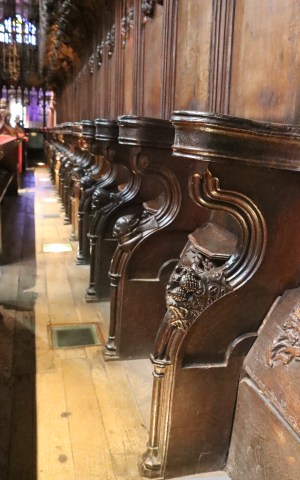
Choir stalls at Chester Cathedral (my photo Creative Commons licence CC BY-NC-ND 4.0)
Part 1 introduces misericords and explains what they are. Examples from Chester Cathedral are discussed. Part 2 looks at the examples from Gresford All Saints’, Malpas St Oswald’s and Bebington St Andrew’s. Part 3 looks at who chose the themes on misericords, where the ideas came from, who paid for them, and why some often profane images were housed in such sacred places. Also in part 3, some final comments are followed by visitor details and a full list of the references used for all three parts.
All three parts are already written. Part 2 has now been posted on the blog and Part 3 will be posted shortly. If you would like to see the list of references before part 3 is posted, please get in touch and I will email them.
On these posts, some of the photographs are mine, but others, particularly for Chester Cathedral where I didn’t use flash, have been taken from Dominic Strange’s remarkable World of Misericords website, with Dominic’s permission and my sincere thanks. His copyright statement is here. Please see the captions for the correct attributions. I have included some images from all the churches discussed, but to see the complete medieval corpus of each, do visit Dominic’s site, which has complete images from all the churches mentioned in this post, plus a great many other monastic churches, cathedrals and churches in Britain and Europe. This is the type of ever-growing online resource that makes the most of the web as a platform for building shared resources from which both professionals and enthusiasts can benefit and to which they can contribute.
xxxxxxxxxxxx
Chester, Gresford, Malpas and Bebington
St Werburgh’s Abbey in Chester was the first of these four medieval churches to have misericords installed along with their choir stalls. Chester, being an abbey with massive financial resources, had 48 misericords of which 43 survive. All Saints’ in Gresford had 14, St Oswald’s in Malpas 12, and it is unknown how many there were at St Andrew’s in Bebington. A summary of the vital statistics is shown below.

Basic data about the misericords at the four churches
Chester
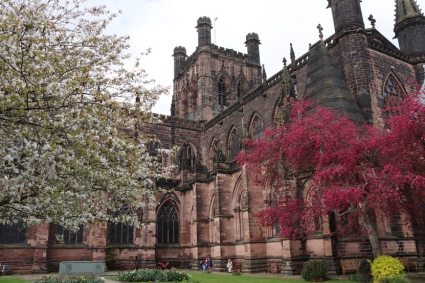
Chester Cathedral. (my photo Creative Commons licence CC BY-NC-ND 4.0)
Chester Cathedral was founded as St Werburgh’s Benedictine Abbey by Hugh Lupus in c.1092 but the choir stalls and their misericords were not installed until the 14th century, in about 1380. The delicately crafted choir (or quire) was the exclusive domain of the monks and their daily rituals, visited only rarely perhaps by the most generous of the abbey’s patrons. The monks were called to the choir seven times a day and once at night. The object of the exercise was to honour and worship the glory of God. This makes the choir the spiritual heart of a monastery. And yet it is here that profane and irreverent images of many misericords were also resident, as fully integrated components of the monks’ devotional and liturgical lives.
The timing of the new choir stalls is particularly interesting as it follows a period of enormous national hardship, beginning with crop failure and famine, and climaxing with the Black Death. The abbey clearly had funds at its disposal, even during such a difficult period, because the choir represents an enormous investment. With its choir stalls, desks, benches and elaborate canopies, all carved in oak, the choir’s components were not merely functional. Today the choir and its many flourishes are valued not only for the considerable skill demonstrated by its carvers and for its considerable aesthetic merit, but for the symbolic character of many of its representational carvings.

The layout of the choir stalls and description of their misericords. Source: Stephen Smalley 1996 (see “Sources” at end). Click to enlarge.
Although Chester Cathedral appears at first glance to have a complete set of medieval misericords, 5 out of the 48 were, as mentioned above, replaced by Victorian restorers either to replace damaged ones or to replace those that were considered to have inappropriate themes, such as nudity or poor taste. It is not known what happened to the missing misericords, but they were probably destroyed at the time. Given that the Puritan soldiers of the English Civil War defaced many features of Chester Cathedral in 1645 it is astonishing that the 48 survived so long.
The St Werburgh’s Abbey examples are justifiably famous, very similar to the examples at Lincoln Cathedral, built a decade earlier, which probably provided some templates for Chester, and with which they may have shared a workforce. Shown to the right is the layout of the misericords and the topic of each one, copied from a small and invaluable booklet that used to be sold in the cathedral shop. It is now presumably out of print and has become very difficult to source (thanks for the loan Katie!). Note that those misericords shown in italics are Victorian replacements.
The themes present at Chester’s St Werburgh Abbey are a phenomenal mix, so only a few can be picked out to represent some of the ideas on show.
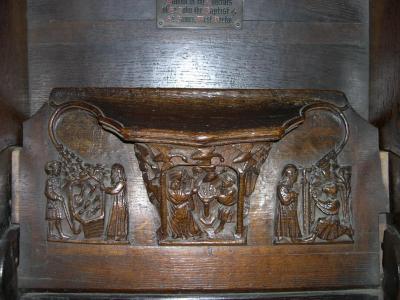
Scene of St Werburgh’s miracles. Source: Dominic Strange, World of Misericords
Obviously religious themes and personalities are often in a minority on misericords, but where a monastery or church is named for a particular saint, a misericord may be dedicated to that saint. The Anglo-Saxon saint Werburgh was an 8th century nun and abbess from the Midlands. One of the misericords focuses on St Werburgh’s miracle. There are various versions of the story but all agree that geese were damaging the convent fields. Werburgh ordered them to be gathered up before commanding them to leave. The convent steward, Hugh, was angry with the geese for devastating his field of corn. One version says that whilst Werburgh was away Hugh captured and cooked one of the geese, and when she returned the remaining geese had refused to leave, forming a delegation to inform her of the event and ask for her help. Werbugh ordered that the bones and feathers of the carcass should be gathered up, and the missing goose was reborn. The supporter to the left shows Hugh and Werburgh rounding up the geese. In the centre Werburgh resurrects the goose, which flies away with its companions. On the right supporter Hugh is on his knees, repentant, and is forgiven by Werburgh.

Coronation of the Virgin in Chester. Source: Dominic Strange, World of Misericords
The infrequency of religious topics is perhaps due to a general feeling that it as unsuitable to a) hide them away and b) sit on them. However they do occur and at Chester another obviously religious topic that requires no interpretation is the Coronation of the Virgin. The Chester example is not the carved equivalent of a delicate Fra Angelico, being a rather chunky rendition, but it has real charm and the supporters, cittern-playing winged angels, are lovely. The Virgin and Child is the subject of another misericord. St George and the Dragon is another popular religious topic for misericords, an action scene that shows an uncompromising approach to demonic danger, but the one at Chester is Victorian.

The rear end of Yvain’s horse captured in the portcullis in Chester. Source: Dominic Strange, World of Misericords
Popular romance stories provide the theme for some misericords, such as the 12th century Arthurian story “The Knight of the Lion” by Chrétien de Troyes about Sir Yvain. A snapshot from the story is captured on a really entertaining vignette. The central scene shows a walled town with its entrance arch flanked by two slender towers. Look closely, and you see that the rear end of a horse faces you. As Yvain chased his opponent into the gatehouse, the portcullis was activated by a secret device as Yvain’s horse stepped on it. The portcullis dropped, narrowly missing Yvain and chopped the horse in two. The portcullis at the other end of the gatehouse also dropped, trapping Yvain. All of this, and the rest of the story, would have been immediately recognizable, without showing Yvain himself, from the image of the half-horse on the outer side of the portcullis. The horse’s arse approach to a story that had plenty of other events from which to select probably raised many smiles as well as evoking the rest of the story. The supporters show another aspect of the tale involving two men-at-arms.

Alexander in Flight in Chester. My photo Creative Commons licence CC BY-NC-ND 4.0
Alexander the Great, very small part history and a much greater part legend and fiction, was a very popular character in the Middle Ages. At Chester a misericord captures the notorious “flight” of Alexander. The great leader, having reached the edge of the world, wished to explore the unknown beyond, rising both to the heights and to the depths. Perched on what looks like a piece of wood in this misericord is his throne, supported on ropes held by two griffins. Fully equipped to take flight, he was carried over the edge of the known world to explore the unknown.

Alexander in Flight shown in the mid-15th century Talbot Shrewsbury Book, officially known as Royal MS 15 E VI (folio 20v). Source: British Library.
Having acquainted himself with the unknown world, and finding nothing left for him to conquer, Alexander returned to the known world. Alexander’s flight to the unknown may be more favourite story than morality tale, although it can also be taken to represent the folly of all-encompassing ambition. Alexander goes on to conquer Babylon and build himself a massive golden throne. In Babylon, he dies. As David Williams says “Alexander is both the force that battles the monsters as he attempts to extend civilization to the ends of the earth, and he is the monster itself, demolisher of cities, reviser of history.” The misericord’s supporters also show griffins. Griffins are discussed further with reference to a splendid example at Gresford in Part 2.

Angry woman berating a cowering man in Chester. Source: Dominic Strange, World of Misericords
Scenes of domestic life on British misericords include some startling vignettes of women attacking men, presumably their husbands. The marvellous example at Chester involves a woman with a dress resembling a tornado, sweeping her much smaller, cowering husband aside with a wooden implement, apparently in a garden or rural setting. The Chester Cathedral Quire Misericords booklet describes this as “fighting couple,” which seems like something of an understatement for a scene showing a whirlwind of fury breaking loose. Some of these many British and European woman-abusing-man misericords have been interpreted as depicting the physical, carnal and uncontrolled aspect of women. It has also been suggested that some of them may represent male anxiety in the face of increasing female emancipation. Perhaps, in the male-only environment of the choir, a humorous subtext was that the monastery is a much safer place for a man than a marital home. The supporters, which appear at first glance to be floral, have angry faces at their centres, reinforcing the message of conflict and hostility.

A page from the 13th century MS Bodley 764, showing the tigress with the mirror at the top (see below). Source: Bodleian Library, Oxford
Real world animals, fish and birds shown on misericords, either local or exotic, are frequently very beautiful, but often have symbolic roles as well. “Bestiaries” were encyclopaedia type books produced in the middle ages that not only produced information about animals (some of them mythological or imaginary) but also put them into religious context. An example is the fascinating bestiary now known as manuscript MS Bodley 764 available to view on the Bodleian Library website or available in print, translated by Richard Barber (see Sources at the end of Part 3). This describes characteristics of familiar, exotic and mythological animals, many of which appear on misericords. There is also the splendid Medieval Bestiary website, an excellent resource that lists animals (again, real, exotic and mythological) and examines medieval perspectives on each, including their symbolic value.

Herons with sinuous necks. Source: Dominic Strange, World of Misericords
The MS Bodley 764 bestiary says that a familiar British bird, the heron, symbolizes “the soul of saints or the elect, who, scorning the turbulence of this world, lest they should become ensnared in the traps of the devil, raise their minds above things to the serenity of heaven where they could see God face to face.” A Chester misericord shows two fabulous herons, their necks sinuously curved and their heads facing upwards as though feeding off the underside of the misericord. They are flanked by supporters that are less easy to interpret, but possibly representing demonic influences: a winged dragon with claws on one side, and on the other side a man-headed dragon with beard and an elaborate hat, scaled body and hooves.

Herons and supporters. Source: Dominic Strange, World of Misericords

The knight stealing a cub and deceiving the tigress with a mirror. My photo Creative Commons licence CC BY-NC-ND 4.0
An exotic animal displayed on a misericord was the tiger, something impossible for most people to experience, much like a unicorn, but known to be the living product of distant lands. In this particular narrative it is at the heart of a morality tale, which is described in the bestiary. A knight lies flat on his horse’s back, holding a stolen tiger cub in his left hand. From this apparently perilous position he reaches to the ground and drops a mirror in the path of the tigress that pursues her stolen cub. The tigress stops when she sees the mirror, believing that her own reflection is the stolen cub. Together, the knight and the mirror represent demonic trickery and deceit, whilst the inclusion of the tiger provides an exotic flavour to the scene. Admittedly the tiger doesn’t look like a tiger (no stripes either on the misericord or on the blue creature in the bestiary, shown in MS Bodley 764 above) but this was a well known scene that would have been familiar to educated medieval onlookers.
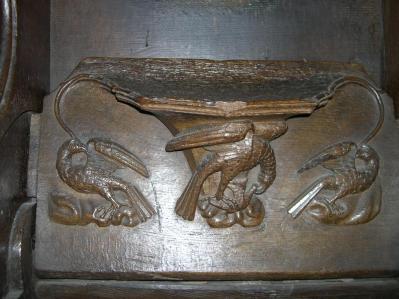
The Pelican in her Piety. Source: Dominic Strange, World of Misericords
Some animals have specifically religious associations. The “Pelican in her Piety” is a recurring theme and is shown on one of the misericords at Chester, as well as one of the associated carvings, representing the sacrifice of Christ to redeem humanity. The pelican, attacked by her hungry children (representing ungrateful humanity), retaliates and accidentally kills them. Remorsefully, she pecks her own breast until she bleeds, and this revives her chicks (representing Christ’s sacrifice for humanity).

The unicorn, his head cradled in the lap of a virgin whilst killed by a knight. My photo Creative Commons licence CC BY-NC-ND 4.0
Mythological animals on the Chester misericords also often have specific ideas associated with them, which may sometimes be an odd blending of imaginary animals with Christian ideas. For example, there is a carving of a really lovely unicorn with a curly mane, its head in the lap of a woman (above). Even as it lies there it is attacked and killed by a man in armour with a sword. The woman is a virgin, and the voluntary submission of the unicorn symbolizes its respect for her pure condition, like the Virgin Mary, whilst the killing of the unicorn represents Christ’s sacrifice and the martyrdom of the innocent. The supporters show a wyvern with scaled wings, and one with bat wings, probably demonic characters representing the eternal threat of evil. This scene is a popular one, not confined to misericords. Below it is an illustration in a manuscript, showing exactly the same components.
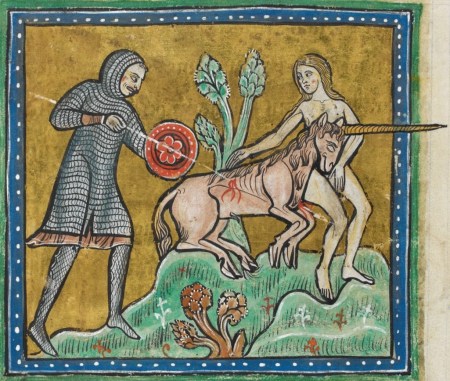
The 13th century Rochester Bestiary: British Library, Royal 12f. XIII, fol.10v. Source: Wikpedia
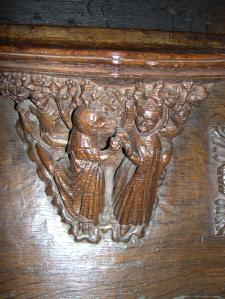
A friar-fox preaching to a woman. Source: Dominic Strange, World of Misericords
Animals mimicking human actions normally incorporate a particular comment on the human world, often derisive or satirical. In St Werburgh’s Abbey, the wily fox in a friar’s habit, preaching to a woman, possibly a nun, probably represented the new mendicant friars preaching to the gullible general public. The orders of friars in Chester were Franciscans, Dominicans and Carmelites. These were the new kids on the block in the 13th century who, unlike the established Benedictine monks, were preaching in the streets, and mingling with people where they lived and worked, diverting donations to their own establishments and raising questions about the value of monks who were hidden away. These scenes at several churches demonstrate Benedictine contempt for the mendicants, putting a clever and often amusing spin on their activities (the friar-foxes are often shown preaching to geese and cockerels), but almost certainly demonstrate a certain amount of anxiety about how their popularity would impact the conventional, secluded monks in their cloisters. Another, closely related interpretation is that the fox represents the anti-establishment Lollards, deeply troubling to the church in the 14th century.

Wildman and lion. Source: Dominic Strange, World of Misericords
Mythological people also have a place on misericords. Wildmen are a popular subject, of which there are three examples at Chester, each dealing with a slightly different theme. A Wildman (or wodehouse) is distinguished from other men by being covered from head to foot with a curly or shaggy pelt. Only the bearded upper face, hands and feet are fur-free. Wildmen were nearer to nature than to civilization, and accordingly had powers over the natural world. One of the examples, known from a number of sites, shows a lion (often God) fighting a dragon (often Satan) with the supporters showing Wildmen riding, and thereby controlling, dragons. A second example, shown here, shows a Wildman (with head damaged) riding a lion, holding its chain in one hand. The pair are flanked by two different types of dragon or monster. Wildmen riding dragons and lions represent nature tamed, but may also suggest the taming of passions like love and lust.
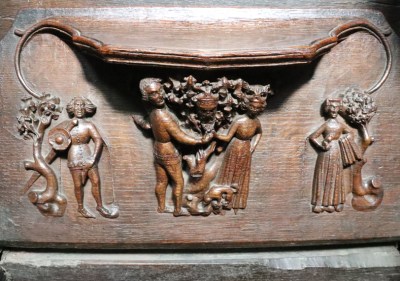
Scene from the romance of Tristan and Isolde. My photo Creative Commons licence CC BY-NC-ND 4.0
Finally, some churches have scenes that are unique or found only rarely. Chester has a misericord showing a scene from the early 13th century Arthurian romance of Tristan and Isolde (or Iseult), which it shares only with Lincoln Cathedral. The misericord at Chester shows the lovers in front of a tree with a dog at their feet. In or behind the tree is Isolde’s justifiably suspicious husband King Mark, spying on the lovers. Tristan’s dog at the feet of the lovers represents loyalty and love in most versions of the tale, but in one version of the story it is revealed that blind loyalty can be dangerous, when the dog betrays the disguised Tristan by recognizing him. One of the difficulties of deciphering a scene like this is that there may be several versions of a popular story that include the same lead characters and supporting roles, but with different narrative twists and outcomes.

Sow and piglets. Source: Dominic Strange, World of Misericords
The misericords at Chester help to demonstrate the variety of themes and ideas that were in play in the Middle Ages, and successfully demonstrate the imagination, creativity and skill that went into the misericords in a prestigious religious institution. They do not capture the complete range of typical subject matters that might be found on misericords throughout Britain. Five of them are, of course, missing, either because of damage or, perhaps more likely, because the Victorian restorers considered their themes to be inappropriate. Even so, the massive variety of misericord subjects chosen across the many ecclesiastical institutions in Britain point to different interests and ideas in the many places in which they appear.
All of the Chester misericords are shown on the World of Misericords website at https://www.misericords.co.uk/chester.html, with short descriptions at https://www.misericords.co.uk/chester_des.html
Next
Emulating their more prestigious cousins much smaller churches could also follow ecclesiastical fashion and demonstrate, on a more modest scale, their ability to produce fine misericords and other sculptural elements of their own. In Part 2 the twelve of fourteen misericords at Gresford, and the remaining examples at Malpas (three of twelve) and Bebington (five of twelve) are discussed.
 Based in Churton

Hi Andi, another great informative article.
LikeLike
Thank you so much. I really enjoyed doing the reading and writing for this one.
LikeLike