A Chester Archaeological Society visit to the Grosvenor Museum Stores

Many thanks to Pauline Clarke, the Excursions Officer of the Chester Archaeological Society, for organizing our CAS visit to the Grosvenor Museum Stores, and to Liz Montgomery of the Grosvenor Museum for taking us on a splendid guided tour.  All the way round there were dozens of questions from the group, always the mark of a successful event.

It was a real eye-opener, not merely because of the box upon box of objects, but because of the amount of work that remains to be carried out.  Many of the boxes represent excavations that have been published, but also those for which post-excavation funding was not available.  Intriguingly, there are boxes of items from the excavations that took place when the old police headquarters was replaced with today’s HQ building, where St Mary’s Nunnery once stood.

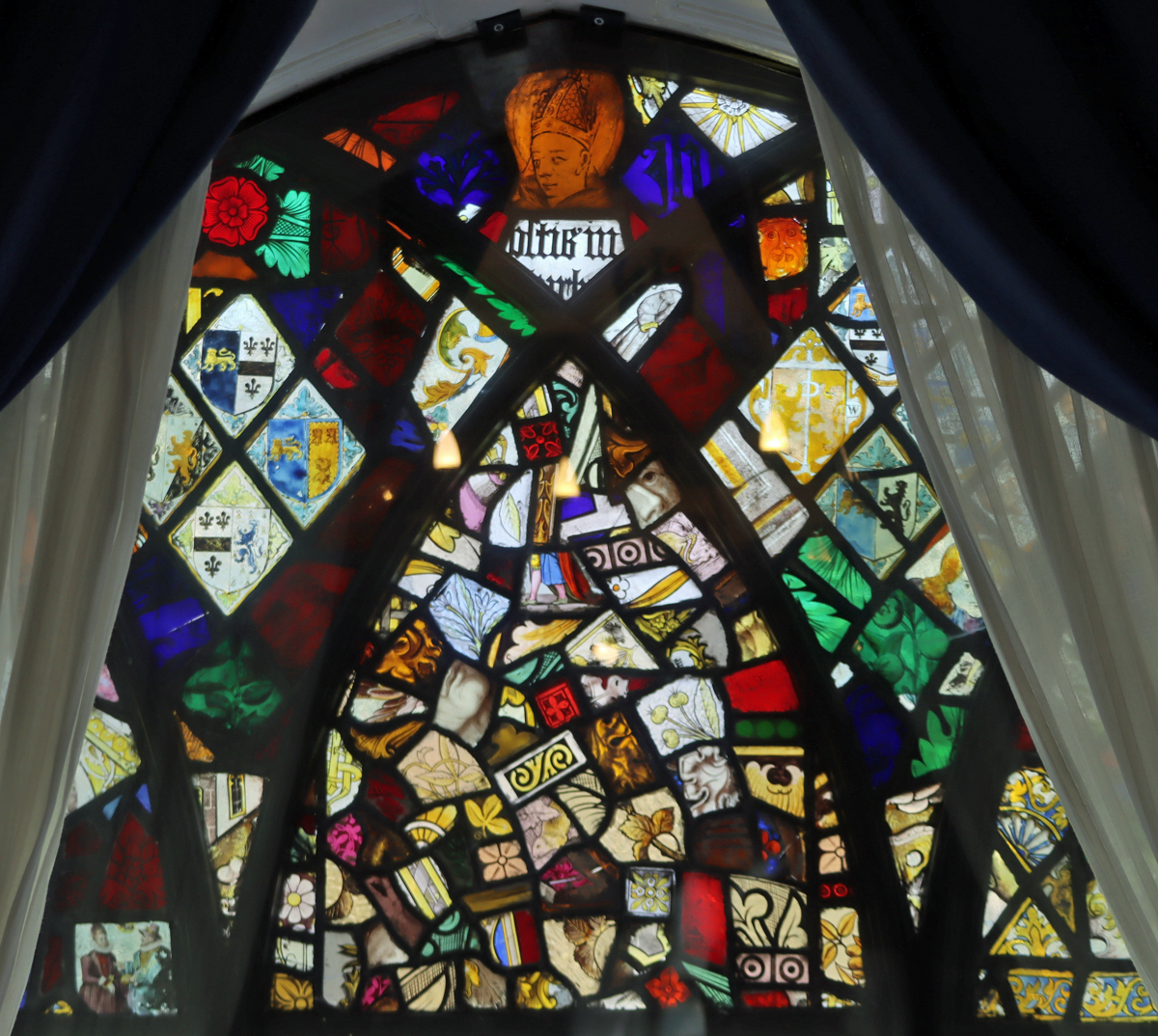
The storage boxes are stacked on racks, with organic and metallic remains kept in airtight containers and, in one of the storage sections, whole objects and big stone-carved fragments kept on display on some of the racks. It was fun to spot some boxes from Cuppin Street, where I excavated in the 1980s with a great group under the supervision of Simon Ward.  Bigger objects, particularly Roman stoneware, are kept on palettes. There is a lot of Roman and post-Roman, including Medieval material, but there is also a collection of prehistoric items from the neighbouring area as well as the Cheshire ridge.

More recent items, from the earlier 20th century, are also lying on the shelves as well as in storage boxes, including wartime and inter-war period plus more recent objects.

All the contents of the storage facility have been carefully recorded, and many of the older boxes have been replaced with more appropriate specialized storage containers.  Everything is kept clean and all items are accessible.  These measures make the storage collection a very useful resource for researchers, who can take the selected storage boxes to a room equipped with tables and chairs (and an efficient radiator!) to explore the contents in comfort. It  looks as though there may be opportunities for volunteers to contribute to this work in the future, which will be an excellent opportunity for non-experts to help the professionals to put the storage collection to good use.

This storage facility is largely dedicated to the museum’s archaeological collection, with a smaller set of items from more recent history, and the whole lot is utterly fascinating.  This is not, however,  the only storage facility for the museum.  The old saltworks caverns have been converted into storage for some organizations, including the museum, and valuable items like jewellery, coins and other perishable metalwork are stored in a vault elsewhere.  The 1000+ paintings collected by the museum, particularly under the aegis of Peter Boughton, are also stored elsewhere.  As with most other museums, both this and the other Grosvenor stores demonstrate that what the museum has on display is just a fraction of what it holds, but also demonstrates just how much activity goes on behind the scenes, as well as the extent of the museum’s many responsibilities.

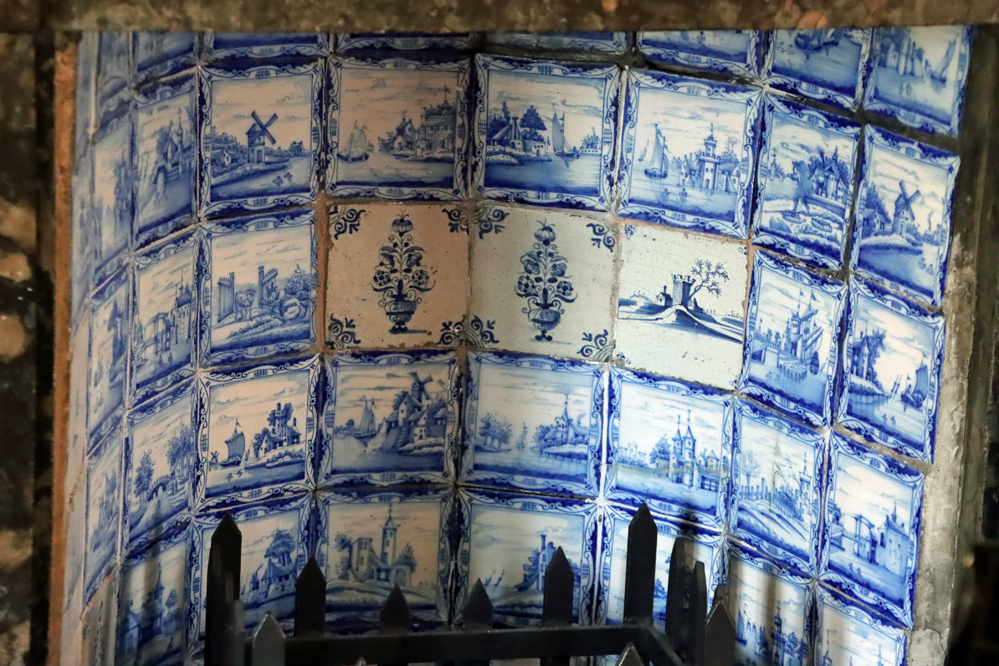
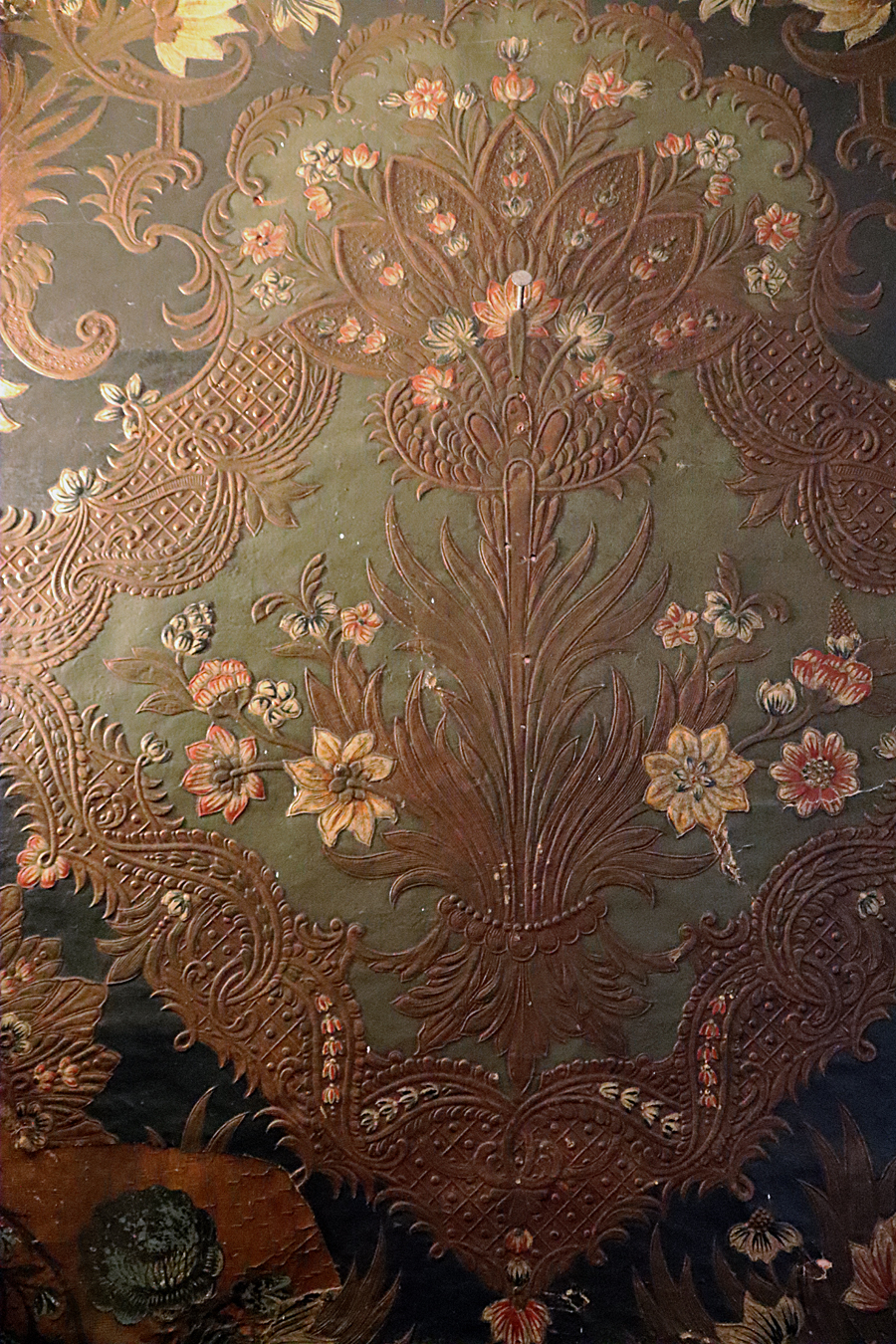
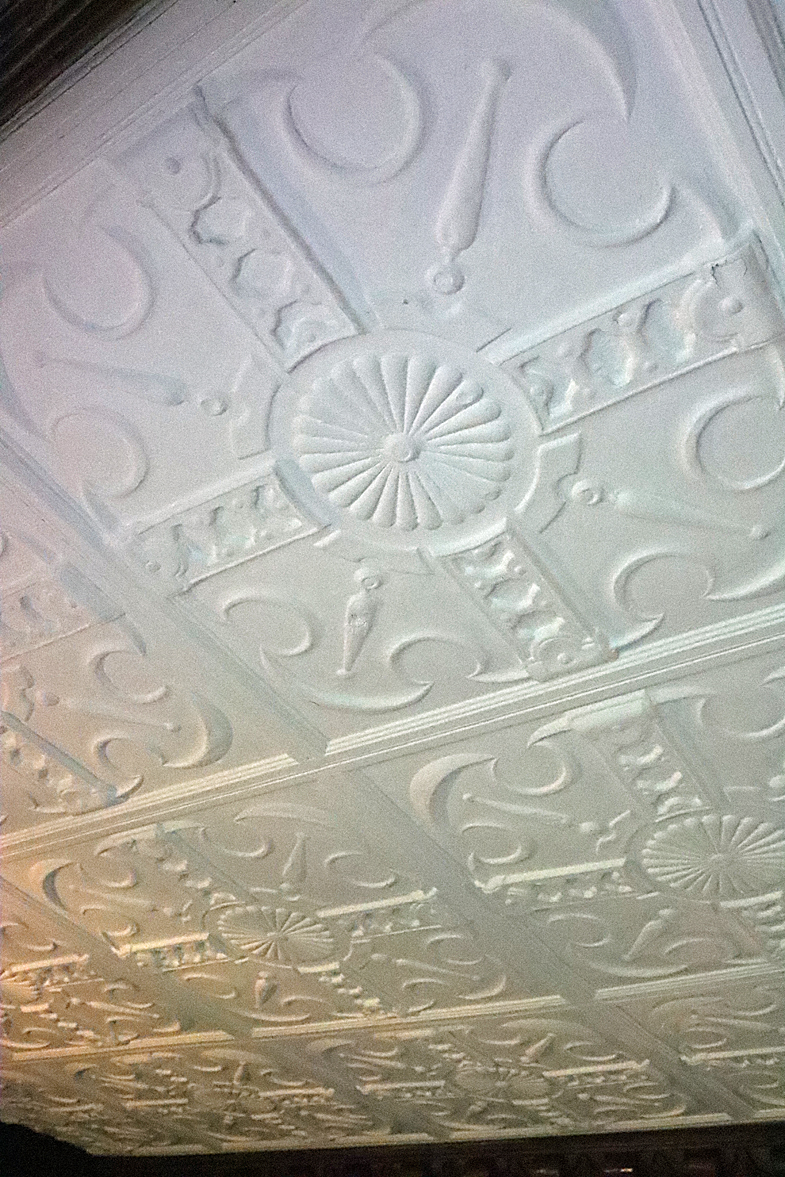
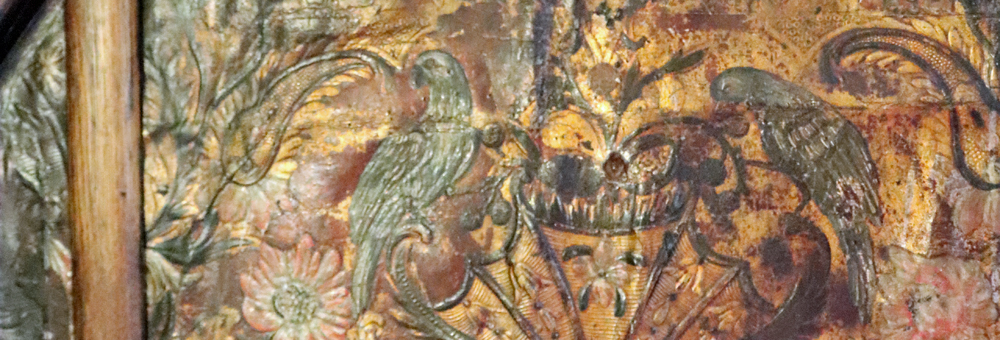
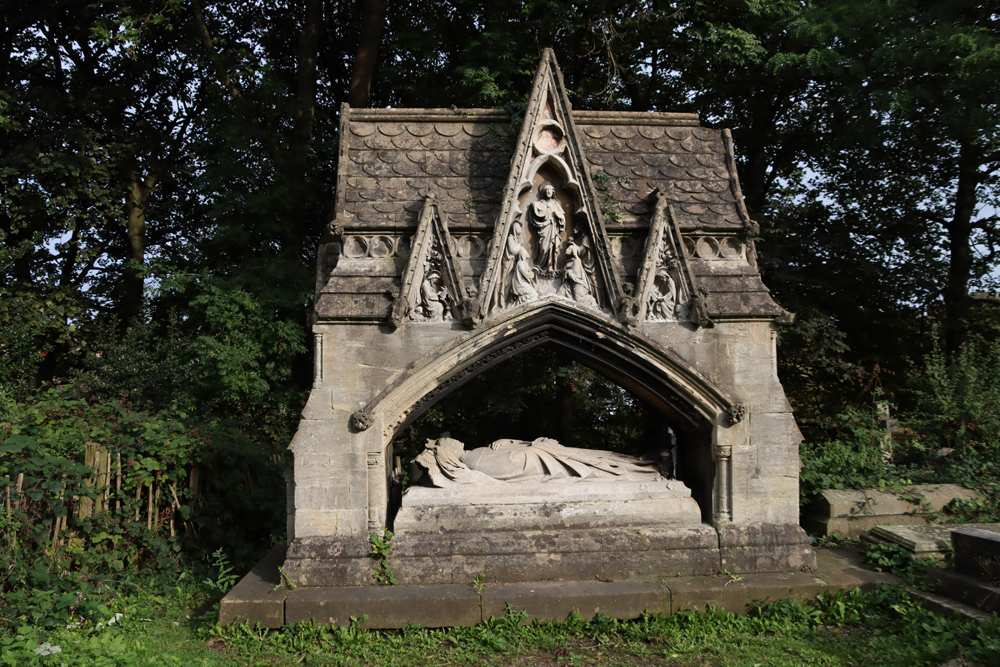
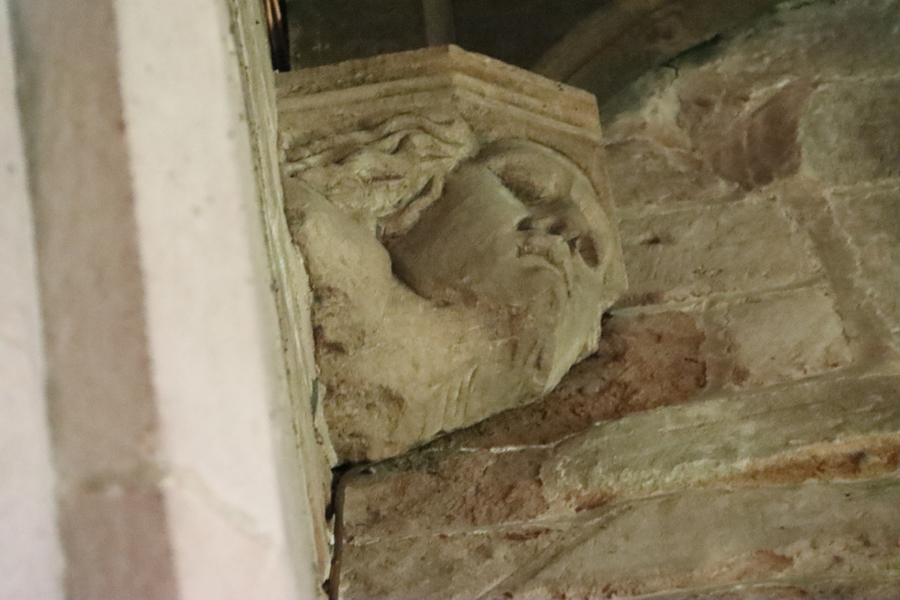
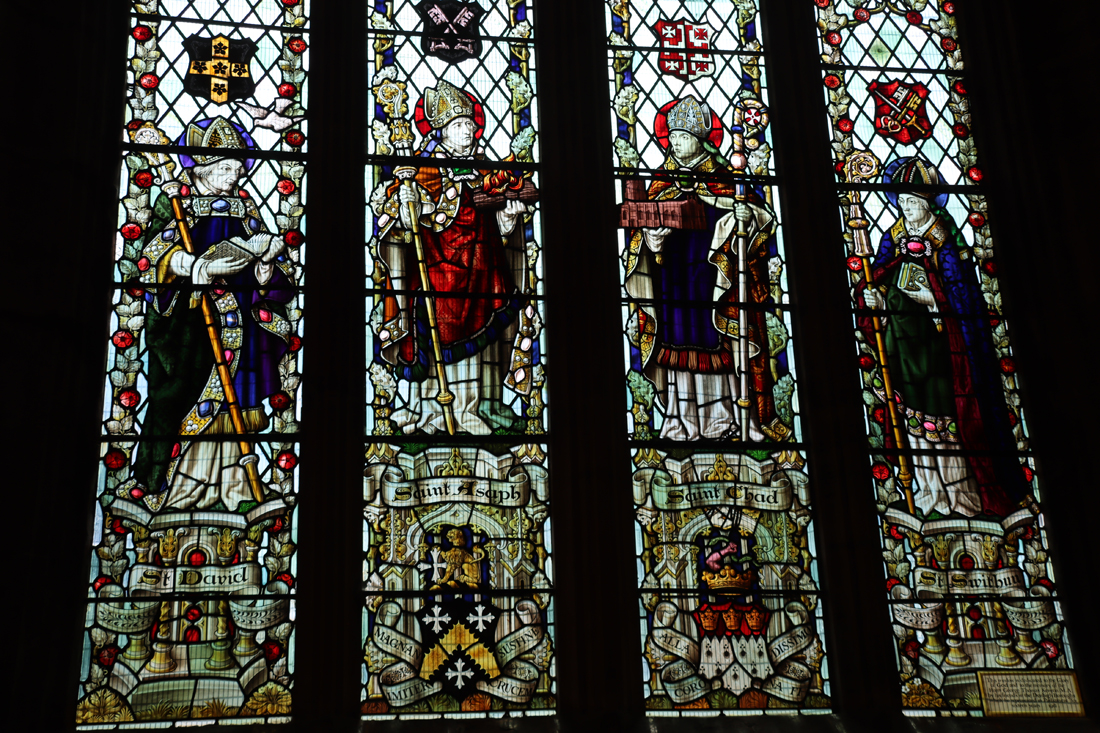
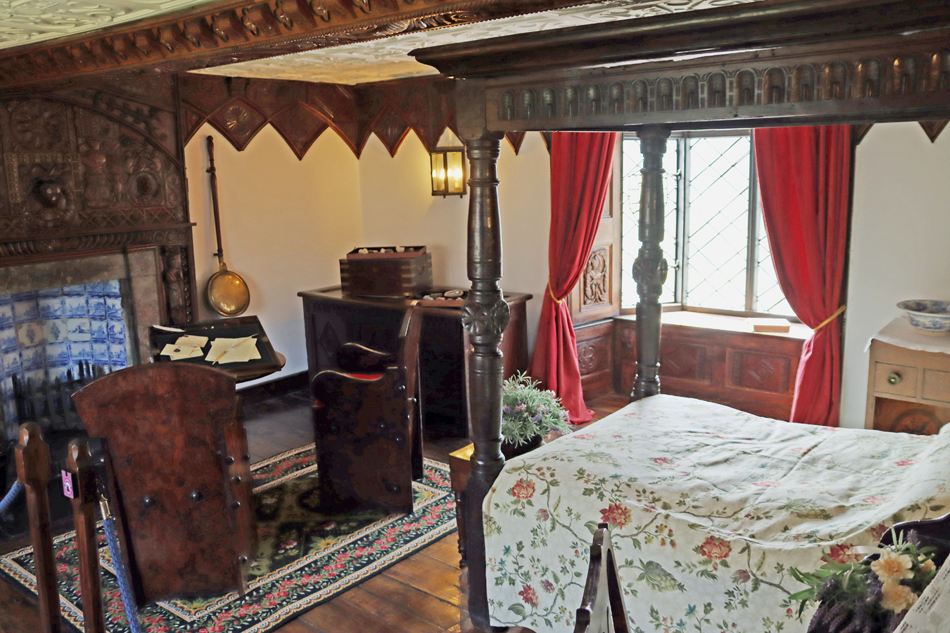
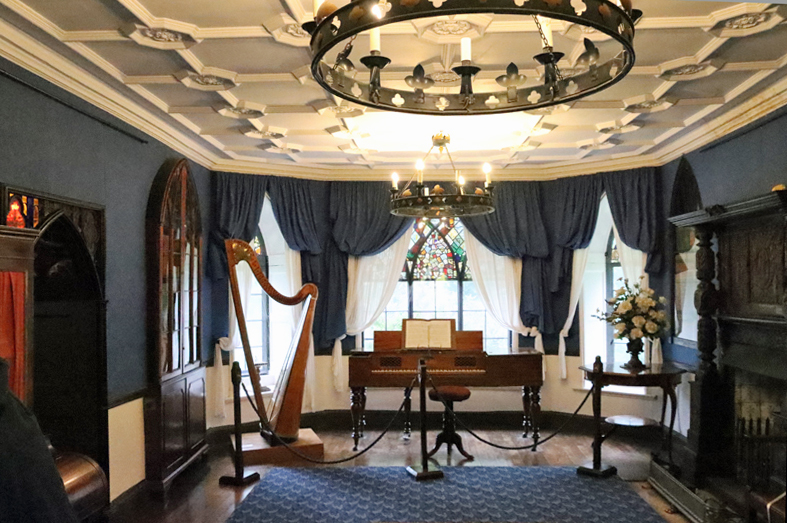
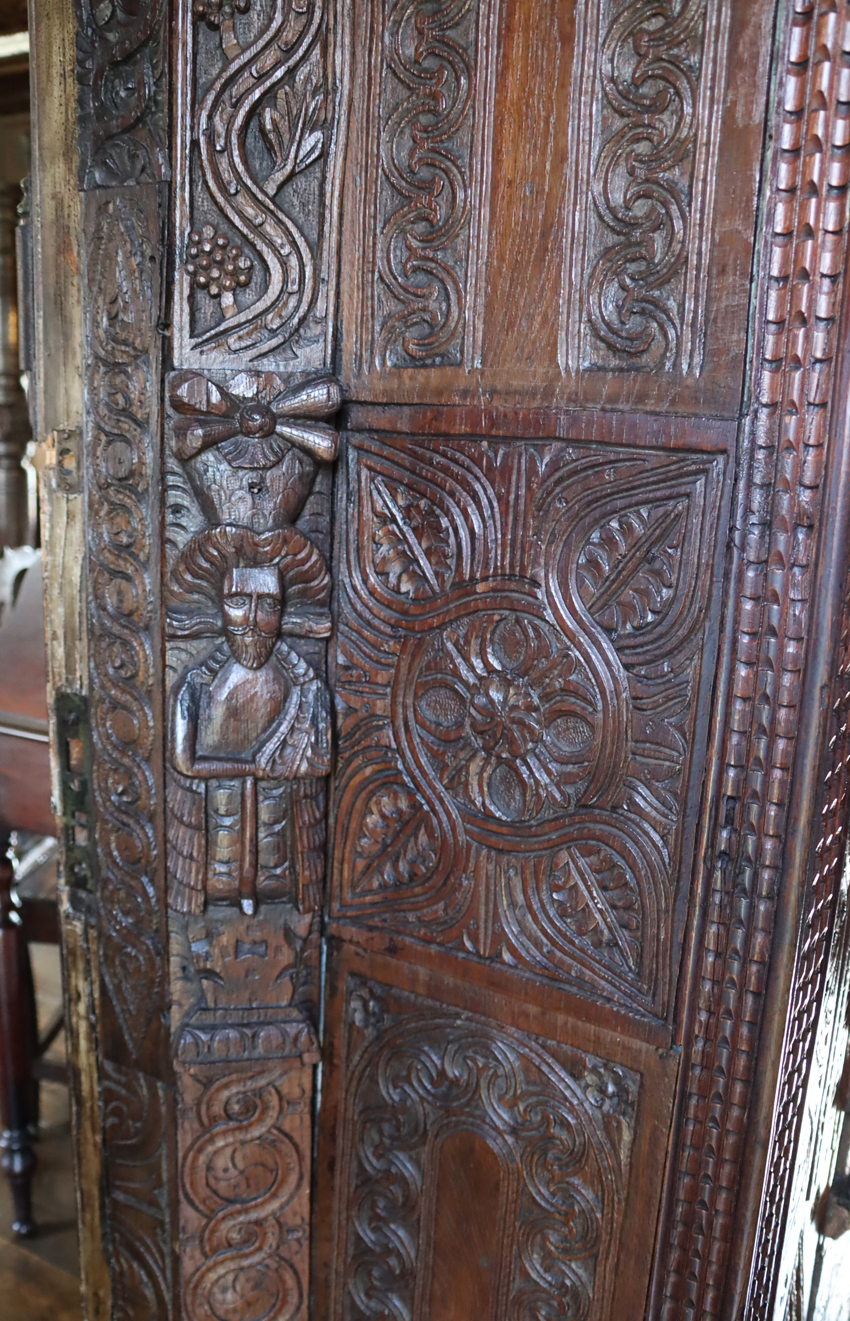
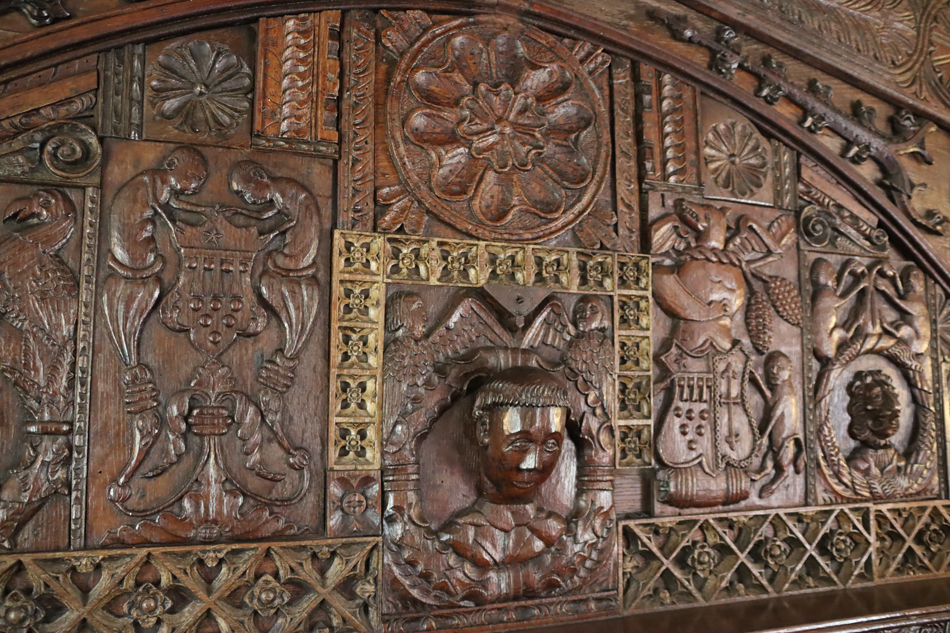
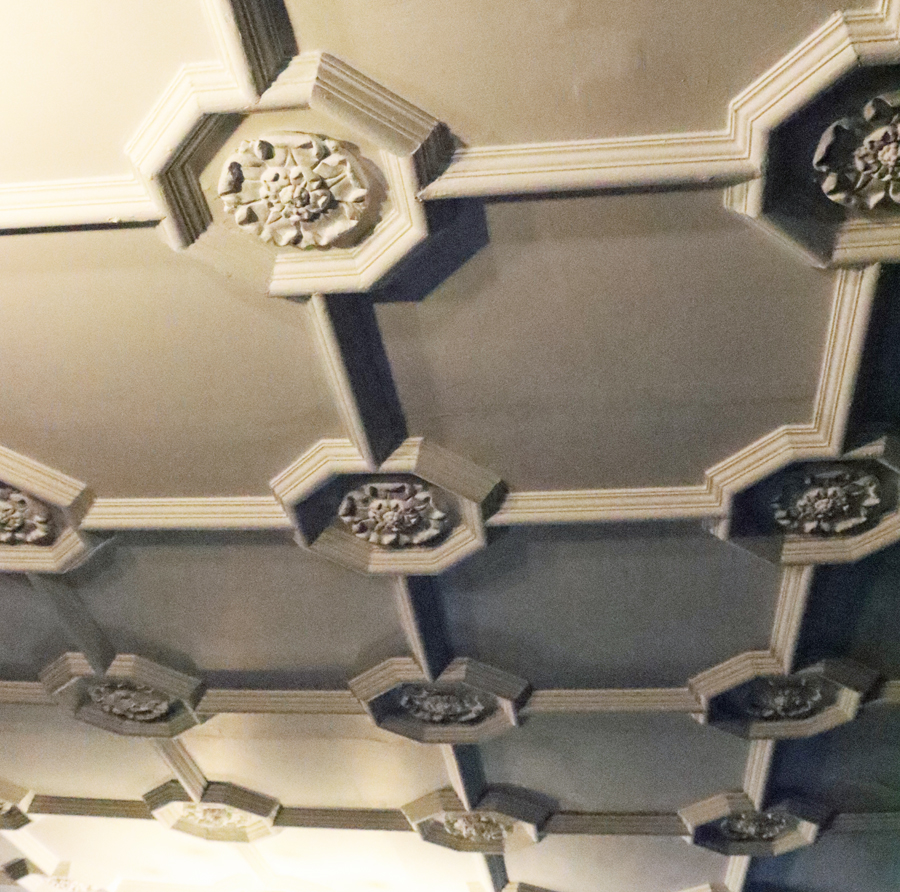
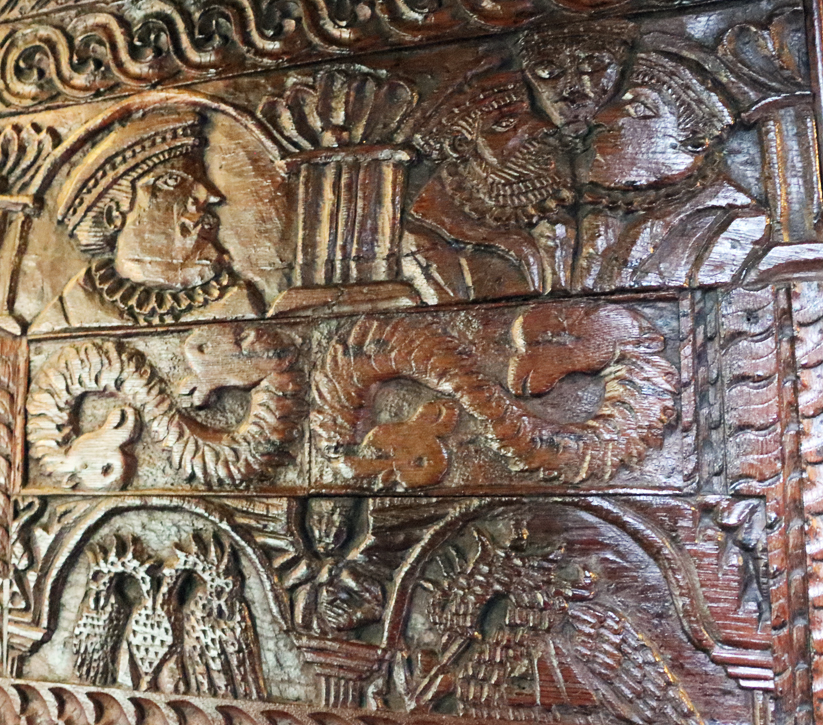
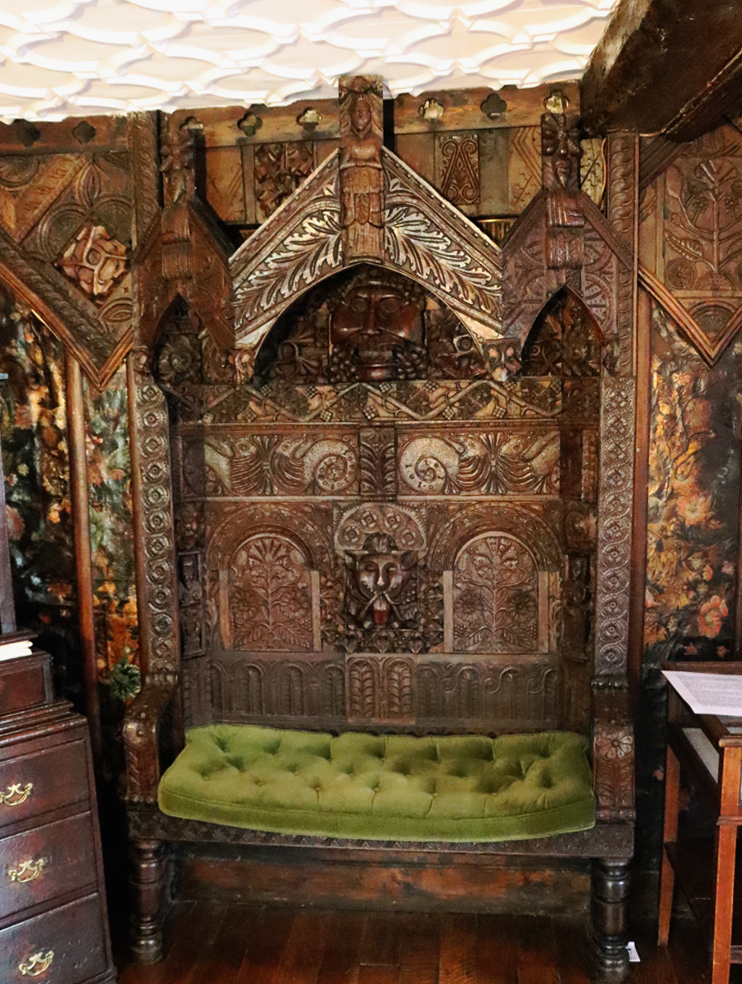
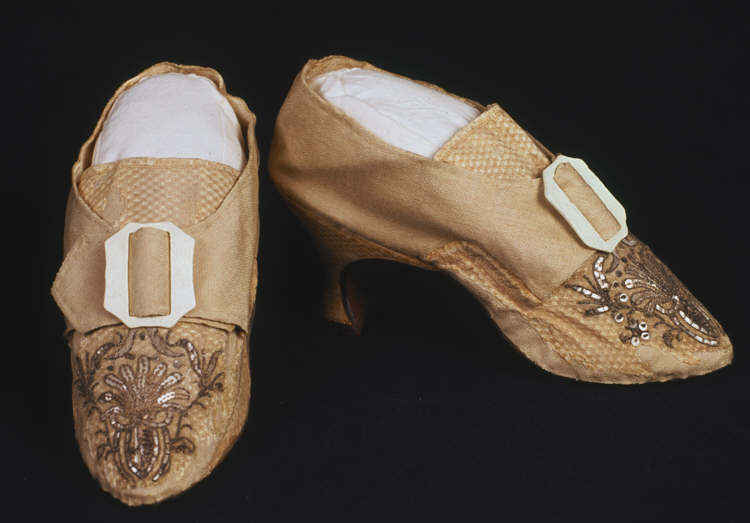
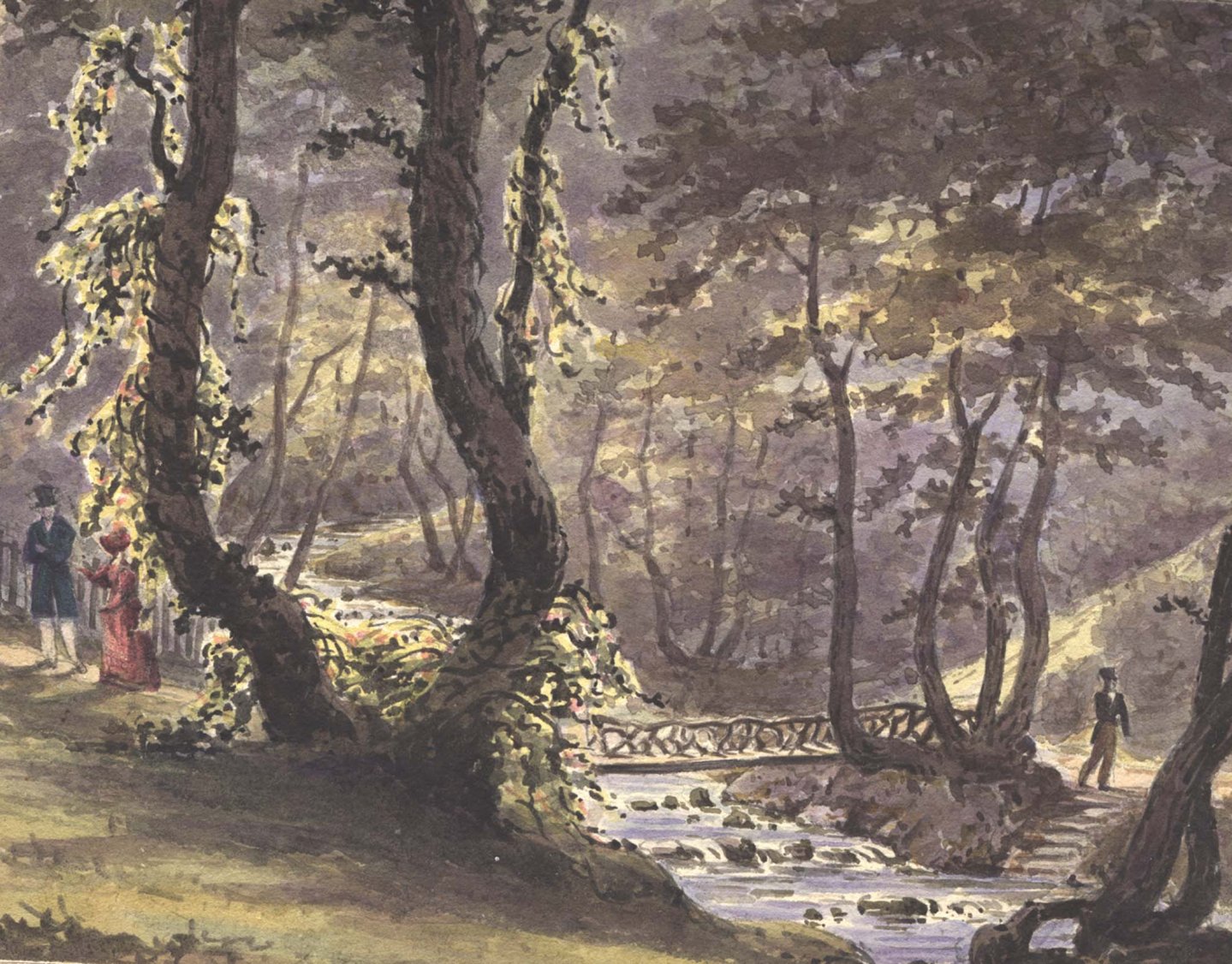
The photos below are a random selection of the many, many delights that the stores have to offer.  Thanks again to Liz Montgomery for an excellent guided tour, which provided real insights into the value of a storage collection to the work of this and other museums.


—===

===


===

===

===

===

===

=

===

====

===

===

===

===
===


===

=

Cheshire Lunatic Asylum: The development of lunatic asylums – Part 1.2

Cheshire Lunatic Asylum 2024

This is the second part of my post about the background to English lunatic asylums, prior to focusing on the Cheshire Lunatic Asylum in Chester.  To make the pages manageable, I have divided part 1, looking at the mental health background to the Cheshire Lunatic Asylum and other lunatic asylums into two.  Part 1.1 was posted here a few minutes agoPart 1.2 carries on below, following directly from part 1.1. A version of parts 1.1 and 1.2,without images, can be downloaded as a single PDF here  (27 pages of A4)   Sources and references for all posts can be found here.

Part 2 will focus on the Cheshire Lunatic Asylum at Upton in Chester and will be posted in the next month or so, when I’ve sorted out the images.

Timeline of reform after 1830

After the opening of a number of public asylums in the early 1800s, including the Cheshire Lunatic Asylum in Chester in 1829, several others began to be erected, including those in Dorset, Leicestershire, Shropshire and Montgomery and Devon, all by 1845, the year in which the County Asylums Act was passed.  Private asylums still outnumbered county and charity asylums, some small and catering for a handful of patients, whilst others like and Ticehurst in Sussex (opened 1792) the purpose-built Brislington House near Bristol (opened 1806) were fully comparable in size to county asylums.

The First Middlesex County Asylum, Hanwell. Source: London Historians’ Blog

The most important innovation in the early 19th century had been the “moral treatment” that had been introduced by Philippe Pinet in Paris and by William Tuke in York, was influential on other asylum owners and designers.  One of the most innovative of these was Methodist Dr William Ellis.  Having learned the practice of moral treatment at the Sculcoates Refuge in Hull, in 1817 he was employed as superintendent at West Riding Pauper Asylum at Wakefield, with his wife Mildred as matron, where he practised the same approaches. His successes led to his appointment at the new Hanwell Asylum in Middlesex in 1832, with his wife again employed as matron.  In each case patients were exposed to conditions that emulated family life and the manners of polite society, with treatment consisting of activities, entertainments and employment both indoors and out, using physical restraints only where strictly necessary. Social reformer Harriet Martineau, was impressed with how, when she visited, she saw a patient going to a garden to work with his tools in his hand, how a cheerful patient rolling in the grass with two other patients had been chained to her bed for seven years before arriving at Hanwell, and in shed in one of the gardens patients were cutting potatyes for seed “singing and amusing each other.”  Ellis resigned in 1838 in a disagreement with the overseers of the asylum over their decision to extend the asylum for a much greater patient intake, convinced that his methods could not be successful in a much larger institution, as well as their plans to change how the asylum was managed.

In 1832 the Royal Commission carried out a survey of how the Poor Law was generally implemented throughout all counties, and who benefitted.  The findings were published in 1834, and concluded that existing workhouses and almshouses were too sympathetic and generous, as well as too costly, to be sustainable. The report contained a long list of recommendations that set out to deter paupers from claiming relief by redefining the workhouse as a tool for reducing the costs of caring for the poor.  The survey formed the basis of the new 1834 poor law.

In terms of social reform the new Poor Law, which was introduced to replace the Elizabethan Poor Law of 1601, represented a backwards step.  The Act, adding to the 1723 General Workhouse Act and the 1774 Madhouse Act, lead to even more lunatics being absorbed into workhouses, where all inmates were treated far more punitively then before. According to the 1834 Poor Law Amendment Act (“the New Poor Law”) workhouses of a new type would be built to deter vagrancy and the dependency of able-bodied men, women and children on handouts, ensuring that only those who were suffering from desperate necessity would seek a workhouse place. The Act was introduced to reduce the cost of the poor by putting them to work in fixed indoor locations, removing beggars, vagrants and itinerant paupers from the streets, its main mechanism of which was the workhouse. However, although orphanages and infirmaries were also built, the workhouses were punitive places, built to discourage the idle from attending them.  They provided deliberately uncomfortable living conditions, splitting of husbands from wives and parents from their children.  To enable parishes to finance the new workhouses, the new poor law allowed for the creating of parish unions.  Over 350 new workhouses were built within five years of the Act to cope with those who were unable or unwilling to find work.

The 1834 Act also laid down that dangerous lunatics, insane people and imbeciles were not to be kept in workhouses and should be moved to new asylums that should be built without delay, as per the Act of 1828, to receive them.  In practice, however, partly because it cost less to house lunatics in workhouses than asylum, and partly because asylums were often overcrowded, an alarming number entered workhouses.  In some workhouses special wards within workhouses for the insane were added, and these were often used as repositories for the mentally ill, as well as imbeciles and idiots, the debilitated elderly (particularly those suffering from dementia) and the physically disabled.

The Chester Union Workhouse in 1861, recorded on workhouses.org, included 29 long-term inmates (continuous living for five years or over) of whom nine (31.03%) were deemed to be of “weak mind” and two (6.9%) were “subject to fits” (the latter relevant because epilepsy was considered to be a form of insanity until the late 19th century).  Interestingly, the incorporated union of Chester’s nine parishes was exempt from the 1834 act, and Chester did not accept a Chester new Poor Law Union until 1869.  There is clearly a lot more work to be done in Chester between the lunatic asylum and its workhouses.

The 1820 Lincoln Asylum. By Elliott Simpson, CC BY-SA 2.0. Source: Wikipedia

New reformist practitioners continued to make their mark in the treatment of lunatics, mainly in private asylums for the wealthy, but also in the county asylums. In 1820 the subscription-funded Lincoln Lunatic Asylum was opened, and in 1837, under Edward Parker Charlesworth and Robert Gardiner Hill, became notable for being the first English asylum to formally abolish the use of mechanical devices for restraint, with the results recorded in  the asylum’s annual reports. This approach was influenced by the death at the asylum in 1829 of patient William Scrivinger, who was strapped to his bed overnight in a straitjacket and was found dead from strangulation in the morning.   In 1838 Robert Gardiner Hill, who became house surgeon at the asylum, delivered a lecture to The Mechanics’s Institute, Lincoln, advocating the care of the mentally ill without recourse to restraints, which was subsequently published and circulated and became influential on other asylum superintendents who were interested in treating symptoms rather than merely detaining patients.

Tabulated records of restraint from the Lincoln Lunatic Asylum in 1830 (click to enlarge).  Wellcome Collection.

===
In 1839 John Conolly moved to Hanwell Asylum in Middlesex to take over from William Ellis as its third superintendent.  As superintendent he took Ellis’s policy of only using restraints when unavoidable even further, following Robert Gardiner Hell, and in his first report from the asylum claimed that the banning of restraints, replaced by “kindness and firmness” had produced a much better environment for patients. He believed that supervision by specially trained attendants and nurses, consistent regimes and pleasant surroundings were essential.  His treatment regime was reported by The Times on several occasions, an the asylum was visited by influential figures in society. Although many other alienists were sceptical about non-restraint, the positive publicity soon influenced other asylums who began to follow the lead originally set by Robert Gardiner Hill, but publicized by Conolly. Following his resignation from Hanwell in 1844, after a disagreement with the Metropolitan Commissioners in Lunacy, Conolly published his latest opinions on the subject of managing lunacy.  These included his 1847 The Construction and Government of Lunatic Asylums and Hospitals for the Insane and his 1856 The Treatment of the Insane without Mechanical Restraints.  His 1849 A remonstrance with the Lord Chief Baron touching the case Nottidge versus Ripley clearly stated his belief that eccentricity, excessive passion, signs of moral failure, gambling what should not be tolerated, and any person’s behaviour that was “inconsistent with the comfort of society and their own welfare” were sufficient to merit certification and committal to an asylum.  This position was one of intolerance to any behaviour that might contravene strict ideas of social conventions.

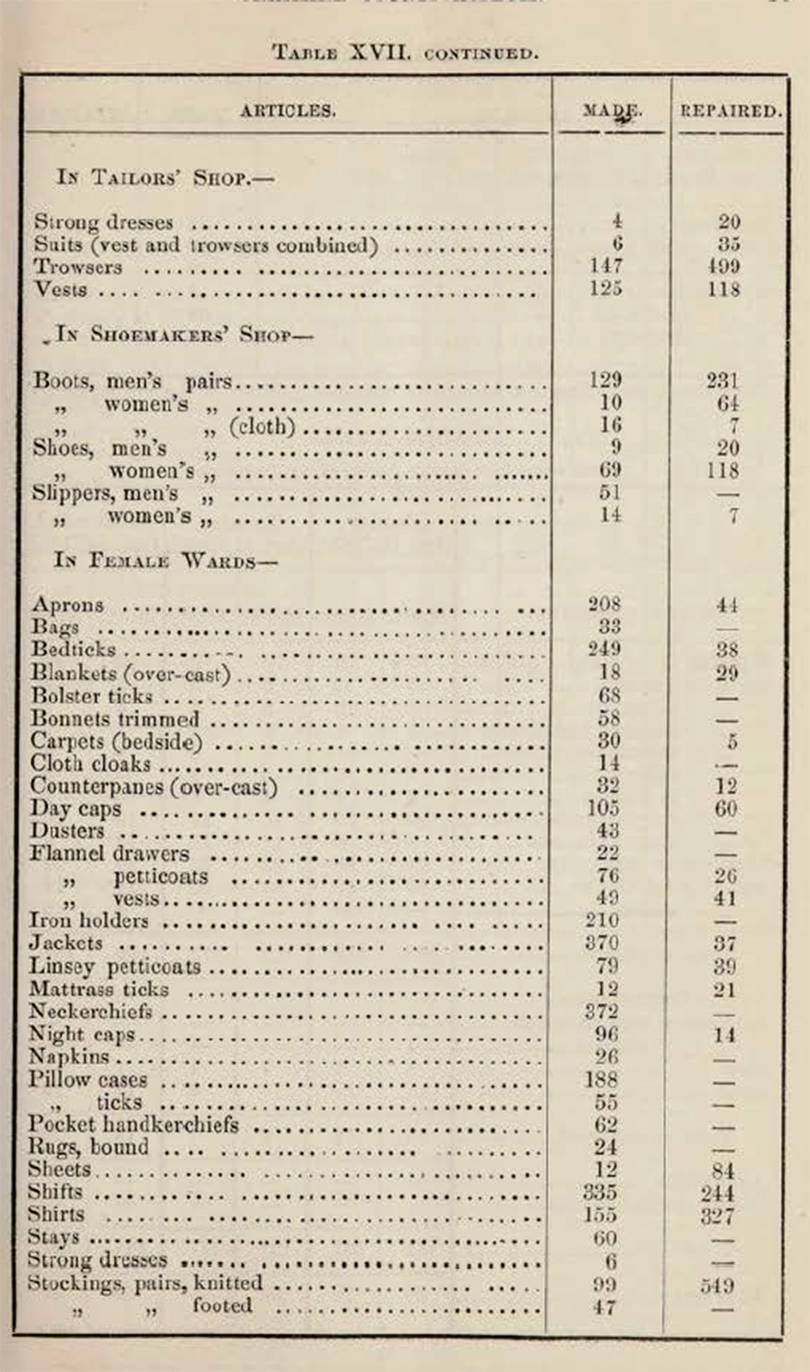
Male and female patient employment records at the Cheshire Lunatic Asylum for the year 1855 (click to enlarge) (Wellcome Collection).

The new forms of treatment that attempted to return people to society put great emphasis on the value of manual work, much like the influential 6th century Benedictine monastic ideal, so some asylums built and managed home farms in which patients worked, and indoors encouraged involvement in art, crafts, sewing of clothes and other items of use within the asylum, and help with the maintenance of the asylum buildings.  Airing courts provided leisure access to fresh air and vegetation, and sporting activities were arranged.  Indoor leisure activities included games, indoor sports, reading material, the ability to engage in art, music, dance and theatre, and there was in-house provision for access to religious guidance

The 1842 Poor Law Commissioners Act introduced by social reformer Lord Ashley (later Lord Shaftesbury), extended the authority of London’s Metropolitan Commissions in Lunacy to the entire country and expanded its staff. Its remit was extended for a trial three-year period to all types of care institution in all parts of England and Wales where lunatics might be held, and this in turn led to the 1844 report of the Metropolitan Commission to the Lord Chancellor.  This report described poor conditions and treatment, and expressed concerns about illicit certification and the continued incarceration of those who had recovered.

Portrait of Harriet Martineu. Source: Wikipedia

An indication of how much work still needed to be done to care for the insane was an article published in 1834 by Harriet Martineau, one of Britain’s first sociologists, who asked whether lunatic asylums really needed to be as dreadful as they so often were, contrasting it with the pioneering attitude of Dr William Ellis and his wife Mildred at the new Hanwell Lunatic Asylum, which opened in 1831:

It is commonly agreed that the most deplorable spectacle which society presents, is that of a receptacle for the insane. In pauper asylums we see chains and strait-waistcoats, – three or four half-naked creatures thrust into a chamber filled with straw, to exasperate each other with their clamour and attempts at violence; or else gibbering in idleness, or moping in solitude. In private asylums, where the rich patients are supposed to be well taken care of in proportion to the quantity of money expended on their account, there is as much idleness, moping, raving, exasperating infliction, and destitution of sympathy, though the horror is attempted to be veiled by a more decent arrangement of externals. Must these things be? (my italics).

A two year investigation by the Metropolitan Lunacy Commissioners was followed by the 1844 Report to the Lord Chancellor which, like its predecessors, highlighted the abysmal conditions in many of the establishments that  that housed lunatics:  “Twenty-one counties in England and Wales had neither public nor private asylum. Profiteering was rife in the private sector; such public asylums as existed were often defective in terms of site, design or accommodation” [Mellett 1981]. The 1844 report seems to have had rather more significant impact than some of its predecessors, timed as it was with Lord Ashley’s continued and vigorous campaigning to provide for pauper lunatics.  The Socialist Health Association records that in 1844 there were around 20,600 lunatics in some form of institution or private care in England and Wales, of whom only 3800 were private patients.  Over 16,800 were classified as paupers.

Edward Wakefield’s 1815 statement about the value of recommending a change to the law to make new asylums compulsory. Source: Wellcome Collection

In 1845, following the 1844 report, Lord Ashley was able to push through the important Lunacy Act and the County Asylum Act.  Importantly, every county was given compulsory responsibility for the provision of a county asylum funded by rates, instead of making it optional as in the 1808 Wynn’s Law.  This was a measure that Edward Wakefield, reporting to the 1815 Select Committee had suggested be implemented, and it had taken 30 years for the recommendation to be acted upon.  The Act required the transfer of mentally ill people (defined as lunatics and idiots) from workhouses, where over 6000 were recorded in 1847, to these new or existing asylums.  It became a legal requirement that both a new Board of Commissioners for Lunacy and regional Justices throughout England and Wales should regularly visit places where lunatics were held, in prisons and workhouses as well as hospitals and both the old and new asylums, for both private and public institutions.  Locally appointed Committees of Visitors would oversee the ongoing operation of asylums, and an annual report would be submitted to the Lunacy Commissioners.  It was now also a legal requirement that asylums record admissions with basic demographic information about the patient, the reason for admission, details of the disorder, treatments and ultimate outcomes (i.e. discharge or death, including suicide).  These were to be inspected at least annually by the Commissioners and regional Justices.  In practice, the Act was not supported with funding or resources, and many of its measures proved difficult to implement and enforce, although it was responsible for the growing number of asylums throughout England and Wales.  Again, improvements to certification processes were made.  In 1847, reporting on their progress, the Commissioners noted how their workload had expanded, emphasising their role as a central resource for asylums:

Excerpt from the Table of Contents for the Further report of the Commissioners in Lunacy 1847

We have found it necessary to carry on an extensive correspondence with numerous parties, some demanding· the interposition of our authority, in reference to cases of supposed abuse; many requiring information, and many others neglecting or misinterpreting· the salutary provisions of the Acts of Parliament; and in the course of this correspondence, numerous questions (some of much nicety and difficulty) have been submitted to us;  we have also found it necessary to enter into long and difficult investigations.

The commissioners were undoubtedly patting themselves on the back in this piece of text, demonstrating the value of their new role, but the rest of the report suggests that since the passing of the 1845 Act they had been very busy assessing the network of public and private asylums for which they were now responsible, gathering extensive amounts of data to inform their decisions.

In 1853 John Bucknill (1817–1897) became the first editor of the Asylum Journal, which became the Journal of Mental Science.  Bucknill held the position until 1862.  The Journal eventually became the British Journal of Psychiatry and is still publishing today. This provided a forum for interested parties, mainly those connected with asylums, to put forward their ideas and instigate discussions.  Ideas about madness and lunatic asylums also filtered into the British Medical Journal.

Asylum Journal 1855. Source: Internet Archive

===
Another set of laws were introduced with the intention of improving matters throughout the second half of the 19th century.  The 1853 Lunacy Amendment Act outlawed hearsay evidence from the process of certification, meaning that doctors were no longer able to depend on the accounts of those who were asking for patients to be admitted to asylums.  The certification process required that doctors only included behaviour that they had themselves observed at first hand, another measure towards prevention of wrongful confinement.  The 1862 Lunacy Act enabled patients who had received care for mental illness in the past to enter asylums on a voluntary basis to receive treatment.  Special permission had to be sought from two lunacy commissioners, but this recognized that the treatment of mental health should not be exclusively enforced and custodial.  It also allowed for greater fluidity of transfer of patients between asylums and workhouses.  The Annual Report of the Lunacy Commission for the same year noted that physical restraints were no longer in common use and that isolation was preferred as a viable alternative.  In 1867 the Metropolitan Poor Bill was designed to recognize harmless “imbeciles”, those with learning difficulties in London workhouses and asylums, and to provide them with specialized establishments. In 1874 the rising costs of asylum management were recognized by the government who introduced a grant allocating 4 shillings per week per person sent to the asylum. This presumably also assisted with moving appropriate inmates from workhouses to asylums.

Unfortunately none of the above measures were successful in introducing genuine state-sponsored social responsibility and reform.  As late in the 19th century as 1873 the British Medical Association expressed its views on the existing state of asylums:

There are no public institutions which lie so open to attack as lunatic asylums.  They are necessary evils; they interfere with the liberty of the subject; they are costly in erection and maintenance; and they are, as a rule, managed with doors more closely shut than those of other hospitals.  There also hangs about them in the mind of the public an air of mystery, and the memory of bygone evils is by no means erase.  When all these factors of unpopularity are taken into account, it is not difficult to see why the complaints of those who have been subjected to their discipline are listened to with avidity. [BMA August 2nd 1873, p.120]

Sadly, as the century advanced and passed into the 20th century, the number of admissions into asylums increased and the earlier idealistic and more personalized approaches became impossible to implement.  The 29th Annual Local Government Report of 1900 stated that in 1860 50% of insane paupers were in county and borough asylums, and 25% of them in workhouses.  By 1900 there were 75% in asylums and just under 20% in workhouses.
xxx

Public anxiety about lunatic asylums in the mid-late 19th century

Louisa Lowe, incarcerated even though later judged to be completely sane. Source: a digitized copy of Blighted Life, in the Wellcome Collection

Whilst the role of lunatic asylums was widely discussed in Victorian medical journals and works produced by alienists, each promoting certain methodological and ideological approaches, there were also publications that spoke to the general public, representing concerns with the alienist profession and describing clear infringements of what we would now think of as the human rights of those who had been illicitly incarcerated.  Wrongful incarcerations fell into two main categories.  First, there were those individuals who had been incarcerated forcibly when sane, sometimes as the result of collusion between family members and medical professionals.  Secondly there were those who had been admitted to an asylum under a legitimate certificate, but continued to be detained long after they had recovered their senses.  Part of the problem lay in what did or did not qualify as sanity but, as discussed above, there were also cases of malicious incarceration and corrupt collusion for financial advantage.

There were two primary channels of information about such cases  to the general public.  Both national and local media took up the stories of those who had been illicitly confined in lunatic asylums, whilst some of the victims published their own accounts. Examples of the latter are John Perceval’s  A narrative of the treatment experienced by a gentleman during a state of mental derangement (1840), Rosina Bulwer-Lytton’s A Blighted Life (1880) and Louisa Lowe’s The Bastilles of England, Or The Lunacy Laws at Work (1883).  Some publications were anonymous, former mad-house inmates fearing derision or stigma.  One author, “A Sane Patient,” wrote My Experiences in a Lunatic Asylum (1879), and another was written by “A Clerical Ex-Lunatic:” The private asylum: how I got in an out: an autobiography (1889). As well as describing the circumstances under which they had been admitted and in which they lived, some also urged government change to existing laws.

News article excerpt about Lawrence Ruck in The Leader, no.440, August 28th 1858, p.862. Source: Nineteenth-Century Serials Edition

Although there were exceptions, the means by which the media became aware of such cases was largely via formal inquisitions. In 1858-1859 there were four cases that caused a media sensation and a public panic about illegitimate certification: Rosina Bulwer-Lytton, Mary Jane Hepworth, Reverend William Leach and Lawrence Ruck.  Inquisitions were legal mechanisms by which those held in private asylums could apply for permission to take their cases in front of a judge and jury to attempt to prove their sanity.  Witnesses could be called to give testimony for or against a patient’s sanity, both personal and professional. These were very expensive and the cost fell on the applicant, so was available only to the very wealthy.  Because these people often belonged to elite families or were associated with public figures, they could be of great public interest.   Inquisitions were held in public, in any venue large enough to accommodate them, in coffee houses, bars and taverns, and any member of the general public or media was free to attend.  Juries were men, often magistrates or others who were sufficiently educated to assess both medical and legal arguments.  In the cases of Bulwer-Lytton, Hepworth, Leach and Ruck, all four had been confined in asylums, but during inquisition had been judged sane.  Rosina Bulwer-Lytton had a particular gift for publicity and succeeded in winning many newspaper publications to her side to publicize her grievances.  The highly publicized scenario where a family member, colluding with an asylum owner and sent attendants to bundle a sane victim into a carriage to be locked up, their basic human rights denied them, caused real public anxiety.

Report of the Alleged Lunatics’ Friend Society 1851. Source for report: Wellcome Collection

The newspaper publications and first-hand accounts about individual cases were supplemented by the work of pressure groups. Three groups were formed to promote the causes of patients in asylums, more or less consecutively, all started by those who had direct experience of illegal detention in lunatic asylums: The Alleged Lunatics’ Friends Society (an informal grouping until 1845 when they became organized), the Lunacy Law Reform Association, and its splinter group The Lunacy Law Amendment Society.  At the same time, Georgina Weldon attracted many followers in her campaign against illegal incarceration and detainment in asylums, having gone into hiding when her estranged husband attempted to have her committed. Whist in hiding she was declared sane by two independent physicians. All these activists wrote letters to influential people, took out newspaper adverts, distributed pamphlets and spoke extensively in public in attempts to influence government action to reform lunacy laws.  Although they were rarely successful at pushing through legal reform, they were very good at generating publicity for their causes, drawing attention to the financial motivations of both those who might benefit from certifying a relative and the asylums admitting them, and the callous tyranny of some of the asylum owners and staff.  They also acted to take up individual cases where sane people remained locked up in asylums.

Inevitably, in spite of attempts to force through legal and social reform, changes in the law always lagged behind the need for reform.  For every energetic reformer there were many more places that continued to follow easier, less labour-intensive means of confinement, and although individual reformers and medical representatives attempted to improve asylum care, there were continuing problems of unnecessary and illegal incarceration and detainment, sometimes as a result of collusion between relatives and asylum owners, causing ongoing anxiety in contemporary society.
xxx

The criminally insane

Lithograph by JR Jobbins in 1840 showing the assassination attempt by Edward Oxford on Queen Victoria. Source: Meisterdrucke

In 1800 when James Hadfield attempted to assassinate George III in the belief that the death of the king would initiate the Second Coming of the Messiah, he was charged with treason. However he was judged to be non compos mentis (not in his right mind) due to severe head injuries incurred during his service as a soldier.  This verdict of insanity was followed by the the Criminal Lunatics Act, which required that criminal lunatics should be detained in county jails, and lead to the addition of a new criminal wing be Bethlem to house the criminally insane.  A number of high profile cases followed, and in 1840 Edward Oxford fired a pistol at Queen Victoria and Prince Albert as they were travelling in an open carriage on Constitution Hill in London, and although he was tried for high treason, was found not guilty by reason of insanity.  He was sent to the criminal wing at Bethlem.

Daniel M’Naghten photographed by Henry Hering in around 1856. Source: Bethlehem Hospital Museum Archives via Wikipedia

A decisive case was that of Daniel M’Naghten who, in 1843, attempted to kill Prime Minister Robert Peel, but mistook Peel’s secretary for the Prime Minister, shooting and killing him.  M’Naghten suffered from paranoid delusions, thinking that the Tories were persecuting him and were planning to murder him. He was acquitted on the basis of insanity and confined to Bethlem asylum.  This lead to the M’Naghten Rule (or M’Naghten Test) which provided criteria for assessing whether or not someone was insane at the time that a serious crime was committed, to assess whether or not someone was criminal liable.  Only when the test has been completed in all its parts can a person be deemed to be criminally insane.

One of the best known 19th century inmates of both Bethlem was was the remarkable professional artist Richard Dadd R.A., who was incarcerated first in the ward for the criminally insane in Bethlem in 1843.  Dadd, after exhibiting signs of violent and delusional behaviour when travelling in the Middle East went to stay with his parents to recover but, believing that he was acting under the orders of the Egyptian God Osiris, murdered his father whom he was convinced was possessed by the Devil.

Richard Dadd, painting whilst incarcerated in an asylum in 1856. Source: Wikipedia

These cases paved the way for the establishment of the Broadmoor Criminal Lunatic Asylum, which opened in 1863 in Berkshire, and which remains in use today.  Oxford, M’Naghten and Dadd were all transferred to Broadmoor in 1864.  M’Naghten died in 1865 but Dadd continued to paint throughout there until his death in 1886 at the age of 68.  Edward Oxford, who showed no ongoing signs of insanity, was offered the opportunity to be relocated to Australia in 1867, and duly took up the offer, settling, marrying and living out his life in Melbourne, later publishing a book about the city.

Much of the intention of earlier laws in this respect was re-formalized in the Trial of Lunatics Act of 1883, in which any offence committed whilst a person was deemed to be insane, and therefore according to the law not responsible for his actions at the time when the act was committed, a special verdict of not guilty by reason of insanity should be returned. This law was updated several times, most recently in 1991.

Day room for male patients at the Asylum for Criminal Lunatics, Broadmoor, Sandhurst, Berkshire. Source: Wellcome Collection

A broken system

Excerpt for a page from the 21st Report of the Commissioners in Lunacy for 1866, published in 1867. Source: Wellcome Collection

In the later half of the 19th century, it was becoming clear that the optimism of both medical and legal professions the 1840s was dwindling fast, and that the asylum system was failing to keep up with demand.  The 21st Report of the Commissioners in Lunacy in 1867 indicated that 90% of patients in public asylums were considered to be incurable.  Writing only three years later in 1870, Dr Andrew Wynter, former editor of the British Medical Journal, commented that “Our whole scheme for the cure of lunatics has utterly broken down.”  Although it was convenient to hold large numbers in facilities where they could be dealt with in a consistent and organized way, the numbers of those who entered far exceeded the numbers of those who left.  Overcrowding was a serious problem for most public.  The emphasis inevitably shifted from treatment and cure to containment, order and bureaucracy.  This succeeded in dividing lunatics from society, but did not address the root cause of the the problem – the analysis and cure of mental illness.  Those who might have been treated and restored to their families were lost in the sheer volume of inmates who required maintenance and management.  Wynter referred to this as “brick and mortar humanity.”

Plan for Caterham and Leavesden 1868, both serving the London area. Both were opened by the Metropolitan Asylums Board in 1870, and within five years demand far exceeded capacity, requiring new building works to accommodate the influx of new patients . Source: Wellcome Collection

There were only two practical solutions to overcrowding in asylums.  The first was to return non-violent patients to their families or to send them to workhouses.  The second was to expand existing asylum buildings and facilities and to build new asylums.  Although workhouses continued to take in lunatics and idiots, expansion and new building were the most frequently adopted solutions.  It is to this period that the first of the vast dedicated developments were built, with their own water and gas works, their own fire brigades, cemeteries and other urban-type facilities.  These were located in rural locations, where asylums could be conveniently separated from the rest of society, and where land was relatively cheap. The earliest examples of these vast enterprises were built to serve London and its environs, and include Colney Hatch in Middlesex (opened in 1849 for 1000 patients), Leavesden and Caterham (both opened in 1870 for 2000 patients each), Caterham, and Claybury County Asylum (opened in 1894, also for 2000 patients).

Claybury County Asylum, now converted into apartments. Source: Wikipedia

It was not until nine years later that the 1886 Idiots Act created specialist asylums for individuals with learning difficulties beyond the London area.  Important distinctions were made between lunatics on the one hand and harmless idiots and imbeciles (those with learning difficulties) on the other.  The intention was to take the opportunity to care for them and provide basic education and training so that idiots were treated neither as lunatics that needed to be confined nor as indigent vagrants.  Following this, the 1890 Lunacy Act the certification of alleged lunatics was moved to the jurisdiction magistrates as well as doctors.  It also made the provision of free mental healthcare available, but as the majority of the population could only access free psychiatric care if they were certified insane and agreed to be admitted to an asylum, the stigma of certification and the requirement for confinement were significant deterrents to people volunteering to receive the help they needed.  More than any previous law, the 1890 Act helped to prevent medical collusion to incarcerate patients wrongfully.  Whereas only medical certification had been required before, a civic official such as a magistrate or Justice of the Peace was now required to certify madness.  The Act also took measures to prevent the licensing of new asylums, aiming to inhibit the further licensing of private asylums, which it was hoped would lead to the eventual demise of the private asylum.

An inspection of the formerly progressive Hanwell in 1893 described depressing conditions, concluding that it would be surprising if any of the patients were to recover given the type of care they were receiving in fairly dismal surroundings.  Even more regrettably, the untested idea that mental illness could be passed from one generation to the next fed into the horrible theory of eugenics.   New surveys continued to be carried out, reports continued to be submitted and new laws continued to be introduced, modified and implemented, but it is a sad fact that neither medicine nor the government, via changes to the law, managed to provide convincing support for a growing section of society that was still not well-understood.
===

After the Victorian period

Graphic to accompany the one-man play Shell Shock, performed at the National Army Museum to mark Mental Health Awareness Week in 2019. Source: National Army Museum

I have not ventured into post-Victorian approaches to mental health in this post, but it was very far from a story of continual improvement of care and cure.  There was still a very long way to go to even begin an understanding mental illness, and to standardize, in a scientific way, the treatment mental illness in psychiatric units. Sigmund Freud’s end-of-century theories of psychology were squabbled over for decades.  The First World War’s executions for “shell shock” as a judgement of cowardice remain deeply shaming.  In the inter-war years psychiatrists began to take a more experimental and interventionist approach to treating mental illness. Several new so-called “heroic” physical therapies were introduced, based on the belief that mental illness had a physical basis in the nervous system or the brain. These included insulin coma, chemical shock, electro-convulsive shock therapies and, most radically interventionist, lobotomization.  Egas Maniz’s experiments with prefrontal lobotomy remain profoundly disturbing.

The abandoned Denbigh Lunatic Asylum. Photograph by Steve R. Bishop. Source: Everywhere from Where You are Not

It will come as no surprise to those who follow the news that there are still serious problems, not merely in official provision of mental health care, but in care homes for the elderly, including those recuperating and convalescing, and those who had been persuaded to hand over power of attorney.  There were dreadful examples of people being released from long-term incarceration in the 1950s and 60s who had been admitted for minor criminality and socially disruptive behaviour, and although they had become institutionalized were found to be completely sane.  The use of vast repositories for the mentally unwell was abandoned without, however, a clear strategy for handling those who still needed help.  This was followed by a policy of caring for the mentally unwell within the community, pushed through during the 1980s, which often failed to provide families and local care centres with sufficient resources to make this fully viable, placing great strain on families and support mechanisms.  The tyranny of some institutions was revealed in a number of scandals and was a theme explored in relatively modern times in the 1975  film One Flew Over the Cuckoo’s Nest.  Documentaries in care homes in recent times demonstrate how this problem still persists in some places.

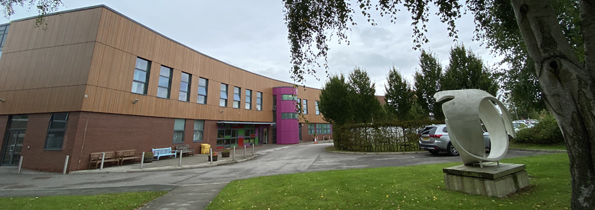
Ancona House. Child and Adolescent Mental Health Services unit at the Countess of Chester Hospital, Chester

Today the madhouse or lunatic asylum has become a psychiatric hospital or a psychiatric unit in a general hospital for those with manageable symptoms, or a specialist secure facility for the violent and criminally insane.  In the Victorian period medical understanding and psychiatric ideas were only beginning to be proposed and tested, and this continued well into the Edwardian period and beyond, with medicine and the law both playing  important parts in how mental illness and suicide were understood, diagnosed and treated.  The research remains ongoing.  There is still no viable solution, or set of solutions, to the problem of coping with mental illnesses. The subject of how to care for those suffering from mental illness is far from resolved.
===

Final Comments on parts 1.1 and part 1.2

William Tuke’s “The Retreat” in around 1796. Source: Wikipedia

In spite of being divided into two parts to make it easier to digest, this quick and dirty summary of the state of mental healthcare in the 18th and 19th centuries inevitably smooths out some of the kinks in that often convoluted story, over-simplifying some of the many subtleties.  This account represents a very short summary of a very complex topic.

From the late 18th century mental illness represented a growing issue for a society that was developing a broad social conscience. In spite of many reforms to poor laws and a number of new Acts of Parliament to govern asylums, governments were slow to respond to either public pressure or their own specially commissioned reports, and stories of unlawful detainment in some places and frightful conditions in others failed to produce change that was both meaningful and timely.  The role of workhouses in the handling of the mentally ill continued to be important, with patients shared between workhouses, workhouse infirmaries and asylums, in spite of legislation designed to make the responsibilities of each much more transparent, which is an area that needs to be much better understood.  It was only towards the end of the 19th century that those with learning difficulties, termed imbeciles and idiots, were seriously treated in the law as a separate problem requiring different types of care.  The topic of children in lunatic asylums is not much discussed, but records show that at least some were admitted, as they were to workhouses.

John Conolly, looking rather self-satisfied. Source: Wikipedia

Sometimes those who were supposed to represent the pinnacle of care and reform are described with a rose-tinted filter.  For example, Edward Long Fox and his sons, running one of the most expensive private asylums in the country, were accused in the writings of patient John Perceval, son of the murdered prime minister Spencer Perceval, of incarcerating their more troublesome patients in truly dreadful conditions where they were subjected to beatings, threats, manacles, strait-vests, freezing water baths and other punishments and indignities.  The alienist John Conolly, a national figurehead of ethical and human approaches, was found guilty in court of taking money for signing legally binding certificates that retained patients in private asylums to which he was employed as a paid consultant.  One of these patients was found, by jury to be sane and the investigation highlighted the risk of consultants being paid by asylums for certifying patients.  He also often took credit in public for introducing non-restraint in England, in fact an innovation of Robert Gardiner Hill at Lincoln, and at Hanwell asylum had a very low cure rate.  Another example is Lord Ashley, later Lord Shaftesbury, generally and fairly acknowledged as an important voice for mental healthcare reform but sometimes remarkably intransigent. He often blocked or delayed changes that would have made important differences that would have lead to improved quality of life and greater transparency and justice in the asylum system.  This was a particular problem given that Ashley had been elected the lifetime head of the Commission for Lunacy, a position that he did indeed hold until his death in 1885.

By the end of the century the dream of personalized care of the mentally ill by engaging them in social activities within attractive contexts was largely abandoned.  The “moral treatment” approach had depended not only on sufficient numbers of attendants to manage patients with kindness and empathy, but those who had a genuine interest in caring and treating.  The 1870 Annual Report of the Lunacy Commission recorded that 122 attendants had been dismissed in 1869 for manhandling patients roughly or violently, and it is not at all surprising that as new patients were admitted in increasing numbers, the sheer volume proved difficult to manage:

The number of people certified as ‘insane’ soared.  The asylum created demand for its own services.  Less and less people ever left, and more and more arrived.  In 1806 the average asylum housed 115 patients.  By 1900 the average was over 1,000.  Earlier optimism that people could be cured disappeared.  The asylum became simply a place of confinement. [Disability in Time and Place, Historic England, Simon Jarrett]

Leavesden Hospital in Abbots Langley, Herts., opened 1870. Source: Leavesden Hospital

Governments as well a local organizations began to invest in creating larger institutional solutions for paupers whose symptoms indicated the sort of social deviance and/or danger to self that could not be countenanced without intervention.  However. the recognition of mental illness and the acceptance that it should be handled by the state caused its own problems as more people were incarcerated and management of mental illness became, like contemporary prisons, more of an issue of how to maintain order than how to provide cures.  Unlike most prison sentences, there was no release date for mental patients, who could be held indefinitely and sometimes were.  An indication of how urban areas in Britain were overwhelmed by demand was the new Metropolitan District Asylum built between 1868 and 1870 as Leavesden Hospital in Hertfordshire, which was designed to house 1500 patients, after which it continued to expand to cope with the ever growing need to provide care for the mentally ill.  Like other asylums of this period, it is more like a small town than a hospital.  Sadly, many asylums once again became associated with confinement and bureaucracy rather than attempts at cure and rehabilitation.

The perception of mentally ill people changed over the course of the Victorian and Edwardian periods as psychiatry developed as a specialist branch of medicine, swinging between biological, congenital and neurological explanations on the one hand and emotional-psychological explanations on the other. The degree of subjectivity lead inevitably to disagreement and contradictory opinions, with very little indication of how to choose between the variety of different ideas held in different asylums.  The legacy of 19th century mental health medicine, law and care seems to be one of a continued struggle to fully comprehend the complexities of mental illness or to devise suitable ways of treating them sustainably.  As Mike Jay says in his book This Way Madness Lies, “While the asylum as an institution is now largely consigned to the past, many of the questions it struggled so hard to address still persist.”===

Click here for the references for this post


Full 1-hour documentary about the situation within mental asylums at the time of the closure of many of them

Out of Sight, Out of Mind – The Leavesden Asylum Story
Leavesden Hospital History Association


Cheshire Lunatic Asylum: The development of lunatic asylums – Part 1.1

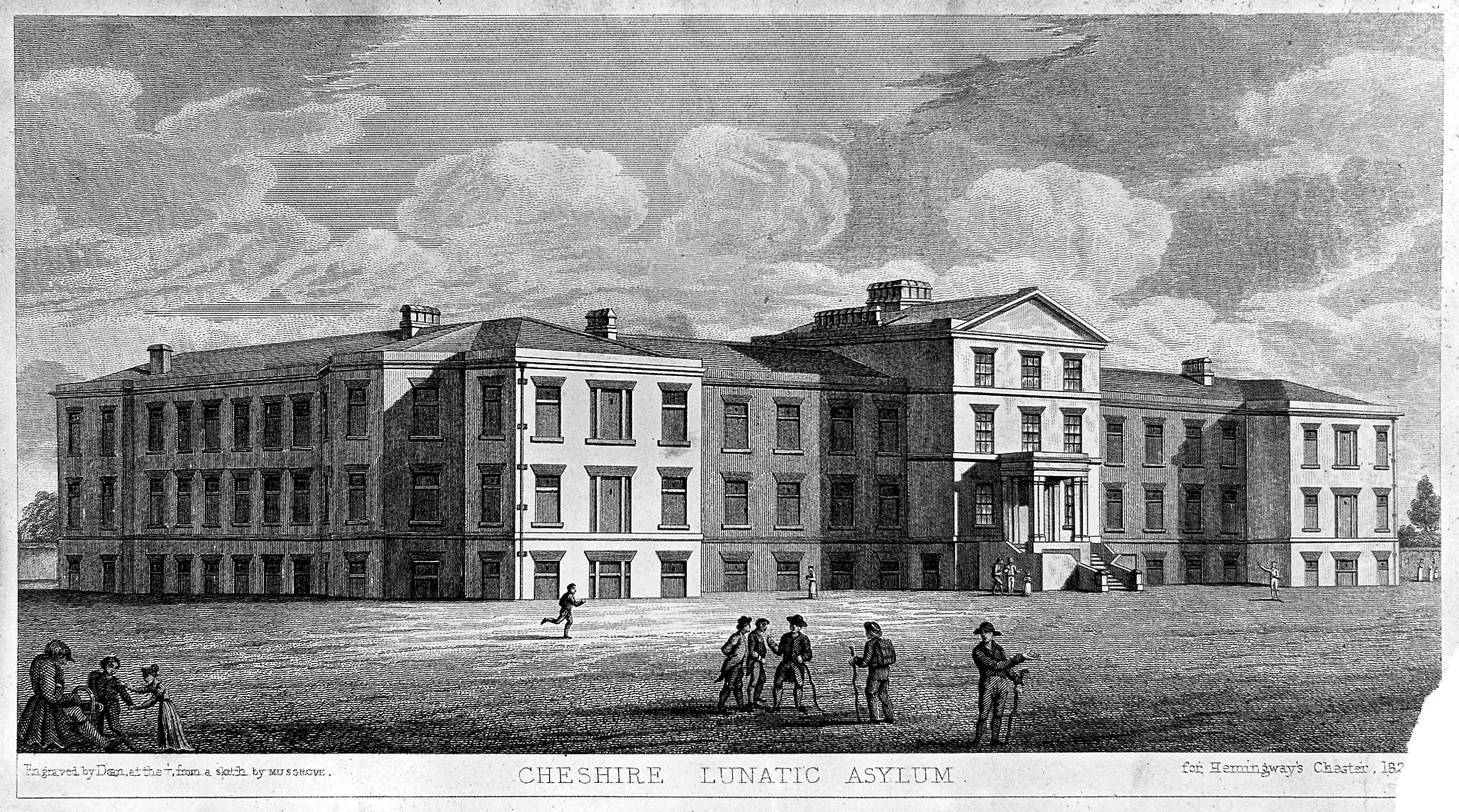
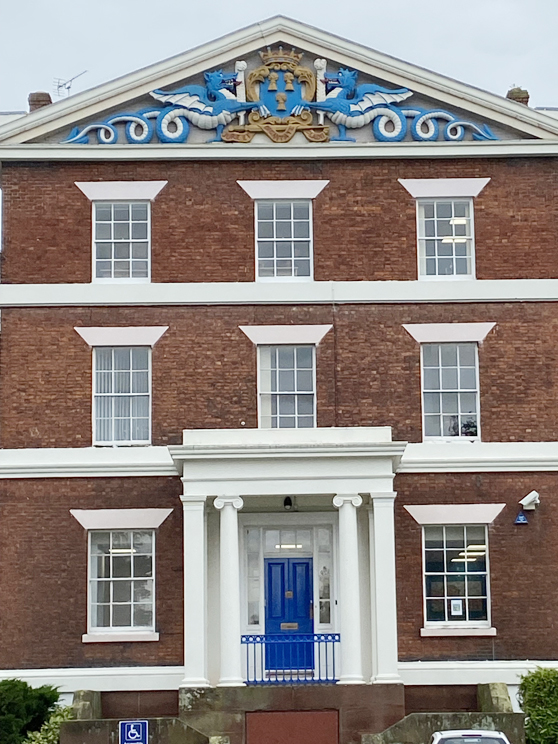
The 1829 Building, built as Cheshire’s first lunatic asylum


Beginning with nine voluntary institutions, the asylum movement rolled across the 19th century English landscape like an avalanche gathering pace. The ‘mentally unsound’ were moved in ever greater numbers from their communities to these institutions.  From 1808, parliament authorised publicly funded asylums for ‘pauper lunatics’, and 20 were built. From 1845 it became compulsory for counties to build asylums, and a Lunacy Commission was set up to monitor them. By the end of the century there were as many as 120 new asylums in England and Wales, housing more than 100,000 people.

Historic England:  The Growth of the Asylum – a Parallel World

==


Introduction

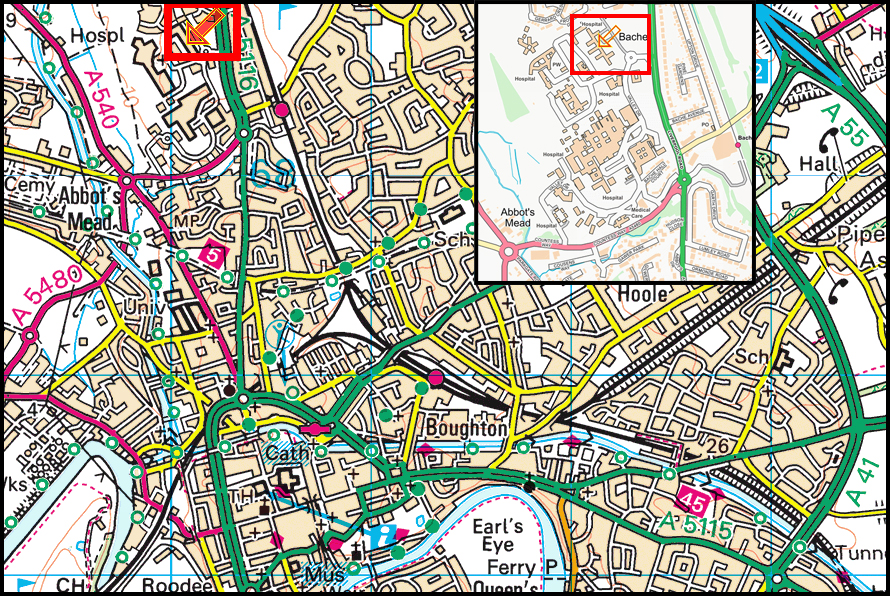
As part of my ongoing series looking at Overleigh Cemetery, I asked Christine Kemp of the Friends of Overleigh Cemetery about the suicides she knew of in Overleigh Old and New Cemeteries.  In the 19th century suicide was more often than not deemed to be the result of temporary insanity.  Looking into how suicide was handled in the 19th century lead me to the discovery, probably very familiar to most Chester residents, that there had been a “lunatic asylum” where the enormous site of the Countess of Chester Hospital is now located at Upton.

The rear of the 1829 Building today

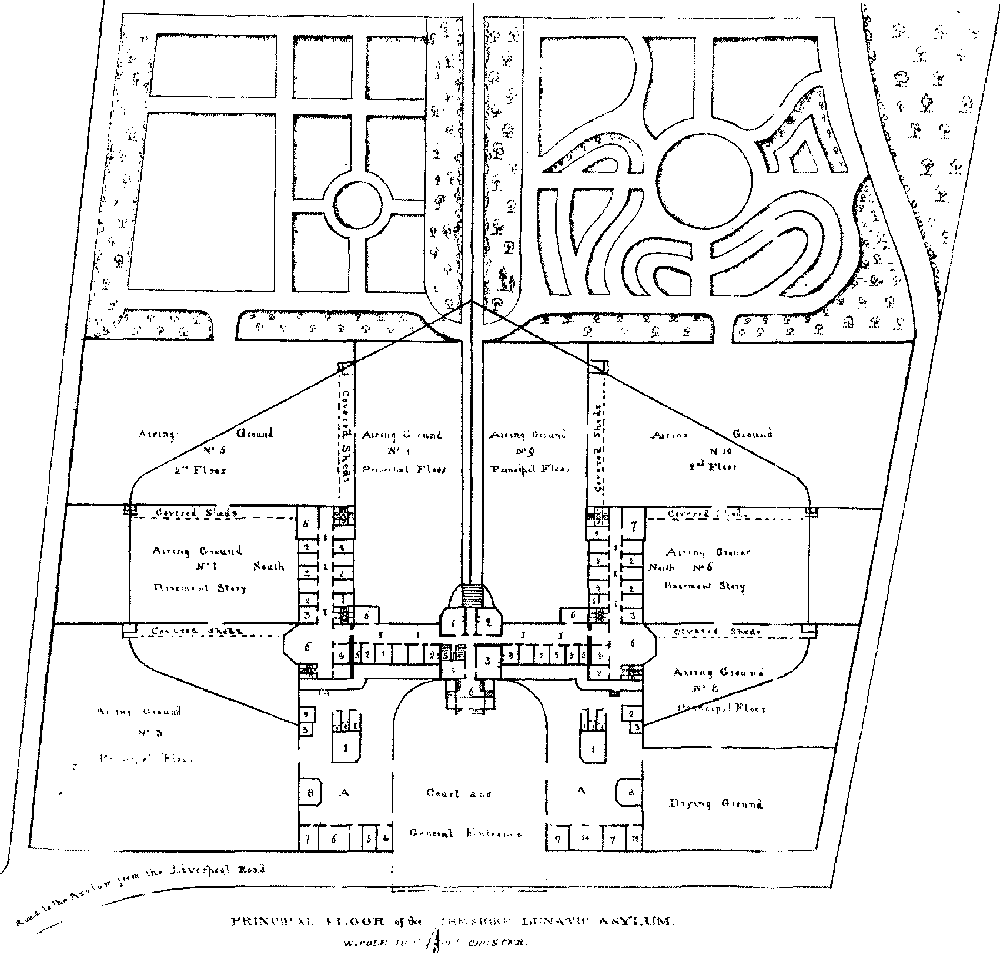
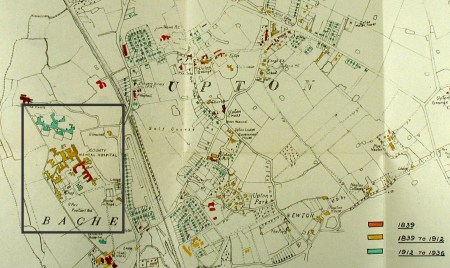
The Cheshire Lunatic Asylum was a public institution established to house pauper lunatics as well as a limited number of paying private patients in 1829.  The asylum opened on a 10 acre site in 1829 to accommodate 45 women and 45 men, reflecting the fairly even numbers of both at asylums in the 19th century.  It grew throughout the 19th century and eventually occupied a significant area of over more than 55 acres.

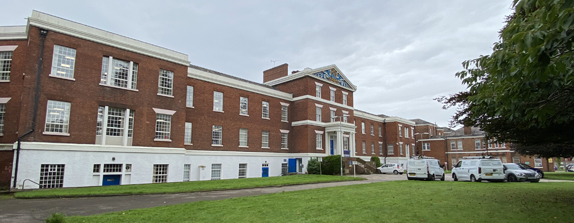
The exterior of the earliest building remains in situ, and has the appearance of an elegant and stately Georgian-style building with a small Classical portico, looking very much more like a the remnant of a country estate than the intimidating prison-type establishment that I had been expecting.  An elegant façade was typical of 19th century asylums.  Today the asylum building is still an active part of the Countess of Chester Hospital, officially named “The 1829 Building” (Grade 2 listed), housing a number of departments including Adult Mental Health, Physical Health and Brain Injury Services, as well as the GP Blood Test DepartmentWhen I was sent to the Blood Test department last year it was some consolation that I was being jabbed in the arm in a place of significant history.

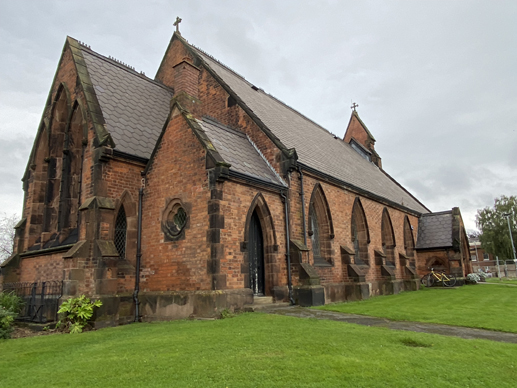
The chapel (Grade 2 listed) was built in 1856 to serve the lunatic asylum, and still on the site although used for a different purpose

Most of the other buildings associated with the asylum have now been demolished, but nearby are the asylum’s 1856 chapel (Grade 2 listed) and the fenced-off and boarded-up remains of what I believe was “the villa,” the 1912 building for treating epilepsy (which had been treated as a mental illness up until the early 20th century). The recently restored water tower also remains.

Although it would have been great to jump into the story of the Chester Lunatic Asylum without delay, the background information was absolutely necessary to make any sense of that story.  In part 1, I have tried to do provide a sufficiently detailed background to give a sense of how the Chester Lunatic Asylum fits into the full history of mental health care in the 19th century.  In part 1 (split into part 1.1 and part 1.2 to make it easier to manage, but both posted on the same day) I look at the background history of what were known as lunatic asylums in the 18th and 19th centuries, with some additional brief comments on how this overlapped with workhouses.  Sources and references for all parts can be found hereA version of parts 1.1 and 1.2,without images, can be downloaded as a single PDF here (27 pages of A4)

In part 2 (also split into two parts) I discuss the Chester asylum itself, built in 1829, the name of which changed many times over the period of its use as an establishment for treating mental illness. Part 2 has been written and will be posted as soon as I have added in the images, probably next week.

Many thanks to historian Mike Royden for sharing his knowledge about the Tudor and Victorian Poor Laws and workhouses.  You can find out more about Mike’s research on his History Pages website.
===

18th and 19th century terminology and its limitations

From at least the 17th century the terms “madhouse” and “lunatic asylum” were terms employed to indicate a place that confined the mentally ill.  These institutions were differentiated from hospitals that dealt with more conventional medical problems where attempts were made to treat rather than confine patients.  The term “asylum” was originally used to refer to places of refuge, retreat and sanctuary, but up until the late-18th century the lunatic asylums were generally custodial in character, often keeping inmates in very poor conditions, and were usually referred to as mad-houses. By the 19th century an asylum was generally an establishment that made claims to treat as well as confine inmates.

Terms such as “mad” and “lunatic,” as well as “idiot” and “imbecile” are now considered to be pejorative, as well as imprecise, and are no longer used in medical, psychiatric, sociological, legal or political contexts today.  In the Victorian and Edwardian periods, however, these were the standard terms used for those who suffered from some form of mental illness that incapacitated them emotionally or cognitively, temporarily or permanently, along a continuum from violent or otherwise harmful behaviour to mere learning difficulties.  The term “insanity” was also in common usage, but has not been entirely excluded from modern usage.  All terms are used throughout this post, reflecting the usage of the 18th and 19th centuries.

Insanity in the 18th and 19th centuries could include a vast array of conditions including delusions, paranoia, self-harm, hysteria, mood-swings, visions, speaking in tongues, irrational violence against others, senility, alcoholism, epileptic fits, dementia, mania, depression and suicidal behaviour. Even eccentricity, such as spiritualism or unconventional social behaviour, was sometimes interpreted as incipient lunacy and could lead to illicit confinement.

The earliest owners and overseers of mad-houses were known as “mad-doctors,” a term from which 19th century asylum owners attempted to distance themselves.  The later specialists in mental illness who claimed (and in some cases did) focus on treatment and cure, who were the predecessors of today’s psychologists and psychiatrists, were known as “alienists.”   The term derives from the idea of mental alienation.

When the only practical solution to lunacy was incarceration, it should have been a priority to establish a set of universal definitions for the unmanageable symptoms of lunacy, but without a centralized approach to this problem, none were forthcoming.  This lack of agreement about what did and did not constitute madness is exemplified by the case of Mrs Catherine Cumming who was abducted from her home and taken to York House Asylum near Battersea in London.  After a period of incarceration and a long legal battle, she was declared sane by a jury, and released.  When Thomas Wilmot, who had signed her lunacy certificate, was asked what he thought lunacy was, he replied that he had never seen a reasonable definition. One of the most notable features of the Cumming case was the number of medical experts called as witnesses, nineteen of them, including such notable names as John Conolly, Sir Alexander Morison and Dr Edward Monro.  As Sarah Wise summarized:

After the Cumming case, it was once again noted by most commentators how unsatisfactory it was that nineteen eminent medical men could give widely differing opinions of what constituted soundness of mind, tailoring their learning according to what ‘side’ in the dispute had hired them. One alienist had claimed that Mrs Cumming was a monomaniac, another that she was an imbecile, and yet another that she was perfectly sane. . . How safe was anyone when the experts had such divergent views of insanity? [Inconvenient People, p.177]

Individual conditions now required names so that patients could be labelled, statistics logged and cases discussed.  For example, research by Hill and Laughurne, based on 1870s records from St Lawrence’s Asylum in Bodmin (Cornwall), identified the most common conditions suffered by those admitted at the asylum.  Although the main reasons for admission were recorded as mania, dementia, melancholia, moral insanity and the combination of manic behaviour and dementia, it is not at all clear what these terms represent.  Hill and Laughurn tentatively apply the following attempts to suggest modern equivalents:  mania probably representing overactive episodes; dementia, which appeared to  include loss of cognition, memory loss, intellectual deficit, schizophrenia and losses of concentration; melancholia, which seems to have mainly indicated underactive episodes relating to depression; moral insanity (unspecified) and the combination of manic behaviour and dementia, which possibly describes bipolar disorder.

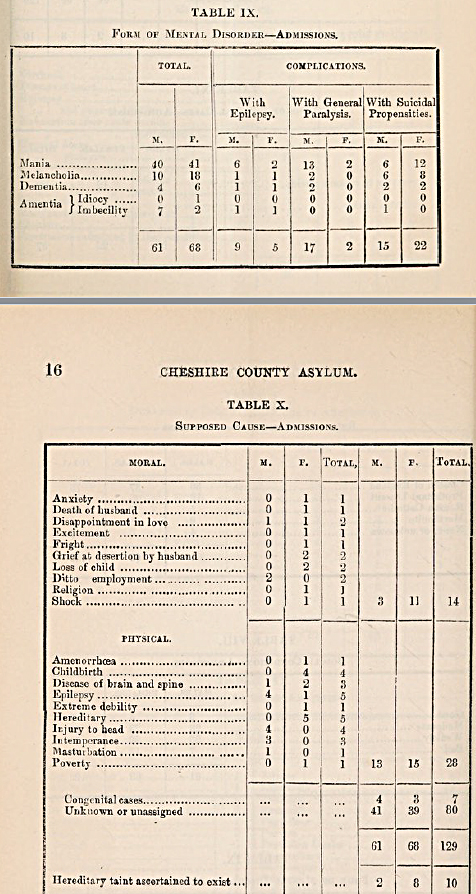
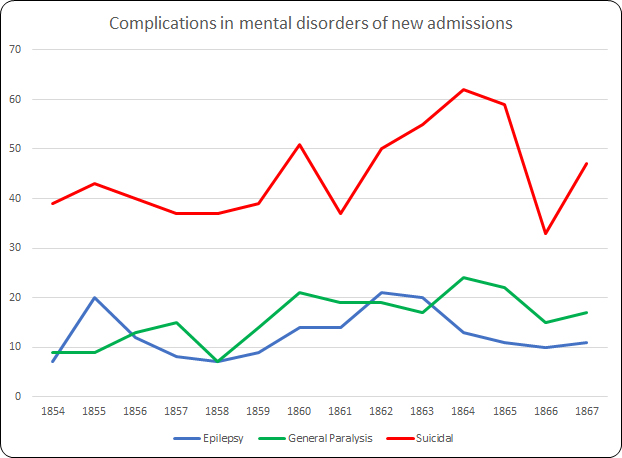
Similarly, a table from the 1855 report for the Cheshire Lunatic Asylum, for both males (M) and females (F), shown below, records that the overarching symptoms in that year were mania, melancholia, dementia and amentia (defined as idiocy and imbecility), and these were further sub-categorized by the presence of epilepsy, general paralysis (also known as general paresis), and suicidal propensity.

The “Committee of Visitors and Superintendent of the Cheshire Lunatic Asylum Report” of 1855, showing Reasons for Admission. Wellcome Collection

Unfortunately, the terms for mental illnesses are not used consistently from one institution to another, meaning that mapping them on to modern conditions can be very difficult.  The term dementia, for example, covered a variety of symptoms relating to mental illness at St Lawrence’s and Chester, but has become rather more precisely defined today.  Epilepsy was subsumed into the general category of mental illness until the later 19th and early 20th century when special epilepsy treatment centres were introduced, intended to be more domestic and less institutional.  Suicidal behaviour, with the multiplicity of potential causes and symptoms, even now sits in a somewhat liminal area between mental illness and the ability to make coherent decisions, blurring boundaries.

Admissions, Discharges (Cured and Relieved) and Deaths for Cheshire County Asylum, 1860. Source: Wellcome Collection

Another of the many challenges to understanding how lunatics were assessed was that there were no criteria for how a successful cure could be identified.  In York the Tuke’s compassionate asylum The Retreat, it was assumed that anyone who had been released was cured if they were not readmitted, but not only could this represent wishful thinking without additional data, but it sidestepped the task of creating behavioural or other measures that might be used in asylums to determine whether or not someone ought to be released or detained.  Like other asylums, the Cheshire Lunatic Asylum annual records show that each year a number of patients were released from the asylum, but it is impossible to know what this actually means, as there are no recorded criteria for determining whether or not a patient had been cured or, for example, sent home because they were not necessarily cured but were not dangerous to themselves or others (usually referred to as “relieved” rather than cured). The failure to define criteria to measure the success of treatment and recovery was a serious problem once patients were certified insane and committed to an asylum, because there was no universal agreement about how recovery could or should be recognized.  As well as being imprecise, the lack of clear definitions and criteria was potentially an invitation to corrupt or merely sceptical asylum owners to hold patients indefinitely.

For more on these and other terms see Historic England’s Glossary of Disability History.
===

Practical problems associated with early mental illness

Engraving by T. Bowles 1735. “In a lunatic asylum, and in the company of a variety of other deranged individuals, a half-naked Ramble Gripe, his wrists chained, is restrained by orderlies.” Wellcome Collection Reference 38347i

Depending on its severity many forms of mental illness, and conditions like epilepsy that were interpreted as occasional bouts of madness, could be intensely distressing for the families and friends concerned.  Not only were the symptoms apparently incomprehensible and might seem  to be completely random, but they contravened social norms and conventions in a society that placed great value on normative behaviour.  It might be very difficult to manage the situation if symptoms were particularly acute, requiring physical intervention. Mental illness drew unwanted attention, could attract derision and social stigma, and might prevent family members from marrying due to fears of hereditary contamination.  Depictions of insanity in drama, literature, art, newspapers and magazines only inflated stigma and misunderstanding.  Unfortunately, until the 18th century there was very little official support for mental illness.  In rural locations families who could not keep a mentally or otherwise disabled family member at home could pay for their mentally ill relatives, including those with learning difficulties, to be cared by villagers or at local farms in need of income, sometimes providing indigent widows with a means of generating income. There was no official record of mentally ill people cared for at home.

Wealthy families could either hire an appropriate person to join the household to care for the afflicted individual, or send them to a private home or a privately run asylum where a frequently unqualified person would charge a fee to take the problem off a family’s hands.  Families with middle class and reliable working class incomes might depend on any home-based family members, usually female, to provide care, but less expensive privately run houses might again provide a solution. Private mad-houses only began to become prevalent from the 17th century, and operated as lucrative businesses, unlicensed, unregulated and without oversight, there were mad-houses priced for most pockets.  They were often owned or managed by individuals with no qualifications and run without any medically qualified person in attendance.  Even when operated by physicians or surgeons, these titles covered a multitude of sins and might mean anything from someone who was genuinely attempting to treat ailments to a quack doctor who was little better than a profiteering snake-oil salesman.

At the main gates to Bethlem at Moorgate were two sculptures, which just about say it all: “Melancholia” and “Raving Madness” (in chains) in 1689 by Caius Gabriel Cibber. Source: Wellcome Institute via Wikipedia

For pauper families, a lunatic family member was an even greater burden.  Lunatics whose families could not support them were forced to resort to begging.  These were amongst the most isolated and vulnerable people in society. The pauper insane were undifferentiated from other paupers, including vagrants, tramps, beggars.  Many found themselves in workhouses, and workhouses continued to have a role housing those will mental illnesses well into the 19th century.  Other less fortunate pauper lunatics would be incarcerated in prisons, particularly when violent.

The first charitable mad-house was the 1247 Priory of Our Lady of Bethlehem in London, which had taken in the insane from the early 15th century as a monastic duty.  For most of its life it was a small institution, with a capacity of few more than 40 individuals, but by the mid 19th century it was suffering from overcrowding.  Following the Great Fire of London in 1666 the largest public asylum investment in dealing with lunacy was the 17th century was in the new Bethlehem (also known as Bethlem and Bedlam), which opened in Moorfields on the edge of London in 1676 for 120 patients, with additional extensions added as it reached capacity.  Conditions were notoriously dire until the early 19th century.

Outside London care was organized under local parishes in a highly decentralized way, and these would sometimes provide accommodation for those who, through no fault of their own, were unable to support themselves.  Charitable asylums began to appear throughout England in the early 18th century, first in Norwich and London, then in Newcastle and Manchester by the middle of the century and, towards the end of the 18th century, others in York, Leicester, Liverpool and Hereford.
===

Perceptions of lunacy in society in fiction and theatre

Gustave Doré illustration of Don Quixote in 1863. Source: Wikipedia

Accounts of madness appear in both Old and New Testaments, where they often provided a moral allegorical aspect to  religious narratives.  As literacy and theatre became increasingly popular, insanity became a major literary device in drama and poetry from the Elizabethan period.  This helped to spread an idea of insanity that was something both alien and dark, but at the same time eerily recognizable in the real world, creating both curiosity and fear.  The dramatization of madness appealed to the same sense of  fascination, aversion and suspense that horror and science fiction genres generate today.

Many playwrights used madness to add dramatic emphasis to a number of their plays including Christopher Marlowe’s Dr Faustus (first performed c.1594), Thomas Kyd’s The Spanish Tragedy (first performed 1587), Shakespeare’s Hamlet (first performed c.1601), King Lear (c.1606), and Macbeth (first performed c.1611),  Webster’s Duchess of Malfi (first performed 1614) and John Fletcher’s The Pilgrim (first performed 1621).  The novel Don Quixote (c.1605) by Miguel Cervantes, which depicted outright insanity as the main subject matter, was first translated into English in 1612, with a more popular version in 1700.   In the 18th century Tobias Smollett also translated Cervantes but also offered his own treatment of madness in Sir Launcelot Greaves (1760). Samuel Richardson explored his own versions of female madness in Clarissa (1748) and Sir Charles Grandison (1753).  In the late 18th and early 19th century George Crabbe’s poetry makes frequent reference to madness, and his poem Sir Eustace Grey (published in his collection of 1807), set in a “mad-house” and framed as a conversation between a patient, a doctor and a physician, examines the decline of a sane person into insanity. 

The more he felt misfortune’s blow;
Disgrace and grief he could not hide,
And poverty had laid him low:
Thus shame and sorrow working slow,
At length this humble spirit gave;
Madness on these began to grow,
And bound him to his fiends a slave.

Engravings of a series of William Hogarth’s The Rake’s Progress paintings, published in 1735, include this scene from a lunatic asylum, with wealthy female visitors looking on. Source: Wikipedia

Visual depictions are dominated by William Hogarth’s famous Rake’s Progress, which included a scene showing the Bethlem the asylum as a deranged and frenzied environment viewed by two wealthy ladies visiting the asylum to enjoy a spectacle of curiosity.  Although painted in the early 1730s it was engraved in 1755 after which it was widely distributed.  Satirical cartoonists, building on the work of Hogarth, became very popular in the 18th century, of whom James Gillray is by far the best known, although there were many others.  The satirical publication Punch shared many of these, and it was by no means unusual for them to depict politicians and other senior figures as madmen, some of them chained up in lunatic asylums, showing slapstick, scatological and often puerile visions of a flawed society.  As Cartoonist Martin Rowson says:

Bethlem Hospital, London: the incurables being inspected by a member of the medical staff, with the patients represented by political figures. By Thomas Rowlandson 1789. Source: Wellcome Collection Ref 536228i

Personally, I believe satire is a survival mechanism to stop us all going mad at the horror and injustice of it all by inducing us to laugh instead of weep. . .  That’s why, if we can, we laugh at both those things, as well as being disgusted and terrified by them. Beneath the veil of humour, there’s always a deep, disturbing darkness. [The Guardian, March 2015]

References to behaviour that seemed ill-suited to the rational world, particularly amongst politicians and the social elite, were easily ridiculed by reference to lunatic asylums, which played on the fears of society as well as on its inclination to deride the sane.

The Woman In White by Wilkie Collins, first serialized in 1859 before being published as a book. Source: Wilkie Collins Information Pages

Madness was a recurring theme in 19th century literature and British Victorian fictional literature continued to offer insights into how society perceived lunacy.  Works include Jane Eyre by Charlotte Brontë (1847); The Woman in White (1859) and the short story Fatal Future (1874) both by Wilkie Collins; Charles Reade’s Hard Cash (1863); Dr. Jekyll and Mr. Hyde by Robert Louis Stevenson (1886), and Oscar Wilde’s The Picture of Dorian Gray (1891), to name but a few.  Insanity also finds its way into many novels and stories by Charles Dickens including the short story A Madman’s Manuscript (1836, from The Pickwick Papers) and the novels Bleak House (early 1850s) and Great Expectations (1861).  

Madness was also featured in opera, particularly adaptations of Shakespeare’s plays, and those by Gaetano Donizetti who made particular use of madness as a device. Donizetti’s Anna Bolena of 1830, in which Anna (Anne Boleyn) goes mad in the Tower of London as she awaits execution, suffering delusions) was premiered in London 1831. Donizetti’s 1838 Lucia de Lammermoor, based on Sir Walter Scott’s 1819 novel The Bride of Lammermoor, in which the eponymous heroine goes mad when her brother forces her into a loveless marriage, was first performed in London in 1836, with a famous Eccola! mad scene.  Lucrezia Borgia, dates to 1833 and was premiered in London in 1839.  Other well known operas that feature insanity are Vincenzo Bellini’s I Puritani, in which the heroine goes mad when she is abandoned at the altar and in Wolgang Amadeus Mozart’s Idomeneo win which the vengeful Elettra, another woman unlucky in love, goes splendidly mad with grief and rage at the end of the opera.

The mad Bertha Mason as envisaged by F. H. Townsend for the second edition of Jane Eyre, published in 1847. Source: Wikipedia

The above-mentioned functional works by Charlotte Brontë, Wilkie Collins and Charles Reade dealt with wrongful detainment, either at home or in an asylum, bringing a new risk to public attention.  The impact of these fictional works were considerably exacerbated by real-life incidents of wrongful detainment.  Sarah Wise’s book Inconvenient People provides many examples of illicit incarceration and how these were handled.  An early 19th century example is the case of one Mrs Hawley.  It is worth quoting James Peller Malcolm’s 1808 account in Anecdotes of the Manners and Customs of London during the Eighteenth Century Including the Charities, Depravities, Dresses, and Amusements etc to give an example of how the sort of accounts that the public were reading:

Amongst the malpractices of the Century may be included the Private Mad-houses. At first view such receptacles appear useful, and in many respects preferable to Public; but the avarice of the keepers, who were under no other control than their own consciences, led them to assist in the most nefarious plans for confining sane persons, whose relations or guardians, impelled by the same motive, or private vengeance, sometimes forgot all the restraints of nature, and immured them in the horrors of a prison, under a charge of insanity.  Turlington kept a private Mad-house at Chelsea: to this place Mrs. Hawley was conveyed by her mother and husband, September 5, 1762, under pretense of their going on a party of pleasure to Turnham-Green. She was rescued from the coercion of this man by a writ of Habeas corpus, obtained by Mr. La Fortune, to whom the lady was denied by Turlington and Dr. Riddle; but the latter having been fortunate enough to see her at a window, her release was accomplished. It was fully proved upon examination, that no medicines were offered to Mrs. Hawley, and that she was perfectly sane.

This incident lead to a Select Committee investigation appointed by the House of Commons to investigate wrongful detention in private asylums, and lead to Madhouse Act of 1774 (on which more later), which recognized the problem and although it did not do nearly enough to tackle it, set a useful precedent for applying legal measures to madhouses.  Legislation throughout the 19th century attempted to prevent wrongful certification, but there were four highly publicized scandals on illegal incarceration in 1858 that fuelled public fear and even as late as 1890 laws were being introduced to prevent collusion between those attempting to admit sane patients and certain medical men incentivized to receive them.

Introduction to Nellie Bly’s account of her undercover work in an American asylum. Source: Internet Archive

The requirements for committing the poor in public asylums were less stringent.  This was not an elitist measure.  The wealthy were far more vulnerable to family manipulation for self-gain, and as Sarah Wise has demonstrated, men were just as vulnerable in this respect as women.  Pauper lunatics whose families had little financial incentive to incarcerate impoverished relatives, except to reduce the pressure on household costs.  On the other hand the wealthy were universally treated far more kindly than the poor.

In America, Nellie Bly’s late 19th century journalistic account of the ten days she spent on an undercover assignment, incarcerated in an American women’s asylum caused a public outcry similar to that attached to the repeated scandals at Bethlem, the York Lunatic Asylum scandals in 1790 and 1814 and the four highly publicized cases of 1858.  Bly’s experiences were published and widely distributed in book form in 1887.  Nellie Bly, the pen-name for Elizabeth Cochrane Seaman, was a correspondent on The New York World, and her articles and book served to raise awareness of the true horrors that still existed so late in the 19th century on both sides of the Atlantic.

All these different types of medium demonstrate that madness was a powerful artistic and dramatic device, eliciting feelings of both fascination and dread.
===

Approaches to lunacy before 1830

The 1676 front page from “The Anatomy of Melancholy” by Robert Burton, first published in 1621. Source: Shakespeare Birthplace Trust

One of the earliest non-fiction books to be published on the subject of mental instability was Robert Burton’s (1577 – 1640) startling and difficult 1621 The Anatomy of Melancholy which ranges freely through all aspects of religion, the Classics and literature to discuss, in a somewhat tangled narrative, a variety of behaviours that he brings together under “melancholy” that he generally equates to madness:

That men are so misaffected, melancholy, mad, giddy-headed, hear the testimony of Solomon, Eccl.ii.12. “And I turned to behold wisdom, madness and folly,” &c. And ver.23: “All his days are sorrow, his travel grief, and his heart taketh no rest in the night.” So that take melancholy in what sense you will, properly or improperly, in disposition or habit, for pleasure or for pain, dotage, discontent, fear, sorrow, madness, for part, or all, truly, or metaphorically, ’tis all one. Laughter itself is madness according to Solomon, and as St. Paul hath it, “Worldly sorrow brings death.” “The hearts of the sons of men are evil, and madness is in their hearts while they live,” Eccl.ix.3. “Wise men themselves are no better.” Eccl.i.18.

This is one of many publications that demonstrate that there was no science-based medical understanding of madness before the later 19th century, partly because there was little understanding of human anatomy or neurology, and partly because of the existence of well-honed model of human biology.  In the late 11th century the published research of Arab scholars came to the west, where it had a colossal impact on how the world was understood and interpreted, offering new explanatory models that were not dependent on Christian conventions or traditional folklore, but were still woefully inaccurate.

The Four Humours and their characteristics. Source: National Library of Medicine

The dominant medical model from the medieval period, echoes of which lasted well into the 19th century, derived from Greek thinking was medical, based on Hippocrates and modifications of Hippocrates by Galen.  Forming the foundation of medieval ideas of biology and the treatment of ailments, these beliefs were based on the theory that humans were were made up of four basic elements called humours, which were characterized by specific properties that had to be kept in balance in order for health and well-being to be maintained. Failure to balance these humours was thought to result in illness and/or mental instability.  This was a powerful explanatory model that appeared to offer solutions but although it avoided some often unpleasant divine, magical and superstitions approaches, with which it lived side by side, it represented a complete lack of understanding of human biology and anatomy.  Various often painful and harmful techniques were employed in attempts to restore equilibrium to these imaginary humours. Some of the treatments were quite literally torturous, intended to draw out or counteract imbalances. Together with explanations citing demonic influence, the humours were an important part of medieval belief that leaked into the 18th and early 19th centuries.  Treatments included restraints long periods of isolation and so-called treatments including purging, bloodletting, food deprivation, hot and cold water immersion and beating to attempt to treat madness with physical measures, and presumably to enforce better behaviour.

The issue of whether or not madness could be treated to reduce or eliminate symptoms became a matter of considerable importance to the royal family and the government at the end of the 18th century.  Beginning in the 1780s, King George III (1738-1820) experienced phases of severe mental disturbance.  This brought with it an interest in research into symptoms of madness at state level.  The king’s medical team included Francis Willis, a former clergyman who owned an asylum in Lincolnshire.  Willis’s treatment of King George indicates that the treatments employed in both private and public asylums were genuinely believed to have a beneficial impact because the king was subjected to the same type of treatment practised to rebalance humours, and which Willis used in his own asylum, including ice baths, purging, enforced vomiting, burns, denial of food, and restraints.  King George appeared to improve after treatment, and Willis was well-rewarded, but the king’s condition worsened again in the early 18900s.  In 1810, perhaps because his illness was exacerbated by the death of his daughter Princess Amelia, he withdrew from official duties, although lived for another 10 years.

By far the most common solution for non-royal lunatics was some form of containment.  As Lucy Series puts it: “A key tenet of the law of institutions is that some people belong in ‘institutions’ (at least some of the time) and others do not.”  Those institutions were designed to separate the mad from their homes and communities “spatially, legally and socially.”  It was  from the late 17th century in London and the 18th century elsewhere in Britain that the problems associated with madness began to be approached by both private enterprise and, more slowly, charities.  Private asylums were unlicensed and unregulated, operating completely outside any legal framework, and as early as 1728 Daniel Defoe (writing under the pseudonym Andrew Moreton) referred to the “vile practice” of incarcerating family members for personal advantage.  Operated as commercial ventures, and often very profitable, they grew in great numbers.  The new 1676 public Bethlem hospital for 120 patients, was designed by Robert Hooke along impressively grandiose lines but it was poorly constructed and deteriorated rapidly, requiring extensive maintenance and repair.  It has become infamous for charging tourists a fee to view the mentally disturbed, a practice not stopped until 1770.  It treated the mentally ill as sub-human, barely better than chained animals, and conditions became notoriously dreadful, not tackled until a new reformist superintendent was installed in 1815.

Seven vignettes of people suffering from different types of mental illness. Lithograph by W. Spread and J. Reed, 1858. Source: Wellcome Collection, Ref. 20076i

As the 19th century proceeded, lunacy or madness was interpreted in different ways, both medical and philosophical, drawing together the brain, the body and the mind in new exploratory but untested directions.  In Britain, as well as elsewhere, physical examination of the skull (phrenology) and the face (physiognomy) were approaches that attempted to find the source of madness in visible physical details, but there was little attempt to develop a scientific understanding of madness or how to treat it.  Britain’s alienist German counterparts, were more closely affiliated with universities and adopted academic approaches, and developed new ideas towards mental illness in laboratory environments where hypotheses formed and tested.  It is in Germany that the term “psychiatry” was first coined in the early 19th century, and from where  many of the innovations in understanding mental illness started to emerge.  In the late 19th century Emil Kraepelin, Professor of Psychiatry at the University of Heidelberg, recognized and described the mental illness dementia praecox, later renamed schizophrenia.  This type of research began to influence some British researchers, some of whose own work was recorded in the Journal of Mental Science.  Linkages between pathological conditions (such as infectious disease), and mental conditions were only recognized in the later 19th century.  For example, the connection between the sexually transmitted infection syphilis and its late-phase symptoms (including mood swings, antisocial behaviour, delusions and seizures) was only recognized in the late 1880s.

There were no medicines available to treat the causes of mental illness.  The only medications available were for the treatment of symptoms, not causes.  Tranquilizers, a certain amount of pain relief and the treatments for fever were the only available forms of relief for patients.  For very violent patients the only measures were sedatives, restraints and isolation.
===

The growth of the lunatic asylum 1751-1834

Sketch of the original plan of the Chester Union Workhouse. Source: Chester – A Virtual Stroll Around the Walls

The Old Poor Law (officially the Act for the Relief of the Poor) of 1601 had been instigated during the reign of Elizabeth I was modified but largely changed until the 1834.  It classified paupers as the able-bodied who were unable to find employment, the able-bodied who refused to find employment, and those who due to illness, old age, disability or other infirmities, including lunacy, were unfit for employment and needed relief.  In the 18th century the institutional mechanisms available for the mentally ill who had no family assistance were mainly hospitals, workhouses, almshouses, and prisons each set up to cater for different types of problem and accompanying symptoms.  Some parishes paid for lunatics to be housed in private house, where they could be confined, but public funding of lunatic confinement was unusual.

The problem of poverty and paupers is well represented by the multitude of poor laws that were introduced throughout the Tudor and Jacobean periods.  The church and charitable organizations might assist with payments and household supplies, and even housing for the poor, providing a accommodation and food in return for labour, but such resources were few and far between and did not apply to lunatics.  A much more familiar solution for the pauper insane became the workhouse, an early institution initially set up with the laudable intention of helping the poor on a parish by parish basis, partly funded by the “poor rate”, and which also took in the pauper insane.  Charitable public lunatic asylums, some raised by subscription, were introduced at the end of the 18th century, and became more important as workhouses became more penal in character, but workhouses were still acknowledged places of detention and safekeeping for the insane and the imbecile well into the 19th century.

The 1713 and 1744 Vagrancy Acts distinguished between lunatics and criminals, imposing much less severe treatment on the former, but providing for their detention.  In practice, this meant incarceration in a jail or Bridewell rather than a death sentence.  In 1723 the General Workhouse Act, intending to reduce the ongoing costs of maintenance of unemployed paupers, allowed parishes to erect a workhouse, and judge whether those who were out of work should be sent to the workhouse and to labour for their shelter and food.  They were built all over Britain in their 100s.  Paupers with learning difficulties or mental illnesses were regularly subsumed into the workhouse system due to the lack of any practical alternative. Although anyone could leave, at least in theory, the workhouse was not a place of rehabilitation, and was designed to be sufficiently ghastly to deter people from seeking state help.  Some workhouses had a wing for lunatics, but the conditions were very poor.  Whilst it probably did lead some to seek work, the system penalized those who were genuinely unable to work.

St Luke’s Hospital, Cripplegate, London: the facade from the east. Engraving after T. H. Shepherd. Source: Wellcome Collection, ref. 26120i

A new model of lunatic asylums is represented by St Luke’s Hospital for Lunatics, founded on Old Street in Cripplegate (London), which opened in 1751.  The neoclassical façade favoured by was emulated by several later institutions.  Its first head physician was Dr William Battie, who set himself up in opposition to the barbaric and punitive regime at Bethlem, and published his Treatise on Madness in 1758, describing his contrasting approach.  He distinguished between un-treatable congenital madness and that caused by a social environment, which might be treated.  He was unusual in preferring treatment to constraint, and although his methods were interventionist, his belief that mental illness was treatable and even curable was influential.  He ran a school at the hospital in the hope that this would disperse his teachings and approaches.  Although he took in pauper lunatics, Battie ran the hospital as a profitable commercial venture.

The 1774 Act for Regulating Private Madhouses (and sometimes referred to as the Lunacy Act or the Madhouse Act ) was an early attempt to regulate and manage private madhouses. Public asylums were not regulated by this Act. One of its achievements was the appointment of five Commissioners who were Fellows of the Royal College of Physicians who would inspect private asylums, and although these were only in the London area it was a step towards certification and licencing.  Another important measure was designed to ensure that anyone committed required two referrals by qualified doctors to ensure that individuals were not wrongfully confined by their families.

In 1782 The Act for the Relief and Employment of the Poor (also known as Gilbert’s Act) allowed parishes to form themselves into groups for the purpose of building workhouses exclusively for those unable to work. No able-bodied people were to be admitted.  Although this was not a successful measure, being entirely optional with a poor take-up, it did acknowledge a real need for providing for the physically and mentally infirm.

As William Battie had demonstrated, real change lay as much in philosophical, ideological and humanitarian ideas as medical and legal ones.  The Quaker movement had a strong influence on this idealized way of treating mental illness, and this grew partly out of the death of Quaker Hannah Mills in 1790, less then a month after being admitted to the York Lunatic Asylum (opened 1777), suffering from melancholy.  She was one of some 300 inmates who died there in the 37 years between 1777 and 1814.  Her case came to the attention of the Quaker and wholesale tea trader William Tuke (1732-1822).  Horrified by the facts of the matter, decided to raise funds to build an asylum in which members of the Quaker community suffering from mental health problems could be treated in a new and civilized way.  The result was his own asylum called The Retreat, which opened in 1792. His approach, referred to as the “moral” treatment, was altogether more compassionate and empathetic, based on the belief that a positive physical and emotional environment and good food were key to mental recovery.   A nurturing and therapeutic approach to care was adopted.  Instead of being treated as sub-human or bestial, those who entered the asylum were encouraged to lead lives emulating social norms.  Restraint was only used when strictly necessary, and although patients were confined within an institution, the Retreat attempted to reproduced ordinary home living and encouraged socializing amongst patients to help patients to recover. William Tuke’s son also worked at the asylum, and his grandson Samuel Tuke (1784-1847), published a description of The Retreat in 1813, describing the philosophy and activities of the asylum.  This publication helped to inform other mental illness reformers.

Depiction of “The Retreat,” established by William Tuke in 1792, by George Isaac Sidebottom, a patient at the retreat in the late 19th century. Source: Wellcome Collection RET/2/1/7/5

Following the 1808 County Asylum’s Act known as “Wynn’s Act” after Charles Williams-Wynn, the politician who did much to promote it, Justices of the Peace were given the authority to build county asylums, and to raise finance to do so.  This was optional, not compulsory, and local councils were under no obligation to build asylums. Although some new asylums were subsequently built to enable paupers with mental illnesses to be removed from workhouses and placed in appropriate establishments these were slow to arrive.  Many who suffered with mental illnesses or learning difficulties continued to be taken into workhouses and prisons.  The treatment of the poor continued to be a story of failure to respond to a serious need, whilst the rich were still regularly deposited in private institutions of very variable quality.

York Lunatic Asylum. Source: Wikipedia

In the meantime, the York Lunatic Asylum, first under physician Alexander Hunter, and after his death in 1809 under his assistant Dr Charles Best, continued to take a custodial, punitive and disgustingly neglectful approach to its patients, a fact that Tuke and other York philanthropists attempted to address, partly by reporting cases to the media and partly by infiltrating the board of governors and using this to demand access to the asylum to inspect patient care, finding that although wealthy patients were usually well treated, pauper lunatics were kept in dreadful conditions.  Godfrey Higgins, one of a number of social agitators in York at the time, who had taken a particular interest in the treatment of the insane, used his influence to demand an inspection in March 1814.  When he found locked doors he insisted that they be opened, threatening to break them down himself.  Inside one room he found female patients in what he referred to as “a number of secret cells in a state of filth, horrible beyond description . . . the most miserable objects I ever beheld.”  In another part of the asylum he found “more than 100 poor creatures shut up together, unattended and unsuspected by anyone”.  The case went to court, and a new committee was appointed in 1814, but problems continued to be reported.

Bethlehem (Bethlem) Hospital by William Henry Toms for William Maitland’s History of London, published 1739. Source: Wikipedia

The dire conditions at Bethlem in Moorfields continued to be a disgrace to London.   Even though a decision had been made to replace the Moorfields building with a new one, south of the Thames at Southwark, matters might have gone on as before if not for Edward Wakefield, a Quaker, like the Tukes, an advocate of lunacy reform whose mother had been confined in an asylum.  He had visited the Moorfields site in 1814 and reported on the inhuman conditions that he witnessed there.  Wakefield’s insights were an important part of the Select Committee investigation of 1815, which reported on the appalling conditions that Wakefield had found.

A sample of Wakefield’s contribution to the 305-page report is as follows, which is by no means the most distressing: In the early 1800s it was determined that the Bethlem Lunatic Asylum building in London was no longer fit for purpose, and it was demolished, replaced by a new building in Southwark (which today houses the Imperial War Museum).

American sailor James (sometimes called William) Norris as found in Bethlem in 1815, where he had been detailed for over a decade. Source: Wikipedia

We first proceeded to visit the women’s galleries: one of the side rooms contained about ten patients, each chained by one arm or leg to the wall; the chain allowing them merely to stand up by the bench or form fixed to the wall, or to sit down on it. The nakedness of each patient was covered by a blanket-gown only; the blanket-gown is a blanket formed something like a dressing-gown, with nothing to fasten it with in front; this constitutes the whole covering; the feet even were naked. One female in this side room, thus chained, was an object remarkably striking; She mentioned her maiden and married names, and stated that she had !been a teacher of languages; the keepers described her as a very accomplished lady, mistress of many languages, and corroborated her account of herself. The Committee can hardly imagine a human being in a more degraded and brutalizing situation than that in which I found this female, who held a coherent conversation with us, and was of course fully sensible of the mental and bodily condition of those wretched
beings, who, equally without clothing, were closely chained to the same wall with herself
. . . .
In the men’s wing in the side room, six patients were chained close to the wall, five handcuffed; and one locked to the wall by the right arm as well as by the right leg; he was very noisy; all were naked, except as to the blanket-gown or a small rug on the shoulders, and without shoes; one complained much of the coldness of his feet; one of us felt them, they were very cold. The patients in this room, except the noisy one, and the poor lad with cold feet, who was lucid when we saw him, were dreadful idiots ; their nakedness and their mode of confinement, gave this room the complete appearance of a dog-kennel.
[First report from the Committee on the State of Madhouses, 1815, p.46]


The new Bethlem of 1815. Source: BBC Culture

===
Wakefield himself was appointed as the new superintendent of the new Bethlem in Southwark and he introduced similar values as those employed by the Tukes at The Retreat.  The new Bethlem opened in 1815 with a wing for the criminally insane, the same year as the Select Committee report on the condition of lunatic asylums.
======

Excerpt from Committee Appointed to Consider of Provision Being Made for the Better Regulation of Madhouses in England, Parliament, House of Commons 1815-16. First report from the Committee on the State of Madhouses. London.  Source: Wellcome Collection

The 1815 First report from the Committee on the State of Madhouses of the House of Commons Select Committees highlighted the lack of oversight of lunatics, and the dismal conditions in which patients that pertained in far too many asylums, workhouses and other institutions where lunatics and imbeciles were confined.

The report’s findings are elegantly phrased, but make it abundantly clear that asylums, amongst them some of the most successful institutions of the day violated basic human rights.  The conditions for paupers and even those of better social standing who lacked visitors to make complaints were frequently filthy places of restraint, beatings and both physical and mental cruelty, with overcrowding, freezing cold conditions, lack of sufficient attendants, and poor admission procedures.  Some of the accounts make for really harrowing reading.  The most truly depressing aspect of the report is that although the committee had made heartfelt recommendations for improvements, matters remained largely unchanged because these did not pass into law.

A page from Mitford’s “Crimes and Horrors in the Interior of Warburton’s Private Mad-House at Hoxton.” Source: Internet Archive

Unsurprisingly, matters had not much improved seven years later in 1822 when John Mitford published his eye-opening A Description of the Crimes and Horrors in the Interior of Warburton’s Private Madhouse at Hoxton.  Mitford’s assessment of Mr Warburton, unqualified and cruel, concludes that “[on] a careful exposure of this diabolical establishment, I doubt not all will agree with me in opinion, that these ‘lawless houses under the law’ should be done away with entirely, as a disgrace to human nature. The angel of death moves through them with secret and murderous strides.”  As with Edward Wakefield’s earlier expose of Bethlem in 1815, it is a truly shocking read.

It took another decade before another Select Committee was appointed in 1827, partly due to a scandal concerning conditions and illegal incarceration at Warburton’s Mad-house in Hoxton, and partly due to campaigning by both social reformers M.P. Lord Anthony Ashley (as from 1851 Lord Shaftesbury), and Dorset magistrate Robert Gordon.  This time the Committee’s reports were taken into account and two new acts were passed in 1828. The Act to Regulate the Care and Treatment of Insane Persons in England (also known as The Madhouse Act) appointed a new Commission in Lunacy to improve centralized control over asylums, not merely in London but throughout England and Wales in an attempt to provide consistent oversight.  The Act attempted to tighten up the certification required before a person, either private or pauper, could be admitted to a lunatic asylum, and the Commission was given much greater powers to act in respect of private asylums.  The admission of pauper lunatics now required certification by a Justice of the Peace as well as a physician.  The County Lunatic Asylums (England) Act again encouraged counties to build asylums from ratepayer contributions, and also required that county asylums should send detailed reports on an annual basis to the Home Office.  The Act was updated in 1832, again to attempt to improve the certification process and prevent illegal detainment, making false or inaccurate certification a misdemeanour.

Following the 1808 and 1828 Acts, several new county asylums had been built.  Early examples were Nottingham, Bedford, Norfolk, Staffordshire, Cornwall, Gloucester and Suffolk all before 1830.  It is at this point, to slot it into its chronological context, that the new Cheshire Lunatic Asylum was built, in 1829.

Please click here to go to Part 1.2, the second part of this background to the Cheshire Lunatic Asylum.  The Cheshire Lunatic Asylum itself is discussed in Part 2.
===

The Tukes’ Retreat, a private asylum delivering “moral treatment” in York, which opened in 1792. Source: Wikipedia


Chester Lunatic Asylum 1831, a public asylum established for paupers, and a few private patients, which opened in 1829. Source: Wellcome Institute Library

====

Day Trip: The elegant Augustinian Haughmond Abbey near Shrewsbury

Interpretation board at Haughmond Abbey.  The “You Are Here” text at far right (the south end of the site) marks the location of the interpretation board. The church remains only as a few courses of stone at far left (north) but leaves a clear footprint of its layout.

One of the fascinating ruined monastic buildings that I visited during my October 2024 trip to Shropshire, was the sprawling Haughmond Abbey, just a few miles northeast of Shrewsbury, and very easy to reach.  The Romanesque survivors at the site are particularly delightful, giving the site a charm and subtle glamour that is largely missing from most of the somewhat repetitive gothic establishments that followed.

Haughmond was the first Augustinian monastery that I have visited, and it is unusual in being so large for an Augustinian establishment.  The followers of St Augustine of Hippo, also known as Austins or Black Canons, followed a rather different set of guidelines from those of the Benedictines, Cluniacs and Cistercians and others who followed the Rule of St Benedict, of which more below.  Most Augustinian monasteries were priories, but Haughmond was raised from a priory to an abbey in the mid-12th century, one of only 9 in England to do so, and its ground plan is extensive.  Its design borrows extensively from its St Benedict-inspired predecessors, but there are notable differences too.

The visible remains of Haughmond relate to the buildings founded as an Augustinian abbey in the 1130s, dedicated to St John the Evangelist.  Some documentary evidence is supplied by what remains of its cartularies (collection of charters) assembled between 1478-1487 as well as records of leasing agreements from the 14th to the 16th century, both of which provide information about its economic activities from the 12 century onward.  Further information was provided by excavations. The first of these were carried out by William St John Hope and Harold Brakspear in 1907, and were interestingly financed mainly by public subscription, reflecting local interest in the site.  Part of this was clearance of debris but they found the remains of the 11th century church and  revealed many of the remains of the early church and priory.  When the Ministry of Works in 1933  took over the site they too undertook clearance works and further excavations, at the south end of the site, took place in 1958 . In the 1970s, Jeffrey West and Nicholas Palmer concentrated on the various phases of the abbey church and and surveyed the abbey’s surviving walls.  In 2002 a survey by English Heritage not only found the location of the original gatehouse but located the abbey precinct’s boundaries and many of the features that lay within those boundaries, including important aspects of the drainage system.
====

The Augustinians

The earliest known representation of St Augustine from the 6th Century in the Lateran, Rome. Source: Wikipedia

The Augustinian order, like the traditional medieval monasticism that subscribed to the ideas of 6th century St Benedict, looked to an earlier time and an earlier authority on which to base their own approach to monastic living.  St Augustine (354–430) was born in Roman North Africa in 345. Before a visit to Milan he had been closely associated with the Manichean religion before meeting Christian intellectuals in Milan.  On his return to North Africa his own inclination as a Christian was to embrace the monastic life, but he was persuaded to take orders as an ordained priest, partly because Christianity was a minority religion in the area at that time, and although he accepted this role, he also received permission from the bishop of Hippo (now Annaba in Algeria) to create a community of Christian men and women who renounced wealth in favour of a communal life of religious service.  He later became the bishop of Hippo himself.

Augustine’s guidelines were not written down as a single set of rules like those of St Benedict, but were assembled from a letter to his sister a nun, which offered thoughts on how a monastic establishment should be run.  These had no influence on the development of monastic life until the 11th century and it is not known whether the rule itself was rediscovered or whether Augustine’s ideas were simply adopted from his other extensive writings to create a rule carrying the saint’s authority, applicable not only to monasteries but other religious communities, including hospitals.  

The Augustinian monastic organization was founded in the 11th century, with papal approval.  Its monks were popularly known as the Black Canons, canons being members of a monastic community of priests.  Unlike those monastic orders based on the Rule of St Benedict, the Augustinians, or Austins, were ordained priests and were able to leave their monastery to work in the community to carry out pastoral work. The foundation of hospitals was also an integral part of many of the Augustinian establishments.

The central ideas of the rule by the 12th century were that canons should emulate the apostles, abandoning their possessions, leading a celibate, contemplative life that included prayer, in which personal poverty, self-discipline, mutual responsibility and charitable generosity were more important than austerity and seclusion. Augustinian canons could spend time in the community and conduct services in churches.  The maximum number of canons permitted in a single establishment was 24, and at the time of the Dissolution there was half this number at Haughmond.  No two establishments necessarily operated in the same way, although many of the monasteries shared the basic Benedictine layout of the main buildings gathered around cloisters.  Many were very small, usually holding the status of priory, but Haughmond was promoted to an abbey early in its history.  It was unusually large, and was gathered around two cloisters, as well as an infirmary, now lost.
==

Entering the site today – orienting yourself

Haughmond Site Plan. Source: Iain Ferris 2010 (see sources at end)

The site is entered from the south where the Abbot’s Hall, private rooms and reredorter (latrine block) are located (at the bottom of the plan at left).  In the medieval period all visitors would only have entered at the opposite end of the site, to the north, where the remains of the church and its two transepts are to be found.  The monastic complex is an integrated whole, incorporating both domestic and religious functions in a single unit, although it grew up over time, advancing from north to south, beginning with the church, in the opposite direction from which you enter.  Repairs and reinventions mean that there are many layers to understand within the abbey complex.

Sandwiched between the Abbot’s Hall at the south end of the monastery and the church at the north end are two cloisters (square arrangements of buildings, each around a central green area).  The two cloisters are separated by the frater (refectory) that makes up the north wall of the southern cloister and the south wall of the northern one.

The official guidebook has a recommended circular route either straight ahead from the entrance, via the Abbot’s Hall, or via the reredorter (latrine block) to the right.  It does help to have a site plan to walk with, either in the guide book or printed out, particularly given that even with experience of previous monasteries, it’s a complex site with some features only surviving to the height of a few courses of stone.
==

The development of Haughmond Abbey

A splendid reconstruction of Haughmond Abbey by Josep Casals for English Heritage / Historic England. Source: English Heritage. My annotations based on the plan shown in the Haughmond Abbey guidebook. North is to the left, where the church is located. Click to enlarge

Like most high-status buildings, Haughmond changed considerably over time.  It began in the 11th century as an isolated community. The reasons for the location have not been recorded but the English Heritage survey of the site suggests the following:

[T]he comparative remoteness of the area on the woodland fringe, the shelter provided by the slope and the ready availability of building stone are all valid explanations. However, these conditions apply widely along the foot of Haughmond Hill and so it was probably the occurrence of a number of springs along this particular section of the escarpment which was the determining factor. The need for a reliable water supply for drinking, washing and carrying away waste hardly needs stating but there is also the possibility that the first community chose to settle here because the springs already had an established spiritual significance. (Pearson et al 2003)

Small entrance to Haughmond Abbey from the south, now the entrance for visitors.  The main gateway was at the north.

One of the important achievements of the combined excavations was to establish that an earlier abbey had preceded the 12th century Augustinian priory.  The remains of a  small cruciform stone church were found beneath the south transept and the northeast cloister and it is suggested that it may have been built by an eremetical community, either in the late Saxon or early Norman period. A small cemetery of 24 graves that was found immediately to the west of that church included child burials, suggesting that it was serving the community at large, not merely the monastery.

The monastery was later re-established by the FitzAlan family under William FitzAlan I in the 1130s as a priory using the Rule St Augustine to guide its activities.  This included rebuilding of the church and cloister that provided the Augustinian priory an integral part of its later identity.  It was so richly endowed that it was soon given abbey status.  The FitzAlan family continued to be patrons of the abbey and were buried at the site until the mid-14th century.  They eventually transferred their loyalties to another establishment when the Lestrange family took over as primary patrons, their endowments allowing further expansion.  During the 13th and 14th centuries further elaborations were made, and in the early 16th century it underwent remodeling, just in time for the Dissolution in 1535.

Information panel at Haughmond showing the daily liturgy followed by the Black Canons. Click to enlarge

As a wealthy abbey, Haughmond was not amongst the first to be closed down, and lasted until 1539, at which time the remaining community members were pensioned off.  After it had been plundered for its treasures for Henry VIII’s coffers the abbot’s quarters were converted to a country home for Sir Edward Littleton, with some of the other buildings remaining in use.  It continued to be a home until the Civil War when a fire put an end to its residential use. It was eventually handed over to the Office of Works in 1933.  The 2002 survey by English Heritage established the extent of the abbey precinct and identified its water management systems, neither of which had been fully understood before.  The excavations found numerous objects, Romanesque architectural stonework, human remains, animal bones, pottery and metalwork all dating to the abbey’s occupation.
==

The Abbey Layout

The preservation of the buildings is very variable, with the abbot’s residence and hall and chapter house being the main and very impressive survivors.  The inner wall of the west range survives, and there are some fascinating architectural details dotted around, but most of the site is represented by low courses of stone that reach only a few feet high.  This does not undermine the visit, because these lower courses preserve the layout of a complex site, which offers a great many insights into life at Haughmond.

The monastic precinct

Plan of the abbey in the 2002 survey. Source: Pearson et al survey report 2003, English Heritage (see Sources at end).

The site is large, but only represents the core buildings.  The monastic precinct was much bigger.  Access to the monastic precinct would have been via the main gatehouse.  The remains of this was found in the 2002 survey, to the west of the church.  The boundaries of the monastic precinct were not found in 1907, but were revealed by the 2002 English Heritage survey.  This provided a good idea of the full extent of the site, making it easier to visualize it beyond its current footprint, and at the same time offered an entirely new interpretation of the site’s drainage management, always an important aspect of monastic establishments which, as well as requiring fresh water, had waste management and other drainage requirements.

The church

Haughmond Abbey Church interpretation panel. The sacred east end with the presbytery/chancel is on the left, with the nave to the west on the right, and a dividing screen between them. Click to enlarge.

Although there is nothing left to give an idea of how the interior would have looked, the very lowest courses of the church retain its footprint, and excavations have provided some more information, derived from the masonry of the site.  The church had the usual cruciform plan of a long nave, short chancel,  two side transepts, 60m (200ft) long in total, with a short tower over the crossing.   Visitors would have entered into the nave of the church via the north porch, penetrating no further than the church nave.  The nave was divided from the sacred east end of the church by a stone screen.  The cloister and the rest of the monastic establishment would have been completely out of bounds for ordinary visitors.  The canons would enter from the cloister side.  Interestingly, the site is terraced beneath the line of the church, meaning that the altar would have been physically higher than the transepts, involving a great many steps to reach the high altar, which would have been higher than the nave, emphasizing the hierarchy of the church from sacred east to secular west.  The transepts would have contained chapels where the ordained priests could say masses to the dead.  There were also altars, other than the main altar, to St Andrew and St Anne.  An aisle was added to the north side of the nave, the pier bases of which were found during the 1907 excavations.

Looking down the terraced profile of what remains of the church

The main cloister

The processional doorway

The church makes up the north side of the cloister, offering it some protection from the elements and allowing in the sun, which helped to light both the church and the cloister buildings.  The main cloister was rectangular and the other three sides were made up of three ranges of buildings with a green, the garth, at its centre. Nothing remains of the walkway that would have connected these four ranges of buildings.

Connecting the cloister or the nave was the processional doorway, a magnificent 12th century feature through which the monks could carry reliquaries, saint images and portable shrines on days of particular religious significance.  Like the chapter house, it has elaborate patterning on the out of the recessed arches and is flanked by two statues representing St Peter (left) and St Paul (right).

The facade of the Chapter House

The most important building in the east range, which is partly made up by the north transept of the church, is the chapter house, where the daily business of the monastery was discussed. Its  lovely facade includes the entrance flanked by two windows, all with receding layers of arching featuring decorative patterns, and featuring eight statues showing saints between the slender columns.  Although the arches belong to the 12th century, the statues were added in the 14th.  Some are in rather better condition than others, but include St Augustine, a female saint who perhaps represents St Winifred of Shrewsbury Abbey, St Thomas Becket, St Catherine of Alexandria, St John the Evangelist, St John the Baptist, and St Margaret of Antioch.  The building underwent further changes at the beginning of the 16th century, probably including the addition of a wooden ceiling.  The tombstones and the font were probably moved here from the church after the monastery went out of use.

Interpretation board discussing the chapter house saints


Interior of the chapter house

Detail of one of the interpretation panels

The remains of the west range.

Opposite the chapter house is what remains of the western range.  The inner wall survives, with two tall arched recesses, which  probably contained a laver, a basin that the monks used for washing before eating.  Further along at the northern end adjacent to the processional doorway an entrance lead into the western range, with decorated capitals at the top of the columns.  The outer walls have been lost.  The western range was used differently from one establishment to another, and it is not known how this example was used.

Gateway into the western cloister, showing multiple levels of structural change

The southern range was made up of the refectory (dining hall) with an undercroft (storage area) below.  The floor of the dining hall is long gone, but some decorative features remain in the walls, and it once had a great window over a central pointed arch.  The undercroft opened out into the monastic precinct via an arched entrance and and two flanking windows.  The remains of the pillars that supported the refectory wall remain, together with a drain running towards the north.  The full length of the refectory was 30ft 6ins (c.9m) wide by c.81ft (c.25m) long.

The refectory undercroft with pillars and drain

Interpretation panel showing the refectory and its undercroft

Behind the chapter house and overlapping with half of the dormitory is what is known as the Longnor’s Garden, now an empty space with a wall behind it, established in the mid-15th century for Abbot Longor.  As well as a dovecote it was presumably used to grow herbs, for both cooking and medicinal use.

The little cloister

Kitchen ovens

A narrow gap at the east end of the refectory allowed access from the main cloister into the little cloister.  A low line of stone marks the line of the former walkway that surrounded the little cloister. This contained another four ranges, the northernmost of which was made up by the refectory.  The entrance to the refectory was probably originally from the main cloister, but once the little cloister was established, the entrance was on this side, which makes sense as the early 14th century western range consists of a surprisingly large kitchen area with two giant ovens and chimneys.  The 1332 document by Abbot Longnor that permitted this survives, stating that the prior and monastic community “may have from henceforth a new kitchen assigned for the frater, which we will cause to be built with all speed ; in which they may cause to be prepared by their special cook such food as pertains to the kitchen of that which shall be served to them, every day, by the canons and ministers appointed to that end by them by leave of the abbot.”

The kitchen and refectory, side by side. To the left of the refectory wall, and in front of the ovens is the line of little cloister’s walkway.

Opposite the kitchens were the two-storey dormitory and its undercroft, set at an angle to the little cloister and terminating at the south side with an entrance into the reredorter (latrine block), which was set at an angle to the dormitory. The undercroft survives, but the upper levels that made up the dormitory are now lost. The building is 125 ft long by 27 ft wide, with a row of columns along the centre, dividing it into eleven bays.  The remaining stonework preserves indications of doorways, windows and fireplaces.  In the mid-15th century the north end of the dormitory was divided off to provide private space for the quarter’s of the abbot’s second in command, the prior.

View part-way along the dormitory, looking towards the chapter house

The drain of the reredorter

At the southern end of the little cloister were the abbot’s apartments, consisting of a hall and private rooms.  The remains of an earlier and much smaller set of13th century apartments survives at the east, but was replaced by the much more ambitious, decorated 14th century buildings that partly survive today.  The main feature of the hall is an enormous pointed window, with fragments of stone tracery remaining, set over twin pointed arches, and flanked by two small towers.  Three sets of windows, with tracery, let light in on either side, and again provide the rooms with gothic flair. The Abbot’s private rooms feature a distinctive 5-sided oriel window with distinctive decorative elements.

The abbot’s private rooms on the right, and his hall to the left

The abbot’s hall

The fireplace in the abbot’s hall


Interpretation panel for the abbot’s hall

The oriel window in the abbot’s private rooms

Some of the decorative features in the abbot’s private rooms

=
Records mention an infirmary at Haughmond, as well as a library.  The library would usually be closely associated with the chapter house, but there is no sign of one today.  In early 20th century plans the infirmary is marked where the abbot’s hall is now located, and the infirmary has not actually been located.  The consensus is that the local topography means that it could not have been to the east of the site.  Two fishponds were not far away, and others were associated with mills.
====

Economic activities

View of the western side of the monastery from the outside

Although patrons were important for establishing monastic establishments and continuing to support them, many of the endowments took the form of land, and the success of a monastery was largely dependent on how well that land and other assets were managed.  There were two main models for making an income from these assets – either by the owners working it themselves or by leasing it out.  In the case of Haughmond the assets included considerable amounts of farmed land, as well as fulling (wool processing) and corn mills.  Although lying within a royal forest, the abbey was given limited permission to assart land (clear woodland and shrubs for farming), and also acquired newly assarted lands in the area.  It owned land under cultivation but also established cattle farming on higher ground.  Lands were not only in Shropshire but from the late 12th century it also owned land in Cheshire, Worcestershire, Wales, Sussex and Norfolk.  Fishing rights were also important, and the abbey had its own fishponds, as well as fishing rights both nearby and from the river Dee at Chester, the latter doubtlessly annoying the Benedictine monks of St Werburgh’s in Chester.  It also received income from six churches that had been passed to its control, including Hanmer in Flintshire, the only one outside Shropshire; it had properties in Shrewsbury that it rented out; and was granted the rights to and a one half salt-pan in Nantwich.

Many small bequests were made to secure prayers, to assist the infirmary and to provide for the poor who came to the monastery gate for alms.  The monastery also sold corrodies, which were substantial gifts made to the monastery in return for food and housing, a form of pension. On the other hand, corrodies were also provided to loyal servants, in which case they represented an outlay rather than an income.

Farming land just beyond Haughmond Abbey

It is thought that between the 13th and early 14th centuries the abbey restructured in order to consolidate the dispersed properties to make them easier to manage, something that happened at a lot of other monastic establishments that found themselves in this situation, causing real management difficulties.  By selling some lands and acquiring others in more suitable locations, consolidation made management much easier and less costly.  At least some of the land was leased out, but other lands were worked directly,  However the surviving records are insufficient to allow a clear view of how well the abbey managed its assets, how all of its lands were used and what sort of activity provided the most income.

In spite of the recorded assets, in the early 16th century the abbey clearly experienced difficulties, both in the management of its estates and in the internal discipline of the monastery itself.  This is put down to poor management by two of its abbots.  Under its final abbot, Thomas Corveser, it began to recover and it was still sufficiently wealthy to avoid immediate closure in 1535, surviving another four years, and the surviving personnel were provided with generous pensions.
==

Final Comments

This is a very quiet site, and because it feels so peaceful and retains some lovely features of its 12th century Romanesque origins, has a particular charm to it.  I particularly like that some of the domestic buildings that rarely survive at other sites, including the vast hearths in the former kitchen, and the reredorters connected to the dormitory, can be clearly made out.  I was expecting the Augustinian arrangement to have significant differences from Benedictine prototypes, but there was nothing much on the ground to differentiate them.  The decorative features certainly mark them out as less austere than, for example, the Cistercians, but otherwise the architectural concept of a monastery in the medieval period is impressively uniform.
==

Visiting

Haughmond Abbey is an English Heritage site.  It was open free of charge when I was there in October 2024, but its opening times and ticket prices may vary with the season.  See details on the English Heritage website here.  The postcode for those of you with SatNav is SY4 4RW.  The guide book, published in 2000, claims that the little building on the left as you enter is a museum, but this was very firmly closed when I visited. Perhaps it is open during the summer, or it may have shut down for good by now.  Please let me know if you find out!

There are interpretation boards throughout the site, which help to explain it.  The helpful guide booklet by Iain Ferris is available from online retailers, but may also be available from English Heritage sites with gift shops in the area.  It combines Haughmond, Lilleshall and Moreton Corbet Castle in the same 24-page booklet, with 14 pages dedicated to Haughmond and the Augustinians, 8 pages to Lilleshall and 2 to Moreton Corbet Castle.  It includes the ever-essential site layouts of Haughmond and Lilleshall.  There are also very useful details about the history of the site on the English Heritage’s Haughmond Abbey History page here.  If you are interested in following a trail of some of the Shropshire abbeys including Haughmond, Mike Salter’s booklet “A Shropshire Abbeys Trail” is a good place to start, available to purchase online.

Other sites in the area, a selection of which would help to make up a good day out include Wroxeter Roman City (about which I have posted here), the Cluniac Order’s Wenlock Priory at Much Wenlock (posted about here), another Augustinian abbey at Lilleshall, Moreton Corbet Castle, and of course the town of Shrewsbury itself, with its lovely architecture, terrific abbey church (within the outskirts of the town) and the excellent Shrewsbury Museum and Art Gallery. with its modern displays connecting different periods of the history of both town and area.

The abbot’s hall, with the remains of its predecessor in the foreground


Sources

Books and Papers

Angold, M.J. Angold, George C. Baugh, Marjorie M. Chibnall, D.C. Cox, D.T.W. Price, Margaret Tomlinson, B.S. Trinder 1973.  Houses of Augustinian canons: Abbey of Haughmond, in (eds.) A.T. Gaydon, and R.B. Pugh.  A History of the County of Shropshire: Volume 2. London.
British History Online: https://www.british-history.ac.uk/vch/salop/vol2/pp62-70 

Burton, Janet 1994. Monastic and Religious Orders in Britain. Cambridge University Press

Chadwick, Peter 1986. Augustine. A Very Short Introduction. Oxford University Press

Levitan, Bruce 1989.  Ancient Monuments Laboratory Report 118/89. Vertebrate Remains from Haughmond Abbey, Shropshire. English Heritage
https://historicengland.org.uk/research/results/reports/3917/VERTEBRATEREMAINSFROMHAUGHMONDABBEYSHROPSHIRE

Pearson, Trevor, Stuart Ainsworth and Graham Brown 2003.  Haughmond Abbey, Shropshire: Survey Report Archaeological Investigation Report Series AI/10/2003. English Heritage
https://archaeologydataservice.ac.uk/archiveDS/archiveDownload?t=arch-1893-1/dissemination/pdf/englishh2-349481_1.pdf

Salter, Mike 2009.  A Shropshire Abbeys Trail. Folly Publications

St John Hope, William H. and Harold Brakspear 1909. Haughmond Abbey, Shropshire Archaeological Journal, 66 (1909), p.281–310
https://archaeologydataservice.ac.uk/archiveDS/archiveDownload?t=arch-1132-1/dissemination/pdf/066/066_281_310.pdf

White, Carolinne 2008. The Rule of St Benedict. Penguin

Ferris, Iain 2000. Haughmond Abbey, Lilleshall Abbey, Moreton Corbet Castle. English Heritage

West, Jeffrey J. and Nicholas Palmer 2014. Haughmond Abbey. Excavation of a 12th-century cloister in its historical and landscape context. English Heritage


Websites

ArchaeoDeath
Identities in Stone: Haughmond Abbey’s Saints and Spolia. By Prof. Howard M. R. Williams,
October 17th 2016
https://howardwilliamsblog.wordpress.com/2016/10/17/identities-in-stone-haughmond-abbeys-saints-and-spolia/

English Heritage
Haughmond Abbey
https://www.english-heritage.org.uk/visit/places/haughmond-abbey/
History of Haughmond Abbey
https://www.english-heritage.org.uk/visit/places/haughmond-abbey/history/
Medieval Women and Haughmond Abbey
https://www.english-heritage.org.uk/visit/places/haughmond-abbey/history/women-at-haughmond/

Historic England
Haughmond Abbey: an Augustinian monastery on the site of an earlier religious foundation, a post-Dissolution residence and garden remains
https://historicengland.org.uk/listing/the-list/list-entry/1021364?section=official-list-entry


Lovely 1858 engraving of the Minerva Shrine in Chester

==

In 1858 the Roberts’ Chester Guide was published, with a series of engravings accompanying the text, one of which is the Minerva Shrine.  Posted for no better reason than it provides a  rather endearing 19th century take on the shrine, here it is, with thanks to Project Gutenberg, which has uploaded a digitized version of the book.

Located in Edgar’s Field in Handbridge, very close to the Dee, the Minerva Shrine is battered and water-eroded, and is a miraculous survivor of Roman Chester, carved into the red sandstone of the former Roman quarry.  Minerva was goddess of artistic endeavour, craft and strategic warfare, the latter an interesting distinction from Mars who was the god of armed conflict in war.  Her location in the Roman quarry as well as her association with the legionary fortress of Deva makes her particularly appropriate.  According to Historic England: “It was made in the early 2nd century. It has a 19th century stone hood protecting it.”  Although it is not the only example of an in-situ shrine in Britain (Peter Carrington has drawn my attention to other examples – in Northumberland and in Upper Coquetdale), it is certainly rare.

I love the map!
==

==
Messing around with my iPhone, this is the Minerva Shrine back in June 2024.


Day trip: Architectural expression in the Cluniac Wenlock Priory in Much Wenlock, Shropshire

Introduction

North transept

Because there is no sense of a physical division between the remains of Cluniac Wenlock Priory and the very picturesque village of Much Wenlock, the one blending into the other, the village and the priory make up a terrific visit between them.  The little museum was closed when I was there, but this too is apparently well worth a visit.

The post-Conquest priory was established in the 11th century, at around 1082 by Roger de Montgomery.  The term “priory” often denotes a smaller subset of a more impressive substantial abbey, but this is misleading here.  Wenlock Priory is considerably substantial and its remains continue to impress.  The term “priory” in this case refers to its status as a foundation belonging to the Cluniac order’s founding monastery at  in France, discussed further below.

The ground plans of monastic establishments in Britain all conform to a basic formula, first established by the Benedictine order, and because most are ruined it is sometimes easy to miss the considerable variations that were built into the architecture by the different monastic orders that followed the Benedictines.  This is clearly seen at Wenlock, where specific architectural features reflect a very different ideology from many of its competitors.  These differentiating features are highlighted below.

Artist’s reconstruction of Wenlock Priory in the mid 15th century. My annotations, based on the above English Heritage site plan.  There’s a nifty feature on the English Heritage site that allows you to overlay an aeriel photograph over this image by dragging it, to show how present and past related.  Source: English Heritage

The original arrangement of the most important monastic buildings followed the Benedictine interpretation of their founder, the 6th century St Benedict of Nursia, in Italy.  The formula required that the first building to be built was a church. This formed one side of a square cloister of essential buildings, all connected by a walkway that surrounded a green square, the garth.  Other buildings would be erected later in a monastic establishment’s history, often around secondary and tertiary cloisters.

This basic layout is demonstrated at Wenlock Priory. The church was normally on the north side of the cloister, to protect the rest of the buildings from the worst of the weather and to provide light to the garth, and this is also true at Wenlock.

The rest of the cloister, main shown on the left in the reconstruction, consists of three ranges connected by a walkway.  The east range essential administrative buildings: the chapter house and the book room a door leading up to the dormitory. The dormitory extended from the east range out to the south to become one side of a secondary cloister.  The south range usually incorporated the refectory, as it does here, where the monks ate all their meals, as well as the kitchen and the warming room.  The use of the west range varied from one order to another, and at Wenlock its use is uncertain.

Blind arcading in the Chapter House

Subsequent buildings, such as an infirmary, the prior’s lodging and land set aside for a cemetery, are often lost in ruined cemeteries, but thanks to the conversion of the prior’s lodging and infirmary into a private residence, these have been preserved (although are not open to visitors).  This enables the larger layout of Wenlock to be understood, where this information has been lost in many other ruined sites.  Other elements, such as boundary markers, and a gate-house are no longer visible, but the sites of tow important fishponds have been located.
==

The Cluniacs

A model representing the vast headquarters of the Cluniac order at Cluny in France as it was at its height. Source: Wikipedia, by Hannes72 CC BY-SA 3.0

The Cluniac Order was founded in 909 in the southern Burgundy area of France by the Duke of Aquitaine with the Abbey of Cluny.  The new order was created partly as a response to the belief that the earlier Benedictine order had become lax in its monastic practices and also the belief that its senior personnel were frequently corrupt.  However, although they took St Benedict’s Rules as their guideline, the Cluniac order did not follow the letter of St Benedict’s vision.

St Benedict had divided the workload of his monastic community into “ora et labora” (prayer and work).  Different monastic orders each put different emphasis on these components. Work for the Cistercians, for example, meant both physical labour and time spent both learning and copying religious texts and religious law.  For the Cluniacs, manual labour was not considered relevant, and study was rarely as significant as in other orders.  Instead, their emphasis was on glorifying God and Christ via an emphasis on liturgy and displays of material wealth.  Their elaborate architecture, stained glass, paintwork, artworks, rich vestments, priceless relics and other valuable objects, attracted wealthy patrons who related to this rich environment. 

Early in its history the Cluniac order had secured independence from the local bishopric, which usually oversaw monastic establishments, and became answerable only to the papacy.  This direct attachment to the ultimate divine authority on earth and the emphasis on liturgy and prayer were particularly attractive to endowments.  The order’s rules laid down that those who granted endowments to the order were not permitted to dictate Cluniac management of their own houses.  The Cluniacs became politically influential in France. 

La Charité-sur-Loire, Burgundy, the mother house of Wenlock Priory. Photograph by Rolf Kranz. Source: Wikipedia CC BY-SA 4_0

All this ostentatious display of piety impressed patrons, but one shudders to think what St Benedict would have made of it all.  The Cistercians, Savignacs and Carthusians all responded to the increasing materiality and conspicuous displays of wealth of both Cluniac and Benedictine orders with a different ideological and procedural way of life, already discussed on the blog in connection with Valle Crucis Abbey (Llangollen) and Basingwerk Abbey (Holywell).  It was the Cluniac model that particularly repelled the break-away orders who sought isolation, humility and hard work as more appropriate ways of honouring their Christian beliefs.  On the other hand, the Cluniac system of making all subsequent houses accountable to the mother house introduced an element of governance, together with the insistance of rule enforcement, that was not required by the Benedictines, and which helped to give the Cluniacs real cohesion, a system imitated and enforced in particular by the Cistercians.

Throughout England, following the Norman invasion and mainly between 1075 and 1175, the order began to spread throughout England, amounting to 36 new foundations, many of them very ambitious.  The first was established in Lewes in Sussex in 1077 by William de Warenne.  Bermondsey, now a part of southeast London followed soon afterwards.  Wenlock was one of the next to be established in 1180, by Roger de Montgomery.  The Cluniac order continued to be very successful, particularly in France. 

The bronze effigy of Edward III in Westminster Cathedral

Because the priory it was subject to its mother abbey of Cluny in France, Wenlock was one of many French monasteries in Englan termed an “alien priory.”  This became particularly relevant during the Hundred Years War under Edward III, which broke out in 1337.  Alien priories were suspected of representing French interests in England.  King Edward III (reigned 1327 – 1377) saw these alien priories not only as a political threat, but also as a source of income. Some were suppressed, with Edward confiscating their properties and lands, and others were ordered to pay an often crippling annual fee for survival.  Wenlock was able to pull together the funds to pay, amounting to more than half of the priory’s total annual income, and in the late 13th century, took the decision to cut its links with its mother house, La Charité, to swear loyalty as English nationals to the Crown, and to pay a massive one-off fee to secure this new “denizen status.”  Tensions remained, as La Charité was by no means ready to accept the situation, and the connection was not fully terminated until the end of the 15th century.

The Anglo-Saxon Monastery dedicated to St Milberga

Excavations have established that the Cluniac Wenlock Priory was established on the site of a much earlier monastery that had been established in around AD 675, closing in around the 10th century.  Both monks and nuns worshiped at the monastery, with each having their set of buildings including their own churches.  The monastery was dedicated to St Milburga, the patron saint of the original 7th century abbey, who continued to be venerated in the 12th century priory, just as at Chester the Anglo-Saxon St Werburgh was venerated in the Anglo-Norman Abbey of St Werburgh, now Chester Cathedral.  As with most Anglo-Saxon saints, not a great deal is known about St Milburga.  She was the eldest daughter of the King of Mercia, Merewalh, and was sent to be educated near Paris.  She arrived at Wenlock in 687 to succeed the presiding abbess of the nunnery, where she remained for three decades.  She became renowned for the miracles that she performed whilst at Wenlock.  She was supposed to have resurrected a dead child, to have banished geese that devastated the region’s cultivated fields, but she is best known for having floated her veil on a sunbeam.


Entering the site today – orienting yourself

Entering the nave from the west, with the piers running from west to east, the outline of the porch on your left, and the north and south transepts either side

Today you enter the priory from the west end, where the grand entrance would have stood.  This entrance was reserved for ceremonial occasions.  The public would normally have entered via a stone porch on the north side of the nave, whereas the monks would have entered via one of two entrances opening into the south side.   Entering from the west end gives you an excellent view of the church.  In front of you are the bases of piers (multi-shafted columns), flanked by twin side aisles.

Next, you see two tall opposing stone constructions to left and right, the north and south transepts.  Looking beyond the transepts, the church continues with a vast east end, with what would have been the choir, the presbytery and high altar and probably the shrine of st Mildeburge.  Beyond this, in the 14th century, a small Lady Chapel was added. Although some publications refer to a “traditional cruciform shape,” referring to the cross-shape created by the east end, the west end and protruding transepts, most monastic churches have an east end much shorter than the nave, giving it more of the shape of the crucifix; the church at Wenlock is therefore not entirely traditional.

Chapter House

The nave of the church makes up the north wall of the main cloister, which lies to its south, so if you look to your right, you will see an archway leading through to the cloister.  Buildings further along the line of the church, also to the right, are buildings that were built after the main cloister was established, including the infirmary and the prior’s lodging.

I started with a walk from one end of the church to the other, taking in both transepts, came back to the main cloister and then later went and had a look at the remains of the secondary cloister.  I’ve used that visiting order in the description below.


The Church

A multi-phase construction

The location, next to Farley Brook, which runs into the Severn four miles to the south, was important for supplying water to the fish ponds and for the monastery’s own water supply and drainage system.   The Anglo-Saxon church seems to have formed the foundations for Roger de Montgomery’s 1180 monastic church, after which a number of phases of construction can be identified.

The plan of Wenlock Priory. Source: McNeill 2020, English Heritage

The West End – the Nave, the Porch and the Upper Chamber

Entering from the west, you are following the approximate approach of the monks through their grand entrance, used only on special days of the religious calendar and for processions.  The long 8-bay nave with its octagonal plinths, probably built during the mid-13th century, was used by visitors to the priory and provided a suitably impression processional space.  Along the north wall, midway between the entrance and the crypt, was a porch that gave public access to the nave (the bottom courses of which mark its position), whilst the monks would usually enter from the cloister.  The nave was divided from the crossing and the east end presbytery, which were confined to the monks, by a stone screen that no longer remains.

One of the pier bases in the nave of the priory church at the west end of the church, with the garth on the other sideof the ruined wall, the cloister visible to the left

A very unusual architectural feature is found at the south side of the nave next to the west entrance.  A chamber sits over part of the south aisle, which is particularly low to accommodate the chamber above.  It is not recorded what this chamber was for, and although there are several ideas about its possible use, there is nothing to help choose between them.  The chamber is not open to the public.

The Upper Chamber, seen from the Cloister

Medieval tiles gathered together from around the site in the south aisle of the west transept.

Medieval tiles


The 3-storey Transepts and the Crypt

Flanking the crossing were two transepts, which give the priory its cruciform appearance.  These were used for chapels on the ground floor, where masses were held for the deceased.  There were three chapels in each transept.

The south transept

South Transept

The best preserved of the two transepts is the south transept, which was built in the 1230s and retains some attractive features of the 13th century church.  The archers are supported on massive columns, each consisting of eight vertical shafts, themselves supported on plinths.  The side walls seem massive and the reason is that above the level of the chapel arches they contained an internal passage, the triforium, and supported windows above, the clerestory, which allowed light into the south transept.  The end wall at the south has two decorative blind arches.

The west wall has one of the special features of the priory:  a set of narrow, pointed blind arches with two tiny blind arches between them, to hold candles.  A channel carved into the stone of the central arch indicates that this once held a water pipe, and was probably used as part of the monks’ ritual cleansing prior to liturgies.

Unique feature in the west wall of the south transept

The north transept

Opposite the south transept, the north transept is less well preserved, but reflects the south transept.  One of the chapels was excavated and revealed a skeleton accompanied by a ceramic chalice, thought to have been a medieval monk.

The crypt and possible sacristy

In the west wall there is a blocked entrance that once opened into a two-storey building, the remains of which can still be seen.  The upper level shares a wall with the south transept and retains three arched recesses, possibly the sacristy. The lower level of was a vaulted crypt whose function remains unknown.

The possible sacristy, backing on to the north transept

The crypt below the possible sacristy

The East End, the Treasury and the Lady Chapel

By 1320 the church was 105m long.  Divided from the west end of the church by a stone screen, the holy east end consists of 7 bays and was confined to the monks, and was where the high altar was located and where liturgies, masses for the souls of the dead and the Eucharist were performed.  Behind the high altar it is thought that the shrine of St Milburga was probably retained.  All that remains of the east end are the lowest tiers of wall and the plinths for the piers, but these manage to contribute to the sense of the sheer scale of the church as you look from one end to the other.

The Treasury

Just to the south of the presbytery was a seven-sided building now referred to as The Treasury, which is thought to have been built in the 15th century and was probably used to store valuable ritual items associated with special days in the religious calendar and the associated processions.

The Lady Chapel was a particular feature of 13th century churches when dedication to the Virgin Mary became an important feature of Christianity, and was frequently a somewhat untidy bolt-on to an existing arrangement.  This is the case at Wenlock, where a small protrusion was added to the east end.

The Main Cloister

The Garth with the walkway and lavabo

Lavabo in the foreground, looking towards the south transept and the Upper Chamber

The garth, the central green around which the main cloister walkway (which does not survive) and the cloister buildings were arranged would have been the centre of the most important part of the priory in the medieval period.  It could have served as a herb garden or as a peaceful area for contemplation. One of the oddities about the layout of the cloister at Wenlock, which is easier to see on the plan that it is on the ground, is that it is not a perfect square or rectangle.  The refectory cuts across the south end of the garth at a distinct angle, which is out of keeping with the line of the church or with the other two ranges that make up the cloister buildings.


Artist’s reconstruction of the lavabo. Source: information board at Wenlock Priory

Today the main feature of the garth that survives in ruined form, but was once a magnificent feature unparalleled in England, is the late 12th century lavabo.  Its remains were found during the 19th century, and although only a few elements were preserved intact, they give a good idea of how the lavabo would have appeared.  It consisted of a fountain arrangement of two upper bowls and a lower basin all of which sat within an arched octagonal structure.  It was decorated with carved panels whoing religious themes, two of which are now in the Much Wenlock Museum.  This is where the monks washed before eating.

The garth’s modern topiary bushes were established in the 19th century.  Opinion is divided about whether this is a positive addition or not, but it has become a component part of the site’s history.

Lavabo carving of Christ with St Peter and St Andrew on the Sea of Galilee. Source: English Heritage

The covered walkway, with open arches that offered light and views of the garth, provided a link between all the cloister buildings that formed the heart of the monastic establishment, where most of the monks spent most of their lives. The walkway no longer survives.  On three sides of the cloister, these are referred to as ranges.  Part of the church nave made up the fourth side.

The East Range

The magnificent Chapter House

The Chapter House, dating from the 12th century, is the jewel in the crown of the abbey.  Considerable investment was usually made in any order’s chapter house, where the community met daily to discuss the business of the monastery, but Cluniac chapter houses are characterized by their particularly elaborate architectural detail, which would have been picked out in full colour.  The blind arcading, a decorative feature emulating window arches, is particularly characteristic of Cluniac sites, although it appears in the architecture of other orders too.  Philip Wilkinson suggests that it was probably “one of the most magnificent rooms in Norman England” (p.35).

Entrance to the chapter house from the cloister

The Chapter House

Blind arcading in the Chapter House

Decorative features in the Chapter House

Romanesque lintel over blocked door in the Chapter House, probably moved here from a different part of the abbey

Decorative touches in the Chapter House

Imaginative reconstruction of how the Chapter House, with its painted arcading, might have looked. Source: English Heritage. See video at the end of the post.

The library with medieval floor tiles

The library on the left, with the Chapter House to its right

Although many monasteries had a book cupboard, the book room at Wenlcock is particularly generous.  The library dates to the 13th century, as does the central arch, but the other arches were added later.  Thanks to pigeons, it has been necessary to put up netting to protect this space, but this also protects the tiles from other general wear and tear.

13th century tiles from around the site have been gathered together here, and laid down at random in order both to preserve them under a roof, and to display them to advantage.  There are also two tombstones, also moved here from elsewhere, but their owners have not been identified.

Medieval tiles and tombstone, seen through netting that protects the tiles from pigeons

The South Range – the refectory

The south range was entirely taken up by the refectory, although only one wall survives.  Sometimes refectories were built perpendicular to the cloister to allow inclusion of other buildings, but others were like this one, running along the side of the cloister with room at each end for a kitchen and a warming house (the latter a small heated room where the monks could spend a little time to warm through during harsh winters).  An oddity is that the line of the refectory runs at an angle (see site plan above), meaning that the garth is not the conventional square or rectangle.

The West Range

The west range, which has now been lost, was used differently from one monastery to another, and could have been used for storage, for visitors, including pilgrims, and could also have been used as the prior’s quarters before a large dedicated building was completed in the 15th century to house the prior and infirmerer.


The Secondary Cloister and beyond

All of the extant buildings that make up the remaining secondary cloister are off-limits to the public, having been sold off after the Dissolution closed it in 1540 but the exterior of the infirmary and prior’s lodging ranges are visible from the east end of the church.  These are considerably modified from their 13th century origins, but are in the original positions of those buildings.  Both are now part of a private residence.

Once the main cloister had been built in stone, further wooden buildings could be replaced by new stone versions.  At Wenlock a secondary cloister was made up by another four ranges.  On the north side was the Infirmary  and the Infirmarer’s lodging.  On the east side was a chapel and the prior’s lodging, the latrines were on the south side and on the west was the continuation of the dormitory that also overlapped with the main cloister as part of the latter’s east range.

At the end of the monks’ dormitory was also a non-standard building that is now known as the Chamber Block and Hall.  The role of this is speculative but it is thought that it may have been reserved for high status visitors like the king, who is known to have visited the priory six times during his reign.

Further to the south and southwest there would also have been subsidiary service buildings including the brewery, bakery, stores and the buildings of the home farm.

Final Comments

It is fairly unusual to have so much of the original site plan preserved in the remaining architecture, even where this only survives as a few courses of stonework.  Wenlock Priory gives a much better idea of the complexity of well-endowed monastic establishments that many others around the country.  In addition, the extravagance of the Cluniac Order is clearly visible in both the size and the architectural detail of Wenlock Priory.

At the same time, much of the understanding of Wenlock Priory and its Early Medieval predecessor comes from excavations, which were carried out in 1901, the early 1960s and during the 1980s, and these findings survive mainly in the form of excavation reports.

This mixture of what can be observed on the ground and what derives from excavations is typical of medieval monastic sites.


Visiting

Entrance to the cloister

The Wenlock Priory is an attractive site beautifully maintained by English Heritage.  The former Prior’s Lodging and the Infirmary are privately owned and cannot be visited but are but visible from the English Heritage site.  There is a large car park. Details of ticket prices and parking fees are on the English Heritage website.  The most recent version of the English Heritage guidebook (by John McNeill, 2020) has some excellent site plans, an artist’s reconstruction and photographs, available from the nice little gift shop, but also available through online retailers if you want to read up the full details in advance of a visit.  The site is mainly all the level, and should be fully suitable for those with unwilliing legs. with a wary eye out for underfoot masonry.

Its postcode is TF13 6HS.  Don’t forget to check the opening days and times of the Much Wenlock Museum, which is a separate entity, and located within the village itself.

The site is near to other attractions, making it a great visit for a day out.  I visited Haughmond Abbey (built by Augustinian monks) and Wroxeter Roman City (posted about here) on the same day, and Ironbridge Gorge is a short drive away (although Ironbridge and its museums, posted about here, really take up a whole day in their own right).  For those with time on their hands, a nice-looking walk in reasonable weather, recommended by English Heritage, takes you from Much Wenlock to the Ironbridge.


Sources

Books and papers

Wenlock Priory 1798 by R. Paddey. Source: Government Art Collection

Angold, M.J., George C. Baugh, Marjorie M. Chibnall, D.C. Cox, D.T.W.Price, Margaret Tomlinson, B.S. Trinder 1973, ‘Houses of Cluniac monks: Abbey, later Priory, of Wenlock‘, in A History of the County of Shropshire: Volume 2, ed. A T Gaydon, R B Pugh (London, 1973), British History Online
https://www.british-history.ac.uk/vch/salop/vol2/pp38-47

Burton, Janet 1994. Monastic and Religious Orders in Britain. Cambridge University Press

McNeill, John 2020. Wenlock Priory. English Heritage

Pinnell, Julie 1999. Wenlock Priory. English Heritage

Platt, Colin 1995 (2nd edition). The Abbeys and Priories of Medieval England.  Chancellor Press

White, Carolinne 2008. The Rule of St Benedict. Penguin.

Wilkinson, Philip 2006.  England’s Abbeys. Monastic Buildings and Culture. English Heritage

==
Websites

English Heritage
Wenlock Priory
https://www.english-heritage.org.uk/visit/places/wenlock-priory/
Walk: Wenlock Priory to the Iron Bridge Shropshire (4.5 miles/7.5km (2-3 hours walking, plus time to visit the properties)
https://www.english-heritage.org.uk/siteassets/home/members-area/exclusive-content/your-exclusive-content/walking-page-dec-20/wenlock-priory-to–the-iron-bridge-shropshire-v2.pdf
St Milburga
https://www.english-heritage.org.uk/visit/places/wenlock-priory/history/st-milburga/

Historic England
Wenlock Priory
https://historicengland.org.uk/listing/the-list/list-entry/1004779?section=official-list-entry


Day Trip: Misericords and other choir carvings at St Bartholomew’s, Tong, Shropshire

Introduction

This time last year I wrote a short 3-part series about misericords in the Chester-Wrexham area, at St Werburgh’s Abbey (now Chester Cathedral), St Andrew’s Church in Bebbington and All Saints in Gresford.  These are all terrific examples of misericords, in really excellent architectural contexts.  On my way back from a short break in Shropshire in October I passed Tong, which I have been meaning to visit for years, so dropped in. Tong is on the A41, just where the road meets the M54, and the church, St Bartholomew’s is literally a couple of seconds off the A41.  It is about an hour’s drive from the Chester area.  It’s a very small, pretty village, and the collegiate church seems disproportionately large, but there was an inhabited castle here, and it was well used in both medieval and Tudor times. The unusual name Tong appears in Domesday as “Tuange.”  Although there is no consensus on the subject, it may derive from a word meaning “fork in the river,” referring to a meeting place of two streams near the former castle.

Lady Isobel and Sir Fulke Pembrugge. Lady Isobel founded the church in 1409 on the death of her husband.

St Bartholomew’s is thought to have been the third church on the site.  It was built by Royal License from 1409, the year of the death of crusader Sir Fulke de Pembrugge, by Lady Isabel Pembrugge, his second wife. It was finished by about 1430.  Lady Isabel established it as a collegiate church, meaning that as well as the church there was a separate building that housed a small community of secular (non-monastic) priests.  There were five at Tong, plus one or two clerks, who were employed to say masses for the soul of Sir Fulke de Pembrugge, in order to reduce his time in Purgatory, as well as prayers for other deceased souls.  The priests also ran a school for village children and a hospital for the elderly and sick, slight ruins of which still survive.  Both Sir Fulke and Lady Isabel are buried in the church in an elaborate tomb, shown above.

The style of the church is Perpendicular Gothic, with the Golden Chapel added 100 years later as an extension in 1510.  It is possible that the arcading in the south side of the nave dated to an earlier, perhaps 13th century church, because the style is different, and could have been incorporated into the new church.  Quite unusually, there are no projecting transepts, so the footprint of the church is not cruciform.  An original porch projects from the nave, whilst on the opposite side a large vestry projects from the chancel.  The rest of the church and its history will be discussed on a future post.

Misericords are “mercy seats,” first employed in monastic establishments, and carved onto the underside of hinged seats in choir stalls.  When the seat is down, it can be sat on as normal, but when leaning up against the back of the choir stall it has a little protrusion on which a monk or nun could prop themselves during some of the long daily offices that were typical of monastic and collegiate life.  Many of these feature elaborate carved decoration.  The earliest ones in Britain were carved in monasteries in the 13th century, and later on they found their way into collegiate establishments, cathedrals and, later still, parish churches.  Whether in monastery, cathedral or church, they could include a variety of subjects, religious, classical, pagan, chivalric and naturalistic.  You can read much more about them on my introductory post on the subject here and my round-up post here, looking at who might have been responsible for the themes chosen, who may have paid for the misericords, why they were contained within the most sacred part of the church and how they might be understood.
==

The misericords at St Bartholomew’s, Tong

The stone elements of the St Bartholomew’s choir, including the piscina (shallow basin used for cleaning communion and other vessels) in the sanctuary or chancel and sedilia (stone seat), also in the sanctuary all date to between 1410 and 1430.  The oak choir stalls would have been inserted only after the stonework had been completed, probably towards the end of the 1420s.

There are two sets of L-shaped eight choir stalls, facing each other with the entrance to the choir separating them.  Originally each would have had a misericord and today there is only apparently one missing, with no subsequent replacements, with only some slight restoration work carried out.  There are also with three-light traceried back panels, carved frieze, and desks, as well as carved bench ends, desk ends and carved poppy-heads, all dating to the early 15th century.  The published guide to St Bartholomew’s adds that one of the bench-ends seems to be a much simpler and less skilled example, and was probably a later replacement for one that was damaged.

Most of the misericords are botanical, but there are other themes, some of them natural and some of them apparently pagan, such as the face above.  Pagan faces, or grotesques, are not unusual, but although they are often difficult to interpret. Two show winged angels, one apparently in armour holding a shield, the other holding a book or coat of arms, and another apparently depicts a castle.  These may be references to the family who built the church.  Sir Fulke de Pembrugge, for example, was a crusader, and the family lived in the nearby castle.


It is sod’s law that the last of the misericords shown above is the one most discussed in books and is the one that I took three attempts to photograph and still came out dismally.  This is the only one that represents a specific scene: the New Testament story of the Annunciation.  In the middle is a lily growing in a vessel with two blooms and, at its centre, Christ on the cross. This arrangement is flanked on one side by the Angel Gabriel and on the other by the Virgin Mary, each of whom hold pieces of a scroll that records the Angel’s greeting and Mary’s reply.  The supporters may either represent doves of peace or the Holy Spirit.


Details of poppy heads (on the tops of bench ends and desk ends). Click to enlarge

There are numerous churches in the Midlands that could have provided the general idea for misericords at St Bartholomew’s.  For a list of misericords elsewhere in the Midlands see Misericords of Midlands Churches page on the misericords.co.uk website.  It is probable that many other misericords were lost when Henry VIII dissolved the monasteries.

===

Visiting

Check the St Bartholomew’s Church website for up-to-date opening hours and events that may close it to the public, but at the time of writing it is open daily, and in the summer months runs heritage tours that do not need to be booked in advance.  The church’s post code is TF11 8PW but Tong is almost impossible to miss, just seconds away from the A41 immediately before the M54 roundabout.

When there are no events, it is easy to park on the quiet road outside the church.

There is absolutely tons to see at the church, which is a feast for the eyes.  The 1515 Golden Chapel alone is a remarkable thing with its fan vaulting, but the many other early Tudor monuments are also spectacular.  See the church’s Heritage links on the above site to explore what it has to offer the visitor.  There is also a guide book that you can purchase at the church for £2.00 (cash into an honesty box), at the time of writing, which is great value with excellent photographs and good explanatory text, although it skims over the choir carvings.

If you want to make a day trip of it, nearby is the marvelous RAF Museum at Cosford, around 10 minutes away, and the the small but attractive White Ladies Augustinian Priory, also around 10 minutes away. 


Sources

See the end of Part 3 of my original series on misericords for sources on the general subject of medieval misericords.

The St Bartholemew’s misericords are referenced in the following works:

Books and papers

Anderson, M.D. 1954. Misericords. Medieval Life in English Woodcarving. Penguin Books

Anon, 2002. St Bartholomew’s Church, Tong, Shropshire. ISBN 1 872665 59 4.
(Almost no information about the misericords but some background information about the medieval church, to which the misericords date)

Grössinger, Christa. 2007.  The World Upside-Down. English Misericords.  Harvey Miller Publishers

Websites

St Bartholomew’s Church, Tong
https://tong-church.org.uk/
History (very top-level)
https://tong-church.org.uk/history/
Tong’s timeline
https://tong-church.org.uk/tong-parish/timeline/

Historic England
Church of St Bartholomew
https://historicengland.org.uk/listing/the-list/list-entry/1053606?section=official-list-entry

The Medieval Bestiary
Excerpts from Francis Bond, Wood Carvings in English Churches: Misericords (pages 208-214). This text is believed to be in the public domain.  CHAPTER XVII: ON THE USE OF MISERICORDS – NOMENCLATURE
https://bestiary.ca/prisources/pstexts4837.htm

misericords.co.uk
Home page
https://misericords.co.uk/


Day Trip: The Iron Bridge and the Ironbridge Gorge World Heritage Site

Introduction

The Iron Bridge is the star attraction of the Ironbridge area, the focal point of the UNESCO World Heritage Site (awarded in 1986), and managed since 1991 by the Severn Gorge Countryside Trust, which includes 52 sites, 60 historic structures, 230 hectares of woodland, 25 acres of wild flower meadow, 26kms of paths and 8 kms of bridleways.  This includes at least twelve museums and managed sites, some of which are open all year round, others only seasonally.  This makes the Ironbridge Gorge a splendid place for an extended visit as well as for day trips to selected destinations.

It can be easy to come away with a fragmented view of Ironbridge Gorge whilst driving between the bridge and the different museums and villages.  Once known collectively as Coalbrookdale, the immediate valley area is now divided into Ironbridge, Jackfield, Coalport and Coalbrookdale with outlying attractions in the surrounding area.  However, all areas are united by the underlying geology that was revealed by glacial action and became the source of raw materials for manufacturing in the area, both of ironworks that produced industrial scale projects like the bridge itself as well as decorative objects for home and office; and clay-based household objects such as tiles, and finer decorative china.

The first engineer and entrepreneur to exploit the full potential of the Ironbridge area’s geology for industry was Abraham Darby I who had a small furnace in the area and who in 1709 successfully experimented with carbonized coal, called coke, as fuel instead of charcoal that depended on less volumes of mature woodlands and required much less labour.  Abraham Darby I’s formula for iron was a ratio of 600kg coke to 600kg of ironstone and 250g limestone, all of which were available locally, and produced 250kg iron.  Efficiencies in the iron manufacturing industry were further improved with refinement of coke production and the introduction of steam-powered engines later in the 18th century.
==

From the leaflet “Exploring Ironbridge Gorge” showing the key components of the visitor attractions today

The other essential geographical feature was the river Severn, which flows through the Ironbridge Gorge.  The gorge was itself formed by the pressure from a glacier, that sat over much of Shropshire, on the underlying trapped water.  This water, with nowhere else to go,  forced itself out from under the glacier through the soft limestone of what are now named Benthall Edge and Lincoln Hill, forming the steep-sided channel that the river occupies today.  In the 18th and 19th centuries the water from the Severn provided both power, first to water wheels and then steam engines, as well as cooling for many of the machines and as part of many of the industrial processes.  It was also a major transport link between the Ironbridge area, the Bristol Channel and the rest of the world.  Looking at the river today in its wildlife and heritage setting, it is difficult to imagine how much pollution there must have been both in the air and in the water, produced by the furnaces, forges and kilns, as well as the chemical waste.

Source: The Iron Trail, Ironbridge Gorge (leaflet), Severn Gorge Countryside Trust

The Iron Bridge

The building of a cast-iron bridge was proposed by Thomas Farnolls Pritchard 1723-1777), who also designed the prototype.  Up until the building of the bridge, which opened in 1781, most of the traffic across the river was by ferry; the nearest bridge was the medieval Buildwas bridge next to Buildwas abbey, 3.8km upstream from the site of the new Iron Bridge. The connection between the north and south sides of the river was essential, allowing the movement of raw materials, people and supplies.  The bridge was an obvious solution to the problem of a river that was vulnerable to changing levels and seasonal weather extremes such as low levels, floods and high winds.

Thomas Farnollis Pritchard by C. Blackberd c.1765

Thomas Farnolls Pritchard specialized in the restoration of prestigious houses. Although he had built bridges in wood and stone, none had been as ambitious as his Ironbridge proposal, and this was the first attempt to use cast iron to span a gap this wide. the idea was to use a single arch to span the widest section of the river, avoiding piers that would impede navigation.  He sent his proposal for a cast iron bridge to John “Iron-Mad” Wilkinson, an obvious sponsor for this type of innovative project.  Wilkinson in turn discussed the matter with Abraham Darby III, who instantly saw the potential for the bridge not merely as a means of spanning the river, but of marketing his company and the benefits of the Ironbridge area as a whole, at that time known collectively as Coalbrookdale.  A committee was formed to take the project forward.

The only known image of the bridge under construction, by Elias Martin (1739-1818) painted in the summer of 1779

An Act of Parliament was granted in 1776, and shares were soon issued to raise funds. Work began in 1777.  The iron for the bridge was cast by Darby at his works, but there is no record as to which of his three furnace sites was responsible.  It is probable that the work was shared out to all three, spreading the load to ensure that existing and new commercial contracts continued to be delivered.  It is known that wooden scaffolding was employed in the construction of the iron bridge, but the exact process of construction is unrecorded.  The painted inscription on the ironwork that spans the top of the bridge reads “This bridge was cast at Coalbrook-Dale and erected in the year MXDCCLXXIX [1779].”  Ribs were cast in two pieces and joined in the middle.  Observation of the bridge’s construction shows that it was assembled using both metalwork techniques and joinery techniques such as mortise and tenon joints and dovetailing.  The ironwork was flanked by and set into stone abutments.

Once the basic frame was built, spanning 100ft 6ins (c.31m)  the scaffolding was removed in 1779 and a road was constructed over the top and a small toll-house added on the southern side.  The bridge eventually opened in 1781, on New Year’s Day.  Although it was built closely in the spirit of Pritchard’s original plan, several changes were made.  Pritchard did not live to see the bridge completed but his family were duly paid for his contribution.

The bridge had cost a massive £6000, twice the estimate.  Darby had taken on the bulk of this financial burden.  Although he was quick to use the marketing potential of the bridge deploying it as an advertising emblem, and visitors came from all over the world to see it, neither this nor the tolls for use of the bridge were able to make up the substantial shortfall.  Darby was unable to make up his losses and the bridge left him in debt for the rest of his life, with both business and properties mortgaged.

Unlike Buildwas and other Severn bridges, the Iron Bridge  survived the Great Flood of 1795, unlike the medieval stone Buildwas Bridge, proving the durability of a cast iron bridge.  Thomas Telford had repaired the Buildwas bridge in 1779 but during 1795 it was damaged beyond repair and, taking Ironbridge as his model, Telford replaced it with his own iron bridge.

Over the following century repairs were carried out as required, but during the early 20th century its stability was questioned and its demolition was suggested in 1926.  Fortunately, it was decided to save the bridge and was limited to pedestrian use from 1934, and was listed as a National Monument.  In 1950 it passed into the hands of Shropshire County Council.  Substantial restoration work has been carried out since 1972 to stabilize and reinforce the bridge.  It is now in the care of English Heritage.

A footpath runs under the bridge on the Ironbridge village side, allowing a good view of some of the metalwork.

The small town of Ironbridge began to develop in the later 18th century.  Today Ironbridge village is small but attractive, with a row of shops, cafes and pubs lining the road that runs along Severn between Ironbridge and Coalbrookdale, with houses, a massive church and other community buildings climbing the hill above the river in Ironbridge.  I can recommend the ice cream 🙂

The Museums

I have already posted about the glorious Jackfield Tile Museum here, with lots of photos, but there are at least total of twelve museums and related visitor attractions in the Ironbridge area, and I will post about the other four museums that I visited on future posts.  I would have visited the Broseley Pipeworks and the Tar Tunnel, but neither were open, so I plan to visit those when they re-open.  The Darby Houses were also closed.  Nor did I visit Enginuity, which appears to be geared towards children, but actually looks like a lot of fun, if you are child-friendly, with plenty of interactive activities demonstrating engineering principals.  Blist’s Hill Victorian Town just wasn’t my cup of tea, but the recreation of everyday life in 1900 Shropshire sounds like a good initiative.

From the “Ironbridge Valley of Invention” leaflet, 2024

==

A have talked about the Jackfield Tile Museum in detail on a previous post.  Don’t miss it.  In the world of museums, this is a rock star.

Part of the Coalbrook China Museum

The Coalport China Museum to the east of of Ironbridge and Jackfield consists of two areas of interest – the displays of decorated china ware made in the local area, and the surviving furnaces in which many of them were made, which you can enter and walk around.  Although the china is worth seeing, partly because it demonstrates the many shapes, textures and patterns that were produced, I found the splendid industrial heritage of this site the most evocative and engaging part of the experience, bringing the sheer vast materiality of these enterprises to life.  This part of the Severn valley would have been full of these furnaces.  There is good car parking.  Ticket prices are on the Ironbridge website, and don’t forget to ask for an English Heritage discount if you  are a member.

The Toll House, free of charge, is set just to the south of the Ironbridge near to the car park, is now a museum of the bridge, telling it story.  This is mainly a matter of information boards rather than objects on display, but is very informative.  It also serves as a ticket office for those wishing to buy family tickets and day passes (although you can also buy tickets on an ad hoc basis when you visit individual museums).

To the east, easily reached by walking along the wide pathway that follows the Severn, is the Museum of the Gorge, also free of charge.  There is a small car park next to it.  The exterior of the building is fabulous, and there are some great internal features, and there are information boards about the history of the building and the conservation work, as well as a selection of reproductions of historic maps of Shropshire.

The Old Furnace at the Iron Museum

Up the hill is the splendid Coalbrookdale Museum of Iron.  The museum captures the essence of the area’s iron production output, from geology and early history via the bridge itself, including some excellent original images of the Ironbridge, via civil engineering equipment to a surprising and elaborate array of domestic items.  On the museum site is also the substantial and impressive remains of the the Old Furnace, some of which has been turned into an indoor feature.  Like the China Museum, this is a splendid mix of museum displays and well preserved and explained industrial archaeology.

Not shown on the above map is the Bedlam furnace, half way between Jackfield and Iron bridge on the north side of the river, which can be viewed from the laybay in front of it and is well worth visiting, partly because although there is little of it left, it was the subject of Philip de Loutherberg’s famous 1801 painting.

“Coalbrookdale by Night” by Philippe Jacques de Loutherbourg, 1801. Open coke hearths give off vivid flames and smoke. Archetypal image of the Industrial Revolution. From a colour transparency in the Science Museum Photographic Archive, CC BY-NC-SA 4.0 Licence.


Visiting

Wherever you are, keep an eye open for leaflets, as some of these have some very helpful information, including chronological charts, maps and self-guided trails to some of the features that are beyond the museums.

The bridge

The bridge is open to visitors all year round, assuming that no restoration or repair work is taking place.  The opening times for the toll house, which acts as a museum for the bridge, can be found on the Ironbridge Gorge website.  Extensive pay and display parking for Ironbridge is available on the south side of the river, which allows you to choose how long you are going to stay.  This is handy if you just want to spend a short time looking at the bridge and browsing in the village but also allows you to stay longer if you want to walk along to to Coalbrookdale to visit the Museum of the Gorge museum and up the shallow hill to visit Enginuity and the Coalbrookdale Museum of Iron.

The museums

The Iron musuem

All the Ironbridge Gorge museums are covered on one website – Ironbrige Valley of Invention.   This inexplicably has very few images of what’s on display, and suffers from Russian doll syndrome, with pages buried within pages, but the information on days when the museums are open and closed (changes seasonally) and the opening times are there if you look for them.  Some of the museums are closed completely at certain times of the year (such as the Tar Tunnel and the Broseley Tobacco Pipe Works).

Note that if you are a member of English Heritage there is a discount on ticket prices, but you will need to ask for it.

Other sites to visit in the area

This is a rich area for destinations to visit, including five medieval abbeys a relatively short drive away, a number of National Trust properties and only a little further afield, Shrewsbury makes for a rewarding day out with the abbey church, the excellent Shrewsbury Museum and Art Gallery and the attractive medieval and Georgian architecture.  Not far away is the RAF Museum at Cosford, just outside Telford (my post about it is here), and whilst there, the Church of St Bartholemew at Tong with its lovely medieval choir, its elaborate tombs and the remarkable Tudor chapel and is crammed full of interest and just a 10 minute drive away.

St Bartholemew’s Church, Tong


Sources:

Books, booklets and papers

2019 edition (no author or reference number).  Exploring Ironbridge Gorge (booklet). The Ironbridge Gorge Museum Trust Ltd.

Jones, C. 1989. Coal, Gas and Electricity. In (ed.) Pope, R. Atlas of British Social and Economic History Since c.1700. Routledge

Mathias, P. 2001 (second edition). The First Industrial Nation. The Economic History of Britain 1700-1914. Routledge.

Mokyr, Joel 1981 (2nd edition). Technological change 1700-1830.   In (eds.) Roderick Floud and Deidre McCloskey, The Economic History of Britain since 1700.  Volume 1: 1700-1860. Cambridge University Press

Osborne, R. 2013. Iron, Steam and Money. The Making of the Industrial Revolution. The Bodley Head.

Leaflets

Undated leaflet (no reference number). The Ironbridge and Town. The Ironbridge Gorge Museum Trust Ltd.

Undated leaflet (no reference number). The Iron Trail, Ironbridge Gorge. Severn Gorge Countryside Trust

2024 leaflet (no reference number). Ironbridge Valley of Invention. The Ironbrige Gorge Museum Trust Ltd.

Websites

Ironbridge Valley of Invention
Official website
https://www.ironbridge.org.uk/

UNESCO pages for Ironbridge Gorge
UNESCO World Convention
https://whc.unesco.org/en/list/371/


History in Garden Objects #13 – Sherds of spongeware pottery

Spongeware motif showing squirrels and generic floral motifs, from a garden near Chester

For anyone new to this occasional series on objects extracted from my garden during everyday gardening activities, see the History in Garden Finds page.  These are not objects used in the garden, but bits of objects, usually fairly small fragments, lost or disposed of in the garden and found during digging, trowelling and planting.

It would have been surprising if there had been no spongeware found in the garden, because it was ubiquitous in the 19th century, which most of the other garden fragments date to.  What is surprising is that only two small pieces turned.  This is a tiny number compared to other low-cost standard blue and white transfer work that has emerged from my garden, such as willow pattern and mocha ware. So I have supplemented my own pieces by those found in my friend Helen’s garden, a few miles outside Chester. Helen’s pieces are particularly nice, with a row of squirrels around the edge of the plate.

Sherd from my garden in Churton

If, as a child, you ever made shaped potato and sponge stamps at school, dipping them into paint and stamping them onto paper to create patterns and pictures, you will be very familiar with the idea behind the process.  Instead of being painted or placed onto the object as a transfer, the patterns and other images were stamped with a sponge shape that was attached to a wooden handle, that made repeat patterns easy to achieve, but were also suited to scenes featuring individual subjects and motifs.  Once the pattern was applied, the pottery was fired, which hardened the pottery and set the glaze, fixing the pattern.

An interview on the Bo’Ness Pottery website with Margaret Finlay who worked from 1916 to 1927 at two Scottish potteries describes how she carried out spongeware decoration:

Q. Could you describe fully what work you did?

A. I was in the Sponging and you had a wheel.  The base was on the floor and there was a stack up from it and there was a round wooden thing on the top and when you worked that you worked it with this hand and you did your sponging with this one, and you had
an arm rest and you could do your colourings with the plates for the different coloured stuff you had.  You had a bit sponge in every one of these things and you put it on your pattern on this hand and then changed it over to this one and you could put that on with the sponge.  Every time you worked it you turned the wheel round with your fingers underneath and you turned it round and got the pattern on.  If you were going to put lines round plates or anything you had a wee brush, long to a point and you put your arm on there (the rest) and you turned this round (the wheel) and when you were turning this round this was going all the time and your hand was making the line round it.  We used to have bowls lying beside us and when this sponge was about finished with you used to  wash it then re-do it for the next plates that came on or the dishes that came on.

Detail of the squirrel plate

Spongeware objects featured a much more informal type of design than transferware, giving them a rustic, home-made appearance that became very popular in Britain, some parts of Europe and particularly in the U.S. and Canada.  It was almost certainly first produced in southern Scotland, in potteries around Glasgow and Edinburgh from around 1835.  Manufacturing of spongeware spread to England and Wales by the end of the 19th century, including Staffordshire, and in some parts of the U.S.  Spongeware went out of fashion in around 1930, but was revived in the 1970s, and continues to be manufactured today.

The other piece of spongeware from my Churton garden

It is almost impossible to track it back to particular potteries and to date it, for a number of reasons.  First, it was almost never marked with the pottery’s stamp.  This is partly because it was so mass-produced that pottery’s were not interested in claiming any credit for it, and partly because it was only made during periods of difficulty, when potteries were producing it only as a quick win for quick sale, and had no wish to attach their names to it.  Second, popular styles could be retained in production across a number of potteries for several years, meaning that it is impossible to attach stylistic trends to certain potteries or time periods.  Finally, the sponges were often designed by itinerant potters who sold them in to established potteries, and the same designs could turn up at different potteries at different times.  19th century spongeware appears on plates, cups and saucers, and jugs.

Squirrel plate from Kelly et al, pl.33, p.19. No pottery mark was made, so no details are known.

The earliest spongeware designs seem to have consisted on loosely geometric dots and circles as well as indeterminate shapes.  These were followed by generically botanical forms.  The earliest spongewares featured blues and reds, followed by greens.  Animals, birds and identifiable plants soon became popular, and purples and browns were added to the palette.  Pink, yellow and other colours were less popular, although black features from the 1870s.  By the 1870s improvements included hard-edged sponges allowing greater precision in designs.  During the First World War patriotic themes became popular.

None of the sherds found in my garden or Helen’s can be pinned down to a pottery, an area or even a date.  I had hopes of the squirrels, but although Kelly et al show one (page 19, pl.33) it too is unmarked and the authors were unable to narrow it down to a particular place or time.

Modern small mug with red squirrel motif, from Brixton Pottery, from their portfolio of 500 spongeware designs, and 60 pottery shapes

Sources

Books and Papers

Brooks, Alisdair M. 2000. The comparative analysis of late 18th and 19th century ceramics – A transatlantic perspective.  Unpublished D.Phil, University of York, June 2000
https://etheses.whiterose.ac.uk/10888/1/326550.pdf

Kelly, H.E., Arnold, A. and Kowalsky, Dorthy E. 2001. Spongeware 1835-1935. Makers, Marks and Patterns. Schiffer Publishing
https://archive.org/details/spongeware1835190000kell/mode/2up?view=theater (available to “borrow” free of charge)

Neale, Gillian. 2005. Miller’s Encyclopedia of British Transfer-Printed Pottery Patterns 1790-1930. Octopus Publishing Group

Websites

Bo’mess Pottery
Margaret Finlay
http://bonesspottery.co.uk/fim.html

Brixton Pottery
https://www.brixtonpottery.com/about-us


The squirrel-themed spongeware as it was found

Day trip: The chaos of the Avanti train to and from Chester and Euston for “The Great Mughals” and “Silk Roads”

The Reading Room at the British Museum

One of the things I write about on this blog is how viable day trips to specific places actually are.  On Thursday December 5th my friend Helen and I went on a planned trip to London for the day to see two exhibitions and a quick touristy visit to Harrods Food Hall. The exhibitions are described briefly below, in case you are considering attending either and are interested in some insights, but this is mainly a story of an Avanti fiasco.

It’s the first time since moving to this area that I’ve been back to London by train, because on previous visits I took the car.  Virgin was still in charge of the west coast line when I was last traveling by train to visit my parents in the Chester area (when I was living in London), and although people complained about it, I used it a lot and found both the prices and the service very acceptable.  The line is now run by Avanti West Coast Trains.  A single return journey does not provide a valid sample of the service on an everyday basis, and perhaps this was not typical, but on a typically alternating dry-wet English day, not only were both direct trains that we should have been booked on, there and back cancelled, but there were other complications too.  It was a mess. Whether typical or not, this is certainly something to consider when planning a trip by train from Chester to London.

The Avanti Fiasco

A few weeks ago we both went to Chester to book the tickets on Chester railway station, in person, and that’s where the first problem occurred.  We wanted a direct fairly early train, and that limited us to three services – the 0732, the 0832 and the 0920.  Neither of us felt like an early rise for what was intended to be a very full but light-hearted day, so we selected the 0832, with return tickets booked on the 1902.  We learned later that we were supposed to have received a print-out of the travel plans, put none was given to us.  When we checked the tickets for the exact timings closer to the day of travel, we found that we had been booked on to the 0732.  In spite of Helen’s efforts to get our tickets changed, in person at the station, all the bookable seats on the the 0832 were already taken. The person at the station was apparently really helpful and apologetic but we were stuck with the 0732.  When we arrived we noticed that the 0832 had in fact been cancelled.  The passengers were presumably either heading to Crewe on the shuttle, or hanging around for the next 50 minutes because there is no direct train until 0920 (if that too was not cancelled).  On the upside, the train was clean and comfortable, stopping at Crewe and Stafford before arriving into Euston.

Avanti West Coast Train at Stafford. Source: Wikimedia Commons

When ready to take the train home, we returned to Euston with plenty of time to spare, and found that our train, the 1902, had been cancelled.  A station employee suggested that we take the 1833 to Manchester Piccadilly and change at Crewe.  We had to run for it but we made it.  It was absolutely packed but after walking through four carriages of a very busy train to try to find two seats together, we eventually installed ourselves.  The next bit of news, thanks to another passenger, was that no driver was currently available and we would not be leaving until 1900.  There were no announcements to this effect in the half hour that we were sitting there, so my thanks to that passenger for the information.  A few minutes after 1900 we slowly pulled off.  Nearing Crewe, having lost another 15 minutes en route there was an incredibly garbled announcement about people wanting to go to Crewe and Holyhead that involved platforms 5 and 6. No Avanti personnel came through the train, so there was no-one to ask for clarification.

We opted for platform 6 and once we had left the train at Crewe crossed the foot bridge and found the platform.  The overhead sign was reassuringly marked for Chester, leaving at 2103.   Just minutes before it was due to arrive there was an announcement to say that it was now coming in on platform 11, so we were again legging it along the platform towards the stairs to locate another platform (thanks very much to the knowledgeable fellow traveler who pointed us in the right direction).  We got back to Chester in the end, at something gone half past 9 (even that leg of the journey was late), rather later and much more stressed than we had planned.

In practice, both of the trains that we should have been on were cancelled. We were booked onto the wrong train on our outgoing journey, and on our return journey, instead of travelling direct to Chester in booked seats, we had to take pot luck on being able to sit together, and were forced to change and wait at wet and windy Crewe, adding yet more inconvenience to an already tiresomely unsatisfactory experience.

It is not yet over.  There is now the hassle of seeing if we can negotiate for some form of compensation.  I’ll update this post when the outcome has been decided.


The Great Mughals: Art, Architecture and Opulence at the V&A

This is a lovely, informative and eye-opening exhibition if you are in London before the 5th May 2025.  It has been on since November 9th 2024.  I didn’t take my camera so please note that all the photos below were either from the V&A website or were taken by Helen Anderson on her iPhone (see captions).

The great age of Mughal art lasted from about 1580 to 1650 and spanned the reigns of three emperors: Akbar, Jahangir and Shah Jahan. Hindu and Muslim artists and craftsmen from the northern regions of the Indian subcontinent worked with Iranian masters in the masculine environment of the royal workshops. Their very different traditions were combined to produce a radically new, and rapidly evolving style of art for the court. (V&A)

The exhibition covers the art of the reigns of three successive rulers on the Indian subcontinent.  Under each emperor the empire expanded and the resulting wealth funded a rich output of artistic work, including paintings, manuscripts, floor coverings, tiles, clothing, glass wear (including rock crystal) metalwork, jewellery, and other objects that made versatile use of gemstones and other raw materials such as mother of pearl and decorative stone.  A gold-hilted dagger and scabbard, for example, are studded with 1685 rubies This is very much the output of power and wealth.  The love of vibrant colour and glowing textures shines throughout.

Akbar’s entry into Surat in 1590-95. Source: V&A museum number IS.2:117-1896

Although it is a celebration of natural beauty, the overarching message is one of luxurious court living with its taste for the exotic and the religious all overlaid with by the idealism and expansionist determination of three imperial rulers.  Jahangir’s name means “World Seizer”, ahd he gave his son Khurram the title Shah Jahan, meaning “King of the World,” leaving no doubt that this is a story not merely of art and the skilled craftsmen that created it, but of political and territorial ambition.

The most astonishing thing, apart from the beauty of the artwork, is the sheer number of influences that were at play, producing a rich variety of styles and motifs.  Each region had its own characteristic approach to art and craft, as well as its own cultural motifs, but these were also mingled over time to create new portfolios of idea and expression.

The exhibition also includes pieces that express the influence of European ideas and art works on Mughal work.  The presence of merchants, diplomats, and Christian missionaries sometimes created a blend of Mughal and European concepts in art.

Each of the items, and the paintings in particular, reward examination on at least two levels: the overall subject matter on display, and then the individual details that make up these scenes. There are layers upon layers of patterning and motifs contained within the larger narrative, and each individual person, animal, bird, plant and building is a work of art in its own right.  This is clearly seen in the multiple layers of action, pattern and detail in Akbar’s entry into Surat above, and the glorious Squirrels in a tree, below. The sheer exoticism of some of the religious personalities are marvellous in their conceptualization.  As history, they also reveal a lot about court life, activities and and taste, and how extravagant and sensuous this all was.

by Abu’I-Hasan and Mansur. British Library Collection. Photograph by Helen Anderson, who holds the copyright

Rock crystal cup  studded with precious gems and kingfisher feathers, c.1620. Photograph by Helen Anderson, who holds the copyright

The rock crystal cup is an astonishing example of how different raw materials can be drawn together to produce a work of both breathtaking beauty and elaborate luxury, which can be enjoyed both as a single item and for its individual parts.  The rock crystal is set with rubies, emeralds and dark blue glass.  On the interior, the turquoise is provided by kingfisher feathers sealed under slithers of rock crystal, and the reverse sides of some of the stones are painted with tiny faces.   In spite of the luxurious components, all framed in gold, it miraculously conveys delicacy and charm rather than tipping into excessive ostentation and gaudiness.

Rock crystal cup showing interior with painted faces and kingfisher feathers, c.1620. Photograph by Helen Anderson, who holds the copyright

Some pieces seem much simpler at first sight, but contain such elegance and sophistication of design, form and shaping that they too sing out.  The wine cup of Shah Jahan is a particularly fine example of simplicity of concept and intricacy of design.

Wine cup of Shah Jahan, 1657. Source: V&A museum number IS.12-1962

This was a very well thought out and curated exhibition, making good use of the space in the several rooms and providing excellent information throughout.  It was quite busy at 1pm on a Thursday afternoon, but there was no sense of having to queue to see an item.  Whatever your taste in art, I would say that this is a must-see exhibition, because the quality of the objects is so high and the emphasis on natural beauty is delightful.  It is on until May 5th, and if I make it back to London before then, I will certainly visit again.

Man’s hunting coat with delicate colouring and splendid detail. Source:   V&A  For 23 more images see the V&A website

There is an excellent background to the history of this period on the V&A website, accompanied by many images from the exhibition, at:
https://www.vam.ac.uk/articles/the-arts-of-the-mughal-empire

Visiting details are on the V&A website here:

Photos are permitted without flash.

Gold thumb ring set with emeralds and rubies and enamelled on the inside, 1600 – 50, Mughal. V&A Museum no. IM.207-1920. Photograph by Helen Anderson, who retains the copyright


Silk Roads at the British Museum

Rather than a single trade route from East to West, the Silk Roads were made up of overlapping networks linking communities across Asia, Africa and Europe, from East Asia to Britain, and from Scandinavia to Madagascar. This major exhibition unravels how the journeys of people, objects and ideas that formed the Silk Roads shaped cultures and histories. The Silk Roads were in use for millennia, but this visually stunning show focuses on a defining period in their history, from about AD 500 to 1000. (British Museum)

The Silk Roads exhibition at the British Museum began on 23rd September 2024 and runs until February 2025.  Both Helen and I had reservations about it, each slightly different.  These are my thoughts.

Tang Dynasty Horse

First, this was very busy at around 3pm on a Thursday afternoon, and the exhibition’s organization does not make the most of the space, which was not as extensive as I had expected for such a widely advertised event.  Glass display cabinets only face one way, which does not help to break up the bunching of groups of people in front of them.  If the objects had been visible and labled on both sides, it would have been much easier to get a view of them.  Instead, it was a matter of queuing painfully slowly until visitors had read the signage or listened to the running commentary in their smartphones.  The alternative was to dash between display cabinets as they became available, which I did, but completely breaks down the narrative value of the signage.

Section of a wall painting from the palace of Varakhsha Uzbek, c. AD730, showing a hero on an elephant fighting wild beasts. Collection of the State Museum of Uzbekistan

Because the silk roads cover a very wide area, and this was quite a small exhibition, there is not a great deal of connectivity between the objects on display,  and there is a great deal of variety, meaning that the information boards are essential to tie everything together.  This means that you really have to read the information boards in the order in which they are displayed to understand the role of the objects in the exhibition. The main problem was that it was far too busy at 3pm on a Thursday afternoon, with long slow crocodile queues of people trying to see objects and related signage.  An earlier or later time might have made the exhibition a far more enjoyable experience.

As well as the cultural-artistic aspect of the story, I had been hoping to learn more about the silk roads themselves, with the objects used to illustrate the commercial history of how the trade in silk operated and why it became so important, but there was very little on the subject.  It was not about the silk routes themselves, focusing instead on how these routes lead to the dispersal of objects, religious ideas and technical skills over large areas, mainly between east and west.  The narrative on the information boards does a good job of conveying the latter, if you are able to read them in the correct order, and there are some helpful maps.

To me, the narrative drawing all these objects together around the silk roads theme seemed rather forced. It felt more cobbled together than elegantly thought through, but as busy as it was, there were some very fine pieces on display, and if you see this as something of a kaleidoscope, an impressionistic view of the silk roads and the items and ideas that moved along it, there are some really nice individual pieces to enjoy.

For a more positive and much longer review see Jonathan Jones on The Guardian website gives The Silk Roads a big thumbs-up,  There’s also a good and positive overview by Josephine Quinn on The London Review of Books.

The British Museum’s own introduction to the exhibition can be found here:
https://www.britishmuseum.org/blog/beyond-sand-and-spices-introduction-silk-roads

Visiting details are on the British Museum website here:

Photos are permitted without flash.

Funerary banner of a high-ranking Uyghur, perhaps a royal minister, named Kara Totok, wearing horse-riding attire. Museum fur Asiasfische Kunst.


Final Comments

Pilgrim vases from Abu Mina in Egypt AD 480-650. The one on the right is from Alexandria in Egypt; the one on the right was found in Kent. Both are in the British Museum collection (on show in the Silk Roads exhibition)

The booking of exhibition time slots makes the risk of train cancellations a more complex logistical factor than it should be.  Nowadays time slots for an exhibition are standard, and it clearly makes sense to give yourself a lot of wiggle room unless you are a paid-up member of an organization that allows members to enter without booking a slot.  Although most permanent collections (as opposed to temporary exhibitions) do not require you to book, the Courtauld Institute collection at Somerset House on The Strand is splendid but their website says that they will only let you visit their permanent collection with a booked, timed ticket.  I did email them to question if this was really the case, but they did not reply.  So I would suggest that after checking your destination museum or gallery, you book your train with a lot of wiggle-room built in.

If you have never visited the Food Hall at Harrods, it’s a fun destination at Christmas.  The prices are eye-watering, but as well as being stuffed full of indulgences, luxuries, it also stocks things that are very difficult to find elsewhere, and is a wonderful piece of pure tourism.  For a particular celebration I had wanted to pop in for white asparagus, which I cannot source up here, and snaffled the last pack that they had.  But after that vital piece of semi-sensible shopping, we then wandered through all the different rooms in the food hall, enjoying the beautiful displays, the fabulously packaged items and largely resisting the considerable number of temptations.

In spite of Avanti’s cancellation of both of the direct Chester Euston services that we chose, (which resulted in no seat bookings and the requirement to change at Crewe), it was a really good day and next time I will know that whatever I am / we are planning to do in London the best policy is to assume that the train service will go wrong, that Crewe will be involved even when you have tried to book a direct train, and that exhibition ticket slots need to be planned accordingly.

Good luck and enjoy!

Dale Chihuly’s contemporary central glass sculpture under the dome at the V&A