

Spongeware motif showing squirrels and generic floral motifs, from a garden near Chester
For anyone new to this occasional series on objects extracted from my garden during everyday gardening activities, see the History in Garden Finds page. These are not objects used in the garden, but bits of objects, usually fairly small fragments, lost or disposed of in the garden and found during digging, trowelling and planting.
It would have been surprising if there had been no spongeware found in the garden, because it was ubiquitous in the 19th century, which most of the other garden fragments date to. What is surprising is that only two small pieces turned. This is a tiny number compared to other low-cost standard blue and white transfer work that has emerged from my garden, such as willow pattern and mocha ware. So I have supplemented my own pieces by those found in my friend Helen’s garden, a few miles outside Chester. Helen’s pieces are particularly nice, with a row of squirrels around the edge of the plate.

Sherd from my garden in Churton
If, as a child, you ever made shaped potato and sponge stamps at school, dipping them into paint and stamping them onto paper to create patterns and pictures, you will be very familiar with the idea behind the process. Instead of being painted or placed onto the object as a transfer, the patterns and other images were stamped with a sponge shape that was attached to a wooden handle, that made repeat patterns easy to achieve, but were also suited to scenes featuring individual subjects and motifs. Once the pattern was applied, the pottery was fired, which hardened the pottery and set the glaze, fixing the pattern.
An interview on the Bo’Ness Pottery website with Margaret Finlay who worked from 1916 to 1927 at two Scottish potteries describes how she carried out spongeware decoration:
Q. Could you describe fully what work you did?
A. I was in the Sponging and you had a wheel. The base was on the floor and there was a stack up from it and there was a round wooden thing on the top and when you worked that you worked it with this hand and you did your sponging with this one, and you had
an arm rest and you could do your colourings with the plates for the different coloured stuff you had. You had a bit sponge in every one of these things and you put it on your pattern on this hand and then changed it over to this one and you could put that on with the sponge. Every time you worked it you turned the wheel round with your fingers underneath and you turned it round and got the pattern on. If you were going to put lines round plates or anything you had a wee brush, long to a point and you put your arm on there (the rest) and you turned this round (the wheel) and when you were turning this round this was going all the time and your hand was making the line round it. We used to have bowls lying beside us and when this sponge was about finished with you used to wash it then re-do it for the next plates that came on or the dishes that came on.
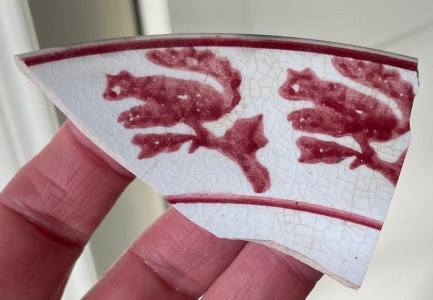
Detail of the squirrel plate
Spongeware objects featured a much more informal type of design than transferware, giving them a rustic, home-made appearance that became very popular in Britain, some parts of Europe and particularly in the U.S. and Canada. It was almost certainly first produced in southern Scotland, in potteries around Glasgow and Edinburgh from around 1835. Manufacturing of spongeware spread to England and Wales by the end of the 19th century, including Staffordshire, and in some parts of the U.S. Spongeware went out of fashion in around 1930, but was revived in the 1970s, and continues to be manufactured today.
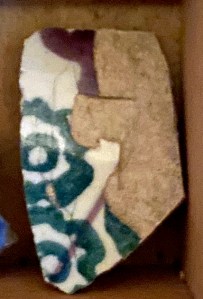
The other piece of spongeware from my Churton garden
It is almost impossible to track it back to particular potteries and to date it, for a number of reasons. First, it was almost never marked with the pottery’s stamp. This is partly because it was so mass-produced that pottery’s were not interested in claiming any credit for it, and partly because it was only made during periods of difficulty, when potteries were producing it only as a quick win for quick sale, and had no wish to attach their names to it. Second, popular styles could be retained in production across a number of potteries for several years, meaning that it is impossible to attach stylistic trends to certain potteries or time periods. Finally, the sponges were often designed by itinerant potters who sold them in to established potteries, and the same designs could turn up at different potteries at different times. 19th century spongeware appears on plates, cups and saucers, and jugs.

Squirrel plate from Kelly et al, pl.33, p.19. No pottery mark was made, so no details are known.
The earliest spongeware designs seem to have consisted on loosely geometric dots and circles as well as indeterminate shapes. These were followed by generically botanical forms. The earliest spongewares featured blues and reds, followed by greens. Animals, birds and identifiable plants soon became popular, and purples and browns were added to the palette. Pink, yellow and other colours were less popular, although black features from the 1870s. By the 1870s improvements included hard-edged sponges allowing greater precision in designs. During the First World War patriotic themes became popular.
None of the sherds found in my garden or Helen’s can be pinned down to a pottery, an area or even a date. I had hopes of the squirrels, but although Kelly et al show one (page 19, pl.33) it too is unmarked and the authors were unable to narrow it down to a particular place or time.

Modern small mug with red squirrel motif, from Brixton Pottery, from their portfolio of 500 spongeware designs, and 60 pottery shapes
Sources
Books and Papers
Brooks, Alisdair M. 2000. The comparative analysis of late 18th and 19th century ceramics – A transatlantic perspective. Unpublished D.Phil, University of York, June 2000
https://etheses.whiterose.ac.uk/10888/1/326550.pdf
Kelly, H.E., Arnold, A. and Kowalsky, Dorthy E. 2001. Spongeware 1835-1935. Makers, Marks and Patterns. Schiffer Publishing
https://archive.org/details/spongeware1835190000kell/mode/2up?view=theater (available to “borrow” free of charge)
Neale, Gillian. 2005. Miller’s Encyclopedia of British Transfer-Printed Pottery Patterns 1790-1930. Octopus Publishing Group
Websites
Bo’mess Pottery
Margaret Finlay
http://bonesspottery.co.uk/fim.html
Brixton Pottery
https://www.brixtonpottery.com/about-us

The squirrel-themed spongeware as it was found
 Based in Churton
Really interesting post – great to live in a place with long-term habitation. No such luck with our house – it was built on a field.
(Clare).
LikeLike
My father’s most recent house was a modern place built on a field, but my parents did find quite a lot of 19th century clay tobacco pipe, presumably dropped by farmers as they worked! Sadly, none of it stamped with maker’s names or anything useful. The conclusion on my garden, which was a house from at lest the early 19th century, was that this was a home in which if they had any “best china” it was cared for, because most of what we find was very utilitarian and inexpensive stuff. That fits the general style of the house, which was a very modest affair. It really is fun to find the stuff and work back from it to where and when it was manufactured, and what sort of income it might represent.
LikeLike