Beyond the Walls: Chester circular river walk

xxx

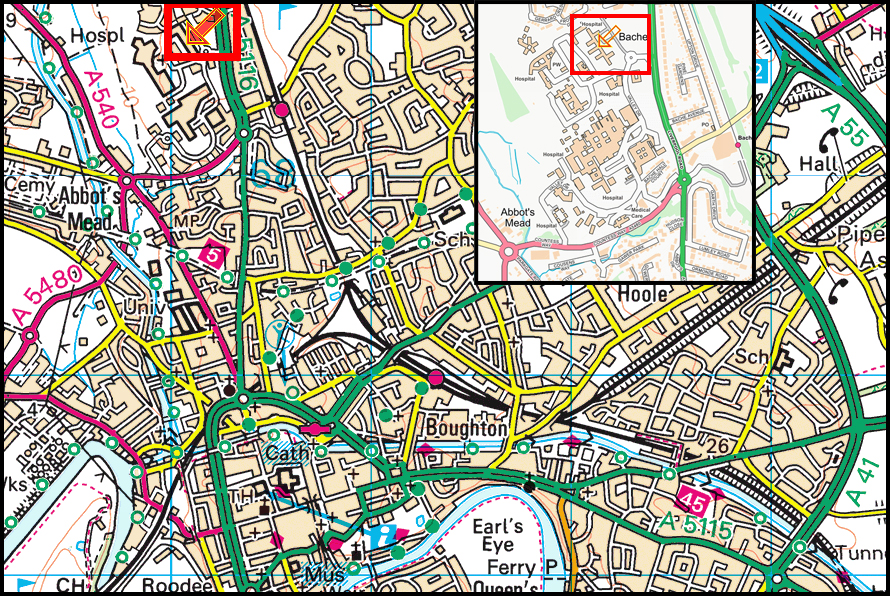
The dotted green line is the only way on to the footbridge avoiding steps.

sdfsdf

For those with unwilling legs please note that in [squared brackets, and highlighted in bold], are alternative routes that avoid steps and any other observed challenges.  On the above maps the dotted line in green, is the only way of getting on to the Queen’s Park footbridge avoiding steps.

As well as the numbered sites, turquoise stars show other sites nearby that may be of interest.  Each of the numbered and starred features deserves a post in its own right rather than the short burst of text allowed for each, but hopefully there is enough to make the walk informative as well as enjoyable, and in some cases I have hyperlinked to sites with more useful details.

You can download the text of the walk, including the maps, as a PDF here (but without the introduction, the list of sources and without ink-hogging images).


The dotted green line is the only way on to the footbridge avoiding steps

xxx

Introduction

View through the chancel arch of St Mary’s Nunnery through to the Ship Gate. Grosvenor Park.

Together with the city walls, this is my favourite walk in Chester, incorporating some lovely riverside footpaths and green spaces beginning at the Little Roodee car park on Castle Drive.  The entire walk is on metalled surfaces, and is therefore very suitable for all seasons.  It starts with the Grosvenor Bridge, turning in to Overleigh Victorian Cemetery and taking it from there along the River Walk.

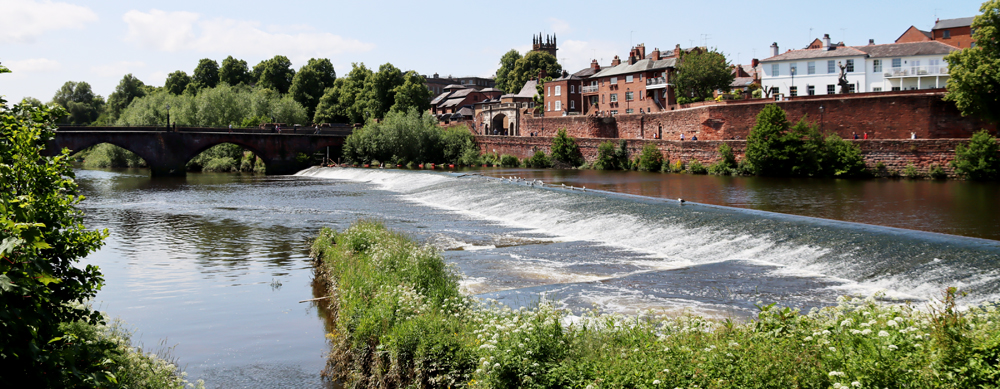
There is plenty to enjoy along the south bank of the Dee, with lovely and peaceful riverside walks separating points of interest such as Minerva’s shrine, Handbridge with the Old Dee Bridge and Weir, and the Queen’s Park footbridge. The Groves is the northern counterpart to the River Walk, with its Victorian grandstand and array of cafes, ice cream parlours and the southern stretches of the Roman-Medieval walls.  Back past the Old Dee Bridge, the walk takes in the former old Dee mills, the Gothic Revival hydroelectric station, the remains of the former prison’s outer wall, the Wheeler Building that houses the Riverside Museum and the Royal Infirmary stained glass, and then returns along the river bank to the Little Roodee.

Ice Cream parlour on The Groves

The walk takes in several periods of Chester’s architectural history, from the Roman, through medieval periods, skipping the early Stuart and Civil War years. The Bear and Billet public house on Lower Bridge Street represents the later 17th century, but most of the remaining architectural history on the walk resumes with the Georgian architecture of the 18th century, plunging headlong into ambitious Victorian expansion and alteration.  From a distance, seen from the Grosvenor Bridge, is the Art Deco water tower, which is a nice addition to the mix.  Two examples of the less fortunate periods of 1960s and 70s architecture that afflict Chester like a bad rash also appear, but although one of them is particularly bad (the “Salmon Leap” apartments on the Handbridge side of the Old Dee Bridge) the other is somewhat less objectionable (the ex-Cheshire County County building, now the University of Chester’s Wheeler Building).  A very modern building, nicely done on a budget, is the cafe in the Little Roodee car park with its environmentally friendly “green” roof.


The Walk

1) Roodee carpark, toilets and café

The Little Roodee Cafe

The walk starts from the Little Roodee car park on Castle Drive, which lies along the northern edge of the River Dee.  There are plenty of other places in Chester to park, and there is also the very reliable Park and Ride, but this is a useful place to start the walk, including a very nice café with excellent coffee and good snacks, with public toilets within the café (there are other public toilets on The Groves, opposite the bandstand, shown below).  The bottom of the car park provides a good viewing point for no.2, the Grosvenor Bridge.

For those wanting to explore the river walk to the east, circling the edge of the Roodee and over to the west of Chester, this is also an excellent starting point.

The postcode for the carpark is CH1 1SL or the exact location for the entrance to the car park is What3Words ///swung.statue.limp), which can be used in most SatNavs.  If you are coming in by Park and Ride, ask the driver tell you when the stop is approaching for Adobe (big black glass building) on the Grosvenor Road.  The return bus stop is opposite Adobe on the castle side of the road.

2) Grosvenor Bridge

The Grosvenor Bridge

For the best view of the bridge, head downhill in the car park towards the river and turn right towards the bridge, crossing under one of its vast arches.  Look back to see a great view of the the entire span.  For centuries the only bridge across the Dee at Chester was where the late Medieval Old Dee Bridge is now located, following the line established by the Roman bridge at the end of what is now Lower Bridge Street.  This was becoming seriously congested by the 18th century, when both the population and the economy were growing at a considerable pace, and a new bridge was an urgent requirement.  Local architect Thomas Harrison won the contract with his daring proposal for a 200ft (61m) single span that would not interrupt tall-masted river traffic.  It was not merely a new artery for Chester, but a statement of civic pride.  A plaque in the side of the bridge records that work began after an Act of Parliament was passed in 1825, and was paid for by a public loan of £50,000.  It was opened by Princess Victoria on 17th October 1832 (5 years before she became Queen), and was paid for by tolls on both the Grosvenor and Old Dee bridges until 1885, when the tolls were abolished.  The bridge remains a monumental and impressive sight today.

The Grosvenor Bridge shortly after construction. Source: Wikipedia

Retrace your steps and head back up the car park, passing in front of the cafe, and up the flight of steps to the Grosvenor Road, cross at the pedestrian lights, and turn left to walk over the bridge.  [If you want to avoid the steps, head to the other end where the car entrance is, turn left and walk up the road, Castle Drive, to the head of the steps on the corner, and cross at the pedestrian lights and turn left across the bridge].  

From the top of the bridge you can look right (or west) over the Roodee racecourse on the north bank of the river, and the impressive houses that formed the new middle class suburbs of Curzon Park which was developed in the 1840s to accommodate wealthy residents who wished to escape the narrower confines of the increasingly busy and commercial city. Some of the bigger of these buildings have been converted into apartments today.  Look left (east) and you can see the spire of St Mary’s Without The Walls, as well as the Handbridge water tower, a local landmark that is visible from various points in the Chester area, and was influenced by Art Deco designs.

Curzon Park

3) and 4) Three memorials in Overleigh Victorian Cemetery

After crossing the bridge, walk for perhaps 30 seconds and you will see a gateway on your left with wrought iron gates, one of which is open to provide access for pedestrians into the Victorian cemetery.  If you are on the opposite side of the road, there is a traffic island almost opposite to make it easier to cross.  Walk towards the information board and the bench, and pause.  The walk will continue downhill to the right, but we are briefly detouring to the left to see two of the most interesting of the memorials in the cemetery, one of which is a puzzle until you see it on the early 1850s engraving of the cemetery.

Entrance to Overleigh Cemetery

xxx

Overleigh Cemetery in the early 1850s. Source: Wikipedia

Overleigh cemetery was given the go-ahead by the Chester Cemetery Act in 1848.  The land was acquired from the Marquis of Westminster, who exchanged it for a shareholding in the company.  Work was forced to stop for seven months when the money raised was spent, and was not completed until new shareholders could be found.  The cemetery opened in 1850.  Like the Grosvenor Bridge, Overleigh Cemetery, was not merely the result of a Victorian efficiency drive and the desire to return a profit, but also a matter of improving the city in ways that demonstrated a profound interest in the character and status of the expanding city.  Although the cemetery was a pragmatic response to the inability of churchyards to meet demand, the layout and planting of the cemetery reflect country house garden and leisure park designs, with curvilinear drives, gothic revival architecture, a lake, plenty of of trees of different types and a rustic bridge.  Sadly, the only survivors of the architectural features from the 1850 design shown on the above engraving are the tall thin monument at far left, discussed below, and the rustic bridge at far right.  You can read more about the cemetery and its fashionable and elegant design on the blog here.

Now head left past the bench and stop a few seconds away in front of a nicely executed faux Grade II listed Gothic shrine featuring an effigy beneath tan elaborate canopy. It puzzled me that there was no inscription on the shrine, but the actual grave ledger lies flat in front of the shrine over the top of the actual grave, complete with the elusive inscription.  The shrine belongs to the Reverend Henry Raikes, who died in 1854, aged 72. The shrine was designed by architect Thomas Penson, who was the landscape architect for the entire cemetery and who built several buildings in Chester.  It was erected in 1858, funded by public subscription, the progress of which was frequently reported in the local newspapers.  As well as the former Chancellor of the Chester, Diocese Raikes was a philanthropist, a trustee and governor of the Blue Coat Hospital and one of the founders of the Chester “Ragged Schools” that provided education for pauper children.

The ruins of the Robert Turner memorial

Immediately to the right of the Raikes shrines, the second monument of note is the grave marker for Robert Turner (1790-1852), a Chester brewer and wine merchant who, in 1848 was Sheriff of Chester, a largely administrative but important function with the responsibility of keeping the peace, closely linked in to the work of the courts and the prison.  The memorial as it stands today looks very peculiar, a bit like a three-tier cake on space-rocket jet nozzles.  The clues to its original appearance actually still lie at its feet.  Three stone columns lie horizontally, when not semi-concealed by undergrowth.  Look at the engraving above and find the building at top right that looks like a little Classical temple.  This is how the Turner grave marker originally looked. It collapsed at some time in the past, and the tiered roof and although it has been considerably tidied up, reconstruction is no longer possible, and this strangely truncated form is all that is left standing of the memorial monument.

Retrace your steps past the bench and head down the hill until you reach a tall monument (4) in a triangular intersection of the cemetery drives and pause to have a look at it. 

This is not a burial monument but a memorial to William Makepeace Thackeray, 1790-1849, (uncle of the famous novelist) who moved from Denbigh to Chester to practice, and became a great success as a physician, and was renowned for his philanthropic and charitable works. He was buried in Chester Cathedral, but this memorial and its inscriptions celebrate his achievements, including “His attention to their charitable institutions / His consideration for the sick and needy / His kindness to the schoolboy and the orphan.” The memorial also serves as a useful anchor for the cemetery, a suitably impressive focal point that helps to give this part of the cemetery a sense of cohesion.  This is also a very good position to pause and take in the wonderful selection of mature trees, most of which were planted when the cemetery was first laid out.  There is a variety of species, and they were an essential part of the parks-and gardens style layout that was very popular in the Victorian period.

Head to the left. You will see the gateway pillars straight ahead of you.  This opens on to River Lane.  Turn left on to River Lane and turn right when you reach the end, heading east along the lovely River Walk.  The walk from Overleigh to Edgar’s Field is a nice one, consisting of a metalled road flanked by trees and shrubs, with fields to the south and views of the river, depending on the time of year, to the north.

You will emerge from the path onto a short residential road, Greenway Street, and opposite is another gateway, this time into Edgar’s Field. 

5) Edgar’s Field

The entrance to Edgar’s Field

Go through the gate into Edgar’s Field

Edgar’s Field is an open green space given to Handbridge by the first Duke of Westminster in 1892.  The name Edgar, so the story goes, refers to the early medieval King Edgar, great-grandson of Alfred the Great, who was crowned King of England in both Bath and Chester.  His Chester coronation was said to have followed a meeting near the field in AD 973, with leaders (either six or eight) from other regions  after which he was rowed by members of the visiting delegation to St John’s Church, just a little further upriver.  How much of this is legend and how much reality is anyone’s guess.

6) The sandstone outcrop 

Straight ahead there is a choice of going uphill to the right or sticking to the river walk on the left.

You will go right, but pause to look at the amazing sandstone outcrop.  This is a particularly nice piece of bedrock, formed of sedimentary layers laid down, during the Triassic period, 252 to 201 million years ago, when the landscape consisted of Sahara-like desert and abraided rivers.  This is also the period when the dinosaurs Pseuduchium Archosaur (ancestral to modern crocodiles and alligators) and Chirotherium are found, survivors of the Permian extinction (in which 95%) of dinosaurs were wiped out, and of which fossilized footprints have been found in the Triassic sandstones on Hilbre Island at the top of the Wirral.

Sandstone formations on Edgar’s Field

The various lines and colours visible in the Edgar’s Field rock represent the different layers of sediment (bedding) that were laid down by rivers and floods that were laid down as muds and have built up over time.  Nice features include both cross-bedding and slumping, geological features exclusive to sedimentary rocks.  Differences in colour reflect differences in the chemical composition of the sediments as they were laid down, a dramatic example of which is shown in the above photograph of the outcrop.  See more about the Cheshire sandstone in this PDF on the Sandstone Ridge Trust website.

Walk along the path to the right of the outcrop.  A second outcrop appears on your right, and on the face that looks over the big open green is the Minerva shrine, so leave the path and walk up the green slope.

7) Edgar’s Field and the Minerva Shrine

When you are standing in front of the shrine, you will find it very water-eroded.  It is carved directly into outcrop, one of only two known to be still in situ in Britain, and is a Grade II listed Scheduled Monument (1.45m high and 0.73m wide).  The sandstone surround is Victorian in date, added in the hope of preventing further erosion.

The Roman 20th Legion, the Valeria Victrix, arrived in Chester (Deva) in AD76, and in one form or another the Romans remained in Deva until around 380.  Although outside the Roman city walls, Handbridge was an important location because it was the quarry for the Roman town and its walls, the source of its red sandstone building blocks.  Further along the path on an interpretation board is a reconstruction of what the shrine would have looked like, originally with an owl on Minerva’s left shoulder, possibly holding a shield in her left hand, and a spear in her right hand.  Minerva was an interesting choice.  Although better known goddess of wisdom and knowledge, she also served as a protector for those engaged in defensive war, a subtle distinction from aggressive war that might well be attractive to those building protective walls.  The little cave to the right of the shrine was probably carved out to hold votive offerings.  The area around the shrine was excavated in the early 1920s, revealing both that the quarry was in use at around AD100 and that subsequently soil was imported to cover the quarry floor in the late-second century. Roman occupation remains dating from that time on were found on the site. The site was again used as a quarry during the Middle Ages, when Historic England speculates that the Minerva carving may have been re-interpreted in Christian terms and re-used as a Christian shrine.

It is worth walking down to the edge of the river, through the line of magnificent lime trees, to enjoy the excellent views over the medieval Old Dee Bridge bridge.  From there, follow the path for a short distance to the gates out of the park.  You now have the Old Dee Bridge on your left and Handbridge on your right.

8) Handbridge

Handbridge

Handbridge has always has an extra-mural personality of its own.  From the mid 12th century there were mills and quays at Handbridge, when parts of the district were owned by St Mary’s Benedictine nunnery, which seems to have taken over the entire manor by the 13th century.  In the late 14th century industrial activity seems to have been represented by the production of glass, and by the 15th century it is thought to have been a popular area of Welsh migrant settlement.  Welsh residents in the 16th century included a high percentage of the city’s brewers and ale sellers. In the Victorian era it became known as one of the poorer areas, with a high proportion of industrial worker.  Today Handbridge has gone upmarket and is now an attractive residential location with a villagey-atmosphere, with some excellent cafés and pubs for those looking to take a break at this point.  Both Spoilt for Choice and Brown Sugar cafés are great brunch/lunch stops, and the Old Ship Inn is a very fine pub.

Nathaniel Buck’s view of Handbridge in 1928. Source: MutualArt

9) The Old Dee Bridge 

Do not cross the bridge, because the walk continues on the same side of the river, but if you want to stand in the middle and admire the weir, discussed next, it’s an excellent place for getting a good view. 

The Old Dee Bridge

The oldest known bridge to cross the river at this point was Roman, carrying the Via Praetoria from the south gate over the river to link up with the Roman road network, with roads leading directly from Chester to the southeast via Whitchurch to Wroxeter (Vicronium) and the south to London (Londinium) and Caerleon (Isca), and along the north Wales coast to Holyhead (Segontium).  It must have been rebuilt several times over the 300 years of Roman occupation.  The current late Medieval bridge replaces an early Norman bridge, but apparently fell down during the floods of 1227 and had to be replaced.  The construction is interesting.  It is built of the usual local red sandstone, but for reasons unknown, instead of being evenly distributed along the length of the bridge, the arches are each of a different width, giving it a splendidly individual appearance.

The Bridgegate on the opposite side of the river is discussed below.

10)  The Weir

Staying on the same side of the river, cross the road and follow the line of the river for a few steps until you get a good view of the weir.
xxx

Very little is known about the weir itself.  It is generally agreed that it was at least Norman in date, but whether it was actually the elaboration of a Roman innovation is open to debate.  The Romans certainly built weirs, some of them very substantial, but at the moment there is insufficient information to determine the earliest date for it.  Walk a little further down by the side of the river and you will see that on the near side of the weir there are a series of very wide water steps, forming what looks a little like a stepped waterfall; this is a salmon leap, built to enable the fish to navigate their way upstream for spawning.  On an open day at the monitoring station last year I saw one of the salmon being caught for weighing and it looked huge!

The Salmon Leap

11) River monitoring station and ornamental water wheel

Probably the least attractive feature of the Chester riverside is a row of 1960s apartments that you will see from the north side of the river.  You now pass under the concrete overhang of these apartments. There are lovely views over Chester on your left, and you  will reach a small island with a building on it.  

River monitoring station

Water wheel reconstructed in 1988 by the Chester Civic Trust

This is the river monitoring station, where various tests are carried out on the water quality and the condition of the fish themselves.  I was lucky enough to be there on an open day last year when  an enormous salmon was pulled out for weighing before being returned to its journey upstream.  In front of it is a small water wheel, which was installed in the 1980s as a reminder of the former Dee mills that used to be a dominant feature of the medieval riverside and an all-important feature of Chester’s economy in the Middle Ages.  Beyond it is a small sluice that once regulated water into the narrow channel that forms the island.

Carry on walking along the Riverside Walk, enjoying the greenery, until you reach the footbridge, which passes above the path, but has a flight of shallow steps running up either side of it so that you can reach the bridge from the path. [The alternative approach to the bridge, avoiding the steps from the river walk up to the bridge, is a rather long way round and is shown on the above maps as a dotted green line that takes you along Queens Park Road and around Victoria Crescent].


12) The lovely Queen’s Park footbridge

In 1851 it was decided that Chester needed a second suburb, in addition to Curzon Park, to be named Queen’s Park, and this was developed throughout the 1850s.  This was also built on the south bank of the river, this time opposite The Groves.

In 1852 a suspension footbridge was built to connect Queen’s Park with Chester, becoming the Queen’s Park Bridge.  The predecessor of the current Queen’s Park footbridge was built in 1852. In 1922 this was taken down, and work began on a new suspension bridge that opened, with some ceremony, in April 1923.  For more information about the opening of the bridge and its contemporary conditions of use, see the entry on the Cheshire Archives and Local Studies blog.

Conceptually, the bridge is the polar opposite of the vast solidity and monumentality of the later 1832 stone Grosvenor Bridge. The 1923 bridge is superbly elegant with delicate lattice metalwork. This latticing and the suspension cables supply a light, airy feeling, which is something to do with the sense of it hanging freely rather than being solidly rooted in the riverbed.  It is a perfect partner for the light-hearted promenade known as The Groves, with its lovely buildings and the similarly elegant bandstand, which is still used today, and the little ice-cream turrets.  Pride in the achievement, common to so many Victorian enterprises, is declared in the panels at the top of the suspension towers, which give the name of the bridge and the date of its construction.  Just as on the Grosvenor Park Lodge, the bridge’s towers feature the shields of Chester’s Norman earls.

13) The Grosvenor Park

The understated river-side entrance to the Grosvenor Park at the end of the footbridge

Walking off the bridge on the Chester side you will see a flight of steps straight ahead of you.  Just before the steps, on your right, is the understated gateway into the Grosvenor Park. 

I have included the park partly because it surprises me how many residents and visitors seem to bypass it, and it is lovely on a sunny day.  The Grosvenor Park was the brainchild of Richard, the second the Marquis of Westminster, following the example of similar projects elsewhere.  Like many wealthy Victorians, he undertook a number of philanthropic projects, and in 1867 the park opened for the benefit of local Chester inhabitants.  Unlike many town and city parks this one was not paid for partly by subscription; it was, in its entirety, a gift to the city from the Marquis, who chose the designer of the successful Birkenhead Park, landscape architect Edward Kemp (1817-1891), to lay out his new public space.

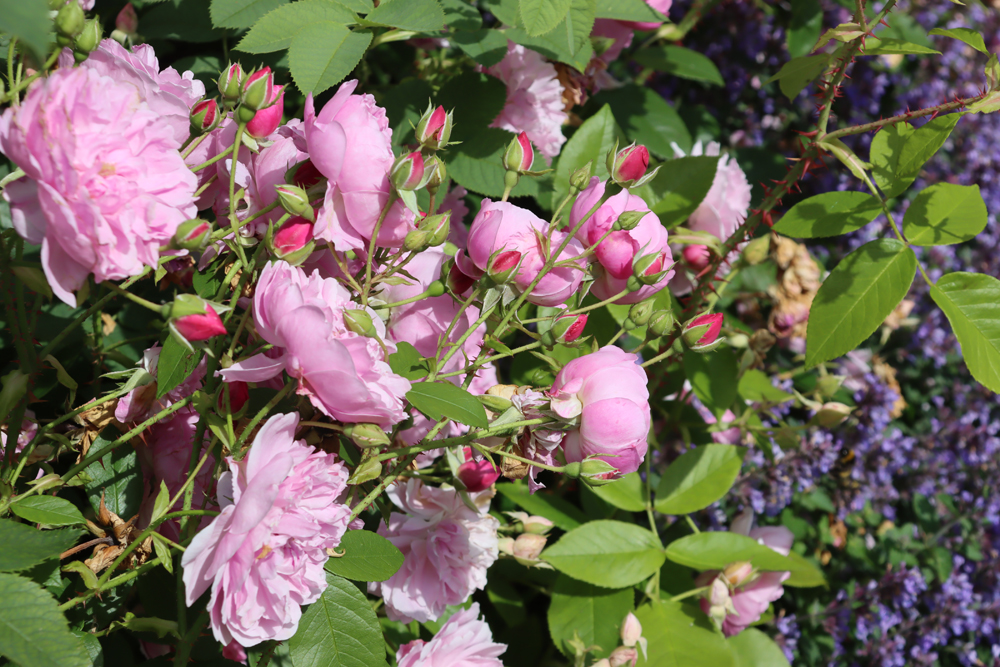
Today it is a beautifully maintained space with a miniature railway operating in the summer, a rose garden, a couple of vantage points from which to inspect the views over the river and some lovely wide open spaces, together with the shade of trees for those who prefer a bit of cover, in which to relax.  Although this is not a formal park, in terms of the big municipal floral plantings that characterize some English parks, there are colourful beds dotted around and at the top left corner of the park there is a charming wheel-shaped rose garden that is lovely in the summer months, with a variety of colours, and some lovely scented species, with benches around its edges.  As in the cemetery, which had opened 17 years previously, the trees were seen as a major feature of park and there are some splendid specimens.  The pond may once have been ornamental, but is now surrounded by tall reeds, providing a splendid refuge for wildlife.  I have seen the rails for the miniature railway but not the train –  I really must find out when it runs!  There is plenty of seating throughout the park, and as well as permanent sculptural pieces, there are often temporary modern art installations dotted throughout, which may or may not be your cup of tea, but are always genuinely interesting, and usually reference the natural world.  Look out for information panels dotted throughout the park.  The lodge, discussed next, serves as a coffee shop during the summer.  It’s not on the map because it is closed in the winter.


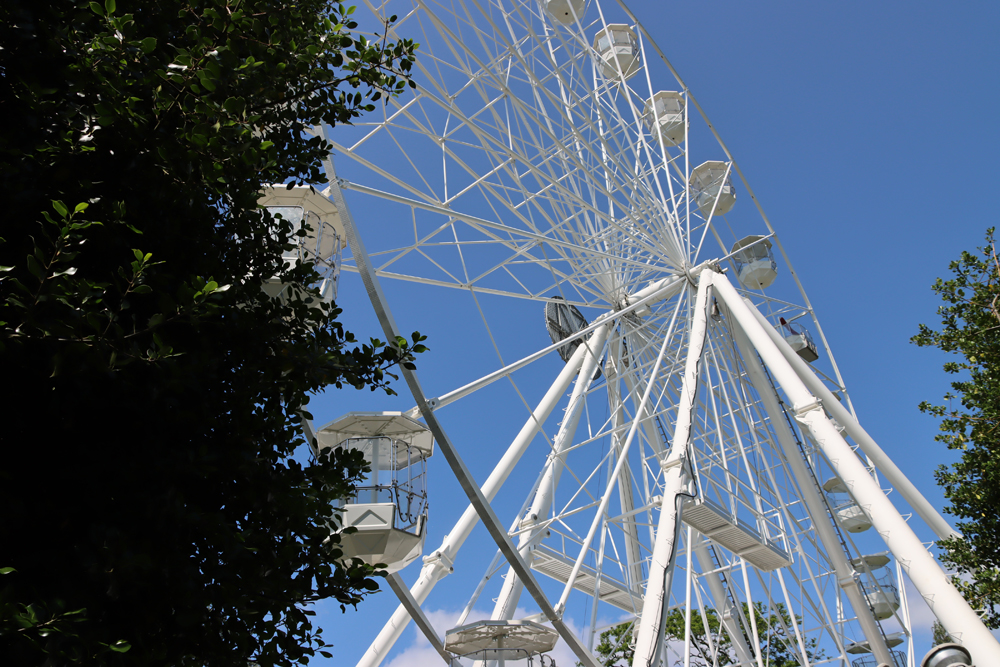
Ferris wheel in the Grosvenor Park


14) Four Medieval monuments

The arch from St Michael’s Church

As you walk into the park along a metalled path, you will soon come to a set of three clearly medieval (as opposed to mock-gothic) monuments set back from the main path, with a little side path of its own.  These were all moved here from elsewhere in Chester, and serves as a miniature outdoor museum.  The first one that you encounter is a gothic arch from St Michael’s Church, which is still standing but was largely rebuilt in the 1840s by James Harrison, and it is possible that the gateway was removed at that time.

Next, following the side path is the little Jacob’s Well, originally installed on The Groves as a drinking fountain and at its base a water dish for dogs.  The keystone inscription is from the New Testament and reads “Whosoever drinketh of this water shall thirst again.”  Finally, and most impressive of the three, is the arch and flanking niches that once linked the nave of St Mary’s monastic church to its chancel, a sad reminder of the absolute total loss of St Mary’s medieval nunnery.  The photograph of it is below under no.27, where the nunnery is discussed.
xxx

Keep walking across the intersection, bearing right, and you will immediately come across the Ship Gate, which once sat to the west of the Bridgegate at the end of Lower Bridge Street providing pedestrian access  from the riverside to the city.  This was moved three times, first in 1831 to a private garden in the Abbey Square, next in 1897  to the Groves and finally in 1923 to its present location in Grosvenor Park.

The Ship Gate, looking back towards the St Mary’s chancel arch

Between the St Mary’s arch and the Ship Gate there is a path going uphill to the main park, with handrails, shown in the photograph above.  Walk up the slope to the main drive towards the statue at the end.

15) Viewing platform over the Dee

If you follow the main drive to the statue of Richard, the second the Marquis of Westminster, you will see, slightly to your right, a large viewing platform with seating around its circuit.  The view over Chester meadows towards Boughton was probably a bit better in the late 1800s, but is still good today.

16) Grosvenor Park Lodge

When the park was opened in 1867, it had a lodge at the main gate and this remains today, used as a café in the summer months.  It was designed by successful local architect John Douglas who is best known for the Eastgate Clock, but who built a great many buildings in different styles in Chester.  It was built in the popular half-timbered revival style over red sandstone.  The brightly coloured statuettes on black timbers on the lodge show King William I, who appointed Hugh d’Avranches, better known as Hugh Lupus as the first Earl of Chester from 1071 until his death in 1101.  Hugh is shown, together with the successive Earls of Chester, ending with John de Scot (from 1232 to 1237), who died without heirs, after which the earldom reverted to the Crown.  Various family shields show locally relevant themes including the golden sheaf of the Grosvenor family, the portcullis of Westminster and the Chester city coat of arms.

17) The Grosvenor Park Archaeological Excavation

Grosvenor Park Excavations in 2024

Near to the rose garden, to its east, and for several weeks every year since 2007, an archaeological excavation takes place using students of the University of Chester to investigate the complex historical narrative of this area.  The project was initiated to provide information about the Church of St John the Baptist, and the later use of the area, including a house documented to have been built in the late 1500s by Sir Hugh Cholmondeley which was later destroyed in the English Civil War.  At the same time, given the proximity of the Roman amphitheatre on the other side of St John’s, it was hoped that some information pertaining to  extra-mural activities under the Romans might emerge, and how the position and ruins of the amphitheatre, as well as the influence of the church, impacted on the later use and development of the surrounding area.  In 2025 the excavation took place between during May.  Visitors can see the excavation taking place, and the site directors and supervisors are very happy to answer any questions from the public.  An excavation Open Day is always organized towards the end of the excavation too.

18) The ruins of the east end of St John’s Church

Ruins at the east end of St John the Baptist’s

Leaving the park at the west, where the exit puts you on the path that leads back down to the footbridge, you find yourself at the east end of St John the Baptist’s Church.

St John the Baptist’s Church, marked with a green star next to the number 18, has a long and fascinating history, which is far too complicated to deal with here.  The current church was established in the 11th century outside the city walls and was the original Chester Cathedral and a collegiate church.  Its architecture is splendidly dominated by the Romanesque, featuring vast columns and gloriously rounded arches, has a wonderful if faint painted fresco, and contains a fine collection of early medieval stone funerary memorials.  Its monumental sense of indestructibility is somewhat misleading, however, as its tower came down in its entirety on Good Friday in 1881.

Without going into the church, however, you can wander around the ruins at the east end of the church.  There are plenty of information boards to explain what is going on, but the short version is that in the mid-1500s the church was too large for the congregation and the decision was made to truncate it by sealing off the eastern end which, deprived of its roof, rapidly deteriorated into ruins.  These ruins contain a splendid Norman arch, which once gave access to the chancel, as well as the usual gothic lancet (pointed) arches, shown in George Cuitt’s engraving below.  One of the other of the many features is the puzzling inclusion of an oak coffin at the top of one of the gothic arches, facing outward, shown above left.

The ruins of St John’s in the first half of the 19th century, showing a splendid Norman Romanesque arch in the foreground, which still stands, and a gothic lancet arch in the background.  By George Cuitt

19) The Anchorite Cell / Hermitage

The Anchorite cell in the grounds of St John the Baptist’s Church

Just downhill from St John’s, at the base of the steps [or thread your way back through the east end of the park by taking left turns, back to the entrance at the bridge], look over the fence on your right to see the lovely so-called anchorite cell, Grade II listed.

The lovely little building sits on an outcrop of red sandstone bedrock.  An anchorite is a religious recluse, someone who decides to retreat from all form of society, even monastic, to pursue a life of prayer and devotion. The building seems to correspond to a number of  references to an anchorite chapel and cell dedicated to St James in the cemetery of St John the Baptist’s church, opposite the south door.

The earliest story, unsubstantiated (and generally discredited), comes from the priest-historian Gerald of Wales (d.1223), who records that King Harold II was not killed at the Battle of Hastings, but was wounded and fled to Chester, where he lived at the cell (or hermitage) for the rest of his life.  British History Online says that this was the only such building that seems to have had a degree of permanence: “In the mid 14th century it held monks of Vale Royal (1342) and Norton (1356) and a Dominican friar (1363), and in 1565 a lease of property formerly belonging to St. John’s College included the ‘anker’s chapel’.”  The Freemen and Guilds of The City of Chester website mentions that at some point the building was used by the cordwainer guild (shoemakers) as a weekly meeting place “until they sold it in due course to a Mr Orange, and spent the proceeds on a party,” but provides no date.  It was expanded in the late 19th century, when the porch of the recently demolished St Martin’s Church, which was being demolished, was moved to form a new north entrance.  It was renovated in the early 1970s, but I can find no mention of how it is being used today.

20) and 21) The Groves

The Groves are a Victorian invention. The earliest section is The Groves East, which has some very attractive residential buildings facing the river, including an Italianate terrace, a Georgian-style terrace built in the early Victorian period and the revival half-timber rowing club boathouse, as well as cafés and pubs.  There are some good views over the riverside buildings on the edge of Queen’s Park, opposite.  Between 1880 and 1881 the western section that is most obviously a promenade area was laid out by Alderman Charles Brown.

As well as the lovely Grade II listed bandstand and delightful little octagonal ice cream huts, the city walls are particularly impressive here, towering above the river with some big chunks of bedrock at their base.  From here you can also enter the Roman Gardens (shown on the map with a green star), by following the line of the wall into a corridor between the wall and a restaurant.  Just about where the no.21 is marked on the above map is a flight of steps leading up to the walls.  These are known as the Recorder’s Steps, built in around 1720, linking the walls and the fashionable promenade to provide ease of access.  If you want to continue your walk by doing a circuit of the walls, this is a very good place to start, particularly as there is a map of the walls at the bottom of the steps.  The walls either side of the stairs are an interesting mix of different periods of construction, with one or two puzzling features.

The most attractive of all the public toilet buildings in Chester! The Groves West, opposite the bandstand.

As you walk towards the Old Dee Bridge, look over the river to see the concrete apartments under which you you walked earlier.  These, in the so-called Brutalist style, are the “Salmon Leap” buildings and  were built starting in the late 1960s until the mid 1970s, which look rather like a bar code.  In the interests of naming and shaming, they were designed by Liverpool architects Gilling Dod and Partners from Liverpool.  I recall that when I was visiting my parents once, many years ago, they were painted pink (salmon pink??), which was indescribably bad.

22) The Bridgegate

Nathaniel Buck’s Old Dee Bridge, showing the Bridgegate with the massive 1600 water tower as it was in 1728. Source: MutualArt

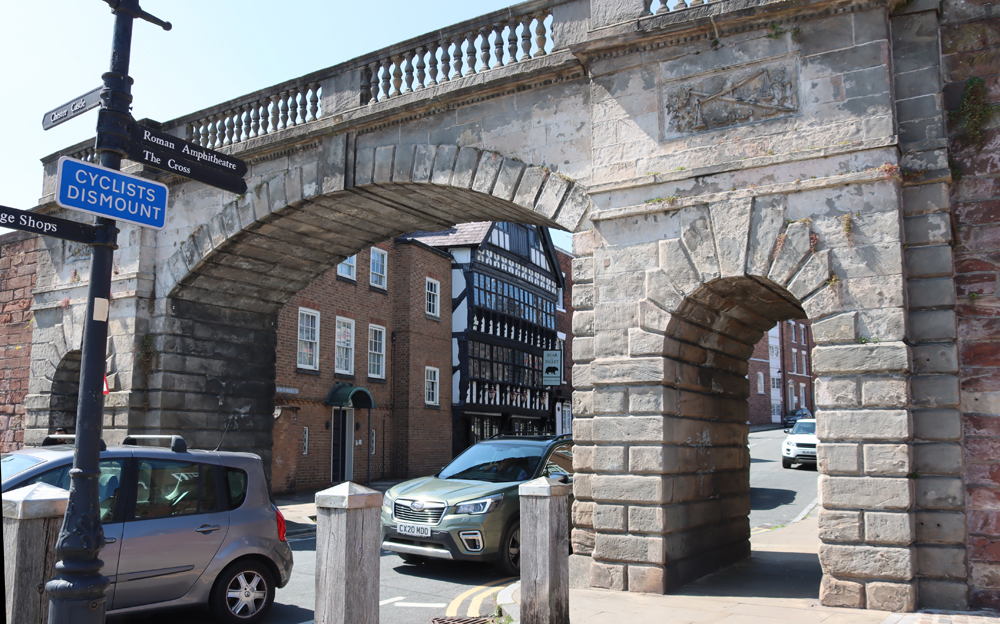
Today’s Georgian gateway, carrying the walls over Lower Bridge Street, is the latest iteration of the first gate built here by the Romans to defend access to the Via Praetoria.  By the Middle Ages all the bridge’s predecessors had been replaced by a medieval gateway that had a central pointed arch, which carried the walkway, and was flanked by two round towers.  This was quite an understated affair, but became considerably more noticeable when a tall, slender water tower was added to the west tower in 1600 to pump water from the river into the city (shown on the above image).  It was destroyed during the Civil War, but is recorded in earlier engravings.  The medieval Ship Gate, one of the architectural features preserved in Grosvenor Park, was a pedestrian archway giving access to the city Just to the west of the Bridgegate (towards the car park), which has already been mentioned in connection with the Grosvenor Park, where it was moved in the 1830s.

The Bridgegate, with the Bear and Billet on the other side of the gate

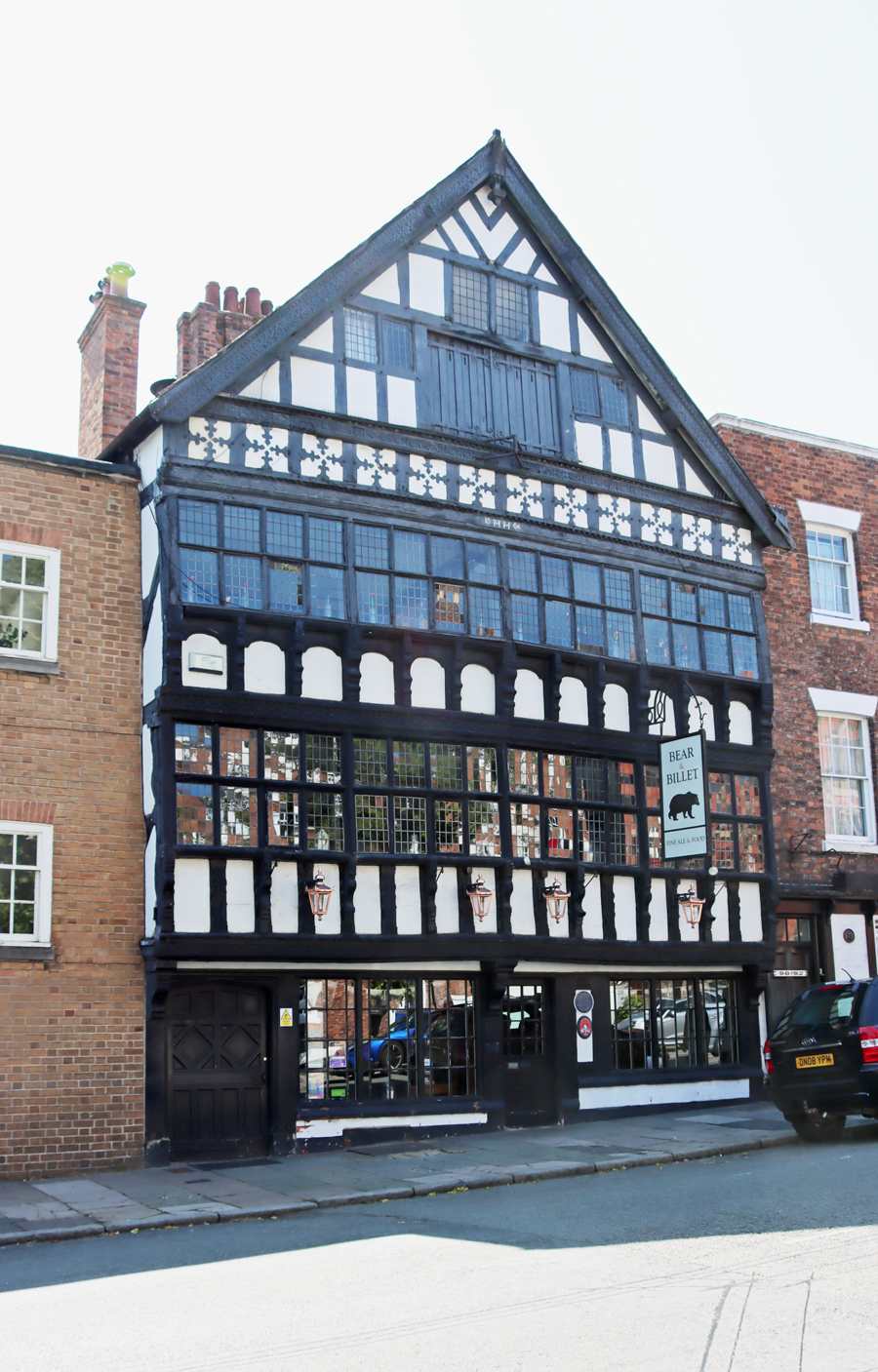
On the city side of the Bridgegate, on your left as you look uphill, is the Bear and Billet public house, which looks like one of the original half-timbered buildings but is in fact part of the revival of timber-framed buildings after the Civil War, in which multiple buildings were destroyed, and was built in 1664 for the Earl of Shrewsbury. See the picture near the end of the post in Sources.

As Chester’s population expanded during the 1700s, the increasing size of vehicles and the need for two-way traffic to pass into and out of the area defined by the walls resulted in the destruction and replacement of the medieval bridge.  The yellow sandstone Georgian arch that survives today was built in 1782 to a design by Joseph Turner (c.1729–1807), a successful local architect.  It supports a walkway that connects the two parts of the city walls that flank Lower Bridge Street.  Although not particularly imaginative, it is elegant in a typically Georgian way.

23) The Dee Mills and the hydroelectric station 

The Old Dee Mills in the 19th Century, with the Bridge Gate to its right and the Old Dee Bridge at its side. Source: Chesterwiki

The area around the Old Dee Bridge was busy from the Roman period onwards.  In the Middle Ages this part of the river was the site of several water mills, and mills continued to be built here until the last one burned down in 1895 and was knocked down in 1910.  In 1913 the site was used to establish a hydroelectric station, part of which survives in the form of the gothic-style building that sits below the bridge in the corner with the north bank, but this went out of use in 1951 and is currently vacant.  You can still see the hydroelectric station in situ on the walk, and the Ship Gate is still visible in the Grosvenor park (photograph further up the page at no.14), but the mill is only preserved in pictures.

The former hydroelectric station

24)  Prison wall

The remains of the west side of the river wall of the former prison, with its distinctive arches, next to the Wheeler Building.

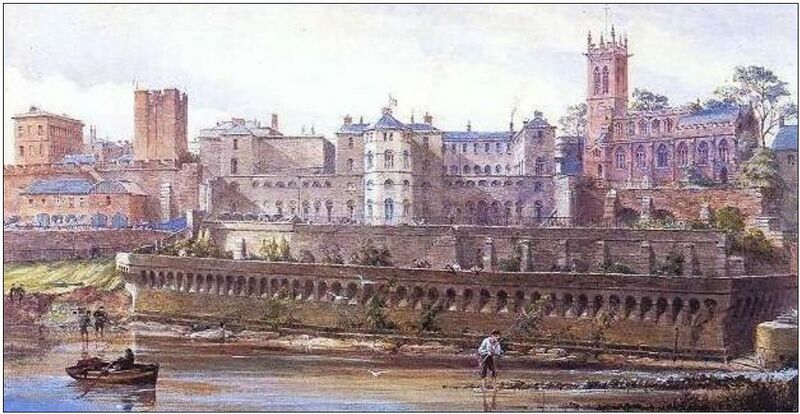
Although it is captured in paintings and engravings, there’s almost nothing left of the former prison, although it was a very substantial building in its day.  Both the prison and the river wall with its inset arches can be seen on this painting below by prolific local artist Louise Rayner (1832-1934).  All that remains is the former river wall with its inset arches, and even this is a matter of noticing that it is there, rather than actually seeing it, even from the opposite side of the river, as it is hidden by extensive tree growth.  It is marked by the fact that it projects slightly into the river.  There are two places where the inset arches are visible, first by the railings opposite the Wheeler Building, where you can lean over and look back, and rather more accessibly there is small a section to the side of the Wheeler Building, which carries the path back up on to the walls, shown here.  Up until 1785 the prison was based in the Chester Castle dungeons, but by the mid-18th century it was very clear that this was no longer fit for purpose, and when it was decided to build a new prison, architects were invited to submit designs to a competition.  Thomas Harrison, who is mentioned below in connection with the revitalization of the castle, won the contract, and new riverside prison opened in 1793.  Less than a century later, in 1865, it was unable to cope with demand, and it was rebuilt, opening again in 1869.  It was demolished in 1902.

The Chester prison by Louise Rayner, showing the river wall along which we still walk today


25) The Wheeler Building, housing Royal Infirmary Stained Glass and the Riverside Museum

Objects from the collection of the Riverside Museum in the Wheeler Building

The University of Chester’s Wheeler Building, a vast block of a thing on your right as you head towards the Little Roodee car park, was built in 1857 as the former Cheshire County Council headquarters.  Although there is not much to say about it as a piece of architectural heritage, it does contain two really valuable items of local heritage interest.  On the first floor of Wheeler Building you can find the stained glass that was once installed in the Victorian Royal Infirmary (opened in 1761, closed in 1994 was converted for residential use in 1998), and about which you can read more on the Chester Archaeological Society blog here.  The Riverside Museum, which usually opens only once a month, is a permanent collection of curiosities from the world of medicine, nursing, midwifery and social work, in addition to an original letter written by Florence Nightingale from Balaclava.

Just past the Wheeler Building, you can walk up the path that follows a slope up the old prison walls onto the city walls for the last stretch of the walk. If you take the opportunity, you get some views over the river, and the best angle to see this side of the castle. [There are no steps upto and off this stretch of the walls, but if you have a wheelchair or buggy, there is a dogleg turn that may be difficult to negotiate]

26) The Castle

The Agricola tower

Chester Castle today is a bizarre and not terribly attractive mixture of Neoclassical and medieval when seen from the front.  The original castle following the Conquest of 1066 was a timber-built motte-and-bailey castle, but this was replaced by the medieval stone castle in the late 12th century.  The Neoclassical bolt-on was architect Thomas Harrison’s solution to the dilapidated state of the building in the Georgian period.

From the walkway along the walls you can see the square Agricola Tower, which dates from around 1190-1200, and this and the Flag Tower are the only survivors of this early stone-built castle.  The tower is opened at least once a year for visitors to see around the vaulted chapel and 13th century wall paintings that are thought to have been ordered by Edward I for his use of the castle as a base during his negotiations with the Welsh princes.  That’s high on my to-do list.

Leaving the walls, you can walk up to the entrance to the castle if you want to see the view from the entrance.  Otherwise, cross the road at the pedestrian lights, taking note of the big black modern building squatting on your right as you cross the road and go a short distance to the covered viewing point, where there are interpretation boards, and have a look over the Roodee.

Nathaniel Buck’s 1728 engraving of the castle. Source: chesterwalls.info


27) The Roodee and the site of St Mary’s Nunnery

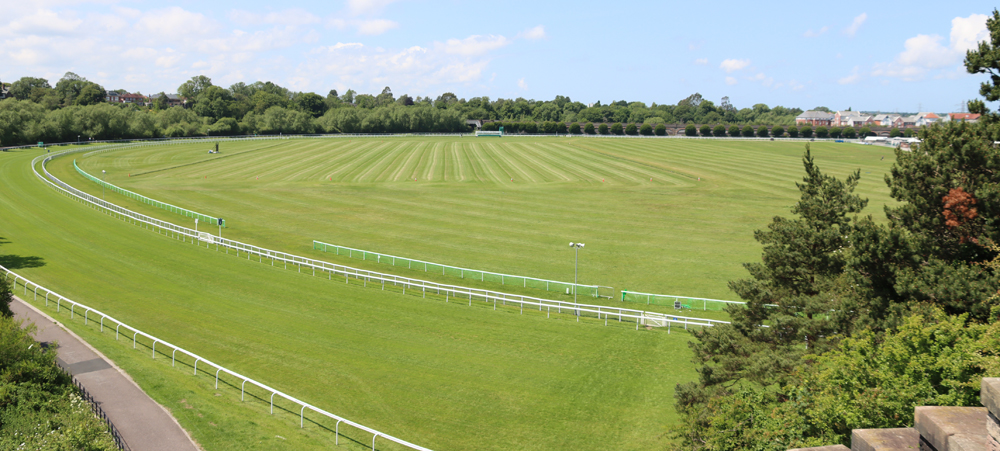
The race course on the Roodee

Nathaniel Buck’s Prospect of the City of Chester 1728 showing The Roodee. Source: chesterwalls.info

The Roodee is now home to the Chester racecourse, with the earliest race here held in 1539, but it also formed the edge of a river port second in size to Bristol on the western coast of Britain, supporting a successful trade along the coast and across to Ireland, as well as a thriving shipbuilding industry.  The commercial value of the river began to decline at the end of the 18th century as the river began to silt up, and did not survive the 19th century.  However, the archaeology of the river at the Roodee dates back to at least the Roman period when there was a harbour at the river and excavations in 1885 revealed the remains of a jetty near the railway viaduct.  The above engraving by Nathaniel Buck shows the medieval tower, connected to the walls by a fortified walkway, which was once at the water’s edge, demonstrating how silting was impacting the port of Chester even at this stage.

Turn so that your back is to the Roodee.  Over the road was the site of St Mary’s Benedictine Nunnery. 

St Mary’s Convent was founded in 1140 and survived until the Dissolution in 1535,on the north side of today’s Nun’s Lane, which is the small road that runs along the top of the Roodee and the race course.  It was built just inside the city walls, a little to the west of the castle. This became quite a large monastic establishment with a relatively compact cloister around which were the usual domestic and administrative buildings along three sides, with the monastic church on the fourth side, and a larger separate courtyard with more buildings arranged around it. A double-cloister arrangement was not at all unusual in wealthy monastic establishments, but the nunnery was notable for its financial difficulties even though it owned and rented out several properties in Chester, and from the 13th century owned the manor of Handbridge.  The last surviving piece of architecture from the nunnery survives in Grosvenor Park, which preserves the red sandstone arch and flanking niches that once separated the church’s nave from its chancel.

Archway and flanking niches from the former St Mary’s Nunnery, looking through to the Ship Gate

The black glass and red sandstone building on the other side of Nun’s Lane, Abode (built in 2010), replaces the former police headquarters, which was an eyesore of a very different type, and between the police building being knocked down and Adobe being built, an archaeological excavation took place.  As well as what are thought to have been significant Roman discoveries, the remains of the nunnery were excavated, producing both architectural and funerary remains, as well as discarded objects.  Quite who was responsible for seeing that the excavation records were published I don’t know, but one of the great tragedies of Chester heritage was that the small company responsible for the excavations never did publish, and no-one seems to know where the excavation reports and any preserved materials might be located.

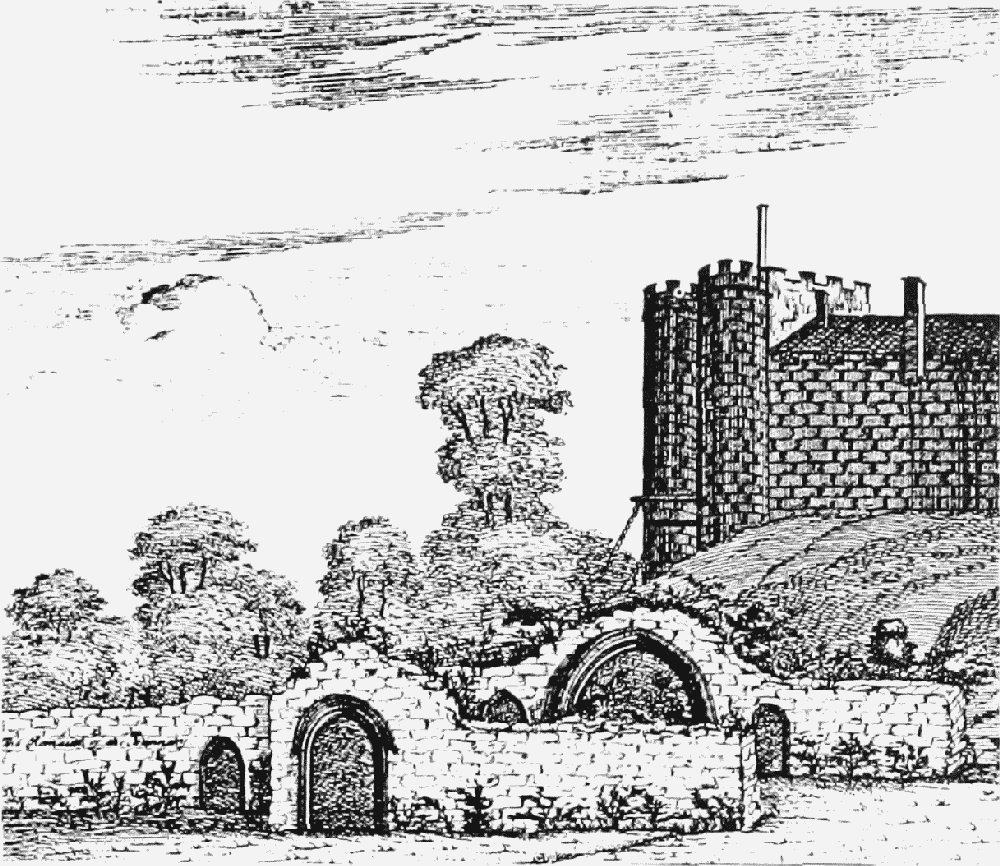
The remains of St Mary’s Nunnery in 1727. Source: British History Online

After the 1536 Dissolution, when the nuns dispersed, the land and buildings were granted to a member of the Brereton family, in whose hands it remained until the 17th century.  Its best known resident was Sir William Brereton, who was the Cheshire commander of the Parliamentary forces during the Civil War, when the buildings came under fire, were badly damaged and were never repaired.  As ruins on valuable land within the city walls they were soon replaced.  At the west end of the former site, architect Thomas Harrison, who has been mentioned several times above, built St Martin’s Lodge for his own use, now sympathetically converted into the gastro pub The Architect.

The walk is over!  Retrace your steps back over the Grosvenor Road into the car park, either via the steps on the corner, or down Castle Drive and into the main entrance, which avoids steps.
xxx

Final comments

I particularly like this walk because of the sheer amount of diversity that it introduces to the experience of Chester, beyond what you can find on a walk around the walls or a stroll around the main streets and the rows.  This is a slightly different slant on Chester, one that takes place nearly entirely beyond the walls, where there is space for promenades, open green spaces, a massive race course, a Victorian cemetery, river walks and of course some marvellous bridges and views over the surrounding area.  Neither urban nor suburban, this walk focuses on the in-between borderland of the riverside.

The shortlink for this post is: https://wp.me/pcZwQK-7BG

Braun’s Map of Chester, 1571 showing the RooDee with a grazing cow at left,  Handrbidge at the bottom, and the Old Dee Bridge connecting Handbridge with the Bridgegate. Source: chesterwalls.info


Sources

Books and Papers

The Bear and Billet

Boughton, Peter 1997. Picturesque Chester.  Phillimore

Carrington, Peter 1994. Chester. English Heritage

Cheshire West and Chester Council 2012.  Explore the Walls. A circular walk around Chester’s historic City Walls.  Cheshire West and Chester Council

Clarke, Catherine A.M. 2011. Mapping the Medieval City. Space, Place and Identity in Chester c.1200-1600.  University of Wales

Herson, John 1996. Victorian History: A City of Change and Ambiguity. In (ed.) Roger Swift. Victorian Chester.  Liverpool University Press

King, Michael J. and David B. Thompson 2000.  Triassic vertebrate footprints from the Sherwood Sandstone Group, Hilbre, Wirral, northwest England. Proceedings of the Geologists’ Association,
Volume 111, Issue 2, 2000, p.111-132

Langtree, Stephen and Alan Comyns (eds.) 2001. 2000 Years of Building: Chester’s Architectural LegacyChester Civic Trust

Laughton, Jane 2008.  Life in a Late Medieval City. Chester 1275-1520. Oxbow

Martin, Richard 2018. Ships of the Chester River. Bridge Books

Mason, D.J.P. 2001, 2007. Roman Chester. City of the Eagles. Tempus

Mason, D.J.P. 2007. Chester AD 400-1066. From Roman Fortress to English Town. Tempus.

Ward, Simon 2009, 2013. Chester. A History. The History Press


Websites

Based in Churton
Overleigh Cemetery in Chester, Parts 1 and 2 by Andie Byrnes
https://basedinchurton.co.uk/category/overleigh-cemetery/

British History Online
Religious houses: Introduction
https://www.british-history.ac.uk/vch/ches/vol3/pp124-127

The Cheshire Sandstone Ridge
The geology of the mid Cheshire Sandstone Ridge: Our landscape story
https://www.sandstoneridge.org.uk/lib/F715451.pdf

Chester Characterisation Study
St John’s Character Area Assessment
https://www.cheshirewestandchester.gov.uk/asset-library/planning-policy/chester-characterisation-study/e-chestercharacterisationstudystjohns.pdf

Chester Heritage Festival YouTube Channel
Four Minute Wonder:  The Sandstone Outcrop by Paul Hyde, 2024
https://www.youtube.com/watch?v=fxgoKh_4FXk
Four Minute Wonder: The Grosvenor Park Lodge by Paul Hyde, 2024
https://www.youtube.com/watch?v=Td67domdAWQ

Chesterwiki
River Dee Geology
https://chester.shoutwiki.com/wiki/River_Dee_Geology

Curiouser and Curioser: Tales from Cheshire Archives and Local Studies
A Grand Day Out in Chester: celebrating 100 years of the new Queens Park Suspension Bridge
https://cheshirero.blogspot.com/2023/04/a-grand-day-out-in-chester-celebrating.html

The Freemen and Guilds of the City of Chester
Cordwainers
https://chesterfreemenandguilds.org.uk/about/

Heritage Gateway
Post Dissolution Use of Former Benedictine Nunnery
https://www.heritagegateway.org.uk/Gateway/Results_Single.aspx?uid=MCH18993&resourceID=1004

Historic England
Roman quarry including Edgar’s Cave and the rock-cut figure of Minerva on Edgar’s Field, 150m south west of Dee Bridge
https://historicengland.org.uk/listing/the-list/list-entry/1014718
The Hermitage, The Groves
https://historicengland.org.uk/listing/the-list/list-entry/1375947

The Spoonster Sprouts
Brutalist Architecture in Chester: A Guide. By Tom Spooner, 15th July 2024
https://thespoonsterspouts.com/brutalism/chester-brutalist-architecture/

A Virtual Stroll Around the Walls of Chester
Old Maps and Aerial Photographs of Chester – Nathaniel Buck
https://chesterwalls.info/gallery/oldmaps/prospect.html

Wikipedia
Henry Raikes
https://en.wikipedia.org/wiki/Henry_Raikes


Upcoming

The Historic Towns Trust map for Chester should be a great aid to anyone planning their own heritage walk.  Although I have one on order it hasn’t arrived yet. You can find details on the Trust’s website where you can also order a copy:
https://www.historictownstrust.uk/maps/an-historical-map-of-chester


View of the City of Chester by an unknown artist, mid 1700s. Source: Victoria and Albert Museum, accession number 29635:57


Nathaniel Buck’s South West Prospect of the City of Chester, 1728. Source: Mutual Art

View from the East Groves to Queen’s Park

A visit to Birkenhead Priory #2: St Mary’s Parish Church and HMS Thetis

Introduction

The remains of the former church interior, with a tall arch that, now blocked with brick, once gave access to the tower

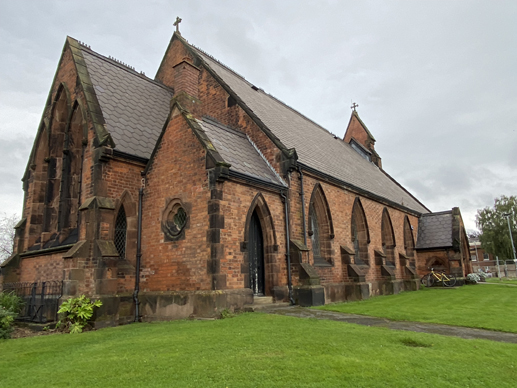
St Mary’s Parish Church in Birkenhead has a splendid claim to fame as one of the earliest churches to have cast iron tracery in its window openings, in place of the usual stone mullions and tracery.  Although relentlessly Gothic Revival in style, it truly is a child of the Industrial Revolution.

St Mary’s sits over a part of the site occupied by the original medieval Birkenhead Priory.  I have talked about the splendid remains of  Birkenhead Priory, founded in the 12th century, and its ferry across the Mersey, the earliest one recorded, on an earlier post, Part 1,  here.  It is an absolute knock-out with a stunning vaulted chapter house, undercroft, remains of other parts of the monastic establishment and a small but very nice museum space.

A recent second visit to Birkenhead Priory, this time with the Chester Archaeological Society, was a good opportunity to re-familiarize myself with the much more recent stories of the 19th century St Mary’s Church, which is interesting in its own right. The tower, which is perfectly preserved with its clock mechanism visible from the stairwell, offers terrific views over the surrounding area whilst also serving as a memorial to those who died tragically during the sea trials of the submarine HMS Thetis.

St Mary’s Church

Plan of the Birkenhead Priory site, with the priory outlined in red, the now absent priory church outlined in orange and remains of the 1822 St Mary’s Church outlined in green. Source: Metropolitan Borough of Wirral leaflet (with my annotations in colour)

The site plan to the right shows the remains of the church framed in green.  The medieval priory and its church are framed in red and orange respectively.  The blue margin on the right is part of the Camell Laird’s shipyard, into which you can look from the tower of St Mary’s and watch the current shipbuilding activities.  Church Street, right at the top of the image, post-dates the demolition of most of the church in 1970.

Although there are some stunning architectural survivals from the medieval priory, almost nothing remains of the priory church following the Dissolution.  As you can see on the site plan to the right, the original priory church overlaps the site of St Mary’s.  The Prior and his monks effectively handed over the keys to Henry VIII’s administrators and left peacefully.  The need for a religious focus for the small community that remained, however, resulted in the consecration of the gorgeous monastic chapter house as a chapel (numbers 2, 3 on the plan, where the daily business of the priory had formerly taken place).  It was only in the 19th century when Birkenhead began to grow into an industrial town, port and shipbuilding yards, with a rapidly expanding population, which was encouraged by the introduction of a steam ferry across the river Mersey, that the little chapel in the former chapter house became far too small for the needs of the Birkenhead community.  As a result the decision was made to build a new church to meet the needs of this expanding population.

Thomas Rickman. Source: Wikipedia

The architect chosen for the task of building a new parish church for Birkenhead was Thomas Rickman, an interesting character whose 1817 book Attempt to Discriminate the Styles of English Architecture helped to promote the development of the Gothic Revival, of which he was himself an enthusiastic proponent.  Having secured some commissions in the Liverpool area from iron foundry owner John Cragg, Rickman had established an architectural practice in Liverpool in 1817.  The foundation stone of the new Parish Church of St Mary’s was laid in July 1819, was consecrated on the 17th December 1821 and opened in 1822, with a vicarage established on the probable site of the priory kitchen.  Built of red sandstone, which inevitably blackened with industrial pollution over the decades, the church had a rectangular plan apparently without aisles, with a tower at the west end.  Although bricked up today for structural stability, the tall arch in the east wall of the tower would have opened into the nave of the church.

St Mary’s church in the early 20th century on a splendid postcard showing the church and the former churchyard. Source: St Mary’s Birkenhead blog

The church was large for the available population, but the landowner Francis Richard Price apparently decided to future-proof his new building, correctly judging that the early influx of people was going to continue to expand.  By 1832 the church was too small for the congregation and was expanded with a north transept (wing), followed by a south transept in 1835. You can see some of the decorative touches from the roof in the remaining pieces of masonry at the feet of the west walls.

Victorian burials took place mainly in the churchyard but prestigious individuals were interred within the monastic garth.  The former monastic garth, the square green that formed the focus around which the most important monastic buildings were arranged, became a cemetery for important residents in the 19th century.  It is here, for example, that the Laird family crypt is to be found.  In 2024, at his request, the cremated ashes of Birkenhead Labour MP Frank Field, who served for 40 years, were buried next to the entrance to the chapter house.  He is almost certainly the last who will be given permission to be interred there.

The dock for which the churchyard was sacrificed in the 1950s

The churchyard with its cemetery no longer survives.  It was originally established in the Middle Ages, for the monastic community, but after the 16th century probably only saw intermittent usage. It was only as Birkenhead began to expand that it came back into general use.  After the opening of St Mary’s it once again became an important cemetery for the local area, remaining in use until 1901, after which only those with family plots or in exceptional circumstances were permitted.  In 1948 the parishes of St Mary’s and St Paul’s in Birkenhead joined forces, and St Paul’s was demolished.  In the 1950s, as the neighbouring shipyard expanded and was desperate for more space, a commercial deal was made between Camell Lairds and the town council, in the face of protests, to purchase the churchyard for a new dock.  Whatever remained of the medieval church, all but part of one arch, was taken down.  Around 1100 burials, including those that had been brought over, with headstones, from St Paul’s were transferred from the churchyard to the new Landican cemetery in 1957-8, leaving only those within the garth of the monastic complex, and a handful in the immediate vicinity of the church and the priory.  A tall wall was built to divide the site from the docks below.

Another angle on St Mary’s showing the exterior walls and the base of the tower, as well as the clock

The Church tower has a number of notable features.  The Victorian clock underwent restoration and was reinstalled in 1990, sponsored by local interests.  From the top of the tower there are some stunning views, and you can peer into the fascinating Camell Laird’s shipyard and see the dry dock where the well-known and very controversial 1862 Alabama was built as a blockade runner for the Confederates in the American Civil War.  However, the most notable aspect of the tower is its role as a memorial to the 99 men who died in 1939 on the submarine HMS Thetis.

The church was closed in 1974 and the majority of the church was taken down in 1977.  Most of the fallen masonry remained after the demolition was presumably removed for recycling as building material, but some of the pieces of stonework that were less obviously adaptable for other building projects are laid along the remains of the inner west walls of the former nave.

One of the splendid cast iron windows

xxx

HMS Thetis

HMS Thetis was salvaged, repaired and relaunched as HMS Thunderbolt, shown here.  Source: Wikipedia 

On 1st June 1939 a new submarine, the first of the new Titan class, left Cammell Laird’s shipyard in Birkenhead.  This was her second set of sea trials, after her first went went very badly, and it was imperative that this time there should be no mistakes.  There was great confidence when she put to sea, but only a few hours later sank 12 miles off the Great Orme in Liverpool Bay, with 103 men on board.  This was twice the usual number of crew on board the HMS Thetis (N25), because as well as the standard Royal Navy crew of some 50 men that manned her, there were also engineers, members of the Admiralty and various others on board, including catering staff and other civilians, as she underwent sea trials.  There were only four survivors, and it is partly due to their testimonies that the cause of the tragedy was pieced together.

The submarine sailed safely down the Mersey towards Liverpool Bay, heading towards the Great Orme and accompanied by a tug boat named the Grebe Cock.  An essential part of her sea trials was to dive and make way underwater.  When the attempt to dive was made, in 150ft (46m) of water, the submarine was found to be too lightweight to submerge.  A submarine can make additional weight by taking on water.  Her internal compensating tanks were full, and it was decided to check the status of the six torpedo tubes and allow the two lowest ones to flood if they were empty.  The torpedo tubes could be checked by means of a stop-cock.  If, when turned, water leaked out, then the torpedo tube was full.  If it did not, it was empty and could opened and inspected.  In the aftermath of the disaster, it was found that the stop-cock of the fifth torpedo tube had been accidentally covered with enamel paint during final preparation for trials, and had hardened, preventing any water seeping out of the stop-cock to indicate that the torpedo tube was, in fact, full of water.  Because it was believed that the tube was empty, the rear door was opened.  In fact, the torpedo door was open to the sea and immediately thousands of gallons flooded into the submarine, forcing her down at the bow as the water began to fill the first two sections.  Thereafter the 270ft (82m) submarine could not be refloated and it was a matter of escape or rescue before air ran out.

The memorial stairways in St Mary’s tower

Thereafter it is a complicated story, certainly not one for someone uninformed to tell, and the best website account I have found to date is the unfortunately named Great Disasters website, which includes accounts by the four survivors and witnesses from the inquiry.  Alternatively, and much-recommended is  really excellent 15-minute summary provided by a video, with original photographs and diagrams, presenting the harrowing story very clearly: The Raven’s Eye YouTube channel.

The submarine was recovered on the 3rd of September 1939, towed to Traeth Bychan beach, where she was grounded and the remaining bodies either buried in a mass grave in Maeshyfryd Cemetery in Holyhead.  After the submarine was salvaged, repaired and renamed HMS Thunderbolt she was returned to active service in 1940.  She was a successful vessel until 1943 when she was sunk off the coast of Sicily by an Italian corvette, with the loss of all hands.

The catalogue of errors both on board and on shore is dismally reminiscent of the sinking of Titanic, when one is familiar with the details of both horror stories.  Human error, in design, in execution, in procedures and in response to technological failure, always seems to be a major factor in shipping and air disasters.
xxx

Final Comments

A visit to Birkenhead Priory is rewarding in its own right, but with the addition of the ruins of St Mary’s Church with its cast iron windows, and the tower, its memorial and its views. there is an awful lot to see, enjoy and learn.

There are some stunning views from the top of St Mary’s tower

xxx

Visiting Details

Details for visitors are in Part 1.  Although Part 1 was posted in May last year, I have checked the details and nothing has changed in the meantime.  There are also opening hours and a map on the Birkenhead Priory website.
xx

Sources

Leaflets

St Mary’s Parish Church 1819-1977, compiled by Tony Hughes
https://thebirkenheadpriory.org/wp-content/uploads/St-Marys-booklet.pdf

HMS Thetis, compiled by Les Black, March 2016. Produced by Birkenhead Priory

Websites

AHRNet
Rickman, Thomas 1776 – 1841
https://architecture.arthistoryresearch.net/architects/rickman-thomas

Graveyard Survey, St Mary’s Birkenhead, volume 1, 1977, Gill Chitty 1977
https://www.merseysidearchsoc.com/uploads/2/7/2/9/2729758/jmas_1_paper_5.pdf

Marshall University, Marshall Digital Scholar
CSS Alabama. An Illustrated History. Part 1: Building Ship No. 290.  By Jack L. Dickinson. Fall 10-9-2017
https://civilwartalk.com/attachments/part-1-building-ship-no-290-pdf.296944/

An Online Archive for the Church of St. Mary’s & the Priory, Birkenhead Cheshire, including a listing of the monumental inscriptions from the old graveyard & Priory
History of the Priory and St. Mary’s Church Birkenhead
http://stmarysbirkenhead.blogspot.com/

The Raven’s Eye
Everything Went Wrong – The Tragedy of HMS Thetis – Submarine Disaster (1939)
https://www.youtube.com/watch?v=JEcW7WjRxY8


Over the wall from the former churchyard

I believe that this was the dry dock where the “Alabama” was built, seen from the top of St Mary’s tower


Medieval ambition and Civil War musket ball holes at the Church of St Chad’s in Holt (Grade 1 listed)

Introduction

Either side of the River Dee, and linked by the lovely late medieval red sandstone bridge, are the villages of Holt on the Welsh side and Farndon on the English side, each with its own substantial red sandstone church, both of which are dedicated to St Chad and both of which have well-populated churchyards.  Each has its own very particular character and personality, and as well as being the centres of Christian devotion and burial, seamlessly blending life and death, both have Civil War stories and scars and both continue to function as places of worship today.  This post is about the Grade-1 listed St Chad’s in Holt.

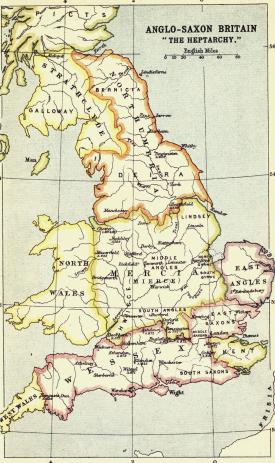
Map showing the location of Mercia and the line of the Anglo-Welsh border. Source: Wikipedia

The church is located at the top of the slope that runs down to the river crossing, precisely where Bridge Street meets Church Street, opposite the small rectangular green.  An attractive wrought iron gateway is set between a house on one side and the Peal O’ Bells pub on the other, and opens onto a path flanked by red sandstone garden walls leading to the church and churchyard.  The church is light-filled with a peaceful atmosphere and some notable features, some of them very unusual. The overall effect of St Chad’s is welcoming and combines a sense of heritage with contemporary relevance.  For details about visiting, see Visiting Details at the end.

According to Bede (in the 8th century) St Chad, who died in AD 672, was a leading light in the Anglo-Saxon church, rising through the ecclesiastical ranks in the kingdoms of Northumbria and Mercia and under King Wulfhere, one of the earliest Christian kings, became the first Bishop of Lichfield in the new diocese of Lichfield, at the heart of Mercia.  Mercia was one of seven British kingdoms of 7th century Britain and occupied most of central England, with much of the border with Wales, always a movable feast, somewhat further to the west.  Regarded as a pioneer who helped to spread Christianity in and beyond Mercia, he became popular during the Middle Ages in the Midlands and its borders.

The following details are just the edited highlights. For a more technical architectural description see the Wrexham Churches Survey (see Sources at the end).  The church very much rewards a visit.
xxx

Exterior

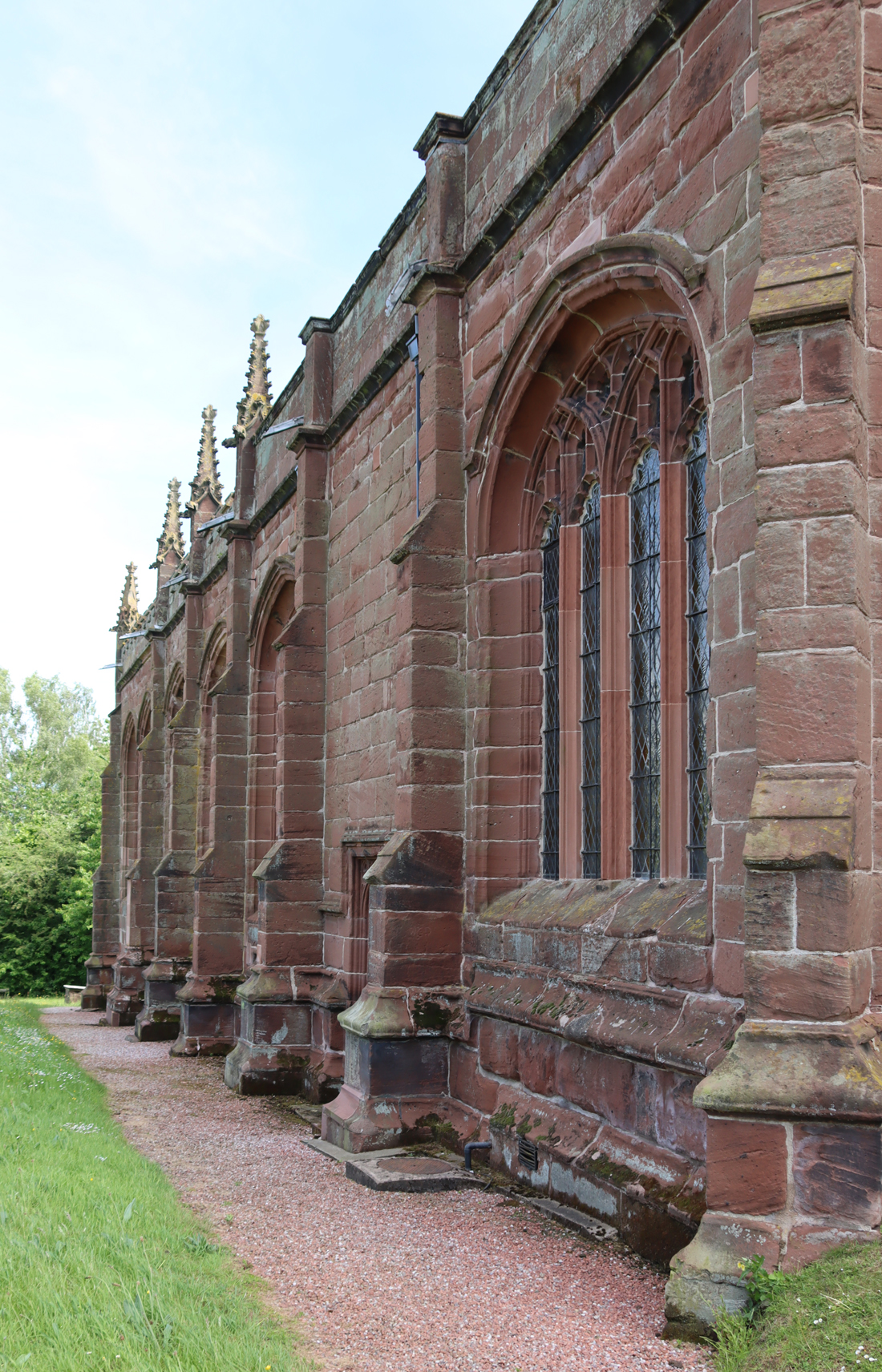
South side of St Chad’s Church, Holt

The church is approached through a pair of wrought iron gates that were made in 1816 and replaced the former lychgate.  As you approach the church and walk around to find the carvings around the south door, you will notice a change underfoot because in the immediate vicinity of the church the path is composed of horizontal ledger grave stones and vertical headstones laid flat (distinguished by chisel marks at the bases, which would have been underground), all forming huge paving slabs, some from the 18th century.

Path made up of grave markers

The exterior of the church is built of local red sandstone, the older parts badly eroded on the exterior, probably as a result of traffic pollution.  Sandstone, being soft, lends itself to graffiti and there is quite a lot of it dotted around the building, dating from the 18th century.  The roof of the rectangular nave and chancel is made of copper, which accounts for its green colour.  Copper was more expensive than the more usual lead, and is both fire resistant and more enduring, as well as a gesture of status.

A curious feature of the church and its roof-level features is the presence of crocketed pinnacles, each with twin gargoyles on the north sides and the absence of them on the south side.  I only noticed because I love gargoyles and go looking for them.  This is due to the removal of the pinnacles on the south side during 1732, one of the periods of redesign and alteration.

North side of the church, showing four pinnacles, each of which is adorned with small gargoyles. Photograph taken from the west, just next to the tower.

The tower features four gargoyles on the corners at the very top of the tower, and a string-course just below that level marked by floral ornamental motifs and small grotesques, very similar to the sculpted string-course that you can see here at Gresford All Saints’.  The 18th century bells are referred to below.  The top of the tower has gargoyles at its corners and the roof of the tower appears to be leaded.

The string course of grotesques, flowers and other motifs near the top of the tower.


A circuit of the exterior reveals that there are three doorways.  The studded west door, through which visitors enter today, is impressively large, but has no notable features.

The earliest entrance is the south door, with some lovely, albeit very eroded ornamental carvings. This would have been the main access from the castle, which is why it was so ornate.  As well as decorative motifs, there is a central panel showing the Annunciation set over the top of the arch and carvings in the spandrels (the three-sided sections between the arch and the square frame).  The spandrel on the right as you face the door shows the arms of Henry VII, together with a figure wearing a mitre; the other side is very worn. Above the door and its surround is a carved band of small quatrefoil motifs, each arranged in patterns of four. xxx

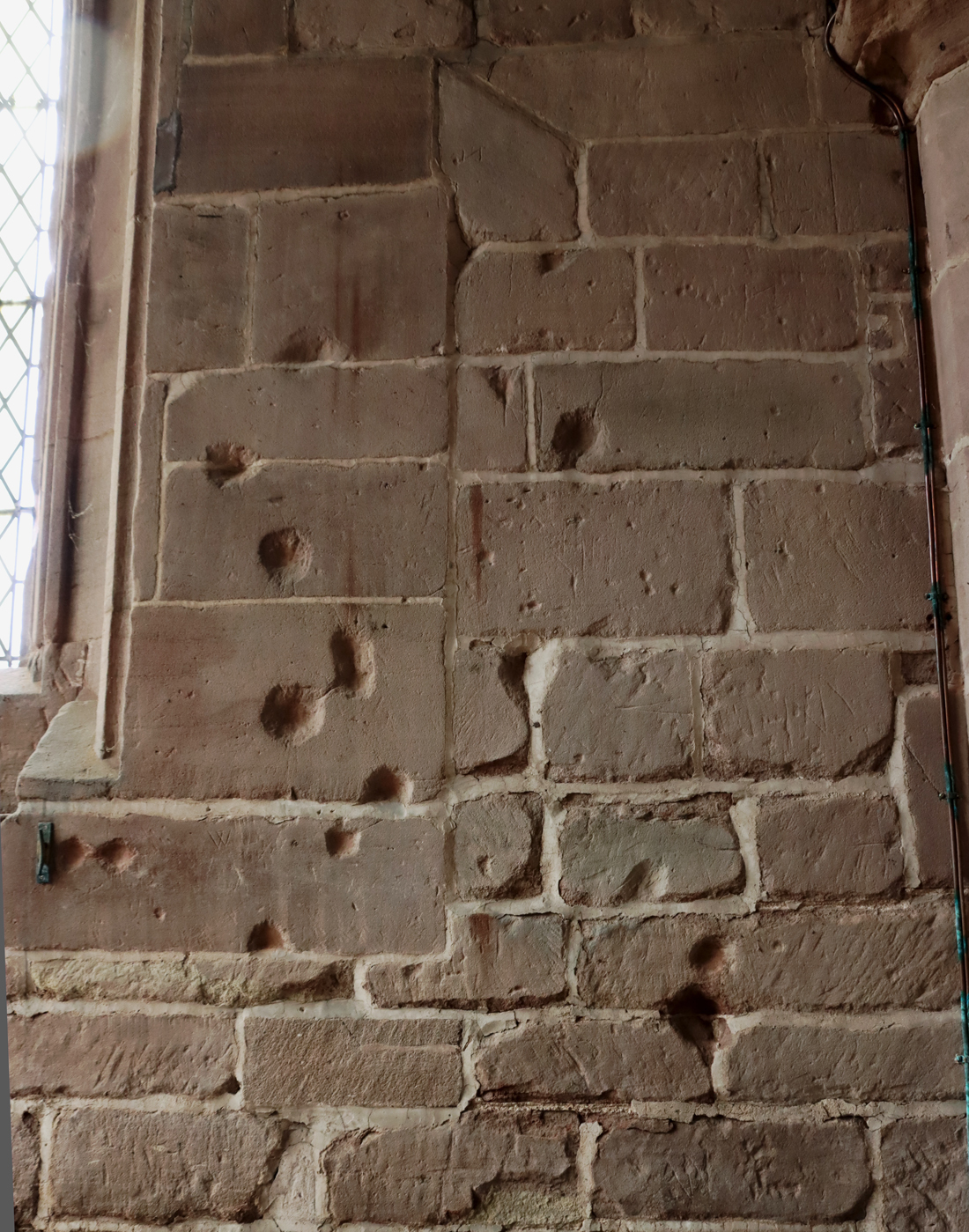
The door that opens into the north aisle of the church (round to the left of the tower as you face it) has nice carved details in the spandrels between the arch and the square frame.  Most fascinatingly, it has a line of three holes in it plugged with wooden stoppers.  These holes are called loopholes and were used for firing muskets from inside, much like arrow-slits in medieval castles.

The north entrance with the “loop holes.”

At the east end, under the central window, is an unusual little memorial built into the wall to Jasper Peck Esq and his wife Amy, died 1712 and 1740 respectively, the latter the daughter of Sir Kenrick Eyton.

At the east end of the church, built into the external wall beneath the central window, is an 18th century memorial

A memorial in the churchyard of St Chad’s, Holt

The churchyard contains plenty of grave stones and memorials.  The earliest, now moved for its protection inside the church (about which more below) dates to either the late 17th or early 18th century.  Although there are many from the 18th century, the majority of graves and their memorials date to the 19th century, with a range of fairly typical shapes and symbols.  Most of the memorials accompanying the graves are headstones, but earlier chest-style memorials and ledgers (inscribed horizontal slabs) are also represented, together with more obviously monumental types.  The cemetery was later extended east, possibly in an effort to avoid the north side of the church, which only has one gravestone, and even that is at the far east end.  The north side of a churchyard, in the shadow of the church, was often reserved either for burials that had to be buried in unconsecrated ground, such as suicides or babies who had died before baptism, but might also contain pauper and unmarked graves.  The monument known as the Roman Pillar, shown further down the page, may or may not have originally been a Roman column from the nearby tileworks, but in the churchyard performed the role of a sundial, now without a dial, with an octagonal top with the engraving TP WR CW 1766.

xxx

Interior

The plan of St Chad’s is simple, with the tower at the west end, and the chancel (where the high altar is located) at the east end as usual.  The nave, where the congregation sits, is flanked by two aisles.  The chancel is flanked by two chapels for private prayer.

The roof looks as though it belongs to the Perpendicular period, but is belongs to the restoration of 1871-3

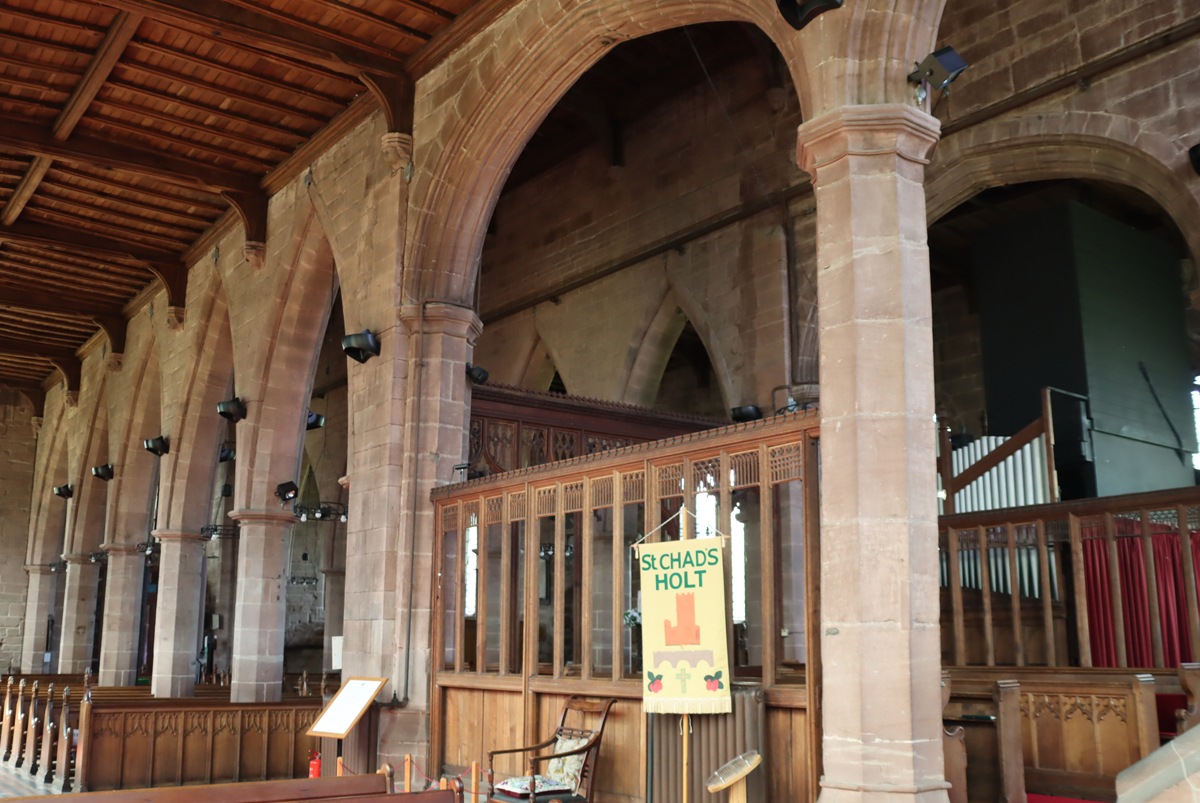
Heading through the impressive main door, set into the base of the tower, and through the glass-panelled doors into the nave, you are immediately presented with an uninterrupted view down the full length of the tall nave towards the east end.  The multiple large windows, only one of which has stained glass (dating to the early 1900s), provide the interior with a lot of natural light, even in the absence of clerestories. The arcades are made of a fine yellow sandstone, much better than red sandstone for creating a light space, and much more refined in appearance. The warm, light reddish wood of the relatively modern pews helps to add to avoid any sense of dourness.  The walls lack the usual distracting and overblown clutter of highly ornamental wall memorials.  Looking up, the wooden ceiling looks as though it belongs to the Perpendicular period, but is belongs to the restoration of 1871-3.

Inevitably there is a bank of 1910 organ pipes blocking the south aisle, shutting out light and preventing direct access from the north aisle to the north chapel, but this is entirely typical, echoing the same scheme in both Gresford and Malpas churches, amongst many others.  Similarly, the south aisle is truncated at the western end of the aisle by a small room presumably used as a vestry.

The 13th and 14th Centuries

Holt Castle by Peter Mazell in 1779. Source: Castle Studies Trust

There is no evidence of a church prior to the 13th century.  The village of Holt was built in the early 1280s, probably as a bastide by John de Warenne, the 7th Earl of Surrey under a charter from Edward I.  A bastide was a newly laid out pioneer town built around a castle on the edge of potentially hostile territory.  Edward I imported the idea imported from Gascony where he had founded a number of new defended towns, and used it as a model for Flint Castle and its bastide town, as well as subsequent castles in his circle of defences in north Wales.  Defensive walls may have been planned for the town but were never built.  The foundations of the first church were probably included in the plan for the border colony, along with a former marketplace (where the village square is located today).

The earliest remaining components of the present church belong to the 13th -14th century.  The nave arcades (arches that divide the nave from the aisles) feature five bays of lancet-shaped pointed arches that date to this period and indicate either that the original church of c.1280 was aisled, or that aisles were a later 14th century addition.  The aisles were widened in the 15th century, removing the older aisle outer walls, but the original ones almost certainly featured lancet-shaped windows of the earlier gothic “Decorated” style.

The earliest of the aisle arches are pointed (or lancet) shaped, unlike the later Perpendicular arches that flank the chancel.

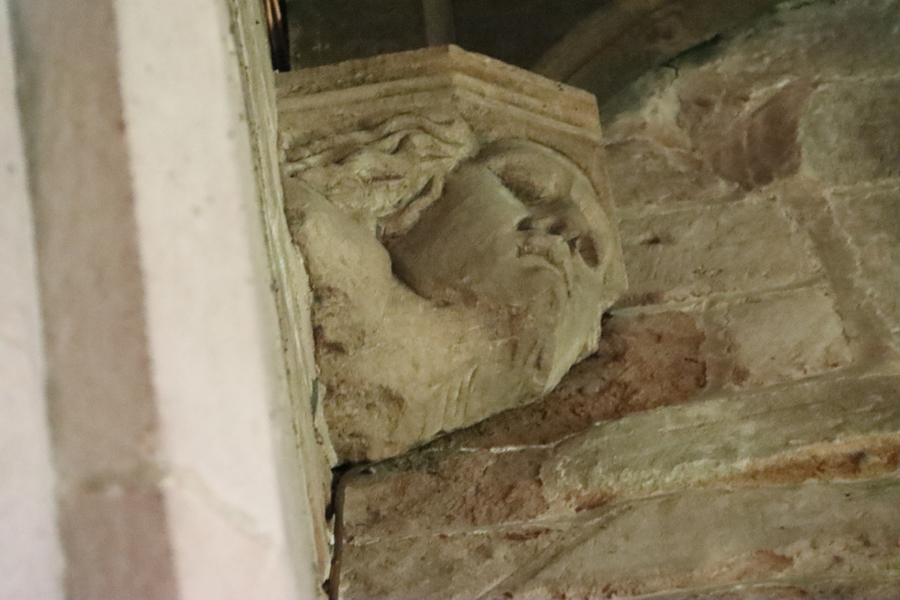
An attractive 14th century “credence table,” looking like a small shrine, was built into the south wall of the Lady Chapel at the east end of the south aisle, moved into this position in Sir William Stanley’s alterations in the late 15th century.  This was used for accessories used to celebrate Holy Mass.  The underside, completely hidden when looking down onto the small platform, has a marvellous grotesque face flanked by two faces, one human and one animal, looking very like a misericord.  If there were misericords in the late medieval choir, like the lovely ones at Gresford, these are long gone.   A mirror leans against the wall but can be laid flat for those who want to see the underside without kneeling down.

Unexpected underside of the credence table, looking very like a misericord

Late 15th Century

In 1483 Richard III granted the Lordship of Bromfield and Yale to Sir William Stanley, which incorporated both Holt Castle and the church.  Stanley made significant changes to the church, removing and replacing the outer walls of the original aisles to widen them, providing them with the Perpendicular style windows, and extended the arcade at the east end.  For reasons unknown, the north aisle is wider than the south aisle. The south aisle chapel is a Lady Chapel. The little leaflet that the church provides suggests, with reservations, that that the chancel, which is slightly out of alignment with the nave, may have been a so-called “weeping chancel,” deliberately and symbolically echoing the images of the crucifixion where Christ’s head is tiltee down to his right.

At the chancel, the two bays of arcades flanking the chancel (the choir and high altar), have much wider four-centred (flattened) arches, providing a very fine contrast to the earlier lancet-shaped arches.  The new arcades were fitted with carved stone heads at the tops of the east and west walls, all but three undetermined male heads.  The other three consist of one male head that is crowned and is probably a king, another depicting a dog and another a grotesque face. 

There were apparently problems with the civil engineering of the new east arcade. The last of the free-standing arcade pillars in the south aisle is at a distinct angle, and there is a pillar at the east end, against the wall, which does not reach the roof, as described on the Clwyd Powys Archaeological Trust / Heneb website: “To explain anomalies at the east end of the south aisle it has been suggested that because the east window of the aisle was too large for the wall to support, an external buttress had to be placed nearer to this window than was planned. An internal pillar was then constructed where the exterior buttress should have been sited.”  

Mitred figure at St Chad’s, Holt

The tower at the west end, through which you enter the church, has a spiral stair case to the bell tower (closed to the public).  As you go into the nave from the tower, look right.  There is a carving of a figure wearing a mitre, which is a fragment of a medieval bench-end of the sort that you can see in the choirs at Chester Cathedral and Gresford All Saints’, and suggests that there was once some very interesting Gothic wood carving here.  The mitre is consistent with it representing St Chad, but other candidates are also entirely plausible.  During 19th century restoration work the head was removed from the church and for reasons unknown found itself at Holt Hall, where its dignity was severely undermined, having been employed as a newel post. Holt Hall was one of the many of the fine buildings that failed to survive the early 20th century, and when it was taken down in the 1940s the head was returned to St Chad’s.

Also at the west end to the right as you enter the church, in the south aisle, is the wonderful font, elaborately and deeply carved and dated by Edward Hubbard to c.1493 on the basis of the heraldry that appears in amongst the other carved panels.  It is a truly remarkable object, featuring the above-mentioned heraldic emblems, religious symbols and even a number of grotesques.  The heraldic symbols include a stag’s head, which is one of the emblems of Sir William Stanley and the others are the arms of previous lords of Bromfield, the Warenne and Fitzalan families as well as the heraldic shield of King Richard II (reigned 1452-85).   Others are religious symbols showing emblems of Saints Matthew, Mark, Luke and John, the Lamb of God, the “pelican in her piety,” highly stylized roses representing the Virgin Mary and the ubiquitous gothic acanthus leaves.

The late 15th century font with a reconstruction from one of the interpretation boards showing how the shields may have been coloured

Sir William’s modifications represent a major investment and suggest enormous personal ambition, a desire to put his stamp on the biggest community asset in late medieval Holt.  It did not save him from political manoeuvring.  Although one of the richest men in England, Sir William Stanley was executed for suspected treason by Henry VII in 1495 and the Lordship of Bromfield and Yale reverted to the crown. 

The 17th Century

Musket ball holes in the west wall, south aisle of st Chad’s Church, Holt

The Civil War took place between 22nd August 1642 and 3rd September 1651, and had a massive impact on the Chester area, with opposing forces occupying Holt and Farndon at the strategic river crossing.  Frank Latham sets the scene as it was in 1643: “Because of its prominence on a hilltop overlooking the river the parish church of Farndon was garrisoned by Roundhead troops from 1643 to 1645 which enabled watch to be kept on the Welsh village of Holt and particularly on the castle there which was occupied by the enemy.” With Farndon in the hands of the Parliamentarians and Holt in the hands of the Royalists, armed conflict was almost inevitable, and the Battle of Farndon Bridge in November 1643 appears to have been the beginning of a number of skirmishes.  The castle was taken by the Parliamentarians, but in 1644 was retaken by the Royalists.  In 1647 it was besieged for 9 months. 

Fascinatingly, impact marks of musket balls scar the wall and pillars inside the west end of St Chad’s, which are an evocative reminder of the area’s troubled history at that time, when Royalist soldiers defended the church against the Parliamentarians, with hand-to-hand fighting taking place within the church itself.  You can find these mainly on the west wall of the south aisle (turn right as you walk in from the tower and they are on your right), with a few on the other side as well.  Don’t forget that the north aisle has a doorway with three “loop holes” through which weapons could be fired, only one of these can be seen from the interior, but there are also some marvellous lock fittings. 

Finally, a very small and beautifully decorated late brass plaque in the north aisle chapel should not be missed. Its beautifully reflective surface made it impossible to photograph nicely.  It is dedicated to Thomas Crue, who died in 1666.  The plaque was provided by his brother Silvanus Crue.  All of the imagery, with a skeleton flanked by skulls at its base, columns supporting sundials and hour glasses all reference time, death and the transition of the soul.  On the columns the words FUGIT HORA also reference the passing of time: “time flies.”  At the top, in the centre, a lion rampant stands over a grotesque head.  As well as some lovely engraved mortuary-themed decoration, it contains an acrostic; when read vertically, the first letter of each new line makes up one or more words.  In this case the vertical reading over two verses is THOMAS CRUE, and the full text is as follows (having performed some serious gymnastics to read it against the light):

The life of man incessantly from the womb
Hastneth both day and night unto the tomb
Of mortal life when once the thread is spunne
Man has a life immortal then begunne
A wise man dying lives; and living dies
Such was the main that here intombed lies

Carefull he liv’d gods secret laws to keep
Religiously until to Death or Sleepe
Unto a happy life his soule did bring
Ending this life to live with Christ our King

At the base it reads STIPENDIUM PECCATI MORS EST is a Latin phrase that translates as “The reward of sin is death,” and with dry humour typical of the 18th century, HODIE MIHI CRAS TIBI  translated as “Me today, you tomorrow”.  All of this may sound a little gloomy and morbid, but this was the era of John Donne and equally articulate metaphysical poets who engaged with satire, dark humour and word play, balancing the reality of time and its inevitable consequences with a strong sense of irony and flamboyant wit.

The 18th Century

In the south aisle, heading towards the chancel and on your left, there is a super grave slab that was moved in from the churchyard to protect it. It is a marvellous piece, with a skull and crossed bones, the skull having a somewhat surprisingly beatific smile on its face.  There are also some flowers at its base.  The flowers at bottom left were apparently typical of the 18th century, but the skull and crossed bones were better known from plague graves of the 17th century, and are known as memento mori stones, indicating the inevitability of death.

It is in this period that six bells were added to the tower, made by Rudhalls of Gloucester in 1714.  Presumably, if there had been any misericords these would have been removed either during the 17th century purge of medieval religious motifs, or at this time, although at least parts of the choir stalls were reported to be preserved in 1853, but were stripped out in the 1870s.  In 1720 the church was presented with a clock, which stayed in position until 1901.  This was followed by significant renovation of the church in 1732, during which, very sadly, the the rood loft and screens were removed.  This renovation also accounts for the parapet that replaced the pinnacles, gargoyles and battlements on the south side, although some were left in position on the north side.

A lovely engraved brass plaque near the entrance, on the west wall on the north side is worth looking out for, dedicated to John Lloyd and dating to 1784.

19th – 20th Century

The 19th century restoration between 1871 and 1873 was responsible for adding some of the ornamental features, such as the new seating in the nave and oak screens to separate the chancel from the side chapels, but also removed some of the memorial tablets from the walls.  Restoration work included including the renewal of the camber-beam oak panelled roof of the nave and the sanctuary at the far end of the chancel, re-laying of the floors and repairs to the window tracery.  Interestingly, many memorial tablets were removed during the renovation of the interior, which almost certainly improved it no end, but whatever remained of the rood screen and choir stalls were also stripped out.  It is possible that choir stalls and some stained glass were removed at this time, as they were mentioned by a visitor in the early 1850s. 

The interior ceiling corbels that support the camber beams were provided with sculptural elements, all human heads.  You will need binoculars or a long camera lens to see them, high up and in shadow, but a couple of examples are shown here.  There is no mention of them in any of the texts, so it is unclear if this dates to the major reworking during the 15th century, or to the 19th century restoration and reconstruction of the ceiling.

Nineteenth century restoration activities can often result in some hair-raising alterations, but St Chad’s seems to have got off quite lightly, retaining some fine original features.  The attempts to restore some of the original ambience were fairly sympathetic, and the new features were not unattractive.  As nineteenth century restorations go, it was not unsuccessful.

In 1896 the bells were provided with a new iron frame and the following year a weathervane was added.

The single stained glass window in St Chad’s, Holt. Early 20th century.

Since then, the main additions to the church have been the new clock in 1902 and a stained glass window later in the early 20th century. The new clock and chimes were fitted to commemorate the coronation of King Edward VIII and Queen Alexandra in 1902.  The stained glass window consists of four panels depicting saints.  The two central panels show St Chad holding an image of the church in his hand, and St Asaph (the church is in the diocese of St Asaph). The outer panels show St David, the patron saint of Wales and St Swithin, reflecting an older connection with Winchester Cathedral in 1547.  It is very nicely done for a 20th century window, emulating the gothic and works well with the rest of the church’s features.

In the 1960s the lighting and heating were improved and the roof coverings were restored.

Detail of Victorian pulpit, St Chad’s Holt

Uncertain dates

It is not known for sure when the tower was built.  One authority puts it in the 17th century, but it is more likely that is is much earlier, probably late 15th century.

Probably late medieval, but not officially dated, are consecration crosses, one of which is next to the radiator to the right of the credence table, and there are other similar consecration crosses marking places that have been consecrated by a member of the clergy elsewhere in the church.

There is a magnificent chest not far from the west end, which had four locks, each representing a keyholder who had to be present when the chest was opened.  This has not been dated, but realistically looks as though it could date to any time between the late 15th to the 17th century.
xxx

Chest in St Chad’s, Holt


Today

There has also been some modernization to improve lighting and heating, which were probably much-needed.  The pipework for the heating system is fantastic – a remarkable feature in its own right, just as the heating system in Chester Cathedral makes its own contribution to domestic-industrial history.

A replacement sandstone block interrupting some engraved text on an external wall of the church

Obviously the church requires ongoing maintenance.  Sandstone is very vulnerable to pollution, and some of the blocks have had to be repaired using modern sandstone, but thanks to the church being set back from the road this is minor work.  It also looks as though some of the four gargoyles on the tower have experienced some damage, but that too is inevitable.  Overall, St Chad’s seems to be in really excellent condition and is clearly well cared for and appreciated.

The church organizers seem to be doing a very good job of balancing the contrasting demands on St Chad’s.  As well as the provision of plenty of information for visitors about the history and heritage of the church as a tourist attraction, the church is managed as a community asset for services, weddings, funerals and community activities.  Reflecting a concern with modern global issues, there are four “millennium banners,” made by members of the congregation to welcome in the year 2000, which capture local scenes but represent the universal ideas of love, hope, peace and faith.


Visiting St Chad’s, Holt

The “Roman pillar”

There is currently no dedicated website, so there is no generally available online information about opening times.  I was able to walk in during the day one bank holiday Monday on a whim, and found it open. On the other hand, I was there some months later at around 1230 on a Wednesday and it was closed, but I found that it had opened later in the afternoon.  There is a Facebook page but it has no details about opening times and contact details.  Please note that the email address on the National Churches Trust page bounces (i.e. it is defunct).  This is a living church, with Sunday services, weddings and funerals, so even if you do find out what the opening times may be, there will be times when it is not possible to gain access.

There is plenty of parking along the road, but there is also a public car park just a few minutes walk away on the other side of the rectangular grass area, Church Green, on the other side of the road from the church.  There is a car park next to the Dee on the Farndon side, but this is very small and fills up quickly at the weekend and during the school holidays, and floods when the river is up.

One of the bilingual interpretation panels in the church, describing the early development of the town

Information boards and circular panels on short pedestals explain the heritage of the church and are nicely done and for the most part do not intrude on the look and feel of the church.  A small black and white leaflet was available on the table to the right in the tower as you walk in, consisting of two sides of A4, folded, that lists the key features to see in the church.

For those worried about steps and accessibility, the church can be visited without having to negotiate any obstacles, as there is a ramp from the tower into the nave.  There are plenty of pews for giving irritable legs a rest.  Outside, there is a  wide path that runs along the south side of the church and a narrower one along the north side and these both felt safe underfoot. There are also tracks through the churchyard, but if you are looking for a particular grave, note that the grassy spaces between graves are very uneven and you need to take seriously good care where you place your feet.  I suspect that it gets very muddy during rainy periods, so appropriate footwear is recommended.

This would make an excellent start or finish to a walk along the River Dee, which has footpaths on both sides of the river.  The late medieval bridge is itself a joy.  On the Holt side a visit could easily take in Holt Castle as well and on the Farndon side there is, of course, the other St Chad’s.  There’s a pub next door to the Holt church that advertises food and a garden, which I haven’t yet tried, but might be handy for the end of a walk.  There are other pubs and coffee shops on both sides of the river, all serving food.


————-

Sources:

Visitor information in St Chad’s, Holt

Interpretation boards and panels

Free leaflet:  20 Minutes of Discovery Around St Chad’s Church Holt


Books and papers:

Farmer, David 2011 (5th edition).  Oxford Dictionary of Saints. Oxford University Press

Hubbard, Edward 1986.  The Buildings of Wales.  Clwyd (Denbighshire and Flintshire). Penguin Books and University of Wales Press

Latham, Frank. 1981.  Farndon: the History of a Cheshire Village. Farndon Local History Society


Websites:

Archaeodeath 
Skulls in Stone and Brass: Inside Holt Church
https://howardwilliamsblog.wordpress.com/2015/08/25/skulls-in-stone-and-brass-inside-holt-church/
Masters of Holt
https://howardwilliamsblog.wordpress.com/2015/10/09/masters-of-holt/

Based In Churton
Big and bold: All Saints’ Church in the small village of Gresford
https://wp.me/pcZwQK-43a
Gresford All Saints’ Church – exterior gargoyles and grotesques
https://wp.me/pcZwQK-498
Gresford All Saints’ Church – a beginner’s guide to funerary monuments
https://wp.me/pcZwQK-49Z
Miracles, myths, demons and the occasional grin: Misericords in the Chester-Wrexham area #2:  The churches of Gresford All Saints’, Malpas St Oswald’s and Bebington St Andrew’s
https://wp.me/pcZwQK-4Ey

British Listed Buildings
The Parish Church of St Chad, Holt
https://britishlistedbuildings.co.uk/300001596-parish-church-of-st-chad-holt

Cadw
The Parish Church of St Chad, reference 1596
https://cadwpublic-api.azurewebsites.net/reports/listedbuilding/FullReport?lang=en&id=1596

Coflein
St Chad’s, Holt
https://coflein.gov.uk/en/site/165283/?term=holt&pg=2
(images at https://coflein.gov.uk/en/site/165283/images?term=holt)
Holt Bridge; Farndon Bridge, Holt, Wrexham

https://coflein.gov.uk/en/site/24043/

Early Tourists in Wales
North side of the churchyard
https://sublimewales.wordpress.com/material-culture/buildings/churchyards/special-graves/north-side-of-the-churchyard/

CPAT / HENEB – Wrexham Churches Survey
Church of St Chad, Holt
https://heneb.org.uk/archive/cpat/Archive/churches/wrexham/16796.htm
or https://cpat.org.uk/Archive/churches/wrexham/16796.htm 

National Churches Trust
St Chad’s, Holt
https://www.nationalchurchestrust.org/church/st-chad-holt

Peoples Collection Wales
St Chad’s Church, Holt
https://www.peoplescollection.wales/items/435519#?xywh=0%2C-55%2C799%2C642

St Chad’s, Holt – Facebook page
https://www.facebook.com/pages/St-Chads-Church-Holt/102667013120267

xxx

One of the many heads at the tops of the aisle walls


The Cheshire Lunatic Asylum 1854-1870 – Part 2.2

As I outlined in part 2.1, for part 2, just as in Part 1, I have again divided part 2 into two posts, 2.1 and 2.2, mainly because of the number of images used, which would take too long to load if I left it as a single piece.  This is the second part of part 2, part 2.2.  Part 2.1 is here.
xxx
xxx

Insights from the annual Visitor and Superintendent Reports for 1854-1870 contd.

Patients and their backgrounds

In the annual reports, patients are largely reduced to numbers.  Without exception the reports never give personal names of patients, only rarely referring occasionally to specific individual cases, such as suicides, escapes or, as in 1857, the birth of a child, and there are only a few clues in the annual report about who these people were.  One of the vital tables in this respect, which always appeared in the annual report, showed the occupations of each of the admissions for each year.  Given that this was mainly an asylum established for paupers, it is not surprising to find that most of the intake was from the lower-paid levels of Cheshire society, but the term “pauper” when applied to asylum patients did not always refer to very poor people. The term “pauper” covers a range of people.  Some were genuinely very impoverished, such as those transferred from workhouses, but others might be fully employed but without sufficient funds for their families to afford asylum costs.  This is probably one reason why there is a wide range of trades and professions represented, partly representing Chester’s diverse economic basis.   The variety of occupations might be more mixed when private patients from middle class families were admitted, or when patients were transferred from other asylums such as Staffordshire and Denbigh.   Two examples are shown below, one from 1855 and another from 1870.

Occupations of patients admitted to the asylum in 1855

The previous occupations of patients admitted in 1870

In every report the numbers of new admissions were listed both the symptoms with which patients were admitted in the tables accompanying the reports, together with the supposed causes in Table IX (until 1868).  The supposed causes are of interest, because they are specific to individual cases, and change annually, although recurring causes inevitably appear from one year to the next.  The following example is from the 1862 report about 1861:
Tables showing the types of mental illness and their supposed causes for 1861

The 1862 report for 1861 reported that the asylum was now capable of housing 500 patients, with the new extra capacity unused, resulting in the decision to charge private patients who were unable to afford more expensive solutions.  It was deemed that the admission of this new class of patients required a set of additional rules that would be applicable to these new more privileged patients.

A page from the 1867 Cheshire Asylum report

Occasionally something related to an individual patient is deemed important enough to report and these give some clues about the circumstances from which these patients came.  For example, in the March of 1862 a “deaf and dumb idiot” was admitted from a workhouse, and within three days had developed symptoms of smallpox.  A second patient soon showed the same symptoms and both had to be isolated from the rest of the asylum patients.  Again in 1862 a female patient gave birth, and this child was “subsequently removed to the Workhouse.”  In 1866 a woman died within six hours of having been admitted and the sad jury verdict determined that the death was due to natural causes “accelerated by ill-treatment, want of proper food and the miserable hovel she lived in.”  In 1867 a female was admitted with advanced Phthisis Pulmonalis,(pulmonary tuberculosis, also referrred to at the time as “consumption”) in a state of extreme exhaustion.  She gave birth a month later to premature baby, and both died. In the same year, a woman was taken to see her dying husband in her home near Middlewich, giving “no small degree a melancholy satisfaction to both, and probably was the means of saving the patient, a melancholic one, considerable subsequent distress of mind.”  One of the female inmates gave birth to a child, which, when a month old, was removed by the Relieving Officer, and delivered to the husband.  In another case of a childbirth within the asylum, both mother and child died.  There are very few other examples listed.

There are plenty of references in the Cheshire Asylum reports to areas outside Cheshire that had asylums of their own, but would send some of their patients asylums outside their immediate areas, including Chester, when they became full to capacity, thereby incurring associated charges.  An example from 1862 is the intake of patients from parishes in north Wales due to the Denbigh asylum being full.  The charges imposed for taking in these patients was used to improve conditions at the Chester asylum, enabling the purchase of “a large portion of the furniture required for the new buildings, but for which the Committee would have been under the necessity of applying for a further sum to supplement the grant of £500 already made by the Court of Quarter Sessions for this purpose.”
An excerpt from the 1855 list of items that were made in-house

It is discussed in part 2.1 (Ideology) how patients were put to work within the asylum partly to control costs, but more particularly to provide them with a sense of self and personal achievement. Women sewed and knitted, and sometimes helped out on the wards.  By 1867 all the clothes, shoes and bedding were being made within the establishment. The report for 1868 shed more light on this.  Of a total population (by the end of the year) of 255 men and 257 women, 120 men and 140 women were employed in productive activities in the asylum.  80-90 men worked in the garden and farm, 8 worked as tailors, 10 as shoemakers, 5 at other trades, and 55 in the wards and offices in unspecified roles.  100-110 women were engaged in sewing and knitting, 22 were in the laundry and washhouse, 9 were in the kitchen and offices and 30-40 assisted on the wards.

In 1870 it was recorded that “an excellent practice has lately been adopted” whereby every patient due to be discharged would be brought before the Committee so that they could be questioned about their treatment and asked if there were any complaints, following which they would have to sign a form confirming their statements.

The overall impression is one in which patients generally came from the lower levels of Chester’s social scale, with a few middle class patients, generally private, and that at the asylum they were integrated into a new community where they were cared for, and to which they could contribute.
xxx

Form of Mental Disorder

The Cheshire Lunatic Asylum Report of 1855 showing the main reasons for admission

One of the tables in each report showed the main “disorder” with which patients were admitted, with any complications.  They make for a fairly startling insight into just how varied and potentially difficult patient symptoms could be.  It is difficult to find precise modern analogies for the forms of disorder shown, not only because they were not always precisely defined in the 19th century, but because definitions could differ from asylum to asylum.

Forms of mental disorder with which new admissions were afflicted 1854 – 1867

The four main classes of disorder were Mania, Melancholia, Dementia and Amentia, the latter subdivided into Imbeciles and Idiots.  I have listed Amentia as a single class in the above graph, due to the lack of any clarification on how idiocy and imbecility were distinguished by the asylum.  Other causes could be added to the table as well.  In 1855, for example, intemperance (alcoholism) was specifically noted as a direct and dominant cause of insanity in new admissions:

Intemperance, as usual, appears to have been one of the most fertile causes of the disease, and this was more especially the case amongst the class of skilled artizans who received high wages. As shewn in table 10, in fourteen instances the attack of insanity was directly attributable to it; and undoubtedly in a large number of the other cases, habits of intemperance acted as a predisposing cause. It unfortunately happens that the offspring of such parents are extremely liable to insanity.

However those shown above in Table IX from the 1855 report, were the main categories up until 1867 when the format of the tables changed, and the “forms of disorder” table was changed.  Hill and Laugharne, looking at the Bodmin asylum data suggest that these conditions could be broadly understood as follows, although this is tentative, and reflects the difficulty that was found in categorizing mental illness in the 19th century.  Mania is thought to have represented manic episodes, for which they suggest that a test would be to look at the age at which the symptoms began to manifest themselves, expecting to find it appearing in patients aged between 10-30 years old.  Melancholia was more closely associated with what were later referred to as depression.  They find dementia more difficult to pin down but suggest that it may equate to schizophrenia, but if correct, this too would have manifested itself in younger patients.  Taber’s Medical Dictionary Online describes Amentia as “1. Congenital mental deficiency; mental retardation. 2. Mental disorder characterized by confusion, disorientation, and occasionally stupor,” but it was broadly associated with those who suffered from learning difficulties, described in the Chester asylum reports as “idiots” and “imbeciles.”
As well as the main forms of disorder, complications could have a considerable impact on any chance of recovery.  Although suicidal tendencies accounted for a considerable proportion of each year’s intake, as shown in the chart above, the greatest complication for any possibility of recovery was General Paralysis, which was one of the most common cause of death in the asylum.

Suicide, which is discussed further below, could be guarded against within the asylum, meaning that even when high numbers of patients were admitted with suicidal propensities, there was a very low rate of suicide within the asylum itself.

General Paralysis of the Insane (GPI), to give it its full title, also known as General Paresis, impacted men far more often than women and was the most frequent contributor to the number of deaths recorded in the asylum each year, with much greater numbers usually found among men than women.  As Kelley Swain illustrates, it was not understood in the 19th century, although not through want of speculation:

“Treponema pallidum” (in Swain 2018)

General paresis (or paralysis) of the insane (GPI) was crippling and terminal. It ended in loss of control over mind and body, often accompanied by grandiose delusions of wealth and power and, finally, paralytic death. There was no known cause. Could GPI be caused by overwork? Emotional labour? Mental strain? Sexual promiscuity? Drink? These were possible causes listed by William Julius Mickle in 1880. . . A disease of dissolution and disrepute, GPI was also considered a result of that most Edwardian horror: degeneration

In fact, GPI was the result of undiagnosed syphilis, a bacterial infection usually transmitted sexually, hence its association with disreputable activities.  No cure was found until the early 1900s, when the bacterium Treponema pallidum was discovered in Germany, leading to the manufacture in 1908 of a drug called arsphenamine later renamed Salvarsan.  GPI was a genuine problem for lunatic asylums like Chester’s.  Because it was incurable, and it required constant nursing attention, patients who were admitted with GPI took up vacancies at the expense of those who might be cured.  It was a massive dilemma. 

The seizures associated with epilepsy were originally thought to be outbreaks of madness, and were treated accordingly but by the mid 19th-century there was a much better understanding, particularly as a result of the work by neurologist John Hughlings-Jackson, of the causes.  In 1857 Sir Charles Locock successfully applied the first effective anti-seizure drug, potassium bromide, to epileptic patients.  For much of the later 19th century epileptics began to be treated as a separate class of patient, either in dedicated wards and buildings or in epileptic colonies.

A recurring theme in the reports, which has been mentioned before, was the frustration that patients were not admitted until their conditions were very advanced, considerably reducing the likelihood of recovery and filling the asylum with those who could not be nursed back to health and cured at the expense of those in need.

It too often happens that to save expense, or else from misplaced charitable motives, the patient is detained at home by his friends, with a hope that improvement may take place; and when it is too late for medical treatment to be of any service, he is removed to the Asylum, where he is likely to remain for life, a burden to bis friends, or to the township to which he belongs; whereas, had be been sent as soon as the malady had manifested itself, there would have been every probability of his speedy recovery, and of his being able once more to support himself and family by his own labour.

John Hughlings-Jackson (1835-1911). Source: Wikipedia

In 1857 the report for 1856 reinforced the point, drawing attention to the fact that of the forty seven who had been discharged as recovered, thirty nine of those patients had been admitted within three months of having been declared insane.

The confusion of mental illness with neurological disorders in the 19th century was understandable, and it was only through the work of medical pioneers like John Hughlings-Jackson that the two began to be seen as separate fields of medical research, with psychiatry and neurology both developing into essential branches of medicine.

There is almost nothing in any of the Chester asylum reports about what sort of treatments were applied, so it is not possible to track how treatment might have evolved.  Nor is there any information about how discharged patients were deemed to be “cured” or “relieved.”  Nor is it explained why, if they were not in any way improved, they were discharged anyway.
xxx

General health and disease
The physical condition of patients admitted to the asylum in 1870

A recurring theme in the reports draws attention to the weak condition and general ill health of new admissions that undermined the efforts of the staff to support new patients.  Many of those who died soon after admission were already in a poor state of health, in spite of being provided with good food and other stimuli.  Those referred from workhouses were often in a very bad way.  This was blamed in some reports on the Relieving Officer who was responsible, at parish level, for assessing paupers and their needs, and for delivering any suitable candidates to the asylums.

There was always the risk of a patient being admitted with a dangerous disease.  In 1864 a patient suffering from smallpox was admitted, which lead to a new bye-law authorizing the Medical Superintendent to reject infectious patients.  In 1865 this was acted upon when a potential patient was indeed refused admission.  On the other hand, there is no mention in the 1867 report for 1866 about any patients contracting cholera, which was an epidemic in that year.


Patients transferred from the Workhouse

The Chester Workhouse, on the edge of the Roodee, hemmed in on all sides. Sometime after 1840. Source: ChesterWiki

The relationship between the Chester workhouse and the Cheshire Lunatic Asylum is an important one and needs far more exploration than is possible here.  As Alistair Ritch has highlighted in his study of transfers between Birmingham are workhouses and asylums, there was a great deal of movement in both directions in England.  Following changes introduced by the 1834 Poor Law Act workhouses were required to move certain patients to local asylums:  “nothing in this Act contained shall authorise the detention in any workhouse of any dangerous lunatic, insane person, or idiot for any longer period than fourteen days” (section 45).  They were often in very poor condition by the time the decision was made to transfer them, both before and after 1834, making it very difficult to treat patients both for ill health and for mental illness.  In the other direction, those long-term residents of the asylum who were deemed to be both harmless and incurable might be moved to workhouses to make room for more acute cases.

In the 1857 report for 1856 the problem of workhouse admissions was highlighted, which provides a useful insight into the relationship between workhouse and asylum, and the problems in capacity that this represented for the asylums:

It appears that there are at this time more epileptic, idiotic, and chronic pauper patients in the different Workhouses of the County and elsewhere, than the patients actually
present in the Asylum; and as the Commissioners in Lunacy recommend that all these shall be brought into the public Asylum of a County, and also recommend that at least one acre of land for ten patients should be provided for their occupation, the quantity of land with that now proposed to be purchased would be in about that proportion, viz. 70 acres for 600 patients.

Dr Brushfield commented on the referrals from the workhouse in 1859, and how these were less likely to recover due to the lateness of the referrals, than those admitted early from other sources.  This is a recurring theme, but was raised particularly with reference to workhouse transfers.

It cannot be too often reiterated, that the chances of the patient’s recovery depends in the great majority of cases upon the circumstance whether the removal to the Asylum is early or late after the primary outbreak of the attack. The patients admitted to the Asylum during the past year, were 11s a class, of a worse description than usual; for instance, at the monthly meeting in October, the following extract was read from my Diary:-

“I beg to call the attention of the committee to the bad and incurable type of cases that are now being brought to the Asylum. Of the eleven patients admitted since the last meeting, there is only one where there is much probability of a cure being established, there are two cases of doubtful issue, and the remaining eight are positively incurable.  Seven of the eleven were admitted from workhouses, and four of this number had been the subjects of restraint.”

When a patient is sent to the Workhouse, which practice in some townships is the rule, considerable delay in the removal to the Asylum is too frequently experienced, and as a
sequence, the recoveries amongst those brought from workhouses are proportionately few, and the deaths many. The following table of the cases admitted into this Asylum during the past year, will bear out the correctness of these remarks.

By 1860 concerns about overcrowding at the asylum, there being no more male capacity and only  a few places available in the female wards, lead to a brief exploration of the various options, which included expanding the asylum yet again, shifting patients to other English asylums, and moving others to the workhouse.  Of the latter option it was suggested that workhouses represented the least desirable option, “it being a fact well known to all experienced in the treatment of recent acute cases too often results in retarding the discovery, or in causing the degeneration from a curable into a chronic incurable state.”  In the 1862 report for 1861 Dr Brushfield expanded upon this point:

In several instances where Patients, after having been quiet and harmless for many months, or even years, in the Asylum, have been removed to the Workhouse, they have, in the course of a short time, been sent back to the Asylum as “dangerous” either to themselves or to others, or to both.

In 1866 there were too few spaces for the number of patients referred to the asylum, and the only solutions were to transfer the new patients to other asylums, if any of those were lucky enough to have capacity, or to send them to workhouses.  As none of the asylums approached had any spare capacity, it is assumed that several of the Chester asylum patients were sent to the workhouse in spite of Dr Brushfield’s considerable misgivings.

The subject of the relationship between the Chester asylum and the workhouse would reward a research project in its own right.
xxx

The emphasis on recovery

Duration of insanity prior to admission asylum in 1855

The objective of the Cheshire Lunatic Asylum was not merely confinement but cure, although apart from a community and activity based approach to mental illness, it is by no means clear how recovery was to be achieved.  The reports are concerned to record and discuss recoveries, as well as the reasons why some patients could not be cured.  Some patients were too unwell to treat effectively when they were admitted to the asylum:  “It is lamentable to find that in such a large proportion of the cases admitted, medical skill is of no avail.”  There is a clear differentiation between those who have the potential for recovery and those who do not.  In the 1855 report this was because of complications due to epilepsy and general paralysis, a recurring theme in these reports, and also because, in some cases, mental illness was too far advanced into the “chronic stage” for any improvement.  The usual explanation for this is that admission came too late in their illness, as this example from the report, also for 1855, makes explicit:

Table XIII (13) from the 1855 report

It too often happens that to save expense, or else from misplaced charitable motives, the patient is detained at home by his friends, with a hope that improvement may take place; and when it is too late for medical treatment to be of any service, he is removed to the Asylum, where he is likely to remain for life, a burden to his friends, or to the township to which he belongs; whereas, had he be been sent as soon as the malady has manifested itself, there would have been every probability of his speedy recovery, and of his being able once more to support himself and family by his own labour. In table 13 it will be seen that out of the 52 cases discharged cured, 32 left the Asylum within six months from the time of their admission.

The report cites a case of one individual who was only kept alive by a stomach pump that administered food, and who died after five months.

This was reiterated in 1861 when Dr Brushfield wrote:

The proportion is wholly governed by the number of curable cases admitted, as of this
class 70 or even 80 per cent. are discharged recovered, hence the importance and necessity of sending the patients to an institution of this kind before the malady has assumed a chronic incurable form. In too many instances the Asylum, instead of serving the purpose of a hospital for curable cases, has simply become a receptacle for incurables.

The ordinary diet table for females from the 1870 report

In 1867 the 21st Report of the Commissioners in Lunacy to the Lord Chancellor was published, for the year 1866.  It listed all the asylums with which it was concerned, showing the data for the total number of inmates in the asylum at year end, and the proportion of those deemed to be probably curable and those deemed to be incurable.  Out of 481 patients (238 male, 243 female) only 13 were “probably curable” (5 males and 8 females) whilst 468 were “probably incurable. ” In the following year, 1868 the percentage of recoveries, 46.5%, was higher than in any previous years but no specific reasons are provided to account for the difference between these two sets of figures.

In spite of this gloomy prognosis, patients were fed well, if unimaginatively, three times a day, and for paupers, many of whom had probably had very little in the way of consistent and healthy diets, the provision of regular meals full of carbohydrates and protein was probably better than many of them had experienced, and was essential for any  hope of recovery.  The fact that the farm, on which many of the men worked, supplied a lot of the daily food supplies must have been a source of some satisfaction to male patients.
xxx

Discharges, deaths and escapes
xxx
Discharges partly reflected the success rate of the asylum, the overall aim of which was to return patients to society rather than retain them, so these were always displayed prominently in the tables and discussed in the text. A distinction was made between those who were considered to have completely recovered, those whose symptoms were relieved and those who had not improved.    Superintendent Brushfield was well aware of how the statistical tables could disguise some of the underlying information about recoveries and in his 1860 report for 1859 attempted to clarify the situation as regards curable versus incurable patients:

Of course the proportion of recoveries must depend upon the proportion of curable cases admitted, which varies much from year to year: for instance, during 1858 the admissions consisted of 43 curable and 47 incurable cases, whilst in 1859 the numbers were much more disproportionate, there having been 49 of the former and 70 of the latter. Of the 49 of the curable class 26 were discharged as recovered during the course of the year, and nearly two thirds of the remaining 23 are progressing favourably towards mental restoration.

Causes of death shown in the 1857 report, including 12 cases of General Paralyis, 10 cases of Phthisis (which sometimes followed General Paralysis) and two suicides

Deaths were inevitable, and were the result of a variety of causes.  In 1854 nineteen men and twenty women had been discharged, and there were a total of thirty deaths, a third of which were put down to “General Paralysis,” which was incurable and was the main cause of death over the entire period that these reports cover.  In 1870 this figure still remained high (15 men and 7 women)  In the 1860 report for 1859, Superintendent Brushfield highlighted the much higher than average number of deaths and some of its causes:

There was a considerable increase in the proportion of deaths and several circumstances contributed to swell the number. The mild winter of 1858, assisted in prolonging the lives of manv of our feeble cases for a few months, thereby lessening the mortality of one year to increase that of the next; whilst the severe weather that occurred during the middle of December last, operated very banefully on those suffering from great prostration of the mental powers, or organic bodily disease. The large number of aged persons admitted tended to produce a similar result. One-third of the number was due to general paralysis.

Tables from 1862 showing ages of patients who have died and the duration of their treatment before death

By 1870 a wider range of causes of death were being reported under different categories

In 1855 and again in 1857 one third of admissions had been recorded as suicidal, but although suicide attempts were occasionally recorded, thirteen years had elapsed before two were successful in the same year, noted in the report for 1857. This is in spite of the fact that some patients had been admitted not only having suicidal tendencies but having made serious suicide attempts prior to admission.  An example from 1857 describes how: “in several the attempts made were of the worst desperate description; and in two instances the patients at the time of their admission had extensive incised wounds of the throat which subsequently healed.”

New admissions with suicidal tendencies into the Cheshire Lunatic Asylum from 1854-1870


Overview of suicides in the report for 1861

In 1861 two patients had been admitted who had attempted suicide by cutting their throats, one of whom had been confined within the workhouse for two years previously.  The year’s only successful suicide lead to new measures to prevent a repeat:


For special notice is that of a male patient who committed suicide in the day time by strangulation. Every precaution appears to have been adopted with a view to guard against his known suicidal propensity. The open ironwork at the head of one of the old bedsteads, however, afforded him the opportunity he had sought. Nearly fifty of these bedsteads were in use when Mr Brushfield entered upon the duties of Superintendent in 1852. All since introduced have been of wood, and of a safe construction . . . It has, consequently, been deemed right to order an alteration, now in progress, in all the iron bedsteads, by the substitution of sheet iron for open work.

1870 was also a particularly bad year for those who were admitted having actually attempted to commit suicide, although there is no attempt to explain why this should be so, and no new suicide attempts were recorded after admission into the asylum:

Of the year’s admissions it was found that a large number had a strong suicidal propensity, and that several had made desperate efforts to commit self-destruction prior to their being brought here: the subjects of melancholia exhibited this proclivity in the greatest intensity.  Six cases were received into the asylum with their throats more or less severely cut, all of whom however recovered of their wounds,. except one – a male patient – who died five days after admission,  five days after admission, when a Coroner’s inquest was held upon the body, and the Jury gave a verdict to the effect that death was caused by self-inflicted injury.  None but those connected with Asylums for the Insane can form an adequate conception of the anxiety which this class of patients causes to the Medical Officers.

Escapes were only noted in the tables where the person had been missing for over a day.  There were several escapes in 1854, one in 1855, two in 1863, two in 1864 and one in 1870, which is a remarkably low number.  One escape attempt resulted in the escaped man drowning in a local canal; this was considered to be an accident rather than a suicide attempt.  This very good record was put down to the amount of freedom accorded to patients as well as their good treatment.
xxx

Re-admission

Re-admissions are not mentioned in every report but are interesting when they are, indicating that someone who had been discharged back into society had not been successfully reintegrated and needed to return to the asylum for treatment.  It is unclear what sort of medical or emotional support someone discharge might or might nor receive from the asylum, although there was a charitable fund for helping them financially. A list in the 1863 report for 1862 displays re-admissions versus admissions since 1842. The percentages indicate that this was a fairly high annual number:

One of the problems with these figures is that the re-admissions do not correspond directly to the admissions, as some of them were admitted from previous years. Other reports make it clear that some re-admissions were within the year covered by the report, but that others clearly represented lapses after many years, so that the percentage of re-admissions does not relate directly to yearly admissions.  The figures in this table are still interesting for two reasons.  First, they indicate that re-admissions were generally quite low for the 17 years concerned, particularly as there does not seem to have been much in the way of after-care, but they did occur.  Second, these figures had not been recorded in most of the preceding reports, although they must have been recorded somewhere for them to be included in the 1862 report.
xxx

Religion and education

The religious persuasion of admissions in 1867

Access to Christian services was considered important not only for the moral and religious wellbeing of patients, but also to reduce the potential tedium of asylum life.  The 1858 report for 1857 describes how a new residential chaplain was appointed:

The necessity of having Divine Service performed more frequently in the Chapel of the Asylum has recently brought under the attention of the Committee. After investigating the matter very fully, and finding that such services not only broke the monotony unavoidably connected with these Institutions, but exercised a more salutary influence on the patients, they appointed the present Chaplain, the Rev. R. Congreve, to be resident Chaplain, with a salary of £200 per annum, and an allowance of £50 per annum for a house, until the same could be provided for him. Divine Service will now be performed once every week day and twice on Sunday, instead of (as heretofore) once in the week and once on Sunday, and the Chaplain’s whole time devoted to the Asylum.
From 1858 the annual report occasionally included a section contributed by the Reverend Congreve, and it is one one of the aspects of asylum life on which the visiting commissioners of lunacy regularly commented in the annual report.  There were two services on Sundays, one on Fridays, and prayer readings every day in the Recreation Hall, as well as services on Christmas Day and on Good Friday.  A choir was made up of both attendants and patients, and Reverend Congreve reported that “all the Sunday evening when they return to the wards, you will find many of them joining together and singing some of the hymns.”  Holy Communion was also organized four times a year for a small minority of the asylum residents who required it (for example, in 1867 there were 14 who took advantage of this provision, out of a total number of 526 patients at year end).

In the report for 1863 it was noted that church attendances averaged from between 108 to 118.  In 1867 the church had reached its capacity of 300, made up of both patients and attendants, and many had to be excluded.  As a result, in 1868 the pews were reorganized to allow an additional 70 to attend.  During the closure for this alteration, “as many patients as could be trusted” were accompanied to Upton Church.  The average congregation after the reorganization was now 320, still including both residents and attendants.

The establishment of the fund for discharged patients in 1863

Reverend Congreve managed a charitable subscription fund called the Convalescent Fund, which was  contributed to by people from the local community to assist those who were discharged, which was designed to help them to re-establish themselves. There were occasionally concerns about this running very short of funds, but every now and again it received a generous contribution or legacy.  The report for 1867 describes how a a legacy of £100.00 was provided, making a substantial difference to the fund.

The chaplain also managed two voluntary schools, one each for male and female, as a form of leisure activity.  A schoolmaster was provided by the men, but women were taught by two nurses.  Over time as well as Bible study and reading, the school taught writing and basic arithmetic and one of the chaplain’s activities was to deliver books and periodicals to the patients, taking particular effort to make sure that those who had difficulty reading had material with plenty of illustrations.  In 1867 the school attracted 30 men and 30 women.
xxx

Personnel

Staffing consisted of a Superintendent, an Assistant Medical Assistant, a Matron, a number of male and female attendants and nursing staff.  These were supplemented by a bailiff, a head gardener and his staff, workshop artisans, the lodge keeper and his wife, and a porter.  The farm, which included both livestock and crop production, would presumably have been staffed quite extensively.

Within the asylum, efforts were made to ensure that women staff worked in the female wards and that male staff worked in the men’s wards.  Long-term employees were provided with pensions.  In 1854, for example, a resident steward was appointed, a new matron replaced the incumbent matron who was provided with pension after 15 years of employment, the head attendant retired due to ill health after over 20 years of employment.  Both were provided with a pension of £20.00 per annum.  The outgoing Medical Superintendent was granted a pension of 200.00 per annum.

Staffing levels are usually reported on within the report, and in 1861 there is a useful insight into staffing at the asylum at that time:

On the male side there are a, head attendant, 13 ordinary attendants, (there being at present one vacancy,) and a gardener and an engineer, each of whom has charge of patients during the day. On the female side, under the Matron there are 15 nurses employed exclusively as such, and a laundress, a cook, and a housemaid. The above are exclusive of the night attendants, one in each division, whose duties, during one night in about 13, are taken in turn by the ordinary attendants.

There had been a reference in the report for 1866 to note that “in most cases” attendants had maintained good standards, which looked somewhat as though some details were being glossed over.  In 1867, it was not deemed possible to ignore that “on one or two occasions” attendants had been charged with striking patients, although no-one was dismissed.  From this year there were repeated problems in this regard.   The report for 1867 also commented that female attendants were short by two due to the difficulty of hiring suitable personnel.  It was suggested that this might be due to the low starting salaries, and it was recommended that this might be increased.

The Handbook for Attendants of the Insane. Source: Royal College of Nursing, “Out of the Asylum”

In 1865 the problem of training frontline staff, both attendants and nurses, in lunatic asylums was recognized by the medical profession and a manual was produced for their use, the Handbook for Attendants on the Insane. It was known colloquially as “The Red Book.” The book cover on the left shows that this was the sixth edition, a measure of its success.  You can read a copy of it on the Wellcome Collection website here (the 1884 edition).  It was not until the early 1890s that training schemes and examinations were first set up for frontline staff at lunatic asylums by the Medico-Psychological Association (which later became the Royal College of Psychiatrists).

In 1868 “considerable difficulty” was experienced finding “efficient and well-conducted” attendants to fill vacancies.  The loss of the Head Female Attendant in that year due to ill health lead to the combination of her role with that of the Matron (it is not recorded quite what the matron made of this).  These staffing difficulties may contributed to the finding of the Lunacy Commission Visitors in that year that although men presented an acceptable appearance, some of the female patients to be “poorly clad and still more untidy, and as if ill-attended to.”  One woman complained of injuries imposed by the staff, still visible, that had not been escalated to the upper hierarchy for investigation.  Although her bouts of violent epilepsy meant that her injuries may have been accidental or the result of trying to pacify her, the failure to report the incident was a cause of concern.  However, it is clear that there were real problems with some of the staff.  In the same year, 1868, a few of the staff members were dismissed for “misconduct, wilful neglect of patients and incompetency” and the rules for staff were revised to ensure the regulation of conduct within the asylum and to ensure proper attention to patient care, but there were still occasional problems.

In spite of genuine efforts, in 1869 several male attendants were dismissed, one of whom was prosecuted for striking a patient and was fined £10.00 per costs, which he paid rather than being imprisoned for three months (to put this in perspective, the National Archives Currency Converter suggests that today this would be equivalent to around £626.00, or 50 days salary for a skilled tradesman).

The combination of low salaries and increasing numbers of patients apparently made it difficult to hire sufficient attendants who had both the skills and the physical and appropriate personal attributes to care for patients according to the values of the moral treatment approach.  The experience at most asylums was that as patient numbers grew, it became increasingly difficult to maintain this empathetic approach, and it would be interesting to know how Dr Brushfield fared after he moved to Brookwood, which at the time of his new appointment had capacity for 650 patients.


Asylum Deaths in Overleigh Cemetery
Family gravestone that includes the name of Ellen McLean Thurston, who died in the asylum at the age of 42. Photograph by Christine Kemp. Source: FindAGrave.com

Without access to the asylum’s records it is difficult to find out information about patients, why they were there and how they died.  I have not yet found out where Asylum patients were buried prior to the opening of Overleigh Cemetery in 1850.  However, a burial dataset from Overleight itself can, in some casesbe matched up to newspaper reports.  The contents of this section have been provided by Christine Kemp’s entries for in the Virtual Asylum Cemetery for Overleigh Old and New Cemeteries on the Find A Grave website, putting names to some of the anonymous statistics captured in the annual report.

Overleigh Cemetery opened in November 1850.  To date Christine Kemp (Friends of Overleigh Cemetery) has found records of 67 patients at the asylum having been buried at Overleigh between 1852 and 1900, as well as 3 from other asylums (Tranmere, St Mary’s Parish and Latchford).  The youngest if these was 15 and the eldest 77.  Two were suicides.  According to Chris’s research on the Asylum Virtual Cemetery, of the 67 known Asylum patient burials, 26 (39%) had no memorials and are in unmarked graves, some of them were buried in common graves (7, or 10.5%), and one of them was interred in a communal cholera grave. In five cases, patient burials are recorded on plots with memorials, but their names are not mentioned on those memorials. Given the size of the asylum and the numbers of deaths recorded in the annual reports, others must remain to be identified or were buried elsewhere.  Cremation was not a possibility in Chester until as late as 1965.

Causes of death are almost never shown on gravestones, but some of them refer to the suffering of the deceased in life.  The memorial for asylum patient Edward Edwards, who died at the age of 69 on the 26th January 1894, is an example of this genre and reads: “His Languishing Head is at Rest / Its thinking and aching are over / His quiet immovable breast / Is heaved by affliction no more.”
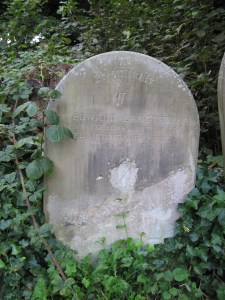
The understated gravestone of Edward (Ned) Langtry, husband of actress Lily Langtry. Photograph by Christine Kemp. Source: FindAGrave.com

Chris has managed to track how some of these people were employed in life, and most of those that she had were in fairly modest work, as one would expect from an asylum set up to assist paupers and those whose families could not afford their care. This agrees with the asylum records which show how patients were employed prior to being admitted.  A number were labourers, as well as the wives of labourers. Others are identified as a grocer’s assistant, a tailor, a porter, the wife of a wagoner, a pub landlord and the wife of a pub landlord, a sergeant major, a stone mason, a bricklayer, a mariner, the wife of a coachman, a “gentleman’s gardener,” a painter, a butcher, a fitter, a store and timekeeper, a char-woman, an engine driver, and a collier.

An unusual asylum patient was Edward (Ned) Langtry, the former husband of popular actress Lily Langtry, from whom he had separated in 1887.  In October 1897 he was found wandering after a bad fall in a state of delirium and was referred to the asylum by a magistrate, although he would probably have been better referred to hospital care.  He died in the asylum after nine days, suffering from “inflammation of the brain.”  His gravestone is a very understated affair, but the newspaper records that Lily Langtry sent a very impressive bouquet!  The full report of Ned Langtry’s death was reported in the Chester Courant, which can be seen on Chris’s entry on the FindAGrave website.

The asylum deaths reported in newspapers are useful exceptions, because most of the asylum deaths were not usually reported in any detail in the newspapers, such as the Cheshire Observer and the Chester Courant, unless the story was in some way sensational.  For example, another newspaper story reports on the death of asylum inmate Martha Miller who was buried in Overleigh Old Cemetery in an unmarked grave in 1879, and whose acts against her children makes for grizzly reading:

Grave of Martha Miller. Photograph by Chris Kemp (who marks the position of unmarked plots using bunches of flowers). Source: FindAGrave.com

She was the 3rd wife of Daniel Miller, Innkeeper of the Yacht Inn, Watergate Street, Chester. He had four living children from his previous marriages and two children with Martha, who was expecting their third. Martha had been in delicate health and had ruptured four blood vessels in the last nine months and had become quite despondent. On a Friday night in June she went to bed with two of her children from her present marriage, Alice aged 2½ yrs and Elizabeth Mary (Lizzie), aged 12 months. Shortly afterwards screams were heard by her stepdaughter Emma. Daniel broke down the bedroom door because it was locked, to find Martha had cut the throats of the children with a table knife, one fatally. She then had tried to commit suicide by the same means. Doctors were called for, who assisted with staunching the flow of blood. Martha who had become violent was put in a straitjacket and confined to the County lunatic asylum, Upton, Chester. Lizzie was taken to the infirmary where she recovered. Martha died at the lunatic asylum aged 30 yrs, after giving birth prematurely. At the Coroner’s inquest she was found ‘guilty of wilful murder’ of Alice Miller. Martha was buried on the 16th October 1879. Her baby daughter Martha, who was born prematurely in the asylum died just a few weeks after her mother on the 30th November 1879. (Source:- Cheshire Observer 21st June 1879 and Chester Courant 15th October 1879) [Researched by Christine Kemp and recorded on the FindAGrave website]

Another example is shoemaker Joseph Crawford whose death was reported in the Cheshire Observer on 14th November 1896.  He had been in the asylum for eight years, suffering from “chronic mania” and died suddenly, returning from church.  Interestingly, although the gravestone gives the name of his wife, who had died in 1882, and there was plenty of room for his name, and Chris has found a record of him being buried in this plot, his name is not mentioned on the gravestone.  Either there were no funds to inscribe the stone, or the manner of his death had lead any remaining family to decide to exclude his memory.

It will be very interesting to try to match the cemetery data with the asylum’s own records when the latter become available in 2026.  Although the Cheshire Archives and Local Studies listing of what they hold indicates that there are no burial records for the asylum, they do hold records of deaths, so it may be possible to extract information from the latter to tie in to the cemetery data.

I have assembled all the information that Chris has made available on her Virtual Asylum Cemetery in a 6-page table, which can be downloaded here, with accompanying notes.
xxx

Sample page from the table and notes showing Cheshire Lunatic Asylum deaths buried at Overleigh Cemetery, assembled from data gathered by Christine Kemp.

After 1870

The asylum continued to grow after 1870, and was still operating when it was absorbed into the NHS in 1948.  On 31st December 1870 there were 536 patients in the asylum.  In 1910 this had risen to 1000, 1500 in the 1920s and 2000 in the 1930s.  In 1895 a completely new hospital was added to the site to the north of the original 1829 building, designed by Grayson and Ould, freeing up the 1829 building to be used as the women’s ward.  In 1912 a new dedicated block was built for epileptics, which had a more domestic feel to it.
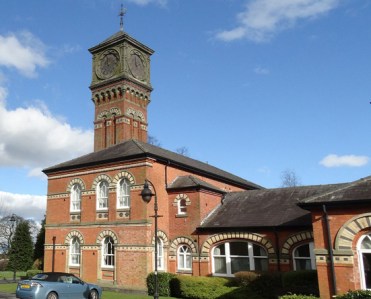
The former Parkside Lunatic Asylum in Macclesfield, which opened in 1871 as a second Cheshire county asylum, to ease some of the pressure on Chester. Photograph by Colin Park CC BY-SA 2.0. Source: Wikipedia

In the 1860s it became clear that the hospital, catering for the entire county, was simply unable to cope, and the decision was made to build a new asylum to serve the east of the county.  The Second Cheshire Lunatic Asylum, also known as the Parkside Lunatic Asylum opened in May 1871 to accommodate 700 patients, with additional buildings added later to absorb over 1500 patients by 1938.  The Parkside Lunatic Asylum’s architectural style and layout represent a completely different paradigm from that of the original Cheshire Lunatic Asylum building of 1829.  It was  designed by Robert Griffiths, who specialized in institutional architecture and was built of red brick with features picked out attractively in contrasting pale and black stone and dressings.   The design is in the Italianate style, looking rather like a downscaled version of Osborne House (built for Queen Victoria on the Isle of Wight between 1845 and 1851).  Instead of a single building linked by a main corridor, Parkside was built on the pavilion-corridor arrangement, with discrete blocks connected by multiple corridors.


Future research potential

The reports used here, the annual Report of the Committee of Visitors and Superintendents, have so many statistical tables that have only been touched on here, and I have simply presented what they contain.  There has been no attempt at analysis.  A well-structured project to analyze this data would reveal much more than I have been able to even hint at for the asylum in the mid-1800s.   In addition, I have not discussed the accounts that are presented in the same reports, and that would benefit from the attention of someone who is familiar with accounting methods.

Cheshire Archives and Local Studies contents listing of records available when the offices open in 2026

There are many untold stories that live outside the reports used here, from the chairmen, the committee members, the visiting committee members, the staff, patients and those local community residents who paid into the voluntary fund for discharged patients.  It will be fascinating to see what is available in the Cheshire Archives and Local Studies office in Chester when it reopens in 2026 so that the earlier and later history of the asylum can be investigated, and it may be possible obtain insights into some of the individual stories of those who worked at, were admitted to and who contributed to the asylum.

It will also be very interesting to try to match Cheshire Archives records with the the Overleigh cemetery and inquest data.  Although the Cheshire Archives listing of what they hold indicates that there are no burial records for the asylum, they do hold records of deaths, so it may be possible to extract information to tie the two datasets together.  For example, it should be possible to match admission and discharge names with those in Overleigh and track back to inquests and newspaper reports.
Screen grab of the header from the Riverside archives list

At the same time, it would be worth investigating the Riverside Museum in Chester, which also has archives that are relevant to the asylum, and although these have not been digitized a listing of its holdings can be downloaded here.   Objects at the same museum may also provide insights into the material culture of the asylum at different times.

Another aspect of the Riverside Museum is that it informs visitors about how nursing became professionalized.  Although this might seem like history from above, as nursing was part of the infrastructure of control, in fact nursing was itself in its very earliest stages.  The role of women in the operation of an asylum is an aspect of how asylums developed.  Each asylum had a matron, and there was one from the beginning at the Chester asylum, but quite what her role was in the asylum, and how many female staff she oversaw is not entirely clear. Female staff would have been needed for female patients.  How much of this was caring and how much enforcement would depend on the nature of the patient and her symptoms.  At what point female attendants became a professional female body of nurses, becoming more expert and informed throughout the 19th century, is unclear, but the professionalization of nursing provided women with the opportunity to take on roles that were not merely menial, although such roles of course existed, but could be increasingly skilled.  If the data is available, and it is a big if, research into the role of women in the Chester asylum might produce some very interesting results when combined with other data and compared with nursing in hospital infirmaries and orphanages.

I originally intended to do a search on the asylum via the British Newspaper Archive, but the reports were so rich that I ran out of both room on this post, and time, so I decided to leave that for now, and perhaps pick it up at another time.  The same can be said for the Reports of the Commissioners in Lunacy to the Lord Chancellor.

The abandoned Denbigh Lunatic Asylum. Photograph by Steve R. Bishop. Source Everywhere from Where You are Not

Other institutions also related directly to the Chester asylum.  Several asylums had a relationship with the Chester asylum, each exchanging patients when they reached capacity, and this would be worth investigating.  One of those asylums, the Denbigh asylum, would be worth an investigation in its own right, as would the Macclesfield Parkside Asylum that opened in 1871 in east Cheshire.

The role of the clergy in the Chester asylum is interesting, and the role of clergy in other asylums would also be well worth exploring for comparative purposes.  Perhaps most importantly, the relationship between lunatic asylums and workhouses was obviously of fundamental importance to both types of institution, with problems associated with how patients were transferred between them, and this would be a fascinating area of investigation.

Finally, It would also be really useful to tie in the history of Victorian Chester with that of the asylum and see if there is any way of tying the two together to find correlations.


Final Comments on the Cheshire Lunatic Asylum
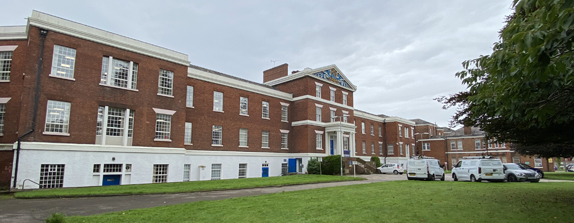
The 1829 Building

The Cheshire Lunatic Asylum was built in an era of social reform, and evolved during a period when philanthropy and social conscience were translated, painfully slowly, into governmental intervention and the passing of new laws.  The 1829 Building represents one of many strategies to cope with the multiple challenges of all the symptoms of mental illnesses, which do not have, after all, a single identifiable cause.

One of the buildings once associated with the lunatic asylum, possibly the “villa” built for the treatment of epileptics in 1912.  Never a thing of architectural beauty, it’s still a part of the asylum’s heritage, and very sad sight in this condition.  As of April 2025 it is a hive of activity, and is perhaps being converted for new use

As the 19th century developed beyond 1870, asylums continued to grow and new custom-designed institutions could be absolutely vast.  It is clear that the buildings of the Chester Lunatic Asylum continued to grow and adapt to meet demand.  In the first years of the 1890s the decision was made to add a completely new building, which was built between 1892 and 1898 to the north of the original building.  This housed the male patients, whilst the original building was used for women.  In 1911 a separate building known as “the villa” was established near the chapel for epileptics, and other buildings were established after the First World War.  The site continued to be expanded in the late 19th and throughout much of the 20th century to meet growing demands for its services.   It is by no means clear, without access to the reports, what sort of ethos and approach was taken when the asylum’s population had become so big.

The new NHS took over the hospital in 1948 and in the 1970s it became a department of the new general hospital that combined the Chester Royal Infirmary and the City Hospital.  In 1984 it was renamed the Countess of Chester.  In 2005 its original function was replaced by the Bowmere Psychiatric Unit and in 2016 Ancora House (the latter for young people, shown at the end, a presumably deliberate modern echo of the 1829 Building).
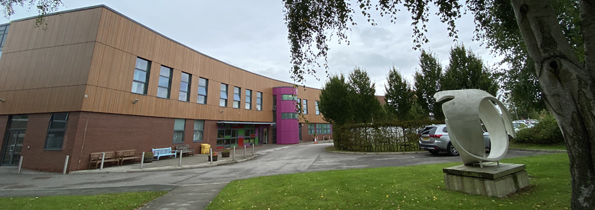
The 2016 Ancora House, just behind the chapel, employs some of the same devices that were used in The 1829 Building, with a central, noticeable and colourful entrance flanked by evenly positioned rectangular windows on a long facade.  Even the sculpture outside is a throwback to attempts to make the surrounding estate more attractive.

The 1829 Building is no longer longer devoted exclusively to mental health care  but contains other departments too. Other parts of the Countess of Chester continue to offer psychiatric support as mental illness continues to be a problem for families, for state and for society.  The modern Ancora House which opened behind the 19th century asylum chapel in 2016 and is shown here has now taken over much of that role.

Chester asylum was an early adopter of many aspects of the “moral treatment approach,” particularly impressive in a public asylum. With access to the airing courts, gardens, and facilities for entertainment and social engagement, the   Its oversight committee and its superintendents seem to have had the interests of its patients at heart, even when the growing numbers of patients was clearly becoming a problem as the century proceeded.  I have not yet been able to follow its fortunes beyond 1870, and I do wonder if, like so many contemporaries, it became swamped with the sheer volume of patients, and began to abandon its attempts to create an empathetic and socializing environment.  That’s a project for another time.

There are several other lines of potential investigation, with many more avenues to pursue, covering a much longer timespan than the sixteen years of 1854-1870 covered here, and there is a lot of work to be done on this very important topic to understand mental healthcare in the 19th century and more recent periods in the Cheshire and neighbouring areas.  It would be lovely to see something like the Staffordshire’s Asylums Project set up for Chester.


Final Comments on parts 1 and 2

Cheshire Lunatic Asylum water tower, now on Frost Drive, in the middle of a modern housing estate

It has been an absolute voyage of discovery to learn about the development of lunatic asylums in England and Wales, and often thoroughly hair-raising.  The notoriously punitive asylums of the late 17th and early 18th century became more regulated, and reformist asylum owners introduced new “moral treatment” approaches that were far more empathetic, attempting to work towards cures.  Many of these approaches were incorporated into public asylums, and as early as 1853 the Cheshire Lunatic Asylum had abandoned the use of physical restraints, in accordance with new rules.  These approaches acknowledged that there was no cure-all solution, and that different symptoms required flexibility towards the provision of a range of treatments.

It still seems remarkable to me that as I was reading all the standard texts, as well as first-hand 19th century accounts about lunatic asylums, both public and private, the Cheshire Lunatic Asylum is almost never mentioned under any of its alternative names.  The first thing I do when I get hold of a new book is flip to the index, or if it is a paper saved as a PDF, do a word search, but Chester is almost never mentioned. It seems to have fallen between the cracks in the history of 19th century lunatic asylums, which strikes me as somewhat peculiar.  As a vast county lunatic asylum for paupers, growing every year, and battling to maintain standards with ambitions to restore its patients to society, it seems to have been something of a pioneer.  And yet it is almost never mentioned.

Page 487 from Conolly’s 1830 “An inquiry concerning the indications of insanity : with suggestions of the
better protection and care of the insane”

Reading the original texts of people like Samuel Tuke (1811), John Conolly (specifically his 1830 thoughts) and Robert Gardiner Hill (1838) and even the later reports for the Chester asylum, there is a sense of a brave new world, an innovation of care for the mentally unwell, and a profound interest in helping those who were suffering to find a route back to a conventional and peaceful life. The Cheshire Lunatic Asylum under Dr Nadauld Brushfield was a part of that trend to find answers and help rather than subjugate the mentally ill.

With hindsight, the approaches that seemed so pioneering, the product of real humanity and social conscience, were limited in what they could achieve and they have come under some criticism today.  First, it is suggested that they suffered from a normalizing attitude, failing to differentiate for treatment purposes between multiple possible causes of insanity, whether medical or psychological, treating all forms of mental illness as though they would respond to a single homogeneous approach. These ethically driven asylums have also been accused by influential writers like Foucault of trying to use coercion and incarceration to impose strict behavioural norms as a form of social control to conform to middle class values of decorum and self-control, although this seems to miss the point that patients in many asylums were no longer treated as sub-human but were given the dignity of being treated as coherent, thinking participants in a community and were provided with an opportunity to learn how to re-integrate.  However not all mental afflictions could be approached with those treatments.  As more people entered asylums a significant problem seems to have been one of resources.  The empathetic approach of moral treatment became far more difficult to apply to even those for whom it may well have worked.  At the same time, there was a change of direction to begin categorizing different types of mental illness to make the task of looking for solutions, remedies and cures far more scientific.  It resulted in some truly shocking approaches, most of which have now been abandoned.

There is a sense running through the 16 years of the reports used here that the Cheshire Lunatic Asylum, whilst experiencing problems due to overcrowding and occasional personnel issues, was a well-run and compassionate institution that suffered few suicide or escape attempts, and did its best to provide quality of life for its inmates.  Even so, care did not equate to cure and it is obvious that there was a long way to go before treatment was converted to remedies and solutions that endured.

Finally, the uncertainties regarding mental health today mean that the 19th century attempts to address these issues are all the more impressive, even when the challenges of implementation did not live up to what were often, although not always, very good intentions.  As I commented at the end of part 1, and since which time I have done a lot more reading on the subsequent 20th and 21st history of mental health, from the beginning of lunatic asylums governments have struggled to know how to cope with those suffering from mental illness.  Institutional care for patients suffering from mental illness is no longer a prominent feature of state responsibility, specialist institutions having been largely replaced by “care in the community” since the late 1980s when Prime Minister Margaret Thatcher, responding to an Audit Commission report in 1986, made it a reality.  This potentially deprives the mentally ill from a sense of community and support that institutions dedicated to their care might provide. Some social scientists and sociologists like Andrew Scull argue that apart from a very few exceptions like syphilis and pellagra, absolutely no consensus exists even today on what causes mental illnesses or how to handle most forms of severe mental instability: “A penicillin for disorders of the mind or brain remains a chimera.”  Whilst medicine continues to make advances all the time, and in spite of the fact that “mental health” is now one of the most over-used terms in modern society, the treatment of mental illness is still in need of much more investment and resources.


Afterthought – coats of arms associated with the asylum


This is the emblem included on most of the Reports of the Committee of Visitors and Superintendent of the Cheshire Lunatic Asylum, and a version of it appears on the pediment of the 1829 building.  Both versions show the Chester coat of arms at the centre, showing the usual three wheat sheaves, but the mottos differ.

In the report version, the crowned coat of arms has the words “Honi Soit qui mal i pense” around the three sheafs, meaning “shame on anyone who thinks evil of it.”  The text on which the arms rest reads “Antiqui Colant Antiquum Dierum” meaning “Let The Ancients Worship the Ancient Days.”

Pediment of the Cheshire Lunatic Asylum

On the pediment there is no text around the coat of arms, but beneath the motto on the pediment the text reads “Jure et dignitate gladii, a phrase often associated with the Chester coat of arms, meaning “by the right and dignity of the sword.” Sorry it’s a bit fuzzy – I took it with my smartphone when I was there for a jab!

Flanking the coat of arms in both examples are two dragons, each with wings and forked tails.  The dragons in the pediment only have two legs.  In  both versions each dragon holds a feather, the meaning of which eludes me, although I believe that this motif is usually associated with the Black Prince (Edward of Woodstock, son of Edward III, who had been invested with the earldom and county of Cheshire in 1333), and was later adopted by Henry VII.  If anyone can decipher this dragon-related symbolism for me, please get in touch!
xxx

Sources:

This second part of the piece on the Cheshire Archaeological Asylum depends almost completely on the annual Reports of the Committee of Visitors and Superintendent of the Cheshire Lunatic Asylum Reports for the years 1854-1870.  Thankfully, the Wellcome Collection website has the digitized records of the Reports produced between and 1855 and 1871 (relating to the years 1854 to 1870), which have been digitized and are available for download free of charge.

All other sources are listed on a separate page because of its length, covering both parts of the post, updated at the time of posting part 2 here:
https://basedinchurton.co.uk/heritage/sources-for-cheshire-lunatic-asylum/
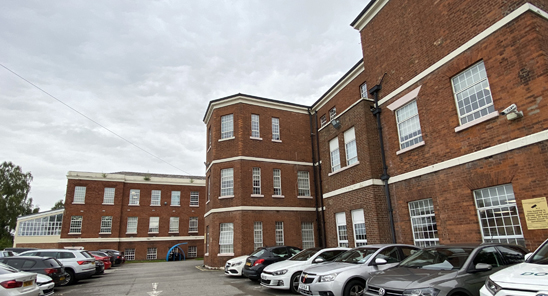
 

The rear of the 1829 Building as it is today


==

The Cheshire Lunatic Asylum 1854-1870 – Part 2.1

Chester Lunatic Asylum in 1831, two years after it was built. From Hemingway’s History of the City of Chester.  Source: Wellcome Institute Library via Historic Hospitals, Cheshire


The 1829 Building, built as Cheshire’s first lunatic asylum, as it is today (What3Words ///tiger.manual.waving)

===

When I posted Part 1, I divided it into two (part 1.1 and part 1.2), to prevent page loading problems, and have done the same with Part 2. Both parts are too long for a blog, and when I have the time during the winter I will probably put them on a website of their own. Part 1 introduced the Chester Lunatic Asylum and discusses the general background to lunatic asylums in England and Wales from the 18th century throughout the 19th century, including medical and legal approaches to a growing problem, as well as some scandalous cases of illegitimate incarceration.  Part 1.1 also addressed some of the terminology used in these two parts (such as “lunatic,” “asylum,” “idiot” etc) that are considered pejorative today, but were part of the standard vocabulary of the Victorian period.

Part 2 focuses at the Chester asylum itself, the name of which changed several times since its foundation as the Cheshire Lunatic Asylum in 1829.  Again, it has been divided into two parts, mainly because of the number of images used, which would take too long to load if I left it as a single piece.  This is part 2.1.  Part 2.2 is here.

As I have said in Part 1.1, I first became aware of the Chester Lunatic Asylum when I was doing some research into 19th century suicides in Chester as part of a larger and ongoing project about Overleigh Cemetery, and found that most of the suicides had been deemed to be insane at the time of their deaths.  This lead me to find more about how insanity was handled in the area, and I discovered that there had been a lunatic asylum at Upton in Chester, something that most long-term Chester residents probably already know.  I found that the original asylum building and some of its related structures were still standing, and began to look into the asylum and its history.

The Cheshire Lunatic Asylum was a public institution that opened in 1829 to house pauper lunatics as well as a limited number of paying private patients.  The asylum opened on a 10 acre site to accommodate 45 women and 45 men, reflecting the fairly even numbers of both men and women at asylums in the 19th century. The asylum grew throughout the 19th century into the 20th century, and eventually occupied a significant area of over more than 55 acres.  The term “pauper” covers a range of people.  Some were genuinely very impoverished; others were employed but their were unable to afford asylum costs.

The emphasis in the following post is on letting the asylum speak for itself as much as possible.  I have made extensive use of quotations from the annual Report of the Committee of Visitors and Superintendents.  This was a legally required document, produced by every asylum to account for itself in terms of both performance and financial management for the period of the previous year.  There is an immediacy to the original material that provides a vivid sense of the asylum.  The reports used here cover a period of 16 years, between 1854 and 1870.  A new medical superintendent had been installed at the asylum in 1853 following a very negative report by the Visiting Commissioners in Lunacy, so the 1854 report marks the beginning of a new era.

xxx

The location of The 1829 Building. Source: streetmap.co.uk

===
Prosperity and poverty in 19th century Chester

Because the Chester Lunatic Asylum was built primarily to cater for paupers, it seems useful to provide a very brief summary of the nature of poverty in Chester in the mid 1800s, the period in which the reports used for this post were produced.

Chester Railway Station. Photograph by Tanya Dedyukhina, CC BY 3.0. Source: Wikimedia Commons

The Victoria History argues that the mid-19th century “was Chester’s most successful period between 1762 and 1914” and Handley describes the 1860s and early 1870s as “relatively buoyant,” unlike other regions in which hunger riots had broken out.  Although the Industrial Revolution did not transform Chester in the same way that it did elsewhere in the northwest, it left its mark.  Although the river Dee had been an important artery connecting Chester to the sea, and had once had a prosperous shipbuilding industry and marine port, silting eventually undermined its important role.  This meant that throughout the 19th century the emphasis on water-borne trade shifted to Liverpool. With the declining importance of Chester as a port and the arrival of the railway in 1840, the Chester canal system became largely redundant. The railway, with today’s station opening in 1848, provided temporary work for both engineers and unskilled labourers and more permanent work for a much smaller number.  A varied economy helped to spread the risk of low industrialization compared to other areas. Light industry was organized mainly in the canal basin and railway areas, expanding south of the river to the Saltney area. Industrial activity was represented by engineering companies, metal manufacturing, steam mills, a lead works, an anchor and chain works, three oil refineries and a chemical works amongst other enterprises.  Craft trades continued to thrive, including tailoring, shoe-making, milliners, dressmaking, bookbinders, cabinet makers, jewellers and goldsmiths.  Domestic service was an important source of employment for the less well off, in both the town centre and the suburbs, as was gardening.  Retail and related services such as banking and insurance grew in importance.  Tourism became an important source of income thanks to the railway, and Chester was a popular shopping destination. Chester’s expansion of commerce and light industry included roles for unskilled workers, but although many of these might earn enough to support themselves and their families, they were able not to afford such luxuries as health care, including private asylums, and it was often difficult to find job security.

Chester’s prosperous image concealed an underbelly of poverty, with dreadful insanitary conditions concentrated in slum areas known as “the courts.”  Whilst St John’s parish became particularly notorious there were patches of poverty in the Boughton, Newtown, Hoole and Handbridge.  The  Irish Famine of 1845-52 drove starving people out of Ireland, and Chester received a large number of impoverished Irish refugees, including entire families, many of whom moved into the poorer quarters of Chester, with a concentration around Steven Street in Boughton.

Population by year in 19th Century Chester. Source: John Herson 1996, Table 1.1, p.14

Unsurprisingly the population grew on the back of all this activity.  Figures have been provided by John Herson as follows, showing how during the period of the asylum the population grew and continued to grow after the Victorian period, as shown in the graph to the right.  Michael Handley points out that pauperism increased at an even greater rate than population growth, with an increase in vagrancy as well, causing problems for all institutions that provided support for the poor.

From the mid-18th century Chester developed a strong line in charitable and philanthropic activities, with a new workhouse, infirmary and various other institutions supporting paupers.  Pauper children could be subsumed into the general population of the impoverished. Although charity and church schools took in some of the poorer children, the most impoverished and vulnerable, sometimes the children of criminals and certainly in danger of becoming criminals themselves, were not at first provided for.  Some of them entered the workhouse, and others were taken into the lunatic asylum, but the problem of pauper children was eventually recognized by Chester philanthropists and three free schools for known as “ragged schools” were built.  In 1900 a children’s home was built just outside Chester on Wrexham Road, which still stands, now converted to residential use.

The Chester Workhouse on the Roodee. Source: Chesterwiki

One of the last-resort solutions for those who were out of work and unable to support themselves was the workhouse. The workhouse was not an intentionally punitive institution before the New Poor Law Amendment Act of 1834, but afterwards became a means of driving the able-bodied poor back into employment, becoming notorious for their harsh policies and conditions.

The first Chester workhouse was established in 1575 just outside the Northgate and more parish workhouses were established after the Workhouse Test Act of 1723. From 1793 and 1869 poor relief was administered by the Chester Local Act.  In 1790 nine Chester parishes joined forces to become an incorporation governed by the mayor, justices of the peace and a large committee of guardians, and took control of the workhouse from the city council under a 99 year lease at a fixed annual rate.  The workhouse was on the Roodee, with the river in front of it.  It was flanked by a gasworks on one side and a timber yard on the other, with the the railway eventually built behind it.  The New Poor Law Amendment Act of 1834 imposed new rules on workhouses, but the Incorporations like Chester’s were largely exempt and Chester refused to release control of the workhouse, maintaining its independence. After 1845 workhouses  were subject to inspections in the same way as lunatic asylums, and there were frequent negative remarks in the reports.  As Handley put it, the Chester workhouse “deteriorated from inadequate to calamitous as the population rose by 66% from 1831 to 1871, accompanied by increased pauperism,” and there had been no new accommodation added since 1834.  The Incorporation only gave up its right to run the workhouse in 1869, and at that time the Incorporation became the Poor Law Union.  In 1871 it absorbed the Great Boughton Union.  Between 1874 and 1878 a new union workhouse was built in Hoole with a separate infirmary and school, and the old Roodee building became a confectionery works. The entire Hoole establishment was eventually converted to use as a hospital in 1930, and became the Chester City Hospital in 1948.
===

The medical-institutional context in Chester in the 18th and 19th centuries

The Bluecoat School, Chester, which became temporarily became a hospital in 1755. By Dennis Turner, CC BY-SA 2.0. Source: Wikipedia

By 1829, when the Cheshire Lunatic Asylum opened in the Upton area of Chester, the city was becoming well supplied with institutions that took in the poor, the sick and those suffering with mental illnesses.

The Victoria History for Chester lists a number of medical institutions from the 18th century.  In the early 18th century a charity dispensing medicines to the poor was set up in 1721.  In 1753 an endowment enabled the establishment of the General County Infirmary. It was temporarily based in the Bluecoat School at Northgate, receiving out-patients in 1755 and in-patients from 1756, moving to its new site facing City Walls Road in 1761, with fever wards added in 1784 and remodelling carried out in 1830.  A dental surgeon joined the hospital in 1853 and an ophthalmic surgeon was added in 1885.  Nearly all the positions were unpaid, with work being carried out on a charitable basis.  The hospital also began to treat patients from beyond the city parishes, as well as paupers from other institutions including the county gaol, the workhouse and those being held in police cells.

In 1798 Dr Griffith Rowland funded the Benevolent Institute, a subscription charity that provided midwives for poor women.  Temporary isolation wards for infections diseases were established for outbreaks of cholera in 1832, 1849 and 1866 but in 1899 a permanent isolation hospital was opened for 46 patients, supplemented by temporary accommodation during outbreaks.  A homeopathic institute was established in Lower Bridge Street in 1855 followed by a free homeopathic dispensary in 1878.

Table from the 1868 “Report of the Commissioners in Lunacy to the Lord Chancellor” 1868 showing Chester pauper lunatics not in asylums. It is not surprising, looking at this, that in 1871 a new asylum was opened in Macclesfielld in 1871.

Workhouses inevitably admitted those who became sick or experienced injuries, as well as the insane and those with learning difficulties.  At the Chester workhouse, the sick were either visited by Chester Infirmary medical staff or were admitted to the infirmary itself.  In 1861 the Poor Law Board published a record of the names of 29 adult paupers who had been inmates for a continuous period of five years or more, of whom 9 had a weak mind (31%) and 2 were subject to fits (5.9%).  Fits could be a sign of epilepsy, but were treated as bouts of madness.  There was no strategy for dealing with the sick and the mentally ill.  Handley’s verdict is that the board “simply responded to the pressure of circumstances,” not adding a an infirmary until 1842.  The new Chester workhouse at Hoole provided a ward for imbeciles and lunatics in its own block in the late 1870s.   After 1834 workhouses were supposed to send their mentally ill patients, and those with learning difficulties, to the local asylum, but this did not always happen as the cost of referring patients could be higher than retaining them, particularly when an infirmary or a lunatic ward had been built.

According to the Victoria History, two private asylums are recorded on Foregate Street in 1787 but otherwise the only provision for the mentally unwell was the workhouse,Lunatic asylums for paupers had been built elsewhere in England, after the County Asylums Act of 1808 which permitted the use of county funds and the raising of rates to pay for them.  Few asylums were built at this time but they included Norfolk in 1814, Lincolnshire in 1820, Cornwall in 1820 and Gloucester in 1823.  The County Asylums Act of 1828 gave county magistrates the right to take out loans to help pay for asylums, and tightened up administrative procedures and overall accountability.  The Cheshire Lunatic Asylum followed in 1829.  It was not until 1845 that the Lunacy Act of that year made county asylums compulsory.  Andrew Scull, having ruled out a direct correlation between industrial cities and large asylums, suggest that expanding market economies and commercialization were more influential, and this does seem to mesh with conditions in Chester, where prosperity was on the rise of the merchant class and new light industries.

Sketch of the original plan of the Chester workhouse at Hoole. Source: Chester – A Virtual Stroll Around the Walls

In 1837 the Poor Law Commissioners estimated that there were 2780 (20%) “Pauper Lunatics and Idiots” in pauper lunatic asylums, 1491 (11%) in private asylums and 9396 (69%) in workhouses or on outdoor relief (figures assembled by Alistair Ritch).  Mentally ill patients, and those with learning difficulties were frequently exchanged between asylums and workhouses, as well as between different asylums.  In Chester, the workhouse sent its violent and difficult mentally ill patients to the Cheshire Lunatic Asylum, but also received those who were deemed to be long-term and incurable but harmless in return.  This was nearly always due to over-crowding and although there were guidelines and criteria for what sort of patients should be held in each institution, it was not always possible to follow these, and decisions were often based on what was needed at the time, rather than being informed by laws, regulations or specific strategies.  The New Poor Law Amendment Act of 1834 determined that dangerous patients were to be sent to the asylum, along with those who might be cured, and incurable harmless patients could be retained in the workhouse, but beyond these broad distinctions, the criteria for which patients should go to the workhouse and which the asylum, and who was in charge of the decision-making process, were never fully delineated.  The Lunacy Amendment Act of 1862 lead to many workhouses building new wards for the intake of lunatics and those with learning difficulties.


The opening of the Cheshire Lunatic Asylum 1829

The 1829 Building at the Countess of Chester Hospital, the former lunatic asylum

The Cheshire County Lunatic Asylum opened in 1829 as a public treatment centre for those with mental illnesses, catering for the entire county. It had capacity for 90 patients, half of them men and half of them women, consisting of 70 paupers and 20 private patients.  When I first looked up the asylum online to see what it had looked like, I was surprised that the exterior had the appearance of an elegant and stately neoclassical building, looking very much more like a property attached to a country estate than the intimidating prison-type establishment that I had been expecting.

The number of new admissions at the asylum from 1829 to 1870

The asylum had been built as the result of the County Asylums Act of 1828, which gave county magistrates the right to build new asylums.  The Act did not make building of county parishes obligatory, and many counties did not bother until the 1845 Lunacy Act, which did make the building of county asylums compulsory.  This makes the Chester lunatic asylum of 1829 something of a pioneer, built only a year after the 1828 Act.   The need for the asylum was proved as patient numbers rose and the asylum itself began to expand to meet a demand that grew throughout the period.

The annual rates could be used to pay for asylums, and rates could be raised to absorb the cost.  Ongoing costs were paid for, per patient, by the parishes, townships and unions from all over Cheshire whose Relieving Officers sent patients to the asylum.  Relieving Officers were responsible for the managing the relief of the poor in parishes.  Sometimes asylums were additionally supported by town council grants and charitable donations, and the Chester asylum benefitted from both.  Small numbers of private patients were also included, and these contributed to the asylum’s overheads.  The patients who worked in the asylum as part of their treatment eventually helped move the asylum towards self-sufficiency, with both men and women making most of the clothing and bedding in-house.  Men additionally helped with building alterations, whilst the asylum farm in which patients worked helped to provide the patients with food.  A charitable fund was eventually set up to help those who were discharged from the asylum to re-establish themselves.

Listing of asylum departments provided by Hemingway in 1831, p.229

The former editor of the Chester Courant newspaper and author of History of the City of Chester, from Its Foundation to the Present Time, Joseph Hemingway, writing in 1831, two years after the asylum opened, describes the institution as follows:

A short distance from the road on the left, stands a large building, erected under the direction of the county magistrates, as a county lunatic asylum. This benevolent institution was raised at the expense of the county; to which that never failing source of revenue, the river Weaver, materially contributed. It occupies, with its gardens, airing grounds and roads, ten statute acres of land, which was purchased from the late Revr. Sir Philip Egerton, Bart. The terms for maintaining lunatic paupers belonging to the county are 7s.6d. per week; and – those beyond its limits, 10s. The unfortunate inmates of a higher class are provided, for by special agreement. . . . Ll. Jones M.D. is the physician, Mr. W. Rose, medical superintendent, and Mrs. Bird, matron of the institution.

Plan of the Cheshire Lunatic Asylum 1828. Source: A History of the County of Chester: Volume 5, Part 2

The Chester lunatic asylum was a brick-built 17-bay building with stone dressings retains its elegant neoclassical exterior.  It was designed by the County Architect, William Cole jr., and bears a strong resemblance to the 1751 St Luke’s Asylum in London. It was started in 1827 and completed in just two years.  There were three main arrangements chosen for asylum designs: the single corridor type, in which individual wards and rooms were connected by one main corridor in the same building, centralized star-corridor arrangements where a central building was connected to outer buildings by a series of corridors, and pavilion types in which separate buildings were all built on the same site.  The Chester asylum was of the first type, built with a main corridor that drew the two sides together, with men on one side and women on the other, divided by the central administrative block.  Additional separate buildings were added on the site as required.

A suggestion of the extent and dating of the asylum as it grew from 1839 to 1936, with the red section including the original 1829 building. Source: History of Upton-by-Chester

The resemblance to wealthy country estates on the outside was merely aesthetic.  Interiors were modelled on institutions like workhouses and hospitals, combining a dignified and attractive external appearance, representing civic pride, with the requirements of large and complex institutional operations.  Requirements included food acquisition, preparation and production; cleaning, sanitation and laundry; exercise indoors and out; entertainment and sport; supply of clothing and bedding; furnishings; specialized areas for treatment and segregation; confinement; medical oversight including the provision of drugs; the sourcing and accommodation of management, supervision, nursing personnel and attendants (also known as keepers); and on-site religious guidance.  It is clear that whoever employed William Cole or was very familiar with the current thinking about asylum design and building requirements for patient treatment.  Cole’s layout was based on long corridors connecting both sides of the building with the central area and two wings (known a return ranges).

The central 3-storey section of the building under the brightly coloured pediment contained the administrative offices, a chapel, and housed the medical superintendent, the matron and the bedrooms of senior staff.  The design in the pediment consists of a central coat of arms  showing the three sheaves of Cheshire  The rest of the building was 2-storey and stretched either side of the central block.  The interior consisted of wards and rooms that were connected by corridors, with men on one side and women on the other.  Basements ran the full length and as well as containing functional areas like the laundry, bakery and kitchens, also housed some of the more uncontrollable patients.  Flanking wings (return ranges) were parallel to the main drive that extended to Liverpool Road and either side of the drive were “airing courts” where patients could walk and benefit from fresh air and carefully chosen plantings.  There was provision within the building for a hierarchy of administration and nursing, food storage and kitchens, a bakery, a laundry, spaces for recreation and exercise, secure rooms and equipment for restraint (abolished at the asylum in 1854) and isolation, areas for specialized treatments as well as nurses’ accommodation, a boiler house and a splendid brick-built water tower (the latter recently restored, located on Frost Drive, in the middle of a housing estate, indicating just how much the asylum’s footprint has now been reduced).   There were two lodges, one at the main road where the head gardener lived with his wife, the latter working as entrance keeper.  Another lodge was located in front of the great court and its main gates, and was managed by the head porter.

Every year the the annual Report of the Committee of Visitors and Superintendents recorded details of repairs to the interior and exterior of the building, and on the whole the building seems to have been well built and maintained, with both practical considerations and quality of life being taken into account.

As the asylum expanded several times to meet the growing needs of growing inmate population other architects were brought in develop it.  It was first extended to the rear in 1849 and again between 1857 and 1863. The 1863 development was designed by Thomas Penson and unlike the original building was gothic revival in style, reminiscent of Penson’s earlier 1858 Crypt Chambers on Chester’s Eastgate Street.  Most of the additional buildings have now been demolished and replaced by both newer hospital buildings and housing, but the asylum building that opened on 25th August 1829 and the former 1856 Grade II listed 6-bay chapel have both survived, now in use for other functions, as well as the later water tower that replaced the hand-operated pump.  One of the former epileptic treatment villas dating to around 1912 is still standing, but boarded up and fenced off.

The rear of the 1829 Building

The annual Report of the Committee of Visitors and Superintendents for 1854 comments that following the appointment of a new medical superintendent in 1853, improvements were required for the care of patients and these were of a very basic nature.  Essential improvements, for example, included clothing, bedding and cutlery.  That raises questions about the standards of care and the attention to patient environment between its establishment in 1829 and 1853, but after that it seems clear that the emphasis was very much on the approach advocated by William and Samuel Tuke, Robert Gardiner Hill and others, who developed the “moral approach” that attempted to treat patients as individual members a community, reducing punitive treatments and eliminating mechanical restraints.

Reflecting its complex history, the 1829 Cheshire Lunatic Asylum underwent a number of name changes. The  National Archives list them as follows:

  • 1855 Cheshire Lunatic Asylum
  • 1899 Cheshire County Lunatic Asylum
  • 1921 Cheshire County Mental Hospital (when Cheshire County Council assumed responsibility, for the first time dropping the word “asylum” in favour of hospital, reflecting a change in attitude to care for the mentally ill)
  • 1948 Upton Mental Hospital (when the new NHS assumed responsibility)
  • 1950? Deva Hospital
  • 1965 West Cheshire Hospital
  • 1984 Countess of Chester Hospital

It should be noted that different sources list different dates and names.  The annual Report of the Committee of Visitors and Superintendents, for example, does not record a change of name between 1855 and 1869.  In 1870 however, in the report for 1869, the name was changed from the Cheshire Lunatic Asylum to the Chester County Lunatic Asylum.

Thomas Nadauld Brushfield in later life. He was appointed in 1853 and remained at the infirmary until 1866.  Source: Wikipedia

Far more nebulous in the records than name changes are the different regimes that operated throughout the asylum’s history, under different superintendent, physicians, matrons and the body of staff responsible for supporting patients and handling patients directly.  The ideological lead of a superintendent in any asylum was all-important, but so was the availability of resources and the willingness of those financing an institute to make them available at different times for repairs, expansion, new equipment, better quality food and medicines, and higher salaries.  These annual reports demonstrate how oversight by the Committee, its Chairman and the visiting Lunacy Commissioners were important to the maintenance of standards.

A number of different superintendents were employed at the asylum between 1854 and 1870, the period that this post covers.  In 1853 Thomas Nadauld Brushfield M.R.C.S. (Member of the Royal College of Surgeons) (1828 – 1910) was appointed, remaining in the office for thirteen years until 1866, becoming the first resident Medical Superintendent.  Having completed his university studies in medicine, he worked for a period at the Bethnal House Asylum in London, the conditions of which horrified him.  From his Chester Asylum reports, it seems that the experience encouraged him to become a follower of the moral treatment ideology, which he implemented in numerous ways at the Chester asylum, including the implementation of a regime of treatment without mechanical restraint.  Beyond the asylum, he made a significant contribution to the understanding of Roman Chester, recording and publishing the hypocaust of the aisled exercise hall and hypocausts belonging to the Roman fortress baths in 1863, when the Feathers Inn was demolished.  His 106 page report in the Chester Archaeological and Historial Society (founded 1849) accompanied by photographs that have been He left in 1866 to become the Medical Superintendent at the new Brookwood Lunatic Asylum in Woking, Surrey, which opened in 1867 with a capacity for 650 patients.

Dr Brushfield was replaced by H.L. Harper M.D. who had been Assistant Medical Officer for the asylum and was now promoted to Medical Superintendent at the asylum for 1866 and 1867.  Harper resigned in 1867, although it is not stated why in the relevant report.  Harper was replaced by John H. Davidson M.D. in 1868, the former Assistant Medical Officer for the previous 12 months, who was still in the position when the online reports end in 1870.  Davidson’s promotion left a vacancy for the Assistant Medical Officer, which was filled in 1868 by Dr Arthur Strange of the Gloucester Asylum.  Davidson is notable for his 1875 publication A Visit To a Turkish Lunatic Asylum, when he was apparently still Medical Superintendent at the Chester asylum.

Two dragons, each clutching a white feather and supporting the Chester coat of arms.


Primary Sources

Records consulted in this post

Most of the documentation for the Chester asylum is held by Cheshire Archives and Local Studies, which has not yet digitized the asylum’s records and which is closed until 2026, so for the time being the records are unavailable.  Fortunately, there are a set of the Reports of the Committee of Visitors and Superintendents available for download on the Wellcome Collection website, covering the years 1854 to 1870.  Considered both individually and together, these do have some very interesting information to impart.

Also available are the Reports of the Commissioners in Lunacy to the Lord Chancellor collated and reported on by the commissioners responsible for public asylum oversight, which were sent to the Lord Chancellor.  Not all of these are available for the period in which the Chester asylum was operating in the 19th century, and not all of them mention the asylum, but there are some useful references in those reports that I have located, dating from 1854 to 1870.

Use has been made of records of deaths at the asylum from Overleigh Cemetery provided by Christine Kemp’s research, which she has recorded on the Find A Grave website. Chris’s research into Overleigh Cemetery has provided information about some of those asylum patients who were buried from when the Cemetery first opened in 1850.  This includes information inscribed on graves, plot details, and newspaper reports about some of the deaths concerned.
xxx

Records that have not been consulted

Title page of the of the 21st Report of the Commissioners in Lunacy to the Lord Chancellor 1867 (for the year 1866)

This overview of the Cheshire Lunatic Asylum is obviously incomplete without access to other records.  The most important are the Asylum’s own records, which are held at the Cheshire Archives and Local Studies and will not be available until 2026.  In addition, I have not yet managed to gain access to the data held by the Riverside Museum in Chester where other archives that have not yet been digitized are held.

The majority of this post has been based on the Report of the Committee of Visitors and Superintendents, but as mentioned above I have only have only been able to access the records for the years 1854 – 1870, and this means that it is impossible to make any statements about long-term trends from 1829 to the end of the 19th century.  Given how much data is in these reports, to which I have barely been able to do justice, it is probably just as well!  In addition, although the reports include accounting information, I have not attempted to tackle this source of data, because accounting is not one of my skill-sets, although I have included a few screen grabs to show what sort of data is available.

Originally I had intended to use both Reports of the Commissioners in Lunacy to the Lord Chancellor, in which the reports submitted by individual asylums and the visiting inspectors were collated into a single annual report on the state of lunatic asylums. I had also planned to use newspaper reports from online archives. Unfortunately, this post is already very long, so that plan has been shelved for the time being.

Doubtless records from other institutions will also come to light, such as workhouse and other asylum archives that detail patient transfers to and from the asylum.


Information available from the annual Visitor and Superintendent Reports

In 1845 the new lunacy laws required that the Commissioners of Lunacy should report to the Lord Chancellor on the state of every public asylum.  Reporting requirements were therefore standardized at the same time.  Part of this reporting process included a report made by every asylum for the Lunacy Commission and this was collated into an overall report for the Lord Chancellor.  Accordingly, each year the Cheshire Lunatic Asylum produced its Report of the Committee of Visitors and Superintendent of the Cheshire Lunatic Asylum, presented  to the General Quarter Sessions of the Peace and submitted to the Lunacy Commissioners.  The chairman of the asylum’s committee, the medical superintendent and the two visiting lunacy commissioners, as well as sometimes the chaplain, all contributed to this annual report.  As most of this post is based on these reports from 1854 to 1870, below is a brief description of the format of these reports.  I have used the earliest as an example, which was published in 1855, but covered the year 1854, twenty five years after the asylum first opened.  Although the reports could presumably be massaged to provide an acceptable face, after the Lunacy Act of 1845  the combination of record-keeping and oversight by the committee responsible for the asylum, together with visits by the Lunacy Commission, helped to make public asylums more accountable than they ever had been before.

The Cheshire Lunatic Asylum report for 1854.

The title page changed very little from year to year.  It shows that the report is made to the General Quarter Sessions of the Peace, and that this took place at Chester Castle on the 2nd July 1855.  The General Quarter Sessions of the Peace, usually abbreviated in reports to to “the Quarter Sessions,” were local courts in England and Wales presided over by Justices of the Peace and held four times a year.  The PRESENTED BY stamp was signed by the incumbent medical superintendent for the asylum, and was counter-stamped by the Royal College of Surgeons.  Later, the county arms were added to the bottom of the report.

The report goes on to present narrative accounts of the state of the asylum for 1854. After the reports for 1854 and 1855 these were standardized to include a statement by the Chairman of the committee that oversaw the asylum, another by two commissioners of the Lunacy Commission and an account of the main points of the year by the Medical Superintendent.  These are followed by a series of statistical tables, including information about patient numbers and activities, and accounting information.  None of the patients are mentioned by name in either the accounts or the tables and there are very few references to individual patients unless one had escaped, committed suicide or was otherwise a particularly notable case.

The running order of the individual contributions to the report changed from year to year, although the format of the statistical tables was very rarely altered.  In the 1855 report for 1854 the first of the reports was by the Committee of Visitors, which gave an overview of what they believed to be the most important aspects of the year’s main findings including building works and the associated costs.  A number of personnel retirements were also associated with costs for pensions.   Concerns were expressed about the number of admissions during 1854 and the fact that the building would have to be further expanded if numbers were to continue rising.  In future reports the Chairman made a separate statement, but in this report the Committee of Visitors report was countersigned by the chairman.

An excerpt from Dr Brushfield’s 1855 report for the year 1854

This was followed by the Medical Superintendent’s statement.  For 1854 this went into some detail under 16 side-headings: Admissions; recoveries, deaths; general health; suicidal cases; general paralysis; restraint; escapes; employment; amusements; exercise beyond boundaries; diet; dinner and services; clothing and bedding; night attendants; and removal of heavy guards (the latter referring to window guards).  The headings could change slightly from one year to the next depending on what was deemed to be the most important information for a given year.  In some years accounts were very much shorter than in others

To give a flavour of the superintendent’s statement, Dr T.N Brushfield notes that at the beginning of 1854 there were 102 patients, 52 men, 50 women; by the end of 1854, counted on January 1st 1855, there were 254 patients (108  men and 146 women) as well as 102 new admissions of which there were a greater number of men than women.  Interestingly Brushfield comments the importance of a speedy referral to the asylum of mentally ill patients so that they could be treated effectively.  This reflects a widespread view in the alienist community that speedy referral was key to any hope of a cure.  Brushfield adds that many of the new admissions were in such a poor physical state that both dietary improvements and stimulants had to be employed but that even when there was bodily improvement, in the cases of patients admitted in such poor physical condition “the mind remained in an impaired condition.”  Only 64 patients were discharged, and 30 died.  Of the deaths, representing 8.92% of the patients under treatment, 30% of them were victims of “general paralysis,” far more common in men than women, and on which more later. 42 suicidal patients had been admitted, 26 of which had actually attempted suicide, more of them men than women, and in several cases unsuccessfully attempted again after admission.  “Several” patients had escaped, but all had been recaptured in less than a day.

Dr Brushfield goes on to comment on the general conditions of the asylum.  He reports, for example,  that “the clothing has been much altered in character and made warmer and more cheerful looking.  The bedding has been considerably improved; the number of straw beds diminished; the straw pillows altogether disused, those stuffed with flock or coir have been substituted.”   Other fundamental improvements included improved diet “of a less liquid nature” (but including the introduction of beer for women as well as men!), and improved dining equipment:  “Dinner and Services:  Earthenware plates, crockery, cups and metal spoons, knives and forks have been supplied to the whole of the inmates in place of the tin plates, horn cups and wood spoons which were in use until the early part of the year.”

These were very basic improvements in the quality of everyday life for patients, but would certainly have been appreciated.  There was a matter of pride in the fact that restraints of all forms had been “entirely abolished.”  Although this had been actioned in 1853, this was in accordance with new rules rather than an independent initiative.  However, the approach that was taken was very much the initiative of the asylum.  Instead of being restrained, patients were given a new sense of direction.  Men were employed in activities relating to the maintenance of the building and the grounds, whilst women took over from tradesmen the making and repairing of clothing and similar needlework.  One of the subsequent tables lists the works undertaken by both men and women.

The first of the statistical tables in the 1854 report

Next, there are 18 numbered tables that record key details about the asylum, its patients and accounts.  These are particularly useful as they can be compared from one year to the next.  Even when the template changed slightly, most of the tabulated data was retained in much the same format, with data separated for men and women:  I) Admissions, discharges and deaths during the year; II) Admissions, discharges and deaths relative to the month of the year; III) Civil State – Admissions; IV) Ages at time of admission; V) Duration of insanity prior to admission; VI) Occupations of those admitted; VII) Religious persuasion – Admissions; VIII) Bodily condition – Admissions; IX) Form of mental disorder – Admissions; X) Supposed cause – Admissions; XI) Analysis of suicidal cases – Admissions; XII) Suicide attempts; XIII) Duration of residence of those discharged and relieved; XIV) Causes of death; XV) Ages of patients who have died; XVI) Duration of treatment of patients who have died; XVII) List of articles of clothing made and repaired during the year;  XVIII) Extract from daily account of patients.

Finally there are a set of unnumbered tables that related to the asylum’s accounts.  These tended to vary from year to year, but their intention was to capture income and expenditure for the period.  Tables that floated from one year to the next were The Average Cost Per Head Per Week of Patients and the Balance Sheet.
===

The Balance Sheet for 1854


Insights from the Visitor and Superintendent Reports for 1854-1870

I have divided this section into some of the themes discussed in the reports, although by no means all, to give a sense of what sort of things were important both to the visiting inspectors and to the superintendent who was in charge of trying to secure more resources for the asylum.
===

Ideology

Robert Gardiner Hill. Source: Wikipedia

Statements in many reports address the ideology of the asylum and indicate that aspects of the moral treatment approach were incorporated from at least since 1854, as per the report for that year:  “it may be stated as an axiom, that everything within the bounds of an Asylum which tends to create a cheerful impression on the minds of the inmates, is certain to have a highly salutary effect.”   Most impressively, according to the report of 1855 all forms of restraint were abolished by the new Medical Superintendent, Dr Brushfield, from 1854 in accordance with new rules, and “nor has there been the slightest reason to regret such a step having been taken; it is certain that its disused has been a beneficial effect on the minds of those patients who, at an time, had been the subjects of it.”  This followed in the footsteps of pioneers in the care of patients with mental illnesses like William and Samuel Tuke and (1732-1822 and 1784-1857 respectively) and Robert Gardiner Hill (1811-1878).

In line with this ideology, in 1854 a team of artisans was employed to work with patients, and various entertainments were arranged including weekly dances, a daily newspaper, periodicals, and a library that was occasionally updated with new titles.  As Laura Blair explains on the Asylum Libraries website:

Within nineteenth-century asylums, attitudes towards reading were expressed as medical directives, framing reading as both a potential cause of, and cure for, mental illness. As the print culture of the era rapidly developed, with a massive increase in periodicals and newspapers following the mid-century period, asylum professionals sought to facilitate an ‘ideal’ engagement with texts. Preliminary research indicates that reading was considered an important part of patients’ leisure and was often regarded as medically therapeutic.

Suitably calm patients were accompanied on walks outside the asylum, on local roads and lanes, giving them both exercise and a wider view of the world and sometimes were even taken to local events.  The range of in-house activities was extended in 1855:

Late 1890s painting “The Retreat” by George Isaac Sidebottom, showing patients at leisure in the asylum founded by William Tuke in 1796. Source: Wellcome Collection

ln the summer months bowls, skittles, quoits, bat and ball, &c., are enjoyed by the males; and on fine clays parties of both sexes, accompanied by attendants, have frequently taken long walks beyond the Asylum boundaries. Reading, and various in-door games have been encouraged as much as possible. The weekly ball has been kept up regularly throughout the year; and while serving to relieve much of the monotony of residence within the walls of an Asylum, it has also tended in many instances to produce a great amount of self-control. By a large number the weekly gathering is invariably looked forward to with much pleasure

Patients were engaged in a very wide range of tasks that supported the asylum, indoors and out, both helping the asylum’s financial burden and giving patients a real sense of purpose, such as working in the gardens and farm, or sewing clothes and bedding.  The 1857 report for 1856 expressed real concern that as the building works came to an end, to which male patients had been contributing,  there would be a hiatus in very beneficial activity:

As the alterations and additions to the building are on the point or completion, a great source or employment will soon be lost to the patients, and although the laying out of the airing courts, remaking roads, &c., may afford work for the next few months, yet when these are finished the present quantity of land is by no means sufficient to keep in active employ the increasing number of inmates, and us no form of labour conduces so much to the recovery of a patient as that derived from ordinary farm and garden operations, it is highly to be desired that more land should be obtained as early as possible.

Examples of the types of employment engaged in by male and female patients at the asylum, from the July 1855 report, over two pages. Source: Wellcome Collection

Accordingly, in 1859 the provision for outdoor employment was significantly expanded, providing work for many of the patients and additional produce for the Asylum kitchens:

The additional land, now under cultivation, has not only increased the means of employing the patients in healthy outdoor work, but has caused a greater variety of employment – a matter of as much importance as employment itself. A sufficient quantity of potatoes has been grown to furnish the requirements of the Asylum until the next crop comes in; hitherto, a large quantity has always had to be purchased. In addition to several acres of beans, peas, mangolds [Swiss chard], etc: 5 acres of grain crop, and l l acres of grass have been harvested by the Patients without any extraneous help. The hay-field contributed materially to afford for a time recreative employment for all the patients and attendants, ordinarily engaged in artizan employments of a sedentary nature; and some of our best haymakers were to be found amongst the Tailors and Shoemakers.

The area employed for the gardens and farmland continued to expand throughout the reports, until this report at the end of 1870, which gives a good idea of the scope of the operation:

Garden and Farm accounts from the 1870 report

In 1862 plans were revealed to establish a voluntary school and bible classes for those patients “who are in a condition to profit by such instruction,” and in 1863 a schoolmaster was appointed to attend twice a week,” with the most beneficial results.”  The school was operated by the chaplain and was divided into two, one for men and one for women, and was operated as a leisure facility, rather than an enforced activity.  It was quite popular, and for those discharged paupers who had had minimal education, if any, would provide them with addition skills such as reading, writing and basic arithmetic.

The report for 1863 contains the usual update from the visiting Commissioners In Lunacy and is a useful example of how they were always searching for improvement in patient conditions:

The state of the inmates of the old wards in both divisions was less satisfactory. Their clothing was not good; and there was an absence of tidiness and comfort.  The proportion of feeble, helpless, and paralysed cases, is unusually great; and they require a larger amount of individual care on the part of attendants. Their sluggish faculties should be stimulated by continuous efforts to rouse and occupy them. There should be reading aloud among them. A few of the more intelligent patients who might not object to help in amusing this unfortunate class should be brought into their wards, and others of the more capable who are here should be removed to No.6. We learn from Dr. Brushfield that a considerable additional supply of pictures for the walls, and of games and objects of amusement, are in preparation for the wards of the old building. The patients to whom we have been adverting require a better provision of this kind.  In both infirmaries, which are not cheerful rooms, the furniture is poor, and a small well-directed expenditure would go far to brighten them up.

At the same time, however, 1863 was also the year in which a croquet lawn was established, a billiard and several bagatelle tables were added to the indoor entertainments and the Prince of Wales’s wedding day on March 10th was celebrated with a fete and a display of fireworks “so arranged as to he witnessed by nearly every patient in the Asylum.”

Similarly, the 1865 report for 1864 described the continued support of Dr Brushfield’s work to provide better conditions for patients.  This included  the enlargement of the Recreation Hall, as well as the domestic offices underneath.  The Recreation Hall was now very spacious and well ventilated, could hold up to 400 people and during the day could be divided into two, so that one part could be used for daily prayer led by the chaplain as well as other sundry activities; the other was used for sewing activities of the women patients.  During the evenings, the entire space could offer large scale indoor activities for the patients.

Title page of the 1870 report

In 1870, in spite of the rising numbers, the asylum appears to have continued with attempts to keep its patients busy and, for those for whom it was possible, entertained:

Numbers of the patients of both sexes have been steadily employed in such work as they have been capable of performing, or which has been considered likely to conduce to the improvement of their bodily or mental health. Excluding those under medical treatment in the Infirmary wards, nearly two-thirds of the patients have been regularly and industriously employed. In addition to their ordinary amusements and recreations, which, with some slight variations, were much the same as those alluded to in my Report for the preceding year,-many of the patients of both sexes were, at my request, kindly permitted by Signor Quaglieni to visit, free of charge, his Grand Italian Hippodrome when in Chester last Spring. About sixty men and an equal number of women, both under the care of Attendants, were also at the Regatta on the River Dee, where they conducted themselves with remarkable decorum.

The approach to the management of the asylum, which sought to treat patients as members of a community by providing them with useful occupations and amusements, almost certainly helped some of the asylum members to regain their stability, but this largely depends the nature of the mental illness.  Although certain health issues might be addressed, mental health was still very poorly understood, and although kindness and activities were certainly an improvement on punitive institutions, there was a very long way to go before many mental illnesses could be alleviated or remedied.
xxx

Upgrades to the asylum during the period 1854-1870

One of the most important aspects of daily are of patients was the maintenance of the buildings and facilities, and the expansion of both to meet increased demand throughout the period.  The increase in new admissions annually meant that in nearly every year alterations had to be made and new extension had to be added.

The 1855 Report of the Committee of Visitors and Superintendent of the Cheshire Lunatic Asylum for 1854 submitted by Superintendent T.N. Brushfield is of particular interest as it is a year in which policy changes occurred, and gives an impression of a much less comfortable regime before this year.  The report notes the successful completion of “alterations and additions paid for by a grant of £6500” (to put this into perspective, according to the National Archives Currency Converter, this is equivalent to about £521,209) in today’s money.  This included enlargement of kitchen and workhouses, newly erected laundry, washhouse, workshops and stables.  There is also mention of “an ample supply of water” but no explanation as to what the problem with the existing water supply might have been. There was also an increase of attendants and nurses from 15 to 23, as well as the addition of a night watch in the women’s wards.

In spite of the improvements, in 1854 more patients required treatment than the asylum had capacity to take, which is probably not surprising given that the asylum was taking in patients from all over Cheshire.  The decision was made to further enlarge the building to take 300 patients, to add a new chapel (the existing one was both too small and deemed to be unsafe) and, now that the law required that a medical superintendent be resident, to add a new superintendent’s house near to the main building.  New furnishings would also be required for all these improvements.  For all this work £12,000 was required, nearly double the work that had just been completed, for which a grant was obtained from the Quarter Sessions, with the intention of ensuring that the asylum should be “equal to most of the modern institutions in the kingdom.” 

In the 1856 report for 1855 there was bad news about the state of the building, but at the same time progress was also made:

The Committee regret to have to state that on proceeding with the alterations, the dry rot was discovered to have entered the flooring of several of the wards, and the additional expense incurred thereby will be considerable. Steps were immediately taken to stop its progress, and they hope the funds placed at their disposal by the Quarter Sessions will be sufficient to cover the entire expenditure. The want of additional land principally for the purpose of more fully employing the patients having long been felt, the Committee made application to Sir Philip de Malpas Grey Egerton for a portion of his land adjoining that of the Asylum, and succeeded in obtaining about six acres on the north side, and which they have taken at an annual rental of £8 per acre. The several workshops erected during last year have also afforded increased facilities for employing the patients so that the whole of the male and female clothing is now made up by them, articles of furniture manufactured for the use of the establishment, and some of the ordinary repairs clone to the building. This employment of the patients bas been attended with the most beneficial results to the parties so occupied, as well as of considerable advantage in a pecuniary point of view.

Even with these improvements, the report for 1855 expressed the concern that the asylum would soon be unable to accommodate the numbers of patients that might, on the basis of the experience of asylums across England, be expected in the coming years.

The chapel built in 1856 to serve the lunatic asylum

In the 1857 report for 1856, the Chairman of the Committee of Visitors was particularly pleased with the end to four years work:

In submitting a report of the proceedings of the past year in connection with this Establishment, your Committee have much pleasure in stating that the various alterations and additions which have occupied a period of nearly four years, have at length been brought to a close, and it is gratifying to them to observe now that the arrangements are quite complete, that they consider the Building has been made equal to most of the more modern Institutions, and appears well adapted for the care of the Insane, according to the recent and improved methods of treatment.

The most recent upgrades included:

      • A Chapel, capable of accommodating 300 persons
      • A commodious house for the Superintendent
      • Carpenters and shoemakers shops and coal Stores
      • Enlargement of the wash-houses and launderette with the addition of a dining room
      • A Steward’s Office, and spacious Store Rooms
      • Reboarding of 4 yards in the new wings, occasioned by dry rot
      • Reboarding of old Chapel, and conversion of the same into a Recreation Hall
      • New bathrooms and lavatories in four wards

The original estimate of £6000 was found to be insufficient, and a further £2000 was applied for.

Admission numbers 1849-1855

In 1856 the report for 1855 had commented on the rising numbers of re-admissions from 1849 onwards, recording how increases in patient numbers represented a considerable challenge to the capacity of the asylum, and recommending more alterations to prevent overcrowding, and listed the previous years’ admissions to make the point.  These concerns about increased patient admissions and re-admissions were vindicated in the 1857 report for 1856 when it was noted that although the asylum was now capable of holding 300 patients, it would actually be “full to overflowing,” had the committee not issued a notice to the unions and parishes that referred patients to the asylum to notify them that “no cases could be admitted except those which were curable or of recent origin.”  The question was posed, in the same report, whether a new asylum should be built at the other side of the county (i.e. east Cheshire) to address the problem of incurable patients, or whether, instead, yet another expansion be made in the existing asylum.  It stated that a decision was now a matter of urgency.  At this stage, the proposal for a new asylum was clearly rejected because Parkside Asylum near Macclesfield did not open until 1871.  Instead, in October, a grant of £6,000 was obtained for the purchase of 21 acres of land from Samuel Hill, Esq. “at which time it wi1s stated that probably a further application for a similar sum, and for the same purpose, would shortly be made.”  Sure enough, the Committee offered the asylum “around 45 acres of land, together with the house and buildings on the same, at £250 per acre, being £50 per acre less that that recently purchased, part of which belongs to Sir Philip Egerton and part to S. Hill, Esq., and to enable them to buy which an application will be made for a grant of £11,500.”  This enormous expenditure was deemed to be “highly desirable” when presented to the Court of Quarter Sessions.

The 1858 report for 1857 described some streamlining activities.  For example, the erection of a new chimney shaft, the provision of a water supply in case of fire, and the conversion of “several small inconvenient airing courts into larger ones” were undertaken.  At the same time, the problem of under-capacity was again considered.  Although new admissions had decreased, this was only because capacity was at its absolute maximum and there was nowhere to put new patients.  It was concluded that the extension of the Chester asylum would be much more cost-effective than the building of an entirely new asylum:  “new Asylums generally cost from £150 to £200 per Patient, whereas the new buildings proposed to be erected will only cost £40.”  Accordingly, £10,000 was requested for the erection of a building to accommodate 100 male patients, another to accommodate 100 women, the ventilation of the wash-house, and alteration of drying closets as well as a house for the chaplain and a wall to enclose the land purchased from Sir Philip Egerton.

In 1860 it was identified that there was an urgent need for more hot water for bathing and washing laundry. A new steam engine and boiler was installed at a cost of £1353.00 in the same year, and was reported to be a success.  The 1862 report for 1861 noted that the asylum was now capable of housing 500 patients, the works including the enlargement of both the Steward’s House and Entrance Lodge, and the erection of additional farm buildings.  The extra capacity at the asylum actually resulted in unused space, and the decision was made to make the most of the unused capacity by seizing the opportunity to charge private patients who were unable to afford more expensive solutions, with the addition of a new set of rules that would be applicable to these new more privileged patients:

After due deliberation, it was deemed desirable to offer the advantages of the Asylum to patients which are to be found, in considerable numbers, among the middle classes,
but whose means will not permit them to pay the high terms of respectable private establishments where, alone, the same advantages of skill and care can be obtained as are afforded in County Asylums.

Excerpt from the 1862 asylum report

In 1862 alterations were minimal but “a new and commodious staircase in the male division” replaced one “which was exceedingly dark, and to a certain extent dangerous,” and a new dwelling was built for the head attendant at the end of the new female wing.  In both cases, male patients helped to carry out the work as part of the asylum’s policy to keep patients busy and entertained, and to enable to to practice existing skills and learn new ones.  The asylum was not full to capacity, and this gave Dr Brushfield the opportunity to take in patients from other asylums, for which he could charge a healthy markup.  40 patients were taken in from Stafford, for a period not less than one year, and others were transferred from asylums in north Wales due to the Denbigh asylum being full to capacity.  The charge made for each patient was 14s per week, “while the weekly cost per patient only amounts to 8s.2d.,” and this actually paid for much of the furnishings in the new building.

1864 saw the erection of a new dedicated gas works, built by Messrs. Porter and Co., of Lincoln, at a cost of £754, actually coming in just under budget, and in 1864 the Recreation Hall and the domestic offices beneath it were expanded, increasing the capacity of the Hall to 400 persons, which was considered very important for supporting patients during the winter, as well as providing a work space for the female patients.

Temporary buildings were erected to meet the need in 1867 to provide additional accommodation for 50 paupers.  At the same time the high numbers of residents 481 at the beginning of the year, with 156 admissions over the course of the year, with only 59 discharges) required considerable improvements to the engine and pumps that supplied water to all the buildings of the asylum.  In 1868  the report claimed that “in no former year has so much been done to repair, make better, embellish and render convenient the interior of the building” including refitted water closets and the addition of gas purifiers.  Outdoors a walkway around the boundary was extended, aiming to make a mile-long walk for patients, and a new orchard was planted.  More alterations were made in 1869 with “additional store-rooms, slop-rooms, bath-rooms, urinals and water-closets”.  Adding to the quality of life were objects that might provide interest (“statuettes, pictures, birds, plants etc” as well as chintz valances fixed to window openings).

In 1870 the report demonstrated how ongoing work continued to be required, including new measures to improve the asylum.  Points 1-6 are shown in the report below.

1870 asylum report bullet point improvements first page.  Two other points, 7) and 8) add that the door locks between male and female wards had been changed, formerly having been the same on each side, and that machinery in the laundry room had been overhauled, resulting in considerable improvements to overall efficiency.

===
These various excerpts demonstrate how the asylum was improved from year to year between 1854 and 1870, not merely in terms of repairs to the building, but also in terms of attention to the quality of life of patients.
xxx

Admission numbers into the asylum

A table from the 1855 Cheshire Lunatic Asylum Report covering 1854

During the year of the  1854, the year following Dr Brushfield’s appointment, it was reported there had been an average of 255.75 inmates, with 102 admitted in that year, 52 men and 50 women, of whom 42 were reported to be suicidal, with 26 having made suicide attempts prior to admission.  The age range of new admissions included two children between the ages of 5 and 10 (the youngest), and up to five adults between the ages of 60 to 70 years old (the oldest).  Eight of the new cases were complicated with epilepsy and nine with “General Paralysis.”  The total number of patients had risen at one point to 266, which had exceeded the capacity of the asylum, and never fell below 240, so the report recorded the decision to extend the building, to build a new chapel (which was built the following year) and, in order to conform to the latest Lunacy Act which required that the Medical Superintendent should be resident, a new house was to be built on the site to house him. These measures would remove the chaplain and superintendent from the asylum itself to provide more room, and the new building works would further increase capacity.  The figure for those remaining in the asylum on January 1st 1855 was 254, made up of 108 males and 146 females.

The report for 1855 similarly notes down numbers, including a patient’s escape:

On January 1st, 1855, there were in the Asylum 254 patients (108 males and 146 females); 125 were admitted in the course of the year – 52 were discharged as recovered, 29 as relieved, 5 as unimproved, 1 escaped, and 31 died, leaving in the Asylum on 1st January, 1856, 26l inmates, of whom 119 were males, and 142 females.

The report adds that because of the building works, which required some wards to be vacated, the asylum was often “inconveniently crowded,” but the decision was made not to refuse admissions of any new cases.  The 1855 intake was broken down as follows, by age:

Ages at time of admission in 1855

xxx
Admission numbers varied from one year to the next, but the overall trend was one of rising admissions.  Where these apparently fall in some years, this was usually not due to any lack of demand but because the asylum was full to capacity.  By the mid 1860s there was now a great deal of focus on the growing patient numbers and how best to accommodate them, and the greater part of the 1864 report is dedicated to this serious issue.

The number of admissions in 1864 was greater than during any previous year since the Asylum was opened. . . The Committee, at their Monthly Meeting in September, finding that the female division was more than full, having then 256 inmates, and being capable of accommodating only 250, gave notice to the Authorities of the Stafford County Asylum to remove, as soon as they possibly could, their female patients. Since then, ten of them have been taken away; and it is expected, that in a very short time all the Staffordshire patients, both male and female, will be removed to the new Staffordshire Asylum, now ready for their reception. Supposing, then, the whole of the Staffordshire patients to be removed, and those belonging to the City of Chester continue to be accommodated, there will then remain 209 males and 222 females in the Asylum. But if the increase of the Cheshire patients go on in the same ratio as in the past year, and the City of Chester patients remain as now, in one year the female wards will be filled, and in another the male wards also. It therefore becomes a question for the Court of Quarter Sessions to take into their consideration, and that without much delay, what further accommodation shall be provided for the Pauper Lunatics of the County; and to the consideration of this question the Committee are desirous of calling the especial attention of the Court.

Marital status of patients at the time of admission in 1861

Dr Brushfied put this down not to a growth in population but to the Poor Law Removal Act of 1862, which changed how patient maintenance was paid for.  Instead of separate Townships footing the cost, it was imposed on Parish Union funds, meaning that more patients were sent to the asylum rather than to private asylums or the workhouse.  These concerns were shown to be valid.  In the 1867 report on 1866, for example, the male wards were too full to take any new cases.  It had been attempted to find spaces for them in the asylums at Denbigh, Stafford, Heydock Lodge (the latter a private asylum established in 1844 and licensed to hold 450 patients), and other asylums in the region, but no spaces were found.  It was only with the discharge or death of patients that new places became available, and these were filled instantly.  The Chairman that year was pessimistic:

Taking 40 as the average increase of lunatics per annum remaining in the Asylum, and calculating that it will take three years to erect and finishing the new building, there will be at that time 120 patients ready to occupy it.

It was concluded that if no provision could be found at Chester, excess patients would have to be moved to other asylums (if available), at extra expense, or to transfer them to workhouses.  In 1865 Dr Brushfield was so worried about admission numbers that in July he felt the need to  issue a special report to consider whether additional accommodation should be supplied.  In 1868 admission numbers were down, but only because the Committee had refused to admit certain patients due to overcrowding.

By 1870 the new Medical Superintendent, John H. Davidson, recorded that the number of patients in the asylum at the start of the year had reached 526 patients, of which 255 were men and 271 were women.  During 1870 a further 165 patients were admitted, of whom 91 were men and 74 women.  The total number of patients admitted in 1870 was 691, of whom 346 were male and 345 were female.  On the 1st of January, 1871, 536 remained, of whom only 17 men and 30 women were judged to be curable.

Other sources indicate that from 1870 the numbers continued to rise, even after Parkside Asylum in Macclesfield, east Cheshire was opened  in 1871, in part to provide relief to the Chester asylum.

CONTINUES IN PART 2.2

==

Splendid stained glass patchworks at Plas Newydd, Llangollen (#2)

Introduction

Plas Newydd with Castell Dinas Bran on the hill behind it

A few weeks ago I posted about Plas Newydd in Llangollen, a fabulous extravaganza of wood carvings, stained glass, decorative wall coverings and plaster ceilings.  This period of creativity and imagination spans 1780 to 1910.

Initially the collection and installation of this patchwork of decorative arts was initiated by two ladies, Lady Eleanor Butler and Miss Sarah Ponsonby who had left their respective homes in Ireland and settled in the house between 1780 and 1831.  General John Yorke owned the house from 1876-1890 and ran the house as a visitor attraction, building on the creativity of the ladies to ensure that the spirit of the house was not only maintained but elaborated.  As well as converting the kitchen in the cottage to the “Oak Room” he also added a new wing in much the same spirit, (and in which a new kitchen was located). Subsequently the cotton broker George Hunter Robertson and his brother (who owned the house from 1890-1910) also maintained the house and added their own extension.  Both new extensions were demolished in the 1960s due to dry rot. Today Plas Newydd is very well maintained by Denbighshire County Council.

This post, part 2, is dedicated exclusively to the stained glass at Plas Newydd.  You can read about the remarkable cottage and its equally remarkable owners, together with visiting details, on my previous post here (part 1).  In part 3, I have looked at the the “delftware” tiles, the leather wall hangings, the Lincrusta wallpaper and the plasterwork ceilings, which you can find here.  


The stained glass at Plas Newydd

Stained glass windows are an inspiring, beautiful and rewarding form of art.  Their kaleidoscope colours form vibrant designs which sparkle in the sun and embellish the interior with a bewitching light [Trevor Yorke 2022, p.5)

The stained glass in the attic, formerly Mary Carryll’s room

The stained glass at Plas Newydd is a bright and brilliant patchwork of colours and shapes, a mass of fascinating detail.  The emphasis is not on attempting to recreate an authentic sense of a former era, but on using combinations of usually unrelated colour and texture to create new artworks that are light-filled, colourful and charming.

The stained glass was first collected by Lady Eleanor and Miss Ponsonby in the late 1700s, and their collection consisted of fragments of glass from various periods, from both secular and religious buildings, all assembled in leaded panels, set within window openings.  The glass is a riot of fabulously luminous colour and texture and is also a colossal mixture of rich  detail.  The use of traditional lead channels that hold the glass pieces (called “lead-cames”), together with the placement of the pieces in Gothic-style windows, connect them to the idea of a gothic past, but it is not anything that medieval observers would recognize or understand.  Some of the pieces are obviously upside down or lying sideways, and different periods of glass are combined in the same lights.  Every room in which it is used brings bright colour, humour and interest to the space.

A page focusing on Plas Newydd from Mostyn Lewis’s 1970 survey of stained glass in North Wales

So far it has been impossible to determine a source for the stained glass, other than unconfirmed but plausible suggestions that the oldest fragments may have come from the nearby Valle Crucis Cistercian abbey.  A 1970 survey of the stained glass at Plas Newydd by Mostyn Lewis attempted to date the most significant fragments as part of his survey of stained glass in North Wales, described below.  A lot of the glass was found to date to the 17th century, but the entire collection spans the late 15th to the 20th centuries.  All the dates quoted below are supplied by Mostyn Lewis’s book.  I have not found any more recent assessment.

All the photographs of the stained glass in this post are my own.  I was unable to see all of it due to curtains hanging across some window openings, and because there are rooms that are not accessible, particularly the dressing room on the other side of the main bedroom (which used to be open to the public as a small visitor centre but is currently under refurbishment), so there are gaps.  Where I have been unable to match Lewis’s descriptions against the visible glass, I have excluded his observations, except where he describes glass that is now actually missing due to breakage.

===

Dating the stained glass

How stained glass is dated

Rose ensoleillée, c.1500. Library

In spite of the apparent chaos of the Plas Newydd fragments, there are clues about the dating.  Although the lancet-shaped windows make it clear that the original idea was to loosely emulate the Gothic, most of the glass is post-medieval. Mostyn Lewis dates the earliest glass to around 1460 (the saint’s head with yellow halo below in the library back wall, right window, shown below) and 1470 (the rose ensoleillée in the library, central window, right), but most of the glass is later and there are fragments dating from the 20th century (the latter including the faux heraldry in the main bedroom and second bedroom, shown left).

Lewis’s dating scheme is based on his identification of different manufacturing methods and painting techniques used over the course of the history of stained glass from the medieval period to the 19th century.  There are also some clues in the subject matter itself.  Heraldry, for example, was only added relatively late to the portfolio of designs.  To understand how Lewis came to his conclusions it is worth having a very quick look at the relevant parts of the history of stained glass.

Coloured glass, conventionally referred to in Britain as stained glass, includes a variety of techniques, with new methods added over time.  Changes to this basic formula provide a terminus post quem  (an earliest possible date) for types of glass as new innovations began to offer more opportunities for stained glass artists and artisans to explore new styles and approaches.

Saint’s head with a silver-oxide halo across two panes from c.1500 (right window, library). The fragment of halo above belongs to a different image. Also heavily eroded fragments, showing details of a canopy with pinnacles and finials, all said to have come from Valle Crucis c.1460.

Glass is made from silica sand combined with a flux (a substance that lowers the melting point of silica) and a stabilizer to produce a material that is durable. During the Middle Ages different metal oxides were incorporated into the fabric of the glass itself.  Copper oxide was used to create reds, gold was used to create deep ruby reads, cobalt oxide produced blues, cobalt and manganese oxide produced  purples, and iron oxides provided greens and yellows.  Impurities in those metal oxides lead to variation in those colours.  This is known as pot-metal glass.  Pot-metal glass was not made in Britain throughout medieval, Tudor and Stuart periods, and was imported from French and Flemish regions.

Whilst hot, molten glass can be manipulated and shaped by tools and a glass blowing iron.  There are two main methods of blowing glass into a sheet by gathering molten glass on the end of a blowing iron. The ‘crown’ method involves turning the blowing iron while blowing. The centrifugal force produces a spun disc, thickest in the centre where the blowing iron is joined. Whilst still hot the crown is cut away from the blowing iron and left to cool. Using the ‘cylinder’ technique the molten glass is blown into a balloon-like shape. During the annealing process the ends are cut off and the muff, as it is known, is scored down the middle and then re-heated to form a large flattened sheet. [Ely Museum p.5]

Glass could then be painted with a dark oxide to show details such as facial features and folds in fabric before being re-fired to again fix the colour.  Each panel of coloured glass in a design was separated by lines of lead with an H-shaped profile that provided the slots into which the glass was inserted (called “lead-cames“), after which the lead was soldered to form a matrix.  To waterproof the panes, a black putty was inserted into gaps between the glass and the lead.

To keep matters simple I have based the following quick overview of some of the landmarks in stained glass production on Roger Rosewell’s history of the subject in his 2012 book Stained Glass (see Sources), focusing on what can be seen at Plas Newydd.

Upside down duck showing a useful example of the silver oxide stain, from yellow to deep orange, indicating multiple applications of silver stain and multiple firings. Dining room.

Gothic stained glass, familiar from the most elaborate cathedral to the most modest parish church was originally inspired by the abbey church of St Denis near Paris, dating to the 1140s, with its lancet windows filled with coloured glass. In England this found early expression in Canterbury Cathedral (1170) and York Minster (1180-90).   As windows increased in size and complexity to meet the demands of medieval ambition, increasing volumes of stained glass more glass were required to fill the openings.  This reached an apotheosis with Sainte Chapelle in Paris in the mid 13th century with its glorious soaring lancet windows that captured sunlight, converting it into multiple rainbows of colour.  As window openings became more complex, stained glass artists were asked to fit glass within often intricate stone tracery shapes such as trefoils and cinquefoils.

Against this trend towards luxuriant richness of colour and content, a form of glass called grisaille was introduced into abbey churches of the Cistercian monastic order from the early 13th century.  “Plain glass was seen as symbolizing the truth and purity of God, and less likely to distract monks form their prayers,” producing “a silvery light conducive to prayer and contemplation” (Rosewell 2012, p.17).  This began to appear in other churches too, allowing in more light and framing other designs.

A major innovation was introduced in the early 14th century with the use of a silver salt solution that was found to produce a stain which, when heated, would produced colours between yellow and deep orange.  This had a profound influence on stained glass production, introducing unprecedented flexibility into the design process.  It was adopted on the continent and found its way into England by the 1320s.  Instead of each colour being separated by lead, a larger white panel could be painted with the silver oxide, sulphide or chloride stain before being fired to create larger, more complex images.  A nice example from Plas Newydd is the saint’s head with halo, above right.  Multiple coatings of the silver oxide resulted in darker colours, from dark yellow to orange.  You can see the effect of this on the upside-down duck, above right.  Eventually the silver was applied to blue glass to create green.  These innovations also meant that heraldry, which began to be popular in churches in the 13th century, and background patterns became much easier to produce over the coming centuries.

The gold stars on red backgrounds are two of three fragments in the library demonstrating abraded red flash, a technique innovated in the 14th century, dated by Lewis to c.1500.

Another innovation of the 14th century is what is referred to as “flashing and abrading,” in which white glass was coated (flashed) with a thin layer of pot-metal coloured glass on one side, before being fired to fuse the two together.  This was more translucent than pot-metal glass, allowing more light to pass through and allowing  gradations of colour and shading, particularly helpful with the deep and somewhat impenetrable red of pot-metal glass.  Byetching it (abrading)  it was possible to achieve rich patterns in the colouring.   There is an example of this technique at Plas Newydd using the same technique shown above on the red background with gold stars.  Grisaille now began to be replaced by small clear glass diamond-shaped “quarries” that featured naturalistic images including flowers, leaves, insects and birds, and their use extended into the 15th to 17th centuries.  For the first time, inscriptions in stained glass are in English as well as Latin.

As stained glass became an essential feature of architecture, and influence from illuminated manuscripts began to make an impression in the late 14th to early 16th century, new approaches to images were explored.  Nature was represented in more realistic ways so that leaf and flower types were recognizable, faces were also painted with more realism.  Canopy images, which had begun to appear in the late 12th century became increasingly elaborate in the 13th and 14th centuries.

This detail of the main dining room window shows a cleric with a mitre, with the curtailed text beneath and, on blue, a fragment of the IHS monogram.  All are dated by Mostyn Lewis to the end of the 15th century/beginning of the 16th century.   At far right, top, a “rose ensoleilée” (a rose contained within sun rays) is dated to around 1470.

In the later 15th century, stained glass now extended into the homes of the newly wealthy middle classes. In churches, images of canopies in stained glass, bits of which can be seen at Plas Newydd, were often “spectacular confections” with “carved bases and capitals  elaborate side shafts, traceried windows, battlements, flying buttresses, turrets and pinacles” (Rosewell, p.24).  Lead dividers were considered more intrusive than helpful, and their presence was minimized where possible.  Brushwork became more important, with the use of shading and improvements in draughtsmanship with the further development of realistic rather than stylized depictions of human anatomy and nature, and the addition of more patterning, although canopy images were retained.  Architecture and landscapes began to appear, including the use of perspective to suggest more realistic depth of field.  Quarries, the small diamond-shaped windows pieces mentioned above, were now stained with the emblems of flowers, birds, leaves, insects and heraldic themes. The oldest piece of stained glass at Plas Newydd as identified by Mostyn Lewis is the “rose ensoleilée,” which he dates to 1470, and is shown at top right of the image.

Small pane in the library, showing a man and woman in period costume with a lamb on a gold oval between their heads, done in a painterly style. Dated by Lewis to the late 16th-early 17th century. Library, central window.

Between 1500 and 1540 the Renaissance began to influence British stained glass via Burgundian and Flemish artists, with painterly approaches and the introduction of receding perspectives in both landscape and architectural scenes.  A good example of the use of perspective at Plas Newydd is in the Exhumation scene in the Dining Room (see below). 

The first half of the 16th century was a turbulent century for stained glass in Britain, with Henry VIII ordering images of St Thomas Becket to be destroyed in painting, sculpture and glass.  The Dissolution, beginning in 1535, and the subsequent Reformation were responsible for even more destruction; A lot of stained glass was lost after Henry VIII suppressed British monasteries, granting them to his favourite followers, and many of these new private owners demolished church buildings in order to build new country houses.  Under Henry VIII’s son Edward VI (reigned 1547-1553) the proscription against idolatry and relics, particularly the royal Injunction of 1547, resulted in more targeted destruction. Because of the expense of replacement, this practice largely ceased under Elizabeth I (reigned 1558-1603), but very little new glass was being produced.  

From the mid-16th century into the mid 1600s an important innovation in Europe was the development of translucent enamel paints formed of powdered ground glass mixed with a medium that was painted on to glass and fired to fuse them, just as though the glass was canvas, making lead unnecessary.  It was incredibly versatile, encouraging a more painterly approach that departed from traditional stained glass styles and making heraldry on glass far easier to produce.  As its introduction coincided with Louis XIII’s invasion of Lorraine in 1636 and the destruction of the glass works, meaning that French pot-metal was no longer available, enamel paints became the only affordable solution to coloured glass.  

In the mid 17th century Britain was plunged into Civil War and between 1649 and 1660 became a commonwealth before the restoration of the monarchy under Charles II.  During the subsequent Civil War, stained glass was again targeted.  This was followed by a period of considerable change in church architecture with a different paradigm introduced in the late 1600s and throughout the 18th century,  when light and airy interiors began to be preferred and stained glass was no longer a dominant element.  There was no stained glass, for example, in St Paul’s Cathedral.  The parallel fashion for heraldry helped to sustain the stained glass industry as heraldry became a medium for expressing social status and ancestral values.  The majority of the heraldic glass in Plas Newydd belongs to the 17th century.

Detail of one of the attic windows, all dated to the 19th century

The Gothic Revival of the 19th century was accompanied by the Pre-Raphaelite, Arts and Crafts movement and Art Nouveau, all of which influenced the style of imagery in stained glass in both ecclesiastical and secular contexts.  Romantic and sentimental depictions of faces and nature were common, and there was a renewed interest in Gothic shapes and images, although these tended to have a distinctly Victorian twist.  Whilst original medieval techniques were revived for some glass, including pot-metal glass, there was also a production line approach to the manufacture of a lot of stained glass that undermined the overall quality and originality of glass.  William Morris and some of his Arts and Crafts circle emphasized the importance of a personal end-to-end approach, as well as medieval methodologies.  In addition to being installed in churches in vast numbers, stained glass continued to be used in domestic, civic and corporate buildings.  All of the glass in the attic in Plas Newydd is judged by Lewis to date to the 19th century, although it is also possible that some of the yellow-stained pieces were earlier.


Dating the Plas Newydd stained glass

In this panel the robin and fly, the face with leaves, and the bowl of vegetables and fruit, with a very delicate butterfly to their right, are all thought by Lewis to be Dutch and dated to the early 17th century.

The survey of the glass by Mostyn Lewis in his 1970 book on stained glass in North Wales notes different stained glass manufacturing techniques identifiable in the fragments.  He found that a lot of the stained glass at Plas Newydd, like most of the wood carving, dates to the 17th century, even though the area was particularly rich in 15th and early 16th century glass. Perhaps this supports the idea that most of the glass was obtained from dealers who were much further afield, rather than on a piecemeal and ad hoc basis from local sources.  There are also pieces from around 1500, some from later in the 16th century, and some which may be from the 18th century, as well as some that Mostyn Lewis says may be from the early 20th century.

Lewis also notes that although there are British examples of stained glass, much of the glass was Dutch or Flemish in origin.  For example, Lewis believes that the “beautifully-painted fragments of birds and flowers” in the library at Plas Newydd are probably Dutch because they closely resemble examples in paintings.  As well as the fragments, the few complete panels are probably also Dutch or Flemish. The multiple lights that make up the single conception in the dining room (which Lewis refers to as the “Anteroom”) was signed F. Struis, and is dated by Lewis to around 1870,

Themes

Fragment of a scene showing either an exhumation or a burial, dated by Mostyn to the 17th century. Dining room.

There are suggestions from the subject matter about the type of buildings from which the stained glass may have derived. The fragments unsurprisingly contain a lot of religious themes, presumably having come from churches, and there are suggestions, unconfirmed, that some of it was taken from Valle Crucis.  The bearded man with a halo further up the page (library, far right window), in greys and yellows, and the beardless man on an orange background, with a halo and mitre (library, top centre), may have been sourced from church contexts.  It seems probable, as well, that the monochrome scene that Lewis suggests shows the exhumation of a bearded man (although I am not sure why it cannot equally be seen to show a burial) in the dining room, the Flagellation of Christ scene in the main bedroom, and the figure of Mary Magdalene with yellow hair and a blue dress in the Oak Room (on the left as you walk in) were similarly sourced from religious buildings.  There are many similar fragments dotted throughout the house from different periods, including at least two fragments showing the IHS Christogram, and various parts of Gothic-style canopy.

Mary Magdalene holding Christ’s feet at the base of the crucifix. Oak Room

xxx

Instantly recognizable in this mixture of fragments are the three wheat sheaves against a blue background, a feature of the coat of arms of of Chester and Cheshire. Upside-down blue peacock feathers are a delicate and lovely feature.

Although stained glass is most often thought of as being associated mainly with church architecture, during the Tudor period it became commonly employed in civic and domestic contexts where it often took the form of heraldry, where it could be employed to capture and validate family history and ancestry, help to establish new institutional identities, or reinforce the historical legitimacy of older ones, such as guilds or local government institutions.  For example, in the library Lewis says that the heraldry mainly represents descendants of Llywelyn Aurdorchog in northeast Wales including Eyton, Evans of Oswestry and Wattsay (now Wynnstay), Bromfield and, probably, Lloyd of Llangollen Fechan. A nice piece in the main library window shows the three golden wheat sheaves of Chester and Cheshire on a deep blue background.  Some of the heraldry is thought to be fake, such as in the bedrooms.

Other themes focus on the natural world, and could have come from either religious or secular contexts, some of which are very fine, like the spider’s web and plant with fruit shown and a butterfly just below;  the robin with a fly above it next to an ornamentation featuring root vegetables, also shown just below; the peacock feathers shown immediately above, and the upside-down duck in the dining room shown further up the page.  These, however, could have come equally from ecclesiastical, civic, commercial or domestic contexts.


Collecting the stained glass

Main window in the library, separated into shapes that emulate lancet window arches. An orange ecclesiastical figure tops the composition, and the central panel is flanked by heraldic shields

Lady Eleanor, who kept journals, some of which survive, and Sarah Ponsonby, some of whose letters are also preserved, failed to write down why they suddenly began collecting carvings and glass, but in the case of the stained glass it is quite likely that they were impressed by the examples at Brynkinalt near Chirk, where they were occasional visitors, and which is also described by Mostyn Lewis in his book on stained glass in North Wales.  The Plas Newydd glass is also mentioned in various contemporary letters and travelogues.  The earliest reference that I have found to date is a year after they moved in, in November 1781:

John Jones’ servant came this morning from Oswestry with a casement window of painted Glass, the arms of Trevor, Owen, and Godolphin family with their different quarterings, a present from Mr Owen of Porkington.

On January 8th 1790 Lady Eleanor’s journal states that they were looking at prices of stained glass from Mr Eginton in Birmingham:

Prices of stained glass – Blue, Green, Purple 5/6 per lb – Yellow 7/6 – Orange 11/7 – Deep red 13/6 – made by Eginton at Soho (Square) Birmingham  – One pound generally measures about a foot square – best mode of purchasing it would be to cut Patterns of Paste board to fit the Frames and write on Each pattern the Colour wanted.

Millar, James; Francis Eginton (1736/1737-1805); Birmingham Museums Trust; http://www.artuk.org/artworks/francis-eginton-173617371805-34319

This almost certainly referred to the what their friend the poet Anna Seward reffered to as the “prismatic lantern” that was installed as an arch between the dining room and the library,  Mr Eginton may also have been a supplier of salvaged glass, but even if this was not part of his remit he may well have been able to put the ladies in touch with someone who could supply them.

The journal for May 1790 adds a note to suggest that at least some of their stained glass was the result of gifts from visitors:

Mr and Mrs Garden brought a present of stained glass. They have resided at Orleans these four years

Another reference dates to 1792, when a visitor, Katherine Plymley, noted that in the library there was “a compass window with a great deal of painted glass,” which could refer to any of the oriel (or bay) windows fitted with stained glass.

It was in 1794 that the ladies wrote a letter to Mr Eginton of Birmingham regarding the manufacture of what their friend Anna Seward referred to as their “prismatic lantern.”  It seems certain from the above that the ladies had started collecting stained glass in the last decade of the 18th century. [All the above references are quoted on the Early Tourists in Wales website].

Chapter House window openings at Valle Crucis. Source: Hughes, January 1895

There is no indication in the journals or letters about the original sources from which the glass derived.  There are unconfirmed suggestions that some of the medieval glass came from the nearby ruined medieval Cistercian abbey of Valle Crucis, and from which the ladies are said to have liberated both a statue and a font from rubble within the abbey precinct.  The Cistercian monastic order, which in the 12th century had prohibited stained glass, had relaxed its rules by the mid 14th century, particularly impacted by the Black Death, so the abbey, which had a bookroom elaborate door flanked by ornamental window openings in the late 14th century also, in the early 1500s, now included an elaborate abbot’s hall and chapter house.  There are also records of lavish entertaining too. As Greene puts it “Valle Crucis had become unrecognisable as a Cistercian abbey in comparison with its early thirteenth century beginnings” (p,108). At the same time, in this process of relaxed values, new stained glass could have been added.  At the end of the 19th century painted glass was reported in Archaeologia Cambrensis in July 1894 and then again in October 1894, uncovered during archaeological excavations. It was only found in small amounts, but it does indicate that it was once there to be found:

The late 14th century book room, attached to the Chapter House, at Valle Crucis near Llangollen. No in-situ glass survives at the site.

July 1894:
Under the roots of an old sycamore-tree, close to_the buttress, he also came upon a quantity of old glass of different periods (some very early, and some of the thirteenth and fourteenth centuries), which has since all been set in a small frame, and is now in the Museum attached to the Abbey.

October 1894:
Of painted glass several fragments have been discovered by the Rev. H. T. Owen, the present custodian. Many of these are so far decayed that it is impossible to make out even their pattern, but some perfect pieces have been found. Those in the best state of preservation were discovered immediately outside the north aisle-windows. Amongst these fragments are the representation of a foot, several fleurs-de-lys, and many pieces of single coloured glass, for the most part blue. The remainder of the glass found was in the ground outside the eastern windows of the presbytery. All this glass, however, is much decayed. Some fragments of glass were found in their old leading. All the specimens  seem to belong to rather a late period; and probably, when first erected, the windows were glazed with white glass, and it was not till the Cistercians began to set the old regulations at defiance that the painted glass was introduced.

I have worked my way through all the excavation reports of the 19th century, including one from 1846, as well as the 1970 excavations by L.A.S Butler (all listed in Sources), but none of them found anything but rare fragments of glass.  All of these reports of course post-date the ladies, although they coincide with the occupations of the house by Mr Robertson (1890-1910), but indicate both that coloured glass was found, and that it was only found in small quantities.  This neither rules in nor rules out that the any of the owners of Plas Newydd acquired their medieval glass from Valle Crucis prior to the excavations, and still leaves the possibility open.

Strawberry Hill House. Source: Wikipedia

Whatever odds and ends may have come from Valle Crucis, most of the glass was much later in date, and much of the glass was probably sourced from at least one dealer rather than relying exclusively on local availability.  Collecting old fragments of wood, glass, stone and plasterwork was not as unusual as it might initially seem.  Even in the 17th century it was not at all unusual to keep costs down during the building of a new house, or during the updating of an older house, to import salvaged components. The French Revolution of 1789 and the disruption it caused in western Germany and the Low Countries, included the pillaging of monasteries and churches, created a supply that met the growing antiquarian demand for old glass, carvings, sculpture, and furniture.  Salvage became a lucrative trade in the 18th and 19th centuries, either when a building’s interior was remodelled, when a home or church was demolished, or when an impecunious owner sold glass and other decorative arts to raise funds. A new brand of middlemen developed in England to meet the demand, importing looted decorative arts in bulk and making it available to the new brand of wealthy collector.  In the mid-18th century Hugh Walpole, son of Britain’s first Prime Minister, created a vast and elaborate extravaganza with Strawberry Hill House, including a patchwork of stained glass from both England and abroad.

Modern glass was also available to purchase, and some of the Plan Newydd glass was contemporary with either the ladies or later owners.  It has already been noted above that Eleanor’s journal records prices of stained glass from Francis Eginton.  A letter to Mr Eginton regarding the cutting of the glass for the prismatic arch (from the dining room into the library) is quoted further below, but is a clear indication that the ladies were not confined to local sources for either stained glass or specialist work that they required.  The same letter states that Mr Eginton should forward the completed assignment to Shrewsbury where “they may prepare the joiners for putting up the work accordingly,” which again confirms that they were able to use dealers and craftsmen much further afield than their immediate area.

Detail of the panel of Charles V and the Chevalier de Bayard in the dining room (the full panel is shown further down the page).

The fragments identified as post-1831 (the date of Sarah Ponsonby’s death) were clearly installed by later tenants.  For example, there is a piece of glass in the attic that is clearly Pre-Raphaelite in inspiration, placing them in the mid- to late-1800s, again after the deaths of Lady Eleanor and Miss Ponsonby.  All of the glass in attic room, formerly Mary Carryll’s room (d.1809), was dated collectively by Lewis to the 19th century but the Pre-Raphaelite style head suggests that these windows may have been installed from the mid-1900s, the Pre-Raphaelites having assembled in 1848 (although active as individuals prior to this date).  It would anyway have been unusual for a bedroom actually in use to have blocked off a good view with uninterrupted stained glass.  It seems at least possible that the attic glass was installed after the deaths of both ladies when the room was no longer used as a maid’s bedroom.  Two other examples are the elaborate window showing Charles V and the Chevalier de Bayard and the roundel showing the Adoration of the Shepherds, both dated by Lewis to 1870.  This suggests that they were installed either by General Yorke or Mr Roberts.  Pieces assigned by Lewis to the 20th century would, if correct, date their installation to the period when the house was occupied by Mr Roberts or a later resident.  This includes the faux heraldry in the two bedrooms.


Complete pieces

As well as fragments assembled into patchworks, there are a small number of windows that were installed intact, of which the one below is a particularly good example.  Showing Charles V of Sweden and the Chevalier de Bayard, it is surrounded by Classical style “grotesques,” fantastical images that show mythological beasts and figures that are part-human and part-plant with wings. It was signed F. Struis Antwerp and was dated by Mostyn Lewis to around 1870 (but apparently based on an earlier style).   Charles V inherited a peaceful kingdom and proceeded, as Holy Roman Emperor from 1500-1558  to define his rule by engaging in warfare.  The Chevalier de Bayard was a renowned French late medieval military leader.  Other than being notable warriors, the two were unconnected.  The window has been repaired in at least one place, possibly two.  Most obviously, the legend under the image of Charles V is incomplete, and the panel replacing the gap is obviously a sympathetic repair; in a similar style the colours of the foliage in the paintwork on the heraldic shield at top right seems inconsistent with the other images on the panel.

Roundel showing the Adoration of the Shepherds, c.1870.

In the second bedroom, known by Lady Eleanor and Miss Ponsonby as the State Bedroom, there is a very nice roundel showing the Adoration of the Shepherds, which Lewis dates to c.1870.   The use of the lead divides the scene sympathetically, outlining rather than interrupting the main subjects, and it is well painted with realistic facial details.  The face of the Virgin Mary has some Pre-Raphaelite romance in its design, but is delicate, not drifting into some of the excess romanticism of the period.  It retains a sense of the quiet dignity and intimacy of the imagined moment.  The limited use of rich colours provides interest and directs attention towards the primary participants in the scene, without dominating.


Fragments

The Oak Room

There are two window openings in the Oak Room.  The first, on the left as you enter the room, consists of two sections divided into two lancets (gothic-style points) and at the end of the room in a niche, a smaller window has been arranged a single lancet.   The stained glass is confined to the window corners, providing interest and colour whilst still allowing light into an otherwise very dark room.

The most prominent pane in this set is the yellow-haird and bearded man with orange cloak and staff, but it is not known who he represented. On the left of the image are a pair of scissors tied with a bow and what Lewis describes as “a fat Magdalene” with yellow hair and a blue dress, holding Christ’s feet. Lewis dates these to the 17th or 18th century and suggests that they are “Continental.”


This is a more mixed set with at least two faces and some indistinct pieces, which Lewis again dates to Lewis dates to the 17th or 18th century , “Continental.”


The niche in the Oak Room consists mainly of fragments of yellows and oranges on white.  Lewis does not mention this in his book


The Dining room

With its leather wall-coverings and glass cabinet, and its simple fire surround, no overmantel, but decorated with delftware tiles, the dining room is a very attractive space that feels quintessentially Victorian.  Most of this is due to General Yorke who, when he bought the house in 1876, not only replaced the kitchen with the Oak Room, but remodelled much of the dining room, adding Lincrusta wallpaper and plan dark oak panneling beneath, and probably the stained glass panels showing Charles V and the Chevalier de Bayard (shown above).  Most of the colour in the room derives from the lovely corner panels filled with fragments of stone glass which, like the Oak Room, were installed by Lady Eleanor and Miss Ponsonby and define the appearance of the lancet-shaped window tops.

Plas Newydd dining room, set up with loose-leaf folders and laminated pages in English and Welsh for visitors to read

The two windows overlooking the formal garden at the front, installed by Lady Eleanor and Miss Ponsonby, are rectangular windows that have been divided into lancet shapes, each with two corners containing stained glass fragments, just like the Oak Room.

Dining room glass

===
Lewis does not comment much on the left window, saying simply “Continental, yellow stain, coloured enamels,; some British, c.1500.”  He offers more information on the right window:
===

Right window, top left corner:

The dominant image in the top left corner appears to show the exhumation of a bearded man. The man overseeing the process may have been a monk. Two women are shown at left. Lewis believes that it dates to the 17th Century

===
Right window, top right corner:

The main fragment in this corner is on its side, showing a finely painted circumcision scene with a baby on a red cushion, a bearded man with headdress and tasselled cloak, and another with a white collar. A third, with a head covering, holds a knife. Red stain and coloured enamels were used.

From the Dining Room into the Library: Prismatic arch

Dining room side of the prismatic arch

One of the features most celebrated by visitors to Plas Newydd during the tenure of Lady Eleanor and Miss Ponsonby was the richly coloured illuminated door arch, a wooden arch-shaped container formed at the top of a door leading from the dining room into the library.  On either side of this arch, and underneath it, is stained glass, within which lamps were lit to bring out the luminosity of the glass.  It was a wonderfully innovative feature, that was mentioned by visitors to the house in their journals, letters and travelogues.  Even better, the Early Tourists in Wales website quotes a letter sent by the ladies to a Mr Egington of Birmingham who made it for them:

1794, 14 March
Letter from The Ladies, Llangollen Vale. 14th March, 1794 to Mr Eginton.
Lady Eleanor Butler and Miss Ponsonby are under a necessity of troubling Mr Eginton in regard to a door light of stained glass which Mr Eginton is making for them, according to  a design and directions forwarded to him the 2nd February by Mr Tudor [upholsterer?] of Shrewsbury, and which they shall esteem as a particular favour Mr Eginton completing without loss of time, as a longer delay than the middle of next week will be of the most serious inconvenience to them.  They further request he will inform them by a line, addressed, within, to Lady Eleanor Butler and Miss Ponsonby, Llangollen, near Oswestry, what day it leaves Birmingham and may be expected at Shrewsbury that they may prepare the joiners for putting up the work accordingly.  Mr Eginton’s speedy attention to this request, will much oblige the Ladies”.
Provenance: From the 19th century album of Emma Marshall of Penworham Lodge, Preston. Emma was the daughter of William Marshall, landowner and cotton manufacturer and was related by marriage to the Miller family of Baronets, M.P.s and landowners.
http://www.owenandbarlow.com/pd-the-ladies-of-llangollen-autograph-letter.cfm
[Source: Early Tourists in Wales]

Underside of the prismatic lantern

In 1795 poet Anna Seward (the so-called “Swan of Lichfield” wrote a letter in which she described the archway, giving it the name “prismatic lantern:

The ingenious friends have invented a kind of prismatic lantern, which occupies the whole elliptic arch of the Gothic door. This lantern is of cut glass, variously coloured, enclosing two lamps with their reflectors. The light it imparts resembles that of a volcano, sanguine and solemn. It is assisted by two glow-worm lamps, that, in little marble reservoirs, stand on the opposite chimney-piece, and these supply the place of the here always chastized day-light, when the dusk of evening sables, or when night wholly involves the thrice-lovely solitude.

In 1796 Seward followed up her appreciation of the arch, amongst other features in a 29-stanza poem called Langollen Vale, the style of which is romantic, sentimental, and somewhat florid.  It contains the following stanza describing the impact of the arch:

How sweet to enter, at the twilight grey,
The dear, minute Lyceum of the dome,
When, thro’ the colour’d crystal, glares the ray,
Sanguine and solemn ‘mid the gathering gloom,
While glow-worm lamps diffuse a pale, green light,
Such as in mossy lanes illume the starless night.

[posted on the Early Tourists in Wales website]


Library side of the prismatic arch


The Library

Back window

The library extends outwards into the rear garden, giving the room a more substantial and refined air than the other, smaller rooms in the house.  Although partly concealed behind curtains, this is the biggest single display of stained glass fragments in the house.  It is difficult to see details clearly without a zoom lens or binoculars, but it certainly rewards some contemplation, with multi-period and multi-themed pieces all fitted into a bewilderingly attractive ensemble.

xxx

Plas Newydd library


A charming detail of the main library window showing “Morning,” presumably one of a series. Lewis provides no further details.  I have tried searching for the poem online without success.  If anyone has any information about it please let me know.

Fayre Nymphe whose chast and fragrante beautyes runne
A course yt honours and prevents the sune
Tis thou yt breaking through ye lightened ayre
Comst first ahead and shakst day from the hayre
xxx

Two sets of four heraldic devices in the library, with another isolated example above the lower set.  The lovely wild boar at top left probably dates to the early 18th century.

xxx

Detail of the library window with mixed fragments including, at bottom right, two portrait-style images.  The black wyvern with a kinked tail and a crown around its neck, standing on a red pillow, is very nearly identical to one at Brynkinalt in a window with a number of heraldic and other pieces at the head of the stairs in the Great Hall.

xxx

Detail of the Library window with a winged animal, a headless ostrich on an orange background, a red-headed green parrot eating a cherry, a yellow star on a red background (abraded flashed glass) and what looks like an artichoke (symbol of prosperity, hope, love and fertility), as well as a heraldic shield that is one of a set of four.

xxx

xxx

First landing

A pretty roundel of rich glass is at the top of the stairs, forming the pattern of a flower in red, green and black.  The glass rest of the glass is transparent, letting in light over the staircase and the surrounding carvings, and offering views over the rear garden.

At the top of the staircase

xxxx

The main bedroom

Lady Eleanor and Miss Ponsonby shared the main bedroom, an arrangement by no means unusual in the Georgian period.  They used the adjoining dressing room and the bedroom itself in the evenings to update their accounts, write journals and letters.   The windows mix transparent glass and stained sections, providing both colour and light.  The heraldry in the windows is, according to Mostyn, modern and probably invented for decorative purposes.  Pieces of the light green glass surrounding some of the heraldry is textured in a style that was not introduced until the 20th century.  There are however older fragments in the top panels, probably Flemish dating to the 17th century.  

xxx


Lower half of a female figure, probably 17th century Flemish

xxx

A detail of the window showing a fragments of the Flagellation, with Christ tied to a pillar being beaten, with architectural details in the background. Probably 17th century Flemish

xxx

Modern heraldic glass in the main bedroom (left)

xxx

Lion rampant heraldic shield

xxx
The second bedroom (the state bedroom)

This is very like the main bedroom in both design and the fragments chosen for their brightness and colour, and also includes heraldry framed in fragments, which Lewis places in the 20th century.

The second bedroom


Stained glass in the second bedroom with faux 20th century heraldry

xxx

Stained glass in the second bedroom

xxx

Stained glass in the second bedroom with faux early 20th century heraldry

xxx

The first floor landing leading to the attic

As in other part of the house, three rectangular windows have been given a gothic appearance by the addition of lancet-shaped frames.  In the corners made are floral and leaf shapes using pot-metal glass that provides a particular richness to the windows..   Inserted into two of the windows are identical botanical motifs, each surrounded by other fragments, all framed. The right hand frame has rounded corners at the base to look a little like a heraldic design.Lewis gives a probably date to the mid-19th century.

First floor landing

xxx

The Attic (Mary Carryll’s Bedroom)

All of the stained glass in the attic has been dated by Mostyn Lewis to the 19th century, although some of it might feasibly be earlier.  This would have blocked the view over what in the days of Lady Eleanor and Miss Ponsonby was a field but is now the formal yew tree garden.


The Dressing Room (State Room) and the rest of the attic

The dressing room has been closed all season to date, so I have not been able to look at and photograph the stained glass.  Hopefully I will be able to do this at some point in the future, as the room is currently being refurbished.  As well as Mary Carryll’s room here are other rooms at the very top of the house, the attic level, that are not open to the public so I have not been able to include those.
xxx

Lost glass

When talking about the glass in the dining room, Lewis comments “Much of the early window glass has now disappeared, but there are fragments dating from c.1500.”  He does not elaborate on this, but it does imply that there was glass in at least one room that has been replaced, although it is not stated when these replacements might have been made or why a replacement would have been required.

Above the front door was a roundel, now clear glass, which once held a mermaid, which sounds charming, and which he dated to the 17th century, but was already damaged when Lewis was writing in 1970 and has now apparently been removed, or has been lost:

Mermaid, orange hair, yellow tail, holds mirror on which their are arms (unidentified)

In the library Lewis describes a piece of glass that has been lost, which is such a shame as it sounds like a classic:

Until recently, delightfully vulgar fragment of a man with trousers down, telling off two others, one sitting on basket (all that remains), probably Flemish early C.XVII; now destroyed, whether by stone of naughty child or by umbrella of prude, I do not know. (p.121)

Fascinatingly, in 1818 G.H. Steele wrote in his travelogue A Three Weeks Tour into Lancashire, Cheshire and North Wales, that there was “a beautiful greenhouse the front of which consists of beautiful stained glass.”  It was also mentioned in the auction catalogue that followed Sarah’s death.  I would have given much to have seen it!

Finally, it is not known exactly what either of the wings added by General Yorke and Mr Robertson looked like, but this postcard shows a room, which although it looks very like the library in some ways, does not look like the stained glass ass it is today.  General Yorke ran the house as a museum, so the postcard may have dated to this time.

At first glance I thought that this was the library at Plas Newydd, but I am not at all sure if it is.  The stained glass does not look quite right.  The contents of the room certainly post-dated Lady Eleanor and Miss Ponsonby and probably date from the time of General Yorke. Source: RCAHMW

Final Comments

Stained glass in the library

Plas Newydd is an absolute rock-star of a house, full of colour, light, and original creativity.  It belongs not only to the inspiration of Lady Eleanor and Miss Ponsonby but also to subsequent owners who built on the remarkable legacy that the ladies had built.  The stained glass was probably the earliest of the steps taken by Lady Eleanor and Miss Ponsonby in their long history of collecting and installing salvaged decorative arts, beginning almost as soon as they arrive in the 1780s; their collections of wood carving only seem to have begun in 1814.  Their experiences of collecting stained glass may well have set their other collections in motion.

Whether or not the eclectic and diverse stained glass can be considered to have artistic merit is entirely subjective and a matter of personal taste.  Writing in 1968 John Harries made the following comment about mixed stained glass:

Many pictures in galleries have been retouched or repainted in surprisingly large areas, and we do not think a great deal worse of them for that.  But what of those windows where a light, or window opening, has been made up of assorted panels or figures, roundels and shields, bits and pieces of borders and patternwork by the same artist – even by different artists, for from different churches? . . . The result would be interesting but ridiculous.  And yet a surprisingly large number of windows are like this . . . They are often still enjoyable. [Harries 1968, 1980, p.5]

Pointing to the “rich colour and beautiful drawing of detail” Harries believes that it says “much for the robustness of stained glass” that it retains its beauty in spite of its removal from its original context.  This is exactly the case at Plas Newydd where the stained glass is frequently referred to as a jigsaw, but unlike a jigsaw it was never intended to form a coherent and recognizable whole.  Instead, if an analogy is needed, then it is more like a patchwork, with attractive but random pieces joined together to create a beautiful and unique artistic creation, full of wit and imagination.

Visiting

For visiting details, please see my previous post about Plas Newydd here.  As well as the splendid house, there is a limited amount of free parking, an excellent cafe and lovely stream-side walks with wild flowers.


Sources

With thanks to stained glass specialist Aleta Doran (www.aletadoran.co.uk/) for sending me material to help with my understanding of the background history to stained glass manufacture and development – and for untangling my confusion about grisaille glass!

Books, booklets and papers

Wild boar, probably early 18th century. Library

Butler, L.A.S. 1976.  Valle Crucis Abbey:  An Excavation in 1970.  Archaeologia Cambrensis 125 (1976), p.80-116

Fleming, John. and Honour, Hugh 1977, 1989 (2nd edition). The Penguin Dictionary of Decorative Arts. Viking

Greene, J. Patrick. 1992. Medieval Monasteries. Leicester University Press

Harries, John 1968, 1980 (2nd edition). Discovering Stained Glass. Shire Publications Ltd.

Harris, John. 2007. Moving Rooms. The Trade in Architectural Salvages. Yale University Press

Hicklin, John 1847.  The “Ladies of Llangollen,”
as sketched by many hands; with notices of
other objects of interest in “That Sweetest of Vales.”
https://www.gutenberg.org/files/20810/20810-h/20810-h.htm

Hughes, Harold 1894.  Valle Crucis Abbey. Archaeologia Cambrensis, 5th Series, Vol.XI, No.XLIII, July 1894, p.169-185

Hughes, Harold 1894.  Valle Crucis Abbey. Archaeologia Cambrensis, 5th Series, Vol.XI, No.XLIV, October 1894, p.257-275

Hughes, Harold 1895.  Valle Crucis Abbey. Archaeologia Cambrensis, 5th Series, Vol.XII, No.XLV, January 1895, p.5-17

Lewis, Mostyn 1970. Stained Glass in North Wales up to 1850. John Sherratt and Son Ltd.

Mavor, Elizabeth 1984.  Life with the Ladies of Llangollen. Viking (hardback). (Published by Penguin in 1986 in paperback as A Year with the Ladies of Llangollen)

McRae Thomson, Aidan 2018. Stained Glass. Amberley Publishing

Osborne, Harold (ed.) 1970. The Oxford Companion to Art. Oxford University Press

Osborne, Harold (ed.) 1975. The Oxford Companion to the Decorative Arts. Oxford University Press

Rosewell, Roger 2012. Stained Glass. Shire Library

Veysey, A. Geoffrey and David Freeman 1988.  Plas Newydd and the Ladies of Llangollen. Glyndwr District Council.  (Based on the booklet by Veysey, County Archivist for Clwyd County Council, published in 1980.  Two sections were substantially updated by Freeman in 1988 – the Oak Room and the Ladies’ Bedchamber).

Yorke, Trevor 2022. Victorian Stained Glass. Shire


Websites

Brynkinalt Estate
https://www.brynkinalt.co.uk/

Early Tourists in Wales
Plas Newydd Home Page
https://sublimewales.wordpress.com/attractions/mansions-and-grounds/ladies-of-llangollen/
Descriptions of Plas Newydd and the Ladies of Llangollen
https://sublimewales.wordpress.com/attractions/mansions-and-grounds/ladies-of-llangollen/descriptions-of-plas-newydd-and-the-ladies-of-llangollen/

The Leiden Collection
Young woman in a niche with parrot and cage
https://www.theleidencollection.com/archives/artwork/GD-105_young-woman-in-a-niche-with-a-parrot-and-cage_2023.pdf

Roaringwater Journal
Netherlandish Glass in Ireland
https://roaringwaterjournal.com/2023/09/24/netherlandish-glass-in-ireland/

The Stained Glass Museum
Glossary
The Development of Stained Glass in England

https://stainedglassmuseum.com/glossary

West Midlands History
Francis Egington. Designer and Glasspainter. By Martin Ellis, Curator of Applied Art, Birmingham Museums Trust (no date)
https://historywm.com/file/historywm/e04-a15-francis-eginton-89236.pdf


xxx

Valle Crucis Cistecian Abbey, founded 1201

xxx


==

Plas Newydd in Llangollen: A packed extravaganza of the decorative arts (#1)

Plas Newydd

Plas Newydd today, with the porches and gothic-style windows added by Lady Eleanor Butler and Miss Sarah Ponsonby, and the ornamental battens to emulate half -timbering that were added by General John Yorke after 1876.

Plas Newydd was on my long list of things to do in the area, one of those places that every Llangollen visitor aims to tick off.  In spite of the outward mock-Tudor chocolate-box appearance, it is a real gem, a completely fascinating treasure trove of late Gothic and Early Modern wood carving used like wallpaper, together with0 patchworks of fragmented stained glass, plasterwork ceilings, delftware tiles, gilt leather wall hangings and Lincrusta wallpaper.  The story of how this blend of decorative arts came about, based on the enthusiasm of two eccentric Irish ladies who moved here in 1780, is probably better known the house itself.  The eccentricity of both ladies and house is unarguable, but there is an energy and antiquarian-style authenticity about the place that is equally undeniable and is truly compelling.  The house turned out to be an absolute delight.

Plas Newydd as it was at least in the time of General Yorke, just showing his new wing at far left, with the mock-Tudor half- timbering on the original cottage, but retaining the canopied oriel windows and porch installed by the ladies.  Pre-dates the wing added by the Robertson brothers to the right. Source: People’s Collection Wales

Plas Newydd is not merely the story of the two ladies, Lady Eleanor Butler and Miss Sarah Ponsonby, who began its transformation from traditional cottage to glorious extravaganza of lovingly-collected decorative arts, but also captures the work of its subsequent owners who, while following in the footsteps of Lady Eleanor and Miss Ponsonby, continued to build on the imaginative legacy, adding ever-more creative features and curiosities.  The character of the building is unique.  Although it is an absolute riot of history, textures and ideas, somehow it works both as an aesthetic experiment and as a patchwork collection of earlier materials and styles.

View of Plas Newydd showing the addition of a new wing under the ownership of Mr George Henry Robertson and his brother, who purchased Plas Newydd in 1890. It lacks the hipped roof of the older cottage. The extension built by the previous owner, General Yorke, can just be made out at far left at an angle to the main house (see the photograph below for General Yorke’s wing). Source: The National Archives, ref. INF 9/641/7

The house is a palimpsest, meaning that when you visit, you are confronted with layer upon layer of addition and alteration, but there is no immediate sense of who added what or when.  Even for experts it has been difficult, and in some cases impossible, to establish a timeline for when the alterations to the interior of the building were made, when new features were added and by whom.  As none of the parties recorded their purchases and installations, distinguishing between wood carving additions made by the ladies and by General Yorke has been particularly difficult, because their respective collections derive from the same time period in the late 16th and 17th centuries.  It has been less of a challenge to establish a precise chronology for the exterior woodwork, partly because sketches, watercolours and photographs have helped to divide the work of the ladies from those of General Yorke and the Robertson brothers.

A gift from the Vicar of Ruthin

As an example of the palimpsest effect, the visitor’s first view of the exterior is dominated by the regimented decorative battens that imitate half-timbering with the striking urn motifs shown on the photograph above.  This actually belongs to the post-1876 activities of General Yorke, who purchased the property four decades after the death of Lady Eleanor and Miss Ponsonby, who were responsible for the elaborately decorated oak porches and the medieval style lancet windows.  From around 1814 the ladies also decided to panel the interior of their modest Welsh cottage with imported pieces of Elizabethan and Jacobean wood carving, and to fit fragments of earlier stained glass in some of their newly fitted lancet windows.  But it was General Yorke who created the Oak Room, which had been the kitchen in the days of the ladies.  In spite of the difficulties concerning the chronology of the installations, it is unarguable that the ladies were certainly responsible for the overall concept.

Now maintained by Denbighshire County Council, the property is beautifully cared for inside and out. The place has an incredibly intimate feeling that was would not have been recognized by any of the ecclesiastical and manorial contexts from which the carvings, leather hangings and stained glass were extracted.

Part 2 of this piece looks specifically at the stained glass, which was surveyed by Mostyn Lewis in 1970.  Part 3 provides short summaries of the “delftware” tiles, the leather wall hangings, the Lincrusta wallpaper and the plasterwork ceilings.  


Plas Newydd with Castell Dinas bran on the hill behind it

The library at Plas Newydd

====
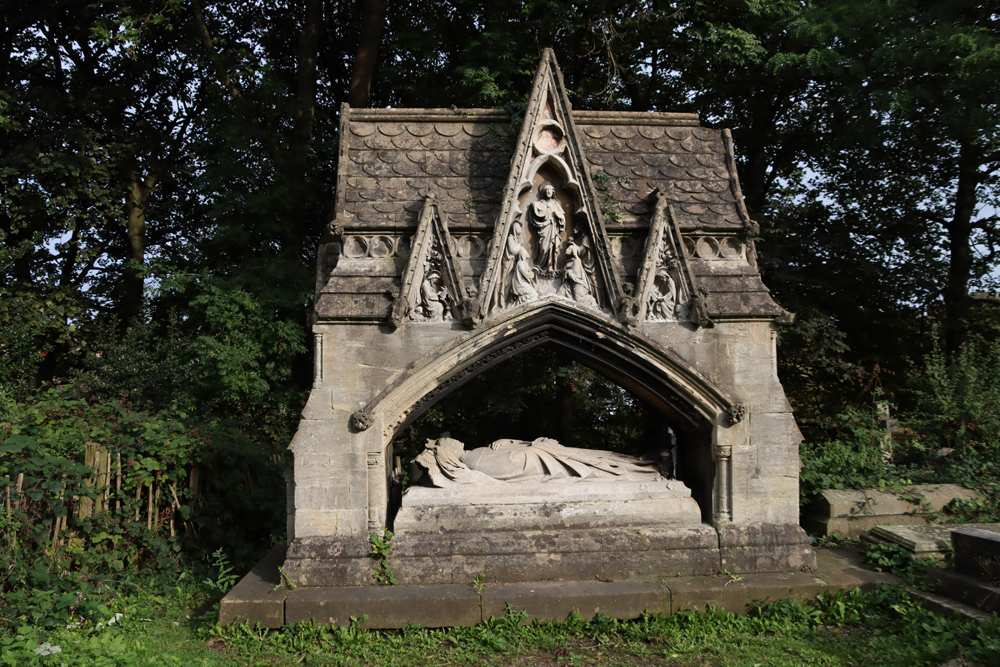
“The Ladies”

Ireland

Kilkenny Castle in 1832. Source: Wikipedia

Lady Eleanor Butler (1739–1829) and Miss Sarah Ponsonby (1755–1831) met at Kilkenny in Ireland, where Eleanor lived in the family home, Kilkenny Castle, and where Sarah was at the private school run by Miss Parkes, 12 miles away from her home in Inistioge.  Both of them were related to aristocratic families.  13-year old Sarah’s guardian Lady Elizabeth (Betty) Fownes, a cousin of her father, had asked Eleanor’s mother to keep an eye on her orphaned ward, and this task had been seconded to 29-year old Eleanor, the youngest of the Butler daughters and the only one who remained unmarried.  When they first met there was a 16 year difference in their ages, but they became very close, with Sarah’s more retiring and diplomatic character apparently complementing Eleanor’s more forceful and sardonic personality.  After Sarah’s departure from school at the age of 18 in 1773, she moved back to her guardians’ home Woodstock at Inistioge.  Sarah and Eleanor exchanged letters, building on their profound rapport, sharing their stories of mutual unhappiness in their respective homes, and offering each other support.

The ruins of Woodstock House. Source: Wikipedia

As an unmarried and recalcitrant spinster Eleanor was largely disregarded by her family, whilst the gentle Sarah, loved by Lady Betty, was receiving unwanted attention from Lady Betty’s husband Sir William who, according to his granddaughter, thought that Sarah might make a suitable replacement for Lady Betty, should her uncertain health leave him widowed.  Via their correspondence, the friendship deepened, and eventually they decided that leaving Ireland and setting up home together would provide them with the happiness that was otherwise lacking in their lives.  They first attempted to run away from their respective homes to leave Ireland in March 1778.  They were tracked down by Eleanor’s family, crushing their plans to board the ferry to Wales, and were returned to their respective homes.  Lady Eleanor’s mother attempted to convince her to enter a convent in France, where Eleanor had been educated, whilst Sarah was seriously discouraged from pursuing what Lady Betty thought would be a disastrous course of action for her orphaned ward.  When Eleanor again ran away and was found to be hiding in Sarah’s bedroom at her home, Woodstock, assisted by the redoubtable Woodstock maid Mary Carryl (alternatively spelled Carryll or Carol) who was smuggling food to Eleanor, both families were apparently convinced that the Eleanor and Sarah could not be dissuaded, and the two were grudgingly permitted by their families to depart for Wales to make new lives for themselves, accompanied by Mary Carryl.  They left Ireland by ferry in May 1778.

Beginnings in Wales

A very rough sketch of how the modest cottage looked before it was rented by the two ladies, adapted from a contemporary watercolour, in which the frontage is partially concealed by vegetation, included to show how simple the cottage was before modifications began

The ladies arrived in Milford Haven on 9th May 1778, and immediately set off on an adventurous tour of north Wales and the borders, first heading north to Machynlleth and on to Bangor  They visited Llangollen in their travels, but moved on afterwards.  As well as enjoying the opportunities for tourism, they were looking for somewhere suitable to settle down, and were becoming increasingly desperate to locate a suitable home as their funds began to diminish.  They returned to Llangollen later in 1778, staying first at Blaen Bach Farm for the winter, before moving in 1779 to a town property owned by the Llangollen postman.  In 1780 they were at last able to rent the cottage then known as Pen-y-Maes (meaning top of the field) from landlord John Edwards of Pengwern.

The ladies’ new home started its life as a traditional low-ceilinged 3-bay, 2-floor stone-built cottage with a central doorway, five rooms and attic space.  It is sited in a lovely location set above the river valley alongside the shallow and gently bubbling Cufflymen, which still filters water from the hillside into the Dee.  In the grounds were outbuildings including a single-storey stable building to the southwest of the house, which remains today, its construction marked by the inscribed date 1778, predating the arrival of the ladies by two years.  Beyond it, the picturesque ruins of the medieval castle Dinas Bran are visible from what was the field in front of the house where sheep were grazed and which now houses a formal yew garden and an early 20th century Gorsedd stone circle.  The lovely ruins of the medieval Valle Crucis Abbey were nearby. Both the castle and the abbey were features that resonated with the romantic historical idealism of Georgian and early Victorian society, and which very much appealed to the ladies.

Plas Newydd sometime between 1835 and 1850 by W. Crane showing Dinas Bran on top of the hill in the background. Source: People’s Collection Wales

Bringing Plas Newydd to life

Mary Carryl. Source: National Library of Wales via Wikipedia

Shortly after moving in to Pen-y-Maes cottage the ladies renamed it Plas Newydd, meaning new hall (plas translates roughly as country hall or small manor) and lived there for 50 years.  Their retinue was headed by Mary Carryl, the strong-minded Irish maid from Sarah Ponsonby’s home who remained with them as both employee and close friend until her death in 1809.  Mary had been known in Ireland as “Molly the Bruiser,” and Eleanor mentions hearing a dispute between Mary and a tradesman in which Mary emerged loudly triumphant.

In spite of their financial difficulties, described below, the cottage was evidently far too modest for the expansionist and artistic ambitions of the ladies.  In their hands, from the moment they arrived, it underwent a series of remarkable transformations.  For example, in 1785 they built a small dairy to the west of the house; sections of interior floor tiles were replaced with stone in 1788, when new carpets were also ordered; repairs to the roof and indoor varnishing and painting took place in 1789; and, in 1792, work included plastering and whitewashing, and the addition of a new cellar, a new room and walls in the garden.

Detail of the porch, installed in 1814, with one of the twin lions contributed by Arthur Wellesley

The work to transform the house from traditional Welsh cottage to artistic extravaganza began in around 1798 and was initially inspired by gothic architecture, primarily the pointed lancet arches that characterized their oriel (projecting) windows, the carved wood that framed them outside.  They also introduced stained glass, which was eventually installed in all the most important rooms.  The spectacular porch was installed in 1814 , complete with seating, carved pillars, a canopy, elaborate carvings and lions supplied by the Duke of Wellington. A porch-warming party celebrated its installation.  As well as the corner seats that resembles those in church porches, the front door showed the four evangelists together with the symbols with which they are associated, the underside of the vaulted canopy resembles the chapter house at Valle Crucis Abbey.  The 1988 guide book says that the window canopies over the lancet-shaped windows were a gift from the Duchess of St Albans, although it does not add how it came by this information or, for that matter, the Duchess of Albans might have come by the carvings.  The guide book adds that they show scenes from Greek, Eastern and Hindu mythology.

The stained glass “prismatic” arch between the dining room and library

Other additions were gothic style doors, sash windows, painted glass, and a “prismatic lantern arch” leading from the dining room into the library.  The ladies also filled the house with objects that fascinated them. They were particularly proud of an aeolian harp (a multi-stringed harp that plays itself in the wind – see the video at the end of this post), and their vast collection of books.  As early as 1795 poet Anna Seward referred to house as “the enchanting unique,” talking about the library of books in multiple languages. Although neither lady spoke Greek or Latin, Eleanor spoke fluent French and they taught themselves Italian and Spanish. Thirty years later another visitor, John Lockhart, wrote to his wife in 1825:

But who could paint the prints, the dogs, the cats, the miniatures, the cram of cabinets, clocks, glass cases, books, bijouterie, and whirligigs of every shape and huge – the whole house outside and In (for we must see everything to the dressing closets covered with carved oak – very rich and fine some of it – and the illustrated copies of Sir W’s poems [quoted in Mavor 1984]

Window canopy and surrounding panelling

From around 1814 the ladies began to collect wood carvings, most of which were Elizabethan-Jacobean style  (late 16th-17th century), and with which they panelled their home in a random but fascinating patchwork.  These are most evident in the hallway, the staircase, and the first landing as well as on fireplace surrounds and doors.  It is clear that furniture from churches and grand homes had been dismantled to provide many of these panels, which make up a wild jigsaw of imagery, emblems and patterns.  This remarkable project was preserved by successive owners and supplemented by General Yorke, who converted the kitchen into the Oak Room.

Walking from the little summer house, via steps and rustic fencing, towards the stream in 1835. Source: People’s Collection Wales

The ladies were also very active beyond the house, fulfilling their ambitions to create lovely gardens, both ornamental and practical, with floral and kitchen gardens.   These gardens, as well as the stream-side walks, became as famous as the house itself.  As well as shrubs, ornamental trees and flowerbeds they grew herbs, fruit and vegetables.  In 1789 they were able to list 43 different rose types planted in the garden.  One of the regular expenses listed in their accounts was “muck” to fertilize these new additions.

Ornamental elements extended into the garden, inspired by romantic landscaping publications of the day, eventually including a rustic “bower,” rustic wooden bridges over the stream, a stone shelter next to the stream built for a font liberated from Valle Crucis, a summerhouse above it,  rustic fencing and other little tweaks to complete a perfect extension of the house and its gardens.  Even the natural arrangement stones in the stream was considered to be displeasing, so workers were employed to reposition them to form a more suitably romantic scheme.  These ornamental features were influenced by the French book on the subject which they had in their library.

Although the gardens have been lost in their entirety, partly due to both the Yorke and Robertson extensions, it has been possible for Denbigh Council to recreate some of the ornamental features portrayed by Lady Henrietta Delamere in her sketches, and these really do capture the sense of how the woodland walks must have looked.

The summer house, rustic fence and the grotto-style structure containing the stone font, reached by a bridge over the stream


Living

The original watercolour of the two ladies by Mary Parker / Lady Leighton is now in the library at Plas Newydd. Source: People’s Collection Wales

In spite of their spending, the ladies were provided with only small incomes from their families after their departure, and money was a constant worry.  The ladies had ambitions for the house that far exceeded what their finances permitted, and regularly overspent.  The small annual amount supplied to Lady Eleanor by her very wealthy family almost certainly reflected their profound disappointment in her, which some of her letters to them only  served to exacerbate.  Miss Ponsonby’s guardian was not as wealthy but she provided Sarah with a small income, and after her death, Lady Betty’s daughter Mrs Tighe continued to provide Sarah with a small but generous allowance in spite of her own periods of financial difficulty.  In spite of hopes that Eleanor might inherit a significant sum from her parents when they died, she was to all intents and purposes disinherited; her father left her nothing and her mother left her only £100. Nothing was forthcoming when her brother succeeded to the family title in 1791.  For much of her time in Llangollen she was convinced that she had been denied a right to a far more substantial amount by the terms of her brother’s marriage settlement, a source of ongoing bitterness.  A small pension provided to the ladies by the state was very welcome, but unreliable.  A second pension added sometime later was of considerable help, but it too was unreliable.  They often had to request loans from friends, which they sometimes had difficulty repaying, and they were always worried about how to pay their debts to tradesmen.  On several occasions they were late with their rent.  The lack of financial stability is reflected in the many references to their financial embarrassments in Lady Eleanor’s journal, Miss Ponsonby’s accounts and many of their letters, but does not seem to have prevented lavish spending on both the house and on servants and labourers.  The risk of investing so much money and love on improving rented accommodation was demonstrated in 1800 when their landlord, the son of their original landlord, attempted to evict them. Legal steps were taken, and the disaster was averted.

Plas Newydd. Source: People’s Collection Wales

The ladies did take some measures to take advantage of their rural location to become dairy and horticultural producers.  They acquired a cow called Margaret in the 1780s, with three others eventually making up a small herd, and put some of their land down to potatoes which they were selling from at least 1797; barley from 1798 and from 1801 they began to sell butter.  Harvesting hay was an annual occurrence, some of which was used for feeding the cows, but some of which may also have been sold.  They built a poultry yard and had a kitchen garden which was quite clearly overflowing with produce including fruit trees, strawberries, raspberries, gooseberries and melons.  Vegetables included cucumbers, peas, mushrooms, potatoes, asparagus, artichokes and cabbages.  Of course there were overheads.  They were renting some of their land, had to pay for labour to work their horticultural projects, and they were purchasing fruit and vegetable stock and large quantities of muck as fertiliser, but it says much for them that they gave self-sufficiency in food and the sale of surplus their best efforts.

The Hand Hotel, Llangollen (with a rather intriguing plane at top!). Source: The People’s Collection Wales

Local connections and the roll-call of visitors, both welcome and unwelcome, meant that they were far from isolated.  They were introduced to the upper echelons of society in Llangollen and further afield by Lady Dungannon who lived in Brynkinalt near Chirk, made extensive use of the various services offered by the towns-people, and employed a number of servants inside and out.  Eleanor’s spiky personality put some of these relationships at risk, such as their valued friendship with the Barrett sisters Elizabeth and Laetitia and Miss Margaret Davies of Cae Glas, Oswestry;  and relationships with townspeople employed by them were frequently tested to breaking point, exemplified by their dispute with the landlord of The Hand Hotel, but they continued to form an important element of the Llangollen social landscape.  As they became tourist attractions, they became part of the economic reality of the town until the deaths of Eleanor in 1829 and Sarah in 1831.  The occasional fireworks emanating from Eleanor were apparently taken in the town’s stride, possibly due to Sarah’s more amiable personality.

The Ladies of Llangollen, Sarah left and Eleanor right, with the Valle Crucis font and the Gothic-style shelter surrounding it. Source: People’s Collection Wales

The duo became increasingly unconventional and very distinctive in appearance.  They wore riding dress all year round, and they both wore black beaver hats over cropped hair.  This was probably very practical for the lives they lead, but made them stand out, drawing attention.  They were described in 1820 by Charles Matthews in a letter to his wife as “dear antediluvian darlings attired for dinner in the same manified dress, with the Croix St Louis, and other orders, and myriads of large brooches, with stones large enough for snuff-boxes, stuck into their started neckloths.”  Matthews also refers to their powdered hair, black beaver hats and says that they “looked exactly like two respectable superannuated clergymen” (quoted in Mavor 1984).  The only authenticated portrait of them was made clandestinely by Mary Parker, later Lady Leighton, a visitor from Oswestry and amateur artist.  She sketched it in pencil under the table at Plas Newydd when she visited in 1828, later converting it to a water-colour, and still later it became an engraving. A lithograph by Lady Henrietta Delamere became popular but it is not known whether it was taken from life; I suspect that it was based on Mary Parker’s painting, because the heads and faces are at exactly the same angle as the earlier portrait.

The ladies loved to walk, and had a number of favourite circuits, both short and long, of which they were particularly fond, spotting wild flowers, identifying bird song and picking blackberries in the hedgerows.  As well as the exotic artifice that they constructed in house and garden, they loved what nature offered on their doorstep, and is a running theme in Eleanor’s journal.

Sunday January 17th. There is no describing the blazing beauty of the Morning. All the Mountains a glorious Purple and Gold.  Woods Sparkling with Gems. Smoke Silently Spinning in Columns to Heaven – chorus of Birds Hymning their Thanksgiving in every Thicket – tender Transparent Mist Exhaling from the River and Brooks – the Hoar frost Melting before the Suns Brilliant rays and disclosing Such Verdure.

A poem for the two ladies “To The Lady E. B. And The Hon. Miss P.”, written by Wordsworth after a visit in 1824. Source: The Simple Poetry website

Although the idea that had lead to their choice of home was one of peaceful retirement and idyllic retreat, this became more a matter of theory than practice after they became well known.  Soon news of their unconventional lives and appearances and their remarkable house and gardens spread.  They had located themselves in a beautiful part of Wales that was becoming a popular tourist destination, and were positioned conveniently close to Llangollen town centre.  They became a tourist destination in their own right, attracting well known names of the Regency and early Victorian periods, insisting that potential visitors request access in writing to introduce themselves.  There is a dauntingly long list of known visitors on the Early Tourists in Wales website, amongst whom were, in no particular order, the Duke of Wellington (at the time merely Arthur Wellesley), the Duke of Gloucester (nephew of King George III), William Wordsworth, the poet Anna Seward (a firm friend), Sir Walter Scott, Mary Berry, Caroline Lamb, Charles Darwin, Mr and Mrs Piozzi (Mrs Piozzi was the former Hester Thrale, who was close to Dr Johnson and was another firm friend), the Duke of Somerset, Sir Humphry Davy, Robert Southey, Prince and Princess Esterhazy, the Duke and Duchess of Northumberland and Josiah Wedgwood.  The January 1788 visit by Arthur Wellesley was commemorated with an inscription on the fireplace overmantel in the kitchen, now the Oak Room, with the initials EB and SP and the date 1814. Wordsworth composed a poem for them after his 1824 visit, although his reference to Plas Newydd as “low roofed cot” caused more offence than pleasure. The multitude of visits was all the more impressive given that Telford’s road between London and Holyhead did not fully open until 1826, and the railway did not reach Llangollen until 1862.

Initially renting the house, gardens and surrounding woodlands and fields, the ladies were eventually able to purchase the property in 1819 from the son of their original landlord, although given their constant shortage of funds, together with the lack of any records of where the money came from, it is not currently known how they could have afforded the purchase price. One suggestion is that the funds left to Sarah Ponsonby in Mary Carryl’s will when Mary  died in 1809 was the source of at least part of the sum.  Eleanor’s journal makes references to ongoing improvements in their financial situation, so perhaps they were left a bequest by some unnamed benefactor.
===

Endings

The memorial in St Collen’s churchyard to Eleanor Butler, Sarah Ponsonby and Mary Carryl. Source: Coflein

Eleanor died on 2nd June 1829 at the age of 90 and Sarah only three years later on 8th December 1831 at the age of 76.  No cause of death for either seems to be known. Many of their closest friends and most of their family had predeceased them and it must have been a strange two years for Sarah, after Eleanor’s death, with no remaining family or close friends nearby.

Both ladies were buried in St Collen’s churchyard alongside Mary Carryl, with whom they share an unusual triangular monument.  A week-long auction followed Sarah’s death, taking place in 1832, selling off everything that was not actually a fixed part of the house itself.  Over 1000 books were sold, together with their furnishings.  Most of their paperwork, including journals, household accounts and letters were apparently disposed of, and only a few of these now survive.  Their gardens were largely destroyed when new extensions were added by subsequent owners, although Lady Delamere’s watercolours preserve aspects of the romantic woodland and stream-side walks.

Legacy

Chase of the Wild Goose book cover. Source: Good Reads

Their legacy is mixed.  Souvenirs were made and widely distributed, and these are of some interest as components of tourism history.  The ladies are now celebrated as the owners of the lovely and unconventional Plas Newydd, once again a major tourist attraction.  At the same time there has inevitably been some debate about the nature of their relationship.  It has been variously proposed that they had sisterly connection, that they were lesbian lovers, that their mutual affection was romantic but not sexual, or that they were simply inseparable kindred spirits.  Apart from their shared lives and shared bed, which are hardly conclusive indicators, there is little to indicate which is the best theory.

In 1936 Dr Mary Louisa Jordan wrote Chase of the Wild Goose, a fictional account based loosely on the lives of the ladies, published in 1936.  Dr Gordon used the basic story of the ladies as a platform to create a narrative about lesbian living, and it was republished in 2023.  Its author was responsible for a plaque to the two ladies in Llangollen’s St Collen’s church.

In 2022 a play called Celebrated Virgins by Katie Elin-Salt and Eleri B. Jones staged at Theatre Clwyd in Mold, based on the story of Lady Eleanor and Miss Ponsonby, suggested to one reviewer that it was “palpitating, more narrowly insistent on sexual yearning and the importance of acknowledging exchanges which were once forbidden” (Susannah Clapp in The Guardian) but this seems to be a minority interpretation, even by other reviewers of the same play in the same newspaper.

Whatever the case, the matter of whether their love was purely idealistic, romantic or had a sexual component seems, quite frankly, much less interesting today than could have been when they were alive and when they were accepted in the narrow society of Llangollen and the wider, more varied society of those who visited from London and elsewhere.  In the late 18th and early 19th century they seem to have been accepted for who they were rather than what they may have been.  Their eccentricity made them the subject of discussion, but they lived without scandal.
===

Amelia Lolly and Charlotte Andrew

The house in around 1840. Source: Early Tourists in Wales

After Sarah’s 1831 death all the contents of the house were auctioned off over a week-long period in 1832.  The house was subsequently sold to another two spinster ladies resident in Llangollen, Miss Amelia Lolly from Manchester and Miss Charlotte Andrew from Liverpool.  They seemed to have decided to model themselves on Eleanor and Sarah, probably unaware that Eleanor, typically satirical, referred to them derisively as “the Lollies and Trollies,” a play on the names Lolly and Charlotte.

The new owners added a stuffed bear to the porch, which would probably have prompted an extremely acerbic comment from Eleanor.  They do not appear to have modified the house significantly, although they must have had to refurnish it.  They may, of course, have bought some items originally installed in the house at the auction following Sarah’s death, but they also presumably moved in their own furniture.  Their intention seems to have been to maintain the house in the condition in which it was left after the auction, and to benefit from its fame.  Under their tenure the house appears to have been run along the lines of a minor tourist attraction, with showings of the house organized for visitors.  It is not known whether they looked after the shrubberies and kitchen gardens, or the woodland features.  Whilst the house may have remained intriguing thanks to the lingering echo of its former owners, the absence of Lady Eleanor and Miss Ponsonby as its hosts probably reduced its curiosity value for tourists quite considerably.

Miss Andrew died in 1854 and Miss Lolly in 1861.  Both were buried in Llantysilio churchyard.  In 1864 a church window was installed in the church of Llantysilio in memory of Charlotte Andrew, showing Timothy reading the scriptures, fulfilling Paul’s command to him.  This window was moved to Trevor Church in 1893.

The house was bequeathed to a relative of Miss Lolly’s, a Mrs Couran, who owned it for some 15 years before selling it in 1873, when it was apparently leased.  In 1876 it was sold briefly to a new owner before being sold on to General John Yorke in May of that year.  General Yorke was an enthusiast for the precedent set by Lady Eleanor and Miss Ponsobny, and built on their legacy with enthusiasm.
===

General John Yorke

It was not until the purchase of the building in 1876 by General John Yorke C,B., son of Simon Yorke II of Erddig near Wrexham, that the vision of Lady Eleanor and Miss Ponsonby was significantly reinforced with new material.  The General had known the ladies as a child when, having fallen from his pony, the ladies had picked him up, ensured that he was in one piece, tidied him up and sent him on his way with pockets full of oranges.  He clearly remembered them with great fondness.

General John Yorke

General Yorke (1814–1890) began his military career in the British Army in 1832, rising through the ranks. He was left permanently lame in the Crimean War in 1854 due to a traumatic and irreversible injury to his leg, but continued to serve and was repeatedly promoted, being made a full general in 1877. He continued to have a role in the military until his death.

The General purchased the house in 1876, 45 years after the death of Sarah Ponsonby, and began to make major alterations that were, however, partially in keeping with the character of the building as left by Lady Eleanor and Miss Ponsonby.  Thanks to his greater resources, his vision was even more elaborate and adventurous than those of the two ladies.  The ladies might have been just as extravagant had the means been available to them, but General Yorke seems to have followed very efficiently in their footsteps.

The black wooden battens with urn motifs that emulate half-timbering date to its ownership by Yorke.  Oblique photographs of the extension added by General Yorke survive, showing how the new wing was at an angle to the original cottage, creating an L-shaped plan.  The extension was removed in the early 1960s due to dry rot.

The new wing added to the side of the original building by General Yorke showing how he continued the tradition of wooden window frames and canopies and exterior panel work and added his own mock-Tudor half timbering. Source: The Sketch, 15th April 1903, The British Newspaper Archive

Inside both old and new buildings, General Yorke had both the means and the inclination to extend the collection of Jacobean oak, as well as introducing painted leather, and eventually lined nearly every wall on the ground floor that was not otherwise adorned with oak with impressed and painted leather and lincrusta wall paper.  His main contribution to the original cottage was the Oak Room, which is a richly ornate celebration of Elizabethan-Jacobean wood and leather work.  Built in what was the kitchen when the ladies were alive, the oak room became both a drawing room and display area.  General Yorke’s kitchen was located in his new wing, shown above.  An inscription over the fireplace with the initials of the lady with the date 1814 and the stained glass are the only original pieces remaining.  As well as 17th century wall hangings made of gilded leather, and 19th century lincrusta wallpaper, the dominant feature of the room is a canopy of wood over more wooden features and a carved oak settle said to have come from a Spanish monastery, although no details are available about which monastery or how it was supposed to have been acquired by the general. It is flanked by ornate leather wall hangings.  The photograph below shows it on the left, and there is a more complete view further down the page.  There are also two panelled recesses, one of which incorporates a pew that belonged to the ladies and is said to come from a Llangollen church.  The main door into the room is also carved and there are carved cupboard doors.  All the fabrics and furnishings are part of the refurbishment of the building.

Detail of the Oak Room showing both carved oak and gilded and painted leather work

===
The gorgeous delftware tiles are thought to have been installed by the general, and it seems probable, although I cannot find any specific reference, that the magnificent ceilings were also installed by General Yorke.  Yorke’s approach has been described as “antiquarian” and there is certainly something of the Victorian gentleman collector-cum-historian about General York’s approach to making Plas Newydd a repository not only of decorative arts but also of curiosities, much in the style of Lieutenant General Augustus Henry Lane Fox Pitt-Rivers.  This is the impression that it made on John Murray, who described it as follows in his Handbook for travellers in North Wales, (5th edition, 1885, pages 19-20, quoted on the Early Tourists in Wales website:

The veteran officer who now owns Plas Newydd, has not only zealously preserved it with all its quaint decorations within and without but has greatly added to its curiosities in the way of old furniture, pictures, painted glass, and sculpture – those in ivory executed by himself. He has in fact converted the house in to a Museum of Vertu, a sort of Welsh Strawberry Hill, for the which, as well as for the singular beauty of the spot, Plas Newydd is well worthy of a visit. Visitors pay a fee of 6d., which goes to some local charity.


A postcard of the house shows the library with some of the carved ivory work mentioned above protected by glass domes.  There is barely a free surface in the place.  Another postcard, of the Oak Room, shows the extensive carvings and leather-work. Pity whoever had to keep this lot clean and dust-free!

General Yorke’s Oak Room, replacing the former kitchen. Source: People’s Collection Wales

The Coflein website says that by the time Yorke arrived at Plas Newydd the ornamental garden and woodland architectural features, all made of perishable materials, had “fallen into decay,” but what was left of the gardens appears to have remained well stocked whilst he was there.  The photograph further up the page showing his new wing certainly shows what appears to be a well-stocked flower bed had been added in front of the new wing.  The wonderful mock-Tudor water tower in the gardens was one of General Yorke’s additions, and the Coflein website says that where the 1958 ‘Bards’ Memorial’ of 1958. now stands used to be the site of General Yorke’s peacock house, which I would have liked to have seen.

General Yorke’s water tower at Plas Newydd

George Hunter Robertson

George Hunter Robertson. Source: Bygone Liverpool via from London and Lancashire Fire Insurance

The house was sold to George Hunter Robertson of Liverpool in 1890, a wealthy cotton broker who owned the house until 1910, and added his own personality to it.  He apparently shared it with his brother.  He was recorded as a member of the Cumberland and Westmorland Antiquarian and Archaeological Society in its 1875 edition. His addition of a new wing at Plas Newydd built to emulate the style of General Yorke demonstrates that like General Yorke, he had an antiquarian interest in re-assembling components of the past.

Even with General Yorke’s large extension, the property was too small for its new occupant, and he added another wing, this time in a line with the original cottage.  This was provided with some pseudo half-timbering, but of a less elaborate type than that of General Yorke.  It looks as though it had a flat roof, or at least a very shallow hipped roof, making its appearance in photographs look most peculiar, almost an afterthought.  As with General Yorke’s extension, this was removed in the early 1960s due to dry rot, and the end of the original building was provided with a simplified half-timbered appearance to blend in with the frontage, which it retains today.

View of Plas Newydd showing the addition of a new wing, without the hipped roof of the older cottage.  General York’s wing can just be seen at far left.  Also visible is the new formal yew garden. Source: The National Archives, ref. INF 9/641/7

According to Coflein, it was Mr Robertson who created the formal garden with its golden yew shrubs and box-hedging. The yew garden incorporates the base of a cross on a stepped plinth, which is said to have been the 15th century Chester marketplace cross, although I have seen nothing to confirm that this is the actual provenance. Nearby is a font said to be from Llangollen parish church.  I remain unclear about whether these were acquired by the Robertsons or were already there, although the font from Valley Crucis, built into a little shelter by the side of the stream was an acquisition of the ladies.

In 1908 a Gorsedd stone circle with a flat stone at its centre was erected on the lawn just beyond this formal garden for the Llangollen hosting of the National Eisteddfod. The Gorsedd circle was a traditional element of the Eisteddfod celebration of Druidic traditions, and was used to host associated ceremonies.

Gorsedd circle with Plas Newydd beyond and Castell Dinas Bran on top of the hill in the background

After the Robertsons, the house was sold to Mrs G.M. Wilson who lived in it until 1918.  It was sold in 1919 to the 7th Earl of Tankerville whose son sold it to Llangollen Town Council in 1932.===

Plas Newydd 1930 – 1960s

Plas Newydd immediately following the destruction of General Yorke’s wing in the 1960s following the discovery of extensive dry rot. Source: People’s Collection Wales

In 1932 the property was purchased by Llangollen Town Council for £3320 after they had secured a loan to do so, a superb decision.  It was opened to the public a mere year later in 1933.

The wings of Plas Newydd, built by General Yorke and the Robertsons, were occupied in 1934 by the Welsh National Theatre, but in the 1960s they were both found to have pervasive dry rot and had to be knocked down.  Dry rot, which usually finds a home in damp wood, is a fungus, the appropriately named Serpula lacrymons (loosely translated as creeping tear-maker). It is catastrophic if not caught early enough, disintegrating wood and causing destruction of structural integrity.  It is the sort of discovery that plunges the owners of old houses into terror, and it is not at all surprising that in order to save the core of Plas Newydd the wings were removed.  It is a crying shame but probably the right decision.  The salvaged antique wood and furniture were sold at that time.

Plas Newydd Today

The house is run today by Denbighshire County Council as a visitor attraction, and they do an absolutely splendid job.  The house and its contents are absolutely sparkling.

Although the 1832 auction removed all of the free-standing furnishings and individual objects owned by the ladies, a few are now on display at the house.  These include a pair of embroidered shoes thought to have been worn by Lady Eleanor and embroidered by Sarah, who was an indefatigable embroiderer whilst Eleanor read to her from their extensive library.  Replacement items have also been sourced to emulate the earlier contents, including furniture and objects that would have filled the house.  One or two of these were mentioned in the journal, including an aeolian (wind) harp.  These help to give a sense of how the house would have looked in the late 18th and 19th centuries.

Woodland walk leading from the rear of Plas Newydd through light woodland and leading to Lady Eleanor’s bower and then down to the stream

The gardens are worth a walk around but would probably not be recognizable to either the ladies or General Yorke. I suspect that General Yorke’s extension, which was quite a substantial affair, sat squarely over part of the gardens as they had been when the ladies had the property.  There is so little known about Amelia and Charlotte that it is not known whether or not they maintained the gardens.  The original yew garden at the front of the property dated to the occupancy of Mr Robertson and his brother (1890-1910), and there are some attractive woodland walks, but the earlier gardens with their considerable investment in flower beds and shrubberies, where the ladies used to sit and read, are now lost.   Following Mr Robertson, there was at least one period when they house was not used as a permanent residence, and as anyone who has owned a garden will know, given half a chance nature will revert any formal garden to a far more chaotic state.  Fruit trees and ornamental shrubs, too, have finite lives which, although they can run into many decades, will not last eternally and will eventually need to be replaced with new stock.  Whilst notes were made in the journal of some of the plantings and comments about them survive in visitor letters, nothing remains to suggest how these gardens were arranged and what they looked like.


At first glance I thought that this was the library at Plas newydd, but it is clearly not. This does not match any of the rooms in the current cottage, so must have come from one of the two later wings, probably from the time of General Yorke when the house was run as a museum. Source: RCAHMW


Final Comments

Plas Newydd does a very good job of speaking for itself.  It is quite amazing that it remains in such good condition after the deaths of Lady Eleanor and Miss Ponsonby, subsequently preserved by Miss Lolly and Miss Andrew, elaborated and extended by General Yorke, and further extended by Mr Robertson.  It is a real shame that the two wings, added by General Yorke and Mr Robertson respectively, had to be destroyed, as they were an integral part of the story of Plas Newydd, but it is a mercy that the original cottage remains.

The aesthetic ideals adopted by the two ladies and preserved by subsequent owners, first emulating the Gothic and then the late Tudor and Stuart periods, using salvaged carved wood and stained glass and other decorative arts, is not to everyone’s taste.  In her book The Ladies of Llangollen, the main biographer of the ladies, Elizabeth Mavor, commented on the “regrettably” added oriel and canopied windows, described their porch as “a rich and appalling riot of carving” and referred to General Yorke’s contributions as “mistaken alterations,” but whether it appeals or appals, it is still a remarkable vision, quite unique, and it is a fabulous place to visit.  I love it.

==
Visiting

My thanks to Helen Anderson for driving us on our first visit, which always gives me the chance to sit and enjoy the scenery, a real treat.

Plas Newydd sits just above Langollen, just off the A5, and is very easy to find.  I tapped the postcode (LL20 8AW) into the Google Maps SatNav and it took us straight there.  Although very near the town centre, a short way up a hill, there is no sense of being so near to the town and its surrounding residential areas.  Beyond and above the house, and looking sensational, are the ruins of Dinas Bran castle.  In front of it is a formal rose garden within yew hedges, and beyond there are cleverly shaped topiary trees, with an early 19th century Gorsedd stone circle beyond, created for the 1908 Llangollen Eisteddfod.  It is a very attractive location.

Parking seems to be confined to the approach lane and around the circular drive itself.  We were there quite early on an overcast weekday morning in July and were able to park, but it might be more of a challenge at a busier and sunnier time as there does not seem to be an overflow car park.

Tickets are available in the nearby café and shop.  You go to the counter where food is paid for to buy your ticket for the house (the grounds are free of charge to visit).   See the website for seasonal opening times and pricing information but do note that the house closes completely off-season (in 2025, for example, it opened on April 1st).  There is a lovely café, also seasonal, where the ticket offices is located, which was serving some splendid looking meals, both indoors and out.  If you do a web search for Plas Newydd do make sure that you are looking at the site in Llangollen and not the National Trust house of the same name on Anglesey.

A pair of embroidered shoes reputedly worn by Lady Eleanor Butler. Source: People’s Collection Wales

The ticket price includes an audio device, if you would like one, which you touch to a receiver in each room to hear details as you go around.  It is not absolutely necessary if this is not your cup of tea as there are other information sources, but there is some very useful information in the recordings that I had not found elsewhere.  There is an exhibition room on the first floor, far right, if you want to see some very useful background information before you start, which acts as a miniature visitor centre, containing objects belonging to the ladies.  There are also plenty of laminated information sheets to pick up and read in each room as you walk round, in English and Welsh, and lots of ring-binders to open with plenty more details about the house and its owners, including excerpts from Lady Eleanor’s journal and pages from the auctioneers sale of their books after they died.

Plas Newydd dining room table, set up with loose-leaf folders and laminated pages in English and Welsh for visitors to read. Take a look at the long, long listing of the books that were auctioned after Miss Ponsonby’s death.

On a nice day there are many walks on public footpaths that start from Plas Newydd, some of which retrace the steps of the two ladies, who were enthusiastic and energetic walkers.

View of “the dell” showing the stream that runs along the valley next to Plas Newydd in around 1835.  Eleanor and Sarah had passed away in 1829 and 1831 respectively, but one of their ornamental bridges, now replaced with a stone one, was still in service. Source: People’s Collection Wales

My personal sketch of the grounds, scribbled for my own benefit before my April visit, is based on the one printed in the guide book published in 1988.  I’ve used it to find my way around, and the paths, coloured in orange are still where marked.  Of course feel free to use it, but it has nothing to do with anything faintly resembling scale!  It took me about 30 minutes to do the full circuit, but I was stopping to take photos.  It is pure laziness that I didn’t do something a little more dignified in software, or even sketch it out more neatly.  Plas Newydd is the big purple rectangle at top left and the yellow blobs next to it represent the yew trees of the formal garden established during Mr Robertson’s tenure.  The green blobs are trees, and I think that the rest is pretty much self explanatory.  The house is on a hill, so there is a slope from the level of the house down to the stream.  If you don’t fancy the walk you can still stand in Lady Eleanor’s reconstructed bower and look down on the stream and the flanking woodlands.  Don’t miss the stone font said to be from Valle Crucis Abbey, marked at bottom right.  The garden and woodland walks are lovely, because of the wild flowers, which in early spring include swathes of purple crocus on the grass in front of the house, and later on, blankets of primroses, snake’s head fritillaries and fresh white blossom.  In the dell, beside the bubbling stream and its little water falls, are endless carpets of white-flowered wild garlic and bluebells.


===

For people with unwilling legs, be warned that to get the full value of the house there are quite a few stairs to negotiate, and there are no elevators or other methods of ascending to the upper storeys.  The flight of stairs leading to Mary Carryl’s room in the attic is particularly steep and narrow, although the stained glass is worth the trip.  Failing the stairs, the ground floor alone has plenty to see, including many of the best features.  The gardens are easily accessible via well maintained gravel paths, but the woodland and stream-side walks require a bit more careful footwork via sloping gravel paths.  With care, these are very accessible.

Valle Crucis Cistecian Abbey, founded 1201, a beautiful and peaceful site run by Cadw. Check opening times as it is only open on certain days during the season.

This could easily be turned into a day trip.  Just a little further afield, and which I have blogged about before, are the Valle Crucis abbey ruins, which is a spectacularly lovely medieval site, with a cache of nicely decorated medieval grave slabs held in the former dormitory.  It preserves a lovely chapter house, the interesting abbot’s quarters, a stunning corbelled vestry and many other very attractive features.  Also nearby is Thomas Telford’s beautiful Horseshoe Falls, which can be incorporated into a walk along the Llangollen canal.  Castell Dinas Bran is accessible both from the town (quite a strenuous walk) and from the panorama road (much less of an effort, with fabulous views from the road, but very narrow with passing places and no official parking).  Dinas Bran is on my to-do list for this summer.  All of these sites were known by the inhabitants of Plas Newydd.

Pontcysyllte aqueduct, over which the ladies travelled in a narrowboat on its opening day

Slightly further away, but on the route between Llangollen and Chester / Wrexham is the Pontcysyllte Aqueduct, the opening event of which the ladies, as local notables, attended on the second of the boats in the official ceremony, sailing over the aqueduct.   The towpath, shown left, is usually quite busy on a nice day, but is shown here completely (and somewhat eerily) free of visitors.  The views over the rail are exceptional.

In Llangollen itself, options include a steam train trip, a canal boat cruise, a short stroll along the river promenade, and the tiny but well-stocked town museum (but check opening times), and there are plenty of places to stop for lunch.  In the summer I recommend that if you want to eat at somewhere particular in Llangollen you book a table in advance or you may find yourself stuck.
===

=
Sources

A note on sources of information

Most of what is known about Eleanor and Sarah comes from their own diaries and accounts, as well as letters they wrote and letters written by others in which they were mentioned.  In her book The Ladies of Llangollen, Elizabeth Mavor provides details of all of the available resources that she was able to consult for that book, and although that book was published in 1971 most of the privately held collections of letters that she was able to consult have yet to be digitized and made available online; Others that are retained in libraries like the Bodleian, the John Rylands and the National Library of Wales have likewise not yet been made available online.  Combined, the correspondence covers some of the years between  1790 and 1831. Although Eleanor’s journals have become the main source of information about their lives, many months and years are missing.  Samples of the diaries are contained in files that can be browsed within Plas Newydd itself, and a selection of entries have been published in Elizabeth Mavor’s 1984 hardback A Year with the Ladies of Llangollen (published in paperback under the title Life with the Ladies of Llangollen, although it is exactly the same book).  Of Sarah’s journals nothing remains except her account of their tour of Wales and the Borders when they first left Ireland.  There seems to be very little information about General Yorke, which is a real shame, and nor is there much about the Robertson brothers.

Online, the best resource for primary sources on the subject of Plas Newydd and its various owners and occupants is on the Early Tourists in Wales website, a superb resource that has collated much of the available information.  The People’s Collection in Wales has some fascinating images of the cottage and its contents in the form of paintings, photographs and postcards, (see Sources at the end for full details and page links).  The Curious Travellers website also has some very useful information to impart, including excerpts from Sarah Ponsonby’s pre-Plas Newydd travels around Wales and Shropshire.  The Ladies of Llangollen blog has some if not all of the letters between the ladies and Hester Piozzi (formerly Thrale) and a comprehensive set of those between the ladies and Anna Seward, all available from its Correspondence and Correspondents page.


Books, booklets and Papers

Harris, John. 2007. Moving Rooms. The Trade in Architectural Salvages. Yale University Press

Hubbard, Edward and Pevsner, Nicholas 1986. The Buildings of Wales. Clwyd (Denbighshire and Flintshire).  Penguin Books

Mavor, Elizabeth 1971, 2011 (2nd edition). The Ladies of Llangollen. A Study in Romantic Friendship. Moonrise Press.  Does not always cite her sources for specific quotations and references.

Mavor, Elizabeth 1984.  Life with the Ladies of Llangollen. Viking (hardback).  N.B. This was published, word for word and page for page, image for image, in Penguin in 1986 in paperback as A Year with the Ladies of Llangollen.  Do not make my mistake of buying the same book twice just because the titles are different! 
The format is rather strange, in that the information is listed first by month and then by year, so that all the journal entries for January in every given year are listed in the first chapter, and then all for February and so on.  I would have found it more informative if it had listed by year, from earliest to latest.  I suppose it gives a sense of how each month in all years may have passed, but it gives no sense of the cumulative passing of time over the lives of the ladies and how their lives changed over their time at Plas Newydd.

Veysey, A. Geoffrey and Freeman, David 1980.  Plas Newydd and the Ladies of Llangollen. Glyndwr District Council.  (16-page visitor guide based on the booklet by Veysey, County Archivist for Clwyd County Council, published in 1988.  Two sections were substantially updated by Freeman – the Oak Room and the Ladies’ Bedchamber).

Websites

British Listed Buildings
Plas Newydd. A Grade II* Listed Building in Llangollen, Denbighshire
https://britishlistedbuildings.co.uk/300001127-plas-newydd-llangollen

Bygone Liverpool
Liverpool’s Slave Gate
https://bygoneliverpool.wordpress.com/wp-content/uploads/2023/01/liverpools-slave-gate-copyright-bygone-liverpool-1st-january-2023-2.pdf

Cadw
The Ladies of Llangollen
https://cadw.gov.wales/ladies-llangollen

Coflein
PGW (C) 48
coflein.gov.uk/media/16/343/cpg069.pdf
Plas Newydd, Llangollen. Site Record
https://coflein.gov.uk/en/site/27760/
Plas Newydd, Upper Garden
https://coflein.gov.uk/en/site/266455/

Curious Travellers
Anne Lister’s diary, tour of North Wales 11-27 July 1822
https://editions.curioustravellers.ac.uk/doc/0023?ref=pe0954#footnoteref53
Eleanor Butler and Sarah Ponsonby, Account of a Journey in Wales; Perform’d in May 1778 By Two Fugitive Ladies. Edited with an introduction by Elizabeth Edwards in Curious Travellers
https://editions.curioustravellers.ac.uk/pages/show.html?document=0004.xml

Denbighshire County Council
Plas Newydd, Llangollen
https://www.denbighshire.gov.uk/en/leisure-and-tourism/museums-and-historic-houses/plas-newydd-llangollen.aspx

Early Tourists in Wales (N.B. an invaluable resource for Plas Newydd, of which the links below are just a small sample click on the first link to see all the available pages)
By Michael David Freeman
Home page for Plas Newydd and the Ladies of Llangollen
https://sublimewales.wordpress.com/attractions/mansions-and-grounds/ladies-of-llangollen/
Descriptions of Plas Newydd and the Ladies of Llangollen
https://sublimewales.wordpress.com/attractions/mansions-and-grounds/ladies-of-llangollen/descriptions-of-plas-newydd-and-the-ladies-of-llangollen/
Plas Newydd Kitchen Garden
https://sublimewales.wordpress.com/attractions/mansions-and-grounds/ladies-of-llangollen/the-grounds/kitchen-garden/
Ladies of Llangollen Portraits
https://sublimewales.wordpress.com/attractions/mansions-and-grounds/ladies-of-llangollen/descriptions-of-eleanor-butler-and-sarah-ponsonby/ladies-of-llangollen-portraits/
Plas Newydd Carved Wood
https://sublimewales.wordpress.com/attractions/mansions-and-grounds/ladies-of-llangollen/plas-newydd-the-house/plas-newydd-carved-wood/
Ownership
https://sublimewales.wordpress.com/attractions/mansions-and-grounds/ladies-of-llangollen/ownership/

English Heritage
Lasting Impressions: The Ladies of Llangollen Portraits at Audley End (Members’ Area)
https://www.english-heritage.org.uk/visit/places/audley-end-house-and-gardens/history-and-stories/ladies-of-llangollen-portraits/?utm_source=The%20English%20Heritage%20Trust&utm_medium=email&utm_campaign=14877625_Members%27%20newsletter%20-%2013th%20February%2025&utm_content=ladies%20of%20llangollen

The Gateacre Society
Gateacre’s Slave Gate: Was the Story True?
https://gateacresociety.co.uk/?page_id=568

Geocaching.com
The Eisteddfod Stones
https://www.geocaching.com/geocache/GC6P1CZ

Geograph.org.uk
Water Tower, Plas Newydd, Langollen
https://www.geograph.org.uk/photo/3583171

The Guardian
Celebrated Virgins. By Gareth Llŷr Evans, Thursday 26th May 2022
https://www.theguardian.com/stage/2022/may/26/celebrated-virgins-review-ladies-of-llangollen
The week in theatre: The Father and the Assassin; Celebrated Virgins; Legally Blonde. By Susannah Clapp, Sunday 19th May 2022
https://www.theguardian.com/stage/2022/may/29/the-father-and-the-assassin-national-theatre-olivier-review-celebrated-virgins-theatre-clwyd-mold-legally-blonde-regents-park-open-air
‘Darling of my heart’: the irresistible love story of the Ladies of Llangollen. By Emma Beddington, Tuesday 31st January 2023
https://www.theguardian.com/world/2023/jan/31/sarah-ponsonby-eleanor-butler-love-story-ladies-of-llangollen-wales

History Points
Trevor Church
https://historypoints.org/index.php?page=trevor-church

House and Heritage
Plas Newydd, 16th March 2018
https://houseandheritage.org/2018/03/16/plas-newydd/

Kilkenny Castle
http://www.kilkennycastle.ie
Explore the Castle
https://www.kilkennycastle.ie/about/explore-the-castle-new/
Audio Guide
https://www.kilkennycastle.ie/audio-guide/
Visitor’s Guide leaflet
https://www.kilkennycastle.ie/wp-content/uploads/2023/06/Visitors-Leaflet-English_compressed.pdf

Ladies of Llangollen blog
By Kelly M. McDonald
https://ladiesofllangollen.wordpress.com/

The National Archives
The Ladies of Llangollen. By Hanna Griffiths.  Tuesday 8th February 2022
https://blog.nationalarchives.gov.uk/the-ladies-of-llangollen/

The National Library of Wales
Plasnewydd Library Catalogue 1792
https://viewer.library.wales/6043853#?xywh=-2355%2C-1%2C8159%2C4390&cv=

The Open University – UK Reading Experience Database
Lady Eleanor Butler
https://www.open.ac.uk/Arts/reading/UK/browse_reader_readings.php?s=Butler&f=Lady+Eleanor

Peoples Collection Wales
Plas Newydd, Llangollen
https://www.peoplescollection.wales/items/37618#?xywh=0%2C-74%2C1476%2C1186
https://www.peoplescollection.wales/discover/query/plas%20newydd%20llangollen
Nicely detailed photograph of Plas Newydd exterior
https://www.peoplescollection.wales/items/41074#?xywh=97%2C317%2C982%2C789

Winckley Square Gardens
Ladies of Llangollen
https://www.winckleysquarepreston.org/heritage/ladies-of-llangollen/


A thoroughly enjoyable visit to a splendidly sunny Chester Zoo

I’ve been a member of Chester Zoo for years, although I cannot remember the last time I got around to visiting.  It is a super place to visit at this time of year, because although there are plenty of people around, and quite a few young kids, it is anything but crowded and there’s no queueing or having to wait in turn for a good view. I was supposed to be doing good works in my garden today, but looking at the sun, and considering my options, it suddenly seemed like a good idea to abandon the weeds and go and inspect the baby elephant in person.

Last time I was there I was really impressed with some of the innovative changes, not only to the animal houses and paddocks but to the walkways between enclosures, which included boardwalks and raised walkways, with a growing emphasis on flora as well as fauna.  All of the walkways are lined with what are now increasingly mature trees and shrubs, many of them specimen pieces, and lots of them labelled with their species name and additional information.  This lavish plant life extends into many of the animal enclosures.  There is a sense of everywhere being green and floral wherever you look, and this is really impressive.  The new zone based around a wending water feature is particular lavish in this respect, giving a real sense of being out of the busy world beyond the zoo.  All of the green and water areas support not only the official zoo residents but the local wildlife too, including water birds, garden birds and insect life, both of the crawling and flying varieties.  Plant species have been selected, for example, to encourage bees, and the lowly mallards looked very much at home.

As ever at Chester Zoo the emphasis is on conservation and their breeding programme, and there were plenty of babies around to demonstrate their successes, as well as multiple  information boards dotted around that explain not only the zoo’s residents and their habitats but also how the zoo itself is helping to promote their survival worldwide, with partnerships with other organizations.

It was far from hot today, although the spring sun was lovely, but it was terrific to see many of the animals enjoying their water features.  There were notable exceptions, including the giant otters who were having a marvellous time sunbathing, a seriously mellow lioness and a very lazy cheetah who seemed to melting into the sunshine.  There was a lot of very contented laziness on display!  At the same time, it is always superb to see various different monkey and apes enjoying their enclosures inside and out, with a lot of energy on display.

The new “pink zone” which has a southeast Asian theme and is organized around a winding circular waterway is excellent, with some great features and, should you be hungry, a southeast Asian-style fast food restaurant.  I had just stuffed myself with an enormous Mr Whippy or I would have gone for it, as that sort of cuisine is just up my street.

The monorail has been taken down, but this has lead to an expansion of the walkways.  At the moment the Heart of Africa section is being reconfigured, meaning that much of that area is not accessible, so the giraffe house is not available, and the zebras were not visible, but this should change by the summer.  At the moment some of the bird venues are closed due to bird flu, a very good precaution.


And it did!

Opening times and prices are on the Chester Zoo website here. You can download the map from the Zoo’s website here, or you can pay a £1.00 for a printed version at the ticket office.   All the Chester Zoo people, whether you are having your bag checked at the security desk, buying an ice cream or asking directions are super-friendly and really helpful.

A great day out. It is super to see how the zoo continues to innovate and to extend its offering.


Lord Leverhulme’s multifarious collections at the Lady Lever Art Gallery in Port Sunlight, Wirral

The Lady Lever Art Gallery is in a fabulous location within the village of Port Sunlight.  Port Sunlight was the brainchild of William Hesketh Lever, who in 1911 became Baronet Lord Lever, and in 1917 Baron Lord Leverhulme, honoured for his contributions to industry, commerce and the economy. He was also remembered, amongst other achievements, for his three years as a Liberal M.P., his philanthropy and his art collections.  Just off the A41, an unattractive stretch of the road characterized by untidy industrial and retail parks, the village remains a genuinely surprising and perfectly charming near-utopia of green spaces, wide boulevard-style roads and a splendid mixture of compact homes with gardens and small civic buildings, all built in a variety of architectural styles, all vernacular.  Port Sunlight, named for one of the soap brands that Lever produced (Sunlight Soap), was built for the workers in the nearby factory.  The Neoclassical architecture of the art gallery stands out as a monument in its own right.  It was, indeed, a memorial to Lever’s late wife Elizabeth Ellen Hulme, who died in 1913, and whom he always stated was his inspiration.  Although the gallery served the practical purpose of housing the best of Lord Lever’s private collections, which had outgrown his own numerous homes, it was more importantly built  on his philanthropic urge to improve conditions and provide educational facilities for the working class families of his factory employees.

The Lady Lever Art Gallery. Photograph by Rich Daley, Wikimedia

Originally the museum was designed to be entered from the front, its big entrance overlooking the boating pond and the long green avenue beyond towards the massive war memorial.  Today the boating pond has been drained of water, with warning signs to prevent people climbing in (Julian, with whom I visited, predicts that it will become a flower bed!).  There is plenty of free parking in front of the museum, as well as on the surrounding roads.  Today the entrance to the gallery is at the side, left as you face the front, next to a ramp that leads to the basement with its excellent café and its little shop.  There is no charge for visiting the permanent collection.  You are offered a  map at the desk, and we did find that this was helpful, although once you have worked out that it is organized by rooms around a main hall, with a circular room at each end, each linking together another set of rooms, it’s very straight-forward to navigate.  Having said that, looking at the map at home after the visit I realized that there were two upstairs galleries, each a corridor that flanks the main hall, which we missed.  According to the map these apparently display 19th and 20th century art.  Next time!

===

===

Lion-headed table support, which would have been one of three or more. Roman. c.100AD

The easiest way to convey the overall impression of the Lady Lever Art Gallery is to characterize it as a miniature V&A.  Although there is a large collection of oil paintings and some water colours, there is also an emphasis on decorative arts including furniture, china, sculpture, tapestries, and embroidery.  The multinational character of the collection is impressive and begins, chronologically, with some Classical objects, as well as a couple of items from ancient Egypt.  Lord Lever had a great love of Chinese porcelain and his taste extended from the simplest of the blue and white patterns to the most elaborate and exotic polychrome extravaganzas.  There are a number of very fine Indian items, but perhaps not as many as there might have been given how long the East India Company had had its claws hooked into India’s social, economic and cultural landscape.  There is a small collection on display of ethnographic objects, although Lord Lever collected over 1000 pieces, and there are also a tiny number of ancient Egyptian objects, the bulk having been loaned to the Bolton Museum and Art Gallery.  He also collected a massive amount of Wedgwood, including fireplaces and pieces on which Josiah Wedgwood collaborated with George Stubbs.  Impressively, Lord Lever’s collection included Elizabethan and Jacobean furnishings, which are not always well represented in British museum and art gallery collections, and are really good examples of their types.

Oinochoe, used to pour wine into cups. Italian, in the style of a Corinthian vase. c.625-600BC.

12th Dynasty Egyptian stone components of an eye

Anglo-Indian commode, 1770-80. Engraved ivory veneered on a sandalwood carcase, originally fitted with specimen draws (now missing). An English design made at Vizagapatam.

English or German “Nonsuch” chest dated 1592 (corresponding to the late Elizabethan period)

Detail of an English or Dutch chair (one of a pair), 1690-1710, emulating the Jacobean style, with mermaids and the bust of a crowned queen


Wedgwood

1780-90 Wedgwood Caneware teapot


The wall decoration in the Adam Room

There are five rooms that skilfully recreate a particular period in all its details, from wall treatments and light fittings to furnishings and art works which.  These recreated rooms are splendid today but in the days before the National Trust and day-trips to aristocratic houses must have been a real revelation to visitors.  Examples are the Adam Room and the William and Mary Room.  Both Julian and I were horrified by the Napoleon Room;  no matter how hard I tried, I was unable to find anything in it of aesthetic merit in it, although the sheer excess of it all did make me grin.  There is always something to love in mad committent to a particular passion.

Sculpturally, Lord Lever’s taste extended from the Classical to the modern including, very surprisingly, a Joseph Epstein sculpture, and the variety of forms and styles is remarkable, although I have the impression that the quality is far more variable than in other art forms in the gallery.  There are, however, some very fine Roman cineraria (small stone caskets that hold ashes of the dead).

In oil painting, Lord Lever’s taste focused mainly, but not exclusively, on contemporary and slightly earlier artists including George Stubbs, Joseph Mallord William Turner, William Etty, Thomas Gainsborough, Joshua Reynolds, Elizabeth Vigée Le Brun and George Romney, as well as a notable selection of those from the Pre-Raphaelite school including William Holman Hunt, John Everett Millais, Dante Gabriel Rossetti and Edward Burne-Jones.

Dante Gabriel Rossetti’s “The Blessed Damozel.” There is an article about the painting on the Lady Lever Art Gallery website.

The glorious “The Falls of the Clyde” by Joseph Mallord William Turner; Lady Lever Art Gallery. Source: ArtUK

St James’s Palace. English School. Source: ArtUK

Emma Hamilton as a Bacchante. Elisabeth Vigée Le Brun.  Lord Lever’s tastes in art were usually consistent with popular opinion, but by modern standards some have not always stood the test of time. Although Vigée Le Brun produced some very accomplished pieces, others were not quite as refined.  Source: ArtUK


Painted mahogany writing desk by John Thomas Serres, 1792

There are some items that don’t fit any particular category, such as 19th century copies of earlier Chinese cabinets (sometimes on hideously elaborate and inappropriate stands), a late 18th century cupboard decorated with thousands of tiny curls of coloured paper (filigree), late 18th century painted writing desks, and a staggeringly huge cabinet full of draws made with different types of wood; as a whole it is too big and ornate by modern standards, but the individual woods are very beautiful.  There is also a room dedicated to Lord Leverhulme and his achievements, essentially the activities that paid for the village and the gallery, together with some more examples of his collecting interests, such as his ethnographic and ancient Egyptian items.  Another room addresses the challenges of conservation.

Cabinet with multiple draws for collecting samples. 1830, but inspired by Thomas Chippendale (18th century)

On the missing list, it is most notable that there are very few Middle Eastern items, and that there are very few Medieval pieces, presumably reflecting Lord Lever’s taste.  It was of particular interest that some of the pieces had been reworked once if not more times either to repair them, reconstruct missing elements or reinvent the original concept to make it more appealing to contemporary tastes.  One of the Roman cineraria, for example, had lost its lid and had been provided with a new one in the 19th century, complete with twin Egyptian-style sphinxes.

Roman cinerarium with a 19th century lid.

Detail of Elizabethan/Jacobean wood inlay cabinet

Because preferences in art and decorative arts are so very personal, and some of the items are very much more 19th century than 21st century taste, not everything will appeal to everyone, but the skill represented by all items of all types is consistently excellent.  A shift of focus from a complete piece of furniture to the individual components that make it up not only help to reveal that skill that went into an object, but also draw attention to themes, symbols and ideas that were built into these otherwise functional items.

A fairly disastrous mismatch of styles. The Dutch cabinet, inspired by Japanese art, dates to 1690. It rests on a an over-elaborately decorative baroque stand, dating to c.1680, inspired by Louis XIV solid silver furniture from Versailles


Some of the rooms have received significant investment since I was last at the museum around a decade ago, with modern displays, excellent lighting and good information boards.  My impression is that there are fewer items on display in the Chinese and Wedgwood rooms, but that the focus on quality and representative types means that visitors are able to fully digest the collection without being overwhelmed by the sheer volume.

Perhaps more than anything else, the Lady Lever Art Gallery is an insight into the self-conscious 19th century perception of the world, including its values, hopes and ambitions.  As one of the information boards points out, although Lever was a brilliant and in many ways an admirable man, he was also part of the story of colonization, with interests in the Belgian Congo. This aspect of his activities is now a new field of research at the gallery, helping to place the story of Lord Lever and his commercial and philanthropic activities into a more global and sometimes troubling context.

Click to enlarge.  Artworks in the “Fresh Perspectives” exhibition. Clockwise from top left: Snowden Through a Lens by Jack Thompson; Gaudi in Paint by Freya Kennedy; Japanese Landscape by Millie Lawrensen Beckett; Seafoam Seaside by Isabelle Stockdale; Triptych by Indy Evans

The gallery often has special exhibitions, and these are worth watching out for on the gallery’s What’s On web page.  At the moment there is a really thought-provoking exhibition, Fresh Perspectives (on until 27th Apr 2025), a tri-annual exhibition of inspiring artworks by young people from Wirral secondary schools.  Julian and I chatted a lot as we were going around this about the differences between how art is clearly being taught in these schools and our own experiences of school art classes.  As a professional artist, Julian was particularly impressed with how students are being encouraged to explore a wide range of approaches and express themselves using non-verbal methods.  Here there is a lot of mixed-media being used in hugely creative and imaginative ways to produce some truly original artworks.  There is a lot of inventive portraiture, but some of the semi-abstract pieces are particularly interesting, featuring multi-cultural themes and the use of overlays to provide focused viewpoints.  It was heartening to see that even those who might not be able to draw were enabled to express themselves using other media to assemble evocative, expressive artworks.  It is an absolutely excellent initiative, and we both found it truly inspiring.  The exhibition also provides the gallery with a very modern component that it otherwise lacks (for obvious reasons!).

William Hesketh Lever. Source: Wikipedia

Check the gallery’s web page on the National Museums Liverpool website for opening times and other information.  Access to the main collection is free of charge, but some special exhibitions may be charged for.  You can preview some of the works on display, and read some articles about objects in the collection on the Collections page.  Note that the website is one of those maddening matryoshka (nested Russian doll) affairs, with multiple museums nested within a general museums website, and it is very easy to find yourself clicking on the wrong thing and finding yourself going off the Lady Lever gallery pages and ending up somewhere else within the general museums website.

There is a terrific coffee shop in the basement, which does a range of sticky buns and cakes, breakfasts and lunches, and serves a range of hot and cold drinks (I can recommend the excellent latte), and where Julian and I set the worlds of decorative and fine arts to rights. It was interesting how not only the objects in Lord Lever’s collection but Lord Lever himself dominated many aspects of the conversation. The shop sells souvenirs, books, greetings cards, postcards, etc, and is beautifully presented.

Overall, a great visit.

“Frightened Horse.” Blue jasper by Wedgwood, modelled by George Stubbs, 1780-85.

Splendid walnut travelling case with gilt metal mountings. 1850-1870

Commode, fascinatingly made up of 18th century parts in about 1880.

English chest c.1600-1625 (Jacobean). Oak inlaid with holly, rosewood, fruitwoods, and possibly sycamore and holly.

Detail of the above chest:


===

My battered copy of the site map

A Chester Archaeological Society visit to the Grosvenor Museum Stores

Many thanks to Pauline Clarke, the Excursions Officer of the Chester Archaeological Society, for organizing our CAS visit to the Grosvenor Museum Stores, and to Liz Montgomery of the Grosvenor Museum for taking us on a splendid guided tour.  All the way round there were dozens of questions from the group, always the mark of a successful event.

It was a real eye-opener, not merely because of the box upon box of objects, but because of the amount of work that remains to be carried out.  Many of the boxes represent excavations that have been published, but also those for which post-excavation funding was not available.  Intriguingly, there are boxes of items from the excavations that took place when the old police headquarters was replaced with today’s HQ building, where St Mary’s Nunnery once stood.

The storage boxes are stacked on racks, with organic and metallic remains kept in airtight containers and, in one of the storage sections, whole objects and big stone-carved fragments kept on display on some of the racks. It was fun to spot some boxes from Cuppin Street, where I excavated in the 1980s with a great group under the supervision of Simon Ward.  Bigger objects, particularly Roman stoneware, are kept on palettes. There is a lot of Roman and post-Roman, including Medieval material, but there is also a collection of prehistoric items from the neighbouring area as well as the Cheshire ridge.

More recent items, from the earlier 20th century, are also lying on the shelves as well as in storage boxes, including wartime and inter-war period plus more recent objects.

All the contents of the storage facility have been carefully recorded, and many of the older boxes have been replaced with more appropriate specialized storage containers.  Everything is kept clean and all items are accessible.  These measures make the storage collection a very useful resource for researchers, who can take the selected storage boxes to a room equipped with tables and chairs (and an efficient radiator!) to explore the contents in comfort. It  looks as though there may be opportunities for volunteers to contribute to this work in the future, which will be an excellent opportunity for non-experts to help the professionals to put the storage collection to good use.

This storage facility is largely dedicated to the museum’s archaeological collection, with a smaller set of items from more recent history, and the whole lot is utterly fascinating.  This is not, however,  the only storage facility for the museum.  The old saltworks caverns have been converted into storage for some organizations, including the museum, and valuable items like jewellery, coins and other perishable metalwork are stored in a vault elsewhere.  The 1000+ paintings collected by the museum, particularly under the aegis of Peter Boughton, are also stored elsewhere.  As with most other museums, both this and the other Grosvenor stores demonstrate that what the museum has on display is just a fraction of what it holds, but also demonstrates just how much activity goes on behind the scenes, as well as the extent of the museum’s many responsibilities.

The photos below are a random selection of the many, many delights that the stores have to offer.  Thanks again to Liz Montgomery for an excellent guided tour, which provided real insights into the value of a storage collection to the work of this and other museums.


—===

===


===

===

===

===

===

=

===

====

===

===

===

===
===


===

=