A guided walk to learn about the distinctive architectural creativity of John Douglas in Chester

John Douglas. A photograph that apparently first appeared in “Building News” in 1890. Source: Wikipedia

For those who are interested in local heritage, it is probably not possible to live in or near Chester without knowing the name of the architect John Douglas.  John Douglas (1830-1911) was a prolific architect, working right at the end of the Victorian era but demonstrating a fundamental affiliation with Victorian architectural ideals.  According to Chantal’s research, between the buildings he built and those that he renovated and adapted, he contributed to over 500 buildings in Britain.  Not much is known about him, but he trained in Lancashire where a new middle class, rising in both wealth and influence, was creating an unprecedented demand for domestic, commercial and civic architecture.  His are some of the most imaginative and and engaging of Chester’s Victorian buildings, providing the city with an important additional layer of interest and texture.  He was also responsible for other local buildings at Eaton Hall (including Eccleston), Aldford and Port Sunlight, as well as many other UK locations.  Although never bowing to the past in his architectural inventions, Douglas incorporated elements of Chester’s earlier architectural styles into his unique creations, remaining sensitive to the original city whilst leaving a highly distinctive and creative legacy of his own.

Grosvenor Park Street

Our guide on the Heritage Open Day walk was Chantal Bradburn, art historian and head of Outreach at the University of Chester, who had done such a splendid job several days previously, introducing a large group of us to the Western Command at the Churchill Building.  Called “John Douglas in Chester,” this was a brand new walk, and a great idea to add it to the many events offered last week.  Instead of taking us on a route-march of every building that Douglas built in Chester, Chantal selected a representative few, which both captured different aspects of his work and at the same time demonstrated an underlying thread between them all.  By choosing a careful sample of Douglas’s total Chester output, she was able to impart far more knowledge about both Douglas and the individual buildings than if she had tried to include more, although she did finish up the tour with recommendations for other buildings to inspect nearby.  As with her Churchill Building talk, and perhaps even more so, it is impossible to do any sort of justice to all the facts that she imparted, and particularly to do any justice at all to her ability to contextualise the architecture within its social and economic environment, as well as discussing it in art-historical terms, so this is just a short taster of a really great guided walk.

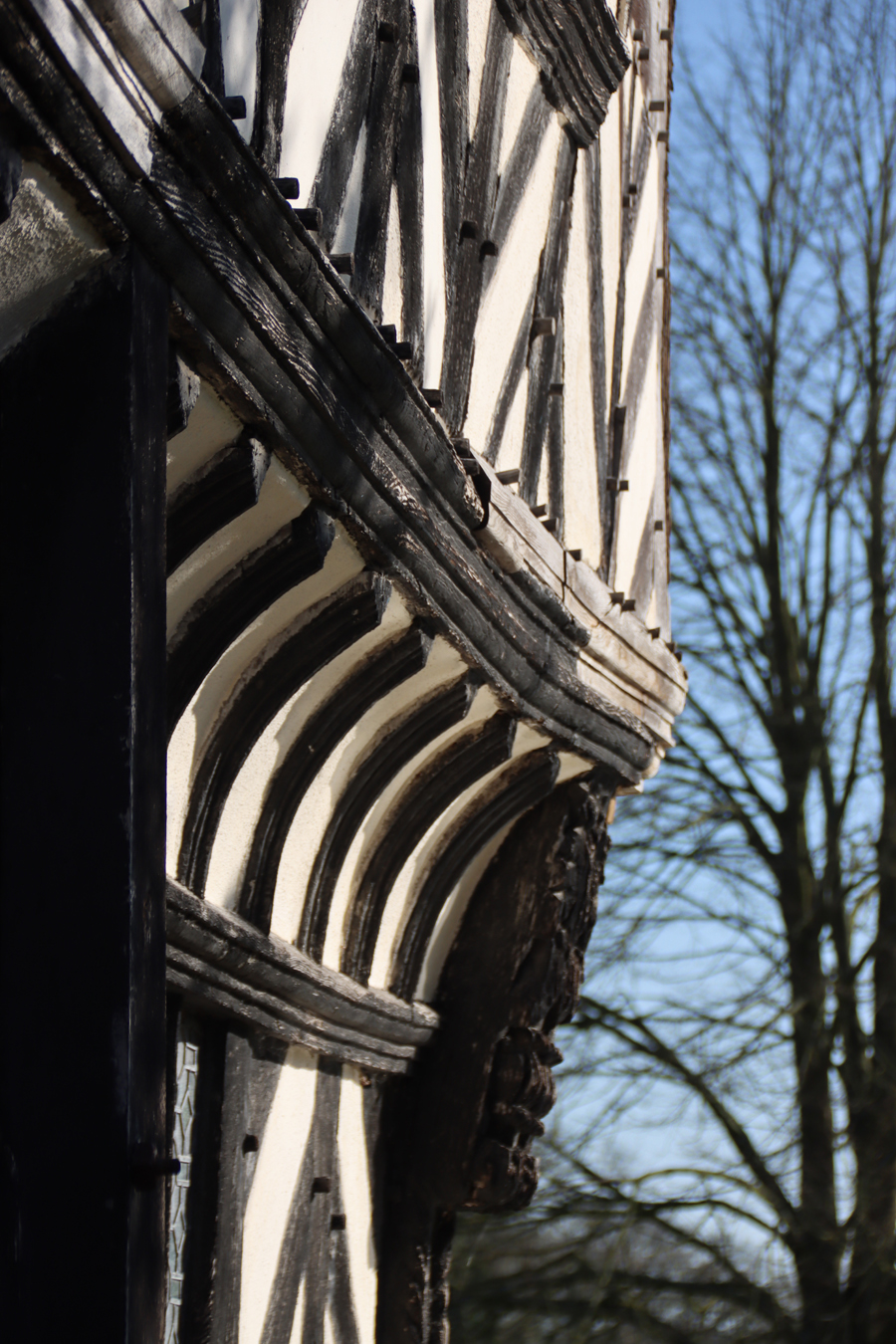
We started at the lodge in the Grosvenor Park, an obviously Victorian take on the Tudor half-timbered buildings that partly define Chester’s heritage, commissioned by the Grosvenor estate to provide a touch of additional elegance to the second Marquess of Westminster’s 1867 philanthropic donation of the land to create a park.

Grosvenor Park Lodge, Chester

Grosvenor Park Lodge

The Grosvenor Park Lodge by John Douglas

Grosvenor Park Lodge from the rear

Grosvenor Park Lodge from the rear

xxx

Grosvenor Park Lodge

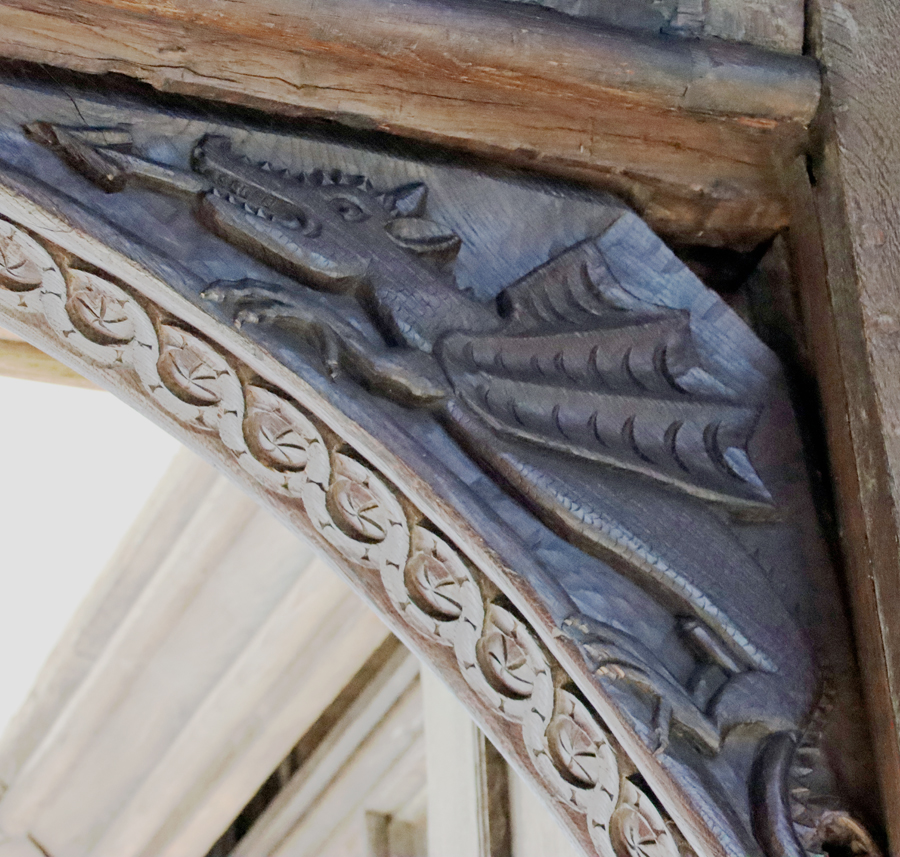
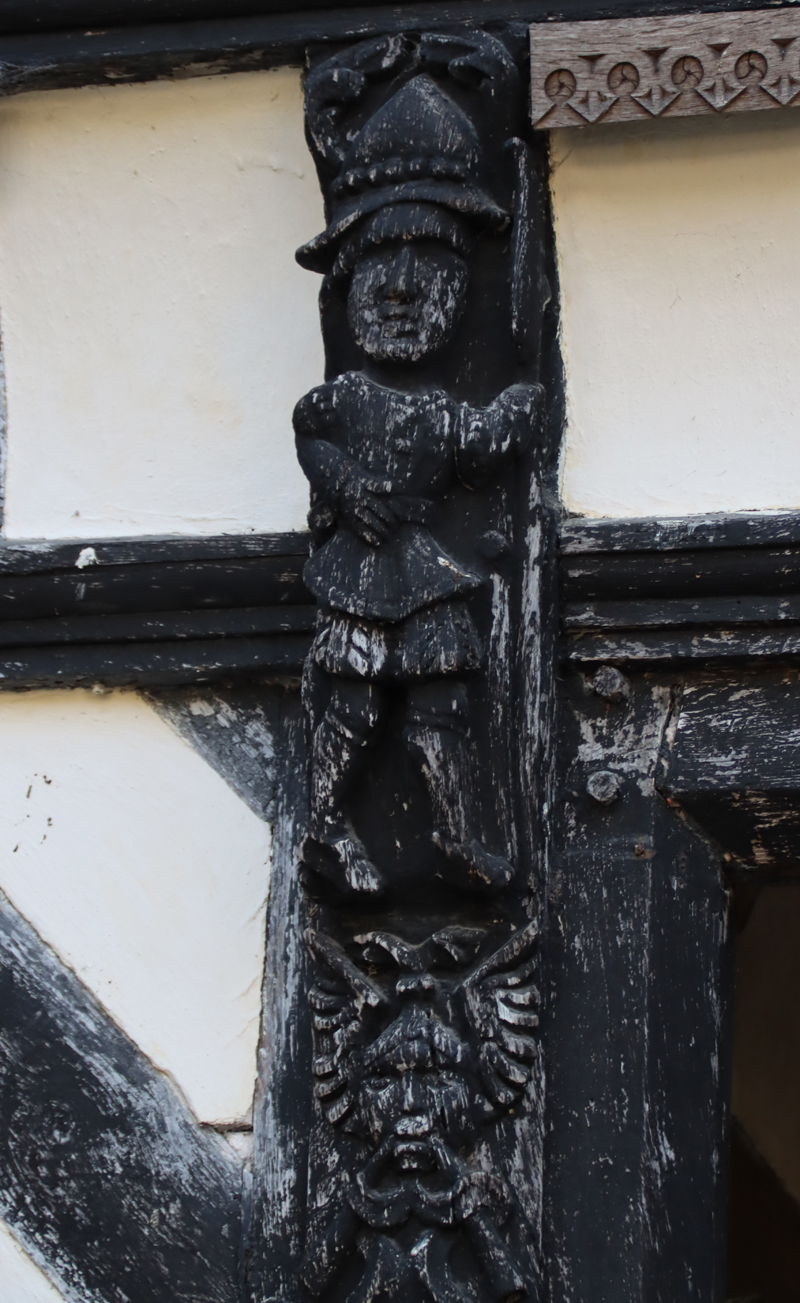
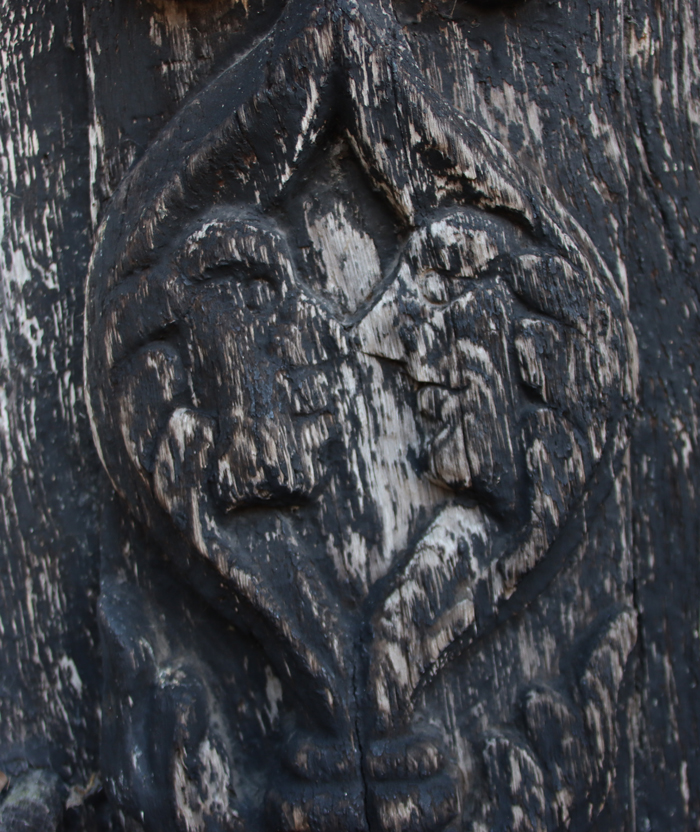
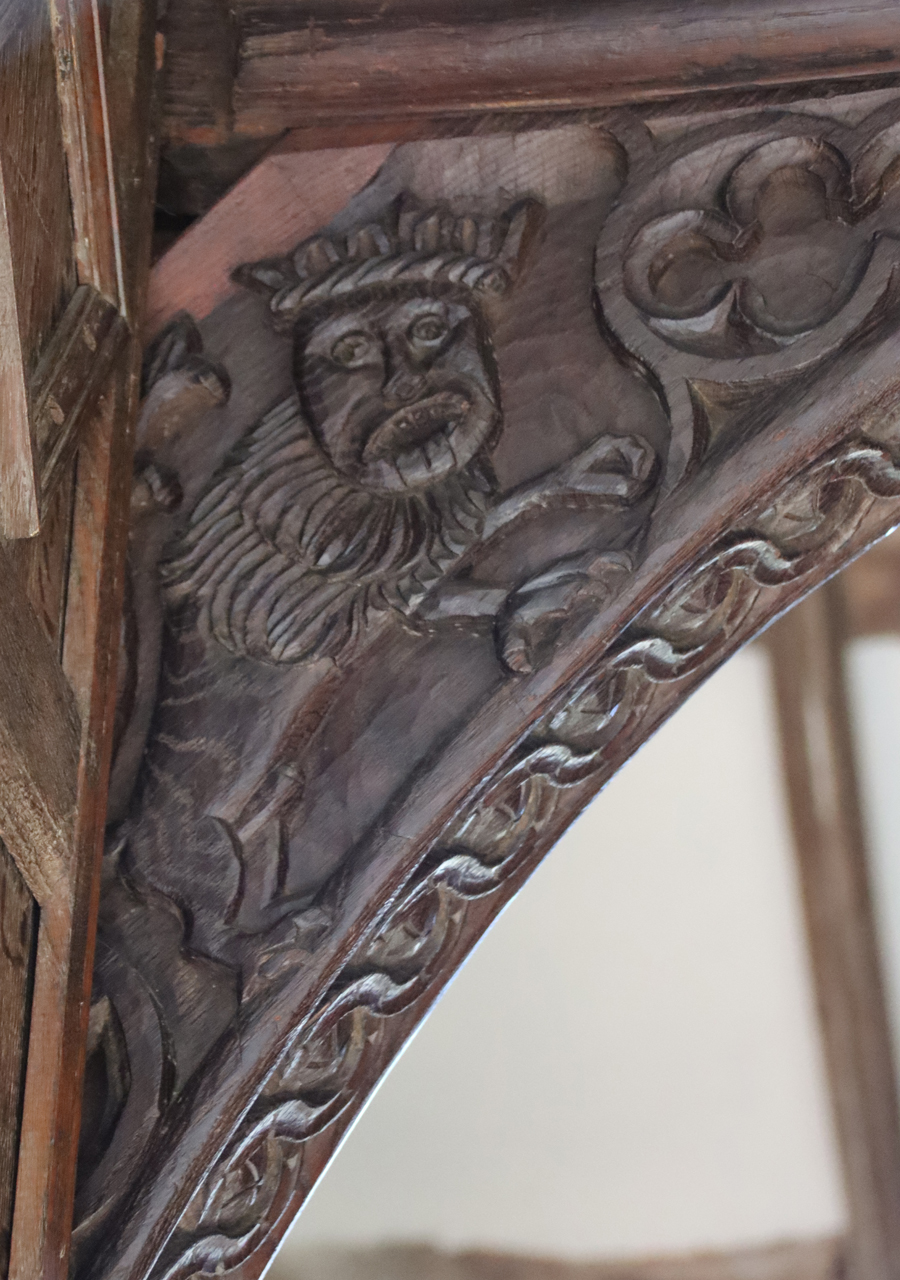
Detail of carved woodwork on the Grosvenor Park Lodge: “Nobilitatis virtus non stemma character”

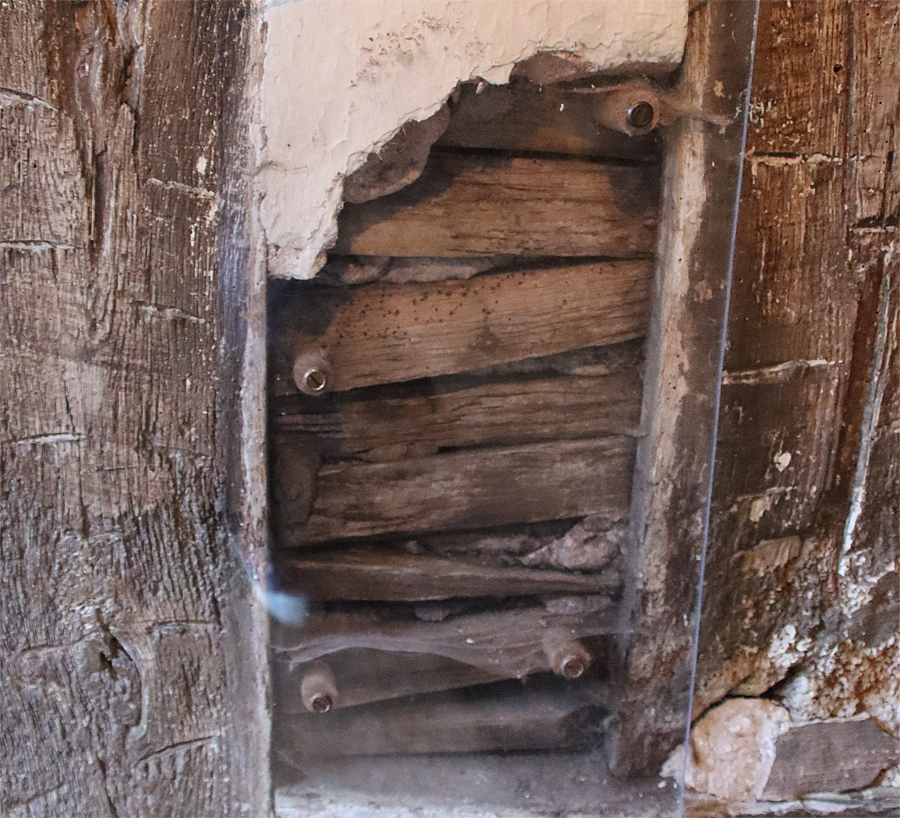
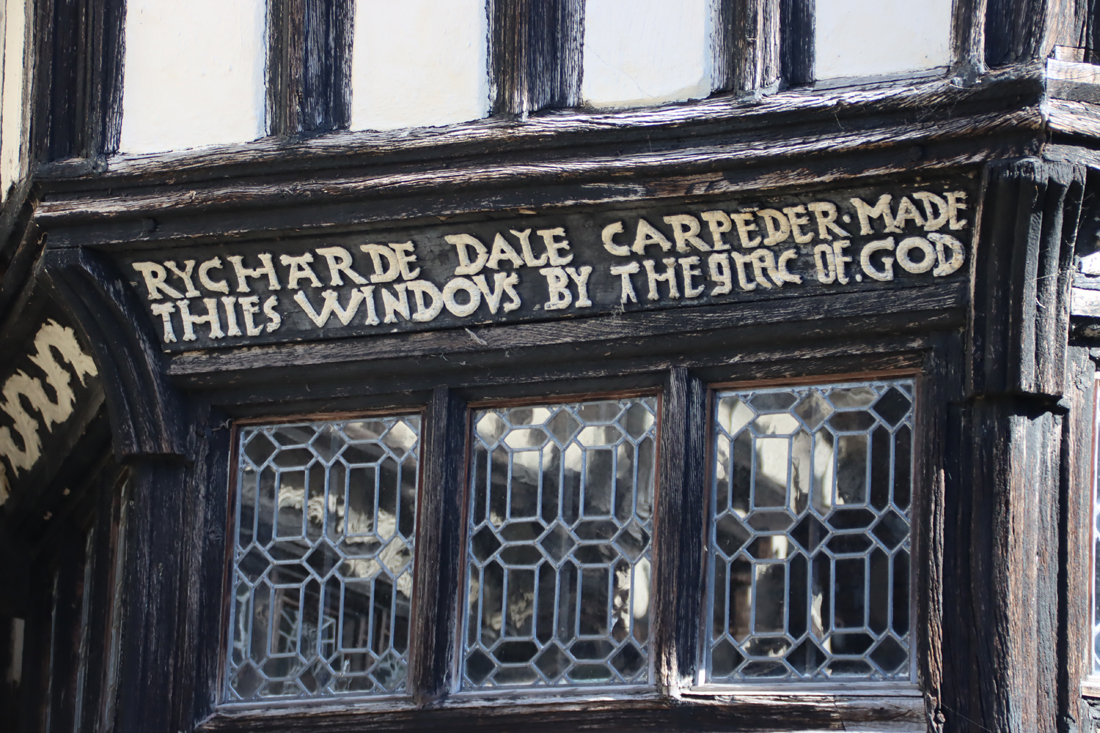
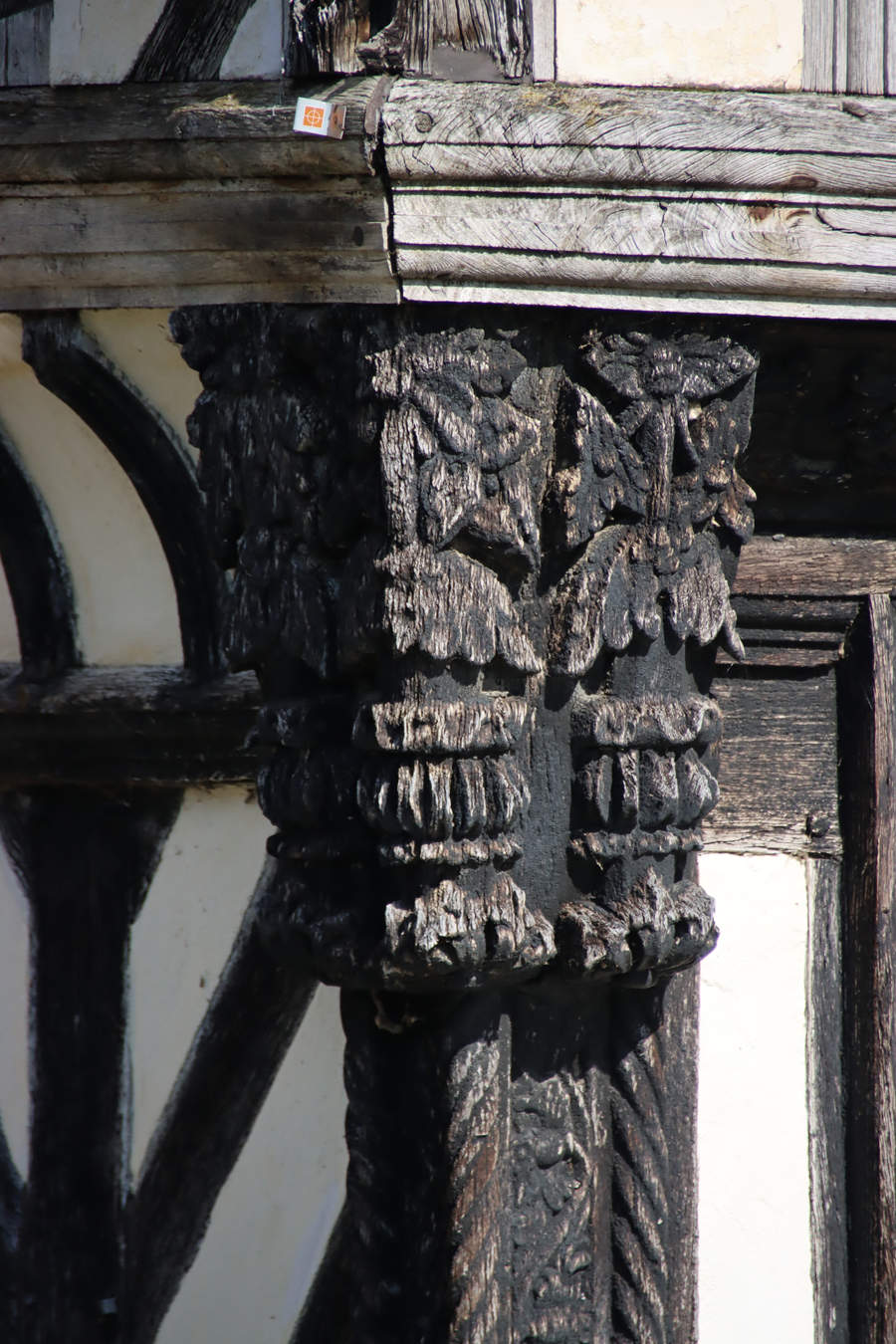
With Ruabon brick at its base and half-timbering at first floor level, it features sculptural elements and carvings that provide it with real charm.  Douglas apparently thought it entirely appropriate to add a medieval-style sandstone extension to his building, which as Chantal pointed out, reflects the multi-period character of many of Chester’s buildings.

It became clear as we proceeded on the walk that this willingness to go with the flow of Chester architecture by echoing some of its variety and diversity, without ever trying to replicate it, was a key characteristic of Douglas’s approach. He always preferred local materials, and this too indicates a real wish to connect with Chester’s earlier architectural heritage.  It’s great to see it being used as a café, providing a useful service on the edge of the park.

xxx


xxx

Our next stop was just over the road, on Grosvenor Park Street.  The 1872 Grade II* listed houses, numbers 6-11 on Grosvenor Park Street make up of a row of terraced houses and a Zion Chapel have long been a favourite of mine.  Together they are a fabulous, wildly imaginative mixture of different elements all of Ruabon red brick, including gothic style features, turrets, and a dozen other twiddly bits.  It is always wonderful to see how brick can be used to create elements that are more conventionally associated with stonework in this country.  Whether the mullioned windows, some with original leading, let in a lot of light I doubt, but they are wonderfully ornamental.  It was particularly interesting that Douglas built these houses on land that he owned, renting them out afterwards.  He did not skimp on materials or architectural design in order to make a bigger profit.  This set of buildings argues that he really cared about not only the quality of his own work, but about what he as an individual could contribute to Chester.FULL RUN HERE

xxx

Perhaps one of his best known buildings in this part of extramural Chester is quite unlike either his lodge or his fantastic domestic extravaganza.  However, as Chantal pointed out, the Chester Public Baths are still in proportion, a good fit with the domestic buildings in this part of Chester in spite of its being a public leisure facility.  Chantal positioned the idea of swimming and the provision of a public baths in the social context of Victorian values and ideals, but made it clear that Douglas had put his own particular spin on the resulting building.  Both practical and decorative, it is a very fine example of a building that is at once distinctively Victorian but also takes admired aspects from Chester’s past.


xxx

Further down Bath Street, I would not have guessed at first sight that the Grade II listed buildings on the right were another Douglas innovation, but the signs are there when you pause to look more closely, and particularly when you have Chantal’s expertise to provide detailed knowledge and insights.  Except for the building at the far south, nearest to the Baths, which is more typical of other Douglas buildings nearby, the main run of houses is built of buff sandstone, quite different in material, colour, and texture from other Douglas buildings and, for that matter, from anything else that I recall seeing in Chester.  It dates to 1903, quite late in Douglas’s life, and perhaps this accounts for some of the distinctive features discussed by Chantal.  There is an echo of the buildings on Grosvenor Park Street, but this has a much more monumental feeling to it and even with the decorative features and the short spires, seems less light-hearted and, in spite of the ornamental features, a little more monumental in feel.


If you follow the building all the way round the corner you will see that the houses link to a building built by Douglas to house Prudential Assurance.  It’s name today, Lombard House, reflects a later use by the eponymous bank.  To the left of the entrance, just around the corner, there is a charming female statue inset into a niche holding a snake and book.  This is Prudence, one of the four cardinal virtues (the others being Justice, Fortitude and Temperance), adopted by Prudential Assurance as their emblem in 1848 for her qualities of foresight, intelligence, thoughtfulness and knowledge.  Although more traditionally shown with a mirror representing self-awareness, a book is also part of her iconography, representing knowledge, wisdom and and good judgement.
xxx

xxx
Our final stop for the day took in two architectural features, bringing us into the city within the walls – the wrought iron extravaganza that sits on top of the Georgian East Gate, with its splendid clock, and the former Grosvenor Club building immediately to its west.  These both speak of late Victorian Chester’s ambition and its delight in ornament and display, giving an unmistakeably Victorian sparkle to this part of the city.  Chantal gave us details about the clock that I hadn’t heard before concerning its construction, as well as an entertaining factoid about the date of construction, reminding me that it is very easy to become complacent about even such a dominant landmark.  I had known nothing about the Grosvenor Club (including its name and purpose) so this too was a learning curve.

The Grosvenor Club by John Douglas

The Grosvenor Club

Grosvenor Club and Eastgate St

The Grosvenor Club on the right with the rest of Eastgate Street taken from the top of the East Gate bridge, under the clock.

When the tour was over, and Chantal had pointed us at other Douglas buildings in the vicinity so that we could investigate further on our own, she was still surrounded by a group of people asking many questions, and this had been the trend of the entire walk, with tons of information being imparted and lots of questions following.  Keep an eye open for this walk being offered in the future.  It’s a good one!

The nearby Parker’s Buildings

xxx

Grosvenor Park Lodge

Grosvenor Park Lodge detail

Thinking about John Douglas and his work over the following few days, and looking up other examples of his work, his buildings generally aim to provide an attractive environment of well-being, based on the idea that past and present reinforce one another in a very comfortable and attractive way.  Although many of the John Douglas buildings were impressive, and some of them were intended to be imposing, others were homes along streets that made use of vernacular features both from Chester, with inspiration taken from European cities, and from the medieval period onwards.  His preference for local materials is clearly demonstrated, and his love of decorative features is a real celebration of life.  He took a modern approach to architecture, incorporating traditional styles into his new interpretive schemes, as well as Germanic and French ideas that gave his work a rather more cosmopolitan edge than other architecture in the city, and in doing so added real value to Chester.  The best of the Victorian architecture of Chester simply oozes a sense of excitement and self-confidence about their lived present and their anticipated future, and John Douglas reflects this unfurling era with real exuberance.   His contributions to places like wealthy Eccleston and Aldford are also attractive, but perhaps Douglas is at his most appealing when contributing to Port Sunlight, the village built in the late 1880s by Lord Lever for his factory workers, contributing his skills with around 30 other architects, to create a very different type of community.  It must have been a real pleasure to live in one of his remarkable houses.  It is very nice to see that the ones that I have found to date seem to be very well maintained.  It is only a shame that subsequent architectural projects in Chester have only occasionally managed to live up to both his high standards and his creativity.


“Cheshire’s Archives: A Story Shared.” Great to learn about the new Cheshire Archives, opening next year

The Cheshire Archives building in Chester. Source: Cheshire Archives: A Story Shared

On Wednesday 17th September, as part of Heritage Open Day, Paul Newman from the Cheshire Archives and Tim Brown from the architectural firm Ellis Williams, explained to a well-attended audience at the Grosvenor Museum how the new archive project had been rolled out and what we can expect next year when the new Chester building opens.  I am dying to get my hands on the Cheshire Lunatic Asylum records that they hold, having already written a long screed about the asylum between 1854 and 1870 (across four posts here), so I was attending the event with a real sense of anticipation.

The Cheshire Archives, which since 1986 have been located in Duke St in Chester, closed in 2022, having won a Lottery grant to build two brand new buildings.  The former Duke Street premises of the Archives were in a set of lovely Victorian buildings, which were once warehouses of the legendary Browns Department Store, but the Archives were beginning to outgrow them.  The archive collections go back to the mid 12th century, and continue to be added today, representing different aspects of community life, working and domestic, at different periods.  As its role became more important, the Archive outgrew the building, with boxes that would reach 8km if laid end to end, and it had a number of environmental issues as well as providing less than ideal facilities for both staff and researchers.  Targets to reach a larger and more diverse audience were difficult, and it became clear that a move was the only realistic solution.

The new Crewe Cheshire Archives building. Source: Cheshire’s Archive: A Story Shared

An initial investment of National Lottery money to explore the project in 2020 was successful, and a full National Lottery Fund grant was subsequently allocated, with work began in earnest in 2022.  The locations in Crewe and Chester will spread the collection between east and west sides of Cheshire to provide accessible storage for the archive collections in conditions that are much more favourable. Outreach programmes will be more viable, reaching a much wider audience of different ages and backgrounds. Digital access will be much improved, with new ways to access local collections and historical data, including a postcode search and community-selected highlights referred to as “Gems.”  At the same time, the salt mines in Winsford will continue to store other records, which are available to order to either location with a one-week turnaround.  A permanent exhibition will be set up, and exhibition spaces will eventually be available for those using the archives.  The new offices will open in 2026, and the project will continue as a measuring and monitoring exercise into 2027.

Location of the site on Lightfoot Street. Source: Cheshire West and Chester

The architectural firm Ellis Williams, who had undertaken the ambitious and successful conversion of Chester’s Story House, was appointed to develop both of the new buildings.  Interestingly, although they have many of the same internal features, their appearance is very dissimilar.  Both have very modern appearances, but each has been adapted to its own immediate neighbourhood.  Initial design ideas were more radical, but certainly in the Chester case the emphasis soon shifted towards meeting planning requirements for some degree of continuity between the proposed new building and the surrounding architectural context and local character. Documents detailing some of the plans can be found here: https://www.cheshirestoryshared.org/home/the-plan

The new archive building in Chester will be located on the mainly residential Lightfoot Street, which runs along the railway line behind the Chester railway station.  This has created some challenges in terms of accessibility, and the Council were unwilling to sell the entire site, so parking is confined to 35 spaces.

A low wall with indented panels on Chester Lightfoot Street, which separates the archive site from the road. Source: Google Maps.

The site is divided from the road by a low wall with indented sections, and it was a planning requirement that this should be preserved.  The idea here is to knock through some of the indented panels, whilst leaving others in tact, replacing those that are to be knocked through with wrought iron artwork, so that the Archive site is visible through the panels, creating a linkage between both sides of the wall.  There is a slight slope of around 2.5m downhill from the road level, which requires stairs and slopes to enable ease of access.  Parking will include spaces for school coaches and there will be a loading bay at the rear.  The shape of the building itself will echo the twin-gabled shape of railway sheds and platform roofs, but is super-modern in design, and it will feature an “active frontage,” a term that refers to the integration of the building with the street onto which it faces.  Work began in 2017.

Inside, the two-storey Chester building will be split between a public-facing space on the ground floor and a more staff-orientated space on the first floor.  It will total 3000 sq ft (c.270 sq m).  The ground floor foyer, which although north-facing should be light-filled, will be an exhibition space, and will include a theatre area with movable walls, lighting and seating, to ensure maximum flexibility.  A help desk will be located at the rear.  The research rooms will have desks for research, with a total of six computers available at any one time (most people apparently bring their own kit) and there will also be a chill-out area.  The first floor will include, with archive storage in rolling racks, offices and meeting rooms.  Energy considerations have been factored in, making best possible use of the available technologies, and various levels of security and fire-safety measures are part of the overall plans.

The foundations have been established and work is underway on the lower level brickwork, whilst a steel frame and roof have also been erected.  Archaeologists from Oxford Archaeology had been given time to carry out an assessment, but found very little of interest beyond sundry 19th century railway features.  The resulting report can be found here.

The archives will probably be open for a 5-day week.  I should have asked whether this was Monday to Friday, or whether a weekend day would also be included, but it did not occur to me at the time.  I am really looking forward to visiting the new Cheshire Archives building when it opens in late summer 2026, and experimenting with some of their upcoming digital services.  In the meantime there is a website showcasing some of the Archive’s activities at Cheshire’s Archives: A Story Shared.

Thanks very much to Paul Newman and Tim Brown for not only delivering a terrifically informative presentation but for answering the numerous audience questions.


A revealing talk and guided tour: The Churchill Building and the Western Command 1937 – Today

The Churchill Building portico dates from 1997, but the original Neo-Georgian military Western Command building can be seen behind it.

The portico dates from 1997, but the original Neo-Georgian military Western Command building can be seen behind it.

With many thanks to Chantal Bradburn for an excellent lecture in the Churchill Building in the University of Chester’s Queen’s Campus.   Chantal is the University’s Outreach representative, with a strong background in art history and a particular interest in architecture in its social context.  Her talk, entitled “Western Command (Churchill Building),” covered the design and original purpose of the building as the headquarters of the Western Command, including the fascinating underground bunkers, and the building’s subsequent phases of use.  The presentation and the subsequent walk around the building’s exterior brought the Western Command to life.  Chantal’s ability to convey an impression of the building as it was in military times, based partly on her research and partly on feedback from people who have attended the talk or contacted her over the years, was of critical importance, because the interior had been completely re-envisioned in grandiose style by the subsequent bank, and converted once again in more pragmatic terms into the University of Chester’s Business School.  Only the exterior retains the essential character of the Western Command building.

The eastern wing of the Western Command (Churchill Building) gives a good impression of how the building appeared when it was first built

The eastern wing of the Western Command (Churchill Building) gives a good impression of how the building appeared when it was first built

The building, then known as Capital House, was completed in around 1938, almost certainly in response to the threat of war.  Neo-Georgian is not my favourite of the various architectural experiments in Chester.  I have grumbled on and off about the Wheeler Building on the blog for years, and there are a number of more modest buildings dotting the streets of the historic city whose architects seem to believe that slapping some symmetrical rectangular windows into plain blocks of undifferentiated brickwork will do the trick nicely, completely missing the point of refined elegance and delicate embellishments that characterized Georgian harmonies.  On the other hand, as Chantal pointed out, at least in the case of the Churchill Building there are good reasons for this style, which is better than most of its siblings, relating not merely to the practicalities of budget constraints for such a large building.

The eastern entrance to the Churchill Building with subtle nods to Art Deco 

The eastern entrance to the Churchill Building with subtle nods to Art Deco

The importance of establishing a dignified military presence referenced the power and prestige of the city’s Georgian predecessors, which were themselves influenced by Classical architecture, whilst some low-key features nod to both the medieval military past and, in an even more subtle way, other contemporary styles.  I would not have noticed these had Chantal not pointed them out.  Although the subsequent Northwest Securities bank slapped a gigantic Classical-style portico on the front, the original building consisted of flat-roofed blocks that provided an impressive frontage, which relies for its impact on the size of its footprint rather than the height of its two-storey walls.  Chantal pointed out that the position of the building was strategically very fine, with its views over the river and the city beyond, only matched in its vantage points by the site chosen for the castle.

As the northwest HQ for intelligence on what was quite literally Britain’s western front during the war, the personnel serving in the Western Command building had a critical role not only leading up to and during the war, but for a surprising amount of time after it.  Chantal told us a great many stories about the role of the building and the people who worked there, highlighting the complexities that different levels of security caused for both employees and contractors, and emphasizing the degree of secrecy that was associated with the activities that took place within the Churchill Building.

Bunkers excavated into the sandstone at the Churchill Building. Source: 28DaysLater

To the east of the building, up-river, the remarkable and extensive underground bunkers were built to provide shelter and a command centre should it become necessary, both during and after the Second World War.  They extend from the level of the building down towards the river.  It is reputed that Churchill, who is known to have visited the building, may have met there with President Dwight D. Eisenhower and General Charles de Gaulle.  No documentation supports this view, but there are apparently anecdotal accounts that support the possibility.  The bunkers are now too dangerous to visit (see a photograph of a point of collapse on the 28DaysLater website).  The sandstone through which former miners in the army excavated to create the bunkers is sponge-like, attracting damp that is not helping with the stability of the underground structures.  Chantal showed photographs and explained past survey work and future plans (dependent as always on funding).

The building passed to the Royal Army Pay Corps in 1972, and from 1972 it was taken over as offices for a banking corporation.  The presentation took place in a huge room with an enormous table, all very glossy and highly polished, and heavily influence by Art Deco designs.  This was part of the bank’s improbable legacy.  It is quite staggering how the bank took over a military building and turned it into an extrovert and financially corrosive expression of self-indulgent excess.  Where these details have survived, the legacy is huge fun, but quite mad.  The bank’s vast portico, converting the Neo-Georgian blocks into a pseudo Classical temple, is equally pretentious. I am very fond of the University, having had a great time doing some post-graduate research there a couple of years back, but it really does seem to have saddled itself with buildings that for all their scale and practicality are amongst the least aesthetically charming of the various Cestrian styles.  In their favour, the University does make the most of them.

The opening of the Churchill Building by John Spencer Churchill (centre in grey suit), when it became part of the University of Chester in October 2015. Source: Cheshire Live

It is interesting to note that in the case of both military base and commercial bank, the building was off-limits to the public, not only physically but visually.  The arrangement of buildings at the time meant that the view through the gates, then in a different position, blocked any view of the heart of the complex.  It has been particularly interesting for local people who have lived in the area for a number of decades to have access to the building at last, and to be able to see what was so long hidden from view, perhaps particularly when family members and friends worked there.

The building had been out of use for a decade when the University took it over in 2015 to make it the centre for their Business School, with most of the building adapted to this task with the usual collection of teaching, research and computer rooms, areas for socializing and a café.  Wisely, the decision was made to preserve some of the more elaborate flourishes of the bank’s idea of good taste, and there are some distinctly New York style decorative features in the foyer.  More to the point, the building’s foundation stone and its frame, appropriately made of carved stone rather than the less expensive brick, has been preserved and is now installed above the reception desk as a very welcome piece of the building’s material heritage.  The exterior, now sporting a leaded dormer roof, still retains the essence of its stern and uncompromising military purpose, but its survival first as a bank and then as a major component of a university campus is a testimony to its durability.

It is impossible to do justice to Chantal’s talk, which was stuffed full of information.  Chantal does these talks quite frequently, and I do recommend that you keep an eye open for her next ones, because she provides a vivid insight into a world that is not normally associated with Chester, and which was clearly a very important part of the city’s social and economic profile from the 1930s onwards.  More than any other talk that I have attended since moving to the area, this is the one that surprised me most, and left me with a new set of insights into Chester’s less publicized wartime and post-war history.  Splendid.

North-facing aspect of the Churchill Building

“Landscape of Neolithic Axes” – A hugely enjoyable afternoon of talks at Penmaenmawr

Introduction

"Landscape of Neolithic Axes" talks in Penmaenmawr on 16th August 2025. Jane Kenney, Becky Vickers and Alison SheridanWhat a thoroughly enjoyable afternoon on Saturday 16th August organized by the Landscape of Neolithic Axes project, part of the Carneddau Landscape Partnership.  The subject matter,  “Landscape of Neolithic Axes,” focused on the production, distribution and role of axeheads made on stone sourced above Llanfairfechan and Penmaenmawr.  These shaped and polished axeheads were distributed to locations all over Britain.

Penmaenmawr, which hosted the event, is a lively little village perched above the north Wales coast, with fabulous views out to the sea, which was particularly jewel-like on the sunny day of our visit.  The sense of seascape and landscape merging almost seamlessly into one another, only faintly interrupted by the line of the village, was remarkable.  Brown signposts to “Druid’s Circle” (Cefn Coch prehistoric stone circle) and the immediacy of the rocky hills just above were incredibly tempting, but we were headed for the Community Hall that was hosting a series of public lectures.

It was a very well attended event.  The same three talks took place first in the morning starting at 10am, and then again in the afternoon at 2pm.  That was extremely generous as it gave those of us coming from further away the chance to leave home at a reasonable time, and the afternoon talks sounded just as fresh as if they were being delivered for the first time.

Key sites in the area of Neolithic axe production around Penmaenmawr and Llainfairfechan

A map of the area, showing all the key sites. From the temporary exhibition at Penmaenmawr Museum (click to enlarge)

Although outside visitors were invited to attend, the event was clearly organized, at least in part, in recognition of the volunteers and the community for all their support.  Many of the attendees had been volunteers on the extensive survey and excavation work that took place not only on Graig Lwyd itself but on nearby outcrops formed of the same intrusive rock.  The talks were designed to be fully accessible to all levels of familiarity with the subject, and were based not only on the latest local research, which has been conducted to the highest standards, but also on the most up to date academic findings in the rest of Britain and in Europe.  It was a genuinely impressive and thoroughly riveting trio of talks.

Apologies for the quality of the photos that I took on my smartphone at the exhibition, and which are dotted throughout this post – I have been unable to improve them much, in spite of tinkering in Photoshop.

A quick note on Neolithic axeheads

Polished Graig Lwyd Neolithic axehead

Polished Graig Lwyd Neolithic axehead. Photograph and copyright David Longley. Source: Carneddau Partnership

Just a quick note on the manufacture of axeheads for anyone reading this who is unfamiliar with the subject.  The Neolithic spans the time period from around 6000-4500BC and in part of this period axeheads made of particular types of stone, found only in certain geographic areas, became an important type of commodity, traded throughout Britain.  The stone axes made from the outcrops at Penmaenmawr and Llanfairfechan, a stone valued both for its durability and workability has been found all over Britain.  The working of the stone and the networks that distributed them were complex, not only logistically but in terms of inter-community co-operation and the development of relationships.  Axeheads, hafted on to wooden handles, were highly valued items, presumably not merely because of their value as utility tools, but as prestige items that were often difficult to obtain.  This idea is reinforced by finds of axeheads that were never used, and by the fact that some were apparently deliberately broken to take them out of circulation.

Digitized image of a drawing of Graig Lwyd axeheads as published in RCAHMW Caernarvonshire Inventory Volume I : East, Figure 10, 1956. Source: RCAHMW

xxx
xxx

The talks

"Landscape of Neolithic Axes" talks in Penmaenmawr, Carneddau PartnershipThere is, of course, no possibility of doing justice to the talks, and I have not tried to capture everything that was covered.  I hope that I have managed to capture just a little flavour of some aspects of the research discussed by the three speakers in the very short sketches below.   Thanks very much to the the three presenters who provided such a good summary of their work, the directions that their research is taking and how it all relates to the Penmaenmawr area.
xxx

Jane Kenney (Landscape of Neolithic Axes Project and Heneb)
About “The Landscape of Neolithic Axes Project”

Graig Lwyd area roughouts

Roughouts (part-completed axeheads) from the Graig Lwyd area. Photographed in the temporary exhibition at the Penmaenmawr Museum

Dr Kenney, who has been running the project, explained that this is the 6th and final year of the project that is part of the part of the Carneddau Landscape Partnership Scheme, the overarching objectives of which are to protect and conserve natural and cultural heritage, engaging local people and visitors with that heritage.

The project covers the important period 4000-2500BC that sees the arrival of the earliest farmers, pottery and new funerary monuments, who began to move into the territories of Mesolithic groups who hunted, collected plant foods and fished.  Polished stone axe-heads were part of the new material assemblage that was required by these innovators.  Although wooden handles rarely survive, it is clear from the few that do that axe and adze heads were intended to be hafted.  The example on the poster at the top of the page, and also shown further down the page, is from Cumbria and is now at the British Museum. There were a number of places from which suitable stones were sourced and worked, and Graig Lwyd behind Penmaenmawr was one of these.  The wide distribution of axe heads throughout Britain and Ireland reflects not only the functional value of this type of tool, but their social significance too.

William Hazzledine Warren, who first discovered the Graig Lwyd site in 1821. Source: Peoples Collection Wales

Graig Lywyd was first discovered by Samuel Hazzledine Warren, who was both geologist and prehistorian, in 1919.  He found literally tons of worked material at the outcrop known as Graig Lwyd, made on an igneous microdiorite called augite granophyre, a type of rock formed of liquid magma intrusions that has the combined virtues of being hard enough to use for chopping wood, but also has a structure suitable for knapping into the required shapes.  He published his findings, starting over two centuries of archaeological research in the area.

Stone sources from around Penmaenmawr. From the temporary exhibition at the Penmaenmawr Museum. Click to enlarge.

The whole of Penmaenmawr is made out of this, with the rock around the exposed edges of Graig Lwyd and nearby outcrops, Dinas and Garreg Fawr, being the most suitable, precisely because they were so exposed, and after repeated freezing and thawing developed fractures that become scree that can be easily exploited.  Graig Lwyd, Dinas and Garreg Fawr became a very important source with examples distributed all the across England and Wales with at least one present in Scotland too.  Warren’s work was built upon by other independent local researchers, including David T. Jones with whom Kenney worked in the initial stages of the project to identify several possible sources of axe manufacturing.

As this became a wide-ranging landscape project, the team involved an army of volunteers to do the hard work, as well as children from local schools.  Different approaches were taken to excavation, beginning with 1m sq test pits, with everything bagged by layer and pit. Even at this early stage trend became noticeable, with flakes dominating and roughouts being found but later stages of manufacture, including completed objects, absent.  This was a pattern that was repeated at different outcrops.  Bigger trenches were opened that provided more detailed information, some of it near the outcrops themselves but others further down slopes where material had travelled over the centuries.  At the same time, more test pits were opened in newly identified areas.  The test pits, which investigated below the surface, supplemented the surface finds and showed that there was much more to be found.  As well as roughouts and waste materials, manufacturing tools like hammerstones were also found, helping to provide a more complete understanding of the manufacturing process.

Image showing the excavation of test pits forming part of the Carneddau Scheme. The workings were previously thought to be focussed only on the area of Graiglwyd axe factory but are now known to extend over a much wider area. Source: RCAHMW

Flint tool and flakes (waste materials from tool making) found at Maes-y- . Photographed at the temporary exhibition at the Penmaenmawr Museum

An exciting find above a a marshy area near Dinas that produced lots of axe-working debris and some finished axes may have been a settlement area, now called Maes y Bryn, where different activities took place. As well as axe debris, scattered over a wide area, there were lots of flint flakes scattered over the area, which are entirely consistent with a settlement site.  The flints were mainly flakes, the waste from domestic tool manufacture, which were probably domestic.

As well as the Neolithic findings, there were Bronze Age and Iron Age discoveries as well.  For example, not only has the Dinas outcrop produced plenty of Neolithic axe production data, but it has a very nice Iron Age hillfort on top, and there are plenty of Iron Age field systems in the area.  The early and later medieval use of the land is also of considerable interest.  The area clearly has a considerable amount of future potential, but for the immediate future the focus has to be on post-excavation work, with the challenge of dealing with the huge quantities of axe-making debris that was found:  163 buckets as of last year, and yet more of it this year!

The next talk, by PhD student Becky Vickers was a fascinating insight into how these 163+ buckets are beginning to be assessed.

Excavation of an axe production site in the Penmaenmawr-Llanfairfechan area

Investigating a test pit in the Penmaenmawr-Llanfairfechan area. Source: RCAHMW


Becky Vickers (PhD candidate, University of Sheffield)
New research on Axe-Making

Poster from the exhibition at the Penmaenmawr Museum showing some of the varieties of tool found on the outcrops on the Penmaenmawr mountain

The moment I saw that this talk was on the programme I was looking forward to it.  There are dozens of studies looking at flint and chert tool analysis and reconstruction, including how the waste flakes inform about the manufacturing process.  The essence of the approach is to look at how basic raw materials undergo a process of reduction, using stone and organic tools (wood, bone, antler etc) to strike a stone directly or indirectly (e.g. hitting an antler-made tool with a hammer stone to create a particular form). It is a lot less common for other types of stone tools to be analyzed using similar methods and perspectives, gaining an understanding of them from raw material to finished product and, beyond manufacturing, how they were used.

This was the main thrust of the first part of the presentation by Becky Vickers, and it was immensely informative.  She first took us through the anatomy of a tool and flakes, identifying key factors that indicate how the tools were made and how waste flakes can be distinguished from loose scree.  Three main stages of reduction were identified after the raw material had been sourced, which represent a process from rough-out (rough shaping of a piece of stone), through clearly identifiable shape, to final product.  Part of the research has been to study the waste flakes from the production process and the pieces of stone that were flaked away from what would become finished (or abandoned) tools.  Waste flakes can be just as informative as roughouts and finished products about the manufacturing process, an essential part of the production process, helping to answer questions about how flakes changed through various stages and where these stages took place.

Not only axes were made at the sites. From an interpretation board at the temporary exhibition.

Similarly, one of the many interesting points picked out here (amongst far too many to list in this post) is that not all of the axes produced in the Graig Lwyd and related areas were of the most traditional axe form.  Others were carved into shapes that could be used as both small and large general-purpose tools, as well as scrapers and picks. These give a sense of the versatility and different scales of the production process.  The hammerstones that would have assisted with the reduction of the stone to form tools are very rare, suggesting that they were valued items that were carried from the site when the work was done.

The analysis of the objects found suggests that these different processes took place at different locations.  Some of the initial work to create a tool from the raw material was found at the source of the stone.  Roughouts, the initial shaping of the stone into a piece that resembles the final tool, were also found at the source of the stone, but after that further refinement took place elsewhere, perhaps initially in at temporary, seasonal settlement sites that may also have been used as bases for pastoral activities, and were perhaps finished in specialized workshop areas.

A few of the 163 tubs of artefacts and waste flakes found during the project.  From the temporary exhibition at the Penmaenmawr Museum.

Another aspect of Becky Vickers’s work is experimental archaeology.  She has been working with experimental archaeologists Dr James Dilley and videographer and photographer Emma Jones, who have all worked together to carry out, record and understand the implications of end-to-end production processes.  See the video at the very end of this post.  Attempting to reproduce the original methodology to complete a final tool have been of real value to Becky Vickers. enabling her to to adapt her ideas. Experiments showed that 1700-3000 small flakes could be produced from one tool, depending on the reduction process chosen.  Interestingly, this is not at all well represented in the archaeological assemblage.  Many of the smaller flakes are now missing, either washed away by the weather or missed in the archaeological process.  Although she has over 163 huge tubs of finds to wade through, the job could have been much more challenging if all the very small waste flakes that must have been produced in the Neolithic had also been found!

Detail from an interpretation panel at the temporary exhibition

Sometimes is is clear that part-made axes deliberately destroyed, intentionally putting them out of action. This aspect of the research suggests that choices were being made about the suitability of a tool during the manufacturing process and, where an item was found to be wanting, it had to be disposed of in a particular way.

The analysis is to finish in spring 2016, and it will be very interesting to see some of the results.


We broke at this point for more tea and coffee.  Following both of the above lectures, a variety of questions were posed by the audience, and it was interesting to note that many of them centred on how the axeheads fitted into not only industrial and economic aspects of life, but on the wider question of how they were involved in how societies and individuals defined themselves and how such objects became culturally embedded with their own particular signficance.  It was handy, then, that the afternoon was wrapped up with the Headline Talk by one of Britain’s best known Neolithic specialists, Dr Alison Sheridan, who tackled these and other wide-ranging topics about axe manufacturing and the axe trade in Europe, Britain and Ireland.


Headline Talk: Alison Sheridan (Associate Researcher, National Museums of Scotland)
About the Wider World of the Axes

The Shulishader hafted axehead (Stornoway, Lewis)

The Shulishader hafted axehead (Stornoway, Lewis). Source: National Museum of Scotland

After hearing about the Penmaenmawr landscape, and its role in the axe trade, Dr Sheridan introduced the wider picture, and offering insights into the social importance of axes in Britain and Europe.

On a practical front, the axehead is an essential component of the toolkit for land clearance and for cutting and shaping wood for making houses, boats, other tools and weapons.  However, they were not all put to work.  Some were not destined to chop anything.  Both haft and axehead of the Shulishader axe, for example,found on the Isle of Lewis and dating c.3300-3000BC were beautifully shaped and seem to have been less for everyday use and more for display.  Whether valued for their utilitarian use or for the prestigious character of the item itself, they demonstrated a high level of interconnection between communities.  Some types of stone were obviously preferred and even when it was logistically challenging, items made of these preferred raw materials travelled over long networks.  The Irish Stone Axe Project, for example, has found at least 9000 porcellanite axes in Ireland.  The networks that distributed these tools presumably also helped to maintain social ties so that communities could support each other in times of need, for finding marriage partners, for exchanging ideas and for a great many other interconnections.

The distribution of axeheads from Penmaenmawr and Llanfairfechan

The distribution of axeheads from Penmaenmawr and Llanfairfechan across Britain. From the temporary exhibition at the Penmaenmawr Museum. Apologies that it is so lop-sided!

Dr Sheridan described how since the mid 1900s thin sections taken of rocks used for tool manufacture has enabled the study of mineral composition, helping to create a picture not only where these have been sourced, but how far these tools have travelled.  Although there were a number of quarries in Wales, axes were also imported from elsewhere, including one in southwest Wales from the Italian Alps.  The extent and complexity of these networks suggests that this was not just a case of economic models of supply and demand and factory-type production line manufacturing. Instead, Dr Sheridan argues that something more complicated was happening, with social and ideological factors driving production and movement.

In order to contextualize the axe trade, Dr Sheridan gave an overview of the establishment of farming and its associated new traditions with the arrival from Europe of livestock and crops.  Much of her work has been informed by DNA analysis of human remains, which suggests several periods of migration, resulting in the widespread adoption of pioneering new methods of farming by indigenous hunting populations.  Two strands in particular impacted Wales, one responsible for the types of megalithic tombs found on the west coasts of England, Wales and Scotland, and in Ireland and another responsible for the those who introduced the Carinated Bowl tradition.  They brought with them not only new economic activities, pottery and funerary traditions, but new domestic architecture based on farmsteads and new tool types.

Jadeitite axe, Kincraigy (Raymoghy) found in Co. Donegal, Ireland. Source: National Museum of Ireland

One of the remarkable aspects of the network of European trade, exchange and communication that grew up around axeheads is the arrival of polished green Jadeitite axeheads from high in the Italian Alps, which have been found as far away as the Scottish borders, County Mayo in Ireland, the Black Sea and Morocco.  These were special purpose objects that were never intended to be used.  The edges can be translucent when ground thin, so that when held up to the light the edges display a halo, and they can be polished to an almost mirror-like surface.  They were the subject of  the pan-European Projet JADE headed by Professor Pierre Pétrequin, a three year project from 2007-2010 that has produced four volumes of findings.  Dr Sheridan described how a strand of interesting ethnoarchaeological  work has been carried out in Papua New Guinea to gain insights into axe productions, where the highest mountains, being closest to the Gods, were seen as the ideal source of rocks for tool manufacture.  As Dr Sheridan said, every single axehead had an amazing biographical tale to tell, based on its perceived value as a prestige item.

Ehenside Tarn haft and axehead, Cumbria

Ehenside Tarn haft and axehead, Cumbria. Source: British Museum (POA.190.6)

One of the best-known sites for accessing the raw material for axeheads in Britain is Great Langdale in Cumbria, where a greenish rock was sought out.  Dr Sheridan suggested that both the choice of stone and its treatment were influenced by Alpine axeheads in terms of colour, shape, aesthetic beauty as well as its ability to take polish.  These were circulated long distance Britain and Ireland, with some performing a functional role whilst others seem to have performed a more ceremonial role.  The Great Langdale quarries were very heard to reach.  As with the Papua New Guinea example, the social value lies in the difficulty of obtaining stone in first place.

Dr Sheridan went on to describe other examples of British axehead finds, including the working of blue-green igneous riebeckite-felsite axeheads on Shetland, where people were making more axeheads than they could possibly use.  One site alone, a Neolithic house, produced a very unusual find of 12 axeheads, perhaps amassed as wealth to be exchanged with other communities.

The obvious question in discussion of exchange networks, is what Neolithic axeheads were exchanged for.  Dr Sheridan suggested that on the basis of evidence of extensive saltern production (salt made by evaporating sea water or brine from inland springs) axeheads could have been exchanged for salt.  Salt has always been a trade commodity, and although it can be difficult to detect archaeologically, it is a very intriguing line of potential research.

Seen in the context of Dr Sheridan’s talk, the Penmaenmawr axeheads are part of a much wider series of Neolithic networks that produced and distributed not only utilitarian tools, but items of status and prestige that could be preserved and curated to become components of more esoteric value systems.

xxx

The Exhibition at the Penmaenmawr Museum

Geology of the Penmaenmawr and Llanfairfechan outcrops

An incredibly helpful portion of an interpretation panel at the temporary exhibition in the museum explaining the geology of the Penmaenmawr and Llanfairfechan outcrops. Click to enlarge.

We had intended to arrive early enough to see the small exhibition on the same theme in the Penmaenmawr Museum, but the A55 crawled along at 30mph nearly the entire way, so we had arrived just in time to sit down with a complementary coffee and utterly delicious chocolate Hobnob.  Fortunately we were fabulously lucky that some of the museum personnel were packing up at the end of the day, and one of their number generously allowed us in to see the exhibition after they should have closed for the day.  Thank you Suryiah for letting us in!  The exhibition was beautifully done.  Seven interpretation boards covered the geology, the process of axe production on Graig Lwyd and other outcrops, the types of tool found, and provided a cabinet full of axes in various stages of construction, waste flakes and some flint implements to provide an excellent idea of the range of items that were being found on the mountain.  Photographs of the interpretation boards and their beautiful photographs and illustrations have been used throughout this post.  It will be good to go back and see the entire museum on another day.
xxx

Final Comments

The Graig Lwyd stone quarry as it looks today. Source: RCAHMW

It was a splendid afternoon of talks.  If you have the chance to hear any of the researchers speak in the future, do take advantage of the opportunity!  The lectures were being filmed, so hopefully they will become available online at some stage.

The sheer number of logos referencing so many organizations on the poster and on presentations says an awful lot about the complexities of funding and organizing something this complex, particularly in the long-term.  Thanks so much not only to the funders, organizers and speakers, but to the volunteers who provided cups of tea and coffee (life-saving), glasses of water and luxury biscuits, and to all the people who enabled the exhibition to happen, including the museum staff.  It was so well done.  The long round of applause at the end of the event said it all, but it was also great to see people queuing up to thank the organisers on the way out.

My thanks also to Helen Anderson not only for driving us, but for letting me know that the event was taking place.


A few selected pieces of further reading

These are bits and pieces from my own reading, not anything recommended by the organizers of the event.

Books and papers

A short list of general introductory reading

Polished axehead from Graig Lwyd stone found on Anglesey

Polished axehead from Graig Lwyd stone found on Anglesey. Source: Peoples Collection Wales

Burrow, Steve 2006. The Tomb Builders in Wales 4000-3000BC. National Museum of Wales

Edmonds, Mark 1995. Stone Tools and Society. Working Stone in Neolithic and Bronze Age Britain. Routledge

Malone, Caroline 2001. Neolithic Britain and Ireland. Tempus

Ray, Keith and Julian Thomas.  Neolithic Britain. The Transformation of Social Worlds.  Oxford University Press

Specific to Axehead Production (all available to view online)

Ennos, Roland and João Oliveira 2020. The mechanical properties of wood and the design of Neolithic stone axes. Journal of Lithic Studies. 8. p.11-24
https://www.researchgate.net/publication/359751898_The_mechanical_properties_of_wood_and_the_design_of_Neolithic_stone_axes

Pétrequin, Pierre and Alison Sheridan, Estelle Gauthier, Serge Cassen, Michel Errera,
Lutz Klassen 2015.  Projet JADE 2. ‘Object-signs’ and social interpretations of Alpine jade axeheads in the European Neolithic: theory and methodology.  In : T. Kerig and S. Shennan (eds.), Connecting networks . Oxford, Archaeopress, p.83-102
(Free to access, but you need a free Academia account):
https://www.academia.edu/13644414/PETREQUIN_P_SHERIDAN_et_al_2015_Projet_JADE_2_Object_signs_and_social_interpretations_of_Alpine_jade_axeheads_in_the_European_Neolithic_theory_and_methodology_in_T_Kerig_et_S_Shennan_ed_Connecting_networks_Oxford_Archaeopress_83_102

Sheridan, Alison and  Gabriel Cooney,  Eoin Grogan 1992.  Stone Axe Studies in Ireland. Proceedings of the Prehistoric Society 58, 1992, p.389-416
https://core.ac.uk/reader/325992590

Topping, Peter 2010. 3 Neolithic Axe Quarries and Flint Mines: Towards an Ethnography of Prehistoric Extraction.  In (eds.) Margaret Brewer-LaPorta, Adrian Burke and David Field. Ancient Mines and Quarries. A Trans-Atlantic Perspective. Oxbow Books, chapter 3.
(Free to access, but you need a free Academia account):
https://www.academia.edu/17310103/_2010_Neolithic_Axe_Quarries_and_Flint_Mines_Towards_an_Ethnography_of_Prehistoric_Extraction

Walker, Katherine 2015.  Axe-heads and Identity: an investigation into the roles of imported
axe-heads in identity formation in Neolithic Britain.  Unpublished PhD. University of Southampton, Faculty of Humanities (Archaeology), Volume 1 of 2
https://eprints.soton.ac.uk/383149/1/K.Walker%2520-%2520PhD%2520thesis.pdf

Williams, J.Ll.W. and Jane Kenney  2009.  Graig Lwyd (Group VII) Lithic Assemblages from the Excavations at Parc Bryn Cegin, Llandygai, Gwynedd, Wales – Analysis and Interpretation. Internet Archaeology 26
https://intarch.ac.uk/journal/issue26/williams_index.html


Websites and YouTube videos

Gwynedd Archaeological Trust
Group VII Axe-working Sites and Stone Sources, Llanfairfechan, Conwy. Report and gazetteer.  Project No. G2495. Cadw Report No. 1416. December 2017. By Jane Kenney
https://www.walesher1974.org/her/groups/GAT/media/GAT_Reports/GAT_report_1416_compressed.pdf
Landscape of Neolithic Axes: Report on fieldwork in 2021 at Llanfairfechan. Project No. G2495. Prepared for: Cadw. Report No. 1623. March 2022. By Jane Kenney and George Smith
walesher1974.org/her/groups/GAT/media/GAT_Reports/GATreport_1623_compressed_revised.pdf
Landscape of Neolithic Axes. Report on fieldwork in 2022 at Llanfairfechan. Project G2495. Prepared for: Cadw. Report No.1698. March 2023. By Jane Kenney and George Smith
https://walesher1974.org/her/groups/GAT/media/GAT_Reports/GATreport_1698_compressed.pdf

Heneb
Landscape of Neolithic Axes Project: Year 1 Test Pitting, Ty’n y Llwyfan, Llanfairfechan.
https://heneb.org.uk/wp-content/uploads/2024/11/fieldwork2019.pdf
Group VII Axe-working Sites and Stone Sources, Llanfairfechan, Conwy. Report and gazetteer.  Project No. G2495. Prepared for: Cadw. Report No. 1416. December 2017. By
Jane Kenney
https://heneb.org.uk/wp-content/uploads/2024/11/initialsurvey.pdf

A Research Framework for the Archaeology of Wales
Neolithic and Earlier Bronze Age. Version 03; Final Refresh Document February 2017
www.archaeoleg.org.uk/pdf/review2017/neolithicreview2017.pdf

Carneddau Landscape Partnership
Conserving and celebrating the landscape of the Carneddau
(The Carneddau landscape is an area stretching across almost 220 square kilometres in Northen Snowdonia. Its mountain uplands are dominated by Carnedd Llywelyn and Carnedd Dafydd – two of Wales’ five 1,000m peaks)
https://carneddaupartnership.wales/
Landscape of Neolithic Axes
https://carneddaupartnership.wales/project/landscape-of-neolithic-axes/

Penmaenmawr Historical Society and Museum
https://www.penmaenmawrmuseum.co.uk/

xxx


See the website at www.ancientcraft.co.uk 


xxx

Open Day of the CRAG excavations at Bryneglwys, Llantysilio Mountain

Many thanks to the Clwydian Range Archaeology Group (CRAG) for organizing an Open Day to the Bryneglwys excavations on 9th August 2025, and to Dr Ian Brooks of Engineering Archaeological Services (EAS), who is consulting for CRAG, for an excellent guided tour of the Bryneglwys archaeological site.  The volunteer excavators, all CRAG members, were remarkably tolerant of us peering into their trenches as they worked.  Thanks are due too to Dr Pauline Clarke for arranging for Chester Archaeological Society members to visit.  The site is on private land, so visits are by invitation only, and it was a great opportunity to get a feel not only for the pioneering nature of the excavations, but also for the way in which that particular landscape has been used over long periods of time.  I attended with another CAS member, Helen Anderson, and we both enjoyed it enormously.

The site sits on the west-facing lower slopes of the Llantysilio mountain near Bryneglwys, with views both across the valley and down the valley towards the southwest.  Unlike the Clwydian range, which runs broadly north to south, with a tilt towards the east, the main line of the Llantysilio mountain runs roughly northeast to southwest, with the valley of Afon Morwynion along its western edge, crossing below the end of the Clwydian Range. It is now followed by the A5104 from Llandegla to Corwen, with the A494 picking up the route of the River Dee, and following it to Bala and Lake Tegid, and beyond into midwest Wales.  This has almost certainly been an important route connecting northern and middle parts of Wales with the English northwest at least since the end of the last Ice Age, with Iron Age hillforts standing prominent guard over much of the route.

The undulating Llantisylio mountain rising above the village and site of Bryneglwys, its ridge marked by a prominent modern trackway

Research goals

When it was established, the remit of the Bryneglwys project was partly to investigate potential sites identified by the landowner, a keen supporter of the excavations.  It was thought that at least one of the sites might be an early-mid Bronze Age cairn.  As sites from the period are an important aspect of  northeast Wales, and there are very few known from the Llantysilio mountain, this was an opportunity to improve knowledge on the subject and extend an understanding of how these sites were distributed both locally and in northeast Wales.  Given the relative proximity of two Iron Age hillforts.  Given the proximity of an Iron Age hillfort, it was not out of the question that Iron Age data might be recovered.

View to the west of the lower Bryneglwys excavation area

The medieval history of the area was also taken into account.  Bryneglwys village is first mentioned by name in documents in 1284.  Its church, which dates to the late 15th or early 16th century, contains a 14th century slab.  Not far away, just outside Llangollen are the ruins of the 1201 the Cistercian abbey of Valle Crucis, established in 1201 and forced to close in 1537, which may have owned farm property in this location.  The economic activities of Valle Crucis Cistercian monastery near Llangollen are not well documented and any archaeological evidence contributing information would obviously be useful.  The Clwyd and Powys Archaeological Trust (CPAT) report on the subject of granges in northeast Wales collated the information available, but is far from definitive on the subject, and it would be very useful to know if a grange had indeed been established in the Bryneglwys area.

Finally, as usual in rural landscape investigations, seeing what else turned up in the process, including far more recent use of the landscape, was very much part of project scope and has produced some interesting results about changes agricultural land use and the challenges of dealing with drought conditions.
xxx

Survey and excavations

Initial surveys

The Bryneglwys project has produced some revealing results touching on some if not all of these areas of interest.  The initial investigation focused on non-invasive topographical and geophysical surveys, the combination of which determined where the initial excavations should take place.  The topographical investigations located areas where potential archaeological and historical features are visible to the eye, including field boundaries, trackways, a natural spring uphill from the known archaeological features, and evidence of ridge-and-furrow agriculture.  The online resource Archwilio was employed to supplement ground-level observations by providing a birds-eye view of the location.  The geophysical surveys, allowing the team to assess what might lie beneath the surface level, identified features that seemed non-natural and might be man-made.  The excavations have been following up on some of these initial investigations.

Like the Clwydian Range, the Llantisylio mountain has a ridge that is now covered in moorland scrub, although the remains ridge and furrow ploughing show that it was cultivated during the Middle Ages.  The lower slopes at Bryneglwys, having been cultivated and/or grazed for centuries, are largely fee of moorland scrub.  The geological bedrock over which all the Bryneglwys excavations are located is composed of the same cleaved Silurian siltstones that I mentioned on my Dinas Bran post, and look horrendous to excavate.  The current excavations have been taking place either side of a boundary marked by a low turfed stone wall topped with shrubs dating from at least 1740, fields that are now used for herding sheep, although they were ploughed in the past.  Although there were findings of a few Mesolithic tools, which are often found in the area, the main discoveries were far more substantial.

Bronze Age ring cairn and associated finds

Bryneglwys composite photographs of the ring cairn, excavated over two seasons. Source: Clwydian Range Archaeology Group

On the upper side of the boundary wall, the furthest away from the valley floor, the most exciting find to date has been the discovery of a Bronze Age ring cairn, the diameter of which was around 7m.  All four quadrants were excavated over two seasons,

It is thought that the monument probably started life as a small stone circle with upright stones, some modified, and that the structure was later adapted into a banked ring into which the cremated bones and artefacts were deposited on a clay base before being topped with a low cairn.  There were four other deposits of cremated bone and charcoal.  The repeated use of cairns is a normal for the period, indicating the importance of these sites from one generation to the next.

The cremated human remains were found together with some pieces of pottery.  One of these was a large but very poorly fired piece around 120mm in diameter, found upright in the ground just outside the main ring of boulders.  The rim was missing, probably due to plough activity.

Pottery vessel as it was found at the ring cairn, Bryneglwys. Source: Clwydian Range Archaeology Group


Although this poorly fired vessel with the rim missing does not look particularly exceptional today, it must have been an important contribution to the ring cairn


There were also around 40 sherds of other pottery in the cairn accompanying the cremated remains, some with attractive cord-impressed designs that were perhaps intended emulate basketry.


Pottery sherds from Bryneglwys ring cairn. Source: Clwydian Range Archaeology Group

xxx
One of the cremations was deposited in a circle of stones, which was deposited with a quartz crystal and one of two flint arrowheads found at the site.  There were a number of tools made on flint and chert, including two barbed and tanged arrowheads, thumbnail scrapers and a small knife blade.  The flint was very fine and may have been imported.  Tools made on chert were also found.  As well as those in the ring cairn itself, there was also a flint scatter which is at present focused around the ring cairn.   The amount of flint has been unusual for the area, and is of particular interest.
xxx

Remarkably, over 150 pieces of quartz were found in and around the circle, and include a range of different forms and types.


A sample of some of the quarts items found in the ring cairn. Source: Clwydian Range Archaeology Group

There were also a large number of other more general-purpose but important tools  like hammer stones and shale disk-shaped items, the function of which is uncertain but look rather like lids.  Most of the finds from the site are currently on show at a temporary exhibition in the Llangollen Museum but some were on display on a table in the field serving as a car park, together with photographs of those on loan to the exhibition.

The volume of finds in the site has clearly been both rewarding and very informative, providing new insights into the funerary and ceremonial tradition in the area.   The site has now been refilled.

Standing on the refilled excavation of the ring cairn, looking towards the southwest

As ring cairns are rarely found in isolation, the team immediately went looking for similar sites, and a little to the south opened a sample trench, which has unearthed the foundations of another circular cairn which needs to be fully excavated in order to reveal more details.

Lines of sight are an important element of landscape archaeology.  Because so little is known about what, if any, contemporary sites may have been located in the vicinity, this cannot yet be achieved.  Another reason for its position, however, may have been the views from across the valley to the west and down the valley towards Rhug, with distant hilltops figuring as prominent markers not only as landmarks in their own right but also as markers of important routes below that ultimately lead to northwest and midwest Wales, including the Cadair Idris and Snowdonia areas respectively.  The later hillforts, dating to the late Bronze Age and Iron Age that adorn some of these hilltops are indications of the importance of these routes and of the need to protect resources.

The horseshoe feature

The horse-shoe shaped feature, with boulders along one of the banks. Excavated but not yet understood, radiocarbon dates should at least help to establish when it was constructed

Another site that was excavated and has now been refilled was a horse-shoe shaped feature defined by a bank with what looked like an entrance interrupting it on its western side.  Apart from a small group of stones, a large one of which seems to have a cup mark, and some evidence of burning on the flat floor of the feature, this nearly sterile. Sufficient burnt debris has survived to be sent for radiocarbon dating.  Photographs of the cup-marked surface have been sent to an expert on the subject and it seems probable that this is indeed an example of a form of stone marking common to upland areas during the Bronze Age.

The horse-shoe shaped site produced what is probably a cup-marked stone. Source: CRAG Facebook page

The other excavated areas

In the final days of this year’s work, during which further geophysical survey has been carried out, three excavated areas were opened on the basis of previous geophysical survey results, and were being worked on by volunteers during our visit.  At the moment it is not at all clear what the features uncovered represent, and nor is it known when they may date to.  A piece of medieval pottery from one of the trenches is not particularly informative.

Although it would be very nice if some information about land management during prehistoric and medieval periods became available, this is clearly some way off at the moment, but by no means out of the scope of the project should it gain future funding.
xxx

General Context

There is no mention of the Llantysilio mountain in my fairly thorough collection of books about prehistoric Wales, and looking at the Ordnance Survey map, there are only two archaeological sites marked in the vicinity, both Iron Age hillforts.  One of these is Moel y Gaer, about 2km as the crow flies, but uphill all the way, roughly east from Bryneglwys village (not to be confused with either of the two of the same name on the Clwydian Range).  The other is Caer Drewyn (about which I have posted here) and is around 7km to the southwest.  The usually helpful Megalithic Portal had nothing else to add.  Archwilio is somewhat more informative, but makes it clear that this is still an area that is surprisingly short on recorded prehistoric data when compared with, for example, the Clwydian Range or the nearby Eglwyseg mountain.  Further information is provided by Heneb, which comments that there are “Bronze Age hilltop burial monuments on Moel y Gamelin and Gribin Oernant” (on their Llantysilio Mountain HLCA 1142 page).

The Archwilio website shows possible sites (unexcavated) in the Bryneglwys area, as well as the Iron Age hillfort Moel y Gaer (not to be confused with those of the same name on the Clywdian Range)

This emphasis on the survival of cairns and ceremonial sites in the archaeological record is typical.  Settlement data is very thin on the ground anywhere in Britain, because having been built in perishable materials, they have decayed into the ground.  Archaeological data is therefore skewed towards funerary sites, which probably also double as statements of identity and territorial affiliation.  Ceremonial sites are known throughout Wales, although in northeast Wales these are rarely found.  The function of henges (banked and ditched enclosures, with ditches on the inside) and stone or timber circles seems, in northeast Wales, to have been either irrelevant or was incorporated into cairn designs, like ring cairns, that combined funerary and ceremonial functions.

Distribution of round barrows and cairns in Wales after c.2100BC – c.1600BC. Source: Burrow 2011, p.106

Looking in general terms at the early to mid Bronze Age of northeast Wales, beginning a little before 2100BC and lasting to around 1600BC, there are plenty of round cairns on the Clwydian range, the Eglwyseg range, and Ruabon mountain, apparently coinciding with improvement in climatic conditions.  Writing in 2004 Steve Burrows noted that a survey by Cadw had identified 17 cairns on the Clwydian Range alone; and more have been identified since then.  These are just a small sample of the 1000s that have been found throughout Wales as a whole.  It is interesting to note that most of these are on, rather than above, worked land.  Although most of those remaining are on uplands, the presence of lowland and valley bottom locations indicates that even though many of those on land attractive to more recent farmers may have been ploughed out, they were certainly there.  On the least attractive land for cultivation, pastoral herding was probably favoured, requiring smaller groups and greater mobility for at least part of the year.

Most of the remains interred in cairns are cremated, and represent a tiny proportion of the population, indicating that communities were singling out particular individuals for burial.  Where sufficient bone has been preserved amongst the cremated remains, it has been determined that these may be adults, children or infants, male and female.  The presence of children may or may not suggest that a sense of family lineage was involved.  Unfortunately DNA testing techniques are problematic and so far no familial connections have been proved within Bronze Age cairns in Britain.

Barbed and tangled arrowhead from the Bryneglwys ringcairn. Source: Clwydian Range Archaeology Group

Grave goods accompanied many, but not all of the interments.  The Bryneglwys ring cairn burials were accompanied, probably added at different times, with pottery and flint tools and flakes, but some sites have produced no objects, whilst others contained more elaborate items.  The single most famous example of a grave object dominating the narrative is the Mold Cape (about which I have posted previously here) but less remarkable sites include some well preserved pottery, quantities of well-crafted stone tools and some objects made of copper and bronze.  Flint tools may seem more mundane, but many were beautifully crafted and, in the case of flint, the material itself may have had a certain amount of status.  Some raw flint can be found on beaches and in glacial deposits, it is only rarely of high quality, suggesting that where fine flint is found, like the Bryneglwys flint used for tool manufacture, it could have been imported.

In terms of landscape use in northeast Wales the proliferation of cairns suggests there was a requirement for display of belief and ideology, and perhaps identity or territoriality, in the positioning of highly visible funerary monuments in land that could also be employed for either crop growing or pastoral herding.  Although the western valley, slopes and heights of the Llantysilio mountain have not revealed much information about land use in the Bronze Age, the Bryneglwys excavations are beginning to add to this wider regional  knowledge base of information.


xxx

Final Comments

The mapped Llantysilio site data suggest that although the current Bryneglwys excavations by CRAG are not in completely virgin territory, there are considerable gaps in knowledge and the work is  pioneering in terms of starting to do a professional job of opening up the landscape archaeology of the Llantysilio mountain area.  There’s real knowledge buried in them there hills.

For those interested in exploring further, the Bryneglwys excavations are being carried out on private land, but to get a sense of the landscape there is a track across the Llantysilion mountain, taking in Moel y Gaer hillfort and offering wide views of the surrounding hills and valleys, which can be approached from the Horseshoe Pass.  Bryneglwys itself is bisected by the Welsh Cistercian Way, a modern creation, but an interesting one that focuses on monastic sites in Wales and is featured by the British Pilgrimage Trust.  The site is also located just south of the line of the 122 mile (196km) Clwydian Way, a long-distance walking trail that was established by members of the Ramblers’ Association as a Millennium Project in 2000.  Website links below.

Thanks again to the team for a great visit.
xxx


Sources

The guided tour by Dr Ian Brooks (Engineering Archaeological Services on behalf of CRAG) on 9th August 2025 was the primary source of information about the excavations, with particular thanks to Dr Brooks for taking time out of his busy life to go over my first draft and suggest corrections, and for forwarding CRAG suggestions regarding my account of the ring cairn excavation.  Much appreciated!

The Ordnance Survey map for this area is the Explorer 256, Wrexham and Llangollen


Books and papers

Brown, Ian. 2004. Discovering a Welsh Landscape.  Archaeology in the Clwydian Range. Windgather Press

Burrow, Steve. 2011.  Shadowland. Wales 3000-1500BC. Oxbow / National Museum of Wales

Jenkins, David A. 1991.  The Environment: Past and Present. In (eds.) John Manley, Stephen Grenter and Fiona Gale. The Archaeology of Clwyd. Clwyd County Council

Jones, Glanville 1991. Medieval Settlement. In (eds.) John Manley, Stephen Grenter and Fiona Gale. The Archaeology of Clwyd. Clwyd County Council

Lynch, Frances, 2000. The Later Neolithic and Earlier Bronze Age.  In (eds.) Frances Lynch, Stephen Aldhouse-Green and Jeffrey L. Davies.  Sutton, p.79-138.

Pratt, D., 2011. Valle Crucis abbey: lands and charters. Transactions of the Denbighshire Historical Society 59, p.9-55

Williams, D.H., 1990. Atlas of Cistercian Lands.  University of Wales Press
xxx

Websites

(in order of usefulness for this topic)

Clwydian Range Archaeology Group
Website
https://cragnorthwales.wordpress.com/
Facebook page
https://www.facebook.com/CRAGNorthWales

CBA Newsletters
No. 64. Autumn 2022:
Excavation of a Ring Cairn at Bryneglwys, Denbighshire From CBA Wales 
https://cragnorthwales.wordpress.com/wp-content/uploads/2023/03/newsletter-report-in-publisher.pdf
No. 66. Autumn 2023:
Excavation of a Ring Cairn at Bryneglwys, Denbighshire (Part 2) by The Clwydian Range Archaeology Group (CRAG), p.13-15
https://cragnorthwales.wordpress.com/wp-content/uploads/2024/01/20231017-cba-wales-newsletter-66-autumn-2023.pdf

Clwydian Range and Dee Valley
The Dee Valley
https://www.clwydianrangeanddeevalleyaonb.org.uk/projects/the-dee-valley/

Archwilio
Denbighshire (search under “Bryneglwys” to centre in on the area)
https://archwilio.org.uk/her/chi3/arch.php?county=Denbighshire&lang=eng

Clwyd and Powys Archaeological Trust (CPAT)
CPAT Report No. 1340. The Monastic Granges of East Wales. A Scheduling Enhancement Project. By R.J. Silvester and R. Hankinson, March 2015
https://coflein.gov.uk/media/241/979/652240.pdf
Historic Settlements in Denbighshire. CPAT Report no.1257
. By R.J. Silvester, C.H.R. Martin and S.E. Watson, March 2014, p.14-15
https://coflein.gov.uk/media/287/517/652224.pdf

Coflein
Moel y Gaer hillfort, Llantysilio mountain
https://coflein.gov.uk/en/site/306813/

Heneb
Llantysilio Mountain, Brynegleys, Corwen and Llantysilio Communities, Denbighshire (HLCA 1142)
https://heneb.org.uk/hcla/vale-of-llangollen-and-eglwyseg/llantysilio-mountain-brynegleys-corwen-and-llantysilio-communities-denbighshire-hlca-1142/
Llantysilio Mountain and Moel y Gaer Hillfort
(walk and background history)
https://heneb.org.uk/archive/cpat/walks/moelygaer.pdf

Megalithic Portal
Moel y Gaer, Llantysilio
https://www.megalithic.co.uk/article.php?sid=14086

Based In Churton
Who was Brymbo Man, what was the Mold Cape and why do they matter? (3-part series)
https://basedinchurton.co.uk/2023/03/18/part-1-who-was-brymbo-man-what-was-the-mold-cape-and-why-do-they-matter/
Caer Drewyn, Corwen
https://basedinchurton.co.uk/2023/09/11/sunshine-and-great-views-at-caer-drewyn-iron-age-hillfort-at-corwen/
Valle Crucis Cistercian Abbey
https://basedinchurton.co.uk/2021/11/23/monastic-northeast-wales-and-west-cheshire-2-valle-crucis/

The British Pilgrimage Trust
The Welsh Cistercian Way
British Pilgrimage Trust
https://www.britishpilgrimage.org/portfolio/welsh-cistercian-way
The Welsh Cistercian Way on Google
https://www.google.com/maps/d/viewer?mid=1nDf0d1rqf5P5uWJDDYvg2i8L8Lo&hl=en&femb=1&ll=53.02208569877805%2C-3.2900072936767533&z=15

The Clwydian Way
This area lies in section 9, but note that to follow the trail requires a paid subscription to the Ordnance Survey online.
https://www.clwydianway.co.uk/

Engineering Archaeological Services Ltd
http://eas-archaeology.co.uk/

The site of the ring cairn, refilled after the excavation

Thanks to Helen Anderson for this photograph of the 11am Open Day group standing by the ring cairn and the scene towards the southwest in the distance (copyright Helen Anderson)

The fabulous nature reserve at the RSPB’s Burton Mere Wetlands

Flying Canada Geese at the RSPB's Burton Mere wildlife reserveWhen I got up this morning and saw what a beautiful day awaited, I decided on the spur of the moment to go to the RSPB nature reserve on the Dee estuary at Burton.

Burton village, well-kept and firmly manicured, is located on the southwest of the Wirral, about 20 minutes drive out of Chester, an area now better known for giving its name to the nearby wetlands.  The wetlands are divided into two separate entities.  The first is the splendidly well organized and laid out nature reserve operated by the Royal Society for the Protection of Birds (the RSPB) which was specially set up for the benefit of birds and bird watchers, but accommodates general visitors too.  There is also a route through the wetlands on the far side of the RSPB reserve, and extending well beyond it, which is the Sustrans route number 568, developed for cyclists but welcoming walkers. It crosses the wetlands from Connah’s Quay, meeting the Wirral peninsula at just above Burton Point, and continuing on to Neston.  They provide two very different but both marvellous experiences of the wetland scenery.  I have already posted a short piece about my short visit to the Sustrans cycle and walking route in the Burton Point area, although I want to walk the whole thing eventually.

Greylag goose at the RSPB's Burton Mere wildlife reserve


A lapwing stretching its wings, whilst a common sandpiper stands by unimpressed

A lapwing stretching its wings, whilst a common sandpiper stands by unimpressed

The RSPB wetland reserve

Greylag geese with their bright orange beaks at the RSPB's Burton Mere

Greylag geese with their bright orange beaks at the RSPB’s Burton Mere

Several miles of wetland are enclosed within the RSPB reserve, which attract thousands of birds of many different species, with the river Dee invisible along the far edge of north Wales. The canalization of the Dee, completed in 1737, completely changed the environmental conditions of this part of the estuary, forcing the river to run along the Welsh edge of the estuary.  The canalized channel of the Dee is not visible from the nature reserve, but the miles of wetland are lovely.  There are huge expanses of pond and small lake, as well as flooded wetlands in the distance.  On a bright day with blue skies overhead it is gorgeous.  The reserve backs on to farmland at the rear, includes a woodland walk, and has a very attractive red sandstone railway bridge crossing the tracks below and even boasts the remains of an Iron Age hillfort which, if somewhat puzzling as an archaeological entity, has lovely views along the estuary towards Hilbre Island and across to north Wales.


xxx

For bird watchers there is an enclosed viewing room where the ticket office is located, and throughout the reserve there are coverts and hides like the one above, all of them with benches, and all with windows suitable for both seated and standing visitors, and there are also viewing screens  and viewing platforms dotted throughout.

For less specialist visitors there are some splendid wending walks through the reserve, where water-loving plant and tree species abound, many in flower or producing berries at this time of year, and all providing a myriad of colours and textures over a base of deep greens and rich browns, which provide excellent resources for insect life.  The plants are so dense that where there is water running beneath boardwalks the water is scarcely visible.


The walks are all nice and even underfoot, many of the boardwalks coated in wire mesh to prevent them becoming slippery, and it is all beautifully maintained.  Being located on the side of the estuary, the nature reserve is nearly all on the flat.  All the main walks are wheelchair friendly, as are the hides and coverts.  There are actually four miles of signposted walks, as well as the woodland walk, which takes about half an hour.  There are plenty of benches dotted around for a moment of relaxation and contemplation.  Burton Point, at the furthest end of the nature reserve, is a tiny headland, which involves walking a short way up a slight slope and an informal footpath, and offers some great views along the estuary.  It is supposed to be the site of a small Iron Age promontory hillfort, but the evidence for this is difficult to see, although an interpretation sign does its best to offer a visualization of how it may have looked.

Even if you are not a regular bird watcher, the water birds are fascinating.  There are plenty of information boards showing what you are likely to see, and there is a whiteboard in the reception area showing a list of what has been spotted on a given and previous days.  Binoculars and cameras with enormous lenses (one of them in camouflage colours!) were very much in evidence and I soon found at why – my nice all-round lens, a 28-300mm zoom, was struggling desperately at its top end, and something much more powerful would have been helpful.  Do note that you can hire or buy binoculars from the reception area to get a better view of what birdlife is spending its time on the wetlands.   At this time of year the geese dominate, both in numbers and in voice.  Their honking can be heard wherever you are in the reserve, even when you can’t see them, There were Canada and greylag geese in great numbers, and a handful of Egyptian geese sunbathing on the far side of one of the stretches of open water, but there are plenty of other species too.

Greylag geese at the RSPB's Burton Mere nature reserve

There was something distinctly conversational, and rather cross, going on here, and you should have heard the honking!

Of the smaller water birds, as well as the familiar moorhens, coots and mallards, there were gorgeous lapwings and a variety of small wading birds, with slender legs and long beaks, including a common sandpiper that was distinguished by its rusty coloured plumage.  There were multiple grey herons looking like statues, waiting patiently for unsuspecting fish to swim by, and I spotted some tiny little fish in one of the ponds near the cafe which are presumably a popular part of the herons’ dietary intake.  There must be lots of reed-loving birds hidden in the wetlands, successfully shielding themselves from prying eyes.  There was apparently a spotted redshank, which was causing some excitement among the better informed bird watchers in one covert, but although I followed the directions that a father was giving his son (along the lines of – left of that greylag goose walking in front of that moorhen and then two back and one over) I was unable to spot it.  Bird feeders dotted around were attracting blue tits and great tits in great numbers and there were pied wagtails in some of the many trees that line the edges of some of the paths.  There’s an A-Z of bird species on the RSPB website.

One of many grey herons, on the hunt for unsuspecting fish at RSPB's Burton Mere

One of many grey herons, on the hunt for unsuspecting fish

This is a super place to visit, and seasonal changes in bird and plant life mean that there will always be something new to see, and there are plenty of butterflies, bees, dragonflies, damsonfiles and other insects to observe if you look carefully.  The grasshopper in the image below was particularly well camouflaged, and apparently there are sometimes lizards sunbathing in the sunnier patches.  On Burton Point there are rabbit warrens, and according to some of the signage (much of it directed at children, but still informative to older visitors) the local animals have a vibrant night life.

Spot the grasshopper

Regarding the hillfort on the promontory, Burton Point, there are websites that say that the small headland on which the site is located is privately owned and should not be entered without permission, but this is in fact now included in the RSPB reserve and is served by good footpaths and includes interpretation signage to give visitors some idea of what was here.  I’ll talk more about this site on a separate post.

Burton Point, a low promontory that overlooks the Dee estuary and is the possible site of an Iron Age Hillfort. In this photograph the footpath at far right leads into the woodland, where a vantage point looks down on the fortifications, but you can also see what remains of the fortifications at the far left of the photo where an earthwork is clearly visible

xxx

Visiting the RSPB reserve

Meadow Brown butterfly beautifully camouflaged at the RSPB Burton Mere nature reserve

Meadow Brown butterfly beautifully camouflaged

The RSPB reserve is very easy to find, although if you rely on that Google SatNav, please note that mine, having been asked to find “RSPB Burton” informed us we had reached our destination before we had actually arrived.  Fortunately, if you use the What3Words smartphone ap, which is stupendous (narrowing locations down to metre-sized locations) you can find it at ///readings.sideburns.handicaps.  Other details can be found on the RSPB website which includes the address, postcode, as well as details of the current ticket price and full details about what the nature reserve offers the visitor: https://www.rspb.org.uk/days-out/reserves/dee-estuary-burton-mere-wetlands.

The RSPB site has been very well thought out, and is very welcoming.  A single lane road from Puddington Lane has speed bumps and plenty of passing places, leading to a well-sized car park.  Entrance is via a building with a look-out over the estuary.  The entrance fee is £7.00 at the time of writing (July 2025), which helps to support the charity. There is a nice modern cafe on site, which sells tea, very good coffee, cold drinks and snacks. This is also where the toilets are located.  There is a small shop next to the ticket desk that sells gifts, books and bird food.

I have been following the RSPB Burton reserve on Twitter for a couple of years, without ever having managed to get there, and every day they take a photograph of their whiteboard to give you an idea of what species have been observed recently so that you know what to look out for.  You can find this at https://x.com/RSPB_BurtonMere.  There is a placeholder for them on Bluesky but no content just yet.

I rarely give an opinion about wheelchair use, but there were actually several wheelchairs users out and about today.  It would not be possible to get wheelchairs up to the Burton Point hill fort, or navigate them down one or two of the little tracks that run at the back of the reserve, but all of the coverts and hides are wheelchair friendly and, for both wheelchair users and children, the viewing windows extend from low to high for both seated and standing visitors.  The same comments go for those with unwilling legs.

Dogs are not permitted, and nor are drones.

Excerpt from the RSPB's leaflet about Burton Mere

Excerpt from the RSPB’s leaflet about Burton Mere, showing the top things to do on a seasonal basis


Plas Newydd, Llangollen #4: The Gorsedd Stone Circle for the Eisteddfod of 1907-8

Introduction

Plas Newydd and the Gorsedd Circle seen from a high vantage point. Source: RCAHMW

In the garden at Plas Newydd in Llangollen a 60ft (18.3m) diameter stone circle with a large stone at its centre is partially overlooked by some rather nice topiary.  It is probably no surprise that the stone circle is not prehistoric, because it would be infinitely better known if it was, and a real tourist attraction in its own right.  It was built in 1907 to host the Proclamation ceremony that preceded the 1908 National Eisteddfod.  During the 1908 Eisteddfod it had a specific ceremonial function. The circles used during the eisteddfodau (plural of eisteddfod) are known as cerrig yr orsedd (stones of the throne or Gorsedd circle), which refers to the Gorsedd ceremonies that take place within the circle, and which are explained below.  When Mr George Robertson, who owned Plas Newydd in 1908, agreed to host the Gorsedd circle and decided to make it a permanent addition, he added a new aspect to Plas Newydd both at the time and for perpetuity.  Brand new at the time of its creation, and part of a tradition that had only been established in 1819, it has now become a piece of heritage in its own right.

This post looks at what a Gorsedd stone circle represents and how its particular character contributes to the eisteddfod tradition, and then describes how the Plas Newydd circle was assembled and used and what it means today.

I did the background reading for this piece as much for myself as for readers, because I had only the fuzziest view of what an eisteddfod might be, how it related to the national and, on the other hand, the international events, and what on earth a Gorsedd might be.  It turns out that this takes rather a long time.  I have tried to tackle the terms and their histories succinctly but clearly below.  All sources are listed at the end.  If you would prefer a PDF version without images (except for two that are necessary to show the layout of the circle) please get in touch.

Throughout the post I have used eisteddfod with a small “e” to refer to local and provincial events, and with a capital “E” to refer to the National Eisteddfodau.

You can find parts 1-3 of this series on the fabulous Plas Newydd, the house shown in the photograph above, by clicking here.

  • Developing a rich Welsh cultural heritage
  • The growth of the eisteddfodau
  • The example of the 1908 Llangollen Eisteddfod
  • The Plas Newydd Gorsedd Circle
  • The Question of Authenticity
  • Final Comments
  • Visiting
  • Sources
    xxx

Developing a rich Welsh cultural heritage

Before a discussion of the Gorsedd circle is possible, a few concepts from Welsh cultural history need to be addressed.  The Gorsedd circle is only one component of an event called the Eisteddfod, with a specific ceremonial role within that event, connected to the bardic tradition of Wales.  These terms, foreign to many who live outside Wales, are an essential part of the language of Welsh literature and song, and are explored below.

Eisteddfod

David Lloyd George and Winston Churchill at the 1908 Llangollen Eisteddfod

When David Lloyd George visited Snowdonia in 1908, in the company of Winston Churchill, he visited the Llangollen Eisteddfod.  He spoke in the pavilion about the power of the mountains, the valleys and the rich cultural history of his homeland.  It is this sort of perceived power of the Welsh landscape and its history that formed the basis of some of the early ideas about the heritage of the eisteddfodau and what they might achieve.  Lord Rhys ap Gruffydd of Deheubarth is usually credited with having ordered the first formal competitive eisteddfod 1176 to take place at Cardigan Castle.  The word eisteddfod is made up of two terms eistedd (sit) and fod (be), which, according to Hywel Teifi Edwards translates roughly as “sitting together” and is a type of local festival, fair and pageant celebrating Welsh music, literature, theatre and language.  In the 18th century the growing perception of the importance of Welsh culture to Welsh identity resulted in a number of new initiatives and organizations, and resulted in a renewed interest in the eisteddfod as an engine of Welsh cultural progress.

The eisteddfod, being a non-political but vibrant statement of Welsh pride in its literary and musical traditions, became an important tool for promoting Welsh solidarity and supporting the sustainability of Welsh cultural traditions and language. At the conclusion of the 1908 Llangollen National Eisteddfod it was concluded that one of the positive features of the event was that the Eisteddfod has a great education value as well as supporting Welsh culture.  The Bishop of St Asaph took up this theme at the 1908 Llangollen Eisteddfod, saying that the Eisteddfod not only rewarded excellence but encouraged those that aspire to excellence, pointing out that the competition was open to poor and rich alike, and accessible to those who were self-taught as well as those who had attended seats of higher learning.

Every town to host a National Eisteddfod host is selected two years in advance of the event, and the date and competitions to take place are announced at a Proclamation Ceremony (Gorsedd y Cyhoeddiad) at least a year and a day in advance of the actual opening ceremony.  The stone circle, whether temporary or permanent, is required at the time of the Proclamation so that the ceremony can take place within it, before being once again needed for the opening ceremony a year later.  This system of formal proclamation echoes Lord Rhys’s own 1175 proclamation for the 1176 eisteddfod, announced a year in advance to allow competitors to prepare.  The development of local and provincial eisteddfodau into the National Eisteddfod is discussed below.  Local, provincial and national eisteddfodau could all occur simultaneously, each with its own goals in mind.

The bards

Proclamation Ceremony at a tiny symbolic Gorsedd circle in 1888 at Brecon

The revived eisteddfod celebrated the bardic tradtion.  The earliest use of the term “bard” refers to Welsh-language poets who, in the medieval period, were professional poets, and usually maintained their professions by being itinerant.  They were honoured guests at the homes of nobility and in monastic premises as orators of poetic forms including poetic versions of accepted history.  The best of these bards were widely lauded, valued members of society and are referred to extensively in medieval literature.  Guto’r Glyn, for example, was a famous 15th century bard who lived for a time at Valle Crucis Abbey, just outside Llangollen, and wrote about the architecture as well as the hospitality he received whilst there in flattering terms (see, for example, the Valle Crucis page on the Guto’s Wales website).   Whilst this type of poetry was undoubtedly entertainment, it was also a form of artistic endeavour and was recognized as such.  Bards often performed at local eisteddfodau where winning prizes helped to establish them in bardic circles, but rarely beyond.  By the later 18th century, when the eisteddfod became associated with the Gorsedd ceremonies, many of the bards were working class and would have had full time professions, writing in their spare time.  A bard would usually have two names, the one with which he (and later she) was born and the one he or she picked as a pseudonym, a type of stage name, and a tradition that is retained today.

Druids

Pages from Stukeley’s Stonehenge showing Stukeley’s impression of a British druid. Source: Stukeley 1740

A revival in Druidism informed the ideas behind the Gorsedd ceremonies performed at eisteddfodau, but it was a form of Druidism that was based on wishful thinking rather than empirical knowledge.  Druidic traditions as they developed in the 18th century, although largely fictional, are based on a real historical religious movement that seems to have been widespread in Gaelic-speaking regions during the Iron Age (from c.800BC until the Roman invasion of Wales by around 78AD).  This period is sometimes referred to as “Celtic,” although that term is itself full of geographic, chronological and cultural ambiguity, implying an exaggerated degree of homogeneity over vast regions and encompassing significant variation in archaeological data.  Both Greek and Roman authors reference the Druids in Europe, particularly in Gaul (now France) and Roman writers later record encounters with Druids on Anglesey.  The earliest records that specifically mention Druids are no earlier than the 1st century BC, although as Miranda Green points out, they must have been in existence in some form from the 2nd century BC in order to have been so well established by the time they were being reported.  Although some of the historial information about Druids is contradictory, the available texts refer not only to religious belief and ritual (including sacrifice and divination) but also to the curation of knowledge, a culture of oral history and poetry, a judicial role, the application of health cures and a strong affinity with the natural world.

A revival in British interest in Druids and anything Celtic began in the 17th century with John Aubrey (1626-97).  Edward Lhuyd, Welsh linguist and antiquarian, produced his Archaeologia Britannica in 1707.  He argued that a common origin for language was shared by those who lived in Brittany, Wales, Cornwall and the Gaelic parts of Ireland and Scotland, and the term “Celtic” that he applied to these areas was widely adopted as a term referring to a common Celtic cultural heritage in these regions.  The first of the groups based on an idealized view of Druidism was the non-religious Ancient Druid Order established by J.J. Toland in 1717 on the back of a huge wave of interest in all things Druid, and in Wales the antiquarian Reverend Henry Rowlands (1655-1723) argued in his Mona Antiqua Restaurata of 1723 that the megalithic monuments on Anglesey were Druidic temples.

The fascination reached its apex with physician and antiquarian William Stukeley (1687 – 1765).  He argued that Druids had come to Britain with Phoenician colonists as priests from Tyre.  As Bruce Trigger explains, this tied into his belief in “a relatively pure survival of the primordial monotheism that God had revealed early in human history to the Hebrew patriarchs and hence closely related to Christianity” (Trigger p.111).  The tying in of Druidic history with Christianity has been an essential component of the sustainability of the Gorsedd tradition described below, practiced at the Eisteddfod which is often overseen and contributed to by Christian clergy.  Stukeley had a Druidic folly in his garden and had himself painted in what he imagined were Druidic style robes. His publications were popular and influential.  Druids were not merely respectable in the 18th century; they were fashionable.  The reinterpretation of Celtic artefacts and imaginary rituals by artists in the 18th and 19th centuries was often founded on imagined realities, false impressions and incorrect histories, but was hugely influential.

Gorsedd of Bards

Edward Williams, “Iolo Morganwg.” Source: Peoples Collection Wales

Belief in Druidism was essential to many parts of the part of the ceremonial component now a part of the eisteddfod known as the Gorsedd.  The word Gorsedd is a Welsh word meaning “throne.”  It was employed by former stonemason and bard Edward Williams (bardic name Iolo Morganwg, 1747 – 1826) for the name of his new group and nationalist manifesto, the “Gorsedd of Bards of the Isle of Britain” (Gorsedd Beirdd Ynys Prydain, now known as Gorsedd Cymru – the “Gorsedd of Wales”).  Williams  was brought up in Glamorgan, and knew the bards Lewis Hopkins, Siôn Bradford and Rhys Morgan when young.  Although his first language was English, Williams was brought up in Glamorganshire, where he was based for the majority of his life, learned Welsh and was an indefatigable activist on behalf of Welsh interests, advocating for a national library and a folk museum.  He travelled in 1771 and went to London in 1773 where he met members of the Society of Gwyneddigion, and attended their meetings.  This inspired him to set up an association of bards based on ancient traditions.

His Gorsedd of Bards was the tool that Williams used to promote Welsh culture, particularly that of south Wales, showcasing individuals who furthered the interests of art, music, literature and language. Williams was an interesting, if very divisive character.  In order to give his new group a strong historic validity he claimed a personal connection between himself and Iron Age Druids, whose knowledge he claimed had survived and had been passed down through generations in Glamorgan as a secret sect with a series of ceremonies into which he had been initiated by the last surviving Druid.  Antiquarian William Stukeley had made Druidism fashionable in the 18th century, and Williams was able to jump on the bandwagon.  To substantiate his claims and gain acceptance, he forged ancient manuscripts including a fake Druidic alphabet, which he presented to peers as authentic documents, which were widely accepted by the community of Welsh nationals in London, where he was temporarily living, including the influential Gwyneddigion Society. The account in the I884 Introduction of the Transactions of the Royal National Eisteddfod of Wales, provides a good idea of the sort of fraudulent history invented by Williams:

The records thus furnished, take us back to a time of Prydain ab Aedd Mawr, who is said to have lived about a thousand years before the Christian era, and who established the Gorsedd as an institution to perpetuate the works of the poets and musicians. But the first Eisteddfod, properly so called, appears to have been held at Conway in the year 540, under the authority and control of Maelgwn Gwynedd.* This was followed by a series of meetings held at varying intervals under the auspices of the Welsh Princes, among whom Bleddyn ab Cynfyn and Gruffydd ab Cynan were prominent as patrons and organizers; and the granting of Royal Charters by Edward IV for the holding of an Eisteddfod at Carmarthen in 1451, and by Queen Elizabeth for a similar festival at Caerwys in 1568 [quoted in Wikipedia: Transactions of the Royal National Eisteddfod of Wales, Liverpool, 1884] *Maelgwn Gwynedd (d. c. 547) was King of Gwynedd during the early 6th century.]

Page from Mona Antiqua Restaurata. Source: Internet Archive

It has to be said that Williams was not alone in seeking a largely mythological identity for Wales.  There was a precedent in Theophilus Evans and his 1716 book Drych y Prif Oesoedd (Mirror of Past Ages), which re-wrote Welsh history as an epic tale of Welsh descent from a grandson of Noah.  It has already been mentioned that in 1717 The Ancient Druid Order had been founded by J.J. Toland and that in 1723 the Reverend Henry Rowlands (1655-1723) published Mona Antiqua Restaurata, which sought and purported to find a Druidic explanation for prehistoric monuments on Anglesey which are now known to have been much earlier.  William Stukeley was convinced that the great circles of Stonehenge and Avebury were the work of the Druidic religion.

On 21st June 1792, Midsomer Solstice, Williams built a small stone circle on Primrose Hill in London, with a central stone as a ceremonial focus, and used it to formalize the membership of a number of supporters of Welsh culture into his Gorsedd of Bards.  Later in 1792, on September 22nd, this was repeated.  The ceremonies that he held in 1792 and afterwards were designed to reward the efforts of those who were making significant contributions to Welsh culture and its sustainability, framing these contributions and successes within a time-honoured Druidic tradition.

In 1795 Edward Williams returned to Glamorgan.  At the age of 70 he travelled to the Carmarthen eisteddfod, uninvited, and used a pocket full of pebbles to delineate a Gorsedd circle on the lawn of the Ivy Bush Inn.  There he ceremonially inducted a number of individuals to the Gorsedd, providing them with coloured ribbons to indicate their new rank of ovate, bard or Druid.  This was the first time that the eisteddfod and the Gorsedd were linked, and the second time a circle had been deployed.

Eventually, of course, Edward Williams was revealed to be a fraud.  Even some of his contemporaries were doubtful of his claims, with John Walters (1721-97) referring to his Gorsedd and its historical foundations as “a made dish.”  Rather more personally damning, William Williams stated flatly that “no vouches can be produced but the brains of Iolo Morganwg” (the latter being the bardic name of Edward Williams).   However it was not until the latter half of the 19th century that academics began to make their voices heard on the subject of the authenticity of the Gorsedd.  The very first Celtic professor at Oxford University, John Rhŷs, appointed in 1877, referred to the Gorsedd as “antiquarian humbug, positively injurious to the true interests of the Eisteddfod” (all quoted on the Peoples Collection Wales).

Archdruid Cynan (seated central) in 1956 at Aberdare. Source: Wikipedia

Although doubts were cast on the Gorsedd narrative, with many declaring it to be a fantasy, the false history provided by Edward Williams was not actually addressed until after the 1950s when Albert Evans-Jones “Cynan” (1895-1970), an ordained pastor of the Presbyterian church and tutor in the Extramural Department of the University College, Bangor, became Archdruid.  He held the position twice, from 1950 until 1954 and again from 1963 until 1966 and was a considerable innovator, responsible for declaring that the Gorsedd had no connection with ancient Druidism.  According to the Welsh Dictionary of Biography:

Endowed with a keen sense of drama and pageant, he realised that the Gorsedd ceremonies were capable of being made attractive to the crowds.  He brought order and dignity to the proceedings, and introduced new ceremonies, such as the flower dance.  He renounced all the Gorsedd’s former claims to antiquity and links with the Druids, and openly acknowledged that it was the invention of Iolo Morganwg (Edward Williams). He succeeded in gaining many new members, including some academics.”

The Druidic component of the Gorsedd ceremonies is now purely symbolic, but that symbolism still remains an important aspect of the display and ritual.  Whilst rejecting the historical links to Druidism, the Archdruid innovated new modern ceremonies that were more inclusive of Christian ideas, marrying them to Celtic symbolism to create a new hybridized approach that retained all the pageantry.

The invention of the Gorsedd of Bards is a truly extraordinary story, not least because it worked.  By weaving together a mixture of Druidic history (as it was then understood), Bardic tradition, and spurious historical reimagining supported by faked manuscripts, to lend his ideas credibility, Edward Williams was able to produce a new Druidic-bardic tradition, of which he was himself a key component.  As David Lowenthal says

History is customarily made more venerable.  those who magnify their past are especially prone to amplifying its age.  Relics and records count for more if they antedate rival claims to power, prestige or property; envy of antecedence plays a prime role in lengthening the past (p.336)

Williams did not just massage his data, he faked it, producing a Celtic documentary equivalent of Piltdown Man and like the forger of Piltdown, Williams targeted colleagues and influencers.  He used his invented platform of the Gorsedd to relaunch the institution of the eisteddfod as a celebration of Welsh culture. After his death, his son Taliesin worked to continue his father’s legacy.

Stone circles / Cerrig yr orsedd

A prehistoric stone circle in Happy Valley near Aberdovey, mid-west Wales with a friend standing for scale to show how relatively small it is.  Dates to the Early Bronze Age.

William Stukeley’s proposal that stone circles like Stonehenge and Avebury were Druidic incorrectly linked what were actually Late Neolithic and Early Bronze Age monuments with Druids of the later Iron Age.  Even though there are stone circles in Wales, these tend to be small, particularly in north and mid Wales, and go out of use well before the Iron Age.  Stone circles were never a feature of the Druidic portfolio.  Although subsequent archaeological research placed prehistoric stone circles in a much earlier period, this knowledge was not available at the time. This means that neo-Druidic groups making claims on Stonehenge and other sites are doing so without any basis in the available archaeological data.  Edwards very cleverly adopted the stone circle as a useful motif and device for his Gorsedd ceremonies. Given Stukeley’s claims, this must have seemed perfectly reasonable and from 1819 was developed into an important part of the Eisteddfod, with custom-designed Gorsedd circles, cerrig yr orsedd, making very good use of a much older model to meet the Gorsedd’s own needs within the eisteddfod format.

The Gorsedd circle has survived into the modern eisteddfod, and although since 2004 it now uses portable fibreglass “stones”,  the circle continues to be a component part of the Eisteddfod.  As Archdruid Cynan demonstrated, a belief in Druids is not required to make the stone circle a very effective ceremonial container for some of the Eisteddfod ceremonies, and nor, apparently, is the authenticity of its materials.
xxx

The growth of the eisteddfodau

The eisteddfodau up until the 19th century

There had been a long tradition of eisteddfodau in communities in Wales each adapting the festival to its own requirements at various different scales of endeavour before the idea of provincial, and later national eisteddfodau, were first explored.  After the first known eisteddfod of Lord Rhys in 1176, the tradition seems to have survived until the mid-16th century when it went into decline, but began to revive in the early 1700s.  John Davies refers to some of the earlier 18th century eisteddfodau as “often drunken and bootless occasions” (p.297), but the value of the event to national interests ensured that in the later 18th century the larger provincial occasions were far more sober and well-structured.  Whilst still being enjoyable festivals, pageants and fairs, they focused mainly on Welsh traditions and language, rewarding Welsh cultural output.  Welsh music and poetry were major components of these festivals, and so have literature, theatre and scholarship.

Wonderful Gwyneddigion medal awarded in the 1789 eisteddfod at Corwen. Source: National Museum of Wales

As suggested above, in the later 18th century a new interest in Welsh culture had developed both within and beyond Wales and new ways of finding expression of Welsh identity were sought via education, religion and publications.  Formal organizations grew up to highlight Welsh cultural distinctiveness and merit and to promote Welsh cultural values, many developing outside Wales to attempt to raise the national profile beyond the country’s borders.  Examples are the Honourable Society of Cymmrodorion founded in 1751, the Gwyneddigion established in 1771, and the Caradogian Society founded in the 1790s.  As these initiatives took off, new means to market Welsh nationality were sought, and the eisteddfod was seized on as a vehicle for promoting these ideas of cultural identity and uniqueness.  In September 1789 the Gwyneddigion sponsored the eisteddfod in Bala and might have continued to do so if it had not been for the French Revolutionary Wars (followed by the Napoleonic Wars) when nationalistic activities were strongly discouraged in a climate of fear of sedition and revolution.

In the post-Napoleonic war period enthusiasm for the eisteddfod lingered, and in 1819 the first provincial eisteddfod took place in Carmarthen, when Edward Williams staged his first eisteddfod Gorsedd ceremony.  There were signs that the eisteddfod was becoming far more organized and flexible to new ideas.  Teifi Williams gives the example of how Edward Williams argued that as well as the cynghanedd, other freer forms of poetic composition should also be welcomed, claiming that this would reflect medieval traditions, but would also open the competition to more bards.  At the same time new sources of material were being sought and English songs translated into Welsh became part of the portfolio of Welsh music, absorbed into a narrative of Welsh national musical heritage, not particularly authentic but helping to contribute to the available material.

The Chair for the winner of the awdl in 1908. Source: Peoples Collection Wales

Rewarding competitions and demonstrations of skill became increasingly important, with a beautifully designed wooden chair, being awarded annually to the winning “Chief Bard,” From 1867 a crown was also awarded annually, and medals began to be designed by well-known silversmiths to highlight the prestige of winning.  These medals would merit study in their own right.  Cash prizes were also offered to encourage participation and help bards to establish themselves after the events.  The competitions have been a particularly good opportunity for Welsh men and an increasing number of women to establish themselves as artists and scholars who might be lauded for their achievements further afield.  However, feeding into the format were English contributors and Anglicized Welsh landowners.  it was only in the second half of the 20th century that the occasions became more confidently and exclusively Welsh.

The institution of the eisteddfod was given a significant publicity boost in both 1828 and again in 1832  when the events were marked by royal visits.  King George IV  visited in 1828 at the Denbigh Eisteddfod and in 1832, although poor weather caused the proposed visit of Princess Victoria and her mother to the Beaumaris Eisteddfod to be cancelled, the winners were all taken to Baron Hill, where she was staying, to have their medals presented to them by the future monarch.  The winner of the Chair for a poem that year was the Reverend William Williams (bardic name “Caledfryn”) who wrote a poem that is well known even today: The Rothesay Castle (about a ship wrecked off the coast of Anglesey).

Lady Augusta Llanover became an important name in the history of eisteddfodau.  In 1834, using the Bardic name Gwenynen Gwent (the bee of Gwent), Lady Llanover won first prize for her essay The Advantages resulting from the Preservation of the Welsh Language and National Costumes of Wales.  As well as being a competitor in the 1834 eisteddfod, Lady Llanover (1802-1896) sponsored other eisteddfod competitors, promoted other Welsh traditions, including Welsh wool and costume, and was particularly interested in the Welsh triple harp. As with Edward Williams, English was her first language but she learned Welsh.  She was also a founder of the Cymdeithas Cymreigyddion y Fenni (the Abergavenny Welsh Society) founded in 1833 to emulate the Cymmrodorion society.  In 1835 as part of the Cymdeithas Cymreigyddion y Fenni she established a new series of ten  eisteddfodau in Abergavenny, which lasted until 1853:

By the time we reach the end of this exciting movement with the last of the Abergavenny eisteddfodau in 1853, it’s obvious that the Eisteddfod is on the threshold of a particularly exciting period. By then there were railways the length and breadth of Wales, and this made it possible to bring thousands of people from every part of Wales to the different venues where the eisteddfodau were held. A new era had dawned, and by the middle of the 1850s people were beginning to talk of a National Eisteddfod. The time had come to create one single eisteddfod, yearly, if possible, that would encapsulate Wales’s eisteddfod culture on an annual basis.  [Amgueddfa Cymru]

At the same time other local eisteddfodau continued to be organized, each doing things in their own way, so that the tradition continued to grow at all levels.

Reports of the Commissioners of Inquiry into the State of Education in Wales. Source: National Museum of Wales

The provincial eisteddfodau had taken place in an atmosphere of national discontent.  From the 1830s the rise of Non-Conformism as an alternative to Anglicanism was widespread, and the working class Chartist movement was increasingly popular.  Following the French Revolution there was fear at a state level that protests like those in Newport in 1839, where a crowd of some 20,000 protestors was fired upon by soldiers, and the Rebecca Riots of the 1840s would escalate into something that would threaten national security.  It was the Welsh M.P. for Coventry, William Williams, who drew attention to the state of education in Wales, believing that the lack of English teaching in Welsh schools limited employment opportunities.  The result was the 1847 Report of the Commissions of Enquiry into the State of Education in Wales, which became referred to as the Blue Books due to the blue binding, and was later referred to as The Treason of the Blue Books after a play of that name was written and performed.

When the report was published it was scathing and sweeping in its findings. Welsh children were poorly educated, poorly taught and had little or no understanding of the English language. They were ignorant, dirty and badly motivated.  Welsh women were not just lax in their morals – many of them being late home from chapel meetings! – they were also non-conformist lax. To reinforce the power of the established church and to make English the required mode of teaching and expression in schools is the main thrust of the report. [BBC News]

To make matters worse, Matthew Arnold (1822-1888), an English cultural commentator, poet, Professor of Poetry at Oxford University, literary critic and inspector of schools considered that Welsh would die out and should be allowed to do so.  Writing in 1867, Arnold stated that “the sooner the Welsh language disappears as an instrument of the practical, political, social life of Wales, the better for England and the better for Wales itself.”  He was supportive of Celtic literature, but thought that in confining itself to Welsh, it failed to engage with mainstream poetic trends in Britain and Europe and would never be fully appreciated outside Wales.

The importance of promoting positive aspects of Welsh life in the face of the Blue Books and other detractors coincided with the increasing popularity of the eisteddfodau, and the establishment of the first National Eisteddfod helped promote Wales as a cultural presence capable of competing on equal terms with the English.

The National Eisteddfod

Silver crown from the 1858 eisteddfod. Source: National Museum of Wales

In 1858 the eisteddfod in Llangollen was a landmark event, the Great Llangollen Eisteddfod (Eisteddfod Fawr Llangollen).  In positioning itself as a national eisteddfod, it set the ball rolling for an official annual National Eisteddfod.  It was organized by John Williams “Ab Ithel,” one of the adherents of Edward Williams, and made a formal, official inclusion of Gorsedd ceremonies including a stone circle in which to hold them.  Michael Freeman notes that the circle for the 1858 event was removed after the event. Llangollen was a good venue because Telford’s improved Holyhead road, now the A5, had opened in 1826 although the railway did not open to passengers until 1862.  Llangollen had been a tourist destination since the late 1700s, when Lady Eleanor Butler and Sarah Ponsonby were in residence at Plas Newydd, and had continued to rise in popularity.  The 1858 eisteddfod was the first time that robes were worn instead of sashes at the Gorsedd, giving it a new feel and a greater Druidic atmosphere.  Most entertainingly, an essay was presented by one Thomas Stephens that set about overturning the pseudo-history in which Prince Madog ap Owain Gwynedd  had discovered America.  Unfortunately the set topic for the eisteddfod was The Discovery of America in the 12th Century by Prince Madoc ab Owain Gwynedd, for which a silver star medal was offered.  This had run counter to the type of message of Welsh supremacy that the organizers had been hoping for, and caused no little controversy.  Fortunately for the organizers, the poem that won the Chair by John Ceiriog Hughes (Bardic name “Ceiriog”) entitled Myfanwy Fychan of Dinas Brân was an instant and lasting success, creating a model of a virtuous and charming Welsh heroine, and referring to the local castle perched behind Llangollen.  In the 1856 and 1858 Eisteddfodau, the song Hen Wlad Nhadau (Land of my Fathers) by father and son team Evan and James James from Pontypridd was sung with such gusto that it was soon adopted as the Welsh National Anthem.

At the 1860 eisteddfod in Denbigh a decision was made to established a national body run by an elected committee to run a National Eisteddfod.  The first official National Eisteddfod took place in 1861 in Aberdare.  Subsequent eisteddfodau went to Caernarfon, Swansea, Llandudno, Aberystwyth, Chester, Carmarthen, and then Ruthin In 1868.  Innovations continued to be made.  For example, in 1862, in Caernarfon, a new Social Science category was added, which extended the scope of the Eisteddfod beyond the arts into the realm of the everyday Welsh living.  In 1863, although musical compositions had won awards and been performed to enthusiastic reception in the past, the Swansea Eisteddfod marked the first time that a medal was awarded for choral singing, and this became a major aspect of the competition from then on.

1904 postcard of Archdruid Hwfa Mon. Source: Peoples Collection Wales

From 1895 to 1905 the Archdruid was the Reverend Rowland Williams “Hwfa Mon,” the son of an agricultural labourer who became a carpenter and like so many of the stand-out characters in the Eisteddfod and Gorsedd, had received an education and found a path to an influential position.  From being a lay preacher he trained in the Bala Theological College and was ordained as a Congregational Minister in 1851.  He became a Bard at the Eisteddfod in Aberffaw in 1849 and rose through the ranks to become the first Crowned bard in Carmarthen in 1867 and Archdruid in 1895.  His main claim to fame is his role in fully integrating the Gorsedd with the National Eisteddfod, building on the ideas of Edward Williams, turning the Gorsedd component into a pageant with full ceremonial garb.

From 1910 costs for the National Eisteddfod became the responsibility of the a local committee, to be reimbursed by ticket sales for the main event, as well as for subsidiary events.  For the 1908 Llangollen Eisteddfod, for example, as well as turnstile takings, an Arts Exhibition, with items on loan from London and from local collectors, was ticketed separately.

In 1876 the first “empty chair” had been awarded at Wrexham, when the winning submission had died and the Chair was awarded posthumously to Thomas Jones (Taliesin o Eifion).  This was echoed in 1917 when the Chair was again empty.  The Chair had been awarded to Ellis Humphrey Evans “Hedd Wyn” (Blessed Peace) but Private Evans had died in the trenches whilst serving with the Royal Welsh Fusiliers.  The Chair was covered with a black sheet to indicate mourning.
xxx

The example of the 1908 Llangollen Eisteddfod

The pavilion of the 1908 National Eisteddfod. Source: People’s Collection Wales (Llangollen Museum Object Reference 2005_20_42)

Using the 1908 Eisteddfod as an example, gleaned mainly from contemporary newspaper reports, holding the Eisteddfod was an important event for the town.  It is referred to as the “Ceiriog Memorial Eisteddfod” (after the bardic name, Ceiriog, of the winner of the 1858 Llangollen Chair), the “Llangollen Jubilee Eisteddfod”  or the “Royal National Eisteddfod.” It marked the 50th year anniversary of the Great Llangollen Eisteddfod of 1858, when the Chair was won by Ceiriog for Myfanwy Fychan of Dinas Bran.  Ceiriog was important to Llangollen, and is sometimes referred to in Welsh newspapers as the Burns of Wales, reflecting Welsh hopes to produce a poet who would be recognized outside Wales.

The organizing committee clearly felt under pressure as a comparatively small venue to put on a show just as impressive as those of its larger predecessors, and took the fact that it was the Jubilee year very seriously.  Local dignitaries were recruited to form a committee, including landowners, clergy, and civic officials, and and the entire community was involved in delivering the fully functional enterprise.  A 60ft (18.3m) stone circle was decided upon and built in 1907 for the proclamation ceremony (about which more below), and the design for the pavilion, after much discussion, was agreed.  It was made of wood with a corrugated iron roof, which was designed to be easy to dismantle after the event, but which actually managed to withstand the dreadful wind and rain in the Eisteddfod week at Llangollen.  It slighting was supplied by one T.C. Davies who used acetylene gas that cost the committee one third of what any other form of lighting would have cost them.  Usually the pavilion was the covered stage for the main events, including competitions and the awarding of prizes, and the circle was the focus of the Druid-inspired Gorsedd ceremonies, but because of the rain some of the Gorsedd ceremonies had to be conducted in the pavilion.

Details of the Week’s programme from The Welsh Coast Pioneer and Review for North Cambria 3rd sept 1908

As well as ceremonial and competition considerations there were the logistical arrangements required for a huge influx of visitors.  Extra trains were put on for visitors from the wider area including North and South Wales, Cheshire, Lancashire, Yorkshire and Staffordshire, and the railway station took measures to cope with the volume of passengers that they would have to process.  Extra police were brought in to help direct crowds and to cope with any wayward behaviour, and the Post Office arranged for extra mail handling requirements.  Even the Parish Church put on special services for the visitors, with a service delivered by the Lord Bishop of Ottawa, visiting from Canada.

After the opening ceremony in the Gorsedd circle, the Art Exhibition was opened by The Countess of Grosvenor on Friday August 28th with an opening speech by Sir Theodore Martin.  As well as two chairs once belonging to Lady Eleanor Butler and Miss Sarah Ponsonby, the famous owners of Plas Newydd up until 1831, there were items relevant to the 1858 Eisteddfod, including the wreath won by Ceiriog and the original manuscript of his winning Myfanwy Fychan of Dinas Bran.  Ab Ithel’s gold tiara and satin robe, and the hirlas horn were all present too.  Local property owners also supplied items of interest.  Of more universal interest were paintings by JMW Turner and David Cox, supplied by the South Kensington Museum.  There was also a demonstration of weaving, the Mile End Mills having loaned a loom, whilst other local companies supplied an oil engine and a card setting machine.  It was apparently visited by hundreds of visitors.  The art exhibition was ticketed separately.  It accompanied a set of papers delivered later in the proceedings on the subject of developing art in Wales.  The Cardiff Times (12th September 1908) commented that it was suggested that until national or public art galleries were established to provide public access to art within the Principality, “[a]rt in Wales is in the future and not the present.”  Although ticketed separately, the exhibition was apparently a great success.

Given that the competition for the Chair and Crown were both for Welsh-language verse, the winners were almost inevitably Welsh.  The Chair (shown in a photograph further up the page) was awarded to the the person deemed to be the prifardd (the main or chief bard) for an awdl a long-form poem written in strict metre according to specific rules around alliteration, assonance, and internal rhyme (cynghanedd), which was still expected to have emotional content.  In 1908 it was awarded to ordained preacher John James Williams (“JJ”) for his poem on the fixed theme for the awdl competition, “Ceiriog.”  John Ceiriog Hughes had been the winner of the chair in the 1858 Llangollen Eisteddfod, and his two daughters were on the platform during the ceremony and participated in the investiture.  The Crown was awarded to Hugh Emyr Davies (“Emyr”), a Welsh Presbyterian minister for his poem, awarded for free metre (pryddest) on the theme of Owain Glyndwr.  Both ceremonies were performed within the pavilion.  The announcement of the winner of the Crown was preceded by the bards appearing in their robes and paraphernalia, and forming an arc behind the Archdruid.  Two of the three judges (the other not in attendance) stepped forward and the unanimous judgment was given.  The poet “Emyr” knelt before local dignitary Mrs Bulkeley Owen for the crowing, after which he was accepted into the fraternity with the recital of poetry and a song.

A crown made in arts and crafts / art nouveau style that was given  to the winner of the free verse competition at the National Eisteddfod of Wales.  Made of silver, green enamel and velvet.  Produced in 1908 by Philip and Thomas Vaughton.  Source: Titus Omega via Art Nouveau Style.

Other competitions taking place throughout the week included prizes for literature; music (vocal, choral and instrumental as well as compositions); arts, crafts and science; sculpture and modelling; architecture; photography; designing and decorating; and wood and stone carving.  There were also prizes for different age groups, so that children could be included.  In between events there were many speeches, some by local worthies, others by more widely known individuals.  On one of the days both David Lloyd George (Chancellor under Herbert Henry Asquith) and Winston Churchill (President of the Board of Trade), travelling together, gave speeches.  The speech by Lloyd George was a somewhat romantic and hyperbolic view of Welsh history as derived from the mountains and valleys themselves and spoke of his pride in Welsh progress (described by one columnist for the Aberystwyth Observer as “a mere string of platitudes interspersed with florid compliments to his own country and people”); that of Winston Churchill referred to Wales as a “sea of song” and he hoped that that song would  endure and preserve what was best in the Welsh national character and faith.  A more interesting speech was by Mr Llywelyn William MP who “transgressed the time honoured rule which bans politics from the Gorsedd circle and the Eisteddfod platform by declaring he looked forward to seeing a national Parliament, like that over which Llywelyn the Great presided,” which was followed by applause [The Aberystwyth Observer, 10th September 1908].  The Bishop of St Asaph was invited to speak not because of his episcopal position but due to his eminence as a Welshman.  The speech by Sir Merchant Williams, which was reported in several newspapers, is quoted further below.

1908 menu celebrating the Patagonian visitors. Source: Peoples Collection Wales

Off-stage, some of the more sensitive discussions were held, such as the important consideration of the Archdruid’s Reform Bill, (which was referred back to a committee for consideration due to concerns that could not be resolved) and the problems of the Breton Gorsedd delegation, which resulted in the statement that the British Gorsedd would never interfere with political or sectarian questions.  The event was also dotted with a number of concerts, receptions and banquets, including an event to celebrate the presence of some 50 delegates from Patagonia.  Importantly, it was also decided which town would win the competition to host the National Eisteddfod in two years time (Colwyn Bay was selected to follow London’s Albert Hall Eisteddfod of 1909).

Although the winners of the two main Welsh-language poetry prizes were both Welsh, no Eisteddfod was a purely Welsh affair.  Part of its purpose was to demonstrate that the Welsh could compete on equal terms with the English in music, and this meant that English competitors, as well as some European ones, were a big part of the Eisteddfod well into the 20th century.  Indeed, five Eisteddfodau were also held in England – in Chester (1866), Liverpool (1900 and again in 1929), London (1909, following the Llangollen Eisteddfod) and Birkenhead (1917), which one of the newspapers interpreted as a successful transmission of Welsh traditions across the border.

The last day featured a brass band contest, after which the end of the Eisteddfod was marked by a splendid display at Plas Newydd to celebrate the success of the event.  The Llangollen Advertiser provides a vivid description:

The splendidly complete arrangements made Mr. Robertson for the illumination of the grounds of Plas Newydd, on Wednesday evening during Eisteddfod week, were in every way admirable. A Manchester contemporay, in the course of an elaborate description of the effect, says; “The outline of every flower-bed was picked out with coloured fairy lamps. In among the geraniums they lay in almost dazzling pro fusion—white, amber, and rose—and some there Were of an icy, greenish blue, like giant glow- worms in the grass. Chinese lanterns, too, were hanging in lines between the distant trees, and the water tower, black and white like the house, though half leaf-buried, had near its summit a huge star of gleaming. All Llangollen, little and big, bad mounted the hill to see the sight, And were now peering over the garden hedge from the neighbouring lane, either standing on tiptoe or seated at ease on a paternal shoulder. The mosaic of ground lights cast a flush on the long line of watchers’ facts and turned into maidenhair the canopy of birch leaves overhead. It picked out, too, the grotesque outlines of poodle-clipped yew trees, unvenerable though so old, and by its many-tinted reflex made medley of the stained-glass windows of Plas Newydd.” [Llangollen Advertiser, 11th September 1908]

Olga Harte winner of the under-16 violin solo. Source: Evening Express, September 3rd 1908

The Pembroke County Guardian and Cardigan Reporter was pleased to note, on 11th September 1908, that even though there were big crowds with over 7000 people a day through the turnstiles, there had not been a single reported case of drunkenness or disorderly conduct, and that the police had experienced no difficulties managing the revellers.  This is surprising, as not only were people pouring in from the immediate area, but special trains had been put on to carry people from much further afield.  This was quite unlike the “often drunken and bootless” occasions of earlier eisteddfodau reported by John Davies.

The Cambrian News and Merionethshire Standard on 11th September reported that 34,626 visitors had been recorded through the turnstiles.  The newspapers reported that the finances after the event were healthy.  The Llangollen Advertiser on 11th September commented that “the financial success of the National Eisteddfod id virtually assured – something like £500 being required to meet all claims, something over £950.00 having been taken yesterday.”

Overall, although the standard of singing was thought to be inferior, possibly because some of the most prestigious competitors were unable to attend due to bad weather, and the weather itself spoiled some of the Gorsedd ceremonies, the media deemed that the Eisteddfod as a whole was a great success.
xxx

Gorsedd circles and their role in the eisteddfodau

Gorsedd of Bards at the Liverpool Eisteddfod 1884. Source: Peoples Collection Wales

The Gorsedd circle was developed as a ceremonial space, using a millennia-old design to create a marketable image of a modern Welsh identity with roots that were positioned as deriving from Celtic traditions.  Edward Williams, influenced by the ideas of William Stukeley and others incorrectly associated stone circles with Druids, worked back from a desired state of Welsh identity to provide his nation with time depth and historical integrity towards making that desired time-honoured identity a reality.

The Proclamation, described above, took place a year and a day in advance of the event, and this now takes the form of a procession to the circle where the next eisteddfod is announced.  The National Eisteddfod celebrations, which are not exclusively Gorsedd, shift between the circle, the pavilion and, in subsidiary temporary structures in the the field in which the entire event takes place, (Y Maes).  The first Gorsedd ceremony held by Edward Williams on Primrose Hill took place in a stone circle, and for his impromptu arrival at the 1819 eisteddfod he carried pockets full of pebbles.  After then most circles were temporary, and sometimes none were built at all.  The first permanent stone circle was built in 1897 at the Newport (Gwent) National Eisteddfod and they have been a much valued component of most of the annual celebrations in Wales ever since.  Most were permanent but the five held in England were all apparently temporary.

Over the course of two decades Michael Freeman (former curator of the Amgueddfa Ceredigion / Ceredigion Museum) has carried out a comprehensive research programme, effectively an archaeological survey.  This research has found that of around 90 circles originally built around 75 survive.  Most of these are not shown on the Ordnance Survey maps and until the Royal Commission on the Ancient and Historical Monuments of Wales (RCAHMW) recorded Michael Freeman’s research, complete with grid reference and NPRN (a unique RCAHMW identifier), they were not listed as heritage monuments.  They have been divided into four categories, which enable the trends and differences in Gorsedd circle building to be compared.  For those interested in knowing more about the permanent Gorsedd circles, see Michael Freeman’s web pages dedicated to the subject on his Early Tourists in Wales website.  It makes for fascinating reading.

Sample from Michael Freeman’s page on Gorsedd circles. Source: Early Tourists in Wales

Michael Freeman’s research has shown that the most common circles consist of a single circuit of 11 or 12 stones, a central large stone, the Maen Llong (Logan Stone), which acts as a focal point and what was a Druidic altar but since Archdruid Dyfed’s tenure is now secular.  This basic layout could be supplemented by two or more outliers or inliers which either reflected points where the sun would rise at certain times of the year, or alternatively the symbol of the Gorsedd, a three-stroke symbol known as the anwen or Y Nod Cyfrin.  Interestingly, Michael Freeman’s work has found that the location of the circle was usually one of convenience and had little to do with a good position in terms of solar or astronomical observance.  This would not usually have been the case in the Early Bronze Age, when most were built and when sites were often located where they provided views into the distance, where large portions of the skies could be observed.

Incorporated into the timetable of the National Eisteddfod, such as the one that took place in the 1858 and 1908 Eisteddfodau at Llangollen, a number of ceremonies took place.  First is the Proclamation ceremony that gives a year’s notice of the event, and which involves a ceremonial procession to the circle accompanied by music, school children and other community groups.  Some of the ceremonies that take place during the Eisteddfod are for granting awards to the competition winners and others are for rewarding the achievements of those who are to be formally admitted to the membership of the Gorsedd, either by completing exams or by having made some significant contribution to Welsh culture or language.

Archdruid’s Breastplate designed by Hubert Herkomer for the Newport Eisteddfod in 1896. Source: National Museum of Wales via Peoples Collection Wales

Just as in the 1819 ceremony, there are three classes of Gorsedd membership, each represented by a different colour: ovates (green), bards (blue) and Druids (white).  When Edward Williams began the Gorsedd ceremonies he used ribbons, but these became sashes and eventually became robes.  These categories used to form a tripartite hierarchy, but are now considered to be on equal footing.  There is, however, an elected head of the Gorsedd known as the Archdderwydd (Archdruid) whose robe is gold and has tenure for three years.  The form of the ceremonies is designed to reference Druid iconography, and includes rituals supported by ritual objects and accompanied by prayers and chanting.  The key material components of the Gorsedd at a national Eisteddfod, apart from the stone circle itself, are the corn hirlais (horn of plenty), the Grand Gorsedd Sword (sheathed at the end of the ceremony to symbolize peace), the Y Corn Gwlad trumpet, an official banner introduced in 1896, and roles and regalia that were introduced at different times, including the crown, breast-plate and sceptre that are often prominent in photographs.  The symbol known as the mystic mark, consisting of three converging slender triangles, was known as the anwen, Nôd Cyfrin or Nôd Pelydr Goleuni (mark of shafts of light) was not much used during the life of Edward Williams, but was employed by his son, and became a popular icon of National Eisteddfodau.  Robes and insignia were introduced to replace sashes in the 1858 Llangollen National Eisteddfod.

Interestingly, Gorsedd sites were never objects of pilgrimage, even when still associated in Gorsedd lore with ancient Druidism.  They may hold local importance, and are sometimes tourist attractions, but even before a more formal synthesis with Christian ideas and rituals, they were never seen as Druid temples in their own right. Nor are they seen as Christian places of worship.

The Corwen eisteddfod of 1895 with a group around a stone in the centre. Source: Peoples Collection Wales

The point has already been made that in the context of an eisteddfod, local or national, the cerrig yr orsydd are an artifice in the sense that they were never associated with the medieval tradition of the eisteddfod.  The stone circle was chosen as an emblem decided to reference prehistoric monuments and this too is an artifice because the Early Bronze Age circles have nothing to do with the later Druidic sects.  Although they have only recently been acknowledged as heritage in their own right, the Gorsedd circles are fixed reminders that an Eisteddfod has taken place there and that these events represent the value of Welsh cultural output, stamping a sense of modern Welsh identity on the landscape.  It was a brilliant idea, but a shame that it required the dragging in of ancient Druidism to give it momentum.  Since 2004 the cerrig yr orsedd are not actually made of stone and are not permanent.  Fibreglass look-alikes are used instead, which must greatly simplify the logistics, and saves much of the hand-wringing that has taken place when permanent circles are sometimes found to be in places that interrupt modern development plans.

Gorsedd circles are a long-term material emblem and reminder of past eisteddfodau, collectively representing a recognizable identity associated with specific ideas, values and cultural beliefs.  For every community in which a Gorsedd circle still stands, it carries social and cultural significance that is both locally grounded and an integral part of a larger tradition into which those individual communities are linked by having played their part in a grand Welsh tradition.
xxx

The Plas Newydd Gorsedd Circle

1908 Gorsedd circle. Plas Newydd is behind it with Mr George Robertson’s wing before it was demolished, and Castell Dinas Bran at the top of the hill behind the house.  Peoples Collection Wales (Object Ref 2001_6_47, Llangollen Museum)

The Plas Newydd stone circle is located in a small field just beyond the remarkable house of Plas Newydd, overlooked by topiary and surrounded by a driveway that today serves as parking for visitors.  It has been recently recorded by the Royal Commission on the Ancient and Historical Monuments of Wales as NPRN 800631.

The Gorsedd stone circle itself was a community effort, and at the centre of decisions about how the Proclamation ceremony, which would take a year in advance of the main event, would be managed and experienced.  At a planning meeting of the organizing committee it was decided to ask Mr George H. Robertson who owned Plas Newydd for the field next to the house, so that a procession could be organized from the town up the hill to the circle.  Mr Robertson, a Liverpool cotton trader, was one in a line of owners of the Plas Newydd cottage, all of whom maintained the legacy of Lady Eleanor Butler and Miss Sarah Ponsonby as well as making modifications of their own.  He contributed a new wing to the cottage that can be seen in the above photograph (demolished in the 1960s) and probably added new features to the original building, whilst maintaining what was already in situ.  He was also responsible for the yew tree garden and the topiary.  His gift of the land for the Gorsedd circle, and his decision to make the circle a permanent feature, has added to the already unique personality of Plas Newydd.

The central stone in the middle of the Gorsedd circle, on top of which many of the ceremonies were performed

The Llangollen circle is spacious, with a diameter of 60ft (18.3m), with twelve evenly spaced large rocks around the circumference, averaging 2 tons each, as well as the 5-ton 8ft (2.4m) long monster at its centre, the maen llong (Logan stone).  There are also three outliers.  There are different explanations for what outliers, which occur at other sites too, may represent.  One newspaper, the Chester Courant and Advertiser for North Wales, describes the Llangollen outliers as representing sunrise, midday and sunset, but more generally they may equally represent the Y Nod Cyfrin (or anwen), used by Edward Williams to represent love, justice and truth.  Judging from Michael Freeman’s survey, at 60ft (18.3m) it was smaller than most of the surviving circles (which are between 75-80ft / 23-25m), but it was exactly twice the size of the reported diameter for the 1858 Llangollen circle.  Before 1900 most were fairly small, portable stones, but in the early 1900s the stone circles became larger and enabled more elaborate ceremonies.

Michael Freeman’s diagram of the layout of the Llangollen circle with its central Maen Llong and three outliers, type 2d. Source: Early Tourists in Wales


The circle at Plas Newydd with the outliers highlighted in red.

Although Stonehenge with its seriously modified uprights and lintels is impressive and influential, most prehistoric stone circles were made of unmodified stones that were chosen for their individual properties before being raised into position, and these have a quite different character from anything as thoroughly transformed as Stonehenge.  The Llangollen Eisteddfod organizers chose the more natural prehistoric circle for their model, as required by the Gorsedd guidelines.  By 1907 they had the technology to batter rocks into a particular form, but they chose to use unaltered stones from local Pengwern Hall.  They deployed vast, natural rocks into an unnatural symmetrical form, and in doing so they effectively bridged between nature and design to create a contained but permeable space in a way that is spectacularly effective.  They It has more in common with the prehistoric stone circles of Cumbria than anything like Stonehenge or Avebury.

Each stone circle, whether prehistoric or modern, big or small, has its own particular personality, and the one at Plas Newydd is impressive both in its scale and in the individual rocks chosen to give it a real presence in the landscape.  The spacing of the stones provide a dual sense of delineation and permeability.  It is easy to see how it can be used as a zone of inclusion-exclusion when the occasion demands, but at the same time it is easy to move through and around, making it a monumental but subtle component of the Plas Newydd gardens that does not block access.  By using products of the natural world to define the space there is the sense that the landscape itself, the hills and valley have been incorporated into the experience, with Castell Dinas Bran above, itself looking like an extension of the landscape.  This is reflected in the Pembroke County Guardian and Cardigan Reporter on 11th September 1908 which commented that the stones were “all massive natural bounders collected from the surrounding mountain sides and so deeply embedded in the soil that they appear to have been planted not by the hand of man but forces of nature.”

In 1907 the new Llangollen Gorsedd circle was erected in what was named the Heritage Field at Plas Newydd and the 1908 Llangollen Royal “Ceiriog” Eisteddfod was proclaimed in June 1907 at a ceremony in the newly built stone circle.  The Llangollen Advertiser described the procession at 1pm:

Archdruid Dyfed (Evan Rees). Source: Wikipedia

Proclamation Ceremony of the Welsh National Eisteddfod of 1908, which is to be held at Llangollen next Autumn, took place yesterday (Thursday), upon the beautiful enclosure at Plas Newydd, kindly placed at the disposal of the organisers by Mr. G.H., Robertson, the owner of the historic residence. A procession was formed in the Smithfield at one o’clock, and consisted of contingents of the Royal Welsh Fusiliers, Denbighshire Yeomanry, Worcestershire Militia, Denbighshire Constabulary, Llangollen Fire Brigade, Friendly Societies, Llangollen Urban Council, Tradesmen’s Association, Cymrodorion Society, Lord Lieutenants and representatives of the various public administrative bodies in Denbighshire and the adjoining counties, the Mayors of Aberystwyth, Wrexham, Shrewsbury, Ruthin. Oswestry and Llanfyllin attending in their official robes. There was a very large gathering of Justices of the Peace and the representatives of the Celtic Society deputised to attend were Lord Castletown of Upper Ossory, and Sir William Preece, F.R S., Chairman of the London Committee. Mr. and Mrs. Darley were the representatives of the Dublin Cymric Society and Sir Marchant Williams represented the Honourable Society of Cymmrodorion.

After marching through the principal streets of the town the procession entered the beautiful enclosure selected for the interesting ceremony, and a more appropriate site could not possibly have been selected. The beautiful foliage of the surrounding trees in the full glory of summer foliage, the distant view of Castell Dinas Bran, “the most proudly perched ruin” in Britain, the excellently ordered gardens which surround Mr. Robertson’s romantic residence, were among the outstanding features in a picture of singular beauty and interest. After the opening of the Gorsedd by the Archdruid Dyfed; the Rev. Edwards (Gwynydd) offered the Gorsedd prayer; several addresses were delivered. [Llangollen Advertiser, 21st June 1907]

The North Wales Express provided a slightly different version version:

The Llangollen National Eisteddfod of 1908 was proclaimed on Thursday in a storm of wind and rain by the Archdruid Dyfed, and a large concourse of bards and ovates. The procession was very imposing. A choir of school children, drawn from all the elementary and the intermediate school, under the leadership of Mr W. Percerdd Williams, were assembled ready at the Gorsedd portals, and as the Archdruid (Dyfed) and his brilliantly-robed retinue entered they were greeted by a volume of sweet voices, rendering a selection of Welsh airs. The “Corn Hirlais” was gracefully presented by Miss Barbara Robertson, Plas Newydd. and Miss Nanson, while the “Aberthged” was presented as Miss Williams, daughter of the guest Ab Ithel, accompanied by Miss Hughes, Glanynys. A long list of candidates for honorary degrees were invested by the Archdruid, and the usual in memoriam addresses were delivered . . . Mr J. Herbert Roberts, M.P., was admitted a member of the Gorsedd under the designation “Gwenalit.” [North Wales Express, 28th June 1907]

The 1908 Llangollen National Eisteddfod. Source: Peoples Collection Wales

In the 1908 Eisteddfod, opening events were shared between the Gorsedd circle and the pavilion. Most of the newspaper accounts mention that on all but the last day there was pouring rain throughout most of the Gorsedd ceremonies which, as one news paper put it “it being impossible, in the midst of driving showers to secure the attention of the crowd surrounding the Gorsedd circle” [Llangollen Advertiser 11th September 1908].   It was stated in the newspapers that this was one of the wettest Eisteddfodau that anyone could recall, but there was still a terrific attendance.  Even though some of the Gorsedd proceedings had to be held in the pavilion instead of the circle, all were overseen by Archdruid Evan Rees “Dyfed” who had tenure from 1905-1923.  Following on from his landmark predecessor the Congregational minister Rowland Williams “Hwfa Môn”, Archdruid Dyfed wanted to introduced various innovations.  His outlook must have been quite interesting as he had participated in the 1893 International Eisteddfod at the World’s Columbian Exposition in Chicago Illinois, where he won the Bardic chair with an awdl on Jesus of Nazareth.

At the Gorsedd circle the first ceremony was the opening of the event.  Because the event is carried out within full sight of the wider community and visitors it absorbs much of their energy, because the success of the ceremony and pageant are dependent on the crowd.  Part of the ceremony is a call out and response between the Archdruid and the crowd, a call for peace, with a single voice raising the call, and a vast crowd, sometimes of thousands, responding in the affirmative.

However, the Pembroke County Guardian on the 11th September believed that the Thursday’s Gorsedd procession “more than made amends for any shortcomings in Tuesday’s gathering.”  Having made a tour of the whole town, the procession gathered at the circle where the ceremony included a contingent of Patagonians, the two daughters of Ceiriog, and a Welsh national from the Transvaal, all of whom witnessed an honorary Gorsedd degree being awarded to Lady st David (given the bardic name “Goleuni Dyfed” – the light of Pemborkeshire) due to her paper delivered during the Eisteddfod on the subject of the establishment of village societies for the encouragement of art and music.

Archdruid Dyfed at the 1908 Llangollen Eisteddfod. Source: Evening Express

Some of the costs and takings of the Eisteddfod were reported in local newspapers, but there is nothing mentioned about the cost of the circle itself.  It may be that as the stones were provided by the owner of Pengwern Hall, and were delivered using Pengwern transport, the charges may have been absorbed by the estate as a charitable gesture, in the same spirit in which the land where it sits was provided by the owner of Plas Newydd.

Today the meaning of the Gorsedd circle is largely lost on visitors from outside Llangollen.  I have found no signage to explain its significance, and there are no objects to commemorate the event in the museum.  I daresay people come up with their own interpretations, and that’s not necessarily a bad thing, but it would be nice to have some information available to those who might welcome it.  It does give people the freedom to interact with the circle on their own terms.

In 1958, half a century after the 1858 eisteddfod, the Bard’s Memorial was built on the site of previous Plas Newydd owner General Yorke’s peacock house.  This is a commemorative structure, referring to the past but not part of it.  The 1907 circle, quite apart from being so enjoyable, has the added gravitas of having been an integral part of the 1908 National Eisteddfod and remains a very attractive symbol of Welsh determination in the 19th and early 20th centuries to promote its cultural heritage.
xxx

The question of authenticity

Edward Williams was desperate to connect modern Wales with its more magnificent, albeit partly imagined cultural past.  His Gorsedd ceremonies have become an integral part of the National Eisteddfod.  The Gorsedd tradition invented by Williams is based on an entirely inauthentic narrative to promote a particular agenda substantiated by fraudulent documentation.  As Lowenthal says, “The rectified past aims to be seen as the true original . . we alter the past to become part of it as well as to make it our own” (p.328-31) and this is what Williams was attempting.  In many ways his aims were admirable in trying to recover and reinforce a sense of Welsh national identity, but it is difficult to ignore his methods.

Manuscript showing the Gorsedd robes and headgear designed by T.H.Thomas, c.1895. Source: Peoples Collection Wales

Does it matter that in order to build up a sense of Welsh cultural self-worth and identity, Williams lied and forged documents?  This question was asked throughout the later 19th and early 20th centuries, and was addressed at some length in the local media at the time of the 1907 Proclamation ceremony In Llangollen.  On Friday 21st June 1907 a column in the Llangollen Advertiser commented as follows:

In a sense the Proclamation Ceremony is the ornamental side of the Eisteddfod but it is something more than this.  By some it is regarded as a purely archaic survival that might very well be dispensed with or at any rate very considerably reformed” and goes on to suggest that it is very much an important part of the Eisteddfod.  But even this anonymous supporter of the Gorsedd ceremony highlights the great difficulties of determining historical accuracy:  “When one attempts to penetrate into the deeper depths of Bardic Law, and the historical facts and legends upon which it is based, the result is somewhat perplexing and the same differences of opinion and variation of views are manifest in this as in other matters where points of historical accuracy have to be decided and deductions drawn therefrom. [Llangollen Advertiser, 21st June 1907]

At the same time, Sir Marchant Williams gave a speech at the Eisteddfod Proclamation Ceremony that was an impassioned declaration in favour of the Edward Williams version of reality:

An address was delivered by Sir Merchant Williams, who referred to the contempt- with which some Welshmen viewed the proceedings of the Gorsedd, and to the assertion of Professor Morris Jones, of Bangor, that the antiquity of the Gorsedd and its authority were a myth. He said that inquiries by scientific archaeologists proved conclusively that the Gorsedd was flourishing before a single stone was laid of the oldest college in Oxford or Cambridge, and he predicted that the Gorsedd would be flourishing when the colleges- of Oxford and Cambridge were in ruins. Whether it was old in its origin or recent, he loved and cherished it for the simple reason – that it was unique; it characterised and separated the Welsh nation from all other nations under the sun, and re- served to live on that account solely. [North Wales Express, 28th June 1907]

Plaque to Edward Williams (bardic name Iolo Morganwg) on Primrose Hill, London. Source: London Remembers

Because Archdruid Cynan addressed the issue from the 1950s, renouncing all Gorsedd claims to antiquity Druidic connections, and openly acknowledging that it was based on fraudulent claims and manuscripts, there is much less controversy in the ceremonies of the Eisteddfod.  Still, the Druidic robes and objects, however artificial, continue to be part of the pageantry.  Lowenthal believes that many actually enjoy the contrived aspects of modern ceremonial clothing and objects, because they are specially made and designed, a product of the present, something consistent with how people live their lives today, but with a nod of respect to the past, a bit like re-enactment.

Lovely Welsh poet Dannie Abse has rejected the validity of criticism of Edward Williams on the grounds that he was a great scholar and poet, but many of the residents of Primrose Hill seriously resented the new plaque that venerated him on the grounds that he was a blatant fraudster.  In fairness to the plaque, it does not praise Williams, saying simply “This is the site of the first meeting of the Gorsedd of the Bards of the Isle of Britain 22.6.179 / Yma y cyfarfu Gorsedd Beirdd Ynys Prydain gyntaf.”

It cannot be doubted that Williams was an important contributor to the promotion of Welsh culture and the success of the National Eisteddfod.  I suppose that it comes down to whether you believe that the end justifies the means.
xxx

Final Comments

When I set out to write, just for a change, a nice short piece as part 4 of my series on Plas Newydd, departing for the moment from talking about the house itself, and looking instead at the stone circle in its grounds, I had no idea what a complicated story would emerge.  The post turned into yet another exploration of a subject from the roots up, and was infinitely longer than I anticipated when I started it, but it was a fascinating learning curve.

Llangollen Advertiser 1908. Source: National Library of Wales

The concept of the eisteddfod goes back far beyond the introduction in the 18th century of the Gorsedd component, but the two are now, at least at the level of National Eisteddfod, inseparable, and this linkage is what is captured by the stone circles at Plas Newydd and elsewhere.  By rooting the Gorsedd in ideas of antiquity and introducing it to the Eisteddford, Edward Williams found a way of validating and legitimizing Welsh culture and its artistic output.  The new interest in promoting Welsh identity in the 18th century began in London with Welsh nationals living in England, and for decades continued to be influenced by Anglicised Welsh landowners, and by English participants.  By competing against English artists, the Welsh were able to prove their own abilities, but this involved a compromise in which an essentially Welsh festival became bi-national.  In 1909, the year following Llangollen, the National Eisteddfod went to London where, according to The Cardiff Times on 2nd January 1909, it had resulted in the “energising of national life among London Welshmen” and had “secured the hearty co-operation of every section of the Cymric colony in the Metropolis.”

Llangollen Advertiser 1908. Source: National Library of Wales

One of the interesting aspects of the 18th and 19th century Eisteddfodau is that when looked at in more detail, this is often “history from below.”  The involvement of both working class and educated people to compete in Welsh language events gave it a broad social spectrum, albeit exclusively male for some time.  Some of those competing were people who worked with their hands, like miners and carpenters, and although there were also clergy in their number, many of these had equally humble beginnings.

Today the National Eisteddfod continues to be held annually in the first week of August every year, alternating between North Wales and South Wales and since 1950 has become a Welsh language experience and all signage, speeches and competitions have been in Welsh.  To help it to survive, the Eisteddfod Act of 1959 permitted local authorities to provide financial contributions to the event.  This year (2025) it is to be held at the Welsh-English borders near Wrexham from 2nd to 9th August at Isycoed near Holt.   It remains a competition with prizes offered in poetry, prose, music, dance, theatre, social science and Welsh language and is a busy social event with artisan stalls and food vendors.  It will take a pragmatic view on the weather for the Gorsedd ceremonies, as this page from the National Eisteddfod website explains:

When the weather is fine, the ceremonies to welcome new Gorsedd members are held in Cylch yr Orsedd. If the weather is poor, they’re held in the Pavilion.

The Archdruid leads the Gorsedd ceremonies in the Cylch and on the Pavilion stage. New members are welcomed on Monday and Friday mornings at 10:00, and the Crowning, Prose Medal and Chairing ceremonies are held in the Pavilion at 16:00 on Monday, Wednesday and Friday, respectively.

The Plas Newydd Gorsedd Circle has a fascinating story, both as part of the Gorsedd heritage and as a part of Llangollen’s community history.  It is attractive in its own right, and a superb add-on to the unique and fabulous house of Plas Newydd with its lovely stream-side dell.  It has a great personality all of its own, and it is nice to see it being used on an informal basis.  People rest against the stones in sun or shade, some with picnics, some simply relaxing and enjoying their surroundings with its views to the house, the topiary and beyond to Dinas Bran.  In spring the circle is flanked by purple crocuses.  It is a really lovely piece of heritage.

1908 Llangollen Pennillion singing at the Gorsedd on top of the Maen Llong. Source: Peoples Collection Wales (Llangollen Museum, Object Reference 2002_32_28)

xxx

Visiting Details

Visiting details are in Part 1, but if you only want to visit the gardens and the Gorsedd circle, these are free of charge.  The Plas Newydd website is at https://www.denbighshire.gov.uk/en/leisure-and-tourism/museums-and-historic-houses/plas-newydd-llangollen.aspx.  What3Words address for the site is ///occurs.stowing.neck.  Parking at the site is free, but limited.  There is parking in Llangollen, although at the height of the season, parking at the International Eisteddfod stadium is a good idea.  The short walk back into town along the canal is very enjoyable and a great way to experience a small sample of Llangollen’s canal walks.

The Eisteddfod advert for the Parish Church services in the Llangollen Advertiser, featuring the Lord Bishop of Ottawa

Sources

Books and Papers

Arnold, Matthew 1867. On the Study of Celtic Literature. London
https://archive.org/details/onstudyofceltic00arno/page/n5/mode/2up

Bender, Barbara 1998. Stonehenge. Making Space.  Berg

Cresswell, Tim 2015 (2nd edition). Place. An Introduction. Wiley Blackwell.

Davies, John 2007 (3rd edition). A History of Wales. Penguin.

Edwards, Hywel Teifi 1990, 2016. The Eisteddfod.  University of Wales Press

Fagan, Garrett G. 2006.  Diagnosing Pseudoarchaeology. The attraction of non-rational in archaeological hypotheses. In Fagan (ed.). Archaeological Fantasies. Routledge, p.47-70

Farley, Julia and Fraser Hunter 2015. Celts: art and identity. The British Museum and National Museums of Scotland

Flemming, N.C. 2006. The attraction of non-rational archaeological hypotheses.  The individual and sociological factors. In (ed.) Garrett G. Fagan. Archaeological Fantasies, Routledge, p.47-70

Fowle, Francis 2015. Chapter 10. The Celtic Revival in Britain and Ireland. Reconstructing the Past c.AD1600-1920.  In Farley, Julia and Fraser Hunter 2015 (eds.), Celts: art and identity. The British Museum and National Museums of Scotland, p.236-259.

Green, Miranda J. 1997. Exploring the World of the Druids. Thames and Hudson

Hewison, R. 1987. The Heritage Industry. Methuen

Hobsbawm, Eric 1983. Introduction: Inventing Traditions. In Eric Hobsbawm and Terence Ranger (eds.). The Invention of Tradition.  Cambridge University Press, p.16-43

Hobsbawm, Eric and T. Ranger 1983.  The Invention of Tradition. Cambridge University Press

Holtorf, Cornelius 2005. From Stonehenge to Las Vegas.  Archaeology as Popular Culture. Altamira Press

Hughes, Bettina 2006.  Pseudoarchaeology and nationalism. Essentializing the Difference.  In (ed.) Garrett G. Fagan. Archaeological Fantasies, Routledge

Jenkins, Geraint H. 2007. A Concise History of Wales. Cambridge University Press

Kemp, Barry 2010. Druids. A Very Short Introduction. Oxford University Press

Kightly, Charles 2003.  Castell Dinas Brân Llangollen.  Denbighshire County Council (bilingual booklet with excellent illustrations, artist reconstructions, photographs and information)

Lovata, Troy 2007. Inauthentic Archaeologies.  Public Uses and Abuses of the Past. Left Coast Press

Lynch, Frances, 2000. The Later Neolithic and Earlier Bronze Age.  In (eds.) Frances Lynch, Stephen Aldhouse-Green and Jeffrewy L. Davies.  Sutton, p.79-138.

Morgan, Prys 1983. From a Death to a View: The Hunt for the Welsh Past in the Romantic Period. In Eric Hobsbawm and Terence Ranger (eds.). The Invention of Tradition.  Cambridge University Press, p.16-43

Morris, Jan 1984. The Matter of Wales: Epic Views of a Small Country. Oxford University Press

Piggott, Stuart 1950.  William Stukeley. An Eighteenth Century Antiquary. Oxford Clarendon Press
https://archive.org/details/in.gov.ignca.27266/page/n5/mode/2up

Roberts, Alice 2015. The Celts. Search for a Civilization. Heron Books

Rowlands, Henry.  Mona Antiqua Restaurata.
https://archive.org/details/bim_eighteenth-century_mona-antiqua-restaurata_rowlands-henry_1723

Stukeley, William 1740. A Temple Restor’d to the British Druids. London

Tanner, Marcus 2004. The Last of the Celts.  Yale University Press

Tilley, Christopher 2004. The Materiality of Stone.  Explorations in Phenomenology. Berg

Tregellas, Walter 1864. Castell Dinas Bran Near Llangollen, Denbighshire. The Archaeological Journal, 21, p.114–120
https://archaeologydataservice.ac.uk/archiveDS/archiveDownload?t=arch-1132-1/dissemination/pdf/021/021_114_120.pdf

Trigger, Bruce G. 1996, 2nd edition. A History of Archaeological Thought.  Cambridge University Press


Websites

Amgueddfa Cymru / National Museum of Wales
History of the Welsh Eisteddfodau
https://museum.wales/curatorial/social-cultural-history/online-collections/what-is-the-eisteddfod/
‘Our own pageantry and peacockry‘: the Gorsedd of the Bards
https://museum.wales/articles/1139/Our-own-pageantry-and-peacockry-the-Gorsedd-of-the-Bards/
Gorsedd Symbols and Regalia
https://museum.wales/articles/1136/Scrolls-swords-and-mystic-marks/

Titus Omega via Art Nouveau Style
Arts and crafts/Art nouveau crown given to the winner of the free verse competition at the National Eisteddfod of Wales by Philip & Thomas Vaughton 1908
https://artnouveaustyle.tumblr.com/page/94

Based In Churton 
Plas Newydd (3-part series)
https://basedinchurton.co.uk/category/llangollen/plas-newydd-llangollen/

BBC News
The Treason of the Blue Books. By Phil Carradice, 21st January 2011
https://www.bbc.co.uk/blogs/waleshistory/2011/01/treason_of_the_blue_books.html
Iolo Morganwg: Scholar, antiquarian and forger.  By Phil Carradice, 9th March 2011
https://www.bbc.co.uk/blogs/waleshistory/2011/03/iolo_morganwg_scholar_antiquarian_forger.html

Camden New Journal
Park objectors say Welsh hero was a criminal. By Tom Foot, 1st October 2009
https://www.thecnj.com/camden/2009/100109/news100109_03.html

Coflein
Gorsedd Circle, Plas Newydd grounds, Llangollen
https://coflein.gov.uk/en/site/800631/

Dictionary of Welsh Biography
Edward Williams (Iolo Morganw, 1747-1826), poet and antiquary (by Griffith John Williams and revised by the editorial team 2024)
https://biography.wales/article/s-WILL-EDW-1747#?c=0&m=0&s=0&cv=0&manifest=https%3A%2F%2Fdamsssl.llgc.org.uk%2Fiiif%2F2.0%2F4672175%2Fmanifest.json&xywh=1184%2C787%2C1567%2C1265
WILLIAMS, JOHN JAMES (1869 – 1954), minister (Congl.) and poet (by Evan David Jones)
https://biography.wales/article/s2-WILL-JAM-1869
DAVIES, HUGH EMYR (1878 – 1950), minister (Presb.) and poet (by Reverend Gomer Morgan Roberts)
https://biography.wales/article/s2-DAVI-EMY-1878
REES, EVAN (Dyfed; 1850 – 1923), Calvinistic Methodist minister, poet, and archdruid of Wales
https://biography.wales/article/s-REES-EVA-1850?&query=archdruid%20evan%20rees&lang%5B%5D=en&sort=score&order=desc&rows=12&page=1

Early Tourists in Wales
18th and 19th Century Stone Circles
https://sublimewales.wordpress.com/attractions/18th-and-19th-century-stone-circles/
Gorsedd stone circles / Cylchoedd Cerrig yr Orsedd
https://sublimewales.wordpress.com/attractions/18th-and-19th-century-stone-circles/gorsedd-circles/
Early Plans of Gorsedd Circles
https://sublimewales.wordpress.com/attractions/18th-and-19th-century-stone-circles/gorsedd-circles/early-plans-of-gorsedd-circles/
Lists of Gorsedd Circles (including full details of the Llangollen 1908 circle)
https://sublimewales.wordpress.com/attractions/18th-and-19th-century-stone-circles/gorsedd-circles/list-of-gorsedd-circles/
Plas Newydd – Gorsedd Circle (short note)
https://sublimewales.wordpress.com/attractions/mansions-and-grounds/ladies-of-llangollen/plas-newydd-gorsedd-circle/

Eisteddfod Wales
Gorsedd Cymru
https://eisteddfod.wales/gorsedd-cymru
Chair Winners
https://eisteddfod.wales/chair-winners
Crown Winners
https://web.archive.org/web/20191107194429/https://eisteddfod.wales/archive/eisteddfod-winners/crown-winners

The Honourable Society of Cymmrodorion
https://www.cymmrodorion.org/

The Iolo Morganwg Project
https://iolomorganwg.wales.ac.uk/index.php

Llangollen
Eisteddfod Fawr Llangollen
https://www.llangollen.org.uk/index.php/things-to-do/history/eisteddfod-bards/item/57-isteddfod-fawr-llangollen

The National Library of Wales
The Blue Books of 1847
https://www.library.wales/discover-learn/digital-exhibitions/printed-material/the-blue-books-of-1847

People’s Collection Wales
Iolo Morganwg
https://www.peoplescollection.wales/content/iolo-morganwg-1747-1826
Augusta Hall (‘Lady Llanover’) (1802-1896)
https://www.peoplescollection.wales/content/bee-gwent
Doubters and critics
https://www.peoplescollection.wales/content/eisteddfod-and-gorsedd-join-forces

RCAHMW
The Intrigue of the National Eisteddfod Gorsedd Stone Circle. By Bethan Hopkins-Williams, 31st July 2024
https://rcahmw.gov.uk/the-intrigue-of-the-national-eisteddfod-gorsedd-stone-circle/

Welsh Newspapers – National Library of Wales
Aberystwyth Observer
Welsh National Eisteddfod at Llangollen, 10th September 1908
https://newspapers.library.wales/view/3050509/3050512/14/1908%2BOR%2Beisteddfod%2BAND%2BEisteddfod%2BOR%2B1908%2BOR%2Bresults?from=search
Cambrian News and Merionethshire Standard
The National Eisteddfod, 11th September 1908
https://newspapers.library.wales/view/3411012/3411014/12/1908%2BOR%2Beisteddfod?from=search
Cardiff Times
The Eisteddfod Result. 12th September 1908
https://newspapers.library.wales/view/3434323/3434329/151/1908%2BOR%2Beisteddfod?from=search
Bardism in 1908. A Notable Year. The Cardiff Times, 2nd January 1909
https://newspapers.library.wales/view/3434531/3434535/85/1908%2BOR%2Beisteddfod?from=search
Chester Courant and Advertiser for North Wales
The National Eisteddfod, 11th September 1808
https://newspapers.library.wales/view/3411012/3411014/12/1908%2BOR%2Beisteddfod?from=search
Llangollen Advertiser
Proclaiming the Eisteddfod, 21st June 1907
https://newspapers.library.wales/view/3177952/3177956 
Eisteddfod Collections and Recollections, 11th September 1908
https://newspapers.library.wales/view/3178435/3178440
North Wales Express
The 1908 Eisteddfod, 28th June 1907
https://newspapers.library.wales/view/3571672/3571675/16/1908%2BOR%2Beisteddfod?from=search
Pembroke County Guardian and Cardigan Reporter
The National Eisteddfod at Llangollen, 11th September 1908
https://newspapers.library.wales/view/4251539/4251545/66/1908%2BOR%2Beisteddfod?from=search 
https://newspapers.library.wales/view/4251539/4251545
Weekly Mail
Friends and Critics, 5th September 1908
https://newspapers.library.wales/view/3379083/3379089/112/1908%2BOR%2Beisteddfod%2BAND%2BEisteddfod%2BOR%2B1908%2BOR%2Bresults?from=search

Gorsedd circle at Plas Newydd. Peoples Collection Wales


The Burton Marsh cycle and walking route 568 along the Dee estuary, Wirral

In 2013 a track across the wetlands from Connah’s Quay via Burton Point to Neston was opened.  As part of the Sustrans cycle network it is known as Route 568 or The Burton Marsh Greenway, and an information board at the point where the route meets Station Road (see map at end) says that this section is now also part of the “King Charles III England Coast Path.”  This section of the route, Burton Marsh, is partly made up of metalled lane, and partly boardwalk, and is a terrific walk.  I had never heard of it until I was standing in what remains of the hillfort on Burton Point headland, part of the RSPB reserve, and saw it passing almost at our feet and beyond into the distance.  It is an extraordinary sight, a mainly straight track across the landscape, and such a brilliant idea.

I parked on the section of Station Road that runs parallel to the estuary, which is part of the cycle route to Chester, and is separated from the rest of the Burton Marsh stretch of track by a gate to keep the sheep in.  There’s a map showing where the parking is located towards the end of this post.  This walks is all particularly beautiful on a sunny day with a blue sky stretching to the horizon. A shifting sky, which one moment produced sun and the next light shade, brought out the textures and colours for miles around.  Because the estuary is so flat and vast it can be very breezy or windy, which was no bad thing on a particularly sticky July day!


I headed through the gate in the Chester direction.  Starting out from this point you are on a metalled lane and have fields rising on your left, currently planted with palest yellow barley, whilst on your right are marshland habitats stretching all the way to the river Dee running along the Welsh side of the estuary, with every shade of green you can imagine, dotted with bright clumps of flowering plants and layer upon layer of different textures.

The barley fields are soon replaced by a fairly short red sandstone cliff edge, which has been heavily quarried over the centuries.  Where this red sandstone becomes much more uneven and comes out towards the lane, there is a sign on your right that explains that here are the remains of an Iron Age hillfort at the top of this small headland.  This is fenced off, as it is RSPB land.

Burton Point

The lane pulls away from the headland heading out into the wetlands, and soon you find yourself on a long section of boardwalk, which rattles splendidly when cyclists come along, with the marsh habitats either side of you.


On a clear day the views seem endless as far as the way to the Clwydian Range of Wales.  The track gives a sense of how big that landscape actually is, and why it is such a special environment for wildlife, with aquatic plant life as far as the eye can see, and bird life launching itself in and out at surprising and random moments.  As well as plenty of Canada and greylag geese, both on the ground and in the air, there were dozens of skylarks, terns flying overhead and birds of prey too high to identify.  Unsurprisingly there were plenty of seagulls too.  Beneath the surface, there must be an awful lot more going on.

The intention was to walk for an hour and a half, see where that took me, and then turn back to retrieve the car, but the sudden onset of fairly heavy rain both greyed out the landscape and blocked the view so I only walked for around half an hour before turning around.  Even during that short walk, the views were superb and the environment absorbing, and one of the nice things about this is that however far you want to go, and from wherever you start, it lends itself to any length of walk.  I was chatting to a man on a bike who had stopped to watch a group of greylag geese, who had cycled from the middle of Chester and was going to visit his father in Neston before turning around and coming back, and by contrast there were a couple who were just out walking a short way with their dog and a child in a pushchair.  All very civilized and a great way of introducing a wide range of people to an entirely new environment in a very easy way.


xxx

Visiting from near Burton Point

You can access the track free of charge from anywhere along its route.  Because it is all on the flat, it is suitable not only for walkers and cyclists but those with pushchairs, buggies, and wheelchairs.  There was even a man on one of those push-it-with-one-leg adult scooters.  There are gates at interfaces with roads because of the sheep.  Also because of the sheep there are frequent signs asking owners to keep dogs on short leads.   Having been followed for about half a mile by one particular sheep, which stopped and looked fixedly at me every time I turned around to see if it was still following me, I can confirm that sheep are a very likely to be encountered.

I have only done this from just north of Burton Point so far, a short drive from the A540 via the village of Burton, and you can park on the straight section of Station Road that runs along the estuary, and where there is plenty of room to park along the road (what3words: ///recur.films.dream if you have the Google-compatible app on your smartphone).  Station Road, as it leads back inland, also has some parking along its edges near to the estuary.  I have highlighted the main parking-friendly area on Station Road in the pink box below.
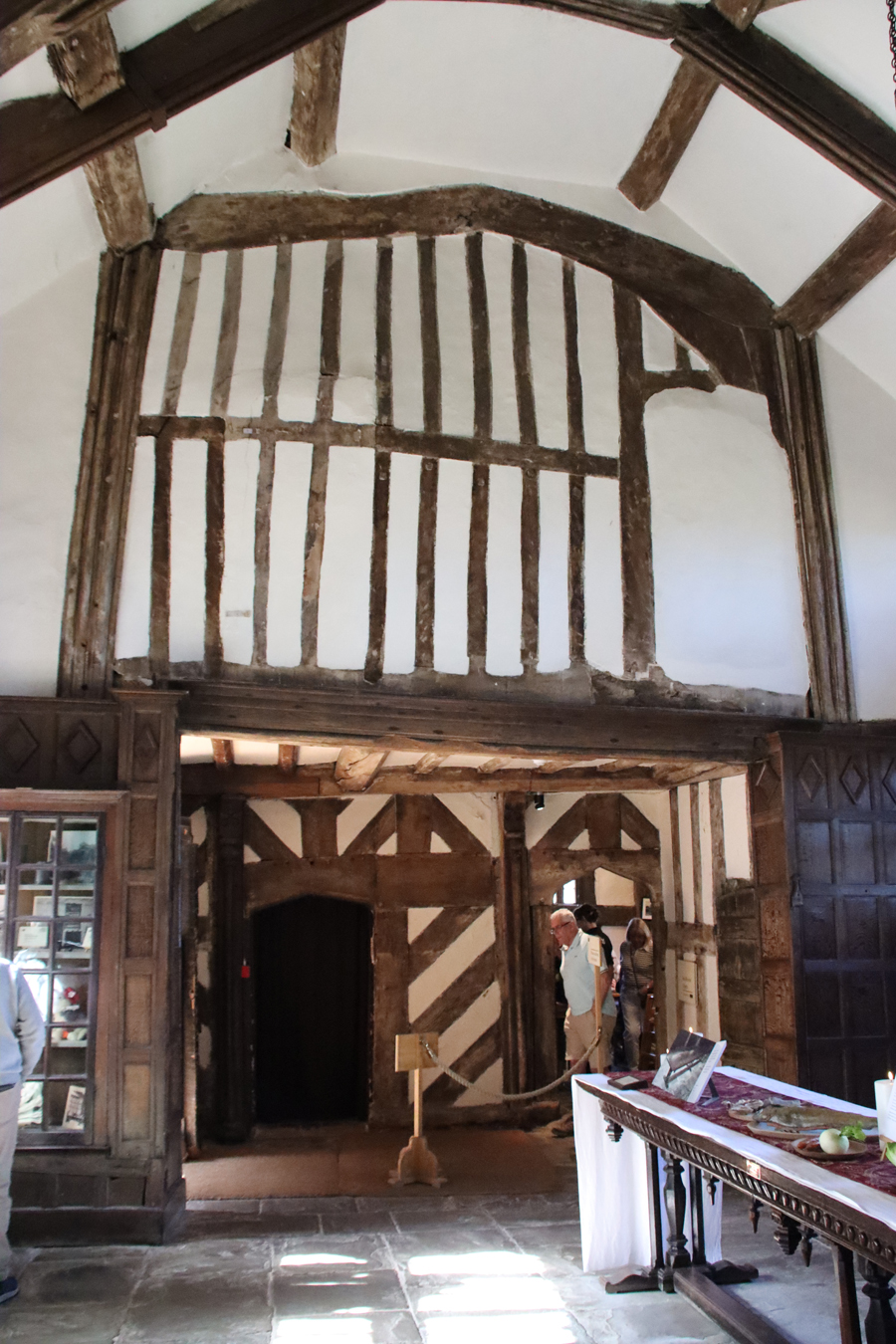
Convenient road-side parking near Burton Point marked in pink. Source: Streetmap.co.uk
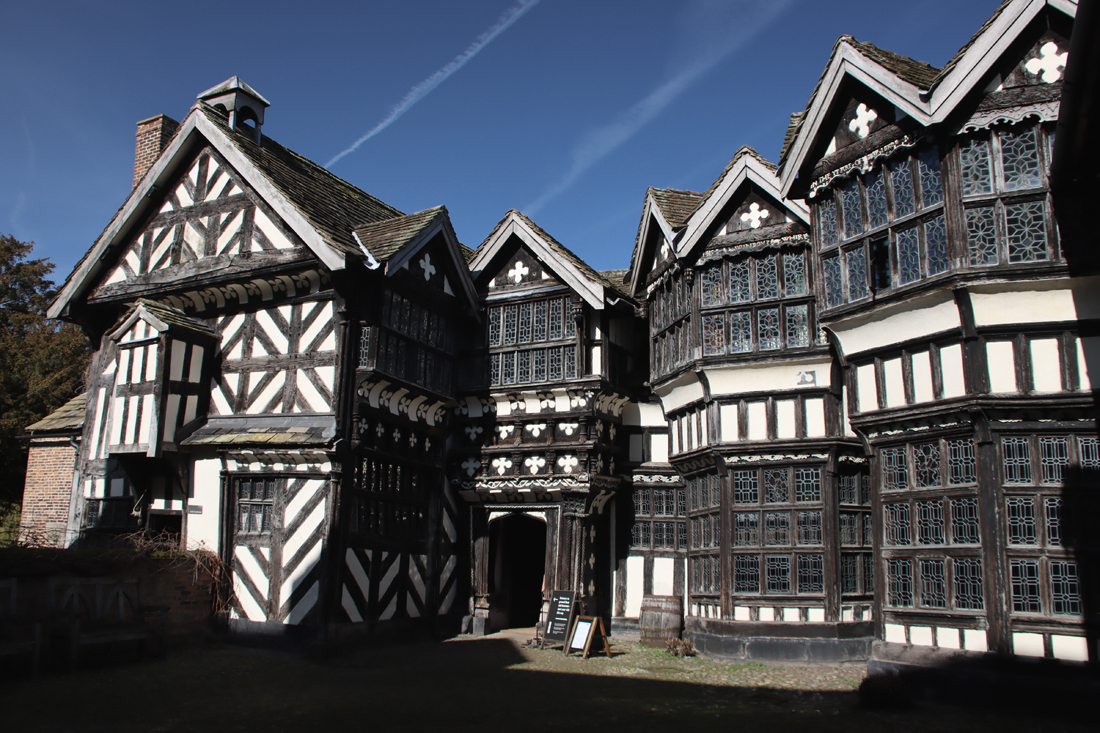
If you fancy starting in Chester, you can set off from the Little Roodee car park, go around the Roodee itself, and then follow the track to Connah’s Quay and go from there.  Fortunately you don’t have to depend on my finger-in-the-air directions, because Sustrans has its own website with full details for Route 568, which you can find here.  It shows the sections where the route meets roads, and where it intersects with other routes in the network.


Julian Baum’s fascinating Festival of Ideas presentation about the geology and archaeology of the Dee

Many thanks to professional visual effects and 3-D graphics modeller and independent researcher Julian Baum for a really fascinating presentation about new research into the River Dee.
One of Julian Baum’s beautiful reconstructions of Deva and its outer buildings in the mid 3rd Century, based on data from archaeological excavations, showing the Roman town in the context of the river and the widening estuary beyond.

The talk focused on how the Dee’s formation, archaeology and several historic maps have raised a number of questions about the Roman river.  Julian made it very clear that the presentation would consist of a number of hypothetical scenarios based on observable features, none of which can yet be fully supported by the available data.  He and his fellow investigators Rod Hobbs and Peter France have been compiling their data for the last six years, and have produced a 17,000 word paper that has been sent out to experts on Roman stonework and hydraulic engineering for consideration.  As they continue to assemble responses to their proposals, the team are also looking for opportunities to work with other specialists to extract more data from the field.  So, accepting that these ideas need more data to test the hypotheses presented today, what are the questions being asked?
The presentation followed the formation of a new research group, which met in June for the first time and included specialists in a number of relevant fields.  A great many questions were asked at that meeting, but the two overarching research questions are as follows:

1) What do we know about the geology and geomorphology of the Dee valley in the Chester area? Although multiple glaciations impacted the underlying geology of Britain, it was the impact of the last glaciation that is of most interest for the second question.

2) What do we know about Chester and the nearby archaeology, from the prehistoric to early Medieval periods, with particular focus, initially, on the Roman period?

Julian Baum’s presentation then went on to introduce the geology and glacial history of the Dee valley before going on to describe three key archaeological questions.

The Chester weir

First, how old is Chester’s remarkable weir?  Traditionally it has been dated  to the Norman period when the notorious Hugh d’Avranches, better known as Hugh Lupus, began to introduce substantial architectural and civil engineering works to develop a strong economic, religious and social foundation for Chester.  There can be no doubt that Hugh Lupus undertook works on the weir.  What is less certain is if he was the first to establish a weir here.  The proposal by Julian Baum, Rod Hobbs and Peter France, just an intriguing theory at this stage, is that the weir may have been a Roman innovation, mirroring hydraulic works elsewhere in the empire, required to raise the level of the river upstream to enable the vast barges carrying essential building materials from Holt.  The initial round of research described in the presentation has produced considerable quantities of data about the river bed, about post-glacial sea levels and tidal information, as well as looking at all the available archaeological data published to date.  Divers have been consulted and the river boat captains have provided invaluable information about their own experiences with the river depth today, as well as seasonal variations in the navigability of the river.  As the presentation emphasized, much more research is required to test this proposal.  An academic paper has been written by the three researchers and is currently being circulated amongst specialist in the field, who have all expressed an interest in assessing the hypothesis.

The Braun map of 1571

The second question concerns two 16th century maps of the Roodee that show that the north western edge was an almost straight line. How can this straight line be explained?  Building on earlier archaeological discoveries the same researchers propose that this edge may have marked the position of a very long Roman timber jetty.  The line of wall usually identified as the old Roman quay near the modern HQ building at the east of the Roodee has been widely discredited, so the question of where the Roman quay was located remains open.  This proposal makes a great deal of sense, but it too needs testing, and Julian Baum proposed a number of ways in which this could be done using specialist equipment and taking advantage of the upcoming building works at the Roodee.  An interesting corollary to the proposal is that if there was indeed a jetty there, supported on presumably vast timbers, and of a width to enable wheeled vehicles and horses to reach ships moored up along its length, its collapse would have created a major disruption to river flow, and could have had a considerable impact on the silting of the river.

Chester amphitheatre

The third question concerns the archaeology of Chester and its environs prior to the arrival of the Romans.  Iron Age remains were found during the amphitheatre excavations of the 1980s, and there are other indications that there was a healthy Iron Age presence in the area before (and when) the Romans arrived.  This data needs to be collated before it can be assessed, and this is another aim of the research group.

All findings will be made available online on a dedicated website that is currently being built.  The website address will be made available as soon as it is launched.

With many thanks to Julian Baum and other team members, who were present on the day, for such a fascinating presentation.


Peter Carrington’s excellent guided walk of Roman Chester during the Festival of Ideas

Dr Peter Carrington, an experienced archaeologist specializing in Roman history, author of the English Heritage book Chester, and editor of the Journal of the Chester Archaeological Society always heads a guided walk as part of the city’s two annual festivals.  This year he introduced a large group of us to what remains of Roman Deva.  We had all received an introductory handout beforehand by email, which as well as outlining the history of the city, included maps and images of aspects of Roman Chester that could only be represented visually.  We met up at the canal bridge just outside the Northgate, so that we could look back towards the stretch of city wall that extends east, high above the bedrock channel that contains the 18th century canal.

Here, just on the other side of the bridge over the canal, a line of Roman wall is still clearly visible, originally topped by an ornamental cornice, the remains of which still survive, bizarrely incorporated into the later walls.  It is thought that the wall originally stood to around 15ft (c.4.5m).  It was news to me that the original defences had been turf-built, and that single layers of stone walling, leaning up against the turf wall, were subject to subsidence and patches of collapse.  The inward-leaning profile of that surviving section above the canal may be explained by that process of subsidence, and this is probably responsible for much of the rebuilding necessary around the walls.  We went up on to the walls and as we proceeded clockwise towards the cathedral, looking over the edge at key points along the way, some of the complexity of the original Roman design was explained.

Walks around the walls are always popular with tourists and residents alike, but sometimes it is what we can see at the base of the walls that tell us most about the Roman past.  When we left the walkway along the top of the walls to examine sections of Roman wall at the foot of the later walls, in Northgate gardens and the Kaleyard and opposite the amphitheatre we learned about the difference between the massive, uncompromising blocks of Roman stonework and the later medieval and Victorian sections of much smaller, sometimes rounded stonework.

The amphitheatre itself is one of Chester’s most well-known tourist attractions but because nearly half of it remains buried under a hideously decaying eyesore of a building, part of which is Georgian and all of which has been abandoned (shocking tourists), the story is only partially told.  Even so, two sets of excavations have revealed an enormous amount of details about the chronological history of the site, which was the biggest Roman amphitheatre built in Britain, with clearly visible phases of enlargement preserved in what remains today.   Peter talked us through the different phases, and explained how the interior would have looked and how the timber sections of seating would have been built and arranged, painting a verbal picture of a much more elaborate building than we see today.  As Peter pointed out throughout the walk, understanding the vertical past of Chester is far more challenging than getting to grips with its horizontal footprint.  It is hoped that the report on the post-Roman history of the site, also of profound interest, will be published in the upcoming months.

The Roman Gardens, which connect the amphitheatre area with The Groves, represent a particularly nice way of bringing together various features of Roman Chester in one place.  The signage explains how much of it relates to the original city, and explains how the hypocaust looked and worked and how the reconstructed mosaics were based on those found in excavations.

By the end of the walk the group had been given a great sense of where Deva is still to be found, and what the fragmentary remains represent.  Given the importance of the town and the scale of the architecture both within and outside the walls, it is remarkable how completely Medieval and more recent Chester have eliminated Rome’s once considerable footprint.

With many thanks to Peter Carrington for a fascinating introduction to Roman Chester.