Many thanks to Aleta Doran, Artist in Residence at Chester Cathedral for today’s introduction to stained glass artist Trena Cox, who was based in Chester for most of her long career. Aleta is a brilliant and engaging presenter, currently working hard on the upcoming Trena Cox exhibition, which she is curating. Although this was organized specially for Chester Archaeological Society, Aleta is doing more presentations during the Heritage Festival and if you get the chance to attend, do go. It will give you a completely new insight into the world of 20th Century stained glass, as well as introducing you to a really creative part of the cathedral’s history. I’ll keep this relatively short so as not to spoil the event for those of you who have tickets.
Trena Cox, apparently the least photographed artist in modern history, was born on the Wirral and trained at Birkenhead’s Laird School of art, learning her skills in traditional media before switching to stained glass. She has created over 150 stained glass pieces that are known, but there are probably many more to be identified. She worked mainly in the Cheshire and northeast Wales areas but her works are found further afield. There are many in Chester itself, mainly in churches. There are nine Trena Cox windows in the cathedral, one in the slype (a corridor) and the others arranged in groups of four, two at the top, two at the bottom, in adjacent aisles in the cloister (the walkway around the central garth or garden).
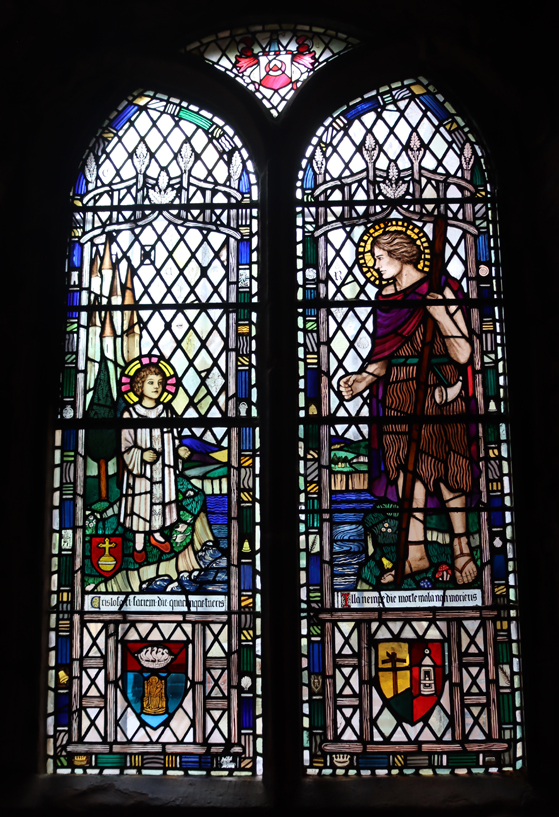
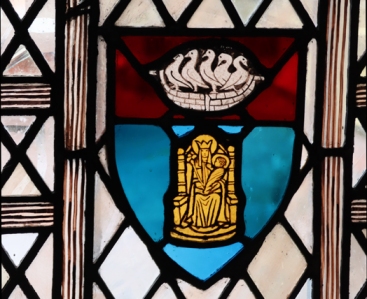
The big window in the slype shows the child Christ on one river bank, and St Christopher on the other. This is very unconventional, as Christ is usually depicted being carried across the water on the shoulders of St Christopher. Aleta described how this window clearly demonstrates many of the features of Trena Cox’s work, with the beautifully executed details of both figures, the surrounding landscape and the flowers, birds and animals that sit at the feet of the two figures. Also typical are the portrait-style faces, which seem incredibly life-like. The colouring of the glass, as in all her work, is vibrantly jewel-like and the background semi-opaque glass concentrates the eye on colours whilst allowing in light. There are many emblems of international pilgrimage, known from badges purchased from the Middle Ages by pilgrims to commemorate their achievements. As well as many others, these include St Thomas of Canterbury, St James of Santiago de Compostella, and of course Chester Cathedral’s own St Werburgh herself, her symbol being five geese in a basket. It is a rich and symbol-laden piece that rewards time taken to appreciate it.
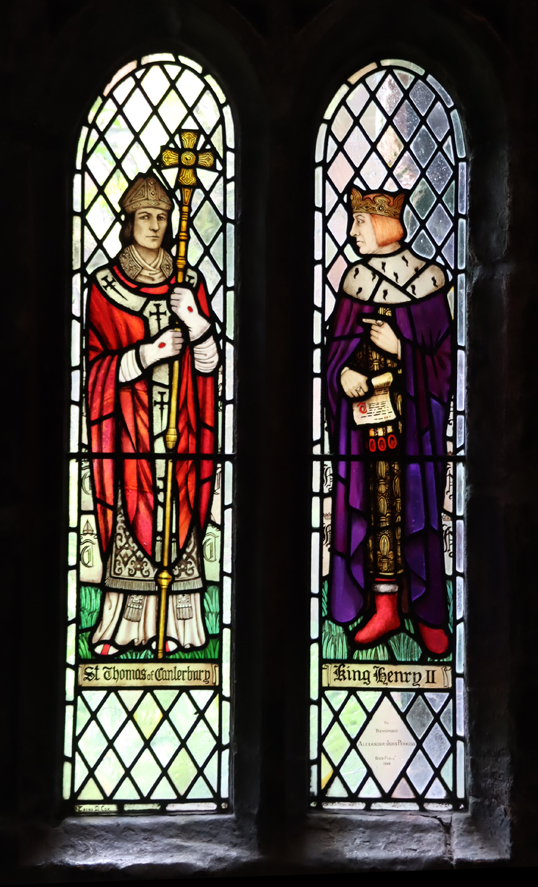
The cloister used to open out onto the garth, with a stone arcade forming a corridor with the buildings that surround the cloister. In 1920 Dean Frank Bennet was appointed as the new head of the cathedral, and decided to take measures to improve the cathedral’s fortunes. In order to glaze the arcade that surrounded the garth, the dean decided to raise public funds. It is thought that some funds were raised by allowing donors for the cloister glass to add commemorations to loved ones in panes withing the windows, which survive today. Each window represents a saint, religious festival or holy day. Trena Cox contributed eight panels in two adjacent sections of the cloister, showing eight different saints. In one set of four, the two at the top are Hugh Lupus who founded the abbey and St Werburgh’s mother St Ermengild In the lower section are St Thomas Becket and King Henry II. In the other set, the two figures at the top are Abbot Witchurch and Ralph Higden and the two below King Alfred and St Piegmund. Aleta talked us through the significance of each of these saints, and why there were chosen. These are much smaller and therefore much simpler compositions, but again the colours are vibrant, and the faces resemble portraiture.
Aleta wrapped up by telling us something about Trena Cox and her influence on Chester life, not only as an artist but as something of an activist for the protection of local heritage. It seems remarkable that she is not better known, at least in Chester where she lived nearly all her life. Hopefully, the upcoming the exhibition “Trena Cox: Reflections 100”, which begins on the 7th October, will bring this under-sung local personality and talented, prolific artist to much wider public attention. Do take advantage of a tour of the glass with Aleta Doran if you have the opportunity. As an artist herself, she offers a unique insight into the work of Trena Cox.
This is a bit of an experiment, using my iPhone, which I’ve never tried before for video. I did a lot of camcorder videos of scenery when I lived in Aberdovey on the west coast of Wales, but fell out of the habit when I moved to the Chester area, so I am out of practice, feel very peculiar using an iPhone to do video, and hate the sound of my voice, but here we go. So here’s my two-minute introduction to the wonderful priory of St Mary and St James, aka Birkenhead Priory, for better or for worse. I’ll get better!
At Birkenhead Priory the other day I very much liked this small building on Knox Street, very close to both Birkenhead Priory and the Cammell Laird shipyard. It has been painted in the style of dazzle camouflage, used in the First World War, and to a lesser extent in the Second World War, primarily to confuse submarines. “The primary object of this scheme was not so much to cause the enemy to miss his shot when actually in firing position, but to mislead him, when the ship was first sighted, as to the correct position to take up. Dazzle was a method to produce an effect by paint in such a way that all accepted forms of a ship are broken up by masses of strongly contrasted colour, consequently making it a matter of difficulty for a submarine to decide on the exact course of the vessel to be attacked” (Norman Wilkinson, 1969, A Brush with Life, Seeley Service, p.79, quoted on Wikipedia).
The moment I saw it, it reminded me of a 1919 painting by Edward Wadsworth (1889 – 1949) that I have hanging in my spare bedroom, showing a ship in dry dock in Liverpool receiving its new paint job. Wadsworth painted in the style of the Vorticists, whose best known proponent was Wyndham Lewis, inspired by machinery and industry, and focused on clean lines, hard edges and planes of strong colour. The dazzle ship was a near perfect subject matter for this style of painting, and Wadsworth was in an ideal position to get up close and personal with his subject matter, as in the First World War he worked as an intelligence officer, and one of this responsibilities was implementing dazzle camouflage designs for the Royal Navy.
I would love to know who came up with painting the building on Knox Street in the same style. If you know anything about it, do let me know.
Below is a painting from the Merseyside Maritime Museum showing the Walmer Castle painted in her dazzle camouflage. “The Walmer Castle was launched in 1901 for the recently created Union Castle Mail Steamship Company. The ship sailed between Southampton and Cape Town and in 1917 was requisitioned by the British Government. It is seen here dazzle painted for use as a troop ship in the North Atlantic. Walmer Castle survived the war and was broken up in 1932″ (National Museums Liverpool).
Birkenhead Priory is one of the most enjoyably unexpected places I have visited in the region, even more surprising than a Roman bath-house embedded in a 1980s Prestatyn housing estate. The priory site incorporates both the remains of the 12th century monastic establishment and the ruins of St Mary’s 1822 parish church with its surviving tower and terrific views. On all sides the site is surrounded by both heavy and light industry. Cammell Lairds shipyard not only butts up against the south and east walls, but purchased part of the priory’s former churchyard and cemetery for its expansion and the building of Princess Dock. On the other sides are warehouses and commercial units. The result is that in spite of the clanging and banging from the vast ship under construction immediately next door (fascinating in its own right), the obvious and somewhat inescapable cliché is that the ruins of the priory and parish church are an oasis of peace in the midst of all the busy activity. The small but quiet stretches of grass, the trees and the wild flowers contained within the remains of the priory site are a treat, and the splendid views from the top of St Mary’s tower are a powerful reminder of how the world has changed since the foundation of the priory.
I have divided this post into two parts, because there is so much to say. A visit to Birkenhead Priory is really five visits in one. In chronological order, a visit to the site provides you with the following heritage:
1) The priory, established in the 12th century and built of red sandstone, is the oldest part of the site and the star turn with its vaulted undercroft and chapter house
2)St Mary’s parish church was built next to the ruins in 1821 to serve the growing community, its gothic revival windows wonderfully featuring cast iron window tracery
3) The priory’s scriptorium over the Chapter House, now with wood paneling over the sandstone walls, is the exhibition area for the Friends of the training ship HMS Conway,
4) The Cammell-Laird shipyard is hard up against the priory’s foundations and fabulously visible from St Mary’s Tower. When it wished to expand into the church’s churchyard, it purchased the land and re-located the burials
5) St Mary’s Tower, which is open to the public with amazing views from the top, is now a memorial to the 1939 HMS Thetis submarine disaster in the Mersey.
In this part, part 1 I am taking a look at the priory. In part 2 I have looked at the post-dissolution history of the site; the 1821 construction of St Mary’s parish church; the memorial to HMS Thetis and the display area for HMS Conway. I will tackle Cammell Laird’s separately, as I suspect that it will be very difficult to handle in a single post, and I need to do a lot more research before I make the attempt to summarize its history.
Birkenhead in the foreground with the manor and ruins of the monastery, and Liverpool in the background over the river, c.1767, showing just how isolated Birkenhead remained even in the 18th century. Attributed to Charles Eyes. Source: ArtUK
Foundation of the priory in the 12th Century
Artist’s impression of the priory done by E.W. Cox by 1896.
The priory was dedicated to St Mary and St James the Great. There are no documents surviving from the priory, and none of its priors became important in other areas of the church or in life beyond the priory, so most of the information comes from other sources of documentation as well as from the architecture itself. Its principal biographer, R. Stewart-Brown, writing in 1925, commented that it was “not possible to compile anything in any degree resembling a history of this small and obscure priory,” but the result of his work was an impressive overview of the priory, its financial stresses and its involvement in the Wirral as a whole and the Mersey ferry in particular. Much recommended if you can get hold of it. Although not certain, is thought that the priory was founded in the mid-12th century by one of William the Conqueror’s Norman followers who was rewarded for his service to the new king and the local earl Hugh Lupus with land on the Wirral. His name was Hamon (sometimes Hamo) de Massey from Dunham Massey, the second baron, who died in 1185, suggesting that the priory was founded before this date, probably in the middle of the 12th century.
Exterior of the west range, showing the two big windows that illuminated the guest quarters, the one on the left heavily modified.
The priory was established on an isolated headland, surrounded on three sides by water. Hamon almost certainly took as his model for the priory the abbey of St Werburgh in Chester (now Chester Cathedral) which was founded in 1093 by Hugh d’Avranches, also known as Hugh Lupus. Hugh Lupus had convinced St Anselm of Bec (later Archbishop of Canterbury and after his death canonized) to come and establish St Werburgh’s, and it was organized along classic Benedictine lines, about which more below. The founding of a monastic establishment was seen as a Christian act, a statement of piety and devotion, and was most importantly a precautionary investment in one’s afterlife, securing the prayers of the monks, considered amongst the closest to God, throughout the entire lifetime of the monastery
A priory was smaller and inferior in status to an abbey and was was often dependent (i.e. a subset) of an abbey, and answerable to it. It is possible that the much larger and infinitely more prestigious St Werburgh’s Abbey in Chester supplied the monks to establish Birkenhead Piory, but there is no sign in the cartularies (formal documents and charters) of St Werburgh’s that there was any ongoing formal connection between the two. The difference between a non-dependent priory and an abbey was usually that the priory did not have sufficient numbers to be classified as an abbey, or that it had not applied for the royal stamp of approval required for the more senior status of an abbey. The minimum requirement for the foundation of a Benedictine abbey was 12-13 monks. A 16th century historian suggested that there were 16 monks, but it is by no means clear where this figure came from. Twice during the 14th century it is recorded that there were only five monks at the priory, and it is very likely that the priory remained too small to become an abbey.
The typical monastic day in a Benedictine monastery. Not a great photo, but a very nice representation from a display in the museum area in the undercroft
The Benedictine Order was not the oldest of the monastic orders in Britain, but following the Norman Conquest it became the most widespread. It was named for St Benedict of Nursia who, in the 6th century, set out a Rule, or set of guidelines, for his own monastery. This spread widely and became the basis of many monastic establishments setting out to follow his example. The Benedictines had been well established in France at the time of the Conquest, and sponsorship by incoming Normans, granted land by William the Conqueror, ensured that they spread rapidly in England, and later Wales, Scotland and Ireland. Benedictine monasteries were all built to a standard architectural layout, with minor deviations, based on both religious and administrative requirements.
The monastic buildings
Plan of the Birkenhead Priory site. Source: Metropolitan Borough of Wirral leaflet (with my annotations in colour). North is left, south right.
If you take the guided tour, which I sincerely recommend, you begin your tour in the undercroft, now used as a museum / display space. Most helpfully it has a scale model of the priory with Stewart-Brown’s 1925 site plan, both of which help you to orientate yourself and get a sense of how the ruins were once a complex of buildings that defined and enabled a monastic community, combining religious, administrative, domestic and other functions. In the plan on the left, with the surviving remains of the priory outlined in red, the site of the priory church outlined in orange and remains of the 1822 St Mary’s Church outlined in green. The blue margin indicates the shipyard over the priory wall. The numbers on the plan are referred to in the description below. You can download a copy of the map (without the coloured additions) as a PDF here.
Like St Werburgh’s Abbey, the priory buildings were made of locally available red sandstone. Like all monasteries based on Benedictine lines, the monastic site plan began with a square. The bigger the monastery envisaged, the bigger the square. This was known as the garth (1 in the plan on the left), and was either a grassed area or a garden. Surrounding this was the cloister, a covered walkway that served as a link between the buildings that were erected around the garth, and where desks were usually arranged so that the monks could work. This was a secluded space, confined to the inmates of the monastery.
Model of the priory church and claustral buildings in the priory’s museum space in the undercroft showing a possible layout of the church. The chapter in this view is hidden behind the tower.
The most conspicuous of the buildings would have been the one that no longer stands: the church and its tower (4 on the plan above, outlined in orange), which made up one side of the cloister. Traditionally in Benedictine complexes this was built on the north side of the garth, making up an entire side of the cloister, in order protect the rest of the buildings and allow light into the garth and the other cloister buildings, but at Birkenhead Priory’s church was on the south, possibly to protect the claustral buildings from the winds whistling down and across the Mersey. The model and plan show that the 13th century church was built in the standard cross-shape. It featured a long nave at the west end (where the public were permitted to observe religious ceremonies), and a surprisingly long east end (where the ceremonies were performed) with two side-transepts, which were usually used as chapels for commemorating the dead and a tower over the crossing. A pair of aisles flanked the south and north transepts as show above. When it was first built in the 12th century, the church would have been much smaller and probably smaller than this footprint.
View of Birkenhead Priory by Samuel and Nathan Buck in 1726, showing the remains of the church’s northern arcade. Source: Panteek
Lonely remainder of the church’s northern arcade
The entrance to the chapter house with its Norman arches. You can clearly see the difference between the 12th century chapter house masonry and the 14th century scriptorium above with its gothic window and tracery. The tower in the background belongs to the 19th century church.
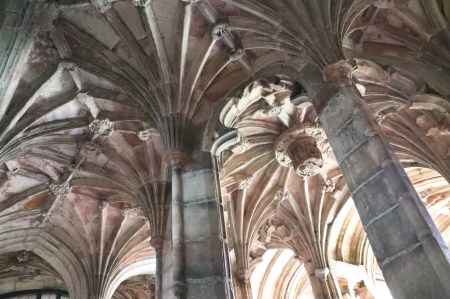
The chapter house (2) is the oldest of the Birkenhead Priory buildings, the only one remaining that dates to the 12th century. The building of the priory church, being the place where the main business of praising God took place, was usually started straight away, but the chapter house was often built in tandem as this was also of fundamental importance to a monastery. This is where the everyday business of the priory was attended to, from the day-to-day administration and disciplinary matters, to the daily readings of chapters of St Benedict’s Rules or other improving texts such as excerpts from one of the many histories of saints (hagiographies). The Birkenhead Priory’s original medieval chapter house is a gorgeous. The vaulted roof of the chapter house is superb (see the photo at the very top of this post), and although the windows have been altered over time, one of the deep Norman Romanesque window embrasures survives, and is a thing of real beauty (see below). The stained glass is all modern, but all are nicely done, the one over the altar by Sir Ninian Cowper combining religious themes relevant to the house (St Mary and St James flanking Jesus) with two prestigious characters from the priory’s own history (its founder Hamo de Massey and its two-time visitor Edward I). Gravestones from the medieval cemetery have been incorporated into the floor around the post-Dissolution altar. In the medieval priory, there would have been no altar in the chapter house, but following the Dissolution the chapter house was converted into a chapel and is still used for weddings, funerals and baptisms.
Over the top of the chapter house, a scriptorium was added in the 14th century. In theory this was where the copying of books took place, but it has been pointed out that this was a particularly large space for such an activity, and it may have been used for something else, or for a number of different activities. Today it is the display area for the training ship HMS Conway, and at some point in the 19th or early 20th century was provided with panelling and has some very fine modern stained glass by David Hillhouse. This modern usage will be discussed in part 2.
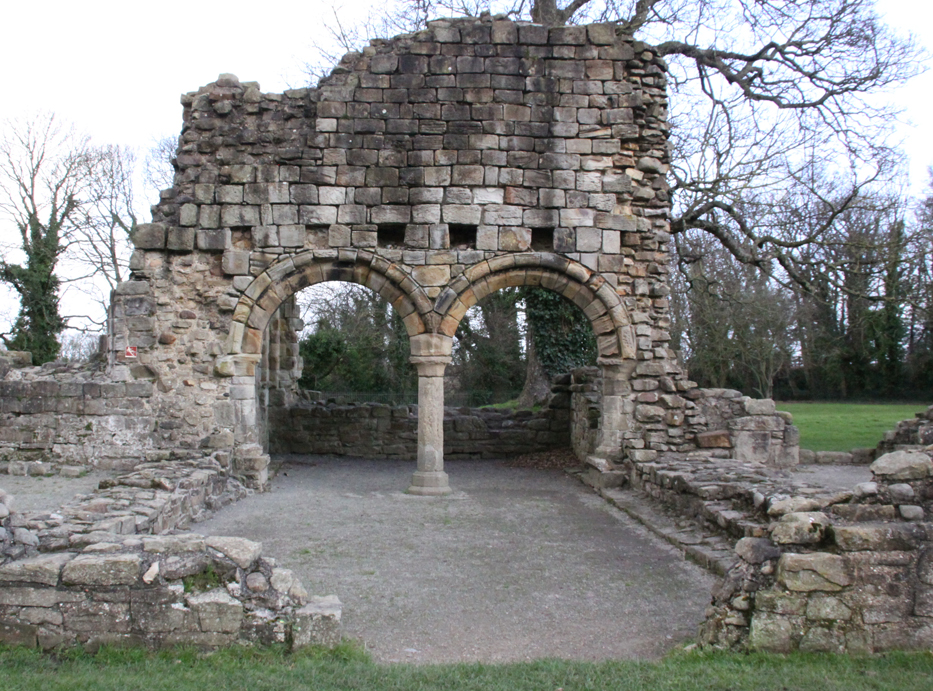
Opposite the chapter house the remains of the west range (7-11) survives, which was again a two-floor building separated into a number of different spaces It seems to have been divided into two, with the northern end and its big fireplace reserved for guests, and the southern end, with an entrance into the cloister, seems to have been split into two floors, with a fireplace on each, for the prior’s personal quarters, which would have included a private parlour that he could use for entertaining VIP guests. Although it’s not the most aesthetically stunning of the surviving claustral buildings today, the stonework displays a fascinating patchwork of different features and alterations that reflect many changes and refinements in use over time and are still something of a fascinating puzzle.
West Range
Remodelling in the 14th century created the undercroft and the refectory above it, as well as the kitchen. The undercroft (14), once used as a storage space, with the original floor intact. The investment in the lovely architecture may indicate that before it was used as a storage area, it had a more high profile role, perhaps as a dining area for guests. Above it was the refectory, unlike St Werburgh’s, Basingwerk Abbey or Valle Crucis Abbey, all of which had refectories at ground level. It was reached by a spiral stone staircase leads up to this space today.
The kitchen was apparently to the north of the west range, and connected to it, as shown on the above plan (12). This was convenient for the guest quarters, but not quite as convenient for the refectory over the undercroft, from which it was divided by a buttery (or store-room, 13), over which a guest room was also installed. The kitchen was apparently a stand-alone structure made mainly of timber, and this may have been because kitchen fires were so common, and building the kitchen slightly apart from the main monastery would have been a sensible precaution. Kitchen fires are thought to have been the cause of several devastating scenes of destruction in monastic establishments, spreading quickly via roof timbers and wooden furnishings.
Between the chapter house and the north range, which contained the undercroft and refectory, was an infirmary (19 on the plan) and the dormitory (18) side by side, each accessible from the cloister. The infirmary was for the benefit of the monks, and was where those who were sick or injured or suffering the impacts of old age were cared for.
Sources of income and financial difficulties
Carved head in the side of the fireplace in the guest quarters on the ground floor of the west range
Monasteries were amongst the most important land-owners in medieval Britain, on a par with the aristocracy. Their income came mainly from agricultural activities, both crops and livestock, as well as making and selling bread, beer, buttery and honey; but they might also own mills, mines, quarries and fisheries and the rights to anchorage, foreshore finds and the use of boats on rivers. For those with coastal and estuary locations with foreshore rights, there was, as Stewart-Brown lists, the benefits of flotsam (items accidentally lost from a boat or ship, jetsam (items deliberately tossed overboard), salvage from shipwrecks and keel toll. The luckier (or most strategically inclined) monasteries and churches also had pilgrim shrines, sometimes reliquaries imported from overseas. St John’s Church in Chester had a miraculous rood screen, St Werburgh’s Abbey in Chester had the shrine containing the bones of St Werburgh herself, and Basingwerk Abbey had the neighbouring holy well of St Winifred. These attracted donations and bequests and were good for the settlements in which they stood, because the pilgrims needed places to stay, food and drink, and would probably buy souvenirs. Birkenhead Priory had no such shrine, but it probably felt the impact of the pilgrim route as the ferry crossing over the Mersey, which it ran free of charge, was an important link between Lancashire, west Cheshire and northeast Wales.
The original foundation of the monastery would have included both the land on which the monastery sat, funding for building it, and an economic infrastructure of landholdings as well as the income of some local churches. The long list of land-holdings sounds impressive, but most of them appear to have been quite small and scattered, some of which will have been wooded and some wasteland, not all of it suitable for cultivation or pasture. These include lands in Birkhenhead (including the home farm in Claughton with its mill), Moreton (with a mill and dovecote), Tranmere, Higher Bebington, Bidston, Heswall, Upton, Backford, Saughall, Chester, Leftwich, Burnden at Great Lever in Middleton, Newsham in Walton, Melling in Halsall, and Oxton. Either at foundation or not long afterwards, the priory was granted the incomes of the churches of Bidston, Backford, Davenham and half of the church of Wallasey, and claimed rights of Bowdon church that were disputed.
Carving at the base of a window arch in the west range
The monastery did not flourish with these assets. In spite of the claim that there were 16 monks at the time of its foundation, the records made by official church visitors suggests there were only a small number of monks at any one time (only five in 1379, 1381, and 1469, and seven, including two novices, in 1518 and 1524), and there is plenty of evidence to indicate that the priory struggled financially. Monasteries had significant overheads including feeding the community, buying tools and supplies, repairing monastic and farm buildings, appointing stewards and other employees, providing charitable alms and providing hospitality free of charge. Where they earned incomes from churches and chapels, they were also responsible for the provision of the clergy and shared part of the cost of maintaining the buildings. Ambitious priors often invested in building projects, sometimes to improve the monastic offering, sometimes for prestige, and even with donations this was usually costly. There were also occasional challenges to bequests made to churches from following generations, which involved costly legal proceedings. Balancing the books was a frequent problem for monastic establishments, and the priors of Birkenhead Priory were no different.
There were quite limited means by which the priors of Birkenhead might increase their income. The most obvious way of generating ongoing income was to acquire more land through gifts and bequests. In this endevour the priory probably had a real disadvantage in being near to both St Werburgh’s Abbey in Chester and, across the river Dee, Basingwerk Abbey at Holywell. Both abbeys had significant land-holdings on the Wirral, and both had pilgrim shrines and were on pilgrim routes. Both were large and prestigious, and were far more likely to attract big gifts than a small and rather remote priory. If Birkenhead hoped to attract gifts of land, it probably had to depend on local landowners and merchants who felt a personal connection with the priory but would not necessarily have had the wherewithal to significantly change the income-earning potential of the priory, providing personal items rather than swathes of land. For these very local gifts and legacies, it is entirely possible that the priory was also in competition with contemporary parish churches on the Wirral. There are records in the early 16th century, not long before the monastery was closed during the Dissolution, that give an idea of the sort of bequests made by local people in return for requiem masses to be recited for their souls: one will provided a painting of the Crucifixion for the priory church. Another bequeathed the owner’s best horse, 10 shillings, and a ring of gold.
As the Middle Ages progressed, populations expanded and both new and old towns began to hold markets where everyday goods and more prestigious products could be traded, even once-isolated monasteries found themselves becoming integrated into the secular world and in competition with it. It certainly did not initially help the monks at first that during the early 13th century Liverpool began to grow. Under the Benedictine rules, monasteries had an obligation to provide hospitality to visitors when required, and the Birkenhead monks ran the ferry over the Mersey as a charitable service. When the priory was first established, offering occasional hospitality and running the ferry free of charge were not onerous. This changed rapidly after 1207 when Liverpool was granted burgh status by King John, as the following translation of the original Latin charter confirms (Translation from Picton 1884):
John, by the grace of God King of England, Lord of Ireland, Duke of Normandy, Aquitain, and Earl of Anjou, to all his faithful subjects who may have wished to have burgages in the town of Liverpool greeting. Know ye that we have granted to all our faithful people who may have taken burgages at Liverpul that they may have all liberties and free customs in the town of Liverpul which any free borough on the sea hath in our land. And therefore we command you that securely and in our peace you come there to receive and inhabit our burgages. And in testimony hereof we transmit to you these our letters patent. Witness Simon de Pateshill at Winchester on the 28th day of August in the ninth year of our reign.
A little later Liverpool was granted the right to hold markets and fairs, and the links between Liverpool and the busy port of Chester grew to be increasingly important. There was no infrastructure to cope with this increase in human traffic. They were already offering a ferry service free of charge but even more pressing on their resources was the cost of housing guests. There were no inns between Liverpool and Chester (showing a lack of commercial ambition on the part of both Liverpool and Chester medieval merchants!), so the monks found themselves obliged to offer accommodation and food, which the rules of the Benedictine order required them to offer free of charge. This hospitality became particularly difficult if there was a spell of bad weather, during which those waiting to cross from Birkenhead to Liverpool would have to wait at the priory until the weather improved and crossings could resume. They were also were troubled with all the through-traffic that travelled along a route that ran through the monk’s Birkenhead lands close to the priory buildings.
The spiral staircase from the undercroft into the former refectory
It must have exacerbated the monks’ financial situation when Edward I visited the monastery twice with his entourage during this period. Edward’s first visit was in September 1275 for three nights, seeking a diplomatic solution to his dispute with the self-styled Prince of Wales, Llywelyn the Last of Gwynedd. His second was in 1277 for six days with the apparently dual motives of pursuing his campaign against Llywelyn and receiving a delegation from Scotland to settle a boundary dispute. Although the king would pay the costs of his entourage and horses, the cost of entertaining the king and his most senior advisors fell to the monastery. Hosting a royal entourage was notoriously expensive, and any contributions made by a visiting monarch to a monastic establishment only rarely compensated for the outlay.
One of the measures to improve their income in the 1270s involved the expense of serious litigation when incumbent prior claimed that the church had been presented in its entirety to the priory. This was disputed by the Massey family, who triumphed in the courts. Fortunately for the priory, in 1278 the 5th Hamon de Massey came to an agreement with the monks to their benefit. Other litigation occurred over pasture rights in Bidston and Claughton.
In 1284 the priory received permission from Edward I, who had probably witnessed the priory’s problems at first hand in the 1270s, to divert the road that disrupted the priory “to the manifest scandal of their religion” and to provide the priory court with an enclosure, either a ditch, hedge or wall, to preserve its privacy. This would have incurred costs, but would have eased one of the problems caused by the ferry. Rather more significant for their finances, early in the 14th century the priory was granted a licence to build and charge for guest lodgings at the ferry at Woodside, and in 1311 they were granted the rights to sell food there. It was at this time that the church was expanded, which would have been a significant project.
Chapter house building with scriptorium room added over the top in the 14th century.
The first half of the 14th century had been hard for most of western Europe, with both famine due to anomalous weather conditions that caused crops to fail, followed only a few decades later by a plague that killed huge numbers of people. In Britain the famine lasted from 1315-17 and the Black Death arrived in 1348. The priory survived both the famine and the plague, as did the settlement of Liverpool, now a century old. At some point in the first half of the 14th century, the priory acquired land in Liverpool so that the monks could begin to trade their goods at market, building a granary or warehouse on Water Street (then known as Bank Street).
In 1316 the hospital of St John the Baptist in Chester was judged to be seriously mismanaged and was put into the hands of the priory, perhaps because of their experience running their own infirmary. This was a failure, merely adding to the priory’s problems, and was removed from their care in 1341.
Multiple layers in the west range, with a window added into the top of a former fireplace, blocking it, and a fireplace above it.
In 1333 Edward III requested monasteries to contribute to the expenses of the marriage of his sister Eleanor. Local monasteries who contributed included Birkenhead, which contributed £3 6s 8d and Chester’s St Werburgh’s Abbey which, bigger and more prosperous, gave £13 6s 8d. There were doubtless other payments of this sort, occasional and therefore unpredictable, and impossible to resist. The priory was also liable for taxation.
The ferry from Woodside had continued to be supplied free of charge, but the priory appealed to Edward III and was permitted for the first time to charge tolls in 1330, setting a precedent that remains today. A challenge to the monk to operate the ferry and claim the tolls, was challenged by the Black Prince in 1353, but the priory produced its charter and successfully resisted the removal of this privilege. The tolls charged were recorded at that time: 2d for a man and horse, laden or not; 1/4d for a man on foot or 1/2d on a Saturday market dasy if he had a pack
Other ways of generating income from lands to which they had rights were also explored, and from records of litigation against them, they were often accused of infringing forest law. Wirral had been defined as a forest by the Norman earls of Chester, which restricted how the land could be used. The monks were clearly assarting (cutting down wood to convert to fields and pasture), reclaiming waterlogged land, enclosing certain areas and cutting peat for fuel. The priory was able to argue special exemptions for some of the charges, and produced the charters to prove it, but at other times they were fined for the infractions. In 1357, for example, they were fined for keeping 20 pigs in the woods.
A number of monastic establishments seem to have responded to surviving the plague by redefining themselves via architectural transformations. Whatever the reasons for this trend, Birkenhead Priory was no exception and the 14th century could have been an expensive time for the monks. The frater range (including the elaborate vaulted undercroft and the refectory) was completely rebuilt and the west range was remodelled. The room today described as a scriptorium was also added over the chapter house at this time. Although Stewart-Brown suggests that much of this could have been accomplished with “pious industry . . . without much cost” with the assistance of donations of labour and money, that is probably somewhat optimistic, and there would have been an outlay. Certainly, at the end of the century the priory was considered to be so impoverished that it was exempted from its tax contribution.
There is some evidence that for at least some of the Middle Ages the priory rented out land rather than working it themselves, except for their home farm at Cloughton. This had the benefit of providing a dependable income if tenants were reliable, and obviated the need to appoint managers or deal with labour and handle the sale of produce, but if the cost of living went up, the fixed income that no longer purchased what it had previously afforded, and this could represent a serious problem.
Dissolution
The opening page of the Valor Ecclesiasticus, showing Henry VIII. Source: Wikipedia
When Henry VIII’s demand for a divorce was rejected by the pope, the king severed Britain from the Catholic Church, creating the Church of England. This provided him with the opportunity to acquire land and valuable assets by dissolving all monastic establishments, all of which had been subject to the papacy. The spoils were to be used to fund Henry’s wars with France and Scotland, and some former monasteries were given to Henry’s supporters as rewards. To assess the potential of the monastic assets, Henry VIII commissioned the Valor ecclesiastis, a review of every monastery in the country. All monastic establishments with an annual income of less than £200.00 were to be closed as soon as possible. The first monasteries were dissolved in 1536 and the process was more or less concluded by 1540, with a handful of the more prestigious abbeys, like St Werburgh’s in Chester, converted to cathedrals. Birkenhead Priory was only earning £91.00 annually so it was amongst the first to be closed. There was no resistance by the Birkenhead prior, who was provided with a pension of £12.00 annually. The brethren were either dismissed or disseminated to non-monastic establishments.
Visiting
The car park is on Church Street, at the rear of the priory, where the cafe is also located. There is some on-street parking on Priory Street at the front of the priory. Source: Birkenhead Priory website
This is a super place, and makes for a terrific visit. Do go. You won’t be disappointed!
Even with SatNav, the big thing to remember about finding your way to Birkenhead Priory, if you are arriving by car from the Chester direction, is to do whatever it takes NOT to end up at the Mersey tunnel toll-booths 🙂 They were very nice about it, let me out through a barrier, and gave me perfect directions to get to the priory once they had freed me from the tunnel concourse. Very nice people. If Edward III was looking down, I’m sure he would have rolled his eyes in despair, given that it was he who gave the monks the right to charge for their Mersey ferry crossings.
Do check the opening times on the website, as the priory is only open on certain days and for only a few hours on those days, mainly in the afternoons. There is dedicated parking on Church Street at SatNav What3Words reference ///super.punchy.report. From there, the priory is up a short flight of steps. You can also park on Priory Street, which is where the SatNav will take you if you simply type “Birkenhead Priory” into your SatNav (at What3Words ///indoor.vibes.hips), which offers step-free access but there is limited parking there, and it is a favourite place for van drivers to park and eat their lunches so may be better used as a drop-off point before going round the the car park.
Remnants of the decorative floor tiles, now in the priory’s undercroft, which is used as a museum space
At the time of writing, a visit is free of charge, and so are the guided tours. My guide was the excellent Frank. He covered not only the priory but St Mary’s, the HMS Conway room, and the HMS Thetis memorial and, when I headed up to the top of the tower of St Mary’s, directed me to out for the dry dock where the CSS Alabama (the US Confederate blockade runner) was built by John Laird, to be discussed in Part 2. Frank was very skilled at providing sufficient knowledge to get a real sense of the place, but not so much that it became information overload. I very much appreciated this, having always found it difficult myself to strike that particular balance. I was lucky enough to have him to myself, having turned up at opening time, but I noticed that the next tour had a respectable group attending.
There is a small gift shop where you can also buy a really useful guide book with plenty of plans, illustrations and colour photographs. Please note that they are not able to take cards, and payment is cash only.
There are toilets in St Mary’s tower, a picnic area behind the undercroft on sunny days, and the highly rated Start Yard café is almost next door on Church Street.
For those with unwilling legs, I would suggest that apart from the tower and its 101 steps, and a flight of around 10 steps up into the scriptoruim (the display area for HMS Conway) this is entirely do-able. There are occasional single steps and uneven surfaces, and it is a matter of taking good care. As mentioned above, if you park in the carpark at the rear on Church Street, there is a flight of steps into the priory, but even if there is no space in the limited street parking available at the front of the priory on Priory Street, it is a useful drop-off point for anyone needing step-free access. You can find the SatNav references for both above.
I have posted a two-minute video of the priory, recorded on my iPhone, on YouTube:
Sources
Books, papers, and guidebooks
Baggs. A.P., Ann .J Kettle. S. J. Lander, A.T. Thacker, David Wardle 1980. Houses of Benedictine monks: The priory of Birkenhead, In (eds.) Elrington, C. R. and B. E. Harris. A History of the County of Chester: Volume 3, (London, 1980) pp. 128-132. https://www.british-history.ac.uk/vch/ches/vol3/pp128-132
Burne, R.V.H. 1962. The Monks of St Werburgh. The History of St Werburgh’s Abbey. S.P.C.K.
Stewart-Brown, R. 1925. Birkenhead Priory and the Mersey Ferry, and a Chapter on the Monastic Buildings. The Gift of the Directors of the State Assurance Company Ltd.
White, Carolinne 2008. The Rule of St Benedict. Penguin.
On a recent visit to Birkenhead Priory, which I am still writing up, I arrived some time before the Priory opened, and went for a wander. There are some great things to see in the area, but this combined monument and street light really drew the eye. I decided not to risk life and limb by flinging myself across the very busy road to read the inscription at its base, so did a web search when I returned home. It is a monument to the building of the Queensway Tunnel under the Mersey. It is Grade II listed (1217871), was designed by Herbert Rowse and erected in 1934. It was shifted from its original position in 1970 due to changes in the road layout at the tunnel approach, but originally illuminated the first concourse / plaza.
The monument has the fluted elements of a Doric column clad in impressive black granite, hints at ancient Egyptian lotus-top capitals, has a light on top, and simply yells Art Deco creativity and optimism, with a touch of eccentricity. It is such a hybrid of different ideas, incorporating ancient art and contemporary technology, and happily combining the functions of both monument and lighthouse that it has no chance of being rationally categorized. Like Greek and Roman columns or ancient Egyptian obelisks, it looks as though it ought to be in company, not standing all on its own.
The monument did in fact have a twin, but instead of standing alongside its sibling was erected over the river in Liverpool, lighting the other entrance to the tunnel.Sadly this was taken down in the 1960s, a period when so many bad decisions were made regarding architectural heritage. There was some talk in the media this time last year about erecting a replica, but I don’t know if that plan went anywhere or has been abandoned.
The inscriptions on the bronze plaques on the base display the names of the engineer responsible for the civil engineering of the tunnel, Sir Basil Mott J.A. Brodie and the architect Herbert Rowse, as well as the names of the team who built the bridge and the construction teams and committee members who oversaw proceedings. The commemorative declaration reads:
Queensway, opened by His Majesty King George V, 18th July 1934 accompanied by Her Majesty Queen Mary. The work on this tunnel was commenced on 16th December by Her Royal Highness Princess Mary Viscountess Lascelles, who started the pneumatic boring drills at St George’s Dock Liverpool MCMXXXIV
I love the monument. It has a real sense of joie de vivre. It is a shame that it is no longer located closer to its original position as part of the tunnel’s original architectural vision. On the upside, at least it has been preserved and not demolished like its twin. Other aspects of the original Art Deco vision do survive insitu at the tunnel entrance, shown above right.
Rosemary’s Baby: Adventures and Insights from Contributing to the Corpus of Anglo-Saxon Stone Sculpture in England
Paul Everson, Keele University
Tom Pickles, Chair of Chester Archaeological Society, introducing Paul Everson
On Saturday 4th May, in the last in-person Chester Archaeological Society lecture of the 2023/24 spring season in the Grosvenor Museum’s elegant lecture theatre, archaeologist and landscape historian Paul Everson introduced members and guests to the “Corpus of Anglo-Saxon Stone Sculpture (CASSS)” project inaugurated in 1977 by Professor Dame Rosemary Cramp (https://corpus.awh.durham.ac.uk/). With his long-time collaborator David Stocker, Mr Everson has published three volumes of the CASSS, and in this lecture explained how the decades-long project has not only provided us with a definitive catalogue of decorated stonework of the period but also stimulated new avenues of thought.
Professor Dame Rosemary Cramp’s name is synonymous with Early Medieval sculpture, combining her expertise in Old and Middle English with archaeological research, beginning her own excavations at Monkwearmouth in 1957. Having identified an opportunity to create a corpus of early stone sculpture after working on examples in Durham Cathedral and the Wearmouth and Jarrow monastic sites, she developed a standardized format for the publication of the CASSS, and a “grammar” of Anglo-Saxon ornament (also used for knitting!). This enables each volume of the corpus to be used in the same way and, where required, directly compared, making the series invaluable as a cohesive research tool. The first volume to be published was County Durham and Northumberland in 1984, and the last two, currently being compiled, are volumes 15, Leicester, Notrh Rutland and Soke Peterborough and volume 16, Norfolk and Suffolk.
Some examples of the types of Anglo-Saxon sculpture included in the Corpus (slide from Paul Everson’s presentation)
The corpus of Anglo-Saxon carvings, dating from the 7th to the 11th centuries and much of it previously unpublished, includes crosses, grave markers and grave covers, architectural detailing and inscriptions, both in original locations and in relocated positions. The compilation of the Corpus required the establishment of procedures for locating and recording both known and previously unidentified carvings. A mixture of archaeological, field survey and historical approaches are employed. All churches in a Corpus volume area are inspected, inside and out. Sketches, photographs, measurements and notes ensure that full details were recorded. Lost items have been rediscovered by tracing records in publications produced by antiquarian and early scholars. Antiquarian and early scholarship are always described and credited in the first chapter of each volume, reflecting their value.
As with most archaeological data, Anglo-Saxon sculptures often exist only in fragments and this requires virtual reconstruction work so that these too can be understood as whole pieces and included in the corpus. It was interesting to note that, like Roman tombstones, the ornament was picked out in bright paints, exemplified by a replica from Neston which has been rendered in full colour, shown on the above slide.
Bringing to together substantial data across each area has led to an exploration distribution patterns, with some specific types distributed widely across a county and others being more localized, leading to a search for explanations An example is Raunds Furnells where a small cluster of 10th century stone monuments may help to explain similar finds in east England, perhaps representing the founding families of churches, which in turn may represent the first stages of the development of the parochial system. “Exceptional collections” also occur, where large numbers of sculptural stones are found in a particular location, and it has been found that these tend to be near river sites where markets were held, and where merchant communities with disposable incomes concentrated, such as Chester where an impressive collection is retained at St John’s Church, and at Neston on the Wirral.
The Hedda Stone, Peterborough Abbey
A surprising finding was that there may have been very little pre-Viking quarrying of new stone. Instead, earlier stone masonry in church architecture and graves was often recycled and has become a much-debated topic. Some of these re-uses are pragmatic and practical, making use of usefully shaped pieces. The re-use of Roman masonry could explain, for example, some puzzling holes in the famous early Medieval Hedda Stone at Peterborough Cathedral. Another form of recycling is described as “iconic,” where earlier scenes are appropriated and re-positioned in a new cultural context. Interpretation of specific instances of recycling differ, and the resulting debates, although usually amicable, may be very animated! Discourse provided by differing perspectives, specialisms and sub-disciplines and by a new generation of researchers ensure that research into Anglo-Saxon sculpture continues to be a lively field.
At the other end of the chronological scale, studies of post-Conquest sculpture have helped to elucidate the continuity of earlier medieval traditions, and this too is an important research vector for understanding the period when Saxon and Norman interests vied for supremacy.
Making use of database technologies, an important leg of future work will include the Arts and Humanities Research Council (AHRC)-funded “Worked in Stone” project which will re-digitize all the volumes to make them into a fully searchable database, an important new initiative that will be hosted by the Archaeological Data Service (ADS) and will be free to access.).
The challenges of interpreting different syncretic and iconic schemes. (slide from Paul Everson’s presentation)
An enthusiastic round of applause marked the end of the lecture. There was the opportunity for questions, and the audience took full advantage. The topic of recycled Roman stonework lead to some discussion about how identity and meaning may have been syncretized or replaced. Another question concerned how future discoveries might be incorporated into the corpus, and although nothing formal yet exists, the topic is obviously on the minds of those looking to the future of this research area. At the end of the questions the audience again applauded loudly in appreciation.
By the end of the lecture, it had become clear that the loss of Dame Rosemary last year at the age of 93, and the publication of the final two volumes of CASSS will not draw any sort of line under the research into Anglo-Saxon sculpture. The Corpus continues to be provide an invaluable resource. The digitization of the corpus will make it readily available to support a new generation of researchers as they develop new ideas and perspectives and explore new directions. It is clear that in spite of her passing away last year, this project remains very much “Rosemary’s Baby.”
The first twelve volumes of the CASSS are available online at https://corpus.awh.durham.ac.uk/. For Anglo-Saxon stone sculpture in Cheshire see volume IX. For a paper produced as an offshoot of the corpus work, see the study of the social background of the St John’s (Chester) crosses in the Members Area of the CAS website (https://chesterarchaeolsoc.org.uk/members-area/): P Everson & D Stocker. Transactions on the Dee: the ‘exceptional’ collection of early sculpture from St John’s, Chester
In: Cambridge, E & Hawkes, J eds. Crossing boundaries: interdisciplinary approaches to the art, material culture, language and literature of the early medieval world. Essays presented to Professor Emeritus Richard N. Bailey, OBE, in honour of his eightieth birthday. Oxford: Oxbow Books, 2017, 160–78.
Finally, the international ‘Worked in Stone: Early Medieval Sculpture in its International Context’ conference takes place next year in Durham (https://corpus.awh.durham.ac.uk/wis.php).
Many thanks to Paul Everson for such am engaging and enlightening lecture.
Paul Everson in the Grosvenor Museum lecture theatre
Although quite literally freezing cold, the sun was stunning yesterday so on the spur of the moment, having just run an errand to Rossett, I plotted a route to the National Waterways Museum at Ellesmere Port on the Wirral. It’s very easy to find, being just off the M53. I have been meaning to visit ever since I moved to this area. It is one of those places best done in dry weather, because there is as just as much, if not more, to see outside as indoors. Visitor information details are at the end.
Background History
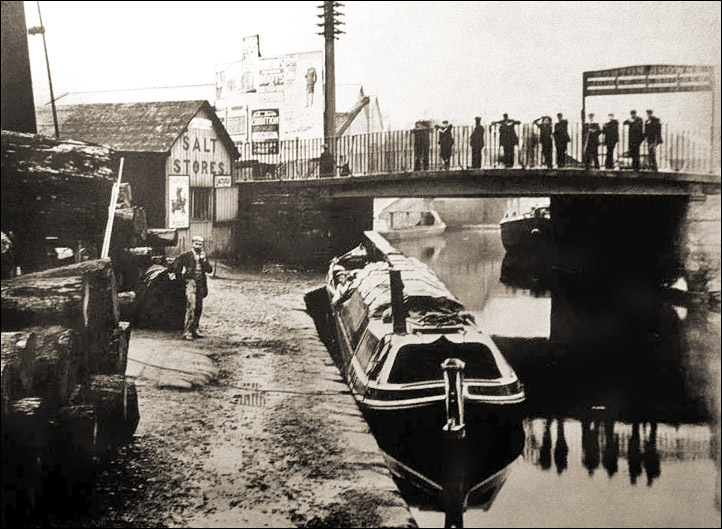
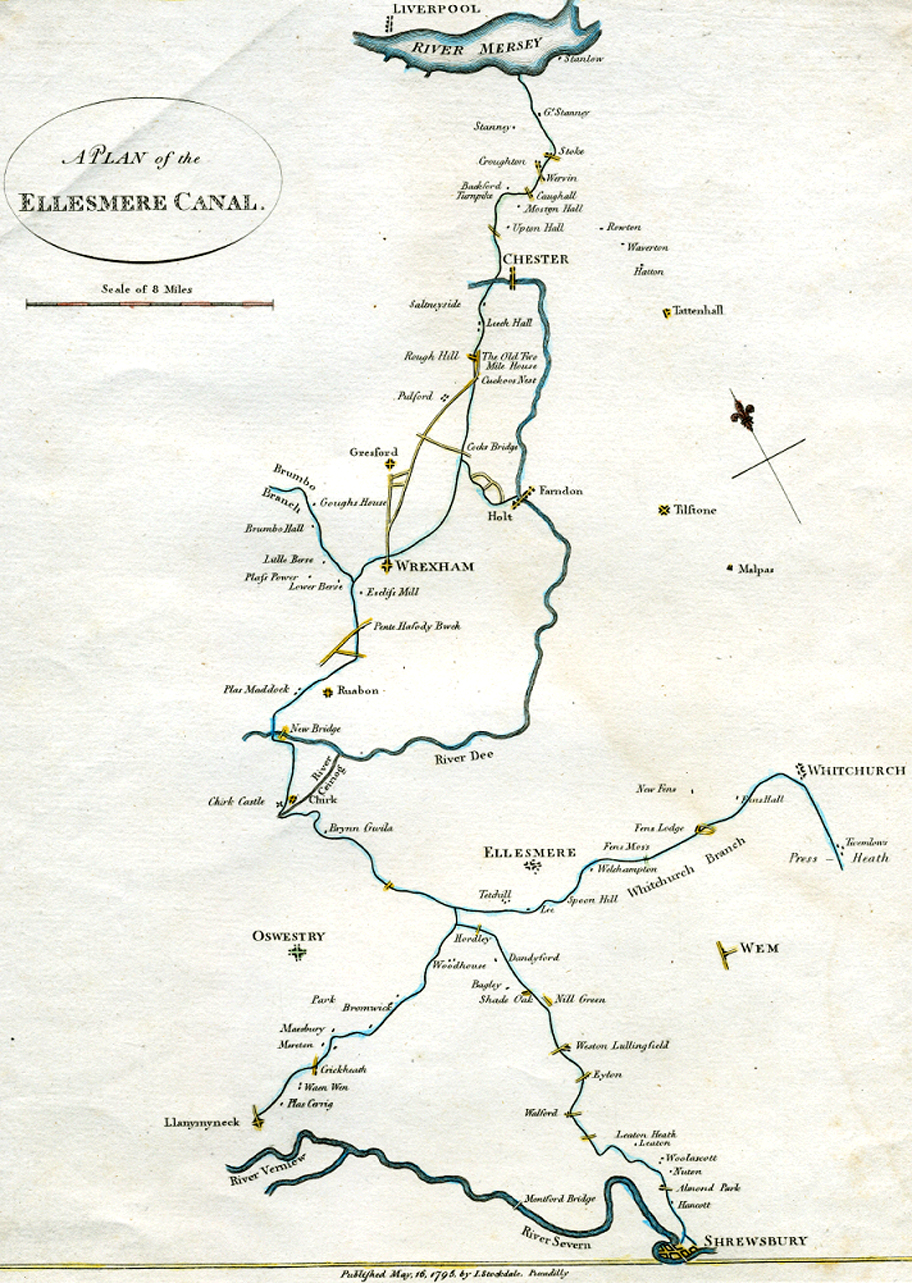
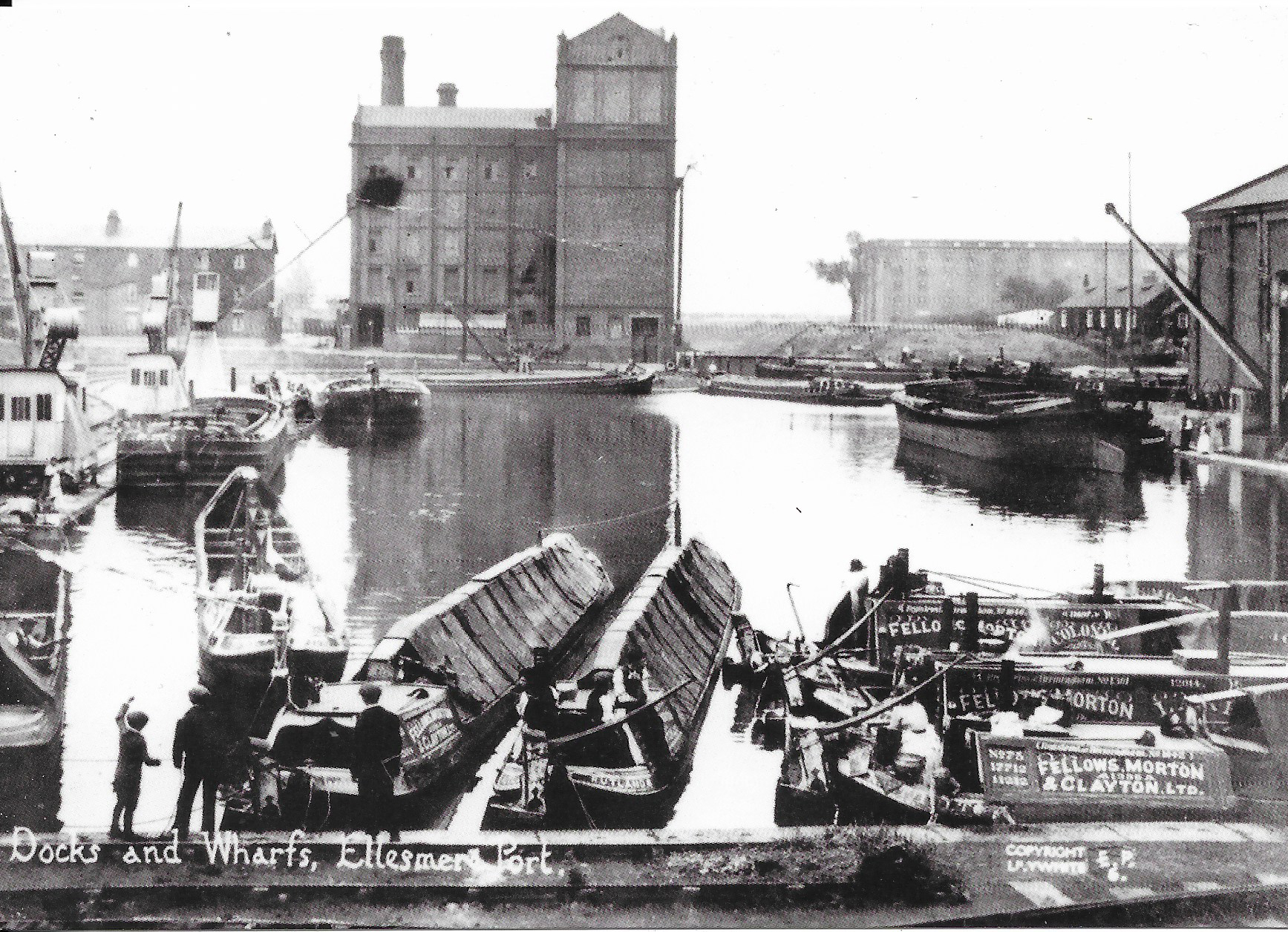
The museum occupies the 19th century canal and port complex, re-using the lovely brick-built buildings for exhibits and displays and using sections of the docks and basins for a number of fascinating canal and waterway vessels. Ellesmere Port was the largest Inland Waterway dock complex in the United Kingdom. The name Ellesmere Port refers to the town of Ellesmere, where many of the decisions about the Shropshire Union canal network were made. There was no Ellesmere Port until the port was established in 1796 as a small base at the Mersey end of the Shropshire Union Canal.
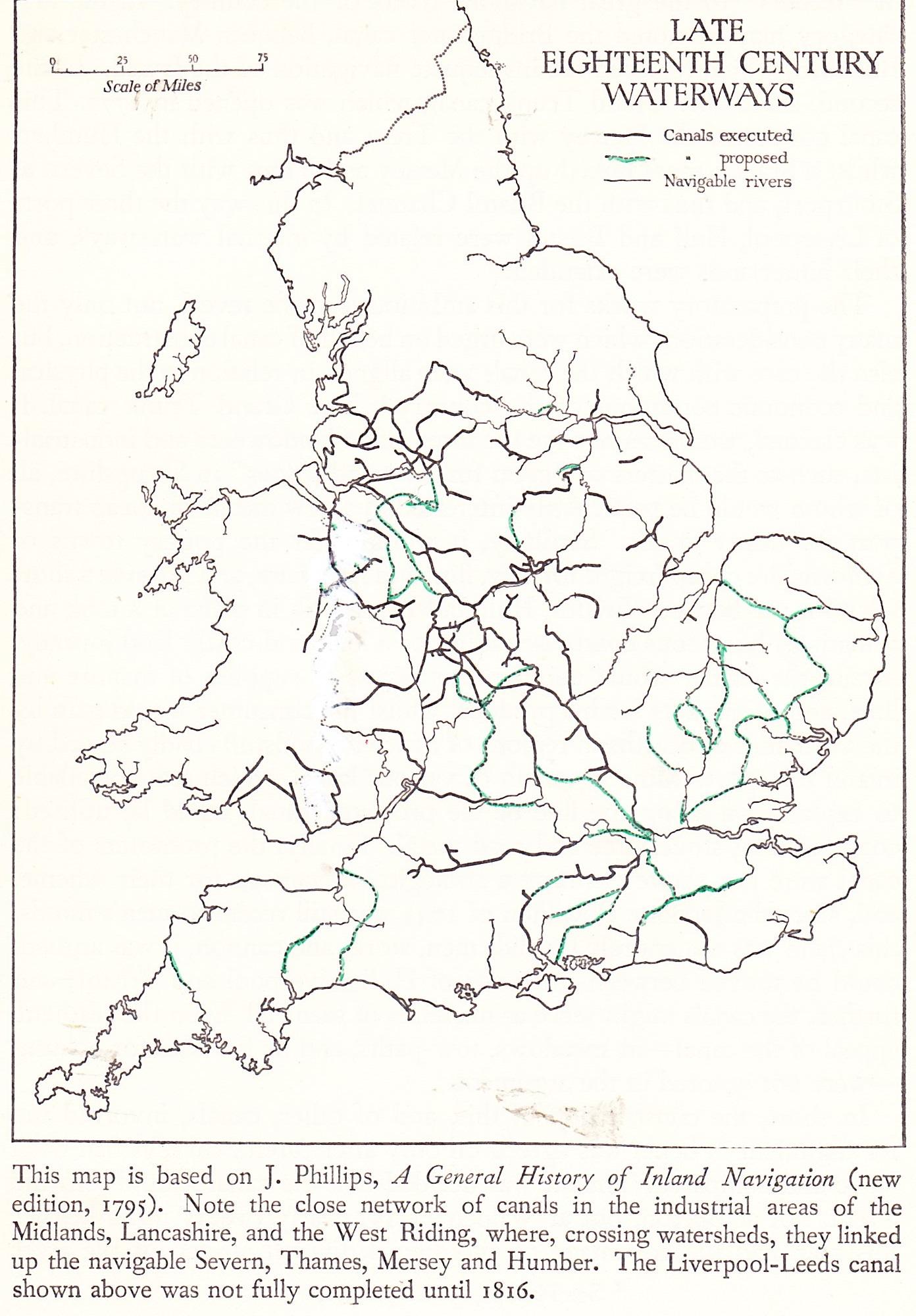
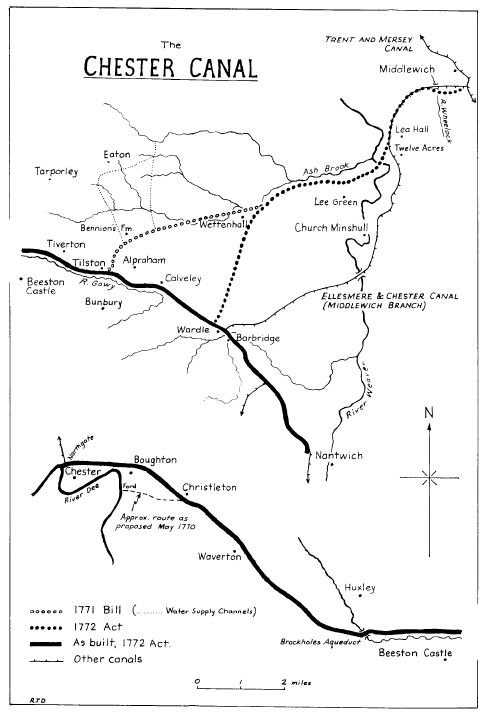
The Shropshire Union Canal was one of a number of canals built at different times which, in 1846, were amalgamated into a single operational network. The earliest part of this network was the Nantwich to Canal section. The earliest part of the system was the Chester Canal which ran from Chester to Nantwich in 1772. It was not until 1793 that a section connecting Chester to the Mersey was built, with its terminus at Ellesmere Port. The section from Nantwich to Birmingham, the Birmingham and Liverpool Junction Canal, was the main north-south artery of this network, and was not completed until 1835, joining the national canal network for which Birmingham was the central hub.
By 1802 as well as a series of locks with a lock keeper’s house, there was also three basins, wet and dry docks, a small wharf, a clerk’s house and a canal lighthouse. Over subsequent decades additional wharves were added and warehouses, workshops and sheds were built. A scheme by Thomas Telford for a dock and entrance for seagoing vessels was completed in 1843, significantly improving the port’s suitability for transhipping. During the 1850s the most important cargo was iron, followed by ceramics from the Potteries, and substantial facilities were provided for both.
The opening of the Manchester Ship Canal in 1894, and the simultaneous improvement in facilities at Ellesmere Port significantly improved the prosperity of the port. Unfortunately this was something of a swansong for the canal port, and In 1921 the Shropshire Union Canal Company sold its fleet of barges and the commercial viability of the canal and the port for freight handling came to an end. The railways replaced the canals throughout Britain, with many of the former wharves and ports falling into disuse and dereliction. Ellesmere Port managed to survive until the 1950s and became a museum in the 1970s.
More details of the history of the port, (together with some of the business and industries it attracted, the development of the surrounding settlement and details of the drainage of Stanlow marshes by German prisoners of war in the First World War), are available in Vince Devine and Jo Clark’s excellent survey (see Sources at end).
The Museum
The derelict port buildings became a museum in the 1970s after a heroic effort by a group of volunteers, and is now a conservation area with nineteen Grade II listed buildings. It was originally known as the North West Museum of Inland Navigation and had various other names until it became The National Waterways Museum, with its emphasis on inland waterways, both rivers and canals, although coastal vessels are also included. As well as boats and exhibition and display spaces, the site is also home to the Waterways Archive, and education centre, conference facilities, a shop and café and other amenities, all located within the port buildings.
Map of the museum. Sorry it’s a bit crumpled, but there does not appear to be a clean version online. Click image to expand.
Entrance is via the ticket office that sits between the shop and the café. There is a 5 minute video to watch if required, and then access to the rest of the museum is on the other side of the shop, which sites on the side of the canal entrance to the port. There were obligingly two narrowboats moored further up the quayside, hemmed in with ice, and this is a very good place to orientate oneself with the help of the excellent map that comes with your entry ticket. It’s quite a complicated site, with several buildings containing exhibits, so the map is invaluable.
I started out by walking over the bridges towards the Exhibition Hall, former warehousing, taking in some of the historic boats moored up alongside the quays in the Upper Basin.
The big former warehouse, called the Island Warehouse, has displays on two floors. The ground floor is a vast collection of objects connected to the waterways, including bits of engine, windlasses, tillers, rudders, sack barrows, buckets and lamps and a zillion other objects, parts and bits. There’s very little information on display, although a QR code promised more details about some of the objects via your smartphone (I had left mine in the car by accident).
A really wonderful find on the ground floor was a long glass cabinet containing a prehistoric log boat found in Baddiley Mere in Cheshire, and made of a single, hollowed-out trunk of oak. This is a nationally important object and it was splendid to see it. I had no idea it was at Ellesmere Port. Sadly, the cabinet was hemmed in on all sides with other objects. It was also covered in dust and the glass sides reflected the surroundings, so it was difficult to get close or see it properly and impossible to photograph well. I do wish that it was on the first floor exhibition area, where it could be seen and appreciated properly. According to the Heritage Gateway website, it is on loan from the Grosvenor Museum.
The prehistoric log canoe, which could be rather more conspicuously and sympathetically displayed.
—————-
The first floor is a more formal exhibition area. There is a cut-away narrowboat called Friendship with its painted bow and stern and a tiny little cabin, the unimaginably small living quarters of the narrowboat’s operator and his family. A delightful pleasure boat, the 1954 Amaryllis, glows with glossy mahogany and polished brass. My favourite was an example of a long, slender boat called a “starvationer,” designed to run on the 46 miles (74km) of subterranean canal tunnels in the Duke of Bridgewater’s Worsley coal mines. Other cabinets have model boats and ships showing a range of different types and sizes. A couple of cabinets have examples of canal art associated with narrowboats. Items commonly found in the dock and canal port are included. There’s even a working model of the Anderton Boat Lift. Information boards provide plenty of detail.
A “starvationer”
Sack chute
Out on the other side of this building, back outside, there are more boats. Some of the boats that are usually out in the summer are under cover for winter, still visible but not as accessible. This is particularly true of the valuable wooden narrowboats like Gifford and the ice-breaker Marbury. Being under cover, they are also easier to work on. The ongoing care and repair of wooden boats is a major part of the out of season work at the museum, and there information boards explaining what is being done to each.
The ice-breaker “Marbury”
Walking to the left, a splendid ship hull rests in a giant covered cradle, the remains of the Mersey flat barge Mossdale. According to the signage she is the only surviving all-timber Mersey flat. She was initially named Ruby, in which guise she carried cargoes of up to 70 tons, towed by steam tug on canal, river and along the coast. In spite of her flat base she was very stable. She was sold in 1920, after which she carried pottery, grain, flour and sugar along the Bridgewater canal.
Mossdale
Beyond this is the splendid Pump House with its 69ft (21m) chimney built in 1873. This was closed to the public on the day I visited.
Heading back, the next place to visit is Porters Row, four terraced houses, each one fitted out with furniture, accessories, wallpaper, technology and kitchen equipment that would have been found in dock workers’ homes of the 1830s, 1900s, 1920s and 1950s. This is such fun, a really evocative way of getting a sense of how past objects were deployed in ordinary homes, although some were clearly more prosperous than others, one with a piano, and more remarkably one with a organ!
Beyond and downhill (reached via a ramp, or by locks if you are in a boat) is the Lower Basin containing more boats, with the rather well disguised Holiday Inn hotel beyond.
Crossing to the other side of the port, there is another set of buildings that includes the old stables (for the horses that pulled the unpowered narrowboats), the blacksmith’s forge (still operational), and the Power Hall, which is a display of ship engines, one of which can be operated via a push-button.
FCB18 – a barge made of concrete
On the other side of the Power Hall are two more boats, one of which, the barge FCB18, is fascinatingly made of concrete, which is a crazily counter-intuitive concept. But there it is, happily afloat. The information signage says that she was built in 1944 during the war, which was a time of steel shortage. Concrete was readily available and cheap, and although steel was still required, only 18 tons was required, as opposed to the 56 for a steel barge with a carrying capacity of 200 tons. Unfortunately, the resulting barge was heavy, difficult to steer, and brittle.
The other boat is Basuto, looking like something built of rusty Meccano, but again, still afloat in a sea of green weed.
Back up towards the exit is a sign pointing you to the slipway with its blue-painted wooden winch house, and from here you can see over to the channel that connects the Manchester Ship Canal to the River Weaver and Ellesmere Port. When you leave the museum, you can turn left along the road that passes between the museum and the car park, and walk along the channel’s edge towards the Holiday Inn, where there are some great swing bridges and more canal-side buildings, including a unique port lighthouse.
The above is just a sample – there’s lots to see. A great visit.
Visiting Information
A dry day is preferable for a visit, because there is a lot to see outside, and the buildings themselves are part of the attraction. Opening times are on the Canal and River Trust website here. At the time of writing (January 2024) the entrance fee was £11.75 for an adult, which seems quite steep but the ticket lasts for a year, and I will certainly be making use of mine for another visit. Other entrance fees are on the museum’s website on the above link. There is a nicely presented shop with books, toys and canal-themed ornaments, and a bright, comfortable café. Outside there are plenty of picnic benches, and a play area. The museum was amazingly quiet. Given the bright sunshine I thought that it would be fairly busy, but the cold was obviously a deterrent, the docks being frozen solid.
I was warned at the ticket office about icy surfaces, which takes on a particular resonance when you are walking along the edges of frozen expanses of water with almost no-one around. But they had done such a good job with the salt and grit that even in the cold shadows there was no ice on which to slip.
For those with unwilling legs, there are ramps nearly everywhere. In the Island Warehouse there is an elevator to the first floor, but this was out of order when I visited so it might be a good idea to phone first if you need it. There is a lot to see on the first floor, so it would be best to go when the elevator is working. The Pump House was closed, but this appears to be accessible only via a short flight of steps (5 or 6 steps). Otherwise, as far as I could see, the whole site seemed to be fully accessible for wheelchair users and those with unwilling legs.
In Part 1 of this 3-part series, the subject of misericords in choir stalls was introduced, the four churches covered in this three-parter were identified, and the St Werburgh’s Abbey (Chester Cathedral) misericords were discussed. Part 2 takes a look at the misericords in the smaller churches of Gresford All Saints’, Malpas St Oswald’s and Bebington St Andrew’s. References for all three parts can be found at the end of Part 3.
——–
Chester, Gresford, Malpas and Bebington (continued)
Basic data about the misericords at the four churches
The misericords carved for St Werburgh’s Abbey (Chester Cathedral) were discussed in Part 1. All Saints’ church in Gresford, St Oswald’s at Malpas and St Andrew’s in Bebington were considerably more modest in scale than St Werburgh’s Abbey, but all were impressive when measured against other parish churches in the region, and obviously had access to relatively substantial funding. The table above was also posted in part 1 and provides some of the vital statistics of all four sets of misericords.
All Saints’, Gresford
All Saints’ Church in Gresford
All Saints’ Church in Gresford is unexpectedly big for such a small and unimposing village. The stone church was founded in the 13th century and underwent a major revamp in the 15th century, and is still busy today. I have written about All Saints’ on two previous posts, one about the history of the church in general, and the other about the 15th century gargoyles and grotesques that inhabit its exterior. It has been suggested that the misericords were sourced from Basingwerk Abbey at Holywell in north Wales and added to All Saints’s after the abbey was dissolved in the early 1500s, but although this remains a possibility, it is also probable that All Saints’ was sufficiently well provided for to pay for its own misericord carvings.
Choir stalls at Gresford All Saints’
Neither the All Saints’ guidebook nor the CPAT survey suggest a date for the misericords, and the church’s web page does not mention them. Based on the presence of a preaching fox, a theme thought to represent mendicant friars who were only present from the 14th century, they must have carved after the late 14th century. It is also very probable that they post-date those at St Werburgh’s (1390) as there was nothing else nearby to provide a model. Although the Gresford misericords could plausibly have been associated with the major rebuild of the church in the 15th century, when two new aisles were added and many other changes were made, Dominic Strange’s misericord timeline places the misericords in the late 15th or early 16th century, over 100 years after the Chester misericords. If correct, it demonstrates the durability of themes that were popular in earlier periods.
Sketch plan of the Gresford misericords.
The choir stalls provide a good example of a three-sided arrangement in a squared U-shape. In total there were originally fourteen misericords, four on the north, four on the south and two lots of three on the west. The latter flanked the entrance from the nave to the choir. Today two are blank, either because they were never completed, or because they were removed due to inappropriate content or severe damage (I can find nothing to help determine which). Some are quite badly damaged, but the entire group indicate great skill and include some varied topics.
The choir, Gresford All Saints’
The misericords are separated by arm rests that curl up the sides of the chairs and along the backs, each one featuring a small human figure at the front of the arm rest. Exceptions are at the corners between the north and west rows and the west and south rows, which feature fantastic beasts.
As in St Werburgh’s, a fox is dressed as a friar but this time he is in a pulpit preaching to chickens and geese, demonstrating that this theme was of interest not merely to monastic establishments but to churches as well. The allegedly venal of some elements of the mendicant cause may be the theme here. The earliest mendicant friars were poor and itinerant, begging for alms. By the later middle ages they were comfortably established in friaries of their own, the recipients of patronage, gifts and wills. The apparent hypocrisy was a source of grievance for the clergy beyond the seclusion of the cloister. The parish priest may also have felt threatened by the powerful public sermons and the more evocative style of engagement with the general public delivered by the friars. In the parish church, as well as in the heart of the monastery, friars might be seen as a threat to the role of the conventional clergy, to be satirized, derided and, if possible, undermined.
One of the more puzzling themes that occasionally appears on misericords (but is missing from Chester, possibly due to removal in the Victorian period) is the revealing of male nether regions. At Gresford this is given a context. The misericord shows an acrobat hanging over a pole held by two men, ostentatiously exposing his undercarriage, apparently during a performance, possibly a form of slap-stick entertainment. Quite what these were doing on misericords is uncertain, although there is a lot of speculation on the subject. Whilst there may have been a warning against lewdness and impurity, it is difficult to deny that at least some of these depictions were intended to include a degree of crude humour.
A badly damaged misericord shows two cats, both standing on their hind legs in front of something that is now missing but appears to show a mouse hole at the base, with a tiny mouse with pointed ears to its right. The cats are holding hands, with one apparently leading the other. The leading cat seems to have been holding something in its outstretched paw. Perhaps the upright stance reflects the cat’s commanding, self-possessed and often self-satisfied view of its position within its own universe. An alternative interpretation is that when animals are shown adopting human behaviour, it is a reminder of human failings. Similarly standing on their hind legs are the cats in MS. Bodley 764 (folio 50r), which also shows cats on the hunt.
Wheelbarrows feature quite frequently in misericords, and one of the Gresford misericords shows two women seated side by side in a wheelbarrow being pushed towards the open jaws of a monster’s head by a creature with staring eyes and a forked tail. The cavalcade is followed by a man. All the participants in the scene stare out at the onlooker. The open jaws of the monster represent the gateway to hell. This is a much simpler version of a well-known example at St George’s Chapel, Windsor Castle, which shows two monks being wheeled towards the hellmouth by either a demon or the devil himself, leading to the suggestion that the two wimpled women on the Gresford misericord may be nuns (but bearing in mind that wimples were not exclusive to nuns). The supporters appear to be small rodents, but it is difficult to see how they might relate to the central narrative.
A splendid winged griffin, facing left, is positioned between two delicate unicorns, one of which is missing its head. The griffin has the head and wings of an eagle, the body of a Lion and is four-legged. Like the lion, which can exert its power for either good or evil, depending on the context. When Alexander the Great encounters the enclave of griffins in his voyage to the end of the world, the creature is a true monster, ugly, frightening and vicious. On the other hand it is a pair of griffins that carried Alexander over the edge of the world. The griffin is often used to represent rival ideas and can, in different contexts, represent such opposing individuals as Satan and Christ. The griffin also represents the combination of the opposing elemental forces of air (eagle) and earth (lion). It is difficult to know what, in this context, the griffin is intended to convey. The presence of unicorns, which are often associated with Christ, may either be supportive companions, opposing forces, or hapless victims, and there is nothing to help determine which. The supporters are decorative flowers.
Another misericord, also quite unlike its companions, seems to refer to the gargoyles and grotesques so strongly featured on the exterior of the building. It may have had no specific symbolic meaning. It is a monster’s face with vaulting emanating from its head. The vaulting may be intended to evoke the magnificent screen that separates choir from nave at All Saints’, although the flowers at the intersections on the misericord are not present on the screen. Perhaps it is intended to bring indoors the collective message that the gargoyles and grotesques were communicating from the exterior of the church (discussed briefly in an earlier post).
Some of the All Saints’ misericords are very badly damaged, leaving the core subject matter very difficult to identify. A particularly frustrating example is the misericord whose central subject matter is completely missing. Flanking it there is a wonderful winged angel on the left and, on the right, a lady in an elaborate dress kneeling before a personal altar with the soft folds of her dress flowing behind her on the floor. Perhaps this was either the Annunciation or the Coronation of the Virgin, particularly as there are no other overtly religious stories included in the All Saints’ corpus.
Another badly damaged misericord shows a woman on a four-legged animal, the head of which is missing and is therefore unidentifiable. It is short, has particularly bandy legs and ill-defined feet, none of which suggest a horse. Two carvings, one in front of the woman and animal, and one behind, are lost. The one behind is almost certainly another figure in a long garment, but the one in front may or may not be.
Some of the misericords contain no narrative or obviously symbolic component. One misericord has no central subject matter and no obvious sign of damage, with just two images as supporters, right on the edge of the underside of the seat. These are two three-quarter partial heads, almost sketches, looking towards one another. The meaning of this, if there was any, is lost. If there was a central carving, there is not even a shape left to suggest a subject matter. It is possible that it was carved at a much later date to replace one of the original misericords that might have been damaged or whose subject matter was considered inappropriate. These lost stories are very frustrating.
St Oswald’s Church in Malpas. Photograph by Alan Marsh. Source: Historic England
St Oswald’s Church in the village of Malpas was founded in the late 1300s. The church underwent a similar modernization in the 15th century to that at Gresford, including a similar camber beam roof. It has a great many features that continue to impress, particularly the spectacular tomb effigies of the 15th and early 16th centuries, but its remaining misericords are disappointingly confined to three choir stalls.
There is a set of three choir stalls with three misericords, in a single row, still displayed in the choir area in St Oswald’s. The visitor guide to the church says that there were “at least twelve” 15th century choir stalls with misericords, with only nine surviving and six “much restored.” Given that there are only three on display, it is something of a puzzle as to what happened to the remaining six of the nine surviving. There are no descriptions of any of the misericords, and nor does the booklet say where the surviving misericords (other than the three still in the choir at Malpas) are located today.
The remaining row of choir stalls at St Oswald’s with the misericords hidden beneath the seats.
The choir stalls have carved armrests, although they less elaborate than those at Gresford, and have no carved bench ends. This may suggest that carved choir stalls were never a very important component of the chancel at St Oswald’s, or that the funds required for a more ambitious project were not available. All three remaining misericords are described here, with the disclaimer that they represent only a very small sample of the original corpus. Two of the three are damaged.
I particularly like the mermaid. Mermaids appear on many misericords in Britain. Mermaids resembled Greek sirens, representing both the temptation and lust that men might find hard to resist on the one hand, and the dangers represented by the deformation of the human image in the form of a hybrid creature on the other. They were usually shown, as at Malpas, with bared breasts, with a comb in one hand and a mirror in the other, warnings not merely of seduction but of the vice of vanity. The Malpas mermaid looks down and seems to be moving gently to her right. Her tail has been lightly carved to suggest fish scales. Her bare chest is distinctly flat and smooth, unlike most misericord mermaids, perhaps to avoid encouraging carnal thoughts amongst the Malpas choristers. She holds the comb in her left hand, which rests on her thigh (separated from her upper arm by breakage), and the mirror in the other, overlapping one of the supporters. Both supporters are three-lobed leaves.
A winged monster has one head, shown facing outward, but two bodies that are shown in profile either side of the head. This is probably the simplest and least worked of all three, with minimal details carved into the image, although there are shallow markings to suggest the scaled nature of the wings, and clawed feet. The face is shown in more detail, with three protrusions from the head, which may or may not depict serpents. It is clearly a monster with affinities like the wings, tails and claws that are shared with dragons. Dragons, wyverns and related monsters may represent paganism, power, uncontrolled violence or lust, the Devil himself and unspecified evil and sin that must be confronted and neutralized, or at the very least rationalized. As such creatures are usually associated with remote, often hostile landscapes, they may also represent fear of the unknown. It may also offer a shifting geographical component, so that the dragon may be feared in the remote landscape but is only confronted when it threatens human habitation and safety. The three-lobed leaf supporters are nicely done, with clearly defined edges. A much more elaborate version of a single-headed and double-bodied monster is shown in the Luttrell Psalter (folio 195v), but is evidently part of the same family of images familiar and available to medieval illuminators, carvers and sculptors.
Single-headed two-bodied monster from the Luttrell Psalter (Add MS 42130 f.195.v). Source: Groteskology
Finally, two knights are shown engaged in an athletic, almost balletic fight with swords. Of the three this is by far the most complex, compositionally. At first glance it is very difficult to see exactly what is going on, and whose limbs belong to whom, vividly capturing movement. The pointed shoes, generally confined to the well-to-do, emphasize the mobility and athleticism of the figures. Perhaps it refers to a scene from a chivalric romance, such a the Chester examples that show scenes from stories of Yvain and Tristan and Isolde. Again, the supporters are foliage.
St Andrew’s, Bebington
As I was just about ready to hit the Publish button on this post I had a whizz through Dominic Strange’s Timeline and Gazetteer, which revealed that St Andrew’s in Bebington on the Wirral possesses misericords in three choir stalls, plus two that have survived being separated from their choir stalls, now serving as corbels. Although the church is not open except for Sunday services, weddings etc., Karen from the church office very kindly arranged for me to visit when volunteers were working there.
Choir stalls in St Andrew’s, Bebington
It is particularly nice to have found these misericords because, as with St Oswald’s in Malpas, the misericords at St Andrew’s rarely appears in books about misericords, always overshadowed by Chester Cathedral and Gresford All Saints’. It is clear that they should be included here not only because they are local and under-sung but because they show some themes that are not shown in the misericords at the other locations discussed in these posts.
The pelican in her piety
Dominic Strange places all five misericords in the 15th century. The guidebook to the church, by Richard Lancelyn Green, says that there were originally twelve of them, with six surviving until 1847 when they were split up due to damp and dry rot. Presumably the other six were discarded. Initially, in 1871, they were split into pairs and then, in 1897, three of them were reassembled into the row that survives today in the chancel, just to the side of the main altar. Two of them have been removed from their original choir stalls and are deployed as corbels but there is no mention of the sixth 1847 survivor.
At the far left of the choir stall is the pelican in her piety plucking her breast (shown above), already described in connection with Chester in part 1, but flanked here with foliage.
The head of a man with beard and hat or other form of head covering may or may not be a portrait. Many misericords show human faces, some characterized by particular expressions or actions, but many contain no clues about the significance. The supporters feature pomegranates. Pomegranates are associated with numerous ideas from antiquity onwards. The symbolism attached to them ranges from fertility, regeneration and good luck to representing the shedding of the blood of Christ and as a symbol of the church and its congregation. Without knowing quite what the man’s head represents it is difficult to interpret the entire message of the misericord.
The third in the row is a splendid dolphin flanked by equally splendid seahorses, presumably designed by someone who had seen neither dolphin or seahorse. The dolphin is a rather terrifying looking creature, but there seem to be no negative narratives associated with it. The bestiary in MS Bodley 764 includes the dolphin, but attaches no special meaning to it, stating that “they follow men’s voices, or gather in shoals when music is played . . . if they go in front of the ship, leaping in the waves, they appear to foretell bad weather.” The only other misericord dolphins that I’ve seen in my online travels are at Norwich Cathedral and St Laurence’s Church in Ludlow.
The remaining two misericords, now used as corbels, show what may be a bull’s head, and a sow with a litter. You can see them on the World of Misericords website. The sow with a litter is a theme also featured on one of the St Werburgh misericords. MS Bodley 764 is quite clear on the negative connotations: “The sow that was washed and returns to her wallowing in the mire is filthier than before; and he who weeps for his admitted sins, but does not desist from them, earns a graver punishment, condemned by his own misdeeds which he could have prevented by repentance; and he descends as if into murky waters because he removes the cleanness of his life by such tears, which are tainted before the eyes of God.” Sows represent unclean spirits and are often associated with gluttony and, more disturbingly, heresy. And in the medieval mind, where heresy lurks, paganism may be lurking nearby.
Contributors to knowledge
Even in such small numbers, the churches at Malpas and Bebington contribute to the body of information about Medieval misericords, helping to build up a database of knowledge about the themes that were of interest to those who commissioned them for the most sacred parts of their monasteries and parish churches. Unless an early report describing or illustrating some of the other misericords emerges, the legacy of those who commissioned, funded and carved the misericords at Malpas and Bebington are confined to just these three and five examples respectively. Although the themes were represented elsewhere, none of the topics shown replicate any of those surviving at St Werburgh’s.
Other churches in the region with misericords
Grapevine misericord at Nantwich St Mary’s. Source: Dominic Strange, World of Misericords
The above are the only churches with misericords in the Wrexham-Chester area, but there are others in the general region. For example, there is a set of fourteen dating to the late 14th century in St Mary’s Nantwich to the east, in the town centre. There are 20 dating to the late 15th century in St Asaph’s Cathedral to the west in north Wales. Another set of sixteen dating to the late 15th century can be found in St Bartholemew’s in the village of Tong to the southeast (where the A41 meets the M54). Finally, there are two fine sets of 15th century misericords (the first of sixteen in 1425 the second of twelve in 1447) in St Laurence’s church in Ludlow.
Part 3 wraps up the series, looking at who was involved in the creation of misericords, how they were paid for, and why they featured so frequently in the most sacred part of a church, often hidden from view but containing a mixture of messages that in each case contributed to the sense of a church’s identity. Visitor details and references are also added at the end of part 3.
This was a completely off-the-cuff visit, as we were planning to go somewhere else but found that it was temporarily closed. I am so glad that we were forced to change our plans, because we absolutely loved the aquarium. Located in the Ellesmere Port area, it was opened in 1998, but it has been so well cared for that it looks brand new.
The fish are fabulous – everything from sharks bigger than me to tiny fast-moving flashes of spectacular colour and light. the myriad of shapes, sizes, colours and types of movement is a massive eye-opener. Nature went to town on the aquatic spectrum of possibilities. There are also timeless tortoises, sinuous snakes, iridescent frogs and a remarkable chameleon, whose projecting, rotating eyes are an evolutionary marvel. One of the most attractive features of the aquarium is the profusion of richly flourishing plant life. Oh that my indoor plants would look like that!
The underwater tunnel, which passes through the aquarium, is a sensational experience, with an incredible array of fish, including sharks and stingrays, flowing around you and overhead and conger eels peering out at you from rocky enclaves. It is the nearest that any non-divers are ever going to get to a first-hand sense of experiencing the enchantment of the aquatic universe. Rather than carrying on with the superlatives, here are the rest of the pics. Visiting details (including disabled access) are at the end, as usual.
Where else could you possibly find yourself looking up into the intimidatingly toothy mouth of a shark overhead, or glory in the soft, pure-white underbelly of a stingray, elegance on the wing, as it glides effortlessly just inches from your eyes? Magic.
Visiting
Blue Planet was easy to find, clearly signposted with brown signs from the M53. When you reach it, you find yourself confronted with a series of car dealerships, and cars parked all along the approach road, but the aquarium is the big silver building on the left at the end of the approach road, with its own big car park, including disabled parking. For SatNav users, the postcode is CH65 9LF. Bus and other transport info is on the website’s Getting Her page.
See the website for the opening times and entry and parking charges. We visited on a Wednesday at around midday, and although there were other people there, it was very quiet, and ideal for us. A couple of school trips were in progress, but were easy to avoid as the kids were well managed and herded together.
For those with leg issues and for wheelchair users (both were there having a great time) there is a disabled lift (just ask if you cannot find it). The aquarium ranges over two floors, and each is on the flat. Some of the rooms are quite dark, and that may be a problem for people with balance problems. You can find more on the disability page on the website. There are plenty of places to sit down.
Outside, on the other side of the shop, there is the pelican enclosure (with real, live pelicans), a picnic area, a kid’s play area, and a small wildlife reserve. There are daily talks and events, and you can book special visits, all details available on the website.
The shop is stocked with loads of truly fun soft toys, aquatically themed. I managed not to buy a giant fluffy stingray or octopus, but it was touch and go (had I been alone it might have been a different story 🙂 ). There is a large café. We didn’t try it, but it was well used.
The Meols Pilgrim Flask, now in the Grosvenor Museum, Chester (GM 43. M.56). Source of photograph: Pilgrims and Posies blog
Flipping through Peter Carrington’s book Chester when it arrived on my doorstep a year or so ago, I was surprised to see a black and white photograph of something both very familiar and exceedingly unexpected: an Egyptian pilgrim flask originally from the shrine of the Coptic Christian St Menas in Egypt. Only 98mm tall, it was manufactured during the 6th-7th century in northern Egypt. It was almost certainly purchased at the desert shrine of St Mena, 45km to the southwest of Alexandria.
It was found on the Wirral at Meols (pronounced mells) by a local man digging for lugworms in 1955, in a peat layer 61cm (2ft) below the sand 274m (300 yards) off Dove Point. For those unfamiliar with the local geography, there’s a map at the end of the post. The flask was donated to the Grosvenor Museum in Chester. Although the location site consists of nothing but sand dunes today, it was formerly inhabited. Griffiths and his colleagues, in their 2007 monograph on Meols, describe the 19th century investigations of this strip of land:
The eroding sand-dunes not only produced an enormous body of small finds, but also traces of buildings (the records of which are now unfortunately lost) and stumps of trees from the old ground surface. The numerous artefacts include, as well as many mundane objects, exotic pieces of high quality.
Today, the same team interpret early Meols (from the Norse meaning sand-hills) as a possible “beach market or port.”
Unsurprisingly, given the time that the pilgrim flask must have spent in the sand, the surface of the flask it is badly abraded and is slightly damaged. In the photograph on the left it looks as though it has a handle and spout, but in fact the “spout” was a twin handle, by which the vessel could be held in two hands, or threaded through a belt or chord for carrying. There is also some slight damage to the body of the vessel itself. It was not the most skilfully manufactured item, and was probably one of the less expensive examples on offer to the purchaser, but given its find-site is remarkably well preserved.
Although difficult to make out, the front of the vessel shows a scene consisting of the Roman-Egyptian St Menas flanked by two camels, about which more in a moment. There are photos of better preserved versions of the same scene below. I haven’t found a diagram or photograph of the reverse of the flask, but Griffiths et al describe it as follows: “The righthand part of the circular field has short radiating spokes from the frame. The design is very abraded and unclear, but appears to have a long curving design.”
Thompson’s figure 3, showing a sketch of the Meols flask at the time of its discovery. Source: Journal of the Chester Archaeological Society, volume 53, 1956
Material of the same period (6th-7th century AD) is found in the general area, confined to a short stretch at the top of the Wirral peninsula, producing over 100 artefacts, from both Roman and post-Roman objects, including Late Saxon and Anglo-Scandinavian material. Following its discovery in 1955 the find was reported very briefly by F.H. Thompson in the Miscellanea section of the Journal of the Chester Archaeological Society in 1956, accompanied by a sketch, and a description of the context in which it was found:
Although the coastal site of Meols, near Hoylake, is not now so prolific of antiquities as in the days when the Rev. A. Hume could devote a whole book to cataloguing the Romano-British, Saxon and mediaeval finds made there, single specimens are occasionally recovered.
The pilgrim flask is a well known form of vessel, and examples are found all over Egypt, and in Nubia. Fewer numbers have been found outside Egypt, most of them in the eastern Mediterranean. They are characterized by a lentoid (lens-shaped) body, narrow neck and twin handles, connecting the neck of the vessel to the main body. They seem to have been fitted with stoppers made from mud and other materials. The Meols example is 98mm high from lip to base. The body is 65mm wide, and the neck 35mmwide. The thickness of the pottery never exceeds 18mm. The neck and arms were added to the body after the manufacture of the vessel’s body, and there was not a great deal of skill demonstrated in its production. Much finer examples survive.
St Menas pilgrim flask from Preston on the Hill, Cheshire, now in Norton Priory Museum. Source: Griffiths et al 2007
The Meols pilgrim flask is not unique in England. Norton Priory Museum, near Warrington, has a collection of pilgrim tokens, one of which is a pilgrim flask from the shrine of St Menas, which was found in the Norton Priory area at Preston-on-the-Hill, shown left. It is missing its handles and neck. When the neck and handles are added on afterwards, the joints are a common point of failure. The Preston-on-the-Hill flask has a much clearer image of Menas and the camels and is framed with text, which is a blessing of St Menas. It was found during construction work for a new housing estate, and it is by no means clear how it got there. Other examples with a comparable date have been found elsewhere in England, including Durham, York, Derby, Baldock in Hertfordshire, Faversham and Canterbury. Although they are not unique, they are certainly not common. None, for example, have yet been found in Wales, Ireland or Scotland, although other contemporary Mediterranean objects have.
Who was St Menas?
St Menas was an early Christian saint dating to the Roman period who died in around the year 300AD. Christianity was introduced into Egypt, traditionally by St Mark, and became well established during the 2nd and early 3rd centuries in the multi-ethnic city of Alexandria on the Mediterranean coast. During the 541 Council of Chalcedon differences about theological understanding of the nature of Christ caused the Coptic Church of Egypt to split from Rome, and to establish its own clerical administration with its own pope, which it retains today. St Menas is part o the Coptic Christian tradition.
Pilgrim flask of St Menas at the British Museum, findspot unknown. BM1875,1012.16. Source: British Museum
There are a number of versions of the story of St Menas, and it is likely that the stories of St Menas and St Gordius were conflated into a single story. Probably the most popular version is that Menas was martyred in Phrygia, possibly during the reign of Diocletian in the 3rd Century for wishing to give up service in the Roman army to become a hermit in the service of God. Egypt had a tradition of eremitical worship in the desert, most famously represented by St Paul of Thebes (died c.345) and his follower St Antony (died c.356). The soldiers who killed Menas tried to burn his body but it remained unharmed. Pope Athanasius of Alexandria was visited by an angel who told him to take Menas into the desert for burial. Menas was carried on either one or two camels, and when the camel/s suddenly stopped and refused to go further, it was taken as a sign that he should be buried at the spot. A spring erupted into life where he was buried. The grave was forgotten until the 4th century. The story is that it was rediscovered by a shepherd when a wounded sheep submerged itself in the spring and was cured. As the shepherd continued to heal his sheep in the spring, the story began to spread. According to the legend Constantine the Great sent his daughter, afflicted with leprosy, to be cured. Her recovery endowed the site with even greater acclaim. Not long afterwards the saint’s grave was discovered, and a church was erected at the site in the Mareotis area, now known as Abu Mena, located around 45km southwest of Alexandria. The saint’s remains were transferred to the crypt. It soon became a place of pilgrimage with a settlement around it catering to the expanding number pilgrims from both inside Egypt and beyond as news of the shrine continued to spread. The site became renowned for its responsiveness to prayers, including the delivery of miraculous cures, becoming the largest pilgrimage destination in the eastern Mediterranean, and was considered to be a patron of desert caravans and merchants.
The Arab-Muslim Conquest of Egypt between 639-646AD caused considerable difficulty for the Coptic religion, and the site seems to have been destroyed at this time. It was partially restored in the 8th century but underwent various reversals and seems to have gone out of fashion after the 10th century. Excavations in the early 20th century, and then from the 1960s have uncovered the foundations of the church and the associated monastery.
Pyxis showing St Mena. British Museum 1879,1220.1. Source: British Museum
The saint was often shown on the pilgrim flasks flanked by camels wearing a short long-sleeved tunic, with a wide belt, military cloak, laced boots and raised arms in the “orans” posture, which is a gesture used by the clergy when praying with or on behalf of the congregation. The British Museum has a flask (shown above) that is much less eroded than the Meols example, and depicts the same scene of the saint flanked by two camels. It is more obviously similar to the Preston-on-the-Hill example, but lacks the inscription. Most have a different scene on the reverse side, sometimes another saint, but often a more geometric pattern consisting of motifs, as in the Meols example, .
Just for comparison, the ivory pyxis (cylindrical box) above left, dating to the 6th century, made in Egypt and found in Italy, shows a much clearer and far more elaborate version of the scene. On this side of the box St Menas is shown standing beneath an arch, representing a shrine, with his hands raised, flanked by two recumbent camels, and approached by worshippers. The reverse side shows his martyrdom.
What were the pilgrim flasks used for?
The ruins of the early religious complex at Abu Mena. It included, amongst other things, two churches, a basilica, courts, hostels, baths, a baptistry and colonnades. Photo source: Wikipedia
Above all the Egyptian pilgrim flask was a personal expression of pilgrimage for the purchaser, serving a) as means of carrying a part of the divine with him or her, b) as the memento of a personally important and perhaps very remarkable journey and c) as a mechanism for advertising that the pilgrimage was undertaken.
Pilgrimage is a personal voyage, for reasons known only to the person making the journey. Motivations can vary from an illness or disability afflicting the person making the pilgrimage, or afflicting someone else on whose behalf the pilgrimage is made, to a general need to demonstrate penitence, piety or fulfil another inner need. These little mementos contain more than hope – they contain something precious and beloved, a bridge between a person and his or her God, often via the intercession of a benevolent saint to whom it was perhaps easier to relate. Finds in Alexandria indicate that St Menas had a popular local following, and those further afield attest to his wider importance. A long distance pilgrimage was an investment not only of financial cost, time and energy, but also time away from family, home and the means of making an income, so it involved sacrifice, without which perhaps the pilgrimage was probably much less significant.
The similarity between the flasks, whether poorly- or well made indicates that they were mass-produced. They were not special to the producer, except as a means of making income, but they were immensely special to the pilgrim. Because the flasks were very small, between c.9 and 20cm tall, they were highly portable, and could be carried home even over very long distances without difficulty. Pilgrimage sites today still sell little objects for visitors to take home. Lourdes and Santiago de Compostella are two obvious examples, but at a visit to St Winifred’s well in Holywell, north Wales, I found that it too has a gift shop where you can purchase religiously-themed memorabilia.
Piers Baker-Bates of the Open University talks about the value of his own pilgrimage memento, helping to clarify the personal connection that people have with pilgrimage objects. This is part of the transcript from a short video, which at the time of writing you can find on the OU site here:
This is the pilgrimage medal I had after I went to Santiago [de Compostela] in 1995. It’s just the ordinary cheap, lead model they sell in the tourist shops there, nothing special at all, but it was simply, if you like, my memento mori of the expedition. It’s a scallop shell. The scallop shell has traditionally been the symbol of St James because it is a native of Galicia, which is the region of Spain where Santiago de Compostela is, and supposedly, according to legend, when his body was found it was surrounded by scallop shells, and this is therefore ever since been the symbol of the saint. So you will not just see the scallop as an individual symbol, but if you look at churches, if you look at hospices, if you look at other buildings connected with St James, they all have somewhere on them the scallop shell because it is the symbol of the saint.
If the chain wasn’t broken I’d still wear it round my neck all the time and it serves to remind me of something I did and I would like to do again eventually. If I was a medieval pilgrim, I’d have worn it in my hat, and you would have seen a wonderful selection of people who’d been to all the major shrines, who had a selection of these in their hats, so you’d have Jerusalem, Santiago de Compostela, Rome – they all had their own symbols. . .
Even though there are millions of these in the world, it still has meaning because it has meaning for me in particular, because it is particular to me, but also if someone else has one of their own, it will mean something to them. But at the same time, as a symbol, it means something to everyone, so when anyone looks at one of these they will recognise the symbol and understand what it means.
The vessel could contain the holy water of the well, the sand surrounding the shrine or liturgical oils. Some vessels were more elaborate than others. The Meols example, even though highly abraded, was probably never a very sophisticated piece of craftwork, meaning that the pilgrim who bought it probably had little spare money to spend. In Egypt, nearly all the complete examples were found in funerary contexts, indicating that they were sufficiently significant to the living that they wished to meet the afterlife with their pilgrim flasks at their sides.
Precursors of the the pilgrim flask
Clay vessel dating to the New Kingdom, painted with concentric rings, now in the Petrie Museum of Egyptian Archaeology (UC66492). Source: Petrie Museum of Egyptian Archaeology
The Coptic era pilgrim flasks were not an innovative form of pottery. The form emerged in the earlier New Kingdom (1550-1069BC). These were in their turn were based on vessels imported from the Levant in the 18th Dynasty (1550-1295BC). The form was soon taken up and copied by Egyptian potters who produced them for local demand. They were usually manufactured in clay, like the later pilgrim flasks, and sometimes other materials including glass, faience, stone and even metal. The early clay examples were frequently provided with a coloured slip and decoration that emulated the Near Eastern examples with concentric circles on each face. Kilroe suggests that the concentric circles were equivalent to branding, and that they were indicative of the contents of the flasks. They grew in popularity in the 19th Dynasty (1295-1186BC), and became part of the potter’s repertoire from that point forward. Their function was probably somewhat different from the later pilgrim flasks. One suggestion is that they were used for carrying valuable perfumed oils.
New Year flask from Egypt, now in the Walter’s Museum (48.419)
These were followed by so-called New Year’s flasks, which have the same basic shape, but with handles so small that they are merely decorative rather than functional. The New Year’s flasks are often ornate and are usually made of faience, an expensive material exclusive to the elite. New Year was one of the most important dates in the Egyptian calendar, marking the beginning of the Nile flood, which replenished the soil with fertile silts and saturated the land ready for germinating the seeds retained from the previous year’s harvest. Coinciding with the appearance in the night sky of the star Sirius, and closely associated with it, the new agricultural year was celebrated in an annual New Year festival called wep renpet meaning “opening of the year.” During the Saite 26th Dynasty (c.664-535BC) New Year flasks became a particularly popular celebratory item. They are found both in Egypt and abroad and are often decorated with papyrus and lily capitals. The lug handles on the shoulders are often in the form of the deity Thoth, represented as a baboon, responsible for knowledge, wisdom and the calculation of time. Nands of decoration around the body of the vessels and down the sides are also common. Many have hieroglyphs, often mentioning the wep renpet, together with favoured deities.
How did the Meols flask arrive in England?
Coins found in the northwest, including examples from the Wirral. Source: Philpott 2020, Journal of the Chester Archaeological Society, table V.1, p.53
F.H. Thompson discusses whether the Meols flask had been acquired at the St Menas shrine when it was brought to England or whether it was brought to the area at a much later date. There is no reason to doubt that it was manufactured in the 6th or 7th centuries, and there are arguments in favour of it having been brought to England at that time. As Thompson says, “finds of the late Saxon period from Meols are sufficiently common to suggest that this flask may well be contemporary.” The presence of three mid to late 6th century Byzantine coins in the Meols area are consistent with connections to the southeast Mediterranean at that time. This view is supported by William Anderson who believes that the flask may be associated with other evidence of long-distant contact, “namely amphorae and imported fine wares found at Tintagel in Cornwall, and other sites in Ireland, Wales, England and Scotland,” possibly representing direct trading contacts between the Mediterranean and and the west of Britain. Robert Philpott’s examination of early Byzantine coins from the northwest also supports a Mediterranean connection: “Although we lack diagnostic material to identify the elite with whom Mediterranean trade was conducted, the finds indicate an entry point at the port of Meols.” The Wirral coins, from Leasowe, Moreton,, Seacombe and Landican were issued over a period between 518 – 541 AD.
Susanne Bangert suggests two primary routes by which objects from Alexandria may have reached Britain. The first is an overland route across Europe, along the Rhine corridor or through Italy and via the Alps. Her other proposed route, by ship, would have passed through the Straits of Gibraltar and north up the Atlantic coast, putting into ports along the west cost of Britain, including Cornwall, Wales and perhaps Meols.
It is a possibility that the pilgrim flask was connected with early Christian pilgrimage at Hilbre Island, just off the Wirral as part of a global pilgrimage circuit to Christian monasteries and shrines. As unlikely as this sounds, it is not beyond the bounds of probability, as some of the Egyptian pilgrim flasks in England are found in the rough vicinity of former monastic sites (Canterbury, Derby, Durham, Norton, Runcorn and York). Christianity arrived in England during the Roman occupation in the 4th century, after which it existed alongside pagan religions of the Anglo-Saxons until the arrival of Irish Christianity on the one hand, and the arrival of St Augustine’s mission to England from Rome in 597. Monasteries were established in both traditions, but many were destroyed by Viking raids during the 9th century. Only those of the Roman tradition were restored in the 10th century. Pilgrimage was a popular activity in Britain from the early Christian period until the end of the medieval period, and it is possible that the Meols flask was deposited or lost during a pilgrim’s visit to the tidal Hilbre Island. Although a monastic cell was established in the late 11th century by St Werburgh’s Benedictine Abbey in Chester, there was apparently a much earlier shrine to the obscure St Hildeberga, which the St Werburgh charters appear to confirm.
An example from Baldock, Herts., in the Letchworth Museum, no.7421. Source: Fitzpatrick-Matthews 2010
Another possibility is that although originally purchased at the Menas shrine, the Meols (and other English flask finds) were brought not directly from the site, but during near-contemporary or slightly later periods from Alexandria, locations in the Levant and elsewhere in the eastern Mediterranean, where many more Menas flasks have been found. A generation or two on from the original pilgrims who purchased them, they may have entered local markets as devotional curios, sold by their families to contemporary travellers to raise cash. Then too, at a much later date, it could have been acquired as an antiquity by a collector, or as a travel memento by someone on military service in the Near East, or making the Grand Tour. Philpott, in his analysis of coins from northwest England argues against this: “If the coins were modern losses by tourists or soldiers who served in eastern Europe, the Middle East or north Africa, as has often been asserted, the material recovered by metal detectorists should range more widely through the Byzantine era to embrace, for example, the common anonymous bronze issues of the late tenth to eleventh centuries, as well as other coins of Turkish, north African or Near Eastern origin.”
On balance, the available evidence seems to point a to a connection between the port of Meols and the eastern Mediterranean until the 7th century, and it seems likely that the Meols flask was introduced, along with other objects like the coins described by Philpott, at that time.
Final comments
There are four distinct phases that we know of in the life of the Meols pilgrim flask. The first is its production. Raw material sources were acquired, and the flask was manufactured. The raw material was clay, very easy to source in the Nile Delta, and the manufacturing process was mundane. Hundreds of pilgrim flasks have survived, and this is one of the less elaborate examples, produced quickly and without flourishes. The fact that the Menas pilgrim flask left the site of Abu Menas strongly suggests that it was purchased by a pilgrim, who bought one of the less expensive examples, and was probably not particularly well off.
Next, we find the pilgrim flask in Meols, so we know that it travelled. There are a number of possible explanations for how it left the eastern Mediterranean and arrived in Meols, all of them viable. Found in sand dunes, which cover the site of a small port, with a market, the object could have been hidden in a building that decayed, or may have been lost by its owner in or around the settlement.
The discovery of the flask in 1955, another stepping stone in its history, resulted in it being donated to its next port of call, the Grosvenor Museum, in 1956. The museum deemed it of sufficient curiosity value to have replicas made, which were sold in the museum’s shop.
Subsequently, a number of academic papers were written about it. Peter Carrington published a photograph of it in his book on Chester in 1994 (as mentioned at the beginning of this article, bringing us full circle), and it was described in some detail in a monograph about Meols in 2007. This little object has had quite an interesting life.
Although this is the story of an object, its real value lies in its part of a much bigger story – that of early Christian pilgrimage. When considered in the light of other pilgrim sites, and other objects that have travelled from the eastern Mediterranean to other parts of the world, it becomes much more than an object, and part of a fascinating narrative about people, movements and the way in which Christianity was understood and expressed in the 6th and early 7th centuries. The St Menas pilgrim flasks also offer the chance to explore the relationship between Christianity and Egypt’s pagan past, via the survival of some of PHaraonic Egypt’s ideas and traditions in object form. Finally, the presence of the pilgrim flask at Meols raises questions about the development of trade and transport on the Wirral and in Chester in the post-Roman period.
If anyone has anything to add to the story of the Meols pilgrim flask, do get in touch.
——-
The Wirral, showing Meols and Chester. Source: Google Maps
Anderson, W. 2007. Menas flasks in the West: pilgrimage and trade at the end of antiquity. Ancient West and East 6, p.221-43
Bagnall, R.S. 2001. Archaeological Work on Hellenistic and Roman Egypt, 1995–2000. American Journal of Archaeology. Archaeological Institute of America, 105 (2), p.227–243
Bourriau, J. 2004. The beginning of amphora production in Egypt, in J. Bourriau and J. Phillips (eds.), Invention and Innovation. The Social Context of Technological Change 2. Egypt, the Aegean and the Near East, 1650-1150 BC, Oxford, 78-95
Brooks Hedstrom, D.L. 2019. Archaeology of Early Christianity in Egypt. In Pettegrew, D.K., Caraher, W.R. and Davis, T.D (eds). The Oxford Handbook of Early Christian Archaeology, Oxford Handbooks, Oxford Academic.
Carrington, P. 1994. Chester. Batsford / English Heritage (flask mentioned on page 54, and shown on page 56, figure 33)
Craggs, J.D. 1982. Hilbre: The Cheshire Island: Its History and Natural History. Liverpool University Press
Farmer, David. 2011 (5th edition, revised). The Oxford Dictionary of Saints. Oxford University Press.
Grossmann, P. 1998. The Pilgrimage Center of Abû Mînâ. in D. Frankfurter (ed.), Pilgrimage & Holy Space in Late Antique Egypt. Leiden-Boston-Köln, Brill. p.282
Harris, A. 2003 Byzantium, Britain and the West: the archaeology of cultural identity AD 400-650. Tempus.
O’Ferrall, R.S.M. 1951. A Pilgrim’s Flask found in Derby. Journal of Derbyshire Archaeology and Natural History Society 71, p.78-9.
Philpott, R.A. 2020. Early Byzantine Copper Coins from Lowland North-West England. New Finds from Wirral, Cheshire and West Lancashire. Journal of the Chester Archaeological Society, volume 90, 2020, p.51-70
Richards, J.D., Naylor, J. and Holas-Clark, C. Anglo-Saxon Landscape and Economy: using portable antiquities to study Anglo-Saxon and Viking Age England. 4.4.5. Meols, Cheshire. Internet Archaeology https://intarch.ac.uk/journal/issue25/2/4.4.35.html
Stevenson, A. 2015. The Petrie Museum of Egyptian Archaeology: Characters and Collections. Petrie Museum of Egyptian Archaeology, p.35
Thompson F.H. 1956. Pilgrim’s flask from Meols. Journal of the Chester Archaeological Society 43, p.48-9
Wyn Griffiths, D. 1991. Anglo-Saxon England and the Irish Sea Region AD 800 – 1100. An Archaeological Study of the Lower Dee and Mersey as a Border Area. A Thesis presented for the degree of Doctor of Philosophy. Department of Archaeology, the University of Durham http://etheses.dur.ac.uk/1488/1/1488.pdf