Category Archives: Wirral

A very beautiful autumnal sunshine walk along the Wirral estuary from Burton to Parkgate

Bird of prey, Burton, Wirral

Beautiful feathers on a bird of prey at Burton, Wirral

Yesterday seemed, at first, to have been doomed from the start.  I was supposed to be driving to Aberdyfi in mid-Wales to do something specific, but 20 minutes from home, already running very late, realized that I had left two components essential to the task on the kitchen table.  Having returned home and collected the required items, I was leaving the house and went to take a quick snapshot in my garden of a squirrel running upside down along a power line and rapidly closing on an oblivious turtle dove, and found to my dismay that the camera couldn’t read the SD card. Nooooooo!  I knew I had a spare somewhere, but where?  Ridiculous to go to Aberdyfi on a sunny blue-skied day like this without a camera.  After half an hour of fruitless searching I picked up the phone and cancelled my visit.  Twenty minutes later I had found the wretched thing.  Instead of the planned expedition, I found myself grabbing the camera and car keys before heading up the Wirral to Burton to park up along the estuary and go for a very fine walk along part of the Wirral section of the King Charles III England Coast Path.  I hadn’t even got out of the car when I saw the above bird of prey, which politely held position whilst I scrambled out of the car.  A perfect way to turn around a very unpromising start to the day.

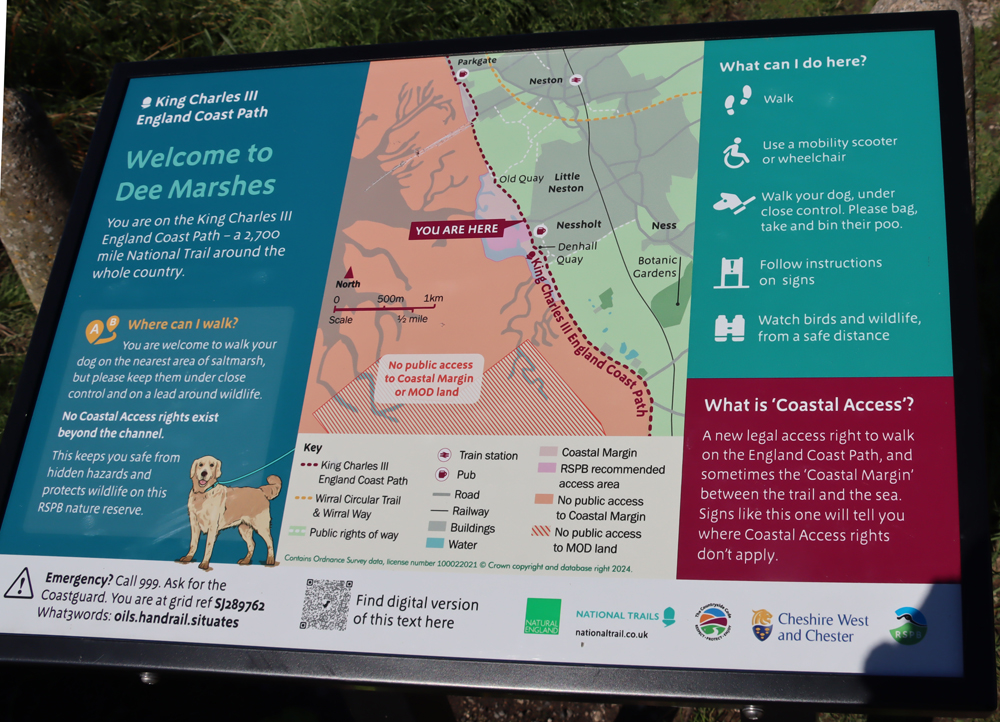
I have made a short visit to the estuary cycle track and walk in the past, simply to get a good look at the purported Iron Age promontory fort on Burton Point, but although it was enjoyable, it was a short stroll because the skies opened and I got drenched.  Today, with no risk of rain, I decided to walk from Burton towards Parkgate, which I guessed to be about an hour’s walk each way.  When I reached the “You are Here” board (with which the walk is dotted at key points) at Moorside, alongside Parkgate Spring and on the very edge of Parkgate, this was a full hour.

Parking is easy along the section of Station Road that lies along the estuary for the Burton to Moorside (near Parkgate) section of the "King Charles III England Coast Path"

Parking is easy along the section of Station Road that lies along the estuary for the Burton to Moorside (near Parkgate) section of the “King Charles III England Coast Path” (What3Words: ///glows.lung.headsets). Source: Google Maps

Parking for this particular walk is along the section of Station Road that runs along the side of the estuary, indicated by the red circle on the map.

The walk itself begins along the section of Denhall Lane that turns along the side of the estuary and passes a café, as indicated by the black arrow on the map.  Although vehicles are permitted as far as the café (just beyond the left edge of the map), they are banned beyond this point.

This first stretch of metalled lane is dominated by dog walkers and cyclists. Do keep an ear open for the cyclists as they can pick up a lot of speed along the lane and don’t always give a lot of notice of their impending arrival.  The path goes through various changes.  After some time it parts from the lane and becomes much more of a footpath with rough stone underfoot, which probably accounts for why the cyclists vanish from the scene at this point.  At one stage it becomes a track across a field, although there is a route around this in wet weather that diverts inland for a while.  The entire walk is well maintained with pedestrian gates and bridges where needed.  One field had horses in it, so do take care if you are walking dogs.

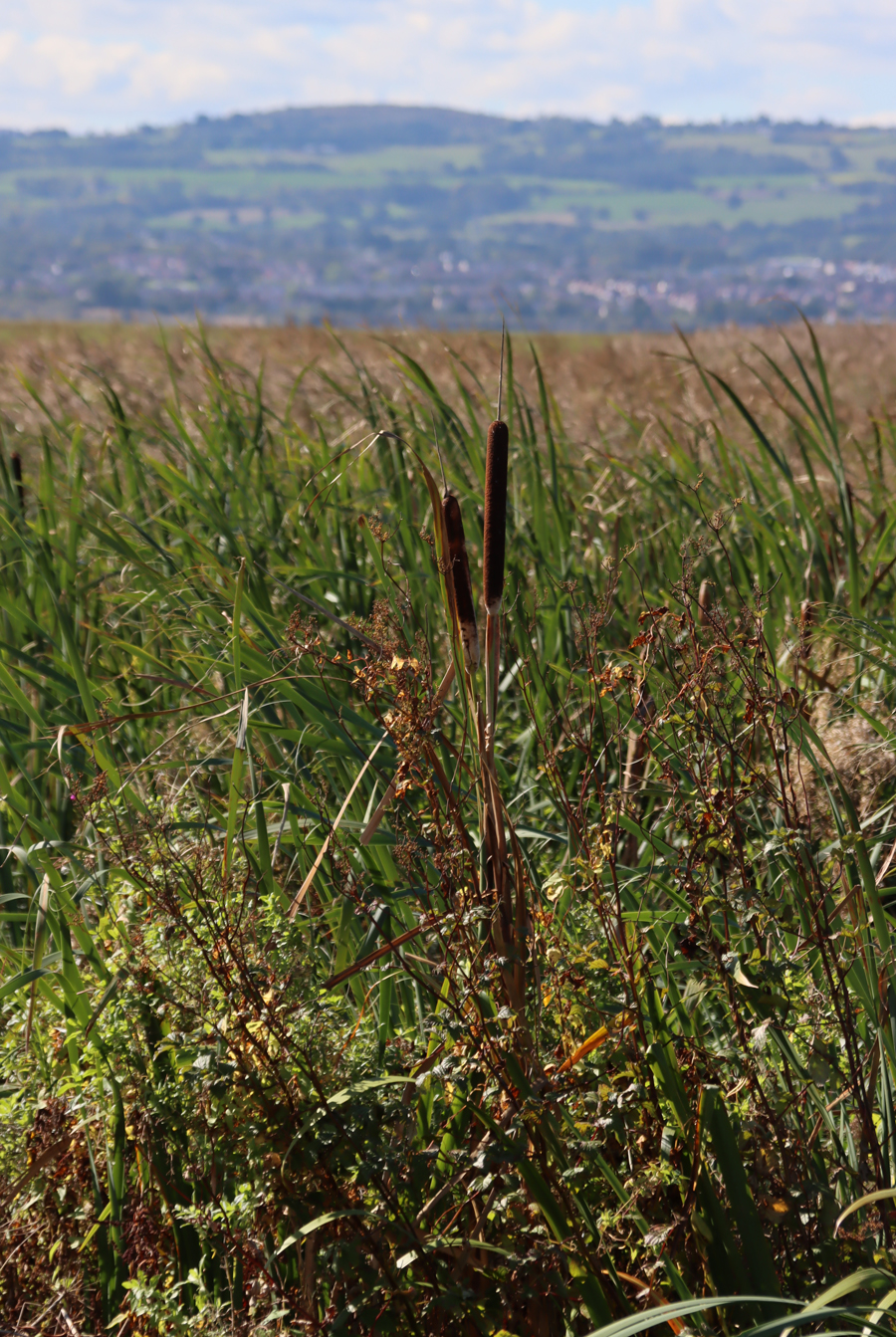
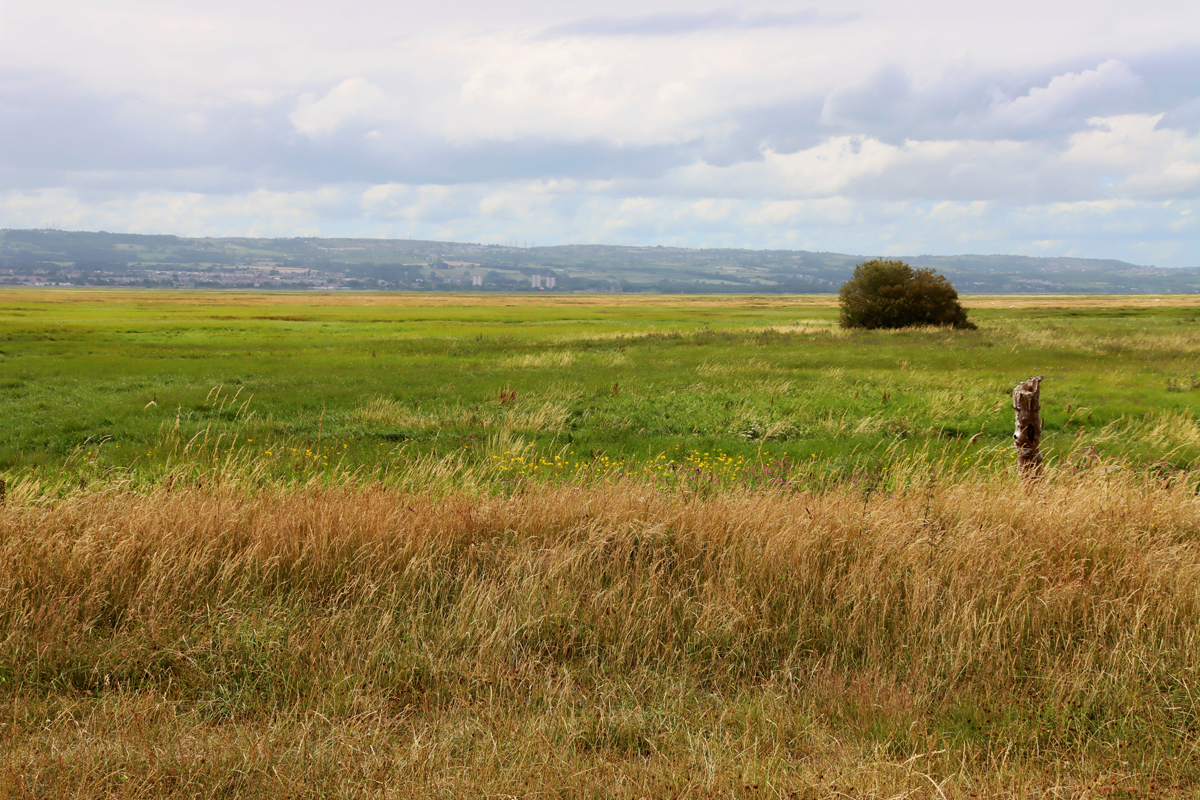
Scenically, the walk is always split between two different experiences to left and right.  The views across both wetlands and former wetlands to the Welsh foothills to the southwest are lovely on a sunny day, and you can keep an eye open for bird life.  On the other side of the path, immediately hugging its edges, there is an almost uninterrupted run of very fine hedgerows and trees.  At this time of year there is not a great deal to see on the estuary, although I was delighted to see lovely white egrets in a distant blue pool, as well as a couple of birds of prey hovering splendidly overhead. Most of the flowers in the estuary have gone over, but the autumnal leaves, berries, rose-hips and other fruits of the shrubs and hedges and the multiple colours of the changing leaves on trees along the paths were endless and superb, really gorgeous against a blue sky with the sun shining on them.

xxx

Nearing Neston I spotted a line of vast red sandstone blocks extending out into the estuary vegetation, and a small spur of land also extends out at this point.  An information board explains that this is part of the Neston Colliery, Denhall Quay.  There is a particularly good book about the collieries, The Neston Collieries, 1759–1855: An Industrial Revolution in Rural Cheshire (Anthony Annakin-Smith, second edition), published by the University of Chester, which I read and enjoyed a few years ago.  The sandstone blocks are massive, and as well as retaining original metalwork, one of them has become a memorial stone, as has one of the trees on the small spur of land.  The line of sandstone, now a piece of industrial archaeology, is a very small hint of the extensive work that once took place here, but is an important one.  The author of the above-mentioned book refers to it in a short online page here, from which the following is taken:

There are still some signs today of the old mining operations. Most prominent is Denhall Quay, the remains of which still jut out into the Dee Estuary. This was built in 1791 and was used to ship coal to North Wales, Ireland and occasionally to foreign countries, as well as inland via newly-built canals.  Also, if you know where to look it is possible to trace the location of many of the shafts that were once in use, including one hidden behind a brick wall in Riverside Walk. Easier and arguably more rewarding to find is The Harp Inn! The building was standing in the mines’ earliest days and records show it was a public house for the miners no later than 1813 and probably much earlier. It has several photos on its walls from the mines’ later days.


This is the point that I turned around and walked back. The image immediately above the  map shows point where the Parkgate Spring emerges, very audible but  not actually visible.


xxx

There are very few places to sit down along the walk, so I would recommend that if you need to rest your legs occasionally, you take your own portable seating.  Regarding refreshments, I have mentioned Net’s Café, near the Burton end.  I haven’t visited and apparently there’s no website, but it is just off Denhall Lane and it is listed on Trip Advisor here.  There is also a very good pub called The Harp, which I actually have visited, with outdoor tables immediately overlooking the wetlands towards the Welsh hills, just outside Little Neston.  The food being served there looked excellent, and I can give a solid thumbs-up for the cider.  The pub was particularly well situated for my return from Parkgate as the zoom lens on my camera, a particular beauty that has been worryingly on the twitch for weeks, suddenly stopped working and was now, just to ram home the overall message, rattling.  A glass of cider and a seat in the sun were perfect for jury-rigging the wretched thing so that the zoom now worked like an old-fashioned telescope and the camera’s autofocus, which was refusing point-blank to engage in conversation with the lens, could be operated manually on the lens itself.  Sigh.  New lens on order.

If you can do this walk in September when the berries are at their best, do take the opportunity, because it is stunning, particularly on a sunny day.  And all on the flat too, so entirely appropriate for unwilling legs.
xxx


The fabulous nature reserve at the RSPB’s Burton Mere Wetlands

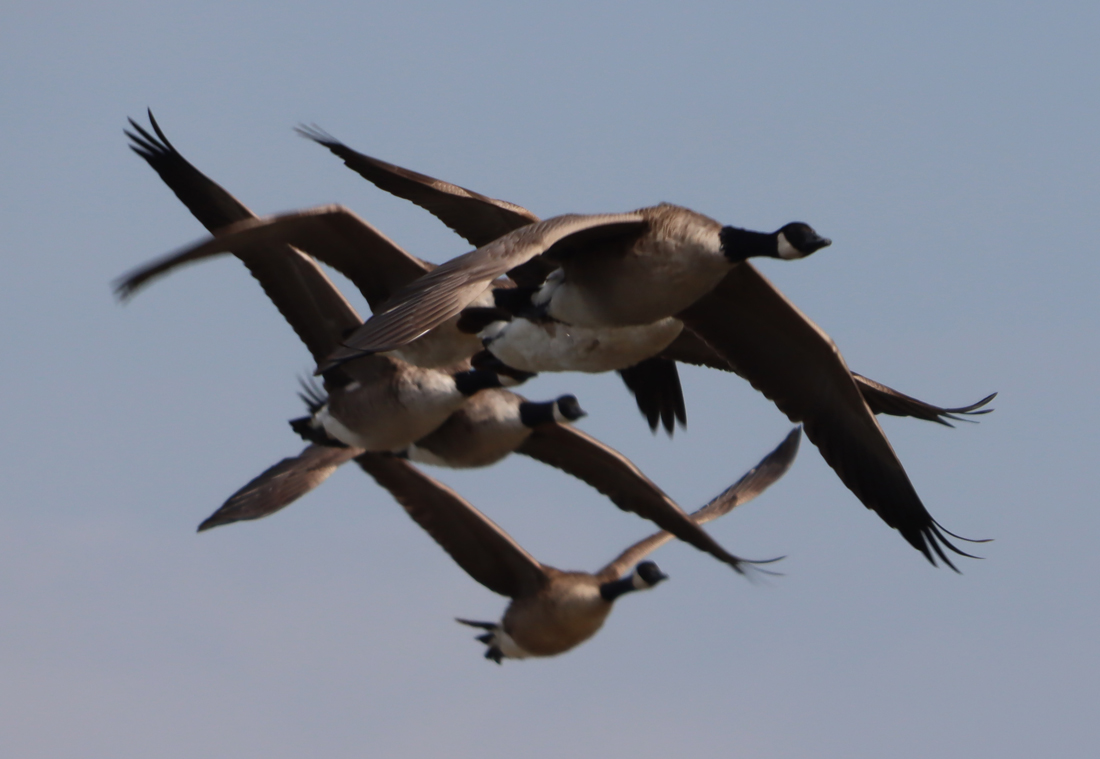
Flying Canada Geese at the RSPB's Burton Mere wildlife reserveWhen I got up this morning and saw what a beautiful day awaited, I decided on the spur of the moment to go to the RSPB nature reserve on the Dee estuary at Burton.

Burton village, well-kept and firmly manicured, is located on the southwest of the Wirral, about 20 minutes drive out of Chester, an area now better known for giving its name to the nearby wetlands.  The wetlands are divided into two separate entities.  The first is the splendidly well organized and laid out nature reserve operated by the Royal Society for the Protection of Birds (the RSPB) which was specially set up for the benefit of birds and bird watchers, but accommodates general visitors too.  There is also a route through the wetlands on the far side of the RSPB reserve, and extending well beyond it, which is the Sustrans route number 568, developed for cyclists but welcoming walkers. It crosses the wetlands from Connah’s Quay, meeting the Wirral peninsula at just above Burton Point, and continuing on to Neston.  They provide two very different but both marvellous experiences of the wetland scenery.  I have already posted a short piece about my short visit to the Sustrans cycle and walking route in the Burton Point area, although I want to walk the whole thing eventually.

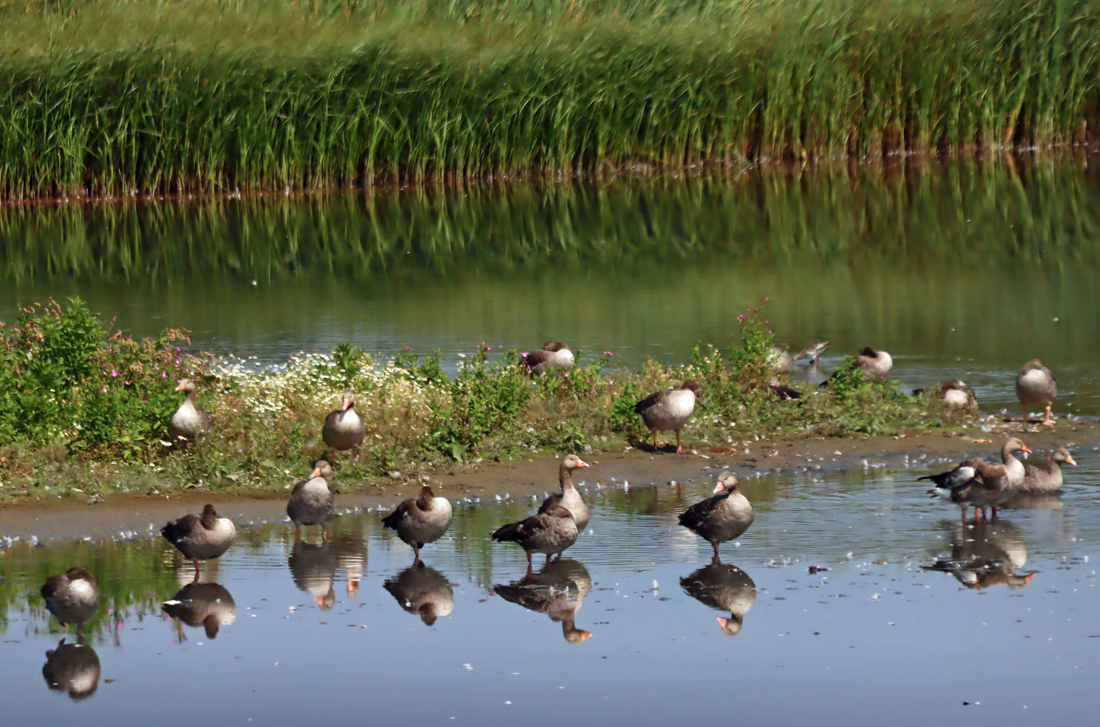
Greylag goose at the RSPB's Burton Mere wildlife reserve


A lapwing stretching its wings, whilst a common sandpiper stands by unimpressed

A lapwing stretching its wings, whilst a common sandpiper stands by unimpressed

The RSPB wetland reserve

Greylag geese with their bright orange beaks at the RSPB's Burton Mere

Greylag geese with their bright orange beaks at the RSPB’s Burton Mere

Several miles of wetland are enclosed within the RSPB reserve, which attract thousands of birds of many different species, with the river Dee invisible along the far edge of north Wales. The canalization of the Dee, completed in 1737, completely changed the environmental conditions of this part of the estuary, forcing the river to run along the Welsh edge of the estuary.  The canalized channel of the Dee is not visible from the nature reserve, but the miles of wetland are lovely.  There are huge expanses of pond and small lake, as well as flooded wetlands in the distance.  On a bright day with blue skies overhead it is gorgeous.  The reserve backs on to farmland at the rear, includes a woodland walk, and has a very attractive red sandstone railway bridge crossing the tracks below and even boasts the remains of an Iron Age hillfort which, if somewhat puzzling as an archaeological entity, has lovely views along the estuary towards Hilbre Island and across to north Wales.


xxx

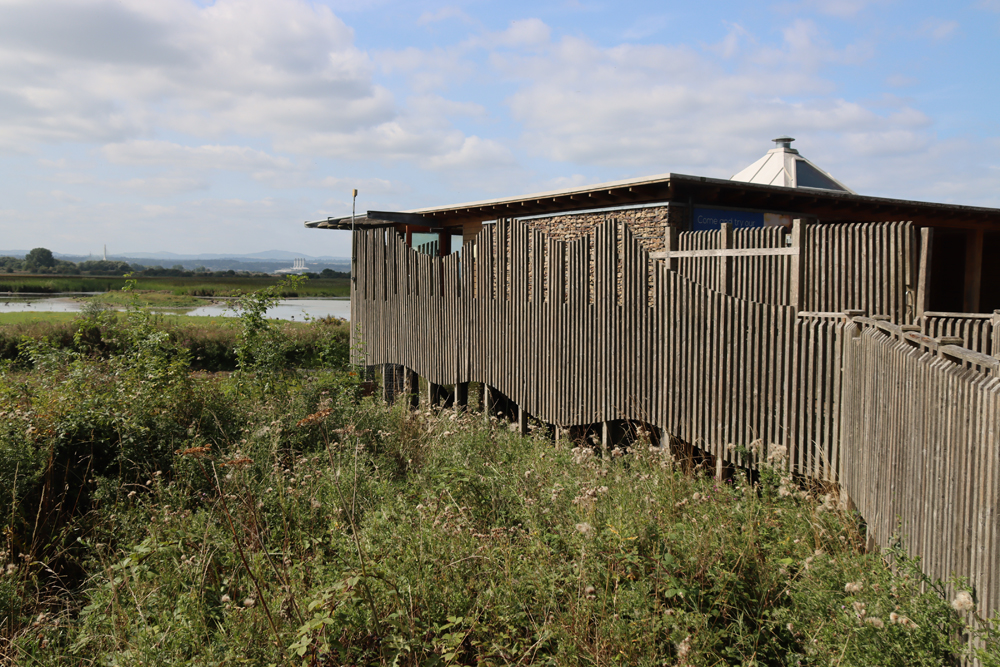
For bird watchers there is an enclosed viewing room where the ticket office is located, and throughout the reserve there are coverts and hides like the one above, all of them with benches, and all with windows suitable for both seated and standing visitors, and there are also viewing screens  and viewing platforms dotted throughout.

For less specialist visitors there are some splendid wending walks through the reserve, where water-loving plant and tree species abound, many in flower or producing berries at this time of year, and all providing a myriad of colours and textures over a base of deep greens and rich browns, which provide excellent resources for insect life.  The plants are so dense that where there is water running beneath boardwalks the water is scarcely visible.


The walks are all nice and even underfoot, many of the boardwalks coated in wire mesh to prevent them becoming slippery, and it is all beautifully maintained.  Being located on the side of the estuary, the nature reserve is nearly all on the flat.  All the main walks are wheelchair friendly, as are the hides and coverts.  There are actually four miles of signposted walks, as well as the woodland walk, which takes about half an hour.  There are plenty of benches dotted around for a moment of relaxation and contemplation.  Burton Point, at the furthest end of the nature reserve, is a tiny headland, which involves walking a short way up a slight slope and an informal footpath, and offers some great views along the estuary.  It is supposed to be the site of a small Iron Age promontory hillfort, but the evidence for this is difficult to see, although an interpretation sign does its best to offer a visualization of how it may have looked.

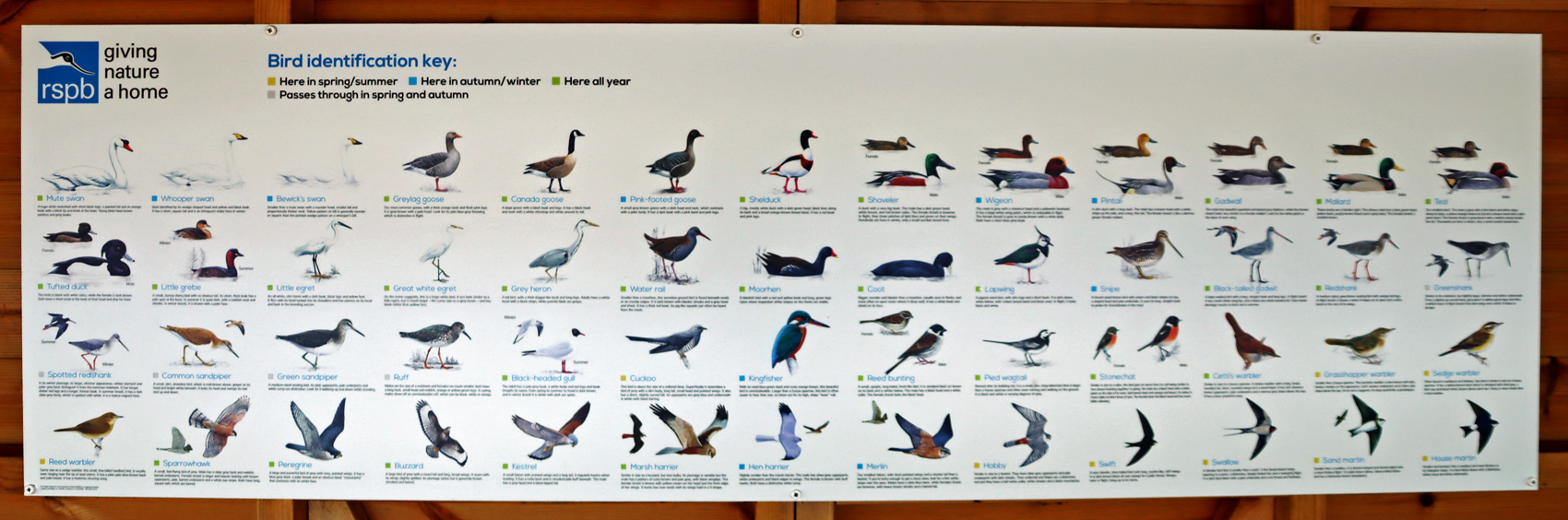
Even if you are not a regular bird watcher, the water birds are fascinating.  There are plenty of information boards showing what you are likely to see, and there is a whiteboard in the reception area showing a list of what has been spotted on a given and previous days.  Binoculars and cameras with enormous lenses (one of them in camouflage colours!) were very much in evidence and I soon found at why – my nice all-round lens, a 28-300mm zoom, was struggling desperately at its top end, and something much more powerful would have been helpful.  Do note that you can hire or buy binoculars from the reception area to get a better view of what birdlife is spending its time on the wetlands.   At this time of year the geese dominate, both in numbers and in voice.  Their honking can be heard wherever you are in the reserve, even when you can’t see them, There were Canada and greylag geese in great numbers, and a handful of Egyptian geese sunbathing on the far side of one of the stretches of open water, but there are plenty of other species too.

Greylag geese at the RSPB's Burton Mere nature reserve

There was something distinctly conversational, and rather cross, going on here, and you should have heard the honking!

Of the smaller water birds, as well as the familiar moorhens, coots and mallards, there were gorgeous lapwings and a variety of small wading birds, with slender legs and long beaks, including a common sandpiper that was distinguished by its rusty coloured plumage.  There were multiple grey herons looking like statues, waiting patiently for unsuspecting fish to swim by, and I spotted some tiny little fish in one of the ponds near the cafe which are presumably a popular part of the herons’ dietary intake.  There must be lots of reed-loving birds hidden in the wetlands, successfully shielding themselves from prying eyes.  There was apparently a spotted redshank, which was causing some excitement among the better informed bird watchers in one covert, but although I followed the directions that a father was giving his son (along the lines of – left of that greylag goose walking in front of that moorhen and then two back and one over) I was unable to spot it.  Bird feeders dotted around were attracting blue tits and great tits in great numbers and there were pied wagtails in some of the many trees that line the edges of some of the paths.  There’s an A-Z of bird species on the RSPB website.

One of many grey herons, on the hunt for unsuspecting fish at RSPB's Burton Mere

One of many grey herons, on the hunt for unsuspecting fish

This is a super place to visit, and seasonal changes in bird and plant life mean that there will always be something new to see, and there are plenty of butterflies, bees, dragonflies, damsonfiles and other insects to observe if you look carefully.  The grasshopper in the image below was particularly well camouflaged, and apparently there are sometimes lizards sunbathing in the sunnier patches.  On Burton Point there are rabbit warrens, and according to some of the signage (much of it directed at children, but still informative to older visitors) the local animals have a vibrant night life.

Spot the grasshopper

Regarding the hillfort on the promontory, Burton Point, there are websites that say that the small headland on which the site is located is privately owned and should not be entered without permission, but this is in fact now included in the RSPB reserve and is served by good footpaths and includes interpretation signage to give visitors some idea of what was here.  I’ll talk more about this site on a separate post.

Burton Point, a low promontory that overlooks the Dee estuary and is the possible site of an Iron Age Hillfort. In this photograph the footpath at far right leads into the woodland, where a vantage point looks down on the fortifications, but you can also see what remains of the fortifications at the far left of the photo where an earthwork is clearly visible

xxx

Visiting the RSPB reserve

Meadow Brown butterfly beautifully camouflaged at the RSPB Burton Mere nature reserve

Meadow Brown butterfly beautifully camouflaged

The RSPB reserve is very easy to find, although if you rely on that Google SatNav, please note that mine, having been asked to find “RSPB Burton” informed us we had reached our destination before we had actually arrived.  Fortunately, if you use the What3Words smartphone ap, which is stupendous (narrowing locations down to metre-sized locations) you can find it at ///readings.sideburns.handicaps.  Other details can be found on the RSPB website which includes the address, postcode, as well as details of the current ticket price and full details about what the nature reserve offers the visitor: https://www.rspb.org.uk/days-out/reserves/dee-estuary-burton-mere-wetlands.

The RSPB site has been very well thought out, and is very welcoming.  A single lane road from Puddington Lane has speed bumps and plenty of passing places, leading to a well-sized car park.  Entrance is via a building with a look-out over the estuary.  The entrance fee is £7.00 at the time of writing (July 2025), which helps to support the charity. There is a nice modern cafe on site, which sells tea, very good coffee, cold drinks and snacks. This is also where the toilets are located.  There is a small shop next to the ticket desk that sells gifts, books and bird food.

I have been following the RSPB Burton reserve on Twitter for a couple of years, without ever having managed to get there, and every day they take a photograph of their whiteboard to give you an idea of what species have been observed recently so that you know what to look out for.  You can find this at https://x.com/RSPB_BurtonMere.  There is a placeholder for them on Bluesky but no content just yet.

I rarely give an opinion about wheelchair use, but there were actually several wheelchairs users out and about today.  It would not be possible to get wheelchairs up to the Burton Point hill fort, or navigate them down one or two of the little tracks that run at the back of the reserve, but all of the coverts and hides are wheelchair friendly and, for both wheelchair users and children, the viewing windows extend from low to high for both seated and standing visitors.  The same comments go for those with unwilling legs.

Dogs are not permitted, and nor are drones.

Excerpt from the RSPB's leaflet about Burton Mere

Excerpt from the RSPB’s leaflet about Burton Mere, showing the top things to do on a seasonal basis


The Burton Marsh cycle and walking route 568 along the Dee estuary, Wirral

In 2013 a track across the wetlands from Connah’s Quay via Burton Point to Neston was opened.  As part of the Sustrans cycle network it is known as Route 568 or The Burton Marsh Greenway, and an information board at the point where the route meets Station Road (see map at end) says that this section is now also part of the “King Charles III England Coast Path.”  This section of the route, Burton Marsh, is partly made up of metalled lane, and partly boardwalk, and is a terrific walk.  I had never heard of it until I was standing in what remains of the hillfort on Burton Point headland, part of the RSPB reserve, and saw it passing almost at our feet and beyond into the distance.  It is an extraordinary sight, a mainly straight track across the landscape, and such a brilliant idea.

I parked on the section of Station Road that runs parallel to the estuary, which is part of the cycle route to Chester, and is separated from the rest of the Burton Marsh stretch of track by a gate to keep the sheep in.  There’s a map showing where the parking is located towards the end of this post.  This walks is all particularly beautiful on a sunny day with a blue sky stretching to the horizon. A shifting sky, which one moment produced sun and the next light shade, brought out the textures and colours for miles around.  Because the estuary is so flat and vast it can be very breezy or windy, which was no bad thing on a particularly sticky July day!


I headed through the gate in the Chester direction.  Starting out from this point you are on a metalled lane and have fields rising on your left, currently planted with palest yellow barley, whilst on your right are marshland habitats stretching all the way to the river Dee running along the Welsh side of the estuary, with every shade of green you can imagine, dotted with bright clumps of flowering plants and layer upon layer of different textures.

The barley fields are soon replaced by a fairly short red sandstone cliff edge, which has been heavily quarried over the centuries.  Where this red sandstone becomes much more uneven and comes out towards the lane, there is a sign on your right that explains that here are the remains of an Iron Age hillfort at the top of this small headland.  This is fenced off, as it is RSPB land.

Burton Point

The lane pulls away from the headland heading out into the wetlands, and soon you find yourself on a long section of boardwalk, which rattles splendidly when cyclists come along, with the marsh habitats either side of you.


On a clear day the views seem endless as far as the way to the Clwydian Range of Wales.  The track gives a sense of how big that landscape actually is, and why it is such a special environment for wildlife, with aquatic plant life as far as the eye can see, and bird life launching itself in and out at surprising and random moments.  As well as plenty of Canada and greylag geese, both on the ground and in the air, there were dozens of skylarks, terns flying overhead and birds of prey too high to identify.  Unsurprisingly there were plenty of seagulls too.  Beneath the surface, there must be an awful lot more going on.

The intention was to walk for an hour and a half, see where that took me, and then turn back to retrieve the car, but the sudden onset of fairly heavy rain both greyed out the landscape and blocked the view so I only walked for around half an hour before turning around.  Even during that short walk, the views were superb and the environment absorbing, and one of the nice things about this is that however far you want to go, and from wherever you start, it lends itself to any length of walk.  I was chatting to a man on a bike who had stopped to watch a group of greylag geese, who had cycled from the middle of Chester and was going to visit his father in Neston before turning around and coming back, and by contrast there were a couple who were just out walking a short way with their dog and a child in a pushchair.  All very civilized and a great way of introducing a wide range of people to an entirely new environment in a very easy way.


xxx

Visiting from near Burton Point

You can access the track free of charge from anywhere along its route.  Because it is all on the flat, it is suitable not only for walkers and cyclists but those with pushchairs, buggies, and wheelchairs.  There was even a man on one of those push-it-with-one-leg adult scooters.  There are gates at interfaces with roads because of the sheep.  Also because of the sheep there are frequent signs asking owners to keep dogs on short leads.   Having been followed for about half a mile by one particular sheep, which stopped and looked fixedly at me every time I turned around to see if it was still following me, I can confirm that sheep are a very likely to be encountered.

I have only done this from just north of Burton Point so far, a short drive from the A540 via the village of Burton, and you can park on the straight section of Station Road that runs along the estuary, and where there is plenty of room to park along the road (what3words: ///recur.films.dream if you have the Google-compatible app on your smartphone).  Station Road, as it leads back inland, also has some parking along its edges near to the estuary.  I have highlighted the main parking-friendly area on Station Road in the pink box below.

Convenient road-side parking near Burton Point marked in pink. Source: Streetmap.co.uk

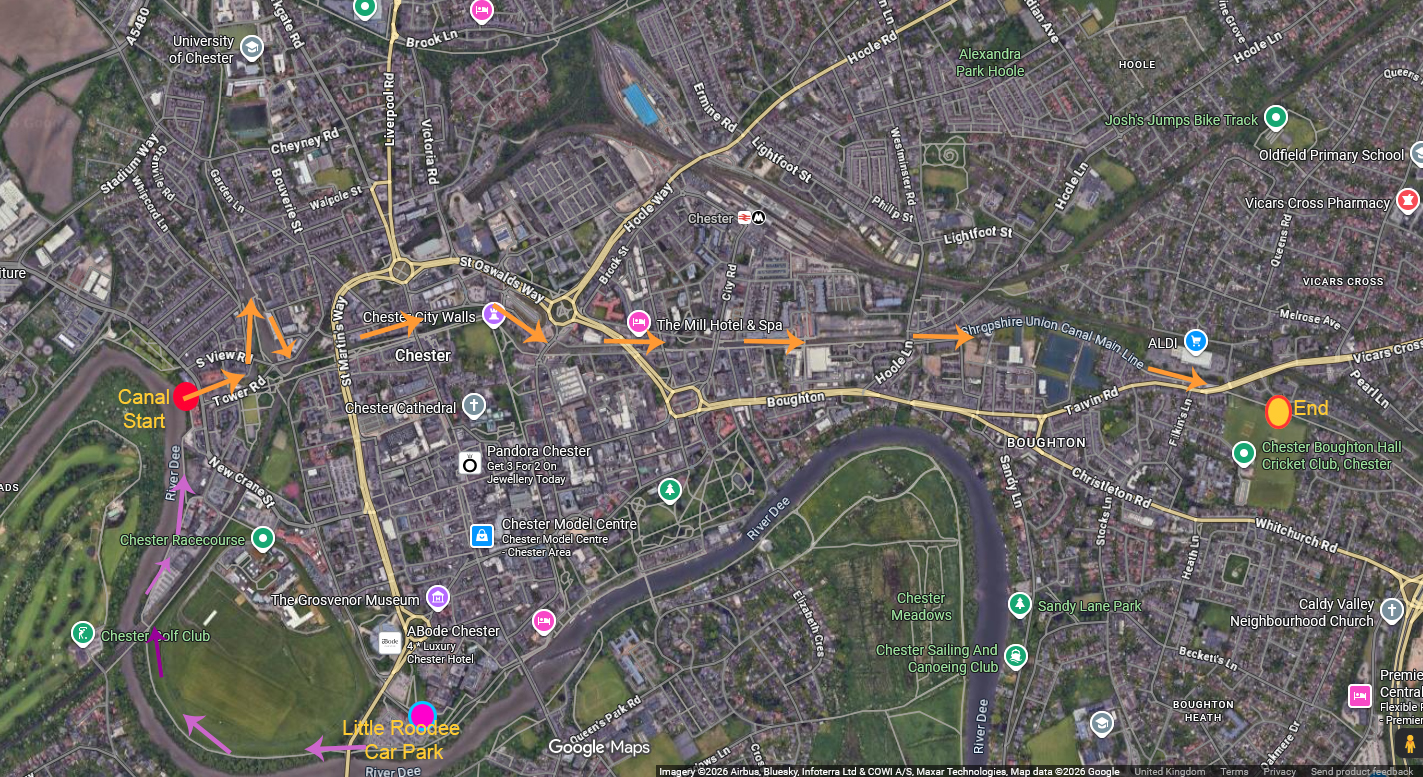
If you fancy starting in Chester, you can set off from the Little Roodee car park, go around the Roodee itself, and then follow the track to Connah’s Quay and go from there.  Fortunately you don’t have to depend on my finger-in-the-air directions, because Sustrans has its own website with full details for Route 568, which you can find here.  It shows the sections where the route meets roads, and where it intersects with other routes in the network.


A visit to Birkenhead Priory #2: St Mary’s Parish Church and HMS Thetis

Introduction

The remains of the former church interior, with a tall arch that, now blocked with brick, once gave access to the tower

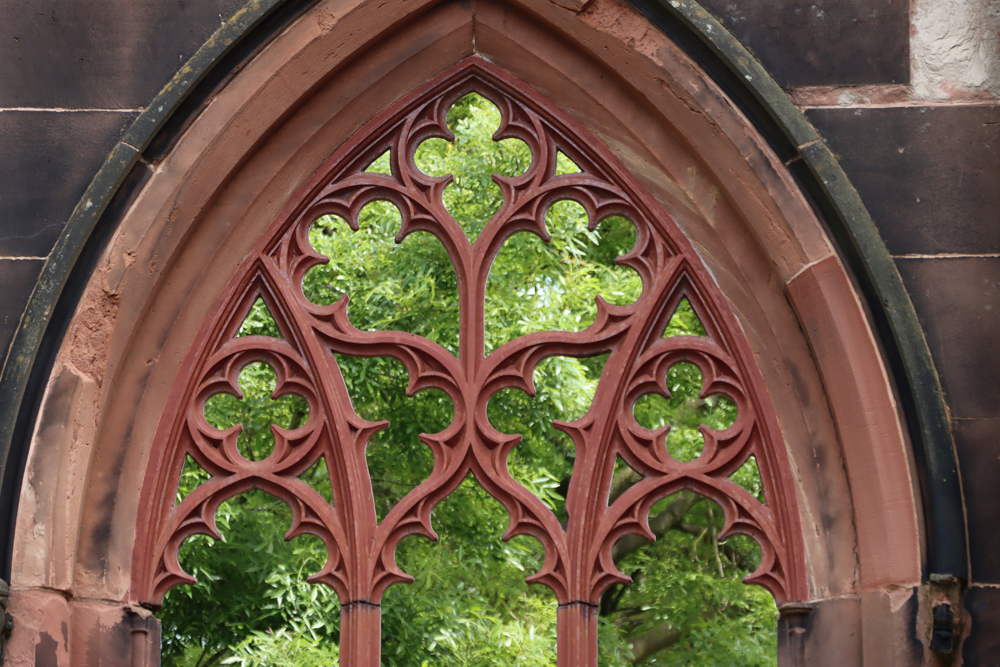
St Mary’s Parish Church in Birkenhead has a splendid claim to fame as one of the earliest churches to have cast iron tracery in its window openings, in place of the usual stone mullions and tracery.  Although relentlessly Gothic Revival in style, it truly is a child of the Industrial Revolution.

St Mary’s sits over a part of the site occupied by the original medieval Birkenhead Priory.  I have talked about the splendid remains of  Birkenhead Priory, founded in the 12th century, and its ferry across the Mersey, the earliest one recorded, on an earlier post, Part 1,  here.  It is an absolute knock-out with a stunning vaulted chapter house, undercroft, remains of other parts of the monastic establishment and a small but very nice museum space.

A recent second visit to Birkenhead Priory, this time with the Chester Archaeological Society, was a good opportunity to re-familiarize myself with the much more recent stories of the 19th century St Mary’s Church, which is interesting in its own right. The tower, which is perfectly preserved with its clock mechanism visible from the stairwell, offers terrific views over the surrounding area whilst also serving as a memorial to those who died tragically during the sea trials of the submarine HMS Thetis.

St Mary’s Church

Plan of the Birkenhead Priory site, with the priory outlined in red, the now absent priory church outlined in orange and remains of the 1822 St Mary’s Church outlined in green. Source: Metropolitan Borough of Wirral leaflet (with my annotations in colour)

The site plan to the right shows the remains of the church framed in green.  The medieval priory and its church are framed in red and orange respectively.  The blue margin on the right is part of the Camell Laird’s shipyard, into which you can look from the tower of St Mary’s and watch the current shipbuilding activities.  Church Street, right at the top of the image, post-dates the demolition of most of the church in 1970.

Although there are some stunning architectural survivals from the medieval priory, almost nothing remains of the priory church following the Dissolution.  As you can see on the site plan to the right, the original priory church overlaps the site of St Mary’s.  The Prior and his monks effectively handed over the keys to Henry VIII’s administrators and left peacefully.  The need for a religious focus for the small community that remained, however, resulted in the consecration of the gorgeous monastic chapter house as a chapel (numbers 2, 3 on the plan, where the daily business of the priory had formerly taken place).  It was only in the 19th century when Birkenhead began to grow into an industrial town, port and shipbuilding yards, with a rapidly expanding population, which was encouraged by the introduction of a steam ferry across the river Mersey, that the little chapel in the former chapter house became far too small for the needs of the Birkenhead community.  As a result the decision was made to build a new church to meet the needs of this expanding population.

Thomas Rickman. Source: Wikipedia

The architect chosen for the task of building a new parish church for Birkenhead was Thomas Rickman, an interesting character whose 1817 book Attempt to Discriminate the Styles of English Architecture helped to promote the development of the Gothic Revival, of which he was himself an enthusiastic proponent.  Having secured some commissions in the Liverpool area from iron foundry owner John Cragg, Rickman had established an architectural practice in Liverpool in 1817.  The foundation stone of the new Parish Church of St Mary’s was laid in July 1819, was consecrated on the 17th December 1821 and opened in 1822, with a vicarage established on the probable site of the priory kitchen.  Built of red sandstone, which inevitably blackened with industrial pollution over the decades, the church had a rectangular plan apparently without aisles, with a tower at the west end.  Although bricked up today for structural stability, the tall arch in the east wall of the tower would have opened into the nave of the church.

St Mary’s church in the early 20th century on a splendid postcard showing the church and the former churchyard. Source: St Mary’s Birkenhead blog

The church was large for the available population, but the landowner Francis Richard Price apparently decided to future-proof his new building, correctly judging that the early influx of people was going to continue to expand.  By 1832 the church was too small for the congregation and was expanded with a north transept (wing), followed by a south transept in 1835. You can see some of the decorative touches from the roof in the remaining pieces of masonry at the feet of the west walls.

Victorian burials took place mainly in the churchyard but prestigious individuals were interred within the monastic garth.  The former monastic garth, the square green that formed the focus around which the most important monastic buildings were arranged, became a cemetery for important residents in the 19th century.  It is here, for example, that the Laird family crypt is to be found.  In 2024, at his request, the cremated ashes of Birkenhead Labour MP Frank Field, who served for 40 years, were buried next to the entrance to the chapter house.  He is almost certainly the last who will be given permission to be interred there.

The dock for which the churchyard was sacrificed in the 1950s

The churchyard with its cemetery no longer survives.  It was originally established in the Middle Ages, for the monastic community, but after the 16th century probably only saw intermittent usage. It was only as Birkenhead began to expand that it came back into general use.  After the opening of St Mary’s it once again became an important cemetery for the local area, remaining in use until 1901, after which only those with family plots or in exceptional circumstances were permitted.  In 1948 the parishes of St Mary’s and St Paul’s in Birkenhead joined forces, and St Paul’s was demolished.  In the 1950s, as the neighbouring shipyard expanded and was desperate for more space, a commercial deal was made between Camell Lairds and the town council, in the face of protests, to purchase the churchyard for a new dock.  Whatever remained of the medieval church, all but part of one arch, was taken down.  Around 1100 burials, including those that had been brought over, with headstones, from St Paul’s were transferred from the churchyard to the new Landican cemetery in 1957-8, leaving only those within the garth of the monastic complex, and a handful in the immediate vicinity of the church and the priory.  A tall wall was built to divide the site from the docks below.

Another angle on St Mary’s showing the exterior walls and the base of the tower, as well as the clock

The Church tower has a number of notable features.  The Victorian clock underwent restoration and was reinstalled in 1990, sponsored by local interests.  From the top of the tower there are some stunning views, and you can peer into the fascinating Camell Laird’s shipyard and see the dry dock where the well-known and very controversial 1862 Alabama was built as a blockade runner for the Confederates in the American Civil War.  However, the most notable aspect of the tower is its role as a memorial to the 99 men who died in 1939 on the submarine HMS Thetis.

The church was closed in 1974 and the majority of the church was taken down in 1977.  Most of the fallen masonry remained after the demolition was presumably removed for recycling as building material, but some of the pieces of stonework that were less obviously adaptable for other building projects are laid along the remains of the inner west walls of the former nave.

One of the splendid cast iron windows

xxx

HMS Thetis

HMS Thetis was salvaged, repaired and relaunched as HMS Thunderbolt, shown here.  Source: Wikipedia 

On 1st June 1939 a new submarine, the first of the new Titan class, left Cammell Laird’s shipyard in Birkenhead.  This was her second set of sea trials, after her first went went very badly, and it was imperative that this time there should be no mistakes.  There was great confidence when she put to sea, but only a few hours later sank 12 miles off the Great Orme in Liverpool Bay, with 103 men on board.  This was twice the usual number of crew on board the HMS Thetis (N25), because as well as the standard Royal Navy crew of some 50 men that manned her, there were also engineers, members of the Admiralty and various others on board, including catering staff and other civilians, as she underwent sea trials.  There were only four survivors, and it is partly due to their testimonies that the cause of the tragedy was pieced together.

The submarine sailed safely down the Mersey towards Liverpool Bay, heading towards the Great Orme and accompanied by a tug boat named the Grebe Cock.  An essential part of her sea trials was to dive and make way underwater.  When the attempt to dive was made, in 150ft (46m) of water, the submarine was found to be too lightweight to submerge.  A submarine can make additional weight by taking on water.  Her internal compensating tanks were full, and it was decided to check the status of the six torpedo tubes and allow the two lowest ones to flood if they were empty.  The torpedo tubes could be checked by means of a stop-cock.  If, when turned, water leaked out, then the torpedo tube was full.  If it did not, it was empty and could opened and inspected.  In the aftermath of the disaster, it was found that the stop-cock of the fifth torpedo tube had been accidentally covered with enamel paint during final preparation for trials, and had hardened, preventing any water seeping out of the stop-cock to indicate that the torpedo tube was, in fact, full of water.  Because it was believed that the tube was empty, the rear door was opened.  In fact, the torpedo door was open to the sea and immediately thousands of gallons flooded into the submarine, forcing her down at the bow as the water began to fill the first two sections.  Thereafter the 270ft (82m) submarine could not be refloated and it was a matter of escape or rescue before air ran out.

The memorial stairways in St Mary’s tower

Thereafter it is a complicated story, certainly not one for someone uninformed to tell, and the best website account I have found to date is the unfortunately named Great Disasters website, which includes accounts by the four survivors and witnesses from the inquiry.  Alternatively, and much-recommended is  really excellent 15-minute summary provided by a video, with original photographs and diagrams, presenting the harrowing story very clearly: The Raven’s Eye YouTube channel.

The submarine was recovered on the 3rd of September 1939, towed to Traeth Bychan beach, where she was grounded and the remaining bodies either buried in a mass grave in Maeshyfryd Cemetery in Holyhead.  After the submarine was salvaged, repaired and renamed HMS Thunderbolt she was returned to active service in 1940.  She was a successful vessel until 1943 when she was sunk off the coast of Sicily by an Italian corvette, with the loss of all hands.

The catalogue of errors both on board and on shore is dismally reminiscent of the sinking of Titanic, when one is familiar with the details of both horror stories.  Human error, in design, in execution, in procedures and in response to technological failure, always seems to be a major factor in shipping and air disasters.
xxx

Final Comments

A visit to Birkenhead Priory is rewarding in its own right, but with the addition of the ruins of St Mary’s Church with its cast iron windows, and the tower, its memorial and its views. there is an awful lot to see, enjoy and learn.

There are some stunning views from the top of St Mary’s tower

xxx

Visiting Details

Details for visitors are in Part 1.  Although Part 1 was posted in May last year, I have checked the details and nothing has changed in the meantime.  There are also opening hours and a map on the Birkenhead Priory website.
xx

Sources

Leaflets

St Mary’s Parish Church 1819-1977, compiled by Tony Hughes
https://thebirkenheadpriory.org/wp-content/uploads/St-Marys-booklet.pdf

HMS Thetis, compiled by Les Black, March 2016. Produced by Birkenhead Priory

Websites

AHRNet
Rickman, Thomas 1776 – 1841
https://architecture.arthistoryresearch.net/architects/rickman-thomas

Graveyard Survey, St Mary’s Birkenhead, volume 1, 1977, Gill Chitty 1977
https://www.merseysidearchsoc.com/uploads/2/7/2/9/2729758/jmas_1_paper_5.pdf

Marshall University, Marshall Digital Scholar
CSS Alabama. An Illustrated History. Part 1: Building Ship No. 290.  By Jack L. Dickinson. Fall 10-9-2017
https://civilwartalk.com/attachments/part-1-building-ship-no-290-pdf.296944/

An Online Archive for the Church of St. Mary’s & the Priory, Birkenhead Cheshire, including a listing of the monumental inscriptions from the old graveyard & Priory
History of the Priory and St. Mary’s Church Birkenhead
http://stmarysbirkenhead.blogspot.com/

The Raven’s Eye
Everything Went Wrong – The Tragedy of HMS Thetis – Submarine Disaster (1939)
https://www.youtube.com/watch?v=JEcW7WjRxY8


Over the wall from the former churchyard

I believe that this was the dry dock where the “Alabama” was built, seen from the top of St Mary’s tower


Lord Leverhulme’s multifarious collections at the Lady Lever Art Gallery in Port Sunlight, Wirral

The Lady Lever Art Gallery is in a fabulous location within the village of Port Sunlight.  Port Sunlight was the brainchild of William Hesketh Lever, who in 1911 became Baronet Lord Lever, and in 1917 Baron Lord Leverhulme, honoured for his contributions to industry, commerce and the economy. He was also remembered, amongst other achievements, for his three years as a Liberal M.P., his philanthropy and his art collections.  Just off the A41, an unattractive stretch of the road characterized by untidy industrial and retail parks, the village remains a genuinely surprising and perfectly charming near-utopia of green spaces, wide boulevard-style roads and a splendid mixture of compact homes with gardens and small civic buildings, all built in a variety of architectural styles, all vernacular.  Port Sunlight, named for one of the soap brands that Lever produced (Sunlight Soap), was built for the workers in the nearby factory.  The Neoclassical architecture of the art gallery stands out as a monument in its own right.  It was, indeed, a memorial to Lever’s late wife Elizabeth Ellen Hulme, who died in 1913, and whom he always stated was his inspiration.  Although the gallery served the practical purpose of housing the best of Lord Lever’s private collections, which had outgrown his own numerous homes, it was more importantly built  on his philanthropic urge to improve conditions and provide educational facilities for the working class families of his factory employees.

The Lady Lever Art Gallery. Photograph by Rich Daley, Wikimedia

Originally the museum was designed to be entered from the front, its big entrance overlooking the boating pond and the long green avenue beyond towards the massive war memorial.  Today the boating pond has been drained of water, with warning signs to prevent people climbing in (Julian, with whom I visited, predicts that it will become a flower bed!).  There is plenty of free parking in front of the museum, as well as on the surrounding roads.  Today the entrance to the gallery is at the side, left as you face the front, next to a ramp that leads to the basement with its excellent café and its little shop.  There is no charge for visiting the permanent collection.  You are offered a  map at the desk, and we did find that this was helpful, although once you have worked out that it is organized by rooms around a main hall, with a circular room at each end, each linking together another set of rooms, it’s very straight-forward to navigate.  Having said that, looking at the map at home after the visit I realized that there were two upstairs galleries, each a corridor that flanks the main hall, which we missed.  According to the map these apparently display 19th and 20th century art.  Next time!

===

===

Lion-headed table support, which would have been one of three or more. Roman. c.100AD

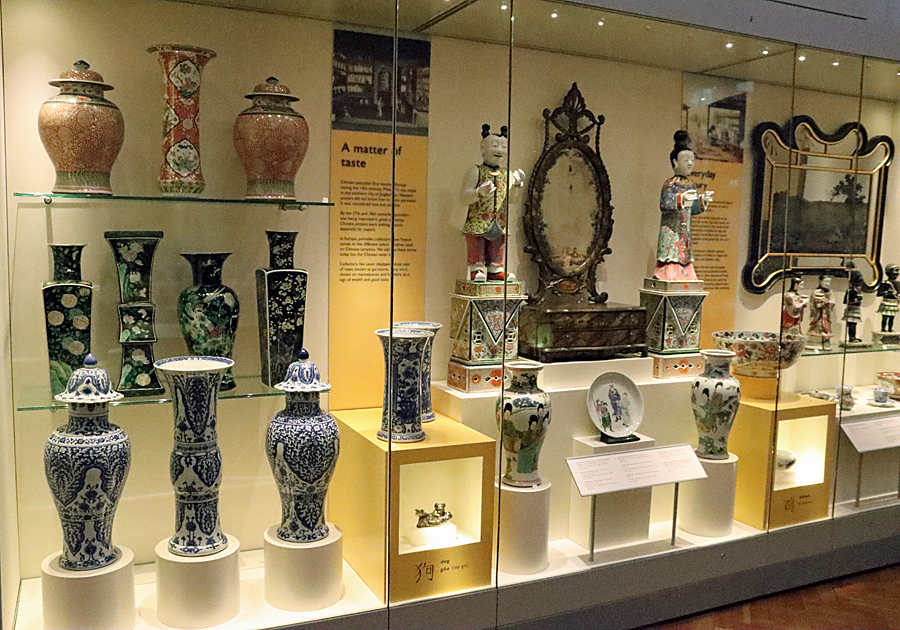
The easiest way to convey the overall impression of the Lady Lever Art Gallery is to characterize it as a miniature V&A.  Although there is a large collection of oil paintings and some water colours, there is also an emphasis on decorative arts including furniture, china, sculpture, tapestries, and embroidery.  The multinational character of the collection is impressive and begins, chronologically, with some Classical objects, as well as a couple of items from ancient Egypt.  Lord Lever had a great love of Chinese porcelain and his taste extended from the simplest of the blue and white patterns to the most elaborate and exotic polychrome extravaganzas.  There are a number of very fine Indian items, but perhaps not as many as there might have been given how long the East India Company had had its claws hooked into India’s social, economic and cultural landscape.  There is a small collection on display of ethnographic objects, although Lord Lever collected over 1000 pieces, and there are also a tiny number of ancient Egyptian objects, the bulk having been loaned to the Bolton Museum and Art Gallery.  He also collected a massive amount of Wedgwood, including fireplaces and pieces on which Josiah Wedgwood collaborated with George Stubbs.  Impressively, Lord Lever’s collection included Elizabethan and Jacobean furnishings, which are not always well represented in British museum and art gallery collections, and are really good examples of their types.

Oinochoe, used to pour wine into cups. Italian, in the style of a Corinthian vase. c.625-600BC.

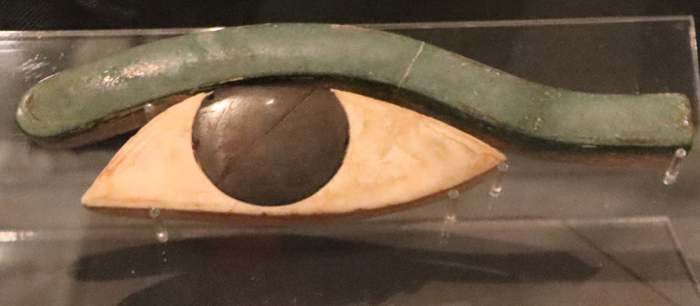
12th Dynasty Egyptian stone components of an eye

Anglo-Indian commode, 1770-80. Engraved ivory veneered on a sandalwood carcase, originally fitted with specimen draws (now missing). An English design made at Vizagapatam.

English or German “Nonsuch” chest dated 1592 (corresponding to the late Elizabethan period)

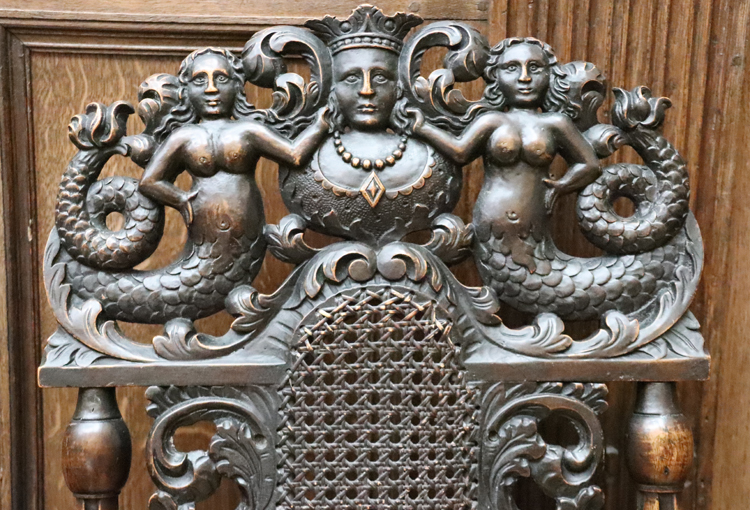
Detail of an English or Dutch chair (one of a pair), 1690-1710, emulating the Jacobean style, with mermaids and the bust of a crowned queen


Wedgwood

1780-90 Wedgwood Caneware teapot


The wall decoration in the Adam Room

There are five rooms that skilfully recreate a particular period in all its details, from wall treatments and light fittings to furnishings and art works which.  These recreated rooms are splendid today but in the days before the National Trust and day-trips to aristocratic houses must have been a real revelation to visitors.  Examples are the Adam Room and the William and Mary Room.  Both Julian and I were horrified by the Napoleon Room;  no matter how hard I tried, I was unable to find anything in it of aesthetic merit in it, although the sheer excess of it all did make me grin.  There is always something to love in mad committent to a particular passion.

Sculpturally, Lord Lever’s taste extended from the Classical to the modern including, very surprisingly, a Joseph Epstein sculpture, and the variety of forms and styles is remarkable, although I have the impression that the quality is far more variable than in other art forms in the gallery.  There are, however, some very fine Roman cineraria (small stone caskets that hold ashes of the dead).

In oil painting, Lord Lever’s taste focused mainly, but not exclusively, on contemporary and slightly earlier artists including George Stubbs, Joseph Mallord William Turner, William Etty, Thomas Gainsborough, Joshua Reynolds, Elizabeth Vigée Le Brun and George Romney, as well as a notable selection of those from the Pre-Raphaelite school including William Holman Hunt, John Everett Millais, Dante Gabriel Rossetti and Edward Burne-Jones.

Dante Gabriel Rossetti’s “The Blessed Damozel.” There is an article about the painting on the Lady Lever Art Gallery website.

The glorious “The Falls of the Clyde” by Joseph Mallord William Turner; Lady Lever Art Gallery. Source: ArtUK

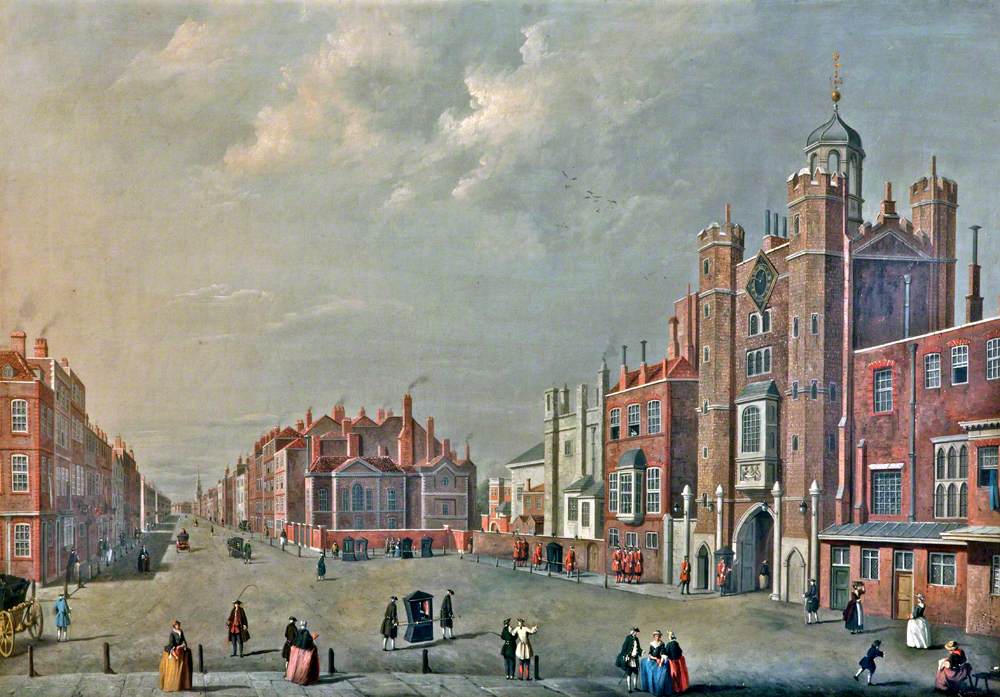
St James’s Palace. English School. Source: ArtUK

Emma Hamilton as a Bacchante. Elisabeth Vigée Le Brun.  Lord Lever’s tastes in art were usually consistent with popular opinion, but by modern standards some have not always stood the test of time. Although Vigée Le Brun produced some very accomplished pieces, others were not quite as refined.  Source: ArtUK


Painted mahogany writing desk by John Thomas Serres, 1792

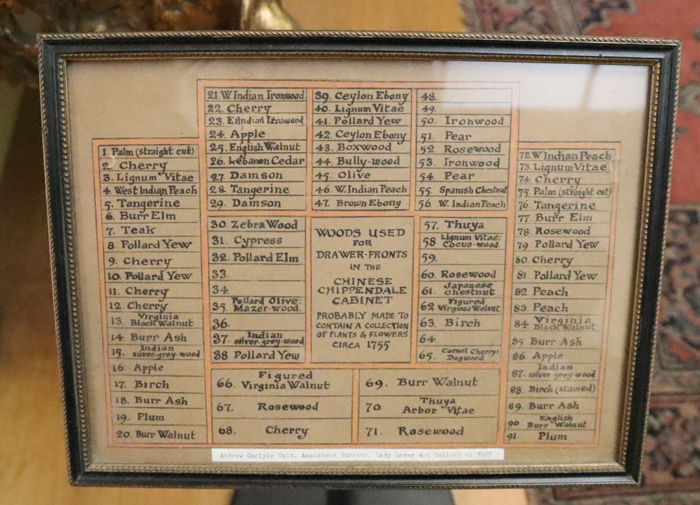
There are some items that don’t fit any particular category, such as 19th century copies of earlier Chinese cabinets (sometimes on hideously elaborate and inappropriate stands), a late 18th century cupboard decorated with thousands of tiny curls of coloured paper (filigree), late 18th century painted writing desks, and a staggeringly huge cabinet full of draws made with different types of wood; as a whole it is too big and ornate by modern standards, but the individual woods are very beautiful.  There is also a room dedicated to Lord Leverhulme and his achievements, essentially the activities that paid for the village and the gallery, together with some more examples of his collecting interests, such as his ethnographic and ancient Egyptian items.  Another room addresses the challenges of conservation.

Cabinet with multiple draws for collecting samples. 1830, but inspired by Thomas Chippendale (18th century)

On the missing list, it is most notable that there are very few Middle Eastern items, and that there are very few Medieval pieces, presumably reflecting Lord Lever’s taste.  It was of particular interest that some of the pieces had been reworked once if not more times either to repair them, reconstruct missing elements or reinvent the original concept to make it more appealing to contemporary tastes.  One of the Roman cineraria, for example, had lost its lid and had been provided with a new one in the 19th century, complete with twin Egyptian-style sphinxes.

Roman cinerarium with a 19th century lid.

Detail of Elizabethan/Jacobean wood inlay cabinet

Because preferences in art and decorative arts are so very personal, and some of the items are very much more 19th century than 21st century taste, not everything will appeal to everyone, but the skill represented by all items of all types is consistently excellent.  A shift of focus from a complete piece of furniture to the individual components that make it up not only help to reveal that skill that went into an object, but also draw attention to themes, symbols and ideas that were built into these otherwise functional items.

A fairly disastrous mismatch of styles. The Dutch cabinet, inspired by Japanese art, dates to 1690. It rests on a an over-elaborately decorative baroque stand, dating to c.1680, inspired by Louis XIV solid silver furniture from Versailles


Some of the rooms have received significant investment since I was last at the museum around a decade ago, with modern displays, excellent lighting and good information boards.  My impression is that there are fewer items on display in the Chinese and Wedgwood rooms, but that the focus on quality and representative types means that visitors are able to fully digest the collection without being overwhelmed by the sheer volume.

Perhaps more than anything else, the Lady Lever Art Gallery is an insight into the self-conscious 19th century perception of the world, including its values, hopes and ambitions.  As one of the information boards points out, although Lever was a brilliant and in many ways an admirable man, he was also part of the story of colonization, with interests in the Belgian Congo. This aspect of his activities is now a new field of research at the gallery, helping to place the story of Lord Lever and his commercial and philanthropic activities into a more global and sometimes troubling context.

Click to enlarge.  Artworks in the “Fresh Perspectives” exhibition. Clockwise from top left: Snowden Through a Lens by Jack Thompson; Gaudi in Paint by Freya Kennedy; Japanese Landscape by Millie Lawrensen Beckett; Seafoam Seaside by Isabelle Stockdale; Triptych by Indy Evans

The gallery often has special exhibitions, and these are worth watching out for on the gallery’s What’s On web page.  At the moment there is a really thought-provoking exhibition, Fresh Perspectives (on until 27th Apr 2025), a tri-annual exhibition of inspiring artworks by young people from Wirral secondary schools.  Julian and I chatted a lot as we were going around this about the differences between how art is clearly being taught in these schools and our own experiences of school art classes.  As a professional artist, Julian was particularly impressed with how students are being encouraged to explore a wide range of approaches and express themselves using non-verbal methods.  Here there is a lot of mixed-media being used in hugely creative and imaginative ways to produce some truly original artworks.  There is a lot of inventive portraiture, but some of the semi-abstract pieces are particularly interesting, featuring multi-cultural themes and the use of overlays to provide focused viewpoints.  It was heartening to see that even those who might not be able to draw were enabled to express themselves using other media to assemble evocative, expressive artworks.  It is an absolutely excellent initiative, and we both found it truly inspiring.  The exhibition also provides the gallery with a very modern component that it otherwise lacks (for obvious reasons!).

William Hesketh Lever. Source: Wikipedia

Check the gallery’s web page on the National Museums Liverpool website for opening times and other information.  Access to the main collection is free of charge, but some special exhibitions may be charged for.  You can preview some of the works on display, and read some articles about objects in the collection on the Collections page.  Note that the website is one of those maddening matryoshka (nested Russian doll) affairs, with multiple museums nested within a general museums website, and it is very easy to find yourself clicking on the wrong thing and finding yourself going off the Lady Lever gallery pages and ending up somewhere else within the general museums website.

There is a terrific coffee shop in the basement, which does a range of sticky buns and cakes, breakfasts and lunches, and serves a range of hot and cold drinks (I can recommend the excellent latte), and where Julian and I set the worlds of decorative and fine arts to rights. It was interesting how not only the objects in Lord Lever’s collection but Lord Lever himself dominated many aspects of the conversation. The shop sells souvenirs, books, greetings cards, postcards, etc, and is beautifully presented.

Overall, a great visit.

“Frightened Horse.” Blue jasper by Wedgwood, modelled by George Stubbs, 1780-85.

Splendid walnut travelling case with gilt metal mountings. 1850-1870

Commode, fascinatingly made up of 18th century parts in about 1880.

English chest c.1600-1625 (Jacobean). Oak inlaid with holly, rosewood, fruitwoods, and possibly sycamore and holly.

Detail of the above chest:


===

My battered copy of the site map

A visit to Basingwerk Abbey, Holywell

Introduction

The Chuch is at left, the Chapter House opposite and the ground floor monks’ day parlour whcih once had their dormitory overhead. The line of the cloister, a covered walkway with arcades, and the central garth are marked out by the stone foundations

I have been to Basingwerk Abbey a couple of times, but never got around to writing it up.  It’s a super site, and although it is now a ruin, it retains enough of its original structures to ensure that its layout is easily understood.  St Winifred’s Well, with its lovely late gothic shrine, is only a mile and a bit away, and an important part of Basingwerk’s property for most of its life, will be covered on another post.

Basingwerk Abbey is only a  few miles away from Flint Castle.  The abbey preceded the castle by over a century but when Edward I founded Flint Castle and its accompanying town in 1277, the histories of abbey and castle became entwined. A visit to the abbey is easily combined with a look-in at the attractive riverside remains of Flint Castle.  I have written about the history of Flint Castle on an earlier post.

Digital Aerial Photograph of Basingwerk Abbey. AP_2009_2896 – s, Archive Number
6355272. Source: Coflein
Savignacs and Cistercian Basingwerk Abbey

Remains of the church

The first Basingwerk abbey, dedicated to St Mary, was founded as a Savignac monastery Ranulf II (Ranulf de Gernons) (1099–1153), fourth earl of Chester and later merged with the Cistercian order. It is not known why the Savignac order was chosen by Ranulf, but the monks who were sent to Basingwerk were provided directly by the founding monastery of Savigny in southwest Normandy itself. It became Cistercian in 1147.  Most of the monks who served there subsequently, up until the 15th century, were English, aliens in territory that was a bone of contention between England and Wales.

A monastic order is formed of a shared set of spiritual ideals, often spelled out in considerable detail in rules that covered everything from how many times a day a monk should pray, communally or individually, to where and when they could speak, eat and sleep, and what work they should engage in. All orders involved, at least in theory, a degree of renunciation and isolation by communities of monks, but these ideals were eroded as the influence of monastic houses grew.  The trajectory of monastic history in Europe changed in the late 11th century and early 12th century with the establishment of the so-called reforming orders, who wanted a purer, less self-indulgent and more hard-working approach to cloistered living than other contemporary monastic institutions offered.  The reforming orders believed that the Rule of St Benedict, as it had been originally conceived and set down in the 6th Century Italy, was the key to recovering a holier and more disciplined approach to a communal life of worship. The Carthusian order was established in 1084, the Cistercian order in 1098, the Savignac order between 1109 and 1112.

12th Century links between Cistercian monasteries.Although Citeaux, the node for all Cistercian abbeys, established early new bases in France, it was Clairvaux under the lead of St Bernard that was responsible for the earliest new abbeys in Wales. Of these Whitland was the most important for the northward spread of monasticism. The green lines emanating from Savigny reflect the Savignac order, which merged with the Cistercians after only 20 years, in 1147. So although Basingwerk in the north and Neath in the south were founded as Savignac orders, after 1147 they were brought under the rule of the Cistercians at Citeaux.  Source: Evans, D.H. Evans 2008, Valle Crucis Abbey (Cadw).

In Wales one of the most successful of these orders was the Cistercian order, which left remains in north, mid and south Wales.  Valle Crucis in Llangollen is the nearest of the Cistercian abbeys to the Chester-Wrexham areas, established in 1201, and is discussed in a series of earlier posts, which begins here with Part 1.  The Savignac order is much less well represented throughout Britain, and the reason for this is that in 1147 it was amalgamated with the Cistercian order.  Basingwerk Abbey, established as a Savignac monastery, became Cistercian in that year.

Because of their similarities the Savignacs and Cistercians were a good match, but there were differences too, largely in terms of the constitutional framework and systems of accountability.  To ensure that these were understood after the fusion, Savignac monasteries were put under the supervision of an appropriately located and senior Cistercian order.  Basingwerk was put under authority of Buildwas Abbey in Shropshire, which had also originally been Savignac.  This was perfectly in keeping with the Cistercian hierarchical approach to monastic management with every new monastery answerable and accountable to a mother house.  The mother house for the entire order was Cîteaux, and Clairvaux was the mother abbey for Whitland in south Wales, which was established by monks from Clairvaux itself. Whitland in turn established other abbeys including Strata Marcella near Welshpool, and this abbey in turn established Valle Crucis.   This system created a network of houses that all linked back to the ultimate mother house at Cîteaux (Cistercium in Latin) in France, the founding monastery of the Cistercian order.  Every Cistercian abbot had to return from his abbey to Cîteaux every year for what was known as the General Chapter, a great conference of the Cistercian abbots. 

A more detailed history of monasticism, and the Cistercians in particular, is included in Part 1 of the series on Valle Crucis.

Cadw guardianship monument drawing of Basingwerk Abbey. Survey-plan. Cadw Ref. No. 216/9a4. Scale 1:192. Source: Coflein

The foundation and economic basis of Basingwerk Abbey at Holywell

Exterior of the refectory

The first Basingwerk Abbey was probably in wood, and was located at a different but nearby site possibly somewhere in the vicinity of Hên Blas in Coleshill, near a now-lost castle.  There is a reference to a fortification in the Annales Cambriae describing how, when Henry II advanced into Wales from Chester,  Owain Gwynedd prepared for the upcoming battle by digging a large ditch associated with a hastily built camp at a site called Dinas Basing.  It is thought that this was the castle known to have been in the area of Hên Blas, which lies on a ridge between two streams and overlooks the Dee estuary.  Excavations in the 1950s demonstrated the existence of a 12th century motte-and-bailey castle , which was flattened by Llewelyn the Great in the early 13th century, and was replaced with a defended courtyard with timber-framed buildings.

The central garth on a very moody day looking at the remains of the church. The tall upstanding ruin is the main remnant of the church at its east end. Photo taken from within the refectory

Basingwerk Abbey was later rebuilt in stone at the current site of the ruins, possibly in the 1150s, probably when Henry II granted a charter to the house and endowed it with the wealthy manor of Glossop in Derbyshire to assist with its financial future, 10 years after it became Cistercian.  The general location seems to have been strategic rather than purely spiritual.  The area of Tegeingl is located in the Four Cantrefs between the earldom of Chester and Welsh Gwynedd, always the subject of territorial dispute between England and Wales and a source of regional discontent until Edward I completed his invasion in the late 13th century.  The establishment of a large French monastery was probably part of this process of establishing a presence, and a holy one at that.  Although the monastery was later mainly populated by English monks, the Welsh too saw the benefit of patronizing a prestigious religious establishment and both Llywelyn ab Iorwerth (d. 1240) and his son, Dafydd ap Llywelyn (d. 1246) were benefactors. 

Detail of Map 12, page 91 in Williams 1990 showing Cistercian Lands in Wales, with those of Basingwerk marked in red. Click to enlarge.

When an abbey was founded, its endowment included a number of properties that included farmland or pasture that were intended to support it by the provision of produce to make it self sustaining and later by selling produce.  Some of these could be quite substantial manors, but others were smaller farms, which the Cistercians referred to as granges.  These could resemble mini monastic establishments and often had their own chapels. Later still, properties with their land could be rented out to tenants, but as late as the early 16th century, Abbot Nicholas Pennant was busy creating a new open enclosure in the mountains adjacent to the monastery apparently for agricultural development.

Gelli Chapel, from Thomas Pennant’s 18th Century Tour in Wales. Source: National Library of Wales, via Wikipedia

Based on the work of D.H. Williams in his 1990 Atlas, Silvester and Hankinson 2015 list all the known Basingwerk granges, shown on the above map produced by Williams. These were supplemented in 2001 by Williams in 2001.  Apart from two properties in Derbyshire these are all concentrated in northeast Wales and the Wirral and include, in alphabetical order:  Baggechurch /Beggesburch Grange, Bagillt; Calcot; Gelli Grange, either at Gelli or Gelli Fawr; lands in Whitford and the adjacent parish of Cwm; the Lordship of Greenfield, alias Fulbrook, including lands of Merton Abbot and party of Holywell town; and Over Grange, Holywell (all in Flintshire).  Lands with uncertain boundaries have also been identified elsewhere in the area, including Mostyn, Wake, Flint and Gwersylt as well as transhumant pasture close to property belonging to Valle Crucis Abbey at Moelfre-fawr in Denbighshire, at Boch-y-rhaiadr and Gwernhefin. They also owned Lake Tegid at Bala.

Beyond Wales, there were also three granges on the Wirral: Caldy Grange (West Kirby), Thornton Grange and Lache Grange (known as “La Lith”), as well as the granges in Charlesworth at Glossop, their mos profitable property, and leased land in Chapel le Frith. 

Over Grange, Holywell. Source: Williams 1990, plate 39, page 120. No indication of when the photograph was taken.

Of this list, only two buildings seem to have survived into relatively recent times, the remnants of two granges.  A chapel at Gelli Fawr in Whitford (Flints), apparently once belonging to Basingwerk Abbey was recorded in  a late 18th-century drawing which suggests that the chapel was part of a larger building complex. More can be found about the building and its possible function it in Silvester and Hankinson 2015.  Another grange, Over Grange, was listed by Cadw in 1991, according to Silverster and Hankinson, and was located located to the southwest of the modern farm house, and has been much-altered.  The photograph below shows it with small cross over the gable.

The Coflein website says that it is believed that Basingwerk Abbey originally constructed a windmill on this site, but the present structure probably dates to the late18 or early 19th century.  Now restored. Source: Coflein 804658 – NMR Site Files. Archive Number 6259181

To support its farming activities, the monastery built watermills, windmills and fulling mills.  Abbot Thomas Pennant (abbot from 1481 to 1522) appears to have been particularly active in the building of mills.  Records indicate that there were at least four windmills, at least three watermills, and at least two fulling mills, as well as a tithe barn in Coleshill.

The site of the Holywell windmill is thought to be preserved by the surviving windmill that can be seen today, shown right.  Two of the windmills were on the Wirral. Rowan Patel’s research has found that the Basingwerk windmill that stood at West Kirby area had been established at around 1152, and was probably upgraded and even replaced several times.  It stood on a high spot near the coast, an ideally windy location, and eventually featured on sea charts as a major landmark for coastal navigation.   It was mentioned in Henry VIII’s Valor Ecclesiasticus, the valuation of all monastic properties. Patel has found that after the Dissolution the mill became the property of the Crown and was rented to Thomas Coventree for an annual sum of 40s.  Rowan Patel’s research suggests that the second Basingwerk windmill was at Newbold, east of West Kirby, mentioned in the Taxatio of Pope Nicholas IV in 1291, where a Newbold windmill was referred to and valued at 40s a year.  Before the Dissolution it appears to have been rented out to Thomas Coyntre in 1525 on a 100 year lease at 40s a year.  By the time of the Dissolution, Thomas’s son Richard Coventry was apparently paying rent to the Crown, and in 1659 William Coventry, presumably a descendant of Richard’s, was still paying rent.  In 1664 it is next recorded having been sold to one Thomas Bennett in who donated it to the support of the poor.  Patel notes that in 1546 two men stole oats, barley and pease worth 10d, indicating the cereals proposed at the mill in the mid-16th century if not before.

Watermills continued to have a value well into the 20th century, and medieval mills will have been replaced over time, removing the visible remains of them, particularly along the valley that ran down the hill behind St Winifred’s Well and past Basingwerk before emptying into the Dee.
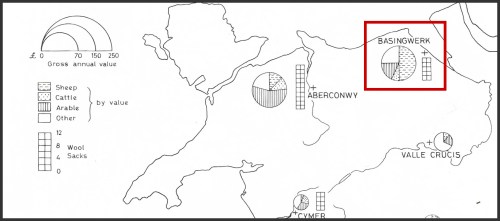
Economic Values excerpted from Williams 1990, map 21, p.105, showing the dominance of the agricultural contribution to the abbey’s income

Basingwerk had a large amount of livestock.  The hills and newly cleared meadows around Basingwerk were ideal for sheep in the uplands and cattle in river valleys and pastures.  The Welsh princes are also recorded as expecting two horses annually from Basingwerk which may indicate that the monks, like those of Cymer Abbey, were breeding horses.

As well as agriculture, which made up most of its income, Basingwerk was also involved in industrial activities, owning or leased industrial properties, Williams lists silver mining as a component of Basingwerk’s economic activities, and this is supported by Gerald of Wales whose trip through Wales in 1188 records leaving Conwy and heading east through Tegeingl through “a country rich in minerals of silver, where money is sought in the bowels of the earth” before spending the night at Basingwerk.  The abbey was also involved in the salt trade, with salt extraction enterprises in Northwich and possibly Middlewich.   Williams notes a coal mine leased from the Crown in Coleshill.  Lead was also mined at Basingwerk, probably making use of the same resources that had been exploited by the Romans in the area.

Economic resources excerpted from Williams 1990, map 22, p.105

Timber was taken from woodlands in Penllyn in Merionydd for housing, hedges, fuel and other requirements, as well as for sale.  Tenants were permitted to take a reasonable amount of firewood.  Assarting, the removal of woodland for conversion to agricultural land and other uses was a common activity in the middle ages.

Fishing probably made up a significant part of the diet, as it did at most Cistercian monasteries.  Basingwerk held the fishing rights for Lake Tegid at Bala, which it owned, and had a weir at West Kirby.  Prince Dafydd granted them one fifth of the catch at Rhuddlan in the 13th century.  They may also have purchased fish caught in the nearby coastal waters.

Basingwerk had a number of urban properties too, in Holywell, Flint, Chester, and Shrewsbury, which served as bases in town for the abbot and his representatives, which were probably loaned to friends of the monastery, but could also be leased out for additional income if required.  The Shrewsbury house was probably a legacy of the abbey’s connection with Buildwas Abbey after the amalgamation of the Cistercian and Savignac orders.
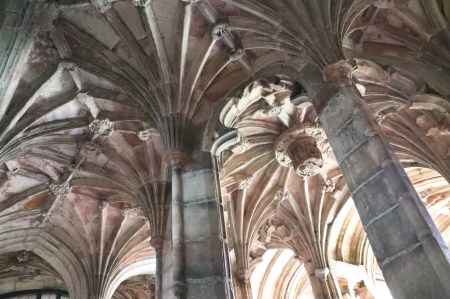
The fan vaulting in St Winifred’s Well at Holywell

A major feather in the financial cap of Basingwerk was St Winifred’s shrine with its beautiful natural spring.  The Holywell shrine of St Winifred was also another source of travelers requiring somewhere to stay and something to eat.  St Winifred’s shrine was granted in 1093 to St Werburgh’s Abbey in Chester, but was passed to Basingwerk in 1240, together with the living of Holywell church.  An abbey with a pilgrim shrine had a whole world of opportunities for income generation, and St Winifred’s was not only famous in its own right for its powers of healing and provision of miraculous cures, but was on the pilgrim trail to Bardsey Island at the end of the Llŷn peninsula and Ireland, via Anglesey.  In 1427 it was given a considerable boost when Pope Martin V granted indulgences for those visiting the shrine and giving alms to the chapel.  Indulgences rewarded certain behaviours, like pilgrimages, with a remission of sins, meaning less time in purgatory.  Royal visitors included King Henry V in around 1416 and Edward IV in 1461, helping to raise the profile of the shrine, which continues to welcome pilgrims today.  It became even more attractive from the late 15th – early 15th century when the shrine was provided with a spectacular gothic building that surrounded the spring.  I will cover Holywell in a separate post.

A traditional method of income acquisition for monasteries was appropriating a church and its income, sometimes to cover a particular expense, such as a major building project, and sometimes just to supplement income.  The Cistercians officially frowned on this practice, but the ban on appropriating church incomes did not survive very long.  Even so, Basingwerk had appropriated surprisingly few, just parish churches at Holywell, Glossop and a third at an unknown location, possibly to be identified with Abergele.

The fairs and markets granted to Basingwerk during Edward I’s reign in the 1290s are discussed below, and this must have been a considerable aid to their income.

Behind the monks’ day room and the dormitory above it was a block of buildings the function of which remains unclear. Suggestions include an extension of the abbot’s personal quarters, with rooms for special visitors, or a dedicated guest wing.

In spite of these various forms of income, Basingwerk sometimes found itself in financial stress. The monastery had been unable to provide a required payment to Edward III in 1346, and by way of explanation complained of the burdens of hospitality that came partly with being a Cistercian abbey, which put a great deal of emphasis on providing free hospitality, and partly from being near a major road, which had become increasingly busy after Edward I had moved forward into Wales, establishing market towns whose merchants moved between Wales and Chester for trade.  Even later in its history, in the late 15th/early 1gth century, it was reported that guests were so numerous that they had to take their meals in two sittings. Smith paints an evocative picture of other travelers in Wales who “cautiously flitted from one English settlement to the next, seeking safe overnight bases where food and shelter could be found “in a land in which rumors of insurrection abounded.” Basingwerk was by no means the only abbey to complain of this burden, which was a particular problem for Cistercian abbeys, but was shared by any monastic community that sat at a busy location.  Birkenhead Priory, which ran the ferry that allowed crossings between the Wirral and Lancashire for access to Chester and beyond (and later Liverpool), found itself in real difficulties due to the requirement to supply hospitality for ferry users who might be stuck at the monastery for several nights in bad weather.

A rather more specific problem was the expectation by the Welsh princes to use the abbey’s Boch-y-rhaiadr range for its annual hunting expeditions, during which the abbey was expected to provide bread, butter, cheese and fish for a hunting party of 300, expanding to 500, with money due in lieu when hunting did not take place.  This was abolished by Edward I after his conquest of Wales.

The Cistercian monasteries in Wales were not exempt from all taxes, or subsidies, and some of the abbots and their community were employed as tax collectors.  Other occasional charges were made on the abbey, such as a demand for financial contributions towards the marriage of Edward III’s sister.  Basingwerk provided £5 in 1333.

The abbey, being so active in economic production in the Holywell-Flint areas, was responsible for the management of its lands and the personnel who managed and worked the land, but was also required to function in a judicial role, its courts administering justice and meting out punishments.  Lekai says that the monastery had “a pillory, tumbrel and other instruments of punishment, although the penalty most often inflicted was a fine.”

The church is on the left and the two arches of the chapter house at right,.  All the buildings were arranged around the central green area, the garth. The stone foundations for the covered and arcaded walkway survive.

Most of the Cistercian abbeys in Wales, at one time or another, had a diplomatic role acting as intermediaries between the Welsh princes and the Crown, acting for either side, a role that was in their political interests to accept.  For example In 1241 Henry III used the Lache grange for a conference between himself and Prince Dafydd’s clerk.  In 1246 Henry III chose the abbot of Basingwerk to escort Prince Dafydd’s wife Isabella from Dyserth Castle to Godstow nunnery near Oxford.  A decade later, Prince Llywelyn ap Gruffyd used an abbot of Basingwerk to carry a letter to Henry III.

In 1291 the Taxatio Ecclesiastica of Pope Nicholas IV valued Basingwerk at £68 8s 0d, gross value (compared with Valle Crucis at £91 8s 0d, and Margam  at £255 27s 4½d).  In 1346 it claimed that its lands were sterile, and it went through some bad years, but in spite of the rebellion of Owain Glyn Dŵr in the early 1400s and a very troublesome period when a monk took the abbacy without being legally elected in the first half of the 15th century, with a similar problem in the later 15th century, the appointment of Thomas Pennant in the early 16th century seems to have turned things around.  In 1535, Henry VIII’s Valor Ecclesiasticus valued the monastery at £157 15s 2d.  Margam by this time was valued at £188 14s 0d, and Valle Crucis £214 3s 5d.
——

The layout of the monastery

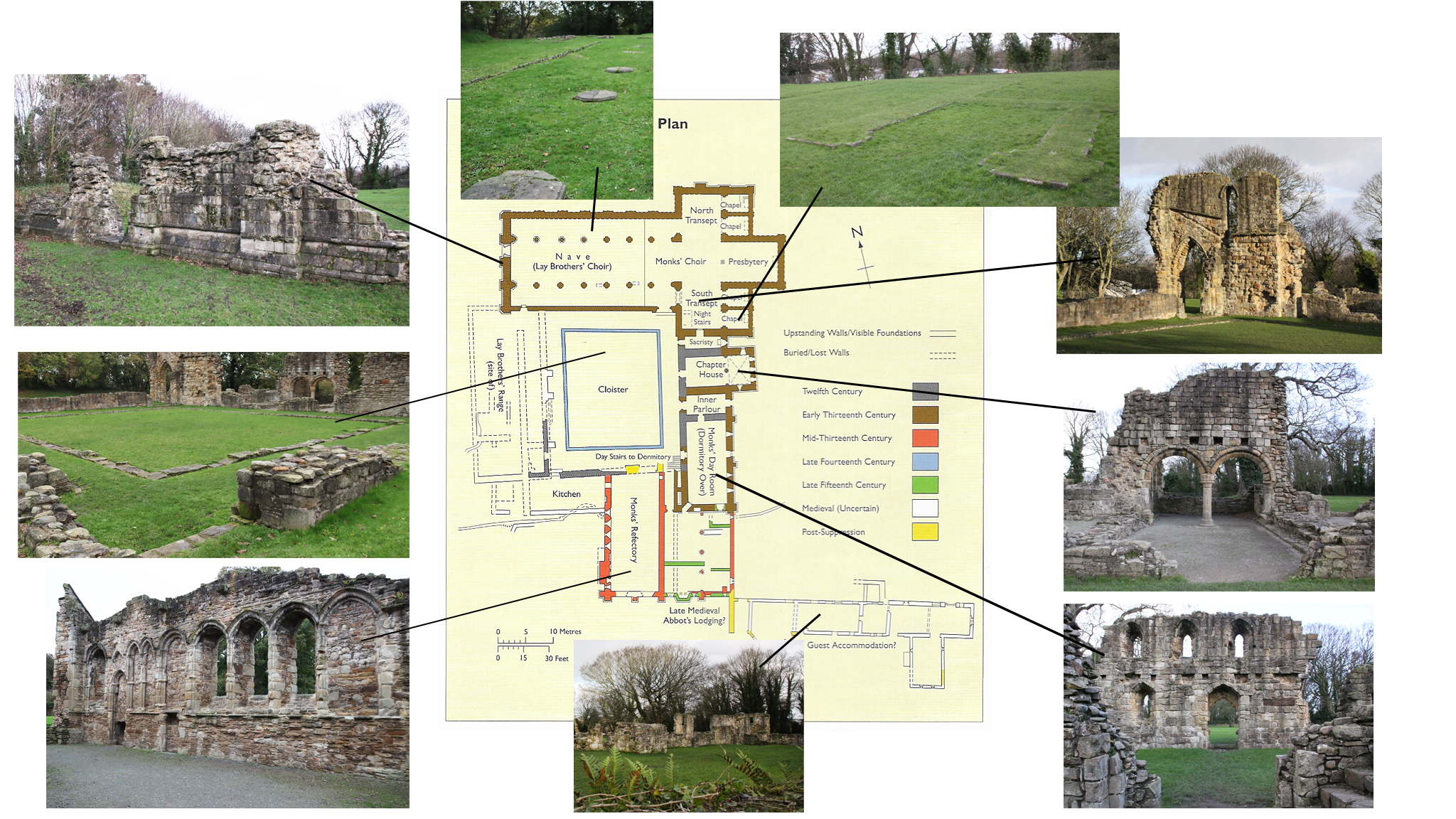
Plan of Basingwerk Abbey. Source: Robinson, D. M., 2006. Basingwerk Abbey (Cadw).

The remains of the monastery conform to a standardized layout favoured by all the orders that followed the rule of St Benedict, clearly shown on the Cadw plan to the right, which helpfully colour-codes the dates for each part of the building. Few parts of the 12th century abbey are left.  Most date to the early 13th century, but the monk’s refectory was built in the mid-13th century.  Much of the abbey was rebuilt in the 13th century, which was not unusual when, for example, a new abbot might want to make a mark, but in this case it is possible that much of not most of it was done due to damage inflicted during the wars between the English and the Welsh, when Edward paid compensation to the abbey to enable it to carry out repairs, about which more below.

The cloister arcade was apparently remodelled in the late 14th century.  In the late 15th century Abbot Thomas Pennant carried out building work not only at the abbey but also at the shrine of St Winifred just up the road in Holywell.  There are various aspects of the site where both date and function remain unclear.  The western range, opposite the chapter house, would have been part of the original layout, used to house the lay brethren, discussed below, but may have gone out of use if a new use for them could be found when the lay brethren were no long featured in the community.  Although the above plan shows that the possible guest accommodation is undated, timbers from fire damage Basingwerk were saved for future analysis and tree-ring dating shows that the felling-date of the crown-post truss was c. 1385.  This is one of the earliest Welsh tree-ring dated.  The dating was commissioned by Cadw.

The church is at left, the chapter house to its right, the day room and the windows of the first floor dormitory next, and set to the far right is the refectory

Although every monastery differed in some aspects, the basic template of buildings surrounding a central square area, a garth (green area) with surrounding walkway (the cloisters) with the monastic church making up one side, was a universal arrangement.  The church was usually on the north side, as it was here, and often included two chapels in the transepts that flanked the crossing area where the choir was located.  Some churches featured towers either above the crossing or at one end.  The other buildings usually included a chapter house (the important monastic meeting room), day room with a dormitory on its first floor, a refectory, and sometimes an undercroft for storage. with an external door leading into the cloister on one side and the monastic precinct beyond. A sacristy was usually attached to the church, sandwiched between the church and the chapter house, which is how matters were arranged at both Basingwerk and Valle Crucis.  The cloisters were usually supplied with desks (called carrels) along the exterior wall of the church  where the monks could study and write.

The precinct, in which this arrangement of buildings sat, could include other structures like farm buildings, and visitor accommodation and often included a gatehouse, the whole surrounded by some form of boundary.  A key feature of Cistercian monasteries was good drainage, which supplied the kitchens and fish ponds, where present, and took away toilet waste, and various parts of the Basingwerk drainage system can be traced at the site.

Part of the abbey’s drainage system

Part of the abbey’s drainage system

The church, with its entrance at far left and the south transept at right

Many of these features can be found at Basingwerk.  The church is largely in ruins, but the layout is still visible in the very masonry walls that sit on the grass, including the columns that supported the roof and divided the church into a central nave with three aisles and seven bays, two side transepts each with a small transept and an eastern presbytery where the high altar would be located.  At around 50 metres in length the church would have been one of the smallest Cistercian churches in Wales. Only Cymer near Dolgellau is shorter, at just over 30m in length.  At the entrance to the presbytery a stone set into the floor may have supported a lectern.

What remains of the south transept, with the presbytery beyond

Basingwerk Abbey refectory wall

Opposite the former church, and one of the best preserved parts of the abbey, is south range with the refectory, which was built perpendicular to the cloister rather than lying along it on a north-south axis.  The refectory in Chester Cathedral, the former St Werburgh Abbey, was built along the length of the cloister, limiting its size, but the the refectory at Basingwerk as limited only by the size of the precinct.  This was probably a change introduced in the 13th century remodelling of much of the abbey, replacing a 12th century refectory that lay along the side of the cloister on an east-west axis.  It is a substantial building with many features preserved in its walls.  This includes the former entrance and stairway to the pulpit, now blocked off, from which religious texts would have been read during meals.  S series of tall windows would have let in a lot of light, and there was a hatch between the refectory and the kitchen for the convenient handing over of food, as well as a cupboard, which was apparently shelved, opposite.

The monks’ day parlour at ground floor level, with the dormitory on the first floor, the windows suggesting the original height of this building

The east range of buildings, again along the edge of the cloister, extends between the east range and the church.  As you face this range, running from right to left are the monks’ day parlour, over which was the dormitory, the length of which over-ran the cloister and ran parallel for a short distance with the refectory;  a long thin parlour is next, and then most importantly is the chapter house, where the monks met daily to discuss the business of the order.  To its left is the sacristy, which adjoined the south transept of the church.
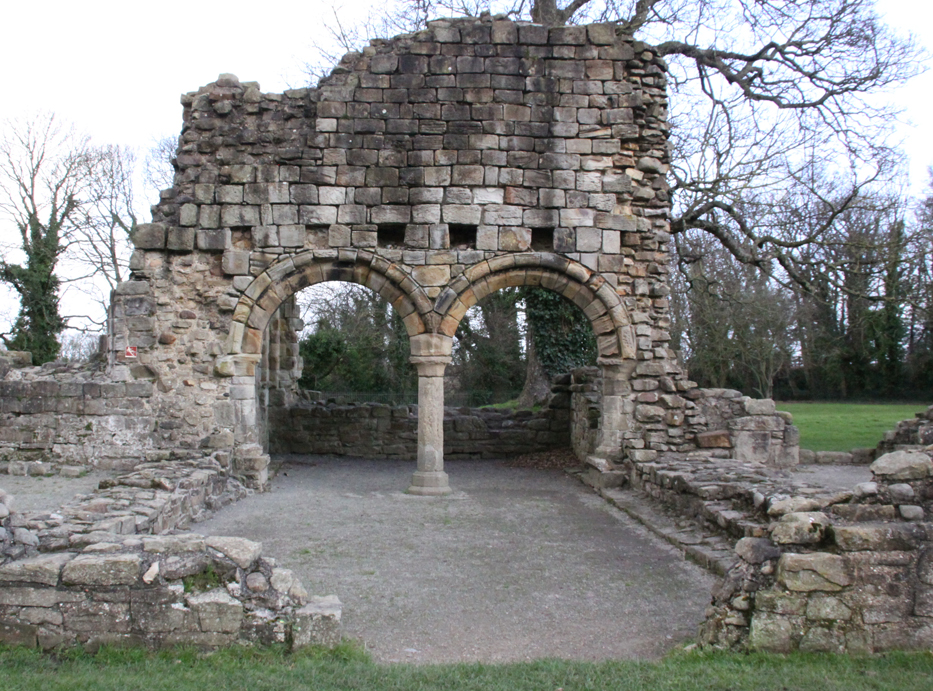
The Chapter House

The sacristy to the left of the chapter house, with doorway leading into the church to the left.

Looking towards where the western range would have been located. The building beyond is now the café.

Opposite this range was the western range, of which there is almost nothing left.  In a Cistercian monastery this was usually used, at least in the early decades, for the lay brethren.  These were members of the monastic community who worked the land, and were not required either to be as educated as the monks, or to dedicate a similar amount of time to worship.  They worked the land and were maintained by the monastery.  As properties were leased out, the lay brethren were increasingly redundant and the western range was usually put to different uses.  It is not known how it would have been used at Basingwerk.


Edward I and Basingwerk Abbey
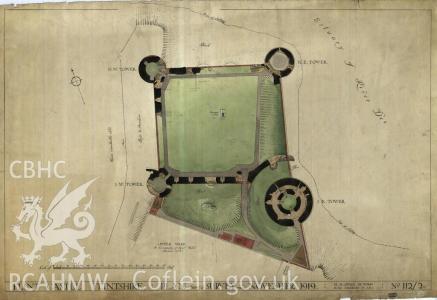
Plan of Flint Castle. Source: Coflein

When Edward I settled on his location for his new castle at Flint, Basingwerk Abbey was just a few miles west of the new site.  The monks of Basingwerk Abbey, which was established over 100 years earlier in 1132, must have wondered about the impact of the castle on their own security and their livelihood.  During the first few months of the castle construction process in the summer of 1277 Edward stayed near Basingwerk.  Edward saw himself as a religious man.  He had been on crusade, and had made a vow to establish a monastic house of his own, under the Cistercian order, and had selected a site for it in Cheshire.  Vale Royal Abbey was already underway in 1277 near Northwich, Edward having laid the first stone in early August.  It seems unlikely that Edward was not often a guest of the Basingwerk Cistercian Abbey during the building of Flint, which apart from being obliged under Cistercian rules to provide hospitality, was unlikely to reject a royal visitor.  Although Basingwerk had been founded by an English patron, Ranulf II it was probably more in tune with Welsh interests by the arrival of Edward.  Indeed, earlier in 1277 seven Cistercian abbots had written a letter to Pope Gregory X supporting Prince Llewellyn ap Gruffud against charges placed by the Bishop of St Asaph, although the abbot of Basingwerk was not amongst them.

Drainage at Basingwerk, from the refectory

Whatever their personal leanings, it would have been very much in the interests of the order for good relations to be maintained.  They may have offered advice about his plans for Vale Royal, and it is clear that some of the abbots in the Welsh-based monasteries, including Basingwerk, played an invaluable role as intermediaries between the Welsh and the English.  Fortunately for the monks at Basingwerk, Edward I chose the Cistercian abbey at Aberconwy for his headquarters, forcing that monastic community to eventually shift further south along the Conwy valley to a new home.

The monks of Basingwerk would have been less than astute, however, if they had not regarded the new castle with misgivings, and if they had concerns about being caught in the middle of a fight between Edward and Llywelyn, their worries would later be justified.  In the 1270s and 1280s the abbey suffered damage during the wars of Edward I, in spite of letters of protection issued to it in 1276,1278, and 1282 and in 1284 Edward granted £100 compensation to the monks after the army stole corn and cattle and the loss of workers who were abducted, presumably for labour.  An additional 132 4d was paid in damages to churches in Holywell.  Basingwerk was not the only abbey in the area to suffer and receive compensation.  Valle Crucis near Llangollen received a sum of £160.00, and nearby Aberconwy was occupied by Edward I’s forces and its monastic community was forced to move to a new home to the south, at Maenan.  Relations between the abbey and castle obviously continued to remain good, because when the castle was completed in 1280 a monk of Basingwerk was engaged as the chaplain to the royal garrison.
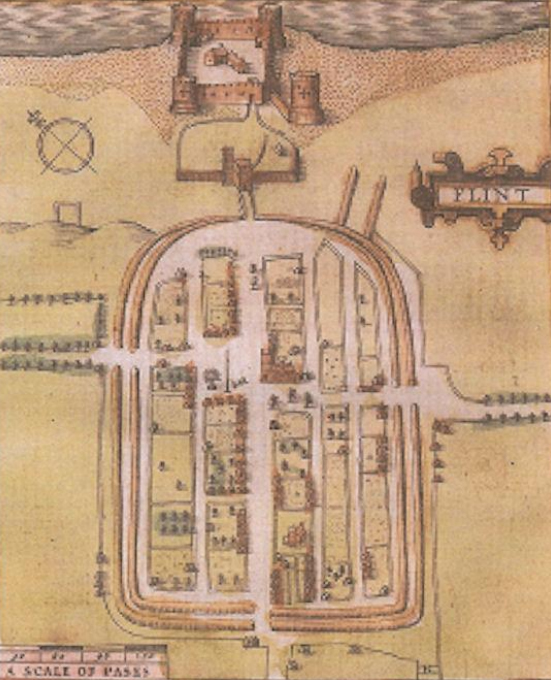
One of John Speed’s maps showing Flint Castle and town. The castle and town of Flint as mapped by John Speed in 1610, showing the original road layout and market place. Source: National Library of Wales

At Flint, Edward had established a Norman-style new town as part of his vision for colonizing various parts of Wales.  This was an English settlement, and any new burgesses prepared to live there was given numerous incentives.  In 1278 Edward granted it permission to hold weekly markets and an annual fair.  In 1292 he granted Basingwerk the same permissions for Holywell, having granted them permission to hold an annual fair at their Glossop manor in 1290.  The monks could charge market stall holders rent for the duration of the market, a nice source of income, as well as selling their own products.  Basingwerk, with its water mills, windmills and fulling mills and land under both grazing and grain, was certainly in a position to sell a number of products, including grain, livestock and livestock products including meat, skins and wool. Welsh wool was recognized as being of very high quality, sometimes superior to even that of the better known wool produced by the Yorkshire monastic producers.  The Taxatio ecclesiastica of Pope Nicholas IV in 1291 recorded that Basingwerk had 2000 sheep producing 10 sacks of wool, 53 cows (at a ratio of 37.1:1), and no goats. Even if it found itself in competition with Flint, Basingwerk’s fairs probably represented the opportunity to raise the abbey’s income.  Its industrial products, as well as some of its wool, may have been sold for export.

The 14th – 16th century

Burton and Stöber describe how by the mid 14th century there were reports that the abbey was in debt, and in the fifteenth century some of its abbots were a distinct liability:

in 1430 the house was seized by Henry Wirral, who made himself abbot, and the following year he was engaged in a legal dispute for the office with Richard Lee. Despite the court ruling in favour of Lee, Henry continued in power at Basingwerk until 1454 when he was arrested for various misdemeanours and deposed. Matters did not improve, for in the following decade Richard Kirby, monk of Aberconwy, disputed the abbacy with Edmund Thornbar. Although the General Chapter ordered that Edmund be recognized as abbot, Richard was still in office in 1476.

Manuscript by Gutan Owain, National Library of Wales, MS3026C. Source: The National Library of Wales

Fortunately the abbey’s fortunes improved under Welsh Abbot Thomas Pennant, who ruled the house for about forty years from around 1481 to 1523, although this was very much a last hurrah before Henry VIII dissolved the monasteries beginning in 1535. By the early 16th century Welsh bard Tudur Aled (died 1526) makes it clear that there was lead roofing and stained glass at the abbey.   Tudur Aled praised Abbot Thomas , commending his his learning but also his generosity, generally an indication that they were being sponsored by a given abbot, as at Valle Crucis.  Gutun Owain seems to have benefited from Basingwerk Abbey’s patronage.  Owain is notable for having addressed over fifteen poems to Cistercian abbots, and is known to have stayed as a guest at Valle Crucis and Strata Florida as well as Basingwerk.  Although the late fifteenth century manuscript known as the Black Book of Basingwerk (Llyfr Du Basing, now NLW MS 7006D, which was the mainly the work of Gutun Owain copied into a single volume) was probably held by Basingwerk at the time of the dissolution in around 1536, it is thought in fact to have been the work of copyist monks at Valle Crucis.

Thomas Pennant was not a man of undiluted virtue.  In an order where celibacy was required and monks were not permitted to marry, Pennant not only fathered a family, but his son Nicholas, became the last abbot of Basingwerk, which in theory was an act of simony banned by the order.  When the abbey closed, probably in 1536, with just three monks, Nicholas was the abbot.
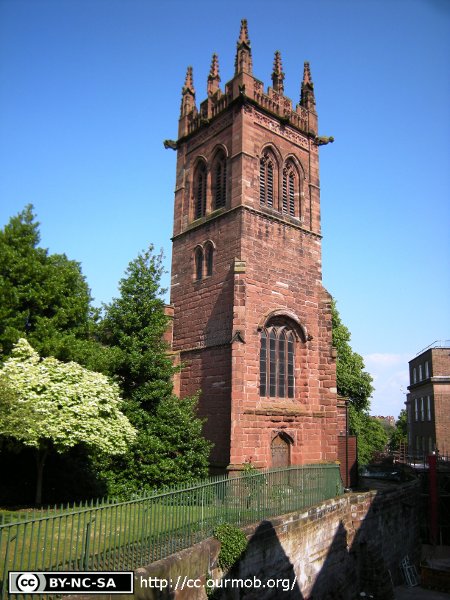
St Mary on the Hill, Chester. Source: GENUKI

After the Dissolution every valuable object and piece of structural material was stripped for Henry VIII’s treasury.  James says that part of the timber ceiling is at Cilcain, and that stained glass can be found at Llanasa.  Burton and Stöber add that the choir stalls from the abbey were transferred to the church of St Mary on the Hill in Chester.  Lead from the roof was removed, and may have been used for the repair of Holt Castle on the Dee and Dublin Castle. Williams adds that it may have been employed also in other crown buildings in Dublin, and that it is possible that the wooden sedilia in the parish church of St Mary, Nercwys, was from Basingwerk.  There is a tradition that the Jesse window was reinstalled in the parish church of St Dyfriog (Llanrhaeadr-yng-Nghinmeirch) but this remains unconfirmed.

I have been unable to get access to St Mary on the Hill, a comprehensive history of which is on the Chesterwiki. It was decomissioned in 1972 and now describes itself as a Creative Space and venue for a range of activities.  However, the Chesterwiki site says that the fittings, presumably including the Basinwerk choir stalls, were removed after the church was decomissioned, although it does not say where these fittings went.

From the 18th century the site attracted artists who recorded features that are now lost.  In the early 20th century a large section of the south transept collapsed.  In 1923 the site was put in State guardianship and in 1984 it was put into the car of Cadw.

Basingwerk Abbey miniature by Moses Griffiths, c.1778. Source: National Library of Wales, via Wikipedia

Final comments

The building that may be a guesthouse, has had burned timbers dendro-dated, which give the roof a date of c.1385. Source: RCAHMW Exhibitions: Dendrochronology Partnerships

Information about Basingwerk Abbey is fragmented and partial, but researchers have pieced together a history of the abbey that tells a story about abbey’s past, beginning as a Savignac establishment before being absorbed into the Cistercian network of monasteries.  The disputes between the Welsh princes and Henry III and Edward I caused grief for the north Wales monasteries, but they survived to rebuild and move forward.  Like other abbeys in Wales, the abbots of the abbey had a diplomatic role, often acting as intermediaries between Wales and England.  As members of the wider community with an important economic role, the abbey was often involved in local judicial matters. Financial difficulties in the 14th and 15th centuries are recorded and but again the monastery survived these difficulties.  In the early 16th century the abbey became a haven for Welsh bards, supporting their work. Throughout its history, its location on the main route through north Wales meant that it was obliged to provide more hospitality than more secluded monastic houses, whilst the shrine of St Winifred, whilst contributing to the prestige and financial value of the abbey, also required some management to prevent it becoming a drain on the abbey’s obligation to provide shelter and food.  After the Dissolution in 1536, the abbey was decommissioned, its valuables removed and its properties either sold off our leased out.  Today it is managed by Cadw and offers an excellent visitor experience.


Visitor Information

Find the captions and see the full-sized map at https://greenfieldvalley.com/greenfield-valley-zones/. There is an interactive version of the map at https://greenfieldvalley.com/explore/interactive-map/.

The site is free to visit.  There is no visitor information centre but a small modern shop sells guide books, postcards and souvenirs relating to Basingwerk, St Winifred’s Shrine and the Greenfield Valley Park. The abbey’s postcode is CH8 7GH and the car park is on Bagillt road, just to the west of the enormous railway bridge, opposite a small trade/industrial estate.

There is a big car park at the foot of the abbey, shown to the right left on the A548, just west of the enormous railway bridge, which has a fairly gentle metalled incline up to the abbey, with a bench and information map half way up.

There is also a café just outside the main gates, which in October 2022 was doing a good coffee and a splendid lunch.

Basingwerk Abbey is a component part of Greenfield Valley Park, and is popular with dog walkers and children, so if you want a quiet visit it is probably best to go on a weekday outside the holidays. The rest of Greenfield Valley Park is an excellent visit in its own right, with a remarkable amount of industrial archaeology within its borders, and plenty of interpretation boards.  I have posted about the industrial archaeology of the Green Valley Park here.

If you want to stay in the medieval period, St Winifred’s Well is about 1.5 miles through the park (shown as No.9 at the very top of the map right), or if you prefer to drive it has its own car park.  Flint Castle is only 4 or so miles down the A548 towards Chester, and makes for a great visit.  I wrote about the history of Flint Castle on an earlier post, Together, the three sites make a very fine medieval day.

Sources

Books and papers:

Burton, J. and Stöber, K. 2015.  Abbeys and Priories of Medieval Wales.  University of Wales Press.  https://www.jstor.org/stable/j.ctt9qhdvn.13

Davies, Paul R. 2021. Towers of Defiance. YLolfa

Elfyn Hughes, R., J. Dale, I. Ellis Williams and D. I. Rees. Studies in Sheep Population and Environment in the Mountains of North-West Wales I. The Status of the Sheep in the Mountains of North Wales Since Mediaeval Times. Journal of Applied Ecology , Apr., 1973, Vol. 10, No. 1 (Apr., 1973), p.113-132
https://www.jstor.org/stable/2404720

Evans D.H. 2008, Valle Crucis Abbey, Cadw

Knight, L. Stanley 1920. The Welsh monasteries and their claims for doing the education of later Medieval Wales. Archaeologia Cambrensis, 6th series, volume 2, 1920, p.257-276
https://journals.library.wales/view/4718179/4728984/314#?xywh=-63%2C345%2C2942%2C1730

Rhys, Ernest (ed.) 1908.  The Itinerary and Description of Wales with an introduction by W. Llewelyn Williams. Everyman’s Library. J.M. Dent and Co, London. and E.P. Dutton and Co (NY)
https://archive.org/details/itinerarythroug00girauoft

Huws, D. 2000.  Medieval welsh Manuscripts. University of Wales Press

James, M.R. 1925.  Abbeys. The Great Western Railway
https://archive.org/details/abbeys-great-western-railway

Jones, Owain, 2013. Historical writing in medieval Wales. PhD Thesis, University of Bangor.
https://research.bangor.ac.uk/portal/files/20577287/null&ved=2ahUKEwjxssbb0tvtAhWmxIsKHQgvBW0QFjAOegQICBAI&usg=AOvVaw2GbJiGy6Sl3SPiTX4K8RqZ

Lekai, Louis L. 1977. The Cistercians. Ideals and Reality. The Kent State University Press

Patel, Rowan 2016. The Windmills and Watermills of Wirral. A Historical Survey. Countyvise Ltd.

Robinson, D. M., 2006. Basingwerk Abbey. Cadw

Silvester, R.J., and Hankinson, R., 2015. The Monastic Granges of East Wales. The Scheduling Enhancement Programme: Welshpool. Clwyd-Powys Archaeological Trust (CPAT)
coflein.gov.uk/media/241/979/652240.pdf

Smith, Joshua Byron 2016. “Til þat he neӡed ful neghe into þe Norþe Walez”: Gawain’s Postcolonial Turn. The Chaucer Review, Vol.51, No.3 (2016), p.295-309
https://www.jstor.org/stable/10.5325/chaucerrev.51.3.0295

Williams, David H., 2001. The Welsh Cistercians, Gracewing

Williams, David H., 1990. Atlas of Cistercian Lands. University of Wales Press

Websites:

Coflein
Basingwerk Abbey
https://coflein.gov.uk/en/site/35649?term=basingwerk%20abbey%20holywell

Monastic Wales
Basingwerk Abbey
https://www.monasticwales.org/browsedb.php?func=showsite&siteID=24
Gutun Owain
https://www.monasticwales.org/person/72
The Black Book of Basingwerk
https://www.monasticwales.org/archive/24
Valle Crucis (Abbey)
https://www.monasticwales.org/browsedb.php?func=showsite&siteID=35

RCAHMW Exhibitions: Dendrochronology Partnerships
Bilingual exhibition panel entitled Partneriaethau Dendrocronoleg; Dendrochronolgy Partnerships, produced by RCAHMW 2013
https://coflein.gov.uk/media/200/524/rcex_026_01.pdf

RCAHMW List of Historic Placenames (searchable database)
https://historicplacenames.rcahmw.gov.uk/

University of Notre Dame
A Knight in St. Patrick’s Purgatory, by Haley Stewart. March 15, 2019
https://churchlifejournal.nd.edu/articles/a-knight-in-st-patricks-purgatory/

An Essay on Cistercian Liturgy by Dr Julie Kerr
Cistercians in Yorkshire, University of Sheffield
www.dhi.ac.uk/cistercians/cistercian_life/spirituality/Liturgy/Cistercian_liturgy.pdf 


The chapter house propped up during excavations when M.R. James visited in 1925.

Basingwerk Abbey from the South. 1929 postcard. Source: People’s Collection Wales

A splendid introduction to stained glass artist Trena Cox by Aleta Doran

Many thanks to Aleta Doran, Artist in Residence at Chester Cathedral for today’s introduction to stained glass artist Trena Cox, who was based in Chester for most of her long career.  Aleta is a brilliant and engaging presenter, currently working hard on the upcoming Trena Cox exhibition, which she is curating.  Although this was organized specially for Chester Archaeological Society, Aleta is doing more presentations during the Heritage Festival and if you get the chance to attend, do go.  It will give you a completely new insight into the world of 20th Century stained glass, as well as introducing you to a really creative part of the cathedral’s history.  I’ll keep this relatively short so as not to spoil the event for those of you who have tickets.

Trena Cox, apparently the least photographed artist in modern history, was born on the Wirral and trained at Birkenhead’s Laird School of art, learning her skills in traditional media before switching to stained glass.  She has created over 150 stained glass pieces that are known, but there are probably many more to be identified.  She worked mainly in the Cheshire and northeast Wales areas but her works are found further afield.  There are many in Chester itself, mainly in churches.  There are nine Trena Cox windows in the cathedral, one in the slype (a corridor) and the others arranged in groups of four, two at the top, two at the bottom, in adjacent aisles in the cloister (the walkway around the central garth or garden).

The big window in the slype shows the child Christ on one river bank, and St Christopher on the other.  This is very unconventional, as Christ is usually depicted being carried across the water on the shoulders of St Christopher.  Aleta described how this window clearly demonstrates many of the features of Trena Cox’s work, with the beautifully executed details of both figures, the surrounding landscape and the flowers, birds and animals that sit at the feet of the two figures.  Also typical are the portrait-style faces, which seem incredibly life-like.  The colouring of the glass, as in all her work, is vibrantly jewel-like and the background semi-opaque glass concentrates the eye on colours whilst allowing in light.  There are many emblems of international pilgrimage, known from badges purchased from the Middle Ages by pilgrims to commemorate their achievements.  As well as many others, these include St Thomas of Canterbury, St James of Santiago de Compostella, and of course Chester Cathedral’s own St Werburgh herself, her symbol being five geese in a basket. It is a rich and symbol-laden piece that rewards time taken to appreciate it.

The cloister used to open out onto the garth, with a stone arcade forming a corridor with the buildings that surround the cloister.  In 1920 Dean Frank Bennet was appointed as the new head of the cathedral, and decided to take measures to improve the cathedral’s fortunes.  In order to glaze the arcade that surrounded the garth, the dean decided to raise public funds.  It is thought that some funds were raised by allowing donors for the cloister glass to add commemorations to loved ones in panes withing the windows, which survive today.  Each window represents a saint, religious festival or holy day.  Trena Cox contributed eight panels in two adjacent sections of the cloister, showing eight different saints.  In one set of four, the two at the top are Hugh Lupus who founded the abbey and St Werburgh’s mother St Ermengild  In the lower section are St Thomas Becket and King Henry II.  In the other set, the two figures at the top are Abbot Witchurch and Ralph Higden and the two below King Alfred and St Piegmund.  Aleta talked us through the significance of each of these saints, and why there were chosen.  These are much smaller and therefore much simpler compositions, but again the colours are vibrant, and the faces resemble portraiture.

Aleta wrapped up by telling us something about Trena Cox and her influence on Chester life, not only as an artist but as something of an activist for the protection of local heritage.  It seems remarkable that she is not better known, at least in Chester where she lived nearly all her life.  Hopefully, the upcoming the exhibition “Trena Cox: Reflections 100”, which begins on the 7th October, will bring this under-sung local personality and talented, prolific artist to much wider public attention.  Do take advantage of a tour of the glass with Aleta Doran if you have the opportunity.  As an artist herself, she offers a unique insight into the work of Trena Cox.

You can follow Aleta Doran on Twitter (@StargazingAleta), or via her blog at https://www.aletadoran.co.uk/

Birkenhead Priory – A 2-Minute Video

This is a bit of an experiment, using my iPhone, which I’ve never tried before for video.  I did a lot of camcorder videos of scenery when I lived in Aberdovey on the west coast of Wales, but fell out of the habit when I moved to the Chester area, so I am out of practice, feel very peculiar using an iPhone to do video, and hate the sound of my voice, but here we go.  So here’s my two-minute introduction to the wonderful priory of St Mary and St James, aka Birkenhead Priory, for  better or for worse. I’ll get better!

Dazzle-camouflage building on Knox Street in Birkenhead

At Birkenhead Priory the other day I very much liked this small building on Knox Street, very close to both Birkenhead Priory and the Cammell Laird shipyard.  It has been painted in the style of dazzle camouflage, used in the First World War, and to a lesser extent in the Second World War, primarily to confuse submarines.  “The primary object of this scheme was not so much to cause the enemy to miss his shot when actually in firing position, but to mislead him, when the ship was first sighted, as to the correct position to take up. Dazzle was a method to produce an effect by paint in such a way that all accepted forms of a ship are broken up by masses of strongly contrasted colour, consequently making it a matter of difficulty for a submarine to decide on the exact course of the vessel to be attacked” (Norman Wilkinson, 1969, A Brush with Life, Seeley Service, p.79, quoted on Wikipedia).

The moment I saw it, it reminded me of a 1919 painting by Edward Wadsworth (1889 – 1949) that I have hanging in my spare bedroom, showing a ship in dry dock in Liverpool receiving its new paint job.  Wadsworth painted in the style of the Vorticists, whose best known proponent was Wyndham Lewis, inspired by machinery and industry, and focused on clean lines, hard edges and planes of strong colour.  The dazzle ship was a near perfect subject matter for this style of painting, and Wadsworth was in an ideal position to get up close and personal with his subject matter, as in the First World War he worked as an intelligence officer, and one of this responsibilities was implementing dazzle camouflage designs for the Royal Navy.

I would love to know who came up with painting the building on Knox Street in the same style.  If you know anything about it, do let me know.

Below is a painting from the Merseyside Maritime Museum showing the Walmer Castle painted in her dazzle camouflage.  “The Walmer Castle was launched in 1901 for the recently created Union Castle Mail Steamship Company. The ship sailed between Southampton and Cape Town and in 1917 was requisitioned by the British Government. It is seen here dazzle painted for use as a troop ship in the North Atlantic. Walmer Castle survived the war and was broken up in 1932″ (National Museums Liverpool).

A visit to the 12th century Birkenhead Priory #1 – The Medieval buildings

Introduction

The chapter house

Birkenhead Priory is one of the most enjoyably unexpected places I have visited in the region, even more surprising than a Roman bath-house embedded in a 1980s Prestatyn housing estate.  The priory site incorporates both the remains of the 12th century monastic establishment and the ruins of St Mary’s 1822 parish church with its surviving tower and terrific views.  On all sides the site is surrounded by both heavy and light industry.  Cammell Lairds shipyard not only butts up against the south and east walls, but purchased part of the priory’s former churchyard and cemetery for its expansion and the building of Princess Dock.  On the other sides are warehouses and commercial units.  The result is that in spite of the clanging and banging from the vast ship under construction immediately next door (fascinating in its own right), the obvious and somewhat inescapable cliché is that the ruins of the priory and parish church are an oasis of peace in the midst of all the busy activity.  The small but quiet stretches of grass, the trees and the wild flowers contained within the remains of the priory site are a treat, and the splendid views from the top of St Mary’s tower are a powerful reminder of how the world has changed since the foundation of the priory.

I have divided this post into two parts, because there is so much to say.  A visit to Birkenhead Priory is really five visits in one.  In chronological order, a visit to the site provides you with the following heritage:

  • 1) The priory, established in the 12th century and built of red sandstone, is the oldest part of the site and the star turn with its vaulted undercroft and chapter house
  • 2) St Mary’s parish church was built next to the ruins in 1821 to serve the growing community, its gothic revival windows wonderfully featuring cast iron window tracery
  • 3) The priory’s scriptorium over the Chapter House, now with wood paneling over the sandstone walls, is the exhibition area for the Friends of the training ship HMS Conway,
  • 4) The Cammell-Laird shipyard is hard up against the priory’s foundations and fabulously visible from St Mary’s Tower. When it wished to expand into the church’s churchyard, it purchased the land and re-located the burials
  • 5) St Mary’s Tower, which is open to the public with amazing views from the top, is now a memorial to the 1939 HMS Thetis submarine disaster in the Mersey.

In this part, part 1 I am taking a look at the priory.  In part 2 I have looked at the post-dissolution history of the site; the 1821 construction of St Mary’s parish church; the memorial to HMS Thetis and the display area for HMS Conway.  I will tackle Cammell Laird’s separately, as I suspect that it will be very difficult to handle in a single post, and I need to do a lot more research before I make the attempt to summarize its history.

Birkenhead in the foreground with the manor and ruins of the monastery, and Liverpool in the background over the river, c.1767, showing just how isolated Birkenhead remained even in the 18th century. Attributed to Charles Eyes. Source: ArtUK

Foundation of the priory in the 12th Century

Artist’s impression of the priory done by E.W. Cox by 1896.

The priory was dedicated to St Mary and St James the Great.  There are no documents surviving from the priory, and none of its priors became important in other areas of the church or in life beyond the priory, so most of the information comes from other sources of documentation as well as from the architecture itself. Its principal biographer, R. Stewart-Brown, writing in 1925, commented that it was “not possible to compile anything in any degree resembling a history of this small and obscure priory,” but the result of his work was an impressive overview of the priory, its financial stresses and its involvement in the Wirral as a whole and the Mersey ferry in particular.  Much recommended if you can get hold of it.  Although not certain, is thought that the priory was founded in the mid-12th century by one of William the Conqueror’s Norman followers who was rewarded for his service to the new king and the local earl Hugh Lupus with land on the Wirral.  His name was Hamon (sometimes Hamo) de Massey from Dunham Massey, the second baron, who died in 1185, suggesting that the priory was founded before this date, probably in the middle of the 12th century.

Exterior of the west range, showing the two big windows that illuminated the guest quarters, the one on the left heavily modified.

The priory was established on an isolated headland, surrounded on three sides by water.  Hamon almost certainly took as his model for the priory the abbey of St Werburgh in Chester (now Chester Cathedral) which was founded in 1093 by Hugh d’Avranches, also known as Hugh Lupus.  Hugh Lupus had convinced St Anselm of Bec (later Archbishop of Canterbury and after his death canonized) to come and establish St Werburgh’s, and it was organized along classic Benedictine lines, about which more below.  The founding of a monastic establishment was seen as a Christian act, a statement of piety and devotion, and was most importantly a precautionary investment in one’s afterlife, securing the prayers of the monks, considered amongst the closest to God, throughout the entire lifetime of the monastery

A priory was smaller and inferior in status to an abbey and was was often dependent (i.e. a subset) of an abbey, and answerable to it.  It is possible that the much larger and infinitely more prestigious St Werburgh’s Abbey in Chester supplied the monks to establish Birkenhead Piory, but there is no sign in the cartularies (formal documents and charters) of St Werburgh’s that there was any ongoing formal connection between the two.  The difference between a non-dependent priory and an abbey was usually that the priory did not have sufficient numbers to be classified as an abbey, or that it had not applied for the royal stamp of approval required for the more senior status of an abbey. The minimum requirement for the foundation of a Benedictine abbey was 12-13 monks.  A 16th century historian suggested that there were 16 monks, but it is by no means clear where this figure came from.  Twice during the 14th century it is recorded that there were only five monks at the priory, and it is very likely that the priory remained too small to become an abbey.

The typical monastic day in a Benedictine monastery. Not a great photo, but a very nice representation from a display in the museum area in the undercroft

The Benedictine Order was not the oldest of the monastic orders in Britain, but following the Norman Conquest it became the most widespread.  It was named for St Benedict of Nursia who, in the 6th century, set out a Rule, or set of guidelines, for his own monastery.  This spread widely and became the basis of many monastic establishments setting out to follow his example.  The Benedictines had been well established in France at the time of the Conquest, and sponsorship by incoming Normans, granted land by William the Conqueror, ensured that they spread rapidly in England, and later Wales, Scotland and Ireland.  Benedictine monasteries were all built to a standard architectural layout, with minor deviations, based on both religious and administrative requirements.

The monastic buildings

Plan of the Birkenhead Priory site.  Source: Metropolitan Borough of Wirral leaflet (with my annotations in colour). North is left, south right.

If you take the guided tour, which I sincerely recommend, you begin your tour in the undercroft, now used as a museum / display space.  Most helpfully it has a scale model of the priory with Stewart-Brown’s 1925 site plan, both of which help you to orientate yourself and get a sense of how the ruins were once a complex of buildings that defined and enabled a monastic community, combining religious, administrative, domestic and other functions.  In the plan on the left, with the surviving remains of the priory outlined in red, the site of the priory church outlined in orange and remains of the 1822 St Mary’s Church outlined in green. The blue margin indicates the shipyard over the priory wall.  The numbers on the plan are referred to in the description below.  You can download a copy of the map (without the coloured additions) as a PDF here.

Like St Werburgh’s Abbey, the priory buildings were made of locally available red sandstone.  Like all monasteries based on Benedictine lines, the monastic site plan began with a square.  The bigger the monastery envisaged, the bigger the square.  This was known as the garth (1 in the plan on the left), and was either a grassed area or a garden.  Surrounding this was the cloister, a covered walkway that served as a link between the buildings that were erected around the garth, and where desks were usually arranged so that the monks could work.  This was a secluded space, confined to the inmates of the monastery.

Model of the priory church and claustral buildings in the priory’s museum space in the undercroft showing a possible layout of the church.  The chapter in this view is hidden behind the tower.

The most conspicuous of the buildings would have been the one that no longer stands:  the church and its tower (4 on the plan above, outlined in orange), which made up one side of the cloister.  Traditionally in Benedictine complexes this was built on the north side of the garth, making up an entire side of the cloister, in order protect the rest of the buildings and allow light into the garth and the other cloister buildings, but at Birkenhead Priory’s church was on the south, possibly to protect the claustral buildings from the winds whistling down and across the Mersey. The model and plan show that the 13th century church was built in the standard cross-shape.  It featured a long nave at the west end (where the public were permitted to observe religious ceremonies), and a surprisingly long east end (where the ceremonies were performed) with two side-transepts, which were usually used as chapels for commemorating the dead and a tower over the crossing. A pair of aisles flanked the south and north transepts as show above.  When it was first built in the 12th century, the church would have been much smaller and probably smaller than this footprint.

View of Birkenhead Priory by Samuel and Nathan Buck in 1726, showing the remains of the church’s northern arcade.  Source: Panteek

Lonely remainder of the church’s northern arcade

The entrance to the chapter house with its Norman arches. You can clearly see the difference between the 12th century chapter house masonry and the 14th century scriptorium above with its gothic window and tracery. The tower in the background belongs to the 19th century church.

The chapter house (2) is the oldest of the Birkenhead Priory buildings, the only one remaining that dates to the 12th century.  The building of the priory church, being the place where the main business of praising God took place, was usually started straight away, but the chapter house was often built in tandem as this was also of fundamental importance to a monastery.  This is where the everyday business of the priory was attended to, from the day-to-day administration and disciplinary matters, to the daily readings of chapters of St Benedict’s Rules or other improving texts such as excerpts from one of the many histories of saints (hagiographies).  The Birkenhead Priory’s original medieval chapter house is a gorgeous. The vaulted roof of the chapter house is superb (see the photo at the very top of this post), and although the windows have been altered over time, one of the deep Norman Romanesque window embrasures survives, and is a thing of real beauty (see below).  The stained glass is all modern, but all are nicely done, the one over the altar by Sir Ninian Cowper combining religious themes relevant to the house (St Mary and St James flanking Jesus) with two prestigious characters from the priory’s own history (its founder Hamo de Massey and its two-time visitor Edward I).  Gravestones from the medieval cemetery have been incorporated into the floor around the post-Dissolution altar.  In the medieval priory, there would have been no altar in the chapter house, but following the Dissolution the chapter house was converted into a chapel and is still used for weddings, funerals and baptisms. 

Over the top of the chapter house, a scriptorium was added in the 14th century. In theory this was where the copying of books took place, but it has been pointed out that this was a particularly large space for such an activity, and it may have been used for something else, or for a number of different activities.  Today it is the display area for the training ship HMS Conway, and at some point in the 19th or early 20th century was provided with panelling and has some very fine modern stained glass by David Hillhouse.  This modern usage will be discussed in part 2.

Opposite the chapter house the remains of the west range (7-11) survives, which was again a two-floor building separated into a number of different spaces  It seems to have been divided into two, with the northern end and its big fireplace reserved for guests, and the southern end, with an entrance into the cloister, seems to have been split into two floors, with a fireplace on each, for the prior’s personal quarters, which would have included a private parlour that he could use for entertaining VIP guests.  Although it’s not the most aesthetically stunning of the surviving claustral buildings today, the stonework displays a fascinating patchwork of different features and alterations that reflect many changes and refinements in use over time and are still something of a fascinating puzzle.

West Range

Remodelling in the 14th century created the undercroft and the refectory above it, as well as the kitchen.  The undercroft (14), once used as a storage space, with the original floor intact. The investment in the lovely architecture may indicate that before it was used as a storage area, it had a more high profile role, perhaps as a dining area for guests.  Above it was the refectory, unlike St Werburgh’s, Basingwerk Abbey or Valle Crucis Abbey, all of which had refectories at ground level.  It was reached by a spiral stone staircase leads up to this space today.

The kitchen was apparently to the north of the west range, and connected to it, as shown on the above plan (12).  This was convenient for the guest quarters, but not quite as convenient for the refectory over the undercroft, from which it was divided by a buttery (or store-room, 13), over which a guest room was also installed.   The kitchen was apparently a stand-alone structure made mainly of timber, and this may have been because kitchen fires were so common, and building the kitchen slightly apart from the main monastery would have been a sensible precaution.  Kitchen fires are thought to have been the cause of several devastating scenes of destruction in monastic establishments, spreading quickly via roof timbers and wooden furnishings.

Between the chapter house and the north range, which contained the undercroft and refectory, was an infirmary (19 on the plan) and the dormitory (18) side by side, each accessible from the cloister.  The infirmary was for the benefit of the monks, and was where those who were sick or injured or suffering the impacts of old age were cared for.

Sources of income and financial difficulties

Carved head in the side of the fireplace in the guest quarters on the ground floor of the west range

Monasteries were amongst the most important land-owners in medieval Britain, on a par with the aristocracy.  Their income came mainly from agricultural activities, both crops and livestock, as well as making and selling bread, beer, buttery and honey; but they might also own mills, mines, quarries and fisheries and the rights to anchorage, foreshore finds and the use of boats on rivers. For those with coastal and estuary locations with foreshore rights, there was, as Stewart-Brown lists, the benefits of flotsam (items accidentally lost from a boat or ship, jetsam (items deliberately tossed overboard), salvage from shipwrecks and keel toll.  The luckier (or most strategically inclined) monasteries and churches also had pilgrim shrines, sometimes reliquaries imported from overseas. St John’s Church in Chester had a miraculous rood screen, St Werburgh’s Abbey in Chester had the shrine containing the bones of St Werburgh herself, and Basingwerk Abbey had the neighbouring holy well of St Winifred.  These attracted donations and bequests and were good for the settlements in which they stood, because the pilgrims needed places to stay, food and drink, and would probably buy souvenirs.  Birkenhead Priory had no such shrine, but it probably felt the impact of the pilgrim route as the ferry crossing over the Mersey, which it ran free of charge, was an important link between Lancashire, west Cheshire and northeast Wales.

Some of the monastic landholdings on the Wirral. Source: Gill Chitty, on Merseyside Archaeology Society website

The original foundation of the monastery would have included both the land on which the monastery sat, funding for building it, and an economic infrastructure of landholdings as well as the income of some local churches. The long list of land-holdings sounds impressive, but most of them appear to have been quite small and scattered, some of which will have been wooded and some wasteland, not all of it suitable for cultivation or pasture. These include lands in Birkhenhead (including the home farm in Claughton with its mill), Moreton (with a mill and dovecote), Tranmere, Higher Bebington, Bidston, Heswall, Upton, Backford, Saughall, Chester, Leftwich, Burnden at Great Lever in Middleton, Newsham in Walton, Melling in Halsall, and Oxton.  Either at foundation or not long afterwards, the priory was granted the incomes of the churches of Bidston, Backford, Davenham and half of the church of Wallasey, and claimed rights of Bowdon church that were disputed.

Carving at the base of a window arch in the west range

The monastery did not flourish with these assets.  In spite of the claim that there were 16 monks at the time of its foundation, the records made by official church visitors suggests there were only a small number of monks at any one time (only five in 1379, 1381, and 1469, and seven, including two novices, in 1518 and 1524), and there is plenty of evidence to indicate that the priory struggled financially.  Monasteries had significant overheads including feeding the community, buying tools and supplies, repairing monastic and farm buildings, appointing stewards and other employees, providing charitable alms and providing hospitality free of charge.  Where they earned incomes from churches and chapels, they were also responsible for the provision of the clergy and shared part of the cost of maintaining the buildings.  Ambitious priors often invested in building projects, sometimes to improve the monastic offering, sometimes for prestige, and even with donations this was usually costly.  There were also occasional challenges to bequests made to churches from following generations, which involved costly legal proceedings.  Balancing the books was a frequent problem for monastic establishments, and the priors of Birkenhead Priory were no different.

There were quite limited means by which the priors of Birkenhead might increase their income.  The most obvious way of generating ongoing income was to acquire more land through gifts and bequests.  In this endevour the priory probably had a real disadvantage in being near to both St Werburgh’s Abbey in Chester and, across the river Dee, Basingwerk Abbey at Holywell.  Both abbeys had significant land-holdings on the Wirral, and both had pilgrim shrines and were on pilgrim routes.  Both were large and prestigious, and were far more likely to attract big gifts than a small and rather remote priory.  If Birkenhead hoped to attract gifts of land, it probably had to depend on local landowners and merchants who felt a personal connection with the priory but would not necessarily have had the wherewithal to significantly change the income-earning potential of the priory, providing personal items rather than swathes of land. For these very local gifts and legacies, it is entirely possible that the priory was also in competition with contemporary parish churches on the Wirral.  There are records in the early 16th century, not long before the monastery was closed during the Dissolution, that give an idea of the sort of bequests made by local people in return for requiem masses to be recited for their souls:  one will provided a painting of the Crucifixion for the priory church.  Another bequeathed the owner’s best horse, 10 shillings, and a ring of gold.

As the Middle Ages progressed, populations expanded and both new and old towns began to hold markets where everyday goods and more prestigious products could be traded, even once-isolated monasteries found themselves becoming integrated into the secular world and in competition with it.  It certainly did not initially help the monks at first that during the early 13th century Liverpool began to grow.  Under the Benedictine rules, monasteries had an obligation to provide hospitality to visitors when required, and the Birkenhead monks ran the ferry over the Mersey as a charitable service.  When the priory was first established, offering occasional hospitality and running the ferry free of charge were not onerous.  This changed rapidly after 1207 when Liverpool was granted burgh status by King John, as the following translation of the original Latin charter confirms (Translation from Picton 1884):

The 1207 charter of Liverpool by King John. Source: Royal Charters of Liverpool leaflet

John, by the grace of God King of England, Lord of Ireland, Duke of Normandy, Aquitain, and Earl of Anjou, to all his faithful subjects who may have wished to have burgages in the town of Liverpool greeting. Know ye that we have granted to all our faithful people who may have taken burgages at Liverpul that they may have all liberties and free customs in the town of Liverpul which any free borough on the sea hath in our land. And therefore we command you that securely and in our peace you come there to receive and inhabit our burgages. And in testimony hereof we transmit to you these our letters patent. Witness Simon de Pateshill at Winchester on the 28th day of August in the ninth year of our reign.

A little later Liverpool was granted the right to hold markets and fairs, and the links between Liverpool and the busy port of Chester grew to be increasingly important. There was no infrastructure to cope with this increase in human traffic. They were already offering a ferry service free of charge but even more pressing on their resources was the cost of housing guests.  There were no inns between Liverpool and Chester (showing a lack of commercial ambition on the part of both Liverpool and Chester medieval merchants!), so the monks found themselves obliged to offer accommodation and food, which the rules of the Benedictine order required them to offer free of charge.  This hospitality became particularly difficult if there was a spell of bad weather, during which those waiting to cross from Birkenhead to Liverpool would have to wait at the priory until the weather improved and crossings could resume.  They were also were troubled with all the through-traffic that travelled along a route that ran through the monk’s Birkenhead lands close to the priory buildings.

The spiral staircase from the undercroft into the former refectory

It must have exacerbated the monks’ financial situation when Edward I visited the monastery twice with his entourage during this period.  Edward’s first visit was in September 1275 for three nights, seeking a diplomatic solution to his dispute with the self-styled Prince of Wales, Llywelyn the Last of Gwynedd. His second was in 1277 for six days with the apparently dual motives of pursuing his campaign against Llywelyn and receiving a delegation from Scotland to settle a boundary dispute.  Although the king would pay the costs of his entourage and horses, the cost of entertaining the king and his most senior advisors fell to the monastery.  Hosting a royal entourage was notoriously expensive, and any contributions made by a visiting monarch to a monastic establishment only rarely compensated for the outlay.

One of the measures to improve their income in the 1270s involved the expense of serious litigation when incumbent prior claimed that the church had been presented in its entirety to the priory.  This was disputed by the Massey family, who triumphed in the courts.  Fortunately for the priory, in 1278 the 5th Hamon de Massey came to an agreement with the monks to their benefit.  Other litigation occurred over pasture rights in Bidston and Claughton.

In 1284 the priory received permission from Edward I, who had probably witnessed the priory’s problems at first hand in the 1270s, to divert the road that disrupted the priory “to the manifest scandal of their religion” and to provide the priory court with an enclosure, either a ditch, hedge or wall, to preserve its privacy.  This would have incurred costs, but would have eased one of the problems caused by the ferry.  Rather more significant for their finances, early in the 14th century the priory was granted a licence to build and charge for guest lodgings at the ferry at Woodside, and in 1311 they were granted the rights to sell food there.  It was at this time that the church was expanded, which would have been a significant project.

Chapter house building with scriptorium room added over the top in the 14th century.

The first half of the 14th century had been hard for most of western Europe, with both famine due to anomalous weather conditions that caused crops to fail, followed only a few decades later by  a plague that killed huge numbers of people.  In Britain the famine lasted from 1315-17 and the Black Death arrived in 1348. The priory survived both the famine and the plague, as did the settlement of Liverpool, now a century old.  At some point in the first half of the 14th century, the priory acquired land in Liverpool so that the monks could begin to trade their goods at market, building a granary or warehouse on Water Street (then known as Bank Street).

In 1316 the hospital of St John the Baptist in Chester was judged to be seriously mismanaged and was put into the hands of the priory, perhaps because of their experience running their own infirmary.  This was a failure, merely adding to the priory’s problems, and was removed from their care in 1341.

Multiple layers in the west range, with a  window added into the top of a former fireplace, blocking it, and a fireplace above it.

In 1333 Edward III requested monasteries to contribute to the expenses of the marriage of his sister Eleanor.  Local monasteries who contributed included Birkenhead, which contributed £3 6s 8d and Chester’s St Werburgh’s Abbey which, bigger and more prosperous, gave £13 6s 8d.  There were doubtless other payments of this sort, occasional and therefore unpredictable, and impossible to resist.  The priory was also liable for taxation.

The ferry from Woodside had continued to be supplied free of charge, but the priory appealed to Edward III and was permitted for the first time to charge tolls in 1330, setting a precedent that remains today.  A challenge to the monk to operate the ferry and claim the tolls, was challenged by the Black Prince in 1353, but the priory produced its charter and successfully resisted the removal of this privilege.  The tolls charged were recorded at that time:  2d for a man and horse, laden or not; 1/4d for a man on foot or 1/2d on a Saturday market dasy if he had a pack

Other ways of generating income from lands to which they had rights were also explored, and from records of litigation against them, they were often accused of infringing forest law.  Wirral had been defined as a forest by the Norman earls of Chester, which restricted how the land could be used.  The monks were clearly assarting (cutting down wood to convert to fields and pasture), reclaiming waterlogged land, enclosing certain areas and cutting peat for fuel. The priory was able to argue special exemptions for some of the charges, and produced the charters to prove it, but at other times they were fined for the infractions.  In 1357, for example, they were fined for keeping 20 pigs in the woods.

A number of monastic establishments seem to have responded to surviving the plague by redefining themselves via architectural transformations.  Whatever the reasons for this trend, Birkenhead Priory was no exception and the 14th century could have been an expensive time for the monks.  The frater range (including the elaborate vaulted undercroft and the refectory) was completely rebuilt and the west range was remodelled.  The room today described as a scriptorium was also added over the chapter house at this time.  Although Stewart-Brown suggests that much of this could have been accomplished with “pious industry . . . without much cost” with the assistance of donations of labour and money, that is probably somewhat optimistic, and there would have been an outlay.  Certainly, at the end of the century the priory was considered to be so impoverished that it was exempted from its tax contribution.

There is some evidence that for at least some of the Middle Ages the priory rented out land rather than working it themselves, except for their home farm at Cloughton. This had the benefit of providing a dependable income if tenants were reliable, and obviated the need to appoint managers or deal with labour and handle the sale of produce, but if the cost of living went up, the fixed income that no longer purchased what it had previously afforded, and this could represent a serious problem.

Dissolution

The opening page of the Valor Ecclesiasticus, showing Henry VIII. Source: Wikipedia

When Henry VIII’s demand for a divorce was rejected by the pope, the king severed Britain from the Catholic Church, creating the Church of England.  This provided him with the opportunity to acquire land and valuable assets by dissolving all monastic establishments, all of which had been subject to the papacy.  The spoils were to be used to fund Henry’s wars with France and Scotland, and some former monasteries were given to Henry’s supporters as rewards. To assess the potential of the monastic assets, Henry VIII commissioned the Valor ecclesiastis, a review of every monastery in the country.  All monastic establishments with an annual income of less than £200.00 were to be closed as soon as possible. The first monasteries were dissolved in 1536 and the process was more or less concluded by 1540, with a handful of the more prestigious abbeys, like St Werburgh’s in Chester, converted to cathedrals.  Birkenhead Priory was only earning £91.00 annually so it was amongst the first to be closed.  There was no resistance by the Birkenhead prior, who was provided with a pension of £12.00 annually.  The brethren were either dismissed or disseminated to non-monastic establishments.

Visiting

The car park is on Church Street, at the rear of the priory, where the cafe is also located.  There is some on-street parking on Priory Street at the front of the priory. Source: Birkenhead Priory website

This is a super place, and makes for a terrific visit.  Do go.  You won’t be disappointed!

Even with SatNav, the big thing to remember about finding your way to Birkenhead Priory, if you are arriving by car from the Chester direction, is to do whatever it takes NOT to end up at the Mersey tunnel toll-booths 🙂  They were very nice about it, let me out through a barrier, and gave me perfect directions to get to the priory once they had freed me from the tunnel concourse.  Very nice people.  If Edward III was looking down, I’m sure he would have rolled his eyes in despair, given that it was he who gave the monks the right to charge for their Mersey ferry crossings.

Do check the opening times on the website, as the priory is only open on certain days and for only a few hours on those days, mainly in the afternoons. There is dedicated parking on Church Street at SatNav What3Words reference ///super.punchy.report.  From there, the priory is up a short flight of steps.  You can also park on Priory Street, which is where the SatNav will take you if you simply type “Birkenhead Priory” into your SatNav (at What3Words ///indoor.vibes.hips), which offers step-free access but there is limited parking there, and it is a favourite place for van drivers to park and eat their lunches so may be better used as a drop-off point before going round the the car park.

Remnants of the decorative floor tiles, now in the priory’s undercroft, which is used as a museum space

At the time of writing, a visit is free of charge, and so are the guided tours.  My guide was the excellent Frank.  He covered not only the priory but St Mary’s, the HMS Conway room, and the HMS Thetis memorial and, when I headed up to the top of the tower of St Mary’s, directed me to out for the dry dock where the CSS Alabama (the US Confederate blockade runner) was built by John Laird, to be discussed in Part 2.  Frank was very skilled at providing sufficient knowledge to get a real sense of the place, but not so much that it became information overload.  I very much appreciated this, having always found it difficult myself to strike that particular balance.  I was lucky enough to have him to myself, having turned up at opening time, but I noticed that the next tour had a respectable group attending.

There is a small gift shop where you can also buy a really useful guide book with plenty of plans, illustrations and colour photographs.  Please note that they are not able to take cards, and payment is cash only.

There are toilets in St Mary’s tower, a picnic area behind the undercroft on sunny days, and the highly rated Start Yard café is almost next door on Church Street.

For those with unwilling legs, I would suggest that apart from the tower and its 101 steps, and a flight of around 10 steps up into the scriptoruim (the display area for HMS Conway) this is entirely do-able.  There are occasional single steps and uneven surfaces, and it is a matter of taking good care.  As mentioned above, if you park in the carpark at the rear on Church Street, there is a flight of steps into the priory, but even if there is no space in the limited street parking available at the front of the priory on Priory Street, it is a useful drop-off point for anyone needing step-free access.  You can find the SatNav references for both above.

I have posted a two-minute video of the priory, recorded on my iPhone, on YouTube:

Sources

Books, papers, and guidebooks

Baggs. A.P., Ann .J Kettle. S. J. Lander, A.T. Thacker, David Wardle 1980. Houses of Benedictine monks: The priory of Birkenhead, In (eds.) Elrington, C. R. and B. E. Harris. A History of the County of Chester: Volume 3, (London, 1980) pp. 128-132.
https://www.british-history.ac.uk/vch/ches/vol3/pp128-132

Burne, R.V.H. 1962. The Monks of St Werburgh. The History of St Werburgh’s Abbey. S.P.C.K.

Chitty, Gill 1978. Wirral Rural Fringes Survey. Journal of Merseyside Archaeological Society, vol.2 1978
https://www.merseysidearchsoc.com/uploads/2/7/2/9/2729758/jmas_2_paper_1.pdf

de Figueiredo, Peter 2018. Birkenhead Priory. A Guidebook. ISBN 978 1 9996424 0 2

Hughes, Tony. St Mary’s Parish Church, BIrkenhead, 1819-1977. n.d.
https://thebirkenheadpriory.org/wp-content/uploads/St-Marys-booklet.pdf

Picton, Sir James A. 1884.  Notes on the Charters of the Borough (now City) of Liverpool. The Historic Society of Lancashire and Cheshire, vol 36 (1884)
https://www.hslc.org.uk/wp-content/uploads/2017/07/36-5-Picton.pdf

Stewart-Brown, R. 1925.  Birkenhead Priory and the Mersey Ferry, and a Chapter on the Monastic Buildings. The Gift of the Directors of the State Assurance Company Ltd.

White, Carolinne 2008. The Rule of St Benedict. Penguin.


Websites

The Birkenhead Priory
https://thebirkenheadpriory.org/
Buildings of Birkenhead Priory
https://thebirkenheadpriory.org/about/
The medieval grave slabs of Birkenhead Priory
http://thebirkenheadpriory.org/wp-content/uploads/Graveslabs-of-Priory-Chapel.pdf

Mike Royden’s Local History Pages
The Monastic and Religious Orders in the Hundred of Wirral from the Saxons to the Dissolution of the Monasteries – A study of the Monastic history and heritage of Wirral by Norman Blake, April 2003
http://www.roydenhistory.co.uk/mrlhp/articles/students/monasticwirral/monasticwirral.htm
The Influence of Monastic Houses and Orders on the Landscape and locality of Wirral (with particular reference to Birkenhead Priory) by Robert Storrie, April 2003
http://www.roydenhistory.co.uk/mrlhp/articles/students/bheadpriory/bheadpriory.htm
The Medieval Landscape of Liverpool: Monastic Lands (with particular reference to the granges of Garston Hall and Stanlawe Grange) by Mike Royden, 1992
http://www.roydenhistory.co.uk/mrlhp/articles/mikeroyden/liverpool/monastic/mondoc.htm

ArchaeoDeath
Commemorating the Reburied Dead: Landican Cemetery
https://howardwilliamsblog.wordpress.com/2024/05/16/commemorating-the-reburied-dead/

Old Wirral
https://oldwirral.net/archaeology.html

Wirral Council
Making Our Heritage Matter. Wirral’s Heritage Strategy 2011-2014, 2013 Revision. Technical Services Department.
http://democracy.wirral.gov.uk/documents/s50009194/Wirral Heritage Strategy Appendix.pdf

Wirral History
Medieval Wirral (maps)
http://www.wirralhistory.uk/medieval.html

An online archive for for St Mary’s Church and the Priory, Birkenhead
History of the Priory and St. Mary’s Church Birkenhead
http://stmarysbirkenhead.blogspot.com/p/history-of-priory-and-st-marys-church.html


Leaflets

Birkenhead Priory Guide. Metropolitan Borough of Wirral.
Birkenhead Priory A4 leaflet Wirral

Liverpool’s Royal Charters
https://liverpool.gov.uk/media/ghdaoid3/liverpool-charter.pdf

St Mary’s Parish Church 1819-1977
https://thebirkenheadpriory.org/wp-content/uploads/St-Marys-booklet.pdf