Category Archives: Walks

Ewloe Castle in Wepre Park, near Connah’s Quay

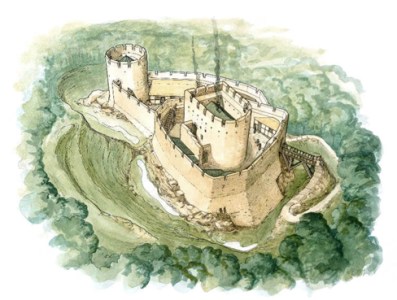
Artist’s reconstruction of Ewloe Castle. Source: Renn and Avent 2001

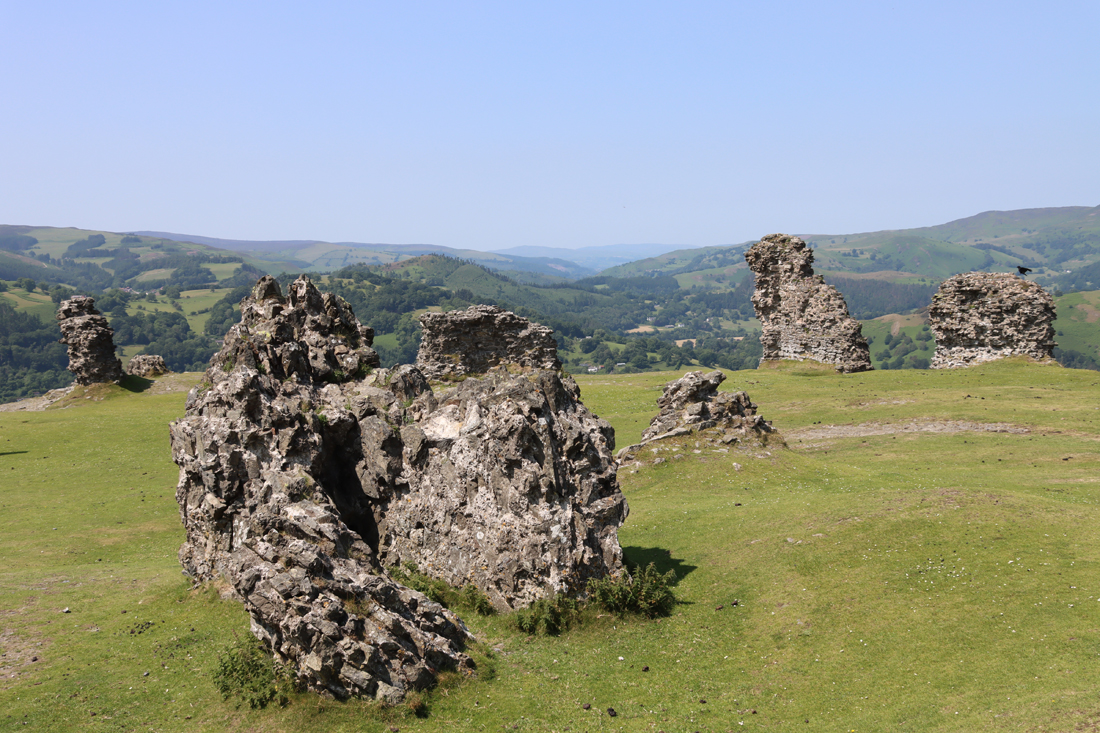
The ruins of the 13th century Ewloe Castle, one of Llywelyn ap Gruffudd’s more puzzling constructions, is located in the public Wepre Park, near Connah’s Quay and not far from Chester.

Visiting details are at the end of the post, including information about car parking, the visitor centre, an excellent downloadable guide to the routes through the park and its key features, as well as where to find out more information about the castle.
==


==

Wepre Park

Wepre Park map in the Explore Wepre Park PDF by Denbigh County Council online.  The Main Trail leads from the car park all the way to the foot of Eweloe Castle.  The Boardwalk is also reached from the car park, and is shown at bottom left.

Wepre Park is a woodland valley, largely deciduous, that flanks the Wepre Brook, and is very popular with dog walkers, joggers, and families. According to the park’s literature, it is a remnant of the great hunting forest of Ewloe.  More recently it was the site of Wepre Hall.  On a sunny day in the autumn, with the light filtering through the trees, this should be a wonderful display of illuminated colour.  The autumnal display was very fine, with the light filtering through the multi-coloured leaves and the woodland floors carpeted with bright yellows and oranges.  The woodland contains a wide mixture of different trees, shrubs and vegetation and is home to varied wildlife, including aquatic species, insects, birds, bats, badgers and a lot of very busy squirrels.  There is also a small wildlife meadow, although there is not much to see at this time of year.
==

The valley was owned in the 11th century by St Werburgh’s Abbey in Chester.  In the mid 12th century it was the site of a major confrontation between Henry II and the forces of Owain ap Gruffydd, ruler of Gwynedd in west Wales, during Owain’s campaign to extend his territories to the east. In 1157 Henry II took an army into northeast Wales to subdue Owain, but was ambushed by Owain in the Ewloe valley.  Although Henry escaped, and defeated Owain at Rhuddlan, Owain later regained much of the lost territory.

Wepre Hall, first built in 1788. Source: RCHAMW

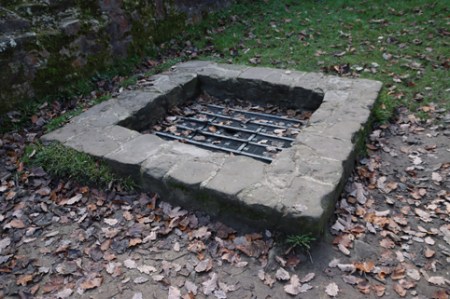
A house is recorded at the site from at least the late Middle Ages.  During the Civil War a house at Wepre belonged to Royalist supporters who, in 1645, supposedly hid in the cellars a Royalist sympathiser who was a participant in the the Battle of Rowton Moor.  It was rebuilt as a 2-storey Georgian house in 1788 by Edward Jones, the owner of a local lead mine, with outbuildings and later extensions.  It was demolished in 1960.  There is nothing remaining of Wepre Hall except for the cellars.  The visitor centre sits on part of the Wepre Hall site, and the gardens here and nearby are designed to echo the formal gardens of the Hall.

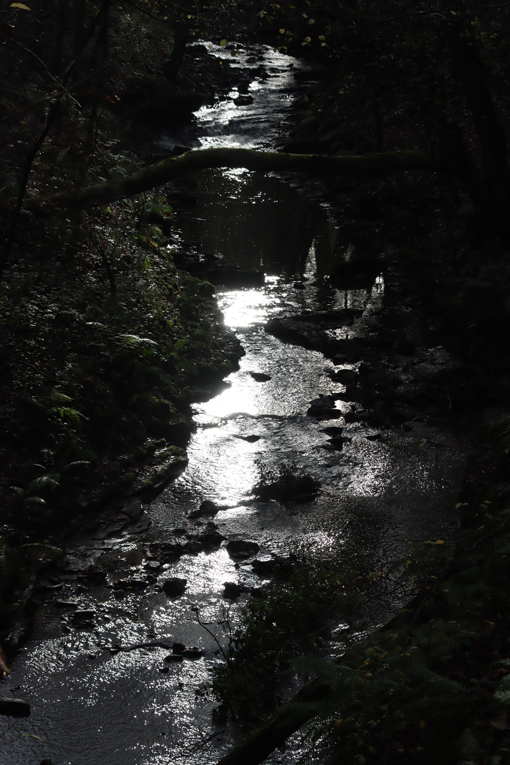
There are a number of routes through the park.  From the car park, the Main Trail is a wide metalled track that leads from the car park past the visitor centre nearly as far as the castle (after which there are wooden steps leading up to the castle).  It follows the line of the brook, which drifts in and out of sight and is constantly audible.  The most notable feature on the Main Trail, apart from the lovely woodland, are the outcrops of Hollin Rock, a 320 million year old red sandstone, popular as a building material.  Towards the end of the trail is a small and attractive bridge, Pont Aber, that was once located further upstream but was moved here in 1800 to improve access to Wepre Hall.  There is a delightful small waterfall on the other side, which used to be the location of the Castle Hill Brewery that used the water from a natural spring.
==

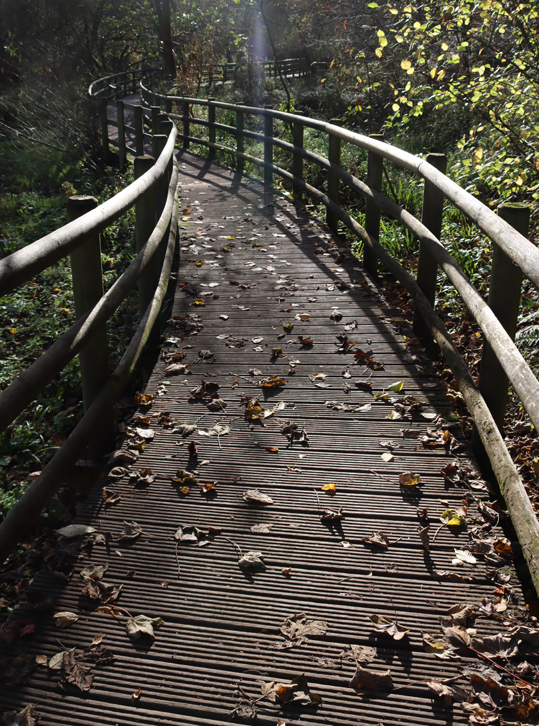
The second significant route is a boardwalk, which leads from the car park along the brook and connects to the Main Trail about half way way along.  The main feature of the Boardwalk route is the waterfall, actually built as a weir to power a small hydroelectric plant, but it is a very attractive feature.  The plant used to provide electricity to the Hall before mains electricity arrived in the area in 1925.  There is a variety of aquatic vegetation flanking the boardwalk, and information boards indicate the different wildlife, including birds, that can be spotted on a walk.  The boardwalk follows the brook closely until it slopes up slightly to meet the Main Trail, and the “bubbling brook” phrase never seemed more apt.  This is a very audio-visual walk.
==

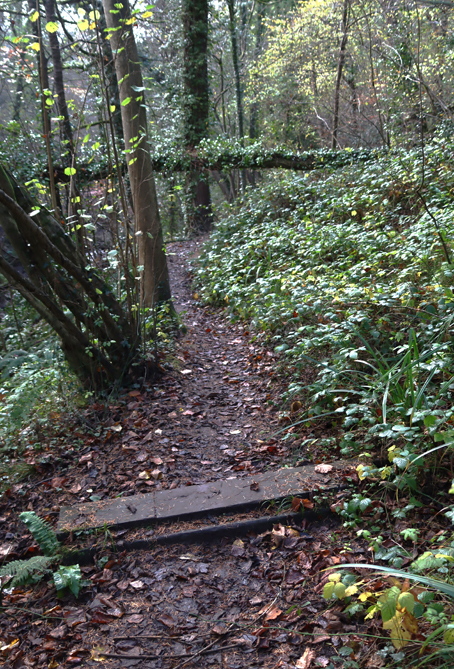
Some of the other footpaths are just well-worn tracks, very muddy at this time of year, but follow lovely winding routes through the woodland.  I tried the track from the bridge to the Devil’s Basin, supposed to be a short set of very pretty falls, but after five minutes or so the deeply churned mud made it completely impassable in ordinary hiking boots. It would have required wellies.

Near the visitor centre there is a small lake called the Rosie Pool that was created in the late 19th century for fishing and is now managed by the local angling club.  Immediately behind the visitor centre is a small but very attractive formal garden with a small pond, a nod to the former hall.  Even at this time of year, fuchsia, hydrangea and sedum still have some flowers.  There is a small pet cemetery located at its edge.  For more about the park download the Explore Wepre Park guide (in Sources at the end of this post).

Ewloe Castle

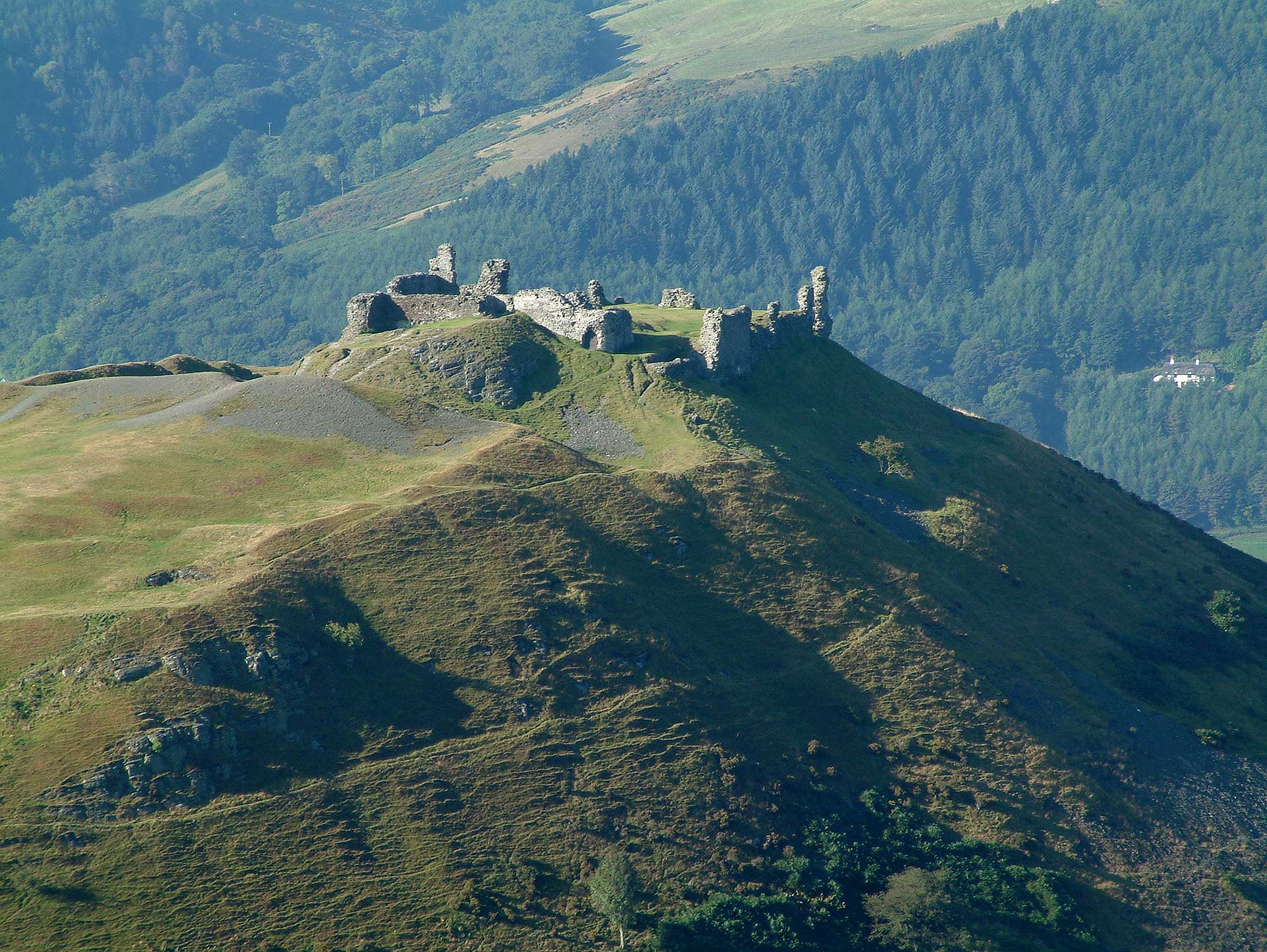
Ewloe Castle from the air. RCHAMW 6463845. Source: RCHAMW

There is some discussion about who built the castle. It was certainly either built or rebuilt in c.1257 by Llywelyn ap Gruffudd (also known as Llywelyn the Last), but he may have been restoring a castle originally built by Llywelyn ap Iorwerth (Llywelyn the Great).  The D-shaped keep has been seen as characteristic of Llywelyn the Great, and differences in the stonework of the upper and lower wards have been used to argue for a two-phase construction.  If this was indeed the case, it is argued that the upper ward would have been contemporary with the keep built by Llywelyn the Great and the lower ward built by his grandson Llywelyn the Last.  On the other hand, there is an early 14th century document that states that the entire was built by Llywelyn the Last.  The question remains unresolved, but it is not doubted that whoever built the castle, Llywelyn the Last certainly carried out extensive building work here.

Plan of the castle. Source: Lloyd 1928

Although it is built to a fairly standard Welsh plan, it is something of an oddity in strategic terms, not being built high on a hill but on the edge of a small valley.  Although the sides slope steeply away from the castle on three sides, it was actually overlooked from the south, so required quite extensive outer defences on that side, consisting of a ditch, the digging out of which would have provided a bank.
==

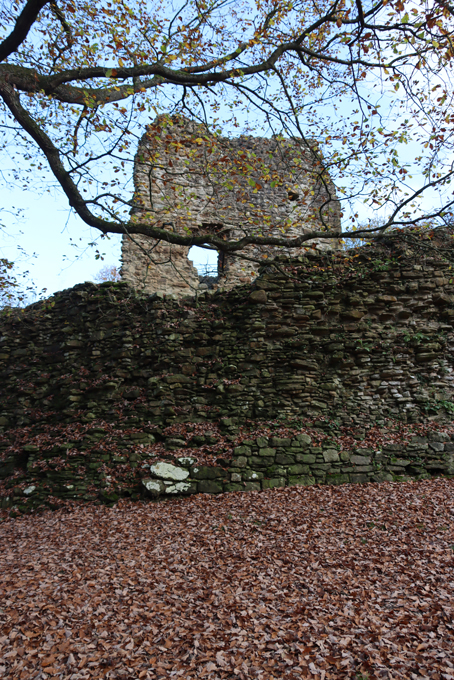
The keep sits within a small upper ward.  A larger lower ward was added, possibly at a later date, with a tower at its furthest extent from the upper ward and both were provided with curtain walls, some of which remain.  The D-shaped (or apsidal) keep has a small footprint with its semi-circular end overlooking the defences, whilst the tower in the lower keep overlooks both the southern aspect and the valley below.  The lower ward would have been provided with timber buildings for domestic functions and storage.

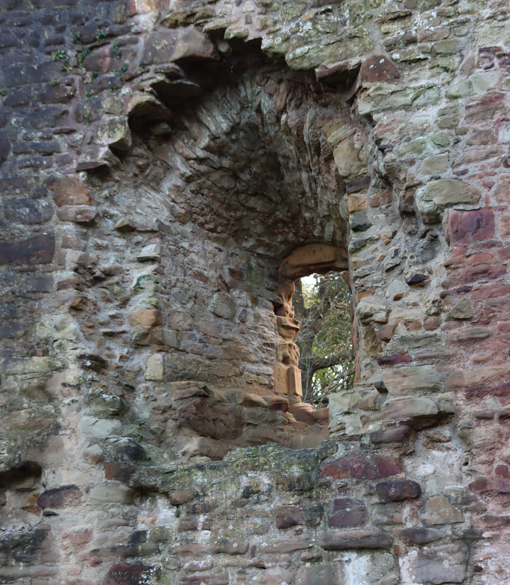
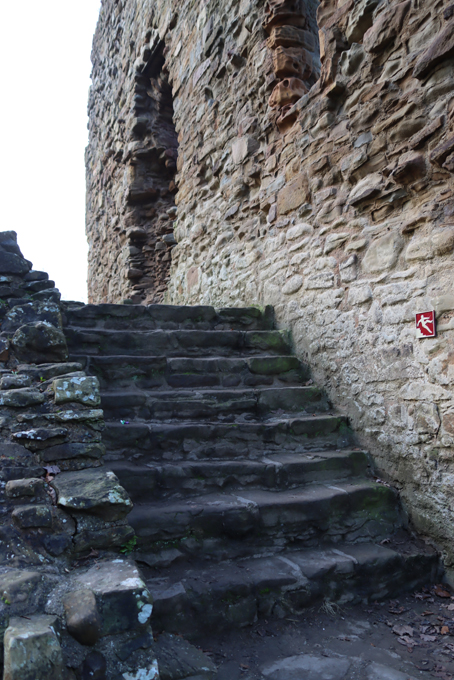
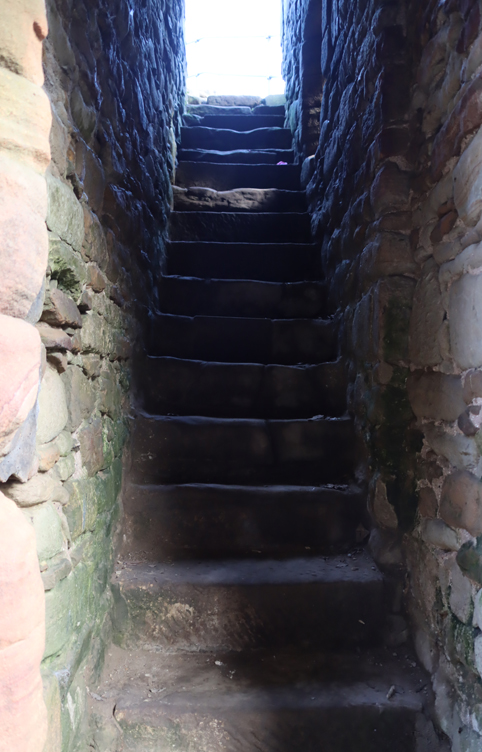
On the former ground floor of the keep, to which the steps at the back of the upper ward lead, the former hearth is still visible, and there are windows set in the thick walls.  Looking at the keep today, the lowest layer was a basement with no lighting.  The keep had an outer stone staircase at its south, and this is still in use for accessing the inner staircase that leads up inside the walls of the keep to a viewing platform at the top of what remains of the keep’s walls.

Two entrances, one into the upper ward and one into the lower ward would have been approached by bridges over the defences.  The lower ward’s tower was probably accessed from the curtain walls of the lower ward.

In 1257, when the castle was either built or rebuilt, Llywelyn ap Gruffudd was on the offensive, attempting to retake Perfeddwlad, otherwise known as the “Four Cantrefs,” which incorporated the cantrefs of Rhos, Rhufoniog, Dyffryn Clwyd and Tegeingl, a constant bone of contention between the Welsh princes and the English crown.

The problem of the poor strategic location could be explained by suggesting a different intention for the castle as more of a political statement than a fully functional military outpost.  Its location on the edges of disputed territory, not far from older English castles and the site of Owain Gwynedd’s defeat of Henry II may simply have been a statement of a Welsh return to land that they claimed as their own, and a useful staging point for any future negotiations, given its proximity to the Anglo-Welsh border.  This is supported by its probable use first in November 1259 and again in December 1260 when English ambassadors were sent to meet with Llywelyn at a place identified as Wepre, which must have been the castle.  There is no record of the castle’s involvement in 1276 and 1277, when war between England and Wales reignited, which may give added weight to this castle being a political gesture rather than a strictly military base, but could also reflect the necessity of Welsh retreat to safer ground.

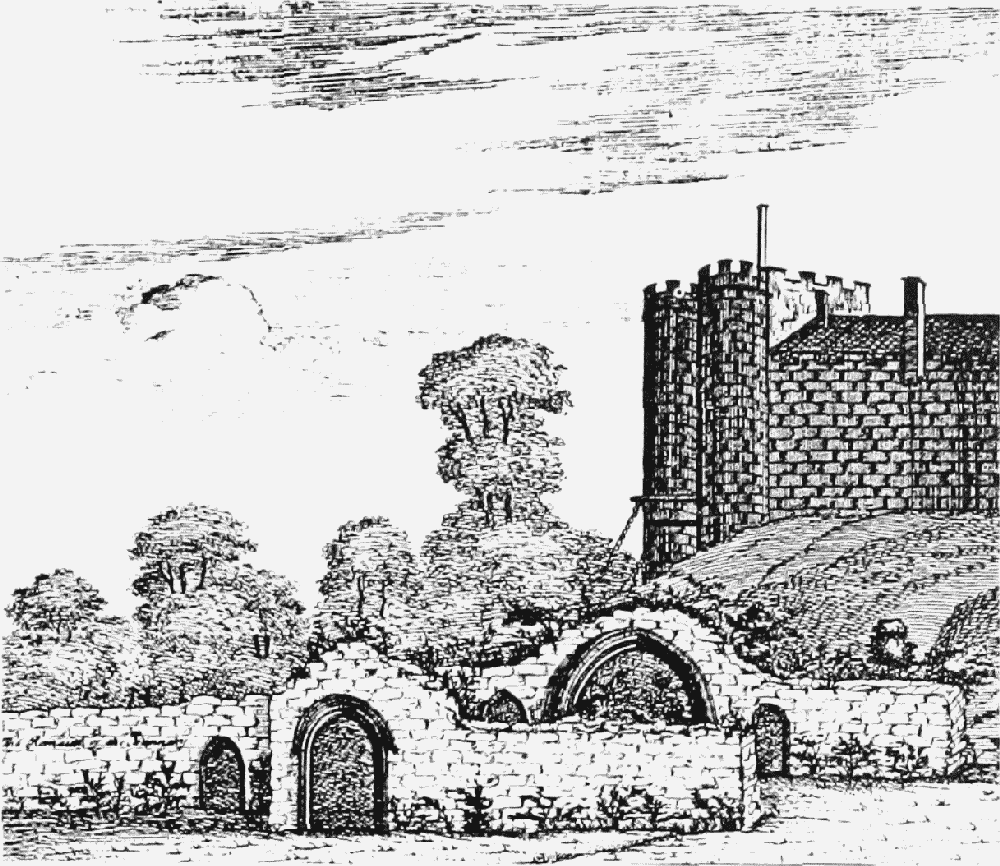
Ewloe Castle by Moses Griffith (1747-1819) NMW A13529. Source: National Museum of Wales

Edward I does not appear to have felt that Ewloe Castle was worthy of his interest.  Although he restored other castles for his own use, this was probably too small, too badly sited and too difficult to defend.  Instead, in 1277 Edward began to build at Flint (posted about on the blog here), Rhuddlan (posted about here) and Denbigh (posted about here).  Owain Glyndwr’s rebellion in 1400 found no use for it either.
==

Visiting

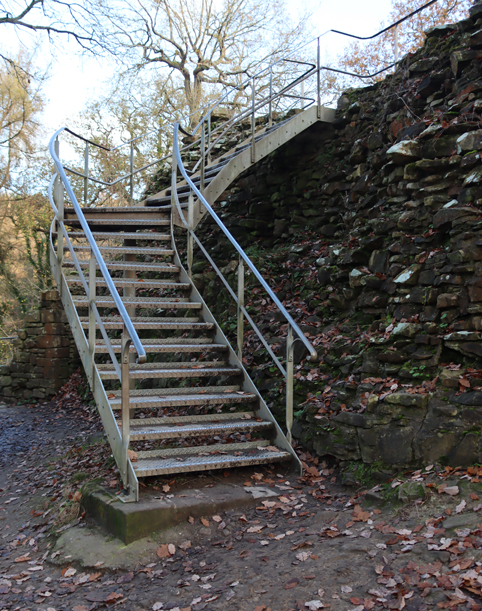
Access to the castle, managed by Cadw, is free of charge and open all year round, as is the entire park, but you will need to be confident with stairs, as they are the only way in and out of the castle.  There are new metal stair cases with handrails, and original stone ones, including a small flight in a stairwell in the keep leading up to a viewing platform at the top.  None of the stone staircases have handrails.

Parking is straight forward for both castle and park.  If you only want to see the castle there is a lay-by on the side of the B5125 that looks as though it will take about 8 cars, maybe a couple more.  I didn’t try the route from there to the castle so have no idea what the footpath is like underfoot, but the What3Words address for the lay-by parking is ///follow.beauty.mistaking.  The official car park is a large one near the visitor centre on Wepre Drive. Ewloe Castle is about a mile away from this car park along a very easy and attractive trail. The What3Words address is for the main car park is  ///contrived.writing.mailers

A circular walk taking in the boardwalk and returning to the car park via the Main Trail would be suitable for unwilling legs, as would a walk along the boardwalk to the bridge and then back along the main route.  The castle is not suitable for those who cannot manage steps and stairs, as this is the only way of getting into the castle, from whatever direction you approach.

The visitor centre is closed at this time of year (November) but its cafe was open on my visit.  The public toilets are also open nearby.  There’s a substantial play area on the edge of the car park.  There are a small number of good information boards throughout the park, including one at the castle, but the Cadw official guide to Flint Castle also has a section on Ewloe Castle.  Other sources are listed below, including castle information and an excellent guide to the park, together with a footpath map.


Sources:

Wepre Park

Flintshire County Council
Parks and Countryside
https://www.flintshire.gov.uk/en/LeisureAndTourism/Countryside-and-Coast/Parks-and-countryside.aspx
Discover Wepre Park Booklet
https://www.flintshire.gov.uk/en/PDFFiles/Countryside–Coast/Discover-Wepre-EnglishWEB.pdf

A different map that may be slightly easier to follow is on the following link:
Potty Adventures
Wepre Park
https://pottyadventures.wordpress.com/2016/07/16/wepre-park-our-local-8th-wonder-of-world/

=
Ewloe Castle

Books and papers

Davis, Paul R. 2021.  Towers of Defiance.  The Castles and Fortifications of the Princes of Wales. Y Lolfa

Lloyd, J.E. 1928.  Ewloe.  Y Cymmrodor, vol.39 (unnumbered)

Renn, D.F. and Avent, R. 2001 (2nd edition). Flint Castle – Ewloe Castle. Cadw

Websites

BBC News
13th century castle to be sold (18th November 2009)
http://news.bbc.co.uk/1/hi/wales/north_east/8364611.stm

Cadw
Castell Ewloe
https://cadw.gov.wales/visit/places-to-visit/castell-ewloe

Coflein
Ewloe Castle
https://coflein.gov.uk/en/site/94447/
Wepre Hall
https://coflein.gov.uk/en/site/36307/

Wales Online
Ewloe Castle has sold to farmer at auction (9th December 2009)
https://www.dailypost.co.uk/news/local-news/ewloe-castle-sold-farmer-auction-2770922
==

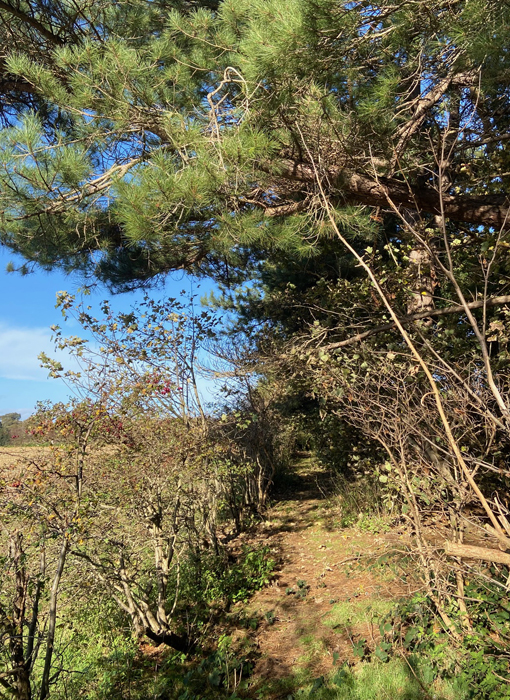
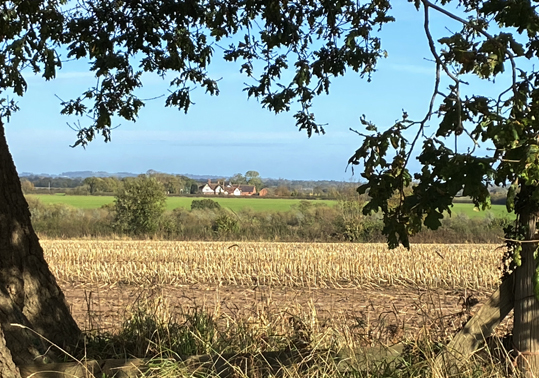
An autumnal stroll from Churton to Aldford, pausing for lunch at The Grosvenor

Autumn sun and brightly coloured leaves are always a joy at this time of year, right up until the point that they drop in huge numbers and need clearing off the garden lawn 🙂

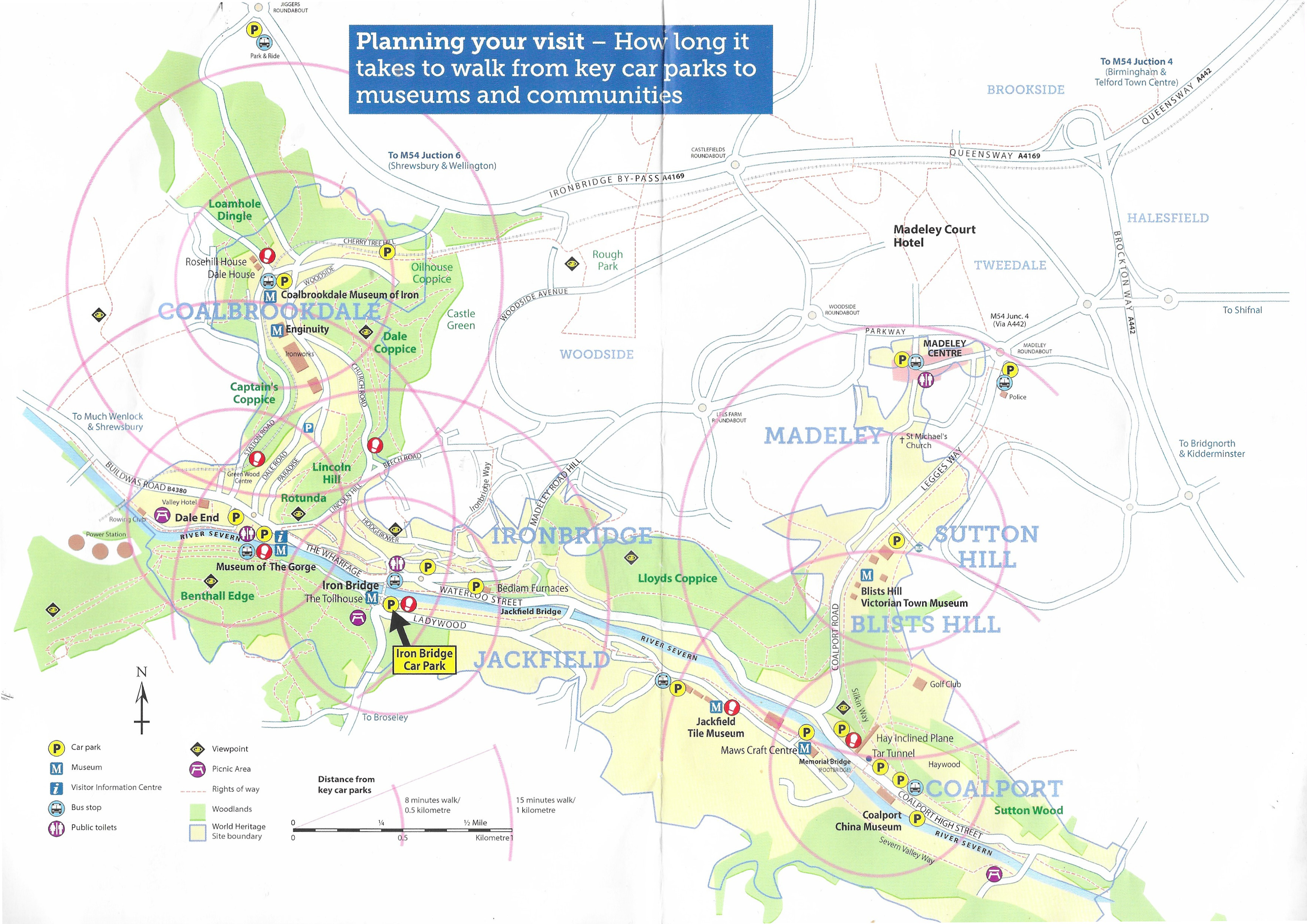
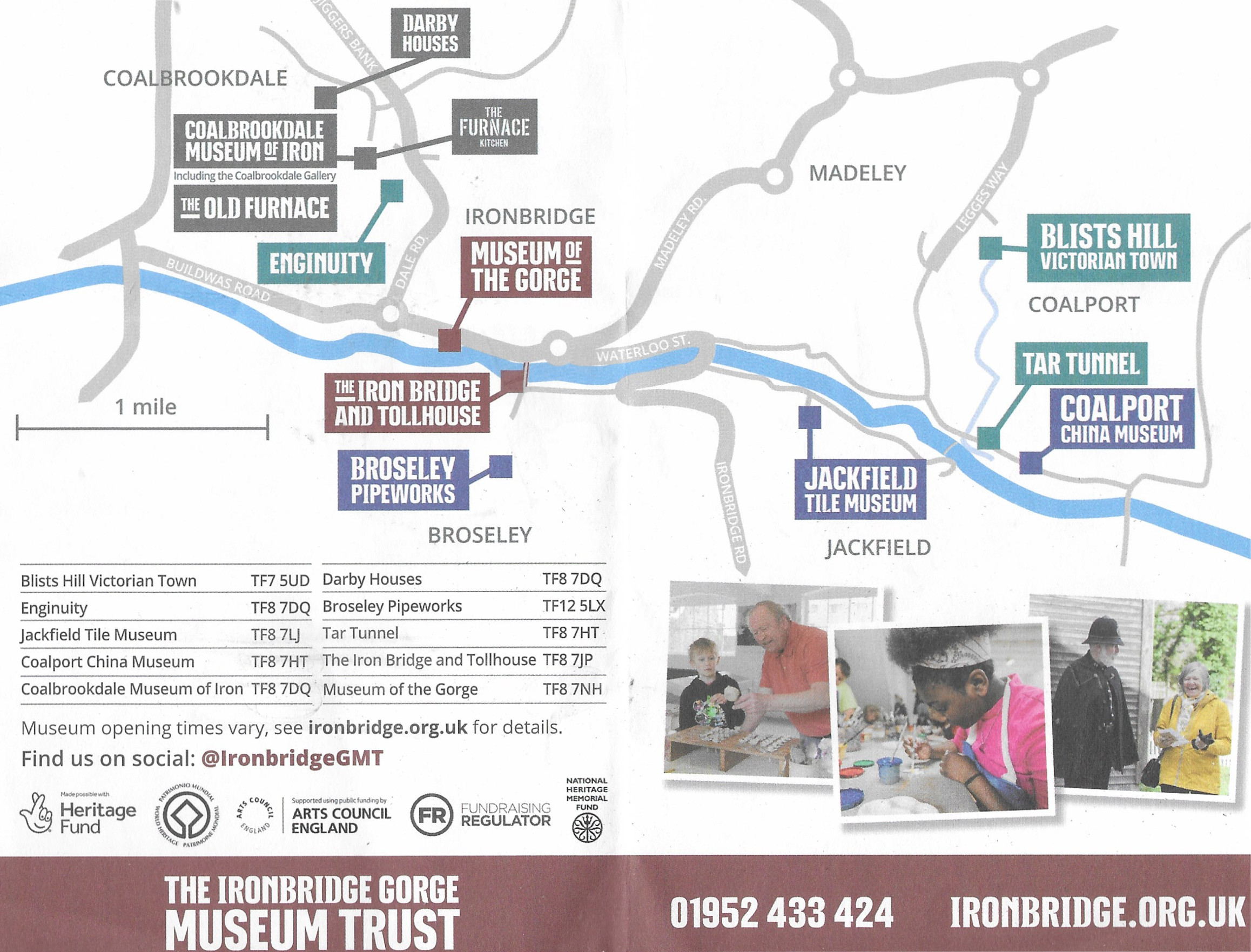
Because it was so warm, my destination was The Grosvenor pub, a self-indulgent extension to my terrific short break in the Ironbridge area of Shropshire last week.  It is always such a treat to be able to sit outdoors at this time of year.

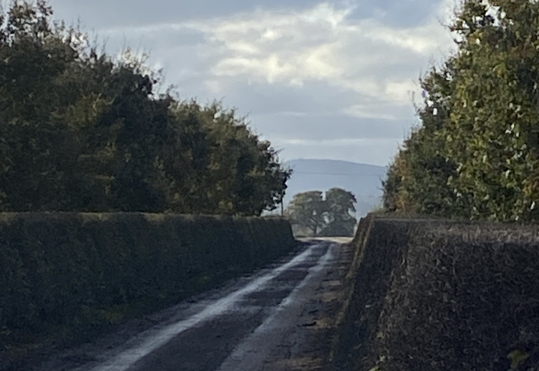
The map of this walk is at the end of the post, and is a very simple one.  It takes around 40 – 45 minutes to walk through the fields to Aldford from Churton, so it is a short walk, and always a good fall-back when I don’t want to be bothered with the car.  The harvested fields, mainly used for growing corn, can be very soggy at this time of year with nothing but wet earth under foot, but it is always an easy and attractive option on a sunny day when the leaves are changing colour.  It was fine on the field edges, although distinctly squelchy underfoot crossing diagonally from footpath FP7 to FP6.  Half of the route is the metalled B-road Lower Lane, which gave the hiking boots a bit of a break from the sludge.

Irritatingly, I did not have my camera with me, so these were taken on my iPhone and many don’t bear close scrutiny.
===

=====================

======

===

===

After a very enjoyable lunch in the sun at the Grosvenor Arms, I had a wander around the village and returned back to Churton using the same route.  Normally I go back via the well-signposted FP8 footpath, but having investigated on my way to Aldford, deemed it far too muddy and waterlogged to make the attempt in anything other than wellies.  In the dry, this is a nice return route and takes in a chunk of the Roman road that once ran east of Churton (about which I posted here).

===

===

===

===

===

===

===

===

Cheshire West and Chester Public Map Viewer, annotated


A walk from Waverton towards Chester along the Shropshire Union Canal

I have driven over the canal bridge on Eggbridge Lane in Waverton so many times thinking that I really must take advantage of the little car park just before the bridge to go and take a stroll down the towpath.  Having woken up early on a sunny morning I decided to investigate. Waverton is just off the A41, so very easy to reach. The car park is quite small, but it was not full even on a bright and warm morning.  The What3Words address for the car park is ///fingertip.snored.deals

Victoria Mill, Waverton

Immediately opposite the car park, as you walk to the towpath, is a very attractive canal building, the Grade 2 listed, a mid-19th century Victoria Mill, a former steam-powered canal-side corn mill, with bays for loading and unloading narrowboats, and now converted for modern use. The Historic England description is here.  This is part of the heritage of the Shropshire Union Canal, which if you keep walking north eventually ends up at Ellesmere Port.  To the south, it eventually connects up with the rest of the main canal network at Hurleston Junction.  The Shropshire Union has quite a complicated history, as does Chester’s canal heritage as a whole, and was not completed until 1835.

As with most canal walks, there’s always a choice to turn right or left, and as I had no idea what to expect from either direction I decided to head north, leaving the walk south for another occasion. Out of the car park I turned left under the unprepossessing bridge no.119 and headed up the towpath.  This section is metalled, so it avoided the mud and sludge that I had been half expecting.

If you take this route you find yourself walking along a short row of houses with canal gardens along a metalled pathway.  Canal-side gardens are always fascinating.  I used to live on a narrow boat many years ago, and it is always a lot of fun to see how different minds have dealt with a garden that opens directly on to a canal.  These are always hugely individualistic and personal.  There is always much to see in the way of garden furniture, garden ornaments (someone will always have gnomes, and there is usually at least one example of traditional canal painting), sheds in various states of repair, a wide range of summer houses, varieties of approaches to terracing, often some very interesting specimen trees and shrubs, and different attitudes to garden seclusion, along a spectrum from solid barriers of hedging or fencing to a complete lack of interest in any form of privacy.  A real cultural treat.

After just a minute or so the towpath enters a more rural section, and in the late season sun it was a real pleasure to take in all the autumnal colours on trees and shrubs that flank the canal.  I’ve posted some of the photos below. It’s a well-used section of towpath, with joggers, cyclists and plenty of dog walkers, but everyone is very civilized about moving over to make passing easy.  There was not much in the way of canal traffic, with just two narrowboats on the move, but I expect that it is much busier in summer.

Keep an eye out on your left as you leave the housing on your right and reach the more rural section.  Partly concealed by the grass next to the towpath, there is a short inscribed red sandstone Parish Boundary Marker. This section of the canal passes through the parish of Rowton, famous for the Civil War Battle of Rowton Heath (see the Wikipedia entry on the subject and a more detailed analysis by Historic England).  King Charles I is said to have watched his army lose that battle from the Phoenix Tower that still stands on Chester’s city walls. The stone marks the boundary between the parishes of Christleton (CP on the stone) and Rowton (RT).  The date commemorates the date of the battle in 1645 and, below the level of the grass, 1995, the 250th anniversary of the battle.
===

After this more countrified section there are more houses, all interesting, with some lovely weeping willows and other water-loving species, and a very attractive hump-backed bridge, that I have since discovered carries Rowton Bridge Road into Christleton.  I walked up as far as The Cheshire Cat, which sensibly has a gate onto the towpath, and carried on just a short way beyond it, but at that point the canal converges closely with the A41 (Whitchurch Road) and it becomes quite a noisy experience with the unremitting traffic, especially during the week.

Checking the map later (for example see the plotaroute.com website), I note that by coming off the towpath at Rowton Bridge it is possible to walk into the attractive village of Christleton, with its marvellous pond, and I would have done this had I realized.  Another time.  had to be somewhere else in the afternoon, so it was a short walk, probably an hour and a bit there and back at strolling pace, with pauses to let bicycles pass, and to take photographs.

For those with unwilling legs (see the blog’s Introduction for details about what this refers to), the towpath heading north from Waverton is metalled, but quite uneven.  No problem for most people, I would have thought but do keep an eye on it.  There are places where the edges of the surface are particularly uneven, but this just means that if you are with someone else you need to go in single file for short sections.  Otherwise, it’s on the flat and very enjoyable.

On the way back I followed the towpath beyond the car park for a few minutes to see how far the housing that backs onto the canal extended.  This part of the towpath is not metalled, was muddy and is single-track.  These houses and gardens are another interesting mixture – each of the sections of housing and gardens has its own personality, presumably reflecting both when it was built and the pricing.  These look as though the garden-canal margins were all designed with narrowboats or other canal vessels in mind. There was indeed one narrowboat moored up at a garden.  The housing stops after a couple of minutes and the towpath reverts to a far more rural appearance.  I’ll investigate further on another day.

Overleigh Cemetery Self-Guided Geodiversity Tour

Many, many thanks to Paul Woods (Chester Green Badge Guide who leads the cemetery tour Stories in Stone) for sending me the scans of this leaflet by Cheshire RIGS and the Northwest Geodiversity Partnership, apparently published in 2012.  It looks at the most common types of stone used, gives some geological details about it, and discusses how some of it responds to environmental conditions.  I’ve shared the JPEGs below but I have also turned it into a PDF that you can download by clicking here.  I cannot wait to take it for a test drive!

Overleigh Cemetery, Chester #2 – The living, the dead and the visitor

In part 1 of this series on Overleigh Cemetery the economic background to Overleigh Old Cemetery was introduced briefly, and details of the reasons and execution of the foundation of Overleigh Old and New Cemeteries were discussed.  Here, in part 2, both Overleigh Old and New Cemeteries are explored in a little more depth.  There are a great many components that contribute to how a gravestone looks, what it says, and what it meant to the bereaved.  Between the sculptural forms, the symbols used on headstones and the inscriptions, as well as the design of the the cemetery itself and the ways in which it evolved and was used and perceived at different times in the past, Overleigh has a lot to contribute to how we think about Chester and its occupants.

Eliza Margaret Wall, died 1899, aged 30. Other family members were added in future years up to 1936

As a starting point, it is useful to look at who the main users of the cemetery were and are, both living and deceased, before moving on to a general guide to what to look out for if you are a visitor interested in learning about what the cemetery has to offer.

As in part 1, where I have included a photograph of a grave and there is information about it on the Find A Grave website, I have added a link.  For anyone using the database for their own investigations, note that Find A Grave treats Overleigh Old and New cemeteries as two different entities and you have to search under the correct one.

I have stuffed this full of photographs to help explain some of my points, so Part 2 looks bigger than it actually is.  You can click on any of the images to see a bigger version.

With many thanks again to Christine Kemp (Friends of Overleigh Cemetery) for her much-appreciated ongoing help.
====

People

Graves represent people, the living and the dead, both entangled in the complexities of funerary rites.

The bereaved

A funeral at Overleigh Old Cemetery. Detail of 19th century engraving of Overleigh Cemetery. Source: Wikipedia

Although this post is about a burial ground and its graves, funerary traditions and practices are all as much, if not infinitely more, about the living.  The need to recognize and commemorate loss, not merely at the funeral but prior to it and after it are essential to people, even today when the traumas associated with death tend to be handled in more internalized ways than in the pre-war periods.

Gravestone of Geoffrey Mascie Taylor, died 1879. If anyone has any idea what the symbol represents at the top of the gravestone, please let me know.

During the Victorian period there was an elaborate process of marking a death, a tradition of precise convention and ritual, expressed both within the family and communally.  When someone dies the living are left behind to handle a loss as best they can, and cemeteries and memorials are only one one part of that process.   The end to end process from death to mourning is all a part of the Victorian experience of bereavement.  Visiting and tending the grave, bringing flowers for the deceased, was part of this process, in which women had a key role, and demonstrating bereavement in public essentially brought the grave into the domestic sphere.  Several of the books listed in the references, go into some detail about the Victorian expressions of mourning, and books by James Stevens Curl in 1972 and Judith Flanders in her recent overview provide great insights, but if you want a much shorter book with a still very comprehensive and well written overview, Helen Frisby’s Traditions of Death and Burial offers an excellent overview of Victorian and later bereavement ceremonies.

John Owens JP, died 1853, age 72.  “A Merciful Man Whose /
Righteousness Shall / Not Be Forgotten.” There are no additional inscriptions on this impressive headstone

In the Victorian period it has been argued that the lead-up to a funeral, the funeral itself and its aftermath were all components of an intention to promote social status, wealth and the knowledge of and participation in deeply embedded social conventions that specified in detail how death should be handled and how mourning should take place.  The Industrial Revolution had created a new type of middle class, many of whom were making livings based on manufacturing and commerce, as well as roles in the growing legal, medical, administrative, banking, and similar sectors. Even though there were more opportunities for social mobility, and the ability for individuals to define themselves in new terms, the aristocracy still provided a model for those with social ambitions.  Conspicuous displays of personal and family identity and wealth had become fundamentally important in this need to establish a dignified and self-important identity at a location between the upper and working classes. It was also important for the lower middle classes to distinguish themselves from those who were less financially robust, doing what was perceived as more menial work, defining themselves as socially distinct from the working class. Hierarchy, with all its subtleties during the Victorian period, was important, deeply-felt, and complex, and much of this is reflected in funerary rituals.

More recently it has also been recognized that elaborate Victorian and early Edwardian funerary ceremonies were not merely social devices but reflected the great trauma associated with loss in a world where medicine was in its infancy and where where the middle class was defining itself within often smaller families than previously.  Sickness and death could be both frequent by comparison to today, and was often profoundly distressing.  At the same time, sanitation and health were slowly improving in the second half of the century, meaning that once childbirth and infancy had been survived, people physically lasted longer than they had done in the past, building relationships but more frequently succumbing to old-age problems, becoming invalids who were cared for within the home.  National and community diseases were frequent, some of them long-lasting, and the role of women in nursing their relatives became increasingly important where professional standards of nursing were, just as much as the professionalization of medicine, in their earliest incarnation.  Middle class family ties, and the Victorian and Edwardian sense of moral responsibility to relatives, ensured that sickness was a very frequent component of family life.

TThe monumental grave shrine of Henry Raikes, died 1854, aged 72, Chancellor of the Chester Diocese and one of the founders of the Chester “Ragged Schools.” Overleigh Old Cemetery..

Relatively recent research has also suggested that working class people felt no less strongly about the loss of their partners, siblings and children.  Many working class families were crowded into insanitary areas all over in Britain, and notable areas have been identified in Chester, forcing people into much closer proximity, and this promoted the transmission of sickness and disease with a consequent cost in terms of poor health. Sickness was handled within families, which caused many problems in household management, where women frequently worked for a living, often in domestic capacities.  This resulted in the occasional recourse to a new breed of hospitals as well as a frequently dubious type of pre-professional paid nursing care. The ease of disease transmission meant that those living so close together and in such insanitary conditions were most at risk of epidemics, and the mortality rate was much higher than in middle class households. There were clubs into which people could pay a subscription to save up for funerals, just as there were clubs to save up for Christmas, and there are several pauper graves at Overleigh. But for some the costs were too high, so many graves were unmarked, and the grief of some families was never recorded meaning that these losses are not captured.

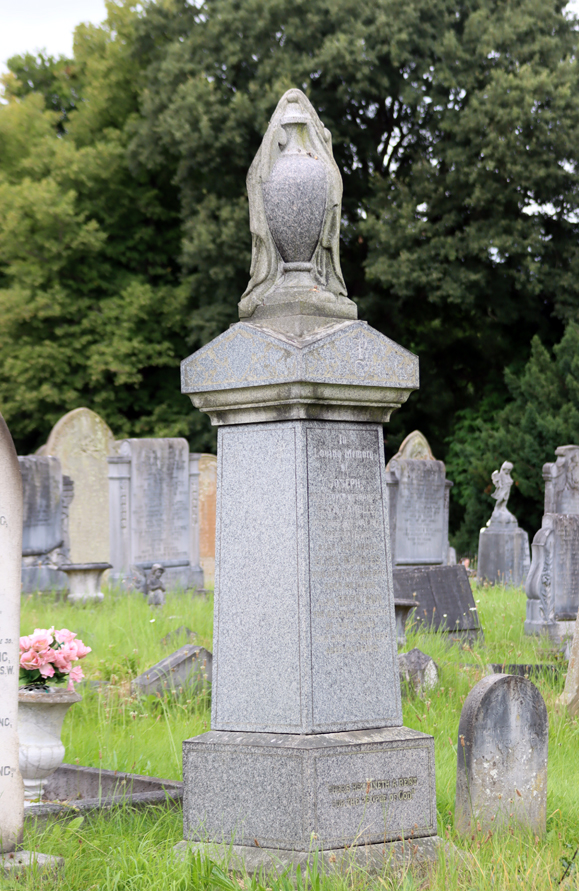
The monument for Joseph Randles, died 1917, aged 65-66. Note the partially veiled urn, which will be mentioned later.

It is easy to forget that until the NHS was established in 1948, most people still died at home rather than in hospitals, hospices or nursing homes, and that families housed the deceased, until burial, within their homes, and those deceased, laid out in front parlours in their coffins, were visited by friends and families.  The introduction of the funerary Chapel of Rest in the later Victorian period helped to reduce the time when the deceased remained in the house, but it was still a common part of a death that the dead remained amongst the living until the funeral well into the 20th century.

The focus on ceremony and ritual altered over time, with a considerable change of direction from the elaborate ceremonies of the Victorians to the minimalist approaches taken today. This does not mean a growth of indifference to death, but it does indicate changes within society. The beginnings of this are to be found in the Edwardian period, particularly during and after the First World War, when the nation’s horses that traditionally pulled hearses were required for the war effort. Funerals became even less demonstrative after World War 2.  This will be discussed a little more in Part 3.

On this Armstrong family cenotaph and headstone in the Overleigh New Cemetery, three sons predeceased their parents aged 32 in 1917, 22 in 1918, and 39 in 1927, the first two of them at war, all of which must have been a shocking loss.  Their parents are commemorated here too.

In the cemetery itself, the most obvious incorporation of gravestones into the world of the living is the highly visible custom of flowers and other gifts having been left in front of a headstone.  Fresh flowers in particular give the sense of a grave being regularly tended but artificial flowers and other items also serve to mark the continued attention to a grave by those who wish to indicate their recognition and care.  My father, who was born in 1936 and grew up on the Wirral, says that when he was a small boy he was taken regularly to the graves of his relatives in Liverpool, where there was a flower shop outside the gates, and flowers were purchased, a visit was made to family graves, and a picnic was enjoyed nearby.  It was a visit of celebration, continuity and memory, a positive occasion.

The other most obvious indication of a gravestone continuing to have a role is the presence of multiple inscriptions on many memorials, as individual family members are lost and the living are compelled to update the inscriptions.  Many of these gravestones capture this passage of time and accumulated loss very effectively, telling long narratives of family loss, sometimes covering several decades, and suggesting multi-generational involvement with funerary activities and commemoration, the sense of a continuum between the past, the present and the potential future.

The Deceased

The deceased may seem to be passive and inanimate, but they have voices in at least three ways.  First, they may have had input into their own graves, including its location, its design and its use as a single plot or a family plot.   In this sense they are very much agents of their own burials.  Second, the very process of memorialization, whether by family or friends, gives the departed an enduring presence that lasts into the modern world, a very material presence.  Some of those who died may also have obituaries to be found in newspaper archives, and accounts of inquests into their deaths, filling out a much richer picture of former lives, and those who were in positions of influence will have had much more information captured in official documents and even preserved journals.  In this way they can contribute very significantly to modern research projects, as much as that may have surprised them.  Third, they occupy the living landscape of cemeteries, spaces that occupy often new places in modern life and that are valued today.  At Overleigh I have seen people walking from one end to the other pause to read an inscription, and dog walkers wandering around, pausing to take note of a particular grave.  The dead area still amongst the living, even when they are not even slightly connected today with their ancestors.  Those who care for their graves, and tours that bring visitors, all do their essential bit to keep the deceased amongst the living.

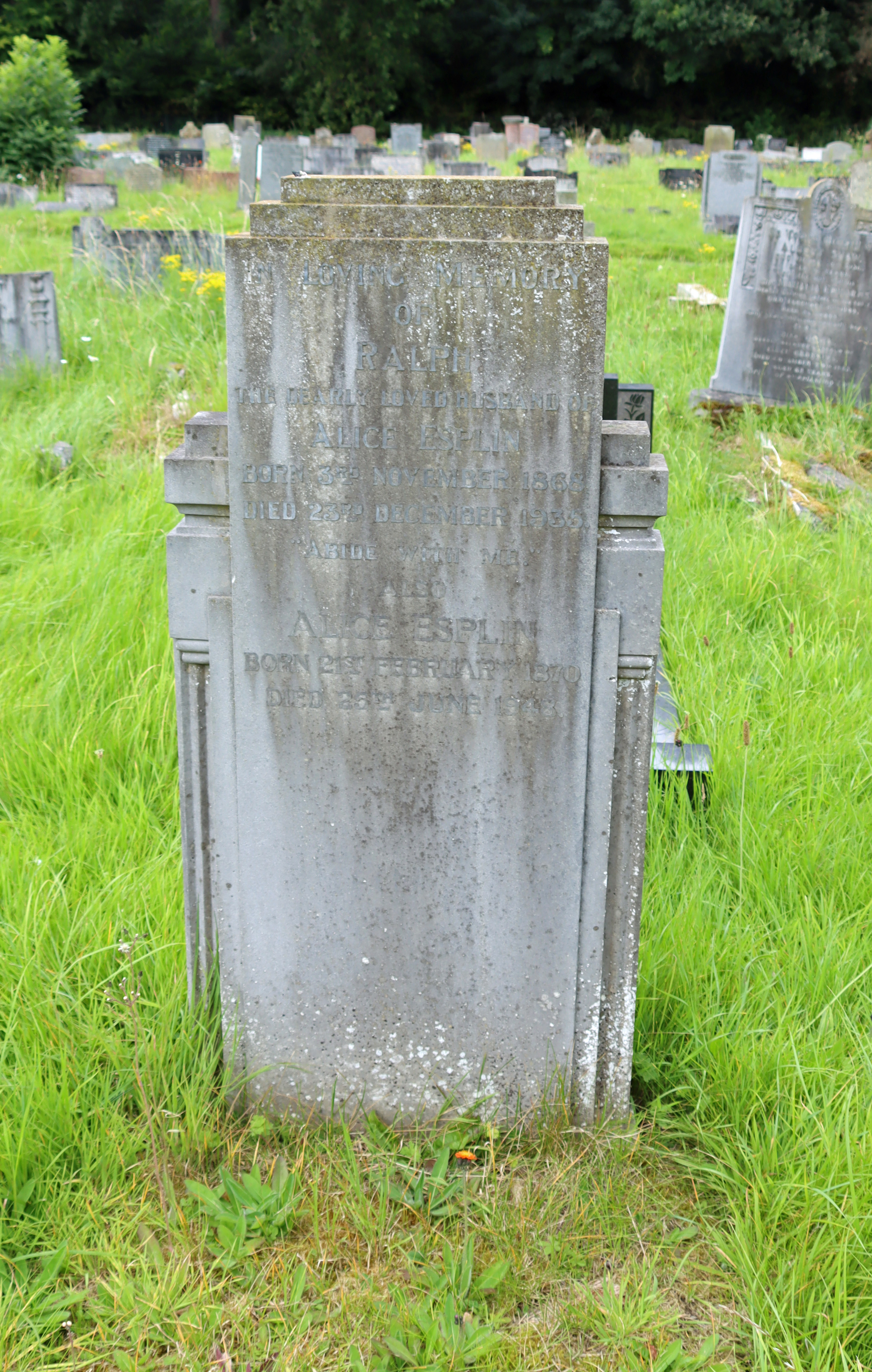
Art Deco style headstone of Ralph Esplin, died 1935, aged 67

It has been the experience of cemeteries since the beginning of the 17th century in Britain that graves are tended for perhaps three generations after which they fall out of use, as families move away or simply move on.  Genealogy makes some of them  briefly relevant, but the funerary landscape is a strange mixture of the abandoned and the perpetuated.  Local authorities and Friends societies contribute to the task of caring for abandoned graves, but this is a very different relationship from those that are still visited by family members.  In Victorian cemeteries, there is always a rather strange dynamic between the historical sections and those that are still the essence of loss, bereavement and and ongoing engagement.

The deceased in the early periods of the cemetery capture something of Chester’s evolving social, economic and cultural endeavors, as it attempted to secure its future and create a stable and prosperous community.  Those who are represented in the cemetery are largely those who were either already successful in establishing themselves within this community or were making the attempt to improve themselves and gain status; the unmarked pauper and cholera graves are amongst the hidden histories of Overleigh and of Chester itself.  There is time-depth here too, as we can track changes from 1848, when the Old cemetery was established, through the Edwardian period and both World Wars, and the changes during the post-war period up until the present day.  I have been learning how much work it takes to see beyond the sea of graves and to read history captured in the cemetery landscape and monuments, and it is all there to be found, the world of the dead contributing to an understanding of the transforming past and how society’s views on death and commemoration changed.  Parts 3 and 4 will go into this in more detail.
===

Visiting Overleigh for the first time – what to look out for

The central monument, in rose granite, is a truncated obelisk, indicating a life cut short and usually associated with the loss of younger people, although not invariably. In this case, Harry MacCabe who died aged 26.

I have started here with the most obvious way of getting to grips with a cemetery – how things look when you walk through for the first time.  This is about shapes, materials and the visual cues that you can pick up at first glance to give an indication of what the casual visitor may want to focus on during a first visit.

The majority of monuments at Overleigh are vertical, unlike the variety seen in local churchyards that include a variety of other horizontal and chest-type forms, as discussed in connection with the churchyard at Gresford, some 10 miles south of Chester.  The example below shows one of the  horizontal representations, which are less numerous, although of course by being less visible are more likely to be overlooked.

Although I discuss Overleigh as a site that helps us to connect with history, it is important to remember that both Old and New parts of Overleigh are still in use for new interments and cremation memorials, and that families and friends are still regular visitors to visit their departed and tend their plots.  All visits by those of us who are not connected with family or friends interred in the cemetery need to explore with respect and care for those other visitors who are at the cemetery for the purpose of connecting with the departed.

The horizontal gravestone of Major Richard Cecil Davies is one of the relatively few gravestones that are not vertical. Some, of course, have fallen over and are now just as horizontal as this one, but this was always intended to lie over the grave and face upwards.  These are always vulnerable to being taken over by grass and weeds, and need an eye kept on them.

Themes and symbols

Author James Curl (1975) found this advert in an 1860s guide to Highgate Cemetery in London, showing a range of grave monuments available for purchase. Most of these have equivalents at Overleigh.

How were headstones and monuments chosen?  From the 1830s onward stonemasons had catalogues from which headstones could be chosen, just as there are today.  Today there are also catalogues from which to choose, many of them online and offering a wide range of alternatives.  At the same time, some families might prefer a grave that is similar to that of other family members, and some might want to emulate styles admired in a local cemetery.  The imagery on the graves during the Victorian and Edwardian periods formed a rich language of meaning that is understood by all, including the illiterate.  Sometimes the imagery used on a gravestone may say as much if not more about the emotional relationship between the living and the deceased than the text inscription, including the hopes that the living had for their dearly departed.

Headstone of George Henry, with a lily, the symbol of mourning, purity and peace

When you are walking around, you will notice that certain themes are recurring in the designs of the gravestones in both halves of the cemetery.  These represent specific choices that people have made and the ideas that they wish to communicate.  These can either be sculptural memorials or more modest headstones that incorporate carved imagery.  Sometimes headstones just include text, and sometimes there is just a kerb with no headstone which usually lacks imagery, but the symbolic medium is often an important part of the message that a gravestone communicates, imparting a different type of information from the text, often rather more subtle and conceptual than what is written, sometimes capturing emotions and ideas rather more effectively than words.  There is a usually a minimalist formality in what is written, but this does not extend to imagery and symbols, which can be far more expressive.  The themes and symbols mentioned below are just examples that I have found in Overleigh Cemetery.

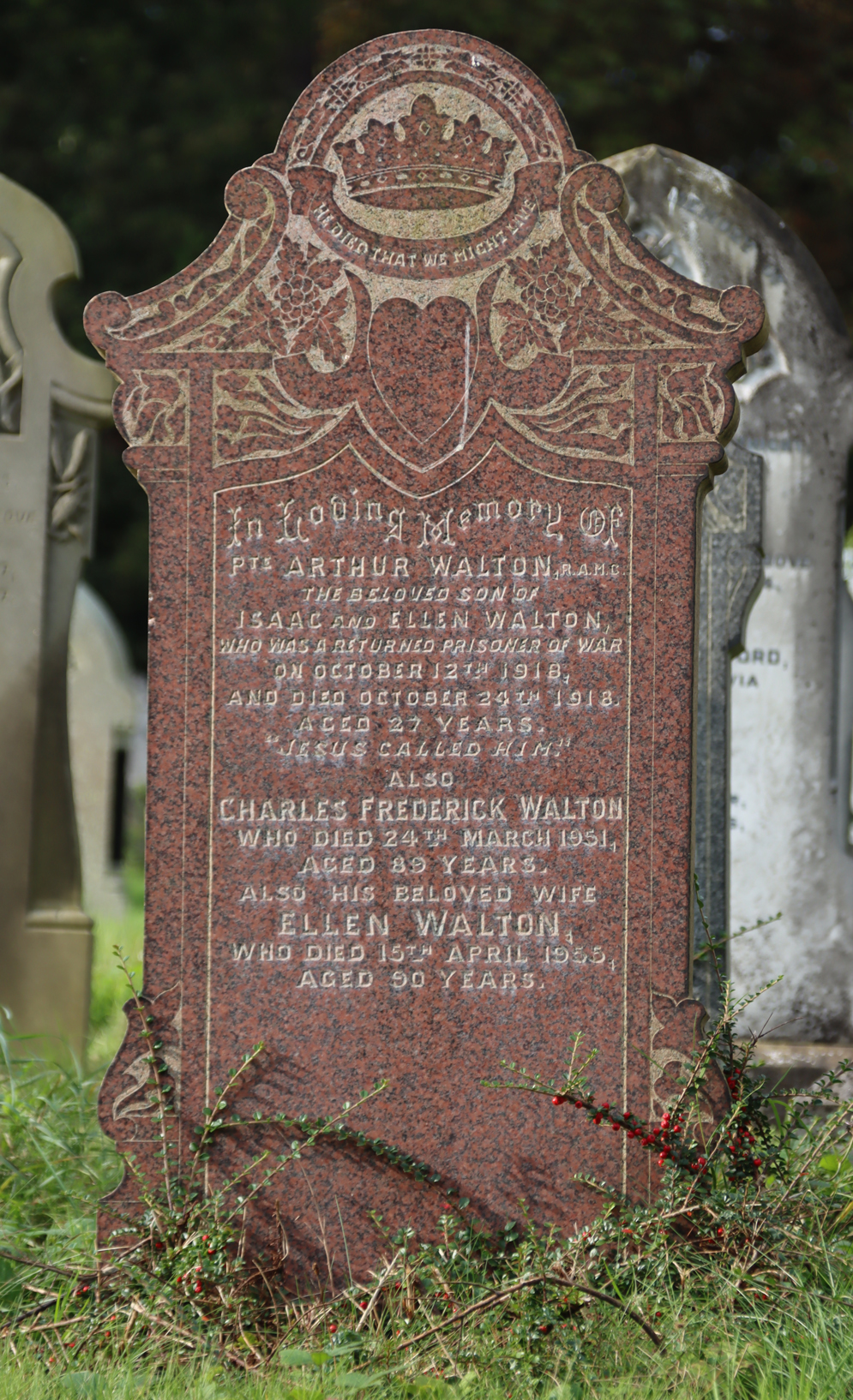
The memorial to Private Arthur Walton, died 1918 aged 27.

In the memorial to Private Arthur Walton shown left, the overall language of the iconography, seems to reflect the concepts of Christianity and the life of Jesus in response to the loss of a much-loved son in the First World War.  The crown can symbolize victory but is also the emblem of Jesus and Christian immortality. Beneath it, the Biblical quote “He died that we might live” refers to Jesus, but might also refer to the sacrifice of Arthur Walton himself.  The heart is a symbol of everlasting love of Christ and also of the charity espoused by St Paul, but also captures personal love. The grapes and vine-leaves are usually related to themes connected with Jesus including the blood of Christ, the Last Supper and the Holy Sacrament. Overall the iconography of the grave is probably one of personal sacrifice and its association with Christian values and the sacrifice of Christ himself, whilst at the same time demonstrating very deep personal loss.  As well as being very moving, this is a good example of how the imagery can contribute to the overall narrative of a headstone or memorial.

Hester Ann Clemence, died 1914, aged 62, with other members of the family commemorated on the pedestal  steps beneath the floral Celtic style cross. The steps often represent the steps representing Christ’s climb to Calvary.  All of the creativity and suggestion of emotion in the monument is in the design; the inscription is minimalist.  Although the encircled cross was originally associated with Irish graves, it became popular throughout Britain during the 19th century.

Of the overtly Christian-themed grave markers the dominant shapes are the crosses that re-appear for the first time since the Reformation during the 19th century, symbols both of Christ’s sacrifice and of resurrection, and proliferate at Overleigh, from the very simple to the seriously elaborate.  Crosses carved with decorated themes are widespread through the cemetery.  Although there had been very few crosses before the Victorian period, due to fear of association with papism.  A popular choice at Overleigh was the so-called Celtic cross, with Celtic-style designs covering the surface.  A popular variant has the top of the cross contained within a stone circle.  Although originally associated with Irish and Scottish graves, after 1890s in particular, when a Celtic cross was chosen by the celebrated art critic John Ruskin for his own memorial in Coniston, it became popular for burials of all religious persuasion.   A cross on a set of steps is often intended to represent the steps the Christ climbed to Calvary, but they might also simply be chosen for their monumental impact.  Flowers on a cross are indicative of immortality.  There are quite a few angels, messengers of God and the guardians of the dead who also transport the soul to heaven. The letters IHS often occur on graves in both urban and rural cemeteries and represent a Christogram, the three letters of the name of Jesus in Greek (iota, eta, sigma).

The truncated obelisk erected in memory of Francis Aylmer Frost. This photograph was taken by Christine Kemp when this area was not the overgrown jungle that it is now (you can see another photograph of this column, as it is today just below. Copyright Christine Kemp.

Many emblems are appropriated from earlier periods.  Pagan themes include the many Egyptian-style obelisks (more about which you can read on my post about the Barnston memorial in Farndon).  A splendid fluted truncated Doric column, a not uncommon cemetery icon but in this particular case perhaps a nod to Chester’s Roman past, is located just inside the River Lane gate to the Old Cemetery, its truncation indicating a life cut short, and generally indicating someone who died young, although in this case Francis Aylmer Frost was 68; another truncated column was dedicated to Harry MacCabe who was 26.  It is not the only one in the Old and New cemeteries, but it is by far the most impressive, shown at far left in the image below.  Its base is so badly overgrown with viciously thorny brambles that I couldn’t begin to find an engraving without losing half my hands and arms, and so remain ignorant as to who it commemorated.  I need some garden shears next time!

Truncated column; weeping woman; angel; Celtic crosses, temple-style gravestone. Click to enlarge


Floral themes on the grave of Thomas George Crocombe, died 1913 aged 20, the eldest of 9 children. Overleigh Old Cemetery.

Flowers are a popular carved theme on headstones.  Some have specific associations, such as the lily, standing for purity and a return to innocence; the rose, which indicates love (different coloured roses mean slightly different things), lilies of the valley, with connotations of innocence and renewal; daffodils that, flowering in spring, represent rebirth; and daisies, which symbolize innocence and were a popular choice for child graves.  A sprig of wheat often indicated someone who had lived to a good age.  Ivy, ironically, is representative of life everlasting and due to its enduring character. It is often show winding its way around cross headstones; today rampant ivy is one of the greatest causes of damage to graves in cemeteries and churchyards.  The most popular of birds shown on graves were doves, symbolizing either the Holy Spirit guiding the deceased to heaven, or general values of spirituality, hope and peace.  There are several at Overleigh.

Detail of the headstone of Harriett Garner and other family members with clasped hand motif. in this case it perhaps suggests father and daughter.  Harriett’s father, who gave evidence at the inquest into her suicide, was certainly very distressed by the loss of his daughter.  They are usually quite common in cemeteries, I have noticed only a few at Overleigh.

An urn is a very well represented motif, quite often topping a headstone as a sculptural component, and indicating the soul of the deceased; when draped with a veil they may indicate the soul departing or represent grief of mourners.  Angels are popular sculptural elements at Overleigh, indicating the soul of the deceased being accompanied to heaven.  Much less frequently shown than angels, but popular in many cemeteries, are images is that of a weeping woman, representing the loss of a person and the mourning of the bereaved.  Small statues of children often indicate the grave of a young child.  Clasped hands, common at some cemeteries but apparently not as well represented at Overleigh, indicate unity and may suggest the bonds of husband and wife, or of friendship or the hope to be reunited with loved ones; some have been carved to show the clothing and character of the hands as distinctly male or female.  An anchor may show that the deceased was professionally connected with the sea, but may also represent hope; a variation is the anchor with a woman, the embodiment of hope, although I have not seen an example of the latter at Overleigh.  Books may have many meanings – sometimes they are associated with the Bible of the clergy or the work of scholars, whilst others may mean knowledge or wisdom, or may simply represent chapters in life.

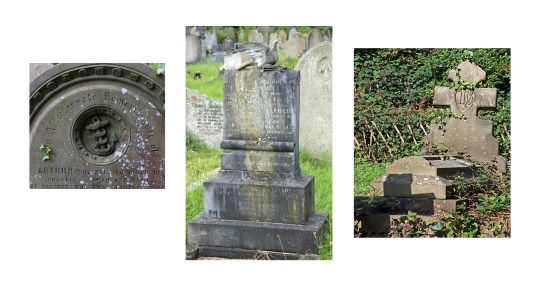
On the left, the headstone of Arthur Davies. The text wrapped around the anchor reads “Hope is the Anchor of the Soul.” The inscription contains other commemorations.  The headstone of Florence Taylor Battersby and other family members in the middle, topped with a dove.  The grave at far right shows the Christogram IHS, an abbreviation of the name of Jesus in Greek and Latin.  Click to enlarge

===

The child grave of Violet Patterson, died 1929, as well as other members of her family, one of whom, Edward Andrew Patterson, who died and was cremated in 2007, is inscribed on one page of the book. This is one of the longer enduring of the graves at Overleigh, in use for 78 years.

A book included on a gravestone may indicate any of a number of ideas.  Prosaically, the grave’s owner might be  involved in the printing, publishing or book-selling trades.  Alternatively they might be a scholar or, if the book is intended to be a Bible, a cleric or someone particularly devout.  In cemeteries one side of an open book often has the name of the husband or wife, whilst the other side remains blank until the other partner has also died, when the blank page can be completed. Sometimes the blank page is left incomplete, possibly because the former partner has remarried or moved out of the area, or has left no provision for the disposal of his or her remains.

There are also more modern emblems and themes that people have incorporated into grave carvings. In the Overleigh New Cemetery in particular there are Art Deco, Arts and Crafts and Art Nouveau themes.  Although often contained within crosses, the Art Nouveau decorations seem otherwise celebratory of life.  The combination of Christian crosses with modern themes perhaps positions religion within a modern context where there is no need to refer back to much older historical values in order legitimize Christian beliefs.  One of them, dedicated to Anna Maria Meredith, has a Biblical quote on it (fourth from the left, a most unusual headstone, although there is a second example in the cemetery).  The memorial to Frederick Coplestone, third from left, shows St Francis of Assisi.  It will be discussed further in Part 4.

Click to enlarge


Memorial in the cremation Garden of Reflection showing a locomotive. Roy Douggie, died 2010 aged 77, and his wife Beryl, died 2016, aged 79. That sycamore is going to need weeding out if it is not going to do permanent damage!

As can be seen on more modern gravestones and memorials, most of which can be seen in the Garden of Reflection in Overleigh Old Cemetery and at the very far end of Overleigh New Cemetery and even more dramatically at the post-war cemetery at Blacon, gravestone types and materials have become standardized, and the rich visual language of symbols and icons employed became much less varied over time, and are now often eliminated entirely, although secular themes are sometimes chosen instead.  In modern cemeteries, regulations about the nature of grave markers limit potential for developing new monumental statements, but the decline in religious involvement in everyday life is also a part of this trend.  The language of religious imagery to convey complex values (semiotics) now takes a back seat, even where commemoration is required, with modern secular images often chosen instead of Christian ones.  There are exceptions, and Roman Catholic memorials can still be quite elaborate.  Today modern gravestones and memorials can be less about choosing the perfect message for eternity than creating an appropriate personal message and style for the here and now, which is an attractive feature of many modern memorials.
====

There are many more symbols and themes on gravestones than those covered in my brief overview above, some quite common at cemeteries, some unique, and it is worth looking out for some interesting examples.
===

Inscriptions

Alice Maud Gwynne, died 1921 at the age of 42 which bears the inscription “There’s no pain in the homeland,” the monument topped with an urn

Inscriptions can be presented using various different fonts, sizes and colours all on the same monument, which creates a sense of texture.  Inscriptions are often filled with colour to make the text stand out from the background stone and make it easier to read.  Lead lettering was occasionally inset into stone to achieve the same impact.  The different styles of text create a great deal of variety in the visual impact of the cemetery.

Headstones in Overleigh tend to be fairly minimalist in terms of the information they provide, many simply naming family members and providing a date of birth and death, perhaps a note about the role of the deceased, particularly where this was a high status position. Most contain some sort of affectionate phrase or such as “In loving memory of,” “in affectionate remembrance of,” “beloved wife,” “dear husband,” etc. Others may contain a little more information.  Some may state the town or village name of the village, or even the property, where the deceased was resident.

The commemoration to 9 year old Walter Crocombe, his mother Sarah, 68, her husband George, 88, and their 4 year old grandson Eric.

Multiple dedications following the initial interment help to give a sense of the family context of both the first and and subsequent family members, and the longer they were in use, the more resonance they had for the family as successive generations interacted with the monument not merely to a single person but to a family commitment and tradition.  The child grave of Violet Patterson, died 1929, includes dedications to other members of her family, and was in use for 78 years, with the latest  inscription dedicated to a family member who died and was cremated in 2007.

Only war graves tend to give details of how death happened, such as “killed in action” or “killed in flying accident,” although there are never any details.  A great many refer to the deceased having fallen asleep, a euphemism for having died that skirts around and sometimes deliberately disguises how the death occurred.  Occasionally a grave will refer to the suffering of an individual, although I have seen fewer at Overleigh than in churchyards.  The commemoration of Sarah Crocombe at Overleigh reads “Her pain was great / She murmured not / But hung on to / Our Saviour’s cross.”  The monument to Alice Maud Gwynne comments “There’s no pain in the homeland,” which implies that she may have experienced some suffering towards the end of her life.

The memorial to Josephine Enid Whitlow in Overleigh New Cemetery (thanks Chris!) who died in 1938.

For obvious reasons, child graves can be more expressive than others about personal feelings of grief and loss.  The grave of 2-3 year old Josephine Enid Whitlow in Overleigh New Cemetery, for example, shown towards the top of this post, has a statue of a small child labled “JOSIE” (Josephine Enid Whitlow) accompanied by the the inscription “Jesus Walked Down The Path One Day / And Glanced At Josie On His Way / Come With Me He Softly Said / And On His Bosom Laid Her Head.”  She died in an isolation hospital in 1938.  The grave of the Crocombe family shown above records the loss of 9 year old Walter: “Little Walter was our darling / Pride of all the hearts at home / But the breezes floating lightly / Came and whispered Walter come.”

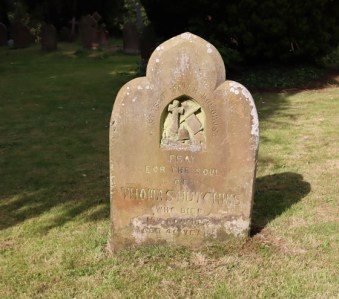
A few graves have Latin inscriptions. Latin is often used on Roman Catholic graves, and the letters RIP often indicate a Catholic grave, standing for the words “requiescat in pace,” meaning “rest in peace”, part of a prayer for the dead.  A nice little gravestone commemorating Thomas Hutchins, near the entrance on Overleigh Road has the legend “stabat mater dolorosa” inscribed along the line of the arch, meaning “the sorrowful mother was standing,” a reference to the Virgin Mary’s vigil during the crucifixion.  It is one of a number that ask the reader to pray for the soul of the deceased.

The small, relatively isolated gravestone of Thomas Hutchins, died 1879, aged 39–40

Perhaps the most minimalist of all the inscriptions, in terms of information imparted, is this curious woodland-style headstone topped with a downward-facing dove, shown below: “With Sweet Thoughts of Phyllis from Mother and Father and Aubrey.”  Given the lack of any useful information it is not surprising that there is no information on the entry for it on the Find A Grave website, but the headstone has charm, and the lack of data is really intriguing, because this was not an inexpensive monument.  Chris tells me that her last name was Elias.  There must have been a story here, but how to find it would need some extensive research that would require access to the original stonemason’s records.

“With Sweet Thoughts of Phyllis from Mother and Father and Aubrey,” Overleigh New Cemetery

Although it might be expected that headstones would give a wealth of information, this is rarely the case at Overleigh, although names, dates of birth and death and place names are a good place to begin with additional research.

There are several books and websites that list some of the most common cemetery themes and symbols, which are very helpful for decoding some gravestones and memorials.
===

Visually personalized headstones

Memorial to Richard Price, Dee salmon fisher, who died in 1960 aged 59. Overleigh Old Cemetery

Personally commissioned scenes, where they are shown, are very specific.  One of the most evocative is the gravestone that has a white marble section showing the Grosvenor Bridge, flanking trees on the river banks and a solitary, empty rowing boat moored in the middle of the river. It is dedicated to Richard Price, salmon fisherman, who died in 1960 aged 59.  Salmon fishing on the Dee has its own history, well worth exploring, and Richard Price was one of the last to make a living from it.  With Art Deco style wings either side, and an urn within the kerb, which could have been added at any time but appears to be in the same stone as the rest of the monument, it is an attractive and very personal dedication, becoming a little overgrown.  Richard’s wife Rose, who died in 1987 aged 81, is also commemorated on the stone.

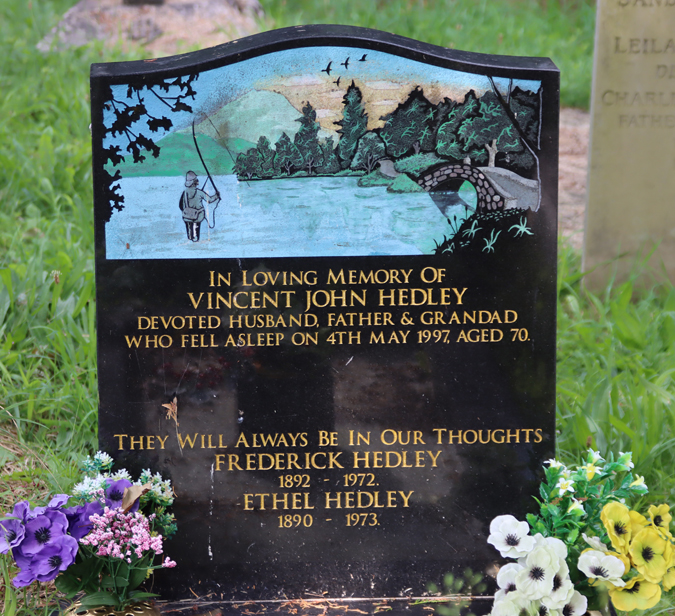
One of the more startling graves when seen from a distance, but completely charming and evocative when seen up close, is the full-colour section of a headstone to Vincent John Hedley, with a scene showing a fly-fisherman in a river or estuary with a rural scene, a rustic bridge, flying geese, an evergreen woodland, a bare hillside and a sunset or sunrise. It seems probable that Vincent John Hedley was a keen fly fisherman.

Vincent John Hedley, died 1997, aged 70. Overleigh Old Cemetery

Small section of an elaborate grave to Annie Myfanwy Roberts, died 1986, aged 73-74, showing photographs of family members.

A very well-tended grave in Overleigh New Cemetery is extremely monumental in its scope and intention, and includes photographs of the deceased, far more elaborate than the Anglican tradition but in keeping with the idea of the personalized scenes above that include visual as well as textual references to the personal.  Whereas the two headstones above show evocative and nuanced scenes that suggest how lives were lived, the photographs of lost people show nothing of the lives that the people lived but are instant reminders of the faces of the departed, instantly emotive for the living, indicating a different way of thinking about and representing those who have been lost and are grieved for.

Materials

Although the most obvious thing about a grave is its shape, together with its ornamental elements, the choice of materials is also an essential part of the design of a monument, and helps to determine its appearance.  As Historic England pointed out in their report Paradise Preserved, “the rich variety of stone within cemeteries represents a valued resource for the understanding and appreciation of geology.”  The good news is that in 2012 Cheshire RIGS and the Northwest Geodiversity Partnership produced a five-page leaflet, Walking Through the Past: Overleigh Cemetery Geodiversity that describes some of the geological background to stone types used on gravestones at Overleigh Old Cemetery, which you can download as a PDF by clicking here.

Some of the many different stone types at Overleigh

Local red sandstone was a popular choice, the same material used to build Chester Cathedral.  Yellow sandstone, presumably much of which came from the Cefn quarries in northeast Wales, is finer-grained and often easier to sculpt, but is very vulnerable to pollution and, as a result, de-lamination.  Pale limestone and granite are available from British sources, and are scattered throughout the cemetery.  Limestone is a sedimentary stone like the sandstones, and relatively soft and easy to sculpt, whereas granite is an igneous rock, very hard and enduring, often with a very attractive flecked texture, but far more difficult to shape.  Imports from overseas include marble and various exotic granites, which are higher-status materials with smooth surfaces that lend themselves well to sculptural memorials.  Rose granite, so beloved of the ancient Egyptians, is well represented, usually polished to a high gloss.  The majority of modern headstones are in highly polished black granite.  Local schools would probably welcome a geology trail through the cemetery.

Cross made of a composite of two different materials, with pieces of stone inserted rather coarsely into what looks like concrete and was probably a low-cost solution to a burial memorial.

As the 19th century rolled into the 20th century and transportation costs declined, imported stones became more common, particularly marbles and coloured granites.  Closer to home,  reconstituted (powdered and reformed) stone became a lower cost alternative to real stone, a common type of which was called coade stone.  At first this resulted in an increased diversity of materials, forms and styles, but as the 20th century advanced, the whole business of burials became far more standardized.  This is not a reflection of falling standards, but it is an indication of cultural change in general, where Anglican Christianity in particular is of less importance in Britain and where society tends to internalize loss rather than expressing it.

The only grave marker that I have spotted so far that is neither stone nor pseudo-stone is a single metal cross in Overleigh New Cemetery, shown just below, although I am sure that there must be others.

Lead lettering on the fallen headstone of Harriet Benson, died 1909 aged 63

Some graves have inscriptions formed of lead letters, which makes them stand out to ensure that they are easy to read, but they have a very poor survival rate, with letters falling out, and only the pin-holes where they were affixed surviving.  This can be sufficient to work out the original inscription, but makes some of the the headstones look rather derelict.  In the example shown left, the lettering under the missing lead can still be made out, but this is rarely the case.

Combined, these different materials, with their very contrasting textures and colours, offer a far more diverse visual fare than the modern cemetery areas in both Overleigh and elsewhere, which are usually glossy black granite.  They help to contribute to the sense of individuality and personal expression in the cemetery.

Black-painted metal memorial to Frederick, aged 66-77, and Alice Wynne, John Meacock and Robert and Alice Taylor.

Memorabilia and gifts

Bird on a plinth at the foot of Harriett Garner‘s grave

A gravestone was a fixed point, although not invulnerable, whilst gift of flowers, immortelles and other objects are the ore transient but personal markers of ongoing memories or the establishment of new connections between people and graves.  As well as demonstrating a personal connection between the living and the dead, the offerings of all types help to keep the sense that the cemetery is still a place of relevance, where narratives continue to be written and rewritten, sometimes only in people’s individual minds, and sometimes shared amongst families and even amongst sections of specific communities.

In the next section, below, is a photograph of Mabel Francis Ireland-Blackburn, showing a three year old child lying in a bed.  It is surrounded by modern memorabilia, including flowers (fresh and everlasting) and a variety of toys and other items.

Although it does not attract the same devotion as Mabel, the grave of the suicide Harriett Garner features a charming little bird, probably a robin, on a thoughtful makeshift stand accompanying the grave.  It gives the grave a personal touch, something more intimate than the headstone itself, suggesting a sense of ongoing empathy and regret.

War grave of Marjorie Anne Tucker, Women’s Royal Air Force, died 1918 aged 32, with a textile  wreath placed by the members of Handbridge Women’s Institute

In the baby cemetery area and the cremation Garden of Reflection in Overleigh Old Cemetery and in the area of recent graves in Overleigh New Cemetery there are many graves with personal memorabilia and gifts from the living to the departed, and these speak to the realities of grief and the importance of reinforcing memory through small gifts and commemorations.


Examples that are cared for by today’s cemetery regulars

Not all graves are appreciated exclusively by their families and descendants.  Others have become interesting or even important to people who otherwise have no connections to the deceased. Some graves have attained something of a celebrity status, either because of their visual appeal or because of the reputation or story of their owners, and are particularly cared for by local people as well as by the Friends of Overleigh Cemetery.  These graves form a sense of how modern minds can connect on a personal and private level with graves with which they have no familial connection.

Grimsby News, September 11th 1908, reporting the coffin of William Biddulph Cross (The British Newspaper Archive)

The nicely shaped but otherwise unremarkable headstone of electrical engineer William Biddulph Cross, who died in 1908, conceals an amusing story of a coffin made entirely of matchboxes, thousands of them, by William himself over a ten year period, a fact mentioned on the gravestone: “WILLIAM BIDDULPH CROSS / Who Passed Away September 5th 1908 / Aged 85 Years / Known By His Galvanic Cures / And The Maker Of His Own Coffin.”  The “galvanic cures” refer to a somewhat scary electrical therapy device thought to be a cure-all for numerous ailments.  You can read more about the device and the theory behind it on the National Archives website. The coffin became something of a local tourist attraction in its own right before William was laid to rest, and was widely reported in newspapers all over Britain.  The newspaper paragraph to the right, for example, was reported in the Grimsby News.  It has been suggested that the electrical fittings were for lighting, but interment before death was a fear throughout the entire Victorian period, and there are some examples of coffins being fitted with devices to allow those who had been mistakenly certified dead to be given a means of raising the alarm, and perhaps this is an alternative explanation. The grave also commemorates six other members of the family who died between 1870 and 1904.  It is something of a puzzle to me as to why William BIddulph Cross was the first of these to be named but the last to die. 

Mabel Francis Ireland-Blackburn, died 1869. Overleigh Old Cemetery

A particularly notable example is “chewing-gum girl,” which is a rather frightful name for a clearly much-loved grave, explained in Part 4. The grave is a very good example of a modern phenomenon where people feel a strong connection to a grave in the past and demonstrate their sense of affinity and empathy by visiting the grave and leaving items to keep the deceased company.  The three year old girl, Mabel Francis Ireland-Blackburn, is represented in stone as a child lying in a bed, and is today surrounded by flowers (cut and artificial), small stone statuettes, toys, a teddy bear by her head, and other small gifts.  She died of whooping cough, but was reputed to have suffocated on chewing-gum, becoming a warning anecdote told by parents to their children, in the form of a poem, of the dangers of following in her footsteps.  Child grave memorials are discussed more in Part 4.  The visual impact of this grave, with the sleeping or dead girl lying in her small bed, propped up on a pillow, is clearly the impetus for the gifts, demonstrating the power of the sculptural funerary image, but also the connection that adults feel for deceased children.

Whilst some graves attract particular attention and are well cared for, The Friends of Overleigh Cemetery are trying to look after the cemetery as a whole, tackling individual problems as they identify them and attempting to rescue stones that can be freed from vegetation without doing them damage.


Cemeteries and the bereaved today

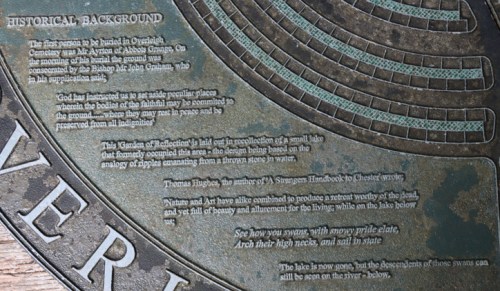
The only new interments in the Old Cemetery are baby burials, segregated with respect and sorrow in a separate garden of their own, or where rights are retained to be interred in a family plot.  The attractive cremation Garden of Reflection, with its hedges emulating ripples on the former lake, is also still in use, and it is possible that it will be extended.  Both are clearly distinguished from the majority of graves of the previous two centuries by virtue of the fresh flowers and other gifts that are regularly provided.  In the New Cemetery, the buildings are no longer in use for funerary activities, and the older part of the cemetery to a great extent resembles many parts of the Old Cemetery, but walk beyond these features and you will find yourself in a far more modern cemetery area, which is clearly frequently visited by family and friends.  This is the newer style lawn cemetery where a compromise has been sought between the needs of relatives and the problems of maintenance.  This will be discussed in Part 3.

Modern cemeteries issue rules and guidelines about the size and type of grave and grave marking permitted, in order to ensure that cemeteries are as easy to maintain as possible, whilst at the same time providing the bereaved with a place to visit and connect with their lost loved ones.  This is a very difficult balance to strike, and local authorities who find themselves with the costly task of maintaining old cemeteries as well as modern ones, have the unenviable task of finding cost-effective ways of caring for these important sites of both past and present commemoration and memorialization.  This is discussed further in Part 5.


Part 2 Final Thoughts

Yellow sandstone headstone of George Hamilton, son of Alexander and Mary, suffering from rather surrealistic de-lamination that looks like melting ice-cream, as well as a colonization of lichen. (Overleigh New Cemetery)

A graveyard is less about a place of the dead than a place of commemoration, the formation of individual, family and collective memories and the ongoing reinvention of ideas about how to deal with death. Those who have gone before us are still part of our lives, still form part of our physical landscape and can contribute to our inner ideas about mortality and the future. It is possible to get to know the dead than it is the living via their gravestones, their epitaphs and their stories.  Individually these are interesting but collectively they combine with other buildings and institutions to contribute to our understanding of the Victorian period and changing funerary traditions thereafter.  These changing fashions in funerary practice from the mid-19th century to the present day will be discussed in part 3.

Cemeteries have visitors who come to see particular graves, either due to regular tending of the grave and communion with the deceased, or to find a grave as part of genealogical research, or as for general or more formal interest into social history, art history and archaeological interest in death and memory.

Many of these graves, suffering from de-laminating or eroded inscriptions, and the invasion of ivy, as well as fallen headstones, highlight the importance not only of maintenance activities but of recording as many of the details on gravestones as possible in online, freely available databases.

Gothic style memorial to Thomas Ernest Hales, died 1906 aged 69. In the background are obelisks in rose granite, made popular when the antiquities of Egypt were first published

Cemeteries are fascinating places, and although modern sections are certainly rather understated and somber because of the signs of recent loss and sadness, older sections are very positive keepers of social history and human endeavor, reflecting choices and decisions by both the living and the deceased, in a wonderful arboretum of multiple tree species.  These grave monuments lend themselves to close inspection and appreciation not just of the materials, shapes and symbols, but of the stories that they capture about past lives and how we learn about a city’s past through both the material and conceptual cues that cemeteries retain.  The information on headstones can be a good place to start with an investigation in archives.  This type of information gives a sense both of the communal identity of a provincial town, and the individual identities that make up that community.  Of course, those who could not afford graves or were buried in communal graves that were the result of epidemics, are lost from this commemoration of the individual.

As before, my many thanks to Christine Kemp (Friends of Overleigh Cemetery) for all her practical help, her encyclopedic knowledge, and for checking over my facts.  Any/all mistakes are my own.  Do give me a yell if you find any.

I have quadruple-checked for typos etc, but some always get past me, for which my apologies.

References for all five parts are on a separate page on the blog here.

Overleigh Cemetery, Chester #1 – Introduction to its background and establishment

The Celtic cross style headstone of Robert Walter Russell (d.1909) and his wife Louisa Alma (d.1936) is on the left; the grave of Jane Whitley (d.1912), with its elaborate angel, topped with a cross and provided with a kerb and footstone (which is where the dedication is to be found), is on the right, erected by her husband Captain W.T Whitley, late Royal Artillery, who joined her there in 1936.

I have been to dozens of archaeological and historical burial sites, from prehistory onward, including famous monumental 19th century cemeteries in London, Paris and Havana, but the easiest by far to visit for someone based near Chester are local parish churchyards and the later dedicated Overleigh Old and New Cemeteries built during the Victorian period.  Ironically, I know much more about the burial traditions of ancient Egypt than I do about those on my own doorstep.  Up until now I have been repairing the gaps in my knowledge by visiting parish churchyards, but Overleigh Cemetery represents a different type of experience altogether, part graveyard and part public green space.  Overleigh reflects the growth of urban populations in towns and cities “which massed people on a hitherto unimaginable scale” (Julie Rugg, 2008) and put unmanageable pressure on urban parish churchyards.  It also demonstrates both a new idealism in the 19th century, the belief in the development of civic resources for the benefit of the general public, as well as the growing awareness of how disease was spread, the dangers of insanitary conditions, and the need for new approaches to public health.  The Victorian cemetery introduced into suburban environments the down-scaled aesthetics of 18th century estate parkland, often with their associated Classical architectural features, made popular by landscape designers like Capability Brown.  This touches on the complexities of the Victorian cemetery of which Overleigh was a smaller provincial form albeit clearly influenced by more elaborate examples.

Before I go any further, many thanks are due to Christine Kemp for her marvellous help when I started this mini-project.  It would have taken me at least twice as long without her, probably a lot longer, and I would have made errors that she has put right, so I am in her debt.  Chris has contributed 1000s of grave descriptions from this and other local cemeteries to findagrave.com, and is a founder member of the Friends of Overleigh Cemetery.

Where the findagrave.com website has an entry for a grave owner, I have added the hyperlink to the photographs used on this page for anyone who wants to read the inscriptions or find out more.

Overleigh Old Cemetery with its wonderful tree life, part cemetery and part arboretum

There will be five parts to this piece about Overleigh. Part 1 starts with a very brisk and short overview of Chester in the 19th Century and goes on to look at the establishment, in that context, of Overleigh Old Cemetery and Overleigh New Cemetery, followed by a short introduction to the objectives of research activities that can be carried out using cemetery material (discussed more in other parts) and some final comments.  At the end it also lists the sources for the entire five-part series, which will be added to as the series is posted.

  • Part 1:  Introduction to the background and the establishment of Overleigh Cemetery
  • Part 2:  The living, the dead and the visitor at Overleigh,
  • Part 3:  Shifting ideas – the move away from monumental cemeteries towards cremations and lawn cemeteries
  • Part 4:  The research potential of cemeteries; and Overleigh case studies
  • Part 5:  The Overleigh Old and New Cemetery today and in the future
    —-

Chester in the 19th century

Overleigh Old Cemetery opened in 1850, and the New Cemetery opened in 1879. To put this into some sort of context, here’s a very short gallop through Chester in the mid-19th century.

Chester Tramways Company Horsecar no.4 at Saltney. Source: Tramway Systems of the British Isles

Chester had been connected to the greater canal network in 1736, linking Chester with the Mersey, and was connected to the rail network by 1840, with today’s station opening in 1848.  The Grosvenor Bridge opened in 1832, taking the pressure off the Old Dee Bridge.  A horse-drawn tram was introduced in 1879 to link the railway station to Chester Castle and the racecourse.  This was replaced by an electric service in 1903 after Chester built an electricity plant in 1896, which also allowed the 1817 gas lighting to be replaced.  Improved communications brought more prosperity, and from the 1830s to the beginning of the 20th century, Chester had become an affluent town with a growing population.  To accommodate this rapidly growing population the city suburbs expanded to the south of the river, with Middle Class suburbs developing at Curzon Park and Queen’s Park, with  a new suspension bridge built  in 1852 (the current one replaced it in 1923) to connect the latter to the town.

Chester Town Hall of 1869. Photograph by Jeff Buck, CC BY-SA 2.0

Signs of prosperity were everywhere.  Commerce in the markets, shops and local trades thrived in the mid 19th century, and the sense of confidence and ambition was reflected in the expansion of the 18th century Bluecoat Hospital School, the building of the new Town Hall of 1869, the restoration of old buildings, and the establishment of new buildings, many in the style of earlier medieval half-timbering, as well as churches, including those for Dissenters.  With its extensive retail, its race course, its regatta and its medley of fascinating architecture, Chester was becoming a popular destination for visitors, and a series of hotels were built to support the growing tourist industry.

Although the Industrial Revolution did not revolutionize Chester in the same way that it did in other towns and cities, it left its mark, although in a rather piecemeal fashion.  As with most towns of the period it had light industry concentrated around the canal basin, as well as over the river in Saltney, and a declining shipbuilding industry.  Industries included new steam mills, a lead works, an anchor and chain works, three oil refineries and a chemical works amongst other enterprises.  Craft trades included tailoring, shoe-making, milliners, dressmaking, bookbinders, cabinet makers, jewelers and goldsmiths, amongst others.  In both town and suburban houses domestic service was an important source of employment for the less well off, as was gardening.  In line with the Victorian interest in civic works and promoting education and health, the Grosvenor Park opened in 1867 and the Grosvenor Museum in 1885.

Louise Rayner’s (1832–1924) painting of Eastgate Street and The Cross looking towards Watergate Street. Source: Wikipedia

Although the face of Chester seen by most people was a gracious attractive and prosperous one, there was also a lot of poverty. For those who were not quite on the breadline, but could not afford expensive accommodation a solution was provided by lodging houses of variable quality and pricing, which were growing in number to cater for both temporary visitors and more long-term residents.  Far more troubling, there were also slum areas known as “the courts,” which housed the city’s poor.  The St John’s parish became particularly notorious but these too were expanding, extending into the Boughton, Newtown and Hoole areas.  As agriculture made increasing use of labour-saving techniques, former agricultural labourers and their families moved to urban centres to find work.  At the same time, the appalling Irish Famine of 1845-52 drove starving people out of Ireland, and a large influx of impoverished Irish refugees, including entire families, expanded the poorest quarters of Chester and were a source of considerable concern to the authorities.  Although charity and church schools took in some of the poorer children, the most impoverished and vulnerable, sometimes the children of criminals and certainly in danger of becoming criminals themselves, were not at first provided for but the problem was acknowledged and three free schools for impoverished children known as “ragged schools” were built, of which more in Part 4.

According to John Herson there was an economic decline after 1870, during which population numbers fell, and Chester became more focused on its retail and service industries and the development of its tourism.  I recommend his chapter in Roger Swift’s Victorian Chester for more information about his discussion of the three phases of Chester’s Victorian past (see Sources at the end).


A solution to overflowing churchyards

Population in Chester and suburbs by year in 19th Century Chester. Source of data: John Herson 1996, Table 1.1, p.14

Polymath and diarist John Evelyn and architect Christopher Wren had both proposed out-of-town cemeteries in the 17th century, but their suggestions had fallen on deaf ears.  An exception was the famous Dissenter cemetery at Bunhill Fields, established from a sense of spiritual necessity.

The rising population that lead the living to move to new areas around Chester, was also a problem for churchyards.   The condition of Chester’s city churchyards was very poor, in common with other cities and towns throughout the country, and as the population expanded the situation in churchyards became somewhat desperate, and the new cemeteries were a necessity.  John Herson’s chapter in Roger Swift’s Victorian England provides a table of population figures for Chester and its suburbs from 1821 to 1911, and this shows that the population was rising rapidly.  Rising populations and the concentration of people in towns had lead to parish church cemeteries becoming problematic all over Britain.  This was infinitely worse in big-city urban environments where manufacturing industries had become major employers, where the lack of churchyard capacity led to some truly dreadful, squalid scenes representing appalling health risks, but even in a county town like Chester the problem was very real and churchyards there too were struggling to meet demand.

George Alfred Walker’s “Gatherings from Graveyards

Complaints were growing about the unsanitary condition of full intramural graveyards, and the risks that this represented.  Typhoid, typhus, scarlet fever, tuberculosis, measles, influenza and cholera, were all infectious diseases that were common in Victorian England, and the establishment of new graveyards for minimizing risk was becoming increasingly important as the links between health and sanitation were established.  Jacqueline Perry says that between 1841 and 1847 the annual average was 700 burials in Chester alone.

Those arguing for a new cemetery in Chester as a response to this problem were able to point to other specialized graveyards in Britain and overseas.  Bigger city cemeteries had been established earlier in the 19th century in Paris (in 1804 Père La Chaise was the first municipal cemetery in western Europe), Liverpool (Liverpool Low Hill opened in 1825 and St James’s Cemetery opened in 1829). In 1830 George Carden, after years of campaigning, organized a meeting to discuss how to improve the burial situation in London and Kensal Green opened in 1833, which initiated “The Magnificent Seven” ring of London cemeteries. Glasgow’s remarkable Necropolis followed in 1833.

In 1839 surgeon George Alfred Walker published his Gatherings from Graveyards (including the subtitle And a detail of dangerous and fatal results produced by the unwise and revolting custom of inhuming the dead in midst of the living), which drew uncompromising attention to some of the horrors of churchyards, encouraging burial reform and the wider adoption of the out-of-town cemetery.  I have provided a link to an online copy of this book in the Sources, but it is absolutely not for the faint-hearted. Although this trend was challenged by the Church of England, which derived an income from burial fees, the need was acute, and parish churches were compensated for their loss of income.  Most of these new cemeteries were commercial, charging for burials and paying dividends to investors from their profits.

Mourning clothes were a major investment in the Victorian funeral ceremonies. Source: Wikipedia

There was also clearly a psychological need for new cemeteries with neatly defined and delineated plots for individuals and families, and the space to commemorate and mourn loved ones.  As James Stevens Curl explains:  “It could never be said that the Victorians buried their dead without ceremony.  Apart from the immediate family, all the distant relatives would be present . . . Friends, business associated, acquaintances would all appear . . . A dozen or sometimes more coaches therefore followed the hearse.”  The acts of observance and the rituals associated with death in the Victorian period, and the traditions associated with the bereavement that followed interment were elaborate, encoded and important to Victorian religious beliefs and social conventions.  These beliefs and conventions were part of a deeply felt attitude to death and how it should be handled.  They were also opportunities to display wealth and status for those who had it.  The new landscape-style cemeteries offered the opportunity to carry out these various rituals at each stage of bereavement after loss with dignity and ceremony.

Following the new cemeteries and the success of the concept, cemetery design became a recognized field of endeavor for landscape designers and architects, and the best known cemetery designer, although by no means the first or even the best, was probably John Claudius Loudon, who consulted on a number of projects before publishing his 1843 On the Laying Out, Planting and Managing of Cemeteries, which became an important source of practical advice and creative ideas for many private enterprises. Loudon’s intentions are captured in these two statements from the beginning of his book:

Cemetery design for a hilly location by Thomas Loudon, 1834, showing a similarly sinuous arrangement as Overleigh, but with the building centred at the heart of the cemetery. Source: Loudon 1843

The main object of a burial-ground is, the disposal of the remains of the dead in such a manner as that their decomposition, and return to the earth from which they sprung, shall not prove injurious to the living; either by affecting their health, or shocking their feelings, opinions, or prejudices.

A secondary object is, or ought to be, the improvement of the moral sentiments and general taste of all classes, and more especially of the great masses of society.

The means by which Loudon proposed to address his “secondary object” was by introducing a sense of serenity, providing fresh air and a sense of nature, and encouraging contemplation.  At the time disease was thought to be conveyed by “miasmas” or vapours, not entirely unsurprising given how bad cesspits, uncovered drains and overfilled graveyards smelled, and trees were thought to assist with the absorption of miasmas, helping to promote good health and prevent the spread of disease.  Often his designs were based on a grid, like the 1879 Overleigh New Cemetery, but his above design for cemeteries on hills and slopes, like the Overleigh Old Cemetery was more forgiving.

Sculptural monument on a plinth dedicated to land agent and surveyor Henry Shaw Whalley, d.1904

After the 1850s commercial cemeteries were not the standard way of establishing new cemeteries.  The Metropolitan Interments Act allowed for burial grounds to be purchased by a civic authorities, which was itself replaced by a new Act of Parliament in 1852 when Burial Boards were established, after which publicly funded cemeteries became the norm.

One of the results of the new cemeteries, with individual plots dedicated to single individuals or to families, was that graves became part of the domestic sphere of families, part of their personal real estate.  In an elaborate cemetery this might include personal family mausolea and vaults, but at a more modest provincial cemetery like Overleigh, it usually consisted of a sculptural element or a headstone with a kerb and sometimes a footstone, although at Overleigh footstones are unusual (all the elements are in the grave shown at the top of the page, on the right).  This created a clearly defined space in which family and friends could commemorate their dead with gifts of flowers and sometimes additional memorabilia.  The main sculpture or headstone, usually of stone but occasionally of metal, was itself a medium for expression, combining shapes, symbolic and sentimental imagery, and text to express ideas about both the dead and their relationship to the living.  The kerbs were usually visited and the dead were gifted fresh flowers or immortelles (more permanent artificial flowers presented in suitable vessels or frames, sometimes under a glass dome).

Overleigh Old Cemetery

Grosvenor Bridge entrance to Overleigh Old Cemetery

Overleigh Old Cemetery, very convenient for Chester residents without intruding on the town itself, lies just across the Grosvenor Bridge, its northern border running along the south bank of the river Dee.  It has gateways from the Grosvenor Bridge, Overleigh Road and River Lane which converge on the monument of, cenotaph to William Makepeace Thackeray, a Chester doctor and benefactor.  Although this is the oldest of the two halves of the cemetery, it is still in use today for new cremation memorials in its maze-like hedged memorial area (actually designed to look like ripples on the lake that once occupied the space), as well as an enclosed area for interments and cremated ashes of babies, which is inevitably particularly sorrowful.  Overleigh Old Cemetery is often used as a short-cut from the Grosvenor Bridge to the walkway along the Dee, and presumably as its designer Thomas Penson originally intended, always has the feeling of a public park as much as a cemetery, although up until late August 2024, there has been nowhere to sit.  A bench supplied by the Friends of Overleigh Cemetery has helped to bring the cemetery further into the public domain.

First page of the The Chester Cemetery Act in 1848

The cemetery was established by The Chester Cemetery Act in 1848.  Chester’s City Surveyor, Mr Whally had held a public inquiry at the Town Hall to discuss the urgent need of a new extramural cemetery.  Overleigh was established by a private company named the Chester General Cemetery Company, which was formed by an Act of Parliament on 22nd July 1848. According to Historic England, the cemetery site was owned by the Marquis of Westminster who exchanged it for a shareholding in the company.  The cost of the cemetery was estimated at £5000 but the company blew its budget and in 1849 work was forced to stop for seven months until new shareholders could be found.  The thinking behind it was, much like the Grosvenor Park and the museum, as much a matter of civic pride as it was a practicality.  However, unlike the park or the museum, the cemetery was intended to turn a profit, and was essentially a retail operation, selling or renting burial plots, paying for its own maintenance and offering a return on shareholder investment, and providing a valuable service to residents at the same time.

Crypt Chambers, Eastgate Street. Source: Wikipedia

Overleigh Old Cemetery was designed by Thomas Mainwaring Penson (1818–1864), the surveyor and architect responsible for, amongst other Chester buildings, the 1858 Crypt Chambers and the 1868 Grosvenor Hotel, both on Eastgate Street.  The original layout of Overleigh Old Cemetery is preserved in an engraving from sometime after it opened, shown below, probably in the later 1850s.

Following the model already established in Paris, Belfast, Glasgow, Liverpool and London, this was a garden- or landscape-type cemetery, planned to emulate a large garden or small park.  When compared with some of the vast architectural entrances to the great Victorian cemeteries of Liverpool, Glasgow, London and elsewhere (see, for example, Kensal Green or, in a different style, the Glasgow Necropolis) the gates at Overleigh are a mere nod to a transitional zone between the busy outside world and the quiet necropolis within, with modest pillars and iron gates, shown above.  The buildings that were once just inside each gate, the entrance lodges, will have given more of sense of entry and exit than the entrances retain today.  Something of that effect can be seen over the road at Overleigh New Cemetery where the lodge building survives.  The funeral cortege would stop here to be formally received and recorded before proceeding to the burial site.

Overleigh Cemetery. Source: Wikipedia

The cemetery was landscaped with sinuous wide driveways winding down the hill towards a lake, laid out over an area of some 12 acres.  In the engraving to the right there are six buildings, none of which survive today.  I have no information about why they were taken down, but assume that they had fallen out of use and were becoming a problem to maintain.  Two of them are lodges at the Grosvenor Bridge and River Lane gates of the cemetery, used by cemetery superintendents and officials, and housing cemetery records. One of the lodges was apparently removed in 1967.  Chris has a plan of the cemetery dating to 1875 that identifies the church-like buildings at the top and the one by the lake as mortuary chapels (the one by the lake was for Dissenters), whilst the building behind the temple-style monument to Robert Turner was the Chaplain’s house.  It may have had rather good views over the bridge and the river.  The tiny building at centre left was probably a grounds-man’s hut, used for storing tools.

The headstone of Harriett Garner (d.1905) and other family members.  Harriett was a suicide, but because the inquest found her to be temporarily insane, and therefore innocent of crime, she was allowed to be buried in a consecrated grave

The 1847 Cemeteries Clause Act (section 36) stated that a new cemetery contain both consecrated and unconsecrated land and there were usually two chapels, one Anglican and one for Dissenters.  The provision for non-Anglican graves had become particularly important because of the Nonconformist movement, which had grown from strength to strength.  Non-denominational chapels of rest, where the deceased could be laid before interment, were a characteristic feature of the new cemeteries.  The idea of including unconsecrated land was to ensure that a cemetery should exclude no-one, including suicides who were declared sane at the time of their deaths (those judged to be insane when they committed suicide were considered to be innocent), unbaptized children and those of non-Anglican religions.  Chris showed me where, indicated by marker stones, there is a section for Roman Catholics and another for Dissenters, whilst pauper graves, some of which surprisingly have headstones, are dotted throughout the cemetery.  For those short of funds, there were burial club schemes, a little like life assurance today, where people could pay in a regular amount to save up for a proper ceremony and gravestone.

Plantings to give the garden cemetery its Arcadian feel included both deciduous and evergreen trees.  The use of deciduous trees was counter to Loudon’s advice, as in his view they grew too fast, became too big, dropped leaves that had to be cleared up, and looked ugly with bare branches in the winter, but at Overleigh the combination provides a marvelous mixture of colours, textures and shapes for most of the year.  The trees are worth a study in their own right, including some very unusual specimen varieties.  The now truly massive and splendid redwoods and traditional yew trees, both of them evergreen and long-lasting, often represent the hope for eternal life, and the sheer variety of specimen deciduous trees is remarkable and if anyone out there happens to be a tree expert and would like to help me out with some identifications, I would be grateful!

The William Thackeray cenotaph that sits at the conjunction of the cemetery drives. A huge beech tree stands behind it, and in front of it is a big horse chestnut; the trees in Overleigh are one of its most appealing features

The lake was eventually filled in, a very nice feature but presumably something of a problem to maintain and probably a risk to children and of course was using up land that could be used for more graves.  Partially in its place is a cremation area made of concentric hedging to emulate the ripples on the former lake.  The cremation memorial will be discussed in part 3.  The rustic bridge to the right of the lake on the engraving remains in situ, although the land either side of it is being used as a dumping ground for clearance works, which will eventually biodegrade and build up the soil level around the arch bases, which is a real shame.

The William Thackeray monument, at the confluence of the Old Cemetery drives has already been mentioned, but in the engraving above, the tall, slender temple-style monument shown at top right of the image, which commemorated brewer and wine merchant Robert Turner, who was Sheriff of Chester in 1848. The plinth now sits directly over the base,  with the fallen pillars at its side.  The engravings are on the floor of the base, which would once have been visible by walking into the monument and looking down, one for Robert Turner and one for his wife, which are shown on the findagrave.com website (by Chris Kemp). There’s a certain amount of irony in its demise, as over the course of the Victorian period the brewery industry also went into a state of terminal decline.  Work was done by Blackwells Stonecraft to prevent it sliding down the slope in 2022.

Robert Turner’s grave (d.1852) as it now appears in the oldest part of Overleigh Old Cemetery. Christine Kemp has posted a fascinating photograph of it under repair in 2022 on the findagrave website at https://www.findagrave.com/memorial/195750339/robert_hugh-turner/photo#view-photo=247132692

The pillars at the base of the monument, which once formed the temple

Overleigh New Cemetery

Overleigh New Cemetery, with the Greek Orthodox church, formerly a cemetery chapel, in the background

Overleigh New Cemetery, established in 1879, lies to the south of the Old Cemetery, with the Duke’s Drive running along its southern boundary, accessible via its entrance on Overleigh Road, opposite the entrance to the Old Cemetery, which gives some sense of continuity, and this too is still in use.  Overleigh New Cemetery, established in 1879, is a more obviously lower budget incarnation, all on the flat, its driveways laid out on a grid that divides the cemetery into raised rectangles.  Loudon’s book had layouts very like this in his 1843 book, although they weren’t amongst his more imaginative designs.  They did, however, have the essential idea that Loudon proposed of trees and shrubs to create a healthy and contemplative experience, and these are largely missing from Overleigh New Cemetery, except around the very edges.  By virtue of the fact that it does not serve as a route to anywhere else, and is essentially a cul-de-sac, it is more peaceful than the Old Cemetery but has less of a feeling of community.

*****

The section of Overleigh New Cemetery dedicated to the Commonwealth War Grave commission memorials

There is a small and beautifully maintained section dedicated to Commonwealth War Grave Commission graves, and managed by the Commonwealth War Grave Commission itself, is an important reminder of the sacrifices that were made, although graves dedicated to those who lost their lives in combat are also dotted through both the Old and New cemeteries.  These are planted with evergreen and flowering shrubs, and carry just the right balance of dignity, solemnity and floral tribute.  It was decided, when they were originally designed that there should be no distinction between graves of different rank so the headstones are all made according to a standardized template, differentiated by the regimental crest and or badge, the ranks and of course the names of the deceased.

One of the chapels in Overleigh New Cemetery, a Designated Heritage Asset in the Cheshire West and Cheshire “Chester Characterisation Study”

There are four buildings in the New Overleigh Cemetery.  The largest is the West Chapel, now Saint Barbara’s Orthodox Church. Historic England states that it was built in the style of John Douglas in the early 20th Century.  Chester Council made it available to the Greek Orthodox church in the 1980s and it opened its doors to congregations in 1987.  It attracts a congregation from a very wide area and prevents the site feeling entirely field-like.  Also assisting in this sense of place rather than space is a lodge that sits near the Overleigh Road entrance but is now apparently used as a private residence.  The small chapel, now used as a base for cemetery workers, is a lovely little thing with a few nice decorative features inside and out and some understated stained glass consisting of small square panels in quiet colours.  It was nicely thought through when it was built, and is now a Designated Heritage Asset.

The other building, recently fenced off presumably due to the sorry state of repair, making it look like a complete eyesore, is the former grave-digger’s hut, a charming brick-built building, described as “an important historical feature” in the Handbridge Neighbourhood Plan. It is clearly in urgent need of help.

The grave-diggers’ hut, fenced off.

—–

Headstone of Frederick Coplestone, d.1932 and members of his family by sculptor Eric Gill, showing St Francis of Assisi (Grade 2* listed)

When you first enter the New Cemetery, the initial impression given by the repeated lines of headstones is that the cemetery is less obviously interesting than the variety of shapes and sizes over the road.  This is, however, partly an illusion caused by the grid-like horizontal layout.  Closer inspection of the older sections, nearest to Overleigh Road, demonstrates that these too offer an enormous amount of variety that provides insights into personal preferences and choices, and certain very specific affiliations.  The graves here, many of them more recent than those at the Old Cemetery, offer a rather different sense of style and character, of different experiments with more personalized design and symbol as new trends emerged.  There are, for example, some interesting Art Nouveau and Art Deco examples that I have not noticed in the Old Cemetery.—-

As you head to the extremities furthest from the road, you will see less of these mainly earlier 20th century monuments and find yourself confronted with the more modern emblems of British commemoration of the dead.  These are generally smaller and plainer, often with flowers or other memorabilia, and reflect a changing attitude to memorializing the dead.  The further on you go, the more you find yourself in the sort of “lawn cemetery” concept that is becoming increasingly popular for public cemeteries, with small memorials.  Although this is much less aesthetically engaging than the older cemeteries, it does reflect an interesting change in mortuary practices that will be discussed further in parts 4 and 5.

Looking towards the far end of Overleigh New Cemetery, where new graves are still added

**
Family Research

Overleigh Old Cemetery

It does not take a great deal of imagination to see that a cemetery like Overleigh contains an enormous amount of information about people who have lived and died in and near Chester.  Most of this information comes from words on gravestones, although some general comments can be made about the imagery employed and the design of the grave monuments themselves.  There is as much fashion as there is tradition, all mingled together.  Classical elements, Gothic Revival, Art Deco, Art Nouveau are all here, and in Overleigh New Cemetery the differences between Anglican and Roman Catholic graves are often particularly striking.  One way of learning more about the cemetery as a whole is by taking the Stories in Stone walking tour with one of Chester’s excellent Green Badge Guides, which takes visitors on a tour of the main features and some particularly interesting graves.

Grave of William Pinches (d.1929), Overleigh New Cemetery

The most common motivation for conducting research at cemeteries is to find the grave of an ancestor or loved one, whilst others find real interest in the individual stories told by gravestones via design, symbol and inscription.  Although Overleigh is so large that it may all seem like a challenge to make sense of it all, if you know the name of the grave’s owner, the findagrave.com website is an excellent database containing details of the grave and its owner, where known, together with any interesting stories that might be connected with either the grave or the owner.  Chris Kemp alone has been responsible for researching and adding literally thousands of graves in Overleigh and elsewhere in the Chester area since she began to record them over 12 years ago.  There are other online databases that do something similar, but findagrave.com is probably the most accessible resource for Overleigh.  Note that findagrave.com divides the cemetery into the Old Cemetery and the New Cemetery for search purposes.  Chris points out that until 1879 when the Overleigh New Cemetery was built, the Overleigh Old Cemetery was at that time known and referred to in documents as the “new cemetery.”

The Cheshire Archives and Local Studies service has some excellent online resources, and as well as their Overleigh Cemetery 1850-1950 database (it’s not the most user-friendly interface, so do watch the video about how to use it here), there are many other sources of local information about individuals, institutions and business in their online Archive Collections, including parish records, the electoral register, business directories, court sessions and poor law and workhouse records.

Amongst many other activities, Chris Kemp receives emails from people looking for graves from outside the area, and sometimes overseas, and tracks down the graves for them, a valuable and time-consuming task, as she receives at least half a dozen every week, which she hunts down every Saturday, and which demonstrate how much the cemetery, on both sides of the road, continues to contribute to people’s investigations of their past and their sense of a link with their family history.
———–

Part 1 Final Comments

Many of the first out-of-town cemeteries were conceived of as memorial parklands that were designed to balance the natural and the man-made, to harmonize different needs and priorities.  Although at Overleigh each of the two halves of the cemetery has a different personality, both combine monument and commemoration within a designed space where the dead and the living can peacefully coexist.  The graves themselves, some of them impressive, others very modest, never reach the heady heights of London’s “Magnificent Seven” with their extravagant mausolea and world-famous names, but in the details, the variations and subtleties, and of course in the engravings, there is a very real sense for visitors of mingling with the lives of Chester residents and getting to know something about the population at large.

Detail from the headstone of Margaret Roberts (d.1900), Overleigh Old Cemetery

The gravestone is, just as much as items given pride of place in the home and passed between generations, both an object and a commodity.  It was manufactured, chosen, customized, purchased and curated.  Even within its own funerary landscape, the funerary monument had a role within the home, in that it formed part of a personal experience of the world, a form of mental mapping that includes places beyond the front door but are endowed with a personal value.  They become part of a much wider family and social landscape than their physical location in a cemetery.  This means that there is a social and cultural history component to be researched in large cemeteries that offers a different type of record from documentary resources.  I will talk more about the role of cemetery research in social and cultural history in Part 4.

Overleigh Old Cemetery

Overleigh is a place where relatives can visit their loved ones or carry out genealogical research into their ancestors and where social history can be investigated.  At the same time it needs to be respected and to be recognized as a vulnerable piece of local heritage.  One of the most important questions about any monument or object is what happens when it is no longer valuable to someone, when the useful life for which it was intended comes to an end.  At this point, so many bad decisions have been made in Britain about the value of buildings and objects to social and cultural history, and there is a need to ensure that cemeteries like Overleigh continue to both support and inform the living.  This will be discussed further in part 5.

Part 2, only part-written at the moment, will look at how the living and the deceased are both incorporated into a common language of the necropolis, and how gravestones are used to express complex ideas about the dead.
***

With sincere thanks again to Christine Kemp for giving me a guided tour of both parts of Overleigh Cemetery at the beginning of August 2024, and then guiding me to find specific graves and helping me to understand different aspects of the cemeteries when I met her again at the end of August, and for offering ongoing help.  In this and the following parts, she has been a splendid source of information, fact-checking and guidance.  Any errors are, of course, all my own work!

Sources:

Charles Edward Armitage, d.1930, Overleigh New Cemetery

The books and papers and websites used in all the parts are listed in their own page.  Splitting them up over the various parts does not make much sense because so many of them are used time and time again and listing the sources in one place makes it easier for anyone wanting to print off the full list.

The list of references for this post has become ridiculously long, so instead of listing them here on the page I have copied them onto their own page on the blog at
https://basedinchurton.co.uk/walking/overleigh/


The rustic bridge that was part of the original Penson design


The 1715 “Old Dock” – The earliest of Liverpool’s commercial docks, preserved beneath the Liverpool ONE shopping centre

Introduction

The Eyes map of Liverpool showing Old Dock on a previous tidal inlet and enclosed within the streets of an expanding Liverpool in 1765, 50 years after it first opened. Later docks were laid out along the foreshore. Source: National Museums Liverpool

Earlier in summer 2024 I went on the Old Dock tour in Liverpool when it was offered one Sunday.   Old Dock, of which only one corner remains to be visited, was perhaps Liverpool’s most important commercial and civil engineering initiative at a time when Chester’s port was going into decline and Liverpool had the opportunity to become the trading centre for the northwest.

Old Dock, Liverpool

Old Dock in Liverpool, the first of Liverpool’s impressive network of enclosed docks, opened in 1715, to the design of civil engineer Thomas Steers.  It is Europe’s oldest enclosed cargo-handling dock.  What remains of Old Dock is underground, beneath the “Liverpool ONE” shopping centre.  Its lock gates can no longer be visited, but remain under The Strand (the modern dual carriageway that runs along the line of the old foreshore).  Only the northeastern corner of the dock is accessible to visitors, and has been provided with a gantry and information panels, and its history is presented to pre-booked groups by an excellent guide.  I’ve added details about booking and the tour itself at the end of the post under “Visiting.” The following looks at some of the history of Old Dock.

The 1699 Howland Great Wet Dock in London. British Library HMNTS 10349.ff.9.. Source: Wikipedia

Old Dock was modelled on the Howland Great Wet Dock, shown right, built in 1699, which was built to shelter ships, mainly of the East India Company, in the days when ships over-wintering on the Thames were regularly subjected to both storm damage and piracy.  It was surrounded by a double planting of trees to help protect the ships within and had shipbuilding dry docks at its entrance. It was a convenient place to carry out repairs and to ready ships for the upcoming season, but was not used for handling cargo so was not a commercial trading dock.  The Howland Great Wet Dock was built in a rural space on the south of the Thames in what is now the residential Surrey Quays area of southeast London, and was replaced in the 18th century by Greenland Dock, which itself became part of the Surrey Commercial Docks.

The commercial argument for Old Dock

Liverpool was established by a charter of King John in 1207 and was provided with a castle in 1235.  At this time, however, Chester was the main northwestern port, and Liverpool did not become a commercial giant until the 18th and 19th centuries, and this required some pioneering Victorian thinking and civil engineering before it really took off as one of Britain’s leading ports.  Old Dock is at the heart of this story.

Painting of Liverpool in 1680, from the Old Dock display area. Unknown artist. The original is held by the National Maritime Museum. See more (and a better image) on ArtUK

Before the docks, the Mersey was not the easiest of rivers to use in an age of sail partly due to strong winds but also because of the twice-daily tidal events that swept down the estuary. An additional problem was that due to the dumping of rubbish and ships’ ballast along the river edges, deep-sea shipping was unable to approach the river banks to offload and reload.  It could also become very busy with river traffic of all shapes and sizes. The handling of cargo on the Mersey was achieved by mooring ships in the main channel and loading and offloading them with lighters – unpowered boats into which the cargo was loaded by hand, then rowed to shore, and offloaded by hand.  This could only be carried out between tidal events, confining the activity to around 5 hours a day. To empty a single ship averaging 150 tons could take between two and three weeks.

The engineering success of the Howland dock enterprise inspired MP Thomas Johnson, who was both a successful merchant a slave trader, to approach one of the engineers probably responsible for the Howland dock, George Sorocold, to discuss the viability of a similar dock for Liverpool.  Johnson, however, saw the greater potential of an enclosed inland dock, not for over-wintering ships but for creating a cargo-handling facility to radically improve speed and efficiency. Under The Dock Act of 1708 a Common Council of leading city figures was established to became trustees of the proposed dock, which they operated through council committees.  The risk of doing it this way rather than as a private enterprise was that failure could have put the entire city finances in jeopardy.  Thomas Steers from London was the civil engineer appointed in 1709 to make this a reality, only a decade after the opening of the Howland Great Wet Quay on which he had probably also worked.  Initially costs had been estimated at £6000, but this was a serious underestimation and eventually the dock cost more than double this amount.

Building and opening the dock

The dock was lined with bricks in the upper sections with local red sandstone in the lower courses.  I am accustomed to the later Surrey Commercial Docks in southeast London, where I used to live, which are lined with stone much like Liverpool’s Albert Dock, so the sight of a brick-lined dock seemed extraordinary to me.  The bricks were made on site from local clays, with a dedicated kiln built for the task, and a special mortar was used to resist the incursion of water.

At the base of Old Dock, Liverpool

The result of all the investment, civil engineering and labour was Old Dock, which opened in 1715 at the mouth of a former tidal inlet or creek.  Up to a hundred ships could be taken into the 3.5 acre dock via a 30ft wide entrance lock and could draw up against the quayside to offload without the use of lighters. Because of the tides, ships could only enter the dock at the top half of the tide, but a 1.5 acre tidal entrance basin was provided as a waiting area.  By drawing ships up against the quayside, three weeks could be reduced to just one to two days.  The proof of concept was soon confirmed.

The area around the dock was soon surrounded by residential, commercial, retail and service industry premises. Excerpt from a poster from the Old Dock exhibition area.

An entire new residential, commercial, retail and service industry quarter grew up around the dock, which became known as the Merchants’ Quarter.  As well as homes, warehousing and other commercial facilities there were lodging houses for sailors, and less salubrious businesses that catered to their needs.  This is a good illustration of the sort of process of urban sprawl that follows on from a specific industrial development.

Old Dock was such a notable success that new docks were soon opened, and the Liverpool foreshore began its transformation.  During the 18th century South Dock, also built by Thomas Steers (later Salthouse Dock) opened 1753, George’s Dock opened 1771, King’s Dock opened and Queen’s Dock opened in 1796.  It is a measure of the success of the dock concept, Old Dock having been established 53 years before Bristol’s first dock, that between 1772 and 1805 the total tonnage of shipping increased from 170,000 to 670,000, with foreign shipping increasing from 20,000 to 280,000.  By the end of the 19th century 9% of all world trade passed through the Liverpool docks, and there were 120 acres of enclosed docks along 10km (7 miles) of Liverpool’s foreshore.

Closure of the dock

Old Dock, Liverpool

Old Dock itself closed in 1826 mainly because as ship sizes increased, in terms of width, length and depth, it became increasingly obsolete.  It did not help either that the dock had become surrounded with other buildings and could not easily expand without considerable destruction.  Instead, the development of docks beyond the existing foreshore seemed like a better option and this is what happened.

This new use of enclosed docks for cargo-handling was pioneered at Old Dock in Liverpool, creating the first revolution in cargo handling in the UK.  To provide additional real estate for the rapidly growing city, most of the dock was infilled and built over, so this one remaining corner is a significant survivor from Liverpool’s early development as a major trading port.

Final Comments

Old Dock brickwork

Much of what is known about Liverpool’s earliest docks comes from the archaeological investigations that took place between 1976 and 2009. Old Dock was examined prior to the building of Liverpool One by Oxford Archaeology between 2001 and 2006. The remains of Old Dock are designated a site of Outstanding Universal Value.

It is difficult to over-emphasize how important London’s Howland Great Wet Dock and Liverpool’s Old Dock were to the development of maritime trade in Britain.  With an enclosed dock designed by Thomas Steers, the Old Dock set Liverpool firmly on the path for trading success throughout the 18th century and the commercial and architectural triumphs of the Victorian period.

Visiting

Booking details, opening times, ticket prices and everything else you need to know are on the Old Dock Tour website.

At the time of writing the meeting point shown on one place on Google Maps is in a different location from the one that is shown on the Old Dock Tours website, and the latter is the correct one.  I don’t know Liverpool at all and I was confused by the directions on the website, partly because I had no idea what a “Q-Park” might be when it escaped from its burrow, so I arrived early to make sure that I was in the right place, which was on the Thomas Steers Way entrance to the “Q-Park” (the Liverpool ONE car-park), on the left as you head up from the Mersey, near the base of the Sugar House Steps.  Here’s the What3Words address for that location, which is traffic-free, but do check on the website or your ticket that this remains the same meeting place: https://what3words.com/found.farm.gent. Have your ticket handy to be checked, either printed out or on your device.

This is a guided tour.  You receive an excellent lecture as you walk to the dock via a wall-sized map of old Liverpool, and then stand on the  gantry looking down into the dock. Our guide was informative, humorous and engaging, parting with a staggering amount of information in an easily digestible way.  It is always a mark of how well a guide does when there are questions afterwards, people wanting to explore specific aspects of the story, and there were lots of questions.  I used to live overlooking Greenland Dock in London, and the remnants of the Surrey Commercial Docks were my home for twenty years.  Opposite was Canary Wharf, where the former East India and West India quays are preserved and the Museum of London Docklands is located. It was a real dock heritage experience, so it was particularly nice to go to Liverpool and have someone bring this particular old dock to such vivid life.

If you are dealing with unwilling legs, there is a flight of steps with a banister to hold onto.  I forgot to count, but I would guess perhaps ten steps, down from the car park entrance into the dock area.  There is then a gantry (metal walkway) across the remaining part of the dock, with high sides to hang on to.  There is nowhere to sit, so a portable perch of some sort might be useful whilst you are listening to the talks.

I had not realized that it was the schools’ half term break.  Half-term was a poor day to visit Liverpool, and on the tour there were two completely uncontrolled young children running around and yelling their heads off.  A less child-intensive day would be better if it can be arranged.  There’s not a lot for young children to see on this walk anyway, although an older child seemed to be enjoying it very much.
———


—–

Sources

Most of the above details came from the guided tour.  I did not want to detract from that so I have not gone into greater detail here, but I did use some additional sources to check facts that I had not noted down at the time, and have provided some suggestions for further reading.

Books and Papers

Farrer, William, and Brownbill, J. (eds.) 1911. Liverpool: The docks, in “A History of the County of Lancaster: Volume 4,” p. 41-43. British History Online. Originally published by Victoria County History, London, 1911.
https://www.british-history.ac.uk/vch/lancs/vol4/pp41-43

Gregory, Richard A., Caroline Raynor, Mark H. Adams, Robert Philpott, Christine Howard-Davis, Nick Johnson, Vix Hughes, David A. Higgins 2014. Archaeology at the Waterfront vol 1: Liverpool Docks. Lancaster Imprints / Oxford Archaeology North

Stammers, M.K. 2007.  Ships and port management at Liverpool before the opening of the first dock in 1715.  Journal of the Historic Society of Lancashire and Cheshire, vol.56.
https://www.hslc.org.uk/journal/vol-156-2007/attachment/156-3-stammers/

Stephenson, Roderick A. 1955. The Liverpool Dock System.  Transactions of the Liverpool Nautical Research Society, Volume 8 1953-55 (1955)
https://liverpoolnauticalresearchsociety.org/wp-content/uploads/2019/03/Article-The-Liverpool-Dock-System.pdf

Websites

National Museums Liverpool
Ten fascinating facts about Liverpool’s Old Dock
https://www.liverpoolmuseums.org.uk/stories/ten-fascinating-facts-about-liverpools-old-dock

Historic Liverpool
1846: Plan of the Liverpool Docks, by Jesse Hartley, Dock Surveyor
https://historic-liverpool.co.uk/old-maps-of-liverpool/1846-plan-liverpool-docks-jesse-hartley-dock-surveyor/#4/65.79/-74.43

The Liverpolitan
Old Dock: a different view. Wednesday, 18 November 2015
https://theliverpolitan.com/blog_old_dock_a_different_view.php

That’s How The Light Gets In blog
Liverpool Old Dock: Down to the bedrock
https://gerryco23.wordpress.com/2010/09/14/liverpool-old-dock-down-to-the-bedrock/

Liverpool World Heritage
LIVERPOOL MARITIME MERCANTILE CITY WORLD HERITAGE SITE MANAGEMENT PLAN 2017 – 2024. Prepared by LOCUS Consulting Ltd. Liverpool City Council
www.liverpoolworldheritage.com/wp-content/uploads/2018/09/pmd-486-liverpool-whs-management-plan-final-version-as-at-27-sep-2017.pdf

A Rotherhithe Blog
The Howland Great Wet Dock 1699-1807
http://russiadock.blogspot.com/2008/06/rotherhithe-heritage-2-howland-great.html

—–

A visit to the 12th century Birkenhead Priory #1 – The Medieval buildings

Introduction

The chapter house

Birkenhead Priory is one of the most enjoyably unexpected places I have visited in the region, even more surprising than a Roman bath-house embedded in a 1980s Prestatyn housing estate.  The priory site incorporates both the remains of the 12th century monastic establishment and the ruins of St Mary’s 1822 parish church with its surviving tower and terrific views.  On all sides the site is surrounded by both heavy and light industry.  Cammell Lairds shipyard not only butts up against the south and east walls, but purchased part of the priory’s former churchyard and cemetery for its expansion and the building of Princess Dock.  On the other sides are warehouses and commercial units.  The result is that in spite of the clanging and banging from the vast ship under construction immediately next door (fascinating in its own right), the obvious and somewhat inescapable cliché is that the ruins of the priory and parish church are an oasis of peace in the midst of all the busy activity.  The small but quiet stretches of grass, the trees and the wild flowers contained within the remains of the priory site are a treat, and the splendid views from the top of St Mary’s tower are a powerful reminder of how the world has changed since the foundation of the priory.

I have divided this post into two parts, because there is so much to say.  A visit to Birkenhead Priory is really five visits in one.  In chronological order, a visit to the site provides you with the following heritage:

  • 1) The priory, established in the 12th century and built of red sandstone, is the oldest part of the site and the star turn with its vaulted undercroft and chapter house
  • 2) St Mary’s parish church was built next to the ruins in 1821 to serve the growing community, its gothic revival windows wonderfully featuring cast iron window tracery
  • 3) The priory’s scriptorium over the Chapter House, now with wood paneling over the sandstone walls, is the exhibition area for the Friends of the training ship HMS Conway,
  • 4) The Cammell-Laird shipyard is hard up against the priory’s foundations and fabulously visible from St Mary’s Tower. When it wished to expand into the church’s churchyard, it purchased the land and re-located the burials
  • 5) St Mary’s Tower, which is open to the public with amazing views from the top, is now a memorial to the 1939 HMS Thetis submarine disaster in the Mersey.

In this part, part 1 I am taking a look at the priory.  In part 2 I have looked at the post-dissolution history of the site; the 1821 construction of St Mary’s parish church; the memorial to HMS Thetis and the display area for HMS Conway.  I will tackle Cammell Laird’s separately, as I suspect that it will be very difficult to handle in a single post, and I need to do a lot more research before I make the attempt to summarize its history.

Birkenhead in the foreground with the manor and ruins of the monastery, and Liverpool in the background over the river, c.1767, showing just how isolated Birkenhead remained even in the 18th century. Attributed to Charles Eyes. Source: ArtUK

Foundation of the priory in the 12th Century

Artist’s impression of the priory done by E.W. Cox by 1896.

The priory was dedicated to St Mary and St James the Great.  There are no documents surviving from the priory, and none of its priors became important in other areas of the church or in life beyond the priory, so most of the information comes from other sources of documentation as well as from the architecture itself. Its principal biographer, R. Stewart-Brown, writing in 1925, commented that it was “not possible to compile anything in any degree resembling a history of this small and obscure priory,” but the result of his work was an impressive overview of the priory, its financial stresses and its involvement in the Wirral as a whole and the Mersey ferry in particular.  Much recommended if you can get hold of it.  Although not certain, is thought that the priory was founded in the mid-12th century by one of William the Conqueror’s Norman followers who was rewarded for his service to the new king and the local earl Hugh Lupus with land on the Wirral.  His name was Hamon (sometimes Hamo) de Massey from Dunham Massey, the second baron, who died in 1185, suggesting that the priory was founded before this date, probably in the middle of the 12th century.

Exterior of the west range, showing the two big windows that illuminated the guest quarters, the one on the left heavily modified.

The priory was established on an isolated headland, surrounded on three sides by water.  Hamon almost certainly took as his model for the priory the abbey of St Werburgh in Chester (now Chester Cathedral) which was founded in 1093 by Hugh d’Avranches, also known as Hugh Lupus.  Hugh Lupus had convinced St Anselm of Bec (later Archbishop of Canterbury and after his death canonized) to come and establish St Werburgh’s, and it was organized along classic Benedictine lines, about which more below.  The founding of a monastic establishment was seen as a Christian act, a statement of piety and devotion, and was most importantly a precautionary investment in one’s afterlife, securing the prayers of the monks, considered amongst the closest to God, throughout the entire lifetime of the monastery

A priory was smaller and inferior in status to an abbey and was was often dependent (i.e. a subset) of an abbey, and answerable to it.  It is possible that the much larger and infinitely more prestigious St Werburgh’s Abbey in Chester supplied the monks to establish Birkenhead Piory, but there is no sign in the cartularies (formal documents and charters) of St Werburgh’s that there was any ongoing formal connection between the two.  The difference between a non-dependent priory and an abbey was usually that the priory did not have sufficient numbers to be classified as an abbey, or that it had not applied for the royal stamp of approval required for the more senior status of an abbey. The minimum requirement for the foundation of a Benedictine abbey was 12-13 monks.  A 16th century historian suggested that there were 16 monks, but it is by no means clear where this figure came from.  Twice during the 14th century it is recorded that there were only five monks at the priory, and it is very likely that the priory remained too small to become an abbey.

The typical monastic day in a Benedictine monastery. Not a great photo, but a very nice representation from a display in the museum area in the undercroft

The Benedictine Order was not the oldest of the monastic orders in Britain, but following the Norman Conquest it became the most widespread.  It was named for St Benedict of Nursia who, in the 6th century, set out a Rule, or set of guidelines, for his own monastery.  This spread widely and became the basis of many monastic establishments setting out to follow his example.  The Benedictines had been well established in France at the time of the Conquest, and sponsorship by incoming Normans, granted land by William the Conqueror, ensured that they spread rapidly in England, and later Wales, Scotland and Ireland.  Benedictine monasteries were all built to a standard architectural layout, with minor deviations, based on both religious and administrative requirements.

The monastic buildings

Plan of the Birkenhead Priory site.  Source: Metropolitan Borough of Wirral leaflet (with my annotations in colour). North is left, south right.

If you take the guided tour, which I sincerely recommend, you begin your tour in the undercroft, now used as a museum / display space.  Most helpfully it has a scale model of the priory with Stewart-Brown’s 1925 site plan, both of which help you to orientate yourself and get a sense of how the ruins were once a complex of buildings that defined and enabled a monastic community, combining religious, administrative, domestic and other functions.  In the plan on the left, with the surviving remains of the priory outlined in red, the site of the priory church outlined in orange and remains of the 1822 St Mary’s Church outlined in green. The blue margin indicates the shipyard over the priory wall.  The numbers on the plan are referred to in the description below.  You can download a copy of the map (without the coloured additions) as a PDF here.

Like St Werburgh’s Abbey, the priory buildings were made of locally available red sandstone.  Like all monasteries based on Benedictine lines, the monastic site plan began with a square.  The bigger the monastery envisaged, the bigger the square.  This was known as the garth (1 in the plan on the left), and was either a grassed area or a garden.  Surrounding this was the cloister, a covered walkway that served as a link between the buildings that were erected around the garth, and where desks were usually arranged so that the monks could work.  This was a secluded space, confined to the inmates of the monastery.

Model of the priory church and claustral buildings in the priory’s museum space in the undercroft showing a possible layout of the church.  The chapter in this view is hidden behind the tower.

The most conspicuous of the buildings would have been the one that no longer stands:  the church and its tower (4 on the plan above, outlined in orange), which made up one side of the cloister.  Traditionally in Benedictine complexes this was built on the north side of the garth, making up an entire side of the cloister, in order protect the rest of the buildings and allow light into the garth and the other cloister buildings, but at Birkenhead Priory’s church was on the south, possibly to protect the claustral buildings from the winds whistling down and across the Mersey. The model and plan show that the 13th century church was built in the standard cross-shape.  It featured a long nave at the west end (where the public were permitted to observe religious ceremonies), and a surprisingly long east end (where the ceremonies were performed) with two side-transepts, which were usually used as chapels for commemorating the dead and a tower over the crossing. A pair of aisles flanked the south and north transepts as show above.  When it was first built in the 12th century, the church would have been much smaller and probably smaller than this footprint.

View of Birkenhead Priory by Samuel and Nathan Buck in 1726, showing the remains of the church’s northern arcade.  Source: Panteek

Lonely remainder of the church’s northern arcade

The entrance to the chapter house with its Norman arches. You can clearly see the difference between the 12th century chapter house masonry and the 14th century scriptorium above with its gothic window and tracery. The tower in the background belongs to the 19th century church.

The chapter house (2) is the oldest of the Birkenhead Priory buildings, the only one remaining that dates to the 12th century.  The building of the priory church, being the place where the main business of praising God took place, was usually started straight away, but the chapter house was often built in tandem as this was also of fundamental importance to a monastery.  This is where the everyday business of the priory was attended to, from the day-to-day administration and disciplinary matters, to the daily readings of chapters of St Benedict’s Rules or other improving texts such as excerpts from one of the many histories of saints (hagiographies).  The Birkenhead Priory’s original medieval chapter house is a gorgeous. The vaulted roof of the chapter house is superb (see the photo at the very top of this post), and although the windows have been altered over time, one of the deep Norman Romanesque window embrasures survives, and is a thing of real beauty (see below).  The stained glass is all modern, but all are nicely done, the one over the altar by Sir Ninian Cowper combining religious themes relevant to the house (St Mary and St James flanking Jesus) with two prestigious characters from the priory’s own history (its founder Hamo de Massey and its two-time visitor Edward I).  Gravestones from the medieval cemetery have been incorporated into the floor around the post-Dissolution altar.  In the medieval priory, there would have been no altar in the chapter house, but following the Dissolution the chapter house was converted into a chapel and is still used for weddings, funerals and baptisms. 

Over the top of the chapter house, a scriptorium was added in the 14th century. In theory this was where the copying of books took place, but it has been pointed out that this was a particularly large space for such an activity, and it may have been used for something else, or for a number of different activities.  Today it is the display area for the training ship HMS Conway, and at some point in the 19th or early 20th century was provided with panelling and has some very fine modern stained glass by David Hillhouse.  This modern usage will be discussed in part 2.

Opposite the chapter house the remains of the west range (7-11) survives, which was again a two-floor building separated into a number of different spaces  It seems to have been divided into two, with the northern end and its big fireplace reserved for guests, and the southern end, with an entrance into the cloister, seems to have been split into two floors, with a fireplace on each, for the prior’s personal quarters, which would have included a private parlour that he could use for entertaining VIP guests.  Although it’s not the most aesthetically stunning of the surviving claustral buildings today, the stonework displays a fascinating patchwork of different features and alterations that reflect many changes and refinements in use over time and are still something of a fascinating puzzle.

West Range

Remodelling in the 14th century created the undercroft and the refectory above it, as well as the kitchen.  The undercroft (14), once used as a storage space, with the original floor intact. The investment in the lovely architecture may indicate that before it was used as a storage area, it had a more high profile role, perhaps as a dining area for guests.  Above it was the refectory, unlike St Werburgh’s, Basingwerk Abbey or Valle Crucis Abbey, all of which had refectories at ground level.  It was reached by a spiral stone staircase leads up to this space today.

The kitchen was apparently to the north of the west range, and connected to it, as shown on the above plan (12).  This was convenient for the guest quarters, but not quite as convenient for the refectory over the undercroft, from which it was divided by a buttery (or store-room, 13), over which a guest room was also installed.   The kitchen was apparently a stand-alone structure made mainly of timber, and this may have been because kitchen fires were so common, and building the kitchen slightly apart from the main monastery would have been a sensible precaution.  Kitchen fires are thought to have been the cause of several devastating scenes of destruction in monastic establishments, spreading quickly via roof timbers and wooden furnishings.

Between the chapter house and the north range, which contained the undercroft and refectory, was an infirmary (19 on the plan) and the dormitory (18) side by side, each accessible from the cloister.  The infirmary was for the benefit of the monks, and was where those who were sick or injured or suffering the impacts of old age were cared for.

Sources of income and financial difficulties

Carved head in the side of the fireplace in the guest quarters on the ground floor of the west range

Monasteries were amongst the most important land-owners in medieval Britain, on a par with the aristocracy.  Their income came mainly from agricultural activities, both crops and livestock, as well as making and selling bread, beer, buttery and honey; but they might also own mills, mines, quarries and fisheries and the rights to anchorage, foreshore finds and the use of boats on rivers. For those with coastal and estuary locations with foreshore rights, there was, as Stewart-Brown lists, the benefits of flotsam (items accidentally lost from a boat or ship, jetsam (items deliberately tossed overboard), salvage from shipwrecks and keel toll.  The luckier (or most strategically inclined) monasteries and churches also had pilgrim shrines, sometimes reliquaries imported from overseas. St John’s Church in Chester had a miraculous rood screen, St Werburgh’s Abbey in Chester had the shrine containing the bones of St Werburgh herself, and Basingwerk Abbey had the neighbouring holy well of St Winifred.  These attracted donations and bequests and were good for the settlements in which they stood, because the pilgrims needed places to stay, food and drink, and would probably buy souvenirs.  Birkenhead Priory had no such shrine, but it probably felt the impact of the pilgrim route as the ferry crossing over the Mersey, which it ran free of charge, was an important link between Lancashire, west Cheshire and northeast Wales.

Some of the monastic landholdings on the Wirral. Source: Gill Chitty, on Merseyside Archaeology Society website

The original foundation of the monastery would have included both the land on which the monastery sat, funding for building it, and an economic infrastructure of landholdings as well as the income of some local churches. The long list of land-holdings sounds impressive, but most of them appear to have been quite small and scattered, some of which will have been wooded and some wasteland, not all of it suitable for cultivation or pasture. These include lands in Birkhenhead (including the home farm in Claughton with its mill), Moreton (with a mill and dovecote), Tranmere, Higher Bebington, Bidston, Heswall, Upton, Backford, Saughall, Chester, Leftwich, Burnden at Great Lever in Middleton, Newsham in Walton, Melling in Halsall, and Oxton.  Either at foundation or not long afterwards, the priory was granted the incomes of the churches of Bidston, Backford, Davenham and half of the church of Wallasey, and claimed rights of Bowdon church that were disputed.

Carving at the base of a window arch in the west range

The monastery did not flourish with these assets.  In spite of the claim that there were 16 monks at the time of its foundation, the records made by official church visitors suggests there were only a small number of monks at any one time (only five in 1379, 1381, and 1469, and seven, including two novices, in 1518 and 1524), and there is plenty of evidence to indicate that the priory struggled financially.  Monasteries had significant overheads including feeding the community, buying tools and supplies, repairing monastic and farm buildings, appointing stewards and other employees, providing charitable alms and providing hospitality free of charge.  Where they earned incomes from churches and chapels, they were also responsible for the provision of the clergy and shared part of the cost of maintaining the buildings.  Ambitious priors often invested in building projects, sometimes to improve the monastic offering, sometimes for prestige, and even with donations this was usually costly.  There were also occasional challenges to bequests made to churches from following generations, which involved costly legal proceedings.  Balancing the books was a frequent problem for monastic establishments, and the priors of Birkenhead Priory were no different.

There were quite limited means by which the priors of Birkenhead might increase their income.  The most obvious way of generating ongoing income was to acquire more land through gifts and bequests.  In this endevour the priory probably had a real disadvantage in being near to both St Werburgh’s Abbey in Chester and, across the river Dee, Basingwerk Abbey at Holywell.  Both abbeys had significant land-holdings on the Wirral, and both had pilgrim shrines and were on pilgrim routes.  Both were large and prestigious, and were far more likely to attract big gifts than a small and rather remote priory.  If Birkenhead hoped to attract gifts of land, it probably had to depend on local landowners and merchants who felt a personal connection with the priory but would not necessarily have had the wherewithal to significantly change the income-earning potential of the priory, providing personal items rather than swathes of land. For these very local gifts and legacies, it is entirely possible that the priory was also in competition with contemporary parish churches on the Wirral.  There are records in the early 16th century, not long before the monastery was closed during the Dissolution, that give an idea of the sort of bequests made by local people in return for requiem masses to be recited for their souls:  one will provided a painting of the Crucifixion for the priory church.  Another bequeathed the owner’s best horse, 10 shillings, and a ring of gold.

As the Middle Ages progressed, populations expanded and both new and old towns began to hold markets where everyday goods and more prestigious products could be traded, even once-isolated monasteries found themselves becoming integrated into the secular world and in competition with it.  It certainly did not initially help the monks at first that during the early 13th century Liverpool began to grow.  Under the Benedictine rules, monasteries had an obligation to provide hospitality to visitors when required, and the Birkenhead monks ran the ferry over the Mersey as a charitable service.  When the priory was first established, offering occasional hospitality and running the ferry free of charge were not onerous.  This changed rapidly after 1207 when Liverpool was granted burgh status by King John, as the following translation of the original Latin charter confirms (Translation from Picton 1884):

The 1207 charter of Liverpool by King John. Source: Royal Charters of Liverpool leaflet

John, by the grace of God King of England, Lord of Ireland, Duke of Normandy, Aquitain, and Earl of Anjou, to all his faithful subjects who may have wished to have burgages in the town of Liverpool greeting. Know ye that we have granted to all our faithful people who may have taken burgages at Liverpul that they may have all liberties and free customs in the town of Liverpul which any free borough on the sea hath in our land. And therefore we command you that securely and in our peace you come there to receive and inhabit our burgages. And in testimony hereof we transmit to you these our letters patent. Witness Simon de Pateshill at Winchester on the 28th day of August in the ninth year of our reign.

A little later Liverpool was granted the right to hold markets and fairs, and the links between Liverpool and the busy port of Chester grew to be increasingly important. There was no infrastructure to cope with this increase in human traffic. They were already offering a ferry service free of charge but even more pressing on their resources was the cost of housing guests.  There were no inns between Liverpool and Chester (showing a lack of commercial ambition on the part of both Liverpool and Chester medieval merchants!), so the monks found themselves obliged to offer accommodation and food, which the rules of the Benedictine order required them to offer free of charge.  This hospitality became particularly difficult if there was a spell of bad weather, during which those waiting to cross from Birkenhead to Liverpool would have to wait at the priory until the weather improved and crossings could resume.  They were also were troubled with all the through-traffic that travelled along a route that ran through the monk’s Birkenhead lands close to the priory buildings.

The spiral staircase from the undercroft into the former refectory

It must have exacerbated the monks’ financial situation when Edward I visited the monastery twice with his entourage during this period.  Edward’s first visit was in September 1275 for three nights, seeking a diplomatic solution to his dispute with the self-styled Prince of Wales, Llywelyn the Last of Gwynedd. His second was in 1277 for six days with the apparently dual motives of pursuing his campaign against Llywelyn and receiving a delegation from Scotland to settle a boundary dispute.  Although the king would pay the costs of his entourage and horses, the cost of entertaining the king and his most senior advisors fell to the monastery.  Hosting a royal entourage was notoriously expensive, and any contributions made by a visiting monarch to a monastic establishment only rarely compensated for the outlay.

One of the measures to improve their income in the 1270s involved the expense of serious litigation when incumbent prior claimed that the church had been presented in its entirety to the priory.  This was disputed by the Massey family, who triumphed in the courts.  Fortunately for the priory, in 1278 the 5th Hamon de Massey came to an agreement with the monks to their benefit.  Other litigation occurred over pasture rights in Bidston and Claughton.

In 1284 the priory received permission from Edward I, who had probably witnessed the priory’s problems at first hand in the 1270s, to divert the road that disrupted the priory “to the manifest scandal of their religion” and to provide the priory court with an enclosure, either a ditch, hedge or wall, to preserve its privacy.  This would have incurred costs, but would have eased one of the problems caused by the ferry.  Rather more significant for their finances, early in the 14th century the priory was granted a licence to build and charge for guest lodgings at the ferry at Woodside, and in 1311 they were granted the rights to sell food there.  It was at this time that the church was expanded, which would have been a significant project.

Chapter house building with scriptorium room added over the top in the 14th century.

The first half of the 14th century had been hard for most of western Europe, with both famine due to anomalous weather conditions that caused crops to fail, followed only a few decades later by  a plague that killed huge numbers of people.  In Britain the famine lasted from 1315-17 and the Black Death arrived in 1348. The priory survived both the famine and the plague, as did the settlement of Liverpool, now a century old.  At some point in the first half of the 14th century, the priory acquired land in Liverpool so that the monks could begin to trade their goods at market, building a granary or warehouse on Water Street (then known as Bank Street).

In 1316 the hospital of St John the Baptist in Chester was judged to be seriously mismanaged and was put into the hands of the priory, perhaps because of their experience running their own infirmary.  This was a failure, merely adding to the priory’s problems, and was removed from their care in 1341.

Multiple layers in the west range, with a  window added into the top of a former fireplace, blocking it, and a fireplace above it.

In 1333 Edward III requested monasteries to contribute to the expenses of the marriage of his sister Eleanor.  Local monasteries who contributed included Birkenhead, which contributed £3 6s 8d and Chester’s St Werburgh’s Abbey which, bigger and more prosperous, gave £13 6s 8d.  There were doubtless other payments of this sort, occasional and therefore unpredictable, and impossible to resist.  The priory was also liable for taxation.

The ferry from Woodside had continued to be supplied free of charge, but the priory appealed to Edward III and was permitted for the first time to charge tolls in 1330, setting a precedent that remains today.  A challenge to the monk to operate the ferry and claim the tolls, was challenged by the Black Prince in 1353, but the priory produced its charter and successfully resisted the removal of this privilege.  The tolls charged were recorded at that time:  2d for a man and horse, laden or not; 1/4d for a man on foot or 1/2d on a Saturday market dasy if he had a pack

Other ways of generating income from lands to which they had rights were also explored, and from records of litigation against them, they were often accused of infringing forest law.  Wirral had been defined as a forest by the Norman earls of Chester, which restricted how the land could be used.  The monks were clearly assarting (cutting down wood to convert to fields and pasture), reclaiming waterlogged land, enclosing certain areas and cutting peat for fuel. The priory was able to argue special exemptions for some of the charges, and produced the charters to prove it, but at other times they were fined for the infractions.  In 1357, for example, they were fined for keeping 20 pigs in the woods.

A number of monastic establishments seem to have responded to surviving the plague by redefining themselves via architectural transformations.  Whatever the reasons for this trend, Birkenhead Priory was no exception and the 14th century could have been an expensive time for the monks.  The frater range (including the elaborate vaulted undercroft and the refectory) was completely rebuilt and the west range was remodelled.  The room today described as a scriptorium was also added over the chapter house at this time.  Although Stewart-Brown suggests that much of this could have been accomplished with “pious industry . . . without much cost” with the assistance of donations of labour and money, that is probably somewhat optimistic, and there would have been an outlay.  Certainly, at the end of the century the priory was considered to be so impoverished that it was exempted from its tax contribution.

There is some evidence that for at least some of the Middle Ages the priory rented out land rather than working it themselves, except for their home farm at Cloughton. This had the benefit of providing a dependable income if tenants were reliable, and obviated the need to appoint managers or deal with labour and handle the sale of produce, but if the cost of living went up, the fixed income that no longer purchased what it had previously afforded, and this could represent a serious problem.

Dissolution

The opening page of the Valor Ecclesiasticus, showing Henry VIII. Source: Wikipedia

When Henry VIII’s demand for a divorce was rejected by the pope, the king severed Britain from the Catholic Church, creating the Church of England.  This provided him with the opportunity to acquire land and valuable assets by dissolving all monastic establishments, all of which had been subject to the papacy.  The spoils were to be used to fund Henry’s wars with France and Scotland, and some former monasteries were given to Henry’s supporters as rewards. To assess the potential of the monastic assets, Henry VIII commissioned the Valor ecclesiastis, a review of every monastery in the country.  All monastic establishments with an annual income of less than £200.00 were to be closed as soon as possible. The first monasteries were dissolved in 1536 and the process was more or less concluded by 1540, with a handful of the more prestigious abbeys, like St Werburgh’s in Chester, converted to cathedrals.  Birkenhead Priory was only earning £91.00 annually so it was amongst the first to be closed.  There was no resistance by the Birkenhead prior, who was provided with a pension of £12.00 annually.  The brethren were either dismissed or disseminated to non-monastic establishments.

Visiting

The car park is on Church Street, at the rear of the priory, where the cafe is also located.  There is some on-street parking on Priory Street at the front of the priory. Source: Birkenhead Priory website

This is a super place, and makes for a terrific visit.  Do go.  You won’t be disappointed!

Even with SatNav, the big thing to remember about finding your way to Birkenhead Priory, if you are arriving by car from the Chester direction, is to do whatever it takes NOT to end up at the Mersey tunnel toll-booths 🙂  They were very nice about it, let me out through a barrier, and gave me perfect directions to get to the priory once they had freed me from the tunnel concourse.  Very nice people.  If Edward III was looking down, I’m sure he would have rolled his eyes in despair, given that it was he who gave the monks the right to charge for their Mersey ferry crossings.

Do check the opening times on the website, as the priory is only open on certain days and for only a few hours on those days, mainly in the afternoons. There is dedicated parking on Church Street at SatNav What3Words reference ///super.punchy.report.  From there, the priory is up a short flight of steps.  You can also park on Priory Street, which is where the SatNav will take you if you simply type “Birkenhead Priory” into your SatNav (at What3Words ///indoor.vibes.hips), which offers step-free access but there is limited parking there, and it is a favourite place for van drivers to park and eat their lunches so may be better used as a drop-off point before going round the the car park.

Remnants of the decorative floor tiles, now in the priory’s undercroft, which is used as a museum space

At the time of writing, a visit is free of charge, and so are the guided tours.  My guide was the excellent Frank.  He covered not only the priory but St Mary’s, the HMS Conway room, and the HMS Thetis memorial and, when I headed up to the top of the tower of St Mary’s, directed me to out for the dry dock where the CSS Alabama (the US Confederate blockade runner) was built by John Laird, to be discussed in Part 2.  Frank was very skilled at providing sufficient knowledge to get a real sense of the place, but not so much that it became information overload.  I very much appreciated this, having always found it difficult myself to strike that particular balance.  I was lucky enough to have him to myself, having turned up at opening time, but I noticed that the next tour had a respectable group attending.

There is a small gift shop where you can also buy a really useful guide book with plenty of plans, illustrations and colour photographs.  Please note that they are not able to take cards, and payment is cash only.

There are toilets in St Mary’s tower, a picnic area behind the undercroft on sunny days, and the highly rated Start Yard café is almost next door on Church Street.

For those with unwilling legs, I would suggest that apart from the tower and its 101 steps, and a flight of around 10 steps up into the scriptoruim (the display area for HMS Conway) this is entirely do-able.  There are occasional single steps and uneven surfaces, and it is a matter of taking good care.  As mentioned above, if you park in the carpark at the rear on Church Street, there is a flight of steps into the priory, but even if there is no space in the limited street parking available at the front of the priory on Priory Street, it is a useful drop-off point for anyone needing step-free access.  You can find the SatNav references for both above.

I have posted a two-minute video of the priory, recorded on my iPhone, on YouTube:

Sources

Books, papers, and guidebooks

Baggs. A.P., Ann .J Kettle. S. J. Lander, A.T. Thacker, David Wardle 1980. Houses of Benedictine monks: The priory of Birkenhead, In (eds.) Elrington, C. R. and B. E. Harris. A History of the County of Chester: Volume 3, (London, 1980) pp. 128-132.
https://www.british-history.ac.uk/vch/ches/vol3/pp128-132

Burne, R.V.H. 1962. The Monks of St Werburgh. The History of St Werburgh’s Abbey. S.P.C.K.

Chitty, Gill 1978. Wirral Rural Fringes Survey. Journal of Merseyside Archaeological Society, vol.2 1978
https://www.merseysidearchsoc.com/uploads/2/7/2/9/2729758/jmas_2_paper_1.pdf

de Figueiredo, Peter 2018. Birkenhead Priory. A Guidebook. ISBN 978 1 9996424 0 2

Hughes, Tony. St Mary’s Parish Church, BIrkenhead, 1819-1977. n.d.

https://thebirkenheadpriory.org/wp-content/uploads/St-Marys-booklet.pdf

Picton, Sir James A. 1884.  Notes on the Charters of the Borough (now City) of Liverpool. The Historic Society of Lancashire and Cheshire, vol 36 (1884)
https://www.hslc.org.uk/wp-content/uploads/2017/07/36-5-Picton.pdf

Stewart-Brown, R. 1925.  Birkenhead Priory and the Mersey Ferry, and a Chapter on the Monastic Buildings. The Gift of the Directors of the State Assurance Company Ltd.

White, Carolinne 2008. The Rule of St Benedict. Penguin.


Websites

The Birkenhead Priory
https://thebirkenheadpriory.org/
Buildings of Birkenhead Priory
https://thebirkenheadpriory.org/about/
The medieval grave slabs of Birkenhead Priory
http://thebirkenheadpriory.org/wp-content/uploads/Graveslabs-of-Priory-Chapel.pdf

Mike Royden’s Local History Pages
The Monastic and Religious Orders in the Hundred of Wirral from the Saxons to the Dissolution of the Monasteries – A study of the Monastic history and heritage of Wirral by Norman Blake, April 2003
http://www.roydenhistory.co.uk/mrlhp/articles/students/monasticwirral/monasticwirral.htm
The Influence of Monastic Houses and Orders on the Landscape and locality of Wirral (with particular reference to Birkenhead Priory) by Robert Storrie, April 2003
http://www.roydenhistory.co.uk/mrlhp/articles/students/bheadpriory/bheadpriory.htm
The Medieval Landscape of Liverpool: Monastic Lands (with particular reference to the granges of Garston Hall and Stanlawe Grange) by Mike Royden, 1992
http://www.roydenhistory.co.uk/mrlhp/articles/mikeroyden/liverpool/monastic/mondoc.htm

ArchaeoDeath
Commemorating the Reburied Dead: Landican Cemetery
https://howardwilliamsblog.wordpress.com/2024/05/16/commemorating-the-reburied-dead/

Old Wirral
https://oldwirral.net/archaeology.html

Wirral Council
Making Our Heritage Matter. Wirral’s Heritage Strategy 2011-2014, 2013 Revision. Technical Services Department.
http://democracy.wirral.gov.uk/documents/s50009194/Wirral Heritage Strategy Appendix.pdf

Wirral History
Medieval Wirral (maps)
http://www.wirralhistory.uk/medieval.html

An online archive for for St Mary’s Church and the Priory, Birkenhead
History of the Priory and St. Mary’s Church Birkenhead
http://stmarysbirkenhead.blogspot.com/p/history-of-priory-and-st-marys-church.html


Leaflets

Birkenhead Priory Guide. Metropolitan Borough of Wirral.
Birkenhead Priory A4 leaflet Wirral

Liverpool’s Royal Charters
https://liverpool.gov.uk/media/ghdaoid3/liverpool-charter.pdf

St Mary’s Parish Church 1819-1977
https://thebirkenheadpriory.org/wp-content/uploads/St-Marys-booklet.pdf


Gop Cave and Cairn near Prestatyn #3 – The vast cairn

Introduction

The cairn rising above the tree tops on Gop hill, with the cave visible as a dark line in the light limestone ridge below. Source: Coflein

Gop Cairn is at an elevation of 250m (c.820ft) above sea level  on the prow of a hill overlooking the Vale of Clwyd, just outside the village of Trelawnyd (formerly known as Newmarket).  It is oval rather than round, and measures roughly 101m x 78m (331 x 255ft).  It is the biggest man-made prehistoric mound in Wales, and in Britain as a whole it is second only to Silbury Hill in Wiltshire.

The cave has already been discussed in part 1 (Pleistocene and Mesolithic) and part 2 (Neolithic burials).

The Excavation

The plan of the cairn and excavations by Boyd Dawkins. Source: Boyd Dawkins 1901

Sir William Boyd Dawkins was hired by the landowner to excavate the cairn.  Boyd Dawkins had a simple, though labour-intensive strategy.  The plan that Boyd Dawkins made of the cairn shows the dip in the top that remains today.  Boyd Dawkins speculates that this could have been caused when the cairn was later used as a source of raw materials for local drystone walling, or alternatively by subsidence due to the collapse of an underlying chamber.

Although there is a thin covering of vegetation today, the cairn was found to be built of chunks of limestone.  Around the base of the cairn there seems to have been a more organized and well presented kerb of drystone walling.  Ian Brown suggests that when first built, and during the period when it still retained importance, it may have “shown a dramatic whiteness set against a blue or darkening site.”  The limestone ridge below, in which the cave is located and shown at the top of this post, certainly seems almost white in the sunshine, and the cairn may have had a similarly noticeable appearance, particularly given its great size.

Boyd Dawkins sunk a shaft (6ft 6 ins by 4ft / c.2m x 1.22m) vertically from the top of the cairn, which had to be shored up with timber to allow work to proceed safely.  The shaft reached the former ground surface, which was formed of bedrock.  A main “drift” (a mining term for a horizontal subterranean tunnel) was then tunnelled running 30ft (c.9m) to the northeast from the bottom of the vertical shaft towards the edge, followed by two shorter drifts.  The hope was to find a burial chamber at the centre.  It was not unreasonable to assume that there would be a burial chamber of some description.  Although Neolithic chambered cairns are not common in northeast Wales (examples are Tyddyn Bleiddyn near St Asaph and Tan y Coed in the Dee valley), there are many Early Bronze Age round barrows with cists, and there are several stone-built burial sites and a stone row on the Great Orme to the west.

Unfortunately, in spite of all the hard work, all that Boyd Dawkins and his team found were fragmented animal bones, which in spite of his considerable experience identifying animal remains, Boyd Dawkins was unable to identify with certainty: “hog, sheep or goat, and ox or horse, too fragmentary to be accurately determined.”  Overall, the suggestion is that these were domesticated species that could have been herded or penned in the area.

No artefacts were found.

Conditions were obviously very difficult, as Boyd Dawkins states: “The timbering necessary for our work was not only very costly, but rendered it very difficult to observe the condition of the interior even in the small space which was excavated.”  It is possible that the chamber, if there is one, is off-centre, and that any passage leading to it is in a different direction.  Until further survey or excavation work is carried out, there is no means of telling what lies beneath the surface.

Dating the Cairn

Neolithic arrowheads found on Gop Hill. Source: Glenn 1935

Data for the dating of the cairn is circumstantial.  Although domesticated animal species were found within the cairn, these could have been deposited at an any time from the Neolithic onwards.  On the other hand, arrowheads and other Neolithic stone tools have been found on Gop Hill. According to T. Allen Glenn in 1935, Gop Hill was known locally as Bryn-y-Saethau, the Hill of Arrows, due to the large number of Neolithic arrowheads found there over the decades.  Just below the cairn, just 43m (141ft) away, shown in the above photograph, is a shallow cave in the limestone ridge  that contained Neolithic burials.  There are ephemeral Neolithic sites nearby, identified by T. Allen Glenn during field walking during the 1920s, and there are other Neolithic cave sites in northeast Wales.  At the same time, nothing significant relating to the Bronze Age has been found in the immediate area.  Although Iron Age and Roman sites have been found in the area, Gop Cairn is not an Iron Age or Roman form of site, and there is no record of a medieval motte and bailey castle up on the hill.  On balance, accepting that it remains speculative, it seems probable that it will turn out to be a Neolithic site if it is ever properly investigated.

Myth: “Baseless Theories”

A local writer named Edward Parry, author of Royal Visits and Progresses into Wales, written in 1851, propagated the idea that Gop Hill and its cairn were connected with the battle between Boudicca and Suetonius Pauluins in A.D. 61.  It is a bizarre theory, that Ellis Davies, under the subheading “Baseless Theories” says in 1949 was a “false derivation” based on one of the names of the Gop, Cop Paulini.  It is otherwise incomprehensible why Parry should have come up with the theory, but it found its way into other pamphlets and local accounts.  As Davies points out in a rather aggrieved tone, “It would not be necessary to refer to these absurd stories about the association of Boudicca with Gop and neighbourhood were it not for the fact that locally they still persist!”

The Beacon

In his 1949 book “The Prehistoric and Roman Remains of Flintshire,” Ellis Davies notes that in the 17th century there was a beacon on Gop Hill, the purpose of which was to send up an alarm, when necessary, should pirates be spotted off the coast.  A small hut was built at the bottom of the cairn to store the combustible materials with which the fire would be lit.

Final Comments

It is a little ironic that there is such a lot to say about a rather small cave, and not a great deal to say about an absolutely enormous cairn on the prow of a hill that dominates the surrounding landscape.  It seems clear from the burials in the cave beneath the cairn, dated by association with distinctive artefacts, and supported by stone tools found on the hill, that this was an important location during the Neolithic. It seems likely that the cairn could have belonged to the same period, but it is also possible that it could belong to the following earlier Bronze Age.  Further investigation will be required to nail down the date of the site, and to establish if there are any additional structures, such as burial chambers, contained within.


Suggestions for the derivation of the name Gop. Source: Ellis Davies 1949, p.159

Sources and visiting details are shown in part 1


Gop Cave and Cairn near Prestatyn # 2 – The Neolithic burials

Part 2 – The Neolithic burials in the cave

Introduction

Main entrance to Gop Cave

In Part 1 I looked at the excavations carried out at Gop Cave in 1886-7, 1908-14, 1920-21 and 1956-57 and talked about the pre-glacial levels of Gop Cave, with its finds of woolly rhino, hyaena and wild horse, and the Mesolithic tools found outside the cave mouth.

In this second part, the cave is still the topic under discussion, with a shift in focus to the Neolithic layers, whilst the cairn on top of Gop Hill is tackled in part 3.  During the Neolithic, the cave was used to deposit a number of burials, two thirds of which were contained within a walled-off section of the cave, and the rest within a narrow passage that linked two parts of the cave.  These burials are the subject of this post.  References used for all three parts are listed in part 1, together with visiting details.

The Excavations

Modern plan of Gop Cave by Cris Ebbs. Source: Cambrian Caving Council Survey 2013

Just to recap briefly on the details from part 1, the earliest excavations in the cave were carried out by Sir William Boyd Dawkins, a well known and respected early archaeologist who excavated the cave site over two seasons in 1887 and 1887, having originally been asked to assess the cairn on top of the hill.  The lowest level was barren , but the next contained numerous bones of Pleistocene animals, many of them now extinct.  The top two layers contained mainly Neolithic material including human skeletal remains.

In 1908 John H. Morris began digging at the cave, and was joined by T. Allen Glenn, who took systematic notes and made a plan of the newly uncovered sections of the cave.  They opened up a passage missed by Boyd Dawkins, referred to as the northwest passage, which linked to a very small opening just to the east of the main cave entrance.  During these excavations a further six partial skeletons were found, two of them children.  The skeletal remains in both cases were associated with artefacts and animal bones.

Most of the bone collection collected by Boyd Dawkins, and stored in a pigeon house at Gop Farm, were disposed of in 1913 by the tenant of Gop Farm, who threw them down a local mine shaft – which is particularly sad as Glenn had just received permission to take charge of them.  Most of the Morris and Glenn finds, both bones and objects, were sent to the National Museum of Wales.  Some finds from Gop Cave are also retained by Manchester Museum and Aura Museum Services, and possibly by the Grosvenor Museum in Chester.

The Neolithic burials at Gop Cave

In total, at least 20 individuals were recorded in Gop Cave.  The 14  found by Boyd Dawkins and the 6 found by Morris and Glenn may have been deposited at slightly different times, due to the different character of the deposition.  Whereas the individuals discovered by Boyd-Dawkins  seem to have been buried whole, Glenn is fairly confident that the ones discovered by himself and Morris in a different part of the cave were only partial when they were interred.

Boyd-Dawkins excavations showing the chamber (feature B) above layer 3 and abutting layer 4, which contained skeletal remains of humans with artefacts. Source: Boyd Dawkins 1901.  See other cave plans in part 1.

Dawkins describes how he found a thick layer of charcoal over slabs of limestone at a depth of 4ft (c.1.2m) from the surface, which formed an old hearth.  Blackened slabs were found throughout the area excavated, and there were also burnt and broken bones of domestic animals and fragments of pottery.  “Intermingled with these were a large quantity of human bones of various ages, lying under slabs of limestone, which formed a continuous packing up to the roof.  On removing these a rubble wall became visible, regularly built of courses of limestone.”  These limestone blocks made up walls on three sides, with the cave wall itself making up the fourth wall, to form a chamber 4ft 6 by 5ft 4 (c.1.4m x 1.65m).  Inside the chamber was what Dawkins describes as “a mass of human skeletons of various ages, more than fourteen in number, closely packed together, and obviously interred at successive times.” Individuals were deposited in a crouched position, “with arms and legs drawn together and folded.”  His assessment was that the bodies were buried whole. When the chamber became full, another area of the cave was used as an overflow for new burials, identified on the section plan above as area A.  Because layer 3 was found beneath the burial chamber, as well as beneath layer 4, Boyd Dawkins concluded that layer 3 had formed a habitation area prior to the burials, in a similar way to two other cave sites in north Wales.

Glenn’s plan of the 1912 excavations. Source: Davies 1949

When Morris and Glenn opened up another passage, and found another six individuals, Although the view was confused by rock fall and a very uneven floor, it was thought that limestone slabs may have been used to create a wall around some of the skeletons.  Glenn describes the bones as fragmented and partial.  Glenn ascribes this to the remains having been brought from somewhere else, rather than having been depleted due to roof fall damage of fragile bones, or the work of the “burrowing animals” that caused disruption in the stratification within the passage.  He was methodical and a good observer, so presumably had good grounds for suggesting this, and it is certainly in keeping with other, more recent archaeological evidence for Neolithic burials where partial skeletons are found, apparently due to having died elsewhere and been moved to a particular site for burial.  Another possibility is that the body had been excarnated, a practice involving the ceremonial placement of a body in the open air to allow it to be processed naturally so that it was defleshed and partially disarticulated before being collected for interment, which often resulted in the bigger longbones and crania being collected whilst finger and foot bones were left behind.

Having opened the cave out and discovered the second entrance, Morris and Glenn found that it was blocked with limestone slabs, apparently deliberately, although it is by no means certain when this was done.  It is not unlike the blocking of entrances to Neolithic burial monuments towards the end of the Neolithic period.

The artefacts associated with the burials

Polished blade found by Boyd Dawkins in Gop Cave. Source: Dawkins 1901

The artefacts associated with both sets of skeletons are all Neolithic in date.  Boyd Dawkins assigned them to the Bronze Age on the basis of the pottery, but this has since been re-dated. Both the Boyd Dawkins and the Morris and Glenn excavations produced stone tools, most of which are fairly generic but can be assigned to the Neolithic.  One of the Boyd Dawkins discoveries was a long, curved blade, very carefully carved and polished to provide it with smooth surfaces, and showing no signs of usage.  He also identified quart pebbles, which he refers to as “luck stones.”  Another notable stone tool, this time found by Harris and Glenn in the part of the cave undiscovered by Boyd Dawkins, was a bifacially worked axe head made from Graig Lywyd stone from the well-known Neolithic stone mines at Penmaenmawr, which was apparently unused.

Objects found by Harris and Allen in Gob Cave, including the Graig Lwyd axe at top. Source: Davies 1949.

The pottery was Peterborough ware, and it has been determined that the Gop Cave type was the Mortlake variant of Peterborough ware,  which dates to between about 3350 and 2850 BC.  All were fragments, and were either grey or black or burnt red.

Pottery found in association with the skeletons by Boyd Dawkins, since identified as Mortlake Ware. Source: Boyd Dawkins 1901

Kimmeridge sliders. Source: Boyd Dawkins 1901

Two unusual items were referred to by Boyd Dawkins as “links,” which he thought were proably used to fasten clothing, and are referred to by some others as belt-sliders.  He described them as being made of “jet or Kimmeridge coal,” or “Kimmeridge shale.”  As these items are now lost, they cannot be tested (they were last known to be in Manchester Museum, but now cannot be found).  He gives the measurements as 54mm L x 22m W and 16mm H; and 70mm L, 22mm W and 27mm H.  Boyd Dawkins says that they showed no signs of any usage, and according to Alison Sheriden’s analysis of these object types, this is typical.  They appear to have been kept for show rather than being attached to clothing or employed in some other everyday capacity, much like the curved blade and the Graig Lwyd axe head.  As jet and Kimmeridge coal come from Yorkshire, and a third of all known sliders have been found in and around Yorkshire, they are certainly exotic goods in northeast Wales, and the rarity of the substance may have endowed it with a particular cachet.  Jet has the very unusual property of being electrostatic, so that when it is rubbed it can make one’s hair stand on end! If it was jet, this would certainly have added to its novelty value.   29 of them were known when Sheriden was surveying them in 2012, of which only 6 were certainly of jet, one of which was found in Wales.  12 or 13 were from burial contexts and distribution showed  “a marked tendency towards coastal and riverine finds” that are a reminder of the extensive networks that operated in the Neolithic. 

Although the objects in the cave are few and far between, some were unused suggesting that they highly valued and retained for special occasions or as prestige items.  It is unclear whether any artefacts were associated with any particular individuals, although Boyd-Dawkins describes the the jet sliders and the polished flint flake forming one group together.

Animal remains

Although he does not list numbers, Boyd Dawkins says that the remains of the domesticated species “were greatly in excess of those of the wild animals, and the most abundant were those of sheep.”  He also comments that the horse listed under wild fauna may actually be domesticated, and that foxes were using the vicinity of the cave area at the time of the excavation.  All bones were found in what he describes as “prehistoric refuse heaps and that nearly all were broken and burnt.


As all the bones were discarded in 1913, none of the identifications can be checked, but Boyd Dawkins was very experienced in the identification of animal remains, giving some confidence that his work reflected the reality of the situation.  Sheep and goat are notoriously difficult to tell part, so the question-mark against goat is not surprising.  That sheep are dominant is not a surprise, as the area around Gop would be ideal grazing for them.  The valley bottom would have been well-suited for cattle and horse.

Dating the skeletons

Mandibles used in radiocarbon dating of Gop Cave skeletons. Source: Schulting 2020

Although the artefacts found in the cave, loosely associated with the skeletal remains, are indicators of a mid-Neolithic date, as described above, in 2020 Rick Schulting was able to pull together 23 samples from a number of caves for radiocarbon dating, including three samples from Gop Cave, comprising two mandibles and one cranium.  Although some samples had been tested previously, an error in the sampling method had led to them being withdrawn in 2007.  For Gop, the new dates lie firmly with the Middle-Late Neolithic range, tending towards the middle of the Neolithic (between c.3100 and 2900 BC).

This date range backs up the findings of the Mortlake variants of the Peterborough ware, the jet sliders and the Graig Lwyd axe.

The practice of non-monumental burials

The main form of burial recognized throughout most of the Neolithic Britain is the long barrow or cairn, or the round passage grave.  In each case, there was usually an accumulation of burials over time, referred to as collective burials.  These were not, however, the only forms of burial during the Neolithic. Although less often found, because of the lack of monumental marker, flat interment cemeteries are known, burials in the ditches of the so-called causewayed enclosures are often recorded and there is some, uncertain data that there may have been burials in rivers.  During the later Neolithic, cremation became the norm.

Jawbone of skeleton from Gop Cave. Source: National Museum of Wales (47.97/104)

By far the most common non-monumental form of burial, however, is deposition within a cave.  Cave burials of various dates are known from all over Britain.  In his survey of cave burials in 2020, Rick Schulting noted examples from the Palaeolithic through to the Anglo-Saxon period.  From the Neolithic in north Wales, contemporary with Gop Cave, nearby Nanty-Fuach rock shelter above Dyserth produced five burials, all contracted, and without grave goods.  Outside the cave there were fragments of Neolithic pottery, a large barbed and tanged arrowhead and, nearby, some Peterborough ware.  In the Alyn valley 16 burials were deposited within Perthi Cawarae, and 6 within Rhos Ddigre, the latter associated with a Graig Lwyd axe and pottery fragments, both in the Alyn valley.  Other examples are known from Loggerheads and Mostyn with Neolithic flint implements.  It is clear that Gop Cave is by no means an isolated example, although the precise arrangement of the skeletal remains within containing walls may be unusual.  As many caves were excavated in the late 19th and early 20th centuries, when excavations lacked today’s precision, it is impossible to know what was missed by excavators.  Finally, Schulting notes that there is a gap of “several millennia” between the last Mesolithic cave burial and the first Neolithic ones, indicating that there is no continuity of burial tradition in caves between the two periods.

Meaning in collective burial

Frances Lynch suggests that the use of caves for burial, occurring in many areas at different periods “seems to be  a matter of convenience rather than cultural preference” but there are alternative views on the matter.  In his book on the materiality of stone – Christopher Tilley does not discuss caves, but he references almost every other aspect of stone as a natural material that becomes objectified by human uses and actions.  He comments that social identity requires “specific concrete material points of reference in the form of landscapes, places, artefacts and other persons.” Topographic and other natural features are often used by humans to anchor and fix memory and establish places of meaning in landscapes.  Carole Crumley highlights the phenomenological experience of features like caves, mountains and springs, and their role in connecting the mental with the material to create both individual and social identity.  In their chapter on the uses of landscape features like caves and springs by the Maya in Mesoamerica, James Brady and Wendy Ashmore describe how caves, eternally damp and dripping water, were connected with the sacred and the ritualization of water. By appropriating and modifying such natural features, people have embedded them with meaning to form bridges between the natural, supernatural and the manufactured, blurring the differences to confer special status on these dark places where the dead might be deposited safely.

Artist’s impression of what an excarnation platform might look like. By Jan Dunbar. Source: BBC

A number of authors have suggested that collective burial of humans, and in particular the mingling of bones rather than maintaining skeletons as delineated individuals, is an indication of the individual being subsumed into a collective identity, privileging the group identity over the authority or status of any one individual.  Of course, these collective burials, whether in monument or cave, are representatives of much larger communities, and the criteria used for selecting one person for burial over another are lost.  It is possible that in order to transform an individual into a representative of the community, a two-stage process was undertaken whereby an individual is excarnated or buried elsewhere, and then moved to a collective burial site, a transformative process during which the individual member of the community loses their individuality and becomes representative of a communal and ancestral link between the past and the present.   With the addition of each new individual to the cemetery, another layer of communal meaning was added to the cave, reinforcing the message that the existing burials already encapsulated.

In the contrast between the brightness of the light-coloured limestone reflecting in the sun, and the darkness of the hidden, secret interior there is a resemblance between the relationship between the visually striking chambered tomb and the sepulchre within.  Not forgetting, of course, that there is an enormous cairn on top of the hill, just 43m (141ft) away from the cave, which may in itself have been a marker rather than a grave.  The cairn is discussed in part 3.

Final Comments

Neolithic stone implements found in and near Gop Cave. Source: Davies 1949, p.283

Gop Cave is often left out of accounts of the Neolithic in Wales, or merely mentioned in passing, which is surprising given both the number of its human occupants and the unusual combination of artefacts found within the cave.  Cave burials are given secondary status to monumental constructions, but given the number of them in Wales, it is good to see that they are now being researched as valid contributors to the corpus of knowledge about the Neolithic both in Wales and the rest of Britain.

Graph from Jonathan Last showing the usage of caves at different periods in England (The Archaeology of English Caves and Rock-Shelters: A Strategy Document. Centre for Archaeology Report 2003)

Sources and visiting details are in part 1