Category Archives: Walks

The fabulous nature reserve at the RSPB’s Burton Mere Wetlands

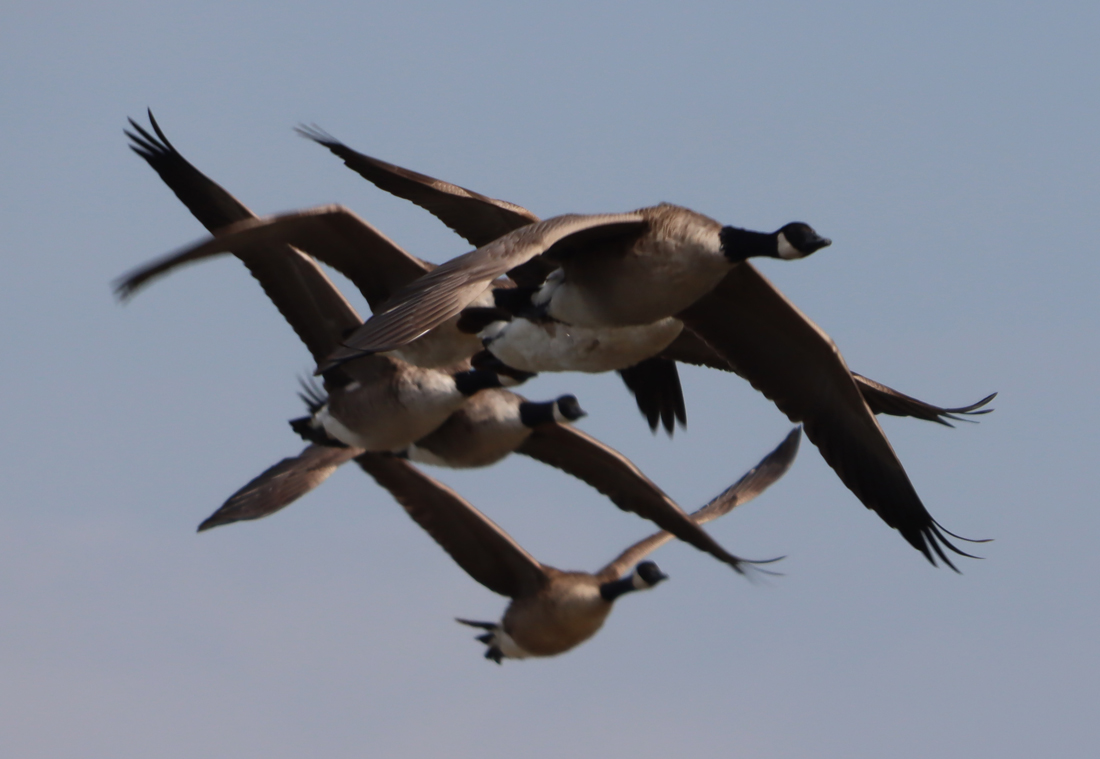
Flying Canada Geese at the RSPB's Burton Mere wildlife reserveWhen I got up this morning and saw what a beautiful day awaited, I decided on the spur of the moment to go to the RSPB nature reserve on the Dee estuary at Burton.

Burton village, well-kept and firmly manicured, is located on the southwest of the Wirral, about 20 minutes drive out of Chester, an area now better known for giving its name to the nearby wetlands.  The wetlands are divided into two separate entities.  The first is the splendidly well organized and laid out nature reserve operated by the Royal Society for the Protection of Birds (the RSPB) which was specially set up for the benefit of birds and bird watchers, but accommodates general visitors too.  There is also a route through the wetlands on the far side of the RSPB reserve, and extending well beyond it, which is the Sustrans route number 568, developed for cyclists but welcoming walkers. It crosses the wetlands from Connah’s Quay, meeting the Wirral peninsula at just above Burton Point, and continuing on to Neston.  They provide two very different but both marvellous experiences of the wetland scenery.  I have already posted a short piece about my short visit to the Sustrans cycle and walking route in the Burton Point area, although I want to walk the whole thing eventually.

Greylag goose at the RSPB's Burton Mere wildlife reserve


A lapwing stretching its wings, whilst a common sandpiper stands by unimpressed

A lapwing stretching its wings, whilst a common sandpiper stands by unimpressed

The RSPB wetland reserve

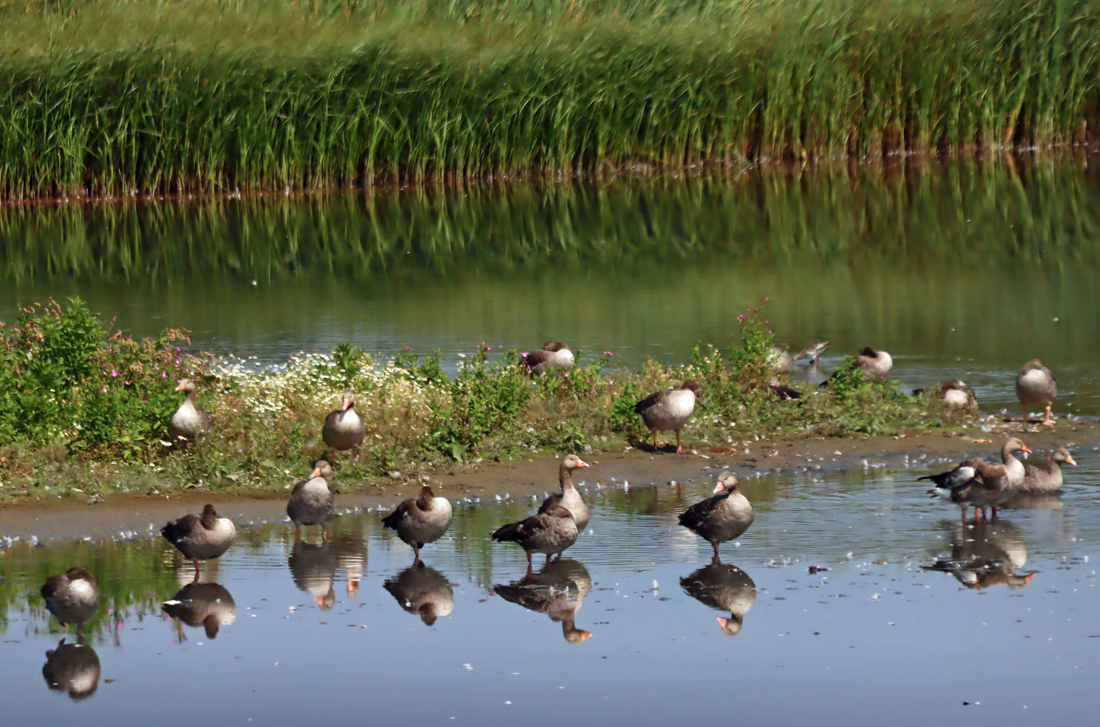
Greylag geese with their bright orange beaks at the RSPB's Burton Mere

Greylag geese with their bright orange beaks at the RSPB’s Burton Mere

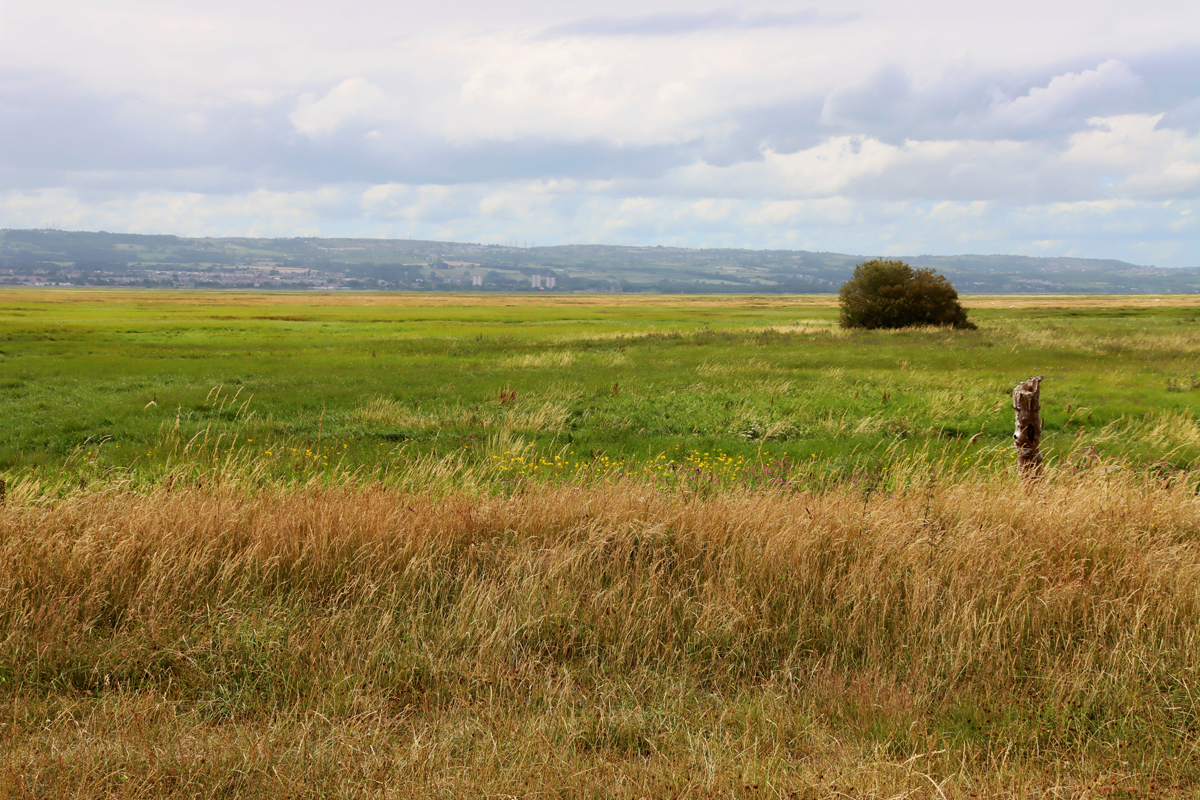
Several miles of wetland are enclosed within the RSPB reserve, which attract thousands of birds of many different species, with the river Dee invisible along the far edge of north Wales. The canalization of the Dee, completed in 1737, completely changed the environmental conditions of this part of the estuary, forcing the river to run along the Welsh edge of the estuary.  The canalized channel of the Dee is not visible from the nature reserve, but the miles of wetland are lovely.  There are huge expanses of pond and small lake, as well as flooded wetlands in the distance.  On a bright day with blue skies overhead it is gorgeous.  The reserve backs on to farmland at the rear, includes a woodland walk, and has a very attractive red sandstone railway bridge crossing the tracks below and even boasts the remains of an Iron Age hillfort which, if somewhat puzzling as an archaeological entity, has lovely views along the estuary towards Hilbre Island and across to north Wales.


xxx

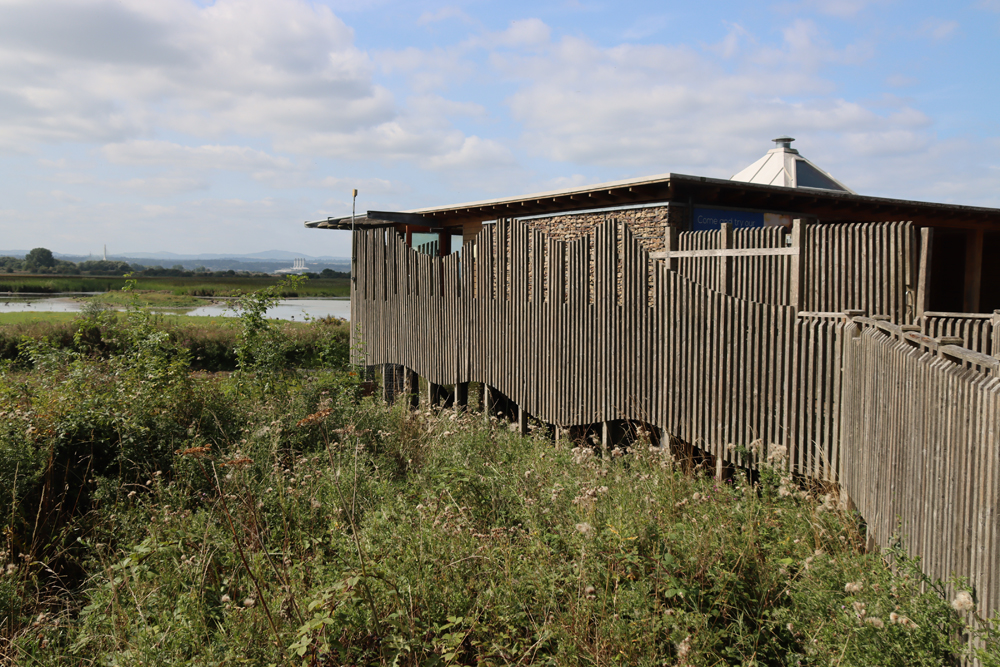
For bird watchers there is an enclosed viewing room where the ticket office is located, and throughout the reserve there are coverts and hides like the one above, all of them with benches, and all with windows suitable for both seated and standing visitors, and there are also viewing screens  and viewing platforms dotted throughout.

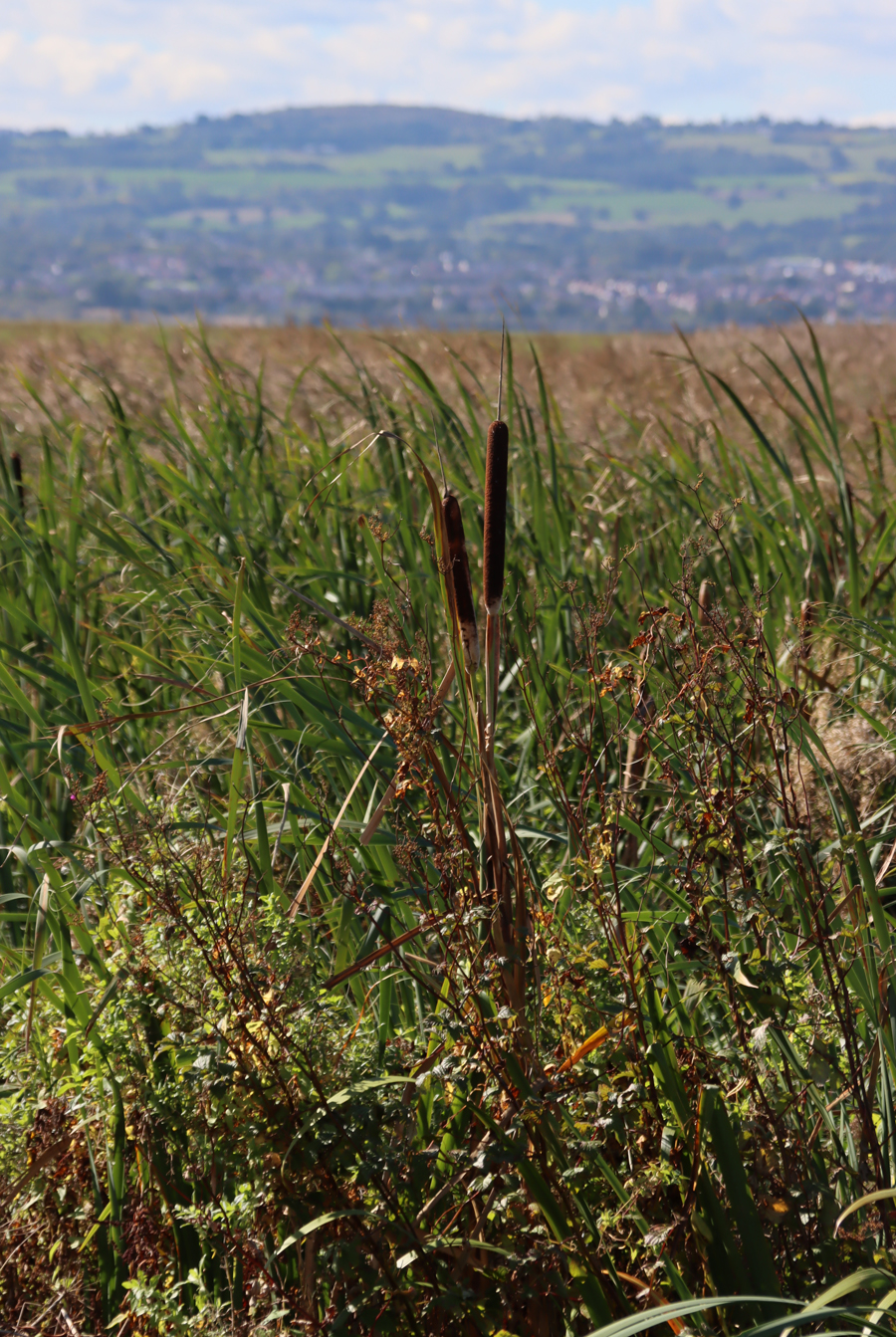
For less specialist visitors there are some splendid wending walks through the reserve, where water-loving plant and tree species abound, many in flower or producing berries at this time of year, and all providing a myriad of colours and textures over a base of deep greens and rich browns, which provide excellent resources for insect life.  The plants are so dense that where there is water running beneath boardwalks the water is scarcely visible.


The walks are all nice and even underfoot, many of the boardwalks coated in wire mesh to prevent them becoming slippery, and it is all beautifully maintained.  Being located on the side of the estuary, the nature reserve is nearly all on the flat.  All the main walks are wheelchair friendly, as are the hides and coverts.  There are actually four miles of signposted walks, as well as the woodland walk, which takes about half an hour.  There are plenty of benches dotted around for a moment of relaxation and contemplation.  Burton Point, at the furthest end of the nature reserve, is a tiny headland, which involves walking a short way up a slight slope and an informal footpath, and offers some great views along the estuary.  It is supposed to be the site of a small Iron Age promontory hillfort, but the evidence for this is difficult to see, although an interpretation sign does its best to offer a visualization of how it may have looked.

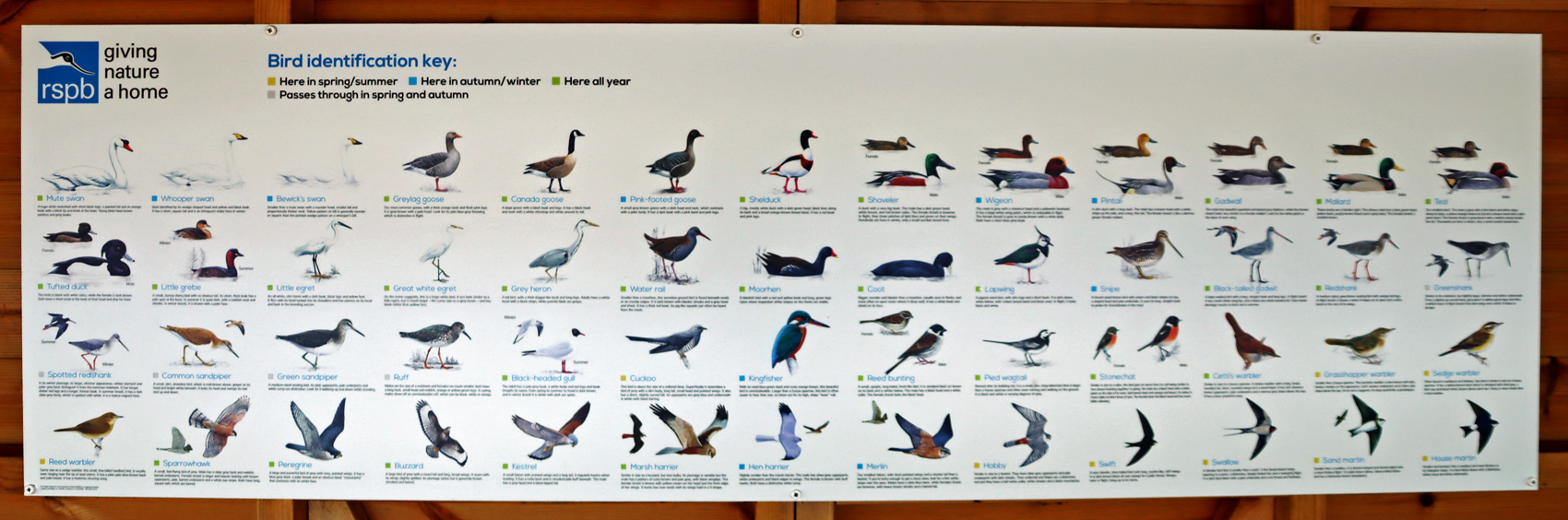
Even if you are not a regular bird watcher, the water birds are fascinating.  There are plenty of information boards showing what you are likely to see, and there is a whiteboard in the reception area showing a list of what has been spotted on a given and previous days.  Binoculars and cameras with enormous lenses (one of them in camouflage colours!) were very much in evidence and I soon found at why – my nice all-round lens, a 28-300mm zoom, was struggling desperately at its top end, and something much more powerful would have been helpful.  Do note that you can hire or buy binoculars from the reception area to get a better view of what birdlife is spending its time on the wetlands.   At this time of year the geese dominate, both in numbers and in voice.  Their honking can be heard wherever you are in the reserve, even when you can’t see them, There were Canada and greylag geese in great numbers, and a handful of Egyptian geese sunbathing on the far side of one of the stretches of open water, but there are plenty of other species too.

Greylag geese at the RSPB's Burton Mere nature reserve

There was something distinctly conversational, and rather cross, going on here, and you should have heard the honking!

Of the smaller water birds, as well as the familiar moorhens, coots and mallards, there were gorgeous lapwings and a variety of small wading birds, with slender legs and long beaks, including a common sandpiper that was distinguished by its rusty coloured plumage.  There were multiple grey herons looking like statues, waiting patiently for unsuspecting fish to swim by, and I spotted some tiny little fish in one of the ponds near the cafe which are presumably a popular part of the herons’ dietary intake.  There must be lots of reed-loving birds hidden in the wetlands, successfully shielding themselves from prying eyes.  There was apparently a spotted redshank, which was causing some excitement among the better informed bird watchers in one covert, but although I followed the directions that a father was giving his son (along the lines of – left of that greylag goose walking in front of that moorhen and then two back and one over) I was unable to spot it.  Bird feeders dotted around were attracting blue tits and great tits in great numbers and there were pied wagtails in some of the many trees that line the edges of some of the paths.  There’s an A-Z of bird species on the RSPB website.

One of many grey herons, on the hunt for unsuspecting fish at RSPB's Burton Mere

One of many grey herons, on the hunt for unsuspecting fish

This is a super place to visit, and seasonal changes in bird and plant life mean that there will always be something new to see, and there are plenty of butterflies, bees, dragonflies, damsonfiles and other insects to observe if you look carefully.  The grasshopper in the image below was particularly well camouflaged, and apparently there are sometimes lizards sunbathing in the sunnier patches.  On Burton Point there are rabbit warrens, and according to some of the signage (much of it directed at children, but still informative to older visitors) the local animals have a vibrant night life.

Spot the grasshopper

Regarding the hillfort on the promontory, Burton Point, there are websites that say that the small headland on which the site is located is privately owned and should not be entered without permission, but this is in fact now included in the RSPB reserve and is served by good footpaths and includes interpretation signage to give visitors some idea of what was here.  I’ll talk more about this site on a separate post.

Burton Point, a low promontory that overlooks the Dee estuary and is the possible site of an Iron Age Hillfort. In this photograph the footpath at far right leads into the woodland, where a vantage point looks down on the fortifications, but you can also see what remains of the fortifications at the far left of the photo where an earthwork is clearly visible

xxx

Visiting the RSPB reserve

Meadow Brown butterfly beautifully camouflaged at the RSPB Burton Mere nature reserve

Meadow Brown butterfly beautifully camouflaged

The RSPB reserve is very easy to find, although if you rely on that Google SatNav, please note that mine, having been asked to find “RSPB Burton” informed us we had reached our destination before we had actually arrived.  Fortunately, if you use the What3Words smartphone ap, which is stupendous (narrowing locations down to metre-sized locations) you can find it at ///readings.sideburns.handicaps.  Other details can be found on the RSPB website which includes the address, postcode, as well as details of the current ticket price and full details about what the nature reserve offers the visitor: https://www.rspb.org.uk/days-out/reserves/dee-estuary-burton-mere-wetlands.

The RSPB site has been very well thought out, and is very welcoming.  A single lane road from Puddington Lane has speed bumps and plenty of passing places, leading to a well-sized car park.  Entrance is via a building with a look-out over the estuary.  The entrance fee is £7.00 at the time of writing (July 2025), which helps to support the charity. There is a nice modern cafe on site, which sells tea, very good coffee, cold drinks and snacks. This is also where the toilets are located.  There is a small shop next to the ticket desk that sells gifts, books and bird food.

I have been following the RSPB Burton reserve on Twitter for a couple of years, without ever having managed to get there, and every day they take a photograph of their whiteboard to give you an idea of what species have been observed recently so that you know what to look out for.  You can find this at https://x.com/RSPB_BurtonMere.  There is a placeholder for them on Bluesky but no content just yet.

I rarely give an opinion about wheelchair use, but there were actually several wheelchairs users out and about today.  It would not be possible to get wheelchairs up to the Burton Point hill fort, or navigate them down one or two of the little tracks that run at the back of the reserve, but all of the coverts and hides are wheelchair friendly and, for both wheelchair users and children, the viewing windows extend from low to high for both seated and standing visitors.  The same comments go for those with unwilling legs.

Dogs are not permitted, and nor are drones.

Excerpt from the RSPB's leaflet about Burton Mere

Excerpt from the RSPB’s leaflet about Burton Mere, showing the top things to do on a seasonal basis


The Burton Marsh cycle and walking route 568 along the Dee estuary, Wirral

In 2013 a track across the wetlands from Connah’s Quay via Burton Point to Neston was opened.  As part of the Sustrans cycle network it is known as Route 568 or The Burton Marsh Greenway, and an information board at the point where the route meets Station Road (see map at end) says that this section is now also part of the “King Charles III England Coast Path.”  This section of the route, Burton Marsh, is partly made up of metalled lane, and partly boardwalk, and is a terrific walk.  I had never heard of it until I was standing in what remains of the hillfort on Burton Point headland, part of the RSPB reserve, and saw it passing almost at our feet and beyond into the distance.  It is an extraordinary sight, a mainly straight track across the landscape, and such a brilliant idea.

I parked on the section of Station Road that runs parallel to the estuary, which is part of the cycle route to Chester, and is separated from the rest of the Burton Marsh stretch of track by a gate to keep the sheep in.  There’s a map showing where the parking is located towards the end of this post.  This walks is all particularly beautiful on a sunny day with a blue sky stretching to the horizon. A shifting sky, which one moment produced sun and the next light shade, brought out the textures and colours for miles around.  Because the estuary is so flat and vast it can be very breezy or windy, which was no bad thing on a particularly sticky July day!


I headed through the gate in the Chester direction.  Starting out from this point you are on a metalled lane and have fields rising on your left, currently planted with palest yellow barley, whilst on your right are marshland habitats stretching all the way to the river Dee running along the Welsh side of the estuary, with every shade of green you can imagine, dotted with bright clumps of flowering plants and layer upon layer of different textures.

The barley fields are soon replaced by a fairly short red sandstone cliff edge, which has been heavily quarried over the centuries.  Where this red sandstone becomes much more uneven and comes out towards the lane, there is a sign on your right that explains that here are the remains of an Iron Age hillfort at the top of this small headland.  This is fenced off, as it is RSPB land.

Burton Point

The lane pulls away from the headland heading out into the wetlands, and soon you find yourself on a long section of boardwalk, which rattles splendidly when cyclists come along, with the marsh habitats either side of you.


On a clear day the views seem endless as far as the way to the Clwydian Range of Wales.  The track gives a sense of how big that landscape actually is, and why it is such a special environment for wildlife, with aquatic plant life as far as the eye can see, and bird life launching itself in and out at surprising and random moments.  As well as plenty of Canada and greylag geese, both on the ground and in the air, there were dozens of skylarks, terns flying overhead and birds of prey too high to identify.  Unsurprisingly there were plenty of seagulls too.  Beneath the surface, there must be an awful lot more going on.

The intention was to walk for an hour and a half, see where that took me, and then turn back to retrieve the car, but the sudden onset of fairly heavy rain both greyed out the landscape and blocked the view so I only walked for around half an hour before turning around.  Even during that short walk, the views were superb and the environment absorbing, and one of the nice things about this is that however far you want to go, and from wherever you start, it lends itself to any length of walk.  I was chatting to a man on a bike who had stopped to watch a group of greylag geese, who had cycled from the middle of Chester and was going to visit his father in Neston before turning around and coming back, and by contrast there were a couple who were just out walking a short way with their dog and a child in a pushchair.  All very civilized and a great way of introducing a wide range of people to an entirely new environment in a very easy way.


xxx

Visiting from near Burton Point

You can access the track free of charge from anywhere along its route.  Because it is all on the flat, it is suitable not only for walkers and cyclists but those with pushchairs, buggies, and wheelchairs.  There was even a man on one of those push-it-with-one-leg adult scooters.  There are gates at interfaces with roads because of the sheep.  Also because of the sheep there are frequent signs asking owners to keep dogs on short leads.   Having been followed for about half a mile by one particular sheep, which stopped and looked fixedly at me every time I turned around to see if it was still following me, I can confirm that sheep are a very likely to be encountered.

I have only done this from just north of Burton Point so far, a short drive from the A540 via the village of Burton, and you can park on the straight section of Station Road that runs along the estuary, and where there is plenty of room to park along the road (what3words: ///recur.films.dream if you have the Google-compatible app on your smartphone).  Station Road, as it leads back inland, also has some parking along its edges near to the estuary.  I have highlighted the main parking-friendly area on Station Road in the pink box below.

Convenient road-side parking near Burton Point marked in pink. Source: Streetmap.co.uk

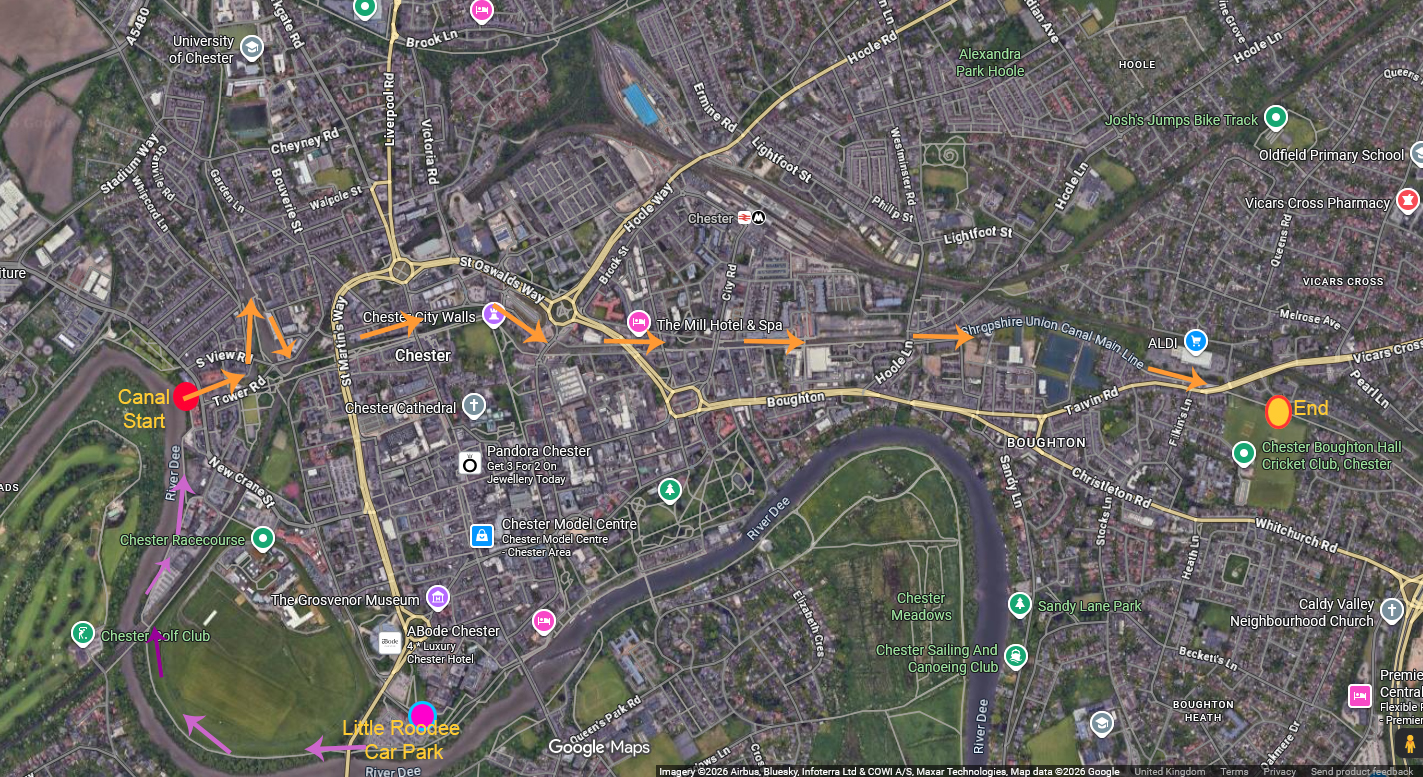
If you fancy starting in Chester, you can set off from the Little Roodee car park, go around the Roodee itself, and then follow the track to Connah’s Quay and go from there.  Fortunately you don’t have to depend on my finger-in-the-air directions, because Sustrans has its own website with full details for Route 568, which you can find here.  It shows the sections where the route meets roads, and where it intersects with other routes in the network.


Peter Carrington’s excellent guided walk of Roman Chester during the Festival of Ideas

Dr Peter Carrington, an experienced archaeologist specializing in Roman history, author of the English Heritage book Chester, and editor of the Journal of the Chester Archaeological Society always heads a guided walk as part of the city’s two annual festivals.  This year he introduced a large group of us to what remains of Roman Deva.  We had all received an introductory handout beforehand by email, which as well as outlining the history of the city, included maps and images of aspects of Roman Chester that could only be represented visually.  We met up at the canal bridge just outside the Northgate, so that we could look back towards the stretch of city wall that extends east, high above the bedrock channel that contains the 18th century canal.

Here, just on the other side of the bridge over the canal, a line of Roman wall is still clearly visible, originally topped by an ornamental cornice, the remains of which still survive, bizarrely incorporated into the later walls.  It is thought that the wall originally stood to around 15ft (c.4.5m).  It was news to me that the original defences had been turf-built, and that single layers of stone walling, leaning up against the turf wall, were subject to subsidence and patches of collapse.  The inward-leaning profile of that surviving section above the canal may be explained by that process of subsidence, and this is probably responsible for much of the rebuilding necessary around the walls.  We went up on to the walls and as we proceeded clockwise towards the cathedral, looking over the edge at key points along the way, some of the complexity of the original Roman design was explained.

Walks around the walls are always popular with tourists and residents alike, but sometimes it is what we can see at the base of the walls that tell us most about the Roman past.  When we left the walkway along the top of the walls to examine sections of Roman wall at the foot of the later walls, in Northgate gardens and the Kaleyard and opposite the amphitheatre we learned about the difference between the massive, uncompromising blocks of Roman stonework and the later medieval and Victorian sections of much smaller, sometimes rounded stonework.

The amphitheatre itself is one of Chester’s most well-known tourist attractions but because nearly half of it remains buried under a hideously decaying eyesore of a building, part of which is Georgian and all of which has been abandoned (shocking tourists), the story is only partially told.  Even so, two sets of excavations have revealed an enormous amount of details about the chronological history of the site, which was the biggest Roman amphitheatre built in Britain, with clearly visible phases of enlargement preserved in what remains today.   Peter talked us through the different phases, and explained how the interior would have looked and how the timber sections of seating would have been built and arranged, painting a verbal picture of a much more elaborate building than we see today.  As Peter pointed out throughout the walk, understanding the vertical past of Chester is far more challenging than getting to grips with its horizontal footprint.  It is hoped that the report on the post-Roman history of the site, also of profound interest, will be published in the upcoming months.

The Roman Gardens, which connect the amphitheatre area with The Groves, represent a particularly nice way of bringing together various features of Roman Chester in one place.  The signage explains how much of it relates to the original city, and explains how the hypocaust looked and worked and how the reconstructed mosaics were based on those found in excavations.

By the end of the walk the group had been given a great sense of where Deva is still to be found, and what the fragmentary remains represent.  Given the importance of the town and the scale of the architecture both within and outside the walls, it is remarkable how completely Medieval and more recent Chester have eliminated Rome’s once considerable footprint.

With many thanks to Peter Carrington for a fascinating introduction to Roman Chester.

Castell Dinas Brân, Castle of Crows above Llangollen – Medieval ruins and stunning views

I have been visiting Dinas Brân on and off for decades, but have never got around to writing it up.  It was one of my favourite walks with the family dog in the 1980s when my parents lived hereabouts.  Much later, a regular return trip between Aberdovey and Rossett gave me the opportunity to see the castle from various different angles in all sorts of weather, the conical hill on which it sits soaring from the Dee valley providing a commanding, impressive position that dominates the landscape.  I recently drove into Llangollen to go up to the castle on a hot day, prepared for a moderately steep walk from the canal bridge, correctly anticipating a slightly breathless arrival at the ruins.

This is a splendid walk.  It is only about 2km (1.3 miles) from the Eisteddfod Pavilion, where I parked, although uphill all the way from the Wern Road canal bridge, so it feels longer, and the views towards the castle and back over the valley are splendid.  The views from the castle itself are of course stupendous, both aesthetically and geologically.  The geology and geomorphology are mentioned in brief below.  More about parking, the different routes and conditions underfoot are towards the end of the post in Visiting.


Dinas Bran ruins

Castell Dinas Brân, a Scheduled Monument, is the story of two fortifications, one dating to the Iron Age, at around 600BC, the other a medieval castle dating to the 13th Century.  It is far from unusual to find Medieval castles built within the circumference of an Iron Age hillfort, because both were making use of the same strategic features:  a good view of the surrounding countryside, a defensible position, often above cultivable land, and access to water.  This post is about the Medieval castle.

xxx

History of Castle of the Crows

The medieval castle

Window of what was possibly the Great Hall of Dinas Bran

Window of what was possibly the Great Hall of Dinas Bran

It is not certain which of the Powys Fadog rulers built Dinas Brân.  The most common suggestion is that the castle was built by Prince Gruffudd ap Madoc (c.1220-c.1270), beginning in the 1260s, but there is an argument discussed by Paul R Davies that it may have been built by his father Prince Madoc ap Gruffudd Maelor.

Valle Crucis Cistecian Abbey, founded 1201

From c.1190 Prince Madoc was ruler of Powys Fadog, the northern section of Powys, which had been split into two on the death of Madoc ap Maredudd in 1160.  He founded the nearby Cistercian abbey in 1201, and although his territory was comparatively small, he clearly had ambitions to establish his name and ensure his legacy, A castle would have been consistent with that intention, and as Davis points out, materials and workers could have been shared between the two sites.  Prince Madoc died in 1236 leaving four sons, of whom Prince Gruffudd was the only one to survive.  Whether Madoc started work on the castle or not, it is clear that Prince Gruffudd continued it, completing it well before the war of 1277.

Together with Powys Wenwynwyn to the south, Powys Fadog was sandwiched between the much larger territory of Llywelyn ap Gruffudd’s Meirionydd in the west of Wales and England to the east.  Llywelyn (c.1223 – 11th December 1282, also known as Llywelyn the last, grandson of Llywelyn the Great) and his brother Dafydd (1238 – 3rd October 1283) had been in a long-term power struggle with Henry III that erupted once again under Henry’s son Edward I.  Whilst the northeast territories provided a buffer zone between the two warring factions, their rulers were inevitably dragged into the question of where to bestow their loyalties.  There was never any certainty that the members of a single family would throw in their lot with the same side, and some, like Llywelyn’s brother Dafydd, switched sides at least once.

Wales following the 1267 Treaty of Montgomery showing Powys Fadog sandwiched between Gwynedd and England. Source: Turvey 2002, p.xxvii map 8

Prince Gruffudd was married to an English wife, presumably for diplomatic reasons, providing a nod of friendship to the English.  With Lady Emma Audely he had four sons, the eldest named Madoc, and one daughter.  Presumably seen as fair game by Llywelyn, Powys Fadog was attacked.  When Henry III was appealed to for help but did not come to Powys Fadog’s aid Gruffudd seems to have thrown in his lot with Llywelyn, arranging for peace between Meirionydd (Gwynedd) and the return of his territories by agreeing to the marriage of his eldest son Madoc to Llywelyn’s sister Margaret.  Dinas Brân was apparently built in support of the interests of Llywelyn the self-styled Prince of Wales, borrowing certain elements of architectural styling from Llywelyn’s castles, including the D-shaped tower at its southern side.

Gruffudd apparently died in around 1270, because it was in this year that his sons signed a grant to provide Lady Emma with lands of Maelor Saesneg to secure her future.  At this time ownership of the castle would have been split four ways between his sons, because primogeniture was the English but not the Welsh system of inheritance.  Instead of one son or daughter inheriting an estate, on the death of a father all property was divided between the remaining sons, with provision usually made for wives and daughters.  Each of Prince Gruffudd’s sons had his own decision to make in November 1276 when war broke out again between England and Wales.  However they started the war, Gruffydd’s eldest sons eventually submitted to Edward, but in May 1277 an English force sent to take possession of the castle found it in engulfed in flames and it was evident that the garrison left behind had remained loyal to Llywelyn.  The decision to burn and abandon the castle rather than defend or surrender it did not, however, completely destroy the castle.

After the Treaty of Aberconwy in 1277 Llywelyn paid homage to Edward, sitting to the left of the king’s throne, with Alexander of Scotland at the king’s right. The peace did not last.

After the Treaty of Aberconwy in 1277, Llywelyn’s power was confined to northwest Wales.  The English inspection of Dinas Brân to assess the damage caused by the fire found that although considerable superficial damage had been inflicted, the well-built castle was structurally sound and still of strategic value.  Henry de Lacy, Earl of Lincoln, wrote to Edward I recommending that the castle be repaired and garrisoned with English troops.

Following Edward’s triumph, Powys Fadog was abolished as a territory.  Edward gave ownership of the castle and all its lands to John de Warenne, the early of Surrey.  The castle, however, was no longer relevant as a symbolic stronghold of the former territory and now stood at the borderland of the new friendly lordships of Chirk, held by Roger Mortimer, and Bromfield and Yale by John de Warenne.  Instead of devoting any attention to Dinas Brân, de Warenne became busy building his new castle at the eastern end of Bromfield and Yale on the Dee crossing at Holt near Chester.

Ruins of Dinas Bran

Ruins of Dinas Bran

There is no record of the role performed by Dinas Brân, if any, during the final great conflict between Llywelyn and Edward of 1282, when the English were triumphant.  Llywelyn died on the battlefield that year, and Dafydd was captured and put to death in 1283.  As Holt Castle grew, Dinas Brân was abandoned.

A completely unsubstantiated legend concerns the fate of the two underage sons of Prince Madoc, Gruffudd’s eldest son.  Walter Tregellas in 1864 tells the story, in which Edward I conferred guardianship of the two boys on Roger Mortimer and John de Warenne:  “it is stated that the two children were soon afterwards drowned under Holt Bridge . . . This is said to have happened in 1281.”  He goes on to recount an even better version of the conspiracy, however: “it is uncertain whether the king himself did not cause the children to be put to death.”  There is no evidence whatsoever about what became of the two younger children of the prince of Powys Fadog.

Dinas Bran and the wonderful scenery beyond

Dinas Bran and the wonderful scenery beyond

The only hint that they castle buildings may have been re-used is a poem by Hywel ab Einion Llygliw Myfanwy Fychan in the 14th century, in which he claimed to have been rejected by the beautiful girl who lived there.  There is no evidence to support this later domestic occupation, but neither is there anything to deny it.  John Leland, visiting in 1536, found it in ruins.


The Victorians

Dinas Brân Castle by Alphonse Dousseau, c.1850. Source: The National Library of Wales, via WikiData.

When ruins became desirable romantic destinations, Dinas Brân was an obvious lure for painters (many of whom chose to paint safely from below) and more adventurous tourists.  The Holyhead road was the major route through north Wales, with Telford’s great route, now the A5, opening in 1826, and the railway was opened in 1864.  A local entrepreneur, demonstrating great faith in the spirit of adventure demonstrated by the new tourists, decided to make the most of the popular site and the first visitor provision was supplied in 1820, with a cottage added in the 1880s as a tea room together with an octagonal camera obscura, which was still in situ by the start of the Second World War.

Walking up the hill not far from the summit I found a piece of slender white clay pipe, about an inch long, on a piece of well-worn hillside.  This almost certainly belonged to the period of Victorian interest in the castle.

Victorian cottage built for serving teas to visitors on Dinas Brân. Source: People’s Collection Wales


The castle as it stands today

Fieldwork

Plan of Dinas Brân, both prehistoric and medieval, following the geophysical survey of 2017

There has been very little fieldwork at Dinas Brân, and even the antiquarian investigators who explored other sites seem to have felt that this was one challenge too many.  The only exception appears to be alocal treasure hunter who is mentioned in a journal entry by Lady Eleanor Butler of Plas Newydd, whose home was in full view of the castle, and who commented that their landlord had informed them that a smith from Dimbraneth “has been dreaming of more than a year past of treasure at Dinas Brân. Hew has within this week begun to dig.”  There is no report of any discoveries.

In 2017 a geophysical survey was carried out and this was quite comprehensive, addressing both the medieval castle and the prehistoric hillfort.  Although nothing conclusive was discovered, magnetic readings did suggest that a fire had scoured the ramparts, perhaps tying in with contemporary reports that the sons of Prince Gruffudd had set fire to the entire structure rather than surrender it to the English.

In 2020 a survey was carried out by the Clwyd Powys Archaeological Trust (CPAT) to assess the condition of the site, both the castle and the prehistoric hillfort, making recommendations to make it safer and more approachable for visitors and to manage archaeological impact.  Earthworks were noted beyond the hillfort but were not included in the survey.

CPAT excavation at Dinas Brân in 2021. Source: Heneb

It was not until August 2021 that the first archaeological investigation was carried out at the site, organized by CPAT.  It was a small exploratory dig, with four trial trenches both within and outside the castle walls.  The main aim of the project was less investigation of the history and more about assessment of the condition of the building’s foundations.  Although the excavations did no more than reveal the medieval floor surface, one sherd of medieval pottery was recovered and a “ledge/kerb was discovered projecting from the gatehouse wall, with a portcullis slot in it near the east end, and a fine masonry carved pillar base at the western end.”  In 2021 the Heneb report said that the excavation report was “awaiting a second phase of work in 2022,” but I have been able to find nothing about a 2022 excavation and no further reports.

Modern conservation work was carried out by Recclesia, who surveyed the site and inserted stabilizing rods into the south wall of the castle to ensure that it stays upright now and in the future.

The surviving architecture

Detail of an old interpretation board

The plan drawn by Tregellas in 1864. with annotations

The castle was very fine in its day, with imposing fortified walls and stone and timber buildings.  There are hints that there were decorative features.  I have annotated the plan drawn in 1864 by Walter Tregellas to make this easier to follow.  If you have walked up from Llangollen, and climbed the east-facing slope of the hill, you will have entered opposite the original entrance.  I had had a long wander around before tackling how the ruins relate to the original layout but when I got stuck into the site plan, I started at the entrance.

The ditch surrounding the castle

The site consists of a rectangular court orientated east-west, c.82m  by 35m, surrounded by a ditch dug out of the bedrock, which provided the material from which the castle was built.  As well as building materials available within the immediate vicinity, it was found that there was sandstone facing in certain parts of the castle, which would have provided it with both refinement and prestige.  It is not clear where this came from, but it is likely that it was sourced from the same location as the Valle Crucis ashlar.  The ditch surrounding the castle was an impressively deep and wide feature, running around three sides, the northern side of the castle being positioned directly over a steep drop.  At the southwestern corner of the ditch was once a well, the location of which is now very difficult to see.

An artist’s impression of how the gatehouse (right) and the keep (left) as they may have looked when it was first built. Source: Clwydian Range and Dee Valley

The original entrance was marked by a gatehouse that, being one of the points of weakness of the castle, was built so that it could be well defended, with twin English-style towers forming a gatehouse, each with hollow basements and, remarkably, appears to have been furnished with highly ornate rib-mouldings.  This is unprecedented in Welsh castle design and may have been copied from an English example.  One of the two gate towers still has the underfloor barrel-vaulted arch that was accessible from the courtyard; although it is now open to the outside, this would have been closed in the 13th century and is probably the enlargement of an arrow slit.  The vaulted room is closed to the public except on special open days.  The gatehouse was supplied with latrines on its northern side, that emptied down the walls into the ditch.

The vaulted undercroft in the gatehouse


The stairwell that lead up to the first floor of the keep

Heading clockwise from here, you encounter the square keep.  This was once an impressive building that helped offer protection for the gatehouse as well as the most vulnerable eastern approach.  It will also have provided a home for the main family members and a final retreat at a time of siege.  It was equipped with latrine which, like the gatehouse, emptied into the ditch.  Additional security was provided for the keep.  It could only be entered via a first floor door reached by stairs from a walled passage, and was separated from the rest of the castle interior by its own ditch, which would have been crossed by a liftable bridge.

Continue around to the right to follow what was once the long south curtain wall.  The section of wall with two giant openings in it was either the site of the castle’s Hall, where dining and socializing would have taken place, or its chapel. The two openings, providing plenty of light for interior, would have been about 1.8m (6ft) wide at their maximum width.  They would have had shutters to protect the castle from the elements, but no window glass.

At the far end of the Hall a doorway opened into a D-shaped tower that extended beyond the line of the curtain wall.  The D-shaped section has gone, but this tower was a major feature of the castle, rising to two if not three floors.  A good surviving example can be seen at the well known Ewloe Castle (about which I have posted here).  Again, this was a defensive measure providing archers good views over the ditch and the flanking walls. The ruins of the inners walls give a sense of the size of this half of the room. It is likely that part of this was used for the castle kitchens, which gives weight to the argument that the adjoining apartment was the dining hall rather than the chapel.

Further along this stretch and you will find yourself looking out between two sections of wall, a gap that represents the remains of the postern gateway.  As well as providing a useful secondary pedestrian entrance on the opposite side of the castle from the main gatehouse, this could also be used as a “sally port” that would allow foot soldiers to mount a surprise attack from an unexpected position.

A rectangular building at the west end may have been either the hall or the chapel or served another purpose.  This area is likely to be highly disturbed, archaeologically, due to the Victorian building works in this area. The rest of the interior would have been filled with timber-built buildings, including accommodation for servants, storage, stables and workshops.


The landscape  

xxx

British Geological Survey geological timeline.

Standing on the peak of the hill, you are 305m (c.1000ft) above seal level.  Geologically, Llangollen is divided into two main formations.  At the top of Dinas Brân you are standing on one and looking at the other.

Beneath your feet the rock formations are dark grey Silurian shales and silstones, which were laid down as deep sea sediments and then subjected to metamorphic processes.  These are the same rocks that you see in the Dee river bed from the Llangollen bridge, with the rapids flowing over them.  The stone quarried from the ditches of this Silurian hillside were used to build the castle, and are uncleaved, around 30-40cm thick.

Above this layer in Llangollen is the heavily layered Carboniferous limestone escarpment that so dramatically forms a backdrop to Llangollen and Dinas Brân, laid down when the sea was warm and shallow.  The Devonian, which theoretically should have sat between these two geological periods, is missing, presumably because it was not under water in this area at that time, and did not form the rich, deep layers usually laid down in marine contexts.

The solid geology of Clwyd showing rock types. Jenkins 1991, p.14

Geomorphologically, the Vale of Llangollen is a typical U-shaped valley carved by the advancing ice and associated debris of the Welsh Ice Sheet as it advanced east.  The river Dee wends its way through this flat base, and former river beds are visible in the landscape, the former routes of the river blocked by the ice sheet, forcing water to find a new passage.

The  plant life that has settled into place on this isolated outpost is typical species that are capable of surviving on highly exposed rock with very little topsoil.  Drought-resistant annuals like foxgloves and swathes of rock-hugging perennial succulents like sedum anglicum are dominant at this time of year.


xxx


Visiting

Map of the footpaths to Dinas Brân Castle (Kightly 2003, Denbighshire County Council)

The castle is on the open hilltop and is free of charge to access.  There are no facilities at all.  You will need to take water and any snacks with you, although there are plenty of facilities down in Llangollen itself.

There are two main approaches to the castle for walkers arriving by car from the east.  One is a longer walk from the valley bottom, and the other is a much shorter but slightly steeper walk from the other side, approached along the narrow road now marked on the map as the Offa’s Dyke Path (even though Offa’s Dyke does not actually follow this exact path).  A map taken from the bilingual booklet Castell Dinas Brân Llangollen (in their Enjoy Medieval Denbighsire series) shows two alternative routes, with variations. 

The easiest place to park if you are heading up from the valley is the International Eisteddfod Pavilion (marked as the Royal International Pavilion on the map), which offers a really lovely walk along the canal to arrive at the canal bridge where you cross to begin the walk.  The second approach is much shorter and takes you from the Offa’s Dyke Path, a single-track road that follows the line of the hill, and has spectacular views; there is no official parking here, although there is space to pull over and park for about 4-5 cars (being careful to leave passing spaces) and this gets full very quickly on fine days.  

Both routes require sensible footwear, whatever the weather.  I was wearing some excellent lightweight hiking trainers with heavy tread, perfect for a hot day, but in damper seasons I would go for hiking boots.  Although the path starts off metalled in Llangollen itself, mainly because it is one access point to the local school, it becomes much more uneven underfoot as the path goes on, with patches of coarse bedrock and scatterings of loose scree.

The Eisteddfod Pavilion is on the A539 on the way out of Llangollen towards Valle Crucis and the Horseshoe Pass.  The car park is big, with a pay and display system.  From here, go up out of the car park towards the canal bridge, and go down on to the towpath to the left of the bridge, turning to the right under the bridge to head east in the direction of Llangollen.  This is a lovely stretch of canal, passing the marina on your left.

When you reach the next canal bridge, with a cafe on the right, walk up on to the bridge.  Directly in front of you, heading straight up a short flight of stairs, is the public footpath.

From here on it is easy to find your way.  Just keep going straight up.  You first pass the school on the left, and a field on the right, with a gate at the top of this first stretch.  Go through the gate, cross the lane, and keep going up the other side.

You will pass various attractive buildings along the way, the largest of which is the Grade II listed Dinbren Hall, built with conviction but without a great deal of imagination in a very lovely location in 1793.

Soon you will reach another gate.  This has signage on the other side of it warning to inform you that you have now arrived at the foot of the hill, and to keep dogs on a lead (there are sheep all the way along this walk).

It is less even underfoot from here, with a very short uneven patch, but you will find that just over the other side the path opens out onto the hillside, with a clear view of the path ahead.

A very short uneven section of path, but it evens out just on the other side


Beyond this, along the steepest part of the route, the ziz-zag path marked on the map is beautifully maintained at the time of writing, with occasional stretches provided with a hand rail and long shallow steps where required.

This brings you out at the the west end of the castle, where the Victorian camera obscura and teashop used to be located.  If you are approaching from the other side, via the Offa’s Dyke Path, you will find a similar zig-zag arrangement to provide a less strenuous way up the hill than heading straight up the side.

Eastern approach to the castle

You can easily turn this into a circular walk from the Eisteddfod pavilion. For the quickest of the two easiest routes, come down from the castle onto the lane under the limestone escarpment and head downhill along the Wern Road, which takes you back to the canal bridge.  For a longer but really attractive route, continue along Offa’s Dyke Path, past Wern Road, which eventually heads downhill and comes out at the Sun Trevor on the A542; cross the road, cross the canal bridge, turn right and walk back along the towpath into Llangollen.  Although this is a much longer way back, it is all metalled lane and nicely maintained towpath, so is very easy underfoot.

Sources

Ordnance Survey Explorer no.256: Wrexham/Wrecsam and Llangollen.  Particularly useful if you want to make this into a circular walk, or to visit other local sites like the Horseshoe Falls and Valle Crucis Cistercian abbey.

If you are particularly interested in medieval architecture in the Denbighshire area, do download their bi-lingual PDF booklet Enjoy Medieval Denbighshire.

Map showing sites featured in the “Enjoy Medieval Denbighshire” PDF

Books and papers

Berry, D. 2016 (4th edition). Walks around Llangollen and the Dee Valley.  Kittiwake Books

Davies, John 2007 (3rd edition). A History of Wales. Penguin.

Davis, Paul R. 2021. Towers of Defiance. The Castles and Fortifications of the Princes of Wales. Y Lolfa

Kightly, Charles 2003.  Castell Dinas Brân Llangollen.  Denbighshire County Council (bilingual booklet with excellent illustrations, artist reconstructions, photographs and information)

Jenkins, David A. 1991.  The Environment: Past and Present. In (eds.) John Manley, Stephen Grenter and Fiona Gale. The Archaeology of Clwyd. Clwyd Archaeology Service, p.13-25

Jones, N. W., 2020. Castell Dinas Brân, Llangollen, Denbighshire: Condition Survey. Unpublished report. CPAT Report No. 1739
https://coflein.gov.uk/media/366/634/cpatp_144_001.pdf

Roserveare, M. J., 2017. Castell Dinas Bran, Llangollen, Denbighshire: geophysical survey
report. TigerGeo Project DBL161.

Tregellas, Walter 1864. Castell Dinas Bran Near Llangollen, Denbighshire. The Archaeological Journal, 21, p.114–120
https://archaeologydataservice.ac.uk/archiveDS/archiveDownload?t=arch-1132-1/dissemination/pdf/021/021_114_120.pdf

Turvey, Roger 2002. The Welsh Princes. The Native Rules of Wales 1063-1283. Pearson Education

Venning, Timothy 2012. The Kings and Queens of Wales. Amberley


Websites

Coflein
Castell Dinas Bran
https://coflein.gov.uk/en/site/307064/

Clwydian Range and Dee Valley
Dinas Brân
www.clwydianrangeanddeevalleyaonb.org.uk/projects/dinas-bran/

CPAT
Historic Landscape Characterization: The Making of the Vale of Llangollen and Eglwyseg Historic Environment
https://heneb.org.uk/archive/cpat/projects/longer/histland/llangoll/vlenvi.htm

Heneb
Castell Dinas Brân, Llangollen
https://heneb.org.uk/cy/project/castell-dinas-bran-llangollen/
Dinas Brân, Llangollen Community, Denbighshire (HLCA 1150)
https://heneb.org.uk/hcla/vale-of-llangollen-and-eglwyseg/dinas-bran-llangollen-community-denbighshirehlca-1150/

Recclesia
Castell Dinas Bran
https://recclesia.com/our-work/castell-dinas-bran

Scottish Geology Trust GeoGuide
Dinas Brân
https://geoguide.scottishgeologytrust.org/p/gcr/gcr19/gcr19_dinasbran


You can explore the castle from afar via this Sketchfab 3D model by Mark Walters.


A video showing the two main stages of occupation of the Dinas Bran hill, on the Clwydian Range and Dee Valley website, beginning with the hillfort and moving on to the medieval castle.

xxx

Beyond the Walls: Chester circular river walk

xxx

The dotted green line is the only way on to the footbridge avoiding steps.

sdfsdf

For those with unwilling legs please note that in [squared brackets, and highlighted in bold], are alternative routes that avoid steps and any other observed challenges.  On the above maps the dotted line in green, is the only way of getting on to the Queen’s Park footbridge avoiding steps.

As well as the numbered sites, turquoise stars show other sites nearby that may be of interest.  Each of the numbered and starred features deserves a post in its own right rather than the short burst of text allowed for each, but hopefully there is enough to make the walk informative as well as enjoyable, and in some cases I have hyperlinked to sites with more useful details.

You can download the text of the walk, including the maps, as a PDF here (but without the introduction, the list of sources and without ink-hogging images).


The dotted green line is the only way on to the footbridge avoiding steps

xxx

Introduction

View through the chancel arch of St Mary’s Nunnery through to the Ship Gate. Grosvenor Park.

Together with the city walls, this is my favourite walk in Chester, incorporating some lovely riverside footpaths and green spaces beginning at the Little Roodee car park on Castle Drive.  The entire walk is on metalled surfaces, and is therefore very suitable for all seasons.  It starts with the Grosvenor Bridge, turning in to Overleigh Victorian Cemetery and taking it from there along the River Walk.

There is plenty to enjoy along the south bank of the Dee, with lovely and peaceful riverside walks separating points of interest such as Minerva’s shrine, Handbridge with the Old Dee Bridge and Weir, and the Queen’s Park footbridge. The Groves is the northern counterpart to the River Walk, with its Victorian grandstand and array of cafes, ice cream parlours and the southern stretches of the Roman-Medieval walls.  Back past the Old Dee Bridge, the walk takes in the former old Dee mills, the Gothic Revival hydroelectric station, the remains of the former prison’s outer wall, the Wheeler Building that houses the Riverside Museum and the Royal Infirmary stained glass, and then returns along the river bank to the Little Roodee.

Ice Cream parlour on The Groves

The walk takes in several periods of Chester’s architectural history, from the Roman, through medieval periods, skipping the early Stuart and Civil War years. The Bear and Billet public house on Lower Bridge Street represents the later 17th century, but most of the remaining architectural history on the walk resumes with the Georgian architecture of the 18th century, plunging headlong into ambitious Victorian expansion and alteration.  From a distance, seen from the Grosvenor Bridge, is the Art Deco water tower, which is a nice addition to the mix.  Two examples of the less fortunate periods of 1960s and 70s architecture that afflict Chester like a bad rash also appear, but although one of them is particularly bad (the “Salmon Leap” apartments on the Handbridge side of the Old Dee Bridge) the other is somewhat less objectionable (the ex-Cheshire County County building, now the University of Chester’s Wheeler Building).  A very modern building, nicely done on a budget, is the cafe in the Little Roodee car park with its environmentally friendly “green” roof.


The Walk

1) Roodee carpark, toilets and café

The Little Roodee Cafe

The walk starts from the Little Roodee car park on Castle Drive, which lies along the northern edge of the River Dee.  There are plenty of other places in Chester to park, and there is also the very reliable Park and Ride, but this is a useful place to start the walk, including a very nice café with excellent coffee and good snacks, with public toilets within the café (there are other public toilets on The Groves, opposite the bandstand, shown below).  The bottom of the car park provides a good viewing point for no.2, the Grosvenor Bridge.

For those wanting to explore the river walk to the east, circling the edge of the Roodee and over to the west of Chester, this is also an excellent starting point.

The postcode for the carpark is CH1 1SL or the exact location for the entrance to the car park is What3Words ///swung.statue.limp), which can be used in most SatNavs.  If you are coming in by Park and Ride, ask the driver tell you when the stop is approaching for Adobe (big black glass building) on the Grosvenor Road.  The return bus stop is opposite Adobe on the castle side of the road.

2) Grosvenor Bridge

The Grosvenor Bridge

For the best view of the bridge, head downhill in the car park towards the river and turn right towards the bridge, crossing under one of its vast arches.  Look back to see a great view of the the entire span.  For centuries the only bridge across the Dee at Chester was where the late Medieval Old Dee Bridge is now located, following the line established by the Roman bridge at the end of what is now Lower Bridge Street.  This was becoming seriously congested by the 18th century, when both the population and the economy were growing at a considerable pace, and a new bridge was an urgent requirement.  Local architect Thomas Harrison won the contract with his daring proposal for a 200ft (61m) single span that would not interrupt tall-masted river traffic.  It was not merely a new artery for Chester, but a statement of civic pride.  A plaque in the side of the bridge records that work began after an Act of Parliament was passed in 1825, and was paid for by a public loan of £50,000.  It was opened by Princess Victoria on 17th October 1832 (5 years before she became Queen), and was paid for by tolls on both the Grosvenor and Old Dee bridges until 1885, when the tolls were abolished.  The bridge remains a monumental and impressive sight today.

The Grosvenor Bridge shortly after construction. Source: Wikipedia

Retrace your steps and head back up the car park, passing in front of the cafe, and up the flight of steps to the Grosvenor Road, cross at the pedestrian lights, and turn left to walk over the bridge.  [If you want to avoid the steps, head to the other end where the car entrance is, turn left and walk up the road, Castle Drive, to the head of the steps on the corner, and cross at the pedestrian lights and turn left across the bridge].  

From the top of the bridge you can look right (or west) over the Roodee racecourse on the north bank of the river, and the impressive houses that formed the new middle class suburbs of Curzon Park which was developed in the 1840s to accommodate wealthy residents who wished to escape the narrower confines of the increasingly busy and commercial city. Some of the bigger of these buildings have been converted into apartments today.  Look left (east) and you can see the spire of St Mary’s Without The Walls, as well as the Handbridge water tower, a local landmark that is visible from various points in the Chester area, and was influenced by Art Deco designs.

Curzon Park

3) and 4) Three memorials in Overleigh Victorian Cemetery

After crossing the bridge, walk for perhaps 30 seconds and you will see a gateway on your left with wrought iron gates, one of which is open to provide access for pedestrians into the Victorian cemetery.  If you are on the opposite side of the road, there is a traffic island almost opposite to make it easier to cross.  Walk towards the information board and the bench, and pause.  The walk will continue downhill to the right, but we are briefly detouring to the left to see two of the most interesting of the memorials in the cemetery, one of which is a puzzle until you see it on the early 1850s engraving of the cemetery.

Entrance to Overleigh Cemetery

xxx

Overleigh Cemetery in the early 1850s. Source: Wikipedia

Overleigh cemetery was given the go-ahead by the Chester Cemetery Act in 1848.  The land was acquired from the Marquis of Westminster, who exchanged it for a shareholding in the company.  Work was forced to stop for seven months when the money raised was spent, and was not completed until new shareholders could be found.  The cemetery opened in 1850.  Like the Grosvenor Bridge, Overleigh Cemetery, was not merely the result of a Victorian efficiency drive and the desire to return a profit, but also a matter of improving the city in ways that demonstrated a profound interest in the character and status of the expanding city.  Although the cemetery was a pragmatic response to the inability of churchyards to meet demand, the layout and planting of the cemetery reflect country house garden and leisure park designs, with curvilinear drives, gothic revival architecture, a lake, plenty of of trees of different types and a rustic bridge.  Sadly, the only survivors of the architectural features from the 1850 design shown on the above engraving are the tall thin monument at far left, discussed below, and the rustic bridge at far right.  You can read more about the cemetery and its fashionable and elegant design on the blog here.

Now head left past the bench and stop a few seconds away in front of a nicely executed faux Grade II listed Gothic shrine featuring an effigy beneath tan elaborate canopy. It puzzled me that there was no inscription on the shrine, but the actual grave ledger lies flat in front of the shrine over the top of the actual grave, complete with the elusive inscription.  The shrine belongs to the Reverend Henry Raikes, who died in 1854, aged 72. The shrine was designed by architect Thomas Penson, who was the landscape architect for the entire cemetery and who built several buildings in Chester.  It was erected in 1858, funded by public subscription, the progress of which was frequently reported in the local newspapers.  As well as the former Chancellor of the Chester, Diocese Raikes was a philanthropist, a trustee and governor of the Blue Coat Hospital and one of the founders of the Chester “Ragged Schools” that provided education for pauper children.

The ruins of the Robert Turner memorial

Immediately to the right of the Raikes shrines, the second monument of note is the grave marker for Robert Turner (1790-1852), a Chester brewer and wine merchant who, in 1848 was Sheriff of Chester, a largely administrative but important function with the responsibility of keeping the peace, closely linked in to the work of the courts and the prison.  The memorial as it stands today looks very peculiar, a bit like a three-tier cake on space-rocket jet nozzles.  The clues to its original appearance actually still lie at its feet.  Three stone columns lie horizontally, when not semi-concealed by undergrowth.  Look at the engraving above and find the building at top right that looks like a little Classical temple.  This is how the Turner grave marker originally looked. It collapsed at some time in the past, and the tiered roof and although it has been considerably tidied up, reconstruction is no longer possible, and this strangely truncated form is all that is left standing of the memorial monument.

Retrace your steps past the bench and head down the hill until you reach a tall monument (4) in a triangular intersection of the cemetery drives and pause to have a look at it. 

This is not a burial monument but a memorial to William Makepeace Thackeray, 1790-1849, (uncle of the famous novelist) who moved from Denbigh to Chester to practice, and became a great success as a physician, and was renowned for his philanthropic and charitable works. He was buried in Chester Cathedral, but this memorial and its inscriptions celebrate his achievements, including “His attention to their charitable institutions / His consideration for the sick and needy / His kindness to the schoolboy and the orphan.” The memorial also serves as a useful anchor for the cemetery, a suitably impressive focal point that helps to give this part of the cemetery a sense of cohesion.  This is also a very good position to pause and take in the wonderful selection of mature trees, most of which were planted when the cemetery was first laid out.  There is a variety of species, and they were an essential part of the parks-and gardens style layout that was very popular in the Victorian period.

Head to the left. You will see the gateway pillars straight ahead of you.  This opens on to River Lane.  Turn left on to River Lane and turn right when you reach the end, heading east along the lovely River Walk.  The walk from Overleigh to Edgar’s Field is a nice one, consisting of a metalled road flanked by trees and shrubs, with fields to the south and views of the river, depending on the time of year, to the north.

You will emerge from the path onto a short residential road, Greenway Street, and opposite is another gateway, this time into Edgar’s Field. 

5) Edgar’s Field

The entrance to Edgar’s Field

Go through the gate into Edgar’s Field

Edgar’s Field is an open green space given to Handbridge by the first Duke of Westminster in 1892.  The name Edgar, so the story goes, refers to the early medieval King Edgar, great-grandson of Alfred the Great, who was crowned King of England in both Bath and Chester.  His Chester coronation was said to have followed a meeting near the field in AD 973, with leaders (either six or eight) from other regions  after which he was rowed by members of the visiting delegation to St John’s Church, just a little further upriver.  How much of this is legend and how much reality is anyone’s guess.

6) The sandstone outcrop 

Straight ahead there is a choice of going uphill to the right or sticking to the river walk on the left.

You will go right, but pause to look at the amazing sandstone outcrop.  This is a particularly nice piece of bedrock, formed of sedimentary layers laid down, during the Triassic period, 252 to 201 million years ago, when the landscape consisted of Sahara-like desert and abraided rivers.  This is also the period when the dinosaurs Pseuduchium Archosaur (ancestral to modern crocodiles and alligators) and Chirotherium are found, survivors of the Permian extinction (in which 95%) of dinosaurs were wiped out, and of which fossilized footprints have been found in the Triassic sandstones on Hilbre Island at the top of the Wirral.

Sandstone formations on Edgar’s Field

The various lines and colours visible in the Edgar’s Field rock represent the different layers of sediment (bedding) that were laid down by rivers and floods that were laid down as muds and have built up over time.  Nice features include both cross-bedding and slumping, geological features exclusive to sedimentary rocks.  Differences in colour reflect differences in the chemical composition of the sediments as they were laid down, a dramatic example of which is shown in the above photograph of the outcrop.  See more about the Cheshire sandstone in this PDF on the Sandstone Ridge Trust website.

Walk along the path to the right of the outcrop.  A second outcrop appears on your right, and on the face that looks over the big open green is the Minerva shrine, so leave the path and walk up the green slope.

7) Edgar’s Field and the Minerva Shrine

When you are standing in front of the shrine, you will find it very water-eroded.  It is carved directly into outcrop, one of only two known to be still in situ in Britain, and is a Grade II listed Scheduled Monument (1.45m high and 0.73m wide).  The sandstone surround is Victorian in date, added in the hope of preventing further erosion.

The Roman 20th Legion, the Valeria Victrix, arrived in Chester (Deva) in AD76, and in one form or another the Romans remained in Deva until around 380.  Although outside the Roman city walls, Handbridge was an important location because it was the quarry for the Roman town and its walls, the source of its red sandstone building blocks.  Further along the path on an interpretation board is a reconstruction of what the shrine would have looked like, originally with an owl on Minerva’s left shoulder, possibly holding a shield in her left hand, and a spear in her right hand.  Minerva was an interesting choice.  Although better known goddess of wisdom and knowledge, she also served as a protector for those engaged in defensive war, a subtle distinction from aggressive war that might well be attractive to those building protective walls.  The little cave to the right of the shrine was probably carved out to hold votive offerings.  The area around the shrine was excavated in the early 1920s, revealing both that the quarry was in use at around AD100 and that subsequently soil was imported to cover the quarry floor in the late-second century. Roman occupation remains dating from that time on were found on the site. The site was again used as a quarry during the Middle Ages, when Historic England speculates that the Minerva carving may have been re-interpreted in Christian terms and re-used as a Christian shrine.

It is worth walking down to the edge of the river, through the line of magnificent lime trees, to enjoy the excellent views over the medieval Old Dee Bridge bridge.  From there, follow the path for a short distance to the gates out of the park.  You now have the Old Dee Bridge on your left and Handbridge on your right.

8) Handbridge

Handbridge

Handbridge has always has an extra-mural personality of its own.  From the mid 12th century there were mills and quays at Handbridge, when parts of the district were owned by St Mary’s Benedictine nunnery, which seems to have taken over the entire manor by the 13th century.  In the late 14th century industrial activity seems to have been represented by the production of glass, and by the 15th century it is thought to have been a popular area of Welsh migrant settlement.  Welsh residents in the 16th century included a high percentage of the city’s brewers and ale sellers. In the Victorian era it became known as one of the poorer areas, with a high proportion of industrial worker.  Today Handbridge has gone upmarket and is now an attractive residential location with a villagey-atmosphere, with some excellent cafés and pubs for those looking to take a break at this point.  Both Spoilt for Choice and Brown Sugar cafés are great brunch/lunch stops, and the Old Ship Inn is a very fine pub.

Nathaniel Buck’s view of Handbridge in 1928. Source: MutualArt

9) The Old Dee Bridge 

Do not cross the bridge, because the walk continues on the same side of the river, but if you want to stand in the middle and admire the weir, discussed next, it’s an excellent place for getting a good view. 

The Old Dee Bridge

The oldest known bridge to cross the river at this point was Roman, carrying the Via Praetoria from the south gate over the river to link up with the Roman road network, with roads leading directly from Chester to the southeast via Whitchurch to Wroxeter (Vicronium) and the south to London (Londinium) and Caerleon (Isca), and along the north Wales coast to Holyhead (Segontium).  It must have been rebuilt several times over the 300 years of Roman occupation.  The current late Medieval bridge replaces an early Norman bridge, but apparently fell down during the floods of 1227 and had to be replaced.  The construction is interesting.  It is built of the usual local red sandstone, but for reasons unknown, instead of being evenly distributed along the length of the bridge, the arches are each of a different width, giving it a splendidly individual appearance.

The Bridgegate on the opposite side of the river is discussed below.

10)  The Weir

Staying on the same side of the river, cross the road and follow the line of the river for a few steps until you get a good view of the weir.
xxx

Very little is known about the weir itself.  It is generally agreed that it was at least Norman in date, but whether it was actually the elaboration of a Roman innovation is open to debate.  The Romans certainly built weirs, some of them very substantial, but at the moment there is insufficient information to determine the earliest date for it.  Walk a little further down by the side of the river and you will see that on the near side of the weir there are a series of very wide water steps, forming what looks a little like a stepped waterfall; this is a salmon leap, built to enable the fish to navigate their way upstream for spawning.  On an open day at the monitoring station last year I saw one of the salmon being caught for weighing and it looked huge!

The Salmon Leap

11) River monitoring station and ornamental water wheel

Probably the least attractive feature of the Chester riverside is a row of 1960s apartments that you will see from the north side of the river.  You now pass under the concrete overhang of these apartments. There are lovely views over Chester on your left, and you  will reach a small island with a building on it.  

River monitoring station

Water wheel reconstructed in 1988 by the Chester Civic Trust

This is the river monitoring station, where various tests are carried out on the water quality and the condition of the fish themselves.  I was lucky enough to be there on an open day last year when  an enormous salmon was pulled out for weighing before being returned to its journey upstream.  In front of it is a small water wheel, which was installed in the 1980s as a reminder of the former Dee mills that used to be a dominant feature of the medieval riverside and an all-important feature of Chester’s economy in the Middle Ages.  Beyond it is a small sluice that once regulated water into the narrow channel that forms the island.

Carry on walking along the Riverside Walk, enjoying the greenery, until you reach the footbridge, which passes above the path, but has a flight of shallow steps running up either side of it so that you can reach the bridge from the path. [The alternative approach to the bridge, avoiding the steps from the river walk up to the bridge, is a rather long way round and is shown on the above maps as a dotted green line that takes you along Queens Park Road and around Victoria Crescent].


12) The lovely Queen’s Park footbridge

In 1851 it was decided that Chester needed a second suburb, in addition to Curzon Park, to be named Queen’s Park, and this was developed throughout the 1850s.  This was also built on the south bank of the river, this time opposite The Groves.

In 1852 a suspension footbridge was built to connect Queen’s Park with Chester, becoming the Queen’s Park Bridge.  The predecessor of the current Queen’s Park footbridge was built in 1852. In 1922 this was taken down, and work began on a new suspension bridge that opened, with some ceremony, in April 1923.  For more information about the opening of the bridge and its contemporary conditions of use, see the entry on the Cheshire Archives and Local Studies blog.

Conceptually, the bridge is the polar opposite of the vast solidity and monumentality of the later 1832 stone Grosvenor Bridge. The 1923 bridge is superbly elegant with delicate lattice metalwork. This latticing and the suspension cables supply a light, airy feeling, which is something to do with the sense of it hanging freely rather than being solidly rooted in the riverbed.  It is a perfect partner for the light-hearted promenade known as The Groves, with its lovely buildings and the similarly elegant bandstand, which is still used today, and the little ice-cream turrets.  Pride in the achievement, common to so many Victorian enterprises, is declared in the panels at the top of the suspension towers, which give the name of the bridge and the date of its construction.  Just as on the Grosvenor Park Lodge, the bridge’s towers feature the shields of Chester’s Norman earls.

13) The Grosvenor Park

The understated river-side entrance to the Grosvenor Park at the end of the footbridge

Walking off the bridge on the Chester side you will see a flight of steps straight ahead of you.  Just before the steps, on your right, is the understated gateway into the Grosvenor Park. 

I have included the park partly because it surprises me how many residents and visitors seem to bypass it, and it is lovely on a sunny day.  The Grosvenor Park was the brainchild of Richard, the second the Marquis of Westminster, following the example of similar projects elsewhere.  Like many wealthy Victorians, he undertook a number of philanthropic projects, and in 1867 the park opened for the benefit of local Chester inhabitants.  Unlike many town and city parks this one was not paid for partly by subscription; it was, in its entirety, a gift to the city from the Marquis, who chose the designer of the successful Birkenhead Park, landscape architect Edward Kemp (1817-1891), to lay out his new public space.

Today it is a beautifully maintained space with a miniature railway operating in the summer, a rose garden, a couple of vantage points from which to inspect the views over the river and some lovely wide open spaces, together with the shade of trees for those who prefer a bit of cover, in which to relax.  Although this is not a formal park, in terms of the big municipal floral plantings that characterize some English parks, there are colourful beds dotted around and at the top left corner of the park there is a charming wheel-shaped rose garden that is lovely in the summer months, with a variety of colours, and some lovely scented species, with benches around its edges.  As in the cemetery, which had opened 17 years previously, the trees were seen as a major feature of park and there are some splendid specimens.  The pond may once have been ornamental, but is now surrounded by tall reeds, providing a splendid refuge for wildlife.  I have seen the rails for the miniature railway but not the train –  I really must find out when it runs!  There is plenty of seating throughout the park, and as well as permanent sculptural pieces, there are often temporary modern art installations dotted throughout, which may or may not be your cup of tea, but are always genuinely interesting, and usually reference the natural world.  Look out for information panels dotted throughout the park.  The lodge, discussed next, serves as a coffee shop during the summer.  It’s not on the map because it is closed in the winter.


Ferris wheel in the Grosvenor Park


14) Four Medieval monuments

The arch from St Michael’s Church

As you walk into the park along a metalled path, you will soon come to a set of three clearly medieval (as opposed to mock-gothic) monuments set back from the main path, with a little side path of its own.  These were all moved here from elsewhere in Chester, and serves as a miniature outdoor museum.  The first one that you encounter is a gothic arch from St Michael’s Church, which is still standing but was largely rebuilt in the 1840s by James Harrison, and it is possible that the gateway was removed at that time.

Next, following the side path is the little Jacob’s Well, originally installed on The Groves as a drinking fountain and at its base a water dish for dogs.  The keystone inscription is from the New Testament and reads “Whosoever drinketh of this water shall thirst again.”  Finally, and most impressive of the three, is the arch and flanking niches that once linked the nave of St Mary’s monastic church to its chancel, a sad reminder of the absolute total loss of St Mary’s medieval nunnery.  The photograph of it is below under no.27, where the nunnery is discussed.
xxx

Keep walking across the intersection, bearing right, and you will immediately come across the Ship Gate, which once sat to the west of the Bridgegate at the end of Lower Bridge Street providing pedestrian access  from the riverside to the city.  This was moved three times, first in 1831 to a private garden in the Abbey Square, next in 1897  to the Groves and finally in 1923 to its present location in Grosvenor Park.

The Ship Gate, looking back towards the St Mary’s chancel arch

Between the St Mary’s arch and the Ship Gate there is a path going uphill to the main park, with handrails, shown in the photograph above.  Walk up the slope to the main drive towards the statue at the end.

15) Viewing platform over the Dee

If you follow the main drive to the statue of Richard, the second the Marquis of Westminster, you will see, slightly to your right, a large viewing platform with seating around its circuit.  The view over Chester meadows towards Boughton was probably a bit better in the late 1800s, but is still good today.

16) Grosvenor Park Lodge

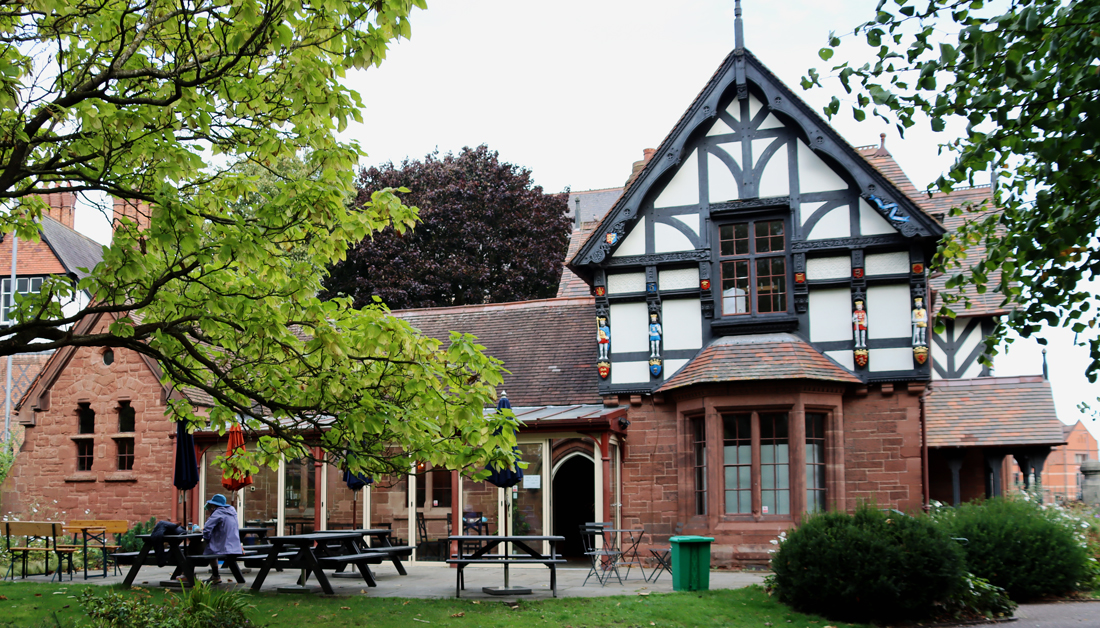
When the park was opened in 1867, it had a lodge at the main gate and this remains today, used as a café in the summer months.  It was designed by successful local architect John Douglas who is best known for the Eastgate Clock, but who built a great many buildings in different styles in Chester.  It was built in the popular half-timbered revival style over red sandstone.  The brightly coloured statuettes on black timbers on the lodge show King William I, who appointed Hugh d’Avranches, better known as Hugh Lupus as the first Earl of Chester from 1071 until his death in 1101.  Hugh is shown, together with the successive Earls of Chester, ending with John de Scot (from 1232 to 1237), who died without heirs, after which the earldom reverted to the Crown.  Various family shields show locally relevant themes including the golden sheaf of the Grosvenor family, the portcullis of Westminster and the Chester city coat of arms.

17) The Grosvenor Park Archaeological Excavation

Grosvenor Park Excavations in 2024

Near to the rose garden, to its east, and for several weeks every year since 2007, an archaeological excavation takes place using students of the University of Chester to investigate the complex historical narrative of this area.  The project was initiated to provide information about the Church of St John the Baptist, and the later use of the area, including a house documented to have been built in the late 1500s by Sir Hugh Cholmondeley which was later destroyed in the English Civil War.  At the same time, given the proximity of the Roman amphitheatre on the other side of St John’s, it was hoped that some information pertaining to  extra-mural activities under the Romans might emerge, and how the position and ruins of the amphitheatre, as well as the influence of the church, impacted on the later use and development of the surrounding area.  In 2025 the excavation took place between during May.  Visitors can see the excavation taking place, and the site directors and supervisors are very happy to answer any questions from the public.  An excavation Open Day is always organized towards the end of the excavation too.

18) The ruins of the east end of St John’s Church

Ruins at the east end of St John the Baptist’s

Leaving the park at the west, where the exit puts you on the path that leads back down to the footbridge, you find yourself at the east end of St John the Baptist’s Church.

St John the Baptist’s Church, marked with a green star next to the number 18, has a long and fascinating history, which is far too complicated to deal with here.  The current church was established in the 11th century outside the city walls and was the original Chester Cathedral and a collegiate church.  Its architecture is splendidly dominated by the Romanesque, featuring vast columns and gloriously rounded arches, has a wonderful if faint painted fresco, and contains a fine collection of early medieval stone funerary memorials.  Its monumental sense of indestructibility is somewhat misleading, however, as its tower came down in its entirety on Good Friday in 1881.

Without going into the church, however, you can wander around the ruins at the east end of the church.  There are plenty of information boards to explain what is going on, but the short version is that in the mid-1500s the church was too large for the congregation and the decision was made to truncate it by sealing off the eastern end which, deprived of its roof, rapidly deteriorated into ruins.  These ruins contain a splendid Norman arch, which once gave access to the chancel, as well as the usual gothic lancet (pointed) arches, shown in George Cuitt’s engraving below.  One of the other of the many features is the puzzling inclusion of an oak coffin at the top of one of the gothic arches, facing outward, shown above left.

The ruins of St John’s in the first half of the 19th century, showing a splendid Norman Romanesque arch in the foreground, which still stands, and a gothic lancet arch in the background.  By George Cuitt

19) The Anchorite Cell / Hermitage

The Anchorite cell in the grounds of St John the Baptist’s Church

Just downhill from St John’s, at the base of the steps [or thread your way back through the east end of the park by taking left turns, back to the entrance at the bridge], look over the fence on your right to see the lovely so-called anchorite cell, Grade II listed.

The lovely little building sits on an outcrop of red sandstone bedrock.  An anchorite is a religious recluse, someone who decides to retreat from all form of society, even monastic, to pursue a life of prayer and devotion. The building seems to correspond to a number of  references to an anchorite chapel and cell dedicated to St James in the cemetery of St John the Baptist’s church, opposite the south door.

The earliest story, unsubstantiated (and generally discredited), comes from the priest-historian Gerald of Wales (d.1223), who records that King Harold II was not killed at the Battle of Hastings, but was wounded and fled to Chester, where he lived at the cell (or hermitage) for the rest of his life.  British History Online says that this was the only such building that seems to have had a degree of permanence: “In the mid 14th century it held monks of Vale Royal (1342) and Norton (1356) and a Dominican friar (1363), and in 1565 a lease of property formerly belonging to St. John’s College included the ‘anker’s chapel’.”  The Freemen and Guilds of The City of Chester website mentions that at some point the building was used by the cordwainer guild (shoemakers) as a weekly meeting place “until they sold it in due course to a Mr Orange, and spent the proceeds on a party,” but provides no date.  It was expanded in the late 19th century, when the porch of the recently demolished St Martin’s Church, which was being demolished, was moved to form a new north entrance.  It was renovated in the early 1970s, but I can find no mention of how it is being used today.

20) and 21) The Groves

The Groves are a Victorian invention. The earliest section is The Groves East, which has some very attractive residential buildings facing the river, including an Italianate terrace, a Georgian-style terrace built in the early Victorian period and the revival half-timber rowing club boathouse, as well as cafés and pubs.  There are some good views over the riverside buildings on the edge of Queen’s Park, opposite.  Between 1880 and 1881 the western section that is most obviously a promenade area was laid out by Alderman Charles Brown.

As well as the lovely Grade II listed bandstand and delightful little octagonal ice cream huts, the city walls are particularly impressive here, towering above the river with some big chunks of bedrock at their base.  From here you can also enter the Roman Gardens (shown on the map with a green star), by following the line of the wall into a corridor between the wall and a restaurant.  Just about where the no.21 is marked on the above map is a flight of steps leading up to the walls.  These are known as the Recorder’s Steps, built in around 1720, linking the walls and the fashionable promenade to provide ease of access.  If you want to continue your walk by doing a circuit of the walls, this is a very good place to start, particularly as there is a map of the walls at the bottom of the steps.  The walls either side of the stairs are an interesting mix of different periods of construction, with one or two puzzling features.

The most attractive of all the public toilet buildings in Chester! The Groves West, opposite the bandstand.

As you walk towards the Old Dee Bridge, look over the river to see the concrete apartments under which you you walked earlier.  These, in the so-called Brutalist style, are the “Salmon Leap” buildings and  were built starting in the late 1960s until the mid 1970s, which look rather like a bar code.  In the interests of naming and shaming, they were designed by Liverpool architects Gilling Dod and Partners from Liverpool.  I recall that when I was visiting my parents once, many years ago, they were painted pink (salmon pink??), which was indescribably bad.

22) The Bridgegate

Nathaniel Buck’s Old Dee Bridge, showing the Bridgegate with the massive 1600 water tower as it was in 1728. Source: MutualArt

Today’s Georgian gateway, carrying the walls over Lower Bridge Street, is the latest iteration of the first gate built here by the Romans to defend access to the Via Praetoria.  By the Middle Ages all the bridge’s predecessors had been replaced by a medieval gateway that had a central pointed arch, which carried the walkway, and was flanked by two round towers.  This was quite an understated affair, but became considerably more noticeable when a tall, slender water tower was added to the west tower in 1600 to pump water from the river into the city (shown on the above image).  It was destroyed during the Civil War, but is recorded in earlier engravings.  The medieval Ship Gate, one of the architectural features preserved in Grosvenor Park, was a pedestrian archway giving access to the city Just to the west of the Bridgegate (towards the car park), which has already been mentioned in connection with the Grosvenor Park, where it was moved in the 1830s.

The Bridgegate, with the Bear and Billet on the other side of the gate

On the city side of the Bridgegate, on your left as you look uphill, is the Bear and Billet public house, which looks like one of the original half-timbered buildings but is in fact part of the revival of timber-framed buildings after the Civil War, in which multiple buildings were destroyed, and was built in 1664 for the Earl of Shrewsbury. See the picture near the end of the post in Sources.

As Chester’s population expanded during the 1700s, the increasing size of vehicles and the need for two-way traffic to pass into and out of the area defined by the walls resulted in the destruction and replacement of the medieval bridge.  The yellow sandstone Georgian arch that survives today was built in 1782 to a design by Joseph Turner (c.1729–1807), a successful local architect.  It supports a walkway that connects the two parts of the city walls that flank Lower Bridge Street.  Although not particularly imaginative, it is elegant in a typically Georgian way.

23) The Dee Mills and the hydroelectric station 

The Old Dee Mills in the 19th Century, with the Bridge Gate to its right and the Old Dee Bridge at its side. Source: Chesterwiki

The area around the Old Dee Bridge was busy from the Roman period onwards.  In the Middle Ages this part of the river was the site of several water mills, and mills continued to be built here until the last one burned down in 1895 and was knocked down in 1910.  In 1913 the site was used to establish a hydroelectric station, part of which survives in the form of the gothic-style building that sits below the bridge in the corner with the north bank, but this went out of use in 1951 and is currently vacant.  You can still see the hydroelectric station in situ on the walk, and the Ship Gate is still visible in the Grosvenor park (photograph further up the page at no.14), but the mill is only preserved in pictures.

The former hydroelectric station

24)  Prison wall

The remains of the west side of the river wall of the former prison, with its distinctive arches, next to the Wheeler Building.

Although it is captured in paintings and engravings, there’s almost nothing left of the former prison, although it was a very substantial building in its day.  Both the prison and the river wall with its inset arches can be seen on this painting below by prolific local artist Louise Rayner (1832-1934).  All that remains is the former river wall with its inset arches, and even this is a matter of noticing that it is there, rather than actually seeing it, even from the opposite side of the river, as it is hidden by extensive tree growth.  It is marked by the fact that it projects slightly into the river.  There are two places where the inset arches are visible, first by the railings opposite the Wheeler Building, where you can lean over and look back, and rather more accessibly there is small a section to the side of the Wheeler Building, which carries the path back up on to the walls, shown here.  Up until 1785 the prison was based in the Chester Castle dungeons, but by the mid-18th century it was very clear that this was no longer fit for purpose, and when it was decided to build a new prison, architects were invited to submit designs to a competition.  Thomas Harrison, who is mentioned below in connection with the revitalization of the castle, won the contract, and new riverside prison opened in 1793.  Less than a century later, in 1865, it was unable to cope with demand, and it was rebuilt, opening again in 1869.  It was demolished in 1902.

The Chester prison by Louise Rayner, showing the river wall along which we still walk today


25) The Wheeler Building, housing Royal Infirmary Stained Glass and the Riverside Museum

Objects from the collection of the Riverside Museum in the Wheeler Building

The University of Chester’s Wheeler Building, a vast block of a thing on your right as you head towards the Little Roodee car park, was built in 1857 as the former Cheshire County Council headquarters.  Although there is not much to say about it as a piece of architectural heritage, it does contain two really valuable items of local heritage interest.  On the first floor of Wheeler Building you can find the stained glass that was once installed in the Victorian Royal Infirmary (opened in 1761, closed in 1994 was converted for residential use in 1998), and about which you can read more on the Chester Archaeological Society blog here.  The Riverside Museum, which usually opens only once a month, is a permanent collection of curiosities from the world of medicine, nursing, midwifery and social work, in addition to an original letter written by Florence Nightingale from Balaclava.

Just past the Wheeler Building, you can walk up the path that follows a slope up the old prison walls onto the city walls for the last stretch of the walk. If you take the opportunity, you get some views over the river, and the best angle to see this side of the castle. [There are no steps upto and off this stretch of the walls, but if you have a wheelchair or buggy, there is a dogleg turn that may be difficult to negotiate]

26) The Castle

The Agricola tower

Chester Castle today is a bizarre and not terribly attractive mixture of Neoclassical and medieval when seen from the front.  The original castle following the Conquest of 1066 was a timber-built motte-and-bailey castle, but this was replaced by the medieval stone castle in the late 12th century.  The Neoclassical bolt-on was architect Thomas Harrison’s solution to the dilapidated state of the building in the Georgian period.

From the walkway along the walls you can see the square Agricola Tower, which dates from around 1190-1200, and this and the Flag Tower are the only survivors of this early stone-built castle.  The tower is opened at least once a year for visitors to see around the vaulted chapel and 13th century wall paintings that are thought to have been ordered by Edward I for his use of the castle as a base during his negotiations with the Welsh princes.  That’s high on my to-do list.

Leaving the walls, you can walk up to the entrance to the castle if you want to see the view from the entrance.  Otherwise, cross the road at the pedestrian lights, taking note of the big black modern building squatting on your right as you cross the road and go a short distance to the covered viewing point, where there are interpretation boards, and have a look over the Roodee.

Nathaniel Buck’s 1728 engraving of the castle. Source: chesterwalls.info


27) The Roodee and the site of St Mary’s Nunnery

The race course on the Roodee

Nathaniel Buck’s Prospect of the City of Chester 1728 showing The Roodee. Source: chesterwalls.info

The Roodee is now home to the Chester racecourse, with the earliest race here held in 1539, but it also formed the edge of a river port second in size to Bristol on the western coast of Britain, supporting a successful trade along the coast and across to Ireland, as well as a thriving shipbuilding industry.  The commercial value of the river began to decline at the end of the 18th century as the river began to silt up, and did not survive the 19th century.  However, the archaeology of the river at the Roodee dates back to at least the Roman period when there was a harbour at the river and excavations in 1885 revealed the remains of a jetty near the railway viaduct.  The above engraving by Nathaniel Buck shows the medieval tower, connected to the walls by a fortified walkway, which was once at the water’s edge, demonstrating how silting was impacting the port of Chester even at this stage.

Turn so that your back is to the Roodee.  Over the road was the site of St Mary’s Benedictine Nunnery. 

St Mary’s Convent was founded in 1140 and survived until the Dissolution in 1535,on the north side of today’s Nun’s Lane, which is the small road that runs along the top of the Roodee and the race course.  It was built just inside the city walls, a little to the west of the castle. This became quite a large monastic establishment with a relatively compact cloister around which were the usual domestic and administrative buildings along three sides, with the monastic church on the fourth side, and a larger separate courtyard with more buildings arranged around it. A double-cloister arrangement was not at all unusual in wealthy monastic establishments, but the nunnery was notable for its financial difficulties even though it owned and rented out several properties in Chester, and from the 13th century owned the manor of Handbridge.  The last surviving piece of architecture from the nunnery survives in Grosvenor Park, which preserves the red sandstone arch and flanking niches that once separated the church’s nave from its chancel.

Archway and flanking niches from the former St Mary’s Nunnery, looking through to the Ship Gate

The black glass and red sandstone building on the other side of Nun’s Lane, Abode (built in 2010), replaces the former police headquarters, which was an eyesore of a very different type, and between the police building being knocked down and Adobe being built, an archaeological excavation took place.  As well as what are thought to have been significant Roman discoveries, the remains of the nunnery were excavated, producing both architectural and funerary remains, as well as discarded objects.  Quite who was responsible for seeing that the excavation records were published I don’t know, but one of the great tragedies of Chester heritage was that the small company responsible for the excavations never did publish, and no-one seems to know where the excavation reports and any preserved materials might be located.

The remains of St Mary’s Nunnery in 1727. Source: British History Online

After the 1536 Dissolution, when the nuns dispersed, the land and buildings were granted to a member of the Brereton family, in whose hands it remained until the 17th century.  Its best known resident was Sir William Brereton, who was the Cheshire commander of the Parliamentary forces during the Civil War, when the buildings came under fire, were badly damaged and were never repaired.  As ruins on valuable land within the city walls they were soon replaced.  At the west end of the former site, architect Thomas Harrison, who has been mentioned several times above, built St Martin’s Lodge for his own use, now sympathetically converted into the gastro pub The Architect.

The walk is over!  Retrace your steps back over the Grosvenor Road into the car park, either via the steps on the corner, or down Castle Drive and into the main entrance, which avoids steps.
xxx

Final comments

I particularly like this walk because of the sheer amount of diversity that it introduces to the experience of Chester, beyond what you can find on a walk around the walls or a stroll around the main streets and the rows.  This is a slightly different slant on Chester, one that takes place nearly entirely beyond the walls, where there is space for promenades, open green spaces, a massive race course, a Victorian cemetery, river walks and of course some marvellous bridges and views over the surrounding area.  Neither urban nor suburban, this walk focuses on the in-between borderland of the riverside.

The shortlink for this post is: https://wp.me/pcZwQK-7BG

Braun’s Map of Chester, 1571 showing the RooDee with a grazing cow at left,  Handrbidge at the bottom, and the Old Dee Bridge connecting Handbridge with the Bridgegate. Source: chesterwalls.info


Sources

Books and Papers

The Bear and Billet

Boughton, Peter 1997. Picturesque Chester.  Phillimore

Carrington, Peter 1994. Chester. English Heritage

Cheshire West and Chester Council 2012.  Explore the Walls. A circular walk around Chester’s historic City Walls.  Cheshire West and Chester Council

Clarke, Catherine A.M. 2011. Mapping the Medieval City. Space, Place and Identity in Chester c.1200-1600.  University of Wales

Herson, John 1996. Victorian History: A City of Change and Ambiguity. In (ed.) Roger Swift. Victorian Chester.  Liverpool University Press

King, Michael J. and David B. Thompson 2000.  Triassic vertebrate footprints from the Sherwood Sandstone Group, Hilbre, Wirral, northwest England. Proceedings of the Geologists’ Association,
Volume 111, Issue 2, 2000, p.111-132

Langtree, Stephen and Alan Comyns (eds.) 2001. 2000 Years of Building: Chester’s Architectural LegacyChester Civic Trust

Laughton, Jane 2008.  Life in a Late Medieval City. Chester 1275-1520. Oxbow

Martin, Richard 2018. Ships of the Chester River. Bridge Books

Mason, D.J.P. 2001, 2007. Roman Chester. City of the Eagles. Tempus

Mason, D.J.P. 2007. Chester AD 400-1066. From Roman Fortress to English Town. Tempus.

Ward, Simon 2009, 2013. Chester. A History. The History Press


Websites

Based in Churton
Overleigh Cemetery in Chester, Parts 1 and 2 by Andie Byrnes
https://basedinchurton.co.uk/category/overleigh-cemetery/

British History Online
Religious houses: Introduction
https://www.british-history.ac.uk/vch/ches/vol3/pp124-127

The Cheshire Sandstone Ridge
The geology of the mid Cheshire Sandstone Ridge: Our landscape story
https://www.sandstoneridge.org.uk/lib/F715451.pdf

Chester Characterisation Study
St John’s Character Area Assessment
https://www.cheshirewestandchester.gov.uk/asset-library/planning-policy/chester-characterisation-study/e-chestercharacterisationstudystjohns.pdf

Chester Heritage Festival YouTube Channel
Four Minute Wonder:  The Sandstone Outcrop by Paul Hyde, 2024
https://www.youtube.com/watch?v=fxgoKh_4FXk
Four Minute Wonder: The Grosvenor Park Lodge by Paul Hyde, 2024
https://www.youtube.com/watch?v=Td67domdAWQ

Chesterwiki
River Dee Geology
https://chester.shoutwiki.com/wiki/River_Dee_Geology

Curiouser and Curioser: Tales from Cheshire Archives and Local Studies
A Grand Day Out in Chester: celebrating 100 years of the new Queens Park Suspension Bridge
https://cheshirero.blogspot.com/2023/04/a-grand-day-out-in-chester-celebrating.html

The Freemen and Guilds of the City of Chester
Cordwainers
https://chesterfreemenandguilds.org.uk/about/

Heritage Gateway
Post Dissolution Use of Former Benedictine Nunnery
https://www.heritagegateway.org.uk/Gateway/Results_Single.aspx?uid=MCH18993&resourceID=1004

Historic England
Roman quarry including Edgar’s Cave and the rock-cut figure of Minerva on Edgar’s Field, 150m south west of Dee Bridge
https://historicengland.org.uk/listing/the-list/list-entry/1014718
The Hermitage, The Groves
https://historicengland.org.uk/listing/the-list/list-entry/1375947

The Spoonster Sprouts
Brutalist Architecture in Chester: A Guide. By Tom Spooner, 15th July 2024
https://thespoonsterspouts.com/brutalism/chester-brutalist-architecture/

A Virtual Stroll Around the Walls of Chester
Old Maps and Aerial Photographs of Chester – Nathaniel Buck
https://chesterwalls.info/gallery/oldmaps/prospect.html

Wikipedia
Henry Raikes
https://en.wikipedia.org/wiki/Henry_Raikes


Upcoming

The Historic Towns Trust map for Chester should be a great aid to anyone planning their own heritage walk.  Although I have one on order it hasn’t arrived yet. You can find details on the Trust’s website where you can also order a copy:
https://www.historictownstrust.uk/maps/an-historical-map-of-chester


View of the City of Chester by an unknown artist, mid 1700s. Source: Victoria and Albert Museum, accession number 29635:57


Nathaniel Buck’s South West Prospect of the City of Chester, 1728. Source: Mutual Art

View from the East Groves to Queen’s Park

A thoroughly enjoyable visit to a splendidly sunny Chester Zoo

I’ve been a member of Chester Zoo for years, although I cannot remember the last time I got around to visiting.  It is a super place to visit at this time of year, because although there are plenty of people around, and quite a few young kids, it is anything but crowded and there’s no queueing or having to wait in turn for a good view. I was supposed to be doing good works in my garden today, but looking at the sun, and considering my options, it suddenly seemed like a good idea to abandon the weeds and go and inspect the baby elephant in person.

Last time I was there I was really impressed with some of the innovative changes, not only to the animal houses and paddocks but to the walkways between enclosures, which included boardwalks and raised walkways, with a growing emphasis on flora as well as fauna.  All of the walkways are lined with what are now increasingly mature trees and shrubs, many of them specimen pieces, and lots of them labelled with their species name and additional information.  This lavish plant life extends into many of the animal enclosures.  There is a sense of everywhere being green and floral wherever you look, and this is really impressive.  The new zone based around a wending water feature is particular lavish in this respect, giving a real sense of being out of the busy world beyond the zoo.  All of the green and water areas support not only the official zoo residents but the local wildlife too, including water birds, garden birds and insect life, both of the crawling and flying varieties.  Plant species have been selected, for example, to encourage bees, and the lowly mallards looked very much at home.

As ever at Chester Zoo the emphasis is on conservation and their breeding programme, and there were plenty of babies around to demonstrate their successes, as well as multiple  information boards dotted around that explain not only the zoo’s residents and their habitats but also how the zoo itself is helping to promote their survival worldwide, with partnerships with other organizations.

It was far from hot today, although the spring sun was lovely, but it was terrific to see many of the animals enjoying their water features.  There were notable exceptions, including the giant otters who were having a marvellous time sunbathing, a seriously mellow lioness and a very lazy cheetah who seemed to melting into the sunshine.  There was a lot of very contented laziness on display!  At the same time, it is always superb to see various different monkey and apes enjoying their enclosures inside and out, with a lot of energy on display.

The new “pink zone” which has a southeast Asian theme and is organized around a winding circular waterway is excellent, with some great features and, should you be hungry, a southeast Asian-style fast food restaurant.  I had just stuffed myself with an enormous Mr Whippy or I would have gone for it, as that sort of cuisine is just up my street.

The monorail has been taken down, but this has lead to an expansion of the walkways.  At the moment the Heart of Africa section is being reconfigured, meaning that much of that area is not accessible, so the giraffe house is not available, and the zebras were not visible, but this should change by the summer.  At the moment some of the bird venues are closed due to bird flu, a very good precaution.


And it did!

Opening times and prices are on the Chester Zoo website here. You can download the map from the Zoo’s website here, or you can pay a £1.00 for a printed version at the ticket office.   All the Chester Zoo people, whether you are having your bag checked at the security desk, buying an ice cream or asking directions are super-friendly and really helpful.

A great day out. It is super to see how the zoo continues to innovate and to extend its offering.


Day Trip: The Iron Bridge and the Ironbridge Gorge World Heritage Site

Introduction

The Iron Bridge is the star attraction of the Ironbridge area, the focal point of the UNESCO World Heritage Site (awarded in 1986), and managed since 1991 by the Severn Gorge Countryside Trust, which includes 52 sites, 60 historic structures, 230 hectares of woodland, 25 acres of wild flower meadow, 26kms of paths and 8 kms of bridleways.  This includes at least twelve museums and managed sites, some of which are open all year round, others only seasonally.  This makes the Ironbridge Gorge a splendid place for an extended visit as well as for day trips to selected destinations.

It can be easy to come away with a fragmented view of Ironbridge Gorge whilst driving between the bridge and the different museums and villages.  Once known collectively as Coalbrookdale, the immediate valley area is now divided into Ironbridge, Jackfield, Coalport and Coalbrookdale with outlying attractions in the surrounding area.  However, all areas are united by the underlying geology that was revealed by glacial action and became the source of raw materials for manufacturing in the area, both of ironworks that produced industrial scale projects like the bridge itself as well as decorative objects for home and office; and clay-based household objects such as tiles, and finer decorative china.

The first engineer and entrepreneur to exploit the full potential of the Ironbridge area’s geology for industry was Abraham Darby I who had a small furnace in the area and who in 1709 successfully experimented with carbonized coal, called coke, as fuel instead of charcoal that depended on less volumes of mature woodlands and required much less labour.  Abraham Darby I’s formula for iron was a ratio of 600kg coke to 600kg of ironstone and 250g limestone, all of which were available locally, and produced 250kg iron.  Efficiencies in the iron manufacturing industry were further improved with refinement of coke production and the introduction of steam-powered engines later in the 18th century.
==

From the leaflet “Exploring Ironbridge Gorge” showing the key components of the visitor attractions today

The other essential geographical feature was the river Severn, which flows through the Ironbridge Gorge.  The gorge was itself formed by the pressure from a glacier, that sat over much of Shropshire, on the underlying trapped water.  This water, with nowhere else to go,  forced itself out from under the glacier through the soft limestone of what are now named Benthall Edge and Lincoln Hill, forming the steep-sided channel that the river occupies today.  In the 18th and 19th centuries the water from the Severn provided both power, first to water wheels and then steam engines, as well as cooling for many of the machines and as part of many of the industrial processes.  It was also a major transport link between the Ironbridge area, the Bristol Channel and the rest of the world.  Looking at the river today in its wildlife and heritage setting, it is difficult to imagine how much pollution there must have been both in the air and in the water, produced by the furnaces, forges and kilns, as well as the chemical waste.

Source: The Iron Trail, Ironbridge Gorge (leaflet), Severn Gorge Countryside Trust

The Iron Bridge

The building of a cast-iron bridge was proposed by Thomas Farnolls Pritchard 1723-1777), who also designed the prototype.  Up until the building of the bridge, which opened in 1781, most of the traffic across the river was by ferry; the nearest bridge was the medieval Buildwas bridge next to Buildwas abbey, 3.8km upstream from the site of the new Iron Bridge. The connection between the north and south sides of the river was essential, allowing the movement of raw materials, people and supplies.  The bridge was an obvious solution to the problem of a river that was vulnerable to changing levels and seasonal weather extremes such as low levels, floods and high winds.

Thomas Farnollis Pritchard by C. Blackberd c.1765

Thomas Farnolls Pritchard specialized in the restoration of prestigious houses. Although he had built bridges in wood and stone, none had been as ambitious as his Ironbridge proposal, and this was the first attempt to use cast iron to span a gap this wide. the idea was to use a single arch to span the widest section of the river, avoiding piers that would impede navigation.  He sent his proposal for a cast iron bridge to John “Iron-Mad” Wilkinson, an obvious sponsor for this type of innovative project.  Wilkinson in turn discussed the matter with Abraham Darby III, who instantly saw the potential for the bridge not merely as a means of spanning the river, but of marketing his company and the benefits of the Ironbridge area as a whole, at that time known collectively as Coalbrookdale.  A committee was formed to take the project forward.

The only known image of the bridge under construction, by Elias Martin (1739-1818) painted in the summer of 1779

An Act of Parliament was granted in 1776, and shares were soon issued to raise funds. Work began in 1777.  The iron for the bridge was cast by Darby at his works, but there is no record as to which of his three furnace sites was responsible.  It is probable that the work was shared out to all three, spreading the load to ensure that existing and new commercial contracts continued to be delivered.  It is known that wooden scaffolding was employed in the construction of the iron bridge, but the exact process of construction is unrecorded.  The painted inscription on the ironwork that spans the top of the bridge reads “This bridge was cast at Coalbrook-Dale and erected in the year MXDCCLXXIX [1779].”  Ribs were cast in two pieces and joined in the middle.  Observation of the bridge’s construction shows that it was assembled using both metalwork techniques and joinery techniques such as mortise and tenon joints and dovetailing.  The ironwork was flanked by and set into stone abutments.

Once the basic frame was built, spanning 100ft 6ins (c.31m)  the scaffolding was removed in 1779 and a road was constructed over the top and a small toll-house added on the southern side.  The bridge eventually opened in 1781, on New Year’s Day.  Although it was built closely in the spirit of Pritchard’s original plan, several changes were made.  Pritchard did not live to see the bridge completed but his family were duly paid for his contribution.

The bridge had cost a massive £6000, twice the estimate.  Darby had taken on the bulk of this financial burden.  Although he was quick to use the marketing potential of the bridge deploying it as an advertising emblem, and visitors came from all over the world to see it, neither this nor the tolls for use of the bridge were able to make up the substantial shortfall.  Darby was unable to make up his losses and the bridge left him in debt for the rest of his life, with both business and properties mortgaged.

Unlike Buildwas and other Severn bridges, the Iron Bridge  survived the Great Flood of 1795, unlike the medieval stone Buildwas Bridge, proving the durability of a cast iron bridge.  Thomas Telford had repaired the Buildwas bridge in 1779 but during 1795 it was damaged beyond repair and, taking Ironbridge as his model, Telford replaced it with his own iron bridge.

Over the following century repairs were carried out as required, but during the early 20th century its stability was questioned and its demolition was suggested in 1926.  Fortunately, it was decided to save the bridge and was limited to pedestrian use from 1934, and was listed as a National Monument.  In 1950 it passed into the hands of Shropshire County Council.  Substantial restoration work has been carried out since 1972 to stabilize and reinforce the bridge.  It is now in the care of English Heritage.

A footpath runs under the bridge on the Ironbridge village side, allowing a good view of some of the metalwork.

The small town of Ironbridge began to develop in the later 18th century.  Today Ironbridge village is small but attractive, with a row of shops, cafes and pubs lining the road that runs along Severn between Ironbridge and Coalbrookdale, with houses, a massive church and other community buildings climbing the hill above the river in Ironbridge.  I can recommend the ice cream 🙂

The Museums

I have already posted about the glorious Jackfield Tile Museum here, with lots of photos, but there are at least total of twelve museums and related visitor attractions in the Ironbridge area, and I will post about the other four museums that I visited on future posts.  I would have visited the Broseley Pipeworks and the Tar Tunnel, but neither were open, so I plan to visit those when they re-open.  The Darby Houses were also closed.  Nor did I visit Enginuity, which appears to be geared towards children, but actually looks like a lot of fun, if you are child-friendly, with plenty of interactive activities demonstrating engineering principals.  Blist’s Hill Victorian Town just wasn’t my cup of tea, but the recreation of everyday life in 1900 Shropshire sounds like a good initiative.

From the “Ironbridge Valley of Invention” leaflet, 2024

==

A have talked about the Jackfield Tile Museum in detail on a previous post.  Don’t miss it.  In the world of museums, this is a rock star.

Part of the Coalbrook China Museum

The Coalport China Museum to the east of of Ironbridge and Jackfield consists of two areas of interest – the displays of decorated china ware made in the local area, and the surviving furnaces in which many of them were made, which you can enter and walk around.  Although the china is worth seeing, partly because it demonstrates the many shapes, textures and patterns that were produced, I found the splendid industrial heritage of this site the most evocative and engaging part of the experience, bringing the sheer vast materiality of these enterprises to life.  This part of the Severn valley would have been full of these furnaces.  There is good car parking.  Ticket prices are on the Ironbridge website, and don’t forget to ask for an English Heritage discount if you  are a member.

The Toll House, free of charge, is set just to the south of the Ironbridge near to the car park, is now a museum of the bridge, telling it story.  This is mainly a matter of information boards rather than objects on display, but is very informative.  It also serves as a ticket office for those wishing to buy family tickets and day passes (although you can also buy tickets on an ad hoc basis when you visit individual museums).

To the east, easily reached by walking along the wide pathway that follows the Severn, is the Museum of the Gorge, also free of charge.  There is a small car park next to it.  The exterior of the building is fabulous, and there are some great internal features, and there are information boards about the history of the building and the conservation work, as well as a selection of reproductions of historic maps of Shropshire.

The Old Furnace at the Iron Museum

Up the hill is the splendid Coalbrookdale Museum of Iron.  The museum captures the essence of the area’s iron production output, from geology and early history via the bridge itself, including some excellent original images of the Ironbridge, via civil engineering equipment to a surprising and elaborate array of domestic items.  On the museum site is also the substantial and impressive remains of the the Old Furnace, some of which has been turned into an indoor feature.  Like the China Museum, this is a splendid mix of museum displays and well preserved and explained industrial archaeology.

Not shown on the above map is the Bedlam furnace, half way between Jackfield and Iron bridge on the north side of the river, which can be viewed from the laybay in front of it and is well worth visiting, partly because although there is little of it left, it was the subject of Philip de Loutherberg’s famous 1801 painting.

“Coalbrookdale by Night” by Philippe Jacques de Loutherbourg, 1801. Open coke hearths give off vivid flames and smoke. Archetypal image of the Industrial Revolution. From a colour transparency in the Science Museum Photographic Archive, CC BY-NC-SA 4.0 Licence.


Visiting

Wherever you are, keep an eye open for leaflets, as some of these have some very helpful information, including chronological charts, maps and self-guided trails to some of the features that are beyond the museums.

The bridge

The bridge is open to visitors all year round, assuming that no restoration or repair work is taking place.  The opening times for the toll house, which acts as a museum for the bridge, can be found on the Ironbridge Gorge website.  Extensive pay and display parking for Ironbridge is available on the south side of the river, which allows you to choose how long you are going to stay.  This is handy if you just want to spend a short time looking at the bridge and browsing in the village but also allows you to stay longer if you want to walk along to to Coalbrookdale to visit the Museum of the Gorge museum and up the shallow hill to visit Enginuity and the Coalbrookdale Museum of Iron.

The museums

The Iron musuem

All the Ironbridge Gorge museums are covered on one website – Ironbrige Valley of Invention.   This inexplicably has very few images of what’s on display, and suffers from Russian doll syndrome, with pages buried within pages, but the information on days when the museums are open and closed (changes seasonally) and the opening times are there if you look for them.  Some of the museums are closed completely at certain times of the year (such as the Tar Tunnel and the Broseley Tobacco Pipe Works).

Note that if you are a member of English Heritage there is a discount on ticket prices, but you will need to ask for it.

Other sites to visit in the area

This is a rich area for destinations to visit, including five medieval abbeys a relatively short drive away, a number of National Trust properties and only a little further afield, Shrewsbury makes for a rewarding day out with the abbey church, the excellent Shrewsbury Museum and Art Gallery and the attractive medieval and Georgian architecture.  Not far away is the RAF Museum at Cosford, just outside Telford (my post about it is here), and whilst there, the Church of St Bartholemew at Tong with its lovely medieval choir, its elaborate tombs and the remarkable Tudor chapel and is crammed full of interest and just a 10 minute drive away.

St Bartholemew’s Church, Tong


Sources:

Books, booklets and papers

2019 edition (no author or reference number).  Exploring Ironbridge Gorge (booklet). The Ironbridge Gorge Museum Trust Ltd.

Jones, C. 1989. Coal, Gas and Electricity. In (ed.) Pope, R. Atlas of British Social and Economic History Since c.1700. Routledge

Mathias, P. 2001 (second edition). The First Industrial Nation. The Economic History of Britain 1700-1914. Routledge.

Mokyr, Joel 1981 (2nd edition). Technological change 1700-1830.   In (eds.) Roderick Floud and Deidre McCloskey, The Economic History of Britain since 1700.  Volume 1: 1700-1860. Cambridge University Press

Osborne, R. 2013. Iron, Steam and Money. The Making of the Industrial Revolution. The Bodley Head.

Leaflets

Undated leaflet (no reference number). The Ironbridge and Town. The Ironbridge Gorge Museum Trust Ltd.

Undated leaflet (no reference number). The Iron Trail, Ironbridge Gorge. Severn Gorge Countryside Trust

2024 leaflet (no reference number). Ironbridge Valley of Invention. The Ironbrige Gorge Museum Trust Ltd.

Websites

Ironbridge Valley of Invention
Official website
https://www.ironbridge.org.uk/

UNESCO pages for Ironbridge Gorge
UNESCO World Convention
https://whc.unesco.org/en/list/371/


Ewloe Castle in Wepre Park, near Connah’s Quay

Artist’s reconstruction of Ewloe Castle. Source: Renn and Avent 2001

The ruins of the 13th century Ewloe Castle, one of Llywelyn ap Gruffudd’s more puzzling constructions, is located in the public Wepre Park, near Connah’s Quay and not far from Chester.

Visiting details are at the end of the post, including information about car parking, the visitor centre, an excellent downloadable guide to the routes through the park and its key features, as well as where to find out more information about the castle.
==


==

Wepre Park

Wepre Park map in the Explore Wepre Park PDF by Denbigh County Council online.  The Main Trail leads from the car park all the way to the foot of Eweloe Castle.  The Boardwalk is also reached from the car park, and is shown at bottom left.

Wepre Park is a woodland valley, largely deciduous, that flanks the Wepre Brook, and is very popular with dog walkers, joggers, and families. According to the park’s literature, it is a remnant of the great hunting forest of Ewloe.  More recently it was the site of Wepre Hall.  On a sunny day in the autumn, with the light filtering through the trees, this should be a wonderful display of illuminated colour.  The autumnal display was very fine, with the light filtering through the multi-coloured leaves and the woodland floors carpeted with bright yellows and oranges.  The woodland contains a wide mixture of different trees, shrubs and vegetation and is home to varied wildlife, including aquatic species, insects, birds, bats, badgers and a lot of very busy squirrels.  There is also a small wildlife meadow, although there is not much to see at this time of year.
==

The valley was owned in the 11th century by St Werburgh’s Abbey in Chester.  In the mid 12th century it was the site of a major confrontation between Henry II and the forces of Owain ap Gruffydd, ruler of Gwynedd in west Wales, during Owain’s campaign to extend his territories to the east. In 1157 Henry II took an army into northeast Wales to subdue Owain, but was ambushed by Owain in the Ewloe valley.  Although Henry escaped, and defeated Owain at Rhuddlan, Owain later regained much of the lost territory.

Wepre Hall, first built in 1788. Source: RCHAMW

A house is recorded at the site from at least the late Middle Ages.  During the Civil War a house at Wepre belonged to Royalist supporters who, in 1645, supposedly hid in the cellars a Royalist sympathiser who was a participant in the the Battle of Rowton Moor.  It was rebuilt as a 2-storey Georgian house in 1788 by Edward Jones, the owner of a local lead mine, with outbuildings and later extensions.  It was demolished in 1960.  There is nothing remaining of Wepre Hall except for the cellars.  The visitor centre sits on part of the Wepre Hall site, and the gardens here and nearby are designed to echo the formal gardens of the Hall.

There are a number of routes through the park.  From the car park, the Main Trail is a wide metalled track that leads from the car park past the visitor centre nearly as far as the castle (after which there are wooden steps leading up to the castle).  It follows the line of the brook, which drifts in and out of sight and is constantly audible.  The most notable feature on the Main Trail, apart from the lovely woodland, are the outcrops of Hollin Rock, a 320 million year old red sandstone, popular as a building material.  Towards the end of the trail is a small and attractive bridge, Pont Aber, that was once located further upstream but was moved here in 1800 to improve access to Wepre Hall.  There is a delightful small waterfall on the other side, which used to be the location of the Castle Hill Brewery that used the water from a natural spring.
==

The second significant route is a boardwalk, which leads from the car park along the brook and connects to the Main Trail about half way way along.  The main feature of the Boardwalk route is the waterfall, actually built as a weir to power a small hydroelectric plant, but it is a very attractive feature.  The plant used to provide electricity to the Hall before mains electricity arrived in the area in 1925.  There is a variety of aquatic vegetation flanking the boardwalk, and information boards indicate the different wildlife, including birds, that can be spotted on a walk.  The boardwalk follows the brook closely until it slopes up slightly to meet the Main Trail, and the “bubbling brook” phrase never seemed more apt.  This is a very audio-visual walk.
==

Some of the other footpaths are just well-worn tracks, very muddy at this time of year, but follow lovely winding routes through the woodland.  I tried the track from the bridge to the Devil’s Basin, supposed to be a short set of very pretty falls, but after five minutes or so the deeply churned mud made it completely impassable in ordinary hiking boots. It would have required wellies.

Near the visitor centre there is a small lake called the Rosie Pool that was created in the late 19th century for fishing and is now managed by the local angling club.  Immediately behind the visitor centre is a small but very attractive formal garden with a small pond, a nod to the former hall.  Even at this time of year, fuchsia, hydrangea and sedum still have some flowers.  There is a small pet cemetery located at its edge.  For more about the park download the Explore Wepre Park guide (in Sources at the end of this post).

Ewloe Castle

Ewloe Castle from the air. RCHAMW 6463845. Source: RCHAMW

There is some discussion about who built the castle. It was certainly either built or rebuilt in c.1257 by Llywelyn ap Gruffudd (also known as Llywelyn the Last), but he may have been restoring a castle originally built by Llywelyn ap Iorwerth (Llywelyn the Great).  The D-shaped keep has been seen as characteristic of Llywelyn the Great, and differences in the stonework of the upper and lower wards have been used to argue for a two-phase construction.  If this was indeed the case, it is argued that the upper ward would have been contemporary with the keep built by Llywelyn the Great and the lower ward built by his grandson Llywelyn the Last.  On the other hand, there is an early 14th century document that states that the entire was built by Llywelyn the Last.  The question remains unresolved, but it is not doubted that whoever built the castle, Llywelyn the Last certainly carried out extensive building work here.

Plan of the castle. Source: Lloyd 1928

Although it is built to a fairly standard Welsh plan, it is something of an oddity in strategic terms, not being built high on a hill but on the edge of a small valley.  Although the sides slope steeply away from the castle on three sides, it was actually overlooked from the south, so required quite extensive outer defences on that side, consisting of a ditch, the digging out of which would have provided a bank.
==

The keep sits within a small upper ward.  A larger lower ward was added, possibly at a later date, with a tower at its furthest extent from the upper ward and both were provided with curtain walls, some of which remain.  The D-shaped (or apsidal) keep has a small footprint with its semi-circular end overlooking the defences, whilst the tower in the lower keep overlooks both the southern aspect and the valley below.  The lower ward would have been provided with timber buildings for domestic functions and storage.

On the former ground floor of the keep, to which the steps at the back of the upper ward lead, the former hearth is still visible, and there are windows set in the thick walls.  Looking at the keep today, the lowest layer was a basement with no lighting.  The keep had an outer stone staircase at its south, and this is still in use for accessing the inner staircase that leads up inside the walls of the keep to a viewing platform at the top of what remains of the keep’s walls.

Two entrances, one into the upper ward and one into the lower ward would have been approached by bridges over the defences.  The lower ward’s tower was probably accessed from the curtain walls of the lower ward.

In 1257, when the castle was either built or rebuilt, Llywelyn ap Gruffudd was on the offensive, attempting to retake Perfeddwlad, otherwise known as the “Four Cantrefs,” which incorporated the cantrefs of Rhos, Rhufoniog, Dyffryn Clwyd and Tegeingl, a constant bone of contention between the Welsh princes and the English crown.

The problem of the poor strategic location could be explained by suggesting a different intention for the castle as more of a political statement than a fully functional military outpost.  Its location on the edges of disputed territory, not far from older English castles and the site of Owain Gwynedd’s defeat of Henry II may simply have been a statement of a Welsh return to land that they claimed as their own, and a useful staging point for any future negotiations, given its proximity to the Anglo-Welsh border.  This is supported by its probable use first in November 1259 and again in December 1260 when English ambassadors were sent to meet with Llywelyn at a place identified as Wepre, which must have been the castle.  There is no record of the castle’s involvement in 1276 and 1277, when war between England and Wales reignited, which may give added weight to this castle being a political gesture rather than a strictly military base, but could also reflect the necessity of Welsh retreat to safer ground.

Ewloe Castle by Moses Griffith (1747-1819) NMW A13529. Source: National Museum of Wales

Edward I does not appear to have felt that Ewloe Castle was worthy of his interest.  Although he restored other castles for his own use, this was probably too small, too badly sited and too difficult to defend.  Instead, in 1277 Edward began to build at Flint (posted about on the blog here), Rhuddlan (posted about here) and Denbigh (posted about here).  Owain Glyndwr’s rebellion in 1400 found no use for it either.
==

Visiting

Access to the castle, managed by Cadw, is free of charge and open all year round, as is the entire park, but you will need to be confident with stairs, as they are the only way in and out of the castle.  There are new metal stair cases with handrails, and original stone ones, including a small flight in a stairwell in the keep leading up to a viewing platform at the top.  None of the stone staircases have handrails.

Parking is straight forward for both castle and park.  If you only want to see the castle there is a lay-by on the side of the B5125 that looks as though it will take about 8 cars, maybe a couple more.  I didn’t try the route from there to the castle so have no idea what the footpath is like underfoot, but the What3Words address for the lay-by parking is ///follow.beauty.mistaking.  The official car park is a large one near the visitor centre on Wepre Drive. Ewloe Castle is about a mile away from this car park along a very easy and attractive trail. The What3Words address is for the main car park is  ///contrived.writing.mailers

A circular walk taking in the boardwalk and returning to the car park via the Main Trail would be suitable for unwilling legs, as would a walk along the boardwalk to the bridge and then back along the main route.  The castle is not suitable for those who cannot manage steps and stairs, as this is the only way of getting into the castle, from whatever direction you approach.

The visitor centre is closed at this time of year (November) but its cafe was open on my visit.  The public toilets are also open nearby.  There’s a substantial play area on the edge of the car park.  There are a small number of good information boards throughout the park, including one at the castle, but the Cadw official guide to Flint Castle also has a section on Ewloe Castle.  Other sources are listed below, including castle information and an excellent guide to the park, together with a footpath map.


Sources:

Wepre Park

Flintshire County Council
Parks and Countryside
https://www.flintshire.gov.uk/en/LeisureAndTourism/Countryside-and-Coast/Parks-and-countryside.aspx
Discover Wepre Park Booklet
https://www.flintshire.gov.uk/en/PDFFiles/Countryside–Coast/Discover-Wepre-EnglishWEB.pdf

A different map that may be slightly easier to follow is on the following link:
Potty Adventures
Wepre Park
https://pottyadventures.wordpress.com/2016/07/16/wepre-park-our-local-8th-wonder-of-world/

=
Ewloe Castle

Books and papers

Davis, Paul R. 2021.  Towers of Defiance.  The Castles and Fortifications of the Princes of Wales. Y Lolfa

Lloyd, J.E. 1928.  Ewloe.  Y Cymmrodor, vol.39 (unnumbered)

Renn, D.F. and Avent, R. 2001 (2nd edition). Flint Castle – Ewloe Castle. Cadw

Websites

BBC News
13th century castle to be sold (18th November 2009)
http://news.bbc.co.uk/1/hi/wales/north_east/8364611.stm

Cadw
Castell Ewloe
https://cadw.gov.wales/visit/places-to-visit/castell-ewloe

Coflein
Ewloe Castle
https://coflein.gov.uk/en/site/94447/
Wepre Hall
https://coflein.gov.uk/en/site/36307/

Wales Online
Ewloe Castle has sold to farmer at auction (9th December 2009)
https://www.dailypost.co.uk/news/local-news/ewloe-castle-sold-farmer-auction-2770922
==

An autumnal stroll from Churton to Aldford, pausing for lunch at The Grosvenor

Autumn sun and brightly coloured leaves are always a joy at this time of year, right up until the point that they drop in huge numbers and need clearing off the garden lawn 🙂

Because it was so warm, my destination was The Grosvenor pub, a self-indulgent extension to my terrific short break in the Ironbridge area of Shropshire last week.  It is always such a treat to be able to sit outdoors at this time of year.

The map of this walk is at the end of the post, and is a very simple one.  It takes around 40 – 45 minutes to walk through the fields to Aldford from Churton, so it is a short walk, and always a good fall-back when I don’t want to be bothered with the car.  The harvested fields, mainly used for growing corn, can be very soggy at this time of year with nothing but wet earth under foot, but it is always an easy and attractive option on a sunny day when the leaves are changing colour.  It was fine on the field edges, although distinctly squelchy underfoot crossing diagonally from footpath FP7 to FP6.  Half of the route is the metalled B-road Lower Lane, which gave the hiking boots a bit of a break from the sludge.

Irritatingly, I did not have my camera with me, so these were taken on my iPhone and many don’t bear close scrutiny.
===

=====================

======

===

===

After a very enjoyable lunch in the sun at the Grosvenor Arms, I had a wander around the village and returned back to Churton using the same route.  Normally I go back via the well-signposted FP8 footpath, but having investigated on my way to Aldford, deemed it far too muddy and waterlogged to make the attempt in anything other than wellies.  In the dry, this is a nice return route and takes in a chunk of the Roman road that once ran east of Churton (about which I posted here).

===

===

===

===

===

===

===

===

Cheshire West and Chester Public Map Viewer, annotated


A walk from Waverton towards Chester along the Shropshire Union Canal

I have driven over the canal bridge on Eggbridge Lane in Waverton so many times thinking that I really must take advantage of the little car park just before the bridge to go and take a stroll down the towpath.  Having woken up early on a sunny morning I decided to investigate. Waverton is just off the A41, so very easy to reach. The car park is quite small, but it was not full even on a bright and warm morning.  The What3Words address for the car park is ///fingertip.snored.deals

Victoria Mill, Waverton

Immediately opposite the car park, as you walk to the towpath, is a very attractive canal building, the Grade 2 listed, a mid-19th century Victoria Mill, a former steam-powered canal-side corn mill, with bays for loading and unloading narrowboats, and now converted for modern use. The Historic England description is here.  This is part of the heritage of the Shropshire Union Canal, which if you keep walking north eventually ends up at Ellesmere Port.  To the south, it eventually connects up with the rest of the main canal network at Hurleston Junction.  The Shropshire Union has quite a complicated history, as does Chester’s canal heritage as a whole, and was not completed until 1835.

As with most canal walks, there’s always a choice to turn right or left, and as I had no idea what to expect from either direction I decided to head north, leaving the walk south for another occasion. Out of the car park I turned left under the unprepossessing bridge no.119 and headed up the towpath.  This section is metalled, so it avoided the mud and sludge that I had been half expecting.

If you take this route you find yourself walking along a short row of houses with canal gardens along a metalled pathway.  Canal-side gardens are always fascinating.  I used to live on a narrow boat many years ago, and it is always a lot of fun to see how different minds have dealt with a garden that opens directly on to a canal.  These are always hugely individualistic and personal.  There is always much to see in the way of garden furniture, garden ornaments (someone will always have gnomes, and there is usually at least one example of traditional canal painting), sheds in various states of repair, a wide range of summer houses, varieties of approaches to terracing, often some very interesting specimen trees and shrubs, and different attitudes to garden seclusion, along a spectrum from solid barriers of hedging or fencing to a complete lack of interest in any form of privacy.  A real cultural treat.

After just a minute or so the towpath enters a more rural section, and in the late season sun it was a real pleasure to take in all the autumnal colours on trees and shrubs that flank the canal.  I’ve posted some of the photos below. It’s a well-used section of towpath, with joggers, cyclists and plenty of dog walkers, but everyone is very civilized about moving over to make passing easy.  There was not much in the way of canal traffic, with just two narrowboats on the move, but I expect that it is much busier in summer.

Keep an eye out on your left as you leave the housing on your right and reach the more rural section.  Partly concealed by the grass next to the towpath, there is a short inscribed red sandstone Parish Boundary Marker. This section of the canal passes through the parish of Rowton, famous for the Civil War Battle of Rowton Heath (see the Wikipedia entry on the subject and a more detailed analysis by Historic England).  King Charles I is said to have watched his army lose that battle from the Phoenix Tower that still stands on Chester’s city walls. The stone marks the boundary between the parishes of Christleton (CP on the stone) and Rowton (RT).  The date commemorates the date of the battle in 1645 and, below the level of the grass, 1995, the 250th anniversary of the battle.
===

After this more countrified section there are more houses, all interesting, with some lovely weeping willows and other water-loving species, and a very attractive hump-backed bridge, that I have since discovered carries Rowton Bridge Road into Christleton.  I walked up as far as The Cheshire Cat, which sensibly has a gate onto the towpath, and carried on just a short way beyond it, but at that point the canal converges closely with the A41 (Whitchurch Road) and it becomes quite a noisy experience with the unremitting traffic, especially during the week.

Checking the map later (for example see the plotaroute.com website), I note that by coming off the towpath at Rowton Bridge it is possible to walk into the attractive village of Christleton, with its marvellous pond, and I would have done this had I realized.  Another time.  had to be somewhere else in the afternoon, so it was a short walk, probably an hour and a bit there and back at strolling pace, with pauses to let bicycles pass, and to take photographs.

For those with unwilling legs (see the blog’s Introduction for details about what this refers to), the towpath heading north from Waverton is metalled, but quite uneven.  No problem for most people, I would have thought but do keep an eye on it.  There are places where the edges of the surface are particularly uneven, but this just means that if you are with someone else you need to go in single file for short sections.  Otherwise, it’s on the flat and very enjoyable.

On the way back I followed the towpath beyond the car park for a few minutes to see how far the housing that backs onto the canal extended.  This part of the towpath is not metalled, was muddy and is single-track.  These houses and gardens are another interesting mixture – each of the sections of housing and gardens has its own personality, presumably reflecting both when it was built and the pricing.  These look as though the garden-canal margins were all designed with narrowboats or other canal vessels in mind. There was indeed one narrowboat moored up at a garden.  The housing stops after a couple of minutes and the towpath reverts to a far more rural appearance.  I’ll investigate further on another day.