Category Archives: Social History

Day Trip: The elegant Augustinian Haughmond Abbey near Shrewsbury

Interpretation board at Haughmond Abbey.  The “You Are Here” text at far right (the south end of the site) marks the location of the interpretation board. The church remains only as a few courses of stone at far left (north) but leaves a clear footprint of its layout.

One of the fascinating ruined monastic buildings that I visited during my October 2024 trip to Shropshire, was the sprawling Haughmond Abbey, just a few miles northeast of Shrewsbury, and very easy to reach.  The Romanesque survivors at the site are particularly delightful, giving the site a charm and subtle glamour that is largely missing from most of the somewhat repetitive gothic establishments that followed.

Haughmond was the first Augustinian monastery that I have visited, and it is unusual in being so large for an Augustinian establishment.  The followers of St Augustine of Hippo, also known as Austins or Black Canons, followed a rather different set of guidelines from those of the Benedictines, Cluniacs and Cistercians and others who followed the Rule of St Benedict, of which more below.  Most Augustinian monasteries were priories, but Haughmond was raised from a priory to an abbey in the mid-12th century, one of only 9 in England to do so, and its ground plan is extensive.  Its design borrows extensively from its St Benedict-inspired predecessors, but there are notable differences too.

The visible remains of Haughmond relate to the buildings founded as an Augustinian abbey in the 1130s, dedicated to St John the Evangelist.  Some documentary evidence is supplied by what remains of its cartularies (collection of charters) assembled between 1478-1487 as well as records of leasing agreements from the 14th to the 16th century, both of which provide information about its economic activities from the 12 century onward.  Further information was provided by excavations. The first of these were carried out by William St John Hope and Harold Brakspear in 1907, and were interestingly financed mainly by public subscription, reflecting local interest in the site.  Part of this was clearance of debris but they found the remains of the 11th century church and  revealed many of the remains of the early church and priory.  When the Ministry of Works in 1933  took over the site they too undertook clearance works and further excavations, at the south end of the site, took place in 1958 . In the 1970s, Jeffrey West and Nicholas Palmer concentrated on the various phases of the abbey church and and surveyed the abbey’s surviving walls.  In 2002 a survey by English Heritage not only found the location of the original gatehouse but located the abbey precinct’s boundaries and many of the features that lay within those boundaries, including important aspects of the drainage system.
====

The Augustinians

The earliest known representation of St Augustine from the 6th Century in the Lateran, Rome. Source: Wikipedia

The Augustinian order, like the traditional medieval monasticism that subscribed to the ideas of 6th century St Benedict, looked to an earlier time and an earlier authority on which to base their own approach to monastic living.  St Augustine (354–430) was born in Roman North Africa in 345. Before a visit to Milan he had been closely associated with the Manichean religion before meeting Christian intellectuals in Milan.  On his return to North Africa his own inclination as a Christian was to embrace the monastic life, but he was persuaded to take orders as an ordained priest, partly because Christianity was a minority religion in the area at that time, and although he accepted this role, he also received permission from the bishop of Hippo (now Annaba in Algeria) to create a community of Christian men and women who renounced wealth in favour of a communal life of religious service.  He later became the bishop of Hippo himself.

Augustine’s guidelines were not written down as a single set of rules like those of St Benedict, but were assembled from a letter to his sister a nun, which offered thoughts on how a monastic establishment should be run.  These had no influence on the development of monastic life until the 11th century and it is not known whether the rule itself was rediscovered or whether Augustine’s ideas were simply adopted from his other extensive writings to create a rule carrying the saint’s authority, applicable not only to monasteries but other religious communities, including hospitals.  

The Augustinian monastic organization was founded in the 11th century, with papal approval.  Its monks were popularly known as the Black Canons, canons being members of a monastic community of priests.  Unlike those monastic orders based on the Rule of St Benedict, the Augustinians, or Austins, were ordained priests and were able to leave their monastery to work in the community to carry out pastoral work. The foundation of hospitals was also an integral part of many of the Augustinian establishments.

The central ideas of the rule by the 12th century were that canons should emulate the apostles, abandoning their possessions, leading a celibate, contemplative life that included prayer, in which personal poverty, self-discipline, mutual responsibility and charitable generosity were more important than austerity and seclusion. Augustinian canons could spend time in the community and conduct services in churches.  The maximum number of canons permitted in a single establishment was 24, and at the time of the Dissolution there was half this number at Haughmond.  No two establishments necessarily operated in the same way, although many of the monasteries shared the basic Benedictine layout of the main buildings gathered around cloisters.  Many were very small, usually holding the status of priory, but Haughmond was promoted to an abbey early in its history.  It was unusually large, and was gathered around two cloisters, as well as an infirmary, now lost.
==

Entering the site today – orienting yourself

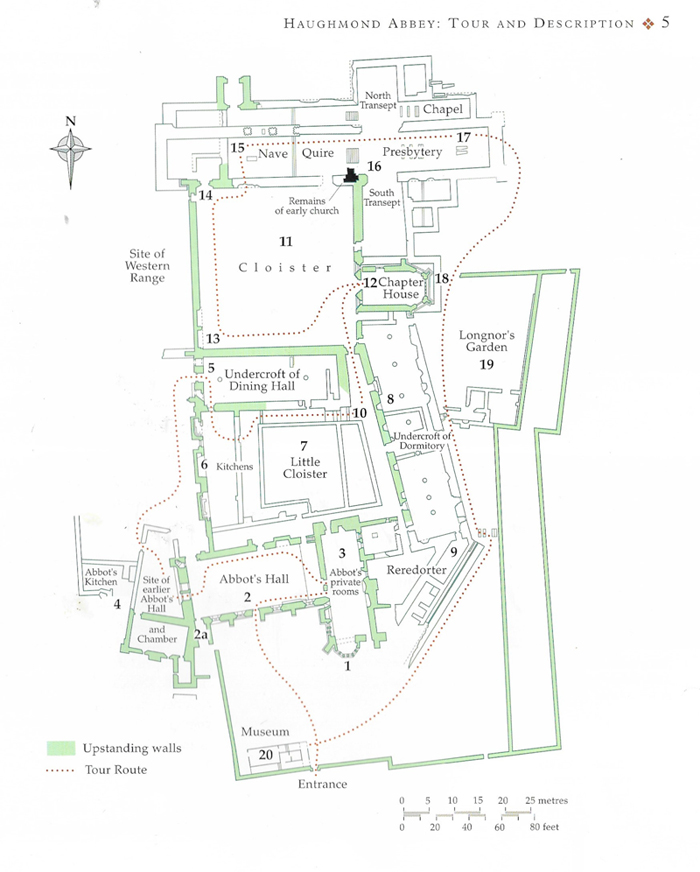
Haughmond Site Plan. Source: Iain Ferris 2010 (see sources at end)

The site is entered from the south where the Abbot’s Hall, private rooms and reredorter (latrine block) are located (at the bottom of the plan at left).  In the medieval period all visitors would only have entered at the opposite end of the site, to the north, where the remains of the church and its two transepts are to be found.  The monastic complex is an integrated whole, incorporating both domestic and religious functions in a single unit, although it grew up over time, advancing from north to south, beginning with the church, in the opposite direction from which you enter.  Repairs and reinventions mean that there are many layers to understand within the abbey complex.

Sandwiched between the Abbot’s Hall at the south end of the monastery and the church at the north end are two cloisters (square arrangements of buildings, each around a central green area).  The two cloisters are separated by the frater (refectory) that makes up the north wall of the southern cloister and the south wall of the northern one.

The official guidebook has a recommended circular route either straight ahead from the entrance, via the Abbot’s Hall, or via the reredorter (latrine block) to the right.  It does help to have a site plan to walk with, either in the guide book or printed out, particularly given that even with experience of previous monasteries, it’s a complex site with some features only surviving to the height of a few courses of stone.
==

The development of Haughmond Abbey

A splendid reconstruction of Haughmond Abbey by Josep Casals for English Heritage / Historic England. Source: English Heritage. My annotations based on the plan shown in the Haughmond Abbey guidebook. North is to the left, where the church is located. Click to enlarge

Like most high-status buildings, Haughmond changed considerably over time.  It began in the 11th century as an isolated community. The reasons for the location have not been recorded but the English Heritage survey of the site suggests the following:

[T]he comparative remoteness of the area on the woodland fringe, the shelter provided by the slope and the ready availability of building stone are all valid explanations. However, these conditions apply widely along the foot of Haughmond Hill and so it was probably the occurrence of a number of springs along this particular section of the escarpment which was the determining factor. The need for a reliable water supply for drinking, washing and carrying away waste hardly needs stating but there is also the possibility that the first community chose to settle here because the springs already had an established spiritual significance. (Pearson et al 2003)

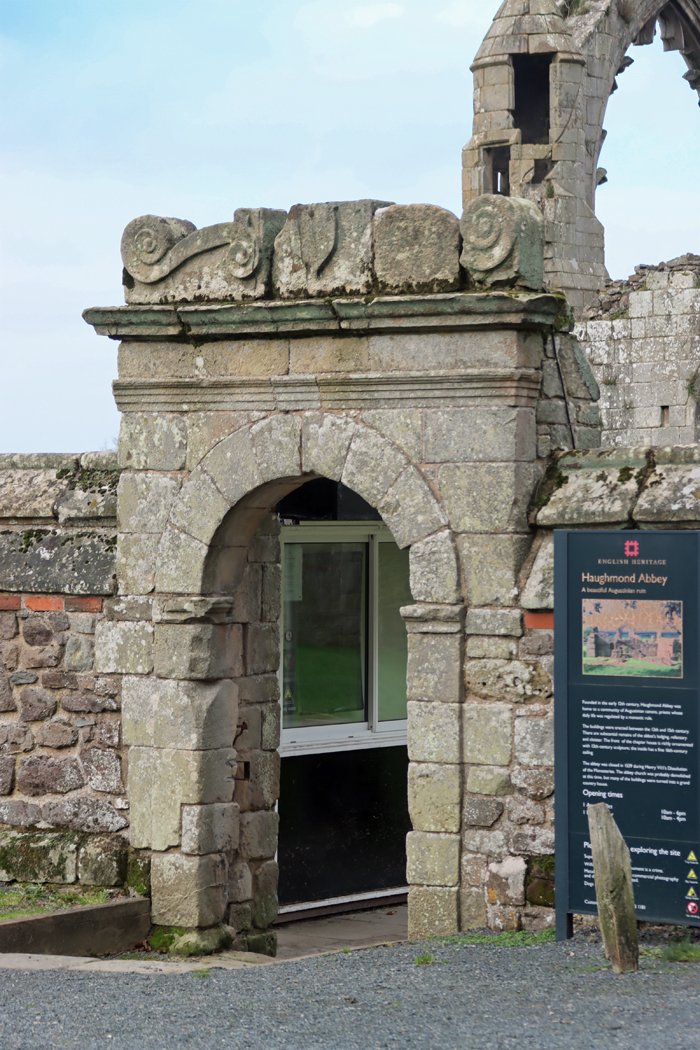
Small entrance to Haughmond Abbey from the south, now the entrance for visitors.  The main gateway was at the north.

One of the important achievements of the combined excavations was to establish that an earlier abbey had preceded the 12th century Augustinian priory.  The remains of a  small cruciform stone church were found beneath the south transept and the northeast cloister and it is suggested that it may have been built by an eremetical community, either in the late Saxon or early Norman period. A small cemetery of 24 graves that was found immediately to the west of that church included child burials, suggesting that it was serving the community at large, not merely the monastery.

The monastery was later re-established by the FitzAlan family under William FitzAlan I in the 1130s as a priory using the Rule St Augustine to guide its activities.  This included rebuilding of the church and cloister that provided the Augustinian priory an integral part of its later identity.  It was so richly endowed that it was soon given abbey status.  The FitzAlan family continued to be patrons of the abbey and were buried at the site until the mid-14th century.  They eventually transferred their loyalties to another establishment when the Lestrange family took over as primary patrons, their endowments allowing further expansion.  During the 13th and 14th centuries further elaborations were made, and in the early 16th century it underwent remodeling, just in time for the Dissolution in 1535.

Information panel at Haughmond showing the daily liturgy followed by the Black Canons. Click to enlarge

As a wealthy abbey, Haughmond was not amongst the first to be closed down, and lasted until 1539, at which time the remaining community members were pensioned off.  After it had been plundered for its treasures for Henry VIII’s coffers the abbot’s quarters were converted to a country home for Sir Edward Littleton, with some of the other buildings remaining in use.  It continued to be a home until the Civil War when a fire put an end to its residential use. It was eventually handed over to the Office of Works in 1933.  The 2002 survey by English Heritage established the extent of the abbey precinct and identified its water management systems, neither of which had been fully understood before.  The excavations found numerous objects, Romanesque architectural stonework, human remains, animal bones, pottery and metalwork all dating to the abbey’s occupation.
==

The Abbey Layout

The preservation of the buildings is very variable, with the abbot’s residence and hall and chapter house being the main and very impressive survivors.  The inner wall of the west range survives, and there are some fascinating architectural details dotted around, but most of the site is represented by low courses of stone that reach only a few feet high.  This does not undermine the visit, because these lower courses preserve the layout of a complex site, which offers a great many insights into life at Haughmond.

The monastic precinct

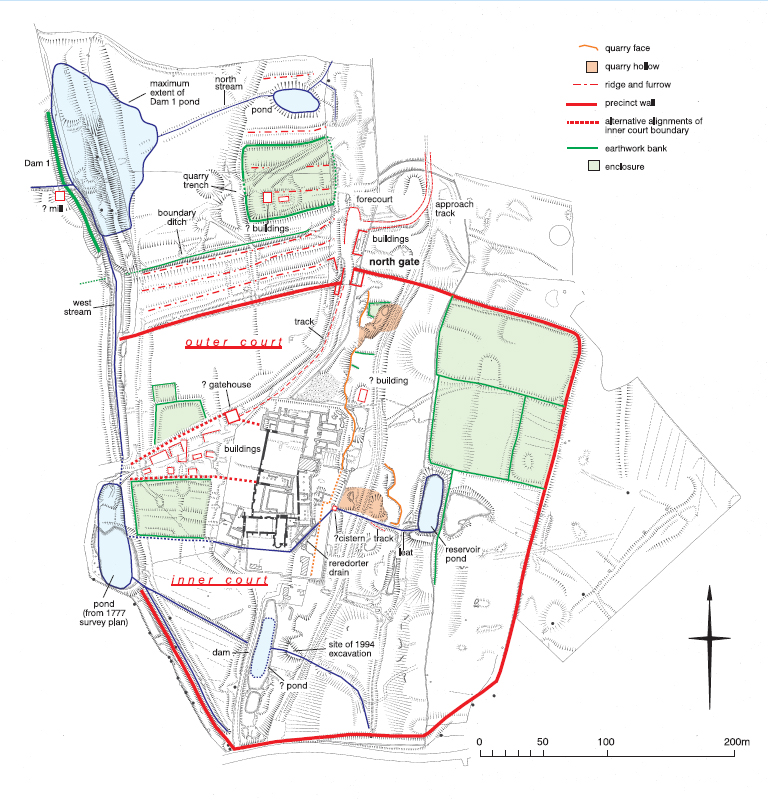
Plan of the abbey in the 2002 survey. Source: Pearson et al survey report 2003, English Heritage (see Sources at end).

The site is large, but only represents the core buildings.  The monastic precinct was much bigger.  Access to the monastic precinct would have been via the main gatehouse.  The remains of this was found in the 2002 survey, to the west of the church.  The boundaries of the monastic precinct were not found in 1907, but were revealed by the 2002 English Heritage survey.  This provided a good idea of the full extent of the site, making it easier to visualize it beyond its current footprint, and at the same time offered an entirely new interpretation of the site’s drainage management, always an important aspect of monastic establishments which, as well as requiring fresh water, had waste management and other drainage requirements.

The church

Haughmond Abbey Church interpretation panel. The sacred east end with the presbytery/chancel is on the left, with the nave to the west on the right, and a dividing screen between them. Click to enlarge.

Although there is nothing left to give an idea of how the interior would have looked, the very lowest courses of the church retain its footprint, and excavations have provided some more information, derived from the masonry of the site.  The church had the usual cruciform plan of a long nave, short chancel,  two side transepts, 60m (200ft) long in total, with a short tower over the crossing.   Visitors would have entered into the nave of the church via the north porch, penetrating no further than the church nave.  The nave was divided from the sacred east end of the church by a stone screen.  The cloister and the rest of the monastic establishment would have been completely out of bounds for ordinary visitors.  The canons would enter from the cloister side.  Interestingly, the site is terraced beneath the line of the church, meaning that the altar would have been physically higher than the transepts, involving a great many steps to reach the high altar, which would have been higher than the nave, emphasizing the hierarchy of the church from sacred east to secular west.  The transepts would have contained chapels where the ordained priests could say masses to the dead.  There were also altars, other than the main altar, to St Andrew and St Anne.  An aisle was added to the north side of the nave, the pier bases of which were found during the 1907 excavations.

Looking down the terraced profile of what remains of the church

The main cloister

The processional doorway

The church makes up the north side of the cloister, offering it some protection from the elements and allowing in the sun, which helped to light both the church and the cloister buildings.  The main cloister was rectangular and the other three sides were made up of three ranges of buildings with a green, the garth, at its centre. Nothing remains of the walkway that would have connected these four ranges of buildings.

Connecting the cloister or the nave was the processional doorway, a magnificent 12th century feature through which the monks could carry reliquaries, saint images and portable shrines on days of particular religious significance.  Like the chapter house, it has elaborate patterning on the out of the recessed arches and is flanked by two statues representing St Peter (left) and St Paul (right).

The facade of the Chapter House

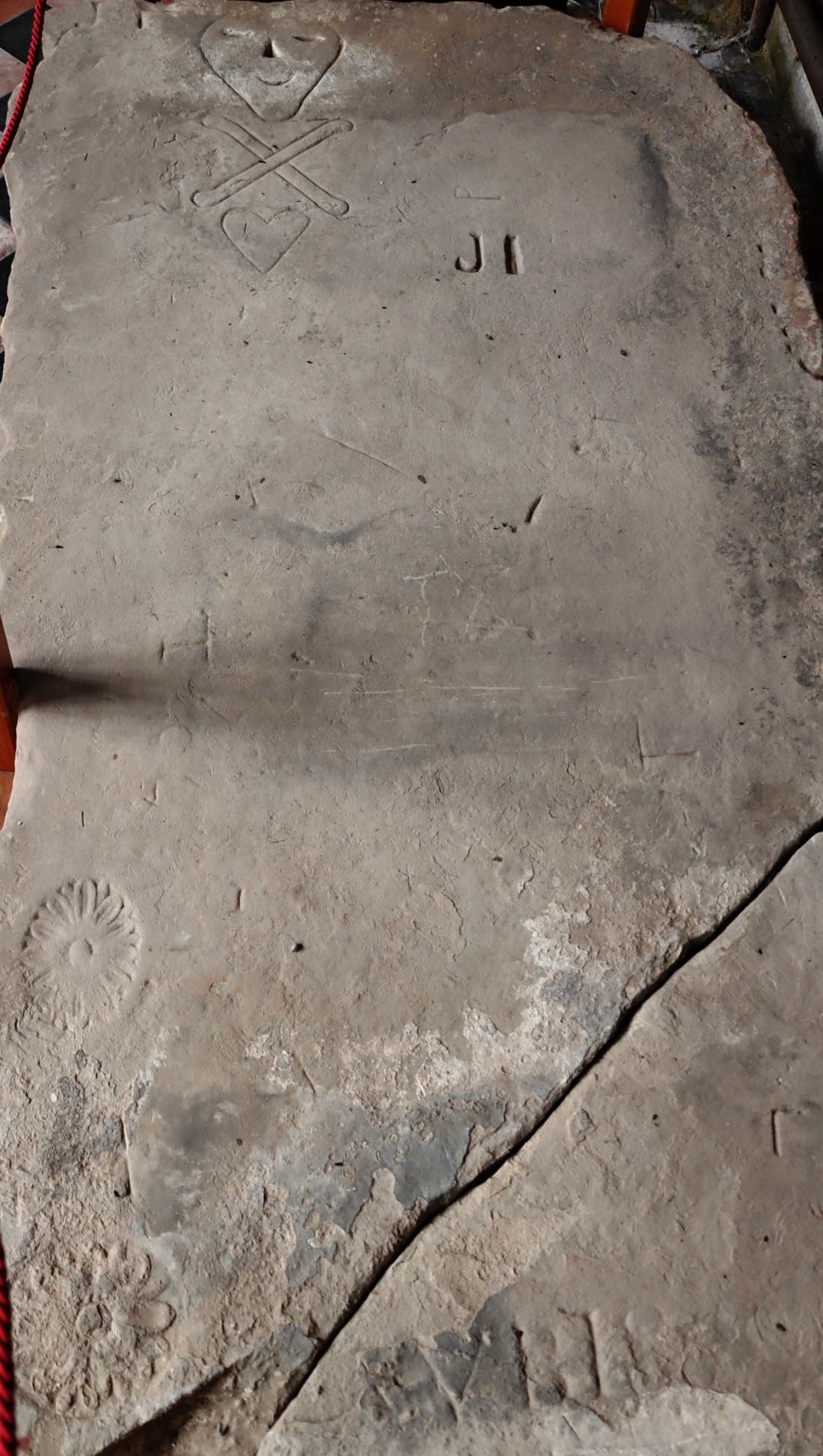
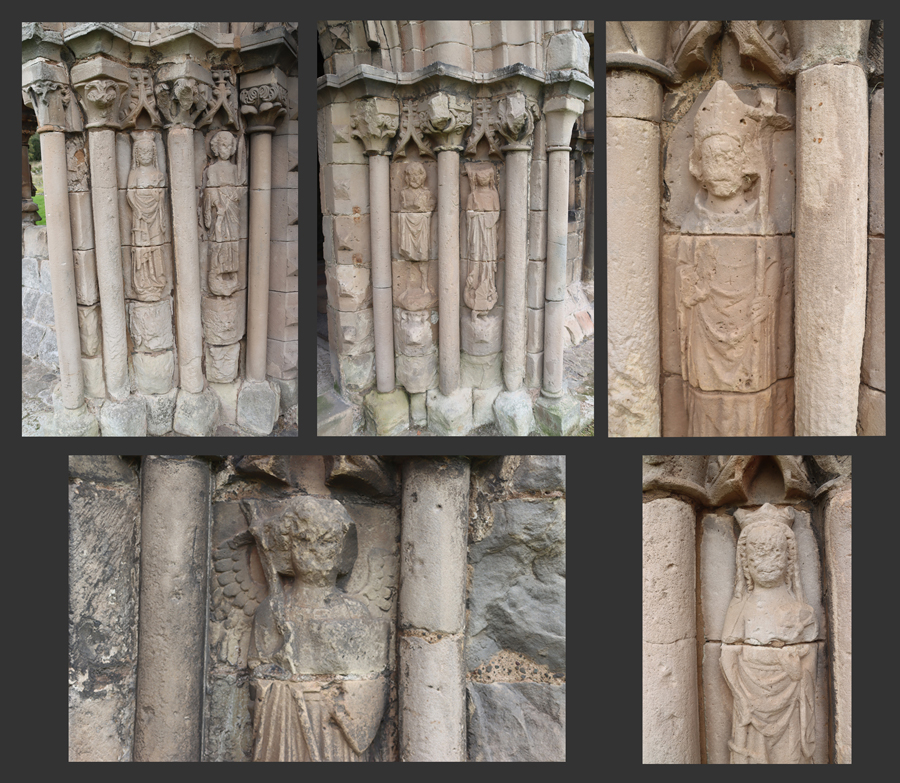
The most important building in the east range, which is partly made up by the north transept of the church, is the chapter house, where the daily business of the monastery was discussed. Its  lovely facade includes the entrance flanked by two windows, all with receding layers of arching featuring decorative patterns, and featuring eight statues showing saints between the slender columns.  Although the arches belong to the 12th century, the statues were added in the 14th.  Some are in rather better condition than others, but include St Augustine, a female saint who perhaps represents St Winifred of Shrewsbury Abbey, St Thomas Becket, St Catherine of Alexandria, St John the Evangelist, St John the Baptist, and St Margaret of Antioch.  The building underwent further changes at the beginning of the 16th century, probably including the addition of a wooden ceiling.  The tombstones and the font were probably moved here from the church after the monastery went out of use.

Interpretation board discussing the chapter house saints


Interior of the chapter house

Detail of one of the interpretation panels

The remains of the west range.

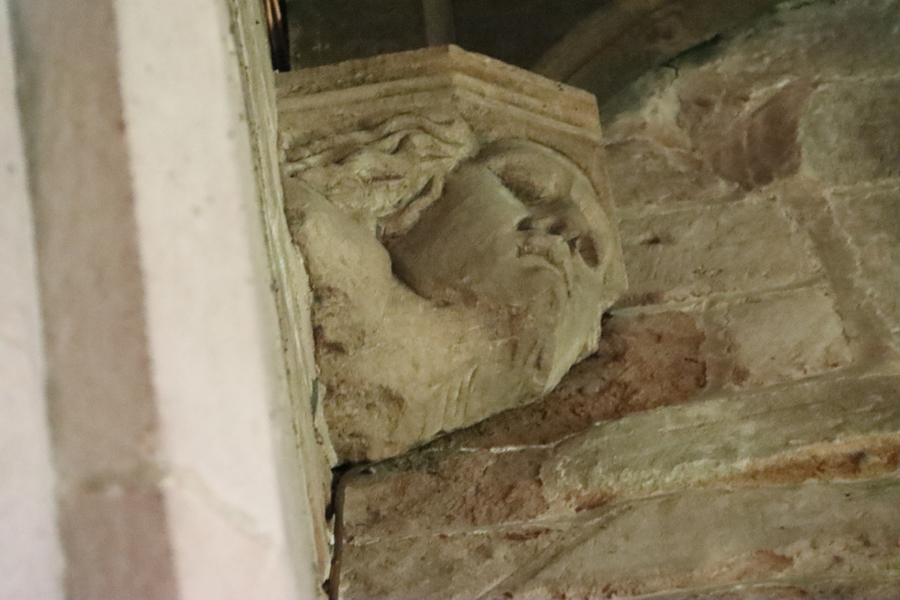
Opposite the chapter house is what remains of the western range.  The inner wall survives, with two tall arched recesses, which  probably contained a laver, a basin that the monks used for washing before eating.  Further along at the northern end adjacent to the processional doorway an entrance lead into the western range, with decorated capitals at the top of the columns.  The outer walls have been lost.  The western range was used differently from one establishment to another, and it is not known how this example was used.

Gateway into the western cloister, showing multiple levels of structural change

The southern range was made up of the refectory (dining hall) with an undercroft (storage area) below.  The floor of the dining hall is long gone, but some decorative features remain in the walls, and it once had a great window over a central pointed arch.  The undercroft opened out into the monastic precinct via an arched entrance and and two flanking windows.  The remains of the pillars that supported the refectory wall remain, together with a drain running towards the north.  The full length of the refectory was 30ft 6ins (c.9m) wide by c.81ft (c.25m) long.

The refectory undercroft with pillars and drain

Interpretation panel showing the refectory and its undercroft

Behind the chapter house and overlapping with half of the dormitory is what is known as the Longnor’s Garden, now an empty space with a wall behind it, established in the mid-15th century for Abbot Longor.  As well as a dovecote it was presumably used to grow herbs, for both cooking and medicinal use.

The little cloister

Kitchen ovens

A narrow gap at the east end of the refectory allowed access from the main cloister into the little cloister.  A low line of stone marks the line of the former walkway that surrounded the little cloister. This contained another four ranges, the northernmost of which was made up by the refectory.  The entrance to the refectory was probably originally from the main cloister, but once the little cloister was established, the entrance was on this side, which makes sense as the early 14th century western range consists of a surprisingly large kitchen area with two giant ovens and chimneys.  The 1332 document by Abbot Longnor that permitted this survives, stating that the prior and monastic community “may have from henceforth a new kitchen assigned for the frater, which we will cause to be built with all speed ; in which they may cause to be prepared by their special cook such food as pertains to the kitchen of that which shall be served to them, every day, by the canons and ministers appointed to that end by them by leave of the abbot.”

The kitchen and refectory, side by side. To the left of the refectory wall, and in front of the ovens is the line of little cloister’s walkway.

Opposite the kitchens were the two-storey dormitory and its undercroft, set at an angle to the little cloister and terminating at the south side with an entrance into the reredorter (latrine block), which was set at an angle to the dormitory. The undercroft survives, but the upper levels that made up the dormitory are now lost. The building is 125 ft long by 27 ft wide, with a row of columns along the centre, dividing it into eleven bays.  The remaining stonework preserves indications of doorways, windows and fireplaces.  In the mid-15th century the north end of the dormitory was divided off to provide private space for the quarter’s of the abbot’s second in command, the prior.

View part-way along the dormitory, looking towards the chapter house

The drain of the reredorter

At the southern end of the little cloister were the abbot’s apartments, consisting of a hall and private rooms.  The remains of an earlier and much smaller set of13th century apartments survives at the east, but was replaced by the much more ambitious, decorated 14th century buildings that partly survive today.  The main feature of the hall is an enormous pointed window, with fragments of stone tracery remaining, set over twin pointed arches, and flanked by two small towers.  Three sets of windows, with tracery, let light in on either side, and again provide the rooms with gothic flair. The Abbot’s private rooms feature a distinctive 5-sided oriel window with distinctive decorative elements.

The abbot’s private rooms on the right, and his hall to the left

The abbot’s hall

The fireplace in the abbot’s hall


Interpretation panel for the abbot’s hall

The oriel window in the abbot’s private rooms

Some of the decorative features in the abbot’s private rooms

=
Records mention an infirmary at Haughmond, as well as a library.  The library would usually be closely associated with the chapter house, but there is no sign of one today.  In early 20th century plans the infirmary is marked where the abbot’s hall is now located, and the infirmary has not actually been located.  The consensus is that the local topography means that it could not have been to the east of the site.  Two fishponds were not far away, and others were associated with mills.
====

Economic activities

View of the western side of the monastery from the outside

Although patrons were important for establishing monastic establishments and continuing to support them, many of the endowments took the form of land, and the success of a monastery was largely dependent on how well that land and other assets were managed.  There were two main models for making an income from these assets – either by the owners working it themselves or by leasing it out.  In the case of Haughmond the assets included considerable amounts of farmed land, as well as fulling (wool processing) and corn mills.  Although lying within a royal forest, the abbey was given limited permission to assart land (clear woodland and shrubs for farming), and also acquired newly assarted lands in the area.  It owned land under cultivation but also established cattle farming on higher ground.  Lands were not only in Shropshire but from the late 12th century it also owned land in Cheshire, Worcestershire, Wales, Sussex and Norfolk.  Fishing rights were also important, and the abbey had its own fishponds, as well as fishing rights both nearby and from the river Dee at Chester, the latter doubtlessly annoying the Benedictine monks of St Werburgh’s in Chester.  It also received income from six churches that had been passed to its control, including Hanmer in Flintshire, the only one outside Shropshire; it had properties in Shrewsbury that it rented out; and was granted the rights to and a one half salt-pan in Nantwich.

Many small bequests were made to secure prayers, to assist the infirmary and to provide for the poor who came to the monastery gate for alms.  The monastery also sold corrodies, which were substantial gifts made to the monastery in return for food and housing, a form of pension. On the other hand, corrodies were also provided to loyal servants, in which case they represented an outlay rather than an income.

Farming land just beyond Haughmond Abbey

It is thought that between the 13th and early 14th centuries the abbey restructured in order to consolidate the dispersed properties to make them easier to manage, something that happened at a lot of other monastic establishments that found themselves in this situation, causing real management difficulties.  By selling some lands and acquiring others in more suitable locations, consolidation made management much easier and less costly.  At least some of the land was leased out, but other lands were worked directly,  However the surviving records are insufficient to allow a clear view of how well the abbey managed its assets, how all of its lands were used and what sort of activity provided the most income.

In spite of the recorded assets, in the early 16th century the abbey clearly experienced difficulties, both in the management of its estates and in the internal discipline of the monastery itself.  This is put down to poor management by two of its abbots.  Under its final abbot, Thomas Corveser, it began to recover and it was still sufficiently wealthy to avoid immediate closure in 1535, surviving another four years, and the surviving personnel were provided with generous pensions.
==

Final Comments

This is a very quiet site, and because it feels so peaceful and retains some lovely features of its 12th century Romanesque origins, has a particular charm to it.  I particularly like that some of the domestic buildings that rarely survive at other sites, including the vast hearths in the former kitchen, and the reredorters connected to the dormitory, can be clearly made out.  I was expecting the Augustinian arrangement to have significant differences from Benedictine prototypes, but there was nothing much on the ground to differentiate them.  The decorative features certainly mark them out as less austere than, for example, the Cistercians, but otherwise the architectural concept of a monastery in the medieval period is impressively uniform.
==

Visiting

Haughmond Abbey is an English Heritage site.  It was open free of charge when I was there in October 2024, but its opening times and ticket prices may vary with the season.  See details on the English Heritage website here.  The postcode for those of you with SatNav is SY4 4RW.  The guide book, published in 2000, claims that the little building on the left as you enter is a museum, but this was very firmly closed when I visited. Perhaps it is open during the summer, or it may have shut down for good by now.  Please let me know if you find out!

There are interpretation boards throughout the site, which help to explain it.  The helpful guide booklet by Iain Ferris is available from online retailers, but may also be available from English Heritage sites with gift shops in the area.  It combines Haughmond, Lilleshall and Moreton Corbet Castle in the same 24-page booklet, with 14 pages dedicated to Haughmond and the Augustinians, 8 pages to Lilleshall and 2 to Moreton Corbet Castle.  It includes the ever-essential site layouts of Haughmond and Lilleshall.  There are also very useful details about the history of the site on the English Heritage’s Haughmond Abbey History page here.  If you are interested in following a trail of some of the Shropshire abbeys including Haughmond, Mike Salter’s booklet “A Shropshire Abbeys Trail” is a good place to start, available to purchase online.

Other sites in the area, a selection of which would help to make up a good day out include Wroxeter Roman City (about which I have posted here), the Cluniac Order’s Wenlock Priory at Much Wenlock (posted about here), another Augustinian abbey at Lilleshall, Moreton Corbet Castle, and of course the town of Shrewsbury itself, with its lovely architecture, terrific abbey church (within the outskirts of the town) and the excellent Shrewsbury Museum and Art Gallery. with its modern displays connecting different periods of the history of both town and area.

The abbot’s hall, with the remains of its predecessor in the foreground


Sources

Books and Papers

Angold, M.J. Angold, George C. Baugh, Marjorie M. Chibnall, D.C. Cox, D.T.W. Price, Margaret Tomlinson, B.S. Trinder 1973.  Houses of Augustinian canons: Abbey of Haughmond, in (eds.) A.T. Gaydon, and R.B. Pugh.  A History of the County of Shropshire: Volume 2. London.
British History Online: https://www.british-history.ac.uk/vch/salop/vol2/pp62-70 

Burton, Janet 1994. Monastic and Religious Orders in Britain. Cambridge University Press

Chadwick, Peter 1986. Augustine. A Very Short Introduction. Oxford University Press

Levitan, Bruce 1989.  Ancient Monuments Laboratory Report 118/89. Vertebrate Remains from Haughmond Abbey, Shropshire. English Heritage
https://historicengland.org.uk/research/results/reports/3917/VERTEBRATEREMAINSFROMHAUGHMONDABBEYSHROPSHIRE

Pearson, Trevor, Stuart Ainsworth and Graham Brown 2003.  Haughmond Abbey, Shropshire: Survey Report Archaeological Investigation Report Series AI/10/2003. English Heritage
https://archaeologydataservice.ac.uk/archiveDS/archiveDownload?t=arch-1893-1/dissemination/pdf/englishh2-349481_1.pdf

Salter, Mike 2009.  A Shropshire Abbeys Trail. Folly Publications

St John Hope, William H. and Harold Brakspear 1909. Haughmond Abbey, Shropshire Archaeological Journal, 66 (1909), p.281–310
https://archaeologydataservice.ac.uk/archiveDS/archiveDownload?t=arch-1132-1/dissemination/pdf/066/066_281_310.pdf

White, Carolinne 2008. The Rule of St Benedict. Penguin

Ferris, Iain 2000. Haughmond Abbey, Lilleshall Abbey, Moreton Corbet Castle. English Heritage

West, Jeffrey J. and Nicholas Palmer 2014. Haughmond Abbey. Excavation of a 12th-century cloister in its historical and landscape context. English Heritage


Websites

ArchaeoDeath
Identities in Stone: Haughmond Abbey’s Saints and Spolia. By Prof. Howard M. R. Williams,
October 17th 2016
https://howardwilliamsblog.wordpress.com/2016/10/17/identities-in-stone-haughmond-abbeys-saints-and-spolia/

English Heritage
Haughmond Abbey
https://www.english-heritage.org.uk/visit/places/haughmond-abbey/
History of Haughmond Abbey
https://www.english-heritage.org.uk/visit/places/haughmond-abbey/history/
Medieval Women and Haughmond Abbey
https://www.english-heritage.org.uk/visit/places/haughmond-abbey/history/women-at-haughmond/

Historic England
Haughmond Abbey: an Augustinian monastery on the site of an earlier religious foundation, a post-Dissolution residence and garden remains
https://historicengland.org.uk/listing/the-list/list-entry/1021364?section=official-list-entry


Day Trip: The Iron Bridge and the Ironbridge Gorge World Heritage Site

Introduction

The Iron Bridge is the star attraction of the Ironbridge area, the focal point of the UNESCO World Heritage Site (awarded in 1986), and managed since 1991 by the Severn Gorge Countryside Trust, which includes 52 sites, 60 historic structures, 230 hectares of woodland, 25 acres of wild flower meadow, 26kms of paths and 8 kms of bridleways.  This includes at least twelve museums and managed sites, some of which are open all year round, others only seasonally.  This makes the Ironbridge Gorge a splendid place for an extended visit as well as for day trips to selected destinations.

It can be easy to come away with a fragmented view of Ironbridge Gorge whilst driving between the bridge and the different museums and villages.  Once known collectively as Coalbrookdale, the immediate valley area is now divided into Ironbridge, Jackfield, Coalport and Coalbrookdale with outlying attractions in the surrounding area.  However, all areas are united by the underlying geology that was revealed by glacial action and became the source of raw materials for manufacturing in the area, both of ironworks that produced industrial scale projects like the bridge itself as well as decorative objects for home and office; and clay-based household objects such as tiles, and finer decorative china.

The first engineer and entrepreneur to exploit the full potential of the Ironbridge area’s geology for industry was Abraham Darby I who had a small furnace in the area and who in 1709 successfully experimented with carbonized coal, called coke, as fuel instead of charcoal that depended on less volumes of mature woodlands and required much less labour.  Abraham Darby I’s formula for iron was a ratio of 600kg coke to 600kg of ironstone and 250g limestone, all of which were available locally, and produced 250kg iron.  Efficiencies in the iron manufacturing industry were further improved with refinement of coke production and the introduction of steam-powered engines later in the 18th century.
==

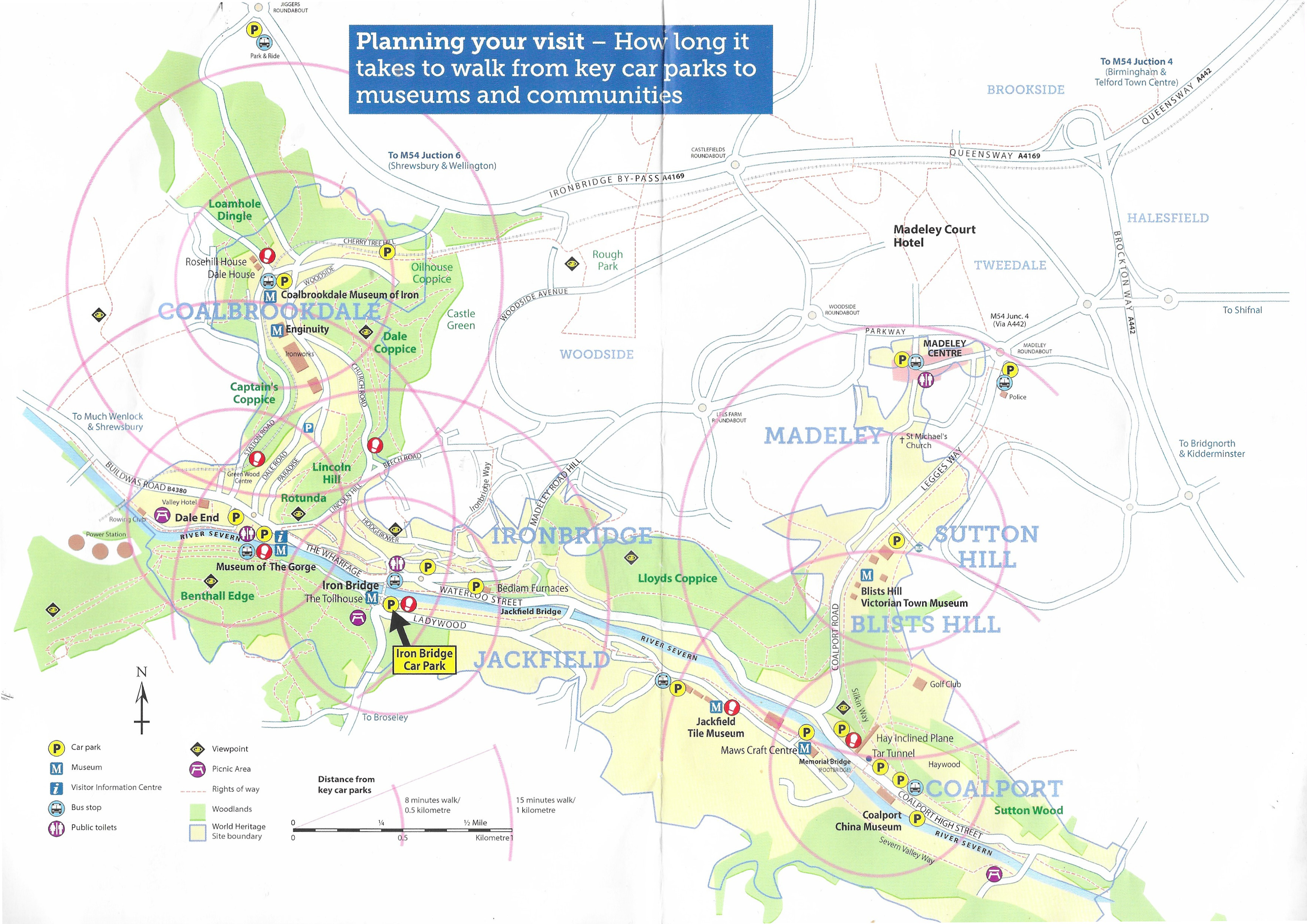
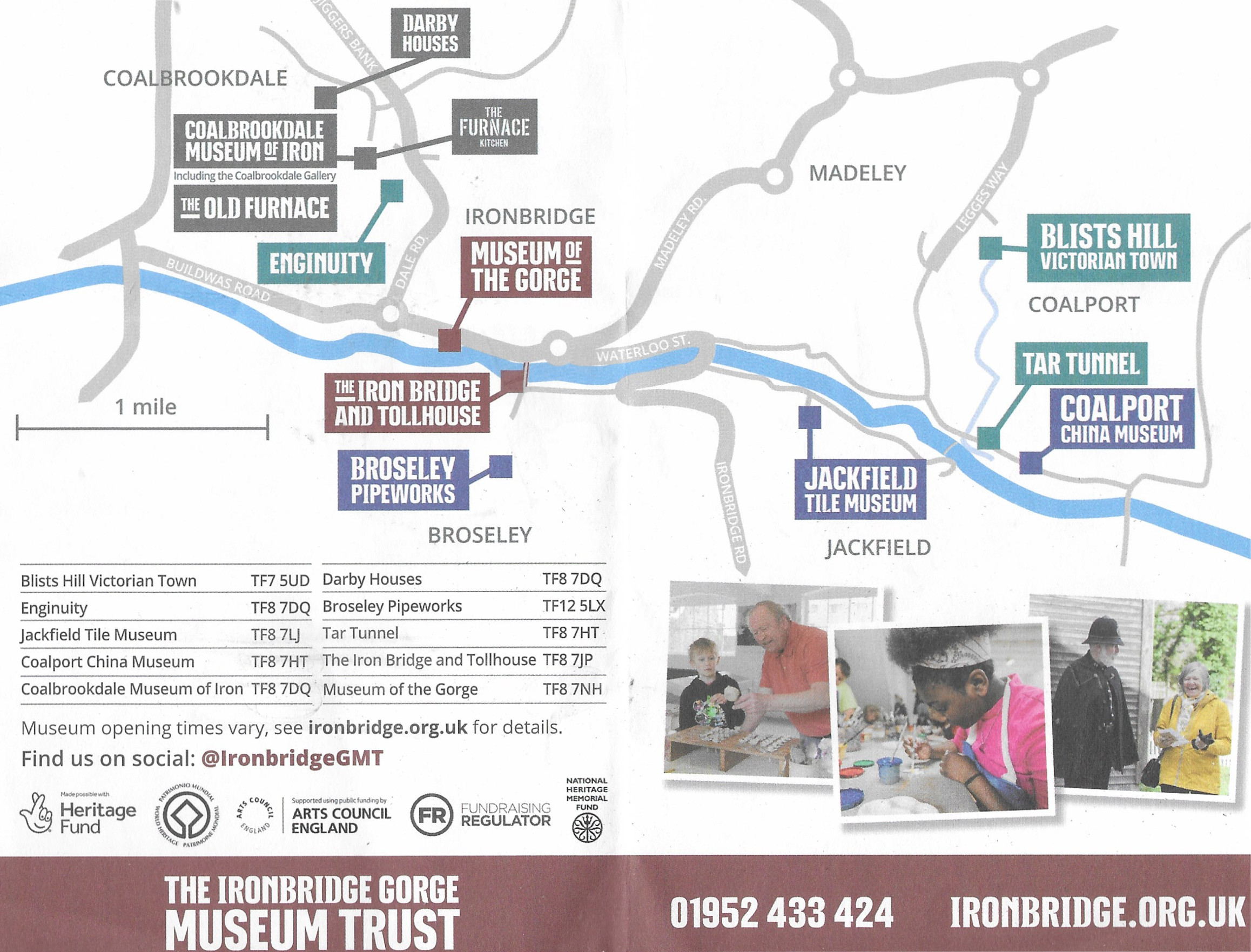
From the leaflet “Exploring Ironbridge Gorge” showing the key components of the visitor attractions today

The other essential geographical feature was the river Severn, which flows through the Ironbridge Gorge.  The gorge was itself formed by the pressure from a glacier, that sat over much of Shropshire, on the underlying trapped water.  This water, with nowhere else to go,  forced itself out from under the glacier through the soft limestone of what are now named Benthall Edge and Lincoln Hill, forming the steep-sided channel that the river occupies today.  In the 18th and 19th centuries the water from the Severn provided both power, first to water wheels and then steam engines, as well as cooling for many of the machines and as part of many of the industrial processes.  It was also a major transport link between the Ironbridge area, the Bristol Channel and the rest of the world.  Looking at the river today in its wildlife and heritage setting, it is difficult to imagine how much pollution there must have been both in the air and in the water, produced by the furnaces, forges and kilns, as well as the chemical waste.

Source: The Iron Trail, Ironbridge Gorge (leaflet), Severn Gorge Countryside Trust

The Iron Bridge

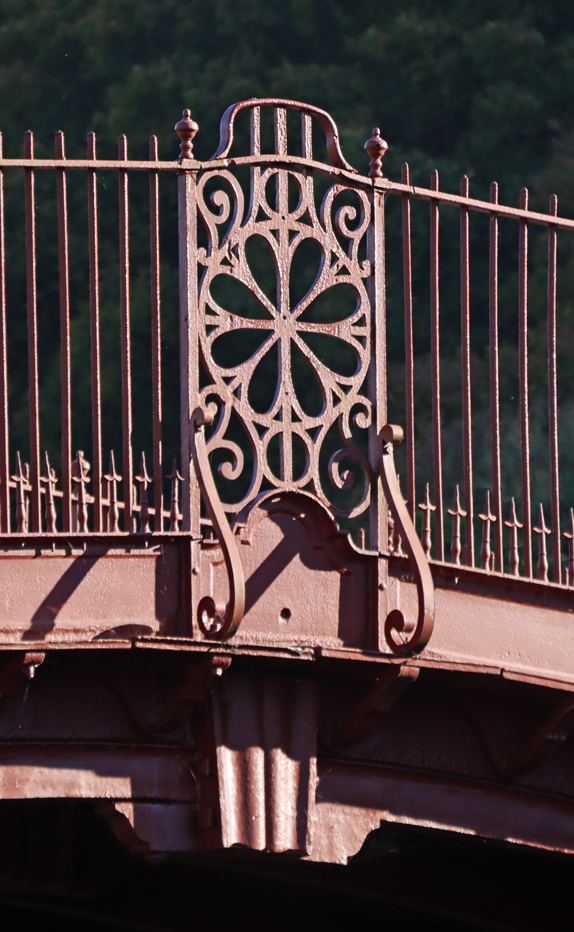
The building of a cast-iron bridge was proposed by Thomas Farnolls Pritchard 1723-1777), who also designed the prototype.  Up until the building of the bridge, which opened in 1781, most of the traffic across the river was by ferry; the nearest bridge was the medieval Buildwas bridge next to Buildwas abbey, 3.8km upstream from the site of the new Iron Bridge. The connection between the north and south sides of the river was essential, allowing the movement of raw materials, people and supplies.  The bridge was an obvious solution to the problem of a river that was vulnerable to changing levels and seasonal weather extremes such as low levels, floods and high winds.

Thomas Farnollis Pritchard by C. Blackberd c.1765

Thomas Farnolls Pritchard specialized in the restoration of prestigious houses. Although he had built bridges in wood and stone, none had been as ambitious as his Ironbridge proposal, and this was the first attempt to use cast iron to span a gap this wide. the idea was to use a single arch to span the widest section of the river, avoiding piers that would impede navigation.  He sent his proposal for a cast iron bridge to John “Iron-Mad” Wilkinson, an obvious sponsor for this type of innovative project.  Wilkinson in turn discussed the matter with Abraham Darby III, who instantly saw the potential for the bridge not merely as a means of spanning the river, but of marketing his company and the benefits of the Ironbridge area as a whole, at that time known collectively as Coalbrookdale.  A committee was formed to take the project forward.

The only known image of the bridge under construction, by Elias Martin (1739-1818) painted in the summer of 1779

An Act of Parliament was granted in 1776, and shares were soon issued to raise funds. Work began in 1777.  The iron for the bridge was cast by Darby at his works, but there is no record as to which of his three furnace sites was responsible.  It is probable that the work was shared out to all three, spreading the load to ensure that existing and new commercial contracts continued to be delivered.  It is known that wooden scaffolding was employed in the construction of the iron bridge, but the exact process of construction is unrecorded.  The painted inscription on the ironwork that spans the top of the bridge reads “This bridge was cast at Coalbrook-Dale and erected in the year MXDCCLXXIX [1779].”  Ribs were cast in two pieces and joined in the middle.  Observation of the bridge’s construction shows that it was assembled using both metalwork techniques and joinery techniques such as mortise and tenon joints and dovetailing.  The ironwork was flanked by and set into stone abutments.

Once the basic frame was built, spanning 100ft 6ins (c.31m)  the scaffolding was removed in 1779 and a road was constructed over the top and a small toll-house added on the southern side.  The bridge eventually opened in 1781, on New Year’s Day.  Although it was built closely in the spirit of Pritchard’s original plan, several changes were made.  Pritchard did not live to see the bridge completed but his family were duly paid for his contribution.

The bridge had cost a massive £6000, twice the estimate.  Darby had taken on the bulk of this financial burden.  Although he was quick to use the marketing potential of the bridge deploying it as an advertising emblem, and visitors came from all over the world to see it, neither this nor the tolls for use of the bridge were able to make up the substantial shortfall.  Darby was unable to make up his losses and the bridge left him in debt for the rest of his life, with both business and properties mortgaged.

Unlike Buildwas and other Severn bridges, the Iron Bridge  survived the Great Flood of 1795, unlike the medieval stone Buildwas Bridge, proving the durability of a cast iron bridge.  Thomas Telford had repaired the Buildwas bridge in 1779 but during 1795 it was damaged beyond repair and, taking Ironbridge as his model, Telford replaced it with his own iron bridge.

Over the following century repairs were carried out as required, but during the early 20th century its stability was questioned and its demolition was suggested in 1926.  Fortunately, it was decided to save the bridge and was limited to pedestrian use from 1934, and was listed as a National Monument.  In 1950 it passed into the hands of Shropshire County Council.  Substantial restoration work has been carried out since 1972 to stabilize and reinforce the bridge.  It is now in the care of English Heritage.

A footpath runs under the bridge on the Ironbridge village side, allowing a good view of some of the metalwork.

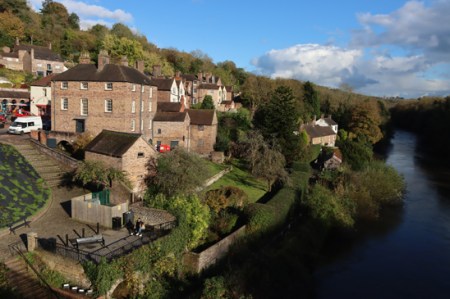
The small town of Ironbridge began to develop in the later 18th century.  Today Ironbridge village is small but attractive, with a row of shops, cafes and pubs lining the road that runs along Severn between Ironbridge and Coalbrookdale, with houses, a massive church and other community buildings climbing the hill above the river in Ironbridge.  I can recommend the ice cream 🙂

The Museums

I have already posted about the glorious Jackfield Tile Museum here, with lots of photos, but there are at least total of twelve museums and related visitor attractions in the Ironbridge area, and I will post about the other four museums that I visited on future posts.  I would have visited the Broseley Pipeworks and the Tar Tunnel, but neither were open, so I plan to visit those when they re-open.  The Darby Houses were also closed.  Nor did I visit Enginuity, which appears to be geared towards children, but actually looks like a lot of fun, if you are child-friendly, with plenty of interactive activities demonstrating engineering principals.  Blist’s Hill Victorian Town just wasn’t my cup of tea, but the recreation of everyday life in 1900 Shropshire sounds like a good initiative.

From the “Ironbridge Valley of Invention” leaflet, 2024

==

A have talked about the Jackfield Tile Museum in detail on a previous post.  Don’t miss it.  In the world of museums, this is a rock star.

Part of the Coalbrook China Museum

The Coalport China Museum to the east of of Ironbridge and Jackfield consists of two areas of interest – the displays of decorated china ware made in the local area, and the surviving furnaces in which many of them were made, which you can enter and walk around.  Although the china is worth seeing, partly because it demonstrates the many shapes, textures and patterns that were produced, I found the splendid industrial heritage of this site the most evocative and engaging part of the experience, bringing the sheer vast materiality of these enterprises to life.  This part of the Severn valley would have been full of these furnaces.  There is good car parking.  Ticket prices are on the Ironbridge website, and don’t forget to ask for an English Heritage discount if you  are a member.

The Toll House, free of charge, is set just to the south of the Ironbridge near to the car park, is now a museum of the bridge, telling it story.  This is mainly a matter of information boards rather than objects on display, but is very informative.  It also serves as a ticket office for those wishing to buy family tickets and day passes (although you can also buy tickets on an ad hoc basis when you visit individual museums).

To the east, easily reached by walking along the wide pathway that follows the Severn, is the Museum of the Gorge, also free of charge.  There is a small car park next to it.  The exterior of the building is fabulous, and there are some great internal features, and there are information boards about the history of the building and the conservation work, as well as a selection of reproductions of historic maps of Shropshire.

The Old Furnace at the Iron Museum

Up the hill is the splendid Coalbrookdale Museum of Iron.  The museum captures the essence of the area’s iron production output, from geology and early history via the bridge itself, including some excellent original images of the Ironbridge, via civil engineering equipment to a surprising and elaborate array of domestic items.  On the museum site is also the substantial and impressive remains of the the Old Furnace, some of which has been turned into an indoor feature.  Like the China Museum, this is a splendid mix of museum displays and well preserved and explained industrial archaeology.

Not shown on the above map is the Bedlam furnace, half way between Jackfield and Iron bridge on the north side of the river, which can be viewed from the laybay in front of it and is well worth visiting, partly because although there is little of it left, it was the subject of Philip de Loutherberg’s famous 1801 painting.

“Coalbrookdale by Night” by Philippe Jacques de Loutherbourg, 1801. Open coke hearths give off vivid flames and smoke. Archetypal image of the Industrial Revolution. From a colour transparency in the Science Museum Photographic Archive, CC BY-NC-SA 4.0 Licence.


Visiting

Wherever you are, keep an eye open for leaflets, as some of these have some very helpful information, including chronological charts, maps and self-guided trails to some of the features that are beyond the museums.

The bridge

The bridge is open to visitors all year round, assuming that no restoration or repair work is taking place.  The opening times for the toll house, which acts as a museum for the bridge, can be found on the Ironbridge Gorge website.  Extensive pay and display parking for Ironbridge is available on the south side of the river, which allows you to choose how long you are going to stay.  This is handy if you just want to spend a short time looking at the bridge and browsing in the village but also allows you to stay longer if you want to walk along to to Coalbrookdale to visit the Museum of the Gorge museum and up the shallow hill to visit Enginuity and the Coalbrookdale Museum of Iron.

The museums

The Iron musuem

All the Ironbridge Gorge museums are covered on one website – Ironbrige Valley of Invention.   This inexplicably has very few images of what’s on display, and suffers from Russian doll syndrome, with pages buried within pages, but the information on days when the museums are open and closed (changes seasonally) and the opening times are there if you look for them.  Some of the museums are closed completely at certain times of the year (such as the Tar Tunnel and the Broseley Tobacco Pipe Works).

Note that if you are a member of English Heritage there is a discount on ticket prices, but you will need to ask for it.

Other sites to visit in the area

This is a rich area for destinations to visit, including five medieval abbeys a relatively short drive away, a number of National Trust properties and only a little further afield, Shrewsbury makes for a rewarding day out with the abbey church, the excellent Shrewsbury Museum and Art Gallery and the attractive medieval and Georgian architecture.  Not far away is the RAF Museum at Cosford, just outside Telford (my post about it is here), and whilst there, the Church of St Bartholemew at Tong with its lovely medieval choir, its elaborate tombs and the remarkable Tudor chapel and is crammed full of interest and just a 10 minute drive away.

St Bartholemew’s Church, Tong


Sources:

Books, booklets and papers

2019 edition (no author or reference number).  Exploring Ironbridge Gorge (booklet). The Ironbridge Gorge Museum Trust Ltd.

Jones, C. 1989. Coal, Gas and Electricity. In (ed.) Pope, R. Atlas of British Social and Economic History Since c.1700. Routledge

Mathias, P. 2001 (second edition). The First Industrial Nation. The Economic History of Britain 1700-1914. Routledge.

Mokyr, Joel 1981 (2nd edition). Technological change 1700-1830.   In (eds.) Roderick Floud and Deidre McCloskey, The Economic History of Britain since 1700.  Volume 1: 1700-1860. Cambridge University Press

Osborne, R. 2013. Iron, Steam and Money. The Making of the Industrial Revolution. The Bodley Head.

Leaflets

Undated leaflet (no reference number). The Ironbridge and Town. The Ironbridge Gorge Museum Trust Ltd.

Undated leaflet (no reference number). The Iron Trail, Ironbridge Gorge. Severn Gorge Countryside Trust

2024 leaflet (no reference number). Ironbridge Valley of Invention. The Ironbrige Gorge Museum Trust Ltd.

Websites

Ironbridge Valley of Invention
Official website
https://www.ironbridge.org.uk/

UNESCO pages for Ironbridge Gorge
UNESCO World Convention
https://whc.unesco.org/en/list/371/


Objects from my Garden #12: Maker’s mark on a piece of flow blue ware by S.W. Dean, Burslem

Both sides of the broken sherd

For anyone new to this occasional series on objects extracted from my garden during everyday gardening activities, see the History in Garden Finds page.  These are not objects used in the garden, but objects, usually fragments, lost or disposed of in the garden and found during digging, troweling and planting.

This maker’s mark, crossing all three sherds, was a happy find for me, because although we have dug up tons of broken china from the garden (which is in Churton, a few miles south of Chester), all of it interesting in its own way, few of the manufacturers can be identified.  This piece, with a company trademark on one side and part of the pattern on the other, contains the name both of the manufacturer and the design.

Re-assembled, the original sherd is 9cm long and 3.5cm wide.  The potter’s mark is split over three broken pieces.  The clean breaks and pure what fabric that divided the sherd into three means that it was broken when one of us found it whilst gardening, with spade or pick-axe, straight through the middle.  Fitting the three pieces together to form a single piece leaves the much grubbier original break around the former edges.  The spidery cracks in the glaze, called crazing, have also allowed the garden earth to seep into the fabric.

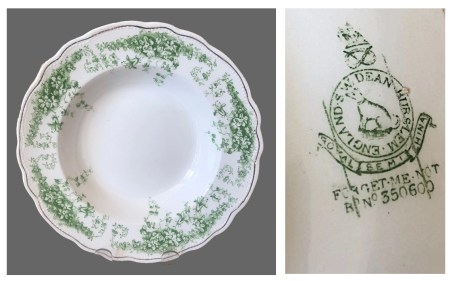
Flip it over, and there are parts of the floral pattern on the reverse, a deliberately blurred design referred to as “flow blue,” about which more below.  Interestingly, the other images I have seen of this particular design, “Forget Me Not,” are not in flow, but are very clearly delineated, as shown in the example further below, where the design is in green.

What are we looking at in the manufacturer’s mark?  Starting at the top is a crown sitting over the top of a Staffordshire Knot.  This knot is a traditional symbol of Staffordshire and the town of Stafford, first used by the Stafford family in the 15th century.  The words within the circle read “England’s S.W. Dean Burslem,” which encircle a seated greyhound, part of the company’s trademark, and damaged with dark scratches in this piece.  In the banner (or swag) below this, and illegible here, this clearly reads on other examples “Royal Semi China” and beneath that is the design name “FORGET-ME-NOT” and the manufacturer’s registration number:  RºNº350600.  This mark is much clearer in the example shown below, which shows the same design applied using a different technique.

Green version of the S.W. Dean Forget-Me-Not pattern and trademark. Photos by Letsgoexplorin64 Source: Etsy.

S.W. Dean of the Newport Pottery, Burslem, in Staffordshire was the manufacturer.  Samuel Webster Dean had been the chairman of ceramics manufacturer in Edge, Malkin & Co., which started life as Cork and Edge in Burslem, making teapots and operated from 1846 to 60) before going through various changes in partnership.  When it closed in 1906, Dean declared an interest, and eventually took over the company in 1909, renaming it S.W. Dean. The greyhound at the heart of the maker’s mark was carried over from Edge & Malkin & Co, which had used it between 1873 and 1903.   The new company still operated out of Burselm at the Newport Works, and its products were probably sold in a number of retail outlets.  The company also appointed agents to sell its products at sales events in hotels in major cities, probably for bulk sales into retail and export.  In the advert below an event at the Holborn Viaduct Hotel in London as announced.  There are examples of the type of products that the company produced on the A-Z of Stoke on Trent Potters website.  S.W. Dean ran into financial problems very quickly, and Samuel Dean was declared bankrupt in June 1910.  Although the advert below mentions an export market, it seems unlikely that there was sufficient time for this to get fully underway before the company closed.

Advert from the Pottery Gazette of October 1908. Source: A-Z of Stoke On Trent Potters

Later in 1910, S.W. Dean was in turn purchased, and a new company was registered by J.D. Kerr.  Kerr clearly thought that the Dean name had enough brand recognition amongst potential purchasers of the ceramics to retain the name, because the new company became Deans (1910) Ltd.  A greyhound was retained in the log, but was on all fours, instead of seated, and was shown standing on an open crown.

The pattern side, showing the Forget-Me-Not design

The style and technique used on this pottery is called flow  blue, and is a form of transferware.  Transferware is a very swift way of transferring a design to the surface of an object. A copperplate engraved with the required design was inked, in this case with deep blue cobalt oxide, and pressed on to paper that, while still wet, was in turn pressed on to a ceramic surface.  The design left on the piece of pottery is the transfer.  With a complete object, the overlap between the transfers is usually visible as a seam, but this piece is too small to show this.  The process speeded up the process of decorating ceramics, making them much less expensive to produce than hand-painted wares, permitting mass production, and creating cost-savings that were passed on to the customer.  

The particular characteristic of flow blue is the appearance of blurred edges, giving them a soft and blousy look, quite unlike the precision of the green example of the same design above.  When the pot was ready for a second firing, after the transfer design had been fixed into place, a flow-powder was added to the kiln.  A typical mixture was 22% salt, 40% white lead, 30% calcium carbonate, and 8% borax, but there were variants.  This gave off a chlorine gas which caused the cobalt in the transfer to diffuse into the glaze, creating the flow effect and the intense blue glow.

The Newport Works in Burslem, Staffordshire, where S.W. Dean’s pottery production was based. Source: A-Z of Stoke On Trent Potters

Flow blue appears from about 1830.  Whether the effect was originally accidental or deliberate, it soon became very popular, first in the U.S., exported from Staffordshire factories, and later in Britain’s own households.  During the Napoleonic Wars of 1803-15, the U.S. had become Britain’s most important export market until the onset of the American Civil War in 1860.  The Registration of Design Act of 1842, which prevented factories from copying each others patterns without permission, resulted in new patterns, and sometimes specialization in particular types of design. By the mid 1800s British manufacturers were producing a variety of different genres, including more traditionally Victorian rural, garden and specifically floral designs, many of them very romanticized.  The forget-me-not is a good example of a flower chosen because of its popularity in Victorian gardens and poems.

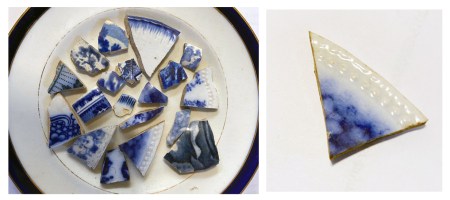
Flow blue from the garden, with the forget-me-not sherd both centre bottom on the plate, and on its own on the right

A lot of flow blue has come out of the garden, but nearly all of it in very small pieces.  A sort through them has only found one piece that is consistent with the Forget-Me-Knot design, a very thin rim piece, much thinner than the pieces shown above.  It may or may not come from the same item, perhaps thinning towards the edge, but it could also be a sherd from a different part of the same set.  Some of the other pieces of flow blue display a characteristic feathering along the rims of ceramics, none of these gilded, although many feathered edges were.  Those shown here are a selection of the bits pulled out of the garden, including the Forget-Me-Not rim piece.

Other object histories from my garden can be found 
on the History in Garden Objects page


Sources:

Books and papers

Neale, G. 2005. Encyclopedia of British Transfer-Printed Pottery Patterns 1790-1930.  Miller’s

Websites

The A-Z of Stoke On Trent Potteries
S.W. Dean

http://www.thepotteries.org/allpotters/347a.htm

The Glossop Cabinet of Curiosities
The Rough Guide to Pottery Pt.5 – Blue and White Bits.
https://glossopcuriosities.wordpress.com/2022/09/15/the-rough-guide-to-pottery-pt-5-blue-and-white-bits/

HobbyLark
Flow Blue: History and Value of Blue-and-White Antique China, by Dolores Monet, December 23rd 2022
https://hobbylark.com/collecting/FlowBlueHowtoIDandValuetheCollectibleBlueandWhiteAntiqueChina

House of Brinson
Transferware and Flow Blue
https://houseofbrinson.com/2021/04/28/thoughts-on-transferware-and-flow-blue/#:~:text=If%20you%20see%20a%20blue,were%20widely%20sold%20in%20America.


Object histories from my garden #11 – Fragment of a bisque porcelain doll

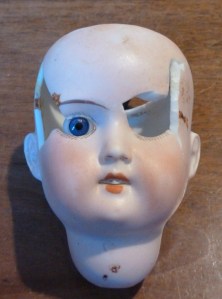
Fragment at a bisque ware doll head with painted lips

One of the eeriest pieces that we have dug out of the garden is this fragment of a doll’s head.  It was no ordinary child’s doll, but an expensively crafted item, its head and limbs made of bisque porcelain.  It would have been dressed in opulent, often period-themed clothes, and its eyes may have opened and closed, via hinged eyelids, as it was tilted. 

For anyone new to this occasional series on objects extracted from my garden during everyday gardening activities, see the History in Garden Finds page.  These are not objects used in the garden, but objects, usually fragments, lost or disposed of in the garden and found during digging, troweling and planting.

Bisque ware dolls either appeal to you or don’t, and in my case they sit with clowns and golliwogs in the category of the downright unpleasant. We found a piece of china showing a golliwog  in the garden too.  The bisque ware dolls are collectors items today, and you can usually find a few examples on eBay.  Bisque ware or biscuit porcelain is made in a mould, and fired but left unglazed, giving its surface a matte finish.  When skilfully painted, it can look from a distance like human skin.  Each colour is painted on to the surface and fired separately, building up the layers to create the skin-like effect.  The head and limbs of the doll were formed in moulds.  The unseen body of the doll, hidden by clothes, could be made of much less expensive materials.  Limbs were sometimes articulated, so that they bent at elbows, hips and/or knees.  

A doll head that gives some idea of what the rest of the garden fragment doll may have looked like. “Floradora” by Armand Marseille of Germany. Source: What The Victorians Threw Away

The bisque dolls were made from around 1860 to around 1915, although similar dolls were made from other materials before that date. The earliest were intended to represent fashionable women, and the child dolls only came in later, after around 1880.  Their popularity spread initially in France during the 1880s, but the German market soon competed, making dolls that looked just as expensive but were far more reasonably priced.  By 1900, Germany was dominating in the bisque doll market.  Names like J.D. Kestner, Armand Marseille and the Heubach brothers are still popular in the collector market.   The best known producers marked their dolls where they would not normally be seen, now of great value for collectors, but a head fragment like this would not have been marked.

There is an example of an elaborately kitted out Kestner doll at the end of the post, but to the right is the equally eerie head of another broken doll, from the What The Victorians Threw Away website, showing what the rest of the head of the fragment in my garden may have looked like.  Although some dolls had mouths that moved when the doll was tilted, this one did not, and it does not looks at though the garden fragment did either.  It has eyelashes  like the ones on the one from my garden, but shorter.

There is little to say about the piece from the garden, other than it was made of a thin porcelain, carefully shaped in a mould.  It was very skilfully painted, the cheeks a gentle rosy colour, the thin, bow-shaped lips a bright scarlet, with the ends of long dark eyelashes at top right.  The clump of grey substance on the reverse side suggests that someone had made an attempt to repair the doll, presumably following a previous breakage.  It seems to have been a very unlucky individual.

The fragment is at top left of this photo, shown with a few of the other garden fragments in an old printer’s tray, hung on a wall.

Looking at it, I cannot help but wonder what on earth happened to the rest of the doll and why this bit of it was isolated from the rest of its head and its body?  It was found to the rear of a wide flower bed that was completely dug out, its soil disposed of and replaced due to a particularly virulent and un-killable form of grass, before being replanted. If the rest of the doll had been there, we would have found it, but there was no sign of anything remotely like it.  Perhaps it was dropped, broke on the spot, and this fragment was lost at the time, with the rest of the doll picked up and disposed of elsewhere.  Who knows :-).  It is one of the few hints of any high quality pieces owned by previous householders that we have dug out of the garden.  Most of those items are of domestic use, and very commonplace, although each has its own history as a representative of a certain type of object fashionable at the time of its production.

J.D. Kestner bisque doll with accessories (for sale at over $1000.00). Source: eBay

For other objects in the series,
please see the History in Garden Objects page


Sources:

History of Dolls
History of Porcelain Dolls
http://www.historyofdolls.com/doll-history/history-of-porcelain-dolls/

Houston Texas University
Bisque Dolls 1890-1915
https://hbu.edu/museums/museum-of-american-architecture-and-decorative-arts/theo-redwood-blank-doll-collection/bisque-dolls-1890-1915/

The Spruce Crafts
Top 5 German Antique Doll Brands (by Denise van Patten)
https://www.thesprucecrafts.com/top-german-antique-doll-brands-774906


Objects histories from my garden #10 – 19th century mocha and annular ware sherds

Mochaware sherd from the garden

This satisfyingly chunky piece of glazed earthenware, featuring a roughly beaded rim, was once a fairly large, open vessel, probably a pot or a tall-sided bowl.  Mocha ware, produced between the mid 1700s and the early 1900s, was relatively cheap and cheerful, pottery for using rather than admiring.  Its defining features include its colouring, the linear decoration (usually combined with panels of colour or white background) and the “dendritic” design. “Dendritric” means “branching,” and in mochaware refers to a pattern consisting of a feathery fern-like tendrils, usually emanating from a main stem, typically coloured either black or blue.  Vessels without the dendritic design are usually referred to simply as banded creamware or annular (ring-like) ware, in both cases due to the encircling bands of colour.  It is only those vessels with the dendritic design that are supposed to be referred to as mochaware.   We have found both in the garden, but the piece of mochaware is the most impressive, both in terms of solidity and distinctiveness.

Polished moss agate pebble. Source: Wikipedia

The name mocha derives from an imported stone known as moss agate, which was also known as mocha stone due to its export from the port of Mocha (al Mukha) in Yemen, on the southwestern end of the Arabian peninsula.  The stone is not actually found in that part of the world, and was imported from India and some parts of central Europe. Many of the first examples to find their way into western Europe were brought back by the East India Companies of Britain and the Netherlands.  Although the appearance suggested to its European admirers that plant remains had been preserved in the stone, moss agate consists of quarts with mineral inclusions, usually manganese and iron oxides.  It is not actually an agate at all.  

Fabergé box with moss agate lid. Source: Royal Collection Trust

In the 18th century the belief that the stone preserved plant remains indefinitely suggested that it had special health-preserving properties, providing good luck to the wearer.  Many were accordingly turned into jewellery, particularly as polishing techniques improved, and they were often accompanied by gemstones in settings.  The ability to cut the stone into thin sheets that could be polished encouraged its incorporation into various decorative objects.  The Royal Collection Trust has in its collection a piece of sliced moss agate formed into the lid of a box, by Fabergé, which shows clearly how the pottery emulates the stone, and how it might be used in luxury goods.  There are many similar examples.

The Greengates Works in Tunstall during the 1780s. Source: thepotteries.org

It is thought that the comparatively humble mochaware pottery was first made by William Adams of the Greengates factory, Tunstall, England (1745-1805).  Production moved to the factory of his cousin, also William Adams, at Brickhouse, Burselm and later at Cobridge Hall in Cobridge.  Many English factories were soon turning out large quantities of mocha, mainly in Staffordshire into the early years of the 20th Century.  Other factories were set up in Bristol, Hull, Leeds, Glasgow, Swansea and Llanelly.

Banded Creamware. Source: Lot-Art

Annular and mochaware vessels usually combine a limited repertoire of colours.  The concentric rings include yellow,  yellow ochre, blue, black and and beige.  More rarely some feature terracotta, orange and green bands.  The background is usually cream or white, and the dendritic design is usually blue or black. In some cases the mochaware decoration remained purely abstract, but on some vessels the acidic solution is controlled to create images representing trees.  Some examples of both abstract and more representational uses of the style are shown below.

Being so inexpensive, and at the same time so attractive, it became extremely widespread.  It was often used to make pint mugs for pubs, marked with an imperial symbol confirming the correct volume, and ordinary domestic items like cups, mugs jugs, jars, lidded pots and mixing bowls, and even chamber pots.   It was almost never used for flat items like dishes, plates or platters.  Because the patterns made could be influenced but not precisely determined, each piece was unique. Mocha and banded creamware were exported in large amounts to the United States, which was soon manufacturing its own mochaware.

Mochaware mixing bowl. Source: 1stDibs

On the pottery, the tendril effect of the moss agate is achieved by dripping a dark acidic colouring (which could include urine, tobacco juice, lemon juice, ground iron scale, hops or vinegar) onto the alkaline slip (mixture of water and clay) of the pot, whilst still wet.  The alkaline liquid splits, and the result was thought to resemble the moss agate.  Here’s a description of the technique from the University of Toronto’s Physics department:

The original recipe involves a “tea” made by boiling tobacco, which is then colored with e.g. Iron oxide. The piece is first coated with a wet “slip” (very runny clay/water mixture). Then the tea mixture is touched onto the wet surface. The acidic tea reacts with the alkaline slip and the dendrites grow quickly from the point of contact.  The dendritic pattern is clearly the result of a dynamic process in which the contact line between the two liquids, tea and slip, becomes unstable. The surface tension of the tea is less than that of the slip. The instability is probably driven by a combination of capillary and Marangoni (surface tension gradient) stresses, coupled somehow to the acid/base chemical reaction. Similar looking instabilities are known in surfactant driven flows.

A decisive contributor to the production of both mochaware and annular ware was the rose-and-crown engine-turning lathe, developed by Josiah Wedgwood.  There was a hefty up-front cost, but it allowed a mechanized approach to the otherwise hand-applied concentric rings of coloured slip.

Experiments described by The Ceramic Arts Network website, explain how the techniques have been used to make modern mochaware in modern experiments:

Pint tankard with an imperial stamp. Source: 1stDibs

The mixture that is used to form the patterns is called “mocha tea.” It was originally made by boiling tobacco leaves and forming a thick sludge that was then thinned with water and mixed with colorant. However, nicotine solutions are only one form of mild acid; many others will work, such as citric acid, lemon juice, urine, coffee or vinegar, particularly natural apple-cider vinegar. One of these would be mixed with colorant. Most colorants work quite well, although carbonates and stains are usually better than oxides, since they are typically a physically lighter precipitate than oxides. Heavy materials such as black copper oxide, black cobalt oxide and black iron oxide do not work well, because the acid can’t adequately hold them in suspension. A ratio of about one heaping teaspoon of colorant to a quarter cup of mild acid is usually a good starting point. However, a good deal of individual testing has to be done to get the two liquids to work together to create significant dendritic formations or diffusions. 

The Copeland (formerly Spode) pottery works in 1834. Source: Spode Museum Trust

The Colonial Sense website tells how Charles Dickens visited the Copeland Pottery Works at Stoke on Trent in the Potteries:

I am well persuaded that you bear in mind how those particular jugs and mugs were once set upon a lathe and put in motion, and how a man blew the brown color (having a strong natural affinity with the material in that condition) on them from a blow pipe as they twirled; and how his daughter, with a common brush, dropped blotches of blue upon them in the right places; tilting the blotches upside down, she made them run into rude images of trees.

Mochaware sherd from the garden

The sherd from my garden shows a band of yellow ochre on and beneath the rim with a beaded or rouletted design impressed into the surface below the rim, produced by using an embossed rouletting wheel.  The beading was achieved by a simple cylinder attached to a handle and rolled onto the surface of the ceramic.  It took a very steady hand.  Some rouletting is very subtle and complex, but this is clearly not.  Still, it is another decorative aspect to the vessel.   A segment of black dendritic patterning is visible on a cream background, separated from the wide band of yellow ochre by a thin band of blue.  It is a solid, utilitarian piece of earthenware, almost 1cm (a third of an inch) thick at the rim, narrowing into the body of the vessel.  The vessel originally had a diameter of 25.5cm (10 ins), which makes it a fairly substantial object.  Its walls show very little vertical curvature, unlike most mixing bowls, so it may have been a large pot of some description.

Yellow ochre reverse side (interior) and section of the sherd showing the fabric and glaze

Today,whole and undamaged items of  mochaware attracts collectors on both sides of the Atlantic.  My sherd, though part of a fascinating story, is of course worthless.  As usual, apart from trying to find out information about the odds and ends in the garden, together these objects are combining to form a sense of who lived here before and what sort of livings they may have had.

There’s a truly illuminating video of dendritic mochaware being produced by a modern artisan on YouTube, showing how the acid reacts when it meets the alkaline, as follows:


For anyone new to this occasional series on objects extracted from my garden during everyday gardening activities, see the History in Garden Finds page.  These are not objects used in the garden, but objects, usually fragments, lost or disposed of in the garden and found during digging, troweling and planting.


Sources:

Books and papers

Wright, K.F. 2021. Artifacts.  In Loske, A. (ed.) A Cultural History of Color in the Age of Industry.  Bloomsbury Academic.

Websites

Ceramic Arts Network
Mocha Diffusion Acid/Color Mixture
https://ceramicartsnetwork.org/daily/article/Slipware-Decoration-Mocha-Diffusion-and-Slip-Dotting-Pottery

Colonial Sense website
Mochaware – The Hidden Utiitarian Gem. By Bryan Wright
http://www.colonialsense.com/Antiques/Other_Antiques/Mochaware.php

The Potteries
Greengates Pottery, Tunstall
http://www.thepotteries.org/potworks_wk/027.htm

Regency Redingote
Moss agates: pictures and power. By Kathryn Kane
https://regencyredingote.wordpress.com/2018/02/09/moss-agates-pictures-and-power/

Ceramic – Pottery Dictionary
Roulette wheel
http://ceramicdictionary.com/en/r/513/roulette-wheel-roller+tools

Royal Collection Trust
Box with moss agate panel 1903-08
https://www.rct.uk/collection/40155/box-with-moss-agate-panel

St Mary’s University
Mocha Ware
https://www.smu.ca/academics/departments/anthropology-mocha-ware.html

University of Toronto, Physics Department
Dendritic patterns on mochaware pottery
https://www.physics.utoronto.ca/~smorris/edl/mochaware/mochaware.html


Objects histories from my garden #9 – A Golliwog on a child’s cup

It never occurred to me that I would find any politically incorrect objects in the garden, but this is certainly a contender.  I dug it out of one of the flower beds when doing some planting last summer, and for a moment couldn’t figure out what it was I was looking at, partly because I was holding it upside down, but partly because it was so unexpected.

I remember that Robertson marmalade and other Robertson products were everywhere, with the distinctive Golliwog logo on their labels, with its bright clothing and crudely caricatured face.  ln spite of the Golliwog’s big red smile, or perhaps because of it, I found it threatening.  For others, however, it was (and still is) a cheerful and entertaining character, rather absurd but benign.

The Golliwogg as it first appeared in Florence Kate Upton’s “The Adventures of Two Dutch Dolls” of 1895. Source: Wikipedia

The name “Golliwogg” (with the double g at the end) was invented by Florence Kate Upton, whose parents had emigrated from England to New York in 1870, and who had a black minstrel soft toy as a child, which was at the heart of many childhood games.  When the family returned to England in the late 1880s, Upton began to illustrate children’s books to raise money to attend art school, with verses for the books written by her mother Bertha.   The Golliwogg was introduced in their 1895 book The Adventures of Two Dutch Dolls, complete with the shaggy hair, clown-like grin, bright clothes and bow tie.  This was the first of fourteen very popular books that featured Golliwogg as a central character, a jolly, benevolent, and good-natured friend who embarked on international adventures.

The name and character invented by the Uptons were not copyrighted, and the character was incorporated into works by other authors.  It became a popular home-made rag doll, but it soon went into production as a soft toy, mainly in Germany and Britain, marketed as a “Golliwog” (without the final g). The German Steiff Company became the first to mass produce them in 1908, going on to produce a female version of the doll.

Robertson’s Golden Shred Golly Badge, Pre-War Issue dating from 1937 commemorating the coronation of King George VI. Source: Portable Antiquities Scheme via Wikipedia

In the 1910 James Robertson and Sons  (based in Droylsden in Greater Manchester) first adopted the “Golly” on its branding after James’s son John had seen them being played with on a trip to the U.S., and by the early 1920s had been rolled out to many of their products.  In 1928, the company began to offer Golly brooches in return for tokens printed on product labels as a marketing gimmick.  The first were a series of Gollies engaged in different sporting activities and the Golly became a runaway success for Robertson’s.

It was only in the 1960s when increasing issues surrounding attitudes to race and the growth of  racism became dominant that the role and significance of the Golly became questionable, and began to seem like very bad taste, offensive to many, potentially encouraging unconscious bias in children.  In some countries today the word, either in its entirety or split into “golly” or “wog” is categorized as a racial slur, and the image of the Golliwog has been banned from some of them.  At the same time, Golliwog-themed items, particularly vintage ones, have become collectable.  Indeed, the Robertson’s Golly was not actually retired until 2001.  The BBC reported that it was to be replaced by characters from Roald Dahl books, illustrated by Quentin Blake.  Robertson’s Brand Director Ginny Knox commented on the changeover:

We sell 45 million jars of jam and marmalade each year and they have pretty much all got Golly on them.  We also sell 250,000 Golly badges to collectors and only get 10 letters a year from people who don’t like the Golly.  Whereas we are concerned about those people and it’s not our intention to be offensive with the Golly, we have to look at what our research says and what the sales say.  The feedback has consistently been that for the vast majority of people, the Golly is a positive thing that they like.

One wonders what, in particular, people said that they liked about the Golly.

The very battered sherd from my garden was probably part of a child’s teacup or similar.  The fabric is just over 2mm thick, and the diameter is probably something a little in excess of 7cm diameter.  This would be more accurate if this as a rim piece, which can be measured by laying the rim on a simple map of concentric circles, (a rim chart or radius chart) but even though this is just a body sherd, the curvature is obvious and it is unlikely that it will have been much wider at the top.

The head of the Gollywog is typical, with the big round eyes, spiky hair and wide red mouth.  The bow tie is yellow and the waistcoat or jacket is blue, fastened with a big white button.  Just visible across the base of the waistcoat/jacket is a splash of red, which could either be a jacket buttoned across the base of a waistcoat or the top of the trousers.

The eyes look slightly down to its left, which was a standard feature of the Robertson’s Golly.  The most familiar Robertson’s Golly was usually shown with a bright yellow waistcoat, red bow tie, blue jacket and red trousers but there variants.  In spite of making myself substantially uncomfortable by paging through dozens of images on specialist websites, as well as paging through Google Images, I have not found one that looks like the piece from the garden.

The  paragraphs looking at the history of the Golliwog on this post were based on Dr. David Pilgrim’s detailed article The Golliwog Caricature on the Ferris State University / Jim Crow Museum website (dated November 2000, edited 2012), which includes a full bibliography.   For the really fascinating, if often disturbing full story, with a useful discussion of the racism issue,  see the link below.   Dr Pilgrim is Professor of Sociology at the Ferris State University.  https://www.ferris.edu/HTMLS/news/jimcrow/golliwog/homepage.htm

The above-mentioned story about the end of the Golly as a Robertson’s brand in 2001 is on the BBC website.

Updated 13th April 2023, Thursday: The Guardian newspaper reported that toy Golligwogs were being banned from eBay and Etsy “amid new evidence that more people now regard the toys as racist.” I’m amazed that it took so long:

safdfas

For anyone new to this occasional series on objects extracted from my garden during everyday gardening activities, see the History in Garden Finds page.  These are not objects used in the garden, but objects, usually fragments, lost or disposed of in the garden and found during digging, troweling and planting.


dsfdfs

S.S. Great Eastern,16th February 1867 – The world’s biggest ship under refit on the Mersey

Introducing Isambard Kingdom Brunel’s S.S. Great Eastern

The Great Eastern under repair, refit and restoration on the shore of the Mersey, at a cost of £80,000. Illustrated London News ,16th February 1867


On this day,
February 16th 1867, 155 years ago, the colossal, and glorious iron steamship S.S. Great Eastern was beached on the Mersey just off shore from Rock Ferry, opposite Liverpool, for repairs, a major refit and some much-needed restoration after two years of laying cables across the Atlantic.  The work was undertaken to return her to her status as a luxury passenger liner, ready to embark on a voyage to New York to collect passengers for the 1867 Paris Exposition in France.   She was beautifully captured by an artist for the Illustrated London News, which often featured the vast ship.  I have the same page framed on my kitchen wall.

A sketch by Brunel in his journal, accompanied by the following comment: “”Say 600 ft x 65 ft x 30 ft” (180 m x 20 m x 9.1 m).  Source:  S.S. Great Eastern Facebook page

On 25th March 1852, Isambard Kingdom Brunel, perhaps the greatest civil engineer of the Victorian era, and certainly the most ambitious, had sat at his desk and made a sketch, accompanied by the following comment: “Say 600 ft x 65 ft x 30ft” (180 x 20 x 9m).  The title was “East India Steamship.”  As Rolt puts it so evocatively, “Thereafter the pages of the sketch books are haunted by the apparitions of gigantic ships.”  There had been problems with his other two major shipbuilding projects, Great Western and Great Britain, launched in 1837 and 1843 respectively, but Brunel had a gift for sweeping along hard-nosed investors in his wake, building on the confidence and excitement of a Britain that knew that the world getting smaller everyday, and that it was well-placed to reap the commercial rewards of new technologies.  Although just toying with the idea on those pages, Brunel had no reason to believe that he would have difficulty finding an investor.

In the opening lines of a book devoted to  S.S. Great Eastern, George Emerson observes that “By the middle of the nineteenth century the people of Britain were not easily impressed; they thought they had seen everything,” an impression confirmed by the Great Exhibition of 1851.  If there were multiple blind allies in Victorian creativity, there were also splendid successes, and the sense of unstoppable progress was hard to resist, even when some of the ideas were rather more brave and optimistic than they were viable or sustainable. Even in such a creative and ambitious era, where technological ambition had produced innovation after innovation, Great Eastern stood out as a true landmark of engineering excellence and unrestrained ambition.

Building Brunel’s “Great Babe”

Guide to the Great Eastern Steamship. Captain John Vine Hall commander. Source: Library of Congress

Brunel referred to the ship as “Great Babe,” and she was his last project, his last great gift. He envisioned Great Eastern carrying passengers and cargo to Australia.  The idea came to him whilst working on a much smaller project.  Brunel had been asked to design two steamships for the Australian route for the Australian Royal Mail Company.  He had become aware of the “wave-line principle” proposed and researched by shipbuilder and marine engineer John Scott Russell, who had suggested an optimal hull shape for moving a ship through turbulent energy-draining seas.  Brunel, impressed with Russell’s research, invited him to bid for the contract.  The partnership resulted in two iron steamships, the Adelaide and Victoria, launched in 1853.

One of the sturdier sailing ships on the Australian route, the St Vincent, built in 1829, shown here departing with a full load of emigrants in 1844.  She also carried convicts. She was still sailing when Great Eastern was launched. Source: Illustrated London News, via Wikipedia

The investment in steam by the Australian Royal Mail Company reflected the growing reliability of steam over sail in an era when the passage to and from Australia was still dominated by sail.  The requirement to deliver mail to a schedule put pressure on companies to develop timetables, and this was difficult when depending on sail.  Sailing ships serving Australia could take advantage of the trade winds to do the journey between Australia and Britain in 90-120 days, and although better and faster sailing ships were being built all the time, they were at the mercy of winds and tides.  They were forced to follow routes where the winds were to be found, and were uncomfortable for passengers.  No sailing ship could compare to an iron-hulled steam-powered ship fitted with masts and sails, whose captains could fire up its engines to choose shorter routes and propel it through becalmed waters, whilst still having the option to set sails to save fuel where winds were available.  Even though steamships had to be refuelled en route, the most modern steamship engine designs had improved fuel usage, and now seen journeys of 70-80 days, and these technologies were were improving all the time.  Timetables, previously an impossibility, were now a realistic and exciting possibility, and the Australian Royal Mail Company had jumped on the steamship bandwagon to enable it to meet the terms of its mail contract.

Houses behind the shipyard where Great Eastern was built. Great Eastern rises behind them with the Thames running parallel to the hull on her other side. Source: atlantic-cable.com

Brunel, who had already built two transatlantic ships, now turned his formidable brain to the challenges of sailing to and from Australia.  His key insight was that the ideal ship should be able to carry all the coal she needed to complete the entire round trip without refuelling.  The Australian gold rush of 1851 had supercharged emigration from Britain to Australia, and as Australia became a more economically active part of the global economy, improved communication and transport links were becoming annually more imperative.  But who would finance such a ship?  The obvious customer, the Australian Royal Mail Company, had now been provided with what it needed.  Instead, he looked to the Eastern Steam Navigation Company (ESN Co), which had been formed the previous year, to which he submitted a paper proposing the new ship.  In spite of misgivings of some of its board of directors, the proposal was accepted.  At this stage, two sister ships were envisaged, the first to be used between Britain and Ceylon (today Sri Lanka) off the southeast coast of India, to be used as a distribution network from which smaller cargoes would be sent to Madras, Calcutta, Hong Kong and Sydney in Australia.  If that were to prove successful, the two ships would then do regular runs to Calcutta and Australia.  The mind fairly boggles at the idea of two Great Eastern ships on the oceans.

Working on “Great Eastern” in 1857 at night, preparing the great ship for launch by gas light. Source: atlantic-cable.com

Work began with the laying of the keel plate in May 1854 in John Scott Russell’s Millwall yard on the Thames, almost opposite Henry VIII’s Royal Docks at Deptford.  Although these beginnings went unnoticed by either the public or general media, specialist reports began to emerge, drawing attention to the vast scale of the ship, and even before she was launched, there was a momentum of interest in the enormous ship.  As she went up, slowly materializing in Russell’s yard, the sheer scale of Brunel’s vision became evident, and the popular media began to take an interest.  The Times waxed lyrical about the build on 5th April 1857:

Where is a man to go for a new sight? We think we can say.  In the mist of that dreary region known as Millwall, where the atmosphere is tarry and everything seems slimy and amphibious, where it is hard to say whether the land has been rescued from the water or the water encroached upon the land . . . a gigantic scheme is in progress, which if not an entire novelty, is as near an approach to it as this generation is ever likely to witness.

Remains of the slipway down which Great Eastern was launched. Source: Wikipedia

Great Eastern was built just behind today’s Thames Clipper (river bus) stop called Masthouse Terrace Pier, which can be seen on the photograph below.  Operations were directed by John Scott Russell.  The old slipway is still in situ and can be visited, a very short distance from Masthouse Pier, shown right.  When popular novelist Charles Dickens went to see the work in progress, he commented that she rose “above the house-tops, above the tree-tops, standing in impressive calmness like some huge cathedral.”  In fact, the noise associated with the welding and riveting of 30,000 iron plates to form her double hull and watertight bulkheads must have been deafening rather than calm, an absolute cacophony, but Dickens does manage to convey the majesty of the enterprise.  The build of the ship was fraught with problems, financial and technical, and of course there were accidents and injuries, as well as a fire that destroyed much of the shipyard.  The relationship between Brunel and Scott Russell became increasingly acrimonious towards the date of the proposed launch, and it is something of a miracle that Great Eastern was ever completed.

Superimposition of Great Eastern on the modern Google satellite image by Mick Lemmerman.  Masthouse pier is clearly visible. Source:  Isle of Dogs – Past Life, Past Lives blog

When it came to her launch, her very size created a unique situation.  As shown in the photograph and superimposition by Mick Lemmerman, left, she was so long that she had to be built parallel to the Thames, rather than perpendicular to it.  In a lecture that I attended in London a few years ago, Thames archaeologist (and excellent speaker) Elliott Wragg commented that if the ship had been launched stern-end first, as was usual, she would have plunged into and across the Thames, shattering its southern banks before proceeding to carve her way down Deptford High Street.  Everyone at the lecture, all of us familiar with today’s thriving Deptford High Street, burst out laughing, but he made his point very effectively.  The ship really was immense.  Russell had to lease part of a neighbouring shipyard to accommodate her, and plans were made for a sideways or broadside launch.

Robert Howlett’s famous photograph on the occasion of the first launch attempt, 2rd November 1857. It is the only photograph that shows Brunel and Russell together. Russell is at far left, and Brunel is third from the left.  Source: Wikimedia

At that time known as Leviathan, Brunel’s dream ship became a reality when she was launched on the Thames on January 31st 1858, following several, increasingly embarrassing abortive attempts that had begun on 3rd November 1857.  There were few witnesses when the Great Ship, as she had become known, was eventually launched without ceremony or drama.  The public, initially excited by the prospect of the 1857 launch had lost interest, but as the news of the launch spread, bells were rung across London in celebration.

Great Eastern was now afloat, and an impressive sight.  She had two means of propulsion, other than sail, consisting of two huge side-mounted paddle-wheels, and a single screw propeller.  When both were used simultaneously she could reach a maximum speed of 15 knots (or 27.7 kilometres per hour), and she carried 6500 yards (5943m) of sail on her six masts.  Each of the ten engines built by James Watt and Co. was the size of a house.  She had four decks, and could carry 4000 passengers and 15,000 tons of coal. 

Infographic comparing ship sizes, in chronological order from left to right. Click to expand. Source: JF Ptak Science Books.

She measured 692ft (211m) long, 83ft (25m) wide, with a draft of 20ft (6m) unloaded and 30 ft (9m) fully laden, and displaced 32,000 tons fully laden. In comparison, S.S. Persia, the next in size launched two years earlier in 1856, was 390ft (119m) long and 45ft (13m) wide.  Not until 1906 was her 22,500 ton displacement exceeded in 1906 by Cunard’s RMS Lusitania;  and her great length surpassed, in 1899, by the White Star Line’s RMS Oceanic of 704ft (215 m).  At the time of her launch in 1858, S.S. Great Eastern was the biggest ship that anyone had dared to imagine.  

One of Robert Howlett’s photographs of Brunel with Great Eastern in 1857 prior to launch. Source: Wikimedia

In spite of the launch, celebration was not on the minds of the ESN’s company directors.  She had already cost an eye-watering amount, and to fit her out, a lot more investment was required, and there was no money left.  Emerson summarizes the situation as follows:

The great ship was in the water but how was she to be completed?  About £640,000 had been expended on an unfinished, partially engined and boilered ship which no one seemed to want, with a debt of £90,000 handing to it like a superfluous anchor. . . . There was growing belief among some of the directors that the ship should be put up for sale or auction.

For a long time, the ship sat on her mooring at Deptford, incomplete.  Eventually Brunel persuaded railway contractor Thomas Brassey to form a new company to raise the money to complete Great Eastern. The “Great Ship Company” was formed, which purchased the ship for £160,000, whilst raising additional capital to fit out the ship and ready her for active duty.  Brunel, sent by his doctors to Egypt for his health, was absent for much of the fitting out, returning in time to oversee final work under preparation for Great Eastern‘s maiden voyage in September 1859.  Checking her over on the 5th September, Brunel suffered a stroke and was carried home, partially paralysed.

Sea Trials in 1859

Great Eastern set off on sea trials under Captain William Harrison and a team of engineers without Brunel, on 17th September 1859, proceeding with the aid of tugs down the Thames, which must have been a remarkable leg of the journey given her size, before turning into the open sea, heading south and then west along the coast.  The Times reported:  “She met the waves rolling high from the Bay of Biscay.  The foaming surge seemed but sportive elements of joy over which the new mistress of the ocean held her undisputed sway.”

Explosion on Great Eastern 1859. Source: Royal Museums Greenwich, PAH0309

On her first sea trials, without the ailing Brunel to supervise, she was proceeding along the English Channel near Hastings when an explosion in the paddle engine room sent one of the funnels flying upwards, destroyed the beautiful grand salon, the fire and pressurised steam tragically killing five stokers and injuring twelve.  Thanks to her double-skinned hull and watertight bulkheads Great Eastern remained intact, and thanks to alternative propulsion, she was able to proceed under her own steam. Brunel was told of the explosion, which must have been an awful blow.  Brunel had been suffering for some time from a kidney condition now known as glomeculonephritis, which seriously undermined his health, but the stress of the accident must have been a serious additional shock to his failing condition.  He died six days later, aged 53.

Repairs to the ship were soon underway in Weymouth and the ship proceeded to Anglesey in October, where she dragged the two anchors holding her and began to drift in the same gale that sunk the S.S. Royal Charter nearby, with 446 lives lost. Thanks to her captain, crew and the engines used to hold her in position, she survived the night but the episode raised serious concerns about her ability to endure a storm at anchor.  Great Eastern suffered damage in the storm and underwent more repairs,

Consideration now had to be given to the ports that would be able to handle Great Eastern at home in Britain.  She usually sailed from either Milford Haven in southwest Wales, or Liverpool, on the Mersey.  In both places she could be accommodated with moorings in relative shelter, and laid up on gridirons when she was under repair or out of service.

The career of the S.S. Great Eastern

Great Eastern in New York in 1860. Source: Library of Congress (LOT 14160, no. 10)

Great Eastern had been designed to carry passengers and cargo to Australia, carrying sufficient coal to complete the round trip without refuelling. In an era before the building of the Suez Canal, which opened in 1869, Great Eastern could have chugged round Africa and back at greater speeds, with greater reliability, than any sail- or steam-powered ships currently operating.  She could have offered far greater comfort and at much less risk with enormously more capacity for passengers and cargo than any sailing ship owner could dream of at that time.  Unfortunately no-one had taken into consideration that she was far too big for nearly all the harbours to which she might have sailed, meaning that passengers, their luggage and the cargo would have to be ferried to shore in smaller vessels.  In addition, her experience anchored off shore at Holyhead in Anglesey in a gale had cast doubt on how well she was equipped to sit at anchor beyond harbour walls.

More to the point, the struggling Great Ship Company was unable or unwilling to raise the funds to send her that far, and the decision was taken to send the ship to America on its maiden voyage, as a transatlantic passenger liner.  To top off a rough few years, in January 1860 Brunel’s chosen Captain, William Harrison, drowned in a freak accident in a small sailing boat on the approach to Southampton harbour.  He was replaced by John Vine Hall, who was in charge of her maiden voyage to New York in the same year.

Interior of the Great Eastern showing the grand saloon. Source: McCord Museum, Quebec

Great Eastern‘s first commercial trip on 17th June 1860, her official maiden voyage as a luxury liner, was from Liverpool to New York under Captain Vine.  On board there were only 38  paying passengers, far outnumbered by the 418 crew.  Great Eastern was greeted as a fabulous spectacle in New York, a shining, magnificent newcomer.  Taking advantage of this, with the intention of milking her for all she was worth between arrival and departure, the decision was made to sell tickets for a two-day excursion, a mortifyingly mismanaged episode that did nothing to shower the ship or her owners in glory.  She returned to Britain via Halifax with 72 passengers and was laid up for winter at Milford Haven in southwest Wales.

Repairs and adjustments were made, at a cost that the slim gains from America were unable cover, and more financial controversies ensued, all reported in the media, and proving a barrier to further bookings.  In May 1861 around 100 passengers embarked at Milford Haven for New York.  Four days in, they hit a gale, and the previously steady ship was tossed around much like her smaller competitors,  Passengers experienced nothing worse than cuts and bruises, and no serious damage, but it frightened the passengers and undermined the storm-proof reputation of the ship.

1958 lithograph of Great Eastern by Charles Parson. Source: Wikipedia

Great Eastern put into New York just after the outbreak of the Civil War and following her return to England she was refitted as a troop ship to carry British soldiers and family members to Canada from Liverpool.  Once the refit was complete, she sailed for Quebec in June 1861 with 2144 officers, 473 women and children and 122 horses, as well as 40  paying passengers and a crew of 400.  This was the first and last time her massive capacity was actually useful for carrying passengers.  After a 10 day voyage from Liverpool to Quebec, she remained for a month, taking on paying sight-seers, and accumulating bookings for the return trip, carrying 357 passengers back to England.  She began to be a regular on the transatlantic route.

The Great Eastern in a gale, 1861. Source: Royal Museums Greenwich

After several incident-free voyages, in September 1862 the ship left Liverpool with 400 passengers and a commercially healthy load of cargo. On the afternoon of the second day out, the ship hit a gale and in the process of turning into the storm, the rudder was hopelessly damaged which, hanging loosely, began to damage the propeller.  In addition, one paddle wheel damaged in the storm was shredded, lifeboats were lost, and furniture and fittings were tossed throughout the ship’s interior.  Water entering through smashed skylights and portholes began to overwhelm the pumps.  The day was saved, but not by captain, officers or crew.  A passenger, civil engineer Hamilton Towle, devised a scheme to steer the rudder manually.  Under his direction, the crew managed to wrap chains around the rudder, restart the screw propeller, turn the ship around and limp her into Queenstown (today Cobh) in southeast Ireland.  She was subsequently escorted by tug to her mooring at Milford Haven.  It cost some £60,000 to repair the ship, and Towle claimed that as Great Eastern would have foundered without his intervention he could demand a salvage fee.  He was awarded £15,000, and again the management company found itself struggling.

Cross section of the Great Eastern. Source: Original unknown; this was downloaded from Encyclopedia Titanica

Great Eastern returned to the New York run in May of 1862, with only 128 passengers on the way out but 389 and a hold full of cargo on the return journey.  Her July 1862 voyage was also successful.  In spite of this, she was not competitive with the fastest ships against which she was running, all of which, being so much smaller, were running at their full passenger and cargo capacity and burning much less coal.  These were profitable where Great Eastern was struggling.  Her third voyage in 1862 caused more financial worries when,on the approach to New York in late August, she scraped against an uncharted reef.  Although the ship made port without difficulty, thanks to the double-skinned hull, the tear was 80ft long and the cost of a temporary repair was £70,000, partly due to the difficulty of obtaining materials during the American Civil War.  She returned to Liverpool in January 1863, with a substantial cargo, and was put on a gridiron on the Mersey for the damage and repairs to be inspected.  The temporary repair had to be made good, and two boilers required work. 

Great Eastern watercolour showing the ship on the gridiron in 1863. By W.G. Herdman. Source: Williamson Art Gallery Collection at Birkenhead.

1863 was a much better year and she carried a total of some 2700 passengers to New York and 950 in return over three trips.  Still, she made a substantial loss thanks to a pricing war started between the Cunard and Inman Lines, which pushed fares down to below the 1862 rates.  Combined with mortgage and creditor debts, the Great Eastern was no longer viable, and she was put up for auction in January 1864.  She failed to meet her reserve, and the ship was withdrawn from sale.  Instead, she was sold privately for £25,000 to a new company formed to buy her for cable laying, The Great Eastern Steamship Company.  

The following years were Great Eastern‘s  most productive.  She was ideally suitable for laying telegraph cables along the floor of the Atlantic, the only ship large enough to carry the machinery and the 2,000 nautical miles of cable required to reach from Ireland to America.  She was first engaged on this work from 1865-1866.  Although the first attempt to lay cable failed due to problems with both the cable laying equipment and the cable itself, the value of Great Eastern herself was proved, and the second attempt in July 1866 was a great success, and there were now two telegraph cables lying across the seabed of the Atlantic.  A dividend of 70%  was returned on the Great Eastern Steamship Company’s shares.

Great Eastern and the Paris Exposition Universelle of 1867

Magnificent painting of Great Eastern under repair at New Ferry, by Edwin Arthur Norbury. The Illustrated London News engraving at the top of the post is thought to have been based on this painting. Source: Artware Fineart

Great Eastern had been a familiar sight on the Mersey from the early 1860s, when she often used Liverpool as a base for her transatlantic crossings.  The Mersey was one of the few rivers wide enough and sheltered enough to provide her with safe harbour when she was not at sea.  After 1866, Great Eastern returned to Milford Haven.  The Great Eastern Steamship Company, having completed its work, jumped at the opportunity to rent her out for a one-off voyage as a passenger ship.  She was leased for £1,000 a month to a French company, La Société des Affréteurs du Great Eastern, which planned to use her to take around 3000 wealthy Americans to the Paris Exposition, and was moved to the Mersey for a refit.  Some illustrations refer to her being at New Ferry, others at Rock Ferry. There is some confusion in publications over whether New Ferry or Rock Ferry was the most appropriate name for the location.  In fact, both appear to refer to the Sloyne, an anchorage in the Mersey, lying off shore where Tranmere Oil Terminal is located.  It was popularly used as a mooring for particularly deep ships, including the Royal Navy training ship HMS Conway

The French company agreed to pick up the bill for refitting Great Eastern, together with new screw boilers, at a cost of £80,000. A Liverpool company picked up the contract to restore her to her former finery and overhaul the engines, work taken place at the Sloyne, as shown in the picture above and at the top of the post, between 19 January and 21 February 1867, ready to sail in March.

The story of Great Eastern‘s repairs was reported 26th January 1867, as follows in the Brecon County Times Neath Gazette and General Advertiser for the Counties of Brecon Carmarthen Radnor Monmouth Glamorgan Cardigan Montgomery Hereford.

Account of the repairs to Great Eastern at Rock Ferry. Source: Brecon County Times

BEACHING OF THE GREAT EASTERN. The big ship was, on the 19th, placed on the grid- iron at New Ferry, just above Liverpool, on the Cheshire side of the river. The gridiron, on which the ship now rests, was constructed about three years ago, when the vessel was first overhauled in the Mersey, but has since been altered, strengthened, and very much improved. There was a very high spring tide, and although the ship was drawing 18 feet 6 inches of water on an even keel, there was quite sufficient depth on the shore to render the operation of beaching a safe one. She lies broadside on the grid running parallel with the river. About nine o’clock a.m. all was in readiness, and the ship left her moorings. Sir James Anderson, the commander of the big ship, attended to the navigation, while Mr. Brereton, the successor to Mr. Brunel, and Mr. Yockney, carefully watched the engineering department.  Four steam-tugs (two on each side the Great Eastern assisted to keep the vessel in position, as with scarcely perceptible motion she neared the beach. The screw engines only of the big ship were worked. Tie screw boilers have been taken out of the ship, and are to be replaced by new ones, and the screw engines were consequently worked from the paddle boilers. The big ship took the grid about ten o’clock. She was placed with great nicety in the exact position fixed upon. Every- thing passed off without the slightest accident, and the beaching may be said to have been accomplished in the most skillful and successful manner. The Great Eastern is kept in position by two massive dolphins. Although her sides and bottom are rather dirty, the lines, bolts, and rivets appear in excellent order. The gridiron is perfectly flat for 60 feet wide, and the big ship rests in perfect security upon it. Every precaution has been taken to prevent accident. Thousands of men are at present engaged on the ship, and she will be ready at the time specified to trade between New York and Brest. Her first voyage after she comes off the grid-iron will be from Liverpool to New York, with goods and passengers.

Great Eastern sailed to New York with 123 passenger on board, which took a lengthy 14 days due to storms and the need to run in new parts.  Jules Verne, renowned for his novels about futuristic technology, was on board Great Eastern when she left the Mersey .  His subsequent novel The Floating City, is a real mixed blessing, combining his own real world experiences with a very bad fictional drama.  In spite of that, the bits of his text where he talks about the ship herself are excellent.  One of my favourite bits describes her leaving her mooring on the Mersey before heading across the Atlantic (the rest of this account can be found at the end of this post):

Illustration in the Jules Verne book The Floating City

At this moment large volumes of smoke curled from the chimneys; the steam hissed with a deafening noise through the escape-pipes, and fell in a fine rain over the deck; a noisy eddying of water announced that the engines were at work. We were at last going to start.

First of all the anchor had to be raised. The Great Eastern, swung round with the tide; all was now clear, and Captain Anderson was obliged to choose this moment to set sail, for the width of the Great Eastern, did not allow of her turning round in the Mersey. He was more master of his ship and more certain of guiding her skilfully in the midst of the numerous boats always plying on the river when stemming the rapid current than when driven by the ebb-tide; the least collision with this gigantic body would have proved disastrous.

To weigh anchor under these circumstances required considerable exertion, for the pressure of the tide stretched the chains by which the ship was moored, and besides this, a strong south-wester blew with full force on her hull, so that it required powerful engines to hoist the heavy anchors from their muddy beds. An anchor-boat, intended for this purpose, had just stoppered on the chains, but the windlasses were not sufficiently powerful, and they were obliged to use the steam apparatus which the Great Eastern, had at her disposal.

At the bows was an engine of sixty-six horse-power. In order to raise the anchors it was only necessary to send the steam from the boilers into its cylinders to obtain immediately a considerable power, which could be directly applied to the windlass on which the chains were fastened. This was done; but powerful as it was, this engine was found insufficient, and fifty of the crew were set to turn the capstan with bars, thus the anchors were gradually drawn in, but it was slow work.

A dining room on the Great Eastern. Source: National Library of Ireland

After an on-board accident leaving port, the ship reached New York without further incident, and preparations were immediately made for her voyage from New York to Brest in France, from where passengers were to be sent on to Paris.  She had berths prepared for 3000 passengers, but the lengthy  outward passage, much publicized, proved to be a deterrent and she left New York with only 191 on board.  This was a disaster for the French company that had invested so much in her.  It was also a disaster for the Great Eastern Steamship Company, which was caught up in legal disputes concerning unpaid crew fees amounting to £4500.00.  When the company told aggrieved crew members to sue the French firm that had leased the ship, they took legal advice.  Great Eastern was seized by the Receiver of Wrecks, and the Great Eastern Steamship Company eventually awarded the crew a miserly £1500.00. No dividend was paid in 1867.

From 1869 to 1870 and between 1873 and 1874, the great ship had returned to cable work.  Between these two contracts she sat unused at anchor on the Mersey and in 1874 was returned to Milford Haven where she again sat unused.

Great Eastern’s final days on the Clyde and the Mersey 

Back in Milford Haven, no-one could think of a commercially viable use for Great Eastern, and she was beached on a gridiron  in 1874 and was left there for twelve years.  In 1885 she was eventually auctioned to a coal haulier, Edward de Mattos for £26,200, who had first shown interest in her in 1881.  He is thought to have wanted her as a coal hulk in Gibraltar, but his plans fell through, and he agreed to lease her to Louis S. Cohen. Cohen, managing director of Lewis’s Emporium in Liverpool, one of the earliest department stores, had attempted to purchase the ship himself to use as a show boat, but  was prevented by some of his mortgagees.  Leasing her was the next best solution, and Cohen hired crew to bring her from Milford Haven to Liverpool, inviting 200 guests to enjoy the voyage.  In May, she left Milford Haven, once her engines were persuaded back to life by one of her former engineers, George Beckwith.  Having sat unused for so long, her paddles had rusted and were useless, but the screw propeller was in tact and the engines obediently fired up.  Unsurprisingly, the engines could not achieve anything like maximum output, and the hull was mired with seaweed, mussels and limpets, but she still averaged 5 1/2 knots.  The engines failed once when pipes burst, and there was a small fire, but these problems were resolved en route and the guests were delivered safely to their destination.  News of her upcoming arrival in the Mersey had generated considerable interest, and the crowds began to gather.

All along the shore from Crosby crowds of people might be seen assembled looking for the arrival of the big ship.  Tugs crowded with persons approached and cheered.  The Cheshire shore and the New Brighton pier were crowded, and all the way up the river on either side the shore riverwalls and landing stages were black with spectators. (New York Times).

Great Western with an advert for Lewis’s department store painted on her hull, on the Mersey. Source: Royal Museums Greenwich (P10569)

Advertising was painted on her hull, promoting Cohen’s own chain of Lewis’s department stores, the painting having been carried out before her arrival at Liverpool.  Lewis’s was a local success story.  It was founded in 1856 by the son of a Jewish merchant who called  David Levy, who changed his name to Lewis.  He did an apprenticeship with tailors Benjamin Hyam and Co, and at the age of 23 opened a boys’ clothing shop.  His wife’s nephew was Louis Cohen, and the two teamed up to grow the business into the Lewis’s supermarket chain, with the flagship store in Liverpool, and branches opening during the later 19th Century in Manchester, Sheffield and Birmingham, all marketed with the slogan “Lewis’s are friends of the people.” David Lewis died in 1885, after which Louis Cohen took over the entire enterprise.  The entrepreneurial spirit that drove the retail chain was clearly drawn to the marketing possibilities of Brunel’s great ship.

Moored on the Wirral side of the Mersey, visitors had to be ferried over to Great Eastern from Liverpool, and there was no shortage of visitors willing to pay a shilling for a visit, accompanied by entertainments including music and dancing, and religious music played on a Sunday.

Great Eastern laid up in Milford Haven. Source: Source:  Isle of Dogs – Past Life, Past Lives blog

When Cohen’s contract came up for renewal, he decided against renewing and de Mattos decided to covert Great Eastern into a funfair, with space rented out to performers, vendors and other interested parties.  She opened complete with merry-go-rounds and acrobats, with a music hall, a dining room and bars.  After opening in Liverpool, she spent the winter in Dublin with adverts for tea painted on her hull, returning to Liverpool in April 1887.  She was now refused a license for alcohol, possibly because of church objections to the employment of workers on a Sunday, even for performances of sacred music.  The novelty had worn off and the revenues dried up, and she was moved to Greenock on the Clyde in August 1887, to lure in residents of Glasgow who were delivered by steam packet, but again the scheme was a financial failure.  The ship was put up for auction and posters were printed publicizing the sale.

TO BE SOLD AT PUBLIC AUCTION on Thursday 20th October 1887 at 12 O’Clock, at the Brokers’ Saleroom, Walmer Building, Water Street, Liverpool, if not previously disposed of by private treaty, THE CELEBRATED, WORLD-RENOWNED, MAGNIFICENT, IRON PADDLE AND SCREW STEAMSHIP ‘GREAT EASTERN’, as she now lies in the Clyde. Lately steamed from Dublin to Liverpool and then to the Clyde with her screw engine, which is 1,000 h.p. nominal; paddle engines are 1,000 h.p. nominal. She has lately been painted and decorated.

The ship was now purchased by a Mr. Craik for £26,000 who seems to have been de Mattos’s manager and had bid on the ship to prevent a financially ruinous sale.  After several more weeks of failure to find a buyer for Great Eastern, she was sold to a shipbreakers for £16,500.

This cartoon was published in 1858 at a time when members of the media were poking fun at the multiple failures to launch the ship, which at that stage was still called “Leviathan.”  It is bizarre and truly regrettable that this silly satire became the commercial reality nearly 30 years later. By Watts Phillips. Source: Mariners’ Blog

By October, Great Eastern was again up for sale, and was purchased only to be auctioned for scrap in 1888 to Henry Bath Ltd, 30 years after her launch in London on the Thames.  Henry Bath was established in 1794, and is still going today, although no longer involved in ship breaking.  She left the Clyde on 22nd August 1888.  Unable to make more than 4 knots, she was provided with a tow from the accompanying tug boat, Stormcock.  It took three days to move her to  the Mersey.

Great Eastern, beached in advance of being broken up on the Mersey, Wirral side.  Source: Liverpool Echo

Great Eastern was broken up on the Mersey on the same gridiron erected for the repairs.  It is a measure of how big an impression she still made that there was a huge demand for souvenirs, with people lining up to buy pieces of the ship before she the work began.   Breaking began on 1st January 1889.   In this too she ate into her new owner’s profits.  The company directors had estimated that it would take 200 men a year to break up the ship, but she was so well built that it took nearly two years to complete the brutal and punishing task of taking her apart. Her buyers, having been very happy with the purchase price and having made an excellent start selling pieces of her hull and her fittings, had looked forward to a substantial profit from breaking her up as scrap.  Instead, they found themselves paying out for far more man-hours than anticipated, as well as having to bring in additional machinery, including wrecking balls, to finish the job.  She was broken up at a loss.

Final comments

Flagpole at Anfield, which was originally a topmast from Great Eastern. The flagpole still stands today. Source: Play Up, Liverpool

There are plenty of paintings and contemporary newspaper articles, as well as original documentation, from which much of the Brunel and Great Eastern story have been retold in books, articles, museums and art galleries.  An example is a display in the  Merseyside Maritime Museum’s Emigration Gallery where the ship’s bell is preserved.  There is also a silver model of the ship made for the son of Captain Paton, who had been with the ship from 1860-1863.  Captain Paton’s son, James Paton, had been born on board Great Eastern.  A part of one of the ship’s funnels, which exploded during her sea trials, is now at the S.S. Great Britain Museum, saved after she put into Weymouth for repairs.  In 2011, Time Team, a Channel 4 archaeological series carried out a geophysical survey on the Mersey foreshore that suggested that some small pieces of the ship are still buried where she was broken up on the Mersey.  Perhaps the most unusual remnant of the ship is at Liverpool FC in Anfield, where one of Great Eastern‘s top masts is used as a flagpole.  There must be dozens of souvenirs purchased in the final days before Great Eastern was broken up, still out there, perhaps unrecognized.

The Leviathan or Great Eastern Steam Ship.  Source:  Royal Museums Greenwich

It is often said that Great Eastern was ahead of her time, but in some ways, she was too late for the moment when she would have fulfilled Brunel’s vision of filling her to capacity with passengers.  The gold rushes of California (1848–1855) and Australia (1851-1860) saw massive emigration from the UK.  In Australia, by the early 1870s the population had tripled, and most of the emigrants accounting for this phenomenon were carried on sailing ships in often dreadful conditions; they would have been far better off on Great Eastern.  It remains something of a mystery to me why, after her initial service in the US and as a cable layer, she never did go to Australia.  In 1869 the Suez Canal opened, putting many sailing ships out of business in China, because they were unable to navigate the Red Sea’s difficult cross-winds, whilst steam ships could chug on regardless, in a fraction of the time.  Full-rigged tea clippers like Cutty Sark (launched in 1869) shifted on to the Australian route, carrying out passengers and goods for wealthier emigrants and farmers, and returning with sheep wool.  Steam ships of the era could not carry sufficient coal to be competitive on the Australian route, but Great Eastern would have been perfect.  Emerson interestingly suggests that some of the company’s directors may have wanted to avoid putting her into competition with shipping lines serving Australia and the Far East in which they had interests.  

As Kenneth Clark said in his classic book Civilisation, Brunel “remained all his life in love with the impossible.”  There are plenty of survivors to remind us of this wild, explosive imagination.  One of Brunel’s earlier and brilliant ships, the Great Britain, has been preserved in dry dock in Bristol, and his railways and bridges are still used today.  It is a true tragedy that Great Eastern could not be rescued, but she really was too big and expensive to maintain.  It is impossible to imagine how she could have been saved.  Brindle calls her Brunel’s “ultimate triumph, and his greatest folly.”  Sad.

I am left wondering it was like to be at the helm of such an enormous ship, powered by steam or sail, propelled by screw or paddle.  So far, I have found nothing about what it was like to handle that vast, glorious bulk, so please let me know if you know of any first-hand accounts by one of her former captains or crew.

The same length as Great Eastern, the Silver Spirit, photographed in 2021. Source: Vessel Finder

Cruise ships today are still being made that are the same length as Great Eastern, although their other vital statistics are  unsurprisingly considerably different.  One example is Silversea’s Silver Spirit, 211m long (the same length as Great Eastern), with a passenger capacity of 608.  Although she was shorter when first built in 2009, she was cut in half and a middle section added in 2018 and is now, from bow to stern, the same length as Great Eastern.

The following is a short but visually appealing 2-minute Royal Museums Greenwich video about Brunel and the Great Eastern:


Here’s more from Jules Verne on what it was like to be on board the leviathan.

A Floating City
Chapter V – Off at Last [leaving the Mersey]
Jules Verne

THE WORK of weighing anchors was resumed; with the help of the anchor-boat the chains were eased, and the anchors at last left their tenacious depths. A quarter past one sounded from the Birkenhead clock-towers, the moment of departure could not be deferred, if it was intended to make use of the tide. The captain and pilot went on the foot-bridge; one lieutenant placed himself near the screw-signal apparatus, another near that of the paddle-wheel, in case of the failure of the steam-engine; four other steersmen watched at the stern, ready to put in action the great wheels placed on the gratings of the hatchings. The Great Eastern, making head against the current, was now only waiting to descend the river with the ebb-tide.

The order for departure was given, the paddles slowly struck the water, the screw bubbled at the stern, and the enormous vessel began to move.

The greater part of the passengers on the poop were gazing at the double landscape of Liverpool and Birkenhead, studded with manufactory chimneys. The Mersey, covered with ships, some lying at anchor, others ascending and descending the river, offered only a winding passage for our steam ship. But under the hand of a pilot, sensible to the least inclinations of her rudder, she glided through the narrow passages, like a whale-boat beneath the oar of a vigorous steersman. At one time I thought that we were going to run foul of a brig, which was drifting across the stream, her bows nearly grazing the hull of the Great Eastern, but a collision was avoided, and when from the height of the upper deck I looked at this ship, which was not of less than seven or eight hundred tons burden, she seemed to me no larger than the tiny boats which children play with on the lakes of Regent’s Park or the Serpentine. It was not long before the Great Eastern, was opposite the Liverpool landing-stages, but the four cannons which were to have saluted the town, were silent out of respect to the dead, for the tender was disembarking them at this moment; however, loud hurrahs replaced the reports which are the last expressions of national politeness. Immediately there was a vigorous clapping of hands and waving of handkerchiefs, with all the enthusiasm with which the English hail the departure of every vessel, be it only a simple yacht sailing round a bay. But with what shouts they were answered! what echoes they called forth from the quays! There were thousands of spectators on both the Liverpool and Birkenhead sides, and boats laden with sight-seers swarmed on the Mersey. The sailors manning the yards of the Lord Clyde, lying at anchor opposite the docks, saluted the giant with their hearty cheers.

But even the noise of the cheering could not drown the frightful discord of several bands playing at the same time. Flags were incessantly hoisted in honour of the Great Eastern, but soon the cries grew faint in the distance. Our steam-ship ranged near the “Tripoli,” a Cunard emigrant-boat, which in spite of her 2000 tons burden looked like a mere barge; then the houses grew fewer and more scattered on both shores, the landscape was no longer blackened with smoke; and brick walls, with the exception of some long regular buildings intended for workmen’s houses, gave way to the open country, with pretty villas dotted here and there. Our last salutation reached us from the platform of the lighthouse and the walls of the bastion.

At three o’clock the Great Eastern, had crossed the bar of the Mersey, and shaped her course down St George’s Channel There was a strong sou’wester blowing, and a heavy swell on the sea, but the steam-ship did not feel it. . . .

Our course was immediately continued; under the pressure of the paddles and the screw, the speed of the Great Eastern, greatly increased; in spite of the wind ahead, she neither rolled nor pitched. Soon the shades of night stretched across the sea, and Holyhead Point was lost in the darkness.


Colour lithograph (7 in total) of the S.S. ‘Great Eastern’, designed by Isambard Kingdom Brunel and John Scott Russell, launched 1858. 1850s. Longitudinal section. Scale 1/8″ : 1′. Flat copy. Click to see bigger image, and click the link following to see close-up details in sections. Source:  The Science Museum

Sources:

Books and papers

Brindle, S. 2005.  Brunel. The Man Who Built the World. Weidenfeld and Nicolson

Cadbury, D. 2003.  Seven Wonders of the Industrial World. Harper Perennial

Emmerson, G.S. 1980. The Greatest Iron Ship.  S.S. Great Eastern. David and Charles

Maggs, C. 2017. Isambard Kingdom Brunel. The Life of an Engineering Genius. Amberley Books

Rolt, L.T.C. 1957 (with an introduction by Buchanan, R.A. 1989). Isambard Kingdom Brunel. Penguin

If you want to know more about Brunel or Great Eastern and are looking for just one book to read:
Of all the books about Brunel in general, rather than the Great Eastern specifically, I found both Maggs and Rolt the most useful. Rolt offers the best narrative with most detail (447 pages). Maggs is also thoroughly digestible, and is the best for quoting Brunel himself (310 pages).  Brindle is by far the least useful for detailed analysis (195 pages), but is an enjoyable romp through Brunel’s life.  All three have shiny illustrations and photographs clumped together.  All three, being about Brunel, end with his death, and do not pursue the longer term fortunes of any of his ventures.
Regarding Great Eastern, Emerson’s book is invaluable, with a good analysis and some terrific photographs, although it is not always easy to track dates; Cadbury did an excellent job in the chapter of her book (and the other chapters on other engineering triumphs of the period are also a good read); the chapter by Maggs is short, but quotes Brunel extensively, which offers great insight into Brunel’s thinking; Rolt provides a lot of excellent detail in two and a half chapters on the subject; finally, Brindle devotes only 21 pages to all three best-known ships, which renders it fairly useless for insights into Great Eastern.

Websites

Artware Fine Art
Text about the picture “The Great Eastern beached on the gridiron New Ferry , On the Cheshire Bank of the Mersey February 1867 with workers maintaining the Hull”
https://www.artwarefineart.com/gallery/great-eastern-beached-gridiron-new-ferry-cheshire-bank-mersey-february-1867-workers

Dead Confederates. A Civil War Era Blog
The World’s Largest Troopship
https://deadconfederates.com/2014/09/29/the-worlds-largest-troopship/

Grace’s Guide
S.S. Great Eastern
https://www.gracesguide.co.uk/SS_Great_Eastern

Henry Bath Ltd
History
https://www.henrybath.com/about-us/history

History of the Atlantic Cable and Underseas Communication
Great Eastern by Bill Glover
https://atlantic-cable.com/Cableships/GreatEastern/index.htm

The Illustrated Times
The Death of Mr Brunel
https://tinyurl.com/4trdatfn

Isle of Dogs – Past Life, Past Lives
From Millwall to the Kop – the story of Great Eastern
https://islandhistory.wordpress.com/2014/10/07/from-millwall-to-the-kop/

JulesVerne.ca
Timeline of the Great Eastern
http://www.julesverne.ca/greateastern.html

Liverpool Echo
Can you help solve this decades-old Anfield mystery?
https://www.liverpoolecho.co.uk/sport/football/football-news/liverpool-anfield-great-eastern-flagpole-16558997

Liverpool Echo
Store that has its heart in Liverpool
https://www.liverpoolecho.co.uk/news/liverpool-news/store-heart-liverpool-3512499

Lyttleton Times, vol.VIII, Iss.496, 5 AUGUST 1857, page 3 (originally from The Times)
The Great Eastern
https://paperspast.natlib.govt.nz/newspapers/LT18570805.2.6

New York Times
The Great Eastern. Details of a Voyage from Milford Haven to Liverpool, May 1886
http://timesmachine.nytimes.com/timesmachine/1886/05/23/103112495.pdf

Old Mersey Times (originally from the Daily Post, January 23rd 1860)
Death of Captain Harrison of the Great Eastern.
http://www.old-merseytimes.co.uk/captharrison.html

Shipping Wonders of the World
The Famous Great Eastern
https://www.shippingwondersoftheworld.com/great-eastern.html

The Sydney Morning Herald (NSW : 1842 – 1954) Sat 31 Dec 1892, p.10
THE LATE CAPTAIN JOHN VINE HALL.
https://trove.nla.gov.au/newspaper/article/13891898

Victoria and Albert Museum
Photographing the Great Eastern
https://www.vam.ac.uk/articles/photographing-the-great-eastern


Great Eastern water-colour in the Williamson Art Gallery Collection at Birkenhead.

Great Eastern at Hearts Content Cable Station

Painting by Charles James Lewis of the Atlantic Telegraph Expedition landing of the cable in Hearts Content Cable Station in Newfoundland, Canada, on July 27 1866, which he witnessed. Source: PK Porthcurno


Object histories from my garden #8 – Pieces of 19th century clay tobacco pipe

A photograph of the collection of clay pipe pieces from the garden

Clay pipes are ubiquitous in Britain.  The small collection from my garden, extracted from all over the garden over several months, is meagre but the fact that those bits were there at all is still interesting.  Like willow pattern ceramics, I would be very surprised if there are not clay pipe pieces scattered in almost every garden in Churton, Aldford, Farndon and Holt.

For anyone new to this occasional series on objects extracted from my garden during everyday gardening activities, see the History in Garden Finds page.  These are not objects used in the garden, but objects, usually fragments, lost or disposed of in the garden and found during digging, troweling and planting.

The pieces of clay pipe found in my garden are shown in the photo above left.  I suspect that we missed quite a lot when we first started digging out old beds and introducing new beds.  The stem fragments, which survive better than the more fragile pipe bowls (see diagram below right for terminology), are far easier to spot on a river bank where they have been washed back to their original white, than in gardens.  In fields and gardens, they are earth-encrusted and the broken pieces of shaft look almost no different from short pieces of twig.  I was used to looking for pipe pieces on the Thames foreshore, so at first did not notice them in the garden.  After I spotted a broken pipe bowl in the garden, I realized that they were there to be found and started looking for them.  Several more emerged, all pieces of stem, one including a mouthpiece.  Most of the rest of the photos in this post are taken from elsewhere to illustrate the points made in the text.  I found the Thames foreshore examples shown below when I lived in London.

Clay pipe terminology by D.A. Higgins. Source: National Pipe Archive http://www.pipearchive.co.uk/howto/date.html

A clay pipe consists of a long tube of white clay, which makes up the shaft, finishing in a bowl, which often has a small heel (also known as a  spur) to keep it upright when placed on a table.  As clay pipes were prone to snapping and could be easily replaced, their remains are littered throughout the country, turning up in fields, gardens, rivers and on building sites.  When I lived in London I found many decorated pieces on the Thames foreshore, including two complete short pipes, but all of the bits I’ve found in the garden have been completely unmarked by either decoration or manufacturers’ marks.

Clay pipes first started being produced at the end of the 16th century, in the wake of Walter Raleigh’s introduction of tobacco as a luxury item from Virginia.  Although tobacco was new in English society, it had been adopted on ships and was known in many parts of western Europe.  Its rapid success after Walter Raleigh introduced it was due to his launch of it into the upper echelons of society. Much the same happened with Chinese tea in the late 17th Century.  The Worshipful Company of Tobacco Pipe Makers and Tobacco Blenders was granted a charter by King James I in 1619 and although a duty on the sale of tobacco pipes imposed between 1695 and 1699 appears to have lead to a hiatus in clay pipe manufacturing, this did not prevent its success spreading.  It rapidly found its way from the wealthiest to less privileged households.

Decorated bowl from the Thames foreshore with spur and floral decoration down the seam and on the bowl

The pipe making industry had spread throughout England by the end of the 17th Century, when there were very few towns without at least one pipe maker, and there were over 1000 clay pipe makers in London alone.   As prices of tobacco fell and consumption expanded, the size of the pipe bowl increased.  There was another hiatus in pipe manufacturing around in the 18th Century, this time due to interruption of tobacco imports during the American War of Independence.  They came back into fashion in the 19th Century, when all sorts of decorations were applied, some of them real works of art.  These more rarefied pipes became more collectable and less disposable, although plain, unmarked pipes still dominated in the less wealthy echelons of society.  For many more examples of the sort of decoration that was fairly common, see the What The Victorians Threw Away website.

Makers’ marks. The two at the top are a single stem, with the name H. Dudnam from Plumstead clearly shown. At the bottom is a maker’s mark, EW, on the heel of a clay pipe bowl. All found on the Thames foreshore.

Some pipes were marked with the maker’s stamp, either on the shaft or on the base of the heel, enabling the manufacturer to be identified and a date to be assigned.  Some manufacturers became particularly popular, their names a guarantee of quality, and their pipes were priced accordingly. Pipe-making dynasties sometimes emerged, with the skills being passed from one generation to another.  There’s more about pipe marking on the National Pipe Archive website.

Longer pipes were more expensive than shorter pipes, because they more were difficult to make, and used more clay, although the shorter types were more practical, were easier to smoke without holding up, and were less prone to breakage.  However, longer pipes were preferred by connoisseurs as they cooled the smoke as it travelled from the bowl.  Other factors that commanded a higher price include the above-mentioned decorative embellishments, which became particularly popular during the 19th Century.  Some very special ones had elaborate sculptural elements, but are very unlikely to be found in agricultural village gardens.  A far greater number are unmarked in any way and are found everywhere, rural and urban.  Of course, where only small pieces are found, it is entirely possible that a different portion of the same shaft would have been marked and its bowl decorated; there is no way of knowing.

Clay pipes began to be replaced by wooden ones in the early 20th Century, and all were largely replaced by cigarettes in the mid 20th Century.

Clay pipes were made in moulds, although they had to be pierced with a long metal rod before being fired.  Any decoration or manufacturer mark was incorporated into the mould.  The mould seam can usually be seen on the pipe’s underside and the front and back of the bowl.  Often, the seam is disguised by being incorporated into a decorative motif, as shown in the thorn pipe photograph below where the seam becomes the stem of a plant and is flanked by leaves (click to expand to see the decoration on the bowl).

A short pipe that has little decorative bumps on the bowl and stem called “thorns” (pipes featuring this are referred to as thorn pipes).  This one also has a button mouth piece and decorative leaf motifs along the mould seam at the front of the bowl.  Found on the Thames foreshore.

The pipes were then left to dry before being fired in a kiln.  Before being shipped, the mouth piece, the very end of which was often defined by an additional ring of clay, was painted with red or, less usually, yellow wax to prevent the smoker’s lips sticking to the clay.  The wax, which presumably wore off quite quickly, didn’t do much to prevent damage to the teeth.  Habitual pipe-smoking led to damage to the teeth, as well as the lungs.  A Museum of London study of skeletal remains excavated from a Victorian cemetery in Whitechapel found that in many cases teeth had been worn down by pipe-smoking, with some having a circular hole when the jaws were closed, formed in two or four teeth.

The oldest objects to emerge from the garden so far have been later 19th Century, and that seems a probable date for these pieces too.  It is impossible to extrapolate from a single pipe bowl, but that one example is so simple and basic, that it was not something that would have been singled out by someone wealthy.  This was an everyday item, nothing special, like a lot of the decorated ceramics and embossed glass found in this garden.

Piece of a bowl with spur, and piece of a stem with button mouthpiece. From my garden in Churton

Having found many really fascinating examples on the Thames foreshore, the small crop of unmarked clay pipe remains from my garden seem a little underwhelming by comparison, but the pipe pieces tell a more localized story of their own.  Without a maker’s mark to work with, there’s not a lot to be said about these specific examples, and that’s rather frustrating because there has been a lot of great research that has helped to develop clay pipes as archaeological tools to understand the pipe-making industry, the tobacco industry, and how both shed light on economic and social history over the centuries of their usage.  Even simple questions of source and distribution are unanswerable when the maker cannot be identified.  On the other hand, these pieces fit in with the general theme of the 19th century objects from my garden, which all of which are nicely made and look good, are robustly made and standardized, and fairly low cost.  Still, they were nice-to-have, not must-have items and suggest that the people who lived in the house were sufficiently well off to indulge themselves from time to time.

Broseley Clay Tobacco Pipe Museum. Source: Visit Bridgnorth

I initially thought that at least some of the pipes from which the pieces came could have been made in Chester, where there were multiple pipe-makers, some of them producing pipes of very high quality that were in demand both within and outside the immediate area.  Many were exported in great volume up until the 18th Century.  An example is the clay pipe works where the Roman Gardens now stand, with the kilns lined up along the side of the city walls.  It turns out, however, that by the early 19th Century the manufacture of clay tobacco pipes in Chester had collapsed.  The main source of clay pipes in the general area in the 19th Century was Broseley in Shropshire, a few miles to the south of Telford, which had been producing clay pipes since the 18th Century.  The Broseley Pipeworks, for example, was established late in pipe-making history, in 1881, and only closed in 1957, now a small museum.  Realistically, unless I find something more diagnostic, there’s no way of knowing where these odds and ends originally came from.
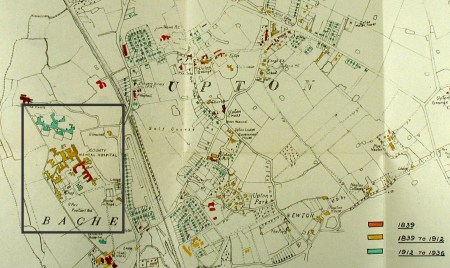
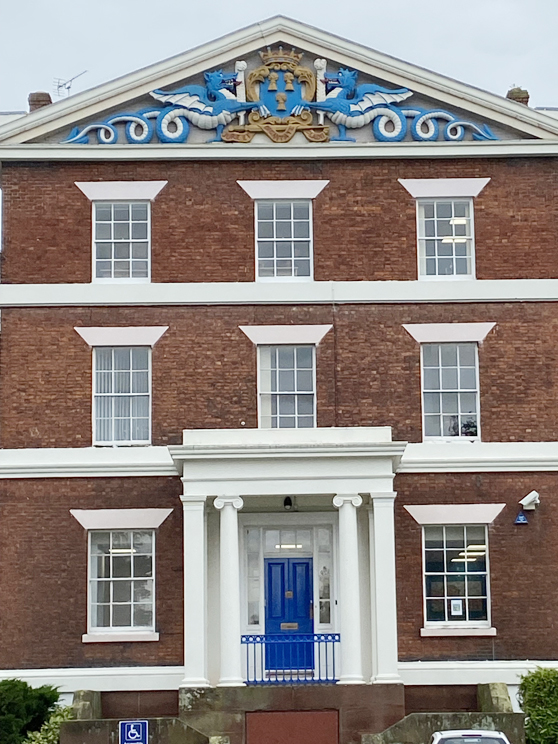
The National Pipe Archive website has some great resources for finding out more about clay pipes and finding out date ranges for anything you may find with diagnostic markings: http://www.pipearchive.co.uk/index.html.  They have a “how to date” web page, on which they provide links to a range of typologies (images of clay pipes and their key characteristics with date ranges) at http://www.pipearchive.co.uk/howto/date.html.

For those in the Chester /northwest area, their typology for the northwest, which is impressively comprehensive, is at http://www.pipearchive.co.uk/pdfs/howto/Typologies/LIVNP_2014_01_100_CHESTER.pdf.  The same website also provides recommended resources for Cheshire pipe studies, which you may be able to find through a library or the Chester Archives, and some may be available online if you do a Google search on the name of the title:

The County list shown above is a bibliography (at http://www.pipearchive.co.uk/archives/british.html#CHESHIRE).

If you are in the Churton, Aldford, Farndon and Holt general area, and you have found clay pipe remains in your garden, especially if there are any type of markings at all, it would be great to hear from you.

For other objects in the series,
see the History in Garden Objects page


Sources:

Books and papers

Another photographs of Churton clay pipes from my garden

Ayto, E.G. 1994 (3rd edition). Clay Tobacco Pipes.  Shire Publications

Cessford, C. 2001.  The archaeology of the clay pipe and the study of smoking.  Assemblage,  Issue 6, August 2001
https://archaeologydataservice.ac.uk/archives/view/assemblage/html/6/index.html

Dagnall, R.  1987.  Chester Pipes in Rainford. Society of Clay Pipe Research, Newsletter no.15, July 1987, p.10-12
http://scpr.co/PDFs/Newsletters/SCPR15.pdf

Davey, P. 1985. Clay pipes from Norton Priory, Cheshire. In (ed. Davey, P.) The Archaeology of the Clay Tobacco Pipe IX. More Pipes from the Midlands and Southern England British Archaeological Reports British Series 146i and ii. p.157-236.

Nevell, M.D. 2015.  The industrial archaeology of Cheshire: an overview. Journal of the Chester Archaeological Society, 85 (IV), p.39-82
http://usir.salford.ac.uk/id/eprint/37519/
http://usir.salford.ac.uk/id/eprint/37519/1/Nevell%202015%20JCAS_ns_085_IndustrialArchaeologyInCheshire_textonly.pdf

Pearce, J. 2007.  Living in Victorian London: The Clay Pipe Evidence.
Part of an Arts and Humanities Research Council funded study ‘Living in Victorian London: Material Histories of Everyday Life in the Nineteenth-Century Metropolis’ Award Number AH/E002285/1 led by Dr Alastair Owens in the Department of Geography at Queen Mary, University of London
https://www.academia.edu/737367/Living_in_Victorian_London_The_Clay_Pipe_Evidence

Sandy, J. 2019.  Clay Pipe Making: The Victorian Way. Beachcombing Magazine, volume 11, March/April 2019
https://www.beachcombingmagazine.com/blogs/news/clay-pipe-making-the-victorian-way

Victoria County History 2003.  Late Georgian and Victorian Chester 1762-1914: The economy, 1762-1840, the demise of old Chester. A History of the County of Chester: Volume 5 Part 1, the City of Chester: General History and Topography. Originally published by Victoria County History, London, 2003, p.172-177.

Websites

The National Pipe Archive
http://www.pipearchive.co.uk/

Victorian smokers had rotten teeth to match lungs
MOLA
https://www.mola.org.uk/blog/victorian-smokers-had-rotten-teeth-match-lungs


Object histories in my garden #7: Little fragments of willow pattern china – what are the stories?

Willow Pattern sherds found in a Churton garden

I defy any gardener, even in a modern home, to do any digging without finding a few pieces of willow pattern china.  It is so common that one barely notices it, whether it is found as garden fragments, encountered in antique shops or viewed as eBay listings.  It comes in all forms – plates, jugs, bowls, cups, saucers, tureens in all sorts of shapes and sizes, varying in quality from fine early examples to increasingly poor imitations as well as a few modern reinventions on fine china.  Early examples were hand-painted on porcelain, but as it became popular, transfers (described below) were used to cheaply replicate their finer predecessors.

Pieces of willow pattern found in a garden in Darland

The examples shown in the photo at above left were all found in my garden, and could date to any time between the 19th Century to relatively recent times.  None of them are fine porcelain, all stoneware, which means that they were built to be durable.  This does not mean that they were any less valued by their owners than finer bone china pieces, which are almost translucent, but either that their purchasers were unable to afford finer pieces, or that these were intended for everyday use.  In either case the sheer volume of china that we have dug out of the garden argues that if finer pieces were purchased, they were kept safely on display or only used for special occasions, because so far we have only found two finer pieces of translucent china.  It is a similar story with china dug out of a Darland garden by my parents (shown right).  In that early Georgian garden, belonging to a large house built by a prosperous land-owner, the pottery was all fairly coarse, although there is no reason to suppose that the owners did not purchase finer wares that were better cared for.

1930s willow pattern in red on white

In America, willow pattern is known as “blue willow,” but although the vast majority produced was in cobalt blue on white, there are also examples of red or brown, and even green on white, and there are some much later examples that were painted with multiple colours (and look both exceedingly odd and rather unpleasant).  Today willow pattern has fallen out of fashion, presumably because it is so formulaic and so commonplace, in spite of  attempts by some modern producers to reinvent it, but the history of willow pattern is an interesting one, even if the design itself has become rather tedious to the modern eye.

There are two strands to the invention of willow pattern, three stories to tell.  The first is how and when willow pattern developed, what influenced it, and why it became so ubiquitous.  The second story concerns the tale told by the pattern itself, which narrates a forbidden romance, a dictatorial father and an unwanted, ultimately vengeful suitor.

At the end I have a look at why the tale embedded into the willow pattern is fundamentally in opposition to Chinese morality, using two examples from Chinese literature.

I have already used the terms “china” and “porcelain,” and will go on to mention stoneware, so here are some quick and dirty definitions:

  • Ceramics:  all items made by clay and hardened by heat.  A generic term used interchangeably with pottery.
  • China:  another generic term, referring to ceramics that have a pure white fabric, of the sort first seen in Europe on items imported from China
  • Porcelain:  from the Italian “porcellana.”  Porcelain is made of fine-grained clay which is then fired at very high temperatures that causes a transformation of the material called vitrification.  It is very thin, and semi-translucent.
  • Pottery:  objects made of fired clay
  • Stoneware:  fired at much lower temperatures than porcelain using inferior clays, and made into much thicker fabrics without any translucence.  Similar to earthenware, which is also made with coarse clays but fired at a higher temperature than earthenware and is superior in quality.
  • Transfers (discussed in more detail below):  Replacing hand-painting to speed up the process of pottery manufacture, transfers produce a cheaper, less refined method of decorating ceramics.  A copperplate engraved with the required design is inked and pressed on to paper that, while still wet, is in turn pressed on to a ceramic surface.  The design left on the piece of pottery is the transfer.

The development and spread of the willow pattern design

This or a similar type of Nanking ware scene could have been the prototype for English willow pattern. Source: The Culture Concept Circle

I had always assumed that the willow pattern design was invented in China for the European export market in the late 18th Century, but this is not true.  It is certainly true that decorated china had been finding its way into Europe and America for two centuries before willow pattern was invented.  The East India Company began to purchase Chinese blue and white ceramics for the British market in the 16th Century when it was a luxury item.  It swiftly became very popular and continued to be in high demand even after the East India Company was deprived of its right to trade in 1833.  Private ships that began to import Chinese tea, still a high value import during the 19th Century, also brought back ceramics that were increasingly standardized and mass-produced for the European market.  Chinese producers had swiftly developed a sense of what themes, colours and designs Europeans and Americans liked, and they began to make them in great quantities.  Willow pattern was inspired by a type of blue and white porcelain called Nanking or Nankin Pattern.  It was made at Ching-te-chen / Jingdezhen and then sailed down the river Yangtze to the coastal port of Nanking from where it was shipped to Canton.  Canton was the main port at which foreign ships were allowed to trade, (the sole trading port until 1842) and here it was loaded on to European and American ships for the export market.  

An early design similar to the willow pattern on a creamware teapot.  Attributed to John Warburton, Staffordshire, England, c. 1800. Victoria and Albert Museum, London.  Source: Encyclopaedia Britannica

Although influenced by Nanking,  willow pattern was not imported from China; it was an English invention based on Chinese patterns.  The first version appears to have been produced in 1779 for Thomas Turner and his Caughley works in Shropshire, originally for a teapot, and then in the late 1780s on other objects, probably by apprentice Thomas Minton. 

Robert Copeland, in Spode’s Willow Pattern, acknowledges Caughley but points out that this was not the standard willow pattern, which he argues persuasively was developed by Josiah Spode, and initially called the Mandarin pattern.  It is not known if Turner, Minton or Spode had a particular story in mind when they began to produce their versions of the formulaic pattern, but a story soon emerged, and probably helped sales, raising the decoration from the level of a  mere pattern to the encapsulation of an exotic legend (albeit one thought up in an English porcelain factory).  It would otherwise be difficult to account for how popular the design became.  Other manufacturers also went on to make willow pattern.


The main features of the willow pattern design

The plates shown above exemplify the most common arrangement of the motifs that make up the willow pattern design, although there are sometimes minor variations.

A 19th century anonymous poem, of which there are numerous versions, summarizes the main themes as follows:

Two birds flying high,
A Chinese vessel, sailing by.
A bridge with three men, sometimes four,
A willow tree, hanging o’er.
A Chinese temple, there it stands,
Built upon the river sands.
An apple tree, with apples on,
A crooked fence to end my song.

The story behind the features on the plate can be fairly short or tediously long, but the essentials of the story can be summarized quite briefly.  Let’s have a closer look first at the main motifs that provide the cues for narrating the story.

The main anchoring feature of the composition is a two- or occasionally three-storey pagoda, usually just right-of-centre, approached by a path and a short flight of steps.  To the left of it is a smaller pagoda on the edge of the river.  A fence zig-zags across the front of the scene, blocking access to the approach path to the pagoda in its garden.

Behind the pagodas is a tree with big round discs that look like enormous pizzas.  Susan Ferguson has researched these and concludes that although they are usually referred to as apples (heaven help you if an apple of that size landed on you), and sometimes oranges, they are probably abstractions of circular spans of a Chinese conifer (needle clusters), a design that over the centuries has become so simplified that on the willow pattern the species of tree is completely unidentifiable.  In the absence of any other explanation that makes sense, I’m convinced.  A lush arboretum surrounds the pagoda.

A huge willow tree leans over the bridge, to the left of the pagoda, which gives the design its name, and usually has some sort of rosette- or round-shaped growths on the trunk.  Its long branches appear to blow lightly in the breeze.

The bridge crosses a narrow strait of water, met by a small building on the other side.  The bridge is being crossed by a woman at the front, a man in the middle holding a long thin box, and another man raising a stick at the rear.

Above left of the willow is a large expanse of water crossed by a man navigating a boat, heading towards the pagoda.  One or more cabins on the boat suggests that another person is inside.

In the distance at top left is an island with another pagoda, again surrounded by lush vegetation.

Overhead in the sky are a pair of birds facing each other, their wings spread to catch the breeze.

If the composition graces a plate, a tureen or a lid, the whole thing is usually circled with a loosely Chinese-themed geometric pattern, sometimes elaborated with leaves and flowers.  On teapots, cups and jugs only favoured portions of the entire composition may be shown.


The story of a forbidden romance and how to read a plate

The story is an invention, and English interpretation of scenes on Chinese export ceramics that had no such narrative.  It is probable that the story gained momentum as the willow pattern became more popular, becoming more elaborate over time.  The basics are these, although there are multiple alternatives:

  1. The pagoda, right-of-centre, the garden, and the weeping willow:  Once upon a time, there was a beautiful girl named Koong-see who lived in a palace in China, a delightful sprawling pagoda in lovely ornamental gardens, with cherry blossom, apple trees, willows, streams, wildlife and birdsong.  Hidden within the pagoda, she is in love with a lowly office clerk named Changwho serves her father, a mandarin (senior official), and is far beneath her social standing. They meet every night beneath the willow.  Forbidden to marry by the Mandarin, she and Chang are in despair.  Both console themselves by caring for the birds in the garden, to which they are devoted and which are, in turn, devoted to them
  2. The mandarin’s daughter is promised to a warrior duke against her wishes:  The Mandarin has arranged for Koong-see to be married to the warrior Duke (a Ta-jin), who is even now approaching.  Much older than Koong-see, he brings a treasure chest as a gift for his future bride.  Deaf to Koong-see’s pleas, her father insists on the marriage, erects a huge fence around the house and garden and imprisons her in a small pagoda overlooking the lake.  When the cherry blossom eventually blooms on the tree in the garden, the marriage will take place. 
  3. Three individuals are seen crossing the bridge.  When the Duke arrives, he, the Mandarin and guests celebrate with an excess of food and alcohol.  Chang enters the compound and seeing that the inebriated gathering has fallen asleep, he goes to Koong-see and they flee, taking with them the duke’s treasure, crossing the bridge over the river.  Koong-see is at the front, carrying a staff, the emblem of virtue.  Chang follows her, carrying the stolen treasure in a rectangular box.  They are pursued by the mandarin, brandishing a whip.  Sometimes a a fourth figure is shown, and this is the duke seeking to retrieve both his bride and, probably more importantly, his treasure.
  4. The pagoda in a distant land, top left.  Chang steals a small boat, and they couple sail to the north.  Having made good their escape, the couple sell the duke’s treasure and buy a pagoda in a distant place.  Having failed to find his daughter in spite of employing spies to track her down, the mandarin has the brilliant idea of releasing the birds that were so loved by Koong-see and Chang. The birds fly straight to the couple, with the mandarin’s warriors following close behind.  When the warriors discover the hideaway they set it alight. 
  5. The turtle doves in the sky.  Koong-see and Chang die in the flames, but unspecified gods looking down on the scene take pity on the devoted couple and transform them into birds so that they can remain together for eternity. 

The boat shown crossing the sea is alternatively interpreted as the approach of the duke, steered by a boatman, or as the departure of the lovers, steered by Chang.

An extended version, tears-and-all version of the tale, was published in The Family Friend, volume I, in 1849, and is extremely long-winded and tedious (as well as slightly sickly), but obviously pushed some of the right buttons in the 19th Century.  As well as the anonymous poem quoted above, there were a number of others as well, some of which are posted on the Potteries website here and the Willow Collectors website here.

Chinese morality versus English romanticism

The willow pattern design that grew out of these imports was not merely an English invention, but the romantic tale of runaway lovers that was developed to sell the design would almost certainly have offended Chinese morality.  The story was born of an unmistakeably western tradition, recognizable in the narrative concerns of star-crossed lovers, persecution by unwanted suitors and unreasonable parents, all of which are solidly  familiar from the Classical Greek tale of Hero and Leander, the 16th Century Os Lusíadas by Luís de Camões, Shakespeare’s 1597 Romeo and Juliet, and many, many more.

The Butterfly Lovers. Source: ShenYunShop

There are some tales from Chinese literature that are superficially somewhat similar, but a closer look at them reveals culturally significant differences.  Two good examples are “The Butterfly Lovers” and “Han Ping and His Wife.”  

The story of the butterfly lovers concerns a rather complicated story about a woman disguised as a man, Zhu Yingtai, and her unsuspecting friend Liang Shanbo who eventually fall in love with one another.   Although women were usually prevented from becoming scholars, Zhu was allowed to study in the guise of a young man.  She meets a fellow scholar, and they become close friends, studying together for the following three years.  Liang remains none the wiser, but Zhu begins to fall in love with him.   Although tolerant enough to allow his daughter to study as a man, Zhu’s father expects her to return when he writes to tell her that he is ill.  She departs, and Liang accompanies his dear friend for part of the route.  Although she drops hints about her true sex, Zhu is unable to reveal her secret to Liang directly and intend invents a sister to whom she proposes that Liang should become betrothed.  She offers to set up a meeting.  Liang eventually visits Zhu, and finds that there is no sister and that Zhu is a woman.  Liang realizes he loves Zhu and they are both overjoyed for a brief period, but Zhu now reveals that her father’s illness was a ruse and he has betrothed her to a wealthy merchant.  Liang leaves, heartbroken, and although he tries to lead a normal life, soon dies.  Zhu, meanwhile, is prepared for her wedding.  The wedding procession forms, its route due to pass Liang’s grave.  As they reach the grave, a great wind blows up, stopping the marriage party in its tracks.  Taking the opportunity to pay her final respects to Liang at his grave, she begs for the grave to swallow her too, and in response to her pleas, it opens up and takes her in.  Zhu and Liang rise as butterflies, and fly away together for eternity.  

A second tragic romance, from a collection of early legends (The Man Who Sold A Ghost), is the tale of Han Ping and his wife also concerns lovers who were transformed into birds following the successful completion of their suicide pact.  Han Ping and his wife were deeply in love.  Han Ping worked for Prince Xang as steward.  His wife was very beautiful and the king, inevitably attracted, took her for himself.   Han Ping’s anguished protests were answered with imprisonment and hard labour.  Eventually his wife managed to send Han Ping a letter, a cryptic message written using allusions to lay out her plan for suicide, which each carried out.  In a separate letter to the king, she requested burial alongside her husband, but this was denied her.  They were buried in the same cemetery but far apart.  All was not lost. Two trees sprung up overnight and within only days were tall and strong, leaning towards each other, their branches intertwining.  Two inseparable lovebirds nested in the branches of the entwined trees, the spirits of the wronged Han Ping and his  wife.

A silk bed covering from Canton, showing the type of artistic device used to represent clusters of fir spines.  This might be the source of the enormous disks in the trees behind the pagoda in the willow pattern design  Source: Ferguson 2017

Although Chinese literature has stories of star-crossed lovers, acting on a forbidden love was counter to Chinese ideas of obedience and arranged marriage and would never be celebrated.  In the first case, even though Zhu is in love with someone else, she obediently, albeit unhappily, accepts marriage.  The gods intervene to allow the couple to live together as butterflies, but only after Zhu has behaved with honour according to her father’s wishes.  Although the couple were not married, they came to represent fidelity in marriage.  In the story of Han Ping and his wife, the two are already married and it is only when the wife is dishonoured by the prince that they are reunited as birds, again demonstrating the power of marital fidelity.

All of this is far more subtle than the rather simplistic willow pattern narrative, which celebrates love conquering all, but ignores the Chinese morality that would have seen the willow pattern story and its outcome as abhorrent.  Daughterly disobedience and unmarried, prohibited love would have been a serious breach of decency and integrity.  Fleeing paternal control would have been unthinkable, particularly as it left behind and honourable and broken-hearted father.  The theft of the Duke’s treasure would have appalled most Chinese people; the Duke, after all, was not the bad guy in the scenario, because arranged marriages were perfectly normal and his gift to his prospective bride was a gesture of great generosity.  A happy-ever-after outcome for the disobedient and ungrateful runaways, even in the form of turtle doves, would not have been sanctioned by Chinese moralists or the authors of Chinese literature.

Stoneware and transfers

Mid 19th Century transferware willow pattern trivet. Source: Inessa-Stewart’s

All of the willow pattern from my garden is robust transferware.  We have found porcelain pieces in other designs, some of them very fine, but the vast majority of it, including all of the willow pattern, is transfers applied to stoneware and earthenware.  Porcelain, almost translucent, was time-consuming to produce, often shattered during production, was usually hand-decorated and was therefore expensive to buy.  Stoneware an earthenware were much easier to manufacture, fired at lower temperatures and not hand-painted.  These solid wares were far more robust and suitable for everyday domestic use.  

It is often possible to find the edge of the transfer on bigger pieces of transferware, as on this corner of a large 1930s red-on-white Royal Venton plate.

Replacing hand-painting to speed up the process of pottery manufacture in the second half of the 18th Century, transfers produce a cheaper, less refined method of decorating ceramics that could be produced by relatively unskilled workers rather than craft specialists.  Chinese-influenced ceramics, like many product that were once luxury products due to their exotic source and/or their expensive manufacturing process, began to be produced in inferior fabrics, became more affordable, and were therefore in more demand, both in Britain and America.  Once an appropriate fabric was developed, a quicker way of decorating the ceramics was required, and transfers were developed to meet this need.  A copperplate engraved with the required design is inked and pressed on to paper that, while still wet, is in turn pressed on to a ceramic surface.  The design left on the piece of pottery is the transfer.  The meeting of the demand for transfer wares was helped by the roll-out of the canal network and the improvement of trade networks that accompanied the Industrial Revolution.  

Final Comments

A more recent interpretation of willow pattern (microwave safe, dishwasher proof).  Although it is a nice, clean design, there is a gap in the fence in front of the path to the pagoda, which rather defeats the object (and is more evocative of an English country cottage than a defensive barrier to prevent a daughter escaping).

The history of the willow pattern design is far more interesting than the design itself and its narrative.  Some of the earliest patterns, evoking original Chinese designs, had considerable charm, but very soon a fairly rigid formula was developed that was repeated over and over again, with only a little occasional variation from one piece to the next.  As such it is more than a little tiresome.

It is anything but tiresome when the story emerges piece by piece from one’s garden, all of them minute fragments contributing to the house’s own narrative.  Over time, the people who lived here broke an awful lot of pottery!  The house, originally two neighbouring cottages, was probably occupied by families working for the local farms in the 19th and early 20th centuries, with a sign of increased prosperity when the two cottages were linked up to become a single building.   The earliest finds from the garden belong to the later 19th Century, well into the period when most willow pattern was stoneware.   Not the sort of thing that a farm labourer’s family would be able to indulge in, but probably affordable as Sunday Best for a slightly more affluent rural family.  I need to find out a lot more about who lived in the house before speculating further. 

Pealrich clock in the form of a willow pattern plate. Source: Amazon UK

It is interesting that willow pattern continues to be made and purchased.  The above picture shows a simplified version of the traditional formulaic design, much less elaborate than earlier versions, much cleaner but also more sterilized.  I would not have thought that it is  the sort of story that would carry much appeal today, but the design itself obviously continues to be attractive to a modern audience.  A quick search on Amazon produced willow pattern oven gloves, a willow pattern mug that could be personalized, an embroidery kit, a large tea set, a “collectible” thimble, a cushion cover and even a clock in the form of a willow pattern plate (shown left).  A company called PRSC specializes in “deconstructed” willow pattern products, which take the motifs and arrange them in aesthetically pleasing combinations that abandon the narrative completely.

Deconstructed willow pattern. Source: PRSC

In the 18th, 19th and early 20th centuries, willow pattern obviously spoke to something in people’s imaginations.  Perhaps the very standardization and mass-production of the design enabled the more exotic to become both familiar and comprehensible, even offering some level of reassurance by its very familiarity.  By developing new and improved ways of manufacturing pottery and decorating it, and taking advantage of new modes of transport and communication, potteries making ceramics in the English Midlands were able to spread willow pattern throughout the UK and into America.  A decorative phenomenon, it is difficult to account for its success, but a success it certainly was.  It has left a legacy that continues to attract collectors and re-interpreters alike.

For anyone new to this occasional series on objects extracted from my garden
during everyday gardening activities, see the History in Garden Finds page.
These are not objects used in the garden, but objects, usually fragments,
lost or disposed of in the garden and found during digging, troweling and planting.


Sources:

Books and papers

Copeland, R. 1999 (3rd edition). Spode’s Willow Pattern And Other Designs After the Chinese.  Studio Vista

Ferguson, S. 2017.  “Blue Willow”: Apples or Oranges?  Transferware Collectors Club Bulletin, 2017 Vol. XVIII No. 1.
https://www.transferwarecollectorsclub.org/bulletin_previews/articles/17_TCC_XVIII_No1_Blue_Willow_Apples_or_Oranges.pdf

Hsien-Yi, Y. and Yang, G. 1958.  The Man Who Sold A Ghost.  Foreign Language Press
Available online at:  https://www.bannedthought.net/China/MaoEra/Arts/Literature/TheManWhoSoldAGhost-ChineseTalesOfThe3rd-6thCenturies-1958.pdf

O’Hara.  P.  “The Willow Pattern That We Knew”: The Victorian Literature of Blue Willow.  Victorian Studies. Vol. 36, No. 4 (Summer, 1993), pp. 421-442
Available online with the academic site JSTOR digital library if you register (free): https://www.jstor.org/stable/3828644?seq=1

Websites

East India company at home 1757-1857, University College London
The Willow Pattern Case Study:  The Willow Pattern Explained
https://blogs.ucl.ac.uk/eicah/the-willow-pattern-dunham-massey/the-willow-pattern-case-study-the-willow-pattern-explained/comment-page-1/

Encyclopaedia Britannica
Willow pattern pottery
https://www.britannica.com/art/Willow-pattern#ref235738

Popular Culture in Modern China
The Butterfly Lovers – Response.  By Dr Liang Luo
http://chi430.blogspot.com/2014/01/the-butterfly-lovers-response.html

The Potteries – An A-Z of Stoke on Trent Potteries
The Willow Pattern Story
http://www.thepotteries.org/patterns/willow.html

Spode History
Spode and Willow Pattern. By Pam Woolliscroft
https://spodehistory.blogspot.com/2013/06/spode-and-willow.html

Transferware Collectors Club
What is transferware?
https://www.transferwarecollectorsclub.org/news-information/faqs

Victoria Gallery and Museum, University of Liverpool
Story of the Willow Pattern, 15 January 2021 by Amanda Draper
https://vgm.liverpool.ac.uk/blog/2021/willow-pattern/


Object histories in my garden #6: A piece of a Hamilton / torpedo bottle

On the left is a complete Hamilton or torpedo bottle now in the Dumfries Museum. On the right is the fragment of a torpedo bottle found in my back garden. Source of image of Dumfries Museum bottle: Future Museum

I suspect we are coming to the end of the most interesting finds in my garden.  The new beds have been dug out and apart from three lilacs that are destined for the lawn, which will each have a circular bed around them for flowers, the digging has mainly stopped and we are now into laying membrane around trees and shrubs, over the top of which we are putting slate, wood bark and gravel.  This will help to keep down the weeds, and provide a variety of textures throughout the garden, but will seal any remaining objects in the ground, perhaps for future gardeners to find.  There are, however, still one or two pieces worth talking about in the existing collection of objects derived from the garden.

The torpedo bottle fragment from the garden

One of these finds, distinguished by the twist in the glass and its distinctive shape, is a fragment of a Hamilton / torpedo bottle.  Like the Codd bottle, described in a previous post, it was designed to keep gas in bottles of fizzy water.  The Codd bottle in some cases replaced the torpedo, which died out in the 19th Century and early 20th Century. Both were eventually replaced by crown caps that still seal many fizzy drinks today, particularly beers.

Joseph Priestley by Henry Fuseli. Source: The Bridgeman Art Library, Object no.42670, via Wikipedia

Fizzy (aerated, effervescent or carbonized) water, occurs naturally in the form of springs.  My favourite is San Pellegrino.  In 1772 Joseph Priestly set out to produce an equivalent of the natural sparkling water from a famous spring in Pyrmont in Germany, and achieved success by dissolving carbon dioxide in water.  This achievement was considered so important that Priestly, a radical minister, was awarded the Copley Medal, the Royal Society’s most prestigious honour.  The Science History Institute’s website describes the process as follows: “He had dripped a little oil of vitriol (sulfuric acid) on a mixture of chalk and water, caught the fixed air (carbon dioxide) that fizzed from the chalk in a bladder, and bubbled the fixed air through a column of water, which he then agitated at intervals.”  Natural spring waters, each with different properties, were used for their medicinal and therapeutic benefits from antiquity, and were similarly popular in Europe in the 17th and 18th Centuries.  Artificially produced carbonated water was also initially sold for its medicinal properties by pharmacists like J.F. Edisbury of Wrexham, who had his own mineral water works in Llangollen (and who has been discussed on a previous post), it was eventually mixed with fruit-flavoured syrups and sold to general consumers as a soft drink.

J.F. Edisbury and Co (Wrexham) advert showing a range of the carbonated waters that was stocked.  Source: The Wellcome Collection

It quickly became obvious that a solution was needed to keep the gas in the water once it was placed in a container.  At first earthenware bottles were employed by early producers such as Joseph Schweppe (the founder of Schweppes, of course), who set up his business in Bristol in 1794.  At that time, Bristol was a thriving port, third in importance only to London and Liverpool, and a hub for businesses of all sorts.  As Schweppe and other discovered, in earthenware bottles the gas soon escaped and the drink went flat.

Glass bottles closed with corks followed, but there were two potential problems with this approach.  First, a build-up of pressure in the bottle could cause the corks to fly out, resulting not only in a mess but, again, a flat drink.  Second, if the corks were not kept moist they shrank, with the same result – a flat drink and an unhappy customer.  This caused something of a problem between supplier and retailer.  The solution was to store bottles on their sides, but retailers were reluctant to go to this trouble because of the problems of stacking the bottles.

In 1809, William Francis Hamilton of Dublin filed a patent for a method of producing mineral water, which included a description of storage devices employed, one of which was a torpedo-shaped bottle with a tapering, rounded end that had to be stored on its side.  Torpedo-shaped bottles had already been in existence before Hamilton’s patent, and he seems to have been using torpedo bottles as one of a number of storage solutions.  However, the torpedo obviously won out and he apparently went into production of the bottles in 1814.  It took time for them to become popular, but by  the 1840s they were widely in use and they were used until the First World War.

Not all bottles are marked with manufacturer details.   Embossing only became popular in the latter half of the 19th Century, when it became something of a mania following the introduction of hinged moulds.  Usually the manufacturer’s name was added to the bottle, and was sometime accompanied by details of the product that the bottle contained.  The one in the photograph at the top of the page had none, but my fragment has embossed letters, which were built into the mould into which the molten glass was poured to produce the bottle.  The letters on my bottle are incomplete and show either “TERE” or “IERE” (the bottom of the T or I is missing).  It is possible that, if TERE, it read CHESTER, MANCHESTER, LEICESTER etc (all areas where mineral waters were produced), with the E representing the beginning of a new word.   Equally, the TER could be the last letters of WATER, and the E again the beginning of a new word.  The fragment of the final letter can only be a B, D, E, F or P.  Any guesses, anyone?

Lion Brewery (Chester) and Edisbury Chemist (Wrexham) bottles

The heavy embossing of the bottle indicates that this bottle was made in the late 19th Century, or later.  This is in keeping with the other bottles found in the garden:  from the Lion Brewery, Chester, J.F. Edisbury, Wrexham (both heavily embossed, the latter with a crossed-fox logo) and the Codd bottle.  Both the Hamilton / torpedo and Codd bottles were eventually made redundant with the introduction of crown caps, which Joseph Schweppe first employed in 1903.

For anyone new to this occasional series on objects extracted from my garden during everyday gardening activities, see the History in Garden Finds page.  These are not objects used in the garden, but objects, usually fragments, lost or disposed of in the garden and found during digging, troweling and planting.

Sources:

Books and papers

Hedges, A.A.C. 1975. Bottles and Bottle Collecting.  Shire Publications Ltd.

Hamilton, W.F. 1810.  Specification of the Patent granted to William Frances Hamilton.  The Repertory of Arts, Manufactures, and Agriculture, Sixteenth Volume, Second Series.
Available on Google Books: https://tinyurl.com/35bcf5tm

Websites

Future Museum
Hamilton Bottle
http://www.futuremuseum.co.uk/collections/life-work/social-history/home-life/housekeeping/hamilton-bottle.aspx

Science History Institute
Powerful Effervescence
https://www.sciencehistory.org/distillations/powerful-effervescence