Category Archives: Scenery

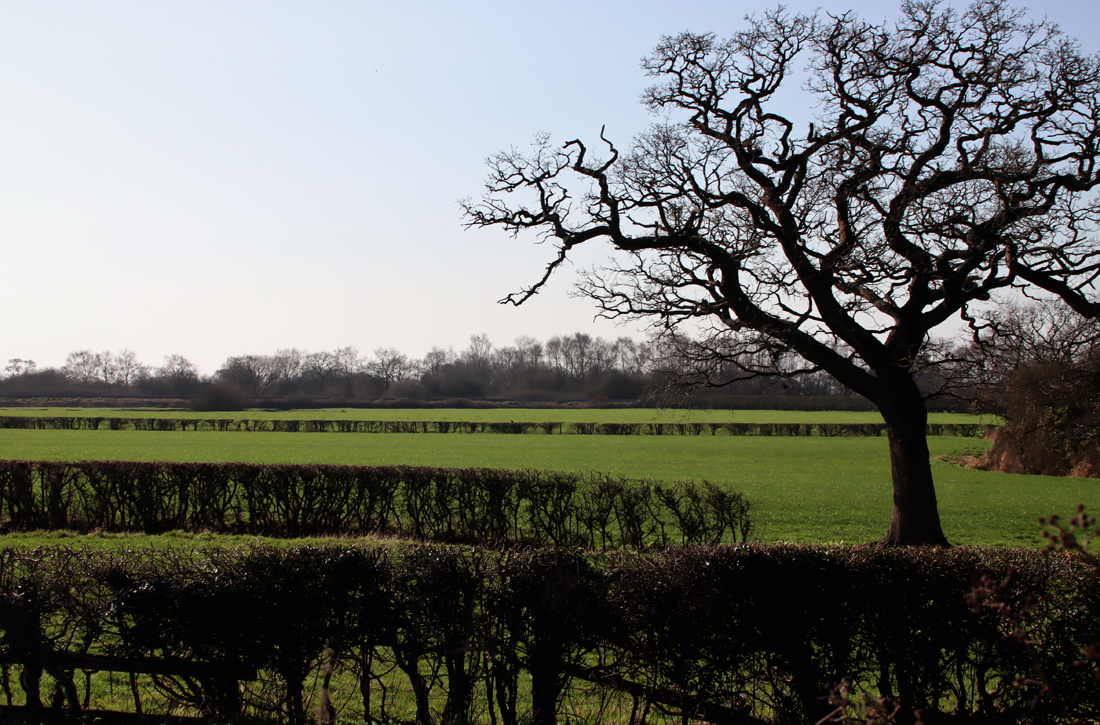
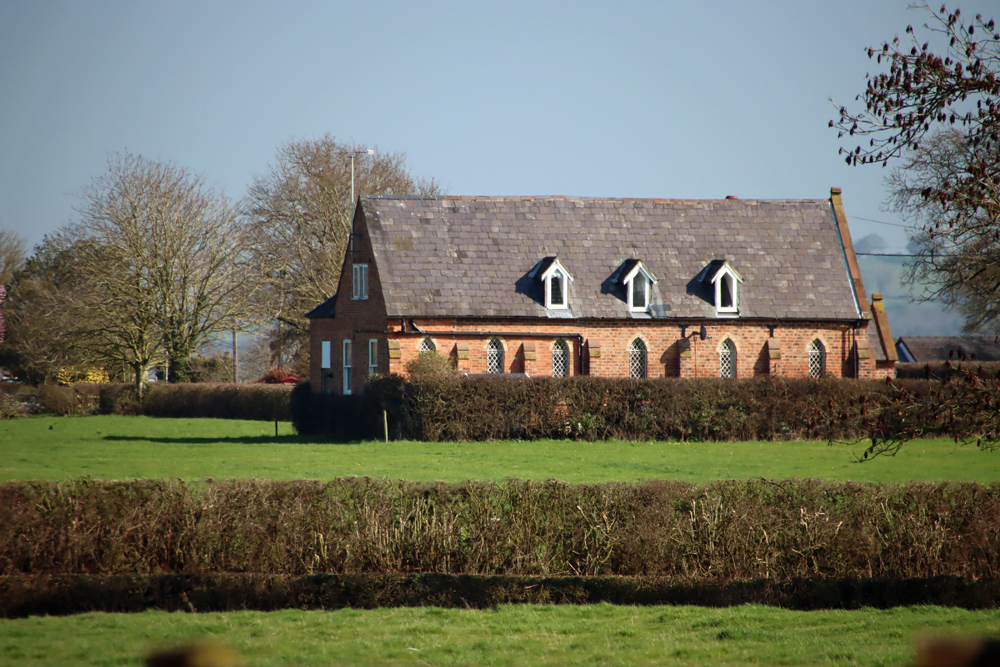
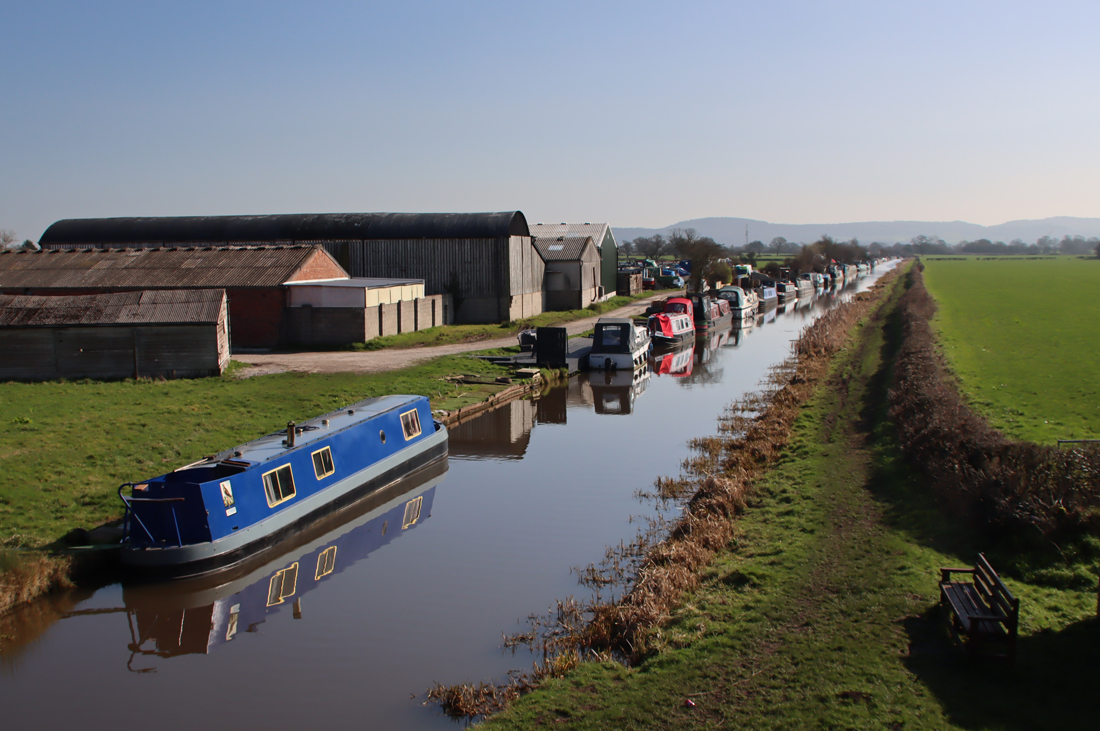
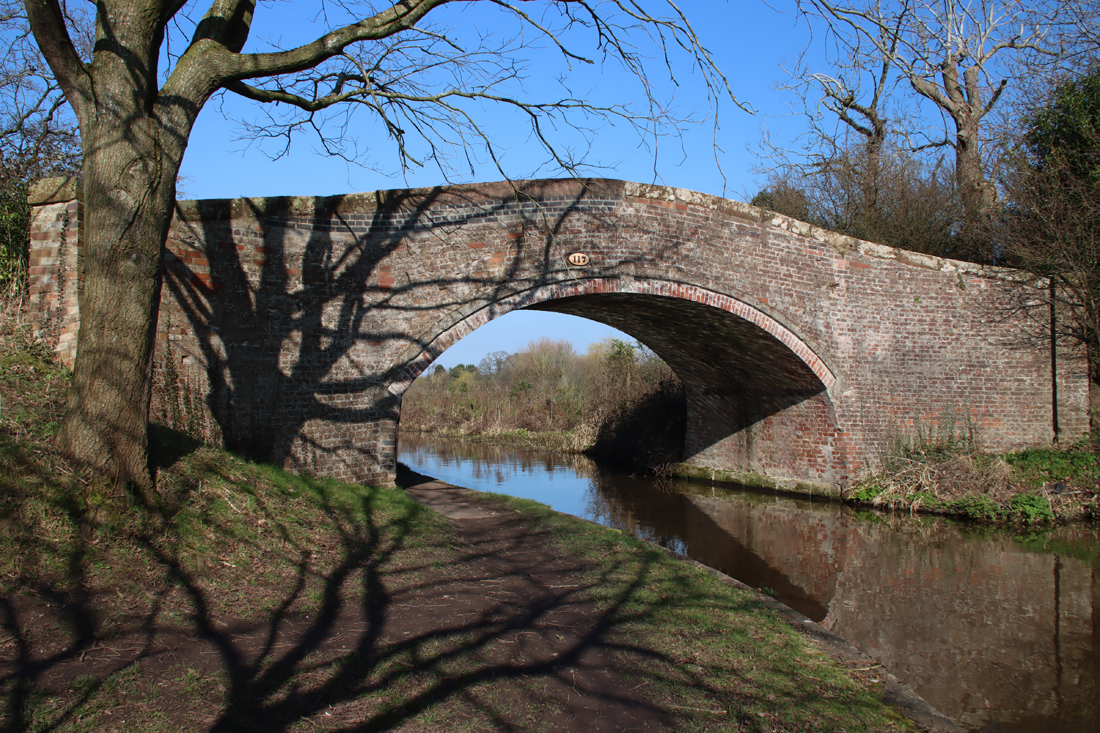
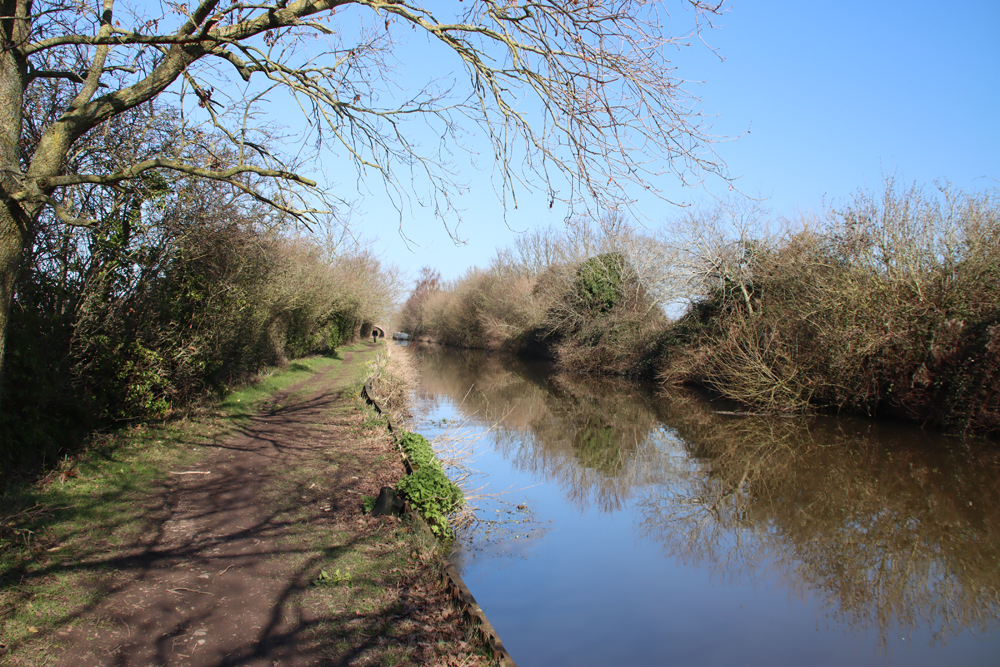
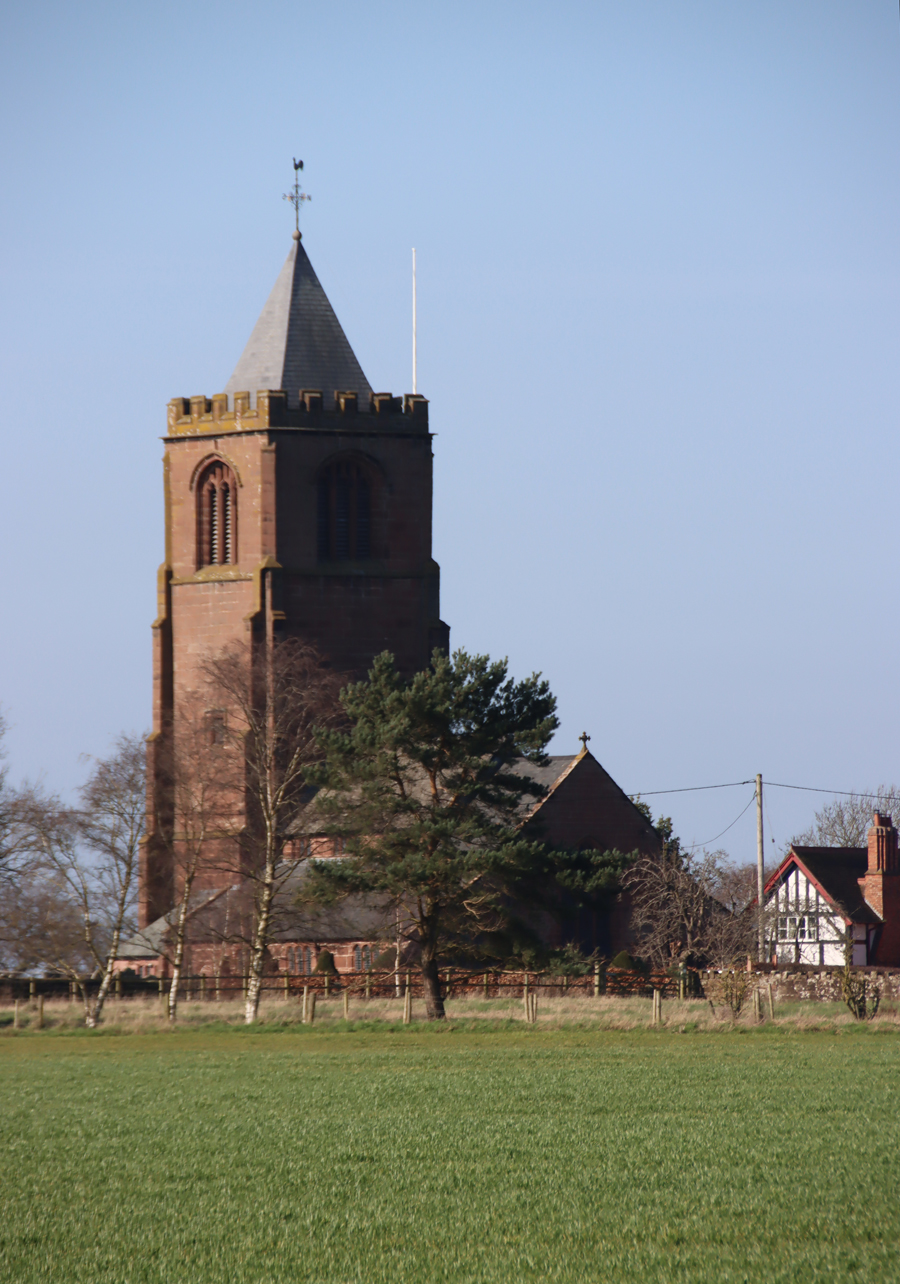
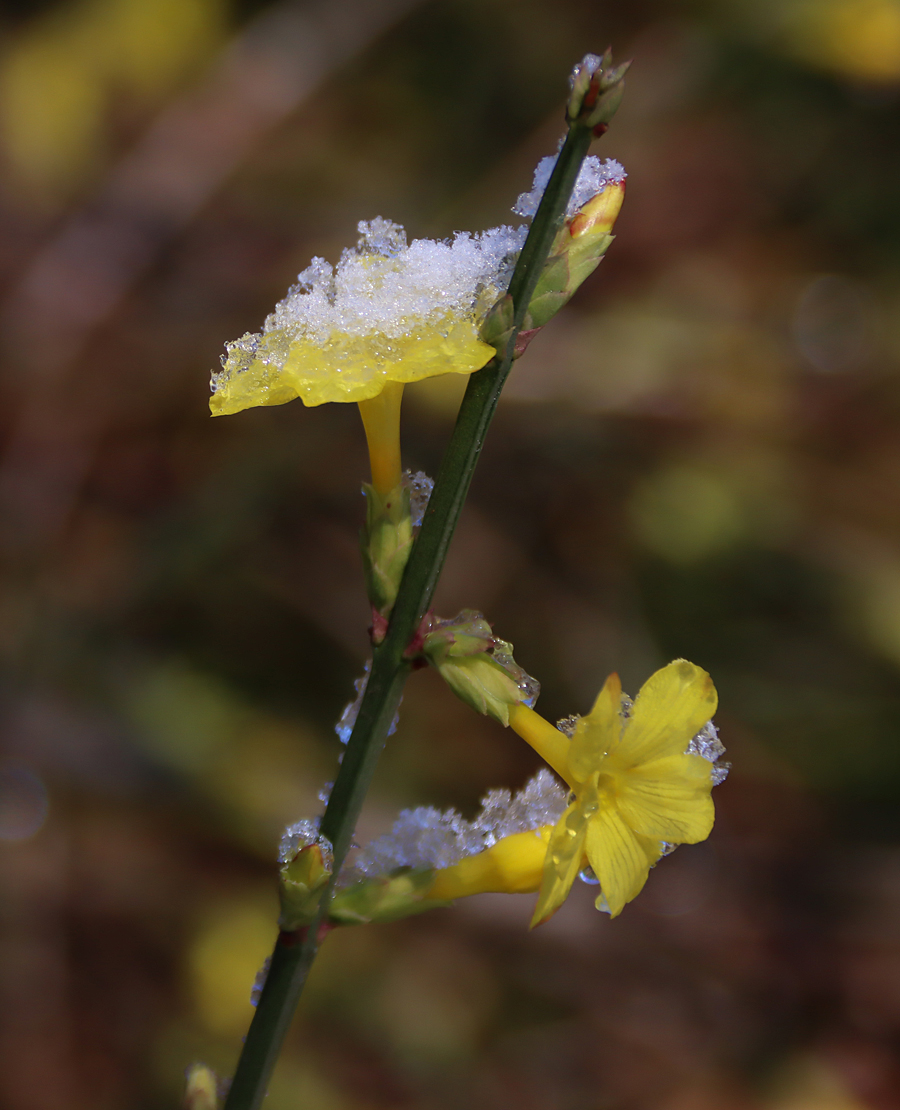
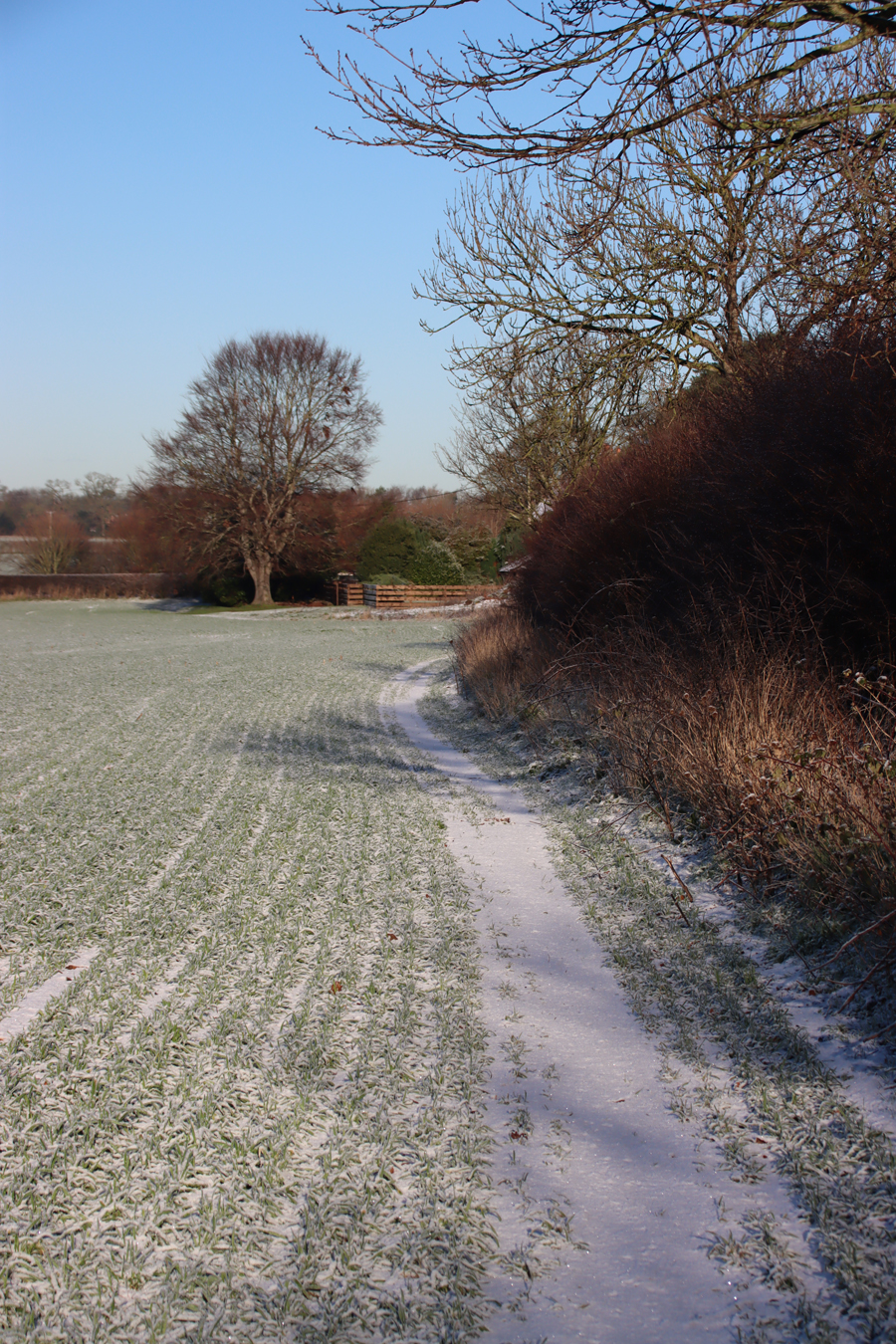
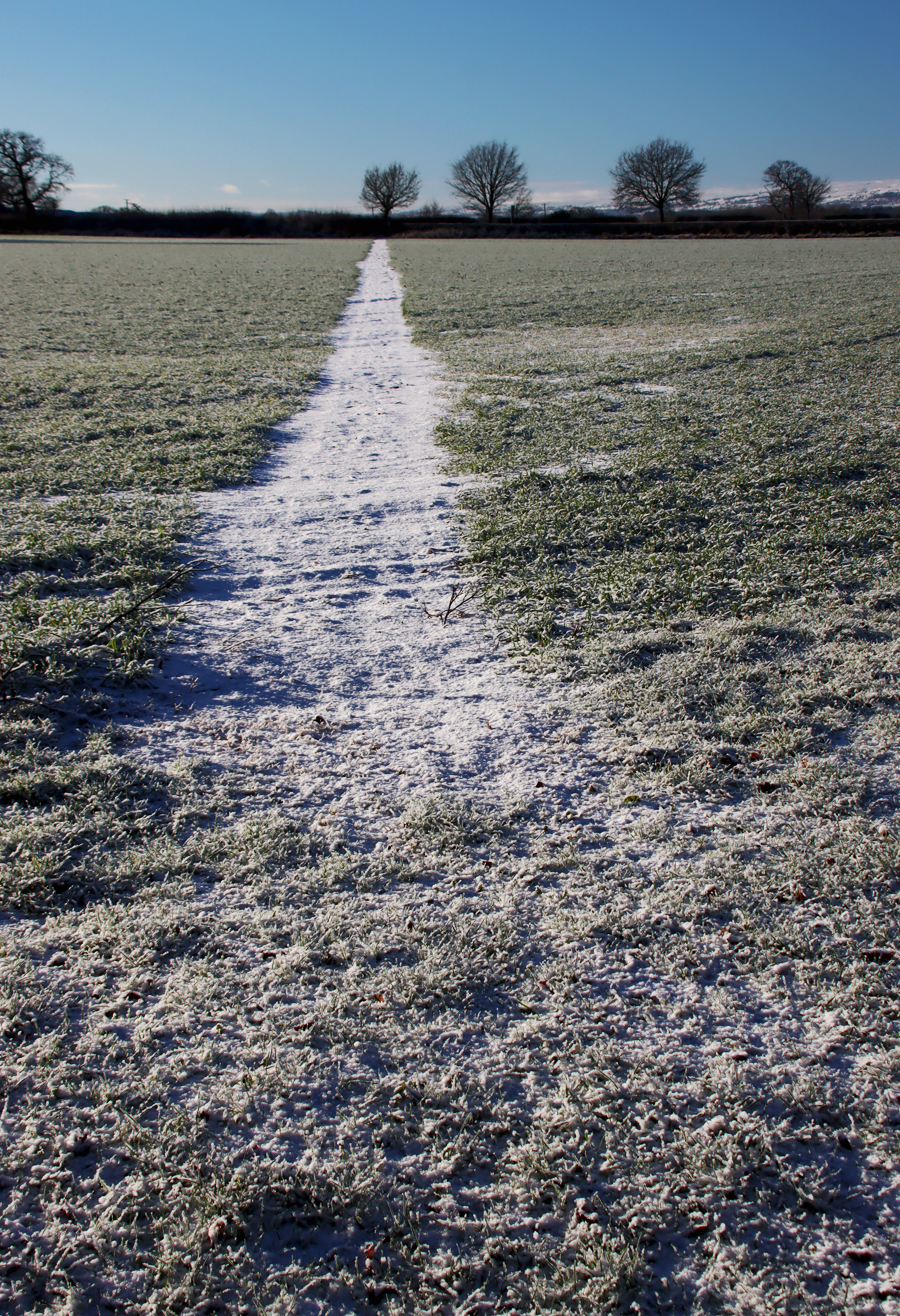
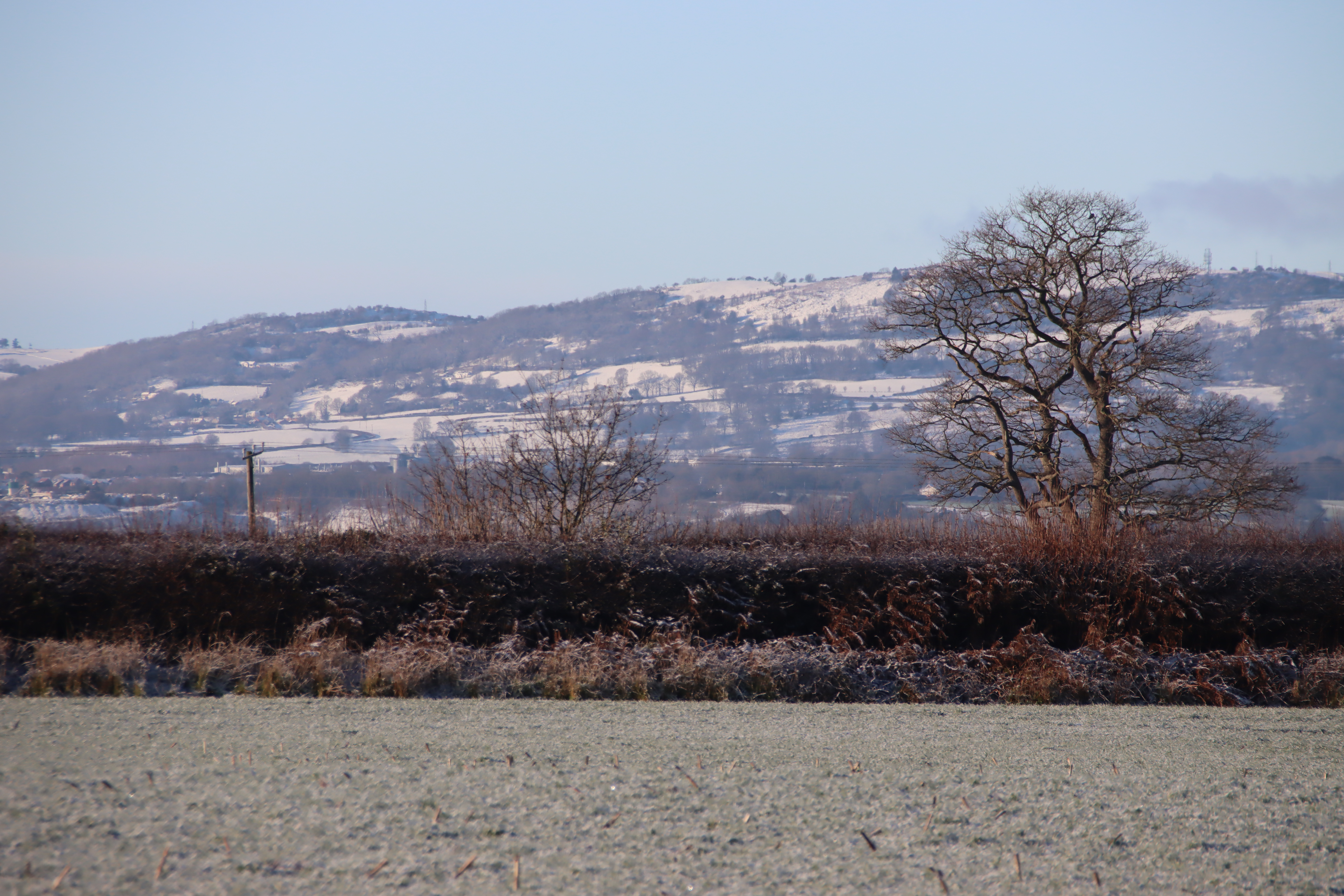
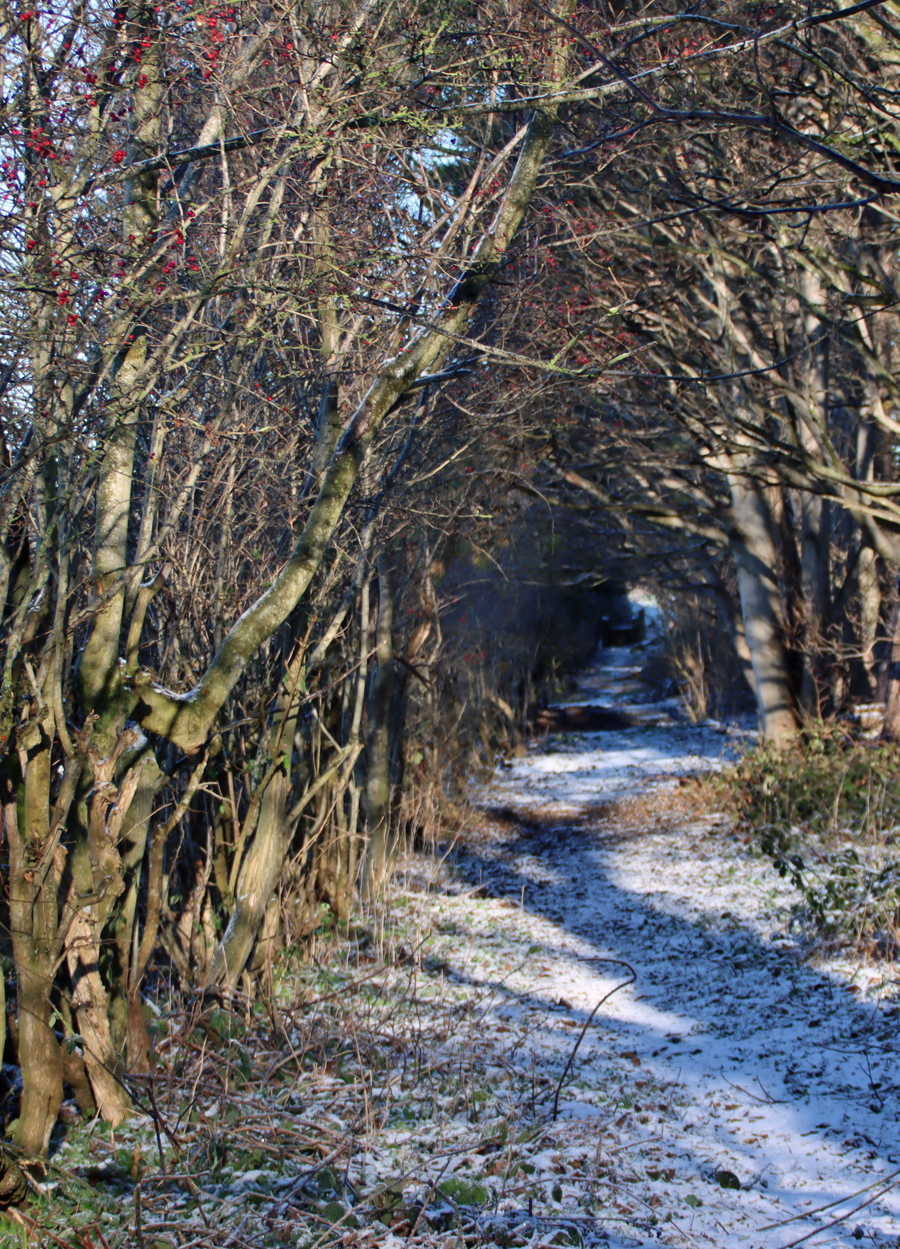
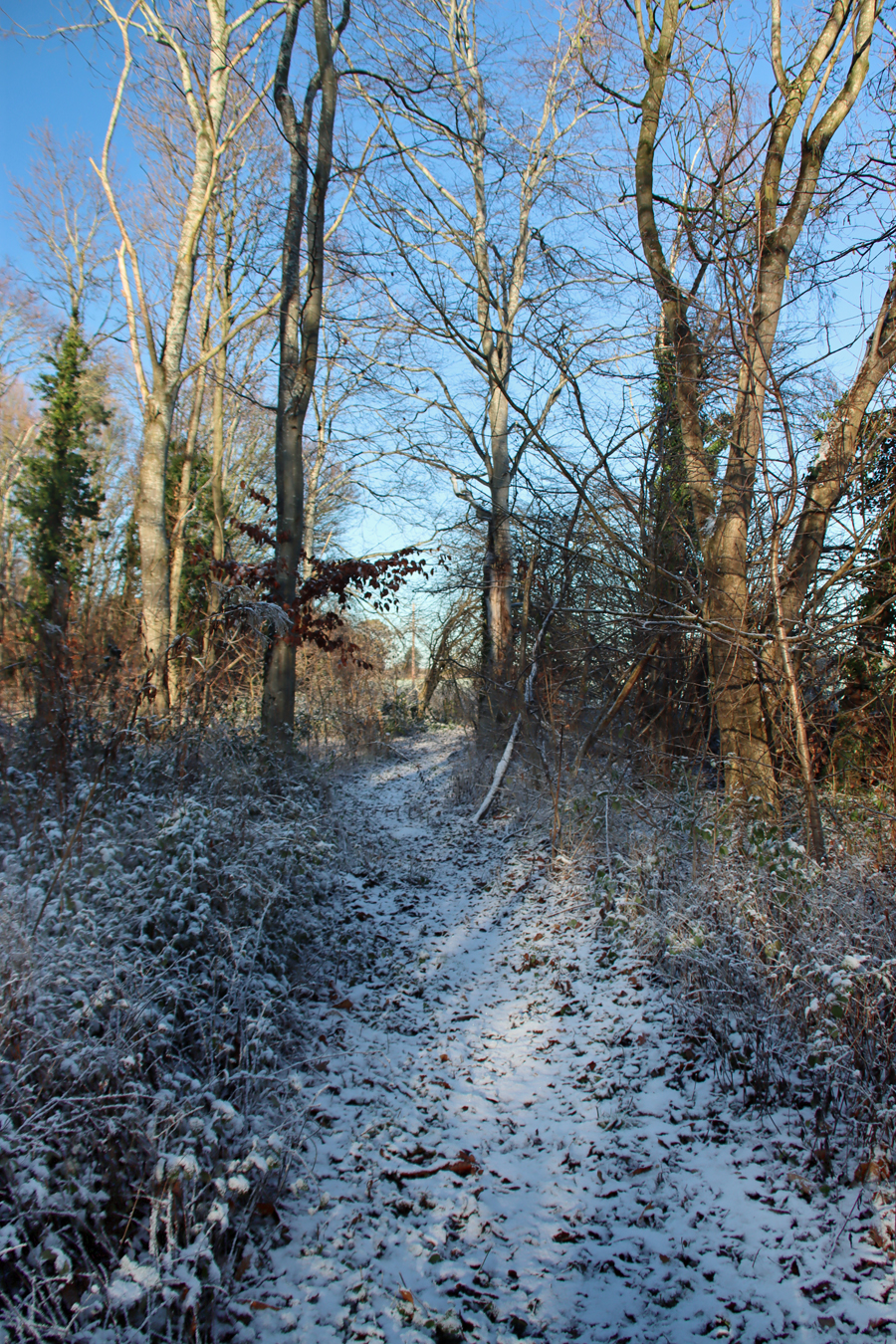
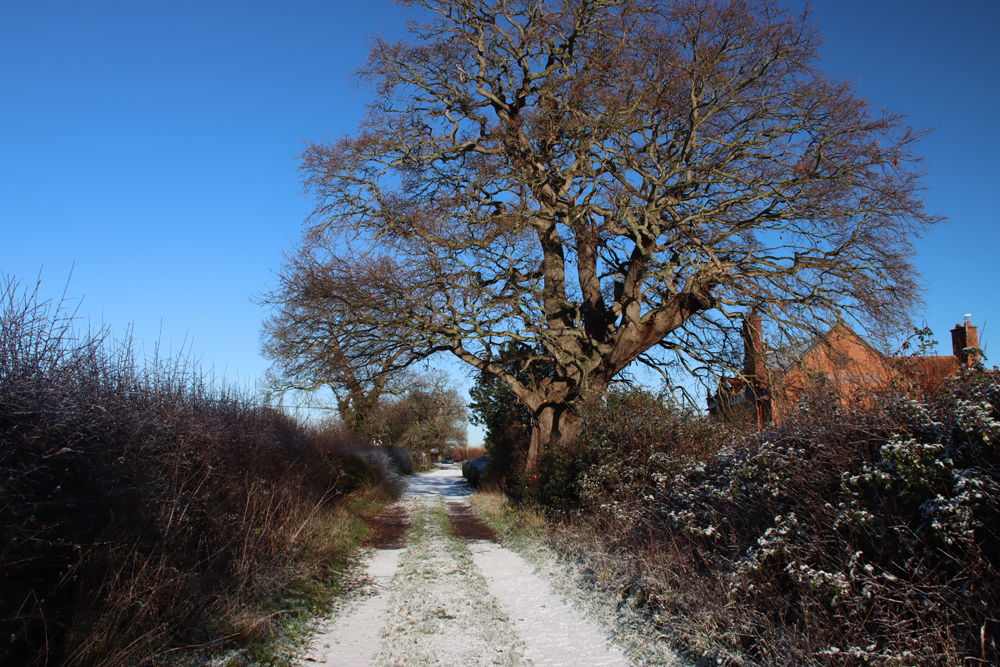
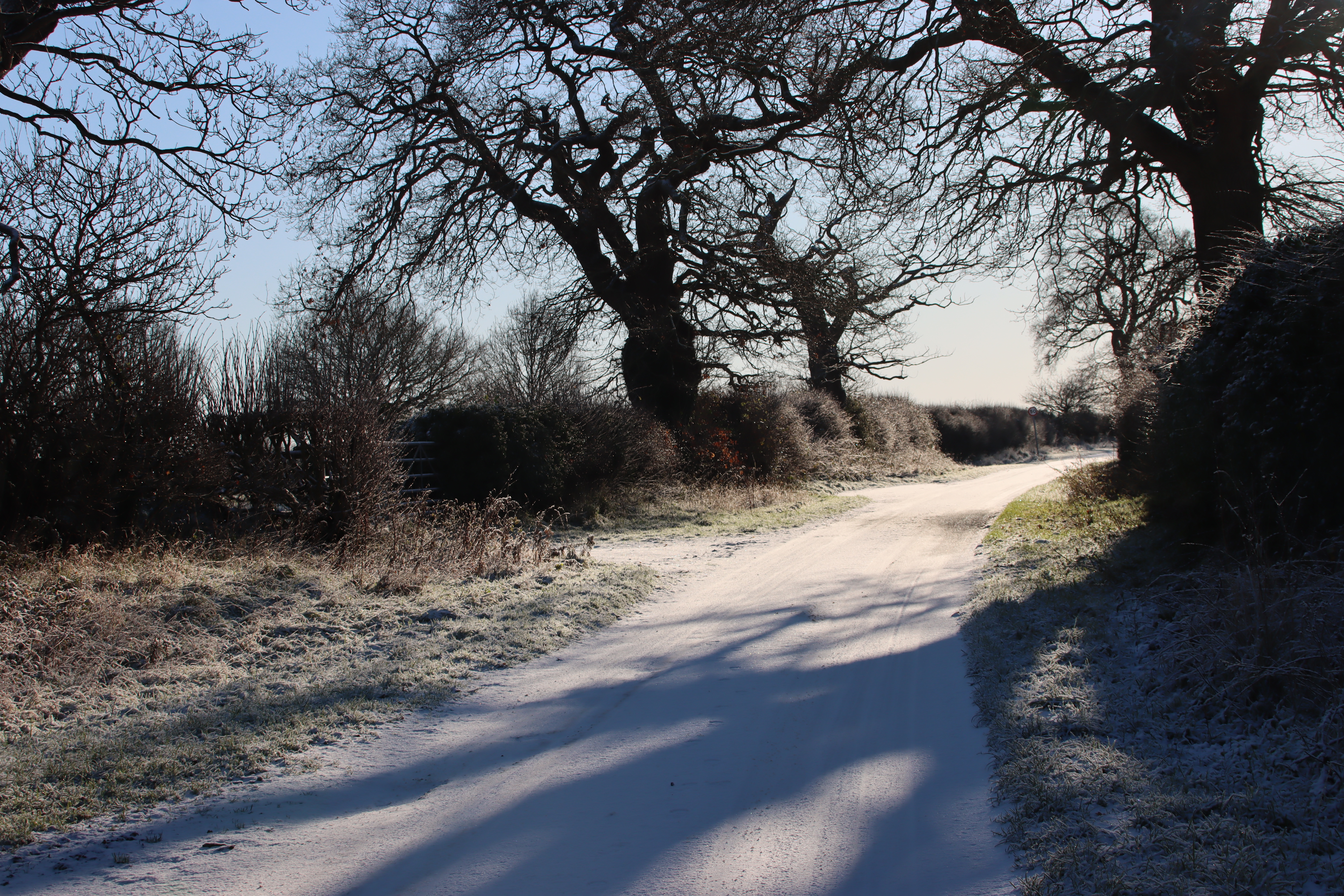
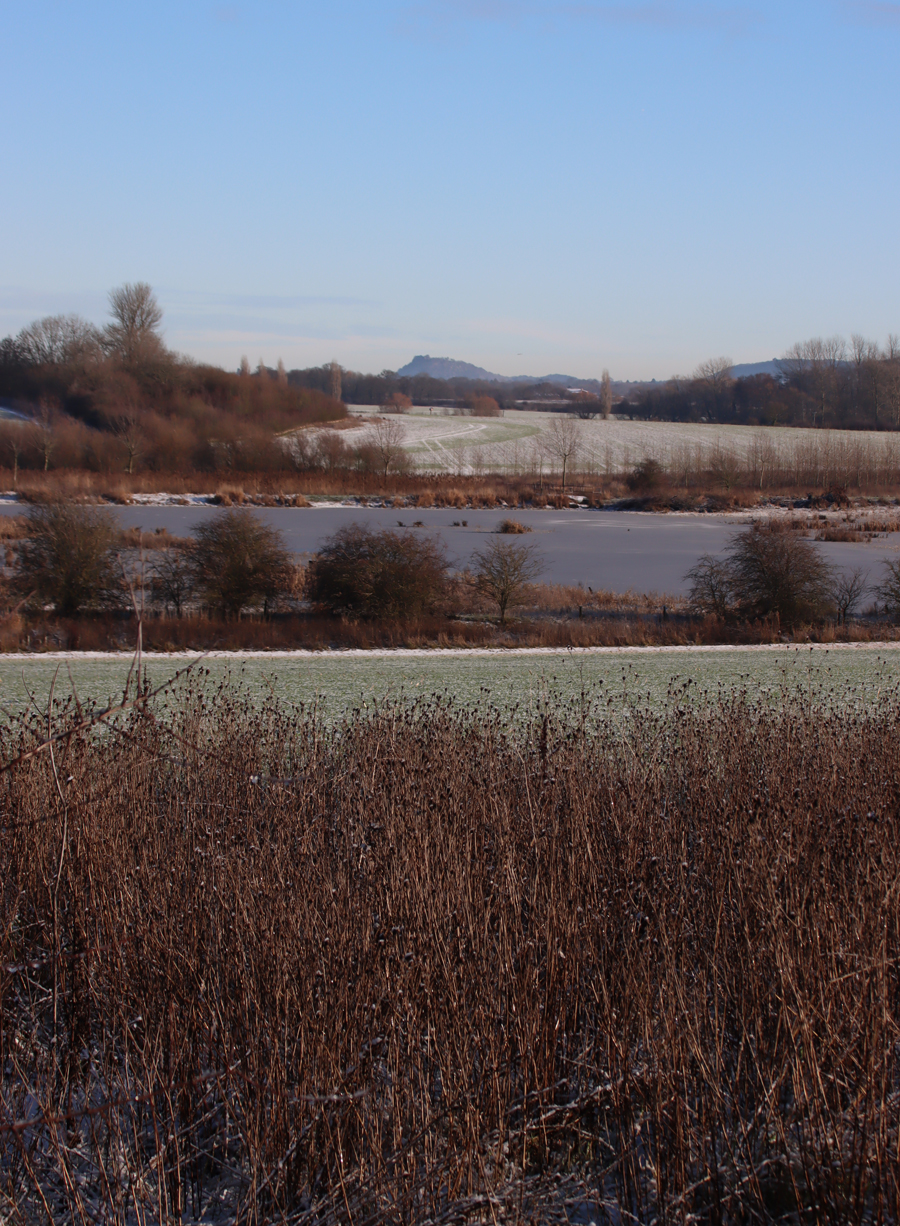
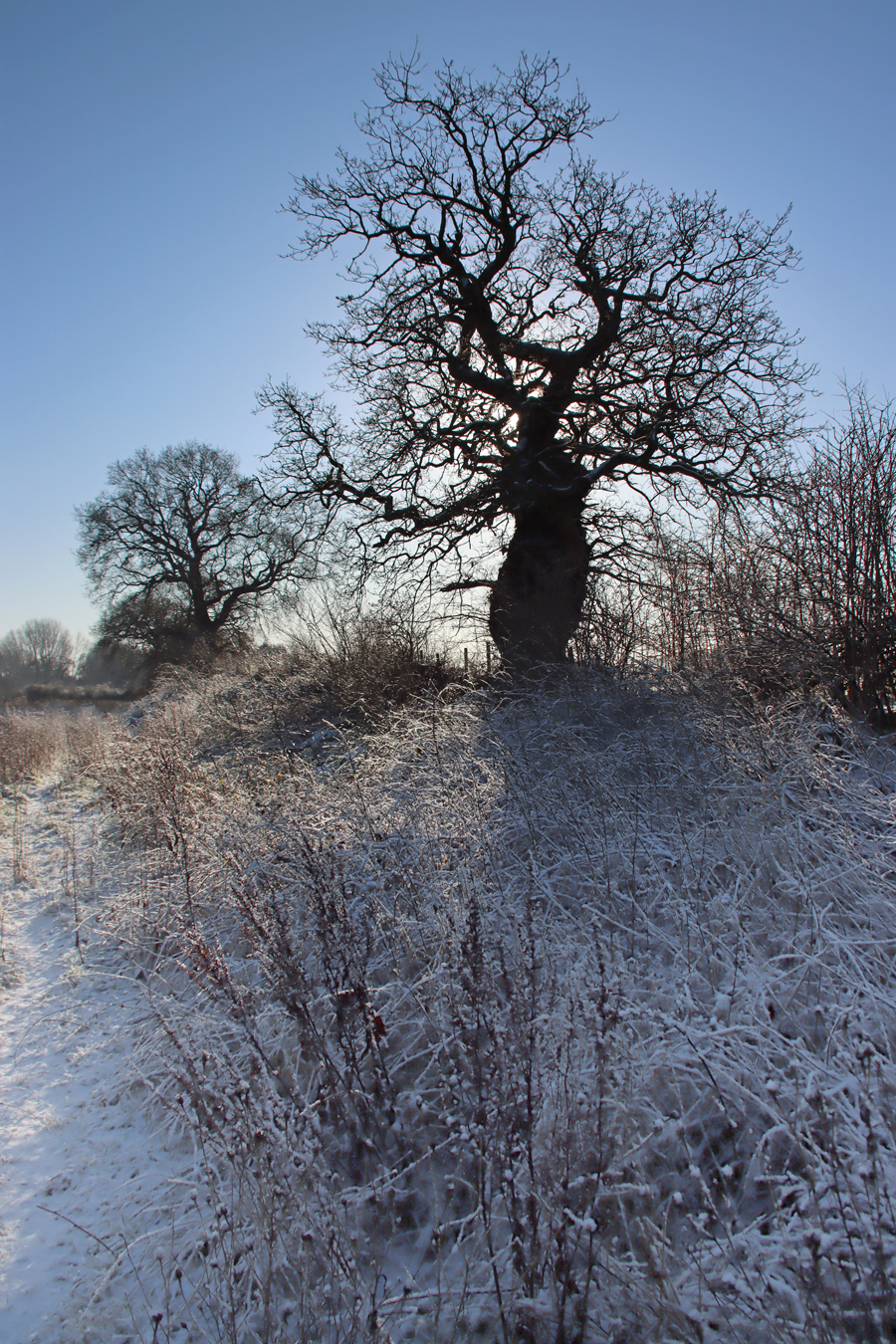
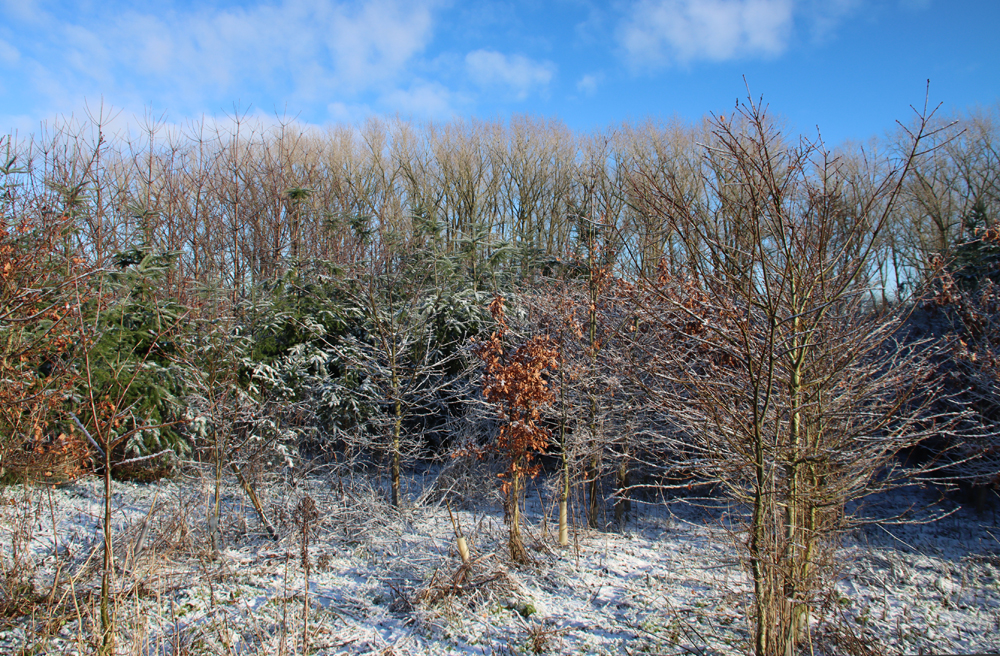
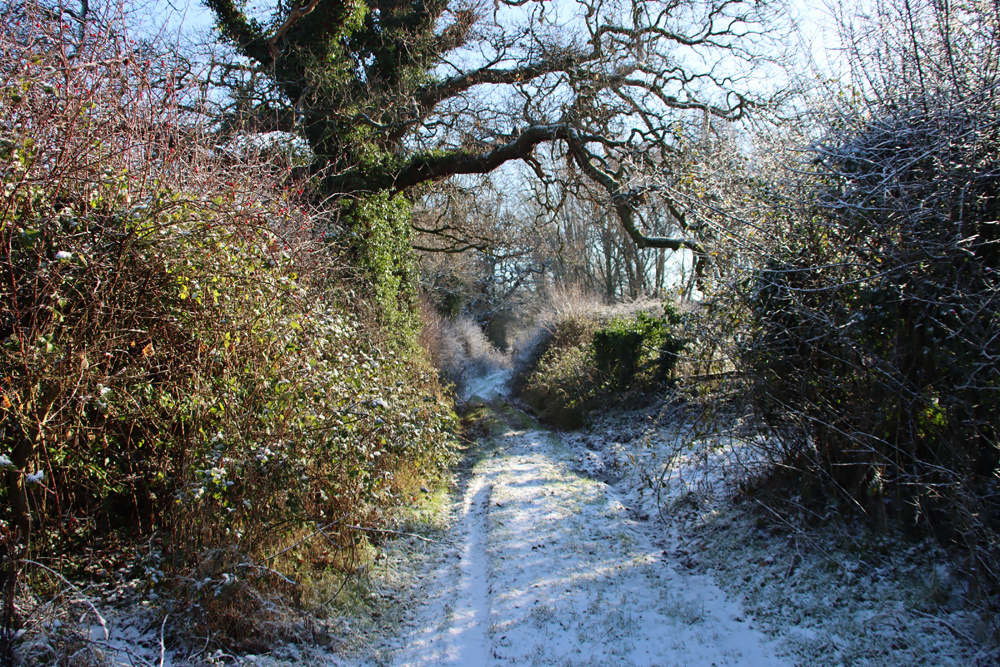
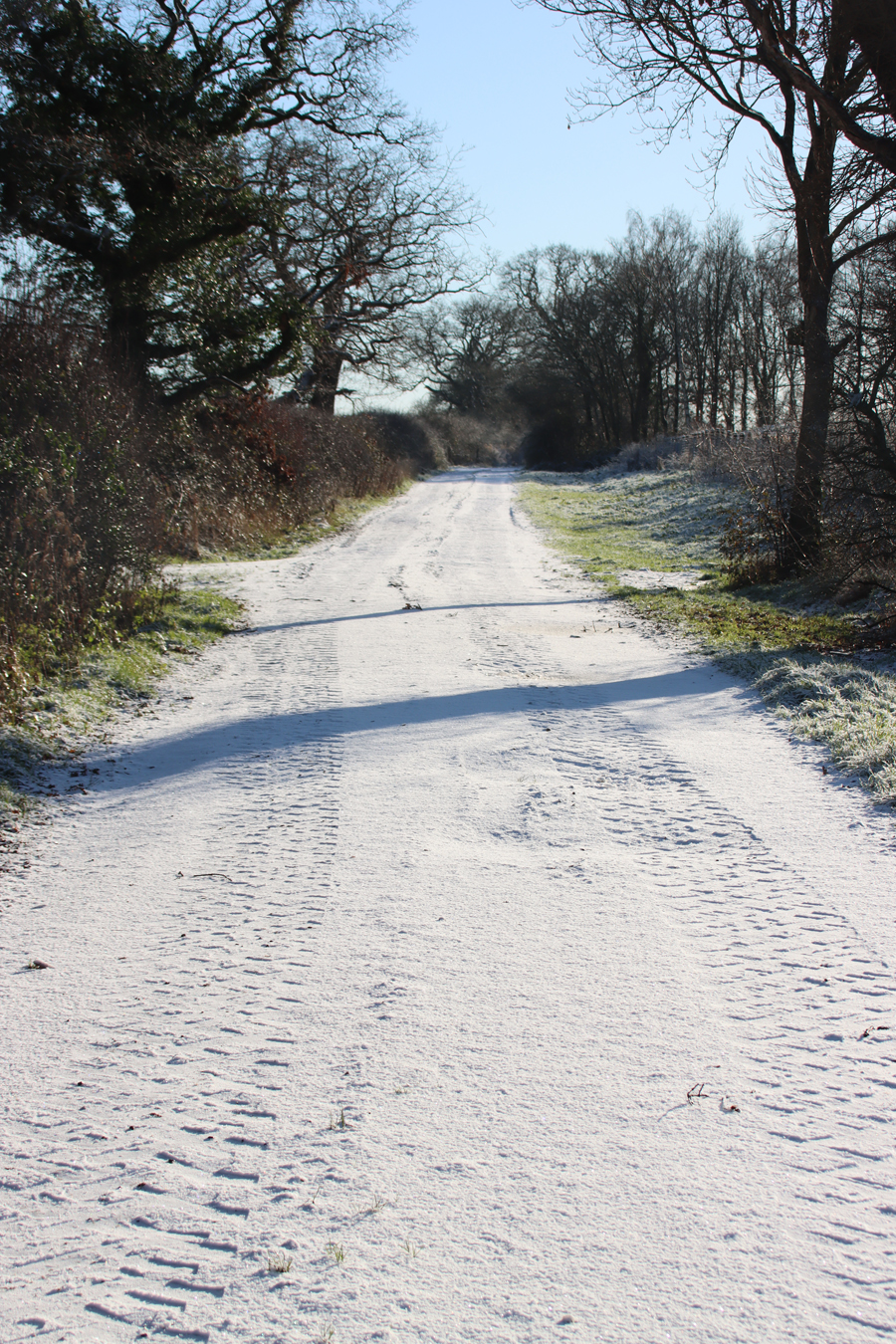
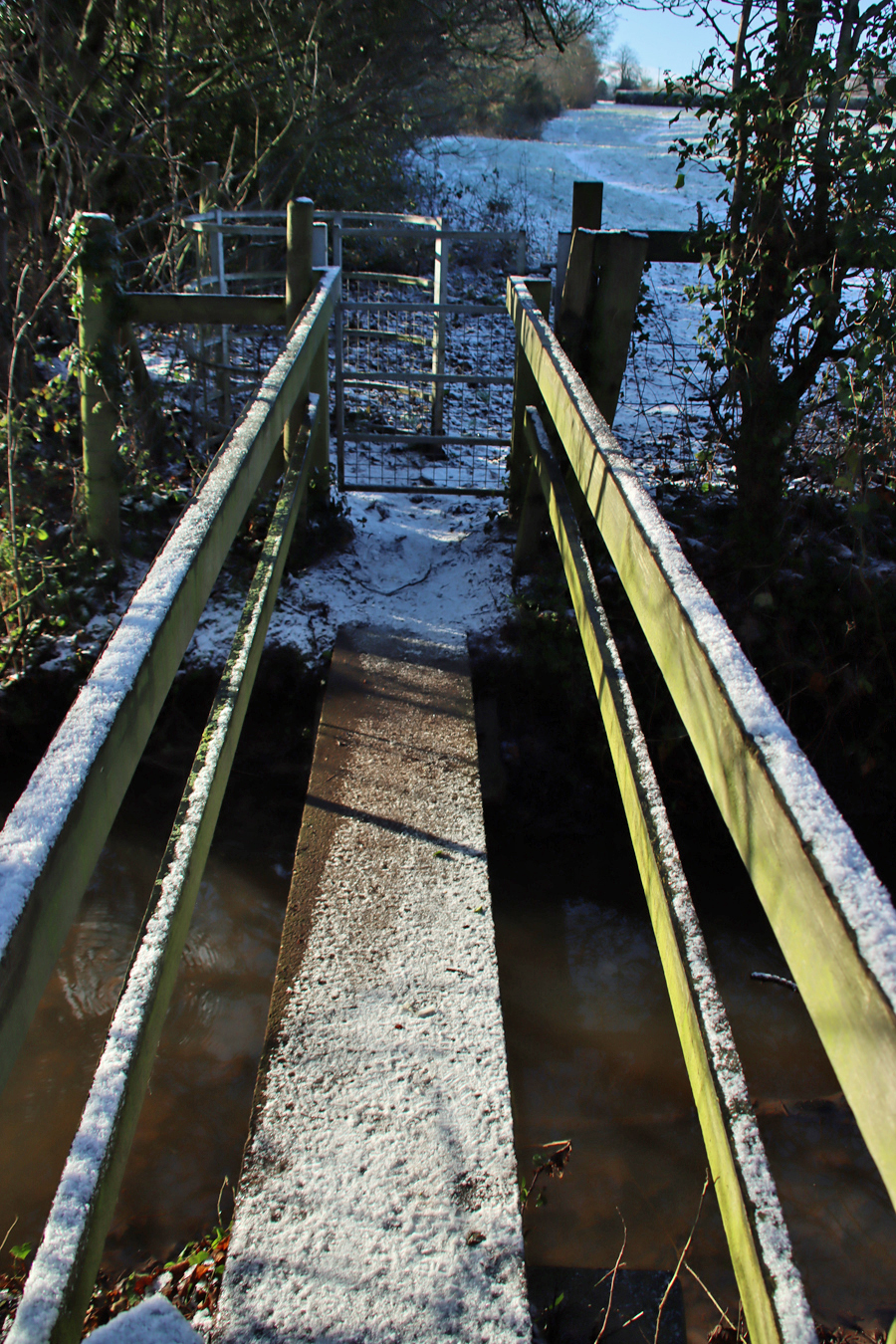
Snowy fields, copses and lanes between Churton and Aldford

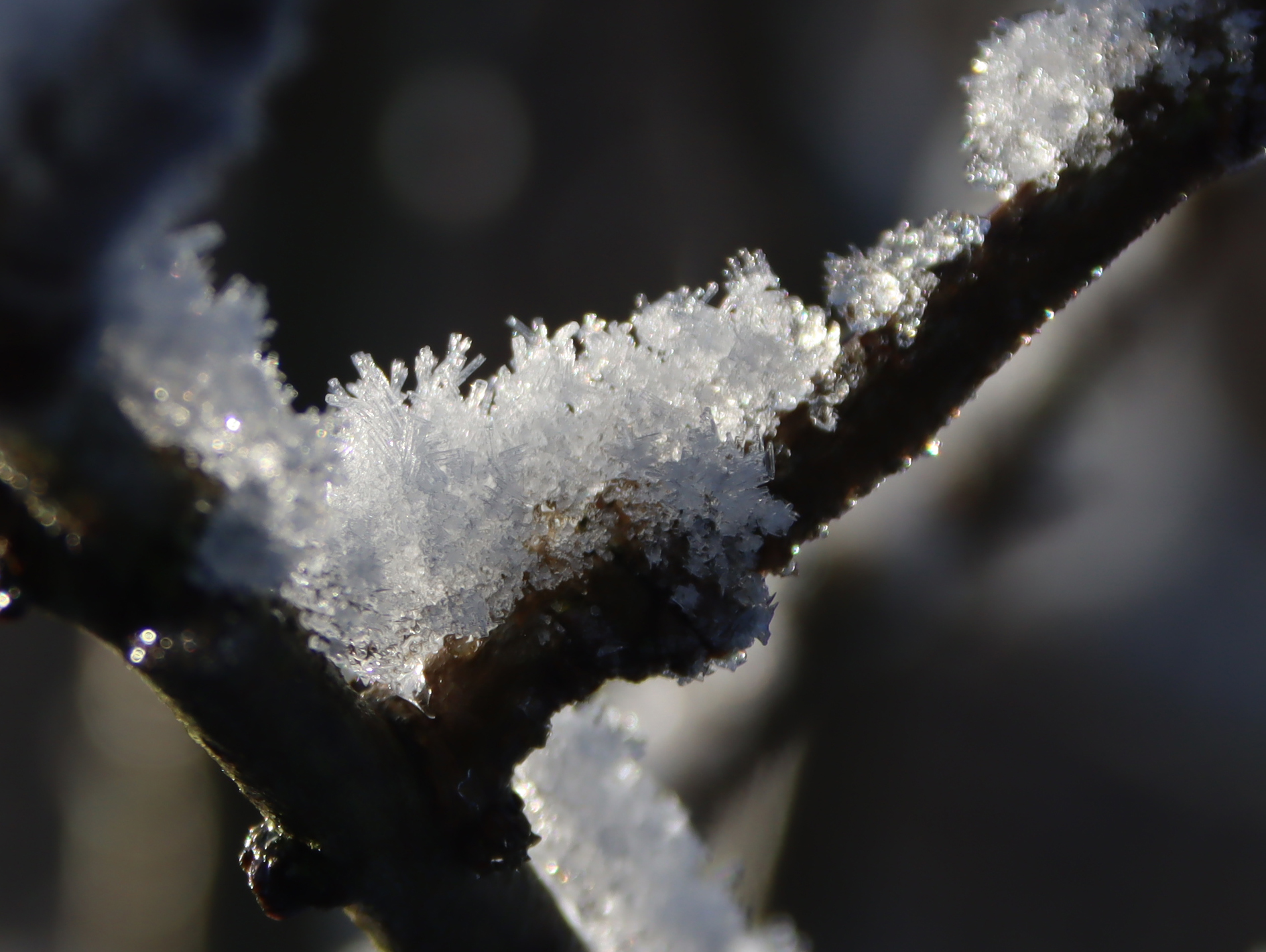
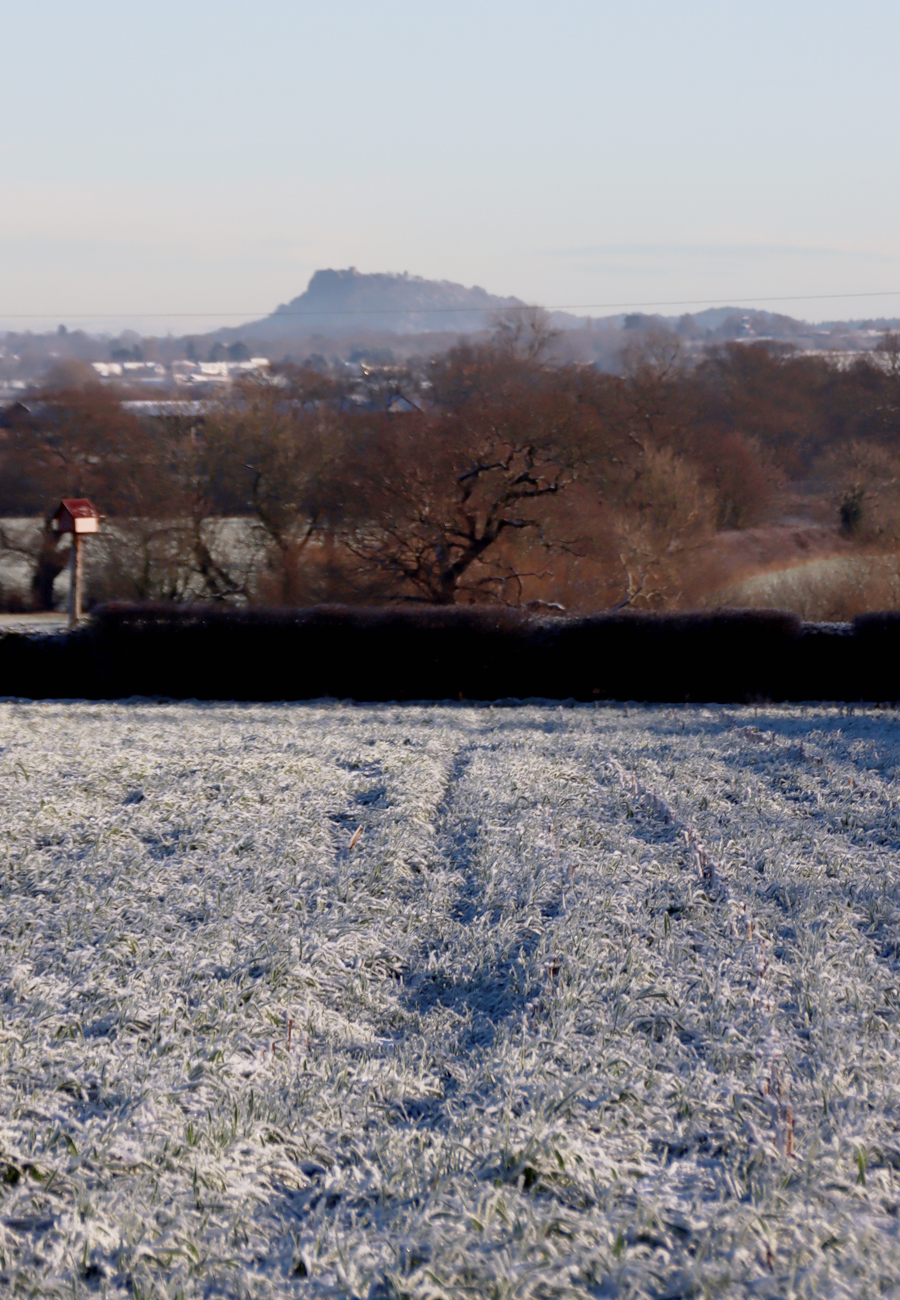
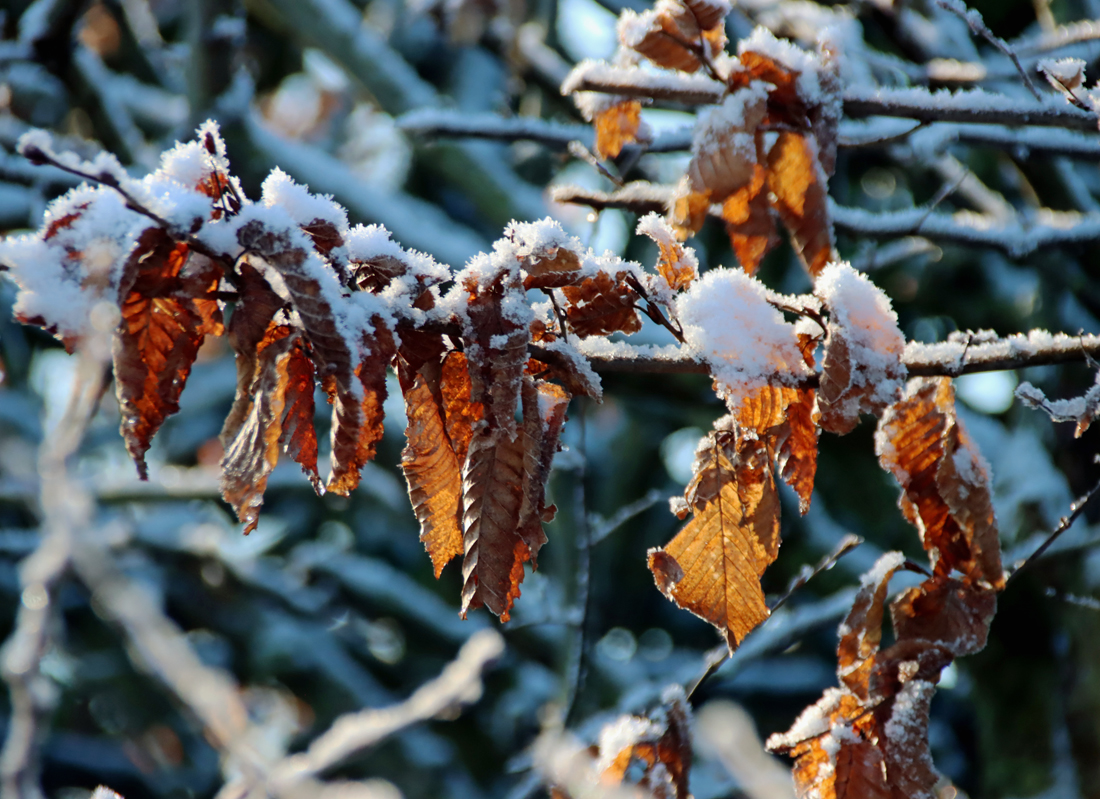
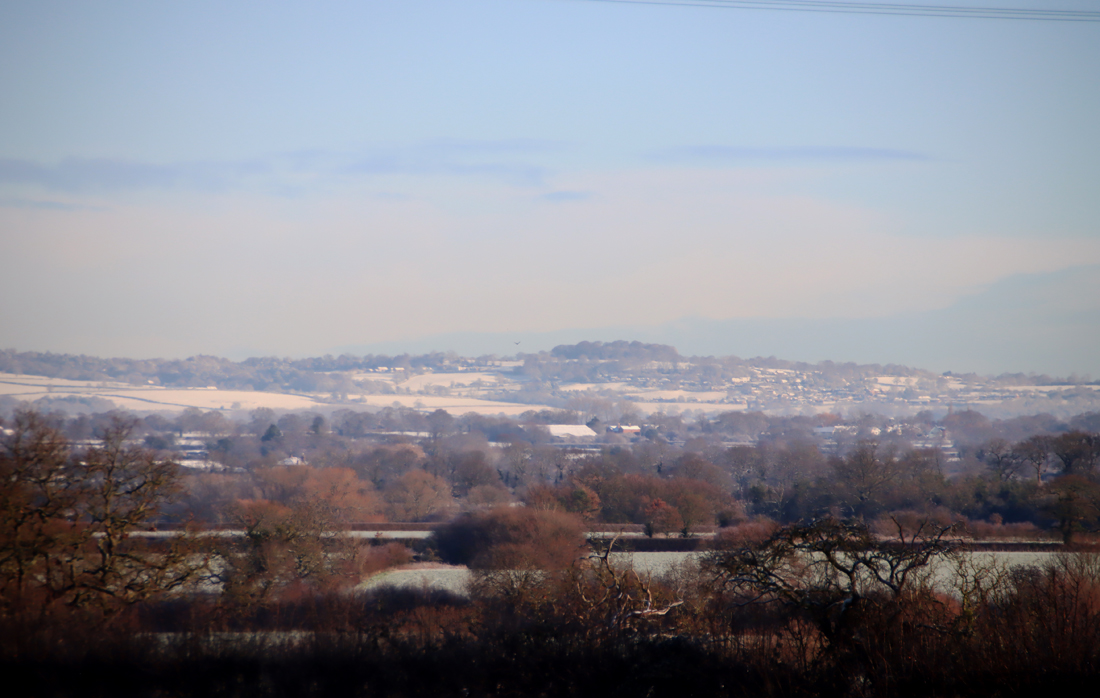
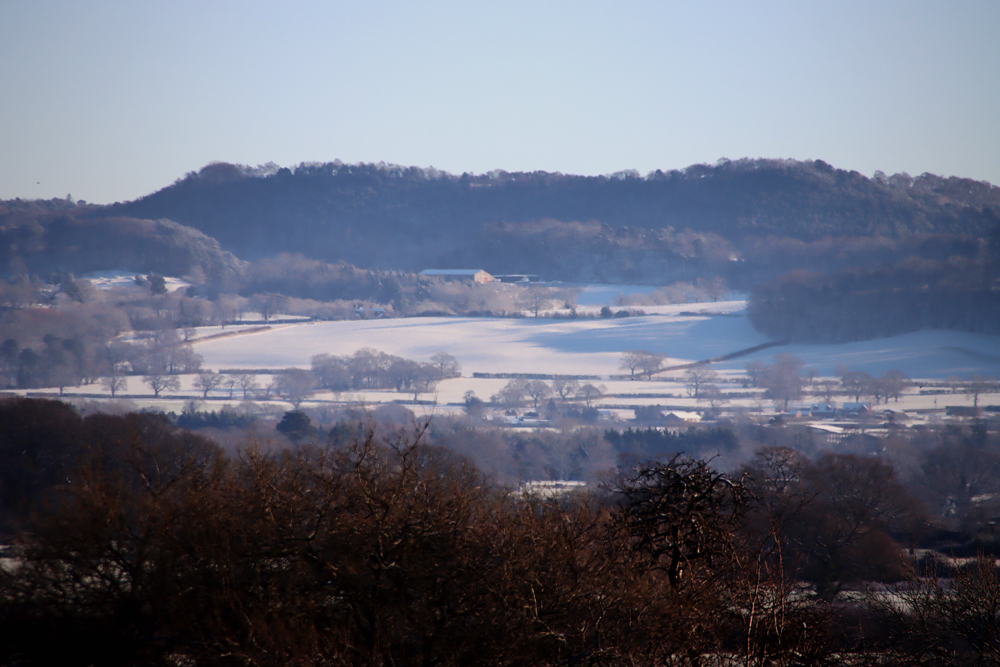
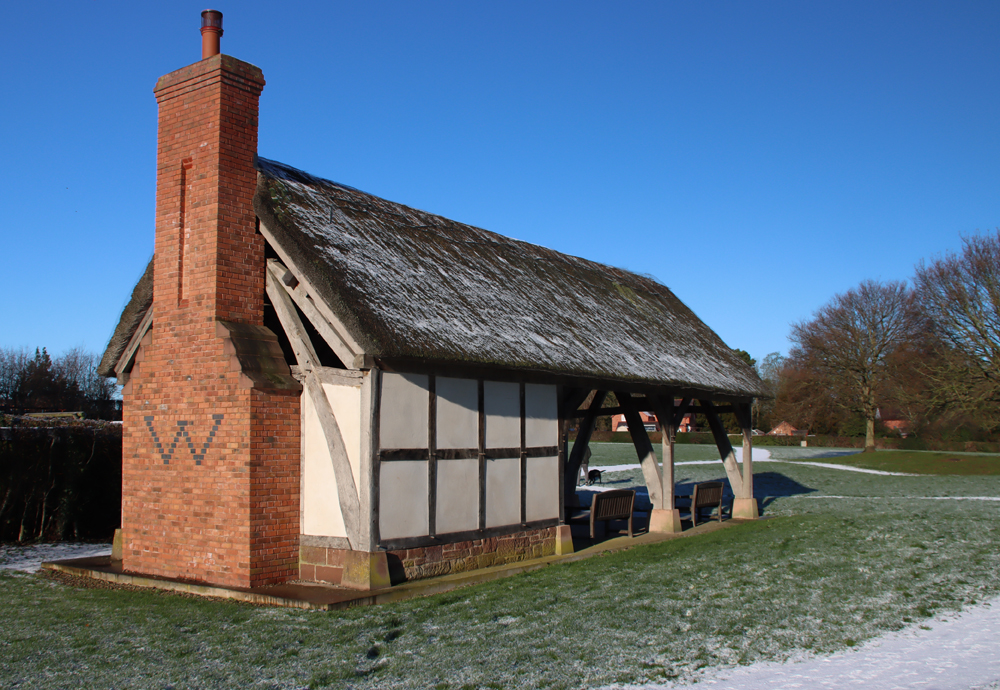
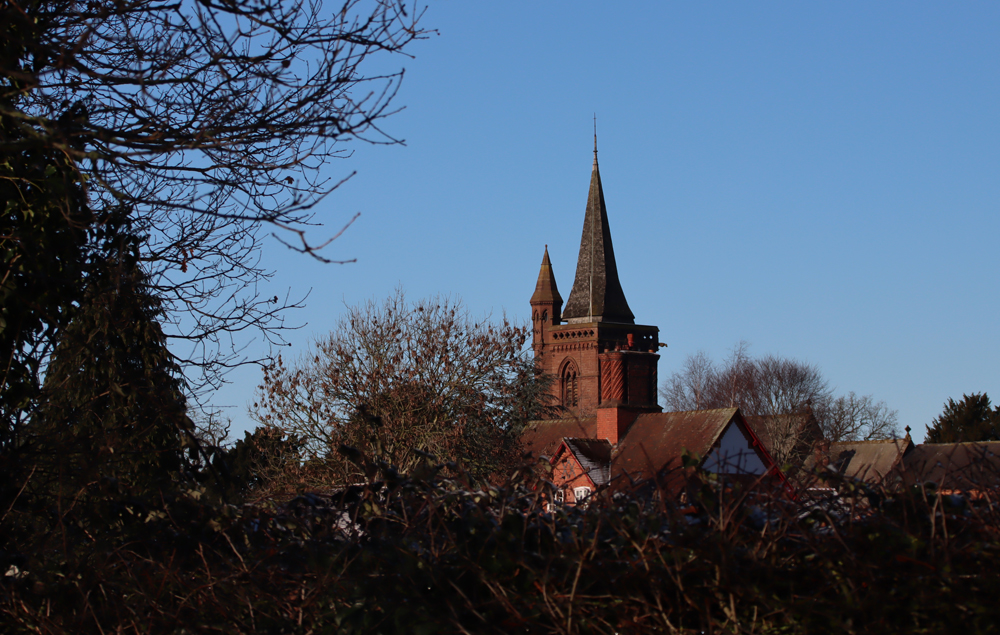
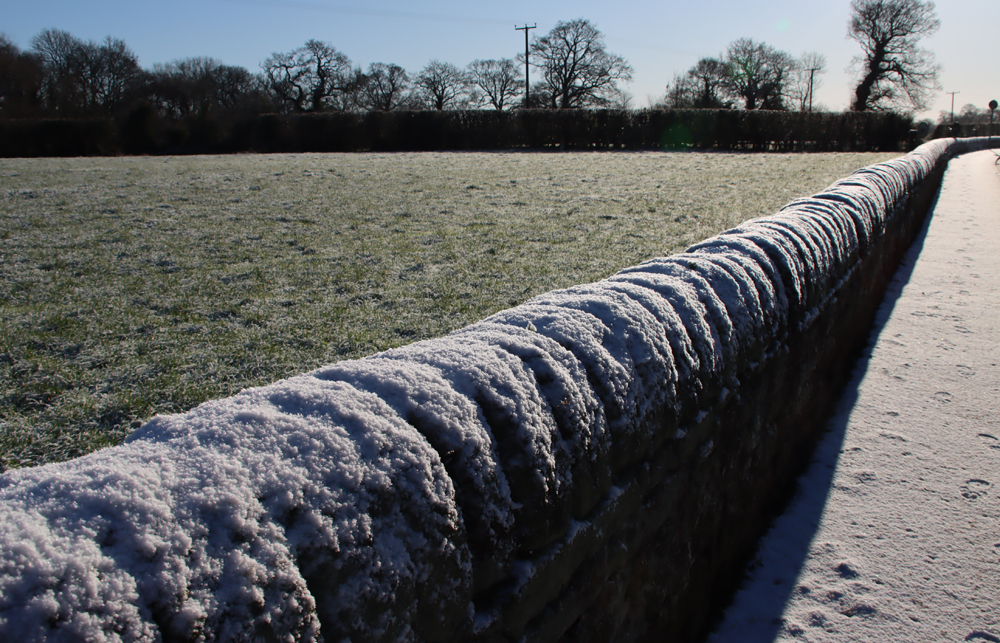
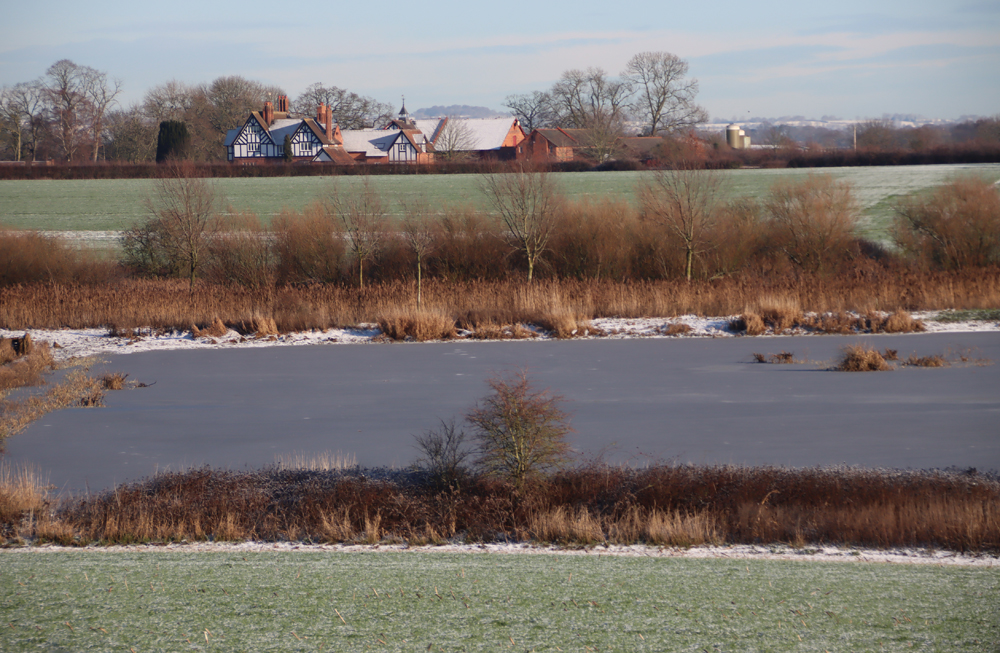
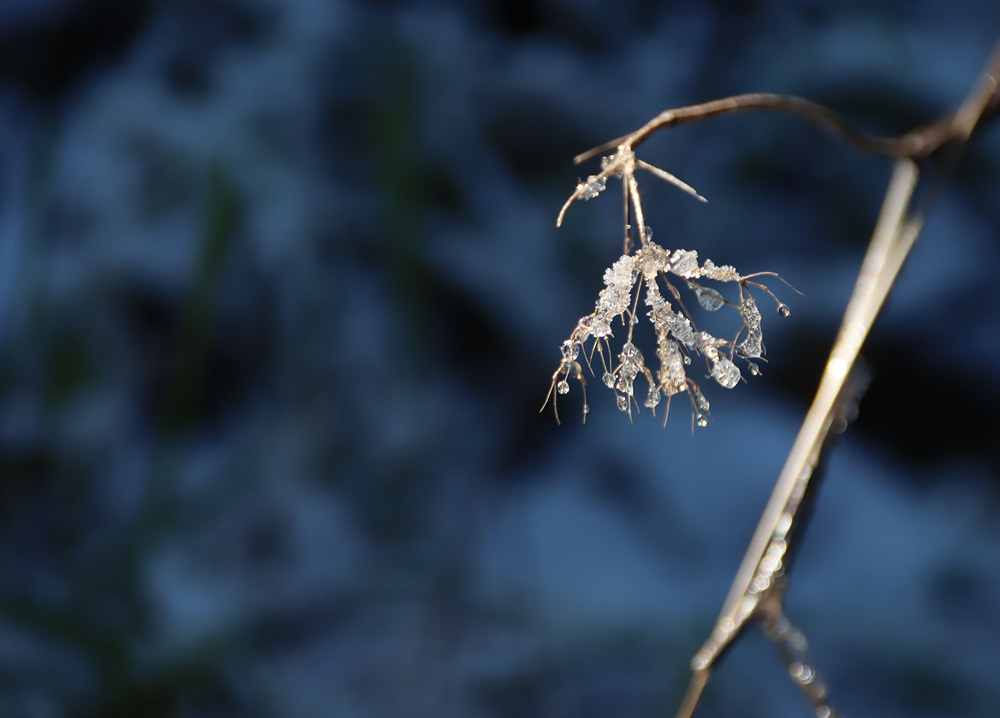
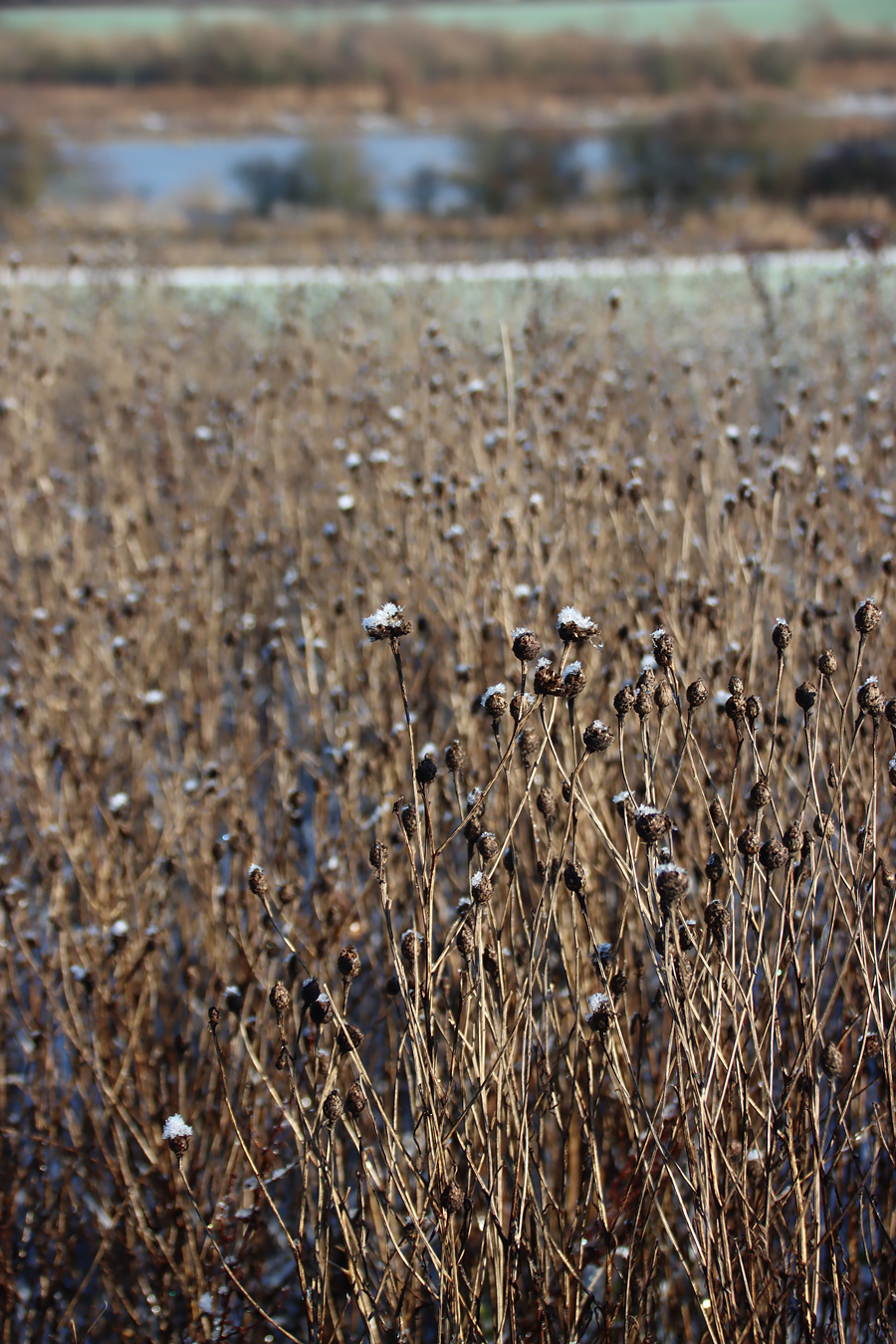
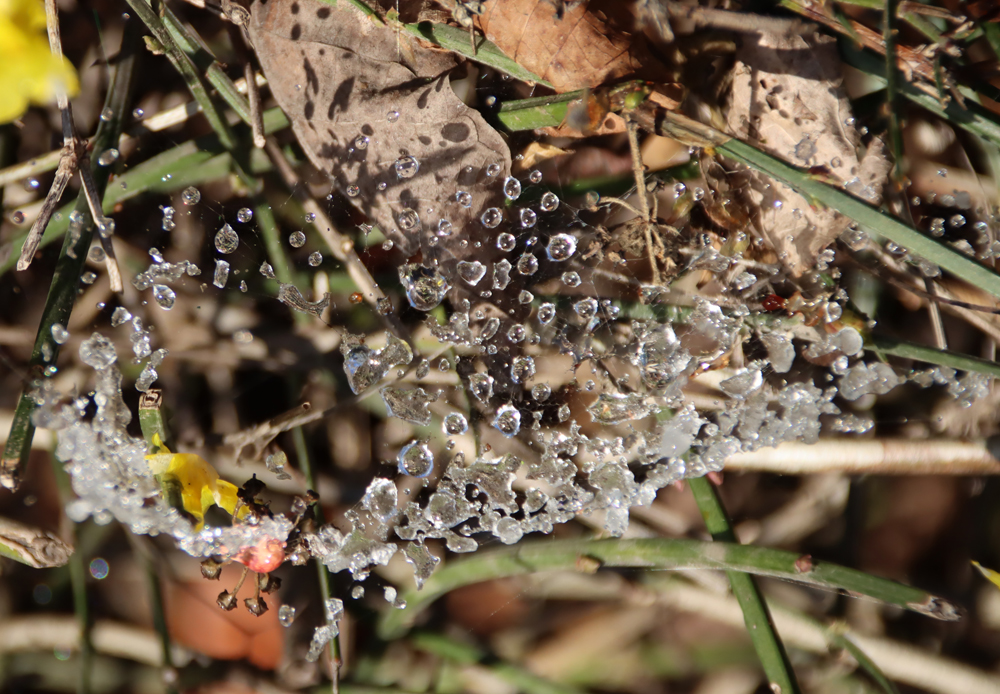
This is a pretty-pics post.  It was a beautiful sunny January day today, after quite a lot of snowfall overnight.  My garden was smothered in snow, and the car was fully shrouded.  Even so, the sunshine was very warm and it was beginning to melt when I left the house at something past 11am, heading for Aldford and returning via the Roman Road (marked on the map at the end as Churton by Aldford FP9), making a good circuit.  The views across the snow-covered fields to the hills to the east and west were lovely, but as always on these snowy walks, sometimes it is the close-up detail that is most lovely.

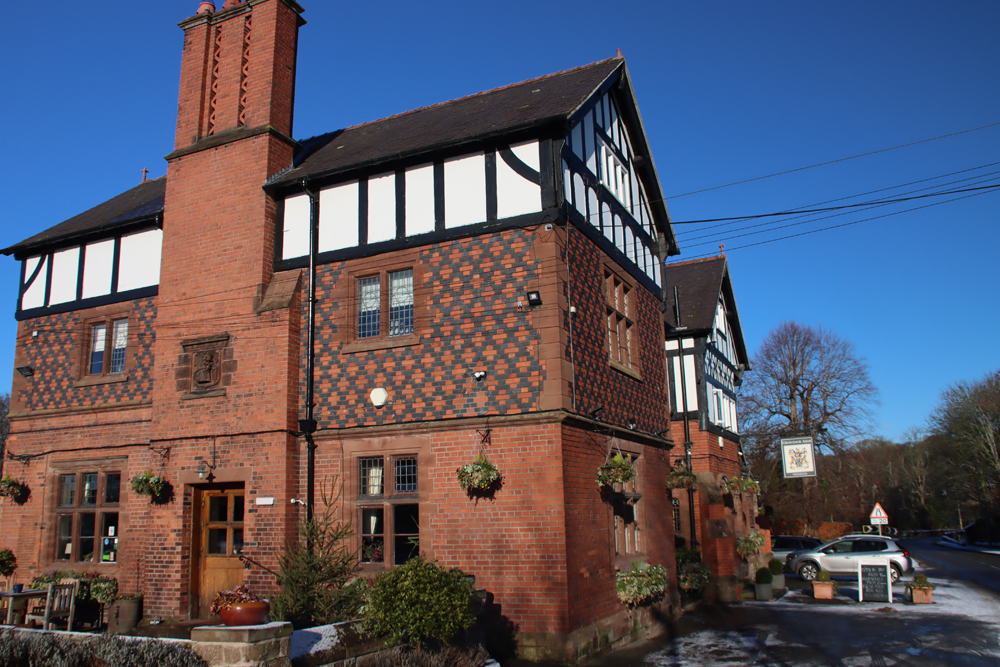
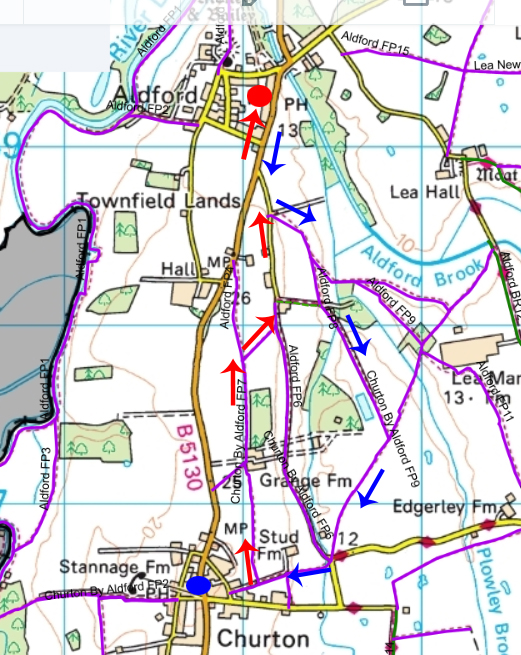
There is a map showing the route at the end. The whole walk, there and back, takes about an hour and a half, perhaps two hours if you are strolling rather than keeping up a brisk pace.  To see what much of the same walk looked like in April 2021, here’s the earlier post.  For those who like to include a destination on their walks, Churton has the attractive White Horse public house, and Aldford has the larger and venerable Grosvenor Arms.  Both do good food and are warm and comfortable.

If you are interested in the Roman road, it is marked as Churton By Aldford FP9 on the map at the end, along the blue arrow return section of the walk, and I have posted about the road and the walk along the road, in two parts, starting here.

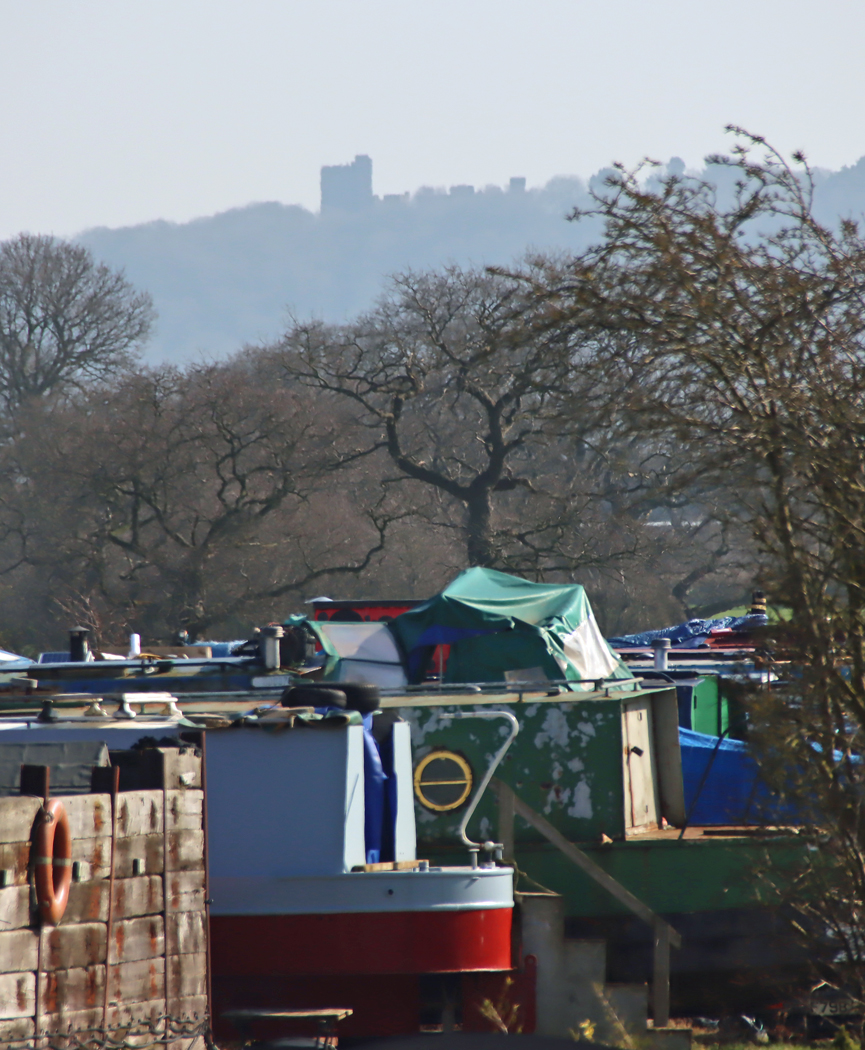
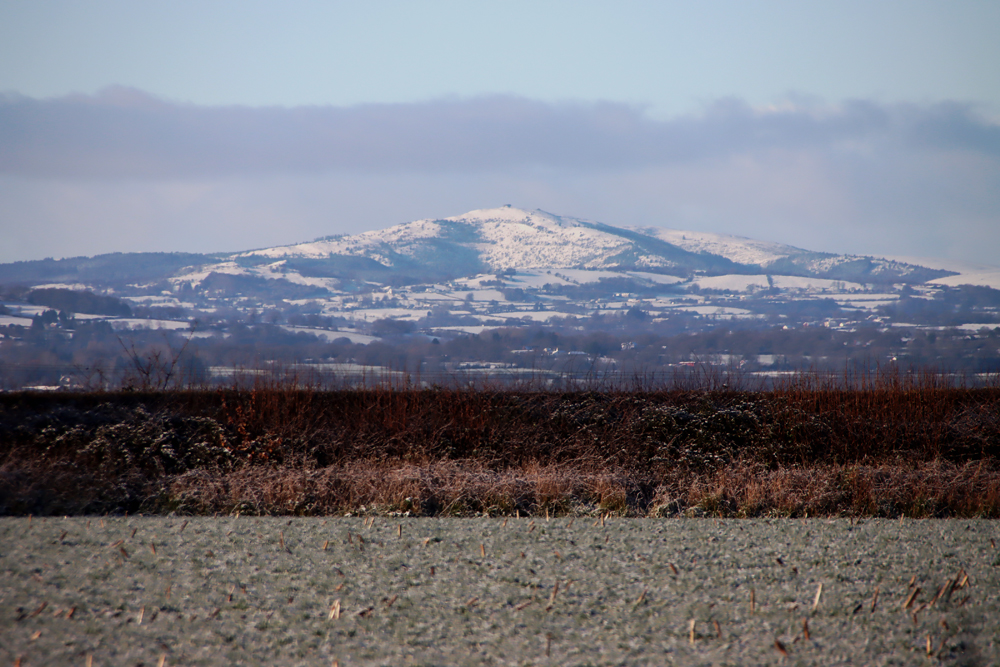
View over the fields to Beeston Crag and the medieval castle

The Welsh foothills

The Welsh foothills


The Grosvenor Arms, Aldford

The first section of Roman road

A much clearer section of the Roman road, well used by farm traffic

The route taken from Churton to Aldford (red arrows) and back (blue arrows). The red dot marks the Grosvenor Public House, and the blue dot marks the White Horse. Source of map: Cheshire West and Chester Public Map Viewer.


A stunning late autumn sun-filled walk at Bickerton Hill, with lovely views

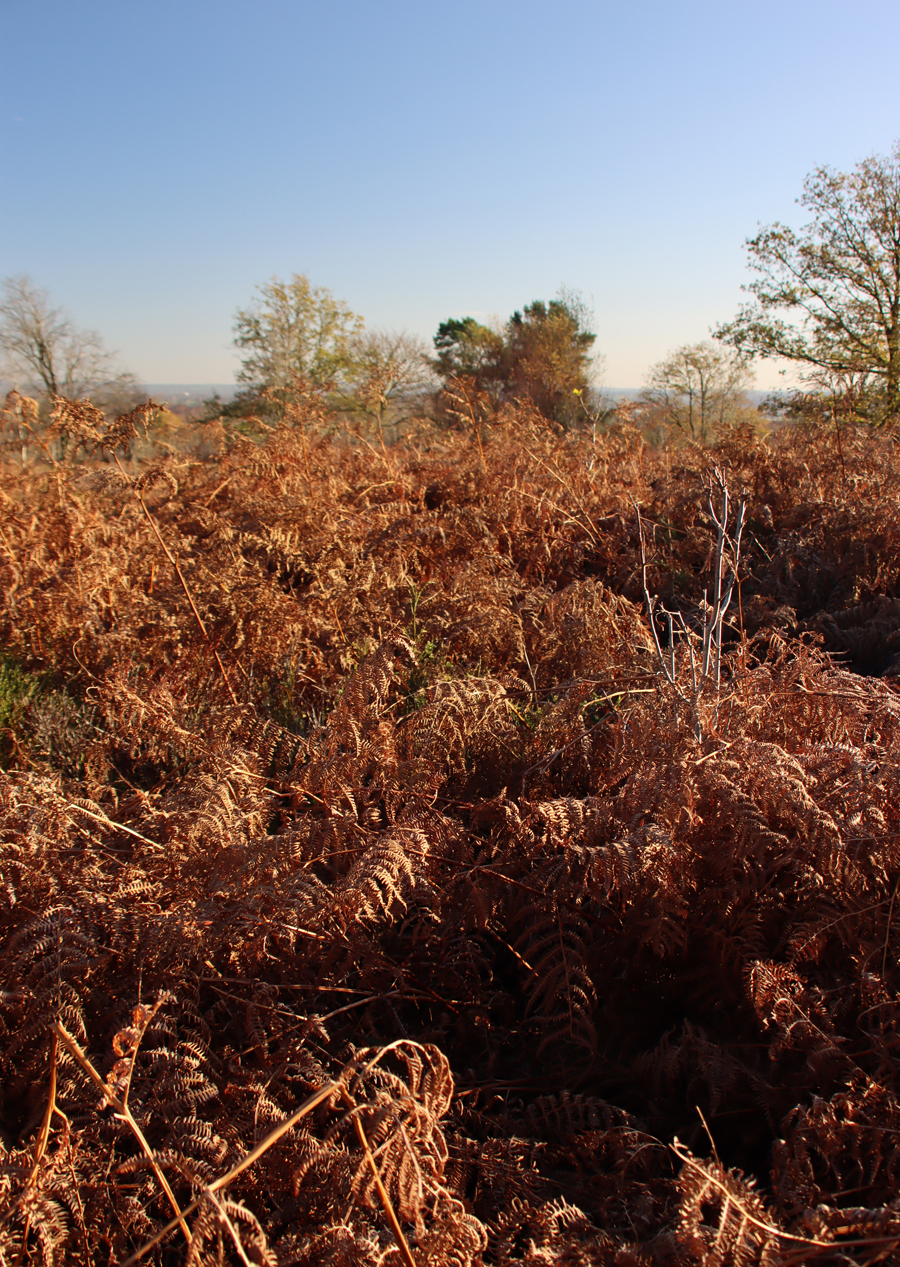
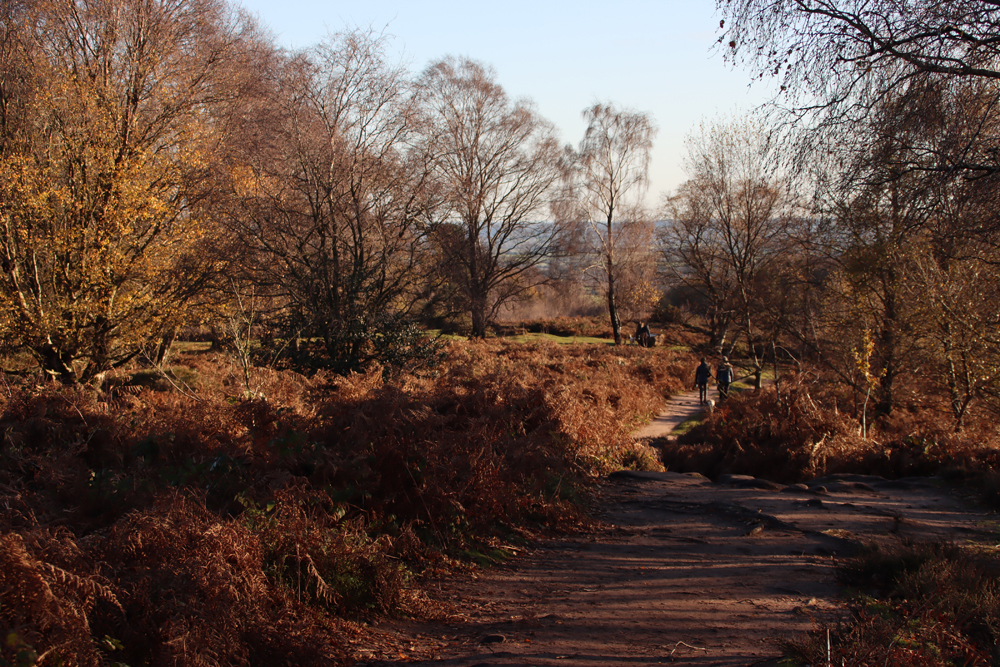
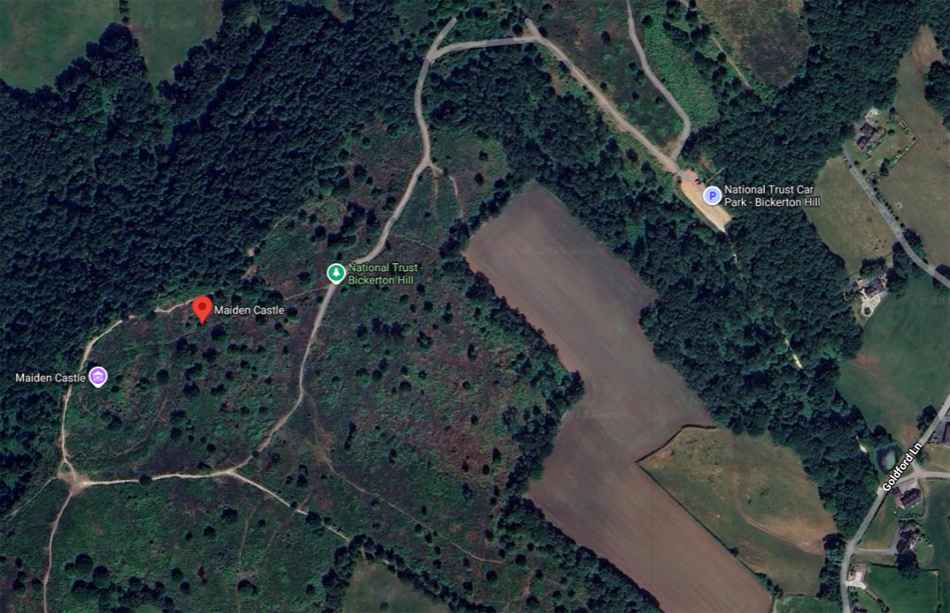
On Tuesday I took advantage of the beautiful sunshine, wrapped myself up like the Michelin Man, and went on an Iron Age hillfort hunt – Maiden Castle on the National Trust’s Bickerton Hill, to be precise.  The hillfort is, as they often are, rather easier to get to grips with from the air and in plans and illustrations, but it was still really good to see it on the ground.  I have written up Maiden Castle on a separate post here.  The real joy of the day were the deep blue skies and the slanting late autumn sunshine as it cut through the spectrum of reds, copper-oranges and yellows, and put a great golden spotlight on the bright, emerald green of the Cheshire plain below.  Utterly stunning.

The walk leads from the car park up to the ridge that overlooks most dramatically across the west Cheshire plain towards the Clwydian Range, with views too across east Cheshire.  I walked up from the Goldford Lane car park, a gentle slope across red sandy soil and sandstone slabs to the ridge, and then walked first in one direction towards and beyond the hillfort, and then retraced my steps to go along the ridge in the other direction, before returning to the car.  An alternative is to do one of a number of circular walks, one of which is shown below.  Whichever route you take, it is really spectacular on a sunny autumnal day.  Visiting details at the end.


Click to enlarge

Google Map of Bickerton Hill and Maiden Castle

Google Map of Bickerton Hill and Maiden Castle

The hill was designated a Site of Special Scientific Interest (SSSI) in 1979.  Interestingly (and unfortunately) the former heathland environment underwent ecological change when cattle and sheep ceased to be  grazed on the hill during the 1950s, allowing birch, oak and endless swathes of bracken to gain a foothold, killing off the natural bilberries and heather.  Although very beautifully copper-coloured in the autumn sun, the bracken, Pteridium aquilinum, has a number of worrying ecological downsides to it, described here on the “Moorland Association” website.  Most of the silver birches and oaks are still very young, but in places the silver birch in particular forms dense clumps.  The National Trust has now initiated a project of long-term work to re-establish large areas of heathland on the hill.


Bickerton Hill nature conservation

Bickerton Hill nature conservation

Visiting is easy.  The hill is just south of the main Wrexham-Broxton-Nantwich road (the A534). There are two car parks, one on either side of the hill.  I used the one off Goldford Lane, which is a large free parking area, with a shallow slope uphill towards the ridge.  The What3Words location is ///device.emulating.upwardly.  The National Trust page for the site can be found at: https://www.nationaltrust.org.uk/visit/cheshire-greater-manchester/alderley-edge-and-cheshire-countryside/things-to-do-at-bickerton-hill#rt-visit-maiden-castle.

You can download a leaflet about the hill and the hillfort here, including what looks like an excellent walk taking in Brown Knowl, on the Cheshire Sandstone Ridge website: https://www.sandstoneridge.org.uk/lib/file-323329.pdf

The geology of the sandstone trail can also be investigated on the Cheshire Sandstone Ridge website at: https://www.sandstoneridge.org.uk/geology.html

My video from the top of the ridge:


A very beautiful autumnal sunshine walk along the Wirral estuary from Burton to Parkgate

Bird of prey, Burton, Wirral

Beautiful feathers on a bird of prey at Burton, Wirral

Yesterday seemed, at first, to have been doomed from the start.  I was supposed to be driving to Aberdyfi in mid-Wales to do something specific, but 20 minutes from home, already running very late, realized that I had left two components essential to the task on the kitchen table.  Having returned home and collected the required items, I was leaving the house and went to take a quick snapshot in my garden of a squirrel running upside down along a power line and rapidly closing on an oblivious turtle dove, and found to my dismay that the camera couldn’t read the SD card. Nooooooo!  I knew I had a spare somewhere, but where?  Ridiculous to go to Aberdyfi on a sunny blue-skied day like this without a camera.  After half an hour of fruitless searching I picked up the phone and cancelled my visit.  Twenty minutes later I had found the wretched thing.  Instead of the planned expedition, I found myself grabbing the camera and car keys before heading up the Wirral to Burton to park up along the estuary and go for a very fine walk along part of the Wirral section of the King Charles III England Coast Path.  I hadn’t even got out of the car when I saw the above bird of prey, which politely held position whilst I scrambled out of the car.  A perfect way to turn around a very unpromising start to the day.

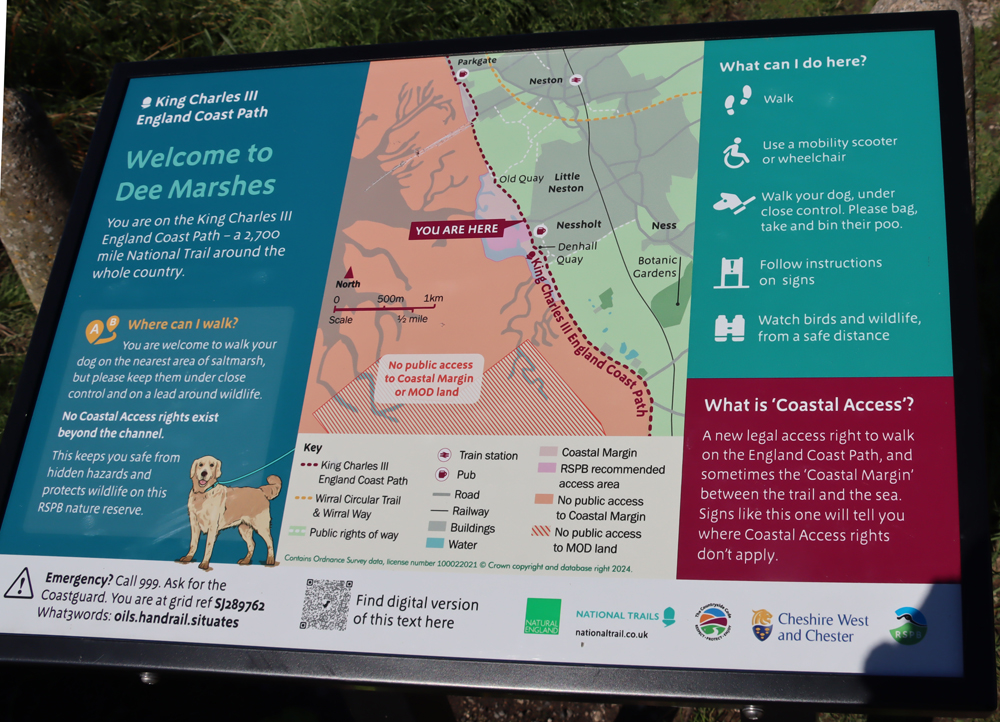
I have made a short visit to the estuary cycle track and walk in the past, simply to get a good look at the purported Iron Age promontory fort on Burton Point, but although it was enjoyable, it was a short stroll because the skies opened and I got drenched.  Today, with no risk of rain, I decided to walk from Burton towards Parkgate, which I guessed to be about an hour’s walk each way.  When I reached the “You are Here” board (with which the walk is dotted at key points) at Moorside, alongside Parkgate Spring and on the very edge of Parkgate, this was a full hour.

Parking is easy along the section of Station Road that lies along the estuary for the Burton to Moorside (near Parkgate) section of the "King Charles III England Coast Path"

Parking is easy along the section of Station Road that lies along the estuary for the Burton to Moorside (near Parkgate) section of the “King Charles III England Coast Path” (What3Words: ///glows.lung.headsets). Source: Google Maps

Parking for this particular walk is along the section of Station Road that runs along the side of the estuary, indicated by the red circle on the map.

The walk itself begins along the section of Denhall Lane that turns along the side of the estuary and passes a café, as indicated by the black arrow on the map.  Although vehicles are permitted as far as the café (just beyond the left edge of the map), they are banned beyond this point.

This first stretch of metalled lane is dominated by dog walkers and cyclists. Do keep an ear open for the cyclists as they can pick up a lot of speed along the lane and don’t always give a lot of notice of their impending arrival.  The path goes through various changes.  After some time it parts from the lane and becomes much more of a footpath with rough stone underfoot, which probably accounts for why the cyclists vanish from the scene at this point.  At one stage it becomes a track across a field, although there is a route around this in wet weather that diverts inland for a while.  The entire walk is well maintained with pedestrian gates and bridges where needed.  One field had horses in it, so do take care if you are walking dogs.

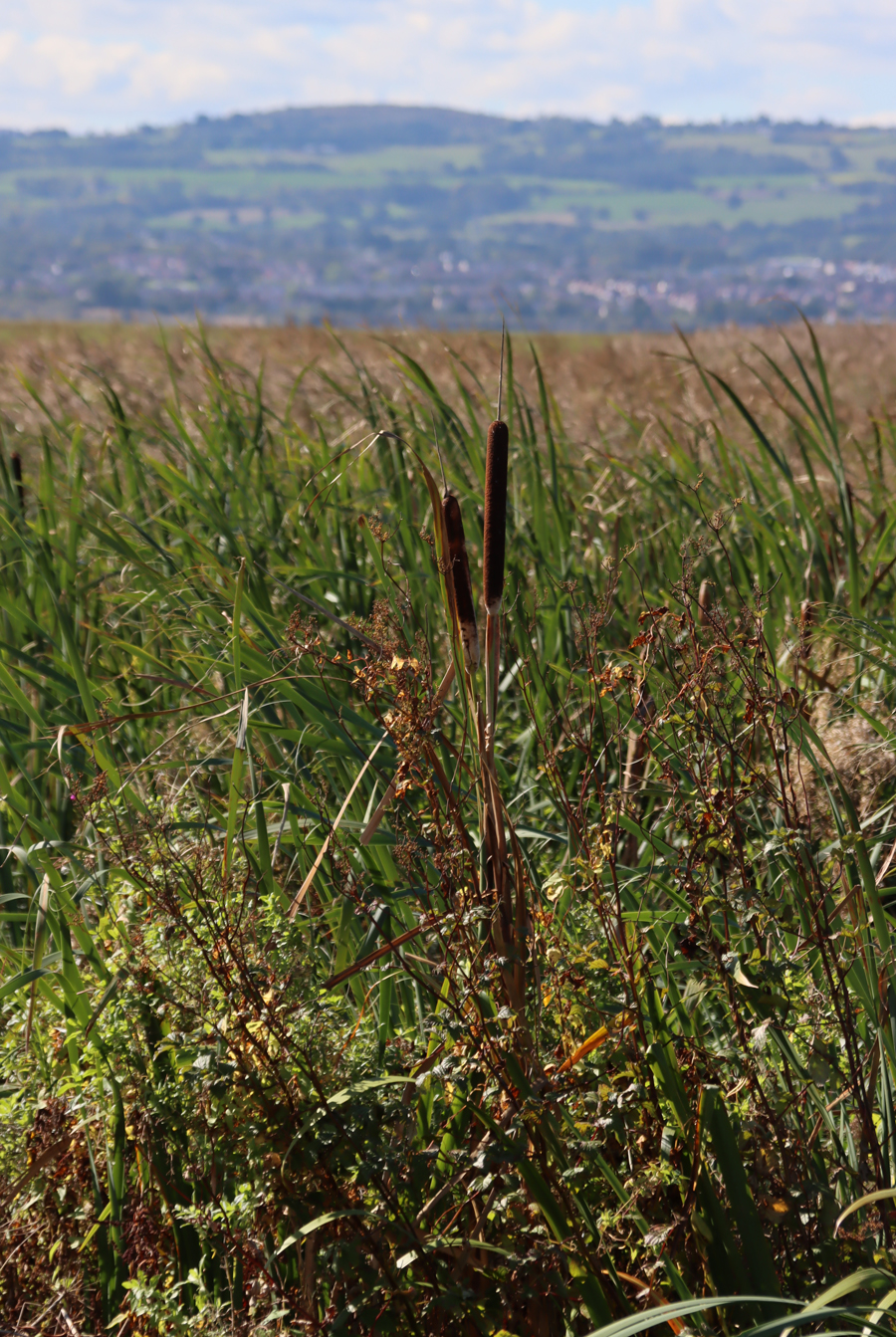
Scenically, the walk is always split between two different experiences to left and right.  The views across both wetlands and former wetlands to the Welsh foothills to the southwest are lovely on a sunny day, and you can keep an eye open for bird life.  On the other side of the path, immediately hugging its edges, there is an almost uninterrupted run of very fine hedgerows and trees.  At this time of year there is not a great deal to see on the estuary, although I was delighted to see lovely white egrets in a distant blue pool, as well as a couple of birds of prey hovering splendidly overhead. Most of the flowers in the estuary have gone over, but the autumnal leaves, berries, rose-hips and other fruits of the shrubs and hedges and the multiple colours of the changing leaves on trees along the paths were endless and superb, really gorgeous against a blue sky with the sun shining on them.

xxx

Nearing Neston I spotted a line of vast red sandstone blocks extending out into the estuary vegetation, and a small spur of land also extends out at this point.  An information board explains that this is part of the Neston Colliery, Denhall Quay.  There is a particularly good book about the collieries, The Neston Collieries, 1759–1855: An Industrial Revolution in Rural Cheshire (Anthony Annakin-Smith, second edition), published by the University of Chester, which I read and enjoyed a few years ago.  The sandstone blocks are massive, and as well as retaining original metalwork, one of them has become a memorial stone, as has one of the trees on the small spur of land.  The line of sandstone, now a piece of industrial archaeology, is a very small hint of the extensive work that once took place here, but is an important one.  The author of the above-mentioned book refers to it in a short online page here, from which the following is taken:

There are still some signs today of the old mining operations. Most prominent is Denhall Quay, the remains of which still jut out into the Dee Estuary. This was built in 1791 and was used to ship coal to North Wales, Ireland and occasionally to foreign countries, as well as inland via newly-built canals.  Also, if you know where to look it is possible to trace the location of many of the shafts that were once in use, including one hidden behind a brick wall in Riverside Walk. Easier and arguably more rewarding to find is The Harp Inn! The building was standing in the mines’ earliest days and records show it was a public house for the miners no later than 1813 and probably much earlier. It has several photos on its walls from the mines’ later days.


This is the point that I turned around and walked back. The image immediately above the  map shows point where the Parkgate Spring emerges, very audible but  not actually visible.


xxx

There are very few places to sit down along the walk, so I would recommend that if you need to rest your legs occasionally, you take your own portable seating.  Regarding refreshments, I have mentioned Net’s Café, near the Burton end.  I haven’t visited and apparently there’s no website, but it is just off Denhall Lane and it is listed on Trip Advisor here.  There is also a very good pub called The Harp, which I actually have visited, with outdoor tables immediately overlooking the wetlands towards the Welsh hills, just outside Little Neston.  The food being served there looked excellent, and I can give a solid thumbs-up for the cider.  The pub was particularly well situated for my return from Parkgate as the zoom lens on my camera, a particular beauty that has been worryingly on the twitch for weeks, suddenly stopped working and was now, just to ram home the overall message, rattling.  A glass of cider and a seat in the sun were perfect for jury-rigging the wretched thing so that the zoom now worked like an old-fashioned telescope and the camera’s autofocus, which was refusing point-blank to engage in conversation with the lens, could be operated manually on the lens itself.  Sigh.  New lens on order.

If you can do this walk in September when the berries are at their best, do take the opportunity, because it is stunning, particularly on a sunny day.  And all on the flat too, so entirely appropriate for unwilling legs.
xxx


Open Day of the CRAG excavations at Bryneglwys, Llantysilio Mountain

Many thanks to the Clwydian Range Archaeology Group (CRAG) for organizing an Open Day to the Bryneglwys excavations on 9th August 2025, and to Dr Ian Brooks of Engineering Archaeological Services (EAS), who is consulting for CRAG, for an excellent guided tour of the Bryneglwys archaeological site.  The volunteer excavators, all CRAG members, were remarkably tolerant of us peering into their trenches as they worked.  Thanks are due too to Dr Pauline Clarke for arranging for Chester Archaeological Society members to visit.  The site is on private land, so visits are by invitation only, and it was a great opportunity to get a feel not only for the pioneering nature of the excavations, but also for the way in which that particular landscape has been used over long periods of time.  I attended with another CAS member, Helen Anderson, and we both enjoyed it enormously.

The site sits on the west-facing lower slopes of the Llantysilio mountain near Bryneglwys, with views both across the valley and down the valley towards the southwest.  Unlike the Clwydian range, which runs broadly north to south, with a tilt towards the east, the main line of the Llantysilio mountain runs roughly northeast to southwest, with the valley of Afon Morwynion along its western edge, crossing below the end of the Clwydian Range. It is now followed by the A5104 from Llandegla to Corwen, with the A494 picking up the route of the River Dee, and following it to Bala and Lake Tegid, and beyond into midwest Wales.  This has almost certainly been an important route connecting northern and middle parts of Wales with the English northwest at least since the end of the last Ice Age, with Iron Age hillforts standing prominent guard over much of the route.

The undulating Llantisylio mountain rising above the village and site of Bryneglwys, its ridge marked by a prominent modern trackway

Research goals

When it was established, the remit of the Bryneglwys project was partly to investigate potential sites identified by the landowner, a keen supporter of the excavations.  It was thought that at least one of the sites might be an early-mid Bronze Age cairn.  As sites from the period are an important aspect of  northeast Wales, and there are very few known from the Llantysilio mountain, this was an opportunity to improve knowledge on the subject and extend an understanding of how these sites were distributed both locally and in northeast Wales.  Given the relative proximity of two Iron Age hillforts.  Given the proximity of an Iron Age hillfort, it was not out of the question that Iron Age data might be recovered.

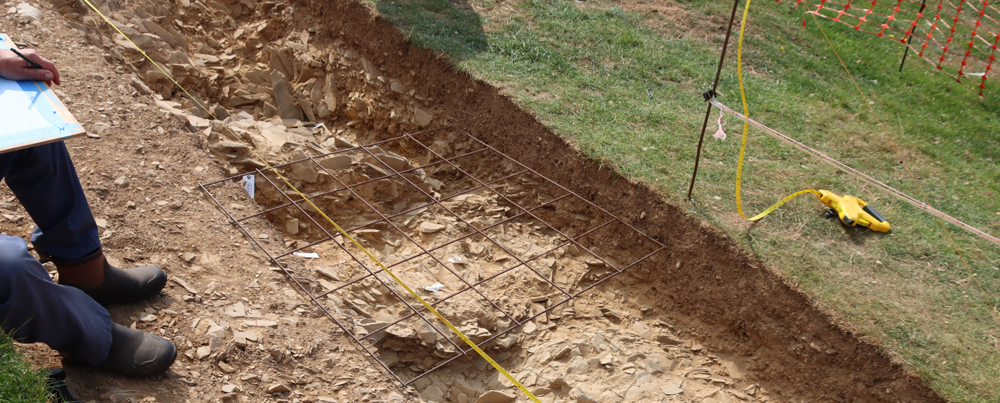
View to the west of the lower Bryneglwys excavation area

The medieval history of the area was also taken into account.  Bryneglwys village is first mentioned by name in documents in 1284.  Its church, which dates to the late 15th or early 16th century, contains a 14th century slab.  Not far away, just outside Llangollen are the ruins of the 1201 the Cistercian abbey of Valle Crucis, established in 1201 and forced to close in 1537, which may have owned farm property in this location.  The economic activities of Valle Crucis Cistercian monastery near Llangollen are not well documented and any archaeological evidence contributing information would obviously be useful.  The Clwyd and Powys Archaeological Trust (CPAT) report on the subject of granges in northeast Wales collated the information available, but is far from definitive on the subject, and it would be very useful to know if a grange had indeed been established in the Bryneglwys area.

Finally, as usual in rural landscape investigations, seeing what else turned up in the process, including far more recent use of the landscape, was very much part of project scope and has produced some interesting results about changes agricultural land use and the challenges of dealing with drought conditions.
xxx

Survey and excavations

Initial surveys

The Bryneglwys project has produced some revealing results touching on some if not all of these areas of interest.  The initial investigation focused on non-invasive topographical and geophysical surveys, the combination of which determined where the initial excavations should take place.  The topographical investigations located areas where potential archaeological and historical features are visible to the eye, including field boundaries, trackways, a natural spring uphill from the known archaeological features, and evidence of ridge-and-furrow agriculture.  The online resource Archwilio was employed to supplement ground-level observations by providing a birds-eye view of the location.  The geophysical surveys, allowing the team to assess what might lie beneath the surface level, identified features that seemed non-natural and might be man-made.  The excavations have been following up on some of these initial investigations.

Like the Clwydian Range, the Llantisylio mountain has a ridge that is now covered in moorland scrub, although the remains ridge and furrow ploughing show that it was cultivated during the Middle Ages.  The lower slopes at Bryneglwys, having been cultivated and/or grazed for centuries, are largely fee of moorland scrub.  The geological bedrock over which all the Bryneglwys excavations are located is composed of the same cleaved Silurian siltstones that I mentioned on my Dinas Bran post, and look horrendous to excavate.  The current excavations have been taking place either side of a boundary marked by a low turfed stone wall topped with shrubs dating from at least 1740, fields that are now used for herding sheep, although they were ploughed in the past.  Although there were findings of a few Mesolithic tools, which are often found in the area, the main discoveries were far more substantial.

Bronze Age ring cairn and associated finds

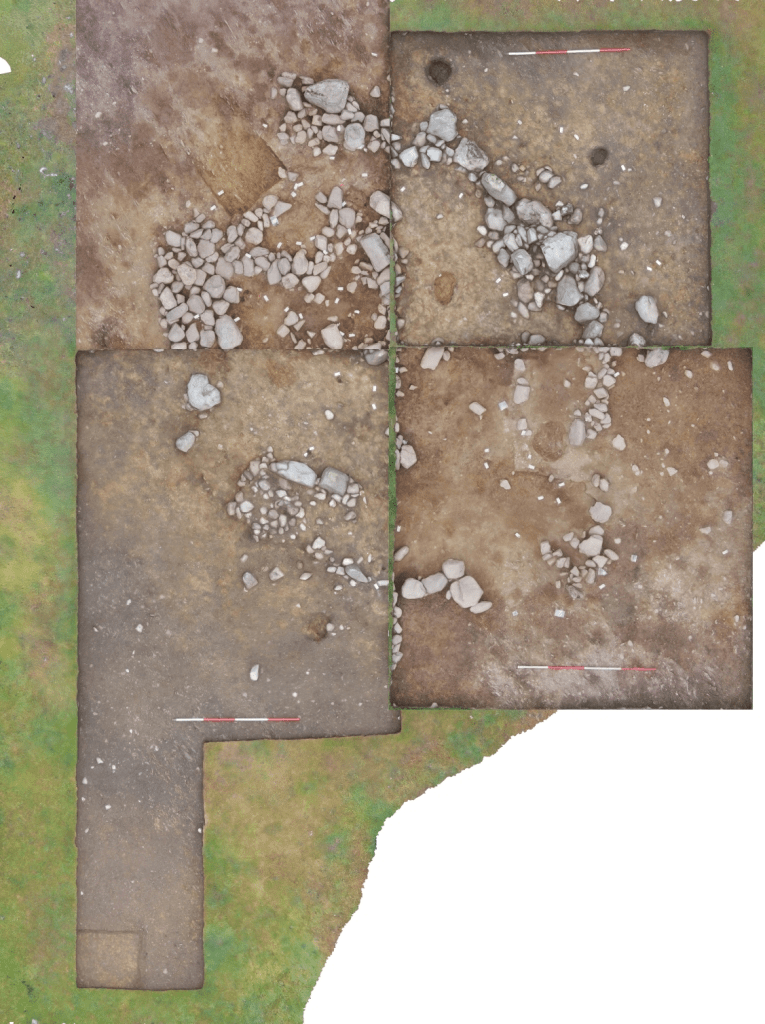
Bryneglwys composite photographs of the ring cairn, excavated over two seasons. Source: Clwydian Range Archaeology Group

On the upper side of the boundary wall, the furthest away from the valley floor, the most exciting find to date has been the discovery of a Bronze Age ring cairn, the diameter of which was around 7m.  All four quadrants were excavated over two seasons,

It is thought that the monument probably started life as a small stone circle with upright stones, some modified, and that the structure was later adapted into a banked ring into which the cremated bones and artefacts were deposited on a clay base before being topped with a low cairn.  There were four other deposits of cremated bone and charcoal.  The repeated use of cairns is a normal for the period, indicating the importance of these sites from one generation to the next.

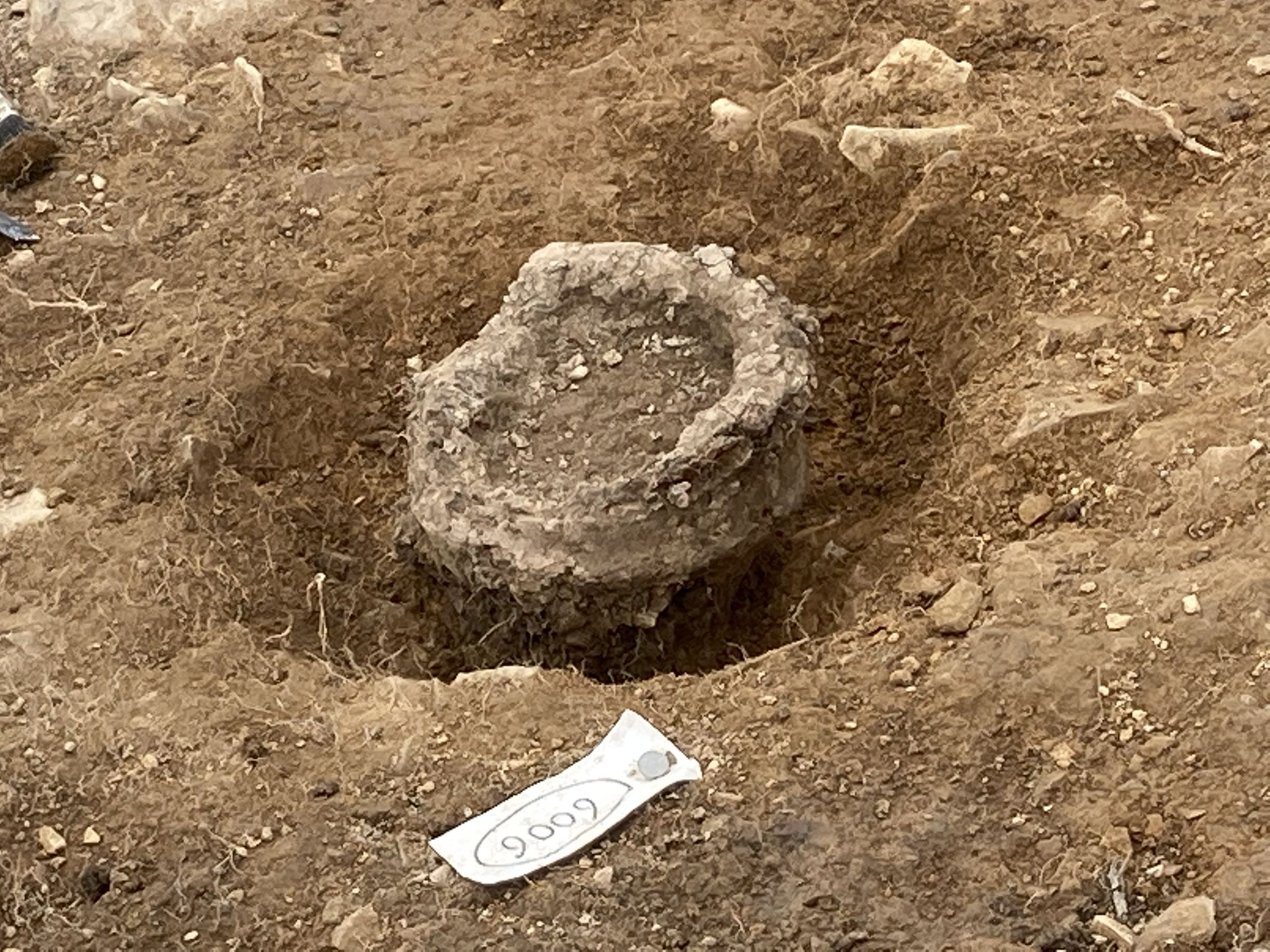
The cremated human remains were found together with some pieces of pottery.  One of these was a large but very poorly fired piece around 120mm in diameter, found upright in the ground just outside the main ring of boulders.  The rim was missing, probably due to plough activity.

Pottery vessel as it was found at the ring cairn, Bryneglwys. Source: Clwydian Range Archaeology Group


Although this poorly fired vessel with the rim missing does not look particularly exceptional today, it must have been an important contribution to the ring cairn


There were also around 40 sherds of other pottery in the cairn accompanying the cremated remains, some with attractive cord-impressed designs that were perhaps intended emulate basketry.


Pottery sherds from Bryneglwys ring cairn. Source: Clwydian Range Archaeology Group

xxx
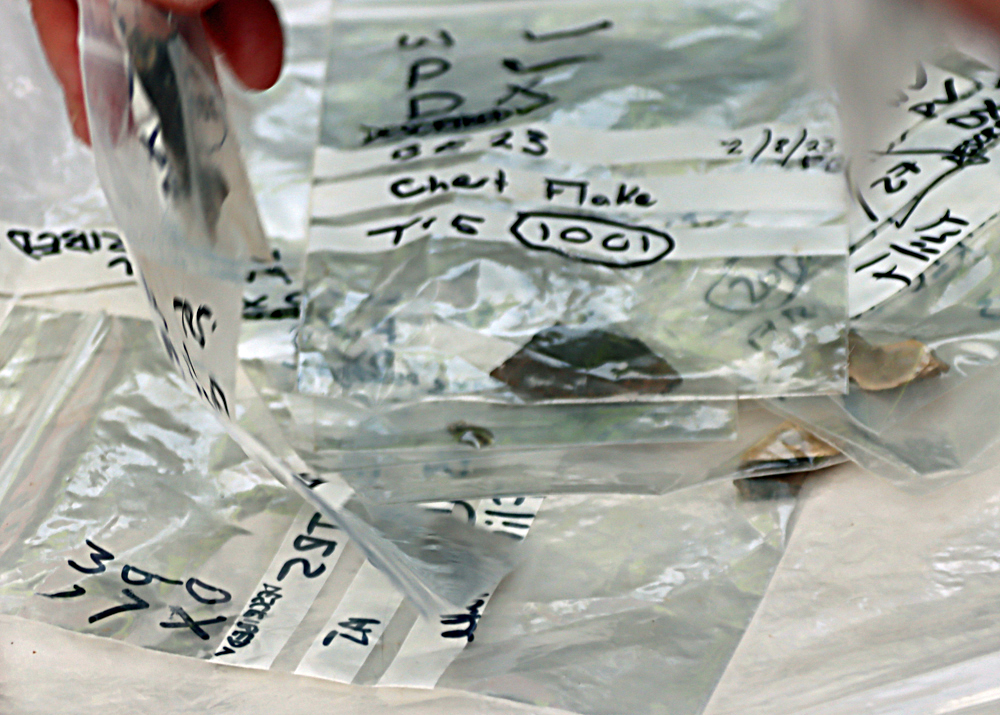
One of the cremations was deposited in a circle of stones, which was deposited with a quartz crystal and one of two flint arrowheads found at the site.  There were a number of tools made on flint and chert, including two barbed and tanged arrowheads, thumbnail scrapers and a small knife blade.  The flint was very fine and may have been imported.  Tools made on chert were also found.  As well as those in the ring cairn itself, there was also a flint scatter which is at present focused around the ring cairn.   The amount of flint has been unusual for the area, and is of particular interest.
xxx

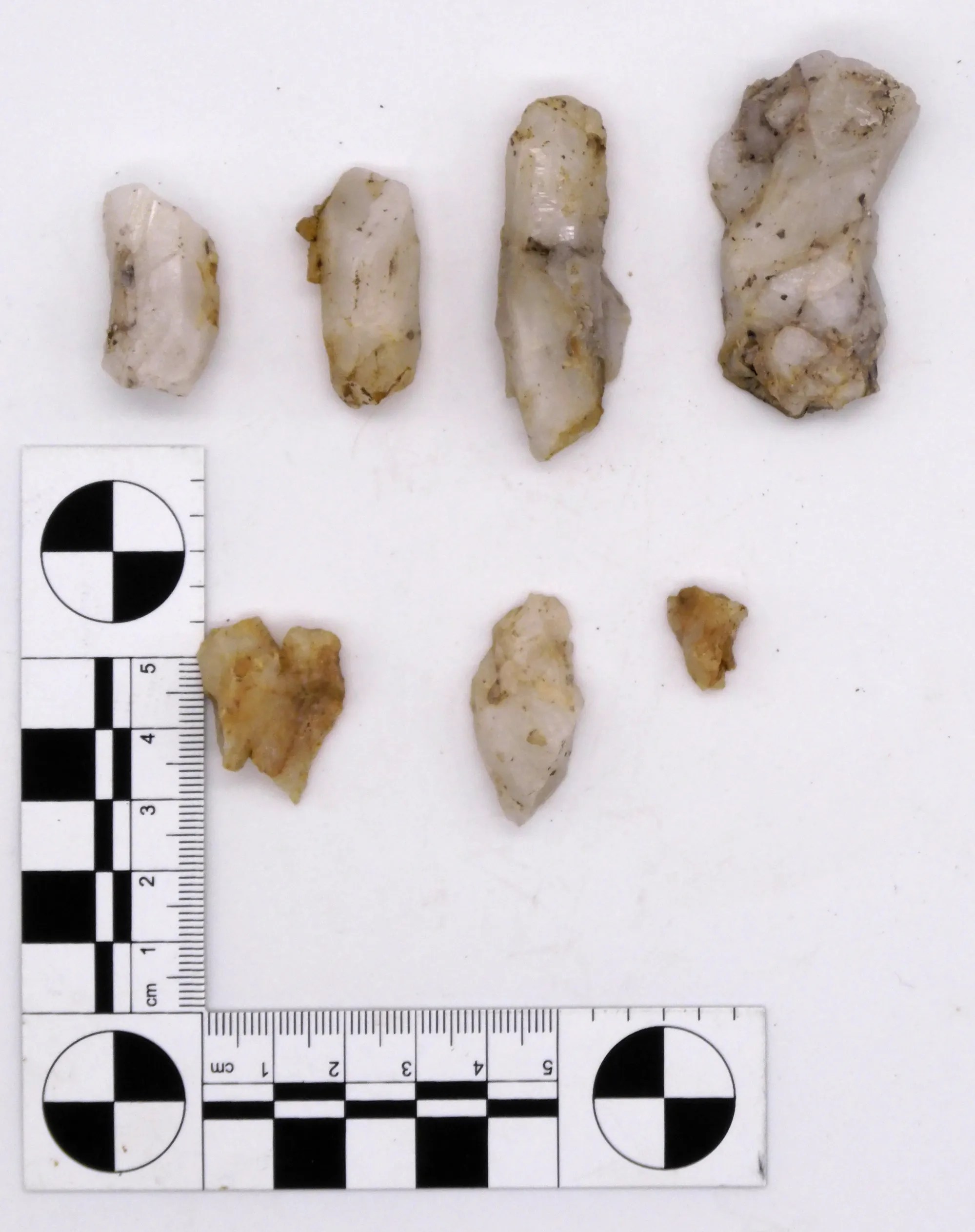
Remarkably, over 150 pieces of quartz were found in and around the circle, and include a range of different forms and types.


A sample of some of the quarts items found in the ring cairn. Source: Clwydian Range Archaeology Group

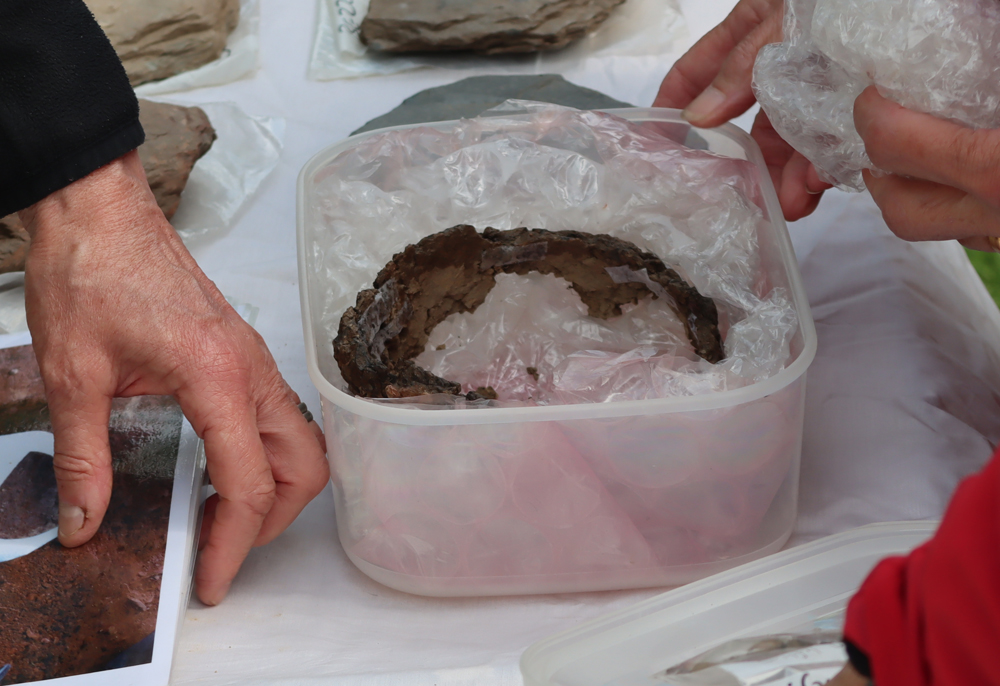
There were also a large number of other more general-purpose but important tools  like hammer stones and shale disk-shaped items, the function of which is uncertain but look rather like lids.  Most of the finds from the site are currently on show at a temporary exhibition in the Llangollen Museum but some were on display on a table in the field serving as a car park, together with photographs of those on loan to the exhibition.

The volume of finds in the site has clearly been both rewarding and very informative, providing new insights into the funerary and ceremonial tradition in the area.   The site has now been refilled.

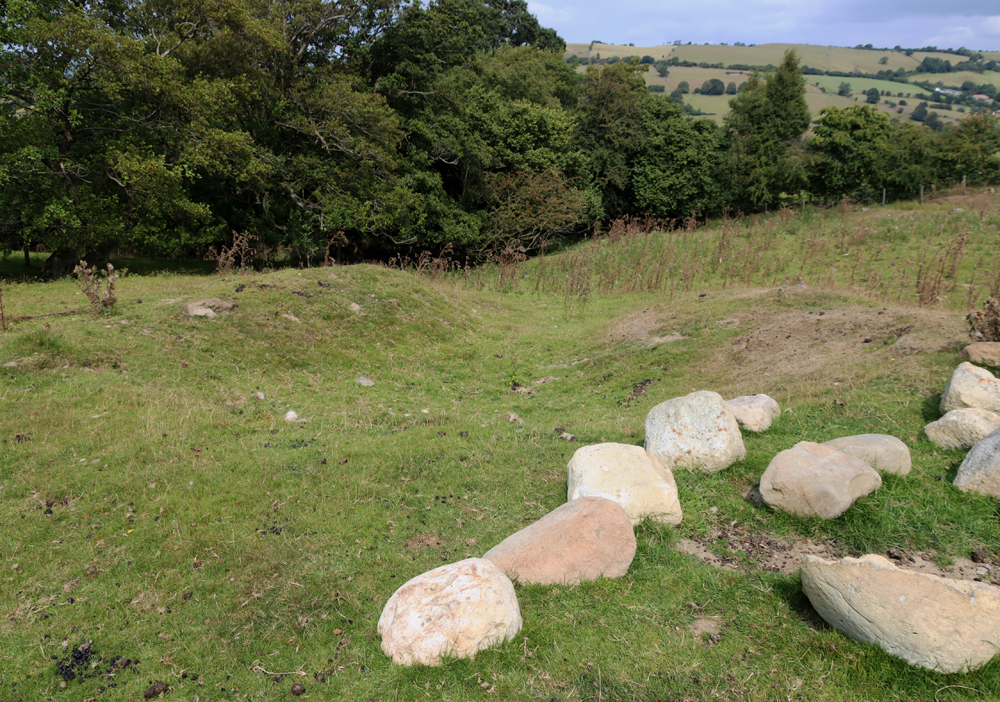
Standing on the refilled excavation of the ring cairn, looking towards the southwest

As ring cairns are rarely found in isolation, the team immediately went looking for similar sites, and a little to the south opened a sample trench, which has unearthed the foundations of another circular cairn which needs to be fully excavated in order to reveal more details.

Lines of sight are an important element of landscape archaeology.  Because so little is known about what, if any, contemporary sites may have been located in the vicinity, this cannot yet be achieved.  Another reason for its position, however, may have been the views from across the valley to the west and down the valley towards Rhug, with distant hilltops figuring as prominent markers not only as landmarks in their own right but also as markers of important routes below that ultimately lead to northwest and midwest Wales, including the Cadair Idris and Snowdonia areas respectively.  The later hillforts, dating to the late Bronze Age and Iron Age that adorn some of these hilltops are indications of the importance of these routes and of the need to protect resources.

The horseshoe feature

The horse-shoe shaped feature, with boulders along one of the banks. Excavated but not yet understood, radiocarbon dates should at least help to establish when it was constructed

Another site that was excavated and has now been refilled was a horse-shoe shaped feature defined by a bank with what looked like an entrance interrupting it on its western side.  Apart from a small group of stones, a large one of which seems to have a cup mark, and some evidence of burning on the flat floor of the feature, this nearly sterile. Sufficient burnt debris has survived to be sent for radiocarbon dating.  Photographs of the cup-marked surface have been sent to an expert on the subject and it seems probable that this is indeed an example of a form of stone marking common to upland areas during the Bronze Age.

The horse-shoe shaped site produced what is probably a cup-marked stone. Source: CRAG Facebook page

The other excavated areas

In the final days of this year’s work, during which further geophysical survey has been carried out, three excavated areas were opened on the basis of previous geophysical survey results, and were being worked on by volunteers during our visit.  At the moment it is not at all clear what the features uncovered represent, and nor is it known when they may date to.  A piece of medieval pottery from one of the trenches is not particularly informative.

Although it would be very nice if some information about land management during prehistoric and medieval periods became available, this is clearly some way off at the moment, but by no means out of the scope of the project should it gain future funding.
xxx

General Context

There is no mention of the Llantysilio mountain in my fairly thorough collection of books about prehistoric Wales, and looking at the Ordnance Survey map, there are only two archaeological sites marked in the vicinity, both Iron Age hillforts.  One of these is Moel y Gaer, about 2km as the crow flies, but uphill all the way, roughly east from Bryneglwys village (not to be confused with either of the two of the same name on the Clwydian Range).  The other is Caer Drewyn (about which I have posted here) and is around 7km to the southwest.  The usually helpful Megalithic Portal had nothing else to add.  Archwilio is somewhat more informative, but makes it clear that this is still an area that is surprisingly short on recorded prehistoric data when compared with, for example, the Clwydian Range or the nearby Eglwyseg mountain.  Further information is provided by Heneb, which comments that there are “Bronze Age hilltop burial monuments on Moel y Gamelin and Gribin Oernant” (on their Llantysilio Mountain HLCA 1142 page).

The Archwilio website shows possible sites (unexcavated) in the Bryneglwys area, as well as the Iron Age hillfort Moel y Gaer (not to be confused with those of the same name on the Clywdian Range)

This emphasis on the survival of cairns and ceremonial sites in the archaeological record is typical.  Settlement data is very thin on the ground anywhere in Britain, because having been built in perishable materials, they have decayed into the ground.  Archaeological data is therefore skewed towards funerary sites, which probably also double as statements of identity and territorial affiliation.  Ceremonial sites are known throughout Wales, although in northeast Wales these are rarely found.  The function of henges (banked and ditched enclosures, with ditches on the inside) and stone or timber circles seems, in northeast Wales, to have been either irrelevant or was incorporated into cairn designs, like ring cairns, that combined funerary and ceremonial functions.

Distribution of round barrows and cairns in Wales after c.2100BC – c.1600BC. Source: Burrow 2011, p.106

Looking in general terms at the early to mid Bronze Age of northeast Wales, beginning a little before 2100BC and lasting to around 1600BC, there are plenty of round cairns on the Clwydian range, the Eglwyseg range, and Ruabon mountain, apparently coinciding with improvement in climatic conditions.  Writing in 2004 Steve Burrows noted that a survey by Cadw had identified 17 cairns on the Clwydian Range alone; and more have been identified since then.  These are just a small sample of the 1000s that have been found throughout Wales as a whole.  It is interesting to note that most of these are on, rather than above, worked land.  Although most of those remaining are on uplands, the presence of lowland and valley bottom locations indicates that even though many of those on land attractive to more recent farmers may have been ploughed out, they were certainly there.  On the least attractive land for cultivation, pastoral herding was probably favoured, requiring smaller groups and greater mobility for at least part of the year.

Most of the remains interred in cairns are cremated, and represent a tiny proportion of the population, indicating that communities were singling out particular individuals for burial.  Where sufficient bone has been preserved amongst the cremated remains, it has been determined that these may be adults, children or infants, male and female.  The presence of children may or may not suggest that a sense of family lineage was involved.  Unfortunately DNA testing techniques are problematic and so far no familial connections have been proved within Bronze Age cairns in Britain.

Barbed and tangled arrowhead from the Bryneglwys ringcairn. Source: Clwydian Range Archaeology Group

Grave goods accompanied many, but not all of the interments.  The Bryneglwys ring cairn burials were accompanied, probably added at different times, with pottery and flint tools and flakes, but some sites have produced no objects, whilst others contained more elaborate items.  The single most famous example of a grave object dominating the narrative is the Mold Cape (about which I have posted previously here) but less remarkable sites include some well preserved pottery, quantities of well-crafted stone tools and some objects made of copper and bronze.  Flint tools may seem more mundane, but many were beautifully crafted and, in the case of flint, the material itself may have had a certain amount of status.  Some raw flint can be found on beaches and in glacial deposits, it is only rarely of high quality, suggesting that where fine flint is found, like the Bryneglwys flint used for tool manufacture, it could have been imported.

In terms of landscape use in northeast Wales the proliferation of cairns suggests there was a requirement for display of belief and ideology, and perhaps identity or territoriality, in the positioning of highly visible funerary monuments in land that could also be employed for either crop growing or pastoral herding.  Although the western valley, slopes and heights of the Llantysilio mountain have not revealed much information about land use in the Bronze Age, the Bryneglwys excavations are beginning to add to this wider regional  knowledge base of information.


xxx

Final Comments

The mapped Llantysilio site data suggest that although the current Bryneglwys excavations by CRAG are not in completely virgin territory, there are considerable gaps in knowledge and the work is  pioneering in terms of starting to do a professional job of opening up the landscape archaeology of the Llantysilio mountain area.  There’s real knowledge buried in them there hills.

For those interested in exploring further, the Bryneglwys excavations are being carried out on private land, but to get a sense of the landscape there is a track across the Llantysilion mountain, taking in Moel y Gaer hillfort and offering wide views of the surrounding hills and valleys, which can be approached from the Horseshoe Pass.  Bryneglwys itself is bisected by the Welsh Cistercian Way, a modern creation, but an interesting one that focuses on monastic sites in Wales and is featured by the British Pilgrimage Trust.  The site is also located just south of the line of the 122 mile (196km) Clwydian Way, a long-distance walking trail that was established by members of the Ramblers’ Association as a Millennium Project in 2000.  Website links below.

Thanks again to the team for a great visit.
xxx


Sources

The guided tour by Dr Ian Brooks (Engineering Archaeological Services on behalf of CRAG) on 9th August 2025 was the primary source of information about the excavations, with particular thanks to Dr Brooks for taking time out of his busy life to go over my first draft and suggest corrections, and for forwarding CRAG suggestions regarding my account of the ring cairn excavation.  Much appreciated!

The Ordnance Survey map for this area is the Explorer 256, Wrexham and Llangollen


Books and papers

Brown, Ian. 2004. Discovering a Welsh Landscape.  Archaeology in the Clwydian Range. Windgather Press

Burrow, Steve. 2011.  Shadowland. Wales 3000-1500BC. Oxbow / National Museum of Wales

Jenkins, David A. 1991.  The Environment: Past and Present. In (eds.) John Manley, Stephen Grenter and Fiona Gale. The Archaeology of Clwyd. Clwyd County Council

Jones, Glanville 1991. Medieval Settlement. In (eds.) John Manley, Stephen Grenter and Fiona Gale. The Archaeology of Clwyd. Clwyd County Council

Lynch, Frances, 2000. The Later Neolithic and Earlier Bronze Age.  In (eds.) Frances Lynch, Stephen Aldhouse-Green and Jeffrey L. Davies.  Sutton, p.79-138.

Pratt, D., 2011. Valle Crucis abbey: lands and charters. Transactions of the Denbighshire Historical Society 59, p.9-55

Williams, D.H., 1990. Atlas of Cistercian Lands.  University of Wales Press
xxx

Websites

(in order of usefulness for this topic)

Clwydian Range Archaeology Group
Website
https://cragnorthwales.wordpress.com/
Facebook page
https://www.facebook.com/CRAGNorthWales

CBA Newsletters
No. 64. Autumn 2022:
Excavation of a Ring Cairn at Bryneglwys, Denbighshire From CBA Wales 
https://cragnorthwales.wordpress.com/wp-content/uploads/2023/03/newsletter-report-in-publisher.pdf
No. 66. Autumn 2023:
Excavation of a Ring Cairn at Bryneglwys, Denbighshire (Part 2) by The Clwydian Range Archaeology Group (CRAG), p.13-15
https://cragnorthwales.wordpress.com/wp-content/uploads/2024/01/20231017-cba-wales-newsletter-66-autumn-2023.pdf

Clwydian Range and Dee Valley
The Dee Valley
https://www.clwydianrangeanddeevalleyaonb.org.uk/projects/the-dee-valley/

Archwilio
Denbighshire (search under “Bryneglwys” to centre in on the area)
https://archwilio.org.uk/her/chi3/arch.php?county=Denbighshire&lang=eng

Clwyd and Powys Archaeological Trust (CPAT)
CPAT Report No. 1340. The Monastic Granges of East Wales. A Scheduling Enhancement Project. By R.J. Silvester and R. Hankinson, March 2015
https://coflein.gov.uk/media/241/979/652240.pdf
Historic Settlements in Denbighshire. CPAT Report no.1257
. By R.J. Silvester, C.H.R. Martin and S.E. Watson, March 2014, p.14-15
https://coflein.gov.uk/media/287/517/652224.pdf

Coflein
Moel y Gaer hillfort, Llantysilio mountain
https://coflein.gov.uk/en/site/306813/

Heneb
Llantysilio Mountain, Brynegleys, Corwen and Llantysilio Communities, Denbighshire (HLCA 1142)
https://heneb.org.uk/hcla/vale-of-llangollen-and-eglwyseg/llantysilio-mountain-brynegleys-corwen-and-llantysilio-communities-denbighshire-hlca-1142/
Llantysilio Mountain and Moel y Gaer Hillfort
(walk and background history)
https://heneb.org.uk/archive/cpat/walks/moelygaer.pdf

Megalithic Portal
Moel y Gaer, Llantysilio
https://www.megalithic.co.uk/article.php?sid=14086

Based In Churton
Who was Brymbo Man, what was the Mold Cape and why do they matter? (3-part series)
https://basedinchurton.co.uk/2023/03/18/part-1-who-was-brymbo-man-what-was-the-mold-cape-and-why-do-they-matter/
Caer Drewyn, Corwen
https://basedinchurton.co.uk/2023/09/11/sunshine-and-great-views-at-caer-drewyn-iron-age-hillfort-at-corwen/
Valle Crucis Cistercian Abbey
https://basedinchurton.co.uk/2021/11/23/monastic-northeast-wales-and-west-cheshire-2-valle-crucis/

The British Pilgrimage Trust
The Welsh Cistercian Way
British Pilgrimage Trust
https://www.britishpilgrimage.org/portfolio/welsh-cistercian-way
The Welsh Cistercian Way on Google
https://www.google.com/maps/d/viewer?mid=1nDf0d1rqf5P5uWJDDYvg2i8L8Lo&hl=en&femb=1&ll=53.02208569877805%2C-3.2900072936767533&z=15

The Clwydian Way
This area lies in section 9, but note that to follow the trail requires a paid subscription to the Ordnance Survey online.
https://www.clwydianway.co.uk/

Engineering Archaeological Services Ltd
http://eas-archaeology.co.uk/

The site of the ring cairn, refilled after the excavation

Thanks to Helen Anderson for this photograph of the 11am Open Day group standing by the ring cairn and the scene towards the southwest in the distance (copyright Helen Anderson)

The fabulous nature reserve at the RSPB’s Burton Mere Wetlands

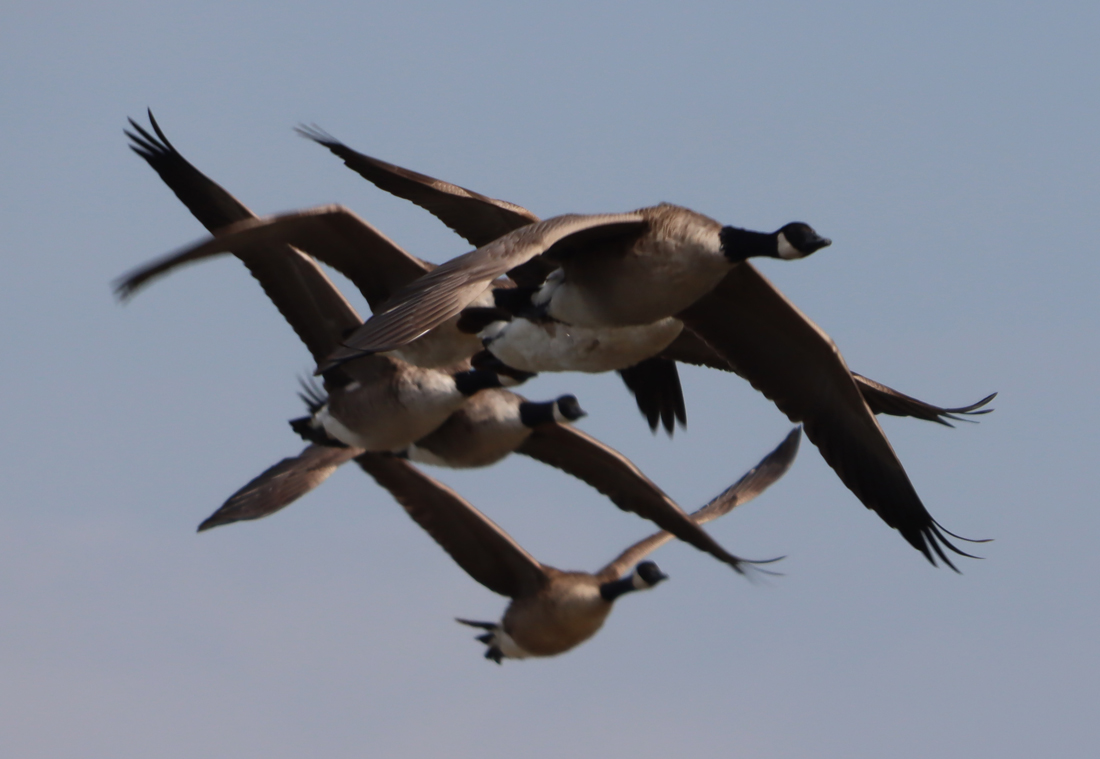
Flying Canada Geese at the RSPB's Burton Mere wildlife reserveWhen I got up this morning and saw what a beautiful day awaited, I decided on the spur of the moment to go to the RSPB nature reserve on the Dee estuary at Burton.

Burton village, well-kept and firmly manicured, is located on the southwest of the Wirral, about 20 minutes drive out of Chester, an area now better known for giving its name to the nearby wetlands.  The wetlands are divided into two separate entities.  The first is the splendidly well organized and laid out nature reserve operated by the Royal Society for the Protection of Birds (the RSPB) which was specially set up for the benefit of birds and bird watchers, but accommodates general visitors too.  There is also a route through the wetlands on the far side of the RSPB reserve, and extending well beyond it, which is the Sustrans route number 568, developed for cyclists but welcoming walkers. It crosses the wetlands from Connah’s Quay, meeting the Wirral peninsula at just above Burton Point, and continuing on to Neston.  They provide two very different but both marvellous experiences of the wetland scenery.  I have already posted a short piece about my short visit to the Sustrans cycle and walking route in the Burton Point area, although I want to walk the whole thing eventually.

Greylag goose at the RSPB's Burton Mere wildlife reserve


A lapwing stretching its wings, whilst a common sandpiper stands by unimpressed

A lapwing stretching its wings, whilst a common sandpiper stands by unimpressed

The RSPB wetland reserve

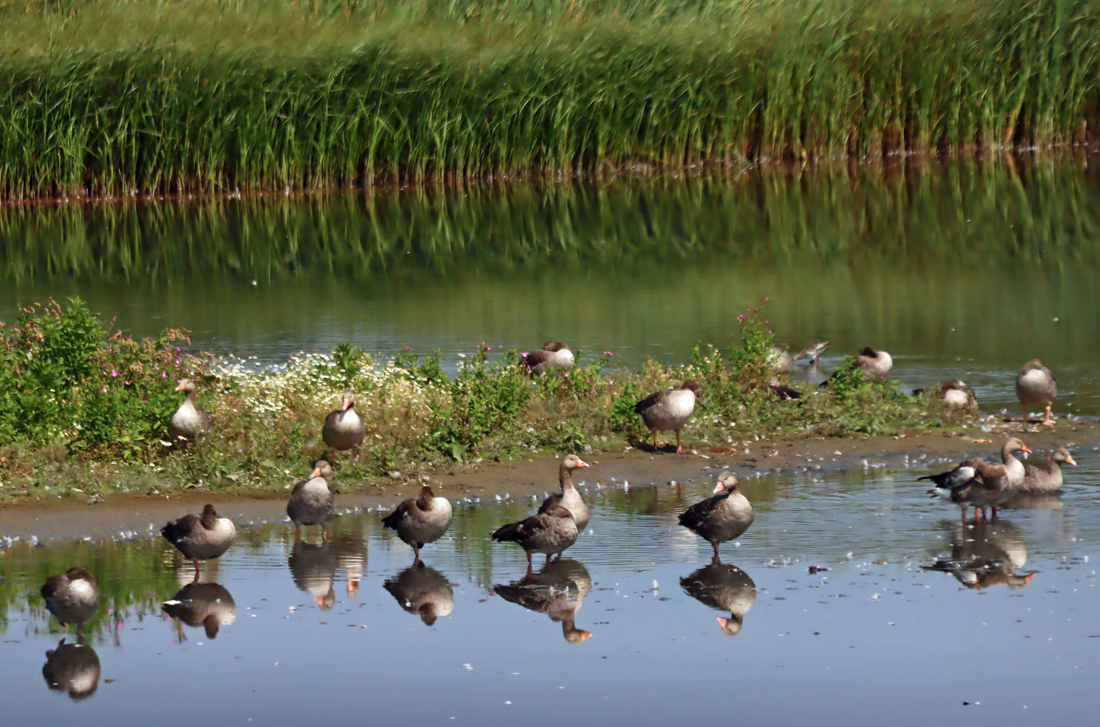
Greylag geese with their bright orange beaks at the RSPB's Burton Mere

Greylag geese with their bright orange beaks at the RSPB’s Burton Mere

Several miles of wetland are enclosed within the RSPB reserve, which attract thousands of birds of many different species, with the river Dee invisible along the far edge of north Wales. The canalization of the Dee, completed in 1737, completely changed the environmental conditions of this part of the estuary, forcing the river to run along the Welsh edge of the estuary.  The canalized channel of the Dee is not visible from the nature reserve, but the miles of wetland are lovely.  There are huge expanses of pond and small lake, as well as flooded wetlands in the distance.  On a bright day with blue skies overhead it is gorgeous.  The reserve backs on to farmland at the rear, includes a woodland walk, and has a very attractive red sandstone railway bridge crossing the tracks below and even boasts the remains of an Iron Age hillfort which, if somewhat puzzling as an archaeological entity, has lovely views along the estuary towards Hilbre Island and across to north Wales.


xxx

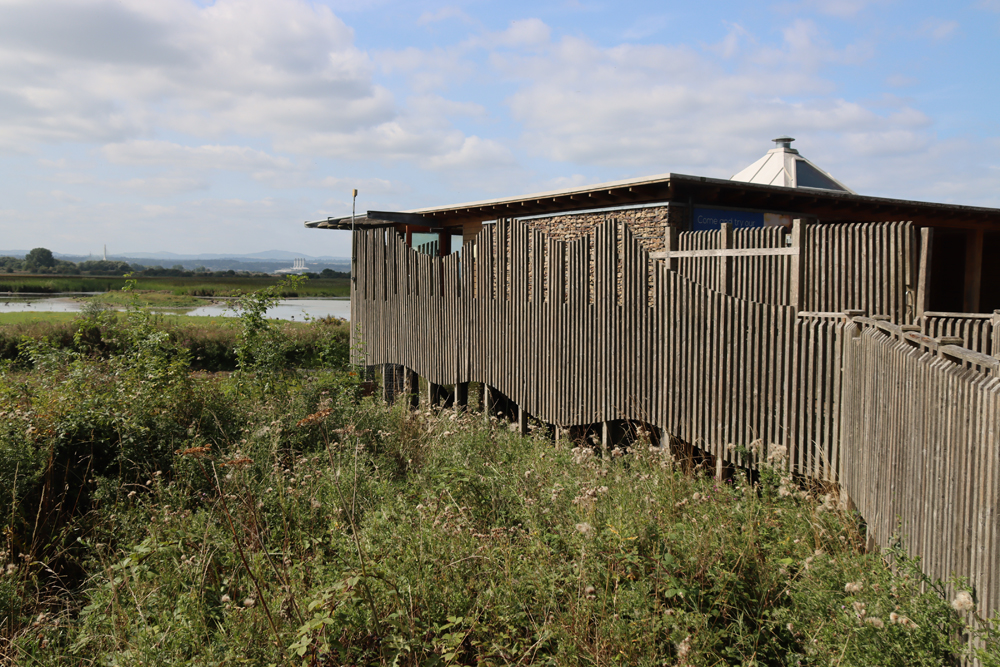
For bird watchers there is an enclosed viewing room where the ticket office is located, and throughout the reserve there are coverts and hides like the one above, all of them with benches, and all with windows suitable for both seated and standing visitors, and there are also viewing screens  and viewing platforms dotted throughout.

For less specialist visitors there are some splendid wending walks through the reserve, where water-loving plant and tree species abound, many in flower or producing berries at this time of year, and all providing a myriad of colours and textures over a base of deep greens and rich browns, which provide excellent resources for insect life.  The plants are so dense that where there is water running beneath boardwalks the water is scarcely visible.


The walks are all nice and even underfoot, many of the boardwalks coated in wire mesh to prevent them becoming slippery, and it is all beautifully maintained.  Being located on the side of the estuary, the nature reserve is nearly all on the flat.  All the main walks are wheelchair friendly, as are the hides and coverts.  There are actually four miles of signposted walks, as well as the woodland walk, which takes about half an hour.  There are plenty of benches dotted around for a moment of relaxation and contemplation.  Burton Point, at the furthest end of the nature reserve, is a tiny headland, which involves walking a short way up a slight slope and an informal footpath, and offers some great views along the estuary.  It is supposed to be the site of a small Iron Age promontory hillfort, but the evidence for this is difficult to see, although an interpretation sign does its best to offer a visualization of how it may have looked.

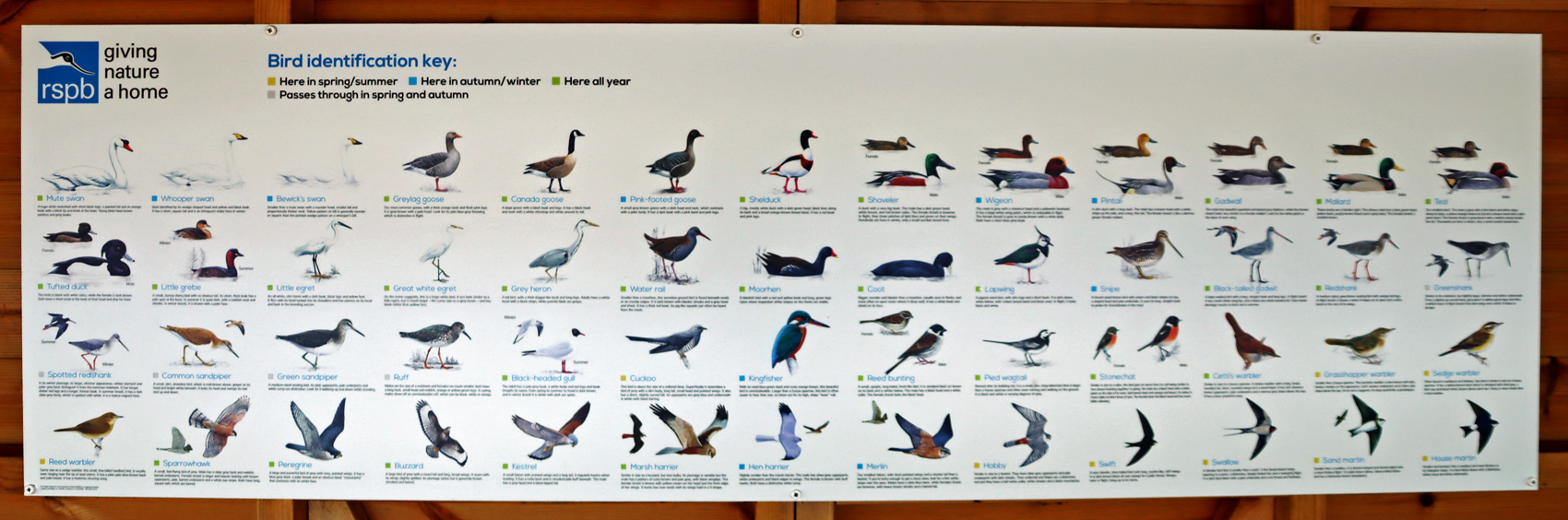
Even if you are not a regular bird watcher, the water birds are fascinating.  There are plenty of information boards showing what you are likely to see, and there is a whiteboard in the reception area showing a list of what has been spotted on a given and previous days.  Binoculars and cameras with enormous lenses (one of them in camouflage colours!) were very much in evidence and I soon found at why – my nice all-round lens, a 28-300mm zoom, was struggling desperately at its top end, and something much more powerful would have been helpful.  Do note that you can hire or buy binoculars from the reception area to get a better view of what birdlife is spending its time on the wetlands.   At this time of year the geese dominate, both in numbers and in voice.  Their honking can be heard wherever you are in the reserve, even when you can’t see them, There were Canada and greylag geese in great numbers, and a handful of Egyptian geese sunbathing on the far side of one of the stretches of open water, but there are plenty of other species too.

Greylag geese at the RSPB's Burton Mere nature reserve

There was something distinctly conversational, and rather cross, going on here, and you should have heard the honking!

Of the smaller water birds, as well as the familiar moorhens, coots and mallards, there were gorgeous lapwings and a variety of small wading birds, with slender legs and long beaks, including a common sandpiper that was distinguished by its rusty coloured plumage.  There were multiple grey herons looking like statues, waiting patiently for unsuspecting fish to swim by, and I spotted some tiny little fish in one of the ponds near the cafe which are presumably a popular part of the herons’ dietary intake.  There must be lots of reed-loving birds hidden in the wetlands, successfully shielding themselves from prying eyes.  There was apparently a spotted redshank, which was causing some excitement among the better informed bird watchers in one covert, but although I followed the directions that a father was giving his son (along the lines of – left of that greylag goose walking in front of that moorhen and then two back and one over) I was unable to spot it.  Bird feeders dotted around were attracting blue tits and great tits in great numbers and there were pied wagtails in some of the many trees that line the edges of some of the paths.  There’s an A-Z of bird species on the RSPB website.

One of many grey herons, on the hunt for unsuspecting fish at RSPB's Burton Mere

One of many grey herons, on the hunt for unsuspecting fish

This is a super place to visit, and seasonal changes in bird and plant life mean that there will always be something new to see, and there are plenty of butterflies, bees, dragonflies, damsonfiles and other insects to observe if you look carefully.  The grasshopper in the image below was particularly well camouflaged, and apparently there are sometimes lizards sunbathing in the sunnier patches.  On Burton Point there are rabbit warrens, and according to some of the signage (much of it directed at children, but still informative to older visitors) the local animals have a vibrant night life.

Spot the grasshopper

Regarding the hillfort on the promontory, Burton Point, there are websites that say that the small headland on which the site is located is privately owned and should not be entered without permission, but this is in fact now included in the RSPB reserve and is served by good footpaths and includes interpretation signage to give visitors some idea of what was here.  I’ll talk more about this site on a separate post.

Burton Point, a low promontory that overlooks the Dee estuary and is the possible site of an Iron Age Hillfort. In this photograph the footpath at far right leads into the woodland, where a vantage point looks down on the fortifications, but you can also see what remains of the fortifications at the far left of the photo where an earthwork is clearly visible

xxx

Visiting the RSPB reserve

Meadow Brown butterfly beautifully camouflaged at the RSPB Burton Mere nature reserve

Meadow Brown butterfly beautifully camouflaged

The RSPB reserve is very easy to find, although if you rely on that Google SatNav, please note that mine, having been asked to find “RSPB Burton” informed us we had reached our destination before we had actually arrived.  Fortunately, if you use the What3Words smartphone ap, which is stupendous (narrowing locations down to metre-sized locations) you can find it at ///readings.sideburns.handicaps.  Other details can be found on the RSPB website which includes the address, postcode, as well as details of the current ticket price and full details about what the nature reserve offers the visitor: https://www.rspb.org.uk/days-out/reserves/dee-estuary-burton-mere-wetlands.

The RSPB site has been very well thought out, and is very welcoming.  A single lane road from Puddington Lane has speed bumps and plenty of passing places, leading to a well-sized car park.  Entrance is via a building with a look-out over the estuary.  The entrance fee is £7.00 at the time of writing (July 2025), which helps to support the charity. There is a nice modern cafe on site, which sells tea, very good coffee, cold drinks and snacks. This is also where the toilets are located.  There is a small shop next to the ticket desk that sells gifts, books and bird food.

I have been following the RSPB Burton reserve on Twitter for a couple of years, without ever having managed to get there, and every day they take a photograph of their whiteboard to give you an idea of what species have been observed recently so that you know what to look out for.  You can find this at https://x.com/RSPB_BurtonMere.  There is a placeholder for them on Bluesky but no content just yet.

I rarely give an opinion about wheelchair use, but there were actually several wheelchairs users out and about today.  It would not be possible to get wheelchairs up to the Burton Point hill fort, or navigate them down one or two of the little tracks that run at the back of the reserve, but all of the coverts and hides are wheelchair friendly and, for both wheelchair users and children, the viewing windows extend from low to high for both seated and standing visitors.  The same comments go for those with unwilling legs.

Dogs are not permitted, and nor are drones.

Excerpt from the RSPB's leaflet about Burton Mere

Excerpt from the RSPB’s leaflet about Burton Mere, showing the top things to do on a seasonal basis


The Burton Marsh cycle and walking route 568 along the Dee estuary, Wirral

In 2013 a track across the wetlands from Connah’s Quay via Burton Point to Neston was opened.  As part of the Sustrans cycle network it is known as Route 568 or The Burton Marsh Greenway, and an information board at the point where the route meets Station Road (see map at end) says that this section is now also part of the “King Charles III England Coast Path.”  This section of the route, Burton Marsh, is partly made up of metalled lane, and partly boardwalk, and is a terrific walk.  I had never heard of it until I was standing in what remains of the hillfort on Burton Point headland, part of the RSPB reserve, and saw it passing almost at our feet and beyond into the distance.  It is an extraordinary sight, a mainly straight track across the landscape, and such a brilliant idea.

I parked on the section of Station Road that runs parallel to the estuary, which is part of the cycle route to Chester, and is separated from the rest of the Burton Marsh stretch of track by a gate to keep the sheep in.  There’s a map showing where the parking is located towards the end of this post.  This walks is all particularly beautiful on a sunny day with a blue sky stretching to the horizon. A shifting sky, which one moment produced sun and the next light shade, brought out the textures and colours for miles around.  Because the estuary is so flat and vast it can be very breezy or windy, which was no bad thing on a particularly sticky July day!


I headed through the gate in the Chester direction.  Starting out from this point you are on a metalled lane and have fields rising on your left, currently planted with palest yellow barley, whilst on your right are marshland habitats stretching all the way to the river Dee running along the Welsh side of the estuary, with every shade of green you can imagine, dotted with bright clumps of flowering plants and layer upon layer of different textures.

The barley fields are soon replaced by a fairly short red sandstone cliff edge, which has been heavily quarried over the centuries.  Where this red sandstone becomes much more uneven and comes out towards the lane, there is a sign on your right that explains that here are the remains of an Iron Age hillfort at the top of this small headland.  This is fenced off, as it is RSPB land.

Burton Point

The lane pulls away from the headland heading out into the wetlands, and soon you find yourself on a long section of boardwalk, which rattles splendidly when cyclists come along, with the marsh habitats either side of you.


On a clear day the views seem endless as far as the way to the Clwydian Range of Wales.  The track gives a sense of how big that landscape actually is, and why it is such a special environment for wildlife, with aquatic plant life as far as the eye can see, and bird life launching itself in and out at surprising and random moments.  As well as plenty of Canada and greylag geese, both on the ground and in the air, there were dozens of skylarks, terns flying overhead and birds of prey too high to identify.  Unsurprisingly there were plenty of seagulls too.  Beneath the surface, there must be an awful lot more going on.

The intention was to walk for an hour and a half, see where that took me, and then turn back to retrieve the car, but the sudden onset of fairly heavy rain both greyed out the landscape and blocked the view so I only walked for around half an hour before turning around.  Even during that short walk, the views were superb and the environment absorbing, and one of the nice things about this is that however far you want to go, and from wherever you start, it lends itself to any length of walk.  I was chatting to a man on a bike who had stopped to watch a group of greylag geese, who had cycled from the middle of Chester and was going to visit his father in Neston before turning around and coming back, and by contrast there were a couple who were just out walking a short way with their dog and a child in a pushchair.  All very civilized and a great way of introducing a wide range of people to an entirely new environment in a very easy way.


xxx

Visiting from near Burton Point

You can access the track free of charge from anywhere along its route.  Because it is all on the flat, it is suitable not only for walkers and cyclists but those with pushchairs, buggies, and wheelchairs.  There was even a man on one of those push-it-with-one-leg adult scooters.  There are gates at interfaces with roads because of the sheep.  Also because of the sheep there are frequent signs asking owners to keep dogs on short leads.   Having been followed for about half a mile by one particular sheep, which stopped and looked fixedly at me every time I turned around to see if it was still following me, I can confirm that sheep are a very likely to be encountered.

I have only done this from just north of Burton Point so far, a short drive from the A540 via the village of Burton, and you can park on the straight section of Station Road that runs along the estuary, and where there is plenty of room to park along the road (what3words: ///recur.films.dream if you have the Google-compatible app on your smartphone).  Station Road, as it leads back inland, also has some parking along its edges near to the estuary.  I have highlighted the main parking-friendly area on Station Road in the pink box below.

Convenient road-side parking near Burton Point marked in pink. Source: Streetmap.co.uk

If you fancy starting in Chester, you can set off from the Little Roodee car park, go around the Roodee itself, and then follow the track to Connah’s Quay and go from there.  Fortunately you don’t have to depend on my finger-in-the-air directions, because Sustrans has its own website with full details for Route 568, which you can find here.  It shows the sections where the route meets roads, and where it intersects with other routes in the network.


Castell Dinas Brân, Castle of Crows above Llangollen – Medieval ruins and stunning views

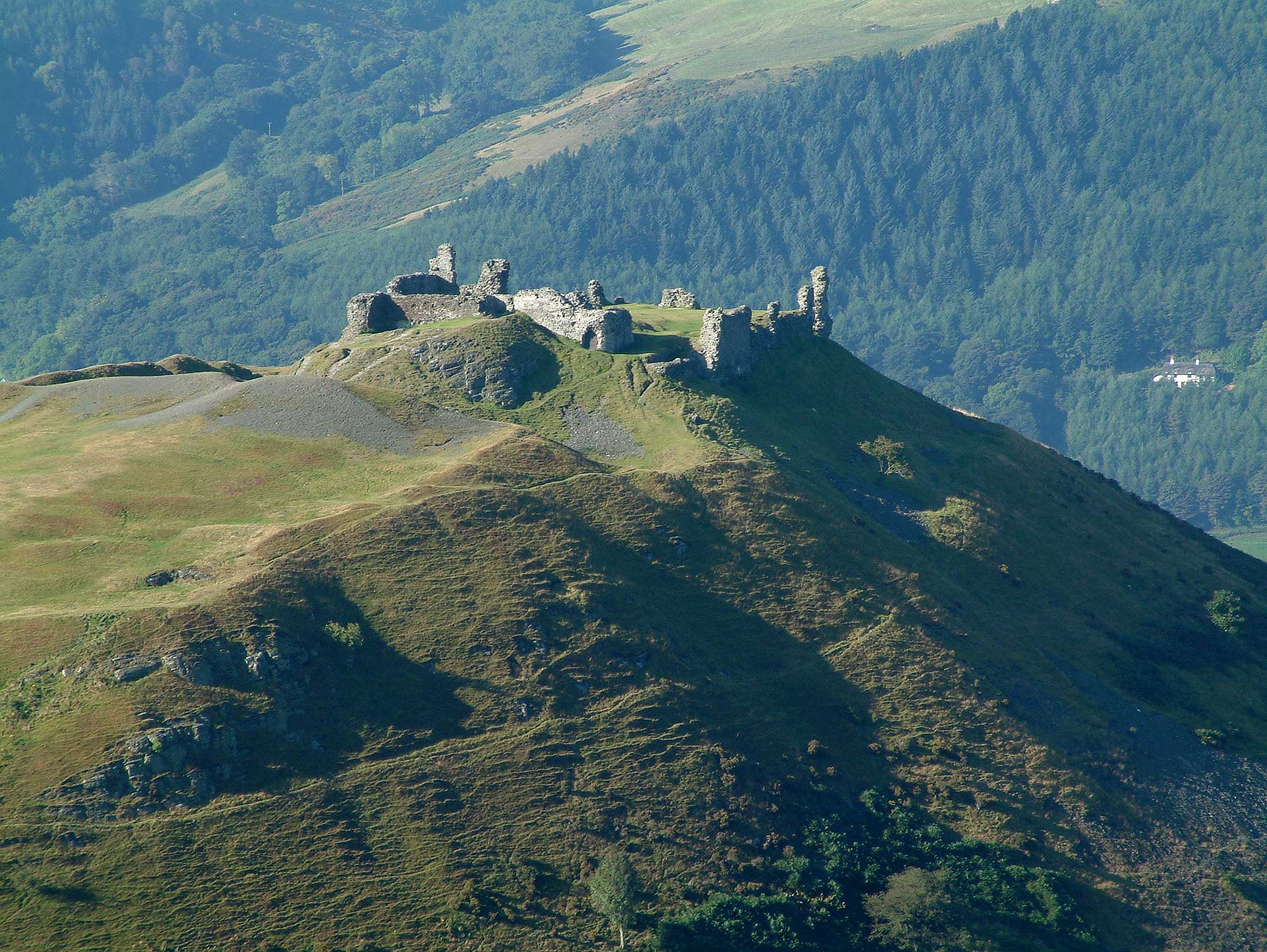
I have been visiting Dinas Brân on and off for decades, but have never got around to writing it up.  It was one of my favourite walks with the family dog in the 1980s when my parents lived hereabouts.  Much later, a regular return trip between Aberdovey and Rossett gave me the opportunity to see the castle from various different angles in all sorts of weather, the conical hill on which it sits soaring from the Dee valley providing a commanding, impressive position that dominates the landscape.  I recently drove into Llangollen to go up to the castle on a hot day, prepared for a moderately steep walk from the canal bridge, correctly anticipating a slightly breathless arrival at the ruins.

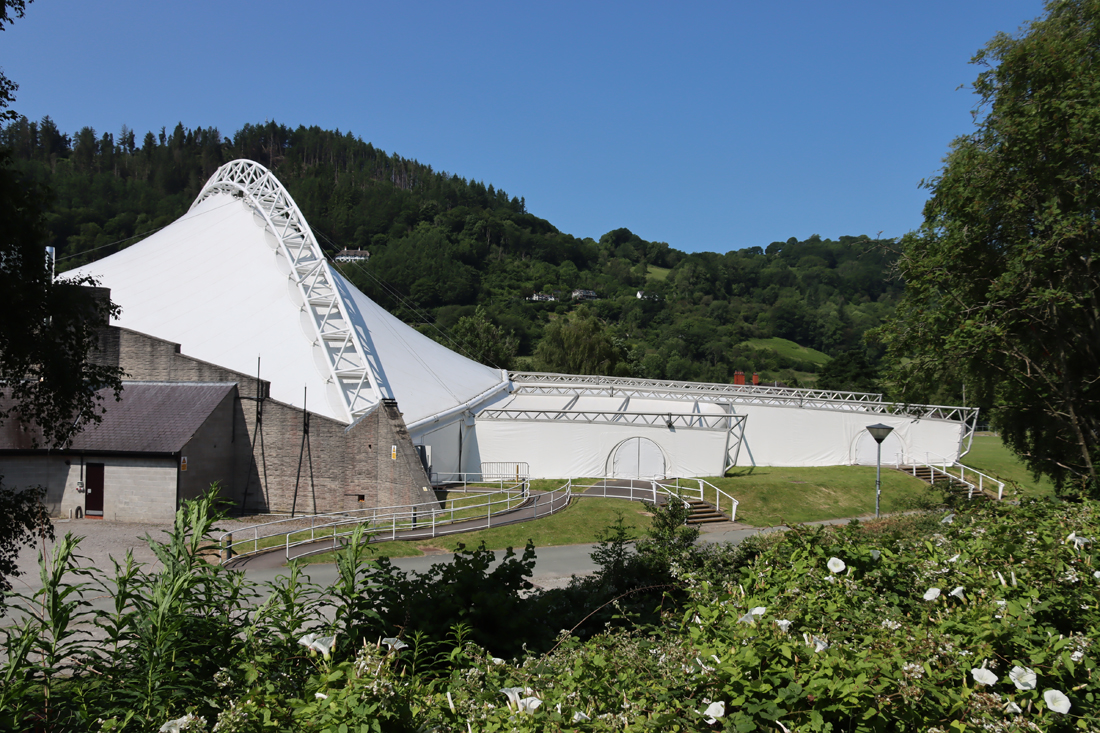
This is a splendid walk.  It is only about 2km (1.3 miles) from the Eisteddfod Pavilion, where I parked, although uphill all the way from the Wern Road canal bridge, so it feels longer, and the views towards the castle and back over the valley are splendid.  The views from the castle itself are of course stupendous, both aesthetically and geologically.  The geology and geomorphology are mentioned in brief below.  More about parking, the different routes and conditions underfoot are towards the end of the post in Visiting.


Dinas Bran ruins

Castell Dinas Brân, a Scheduled Monument, is the story of two fortifications, one dating to the Iron Age, at around 600BC, the other a medieval castle dating to the 13th Century.  It is far from unusual to find Medieval castles built within the circumference of an Iron Age hillfort, because both were making use of the same strategic features:  a good view of the surrounding countryside, a defensible position, often above cultivable land, and access to water.  This post is about the Medieval castle.

xxx

History of Castle of the Crows

The medieval castle

Window of what was possibly the Great Hall of Dinas Bran

Window of what was possibly the Great Hall of Dinas Bran

It is not certain which of the Powys Fadog rulers built Dinas Brân.  The most common suggestion is that the castle was built by Prince Gruffudd ap Madoc (c.1220-c.1270), beginning in the 1260s, but there is an argument discussed by Paul R Davies that it may have been built by his father Prince Madoc ap Gruffudd Maelor.

Valle Crucis Cistecian Abbey, founded 1201

From c.1190 Prince Madoc was ruler of Powys Fadog, the northern section of Powys, which had been split into two on the death of Madoc ap Maredudd in 1160.  He founded the nearby Cistercian abbey in 1201, and although his territory was comparatively small, he clearly had ambitions to establish his name and ensure his legacy, A castle would have been consistent with that intention, and as Davis points out, materials and workers could have been shared between the two sites.  Prince Madoc died in 1236 leaving four sons, of whom Prince Gruffudd was the only one to survive.  Whether Madoc started work on the castle or not, it is clear that Prince Gruffudd continued it, completing it well before the war of 1277.

Together with Powys Wenwynwyn to the south, Powys Fadog was sandwiched between the much larger territory of Llywelyn ap Gruffudd’s Meirionydd in the west of Wales and England to the east.  Llywelyn (c.1223 – 11th December 1282, also known as Llywelyn the last, grandson of Llywelyn the Great) and his brother Dafydd (1238 – 3rd October 1283) had been in a long-term power struggle with Henry III that erupted once again under Henry’s son Edward I.  Whilst the northeast territories provided a buffer zone between the two warring factions, their rulers were inevitably dragged into the question of where to bestow their loyalties.  There was never any certainty that the members of a single family would throw in their lot with the same side, and some, like Llywelyn’s brother Dafydd, switched sides at least once.

Wales following the 1267 Treaty of Montgomery showing Powys Fadog sandwiched between Gwynedd and England. Source: Turvey 2002, p.xxvii map 8

Prince Gruffudd was married to an English wife, presumably for diplomatic reasons, providing a nod of friendship to the English.  With Lady Emma Audely he had four sons, the eldest named Madoc, and one daughter.  Presumably seen as fair game by Llywelyn, Powys Fadog was attacked.  When Henry III was appealed to for help but did not come to Powys Fadog’s aid Gruffudd seems to have thrown in his lot with Llywelyn, arranging for peace between Meirionydd (Gwynedd) and the return of his territories by agreeing to the marriage of his eldest son Madoc to Llywelyn’s sister Margaret.  Dinas Brân was apparently built in support of the interests of Llywelyn the self-styled Prince of Wales, borrowing certain elements of architectural styling from Llywelyn’s castles, including the D-shaped tower at its southern side.

Gruffudd apparently died in around 1270, because it was in this year that his sons signed a grant to provide Lady Emma with lands of Maelor Saesneg to secure her future.  At this time ownership of the castle would have been split four ways between his sons, because primogeniture was the English but not the Welsh system of inheritance.  Instead of one son or daughter inheriting an estate, on the death of a father all property was divided between the remaining sons, with provision usually made for wives and daughters.  Each of Prince Gruffudd’s sons had his own decision to make in November 1276 when war broke out again between England and Wales.  However they started the war, Gruffydd’s eldest sons eventually submitted to Edward, but in May 1277 an English force sent to take possession of the castle found it in engulfed in flames and it was evident that the garrison left behind had remained loyal to Llywelyn.  The decision to burn and abandon the castle rather than defend or surrender it did not, however, completely destroy the castle.

After the Treaty of Aberconwy in 1277 Llywelyn paid homage to Edward, sitting to the left of the king’s throne, with Alexander of Scotland at the king’s right. The peace did not last.

After the Treaty of Aberconwy in 1277, Llywelyn’s power was confined to northwest Wales.  The English inspection of Dinas Brân to assess the damage caused by the fire found that although considerable superficial damage had been inflicted, the well-built castle was structurally sound and still of strategic value.  Henry de Lacy, Earl of Lincoln, wrote to Edward I recommending that the castle be repaired and garrisoned with English troops.

Following Edward’s triumph, Powys Fadog was abolished as a territory.  Edward gave ownership of the castle and all its lands to John de Warenne, the early of Surrey.  The castle, however, was no longer relevant as a symbolic stronghold of the former territory and now stood at the borderland of the new friendly lordships of Chirk, held by Roger Mortimer, and Bromfield and Yale by John de Warenne.  Instead of devoting any attention to Dinas Brân, de Warenne became busy building his new castle at the eastern end of Bromfield and Yale on the Dee crossing at Holt near Chester.

Ruins of Dinas Bran

Ruins of Dinas Bran

There is no record of the role performed by Dinas Brân, if any, during the final great conflict between Llywelyn and Edward of 1282, when the English were triumphant.  Llywelyn died on the battlefield that year, and Dafydd was captured and put to death in 1283.  As Holt Castle grew, Dinas Brân was abandoned.

A completely unsubstantiated legend concerns the fate of the two underage sons of Prince Madoc, Gruffudd’s eldest son.  Walter Tregellas in 1864 tells the story, in which Edward I conferred guardianship of the two boys on Roger Mortimer and John de Warenne:  “it is stated that the two children were soon afterwards drowned under Holt Bridge . . . This is said to have happened in 1281.”  He goes on to recount an even better version of the conspiracy, however: “it is uncertain whether the king himself did not cause the children to be put to death.”  There is no evidence whatsoever about what became of the two younger children of the prince of Powys Fadog.
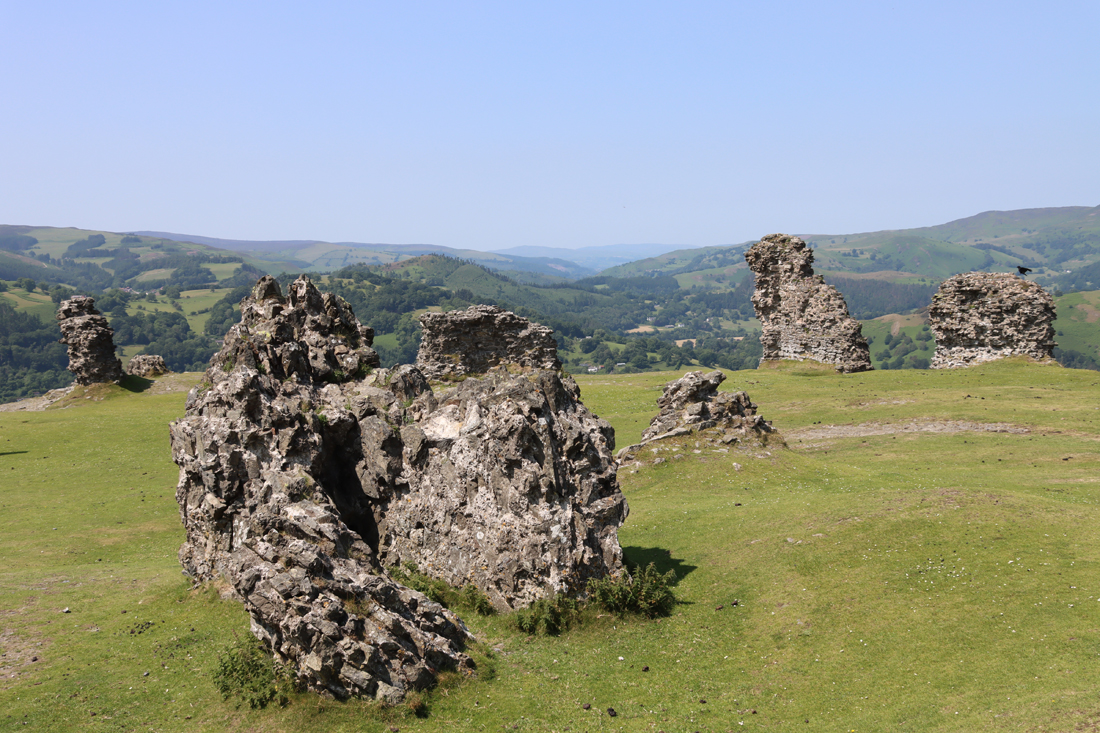
Dinas Bran and the wonderful scenery beyond

Dinas Bran and the wonderful scenery beyond

The only hint that they castle buildings may have been re-used is a poem by Hywel ab Einion Llygliw Myfanwy Fychan in the 14th century, in which he claimed to have been rejected by the beautiful girl who lived there.  There is no evidence to support this later domestic occupation, but neither is there anything to deny it.  John Leland, visiting in 1536, found it in ruins.


The Victorians

Dinas Brân Castle by Alphonse Dousseau, c.1850. Source: The National Library of Wales, via WikiData.

When ruins became desirable romantic destinations, Dinas Brân was an obvious lure for painters (many of whom chose to paint safely from below) and more adventurous tourists.  The Holyhead road was the major route through north Wales, with Telford’s great route, now the A5, opening in 1826, and the railway was opened in 1864.  A local entrepreneur, demonstrating great faith in the spirit of adventure demonstrated by the new tourists, decided to make the most of the popular site and the first visitor provision was supplied in 1820, with a cottage added in the 1880s as a tea room together with an octagonal camera obscura, which was still in situ by the start of the Second World War.

Walking up the hill not far from the summit I found a piece of slender white clay pipe, about an inch long, on a piece of well-worn hillside.  This almost certainly belonged to the period of Victorian interest in the castle.

Victorian cottage built for serving teas to visitors on Dinas Brân. Source: People’s Collection Wales


The castle as it stands today

Fieldwork

Plan of Dinas Brân, both prehistoric and medieval, following the geophysical survey of 2017

There has been very little fieldwork at Dinas Brân, and even the antiquarian investigators who explored other sites seem to have felt that this was one challenge too many.  The only exception appears to be alocal treasure hunter who is mentioned in a journal entry by Lady Eleanor Butler of Plas Newydd, whose home was in full view of the castle, and who commented that their landlord had informed them that a smith from Dimbraneth “has been dreaming of more than a year past of treasure at Dinas Brân. Hew has within this week begun to dig.”  There is no report of any discoveries.

In 2017 a geophysical survey was carried out and this was quite comprehensive, addressing both the medieval castle and the prehistoric hillfort.  Although nothing conclusive was discovered, magnetic readings did suggest that a fire had scoured the ramparts, perhaps tying in with contemporary reports that the sons of Prince Gruffudd had set fire to the entire structure rather than surrender it to the English.

In 2020 a survey was carried out by the Clwyd Powys Archaeological Trust (CPAT) to assess the condition of the site, both the castle and the prehistoric hillfort, making recommendations to make it safer and more approachable for visitors and to manage archaeological impact.  Earthworks were noted beyond the hillfort but were not included in the survey.

CPAT excavation at Dinas Brân in 2021. Source: Heneb

It was not until August 2021 that the first archaeological investigation was carried out at the site, organized by CPAT.  It was a small exploratory dig, with four trial trenches both within and outside the castle walls.  The main aim of the project was less investigation of the history and more about assessment of the condition of the building’s foundations.  Although the excavations did no more than reveal the medieval floor surface, one sherd of medieval pottery was recovered and a “ledge/kerb was discovered projecting from the gatehouse wall, with a portcullis slot in it near the east end, and a fine masonry carved pillar base at the western end.”  In 2021 the Heneb report said that the excavation report was “awaiting a second phase of work in 2022,” but I have been able to find nothing about a 2022 excavation and no further reports.

Modern conservation work was carried out by Recclesia, who surveyed the site and inserted stabilizing rods into the south wall of the castle to ensure that it stays upright now and in the future.

The surviving architecture

Detail of an old interpretation board

The plan drawn by Tregellas in 1864. with annotations

The castle was very fine in its day, with imposing fortified walls and stone and timber buildings.  There are hints that there were decorative features.  I have annotated the plan drawn in 1864 by Walter Tregellas to make this easier to follow.  If you have walked up from Llangollen, and climbed the east-facing slope of the hill, you will have entered opposite the original entrance.  I had had a long wander around before tackling how the ruins relate to the original layout but when I got stuck into the site plan, I started at the entrance.

The ditch surrounding the castle

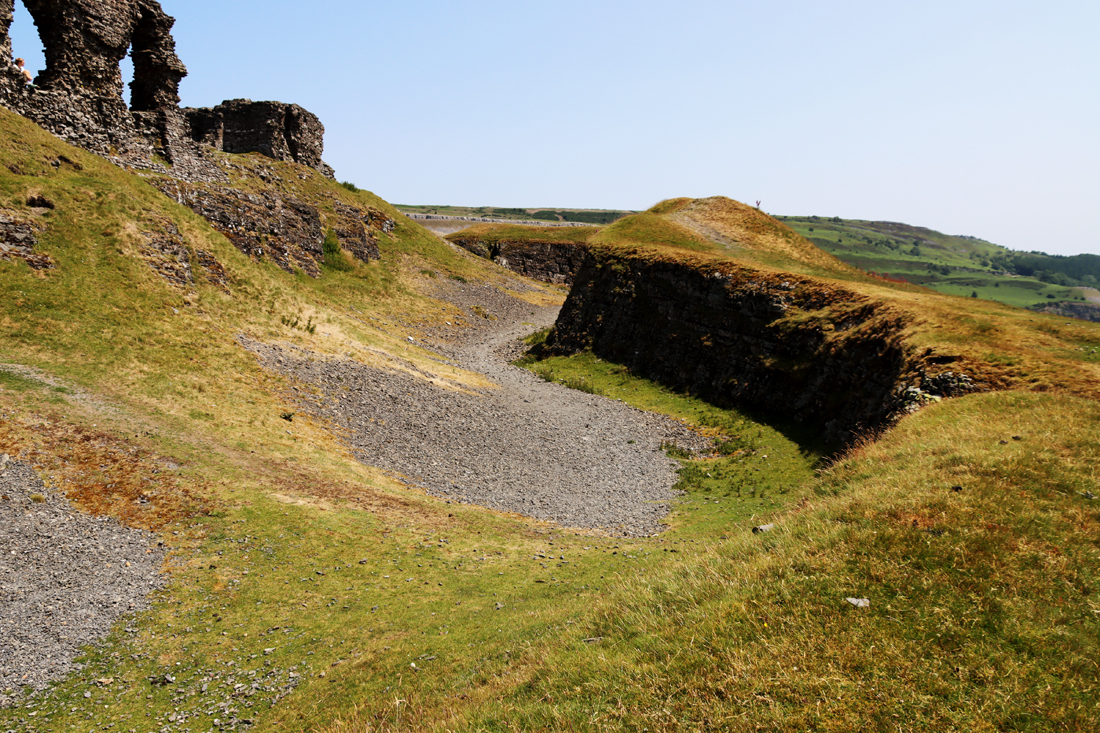
The site consists of a rectangular court orientated east-west, c.82m  by 35m, surrounded by a ditch dug out of the bedrock, which provided the material from which the castle was built.  As well as building materials available within the immediate vicinity, it was found that there was sandstone facing in certain parts of the castle, which would have provided it with both refinement and prestige.  It is not clear where this came from, but it is likely that it was sourced from the same location as the Valle Crucis ashlar.  The ditch surrounding the castle was an impressively deep and wide feature, running around three sides, the northern side of the castle being positioned directly over a steep drop.  At the southwestern corner of the ditch was once a well, the location of which is now very difficult to see.

An artist’s impression of how the gatehouse (right) and the keep (left) as they may have looked when it was first built. Source: Clwydian Range and Dee Valley

The original entrance was marked by a gatehouse that, being one of the points of weakness of the castle, was built so that it could be well defended, with twin English-style towers forming a gatehouse, each with hollow basements and, remarkably, appears to have been furnished with highly ornate rib-mouldings.  This is unprecedented in Welsh castle design and may have been copied from an English example.  One of the two gate towers still has the underfloor barrel-vaulted arch that was accessible from the courtyard; although it is now open to the outside, this would have been closed in the 13th century and is probably the enlargement of an arrow slit.  The vaulted room is closed to the public except on special open days.  The gatehouse was supplied with latrines on its northern side, that emptied down the walls into the ditch.
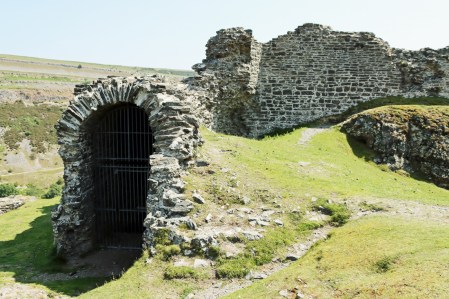
The vaulted undercroft in the gatehouse


The stairwell that lead up to the first floor of the keep

Heading clockwise from here, you encounter the square keep.  This was once an impressive building that helped offer protection for the gatehouse as well as the most vulnerable eastern approach.  It will also have provided a home for the main family members and a final retreat at a time of siege.  It was equipped with latrine which, like the gatehouse, emptied into the ditch.  Additional security was provided for the keep.  It could only be entered via a first floor door reached by stairs from a walled passage, and was separated from the rest of the castle interior by its own ditch, which would have been crossed by a liftable bridge.

Continue around to the right to follow what was once the long south curtain wall.  The section of wall with two giant openings in it was either the site of the castle’s Hall, where dining and socializing would have taken place, or its chapel. The two openings, providing plenty of light for interior, would have been about 1.8m (6ft) wide at their maximum width.  They would have had shutters to protect the castle from the elements, but no window glass.

At the far end of the Hall a doorway opened into a D-shaped tower that extended beyond the line of the curtain wall.  The D-shaped section has gone, but this tower was a major feature of the castle, rising to two if not three floors.  A good surviving example can be seen at the well known Ewloe Castle (about which I have posted here).  Again, this was a defensive measure providing archers good views over the ditch and the flanking walls. The ruins of the inners walls give a sense of the size of this half of the room. It is likely that part of this was used for the castle kitchens, which gives weight to the argument that the adjoining apartment was the dining hall rather than the chapel.

Further along this stretch and you will find yourself looking out between two sections of wall, a gap that represents the remains of the postern gateway.  As well as providing a useful secondary pedestrian entrance on the opposite side of the castle from the main gatehouse, this could also be used as a “sally port” that would allow foot soldiers to mount a surprise attack from an unexpected position.

A rectangular building at the west end may have been either the hall or the chapel or served another purpose.  This area is likely to be highly disturbed, archaeologically, due to the Victorian building works in this area. The rest of the interior would have been filled with timber-built buildings, including accommodation for servants, storage, stables and workshops.


The landscape  

xxx

British Geological Survey geological timeline.

Standing on the peak of the hill, you are 305m (c.1000ft) above seal level.  Geologically, Llangollen is divided into two main formations.  At the top of Dinas Brân you are standing on one and looking at the other.

Beneath your feet the rock formations are dark grey Silurian shales and silstones, which were laid down as deep sea sediments and then subjected to metamorphic processes.  These are the same rocks that you see in the Dee river bed from the Llangollen bridge, with the rapids flowing over them.  The stone quarried from the ditches of this Silurian hillside were used to build the castle, and are uncleaved, around 30-40cm thick.
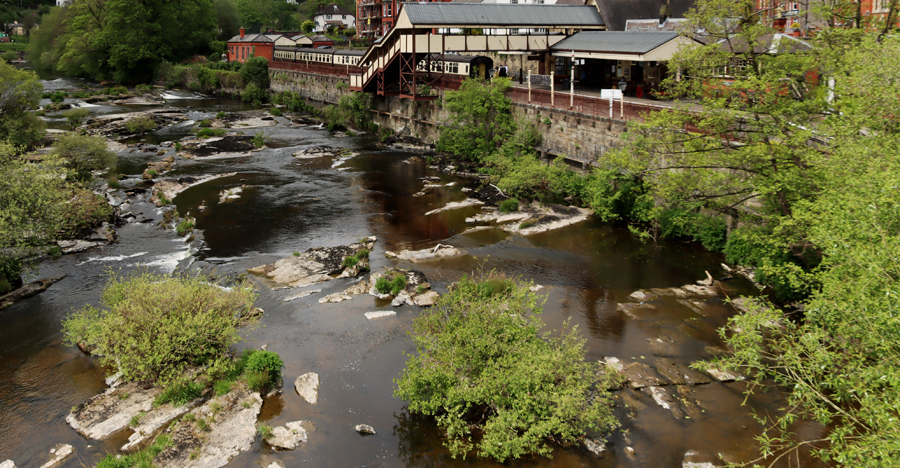
Above this layer in Llangollen is the heavily layered Carboniferous limestone escarpment that so dramatically forms a backdrop to Llangollen and Dinas Brân, laid down when the sea was warm and shallow.  The Devonian, which theoretically should have sat between these two geological periods, is missing, presumably because it was not under water in this area at that time, and did not form the rich, deep layers usually laid down in marine contexts.

The solid geology of Clwyd showing rock types. Jenkins 1991, p.14

Geomorphologically, the Vale of Llangollen is a typical U-shaped valley carved by the advancing ice and associated debris of the Welsh Ice Sheet as it advanced east.  The river Dee wends its way through this flat base, and former river beds are visible in the landscape, the former routes of the river blocked by the ice sheet, forcing water to find a new passage.

The  plant life that has settled into place on this isolated outpost is typical species that are capable of surviving on highly exposed rock with very little topsoil.  Drought-resistant annuals like foxgloves and swathes of rock-hugging perennial succulents like sedum anglicum are dominant at this time of year.


xxx


Visiting

Map of the footpaths to Dinas Brân Castle (Kightly 2003, Denbighshire County Council)

The castle is on the open hilltop and is free of charge to access.  There are no facilities at all.  You will need to take water and any snacks with you, although there are plenty of facilities down in Llangollen itself.

There are two main approaches to the castle for walkers arriving by car from the east.  One is a longer walk from the valley bottom, and the other is a much shorter but slightly steeper walk from the other side, approached along the narrow road now marked on the map as the Offa’s Dyke Path (even though Offa’s Dyke does not actually follow this exact path).  A map taken from the bilingual booklet Castell Dinas Brân Llangollen (in their Enjoy Medieval Denbighsire series) shows two alternative routes, with variations. 

The easiest place to park if you are heading up from the valley is the International Eisteddfod Pavilion (marked as the Royal International Pavilion on the map), which offers a really lovely walk along the canal to arrive at the canal bridge where you cross to begin the walk.  The second approach is much shorter and takes you from the Offa’s Dyke Path, a single-track road that follows the line of the hill, and has spectacular views; there is no official parking here, although there is space to pull over and park for about 4-5 cars (being careful to leave passing spaces) and this gets full very quickly on fine days.  

Both routes require sensible footwear, whatever the weather.  I was wearing some excellent lightweight hiking trainers with heavy tread, perfect for a hot day, but in damper seasons I would go for hiking boots.  Although the path starts off metalled in Llangollen itself, mainly because it is one access point to the local school, it becomes much more uneven underfoot as the path goes on, with patches of coarse bedrock and scatterings of loose scree.

The Eisteddfod Pavilion is on the A539 on the way out of Llangollen towards Valle Crucis and the Horseshoe Pass.  The car park is big, with a pay and display system.  From here, go up out of the car park towards the canal bridge, and go down on to the towpath to the left of the bridge, turning to the right under the bridge to head east in the direction of Llangollen.  This is a lovely stretch of canal, passing the marina on your left.

When you reach the next canal bridge, with a cafe on the right, walk up on to the bridge.  Directly in front of you, heading straight up a short flight of stairs, is the public footpath.

From here on it is easy to find your way.  Just keep going straight up.  You first pass the school on the left, and a field on the right, with a gate at the top of this first stretch.  Go through the gate, cross the lane, and keep going up the other side.
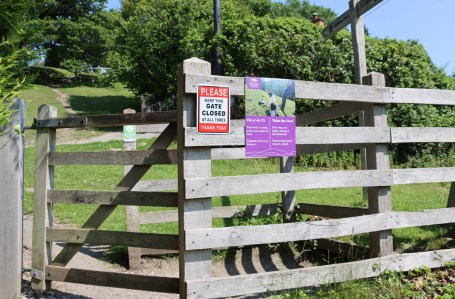
You will pass various attractive buildings along the way, the largest of which is the Grade II listed Dinbren Hall, built with conviction but without a great deal of imagination in a very lovely location in 1793.
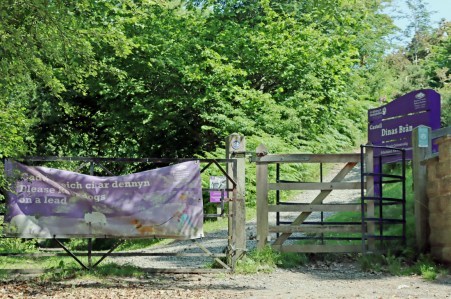
Soon you will reach another gate.  This has signage on the other side of it warning to inform you that you have now arrived at the foot of the hill, and to keep dogs on a lead (there are sheep all the way along this walk).
It is less even underfoot from here, with a very short uneven patch, but you will find that just over the other side the path opens out onto the hillside, with a clear view of the path ahead.

A very short uneven section of path, but it evens out just on the other side


Beyond this, along the steepest part of the route, the ziz-zag path marked on the map is beautifully maintained at the time of writing, with occasional stretches provided with a hand rail and long shallow steps where required.

This brings you out at the the west end of the castle, where the Victorian camera obscura and teashop used to be located.  If you are approaching from the other side, via the Offa’s Dyke Path, you will find a similar zig-zag arrangement to provide a less strenuous way up the hill than heading straight up the side.

Eastern approach to the castle

You can easily turn this into a circular walk from the Eisteddfod pavilion. For the quickest of the two easiest routes, come down from the castle onto the lane under the limestone escarpment and head downhill along the Wern Road, which takes you back to the canal bridge.  For a longer but really attractive route, continue along Offa’s Dyke Path, past Wern Road, which eventually heads downhill and comes out at the Sun Trevor on the A542; cross the road, cross the canal bridge, turn right and walk back along the towpath into Llangollen.  Although this is a much longer way back, it is all metalled lane and nicely maintained towpath, so is very easy underfoot.

Sources

Ordnance Survey Explorer no.256: Wrexham/Wrecsam and Llangollen.  Particularly useful if you want to make this into a circular walk, or to visit other local sites like the Horseshoe Falls and Valle Crucis Cistercian abbey.

If you are particularly interested in medieval architecture in the Denbighshire area, do download their bi-lingual PDF booklet Enjoy Medieval Denbighshire.

Map showing sites featured in the “Enjoy Medieval Denbighshire” PDF

Books and papers

Berry, D. 2016 (4th edition). Walks around Llangollen and the Dee Valley.  Kittiwake Books

Davies, John 2007 (3rd edition). A History of Wales. Penguin.

Davis, Paul R. 2021. Towers of Defiance. The Castles and Fortifications of the Princes of Wales. Y Lolfa

Kightly, Charles 2003.  Castell Dinas Brân Llangollen.  Denbighshire County Council (bilingual booklet with excellent illustrations, artist reconstructions, photographs and information)

Jenkins, David A. 1991.  The Environment: Past and Present. In (eds.) John Manley, Stephen Grenter and Fiona Gale. The Archaeology of Clwyd. Clwyd Archaeology Service, p.13-25

Jones, N. W., 2020. Castell Dinas Brân, Llangollen, Denbighshire: Condition Survey. Unpublished report. CPAT Report No. 1739
https://coflein.gov.uk/media/366/634/cpatp_144_001.pdf

Roserveare, M. J., 2017. Castell Dinas Bran, Llangollen, Denbighshire: geophysical survey
report. TigerGeo Project DBL161.

Tregellas, Walter 1864. Castell Dinas Bran Near Llangollen, Denbighshire. The Archaeological Journal, 21, p.114–120
https://archaeologydataservice.ac.uk/archiveDS/archiveDownload?t=arch-1132-1/dissemination/pdf/021/021_114_120.pdf

Turvey, Roger 2002. The Welsh Princes. The Native Rules of Wales 1063-1283. Pearson Education

Venning, Timothy 2012. The Kings and Queens of Wales. Amberley


Websites

Coflein
Castell Dinas Bran
https://coflein.gov.uk/en/site/307064/

Clwydian Range and Dee Valley
Dinas Brân
www.clwydianrangeanddeevalleyaonb.org.uk/projects/dinas-bran/

CPAT
Historic Landscape Characterization: The Making of the Vale of Llangollen and Eglwyseg Historic Environment
https://heneb.org.uk/archive/cpat/projects/longer/histland/llangoll/vlenvi.htm

Heneb
Castell Dinas Brân, Llangollen
https://heneb.org.uk/cy/project/castell-dinas-bran-llangollen/
Dinas Brân, Llangollen Community, Denbighshire (HLCA 1150)
https://heneb.org.uk/hcla/vale-of-llangollen-and-eglwyseg/dinas-bran-llangollen-community-denbighshirehlca-1150/

Recclesia
Castell Dinas Bran
https://recclesia.com/our-work/castell-dinas-bran

Scottish Geology Trust GeoGuide
Dinas Brân
https://geoguide.scottishgeologytrust.org/p/gcr/gcr19/gcr19_dinasbran


You can explore the castle from afar via this Sketchfab 3D model by Mark Walters.


A video showing the two main stages of occupation of the Dinas Bran hill, on the Clwydian Range and Dee Valley website, beginning with the hillfort and moving on to the medieval castle.

xxx

An autumnal stroll from Churton to Aldford, pausing for lunch at The Grosvenor

Autumn sun and brightly coloured leaves are always a joy at this time of year, right up until the point that they drop in huge numbers and need clearing off the garden lawn 🙂

Because it was so warm, my destination was The Grosvenor pub, a self-indulgent extension to my terrific short break in the Ironbridge area of Shropshire last week.  It is always such a treat to be able to sit outdoors at this time of year.

The map of this walk is at the end of the post, and is a very simple one.  It takes around 40 – 45 minutes to walk through the fields to Aldford from Churton, so it is a short walk, and always a good fall-back when I don’t want to be bothered with the car.  The harvested fields, mainly used for growing corn, can be very soggy at this time of year with nothing but wet earth under foot, but it is always an easy and attractive option on a sunny day when the leaves are changing colour.  It was fine on the field edges, although distinctly squelchy underfoot crossing diagonally from footpath FP7 to FP6.  Half of the route is the metalled B-road Lower Lane, which gave the hiking boots a bit of a break from the sludge.

Irritatingly, I did not have my camera with me, so these were taken on my iPhone and many don’t bear close scrutiny.
===

=====================

======

===

===

After a very enjoyable lunch in the sun at the Grosvenor Arms, I had a wander around the village and returned back to Churton using the same route.  Normally I go back via the well-signposted FP8 footpath, but having investigated on my way to Aldford, deemed it far too muddy and waterlogged to make the attempt in anything other than wellies.  In the dry, this is a nice return route and takes in a chunk of the Roman road that once ran east of Churton (about which I posted here).

===

===

===

===

===

===

===

===

Cheshire West and Chester Public Map Viewer, annotated


A walk from Waverton along the Shropshire Union Canal

I have driven over the canal bridge on Eggbridge Lane in Waverton so many times thinking that I really must take advantage of the little car park just before the bridge to go and take a stroll down the towpath.  Having woken up early on a sunny morning I decided to investigate. Waverton is just off the A41, so very easy to reach. The car park is quite small, but it was not full even on a bright and warm morning.  The What3Words address for the car park is ///fingertip.snored.deals

Victoria Mill, Waverton

Immediately opposite the car park, as you walk to the towpath, is a very attractive canal building, the Grade 2 listed, a mid-19th century Victoria Mill, a former steam-powered canal-side corn mill, with bays for loading and unloading narrowboats, and now converted for modern use. The Historic England description is here.  This is part of the heritage of the Shropshire Union Canal, which if you keep walking north eventually ends up at Ellesmere Port.  To the south, it eventually connects up with the rest of the main canal network at Hurleston Junction.  The Shropshire Union has quite a complicated history, as does Chester’s canal heritage as a whole, and was not completed until 1835.

As with most canal walks, there’s always a choice to turn right or left, and as I had no idea what to expect from either direction I decided to head north, leaving the walk south for another occasion. Out of the car park I turned left under the unprepossessing bridge no.119 and headed up the towpath.  This section is metalled, so it avoided the mud and sludge that I had been half expecting.

If you take this route you find yourself walking along a short row of houses with canal gardens along a metalled pathway.  Canal-side gardens are always fascinating.  I used to live on a narrow boat many years ago, and it is always a lot of fun to see how different minds have dealt with a garden that opens directly on to a canal.  These are always hugely individualistic and personal.  There is always much to see in the way of garden furniture, garden ornaments (someone will always have gnomes, and there is usually at least one example of traditional canal painting), sheds in various states of repair, a wide range of summer houses, varieties of approaches to terracing, often some very interesting specimen trees and shrubs, and different attitudes to garden seclusion, along a spectrum from solid barriers of hedging or fencing to a complete lack of interest in any form of privacy.  A real cultural treat.

After just a minute or so the towpath enters a more rural section, and in the late season sun it was a real pleasure to take in all the autumnal colours on trees and shrubs that flank the canal.  I’ve posted some of the photos below. It’s a well-used section of towpath, with joggers, cyclists and plenty of dog walkers, but everyone is very civilized about moving over to make passing easy.  There was not much in the way of canal traffic, with just two narrowboats on the move, but I expect that it is much busier in summer.

Keep an eye out on your left as you leave the housing on your right and reach the more rural section.  Partly concealed by the grass next to the towpath, there is a short inscribed red sandstone Parish Boundary Marker. This section of the canal passes through the parish of Rowton, famous for the Civil War Battle of Rowton Heath (see the Wikipedia entry on the subject and a more detailed analysis by Historic England).  King Charles I is said to have watched his army lose that battle from the Phoenix Tower that still stands on Chester’s city walls. The stone marks the boundary between the parishes of Christleton (CP on the stone) and Rowton (RT).  The date commemorates the date of the battle in 1645 and, below the level of the grass, 1995, the 250th anniversary of the battle.
===

After this more countrified section there are more houses, all interesting, with some lovely weeping willows and other water-loving species, and a very attractive hump-backed bridge, that I have since discovered carries Rowton Bridge Road into Christleton.  I walked up as far as The Cheshire Cat, which sensibly has a gate onto the towpath, and carried on just a short way beyond it, but at that point the canal converges closely with the A41 (Whitchurch Road) and it becomes quite a noisy experience with the unremitting traffic, especially during the week.

Checking the map later (for example see the plotaroute.com website), I note that by coming off the towpath at Rowton Bridge it is possible to walk into the attractive village of Christleton, with its marvellous pond, and I would have done this had I realized.  Another time.  had to be somewhere else in the afternoon, so it was a short walk, probably an hour and a bit there and back at strolling pace, with pauses to let bicycles pass, and to take photographs.

For those with unwilling legs (see the blog’s Introduction for details about what this refers to), the towpath heading north from Waverton is metalled, but quite uneven.  No problem for most people, I would have thought but do keep an eye on it.  There are places where the edges of the surface are particularly uneven, but this just means that if you are with someone else you need to go in single file for short sections.  Otherwise, it’s on the flat and very enjoyable.

On the way back I followed the towpath beyond the car park for a few minutes to see how far the housing that backs onto the canal extended.  This part of the towpath is not metalled, was muddy and is single-track.  These houses and gardens are another interesting mixture – each of the sections of housing and gardens has its own personality, presumably reflecting both when it was built and the pricing.  These look as though the garden-canal margins were all designed with narrowboats or other canal vessels in mind. There was indeed one narrowboat moored up at a garden.  The housing stops after a couple of minutes and the towpath reverts to a far more rural appearance.  I’ll investigate further on another day.

A visit to the 12th century Birkenhead Priory #1 – The Medieval buildings

Introduction

The chapter house

Birkenhead Priory is one of the most enjoyably unexpected places I have visited in the region, even more surprising than a Roman bath-house embedded in a 1980s Prestatyn housing estate.  The priory site incorporates both the remains of the 12th century monastic establishment and the ruins of St Mary’s 1822 parish church with its surviving tower and terrific views.  On all sides the site is surrounded by both heavy and light industry.  Cammell Lairds shipyard not only butts up against the south and east walls, but purchased part of the priory’s former churchyard and cemetery for its expansion and the building of Princess Dock.  On the other sides are warehouses and commercial units.  The result is that in spite of the clanging and banging from the vast ship under construction immediately next door (fascinating in its own right), the obvious and somewhat inescapable cliché is that the ruins of the priory and parish church are an oasis of peace in the midst of all the busy activity.  The small but quiet stretches of grass, the trees and the wild flowers contained within the remains of the priory site are a treat, and the splendid views from the top of St Mary’s tower are a powerful reminder of how the world has changed since the foundation of the priory.

I have divided this post into two parts, because there is so much to say.  A visit to Birkenhead Priory is really five visits in one.  In chronological order, a visit to the site provides you with the following heritage:

  • 1) The priory, established in the 12th century and built of red sandstone, is the oldest part of the site and the star turn with its vaulted undercroft and chapter house
  • 2) St Mary’s parish church was built next to the ruins in 1821 to serve the growing community, its gothic revival windows wonderfully featuring cast iron window tracery
  • 3) The priory’s scriptorium over the Chapter House, now with wood paneling over the sandstone walls, is the exhibition area for the Friends of the training ship HMS Conway,
  • 4) The Cammell-Laird shipyard is hard up against the priory’s foundations and fabulously visible from St Mary’s Tower. When it wished to expand into the church’s churchyard, it purchased the land and re-located the burials
  • 5) St Mary’s Tower, which is open to the public with amazing views from the top, is now a memorial to the 1939 HMS Thetis submarine disaster in the Mersey.

In this part, part 1 I am taking a look at the priory.  In part 2 I have looked at the post-dissolution history of the site; the 1821 construction of St Mary’s parish church; the memorial to HMS Thetis and the display area for HMS Conway.  I will tackle Cammell Laird’s separately, as I suspect that it will be very difficult to handle in a single post, and I need to do a lot more research before I make the attempt to summarize its history.

Birkenhead in the foreground with the manor and ruins of the monastery, and Liverpool in the background over the river, c.1767, showing just how isolated Birkenhead remained even in the 18th century. Attributed to Charles Eyes. Source: ArtUK

Foundation of the priory in the 12th Century

Artist’s impression of the priory done by E.W. Cox by 1896.

The priory was dedicated to St Mary and St James the Great.  There are no documents surviving from the priory, and none of its priors became important in other areas of the church or in life beyond the priory, so most of the information comes from other sources of documentation as well as from the architecture itself. Its principal biographer, R. Stewart-Brown, writing in 1925, commented that it was “not possible to compile anything in any degree resembling a history of this small and obscure priory,” but the result of his work was an impressive overview of the priory, its financial stresses and its involvement in the Wirral as a whole and the Mersey ferry in particular.  Much recommended if you can get hold of it.  Although not certain, is thought that the priory was founded in the mid-12th century by one of William the Conqueror’s Norman followers who was rewarded for his service to the new king and the local earl Hugh Lupus with land on the Wirral.  His name was Hamon (sometimes Hamo) de Massey from Dunham Massey, the second baron, who died in 1185, suggesting that the priory was founded before this date, probably in the middle of the 12th century.

Exterior of the west range, showing the two big windows that illuminated the guest quarters, the one on the left heavily modified.

The priory was established on an isolated headland, surrounded on three sides by water.  Hamon almost certainly took as his model for the priory the abbey of St Werburgh in Chester (now Chester Cathedral) which was founded in 1093 by Hugh d’Avranches, also known as Hugh Lupus.  Hugh Lupus had convinced St Anselm of Bec (later Archbishop of Canterbury and after his death canonized) to come and establish St Werburgh’s, and it was organized along classic Benedictine lines, about which more below.  The founding of a monastic establishment was seen as a Christian act, a statement of piety and devotion, and was most importantly a precautionary investment in one’s afterlife, securing the prayers of the monks, considered amongst the closest to God, throughout the entire lifetime of the monastery

A priory was smaller and inferior in status to an abbey and was was often dependent (i.e. a subset) of an abbey, and answerable to it.  It is possible that the much larger and infinitely more prestigious St Werburgh’s Abbey in Chester supplied the monks to establish Birkenhead Piory, but there is no sign in the cartularies (formal documents and charters) of St Werburgh’s that there was any ongoing formal connection between the two.  The difference between a non-dependent priory and an abbey was usually that the priory did not have sufficient numbers to be classified as an abbey, or that it had not applied for the royal stamp of approval required for the more senior status of an abbey. The minimum requirement for the foundation of a Benedictine abbey was 12-13 monks.  A 16th century historian suggested that there were 16 monks, but it is by no means clear where this figure came from.  Twice during the 14th century it is recorded that there were only five monks at the priory, and it is very likely that the priory remained too small to become an abbey.

The typical monastic day in a Benedictine monastery. Not a great photo, but a very nice representation from a display in the museum area in the undercroft

The Benedictine Order was not the oldest of the monastic orders in Britain, but following the Norman Conquest it became the most widespread.  It was named for St Benedict of Nursia who, in the 6th century, set out a Rule, or set of guidelines, for his own monastery.  This spread widely and became the basis of many monastic establishments setting out to follow his example.  The Benedictines had been well established in France at the time of the Conquest, and sponsorship by incoming Normans, granted land by William the Conqueror, ensured that they spread rapidly in England, and later Wales, Scotland and Ireland.  Benedictine monasteries were all built to a standard architectural layout, with minor deviations, based on both religious and administrative requirements.

The monastic buildings

Plan of the Birkenhead Priory site.  Source: Metropolitan Borough of Wirral leaflet (with my annotations in colour). North is left, south right.

If you take the guided tour, which I sincerely recommend, you begin your tour in the undercroft, now used as a museum / display space.  Most helpfully it has a scale model of the priory with Stewart-Brown’s 1925 site plan, both of which help you to orientate yourself and get a sense of how the ruins were once a complex of buildings that defined and enabled a monastic community, combining religious, administrative, domestic and other functions.  In the plan on the left, with the surviving remains of the priory outlined in red, the site of the priory church outlined in orange and remains of the 1822 St Mary’s Church outlined in green. The blue margin indicates the shipyard over the priory wall.  The numbers on the plan are referred to in the description below.  You can download a copy of the map (without the coloured additions) as a PDF here.

Like St Werburgh’s Abbey, the priory buildings were made of locally available red sandstone.  Like all monasteries based on Benedictine lines, the monastic site plan began with a square.  The bigger the monastery envisaged, the bigger the square.  This was known as the garth (1 in the plan on the left), and was either a grassed area or a garden.  Surrounding this was the cloister, a covered walkway that served as a link between the buildings that were erected around the garth, and where desks were usually arranged so that the monks could work.  This was a secluded space, confined to the inmates of the monastery.

Model of the priory church and claustral buildings in the priory’s museum space in the undercroft showing a possible layout of the church.  The chapter in this view is hidden behind the tower.

The most conspicuous of the buildings would have been the one that no longer stands:  the church and its tower (4 on the plan above, outlined in orange), which made up one side of the cloister.  Traditionally in Benedictine complexes this was built on the north side of the garth, making up an entire side of the cloister, in order protect the rest of the buildings and allow light into the garth and the other cloister buildings, but at Birkenhead Priory’s church was on the south, possibly to protect the claustral buildings from the winds whistling down and across the Mersey. The model and plan show that the 13th century church was built in the standard cross-shape.  It featured a long nave at the west end (where the public were permitted to observe religious ceremonies), and a surprisingly long east end (where the ceremonies were performed) with two side-transepts, which were usually used as chapels for commemorating the dead and a tower over the crossing. A pair of aisles flanked the south and north transepts as show above.  When it was first built in the 12th century, the church would have been much smaller and probably smaller than this footprint.

View of Birkenhead Priory by Samuel and Nathan Buck in 1726, showing the remains of the church’s northern arcade.  Source: Panteek

Lonely remainder of the church’s northern arcade

The entrance to the chapter house with its Norman arches. You can clearly see the difference between the 12th century chapter house masonry and the 14th century scriptorium above with its gothic window and tracery. The tower in the background belongs to the 19th century church.

The chapter house (2) is the oldest of the Birkenhead Priory buildings, the only one remaining that dates to the 12th century.  The building of the priory church, being the place where the main business of praising God took place, was usually started straight away, but the chapter house was often built in tandem as this was also of fundamental importance to a monastery.  This is where the everyday business of the priory was attended to, from the day-to-day administration and disciplinary matters, to the daily readings of chapters of St Benedict’s Rules or other improving texts such as excerpts from one of the many histories of saints (hagiographies).  The Birkenhead Priory’s original medieval chapter house is a gorgeous. The vaulted roof of the chapter house is superb (see the photo at the very top of this post), and although the windows have been altered over time, one of the deep Norman Romanesque window embrasures survives, and is a thing of real beauty (see below).  The stained glass is all modern, but all are nicely done, the one over the altar by Sir Ninian Cowper combining religious themes relevant to the house (St Mary and St James flanking Jesus) with two prestigious characters from the priory’s own history (its founder Hamo de Massey and its two-time visitor Edward I).  Gravestones from the medieval cemetery have been incorporated into the floor around the post-Dissolution altar.  In the medieval priory, there would have been no altar in the chapter house, but following the Dissolution the chapter house was converted into a chapel and is still used for weddings, funerals and baptisms. 

Over the top of the chapter house, a scriptorium was added in the 14th century. In theory this was where the copying of books took place, but it has been pointed out that this was a particularly large space for such an activity, and it may have been used for something else, or for a number of different activities.  Today it is the display area for the training ship HMS Conway, and at some point in the 19th or early 20th century was provided with panelling and has some very fine modern stained glass by David Hillhouse.  This modern usage will be discussed in part 2.

Opposite the chapter house the remains of the west range (7-11) survives, which was again a two-floor building separated into a number of different spaces  It seems to have been divided into two, with the northern end and its big fireplace reserved for guests, and the southern end, with an entrance into the cloister, seems to have been split into two floors, with a fireplace on each, for the prior’s personal quarters, which would have included a private parlour that he could use for entertaining VIP guests.  Although it’s not the most aesthetically stunning of the surviving claustral buildings today, the stonework displays a fascinating patchwork of different features and alterations that reflect many changes and refinements in use over time and are still something of a fascinating puzzle.

West Range

Remodelling in the 14th century created the undercroft and the refectory above it, as well as the kitchen.  The undercroft (14), once used as a storage space, with the original floor intact. The investment in the lovely architecture may indicate that before it was used as a storage area, it had a more high profile role, perhaps as a dining area for guests.  Above it was the refectory, unlike St Werburgh’s, Basingwerk Abbey or Valle Crucis Abbey, all of which had refectories at ground level.  It was reached by a spiral stone staircase leads up to this space today.

The kitchen was apparently to the north of the west range, and connected to it, as shown on the above plan (12).  This was convenient for the guest quarters, but not quite as convenient for the refectory over the undercroft, from which it was divided by a buttery (or store-room, 13), over which a guest room was also installed.   The kitchen was apparently a stand-alone structure made mainly of timber, and this may have been because kitchen fires were so common, and building the kitchen slightly apart from the main monastery would have been a sensible precaution.  Kitchen fires are thought to have been the cause of several devastating scenes of destruction in monastic establishments, spreading quickly via roof timbers and wooden furnishings.

Between the chapter house and the north range, which contained the undercroft and refectory, was an infirmary (19 on the plan) and the dormitory (18) side by side, each accessible from the cloister.  The infirmary was for the benefit of the monks, and was where those who were sick or injured or suffering the impacts of old age were cared for.

Sources of income and financial difficulties

Carved head in the side of the fireplace in the guest quarters on the ground floor of the west range

Monasteries were amongst the most important land-owners in medieval Britain, on a par with the aristocracy.  Their income came mainly from agricultural activities, both crops and livestock, as well as making and selling bread, beer, buttery and honey; but they might also own mills, mines, quarries and fisheries and the rights to anchorage, foreshore finds and the use of boats on rivers. For those with coastal and estuary locations with foreshore rights, there was, as Stewart-Brown lists, the benefits of flotsam (items accidentally lost from a boat or ship, jetsam (items deliberately tossed overboard), salvage from shipwrecks and keel toll.  The luckier (or most strategically inclined) monasteries and churches also had pilgrim shrines, sometimes reliquaries imported from overseas. St John’s Church in Chester had a miraculous rood screen, St Werburgh’s Abbey in Chester had the shrine containing the bones of St Werburgh herself, and Basingwerk Abbey had the neighbouring holy well of St Winifred.  These attracted donations and bequests and were good for the settlements in which they stood, because the pilgrims needed places to stay, food and drink, and would probably buy souvenirs.  Birkenhead Priory had no such shrine, but it probably felt the impact of the pilgrim route as the ferry crossing over the Mersey, which it ran free of charge, was an important link between Lancashire, west Cheshire and northeast Wales.

Some of the monastic landholdings on the Wirral. Source: Gill Chitty, on Merseyside Archaeology Society website

The original foundation of the monastery would have included both the land on which the monastery sat, funding for building it, and an economic infrastructure of landholdings as well as the income of some local churches. The long list of land-holdings sounds impressive, but most of them appear to have been quite small and scattered, some of which will have been wooded and some wasteland, not all of it suitable for cultivation or pasture. These include lands in Birkhenhead (including the home farm in Claughton with its mill), Moreton (with a mill and dovecote), Tranmere, Higher Bebington, Bidston, Heswall, Upton, Backford, Saughall, Chester, Leftwich, Burnden at Great Lever in Middleton, Newsham in Walton, Melling in Halsall, and Oxton.  Either at foundation or not long afterwards, the priory was granted the incomes of the churches of Bidston, Backford, Davenham and half of the church of Wallasey, and claimed rights of Bowdon church that were disputed.

Carving at the base of a window arch in the west range

The monastery did not flourish with these assets.  In spite of the claim that there were 16 monks at the time of its foundation, the records made by official church visitors suggests there were only a small number of monks at any one time (only five in 1379, 1381, and 1469, and seven, including two novices, in 1518 and 1524), and there is plenty of evidence to indicate that the priory struggled financially.  Monasteries had significant overheads including feeding the community, buying tools and supplies, repairing monastic and farm buildings, appointing stewards and other employees, providing charitable alms and providing hospitality free of charge.  Where they earned incomes from churches and chapels, they were also responsible for the provision of the clergy and shared part of the cost of maintaining the buildings.  Ambitious priors often invested in building projects, sometimes to improve the monastic offering, sometimes for prestige, and even with donations this was usually costly.  There were also occasional challenges to bequests made to churches from following generations, which involved costly legal proceedings.  Balancing the books was a frequent problem for monastic establishments, and the priors of Birkenhead Priory were no different.
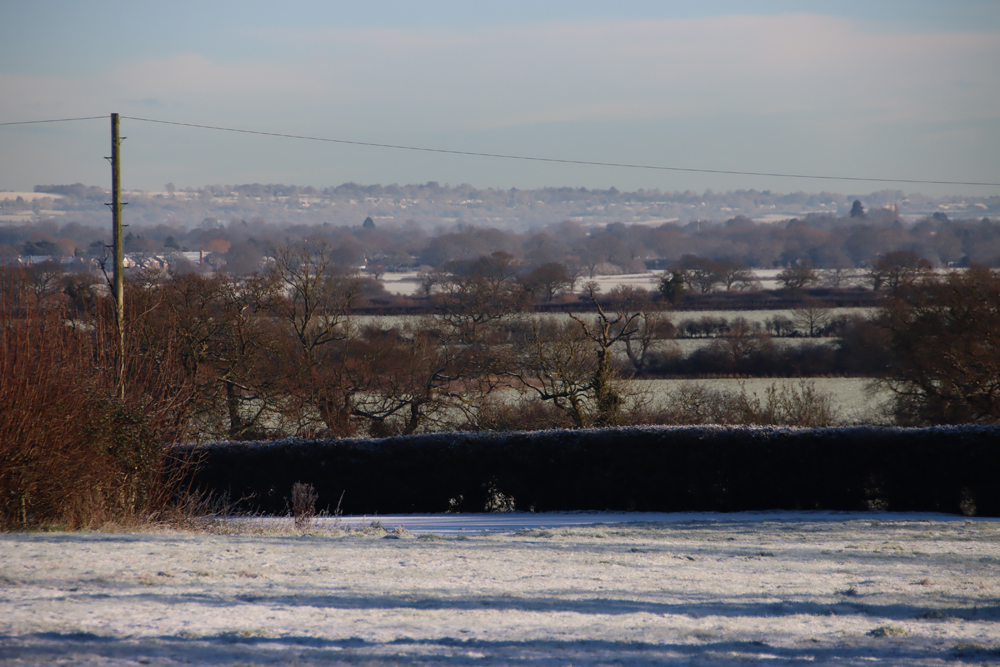
There were quite limited means by which the priors of Birkenhead might increase their income.  The most obvious way of generating ongoing income was to acquire more land through gifts and bequests.  In this endevour the priory probably had a real disadvantage in being near to both St Werburgh’s Abbey in Chester and, across the river Dee, Basingwerk Abbey at Holywell.  Both abbeys had significant land-holdings on the Wirral, and both had pilgrim shrines and were on pilgrim routes.  Both were large and prestigious, and were far more likely to attract big gifts than a small and rather remote priory.  If Birkenhead hoped to attract gifts of land, it probably had to depend on local landowners and merchants who felt a personal connection with the priory but would not necessarily have had the wherewithal to significantly change the income-earning potential of the priory, providing personal items rather than swathes of land. For these very local gifts and legacies, it is entirely possible that the priory was also in competition with contemporary parish churches on the Wirral.  There are records in the early 16th century, not long before the monastery was closed during the Dissolution, that give an idea of the sort of bequests made by local people in return for requiem masses to be recited for their souls:  one will provided a painting of the Crucifixion for the priory church.  Another bequeathed the owner’s best horse, 10 shillings, and a ring of gold.
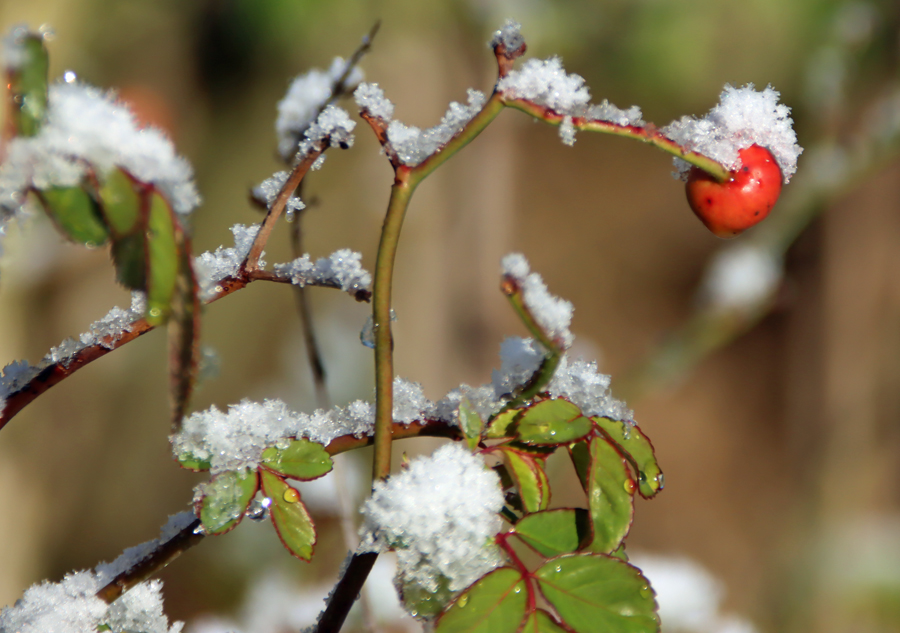
As the Middle Ages progressed, populations expanded and both new and old towns began to hold markets where everyday goods and more prestigious products could be traded, even once-isolated monasteries found themselves becoming integrated into the secular world and in competition with it.  It certainly did not initially help the monks at first that during the early 13th century Liverpool began to grow.  Under the Benedictine rules, monasteries had an obligation to provide hospitality to visitors when required, and the Birkenhead monks ran the ferry over the Mersey as a charitable service.  When the priory was first established, offering occasional hospitality and running the ferry free of charge were not onerous.  This changed rapidly after 1207 when Liverpool was granted burgh status by King John, as the following translation of the original Latin charter confirms (Translation from Picton 1884):

The 1207 charter of Liverpool by King John. Source: Royal Charters of Liverpool leaflet

John, by the grace of God King of England, Lord of Ireland, Duke of Normandy, Aquitain, and Earl of Anjou, to all his faithful subjects who may have wished to have burgages in the town of Liverpool greeting. Know ye that we have granted to all our faithful people who may have taken burgages at Liverpul that they may have all liberties and free customs in the town of Liverpul which any free borough on the sea hath in our land. And therefore we command you that securely and in our peace you come there to receive and inhabit our burgages. And in testimony hereof we transmit to you these our letters patent. Witness Simon de Pateshill at Winchester on the 28th day of August in the ninth year of our reign.

A little later Liverpool was granted the right to hold markets and fairs, and the links between Liverpool and the busy port of Chester grew to be increasingly important. There was no infrastructure to cope with this increase in human traffic. They were already offering a ferry service free of charge but even more pressing on their resources was the cost of housing guests.  There were no inns between Liverpool and Chester (showing a lack of commercial ambition on the part of both Liverpool and Chester medieval merchants!), so the monks found themselves obliged to offer accommodation and food, which the rules of the Benedictine order required them to offer free of charge.  This hospitality became particularly difficult if there was a spell of bad weather, during which those waiting to cross from Birkenhead to Liverpool would have to wait at the priory until the weather improved and crossings could resume.  They were also were troubled with all the through-traffic that travelled along a route that ran through the monk’s Birkenhead lands close to the priory buildings.

The spiral staircase from the undercroft into the former refectory

It must have exacerbated the monks’ financial situation when Edward I visited the monastery twice with his entourage during this period.  Edward’s first visit was in September 1275 for three nights, seeking a diplomatic solution to his dispute with the self-styled Prince of Wales, Llywelyn the Last of Gwynedd. His second was in 1277 for six days with the apparently dual motives of pursuing his campaign against Llywelyn and receiving a delegation from Scotland to settle a boundary dispute.  Although the king would pay the costs of his entourage and horses, the cost of entertaining the king and his most senior advisors fell to the monastery.  Hosting a royal entourage was notoriously expensive, and any contributions made by a visiting monarch to a monastic establishment only rarely compensated for the outlay.

One of the measures to improve their income in the 1270s involved the expense of serious litigation when incumbent prior claimed that the church had been presented in its entirety to the priory.  This was disputed by the Massey family, who triumphed in the courts.  Fortunately for the priory, in 1278 the 5th Hamon de Massey came to an agreement with the monks to their benefit.  Other litigation occurred over pasture rights in Bidston and Claughton.

In 1284 the priory received permission from Edward I, who had probably witnessed the priory’s problems at first hand in the 1270s, to divert the road that disrupted the priory “to the manifest scandal of their religion” and to provide the priory court with an enclosure, either a ditch, hedge or wall, to preserve its privacy.  This would have incurred costs, but would have eased one of the problems caused by the ferry.  Rather more significant for their finances, early in the 14th century the priory was granted a licence to build and charge for guest lodgings at the ferry at Woodside, and in 1311 they were granted the rights to sell food there.  It was at this time that the church was expanded, which would have been a significant project.

Chapter house building with scriptorium room added over the top in the 14th century.

The first half of the 14th century had been hard for most of western Europe, with both famine due to anomalous weather conditions that caused crops to fail, followed only a few decades later by  a plague that killed huge numbers of people.  In Britain the famine lasted from 1315-17 and the Black Death arrived in 1348. The priory survived both the famine and the plague, as did the settlement of Liverpool, now a century old.  At some point in the first half of the 14th century, the priory acquired land in Liverpool so that the monks could begin to trade their goods at market, building a granary or warehouse on Water Street (then known as Bank Street).

In 1316 the hospital of St John the Baptist in Chester was judged to be seriously mismanaged and was put into the hands of the priory, perhaps because of their experience running their own infirmary.  This was a failure, merely adding to the priory’s problems, and was removed from their care in 1341.

Multiple layers in the west range, with a  window added into the top of a former fireplace, blocking it, and a fireplace above it.

In 1333 Edward III requested monasteries to contribute to the expenses of the marriage of his sister Eleanor.  Local monasteries who contributed included Birkenhead, which contributed £3 6s 8d and Chester’s St Werburgh’s Abbey which, bigger and more prosperous, gave £13 6s 8d.  There were doubtless other payments of this sort, occasional and therefore unpredictable, and impossible to resist.  The priory was also liable for taxation.

The ferry from Woodside had continued to be supplied free of charge, but the priory appealed to Edward III and was permitted for the first time to charge tolls in 1330, setting a precedent that remains today.  A challenge to the monk to operate the ferry and claim the tolls, was challenged by the Black Prince in 1353, but the priory produced its charter and successfully resisted the removal of this privilege.  The tolls charged were recorded at that time:  2d for a man and horse, laden or not; 1/4d for a man on foot or 1/2d on a Saturday market dasy if he had a pack

Other ways of generating income from lands to which they had rights were also explored, and from records of litigation against them, they were often accused of infringing forest law.  Wirral had been defined as a forest by the Norman earls of Chester, which restricted how the land could be used.  The monks were clearly assarting (cutting down wood to convert to fields and pasture), reclaiming waterlogged land, enclosing certain areas and cutting peat for fuel. The priory was able to argue special exemptions for some of the charges, and produced the charters to prove it, but at other times they were fined for the infractions.  In 1357, for example, they were fined for keeping 20 pigs in the woods.

A number of monastic establishments seem to have responded to surviving the plague by redefining themselves via architectural transformations.  Whatever the reasons for this trend, Birkenhead Priory was no exception and the 14th century could have been an expensive time for the monks.  The frater range (including the elaborate vaulted undercroft and the refectory) was completely rebuilt and the west range was remodelled.  The room today described as a scriptorium was also added over the chapter house at this time.  Although Stewart-Brown suggests that much of this could have been accomplished with “pious industry . . . without much cost” with the assistance of donations of labour and money, that is probably somewhat optimistic, and there would have been an outlay.  Certainly, at the end of the century the priory was considered to be so impoverished that it was exempted from its tax contribution.

There is some evidence that for at least some of the Middle Ages the priory rented out land rather than working it themselves, except for their home farm at Cloughton. This had the benefit of providing a dependable income if tenants were reliable, and obviated the need to appoint managers or deal with labour and handle the sale of produce, but if the cost of living went up, the fixed income that no longer purchased what it had previously afforded, and this could represent a serious problem.

Dissolution

The opening page of the Valor Ecclesiasticus, showing Henry VIII. Source: Wikipedia

When Henry VIII’s demand for a divorce was rejected by the pope, the king severed Britain from the Catholic Church, creating the Church of England.  This provided him with the opportunity to acquire land and valuable assets by dissolving all monastic establishments, all of which had been subject to the papacy.  The spoils were to be used to fund Henry’s wars with France and Scotland, and some former monasteries were given to Henry’s supporters as rewards. To assess the potential of the monastic assets, Henry VIII commissioned the Valor ecclesiastis, a review of every monastery in the country.  All monastic establishments with an annual income of less than £200.00 were to be closed as soon as possible. The first monasteries were dissolved in 1536 and the process was more or less concluded by 1540, with a handful of the more prestigious abbeys, like St Werburgh’s in Chester, converted to cathedrals.  Birkenhead Priory was only earning £91.00 annually so it was amongst the first to be closed.  There was no resistance by the Birkenhead prior, who was provided with a pension of £12.00 annually.  The brethren were either dismissed or disseminated to non-monastic establishments.

Visiting

The car park is on Church Street, at the rear of the priory, where the cafe is also located.  There is some on-street parking on Priory Street at the front of the priory. Source: Birkenhead Priory website

This is a super place, and makes for a terrific visit.  Do go.  You won’t be disappointed!

Even with SatNav, the big thing to remember about finding your way to Birkenhead Priory, if you are arriving by car from the Chester direction, is to do whatever it takes NOT to end up at the Mersey tunnel toll-booths 🙂  They were very nice about it, let me out through a barrier, and gave me perfect directions to get to the priory once they had freed me from the tunnel concourse.  Very nice people.  If Edward III was looking down, I’m sure he would have rolled his eyes in despair, given that it was he who gave the monks the right to charge for their Mersey ferry crossings.

Do check the opening times on the website, as the priory is only open on certain days and for only a few hours on those days, mainly in the afternoons. There is dedicated parking on Church Street at SatNav What3Words reference ///super.punchy.report.  From there, the priory is up a short flight of steps.  You can also park on Priory Street, which is where the SatNav will take you if you simply type “Birkenhead Priory” into your SatNav (at What3Words ///indoor.vibes.hips), which offers step-free access but there is limited parking there, and it is a favourite place for van drivers to park and eat their lunches so may be better used as a drop-off point before going round the the car park.

Remnants of the decorative floor tiles, now in the priory’s undercroft, which is used as a museum space

At the time of writing, a visit is free of charge, and so are the guided tours.  My guide was the excellent Frank.  He covered not only the priory but St Mary’s, the HMS Conway room, and the HMS Thetis memorial and, when I headed up to the top of the tower of St Mary’s, directed me to out for the dry dock where the CSS Alabama (the US Confederate blockade runner) was built by John Laird, to be discussed in Part 2.  Frank was very skilled at providing sufficient knowledge to get a real sense of the place, but not so much that it became information overload.  I very much appreciated this, having always found it difficult myself to strike that particular balance.  I was lucky enough to have him to myself, having turned up at opening time, but I noticed that the next tour had a respectable group attending.

There is a small gift shop where you can also buy a really useful guide book with plenty of plans, illustrations and colour photographs.  Please note that they are not able to take cards, and payment is cash only.

There are toilets in St Mary’s tower, a picnic area behind the undercroft on sunny days, and the highly rated Start Yard café is almost next door on Church Street.

For those with unwilling legs, I would suggest that apart from the tower and its 101 steps, and a flight of around 10 steps up into the scriptoruim (the display area for HMS Conway) this is entirely do-able.  There are occasional single steps and uneven surfaces, and it is a matter of taking good care.  As mentioned above, if you park in the carpark at the rear on Church Street, there is a flight of steps into the priory, but even if there is no space in the limited street parking available at the front of the priory on Priory Street, it is a useful drop-off point for anyone needing step-free access.  You can find the SatNav references for both above.

I have posted a two-minute video of the priory, recorded on my iPhone, on YouTube:

Sources

Books, papers, and guidebooks

Baggs. A.P., Ann .J Kettle. S. J. Lander, A.T. Thacker, David Wardle 1980. Houses of Benedictine monks: The priory of Birkenhead, In (eds.) Elrington, C. R. and B. E. Harris. A History of the County of Chester: Volume 3, (London, 1980) pp. 128-132.
https://www.british-history.ac.uk/vch/ches/vol3/pp128-132

Burne, R.V.H. 1962. The Monks of St Werburgh. The History of St Werburgh’s Abbey. S.P.C.K.

Chitty, Gill 1978. Wirral Rural Fringes Survey. Journal of Merseyside Archaeological Society, vol.2 1978
https://www.merseysidearchsoc.com/uploads/2/7/2/9/2729758/jmas_2_paper_1.pdf

de Figueiredo, Peter 2018. Birkenhead Priory. A Guidebook. ISBN 978 1 9996424 0 2

Hughes, Tony. St Mary’s Parish Church, BIrkenhead, 1819-1977. n.d.
https://thebirkenheadpriory.org/wp-content/uploads/St-Marys-booklet.pdf

Picton, Sir James A. 1884.  Notes on the Charters of the Borough (now City) of Liverpool. The Historic Society of Lancashire and Cheshire, vol 36 (1884)
https://www.hslc.org.uk/wp-content/uploads/2017/07/36-5-Picton.pdf

Stewart-Brown, R. 1925.  Birkenhead Priory and the Mersey Ferry, and a Chapter on the Monastic Buildings. The Gift of the Directors of the State Assurance Company Ltd.

White, Carolinne 2008. The Rule of St Benedict. Penguin.


Websites

The Birkenhead Priory
https://thebirkenheadpriory.org/
Buildings of Birkenhead Priory
https://thebirkenheadpriory.org/about/
The medieval grave slabs of Birkenhead Priory
http://thebirkenheadpriory.org/wp-content/uploads/Graveslabs-of-Priory-Chapel.pdf

Mike Royden’s Local History Pages
The Monastic and Religious Orders in the Hundred of Wirral from the Saxons to the Dissolution of the Monasteries – A study of the Monastic history and heritage of Wirral by Norman Blake, April 2003
http://www.roydenhistory.co.uk/mrlhp/articles/students/monasticwirral/monasticwirral.htm
The Influence of Monastic Houses and Orders on the Landscape and locality of Wirral (with particular reference to Birkenhead Priory) by Robert Storrie, April 2003
http://www.roydenhistory.co.uk/mrlhp/articles/students/bheadpriory/bheadpriory.htm
The Medieval Landscape of Liverpool: Monastic Lands (with particular reference to the granges of Garston Hall and Stanlawe Grange) by Mike Royden, 1992
http://www.roydenhistory.co.uk/mrlhp/articles/mikeroyden/liverpool/monastic/mondoc.htm

ArchaeoDeath
Commemorating the Reburied Dead: Landican Cemetery
https://howardwilliamsblog.wordpress.com/2024/05/16/commemorating-the-reburied-dead/

Old Wirral
https://oldwirral.net/archaeology.html

Wirral Council
Making Our Heritage Matter. Wirral’s Heritage Strategy 2011-2014, 2013 Revision. Technical Services Department.
http://democracy.wirral.gov.uk/documents/s50009194/Wirral Heritage Strategy Appendix.pdf

Wirral History
Medieval Wirral (maps)
http://www.wirralhistory.uk/medieval.html

An online archive for for St Mary’s Church and the Priory, Birkenhead
History of the Priory and St. Mary’s Church Birkenhead
http://stmarysbirkenhead.blogspot.com/p/history-of-priory-and-st-marys-church.html


Leaflets

Birkenhead Priory Guide. Metropolitan Borough of Wirral.
Birkenhead Priory A4 leaflet Wirral

Liverpool’s Royal Charters
https://liverpool.gov.uk/media/ghdaoid3/liverpool-charter.pdf

St Mary’s Parish Church 1819-1977
https://thebirkenheadpriory.org/wp-content/uploads/St-Marys-booklet.pdf