Cover of the free English/Welsh booklet accompanying the exhibition published by Wrexham Heritage Service, 2021.
My thanks to Brian Payne of the Holt Local History Society for alerting me to the fact that the Hidden Holt exhibition has been launched at the Wrexham County Borough Museum, running until 29th January 2022. I went last week my father, and we were both bowled over by how good it was.
The exhibition introduces the Roman tile, brick and pottery works that were spread across a number of fields to the northwest of Holt, next to the river Dee. It uses an excellent combination of original artefacts, video, information boards and both old and new photographs and diagrams to track the twin stories of the site itself and the history of its discovery and excavation. Holt Local History Society has a long-standing interest in the Roman works, and commissioned the most recent geophysical survey work at the site, so it’s great to see their contribution to the story being celebrated.
The exhibition (free to enter) is in Gallery 3, to the left as you move beyond reception and the café to enter the display areas. I’ve given an overview below, but I seriously recommend that you just go – it is a tremendous, professionally-produced and beautifully designed little exhibition with some superb objects on display and some excellent information boards that explain what you are looking at. You won’t regret it. If you’re in the mood, the café serves a great coffee and what looks like a rather delicious lunch 🙂
Survey and excavation

Arthur Acton – page 5 of the booklet accompanying the exhibition. Source: Wrexham Heritage Service, 2021
The story of how the site was recognized and investigated begins in the early 1600s when landowner Thomas Crue of Holt Hill suffered repeated damage to his plough on broken brickwork and eventually discovered a series of fifty 2ft-tall posts and recorded this in a letter now in the British Museum. The letter was mentioned in the book Roman Cheshire by W. Thompson Watkins (1886). Retired chemist and keen amateur historian Alfred Neobard Palmer read the book, and in 1905 decided to hunt for the remains that Crue had found. He tracked down the original letter and accompanied by local vicar Jenkyn Jones, and with the permission of the landowner Mr Beard, he engaged in a series of fieldwalking expeditions that found plenty of fragments of Roman bricks, roof tiles and pottery over an area of some 20 acres.

Fold-out plan of the kilns at Holt, published by Grimes in 1930. (Scanned from my copy of “Holt, Denbighshire”)
Palmer was not an archaeologist, and the task of excavating the site was taken on by Wrexham solicitor and amateur archaeologist Arthur Acton. Work began in 1907, in Wall Lock Field, and continued until 1915. Although he lectured prolifically about the site, Acton never published his work. Fortunately some of his records survived, and he sold the finds to the National Museum of Wales. After five years of admirable work, the Assistant Keeper of Archaeology at the National Museum, William F. Grimes who was better known as a prehistorian, published a comprehensive 235-page report on the site, complete with site plans, photographs and object illustrations.

Photograph and logo from the Archaeological Survey West website: http://www.archaeologicalsurveywest.co.uk/
Work did not stop there, and during the 1970s Geoffrey Bevan conducted both field walking activities and an excavation, finding Roman material that filled dozens of boxes, which were donated to the Grosvenor Museum in Chester. Most recently, Holt Local History Society commissioned Archaeological Survey West to carry out a geophysical survey of the site, to accurately fix the positions of the known buildings and to identify any unexcavated and previously unknown structures. This was successfully completed in 2018, and demonstrated that the Holt complex was even bigger and more complex than Grimes, via Acton, had been able to determine. There is, of course, the potential for future field research.
The exhibition

Piece of a colander manufactured at Holt, on display at the exhibition
The exhibition is based mainly around discoveries made during the Acton excavations, using the Grimes and later reports to explain what was found and what has been discovered since. Between them, Crue, Palmer, Acton, Grimes, Bevan, Holt Local History Society and Archaeological Survey West have produced a history of what lies beneath those lush green fields, and this is what the exhibition introduces.
As usual usual the exhibition’s narrative is arranged in a clockwise direction, so turn left as you walk in to Gallery 3. The exhibition begins with a video that explains the history of survey and excavation and then talks about the site itself. It is well worth taking a seat and watching. It lasts about 15-20 minutes and is chock-full of information with some terrific photographs, diagrams and artist impressions of what various structures may have looked like. The technique of superimposing building plans over a modern aerial view of the fields is particularly useful for understanding how the site was composed and what each element consisted of. From there, the excellently designed displays take the visitor through the site’s history.

Site plan of the Roman tile and pottery work displayed in the exhibition. Also in the excellent booklet accompanying the exhibition, full details in Sources below. Click to see a bigger version with fully legible text. Source: Wrexham Heritage Service, 2021
The site was more elaborate than I realized, composed of a number of buildings as well as the kilns. The image on the right is shown at full size in the exhibition, and shows how big a complex the Holt tile, brick and pottery works actually was. This is a bang-up-to-date site plan, combining the information provided by Grimes in 1930 with the details obtained by Archaeological Survey West in 2018. What this and a lot of Acton’s photographs makes clear, is that the site was a fully integrated operation combining industrial, public and domestic architectural components. A senior manager had his own house, complete with hypocaust (under-floor) central heating, there was a public bath house, presumably for workers, a series of kilns for the manufacture of mainly tiles and pottery, and a barracks that may have housed workers, or alternatively a detachment of the Roman army based at Chester at this time. The features shown in blue are unrecorded / unexcavated. Those in dark brown are the building locations fixed in 2018, and those in paler brown those estimated by Grimes based on Acton’s work.

The main kiln plant at Holt, published by William Grimes in 1930. Scanned from my copy.
Although now the archaeological remains are covered with fields, Acton used photography extensively, and his site plans were detailed, many published by Grimes, and used in the exhibition to reveal and explain the different components of the site. This is very helpful not only for understanding how the site worked as an end to end operation, but is invaluable for putting the objects into context. Objects on their own tell a limited story, but when contextualized in terms of the buildings in which they were produced and used, come to life. The exhibition does this brilliantly.
It was a good location for a tileworks. Building stone was available in the immediate locality thanks to the Bunter sandstone, alluvial clay was available locally, woodlands were present for the provision of fuel to feed the kilns, and the river Dee provided direct access to Chester, 12 miles / 19km away, passing the civic settlement at Heronbridge. The generally flat environment meant that building of roads was not particularly laborious.
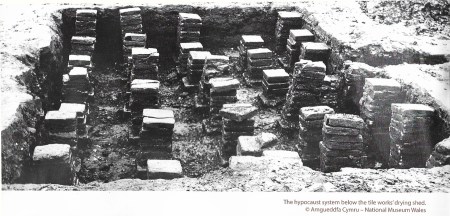 The visitor is taken step-by-step through the production process, explaining how the kilns and drying sheds were built and how they functioned. The kilns formed two main units, a larger (139ft / 52m long, consisting of a row of six kilns) and smaller twin-kiln built on the natural bed-rock. Each kiln was rectangular and tile-lined with an arched stoke-hole for access. A round pottery kiln was also located on the edge of the main kiln complex. The oven floor was fascinating, consisting of a raised floor of tiles plastered with clay that were pierced with holes that acted as vents. I was fascinated to see that the drying shed was provided with a hypocaust, better known as the under-floor heating system that was used in villas and bath houses. These, like the kilns, were stoked and kept hot to ensure that the tiles, pottery and bricks were dried through after firing.
 The exhibition displays a number of artefacts, including a roof tile, a brick and a triangular atefix tile marked with the letters LEGXXVV, an abbreviation for the twentieth legion, known as Valeria Victrix (valiant and victorious). The antefix tile, one of which is shown in the exhibition (photo left and illustration below) also shows Legio XX’s dramatic running boar symbol. Legio XX was stationed at Chester from AD87, and the Holt works appears to have been established shortly afterwards, reaching its peak output at around AD135, and falling out of use in the mid 3rd Century.

Antefix tiles from Holt. Source: Grimes 1930
 A display board shows the vast range of products that were made at the site, including floor and roof tiles, and a variety of different pottery forms. There is a good explanation of how the roof tiles, called imbrex and tegula (plural imbrices and tegulae), worked. A good memory for me – I dug up a lot of these tiles at my first ever dig in Silchester. The arched imbrices, sit snugly over the upright edges of two facing tegula tiles, as shown in the above photograph, and the the triangular antefix tiles were placed to cover the ends of the imbrex.
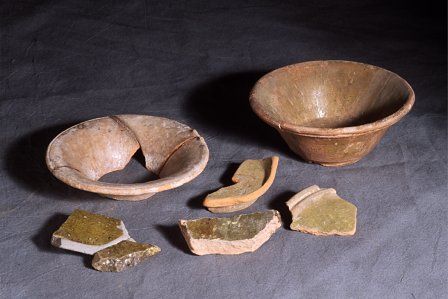
Green-glazed ware found at Holt. Source: National Museum of Wales
Examples of the pottery found at the site are on display, with some really fine examples, including ollae (jars), urcei (jugs), lagenae (flagons), cattili (plates), calices (drinking bowls), and testa (lids). I particularly liked a partly preserved ceramic colander and a mortarium (the latter working like a modern mortar, but with bits of stone embedded into the interior base of the pot to create a rough surface for grinding spices and seeds). Green-glazed pottery, a luxury ware that I had never come across before, was also made at the site. It is rare in Britain, so it was excellent to see examples of it on show. A photograph of the green glazed pottery found at Holt (from the National Museum of Wales website) is shown below.
The workers also turned their hands to other types of objects made from clay – one cabinet shows a marvellous piece of shaped water pipe that was manufactured at the site.

Section of water pipe manufactured at Holt
All of the output manufactured at the works was sent by boat downriver to Chester, the exhibition suggests that a short may have been dug out at Holt in order to make loading the ceramics easier, its course marked today by annual floodwaters that, as they recede, leave a line of floodwater in what could well be a Roman channel.

Samian pottery found at Holt. Source: Grimes 1930
Interestingly, the exhibition shows that even though huge amounts of pottery was being made on-site, there were particularly favoured types of ceramic being imported. Samian (terra sigillata), a truly gorgeous luxury dark red ware that has moulded decoration on its lustrous surfaces, was found in surprising quantities. This was usually imported from south-eastern Gaul (France); a Roman experiment with samian production in southern England produced inferior pottery and was very short-lived.
Imported black-burnished ware was also found at Holt, which the exhibition explains was made in Dorset. At sites in southern England it is common (we found bucket-loads of it at Silchester), but when found at northern sites, it was probably imported to fulfil a particular need or desire. The works manager might have wanted high-status ceramics, and any soldiers at the site may have craved the comforts of home, but another option is that it was being imported for use by a nearby settlement. One of the findings of the 2018 geophysical survey was the presence of a possible Roman fort or marching camp to the west of the site, suggesting that the site may have been on the edge of an unidentified vicus settlement, or village.

Coins on display in the exhibition.
The coins at the site are invaluable for their contribution to creating a timeline for development of the site, but are works of art in their own right.
The exhibition provides another insight into the inhabitants of the site by displaying some of the other objects they owned, like small pieces of jewellery made of bronze, manicure equipment, a beautifully crafted needle and a delectably delicate silver spoon. These are objects that people chose and kept on them, intimate reminders that these were real people who lived complicated lives in which personal appearance had an important role.

Silver spoon from Holt on display at the exhibition. Source: Grimes 1930
A map at the end of the exhibition was riveting, showing how widespread Roman presence in northeast Wales actually was, showing everything from single find-sites to industrial sites like that at Holt, the settlements at Heronbridge and Plas Coch, and the villa at Rossett, the latter two sites both recent discoveries. It looks as though there will be more Roman discoveries in the future, filling out a picture not merely about the activities of Romans in Britain, but on their interactions with local communities, something which remains poorly understood.
Museum details
 The museum is an excellent resource, a small but modern with excellent displays and a lot of great information on professionally produced display boards into context. At the time of writing (August 2021) masks must be worn and you need to leave your name and telephone number with reception. For opening days and times, plus directions, see the Wrexham County Borough website:
http://old.wrexham.gov.uk/english/heritage/wrexham_museum.htm
A booklet accompanying the exhibition is available both in the museum foyer and under the video screen in Gallery 3. The cover and some of the pages from the booklet are shown at the top of the post, and full details are in Sources, below. A leaflet, Holt: Legacy of the Legions, is also available from the museum, or can be downloaded.
It is a real shame that the Hidden Holt gallery is only a temporary feature, but Wrexham Museum has a lot more to see, and I will be posting about some its permanent displays in the future.
Sources:
Books and papers
Grimes, W.F. 1930. Holt, Denbighshire: Twentieth Legion at Castle Lyons. Y Cymmrodor. Society of Cymmrodorion.
Ward, M. 1998. A collection of samian from the legionary works-depot at Holt. In (ed.) Bird, J. Form and Fabric. Oxbow Monographs 80.
https://www.researchgate.net/publication/333155555_A_collection_of_samian_from_the_legionary_works-depot_at_Holt
Ward, M. 1998. Some finds from the Roman works-depot at Holt. Studia Celtica 32:43-65
https://www.researchgate.net/publication/311789557_Some_finds_from_the_Roman_works-depot_at_Holt
Booklets / leaflets
Wrexham Heritage Service 2021. Hidden Holt. The Story of a Roman Site. The Discovery of a Roman Legionary Tile and Pottery Works at Holt, near Wrexham. (Booklet accompanying the exhibition in both English and Welsh)
Holt Castle Conservation and Interpretation Project. Holt. Legacy of the Legions. An introduction to the history of the Legionary Works Depot at Holt. (Leaflet, including site plan, available from the museum)
http://old.wrexham.gov.uk/assets/pdfs/heritage/holt_castle/holt_legacy.pdf
Websites
Hidden Holt
Wrexham Museum
https://www.wrexhamheritage.wales/?exhibition=hidden-holt-the-story-of-a-roman-site
Hidden Holt – Roman history revealed in a new Wrexham Museum exhibition
Wrexham Council News
https://news.wrexham.gov.uk/hidden-holt-roman-history-revealed-in-new-wrexham-museum-exhibition/
Holt Local History Society
https://holtlhs.weebly.com/
National Museum of Wales
https://museum.wales/
Roman Glazed Pottery from North Wales
National Museum of Wales
https://museum.wales/articles/1327/Roman-glazed-pottery-from-North-Wales/
The Pottery Kilns of Roman Britian by Vivien Swan (database)
https://romankilns.net/