Category Archives: River Dee

A visit to Basingwerk Abbey, Holywell

Introduction

The Chuch is at left, the Chapter House opposite and the ground floor monks’ day parlour whcih once had their dormitory overhead. The line of the cloister, a covered walkway with arcades, and the central garth are marked out by the stone foundations

I have been to Basingwerk Abbey a couple of times, but never got around to writing it up.  It’s a super site, and although it is now a ruin, it retains enough of its original structures to ensure that its layout is easily understood.  St Winifred’s Well, with its lovely late gothic shrine, is only a mile and a bit away, and an important part of Basingwerk’s property for most of its life, will be covered on another post.

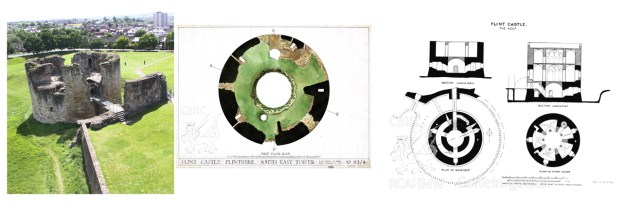
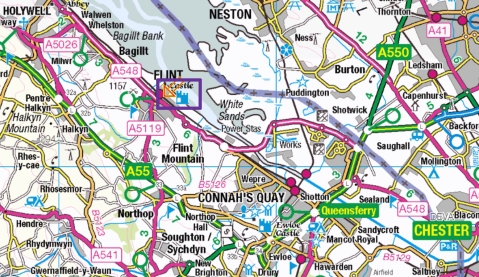
Basingwerk Abbey is only a  few miles away from Flint Castle.  The abbey preceded the castle by over a century but when Edward I founded Flint Castle and its accompanying town in 1277, the histories of abbey and castle became entwined. A visit to the abbey is easily combined with a look-in at the attractive riverside remains of Flint Castle.  I have written about the history of Flint Castle on an earlier post.

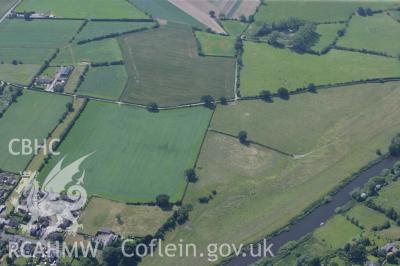
Digital Aerial Photograph of Basingwerk Abbey. AP_2009_2896 – s, Archive Number
6355272. Source: Coflein

Savignacs and Cistercian Basingwerk Abbey

Remains of the church

The first Basingwerk abbey, dedicated to St Mary, was founded as a Savignac monastery Ranulf II (Ranulf de Gernons) (1099–1153), fourth earl of Chester and later merged with the Cistercian order. It is not known why the Savignac order was chosen by Ranulf, but the monks who were sent to Basingwerk were provided directly by the founding monastery of Savigny in southwest Normandy itself. It became Cistercian in 1147.  Most of the monks who served there subsequently, up until the 15th century, were English, aliens in territory that was a bone of contention between England and Wales.

A monastic order is formed of a shared set of spiritual ideals, often spelled out in considerable detail in rules that covered everything from how many times a day a monk should pray, communally or individually, to where and when they could speak, eat and sleep, and what work they should engage in. All orders involved, at least in theory, a degree of renunciation and isolation by communities of monks, but these ideals were eroded as the influence of monastic houses grew.  The trajectory of monastic history in Europe changed in the late 11th century and early 12th century with the establishment of the so-called reforming orders, who wanted a purer, less self-indulgent and more hard-working approach to cloistered living than other contemporary monastic institutions offered.  The reforming orders believed that the Rule of St Benedict, as it had been originally conceived and set down in the 6th Century Italy, was the key to recovering a holier and more disciplined approach to a communal life of worship. The Carthusian order was established in 1084, the Cistercian order in 1098, the Savignac order between 1109 and 1112.

12th Century links between Cistercian monasteries.Although Citeaux, the node for all Cistercian abbeys, established early new bases in France, it was Clairvaux under the lead of St Bernard that was responsible for the earliest new abbeys in Wales. Of these Whitland was the most important for the northward spread of monasticism. The green lines emanating from Savigny reflect the Savignac order, which merged with the Cistercians after only 20 years, in 1147. So although Basingwerk in the north and Neath in the south were founded as Savignac orders, after 1147 they were brought under the rule of the Cistercians at Citeaux.  Source: Evans, D.H. Evans 2008, Valle Crucis Abbey (Cadw).

In Wales one of the most successful of these orders was the Cistercian order, which left remains in north, mid and south Wales.  Valle Crucis in Llangollen is the nearest of the Cistercian abbeys to the Chester-Wrexham areas, established in 1201, and is discussed in a series of earlier posts, which begins here with Part 1.  The Savignac order is much less well represented throughout Britain, and the reason for this is that in 1147 it was amalgamated with the Cistercian order.  Basingwerk Abbey, established as a Savignac monastery, became Cistercian in that year.

Because of their similarities the Savignacs and Cistercians were a good match, but there were differences too, largely in terms of the constitutional framework and systems of accountability.  To ensure that these were understood after the fusion, Savignac monasteries were put under the supervision of an appropriately located and senior Cistercian order.  Basingwerk was put under authority of Buildwas Abbey in Shropshire, which had also originally been Savignac.  This was perfectly in keeping with the Cistercian hierarchical approach to monastic management with every new monastery answerable and accountable to a mother house.  The mother house for the entire order was Cîteaux, and Clairvaux was the mother abbey for Whitland in south Wales, which was established by monks from Clairvaux itself. Whitland in turn established other abbeys including Strata Marcella near Welshpool, and this abbey in turn established Valle Crucis.   This system created a network of houses that all linked back to the ultimate mother house at Cîteaux (Cistercium in Latin) in France, the founding monastery of the Cistercian order.  Every Cistercian abbot had to return from his abbey to Cîteaux every year for what was known as the General Chapter, a great conference of the Cistercian abbots. 

A more detailed history of monasticism, and the Cistercians in particular, is included in Part 1 of the series on Valle Crucis.

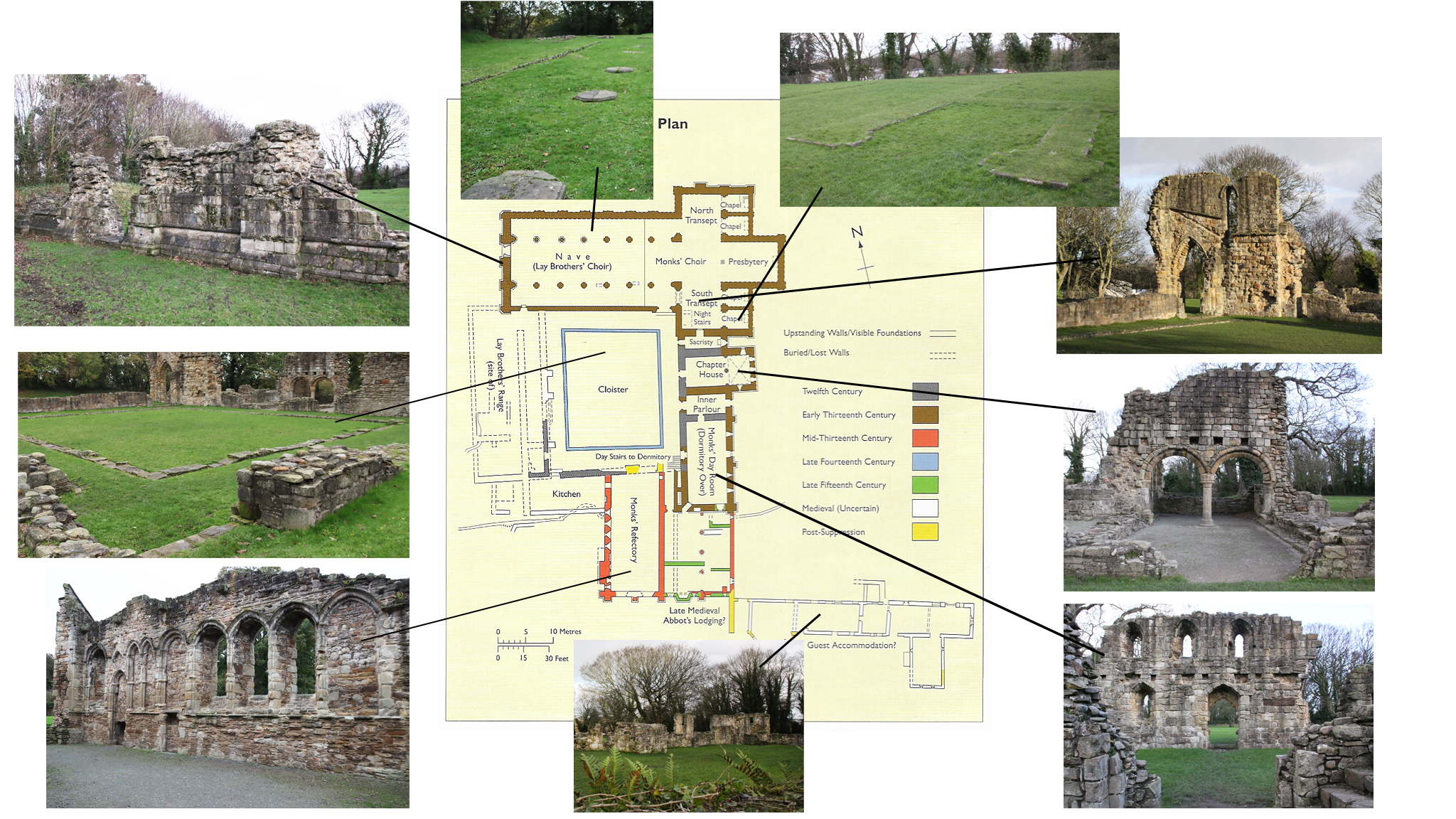
Cadw guardianship monument drawing of Basingwerk Abbey. Survey-plan. Cadw Ref. No. 216/9a4. Scale 1:192. Source: Coflein

The foundation and economic basis of Basingwerk Abbey at Holywell

Exterior of the refectory

The first Basingwerk Abbey was probably in wood, and was located at a different but nearby site possibly somewhere in the vicinity of Hên Blas in Coleshill, near a now-lost castle.  There is a reference to a fortification in the Annales Cambriae describing how, when Henry II advanced into Wales from Chester,  Owain Gwynedd prepared for the upcoming battle by digging a large ditch associated with a hastily built camp at a site called Dinas Basing.  It is thought that this was the castle known to have been in the area of Hên Blas, which lies on a ridge between two streams and overlooks the Dee estuary.  Excavations in the 1950s demonstrated the existence of a 12th century motte-and-bailey castle , which was flattened by Llewelyn the Great in the early 13th century, and was replaced with a defended courtyard with timber-framed buildings.

The central garth on a very moody day looking at the remains of the church. The tall upstanding ruin is the main remnant of the church at its east end. Photo taken from within the refectory

Basingwerk Abbey was later rebuilt in stone at the current site of the ruins, possibly in the 1150s, probably when Henry II granted a charter to the house and endowed it with the wealthy manor of Glossop in Derbyshire to assist with its financial future, 10 years after it became Cistercian.  The general location seems to have been strategic rather than purely spiritual.  The area of Tegeingl is located in the Four Cantrefs between the earldom of Chester and Welsh Gwynedd, always the subject of territorial dispute between England and Wales and a source of regional discontent until Edward I completed his invasion in the late 13th century.  The establishment of a large French monastery was probably part of this process of establishing a presence, and a holy one at that.  Although the monastery was later mainly populated by English monks, the Welsh too saw the benefit of patronizing a prestigious religious establishment and both Llywelyn ab Iorwerth (d. 1240) and his son, Dafydd ap Llywelyn (d. 1246) were benefactors. 

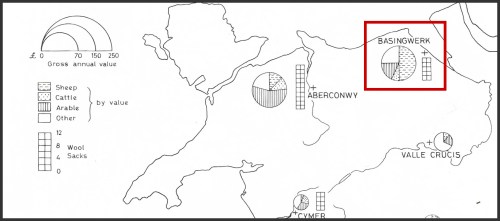
Detail of Map 12, page 91 in Williams 1990 showing Cistercian Lands in Wales, with those of Basingwerk marked in red. Click to enlarge.

When an abbey was founded, its endowment included a number of properties that included farmland or pasture that were intended to support it by the provision of produce to make it self sustaining and later by selling produce.  Some of these could be quite substantial manors, but others were smaller farms, which the Cistercians referred to as granges.  These could resemble mini monastic establishments and often had their own chapels. Later still, properties with their land could be rented out to tenants, but as late as the early 16th century, Abbot Nicholas Pennant was busy creating a new open enclosure in the mountains adjacent to the monastery apparently for agricultural development.

Gelli Chapel, from Thomas Pennant’s 18th Century Tour in Wales. Source: National Library of Wales, via Wikipedia

Based on the work of D.H. Williams in his 1990 Atlas, Silvester and Hankinson 2015 list all the known Basingwerk granges, shown on the above map produced by Williams. These were supplemented in 2001 by Williams in 2001.  Apart from two properties in Derbyshire these are all concentrated in northeast Wales and the Wirral and include, in alphabetical order:  Baggechurch /Beggesburch Grange, Bagillt; Calcot; Gelli Grange, either at Gelli or Gelli Fawr; lands in Whitford and the adjacent parish of Cwm; the Lordship of Greenfield, alias Fulbrook, including lands of Merton Abbot and party of Holywell town; and Over Grange, Holywell (all in Flintshire).  Lands with uncertain boundaries have also been identified elsewhere in the area, including Mostyn, Wake, Flint and Gwersylt as well as transhumant pasture close to property belonging to Valle Crucis Abbey at Moelfre-fawr in Denbighshire, at Boch-y-rhaiadr and Gwernhefin. They also owned Lake Tegid at Bala.

Beyond Wales, there were also three granges on the Wirral: Caldy Grange (West Kirby), Thornton Grange and Lache Grange (known as “La Lith”), as well as the granges in Charlesworth at Glossop, their mos profitable property, and leased land in Chapel le Frith. 

Over Grange, Holywell. Source: Williams 1990, plate 39, page 120. No indication of when the photograph was taken.

Of this list, only two buildings seem to have survived into relatively recent times, the remnants of two granges.  A chapel at Gelli Fawr in Whitford (Flints), apparently once belonging to Basingwerk Abbey was recorded in  a late 18th-century drawing which suggests that the chapel was part of a larger building complex. More can be found about the building and its possible function it in Silvester and Hankinson 2015.  Another grange, Over Grange, was listed by Cadw in 1991, according to Silverster and Hankinson, and was located located to the southwest of the modern farm house, and has been much-altered.  The photograph below shows it with small cross over the gable.

The Coflein website says that it is believed that Basingwerk Abbey originally constructed a windmill on this site, but the present structure probably dates to the late18 or early 19th century.  Now restored. Source: Coflein 804658 – NMR Site Files. Archive Number 6259181

To support its farming activities, the monastery built watermills, windmills and fulling mills.  Abbot Thomas Pennant (abbot from 1481 to 1522) appears to have been particularly active in the building of mills.  Records indicate that there were at least four windmills, at least three watermills, and at least two fulling mills, as well as a tithe barn in Coleshill.

The site of the Holywell windmill is thought to be preserved by the surviving windmill that can be seen today, shown right.  Two of the windmills were on the Wirral. Rowan Patel’s research has found that the Basingwerk windmill that stood at West Kirby area had been established at around 1152, and was probably upgraded and even replaced several times.  It stood on a high spot near the coast, an ideally windy location, and eventually featured on sea charts as a major landmark for coastal navigation.   It was mentioned in Henry VIII’s Valor Ecclesiasticus, the valuation of all monastic properties. Patel has found that after the Dissolution the mill became the property of the Crown and was rented to Thomas Coventree for an annual sum of 40s.  Rowan Patel’s research suggests that the second Basingwerk windmill was at Newbold, east of West Kirby, mentioned in the Taxatio of Pope Nicholas IV in 1291, where a Newbold windmill was referred to and valued at 40s a year.  Before the Dissolution it appears to have been rented out to Thomas Coyntre in 1525 on a 100 year lease at 40s a year.  By the time of the Dissolution, Thomas’s son Richard Coventry was apparently paying rent to the Crown, and in 1659 William Coventry, presumably a descendant of Richard’s, was still paying rent.  In 1664 it is next recorded having been sold to one Thomas Bennett in who donated it to the support of the poor.  Patel notes that in 1546 two men stole oats, barley and pease worth 10d, indicating the cereals proposed at the mill in the mid-16th century if not before.

Watermills continued to have a value well into the 20th century, and medieval mills will have been replaced over time, removing the visible remains of them, particularly along the valley that ran down the hill behind St Winifred’s Well and past Basingwerk before emptying into the Dee.

Economic Values excerpted from Williams 1990, map 21, p.105, showing the dominance of the agricultural contribution to the abbey’s income

Basingwerk had a large amount of livestock.  The hills and newly cleared meadows around Basingwerk were ideal for sheep in the uplands and cattle in river valleys and pastures.  The Welsh princes are also recorded as expecting two horses annually from Basingwerk which may indicate that the monks, like those of Cymer Abbey, were breeding horses.

As well as agriculture, which made up most of its income, Basingwerk was also involved in industrial activities, owning or leased industrial properties, Williams lists silver mining as a component of Basingwerk’s economic activities, and this is supported by Gerald of Wales whose trip through Wales in 1188 records leaving Conwy and heading east through Tegeingl through “a country rich in minerals of silver, where money is sought in the bowels of the earth” before spending the night at Basingwerk.  The abbey was also involved in the salt trade, with salt extraction enterprises in Northwich and possibly Middlewich.   Williams notes a coal mine leased from the Crown in Coleshill.  Lead was also mined at Basingwerk, probably making use of the same resources that had been exploited by the Romans in the area.

Economic resources excerpted from Williams 1990, map 22, p.105

Timber was taken from woodlands in Penllyn in Merionydd for housing, hedges, fuel and other requirements, as well as for sale.  Tenants were permitted to take a reasonable amount of firewood.  Assarting, the removal of woodland for conversion to agricultural land and other uses was a common activity in the middle ages.

Fishing probably made up a significant part of the diet, as it did at most Cistercian monasteries.  Basingwerk held the fishing rights for Lake Tegid at Bala, which it owned, and had a weir at West Kirby.  Prince Dafydd granted them one fifth of the catch at Rhuddlan in the 13th century.  They may also have purchased fish caught in the nearby coastal waters.

Basingwerk had a number of urban properties too, in Holywell, Flint, Chester, and Shrewsbury, which served as bases in town for the abbot and his representatives, which were probably loaned to friends of the monastery, but could also be leased out for additional income if required.  The Shrewsbury house was probably a legacy of the abbey’s connection with Buildwas Abbey after the amalgamation of the Cistercian and Savignac orders.

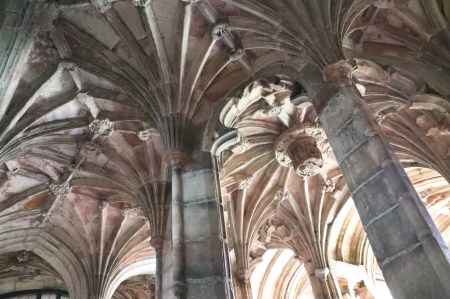
The fan vaulting in St Winifred’s Well at Holywell

A major feather in the financial cap of Basingwerk was St Winifred’s shrine with its beautiful natural spring.  The Holywell shrine of St Winifred was also another source of travelers requiring somewhere to stay and something to eat.  St Winifred’s shrine was granted in 1093 to St Werburgh’s Abbey in Chester, but was passed to Basingwerk in 1240, together with the living of Holywell church.  An abbey with a pilgrim shrine had a whole world of opportunities for income generation, and St Winifred’s was not only famous in its own right for its powers of healing and provision of miraculous cures, but was on the pilgrim trail to Bardsey Island at the end of the Llŷn peninsula and Ireland, via Anglesey.  In 1427 it was given a considerable boost when Pope Martin V granted indulgences for those visiting the shrine and giving alms to the chapel.  Indulgences rewarded certain behaviours, like pilgrimages, with a remission of sins, meaning less time in purgatory.  Royal visitors included King Henry V in around 1416 and Edward IV in 1461, helping to raise the profile of the shrine, which continues to welcome pilgrims today.  It became even more attractive from the late 15th – early 15th century when the shrine was provided with a spectacular gothic building that surrounded the spring.  I will cover Holywell in a separate post.

A traditional method of income acquisition for monasteries was appropriating a church and its income, sometimes to cover a particular expense, such as a major building project, and sometimes just to supplement income.  The Cistercians officially frowned on this practice, but the ban on appropriating church incomes did not survive very long.  Even so, Basingwerk had appropriated surprisingly few, just parish churches at Holywell, Glossop and a third at an unknown location, possibly to be identified with Abergele.

The fairs and markets granted to Basingwerk during Edward I’s reign in the 1290s are discussed below, and this must have been a considerable aid to their income.

Behind the monks’ day room and the dormitory above it was a block of buildings the function of which remains unclear. Suggestions include an extension of the abbot’s personal quarters, with rooms for special visitors, or a dedicated guest wing.

In spite of these various forms of income, Basingwerk sometimes found itself in financial stress. The monastery had been unable to provide a required payment to Edward III in 1346, and by way of explanation complained of the burdens of hospitality that came partly with being a Cistercian abbey, which put a great deal of emphasis on providing free hospitality, and partly from being near a major road, which had become increasingly busy after Edward I had moved forward into Wales, establishing market towns whose merchants moved between Wales and Chester for trade.  Even later in its history, in the late 15th/early 1gth century, it was reported that guests were so numerous that they had to take their meals in two sittings. Smith paints an evocative picture of other travelers in Wales who “cautiously flitted from one English settlement to the next, seeking safe overnight bases where food and shelter could be found “in a land in which rumors of insurrection abounded.” Basingwerk was by no means the only abbey to complain of this burden, which was a particular problem for Cistercian abbeys, but was shared by any monastic community that sat at a busy location.  Birkenhead Priory, which ran the ferry that allowed crossings between the Wirral and Lancashire for access to Chester and beyond (and later Liverpool), found itself in real difficulties due to the requirement to supply hospitality for ferry users who might be stuck at the monastery for several nights in bad weather.

A rather more specific problem was the expectation by the Welsh princes to use the abbey’s Boch-y-rhaiadr range for its annual hunting expeditions, during which the abbey was expected to provide bread, butter, cheese and fish for a hunting party of 300, expanding to 500, with money due in lieu when hunting did not take place.  This was abolished by Edward I after his conquest of Wales.

The Cistercian monasteries in Wales were not exempt from all taxes, or subsidies, and some of the abbots and their community were employed as tax collectors.  Other occasional charges were made on the abbey, such as a demand for financial contributions towards the marriage of Edward III’s sister.  Basingwerk provided £5 in 1333.

The abbey, being so active in economic production in the Holywell-Flint areas, was responsible for the management of its lands and the personnel who managed and worked the land, but was also required to function in a judicial role, its courts administering justice and meting out punishments.  Lekai says that the monastery had “a pillory, tumbrel and other instruments of punishment, although the penalty most often inflicted was a fine.”

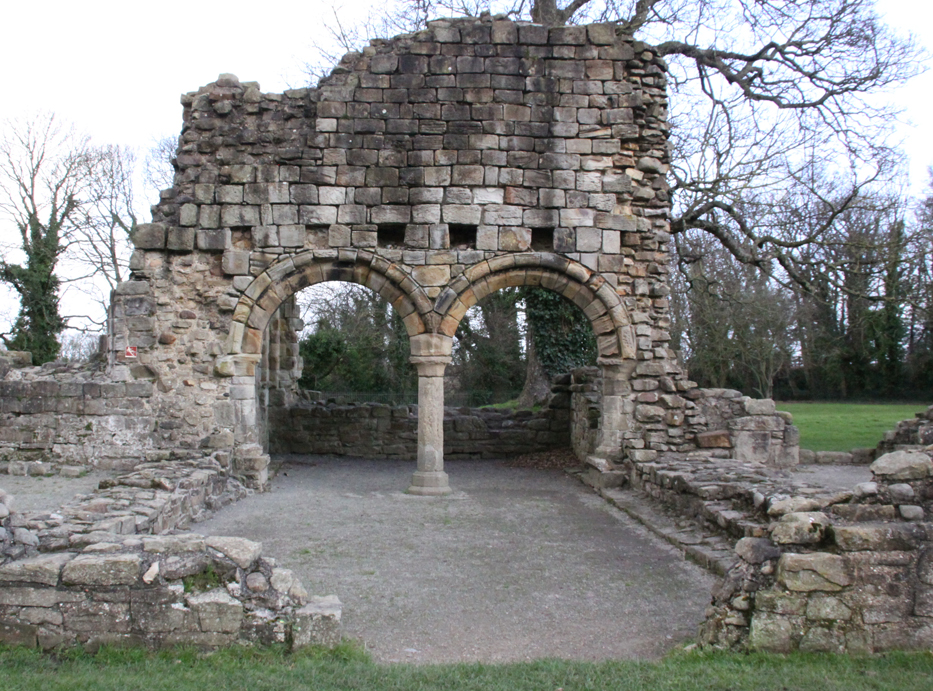
The church is on the left and the two arches of the chapter house at right,.  All the buildings were arranged around the central green area, the garth. The stone foundations for the covered and arcaded walkway survive.

Most of the Cistercian abbeys in Wales, at one time or another, had a diplomatic role acting as intermediaries between the Welsh princes and the Crown, acting for either side, a role that was in their political interests to accept.  For example In 1241 Henry III used the Lache grange for a conference between himself and Prince Dafydd’s clerk.  In 1246 Henry III chose the abbot of Basingwerk to escort Prince Dafydd’s wife Isabella from Dyserth Castle to Godstow nunnery near Oxford.  A decade later, Prince Llywelyn ap Gruffyd used an abbot of Basingwerk to carry a letter to Henry III.

In 1291 the Taxatio Ecclesiastica of Pope Nicholas IV valued Basingwerk at £68 8s 0d, gross value (compared with Valle Crucis at £91 8s 0d, and Margam  at £255 27s 4½d).  In 1346 it claimed that its lands were sterile, and it went through some bad years, but in spite of the rebellion of Owain Glyn Dŵr in the early 1400s and a very troublesome period when a monk took the abbacy without being legally elected in the first half of the 15th century, with a similar problem in the later 15th century, the appointment of Thomas Pennant in the early 16th century seems to have turned things around.  In 1535, Henry VIII’s Valor Ecclesiasticus valued the monastery at £157 15s 2d.  Margam by this time was valued at £188 14s 0d, and Valle Crucis £214 3s 5d.
——

The layout of the monastery

Plan of Basingwerk Abbey. Source: Robinson, D. M., 2006. Basingwerk Abbey (Cadw).

The remains of the monastery conform to a standardized layout favoured by all the orders that followed the rule of St Benedict, clearly shown on the Cadw plan to the right, which helpfully colour-codes the dates for each part of the building. Few parts of the 12th century abbey are left.  Most date to the early 13th century, but the monk’s refectory was built in the mid-13th century.  Much of the abbey was rebuilt in the 13th century, which was not unusual when, for example, a new abbot might want to make a mark, but in this case it is possible that much of not most of it was done due to damage inflicted during the wars between the English and the Welsh, when Edward paid compensation to the abbey to enable it to carry out repairs, about which more below.

The cloister arcade was apparently remodelled in the late 14th century.  In the late 15th century Abbot Thomas Pennant carried out building work not only at the abbey but also at the shrine of St Winifred just up the road in Holywell.  There are various aspects of the site where both date and function remain unclear.  The western range, opposite the chapter house, would have been part of the original layout, used to house the lay brethren, discussed below, but may have gone out of use if a new use for them could be found when the lay brethren were no long featured in the community.  Although the above plan shows that the possible guest accommodation is undated, timbers from fire damage Basingwerk were saved for future analysis and tree-ring dating shows that the felling-date of the crown-post truss was c. 1385.  This is one of the earliest Welsh tree-ring dated.  The dating was commissioned by Cadw.

The church is at left, the chapter house to its right, the day room and the windows of the first floor dormitory next, and set to the far right is the refectory

Although every monastery differed in some aspects, the basic template of buildings surrounding a central square area, a garth (green area) with surrounding walkway (the cloisters) with the monastic church making up one side, was a universal arrangement.  The church was usually on the north side, as it was here, and often included two chapels in the transepts that flanked the crossing area where the choir was located.  Some churches featured towers either above the crossing or at one end.  The other buildings usually included a chapter house (the important monastic meeting room), day room with a dormitory on its first floor, a refectory, and sometimes an undercroft for storage. with an external door leading into the cloister on one side and the monastic precinct beyond. A sacristy was usually attached to the church, sandwiched between the church and the chapter house, which is how matters were arranged at both Basingwerk and Valle Crucis.  The cloisters were usually supplied with desks (called carrels) along the exterior wall of the church  where the monks could study and write.

The precinct, in which this arrangement of buildings sat, could include other structures like farm buildings, and visitor accommodation and often included a gatehouse, the whole surrounded by some form of boundary.  A key feature of Cistercian monasteries was good drainage, which supplied the kitchens and fish ponds, where present, and took away toilet waste, and various parts of the Basingwerk drainage system can be traced at the site.

Part of the abbey’s drainage system

Part of the abbey’s drainage system

The church, with its entrance at far left and the south transept at right

Many of these features can be found at Basingwerk.  The church is largely in ruins, but the layout is still visible in the very masonry walls that sit on the grass, including the columns that supported the roof and divided the church into a central nave with three aisles and seven bays, two side transepts each with a small transept and an eastern presbytery where the high altar would be located.  At around 50 metres in length the church would have been one of the smallest Cistercian churches in Wales. Only Cymer near Dolgellau is shorter, at just over 30m in length.  At the entrance to the presbytery a stone set into the floor may have supported a lectern.

What remains of the south transept, with the presbytery beyond

Basingwerk Abbey refectory wall

Opposite the former church, and one of the best preserved parts of the abbey, is south range with the refectory, which was built perpendicular to the cloister rather than lying along it on a north-south axis.  The refectory in Chester Cathedral, the former St Werburgh Abbey, was built along the length of the cloister, limiting its size, but the the refectory at Basingwerk as limited only by the size of the precinct.  This was probably a change introduced in the 13th century remodelling of much of the abbey, replacing a 12th century refectory that lay along the side of the cloister on an east-west axis.  It is a substantial building with many features preserved in its walls.  This includes the former entrance and stairway to the pulpit, now blocked off, from which religious texts would have been read during meals.  S series of tall windows would have let in a lot of light, and there was a hatch between the refectory and the kitchen for the convenient handing over of food, as well as a cupboard, which was apparently shelved, opposite.

The monks’ day parlour at ground floor level, with the dormitory on the first floor, the windows suggesting the original height of this building

The east range of buildings, again along the edge of the cloister, extends between the east range and the church.  As you face this range, running from right to left are the monks’ day parlour, over which was the dormitory, the length of which over-ran the cloister and ran parallel for a short distance with the refectory;  a long thin parlour is next, and then most importantly is the chapter house, where the monks met daily to discuss the business of the order.  To its left is the sacristy, which adjoined the south transept of the church.

The Chapter House

The sacristy to the left of the chapter house, with doorway leading into the church to the left.

Looking towards where the western range would have been located. The building beyond is now the café.

Opposite this range was the western range, of which there is almost nothing left.  In a Cistercian monastery this was usually used, at least in the early decades, for the lay brethren.  These were members of the monastic community who worked the land, and were not required either to be as educated as the monks, or to dedicate a similar amount of time to worship.  They worked the land and were maintained by the monastery.  As properties were leased out, the lay brethren were increasingly redundant and the western range was usually put to different uses.  It is not known how it would have been used at Basingwerk.


Edward I and Basingwerk Abbey

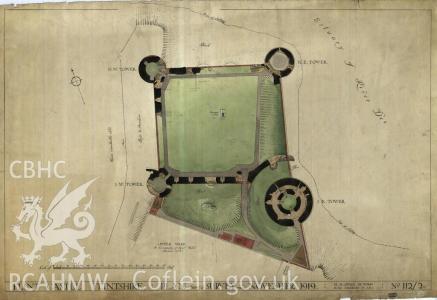
Plan of Flint Castle. Source: Coflein

When Edward I settled on his location for his new castle at Flint, Basingwerk Abbey was just a few miles west of the new site.  The monks of Basingwerk Abbey, which was established over 100 years earlier in 1132, must have wondered about the impact of the castle on their own security and their livelihood.  During the first few months of the castle construction process in the summer of 1277 Edward stayed near Basingwerk.  Edward saw himself as a religious man.  He had been on crusade, and had made a vow to establish a monastic house of his own, under the Cistercian order, and had selected a site for it in Cheshire.  Vale Royal Abbey was already underway in 1277 near Northwich, Edward having laid the first stone in early August.  It seems unlikely that Edward was not often a guest of the Basingwerk Cistercian Abbey during the building of Flint, which apart from being obliged under Cistercian rules to provide hospitality, was unlikely to reject a royal visitor.  Although Basingwerk had been founded by an English patron, Ranulf II it was probably more in tune with Welsh interests by the arrival of Edward.  Indeed, earlier in 1277 seven Cistercian abbots had written a letter to Pope Gregory X supporting Prince Llewellyn ap Gruffud against charges placed by the Bishop of St Asaph, although the abbot of Basingwerk was not amongst them.

Drainage at Basingwerk, from the refectory

Whatever their personal leanings, it would have been very much in the interests of the order for good relations to be maintained.  They may have offered advice about his plans for Vale Royal, and it is clear that some of the abbots in the Welsh-based monasteries, including Basingwerk, played an invaluable role as intermediaries between the Welsh and the English.  Fortunately for the monks at Basingwerk, Edward I chose the Cistercian abbey at Aberconwy for his headquarters, forcing that monastic community to eventually shift further south along the Conwy valley to a new home.

The monks of Basingwerk would have been less than astute, however, if they had not regarded the new castle with misgivings, and if they had concerns about being caught in the middle of a fight between Edward and Llywelyn, their worries would later be justified.  In the 1270s and 1280s the abbey suffered damage during the wars of Edward I, in spite of letters of protection issued to it in 1276,1278, and 1282 and in 1284 Edward granted £100 compensation to the monks after the army stole corn and cattle and the loss of workers who were abducted, presumably for labour.  An additional 132 4d was paid in damages to churches in Holywell.  Basingwerk was not the only abbey in the area to suffer and receive compensation.  Valle Crucis near Llangollen received a sum of £160.00, and nearby Aberconwy was occupied by Edward I’s forces and its monastic community was forced to move to a new home to the south, at Maenan.  Relations between the abbey and castle obviously continued to remain good, because when the castle was completed in 1280 a monk of Basingwerk was engaged as the chaplain to the royal garrison.

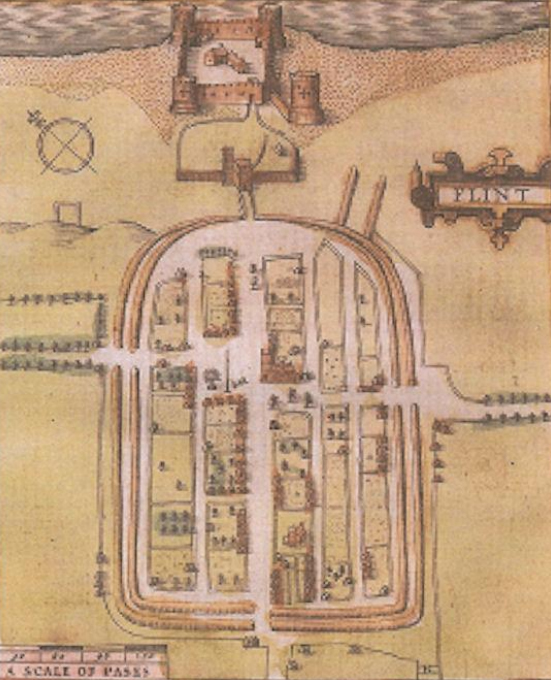
One of John Speed’s maps showing Flint Castle and town. The castle and town of Flint as mapped by John Speed in 1610, showing the original road layout and market place. Source: National Library of Wales

At Flint, Edward had established a Norman-style new town as part of his vision for colonizing various parts of Wales.  This was an English settlement, and any new burgesses prepared to live there was given numerous incentives.  In 1278 Edward granted it permission to hold weekly markets and an annual fair.  In 1292 he granted Basingwerk the same permissions for Holywell, having granted them permission to hold an annual fair at their Glossop manor in 1290.  The monks could charge market stall holders rent for the duration of the market, a nice source of income, as well as selling their own products.  Basingwerk, with its water mills, windmills and fulling mills and land under both grazing and grain, was certainly in a position to sell a number of products, including grain, livestock and livestock products including meat, skins and wool. Welsh wool was recognized as being of very high quality, sometimes superior to even that of the better known wool produced by the Yorkshire monastic producers.  The Taxatio ecclesiastica of Pope Nicholas IV in 1291 recorded that Basingwerk had 2000 sheep producing 10 sacks of wool, 53 cows (at a ratio of 37.1:1), and no goats. Even if it found itself in competition with Flint, Basingwerk’s fairs probably represented the opportunity to raise the abbey’s income.  Its industrial products, as well as some of its wool, may have been sold for export.

The 14th – 16th century

Burton and Stöber describe how by the mid 14th century there were reports that the abbey was in debt, and in the fifteenth century some of its abbots were a distinct liability:

in 1430 the house was seized by Henry Wirral, who made himself abbot, and the following year he was engaged in a legal dispute for the office with Richard Lee. Despite the court ruling in favour of Lee, Henry continued in power at Basingwerk until 1454 when he was arrested for various misdemeanours and deposed. Matters did not improve, for in the following decade Richard Kirby, monk of Aberconwy, disputed the abbacy with Edmund Thornbar. Although the General Chapter ordered that Edmund be recognized as abbot, Richard was still in office in 1476.

Manuscript by Gutan Owain, National Library of Wales, MS3026C. Source: The National Library of Wales

Fortunately the abbey’s fortunes improved under Welsh Abbot Thomas Pennant, who ruled the house for about forty years from around 1481 to 1523, although this was very much a last hurrah before Henry VIII dissolved the monasteries beginning in 1535. By the early 16th century Welsh bard Tudur Aled (died 1526) makes it clear that there was lead roofing and stained glass at the abbey.   Tudur Aled praised Abbot Thomas , commending his his learning but also his generosity, generally an indication that they were being sponsored by a given abbot, as at Valle Crucis.  Gutun Owain seems to have benefited from Basingwerk Abbey’s patronage.  Owain is notable for having addressed over fifteen poems to Cistercian abbots, and is known to have stayed as a guest at Valle Crucis and Strata Florida as well as Basingwerk.  Although the late fifteenth century manuscript known as the Black Book of Basingwerk (Llyfr Du Basing, now NLW MS 7006D, which was the mainly the work of Gutun Owain copied into a single volume) was probably held by Basingwerk at the time of the dissolution in around 1536, it is thought in fact to have been the work of copyist monks at Valle Crucis.

Thomas Pennant was not a man of undiluted virtue.  In an order where celibacy was required and monks were not permitted to marry, Pennant not only fathered a family, but his son Nicholas, became the last abbot of Basingwerk, which in theory was an act of simony banned by the order.  When the abbey closed, probably in 1536, with just three monks, Nicholas was the abbot.

St Mary on the Hill, Chester. Source: GENUKI

After the Dissolution every valuable object and piece of structural material was stripped for Henry VIII’s treasury.  James says that part of the timber ceiling is at Cilcain, and that stained glass can be found at Llanasa.  Burton and Stöber add that the choir stalls from the abbey were transferred to the church of St Mary on the Hill in Chester.  Lead from the roof was removed, and may have been used for the repair of Holt Castle on the Dee and Dublin Castle. Williams adds that it may have been employed also in other crown buildings in Dublin, and that it is possible that the wooden sedilia in the parish church of St Mary, Nercwys, was from Basingwerk.  There is a tradition that the Jesse window was reinstalled in the parish church of St Dyfriog (Llanrhaeadr-yng-Nghinmeirch) but this remains unconfirmed.

I have been unable to get access to St Mary on the Hill, a comprehensive history of which is on the Chesterwiki. It was decomissioned in 1972 and now describes itself as a Creative Space and venue for a range of activities.  However, the Chesterwiki site says that the fittings, presumably including the Basinwerk choir stalls, were removed after the church was decomissioned, although it does not say where these fittings went.

From the 18th century the site attracted artists who recorded features that are now lost.  In the early 20th century a large section of the south transept collapsed.  In 1923 the site was put in State guardianship and in 1984 it was put into the car of Cadw.

Basingwerk Abbey miniature by Moses Griffiths, c.1778. Source: National Library of Wales, via Wikipedia

Final comments

The building that may be a guesthouse, has had burned timbers dendro-dated, which give the roof a date of c.1385. Source: RCAHMW Exhibitions: Dendrochronology Partnerships

Information about Basingwerk Abbey is fragmented and partial, but researchers have pieced together a history of the abbey that tells a story about abbey’s past, beginning as a Savignac establishment before being absorbed into the Cistercian network of monasteries.  The disputes between the Welsh princes and Henry III and Edward I caused grief for the north Wales monasteries, but they survived to rebuild and move forward.  Like other abbeys in Wales, the abbots of the abbey had a diplomatic role, often acting as intermediaries between Wales and England.  As members of the wider community with an important economic role, the abbey was often involved in local judicial matters. Financial difficulties in the 14th and 15th centuries are recorded and but again the monastery survived these difficulties.  In the early 16th century the abbey became a haven for Welsh bards, supporting their work. Throughout its history, its location on the main route through north Wales meant that it was obliged to provide more hospitality than more secluded monastic houses, whilst the shrine of St Winifred, whilst contributing to the prestige and financial value of the abbey, also required some management to prevent it becoming a drain on the abbey’s obligation to provide shelter and food.  After the Dissolution in 1536, the abbey was decommissioned, its valuables removed and its properties either sold off our leased out.  Today it is managed by Cadw and offers an excellent visitor experience.


Visitor Information

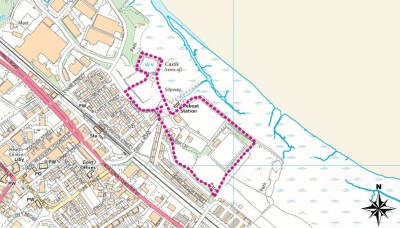
Find the captions and see the full-sized map at https://greenfieldvalley.com/greenfield-valley-zones/. There is an interactive version of the map at https://greenfieldvalley.com/explore/interactive-map/.

The site is free to visit.  There is no visitor information centre but a small modern shop sells guide books, postcards and souvenirs relating to Basingwerk, St Winifred’s Shrine and the Greenfield Valley Park. The abbey’s postcode is CH8 7GH and the car park is on Bagillt road, just to the west of the enormous railway bridge, opposite a small trade/industrial estate.

There is a big car park at the foot of the abbey, shown to the right left on the A548, just west of the enormous railway bridge, which has a fairly gentle metalled incline up to the abbey, with a bench and information map half way up.

There is also a café just outside the main gates, which in October 2022 was doing a good coffee and a splendid lunch.

Basingwerk Abbey is a component part of Greenfield Valley Park, and is popular with dog walkers and children, so if you want a quiet visit it is probably best to go on a weekday outside the holidays. The rest of Greenfield Valley Park is an excellent visit in its own right, with a remarkable amount of industrial archaeology within its borders, and plenty of interpretation boards.  I have posted about the industrial archaeology of the Green Valley Park here.
If you want to stay in the medieval period, St Winifred’s Well is about 1.5 miles through the park (shown as No.9 at the very top of the map right), or if you prefer to drive it has its own car park.  Flint Castle is only 4 or so miles down the A548 towards Chester, and makes for a great visit.  I wrote about the history of Flint Castle on an earlier post, Together, the three sites make a very fine medieval day.

Sources

Books and papers:

Burton, J. and Stöber, K. 2015.  Abbeys and Priories of Medieval Wales.  University of Wales Press.  https://www.jstor.org/stable/j.ctt9qhdvn.13

Davies, Paul R. 2021. Towers of Defiance. YLolfa

Elfyn Hughes, R., J. Dale, I. Ellis Williams and D. I. Rees. Studies in Sheep Population and Environment in the Mountains of North-West Wales I. The Status of the Sheep in the Mountains of North Wales Since Mediaeval Times. Journal of Applied Ecology , Apr., 1973, Vol. 10, No. 1 (Apr., 1973), p.113-132
https://www.jstor.org/stable/2404720

Evans D.H. 2008, Valle Crucis Abbey, Cadw

Knight, L. Stanley 1920. The Welsh monasteries and their claims for doing the education of later Medieval Wales. Archaeologia Cambrensis, 6th series, volume 2, 1920, p.257-276
https://journals.library.wales/view/4718179/4728984/314#?xywh=-63%2C345%2C2942%2C1730

Rhys, Ernest (ed.) 1908.  The Itinerary and Description of Wales with an introduction by W. Llewelyn Williams. Everyman’s Library. J.M. Dent and Co, London. and E.P. Dutton and Co (NY)
https://archive.org/details/itinerarythroug00girauoft

Huws, D. 2000.  Medieval welsh Manuscripts. University of Wales Press

James, M.R. 1925.  Abbeys. The Great Western Railway
https://archive.org/details/abbeys-great-western-railway

Jones, Owain, 2013. Historical writing in medieval Wales. PhD Thesis, University of Bangor.
https://research.bangor.ac.uk/portal/files/20577287/null&ved=2ahUKEwjxssbb0tvtAhWmxIsKHQgvBW0QFjAOegQICBAI&usg=AOvVaw2GbJiGy6Sl3SPiTX4K8RqZ

Lekai, Louis L. 1977. The Cistercians. Ideals and Reality. The Kent State University Press

Patel, Rowan 2016. The Windmills and Watermills of Wirral. A Historical Survey. Countyvise Ltd.

Robinson, D. M., 2006. Basingwerk Abbey. Cadw

Silvester, R.J., and Hankinson, R., 2015. The Monastic Granges of East Wales. The Scheduling Enhancement Programme: Welshpool. Clwyd-Powys Archaeological Trust (CPAT)
coflein.gov.uk/media/241/979/652240.pdf

Smith, Joshua Byron 2016. “Til þat he neӡed ful neghe into þe Norþe Walez”: Gawain’s Postcolonial Turn. The Chaucer Review, Vol.51, No.3 (2016), p.295-309
https://www.jstor.org/stable/10.5325/chaucerrev.51.3.0295

Williams, David H., 2001. The Welsh Cistercians, Gracewing

Williams, David H., 1990. Atlas of Cistercian Lands. University of Wales Press

Websites:

Coflein
Basingwerk Abbey
https://coflein.gov.uk/en/site/35649?term=basingwerk%20abbey%20holywell

Monastic Wales
Basingwerk Abbey
https://www.monasticwales.org/browsedb.php?func=showsite&siteID=24
Gutun Owain
https://www.monasticwales.org/person/72
The Black Book of Basingwerk
https://www.monasticwales.org/archive/24
Valle Crucis (Abbey)
https://www.monasticwales.org/browsedb.php?func=showsite&siteID=35

RCAHMW Exhibitions: Dendrochronology Partnerships
Bilingual exhibition panel entitled Partneriaethau Dendrocronoleg; Dendrochronolgy Partnerships, produced by RCAHMW 2013
https://coflein.gov.uk/media/200/524/rcex_026_01.pdf

RCAHMW List of Historic Placenames (searchable database)
https://historicplacenames.rcahmw.gov.uk/

University of Notre Dame
A Knight in St. Patrick’s Purgatory, by Haley Stewart. March 15, 2019
https://churchlifejournal.nd.edu/articles/a-knight-in-st-patricks-purgatory/

An Essay on Cistercian Liturgy by Dr Julie Kerr
Cistercians in Yorkshire, University of Sheffield
www.dhi.ac.uk/cistercians/cistercian_life/spirituality/Liturgy/Cistercian_liturgy.pdf 


The chapter house propped up during excavations when M.R. James visited in 1925.

Basingwerk Abbey from the South. 1929 postcard. Source: People’s Collection Wales

April’s ‘Chester Archaeological Society’ visit to St Collen’s Church in Llangollen

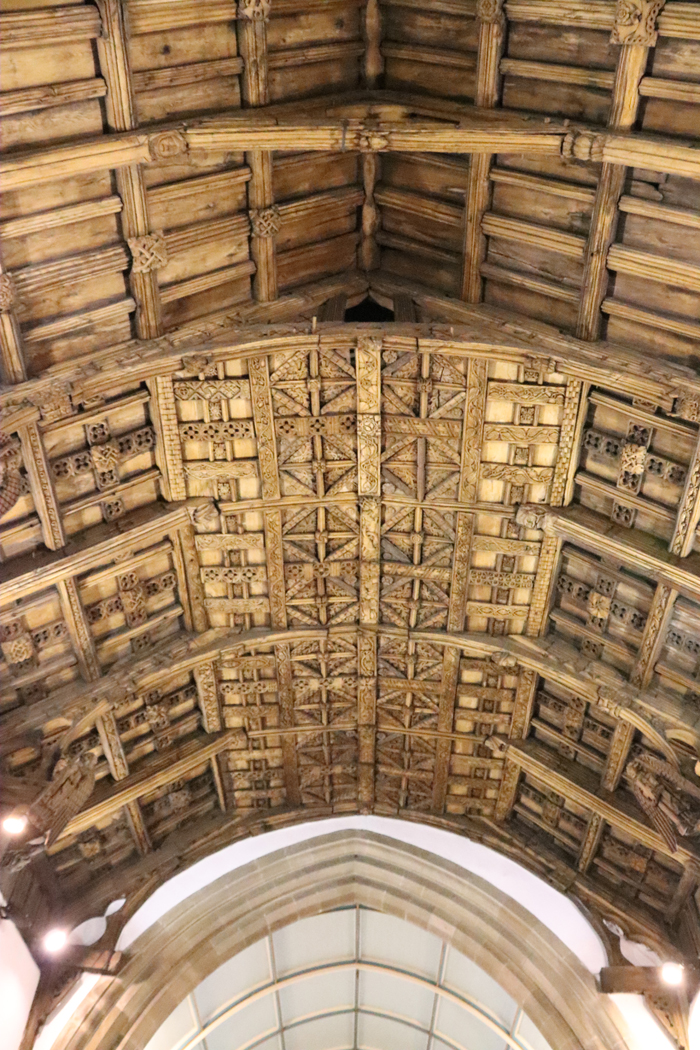
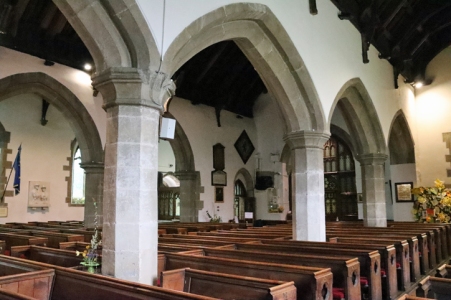
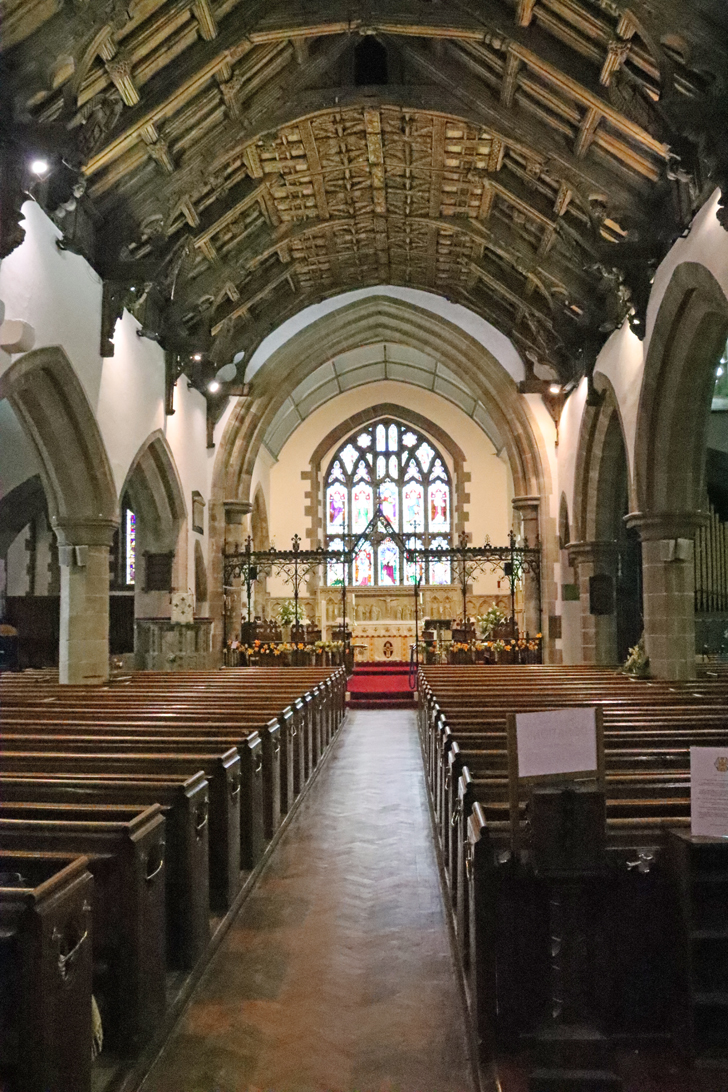
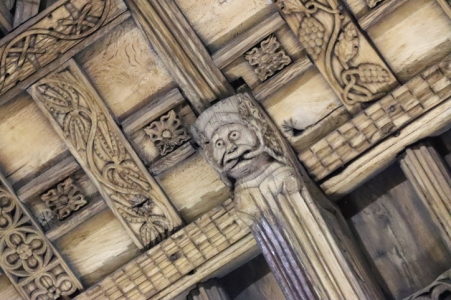
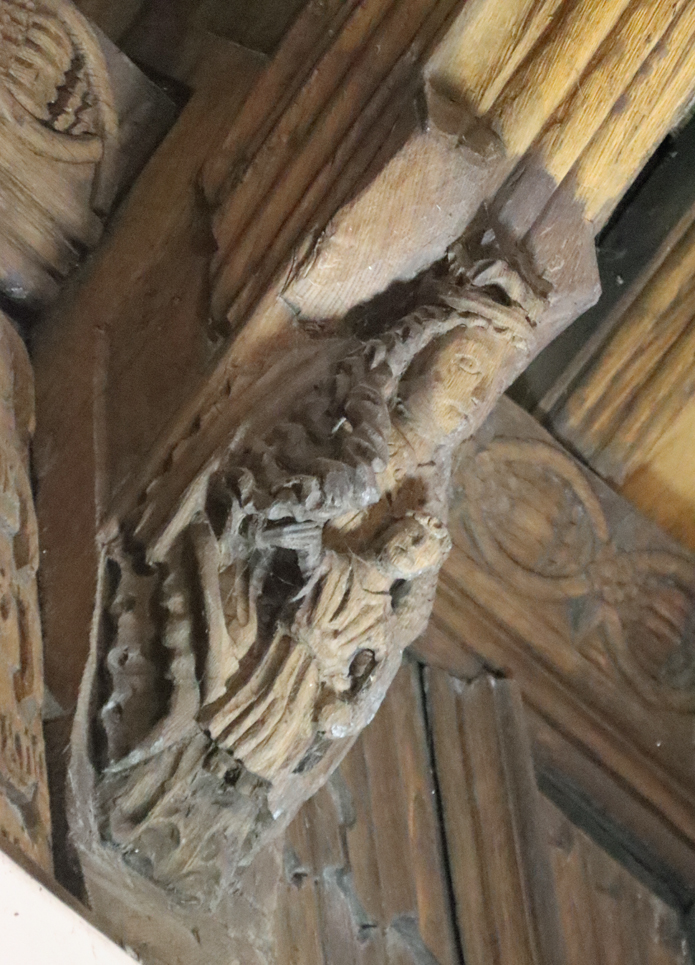
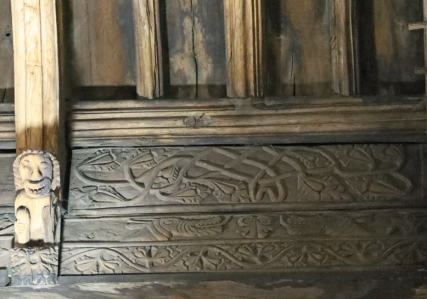
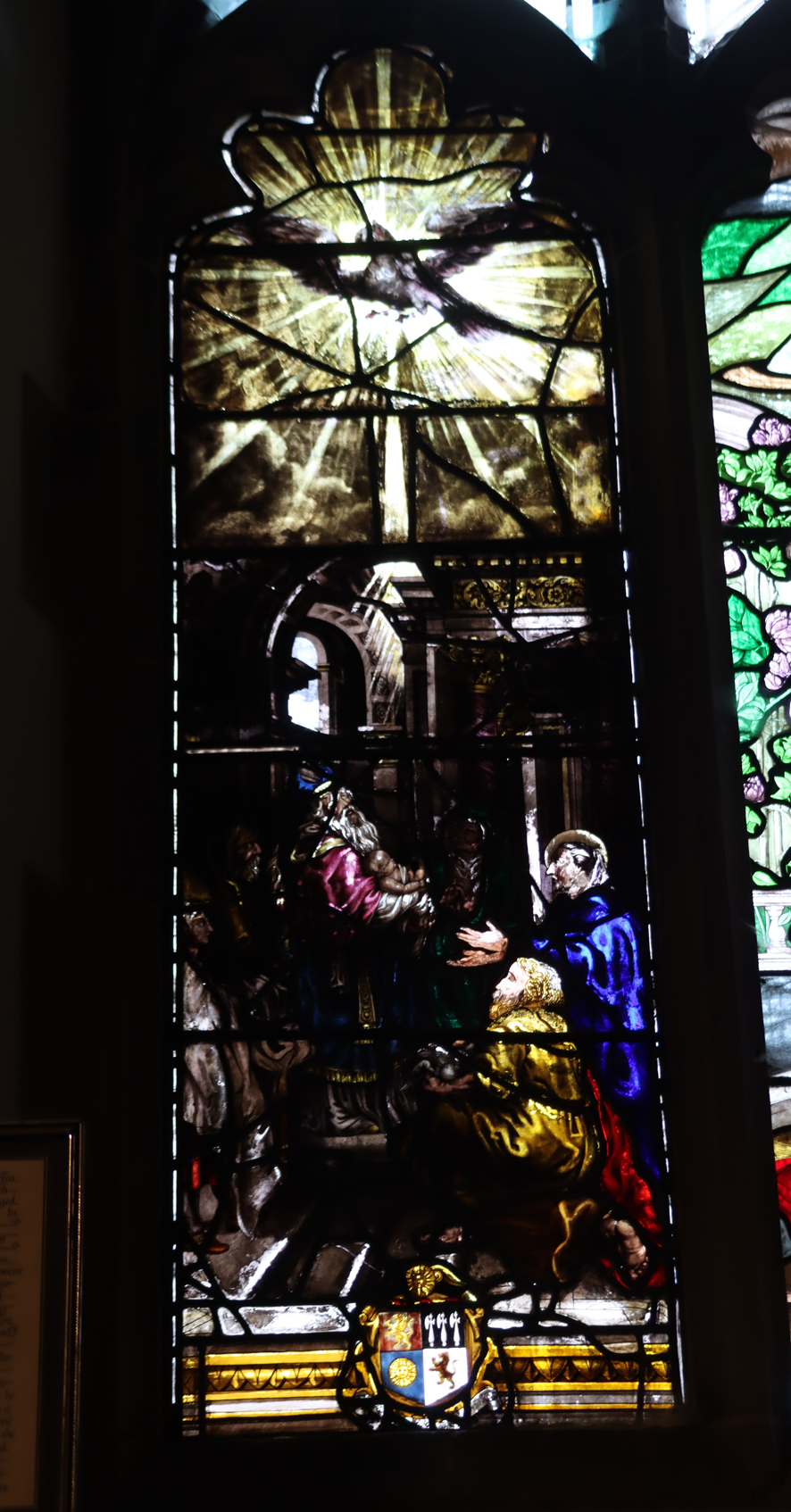
The Chester Archaeological Society 2024 season of excursions started excellently today with the CAS visit to the Church of St Collen, who gave his name to Llangollen. It is the only church in Wales to have taken the saint’s name. Like most Medieval churches in Wales, St Collen’s has undergone considerable alterations, including an 18thcentury tower and a 19th century chancel, vestry and south nave, but there are some very fine 13th century features to be seen, in the Perpendicular Gothic style, including an impressive shrine canopy and mason’s marks. There are also intriguing signs that a Lady Chapel was once incorporated into north aisle. The most remarkable feature of the church is a really superb hammerbeam roof bedecked with ornamental sculptures, both religious and secular, from the early 16th century.

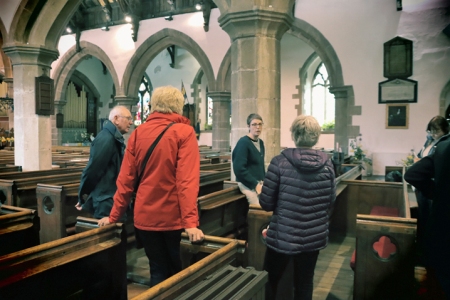
Today, to ensure the survival of the church as a living and breathing community asset, it is undergoing extensive but very sympathetic re-forming.  Suzanne Evans is the Project Manager of this massive task, and was our superb guide today. Suzanne described how the reinvented church will be fully inclusive, not only of the existing congregation who are much-attached to the church, but of the wider community as well, taking into account the needs of those currently unable to make the most of what St Collen’s has to offer. At the same time, the exciting opportunity will be taken to investigate as much of the church’s architectural and funerary history as possible, adding to the community’s understanding of this important contributor to the town’s impressive ecclesiastical heritage.

Suzanne guided us around both the key features and recent discoveries, explaining all the steps to be taken in the upcoming weeks and years. As well as replacement glass doors and the opening up of the nave to enable the interior to be visible by passers-by, there will be new lighting, heating, kitchen and toilet facilities, as well as a large stage, which will all contribute to enhancing the value of the space and improving the visibility of the superb architecture. All archaeological and architectural discoveries will be professionally recorded and published.

After a very welcome cup of tea, there was a round of applause as we thanked both Suzanne for being our terrific guide and Pauline for making all the arrangements. It was great to meet some of the other CAS members, and to hear all the questions and observations. There was a lot of information sharing, which is exactly what one expects of CAS members. What a great start to the year’s excursions! Many thanks again Suzanne and Pauline.

The 13th century exterior


The magnificent aqueduct and viaduct at Chirk, and a very, very dark tunnel

Chirk aqueduct and viaduct on an old postcard. Source: History Points

Having engaged in a two-bridge extravaganza with a visit to the Cefn viaduct and the Pontcysyllte aqueduct via the footpaths in the Tŷ Mawr Country Park recently, I decided to complete the local big-bridge experience with the beautiful Chirk viaduct and aqueduct.  The aqueduct (lower) and viaduct (higher) run parallel within a few feet of one another, high above the floodplain of the river Ceiriog.  A towpath accompanies the LLlangollen Canal across the aqueduct, doubling as a footpath, giving great views over the viaduct and the valley below.  Even better, the aqueduct and towpath vanish into a 1381ft / 420m tunnel under the hill.  The railway, running alongside over the taller and slightly longer viaduct, does not vanish underground and carries on over the top of the hill, where there is a station.  This was a short walk because I had an appointment elsewhere, although it didn’t have to be because once you are on the canal towpath you can simply keep walking in either direction until you feel that it’s time to get back to wherever you have abandoned your car.

Cleaning the Chirk aqueduct in 1954 showing the cast iron plates. Source: History Points

The aqueduct and viaduct, at different heights, seem like such a good pairing but they were not built at the same time, and nor were they designed by the same civil engineer or built by the same contractor.

The aqueduct was built to carry the Llangollen Canal, which was part of a complex plan, only partially realized, to connect north Wales to the large national canal network, about which I have already talked in detail on my post about the building of Pontcysyllte.

As typical with the Jessop and Telford partnership, the  aqueduct had an innovative design.   (https://www.pontcysyllte-aqueduct.co.uk)

As part of this immense canal project the  Chirk aqueduct was built in 1801, four years earlier than the better known Pontcysyllte aqueduct. The aqueduct was a collaboration between William Jessop and the younger Thomas Telford, who had been hired to assist Jessop, but had proved himself an innovator in his own right, even though he had lacked canal experience when taken on.  It is unsurprising, therefore, that the the aqueduct was an innovative design. The weight of the water and its traffic were carried on 10 masonry arches with hollow sections, and a water channel provided with a flat bed of iron plates, its brick sides sealed with hydraulic mortar.  The successful deployment of iron plates inspired the construction of the even more innovative Pontcysyllte aqueduct.  The canal travels under the hill via a tunnel to maintain its level, from where it parts company with the railway, which travels at a higher level than the aqueduct.

The railways came later than the canals, eventually replacing them as the primary form of transport, and the Chirk viaduct came 47 years after the aqueduct as part of this vast expansion and eventual domination of rail.  The viaduct, designed by Henry Robertson who also designed the nearby Cefn viaduct, was built by Thomas Brassey for the Shrewsbury to Chester Railway in1848 (to whom a chapel is dedicated in Chester Cathedral).  It was 710ft (220m) long and 70ft (20m) above the valley floor, with a total of 16 arches.  Look out for the nice decorative niches at either end, the sort of flourish that demonstrated the pride with which such massive civil engineering enterprises were regarded.  It must have felt as though they were changing the world, which they were.

The view from the aqueduct is mainly of the river Ceiriog floodplain, a vast grassy area.  The Ceiriog runs to one side, like something of an afterthought.  The vast expanse of green, although lacking any ooh-ah factor gives a real sense of how much land is being traversed by the arches, and how far above the ground level it is.  And it’s a long way down!  The peace seems so complete that a train suddenly rumbling so closely to the towpath is just a little disconcerting.


If you are planning to walk through the tunnel  you absolutely must take a torch, but do note that you do not have to go through the tunnel to continue along the tow-path.

If you want to avoid the tunnel but proceed to the other side of towpath, stop at the information sign near the tunnel entrance.  There’s a ramp up to the road, and you can walk the length of the tunnel over-ground (a couple of minutes along a quiet road) and rejoin the towpath on the other side.  More about this over-ground route, and other visiting details, are below.


There’s a great view of the aqueduct from a viewing platform at the end of Station Road, if you walk back that way, and you can also reach it from the aqueduct side by going up the slope.

Visiting Details

There are various options for parking, depending on how close to the bridges you want to be, and which side of the tunnel. You could park in Chirk itself or at the Chirk marina, for example, and head south towards the tunnel (the bridges are on the other side of the tunnel, north to south).  Or you could park west of the bridges and head north, which means that you reach the bridges before the tunnel.  I followed the latter strategy and parked in the small car park (10 cars max, no charge) actually on the towpath opposite Canal View, just before a very pretty canal bridge.  Canal Way itself is on the towpath, but has homes along it and is strictly private parking.  The photo of the information board above is fairly dismal due to the light and shade, but if you click it to enlarge it you should be able to make out the main parking areas, plus other features.

If you park where I parked opposite Canal View, walk from the car park along the towpath, with your back to the road.  If you park up and then cross the road on to the towpath opposite, you are going in the wrong direction.  It’s a nice, stretch of metalled canal towpath through woods on either side, passing a couple of houses on the right.  You will suddenly find yourself on the aqueduct over the Dee floodplain, with the viaduct running parallel a very short distance to your left.  The tunnel is at the end of the aqueduct.

The towpath over the aqueduct has a nice safe railing with tightly woven wirework, preventing any chance of falling into the valley.  Like Pontcysyllte, however, the canal trough has nothing on the other side.  Those travelling by narrow-boat, kayak or canoe have a far more interesting time of it.

Signage on the towpath

I have mentioned that you do not have to walk through the tunnel to walk the full length of the canal towpath.  When you reach the tunnel entrance (at both ends) there is a pathway up to a road that runs parallel, and another that runs back down to the towpath, so if you don’t fancy the pitch dark (no lighting unless you bring a torch), there is a perfectly viable alternative.  I came from the Chirk Bank direction on the sign right, and vanished into the tunnel just after the You Are Here label and emerged with he blue arrow.  I took the slope up from the towpath to the road, turned left across the railway and then right down Station Road, as far as the roundabout.  Crossing the road at the roundabout, there is an excellent viewing point for the aqueduct (and a seat to sit on). Just to the left of the viewing point is the slope down to the aqueduct.

When you enter the tunnel, switch on your torch, and be prepared for drips from above even during fine weather.  The towpath in the tunnel will let two people pass, and there is a handrail along the water’s edge.  If you have small children you will probably want to go up to the road level instead, and rejoin the towpath on the other side of the tunnel because although there is a handrail to prevent adults falling into the canal, it is not a fence or barrier, just a handrail on posts.  Dogs should be on a lead.

This is suitable for unwilling legs if you stick to the towpath because it is level all the way.  If you want to avoid the tunnel and are up for some gentle slopes, the two ramps up from the towpath to the road should be okay and the roads themselves are on the flat.

Sunshine and great views at Caer Drewyn Iron Age hillfort at Corwen

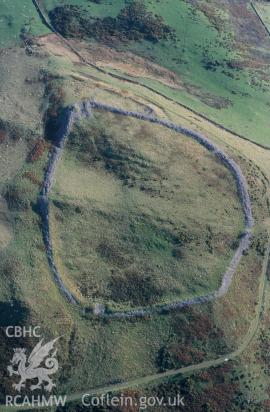
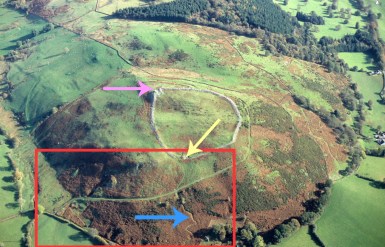
Caer Drewyn aerial photograph. The entrance at the top is at the northeast. Source: Cadw

Caer Drewyn is an Iron Age hillfort located a mile north of Corwen, with remarkable stone-built defences all around its perimeter, and terrific views in all directions.  Every fortnight for two years I drove past Caer Drewyn on my way to my father’s in Rossett, and again on my way back to Aberdovey.  It was so obviously a late prehistoric hillfort that I didn’t investigate what might be known about it for some time, but every time I passed I reminded myself that I really must find out if it was accessible to the general public.  It is.

This post begins with a brief description of Caer Drewyn the Iron Age archaeological site (it is worth reading either this or another description before you visit, as there is no information signage at the site), and finishes with the the walk and views, from the car park via the farm track to the top, and back partly via the track, but also using a different, steep footpath that shortens the route.

If you use the What3Words app, which is invaluable for both locating a site and, most importantly, for giving an exact location to emergency services in the event of an accident at a site, you can find the hillfort at ///kitchen.quaking.segments.

Caer Drewyn

Willoughby Gardner’s 1922 sketch of the position of Caer Derwyn on the slope rather than around the peak of the spur.

Caer Drewyn is the most southerly of the well-known Clwydian range hillforts, The site is located on a spur projecting south and west into the Vale of Ederinion in the upper valley of the river Dee, some 800-985ft above sea level and, at its south, 500ft (152m) above the Dee floodplain.  The aerial photo shown at the top of the post gives some idea of the way in which the site dips fairly steeply from east to west over two loosely defined natural terraces. 

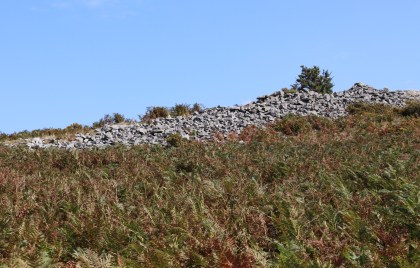
What differentiates Caer Drewyn from its Clwydian range peers is that instead of banks and ditches, it is defended by vast stone defences, spreading to beyond 15ft wide in places.  The Caer Drewyn stone defences are remarkable in that they do not merely defend a particular weak point; they enclose the entire perimeter – and there is an awful lot of perimeter to defend (3 hectares / nearly 7.5 acres, measuring c.629ft / c.192m north-south by 705ft / 215m east-west).  This sort of stone defence is not unique.  There are a number of examples in Ceredigion and in south Merioneth (e.g. Craig yr Aderyn, and Castell y Gaer) both on or near the mid-west Wales coast, with which the area may have had contact via the route that follows a geological fault-line. Other similar examples are further afield in northwest Wales including the famous Tre’r Ceiri on the coast of the north Llyn Peninsula, which has a complete stone perimeter and includes very clearly visible hut circles within.

Although parts of the stone walls were cleared of bracken and other vegetation in the late 19th and early 20th centuries, Caer Derwyn hillfort has not been excavated, so all knowledge is based on observation of the extant features.  According to the Coflein website, the hillfort was probably developed over at least three phases.  

The earliest phase is thought to have consisted of a smaller curvilinear earthwork at the northeast of the hillfort that stands today, and survives in part as an earthwork outside and to the east of Caer Drewyn.  This can be seen on the aerial photograph at the very top of this post.

The next phase is the vast rubble-walled site that dominates the hill today.  This later hillfort was defined by the stone rampart, which Willoughby Gardner describes  in his 1922 paper as  consisting “of a core of rubble stones, faced on either side with a wall of dry masonry.”  These surviving patches of stone facing may suggest that the rampart may have been equipped with an inner wall-walk.

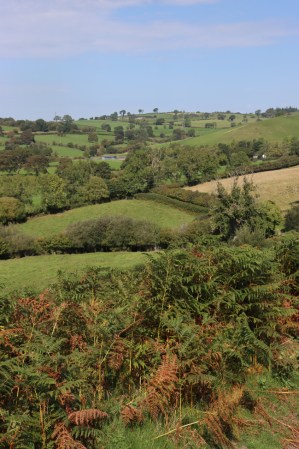
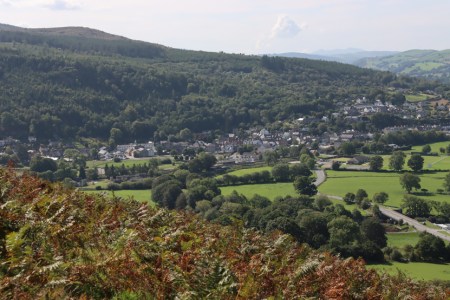
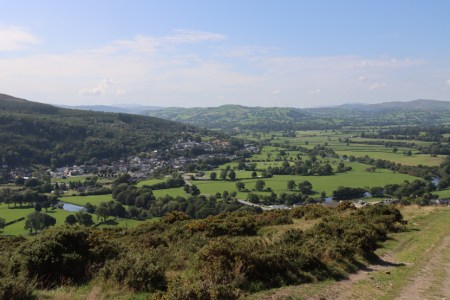
Instead of sitting around the peak of the spur, the hillfort actually sits on the slope, meaning that the interior can be seen from below.  Like many hillforts, it is ideally located for visibility over the landscape, in this case with views over the surrounding area, including the valleys of the rivers Dee and Alwen, which meet just to the east, the Berwyns to the south and the north and east across to the rest of the Clwydian range.  These views are wonderful on a clear, bright day.  Toby Driver points out that in spite of the defences, the above-mentioned fact that the interior of the hillfort can be viewed from below somewhat undermines its strategic value.

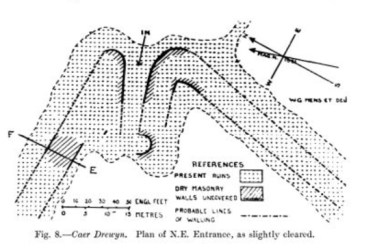
Willoughby Gardner’s 1922 plan of the northeast entrance of the hillfort

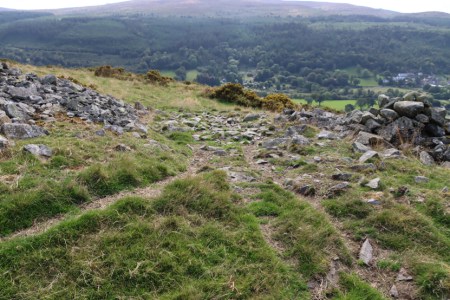
The hillfort could be approached from the west and the northeast, where the two entrances were in-turned, a typical feature of many hillforts that helps to control access to the interior.  Willoughby Gardner says that there was a spring a short way down from the west entrance.  The entrance in the northeast corner where the cairn is located, which is the highest point of the site and shown clearly bottom right of the aerial photo below, may have featured a guard chamber, another characteristic feature, suggested by the complex jumble of stone that implies at least one additional feature at the entrance.  Willoughby Gardner estimates a 12ft diameter. So-called guard chambers are recesses in the entrance passages hillforts, mainly in north Wales and the Welsh Marches, but the name does not mean that the function of these recesses is actually understood, and they may have been used for some sort of religious or alternative function.

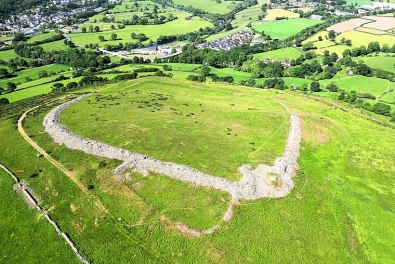
You can see circular dips dotted here and there in the walls.  These may or may not be relatively modern features.  They were there in 1887 when the Reverend Hugh Pritchard was investigating.  One interpretation is that they could have been grouse butts (small enclosures used as grouse-shooting positions), but this is unsubstantiated.  You can see some of them most clearly in the aerial image below.

Caer Drewyn showing northeast entrance, annex, and circular depressions in walls. Source: Peoples Collection Wales

The interior surface has been examined by Willoughby Gardner in 1922 and by the Engineering Archaeological Services (EAS) in 2006.  Willoughby Gardner comments that there are circular structures within the hillfort.  He casts doubt on them being original because in his experience wattle-and-daub or wood was the favoured material for hut circle construction.  The EAS, acting on behalf of the Heather and Hillforts Landscape Partnership Scheme (Denbighshire County Council) carried out a topographical survey which identified eight possible hut platforms within the walls.  Apparently aerial photographs taken in low winter light confirm hut-like shapes in the central and eastern parts of the enclosure.  I had a poke around for anything resembling them on the ground, but could find nothing amongst the bracken.  Winter, when the vegetation has died down a bit, would be a better time for that sort of optimistic activity.  

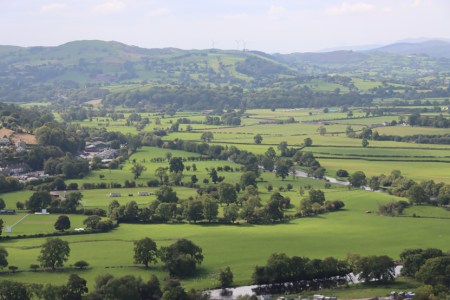
To the south and southwest there are views over Corwen, the Berwyns and into the far distance.  There is excellent line of sight from Caer Drewyn to other hilltops, some of which housed contemporary hillforts.  I walked all the publicly accessible hillforts in the southern Merioneth area in mid west Wales a couple of years ago my write-ups here), and each of them had a clear line of sight to one or more neighbouring hillforts, which would make sense both for mutual support and maintaining lines of communication amongst friendly neighbours, and for keeping an eye on any hostile neighbours.

Caer Drewyn. Photograph by Llywelyn2000, CC BY-SA 4.0. Source: Mapcarta

A third phase apparently added a small  trapezoidal annex to the north-east of the fort, which employs the earliest earthwork of the hillfort.  In the aerial photograph above and to the right you can see one very clearly on the left, but there are others visible on some photographs, much fainter, which may also be hut circles.  There is nothing to indicate a date, but Coflein suggests that it may have been added after the hillfort had gone out of use in the Romano-British period, presumably because of the  possible hut circles, but it could equally have been much later.

Without excavation it is impossible to know how the interior of either earlier or later hillfort forms, or the annex were used, or to know for sure the period over which they were used. 

The term “hillfort,” combined with defensive structures such as banks, ditches, stone walls, defended entrances give the impression that these were built primarily for exclusively military purposes, but it is by no means certain that this was there only purpose or even, in some cases, their primary purpose.  Secondary uses could include storage of agricultural output, protection for livestock, and a visible territorial marker in the landscape. There is no room here to enter into a discussion on the subject, but if you are interested have a look at Toby Driver’s 2018 online paper on the subject (free to access): New Perspectives on the Architecture and Function of Welsh Hillforts and Defended Settlements.  Whatever their primary and secondary purposes, the sheer amount of work that goes into an enterprise like this, or a banked-and-ditch hillfort is considerable, and there was certainly a very desirable outcome in mind when a hillfort was embarked upon.

The site continues to be used for grazing sheep, and it is recorded that it was used as a hafod (seasonal grazing) in around 1600.  It is reputed to have been used as temporary bases for Owain Gwynedd in the 12th century during his conflict with Henry II, and by Owain Glyndwr during his rebellion in 1400.  There is no actual data to support either theory.
———-

Visiting details: parking, the walk and the views

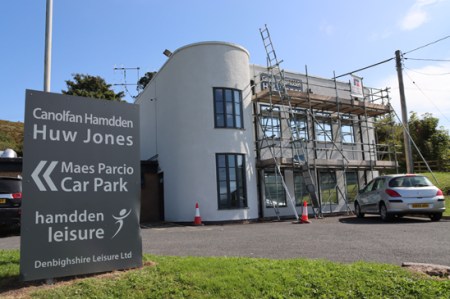
I was advised that it was acceptable to park at the Corwen Leisure Centre, just to the north of Corwen (via Green Lane from the A5, postcode LL21 9RW).  When I arrived, there were only three other cars there, and no signage to indicate that parking was restricted.  By the time I returned to the car a couple of hours later mine was the only car in the car park, so I didn’t feel that I was intruding.

Walking up to the road from the car park, turn left (east).  There is no pavement, just a narrow grass verge, but you are going a very short distance, just a few metres, before a wide farm track is clearly signposted to Caer Drewyn on your left.

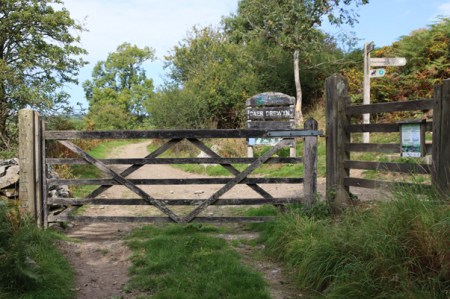
Follow the attractive track for a few minutes, past a couple of farm buildings on your right.  You will reach a gate.


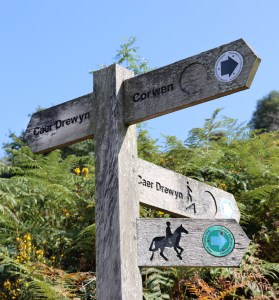
On the other side of the gate is another signpost that gives a few options.

—–

The red box shows part of the farm track taking the easy route up the side of the hill towards the highest part of the hillfort and the northeast entrance (pink arrow). The blue arrow shows the steep footpath that cuts off a corner of the easier route. The yellow arrow shows the lowest point of the hillfort, which is also an access/exit point. Click image to enlarge. Copyright CPAT. Source: Britnell and Sylvester 2018

For Caer Drewyn you can either turn left and follow the farm track, or go straight ahead on a very small footpath straight uphill, which intersects with the farm track at a much higher level. Looking at the aerial photo to the left, it should be possible, although I didn’t realize at the time, to cross over the farm track (or, if you are on the farm track turn left at the point where it intersects with the footpath) to go up to the very lowest point of the hillfort defences and the western entrance.  I wouldn’t, myself, because I really enjoyed the views from the farm track.  It would make a shorter and easier walk for anyone who follows the track to the northeast entrance but doesn’t want to do a full circuit of the hillfort, to follow one set of walls down to the bottom of the hillfort and exit back to the farm track or footpath via the lower entrance.

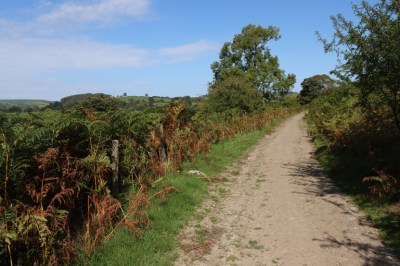
The farm track is the easy option, so I decided to follow this and, on my return journey, take the footpath down.  I would strongly advise that you take the farm track either on your ascent or descent, because the views are so terrific, and you will miss some of them if you confine yourself to the footpath.

The farm track heads west for a short distance on the level, and then you will reach another signpost that points you right, uphill through a gate that has a walk-around on its right.  Take the uphill option that takes you relatively gently across the side of the hill towards the northeast entrance.  This is uphill all the way and although not particularly steep on the seethingly hot day on which I walked it, it was noticeable.


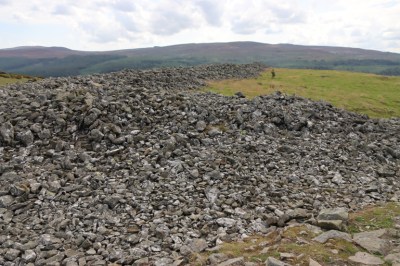
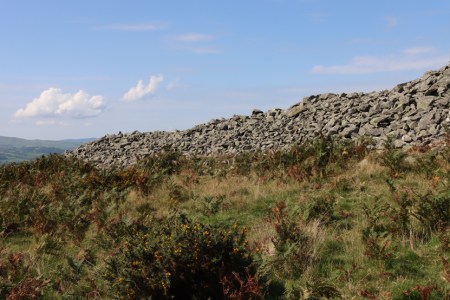
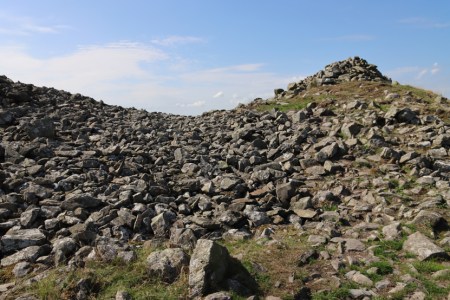
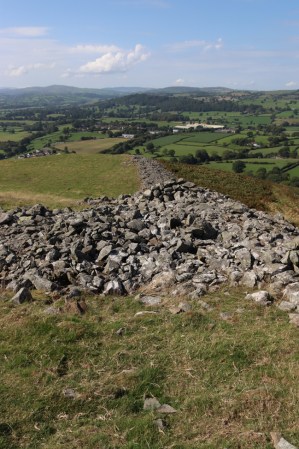
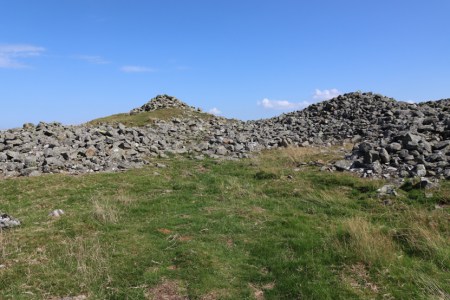
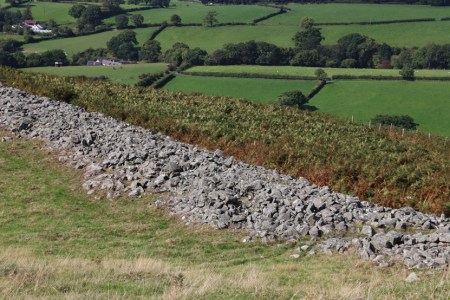
As you climb towards the top of the hill, you will suddenly see some stone rubble on the left, like a massive fallen drystone wall.  This is the hillfort perimeter.  Continue to follow the farm track, running parallel to the walls.  You will eventually reach a gate, which is the end of the line.  Ahead of you is a superb view to the east, and on your left, just a few metres behind you, is a mass of stonework including a roughly conical pile of stone which is a useful point to orient yourself.  This is the northeast corner and marks the following in-turned entrance and possible guard house.  From the cairn you can see for miles and miles around.  The landscape is truly stunning.  You can also see the stone defences heading out in both directions, plunging away to your right down the slope and following the ridge left before then, too, plunging downhill.

It is easy to walk the entire perimeter because all you have to do is follow the stone boundaries, but do take into account when you are heading downhill towards the far eastern extent, that you will have to walk all the way back up again if you want to do the full perimeter back to the cairn!  Alternatively, head out of the well-worn exit at the bottom end of the hillfort to rejoin the farm track.

View over the enclosure towards the west

Looking back up the hill along the northern rampart

The interior showing the topographical tilt to the west

Although there are tracks inside the hillfort, many of them created by sheep, there are no formal pathways and if you leave the trackways, it is very uneven underfoot, with the danger of turning an ankle.  I was wearing tried and tested breathable but very solid hiking trainers that are fabulous on hot days, but it would have been better to have worn summer-weight hiking boots with good ankle support.

Well worn access to and exit from the hillfort at the bottom

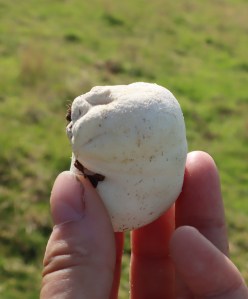
Puff ball

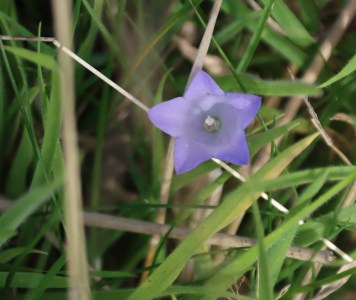
There is not a lot in the way of wildlife, but there is plenty of bright yellow gorse in flower at the moment.  I found a perfect white puff-ball (mushroom) which I later cooked in garlic butter, and some other unidentifiable mushrooms.  There were some very occasional and very pretty wild flowers, including some wonderful harebells dotted around, but there was little else to see at this time of year.  Bird song was all around, but the singers were well hidden.  Judging from the endless rabbit droppings, this is bunny nirvana.  If you are interested in lichen, there seemed to my inexperienced eye to be many different types on the stone defences and the interior rocks and boulders and later that day I read on the Clwydian Range and Dee Valley AONB website that over 60 species of lichen were identified in a 1993-1994 study.


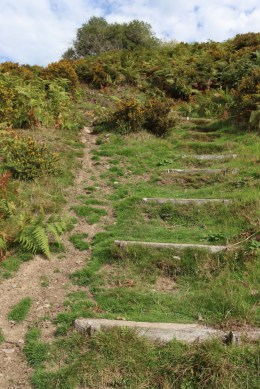
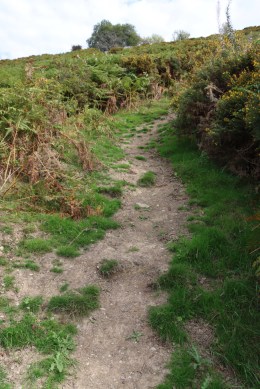
On the way down I kept a close eye out for a signpost for the footpath down, which chops off the corner that the farm track takes (the blue arrow on the above annotated photo).  There is no full-sized signpost, just a little way-marker on the left/south that you need to look out for.  There is a big boulder opposite, which is a useful landmark.  The first part of the footpath, from the top, consists of some quite deep steps reinforced with wood.  It then becomes a fairly steep narrow track – much steeper than it looks in my photographs below.  I suspect that the whole thing becomes a muddy stream during wetter weather, as there are plenty of signs that water courses have made their way down.  The footpath drops you at the gate back down to the road and the car park.

It only took me about half an hour to get up to the hillfort, with lots of stops to enjoy the spectacular scenery, take photos and top up with water.  Once up there, you can spend as long as you like, of course, and it is a great place for a picnic.  I had it to myself, even on a sunny Saturday.

Hopefully the photos will speak for themselves, but I recommend this as a far from strenuous walk, mixing fascinating late prehistoric heritage with terrific views.  If you time your visit to coincide with stunning Rhug Chapel’s opening times (the chapel’s website is here), that would make a great second visit, just a ten minute drive away.

UPDATE:

After I posted about this walk, I found an official leaflet that includes a longer walk incorporating the hillfort, which looks really great.  The relevant page is shown below, but you can download the entire leaflet, with some other really excellent-looking walks too at https://tinyurl.com/2fecwr8c.


——–


Sources

Books and papers

Bowden, M. 2006.  ‘Guard Chambers’: An Unquestioned Assumption in British Iron Age Studies. Proceedings of the Prehistoric Society, 72, p.423-436 [NOT free to view]
https://www.cambridge.org/core/journals/proceedings-of-the-prehistoric-society/article/abs/guard-chambers-an-unquestioned-assumption-in-british-iron-age-studies/E6D627EE54566C400B07C0F42CB5F18C

Britnell W.J. and Silvester, R.J. 2018. Hillforts and Defended Enclosures of the Welsh Borderland. Intarch Issue 48 (2018). Iron Age Settlement in Wales. https://intarch.ac.uk/journal/issue48/7/index.html

Driver, Toby 2018. New Perspectives on the Architecture and Function of Welsh Hillforts and Defended Settlements. Intarch Issue 48 (2018). Iron Age Settlement in Wales. https://intarch.ac.uk/journal/issue48/9/toc.html

Gardner, Willoughby. (1922). The Ancient Hill Fort known as Caer Drewyn, Merionethshire. Archaeologia Cambrensis – The Journal of the Cambrian Archaeological Association. Vol. 77. Seventh Series. 2. Vol 77, p.108-125

Savory, H.N. 1958.  Caer Drewyn. Archaeologia Cambrensis – The Journal of the Cambrian Archaeological Association. Vol 107, p.135-6

Websites

Clwydian Range and Dee Valley Area of Outstanding Natural Beauty
Hillfort: Caer Drewyn
https://www.clwydianrangeanddeevalleyaonb.org.uk/projects/hillfort-caer-drewyn/

Coflein
Caer Drewyn; Caer Drewen – Details
https://coflein.gov.uk/en/site/95431
Caer Drewyn; Caer Drewen – Images
https://coflein.gov.uk/en/site/95431/images
Tre’r Ceiri
https://coflein.gov.uk/en/site/95292

People’s Collection Wales
Caer Drewyn
https://www.peoplescollection.wales/items/5482

Aberdovey Londoner
Iron Age hillforts in South Merioneth
https://aberdoveylondoner.com/category/iron-age-hillforts-in-south-merioneth/

—–

The puff ball as a delicious minimalist starter. Divine.

Tŷ Mawr Country Park, including the Cefn viaduct, the Pontcysyllte aqueduct and some lovely walks


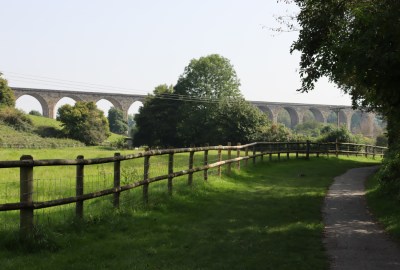
The Tŷ Mawr Country Park, just ten minutes south of Ruabon (LL14 3PE / What3Words ///disprove.dart.isolated) in the Vale of Llangollen, consists of walks through fenced fields, woodland tracks and views over the river Dee and the surrounding countryside.  Most spectacularly, its starting point lies almost underneath the monumental stone-built Cefn railway viaduct, from where a circular walk begins, whilst a less formal there-and-back branch off a circular walk takes in the iron-built Pontcysyllte aqueduct.

Map on the outside of the visitor centre showing all the route options (click to enlarge). At far left is the Cefn viaduct and at far right is the Pontcysyllte aqueduct.

The circular walk begins and ends at the Tŷ Mawr car park (pay and display, but only £1.00 for the day at time of writing, and with two power points for electric cars), visitor centre and café (both closed when I visited yesterday, Wednesday 6th September), and toilets (which were open).

Behind the visitor centre there is a picnic area with excellent views over the countryside and the Cefn viaduct.   There is also a small children’s farm with chickens, goats and other farmyard animals, and a children’s play area.  The circular walk is a metalled pathway through small fields and woodland, which takes in the river Dee, with a small picnic area near a tiny “beach” and has a number of picnic areas. I haven’t found an online PDF of the map above, but you can download my photograph of it as a PDF here (sorry that the text is not particularly clear).

You can go either way around the walk, but the recommended route on the map fixed to the outside of the visitor centre is anticlockwise, which finishes at the Cefn viaduct and the memorial dovecot.  Although there are some inclines, I would suggest that it is entirely suitable for those with unwilling legs.  It was certainly okay for a group of women with pushchairs.  It probably takes no more than half an hour to 40 minutes to walk, with stops to admire the river and the viaduct.  There are occasional benches, a picnic area by the Dee and further picnic areas with lovely views at the top of the walk behind the visitor centre.

The real star of the circular walk, missing off the leg to Pontcysyllte, is the Grade II listed Cefn viaduct, which can be seen around much of the circular walk.  The walk goes right up to and along the base of the viaduct, which really is an awesome sight as you approach it and begin to get a sense of its scale.  The Cefn viaduct was designed by civil engineer Henry Robertson, who had purchased the Brymbo Ironworks, and was built in yellow Cefn sandstone and red brick by contractor Thomas Brassey (to whom there is a chapel dedicated in Chester Cathedral). It was built surprisingly quickly over a two year period to carry the Shrewsbury and Chester Railway over the Dee valley.  It opened in 1848, 43 years after the opening of Pontcysyllte, at a cost of £72,346.  It has twenty one arches, nineteen of which are 60ft (18m) wide, and two of which, one at either end, are 30ft (9m) wide.  If you approach the country park from the Ruabon direction, you will pass under one of the two narrow ones.  The arches span 1508ft (466m) and at their most dizzying tower 147ft (45m) above the level of the river. 

The additional leg of the walk to the Pontcysyllte aqueduct along the path of the Dee is not suitable for anyone who cannot handle steps, as there is a flight down from the circular walk to near the level of the river, with no handrail.  There is a signpost and small Pontcysyllte-themed bench indicating where you have to turn off the path down the stairs to a more informal section towards the aqueduct.


I enjoyed this more informal section, which after a wending track following the path of the Dee through woodland and open field leads to steps at the other end that take the walker to the level of the aqueduct and the Trevor Basin, with fully open visitor centre and other facilities (including boat trips across the aqueduct).  The section along the river to Pontcysyllte will be highly seasonal, with different vegetation allowing or blocking views to the river, offering seasonally variable wildlife.  Yesterday it was very attractive, with glimpses of the river through the tall plant life, and occasional tracks through the vegetation to get down to admire the river itself, much-used by dog walkers whose canine friends were doing a lot of swimming.  The dominant floral element was Himalayan balsam, with orchid-like flowers in pinks and pinkish whites, which is terminally invasive, a complete monster which, given half a chance, takes over its entire environment, but is endlessly pretty and no bother at all in the massive acreage of the park.


Viewing point for the Pontcysyllte aqueduct

The narrow track follow a well sign-posted route, although there are only a few places where choices are required.  When you reach the aqueduct viewing-point that is marked by a metal sculpture of a camera (which acts as a frame for taking photographs of Pontcysyllte) there is a choice to go straight on to the main steps, or turn right to approach the aqueduct from a different angle.  If you are not interested in going up to the canal and aqueduct level but are happy to enjoy some terrific views of the remarkable structure from below, by the side of the river, go straight on.  You can still change your mind and walk up to canal aqueduct level, but be warned that it’s a fairly long and steep flight.  You can always drive back via the Trevor Basin, at the beginning of the aqueduct, where you can park up at the level of the aqueduct.  A better option when you reach the “camera” is to turn right to go up a much shorter and less strenuous flight of steps, which brings you out onto a wooded path that both includes a viewing point and  then delivers you to the canal, Trevor Basin and the aqueduct. You can then then return to Tŷ Mawr via the steeper staircase which is a lot easier going down than up, turning this final section into a circular walk.

The glorious aqueduct, built by Thomas Telford and opened in 1805, is always a joy.  I have written up a summary of Pontcysyllte’s history and visitor information on a previous post.  It is worth going on a bright, cloud-free day, because the views from the aqueduct down to the Dee valley are enhanced by the sun glinting off the water, and by the brightness of the green fields and trees that flank the river.  The towpath along the aqueduct trough is quite narrow, but wide enough for people to pass one another.  The iron railings are high to prevent accidental falls, but not so high that you cannot see over them.  This really is one of the highlights of the area for visitors.

Once done with the aqueduct and Trevor Basin and the visitor centre, going down the longer set of steps to return back to Tŷ Mawr is a great option, walking down the side of the aqueduct and getting a real sense of its scale.  The Dee is particularly delectable here too, bubbling over shallows and glistening in the sun.  A great place to plonk down on the river bank and enjoy an ice cream.

Having retraced your steps, and once back on the more formal circular walk, the star of the show is the Cefn viaduct that looms every close.  There is an option to stop at a picnic area where a small beach is a great spot for admiring the river.  There are tracks that let you walk just a little bit further along the river before heading back to the circular walk, or you can simply pause on the path, admire the view, and keep going up the slope towards the base of the viaduct.  The viaduct is amazing.  You can see it for most of the circular walk.  At first just a few arches appear, and then gradually the entire 19-arch run of the stunning structure is revealed until you arrive at the top of the slope and at the foot of one of its enormous columns.  Look up.  Wow!  At the very top of the arch at the top of the yellow stone-faced columns, the underside of the arches are formed of red brick-built, providing a contrast with the yellow Cefn sandstone.

There is a bench where you reach the viaduct, and a signpost.  The left option continues the circular walk along the foot of the viaduct, which you will have to do anyway to return to the car park.  The right option requires you to cross a stile, and allows you to walk just a few metres in order to see down to the feet of some of the arches in the river, albeit through the vegetation, and to stand right under one of the arches and get up close and personal with the stone work.

When you return to the last stretch of the circular walk, following the viaduct along its base, you eventually reach the attractive dovecot.  This looks much older older than it is, rather like the 18th century example at Erddig, but it is modern, built in 1993 as a memorial.

It’s a short and largely undemanding but seriously enjoyable walk.  Including the walk to Pontcysyllte, the walk only took about two hours to and from Tŷ Mawr car park, with lots of stops for photos and 10 minutes sitting overlooking the river at the foot of the aqueduct with a much-appreciated ice cream.  Apart from the steps, it’s an easy walk, and there is much to see.  I arrived at Tŷ Mawr at 11 and left shortly after 1pm, so it’s not a day-eater.  A great place for a stroll, rather than a hike.  Up-to-date visitor information is available on the Wrexham County Borough Council website.

The name Tŷ Mawr translates as “big house” or “great house.”  There’s no sign of a house, and no mention of one on any of the websites that talk about the country park.  Many old houses have been lost, but I can find no mention of one associated with the country park.  Does anyone know if there was once a property associated with the site?


The 1991 discovery of an important Roman inscription in Holt

By Andie Byrnes and Helen Anderson, August 4th 2023

The discovery in 1991

The Holt inscribed fragment, now in the Grosvenor Museum. Photograph by Dr Roger Tomlin, University of Oxford, with many thanks for allowing Helen to use it.

In 1991 artist and archaeology enthusiast Helen Anderson was driving over the Farndon-Holt bridge, about 11 miles (c.18km) south of Chester, when she noticed some activity and bare soil surfaces in the normally grassy nearby field associated with the Roman tile-works and its ancillary buildings overlooking the Dee.   She had recently started to focus on Roman archaeology and to visit Roman sites, and although she had spent her childhood locally in Churton, she had only recently been reading about the Holt tileworks site for the first time.  She had been intending to go and look at the site but hadn’t yet done so, and thought this might be an interesting opportunity to go and see it. She received permission from the landowner to walk over the newly-stripped surface of the field.

On the  recently exposed soil surface that day, as well as sundry fragments of imbrex and tegula (roofing tiles), two of which were marked with cat and dog paw-prints and one with a finger print, she found the wonderful piece of inscribed brick shown in the photograph above right. Here is Helen talking about discovering the piece:

As I was walking through the field, which had been stripped for turf that was still being rolled and loaded, I saw a large piece of orange tile lying on the muddy surface, picked it up, turned it over and found what appeared to be writing on the underside.  I could hardly believe my eyes – it was an extraordinary and quite eerie moment!  My immediate thought was who I should tell about it.  Later, gently cleaning it in the kitchen sink, the excitement of the incised letters appearing clearly as the soil washed out of them was something I will never forget. It felt a bit like time travel.

Aerial view of the farmland at Holt next to the River Dee where the tile-works were located

The piece was clearly broken, with a bit of the inscription missing.  Helen returned to Holt a few days later, to show it the to the farmer and to see if the rest of the fragment was lying about in the field, but by then it had all been rotovated – if she hadn’t picked up the brick it probably would have been further damaged. She reckons the gods must have been with her that day!

This was six years before the establishment of the Portable Antiquities Scheme, so after after showing the find to the landowner, who gave Helen permission to keep the object, Helen sent photographs to the British Museum.  The resulting correspondence offers a terrific insight into how an understanding of the significance of the object was reached. It emerged that the fragment of Helen’s brick on which the inscription was made was re-used as a form of notepad to make a quick record.  At first it was thought that the fragment was a tile, but it is more likely to be a piece of lydion or sesquipedalis; these look rather like tiles because they are very thin compared with modern brickwork.  Some of the letters have been sliced off at the far right, but what we are looking at is part of a coherent piece of text, a list with signatures.  It was a small-sized record, containing only a few details.  It measures 32cms, by 30cms, and is around 6mm thick.

Helen hard at work at the Rossett Roman Villa excavation in 2021. Photograph courtesy of Dr Caroline Pudney, University of Chester

The inscription is now recorded in various books and papers contributing to knowledge about Roman activities and everyday life in the Chester area.  Although Holt is just over the Welsh border, the tiles and bricks were created for the Roman occupation in Chester.

Following very fine lunches at Pant Yr Ochain near Gresford and the White Horse in Churton, where we pored over both the artefacts and documents that Helen has assembled, including her original correspondence with Catherine John and Roger Tomlin, we decided to write a post about the inscribed fragment.  Helen has now been investigating the Romans in the Chester area for three decades, and as her knowledge has grown she has excavated as a volunteer at Chester amphitheatre, the Heronbridge Roman settlement, and most recently the Rossett villa.  All the documentation cited here has been provided by Helen.

First, a quick look at the Holt tile-works, which produced the inscribed brick.

The early 20th century discovery of the Holt Tile-works

The Holt brick and tile works site was recognized in the early 1600s when landowner Thomas Crue of Holt Hill suffered repeated damage to his plough and was forced to investigate.  He discovered that his plough was encountering a series of fifty 2ft-tall posts, and his finding found its way into the book Roman Cheshire by W. Thompson Watkins (1886).  This was noted by retired chemist and keen amateur historian Alfred Neobard Palmer who, in 1905, decided to hunt for the remains that Crue had found, accompanied by local vicar Jenkyn Jones, having sought permission from the landowner.  A series of field-walking expeditions followed, uncovering plentiful fragments of Roman brick, roof tile and pottery over an area of some 20 acres.

Fold-out plan of the kilns at Holt, published by Grimes in 1930. (Scanned from my copy of “Holt, Denbighshire”)

Palmer was not an archaeologist, and the task of excavating the site was taken on by Wrexham solicitor and amateur archaeologist Arthur Acton.  Work began in 1907 and continued until 1915.  Although he delivered numerous lectures about the site, Acton never published his work.  Fortunately a portion of his records survived, and he sold the excavation finds to the National Museum of Wales, where William F. Grimes used the data to compile a comprehensive report, complete with site plans, photographs and object illustrations.  Work did not stop there, and during the 1970s Geoffrey Bevan conducted both field walking activities and an excavation, finding Roman material that filled dozens of boxes, which were donated, this time, to the Grosvenor Museum in Chester.  Helen’s field-walking in 1991 added the inscription to the list of important finds, and in 2018 Holt Local History Society commissioned Archaeological Survey West to carry out a geophysical survey of the site, to fix the positions of the known buildings and, with luck, to identify any unexcavated and previously unknown structures.  This demonstrated that the Holt complex was even bigger and more complex than Grimes, via Acton, had been able to determine.  There is, of course, the potential for future field research, and recent work in Farndon, summarized on local historian Mike Royden’s website is beginning to expand the story over to the other side of the Dee.

What was the Holt tile-works like?

Site plan of the Roman tile and pottery work displayed in the Hidden Holt exhibition. Also in the excellent booklet accompanying the exhibition, full details in Sources below. The features shown in blue are unrecorded / unexcavated.  Those in dark brown are the building locations fixed in 2018, and those in paler brown those estimated by Grimes based on Acton’s work.  Click to see a bigger version with fully legible text.  Source: Wrexham Heritage Service, 2021

The 20th Legion, Valeria Victrix, of the Roman army, was stationed at Chester, Roman Deva, from AD87, and the Holt works appears to have been established shortly afterwards to supply the fort and settlement at the legionary fortress.  Holt’s industrial activities reaching their peak output at around AD135, and began falling out of use in the mid 3rd Century.  The site was clearly a fully integrated operation combining industrial, public and domestic components.

A senior manager had his own house, complete with hypocaust (under-floor central heating), there was a public bath house, a series of kilns for the manufacture of tiles, bricks and pottery, and a barracks that may have housed workers, or alternatively a detachment of the Roman army based at Chester at this time.

The hypocaust below the drying shed. Source: National Museum of Wales

The main kiln plant at Holt, published by William Grimes in 1930.

The kilns formed two main units, a larger (139ft / 52m long, consisting of a row of six kilns) and smaller twin-kiln built on the natural bed-rock.  Each kiln was rectangular and tile-lined with an arched stoke-hole for access.  A round pottery kiln was also located on the edge of the main kiln complex.  The oven floor consisted of a raised floor of tiles plastered with clay that were pierced with holes that acted as vents.  The drying shed was provided with a hypocaust, of the same sort used in villas and bath houses.  These, like the kilns, were stoked and kept hot to ensure that the tiles, pottery and bricks were dried through after firing.

Map marked by Helen to show the approximate findspot of the inscribed fragment

All of the output manufactured at the works was sent by boat downriver to Chester on the river Dee.  It provided direct access to Chester, 12 miles / 19km away, passing the civic settlement at Heronbridge.  The generally flat environment meant that building of roads, where needed, was not exceptionally laborious.
—–

Corresponding about the tile in 1991

The imposing facade of the British Museum. Source: Wikimedia Commons by Paasikivi

Helen wrote to the British Museum in April 1991 describing how she had found the fragment, and enclosing a high resolution photo in which the inscription could be seen clearly.  The first person to reply to Helen’s letter to the British Museum was Catherine Johns F.S.A., at the time Curator of Roman Britain in the Department of Prehistoric and Romano-British Antiquities in the British Museum in London.  In a letter dated 18th June 1991, Catherine Johns begins “Thank you for your letter and the excellent photographs and drawing of the inscribed tile from Holt in your possession.  This is an interesting and important find.”  She goes on to explain that the inscription is in cursive Latin, “that it is to say, it is handwriting rather than formal lettering.”  She was unable to translate the text, which is a specialist task, and sent it to Dr Roger Tomlin of Wolfson College, University of Oxford.  She warned Helen that the fragmentary nature of the text might impede translation.  She finished by suggesting that Helen might consider presenting the piece to the National Museum of Wales, where most of the Holt material excavated in the early 20th century is held.

Helen then received a letter dated 25th June 1991, only a week after the letter written by Catherine Johns, from Dr Roger Tomlin.  Dr Tomlin explained that it was by no means straightforward to decipher and transcribe the fragment, partly because of the several examples of handwriting inscribed, and the fact that it was clearly incomplete.  He suggested that this was a record of expenses, with the star symbol indicating the unit of payment in denarii, and that several individuals were involved. He referred to the inscribed brick as “a welcome addition” to the corpus of Roman inscriptions in Britain. In a later letter, dated 1st July 1991, he thanked Helen for offering to take the the object to him in Oxford, for translation, whilst on a family break, and expressed the hope to meet up with Helen to discuss it.  He suggested that the fragment was probably part of a lydion (or sesquipedalis), rather than a tile, a brick used for bonding-courses.  When Helen met Dr Tomlin for coffee, he departed on his bicycle, in typical Oxford style, with the inscription propped up in the bicycle’s basket.  ———

The inscription

The same photo of the inscribed tile found by Helen Anderson in Holt in 1996 as above, shown again so that you can review the cursive text Copyright Helen Anderson

The brick was inscribed in the still-soft surface of the wet clay before firing.  The translation of the inscription by Dr Tomlin is a great example of the sort of scholarship and academic detective work that go into understanding a single object.  The inscription was abbreviated, typical for this sort of note, where space was limited and standardized abbreviations were recognizable to all.  As already noted, the slab was broken, possibly by ploughing, so parts of the inscription are missing, but this apparently presented few problems for Dr Roger Tomlin.

Just by looking at it, you can see that there is more than one person’s handwriting, and that’s because each person wrote his own signature.  All three were men, named  1) Junius, 2) Maternus and 3) Bellettus.  The final s is missing in each case due to the break.  In the official transcription below, Tomlin has completed words where he knows them.  The slab is a record of expenses they had incurred, but does not say how they were incurred.  Junius was paid at least 4 denarii, probably more, but the break carried the other details away.

Notes about the inscription on the left, on the back of the photo above, followed ultimately by the publication of the inscription in Tomlin 2018, p.290

Front cover of Tomlin’s 2018 “Britannia Romana. Roman Inscriptions and Roman Britain.” Oxbow Books (see Sources below)

Dr Tomlin wrote about the inscription in the journal Britannia, vol.26, 1995, p.387, where it is numbered no.28 (and Helen’s role in the discovery is referenced in the footnotes).  It was later included in Tomlin’s comprehensive Britannia Romana, published in 2018, which lists over 400 epigraphic inscriptions from Roman Britain.  The inscription is listed on page 290 as number 11.14.  Dr Tomlin observed that the three men listed were probably legionaries (although he does not rule out in the 1995 publication that they may have been auxiliaries).  He says that two of the three names were commonplace Roman names, and the third, Bellettus, may have been a variant on the name Bellicus, which he describes as “popular in Celtic-speaking provinces.”  All three signed their own names, meaning that they were literate.

Tomlin is particularly interested in the word sumtuaria, which is missing its p, and is the plural of the noun sumptuarium.  The word is very rare, with the only example known by Tomlin appearing on a legionary pay-sheet in Masada, Israel, where it refers to food expenses.  Tomlin speculates that this was a record of expenses that were to be reimbursed by headquarters at a later date, but he does question how this was supposed to work when the record took the form of a brick (which, after all, could not be divided between the three men!)

Roman soldier’s payslip from Masada, Israel. Source: Arkeonews.net

This find, recording something of the lives of three men who lived in Roman Holt, has something of the air of the Vindolanda tablets.  The thin leaves of wood used at Vindolanda on Hadrian’s Wall recorded many aspects of everyday life, also written in cursive.  A selection of them are on display in London’s British Museum.  One of them had a similar content to the Holt example, showing a list of people who owe money.  Although it is incomplete and undated, it was possible to identify Vitalis the balniator or bath house keeper and Tagomas, one of a number of cavalrymen from northern Spain who appear on the list (also mentioning the latter’s contubernalis, or unofficial wife).

Text from vindolanda showing a list of people who owe money. Source: Vindolanda.com

————–

Publications mentioning the brick

The inscription became something of an emblem of local Roman social history, being referred to not only in academic publication, but also heritage newsletters and leaflets in Chester.  Dr Tomlin suggested that it be included on the Roman Inscriptions of Britain website, and it has very recently been added to the site here, where it has been given the identifier Brit.26.28.

Here are two examples of publications aimed at the general public, collected by Helen, that mention the find and give a good idea of how it was regarded:

Source: Revealing Cheshire’s Past series: From Farms to Fortress leaflet, page 6 Industrial Activity. Cheshire County Council

Connecting with the past

The inscribed brick in the Grosvenor Museum, Chester. Copyright Helen Anderson

You can see the inscribed fragment today in the Grosvenor Museum in Chester, where it is on display in the ground floor Newstead Roman gallery, thanks to Helen requesting that it be displayed locally rather than in the National Museum of Wales in Cardiff.  Not only would it have been difficult for local people to visit it easily in Cardiff, but the tile-works were directly connected with the legionary fortress in Chester, so this seemed like the perfect home for the inscription.  Generations of local schoolchildren can have their imaginations fired by seeing the handwriting of several different Romans who lived here nearly 2000 years ago.

Helen explains that her own children were so excited and proud of her discovery of this piece of heritage that they somehow persuaded her that it should be on loan to the museum rather than donated, but she has since donated it outright, rightly deciding that it’s a piece of history that belongs to everyone.

If anyone wants to chat with Helen about the find, you can contact her via Twitter: @Helenus_.  You can also contact Andie on the Contacts Page, via Twitter @BasedInChurton, or leave a comment (the Leave a Reply link is immediately under the title of the post).

Other posts on this blog about Roman Chester and Holt can be found here.
———-

Final Comments

The object that Helen found in a field in Holt, during a short window between when turf was removed and new grass sown, has multiple identities.  Archaeologically and historically, it is one of a number of records of Roman Britain that together provide insights into Roman settlement and industry and particularly contribute to the narrative about the Holt tile-works.  At another level it is both a clue about record keeping in Roman Holt, and an ephemeral glimpse into the everyday life of three literate Roman men who were working at the tile-works and were claiming expenses.  Today, as well being a significant part of the Roman display in the Grosvenor Museum in Chester, it has made a claim for a position in Helen’s own family history.  Not a bad set of achievements for one inscribed object found lost in a field.  One wonders if the three soldiers ever did receive their expenses?———————

Sources:

Letters (in the private archive of Helen Anderson)

From Catherine Johns, Curator, Department of Prehistoric and Romano-British Antiquities, British Museum. To Helen Anderson, dated 18th June 1991

From Dr Roger Tomlin, Wolfson College, University of Oxford.  To Helen Anderson, dated 25th June 1991

From Dr Roger Tomlin, Wolfson College, University of Oxford.  To Helen Anderson, dated 10th July 1991

Books and papers:

Grimes, W.F. 1930.  Holt, Denbighshire:  Twentieth Legion at Castle Lyons.  Y Cymmrodor.  Society of Cymmrodorion.

Tomlin, R.S.O. 1995. 11.14 Holt (? Bovium), in (eds.) B. C. Burnham, L. J. F. Keppie, A. S. Esmonde Cleary, M. W. C. Hassall, and R. S. O. Tomlin Roman Britain in 1994. Britannia, Vol. 26 (1995), p. 325-390

Tomlin, R.S.O. 2018.  Britannia Romana. Roman Inscriptions and Roman Britain. Oxbow Books (Chapter 11, no.14, p.290-1)

Leaflets and newsletters:

The Past Uncovered, Autumn 1996
http://www.cheshirearchaeology.org.uk/wp-content/uploads/The-Past-Uncovered-Autumn-1996.pdf

Revealing Cheshire’s Past series: From Farms to Fortress leaflet, page 6 Industrial Activity.  Cheshire County Council

Holt: Legacy of the Legions, available from the museum, or can be downloaded.
http://old.wrexham.gov.uk/assets/pdfs/heritage/holt_castle/holt_legacy.pdf

Websites:

Coflein
Holt Roman Site NPRN 307201
https://coflein.gov.uk/en/site/307201?term=holt&pg=2

National Museum of Wales
Request for Information – Freedom of Information Request Relating to Collections – Reference 17-002, 14th February 2017
amgueddfa.cymru/media/41203/response-web-17-002.pdf

Roman Inscriptions of Britain Online
https://romaninscriptionsofbritain.org/
The Holt inscribed brick now has its own page at:
https://romaninscriptionsofbritain.org/inscriptions/Brit.26.28

Vindolanda Charitable Trust
Writing Tablets
https://www.vindolanda.com/blog/fact-file-writing-tablets

Vindolanda Tablets Online
http://vindolanda.csad.ox.ac.uk/


Day trip: Flint Castle – Edward I’s first permanent Welsh foothold

Northwest “garrison” tower at far left, with the big detached southeast “Great” tower in the middle and the northeast “Eagle” tower at far right.  Out of sight, opposite the Great Tower, is the southwest “Prison” tower

A visit to Flint Castle is not really a day trip if your starting point is the Chester-Wrexham area because it’s only about half an hour away, but because we started out quite late, and decided to combine it with a visit to Basingwerk Abbey in Holywell (a 10 minute drive from Flint), and had a long, lazy coffee in the sun, it did turn into something of a day trip.  If you are into fascinating ruins, I recommend both Flint Castle and Basingwerk, particularly as they are such a short distance from one another and overlap chronologically.  Basingwerk Abbey was founded in 1132 and closed in 1535, so its inhabitants would have seen the first construction of Flint Castle.  I’ll be talking about Basingwerk on another occasion.

As Edward began his castle building extravaganza, Llywelyn at last paid homage to the king of England, sitting to the left of the king’s throne, with Alexander of Scotland at the king’s right.

I have already posted the background story to Edward I’s castle building programme in northeast Wales, describing how different generations of Llywelyn the Great’s descendants clashed with England and the Marcher lords in a fight for territory and prestige in Wales.  I have not repeated any of that here, so if you would like the background information, do have a look at my earlier post.

Flint Castle is right on edge of the river Dee estuary, with beautiful  views across to the Wirral, and even though it is on the edge of a busy town with somewhat chaotic traffic, the castle itself is set back from a quiet housing area and stands apart even from that.  Although the river has silted up in front of the castle today, when it was built, the river flowed up to the castle itself.  It has a sense of isolation and peace about it and is a lovely place to visit, and can be combined with sections of the Wales Coast Path.  See my notes about visiting the castle at the end of the post, together with maps.

The Who, When and Why of Flint Castle

Artist reconstruction of the southeast and northeast towers of Flint Castle by A. Hook. Source: Ancient and Medieval Architecture

When Henry III died in 1272, Edward was on his way home from an underwhelming crusade, having narrowly survived an assassination attempt, and he took his time to return to England.  He was not crowned until 1274.

Henry III and Edward had been troubled throughout Henry’s reign with rebellions in Wales, masterminded by Llywelyn ap Gruffud, known as Llywelyn the Last.  Several treaties had failed to achieve long term peace, and although the Treaty of Montgomery of 1267 looked as though it might hold, Llywelyn ap Gruffud was labelled an outlaw in 1276, and war was declared in 1277.  A peace was brokered, but although Edward had every reason to believe that the treaty might secure peace between England and Wales, he began to build a series of castles in northeast Wales, beginning at Flint in 1277 and rolling out along the coastlines throughout the next two decades.

Why here? The location of Flint Castle

Strategic importance of the castle

View down the Dee estuary towards Chester showing Flint Castle in the foreground. The build-up of marshland is a recent phenomenon. In the 13th century, the castle was right on the edge of the river, accessible by boat.  Source: Coflein

The unoccupied site for Flint Castle was chosen for its excellent views for miles around, and the slab of bedrock on the edge of the estuary, on which the castle would be built.  Although the castle was sited on a floodplain rather than on a more traditional hill, its location on the Dee floodplain still provided clear lines of sight in all directions.  It would be impossible to sneak up on Flint Castle unless it was foggy.  With tall towers on all four corners, any approach by land or water would be easy to spot, and the town that Edward had planned from the beginning sat on the landward side of the castle, preventing any large-scale onslaught from going unnoticed.

Map of the Welsh Cantrefi showing the location of Flint Castle. Source: Wikipedia.

Although Flint was in English hands in the heart of Llywelyn’s former territory, it was only a day’s march from Chester, one of the great earldoms along the Welsh border.  The castle could be supplied with food and other essentials from Chester by boat, and the estuary provided a potential, although not terribly reliable route of escape, should it be needed.  In addition, a small garrison was maintained at Ness on the Wirral, opposite the site of Flint Castle. When the tide was out, the river between Flint and Ness could be forded.  Most importantly, Flint Castle was a stepping stone into Wales, allowing Edward to build his series of castles one day’s march from one another.  This simple linear network, which could be supported by the sea, began to enclose Gwynedd, particularly as Edward and his magnates began to repair or rebuild Welsh castles that they had defeated.

Castles under siege were always at risk from running out of supplies, but the potential of being restocked from the sea was one form of additional security, and the castle had two wells, one in the centre of the inner ward, and one in the detached southeast tower.

Economic potential of the area

Flint Castle northwest corner

Although Flint Castle was a military installation, Edward intended for it to have a town accompanying it, to take advantage of the area’s natural resources.  A new town would need to attract inhabitants, and as well as incentives, the land itself would need to be able to support the town.

Although there was no settlement at Flint, which was named by either Edward or one of his entourage, it would be wrong to think of the land along the estuary as deserted when the castle was first thought up in 1277.  As far back as the Domseday survey of 1086 the nearby hamlet Atis Cross had a church, a corn mill and a a hide of land, something in the range of 120 acres, belonging to Hugh Lupus of Chester, and there was a lead smelting works here.  Nearby Coleshill (Cwynsyllt) was also mentioned in the Domesday book, and Hen Blâs motte and bailey castle at Bagillt, just over a mile away, which lies within the township of Coleshill Fawr, may have served as the llys (court) for the commote of Coleshill.  Archaeological excavations in the mid 1950s concluded that the castle was replaced by a fortified manor house in the early 13th century, which was in turn abandoned in the late 14th century.  In 1132 the abbey of Basingwerk was built here, and in the 13th century it had water mills and a nearby windmill.  This was potentially a prime area for water mills, as water dropped at speed from the hills towards the Dee, ideal for turning water wheels for processing grain or sheep’s wool.  The area was also suitable for agrarian development, sharing with Anglesey a lowland, fertile location that could be cleared for fields and farmed.

The designer and the design 

1919 plan of the castle grounds that were passed into state care, showing all four towers, the inner keep, the well and the remains of the connecting walls.  Only part of the outer keep is preserved.  The same area  remains under Cadw guardianship today. Source: Coflein

Although much of the castle was deliberately torn down following the civil war in the 16th century to prevent re-use, many of the key features are still visible on the ground.  Castle architecture has some basic requirements that are shared by all castles, but Flint itself showed a number of innovations that make it stand out today. Most of Edward I’s castles in Wales were designed primarily by Master James of St George, but Flint Castle was the brainchild of Richard L’Engenour (d.1315), a wealthy resident of Chester, an architect, master mason and military engineer, the owner of three farms in the Chester area, who in 1304 became Mayor of Chester.  It is probable that Edward’s input is reflected in features of the castle that resemble the castle of Aigues-Mort from which Edward left on crusade in 1270.

The wide open site placed few constraints on its designers and builders.  The castle has a number of notable features, including a double moat and the massive offset donjon, that were innovations in British castle building.  Although Flint began with the castle, a town was always part of Edward’s plan for Flint, so the layout of castle and town were conceived of together.

The castle comprised an inner ward (or bailey) and an outer ward, separated by a moat and drawbridge.  The outer ward protected the main gate into the castle and acted as an interface between the inner ward and the outside world.  It was shaped rather like a funnel, allowing access via a single gatehouse into what was effectively a holding area, narrowing into a path that connected it to a gate into the inner ward, which was overseen by the battlements and by the southwest and southeast towers.  It would have had buildings to house and feed troops stationed there, together with stables for horses and a gaol for holding prisoners.

The rectangular inner ward was made up of round towers built into the walls on three corners, and a detached round tower on the south-eastern corner.  Sturdy curtain walling connected all four towers, with the detached tower joined to the inner keep by a footbridge.  Some foundations remain within the inner ward, plus the all-important well.  On the day that I visited in mid June, the water of the well in the inner ward was clearly visible at about 5ft (152cm) below the ground surface.  Buildings within the inner keep would have included a bakehouse, brewhouse, kitchen, chapel and a hall.  Both wells, the one in the inner ward and the one in the donjon, were fed by the freshwater Swinchiard Brook.  Uniquely, the castle had two moats.  An inner moat protected the main castle and an outer moat protecting access from the town.

The southwest tower and a stretch of the curtain wall.

Each of the towers was different.  Although all had spiral staircases leading to battlements for defence, each had its own function.  The southwest tower is, according to Vicky Perfect, recorded in the payroll as the Prison Tower, so may have served as a gaol before a more formal building was added to the outer ward.  It originally had three storeys.  The basement, where prisoners were presumably held, had no steps, which would certainly have frustrated attempts at escape.  The northwest tower, also known as the Garrison Tower, had four points of access, which was useful for deploying troops to the battlements in a hurry, and its basement was probably the store for weaponry.  The northeast, Eagle Tower, was three storeys high, with a basement that was accessed via a trapdoor.  Guests and servants were housed here, and there was a fireplace on the second floor with a chimney up on to the battlements.  A spiral staircase ran up one side.  The potentially standalone southeast Great Tower (also known as the castle keep or donjon), is of particular interest.  Its isolation from the rest of the castle was an additional form of security against any successful incursion, accessible only via a drawbridge, now replaced by a permanent bridge. Sitting within its own portion of moat, it is unique in Britain.  It is a truly massive piece of architecture, about 20ms in diameter, was accessible only on the drawbridge, and contained a central space some 6m diameter.  It was several storeys high.

Southeast Great Tower, donjon or keep.  In the centre and on the right, images sourced from Coflein

The donjon or southeast Great Tower

On an everyday basis the Great Tower was the home of the Constable, but also housed the king’s chamber, which was completed in 1286.  The walls of the keep were 7 meters thick at ground floor level, but were still 5 meters thick at upper levels.  To add to its independence from the rest of the castle, and to provide the king with some privacy when he was in residence, it was provided by its own well.  Holes in the floors above it allowed water to be drawn rather than carried, and a wooden wheel was fitted to raise and lower the pail.  It was also provided with garderobes (toilets) and its own chapel.  Its basement, shown right, had a barrel-vaulted ceiling, limewashed to provide reflective light, but also illuminated by torches.  At times of siege, livestock could be moved into the tower to provide supplies on the hoof.

A watergate was built into the north wall, with steps down to the river frontage.   This was for loading and unloading boats directly into the castle.  A smaller watergate was also built into the donjon, again reflecting its design as a standalone unit.

Building the castle 

The first stage in the construction of the castle was to clear an overland route to Chester.  Although the castle could be supplied by boat, there was no road to Flint from Chester. The tidal character of the river meant that the castle could only be reached at high tides, so an overland route was vital.  More immediately Edward was unwilling to run the risk of penetrating the alien countryside where he could be attacked by those with superior local knowledge.  The road allowed him to travel with realistic protection to his new castle, and to enable his army advance unhindered along the Welsh coastline. A road was carved out of the densely vegetated coastal landscape.  It took 10 days to clear the route to Flint, and from there the castle was linked with routes to Rhuddlan, Degannwy and eventually to Conwy.

The next step was to dig a deep ditch around the chosen site at Flint to protect builders and visitors alike, which took three weeks.  The castle was to be built on bedrock, which gave it a solid base on the otherwise soft floodplain.

View from Flint Castle across the estuary and the River Dee to the Wirral

Wood for scaffolding, lifting equipment and for the defences that would surround the planned town was sourced mainly from the Forest of Toxteth (now part of Liverpool).  The fill of the walls of the castle was built mainly of yellow sandstone, much of which Vicky Prefect says was sourced from Ness on the Wirral, opposite, across the estuary, and other locations on the edge of the Wirral.  Ness could be reached over the sands when the tide was out by fording the river, but stone could also be brought in by boat.  Edward kept a small garrison at Ness.  Other sandstone was available locally, along with other natural resources including lead ore, lime for mortar and white limewash for walls (both lead and lime available from Halkyn Mountain).  Although yellow sandstone dominated, red sandstones were employed for some parts of the outer and inner walls, some of which came from Burton Point, a bit upriver from Ness, with the inner space between them filled with mixed rubble, including stones from the beach and broken building materials.

Many of the original payrolls for the construction of the castle have survived, meaning that details of names, home towns, job roles, and salaries of the workers who built the castle have survived.  Just as the king could demand that his noble subjects should provide men for his armies, he could assemble workforces of specialist craftsmen from across England, whether they wanted to go or not.  The building site and the craftsmen were protected by armed forces. This formula worked so well at Flint that the same model, and many of the same craftsmen, were used at the subsequent castles.  Here’s Vicky Perfect’s description of the first weeks of work in the summer of 1277:

The workforces were placed under the control of various knights, and split into groups under their twenty men (foremen). . . . In week one of the the build a total of 1858 men were involved in the first stage of the building of the castle.  Most were dykers who were required to help prevent the water from filling in the newly dug foundations.  The first order of 10,000 sandstone blocks was placed at the quarry of Ness prior to 25th July 1277.  Large numbers of carpenters and wood cutters were employed, some working in the forest s at Toxteth cutting the timber and building the 250 rafts needed to transport the stone across the water.  Many others were working on site, constructing the stockade required to keep the men safe and making the lifting machinery to move the sandstone blocks into place.  There were also numerous masons, working the stones delivered from Ness Quarry.  Smiths were employed to make and mend the metal tools required for the project.

By week two, the workforce had increased dramatically to 2,911, indicating the urgency of making the site safe.  More specialist workers were brought to the site, such as Carbonarii (miners) to mine the coal to fuel the smith’s fires.  The number of dykers working on the site doubled, including a group from Holland.

The well in the Great Tower.

The rest of that chapter is worth reading in its entirety, providing some fascinating facts and figures including lists of some of the workers, their trade, the number of them employed and how much they were paid.  For example, in the first two weeks, the castle employed dykers, smiths, carpenters, masons, woodcutters, miners, cinder carriers, masons and constables, paid from 2d to 8d a day, the latter reserved for the specialist Dutch dykers.  Other specialists were brought in as work progressed.  John le Blund, for example, was brought from London and paid 19 shillings for dressing stones for the well in the Great Tower.

The castle was not completed until the mid 1280s, by which time it had been painted with  white limewash, and the towers, which had been provided with temporary roofs of thatch, were now provided with lead roofing.  In 1302, following storm damage, lime was brought to repair the castle walls.  In 1304, wood from Ewloe produced 60 boards, 12,000 pieces of wood for tiling, 1000 lathes and four louvres for repairs so kitchen and stabling.

The town

John Speed early 17th century map of Flint. Source: Coflein. Click to enlarge.

An accompanying town, (or “implanted bastide”) was part of Edward’s original plan for the castle.  The idea of establishing defended new towns around castles in hostile territory came from Gascony, where Edward had already founded a number of new defended towns.  Pioneer settlers were granted considerable commercial privileges as incentives, and were expected to help defend the town should it come under attack.  These new towns reinforced the network of castles with economic as well as military foundations, and the enclaves of English commerce also introduced English urban traditions within rural Wales.  Flint and Rhuddlan were two of the earliest examples. 

Writing in 1924, Patrick Abercrombie commented that “There is no town in this country that is of greater interest to the student of Town Planning than Flint. Laid out by Edward I, in 1277 as an appendage to his mighty castle, it has preserved its mediaeval plan almost intact. Like most artificially planted communities, there was no fundamental human need in this place for a town, which accordingly grown in the past little beyond its original size.”  It is a fascinating idea that new towns, built from scratch, arrived with the Normans.  According to Francis Pryor, a total of 172 of these towns are known in England and 84 in Wales, and Edward was the “last great instigator” of the new towns.  As well as the layout of the towns, functional considerations were also important, and Edward believed that to support markets, good road links were vital.  Communications became one of his mantras, vital for a peripatetic king and court, but also for the movement of troops and the commercial viability of new settlements. 

Excavations in 2015 explored what are thought to be part of the town’s defences. Source: BBC News

An indication that the beginnings of the town, which  were already established by early in 1278, was a proclamation of a weekly market each Thursday and an annual fair.  Edward decreed that the burgesses of Flint should hold a market on Thursday of each week, and an annual week-long fair at the time of the Pentecost (50 days after Easter Sunday).  The castle constable was to serve as mayor, one of Edward’s own brothers was installed as chaplain at the castle, and agents were appointed to rent out plots of land to any pioneering English inhabitants who were prepared to chance their luck even though the defences were incomplete.  To encourage take-up, in 1282 these agents offered plots in the town free of rental for ten years, followed by a reduced rate in subsequent years, and residents came under English, rather than Welsh jurisdiction.  Burgesses (property-owning merchants) were exempt from the payment of tolls. In 1284 the town received its first royal charter, which conferred full English-style free borough privileges.  The settlers had their own guild and courts.  Conveyances of property suggest that many of the settlers were from Cheshire, who took advantage of the provision of land in the royal demesne and forests.  Others probably came from Shropshire.  A town mill was constructed, and permission was granted for another, which incurred an annual rate of ten pounds. Even with these benefits, it was obviously an uphill struggle to attract residents at first, in spite of the fact that by 1300 much available land in England was in use and the expansion of population during the 13th century meant that it was becoming increasingly difficult to find land.   By 1292, however, the town had taken off and there were 74 burgesses registered for tax in Flint.

The main source of information for the town’s layout is John Speed’s sketch of 1610, shown above.  The Norman new towns were built as grids.  The maps show that Flint still preserved its Medieval layout, and that it was one of the most symmetrical known, with a very precise underlying geometry.  Four parallel roads ran perpendicular to the river, whilst Edward’s coastal road passed through the middle of the town parallel to the river.  Whether the dog-leg was original or developed between the 1280s and Speed’s map of 1610 is unknown.  One of the four parallel roads, along the route of modern Church Street, connects the entrance to the town with the entrance to the outer ward, passing in front of the Church of St Mary’s and the town square.

Tithe map of Flint area, showing the original Medieval field systems. Flint castle is handily under the left-hand red blotch, and the grid layout of the town is easily seen, as are the neatly arranged fields.  Source: People’s Collection Wales

The economy of most of north Wales was based on livestock herding. Nearby Basingwerk Abbey depended for some of its locally derived income on its 53 heads of cattle and its 2000-strong herd sheep.  However, some lowland areas could be developed for mixed farming.  Anglesey was “the bread basket of Wales,” and the river lowlands at Flint were potentially ideal for agrarian land use.  In order for agriculture to underpin the activities of the settlers at Flint, clearance of neighbouring land took place to create new fields, the outlines of which survive, remarkably, on the 1839  tithe map, shown above.  This shows Flint town’s four parallel roads immediately in front of the castle, but extended on either side beyond the bissecting coast road.   The surrounding land is similarly divided up on a grid pattern of long, thin fields.  Although residential, commercial and industrial growth have obliterated much of this, some of it still survives to the south of Flint town.

Access from the outer ward into the inner ward

Writing about the design of Flint Castle’s town, Caroline Shillaber concludes that “Viewed in historical perspective, Edward I appears as the forerunner of British planners who regard the creation of new towns as a function of national government, who locate and plan the towns to serve an overall administrative policy, who lay out the towns  in accordance with the needs of the people, and who devise economic conditions conducive to their growth and development.”  Some areas were riskier than others, however, as the settlers in Flint discovered in 1294 when renewed hostilities between England and Wales resulted in the town being burned to the ground.  Even though residents received compensation and the town was rebuilt, it must have been a daunting thought to stay in a town where its supposed protectors were willing to burn it down if the need presented itself.

A tax assessment of the town had been made in 1293, naming residents like Adam the carter, Benedict the miner, Godfrey the carpenter and Nicholas the smith.  The assessment recorded 76 households.  Only five of those named were Welsh, like Madog ap Iorwerth and Einion Cragh, indicating that even in an English enfranchisement Welsh people held property.  Things changed after the town was burned down after 1294, perhaps due to bad feeling about the devastation of the town thanks to Welsh hostilities.  This is reflected in a petition of 1297, written when the town was still being rebuilt.  The English burgesses of Flint complained that in an English town, Welsh individuals had “bought land in the town and bake and brew, contrary to their charter and custom,” although there was actually nothing in the 1284 town charter to restrict the nationality of residents. 

Matthew Stevens gives an account of an Englishman named Richard Slepe who had been in Flint town from its inception, and had remained after the town had been burned down.  His daughter Agnes had married a Welsh man, Adda ap Einion.  When Richard died in 1327, Agnes and her husband inherited Richard’s properties, but because Adda was Welsh, they were confiscated by local officials.  They appealed the decision but were turned down.  Enfranchised Welsh towns, occupied by the English, made no concessions to a mixed-nationality marriage, a situation that continued until the 1536 Act of Union giving Welsh nationals equal rights to English.  

The castle under attack during the reign of Edward I

In March 1282 Llywelyn’s brother Daffyd launched a ferocious assault on Hawarden Castle, and this was followed by further attacks on Flint and Rhuddland castles, in which Llywelyn appears to have participated.  Attempts by Archbishop Pecham to negotiate a peace failed, and Edward through everything he had at the brothers, as described on my previous post.  Llywelyn was killed in battle in December 1282, and Dafydd was captured and put to death the following year.  The Flint area, including Basingwerk Abbey, was trampled underfoot, but Basingwerk was given significant compensation and Flint Castle was repaired and construction work completed by 1284.

As mentioned above, in September 1294, those who had been lured to settle in Flint met the dangers of living in the shadow of a strategic military facility head-on when the constable of the castle, William de la Leye, ordered that the town be set on fire to prevent forces led by Madog ap Llywelyn from using it as a protective screen.  Madog ap Llywelyn, one of Llywelyn the Last’s more remote cousins, considered himself to be a successor of Llywelyn and made a bid for power, supported by other Welsh landowners.  Some of them joined Madog on an opportunistic basis, with territorial claims in mind, but all of those who retaliated at this time acted in response to a massive tax demand, and a culling of Welsh men to supply troops for his activities in Gascony. Attacks were co-ordinated and took place at castles both built and appropriated by Edward, at Aberystwyth, Builth, Castell-y-Bere, Denbigh, Criccieth, Harlech, Caernarfon, Morlais, Flint and Rhuddlan.  It was a serious rebellion, and it demanded a serious response.  Edward immediately diverted the troops waiting to ship out to Gascony, sending them instead to Wales, where they advanced from three bases. Madog’s revolt was put down after some delay in March 1295, with Madog surrendering in July.  Edward compensated seventy five burgesses with £521.00, and the buildings were all re-built, but life next to a strategic outpost of an invading nation cannot have been particularly reassuring.  

View along the Dee towards the west from the inner ward

Edward I died in July 1307 at the age of 68 and was succeeded by his son Edward II (April 1284 – September 1327), who had been declared Prince of Wales in 1301.  Edward’s reign was colossally unpopular and he was forced to abdicate in January 1327 in favour of his 14-year-old son, Edward III. Following the quashing of the rebellion of Madog, North  Wales remained more or less at peace until the rebellion of Owain Glyndŵr under the reign of Henry IV in 1400.  Flint Castle continued to be strategically important, and retained a garrison.  The town, protected by the castle, was a financial and administrative centre during the 14th and 15th centuries, meaning that even in times of peace the castle retained its importance and was accordingly well maintained.  Future archaeological excavations may provide information about the original town, both before and after the fire.

Back in the wars after Edward I

Richard II 

Richard II at his coronation. Source: Wikipedia

In terms of great events after Edward, Flint Castle’s next claim to fame was as the venue for the abdication of Richard II (1367-1400) in favour of Henry Bolingbroke, who became Henry IV.  Richard II was the grandson of Edward III, and on the death of his own father, Edward the Black Prince, became heir to the throne, succeeding in 1377 at the age of 10.  He was deposed in 1399.  Flint Castle itself had had nothing to do with Richard II’s career up until that point.  Richard’s regency was managed by a number of councils.  One of his most important advisors was his uncle John of Gaunt. 

The regency councils saw England through the continuing eruptions of the Hundred Years War and the Peasants’ Revolt of 1381, and Richard himself was forced to deal with a number of substantial disruptions, including the threat of invasion from France.  As he came into his own power, Richard’s mistrust for the aristocracy lead him to select both his friends and personal guard with care, causing discontent amongst the powerful aristocracy.  When a group of them took control of the government in 1387, refereed to as the Lords Appellant, Richard was able to reinstate himself, but punished the conspirators with exile or execution.  One of the exiled was his cousin Henry Bolingbroke, son of his advisor John of Gaunt. 

The coronation of Henry IV, from a 15th-century manuscript of Jean Froissart’s Chronicles. Source: Wikipedia

On the death of John of Gaunt, Richard denied Henry Bolingbroke his inheritance, and this was enough to push Henry to open rebellion, landing in Yorkshire in June 1399. Richard II seems to have been very unpopular, and it does not appear to have taken Henry a substantial amount of effort to depose his cousin.  While Richard was in Ireland, Henry moved south.  Richard landed in Wales in July 1399 and entered negotiations with the Earl of Northumberland before surrendering to Henry on 19th August at Flint Castle.  Shakespeare puts these words into Richard’s mouth (Act 3, scene 3):

Cousin, I am too young to be your father,
Though you are old enough to be my heir.
What you will have, I’ll give, and willing too;
For do we must what force will have us do.

Henry Bolingbroke, in Shakespeare’s version, shows all due reverence and offers the king dignity and reverence, but the reality is that Richard was forced to resign in exchange for his life and was forced follow behind Henry to London, where he was incarcerated in the Tower of London.


Owain Glydwr 

Northwest tower

In 1400, a wealthy and London-educated Welsh nobleman was the source of the final great rebellion.  Owain Glyndŵr was the descendent of Llywelyn the Great and the princes of Powys, Owain Glyndŵr (c.1359–c.1415), and had served as a soldier under Richard II revolted against King Henry IV of England, using guerrilla tactics and his knowledge of the terrain to inflict damage on English forces. As with Madog in 1294, his primary grievances were unfair taxation, land disputes, and systematic neglect by the English government.  Owain’s first move was to attack key English castles, including Flint, placing it under siege in 1403.  The burgesses retreated into the castle whilst the town was plundered, inflicting damage that again took substantial time to repair.  Owain inflicted a number of defeats on the English forces with the aid of foreign assistance, and for a few years controlled most of Wales.  He called a parliament in Machynlleth in mid Wales, which was also attended by foreign dignitaries, where he named himself Prince of Wales, presented his plans for an independent Wales, which included building two national universities and the reintroduction of the traditional Welsh legal system.  In the long term, however, even with foreign military aid Owain was unable to compete with England’s superior forces and the king began to regain control of Wales.  Owain Glyndŵr continued to be a thorn in England’s side until 1412, when he disappeared after escaping a siege at Harlech.  He became something of a folk hero and a powerful symbol of Welsh nationalism and heritage.


The English Civil War (1642-1651)

Colonel Roger Mostyn (c.1623-90)

When Charles I acceded to the throne in March 1625, he came into conflict with Parliament from very early in his reign.  Like Henry III, he believed that the king ruled by divine right, and this in turn meant that he was answerable only to God, and not to any earthly authority.  His marriage to a Catholic did not help his popularity.  Constant bickering over religion and funds for Charles’s various projects, none of which Parliament was willing to fund to the king’s satisfaction led to the deterioration of the relationship, and in 1642 the country was torn in two, when civil war broke out.

By this time Flint Castle had been abandoned and was in very poor condition.  It was still, however, located in an excellent strategic position and local landowner Roger Mostyn made the decision to repair the castle and install a garrison as a contribution the Royalist cause.  A useful store for supplies for Chester, the castle changed hands several times during the conflict.  Back under Roger Mostyn, Flint found itself under Parliamentarian siege on 1st June 1646 and held out for nearly three months until all supplies had been exhausted and the garrison under Roger Mostyn surrendered rather than starve.  Although the Parliamentarians allowed them to leave unharmed, they were taking no chances regarding the castle, which was immediately slighted (rendered unusable).

The king was defeated at Rowton Heath, south of Chester, on September 24th 1645.  John Taylor in A Short Relation of a Long Journey, which he wrote in the summer of 1652, painted a thoroughly gloomy picture:.

Surely war hath made it miserable; the sometimes famous castle… is now almost buried in its own ruins, and the town so spoiled that it may truly be said of it, that they never had any  market (in the memory of man). They have no sadler, taylor, weaver, brewer, baker, botcher, or button maker; they have not so much as a signe of an alehouse . . . and this (me thinks) is a pitiful description of a shire town.

Future archaeological excavations may provide information about the original town, both before and after the 1294 fire.

An object of artistic interest

J.M.W.Turner’s painting of Flint Castle. Source: williamturner.org

Although it’s life was over as a military installation, Flint Castle joined other nearby ruined castles and abbeys, like Beeston Castle in West Cheshire and Valle Crucis Abbey near Llangollen, as popular tourist destinations, which were also popular with artists.  The best known of these was J.W.W. Turner (1775-1851), who painted both of the previously mentioned sites, and created a typically atmospheric view of Flint Castle too.  It is fairly typical of Turner’s paintings of this period, produced in the 1830s.  It shows the main subject of Turner’s interest in the background, with contemporary activities in the foreground.  Rather than place his ruins centre stage, Turner usually placed them where they eye was drawn to them, but in much less detail than the activities taking place in his foregrounds.  The man on the right looks towards the castle.  The sun rises at the castle’s side.  A line of blue-grey along the horizon draws the eye from left to right, tying the composition together.  The castle’s silhouette contrasts spectacularly with the yellows, reds, oranges and golds of the rest of the composition.  Everything in the painting draws the eye away from the more detailed and busy foreground to the static silhouette of the the castle’s profile.  Both beautiful and clever.  This was not Turner’s only study of Flint Castle, but it is my favourite.

View of Flint Castle by Richard Reeve 1812. Source:

I also very much like Richard Reeve’s earlier, far more prosaic and much less virtuoso portrait of Flint Castle.  Painted in 1801, instead of Turner’s juxtaposition of past and present, it blends the two, showing everyday life in in harmony with the ruins.  In Reeve’s view, the castle, the the beached boats drawn up on the shore alongside, the cottages in the foreground and the horse and cart driving away all occupy the same time zone without difficulty.  The men pulling in the nets are so accustomed to the castle’s looming presence that it is a mere backdrop to their activities.

Although no-one of Turner’s luminary talent has been drawn to the castle since the 19th Century, probably because of its urban and industrial surroundings, plenty of artists and photographers continue to find inspiration from Flint Castle.

Flint Castle today

Today the castle is a tourist attraction managed by Cadw.  It is beautifully maintained and money has been lavished on creating staircases that give safe access to and within the towers.  The views from both the inner ward and the towers are superb.

There is not much in the way of explanatory signage.  If you want to be informed, it is best to do the reading in advance.  There is a Cadw guidebook that takes in Ewloe castle as well, but it is out of print and difficult to get hold of.  Former mayor of Flint Vicky Perfect has dedicated a small but excellent book to Flint Castle, which is very well researched and written, and includes photographs, illustrations and maps (details of both books are in Sources at the end).

Visiting

Map showing the location of Flint Castle relative to Chester and Holywell (Basingwerk Abbey, marked as “Abbey” at the top left of this map, on the coast at Holywell, can be combined with Flint Castle for a visit). Source: streetmap.co.uk

You have to watch carefully for the road signs directing you to the castle (little Celtic cross symbols) because they are easy to miss.  Alternatively, as we did, check it on the map first to get an idea of the location and then just rely on GPS (I use the free Google Maps app on my iPhone, which works a treat).  There is a good car park overlooking the castle and estuary, with picnic benches on the grass below.

Short walk taking in Flint Castle, and suitable for those with mobility issues, although accessing towers within the castle requires the ability to tackle staircases.  Even without entering the towers, the sense of the castle from within the inner keep is excellent, and the views from the inner keep across the estuary towards the Wirral are lovely.  Source: Flintshire County Council

Flint Castle itself is a bit of a mixed blessing for those with unreliable legs.  One of the best things about Flint Castle is that it is possible to walk up staircases (both original stone ones and bright, modern metal ones), some of which are quite steep.  Although access is on the flat into the outer and inner wards, and the views from the inner ward are lovely, it is difficult to really experience all the components of the castle unless you tackle some stairs.  On the other hand, the walk shown here (from the Flintshire County Council website) shows a walk that includes that castle but could easily be done for those with unwilling legs.

Access to the castle is free, but check the Flint Castle pages on the Cadw website to check if it is closed for certain seasons or specific dates.  The car park is also free of charge.  There was a mobile café van whilst we were there, but there are no other café type facilities on the site.  There is a nice café at Basingwerk Abbey in Holywell if you are combining the two on a single visit to the area.

A section of the Wales Coast, marked with green diamonds, heading west from Flint Castle (marked at left with a white cross on a blue background). Source: Wales Coast Path interactive map

If you like walking, the castle is handily located on the Wales Coast Path, and although the Welsh side of the Dee is characterized by light industry, the views from the Wales Coast Path are across the estuary towards the Wirral.  We’ve not yet done any of the Wales Coast Path in that part of Wales, but the views from the castle argues that it has lots of potential, and I am hoping for sea and marsh birds too.  I cannot state whether or not it is suitable for those with unwilling legs, but it does seem plausible, because it is all on the flat.
asdfasdfa

1726 print of Flint Castle.  Source: Coflein

Sources

Books and papers

As usual, the main sources used are shown in bold.

Note:  Vicky Perfect’s book on the castle (listed below) is great guide to Flint Castle in one convenient publication, with excellent illustrations.  In particular, Chapter 3 “The Building of Flint Castle” makes excellent use of primary sources to provide a fascinating insight into the resources required, the techniques used and the men involved in the construction work (including details of some of their roles and daily pay).

Abercrombie, P. 1924.  Flint.  The Town Planning Review, Vol. 10, No. 4 (Feb., 1924), p.241-244
https://www.jstor.org/stable/40101411

Butlin, R.A. 1978. The Late Middle Ages, c.1350-1500.  In Dodgshon, R.A. and Butlin, R.A. (ed.) An Historical Geography of England and Wales.  Academic Press, p.119-150

Davies, J. 2007 (3rd edition). A History of Wales. Penguin

Dyer, C. 2002.  Making a living in the Middle Ages.  The People of Britain 850-1520.  Yale University Press

Jack, R.I. 1988. H. Wales and the Marches. In Chapter 4, Farming Techniques in Hallam, H.E. (ed.) The Agrarian History of England and Wales, Volume II, 1042-1350. Cambridge University Press, p.412-496

Jenkins, G.H. 2007. A Concise History of Wales. Cambridge University Press

Hume, P. 2020. The Welsh Marcher Lordships. I: Central and North. Logaston Press

Morris, M. 2008. A Great and Terrible King. Edward I and the Forging of Britain. Penguin

Perfect, V. 2012. Flint Castle. The story of Edward I’s first Welsh castle. Alyn Books

Pryor, F.  2010. The Making of the British Landscape.  How we have transformed the land, from prehistory to today.  Allen Lane

Renn, D.F. and Avent, R. 2001 (2nd edition). Flint Castle – Ewloe Castle. Cadw

Rowley, T. 1986. The High Middle Ages, 1200-1500. Routledge and Kegan Paul

Saul, N. 1997. The Oxford Illustrated History of Medieval England. Oxford University Press

Shillaber, C. 1947. Edward I, Builder of Towns. Speculum, Vol. 22, No. 3 (Jul., 1947), p.297-309
https://www.jstor.org/stable/2856866

Stephenson, W. 2019. Medieval Wales c.1050-1332. Centuries of Ambiguity. University of Wales Press

Vening, T. 2012. The Kings and Queens of Wales. Amberley

Walker, D. 1990. Medieval Wales. Cambridge Medieval Textbooks


Websites

Ancient and Medieval Architecture
Flint – Castle (particularly useful for images) (Janusz Michalew)
https://medievalheritage.eu/en/main-page/heritage/wales/flint-castle/

BBC News
Historic Flint Castle defences found under block of flats. June 7th, 2015
https://www.bbc.com/news/uk-wales-north-east-wales-33032562
Flint Castle: History behind castle chosen for sculpture. By Matthew Frank Stevens (Senior Lecturer in History, Swansea University). 1st November 2019
https://www.bbc.co.uk/news/uk-wales-50260758

Cadw
Flint Castle
https://cadw.gov.wales/visit/places-to-visit/flint-castle
Flint.  Understanding Urban Character.
https://www.flintshire.gov.uk/en/PDFFiles/SHARP/Flint-Understanding-Urban-Character-(Cadw-2009).pdf

Clwyd Powys Archaeological Trust
Historic Settlement Survey – Flintshire
https://cpat.org.uk/ycom/flints/flint.pdf

Coflein
Site Record: Flint Castle (with some excellent image and plans)
https://coflein.gov.uk/en/site/94448/

Curious Clwyd
https://www.mythslegendsodditiesnorth-east-wales.co.uk/

Halkyn Mountain
https://www.halkynmountain.co.uk/

Wales Coast Path
Home page
https://www.walescoastpath.gov.uk/?lang=en
Interactive Coast Path Map
https://www.walescoastpath.gov.uk/plan-your-visit/interactive-coast-path-map/?lang=en#


Eaton Hall Gardens Charity Open Days 2022

My father and I booked for the open day on Sunday 26th June.  All tickets have to be booked in advance, both for the gardens and for the train a narrow gauge railway.  We skipped the train option so I don’t know what that experience was like (lots of children, I would imagine) but the gardens were superb, and in some ways unexpected.  Brief comments on practicalities for those considering July or August visits, in terms of parking, suitability for those with mobility issues etc, are at the end of this post.

The Eaton Hall Gardens are open to the public three times this year, the last Sunday in June, July and August, all in aid of three different charities.  If you are intending to go, but have not yet booked a ticket, I suggest you book immediately via EventBrite, as it sells out every year. I missed the chance last year.  The benefiting charities for the 2022 events are Cheshire Young Carers, Cheshire Wildlife Trust and Kidsbank.

We entered via the Belvedere gate just north of the Grosvenor Garden Centre on the old Chester to Wrexham road (the B5445).  It is an ostentatiously long approach to the property.  Just in front of a gigantic obelisk is a checkpoint where you show your tickets.

Young RAF Air Cadets were on hand everywhere to direct traffic and answer questions, and did an absolutely splendid job of keeping the traffic moving.  Once we had followed their directions and parked in a field (but see my notes on disabled access at the end), and walked up towards the estate buildings, you pass through a gate where your tickets are checked again.  Here you are handed a leaflet about the charity being supported, and another highlighting garden features that you might want to visit by head gardener Jan Lomas, with an excellent map on the back showing the locations those features, with  recommended routes between them, which is absolutely necessary if you are not going to miss anything.  You can download my battered copy of the map here if you want to plan your visit in advance.

We were lucky with the weather, because although it was overcast, with only short burst of occasional sunshine, it remained dry, and it was warm.  You can click on any of the photos to see a bigger version.

The description of the gardens on the EventBrite website gives some idea of the treats in store:

Eaton Hall Gardens extend to 88 acres and have been developed over many years by prominent designers, most recently by Lady Arabella Lennox-Boyd. The gardens have a wide variety of planting, including four formal colour-themed rose gardens and grand colour-themed herbaceous borders. There is a newly completed hot border design and a stunning bedding scheme in the Dragon Garden which is not to be missed. Visitors can also enjoy the walled Kitchen Garden, as well as the wildflower garden and the lake walk, where you can take in fabulous views of the Hall and grounds. Finally, the Tea House is filled with roses and herbs and sits perfectly at the end of a short walk past the lake area.

We found all the gardens except the wildflower garden (up a flight of stairs out of the Dragon Garden), and we didn’t do the lake walk simply because it was getting rather late, but looks like a brilliant venue for the picnics that were being carried by more organized visitors.

The first place that we visited was the camellia walk, a long, slender glass corridor lined with camellia bushes.  Although none of the camellias were in flower (they are a spring flowering species), the conservatory building itself was a thing of real beauty, and the sense that it goes on and on without visible end is wonderful.

Nearby are the sheds and the platform for the narrow gauge railway (with open-sided carriages pulled by a steam engine, which used to connect to a Chester-Shropshire railway line siding some 3 miles away).  We walked along a track round the walled kitchen garden towards the courtyard entrance, which is an intriguing little walk, as there is a lovely tree-lined walk towards the kitchen garden, and a couple of quirky buildings, but no signs that it is in use for anything.

The first port of call for most people is the former stable block surrounding a courtyard.  The stable courtyard is open to the public, and there is a horse-drawn carriage display in the light-filled atrium that gives access to it.

The open courtyard itself is laid out with tables and chairs, and is one of the places where refreshments are served in aid of charity (for cash only), and was very congested, but the surrounding buildings were not at all busy.

The former stables themselves, built by Alfred Waterhouse in around 1869, are open.  The saddle horses and harness horses were stabled separately, and there was a harness room and a carriage house too.  There is some information about the horses stabled there and a reconstruction of the stud manager’s office, as well as the family history and exhibition rooms.  You can also, from the stable courtyard, access the bizarre shell grotto and the 1870 Eaton Chapel from the courtyard (stained-glass windows by Frederic James Shields).  Live organ concerts were being played in the chapel, majoring on Johann Sebastian Bach, a lovely, intimate sound in that small space.   

After visiting the courtyard, which is the first place that everyone seems to filter into first, the nearest of the gardens to visit is the walled kitchen garden.

Along one of the walls is a broad border filled with brightly coloured flowers, many of which grow on a massive, upwardly skyrocketing scale.  Within the walls, the beds are divided into squares and rectangles by multiple pathways, many of which are provided with colourful arches.  Some of the beds are defined some defined by short hedges of interlaced apples.  Some of the flowers are exotic and gaudy, others are more humble and subtle, and there is a lively mix of floral displays and vegetables, with lots to see.  The overall impact is one of careful husbandry with a real eye for colour, scale and shape.

asfsdfs
dafdsfs

From there we walked down to the Parrot House, a little round building looking rather like a Graeco-Roman temple, but designed to keep tropical birds.  It was built in the 1880s by Alfred Waterhouse and was fitted with heating to create suitable conditions for such birds, but apparently never housed anything more tropical than some budgies.  There were hay bales outside for visitors to sit and watch the band.

From here it was a short walk to the rose gardens, which sit in front of the Eaton Hall house, offering the first real glimpse of the house and the great clock tower of the neighbouring chapel.  The Country Seat website offers the following very useful potted history of Eaton Hall (not open to the public, but an unavoidable presence).

A Victorian Gothic iteration of Eaton Hall in the late 19th Century. Source: Lost Heritage

The first notable Eaton Hall was designed by William Samwell and built in 1664 but was replaced by a vast Gothic creation by William Porden in 1803, which was then enlarged by William Burn in 1845. This was then replaced by the Victorian Gothic of Alfred Waterhouse in 1870, before the whole edifice was swept away in 1961 as the trustees of the then young Duke couldn’t imagine anyone living in such splendour again. Faced with being a Duke with no seat in his 11,500-acre estate in Cheshire, in 1971 the 5th Duke commissioned a starkly white modernist country house from John Dennys, (who also happened to be the Dukes’ brother-in-law) which was as striking as it was controversial. This was then given a vaguely ‘chateau’ style makeover in 1989 for the 6th Duke, to designs by the Percy Thomas Partnership. So of the five major houses which have been graced with the name Eaton Hall, the current one, though impressive, still doesn’t quite have the gravitas of the others. Perhaps, in time, a future Duke may decide to replace it again.

The current house is an ugly great block of a thing looking not unlike Faengslet prison. I daresay it has more going on in its favour on the inside.  Next to it, rather more endearing in a uniquely Victorian way, is the Eaton Hall chapel clock tower and the chapel itself, behind which is the the stable courtyard.  Although the history of the house is of interest, the visit is all about the gardens, which are excellent.

The gardens are dotted throughout a park that sits above a lake and extends to the east.  Instead of being clustered around the house, as in most houses and estates of this type, the different gardens are dotted around, approached both via metalled surfaces and grass paths mowed through stretches that have been allowed to run wild.

The rose gardens are probably the highlight of the gardens at this time of year, with climbing roses climbing up trellis obelisks and running along heavy rope links.  The twin gardens flank a long rectangular ornamental pond that runs towards the house.  The pond is often shown with fountains, but they were not operating when we visited.

The rose gardens, supplemented by other species to complement the colours of different sections, form part of a remarkable of a set of terraces.  The top terrace, not accessible to the public, is on the level of the house.  The rose gardens are next down, and below this is the lioness and kudu pond, which in turn overlooks the slope down to the lake, which is fed by the River Dee.

The rose gardens and the pond are flanked by wooden arches connected with thick ropes, and both the arches and the connecting ropes support white and palest pink roses.

On each side of the pond are two square rose gardens, separated by yew hedges, cleverly offset so that one garden cannot be seen from the next, giving the impression of being the entrance to a maze.  Each of these rose gardens has a central focal point, a circular path, and four beds, each with a massive obelisk in its corner.  Each of the gardens is colour-themed.  One, for example, is blue and yellow, whilst another is pure white.  The roses are certainly the dominant flower, but they are supported by penstemons, clematis, geraniums and various other species that help to create a mass of different textures and shapes.

asfsfdfsd
The Dragon Garden is named for the dragon sculpture in the centre of the garden.  A formal geometric garden, planted with small species  of blues, purples, lilacs and mauves, this is a delightful sight, highly structured and precise.  There is a statue of a figure on each corner of the garden, possibly former family members.

After a pause to enjoy the view at the end of the terrace, and to look down over the lioness and kudu sculpture (a truly bizarre thing) we went towards the Dutch Tea House and the accompanying Tea Garden.  Outside this garden, and elsewhere on the estate, several of the vast oaks are wrapped in fine mesh.  I had seen this on a previous visit to the Aldford Iron Bridge on the other side of the estate, and had wondered what it was all about.  A helpful sign explained that it was an experimental measure taken against acute decline disease, thought to be caused by a parasitic boring beetle.  The mesh restricts the movement of the beetles and prevents them spreading.  At the same time, the roots of the tree, under soil compacted over the decades, prevents water and nutrients reaching the tree, so a programme of mulching has been undertaken to help retain water and help the transfer of nutrients and water via the roots into the trees.

The Tea House is a little ornamental building, approached via a path that leads through the pet cemetery, and look out for a delectable little wooden Wendy house on the other side of a low hedge.   If you have a pushchair or wheelchair / buggy, there is a side entrance to the garden that avoids the steps down from the Tea House.  Giant fennel plants give a wonderful bitter-sweet scent on approach to the garden.  The garden has a statue of Mercury at its centre (standing on a personification of the wind).  The garden is beautiful in a less formal way than the rose gardens, with a more unaffected feel, with lovely block-paved paths and beds filled with flowers and highly aromatic herbs that deliver a gloriously chaotic range of different aromatic scents that follow you around.  On a hot day I imagine that it would be even better as the aromas heat through.  

From here there was a choice of walking down to the lake, or taking one of the grass paths to another little temple-like building, referred to as a loggia.  We opted for the walk to the loggia, rectangular this time, which was flanked by two genuine Roman columns and housed a genuine Roman altar, the latter found to the east of Chester between the Tarvin and Huntington roundabouts, about 320 metres east of Boughton Cross, and 1.8 km due east of The Cross, Chester.  Given how much Roman architecture has been lost from Chester, it was probably a kindness to remove and preserve them, although the public only rarely have access.

The altar is today known officially as RIB 460.  On two sides it reads “Nymphis et Fontibus
leg(io) XX V(aleria) V(ictrix),” translated as “To the Nymphs and Fountains the Twentieth Legion Valeria Victrix (set this up).”  It was rediscovered first in 1821.

There is a grass avenue from here back to the Parrot House via the terrace with the lioness and kudu pond.  The band’s little white marquee is stationed in front of the Parrot House so you don’t really get a sense of the connection between the two buildings, but it is a nice arrangement.  As you walk onto the pond terrace, you pass through a grass path flanked with two borders filled with lavender.  We paused to run fingers through it and release the splendid scent.  The wall that runs below the upper terrace where the rose gardens were located is covered in white hydrangea petiolaris, a form of hydrangea that climbs. The pond itself has a vast greened sculpture in the middle showing a lioness about to leap on and kill a kudu (a deer-like animal).  As you walk up behind it, the change of perspective gives a strange sense that the lioness is in motion. It is absolutely not my cup of coco, and I would have it moved somewhere a lot less conspicuous, but it is certainly attention-grabbing.

From the Parrot House it was a short walk along the bottom edge of the walled garden to the field where we were parked.  We found the Air Cadets who were stationed around all the entrances and exits very helpful in sorting out somewhere where I could easily pick up my father.

Later, whilst my father was masterminding a fabulous culinary extravaganza in his kitchen, I read the leaflet about the Cheshire Young Carers charity that the day’s takings were to support.  It was something of an eye-opener to learn how many children care for their parents or their siblings, unsupported by any official mechanisms.  I was so pleased that our tickets had gone towards helping this excellent organization, which not only helps with practical support but organizes away days for children, activities that allow them to escape their responsibilities for a short time.
sdfsfas

Visiting Practicalities

The parking arrangements were very well managed with plenty of Air Cadets and other personnel at the ready to give directions and advice.  The car park was a field.  The field surface was dry buy very uneven.  A brief conversation with one of the parking officials enabled me to drop my father off on the hardstanding that led up to the gardens, and park nearby, where some spaces had been kept free, but if you have a disability badge, there are is special parking right by the entrance to the gardens.

There is a disability stand where disability scooters and other aids can be collected, and the gardens as a whole are generally easy for those with mobility issues, as well as for wheelchair and pushchair users. The gardens are connected with the lake by metalled paths leading between gardens, and within some of the gardens and in the park between them, there are level grass surfaces and light slopes throughout, which (at least on a dry day) are suitable for wheelchairs and pushchairs.  There are not many benches or seats around, and none between the gardens.

It was only moderately busy.  The car parks seemed to be stuffed full of cars, but the park and gardens seemed to swallow visitors very easily.  Only in the places where people tend to convene, like refreshment areas and places where there was live music, was there a sense that it might become crowded.  The gardens themselves gave no sense at all of there being too many people for the space.

Full details of the event, plus booking information, are on the Eventbrite website at:
https://www.eventbrite.co.uk/e/eaton-hall-gardens-charity-open-day-tickets-308591705097

sdfd
Sources:

EventBrite
Eaton Hall Gardens Charity Open Days 2022
https://www.eventbrite.co.uk/e/eaton-hall-gardens-charity-open-day-tickets-308591705097

Historic England
Eaton Hall Park and Garden
https://historicengland.org.uk/listing/the-list/list-entry/1000127?section=official-list-entry

Lost Heritage
Eaton Hall
http://www.lostheritage.org.uk/houses/lh_cheshire_eatonhall_info_gallery.html

Roman Inscriptions of Britain
RIB 460
https://romaninscriptionsofbritain.org/inscriptions/460

The Country Seat
Country houses of the 2014 Rich List – Top 10
https://thecountryseat.org.uk/tag/eaton-hall/

A short walk along the Dee at Holt, taking in Holt Castle

Holt Castle

After a morning of shifting logs, the sad remnants of an enormous fallen tree, from one end of the garden to the other and stacking them in the shed, I was fairly stiff and very bored.  It was a lovely day, so even though there is an immense pile still sitting there, I put the wheelbarrow back in the garage and decided to go and walk along the river, taking in Holt Castle.

A number of people have asked me if I’ve visited the castle yet, and my answer that the last time I saw it was probably 30 years ago always seems a tad lame, given how close it is.  I will talk about the castle on another post, but it was interesting today to see how much it has changed.  When I was last there, it was inaccessible and covered in ivy.  I remember the doorway hanging in the side of the wall, and remembered that it was built on a sandstone base, and that local sandstone was quarried from around the castle to provide building material and form a moat, but I had forgotten anything else that I knew about it.  Today, I was so pleased to see how well it has been served since I last saw it.  There is now a staircase leading to the top of the castle, from which the views of the Dee and the fields beyond are excellent, and there is plenty of signage to explain all the features remaining, and to show what existed in the Middle Ages.  I must try to find the photographs I took 30 years ago for comparison.

I was walking straight into the sun, which was beautiful but blinding, so after visiting the castle I retraced my steps and headed instead towards the bridge, crossed the road just before it, and went through the gate into the grass field that flanks the Dee to its west, heading north in the direction of Chester.  It was only a short walk.  I did not pass out of the field onto the track, which was covered with deep pools of muddy water, but the sun on the grass made it glow, the reflections in the river were lovely, and the cobwebs forming silver nets on the ground were glorious, and all in all it was a really rewarding stroll.


Visiting and accessibility notes

There is no carpark for the castle, but during the week there is plenty of on-road parking.  The footpath leading down to the Dee is well maintained, but as it opens into the open grass it is muddy and a little slippery after rainfall.  That is true for the worn footpaths around the castle too, so suitable footwear is required.  The path leading up to the top of the castle is gravel set into a plastic matrix, and felt very safe underfoot.  The metal staircase up tot he top of the castle is also well-textured underfoot, with a good handrail.  It’s only a short flight.  Do note that the noise from the bypass is considerable, so if you were thinking of carrying on along the Dee to the south after seeing the castle, do bear that in mind.
The walk along the Dee has no car park on the Holt side, but cross the bridge and there is a small car park on the Farndon side, to the south of the river (to the right as you cross from Holt into Farndon).  You can then return across the bridge on the narrow footpath to do the walk on the west of the river heading north.  As you open the gate, you may again find that the converging feet and paws have muddied the approach from the field, making it slippery.  The rest of the walk through the field is slip-free, and on the flat.
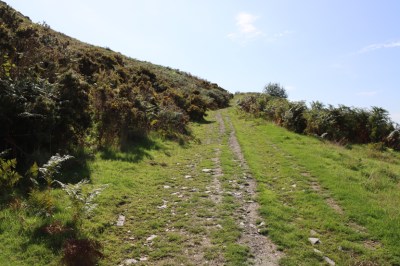
A visit to the Pontcysyllte Aqueduct near Llangollen – Thomas Telford’s iron trough 126ft over the Dee

It is without question a marvel of modern engineering and a remarkable sight, but what strikes most people when they first see the 1000ft (c.305m) Pontcysyllte  canal aqueduct is that the handrail along the pedestrian walkway 127ft (38.5m) over the river Dee is only a few steps away from the other side of the narrow canal trough, which has no handrail at all to separate a boat user from a straight drop into the valley bottom.  Until you lean over the towpath’s handrail and look straight down, 127ft is a rather abstract number.  The photograph on the right shows me crossing it on a 40ft narrowboat in the 1990s on a two week canal holiday.  What you cannot see are the white knuckles with which I am gripping the tiller for dear life, in spite of having absolutely no fear of heights, because there was absolutely nothing between me and that drop.  The aqueduct, Grade I listed, and a UNESCO World Heritage Site since 2009, is the longest and highest in Britain.  It’s a long way down.

The Pontcysyllte Aqueduct passing over the Dee valley at Trevor. Source: Dronepics Wales

Seen from below or from a distance, the Pontcysyllte aqueduct is a fabulous sight, not pretty but truly awe-inspiring, and it shows exactly what Pontcysyllte is:  an iron trough built on 18 vast tapering brick piers, with 19 arches.  It was all about function, nothing to do with aesthetics, and has no ornamentation to soften it, but the sheer ambition of it grips the imagination and makes one look beyond the factual details of the thing.  It really is superb.  There is a path leading down along the side of the approach to the aqueduct into the valley below, a long but well maintained track to the valley bottom, where you can walk along the Dee and get a long at the aqueduct from a distance.  That’s one for another day.

It was a beautiful day, absolutely flawless, with cerulean blue skies, a golden sun warming one’s face, and a brightness of autumnal colours that takes some beating.  After attending the Remembrance Day commemoration at the Churton war memorial, with a memorable and moving address, and a two-minute silence filled with birdsong, I collected the car first, the parent next, and we proceeded towards Trevor, on the A539 to Llangollen.  There’s a brown signpost pointing to the aqueduct’s pay-and-display car park at the Trevor Basin, which is the home of a number of canal boat companies today, but when it was built was used for the transhipment of coal, building stone, iron products, timber and bricks, much of which was brought to the canal wharf by horse-drawn waggons.

Map of the key canal features in the Vale of Llangollen. I have added a red arrow to show the best car park for Pontcysyllte. Click to enlarge. Source: Pontcysyllte Aqueduct & Canal World Heritage Site

Thomas Telford and his chosen team

Portrait of Thomas Telford, who chose to be painted with the Pontcysyllte aqueduct in the background. Engraved by W. Raddon from a painting by S. Lane.

The aqueduct (built (1794-1805) was part of the Ellesmere Canal project.  It is one of the many British civil engineering projects that has the names of Thomas Telford (1757-1834), ironmaster William “Merlin” Hazeldine (1763-1840) and master stonemason John Simpson (1755-1815) attached to it, three men who had brought their particular skills to many different joint projects and in doing so had developed an invaluable relationship of trust and mutual respect.

Thomas Telford started his career as a stone mason, working in London on buildings such as Somerset House, and had ambitions to develop his career as an architect.  When he became the County Surveyor for Shropshire, he worked on a great variety of building projects including, by his own estimation, 40 road bridges between 1790 and 1796, two of which employed iron in their construction.   Hazledine had initially trained as a millwright, but  his family owned a small foundry  and Hazeldine went on to grow his iron casting business with the large Coleham Foundry at Shrewsbury.  Hazledine and Telford, both Freemasons, had met at Salopian Lodge  in Shrewsbury in 1789 and become friends and professional collaborators.  On one of his earliest projects in Shrewsbury Telford hired a childhood friend Matthew Davidson to oversee works, and Davidson employed master stonemason John Simpson who worked on many of Telford’s projects. Telford described Simpson as “a treasure of talents and integrity.”

Although Telford is by far the best known of the three, he, Hazledine and Simpson worked together frequently on many different projects to produce some of the great civil engineering constructions of their era, mainly bridges.  All three were involved with the Pontcysyllte aqueduct, where  Matthew Davidson also joined them, but the story of the canal starts before any of them were recruited to work for the Ellesmere Canal project.

Background to the aqueduct

The Trevor Basin today.

The big name in canal construction was James Brindley (1716-1772), who was responsible for building over 365 miles of canals by the time he died.  Brindely realized that any inland waterway network would need to connect to all the great navigable rivers that connected to the sea, including the Thames, the Mersey, the Severn and the Trent, incorporating other important navigable rivers like the the Avon and the Dee.  Most of his canals were contour canals, wherever possible built on the level and avoiding slopes so that locks and lifts could be avoided.  The network was therefore a sprawling affair, but it revolutionized transport, avoiding roads that would become mired and impassable in winter, as well as unnavigable sections of rivers, and the riverine problems of drought and flood.  Water into and out of the canal system was regulated and therefore predictable, and allowed year-round transport.  The advantages became very clear very quickly, and manufacturing and trading businesses began to locate themselves at critical points on the canal network.  Eagerness to invest in infrastructure resulted in a canal boom in the late 1780s and 1790s.  Each new section of canal required an Act of Parliament, subject to Royal Assent, and Act after Act was passed as the network expanded.

The complex arrangement of the Ellesmere Canal and its branches is shown as a think blue winding line. The thick blue line is the Dee. The yellow lines are roads. Click to see a bigger version. Source: Wikipedia

In 1791 a proposal for a canal to link the Mersey at Netherpool (later renamed Ellesmere Canal) to the river Dee at Chester and the Severn at Shrewsbury was discussed by three Shropshire entrepreneurs, carrying mainly coal, iron and lime, supported by other goods as well.  It was decided that a branch would be needed to Wrexham and Ruabon and onwards, via Chirk, bypassing Oswestry at its west, to Shrewsbury in the south with a branch to Whitchurch in the east and another to Llanymynech.  Originally it was planned to run a branch from Ruabon to reach the Irenant slate quarries near Llantysilio, via Llangollen, but this was at first dropped and later revived for different reasons (discussed below).  That branch would in turn connect to the Montgomery Canal from Frankton Junction via Welshpool to Newtown in mid Wales (for carrying limestone, coal, timber, stone and slates).

This seriously ambitious plan found sufficient support for a surveyor to be hired and possible routes to be explored.   William Jessop, an experienced canal engineer, was hired to head up the project and oversee all of its different components.  After disagreements over the final route were resolved (albeit not to everyone’s satisfaction), the Ellesmere Canal proposal went through parliament and received its Royal Assent in April 1793.  There were still a lot of technical and logistical details to resolve, including how the canal was to cross the Dee and Ceiriog valleys.

It was clear that Jessop needed help, and although the internal promotion of William Turner was Jessop’s first choice, Telford was brought in without his input. It is not certain how Telford, increasingly bored with life as a county surveyor, managed to insert himself into this ambitious engineering project, but the canal was already generating considerable excitement in the area and it looks as though he heard of the position and sought the support of one of Britain’s most prominent industrialists, John Wilkinson, to help him secure it.  Jessop made it clear in his letters what he thought of having Telford, who he had never met, brought in against his wishes as his right hand man, and refused to attend the meeting that appointed Telford to the Ellesmere Canal Company.  In spite of this rocky start, Jessop and Telford seem to have hammered out a decent working relationship, with Jessop teaching Telford what he needed to know about canal construction, and Telford injecting some ideas into the project.  Like Jessop, Telford managed to broker a deal to enable him to carry out other projects when his personal presence was not necessary, and this enabled him to work on other civil engineering works whilst the Ellesmere Canal was being built.

Building the aqueduct

Work began at Netherpool on the Mersey, renamed Ellesmere Port, in 1793.  The 9-mile canal ran down the Wirral to meet the Dee at Chester, and went so well that it opened for traffic in 1795 and was an immediate success.  While this section was underway, discussions were underway about how the canal might cross the Dee.  The original idea presented to the directors by Jessop and Turner, and apparently not opposed by Telford, was a relatively low level stone channel crossing three stone arches, with step locks either side to manage the ascent to and descent from the level of the canal to the aqueduct.   This would have been an expensive option, requiring not only the locks but the management of the water that would feed the locks.  Even after this had been agreed in principle, concerns resulted in a new plan for an iron channel on stone columns.  It is likely that it was proposed by Telford and supported by Jessop partly because it would have reduced the cost as iron was lighter, easier to work and move, and cost less.  A sketch by Telford from March 1794 survives showing an early version of this aqueduct design.

Telford’s Grade 1 listed Longdon-on-Tern aqueduct in Shropshire, 1796. Source: Chris Allen, Wikimedia

In early 1795 Telford had the opportunity to try out a smaller, less ambitious version of the design at Longdon-on-Tern on the new Shrewsbury Canal, on which Telford was also working, as replacement for the incumbent engineer who had died mid-project.  Later in the same year he had built a fully navigable iron aqueduct on a canal that had none of the problems of leakage or shattering that had worried other engineers.  Whether or not this was taken into account by the directors of the Ellesmere Canal Company, they decided in the same year to go for the iron trough on immense stone piers that was eventually built.

Telford’s friend and frequent collaborator, master mason John Simpson soon joined him on the project.  Telford also brought in Matthew Davidson, his childhood friend of Telford, a stone mason, civil engineer and excellent organizer, to oversee the bridge works.  Telford and Davidson had worked successfully together on Telford’s Montford Bridge project of 1790 – 1792.  Shortly afterwards, William Hazledine arrived to establish an ironworks and take charge of the construction work for the iron ribs and the trough.  By assembling three men that he had worked with before and trusted absolutely, Telford was not only ensuring that the project was in good hands, but that he had a team who could operate in his absence. The foundation stone for the aqueduct was laid on 25th July 1795.

Jessop and Telford made wooden models to test the design for the trough, finding that 1000s of iron parts would be needed.  The cast iron for the aqueduct was made of cast iron that was produced in William Hazledine’s new iron foundry nearby at Plas Kynaston, Cefn Mawr.  Hazledine established the Plas Kynaston foundry to service the construction of the Pontcysyllte aqueduct, thereafter taking advantage of the canal network to carry his cast iron in segments to be transhipped by river or sea to where it was needed.  When he built the Eaton Hall Iron Bridge at Aldford on the river Dee (described on an earlier post) it was from Plas Kynaston that the iron was shipped by canal.

After 1801 Jessop was much less involved and Telford also had interests elsewhere, and Telford was also involved in other projects, leaving Davidson, Hazledine and Simpson to run with the project.  The piers rose steadily, each built in turn from south to north by, at the peak of the project, over 500 men.  Jessop had been desperately worried from the beginning by the dangers to workmen’s lives of such tall piers, and safety precautions were taken very seriously, with the loss of only one life.  The iron parts were manufactured as needed at Plas Kynaston, and were numbered according to the order in which they would be needed so that only pieces needed at any one time would be delivered to the site.  First, ribs of iron were fitted to the piers, and then the trough was bolted on top, after which a wooden towpath was fitted to the side.  The entire project was finished in 1805, and opened on a sunny afternoon on November 26th 1805 at a grandiose ceremony followed by a lavish feast.  The entire cost for the aqueduct project was £47,018, which in today’s money translates as around £617,855 (National Archives Currency Convertor).

Metalwork over and under the arch at the left-hand Rhos y Coed bridge.

Although not as visible in the finished design, iron was also used in the Chirk aqueduct on the Llangollen canal where ten semi-circular masonry arches were crossed by a water channel with an iron bed plate and brick sides sealed using hydraulic mortar.  As well as in the aqueducts, iron was used in various ancillary structures too.  for example, Bridge 29, Rhos y Coed, at the Trevor Basin has visible iron metalwork supplementing the stone arch, and iron was used to cap the weir at the Horseshoe Falls.

The role of the aqueduct

Map from Nicholson’s Guide to the Central canal system, showing the stump end (framed in orange) of the planned Ruabon to Chester section of the canal, which was never built and now houses the attractive Trevor boatyard where the visitor centre is located. Source: Nicholson 1989

The Pontcysyllte aqueduct was almost immediately  in danger of becoming something of a white elephant, because its original role as a direct route to Wrexham and Chester was never fulfilled.  The section that led past Trevor Basin over the aqueduct was supposed to run straight on to the west of Ruabon, via Wrexham and on to Chester where it would link with the Wirral stretch leading to the Mersey and to the  Dee and the Shropshire Union Canal.  All that is left of the Trevor-Ruabon-Wrexham-Chester branch is a stump end occupied by the Trevor Basin, where the car park is located.  This is clearly visible on Nicholson’s map left, where the main line of the canal comes to a sudden, abrupt end.

The abandonment of this important part of the original plan was due to both engineering problems and financial issues.  There were only  two obvious engineering options – an enormous tunnel or a series of locks climbing towards Wrexham and another descending into the Cheshire plain where the canal could run along the flat plain to Chester.  The tunnel would have been appallingly costly, and it was difficult to know how the locks, by no means a low-cost option themselves, could have been supplied with the sufficient water.  Although other technologies were considered, they were rejected for reasons of practicality and cost.  This left the problem of where the water was to come from to feed the rest of the Ellesmere Canal and its branches.

Horseshoe Falls

At the far end of the Llangollen canal is Telford’s great arc of a weir, today known as the “Horseshoe Falls,” marking the point at which the Dee begins to feed the Llangollen canal.  An original survey had considered using the water of the Dee as it fell from Snowndonia via Lake  Tegid at Bala and through the Vale of Llangollen as a water source for the canal.  The idea had been to link the canal to a slate works, feeding the canal at the same time.  This proposal was now revisited.  The owner of Lake Tegid gave his permission and the plan was actioned.  At the Horseshoe Falls the canal is fed with water from the Dee via a sluice and meter, and today carries over 11 million gallons of Dee water a day, emptying it into Hurleston reservoir, just north of Nantwich, where the Llangollen Canal meets the Shropshire Union Canal.  I will be posting more about the Horseshoe Falls weir on another day.  There is no turning point for vessels over 10ft long beyond Llangollen, so the final stretch is only used by minimal traffic today.

This means that the vast aqueduct, such a remarkable feat of civil engineering, would only ever lead to the relatively unimportant narrow section of canal and feeder to a complete dead end at Llantisilio after passing high through Llangollen.  This navigable channel is approached from the aqueduct by negotiating a sharp left-hand corner just beyond the exit of the trough.  Although this seems like a sad role for an aqueduct that should have carried many times the traffic that it eventually did, without the aqueduct there would have been no water to feed the rest of the system.

Even without the Ruabon – Chester link, those wishing to carry all their goods by canal were still able to connect to the main canal system, although to reach Chester they had to take a very long way round, and Wrexham was excluded completely.  The Llangollen canal still linked to the Shrophsire Union at its eastern end, from which the rest of the vast canal network could be reached.

  • Chester could still be reached by travelling the full length of the Llangollen canal to Hurleston Junction, just north of Nantwich, on the Shropshire Union Canal.  From here Chester was nearly 16 miles away.
  • Just to the north of Hurleston Junction was the Middlewich Branch, which headed east and linked to the Trent and Mersey Canal, from where Manchester, Stoke on Trent, the eastern Midlands and Yorkshire could all be reached.
  • In the opposite direction, from Hurleston Junction the Shropshire Union ran directly to Birmingham, which was a vast junction for canals in all directions, including London on the Thames and Gloucester on the Severn.

The Cefn Mawr railway viaduct, which opened in 1848.

Along the line that the original canal would have taken, a cast iron tramway was built to connect local collieries and ironworks with the canal, the iron supplied by Hazledine.  This made the Trevor Basin a particularly important hub of activity, taken delivery of bricks, tiles, coal, iron limestone, slate and sandstone for transhipping along the canal.  It was also a boatyard, with  working narrowboats being built and repaired by Hills Boatyard in the dry dock next to the Visitor Centre (now occupied by a floating take-away café).  Later, there was an interchange with the steam railway.

Visiting Pontcysyllte

A small pay-and-display car park is available for visitors at the Trevor Basin, now the home of some canal trip and holiday companies.  There is also a pub with outdoor seating, and a take-away small café on a little boat next to the visitor centre.  There is a lot of disabled parking provided for in the small car park, which is reached from the A539 in Trevor, clearly signposted with brown heritage signposting.   The aqueduct is a very short walk from the car park, and the towpath heads for miles in both directions.

If, before or after crossing the aqueduct, you are interested in finding out more about the general context of the aqueduct and its location in relation to other parts of the canal, at the Trevor Basin there is a visitor centre, a small but nicely put together display space.  As well as a map of the area that takes up a wall and shows all the main features of the landscape and the canal system itself, there is a display of some of the tools that were used in the construction of the aqueduct, which are startlingly basic, and photographs and artists’ impressions of some of the supporting works, including the foundry at Plas Kynaston.  There are ring folders full of additional information, including facts and figures, that you can look through.

Walking the aqueduct itself is not for everyone.  The towpath is rock solid, with a tall handrail on the valley side, but only wide enough for two people, so there is a lot of stopping still to allow others to pass and there is nothing to stop you falling into the canal.  The canal is only just over 6ft (1.8m) wide, and beyond that is an unrestricted (no handrail, no nothing) drop 127ft to the valley floor.  A couple who I passed told me that they were determined to walk the full length and back, but were conquering their fears to do so, and they were gripping firmly to the handrail.

An alternative to walking is to cross by boat.  There are a number of short cruises that leave the Trevor Basin and run for about 20 minutes before turning and coming back (depending on which one you take and the time of year).

For those with uncooperative legs, everything is on the flat, so it is a very good walk for those who find uphill sections of walks difficult.  After rainfall, towpaths always become a bit muddy, and can be slippery, but even though we’ve had some rainfall recently, it was fine.  The towpath between Trevor and Llangollen is beautiful, and a good choice if you can face the aqueduct.

I noticed that one of the passenger boats said that it was suitable for disabled passengers, but I would recommend getting in touch with them first to find out about timings, prices and suitability for different types of disability.

Sources

Books and papers

Glover, J.  2017.  Man Of Iron.  Thomas Telford and the Building of Britain. Bloomsbury

Lynn, P. A. 2019.  World Heritage Canal.  Thomas Telford and the Pontcysyllte Aqueduct.  Whittles Publishing.

Nicholson, R. 1989 (4th edition). Nicholson/Ordnance Survey Guide to the Waterways 2: Central. Robert Nicholson Publications and Ordnance Survey

Rolt, L.T.C. 1958, 2007.  Thomas Telford. The History Press.

Pattison, A.  n.d. William Hazledine (1763-1840): A Pioneering Shropshire Ironmaster.  West Midlands History https://historywm.com/articles/william-hazeldine-1763-1840  (Pattison’s full 278-page M.Phil, on which the article is based, is available here: https://etheses.bham.ac.uk/id/eprint/3358/1/Pattison12MPhil.pdf )

Websites

Canal and River Trust
Montgomery Canal
https://canalrivertrust.org.uk/enjoy-the-waterways/canal-and-river-network/montgomery-canal?gclid=CjwKCAiAp8iMBhAqEiwAJb94z7aIVzLoaYuqtwbDdRQsaUL73ssnmF_u1LpoURZmI9YxVUlrKi15whoCtxoQAvD_BwE

DronePics Wales
Pontcysyllte
https://dronepics.wales/pontcysyllte/

Engineering Timelines
Longdon-on-Tern aqueduct
http://www.engineering-timelines.com/scripts/engineeringItem.asp?id=308

Grace’s Guide to British Industrial History
James Brindley
https://www.gracesguide.co.uk/James_Brindley
William Hazledine
https://www.gracesguide.co.uk/William_Crosley_(1802-1838)
William Jessop
https://www.gracesguide.co.uk/William_Jessop

Pontcysyllte Aqueduct and Canal World Heritage Site
https://www.pontcysyllte-aqueduct.co.uk/