Category Archives: Mediaeval History

St Winefride’s striking fan-vaulted pilgrim shrine at Holywell, c.1480

Introduction

15th century fan vaulting in St Winefride's well

15th century fan vaulting in the under chapel at St Winefride’s well. late 15th – early 16th century

On Friday I took advantage of a sunny cold day to revisit St Winefride’s Well and its late Medieval chapels.  During the Middle Ages it was a major draw for pilgrims to north Wales,  with its shrine, beautiful bubbling spring and the Basingwerk Abbey a few minutes away.  St Winefride’s (Welsh Gwenfrewi) shrine and the Holywell (Treffynnon) parish church were granted in 1093 to St Werburgh’s Abbey in Chester for them to manage and from which to derive an income.  It was later consigned to Basingwerk Abbey.

Nothing is known about what sort of buildings preceded the late medieval building that we see today, but there are details about Saint Winefride, a list of some of the well’s most notable earlier medieval visitors and details about the measures that were taken to promote the interests of the shrine throughout its history following the Norman Conquest.  The role of the abbey in the success of the well can also be seen.

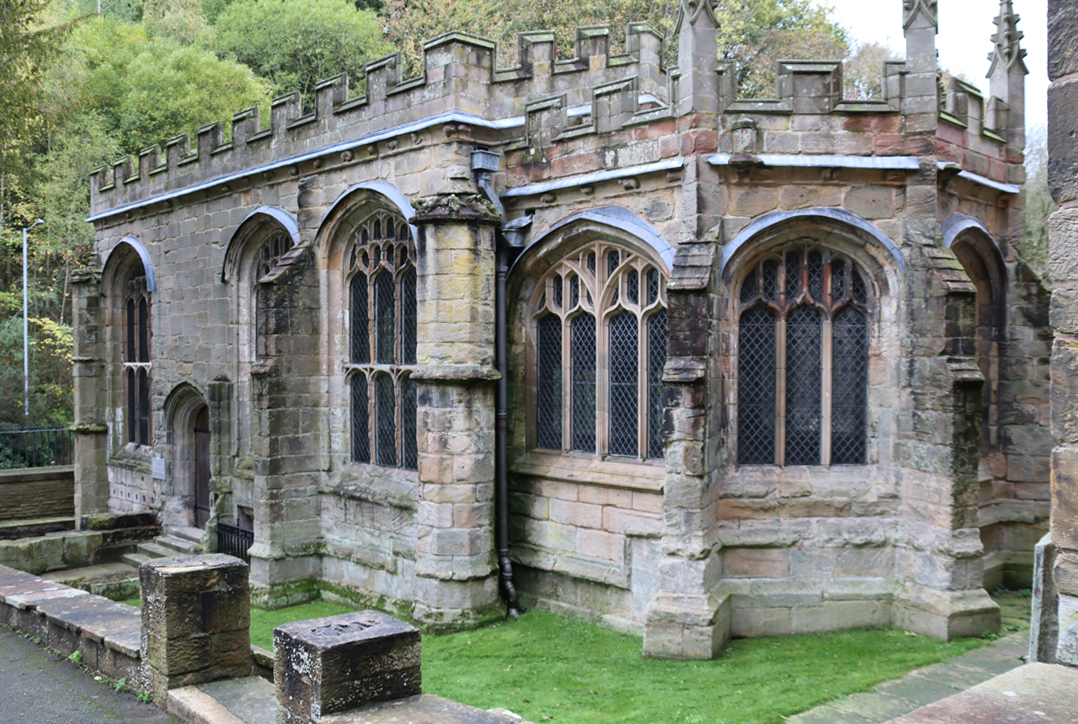
View of the chapel from the south. The chapel is over two floor. The fan-vaulted ground floor has three bays, with the central one containing the well itself. The upper chapel is fully enclosed and its entrance is on the same level as the entrance of the parish church.

An abbey with a pilgrim shrine had a range of opportunities for income generation, and St Winifred’s was famous for its powers of healing and provision of miraculous cures for centuries.  In around 1480 a wealthy patron, possibly Henry VII’s mother Lady Margaret Beaufort, invested in the shrine, providing the miraculous spring with a gorgeous, lofty fan-vaulted open-fronted chapel, as well as an enclosed chapel overhead.  Today both parts of the chapel are very well cared for, located on the edge of the Green Valley Park, which has a superb industrial heritage trail wending through it (see my earlier post here).  There is plenty of parking at both the well and at the abbey, described at the end of this post.

Fan vaulting with roof bosses. From left to right, the rebus of Elizabeth Hopton, two monkeys, a fleur de lys.

Fan vaulting with roof bosses in the lower chapel. From left to right, the rebus of Elizabeth Hopton (showing a rebus of her name, with a hop plant emerging from a barrel or tun); two monkeys, which may have a number of interpretations; and a fleur de lys (representing chastity, often used for the Virgin Mary but also suitable for St Winefride).

There’s a real sense of this being a costly but personal project, particularly in the vaulted lower chapel, which in terms of elaborate ecclesiastical architecture is tiny, although its height gives a sense of heading heavenwards.  Although no documentation survives to say who was responsible for funding the building, the Stanley family’s crests and symbols give an impression of a cherished project and the sheer amount of other imagery are reminiscent of cathedrals and large churches of the period.  It manages to be both impressive and intimate, which is quite a trick.  The chapel upstairs is more conventional in terms of both its size and its layout.  What I missed on my first visit is that the wooden ceiling supports all have sculptural elements sitting on their corbels, as well as more easily visible stone ones lower down.  In both upper and lower chapels, as well as the inherent beauty of the architecture, there is humour as well as religious, pagan, family and royal themes in the imagery.
xxx

xxx

St Winefride's well, c.1480

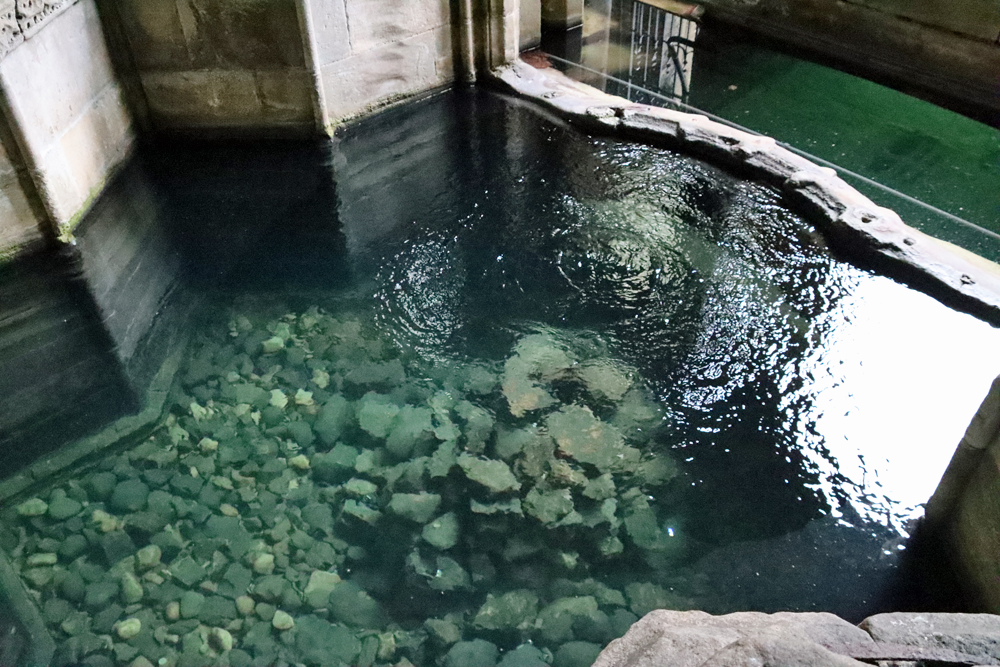
St Winefride’s well, in the star-shaped basin late 15th – early 16th century

St Winefride and St Beuno

There are a number of versions of the story of the miracle of St Winefride or Welsh Gwenfrewi (also spelled Winefred and Winifred), and her uncle and tutor St Beuno.  The earliest that remain preserved date to the 12th century, and excerpts have been translated and published by T.W. Pritchard in his detailed 2009 book about the well.

Modern stained glass in the little prayer chapel next to the main chapels

Winefrede and Beuno in the modern stained glass in the little prayer chapel for worshippers today, next to the main chapels. The palm represents the spiritual victory of martyrdom, whilst the crozier (staff) symbolizes teaching, wisdom and guidance.

Winefride was born towards the beginning of the 7th century in the cantref of Tegeingl, in northeast Wales, the only child of Tyfid and his wife Gwenlo, or Wenlo, who were landholders in the area.  One of the 12th century accounts says that Tyfid’s estate was made up of four manors.

Winefride had decided to renounce marriage and to dedicate herself to God and the teachings of Christ.  Christianity was well established throughout Britain, partly due to missionaries who were often commemorated as saints for their work.  One of these was St Beuno, who had moved to the area from mid Wales and was engaged by Tyfid to teach Winefride, in return for land on which to build a church.  St Beuo built a church in a valley called Sychnant (dry valley), which is now Greenfield Valley, Holywell, where the well is located.

Sculpted figure

Sculpted figure, possibly St Beuno

One day, Winefride was at home alone whilst her parents were attending mass at the church, and a local prince, Caradog, knocked on the door.  She suggested he return later, but he became determined to marry the girl (who was of course beautiful).  Pretending to go and get changed, she ran to the church.  Caradog, realizing that he had been deceived, set out in pursuit and when he caught up with her near the door to the church, decapitated her in a fit of rage.  Beuno, hearing the noise, rushed out of the church and, finding a terrible scene, began to pray for help.  His prayers were answered.   Caradog melted into the ground, never to be seen again, and Beuno picked up her head and placed it back on her neck.  She came back to life, with only a slender white scar showing where the injury had been.  Instantly a spring erupted at the spot where her blood had been spilled.  The stones in the spring were said to be permanently red, the moss that grew around it had an aroma of incense and the waters produced miraculous cures.  The story continues, but the abbreviated version is that Winefride became a nun, moving from Holywell to Gwytherin to oversee 11 nuns as abbess, where she died and was buried.
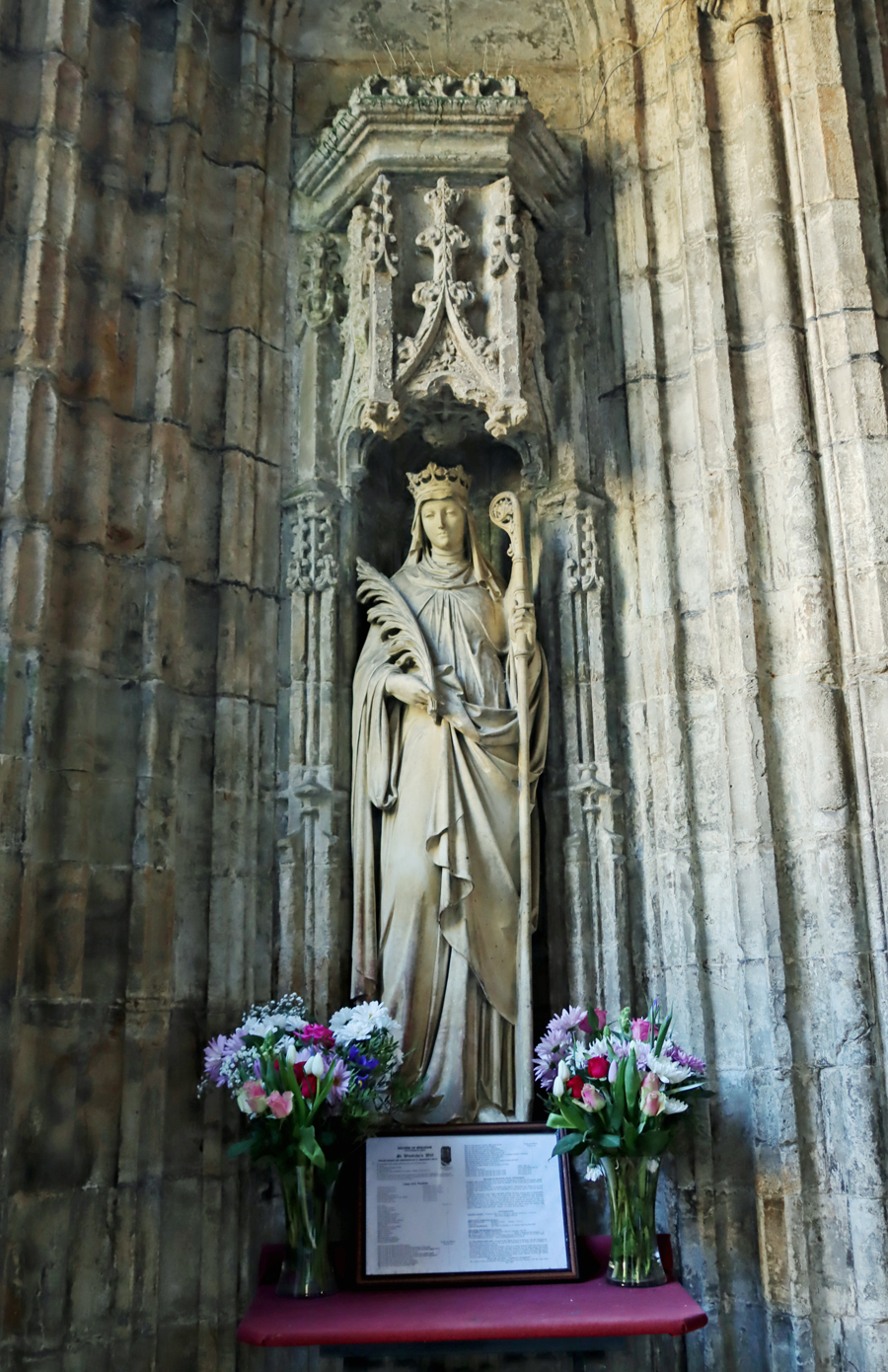
Statue of St Winefride within the lower chapel, dating to 1886

Statue of St Winefride within the lower chapel. The niche with its elaborate and intricate canopy is original, but the medieval statue was lost, and this dates to 1886

The basics of the story, a pure and noble virgin who died rather than surrender her virtue, is a familiar one.  The spring, too, erupting where pure blood was spilled, is not unique. When St Paul the Apostle was executed by decapitation his head is said to have bounced three times, and at each place where it touched the ground a spring erupted. The linkage of springs, wells and purity are long established, and the added connection with baptism gave water particular potency in Christian thought.  Interestingly, Winefride combined the virtues of a martyr saint and a confessor saint, having first died for her beliefs and then having been resurrected to live for those beliefs and values.

Miraculous events and morality tales of this sort became a form of oral history, a mechanism by which the ideology, morality, values and essential beliefs of early Christianity, were spread and understood.  The partly fictional “lives” of saints purporting to be biographies (hagiographies) were particularly popular when distributed after the innovation of printing in England in the 1470s. St Winefride’s story, written down and transmitted via word of mouth, the monasteries, and later by the printing press, became a popular saint  and her miraculous healing well became a pilgrim destination.

The remains of the shrine to St Winefrede in Shrewsbury Abbey

The remains of the later 14th century shrine to St Winefride, Shrewsbury Abbey showing St John the Baptist at left, St Beuno at right and Winefride in the middle.

In the 1130s an account by one of the monks of Shrewsbury Abbey states that the monks had “lamented that they were very deficient in relics of saints and applied their minds to the problem of obtaining some.”  One of the monks, during a spate of sickness, had a dream that St Winefride had appeared to him and said that the monk would be cured if a mission were to be sent to Holywell to say mass at her well.  Convinced that Winefride was their patron, they decided to retrieve her bones and take them to Shrewsbury.  In 1138, over 300 years after St Winefride’s death, a contingent of monks duly went to Gwytherin. They dug up and translated (transferred) Winefride’s remains from her grave and took them back to Shrewsbury, where a shrine had been built to receive her. Legend states that during the journey a spring appeared at Woolston near Oswestry, where her bier was briefly placed on the ground during the journey (a photo of this is shown further below).  A new shrine was built to house her relics at Shrewsbury Abbey in the late 14th century, a fragment of which survives and is shown above. It was destroyed during one of the attacks on the monastery.
xxx 

The Shrewsbury Abbey church

The Shrewsbury Abbey church (the rest of the abbey was demolished, now replaced by a road and a car park)

The Spring that feeds St Winefride’s Well

St Winefride’s well is built over the point at which an ancient spring, an underground stream, erupted to the surface, producing a quite dramatic spectacle of fiercely rushing water, particularly after rainfall.  That was not the same spring that is seen today.

St Winefride's well

St Winefride’s well

In 1917 mining activities at Halkyn cut through the stream, causing a change in flow direction so that the stream now emerges at Bagillt on the edge of the Dee estuary, causing both dramatic change to the industries along the valley and to the well itself, which dried up.  The current spring water that enters the star-shaped basin beneath the vaulted roof now bubbles delightfully, but this comes from another spring that was diverted for the purpose, and has none of the vigour or volume of the original spring.
xxx

The History of the Well

Hugh Lupus and the Abbey of St Werburgh

Romanesque elements surviving from the first Abbey of St Werburgh

Romanesque elements surviving from the first Abbey of St Werburgh

Today Chester Cathedral is a largely Gothic vision, with pointed arches and vaulting with roof bosses, but when it was built as St Werburgh’s Benedictine Abbey in around 1093 it must have been a superb example of the Romanesque curves and rounded arches brought to England by the Normans.  The abbey’s founder was Hugh d’Avranches (better known as Hugh Lupus, c.1047-1101), Earl of Chester, who had been appointed to Chester by William the Conqueror.

Holywell, including St Winefride’s Well and the parish church, were part of Hugh’s new territory. Earl Hugh gave Holywell to his wife, Adeliza, and she in turn awarded it to the abbots of St Werburgh’s Abbey.  A religious attraction like Holywell, with its miracle-producing shrine and its attached church cold produce a good income for an abbey, which took control of the tithes (a sort of religious tax) owed to the church, and to the oblations (gifts from pilgrims and visitors) to the holy shrine.

Transfer of ownership:  Basingwerk Abbey and subsequent transfers

The building that may have been part of the guest quarters at Basingwerk Abbey. Its burned timbers were dendro-dated, giving the roof a date of c.1385

Because it was located in a region that was a territorial bone of contention between the Welsh princes and the English kings during the 13th century, Holywell could be in either English or Welsh territory.  When Basingwerk Abbey was founded in 1131 by Ranulf II Gernon, Earl of Chester, it must have been a source of some discontent to the new abbot that such a rich potential source of income was sitting on the doorstep and benefiting a rival monastic order in Chester.

Fortune smiled on Basingwerk Abbey.  Holywell was granted to it in the 12th century.  It was briefly back in the hands of St Werburgh but in 1196 it was once again assigned to the monks at Basingwerk by the Welsh prince of Gwynedd, Llywelyn the Great (ap Iorwerth, c.1173-1240), who had pushed his frontiers east.  This gift was confirmed in 1240 by Llywelyn’s grandson Dafydd ap Gruffudd (and younger brother of Llywellyn ap Gruffudd known as Llywelyn the Last), who in a turncoat deal with Edward I had been given lands in northeast Wales following the Treaty of Aberconwy. Basingwerk then retained Holywell and its religious assets for nearly 300 years until Henry VIII suppressed the monasteries in the 1530s.  Although they suffered under Edward I’s final conquest of Wales, Baswingwerk and Holywell survived, which is more than either Llywelyn or Dafydd managed to achieve, being killed in 1282 and 1283 respectively.

St Winefrede Well at Woolston

St Winefride Well at Woolston. Source: Shrewsbury Orthodox Church

It is not known what the Holywell pilgrim shrine looked like throughout the changes of ownership between the two abbeys, as no descriptions or images survive.  The shrine and temple would have been built of wood in its earliest years.  In one of its doubtless numerous iterations it is quite likely to have looked something like the small pilgrim shrine at Woolston near Oswestry, shown on the left, also dedicated to St Winefride.  Wooden buildings were replaced by stone buildings when those buildings began to be well used. The first stone parish church at Holywell is thought to date to around the 14th century, and it is possible that the shrine was revamped at the same time.

Promoting the interests of the Holywell shrine

Statue of St Winefrede in a niche in the Henry VII Chapel, Westminster Abbey

Statue of St Winefride in a niche in Henry VII’s early 16th century Lady Chapel at Westminster Abbey. Source: Pritchard 2009, p.71

The task of ensuring the continuing success of St Winefride and the holy well, important both for monastic income and the economy of the Holywell, was occasionally given an official helping hand.

In 1253, for example, a request was made to the Cistercian General Chapter (the governing body of the Cistercian monastic order) to allow a “Feast of 12 Lessons” to be held annually on the saint’s Feast Day at Buildwas Abbey in Shropshire, and Basingwerk Abbeys, the two of which had become connected in a hierarchical relationship some time after Basingwerk was absorbed into the Cistercian order.  The normal feast was of 9 lessons (prayers and readings), and the fact that this was of 12 indicates the respect in which Winefride was held.  The request was authorized, meaning that St Winefride’s Feast was more likely to attract pilgrims to both of the abbeys as well as the Holywell shrine.

In 1398 the annual feast of St Winefride, which had been confined to north Wales and the Marches, was extended to the entire Canterbury area  by Archbishop Roger Walden.  In 1415 his successor Henry Chichele who had a particular interest in Welsh saints having been Bishop of St David’s, a centre for pilgrimage in south Wales, raised the profile of St Winefride’s cult still further.

Richard II established a chantry (payment to a member of the clergy in return for prayers and the saying of mass for the dead of a particular family) in 1377.  This was renewed annually by each subsequent king until the Dissolution, after which chantries and the mass were no longer legal.

An example of an Indulgence, this one issued in London. Source and details: Essex Records Office.

An example of an Indulgence, this one dated 1480 and issued in London. Source and details: Essex Records Office.

In 1427 the shrine’s popularity was assured when Pope Martin V granted indulgences over a ten year period for those who made the pilgrimage to the shrine and gave oblations to the chapel.  Indulgences were mechanisms for rewarding certain activities, mainly those that generated income for the Church, including pilgrimages, by reducing the time an individual spent in purgatory by a specific number of years and days.  In this case the time reduced was a year and forty days.  It was a way of trading off human fear of what followed death, but a ruthless way of raising funds, later famously condemned by Christian revisionist Martin Luther in his Ninety Five Theses.

The role of the well in the Middle Ages

North entrance to the under-chapel at St Winefrede's Well.

North entrance to the under-chapel at St Winefrede’s Well.  The barriers detract from the aesthetics but do prevent people falling in.

The well can be understood in a number of ways, all from different viewpoints.

From the point of view of Basingwerk Abbey, which had authority over the well and its shrine, it was both a source of prestige and income.  The prestige of having the miracle directly connected with an Anglo-Saxon saint was considerable, giving it a historical validity with real time-depth, with roots in the distant past.  Not only was Winefride a miracle-working virgin saint, but she had gone on to become a nun, and then an abbess.  Her credit and sanctity were flawless.  This status and prestige attracted pilgrims, and with them a source of potentially considerable income. The  importance of miraculous places of pilgrimage grew in the medieval period, and pilgrims not only brought donations (alms) but those with money also contributed to the local economy, meaning that the abbey was a contributor to that economy.  However, pilgrims could be a double-edged sword, as they also required some management to prevent them becoming a drain on the abbey’s obligation to provide shelter and food under the general heading of “hospitality,” to which the Cistercian order was committed and which included some form of accommodation and the supply of meals.

Rebus of Elizabeth Hopton's last name (a hop plant emerging from a tun, a type of Barrel

Rebus of Elizabeth Hopton’s last name (a hop plant emerging from a tun, a type of Barrel

From the point of view of pilgrims, miraculous venues offered a range of opportunities, depending on the motives for visiting.  The natural spring was said to have miraculous healing properties, and many will have travelled to be cured, whether rich or poor.  Others were engaged in a form of spiritual tourism, visiting all the most important shrines and relics either in a given area, throughout Britain and sometimes overseas.  Within the Welsh and border areas, Holywell was part of a pilgrim circuit with Basingwerk (with the Holywell shrine), St Asaph (Llanelwy, the church of the 6th century miracle-performing saint), Chester (with the Holy Rood of St John’s and St Werburgh’s shrine in the Abbey), together with other churches and monuments, and this could also be extended to reach the sacred Bardsey Island.

Archway leading to the steps into the well

Archway leading to the steps into the well

The medieval world was very concerned with the challenge of how to manage an afterlife that began with the terrors of Judgement Day and Purgatory.  Visiting saints’ shrines, or just being in close proximity to them, was a way of gaining proximity, at a little distance, to the divine, with the hope that some of it might, in some mystical way, rub off.  Just by touching a shrine, a little of the incredible divine energy could pass into a person; immersion in the spring that emerged from the spilling of a virgin saint’s blood must have seemed like being wrapped in the saint’s divinity.  This did no harm to nearby residents, who must have had a sense of the power of the shrine.

Likewise, monasteries that were filled to the brim with those devoted to Christian worship, whose virtue made them next in godliness to saints, were considered to be invaluable assets to those who lived in their vicinity.  The wealthy chose to be buried within monastic precincts, as close as possible to the most sacred areas.  In churches people wanted to be at the interior east end of churches or, if they were not sufficiently influential to be buried inside, as close outside to the east end as possible. The presence of the abbey so close to the shrine gave Holywell a particular religious vigour.

As well as religious benefits to outsiders, there were economic benefits to the local population.  Basingwerk Abbey had various agricultural (mainly livestock) and industrial (including silver mining) interests in the immediate area that would have employed many rural people, but as the medieval period shook off the manorial control that bound people to the land, the Holywell shrine offered potential for new opportunities, including hospitality and, if other pilgrim centres are anything to go by, the manufacture and sale of souvenirs.

Visitors and patrons in the Middle Ages

Pilgrim being carried to the healing waters of the spring

Pilgrim being carried to the healing waters of the spring. The 15th-early 16th century well shrine.

In the Middle Ages there was no clear dividing line between physical and spiritual health.  The idea of illness was embedded into the belief that the body was composed of a series of complex components that required balancing what were understood to be the essential fluids (blood, phlegm, black bile and yellow bile) with the elements (air, water, fire and earth) and their key characteristics (hot, cold, wet and dry) as well as astrology. Deficiencies and excesses in any one component might put the entire complex equation for stability and harmony in jeopardy.  When attempts to achieve balance these failed, and the person remained sick in body, mind or, for that matter, sin, pilgrimage was often seen as the most logical next step.  Pilgrims understood that this was a two-way street and that they would have to make some sort of sacrifice, part of which might be the difficulty of undertaking the journey, but gifts and promises of reform were also part of the negotiation.  Pilgrimages were undertaken for many other reasons too, but the healing properties of St Winefride’s shrine were probably the main attraction to most visitors.
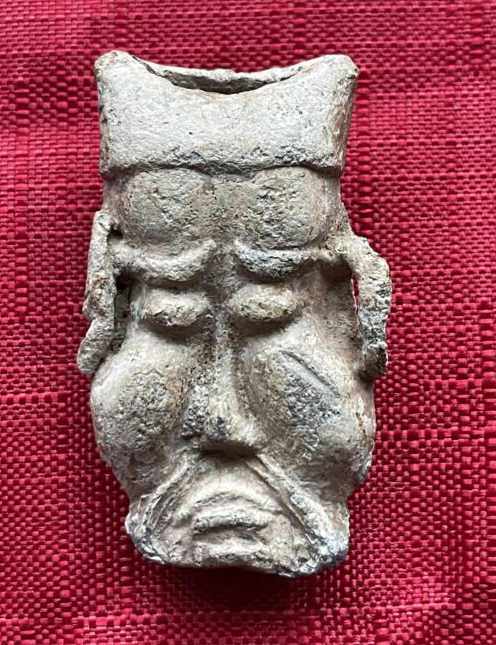
Medieval ampulla for carrying liquids or earth from a pilgrim site

Example of a medieval ampulla used for carrying liquids or earth from a pilgrim site. Source: The Mobility of Objects across Boundaries

St Winefride’s recorded visitors and patrons are a roll-call of the celebrities of the era, the royal and the aristocratic, who were major marketing coups for Basingwerk.  Although those few known by name are listed below, the everyday participants along the pilgrim routes were more often ordinary people.  Reasons for their travels varied, including seeking to undertake a spiritual journey for personal improvement (perhaps one of many journeys);  to offer thanks for prayers that were answered; or to seek divine assistance for problems and maladies by asking a specific saint to intercede for them with God.  Some pilgrims also acted for those who were unable to attend themselves, offering prayers on their behalf, and returning home with garlands of the sacred moss or filling small flasks with the miraculous water.  These ordinary pilgrims from a wide variety of backgrounds always get lost in documented history, the Middle Ages being just as concerned with celebrity endorsements as the west is today, but were nevertheless the most essential components, the bread and butter raison d’être of a living shrine and the institution that managed it.

Ranulph II, Earl of Chester. Source: Wikipedia

Between 1115 and 1119 the second earl of Chester, Richard d’Avranches, son of Hugh Lupus made pilgrimages to the well.  With the shrine of St Werburgh within the Chester city walls, it might have been thought that he would look closer to home, but Richard is thought to have fallen out with the monks of the abbey.  In addition, it is not really a pilgrimage if it is only a ten minute walk, and Richard may have felt the need to make more of a gesture.  Ironically, a miracle took place during the pilgrimage, when Richard became cut off from his forces and his constable in Wirral prayed for assistance but as St Werburgh had been chosen rather than St Winefride, this was chalked up to a win for the Chester abbey.

In 1131 Ranulf II Gernons (1099-1153), fourth earl of Chester, founded the new Savignac (later Cistercian) Basingwerk Abbey somewhere in the area, presumably made of wood.  It is thought that it was moved to its current location in around 1157 to be rebuilt in stone, and this new location was very probably influenced by the presence of the nearby holy well, even though it was at that time part of the landholding of St Werburgh’s Abbey.

It is said that in 1188 or 1189 Richard I, the Lionheart (ruled 1189-1199), made a pilgrimage to Holywell.  Quite where he would have found the time is anyone’s guess.

Flint Castle

Flint Castle on the Dee Estuary, construction having begun in 1277

There is no record of Edward I (reigned 1272 to 1307) making a pilgrimage, but he presumably had no need to put himself to any real effort to visit either the abbey or the shrine, as by the 1270s he was already in the area.  In 1277 he began to build Flint Castle 6.9km/4.3 miles down the road from Basingwerk.  Whilst the castle was under construction it seems reasonable to assume that Edward was a frequent guest at the nearby monastery, and that he took the opportunity to visit the shrine.  In fact, Edward’s castle in Flint may have resulted in a busy time all round for the abbey, the church and the shrine, as the 100s of workers at the castle would have had at least some downtime and would doubtless have sought out a powerful religious shrine so close by.

In 1282 Edward’s armies returned to northeast Wales to engage with the Welsh princes once again, doing substantial damage to monastic lands in the process.  It is recorded that part of Holywell was burned, but it is not stated whether this was the village, the shrine or nearby buildings.  The abbey estates were certainly harmed, with the lost of crops and livestock, and Edward found himself compensating both Basingwerk and other Welsh abbeys that had come under fire during the fighting.  Pilgrims were presumably rather short on the ground at this time, but Edward and his armies probably formed part of the narrative of the abbey told to future pilgrims.

Miniature of Henry V

Miniature of Henry V, c.1411. Source: Wikipedia

According to chronicler Adam of Usk, Henry V (reigned 1413-1422) visited in around 1416, following his success at Agincourt, to give thanks, walking on foot to Holywell from the Shrewsbury abbey to which Winefride’s remains had been translated (moved) in 1138 from where she was originally buried in Gwytherin.  I have not found any reason why Henry would have singled her out to request support in battle, but apparently he prayed to her for assistance and his pilgrimage was an offering of thanks, which created a considerable stir.  Perhaps he had encountered the shrine as Prince of Wales during the military campaigns against Owain Glyndŵr that began in his father’s reign and which he ultimately suppressed.

The Earl and Countess of Warwick made gifts to the shrine in the 1400s there is is not stated that they ever visited.

Henry IV Bolingbroke (reigned 1399-1413) took the throne from Richard II (reigned 1377-1399), with Richard surrendering to Henry at Flint Castle in 1399.  It is possible that whilst he was in the area, Edward took the opportunity to visit St Winefride’s shrine, probably connecting with the monks at the same time.

In 1461 the Welsh bard Tudur Aled wrote that Edward IV (reigned twice in 1442-1483 and 1471-1483) had visited the shrine, but quite why is unclear.  He was a member, by descent, of the Mortimer family who had extensive properties in the Welsh Marches, in Chirk and Denbigh. There was, in fact, considerable resistance to Edward IV in areas of north Wales, including the rebellion of Owain Glyndŵr.  There is nothing in general events of that year that would seem to account for him being in Holywell, although Pritchard suggests that it might be connected with renewing the royal chantry, which seems like the most plausible reason.

St Winifrede's well by John Ingleby. Source: National Library of Wales via Zone47

St Winefrede’s well by John Ingleby (1749-1808) showing crutches slotted into the stonework above the spring.  Note the gallery at the left, and the mill wheel through the doorway.  Source: National Library of Wales via Zone47

Whether royal, aristocratic or of more humble origins, pilgrims continued to visit throughout the medieval period, and pilgrims continue to visit continue today.  As well as the sculpture on the left in the well chapel, showing a pilgrim being carried to the spring on an other man’s back (one in need, the other showing compassion) the visitor centre has examples of later wooden crutches that were apparently discarded after miracle cures had  been received.  In 18th and 19th century engravings crutches are shown slotted into the stone structure of the pilgrim shrine presumably as a record of successes and gestures of thanks (see the John Ingleby coloured engraving towards the end of the page).

For visitors to Holywell and the shrine in the post-medieval periods, which are not covered here, see the Early Visitors in Wales page dedicated to Holywell.

The late Gothic chapels

The patrons of the new chapels

Ceiling boss showing Lady Margaret and the Earl of Derby

Ceiling boss in the lower chapel allegedly showing Lady Margaret with her husband Thomas Stanley, the Earl of Derby

It has passed into tradition that the founder of the chapel that we see today was Lady Margaret, née Beaufort.  Lady Margaret was the mother, by her first husband, of the future King Henry VII who was the founder of the fan-vaulted Lady Chapel in Westminster Abbey, designed by Robert Vertue.  Lady Margaret, born 1443 had married three times by the time she died in 1509, her last husband being Thomas Stanley, Earl of Derby, a member of an important and wealthy local family in the Wrexham area.  She is thought to have patronized St Giles in Wrexham, St Mary the Virgin in Mold and St Chad’s in Farndon.  She sponsored two publishers, both of whom (possibly at her suggestion) published lives of St Winefride.  The involvement of the Stanley family, whether Lady Margaret was involved or not, is suggested quite strongly by the number of relevant carvings in the chapel, including:

  • A sculptural portrait thought to represent Lady Margaret and her husband Thomas Stanley (1435-1504), Earl of Derby (although with very little data, if any, to substantiate the identification)
  • Over the outside of the door to the gallery there is a the portcullis emblem that Henry VII (reigned 1485-1509) derived from Lady Margaret
  • The arms of Sir William Stanley (died 1495), brother of Thomas Stanley showing a wolf’s head enclosed in a garter (rewarded by Henry VII for his role in the Battle of Bodsworth of 1485 but executed in 1495 for conspiracy)
  • The arms of Sir William Stanley’s wife Elizabeth Hopton (died 1498) showing a barrel and a plant, forming a rebus – hop and tun – of her name
  • The 3-leg symbol of the Isle of Man reflects Sir John Stanley’s new title of Lord of Man, gifted to him in 1405 by Henry VII for his support during the War of the Roses
  • Other Stanley emblems including a stag’s head and eagle’s legs
  • Tudor emblems, including the dragon and greyhound in the spandrels of one of the doorways
  • The Royal arms of England and Wales at the end of the pendant ceiling boss over the spring
  • The coat of arms of Queen Katherine of Aragon (1485-1536), the wife of Henry VII’s son Arthur before Arthur’s death in 1502, featuring three pomegranates topped with a crown. Lady Margaret was her grandmother-in-law, dying in the same year as Katherine’s marriage to Arthur’s brother Henry VIII (reigned 1509-1547) in 1509

In addition, Henry VII chose to include a statue of St Winefride in a niche in the north apse of his own Lady Chapel in Westminster Abbey.  She is shown with her head on her shoulders, but there is also a small head on its side at her feet, sitting on the top of the well.

Lower chapel roof bosses.

Lower chapel roof bosses. Clockwise from top left:  Arms of Katherine of Aragon; Wolf-head shield of Hugh I or Richard d’Avranches (probably the latter); Either St Winefride or the Virgin Mary, very battered but originally two angels placed a crown on her head; the base of the pendant boss shows the royal arms of England and Wales whilst the pendant itself shows scenes from the life of St Winefride (very worn); the legs of the Isle of Man, off centre; greyhound and to its left dragon, both symbols of the Tudors (on opposing doorway spandrels).

xxx
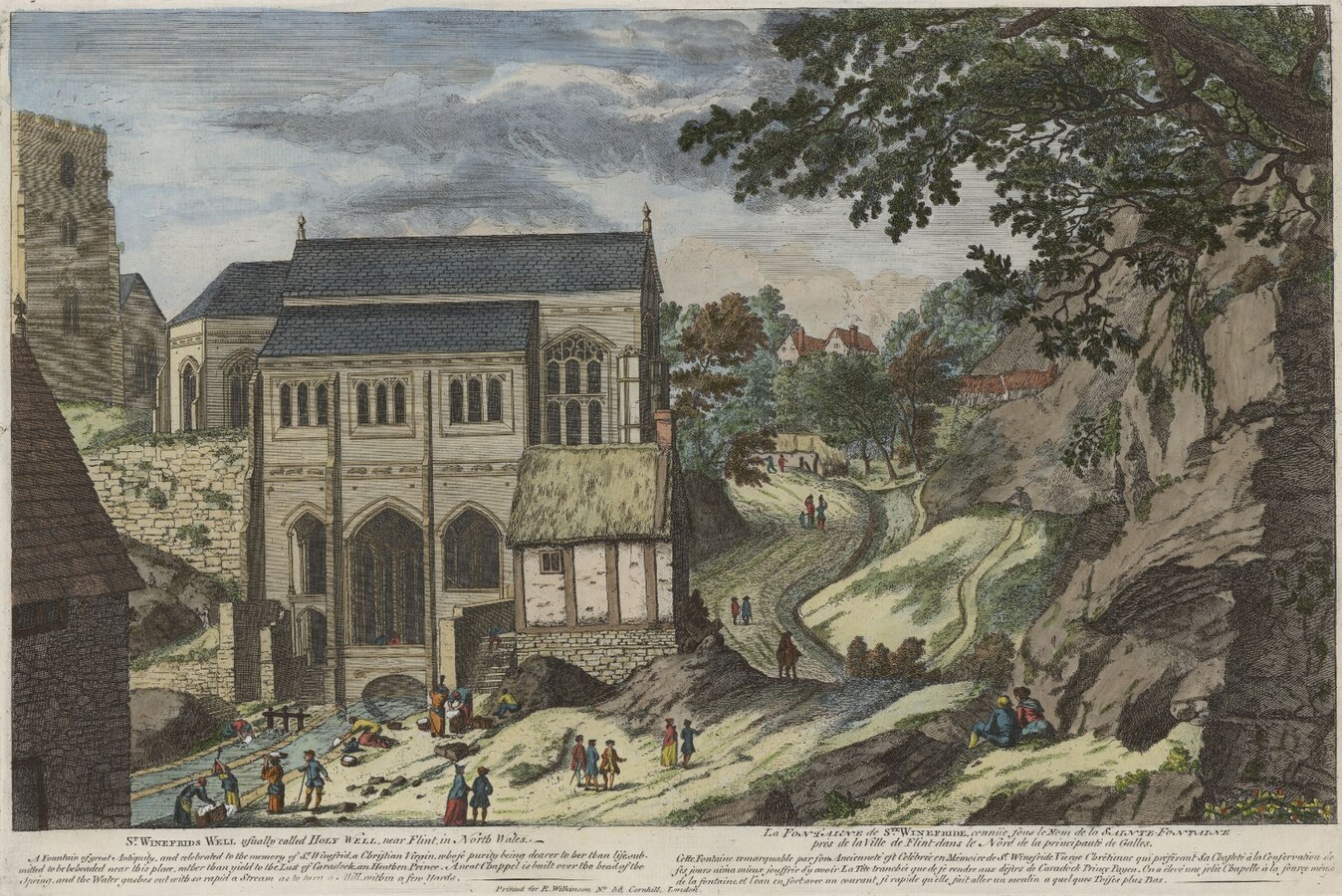
St Winefride's Well. NLW 1129695. National Library of Wales.

St Winefride’s Well c.1790. NLW 1129695. National Library of Wales via Zone47 Zone47.

The construction of the two chapels, above and below, seems to have been overseen by Abbot Thomas Pennant of Basingwerk, who held the abbacy from 1480 – c.1522.  T.W. Pritchard has argued that there is evidence form contemporary Welsh bardic-style poetry to assign the patronage and building to Abbot Thomas, but the weakness in this interpretation is that the bards connected with, and often living at, monastic properties were often effusive, fulsome and sycophantic, and not necessarily truthful.  The poets were making no attempt to capture history, creating a highly partial view of the world as they experienced it in hyperbolic language as an art form. Nor is it at all clear whether Abbot Thomas would have known of the fan vaulting style, or where he would have found an architect to produce it.  On the whole, given that I have seen no argument that the above family-related topics were added at a later date, the data seems to favour the Stanley family as the creators of the chapel, with Abbot Thomas managing the build locally, and perhaps investing in some of its creation.  Without documentary data this remains uncertain.

The concept

Plan and elevation of St Winefrede's Well. Source: Journey to the Past

Plans and elevations of St Winefride’s Well, lower and upper chapels. Source: Journey to the Past (a collaboration between Bangor University, the University of Wales Centre for Advanced Welsh and Celtic Studies (CAWCS) and the Royal Commission on the Ancient and Historic Monuments of Wales)

The late Gothic buildings that we see today came late in the well’s medieval history.  The style, late Perpendicular, comes towards the end of the 15th and beginning of the 16th century, only a couple of decades before Basingwerk Monastery was suppressed in Henry VIII’s Dissolution, shortly after which Edward VI began a policy of suppressing Catholicism.  It is not know what the chapel and well looked like before this time, because there are no images or descriptions, but the new architectural conceptualization design, consisted of two parts, the lower fan-vaulted well chapel, and over the top of this a more conventional church-like structure with a nave, side aisle, chancel and stained glass windows, with more sculptural elements.  These are discussed further below.

Holywell upper chapel and parish church

The parish church on the right and the upper chapel of St Winifride’s Well on the left, showing their proximity

The design was governed by how pilgrims used both the well and the neighbouring church.  Pilgrims would arrive in Holywell at the abbey.  Some of them would take advantage of the abbey’s hospitality.  In the late medieval period the abbot was responsible for new stone-built accommodation for visitors, but there must have been provision previously, perhaps built in wood.  For those who wanted to stay elsewhere, the late medieval town would have offered alternatives.

The upper chapel, looking west

For pilgrims staying at the abbey, a walk to the holy well would have been guided by a monk who would lend monastic authority to the event.  On arrival at the shrine, pilgrims would have been taken up to the chapel to pray and receive guidance before they could proceed to the shrine itself.  The upper chapel was designed to hold large numbers of people in a church-like layout and environment.  It was only a few steps away from the parish church where visitors could also attend services.  The placing of the upper chapel over the top of the well was a clever way both of making the most of the steep hill, and of linking the well with the parish church.  The design of the three bays of the shrine took pilgrims in a procession that entered through one entrance, proceeded around the shrine and lead either out the other side.  There were steps down into the well itself.

Lower Chapel

The well with the ceiling pendant boss overhead, which showed scenes from the life of St Winefrede around it, and the Royal arms of England and Wales at its base

The well with the ceiling pendant boss overhead, which showed scenes from the life of St Winefrede around it, and the Royal arms of England and Wales at its base.

At the level of the spring is a tall, narrow open-fronted well chapel, with a lofty fan-vaulted ceiling on slender compound piers over three bays of which the middle, encompassing the well, is the largest.  The chapel defines a processional area where people could enter at one side, circle the star-shaped basin where the spring emerges, and light candles before and leaving at the other side.  One theory is that the almost star-shaped well represented the Pool of Bethesda.  A staircase led to a gallery where people could look down into the well.  A rectangular pool received the spring waters outside, in a similar way as it does today, but images from the 18th century suggest that the much greater volume also allowed it to run out of the other end of the pool as a strong stream flowing down the hill.

The fan vaulting had sculptural roof bosses wherever there were joints.  The opportunity was taken with nearly all of them, big and small, to create sculptural elements, some of which are shown below.  The main pendant roof boss, suspended over the centre of the spring well, has the royal coat of arms of England and Wales on the base, whilst the sides shown scenes from the life of St Winefride. The columns around the well are now broken, the remaining stumps at two levels shown in the photograph above, but once formed an intricate screen, with filigree-style details in the spandrels.  The string-course of decorated stone along the top of the well was also decorated in the same way.

The entire effect must have been very like a tiny, sublime cathedral in rural northeast Wales.
xx


xxx

The themes on the ceiling bosses and other areas of the lower chapel show some interesting choices.  As well as the heraldry relating to the Stanleys listed above, there are some ceiling bosses relating to Winefride, Beuno and other religious themes, other families, and plant and animal motifs.

Upper Chapel
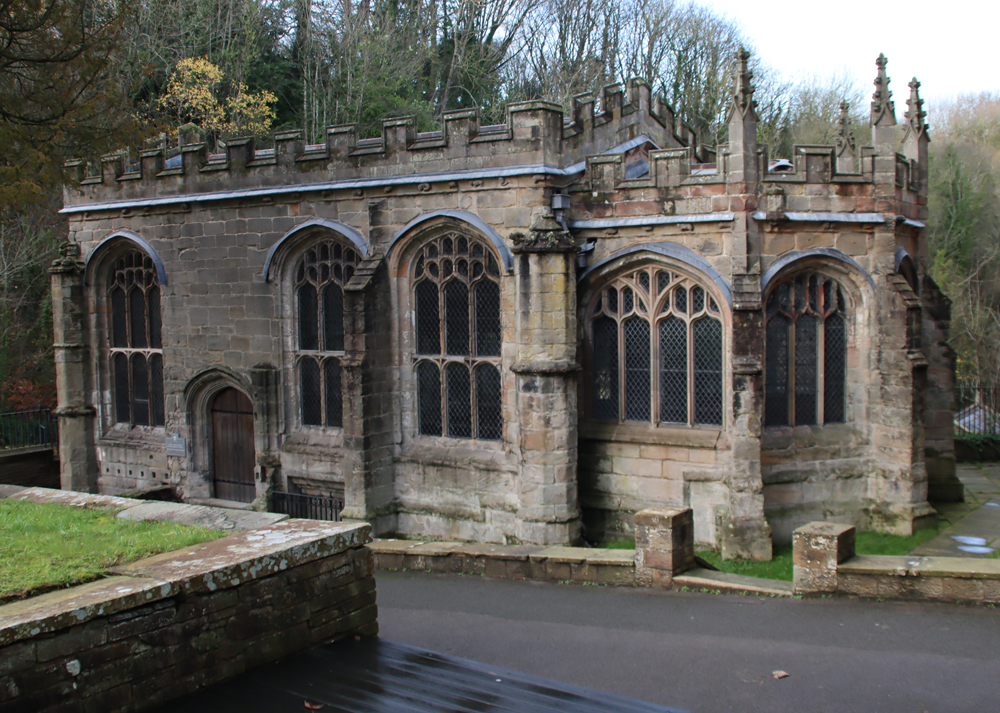
The upper chapel

xxx

The upper chapel, looking east to the chancel

The upper chapel, looking east to the chancel

Over the top of the lower well chapel was an enclosed chapel, designed with a conventional nave and chancel, with one truncated side aisle, to which pilgrims could proceed following their experience at the spring to worship and hear services. The design of window openings and arches is Perpendicular with wide, flattened arches and tall mullioned windows that allow plenty of light into the space.  side aisle sits directly over the well, whilst the chancel at the east end extends beyond the space enclosed by the lower chapel.

The north aisle, overlooking the pool

The north aisle, over the top of the well and overlooking the pool. Only one aisle was built.

The camberbeam roof over the nave

The camber-beam roof over the nave

Modern stained glass window in the chancel

Modern stained glass window in the chancel

xxx
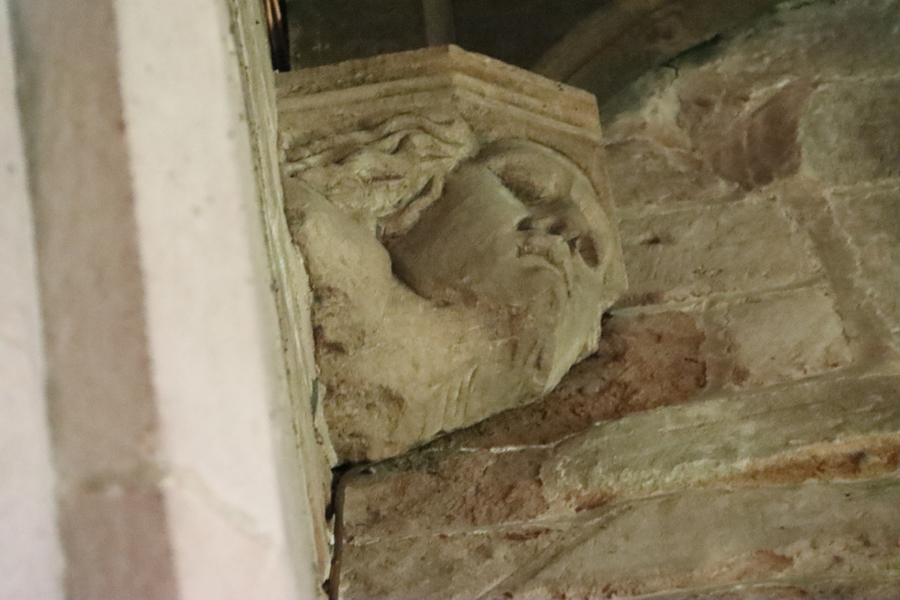
As with the lower chapel, the upper chapel has some rather wonderful sculptural elements, with much less emphasis on family symbolism, and much more on the sort of themes that are found in the margins of illuminated manuscripts, on misericords, and in the roof areas of churches.  They include scenes of everyday life; pagan, mythological and religious motifs; and two humourous grotesques.  The wood carvings, high in the chancel and the nave on stone corbels are difficult to see due to their height and the lack of light.  The stone carvings, which are lower down, are quite easy to make out.

My photos of the wood carvings were frankly diabolical.  I couldn’t actually see what I was photographing in the chancel, so just pointed the camera and hoped for the best.  Even after applying Photoshop, in some cases I am still none the wiser.  Apologies, therefore, that there are so few of them.  A torch would be a handy accessory if you are thinking of visiting.

Sculptural elements from the upper chapel.

Sculptural elements from the upper chapel.

The chapel was considerably altered in the 1700s but has since been restored to something close to its previous appearance.
xxx

The Dissolution of the Monasteries

The opening page of the Valor Ecclesiasticus, showing Henry VIII.

The opening page of the Valor Ecclesiasticus, which valued each of the main monasteries, showing Henry VIII. Source: Wikipedia

The suppression of the monastic houses from 1535 was Henry VIII’s multi-pronged strategy to gain a divorce from Katherine of Aragon, denied to him by the Pope (Katherine was fortunate enough to retain her head); to escape the authority of the Pope and the bishops and place himself as the head of the Church; to strip monasteries and priories of their valuables to raise funds for the Crown; and to release estates from formerly powerful monastic landholders, which enabled him to redistribute land, wealth and power, which he could use to generate money and to negotiate for long-term political support.  In order to assess the value of the nation’s monastic holdings, his hench-man Thomas Cromwell ordered the Valor Ecclesiasticus (a an assessment of the income and assets of each monastic house) and assessors were duly sent out to all parts of the kingdom.  All of those worth less than £200.00 were immediately suppressed, which included all the Welsh houses.  The remaining monks and nuns were dispersed, willingly or unwillingly.  They were often granted reasonably generous pensions if they left without a fight.  Abbot Nicholas Pennant, the last abbot of Basingwerk, clearly gave no trouble to the administrators because he left with a pension.  Monastic properties were sold, gifted or broken up and otherwise disposed of by Henry’s administrators.

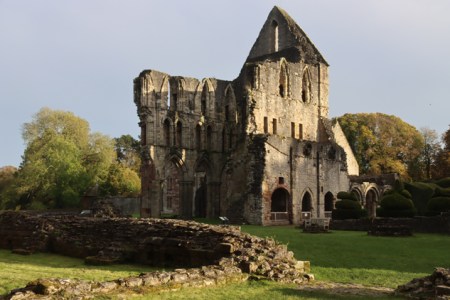
All that remains of the monastic church at Basingwerk

All that remains of the monastic church at Basingwerk today

The impact on St Winefride’s Well was felt both immediately and incrementally thereafter.  With the loss of the abbey, the shrine no longer had monastic support and oversight.  Whatever funding, maintenance and care the shrine received were withdrawn.  The shrine would now be the responsibility of the church and the village.  Pilgrims were deprived of monastic hospitality.  With no monastic guidance to the shrine when they arrived, a lot of the ceremony and sense of a special occasion were removed, perhaps making a pilgrimage less attractive and rewarding.  Certainly the oblations (pilgrim donations) began to decline significantly.  At the same time, political and religious instability may well have deterred pilgrims.  The loss of the monks as managers of the abbey’s landholdings and industrial properties may not have been felt immediately, but whatever processes were in place may have required a new approach to estate management by those actually working the land and this may have had an impact on the local economy, particularly Holywell itself, undermining the economic stability and prosperity of the village at least for some time afterwards.
XXX

After Henry VIII

The Devil selling Indulgences. Jenksy Kodex, c.1500. Source: Wikipedia

Splendidly evocative depiction of the Devil selling Indulgences, from a Czech illuminated manuscript called the Jenksy Kodex, c.1500. Source: Wikipedia

Quite what Henry VIII planned for the future of the new Church of England is not clear. He probably had very little strategic idea himself, but it is certain that the Archbishop of Canterbury, Thomas Cranmer (1489-1556), an advisor to Henry, had plans, which included maximizing his influence has the clerical head of the Church of England. One of Henry VIII’s particular obsessions was the destruction of all traces of the veneration of St Thomas Becket.  For Henry VIII, Archbishop of Canterbury Thomas Becket (1119/20-1556) had been the ultimate Church challenge to “royal supremacy” in which the king rather than the Church held ultimate authority.  Becket was murdered over the question.  The horror with which Becket’s murder was received forced King Henry II to back down and make the peace with a powerful clergy who were backed by the papacy and who had ultimately won the day.  In Henry’s similar battle with church supremacy, with the Pope refusing to condone the annulment of his marriage to Katherine of Aragon, Becket was the embodiment of Church interference with royal right to rule without challenge.  There are only a few representations of Becket today in churches.

After Henry VIII died, Archbishop Cranmer had great influence over Henry’s young son, Edward VI (reigned 1547-1553) during Edward’s six-year reign.  The result was a Tudor clamp-down on Papism, its rules and its traditions, including indulgences, the veneration of saints, and the worship of icons, a policy that went through phases of persecution and lapses of energy.  Edward was not pulling his punches, as this excerpt from Edward VI’s Royal Injunctions of 1547, demonstrates, commanding

. . . that they shall take away, utterly extinct and destroy all shrines, covering of shrines, all tables, trundles or rolls of wax, pictures, paintings and all other monuments of feigned miracles, pilgrimages, idolatry and superstition, so that there remain no memory of the same in walls, glasses, windows or elsewhere within their churches or houses.  And they shall exhort all their parishioners to do the like within their several houses. [See University of Michigan in Sources]

The instruction to erase all reminders of the recent religion, focusing specifically on objects, is an impressive measure of Edward VI’s understanding of the power of objects and how they mediate people’s ideologies, beliefs and sense of both security and identity.  The enormous destruction of objects and art during the Reformation was a strategy to systematically erase the tangible links between people and their beliefs, suppressing in every sense the way in which people understood, expressed and experienced their sense of the connection between the physical and spiritual world in which they lived and which defined their existence.  The result was often exactly what Edward VI would have wanted.  It is astonishing that St Winefride’s chapels were able to escape.
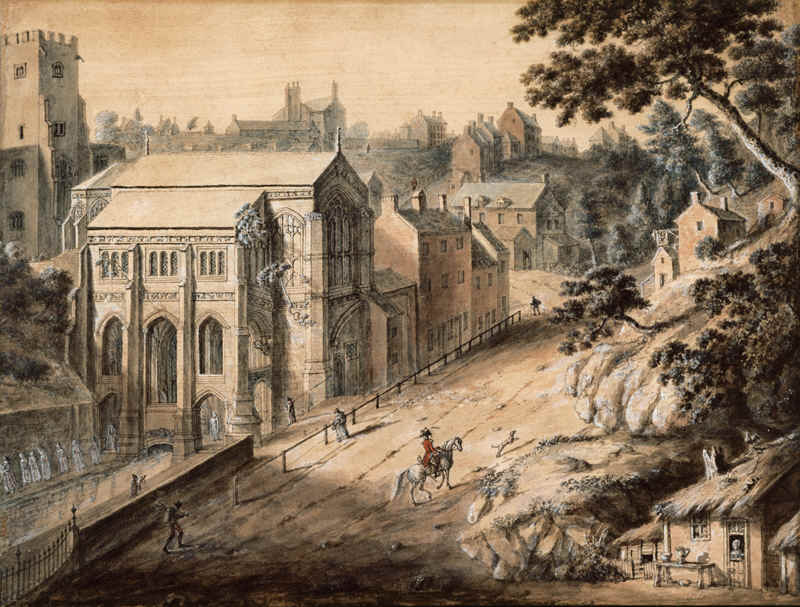
St Winefride's Well with Holywell in the background

St Winefride’s Well with Holywell in the background, 18th century. Watercolour by John Ingleby. Source: People’s Collection Wales

After the Dissolution the well began to become the focus of Catholic (specifically Jesuit) sedition.  In Holywell, Basingwerk Abby had now been stripped of its roof lead, always the beginning of ruin, and although part of it is thought to have been occupied as a house for a while, it was ultimately abandoned.  However, the well and the accompanying church continued to be an illicit focus of Catholic devotion, and St Winefride’s chapel continued to be maintained and visited, often at enormous risk to both residents and visitors, sometimes resulting in imprisonment or execution.  Perhaps directly linked to this illicit expression of devotion, and a way of bonding with the shrine, are many, many carved pieces of graffiti, mostly alphabetic, some dates and a few unexplained pictograms.  That’s all another story, and a really interesting one for another day, but it is really quite remarkable that the shrine survived centuries of religious intolerance to eventually experience a revival of pilgrim and tourist attention in 18th and 19th centuries, at which time the buildings underwent restoration.

Lead repair of stonework along the side of the well


Final Comments

Ceiling boss in the lower chapel

Ceiling boss in the lower chapel

St Winefrede, a 7th century saint, is one of the best known saints in Wales.  The miracle-working shrine with its gushing natural spring became so popular and important throughout the medieval period that in the late 15th or early 16th century it was provided with a brand new pair of chapels, upper and lower, that provided a building of late gothic splendour to frame the well and provide spaces for experiencing the spring and for worshipping in a church-like environment.  It welcomed pilgrims, was an asset to its owners and contributed to the economy of Holywell itself.

The site was awarded the status of a National Shrine in 2023.  It continues to be a significant draw for both pilgrims and tourists, and makes for a very attractive day out when combined with both Basingwerk Abbey and the industrial heritage park, continuing to make its presence felt.
Visiting

With parking nearby, a visit to St Winefride’s Well can take no longer than an hour or so to visit, but it can be combined with the Greenfield Valley Heritage Park to make a full day out, particularly when the small town at the top of the hill is included in the trip.

On the map of Greenfield Valley to the right, the Holywell spring and chapel are at the very top (the car park is just down the hill at the What3Words address ///scanning.smarting.brisk or a lay-by just up the hill at W3W ///fidgeting.grain.nail). Alternative parking is at Basingwerk Abbey at the very bottom of the park, bigger than that for the chapel, at W3W ///assess.origin.flicks). There is also plenty of parking in the town at the top of the hill.

The other sites on the map shown here are described on the post about Greenfield Valley’s industrial heritage.  The church of St James has been closed on the three occasions when I have visited, but it lies behind the chapel, just uphill from it.  There is a cafe next to the abbey, on the bottom right of the map, but check the website listed below, because at the time of writing it is under refurbishment.

The Visitor Centre, ticket office and souvenir shop are on the left as you enter the grounds, and it is from here that you collect the key for the upstairs chapel as well (they ask that you leave your keys as a deposit).  The Visitor Centre is a single large room, with some excellent interpretation boards and some original objects on display (note that there is a sign saying that it is not permitted to take photographs in the Visitor Centre).
The spring and the fan-vaulted well chapel are on the same level as the Visitor Centre via a door to the left of the ticket office. The overhead chapel, which sits over the top of the well chapel, is a little way uphill, on the footpath along the road.  To reach it you need to go back out of the Visitor Centre and turn left up the road.  Turn left again along the path that leads from the road to the church. The door faces uphill.

There is a free leaflet with a map, which you can collect from the ticket office.  I have scanned it and posted it here for download as a PDF, but note that the leaflet was longer than A4, so I’ve split it up and arranged it in portrait rather than landscape to fit it on two pages.  My version is not a thing of beauty, so it would be much better to pick up the leaflet when you visit!

I strongly recommend that if you don’t have a telephoto lens or very good zoom function on your phone, you take binoculars so that you can get a much better view of the carvings on the ceilings in the lower shrine and on corbel tops in the upper chapel.  A powerful torch would certainly help too, particularly in the upper chapel.

Finally, do note that this is still a place of pilgrimage and prayer, and you may run into people having a quiet moment in front of the statue of Winefride within the lower chapel, or even having a dip in the outer pool.  A lady did so when I was last there on a freezing cold day, and after drying off she went pray in front of the statue just inside the entrance of the lower chapel.  I carried on with what I was doing, but gave her space.
xxx

Sources

Books and Papers
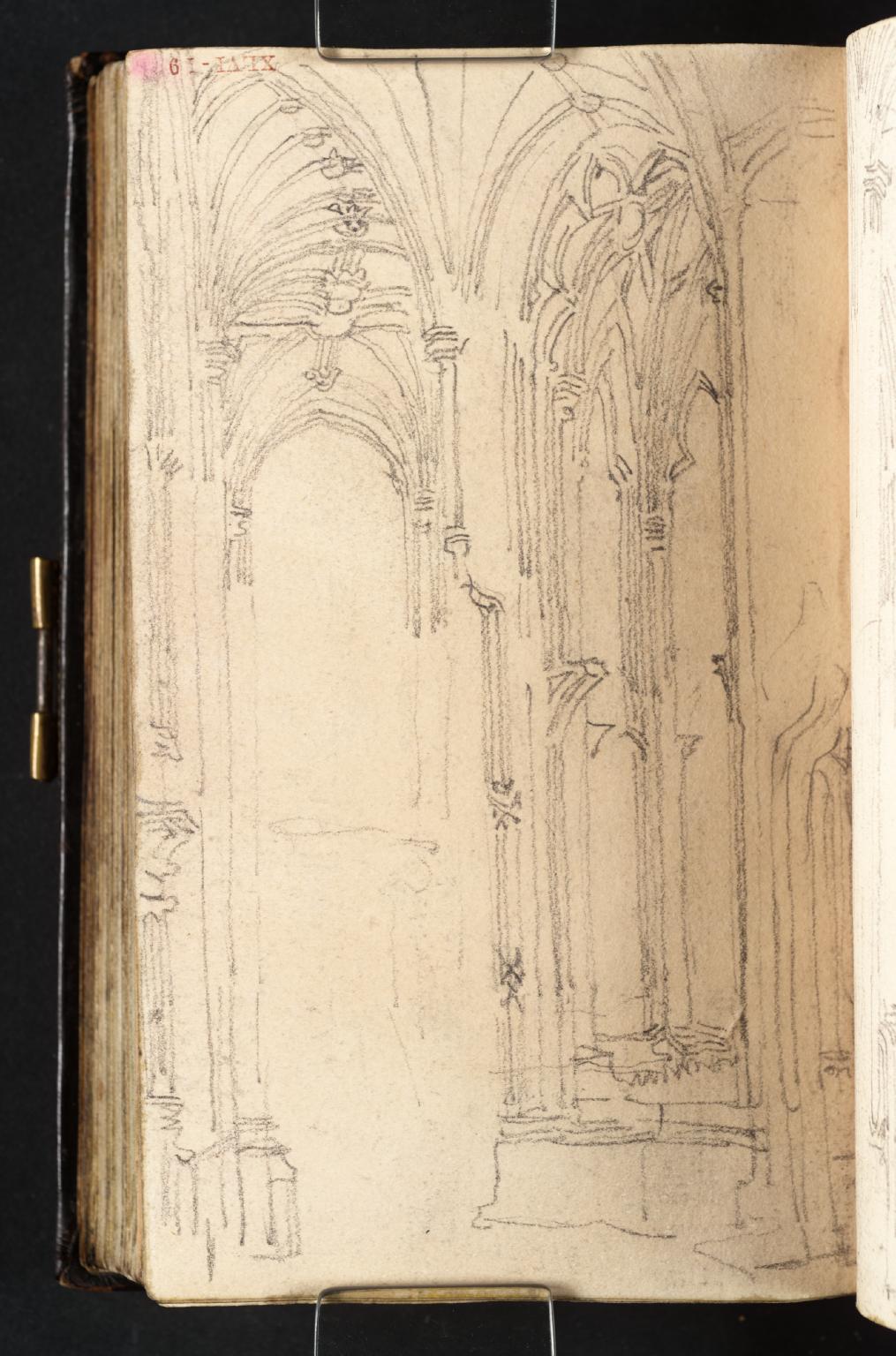
Joseph Mallord William Turner, Holywell: The Interior of the Cloisters, St Winifred's Well 1799


Joseph Mallord William Turner, Holywell: The Interior of the Cloisters, St Winifred’s Well 1799. Source: The Tate

Baker, Nigel 1998. Shrewsbury Abbey. A Medieval Monastery. Shropshire Books.

Barraclough, Geoffrey 1988. The Charters of the Anglo-Normal Earls of Chester c.1071-1237.  The Record Society of Lancashire and Cheshire, vol. CXXVI

Bartlett, Robert 2013. Why Can the Dead Do Such Great Things?  Saints and Worshippers from the Martyrs to the Reformation.  Princeton University Press.

Burne, R.V.H. 1962. The Monks of Chester. The History of St Werburgh’s Abbey. SPCK

David, Christopher 1969, 2002 (2nd edition). St Winefride’s Well.  A History and Guide

Farmer, David 2011 (5th edition). The Oxford Dictionary of Saints. Oxford University Press

Given-Wilson, C. (ed.) 1977.  The Chronicle of Adam Usk 1377-1421. Clarendon Press
https://archive.org/details/chronicleofadamu0000adam/page/n5/mode/2up

Garland, Lisa M. 2005.  Aspects of Welsh Saints’ Cults and Pilgrimage c.1066-1532. Unpublished PhD, King’s College London
https://kclpure.kcl.ac.uk/ws/files/2935809/420753.pdf

Gray, Madeleine 2007.  Welsh Saints in Westminster Abbey.  Transactions of the Honourable Society of Cymmrodorion 2006, New Series, 13 (2007), p.5-30
https://www.cymmrodorion.org/wp-content/uploads/2017/07/2_Welsh-Saints-in-Westminster-Abbey.pdf

Hubbard, Edward 1986. The Buildings of Wales: Clwyd (Denbighshire and Flintshire). Penguin

Pritchard, T.W. 2009. St Winefride, Her Holy Well and the Jesuit Mission, c.650-1930. Bridge Books

Tait, James 1920. The Chartulary or Register of the Abbey of St Werburgh. Chartulary of Chester, part 1. Chetham Society

Turner, Rick 2019. The Architecture, Patronage and Date of St Winefride’s Well, Holywell. Archaeologia Cambrensis 168, p.245-275
https://archaeologydataservice.ac.uk/archiveDS/archiveDownload?t=arch-3493-1/dissemination/168-2019/10-Arch_Camb_168_Turner_245-275.pdf

Webb, Diana 2000. Pilgrimage in Medieval England.  Hambledon and London

Williams, David H. 2001. The Welsh Cistercians. Gracewing


Websites

Based In Churton
Basingwerk Abbey
https://wp.me/pcZwQK-2Ju
Greenfield Valley (industrial heritage)
https://wp.me/pcZwQK-3eL
St Werburgh’s Abbey (multiple posts)
https://basedinchurton.co.uk/category/chester-cathedral/
A roof boss of Thomas Becket in the Abbey of St Werbergh (Chester Cathedral)

https://basedinchurton.co.uk/2023/07/14/a-ceiling-boss-in-chester-cathedral-the-murder-of-thomas-becket/

Early Tourists in Wales
Holywell and St Winifred’s well
https://sublimewales.wordpress.com/attractions/2231-2/

Essex Record Office
Salvation for sale
https://www.essexrecordofficeblog.co.uk/document-of-the-month-august-2017-salvation-for-sale/

Greenfield Valley Heritage Park
https://greenfieldvalley.com/

Greenfield Valley Café
At time of writing closed for refurbishment – check link below
https://greenfieldvalley.com/visit/greenfield-valley-cafe/

Heneb
Holywell
https://heneb.org.uk/archive/cpat/ycom/flints/holywell.pdf

Landmark Trust
St Winifred’s Well (Woolston)
https://cms.landmarktrust.org.uk/globalassets/3.-images-and-documents-to-keep/history-albums/st-winifreds-well-2025.pdf

Shrewsbury Orthodox Church
Saint Winefride (Gwenffrewi) (with a photograph of the St Winefrede chapel and spring at Woolston)
https://shrewsburyorthodox.com/local-saints/saint-winefride-gwenffrewi/

streetsofsalem
Monarchs and Monkeys
https://streetsofsalem.com/2014/03/26/monarchs-and-monkeys/

St Winefride’s Shrine and Visitor Centre
https://www.stwinefridesshrine.org/blank-1

University of Michigan – Digital collections
A collection of articles injunctions, canons, orders, ordinances, and constitutions ecclesiastical: with other publick records of the Church of England; chiefly in the times of K. Edward. VIth. Q. Elizabeth. and K. James. Published to vindicate the Church of England and to promote uniformity and peace in the same. And humbly presented to the Convocation.
https://quod.lib.umich.edu/e/eebo2/A79649.0001.001/1:7?rgn=div1;view=fulltext


Statue outside the shrine

Statue of St Winefride outside the shrine


Norman heritage on the doorstep: St Edith’s Church, Shocklach, near Farndon

Introduction

The tiny Grade-1 listed 12th century Church of St Edith (Historic England 1228322) is located just over four miles (c.6km) south of Farndon, retaining its lovely Norman arch.  Together with its mellow red sandstone walls, the twin bellcote, and its small churchyard it has considerable charm and personality.  It has been very well maintained, and a number of changes over the centuries were made, some later removed and some still in situ.

Although there are no signs that there was a village nearby, St Edith’s was built in the same period as the nearby twin motte-and-bailey castle at Castletown (see my earlier post here), and the two would have been part of the same set of community resources.  Given the state of the castle now, reduced to simple earthworks, the survival of the church seems all the more impressive.  It also probably served farms and hamlets in the general area, becoming the main place for regular get-togethers throughout the medieval period, particularly after the castle went out of use.

The biography of patron saint Edith is at best vague, but what is perhaps most interesting about her patronage is that she was an Anglo-Saxon saint, pre-dating the Norman Conquest (and the Norman arch), perhaps suggesting that the name was inherited from an earlier foundation on the same site.  Edith (or Eadgyth, Eadida or Edyva) is thought to have been an illegitimate daughter of King Edgar who became a nun at Wilton Benedictine Abbey in Wiltshire.  The Oxford Dictionary of Saints states that she was “conspicuous for her personal service of the poor and her familiarity with wild animals.”  She died at the age of 23, and miracles at her tomb resulted in a cult following.  Quite why she became a patron saint of a tiny rural church in west Cheshire remains unknown.

Building exterior

St Edith's Shocklach

St Edith’s, Shocklach

The Grade-II Norman arch is lovely, featuring chevron and cable designs, and was entirely in proportion to the Norman building.  Each end of the arch terminates in a little sculptural element, each depicting a human head, both are very worn.  Pevsner and Hubbard describe the arch as “very crudely decorated,” but the dismissive statement fails to acknowledge the considerable charm and authenticity of the ambitious archway on such a tiny church, as well as its determined fidelity to a particular stylistic paradigm. The main source of information about the church, Margery Waddams, who conducted research at the Chester Records Office, suggests that some of the upper chevron carvings may have been replaced.

Detail of the Norman arch

Detail of the Norman arch, right

Detail of the Norman arch, left

Detail of the Norman arch, left

The north wall is thought to date to the 13th century, although I have seen nothing to explain why the original wall might have been replaced.  There is a single sculptural grotesque above the former entrance, now a window.  Waddams suggests that there may have been a second Norman arch in the past in the south wall, due to the presence of “a small piece of chevron carving high in the south exterior wall which does not fit the present doorway.”  The chancel was added in the early 14th century.  An earlier arch is shown in the photograph above, although the date is uncertain.

North wall of the nave, with old entrance and grotesque

North wall of the nave, with old entrance and grotesque, thought to be 13th century

St Edith’s, Shocklach

Interior

Horse and rider carving

The interior consists of the original nave with a newer chancel on a slightly raised platform.  Some of the structure undoubtedly belongs to the 12th century, and there is a single carving that may date even earlier.  Located on one of the stone blocks of the north wall, close to where it meets the west wall, is an intriguing depiction of what appears to be a horse with a rider holding a shield. Although Waddams suggests that it was probably carved no earlier than the 17th century, the similarity to another carving at St Dochwy’s at Llandough, reported by George Bell in an issue of Country Life, may suggest an earlier date.  The article led the church to contact the author, who confirmed that such carvings are very rare in Wales and and that he has seen no others similar to those at St Dochwys or St Edith’s.  He points out that it could easily be an import from another site, and that it might (very tentatively) be as early as the 10th or 11th century in date.  The matter remains unresolved.

In the interior, according to the Historic England listing, the north wall of the nave may be 13th century, the chancel arch, the east window and the north doorway are, according to Pevsner and Hubbard, all features of the 14th century, although Historic England places the chancel in the 15th century.  Waddams points out that the top of the east window is missing, indicating that it has been cut to fit, suggesting either that it was taken down and refitted, or that it was brought from another church.  The 15th century stone font is still in situ, but was re-cut at a later date, probably in the 17th century.

Pevsner and Hubbard comment that “the odd west baptistery squeezed between the two buttresses looks a rustic c17 job” (Pevsner and Hubbard), a date also confirmed by Historic England.  Also from the 17th century and the pulpit has part of the base of an octagonal pillar, marked with the date 1678 in brass-topped nails. Some of the pews in the nave date to around 1697.

The font

Very endearingly, a pane of the east window is scratched: “I, Robert Aldersey, was here on 1st day of October 1756 along with John Massie and Mr Derbyshire. The roads were so bad that we were in danger of our lives”.

The arced plaster ceiling over the nave is 18th or early 19th century, very attractively decorated with little rosettes.   It slightly truncates the top of the original arch where it enters the chancel.  The communion rail dates to the same period, as does the “table of commandments” in the chancel (with the abbreviation of Jevhoval, IHVH, mis-spelled as VHVH) and a “Credence table” that was installed on the site of a recess that had been walled up in the past.

A major restoration took place in 1878, including the addition of a wooden floor above the original beaten earth floor, which required the shortening of the wooden door under the Norman arch.  Old high pews were replaced, and a gallery was removed.  In 1887 the celebration of Queen Victoria’s Jubilee sounds like a real celebration (the Vicar Edward E. Hodgson quoted in Waddams): “Children and people marched to the Church with flags and banners of the Cross singing. Service was held at 2pm fully Choral.  The Altar was decorated with 8 candles and 8 vases of flowers and floral cross, the windows with ferns etc.  The Children returned to tea at 3pm.  Adults had teat at 5.  Then sports, dancing with Brass Band, closed a thoroughly enjoyable day.”

Flanking the west end entrance to the babtistry, above the font, are the Royal Arms of George III, dated 1760, and the hatchment (funerary board) of one of the Pulestons, a local family, with their motto “Clarior es Tenebris” (More light out of darkness)

In 1903 two oak seats were presented to the church and placed in the chancel for the choir, whilst another six more oak seats were added to the nave.

Another major restoration took place in 1974, during which the small semi-circular window with its geometric stained glass was added at the west end below the bellcote.  To commemorate the year 2000 a new stained glass window was added to the north wall, directly opposite the Norman archway, based on the designs of children from the local Shocklach Primary School.  At the same time a new lighting system and an audio loop were also installed.

The church continues to remain in use, and organizes events throughout the year, based on the religious calendar, including the rushbearing ceremony.  In Pennine Magazine, Vera Adams describes the ceremony in the northwest:

Rushes have been used as a floorcovering for many centuries, and on  certain feast days fresh rushes were  strewn on the earth floors of churches.

A special festival, surrounding this  ancient custom, grew up in the north  west of England during the 17th century. In Lancashire, Cheshire and the  Calderdale area of West Yorkshire,  special rushcarts, pulled by a team of  stalwart men, were used to distribute  the rushes to the churches.  The building of rushcarts developed  into an elaborate ceremonial during  the 18th and 19th centuries, and great  rivalry grew up between the supporters  and the builders of different carts. This  was, at times, very intense and open  brawls occasionally broke out, due,  no doubt, to the amount of strong  drink which was consumed. This led  to some of the more puritanical clergy  refusing to allow the rushbearers into  their churches.

The two-wheeled rushcarts carried  bolts or bundles of rushes built, very  skilfully, into a tall pyramid, almost  like thatching, on top of the carts.  They were then decorated with flowers,  rosettes, scarves, ribbons, tinsel and  silverware. These trinkets were all  loaned by local people.

See Sources for the entire article.

Window below bells made during the 1974 restoration

Churchyard

The churchyard has always fully surrounded the church, but was extended twice, in 1905 (consecrated in the same year) and 1922 (consecrated in 1993).

The Grade II listed red sandstone cross shaft and steps is missing its top, with the cross-shaft, presumably the victim of the two periods of 16th or 17th century iconoclasm.  It stands on its original plinth of four steps.  The lower three are made up of several blocks (the lowest of which is 7ft x 7ft square (2.13m), and the top one 3ft by 3ft (0.91m).  A section removed from the top step was probably a kneeling platform.  The shaft of the cross is octagonal.  In the late 1890s it was found to be in a poor state of preservation as a memorial to the wife of the Reverend George Mathias, Esther Sophia.  It was restored with a base piece 14×14 inches (0.35m) square and 11 inches (0.27m) deep.  However, the idea was to restore it without succumbing to the temptation to make any attempt to otherwise improve upon it: “All this has been carefully done, no old stones having been misplaced, refaced, or in anywise injured.”

Oddly, there are only a handful of pre-20th century gravestones. I found none earlier than the 19th century, which include both table and chest types, the earliest dating to 1816.  Most churches founded in the medieval period that have continued in use in this area will usually have some 18th century gravestones as well.  Most of the the churchyard sloping away from the west end of the church is taken up with 20th century graves, dominated by the polished black style that remains popular in churchyards and cemeteries.

Visting

The church is not currently open to the general-interest public, although it is still a fully functioning church on a Sunday, but the exterior of the church with its Norman arch, charming bellcote and its peaceful churchyard makes for an enjoyable detour if you are in the area.  It is at What3Words address ///initiates.recent.diamonds, or at the very end of Church Road, just off the B5069 to the right, a few minutes before you arrive at Shocklach village if you are heading north to south.

Sources

The main source of information for this post was Margery Waddams, who went through the church records and undertook research at the Chester Records Office.

The letter from Graham Bell concerning the north wall carving is shown in a frame in the interior of the church.

Books, papers and articles

Adams, Vera 1984.  Rushbearing Revived. Pennine Magazine. Vol 5, No. 6, Aug/Sept1984
https://penninemagazine.wordpress.com/vol-5-no-6-aug-sept1984-rushbearing-revived/

Farmer, David 2011 (5th edition). Oxford Dictionary of Saints. Oxford University Press

Haswell, George W. 1899. Shocklach churchyard cross. Journal of Chester Archaeological Society, Volume VI, part 2
https://archaeologydataservice.ac.uk/archiveDS/archiveDownload?t=arch-2910-1/dissemination/pdf/JCAS_ns_006_02/JCAS_ns_006_02_163-166.pdf

Pevsner, Nikolaus and Edward Hubbard 1971.  The Buildings of England: Cheshire. Penguin

Waddams, Margery 2015 (revised version). St Edith’s Church, Shocklach, Cheshire. Printed by St Edith’s Church and available to purchase on site (8 page booklet)


Websites

Based In Churton
Shocklach Motte-and Bailey Castle at Castletown 
https://basedinchurton.co.uk/2021/09/14/shocklach-castletown-motte-and-bailey-castles/

Geograph
St Edith’s Shocklach
https://www.geograph.org.uk/photo/3064132

Historic England
St Edith’s Church
https://historicengland.org.uk/listing/the-list/list-entry/1228322?section=official-list-entry
Medieval cross in St Edith’s churchyard
https://historicengland.org.uk/listing/the-list/list-entry/1228350?section=official-list-entry

St Mary’s and St Edith’s (Tilston)
https://tilstonandshocklachchurch.co.uk/


St Edith's, Shocklach


St Chad’s Church, Farndon, originally medieval but largely rebuilt in 1658 due to war damage

Not for the first time I am writing about somewhere that I really ought to have talked about a long time ago because it is so near to me, in this case the Grade II* listed St Chad’s Church just down the road in Farndon. It is a lovely church, with a rather unexpected history, surrounded by a churchyard and enclosed by an irregularly shaped curving wall.  Apart from the tower, there is very little of the medieval church remaining, having been almost completely rebuilt in 1658 following the damage inflicted during the Civil War, but it followed a broadly gothic template and is charming in its own right with a number of nice features, some influenced by the gothic, and others departing in interesting directions.  It is particularly well known for the Civil War window installed by William Barnston.

St Chad's Farndon

St Chad’s Farndon

The congregation traditionally included those who were on the English side of the river, with burials from Churton-by-Farndon and Churton-by-Aldford, Crewe-by-Farndon, Barton, Leche, and Caldecott, and other nearby villages and farms.  After 1866 residents of Churton-by-Aldford were often buried in at the Church of St John in Aldford.

During the summer I posted an account of St Chad’s Church in Holt, opposite Farndon on the other side of the river Dee, with its medieval links to Holt Castle and the Lordship of Bromfield and Yale.  It is larger and more elaborate than St Chad’s in Farndon, and the two churches each has its own distinctive character with a lot to offer the visitor.  Both churches were involved in the Civil War, due to the importance of the crossing here, and both bear musket ball damage as a result, but Farndon’s St Chad’s came off much worse than St Chad’s in Holt.
xxxxxx

Saint Chad, 1st Bishop of Lichfield

Early Medieval Mercia

Early Medieval Mercia. Source: medievalists.net

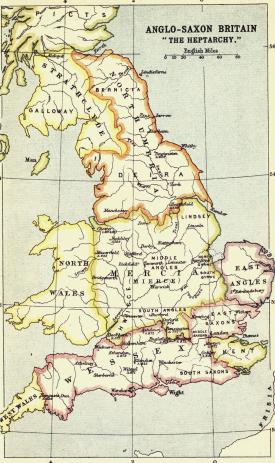
According to Bede (writing in the 8th century) St Chad was one of four brothers who entered the church in the 7th century, and started his training at Lindisfarne Monastery under St Aiden.  He was ordained in Ireland and became a leading light in the Anglo-Saxon church, rising through the ecclesiastical ranks on the kingdoms of Northumbria and Mercia and under King Wulfhere, one of the earliest Christian kings. He was appointed Bishop of Northumbria, including York, and became the first Bishop of Lichfield in the new diocese of Lichfield, at the heart of Mercia. Mercia was one of seven British kingdoms of 7th century Britain and occupied most of central England. Chad died in AD c.672 and was buried in Lichfield Monastery, now Lichfield Cathedral.  Regarded as a pioneer who helped to spread Christian teaching in and beyond Mercia, he became a popular icon during the Middle Ages in the Midlands and its borders.
xxx

The Medieval Church

It is remarkable to think that the Civil War obliterated so much of the medieval church in 1643 that most of it had to be rebuilt in the 17th century.  The Domesday book records a village priest, as well as two other priests locally, strongly suggesting the presence here of an earlier church, probably wood-built.

Today’s church has a nave and tower that are thought to have followed the original medieval footprint dating to the14th century building.  All that obviously remains of the 14th century is the tower, of which three storeys date to around 1343.  Everything else appended to this basic structure on north, east and south sides are later in date.  Although you enter the church through an 18th century yellow sandstone porch, the thick wooden door itself is actually medieval, a quite astonishing survival.

Lines of the old roof of St Chad's in Farndon marked in white

Lines of the old roof of St Chad’s in Farndon marked on this photograph in white.

Inside, looking towards the tower from the nave, you can see the converging lines at which the old church roof met the tower, considerably lower down than the current roof, and terminating further down than the current arch.  This suggests that the medieval church was both shorter and darker.  Within the tower there are three chambers with one each for bell-ringers, another for the clock-works and the belfry itself, containing the bells, originally three, at the top.

In the north aisle in the interior of the church is a 14th century funerary effigy showing a knight in armour holding a shield carved with a Latin inscription reading “Here lies Patrick of Barton. Pray for Him.”  Sir Patrick holds a sword in his other hand, and has some form of animal at his feet, now too badly worn to be identified with any certainty.  This effigy is one of three that was found, but the other two were ground down to make white sand.  Although Sir Patrick survived this particular indignity, he was used as a step into the belfry in in the 1900s, which accounts for the wear and tear to his face and the animal.  Latham says that one of the other effigies was inscribed with the word “Madocusdaur” and a third was inscribed with a wolf.

xxx

John Speed, Tailor and Mapmaker

John Speed's 1610 Map of Cheshire

John Speed’s 1610 map of Cheshire. Source: Wikimedia Commons

John speed was the Farndon tailor’s son and was baptised in St Chad’s in 1552.  There’s a good biography of him on the New World Cartographic website explaining how Speed followed his father into tailoring at a time when fashion was of growing importance, doing very well in the business, whilst at the same time pursuing his interests in history, geography, cartography, antiquities and genealogies.  It was not until he moved to London that he gained a patron and was able to abandon tailoring and launch a new career.  His map of the County of the Palatine of Chester was completed in 1610-11, and was used by both sides during the Civil War.  He died in 1629 and is buried in London.
xxx

The Civil War

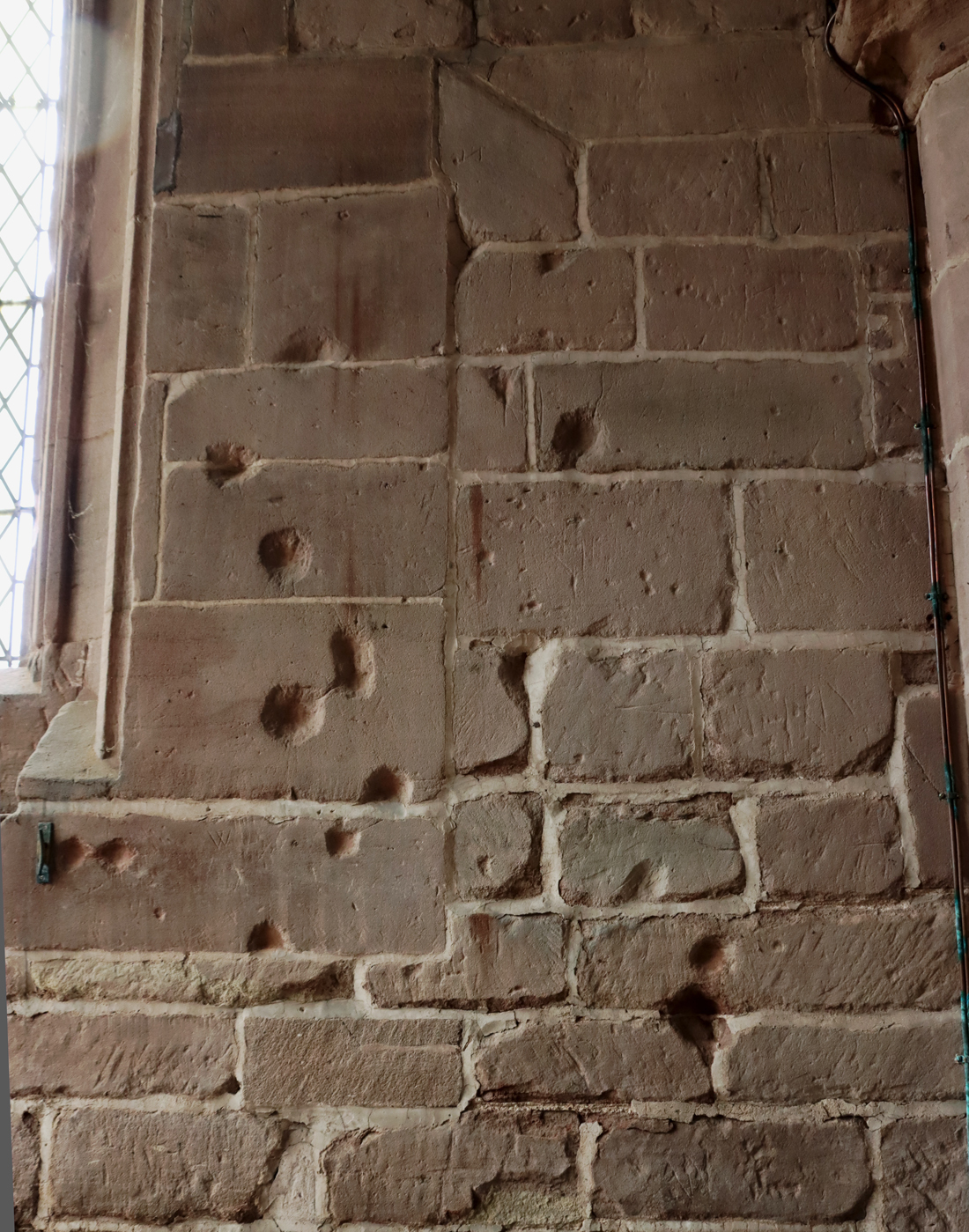
Musket ball and cannon ball marks in the walls of the medieval tower.

The tower in Farndon’s church shows musket-ball and cannon shot damage to the exterior, to the right of the main porch, but the fact that the rest of the church had to be rebuilt in 1658 makes it clear that it experienced a much worse time of it than its counterpart in Holt.  In 1643 the commander of the Cheshire and Lancashire Parliamentarian troops used Farndon and its church as a headquarters and barracks, assembling a force of around 2000 to force their way across the bridge, through Royalist defences. The subsequent fighting entered the churchyards at both Holt and Farndon.  During the fighting in Farndon churchyard the roof was somehow set alight.  In spite of the damage to the roof, the Parliamentarians reoccupied the church until they were ousted in winter 1645.
xxx

The 17th Century Rebuild

Apart from the tower at the west end, the current red sandstone church with its slate-tiled roof is largely the result of the post-Civil War rebuild in 1658, presumably re-using some of the original medieval stonework.  The main body of the church consists of a nave with clerestories (a run of windows above the nave below roof level to allow in light) and two aisles, terminating in the chancel at the east end. The 5-bay arcade separating the nave from the aisles consists of round piers (columns) with simple capitals and pointed arches.  Over 40 different mason marks are dotted throughout the church, each one identifying a separate mason, giving a hint of the scale of the workforce required to rebuild St Chad’s.  There used to be a musician’s gallery at the tower end, but this was removed in the 19th century.

Mason’s mark on the arch between the nave and the tower


The nave, looking towards the chancel, of the 1658 nave

The nave of the 1658 nave, arcade and overhead clerestory. The entrance to the Barnston chapel is shown at lower far right.

The new church was taller than the old one, with the clerestory and the large Gothic-style lancet windows letting in much more light.  The  tower was provided with a new top section at this time.

Adding to the footprint of the old church, the Barnston family, major landowners in the area, built a small chapel off the chancel end of the south aisle, for their private use and to bury and commemorate family members.  According to the church’s history booklet, there are records mentioning Barnstons in Churton during the reign of Henry VI in the 15th century.  In the 17th century William Barnston was a major contributor to the rebuild of the church, and requested that he be buried under a gravestone in the south aisle of the church that has already been placed ready.  His 1663 will left a substantial bequest to the church for its upkeep. He died in 1664.

The Civil War window, St Chad’s, Farndon

An adviser to Charles I at the Siege of Chester, William Barnston was responsible for the famous Civil War window in the chapel.  What surprises most people who see it for the first time is how small it is, but it is full of details that show Royalist participants, including Barnston himself, and a variety of items of contemporary clothing and equipment used in the Siege of Chester. Pevsner and Hubbard say that the technique is “decidedly Dutch” and Latham adds that “Its artist took his design for the armour from a military work by Thomas Cookson (1591-1636) and for the bottom border from prints by Abraham Bosse (1632).”  My photo, left, is very poor due to the lack of light, but have a look at the Visit Stained Glass website for a much better image and a close-up of the depiction of William Barnston.

There are many features of interest to look out for in the 17th century church.  In the south aisle there is a rather fine sculpted wooden beam support.  The church’s booklet questions whether it is a human or an animal but it looks very like the lions with curly manes that are familiar from Tudor and Jacobean carvings.  It is surprising that it is on its own.  The damaged medieval font was repaired by Samuel Woolley of Churton but the current octagonal font is thought to date to 1662, replacing the repaired one.
XXXxxx

18th, 19th and early 20th century alterations

Georgian style porch, St Chad’s

According to Frank Latham, by 1735 “St. Chad was surrounded by green fields and the houses were few and far between,” and the Massie family seems to have been important to the congregation at this time, with six pews allocated to Richard Massie Esq., and his family.  He adds that the east wall was demolished in the 18th century and shifted 10ft (c.3m) further to the east, providing a much larger chancel.  Towards the end of the century repairs to the roof were made between 1793 and 1798.  Today the red sandstone church is entered via a Georgian-style porch built in yellow sandstone, although I have seen no mention of a precise date for this, and inside there is a large 18th century oak chest that housed the church plate and the parish records.

Memorial to Francis Fletcher 1782

The eastern end of the church was remodelled to include today’s chancel in 1853, not by the Barnstons this time but by the Marquess of Westminster.  The carved reredos behind the altar shows the Last Supper and was installed in 1910, with the carvings on the pulpit were added in 1911, showing St Chad accompanied by the usual pulpit team of Saints Matthew, Mark, Luke and John, represented by their emblems.  In 1927 the original three bells were joined by another five.  The church booklet says that they were rung to mark nationally important occasions, including the defeat of Napoleon in Egypt in 1799, and his defeat at Trafalgar in 1805.

Of the various memorials, one that may be of interest to those familiar with the Barnston obelisk just outside Farndon, is the marble memorial to the Major Roger Barnston (died 1847) in the Barnston chapel.  The obelisk in the field on Churton Road, now a natural burial ground, is also a memorial to Major Barnston (died 1847) discussed on the blog here,

The north aisle, like nearly all churches in this area, used to have a clear run to the end of the nave, but the presence of an organ since the 19th century regrettably meant that a gallery just in front of the tower’s arch, where musicians located, became redundant and was removed.  The present organ dates to 1949.

St Werburgh and St Chad stained glass in the chancel

St Werburgh and St Chad stained glass in the chancel

The windows are often round-topped, set within rectangular frames that give the exterior an unusual appearance.  Exceptions are the large east window behind the altar, installed in 1858 and showing the Sermon on the Mount, installed in memory of church benefactors William and Anne Plumpton, and the south window in the Barnston chapel, both gothic-style.

Most of the stained glass is interesting for the contrasting styles.  Following the Trena Cox: Relections 100 exhibition in Chester last year I have become quite interested in 19th century stained glass.  On the north side of the chancel, to the left as you face the altar, is a window showing St Chad and St Werburgh (to whom Chester Cathedral was dedicated when it was a Benedictine monastery), by Trena Cox.  A look at Aleta Doran’s website devoted to Trena Cox confirmed that this was one of hers, from the 1950s (1953 to be exact).  Those windows immediately opposite are similar in style but were clearly crafted by a different artist and show St David (patron saint of Wales) and St Cecilia.  Most of the other stained glass was added in the 19th century, with many of the larger window openings being decorated with romantic takes on the gothic, whilst smaller ones are more minimalist.  It was a little sad not to be able to learn something about the makers of the glass either at the church or after a hunt through my books and around the Internet.

Window dedicated to the memory of Harry Barnston installed by his sisters after he died in 1929

Window dedicated to the memory of Harry Barnston installed by his sisters after he died in 1929, in somewhat Pre-Raphaelite style

Stained glass in the Barnston chapel, emulating gothic tracery and themes

At the rear (south side) of the building you can see a substantial addition at the west end (near the tower) and I assume that this was a 20th or 21st century add-on, presumably acting as a vestry and storage.
xxx

The Churchyard

The churchyard includes a mixture of different types of grave, including chest, table and ledger tombs and vertical headstones, some accompanied by kerbs, mainly of good quality yellow sandstone.  A particularly fine example is a Grade II listed double-chest grave made of yellow sandstone and dating to the early 18th century :

West ends of tombs have recessed round-headed panels; that to north contains an hourglass, that to south a skull and crossbones above an inscription Mors S… Omnium [i.e. Mors Sola Omnia,” meaning Death Conquers All]. North side of north tomb has a square central panel containing an encircled quatrefoil in a lozenge with a vertical panel right and a decayed panel left. The east end of each tomb has a fielded panel; south side of south tomb has 3 fielded panels in bolection moulded borders (Historic England – list entry number 1228746)

It was sobering to notice just how many of the chest grave inscriptions commemorate infants and children.  I always spend an hour or so reading grave inscriptions and don’t remember seeing so many very young children commemorated, often from the same family in the same generation.   As you would expect, the earlier graves  are nearest to the church, although unusually many of these are on the north side, which is normally the last to be filled.

Red sandstone gravestone covered in yew berries


Moving away from the immediate area surrounding church building, to its south, the traditional upright gravestones of the later 19th century begin to dominate, with many examples of 19th century funerary symbolism on the headstones.  Although many of the headstones are lancet-shaped and much of a muchness in terms of size, there was clearly a lot of choice available in terms of the symbolic motifs that decorated the tops of the graves.

Art deco style headstone

Art deco style headstone

Through a small gate beyond the headstones, the churchyard has been extended for modern use.  The 1922 War Memorial in the form of a stone cross commemorates eighteen men killed in the First World War and four in the Second World War.
xxx

Final Comments

This medieval church, almost completely rebuilt in the 17th century, has a character of its own, reflecting various periods of restoration and intended improvement, with a strong gothic influence throughout.  There are many more features than those described above, including benefaction boards, a list of incumbents, and memorials, and the church booklet produced by Cheshire County Council in 1989 is a good guide.

The church website contains no information about visiting, and the Facebook page hasn’t been updated since 2019, but at the moment the church has an open door policy.  On my two recent visits (October 2025) I was able to walk in.  There is a contact page on the site, so if you are coming from any distance it might be worth double-checking.

It is splendid to have two really impressive churches, one either side of the river connected by a splendid 14th century bridge, with very different personalities and features, and both very well cared for and open to visit.


Sources:

Books and papers

Cheshire County Council 1989. The Parish church of St Chad, Farndon. (10-page booklet available for purchase at the church)

Latham, Frank 1981. Farndon. Local History Group

Pevsner, Nikolaus and Edward Hubbard 1971. The Buildings of England: Cheshire. Penguin Books

Websites

Based In Churton
Medieval ambition and Civil War musket ball holes at the Church of St Chad’s in Holt (Grade 1 listed)
https://basedinchurton.co.uk/2025/05/31/medieval-ambition-and-musket-ball-holes-at-the-church-of-st-chads-in-holt-grade-1-listed/
Exhibition in Chester Cathedral: “Trena Cox: Reflections 100”
https://basedinchurton.co.uk/2024/10/19/exhibition-in-chester-cathedral-trena-cox-reflections-100/

Historic England
Pair of Adjacent Table Tombs in Churchyard
https://historicengland.org.uk/listing/the-list/list-entry/1228746?section=official-list-entry

New World Cartographic
Map Maker Biography: John Speed (1552 – 1629)
https://nwcartographic.com/blogs/essays-articles/map-maker-biography-john-speed-1542-1629

St Chad’s Farndon
https://www.stchadschurchfarndon.org.uk/index.php

The Trena Cox Project
https://www.aletadoran.co.uk/

Visit Stained Glass
St Chad’s Farndon (just the Civil War window)
https://www.visitstainedglass.uk/location/church-of-st-chad-farndon-cheshire


Ancient Churchyards of Cheshire – St Chad’s Church Farndon
Tvpresenter4history (James Balme)

Cheshire Proverbs 8: “As Bare as the Bishop of Chester” (15th Century)

“As Bare as the Bishop of Chester”

J.C. Bridge, no.33, p.9


This comes from a poem that Bridge believes dates to the time of Edward IV (28 April 1442 – 9 April 1483), and he suggests that it may belong to the period between the 1460s and 70s.  There are two versions of it surviving in contemporary manuscripts (which I have massaged into modern English).

Hearken to my tale that I shall show
For of such marvels I have heard four
If any of them be  a lie that I tell after
I would I were as bare as the Bishop of Chester

The second version reads as follows:

Hearken to my message that I shall to you show
For of such marvels you have heard but few
If any of them be untrue that I shall tell you after,
Then become I as poor as the Bishop of Chester

As Bridge points out, this refers to the first Chester Bishopric at St John the Baptist’s, not the one founded by Henry VIII in 1541 that converted the dissolved Benedictine Abbey of St Werburgh to become Chester’s new cathedral.


A bit of background

Lead seal of Peter, Bishop of Chester

Lead seal mould of Peter, Bishop of Chester 1075-1085 (Chester Archaeology). Source: The Medieval Period Resource Assessment 2007

In the 11th century Archbishop of Canterbury Lanfranc decreed that bishops should locate themselves in the largest and most impressive provincial centre within their area of responsibility (called a see).  Accordingly, in 1075 the Bishop Peter of Lichfield moved his power base to Chester and began to build a new cathedral commensurate with the importance of his status in his newly adopted town in a monumental Romanesque style, dedicated to St John the Baptist.  Quite why he decided to build outside the walls could be explained in a number of ways, but may have had something to do with Hugh d’Avranches, the first Earl of Chester, who may already have had plans for an ecclesiastical institution within the city walls on an existing church site (St Werburgh’s Abbey, founded in 1093);  or it may have been something to do with a shortage of space for such a large project.  Whatever the reason, by establishing it where he did, on the site of a church that is thought to have been established in the 7th century, he provided his own foundation with a sense of longstanding religious heritage that reinforced its validity as a primary Christian house.

On the death of Bishop Peter in 1095, the role passed to Robert de Limsey.  Bishop Robert abandoned the Chester cathedral in 1102, shifting the see to Coventry, probably to take advantage of the considerable wealth of the Priory of St Mary, which became a new cathedral.  Work foundered on Chester’s St John’s Cathedral which, in spite of no incumbent bishop, retained its role, with subsequent bishops of Coventry and Lichfield terming themselves, when convenient, Bishop of Chester at least into the 16th century.

Work resumed on St John’s a century after the death of Bishop Peter, and was completed sometime in the late 1200s, becoming a successful collegiate church.  It is to this period that the upper storeys belong.  Today’s tower replaces the one that partially collapsed in 1881 after a lightning strike.  The cathedral was included in the local pilgrimage route, along with the Abbey of St Werburgh, when it acquired what was claimed to be a relic of the true cross during the Crusades.
xxx

Back to the proverb

The glorious Romanesque interior of St John's, Chester

The glorious Romanesque interior of St John’s, Chester

There are four possible interpretations of the poem.  The first is that posed by Bridge himself, which is that it was a “sarcastic” reference to the sheer wealth of the Bishops of Coventry and Lichfield.  Douglas Jones highlights how the livings earned by those appointed to different roles at St John’s were doing very nicely, and were far more wealthy than all local churches other than the Rectory of St Mary’s.  Between 1300 and 1430 six out of ninety-one canons of St John’s were presented by the King and three by the Prince of Wales, with twelve by the Pope. Twenty-seven were arranged by the Bishop, and when he was free to make his own choices, he “seems often to have regarded the prebendal status of the collegiate church as providing a source of additional pocket money for his relatives, his friends and his clerks” (Jones, p.17).  Some of those appointed to St John’s rose to positions of great regional and national influence.

In a second possible scenario, the word “bare” could equate to “threadbare,” referring to the fact that the title of “Bishop of Chester” was no more than nominal, nothing more than the smoke and mirrors promoted by the bishopric of Coventry and Litchfield which, having abandoned Chester in favour of more profitable regions, had retained its rights over title to it, and had left St John’s as nothing more than a sinecure.

In a third possible interpretation, it is distinctly possible that it was a matter of considerable amusement within Chester that there was an ongoing quarrel between St John’s and St Werburgh’s, both wealthy institutions that stood above and over the general populace.  In general, monastic institutions were obliged to pay an annual sum to the Bishopric, by whom they were overseen, and to whom they had to account for themselves.  It was the ambition of many monasteries to escape both the financial obligation and the ongoing interference, and Chester had petitioned the pope for just such a relief.  It was granted an exemption in 1363, but nothing at St Werburgh’s ever ran smoothly, and the ongoing fight to retain independence was always at odds with the interests of the Bishops, still nominally of St John’s, to resume its position of influence.  This ongoing failure to entirely subdue St Werburgh’s and bring it back into the financial fold may also have been a source of amusement and comment amongst Chester’s populace about both St John’s and St Werburgh’s.

St John's Chester 1881 after tower collapse

The cathedral in 1881 after the collapse of the top of the 16th century tower. Now in the Grosvenor Museum, Chester. Artist unknown.

The final possible interpretation (unless someone else has other ideas) could also refer to a loss of financial income for St John’s in the 15th century.  Jones says that Owen Glyndŵr’s rebellion had had a considerable impact on ecclesiastical finances after 1430.  It is again pure speculation, but it is possible that St John’s, like other ecclesiastical institutions in Chester, was suffering an unaccustomed shortage of funds, and that this was a source of some amusement in the local community.

In any one of these scenarios, the Bishop of Chester could be said to be “bare,” either in tones of irony due to his extreme wealth, or actually reflecting a documented change in the financial fortunes of Chester’s St John’s that was responded to in Chester with a distinct sense of schadenfreude.
xxx

Final Comments

I particularly like two aspects of this proverb.  The first is that it recalls a part of Chester’s history that is often forgotten, which is that St John’s was not only established as a cathedral but continued to perform the role into the 16th century.  Secondly, I love that this proverb is fundamentally embedded in what must have been a topic of real controversy in Chester:  a bishopric that provided its various incumbents and administrators with a high wage, but whose leaders were absent, claiming rights over Chester and drawing status from it without being any part of the city.  When St John’s and its employees went through less profitable times, there was probably very little sympathy in the city.  In fact, there was almost certainly a distinct sense of justice having been served.  Whether the proverb refers to greater or less profitable times, there is a distinct sense that the relationship between the St John’s and the City was often far from harmonious and that the bishops themselves were bare of any form of substance.  However it may be interpreted, this proverb captures the fact that Chester’s ecclesiastical past was not merely a barely remarked upon fact of life, but something that was noticed and discussed, not always in favourable terms.


For more about J.C. Bridge and this Cheshire Proverbs series,
see Cheshire Proverbs 1.

For the other proverbs in the series, click on the Cheshire Proverbs label
in the right hand margin, or see the end of the Archaeology, Heritage and Art page, where they are listed.


The east end of St John's, walled off from the main church after the Dissolution

The east end of St John’s, walled off from the main church after the Dissolution


Sources:

Books and papers

Boughton, Peter 1997.  Picturesque Chester. The City in Art. Chester City Council and Phillimore

Bridge, J.C. 1917.  Cheshire Proverbs and Other Sayings and Rhymes Connected with the City an County Palatine of Chester.  Phillipson and Golder (Chester)

Carrington, Peter 1994.  Book of Chester.  B.T. Batsford / English Heritage

Jones, Douglas 1957.  The Church in Chester 1300-1540. Chetham Society

Pevsner, Nikolaus and Edward Hubbard 1971. The Buildings of England: Cheshire. Penguin Books

Websites

St John the Baptist
A History of St John’s
https://stjohnschester.uk/history-of-st-johns-chester/


Open Day of the CRAG excavations at Bryneglwys, Llantysilio Mountain

Many thanks to the Clwydian Range Archaeology Group (CRAG) for organizing an Open Day to the Bryneglwys excavations on 9th August 2025, and to Dr Ian Brooks of Engineering Archaeological Services (EAS), who is consulting for CRAG, for an excellent guided tour of the Bryneglwys archaeological site.  The volunteer excavators, all CRAG members, were remarkably tolerant of us peering into their trenches as they worked.  Thanks are due too to Dr Pauline Clarke for arranging for Chester Archaeological Society members to visit.  The site is on private land, so visits are by invitation only, and it was a great opportunity to get a feel not only for the pioneering nature of the excavations, but also for the way in which that particular landscape has been used over long periods of time.  I attended with another CAS member, Helen Anderson, and we both enjoyed it enormously.

The site sits on the west-facing lower slopes of the Llantysilio mountain near Bryneglwys, with views both across the valley and down the valley towards the southwest.  Unlike the Clwydian range, which runs broadly north to south, with a tilt towards the east, the main line of the Llantysilio mountain runs roughly northeast to southwest, with the valley of Afon Morwynion along its western edge, crossing below the end of the Clwydian Range. It is now followed by the A5104 from Llandegla to Corwen, with the A494 picking up the route of the River Dee, and following it to Bala and Lake Tegid, and beyond into midwest Wales.  This has almost certainly been an important route connecting northern and middle parts of Wales with the English northwest at least since the end of the last Ice Age, with Iron Age hillforts standing prominent guard over much of the route.

The undulating Llantisylio mountain rising above the village and site of Bryneglwys, its ridge marked by a prominent modern trackway

Research goals

When it was established, the remit of the Bryneglwys project was partly to investigate potential sites identified by the landowner, a keen supporter of the excavations.  It was thought that at least one of the sites might be an early-mid Bronze Age cairn.  As sites from the period are an important aspect of  northeast Wales, and there are very few known from the Llantysilio mountain, this was an opportunity to improve knowledge on the subject and extend an understanding of how these sites were distributed both locally and in northeast Wales.  Given the relative proximity of two Iron Age hillforts.  Given the proximity of an Iron Age hillfort, it was not out of the question that Iron Age data might be recovered.

View to the west of the lower Bryneglwys excavation area

The medieval history of the area was also taken into account.  Bryneglwys village is first mentioned by name in documents in 1284.  Its church, which dates to the late 15th or early 16th century, contains a 14th century slab.  Not far away, just outside Llangollen are the ruins of the 1201 the Cistercian abbey of Valle Crucis, established in 1201 and forced to close in 1537, which may have owned farm property in this location.  The economic activities of Valle Crucis Cistercian monastery near Llangollen are not well documented and any archaeological evidence contributing information would obviously be useful.  The Clwyd and Powys Archaeological Trust (CPAT) report on the subject of granges in northeast Wales collated the information available, but is far from definitive on the subject, and it would be very useful to know if a grange had indeed been established in the Bryneglwys area.

Finally, as usual in rural landscape investigations, seeing what else turned up in the process, including far more recent use of the landscape, was very much part of project scope and has produced some interesting results about changes agricultural land use and the challenges of dealing with drought conditions.
xxx

Survey and excavations

Initial surveys

The Bryneglwys project has produced some revealing results touching on some if not all of these areas of interest.  The initial investigation focused on non-invasive topographical and geophysical surveys, the combination of which determined where the initial excavations should take place.  The topographical investigations located areas where potential archaeological and historical features are visible to the eye, including field boundaries, trackways, a natural spring uphill from the known archaeological features, and evidence of ridge-and-furrow agriculture.  The online resource Archwilio was employed to supplement ground-level observations by providing a birds-eye view of the location.  The geophysical surveys, allowing the team to assess what might lie beneath the surface level, identified features that seemed non-natural and might be man-made.  The excavations have been following up on some of these initial investigations.

Like the Clwydian Range, the Llantisylio mountain has a ridge that is now covered in moorland scrub, although the remains ridge and furrow ploughing show that it was cultivated during the Middle Ages.  The lower slopes at Bryneglwys, having been cultivated and/or grazed for centuries, are largely fee of moorland scrub.  The geological bedrock over which all the Bryneglwys excavations are located is composed of the same cleaved Silurian siltstones that I mentioned on my Dinas Bran post, and look horrendous to excavate.  The current excavations have been taking place either side of a boundary marked by a low turfed stone wall topped with shrubs dating from at least 1740, fields that are now used for herding sheep, although they were ploughed in the past.  Although there were findings of a few Mesolithic tools, which are often found in the area, the main discoveries were far more substantial.

Bronze Age ring cairn and associated finds

Bryneglwys composite photographs of the ring cairn, excavated over two seasons. Source: Clwydian Range Archaeology Group

On the upper side of the boundary wall, the furthest away from the valley floor, the most exciting find to date has been the discovery of a Bronze Age ring cairn, the diameter of which was around 7m.  All four quadrants were excavated over two seasons,

It is thought that the monument probably started life as a small stone circle with upright stones, some modified, and that the structure was later adapted into a banked ring into which the cremated bones and artefacts were deposited on a clay base before being topped with a low cairn.  There were four other deposits of cremated bone and charcoal.  The repeated use of cairns is a normal for the period, indicating the importance of these sites from one generation to the next.

The cremated human remains were found together with some pieces of pottery.  One of these was a large but very poorly fired piece around 120mm in diameter, found upright in the ground just outside the main ring of boulders.  The rim was missing, probably due to plough activity.

Pottery vessel as it was found at the ring cairn, Bryneglwys. Source: Clwydian Range Archaeology Group


Although this poorly fired vessel with the rim missing does not look particularly exceptional today, it must have been an important contribution to the ring cairn


There were also around 40 sherds of other pottery in the cairn accompanying the cremated remains, some with attractive cord-impressed designs that were perhaps intended emulate basketry.


Pottery sherds from Bryneglwys ring cairn. Source: Clwydian Range Archaeology Group

xxx
One of the cremations was deposited in a circle of stones, which was deposited with a quartz crystal and one of two flint arrowheads found at the site.  There were a number of tools made on flint and chert, including two barbed and tanged arrowheads, thumbnail scrapers and a small knife blade.  The flint was very fine and may have been imported.  Tools made on chert were also found.  As well as those in the ring cairn itself, there was also a flint scatter which is at present focused around the ring cairn.   The amount of flint has been unusual for the area, and is of particular interest.
xxx

Remarkably, over 150 pieces of quartz were found in and around the circle, and include a range of different forms and types.


A sample of some of the quarts items found in the ring cairn. Source: Clwydian Range Archaeology Group

There were also a large number of other more general-purpose but important tools  like hammer stones and shale disk-shaped items, the function of which is uncertain but look rather like lids.  Most of the finds from the site are currently on show at a temporary exhibition in the Llangollen Museum but some were on display on a table in the field serving as a car park, together with photographs of those on loan to the exhibition.

The volume of finds in the site has clearly been both rewarding and very informative, providing new insights into the funerary and ceremonial tradition in the area.   The site has now been refilled.

Standing on the refilled excavation of the ring cairn, looking towards the southwest

As ring cairns are rarely found in isolation, the team immediately went looking for similar sites, and a little to the south opened a sample trench, which has unearthed the foundations of another circular cairn which needs to be fully excavated in order to reveal more details.

Lines of sight are an important element of landscape archaeology.  Because so little is known about what, if any, contemporary sites may have been located in the vicinity, this cannot yet be achieved.  Another reason for its position, however, may have been the views from across the valley to the west and down the valley towards Rhug, with distant hilltops figuring as prominent markers not only as landmarks in their own right but also as markers of important routes below that ultimately lead to northwest and midwest Wales, including the Cadair Idris and Snowdonia areas respectively.  The later hillforts, dating to the late Bronze Age and Iron Age that adorn some of these hilltops are indications of the importance of these routes and of the need to protect resources.

The horseshoe feature

The horse-shoe shaped feature, with boulders along one of the banks. Excavated but not yet understood, radiocarbon dates should at least help to establish when it was constructed

Another site that was excavated and has now been refilled was a horse-shoe shaped feature defined by a bank with what looked like an entrance interrupting it on its western side.  Apart from a small group of stones, a large one of which seems to have a cup mark, and some evidence of burning on the flat floor of the feature, this nearly sterile. Sufficient burnt debris has survived to be sent for radiocarbon dating.  Photographs of the cup-marked surface have been sent to an expert on the subject and it seems probable that this is indeed an example of a form of stone marking common to upland areas during the Bronze Age.

The horse-shoe shaped site produced what is probably a cup-marked stone. Source: CRAG Facebook page

The other excavated areas

In the final days of this year’s work, during which further geophysical survey has been carried out, three excavated areas were opened on the basis of previous geophysical survey results, and were being worked on by volunteers during our visit.  At the moment it is not at all clear what the features uncovered represent, and nor is it known when they may date to.  A piece of medieval pottery from one of the trenches is not particularly informative.

Although it would be very nice if some information about land management during prehistoric and medieval periods became available, this is clearly some way off at the moment, but by no means out of the scope of the project should it gain future funding.
xxx

General Context

There is no mention of the Llantysilio mountain in my fairly thorough collection of books about prehistoric Wales, and looking at the Ordnance Survey map, there are only two archaeological sites marked in the vicinity, both Iron Age hillforts.  One of these is Moel y Gaer, about 2km as the crow flies, but uphill all the way, roughly east from Bryneglwys village (not to be confused with either of the two of the same name on the Clwydian Range).  The other is Caer Drewyn (about which I have posted here) and is around 7km to the southwest.  The usually helpful Megalithic Portal had nothing else to add.  Archwilio is somewhat more informative, but makes it clear that this is still an area that is surprisingly short on recorded prehistoric data when compared with, for example, the Clwydian Range or the nearby Eglwyseg mountain.  Further information is provided by Heneb, which comments that there are “Bronze Age hilltop burial monuments on Moel y Gamelin and Gribin Oernant” (on their Llantysilio Mountain HLCA 1142 page).

The Archwilio website shows possible sites (unexcavated) in the Bryneglwys area, as well as the Iron Age hillfort Moel y Gaer (not to be confused with those of the same name on the Clywdian Range)

This emphasis on the survival of cairns and ceremonial sites in the archaeological record is typical.  Settlement data is very thin on the ground anywhere in Britain, because having been built in perishable materials, they have decayed into the ground.  Archaeological data is therefore skewed towards funerary sites, which probably also double as statements of identity and territorial affiliation.  Ceremonial sites are known throughout Wales, although in northeast Wales these are rarely found.  The function of henges (banked and ditched enclosures, with ditches on the inside) and stone or timber circles seems, in northeast Wales, to have been either irrelevant or was incorporated into cairn designs, like ring cairns, that combined funerary and ceremonial functions.

Distribution of round barrows and cairns in Wales after c.2100BC – c.1600BC. Source: Burrow 2011, p.106

Looking in general terms at the early to mid Bronze Age of northeast Wales, beginning a little before 2100BC and lasting to around 1600BC, there are plenty of round cairns on the Clwydian range, the Eglwyseg range, and Ruabon mountain, apparently coinciding with improvement in climatic conditions.  Writing in 2004 Steve Burrows noted that a survey by Cadw had identified 17 cairns on the Clwydian Range alone; and more have been identified since then.  These are just a small sample of the 1000s that have been found throughout Wales as a whole.  It is interesting to note that most of these are on, rather than above, worked land.  Although most of those remaining are on uplands, the presence of lowland and valley bottom locations indicates that even though many of those on land attractive to more recent farmers may have been ploughed out, they were certainly there.  On the least attractive land for cultivation, pastoral herding was probably favoured, requiring smaller groups and greater mobility for at least part of the year.

Most of the remains interred in cairns are cremated, and represent a tiny proportion of the population, indicating that communities were singling out particular individuals for burial.  Where sufficient bone has been preserved amongst the cremated remains, it has been determined that these may be adults, children or infants, male and female.  The presence of children may or may not suggest that a sense of family lineage was involved.  Unfortunately DNA testing techniques are problematic and so far no familial connections have been proved within Bronze Age cairns in Britain.

Barbed and tangled arrowhead from the Bryneglwys ringcairn. Source: Clwydian Range Archaeology Group

Grave goods accompanied many, but not all of the interments.  The Bryneglwys ring cairn burials were accompanied, probably added at different times, with pottery and flint tools and flakes, but some sites have produced no objects, whilst others contained more elaborate items.  The single most famous example of a grave object dominating the narrative is the Mold Cape (about which I have posted previously here) but less remarkable sites include some well preserved pottery, quantities of well-crafted stone tools and some objects made of copper and bronze.  Flint tools may seem more mundane, but many were beautifully crafted and, in the case of flint, the material itself may have had a certain amount of status.  Some raw flint can be found on beaches and in glacial deposits, it is only rarely of high quality, suggesting that where fine flint is found, like the Bryneglwys flint used for tool manufacture, it could have been imported.

In terms of landscape use in northeast Wales the proliferation of cairns suggests there was a requirement for display of belief and ideology, and perhaps identity or territoriality, in the positioning of highly visible funerary monuments in land that could also be employed for either crop growing or pastoral herding.  Although the western valley, slopes and heights of the Llantysilio mountain have not revealed much information about land use in the Bronze Age, the Bryneglwys excavations are beginning to add to this wider regional  knowledge base of information.


xxx

Final Comments

The mapped Llantysilio site data suggest that although the current Bryneglwys excavations by CRAG are not in completely virgin territory, there are considerable gaps in knowledge and the work is  pioneering in terms of starting to do a professional job of opening up the landscape archaeology of the Llantysilio mountain area.  There’s real knowledge buried in them there hills.

For those interested in exploring further, the Bryneglwys excavations are being carried out on private land, but to get a sense of the landscape there is a track across the Llantysilion mountain, taking in Moel y Gaer hillfort and offering wide views of the surrounding hills and valleys, which can be approached from the Horseshoe Pass.  Bryneglwys itself is bisected by the Welsh Cistercian Way, a modern creation, but an interesting one that focuses on monastic sites in Wales and is featured by the British Pilgrimage Trust.  The site is also located just south of the line of the 122 mile (196km) Clwydian Way, a long-distance walking trail that was established by members of the Ramblers’ Association as a Millennium Project in 2000.  Website links below.

Thanks again to the team for a great visit.
xxx


Sources

The guided tour by Dr Ian Brooks (Engineering Archaeological Services on behalf of CRAG) on 9th August 2025 was the primary source of information about the excavations, with particular thanks to Dr Brooks for taking time out of his busy life to go over my first draft and suggest corrections, and for forwarding CRAG suggestions regarding my account of the ring cairn excavation.  Much appreciated!

The Ordnance Survey map for this area is the Explorer 256, Wrexham and Llangollen


Books and papers

Brown, Ian. 2004. Discovering a Welsh Landscape.  Archaeology in the Clwydian Range. Windgather Press

Burrow, Steve. 2011.  Shadowland. Wales 3000-1500BC. Oxbow / National Museum of Wales

Jenkins, David A. 1991.  The Environment: Past and Present. In (eds.) John Manley, Stephen Grenter and Fiona Gale. The Archaeology of Clwyd. Clwyd County Council

Jones, Glanville 1991. Medieval Settlement. In (eds.) John Manley, Stephen Grenter and Fiona Gale. The Archaeology of Clwyd. Clwyd County Council

Lynch, Frances, 2000. The Later Neolithic and Earlier Bronze Age.  In (eds.) Frances Lynch, Stephen Aldhouse-Green and Jeffrey L. Davies.  Sutton, p.79-138.

Pratt, D., 2011. Valle Crucis abbey: lands and charters. Transactions of the Denbighshire Historical Society 59, p.9-55

Williams, D.H., 1990. Atlas of Cistercian Lands.  University of Wales Press
xxx

Websites

(in order of usefulness for this topic)

Clwydian Range Archaeology Group
Website
https://cragnorthwales.wordpress.com/
Facebook page
https://www.facebook.com/CRAGNorthWales

CBA Newsletters
No. 64. Autumn 2022:
Excavation of a Ring Cairn at Bryneglwys, Denbighshire From CBA Wales 
https://cragnorthwales.wordpress.com/wp-content/uploads/2023/03/newsletter-report-in-publisher.pdf
No. 66. Autumn 2023:
Excavation of a Ring Cairn at Bryneglwys, Denbighshire (Part 2) by The Clwydian Range Archaeology Group (CRAG), p.13-15
https://cragnorthwales.wordpress.com/wp-content/uploads/2024/01/20231017-cba-wales-newsletter-66-autumn-2023.pdf

Clwydian Range and Dee Valley
The Dee Valley
https://www.clwydianrangeanddeevalleyaonb.org.uk/projects/the-dee-valley/

Archwilio
Denbighshire (search under “Bryneglwys” to centre in on the area)
https://archwilio.org.uk/her/chi3/arch.php?county=Denbighshire&lang=eng

Clwyd and Powys Archaeological Trust (CPAT)
CPAT Report No. 1340. The Monastic Granges of East Wales. A Scheduling Enhancement Project. By R.J. Silvester and R. Hankinson, March 2015
https://coflein.gov.uk/media/241/979/652240.pdf
Historic Settlements in Denbighshire. CPAT Report no.1257
. By R.J. Silvester, C.H.R. Martin and S.E. Watson, March 2014, p.14-15
https://coflein.gov.uk/media/287/517/652224.pdf

Coflein
Moel y Gaer hillfort, Llantysilio mountain
https://coflein.gov.uk/en/site/306813/

Heneb
Llantysilio Mountain, Brynegleys, Corwen and Llantysilio Communities, Denbighshire (HLCA 1142)
https://heneb.org.uk/hcla/vale-of-llangollen-and-eglwyseg/llantysilio-mountain-brynegleys-corwen-and-llantysilio-communities-denbighshire-hlca-1142/
Llantysilio Mountain and Moel y Gaer Hillfort
(walk and background history)
https://heneb.org.uk/archive/cpat/walks/moelygaer.pdf

Megalithic Portal
Moel y Gaer, Llantysilio
https://www.megalithic.co.uk/article.php?sid=14086

Based In Churton
Who was Brymbo Man, what was the Mold Cape and why do they matter? (3-part series)
https://basedinchurton.co.uk/2023/03/18/part-1-who-was-brymbo-man-what-was-the-mold-cape-and-why-do-they-matter/
Caer Drewyn, Corwen
https://basedinchurton.co.uk/2023/09/11/sunshine-and-great-views-at-caer-drewyn-iron-age-hillfort-at-corwen/
Valle Crucis Cistercian Abbey
https://basedinchurton.co.uk/2021/11/23/monastic-northeast-wales-and-west-cheshire-2-valle-crucis/

The British Pilgrimage Trust
The Welsh Cistercian Way
British Pilgrimage Trust
https://www.britishpilgrimage.org/portfolio/welsh-cistercian-way
The Welsh Cistercian Way on Google
https://www.google.com/maps/d/viewer?mid=1nDf0d1rqf5P5uWJDDYvg2i8L8Lo&hl=en&femb=1&ll=53.02208569877805%2C-3.2900072936767533&z=15

The Clwydian Way
This area lies in section 9, but note that to follow the trail requires a paid subscription to the Ordnance Survey online.
https://www.clwydianway.co.uk/

Engineering Archaeological Services Ltd
http://eas-archaeology.co.uk/

The site of the ring cairn, refilled after the excavation

Thanks to Helen Anderson for this photograph of the 11am Open Day group standing by the ring cairn and the scene towards the southwest in the distance (copyright Helen Anderson)

Castell Dinas Brân, Castle of Crows above Llangollen – Medieval ruins and stunning views

I have been visiting Dinas Brân on and off for decades, but have never got around to writing it up.  It was one of my favourite walks with the family dog in the 1980s when my parents lived hereabouts.  Much later, a regular return trip between Aberdovey and Rossett gave me the opportunity to see the castle from various different angles in all sorts of weather, the conical hill on which it sits soaring from the Dee valley providing a commanding, impressive position that dominates the landscape.  I recently drove into Llangollen to go up to the castle on a hot day, prepared for a moderately steep walk from the canal bridge, correctly anticipating a slightly breathless arrival at the ruins.

This is a splendid walk.  It is only about 2km (1.3 miles) from the Eisteddfod Pavilion, where I parked, although uphill all the way from the Wern Road canal bridge, so it feels longer, and the views towards the castle and back over the valley are splendid.  The views from the castle itself are of course stupendous, both aesthetically and geologically.  The geology and geomorphology are mentioned in brief below.  More about parking, the different routes and conditions underfoot are towards the end of the post in Visiting.


Dinas Bran ruins

Castell Dinas Brân, a Scheduled Monument, is the story of two fortifications, one dating to the Iron Age, at around 600BC, the other a medieval castle dating to the 13th Century.  It is far from unusual to find Medieval castles built within the circumference of an Iron Age hillfort, because both were making use of the same strategic features:  a good view of the surrounding countryside, a defensible position, often above cultivable land, and access to water.  This post is about the Medieval castle.

xxx

History of Castle of the Crows

The medieval castle

Window of what was possibly the Great Hall of Dinas Bran

Window of what was possibly the Great Hall of Dinas Bran

It is not certain which of the Powys Fadog rulers built Dinas Brân.  The most common suggestion is that the castle was built by Prince Gruffudd ap Madoc (c.1220-c.1270), beginning in the 1260s, but there is an argument discussed by Paul R Davies that it may have been built by his father Prince Madoc ap Gruffudd Maelor.

Valle Crucis Cistecian Abbey, founded 1201

From c.1190 Prince Madoc was ruler of Powys Fadog, the northern section of Powys, which had been split into two on the death of Madoc ap Maredudd in 1160.  He founded the nearby Cistercian abbey in 1201, and although his territory was comparatively small, he clearly had ambitions to establish his name and ensure his legacy, A castle would have been consistent with that intention, and as Davis points out, materials and workers could have been shared between the two sites.  Prince Madoc died in 1236 leaving four sons, of whom Prince Gruffudd was the only one to survive.  Whether Madoc started work on the castle or not, it is clear that Prince Gruffudd continued it, completing it well before the war of 1277.

Together with Powys Wenwynwyn to the south, Powys Fadog was sandwiched between the much larger territory of Llywelyn ap Gruffudd’s Meirionydd in the west of Wales and England to the east.  Llywelyn (c.1223 – 11th December 1282, also known as Llywelyn the last, grandson of Llywelyn the Great) and his brother Dafydd (1238 – 3rd October 1283) had been in a long-term power struggle with Henry III that erupted once again under Henry’s son Edward I.  Whilst the northeast territories provided a buffer zone between the two warring factions, their rulers were inevitably dragged into the question of where to bestow their loyalties.  There was never any certainty that the members of a single family would throw in their lot with the same side, and some, like Llywelyn’s brother Dafydd, switched sides at least once.

Wales following the 1267 Treaty of Montgomery showing Powys Fadog sandwiched between Gwynedd and England. Source: Turvey 2002, p.xxvii map 8

Prince Gruffudd was married to an English wife, presumably for diplomatic reasons, providing a nod of friendship to the English.  With Lady Emma Audely he had four sons, the eldest named Madoc, and one daughter.  Presumably seen as fair game by Llywelyn, Powys Fadog was attacked.  When Henry III was appealed to for help but did not come to Powys Fadog’s aid Gruffudd seems to have thrown in his lot with Llywelyn, arranging for peace between Meirionydd (Gwynedd) and the return of his territories by agreeing to the marriage of his eldest son Madoc to Llywelyn’s sister Margaret.  Dinas Brân was apparently built in support of the interests of Llywelyn the self-styled Prince of Wales, borrowing certain elements of architectural styling from Llywelyn’s castles, including the D-shaped tower at its southern side.

Gruffudd apparently died in around 1270, because it was in this year that his sons signed a grant to provide Lady Emma with lands of Maelor Saesneg to secure her future.  At this time ownership of the castle would have been split four ways between his sons, because primogeniture was the English but not the Welsh system of inheritance.  Instead of one son or daughter inheriting an estate, on the death of a father all property was divided between the remaining sons, with provision usually made for wives and daughters.  Each of Prince Gruffudd’s sons had his own decision to make in November 1276 when war broke out again between England and Wales.  However they started the war, Gruffydd’s eldest sons eventually submitted to Edward, but in May 1277 an English force sent to take possession of the castle found it in engulfed in flames and it was evident that the garrison left behind had remained loyal to Llywelyn.  The decision to burn and abandon the castle rather than defend or surrender it did not, however, completely destroy the castle.

After the Treaty of Aberconwy in 1277 Llywelyn paid homage to Edward, sitting to the left of the king’s throne, with Alexander of Scotland at the king’s right. The peace did not last.

After the Treaty of Aberconwy in 1277, Llywelyn’s power was confined to northwest Wales.  The English inspection of Dinas Brân to assess the damage caused by the fire found that although considerable superficial damage had been inflicted, the well-built castle was structurally sound and still of strategic value.  Henry de Lacy, Earl of Lincoln, wrote to Edward I recommending that the castle be repaired and garrisoned with English troops.

Following Edward’s triumph, Powys Fadog was abolished as a territory.  Edward gave ownership of the castle and all its lands to John de Warenne, the early of Surrey.  The castle, however, was no longer relevant as a symbolic stronghold of the former territory and now stood at the borderland of the new friendly lordships of Chirk, held by Roger Mortimer, and Bromfield and Yale by John de Warenne.  Instead of devoting any attention to Dinas Brân, de Warenne became busy building his new castle at the eastern end of Bromfield and Yale on the Dee crossing at Holt near Chester.

Ruins of Dinas Bran

Ruins of Dinas Bran

There is no record of the role performed by Dinas Brân, if any, during the final great conflict between Llywelyn and Edward of 1282, when the English were triumphant.  Llywelyn died on the battlefield that year, and Dafydd was captured and put to death in 1283.  As Holt Castle grew, Dinas Brân was abandoned.

A completely unsubstantiated legend concerns the fate of the two underage sons of Prince Madoc, Gruffudd’s eldest son.  Walter Tregellas in 1864 tells the story, in which Edward I conferred guardianship of the two boys on Roger Mortimer and John de Warenne:  “it is stated that the two children were soon afterwards drowned under Holt Bridge . . . This is said to have happened in 1281.”  He goes on to recount an even better version of the conspiracy, however: “it is uncertain whether the king himself did not cause the children to be put to death.”  There is no evidence whatsoever about what became of the two younger children of the prince of Powys Fadog.

Dinas Bran and the wonderful scenery beyond

Dinas Bran and the wonderful scenery beyond

The only hint that they castle buildings may have been re-used is a poem by Hywel ab Einion Llygliw Myfanwy Fychan in the 14th century, in which he claimed to have been rejected by the beautiful girl who lived there.  There is no evidence to support this later domestic occupation, but neither is there anything to deny it.  John Leland, visiting in 1536, found it in ruins.


The Victorians

Dinas Brân Castle by Alphonse Dousseau, c.1850. Source: The National Library of Wales, via WikiData.

When ruins became desirable romantic destinations, Dinas Brân was an obvious lure for painters (many of whom chose to paint safely from below) and more adventurous tourists.  The Holyhead road was the major route through north Wales, with Telford’s great route, now the A5, opening in 1826, and the railway was opened in 1864.  A local entrepreneur, demonstrating great faith in the spirit of adventure demonstrated by the new tourists, decided to make the most of the popular site and the first visitor provision was supplied in 1820, with a cottage added in the 1880s as a tea room together with an octagonal camera obscura, which was still in situ by the start of the Second World War.

Walking up the hill not far from the summit I found a piece of slender white clay pipe, about an inch long, on a piece of well-worn hillside.  This almost certainly belonged to the period of Victorian interest in the castle.

Victorian cottage built for serving teas to visitors on Dinas Brân. Source: People’s Collection Wales


The castle as it stands today

Fieldwork

Plan of Dinas Brân, both prehistoric and medieval, following the geophysical survey of 2017

There has been very little fieldwork at Dinas Brân, and even the antiquarian investigators who explored other sites seem to have felt that this was one challenge too many.  The only exception appears to be alocal treasure hunter who is mentioned in a journal entry by Lady Eleanor Butler of Plas Newydd, whose home was in full view of the castle, and who commented that their landlord had informed them that a smith from Dimbraneth “has been dreaming of more than a year past of treasure at Dinas Brân. Hew has within this week begun to dig.”  There is no report of any discoveries.

In 2017 a geophysical survey was carried out and this was quite comprehensive, addressing both the medieval castle and the prehistoric hillfort.  Although nothing conclusive was discovered, magnetic readings did suggest that a fire had scoured the ramparts, perhaps tying in with contemporary reports that the sons of Prince Gruffudd had set fire to the entire structure rather than surrender it to the English.

In 2020 a survey was carried out by the Clwyd Powys Archaeological Trust (CPAT) to assess the condition of the site, both the castle and the prehistoric hillfort, making recommendations to make it safer and more approachable for visitors and to manage archaeological impact.  Earthworks were noted beyond the hillfort but were not included in the survey.

CPAT excavation at Dinas Brân in 2021. Source: Heneb

It was not until August 2021 that the first archaeological investigation was carried out at the site, organized by CPAT.  It was a small exploratory dig, with four trial trenches both within and outside the castle walls.  The main aim of the project was less investigation of the history and more about assessment of the condition of the building’s foundations.  Although the excavations did no more than reveal the medieval floor surface, one sherd of medieval pottery was recovered and a “ledge/kerb was discovered projecting from the gatehouse wall, with a portcullis slot in it near the east end, and a fine masonry carved pillar base at the western end.”  In 2021 the Heneb report said that the excavation report was “awaiting a second phase of work in 2022,” but I have been able to find nothing about a 2022 excavation and no further reports.

Modern conservation work was carried out by Recclesia, who surveyed the site and inserted stabilizing rods into the south wall of the castle to ensure that it stays upright now and in the future.

The surviving architecture

Detail of an old interpretation board

The plan drawn by Tregellas in 1864. with annotations

The castle was very fine in its day, with imposing fortified walls and stone and timber buildings.  There are hints that there were decorative features.  I have annotated the plan drawn in 1864 by Walter Tregellas to make this easier to follow.  If you have walked up from Llangollen, and climbed the east-facing slope of the hill, you will have entered opposite the original entrance.  I had had a long wander around before tackling how the ruins relate to the original layout but when I got stuck into the site plan, I started at the entrance.

The ditch surrounding the castle

The site consists of a rectangular court orientated east-west, c.82m  by 35m, surrounded by a ditch dug out of the bedrock, which provided the material from which the castle was built.  As well as building materials available within the immediate vicinity, it was found that there was sandstone facing in certain parts of the castle, which would have provided it with both refinement and prestige.  It is not clear where this came from, but it is likely that it was sourced from the same location as the Valle Crucis ashlar.  The ditch surrounding the castle was an impressively deep and wide feature, running around three sides, the northern side of the castle being positioned directly over a steep drop.  At the southwestern corner of the ditch was once a well, the location of which is now very difficult to see.

An artist’s impression of how the gatehouse (right) and the keep (left) as they may have looked when it was first built. Source: Clwydian Range and Dee Valley

The original entrance was marked by a gatehouse that, being one of the points of weakness of the castle, was built so that it could be well defended, with twin English-style towers forming a gatehouse, each with hollow basements and, remarkably, appears to have been furnished with highly ornate rib-mouldings.  This is unprecedented in Welsh castle design and may have been copied from an English example.  One of the two gate towers still has the underfloor barrel-vaulted arch that was accessible from the courtyard; although it is now open to the outside, this would have been closed in the 13th century and is probably the enlargement of an arrow slit.  The vaulted room is closed to the public except on special open days.  The gatehouse was supplied with latrines on its northern side, that emptied down the walls into the ditch.

The vaulted undercroft in the gatehouse


The stairwell that lead up to the first floor of the keep

Heading clockwise from here, you encounter the square keep.  This was once an impressive building that helped offer protection for the gatehouse as well as the most vulnerable eastern approach.  It will also have provided a home for the main family members and a final retreat at a time of siege.  It was equipped with latrine which, like the gatehouse, emptied into the ditch.  Additional security was provided for the keep.  It could only be entered via a first floor door reached by stairs from a walled passage, and was separated from the rest of the castle interior by its own ditch, which would have been crossed by a liftable bridge.

Continue around to the right to follow what was once the long south curtain wall.  The section of wall with two giant openings in it was either the site of the castle’s Hall, where dining and socializing would have taken place, or its chapel. The two openings, providing plenty of light for interior, would have been about 1.8m (6ft) wide at their maximum width.  They would have had shutters to protect the castle from the elements, but no window glass.

At the far end of the Hall a doorway opened into a D-shaped tower that extended beyond the line of the curtain wall.  The D-shaped section has gone, but this tower was a major feature of the castle, rising to two if not three floors.  A good surviving example can be seen at the well known Ewloe Castle (about which I have posted here).  Again, this was a defensive measure providing archers good views over the ditch and the flanking walls. The ruins of the inners walls give a sense of the size of this half of the room. It is likely that part of this was used for the castle kitchens, which gives weight to the argument that the adjoining apartment was the dining hall rather than the chapel.

Further along this stretch and you will find yourself looking out between two sections of wall, a gap that represents the remains of the postern gateway.  As well as providing a useful secondary pedestrian entrance on the opposite side of the castle from the main gatehouse, this could also be used as a “sally port” that would allow foot soldiers to mount a surprise attack from an unexpected position.

A rectangular building at the west end may have been either the hall or the chapel or served another purpose.  This area is likely to be highly disturbed, archaeologically, due to the Victorian building works in this area. The rest of the interior would have been filled with timber-built buildings, including accommodation for servants, storage, stables and workshops.


The landscape  

xxx

British Geological Survey geological timeline.

Standing on the peak of the hill, you are 305m (c.1000ft) above seal level.  Geologically, Llangollen is divided into two main formations.  At the top of Dinas Brân you are standing on one and looking at the other.

Beneath your feet the rock formations are dark grey Silurian shales and silstones, which were laid down as deep sea sediments and then subjected to metamorphic processes.  These are the same rocks that you see in the Dee river bed from the Llangollen bridge, with the rapids flowing over them.  The stone quarried from the ditches of this Silurian hillside were used to build the castle, and are uncleaved, around 30-40cm thick.

Above this layer in Llangollen is the heavily layered Carboniferous limestone escarpment that so dramatically forms a backdrop to Llangollen and Dinas Brân, laid down when the sea was warm and shallow.  The Devonian, which theoretically should have sat between these two geological periods, is missing, presumably because it was not under water in this area at that time, and did not form the rich, deep layers usually laid down in marine contexts.

The solid geology of Clwyd showing rock types. Jenkins 1991, p.14

Geomorphologically, the Vale of Llangollen is a typical U-shaped valley carved by the advancing ice and associated debris of the Welsh Ice Sheet as it advanced east.  The river Dee wends its way through this flat base, and former river beds are visible in the landscape, the former routes of the river blocked by the ice sheet, forcing water to find a new passage.

The  plant life that has settled into place on this isolated outpost is typical species that are capable of surviving on highly exposed rock with very little topsoil.  Drought-resistant annuals like foxgloves and swathes of rock-hugging perennial succulents like sedum anglicum are dominant at this time of year.


xxx


Visiting

Map of the footpaths to Dinas Brân Castle (Kightly 2003, Denbighshire County Council)

The castle is on the open hilltop and is free of charge to access.  There are no facilities at all.  You will need to take water and any snacks with you, although there are plenty of facilities down in Llangollen itself.

There are two main approaches to the castle for walkers arriving by car from the east.  One is a longer walk from the valley bottom, and the other is a much shorter but slightly steeper walk from the other side, approached along the narrow road now marked on the map as the Offa’s Dyke Path (even though Offa’s Dyke does not actually follow this exact path).  A map taken from the bilingual booklet Castell Dinas Brân Llangollen (in their Enjoy Medieval Denbighsire series) shows two alternative routes, with variations. 

The easiest place to park if you are heading up from the valley is the International Eisteddfod Pavilion (marked as the Royal International Pavilion on the map), which offers a really lovely walk along the canal to arrive at the canal bridge where you cross to begin the walk.  The second approach is much shorter and takes you from the Offa’s Dyke Path, a single-track road that follows the line of the hill, and has spectacular views; there is no official parking here, although there is space to pull over and park for about 4-5 cars (being careful to leave passing spaces) and this gets full very quickly on fine days.  

Both routes require sensible footwear, whatever the weather.  I was wearing some excellent lightweight hiking trainers with heavy tread, perfect for a hot day, but in damper seasons I would go for hiking boots.  Although the path starts off metalled in Llangollen itself, mainly because it is one access point to the local school, it becomes much more uneven underfoot as the path goes on, with patches of coarse bedrock and scatterings of loose scree.

The Eisteddfod Pavilion is on the A539 on the way out of Llangollen towards Valle Crucis and the Horseshoe Pass.  The car park is big, with a pay and display system.  From here, go up out of the car park towards the canal bridge, and go down on to the towpath to the left of the bridge, turning to the right under the bridge to head east in the direction of Llangollen.  This is a lovely stretch of canal, passing the marina on your left.

When you reach the next canal bridge, with a cafe on the right, walk up on to the bridge.  Directly in front of you, heading straight up a short flight of stairs, is the public footpath.

From here on it is easy to find your way.  Just keep going straight up.  You first pass the school on the left, and a field on the right, with a gate at the top of this first stretch.  Go through the gate, cross the lane, and keep going up the other side.

You will pass various attractive buildings along the way, the largest of which is the Grade II listed Dinbren Hall, built with conviction but without a great deal of imagination in a very lovely location in 1793.

Soon you will reach another gate.  This has signage on the other side of it warning to inform you that you have now arrived at the foot of the hill, and to keep dogs on a lead (there are sheep all the way along this walk).

It is less even underfoot from here, with a very short uneven patch, but you will find that just over the other side the path opens out onto the hillside, with a clear view of the path ahead.

A very short uneven section of path, but it evens out just on the other side


Beyond this, along the steepest part of the route, the ziz-zag path marked on the map is beautifully maintained at the time of writing, with occasional stretches provided with a hand rail and long shallow steps where required.

This brings you out at the the west end of the castle, where the Victorian camera obscura and teashop used to be located.  If you are approaching from the other side, via the Offa’s Dyke Path, you will find a similar zig-zag arrangement to provide a less strenuous way up the hill than heading straight up the side.

Eastern approach to the castle

You can easily turn this into a circular walk from the Eisteddfod pavilion. For the quickest of the two easiest routes, come down from the castle onto the lane under the limestone escarpment and head downhill along the Wern Road, which takes you back to the canal bridge.  For a longer but really attractive route, continue along Offa’s Dyke Path, past Wern Road, which eventually heads downhill and comes out at the Sun Trevor on the A542; cross the road, cross the canal bridge, turn right and walk back along the towpath into Llangollen.  Although this is a much longer way back, it is all metalled lane and nicely maintained towpath, so is very easy underfoot.

Sources

Ordnance Survey Explorer no.256: Wrexham/Wrecsam and Llangollen.  Particularly useful if you want to make this into a circular walk, or to visit other local sites like the Horseshoe Falls and Valle Crucis Cistercian abbey.

If you are particularly interested in medieval architecture in the Denbighshire area, do download their bi-lingual PDF booklet Enjoy Medieval Denbighshire.

Map showing sites featured in the “Enjoy Medieval Denbighshire” PDF

Books and papers

Berry, D. 2016 (4th edition). Walks around Llangollen and the Dee Valley.  Kittiwake Books

Davies, John 2007 (3rd edition). A History of Wales. Penguin.

Davis, Paul R. 2021. Towers of Defiance. The Castles and Fortifications of the Princes of Wales. Y Lolfa

Kightly, Charles 2003.  Castell Dinas Brân Llangollen.  Denbighshire County Council (bilingual booklet with excellent illustrations, artist reconstructions, photographs and information)

Jenkins, David A. 1991.  The Environment: Past and Present. In (eds.) John Manley, Stephen Grenter and Fiona Gale. The Archaeology of Clwyd. Clwyd Archaeology Service, p.13-25

Jones, N. W., 2020. Castell Dinas Brân, Llangollen, Denbighshire: Condition Survey. Unpublished report. CPAT Report No. 1739
https://coflein.gov.uk/media/366/634/cpatp_144_001.pdf

Roserveare, M. J., 2017. Castell Dinas Bran, Llangollen, Denbighshire: geophysical survey
report. TigerGeo Project DBL161.

Tregellas, Walter 1864. Castell Dinas Bran Near Llangollen, Denbighshire. The Archaeological Journal, 21, p.114–120
https://archaeologydataservice.ac.uk/archiveDS/archiveDownload?t=arch-1132-1/dissemination/pdf/021/021_114_120.pdf

Turvey, Roger 2002. The Welsh Princes. The Native Rules of Wales 1063-1283. Pearson Education

Venning, Timothy 2012. The Kings and Queens of Wales. Amberley


Websites

Coflein
Castell Dinas Bran
https://coflein.gov.uk/en/site/307064/

Clwydian Range and Dee Valley
Dinas Brân
www.clwydianrangeanddeevalleyaonb.org.uk/projects/dinas-bran/

CPAT
Historic Landscape Characterization: The Making of the Vale of Llangollen and Eglwyseg Historic Environment
https://heneb.org.uk/archive/cpat/projects/longer/histland/llangoll/vlenvi.htm

Heneb
Castell Dinas Brân, Llangollen
https://heneb.org.uk/cy/project/castell-dinas-bran-llangollen/
Dinas Brân, Llangollen Community, Denbighshire (HLCA 1150)
https://heneb.org.uk/hcla/vale-of-llangollen-and-eglwyseg/dinas-bran-llangollen-community-denbighshirehlca-1150/

Recclesia
Castell Dinas Bran
https://recclesia.com/our-work/castell-dinas-bran

Scottish Geology Trust GeoGuide
Dinas Brân
https://geoguide.scottishgeologytrust.org/p/gcr/gcr19/gcr19_dinasbran


You can explore the castle from afar via this Sketchfab 3D model by Mark Walters.


A video showing the two main stages of occupation of the Dinas Bran hill, on the Clwydian Range and Dee Valley website, beginning with the hillfort and moving on to the medieval castle.

xxx

Beyond the Walls: Chester circular river walk

xxx

The dotted green line is the only way on to the footbridge avoiding steps.

sdfsdf

For those with unwilling legs please note that in [squared brackets, and highlighted in bold], are alternative routes that avoid steps and any other observed challenges.  On the above maps the dotted line in green, is the only way of getting on to the Queen’s Park footbridge avoiding steps.

As well as the numbered sites, turquoise stars show other sites nearby that may be of interest.  Each of the numbered and starred features deserves a post in its own right rather than the short burst of text allowed for each, but hopefully there is enough to make the walk informative as well as enjoyable, and in some cases I have hyperlinked to sites with more useful details.

You can download the text of the walk, including the maps, as a PDF here (but without the introduction, the list of sources and without ink-hogging images).


The dotted green line is the only way on to the footbridge avoiding steps

xxx

Introduction

View through the chancel arch of St Mary’s Nunnery through to the Ship Gate. Grosvenor Park.

Together with the city walls, this is my favourite walk in Chester, incorporating some lovely riverside footpaths and green spaces beginning at the Little Roodee car park on Castle Drive.  The entire walk is on metalled surfaces, and is therefore very suitable for all seasons.  It starts with the Grosvenor Bridge, turning in to Overleigh Victorian Cemetery and taking it from there along the River Walk.

There is plenty to enjoy along the south bank of the Dee, with lovely and peaceful riverside walks separating points of interest such as Minerva’s shrine, Handbridge with the Old Dee Bridge and Weir, and the Queen’s Park footbridge. The Groves is the northern counterpart to the River Walk, with its Victorian grandstand and array of cafes, ice cream parlours and the southern stretches of the Roman-Medieval walls.  Back past the Old Dee Bridge, the walk takes in the former old Dee mills, the Gothic Revival hydroelectric station, the remains of the former prison’s outer wall, the Wheeler Building that houses the Riverside Museum and the Royal Infirmary stained glass, and then returns along the river bank to the Little Roodee.

Ice Cream parlour on The Groves

The walk takes in several periods of Chester’s architectural history, from the Roman, through medieval periods, skipping the early Stuart and Civil War years. The Bear and Billet public house on Lower Bridge Street represents the later 17th century, but most of the remaining architectural history on the walk resumes with the Georgian architecture of the 18th century, plunging headlong into ambitious Victorian expansion and alteration.  From a distance, seen from the Grosvenor Bridge, is the Art Deco water tower, which is a nice addition to the mix.  Two examples of the less fortunate periods of 1960s and 70s architecture that afflict Chester like a bad rash also appear, but although one of them is particularly bad (the “Salmon Leap” apartments on the Handbridge side of the Old Dee Bridge) the other is somewhat less objectionable (the ex-Cheshire County County building, now the University of Chester’s Wheeler Building).  A very modern building, nicely done on a budget, is the cafe in the Little Roodee car park with its environmentally friendly “green” roof.


The Walk

1) Roodee carpark, toilets and café

The Little Roodee Cafe

The walk starts from the Little Roodee car park on Castle Drive, which lies along the northern edge of the River Dee.  There are plenty of other places in Chester to park, and there is also the very reliable Park and Ride, but this is a useful place to start the walk, including a very nice café with excellent coffee and good snacks, with public toilets within the café (there are other public toilets on The Groves, opposite the bandstand, shown below).  The bottom of the car park provides a good viewing point for no.2, the Grosvenor Bridge.

For those wanting to explore the river walk to the east, circling the edge of the Roodee and over to the west of Chester, this is also an excellent starting point.

The postcode for the carpark is CH1 1SL or the exact location for the entrance to the car park is What3Words ///swung.statue.limp), which can be used in most SatNavs.  If you are coming in by Park and Ride, ask the driver tell you when the stop is approaching for Adobe (big black glass building) on the Grosvenor Road.  The return bus stop is opposite Adobe on the castle side of the road.

2) Grosvenor Bridge

The Grosvenor Bridge

For the best view of the bridge, head downhill in the car park towards the river and turn right towards the bridge, crossing under one of its vast arches.  Look back to see a great view of the the entire span.  For centuries the only bridge across the Dee at Chester was where the late Medieval Old Dee Bridge is now located, following the line established by the Roman bridge at the end of what is now Lower Bridge Street.  This was becoming seriously congested by the 18th century, when both the population and the economy were growing at a considerable pace, and a new bridge was an urgent requirement.  Local architect Thomas Harrison won the contract with his daring proposal for a 200ft (61m) single span that would not interrupt tall-masted river traffic.  It was not merely a new artery for Chester, but a statement of civic pride.  A plaque in the side of the bridge records that work began after an Act of Parliament was passed in 1825, and was paid for by a public loan of £50,000.  It was opened by Princess Victoria on 17th October 1832 (5 years before she became Queen), and was paid for by tolls on both the Grosvenor and Old Dee bridges until 1885, when the tolls were abolished.  The bridge remains a monumental and impressive sight today.

The Grosvenor Bridge shortly after construction. Source: Wikipedia

Retrace your steps and head back up the car park, passing in front of the cafe, and up the flight of steps to the Grosvenor Road, cross at the pedestrian lights, and turn left to walk over the bridge.  [If you want to avoid the steps, head to the other end where the car entrance is, turn left and walk up the road, Castle Drive, to the head of the steps on the corner, and cross at the pedestrian lights and turn left across the bridge].  

From the top of the bridge you can look right (or west) over the Roodee racecourse on the north bank of the river, and the impressive houses that formed the new middle class suburbs of Curzon Park which was developed in the 1840s to accommodate wealthy residents who wished to escape the narrower confines of the increasingly busy and commercial city. Some of the bigger of these buildings have been converted into apartments today.  Look left (east) and you can see the spire of St Mary’s Without The Walls, as well as the Handbridge water tower, a local landmark that is visible from various points in the Chester area, and was influenced by Art Deco designs.

Curzon Park

3) and 4) Three memorials in Overleigh Victorian Cemetery

After crossing the bridge, walk for perhaps 30 seconds and you will see a gateway on your left with wrought iron gates, one of which is open to provide access for pedestrians into the Victorian cemetery.  If you are on the opposite side of the road, there is a traffic island almost opposite to make it easier to cross.  Walk towards the information board and the bench, and pause.  The walk will continue downhill to the right, but we are briefly detouring to the left to see two of the most interesting of the memorials in the cemetery, one of which is a puzzle until you see it on the early 1850s engraving of the cemetery.

Entrance to Overleigh Cemetery

xxx

Overleigh Cemetery in the early 1850s. Source: Wikipedia

Overleigh cemetery was given the go-ahead by the Chester Cemetery Act in 1848.  The land was acquired from the Marquis of Westminster, who exchanged it for a shareholding in the company.  Work was forced to stop for seven months when the money raised was spent, and was not completed until new shareholders could be found.  The cemetery opened in 1850.  Like the Grosvenor Bridge, Overleigh Cemetery, was not merely the result of a Victorian efficiency drive and the desire to return a profit, but also a matter of improving the city in ways that demonstrated a profound interest in the character and status of the expanding city.  Although the cemetery was a pragmatic response to the inability of churchyards to meet demand, the layout and planting of the cemetery reflect country house garden and leisure park designs, with curvilinear drives, gothic revival architecture, a lake, plenty of of trees of different types and a rustic bridge.  Sadly, the only survivors of the architectural features from the 1850 design shown on the above engraving are the tall thin monument at far left, discussed below, and the rustic bridge at far right.  You can read more about the cemetery and its fashionable and elegant design on the blog here.

Now head left past the bench and stop a few seconds away in front of a nicely executed faux Grade II listed Gothic shrine featuring an effigy beneath tan elaborate canopy. It puzzled me that there was no inscription on the shrine, but the actual grave ledger lies flat in front of the shrine over the top of the actual grave, complete with the elusive inscription.  The shrine belongs to the Reverend Henry Raikes, who died in 1854, aged 72. The shrine was designed by architect Thomas Penson, who was the landscape architect for the entire cemetery and who built several buildings in Chester.  It was erected in 1858, funded by public subscription, the progress of which was frequently reported in the local newspapers.  As well as the former Chancellor of the Chester, Diocese Raikes was a philanthropist, a trustee and governor of the Blue Coat Hospital and one of the founders of the Chester “Ragged Schools” that provided education for pauper children.

The ruins of the Robert Turner memorial

Immediately to the right of the Raikes shrines, the second monument of note is the grave marker for Robert Turner (1790-1852), a Chester brewer and wine merchant who, in 1848 was Sheriff of Chester, a largely administrative but important function with the responsibility of keeping the peace, closely linked in to the work of the courts and the prison.  The memorial as it stands today looks very peculiar, a bit like a three-tier cake on space-rocket jet nozzles.  The clues to its original appearance actually still lie at its feet.  Three stone columns lie horizontally, when not semi-concealed by undergrowth.  Look at the engraving above and find the building at top right that looks like a little Classical temple.  This is how the Turner grave marker originally looked. It collapsed at some time in the past, and the tiered roof and although it has been considerably tidied up, reconstruction is no longer possible, and this strangely truncated form is all that is left standing of the memorial monument.

Retrace your steps past the bench and head down the hill until you reach a tall monument (4) in a triangular intersection of the cemetery drives and pause to have a look at it. 

This is not a burial monument but a memorial to William Makepeace Thackeray, 1790-1849, (uncle of the famous novelist) who moved from Denbigh to Chester to practice, and became a great success as a physician, and was renowned for his philanthropic and charitable works. He was buried in Chester Cathedral, but this memorial and its inscriptions celebrate his achievements, including “His attention to their charitable institutions / His consideration for the sick and needy / His kindness to the schoolboy and the orphan.” The memorial also serves as a useful anchor for the cemetery, a suitably impressive focal point that helps to give this part of the cemetery a sense of cohesion.  This is also a very good position to pause and take in the wonderful selection of mature trees, most of which were planted when the cemetery was first laid out.  There is a variety of species, and they were an essential part of the parks-and gardens style layout that was very popular in the Victorian period.

Head to the left. You will see the gateway pillars straight ahead of you.  This opens on to River Lane.  Turn left on to River Lane and turn right when you reach the end, heading east along the lovely River Walk.  The walk from Overleigh to Edgar’s Field is a nice one, consisting of a metalled road flanked by trees and shrubs, with fields to the south and views of the river, depending on the time of year, to the north.

You will emerge from the path onto a short residential road, Greenway Street, and opposite is another gateway, this time into Edgar’s Field. 

5) Edgar’s Field

The entrance to Edgar’s Field

Go through the gate into Edgar’s Field

Edgar’s Field is an open green space given to Handbridge by the first Duke of Westminster in 1892.  The name Edgar, so the story goes, refers to the early medieval King Edgar, great-grandson of Alfred the Great, who was crowned King of England in both Bath and Chester.  His Chester coronation was said to have followed a meeting near the field in AD 973, with leaders (either six or eight) from other regions  after which he was rowed by members of the visiting delegation to St John’s Church, just a little further upriver.  How much of this is legend and how much reality is anyone’s guess.

6) The sandstone outcrop 

Straight ahead there is a choice of going uphill to the right or sticking to the river walk on the left.

You will go right, but pause to look at the amazing sandstone outcrop.  This is a particularly nice piece of bedrock, formed of sedimentary layers laid down, during the Triassic period, 252 to 201 million years ago, when the landscape consisted of Sahara-like desert and abraided rivers.  This is also the period when the dinosaurs Pseuduchium Archosaur (ancestral to modern crocodiles and alligators) and Chirotherium are found, survivors of the Permian extinction (in which 95%) of dinosaurs were wiped out, and of which fossilized footprints have been found in the Triassic sandstones on Hilbre Island at the top of the Wirral.

Sandstone formations on Edgar’s Field

The various lines and colours visible in the Edgar’s Field rock represent the different layers of sediment (bedding) that were laid down by rivers and floods that were laid down as muds and have built up over time.  Nice features include both cross-bedding and slumping, geological features exclusive to sedimentary rocks.  Differences in colour reflect differences in the chemical composition of the sediments as they were laid down, a dramatic example of which is shown in the above photograph of the outcrop.  See more about the Cheshire sandstone in this PDF on the Sandstone Ridge Trust website.

Walk along the path to the right of the outcrop.  A second outcrop appears on your right, and on the face that looks over the big open green is the Minerva shrine, so leave the path and walk up the green slope.

7) Edgar’s Field and the Minerva Shrine

When you are standing in front of the shrine, you will find it very water-eroded.  It is carved directly into outcrop, one of only two known to be still in situ in Britain, and is a Grade II listed Scheduled Monument (1.45m high and 0.73m wide).  The sandstone surround is Victorian in date, added in the hope of preventing further erosion.

The Roman 20th Legion, the Valeria Victrix, arrived in Chester (Deva) in AD76, and in one form or another the Romans remained in Deva until around 380.  Although outside the Roman city walls, Handbridge was an important location because it was the quarry for the Roman town and its walls, the source of its red sandstone building blocks.  Further along the path on an interpretation board is a reconstruction of what the shrine would have looked like, originally with an owl on Minerva’s left shoulder, possibly holding a shield in her left hand, and a spear in her right hand.  Minerva was an interesting choice.  Although better known goddess of wisdom and knowledge, she also served as a protector for those engaged in defensive war, a subtle distinction from aggressive war that might well be attractive to those building protective walls.  The little cave to the right of the shrine was probably carved out to hold votive offerings.  The area around the shrine was excavated in the early 1920s, revealing both that the quarry was in use at around AD100 and that subsequently soil was imported to cover the quarry floor in the late-second century. Roman occupation remains dating from that time on were found on the site. The site was again used as a quarry during the Middle Ages, when Historic England speculates that the Minerva carving may have been re-interpreted in Christian terms and re-used as a Christian shrine.

It is worth walking down to the edge of the river, through the line of magnificent lime trees, to enjoy the excellent views over the medieval Old Dee Bridge bridge.  From there, follow the path for a short distance to the gates out of the park.  You now have the Old Dee Bridge on your left and Handbridge on your right.

8) Handbridge

Handbridge

Handbridge has always has an extra-mural personality of its own.  From the mid 12th century there were mills and quays at Handbridge, when parts of the district were owned by St Mary’s Benedictine nunnery, which seems to have taken over the entire manor by the 13th century.  In the late 14th century industrial activity seems to have been represented by the production of glass, and by the 15th century it is thought to have been a popular area of Welsh migrant settlement.  Welsh residents in the 16th century included a high percentage of the city’s brewers and ale sellers. In the Victorian era it became known as one of the poorer areas, with a high proportion of industrial worker.  Today Handbridge has gone upmarket and is now an attractive residential location with a villagey-atmosphere, with some excellent cafés and pubs for those looking to take a break at this point.  Both Spoilt for Choice and Brown Sugar cafés are great brunch/lunch stops, and the Old Ship Inn is a very fine pub.

Nathaniel Buck’s view of Handbridge in 1928. Source: MutualArt

9) The Old Dee Bridge 

Do not cross the bridge, because the walk continues on the same side of the river, but if you want to stand in the middle and admire the weir, discussed next, it’s an excellent place for getting a good view. 

The Old Dee Bridge

The oldest known bridge to cross the river at this point was Roman, carrying the Via Praetoria from the south gate over the river to link up with the Roman road network, with roads leading directly from Chester to the southeast via Whitchurch to Wroxeter (Vicronium) and the south to London (Londinium) and Caerleon (Isca), and along the north Wales coast to Holyhead (Segontium).  It must have been rebuilt several times over the 300 years of Roman occupation.  The current late Medieval bridge replaces an early Norman bridge, but apparently fell down during the floods of 1227 and had to be replaced.  The construction is interesting.  It is built of the usual local red sandstone, but for reasons unknown, instead of being evenly distributed along the length of the bridge, the arches are each of a different width, giving it a splendidly individual appearance.

The Bridgegate on the opposite side of the river is discussed below.

10)  The Weir

Staying on the same side of the river, cross the road and follow the line of the river for a few steps until you get a good view of the weir.
xxx

Very little is known about the weir itself.  It is generally agreed that it was at least Norman in date, but whether it was actually the elaboration of a Roman innovation is open to debate.  The Romans certainly built weirs, some of them very substantial, but at the moment there is insufficient information to determine the earliest date for it.  Walk a little further down by the side of the river and you will see that on the near side of the weir there are a series of very wide water steps, forming what looks a little like a stepped waterfall; this is a salmon leap, built to enable the fish to navigate their way upstream for spawning.  On an open day at the monitoring station last year I saw one of the salmon being caught for weighing and it looked huge!

The Salmon Leap

11) River monitoring station and ornamental water wheel

Probably the least attractive feature of the Chester riverside is a row of 1960s apartments that you will see from the north side of the river.  You now pass under the concrete overhang of these apartments. There are lovely views over Chester on your left, and you  will reach a small island with a building on it.  

River monitoring station

Water wheel reconstructed in 1988 by the Chester Civic Trust

This is the river monitoring station, where various tests are carried out on the water quality and the condition of the fish themselves.  I was lucky enough to be there on an open day last year when  an enormous salmon was pulled out for weighing before being returned to its journey upstream.  In front of it is a small water wheel, which was installed in the 1980s as a reminder of the former Dee mills that used to be a dominant feature of the medieval riverside and an all-important feature of Chester’s economy in the Middle Ages.  Beyond it is a small sluice that once regulated water into the narrow channel that forms the island.

Carry on walking along the Riverside Walk, enjoying the greenery, until you reach the footbridge, which passes above the path, but has a flight of shallow steps running up either side of it so that you can reach the bridge from the path. [The alternative approach to the bridge, avoiding the steps from the river walk up to the bridge, is a rather long way round and is shown on the above maps as a dotted green line that takes you along Queens Park Road and around Victoria Crescent].


12) The lovely Queen’s Park footbridge

In 1851 it was decided that Chester needed a second suburb, in addition to Curzon Park, to be named Queen’s Park, and this was developed throughout the 1850s.  This was also built on the south bank of the river, this time opposite The Groves.

In 1852 a suspension footbridge was built to connect Queen’s Park with Chester, becoming the Queen’s Park Bridge.  The predecessor of the current Queen’s Park footbridge was built in 1852. In 1922 this was taken down, and work began on a new suspension bridge that opened, with some ceremony, in April 1923.  For more information about the opening of the bridge and its contemporary conditions of use, see the entry on the Cheshire Archives and Local Studies blog.

Conceptually, the bridge is the polar opposite of the vast solidity and monumentality of the later 1832 stone Grosvenor Bridge. The 1923 bridge is superbly elegant with delicate lattice metalwork. This latticing and the suspension cables supply a light, airy feeling, which is something to do with the sense of it hanging freely rather than being solidly rooted in the riverbed.  It is a perfect partner for the light-hearted promenade known as The Groves, with its lovely buildings and the similarly elegant bandstand, which is still used today, and the little ice-cream turrets.  Pride in the achievement, common to so many Victorian enterprises, is declared in the panels at the top of the suspension towers, which give the name of the bridge and the date of its construction.  Just as on the Grosvenor Park Lodge, the bridge’s towers feature the shields of Chester’s Norman earls.

13) The Grosvenor Park

The understated river-side entrance to the Grosvenor Park at the end of the footbridge

Walking off the bridge on the Chester side you will see a flight of steps straight ahead of you.  Just before the steps, on your right, is the understated gateway into the Grosvenor Park. 

I have included the park partly because it surprises me how many residents and visitors seem to bypass it, and it is lovely on a sunny day.  The Grosvenor Park was the brainchild of Richard, the second the Marquis of Westminster, following the example of similar projects elsewhere.  Like many wealthy Victorians, he undertook a number of philanthropic projects, and in 1867 the park opened for the benefit of local Chester inhabitants.  Unlike many town and city parks this one was not paid for partly by subscription; it was, in its entirety, a gift to the city from the Marquis, who chose the designer of the successful Birkenhead Park, landscape architect Edward Kemp (1817-1891), to lay out his new public space.

Today it is a beautifully maintained space with a miniature railway operating in the summer, a rose garden, a couple of vantage points from which to inspect the views over the river and some lovely wide open spaces, together with the shade of trees for those who prefer a bit of cover, in which to relax.  Although this is not a formal park, in terms of the big municipal floral plantings that characterize some English parks, there are colourful beds dotted around and at the top left corner of the park there is a charming wheel-shaped rose garden that is lovely in the summer months, with a variety of colours, and some lovely scented species, with benches around its edges.  As in the cemetery, which had opened 17 years previously, the trees were seen as a major feature of park and there are some splendid specimens.  The pond may once have been ornamental, but is now surrounded by tall reeds, providing a splendid refuge for wildlife.  I have seen the rails for the miniature railway but not the train –  I really must find out when it runs!  There is plenty of seating throughout the park, and as well as permanent sculptural pieces, there are often temporary modern art installations dotted throughout, which may or may not be your cup of tea, but are always genuinely interesting, and usually reference the natural world.  Look out for information panels dotted throughout the park.  The lodge, discussed next, serves as a coffee shop during the summer.  It’s not on the map because it is closed in the winter.


Ferris wheel in the Grosvenor Park


14) Four Medieval monuments

The arch from St Michael’s Church

As you walk into the park along a metalled path, you will soon come to a set of three clearly medieval (as opposed to mock-gothic) monuments set back from the main path, with a little side path of its own.  These were all moved here from elsewhere in Chester, and serves as a miniature outdoor museum.  The first one that you encounter is a gothic arch from St Michael’s Church, which is still standing but was largely rebuilt in the 1840s by James Harrison, and it is possible that the gateway was removed at that time.

Next, following the side path is the little Jacob’s Well, originally installed on The Groves as a drinking fountain and at its base a water dish for dogs.  The keystone inscription is from the New Testament and reads “Whosoever drinketh of this water shall thirst again.”  Finally, and most impressive of the three, is the arch and flanking niches that once linked the nave of St Mary’s monastic church to its chancel, a sad reminder of the absolute total loss of St Mary’s medieval nunnery.  The photograph of it is below under no.27, where the nunnery is discussed.
xxx

Keep walking across the intersection, bearing right, and you will immediately come across the Ship Gate, which once sat to the west of the Bridgegate at the end of Lower Bridge Street providing pedestrian access  from the riverside to the city.  This was moved three times, first in 1831 to a private garden in the Abbey Square, next in 1897  to the Groves and finally in 1923 to its present location in Grosvenor Park.

The Ship Gate, looking back towards the St Mary’s chancel arch

Between the St Mary’s arch and the Ship Gate there is a path going uphill to the main park, with handrails, shown in the photograph above.  Walk up the slope to the main drive towards the statue at the end.

15) Viewing platform over the Dee

If you follow the main drive to the statue of Richard, the second the Marquis of Westminster, you will see, slightly to your right, a large viewing platform with seating around its circuit.  The view over Chester meadows towards Boughton was probably a bit better in the late 1800s, but is still good today.

16) Grosvenor Park Lodge

When the park was opened in 1867, it had a lodge at the main gate and this remains today, used as a café in the summer months.  It was designed by successful local architect John Douglas who is best known for the Eastgate Clock, but who built a great many buildings in different styles in Chester.  It was built in the popular half-timbered revival style over red sandstone.  The brightly coloured statuettes on black timbers on the lodge show King William I, who appointed Hugh d’Avranches, better known as Hugh Lupus as the first Earl of Chester from 1071 until his death in 1101.  Hugh is shown, together with the successive Earls of Chester, ending with John de Scot (from 1232 to 1237), who died without heirs, after which the earldom reverted to the Crown.  Various family shields show locally relevant themes including the golden sheaf of the Grosvenor family, the portcullis of Westminster and the Chester city coat of arms.

17) The Grosvenor Park Archaeological Excavation

Grosvenor Park Excavations in 2024

Near to the rose garden, to its east, and for several weeks every year since 2007, an archaeological excavation takes place using students of the University of Chester to investigate the complex historical narrative of this area.  The project was initiated to provide information about the Church of St John the Baptist, and the later use of the area, including a house documented to have been built in the late 1500s by Sir Hugh Cholmondeley which was later destroyed in the English Civil War.  At the same time, given the proximity of the Roman amphitheatre on the other side of St John’s, it was hoped that some information pertaining to  extra-mural activities under the Romans might emerge, and how the position and ruins of the amphitheatre, as well as the influence of the church, impacted on the later use and development of the surrounding area.  In 2025 the excavation took place between during May.  Visitors can see the excavation taking place, and the site directors and supervisors are very happy to answer any questions from the public.  An excavation Open Day is always organized towards the end of the excavation too.

18) The ruins of the east end of St John’s Church

Ruins at the east end of St John the Baptist’s

Leaving the park at the west, where the exit puts you on the path that leads back down to the footbridge, you find yourself at the east end of St John the Baptist’s Church.

St John the Baptist’s Church, marked with a green star next to the number 18, has a long and fascinating history, which is far too complicated to deal with here.  The current church was established in the 11th century outside the city walls and was the original Chester Cathedral and a collegiate church.  Its architecture is splendidly dominated by the Romanesque, featuring vast columns and gloriously rounded arches, has a wonderful if faint painted fresco, and contains a fine collection of early medieval stone funerary memorials.  Its monumental sense of indestructibility is somewhat misleading, however, as its tower came down in its entirety on Good Friday in 1881.

Without going into the church, however, you can wander around the ruins at the east end of the church.  There are plenty of information boards to explain what is going on, but the short version is that in the mid-1500s the church was too large for the congregation and the decision was made to truncate it by sealing off the eastern end which, deprived of its roof, rapidly deteriorated into ruins.  These ruins contain a splendid Norman arch, which once gave access to the chancel, as well as the usual gothic lancet (pointed) arches, shown in George Cuitt’s engraving below.  One of the other of the many features is the puzzling inclusion of an oak coffin at the top of one of the gothic arches, facing outward, shown above left.

The ruins of St John’s in the first half of the 19th century, showing a splendid Norman Romanesque arch in the foreground, which still stands, and a gothic lancet arch in the background.  By George Cuitt

19) The Anchorite Cell / Hermitage

The Anchorite cell in the grounds of St John the Baptist’s Church

Just downhill from St John’s, at the base of the steps [or thread your way back through the east end of the park by taking left turns, back to the entrance at the bridge], look over the fence on your right to see the lovely so-called anchorite cell, Grade II listed.

The lovely little building sits on an outcrop of red sandstone bedrock.  An anchorite is a religious recluse, someone who decides to retreat from all form of society, even monastic, to pursue a life of prayer and devotion. The building seems to correspond to a number of  references to an anchorite chapel and cell dedicated to St James in the cemetery of St John the Baptist’s church, opposite the south door.

The earliest story, unsubstantiated (and generally discredited), comes from the priest-historian Gerald of Wales (d.1223), who records that King Harold II was not killed at the Battle of Hastings, but was wounded and fled to Chester, where he lived at the cell (or hermitage) for the rest of his life.  British History Online says that this was the only such building that seems to have had a degree of permanence: “In the mid 14th century it held monks of Vale Royal (1342) and Norton (1356) and a Dominican friar (1363), and in 1565 a lease of property formerly belonging to St. John’s College included the ‘anker’s chapel’.”  The Freemen and Guilds of The City of Chester website mentions that at some point the building was used by the cordwainer guild (shoemakers) as a weekly meeting place “until they sold it in due course to a Mr Orange, and spent the proceeds on a party,” but provides no date.  It was expanded in the late 19th century, when the porch of the recently demolished St Martin’s Church, which was being demolished, was moved to form a new north entrance.  It was renovated in the early 1970s, but I can find no mention of how it is being used today.

20) and 21) The Groves

The Groves are a Victorian invention. The earliest section is The Groves East, which has some very attractive residential buildings facing the river, including an Italianate terrace, a Georgian-style terrace built in the early Victorian period and the revival half-timber rowing club boathouse, as well as cafés and pubs.  There are some good views over the riverside buildings on the edge of Queen’s Park, opposite.  Between 1880 and 1881 the western section that is most obviously a promenade area was laid out by Alderman Charles Brown.

As well as the lovely Grade II listed bandstand and delightful little octagonal ice cream huts, the city walls are particularly impressive here, towering above the river with some big chunks of bedrock at their base.  From here you can also enter the Roman Gardens (shown on the map with a green star), by following the line of the wall into a corridor between the wall and a restaurant.  Just about where the no.21 is marked on the above map is a flight of steps leading up to the walls.  These are known as the Recorder’s Steps, built in around 1720, linking the walls and the fashionable promenade to provide ease of access.  If you want to continue your walk by doing a circuit of the walls, this is a very good place to start, particularly as there is a map of the walls at the bottom of the steps.  The walls either side of the stairs are an interesting mix of different periods of construction, with one or two puzzling features.

The most attractive of all the public toilet buildings in Chester! The Groves West, opposite the bandstand.

As you walk towards the Old Dee Bridge, look over the river to see the concrete apartments under which you you walked earlier.  These, in the so-called Brutalist style, are the “Salmon Leap” buildings and  were built starting in the late 1960s until the mid 1970s, which look rather like a bar code.  In the interests of naming and shaming, they were designed by Liverpool architects Gilling Dod and Partners from Liverpool.  I recall that when I was visiting my parents once, many years ago, they were painted pink (salmon pink??), which was indescribably bad.

22) The Bridgegate

Nathaniel Buck’s Old Dee Bridge, showing the Bridgegate with the massive 1600 water tower as it was in 1728. Source: MutualArt

Today’s Georgian gateway, carrying the walls over Lower Bridge Street, is the latest iteration of the first gate built here by the Romans to defend access to the Via Praetoria.  By the Middle Ages all the bridge’s predecessors had been replaced by a medieval gateway that had a central pointed arch, which carried the walkway, and was flanked by two round towers.  This was quite an understated affair, but became considerably more noticeable when a tall, slender water tower was added to the west tower in 1600 to pump water from the river into the city (shown on the above image).  It was destroyed during the Civil War, but is recorded in earlier engravings.  The medieval Ship Gate, one of the architectural features preserved in Grosvenor Park, was a pedestrian archway giving access to the city Just to the west of the Bridgegate (towards the car park), which has already been mentioned in connection with the Grosvenor Park, where it was moved in the 1830s.

The Bridgegate, with the Bear and Billet on the other side of the gate

On the city side of the Bridgegate, on your left as you look uphill, is the Bear and Billet public house, which looks like one of the original half-timbered buildings but is in fact part of the revival of timber-framed buildings after the Civil War, in which multiple buildings were destroyed, and was built in 1664 for the Earl of Shrewsbury. See the picture near the end of the post in Sources.

As Chester’s population expanded during the 1700s, the increasing size of vehicles and the need for two-way traffic to pass into and out of the area defined by the walls resulted in the destruction and replacement of the medieval bridge.  The yellow sandstone Georgian arch that survives today was built in 1782 to a design by Joseph Turner (c.1729–1807), a successful local architect.  It supports a walkway that connects the two parts of the city walls that flank Lower Bridge Street.  Although not particularly imaginative, it is elegant in a typically Georgian way.

23) The Dee Mills and the hydroelectric station 

The Old Dee Mills in the 19th Century, with the Bridge Gate to its right and the Old Dee Bridge at its side. Source: Chesterwiki

The area around the Old Dee Bridge was busy from the Roman period onwards.  In the Middle Ages this part of the river was the site of several water mills, and mills continued to be built here until the last one burned down in 1895 and was knocked down in 1910.  In 1913 the site was used to establish a hydroelectric station, part of which survives in the form of the gothic-style building that sits below the bridge in the corner with the north bank, but this went out of use in 1951 and is currently vacant.  You can still see the hydroelectric station in situ on the walk, and the Ship Gate is still visible in the Grosvenor park (photograph further up the page at no.14), but the mill is only preserved in pictures.

The former hydroelectric station

24)  Prison wall

The remains of the west side of the river wall of the former prison, with its distinctive arches, next to the Wheeler Building.

Although it is captured in paintings and engravings, there’s almost nothing left of the former prison, although it was a very substantial building in its day.  Both the prison and the river wall with its inset arches can be seen on this painting below by prolific local artist Louise Rayner (1832-1934).  All that remains is the former river wall with its inset arches, and even this is a matter of noticing that it is there, rather than actually seeing it, even from the opposite side of the river, as it is hidden by extensive tree growth.  It is marked by the fact that it projects slightly into the river.  There are two places where the inset arches are visible, first by the railings opposite the Wheeler Building, where you can lean over and look back, and rather more accessibly there is small a section to the side of the Wheeler Building, which carries the path back up on to the walls, shown here.  Up until 1785 the prison was based in the Chester Castle dungeons, but by the mid-18th century it was very clear that this was no longer fit for purpose, and when it was decided to build a new prison, architects were invited to submit designs to a competition.  Thomas Harrison, who is mentioned below in connection with the revitalization of the castle, won the contract, and new riverside prison opened in 1793.  Less than a century later, in 1865, it was unable to cope with demand, and it was rebuilt, opening again in 1869.  It was demolished in 1902.

The Chester prison by Louise Rayner, showing the river wall along which we still walk today


25) The Wheeler Building, housing Royal Infirmary Stained Glass and the Riverside Museum

Objects from the collection of the Riverside Museum in the Wheeler Building

The University of Chester’s Wheeler Building, a vast block of a thing on your right as you head towards the Little Roodee car park, was built in 1857 as the former Cheshire County Council headquarters.  Although there is not much to say about it as a piece of architectural heritage, it does contain two really valuable items of local heritage interest.  On the first floor of Wheeler Building you can find the stained glass that was once installed in the Victorian Royal Infirmary (opened in 1761, closed in 1994 was converted for residential use in 1998), and about which you can read more on the Chester Archaeological Society blog here.  The Riverside Museum, which usually opens only once a month, is a permanent collection of curiosities from the world of medicine, nursing, midwifery and social work, in addition to an original letter written by Florence Nightingale from Balaclava.

Just past the Wheeler Building, you can walk up the path that follows a slope up the old prison walls onto the city walls for the last stretch of the walk. If you take the opportunity, you get some views over the river, and the best angle to see this side of the castle. [There are no steps upto and off this stretch of the walls, but if you have a wheelchair or buggy, there is a dogleg turn that may be difficult to negotiate]

26) The Castle

The Agricola tower

Chester Castle today is a bizarre and not terribly attractive mixture of Neoclassical and medieval when seen from the front.  The original castle following the Conquest of 1066 was a timber-built motte-and-bailey castle, but this was replaced by the medieval stone castle in the late 12th century.  The Neoclassical bolt-on was architect Thomas Harrison’s solution to the dilapidated state of the building in the Georgian period.

From the walkway along the walls you can see the square Agricola Tower, which dates from around 1190-1200, and this and the Flag Tower are the only survivors of this early stone-built castle.  The tower is opened at least once a year for visitors to see around the vaulted chapel and 13th century wall paintings that are thought to have been ordered by Edward I for his use of the castle as a base during his negotiations with the Welsh princes.  That’s high on my to-do list.

Leaving the walls, you can walk up to the entrance to the castle if you want to see the view from the entrance.  Otherwise, cross the road at the pedestrian lights, taking note of the big black modern building squatting on your right as you cross the road and go a short distance to the covered viewing point, where there are interpretation boards, and have a look over the Roodee.

Nathaniel Buck’s 1728 engraving of the castle. Source: chesterwalls.info


27) The Roodee and the site of St Mary’s Nunnery

The race course on the Roodee

Nathaniel Buck’s Prospect of the City of Chester 1728 showing The Roodee. Source: chesterwalls.info

The Roodee is now home to the Chester racecourse, with the earliest race here held in 1539, but it also formed the edge of a river port second in size to Bristol on the western coast of Britain, supporting a successful trade along the coast and across to Ireland, as well as a thriving shipbuilding industry.  The commercial value of the river began to decline at the end of the 18th century as the river began to silt up, and did not survive the 19th century.  However, the archaeology of the river at the Roodee dates back to at least the Roman period when there was a harbour at the river and excavations in 1885 revealed the remains of a jetty near the railway viaduct.  The above engraving by Nathaniel Buck shows the medieval tower, connected to the walls by a fortified walkway, which was once at the water’s edge, demonstrating how silting was impacting the port of Chester even at this stage.

Turn so that your back is to the Roodee.  Over the road was the site of St Mary’s Benedictine Nunnery. 

St Mary’s Convent was founded in 1140 and survived until the Dissolution in 1535,on the north side of today’s Nun’s Lane, which is the small road that runs along the top of the Roodee and the race course.  It was built just inside the city walls, a little to the west of the castle. This became quite a large monastic establishment with a relatively compact cloister around which were the usual domestic and administrative buildings along three sides, with the monastic church on the fourth side, and a larger separate courtyard with more buildings arranged around it. A double-cloister arrangement was not at all unusual in wealthy monastic establishments, but the nunnery was notable for its financial difficulties even though it owned and rented out several properties in Chester, and from the 13th century owned the manor of Handbridge.  The last surviving piece of architecture from the nunnery survives in Grosvenor Park, which preserves the red sandstone arch and flanking niches that once separated the church’s nave from its chancel.

Archway and flanking niches from the former St Mary’s Nunnery, looking through to the Ship Gate

The black glass and red sandstone building on the other side of Nun’s Lane, Abode (built in 2010), replaces the former police headquarters, which was an eyesore of a very different type, and between the police building being knocked down and Adobe being built, an archaeological excavation took place.  As well as what are thought to have been significant Roman discoveries, the remains of the nunnery were excavated, producing both architectural and funerary remains, as well as discarded objects.  Quite who was responsible for seeing that the excavation records were published I don’t know, but one of the great tragedies of Chester heritage was that the small company responsible for the excavations never did publish, and no-one seems to know where the excavation reports and any preserved materials might be located.

The remains of St Mary’s Nunnery in 1727. Source: British History Online

After the 1536 Dissolution, when the nuns dispersed, the land and buildings were granted to a member of the Brereton family, in whose hands it remained until the 17th century.  Its best known resident was Sir William Brereton, who was the Cheshire commander of the Parliamentary forces during the Civil War, when the buildings came under fire, were badly damaged and were never repaired.  As ruins on valuable land within the city walls they were soon replaced.  At the west end of the former site, architect Thomas Harrison, who has been mentioned several times above, built St Martin’s Lodge for his own use, now sympathetically converted into the gastro pub The Architect.

The walk is over!  Retrace your steps back over the Grosvenor Road into the car park, either via the steps on the corner, or down Castle Drive and into the main entrance, which avoids steps.
xxx

Final comments

I particularly like this walk because of the sheer amount of diversity that it introduces to the experience of Chester, beyond what you can find on a walk around the walls or a stroll around the main streets and the rows.  This is a slightly different slant on Chester, one that takes place nearly entirely beyond the walls, where there is space for promenades, open green spaces, a massive race course, a Victorian cemetery, river walks and of course some marvellous bridges and views over the surrounding area.  Neither urban nor suburban, this walk focuses on the in-between borderland of the riverside.

The shortlink for this post is: https://wp.me/pcZwQK-7BG

Braun’s Map of Chester, 1571 showing the RooDee with a grazing cow at left,  Handrbidge at the bottom, and the Old Dee Bridge connecting Handbridge with the Bridgegate. Source: chesterwalls.info


Sources

Books and Papers

The Bear and Billet

Boughton, Peter 1997. Picturesque Chester.  Phillimore

Carrington, Peter 1994. Chester. English Heritage

Cheshire West and Chester Council 2012.  Explore the Walls. A circular walk around Chester’s historic City Walls.  Cheshire West and Chester Council

Clarke, Catherine A.M. 2011. Mapping the Medieval City. Space, Place and Identity in Chester c.1200-1600.  University of Wales

Herson, John 1996. Victorian History: A City of Change and Ambiguity. In (ed.) Roger Swift. Victorian Chester.  Liverpool University Press

King, Michael J. and David B. Thompson 2000.  Triassic vertebrate footprints from the Sherwood Sandstone Group, Hilbre, Wirral, northwest England. Proceedings of the Geologists’ Association,
Volume 111, Issue 2, 2000, p.111-132

Langtree, Stephen and Alan Comyns (eds.) 2001. 2000 Years of Building: Chester’s Architectural LegacyChester Civic Trust

Laughton, Jane 2008.  Life in a Late Medieval City. Chester 1275-1520. Oxbow

Martin, Richard 2018. Ships of the Chester River. Bridge Books

Mason, D.J.P. 2001, 2007. Roman Chester. City of the Eagles. Tempus

Mason, D.J.P. 2007. Chester AD 400-1066. From Roman Fortress to English Town. Tempus.

Ward, Simon 2009, 2013. Chester. A History. The History Press


Websites

Based in Churton
Overleigh Cemetery in Chester, Parts 1 and 2 by Andie Byrnes
https://basedinchurton.co.uk/category/overleigh-cemetery/

British History Online
Religious houses: Introduction
https://www.british-history.ac.uk/vch/ches/vol3/pp124-127

The Cheshire Sandstone Ridge
The geology of the mid Cheshire Sandstone Ridge: Our landscape story
https://www.sandstoneridge.org.uk/lib/F715451.pdf

Chester Characterisation Study
St John’s Character Area Assessment
https://www.cheshirewestandchester.gov.uk/asset-library/planning-policy/chester-characterisation-study/e-chestercharacterisationstudystjohns.pdf

Chester Heritage Festival YouTube Channel
Four Minute Wonder:  The Sandstone Outcrop by Paul Hyde, 2024
https://www.youtube.com/watch?v=fxgoKh_4FXk
Four Minute Wonder: The Grosvenor Park Lodge by Paul Hyde, 2024
https://www.youtube.com/watch?v=Td67domdAWQ

Chesterwiki
River Dee Geology
https://chester.shoutwiki.com/wiki/River_Dee_Geology

Curiouser and Curioser: Tales from Cheshire Archives and Local Studies
A Grand Day Out in Chester: celebrating 100 years of the new Queens Park Suspension Bridge
https://cheshirero.blogspot.com/2023/04/a-grand-day-out-in-chester-celebrating.html

The Freemen and Guilds of the City of Chester
Cordwainers
https://chesterfreemenandguilds.org.uk/about/

Heritage Gateway
Post Dissolution Use of Former Benedictine Nunnery
https://www.heritagegateway.org.uk/Gateway/Results_Single.aspx?uid=MCH18993&resourceID=1004

Historic England
Roman quarry including Edgar’s Cave and the rock-cut figure of Minerva on Edgar’s Field, 150m south west of Dee Bridge
https://historicengland.org.uk/listing/the-list/list-entry/1014718
The Hermitage, The Groves
https://historicengland.org.uk/listing/the-list/list-entry/1375947

The Spoonster Sprouts
Brutalist Architecture in Chester: A Guide. By Tom Spooner, 15th July 2024
https://thespoonsterspouts.com/brutalism/chester-brutalist-architecture/

A Virtual Stroll Around the Walls of Chester
Old Maps and Aerial Photographs of Chester – Nathaniel Buck
https://chesterwalls.info/gallery/oldmaps/prospect.html

Wikipedia
Henry Raikes
https://en.wikipedia.org/wiki/Henry_Raikes


Upcoming

The Historic Towns Trust map for Chester should be a great aid to anyone planning their own heritage walk.  Although I have one on order it hasn’t arrived yet. You can find details on the Trust’s website where you can also order a copy:
https://www.historictownstrust.uk/maps/an-historical-map-of-chester


View of the City of Chester by an unknown artist, mid 1700s. Source: Victoria and Albert Museum, accession number 29635:57


Nathaniel Buck’s South West Prospect of the City of Chester, 1728. Source: Mutual Art

View from the East Groves to Queen’s Park

Medieval ambition and Civil War musket ball holes at the Church of St Chad’s in Holt (Grade 1 listed)

Introduction

Either side of the River Dee, and linked by the lovely late medieval red sandstone bridge, are the villages of Holt on the Welsh side and Farndon on the English side, each with its own substantial red sandstone church, both of which are dedicated to St Chad and both of which have well-populated churchyards.  Each has its own very particular character and personality, and as well as being the centres of Christian devotion and burial, seamlessly blending life and death, both have Civil War stories and scars and both continue to function as places of worship today.  This post is about the Grade-1 listed St Chad’s in Holt.

Map showing the location of Mercia and the line of the Anglo-Welsh border. Source: Wikipedia

The church is located at the top of the slope that runs down to the river crossing, precisely where Bridge Street meets Church Street, opposite the small rectangular green.  An attractive wrought iron gateway is set between a house on one side and the Peal O’ Bells pub on the other, and opens onto a path flanked by red sandstone garden walls leading to the church and churchyard.  The church is light-filled with a peaceful atmosphere and some notable features, some of them very unusual. The overall effect of St Chad’s is welcoming and combines a sense of heritage with contemporary relevance.  For details about visiting, see Visiting Details at the end.

According to Bede (in the 8th century) St Chad, who died in AD 672, was a leading light in the Anglo-Saxon church, rising through the ecclesiastical ranks in the kingdoms of Northumbria and Mercia and under King Wulfhere, one of the earliest Christian kings, became the first Bishop of Lichfield in the new diocese of Lichfield, at the heart of Mercia.  Mercia was one of seven British kingdoms of 7th century Britain and occupied most of central England, with much of the border with Wales, always a movable feast, somewhat further to the west.  Regarded as a pioneer who helped to spread Christianity in and beyond Mercia, he became popular during the Middle Ages in the Midlands and its borders.

The following details are just the edited highlights. For a more technical architectural description see the Wrexham Churches Survey (see Sources at the end).  The church very much rewards a visit.
xxx

Exterior

South side of St Chad’s Church, Holt

The church is approached through a pair of wrought iron gates that were made in 1816 and replaced the former lychgate.  As you approach the church and walk around to find the carvings around the south door, you will notice a change underfoot because in the immediate vicinity of the church the path is composed of horizontal ledger grave stones and vertical headstones laid flat (distinguished by chisel marks at the bases, which would have been underground), all forming huge paving slabs, some from the 18th century.

Path made up of grave markers

The exterior of the church is built of local red sandstone, the older parts badly eroded on the exterior, probably as a result of traffic pollution.  Sandstone, being soft, lends itself to graffiti and there is quite a lot of it dotted around the building, dating from the 18th century.  The roof of the rectangular nave and chancel is made of copper, which accounts for its green colour.  Copper was more expensive than the more usual lead, and is both fire resistant and more enduring, as well as a gesture of status.

A curious feature of the church and its roof-level features is the presence of crocketed pinnacles, each with twin gargoyles on the north sides and the absence of them on the south side.  I only noticed because I love gargoyles and go looking for them.  This is due to the removal of the pinnacles on the south side during 1732, one of the periods of redesign and alteration.

North side of the church, showing four pinnacles, each of which is adorned with small gargoyles. Photograph taken from the west, just next to the tower.

The tower features four gargoyles on the corners at the very top of the tower, and a string-course just below that level marked by floral ornamental motifs and small grotesques, very similar to the sculpted string-course that you can see here at Gresford All Saints’.  The 18th century bells are referred to below.  The top of the tower has gargoyles at its corners and the roof of the tower appears to be leaded.

The string course of grotesques, flowers and other motifs near the top of the tower.


A circuit of the exterior reveals that there are three doorways.  The studded west door, through which visitors enter today, is impressively large, but has no notable features.

The earliest entrance is the south door, with some lovely, albeit very eroded ornamental carvings. This would have been the main access from the castle, which is why it was so ornate.  As well as decorative motifs, there is a central panel showing the Annunciation set over the top of the arch and carvings in the spandrels (the three-sided sections between the arch and the square frame).  The spandrel on the right as you face the door shows the arms of Henry VII, together with a figure wearing a mitre; the other side is very worn. Above the door and its surround is a carved band of small quatrefoil motifs, each arranged in patterns of four. xxx

The door that opens into the north aisle of the church (round to the left of the tower as you face it) has nice carved details in the spandrels between the arch and the square frame.  Most fascinatingly, it has a line of three holes in it plugged with wooden stoppers.  These holes are called loopholes and were used for firing muskets from inside, much like arrow-slits in medieval castles.

The north entrance with the “loop holes.”

At the east end, under the central window, is an unusual little memorial built into the wall to Jasper Peck Esq and his wife Amy, died 1712 and 1740 respectively, the latter the daughter of Sir Kenrick Eyton.

At the east end of the church, built into the external wall beneath the central window, is an 18th century memorial

A memorial in the churchyard of St Chad’s, Holt

The churchyard contains plenty of grave stones and memorials.  The earliest, now moved for its protection inside the church (about which more below) dates to either the late 17th or early 18th century.  Although there are many from the 18th century, the majority of graves and their memorials date to the 19th century, with a range of fairly typical shapes and symbols.  Most of the memorials accompanying the graves are headstones, but earlier chest-style memorials and ledgers (inscribed horizontal slabs) are also represented, together with more obviously monumental types.  The cemetery was later extended east, possibly in an effort to avoid the north side of the church, which only has one gravestone, and even that is at the far east end.  The north side of a churchyard, in the shadow of the church, was often reserved either for burials that had to be buried in unconsecrated ground, such as suicides or babies who had died before baptism, but might also contain pauper and unmarked graves.  The monument known as the Roman Pillar, shown further down the page, may or may not have originally been a Roman column from the nearby tileworks, but in the churchyard performed the role of a sundial, now without a dial, with an octagonal top with the engraving TP WR CW 1766.

xxx

Interior

The plan of St Chad’s is simple, with the tower at the west end, and the chancel (where the high altar is located) at the east end as usual.  The nave, where the congregation sits, is flanked by two aisles.  The chancel is flanked by two chapels for private prayer.

The roof looks as though it belongs to the Perpendicular period, but is belongs to the restoration of 1871-3

Heading through the impressive main door, set into the base of the tower, and through the glass-panelled doors into the nave, you are immediately presented with an uninterrupted view down the full length of the tall nave towards the east end.  The multiple large windows, only one of which has stained glass (dating to the early 1900s), provide the interior with a lot of natural light, even in the absence of clerestories. The arcades are made of a fine yellow sandstone, much better than red sandstone for creating a light space, and much more refined in appearance. The warm, light reddish wood of the relatively modern pews helps to add to avoid any sense of dourness.  The walls lack the usual distracting and overblown clutter of highly ornamental wall memorials.  Looking up, the wooden ceiling looks as though it belongs to the Perpendicular period, but is belongs to the restoration of 1871-3.

Inevitably there is a bank of 1910 organ pipes blocking the south aisle, shutting out light and preventing direct access from the north aisle to the north chapel, but this is entirely typical, echoing the same scheme in both Gresford and Malpas churches, amongst many others.  Similarly, the south aisle is truncated at the western end of the aisle by a small room presumably used as a vestry.

The 13th and 14th Centuries

Holt Castle by Peter Mazell in 1779. Source: Castle Studies Trust

There is no evidence of a church prior to the 13th century.  The village of Holt was built in the early 1280s, probably as a bastide by John de Warenne, the 7th Earl of Surrey under a charter from Edward I.  A bastide was a newly laid out pioneer town built around a castle on the edge of potentially hostile territory.  Edward I imported the idea imported from Gascony where he had founded a number of new defended towns, and used it as a model for Flint Castle and its bastide town, as well as subsequent castles in his circle of defences in north Wales.  Defensive walls may have been planned for the town but were never built.  The foundations of the first church were probably included in the plan for the border colony, along with a former marketplace (where the village square is located today).

The earliest remaining components of the present church belong to the 13th -14th century.  The nave arcades (arches that divide the nave from the aisles) feature five bays of lancet-shaped pointed arches that date to this period and indicate either that the original church of c.1280 was aisled, or that aisles were a later 14th century addition.  The aisles were widened in the 15th century, removing the older aisle outer walls, but the original ones almost certainly featured lancet-shaped windows of the earlier gothic “Decorated” style.

The earliest of the aisle arches are pointed (or lancet) shaped, unlike the later Perpendicular arches that flank the chancel.

An attractive 14th century “credence table,” looking like a small shrine, was built into the south wall of the Lady Chapel at the east end of the south aisle, moved into this position in Sir William Stanley’s alterations in the late 15th century.  This was used for accessories used to celebrate Holy Mass.  The underside, completely hidden when looking down onto the small platform, has a marvellous grotesque face flanked by two faces, one human and one animal, looking very like a misericord.  If there were misericords in the late medieval choir, like the lovely ones at Gresford, these are long gone.   A mirror leans against the wall but can be laid flat for those who want to see the underside without kneeling down.

Unexpected underside of the credence table, looking very like a misericord

Late 15th Century

In 1483 Richard III granted the Lordship of Bromfield and Yale to Sir William Stanley, which incorporated both Holt Castle and the church.  Stanley made significant changes to the church, removing and replacing the outer walls of the original aisles to widen them, providing them with the Perpendicular style windows, and extended the arcade at the east end.  For reasons unknown, the north aisle is wider than the south aisle. The south aisle chapel is a Lady Chapel. The little leaflet that the church provides suggests, with reservations, that that the chancel, which is slightly out of alignment with the nave, may have been a so-called “weeping chancel,” deliberately and symbolically echoing the images of the crucifixion where Christ’s head is tiltee down to his right.

At the chancel, the two bays of arcades flanking the chancel (the choir and high altar), have much wider four-centred (flattened) arches, providing a very fine contrast to the earlier lancet-shaped arches.  The new arcades were fitted with carved stone heads at the tops of the east and west walls, all but three undetermined male heads.  The other three consist of one male head that is crowned and is probably a king, another depicting a dog and another a grotesque face. 

There were apparently problems with the civil engineering of the new east arcade. The last of the free-standing arcade pillars in the south aisle is at a distinct angle, and there is a pillar at the east end, against the wall, which does not reach the roof, as described on the Clwyd Powys Archaeological Trust / Heneb website: “To explain anomalies at the east end of the south aisle it has been suggested that because the east window of the aisle was too large for the wall to support, an external buttress had to be placed nearer to this window than was planned. An internal pillar was then constructed where the exterior buttress should have been sited.”  

Mitred figure at St Chad’s, Holt

The tower at the west end, through which you enter the church, has a spiral stair case to the bell tower (closed to the public).  As you go into the nave from the tower, look right.  There is a carving of a figure wearing a mitre, which is a fragment of a medieval bench-end of the sort that you can see in the choirs at Chester Cathedral and Gresford All Saints’, and suggests that there was once some very interesting Gothic wood carving here.  The mitre is consistent with it representing St Chad, but other candidates are also entirely plausible.  During 19th century restoration work the head was removed from the church and for reasons unknown found itself at Holt Hall, where its dignity was severely undermined, having been employed as a newel post. Holt Hall was one of the many of the fine buildings that failed to survive the early 20th century, and when it was taken down in the 1940s the head was returned to St Chad’s.

Also at the west end to the right as you enter the church, in the south aisle, is the wonderful font, elaborately and deeply carved and dated by Edward Hubbard to c.1493 on the basis of the heraldry that appears in amongst the other carved panels.  It is a truly remarkable object, featuring the above-mentioned heraldic emblems, religious symbols and even a number of grotesques.  The heraldic symbols include a stag’s head, which is one of the emblems of Sir William Stanley and the others are the arms of previous lords of Bromfield, the Warenne and Fitzalan families as well as the heraldic shield of King Richard II (reigned 1452-85).   Others are religious symbols showing emblems of Saints Matthew, Mark, Luke and John, the Lamb of God, the “pelican in her piety,” highly stylized roses representing the Virgin Mary and the ubiquitous gothic acanthus leaves.

The late 15th century font with a reconstruction from one of the interpretation boards showing how the shields may have been coloured

Sir William’s modifications represent a major investment and suggest enormous personal ambition, a desire to put his stamp on the biggest community asset in late medieval Holt.  It did not save him from political manoeuvring.  Although one of the richest men in England, Sir William Stanley was executed for suspected treason by Henry VII in 1495 and the Lordship of Bromfield and Yale reverted to the crown. 

The 17th Century

Musket ball holes in the west wall, south aisle of st Chad’s Church, Holt

The Civil War took place between 22nd August 1642 and 3rd September 1651, and had a massive impact on the Chester area, with opposing forces occupying Holt and Farndon at the strategic river crossing.  Frank Latham sets the scene as it was in 1643: “Because of its prominence on a hilltop overlooking the river the parish church of Farndon was garrisoned by Roundhead troops from 1643 to 1645 which enabled watch to be kept on the Welsh village of Holt and particularly on the castle there which was occupied by the enemy.” With Farndon in the hands of the Parliamentarians and Holt in the hands of the Royalists, armed conflict was almost inevitable, and the Battle of Farndon Bridge in November 1643 appears to have been the beginning of a number of skirmishes.  The castle was taken by the Parliamentarians, but in 1644 was retaken by the Royalists.  In 1647 it was besieged for 9 months. 

Fascinatingly, impact marks of musket balls scar the wall and pillars inside the west end of St Chad’s, which are an evocative reminder of the area’s troubled history at that time, when Royalist soldiers defended the church against the Parliamentarians, with hand-to-hand fighting taking place within the church itself.  You can find these mainly on the west wall of the south aisle (turn right as you walk in from the tower and they are on your right), with a few on the other side as well.  Don’t forget that the north aisle has a doorway with three “loop holes” through which weapons could be fired, only one of these can be seen from the interior, but there are also some marvellous lock fittings. 

Finally, a very small and beautifully decorated late brass plaque in the north aisle chapel should not be missed. Its beautifully reflective surface made it impossible to photograph nicely.  It is dedicated to Thomas Crue, who died in 1666.  The plaque was provided by his brother Silvanus Crue.  All of the imagery, with a skeleton flanked by skulls at its base, columns supporting sundials and hour glasses all reference time, death and the transition of the soul.  On the columns the words FUGIT HORA also reference the passing of time: “time flies.”  At the top, in the centre, a lion rampant stands over a grotesque head.  As well as some lovely engraved mortuary-themed decoration, it contains an acrostic; when read vertically, the first letter of each new line makes up one or more words.  In this case the vertical reading over two verses is THOMAS CRUE, and the full text is as follows (having performed some serious gymnastics to read it against the light):

The life of man incessantly from the womb
Hastneth both day and night unto the tomb
Of mortal life when once the thread is spunne
Man has a life immortal then begunne
A wise man dying lives; and living dies
Such was the main that here intombed lies

Carefull he liv’d gods secret laws to keep
Religiously until to Death or Sleepe
Unto a happy life his soule did bring
Ending this life to live with Christ our King

At the base it reads STIPENDIUM PECCATI MORS EST is a Latin phrase that translates as “The reward of sin is death,” and with dry humour typical of the 18th century, HODIE MIHI CRAS TIBI  translated as “Me today, you tomorrow”.  All of this may sound a little gloomy and morbid, but this was the era of John Donne and equally articulate metaphysical poets who engaged with satire, dark humour and word play, balancing the reality of time and its inevitable consequences with a strong sense of irony and flamboyant wit.

The 18th Century

In the south aisle, heading towards the chancel and on your left, there is a super grave slab that was moved in from the churchyard to protect it. It is a marvellous piece, with a skull and crossed bones, the skull having a somewhat surprisingly beatific smile on its face.  There are also some flowers at its base.  The flowers at bottom left were apparently typical of the 18th century, but the skull and crossed bones were better known from plague graves of the 17th century, and are known as memento mori stones, indicating the inevitability of death.

It is in this period that six bells were added to the tower, made by Rudhalls of Gloucester in 1714.  Presumably, if there had been any misericords these would have been removed either during the 17th century purge of medieval religious motifs, or at this time, although at least parts of the choir stalls were reported to be preserved in 1853, but were stripped out in the 1870s.  In 1720 the church was presented with a clock, which stayed in position until 1901.  This was followed by significant renovation of the church in 1732, during which, very sadly, the the rood loft and screens were removed.  This renovation also accounts for the parapet that replaced the pinnacles, gargoyles and battlements on the south side, although some were left in position on the north side.

A lovely engraved brass plaque near the entrance, on the west wall on the north side is worth looking out for, dedicated to John Lloyd and dating to 1784.

19th – 20th Century

The 19th century restoration between 1871 and 1873 was responsible for adding some of the ornamental features, such as the new seating in the nave and oak screens to separate the chancel from the side chapels, but also removed some of the memorial tablets from the walls.  Restoration work included including the renewal of the camber-beam oak panelled roof of the nave and the sanctuary at the far end of the chancel, re-laying of the floors and repairs to the window tracery.  Interestingly, many memorial tablets were removed during the renovation of the interior, which almost certainly improved it no end, but whatever remained of the rood screen and choir stalls were also stripped out.  It is possible that choir stalls and some stained glass were removed at this time, as they were mentioned by a visitor in the early 1850s. 

The interior ceiling corbels that support the camber beams were provided with sculptural elements, all human heads.  You will need binoculars or a long camera lens to see them, high up and in shadow, but a couple of examples are shown here.  There is no mention of them in any of the texts, so it is unclear if this dates to the major reworking during the 15th century, or to the 19th century restoration and reconstruction of the ceiling.

Nineteenth century restoration activities can often result in some hair-raising alterations, but St Chad’s seems to have got off quite lightly, retaining some fine original features.  The attempts to restore some of the original ambience were fairly sympathetic, and the new features were not unattractive.  As nineteenth century restorations go, it was not unsuccessful.

In 1896 the bells were provided with a new iron frame and the following year a weathervane was added.

The single stained glass window in St Chad’s, Holt. Early 20th century.

Since then, the main additions to the church have been the new clock in 1902 and a stained glass window later in the early 20th century. The new clock and chimes were fitted to commemorate the coronation of King Edward VIII and Queen Alexandra in 1902.  The stained glass window consists of four panels depicting saints.  The two central panels show St Chad holding an image of the church in his hand, and St Asaph (the church is in the diocese of St Asaph). The outer panels show St David, the patron saint of Wales and St Swithin, reflecting an older connection with Winchester Cathedral in 1547.  It is very nicely done for a 20th century window, emulating the gothic and works well with the rest of the church’s features.

In the 1960s the lighting and heating were improved and the roof coverings were restored.

Detail of Victorian pulpit, St Chad’s Holt

Uncertain dates

It is not known for sure when the tower was built.  One authority puts it in the 17th century, but it is more likely that is is much earlier, probably late 15th century.

Probably late medieval, but not officially dated, are consecration crosses, one of which is next to the radiator to the right of the credence table, and there are other similar consecration crosses marking places that have been consecrated by a member of the clergy elsewhere in the church.

There is a magnificent chest not far from the west end, which had four locks, each representing a keyholder who had to be present when the chest was opened.  This has not been dated, but realistically looks as though it could date to any time between the late 15th to the 17th century.
xxx

Chest in St Chad’s, Holt


Today

There has also been some modernization to improve lighting and heating, which were probably much-needed.  The pipework for the heating system is fantastic – a remarkable feature in its own right, just as the heating system in Chester Cathedral makes its own contribution to domestic-industrial history.

A replacement sandstone block interrupting some engraved text on an external wall of the church

Obviously the church requires ongoing maintenance.  Sandstone is very vulnerable to pollution, and some of the blocks have had to be repaired using modern sandstone, but thanks to the church being set back from the road this is minor work.  It also looks as though some of the four gargoyles on the tower have experienced some damage, but that too is inevitable.  Overall, St Chad’s seems to be in really excellent condition and is clearly well cared for and appreciated.

The church organizers seem to be doing a very good job of balancing the contrasting demands on St Chad’s.  As well as the provision of plenty of information for visitors about the history and heritage of the church as a tourist attraction, the church is managed as a community asset for services, weddings, funerals and community activities.  Reflecting a concern with modern global issues, there are four “millennium banners,” made by members of the congregation to welcome in the year 2000, which capture local scenes but represent the universal ideas of love, hope, peace and faith.


Visiting St Chad’s, Holt

The “Roman pillar”

There is currently no dedicated website, so there is no generally available online information about opening times.  I was able to walk in during the day one bank holiday Monday on a whim, and found it open. On the other hand, I was there some months later at around 1230 on a Wednesday and it was closed, but I found that it had opened later in the afternoon.  There is a Facebook page but it has no details about opening times and contact details.  Please note that the email address on the National Churches Trust page bounces (i.e. it is defunct).  This is a living church, with Sunday services, weddings and funerals, so even if you do find out what the opening times may be, there will be times when it is not possible to gain access.

There is plenty of parking along the road, but there is also a public car park just a few minutes walk away on the other side of the rectangular grass area, Church Green, on the other side of the road from the church.  There is a car park next to the Dee on the Farndon side, but this is very small and fills up quickly at the weekend and during the school holidays, and floods when the river is up.

One of the bilingual interpretation panels in the church, describing the early development of the town

Information boards and circular panels on short pedestals explain the heritage of the church and are nicely done and for the most part do not intrude on the look and feel of the church.  A small black and white leaflet was available on the table to the right in the tower as you walk in, consisting of two sides of A4, folded, that lists the key features to see in the church.

For those worried about steps and accessibility, the church can be visited without having to negotiate any obstacles, as there is a ramp from the tower into the nave.  There are plenty of pews for giving irritable legs a rest.  Outside, there is a  wide path that runs along the south side of the church and a narrower one along the north side and these both felt safe underfoot. There are also tracks through the churchyard, but if you are looking for a particular grave, note that the grassy spaces between graves are very uneven and you need to take seriously good care where you place your feet.  I suspect that it gets very muddy during rainy periods, so appropriate footwear is recommended.

This would make an excellent start or finish to a walk along the River Dee, which has footpaths on both sides of the river.  The late medieval bridge is itself a joy.  On the Holt side a visit could easily take in Holt Castle as well and on the Farndon side there is, of course, the other St Chad’s.  There’s a pub next door to the Holt church that advertises food and a garden, which I haven’t yet tried, but might be handy for the end of a walk.  There are other pubs and coffee shops on both sides of the river, all serving food.


————-

Sources:

Visitor information in St Chad’s, Holt

Interpretation boards and panels

Free leaflet:  20 Minutes of Discovery Around St Chad’s Church Holt


Books and papers:

Farmer, David 2011 (5th edition).  Oxford Dictionary of Saints. Oxford University Press

Hubbard, Edward 1986.  The Buildings of Wales.  Clwyd (Denbighshire and Flintshire). Penguin Books and University of Wales Press

Latham, Frank. 1981.  Farndon: the History of a Cheshire Village. Farndon Local History Society


Websites:

Archaeodeath 
Skulls in Stone and Brass: Inside Holt Church
https://howardwilliamsblog.wordpress.com/2015/08/25/skulls-in-stone-and-brass-inside-holt-church/
Masters of Holt
https://howardwilliamsblog.wordpress.com/2015/10/09/masters-of-holt/

Based In Churton
Big and bold: All Saints’ Church in the small village of Gresford
https://wp.me/pcZwQK-43a
Gresford All Saints’ Church – exterior gargoyles and grotesques
https://wp.me/pcZwQK-498
Gresford All Saints’ Church – a beginner’s guide to funerary monuments
https://wp.me/pcZwQK-49Z
Miracles, myths, demons and the occasional grin: Misericords in the Chester-Wrexham area #2:  The churches of Gresford All Saints’, Malpas St Oswald’s and Bebington St Andrew’s
https://wp.me/pcZwQK-4Ey

British Listed Buildings
The Parish Church of St Chad, Holt
https://britishlistedbuildings.co.uk/300001596-parish-church-of-st-chad-holt

Cadw
The Parish Church of St Chad, reference 1596
https://cadwpublic-api.azurewebsites.net/reports/listedbuilding/FullReport?lang=en&id=1596

Coflein
St Chad’s, Holt
https://coflein.gov.uk/en/site/165283/?term=holt&pg=2
(images at https://coflein.gov.uk/en/site/165283/images?term=holt)
Holt Bridge; Farndon Bridge, Holt, Wrexham

https://coflein.gov.uk/en/site/24043/

Early Tourists in Wales
North side of the churchyard
https://sublimewales.wordpress.com/material-culture/buildings/churchyards/special-graves/north-side-of-the-churchyard/

CPAT / HENEB – Wrexham Churches Survey
Church of St Chad, Holt
https://heneb.org.uk/archive/cpat/Archive/churches/wrexham/16796.htm
or https://cpat.org.uk/Archive/churches/wrexham/16796.htm 

National Churches Trust
St Chad’s, Holt
https://www.nationalchurchestrust.org/church/st-chad-holt

Peoples Collection Wales
St Chad’s Church, Holt
https://www.peoplescollection.wales/items/435519#?xywh=0%2C-55%2C799%2C642

St Chad’s, Holt – Facebook page
https://www.facebook.com/pages/St-Chads-Church-Holt/102667013120267

xxx

One of the many heads at the tops of the aisle walls


Day trip: Architectural expression in the Cluniac Wenlock Priory in Much Wenlock, Shropshire

Introduction

North transept

Because there is no sense of a physical division between the remains of Cluniac Wenlock Priory and the very picturesque village of Much Wenlock, the one blending into the other, the village and the priory make up a terrific visit between them.  The little museum was closed when I was there, but this too is apparently well worth a visit.

The post-Conquest priory was established in the 11th century, at around 1082 by Roger de Montgomery.  The term “priory” often denotes a smaller subset of a more impressive substantial abbey, but this is misleading here.  Wenlock Priory is considerably substantial and its remains continue to impress.  The term “priory” in this case refers to its status as a foundation belonging to the Cluniac order’s founding monastery at  in France, discussed further below.

The ground plans of monastic establishments in Britain all conform to a basic formula, first established by the Benedictine order, and because most are ruined it is sometimes easy to miss the considerable variations that were built into the architecture by the different monastic orders that followed the Benedictines.  This is clearly seen at Wenlock, where specific architectural features reflect a very different ideology from many of its competitors.  These differentiating features are highlighted below.

Artist’s reconstruction of Wenlock Priory in the mid 15th century. My annotations, based on the above English Heritage site plan.  There’s a nifty feature on the English Heritage site that allows you to overlay an aeriel photograph over this image by dragging it, to show how present and past related.  Source: English Heritage

The original arrangement of the most important monastic buildings followed the Benedictine interpretation of their founder, the 6th century St Benedict of Nursia, in Italy.  The formula required that the first building to be built was a church. This formed one side of a square cloister of essential buildings, all connected by a walkway that surrounded a green square, the garth.  Other buildings would be erected later in a monastic establishment’s history, often around secondary and tertiary cloisters.

This basic layout is demonstrated at Wenlock Priory. The church was normally on the north side of the cloister, to protect the rest of the buildings from the worst of the weather and to provide light to the garth, and this is also true at Wenlock.

The rest of the cloister, main shown on the left in the reconstruction, consists of three ranges connected by a walkway.  The east range essential administrative buildings: the chapter house and the book room a door leading up to the dormitory. The dormitory extended from the east range out to the south to become one side of a secondary cloister.  The south range usually incorporated the refectory, as it does here, where the monks ate all their meals, as well as the kitchen and the warming room.  The use of the west range varied from one order to another, and at Wenlock its use is uncertain.

Blind arcading in the Chapter House

Subsequent buildings, such as an infirmary, the prior’s lodging and land set aside for a cemetery, are often lost in ruined cemeteries, but thanks to the conversion of the prior’s lodging and infirmary into a private residence, these have been preserved (although are not open to visitors).  This enables the larger layout of Wenlock to be understood, where this information has been lost in many other ruined sites.  Other elements, such as boundary markers, and a gate-house are no longer visible, but the sites of tow important fishponds have been located.
==

The Cluniacs

A model representing the vast headquarters of the Cluniac order at Cluny in France as it was at its height. Source: Wikipedia, by Hannes72 CC BY-SA 3.0

The Cluniac Order was founded in 909 in the southern Burgundy area of France by the Duke of Aquitaine with the Abbey of Cluny.  The new order was created partly as a response to the belief that the earlier Benedictine order had become lax in its monastic practices and also the belief that its senior personnel were frequently corrupt.  However, although they took St Benedict’s Rules as their guideline, the Cluniac order did not follow the letter of St Benedict’s vision.

St Benedict had divided the workload of his monastic community into “ora et labora” (prayer and work).  Different monastic orders each put different emphasis on these components. Work for the Cistercians, for example, meant both physical labour and time spent both learning and copying religious texts and religious law.  For the Cluniacs, manual labour was not considered relevant, and study was rarely as significant as in other orders.  Instead, their emphasis was on glorifying God and Christ via an emphasis on liturgy and displays of material wealth.  Their elaborate architecture, stained glass, paintwork, artworks, rich vestments, priceless relics and other valuable objects, attracted wealthy patrons who related to this rich environment. 

Early in its history the Cluniac order had secured independence from the local bishopric, which usually oversaw monastic establishments, and became answerable only to the papacy.  This direct attachment to the ultimate divine authority on earth and the emphasis on liturgy and prayer were particularly attractive to endowments.  The order’s rules laid down that those who granted endowments to the order were not permitted to dictate Cluniac management of their own houses.  The Cluniacs became politically influential in France. 

La Charité-sur-Loire, Burgundy, the mother house of Wenlock Priory. Photograph by Rolf Kranz. Source: Wikipedia CC BY-SA 4_0

All this ostentatious display of piety impressed patrons, but one shudders to think what St Benedict would have made of it all.  The Cistercians, Savignacs and Carthusians all responded to the increasing materiality and conspicuous displays of wealth of both Cluniac and Benedictine orders with a different ideological and procedural way of life, already discussed on the blog in connection with Valle Crucis Abbey (Llangollen) and Basingwerk Abbey (Holywell).  It was the Cluniac model that particularly repelled the break-away orders who sought isolation, humility and hard work as more appropriate ways of honouring their Christian beliefs.  On the other hand, the Cluniac system of making all subsequent houses accountable to the mother house introduced an element of governance, together with the insistance of rule enforcement, that was not required by the Benedictines, and which helped to give the Cluniacs real cohesion, a system imitated and enforced in particular by the Cistercians.

Throughout England, following the Norman invasion and mainly between 1075 and 1175, the order began to spread throughout England, amounting to 36 new foundations, many of them very ambitious.  The first was established in Lewes in Sussex in 1077 by William de Warenne.  Bermondsey, now a part of southeast London followed soon afterwards.  Wenlock was one of the next to be established in 1180, by Roger de Montgomery.  The Cluniac order continued to be very successful, particularly in France. 

The bronze effigy of Edward III in Westminster Cathedral

Because the priory it was subject to its mother abbey of Cluny in France, Wenlock was one of many French monasteries in Englan termed an “alien priory.”  This became particularly relevant during the Hundred Years War under Edward III, which broke out in 1337.  Alien priories were suspected of representing French interests in England.  King Edward III (reigned 1327 – 1377) saw these alien priories not only as a political threat, but also as a source of income. Some were suppressed, with Edward confiscating their properties and lands, and others were ordered to pay an often crippling annual fee for survival.  Wenlock was able to pull together the funds to pay, amounting to more than half of the priory’s total annual income, and in the late 13th century, took the decision to cut its links with its mother house, La Charité, to swear loyalty as English nationals to the Crown, and to pay a massive one-off fee to secure this new “denizen status.”  Tensions remained, as La Charité was by no means ready to accept the situation, and the connection was not fully terminated until the end of the 15th century.

The Anglo-Saxon Monastery dedicated to St Milberga

Excavations have established that the Cluniac Wenlock Priory was established on the site of a much earlier monastery that had been established in around AD 675, closing in around the 10th century.  Both monks and nuns worshiped at the monastery, with each having their set of buildings including their own churches.  The monastery was dedicated to St Milburga, the patron saint of the original 7th century abbey, who continued to be venerated in the 12th century priory, just as at Chester the Anglo-Saxon St Werburgh was venerated in the Anglo-Norman Abbey of St Werburgh, now Chester Cathedral.  As with most Anglo-Saxon saints, not a great deal is known about St Milburga.  She was the eldest daughter of the King of Mercia, Merewalh, and was sent to be educated near Paris.  She arrived at Wenlock in 687 to succeed the presiding abbess of the nunnery, where she remained for three decades.  She became renowned for the miracles that she performed whilst at Wenlock.  She was supposed to have resurrected a dead child, to have banished geese that devastated the region’s cultivated fields, but she is best known for having floated her veil on a sunbeam.


Entering the site today – orienting yourself

Entering the nave from the west, with the piers running from west to east, the outline of the porch on your left, and the north and south transepts either side

Today you enter the priory from the west end, where the grand entrance would have stood.  This entrance was reserved for ceremonial occasions.  The public would normally have entered via a stone porch on the north side of the nave, whereas the monks would have entered via one of two entrances opening into the south side.   Entering from the west end gives you an excellent view of the church.  In front of you are the bases of piers (multi-shafted columns), flanked by twin side aisles.

Next, you see two tall opposing stone constructions to left and right, the north and south transepts.  Looking beyond the transepts, the church continues with a vast east end, with what would have been the choir, the presbytery and high altar and probably the shrine of st Mildeburge.  Beyond this, in the 14th century, a small Lady Chapel was added. Although some publications refer to a “traditional cruciform shape,” referring to the cross-shape created by the east end, the west end and protruding transepts, most monastic churches have an east end much shorter than the nave, giving it more of the shape of the crucifix; the church at Wenlock is therefore not entirely traditional.

Chapter House

The nave of the church makes up the north wall of the main cloister, which lies to its south, so if you look to your right, you will see an archway leading through to the cloister.  Buildings further along the line of the church, also to the right, are buildings that were built after the main cloister was established, including the infirmary and the prior’s lodging.

I started with a walk from one end of the church to the other, taking in both transepts, came back to the main cloister and then later went and had a look at the remains of the secondary cloister.  I’ve used that visiting order in the description below.


The Church

A multi-phase construction

The location, next to Farley Brook, which runs into the Severn four miles to the south, was important for supplying water to the fish ponds and for the monastery’s own water supply and drainage system.   The Anglo-Saxon church seems to have formed the foundations for Roger de Montgomery’s 1180 monastic church, after which a number of phases of construction can be identified.

The plan of Wenlock Priory. Source: McNeill 2020, English Heritage

The West End – the Nave, the Porch and the Upper Chamber

Entering from the west, you are following the approximate approach of the monks through their grand entrance, used only on special days of the religious calendar and for processions.  The long 8-bay nave with its octagonal plinths, probably built during the mid-13th century, was used by visitors to the priory and provided a suitably impression processional space.  Along the north wall, midway between the entrance and the crypt, was a porch that gave public access to the nave (the bottom courses of which mark its position), whilst the monks would usually enter from the cloister.  The nave was divided from the crossing and the east end presbytery, which were confined to the monks, by a stone screen that no longer remains.

One of the pier bases in the nave of the priory church at the west end of the church, with the garth on the other sideof the ruined wall, the cloister visible to the left

A very unusual architectural feature is found at the south side of the nave next to the west entrance.  A chamber sits over part of the south aisle, which is particularly low to accommodate the chamber above.  It is not recorded what this chamber was for, and although there are several ideas about its possible use, there is nothing to help choose between them.  The chamber is not open to the public.

The Upper Chamber, seen from the Cloister

Medieval tiles gathered together from around the site in the south aisle of the west transept.

Medieval tiles


The 3-storey Transepts and the Crypt

Flanking the crossing were two transepts, which give the priory its cruciform appearance.  These were used for chapels on the ground floor, where masses were held for the deceased.  There were three chapels in each transept.

The south transept

South Transept

The best preserved of the two transepts is the south transept, which was built in the 1230s and retains some attractive features of the 13th century church.  The archers are supported on massive columns, each consisting of eight vertical shafts, themselves supported on plinths.  The side walls seem massive and the reason is that above the level of the chapel arches they contained an internal passage, the triforium, and supported windows above, the clerestory, which allowed light into the south transept.  The end wall at the south has two decorative blind arches.

The west wall has one of the special features of the priory:  a set of narrow, pointed blind arches with two tiny blind arches between them, to hold candles.  A channel carved into the stone of the central arch indicates that this once held a water pipe, and was probably used as part of the monks’ ritual cleansing prior to liturgies.

Unique feature in the west wall of the south transept

The north transept

Opposite the south transept, the north transept is less well preserved, but reflects the south transept.  One of the chapels was excavated and revealed a skeleton accompanied by a ceramic chalice, thought to have been a medieval monk.

The crypt and possible sacristy

In the west wall there is a blocked entrance that once opened into a two-storey building, the remains of which can still be seen.  The upper level shares a wall with the south transept and retains three arched recesses, possibly the sacristy. The lower level of was a vaulted crypt whose function remains unknown.

The possible sacristy, backing on to the north transept

The crypt below the possible sacristy

The East End, the Treasury and the Lady Chapel

By 1320 the church was 105m long.  Divided from the west end of the church by a stone screen, the holy east end consists of 7 bays and was confined to the monks, and was where the high altar was located and where liturgies, masses for the souls of the dead and the Eucharist were performed.  Behind the high altar it is thought that the shrine of St Milburga was probably retained.  All that remains of the east end are the lowest tiers of wall and the plinths for the piers, but these manage to contribute to the sense of the sheer scale of the church as you look from one end to the other.

The Treasury

Just to the south of the presbytery was a seven-sided building now referred to as The Treasury, which is thought to have been built in the 15th century and was probably used to store valuable ritual items associated with special days in the religious calendar and the associated processions.

The Lady Chapel was a particular feature of 13th century churches when dedication to the Virgin Mary became an important feature of Christianity, and was frequently a somewhat untidy bolt-on to an existing arrangement.  This is the case at Wenlock, where a small protrusion was added to the east end.

The Main Cloister

The Garth with the walkway and lavabo

Lavabo in the foreground, looking towards the south transept and the Upper Chamber

The garth, the central green around which the main cloister walkway (which does not survive) and the cloister buildings were arranged would have been the centre of the most important part of the priory in the medieval period.  It could have served as a herb garden or as a peaceful area for contemplation. One of the oddities about the layout of the cloister at Wenlock, which is easier to see on the plan that it is on the ground, is that it is not a perfect square or rectangle.  The refectory cuts across the south end of the garth at a distinct angle, which is out of keeping with the line of the church or with the other two ranges that make up the cloister buildings.
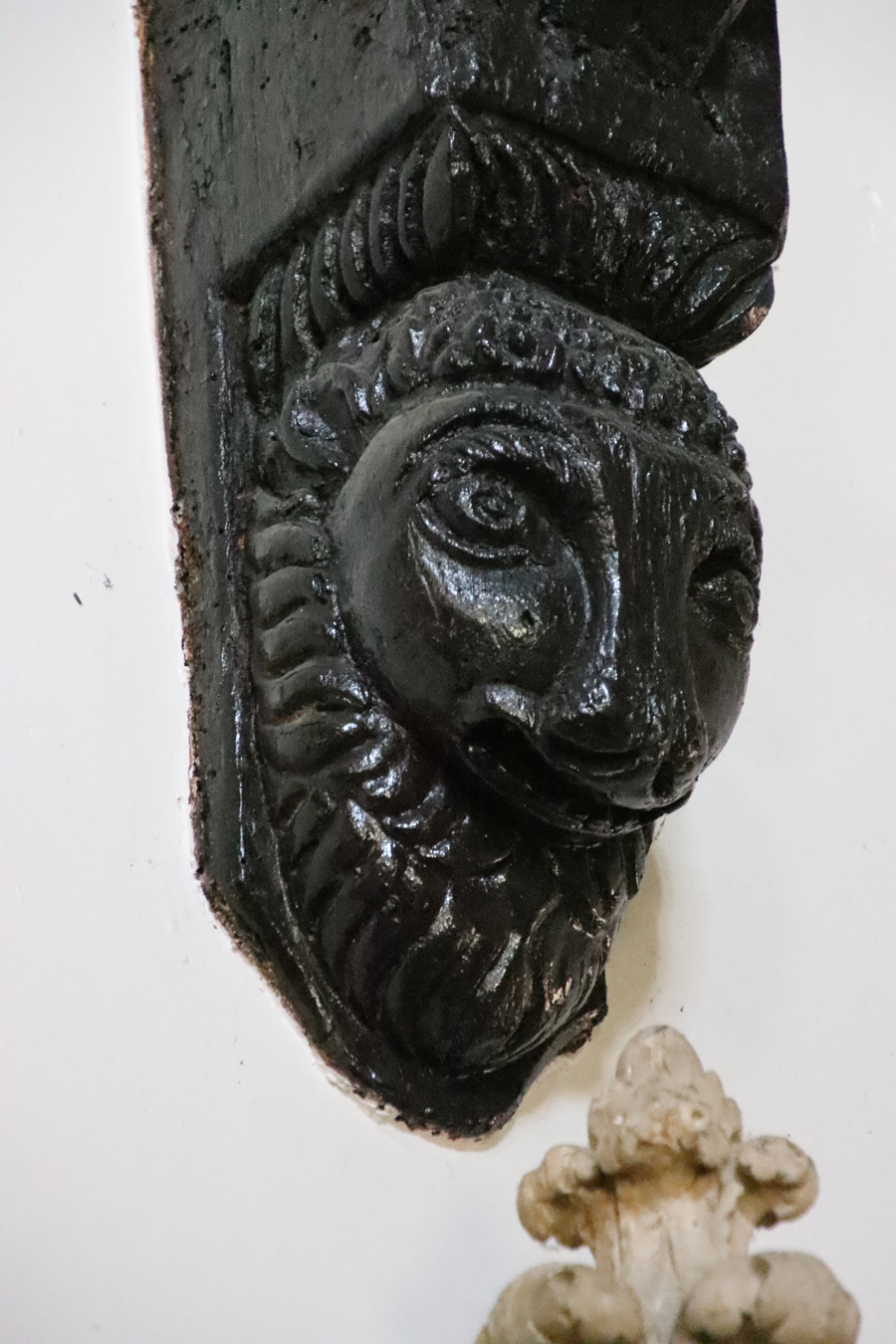
 

Artist’s reconstruction of the lavabo. Source: information board at Wenlock Priory

Today the main feature of the garth that survives in ruined form, but was once a magnificent feature unparalleled in England, is the late 12th century lavabo.  Its remains were found during the 19th century, and although only a few elements were preserved intact, they give a good idea of how the lavabo would have appeared.  It consisted of a fountain arrangement of two upper bowls and a lower basin all of which sat within an arched octagonal structure.  It was decorated with carved panels whoing religious themes, two of which are now in the Much Wenlock Museum.  This is where the monks washed before eating.

The garth’s modern topiary bushes were established in the 19th century.  Opinion is divided about whether this is a positive addition or not, but it has become a component part of the site’s history.

Lavabo carving of Christ with St Peter and St Andrew on the Sea of Galilee. Source: English Heritage

The covered walkway, with open arches that offered light and views of the garth, provided a link between all the cloister buildings that formed the heart of the monastic establishment, where most of the monks spent most of their lives. The walkway no longer survives.  On three sides of the cloister, these are referred to as ranges.  Part of the church nave made up the fourth side.

The East Range

The magnificent Chapter House

The Chapter House, dating from the 12th century, is the jewel in the crown of the abbey.  Considerable investment was usually made in any order’s chapter house, where the community met daily to discuss the business of the monastery, but Cluniac chapter houses are characterized by their particularly elaborate architectural detail, which would have been picked out in full colour.  The blind arcading, a decorative feature emulating window arches, is particularly characteristic of Cluniac sites, although it appears in the architecture of other orders too.  Philip Wilkinson suggests that it was probably “one of the most magnificent rooms in Norman England” (p.35).

Entrance to the chapter house from the cloister

The Chapter House

Blind arcading in the Chapter House

Decorative features in the Chapter House

Romanesque lintel over blocked door in the Chapter House, probably moved here from a different part of the abbey

Decorative touches in the Chapter House

Imaginative reconstruction of how the Chapter House, with its painted arcading, might have looked. Source: English Heritage. See video at the end of the post.

The library with medieval floor tiles

The library on the left, with the Chapter House to its right

Although many monasteries had a book cupboard, the book room at Wenlcock is particularly generous.  The library dates to the 13th century, as does the central arch, but the other arches were added later.  Thanks to pigeons, it has been necessary to put up netting to protect this space, but this also protects the tiles from other general wear and tear.

13th century tiles from around the site have been gathered together here, and laid down at random in order both to preserve them under a roof, and to display them to advantage.  There are also two tombstones, also moved here from elsewhere, but their owners have not been identified.

Medieval tiles and tombstone, seen through netting that protects the tiles from pigeons

The South Range – the refectory

The south range was entirely taken up by the refectory, although only one wall survives.  Sometimes refectories were built perpendicular to the cloister to allow inclusion of other buildings, but others were like this one, running along the side of the cloister with room at each end for a kitchen and a warming house (the latter a small heated room where the monks could spend a little time to warm through during harsh winters).  An oddity is that the line of the refectory runs at an angle (see site plan above), meaning that the garth is not the conventional square or rectangle.

The West Range

The west range, which has now been lost, was used differently from one monastery to another, and could have been used for storage, for visitors, including pilgrims, and could also have been used as the prior’s quarters before a large dedicated building was completed in the 15th century to house the prior and infirmerer.
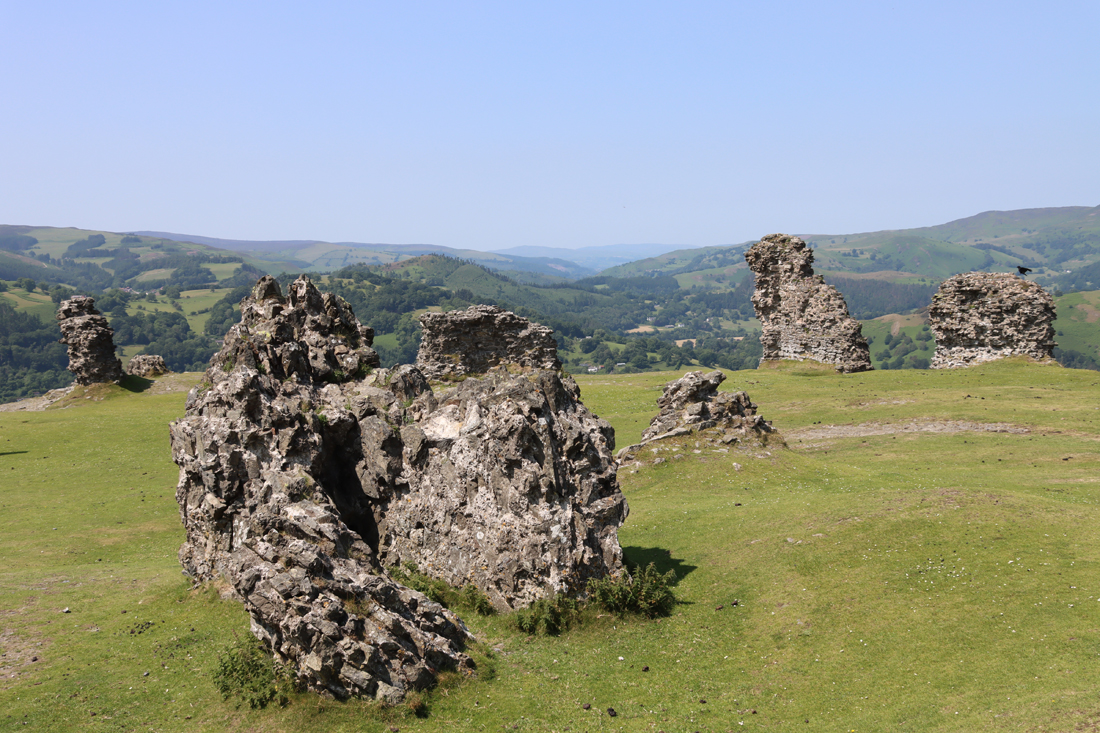
 

The Secondary Cloister and beyond

All of the extant buildings that make up the remaining secondary cloister are off-limits to the public, having been sold off after the Dissolution closed it in 1540 but the exterior of the infirmary and prior’s lodging ranges are visible from the east end of the church.  These are considerably modified from their 13th century origins, but are in the original positions of those buildings.  Both are now part of a private residence.

Once the main cloister had been built in stone, further wooden buildings could be replaced by new stone versions.  At Wenlock a secondary cloister was made up by another four ranges.  On the north side was the Infirmary  and the Infirmarer’s lodging.  On the east side was a chapel and the prior’s lodging, the latrines were on the south side and on the west was the continuation of the dormitory that also overlapped with the main cloister as part of the latter’s east range.

At the end of the monks’ dormitory was also a non-standard building that is now known as the Chamber Block and Hall.  The role of this is speculative but it is thought that it may have been reserved for high status visitors like the king, who is known to have visited the priory six times during his reign.

Further to the south and southwest there would also have been subsidiary service buildings including the brewery, bakery, stores and the buildings of the home farm.

Final Comments

It is fairly unusual to have so much of the original site plan preserved in the remaining architecture, even where this only survives as a few courses of stonework.  Wenlock Priory gives a much better idea of the complexity of well-endowed monastic establishments that many others around the country.  In addition, the extravagance of the Cluniac Order is clearly visible in both the size and the architectural detail of Wenlock Priory.

At the same time, much of the understanding of Wenlock Priory and its Early Medieval predecessor comes from excavations, which were carried out in 1901, the early 1960s and during the 1980s, and these findings survive mainly in the form of excavation reports.

This mixture of what can be observed on the ground and what derives from excavations is typical of medieval monastic sites.


Visiting

Entrance to the cloister

The Wenlock Priory is an attractive site beautifully maintained by English Heritage.  The former Prior’s Lodging and the Infirmary are privately owned and cannot be visited but are but visible from the English Heritage site.  There is a large car park. Details of ticket prices and parking fees are on the English Heritage website.  The most recent version of the English Heritage guidebook (by John McNeill, 2020) has some excellent site plans, an artist’s reconstruction and photographs, available from the nice little gift shop, but also available through online retailers if you want to read up the full details in advance of a visit.  The site is mainly all the level, and should be fully suitable for those with unwilliing legs. with a wary eye out for underfoot masonry.

Its postcode is TF13 6HS.  Don’t forget to check the opening days and times of the Much Wenlock Museum, which is a separate entity, and located within the village itself.

The site is near to other attractions, making it a great visit for a day out.  I visited Haughmond Abbey (built by Augustinian monks) and Wroxeter Roman City (posted about here) on the same day, and Ironbridge Gorge is a short drive away (although Ironbridge and its museums, posted about here, really take up a whole day in their own right).  For those with time on their hands, a nice-looking walk in reasonable weather, recommended by English Heritage, takes you from Much Wenlock to the Ironbridge.


Sources

Books and papers

Wenlock Priory 1798 by R. Paddey. Source: Government Art Collection

Angold, M.J., George C. Baugh, Marjorie M. Chibnall, D.C. Cox, D.T.W.Price, Margaret Tomlinson, B.S. Trinder 1973, ‘Houses of Cluniac monks: Abbey, later Priory, of Wenlock‘, in A History of the County of Shropshire: Volume 2, ed. A T Gaydon, R B Pugh (London, 1973), British History Online
https://www.british-history.ac.uk/vch/salop/vol2/pp38-47

Burton, Janet 1994. Monastic and Religious Orders in Britain. Cambridge University Press

McNeill, John 2020. Wenlock Priory. English Heritage

Pinnell, Julie 1999. Wenlock Priory. English Heritage

Platt, Colin 1995 (2nd edition). The Abbeys and Priories of Medieval England.  Chancellor Press

White, Carolinne 2008. The Rule of St Benedict. Penguin.

Wilkinson, Philip 2006.  England’s Abbeys. Monastic Buildings and Culture. English Heritage

==
Websites

English Heritage
Wenlock Priory
https://www.english-heritage.org.uk/visit/places/wenlock-priory/
Walk: Wenlock Priory to the Iron Bridge Shropshire (4.5 miles/7.5km (2-3 hours walking, plus time to visit the properties)
https://www.english-heritage.org.uk/siteassets/home/members-area/exclusive-content/your-exclusive-content/walking-page-dec-20/wenlock-priory-to–the-iron-bridge-shropshire-v2.pdf
St Milburga
https://www.english-heritage.org.uk/visit/places/wenlock-priory/history/st-milburga/

Historic England
Wenlock Priory
https://historicengland.org.uk/listing/the-list/list-entry/1004779?section=official-list-entry


Day Trip: Misericords and other choir carvings at St Bartholomew’s, Tong, Shropshire

Introduction

This time last year I wrote a short 3-part series about misericords in the Chester-Wrexham area, at St Werburgh’s Abbey (now Chester Cathedral), St Andrew’s Church in Bebbington and All Saints in Gresford.  These are all terrific examples of misericords, in really excellent architectural contexts.  On my way back from a short break in Shropshire in October I passed Tong, which I have been meaning to visit for years, so dropped in. Tong is on the A41, just where the road meets the M54, and the church, St Bartholomew’s is literally a couple of seconds off the A41.  It is about an hour’s drive from the Chester area.  It’s a very small, pretty village, and the collegiate church seems disproportionately large, but there was an inhabited castle here, and it was well used in both medieval and Tudor times. The unusual name Tong appears in Domesday as “Tuange.”  Although there is no consensus on the subject, it may derive from a word meaning “fork in the river,” referring to a meeting place of two streams near the former castle.

Lady Isobel and Sir Fulke Pembrugge. Lady Isobel founded the church in 1409 on the death of her husband.

St Bartholomew’s is thought to have been the third church on the site.  It was built by Royal License from 1409, the year of the death of crusader Sir Fulke de Pembrugge, by Lady Isabel Pembrugge, his second wife. It was finished by about 1430.  Lady Isabel established it as a collegiate church, meaning that as well as the church there was a separate building that housed a small community of secular (non-monastic) priests.  There were five at Tong, plus one or two clerks, who were employed to say masses for the soul of Sir Fulke de Pembrugge, in order to reduce his time in Purgatory, as well as prayers for other deceased souls.  The priests also ran a school for village children and a hospital for the elderly and sick, slight ruins of which still survive.  Both Sir Fulke and Lady Isabel are buried in the church in an elaborate tomb, shown above.

The style of the church is Perpendicular Gothic, with the Golden Chapel added 100 years later as an extension in 1510.  It is possible that the arcading in the south side of the nave dated to an earlier, perhaps 13th century church, because the style is different, and could have been incorporated into the new church.  Quite unusually, there are no projecting transepts, so the footprint of the church is not cruciform.  An original porch projects from the nave, whilst on the opposite side a large vestry projects from the chancel.  The rest of the church and its history will be discussed on a future post.

Misericords are “mercy seats,” first employed in monastic establishments, and carved onto the underside of hinged seats in choir stalls.  When the seat is down, it can be sat on as normal, but when leaning up against the back of the choir stall it has a little protrusion on which a monk or nun could prop themselves during some of the long daily offices that were typical of monastic and collegiate life.  Many of these feature elaborate carved decoration.  The earliest ones in Britain were carved in monasteries in the 13th century, and later on they found their way into collegiate establishments, cathedrals and, later still, parish churches.  Whether in monastery, cathedral or church, they could include a variety of subjects, religious, classical, pagan, chivalric and naturalistic.  You can read much more about them on my introductory post on the subject here and my round-up post here, looking at who might have been responsible for the themes chosen, who may have paid for the misericords, why they were contained within the most sacred part of the church and how they might be understood.
==

The misericords at St Bartholomew’s, Tong

The stone elements of the St Bartholomew’s choir, including the piscina (shallow basin used for cleaning communion and other vessels) in the sanctuary or chancel and sedilia (stone seat), also in the sanctuary all date to between 1410 and 1430.  The oak choir stalls would have been inserted only after the stonework had been completed, probably towards the end of the 1420s.

There are two sets of L-shaped eight choir stalls, facing each other with the entrance to the choir separating them.  Originally each would have had a misericord and today there is only apparently one missing, with no subsequent replacements, with only some slight restoration work carried out.  There are also with three-light traceried back panels, carved frieze, and desks, as well as carved bench ends, desk ends and carved poppy-heads, all dating to the early 15th century.  The published guide to St Bartholomew’s adds that one of the bench-ends seems to be a much simpler and less skilled example, and was probably a later replacement for one that was damaged.

Most of the misericords are botanical, but there are other themes, some of them natural and some of them apparently pagan, such as the face above.  Pagan faces, or grotesques, are not unusual, but although they are often difficult to interpret. Two show winged angels, one apparently in armour holding a shield, the other holding a book or coat of arms, and another apparently depicts a castle.  These may be references to the family who built the church.  Sir Fulke de Pembrugge, for example, was a crusader, and the family lived in the nearby castle.


It is sod’s law that the last of the misericords shown above is the one most discussed in books and is the one that I took three attempts to photograph and still came out dismally.  This is the only one that represents a specific scene: the New Testament story of the Annunciation.  In the middle is a lily growing in a vessel with two blooms and, at its centre, Christ on the cross. This arrangement is flanked on one side by the Angel Gabriel and on the other by the Virgin Mary, each of whom hold pieces of a scroll that records the Angel’s greeting and Mary’s reply.  The supporters may either represent doves of peace or the Holy Spirit.


Details of poppy heads (on the tops of bench ends and desk ends). Click to enlarge

There are numerous churches in the Midlands that could have provided the general idea for misericords at St Bartholomew’s.  For a list of misericords elsewhere in the Midlands see Misericords of Midlands Churches page on the misericords.co.uk website.  It is probable that many other misericords were lost when Henry VIII dissolved the monasteries.

===

Visiting

Check the St Bartholomew’s Church website for up-to-date opening hours and events that may close it to the public, but at the time of writing it is open daily, and in the summer months runs heritage tours that do not need to be booked in advance.  The church’s post code is TF11 8PW but Tong is almost impossible to miss, just seconds away from the A41 immediately before the M54 roundabout.

When there are no events, it is easy to park on the quiet road outside the church.

There is absolutely tons to see at the church, which is a feast for the eyes.  The 1515 Golden Chapel alone is a remarkable thing with its fan vaulting, but the many other early Tudor monuments are also spectacular.  See the church’s Heritage links on the above site to explore what it has to offer the visitor.  There is also a guide book that you can purchase at the church for £2.00 (cash into an honesty box), at the time of writing, which is great value with excellent photographs and good explanatory text, although it skims over the choir carvings.

If you want to make a day trip of it, nearby is the marvelous RAF Museum at Cosford, around 10 minutes away, and the the small but attractive White Ladies Augustinian Priory, also around 10 minutes away. 


Sources

See the end of Part 3 of my original series on misericords for sources on the general subject of medieval misericords.

The St Bartholemew’s misericords are referenced in the following works:

Books and papers

Anderson, M.D. 1954. Misericords. Medieval Life in English Woodcarving. Penguin Books

Anon, 2002. St Bartholomew’s Church, Tong, Shropshire. ISBN 1 872665 59 4.
(Almost no information about the misericords but some background information about the medieval church, to which the misericords date)

Grössinger, Christa. 2007.  The World Upside-Down. English Misericords.  Harvey Miller Publishers

Websites

St Bartholomew’s Church, Tong
https://tong-church.org.uk/
History (very top-level)
https://tong-church.org.uk/history/
Tong’s timeline
https://tong-church.org.uk/tong-parish/timeline/

Historic England
Church of St Bartholomew
https://historicengland.org.uk/listing/the-list/list-entry/1053606?section=official-list-entry

The Medieval Bestiary
Excerpts from Francis Bond, Wood Carvings in English Churches: Misericords (pages 208-214). This text is believed to be in the public domain.  CHAPTER XVII: ON THE USE OF MISERICORDS – NOMENCLATURE
https://bestiary.ca/prisources/pstexts4837.htm

misericords.co.uk
Home page
https://misericords.co.uk/