Category Archives: Industrial history

A great day out at Greenfield Valley Park, Holywell

On visit to Basingwerk Abbey a few months ago, we noticed signage indicating that the abbey was at the south end of the Greenfield Valley Park, the north end of which is Holywell just to the south of Holywell town centre.  The Greenfield Valley Park had been on my to-do list for ages, but it was my friend Katie’s suggestion that we go today, and she brought David Berry’s guide book with her, which included a map that we followed to make the most of the park (details below).

Map from Greenfield Valley Visitor Centre

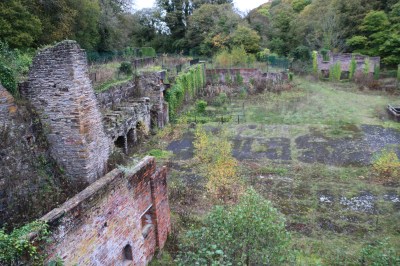
The park, which includes the ruined abbey and St Winifred / Winefrede’s Well follows both the line of the Holywell Stream that erupts in bubbles at St Winifred’s Well, as well as the line of a former railway track that ran from Holywell to Greenfield Dock.  It is one and a half miles as the crow flies from north to south, but covers 70 acres and consists of a network of metalled paths (marked on the map) and tracks, beautifully maintained, connecting some remarkably preserved industrial heritage.  Each one of these buildings was accompanied by large tracts of water that were used to power water wheels that were built in the late 18th century and continued to be used well into the 19th century.

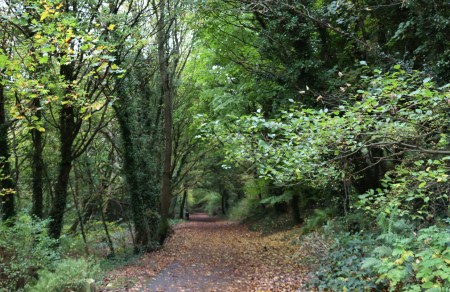
As well as being fascinating, the tree-filled park is a lovely place to walk, particularly appealing in its multi-coloured autumnal garb.  In the summer there are birds and butterflies, and even at this time of year there was the occasional woodland flower.  There is also the little Bakehouse café in Basingwerk House at the  south end of the park, next to Basingwerk  Abbey, which serves good coffee, cake and a small, imaginative menu of nicely presented and very enjoyable food.

This post is confined to the really gripping industrial heritage.  I’ll talk about Basingwerk Abbey on another post, and St Winifred’s well, both of which we visited on the same day, will also be dealt with separately.  The following highlights of the walk start in the north and head south ending at Greenfield Dock.  The numbers in the text refer to the map above.
sdafasdfas

The Holywell Rail Line and bridge

The wide metalled footpath that links Holywell in the north with the A548 to the south follows the line of a standard gauge railway built in 1868.  Its purpose was to carry minerals from the Greenfield Wharf, now known as Greenfield Dock, and to ship products made at Greenfield Valley to Liverpool for sending further afield. In 1912 it was converted to carry passengers, and became known as the Little Train.   It claims to have been the steepest conventional passenger railway line in Britain, with a 1:27 gradient.  At the top of the path, near Holywell, there is a massively constructed railway bridge (10) with two wide arches.  Today, charmingly, it is a footpath, leading from Tesco to a housing estate.
asfasdfsd
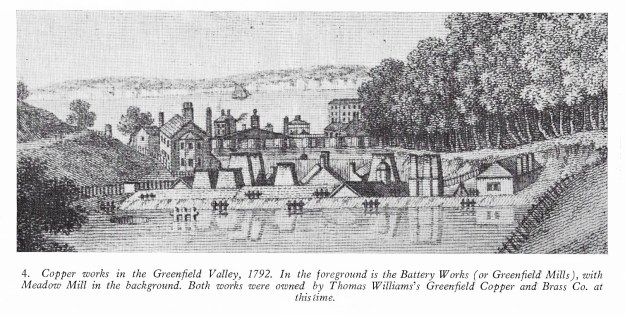
Greenfield Valley 1792. Source: Davies and Williams 1986

Battery Works

Established in 1776, the Battery Works (8), also known as Greenfield Mills, was built to manufacture pots and pans from brass sheets.  Davies and Williams describe the process (p.28-9):  Each of the four copper and brass battery mills “consisted of large hammers raised by a cog on a rotating beam.  The beam extended from the axle of the waterwheel so that each waterwheel worked up to six hammers.  Once the cog had passed, the hammer fell, striking an anvil.  Workmen would hold sheets of plates of metal on the anvils and as the hammer hit them, shape them into pans, bowls and other articles.”

fdfdsfsd
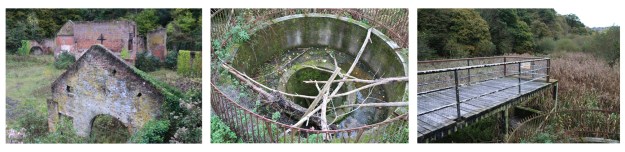
The troughs that held the water to turn the wheels can still be seen.  One of the pits where the waterwheel turned can still be seen in the photograph below, together with a section of wall with a circular hole where the wheel once turned. Like all the main industrial operations along the river, it was backed with a large body of water at its northern (upriver) side.  The water is now full of bull rushes.  Even though it is impossible, just by looking at the ruined remains, to see exactly how all the different elements fitted together, this is a massively impressive piece of the Greenfield site.  The finished products were shipped to  Africa via Liverpool and exchanged for West African slaves.  

Meadow Mill

In 1787, eleven years after the Battery Works, a new mill (7) was built by the Greenfield Copper and Brass Company to produce rolled copper sheets, and to make copper rollers for printing patterns on to cloth.  The main building was a sizeable affair, 86 x 69ft (26 x 21m), with two pillars 11.5ft (3.5m) apart supporting a roof made of copper sheet.  It was  fitted with three cast iron wheels, each 20ft (6m) in diameter.  Copper ingots were melted and moulded into plates 3 (0.9m) x 4ft (1.2m) and about 1/2 inch (1.27cm) thick, which were cut into strips, that were in turn fed between pairs of rollers to create sheets of various thicknesses.   These could be turned into wire or other products.  When this work came to a close, the site was used by a number of other smaller-scale industries, including a tin plate works.

Meadow Mill  is backed by a basin of water that fed the water wheel that powered the mill.  It is now marshy and full of algae, making life rather interesting for the moorhens, and the surrounding foliage is now home to several species of butterfly. On the other side of the water wheel, the water was taken down to the next level of the valley down a purpose-built run-off.  

In the 1850s it was taken over by Newton Keates as a lead works.  This was followed by a tinplate works, then a brass rolling and wire works, and in 1890 was leased to William Eyre for rubber grinding and processing.

Lower Cotton Mill

There were a number of cotton mills along the Greenfield Valley, built for the manufacture of cotton textiles, all water-powered, in a period when cotton was one of Britain’s primary exports. John Smalley, one of the backers of Richard’s Arkwright’s ground-breaking spinning frame, established a mill with his colleague John Chambers. Their company was the Cotton Twist Company.  The earliest mill was built from stones taken from the nearby Basingwerk Abbey, and was called the Yellow Mill.  The business was declared bankrupt in 1780 and Smalley died in 1782, but Smalley’s window Elizabeth was able to find partners to push the business forward, and the business went from strength to strength.  Upper Mill was built inn 1983, Lower Mill (6) In 1785 (in just 10 weeks) and Crescent Mill in 1790.  All were fitted with Arkwright’s spinning frames and were worked by many local people, including young children.  The six-storey mill that survives today is the Lower Cotton Mill, its spinning frame once powered by a waterwheel 18ft high (5.5m) and 7ft (2.1m) wide with a 16ft (4.8m)  fall of water.  You can see the culverts that were built to carry the water beneath the buildings and feed them further down the valley.

From where we were walking, on the upper path, we could look down into the ruined warehouse’s, which was impressive.   In the 1850s it was taken over by a flour merchang and renamed the Victorian Corn Mill; the water basin is still called the Flour Mill Pond. Later it was the premises of a wheelwright and a brickworks.

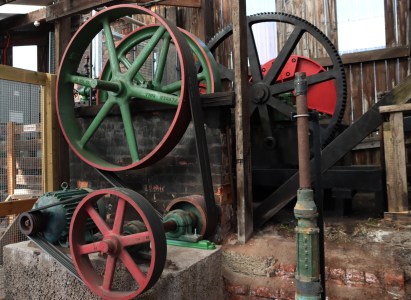
If you were on the lower path, one of the buildings (which we did not know about) has apparently been restored and now houses a steam bottling plant, a railway museum and an exhibition on the industries of the Valley.  It was something of an omission that we missed this!  A good excuse to go back.  At the time of writing, admission is free.

Abbey Wire Mill

The Abbey Wire Mill overshot waterwheel in pit. Source: Chris Allen, Geograph

The site of the former copper and brass wire factory (5), the main output of which was  pins and bolts, has little to see.  It originally covered about an acre, and was the site of the wire mills of the Parys Mine Company, where rods of copper and brass were pulled through a series of holdes of decreasing size and then heated and cooled until wire was produced.  The site does contain an original waterwheel pit in which a waterwheel is still located, now renovated and capable of producing electricity for the museum.

In 1856, Newton Keates and Co leased the site and raised the level of the dam to create a larger pool.  This was a mistake.  Water broke through and flooded in 1857 and 1858, so the height of the water behind the dam had to be lowered.  The works closed in 1894 and the machinery was auctioned off.

Apparently, at a later date in the early 20th century, a small soap-works was built on the site which produced, presumably amongst other themes, soap imprinted with images of St Winifred, the first batch of which were sent to the Pope.  The mind boggles.  Today there is a small bandstand at its edge.

Further down the path, and the Bakehouse Café is located in Basingwerk House, a fine 1930s building.   We had a very good lunch there.  Beyond that is Basingwerk Abbey (about which more on another post) and beyond that is a car park and the A458, which you need to cross to reach Greenfield Dock, which is off the above map.

Greenfield Dock

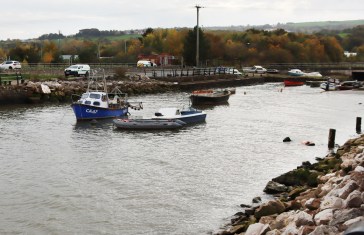
Greenfield Dock is beyond the Green Valley Park, but is only a short walk away, reached by going through the car park beneath the abbey, crossing the main road, heading left for a short distance and taking the first on the right.  This is Dock Lane, which takes you to Greenfield Dock and the Wales Coast Path.  There’s not a lot to see, just a couple of tiny fishing boats in an inlet, and views (on a less grey day) across to the Wirral, but the dock was an important contributor to the Green Valley industries, linking with the Holywell Rail Line.

The Wales Coast Path, however, looks excellent in both directions, and a great destination for a sunny day.  It starts in Chester, and can be followed continuously around the entire Welsh coastline, but can be done in short chunks.  From here, for example, one could head upriver to Flint along the Path, and visit Flint Castle (which I have written about here), which is a walk of 4.3 miles (6.9 km) from Greenfield Dock to Flint Castle, but don’t forget the return journey.
——-

Wales Coast Path: Flint to Holywell. Source: Wales Coast Path

Visitor Information:

This is an excellent place to visit, with stacks to see.  If you are interested in industrial archaeology, wildlife on land and water, and woodland walks, you will not be disappointed.

To give some idea of how long it took us, we started out from Churton (about 15 minutes drive south of Chester) at 1030, arriving in Holywell at about 1115, having taken the most direct route along the A55, and we left at 1530, with a short stop for coffee and a snack in the park.  This is a dry-day walk, because there is nowhere to shelter.

In the Greenfield Valley everything is open and free to see other than the Green Valley Park Museum and St Winifred’s Well and Chapel.  We didn’t visit the museum, which is behind the visitor centre but details are available here.  Details for St Winifred’s Well can be found here.  The museum and visitor centre are closed from the end of October onwards.  There are also details about children’s activities on the Greenland Valley website here.

From a mobility point of view, a number of tracks, including the one that follows the line of the old railway are wide and metalled, but there is a distinct downhill gradient from Holywell to the abbey, and of course there’s the uphill gradient on the return journey.

Sources:

Berry, David, 2012. Walks around Chester and the Dee Estuary.  Kittiwake Books

Davies, K. and Williams, C.J., 1986. The Greenfield Valley. An Introduction to the History and Industrial Archaeology of the Greenfield Valley, Holywell, North Wales.  Holywell Town Centre

Greenfield Valley visitor’s Guide and Map (A3 fold-out)

The Industrial Heritage of Greenfield Valley. KS2 and KS3 Teaching Resource
cadw.gov.wales/sites/default/files/2022-02/Industrial%20Heritage%20-%20Greenfield%20valley%20resource%20-%20English.pdf

Greenfield Valley Park:  www.greenfieldvalley.com

A terrific visit to the Lion Salt Works in Northwich

The Pump House

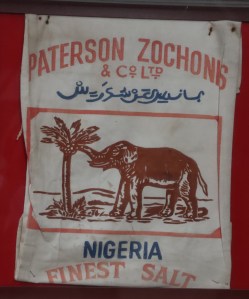
What a brilliant place! The Lion Salt Works in Northwich is not only the last open-pan salt works in Cheshire but one of only four remaining in the world.  I had really very little idea of what to expect, but of all the places I have visited, this one most resembles an industrial time capsule.  It is as though things were left just as they were when the Works closed, which is more or less what happened.  The biggest market for Lion Works salt was West Africa, but when the Nigerian Civil War broke out in the late 1960s, and the political situation that followed it failed to improve matters, the Lion Salt Works struggled to survive, and the business closed in 1986.  The decision was made to convert the Works into a museum of salt working, and what a good decision that was.  There are lots of information boards, models and sound effects, all excellent, but what really grips is the sense that this could all start up again tomorrow.

Roman and Medieval salt pans

Another extraordinary aspect to the place is how for just under a century, between 1894 and 1986, the method of making salt from brine hardly changed.  In fact, the method used was pretty much the same as that employed by the Romans in the same area.  Open-pan salt manufacturing is just what it says – the salt-carrying water, brine, was pumped up from two levels of rock-bearing beds from below the surface and then fed into huge rectangular iron pans, which were heated from below to drive off the water, and then dragged to the side of the pan to help them drain

Salt beds beneath the Lion Salt Works

The Cheshire salt was once suspended in sea water.  In the Triassic Period, c.220 million years go, the Cheshire Basin was a tropical lagoon in which seawater became trapped.  As the water evaporated from the lagoon, it left behind a rock salt known as halite (Sodium Chloride).  Two bands of of salt lie under Northwich and were tapped by the Lion Salt Works.  The first is 40m (131ft) down and is 20m thick (65ft), then there is a 10m (33ft) layer of marlstone and then a second, 30m (90ft) layer of salt.  When rainfall entered the water table and washed over the salt layers, it dissolved the salt again, and created subterranean streams of highly salted water known as brine.  Natural forces pushed these salty streams to the surface in the form of natural springs, but the streams themselves could be tapped by drilling down to them and pumping the brine out at the pump house.

Inside the Pump House

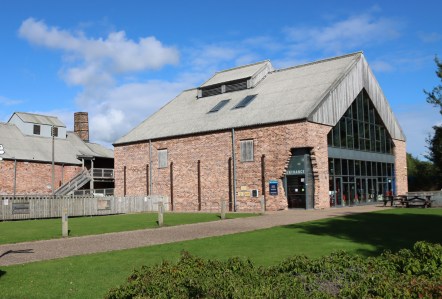
The pump house is a good place to start your visit on the way from the car park to buy your ticket in the former Stove House, now containing a brightly modern shop and café.  The brine, once extracted from the borehole,  was stored first in a tank and from there it was distributed to the salt pans for processing.  A steam engine powered the pump, and both the engine and its boiler are still visible in the pump house.  The pump was known as the “nodding donkey” due to the motion of the overhead beam as it rose and fell.

Once beyond the ticket office, you follow the signs to enjoy a self-guided tour.  There are plenty of disabled elevators for the leg-challenged and for wheelchair users, which you can operate yourself.

The first building that you come to is a former terraced house, the Red Lion Inn.  The original Red Lion Hotel was knocked down in order to expand the mining operation, so two terraced houses were purchased in order to give the workers somewhere to relax after the heavy labour in the stove and pan houses.  This building is now used to show Roman and Medieval versions of the pans (just smaller, not actually any different in how they were used) and to show a reconstruction of the works office, complete with clocking-in machine, and the Red Lion bar.

Indoor salt pan on the first floor

It is difficult to get one’s head around the salt pans.  The concept is childishly simple, but the sheer hands-on labour involved even as late as the 1980s is truly remarkable.  There are displays showing the role of each of the workers.  The Lion Works was set up and run by six generations of the Thompson family, and the workers were all local people.   At first both men and women were employed in the heavy duty work of the Works, but later women were confined to the less strenuous work of packing up the salt and carrying out administrative tasks.

The two main initial tasks were to rake up the salt in the pans once the water had been evaporated off (creating steam-heavy rooms), and to feed the fires in the stove houses.  Here’s a somewhat eye-popping excerpt from the guide book:

Salt-making was a ‘dark art’ and the salt workers would add all sorts of things to make the salt crystals form.  These included strong ale, bullock’s blood and eggs, but these were replaced by soft soap and glue

First floor stove room

Workers known as wallers worked in the outdoor pans, pulling the salt along the edges of the pan to form large walls to drain it.  Inside, lumpers worked on smaller (but still huge) pans to rake the salt to the sides where it drained, before pacing it into blocks or lumps. The lumps were taken on barrows to the stove rooms to dry out.  From here they went through a crushing mill, a splendid piece machinery that was steam-powered until the 1950s when it was converted to electricity.  The resulting salt grains were graded from fine to coarse before being packed up in bags or small plastic packs.

The salt that was processed outside was inferior to that made inside, not due to the original brine or the work of the crushing machine, but due to the temperature at which it was heated in the pans.  This is because of the multiple uses of salt, from fine-dining to packing fish caught at sea.  The Trent and Mersey Canal runs alongside the works.  Coal to power the engines and to heat the pans was delivered by narrowboat and the packaged salt was also sent out by narrowboat.  The canal network was huge, and even though canal travel was slow compared to the railways that eventually replaced them, was well equipped for transporting heavy, bulk products reliably to towns, cities and ports.

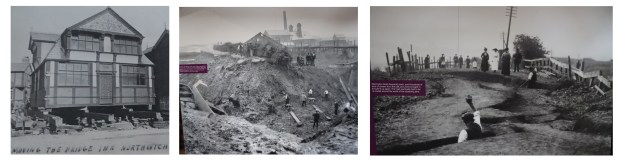
The mining works had a dramatic knock-on effect on the structural stability of the town of Northwich.  The story of the subsidence caused by the mining is another aspect to the story that is truly compelling.  On the approach to the Lion Works, one of the mines subsided so thoroughly in 1928 that two flashes now flank the road.   The subsidence had a truly transformative impact on buildings and infrastructure, and not in a good way.  Buildings shifted, some tilting backwards or forwards, others dividing slowly into two, the brickwork forming great fissures as the subsiding and pulled them in opposite directions.  The solution was to go back to Medieval domestic building traditions, creating light-weight frames and building in jacks points into which levers could be inserted, in order to persuade buildings back into position.  Other buildings, like the Bridge Inn, could simply be moved in their entirety.  This gives the town today a half-timbered look.  It is an astonishing idea that to respond to the conditions, buildings became just as shiftable as furniture. Roads too subsided, and one collapse caused a major breach in the neighbouring canal.

Left: The Bridge Inn in Northwich on the move, giving new meaning to nomadic settlement strategies. Middle: The Marston Hall mine collapse caused part of the canal to subside in 1907. Right: Warrington Road frequently sank and 1000s of tons of salt pan cinders were used to build it up again.

There is lots more to find out at the museum, and I recommend it for anyone interested in industrial heritage.  As well as the Works themselves, there are plenty of really excellent information boards, some interactive displays aimed mainly at children, and some absolutely splendid photographs.

Visiting

We piled out to Northwich along the M56, and it was easy to find the Lion Alt Works by leaving at Junction 10, but we had intended to return via the A51, taking in the Anderton Boat Lift on our way back.  In our dreams.  At the time of writing (September 2022) Northwich is up in extensive roadworks, and the diversion signs must lead somewhere, but heaven knows where.  A sign half-buried in an overgrown verge directed wannabe Boat Lift visitors to follow the diversion signs, which was hysterically funny as the diversion signs were, as stated,completely unfathomable.  We just about found our way to the A51 to Chester (although not by following the diversion signs), but we never did find the Boat Lift, in spite of several attempts, both with and without the SatNav.

At the museum there is a car park, café and shop.  A free map is given out, but a really useful guide is available for purchase too.  The opening times on the website state that the museum is closed on Mondays except bank holidays, and there is an entrance fee.  For up to date information check out their website.
https://lionsaltworks.westcheshiremuseums.co.uk/

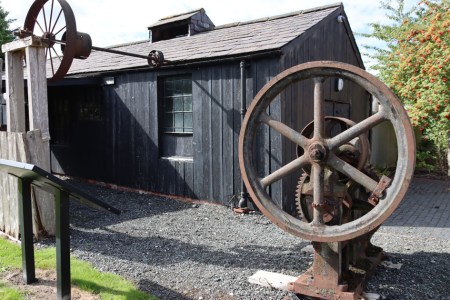
The smithy

The staff at the museum were friendly and helpful.  We were chatting to one of them at the end of our visit when we were sitting in the café.  His knowledge was immense, and he knew the answers to all the questions that we fired at him.  I failed to catch his name, but my sincere thanks.

The coffee came from a push-button machine, but was absolutely fine, and the tea was served in a lovely little pot.  The coffee was a particularly nice surprise after the undrinkable swill that was being served with breakfast in the Novotel in Greenwich (London), where I was staying recently!

For disabled and mobility-challenged visitors, there are wheel-chair friendly lifts to the upper floors, and you can operate these yourself.   The whole museum is intended to be disabled friendly, and at least to my eyes, looked very well thought out.

Feeding the ovens beneath salt pan 3

I wanted to see if there was any edible (as opposed to ornamental) local salt for sale, but forgot.  I am real salt enthusiast and always have several types at home for both cooking and seasoning at the table, so I am a tad miffed that I forgot to look!  If you go, do let me know if they were selling any.  There were blocks of ornamental salt for sale, in beautiful shades of pink, but I have no idea if it was edible too.

Manager’s house

Northwich town itself looks as though it will be well worth visiting after all the roadworks have come to a close, particularly if you are a fan of inland waterways and the architecture and civil engineering that goes with them (which I am).  Make sure that the Anderton Boat Lift is open if you want to see it, as its opening times seem to be something of a movable feast.


The crushing mill

Interior of the smithy


A walk from Telford’s Horseshoe Falls to the outskirts of Llangollen

Photograph taken from the top of the path leading from the car park, looking down at the Horseshoe Falls

The Horseshoe Falls are just outside Llangollen, a remarkable and lovely feature developed by Thomas Telford as part of his solution for supplying the Llangollen canal with water.  As the name suggests, it is a semi-circle of falling water, actually a man-made weir, which combines human symmetry with the natural beauty of water.  It looked spectacular in the sun, more art than engineering.

I usually make my comments about accessibility for people with uncooperative legs at the end, but in case the above photo makes you think I have lost my mind to categorize it as suitable , this is because there are other ways to approach the falls than from the top of the hill, approaches that are completely on the flat along the canal towpath.  Bear with me; clarity will emerge 🙂

Map of the Horse Falls area. Source: Pontcysyllte Aqueduct website

I had not set out to do this walk yesterday (Friday), and was actually on my way back from Valle Crucis (open once again to the public, but closed Tuesday and Wednesday each week), and was not ready to go home, so decided to drive down the road to the car park for the Falls, which is clearly signposted, and do a short walk to find out what it was like with a view to returning for a longer walk on another day.  The car park is pay-and-display but it is only a pound for the entire day, payable by cash or by swiping your debit card.  There are also public toilets.  I imagine that it gets quite busy at the weekends.

It is a short walk from there up a very slight slope along a metalled path to the top of the hill, from which the valley unfolds below.  There is an information sign here too.

I covered the basics of the building of the canal on earlier my post about the fabulous Pontcysyllte aqueduct, which you can find here, so won’t repeat that on this post, but the Horseshoe Falls deserve an explanation in its own right.  To secure water from the Dee, which ultimately comes from Lake Tegid at Bala, Telford gained permission from the owner of the lake to take off water  from the Dee for the new canal. The water had to be diverted from the Dee into the Llangollen canal by means of a feeder channel, some 1.8 miles long.  The distinctively shaped weir helps create a pool of water that can be pumped into the feeder channel. 

This link between the river and the canal required the installation of a pumping station by the side of the pool below the weir.  It was replaced by a new  Meter House or “valve house” in 1947, which still stands.  A massive pipe, 20ft long and 3ft in diameter runs 8ft below the ground to supply the Dee water to the Llangollen canal feeder.  This flow is released and slowed by means of guillotine valves which are controlled from the valve house.  By using the water of the Dee as it fell from Snowndonia via Lake Tegid, over 11 million gallons of Dee water a day, is fed into the Llangollen canal, eventually emptying into Hurleston reservoir, just north of Nantwich, where the Llangollen Canal meets the Shropshire Union Canal and contributing to the greater canal network. It was completed in 1808.

asfafas
It is a short and not particularly steep walk down to the falls from the car park, and the hillside is, at the moment a sheer delight, with the slopes covered in giant buttercups, purple thistles and daisies, with a few blue speedwells dotted in amongst them.  Once down at the falls, you are at the source of the Llangollen canal, a remarkable thought.   The valve house for the canal is at your left, and the footpath runs both left (east) and right (west).

I cannot yet comment on the footpath heading west, but if you head left, towards Llangollen, you find yourself immediately on a wide, level path, the towpath, which runs deliciously between the canal on your left and the Dee on the right.  The canal is very narrow at this stage, just a feeder, and not navigable.  The Dee too changes character, from a wide, deep run of uninterrupted river to fast, impressive rapids channelling itself through large slabs of natural rock.  Although the towpath runs above the level of the Dee, there are paths down to the river, and people were sunbathing on the huge slabs and paddling in the water.

The sound of the river coursing over the rocks is glorious, and a fabulous contrast to the peaceful, mirror-surfaced channel of canal that runs along the base of a solid wall of local rock, infiltrated by all sorts of rock-loving plant species and overhung by trees.  The canal widens as it goes, but remains un-navigable because, even where the canal is sufficiently wide and deep, there is no winding point (an indent where narrow-boats can turn around.  Long, sinuous weeds signal the direction of flow in the apparently motionless water, and fish, swimming against the current, hold a stationary position.  With the sun on it, when not mirroring the vegetation and sky above, it appears gold and velvet brown.  There are bridges all the way along, some modern and metal, but there are also traditional stone canal bridges, clearly numbered, with ramps for horses.  There is also an impressively substantial bridge spanning both the canal and the river.

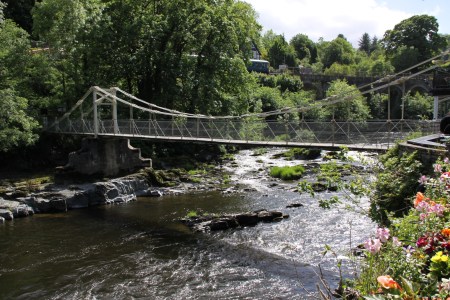
One bridge is a delightful exception, and very unexpected.  The Chain Bridge Hotel contains within its Dee frontage, access to a small but perfect suspension bridge that provides access from the tow path to the railway station on the other side of the river, and some height above.   There is a small car park at the hotel, which can be used by the public.  I didn’t stop for a for a drink or a bite to eat, but the views from the terrace, over the bridge and the Dee rapids, are excellent.  This would probably be a good place to start and end your walk (particularly if the food is any good) if your legs like things simple, because the whole walk is on the flat.

I didn’t go much further because it was already getting rather late and I had other things to do.  I suppose I must have walked for about half an hour, with breaks to take photos, and then turned and walked back. Another way of tackling the walk would be to start in Llangollen and walk out towards the Horseshoe Falls.  This would be a much longer walk, and one for another day,  and again on the flat all the way along the towpath.  I am looking forward to it.

I went some way past the Motor Museum, which was to the right and below the level of the towpath.  The walk was particularly good on a day like yesterday, with hot sun and a light breeze.  At this time of year, with leaves on the trees, the towpath is in dappled shade, perfectly warm but not too hot.

Here are the rest of the photos:
dafsdfds

Exhibition: “Tales from Terracottapolis” at Tŷ Pawb gallery, Wrexham

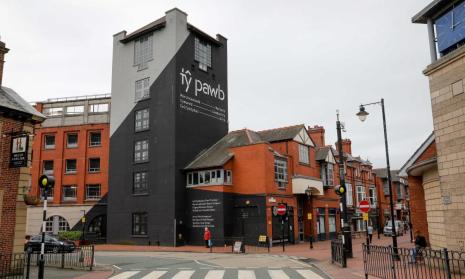
Tŷ Pawb, meaning “Everyone’s House,” is a small but well thought out community and arts hub in the heart of Wrexham.  I had never been to Tŷ Pawb before, simply because I didn’t know of its existence.  Although I have been permanently installed in Churton for over a year now, I am still finding my way around.  The photographs below are my own unless otherwise stated in the caption.

Ty Pawb in Wrexham. Source: Wrexham Leader

For those who have never encountered Tŷ Pawb, it was formerly a covered market with a car park on top.  Apparently the market was hanging on to life by a thread before it was closed and as usual with this sort of change, the plans unsurprisingly met with some resistance. Often, the words “arts” and “community” when put together in the same sentence are enough to set any number of warning bells ringing, but in this particular case, there has been a strong dose of common sense and a real feel for the town thrown into the mix. The car park and the open space occupied by the market are still there, but the exterior and the former market space have been given a very smart and modern facelift.  Small retail units and a food hall and modern benches and chairs making it an an excellent place to meet and grab a bite.  It is an impressive initiative, and looking at it today, it seems to be working very well.

Source: Ty Pawb

The  gallery fits in very nicely into this arrangement.  The market space with its creatively designed modern signage and bright frontages and furnishings give the whole place a contemporary edge, which segues nicely with the inclusion of the gallery, which is so well blended into the space that at first we couldn’t see it.

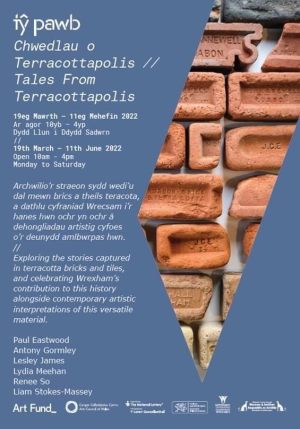
We were there to see Tales from Terracottapolis.  It is on until 4th June (open Monday to Saturday, 10-4, free of charge), and I recommend it wholeheartedly.  It is a small exhibit, a single gallery, but makes brilliant use of the space with its excellent light.  Using objects from the Wrexham Museum and elsewhere, together with art works from a number of local artists, it combines 19th Century with 21st Century ideas to explore the local production of architectural flourishes and glazed tiles that formed the character of an older, more confident and prosperous Wrexham.  Some of the decorative twiddles, like capitals, finials and long decorative panels, could be ordered from catalogues, but others were custom made.

There is an excellent video that provides the background to the industry, and explains how the terracotta was made, from kneading the clay by hand via being formed into moulds before firing, a highly skilled process from beginning to end.  It would have been really great to be able to re-see the video online.
asfsdfsdfsd
The front part of the gallery, where you walk in, is dominated by the modern pieces, many of which are very striking and engaging, and which aim to complement the story of Wrexham’s brick, tile and terracotta industry by offering new responses to it.

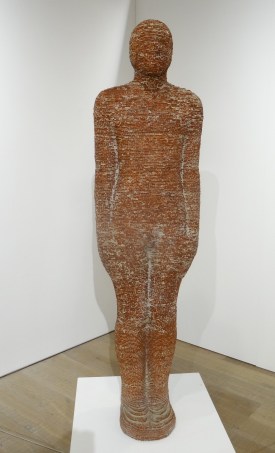
The first thing that draws the eye is The Brick Man by Antony Gormley, best known for his Angel of the North. It is (or would have been) one of his most tactile pieces, and a true celebration of brick.  This is a scale model of a piece that was originally planned as a 120ft (36.5m) monument in the run down Holbrook area of Leeds, near the Leeds City Station.  There was some public outcry against it, which is such a shame, as it resulted in the planning application being rejected by city planners.  As well as the scale model, itself a solidly impressive celebration of brickwork, there is an archive of documentation following the sources of the statue, from the original proposal to the official rejection of the the proposal.

There is a fascinating letter from the Partnership Manager of the British Railways Board, who supported the idea of the project, to a disgruntled objector, which really hits the nail on the head for me.  You can click on the image to see a legible version.  I am often amongst the first to grumble about inappropriate and poorly thought out modern sculpture installed in urban or rural locations as some form of random art statement, because such initiatives can actually alienate people from art and frequently undermine the impact of the heritage in which they are being installed.  By contrast, The Brick Man actually had real merit (originally, I typed “legs”), not only as an art work, but as a way of contributing to urban regeneration, both by drawing attention to the monument and the area, and by attracting visitors.  It is also a good piece of art, which is important.  I was previously unaware of The Brick Man, and it was a really good opportunity to see the scale model and some of Gormley’s original plans.

Display of pottery sherds by Paul Eastwood

Immediately on the right as you walk in to the gallery is a section of wall covered by rows of ceramic sherds that the artist, Paul Eastwood, had collected from riverside locations during lockdown.  It was so familiar, looking eerily like some of the stuff I have been collecting from my garden, and posing exactly the same sort of questions.  Eastwood, based in Wales, specializes in capturing how memory is created through objects and language and, in this case, what abandoned sherds tell us about the people who discarded them and the places they were found.  There were other pieces of his work on the same wall.

A set of large stand-alone pieces in the main space of the gallery, hanging panels and tall curving sections, captured the images of walls and arches, surface-traced like brass-rubbings from the derelict walls of buildings that had produced the bricks, moulded works and tiles.  I had not worked my way round to these Lesley James pieces when I was welcomed to the exhibit by one of the curators, who pointed them out to me, and I was glad she had as I would certainly have missed their textural connection with the 19th century manufacturers:

Lesley James surfaces traces

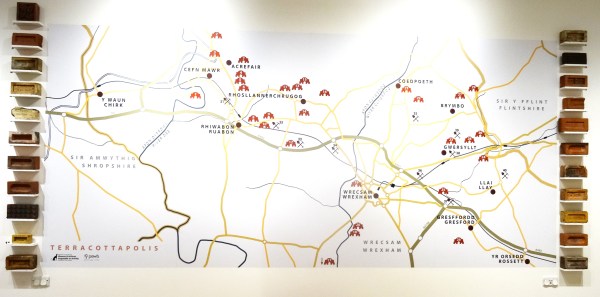
At the far end of the gallery is a floor-to-ceiling map showing the location of all the major brickworks.  It is an excellent way of showing just how important the area was for the production of bricks, tiles and terracotta.

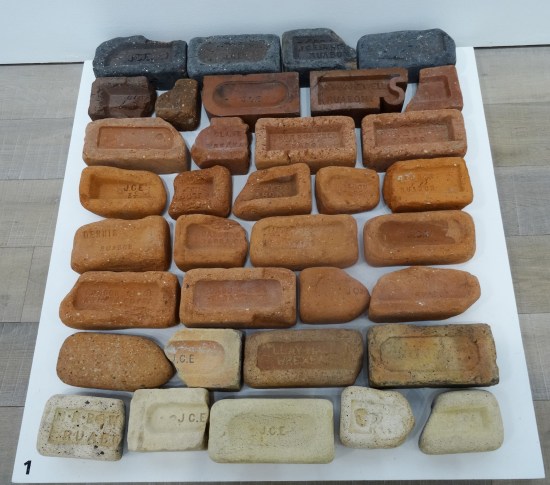
In this section of the gallery, the focus shifts from present to past, and some of the marvellous tiles and moulded terracotta pieces are located here, together with the video.  This is where the exhibition makes a slight gear change from modern art gallery to beautifully displayed items of heritage.  Both flanking the map and at its foot, are examples of locally made bricks, each one marked with the name of the works that produced it, with a key to identify which name related to which manufacturing works.  In Farndon, on Brewery Lane, there is a Llay Hall brick more or less randomly incorporated into the left side of the road, all on its own, face up.  I have no idea what it is doing there, but it was great to see two of its relatives on display, from Llay Hall Brickworks in Sydallt.

sdfsadfasdf

J.C. Edwards ceramic tiles, rescued from a condemned property on the Air Products factory site in 1989, and restored and reconstructed in 1993.

The main manufacturers represented at the exhibition are Dennis Ruabon Ltd and  J.C. Edwards of Ruabon, both important local producers of bricks, tiles and terracotta.

J.C. Edwards tiles were particularly valued and were installed locally at Liverpool’s Pier Head, and at the Lever Brothers village Port Sunlight on the Wirral, and were bought from as far away as Singapore, Egypt, Panama and India.  Edwards also provided the floor tiles for the kitchens on the Titanic. There is at least one of his tiles in the British Museum, designed by Lewis Foreman Day.

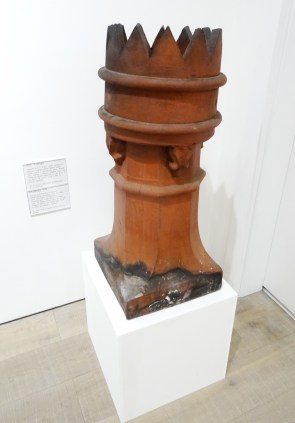
Examples of Dennis Ruabon Ltd terracotta work can be seen locally in Chester at the Westminster Motor Car and Coach Works and the Central Arcade in Hope Street, Wrexham.  Further afield, the Grand Metropole Hotel in Blackpool and Wellington House, at Buckingham Gate in London are high profile examples of  Dennis Ruabon Ltd work.  Whilst Edwards specialized in brickworks based on the Etruria Marl unique to the area, Dennis had interests in a variety of industries, including  quarries, coal pits, waterworks, brickworks and a tramway.

Tiles by J.C. Edwards

Tiles by J.C. Edwards, Henry Dennis, Monk and Newell and the Pant Works

The use of clay pressed into moulds was an excellent way of enlivening buildings, giving them celebratory flourishes without all the costs involved in stone masonry.  The use of moulds that could be re-used many times, enabled manufacturers to produce catalogues for architects, from which their customers could choose appropriate features, which not only made decorative flourishes affordable, but resulted in their proliferation, particularly on roofs.  Once you have seen the items on display, as well as those more elaborate versions shown in the video, it encourages you to look up in places like Wrexham and surrounding villages to spot the terracotta work that gave many local towns a real sense of pride.

Dennis Ruabon Ltd chimney

The layout of the works was elegant and well thought out, with each item widely spaced from the next, allowing it to be appreciated without distraction.  The combination of modern art works and 19th century heritage objects worked beautifully.

All the signage was in Welsh and English, and there was a  handout introducing the modern artists whose works were on display, together with  the 19th century manufacturers J.C. Edwards and Dennis Ruabon Ltd.  I picked up the Welsh version, assuming that it was bilingual; presumably there was an English version as well, so if you don’t read Welsh, look out for it.  I was rescued by Google Translate 🙂

The friendly and helpful curator of the exhibition, whose name I failed to catch, told me that over 2000 people had visited since the exhibition opened in March, with a number of them either former workers or their families sharing experiences.  Certainly, from my own perspective of things I have found in my garden, the Llay Hall brick randomly set into the side of a lane in Farndon, and my enormous affection for 19th century tiles in general and the Westminster Car and Coachworks (now the public library) in Chester in particular, it was very easy to relate to this exhibition.  The modern art pieces also work really well, balancing the older pieces and offering a new way of looking at this type of heritage, as well as engaging the visitor in their own right with thoughts about how heritage can be remembered, explored and, when necessary, lamented.

There was a school party arriving as we left, and on the table by the door I noticed that there was a pile of A4 sheets showing illustrations of three different statues, with an empty space for children to add their ideas for a monumental work.  We flipped through the completed sheets, and they were brilliantly inventive.  They made me remember what it was like to be a child with all that flying, chaotic, no-holds-barred imagination.  I particularly liked the giant robin with a big mouth in its side were its wing should be, complete with a healthy set of teeth.  The giant jelly fish statue was also rather terrific, but they all had something to offer.  Some were surprisingly very abstract.  It was a marvellous idea.

The gallery is a welcoming place, completely unintimidating. I both admired and enjoyed the entire feel of the place.  My only actual grumble about  it is that apart from seating for watching the video there was no seating in the gallery for those who have less than perfectly functioning legs, or who just want to sit and soak up the exhibits.

Practicalities:

The gallery is open 10-4, Monday to Saturday and the exhibition is free to visit.  We didn’t investigate what else the gallery has to offer, so it would be worth checking what else is available and whether there is a ticket charge if you want to visit anything other than the exhibition space (Gallery 1).  Full details for visitors and future exhibits are at https://www.typawb.wales/plan-your-visit.  You can also follow them on Twitter at https://twitter.com/TyPawb

We parked in the multi-storey carpark on Market Street, which has lifts down to the ground floor where the gallery and the food /retail space are located.  It was easy to find, and unlike some multi-storeys, the spaces were generous.  Do not leave your carpark ticket in the car – the pay station is on the ground floor outside the doors to the elevators, and access to the elevators requires you to put your car park ticket into a ticket reader by the side of the door.

Tŷ Pawb has been shortlisted for Art Fund Museum of the Year, the winner of which will be announced in July 2022.  Here’s hoping!
afadfs

Source: Ty Pawb

Sources:

Ty Pawb
Exhibition: Tales from Terracottapolis
www.typawb.wales/tales-from-terracottapolis

Exhibition handout in Welsh:  Chwedlau o Terracottapolis 19/03/22 – 11/06/22


More re Wrexham’s brick, tile and terracotta manufacturing history:

Wrexham Leader
There was gold in the red of Dennis Ruabon
https://www.leaderlive.co.uk/news/20131331.gold-red-dennis-ruabon/

Old Bricks – History at your feet
Ruabon Area
https://www.brocross.com/Bricks/Penmorfa/Pages/ruabon1.htm

Coflein
Hafod Red Brick Works; Dennis Ruabon Brickworks, Rhosllanerchrugog
https://coflein.gov.uk/en/site/40776/

Wrexham History
Henry Dyke Dennis and the Red Works, by John Davies
https://www.wrexham-history.com/henry-dyke-dennis-red-works/

Pontcysyllte
Brickworks
https://www.pontcysyllte-aqueduct.co.uk/object/brickworks/

Hansard 1803 – 2005
Brick and Tile Industry, Wrexham Area: Motion made, and Question proposed, That this House do now adjourn.—[Colonel J. H. Harrison.] – Mr. J. Idwal Jones (Wrexham)
https://api.parliament.uk/historic-hansard/commons/1958/jun/10/brick-and-tile-industry-wrexham-area


More on Ty Pawb:

Ty Pawb
“About” page
https://www.typawb.wales/about/

The Guardian
Tŷ Pawb review – an art gallery that truly is everybody’s house. By Rowan Moore
https://www.theguardian.com/artanddesign/2018/sep/01/ty-pawb-review-art-gallery-everybodys-house-wrexham-market

Architect’s Journal
Something for everybody: Ty Pawb art gallery by Featherstone Young
https://www.architectsjournal.co.uk/buildings/something-for-everybody-ty-pawb-art-gallery-by-featherstone-young

Wrexham Leader
Ty Pawb, Wrexham, shortlisted for Art Fund museum of the year
https://www.leaderlive.co.uk/news/20126804.ty-pawb-shortlisted-museum-year/


More on artists in the exhibition mentioned in this post

Paul Eastwood
https://www.paul-eastwood.net/

Lesley James
https://www.lesley-james.com/

Antony Gormley
https://www.antonygormley.com/


A stroll through Marford Quarry (source of the Mersey Tunnel cement) on a cold but sunny day

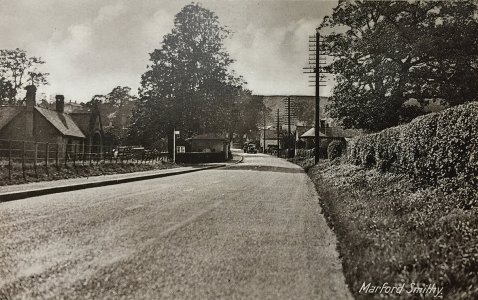
Last week we went to Marford Quarry, just off the Chester-Wrexham road just south of Rossett.  I had never visited before, but it has been open to the public for walking and cycling for decades and has had a lot of work invested in it to make it a great place to walk dogs and stretch legs.  Bigger and smaller footpaths and trails make for a lot of variation, as do the multiple facets of the quarry and its surroundings, with different types of plantation and wildlife providing a lot to see.  Some of it looked almost like a desert landscape, whilst other parts were thick with shrubs and trees.  Although trees dominate even the sparsely covered areas, particularly silver birch and conifers, and the bird song is fabulous, there is a lot more going on at ground level, with wild flowers clustering in favoured spots and the rustle of birds turning over the leaves.  We saw a wren, long-tailed tits, blue tits, great tits, blackbirds and plenty of robins bouncing fearlessly near the paths.  The heart of the quarry a deep bowl with a slight rise in the centre with a single tree on top, is a dramatic sight, like an enormous amphitheatre.

Marford smithy on the left, with the glacial moraine like a giant wall in the background, now quarried away. Source: Essentials Magazine https://www.essentialsmag.co.uk/features/the-last-icesheet

Marford Hill, climbing from Rossett towards Wrexham, is what remains of a glacial moraine.  An article, The Last Ice Sheet by Pam Gibbons in Essentials magazine, has a photograph of the quarry before it began to be quarried for sand and gravel to make cement.  It is shown right, around 130ft high and up to 25,000 years old, dumped by the glacier as it melted, and the ice retreated north.  The former smithy, used by ATS for so long, and recently replaced by two modern houses, is clearly visible on the left at the foot of the hill.  A marvellous photograph, with thanks to Pam Gibbons for recognizing its significance when she saw it.

There was originally a motte and bailey castle at the top of Marford, called Rofft.  I’ll see what I can find out about it, but the quarrying destroyed it, which surprises me given how aware people were of the value of historical sites by the 1930s.  It is such a shame.

Here’s the original caption from the Wonders of World Engineering website: “BUILDING THE ROADWAY through the Mersey Tunnel. Made of reinforced concrete, the roadway is supported by two intermediate walls, 12 inches thick and 21 feet apart, and is anchored to the cast-iron lining. The finished road in the main tunnel has a width of 36 feet between the kerbs. The tunnel has a capacity of 4,150 vehicles an hour, with cars 100 feet apart and moving at twenty miles an hour. The space beneath the roadway acts as the duct for fresh air and is sufficiently large to provide a second road or railway should they be necessary.” Source: Wonders of World Engineering

The quarry opened in 1927 and closed in 1971.  Its biggest claim to fame is the it supplied material for the Mersey Tunnel.  The Mersey Ferry and the railway tunnel, between them doing a good job of carrying passengers to and fro, could not cope with the growing demands of road traffic.  Initially a bridge was proposed, but the engineering wisdom came down in favour of a tunnel, which required a lot of aggregate.  Work on the tunnel started on December 19th 1925.  Today, the former Birkenhead to Wrexham railway, following the river valley, still runs between Chester and Wrexham and runs immediately to the west of Marford Quarry, with the A483 bypass now running between them.  The railway enabled the quarried materials to be loaded directly on to the train and carried to Birkenhead, a super-efficient and cost effective way of acquiring the building materials for the tunnel project.  For a good article on the building of the Mersey Tunnel, with some great pictures, see the Wonders of World Engineering website, which gives the following details “On July 18, 1934, the Mersey Tunnel was opened to traffic by His Majesty King George V. The main tunnel has a length of 3,751 yards, from the Old Haymarket, Liverpool, to King’s Square, Birkenhead. The branch tunnels which lead to the docks on either side of the river bring the total length of roadway to 5,064 yards, or nearly three miles.”  Funny to think of Marford’s glacial moraine holding it all together.  For more about the history of the quarry and its ownership, see the Maes y Pant website.

The main bowl of the quarry, a single tree standing on a slight rise, the rest of the quarry edges rising like an amphitheatre all around it. When I first rounded a corner and saw it, completely empty of people, I found it distinctly eerie.

The 39 acre site was designated a Site of Special Scientific Interest in 1989 and the following year 26 acres of it were bought by the North Wales Wildlife Trust.  As the North Wales Wildlife Trust puts it “The reserve is especially important for a specialised group of invertebrates, aculeate Hymenoptera (bees, ants and wasps), with an astounding 171 different species recorded (2018). Ants, in particular, are an important source of food for green woodpeckers.” In 2011 the site was split into two, and one section of the site is now owned by the Maes-y–Pant Action Group Ltd.

Sadly, the photos taken with the emergency back-up camera that I carry in my handbag did not come out as well as I hoped, but hopefully give some sense of what is there to be seen.  There was a bit that we missed, where there is apparently a viewing point and an outdoor gym, but we figured out where they were so will visit them next time.


Visiting:
There were all age groups present, and several of the unwilling-leg variety who were doing very nicely on the nicely maintained paths, making good use of plenty of benches dotted around (and lots of fallen logs to sit on).  There are some gradients, but not many severe ones, and it is very easy to avoid them.

There are two places to park, one on Springfield Lane just below the Trevor Arms in Marford, with spaces on the side of the road, and a small but proper car park on Pant Lane just beyond (heading north) the Co-op at the top of the hill.  We parked in Springfield Lane and walked along the quarry footpaths to Grove Street, and I walked back to retrieve the car to collect Dad.  It’s about a 15 minute fast walk from one to the other.

Sources

Gibbon, P. The Last Ice Age.  Essentials Magazine
https://www.essentialsmag.co.uk/features/the-last-icesheet

Maes y Pant
Site History by Trevor Britton
http://maes-y-pant.com/site-history.html

Marford Conservation Area Assessment and Management Plan
https://coflein.gov.uk/media/305/417/640273.pdf

Twentieth Century Society
Of the Month: Building of the month – October 2006 – The Mersey Tunnel
https://c20society.org.uk/building-of-the-month/the-mersey-tunnel

Wonders of World Engineering
The Mersey Tunnel
https://wondersofworldengineering.com/merseytunnel.html


S.S. Great Eastern,16th February 1867 – The world’s biggest ship under refit on the Mersey

Introducing Isambard Kingdom Brunel’s S.S. Great Eastern

The Great Eastern under repair, refit and restoration on the shore of the Mersey, at a cost of £80,000. Illustrated London News ,16th February 1867

On this day, February 16th 1867, 155 years ago, the colossal, and glorious iron steamship S.S. Great Eastern was beached on the Mersey just off shore from Rock Ferry, opposite Liverpool, for repairs, a major refit and some much-needed restoration after two years of laying cables across the Atlantic.  The work was undertaken to return her to her status as a luxury passenger liner, ready to embark on a voyage to New York to collect passengers for the 1867 Paris Exposition in France.   She was beautifully captured by an artist for the Illustrated London News, which often featured the vast ship.  I have the same page framed on my kitchen wall.

A sketch by Brunel in his journal, accompanied by the following comment: “”Say 600 ft x 65 ft x 30 ft” (180 m x 20 m x 9.1 m).  Source:  S.S. Great Eastern Facebook page

On 25th March 1852, Isambard Kingdom Brunel, perhaps the greatest civil engineer of the Victorian era, and certainly the most ambitious, had sat at his desk and made a sketch, accompanied by the following comment: “Say 600 ft x 65 ft x 30ft” (180 x 20 x 9m).  The title was “East India Steamship.”  As Rolt puts it so evocatively, “Thereafter the pages of the sketch books are haunted by the apparitions of gigantic ships.”  There had been problems with his other two major shipbuilding projects, Great Western and Great Britain, launched in 1837 and 1843 respectively, but Brunel had a gift for sweeping along hard-nosed investors in his wake, building on the confidence and excitement of a Britain that knew that the world getting smaller everyday, and that it was well-placed to reap the commercial rewards of new technologies.  Although just toying with the idea on those pages, Brunel had no reason to believe that he would have difficulty finding an investor.

In the opening lines of a book devoted to  S.S. Great Eastern, George Emerson observes that “By the middle of the nineteenth century the people of Britain were not easily impressed; they thought they had seen everything,” an impression confirmed by the Great Exhibition of 1851.  If there were multiple blind allies in Victorian creativity, there were also splendid successes, and the sense of unstoppable progress was hard to resist, even when some of the ideas were rather more brave and optimistic than they were viable or sustainable. Even in such a creative and ambitious era, where technological ambition had produced innovation after innovation, Great Eastern stood out as a true landmark of engineering excellence and unrestrained ambition.

Building Brunel’s “Great Babe”

Guide to the Great Eastern Steamship. Captain John Vine Hall commander. Source: Library of Congress

Brunel referred to the ship as “Great Babe,” and she was his last project, his last great gift. He envisioned Great Eastern carrying passengers and cargo to Australia.  The idea came to him whilst working on a much smaller project.  Brunel had been asked to design two steamships for the Australian route for the Australian Royal Mail Company.  He had become aware of the “wave-line principle” proposed and researched by shipbuilder and marine engineer John Scott Russell, who had suggested an optimal hull shape for moving a ship through turbulent energy-draining seas.  Brunel, impressed with Russell’s research, invited him to bid for the contract.  The partnership resulted in two iron steamships, the Adelaide and Victoria, launched in 1853.

One of the sturdier sailing ships on the Australian route, the St Vincent, built in 1829, shown here departing with a full load of emigrants in 1844.  She also carried convicts. She was still sailing when Great Eastern was launched. Source: Illustrated London News, via Wikipedia

The investment in steam by the Australian Royal Mail Company reflected the growing reliability of steam over sail in an era when the passage to and from Australia was still dominated by sail.  The requirement to deliver mail to a schedule put pressure on companies to develop timetables, and this was difficult when depending on sail.  Sailing ships serving Australia could take advantage of the trade winds to do the journey between Australia and Britain in 90-120 days, and although better and faster sailing ships were being built all the time, they were at the mercy of winds and tides.  They were forced to follow routes where the winds were to be found, and were uncomfortable for passengers.  No sailing ship could compare to an iron-hulled steam-powered ship fitted with masts and sails, whose captains could fire up its engines to choose shorter routes and propel it through becalmed waters, whilst still having the option to set sails to save fuel where winds were available.  Even though steamships had to be refuelled en route, the most modern steamship engine designs had improved fuel usage, and now seen journeys of 70-80 days, and these technologies were were improving all the time.  Timetables, previously an impossibility, were now a realistic and exciting possibility, and the Australian Royal Mail Company had jumped on the steamship bandwagon to enable it to meet the terms of its mail contract.

Houses behind the shipyard where Great Eastern was built. Great Eastern rises behind them with the Thames running parallel to the hull on her other side. Source: atlantic-cable.com

Brunel, who had already built two transatlantic ships, now turned his formidable brain to the challenges of sailing to and from Australia.  His key insight was that the ideal ship should be able to carry all the coal she needed to complete the entire round trip without refuelling.  The Australian gold rush of 1851 had supercharged emigration from Britain to Australia, and as Australia became a more economically active part of the global economy, improved communication and transport links were becoming annually more imperative.  But who would finance such a ship?  The obvious customer, the Australian Royal Mail Company, had now been provided with what it needed.  Instead, he looked to the Eastern Steam Navigation Company (ESN Co), which had been formed the previous year, to which he submitted a paper proposing the new ship.  In spite of misgivings of some of its board of directors, the proposal was accepted.  At this stage, two sister ships were envisaged, the first to be used between Britain and Ceylon (today Sri Lanka) off the southeast coast of India, to be used as a distribution network from which smaller cargoes would be sent to Madras, Calcutta, Hong Kong and Sydney in Australia.  If that were to prove successful, the two ships would then do regular runs to Calcutta and Australia.  The mind fairly boggles at the idea of two Great Eastern ships on the oceans.

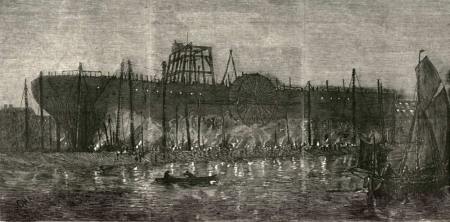
Working on “Great Eastern” in 1857 at night, preparing the great ship for launch by gas light. Source: atlantic-cable.com

Work began with the laying of the keel plate in May 1854 in John Scott Russell’s Millwall yard on the Thames, almost opposite Henry VIII’s Royal Docks at Deptford.  Although these beginnings went unnoticed by either the public or general media, specialist reports began to emerge, drawing attention to the vast scale of the ship, and even before she was launched, there was a momentum of interest in the enormous ship.  As she went up, slowly materializing in Russell’s yard, the sheer scale of Brunel’s vision became evident, and the popular media began to take an interest.  The Times waxed lyrical about the build on 5th April 1857:

Where is a man to go for a new sight? We think we can say.  In the mist of that dreary region known as Millwall, where the atmosphere is tarry and everything seems slimy and amphibious, where it is hard to say whether the land has been rescued from the water or the water encroached upon the land . . . a gigantic scheme is in progress, which if not an entire novelty, is as near an approach to it as this generation is ever likely to witness.

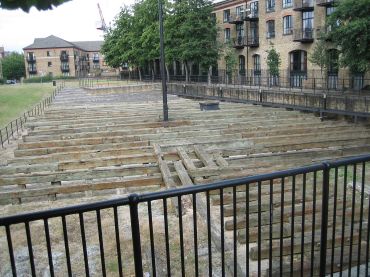
Remains of the slipway down which Great Eastern was launched. Source: Wikipedia

Great Eastern was built just behind today’s Thames Clipper (river bus) stop called Masthouse Terrace Pier, which can be seen on the photograph below.  Operations were directed by John Scott Russell.  The old slipway is still in situ and can be visited, a very short distance from Masthouse Pier, shown right.  When popular novelist Charles Dickens went to see the work in progress, he commented that she rose “above the house-tops, above the tree-tops, standing in impressive calmness like some huge cathedral.”  In fact, the noise associated with the welding and riveting of 30,000 iron plates to form her double hull and watertight bulkheads must have been deafening rather than calm, an absolute cacophony, but Dickens does manage to convey the majesty of the enterprise.  The build of the ship was fraught with problems, financial and technical, and of course there were accidents and injuries, as well as a fire that destroyed much of the shipyard.  The relationship between Brunel and Scott Russell became increasingly acrimonious towards the date of the proposed launch, and it is something of a miracle that Great Eastern was ever completed.

Superimposition of Great Eastern on the modern Google satellite image by Mick Lemmerman.  Masthouse pier is clearly visible. Source:  Isle of Dogs – Past Life, Past Lives blog

When it came to her launch, her very size created a unique situation.  As shown in the photograph and superimposition by Mick Lemmerman, left, she was so long that she had to be built parallel to the Thames, rather than perpendicular to it.  In a lecture that I attended in London a few years ago, Thames archaeologist (and excellent speaker) Elliott Wragg commented that if the ship had been launched stern-end first, as was usual, she would have plunged into and across the Thames, shattering its southern banks before proceeding to carve her way down Deptford High Street.  Everyone at the lecture, all of us familiar with today’s thriving Deptford High Street, burst out laughing, but he made his point very effectively.  The ship really was immense.  Russell had to lease part of a neighbouring shipyard to accommodate her, and plans were made for a sideways or broadside launch.

Robert Howlett’s famous photograph on the occasion of the first launch attempt, 2rd November 1857. It is the only photograph that shows Brunel and Russell together. Russell is at far left, and Brunel is third from the left.  Source: Wikimedia

At that time known as Leviathan, Brunel’s dream ship became a reality when she was launched on the Thames on January 31st 1858, following several, increasingly embarrassing abortive attempts that had begun on 3rd November 1857.  There were few witnesses when the Great Ship, as she had become known, was eventually launched without ceremony or drama.  The public, initially excited by the prospect of the 1857 launch had lost interest, but as the news of the launch spread, bells were rung across London in celebration.

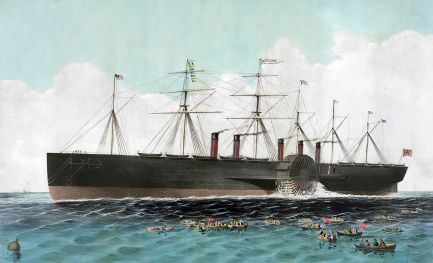
Great Eastern was now afloat, and an impressive sight.  She had two means of propulsion, consisting of two huge side-mounted paddle-wheels, and a single screw propeller.  When both were used simultaneously she could reach a maximum speed of 15 knots (or 27.7 kilometres per hour), and she carried 6500 yards (5943m) of sail on her six masts.  Each of the ten engines built by James Watt and Co. was the size of a house.  She had four decks, and could carry 4000 passengers and 15,000 tons of coal. 

Infographic comparing ship sizes, in chronological order from left to right. Click to expand. Source: JF Ptak Science Books.

She measured 692ft (211m) long, 83ft (25m) wide, with a draft of 20ft (6m) unloaded and 30 ft (9m) fully laden, and displaced 32,000 tons fully laden. In comparison, S.S. Persia, the next in size launched two years earlier in 1856, was 390ft (119m) long and 45ft (13m) wide.  Not until 1906 was her 22,500 ton displacement exceeded in 1906 by Cunard’s RMS Lusitania;  and her great length surpassed, in 1899, by the White Star Line’s RMS Oceanic of 704ft (215 m).  At the time of her launch in 1858, S.S. Great Eastern was the biggest ship that anyone had dared to imagine.  

One of Robert Howlett’s photographs of Brunel with Great Eastern in 1857 prior to launch. Source: Wikimedia

In spite of the launch, celebration was not on the minds of the ESN’s company directors.  She had already cost an eye-watering amount, and to fit her out, a lot more investment was required, and there was no money left.  Emerson summarizes the situation as follows:

The great ship was in the water but how was she to be completed?  About £640,000 had been expended on an unfinished, partially engined and boilered ship which no one seemed to want, with a debt of £90,000 handing to it like a superfluous anchor. . . . There was growing belief among some of the directors that the ship should be put up for sale or auction.

For a long time, the ship sat on her mooring at Deptford, incomplete.  Eventually Brunel persuaded railway contractor Thomas Brassey to form a new company to raise the money to complete Great Eastern. The “Great Ship Company” was formed, which purchased the ship for £160,000, whilst raising additional capital to fit out the ship and ready her for active duty.  Brunel, sent by his doctors to Egypt for his health, was absent for much of the fitting out, returning in time to oversee final work under preparation for Great Eastern‘s maiden voyage in September 1859.  Checking her over on the 5th September, Brunel suffered a stroke and was carried home, partially paralysed.

Sea Trials in 1859

Great Eastern set off on sea trials under Captain William Harrison and a team of engineers without Brunel, on 17th September 1859, proceeding with the aid of tugs down the Thames, which must have been a remarkable leg of the journey given her size, before turning into the open sea, heading south and then west along the coast.  The Times reported:  “She met the waves rolling high from the Bay of Biscay.  The foaming surge seemed but sportive elements of joy over which the new mistress of the ocean held her undisputed sway.”

Explosion on Great Eastern 1859. Source: Royal Museums Greenwich, PAH0309

On her first sea trials, without the ailing Brunel to supervise, she was proceeding along the English Channel near Hastings when an explosion in the paddle engine room sent one of the funnels flying upwards, destroyed the beautiful grand salon, the fire and pressurised steam tragically killing five stokers and injuring twelve.  Thanks to her double-skinned hull and watertight bulkheads Great Eastern remained intact, and thanks to alternative propulsion, she was able to proceed under her own steam. Brunel was told of the explosion, which must have been an awful blow.  He died six days later, aged 53.

Repairs to the ship were soon underway in Weymouth and the ship proceeded to Anglesey in October, where she dragged the two anchors holding her and began to drift in the same gale that sunk the S.S. Royal Charter nearby, with 446 lives lost. Thanks to her captain, crew and the engines used to hold her in position, she survived the night but the episode raised serious concerns about her ability to endure a storm at anchor.  Great Eastern suffered damage in the storm and underwent more repairs,

Consideration now had to be given to the ports that would be able to handle Great Eastern at home in Britain.  She usually sailed from either Milford Haven in southwest Wales, or Liverpool, on the Mersey.  In both places she could be accommodated with moorings in relative shelter, and laid up on gridirons when she was under repair or out of service.

The career of the S.S. Great Eastern

Great Eastern in New York in 1860. Source: Library of Congress (LOT 14160, no. 10)

Great Eastern had been designed to carry passengers and cargo to Australia, carrying sufficient coal to complete the round trip without refuelling. In an era before the building of the Suez Canal, which opened in 1869, Great Eastern could have chugged round Africa and back at greater speeds, with greater reliability, than any sail- or steam-powered ships currently operating.  She could have offered far greater comfort and at much less risk with enormously more capacity for passengers and cargo than any sailing ship owner could dream of at that time.  Unfortunately no-one had taken into consideration that she was far too big for nearly all the harbours to which she might have sailed, meaning that passengers, their luggage and the cargo would have to be ferried to shore in smaller vessels.  In addition, her experience anchored off shore at Holyhead in Anglesey in a gale had cast doubt on how well she was equipped to sit at anchor beyond harbour walls.

More to the point, the struggling Great Ship Company was unable or unwilling to raise the funds to send her that far, and the decision was taken to send the ship to America on its maiden voyage, as a transatlantic passenger liner.  To top off a rough few years, in January 1860 Brunel’s chosen Captain, William Harrison, drowned in a freak accident in a small sailing boat on the approach to Southampton harbour.  He was replaced by John Vine Hall, who was in charge of her maiden voyage to New York in the same year.

Interior of the Great Eastern showing the grand saloon. Source: McCord Museum, Quebec

Great Eastern‘s first commercial trip on 17th June 1860, her official maiden voyage as a luxury liner, was from Southampton to New York under Captain Vine.  On board there were only 38  paying passengers and 418 crew.  Great Eastern was greeted as a fabulous spectacle in New York, a shining, magnificent newcomer.  Taking advantage of this, with the intention of milking her for all she was worth between arrival and departure, the decision was made to sell tickets for a two-day excursion, a mortifyingly mismanaged episode that did nothing to shower the ship or her owners in glory.  She returned to Britain via Halifax with 72 passengers and was laid up for winter at Milford Haven in southwest Wales.

Repairs and adjustments were made, at a cost that the slim gains from America were unable cover, and more financial controversies ensued, all reported in the media, and proving a barrier to further bookings.  In May 1861 around 100 passengers embarked at Milford Haven for New York.  Four days in, they hit a gale, and the previously steady ship was tossed around much like her smaller competitors,  Passengers experienced nothing worse than cuts and bruises, and no serious damage, but it frightened the passengers and undermined the storm-proof reputation of the ship.

1958 lithograph of Great Eastern by Charles Parson. Source: Wikipedia

Great Eastern put into New York just after the outbreak of the Civil War and following her return to England she was refitted as a troop ship to carry British soldiers and family members to Canada from Liverpool.  Once the refit was complete, she sailed for Quebec in June 1861 with 2144 officers, 473 women and children and 122 horses, as well as 40  paying passengers and a crew of 400.  This was the first and last time her massive capacity was actually useful for carrying passengers.  After a 10 day voyage from Liverpool to Quebec, she remained for a month, taking on paying sight-seers, and accumulating bookings for the return trip, carrying 357 passengers back to England.  She began to be a regular on the transatlantic route.

The Great Eastern in a gale, 1861. Source: Royal Museums Greenwich

After several incident-free voyages, in September 1862 the ship left Liverpool with 400 passengers and a commercially healthy load of cargo. On the afternoon of the second day out, the ship hit a gale and in the process of turning into the storm, the rudder was hopelessly damaged which, hanging loosely, began to damage the propeller.  In addition, one paddle wheel damaged in the storm was shredded, lifeboats were lost, and furniture and fittings were tossed throughout the ship’s interior.  Water entering through smashed skylights and portholes began to overwhelm the pumps.  The day was saved, but not by captain, officers or crew.  A passenger, civil engineer Hamilton Towle, devised a scheme to steer the rudder manually.  Under his direction, the crew managed to wrap chains around the rudder, restart the screw propeller, turn the ship around and limp her into Queenstown (today Cobh) in southeast Ireland.  She was subsequently escorted by tug to her mooring at Milford Haven.  It cost some £60,000 to repair the ship, and Towle claimed that as Great Eastern would have foundered without his intervention he could demand a salvage fee.  He was awarded £15,000, and again the management company found itself struggling.

Cross section of the Great Eastern. Source: Original unknown; this was downloaded from Encyclopedia Titanica

Great Eastern returned to the New York run in May of 1862, with only 128 passengers on the way out but 389 and a hold full of cargo on the return journey.  Her July 1862 voyage was also successful.  In spite of this, she was not competitive with the fastest ships against which she was running, all of which, being so much smaller, were running at their full passenger and cargo capacity and burning much less coal.  These were profitable where Great Eastern was struggling.  Her third voyage in 1862 caused more financial worries when,on the approach to New York in late August, she scraped against an uncharted reef.  Although the ship made port without difficulty, thanks to the double-skinned hull, the tear was 80ft long and the cost of a temporary repair was £70,000, partly due to the difficulty of obtaining materials during the American Civil War.  She returned to Liverpool in January 1863, with a substantial cargo, and was put on a gridiron on the Mersey for the damage and repairs to be inspected.  The temporary repair had to be made good, and two boilers required work. 

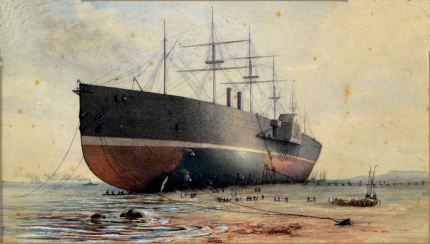
Great Eastern watercolour showing the ship on the gridiron in 1863. By W.G. Herdman. Source: Williamson Art Gallery Collection at Birkenhead.

1863 was a much better year and she carried a total of some 2700 passengers to New York and 950 in return over three trips.  Still, she made a substantial loss thanks to a pricing war started between the Cunard and Inman Lines, which pushed fares down to below the 1862 rates.  Combined with mortgage and creditor debts, the Great Eastern was no longer viable, and she was put up for auction in January 1864.  She failed to meet her reserve, and the ship was withdrawn from sale.  Instead, she was sold privately for £25,000 to a new company formed to buy her for cable laying, The Great Eastern Steamship Company.  

The following years were Great Eastern‘s  most productive.  She was ideally suitable for laying telegraph cables along the floor of the Atlantic, the only ship large enough to carry the machinery and the 2,000 nautical miles of cable required to reach from Ireland to America.  She was first engaged on this work from 1865-1866.  Although the first attempt to lay cable failed due to problems with both the cable laying equipment and the cable itself, the value of Great Eastern herself was proved, and the second attempt in July 1866 was a great success, and there were now two telegraph cables lying across the seabed of the Atlantic.  A dividend of 70%  was returned on the Great Eastern Steamship Company’s shares.

Great Eastern and the Paris Exposition Universelle of 1867

Magnificent painting of Great Eastern under repair at New Ferry, by Edwin Arthur Norbury. The Illustrated London News engraving at the top of the post is thought to have been based on this painting. Source: Artware Fineart

Great Eastern had been a familiar sight on the Mersey from the early 1860s, when she often used Liverpool as a base for her transatlantic crossings.  The Mersey was one of the few rivers wide enough and sheltered enough to provide her with safe harbour when she was not at sea.  After 1866, Great Eastern returned to Milford Haven.  The Great Eastern Steamship Company, having completed its work, jumped at the opportunity to rent her out for a one-off voyage as a passenger ship.  She was leased for £1,000 a month to a French company, La Société des Affréteurs du Great Eastern, which planned to use her to take around 3000 wealthy Americans to the Paris Exposition, and was moved to the Mersey for a refit.  Some illustrations refer to her being at New Ferry, others at Rock Ferry. There is some confusion in publications over whether New Ferry or Rock Ferry was the most appropriate name for the location.  In fact, both appear to refer to the Sloyne, an anchorage in the Mersey, lying off shore where Tranmere Oil Terminal is located.  It was popularly used as a mooring for particularly deep ships, including the Royal Navy training ship HMS Conway

The French company agreed to pick up the bill for refitting Great Eastern, together with new screw boilers, at a cost of £80,000. A Liverpool company picked up the contract to restore her to her former finery and overhaul the engines, work taken place at the Sloyne, as shown in the picture above and at the top of the post, between 19 January and 21 February 1867, ready to sail in March.

The story of Great Eastern‘s repairs was reported 26th January 1867, as follows in the Brecon County Times Neath Gazette and General Advertiser for the Counties of Brecon Carmarthen Radnor Monmouth Glamorgan Cardigan Montgomery Hereford.

Account of the repairs to Great Eastern at Rock Ferry. Source: Brecon County Times

BEACHING OF THE GREAT EASTERN. The big ship was, on the 19th, placed on the grid- iron at New Ferry, just above Liverpool, on the Cheshire side of the river. The gridiron, on which the ship now rests, was constructed about three years ago, when the vessel was first overhauled in the Mersey, but has since been altered, strengthened, and very much improved. There was a very high spring tide, and although the ship was drawing 18 feet 6 inches of water on an even keel, there was quite sufficient depth on the shore to render the operation of beaching a safe one. She lies broadside on the grid running parallel with the river. About nine o’clock a.m. all was in readiness, and the ship left her moorings. Sir James Anderson, the commander of the big ship, attended to the navigation, while Mr. Brereton, the successor to Mr. Brunel, and Mr. Yockney, carefully watched the engineering department.  Four steam-tugs (two on each side the Great Eastern assisted to keep the vessel in position, as with scarcely perceptible motion she neared the beach. The screw engines only of the big ship were worked. Tie screw boilers have been taken out of the ship, and are to be replaced by new ones, and the screw engines were consequently worked from the paddle boilers. The big ship took the grid about ten o’clock. She was placed with great nicety in the exact position fixed upon. Every- thing passed off without the slightest accident, and the beaching may be said to have been accomplished in the most skillful and successful manner. The Great Eastern is kept in position by two massive dolphins. Although her sides and bottom are rather dirty, the lines, bolts, and rivets appear in excellent order. The gridiron is perfectly flat for 60 feet wide, and the big ship rests in perfect security upon it. Every precaution has been taken to prevent accident. Thousands of men are at present engaged on the ship, and she will be ready at the time specified to trade between New York and Brest. Her first voyage after she comes off the grid-iron will be from Liverpool to New York, with goods and passengers.

Great Eastern sailed to New York with 123 passenger on board, which took a lengthy 14 days due to storms and the need to run in new parts.  Jules Verne, renowned for his novels about futuristic technology, was on board Great Eastern when she left the Mersey .  His subsequent novel The Floating City, is a real mixed blessing, combining his own real world experiences with a very bad fictional drama.  In spite of that, the bits of his text where he talks about the ship herself are excellent.  One of my favourite bits describes her leaving her mooring on the Mersey before heading across the Atlantic (the rest of this account can be found at the end of this post):

Illustration in the Jules Verne book The Floating City

At this moment large volumes of smoke curled from the chimneys; the steam hissed with a deafening noise through the escape-pipes, and fell in a fine rain over the deck; a noisy eddying of water announced that the engines were at work. We were at last going to start.

First of all the anchor had to be raised. The Great Eastern, swung round with the tide; all was now clear, and Captain Anderson was obliged to choose this moment to set sail, for the width of the Great Eastern, did not allow of her turning round in the Mersey. He was more master of his ship and more certain of guiding her skilfully in the midst of the numerous boats always plying on the river when stemming the rapid current than when driven by the ebb-tide; the least collision with this gigantic body would have proved disastrous.

To weigh anchor under these circumstances required considerable exertion, for the pressure of the tide stretched the chains by which the ship was moored, and besides this, a strong south-wester blew with full force on her hull, so that it required powerful engines to hoist the heavy anchors from their muddy beds. An anchor-boat, intended for this purpose, had just stoppered on the chains, but the windlasses were not sufficiently powerful, and they were obliged to use the steam apparatus which the Great Eastern, had at her disposal.

At the bows was an engine of sixty-six horse-power. In order to raise the anchors it was only necessary to send the steam from the boilers into its cylinders to obtain immediately a considerable power, which could be directly applied to the windlass on which the chains were fastened. This was done; but powerful as it was, this engine was found insufficient, and fifty of the crew were set to turn the capstan with bars, thus the anchors were gradually drawn in, but it was slow work.

A dining room on the Great Eastern. Source: National Library of Ireland

After an on-board accident leaving port, the ship reached New York without further incident, and preparations were immediately made for her voyage from New York to Brest in France, from where passengers were to be sent on to Paris.  She had berths prepared for 3000 passengers, but the lengthy  outward passage, much publicized, proved to be a deterrent and she left New York with only 191 on board.  This was a disaster for the French company that had invested so much in her.  It was also a disaster for the Great Eastern Steamship Company, which was caught up in legal disputes concerning unpaid crew fees amounting to £4500.00.  When the company told aggrieved crew members to sue the French firm that had leased the ship, they took legal advice.  Great Eastern was seized by the Receiver of Wrecks, and the Great Eastern Steamship Company eventually awarded the crew a miserly £1500.00. No dividend was paid in 1867.

From 1869 to 1870 and between 1873 and 1874, the great ship had returned to cable work.  Between these two contracts she sat unused at anchor on the Mersey and in 1874 was returned to Milford Haven where she again sat unused.

Great Eastern’s final days on the Clyde and the Mersey 

Back in Milford Haven, no-one could think of a commercially viable use for Great Eastern, and she was beached on a gridiron  in 1874 and was left there for twelve years.  In 1885 she was eventually auctioned to a coal haulier, Edward de Mattos for £26,200, who had first shown interest in her in 1881.  He is thought to have wanted her as a coal hulk in Gibraltar, but his plans fell through, and he agreed to lease her to Louis S. Cohen. Cohen, managing director of Lewis’s Emporium in Liverpool, one of the earliest department stores, had attempted to purchase the ship himself to use as a show boat, but  was prevented by some of his mortgagees.  Leasing her was the next best solution, and Cohen hired crew to bring her from Milford Haven to Liverpool, inviting 200 guests to enjoy the voyage.  In May, she left Milford Haven, once her engines were persuaded back to life by one of her former engineers, George Beckwith.  Having sat unused for so long, her paddles had rusted and were useless, but the screw propeller was in tact and the engines obediently fired up.  Unsurprisingly, the engines could not achieve anything like maximum output, and the hull was mired with seaweed, mussels and limpets, but she still averaged 5 1/2 knots.  The engines failed once when pipes burst, and there was a small fire, but these problems were resolved en route and the guests were delivered safely to their destination.  News of her upcoming arrival in the Mersey had generated considerable interest, and the crowds began to gather.

All along the shore from Crosby crowds of people might be seen assembled looking for the arrival of the big ship.  Tugs crowded with persons approached and cheered.  The Cheshire shore and the New Brighton pier were crowded, and all the way up the river on either side the shore riverwalls and landing stages were black with spectators. (New York Times).

Great Western with an advert for Lewis’s department store painted on her hull, on the Mersey. Source: Royal Museums Greenwich (P10569)

Advertising was painted on her hull, promoting Cohen’s own chain of Lewis’s department stores, the painting having been carried out before her arrival at Liverpool.  Lewis’s was a local success story.  It was founded in 1856 by the son of a Jewish merchant who called  David Levy, who changed his name to Lewis.  He did an apprenticeship with tailors Benjamin Hyam and Co, and at the age of 23 opened a boys’ clothing shop.  His wife’s nephew was Louis Cohen, and the two teamed up to grow the business into the Lewis’s supermarket chain, with the flagship store in Liverpool, and branches opening during the later 19th Century in Manchester, Sheffield and Birmingham, all marketed with the slogan “Lewis’s are friends of the people.” David Lewis died in 1885, after which Louis Cohen took over the entire enterprise.  The entrepreneurial spirit that drove the retail chain was clearly drawn to the marketing possibilities of Brunel’s great ship.

Moored on the Wirral side of the Mersey, visitors had to be ferried over to Great Eastern from Liverpool, and there was no shortage of visitors willing to pay a shilling for a visit, accompanied by entertainments including music and dancing, and religious music played on a Sunday.

Great Eastern laid up in Milford Haven. Source: Source:  Isle of Dogs – Past Life, Past Lives blog

When Cohen’s contract came up for renewal, he decided against renewing and de Mattos decided to covert Great Eastern into a funfair, with space rented out to performers, vendors and other interested parties.  She opened complete with merry-go-rounds and acrobats, with a music hall, a dining room and bars.  After opening in Liverpool, she spent the winter in Dublin with adverts for tea painted on her hull, returning to Liverpool in April 1887.  She was now refused a license for alcohol, possibly because of church objections to the employment of workers on a Sunday, even for performances of sacred music.  The novelty had worn off and the revenues dried up, and she was moved to Greenock on the Clyde in August 1887, to lure in residents of Glasgow who were delivered by steam packet, but again the scheme was a financial failure.  The ship was put up for auction and posters were printed publicizing the sale.

TO BE SOLD AT PUBLIC AUCTION on Thursday 20th October 1887 at 12 O’Clock, at the Brokers’ Saleroom, Walmer Building, Water Street, Liverpool, if not previously disposed of by private treaty, THE CELEBRATED, WORLD-RENOWNED, MAGNIFICENT, IRON PADDLE AND SCREW STEAMSHIP ‘GREAT EASTERN’, as she now lies in the Clyde. Lately steamed from Dublin to Liverpool and then to the Clyde with her screw engine, which is 1,000 h.p. nominal; paddle engines are 1,000 h.p. nominal. She has lately been painted and decorated.

The ship was now purchased by a Mr. Craik for £26,000 who seems to have been de Mattos’s manager and had bid on the ship to prevent a financially ruinous sale.  After several more weeks of failure to find a buyer for Great Eastern, she was sold to a shipbreakers for £16,500.

This cartoon was published in 1858 at a time when members of the media were poking fun at the multiple failures to launch the ship, which at that stage was still called “Leviathan.”  It is bizarre and truly regrettable that this silly satire became the commercial reality nearly 30 years later. By Watts Phillips. Source: Mariners’ Blog

By October, Great Eastern was again up for sale, and was purchased only to be auctioned for scrap in 1888 to Henry Bath Ltd, 30 years after her launch in London on the Thames.  Henry Bath was established in 1794, and is still going today, although no longer involved in ship breaking.  She left the Clyde on 22nd August 1888.  Unable to make more than 4 knots, she was provided with a tow from the accompanying tug boat, Stormcock.  It took three days to move her to  the Mersey.

Great Eastern, beached in advance of being broken up on the Mersey, Wirral side.  Source: Liverpool Echo

Great Eastern was broken up on the Mersey on the same gridiron erected for the repairs.  It is a measure of how big an impression she still made that there was a huge demand for souvenirs, with people lining up to buy pieces of the ship before she the work began.   Breaking began on 1st January 1889.   In this too she ate into her new owner’s profits.  The company directors had estimated that it would take 200 men a year to break up the ship, but she was so well built that it took nearly two years to complete the brutal and punishing task of taking her apart. Her buyers, having been very happy with the purchase price and having made an excellent start selling pieces of her hull and her fittings, had looked forward to a substantial profit from breaking her up as scrap.  Instead, they found themselves paying out for far more man-hours than anticipated, as well as having to bring in additional machinery, including wrecking balls, to finish the job.  She was broken up at a loss.

Final comments

Flagpole at Anfield, which was originally a topmast from Great Eastern. The flagpole still stands today. Source: Play Up, Liverpool

There are plenty of paintings and contemporary newspaper articles, as well as original documentation, from which much of the Brunel and Great Eastern story have been retold in books, articles, museums and art galleries.  An example is a display in the  Merseyside Maritime Museum’s Emigration Gallery where the ship’s bell is preserved.  There is also a silver model of the ship made for the son of Captain Paton, who had been with the ship from 1860-1863.  Captain Paton’s son, James Paton, had been born on board Great Eastern.  A part of one of the ship’s funnels, which exploded during her sea trials, is now at the S.S. Great Britain Museum, saved after she put into Weymouth for repairs.  In 2011, Time Team, a Channel 4 archaeological series carried out a geophysical survey on the Mersey foreshore that suggested that some small pieces of the ship are still buried where she was broken up on the Mersey.  Perhaps the most unusual remnant of the ship is at Liverpool FC in Anfield, where one of Great Eastern‘s top masts is used as a flagpole.  There must be dozens of souvenirs purchased in the final days before Great Eastern was broken up, still out there, perhaps unrecognized.

The Leviathan or Great Eastern Steam Ship.  Source:  Royal Museums Greenwich

It is often said that Great Eastern was ahead of her time, but in some ways, she was too late for the moment when she would have fulfilled Brunel’s vision of filling her to capacity with passengers.  The gold rushes of California (1848–1855) and Australia (1851-1860) saw massive emigration from the UK.  In Australia, by the early 1870s the population had tripled, and most of the emigrants accounting for this phenomenon were carried on sailing ships in often dreadful conditions; they would have been far better off on Great Eastern.  It remains something of a mystery to me why, after her initial service in the US and as a cable layer, she never did go to Australia.  In 1869 the Suez Canal opened, putting many sailing ships out of business in China, because they were unable to navigate the Red Sea’s difficult cross-winds, whilst steam ships could chug on regardless, in a fraction of the time.  Full-rigged tea clippers like Cutty Sark (launched in 1869) shifted on to the Australian route, carrying out passengers and goods for wealthier emigrants and farmers, and returning with sheep wool.  Steam ships of the era could not carry sufficient coal to be competitive on the Australian route, but Great Eastern would have been perfect.  Emerson interestingly suggests that some of the company’s directors may have wanted to avoid putting her into competition with shipping lines serving Australia and the Far East in which they had interests.  

As Kenneth Clark said in his classic book Civilisation, Brunel “remained all his life in love with the impossible.”  There are plenty of survivors to remind us of this wild, explosive imagination.  One of Brunel’s earlier and brilliant ships, the Great Britain, has been preserved in dry dock in Bristol, and his railways and bridges are still used today.  It is a true tragedy that Great Eastern could not be rescued, but she really was too big and expensive to maintain.  It is impossible to imagine how she could have been saved.  Brindle calls her Brunel’s “ultimate triumph, and his greatest folly.”  Sad.

I am left wondering it was like to be at the helm of such an enormous ship, powered by steam or sail, propelled by screw or paddle.  So far, I have found nothing about what it was like to handle that vast, glorious bulk, so please let me know if you know of any first-hand accounts by one of her former captains or crew.

The same length as Great Eastern, the Silver Spirit, photographed in 2021. Source: Vessel Finder

Cruise ships today are still being made that are the same length as Great Eastern, although their other vital statistics are  unsurprisingly considerably different.  One example is Silversea’s Silver Spirit, 211m long (the same length as Great Eastern), with a passenger capacity of 608.  Although she was shorter when first built in 2009, she was cut in half and a middle section added in 2018 and is now, from bow to stern, the same length as Great Eastern.

The following is a short but visually appealing 2-minute Royal Museums Greenwich video about Brunel and the Great Eastern:


Here’s more from Jules Verne on what it was like to be on board the leviathan.

A Floating City
Chapter V – Off at Last [leaving the Mersey]
Jules Verne

THE WORK of weighing anchors was resumed; with the help of the anchor-boat the chains were eased, and the anchors at last left their tenacious depths. A quarter past one sounded from the Birkenhead clock-towers, the moment of departure could not be deferred, if it was intended to make use of the tide. The captain and pilot went on the foot-bridge; one lieutenant placed himself near the screw-signal apparatus, another near that of the paddle-wheel, in case of the failure of the steam-engine; four other steersmen watched at the stern, ready to put in action the great wheels placed on the gratings of the hatchings. The Great Eastern, making head against the current, was now only waiting to descend the river with the ebb-tide.

The order for departure was given, the paddles slowly struck the water, the screw bubbled at the stern, and the enormous vessel began to move.

The greater part of the passengers on the poop were gazing at the double landscape of Liverpool and Birkenhead, studded with manufactory chimneys. The Mersey, covered with ships, some lying at anchor, others ascending and descending the river, offered only a winding passage for our steam ship. But under the hand of a pilot, sensible to the least inclinations of her rudder, she glided through the narrow passages, like a whale-boat beneath the oar of a vigorous steersman. At one time I thought that we were going to run foul of a brig, which was drifting across the stream, her bows nearly grazing the hull of the Great Eastern, but a collision was avoided, and when from the height of the upper deck I looked at this ship, which was not of less than seven or eight hundred tons burden, she seemed to me no larger than the tiny boats which children play with on the lakes of Regent’s Park or the Serpentine. It was not long before the Great Eastern, was opposite the Liverpool landing-stages, but the four cannons which were to have saluted the town, were silent out of respect to the dead, for the tender was disembarking them at this moment; however, loud hurrahs replaced the reports which are the last expressions of national politeness. Immediately there was a vigorous clapping of hands and waving of handkerchiefs, with all the enthusiasm with which the English hail the departure of every vessel, be it only a simple yacht sailing round a bay. But with what shouts they were answered! what echoes they called forth from the quays! There were thousands of spectators on both the Liverpool and Birkenhead sides, and boats laden with sight-seers swarmed on the Mersey. The sailors manning the yards of the Lord Clyde, lying at anchor opposite the docks, saluted the giant with their hearty cheers.

But even the noise of the cheering could not drown the frightful discord of several bands playing at the same time. Flags were incessantly hoisted in honour of the Great Eastern, but soon the cries grew faint in the distance. Our steam-ship ranged near the “Tripoli,” a Cunard emigrant-boat, which in spite of her 2000 tons burden looked like a mere barge; then the houses grew fewer and more scattered on both shores, the landscape was no longer blackened with smoke; and brick walls, with the exception of some long regular buildings intended for workmen’s houses, gave way to the open country, with pretty villas dotted here and there. Our last salutation reached us from the platform of the lighthouse and the walls of the bastion.

At three o’clock the Great Eastern, had crossed the bar of the Mersey, and shaped her course down St George’s Channel There was a strong sou’wester blowing, and a heavy swell on the sea, but the steam-ship did not feel it. . . .

Our course was immediately continued; under the pressure of the paddles and the screw, the speed of the Great Eastern, greatly increased; in spite of the wind ahead, she neither rolled nor pitched. Soon the shades of night stretched across the sea, and Holyhead Point was lost in the darkness.


Colour lithograph (7 in total) of the S.S. ‘Great Eastern’, designed by Isambard Kingdom Brunel and John Scott Russell, launched 1858. 1850s. Longitudinal section. Scale 1/8″ : 1′. Flat copy. Click to see bigger image, and click the link following to see close-up details in sections. Source:  The Science Museum

Sources:

Books and papers

Brindle, S. 2005.  Brunel. The Man Who Built the World. Weidenfeld and Nicolson

Cadbury, D. 2003.  Seven Wonders of the Industrial World. Harper Perennial

Emmerson, G.S. 1980. The Greatest Iron Ship.  S.S. Great Eastern. David and Charles

Maggs, C. 2017. Isambard Kingdom Brunel. The Life of an Engineering Genius. Amberley Books

Rolt, L.T.C. 1957 (with an introduction by Buchanan, R.A. 1989). Isambard Kingdom Brunel. Penguin

If you want to know more about Brunel or Great Eastern and are looking for just one book to read:
Of all the books about Brunel in general, rather than the Great Eastern specifically, I found both Maggs and Rolt the most useful. Rolt offers the best narrative with most detail (447 pages). Maggs is also thoroughly digestible, and is the best for quoting Brunel himself (310 pages).  Brindle is by far the least useful for detailed analysis (195 pages), but is an enjoyable romp through Brunel’s life.  All three have shiny illustrations and photographs clumped together.  All three, being about Brunel, end with his death, and do not pursue the longer term fortunes of any of his ventures.
Regarding Great Eastern, Emerson’s book is invaluable, with a good analysis and some terrific photographs, although it is not always easy to track dates; Cadbury did an excellent job in the chapter of her book (and the other chapters on other engineering triumphs of the period are also a good read); the chapter by Maggs is short, but quotes Brunel extensively, which offers great insight into Brunel’s thinking; Rolt provides a lot of excellent detail in two and a half chapters on the subject; finally, Brindle devotes only 21 pages to all three best-known ships, which renders it fairly useless for insights into Great Eastern.

Websites

Artware Fine Art
Text about the picture “The Great Eastern beached on the gridiron New Ferry , On the Cheshire Bank of the Mersey February 1867 with workers maintaining the Hull”
https://www.artwarefineart.com/gallery/great-eastern-beached-gridiron-new-ferry-cheshire-bank-mersey-february-1867-workers

Dead Confederates. A Civil War Era Blog
The World’s Largest Troopship
https://deadconfederates.com/2014/09/29/the-worlds-largest-troopship/

Grace’s Guide
S.S. Great Eastern
https://www.gracesguide.co.uk/SS_Great_Eastern

Henry Bath Ltd
History
https://www.henrybath.com/about-us/history

History of the Atlantic Cable and Underseas Communication
Great Eastern by Bill Glover
https://atlantic-cable.com/Cableships/GreatEastern/index.htm

The Illustrated Times
The Death of Mr Brunel
https://tinyurl.com/4trdatfn

Isle of Dogs – Past Life, Past Lives
From Millwall to the Kop – the story of Great Eastern
https://islandhistory.wordpress.com/2014/10/07/from-millwall-to-the-kop/

JulesVerne.ca
Timeline of the Great Eastern
http://www.julesverne.ca/greateastern.html

Liverpool Echo
Can you help solve this decades-old Anfield mystery?
https://www.liverpoolecho.co.uk/sport/football/football-news/liverpool-anfield-great-eastern-flagpole-16558997

Liverpool Echo
Store that has its heart in Liverpool
https://www.liverpoolecho.co.uk/news/liverpool-news/store-heart-liverpool-3512499

Lyttleton Times, vol.VIII, Iss.496, 5 AUGUST 1857, page 3 (originally from The Times)
The Great Eastern
https://paperspast.natlib.govt.nz/newspapers/LT18570805.2.6

New York Times
The Great Eastern. Details of a Voyage from Milford Haven to Liverpool, May 1886
http://timesmachine.nytimes.com/timesmachine/1886/05/23/103112495.pdf

Old Mersey Times (originally from the Daily Post, January 23rd 1860)
Death of Captain Harrison of the Great Eastern.
http://www.old-merseytimes.co.uk/captharrison.html

Shipping Wonders of the World
The Famous Great Eastern
https://www.shippingwondersoftheworld.com/great-eastern.html

The Sydney Morning Herald (NSW : 1842 – 1954) Sat 31 Dec 1892, p.10
THE LATE CAPTAIN JOHN VINE HALL.
https://trove.nla.gov.au/newspaper/article/13891898

Victoria and Albert Museum
Photographing the Great Eastern
https://www.vam.ac.uk/articles/photographing-the-great-eastern

Great Eastern water-colour in the Williamson Art Gallery Collection at Birkenhead.

Industrial Archaeology: The 19th Century Birkenhead Docks in the mid-late 1980s

I found these photos the other day in an old file and thought that they ought to be shared.  I cannot remember the exact date, but it was somewhere in the mid to late 1980s when Jack Edwards, who ran the Cavendish Enterprise Agency in Birkenhead, gave me the most brilliant work experience opportunity after I left university, one of the best times of my life.  Up until that time, my work experience consisted of digging up archaeological sites around Britain, and Cavendish was a real insight into another world. There were so many superb projects.  Jack noticed that I photographed anything that came my way, so one of the projects that he set me was to take photographs of the derelict Birkenhead docks and its wharves.  This was pre-digital,  all slide and print film.  It was always a bit of an anxious moment when photographs came back from the film processors, to find out whether they were any good.  I have resisted the temptation to tweak them in Photoshop.

Jack was collecting tram rails at the time, in the yard at Cavendish, because there was a lot of conversation about restoring the docks along the lines of the Albert Dock in Liverpool, and he thought that it would be terrific to run replica trams through it.  When I went to the docks, my beloved Nikon in hand, I took the incumbent boyfriend with me, on the grounds that the derelict docks were probably not the best place to be wandering around alone, but we encountered no-one.  Not merely derelict, but deserted.  The photographs were never used for anything,  although Jack loved them, but I am so glad that he sent me to take them, because this is something that no-one will ever see again.  A moment in time, captured.

Jack was my Dad’s great friend, and thanks to my ruthless custom of gate-crashing their many lunches, he became a lifelong friend of mine too.  We lost Jack last year.  In the tornado of questions that I failed to ask him over the many happy and boozy lunches, one of the big ones was – Jack, what on earth did you do with all those tram rails?
afaf


The late 19th century Churton village pump

A little way down Pump Lane, opposite Churton Hall in the village of Churton is a cast iron hand-activated water pump, in an alluring shade of bottle green.  Its original manufacturer marking is almost illegible, but apparently reads “G. INGOLD B. STORTFORD,” referring to G. Ingold of Bishop’s Stortford.  The modern paintwork makes this illegible today.  I haven’t found any photographs of the pump prior to 2005 when it was renovated and reinstalled, but there must be plenty in local collections, so perhaps some will turn up.  It looks as though it is in very good condition, at least externally, its paintwork glossy and its structure intact.  Its What Three Words location is ///lance.alas.prune.

Pumps were installed from the 18th century, and began to replace wells in the  latter half of the 19th Century.  Wells in Churton are recorded at Churton Hall, Pump Lane, inside and out, and inside Cherry Tree Cottage on Chester Road, discovered during renovation work, the latter now sealed over.  Latham says that well water was very hard in the Farndon area, and that most houses had some form of rainwater storage as a common supplement to use of the well, for washing clothes and other tasks were softer water was required.

There were two primary types of upright pump commonly installed in Britain in the mid-late 19th Century: the lift pump and the force pump.  The Churton pump is probably a lift type.  These are relatively simple, with two valves opening and closing as a piston is lifted and dropped with the lever.  When the handle is lifted, the lower vale opens and the upper valve closes.  The barrel draws the water up the downpipe, filling the barrel below the piston.  When the handle is pushed down, the lower valve closes and the upper one opens, forcing water into the barrel about the piston.  The next upward pull of the handle pushes the water out of the spout, with water again filling the barrel below the piston.

Pumps relied on bringing water up from local aquifers via boreholes, which were the biggest part of pump installation.  A simple screw-shaped auger could be used for soft soils (I use a small one for planting daffodil bulbs), but percussion drilling was required for sinking a borehole through stone, a far more laborious and expensive process.   

The first village standpipe pumps were made of wood, which inevitably rotted, and later lead.  Lead was malleable and enabled smaller pumps to be made, but it was expensive and was targeted by thieves for melting down for resale, in spite of the threat of transportation, which was the standard punishment for theft of village pumps. Cast iron, a new technology in the 18th century that spread during the 19th century, replaced both.   Cast iron pumps were cheap to produce and far less prone to decay.  They spread rapidly into villages that had not previously been able to afford a pump, and found their way into homes, inns, farms and public institutions such as schools and hospitals.

Public pumps were not merely water sources but, much like the office water fountain today, places where people bumped into one another and where information, news and gossip were exchanged.  Some activities were easier to carry out at the pump itself rather than carrying the water back to home or business, whilst some better-off residents paid for the water to be delivered to them.  Comings and goings at the pump made it a social as well as a functional resource, and probably changed the dynamic of village life quite substantially once installed.

Servicing the pump was important, replacing the more vulnerable parts to ensure that it stayed functional.  The pump would sometimes be out of commission during the winter months due to frozen water, and the pumps themselves might be chained up to prevent use, and wrapped against the cold to protect them from frost damage.  I do much the same (wrapping, not chaining) with my high-tech hose reel and my outdoor taps.


fdfsdfsd

So far a precise date for the installation of the Churton pump eludes me. Latham says that the village pump at Crewe-by-Farndon was installed by William and Mary Barnston in the 1850s, and the one in Farndon by Mary Barnston in about 1877.   However the Churton pump is on the Churton-by-Aldford side of the road, inset into a field on that side of the road.  This is relevant because Churton was divided at that time into two parts, Churton-by-Aldford and Churton-by-Farndon, the division between the two running down the middle of Pump Lane.  Churton-by-Aldford came under the Grosvenor family’s Eaton Hall estate, and Churton-by-Farndon came under the Barnstons of Farndon, so the pump, if not paid for by public subscription, is more likely to have been donated by the Grosvenor family rather than the Barnstons of Crewe-by-Farndon.  On the other hand, I can find no record of a village pump in Aldford at around the same time.  Aldford, of course, was a model village, built from scratch by the 2nd Marquess of Westminster in the mid-19th Century, and the houses may have been supplied with running water.  So the question of how and precisely when the Churton pump arrived remains, for the time being, unanswered, but there are clues to establishing a rough date.  
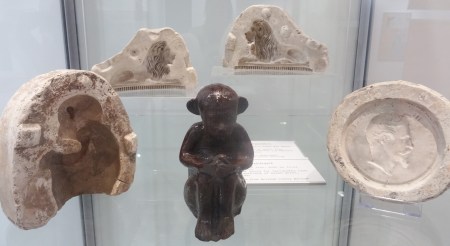
G. Ingold of Bishop’s Stortford (Hertfordshire), made pumps for a variety of locations, although usually in the south, including villages in Essex and Cambridge.  The company had been founded in 1851 by John Ingold for sinking wells and manufacturing pumps.  He was based at Rye Street with a workshop in Apton Road in Bishops Stortford.  Following the death of John Ingold, the business was taken over by his son George, but the latter was marking pumps “G. Ingold” well before his father’s death.  This seems to put our pump quite late in the 19th Century.  This is born out by a number of wells and pumps in Uttlesford in Essex, where the date was recorded.  The earliest marked as “G. Ingold” as opposed to merely “Ingold,” was in 1873, then 1886, with a cluster of five in the 1890s.

Where images are available, all of the Ingold pumps looked very similar. As far as I can tell from the Essex and Cambridge examples posted on the web, most Ingold pumps had handles to the rear, with only some, like the Churton pump, fitted with handles at the side.  The Ingold spouts often had a thorn-like feature at the top of the bend, a bucket hook, often decorated.  This is absent on the Churton pump, although there is an indentation where one might have been located, visible in the photograph above left.

There are two modern signs on the walls flanking the Churton pump.  One is a disclaimer notice drafted by a local solicitor, commenting on the quality of the water available from the pump, saying that  it derives/derived from an artesian aquifer and warning that one drinks at one’s own risk.  I did try to activate the pump, giving it a really good go after heavy rainfall when the aquifers were all filling up, but it produced nothing.  Although I’ve never tried to use a village pump before, there was no feeling of resistance as you might expect of a lever raising a piston.  Thanks very much to Irene Mundy and John Gallagher for the information that When the renovated pump was reinstalled it was discovered that the pipe delivering water up to the pump was deeper than expected. Half way down the pipe towards the water reservoir another, secondary pumping mechanism had been attached in the past.  Although the pump initially drew water, it eventually ceased to function.  It’s nice that it did work for a while, and it still looks great.

The other sign refers to the restoration.  Although it says that it was a Millennium project, commemorating the arrival of the 2000s, Latham comments that the renovated pump was not actually installed until 2005.  The sign records that the project was supported by both Barnston and Grosvenor estates, both with vested interests in the village, as well as the Chester City Council.  The engineering and installation work was carried out by A.E. and K.E. Jones, farmers near Pant yr Ochain (Gresford), and the welding by J. Vale.  Someone must have a record of the project and the installation of the pump, including photographs of the installation and official opening, which would be really good to see.  The Eaton estate repaired the stone wall that encompassed the pump.  If any more details come to light, I will cover the restoration project on another post.

It was super, late last summer, to see that the sandstone trough beneath the pump had been planted out, and that a very attractive display of bedding plants had replaced the straggling weeds (see also the photo at the top of this post).  Many thanks to whoever took the trouble.  It was great to see it looking so good.  The photograph was taken in August 2021.  The other photos on this post were taken in May 2021.

—-
For more information on village pumps
I recommend the short book, Village Pumps by Richard K. Williams and the Village Pumps website (details of both below), both of which provided a lot of the general information in this post and are comprehensive resources on the subject of all types of village pump.
______


Sources:

Books and papers

Latham, F. 1981.  Farndon: the History of a Cheshire Village. Farndon Local History Society

Williams, R.K. 2009.  Village Pumps.  Shire Library

Websites

The Recorders of Uttlesford History
https://www.recordinguttlesfordhistory.org.uk/

Village Pumps website
http://www.villagepumps.org.uk
Village Pumps: Churton entry
http://www.villagepumps.org.uk/pumpsChesh.htm#C10C

Waymarking.com
Village Pump, Widdington, Essex
https://staging.waymarking.com/waymarks/wmC4MW_Village_Pump_Widdington_Essex_UK


Object histories from my garden #8 – Pieces of 19th century clay tobacco pipe

A photograph of the collection of clay pipe pieces from the garden

Clay pipes are ubiquitous in Britain.  The small collection from my garden, extracted from all over the garden over several months, is meagre but the fact that those bits were there at all is still interesting.  Like willow pattern ceramics, I would be very surprised if there are not clay pipe pieces scattered in almost every garden in Churton, Aldford, Farndon and Holt.

For anyone new to this occasional series on objects extracted from my garden during everyday gardening activities, see the History in Garden Finds page.  These are not objects used in the garden, but objects, usually fragments, lost or disposed of in the garden and found during digging, troweling and planting.

The pieces of clay pipe found in my garden are shown in the photo above left.  I suspect that we missed quite a lot when we first started digging out old beds and introducing new beds.  The stem fragments, which survive better than the more fragile pipe bowls (see diagram below right for terminology), are far easier to spot on a river bank where they have been washed back to their original white, than in gardens.  In fields and gardens, they are earth-encrusted and the broken pieces of shaft look almost no different from short pieces of twig.  I was used to looking for pipe pieces on the Thames foreshore, so at first did not notice them in the garden.  After I spotted a broken pipe bowl in the garden, I realized that they were there to be found and started looking for them.  Several more emerged, all pieces of stem, one including a mouthpiece.  Most of the rest of the photos in this post are taken from elsewhere to illustrate the points made in the text.  I found the Thames foreshore examples shown below when I lived in London.

Clay pipe terminology by D.A. Higgins. Source: National Pipe Archive http://www.pipearchive.co.uk/howto/date.html

A clay pipe consists of a long tube of white clay, which makes up the shaft, finishing in a bowl, which often has a small heel (also known as a  spur) to keep it upright when placed on a table.  As clay pipes were prone to snapping and could be easily replaced, their remains are littered throughout the country, turning up in fields, gardens, rivers and on building sites.  When I lived in London I found many decorated pieces on the Thames foreshore, including two complete short pipes, but all of the bits I’ve found in the garden have been completely unmarked by either decoration or manufacturers’ marks.

Clay pipes first started being produced at the end of the 16th century, in the wake of Walter Raleigh’s introduction of tobacco as a luxury item from Virginia.  Although tobacco was new in English society, it had been adopted on ships and was known in many parts of western Europe.  Its rapid success after Walter Raleigh introduced it was due to his launch of it into the upper echelons of society. Much the same happened with Chinese tea in the late 17th Century.  The Worshipful Company of Tobacco Pipe Makers and Tobacco Blenders was granted a charter by King James I in 1619 and although a duty on the sale of tobacco pipes imposed between 1695 and 1699 appears to have lead to a hiatus in clay pipe manufacturing, this did not prevent its success spreading.  It rapidly found its way from the wealthiest to less privileged households.

Decorated bowl from the Thames foreshore with spur and floral decoration down the seam and on the bowl

The pipe making industry had spread throughout England by the end of the 17th Century, when there were very few towns without at least one pipe maker, and there were over 1000 clay pipe makers in London alone.   As prices of tobacco fell and consumption expanded, the size of the pipe bowl increased.  There was another hiatus in pipe manufacturing around in the 18th Century, this time due to interruption of tobacco imports during the American War of Independence.  They came back into fashion in the 19th Century, when all sorts of decorations were applied, some of them real works of art.  These more rarefied pipes became more collectable and less disposable, although plain, unmarked pipes still dominated in the less wealthy echelons of society.  For many more examples of the sort of decoration that was fairly common, see the What The Victorians Threw Away website.

Makers’ marks. The two at the top are a single stem, with the name H. Dudnam from Plumstead clearly shown. At the bottom is a maker’s mark, EW, on the heel of a clay pipe bowl. All found on the Thames foreshore.

Some pipes were marked with the maker’s stamp, either on the shaft or on the base of the heel, enabling the manufacturer to be identified and a date to be assigned.  Some manufacturers became particularly popular, their names a guarantee of quality, and their pipes were priced accordingly. Pipe-making dynasties sometimes emerged, with the skills being passed from one generation to another.  There’s more about pipe marking on the National Pipe Archive website.

Longer pipes were more expensive than shorter pipes, because they more were difficult to make, and used more clay, although the shorter types were more practical, were easier to smoke without holding up, and were less prone to breakage.  However, longer pipes were preferred by connoisseurs as they cooled the smoke as it travelled from the bowl.  Other factors that commanded a higher price include the above-mentioned decorative embellishments, which became particularly popular during the 19th Century.  Some very special ones had elaborate sculptural elements, but are very unlikely to be found in agricultural village gardens.  A far greater number are unmarked in any way and are found everywhere, rural and urban.  Of course, where only small pieces are found, it is entirely possible that a different portion of the same shaft would have been marked and its bowl decorated; there is no way of knowing.

Clay pipes began to be replaced by wooden ones in the early 20th Century, and all were largely replaced by cigarettes in the mid 20th Century.

Clay pipes were made in moulds, although they had to be pierced with a long metal rod before being fired.  Any decoration or manufacturer mark was incorporated into the mould.  The mould seam can usually be seen on the pipe’s underside and the front and back of the bowl.  Often, the seam is disguised by being incorporated into a decorative motif, as shown in the thorn pipe photograph below where the seam becomes the stem of a plant and is flanked by leaves (click to expand to see the decoration on the bowl).

A short pipe that has little decorative bumps on the bowl and stem called “thorns” (pipes featuring this are referred to as thorn pipes).  This one also has a button mouth piece and decorative leaf motifs along the mould seam at the front of the bowl.  Found on the Thames foreshore.

The pipes were then left to dry before being fired in a kiln.  Before being shipped, the mouth piece, the very end of which was often defined by an additional ring of clay, was painted with red or, less usually, yellow wax to prevent the smoker’s lips sticking to the clay.  The wax, which presumably wore off quite quickly, didn’t do much to prevent damage to the teeth.  Habitual pipe-smoking led to damage to the teeth, as well as the lungs.  A Museum of London study of skeletal remains excavated from a Victorian cemetery in Whitechapel found that in many cases teeth had been worn down by pipe-smoking, with some having a circular hole when the jaws were closed, formed in two or four teeth.

The oldest objects to emerge from the garden so far have been later 19th Century, and that seems a probable date for these pieces too.  It is impossible to extrapolate from a single pipe bowl, but that one example is so simple and basic, that it was not something that would have been singled out by someone wealthy.  This was an everyday item, nothing special, like a lot of the decorated ceramics and embossed glass found in this garden.

Piece of a bowl with spur, and piece of a stem with button mouthpiece. From my garden in Churton

Having found many really fascinating examples on the Thames foreshore, the small crop of unmarked clay pipe remains from my garden seem a little underwhelming by comparison, but the pipe pieces tell a more localized story of their own.  Without a maker’s mark to work with, there’s not a lot to be said about these specific examples, and that’s rather frustrating because there has been a lot of great research that has helped to develop clay pipes as archaeological tools to understand the pipe-making industry, the tobacco industry, and how both shed light on economic and social history over the centuries of their usage.  Even simple questions of source and distribution are unanswerable when the maker cannot be identified.  On the other hand, these pieces fit in with the general theme of the 19th century objects from my garden, which all of which are nicely made and look good, are robustly made and standardized, and fairly low cost.  Still, they were nice-to-have, not must-have items and suggest that the people who lived in the house were sufficiently well off to indulge themselves from time to time.

Broseley Clay Tobacco Pipe Museum. Source: Visit Bridgnorth

I initially thought that at least some of the pipes from which the pieces came could have been made in Chester, where there were multiple pipe-makers, some of them producing pipes of very high quality that were in demand both within and outside the immediate area.  Many were exported in great volume up until the 18th Century.  An example is the clay pipe works where the Roman Gardens now stand, with the kilns lined up along the side of the city walls.  It turns out, however, that by the early 19th Century the manufacture of clay tobacco pipes in Chester had collapsed.  The main source of clay pipes in the general area in the 19th Century was Broseley in Shropshire, a few miles to the south of Telford, which had been producing clay pipes since the 18th Century.  The Broseley Pipeworks, for example, was established late in pipe-making history, in 1881, and only closed in 1957, now a small museum.  Realistically, unless I find something more diagnostic, there’s no way of knowing where these odds and ends originally came from.

The National Pipe Archive website has some great resources for finding out more about clay pipes and finding out date ranges for anything you may find with diagnostic markings: http://www.pipearchive.co.uk/index.html.  They have a “how to date” web page, on which they provide links to a range of typologies (images of clay pipes and their key characteristics with date ranges) at http://www.pipearchive.co.uk/howto/date.html.

For those in the Chester /northwest area, their typology for the northwest, which is impressively comprehensive, is at http://www.pipearchive.co.uk/pdfs/howto/Typologies/LIVNP_2014_01_100_CHESTER.pdf.  The same website also provides recommended resources for Cheshire pipe studies, which you may be able to find through a library or the Chester Archives, and some may be available online if you do a Google search on the name of the title:

The County list shown above is a bibliography (at http://www.pipearchive.co.uk/archives/british.html#CHESHIRE).

If you are in the Churton, Aldford, Farndon and Holt general area, and you have found clay pipe remains in your garden, especially if there are any type of markings at all, it would be great to hear from you.

For other objects in the series,
see the History in Garden Objects page


Sources:

Books and papers

Another photographs of Churton clay pipes from my garden

Ayto, E.G. 1994 (3rd edition). Clay Tobacco Pipes.  Shire Publications

Cessford, C. 2001.  The archaeology of the clay pipe and the study of smoking.  Assemblage,  Issue 6, August 2001
https://archaeologydataservice.ac.uk/archives/view/assemblage/html/6/index.html

Dagnall, R.  1987.  Chester Pipes in Rainford. Society of Clay Pipe Research, Newsletter no.15, July 1987, p.10-12
http://scpr.co/PDFs/Newsletters/SCPR15.pdf

Davey, P. 1985. Clay pipes from Norton Priory, Cheshire. In (ed. Davey, P.) The Archaeology of the Clay Tobacco Pipe IX. More Pipes from the Midlands and Southern England British Archaeological Reports British Series 146i and ii. p.157-236.

Nevell, M.D. 2015.  The industrial archaeology of Cheshire: an overview. Journal of the Chester Archaeological Society, 85 (IV), p.39-82
http://usir.salford.ac.uk/id/eprint/37519/
http://usir.salford.ac.uk/id/eprint/37519/1/Nevell%202015%20JCAS_ns_085_IndustrialArchaeologyInCheshire_textonly.pdf

Pearce, J. 2007.  Living in Victorian London: The Clay Pipe Evidence.
Part of an Arts and Humanities Research Council funded study ‘Living in Victorian London: Material Histories of Everyday Life in the Nineteenth-Century Metropolis’ Award Number AH/E002285/1 led by Dr Alastair Owens in the Department of Geography at Queen Mary, University of London
https://www.academia.edu/737367/Living_in_Victorian_London_The_Clay_Pipe_Evidence

Sandy, J. 2019.  Clay Pipe Making: The Victorian Way. Beachcombing Magazine, volume 11, March/April 2019
https://www.beachcombingmagazine.com/blogs/news/clay-pipe-making-the-victorian-way

Victoria County History 2003.  Late Georgian and Victorian Chester 1762-1914: The economy, 1762-1840, the demise of old Chester. A History of the County of Chester: Volume 5 Part 1, the City of Chester: General History and Topography. Originally published by Victoria County History, London, 2003, p.172-177.

Websites

The National Pipe Archive
http://www.pipearchive.co.uk/

Victorian smokers had rotten teeth to match lungs
MOLA
https://www.mola.org.uk/blog/victorian-smokers-had-rotten-teeth-match-lungs


A visit to the Pontcysyllte Aqueduct near Llangollen – Thomas Telford’s iron trough 126ft over the Dee

It is without question a marvel of modern engineering and a remarkable sight, but what strikes most people when they first see the 1000ft (c.305m) Pontcysyllte  canal aqueduct is that the handrail along the pedestrian walkway 127ft (38.5m) over the river Dee is only a few steps away from the other side of the narrow canal trough, which has no handrail at all to separate a boat user from a straight drop into the valley bottom.  Until you lean over the towpath’s handrail and look straight down, 127ft is a rather abstract number.  The photograph on the right shows me crossing it on a 40ft narrowboat in the 1990s on a two week canal holiday.  What you cannot see are the white knuckles with which I am gripping the tiller for dear life, in spite of having absolutely no fear of heights, because there was absolutely nothing between me and that drop.  The aqueduct, Grade I listed, and a UNESCO World Heritage Site since 2009, is the longest and highest in Britain.  It’s a long way down.

The Pontcysyllte Aqueduct passing over the Dee valley at Trevor. Source: Dronepics Wales

Seen from below or from a distance, the Pontcysyllte aqueduct is a fabulous sight, not pretty but truly awe-inspiring, and it shows exactly what Pontcysyllte is:  an iron trough built on 18 vast tapering brick piers, with 19 arches.  It was all about function, nothing to do with aesthetics, and has no ornamentation to soften it, but the sheer ambition of it grips the imagination and makes one look beyond the factual details of the thing.  It really is superb.  There is a path leading down along the side of the approach to the aqueduct into the valley below, a long but well maintained track to the valley bottom, where you can walk along the Dee and get a long at the aqueduct from a distance.  That’s one for another day.

It was a beautiful day, absolutely flawless, with cerulean blue skies, a golden sun warming one’s face, and a brightness of autumnal colours that takes some beating.  After attending the Remembrance Day commemoration at the Churton war memorial, with a memorable and moving address, and a two-minute silence filled with birdsong, I collected the car first, the parent next, and we proceeded towards Trevor, on the A539 to Llangollen.  There’s a brown signpost pointing to the aqueduct’s pay-and-display car park at the Trevor Basin, which is the home of a number of canal boat companies today, but when it was built was used for the transhipment of coal, building stone, iron products, timber and bricks, much of which was brought to the canal wharf by horse-drawn waggons.

Map of the key canal features in the Vale of Llangollen. I have added a red arrow to show the best car park for Pontcysyllte. Click to enlarge. Source: Pontcysyllte Aqueduct & Canal World Heritage Site

Thomas Telford and his chosen team

Portrait of Thomas Telford, who chose to be painted with the Pontcysyllte aqueduct in the background. Engraved by W. Raddon from a painting by S. Lane.

The aqueduct (built (1794-1805) was part of the Ellesmere Canal project.  It is one of the many British civil engineering projects that has the names of Thomas Telford (1757-1834), ironmaster William “Merlin” Hazeldine (1763-1840) and master stonemason John Simpson (1755-1815) attached to it, three men who had brought their particular skills to many different joint projects and in doing so had developed an invaluable relationship of trust and mutual respect.

Thomas Telford started his career as a stone mason, working in London on buildings such as Somerset House, and had ambitions to develop his career as an architect.  When he became the County Surveyor for Shropshire, he worked on a great variety of building projects including, by his own estimation, 40 road bridges between 1790 and 1796, two of which employed iron in their construction.   Hazledine had initially trained as a millwright, but  his family owned a small foundry  and Hazeldine went on to grow his iron casting business with the large Coleham Foundry at Shrewsbury.  Hazledine and Telford, both Freemasons, had met at Salopian Lodge  in Shrewsbury in 1789 and become friends and professional collaborators.  On one of his earliest projects in Shrewsbury Telford hired a childhood friend Matthew Davidson to oversee works, and Davidson employed master stonemason John Simpson who worked on many of Telford’s projects. Telford described Simpson as “a treasure of talents and integrity.”

Although Telford is by far the best known of the three, he, Hazledine and Simpson worked together frequently on many different projects to produce some of the great civil engineering constructions of their era, mainly bridges.  All three were involved with the Pontcysyllte aqueduct, where  Matthew Davidson also joined them, but the story of the canal starts before any of them were recruited to work for the Ellesmere Canal project.

Background to the aqueduct

The Trevor Basin today.

The big name in canal construction was James Brindley (1716-1772), who was responsible for building over 365 miles of canals by the time he died.  Brindely realized that any inland waterway network would need to connect to all the great navigable rivers that connected to the sea, including the Thames, the Mersey, the Severn and the Trent, incorporating other important navigable rivers like the the Avon and the Dee.  Most of his canals were contour canals, wherever possible built on the level and avoiding slopes so that locks and lifts could be avoided.  The network was therefore a sprawling affair, but it revolutionized transport, avoiding roads that would become mired and impassable in winter, as well as unnavigable sections of rivers, and the riverine problems of drought and flood.  Water into and out of the canal system was regulated and therefore predictable, and allowed year-round transport.  The advantages became very clear very quickly, and manufacturing and trading businesses began to locate themselves at critical points on the canal network.  Eagerness to invest in infrastructure resulted in a canal boom in the late 1780s and 1790s.  Each new section of canal required an Act of Parliament, subject to Royal Assent, and Act after Act was passed as the network expanded.

The complex arrangement of the Ellesmere Canal and its branches is shown as a think blue winding line. The thick blue line is the Dee. The yellow lines are roads. Click to see a bigger version. Source: Wikipedia

In 1791 a proposal for a canal to link the Mersey at Netherpool (later renamed Ellesmere Canal) to the river Dee at Chester and the Severn at Shrewsbury was discussed by three Shropshire entrepreneurs, carrying mainly coal, iron and lime, supported by other goods as well.  It was decided that a branch would be needed to Wrexham and Ruabon and onwards, via Chirk, bypassing Oswestry at its west, to Shrewsbury in the south with a branch to Whitchurch in the east and another to Llanymynech.  Originally it was planned to run a branch from Ruabon to reach the Irenant slate quarries near Llantysilio, via Llangollen, but this was at first dropped and later revived for different reasons (discussed below).  That branch would in turn connect to the Montgomery Canal from Frankton Junction via Welshpool to Newtown in mid Wales (for carrying limestone, coal, timber, stone and slates).

This seriously ambitious plan found sufficient support for a surveyor to be hired and possible routes to be explored.   William Jessop, an experienced canal engineer, was hired to head up the project and oversee all of its different components.  After disagreements over the final route were resolved (albeit not to everyone’s satisfaction), the Ellesmere Canal proposal went through parliament and received its Royal Assent in April 1793.  There were still a lot of technical and logistical details to resolve, including how the canal was to cross the Dee and Ceiriog valleys.

It was clear that Jessop needed help, and although the internal promotion of William Turner was Jessop’s first choice, Telford was brought in without his input. It is not certain how Telford, increasingly bored with life as a county surveyor, managed to insert himself into this ambitious engineering project, but the canal was already generating considerable excitement in the area and it looks as though he heard of the position and sought the support of one of Britain’s most prominent industrialists, John Wilkinson, to help him secure it.  Jessop made it clear in his letters what he thought of having Telford, who he had never met, brought in against his wishes as his right hand man, and refused to attend the meeting that appointed Telford to the Ellesmere Canal Company.  In spite of this rocky start, Jessop and Telford seem to have hammered out a decent working relationship, with Jessop teaching Telford what he needed to know about canal construction, and Telford injecting some ideas into the project.  Like Jessop, Telford managed to broker a deal to enable him to carry out other projects when his personal presence was not necessary, and this enabled him to work on other civil engineering works whilst the Ellesmere Canal was being built.

Building the aqueduct

Work began at Netherpool on the Mersey, renamed Ellesmere Port, in 1793.  The 9-mile canal ran down the Wirral to meet the Dee at Chester, and went so well that it opened for traffic in 1795 and was an immediate success.  While this section was underway, discussions were underway about how the canal might cross the Dee.  The original idea presented to the directors by Jessop and Turner, and apparently not opposed by Telford, was a relatively low level stone channel crossing three stone arches, with step locks either side to manage the ascent to and descent from the level of the canal to the aqueduct.   This would have been an expensive option, requiring not only the locks but the management of the water that would feed the locks.  Even after this had been agreed in principle, concerns resulted in a new plan for an iron channel on stone columns.  It is likely that it was proposed by Telford and supported by Jessop partly because it would have reduced the cost as iron was lighter, easier to work and move, and cost less.  A sketch by Telford from March 1794 survives showing an early version of this aqueduct design.

Telford’s Grade 1 listed Longdon-on-Tern aqueduct in Shropshire, 1796. Source: Chris Allen, Wikimedia

In early 1795 Telford had the opportunity to try out a smaller, less ambitious version of the design at Longdon-on-Tern on the new Shrewsbury Canal, on which Telford was also working, as replacement for the incumbent engineer who had died mid-project.  Later in the same year he had built a fully navigable iron aqueduct on a canal that had none of the problems of leakage or shattering that had worried other engineers.  Whether or not this was taken into account by the directors of the Ellesmere Canal Company, they decided in the same year to go for the iron trough on immense stone piers that was eventually built.

Telford’s friend and frequent collaborator, master mason John Simpson soon joined him on the project.  Telford also brought in Matthew Davidson, his childhood friend of Telford, a stone mason, civil engineer and excellent organizer, to oversee the bridge works.  Telford and Davidson had worked successfully together on Telford’s Montford Bridge project of 1790 – 1792.  Shortly afterwards, William Hazledine arrived to establish an ironworks and take charge of the construction work for the iron ribs and the trough.  By assembling three men that he had worked with before and trusted absolutely, Telford was not only ensuring that the project was in good hands, but that he had a team who could operate in his absence. The foundation stone for the aqueduct was laid on 25th July 1795.

Jessop and Telford made wooden models to test the design for the trough, finding that 1000s of iron parts would be needed.  The cast iron for the aqueduct was made of cast iron that was produced in William Hazledine’s new iron foundry nearby at Plas Kynaston, Cefn Mawr.  Hazledine established the Plas Kynaston foundry to service the construction of the Pontcysyllte aqueduct, thereafter taking advantage of the canal network to carry his cast iron in segments to be transhipped by river or sea to where it was needed.  When he built the Eaton Hall Iron Bridge at Aldford on the river Dee (described on an earlier post) it was from Plas Kynaston that the iron was shipped by canal.

After 1801 Jessop was much less involved and Telford also had interests elsewhere, and Telford was also involved in other projects, leaving Davidson, Hazledine and Simpson to run with the project.  The piers rose steadily, each built in turn from south to north by, at the peak of the project, over 500 men.  Jessop had been desperately worried from the beginning by the dangers to workmen’s lives of such tall piers, and safety precautions were taken very seriously, with the loss of only one life.  The iron parts were manufactured as needed at Plas Kynaston, and were numbered according to the order in which they would be needed so that only pieces needed at any one time would be delivered to the site.  First, ribs of iron were fitted to the piers, and then the trough was bolted on top, after which a wooden towpath was fitted to the side.  The entire project was finished in 1805, and opened on a sunny afternoon on November 26th 1805 at a grandiose ceremony followed by a lavish feast.  The entire cost for the aqueduct project was £47,018, which in today’s money translates as around £617,855 (National Archives Currency Convertor).

Metalwork over and under the arch at the left-hand Rhos y Coed bridge.

Although not as visible in the finished design, iron was also used in the Chirk aqueduct on the Llangollen canal where ten semi-circular masonry arches were crossed by a water channel with an iron bed plate and brick sides sealed using hydraulic mortar.  As well as in the aqueducts, iron was used in various ancillary structures too.  for example, Bridge 29, Rhos y Coed, at the Trevor Basin has visible iron metalwork supplementing the stone arch, and iron was used to cap the weir at the Horseshoe Falls.

The role of the aqueduct

Map from Nicholson’s Guide to the Central canal system, showing the stump end (framed in orange) of the planned Ruabon to Chester section of the canal, which was never built and now houses the attractive Trevor boatyard where the visitor centre is located. Source: Nicholson 1989

The Pontcysyllte aqueduct was almost immediately  in danger of becoming something of a white elephant, because its original role as a direct route to Wrexham and Chester was never fulfilled.  The section that led past Trevor Basin over the aqueduct was supposed to run straight on to the west of Ruabon, via Wrexham and on to Chester where it would link with the Wirral stretch leading to the Mersey and to the  Dee and the Shropshire Union Canal.  All that is left of the Trevor-Ruabon-Wrexham-Chester branch is a stump end occupied by the Trevor Basin, where the car park is located.  This is clearly visible on Nicholson’s map left, where the main line of the canal comes to a sudden, abrupt end.

The abandonment of this important part of the original plan was due to both engineering problems and financial issues.  There were only  two obvious engineering options – an enormous tunnel or a series of locks climbing towards Wrexham and another descending into the Cheshire plain where the canal could run along the flat plain to Chester.  The tunnel would have been appallingly costly, and it was difficult to know how the locks, by no means a low-cost option themselves, could have been supplied with the sufficient water.  Although other technologies were considered, they were rejected for reasons of practicality and cost.  This left the problem of where the water was to come from to feed the rest of the Ellesmere Canal and its branches.

Horseshoe Falls

At the far end of the Llangollen canal is Telford’s great arc of a weir, today known as the “Horseshoe Falls,” marking the point at which the Dee begins to feed the Llangollen canal.  An original survey had considered using the water of the Dee as it fell from Snowndonia via Lake  Tegid at Bala and through the Vale of Llangollen as a water source for the canal.  The idea had been to link the canal to a slate works, feeding the canal at the same time.  This proposal was now revisited.  The owner of Lake Tegid gave his permission and the plan was actioned.  At the Horseshoe Falls the canal is fed with water from the Dee via a sluice and meter, and today carries over 11 million gallons of Dee water a day, emptying it into Hurleston reservoir, just north of Nantwich, where the Llangollen Canal meets the Shropshire Union Canal.  I will be posting more about the Horseshoe Falls weir on another day.  There is no turning point for vessels over 10ft long beyond Llangollen, so the final stretch is only used by minimal traffic today.

This means that the vast aqueduct, such a remarkable feat of civil engineering, would only ever lead to the relatively unimportant narrow section of canal and feeder to a complete dead end at Llantisilio after passing high through Llangollen.  This navigable channel is approached from the aqueduct by negotiating a sharp left-hand corner just beyond the exit of the trough.  Although this seems like a sad role for an aqueduct that should have carried many times the traffic that it eventually did, without the aqueduct there would have been no water to feed the rest of the system.

Even without the Ruabon – Chester link, those wishing to carry all their goods by canal were still able to connect to the main canal system, although to reach Chester they had to take a very long way round, and Wrexham was excluded completely.  The Llangollen canal still linked to the Shrophsire Union at its eastern end, from which the rest of the vast canal network could be reached.

  • Chester could still be reached by travelling the full length of the Llangollen canal to Hurleston Junction, just north of Nantwich, on the Shropshire Union Canal.  From here Chester was nearly 16 miles away.
  • Just to the north of Hurleston Junction was the Middlewich Branch, which headed east and linked to the Trent and Mersey Canal, from where Manchester, Stoke on Trent, the eastern Midlands and Yorkshire could all be reached.
  • In the opposite direction, from Hurleston Junction the Shropshire Union ran directly to Birmingham, which was a vast junction for canals in all directions, including London on the Thames and Gloucester on the Severn.

The Cefn Mawr railway viaduct, which opened in 1848.

Along the line that the original canal would have taken, a cast iron tramway was built to connect local collieries and ironworks with the canal, the iron supplied by Hazledine.  This made the Trevor Basin a particularly important hub of activity, taken delivery of bricks, tiles, coal, iron limestone, slate and sandstone for transhipping along the canal.  It was also a boatyard, with  working narrowboats being built and repaired by Hills Boatyard in the dry dock next to the Visitor Centre (now occupied by a floating take-away café).  Later, there was an interchange with the steam railway.

Visiting Pontcysyllte

A small pay-and-display car park is available for visitors at the Trevor Basin, now the home of some canal trip and holiday companies.  There is also a pub with outdoor seating, and a take-away small café on a little boat next to the visitor centre.  There is a lot of disabled parking provided for in the small car park, which is reached from the A539 in Trevor, clearly signposted with brown heritage signposting.   The aqueduct is a very short walk from the car park, and the towpath heads for miles in both directions.

If, before or after crossing the aqueduct, you are interested in finding out more about the general context of the aqueduct and its location in relation to other parts of the canal, at the Trevor Basin there is a visitor centre, a small but nicely put together display space.  As well as a map of the area that takes up a wall and shows all the main features of the landscape and the canal system itself, there is a display of some of the tools that were used in the construction of the aqueduct, which are startlingly basic, and photographs and artists’ impressions of some of the supporting works, including the foundry at Plas Kynaston.  There are ring folders full of additional information, including facts and figures, that you can look through.

Walking the aqueduct itself is not for everyone.  The towpath is rock solid, with a tall handrail on the valley side, but only wide enough for two people, so there is a lot of stopping still to allow others to pass and there is nothing to stop you falling into the canal.  The canal is only just over 6ft (1.8m) wide, and beyond that is an unrestricted (no handrail, no nothing) drop 127ft to the valley floor.  A couple who I passed told me that they were determined to walk the full length and back, but were conquering their fears to do so, and they were gripping firmly to the handrail.

An alternative to walking is to cross by boat.  There are a number of short cruises that leave the Trevor Basin and run for about 20 minutes before turning and coming back (depending on which one you take and the time of year).

For those with uncooperative legs, everything is on the flat, so it is a very good walk for those who find uphill sections of walks difficult.  After rainfall, towpaths always become a bit muddy, and can be slippery, but even though we’ve had some rainfall recently, it was fine.  The towpath between Trevor and Llangollen is beautiful, and a good choice if you can face the aqueduct.

I noticed that one of the passenger boats said that it was suitable for disabled passengers, but I would recommend getting in touch with them first to find out about timings, prices and suitability for different types of disability.

Sources

Books and papers

Glover, J.  2017.  Man Of Iron.  Thomas Telford and the Building of Britain. Bloomsbury

Lynn, P. A. 2019.  World Heritage Canal.  Thomas Telford and the Pontcysyllte Aqueduct.  Whittles Publishing.

Nicholson, R. 1989 (4th edition). Nicholson/Ordnance Survey Guide to the Waterways 2: Central. Robert Nicholson Publications and Ordnance Survey

Rolt, L.T.C. 1958, 2007.  Thomas Telford. The History Press.

Pattison, A.  n.d. William Hazledine (1763-1840): A Pioneering Shropshire Ironmaster.  West Midlands History https://historywm.com/articles/william-hazeldine-1763-1840  (Pattison’s full 278-page M.Phil, on which the article is based, is available here: https://etheses.bham.ac.uk/id/eprint/3358/1/Pattison12MPhil.pdf )

Websites

Canal and River Trust
Montgomery Canal
https://canalrivertrust.org.uk/enjoy-the-waterways/canal-and-river-network/montgomery-canal?gclid=CjwKCAiAp8iMBhAqEiwAJb94z7aIVzLoaYuqtwbDdRQsaUL73ssnmF_u1LpoURZmI9YxVUlrKi15whoCtxoQAvD_BwE

DronePics Wales
Pontcysyllte
https://dronepics.wales/pontcysyllte/

Engineering Timelines
Longdon-on-Tern aqueduct
http://www.engineering-timelines.com/scripts/engineeringItem.asp?id=308

Grace’s Guide to British Industrial History
James Brindley
https://www.gracesguide.co.uk/James_Brindley
William Hazledine
https://www.gracesguide.co.uk/William_Crosley_(1802-1838)
William Jessop
https://www.gracesguide.co.uk/William_Jessop

Pontcysyllte Aqueduct and Canal World Heritage Site
https://www.pontcysyllte-aqueduct.co.uk/