Category Archives: Industrial history

An enjoyable visit to the Williamson Art Gallery and Museum, Birkenhead

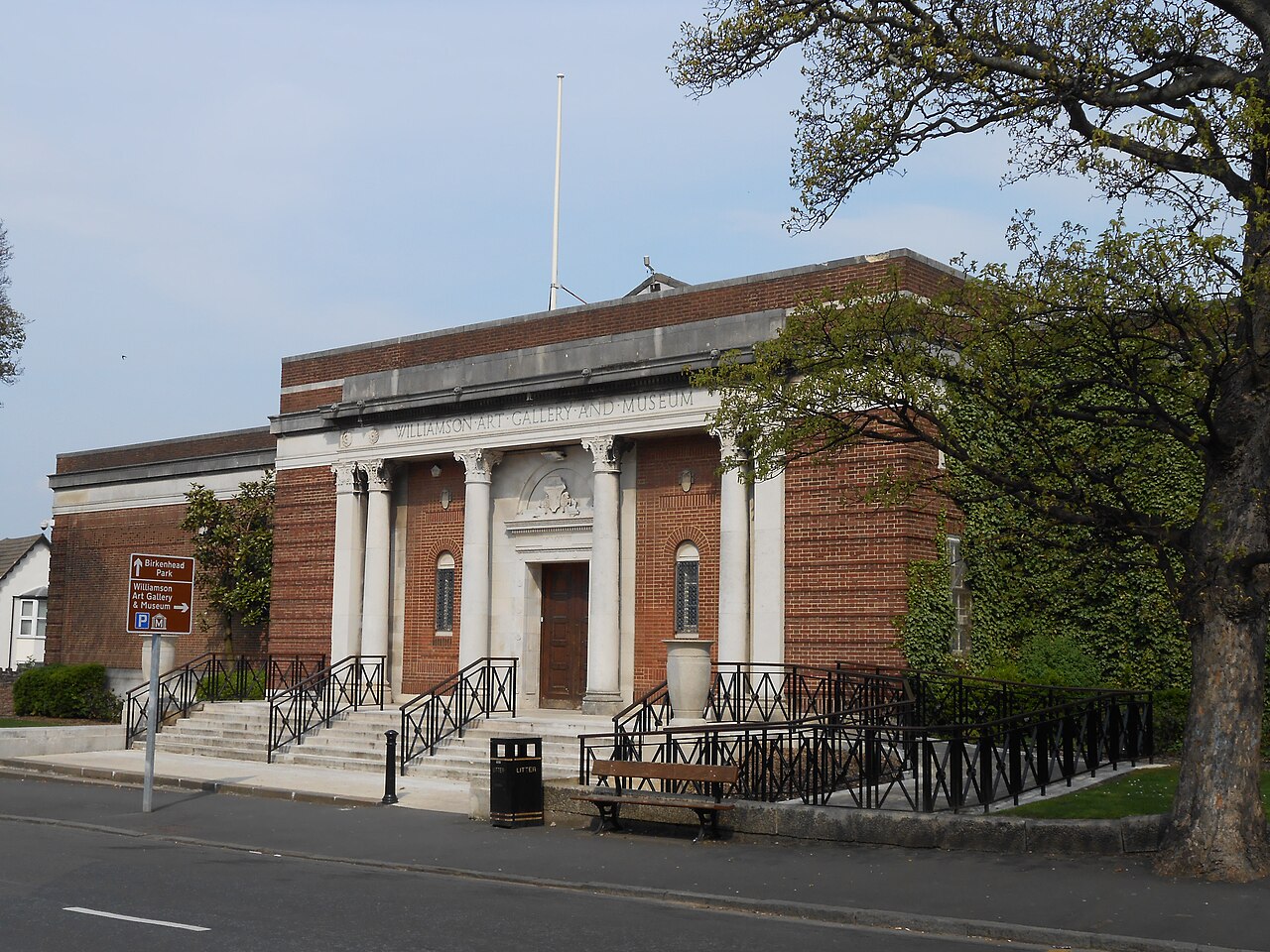
Williamson Art Gallery, Birkenhead

The Williamson Art Gallery in Birkenhead. Source: Wikimedia Commons

A traditional art gallery and museum in Birkenhead seems unexpected, but when the Williamson Art Gallery and Museum opened in 1928, Birkenhead had not yet fallen into the decline that eventually followed the 19th century economic industrial expansion created by the ship building industry.  The gallery was funded by philanthropists John Williamson and his son Patrick Williamson. John Williamson was a shop owner and merchant who became a director of Cunard when it formed as a public company, serving until 1902.  He was also on the board of Standard Marine Insurance and served on the Merseyside Docks and Harbours Board. His son does not appear to have had a career but co-operated with his father on philanthropic activities.  The museum’s design is a simple brick-built square, with a prominent facade that references Classical features.  The steps dominate in the above photo, but there is a ramp at the side for easy access.  The gallery is all on one floor, so this too provides ease of access.

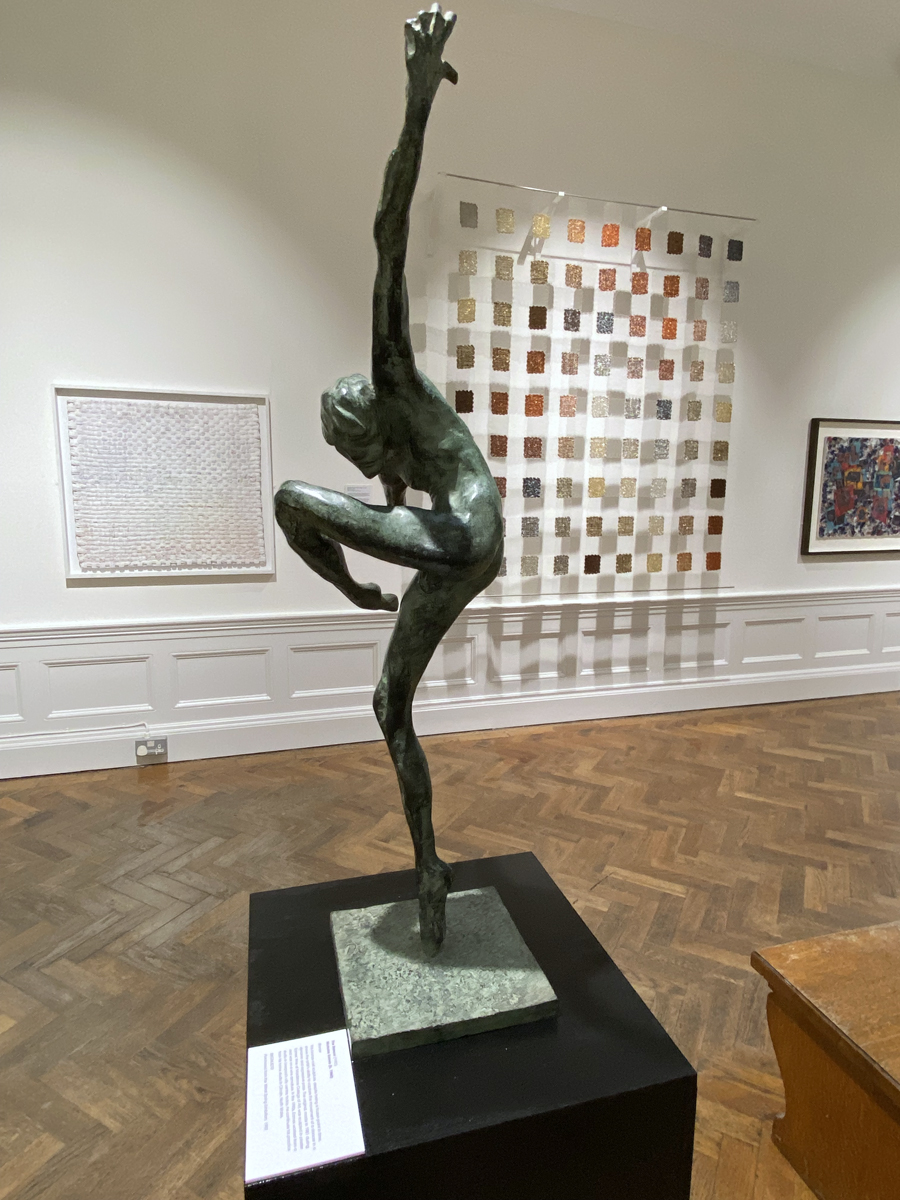
Nicholas Eames, The Dancer (1983)

Nicholas Eames, The Dancer (1983) with two textile works by Anna Sutton behind it

I visited with my friend Julian in December 2025.  We drove guided by the SatNav, which was needed as the Williamson is surrounded by something of a residential rabbit warren (with some very attractive Victorian terracing if you keep an eye open).  There is a free car park on Mather Road that had plenty of spaces.  Full visiting details, both for drivers and those using public transport, are at https://williamsonartgallery.org/visit/.  Apologies for the quality of the photos inside the gallery, taken on my smartphone.  As always in galleries there is reflection from protective glass in many of the photos, but hopefully they will give a good idea of the exhibits.

The gallery is all on a single storey, arranged in a square of linked galleries around what is now the café (with artworks on the walls) and a sculpture garden.  A pre-visit inspection of the site plan indicated that around half of it is used for permanent collections, whilst the rest is home to temporary exhibitions.  The twin focal points are, in the main, 19th and early 20th century and modern, including furnishings, ceramics, paintings, textiles, sculptures and, on this occasion, a modern video installation.  The inclusion of temporary exhibitions is probably very attractive to local people who have reason to visit on repeat occasions.

The first of the galleries that we visited was a temporary exhibition showing the results of the 31st exhibition of the annual Trinity Buoy Wharf Drawing Prize (2025).  The exhibition “celebrates the role and value of drawing with creative practice and provides a forum to test, evaluate and share current drawing practice.”   There is a wide variety of styles and subjects along a continuum from representational to abstract.   The skill on display was impressive, and some of the pieces were visually stunning.  The mainly monochrome entries drew attention to different combinations of line and texture, with the analytical, humorous and occasionally alarming all demonstrating the versatility of the medium.

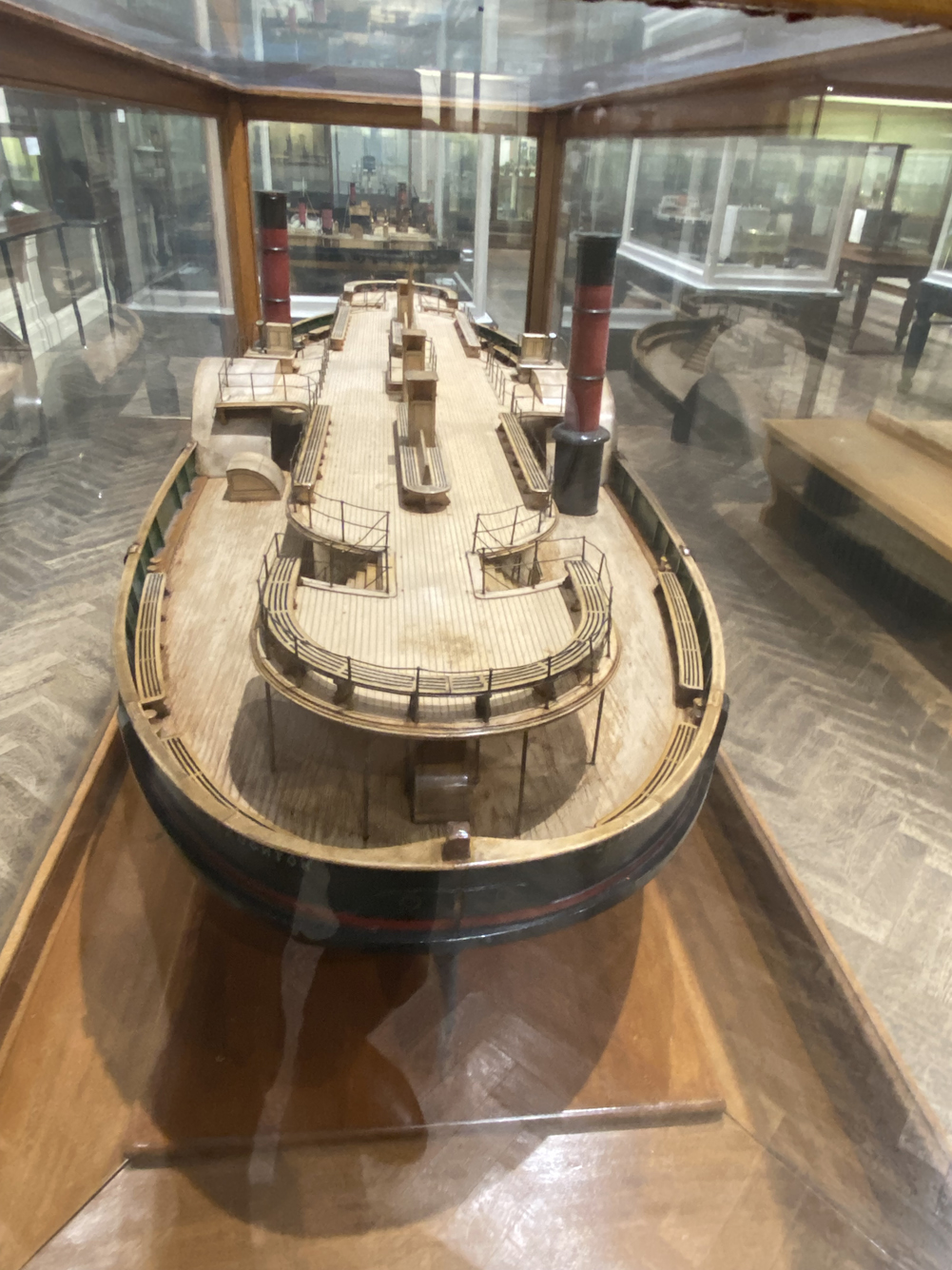
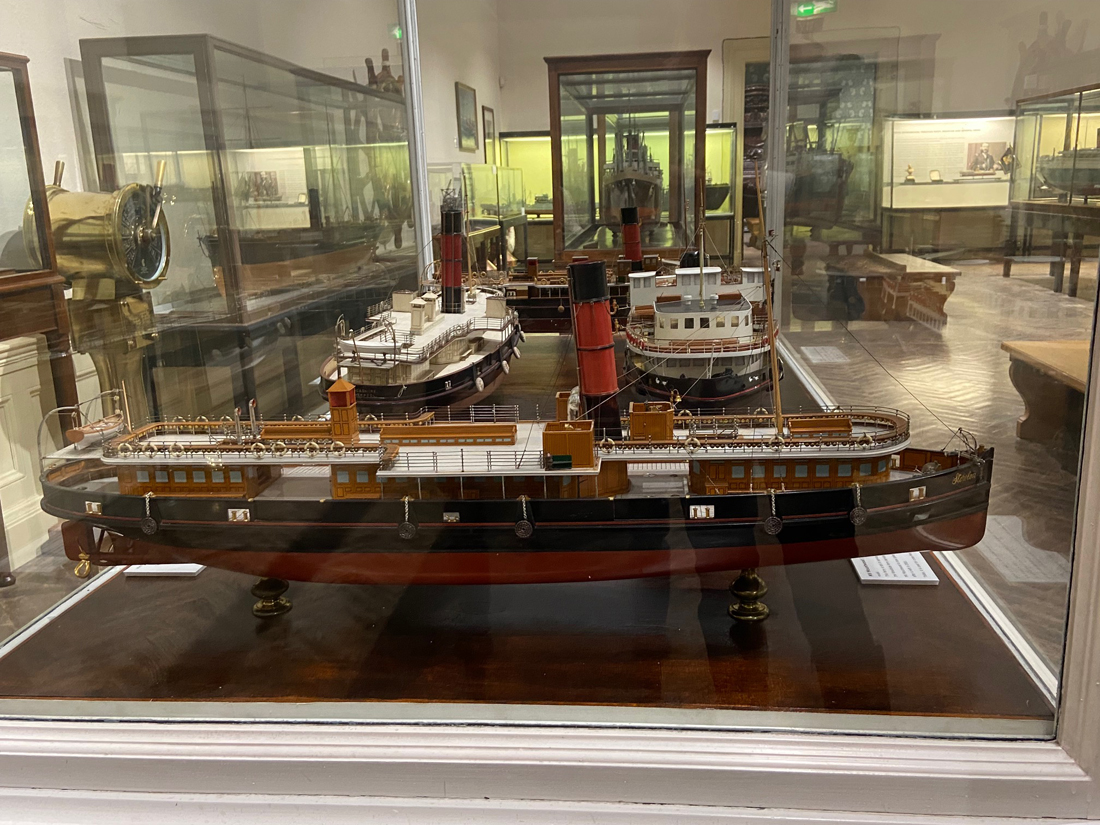
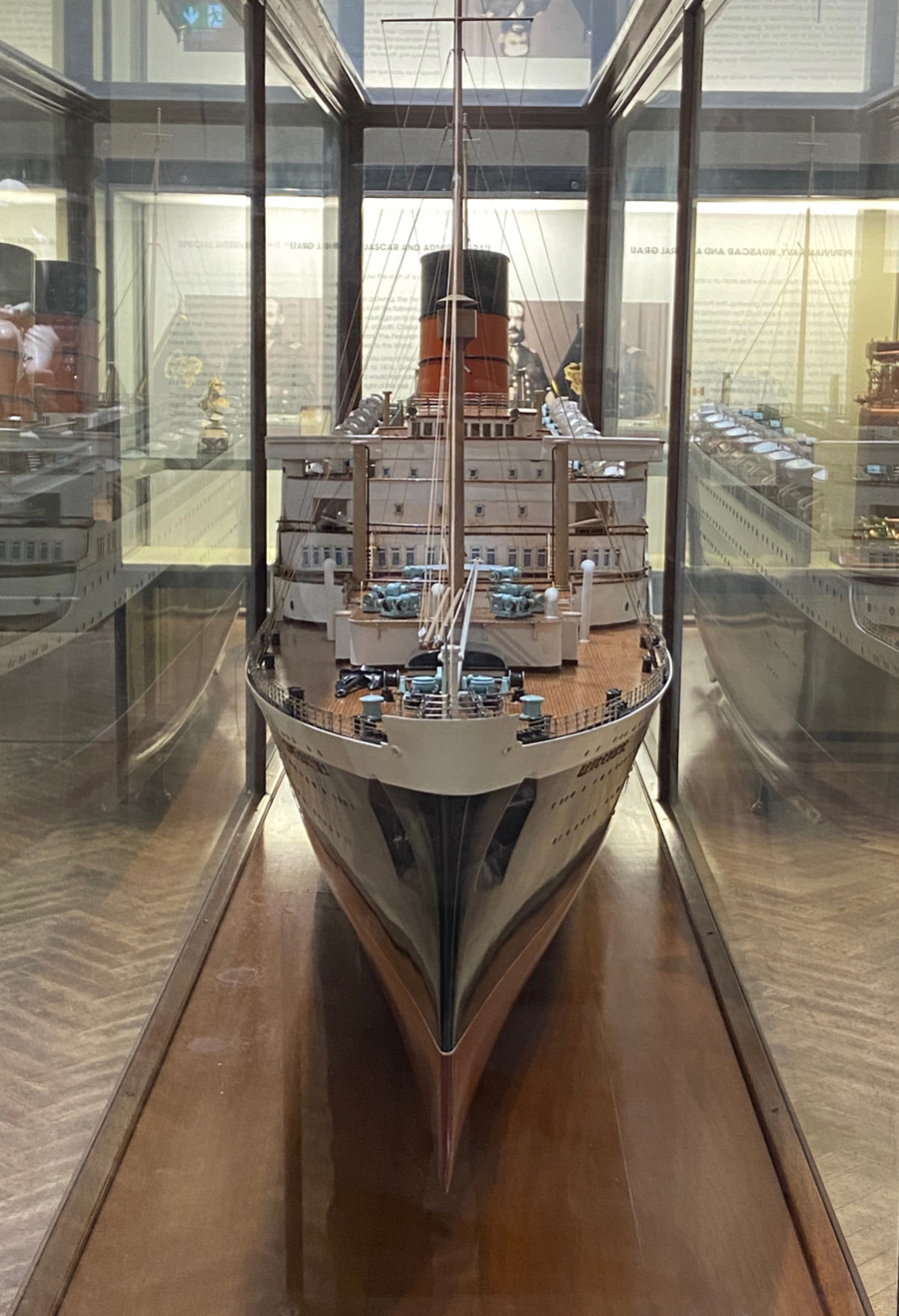
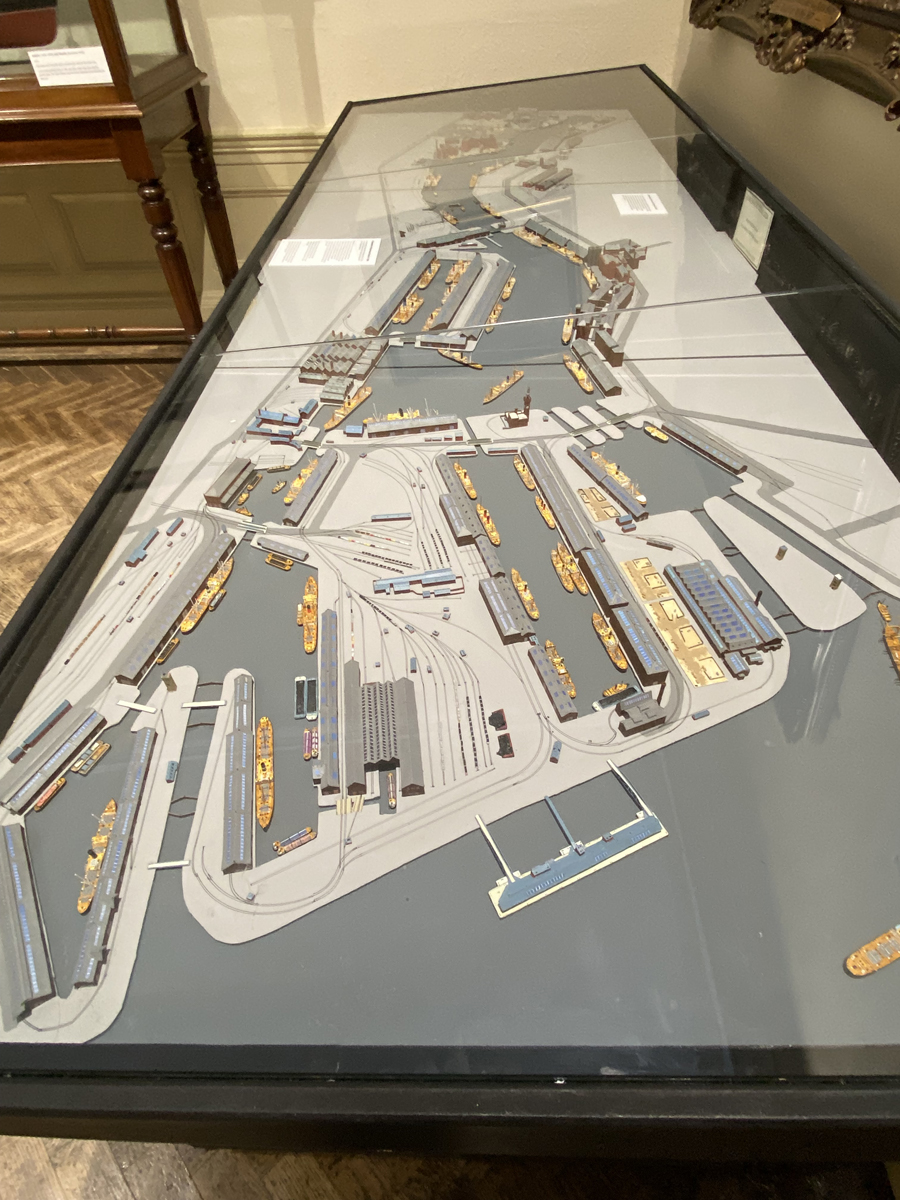
For me, the highlight of the permanent collection was the Maritime room, which is filled with models of ships built locally, as well as the actual fittings from some of the ships depicted by the models.  A model of the Birkenhead Docks is really evocative of the size and scale of the operation (shown at the end of the post).  The models of Mersey ferries are truly splendid, including a deliciously curvaceous Art Deco-flavoured example.  It was a genuine delight to see a model of the S.S. Mauretania, as well as objects that furnished her, because my grandad was quartermaster and helmsman on the ship.  It turns out that my friend Julian’s grandfather was a marine engineer, so there was a particular sense of connection for both of us with these beautifully crafted insights into Birkenhead and Mersey shipping. The whole room is redolent of local maritime history.  Given that the Liverpool Maritime Museum is disappointingly closed indefinitely whilst funding is being sought, this gallery in the Williamson offers the best available local insight into Mersey shipbuilding and shipping.

Models of some of the Mersey ferries

Models of some of the Mersey ferries

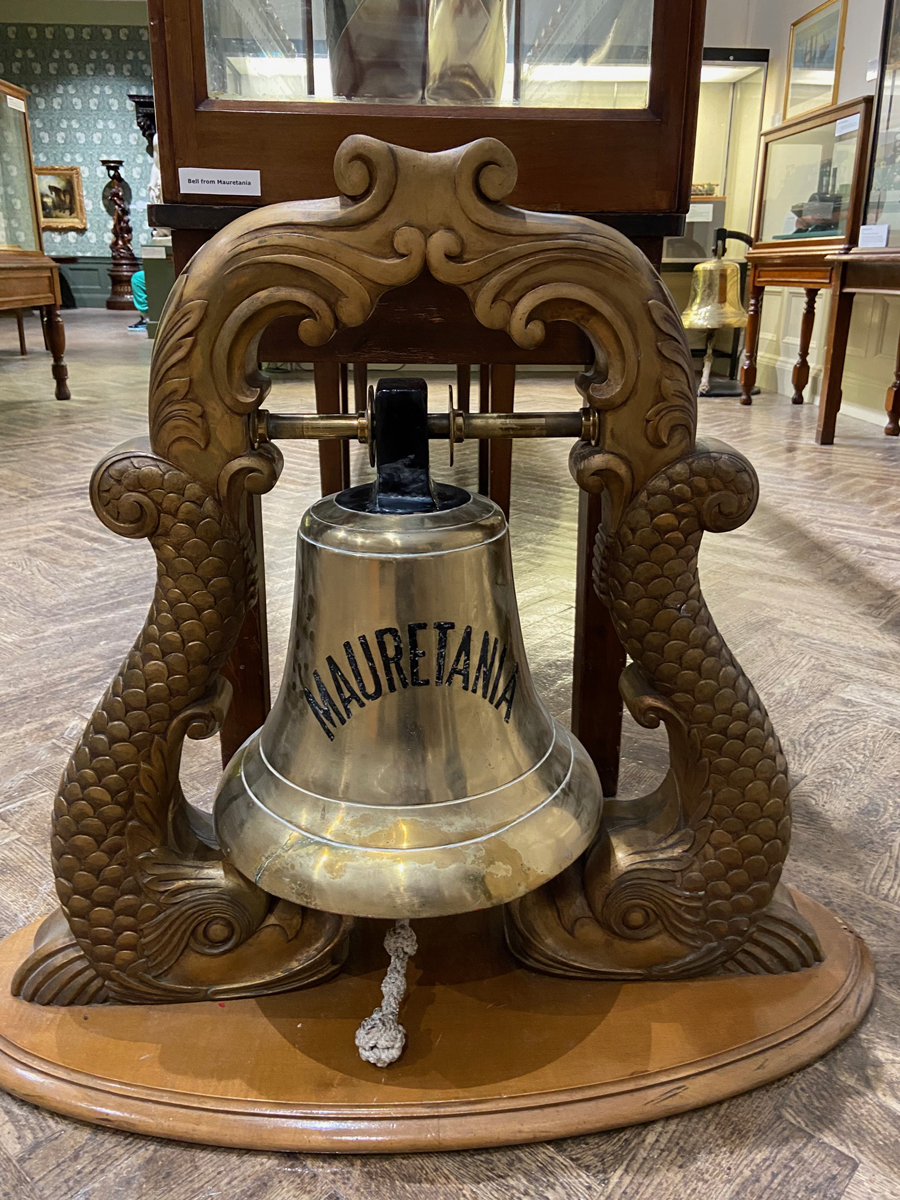
The ship's bell from the Mauretania

The ship’s bell from the Mauretania

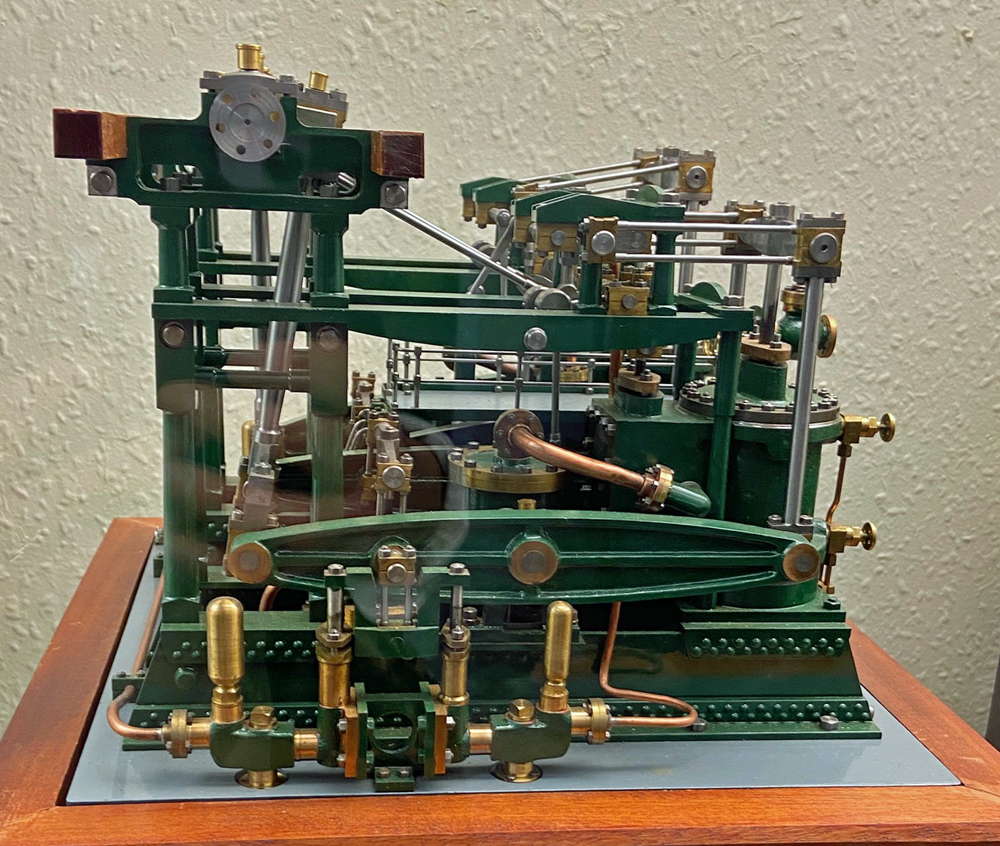
Side lever paddle steam engine

Side lever paddle steam engine, representing an engine of about 1840

Birkenhead Corporation Ferries poster

Birkenhead Corporation Ferries poster


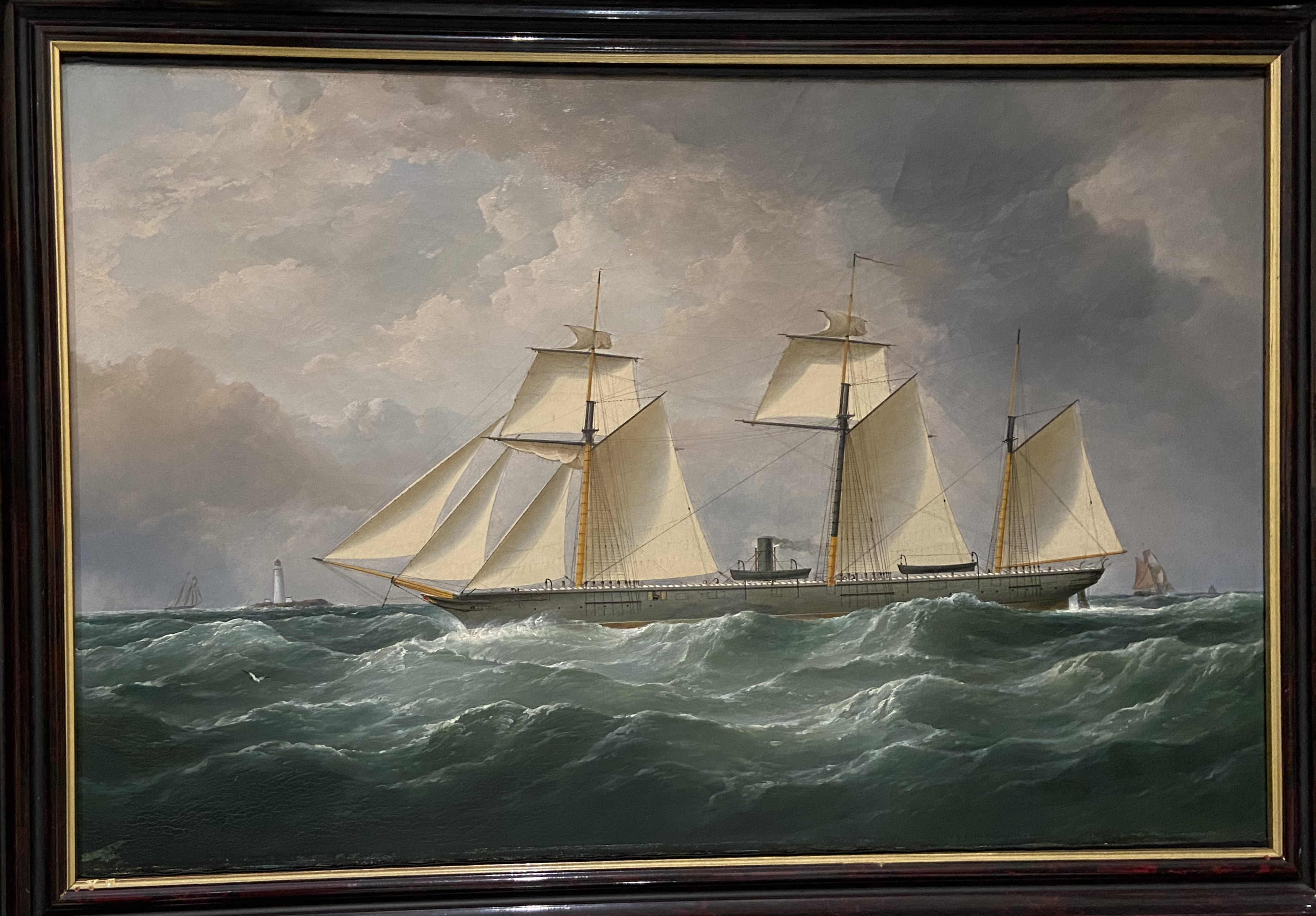
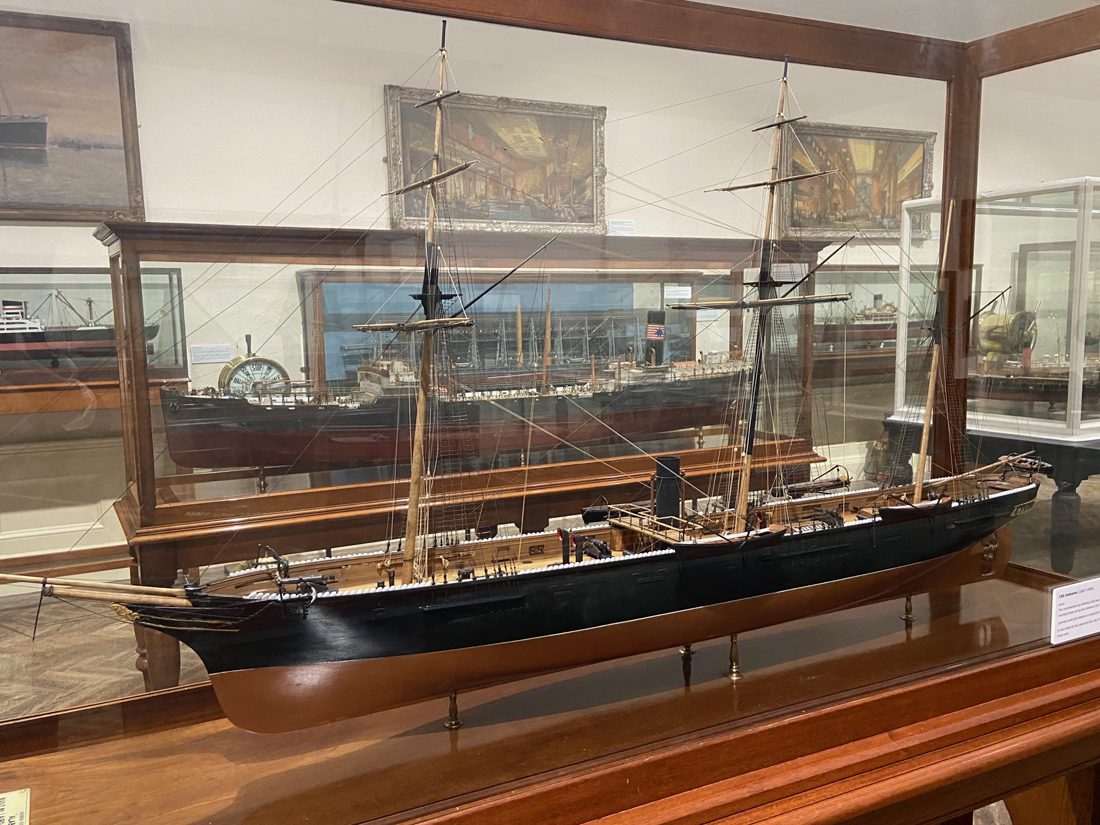
The C.S.S. Alabama, built Camell Laird’s shipyard, in theoretical violation of official Government neutrality in the American Civil War, is represented at the Williamson by both an oil painting and a model (the latter shown at the very end of this post).

Oil painting of the CSS Alabama by Samuel Walters (1811-1882)

Oil painting of the CSS Alabama by Samuel Walters (1811-1882), painted after 1862


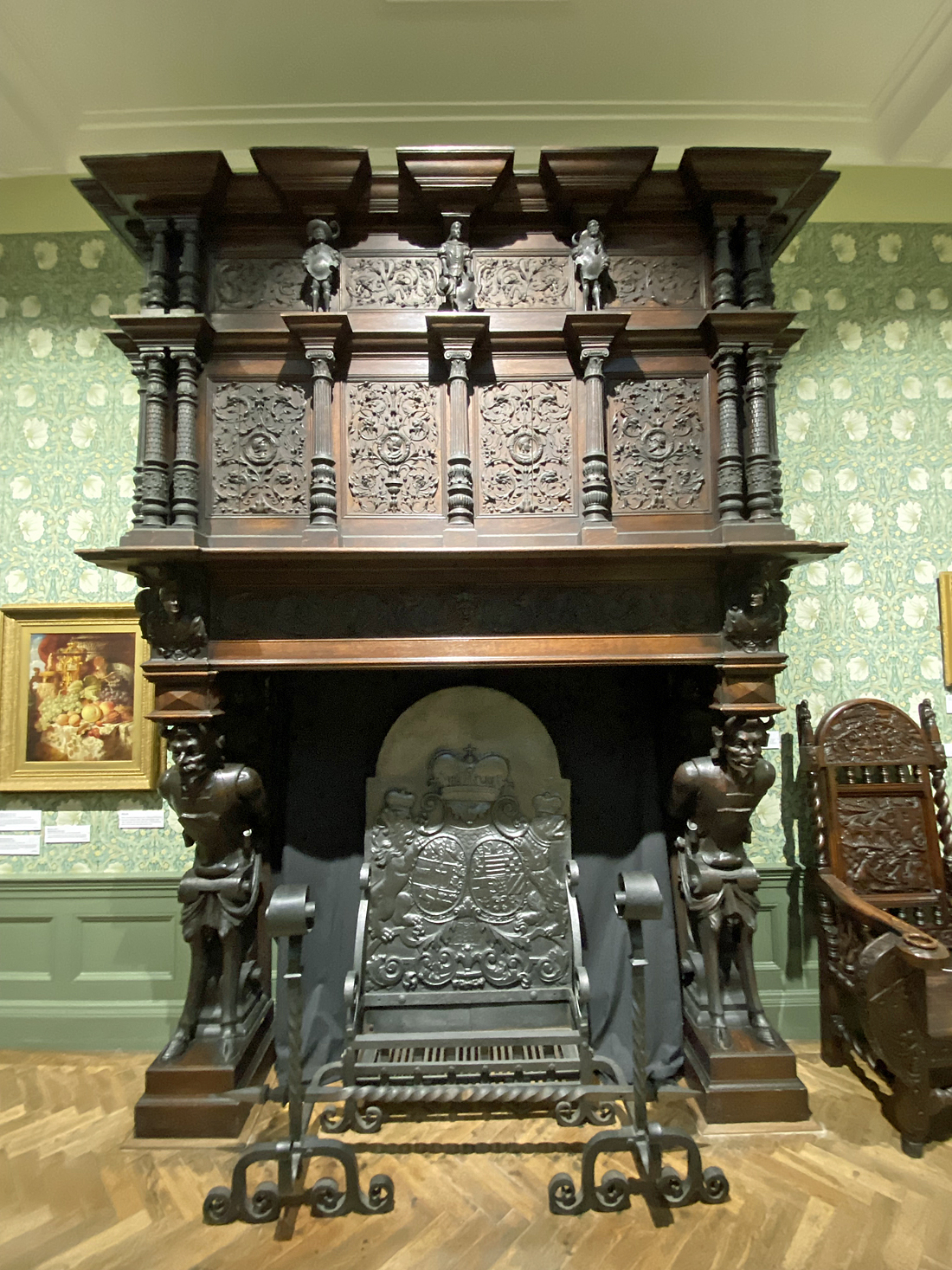
Piece of furniture from Arrowe park.

Piece of furniture, a sideboard, from Arrowe park. None of the Arrowe Park furniture can be ascribed to a particular carver or workshop.  Diana is at centre, possibly an earlier French panel.  The cupid-like boys flanking her represent food and drink.

Entirely in step with this growth of maritime industry and the rise of commerce, was Arrowe Hall.  The name is now associated with as a hospital, it was originally built in 1935 for John Ralph Nicholson Shaw, who inherited Arrowe Park from his uncle John Shaw, Liverpool Mayor and slave trader.    A small gallery is devoted to reconstructing one of the Arrowe Hall rooms, with some truly astonishing, beautifully crafted, enormous and aesthetically rather appalling pieces of furniture and ornamentation, a mish-mash of medieval, Tudor and Jacobean styles executed with enthusiastic Victorian panache.  The information board says that most of the pieces of furniture date to the 1880s, but were carved with earlier dates:  “This deceit, and staining the oak very dark, was meant to give the owner a heritage and respectability that they didn’t really have.”  The detail in the fireplace overmantel below shows considerable skill imitating earlier Renaissance style friezes. At the time of writing, the house is now a home for adults with learning difficulties.


sdfsd

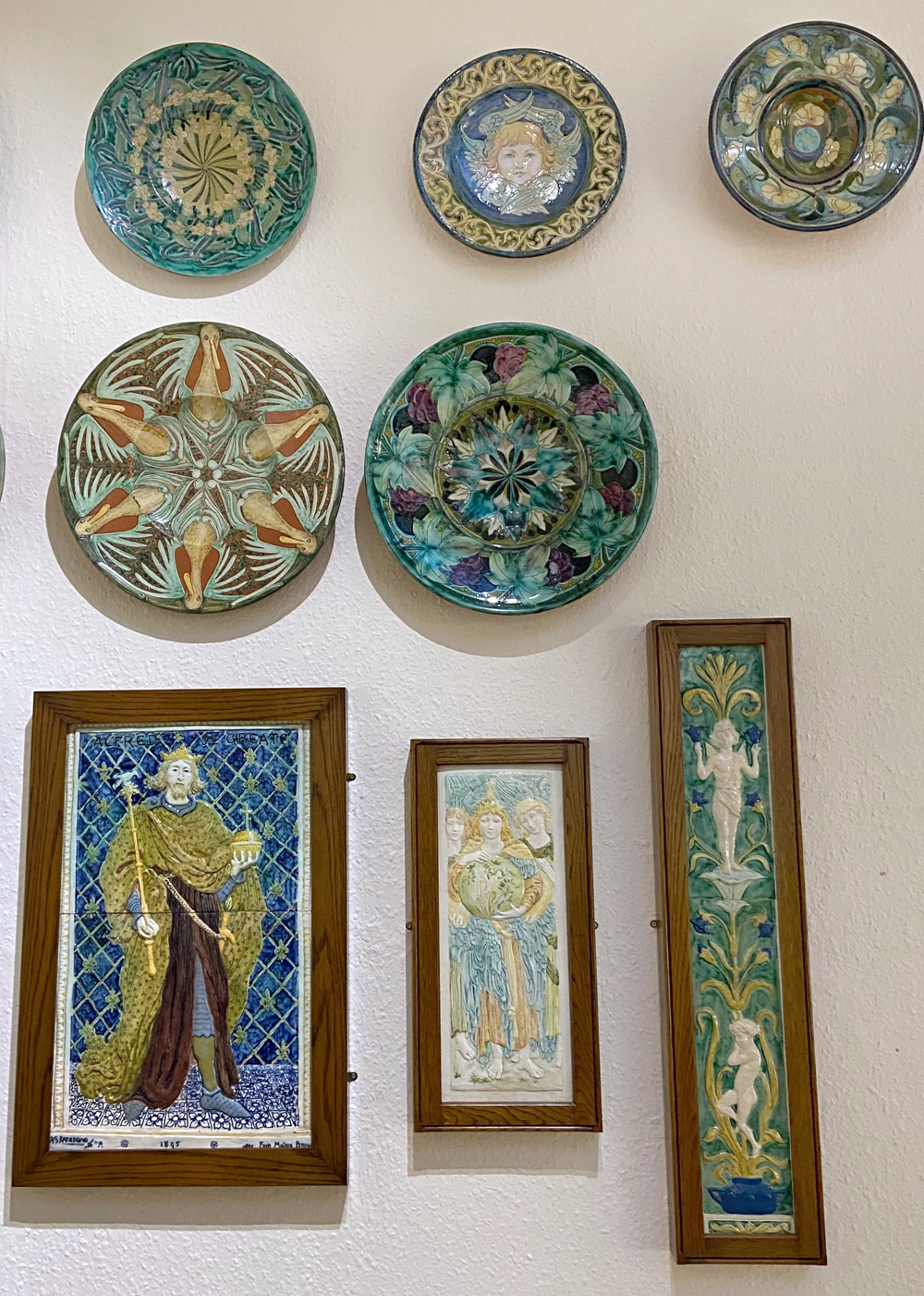
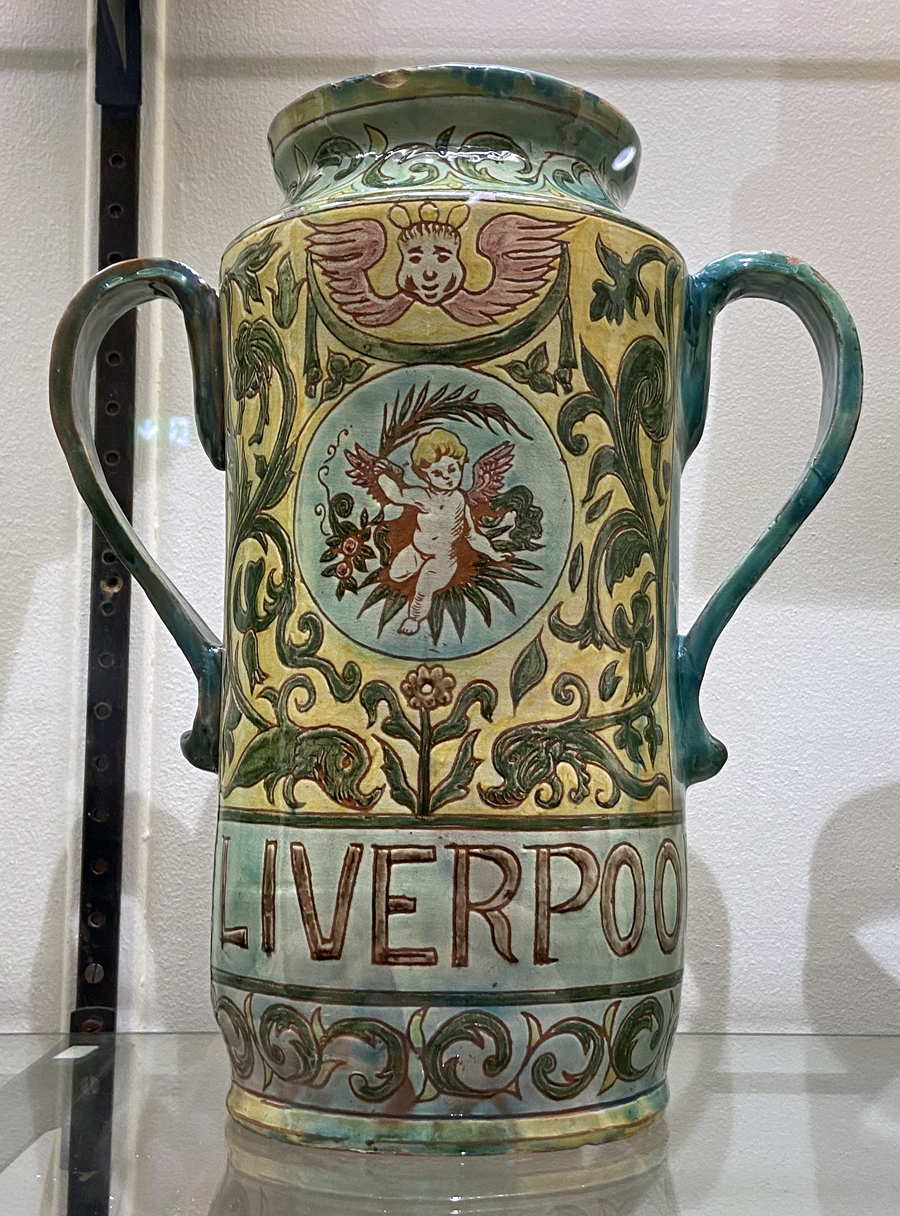
Pieces from the Della Robbia Pottery, Birkenhead

Pieces from the Della Robbia Pottery, Birkenhead

Similarly, the Della Robbia Pottery room is bound to split aesthetic opinion.  Della Robbia Pottery, taking the name from Luca Della Robbia (1400-1481), and on whose style it is loosely based, was a remarkably successful Birkenhead enterprise for a short period of time between 1894 and 1906.  It was established by Harold Rathbone (1858-1929), who worked with professional designers but also hired young people locally who he trained up.  It is lavish, ornate, brightly coloured, glossy, often with multiple textures and sculptural components.  Rathbone strained at the Slade School of Art and became a pupil of Ford Madox Brown, and the influence of the Pre-Raphaelites is clear in many of his pieces.  Many of the themes of pieces produced by the pottery feature angels, cupids and mythological figures, as well as elaborate and complex patterns.

sdsfds


xxx
xx

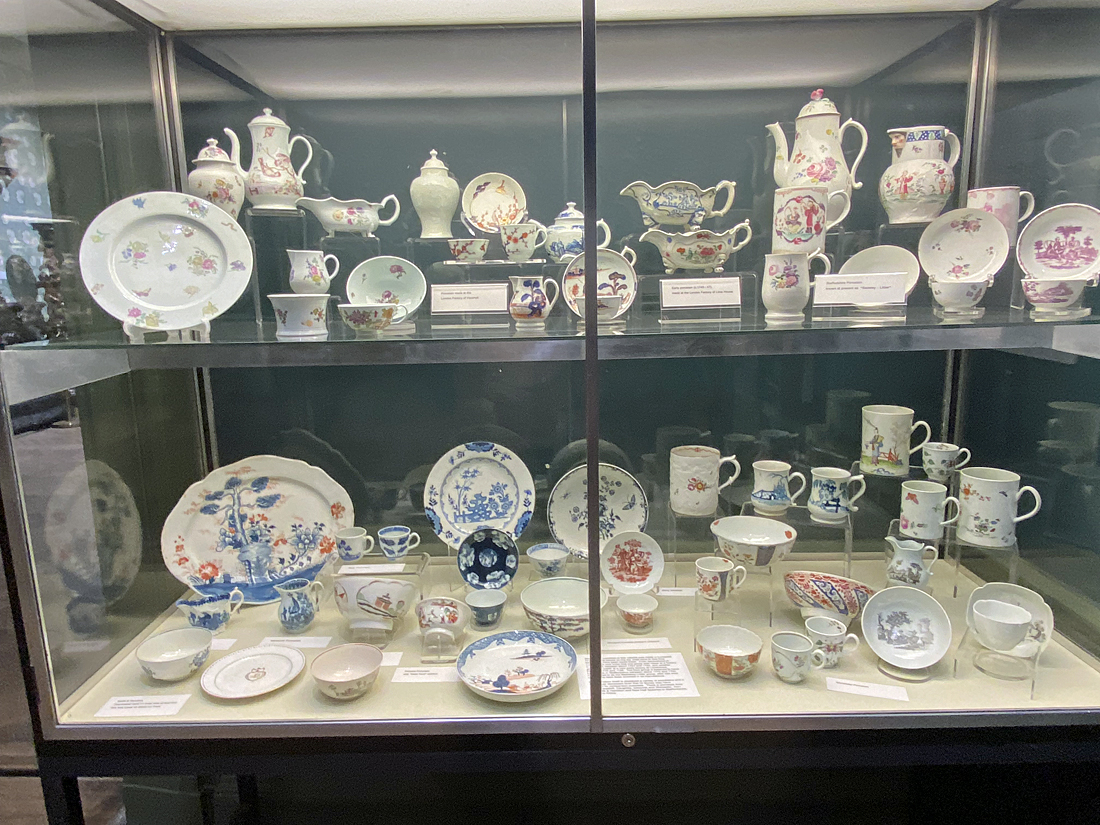
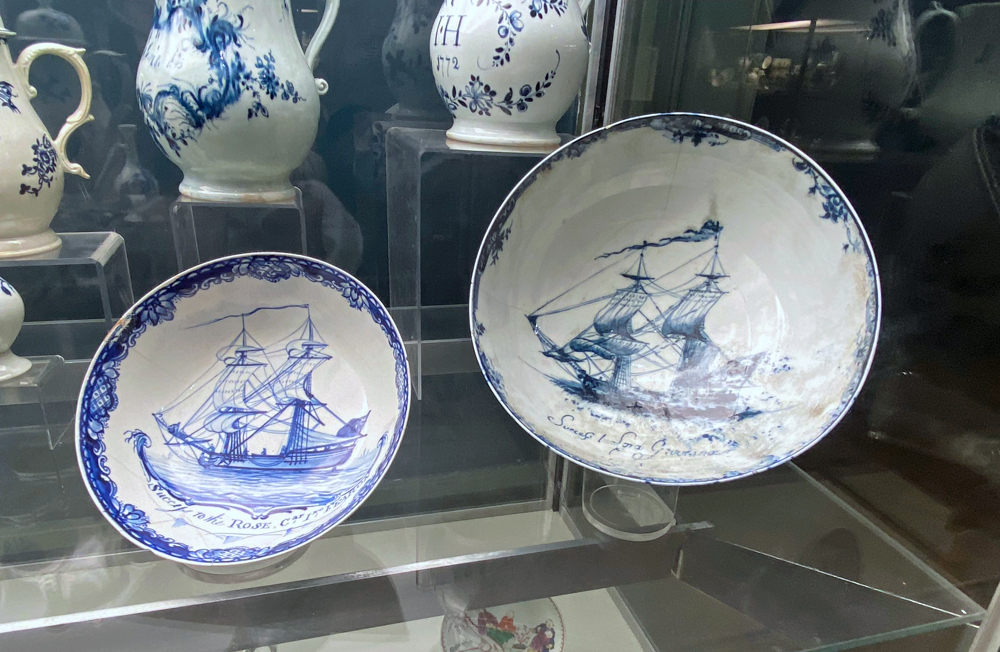
Another small room focuses on ceramics that were either made and used in Merseyside or were imports, brought back to the Mersey docks from the far east to meet the demand of local consumers.  Chinese ceramicists cottoned on very quickly to the types of decorative themes that were popular in the west, and produced specific types of design, including specific types of shape, for the European market. The mix is diverse, but there are one or two pieces that directly reference the maritime.  The influence of Chinese ceramics is very clear, made either locally or imported, in some of the examples, but there are more localized themes as well.  There were seven different sites in Liverpool that were making porcelain, all operating between the mid and late 1700s.  Unfortunately, none of the factories used manufacturing marks so it is difficult to determine which factory produced which pieces.

xxx

Maria Prymachenko - Autumn is Riding on Horeseback

Maria Prymachenko – Autumn is Riding on Horeseback

Paintings by Ukrainian children, produced since the start of the war, from the Sunflower Dreams Project were on display during our visit, alongside paintings by Maria Prymachenko.  The exhibitions produced by Sunflower Dreams are displayed in Britain, North America and Europe.  Although the Sunflower Dreams Project exhibition at the Williamson ended in December 2025, at the time of writing you can still find full details about the project, with samples of the paintings produced by this admirable initiative on https://sunflowerdreamsproject.org/.  Maria Prymachenko (1909-1977) specialized in Ukrainian folklore and was awarded a gold medal at the World Exhibition in Paris in 1937 for her wonderful, brightly imagined paintings.  She was largely forgotten after the Second World War, but there was a resurgence of interest in her work in the 1960s and she is now featured in a number of international museums.

Philip Wilson Steer. A Girl at her Toilet, 1892-3

Philip Wilson Steer. A Girl at her Toilet, 1892-3

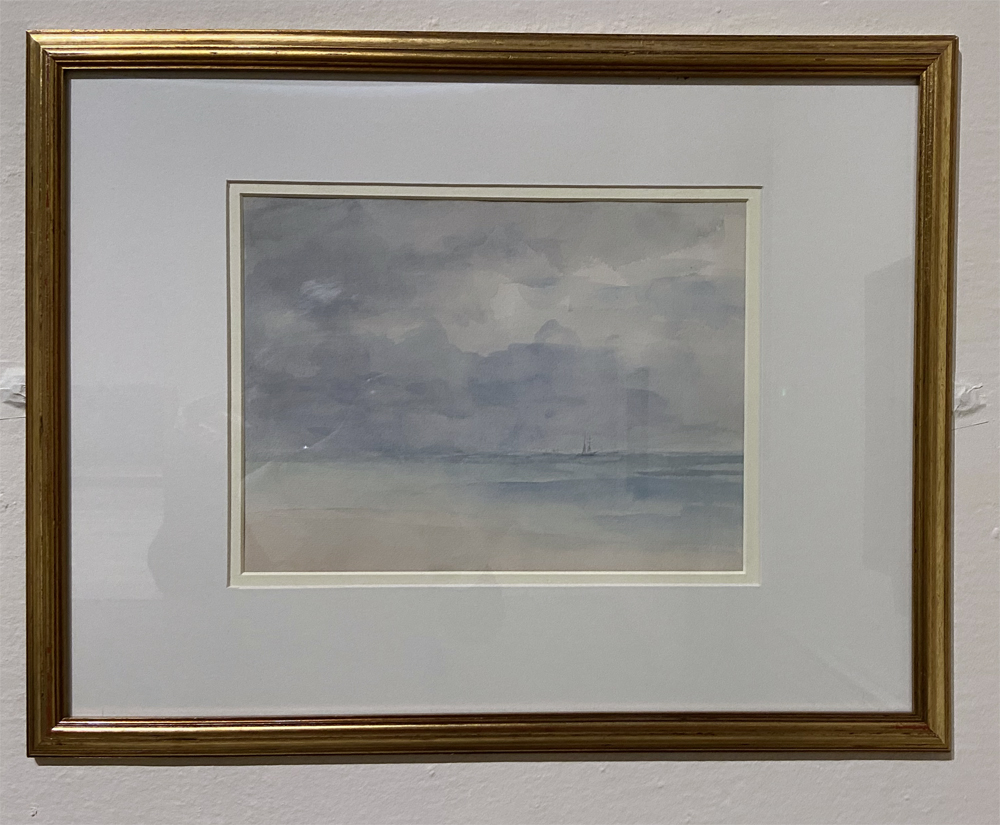
The painting collection on display during our visit strongly featured the landscape and seascape artist Philip Wilson Steer (1860-1942), who was born in Birkenhead, although grew up elsewhere.  He had spent time in Paris and was strongly influenced by the Impressionists and other contemporary artists.  In his A Girl at Her Toilet of 1992-3, the theme of women engaging in personal behind-the-doors activities, so popular with Impressionist painters, is given a more dramatic overlay of contrasting colours, clearly inspired by Éduard Manet.  the label says that the “intimate or even voyeuristic” tone of his painting was “ridiculed by English critics partly for the perceived indecency of his choices of subject matter.”  By complete contrast, his Seascape off Walmer of 1930 was painted as he began to lose his eyesight, retaining only peripheral vision by 1935 when he moved almost completely over to watercolour. The entire composition is made up of thin washes of pale blue that create a delicate, almost abstract seascape with a single small boat in the distance, creating the only sense of depth.

Seascale off Walmer, 1930 by Philip Wilson Steer, 1860-1942

Seascale off Walmer, 1930 by Philip Wilson Steer, 1860-1942

There were a set of paintings by Albert Richards (1919-1945), who has the sad distinction of being the youngest official War Artist to be killed in action in the Second World War, just two months before VE Day when the jeep in which he was travelling ran over a landmine.  He was born in Liverpool but moved to Wallasey when young, training at the Wallasey School of Art.

Albert Richards - Della c.1938

Albert Richards – Della, c.1938. Painted when the artist was attending Wallasey School of Art. Gouache on paper.

Many of the other paintings on display by other artists from the period, both watercolours and oils, are obviously influenced by more accomplished Impressionist and Post-Impressionist works, but are interesting  as examples of how local artists were influenced by the latest trends.

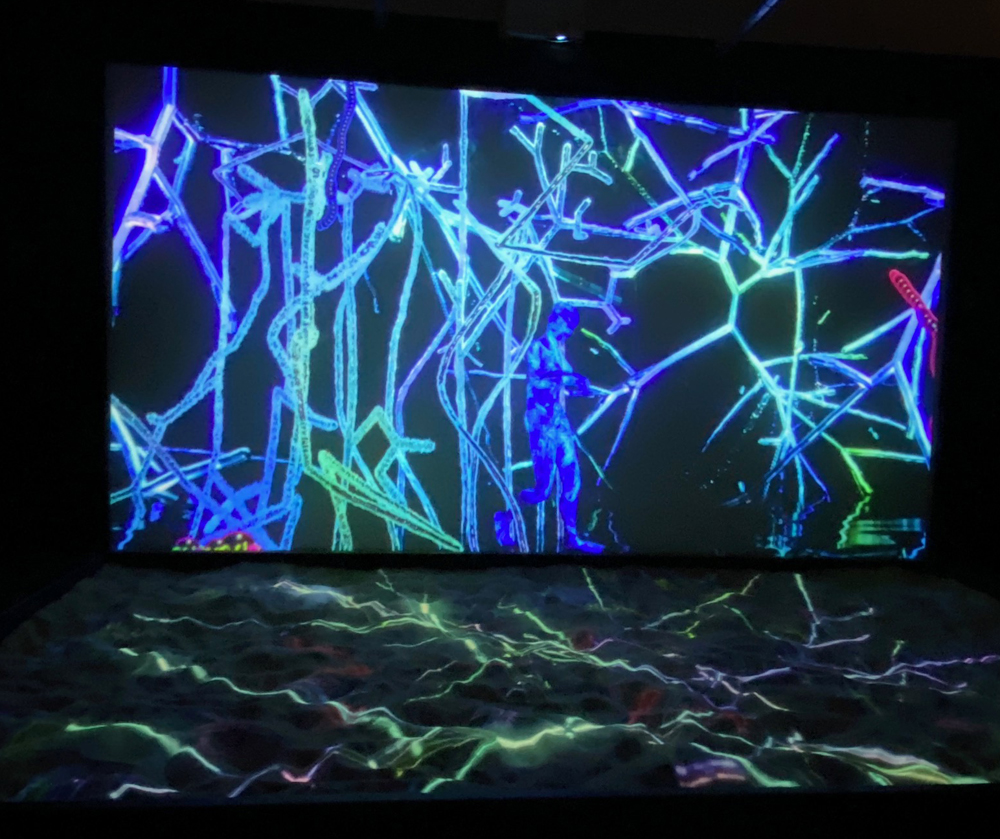
Temporary installation - Di Mainstone's "Subterranean Elevator"

Temporary installation – Di Mainstone’s “Subterranean Elevator,” which shows continually throughout the day. On until the end of January.

Because at least half of the Williamson is dedicated to temporary collections, a lot of the paintings are in storage.  None of the better known examples from the permanent collection were on display when we visited, including the glorious watercolour of Brunel’s S.S. Great Eastern beached on the Mersey for repair work by William Gawin Herdman in 1863 and the Joseph Mallord William Turner’s dramatic watercolour Vesuvius Angry, both of which I was really hoping to see.  I checked with the information desk after our visit, but the consensus was that they were both in storage.  The comprehensive and very nicely presented online catalogue shows what the Williamson holds, but it does not indicate what is or is not on display.
xxx

Charles Eyes 1767 Liverpool and Birkenhead

Liverpool and Birkenhead, attributed to Charles Eyes 1767, showing Birkenhead Manor and Priory. This photo is taken from the Williamson’s online catalogue at https://williamsonartgallery.org/item/1580053/

The café, with more paintings on the walls was producing some very good-looking meals and bakes, and the coffee was excellent.  One of the paintings was a very evocative one of pre-industrial Birkenhead showing the manor and the ruined priory, the sister paining of one in Liverpool’s Walker Art Gallery.  I couldn’t get to it without trampling some diners underfoot, so the picture to the right is taken from the online catalogue. There is also a small shop area with books against one wall, and a few postcards.  The sculpture garden, which can be reached from the café, looks interesting, but it was pouring with rain, so we abstained.

The Williamson represents Birkenhead and the Mersey, both past and present. The policy of the gallery is to mix its core collection of 19th and early 20th century art and decorative arts, with temporary exhibitions, often featuring contemporary works, and it is well worth keeping an eye on what their temporary exhibitions offer, either by checking the Williamson website or signing up to the email newsletter.


Frozen Fabric: Spectrum by Anna Sutton 1983

Frozen Fabric: Spectrum 1983 by Anna Sutton OBE (b.1935), British textile artist and designer. In this example she transforms a simple weave into a sculptural object, “merging textile traditions with minimalist abstraction.”

17th century Japanese temple bell, in the Arrowe Hall room.

17th century Japanese temple bell, in the Arrowe Hall room. If it ever goes missing, you will know where to look!

CSS Alabama

CSS Alabama


Cheshire Proverbs 9: “A face like a Buckley Panmug”

“A face like a Buckley panmug”

Bridge, J.S., no.6, p.2

I love this proverb, although Bridge, in irritatingly understated mode, comments simply “Buckley in Flintshire, a few miles from Chester, produces a good deal of coarse red earthenware.”

Buckley wares in the Grosvenor Museum collection

Buckley wares in the Grosvenor Museum collection

This is the sixth of Bridge’s proverbs, on only the second page of his collection, and although it clearly failed to impress Bridge with any sense of historical depth and interest, the Buckley ceramic potteries near Mold in north Wales were major producers of a number of different types of pottery, nearly all coarseware, produced in great volume.  There is not a field or garden in the area that does not produce at least a few sherds of Buckley ware, and many of them produce a great deal.  I have unearthed tons of it in the form of sherds from my garden.

The earliest potteries were established in the Middle Ages and continued to produce coarsewares well into the 20th century.  Nearly all of the potteries have been lost, as the Buckley area has been expanded via large housing developments, although archaeological excavations have been carried out in recent decades that have helped to supplement documentary information.

Different examples of Buckley pottery. Source: CPAT Report no.1246.

The Buckley potteries were established to take advantage of the underlying on Westphalian (Coal Measure) clays where crops of Ruabon Marl appear on the surface, comprising mudstones, siltstones and sandstones that formed from waterlogged alluvial floodplain silts and provided the fireclays used in the potteries.

First, what on earth is a “panmug” when it escapes from domestic captivity?  I could not find a picture of one but thankfully, amongst other sources, here’s a description from Egerton-Leigh’s 1877 glossary of Cheshire dialect, which makes it quite clear that it was indeed made of the Buckley coarse red pottery, that it was used primarily for dairy products, and goes on to explain the “face like a panmug” reference:

Panmug, s. – (pronounced paanmoog) . . .  The coarse red crockery  used in family operations for cheese milk, butter, &c., and any rough use. A girl who was taken to see Capesthorne Hall, which contains (or contained before the fire), amongst many curiosities, a valuable collection of Etruscan vases, described to her mother on her return how beautiful everything was, but that she had been surprised to see “the paanmoogs kept in the house place” i.e. the best sitting room).  Our Cheshire panmugs are manufactured mostly at Buckley, in the neighbouring county of Flint. A man with a red, coarse, blotchy countenance (not unfrequently the result of hard drinking) is said to have “a feace like a Buckley paanmug.” [Leigh 1877]

Beehive kiln base Lewis Pottery

The base of the beehive kiln at Lewis’s Pottery during excavations in 2000. Source: Earthworks Archaeology, via CPAT Report 1246.

Although established in the Middle Ages, the Buckley industry began to expand significantly in the 18th century, becoming a major producer in the 19th century.  Well-known travel writer Thomas Pennant visited in 1786 and described 14 potteries that produced coarse earthenware “such as pans, jugs, great pots for butter, plates, dishes, ovens, flower pots, etc,” with a significant export trade to Ireland and the Welsh coast.  Research since then has identified at least 31 potential potteries, all small family industries.  The range of items produced was considerable.  As well as household and garden items, specialized products were also manufactured, like door handles, as well as items for the tourist industry, such as teapots and novelty items specific to particular resorts showing placenames and phrases in Welsh.  Industrial output included heat-resistant refractory bricks which could be used in kilns, crucibles and blast furnace linings.

Other areas made very similar coarse wares, including Stoke-on- Trent, South Lancashire (including Liverpool), Whitehaven, and the Glasgow. Each of these produced black-glazed, red-bodied earthenwares using very similar clays and techniques to those at Buckley.  Although when found locally it can be confidently assigned to Buckley, when found further afield it may be difficult to distinguish from pottery made by these other centres.  A classic example is the richly glazed dark coarseware decorated with curving lines of yellow slip, often referred to as “Staffordshire ware” but, in this area, much more likely to be Buckley ware.

Although Buckley ware was commonplace, many types are now collected, and it may be found in museum collections and can reach fairly high prices in antique shops and at auction.

For more about J.C. Bridge and this Cheshire Proverbs series,
see Cheshire Proverbs 1.

For the other proverbs in the series, click on the Cheshire Proverbs label
in the right hand margin, or see the end of the Archaeology, Heritage and Art page, where they are listed.

xxx

Sources:

Books and papers

Bridge, J.C. 1917.  Cheshire Proverbs and Other Sayings and Rhymes Connected with the City an County Palatine of Chester.  Phillipson and Golder (Chester)

Jones, Nigel, W. 2019. The Buckley Potteries Recent Research and Excavation. Archaeopress

Leigh, Lt-Col Egerton M.P 1877. A glossary of words used in the dialect of Cheshire founded on a similar attempt by Roger Wilbraham F.R.S. and F.S.A. Contributed to the Society of Antiquaries.  Minshull and Hughes
ia801204.us.archive.org/0/items/glossaryofwordsu00leigrich/glossaryofwordsu00leigrich.pdf

Websites

Clwyd-Powys Archaeological Trust (CPAT)
CPAT report No. 1246 The Buckley Potteries: an assessment of survival and potential
https://coflein.gov.uk/media/263/618/652220.pdf
CPAT Report No. 1476 Brookhill Pottery, Buckley
https://coflein.gov.uk/media/291/13/652259.pdf

People’s Collection Wales
Buckley Pottery
https://www.peoplescollection.wales/collections/376938

Pilgrims and Posies blog
The Cheshire Prophet
https://pilgrimsandposies.blogspot.com/2013/01/the-cheshire-prophet.html


A very beautiful autumnal sunshine walk along the Wirral estuary from Burton to Parkgate

Bird of prey, Burton, Wirral

Beautiful feathers on a bird of prey at Burton, Wirral

Yesterday seemed, at first, to have been doomed from the start.  I was supposed to be driving to Aberdyfi in mid-Wales to do something specific, but 20 minutes from home, already running very late, realized that I had left two components essential to the task on the kitchen table.  Having returned home and collected the required items, I was leaving the house and went to take a quick snapshot in my garden of a squirrel running upside down along a power line and rapidly closing on an oblivious turtle dove, and found to my dismay that the camera couldn’t read the SD card. Nooooooo!  I knew I had a spare somewhere, but where?  Ridiculous to go to Aberdyfi on a sunny blue-skied day like this without a camera.  After half an hour of fruitless searching I picked up the phone and cancelled my visit.  Twenty minutes later I had found the wretched thing.  Instead of the planned expedition, I found myself grabbing the camera and car keys before heading up the Wirral to Burton to park up along the estuary and go for a very fine walk along part of the Wirral section of the King Charles III England Coast Path.  I hadn’t even got out of the car when I saw the above bird of prey, which politely held position whilst I scrambled out of the car.  A perfect way to turn around a very unpromising start to the day.

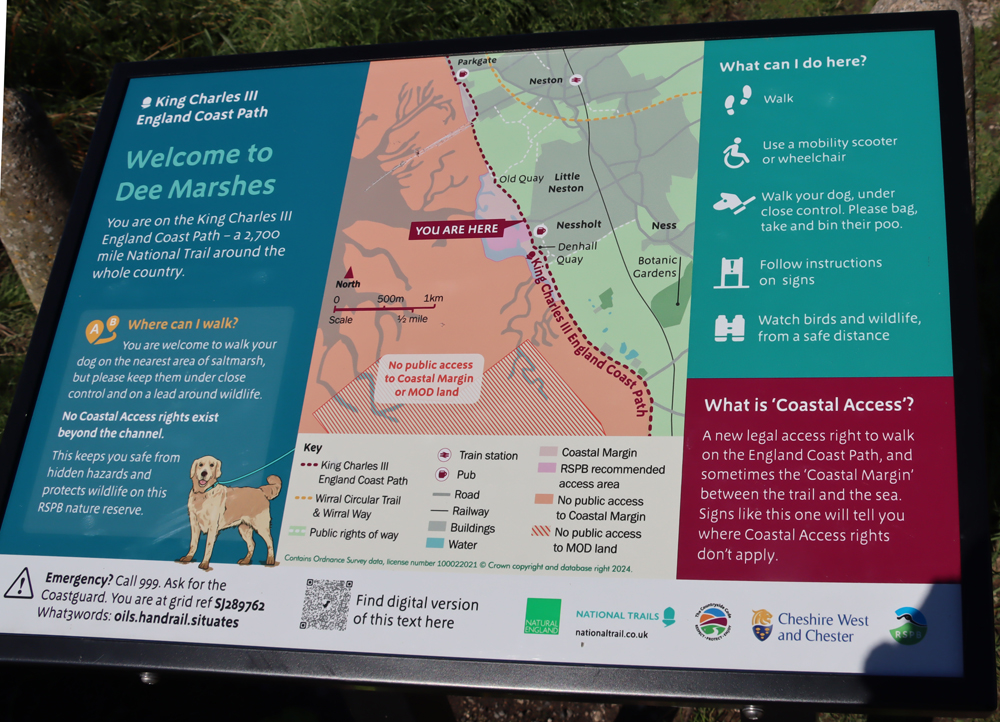
I have made a short visit to the estuary cycle track and walk in the past, simply to get a good look at the purported Iron Age promontory fort on Burton Point, but although it was enjoyable, it was a short stroll because the skies opened and I got drenched.  Today, with no risk of rain, I decided to walk from Burton towards Parkgate, which I guessed to be about an hour’s walk each way.  When I reached the “You are Here” board (with which the walk is dotted at key points) at Moorside, alongside Parkgate Spring and on the very edge of Parkgate, this was a full hour.

Parking is easy along the section of Station Road that lies along the estuary for the Burton to Moorside (near Parkgate) section of the "King Charles III England Coast Path"

Parking is easy along the section of Station Road that lies along the estuary for the Burton to Moorside (near Parkgate) section of the “King Charles III England Coast Path” (What3Words: ///glows.lung.headsets). Source: Google Maps

Parking for this particular walk is along the section of Station Road that runs along the side of the estuary, indicated by the red circle on the map.

The walk itself begins along the section of Denhall Lane that turns along the side of the estuary and passes a café, as indicated by the black arrow on the map.  Although vehicles are permitted as far as the café (just beyond the left edge of the map), they are banned beyond this point.

This first stretch of metalled lane is dominated by dog walkers and cyclists. Do keep an ear open for the cyclists as they can pick up a lot of speed along the lane and don’t always give a lot of notice of their impending arrival.  The path goes through various changes.  After some time it parts from the lane and becomes much more of a footpath with rough stone underfoot, which probably accounts for why the cyclists vanish from the scene at this point.  At one stage it becomes a track across a field, although there is a route around this in wet weather that diverts inland for a while.  The entire walk is well maintained with pedestrian gates and bridges where needed.  One field had horses in it, so do take care if you are walking dogs.

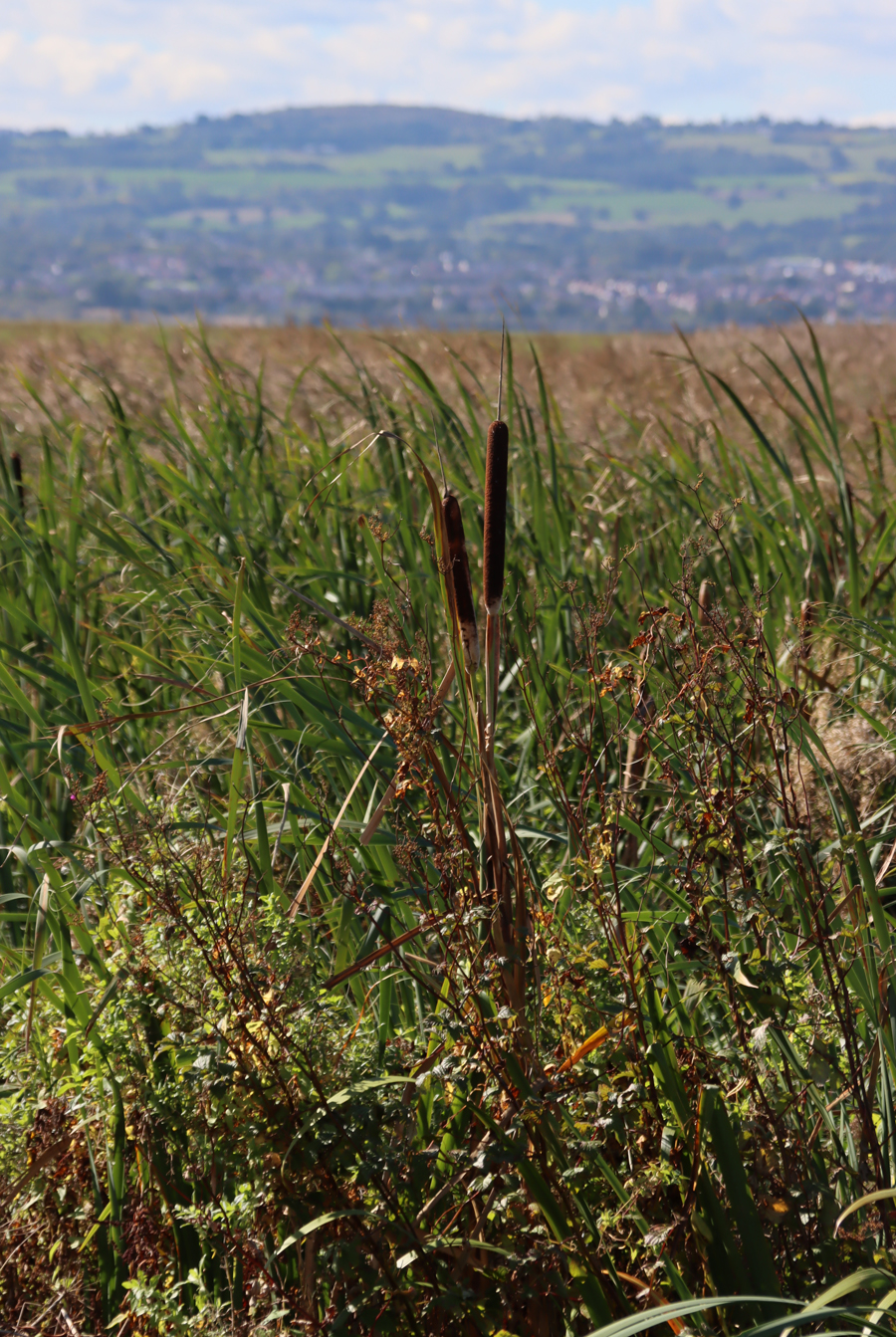
Scenically, the walk is always split between two different experiences to left and right.  The views across both wetlands and former wetlands to the Welsh foothills to the southwest are lovely on a sunny day, and you can keep an eye open for bird life.  On the other side of the path, immediately hugging its edges, there is an almost uninterrupted run of very fine hedgerows and trees.  At this time of year there is not a great deal to see on the estuary, although I was delighted to see lovely white egrets in a distant blue pool, as well as a couple of birds of prey hovering splendidly overhead. Most of the flowers in the estuary have gone over, but the autumnal leaves, berries, rose-hips and other fruits of the shrubs and hedges and the multiple colours of the changing leaves on trees along the paths were endless and superb, really gorgeous against a blue sky with the sun shining on them.

xxx

Nearing Neston I spotted a line of vast red sandstone blocks extending out into the estuary vegetation, and a small spur of land also extends out at this point.  An information board explains that this is part of the Neston Colliery, Denhall Quay.  There is a particularly good book about the collieries, The Neston Collieries, 1759–1855: An Industrial Revolution in Rural Cheshire (Anthony Annakin-Smith, second edition), published by the University of Chester, which I read and enjoyed a few years ago.  The sandstone blocks are massive, and as well as retaining original metalwork, one of them has become a memorial stone, as has one of the trees on the small spur of land.  The line of sandstone, now a piece of industrial archaeology, is a very small hint of the extensive work that once took place here, but is an important one.  The author of the above-mentioned book refers to it in a short online page here, from which the following is taken:

There are still some signs today of the old mining operations. Most prominent is Denhall Quay, the remains of which still jut out into the Dee Estuary. This was built in 1791 and was used to ship coal to North Wales, Ireland and occasionally to foreign countries, as well as inland via newly-built canals.  Also, if you know where to look it is possible to trace the location of many of the shafts that were once in use, including one hidden behind a brick wall in Riverside Walk. Easier and arguably more rewarding to find is The Harp Inn! The building was standing in the mines’ earliest days and records show it was a public house for the miners no later than 1813 and probably much earlier. It has several photos on its walls from the mines’ later days.


This is the point that I turned around and walked back. The image immediately above the  map shows point where the Parkgate Spring emerges, very audible but  not actually visible.


xxx

There are very few places to sit down along the walk, so I would recommend that if you need to rest your legs occasionally, you take your own portable seating.  Regarding refreshments, I have mentioned Net’s Café, near the Burton end.  I haven’t visited and apparently there’s no website, but it is just off Denhall Lane and it is listed on Trip Advisor here.  There is also a very good pub called The Harp, which I actually have visited, with outdoor tables immediately overlooking the wetlands towards the Welsh hills, just outside Little Neston.  The food being served there looked excellent, and I can give a solid thumbs-up for the cider.  The pub was particularly well situated for my return from Parkgate as the zoom lens on my camera, a particular beauty that has been worryingly on the twitch for weeks, suddenly stopped working and was now, just to ram home the overall message, rattling.  A glass of cider and a seat in the sun were perfect for jury-rigging the wretched thing so that the zoom now worked like an old-fashioned telescope and the camera’s autofocus, which was refusing point-blank to engage in conversation with the lens, could be operated manually on the lens itself.  Sigh.  New lens on order.

If you can do this walk in September when the berries are at their best, do take the opportunity, because it is stunning, particularly on a sunny day.  And all on the flat too, so entirely appropriate for unwilling legs.
xxx


“Cheshire’s Archives: A Story Shared.” Great to learn about the new Cheshire Archives, opening next year

The Cheshire Archives building in Chester. Source: Cheshire Archives: A Story Shared

On Wednesday 17th September, as part of Heritage Open Day, Paul Newman from the Cheshire Archives and Tim Brown from the architectural firm Ellis Williams, explained to a well-attended audience at the Grosvenor Museum how the new archive project had been rolled out and what we can expect next year when the new Chester building opens.  I am dying to get my hands on the Cheshire Lunatic Asylum records that they hold, having already written a long screed about the asylum between 1854 and 1870 (across four posts here), so I was attending the event with a real sense of anticipation.

The Cheshire Archives, which since 1986 have been located in Duke St in Chester, closed in 2022, having won a Lottery grant to build two brand new buildings.  The former Duke Street premises of the Archives were in a set of lovely Victorian buildings, which were once warehouses of the legendary Browns Department Store, but the Archives were beginning to outgrow them.  The archive collections go back to the mid 12th century, and continue to be added today, representing different aspects of community life, working and domestic, at different periods.  As its role became more important, the Archive outgrew the building, with boxes that would reach 8km if laid end to end, and it had a number of environmental issues as well as providing less than ideal facilities for both staff and researchers.  Targets to reach a larger and more diverse audience were difficult, and it became clear that a move was the only realistic solution.

The new Crewe Cheshire Archives building. Source: Cheshire’s Archive: A Story Shared

An initial investment of National Lottery money to explore the project in 2020 was successful, and a full National Lottery Fund grant was subsequently allocated, with work began in earnest in 2022.  The locations in Crewe and Chester will spread the collection between east and west sides of Cheshire to provide accessible storage for the archive collections in conditions that are much more favourable. Outreach programmes will be more viable, reaching a much wider audience of different ages and backgrounds. Digital access will be much improved, with new ways to access local collections and historical data, including a postcode search and community-selected highlights referred to as “Gems.”  At the same time, the salt mines in Winsford will continue to store other records, which are available to order to either location with a one-week turnaround.  A permanent exhibition will be set up, and exhibition spaces will eventually be available for those using the archives.  The new offices will open in 2026, and the project will continue as a measuring and monitoring exercise into 2027.

Location of the site on Lightfoot Street. Source: Cheshire West and Chester

The architectural firm Ellis Williams, who had undertaken the ambitious and successful conversion of Chester’s Story House, was appointed to develop both of the new buildings.  Interestingly, although they have many of the same internal features, their appearance is very dissimilar.  Both have very modern appearances, but each has been adapted to its own immediate neighbourhood.  Initial design ideas were more radical, but certainly in the Chester case the emphasis soon shifted towards meeting planning requirements for some degree of continuity between the proposed new building and the surrounding architectural context and local character. Documents detailing some of the plans can be found here: https://www.cheshirestoryshared.org/home/the-plan

The new archive building in Chester will be located on the mainly residential Lightfoot Street, which runs along the railway line behind the Chester railway station.  This has created some challenges in terms of accessibility, and the Council were unwilling to sell the entire site, so parking is confined to 35 spaces.

A low wall with indented panels on Chester Lightfoot Street, which separates the archive site from the road. Source: Google Maps.

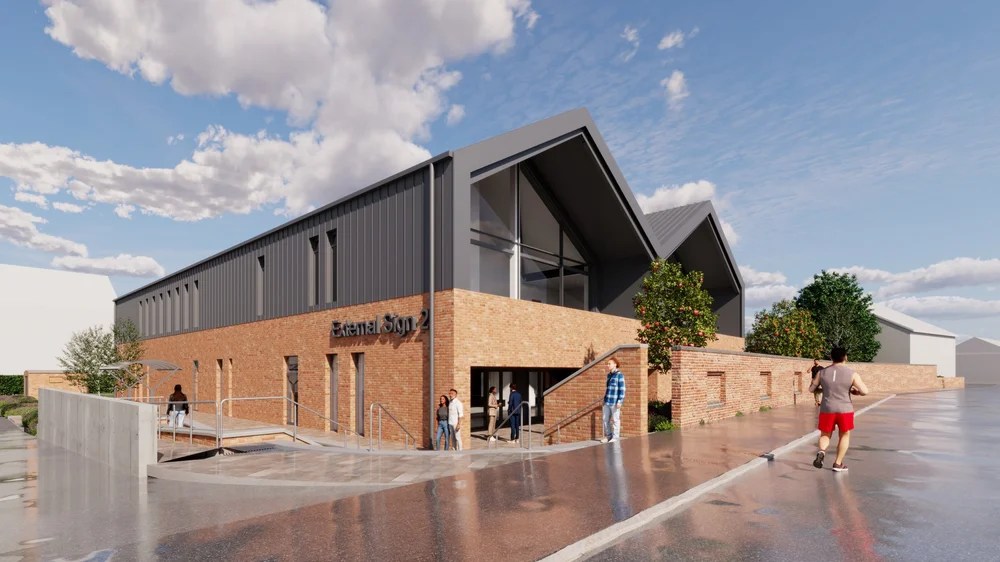
The site is divided from the road by a low wall with indented sections, and it was a planning requirement that this should be preserved.  The idea here is to knock through some of the indented panels, whilst leaving others in tact, replacing those that are to be knocked through with wrought iron artwork, so that the Archive site is visible through the panels, creating a linkage between both sides of the wall.  There is a slight slope of around 2.5m downhill from the road level, which requires stairs and slopes to enable ease of access.  Parking will include spaces for school coaches and there will be a loading bay at the rear.  The shape of the building itself will echo the twin-gabled shape of railway sheds and platform roofs, but is super-modern in design, and it will feature an “active frontage,” a term that refers to the integration of the building with the street onto which it faces.  Work began in 2017.

Inside, the two-storey Chester building will be split between a public-facing space on the ground floor and a more staff-orientated space on the first floor.  It will total 3000 sq ft (c.270 sq m).  The ground floor foyer, which although north-facing should be light-filled, will be an exhibition space, and will include a theatre area with movable walls, lighting and seating, to ensure maximum flexibility.  A help desk will be located at the rear.  The research rooms will have desks for research, with a total of six computers available at any one time (most people apparently bring their own kit) and there will also be a chill-out area.  The first floor will include, with archive storage in rolling racks, offices and meeting rooms.  Energy considerations have been factored in, making best possible use of the available technologies, and various levels of security and fire-safety measures are part of the overall plans.

The foundations have been established and work is underway on the lower level brickwork, whilst a steel frame and roof have also been erected.  Archaeologists from Oxford Archaeology had been given time to carry out an assessment, but found very little of interest beyond sundry 19th century railway features.  The resulting report can be found here.

The archives will probably be open for a 5-day week.  I should have asked whether this was Monday to Friday, or whether a weekend day would also be included, but it did not occur to me at the time.  I am really looking forward to visiting the new Cheshire Archives building when it opens in late summer 2026, and experimenting with some of their upcoming digital services.  In the meantime there is a website showcasing some of the Archive’s activities at Cheshire’s Archives: A Story Shared.

Thanks very much to Paul Newman and Tim Brown for not only delivering a terrifically informative presentation but for answering the numerous audience questions.


A visit to Birkenhead Priory #2: St Mary’s Parish Church and HMS Thetis

Introduction

The remains of the former church interior, with a tall arch that, now blocked with brick, once gave access to the tower

St Mary’s Parish Church in Birkenhead has a splendid claim to fame as one of the earliest churches to have cast iron tracery in its window openings, in place of the usual stone mullions and tracery.  Although relentlessly Gothic Revival in style, it truly is a child of the Industrial Revolution.

St Mary’s sits over a part of the site occupied by the original medieval Birkenhead Priory.  I have talked about the splendid remains of  Birkenhead Priory, founded in the 12th century, and its ferry across the Mersey, the earliest one recorded, on an earlier post, Part 1,  here.  It is an absolute knock-out with a stunning vaulted chapter house, undercroft, remains of other parts of the monastic establishment and a small but very nice museum space.

A recent second visit to Birkenhead Priory, this time with the Chester Archaeological Society, was a good opportunity to re-familiarize myself with the much more recent stories of the 19th century St Mary’s Church, which is interesting in its own right. The tower, which is perfectly preserved with its clock mechanism visible from the stairwell, offers terrific views over the surrounding area whilst also serving as a memorial to those who died tragically during the sea trials of the submarine HMS Thetis.

St Mary’s Church

Plan of the Birkenhead Priory site, with the priory outlined in red, the now absent priory church outlined in orange and remains of the 1822 St Mary’s Church outlined in green. Source: Metropolitan Borough of Wirral leaflet (with my annotations in colour)

The site plan to the right shows the remains of the church framed in green.  The medieval priory and its church are framed in red and orange respectively.  The blue margin on the right is part of the Camell Laird’s shipyard, into which you can look from the tower of St Mary’s and watch the current shipbuilding activities.  Church Street, right at the top of the image, post-dates the demolition of most of the church in 1970.

Although there are some stunning architectural survivals from the medieval priory, almost nothing remains of the priory church following the Dissolution.  As you can see on the site plan to the right, the original priory church overlaps the site of St Mary’s.  The Prior and his monks effectively handed over the keys to Henry VIII’s administrators and left peacefully.  The need for a religious focus for the small community that remained, however, resulted in the consecration of the gorgeous monastic chapter house as a chapel (numbers 2, 3 on the plan, where the daily business of the priory had formerly taken place).  It was only in the 19th century when Birkenhead began to grow into an industrial town, port and shipbuilding yards, with a rapidly expanding population, which was encouraged by the introduction of a steam ferry across the river Mersey, that the little chapel in the former chapter house became far too small for the needs of the Birkenhead community.  As a result the decision was made to build a new church to meet the needs of this expanding population.

Thomas Rickman. Source: Wikipedia

The architect chosen for the task of building a new parish church for Birkenhead was Thomas Rickman, an interesting character whose 1817 book Attempt to Discriminate the Styles of English Architecture helped to promote the development of the Gothic Revival, of which he was himself an enthusiastic proponent.  Having secured some commissions in the Liverpool area from iron foundry owner John Cragg, Rickman had established an architectural practice in Liverpool in 1817.  The foundation stone of the new Parish Church of St Mary’s was laid in July 1819, was consecrated on the 17th December 1821 and opened in 1822, with a vicarage established on the probable site of the priory kitchen.  Built of red sandstone, which inevitably blackened with industrial pollution over the decades, the church had a rectangular plan apparently without aisles, with a tower at the west end.  Although bricked up today for structural stability, the tall arch in the east wall of the tower would have opened into the nave of the church.

St Mary’s church in the early 20th century on a splendid postcard showing the church and the former churchyard. Source: St Mary’s Birkenhead blog

The church was large for the available population, but the landowner Francis Richard Price apparently decided to future-proof his new building, correctly judging that the early influx of people was going to continue to expand.  By 1832 the church was too small for the congregation and was expanded with a north transept (wing), followed by a south transept in 1835. You can see some of the decorative touches from the roof in the remaining pieces of masonry at the feet of the west walls.

Victorian burials took place mainly in the churchyard but prestigious individuals were interred within the monastic garth.  The former monastic garth, the square green that formed the focus around which the most important monastic buildings were arranged, became a cemetery for important residents in the 19th century.  It is here, for example, that the Laird family crypt is to be found.  In 2024, at his request, the cremated ashes of Birkenhead Labour MP Frank Field, who served for 40 years, were buried next to the entrance to the chapter house.  He is almost certainly the last who will be given permission to be interred there.

The dock for which the churchyard was sacrificed in the 1950s

The churchyard with its cemetery no longer survives.  It was originally established in the Middle Ages, for the monastic community, but after the 16th century probably only saw intermittent usage. It was only as Birkenhead began to expand that it came back into general use.  After the opening of St Mary’s it once again became an important cemetery for the local area, remaining in use until 1901, after which only those with family plots or in exceptional circumstances were permitted.  In 1948 the parishes of St Mary’s and St Paul’s in Birkenhead joined forces, and St Paul’s was demolished.  In the 1950s, as the neighbouring shipyard expanded and was desperate for more space, a commercial deal was made between Camell Lairds and the town council, in the face of protests, to purchase the churchyard for a new dock.  Whatever remained of the medieval church, all but part of one arch, was taken down.  Around 1100 burials, including those that had been brought over, with headstones, from St Paul’s were transferred from the churchyard to the new Landican cemetery in 1957-8, leaving only those within the garth of the monastic complex, and a handful in the immediate vicinity of the church and the priory.  A tall wall was built to divide the site from the docks below.

Another angle on St Mary’s showing the exterior walls and the base of the tower, as well as the clock

The Church tower has a number of notable features.  The Victorian clock underwent restoration and was reinstalled in 1990, sponsored by local interests.  From the top of the tower there are some stunning views, and you can peer into the fascinating Camell Laird’s shipyard and see the dry dock where the well-known and very controversial 1862 Alabama was built as a blockade runner for the Confederates in the American Civil War.  However, the most notable aspect of the tower is its role as a memorial to the 99 men who died in 1939 on the submarine HMS Thetis.

The church was closed in 1974 and the majority of the church was taken down in 1977.  Most of the fallen masonry remained after the demolition was presumably removed for recycling as building material, but some of the pieces of stonework that were less obviously adaptable for other building projects are laid along the remains of the inner west walls of the former nave.

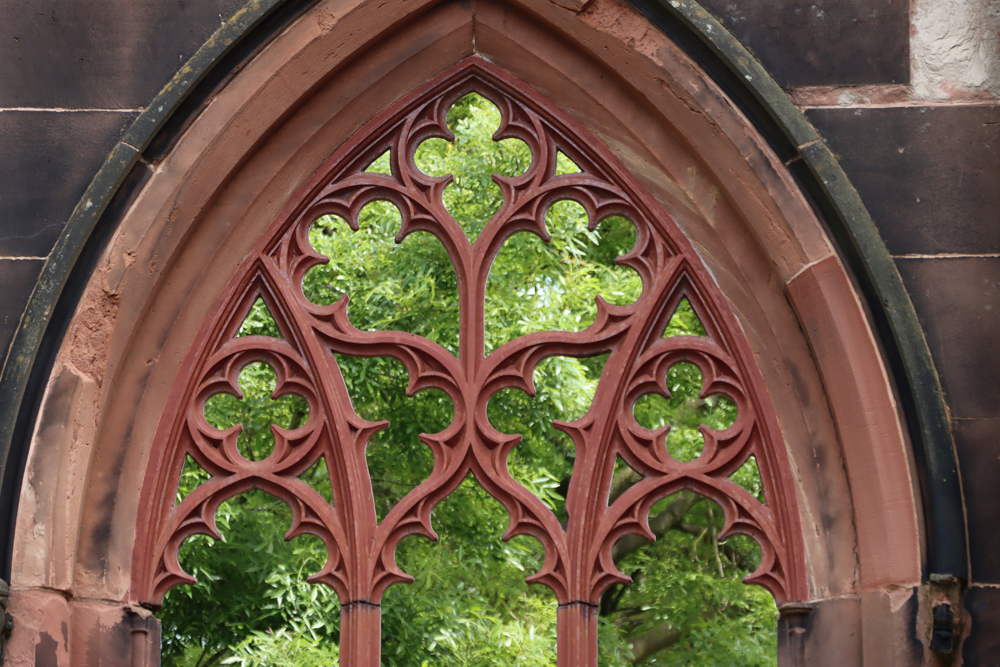
One of the splendid cast iron windows

xxx

HMS Thetis

HMS Thetis was salvaged, repaired and relaunched as HMS Thunderbolt, shown here.  Source: Wikipedia 

On 1st June 1939 a new submarine, the first of the new Titan class, left Cammell Laird’s shipyard in Birkenhead.  This was her second set of sea trials, after her first went went very badly, and it was imperative that this time there should be no mistakes.  There was great confidence when she put to sea, but only a few hours later sank 12 miles off the Great Orme in Liverpool Bay, with 103 men on board.  This was twice the usual number of crew on board the HMS Thetis (N25), because as well as the standard Royal Navy crew of some 50 men that manned her, there were also engineers, members of the Admiralty and various others on board, including catering staff and other civilians, as she underwent sea trials.  There were only four survivors, and it is partly due to their testimonies that the cause of the tragedy was pieced together.

The submarine sailed safely down the Mersey towards Liverpool Bay, heading towards the Great Orme and accompanied by a tug boat named the Grebe Cock.  An essential part of her sea trials was to dive and make way underwater.  When the attempt to dive was made, in 150ft (46m) of water, the submarine was found to be too lightweight to submerge.  A submarine can make additional weight by taking on water.  Her internal compensating tanks were full, and it was decided to check the status of the six torpedo tubes and allow the two lowest ones to flood if they were empty.  The torpedo tubes could be checked by means of a stop-cock.  If, when turned, water leaked out, then the torpedo tube was full.  If it did not, it was empty and could opened and inspected.  In the aftermath of the disaster, it was found that the stop-cock of the fifth torpedo tube had been accidentally covered with enamel paint during final preparation for trials, and had hardened, preventing any water seeping out of the stop-cock to indicate that the torpedo tube was, in fact, full of water.  Because it was believed that the tube was empty, the rear door was opened.  In fact, the torpedo door was open to the sea and immediately thousands of gallons flooded into the submarine, forcing her down at the bow as the water began to fill the first two sections.  Thereafter the 270ft (82m) submarine could not be refloated and it was a matter of escape or rescue before air ran out.

The memorial stairways in St Mary’s tower

Thereafter it is a complicated story, certainly not one for someone uninformed to tell, and the best website account I have found to date is the unfortunately named Great Disasters website, which includes accounts by the four survivors and witnesses from the inquiry.  Alternatively, and much-recommended is  really excellent 15-minute summary provided by a video, with original photographs and diagrams, presenting the harrowing story very clearly: The Raven’s Eye YouTube channel.

The submarine was recovered on the 3rd of September 1939, towed to Traeth Bychan beach, where she was grounded and the remaining bodies either buried in a mass grave in Maeshyfryd Cemetery in Holyhead.  After the submarine was salvaged, repaired and renamed HMS Thunderbolt she was returned to active service in 1940.  She was a successful vessel until 1943 when she was sunk off the coast of Sicily by an Italian corvette, with the loss of all hands.

The catalogue of errors both on board and on shore is dismally reminiscent of the sinking of Titanic, when one is familiar with the details of both horror stories.  Human error, in design, in execution, in procedures and in response to technological failure, always seems to be a major factor in shipping and air disasters.
xxx

Final Comments

A visit to Birkenhead Priory is rewarding in its own right, but with the addition of the ruins of St Mary’s Church with its cast iron windows, and the tower, its memorial and its views. there is an awful lot to see, enjoy and learn.

There are some stunning views from the top of St Mary’s tower

xxx

Visiting Details

Details for visitors are in Part 1.  Although Part 1 was posted in May last year, I have checked the details and nothing has changed in the meantime.  There are also opening hours and a map on the Birkenhead Priory website.
xx

Sources

Leaflets

St Mary’s Parish Church 1819-1977, compiled by Tony Hughes
https://thebirkenheadpriory.org/wp-content/uploads/St-Marys-booklet.pdf

HMS Thetis, compiled by Les Black, March 2016. Produced by Birkenhead Priory

Websites

AHRNet
Rickman, Thomas 1776 – 1841
https://architecture.arthistoryresearch.net/architects/rickman-thomas

Graveyard Survey, St Mary’s Birkenhead, volume 1, 1977, Gill Chitty 1977
https://www.merseysidearchsoc.com/uploads/2/7/2/9/2729758/jmas_1_paper_5.pdf

Marshall University, Marshall Digital Scholar
CSS Alabama. An Illustrated History. Part 1: Building Ship No. 290.  By Jack L. Dickinson. Fall 10-9-2017
https://civilwartalk.com/attachments/part-1-building-ship-no-290-pdf.296944/

An Online Archive for the Church of St. Mary’s & the Priory, Birkenhead Cheshire, including a listing of the monumental inscriptions from the old graveyard & Priory
History of the Priory and St. Mary’s Church Birkenhead
http://stmarysbirkenhead.blogspot.com/

The Raven’s Eye
Everything Went Wrong – The Tragedy of HMS Thetis – Submarine Disaster (1939)
https://www.youtube.com/watch?v=JEcW7WjRxY8


Over the wall from the former churchyard

I believe that this was the dry dock where the “Alabama” was built, seen from the top of St Mary’s tower


Day Trip: The Iron Bridge and the Ironbridge Gorge World Heritage Site

Introduction

The Iron Bridge is the star attraction of the Ironbridge area, the focal point of the UNESCO World Heritage Site (awarded in 1986), and managed since 1991 by the Severn Gorge Countryside Trust, which includes 52 sites, 60 historic structures, 230 hectares of woodland, 25 acres of wild flower meadow, 26kms of paths and 8 kms of bridleways.  This includes at least twelve museums and managed sites, some of which are open all year round, others only seasonally.  This makes the Ironbridge Gorge a splendid place for an extended visit as well as for day trips to selected destinations.

It can be easy to come away with a fragmented view of Ironbridge Gorge whilst driving between the bridge and the different museums and villages.  Once known collectively as Coalbrookdale, the immediate valley area is now divided into Ironbridge, Jackfield, Coalport and Coalbrookdale with outlying attractions in the surrounding area.  However, all areas are united by the underlying geology that was revealed by glacial action and became the source of raw materials for manufacturing in the area, both of ironworks that produced industrial scale projects like the bridge itself as well as decorative objects for home and office; and clay-based household objects such as tiles, and finer decorative china.

The first engineer and entrepreneur to exploit the full potential of the Ironbridge area’s geology for industry was Abraham Darby I who had a small furnace in the area and who in 1709 successfully experimented with carbonized coal, called coke, as fuel instead of charcoal that depended on less volumes of mature woodlands and required much less labour.  Abraham Darby I’s formula for iron was a ratio of 600kg coke to 600kg of ironstone and 250g limestone, all of which were available locally, and produced 250kg iron.  Efficiencies in the iron manufacturing industry were further improved with refinement of coke production and the introduction of steam-powered engines later in the 18th century.
==

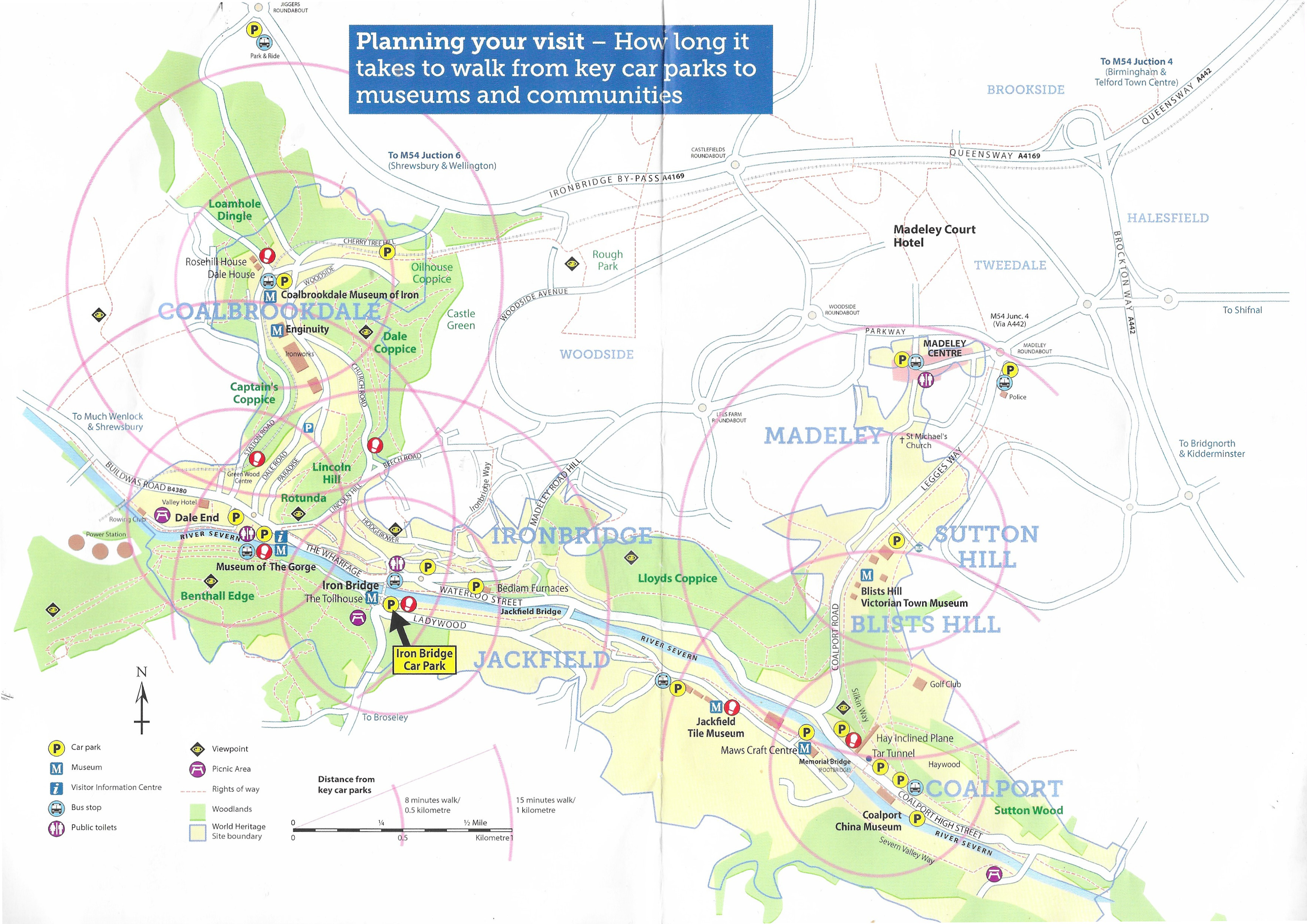
From the leaflet “Exploring Ironbridge Gorge” showing the key components of the visitor attractions today

The other essential geographical feature was the river Severn, which flows through the Ironbridge Gorge.  The gorge was itself formed by the pressure from a glacier, that sat over much of Shropshire, on the underlying trapped water.  This water, with nowhere else to go,  forced itself out from under the glacier through the soft limestone of what are now named Benthall Edge and Lincoln Hill, forming the steep-sided channel that the river occupies today.  In the 18th and 19th centuries the water from the Severn provided both power, first to water wheels and then steam engines, as well as cooling for many of the machines and as part of many of the industrial processes.  It was also a major transport link between the Ironbridge area, the Bristol Channel and the rest of the world.  Looking at the river today in its wildlife and heritage setting, it is difficult to imagine how much pollution there must have been both in the air and in the water, produced by the furnaces, forges and kilns, as well as the chemical waste.

Source: The Iron Trail, Ironbridge Gorge (leaflet), Severn Gorge Countryside Trust

The Iron Bridge

The building of a cast-iron bridge was proposed by Thomas Farnolls Pritchard 1723-1777), who also designed the prototype.  Up until the building of the bridge, which opened in 1781, most of the traffic across the river was by ferry; the nearest bridge was the medieval Buildwas bridge next to Buildwas abbey, 3.8km upstream from the site of the new Iron Bridge. The connection between the north and south sides of the river was essential, allowing the movement of raw materials, people and supplies.  The bridge was an obvious solution to the problem of a river that was vulnerable to changing levels and seasonal weather extremes such as low levels, floods and high winds.

Thomas Farnollis Pritchard by C. Blackberd c.1765

Thomas Farnolls Pritchard specialized in the restoration of prestigious houses. Although he had built bridges in wood and stone, none had been as ambitious as his Ironbridge proposal, and this was the first attempt to use cast iron to span a gap this wide. the idea was to use a single arch to span the widest section of the river, avoiding piers that would impede navigation.  He sent his proposal for a cast iron bridge to John “Iron-Mad” Wilkinson, an obvious sponsor for this type of innovative project.  Wilkinson in turn discussed the matter with Abraham Darby III, who instantly saw the potential for the bridge not merely as a means of spanning the river, but of marketing his company and the benefits of the Ironbridge area as a whole, at that time known collectively as Coalbrookdale.  A committee was formed to take the project forward.

The only known image of the bridge under construction, by Elias Martin (1739-1818) painted in the summer of 1779

An Act of Parliament was granted in 1776, and shares were soon issued to raise funds. Work began in 1777.  The iron for the bridge was cast by Darby at his works, but there is no record as to which of his three furnace sites was responsible.  It is probable that the work was shared out to all three, spreading the load to ensure that existing and new commercial contracts continued to be delivered.  It is known that wooden scaffolding was employed in the construction of the iron bridge, but the exact process of construction is unrecorded.  The painted inscription on the ironwork that spans the top of the bridge reads “This bridge was cast at Coalbrook-Dale and erected in the year MXDCCLXXIX [1779].”  Ribs were cast in two pieces and joined in the middle.  Observation of the bridge’s construction shows that it was assembled using both metalwork techniques and joinery techniques such as mortise and tenon joints and dovetailing.  The ironwork was flanked by and set into stone abutments.

Once the basic frame was built, spanning 100ft 6ins (c.31m)  the scaffolding was removed in 1779 and a road was constructed over the top and a small toll-house added on the southern side.  The bridge eventually opened in 1781, on New Year’s Day.  Although it was built closely in the spirit of Pritchard’s original plan, several changes were made.  Pritchard did not live to see the bridge completed but his family were duly paid for his contribution.

The bridge had cost a massive £6000, twice the estimate.  Darby had taken on the bulk of this financial burden.  Although he was quick to use the marketing potential of the bridge deploying it as an advertising emblem, and visitors came from all over the world to see it, neither this nor the tolls for use of the bridge were able to make up the substantial shortfall.  Darby was unable to make up his losses and the bridge left him in debt for the rest of his life, with both business and properties mortgaged.

Unlike Buildwas and other Severn bridges, the Iron Bridge  survived the Great Flood of 1795, unlike the medieval stone Buildwas Bridge, proving the durability of a cast iron bridge.  Thomas Telford had repaired the Buildwas bridge in 1779 but during 1795 it was damaged beyond repair and, taking Ironbridge as his model, Telford replaced it with his own iron bridge.

Over the following century repairs were carried out as required, but during the early 20th century its stability was questioned and its demolition was suggested in 1926.  Fortunately, it was decided to save the bridge and was limited to pedestrian use from 1934, and was listed as a National Monument.  In 1950 it passed into the hands of Shropshire County Council.  Substantial restoration work has been carried out since 1972 to stabilize and reinforce the bridge.  It is now in the care of English Heritage.

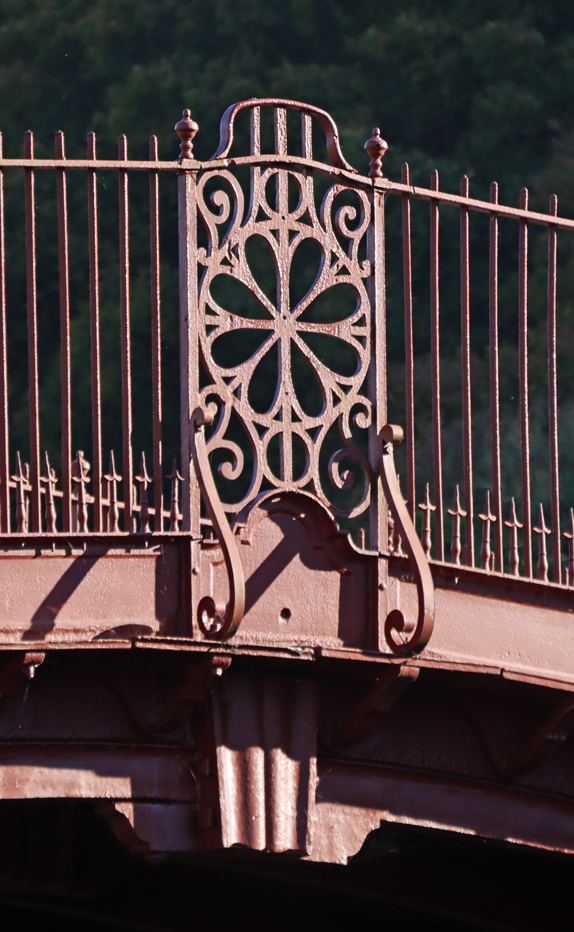
A footpath runs under the bridge on the Ironbridge village side, allowing a good view of some of the metalwork.

The small town of Ironbridge began to develop in the later 18th century.  Today Ironbridge village is small but attractive, with a row of shops, cafes and pubs lining the road that runs along Severn between Ironbridge and Coalbrookdale, with houses, a massive church and other community buildings climbing the hill above the river in Ironbridge.  I can recommend the ice cream 🙂

The Museums

I have already posted about the glorious Jackfield Tile Museum here, with lots of photos, but there are at least total of twelve museums and related visitor attractions in the Ironbridge area, and I will post about the other four museums that I visited on future posts.  I would have visited the Broseley Pipeworks and the Tar Tunnel, but neither were open, so I plan to visit those when they re-open.  The Darby Houses were also closed.  Nor did I visit Enginuity, which appears to be geared towards children, but actually looks like a lot of fun, if you are child-friendly, with plenty of interactive activities demonstrating engineering principals.  Blist’s Hill Victorian Town just wasn’t my cup of tea, but the recreation of everyday life in 1900 Shropshire sounds like a good initiative.

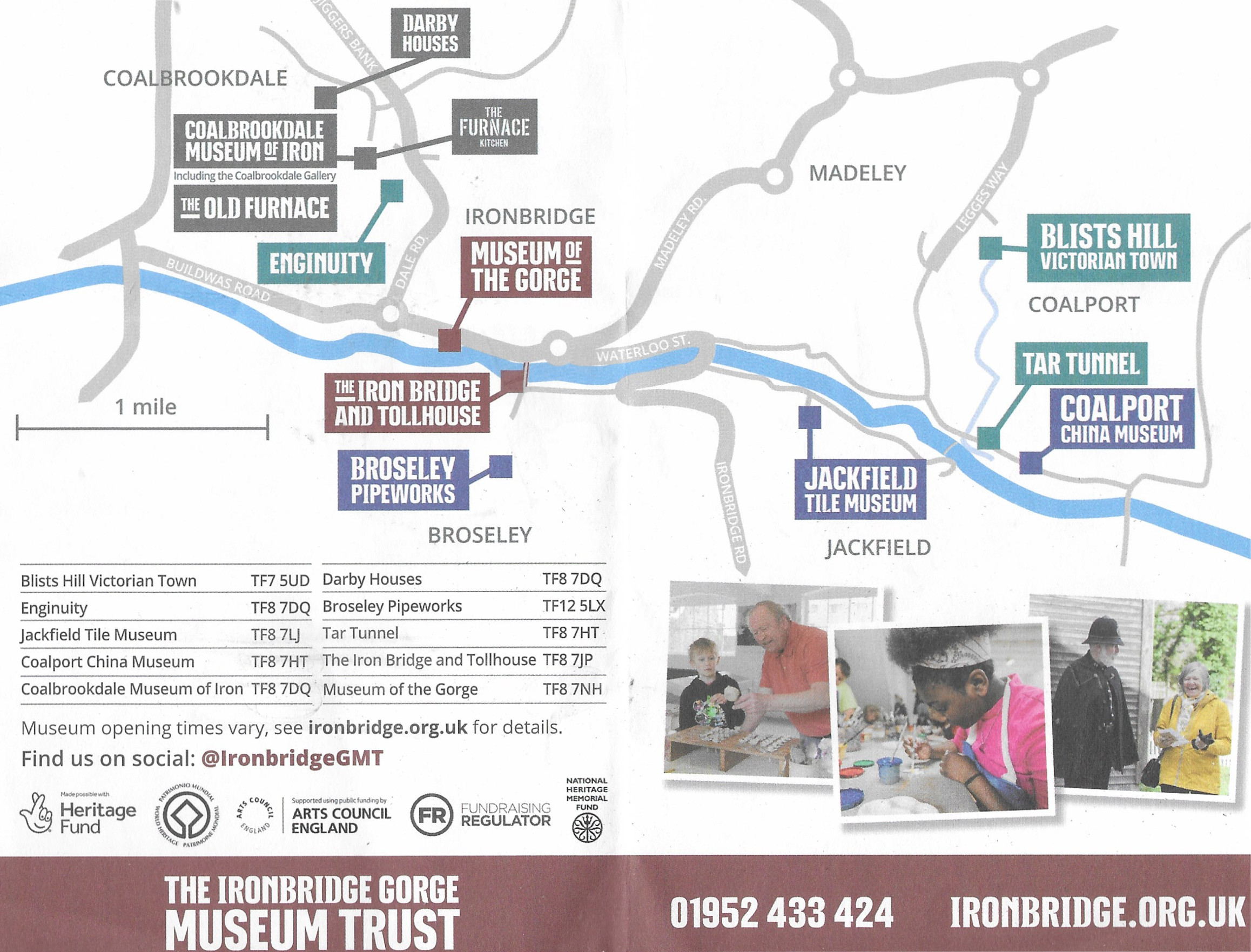
From the “Ironbridge Valley of Invention” leaflet, 2024

==

A have talked about the Jackfield Tile Museum in detail on a previous post.  Don’t miss it.  In the world of museums, this is a rock star.

Part of the Coalbrook China Museum

The Coalport China Museum to the east of of Ironbridge and Jackfield consists of two areas of interest – the displays of decorated china ware made in the local area, and the surviving furnaces in which many of them were made, which you can enter and walk around.  Although the china is worth seeing, partly because it demonstrates the many shapes, textures and patterns that were produced, I found the splendid industrial heritage of this site the most evocative and engaging part of the experience, bringing the sheer vast materiality of these enterprises to life.  This part of the Severn valley would have been full of these furnaces.  There is good car parking.  Ticket prices are on the Ironbridge website, and don’t forget to ask for an English Heritage discount if you  are a member.

The Toll House, free of charge, is set just to the south of the Ironbridge near to the car park, is now a museum of the bridge, telling it story.  This is mainly a matter of information boards rather than objects on display, but is very informative.  It also serves as a ticket office for those wishing to buy family tickets and day passes (although you can also buy tickets on an ad hoc basis when you visit individual museums).

To the east, easily reached by walking along the wide pathway that follows the Severn, is the Museum of the Gorge, also free of charge.  There is a small car park next to it.  The exterior of the building is fabulous, and there are some great internal features, and there are information boards about the history of the building and the conservation work, as well as a selection of reproductions of historic maps of Shropshire.

The Old Furnace at the Iron Museum

Up the hill is the splendid Coalbrookdale Museum of Iron.  The museum captures the essence of the area’s iron production output, from geology and early history via the bridge itself, including some excellent original images of the Ironbridge, via civil engineering equipment to a surprising and elaborate array of domestic items.  On the museum site is also the substantial and impressive remains of the the Old Furnace, some of which has been turned into an indoor feature.  Like the China Museum, this is a splendid mix of museum displays and well preserved and explained industrial archaeology.

Not shown on the above map is the Bedlam furnace, half way between Jackfield and Iron bridge on the north side of the river, which can be viewed from the laybay in front of it and is well worth visiting, partly because although there is little of it left, it was the subject of Philip de Loutherberg’s famous 1801 painting.

“Coalbrookdale by Night” by Philippe Jacques de Loutherbourg, 1801. Open coke hearths give off vivid flames and smoke. Archetypal image of the Industrial Revolution. From a colour transparency in the Science Museum Photographic Archive, CC BY-NC-SA 4.0 Licence.


Visiting

Wherever you are, keep an eye open for leaflets, as some of these have some very helpful information, including chronological charts, maps and self-guided trails to some of the features that are beyond the museums.

The bridge

The bridge is open to visitors all year round, assuming that no restoration or repair work is taking place.  The opening times for the toll house, which acts as a museum for the bridge, can be found on the Ironbridge Gorge website.  Extensive pay and display parking for Ironbridge is available on the south side of the river, which allows you to choose how long you are going to stay.  This is handy if you just want to spend a short time looking at the bridge and browsing in the village but also allows you to stay longer if you want to walk along to to Coalbrookdale to visit the Museum of the Gorge museum and up the shallow hill to visit Enginuity and the Coalbrookdale Museum of Iron.

The museums

The Iron musuem

All the Ironbridge Gorge museums are covered on one website – Ironbrige Valley of Invention.   This inexplicably has very few images of what’s on display, and suffers from Russian doll syndrome, with pages buried within pages, but the information on days when the museums are open and closed (changes seasonally) and the opening times are there if you look for them.  Some of the museums are closed completely at certain times of the year (such as the Tar Tunnel and the Broseley Tobacco Pipe Works).

Note that if you are a member of English Heritage there is a discount on ticket prices, but you will need to ask for it.

Other sites to visit in the area

This is a rich area for destinations to visit, including five medieval abbeys a relatively short drive away, a number of National Trust properties and only a little further afield, Shrewsbury makes for a rewarding day out with the abbey church, the excellent Shrewsbury Museum and Art Gallery and the attractive medieval and Georgian architecture.  Not far away is the RAF Museum at Cosford, just outside Telford (my post about it is here), and whilst there, the Church of St Bartholemew at Tong with its lovely medieval choir, its elaborate tombs and the remarkable Tudor chapel and is crammed full of interest and just a 10 minute drive away.

St Bartholemew’s Church, Tong


Sources:

Books, booklets and papers

2019 edition (no author or reference number).  Exploring Ironbridge Gorge (booklet). The Ironbridge Gorge Museum Trust Ltd.

Jones, C. 1989. Coal, Gas and Electricity. In (ed.) Pope, R. Atlas of British Social and Economic History Since c.1700. Routledge

Mathias, P. 2001 (second edition). The First Industrial Nation. The Economic History of Britain 1700-1914. Routledge.

Mokyr, Joel 1981 (2nd edition). Technological change 1700-1830.   In (eds.) Roderick Floud and Deidre McCloskey, The Economic History of Britain since 1700.  Volume 1: 1700-1860. Cambridge University Press

Osborne, R. 2013. Iron, Steam and Money. The Making of the Industrial Revolution. The Bodley Head.

Leaflets

Undated leaflet (no reference number). The Ironbridge and Town. The Ironbridge Gorge Museum Trust Ltd.

Undated leaflet (no reference number). The Iron Trail, Ironbridge Gorge. Severn Gorge Countryside Trust

2024 leaflet (no reference number). Ironbridge Valley of Invention. The Ironbrige Gorge Museum Trust Ltd.

Websites

Ironbridge Valley of Invention
Official website
https://www.ironbridge.org.uk/

UNESCO pages for Ironbridge Gorge
UNESCO World Convention
https://whc.unesco.org/en/list/371/


Day trip: The Jackfield Tile Museum, near Ironbridge, Shropshire

 Introduction

Craven Dunnill and Co

At the top of my to-do list for my short break to Shropshire in October was the Jackfield Tile Museum.  I wanted to see all the Ironbridge area museums themed around the Industrial Revolution, and managed to do so, but I have a great love of tiles, and since I moved up to this area have been dying to visit the museum in the village of Jackfield, next to the river Severn.  It was even better than I had expected.  To get the most out of this museum, you have to really love Victorian and Edwardian design, because this is a celebration of the tiles produced during the late 18th, 19th and early 20th centuries, but if you do, it is a superb experience.

The museum is beautifully thought out, very well lit, and the tiles are presented in a way that allows them to be appreciated and understood not only as designs, but as the products of specific manufacturing processes, as the result of industrial innovation and as the output of very proficient commercial drive.  It is amazing what went in to making tiles and mosaics and turning them into a commercially viable product for both private homes and public buildings.

Craven Dunnill and Co

As well as original display cases and tile arrangements that show how the tiles were arranged to show to potential buyers, there are rooms showing development in artistic and craft styles (the Style Gallery) and reconstructions of entire rooms that used tiles as the major component of their decorative schemes.  There are also reminders that the tile-works also made plates, vases and other decorative items.  The museum also holds the John Scott Collection of tiles.

The impressively long 1872 building, the original Craven Dunnill and Co tile-works, is occupied partly by the museum and partly by a working tile-works.  Today’s Craven Dunnill is a successful commercial venture building on the successes of its 19th century predecessors, a very nice link between the building’s heritage and its present manufacturing activities.

Craven Dunnill and Co

Apologies for some of the photographs.  There is excellent lighting in the museum, but this sometimes makes it difficult to photograph without reflections, and many of the photographs have big patches of bright light on them.  Some of the angles are a bit odd too, as I tried to lean away from the reflections.  It didn’t help that I was in a bright fuchsia-pink coat, which reflected in the display cabinet glass!

Visiting details (with links to opening times, ticket prices, and parking details etc) are at the end of the post, as usual.

The length of the building reflects the way in which tiles were produced via a series of stages from east to west, from preparation of the clay to the finished product

The museum is arranged into different themed areas, which explain both different aspects of the Jackfield tile-works itself and the development in the 19th century of tiles and how they were marketed and sold, and what sort domestic, commercial and public locations they adorned.

Entrance, showing replica of one of the Craven, Dunnill and Co commissions


Introductory Gallery

One of the original 19th century floors of the Craven Dunnill and Co tile-works, where prospective customers entered to view tiles in the trade showroom.

The self-guided tour starts with information boards describing the background to the tile industry and its commercial development from the 17th century, when the area was famous for its clay tobacco pipe manufacturing works at Broseley.  By the 1720s there were several small potteries in Jackfield, taking advantage of locally available raw materials and the proximity of the river for power and transportation.  There had been a pottery on the Craven and Dunnill site since 1728.  The railway arrived in the valley in 1862, with a siding for Jackfield and stops at Coalport and Ironbridge, improving connections and the speed with which products could be shifted to market.  The expansion of local industries followed, and two of the largest Victorian tile factories in the world were built next to the railway:  Craven, Dunnill and Co in 1875 and Maw and Co in 1883.  Tiles were valued not only for their decorative value but, in a period that was just getting to grips with the importance of hygiene, were easy to clean.  By 1881 Craven Dunnill and Co had 94 workers including 53 men, 15 women and 25 youths.

Craven Dunnill and Co

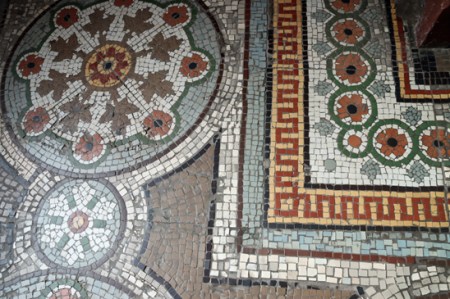
Mosaics on the stairway up to the the trade showroom, displaying the skills of the tile-works

Craven Dunnill and Co

Craven Dunnill and Co

The Trade Showroom

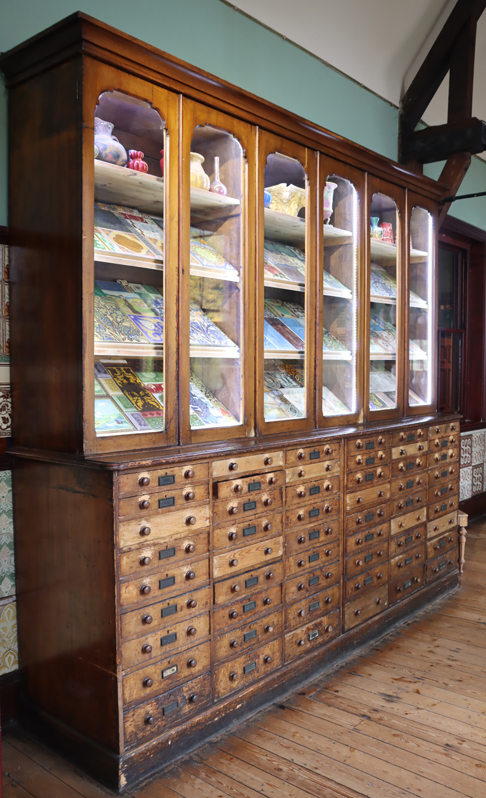
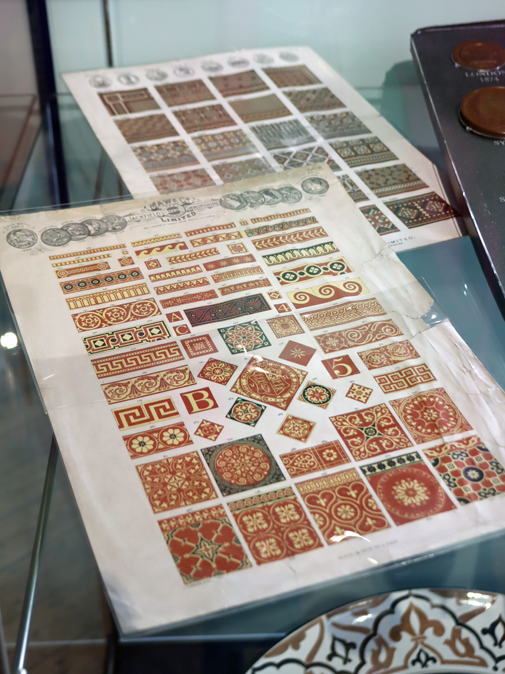
The first gallery, The Trade Showroom, is the display area of the Craven Dunnill and Co. tile-works, where architects, interior decorators and their customers could view catalogues, but could also see samples of the company’s tiles wherever they looked.  Today’s layout preserves one of the company’s original display cabinets, and the tiles on the walls, including floor and wall tiles, are based on images of this room as it was in the 19th century.  Display cabinets in the middle of the room show other aspects of the company’s operations.  On this floor there are also reconstructions of the offices that would have existed in the building in the Victorian period, with recordings that you can listen to, capturing accounts of personal memories of the tile-works in the past.

On of the original display cabinets


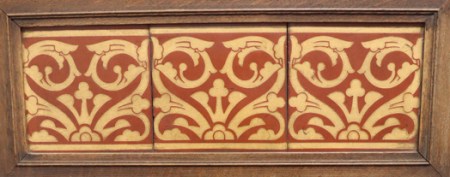
A design book by Owen Gibbons from 1881. Gibbons and his brother taught at the Coalbrookdale School of Art, producing many tile designs

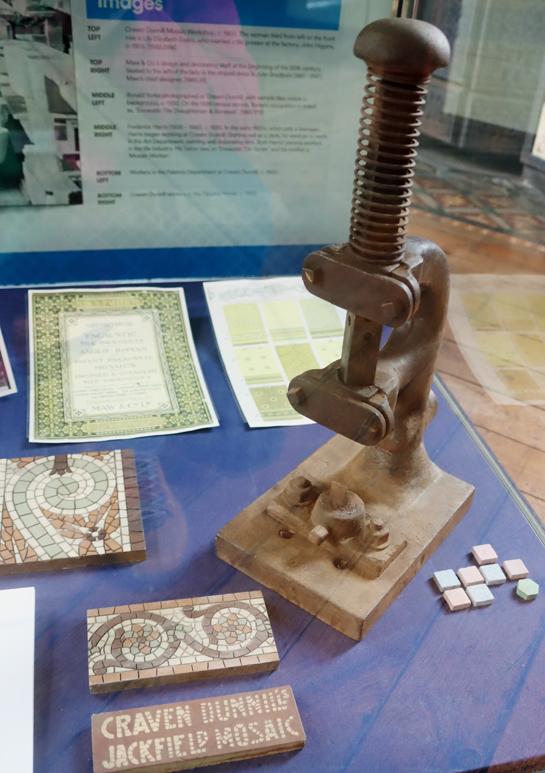
Mosaic cutter


Style Gallery

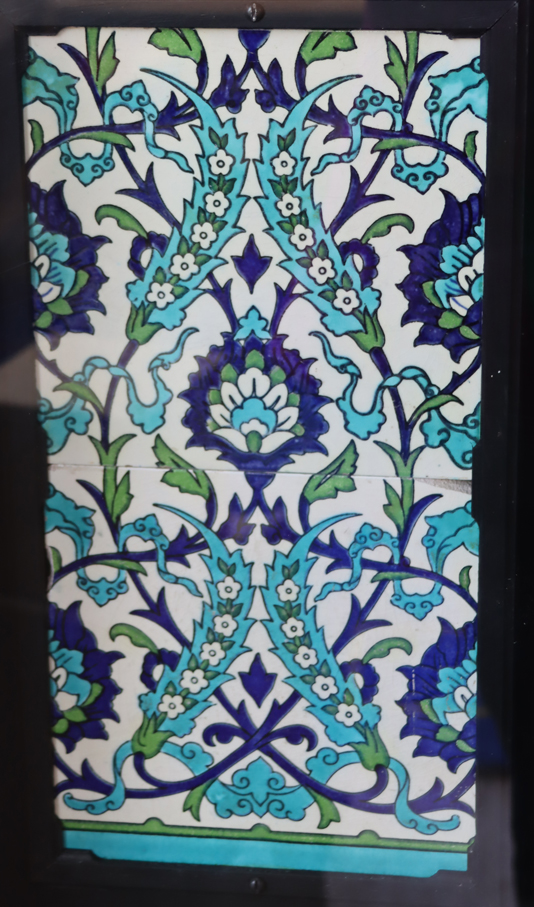
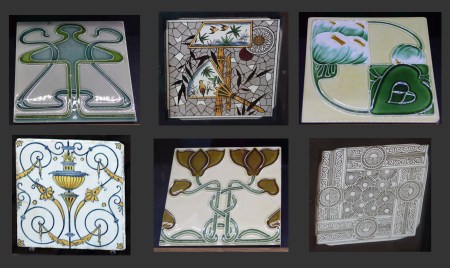
The Style Gallery offers a eye-dazzling view of the sheer number of fashions in tile design that trended during the Victorian period.  It is a reflection not only of how the Victorians were interested both in referring to and interpreting the familiar past, and reinventing the present but of how some of these styles employed imagery from the Far East and and the Middle East.

Both companies used well-known designers for some of their output, but much of the design work was done by in-house designers, some of whom were secured from the Coalbrookdale School of Art.  This was a rare opportunity for women to enter industry as skilled artisans.


William de Morgan

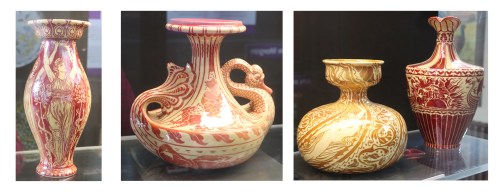
Examples from a series of 7 Art Pottery vases by Walter Crane for Maw and Co, 1889


Tiles in Everyday Spaces

This area of the museum is superb, recreating some of the real-world contexts in which tiles manufactured were employed.  It was great to see the Covent Garden tube station recreation, because that was my tube station for several years when I worked for a company on Long Acre.  And if I could have had a glass or two at that wonderful tiled bar, what a great destination that would have been!

Butcher’s shop, Ripon by Alfred Potter for Maw and Co

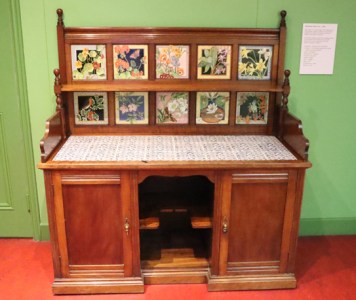
Washstand by Maw and Co., c.1883

Long Gallery

The Long Gallery is elegantly displayed and beautifully designed, showing both sides of individual tiles, and demonstrating the variety of methods and techniques as well as styles and designs manufactured locally.  Each of the displays shows a different decorating technique accompanied by tiles, with both front and back display, that illustrate that particular technique or method.


From the Long Gallery to the John Scott Gallery

Between the Long Gallery and the John Scott Gallery is a corridor with views into the historic mould store, and a panel on the corridor wall consisting of more historic moulds.  These all have relief patterns that were drawn on and then hand-carved.  To make the tile, the clay was pressed or poured into the mould, and then fired.  Once it had cooled it could be glazed, before being fired again.  The ones stored here are part of the commercial and industrial heritage of Maw and Co and Dunnill Craven and Co.


John Scott Gallery

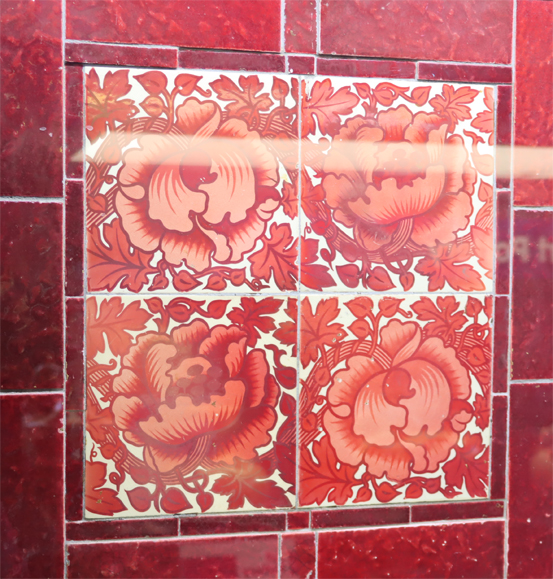
Part of a six-tile panel showing a peony design, attributed to Kate Faulkner, Morris and Co., 1880s

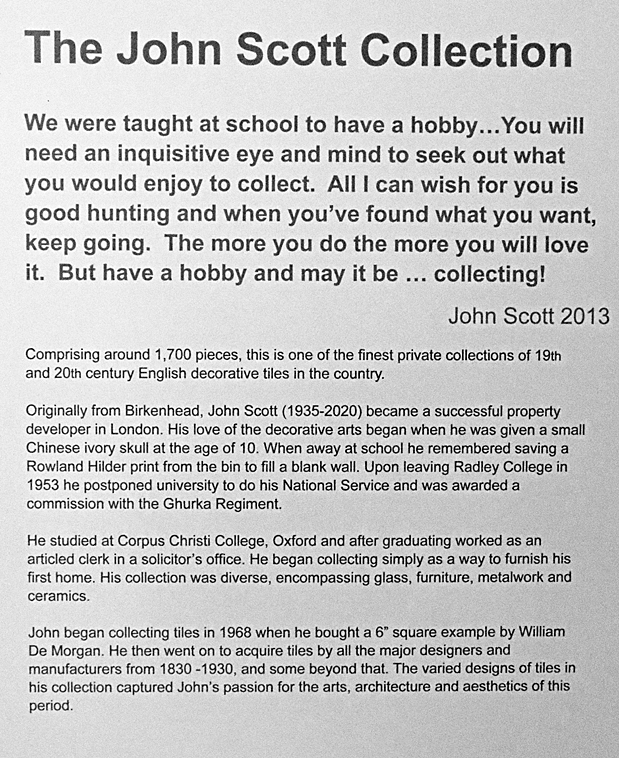
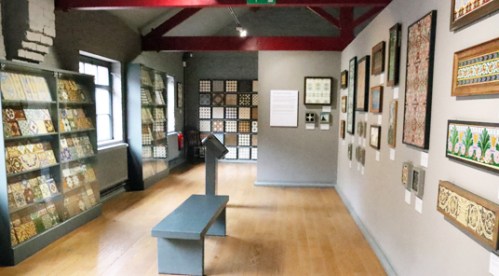
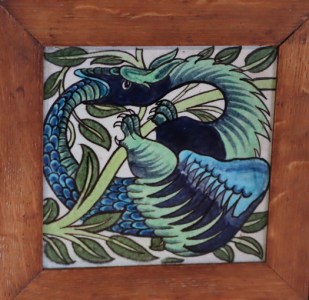
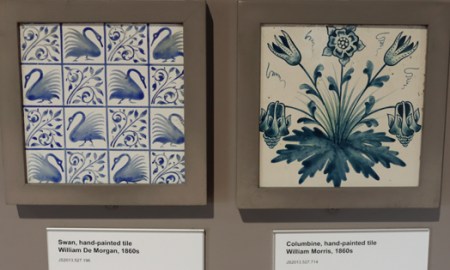
Slightly anomalous, because this is a collection that does not relate specifically to the Ironbridge area, this gallery displays the collection of John Scott, who began collecting tiles in 1968 and continued until he died in 2020.  His collection, gifted to the museum in 2013, includes over 1700 pieces, of which an elegant portion are displayed here.  I really liked his statement, shown on one of the information panels, that he collected only what he both liked and could afford.  He was collecting for his own pleasure, not to build an illustrious collection.  By the time he died, his collection had become a remarkable reflection of the history of tile design and manufacturing.
===

Uroboros, sometimes signifying eternity. By C.F.A Voysey. Pilkington


William de Morgan


One of six panels designed for Membland Hall, Devon. William Morris and William de Morgan 1876

Fish and water lilies. Relief-moulded tile panel design by C.F.A. Voysey, Pilkington

Art Nouveau tile panel by John Wadsworth. Minton Works c.1910. The repeat is achieved with just one tile.

Exterior buildings

Once you leave the museum, you will walk out through some of the original buildings that supported the works, including the massive kilns and storage facilities.  From here, you can re-enter the museum to visit the gift shop and the cafe before leaving.


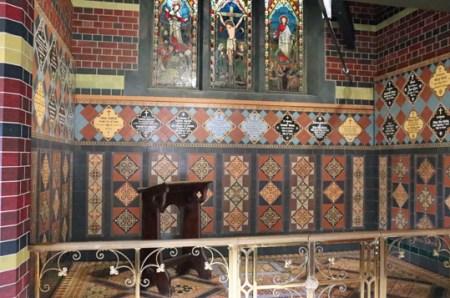
When you leave, the church next to the tile-works is well worth a look, with a partially tiled interior.

Final Comments

All of the museums in the immediate Ironbridge area are well thought out and beautifully presented, and I enjoyed them all enormously.  The Jackfield Tile Museum was the one that most closely demonstrated domestic and commercial artistic tastes throughout England.

The museum offers an impressively detailed insight into multiple aesthetic tastes captured by Victorian tiles and mosaics, showing dozens of them to ensure that visitors are able to appreciate the sheer versatility and exuberance of Victorian taste.  Seeing the tiles built into pieces of furniture, and used to create entire spaces like churches, bars, bathrooms and the Covent Garden tube station brought the tiles to life, showing them both as aesthetic decisions and practical architectural applications. 

Even though the visual impact of the tiles was always going to steal the show, the museum does not neglect explanations of the really fascinating history of the local tile-works, the development of the manufacturing technologies that went into creating tiles and mosaics, and details about the commercial challenges involved in the marketing and sale of both.

I really loved it.


Visiting

Be careful with the opening days, because when I visited it was closed on Monday and Tuesday, but these days, and the times, change depending on the time of year. If you are intending to visit other museums too, it is worth checking out if they are open at the time of year of your visit.  The Broseley clay tobacco pipe works, for example, was closed for the autumn-winter season, which was disappointing.  You can find prices and opening times on the museum website here, and if you want to see other museums too there is a page with all the opening times in the related museums here.

If you are a member of English Heritage be sure to hand over your card, whether asked for it or not, to obtain a 15% discount.

There’s no guide book, which is a shame.

Jackfield Museum has a car park, which is chargeable via some sort of online arrangement that is loosely described on the website here.  I was staying nearby so walked down to the museum and didn’t need to get to grips with the parking system, but I suggest asking at the ticket desk if you have trouble with it.

Nearby there’s an excellent pub called the Black Swan with tables overlooking the Severn outside, and a cosy, friendly interior with excellent pub food.  It has a really super, mellow atmosphere and is a two-minute drive away, with plenty of free parking.  It has no website but it has a Facebook page and if you Google it, the phone number will come up.  It is quite small, so best to book by phone or in person.

==


A walk from Waverton along the Shropshire Union Canal

I have driven over the canal bridge on Eggbridge Lane in Waverton so many times thinking that I really must take advantage of the little car park just before the bridge to go and take a stroll down the towpath.  Having woken up early on a sunny morning I decided to investigate. Waverton is just off the A41, so very easy to reach. The car park is quite small, but it was not full even on a bright and warm morning.  The What3Words address for the car park is ///fingertip.snored.deals

Victoria Mill, Waverton

Immediately opposite the car park, as you walk to the towpath, is a very attractive canal building, the Grade 2 listed, a mid-19th century Victoria Mill, a former steam-powered canal-side corn mill, with bays for loading and unloading narrowboats, and now converted for modern use. The Historic England description is here.  This is part of the heritage of the Shropshire Union Canal, which if you keep walking north eventually ends up at Ellesmere Port.  To the south, it eventually connects up with the rest of the main canal network at Hurleston Junction.  The Shropshire Union has quite a complicated history, as does Chester’s canal heritage as a whole, and was not completed until 1835.

As with most canal walks, there’s always a choice to turn right or left, and as I had no idea what to expect from either direction I decided to head north, leaving the walk south for another occasion. Out of the car park I turned left under the unprepossessing bridge no.119 and headed up the towpath.  This section is metalled, so it avoided the mud and sludge that I had been half expecting.

If you take this route you find yourself walking along a short row of houses with canal gardens along a metalled pathway.  Canal-side gardens are always fascinating.  I used to live on a narrow boat many years ago, and it is always a lot of fun to see how different minds have dealt with a garden that opens directly on to a canal.  These are always hugely individualistic and personal.  There is always much to see in the way of garden furniture, garden ornaments (someone will always have gnomes, and there is usually at least one example of traditional canal painting), sheds in various states of repair, a wide range of summer houses, varieties of approaches to terracing, often some very interesting specimen trees and shrubs, and different attitudes to garden seclusion, along a spectrum from solid barriers of hedging or fencing to a complete lack of interest in any form of privacy.  A real cultural treat.

After just a minute or so the towpath enters a more rural section, and in the late season sun it was a real pleasure to take in all the autumnal colours on trees and shrubs that flank the canal.  I’ve posted some of the photos below. It’s a well-used section of towpath, with joggers, cyclists and plenty of dog walkers, but everyone is very civilized about moving over to make passing easy.  There was not much in the way of canal traffic, with just two narrowboats on the move, but I expect that it is much busier in summer.

Keep an eye out on your left as you leave the housing on your right and reach the more rural section.  Partly concealed by the grass next to the towpath, there is a short inscribed red sandstone Parish Boundary Marker. This section of the canal passes through the parish of Rowton, famous for the Civil War Battle of Rowton Heath (see the Wikipedia entry on the subject and a more detailed analysis by Historic England).  King Charles I is said to have watched his army lose that battle from the Phoenix Tower that still stands on Chester’s city walls. The stone marks the boundary between the parishes of Christleton (CP on the stone) and Rowton (RT).  The date commemorates the date of the battle in 1645 and, below the level of the grass, 1995, the 250th anniversary of the battle.
===

After this more countrified section there are more houses, all interesting, with some lovely weeping willows and other water-loving species, and a very attractive hump-backed bridge, that I have since discovered carries Rowton Bridge Road into Christleton.  I walked up as far as The Cheshire Cat, which sensibly has a gate onto the towpath, and carried on just a short way beyond it, but at that point the canal converges closely with the A41 (Whitchurch Road) and it becomes quite a noisy experience with the unremitting traffic, especially during the week.

Checking the map later (for example see the plotaroute.com website), I note that by coming off the towpath at Rowton Bridge it is possible to walk into the attractive village of Christleton, with its marvellous pond, and I would have done this had I realized.  Another time.  had to be somewhere else in the afternoon, so it was a short walk, probably an hour and a bit there and back at strolling pace, with pauses to let bicycles pass, and to take photographs.

For those with unwilling legs (see the blog’s Introduction for details about what this refers to), the towpath heading north from Waverton is metalled, but quite uneven.  No problem for most people, I would have thought but do keep an eye on it.  There are places where the edges of the surface are particularly uneven, but this just means that if you are with someone else you need to go in single file for short sections.  Otherwise, it’s on the flat and very enjoyable.

On the way back I followed the towpath beyond the car park for a few minutes to see how far the housing that backs onto the canal extended.  This part of the towpath is not metalled, was muddy and is single-track.  These houses and gardens are another interesting mixture – each of the sections of housing and gardens has its own personality, presumably reflecting both when it was built and the pricing.  These look as though the garden-canal margins were all designed with narrowboats or other canal vessels in mind. There was indeed one narrowboat moored up at a garden.  The housing stops after a couple of minutes and the towpath reverts to a far more rural appearance.  I’ll investigate further on another day.

The 1715 “Old Dock” – The earliest of Liverpool’s commercial docks, preserved beneath the Liverpool ONE shopping centre

Introduction

The Eyes map of Liverpool showing Old Dock on a previous tidal inlet and enclosed within the streets of an expanding Liverpool in 1765, 50 years after it first opened. Later docks were laid out along the foreshore. Source: National Museums Liverpool

Earlier in summer 2024 I went on the Old Dock tour in Liverpool when it was offered one Sunday.   Old Dock, of which only one corner remains to be visited, was perhaps Liverpool’s most important commercial and civil engineering initiative at a time when Chester’s port was going into decline and Liverpool had the opportunity to become the trading centre for the northwest.

Old Dock, Liverpool

Old Dock in Liverpool, the first of Liverpool’s impressive network of enclosed docks, opened in 1715, to the design of civil engineer Thomas Steers.  It is Europe’s oldest enclosed cargo-handling dock.  What remains of Old Dock is underground, beneath the “Liverpool ONE” shopping centre.  Its lock gates can no longer be visited, but remain under The Strand (the modern dual carriageway that runs along the line of the old foreshore).  Only the northeastern corner of the dock is accessible to visitors, and has been provided with a gantry and information panels, and its history is presented to pre-booked groups by an excellent guide.  I’ve added details about booking and the tour itself at the end of the post under “Visiting.” The following looks at some of the history of Old Dock.

The 1699 Howland Great Wet Dock in London. British Library HMNTS 10349.ff.9.. Source: Wikipedia

Old Dock was modelled on the Howland Great Wet Dock, shown right, built in 1699, which was built to shelter ships, mainly of the East India Company, in the days when ships over-wintering on the Thames were regularly subjected to both storm damage and piracy.  It was surrounded by a double planting of trees to help protect the ships within and had shipbuilding dry docks at its entrance. It was a convenient place to carry out repairs and to ready ships for the upcoming season, but was not used for handling cargo so was not a commercial trading dock.  The Howland Great Wet Dock was built in a rural space on the south of the Thames in what is now the residential Surrey Quays area of southeast London, and was replaced in the 18th century by Greenland Dock, which itself became part of the Surrey Commercial Docks.

The commercial argument for Old Dock

Liverpool was established by a charter of King John in 1207 and was provided with a castle in 1235.  At this time, however, Chester was the main northwestern port, and Liverpool did not become a commercial giant until the 18th and 19th centuries, and this required some pioneering Victorian thinking and civil engineering before it really took off as one of Britain’s leading ports.  Old Dock is at the heart of this story.

Painting of Liverpool in 1680, from the Old Dock display area. Unknown artist. The original is held by the National Maritime Museum. See more (and a better image) on ArtUK

Before the docks, the Mersey was not the easiest of rivers to use in an age of sail partly due to strong winds but also because of the twice-daily tidal events that swept down the estuary. An additional problem was that due to the dumping of rubbish and ships’ ballast along the river edges, deep-sea shipping was unable to approach the river banks to offload and reload.  It could also become very busy with river traffic of all shapes and sizes. The handling of cargo on the Mersey was achieved by mooring ships in the main channel and loading and offloading them with lighters – unpowered boats into which the cargo was loaded by hand, then rowed to shore, and offloaded by hand.  This could only be carried out between tidal events, confining the activity to around 5 hours a day. To empty a single ship averaging 150 tons could take between two and three weeks.

The engineering success of the Howland dock enterprise inspired MP Thomas Johnson, who was both a successful merchant a slave trader, to approach one of the engineers probably responsible for the Howland dock, George Sorocold, to discuss the viability of a similar dock for Liverpool.  Johnson, however, saw the greater potential of an enclosed inland dock, not for over-wintering ships but for creating a cargo-handling facility to radically improve speed and efficiency. Under The Dock Act of 1708 a Common Council of leading city figures was established to became trustees of the proposed dock, which they operated through council committees.  The risk of doing it this way rather than as a private enterprise was that failure could have put the entire city finances in jeopardy.  Thomas Steers from London was the civil engineer appointed in 1709 to make this a reality, only a decade after the opening of the Howland Great Wet Quay on which he had probably also worked.  Initially costs had been estimated at £6000, but this was a serious underestimation and eventually the dock cost more than double this amount.

Building and opening the dock

The dock was lined with bricks in the upper sections with local red sandstone in the lower courses.  I am accustomed to the later Surrey Commercial Docks in southeast London, where I used to live, which are lined with stone much like Liverpool’s Albert Dock, so the sight of a brick-lined dock seemed extraordinary to me.  The bricks were made on site from local clays, with a dedicated kiln built for the task, and a special mortar was used to resist the incursion of water.

At the base of Old Dock, Liverpool

The result of all the investment, civil engineering and labour was Old Dock, which opened in 1715 at the mouth of a former tidal inlet or creek.  Up to a hundred ships could be taken into the 3.5 acre dock via a 30ft wide entrance lock and could draw up against the quayside to offload without the use of lighters. Because of the tides, ships could only enter the dock at the top half of the tide, but a 1.5 acre tidal entrance basin was provided as a waiting area.  By drawing ships up against the quayside, three weeks could be reduced to just one to two days.  The proof of concept was soon confirmed.

The area around the dock was soon surrounded by residential, commercial, retail and service industry premises. Excerpt from a poster from the Old Dock exhibition area.

An entire new residential, commercial, retail and service industry quarter grew up around the dock, which became known as the Merchants’ Quarter.  As well as homes, warehousing and other commercial facilities there were lodging houses for sailors, and less salubrious businesses that catered to their needs.  This is a good illustration of the sort of process of urban sprawl that follows on from a specific industrial development.

Old Dock was such a notable success that new docks were soon opened, and the Liverpool foreshore began its transformation.  During the 18th century South Dock, also built by Thomas Steers (later Salthouse Dock) opened 1753, George’s Dock opened 1771, King’s Dock opened and Queen’s Dock opened in 1796.  It is a measure of the success of the dock concept, Old Dock having been established 53 years before Bristol’s first dock, that between 1772 and 1805 the total tonnage of shipping increased from 170,000 to 670,000, with foreign shipping increasing from 20,000 to 280,000.  By the end of the 19th century 9% of all world trade passed through the Liverpool docks, and there were 120 acres of enclosed docks along 10km (7 miles) of Liverpool’s foreshore.

Closure of the dock

Old Dock, Liverpool

Old Dock itself closed in 1826 mainly because as ship sizes increased, in terms of width, length and depth, it became increasingly obsolete.  It did not help either that the dock had become surrounded with other buildings and could not easily expand without considerable destruction.  Instead, the development of docks beyond the existing foreshore seemed like a better option and this is what happened.

This new use of enclosed docks for cargo-handling was pioneered at Old Dock in Liverpool, creating the first revolution in cargo handling in the UK.  To provide additional real estate for the rapidly growing city, most of the dock was infilled and built over, so this one remaining corner is a significant survivor from Liverpool’s early development as a major trading port.

Final Comments

Old Dock brickwork

Much of what is known about Liverpool’s earliest docks comes from the archaeological investigations that took place between 1976 and 2009. Old Dock was examined prior to the building of Liverpool One by Oxford Archaeology between 2001 and 2006. The remains of Old Dock are designated a site of Outstanding Universal Value.

It is difficult to over-emphasize how important London’s Howland Great Wet Dock and Liverpool’s Old Dock were to the development of maritime trade in Britain.  With an enclosed dock designed by Thomas Steers, the Old Dock set Liverpool firmly on the path for trading success throughout the 18th century and the commercial and architectural triumphs of the Victorian period.

Visiting

Booking details, opening times, ticket prices and everything else you need to know are on the Old Dock Tour website.

At the time of writing the meeting point shown on one place on Google Maps is in a different location from the one that is shown on the Old Dock Tours website, and the latter is the correct one.  I don’t know Liverpool at all and I was confused by the directions on the website, partly because I had no idea what a “Q-Park” might be when it escaped from its burrow, so I arrived early to make sure that I was in the right place, which was on the Thomas Steers Way entrance to the “Q-Park” (the Liverpool ONE car-park), on the left as you head up from the Mersey, near the base of the Sugar House Steps.  Here’s the What3Words address for that location, which is traffic-free, but do check on the website or your ticket that this remains the same meeting place: https://what3words.com/found.farm.gent. Have your ticket handy to be checked, either printed out or on your device.

This is a guided tour.  You receive an excellent lecture as you walk to the dock via a wall-sized map of old Liverpool, and then stand on the  gantry looking down into the dock. Our guide was informative, humorous and engaging, parting with a staggering amount of information in an easily digestible way.  It is always a mark of how well a guide does when there are questions afterwards, people wanting to explore specific aspects of the story, and there were lots of questions.  I used to live overlooking Greenland Dock in London, and the remnants of the Surrey Commercial Docks were my home for twenty years.  Opposite was Canary Wharf, where the former East India and West India quays are preserved and the Museum of London Docklands is located. It was a real dock heritage experience, so it was particularly nice to go to Liverpool and have someone bring this particular old dock to such vivid life.

If you are dealing with unwilling legs, there is a flight of steps with a banister to hold onto.  I forgot to count, but I would guess perhaps ten steps, down from the car park entrance into the dock area.  There is then a gantry (metal walkway) across the remaining part of the dock, with high sides to hang on to.  There is nowhere to sit, so a portable perch of some sort might be useful whilst you are listening to the talks.

I had not realized that it was the schools’ half term break.  Half-term was a poor day to visit Liverpool, and on the tour there were two completely uncontrolled young children running around and yelling their heads off.  A less child-intensive day would be better if it can be arranged.  There’s not a lot for young children to see on this walk anyway, although an older child seemed to be enjoying it very much.
———


—–

Sources

Most of the above details came from the guided tour.  I did not want to detract from that so I have not gone into greater detail here, but I did use some additional sources to check facts that I had not noted down at the time, and have provided some suggestions for further reading.

Books and Papers

Farrer, William, and Brownbill, J. (eds.) 1911. Liverpool: The docks, in “A History of the County of Lancaster: Volume 4,” p. 41-43. British History Online. Originally published by Victoria County History, London, 1911.
https://www.british-history.ac.uk/vch/lancs/vol4/pp41-43

Gregory, Richard A., Caroline Raynor, Mark H. Adams, Robert Philpott, Christine Howard-Davis, Nick Johnson, Vix Hughes, David A. Higgins 2014. Archaeology at the Waterfront vol 1: Liverpool Docks. Lancaster Imprints / Oxford Archaeology North

Stammers, M.K. 2007.  Ships and port management at Liverpool before the opening of the first dock in 1715.  Journal of the Historic Society of Lancashire and Cheshire, vol.56.
https://www.hslc.org.uk/journal/vol-156-2007/attachment/156-3-stammers/

Stephenson, Roderick A. 1955. The Liverpool Dock System.  Transactions of the Liverpool Nautical Research Society, Volume 8 1953-55 (1955)
https://liverpoolnauticalresearchsociety.org/wp-content/uploads/2019/03/Article-The-Liverpool-Dock-System.pdf

Websites

National Museums Liverpool
Ten fascinating facts about Liverpool’s Old Dock
https://www.liverpoolmuseums.org.uk/stories/ten-fascinating-facts-about-liverpools-old-dock

Historic Liverpool
1846: Plan of the Liverpool Docks, by Jesse Hartley, Dock Surveyor
https://historic-liverpool.co.uk/old-maps-of-liverpool/1846-plan-liverpool-docks-jesse-hartley-dock-surveyor/#4/65.79/-74.43

The Liverpolitan
Old Dock: a different view. Wednesday, 18 November 2015
https://theliverpolitan.com/blog_old_dock_a_different_view.php

That’s How The Light Gets In blog
Liverpool Old Dock: Down to the bedrock
https://gerryco23.wordpress.com/2010/09/14/liverpool-old-dock-down-to-the-bedrock/

Liverpool World Heritage
LIVERPOOL MARITIME MERCANTILE CITY WORLD HERITAGE SITE MANAGEMENT PLAN 2017 – 2024. Prepared by LOCUS Consulting Ltd. Liverpool City Council
www.liverpoolworldheritage.com/wp-content/uploads/2018/09/pmd-486-liverpool-whs-management-plan-final-version-as-at-27-sep-2017.pdf

A Rotherhithe Blog
The Howland Great Wet Dock 1699-1807
http://russiadock.blogspot.com/2008/06/rotherhithe-heritage-2-howland-great.html

—–

Dazzle-camouflage building on Knox Street in Birkenhead

At Birkenhead Priory the other day I very much liked this small building on Knox Street, very close to both Birkenhead Priory and the Cammell Laird shipyard.  It has been painted in the style of dazzle camouflage, used in the First World War, and to a lesser extent in the Second World War, primarily to confuse submarines.  “The primary object of this scheme was not so much to cause the enemy to miss his shot when actually in firing position, but to mislead him, when the ship was first sighted, as to the correct position to take up. Dazzle was a method to produce an effect by paint in such a way that all accepted forms of a ship are broken up by masses of strongly contrasted colour, consequently making it a matter of difficulty for a submarine to decide on the exact course of the vessel to be attacked” (Norman Wilkinson, 1969, A Brush with Life, Seeley Service, p.79, quoted on Wikipedia).

The moment I saw it, it reminded me of a 1919 painting by Edward Wadsworth (1889 – 1949) that I have hanging in my spare bedroom, showing a ship in dry dock in Liverpool receiving its new paint job.  Wadsworth painted in the style of the Vorticists, whose best known proponent was Wyndham Lewis, inspired by machinery and industry, and focused on clean lines, hard edges and planes of strong colour.  The dazzle ship was a near perfect subject matter for this style of painting, and Wadsworth was in an ideal position to get up close and personal with his subject matter, as in the First World War he worked as an intelligence officer, and one of this responsibilities was implementing dazzle camouflage designs for the Royal Navy.

I would love to know who came up with painting the building on Knox Street in the same style.  If you know anything about it, do let me know.

Below is a painting from the Merseyside Maritime Museum showing the Walmer Castle painted in her dazzle camouflage.  “The Walmer Castle was launched in 1901 for the recently created Union Castle Mail Steamship Company. The ship sailed between Southampton and Cape Town and in 1917 was requisitioned by the British Government. It is seen here dazzle painted for use as a troop ship in the North Atlantic. Walmer Castle survived the war and was broken up in 1932″ (National Museums Liverpool).