Category Archives: Heritage

The 1715 “Old Dock” – The earliest of Liverpool’s commercial docks, preserved beneath the Liverpool ONE shopping centre

Introduction

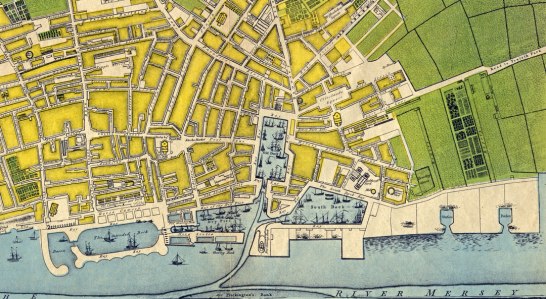
The Eyes map of Liverpool showing Old Dock on a previous tidal inlet and enclosed within the streets of an expanding Liverpool in 1765, 50 years after it first opened. Later docks were laid out along the foreshore. Source: National Museums Liverpool

Earlier in summer 2024 I went on the Old Dock tour in Liverpool when it was offered one Sunday.   Old Dock, of which only one corner remains to be visited, was perhaps Liverpool’s most important commercial and civil engineering initiative at a time when Chester’s port was going into decline and Liverpool had the opportunity to become the trading centre for the northwest.

Old Dock, Liverpool

Old Dock in Liverpool, the first of Liverpool’s impressive network of enclosed docks, opened in 1715, to the design of civil engineer Thomas Steers.  It is Europe’s oldest enclosed cargo-handling dock.  What remains of Old Dock is underground, beneath the “Liverpool ONE” shopping centre.  Its lock gates can no longer be visited, but remain under The Strand (the modern dual carriageway that runs along the line of the old foreshore).  Only the northeastern corner of the dock is accessible to visitors, and has been provided with a gantry and information panels, and its history is presented to pre-booked groups by an excellent guide.  I’ve added details about booking and the tour itself at the end of the post under “Visiting.” The following looks at some of the history of Old Dock.

The 1699 Howland Great Wet Dock in London. British Library HMNTS 10349.ff.9.. Source: Wikipedia

Old Dock was modelled on the Howland Great Wet Dock, shown right, built in 1699, which was built to shelter ships, mainly of the East India Company, in the days when ships over-wintering on the Thames were regularly subjected to both storm damage and piracy.  It was surrounded by a double planting of trees to help protect the ships within and had shipbuilding dry docks at its entrance. It was a convenient place to carry out repairs and to ready ships for the upcoming season, but was not used for handling cargo so was not a commercial trading dock.  The Howland Great Wet Dock was built in a rural space on the south of the Thames in what is now the residential Surrey Quays area of southeast London, and was replaced in the 18th century by Greenland Dock, which itself became part of the Surrey Commercial Docks.

The commercial argument for Old Dock

Liverpool was established by a charter of King John in 1207 and was provided with a castle in 1235.  At this time, however, Chester was the main northwestern port, and Liverpool did not become a commercial giant until the 18th and 19th centuries, and this required some pioneering Victorian thinking and civil engineering before it really took off as one of Britain’s leading ports.  Old Dock is at the heart of this story.

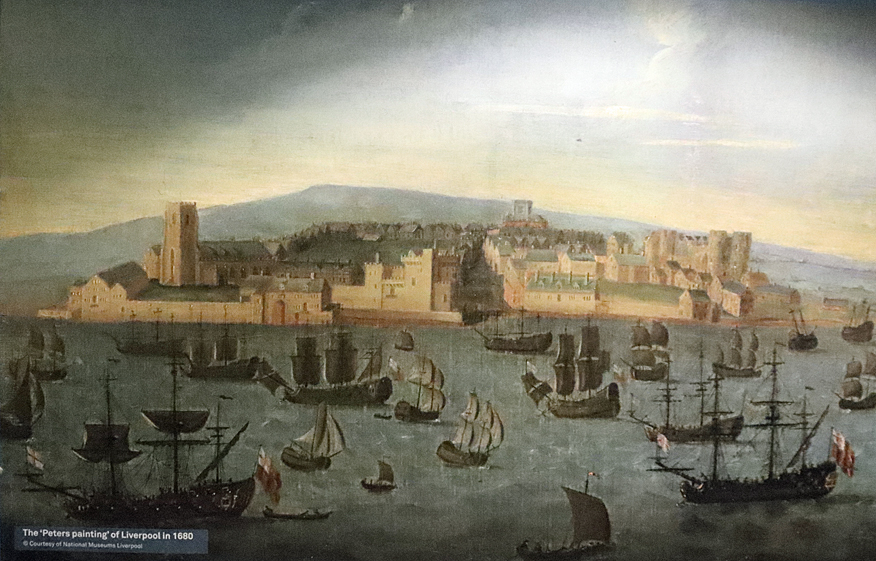
Painting of Liverpool in 1680, from the Old Dock display area. Unknown artist. The original is held by the National Maritime Museum. See more (and a better image) on ArtUK

Before the docks, the Mersey was not the easiest of rivers to use in an age of sail partly due to strong winds but also because of the twice-daily tidal events that swept down the estuary. An additional problem was that due to the dumping of rubbish and ships’ ballast along the river edges, deep-sea shipping was unable to approach the river banks to offload and reload.  It could also become very busy with river traffic of all shapes and sizes. The handling of cargo on the Mersey was achieved by mooring ships in the main channel and loading and offloading them with lighters – unpowered boats into which the cargo was loaded by hand, then rowed to shore, and offloaded by hand.  This could only be carried out between tidal events, confining the activity to around 5 hours a day. To empty a single ship averaging 150 tons could take between two and three weeks.

The engineering success of the Howland dock enterprise inspired MP Thomas Johnson, who was both a successful merchant a slave trader, to approach one of the engineers probably responsible for the Howland dock, George Sorocold, to discuss the viability of a similar dock for Liverpool.  Johnson, however, saw the greater potential of an enclosed inland dock, not for over-wintering ships but for creating a cargo-handling facility to radically improve speed and efficiency. Under The Dock Act of 1708 a Common Council of leading city figures was established to became trustees of the proposed dock, which they operated through council committees.  The risk of doing it this way rather than as a private enterprise was that failure could have put the entire city finances in jeopardy.  Thomas Steers from London was the civil engineer appointed in 1709 to make this a reality, only a decade after the opening of the Howland Great Wet Quay on which he had probably also worked.  Initially costs had been estimated at £6000, but this was a serious underestimation and eventually the dock cost more than double this amount.

Building and opening the dock

The dock was lined with bricks in the upper sections with local red sandstone in the lower courses.  I am accustomed to the later Surrey Commercial Docks in southeast London, where I used to live, which are lined with stone much like Liverpool’s Albert Dock, so the sight of a brick-lined dock seemed extraordinary to me.  The bricks were made on site from local clays, with a dedicated kiln built for the task, and a special mortar was used to resist the incursion of water.

At the base of Old Dock, Liverpool

The result of all the investment, civil engineering and labour was Old Dock, which opened in 1715 at the mouth of a former tidal inlet or creek.  Up to a hundred ships could be taken into the 3.5 acre dock via a 30ft wide entrance lock and could draw up against the quayside to offload without the use of lighters. Because of the tides, ships could only enter the dock at the top half of the tide, but a 1.5 acre tidal entrance basin was provided as a waiting area.  By drawing ships up against the quayside, three weeks could be reduced to just one to two days.  The proof of concept was soon confirmed.

The area around the dock was soon surrounded by residential, commercial, retail and service industry premises. Excerpt from a poster from the Old Dock exhibition area.

An entire new residential, commercial, retail and service industry quarter grew up around the dock, which became known as the Merchants’ Quarter.  As well as homes, warehousing and other commercial facilities there were lodging houses for sailors, and less salubrious businesses that catered to their needs.  This is a good illustration of the sort of process of urban sprawl that follows on from a specific industrial development.

Old Dock was such a notable success that new docks were soon opened, and the Liverpool foreshore began its transformation.  During the 18th century South Dock, also built by Thomas Steers (later Salthouse Dock) opened 1753, George’s Dock opened 1771, King’s Dock opened and Queen’s Dock opened in 1796.  It is a measure of the success of the dock concept, Old Dock having been established 53 years before Bristol’s first dock, that between 1772 and 1805 the total tonnage of shipping increased from 170,000 to 670,000, with foreign shipping increasing from 20,000 to 280,000.  By the end of the 19th century 9% of all world trade passed through the Liverpool docks, and there were 120 acres of enclosed docks along 10km (7 miles) of Liverpool’s foreshore.

Closure of the dock

Old Dock, Liverpool

Old Dock itself closed in 1826 mainly because as ship sizes increased, in terms of width, length and depth, it became increasingly obsolete.  It did not help either that the dock had become surrounded with other buildings and could not easily expand without considerable destruction.  Instead, the development of docks beyond the existing foreshore seemed like a better option and this is what happened.

This new use of enclosed docks for cargo-handling was pioneered at Old Dock in Liverpool, creating the first revolution in cargo handling in the UK.  To provide additional real estate for the rapidly growing city, most of the dock was infilled and built over, so this one remaining corner is a significant survivor from Liverpool’s early development as a major trading port.

Final Comments

Old Dock brickwork

Much of what is known about Liverpool’s earliest docks comes from the archaeological investigations that took place between 1976 and 2009. Old Dock was examined prior to the building of Liverpool One by Oxford Archaeology between 2001 and 2006. The remains of Old Dock are designated a site of Outstanding Universal Value.

It is difficult to over-emphasize how important London’s Howland Great Wet Dock and Liverpool’s Old Dock were to the development of maritime trade in Britain.  With an enclosed dock designed by Thomas Steers, the Old Dock set Liverpool firmly on the path for trading success throughout the 18th century and the commercial and architectural triumphs of the Victorian period.

Visiting

Booking details, opening times, ticket prices and everything else you need to know are on the Old Dock Tour website.

At the time of writing the meeting point shown on one place on Google Maps is in a different location from the one that is shown on the Old Dock Tours website, and the latter is the correct one.  I don’t know Liverpool at all and I was confused by the directions on the website, partly because I had no idea what a “Q-Park” might be when it escaped from its burrow, so I arrived early to make sure that I was in the right place, which was on the Thomas Steers Way entrance to the “Q-Park” (the Liverpool ONE car-park), on the left as you head up from the Mersey, near the base of the Sugar House Steps.  Here’s the What3Words address for that location, which is traffic-free, but do check on the website or your ticket that this remains the same meeting place: https://what3words.com/found.farm.gent. Have your ticket handy to be checked, either printed out or on your device.

This is a guided tour.  You receive an excellent lecture as you walk to the dock via a wall-sized map of old Liverpool, and then stand on the  gantry looking down into the dock. Our guide was informative, humorous and engaging, parting with a staggering amount of information in an easily digestible way.  It is always a mark of how well a guide does when there are questions afterwards, people wanting to explore specific aspects of the story, and there were lots of questions.  I used to live overlooking Greenland Dock in London, and the remnants of the Surrey Commercial Docks were my home for twenty years.  Opposite was Canary Wharf, where the former East India and West India quays are preserved and the Museum of London Docklands is located. It was a real dock heritage experience, so it was particularly nice to go to Liverpool and have someone bring this particular old dock to such vivid life.

If you are dealing with unwilling legs, there is a flight of steps with a banister to hold onto.  I forgot to count, but I would guess perhaps ten steps, down from the car park entrance into the dock area.  There is then a gantry (metal walkway) across the remaining part of the dock, with high sides to hang on to.  There is nowhere to sit, so a portable perch of some sort might be useful whilst you are listening to the talks.

I had not realized that it was the schools’ half term break.  Half-term was a poor day to visit Liverpool, and on the tour there were two completely uncontrolled young children running around and yelling their heads off.  A less child-intensive day would be better if it can be arranged.  There’s not a lot for young children to see on this walk anyway, although an older child seemed to be enjoying it very much.
———


—–

Sources

Most of the above details came from the guided tour.  I did not want to detract from that so I have not gone into greater detail here, but I did use some additional sources to check facts that I had not noted down at the time, and have provided some suggestions for further reading.

Books and Papers

Farrer, William, and Brownbill, J. (eds.) 1911. Liverpool: The docks, in “A History of the County of Lancaster: Volume 4,” p. 41-43. British History Online. Originally published by Victoria County History, London, 1911.
https://www.british-history.ac.uk/vch/lancs/vol4/pp41-43

Gregory, Richard A., Caroline Raynor, Mark H. Adams, Robert Philpott, Christine Howard-Davis, Nick Johnson, Vix Hughes, David A. Higgins 2014. Archaeology at the Waterfront vol 1: Liverpool Docks. Lancaster Imprints / Oxford Archaeology North

Stammers, M.K. 2007.  Ships and port management at Liverpool before the opening of the first dock in 1715.  Journal of the Historic Society of Lancashire and Cheshire, vol.56.
https://www.hslc.org.uk/journal/vol-156-2007/attachment/156-3-stammers/

Stephenson, Roderick A. 1955. The Liverpool Dock System.  Transactions of the Liverpool Nautical Research Society, Volume 8 1953-55 (1955)
https://liverpoolnauticalresearchsociety.org/wp-content/uploads/2019/03/Article-The-Liverpool-Dock-System.pdf

Websites

National Museums Liverpool
Ten fascinating facts about Liverpool’s Old Dock
https://www.liverpoolmuseums.org.uk/stories/ten-fascinating-facts-about-liverpools-old-dock

Historic Liverpool
1846: Plan of the Liverpool Docks, by Jesse Hartley, Dock Surveyor
https://historic-liverpool.co.uk/old-maps-of-liverpool/1846-plan-liverpool-docks-jesse-hartley-dock-surveyor/#4/65.79/-74.43

The Liverpolitan
Old Dock: a different view. Wednesday, 18 November 2015
https://theliverpolitan.com/blog_old_dock_a_different_view.php

That’s How The Light Gets In blog
Liverpool Old Dock: Down to the bedrock
https://gerryco23.wordpress.com/2010/09/14/liverpool-old-dock-down-to-the-bedrock/

Liverpool World Heritage
LIVERPOOL MARITIME MERCANTILE CITY WORLD HERITAGE SITE MANAGEMENT PLAN 2017 – 2024. Prepared by LOCUS Consulting Ltd. Liverpool City Council
www.liverpoolworldheritage.com/wp-content/uploads/2018/09/pmd-486-liverpool-whs-management-plan-final-version-as-at-27-sep-2017.pdf

A Rotherhithe Blog
The Howland Great Wet Dock 1699-1807
http://russiadock.blogspot.com/2008/06/rotherhithe-heritage-2-howland-great.html

—–

A visit to Basingwerk Abbey, Holywell

Introduction

The Chuch is at left, the Chapter House opposite and the ground floor monks’ day parlour whcih once had their dormitory overhead. The line of the cloister, a covered walkway with arcades, and the central garth are marked out by the stone foundations

I have been to Basingwerk Abbey a couple of times, but never got around to writing it up.  It’s a super site, and although it is now a ruin, it retains enough of its original structures to ensure that its layout is easily understood.  St Winifred’s Well, with its lovely late gothic shrine, is only a mile and a bit away, and an important part of Basingwerk’s property for most of its life, will be covered on another post.

Basingwerk Abbey is only a  few miles away from Flint Castle.  The abbey preceded the castle by over a century but when Edward I founded Flint Castle and its accompanying town in 1277, the histories of abbey and castle became entwined. A visit to the abbey is easily combined with a look-in at the attractive riverside remains of Flint Castle.  I have written about the history of Flint Castle on an earlier post.

Digital Aerial Photograph of Basingwerk Abbey. AP_2009_2896 – s, Archive Number
6355272. Source: Coflein
Savignacs and Cistercian Basingwerk Abbey

Remains of the church

The first Basingwerk abbey, dedicated to St Mary, was founded as a Savignac monastery Ranulf II (Ranulf de Gernons) (1099–1153), fourth earl of Chester and later merged with the Cistercian order. It is not known why the Savignac order was chosen by Ranulf, but the monks who were sent to Basingwerk were provided directly by the founding monastery of Savigny in southwest Normandy itself. It became Cistercian in 1147.  Most of the monks who served there subsequently, up until the 15th century, were English, aliens in territory that was a bone of contention between England and Wales.

A monastic order is formed of a shared set of spiritual ideals, often spelled out in considerable detail in rules that covered everything from how many times a day a monk should pray, communally or individually, to where and when they could speak, eat and sleep, and what work they should engage in. All orders involved, at least in theory, a degree of renunciation and isolation by communities of monks, but these ideals were eroded as the influence of monastic houses grew.  The trajectory of monastic history in Europe changed in the late 11th century and early 12th century with the establishment of the so-called reforming orders, who wanted a purer, less self-indulgent and more hard-working approach to cloistered living than other contemporary monastic institutions offered.  The reforming orders believed that the Rule of St Benedict, as it had been originally conceived and set down in the 6th Century Italy, was the key to recovering a holier and more disciplined approach to a communal life of worship. The Carthusian order was established in 1084, the Cistercian order in 1098, the Savignac order between 1109 and 1112.

12th Century links between Cistercian monasteries.Although Citeaux, the node for all Cistercian abbeys, established early new bases in France, it was Clairvaux under the lead of St Bernard that was responsible for the earliest new abbeys in Wales. Of these Whitland was the most important for the northward spread of monasticism. The green lines emanating from Savigny reflect the Savignac order, which merged with the Cistercians after only 20 years, in 1147. So although Basingwerk in the north and Neath in the south were founded as Savignac orders, after 1147 they were brought under the rule of the Cistercians at Citeaux.  Source: Evans, D.H. Evans 2008, Valle Crucis Abbey (Cadw).

In Wales one of the most successful of these orders was the Cistercian order, which left remains in north, mid and south Wales.  Valle Crucis in Llangollen is the nearest of the Cistercian abbeys to the Chester-Wrexham areas, established in 1201, and is discussed in a series of earlier posts, which begins here with Part 1.  The Savignac order is much less well represented throughout Britain, and the reason for this is that in 1147 it was amalgamated with the Cistercian order.  Basingwerk Abbey, established as a Savignac monastery, became Cistercian in that year.

Because of their similarities the Savignacs and Cistercians were a good match, but there were differences too, largely in terms of the constitutional framework and systems of accountability.  To ensure that these were understood after the fusion, Savignac monasteries were put under the supervision of an appropriately located and senior Cistercian order.  Basingwerk was put under authority of Buildwas Abbey in Shropshire, which had also originally been Savignac.  This was perfectly in keeping with the Cistercian hierarchical approach to monastic management with every new monastery answerable and accountable to a mother house.  The mother house for the entire order was Cîteaux, and Clairvaux was the mother abbey for Whitland in south Wales, which was established by monks from Clairvaux itself. Whitland in turn established other abbeys including Strata Marcella near Welshpool, and this abbey in turn established Valle Crucis.   This system created a network of houses that all linked back to the ultimate mother house at Cîteaux (Cistercium in Latin) in France, the founding monastery of the Cistercian order.  Every Cistercian abbot had to return from his abbey to Cîteaux every year for what was known as the General Chapter, a great conference of the Cistercian abbots. 

A more detailed history of monasticism, and the Cistercians in particular, is included in Part 1 of the series on Valle Crucis.

Cadw guardianship monument drawing of Basingwerk Abbey. Survey-plan. Cadw Ref. No. 216/9a4. Scale 1:192. Source: Coflein

The foundation and economic basis of Basingwerk Abbey at Holywell

Exterior of the refectory

The first Basingwerk Abbey was probably in wood, and was located at a different but nearby site possibly somewhere in the vicinity of Hên Blas in Coleshill, near a now-lost castle.  There is a reference to a fortification in the Annales Cambriae describing how, when Henry II advanced into Wales from Chester,  Owain Gwynedd prepared for the upcoming battle by digging a large ditch associated with a hastily built camp at a site called Dinas Basing.  It is thought that this was the castle known to have been in the area of Hên Blas, which lies on a ridge between two streams and overlooks the Dee estuary.  Excavations in the 1950s demonstrated the existence of a 12th century motte-and-bailey castle , which was flattened by Llewelyn the Great in the early 13th century, and was replaced with a defended courtyard with timber-framed buildings.

The central garth on a very moody day looking at the remains of the church. The tall upstanding ruin is the main remnant of the church at its east end. Photo taken from within the refectory

Basingwerk Abbey was later rebuilt in stone at the current site of the ruins, possibly in the 1150s, probably when Henry II granted a charter to the house and endowed it with the wealthy manor of Glossop in Derbyshire to assist with its financial future, 10 years after it became Cistercian.  The general location seems to have been strategic rather than purely spiritual.  The area of Tegeingl is located in the Four Cantrefs between the earldom of Chester and Welsh Gwynedd, always the subject of territorial dispute between England and Wales and a source of regional discontent until Edward I completed his invasion in the late 13th century.  The establishment of a large French monastery was probably part of this process of establishing a presence, and a holy one at that.  Although the monastery was later mainly populated by English monks, the Welsh too saw the benefit of patronizing a prestigious religious establishment and both Llywelyn ab Iorwerth (d. 1240) and his son, Dafydd ap Llywelyn (d. 1246) were benefactors. 

Detail of Map 12, page 91 in Williams 1990 showing Cistercian Lands in Wales, with those of Basingwerk marked in red. Click to enlarge.

When an abbey was founded, its endowment included a number of properties that included farmland or pasture that were intended to support it by the provision of produce to make it self sustaining and later by selling produce.  Some of these could be quite substantial manors, but others were smaller farms, which the Cistercians referred to as granges.  These could resemble mini monastic establishments and often had their own chapels. Later still, properties with their land could be rented out to tenants, but as late as the early 16th century, Abbot Nicholas Pennant was busy creating a new open enclosure in the mountains adjacent to the monastery apparently for agricultural development.

Gelli Chapel, from Thomas Pennant’s 18th Century Tour in Wales. Source: National Library of Wales, via Wikipedia

Based on the work of D.H. Williams in his 1990 Atlas, Silvester and Hankinson 2015 list all the known Basingwerk granges, shown on the above map produced by Williams. These were supplemented in 2001 by Williams in 2001.  Apart from two properties in Derbyshire these are all concentrated in northeast Wales and the Wirral and include, in alphabetical order:  Baggechurch /Beggesburch Grange, Bagillt; Calcot; Gelli Grange, either at Gelli or Gelli Fawr; lands in Whitford and the adjacent parish of Cwm; the Lordship of Greenfield, alias Fulbrook, including lands of Merton Abbot and party of Holywell town; and Over Grange, Holywell (all in Flintshire).  Lands with uncertain boundaries have also been identified elsewhere in the area, including Mostyn, Wake, Flint and Gwersylt as well as transhumant pasture close to property belonging to Valle Crucis Abbey at Moelfre-fawr in Denbighshire, at Boch-y-rhaiadr and Gwernhefin. They also owned Lake Tegid at Bala.

Beyond Wales, there were also three granges on the Wirral: Caldy Grange (West Kirby), Thornton Grange and Lache Grange (known as “La Lith”), as well as the granges in Charlesworth at Glossop, their mos profitable property, and leased land in Chapel le Frith. 

Over Grange, Holywell. Source: Williams 1990, plate 39, page 120. No indication of when the photograph was taken.

Of this list, only two buildings seem to have survived into relatively recent times, the remnants of two granges.  A chapel at Gelli Fawr in Whitford (Flints), apparently once belonging to Basingwerk Abbey was recorded in  a late 18th-century drawing which suggests that the chapel was part of a larger building complex. More can be found about the building and its possible function it in Silvester and Hankinson 2015.  Another grange, Over Grange, was listed by Cadw in 1991, according to Silverster and Hankinson, and was located located to the southwest of the modern farm house, and has been much-altered.  The photograph below shows it with small cross over the gable.

The Coflein website says that it is believed that Basingwerk Abbey originally constructed a windmill on this site, but the present structure probably dates to the late18 or early 19th century.  Now restored. Source: Coflein 804658 – NMR Site Files. Archive Number 6259181

To support its farming activities, the monastery built watermills, windmills and fulling mills.  Abbot Thomas Pennant (abbot from 1481 to 1522) appears to have been particularly active in the building of mills.  Records indicate that there were at least four windmills, at least three watermills, and at least two fulling mills, as well as a tithe barn in Coleshill.

The site of the Holywell windmill is thought to be preserved by the surviving windmill that can be seen today, shown right.  Two of the windmills were on the Wirral. Rowan Patel’s research has found that the Basingwerk windmill that stood at West Kirby area had been established at around 1152, and was probably upgraded and even replaced several times.  It stood on a high spot near the coast, an ideally windy location, and eventually featured on sea charts as a major landmark for coastal navigation.   It was mentioned in Henry VIII’s Valor Ecclesiasticus, the valuation of all monastic properties. Patel has found that after the Dissolution the mill became the property of the Crown and was rented to Thomas Coventree for an annual sum of 40s.  Rowan Patel’s research suggests that the second Basingwerk windmill was at Newbold, east of West Kirby, mentioned in the Taxatio of Pope Nicholas IV in 1291, where a Newbold windmill was referred to and valued at 40s a year.  Before the Dissolution it appears to have been rented out to Thomas Coyntre in 1525 on a 100 year lease at 40s a year.  By the time of the Dissolution, Thomas’s son Richard Coventry was apparently paying rent to the Crown, and in 1659 William Coventry, presumably a descendant of Richard’s, was still paying rent.  In 1664 it is next recorded having been sold to one Thomas Bennett in who donated it to the support of the poor.  Patel notes that in 1546 two men stole oats, barley and pease worth 10d, indicating the cereals proposed at the mill in the mid-16th century if not before.

Watermills continued to have a value well into the 20th century, and medieval mills will have been replaced over time, removing the visible remains of them, particularly along the valley that ran down the hill behind St Winifred’s Well and past Basingwerk before emptying into the Dee.
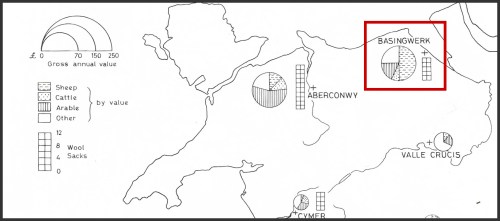
Economic Values excerpted from Williams 1990, map 21, p.105, showing the dominance of the agricultural contribution to the abbey’s income

Basingwerk had a large amount of livestock.  The hills and newly cleared meadows around Basingwerk were ideal for sheep in the uplands and cattle in river valleys and pastures.  The Welsh princes are also recorded as expecting two horses annually from Basingwerk which may indicate that the monks, like those of Cymer Abbey, were breeding horses.

As well as agriculture, which made up most of its income, Basingwerk was also involved in industrial activities, owning or leased industrial properties, Williams lists silver mining as a component of Basingwerk’s economic activities, and this is supported by Gerald of Wales whose trip through Wales in 1188 records leaving Conwy and heading east through Tegeingl through “a country rich in minerals of silver, where money is sought in the bowels of the earth” before spending the night at Basingwerk.  The abbey was also involved in the salt trade, with salt extraction enterprises in Northwich and possibly Middlewich.   Williams notes a coal mine leased from the Crown in Coleshill.  Lead was also mined at Basingwerk, probably making use of the same resources that had been exploited by the Romans in the area.

Economic resources excerpted from Williams 1990, map 22, p.105

Timber was taken from woodlands in Penllyn in Merionydd for housing, hedges, fuel and other requirements, as well as for sale.  Tenants were permitted to take a reasonable amount of firewood.  Assarting, the removal of woodland for conversion to agricultural land and other uses was a common activity in the middle ages.

Fishing probably made up a significant part of the diet, as it did at most Cistercian monasteries.  Basingwerk held the fishing rights for Lake Tegid at Bala, which it owned, and had a weir at West Kirby.  Prince Dafydd granted them one fifth of the catch at Rhuddlan in the 13th century.  They may also have purchased fish caught in the nearby coastal waters.

Basingwerk had a number of urban properties too, in Holywell, Flint, Chester, and Shrewsbury, which served as bases in town for the abbot and his representatives, which were probably loaned to friends of the monastery, but could also be leased out for additional income if required.  The Shrewsbury house was probably a legacy of the abbey’s connection with Buildwas Abbey after the amalgamation of the Cistercian and Savignac orders.
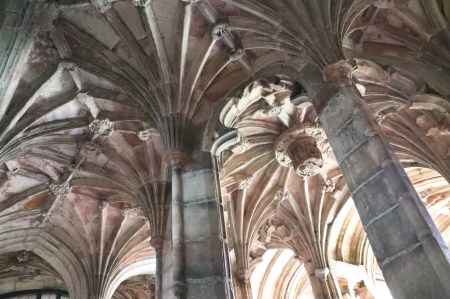
The fan vaulting in St Winifred’s Well at Holywell

A major feather in the financial cap of Basingwerk was St Winifred’s shrine with its beautiful natural spring.  The Holywell shrine of St Winifred was also another source of travelers requiring somewhere to stay and something to eat.  St Winifred’s shrine was granted in 1093 to St Werburgh’s Abbey in Chester, but was passed to Basingwerk in 1240, together with the living of Holywell church.  An abbey with a pilgrim shrine had a whole world of opportunities for income generation, and St Winifred’s was not only famous in its own right for its powers of healing and provision of miraculous cures, but was on the pilgrim trail to Bardsey Island at the end of the Llŷn peninsula and Ireland, via Anglesey.  In 1427 it was given a considerable boost when Pope Martin V granted indulgences for those visiting the shrine and giving alms to the chapel.  Indulgences rewarded certain behaviours, like pilgrimages, with a remission of sins, meaning less time in purgatory.  Royal visitors included King Henry V in around 1416 and Edward IV in 1461, helping to raise the profile of the shrine, which continues to welcome pilgrims today.  It became even more attractive from the late 15th – early 15th century when the shrine was provided with a spectacular gothic building that surrounded the spring.  I will cover Holywell in a separate post.

A traditional method of income acquisition for monasteries was appropriating a church and its income, sometimes to cover a particular expense, such as a major building project, and sometimes just to supplement income.  The Cistercians officially frowned on this practice, but the ban on appropriating church incomes did not survive very long.  Even so, Basingwerk had appropriated surprisingly few, just parish churches at Holywell, Glossop and a third at an unknown location, possibly to be identified with Abergele.

The fairs and markets granted to Basingwerk during Edward I’s reign in the 1290s are discussed below, and this must have been a considerable aid to their income.

Behind the monks’ day room and the dormitory above it was a block of buildings the function of which remains unclear. Suggestions include an extension of the abbot’s personal quarters, with rooms for special visitors, or a dedicated guest wing.

In spite of these various forms of income, Basingwerk sometimes found itself in financial stress. The monastery had been unable to provide a required payment to Edward III in 1346, and by way of explanation complained of the burdens of hospitality that came partly with being a Cistercian abbey, which put a great deal of emphasis on providing free hospitality, and partly from being near a major road, which had become increasingly busy after Edward I had moved forward into Wales, establishing market towns whose merchants moved between Wales and Chester for trade.  Even later in its history, in the late 15th/early 1gth century, it was reported that guests were so numerous that they had to take their meals in two sittings. Smith paints an evocative picture of other travelers in Wales who “cautiously flitted from one English settlement to the next, seeking safe overnight bases where food and shelter could be found “in a land in which rumors of insurrection abounded.” Basingwerk was by no means the only abbey to complain of this burden, which was a particular problem for Cistercian abbeys, but was shared by any monastic community that sat at a busy location.  Birkenhead Priory, which ran the ferry that allowed crossings between the Wirral and Lancashire for access to Chester and beyond (and later Liverpool), found itself in real difficulties due to the requirement to supply hospitality for ferry users who might be stuck at the monastery for several nights in bad weather.

A rather more specific problem was the expectation by the Welsh princes to use the abbey’s Boch-y-rhaiadr range for its annual hunting expeditions, during which the abbey was expected to provide bread, butter, cheese and fish for a hunting party of 300, expanding to 500, with money due in lieu when hunting did not take place.  This was abolished by Edward I after his conquest of Wales.

The Cistercian monasteries in Wales were not exempt from all taxes, or subsidies, and some of the abbots and their community were employed as tax collectors.  Other occasional charges were made on the abbey, such as a demand for financial contributions towards the marriage of Edward III’s sister.  Basingwerk provided £5 in 1333.

The abbey, being so active in economic production in the Holywell-Flint areas, was responsible for the management of its lands and the personnel who managed and worked the land, but was also required to function in a judicial role, its courts administering justice and meting out punishments.  Lekai says that the monastery had “a pillory, tumbrel and other instruments of punishment, although the penalty most often inflicted was a fine.”

The church is on the left and the two arches of the chapter house at right,.  All the buildings were arranged around the central green area, the garth. The stone foundations for the covered and arcaded walkway survive.

Most of the Cistercian abbeys in Wales, at one time or another, had a diplomatic role acting as intermediaries between the Welsh princes and the Crown, acting for either side, a role that was in their political interests to accept.  For example In 1241 Henry III used the Lache grange for a conference between himself and Prince Dafydd’s clerk.  In 1246 Henry III chose the abbot of Basingwerk to escort Prince Dafydd’s wife Isabella from Dyserth Castle to Godstow nunnery near Oxford.  A decade later, Prince Llywelyn ap Gruffyd used an abbot of Basingwerk to carry a letter to Henry III.

In 1291 the Taxatio Ecclesiastica of Pope Nicholas IV valued Basingwerk at £68 8s 0d, gross value (compared with Valle Crucis at £91 8s 0d, and Margam  at £255 27s 4½d).  In 1346 it claimed that its lands were sterile, and it went through some bad years, but in spite of the rebellion of Owain Glyn Dŵr in the early 1400s and a very troublesome period when a monk took the abbacy without being legally elected in the first half of the 15th century, with a similar problem in the later 15th century, the appointment of Thomas Pennant in the early 16th century seems to have turned things around.  In 1535, Henry VIII’s Valor Ecclesiasticus valued the monastery at £157 15s 2d.  Margam by this time was valued at £188 14s 0d, and Valle Crucis £214 3s 5d.
——

The layout of the monastery

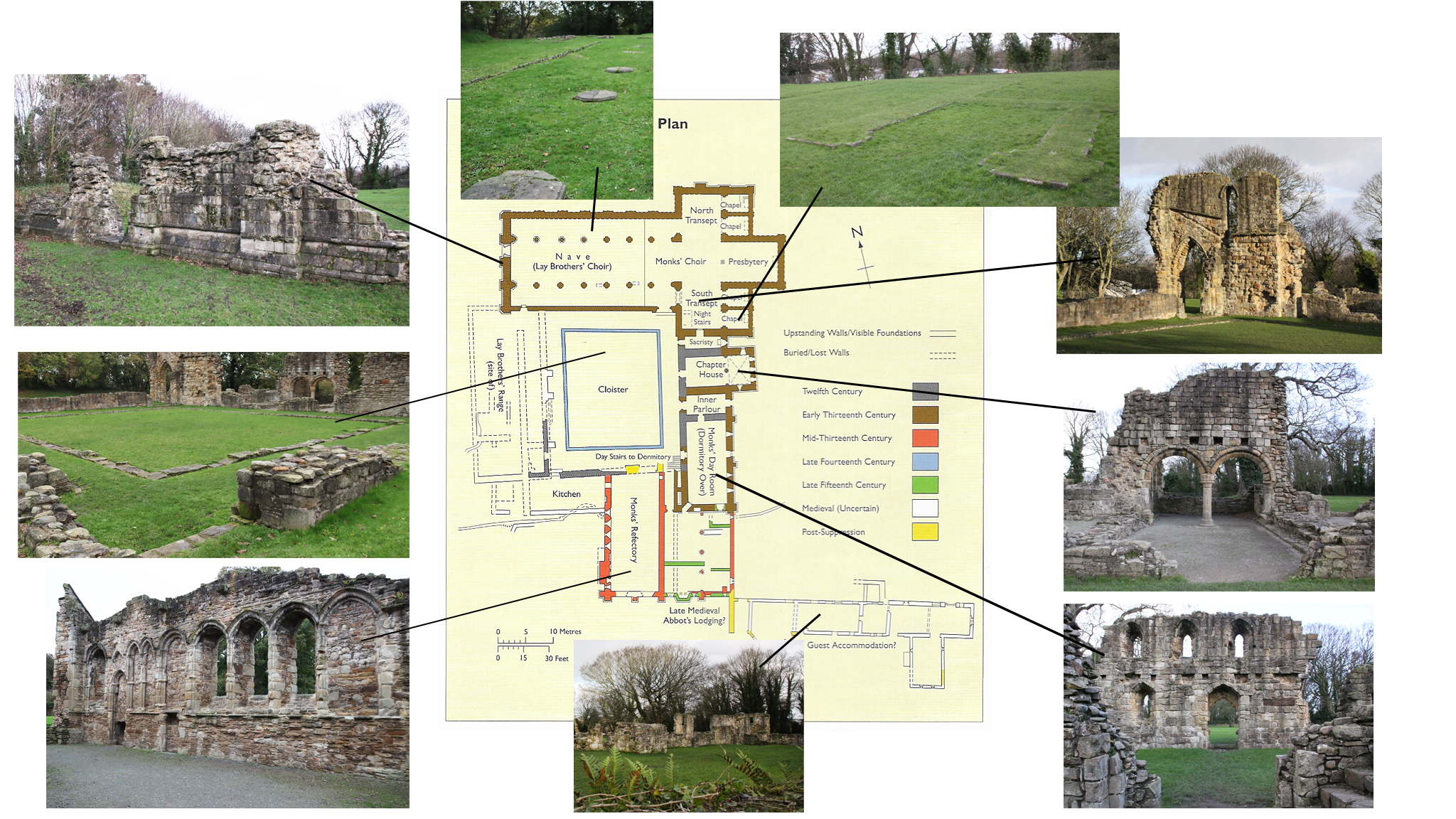
Plan of Basingwerk Abbey. Source: Robinson, D. M., 2006. Basingwerk Abbey (Cadw).

The remains of the monastery conform to a standardized layout favoured by all the orders that followed the rule of St Benedict, clearly shown on the Cadw plan to the right, which helpfully colour-codes the dates for each part of the building. Few parts of the 12th century abbey are left.  Most date to the early 13th century, but the monk’s refectory was built in the mid-13th century.  Much of the abbey was rebuilt in the 13th century, which was not unusual when, for example, a new abbot might want to make a mark, but in this case it is possible that much of not most of it was done due to damage inflicted during the wars between the English and the Welsh, when Edward paid compensation to the abbey to enable it to carry out repairs, about which more below.

The cloister arcade was apparently remodelled in the late 14th century.  In the late 15th century Abbot Thomas Pennant carried out building work not only at the abbey but also at the shrine of St Winifred just up the road in Holywell.  There are various aspects of the site where both date and function remain unclear.  The western range, opposite the chapter house, would have been part of the original layout, used to house the lay brethren, discussed below, but may have gone out of use if a new use for them could be found when the lay brethren were no long featured in the community.  Although the above plan shows that the possible guest accommodation is undated, timbers from fire damage Basingwerk were saved for future analysis and tree-ring dating shows that the felling-date of the crown-post truss was c. 1385.  This is one of the earliest Welsh tree-ring dated.  The dating was commissioned by Cadw.

The church is at left, the chapter house to its right, the day room and the windows of the first floor dormitory next, and set to the far right is the refectory

Although every monastery differed in some aspects, the basic template of buildings surrounding a central square area, a garth (green area) with surrounding walkway (the cloisters) with the monastic church making up one side, was a universal arrangement.  The church was usually on the north side, as it was here, and often included two chapels in the transepts that flanked the crossing area where the choir was located.  Some churches featured towers either above the crossing or at one end.  The other buildings usually included a chapter house (the important monastic meeting room), day room with a dormitory on its first floor, a refectory, and sometimes an undercroft for storage. with an external door leading into the cloister on one side and the monastic precinct beyond. A sacristy was usually attached to the church, sandwiched between the church and the chapter house, which is how matters were arranged at both Basingwerk and Valle Crucis.  The cloisters were usually supplied with desks (called carrels) along the exterior wall of the church  where the monks could study and write.

The precinct, in which this arrangement of buildings sat, could include other structures like farm buildings, and visitor accommodation and often included a gatehouse, the whole surrounded by some form of boundary.  A key feature of Cistercian monasteries was good drainage, which supplied the kitchens and fish ponds, where present, and took away toilet waste, and various parts of the Basingwerk drainage system can be traced at the site.

Part of the abbey’s drainage system

Part of the abbey’s drainage system

The church, with its entrance at far left and the south transept at right

Many of these features can be found at Basingwerk.  The church is largely in ruins, but the layout is still visible in the very masonry walls that sit on the grass, including the columns that supported the roof and divided the church into a central nave with three aisles and seven bays, two side transepts each with a small transept and an eastern presbytery where the high altar would be located.  At around 50 metres in length the church would have been one of the smallest Cistercian churches in Wales. Only Cymer near Dolgellau is shorter, at just over 30m in length.  At the entrance to the presbytery a stone set into the floor may have supported a lectern.

What remains of the south transept, with the presbytery beyond

Basingwerk Abbey refectory wall

Opposite the former church, and one of the best preserved parts of the abbey, is south range with the refectory, which was built perpendicular to the cloister rather than lying along it on a north-south axis.  The refectory in Chester Cathedral, the former St Werburgh Abbey, was built along the length of the cloister, limiting its size, but the the refectory at Basingwerk as limited only by the size of the precinct.  This was probably a change introduced in the 13th century remodelling of much of the abbey, replacing a 12th century refectory that lay along the side of the cloister on an east-west axis.  It is a substantial building with many features preserved in its walls.  This includes the former entrance and stairway to the pulpit, now blocked off, from which religious texts would have been read during meals.  S series of tall windows would have let in a lot of light, and there was a hatch between the refectory and the kitchen for the convenient handing over of food, as well as a cupboard, which was apparently shelved, opposite.

The monks’ day parlour at ground floor level, with the dormitory on the first floor, the windows suggesting the original height of this building

The east range of buildings, again along the edge of the cloister, extends between the east range and the church.  As you face this range, running from right to left are the monks’ day parlour, over which was the dormitory, the length of which over-ran the cloister and ran parallel for a short distance with the refectory;  a long thin parlour is next, and then most importantly is the chapter house, where the monks met daily to discuss the business of the order.  To its left is the sacristy, which adjoined the south transept of the church.
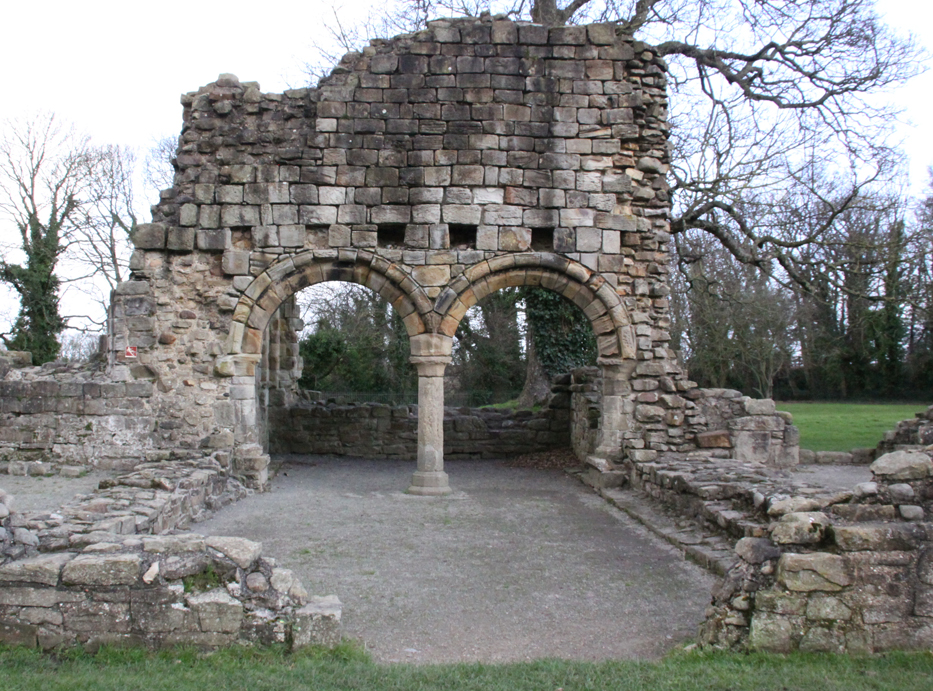
The Chapter House

The sacristy to the left of the chapter house, with doorway leading into the church to the left.

Looking towards where the western range would have been located. The building beyond is now the café.

Opposite this range was the western range, of which there is almost nothing left.  In a Cistercian monastery this was usually used, at least in the early decades, for the lay brethren.  These were members of the monastic community who worked the land, and were not required either to be as educated as the monks, or to dedicate a similar amount of time to worship.  They worked the land and were maintained by the monastery.  As properties were leased out, the lay brethren were increasingly redundant and the western range was usually put to different uses.  It is not known how it would have been used at Basingwerk.


Edward I and Basingwerk Abbey
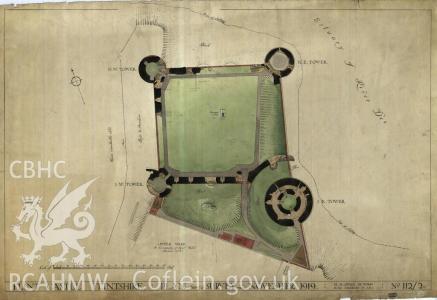
Plan of Flint Castle. Source: Coflein

When Edward I settled on his location for his new castle at Flint, Basingwerk Abbey was just a few miles west of the new site.  The monks of Basingwerk Abbey, which was established over 100 years earlier in 1132, must have wondered about the impact of the castle on their own security and their livelihood.  During the first few months of the castle construction process in the summer of 1277 Edward stayed near Basingwerk.  Edward saw himself as a religious man.  He had been on crusade, and had made a vow to establish a monastic house of his own, under the Cistercian order, and had selected a site for it in Cheshire.  Vale Royal Abbey was already underway in 1277 near Northwich, Edward having laid the first stone in early August.  It seems unlikely that Edward was not often a guest of the Basingwerk Cistercian Abbey during the building of Flint, which apart from being obliged under Cistercian rules to provide hospitality, was unlikely to reject a royal visitor.  Although Basingwerk had been founded by an English patron, Ranulf II it was probably more in tune with Welsh interests by the arrival of Edward.  Indeed, earlier in 1277 seven Cistercian abbots had written a letter to Pope Gregory X supporting Prince Llewellyn ap Gruffud against charges placed by the Bishop of St Asaph, although the abbot of Basingwerk was not amongst them.

Drainage at Basingwerk, from the refectory

Whatever their personal leanings, it would have been very much in the interests of the order for good relations to be maintained.  They may have offered advice about his plans for Vale Royal, and it is clear that some of the abbots in the Welsh-based monasteries, including Basingwerk, played an invaluable role as intermediaries between the Welsh and the English.  Fortunately for the monks at Basingwerk, Edward I chose the Cistercian abbey at Aberconwy for his headquarters, forcing that monastic community to eventually shift further south along the Conwy valley to a new home.

The monks of Basingwerk would have been less than astute, however, if they had not regarded the new castle with misgivings, and if they had concerns about being caught in the middle of a fight between Edward and Llywelyn, their worries would later be justified.  In the 1270s and 1280s the abbey suffered damage during the wars of Edward I, in spite of letters of protection issued to it in 1276,1278, and 1282 and in 1284 Edward granted £100 compensation to the monks after the army stole corn and cattle and the loss of workers who were abducted, presumably for labour.  An additional 132 4d was paid in damages to churches in Holywell.  Basingwerk was not the only abbey in the area to suffer and receive compensation.  Valle Crucis near Llangollen received a sum of £160.00, and nearby Aberconwy was occupied by Edward I’s forces and its monastic community was forced to move to a new home to the south, at Maenan.  Relations between the abbey and castle obviously continued to remain good, because when the castle was completed in 1280 a monk of Basingwerk was engaged as the chaplain to the royal garrison.
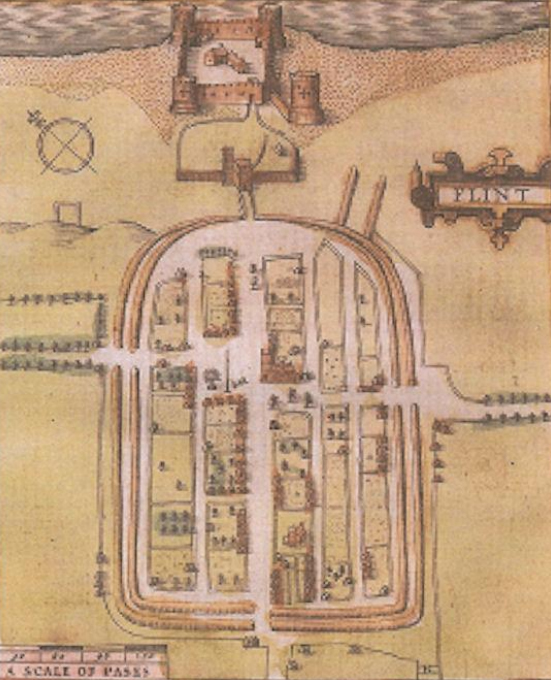
One of John Speed’s maps showing Flint Castle and town. The castle and town of Flint as mapped by John Speed in 1610, showing the original road layout and market place. Source: National Library of Wales

At Flint, Edward had established a Norman-style new town as part of his vision for colonizing various parts of Wales.  This was an English settlement, and any new burgesses prepared to live there was given numerous incentives.  In 1278 Edward granted it permission to hold weekly markets and an annual fair.  In 1292 he granted Basingwerk the same permissions for Holywell, having granted them permission to hold an annual fair at their Glossop manor in 1290.  The monks could charge market stall holders rent for the duration of the market, a nice source of income, as well as selling their own products.  Basingwerk, with its water mills, windmills and fulling mills and land under both grazing and grain, was certainly in a position to sell a number of products, including grain, livestock and livestock products including meat, skins and wool. Welsh wool was recognized as being of very high quality, sometimes superior to even that of the better known wool produced by the Yorkshire monastic producers.  The Taxatio ecclesiastica of Pope Nicholas IV in 1291 recorded that Basingwerk had 2000 sheep producing 10 sacks of wool, 53 cows (at a ratio of 37.1:1), and no goats. Even if it found itself in competition with Flint, Basingwerk’s fairs probably represented the opportunity to raise the abbey’s income.  Its industrial products, as well as some of its wool, may have been sold for export.

The 14th – 16th century

Burton and Stöber describe how by the mid 14th century there were reports that the abbey was in debt, and in the fifteenth century some of its abbots were a distinct liability:

in 1430 the house was seized by Henry Wirral, who made himself abbot, and the following year he was engaged in a legal dispute for the office with Richard Lee. Despite the court ruling in favour of Lee, Henry continued in power at Basingwerk until 1454 when he was arrested for various misdemeanours and deposed. Matters did not improve, for in the following decade Richard Kirby, monk of Aberconwy, disputed the abbacy with Edmund Thornbar. Although the General Chapter ordered that Edmund be recognized as abbot, Richard was still in office in 1476.

Manuscript by Gutan Owain, National Library of Wales, MS3026C. Source: The National Library of Wales

Fortunately the abbey’s fortunes improved under Welsh Abbot Thomas Pennant, who ruled the house for about forty years from around 1481 to 1523, although this was very much a last hurrah before Henry VIII dissolved the monasteries beginning in 1535. By the early 16th century Welsh bard Tudur Aled (died 1526) makes it clear that there was lead roofing and stained glass at the abbey.   Tudur Aled praised Abbot Thomas , commending his his learning but also his generosity, generally an indication that they were being sponsored by a given abbot, as at Valle Crucis.  Gutun Owain seems to have benefited from Basingwerk Abbey’s patronage.  Owain is notable for having addressed over fifteen poems to Cistercian abbots, and is known to have stayed as a guest at Valle Crucis and Strata Florida as well as Basingwerk.  Although the late fifteenth century manuscript known as the Black Book of Basingwerk (Llyfr Du Basing, now NLW MS 7006D, which was the mainly the work of Gutun Owain copied into a single volume) was probably held by Basingwerk at the time of the dissolution in around 1536, it is thought in fact to have been the work of copyist monks at Valle Crucis.

Thomas Pennant was not a man of undiluted virtue.  In an order where celibacy was required and monks were not permitted to marry, Pennant not only fathered a family, but his son Nicholas, became the last abbot of Basingwerk, which in theory was an act of simony banned by the order.  When the abbey closed, probably in 1536, with just three monks, Nicholas was the abbot.
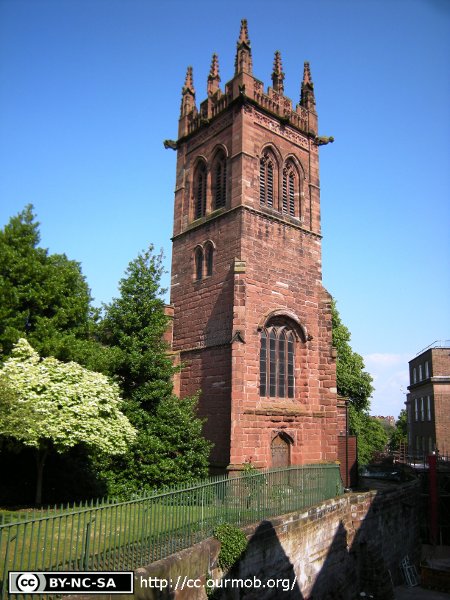
St Mary on the Hill, Chester. Source: GENUKI

After the Dissolution every valuable object and piece of structural material was stripped for Henry VIII’s treasury.  James says that part of the timber ceiling is at Cilcain, and that stained glass can be found at Llanasa.  Burton and Stöber add that the choir stalls from the abbey were transferred to the church of St Mary on the Hill in Chester.  Lead from the roof was removed, and may have been used for the repair of Holt Castle on the Dee and Dublin Castle. Williams adds that it may have been employed also in other crown buildings in Dublin, and that it is possible that the wooden sedilia in the parish church of St Mary, Nercwys, was from Basingwerk.  There is a tradition that the Jesse window was reinstalled in the parish church of St Dyfriog (Llanrhaeadr-yng-Nghinmeirch) but this remains unconfirmed.

I have been unable to get access to St Mary on the Hill, a comprehensive history of which is on the Chesterwiki. It was decomissioned in 1972 and now describes itself as a Creative Space and venue for a range of activities.  However, the Chesterwiki site says that the fittings, presumably including the Basinwerk choir stalls, were removed after the church was decomissioned, although it does not say where these fittings went.

From the 18th century the site attracted artists who recorded features that are now lost.  In the early 20th century a large section of the south transept collapsed.  In 1923 the site was put in State guardianship and in 1984 it was put into the car of Cadw.

Basingwerk Abbey miniature by Moses Griffiths, c.1778. Source: National Library of Wales, via Wikipedia

Final comments

The building that may be a guesthouse, has had burned timbers dendro-dated, which give the roof a date of c.1385. Source: RCAHMW Exhibitions: Dendrochronology Partnerships

Information about Basingwerk Abbey is fragmented and partial, but researchers have pieced together a history of the abbey that tells a story about abbey’s past, beginning as a Savignac establishment before being absorbed into the Cistercian network of monasteries.  The disputes between the Welsh princes and Henry III and Edward I caused grief for the north Wales monasteries, but they survived to rebuild and move forward.  Like other abbeys in Wales, the abbots of the abbey had a diplomatic role, often acting as intermediaries between Wales and England.  As members of the wider community with an important economic role, the abbey was often involved in local judicial matters. Financial difficulties in the 14th and 15th centuries are recorded and but again the monastery survived these difficulties.  In the early 16th century the abbey became a haven for Welsh bards, supporting their work. Throughout its history, its location on the main route through north Wales meant that it was obliged to provide more hospitality than more secluded monastic houses, whilst the shrine of St Winifred, whilst contributing to the prestige and financial value of the abbey, also required some management to prevent it becoming a drain on the abbey’s obligation to provide shelter and food.  After the Dissolution in 1536, the abbey was decommissioned, its valuables removed and its properties either sold off our leased out.  Today it is managed by Cadw and offers an excellent visitor experience.


Visitor Information

Find the captions and see the full-sized map at https://greenfieldvalley.com/greenfield-valley-zones/. There is an interactive version of the map at https://greenfieldvalley.com/explore/interactive-map/.

The site is free to visit.  There is no visitor information centre but a small modern shop sells guide books, postcards and souvenirs relating to Basingwerk, St Winifred’s Shrine and the Greenfield Valley Park. The abbey’s postcode is CH8 7GH and the car park is on Bagillt road, just to the west of the enormous railway bridge, opposite a small trade/industrial estate.

There is a big car park at the foot of the abbey, shown to the right left on the A548, just west of the enormous railway bridge, which has a fairly gentle metalled incline up to the abbey, with a bench and information map half way up.

There is also a café just outside the main gates, which in October 2022 was doing a good coffee and a splendid lunch.

Basingwerk Abbey is a component part of Greenfield Valley Park, and is popular with dog walkers and children, so if you want a quiet visit it is probably best to go on a weekday outside the holidays. The rest of Greenfield Valley Park is an excellent visit in its own right, with a remarkable amount of industrial archaeology within its borders, and plenty of interpretation boards.  I have posted about the industrial archaeology of the Green Valley Park here.

If you want to stay in the medieval period, St Winifred’s Well is about 1.5 miles through the park (shown as No.9 at the very top of the map right), or if you prefer to drive it has its own car park.  Flint Castle is only 4 or so miles down the A548 towards Chester, and makes for a great visit.  I wrote about the history of Flint Castle on an earlier post, Together, the three sites make a very fine medieval day.

Sources

Books and papers:

Burton, J. and Stöber, K. 2015.  Abbeys and Priories of Medieval Wales.  University of Wales Press.  https://www.jstor.org/stable/j.ctt9qhdvn.13

Davies, Paul R. 2021. Towers of Defiance. YLolfa

Elfyn Hughes, R., J. Dale, I. Ellis Williams and D. I. Rees. Studies in Sheep Population and Environment in the Mountains of North-West Wales I. The Status of the Sheep in the Mountains of North Wales Since Mediaeval Times. Journal of Applied Ecology , Apr., 1973, Vol. 10, No. 1 (Apr., 1973), p.113-132
https://www.jstor.org/stable/2404720

Evans D.H. 2008, Valle Crucis Abbey, Cadw

Knight, L. Stanley 1920. The Welsh monasteries and their claims for doing the education of later Medieval Wales. Archaeologia Cambrensis, 6th series, volume 2, 1920, p.257-276
https://journals.library.wales/view/4718179/4728984/314#?xywh=-63%2C345%2C2942%2C1730

Rhys, Ernest (ed.) 1908.  The Itinerary and Description of Wales with an introduction by W. Llewelyn Williams. Everyman’s Library. J.M. Dent and Co, London. and E.P. Dutton and Co (NY)
https://archive.org/details/itinerarythroug00girauoft

Huws, D. 2000.  Medieval welsh Manuscripts. University of Wales Press

James, M.R. 1925.  Abbeys. The Great Western Railway
https://archive.org/details/abbeys-great-western-railway

Jones, Owain, 2013. Historical writing in medieval Wales. PhD Thesis, University of Bangor.
https://research.bangor.ac.uk/portal/files/20577287/null&ved=2ahUKEwjxssbb0tvtAhWmxIsKHQgvBW0QFjAOegQICBAI&usg=AOvVaw2GbJiGy6Sl3SPiTX4K8RqZ

Lekai, Louis L. 1977. The Cistercians. Ideals and Reality. The Kent State University Press

Patel, Rowan 2016. The Windmills and Watermills of Wirral. A Historical Survey. Countyvise Ltd.

Robinson, D. M., 2006. Basingwerk Abbey. Cadw

Silvester, R.J., and Hankinson, R., 2015. The Monastic Granges of East Wales. The Scheduling Enhancement Programme: Welshpool. Clwyd-Powys Archaeological Trust (CPAT)
coflein.gov.uk/media/241/979/652240.pdf

Smith, Joshua Byron 2016. “Til þat he neӡed ful neghe into þe Norþe Walez”: Gawain’s Postcolonial Turn. The Chaucer Review, Vol.51, No.3 (2016), p.295-309
https://www.jstor.org/stable/10.5325/chaucerrev.51.3.0295

Williams, David H., 2001. The Welsh Cistercians, Gracewing

Williams, David H., 1990. Atlas of Cistercian Lands. University of Wales Press

Websites:

Coflein
Basingwerk Abbey
https://coflein.gov.uk/en/site/35649?term=basingwerk%20abbey%20holywell

Monastic Wales
Basingwerk Abbey
https://www.monasticwales.org/browsedb.php?func=showsite&siteID=24
Gutun Owain
https://www.monasticwales.org/person/72
The Black Book of Basingwerk
https://www.monasticwales.org/archive/24
Valle Crucis (Abbey)
https://www.monasticwales.org/browsedb.php?func=showsite&siteID=35

RCAHMW Exhibitions: Dendrochronology Partnerships
Bilingual exhibition panel entitled Partneriaethau Dendrocronoleg; Dendrochronolgy Partnerships, produced by RCAHMW 2013
https://coflein.gov.uk/media/200/524/rcex_026_01.pdf

RCAHMW List of Historic Placenames (searchable database)
https://historicplacenames.rcahmw.gov.uk/

University of Notre Dame
A Knight in St. Patrick’s Purgatory, by Haley Stewart. March 15, 2019
https://churchlifejournal.nd.edu/articles/a-knight-in-st-patricks-purgatory/

An Essay on Cistercian Liturgy by Dr Julie Kerr
Cistercians in Yorkshire, University of Sheffield
www.dhi.ac.uk/cistercians/cistercian_life/spirituality/Liturgy/Cistercian_liturgy.pdf 


The chapter house propped up during excavations when M.R. James visited in 1925.

Basingwerk Abbey from the South. 1929 postcard. Source: People’s Collection Wales

Gresford All Saints’ Church – a beginner’s guide to funerary monuments

Full statue angels only arrive on the churchyard scene in the Victorian period.

This informal look at the monuments in Gresford’s All Saints’ church graveyard follows on from three previous posts about All Saints’, the first a general history of the interior, the second a quick look at the splendid gargoyles and grotesques on the exterior of the building.  The third post looked at misericords (fascinatingly carved so-called mercy seats in choir stalls) in a three-part series about misericords in Gresford, Malpas, Bebington and Chester Cathedral.

I began writing this over a year ago, mainly for my own benefit when I was getting to grips with how churchyards develop, what sort of chronological markers can be found and the variety of monument types and themes that could be expected.  I have just re-found the post in my drafts folder and thought that others might find it useful.  This is no more than a very basic introductory starting point for investigating this and other churchyards in the area.

The churchyard surrounds the Gresford parish church of All Saints’ on all sides.  The main part of the cemetery is to the south of the church.  In parish churchyards the area to the north side of the church was usually the last to be occupied by the dead.  This is partly because the brighter areas were favoured, but partly because the darker area was often reserved for church and community events until the 19th century when a requirement for more burial grounds resulted in the extension into all areas of a churchyard.

There is a variety of different tomb styles with the All Saints’ churchyard, mainly belonging to the late-18th, 19th centuries and 20th centuries.  This includes chest tombs, table graves, ledger gravestones, vertical gravestones and sculptural monuments.  Although most of the grave markers are relatively uniform in shape, size and motifs, reflecting standardization in the approach to gravestones, some are very personal and inevitably there are a few that stand out either because they are conspicuously larger than their neighbours, or because they are slightly unusual in some way.

Grave Types

Terminology can differ slightly from publication to publication.  Graves are, on this post at least, subterranean pits into which the deceased is placed.  Grave stones, markers and monuments may sit over the grave to mark their positions and, if required, provide details of the deceased. Head stones are specifically the vertical slabs that sit at the head end of the grave, and may be accompanied by a short foot stone to mark the other end of the grave.  Kerbs are low stone frames for the space occupied by the grave.  Tombs are constructions, sometimes resembling buildings, that contain above-ground storage of the dead, but the term is often applied to false tombs, which are containers that sit on the ground but lie over a subterranean burial like the chest tombs and table tombs that are found at Gresford.  Memorials commemorate the dead, but may not be associated with the grave where people are interred (like war memorials).  There are no mausolea at Gresford or, indeed, at most parish churchyards, but these are standalone buildings, often highly ornate, that contain one or more tombs within.

The following photographs, all from All Saints’, show individual grave marker types that have been mentioned below.  There are other types that do not appear in the All Saints’ churchyard, which are not included here.  Click the image to enlarge so that the descriptions are legible:

The main types of grave marker present in Gresford All Saints’s churchyard, although there are other types too. Click image to enlarge.

Headstones

The dead are buried on their backs facing upwards, with heads to the west, feet to the east.  Table tombs have inscriptions on the ledger (flat top) and the supports may be plain or more elaborate. Headstones face east, with the inscription on the eastern face.  Because many inevitably face away from footpaths, in some cemeteries a name may be etched into the back of the headstone, to identify the deceased, whilst the full details are shown on the east-facing side.  Chest tombs may have decorative components on the side panels, and text may be on both the ledger (flat top) or the side panels, or both.

Date Range

The earliest graves at Gresford are located within the church itself in the north and south aisles, and have been mentioned on the first post about All Saints’, both dating to the 13th century.  They consist of effigies, the inscribed or carved sculpted images of the deceased and represent two of the highest status and wealthiest individuals of local 13th century society.

Marked graves in British parish churchyards were a relatively late phenomenon, the first ones appearing in the 17th century.  These are quite few and far between, and I have not yet seen mention of any in local or neighbouring churchyards.  Grave monuments in the Gresford churchyard date mainly from the late 18th, 19th and early 20th centuries..

18th Century

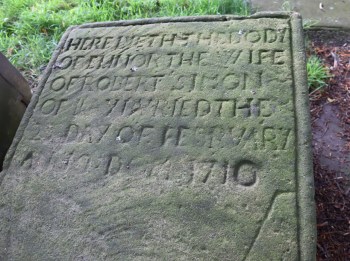
Ledger of 1710

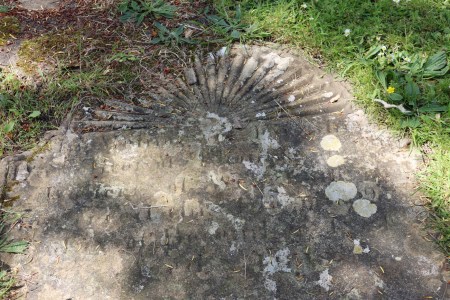
The earliest graves that I have found are early 18th century, one of the earliest dating to 1710, although there may be earlier examples that I have not noticed, including some completely concealed by ivy.  A number of examples from this period are ledgers, flat tablets that in this churchyard are usually carved from fine-grained yellow stone, often greyed with age, set horizontally into the ground, with large, simple text, and almost no decorative features. Later ledger stones were sometimes provided with small decorative embellishments.

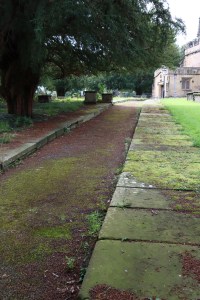
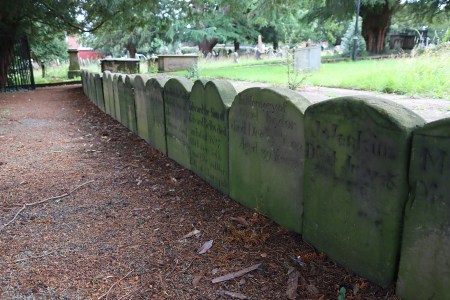
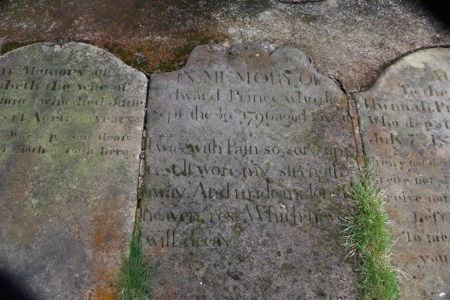
Some of the ledger gravestones flank walkways and paths, forming kerbs and revetments, such as the ones shown on the right that flank the main churchyard path.  It is easy to forget that they are grave markers in their own right.  This is apparently a particular feature of churchyards in Cheshire and Lancashire.

Other ledgers are laid between chest and table tombs, with which they are usually contemporary.  Chest tombs are simply more elaborate versions of ledgers, with the horizontal slab raised off the ground, the space beneath enclosed with stone panels.  Table tombs are also raised ledgers, but on four legs or on three cross-members.  This raising of the ledgers may have been to create something more monumental, to provide more space for inscriptions where a grave is intended for more than one generation of family members, or to prevent the slab being encased in grass, moss, ivy and weeds.

Organized in a row alongside one of the paths, near the east end of the church, are the smallest (c.16in/ 41cm tall) upright grave markers.  These are either footstones that have been separated from their corresponding headstones (only ever inscribed with initials and date if inscribed at all), or were purchased as gravestones by those with few means at their disposal.  None have many inscribed details, and the one shown left, dating to 1778, is particularly minimalist, providing only the initials of the deceased, the year of death and the age at time of death. Others in the row are slightly more informative than this example but there is insufficient space for them to provide detailed information.

Red sandstone chest tomb (with decorative pilasters at each corner), sadly commemorating child deaths, just one month apart, of Robert Jones, aged 12, in July 1791 and Sarah Jones, aged 13, in August 1791, aged 13.

There are a number of chest tombs consisting of four stone panels with a ledger stone set on top.  Chest tombs of all periods are merely monuments like gravestones, in the sense that they do not contain the burial themselves, but sit over the top of subterranean graves.  There is something undeniably spooky about a breach in a chest tomb, but as Trevor Yorke says “Don’t be alarmed when you see a chest tomb with a cracked or missing side, a skeletal arm will not reach out to grab you!  The body was always interred below the ground with the hollow interior empty.”  Most are made of yellow sandstone, but there is one isolated chest tomb in red sandstone.

19th Century

Chest tombs are also a feature of the 19th century, and many of these are more elaborate than earlier forms and have side panels decorated by geometric shapes and small motifs.

Chest tomb dating to 1835, one of a kind within this cemetery

A yellow sandstone chest tomb with another sad inscription, commemorating the death of a 12 year old in 1846 and a 2 year old in 1849.  These are by no means the only records of child and infant mortality in the churchyard.  This grave later went on to house the children’s parents.

An elaborate chest tomb raised on feet and provided with a lid rather than a simple ledger, with decorated panels. The first-mentioned deceased was Bridget Hugo from Truro in Cornwall, who died aged 44 in 1820. It was used again in 1837 for the interment of Elizabeth Hugo, aged 88. Mother or sister?

A table tomb of 1879

Pedestal graves, essentially smaller square versions of chest tombs, also appear at this time.  Like chest graves, pedestal graves could have inscriptions on more than one side.  Some had inscriptions on all four sides, but others might have inscriptions on only one or two, depending on how many people were eventually interred and commemorated.  The pedestal gravestone below is engraved on all four sides with the details of family members related to Timothy Parsonage of Wrexham, who were buried successively in 1811, 1817, 1831, 1839, 1872 and 1875.

Platform of stone paves, surrounded by railings, presumably the remnants of an elaborate monument.

Both chest and pedestal graves could be surrounded by iron railings in the 19th century, and there are several examples at All Saints’.

There are a couple of graves consisting of nothing more than sprawling platforms of paves with a higher raised section in the middle.  It is very probable that the centre of the platform formerly supported some form of monument, now lost, possibly on a fairly narrow stand, such as a cross, that resulted in a fall when the platforms destabilized.  Alternatively, there is a pedestal tomb on a similar platform, which could be an alternative arrangement, although it is more difficult to explain how such a monument could be lost, unless it was destroyed in a fall.

Headstone with kerb defining the area of the grave

The main 19th century cemetery is on the south side of the church and consists of tall headstones of the upright variety with an inscription on the main panel, a few decorative flourishes at the top, and sometimes an epitaph or other line of text at the base.  On several of them the top of the headstone had been carved into a decorative sculptural component in its own right.  These also contain introductory phrases and are often accompanied by religious symbols and motifs.

The area occupied by the body in front of the headstone could be demarcated with a stone kerb or a set of railings.  Although it is difficult to tell because of the long grass, these seem to be confined to a relatively small number of graves, presumably because of the additional cost that would have been incurred.  I noticed at Farndon’s St Chad’s churchyard that the plentiful kerbs accompanying headstones usually belonged to the early 20th century.

Most of the headstones in this section of the churchyard were made of local sandstone, mainly superior fine-grained yellow sandstone, but a few, particularly towards the end of the 19th century, were also made of imported stone, such as rose granite, often highly polished to achieve a glossy surface, such as the 1891 coped stone shown below (interestingly one of the few to be inscribed in Welsh).  Some were partially polished, with parts left unworked to provide contrasts in colour and texture, such as the 1908 example on the right.  Similarly, some of the later grave stones combined different types of stone to draw attention to particular motifs or to highlight inscriptions.  Colour inserts are unusual, but the headstone above includes a blue and white religious symbol, containing the letters IHS. These are usually interpreted as a Christogram, representing the first three letters of the name Jesus Christ’s in Greek, iota eta sigma.   The H is the capitalization of “eta.”

Rose granite coped gravestone

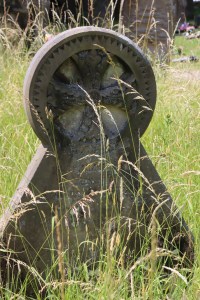
Dotted amongst these more conventional 19th century headstones, and particularly popular in the Victorian periods, is the monumental grave stone, consisting of a large sculptural element supported on an inscribed plinth.  Frequent types are crosses, angels and obelisks.  One example, below far right, has a column on a plinth topped with the crucified Jesus on one side and Mary with the baby Jesus on the other, both protected by a roof.  The relatively tiny cross at its base was dedicated to an infant.

The later 20th Century

At some point between the late 19th and early 20th century, highly polished imported black stone became desirable for gravestones.  There are a couple of full-sized early versions of this stone in the Gresford churchyard, most of which have both polished and unpolished sections to create texture and contrast.

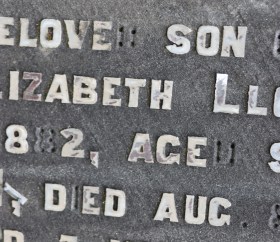
As the 20th century proceeded, the same stone type was used to make tiny grave markers usually laid flat, with white or gold lettering.  Because those commemorated by these stones are often within living memory of children or grandchildren, some of them may be visited and flowers often accompany them, real or artificial, a brightly coloured foil for the standardized lines of shiny black polished stone, quite unlike the earlier, upright headstones.  Although very different from their monumental antecedents they give a sense of continuity from the 18th century.

Grave locations

The irregularly shaped churchyard

The wish for burial within a church or as close as possible to the church, demonstrated by the two 13th century examples in the north and south aisles of the church itself, was driven by the belief that proximity to holiness would confer some form of additional divine spirituality on the dead.  The chancel, the east end section where the choir and high altar were located, was particularly desirable as a burial place.  Throughout history, burial within church premises was reserved only for a limited number of people including senior clergy, those drawn from the upper echelons of society, and those who had provided financial support to the church.  Others might be buried in private mausolea in their own premises, but most would be consigned to a churchyard or, later, a dedicated cemetery.  The north side of a parish church was often the last to be used for burials, in some cases because the cemetery might have been used in early years for village community events, but also because it, or parts of it, were sometimes reserved for unconsecrated burials such as babies who died before baptism and suicides; but in some cases it appears to be simply because the darker north side was seen as less attractive and further away from the divine.

Designs and motifs in the churchyard

Elaborate monument to William Trevor Parkins, Chancellor of St Asaph, who died in 1908 and is also commemorated with a stained glass window in the church. His wife and son are also commemorated on the the monument.

Although gravestones were primarily used for recording details of the deceased, motifs, emblems and symbols were introduced in the late 17th century, and became popular in the 18th century, establishing memento mori and other themes as part of the language of the grave marker.  Most of these helped to express ideas with which the deceased might wish to be connected, a visual reference to the connection between the living, the dead and the afterlife.  The range of visual features in the Gresford churchyard is fairly limited, but they echo churchyard motifs in other local churchyards, suggesting that there was a limited range of ideas with which local people were familiar or felt comfortable, such as as crosses, floral motifs and the letters IHS that stand for the first three letters of the name of Jesus in Latin.  Others are rather more specific, and convey a particular association, such as a cross showing the Star of David and a military grave showing the Canadian maple.  If anyone can enlighten me about the multiple serpents wending their way through half-globes on the Celtic-influenced cross on the image to the right, the 1908 monument to William Trevor Parkins, I would be very grateful!  There is a similar one in the Overleigh Old Cemetery in Chester.

Instead of looking at the limited range of symbols and motifs on gravestones at Gresford, a future post will look at some of these.

Challenges for grave architecture

Heavy central erosion to the headstone on the left; de-lamination of the sandstone of the headstone on the right, leaving a small part of the original surface containing the inscription in one corner

In all churchyards, some grave markers fare better than others, thanks to unavoidable natural processes.  Most of the graves at All Saints’ are in good condition, and the churchyard as a whole is well maintained and cared for.  Natural processes, however, can defy all attempts to conserve grave markers and there is no blame attached to this.  The greater percentage of grave markers at All Saints’ are made of friable yellow sandstone, which is susceptible to damage by extremes of the weather, to the impact of concentrated dripping from trees and to the fumes from motor pollution.  Some of this is mild erosion, some of it has rendered text illegible whilst leaving the basic form unharmed, but other cases are very severe, such as examples shown here, some of which have large patches resembling melted ice-cream, whilst others are suffering serious de-lamination.

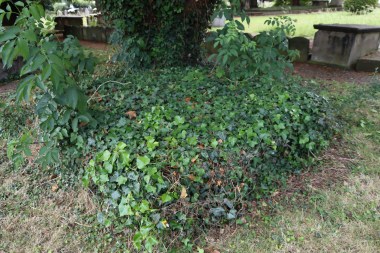
Like most rural churchyards, some of the churchyard is well manicured, and other parts of it have been left to develop a more natural feel.  The dominant vegetation surrounding the 19th century headstones away from the trees is very tall grass, (very wet up to mid-thigh in some areas after rainfall – beware!).  The tall grass appears to do little harm to the headstones, although it does inhibit visits to those gravestones, and the build up of foliage at the bases eventually creates topsoil that covers up inscriptions at the bases, particularly in the case of pedestals at the bottom of crosses, obelisks and similar statues, where text may be confined to the base of the monument.

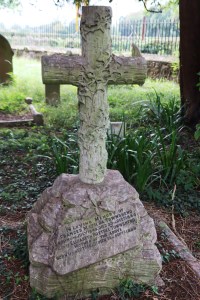
Carved ivy tendrils wrap around a rustic cross as real ivy on the ground just begins to encroach on the pedestal.

Under trees and in shaded areas invasive ivy does real damage, fastening itself to the stone, hiding inscriptions and, when removed, removes the friable surfaces of the stone. Ivy is very difficult to eradicate from an area once it establishes a network of roots, from which it sends out runners that in turn root themselves.  It is resistant to just about every form of weed killer, even if that were desirable in a graveyard that strives to encourage a natural environment.  One or two of the gravestones are carved with images of ivy spreading across their surfaces, which seems like an ironic acknowledgement of the inevitable blending of nature with death.  The only way of dealing with it is to keep cutting it back when it it begins to climb the grave stones – a thankless and endless task!

What appears to be one or more chest tombs, completely overrun and concealed by ivy.

A grave dedicated to Arthur Henry Leslie Soames M.C. and Légion d’Honneur, which had been partially hidden by ivy and other weeds, was uncovered in May 2018 by local historian Jimmy Jones, with the permission of the church.  His account, and the before-and-after photographs used to be on the now defunct Wrexham-History website, and described how the central grave monument and a horizontal slab to one side were visible, but once the full monument was uncovered, a second slab on the opposite side was revealed, indicating that this was a family plot.  This contributes to the biography of Arthur Soames, who died testing an experimental bomb for the army in 1915.

Moss is similarly invasive and destructive where conditions favour its growth and spread, and there are examples at All Saints’ where inscriptions on ledgers have been colonized and concealed.

Ledgers encroached on by moss as well as grass and lichen

Lichen is another natural invader of stone grave monuments, and is very difficult, if not impossible to tackle.  Different types of lichen prefer different environmental conditions, so can be very widespread in a cemetery, even in the most cared-for sections.  Where lichen spreads across inscriptions, it can obscure them completely, and it can eat away the friable surfaces grain by grain over the period of many decades, meaning that inscription, motifs and decorative features may be damaged, obscured or lost.  It can also add to the more abrupt problem of certain types of sandstone de-laminating, which can eliminate big sections of text very suddenly.


Fairly minor lichen damage to a gravestone, dating to 1807.  It has not completely obscured the inscription just yet, although the centre epitaph is illegible. but will probably become worse as time passes

An example of damage inflicted on an inscription by a combination of weathering and lichen, making much of the the text, including the date, illegible.

Lead lettering from 1882, some of which have parted company from the headstone leaving empty peg marks

A small number of the 19th century tombs were provided with lead lettering, hammered into peg holes in the stone.  Some of the lettering has been lost from these grave stones, leaving behind some whole letters, some partial letters and some of the peg holes.  Again, this is natural wear and tear over the centuries and in some ways it seems surprising that any of these lead inserts have actually managed to survive at all.

Some of the stonework of chest and table tombs has been damaged, with panels falling away and ledgers tipping to the side, but this is the usual wear and tear as trees grow and roots find new paths, and storms impose injuries.

Final Comments: The living, the dead and eternity

Although there is some uniformity in the appearance of the churchyard, with certain forms, motifs and shapes being repeated, when you stand in the middle of it all, with the wet grass up to your knees, the great sweep of gravestones and monuments spreading to the limits of the churchyard provides a great sense of individual character and personal commitment.  Each monument contains a fragmentary sense of how precious life could be.  The inscriptions, whilst often fairly formulaic, also represent choices and decisions about what what best represented the interests of the deceased, the living and how this connected to belief in an afterlife.  Churchyards are often places of sadness, but for a great many they also represented ideas of hope.

The grave marker links the living, the dead and Christian belief in a relationship that, particularly when the text survives, may still be engaged with.  Whoever made the decisions about the design of the grave marker, what stands out is how these inanimate objects, the material commemoration of the dead, reflect a wide range of understated emotional ideas a including love, commitment, devotion, fear, anxiety, grief and hope. Collectively they convey both the sadness that the living confront in death and the comfort they find in commemorating their lost loved ones.  People find solace where they can.

If you want to find out more about the owner of a particular grave, the findagrave.com website is a terrific resource.

A ledger and inscription dating to 1796, describing the pain that the deceased suffered.

Sources:

Frisby, Helen 2019. Traditions of Death and Burial. Shire Library

Hayman, Richard 2019.  Churches and Churchyards of England and Wales.  Shire Library.

Heritage, Celia 2022. Cemeteries and Graveyards. A Guide for Family and Local Hstorians in England and Wales. Pen and Sword

Post, W. Ellwood 1962, 1974. A Concise Dictionary: Saints, Signs and Symbols. SPCK

Yorke, Trevor 2017 (2nd edition). Gravestones, Tombs and Memorials.  Countryside Books

Websites:

Cemetery Symbolism
https://cemeterysymbolism.wordpress.com/

Interesting example of a chest tomb that has suffered de-lamination but where the carving of the inscription was so deep that even where it has de-laminated, some of it can still be read.  The ivy is beginning to gain a foothold.

A splendid introduction to stained glass artist Trena Cox by Aleta Doran

Many thanks to Aleta Doran, Artist in Residence at Chester Cathedral for today’s introduction to stained glass artist Trena Cox, who was based in Chester for most of her long career.  Aleta is a brilliant and engaging presenter, currently working hard on the upcoming Trena Cox exhibition, which she is curating.  Although this was organized specially for Chester Archaeological Society, Aleta is doing more presentations during the Heritage Festival and if you get the chance to attend, do go.  It will give you a completely new insight into the world of 20th Century stained glass, as well as introducing you to a really creative part of the cathedral’s history.  I’ll keep this relatively short so as not to spoil the event for those of you who have tickets.

Trena Cox, apparently the least photographed artist in modern history, was born on the Wirral and trained at Birkenhead’s Laird School of art, learning her skills in traditional media before switching to stained glass.  She has created over 150 stained glass pieces that are known, but there are probably many more to be identified.  She worked mainly in the Cheshire and northeast Wales areas but her works are found further afield.  There are many in Chester itself, mainly in churches.  There are nine Trena Cox windows in the cathedral, one in the slype (a corridor) and the others arranged in groups of four, two at the top, two at the bottom, in adjacent aisles in the cloister (the walkway around the central garth or garden).

The big window in the slype shows the child Christ on one river bank, and St Christopher on the other.  This is very unconventional, as Christ is usually depicted being carried across the water on the shoulders of St Christopher.  Aleta described how this window clearly demonstrates many of the features of Trena Cox’s work, with the beautifully executed details of both figures, the surrounding landscape and the flowers, birds and animals that sit at the feet of the two figures.  Also typical are the portrait-style faces, which seem incredibly life-like.  The colouring of the glass, as in all her work, is vibrantly jewel-like and the background semi-opaque glass concentrates the eye on colours whilst allowing in light.  There are many emblems of international pilgrimage, known from badges purchased from the Middle Ages by pilgrims to commemorate their achievements.  As well as many others, these include St Thomas of Canterbury, St James of Santiago de Compostella, and of course Chester Cathedral’s own St Werburgh herself, her symbol being five geese in a basket. It is a rich and symbol-laden piece that rewards time taken to appreciate it.

The cloister used to open out onto the garth, with a stone arcade forming a corridor with the buildings that surround the cloister.  In 1920 Dean Frank Bennet was appointed as the new head of the cathedral, and decided to take measures to improve the cathedral’s fortunes.  In order to glaze the arcade that surrounded the garth, the dean decided to raise public funds.  It is thought that some funds were raised by allowing donors for the cloister glass to add commemorations to loved ones in panes withing the windows, which survive today.  Each window represents a saint, religious festival or holy day.  Trena Cox contributed eight panels in two adjacent sections of the cloister, showing eight different saints.  In one set of four, the two at the top are Hugh Lupus who founded the abbey and St Werburgh’s mother St Ermengild  In the lower section are St Thomas Becket and King Henry II.  In the other set, the two figures at the top are Abbot Witchurch and Ralph Higden and the two below King Alfred and St Piegmund.  Aleta talked us through the significance of each of these saints, and why there were chosen.  These are much smaller and therefore much simpler compositions, but again the colours are vibrant, and the faces resemble portraiture.

Aleta wrapped up by telling us something about Trena Cox and her influence on Chester life, not only as an artist but as something of an activist for the protection of local heritage.  It seems remarkable that she is not better known, at least in Chester where she lived nearly all her life.  Hopefully, the upcoming the exhibition “Trena Cox: Reflections 100”, which begins on the 7th October, will bring this under-sung local personality and talented, prolific artist to much wider public attention.  Do take advantage of a tour of the glass with Aleta Doran if you have the opportunity.  As an artist herself, she offers a unique insight into the work of Trena Cox.

You can follow Aleta Doran on Twitter (@StargazingAleta), or via her blog at https://www.aletadoran.co.uk/

“Excavations at Heronbridge 2002-5, Part 1: The Roman Settlement,”

Great to arrive home from our trip to our CAS introduction to Wirral-born stained glass artist Trena Cox by Aleta Doran (about which more later) and find the Heronbridge report on the doorstep. The report, “Excavations at Heronbridge 2002-5, Part 1: The Roman Settlement,” is a satisfyingly chunky 207 pages with maps, illustrations and photographs. It describes Chester Archaeological Society’s excavations between 2002 and 2005 at the Roman settlement at Heronbridge, about 2.5km south of Chester City Centre. With numerous contributors, headed by David J.P. Mason, it is edited by Peter Carrington with Rowan Patel and Alison Smithson (Chester 2024).
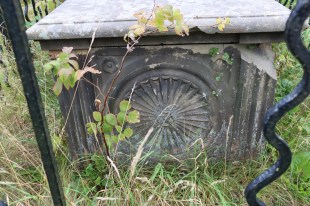
For those who wish to know a bit more about this publication, here are the cover details, the Table of Contents and the list of contributors.  You can click to expand any of the images:

Birkenhead Priory – A 2-Minute Video

This is a bit of an experiment, using my iPhone, which I’ve never tried before for video.  I did a lot of camcorder videos of scenery when I lived in Aberdovey on the west coast of Wales, but fell out of the habit when I moved to the Chester area, so I am out of practice, feel very peculiar using an iPhone to do video, and hate the sound of my voice, but here we go.  So here’s my two-minute introduction to the wonderful priory of St Mary and St James, aka Birkenhead Priory, for  better or for worse. I’ll get better!

Dazzle-camouflage building on Knox Street in Birkenhead

At Birkenhead Priory the other day I very much liked this small building on Knox Street, very close to both Birkenhead Priory and the Cammell Laird shipyard.  It has been painted in the style of dazzle camouflage, used in the First World War, and to a lesser extent in the Second World War, primarily to confuse submarines.  “The primary object of this scheme was not so much to cause the enemy to miss his shot when actually in firing position, but to mislead him, when the ship was first sighted, as to the correct position to take up. Dazzle was a method to produce an effect by paint in such a way that all accepted forms of a ship are broken up by masses of strongly contrasted colour, consequently making it a matter of difficulty for a submarine to decide on the exact course of the vessel to be attacked” (Norman Wilkinson, 1969, A Brush with Life, Seeley Service, p.79, quoted on Wikipedia).

The moment I saw it, it reminded me of a 1919 painting by Edward Wadsworth (1889 – 1949) that I have hanging in my spare bedroom, showing a ship in dry dock in Liverpool receiving its new paint job.  Wadsworth painted in the style of the Vorticists, whose best known proponent was Wyndham Lewis, inspired by machinery and industry, and focused on clean lines, hard edges and planes of strong colour.  The dazzle ship was a near perfect subject matter for this style of painting, and Wadsworth was in an ideal position to get up close and personal with his subject matter, as in the First World War he worked as an intelligence officer, and one of this responsibilities was implementing dazzle camouflage designs for the Royal Navy.

I would love to know who came up with painting the building on Knox Street in the same style.  If you know anything about it, do let me know.

Below is a painting from the Merseyside Maritime Museum showing the Walmer Castle painted in her dazzle camouflage.  “The Walmer Castle was launched in 1901 for the recently created Union Castle Mail Steamship Company. The ship sailed between Southampton and Cape Town and in 1917 was requisitioned by the British Government. It is seen here dazzle painted for use as a troop ship in the North Atlantic. Walmer Castle survived the war and was broken up in 1932″ (National Museums Liverpool).

Monument to the building of the Queensway Tunnel under the Mersey, Birkenhead

On a recent visit to Birkenhead Priory, which I am still writing up, I arrived some time before the Priory opened, and went for a wander.  There are some great things to see in the area, but this combined monument and street light really drew the eye.  I decided not to risk life and limb by flinging myself across the very busy road to read the inscription at its base, so did a web search when I returned home.  It is a monument to the building of the Queensway Tunnel under the Mersey.  It is Grade II listed (1217871), was designed by Herbert Rowse and erected in 1934.  It was shifted from its original position in 1970 due to changes in the road layout at the tunnel approach, but originally illuminated the first concourse / plaza.

The monument has the fluted elements of a Doric column clad in impressive black granite, hints at ancient Egyptian lotus-top capitals, has a light on top, and simply yells Art Deco creativity and optimism, with a touch of eccentricity.  It is such a hybrid of different ideas, incorporating ancient art and contemporary technology, and happily combining the functions of both monument and lighthouse that it has no chance of being rationally categorized.  Like Greek and Roman columns or ancient Egyptian obelisks, it looks as though it ought to be in company, not standing all on its own.

The monument did in fact have a twin, but instead of standing alongside its sibling was erected over the river in Liverpool, lighting the other entrance to the tunnel.  Sadly this was taken down in the 1960s, a period when so many bad decisions were made regarding architectural heritage.  There was some talk in the media this time last year about erecting a replica, but I don’t know if that plan went anywhere or has been abandoned.

The inscriptions on the bronze plaques on the base display the names of the engineer responsible for the civil engineering of the tunnel, Sir Basil Mott J.A. Brodie and the architect Herbert Rowse, as well as the names of the team who built the bridge and the  construction teams and committee members who oversaw proceedings.  The commemorative declaration reads:

Queensway, opened by His Majesty King George V, 18th July 1934 accompanied by Her Majesty Queen Mary.  The work on this tunnel was commenced on 16th December by Her Royal Highness Princess Mary Viscountess Lascelles, who started the pneumatic boring drills at St George’s Dock Liverpool MCMXXXIV

I love the monument.  It has a real sense of joie de vivre. It is a shame that it is no longer located closer to its original position as part of the tunnel’s original architectural vision.  On the upside, at least it has been preserved and not demolished like its twin.  Other aspects of the original Art Deco vision do survive in situ at the tunnel entrance, shown above right.


Sources:

Ariadne Portal
Monument to the building of the Mersey Tunnel, Birkenhead Statement of Significance
https://portal.ariadne-infrastructure.eu/resource/81de5df3ed3619b3a955851dd28c44311e65fcefde36d151d655fdb6f35d49c2

Historic England
1217871
https://historicengland.org.uk/listing/the-list/list-entry/1217871?section=official-list-entry

Chester Standard
Restoration plan for Liverpool entrance to Queensway Tunnel
https://www.chesterstandard.co.uk/news/23587848.restoration-plan-liverpool-entrance-queensway-tunnel/

Liverpool Echo
Replica monument could be installed to mark Mersey Tunnel history
https://www.liverpoolecho.co.uk/news/liverpool-news/replica-monument-could-installed-mark-26238865

Wikipedia
Monument to the Mersey Tunnel
https://en.wikipedia.org/wiki/Monument_to_the_Mersey_Tunnel

Gop Cave and Cairn near Prestatyn #3 – The vast cairn

Introduction

The cairn rising above the tree tops on Gop hill, with the cave visible as a dark line in the light limestone ridge below. Source: Coflein

Gop Cairn is at an elevation of 250m (c.820ft) above sea level  on the prow of a hill overlooking the Vale of Clwyd, just outside the village of Trelawnyd (formerly known as Newmarket).  It is oval rather than round, and measures roughly 101m x 78m (331 x 255ft).  It is the biggest man-made prehistoric mound in Wales, and in Britain as a whole it is second only to Silbury Hill in Wiltshire.

The cave has already been discussed in part 1 (Pleistocene and Mesolithic) and part 2 (Neolithic burials).

The Excavation

The plan of the cairn and excavations by Boyd Dawkins. Source: Boyd Dawkins 1901

Sir William Boyd Dawkins was hired by the landowner to excavate the cairn.  Boyd Dawkins had a simple, though labour-intensive strategy.  The plan that Boyd Dawkins made of the cairn shows the dip in the top that remains today.  Boyd Dawkins speculates that this could have been caused when the cairn was later used as a source of raw materials for local drystone walling, or alternatively by subsidence due to the collapse of an underlying chamber.

Although there is a thin covering of vegetation today, the cairn was found to be built of chunks of limestone.  Around the base of the cairn there seems to have been a more organized and well presented kerb of drystone walling.  Ian Brown suggests that when first built, and during the period when it still retained importance, it may have “shown a dramatic whiteness set against a blue or darkening site.”  The limestone ridge below, in which the cave is located and shown at the top of this post, certainly seems almost white in the sunshine, and the cairn may have had a similarly noticeable appearance, particularly given its great size.

Boyd Dawkins sunk a shaft (6ft 6 ins by 4ft / c.2m x 1.22m) vertically from the top of the cairn, which had to be shored up with timber to allow work to proceed safely.  The shaft reached the former ground surface, which was formed of bedrock.  A main “drift” (a mining term for a horizontal subterranean tunnel) was then tunnelled running 30ft (c.9m) to the northeast from the bottom of the vertical shaft towards the edge, followed by two shorter drifts.  The hope was to find a burial chamber at the centre.  It was not unreasonable to assume that there would be a burial chamber of some description.  Although Neolithic chambered cairns are not common in northeast Wales (examples are Tyddyn Bleiddyn near St Asaph and Tan y Coed in the Dee valley), there are many Early Bronze Age round barrows with cists, and there are several stone-built burial sites and a stone row on the Great Orme to the west.

Unfortunately, in spite of all the hard work, all that Boyd Dawkins and his team found were fragmented animal bones, which in spite of his considerable experience identifying animal remains, Boyd Dawkins was unable to identify with certainty: “hog, sheep or goat, and ox or horse, too fragmentary to be accurately determined.”  Overall, the suggestion is that these were domesticated species that could have been herded or penned in the area.

No artefacts were found.

Conditions were obviously very difficult, as Boyd Dawkins states: “The timbering necessary for our work was not only very costly, but rendered it very difficult to observe the condition of the interior even in the small space which was excavated.”  It is possible that the chamber, if there is one, is off-centre, and that any passage leading to it is in a different direction.  Until further survey or excavation work is carried out, there is no means of telling what lies beneath the surface.

Dating the Cairn

Neolithic arrowheads found on Gop Hill. Source: Glenn 1935

Data for the dating of the cairn is circumstantial.  Although domesticated animal species were found within the cairn, these could have been deposited at an any time from the Neolithic onwards.  On the other hand, arrowheads and other Neolithic stone tools have been found on Gop Hill. According to T. Allen Glenn in 1935, Gop Hill was known locally as Bryn-y-Saethau, the Hill of Arrows, due to the large number of Neolithic arrowheads found there over the decades.  Just below the cairn, just 43m (141ft) away, shown in the above photograph, is a shallow cave in the limestone ridge  that contained Neolithic burials.  There are ephemeral Neolithic sites nearby, identified by T. Allen Glenn during field walking during the 1920s, and there are other Neolithic cave sites in northeast Wales.  At the same time, nothing significant relating to the Bronze Age has been found in the immediate area.  Although Iron Age and Roman sites have been found in the area, Gop Cairn is not an Iron Age or Roman form of site, and there is no record of a medieval motte and bailey castle up on the hill.  On balance, accepting that it remains speculative, it seems probable that it will turn out to be a Neolithic site if it is ever properly investigated.

Myth: “Baseless Theories”

A local writer named Edward Parry, author of Royal Visits and Progresses into Wales, written in 1851, propagated the idea that Gop Hill and its cairn were connected with the battle between Boudicca and Suetonius Pauluins in A.D. 61.  It is a bizarre theory, that Ellis Davies, under the subheading “Baseless Theories” says in 1949 was a “false derivation” based on one of the names of the Gop, Cop Paulini.  It is otherwise incomprehensible why Parry should have come up with the theory, but it found its way into other pamphlets and local accounts.  As Davies points out in a rather aggrieved tone, “It would not be necessary to refer to these absurd stories about the association of Boudicca with Gop and neighbourhood were it not for the fact that locally they still persist!”

The Beacon

In his 1949 book “The Prehistoric and Roman Remains of Flintshire,” Ellis Davies notes that in the 17th century there was a beacon on Gop Hill, the purpose of which was to send up an alarm, when necessary, should pirates be spotted off the coast.  A small hut was built at the bottom of the cairn to store the combustible materials with which the fire would be lit.

Final Comments

It is a little ironic that there is such a lot to say about a rather small cave, and not a great deal to say about an absolutely enormous cairn on the prow of a hill that dominates the surrounding landscape.  It seems clear from the burials in the cave beneath the cairn, dated by association with distinctive artefacts, and supported by stone tools found on the hill, that this was an important location during the Neolithic. It seems likely that the cairn could have belonged to the same period, but it is also possible that it could belong to the following earlier Bronze Age.  Further investigation will be required to nail down the date of the site, and to establish if there are any additional structures, such as burial chambers, contained within.


Suggestions for the derivation of the name Gop. Source: Ellis Davies 1949, p.159

Sources and visiting details are shown in part 1


Gop Cave and Cairn near Prestatyn # 2 – The Neolithic burials

Part 2 – The Neolithic burials in the cave

Introduction

Main entrance to Gop Cave

In Part 1 I looked at the excavations carried out at Gop Cave in 1886-7, 1908-14, 1920-21 and 1956-57 and talked about the pre-glacial levels of Gop Cave, with its finds of woolly rhino, hyaena and wild horse, and the Mesolithic tools found outside the cave mouth.

In this second part, the cave is still the topic under discussion, with a shift in focus to the Neolithic layers, whilst the cairn on top of Gop Hill is tackled in part 3.  During the Neolithic, the cave was used to deposit a number of burials, two thirds of which were contained within a walled-off section of the cave, and the rest within a narrow passage that linked two parts of the cave.  These burials are the subject of this post.  References used for all three parts are listed in part 1, together with visiting details.

The Excavations

Modern plan of Gop Cave by Cris Ebbs. Source: Cambrian Caving Council Survey 2013

Just to recap briefly on the details from part 1, the earliest excavations in the cave were carried out by Sir William Boyd Dawkins, a well known and respected early archaeologist who excavated the cave site over two seasons in 1887 and 1887, having originally been asked to assess the cairn on top of the hill.  The lowest level was barren , but the next contained numerous bones of Pleistocene animals, many of them now extinct.  The top two layers contained mainly Neolithic material including human skeletal remains.

In 1908 John H. Morris began digging at the cave, and was joined by T. Allen Glenn, who took systematic notes and made a plan of the newly uncovered sections of the cave.  They opened up a passage missed by Boyd Dawkins, referred to as the northwest passage, which linked to a very small opening just to the east of the main cave entrance.  During these excavations a further six partial skeletons were found, two of them children.  The skeletal remains in both cases were associated with artefacts and animal bones.

Most of the bone collection collected by Boyd Dawkins, and stored in a pigeon house at Gop Farm, were disposed of in 1913 by the tenant of Gop Farm, who threw them down a local mine shaft – which is particularly sad as Glenn had just received permission to take charge of them.  Most of the Morris and Glenn finds, both bones and objects, were sent to the National Museum of Wales.  Some finds from Gop Cave are also retained by Manchester Museum and Aura Museum Services, and possibly by the Grosvenor Museum in Chester.

The Neolithic burials at Gop Cave

In total, at least 20 individuals were recorded in Gop Cave.  The 14  found by Boyd Dawkins and the 6 found by Morris and Glenn may have been deposited at slightly different times, due to the different character of the deposition.  Whereas the individuals discovered by Boyd-Dawkins  seem to have been buried whole, Glenn is fairly confident that the ones discovered by himself and Morris in a different part of the cave were only partial when they were interred.

Boyd-Dawkins excavations showing the chamber (feature B) above layer 3 and abutting layer 4, which contained skeletal remains of humans with artefacts. Source: Boyd Dawkins 1901.  See other cave plans in part 1.

Dawkins describes how he found a thick layer of charcoal over slabs of limestone at a depth of 4ft (c.1.2m) from the surface, which formed an old hearth.  Blackened slabs were found throughout the area excavated, and there were also burnt and broken bones of domestic animals and fragments of pottery.  “Intermingled with these were a large quantity of human bones of various ages, lying under slabs of limestone, which formed a continuous packing up to the roof.  On removing these a rubble wall became visible, regularly built of courses of limestone.”  These limestone blocks made up walls on three sides, with the cave wall itself making up the fourth wall, to form a chamber 4ft 6 by 5ft 4 (c.1.4m x 1.65m).  Inside the chamber was what Dawkins describes as “a mass of human skeletons of various ages, more than fourteen in number, closely packed together, and obviously interred at successive times.” Individuals were deposited in a crouched position, “with arms and legs drawn together and folded.”  His assessment was that the bodies were buried whole. When the chamber became full, another area of the cave was used as an overflow for new burials, identified on the section plan above as area A.  Because layer 3 was found beneath the burial chamber, as well as beneath layer 4, Boyd Dawkins concluded that layer 3 had formed a habitation area prior to the burials, in a similar way to two other cave sites in north Wales.

Glenn’s plan of the 1912 excavations. Source: Davies 1949

When Morris and Glenn opened up another passage, and found another six individuals, Although the view was confused by rock fall and a very uneven floor, it was thought that limestone slabs may have been used to create a wall around some of the skeletons.  Glenn describes the bones as fragmented and partial.  Glenn ascribes this to the remains having been brought from somewhere else, rather than having been depleted due to roof fall damage of fragile bones, or the work of the “burrowing animals” that caused disruption in the stratification within the passage.  He was methodical and a good observer, so presumably had good grounds for suggesting this, and it is certainly in keeping with other, more recent archaeological evidence for Neolithic burials where partial skeletons are found, apparently due to having died elsewhere and been moved to a particular site for burial.  Another possibility is that the body had been excarnated, a practice involving the ceremonial placement of a body in the open air to allow it to be processed naturally so that it was defleshed and partially disarticulated before being collected for interment, which often resulted in the bigger longbones and crania being collected whilst finger and foot bones were left behind.

Having opened the cave out and discovered the second entrance, Morris and Glenn found that it was blocked with limestone slabs, apparently deliberately, although it is by no means certain when this was done.  It is not unlike the blocking of entrances to Neolithic burial monuments towards the end of the Neolithic period.

The artefacts associated with the burials

Polished blade found by Boyd Dawkins in Gop Cave. Source: Dawkins 1901

The artefacts associated with both sets of skeletons are all Neolithic in date.  Boyd Dawkins assigned them to the Bronze Age on the basis of the pottery, but this has since been re-dated. Both the Boyd Dawkins and the Morris and Glenn excavations produced stone tools, most of which are fairly generic but can be assigned to the Neolithic.  One of the Boyd Dawkins discoveries was a long, curved blade, very carefully carved and polished to provide it with smooth surfaces, and showing no signs of usage.  He also identified quart pebbles, which he refers to as “luck stones.”  Another notable stone tool, this time found by Harris and Glenn in the part of the cave undiscovered by Boyd Dawkins, was a bifacially worked axe head made from Graig Lywyd stone from the well-known Neolithic stone mines at Penmaenmawr, which was apparently unused.

Objects found by Harris and Allen in Gob Cave, including the Graig Lwyd axe at top. Source: Davies 1949.

The pottery was Peterborough ware, and it has been determined that the Gop Cave type was the Mortlake variant of Peterborough ware,  which dates to between about 3350 and 2850 BC.  All were fragments, and were either grey or black or burnt red.

Pottery found in association with the skeletons by Boyd Dawkins, since identified as Mortlake Ware. Source: Boyd Dawkins 1901

Kimmeridge sliders. Source: Boyd Dawkins 1901

Two unusual items were referred to by Boyd Dawkins as “links,” which he thought were proably used to fasten clothing, and are referred to by some others as belt-sliders.  He described them as being made of “jet or Kimmeridge coal,” or “Kimmeridge shale.”  As these items are now lost, they cannot be tested (they were last known to be in Manchester Museum, but now cannot be found).  He gives the measurements as 54mm L x 22m W and 16mm H; and 70mm L, 22mm W and 27mm H.  Boyd Dawkins says that they showed no signs of any usage, and according to Alison Sheriden’s analysis of these object types, this is typical.  They appear to have been kept for show rather than being attached to clothing or employed in some other everyday capacity, much like the curved blade and the Graig Lwyd axe head.  As jet and Kimmeridge coal come from Yorkshire, and a third of all known sliders have been found in and around Yorkshire, they are certainly exotic goods in northeast Wales, and the rarity of the substance may have endowed it with a particular cachet.  Jet has the very unusual property of being electrostatic, so that when it is rubbed it can make one’s hair stand on end! If it was jet, this would certainly have added to its novelty value.   29 of them were known when Sheriden was surveying them in 2012, of which only 6 were certainly of jet, one of which was found in Wales.  12 or 13 were from burial contexts and distribution showed  “a marked tendency towards coastal and riverine finds” that are a reminder of the extensive networks that operated in the Neolithic. 

Although the objects in the cave are few and far between, some were unused suggesting that they highly valued and retained for special occasions or as prestige items.  It is unclear whether any artefacts were associated with any particular individuals, although Boyd-Dawkins describes the the jet sliders and the polished flint flake forming one group together.

Animal remains

Although he does not list numbers, Boyd Dawkins says that the remains of the domesticated species “were greatly in excess of those of the wild animals, and the most abundant were those of sheep.”  He also comments that the horse listed under wild fauna may actually be domesticated, and that foxes were using the vicinity of the cave area at the time of the excavation.  All bones were found in what he describes as “prehistoric refuse heaps and that nearly all were broken and burnt.


As all the bones were discarded in 1913, none of the identifications can be checked, but Boyd Dawkins was very experienced in the identification of animal remains, giving some confidence that his work reflected the reality of the situation.  Sheep and goat are notoriously difficult to tell part, so the question-mark against goat is not surprising.  That sheep are dominant is not a surprise, as the area around Gop would be ideal grazing for them.  The valley bottom would have been well-suited for cattle and horse.

Dating the skeletons

Mandibles used in radiocarbon dating of Gop Cave skeletons. Source: Schulting 2020

Although the artefacts found in the cave, loosely associated with the skeletal remains, are indicators of a mid-Neolithic date, as described above, in 2020 Rick Schulting was able to pull together 23 samples from a number of caves for radiocarbon dating, including three samples from Gop Cave, comprising two mandibles and one cranium.  Although some samples had been tested previously, an error in the sampling method had led to them being withdrawn in 2007.  For Gop, the new dates lie firmly with the Middle-Late Neolithic range, tending towards the middle of the Neolithic (between c.3100 and 2900 BC).

This date range backs up the findings of the Mortlake variants of the Peterborough ware, the jet sliders and the Graig Lwyd axe.

The practice of non-monumental burials

The main form of burial recognized throughout most of the Neolithic Britain is the long barrow or cairn, or the round passage grave.  In each case, there was usually an accumulation of burials over time, referred to as collective burials.  These were not, however, the only forms of burial during the Neolithic. Although less often found, because of the lack of monumental marker, flat interment cemeteries are known, burials in the ditches of the so-called causewayed enclosures are often recorded and there is some, uncertain data that there may have been burials in rivers.  During the later Neolithic, cremation became the norm.

Jawbone of skeleton from Gop Cave. Source: National Museum of Wales (47.97/104)

By far the most common non-monumental form of burial, however, is deposition within a cave.  Cave burials of various dates are known from all over Britain.  In his survey of cave burials in 2020, Rick Schulting noted examples from the Palaeolithic through to the Anglo-Saxon period.  From the Neolithic in north Wales, contemporary with Gop Cave, nearby Nanty-Fuach rock shelter above Dyserth produced five burials, all contracted, and without grave goods.  Outside the cave there were fragments of Neolithic pottery, a large barbed and tanged arrowhead and, nearby, some Peterborough ware.  In the Alyn valley 16 burials were deposited within Perthi Cawarae, and 6 within Rhos Ddigre, the latter associated with a Graig Lwyd axe and pottery fragments, both in the Alyn valley.  Other examples are known from Loggerheads and Mostyn with Neolithic flint implements.  It is clear that Gop Cave is by no means an isolated example, although the precise arrangement of the skeletal remains within containing walls may be unusual.  As many caves were excavated in the late 19th and early 20th centuries, when excavations lacked today’s precision, it is impossible to know what was missed by excavators.  Finally, Schulting notes that there is a gap of “several millennia” between the last Mesolithic cave burial and the first Neolithic ones, indicating that there is no continuity of burial tradition in caves between the two periods.

Meaning in collective burial

Frances Lynch suggests that the use of caves for burial, occurring in many areas at different periods “seems to be  a matter of convenience rather than cultural preference” but there are alternative views on the matter.  In his book on the materiality of stone – Christopher Tilley does not discuss caves, but he references almost every other aspect of stone as a natural material that becomes objectified by human uses and actions.  He comments that social identity requires “specific concrete material points of reference in the form of landscapes, places, artefacts and other persons.” Topographic and other natural features are often used by humans to anchor and fix memory and establish places of meaning in landscapes.  Carole Crumley highlights the phenomenological experience of features like caves, mountains and springs, and their role in connecting the mental with the material to create both individual and social identity.  In their chapter on the uses of landscape features like caves and springs by the Maya in Mesoamerica, James Brady and Wendy Ashmore describe how caves, eternally damp and dripping water, were connected with the sacred and the ritualization of water. By appropriating and modifying such natural features, people have embedded them with meaning to form bridges between the natural, supernatural and the manufactured, blurring the differences to confer special status on these dark places where the dead might be deposited safely.

Artist’s impression of what an excarnation platform might look like. By Jan Dunbar. Source: BBC

A number of authors have suggested that collective burial of humans, and in particular the mingling of bones rather than maintaining skeletons as delineated individuals, is an indication of the individual being subsumed into a collective identity, privileging the group identity over the authority or status of any one individual.  Of course, these collective burials, whether in monument or cave, are representatives of much larger communities, and the criteria used for selecting one person for burial over another are lost.  It is possible that in order to transform an individual into a representative of the community, a two-stage process was undertaken whereby an individual is excarnated or buried elsewhere, and then moved to a collective burial site, a transformative process during which the individual member of the community loses their individuality and becomes representative of a communal and ancestral link between the past and the present.   With the addition of each new individual to the cemetery, another layer of communal meaning was added to the cave, reinforcing the message that the existing burials already encapsulated.

In the contrast between the brightness of the light-coloured limestone reflecting in the sun, and the darkness of the hidden, secret interior there is a resemblance between the relationship between the visually striking chambered tomb and the sepulchre within.  Not forgetting, of course, that there is an enormous cairn on top of the hill, just 43m (141ft) away from the cave, which may in itself have been a marker rather than a grave.  The cairn is discussed in part 3.

Final Comments

Neolithic stone implements found in and near Gop Cave. Source: Davies 1949, p.283

Gop Cave is often left out of accounts of the Neolithic in Wales, or merely mentioned in passing, which is surprising given both the number of its human occupants and the unusual combination of artefacts found within the cave.  Cave burials are given secondary status to monumental constructions, but given the number of them in Wales, it is good to see that they are now being researched as valid contributors to the corpus of knowledge about the Neolithic both in Wales and the rest of Britain.

Graph from Jonathan Last showing the usage of caves at different periods in England (The Archaeology of English Caves and Rock-Shelters: A Strategy Document. Centre for Archaeology Report 2003)

Sources and visiting details are in part 1