Category Archives: Heritage

Exhibition: “The Tailor’s Tale” at Tŷ Pawb gallery, Wrexham

Image source: Tŷ Pawb website, with original image © Amgueddfa Cymru (National Museum Wales). The giraffe is sublime, but the panther is bliss.

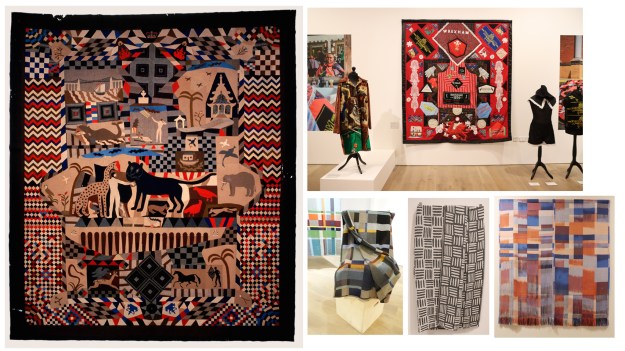
The Tailor’s Quilt, by James Williams. Click to see the larger, clearer image. Image source: Tŷ Pawb website, with original image © Amgueddfa Cymru (National Museum Wales).

The Tailor’s Tale exhibition, at the Tŷ Pawb gallery in Wrexham, is on until September 24th 2022.  It is a rare opportunity to see the mid-19th century “Tailor’s Quilt” without having to go to south Wales to see it in its usual home.  The exhibition is showing at the same time as the exhibition Blanket Coverage, in the same gallery, about which I have already written here.

The Tailor’s Quilt was made by master military tailor James Williams of Wrexham (c.1818 – 1895). It is on loan from the St Fagan’s National Museum of History in Cardiff.  The museum bought it in 1935 from Williams’s grandson during the economic depression, where it joined a national folk art collection, which now has over 200 examples of Welsh quilting and patchworks.   

As well as the quilt itself, which is a complete joy, the exhibition features modern art works, including designer clothing and accessories by Sarah Burton (fashion house Alexander McQueen) and fashion designer Adam Jones;  a range of items  by Mark Herald, based on the quilt and commissioned by Tate Britain; and a set of four small pieces by Quilter’s Guild of the British Isles members Judy Fairless, Anne Gosling, Barbara Harrison and Helen Lloyd.  It is one of the pleasures of The Tailor’s Tale, that 19th and 21st century approaches to patchwork and quilting by local textile specialists can be seen side by side, with all the implications of social and economic change that each implies.
afdasfsd

The Tailor’s Quilt

First, a bit of terminology.  A quilt is generally defined as at least two layers of fabric with padding, called wadding, between them, all stitched together either with straight lines crossing each other to form squares or diamonds, or in more elaborate designs.  A patchwork consists of pieces of fabric sewn together.  A patchwork quilt is a patchwork that has been provided with a wadding and backing, and has been sewn together at multiple places across the surface to connect all three levels, to form a patchwork quilt.  The Tailor’s Quilt, technically, is a patchwork, because it is made up of different fabrics sewn together but is not sewn over to join all the layers together.  It is made using the intarsia method, as described by Dr Clare Rose of the V&A:  “This technique, also known as ‘cloth intarsia’, ‘mosaic needlework’, ‘inlaid patchwork’, ‘inlay patchwork’ and ‘stitched inlay’, involves cutting motifs out of wool cloth and stitching them directly to each other with no seam allowances and no backing fabric.”  Features like the panther’s very smug smile, are picked out in silk thread.

James Williams, Draper, located opposite another draper and a boot maker at the gates to the church. Source: @Tiffypox on Twitter

As modern as it looks, and as imaginative as it is, the Tailor’s Quilt was crafted by James Williams in his downtime over a period of 10 years between 1842 and 1852, using leftover fabrics from the suits and military outfits that he made, as well as from textile sample books that were no longer of use.  It is truly astounding for its scale, imagination and the splendid combination of representational scenes and abstract designs.  The quilt is surprisingly huge, and framed behind glass it is a real presence.

It is thought that Williams was born in 1818.  His name is listed in trade directories between 1850 and the year of his death in 1895.  A photograph survives of his shop sign with the church in the background, which is supposed to show a shopfront on 8 College St., Wrexham.  I went to have a look to see if the original building is still there.  The view shown left, which shows a sign with the legend “J. Williams Draper,” cannot possibly be College Street, which approaches at a very awkward side angle to the church tower.  This is without question Church Street.  Perhaps Williams moved from one premises to another at some point in his business life.

A view down Church Street today.

The Tailor’s Quilt measures 2.34m high by 2m wide (7.6 x 6.5ft) and contains over 4,525 pieces of material.  It is far bigger than I was expecting, even knowing the measurements.  It uses a fairly limited but perfectly harmonized palette of colours, drawn from what Williams had to hand.  It shows scenes from the Bible such as Adam naming the animals, Noah’s Ark,  Jonah and the whale (fabulously, with only the legs showing out of the whale’s mouth), and Cain and Abel, with the sky filled with lightning.  It also features motifs symbolizing Wales (a leek), England (a rose), Scotland (a thistle), and Ireland (a shamrock).  Giving the composite scene a really modern twist, the Menai Suspension Bridge and Cefn Viaduct (with a steam engine and two carriages passing over it) are also prominently featured.  The significance of the Chinese pagoda seems to escape most commentators, but perhaps (speculating recklessly) it was inspired by Chinese ceramics, which had become mainstream in 19th century Britain at the time. Part of the fun of the piece, with a huge, self-satisfied black panther dominating the composition, is looking for the vignettes and enjoying the details in each one.

Image source: Tŷ Pawb website, with original image © Amgueddfa Cymru (National Museum Wales).


The combination of abstract, symbolic and representational takes time to absorb, and it works perfectly both on the level of the detailed vignettes and as a complex composition that instantly creates an attractive and appealing impression.  It is difficult to imagine how, over a 10 year period, Williams was able to keep hold of the compositional elements to create something so beautifully balanced and proportioned. 
As the Tŷ Pawb website puts it, “The quilt is now widely regarded as one of the best surviving examples of Welsh folk art.”

It was exhibited at the Art Treasures Exhibition of North Wales in 1876 and the National Eisteddfod in 1933, both held in Wrexham, and in the British Empire Exhibition in Wembley in 1925.  Although its travels were put on hold for conservation work, it is now fit for travel once again, and was displayed in the Victoria and Albert Museum’s Quilts 1700-2010 exhibition in 2010, and was loaned to the Wrexham Museum for a temporary exhibition in 2017.  Its return to Wrexham at Tŷ Pawb in 2022 is very welcome.

Modern Responses to the Tailor’s Quilt

One of the reasons that this exhibition is so appealing is that it explores how The Tailor’s Quilt influenced and inspired other artists working in the same medium. It offers an opportunity not merely to see a sublime example of the genre, but to see how modern textile artists have incorporated design elements of the quilt in their own work.

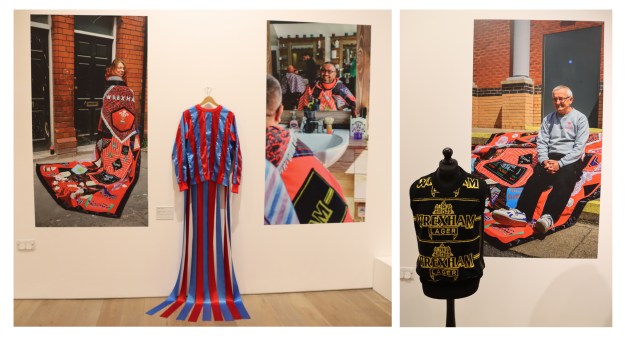
The most original of the contributions is that made by fashion designer Adam Jones, who was commissioned by Tŷ Pawb to make a quilt of his own to be displayed adjacent to the Tailor’s Quilt.  It works superbly, because Adam Jones has a style that is quite unlike that of James Williams.  His bright, often garish clothes are attention-grabbing and regularly make use of clashing colours, textual elements and pub-themed motifs to make often loud, sometimes kitschy and frequently humorous statements.  Adam Jones is from Froncysyllte near Wrexham, but is now based in London.   Although there are garments from Adam’s collection in the exhibition, to demonstrate some of his creative range, his quilt is particularly interesting in this context.  It combines the inspiration of the Tailor’s Quilt with a unique vision of Wrexham, its football team and pubs, and has its own intense personality.  The composition is set against a bright, shiny red background (Wrexham FC’s dominant colour), and is full of references to Wrexham, and in particular Wrexham Lager.  Contrasting textures, like lace and towelling, and everyday objects like a butcher’s apron and a pair of gloves are intertwined with abstract geometric shapes inspired by the Tailor’s Quilt.  Instead of all four nations, Wales is given pride of place with the dragon at its base.  Flanking Jones’s quilt are huge photographs of the quilt with local people, one man sitting on it, another draping it around her shoulders, removing textile art from the clean walls of the gallery and taking it back to its spiritual home.  Great fun.
fasdfs
Painter and printmaker Mark Herald was commissioned by Tate Britain to create some pieces based on the Tailor’s Quilt for the Tate’s shop.  Mark’s sketchbook is displayed here, together with some of the items that he created for Tate Britain (some of which are currently for sale in the Wrexham Museum, a short walk away).  His pieces include pictures, mugs, plates and bags.  He takes motifs and themes from the Tailor’s Quilt, gives them a bright hit of colour, and arranges them in harmony on the new surfaces.  They work superbly, echoing the Quilt, the motifs unmistakeably lifted from its progenitor, but given a bright, modern twist on the surface of everyday objects.  Although none of his other works are shown in the exhibition, a quick web search shows why Tate Britain chose him.  His own artworks are similarly full of light, often referencing the animal world, full of bright colours and dynamic shapes.


The name that pops up repeatedly when you do a search on the Tailor’s Quilt is clothes Sarah Burton, Creative Director of the fashion house Alexander McQueen.  Sarah Burton was inspired by the Tailor’s Quilt on a visit to St Fagan’s Museum, and incorporated its themes into her Autumn/Winter 2020 collection.

Her work provides yet another contrast.  Just as the Tailor’s Quilt is the product of a professional tailor working in Wrexham, and Adam Jones’s quilt and clothing specifically reference the small town environment of the 70s and 80s that were part of his upbringing, Sarah Burton’s clothing is self-consciously aimed at the catwalk and is the product of the couture design world.  Angular shapes and big panels of fabric are imprinted with motifs lifted directly from the Tailor’s Quilt, but given a new colour palette and an entirely new feel.

Four small pieces exhibited together are by Judy Fairless, Anne Gosling, Barbara Harrison and Helen Lloyd, who each made a piece as a response to the Tailor’s Quilt for the Llangollen Quiltfest in 2017.

From top left, clockwise: Ann Gosling “What a busy life I lead;” Helen Lloyd. “Jump,” Barbara Harrison, “The world around me,” and Judy Fairless, “All Stitched Up”

Although every exhibition has a curator and a team of skilled assistants, the general public does not often hear much about them.  This exhibition was the brainchild of the late Ruth Caswell, to whom the exhibition is dedicated.  She was a very remarkable and award-winning costumier, designer, artist and teacher, as well as a skilled curator of exhibitions, of which this was her last.  The Tŷ Pawb website explains how she started out:
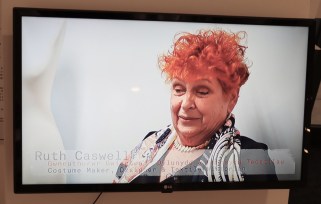
Ruth moved to London in the 1960s, when she met and married her husband actor Eddie Caswell. Ruth said: “When we married and moved to London, we had only £12.50 to our name so I made clothes in my back bedroom and sold them in Kensington Market on a stall next to Freddie Mercury’s. I delivered them on the 73 bus each Friday and they sold instantly.”  Ruth’s clothes were photographed for Vogue and worn by model Jean Shrimpton.

There is a video in the exhibition showing Ruth talking at fascinating length about textile design, and her enthusiasm, eloquence and generosity of spirit are very evident.
rewrwe

Final Comments

Quilting and patchwork, as craft activities, have a long tradition in domestic contexts, either for daily use or to mark special occasions from the Medieval period onwards.  The Tailor’s Quilt, imagined and hand-stitched by a professional tailor, was very much the product of a professional skill, but was also created within a domestic context.  The exhibition makes it clear how craft activities are now gaining traction in the fields of design and textile arts, featuring on catwalks and in art galleries.  The liminal position held by textile arts for at least a century, is slowly being eroded, and textile is coming of age in a number of commercial contexts where they are recognized as both design and art.

It was a particular stroke of genius to organize The Tailor’s Tale and Blanket Coverage at the same time, and provide them with a single space to share.  Whilst quite different in their content and their style of display, both raise questions about how textiles are regarded today, and what they bring to the world of art.  Both of the exhibitions, the one exploring the impact of a single magnificent piece (the patchwork quilt) and the other exploring the multiple facets of a single genre (blanket weaving), work beautifully both in isolation and together.

With this new exhibition, the Tŷ Pawb gallery has again provided the perfect venue for bringing together modern art and local history, whilst also exploring more universal themes.  The exhibitions The Tailor’s Tale and Blanket Coverage run at Tŷ Pawb until September 24th 2022 between 10am and 4pm Monday to SaturdayEntry is free of charge.


Sources:

Books and papers

Jones, J. 2016. Welsh Quilts. Seren

Rose, C. 2011. A patchwork panel ‘shown at the Great Exhibition.  V&A Online Journal, Issue No. 3 Spring 2011
http://www.vam.ac.uk/content/journals/research-journal/issue-03/a-patchwork-panel-shown-at-the-great-exhibition/#:~:text=This%20technique%2C%20also%20known%20as,allowances%20and%20no%20backing%20fabric.

Ty Pawb handouts, 2022.
– Artist Biographies
– Ruth Caswell

Websites

175 Heroes
Ruth Caswell
https://175heroes.bradfordcollege.ac.uk/ruth_caswell.html

Build Hollywood
Your Space or Mine: Adam Jones
https://www.buildhollywood.co.uk/work/adam-jones/

National Museum of Wales
Patchwork Bedcover
https://museum.wales/collections/online/object/4ce80b8d-182e-3822-8038-54080af6b0b8/Patchwork-bedcover/

Tŷ Pawb
https://www.typawb.wales
The Tailor’s Tale / Blanket Coverage at Tŷ Pawb 02/07/22 – 24/09/22
https://www.typawb.wales/exhibitions/the-tailors-tale-blanket-coverage/

Based in Churton
Exhibition write-up: The luxuriant “Blanket Coverage” at Tŷ Pawb gallery, Wrexham. By Andie Byrnes
https://wp.me/pcZwQK-2F8
Exhibition: The luxuriant “Blanket Coverage” at Tŷ Pawb gallery, Wrexham

Wallace Sewell

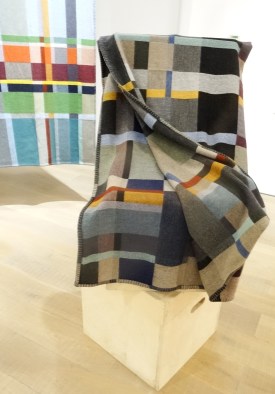
Blanket Coverage, the exhibition currently showing at Tŷ Pawb Gallery in Wrexham, is an exploration of sumptuous and subtle modern woven blanket textiles.  If you have never really considered blankets as an art form, or have never had the chance to experience them at first hand, this is a real opportunity to get up close to some examples of the most creative and skilled examples of modern British textile art.  Some of the artists included in the exhibition are very well known, with established businesses and works hanging in galleries, whilst others are just starting out.  Both individual artists and commercial mills are represented, and there is a good mixture of textures, colours and ideas on show.  It is a small exhibition, but full of rich content.

The curators of Tŷ Pawb have inventively and successfully combined the Blanket Coverage touring exhibition from Llantarmon Grange in south Wales with their own exhibition, The Tailor’s Tale, sharing the same gallery space.  The two small exhibitions, both specializing in textiles, work beautifully together, each complementing the other and offering contrast in terms of themes, styles, textures and colours.  I am talking about each on separate posts, because there is so much to say about each of them separately.   I have started with Blanket Coverage (just because I finished it first) and the post about The Tailor’s Tale will follow shortly.

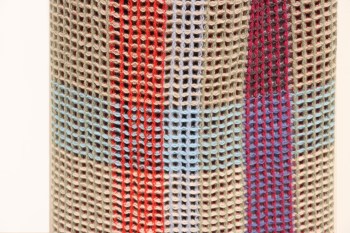
Detail of Margo Selby’s “Kazo Throw” showing the subtlety of the colouring and the softness of the texture (click to enlarge and see the details).

Blanket Coverage has been curated by designer, weaver and curator Laura Thomas, and features works by a diverse collection of contributors who, at Tŷ Pawb, included (in alphabetical order) Llio James, Beatrice Larkin, Angie Parker, Sioni Rhys Handweavers, Margo Selby, Maria Sigma, Wallace Sewell, Meghan Spielman and Melin Tregwynt, as well as curator Laura Thomas.  All are available to purchase.  Both exhibitions opened on July 2nd and are running until September 24th 2022, between 10am and 4pm, Monday to Saturday.  Entry to the exhibition is free of charge.  There is plenty of parking above the gallery and public space, and it is a super, friendly place, so feel free to ask questions. Check the Tŷ Pawb website for any updates.  I have talked about the exhibition space and Tŷ Pawb itself in my previous post about the fabulous Tales of Terracottapolis.
fdsfsdf


The exhibition

Handwoven blanket by Llio James. 100% lambswool. 137×178 (upper) and 137×168 (lower)

Blanket Coverage is all about woven large scale blankets (weighty and warm) and throws (lighter weight and fluid).  The format of the blanket, which is big and rectangular, offers an opportunity to develop ideas on a large scale.  The blanket provides a flat, symmetrical area that can be filled with compelling patterns, colour combinations, and textures in combinations that display skill, creativity and often luminous imagination.  Perhaps more than any other medium, the woven work is produced within the constraint of the technology that defines it.  The loom, whether manual or mechanized, is both a restricting factor, confining the weaver to the format of the physical structure of the mechanism, and an appeal to the imagination of the artist to create magic within that confinement.   Just as a concert pianist is confined to wherever the grand piano happens to be, a weaver must build a relationship with the loom within its environment.  Before the sketched design can be translated into a woven textile, the loom must be threaded with the warp, the structural component of the weave into which the rest of the yarns, the weft, are woven.

Within those restrictions are a multitude of options that enable the weaver to express ideas and develop new forms of connection with the person who picks up the resulting textile, handles it and is lucky enough to luxuriate in it.  Some are lightweight throws that are full of movement; others are heavier, traditional blankets with more physical mass.  Mixing lighter and thicker yarns creates alternative fabric weights and textures, extending the repertoire.

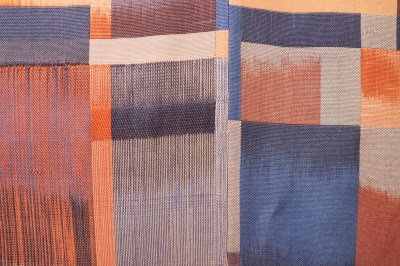
Meghan Spielman “Interchange” showing the use if ikat dyes

Dyes too, varying in subtlety and complexity, give infinite possibilities for design.  Whilst some of them reference the environment in which they are made, with muted colours of the landscape, others are brightly independent of any particular context and celebrate the yarns, colours and textures with which they are created.  Others are splendidly monochrome or used a limited, pastel palette, focusing attention on the shapes and patterns that create an energy through the sense of rhythm, repetition and reinforcement.  The ikat dye technique, of which I was previously unaware, works by blanking off parts of the yarn and dying others, so that the dye leaches and creates the effect of colours bleeding into one another, and looks as though the surface has a liquid quality.  Just as a sculptor tests the limit of his or her chosen material, weavers are experts on how to make the most of their material resources.  

Laura Thomas. “Home blanket.” 100% lambswool. 150x200cm

As well as being visually stunning, each piece has a phenomenal tactile appeal that makes it difficult not to reach out and touch.  A lady with two children who was visiting when I was there was hissing “no, don’t touch!” every few minutes, and I felt total empathy with the children, because it is almost impossible not to reach out to sample the feel of the weaves.  The tactile temptation of textiles like this is different from nearly all other forms of art.  Just as luxurious fabrics like the soft warmth of a cashmere jumper and the cool, liquid smoothness of a silk scarf are just as attractive to the touch as they are to the eye, the finely woven blankets in the exhibition have their own special properties and personalities in which their very physical texture is important both to their functional role and their aesthetic appeal.

Left: Margo Selby. Right: Angie Parker.

The exhibition presents an excellent mix of hand-woven and mill-produced textiles.  Hand-woven pieces consume time, and are more expensive.  Those produced in a mill are less expensive,  and means that copies can be made, but most of them were first woven by hand and were then produced by the mill, building authenticity and originality into the process.  Mills, with their own economic challenges, have become increasingly flexible and adaptive, and work with individual designers and design companies to provide short runs, enabling the mills to develop new opportunities, and the designers to lower prices and reach a wider customer base.  The mills too have their own designers, some of them computerized, which add a new dimension to their works.  The relationship between artist and mill is probably the key not merely to the survival of weaving as an art, but of its development.


The exhibitors

Beatrice Larkin. Cut Throw. 148x195cm. &0% Merino lambswool and 10% cotton

The exhibitors in Blanket Coverage at Ty Pawb introduced below in alphabetical order.  One of the great things about the exhibition is that it combines some well known names like Wallace Sewell with relative newcomers like Beatrice Larkin.

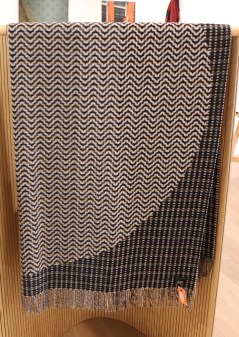
Beatrice Larkin works first in pencil and ink to create her monochrome designs, and works with commercial mills to produce textile runs that capture the hand-drawn quality of her works.  Her patterns repeat over the surface of the blanket, and the way in which the designs are put together often creates a sense of motion.  Her blanket weaves are both eye-catching and attractive. I particularly like the way in which most of those in the exhibition have a rhythmic feel to them, which gives even repeat patterns a sense of being natural and spontaneous.  A good example is the double-sided “Cut Throw,” a monochrome twill weave blanket that looks as though a pattern of slashes has been reproduced across the surface.  It was inspired by West African mud cloth block designs.  Although she lives in Kent, Beatrice Larkin’s weaves are all produced in the north of England, and this example was woven on a jacquard mill in Yorkshire. The jacquard mill, patented in 1804 was an ingenious invention that used punched cards to speed up production and produce increasingly complex patterns, a bit like an early computer, and other weavers in the exhibition also have their designs made up on short runs on this type of loom.  

Margo Selby. “Kazo Throw.” 100% lambswool. 140x190cm.

Margo Selby specializes in hand woven bright colours and geometric designs.  Often inspired by graphic design and Japanese art, she examines the interplay between colours, exploring the relationship between the boundaries where colours collide.  Like some of the other designers in the exhibition she makes hand-woven objects and then works with a mill to produce her designs on a jacquard loom.  Her company makes both large- and small-scale pieces, the latter being particularly well suited to blanket design.  The pieces within the exhibition are not typical of her usual riotous colour palette, and instead focus on the interplay of blacks, whites and greys, creating an interplay between the mainly monochrome shades and textures.  Although her company specializes in handweaving they also collaborate with commercial mills.  As well as blankets and framed pieces, the studio produces rugs, fabrics for upholstery, soft furnishings, apparel, cushions, towels and scarves.

Wallace Sewell “Feilden.” 100% lambswool. 170x250cm

Wallace Sewell (established by established by Harriet Wallace-Jones and Emma Sewell) is a textile design company that produces items both to hang and to use, including scarves, cushions and throws, as well as art prints of some of their designs.  Their weaves are first created on a hand loom before going into production, and all are made using natural yarns.  They work closely with Mitchell Interflex, a mill that straddles the Lancashire-Yorkshire border.  The Mitchell family has been producing woven textiles since 1907, when they first acquired the mill.  Wallace Sewell are noted for the bright colour abstract combinations of their designs, which are fresh and full of light.  Although not on display in the exhibition, if you have hopped on a Victoria Line tube train in London and admired the lovely seating upholstery capturing famous London landmarks, this was one of their commissions, and a measure of both the company’s success and its creativity.

Left: Llio James. “Phaedra V2.” Pure new undyed British alpaca and dyed lambswool. 170x130cm. Right: “Acallis V2” baby blanket. Left: Phaedra V2. Pure new undyed British alpaca and dyed lambswool. 170x130cm

Maria Sigma is a Greek weaver trained in Britain and working in London and Athens.  She uses naturally coloured yarns, including alpaca, to produce hand-woven textiles with subtle and complex patterns and textures, and some surprising details like the blue edging of the ones in the exhibition, which contrast with the muted, natural colours of the yarns.   Her use of yarns that are only minimally processes gives each blanket a unique finish, where the texture is as much a part of the fabric, and of Maria Sigma’s ethical approach, as the design itself.

Llio James, a Welsh weaver who grew up in a village that supported two mills, specializes in using a palette of ecru, black, charcoal and reds to produce modern designs building on the tradition of Welsh weaving that is so familiar to her.  Those at the exhibition are hand-woven, but she also works with a mill for short production runs.  Most of her patterns don’t repeat, but use the rectangular blanket format as a canvas to develop abstract designs, which are best seen in full format rather than folded.  She starts the design process on paper before moving on to a loom to experiment with colours, patterns and yarns, before finalizing the designs, which are produced in a traditional Welsh mill, the Melin Teifi.  The photo of her two contributions to the exhibition are at the top of this section.

Melin Tregwynt. “St David’s Cross.”  100% lambswool.  240x250cm

Melin Tregwynt in Pembrokeshire is one of the best known Welsh weaving mills, which has been in the hands of the same family for over 100 years, and there has been a mill on the site since the 17th century.  The company has a huge archive of Welsh designs, and colours chosen often reflect the local landscape with its valley and moorland palettes.  As well as in-house and guest designers, they also make use of a computer programme called ScotWeave to develop new and complex patterns.   Their versatile product range includes Welsh woollen blankets and throws, woollen cushions, upholstery, items of clothing, accessories and bags.  Although most Welsh wool is too coarse for most weaves, the Cambrian Wool Initiative has been established to introduce softer fleeces back into Wales, and as partners in this project, Melin Tregwynt now have a source of Cambrian soft wools to use in their weaves. Have a look at their website to see a series of videos on the production process: https://melintregwynt.co.uk/watch-weaving.

Sioni Rhys Handweavers

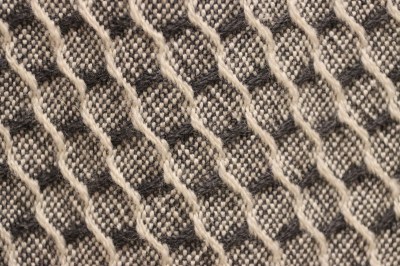
The popular Sioni Rhys Handweavers, established by designer Dennis Mulcahy and weaver Stuart Neale, specializes in the production of traditional Welsh cartheni, patterned bed covers that are used as throws and blankets, frequently using the distinctive twill weave shown right.  Although they often reference the surrounding landscape of Brecon in their colour choices, other examples are bright and full of energy.  Their aim is to combine traditional techniques with modern ideas, and the four examples at Blanket Coverage show the versatility of their carthen range.

Detail of blanket by Angie Parker

Although Angie Parker specializes in woven rugs, she began making blankets during lockdown, inspired by the colours of some the painted buildings that she was walking past in her Bristol neighbourhood.  She specializes in complex combinations of bright, light colours, and this translates well into her blanket weaves, combining colours in very appealing geometrical arrangements that draw on her designs for rug weaves and costume design.  There was only one blanket in the exhibition, but it was well chosen for its visual impact and firm but fine texture.  It was made up by the Bristol Weaving Mill.  There is a photograph of it at the end of the previous section.

Meghan Spielman, “Interchange.”

Meghan Spielman trained in London and now lives in New York.  “Interchange” is a wall hanging rather than a blanket or throw, but uses the same format as the blanket, enabling the design to be worked over a large area.  Spielman works in a variety of materials,  often in combination, which give each of her pieces a distinctive quality.  The piece in the exhibition is a double cloth that uses the ikat dye technique to give parts of it something of the appearance of a watercolour, with colours bleeding into one another, whilst other blocks are far more linear, with clean edges, providing an attractive contrast to the more fluid areas of the surface.  The limited palette of colours, which work so well together, put the composition at centre stage.  It is composed of two sections, stitched down the centre.
fasdfafads

Laura Thomas. “Verdant blanket.” 100% lambswool.

Laura Thomas, the curator of the exhibition, is a well known and popular weaver, and has two of her own blankets on display, one a uniform colour in two shades of green with a pattern built into the weave itself, creating oval spaces evenly distributed across the surface.  A second piece, monochrome with a repeat pattern defined by a raised texture, was particularly successful as a design concept on Instragram, and was sent to Melin Tregwynt for production for a short run.  At the mill it was made of Cambrian Welsh wool, and creates a real sense of motion, like water, as you follow the design across the surface.  As well as designing individual pieces like these, she also works with graphic designers on commercial works, and has contributed to public art projects, which sometimes blend with architecture to create unusual spaces.  Like others in the exhibition, she has a real feel for bright, striking colours and experimental textures.

fdsafas

sdfsdfs

A fading tradition?

Melyn Tregwynt

In its introduction to Blanket Coverage, the Llantarmon Grange website comments “With traditional skills such as weaving in danger of being lost, the makers in the exhibition are ensuring that traditional crafts continue to not only survive but thrive, both celebrating and innovating the rich tradition of woollen blanket production.”

Weaving is rarely taught in schools, meaning that most children are simply not exposed to it. Those who go on to study art at college may have the opportunity to experience weaving and other textile arts, but they represent a select few, most of whom will not have been exposed to weaving before.

Developing a career or a business based on weaving also presents a challenge.  A fully hand-woven item is extremely time-consuming to make, and this translates into a much higher cost than an item produced on a commercial scale.  Although some of the weavers represented in the exhibition only weave by hand, others have chosen to build relationships with commercial mills that can produce their designs on a more commercially viable basis, which helps to lower costs and potentially find additional potential purchasers.  Perhaps one of the most difficult tasks is to find ways in which to market these products, and to locate suitable places to display them, where they will find these potential purchasers.

Wallace Sewell’s “Dorothy.” 100% lambswool. 105x165cm.

Some help comes from collaborative projects that support craft and design combine resources to help support practitioners and promote their interests.  A good example is Design Nation, which arranged the interview with exhibition curator Laura Thomas, shown below.  At the same time, galleries like Tŷ Pawb and Llantarmon Grange are important for showing us not only what skills remain but what traditions we should continue to support.

Blanket Coverage and The Tailor’s Tale, and similar exhibitions are at the heart of raising the profile of textile arts, and help to involve the visitor in challenging their own ideas about the importance of traditional skills and products in the modern world.  By combining the two exhibitions in a single space, one about quilting, patchwork and costume, the other about blanket weaving, the curators of Tŷ Pawb have given local people access to a world of colour and texture that, one hopes, will continue to grow and to find new purchasers who will find great pleasure in experiencing objects of real beauty on a daily basis.

Final Comments

Beatrice Larkin

The blanket makers in this exhibition are ensuring that traditional crafts continue to not only survive but thrive, both celebrating and innovating the rich tradition of woollen blanket production. The skills, traditions and symbolism wrapped up in blankets make them a prized procession in every home, providers of comfort and warmth, both physical and psychological, which are passed from generation to generation.

By combining its own exhibition, The Taylor’s Tale, with Llantarmon Grange’s Blanket Coverage, Tŷ Pawb has elegantly combined two textile genres to bring artists working in this medium into the public eye.  I loved it.

Both exhibitions opened on July 2nd and are running until September 24th 2022, between 10am and 4pm, Monday to Saturday. Entry is free.

There is an informative interview with curator Laura Thomas, who is talking to Design Nation‘s Development Manager Liz Cooper about the Blanket Coverage exhibition (55 minutes).

asfafasd


Sources and further reading:

Melin Tregwynt. “Knot Garden.” 100% lambswool.

Designers’ websites

In alphabetical order

Other Websites

Arts Council of Wales
Blanket Coverage goes on Tour
https://arts.wales/news-jobs-opportunities/blanket-coverage-goes-on-tour

Design Nation
http://designnation.co.uk/about-us/

Design Pool
Ikat: Definition, History & Design
https://www.designpoolpatterns.com/ikat-definition-history-design/

Llantarmon Grange
Touring:  Blanket Coverage
https://llantarnamgrange.com/blanket-coverage-at-shetland-art/
Blanket Coverage catalogue on Issuu
https://issuu.com/lgac/docs/blanketcoverage_eng
Interview by Design-Nation with curator Laura Thomas
https://vimeo.com/492333129

Margo Selby
Blanket Coverage
https://www.margoselby.com/blogs/stories/blanket-coverage

Melin Tregwynt

Series of videos on the their weaving production process
https://melintregwynt.co.uk/watch-weaving.

Tŷ Pawb
https://www.typawb.wales
The Tailor’s Tale / Blanket Coverage at Tŷ Pawb 02/07/22 – 24/09/22
https://www.typawb.wales/exhibitions/the-tailors-tale-blanket-coverage/

Detail of Beatrice Larkin’s “Cut Throw”

A Visit to Cholmondley Castle Gardens

On a bright, sunny day that turned out to be seriously hot, we decided to go to Cholmondeley Castle Gardens.  It’s a great place to go on a hot day because there are lots of open areas if you like the sun, but a lot of leafy shade beneath the trees to keep you cool.  I had no idea that it was so near to the Chester-Wrexham area, just to the east of Bickerton.  I had never been there before, although it was a favourite of my parents.  The castle is not open to the public, but the gardens are, albeit only a few days a week (so do check before you go), and are very impressive.

We parked at the far left of the car park field (see map at end) and entered through the gate at the corner of the field and the drive, which allows you to enter on the flat.  Along the front of the field there are other points of access too, one of which leads straight up a long slope towards the castle and offers a great view.

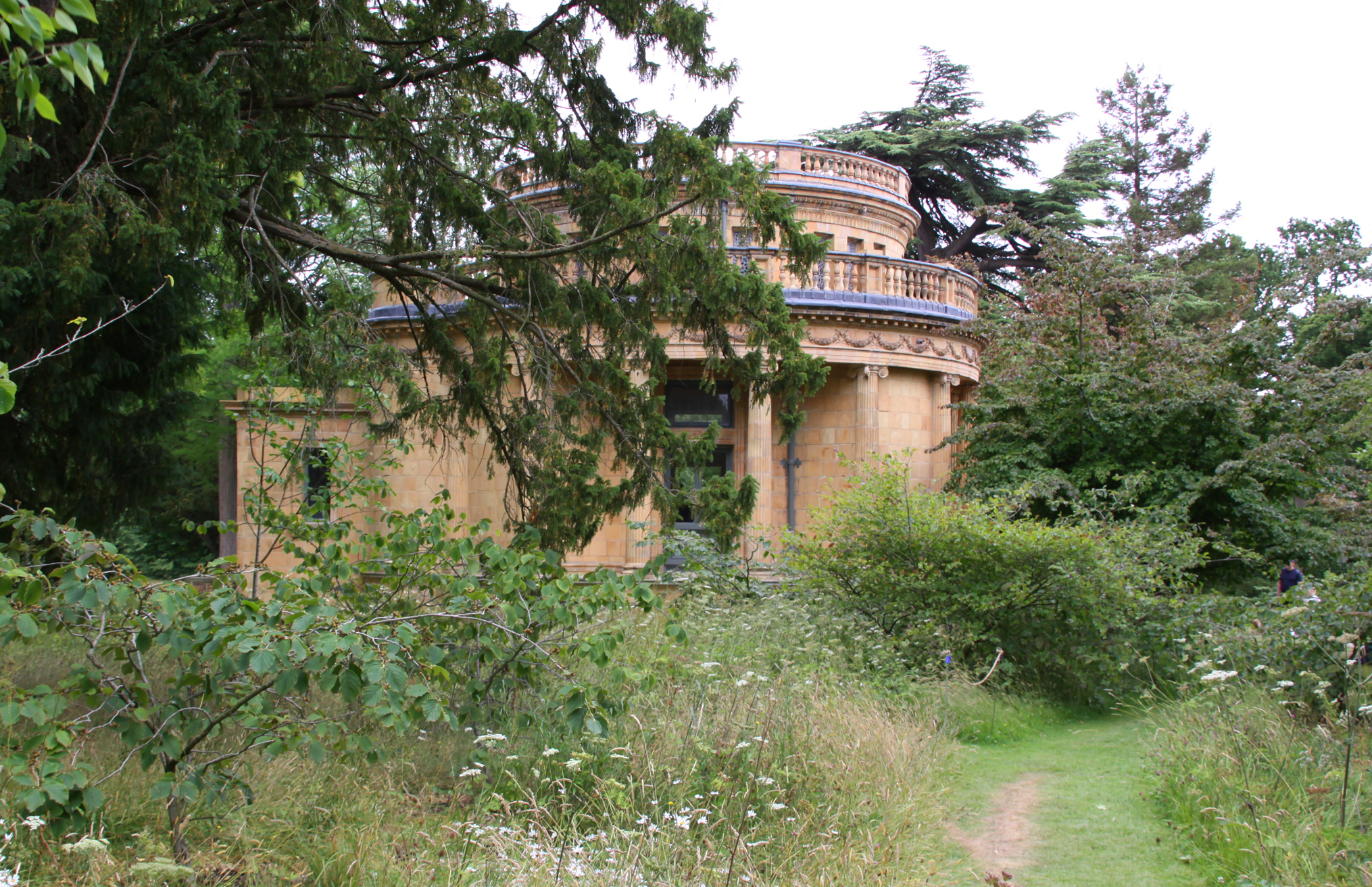
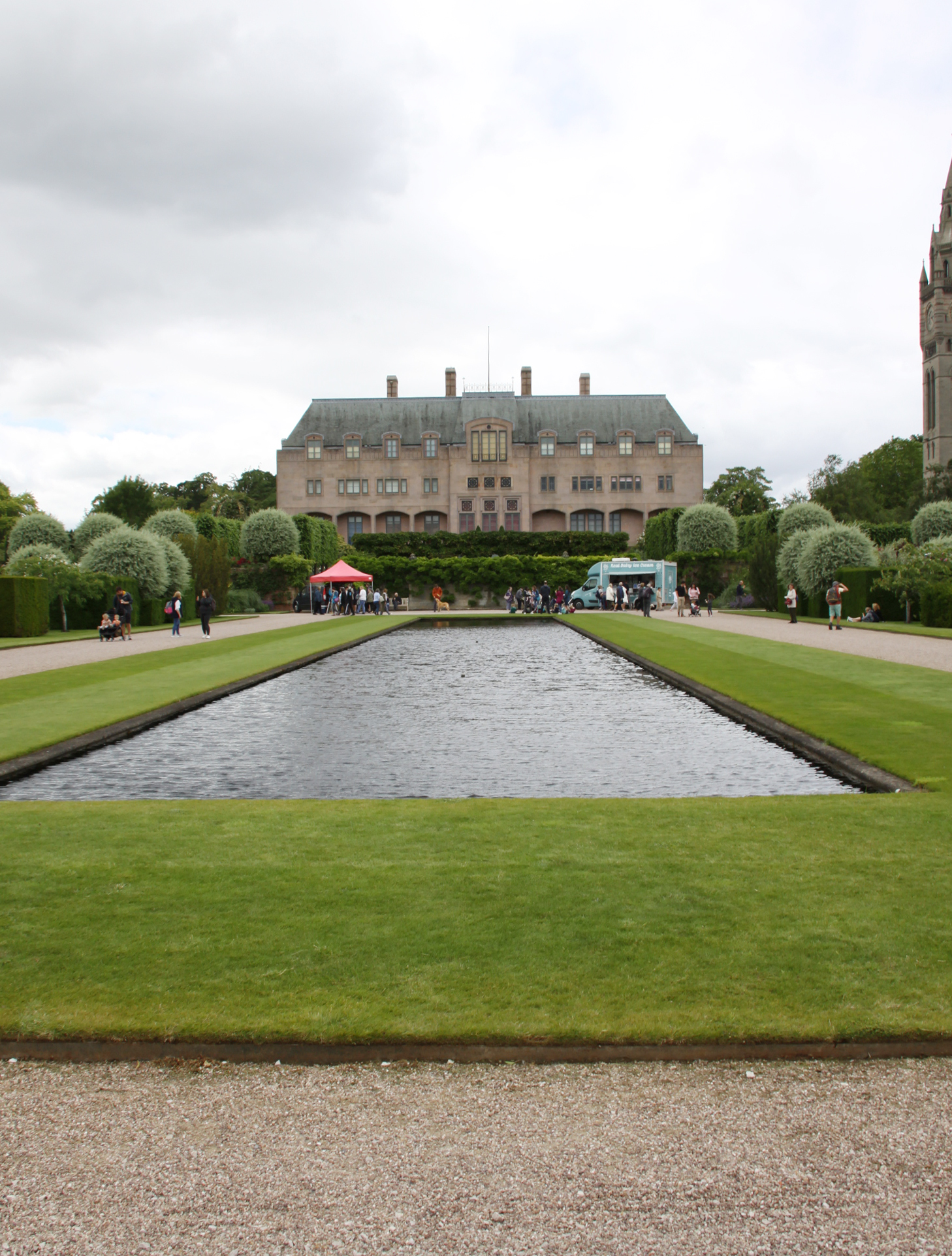
Cholmondeley Castle itself is the brainchild of a vivid imagination, a hotchpotch of ideas assembled in 1801-02 and added to later in the 19th century.  The castle is not open to the public, but the gardens, which are open several days a week, reach right up to the edge of the castle’s own private garden area, giving a great view of the exterior.  According to the website, the Cholmondeley family have occupied the site since the Norman period, but the current castle replaces an earlier hall, a decision by George James, 4th Earl of Cholmondeley.  It was designed by local architect William Turner of Whitchurch, and was extended in 1817–1819.  In 1828 turrets designed by Sir Robert Smirke were added, and the castle has not been much changed since.  It was occupied by the current earl’s mother Lavinia until her death in 2015, and is not now permanently inhabited.

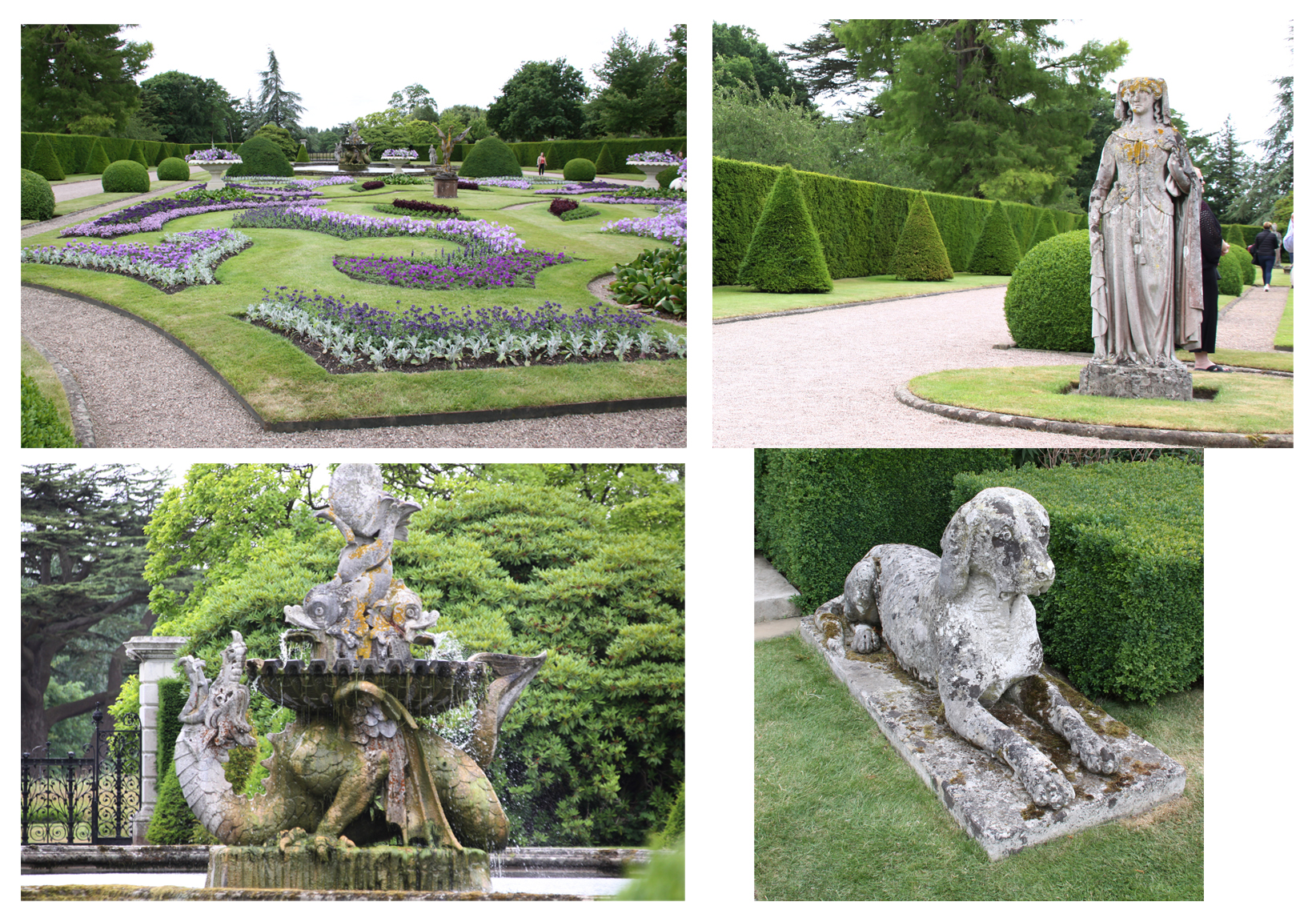
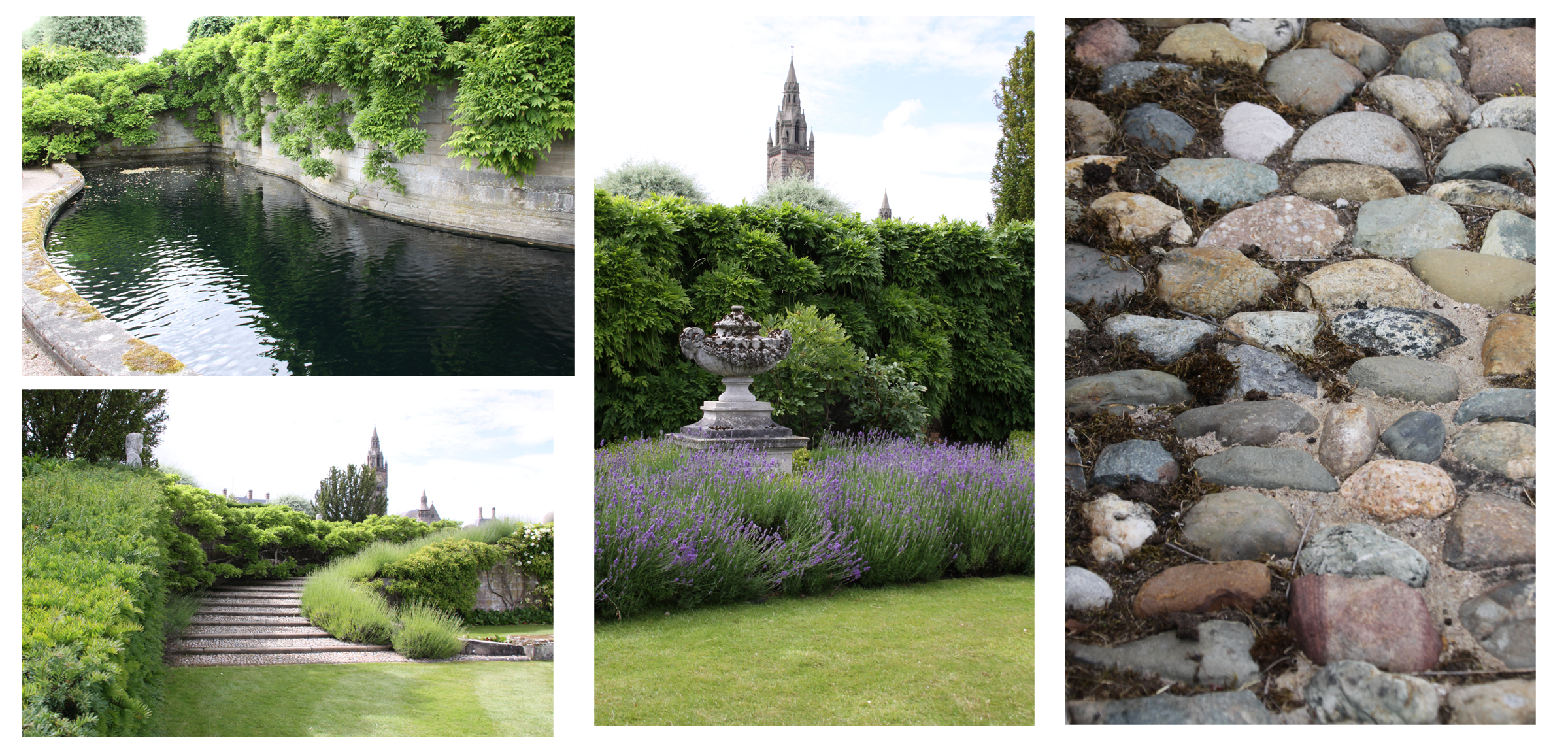
The garden consists of naturalistic water features, formal gardens, a 19th century celebration of classical ruins, all set within an arboretum.  It has an awful lot going for it.

The large ponds are not neat and formal rectangles, but look natural, whether or not they are, with large colonies of water lilies on the water, and water-loving plants along their edges.  They feature small mock-temples, some of them on artificial islands, which are clearly not authentic but are a lot of fun, typical of a lot of 19th century and earlier celebrations of classical architecture.  The first of these that you reach from the car park is the Temple Garden Pond.


The formal border, called the Lavinia Walk, leading from the Temple Pond via a rose garden to a small circular domed pavilion, is sensational, with a glorious mix of penstemon, alstromeria, roses, phlox, eremerus, rudbeckia, crocosmia, salvia, delphiniums, dahlias and lots of other brightly coloured species, some of them climbing parallel rows of round-topped obelisks that flank the path.

The second pond, the Folly Garden Pond and surrounding garden, is another aquatic treat, connected to the Temple Pond.  As well as some magnificent hostas, apparently untroubled by slugs, and a lovely cornus kousa in a shade of deep rose pink, is a walnut grove and some wonderfully scented, heady meadowsweet.  Slender, brilliant electric blue damsel flies were a wonderful, shimmering, endlessly shifting light show.

As well as these main areas of focus, there are some fun architectural and structural features between the main run of gardens, some excellent walks in the wooded and grass areas that sit between the main footpaths, and some superb flowering shrubs dotted everywhere.  This is the sort of garden that has a central focus in the form of a formal garden, but also provides considerable rewards in return for wandering around to get a full sense of the place.

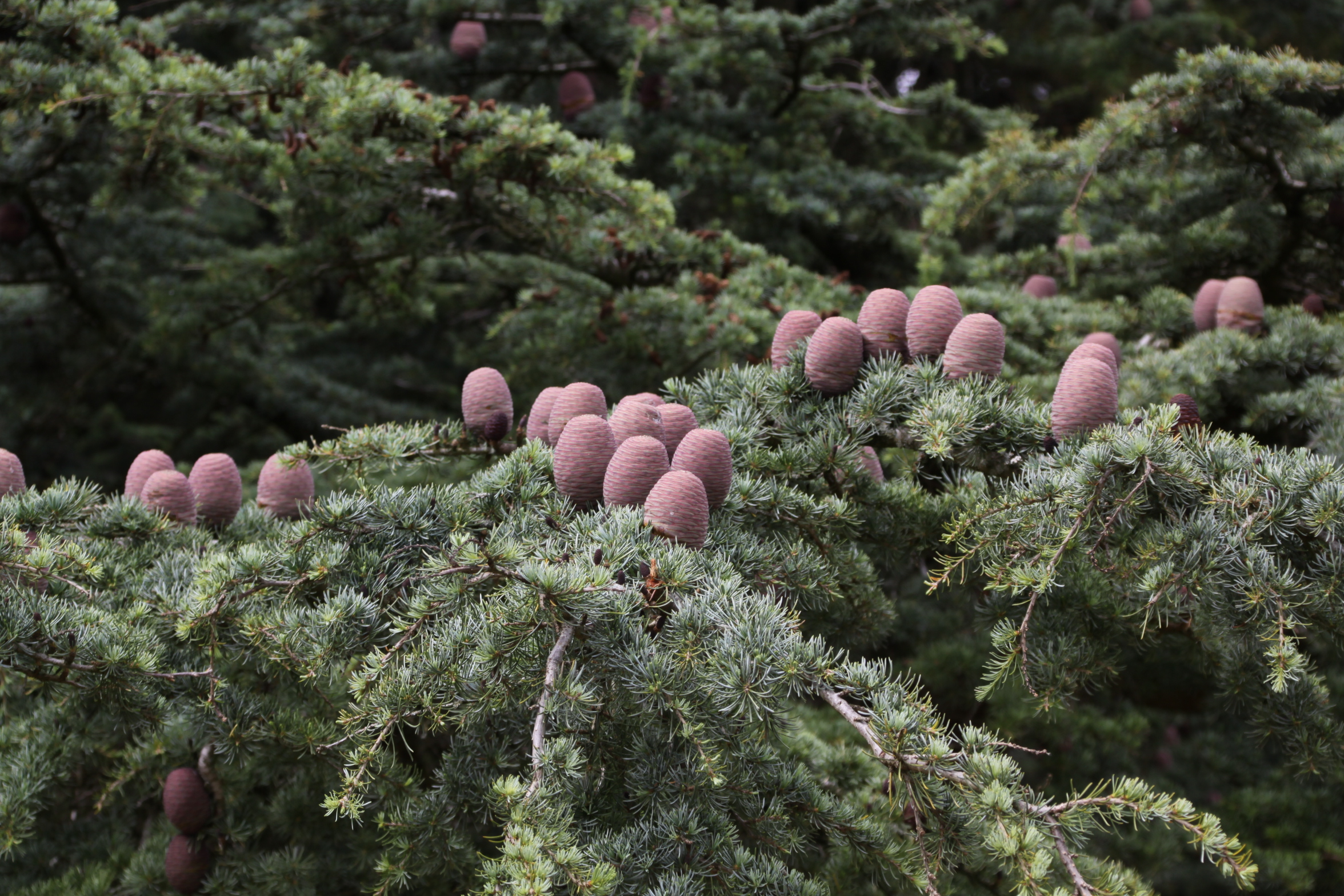
The trees, which in a traditional estate garden would be a narrow range of species dotted around parkland, such as at Chirk Castle, are far more closely spaced and include many varieties, and are an essential part of the garden landscape at Cholmondeley, a proper arboretum.  Dotted around are some enormous and gorgeous hydrangeas, and in one meadow, tellingly named Orchid Meadow, we spotted beautiful wild orchids (shown left).  In spring, the Tower Hill Woodlands contain a bluebell walk and plentiful rhododendrons, there’s a laburnum grove to the east of the Lavinia Walk and running along the line of the Ha Ha is a daffodil walk.

One visitor that we met said that he was disappointed that the once manicured grass on slopes and borders surrounding the main area was no longer being cut, and was being allowed to run wild.  He speculated that this was due to the rise fuel costs.  At the same time, it looked as though some areas were being redeveloped.  Like all managed gardens, whether big or small, they all undergo change as new ideas are incorporated or new needs have to be accommodated.

There are details of some of the species to see on the Cholmondeley Castle Gardens website on The Gardens page.  Something that looked like giant rhubarb (and I do mean giant, shown on one of the above photos around the lake) with thorny stems turns out to be Brazilian giant-rhubarb or, more formally, Gunnera manicata.  I was particularly pleased to find that the row of trees that flanked the drive just as we approached the car park were identified on the website: Tibetan Whitebeam, or more formally Sorbus thibetica ‘John Mitchell’ (which has an RHS Award of Garden Merit).  It is quite sensational with large oval leaves, light green on one side and almost white and slightly furry on the other.  We missed both its flower (spring) and fruit (autumn) but even without either they were still very eye-catching.

As you drive in to park up, you pass a sizeable lake, and there are additionally lakeside walks, as well as a picnic are and children’s play area, all accessible from the main car parking area.  From the tearoom, the drive continues behind the castle, and a 20 minute walk away is the St Nicholas Chapel.


Visitor Information

The opening times and ticket prices are updated on the Cholmondeley Castle Gardens on the Your visit page.  It is not particularly well sign-posted so I would suggest that you either prepare in advance or use GPS.

We were handed a very useful map on arrival, shown left,  which ensured that we did not miss anything of the gardens, and which also shows potential disabled access.  My creased copy is shown left, but you can download a pristine copy from the Cholmondeley Castle Gardens website here.

Parking is at a field on the approach to the castle.  Disabled parking is at the tea room, which can be reached by continuing past the main parking zone, along the lane and through the stunning white gates to the tea room and the disabled parking is behind the tea room.

The tea room itself was  overwhelmed with visitors when we were there, and was unimpressive.  It was a hot day and as well as being airless and steaming inside the tea room, the girl on the ice cream counter could not take payment, so customers had to take their rapidly melting ice creams and stand at the end of the queue for drinks and meals to pay for them, which took some time.  It was all a bit of a sticky, disorganized mess.  On the other hand, the outside seating, on the usual wooden tables with attached benches, located in both sun and shade, with views over the garden and towards the ornate gate, was very pleasant.

If the weather is nice, I’d opt for a picnic on a groundsheet under the garden’s trees, which several people were doing, overlooking the water.  It all looked like a very mellow option.

I am not sure how friendly the gardens are to wheelchair users and those who have any difficulty walking. The map shows metalled lanes and gravel parks that are in theory friendly to both, but if you want to see the main attractions of the gardens there are some gradients and stairs that might pose problems or, should you be looking for ways round, may be difficult to circumnavigate.


Farndon milepost of 1898

I’m still collecting mileposts that are found along the Chester to Worthenbury turnpike (about which I have posted in two parts, starting here).  The mileposts post-date the original Chester to Worthenbury ones, of which none survive, but they are still a lovely bit of heritage  When I originally wrote the piece, it was in the middle of summer and although I set off confidently with a map that marked the location of the surviving 1898 mileposts, I could only find two of them.  Since then I have been finding them and adding them to a post about the 1898 mileposts.

This is one that I wasn’t looking for, because it is not on the official Chester to Worthenbury turnpike.  I spotted it out of the corner of my eye on a rare occasion when I was driving through Farndon along Barton Road, and this was only because the bridge was closed and I found myself driving through Farndon to get onto the bypass.  The exact location is, using What3Words: ///warned.tower.mascots, which you can see on a map at https://what3words.com/warned.tower.mascots.

I remembered it a few days ago and went back to photograph it.  Many thanks to whoever does such a splendid job of sculpting the hedge behind it so that the whilst the hedge still looks great, the milepost is perfectly protected and easy to spot, and looks absolutely super.  If only they were all so well cared for.

I’ve added it to my post about the other 1898 mileposts in this area, which I am happily continuing to find new mileposts for.


New Chester Walking Tour: Women of Chester

Chester Visitor Information Centre. Source: Experience Chester

On the Chester Heritage Week’s tour of the Medieval features of Chester Cathedral by Nick Fry, Green Badge tour guide Katie Crowther was in attendance and mentioned that she was leading a new weekly tour themed around Cestrian women, “Women of Chester”, bookable in person in the Chester Visitor Information Centre.  So on Sunday 3rd July at 1130, I presented myself punctually to join the hour-long walking tour outside the Visitor Information Centre, geared up for sun, cold, and/or rain.  Although slightly cool, it stayed dry and it was a very good day for an outdoor walk.

The Green Badge is only awarded to Chester tour guides after a lengthy course and a tough practical exam, so is a good indication that you’re in safe hands.  Katie is one of life’s natural communicators, avoiding any temptation to swamp visitors with paralyzing volumes of data, and instead delivering an information-packed and enjoyable tour in an entirely digestible and memorable way.

The introductory talk took place midway between the Visitor Information Centre  (itself incorporated into the 19th Century Town Hall), behind St Werburgh’s Cathedral, with a randomly placed Roman column in view.  It was a well-mixed architectural locale for the enormously helpful potted history of Chester, providing the key chronological framework onto which the rest of Katie’s narrative was neatly hooked.

Tombstone of Curatia Dionysia

This is not a tour about famous women married to famous men at the top of Cestrian society.  Nor is it a feminist agenda.  Instead, it is part ancient history, part social history, delving into how political, cultural and economic life shaped the lives of women who, in turn, responded to the drivers of Chester life in different ways.  In short, the tour has tentacles that reach into most parts of Chester’s rich and varied past.  As well as looking at women who, in sometimes surprising circumstances, have performed conspicuous and/or leading roles in Chester life, the tour also looks at those who fell foul of religion, convention and tradition, and suffered for it.  

Roman women are the earliest to be recorded in any detail in Chester, and are particularly visible on Roman tombstones, representing the upper echelons of Chester’s Roman society, those who experienced the most comfortable contemporary life.  By contrast, a horribly unfortunate woman accused of witchcraft in the 17th century suffered terrible conditions in the local prison whilst others were burnt at the stake. 

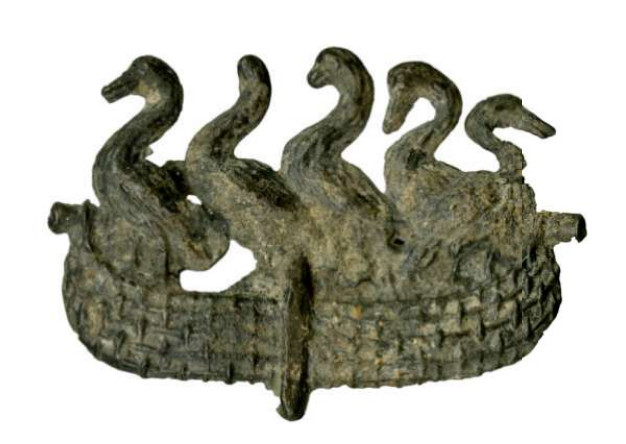
St Werburgh pilgrim’s badge. Source: British Museum

Two of the earliest women who are known to have played a pivotal role in Chester’s history, were Anglo-Saxon.  It is remarkable that the revolutionary diplomat and strategist Aethelflaed (c.870-918), daughter of Alfred the Great and wife of Aethelred, Lord of Mercia, is so unrecognized in Chester that almost no mention of her is made.  She came came to Chester during the illness of her husband to take on a critical role in the defence of Mercia against the Vikings here, and was remarkably successful.  The second Anglo-Saxon name that is intimately tied to Chester is St Werburgh, who died in about 699.  Her remains were brought to Chester Hanbury in Staffordshire at some time between 875 and 907 by the aforementioned Aaethelfaed, raising the profile of Chester as an important Christian centre and destination for pilgrimage.  Chester Cathedral is still dedicated to her.

Sylvia Brown. Source: CheshireLive

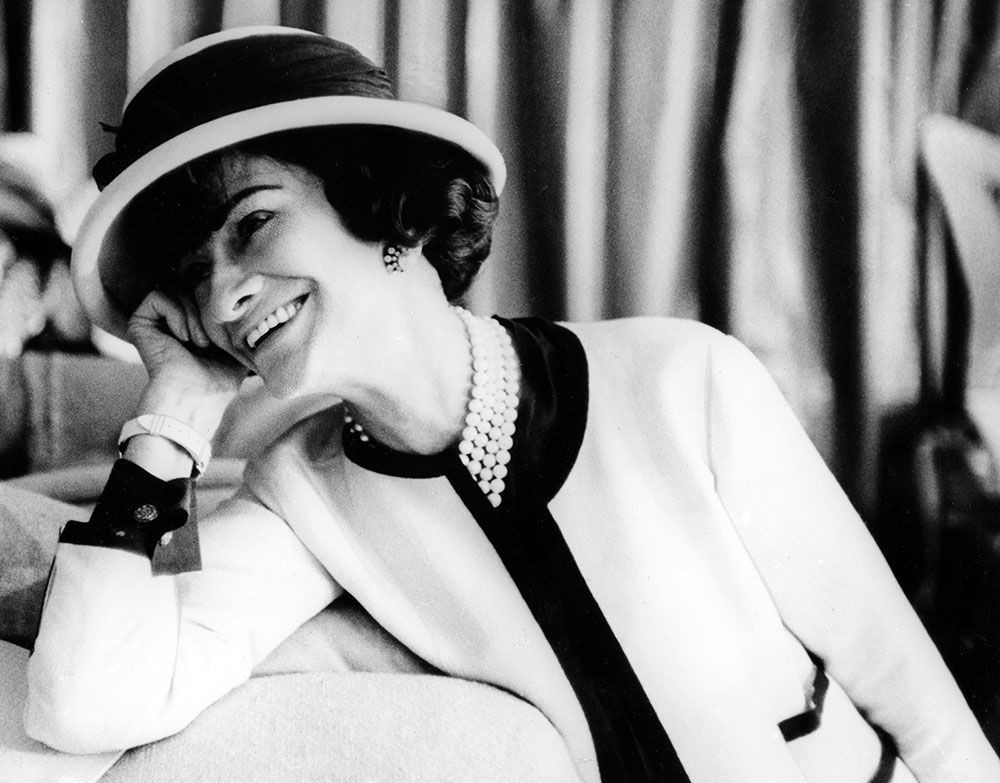
Amongst some of the many other women of Chester with great stories was one who kept an evocative record of what it was like to be under siege within the walls during the civil war; an 18th century pioneering commercial and retail entrepreneur; a mayor; a sheriff and two women who lost, respectively, three and four sons in the Second World War.  Of course, Queen Victoria visited, and a famous Chester landmark is dedicated to her, although there is kink in the tail of this story that raises a smile.  Suffrage and music hall provide equal, if more than slightly contrasting examples, both of women’s attitudes and of attitudes to women. Coco Chanel adds more than a touch of glamour to Chester’s story.  Sculptress Annette Yarrow’s life-size female elephant calf called Janya is a fun way of highlighting the connection between the city and Chester Zoo and is a great presence.  For those of us living in Churton, there is even a link to Churton Lodge!  I won’t repeat any of the specifics, partly because I couldn’t possibly do justice to all the information imparted (particularly some of the funnier stories), but also because it would spoil the experience.

The walking tour ranges freely around Chester within the city walls, going up on to the walls for a chunk of the talk, and taking in a number of both famous and lesser known sites along the way.  We also walked through the town, which retains the original Roman plan and in turn gave definition to the Medieval and modern town.  As well as describing women in terms of Chester, and Chester in terms of the women who, though often invisible, helped to define it, the tour gives an excellent sense of the variety of architectural styles, old and new, and the use of space within the walls.  Again, I won’t spoil the experience by saying which sites we visited or why, but there is something for everyone in the tour.

In terms of accessibility for those with unwilling legs or with wheel chairs or push chairs, there are disabled and wheeled options that avoid stairs.  If your legs are fairly co-operative but hesitant, the number of staircases you have to tackle is minimal, with a couple of short flights of stairs up to and down from the city walls and the rows, all with good banisters to hold on to.   If in doubt, ask on the day, and the guide will sort out either wheel-friendly or leg-friendly options.  Apart from some slightly uneven pavements and the cobbled abbey square, there is nothing more challenging to tackle.

Coco Chanel. Source: medium.com

The “Women of Chester” walking tour is well worth an hour on a nice quiet Sunday, with lots of other places to visit afterwards to turn it into a day out.  The tour offers a different slant on Chester’s history and it takes you to some interesting and sometimes unexpected parts of Chester’s heritage.  The entire group of us, leaning perilously over a section of city wall to achieve a good view of a section of the wall immediately below us that had been rebuilt using Roman tomb stones, must have been a most peculiar sight!  Some of those wonderful carved tomb stones, rescued in the 19th century, are now in an excellent display in the Grosvenor Museum.

It was a good outing, with a lot to make us smile.  

The “Women of Chester” walking tour has been  developed by three of the Green Badge guides, shown in the photograph to the right, and they take turns to guide this tour, so that each of them usually only delivers it once in every three weeks, ensuring that for each of them the material remains fresh.  As new information is discovered it will be incorporated into the tour, meaning that it will be updated over time.  At the same time, women who made a mark on Chester are being incorporated into a new database that it is hoped will provide a foundation for future research projects.

You can follow the Green Badge tour guides on Twitter at @visitchester and you can ask for more details about the Women of Chester tours on Twitter at  https://twitter.com/WomenofChester


An impressive exhibit of decorated Roman tombstones in Chester’s Grosvenor Museum

Introduction

Chester’s role as an important Roman military headquarters surrounded by a growing settlement, known as Deva, is very well understood, but there is not a great deal to see on the ground.  This means that Chester’s Roman legacy is largely preserved in excavated archaeological remains, some of which are on display in local museum spaces.  There is a small gallery of Roman objects in the Grosvenor Museum in Chester showing a wide variety of artefact types, from elite pottery to drainage pipes, but to display some of the large number of Chester tombstones, a special exhibition space was was created for them in a dedicated room in the museum, showing them off to great effect.

The display opens with a Roman style couch under a canopy, setting the scene for a walk down a path between the tombstones, emulating one of the Roman roads heading out of Deva.  The walls behind the tombstones capture the sense of the surrounding landscape, part military installation, part civilian settlement, and part rural vistas.  The tombstones are organized either side of the “road,” each one facing out towards the visitor.  Low level information boards, great for wheelchair users and children, show useful illustrations of key examples, together with translations of the texts.

In the discussion of tombstones below, each example is accompanied by an RIB (Roman Inscriptions of Britain) number.  Each inscription in Britain has been given a unique number.  When I was at university studying the Antonine Wall, the Roman Inscriptions In Britain were recorded in print, but this was obviously the sort of content that was best suited to a database, and one of the best online resources for Roman Britain is Roman Inscriptions in Britain online.  As a resource it has been developed and expanded, and the user interface is excellent.  If you want to know more about any of the tomb stones mentioned below, this is a great place to start, with translations, illustrations and further references all available.

Burials and memorials

Altar RIB 3149, found at the Chester amphitheatre

The Romans disposed of their dead in a variety of ways that included both inhumation (deposition in the ground) and cremation.  Wealthier Roman inhumation burials in Britain were traditionally accompanied by this sort of memorial, and might include tomb stones and commemorative slabs.  In terms of how they were used, tombstones are much like the grave stones and chest-like tombs found in Christian churchyard cemeteries today, but dedicated to different deities and with far more elaborate scenes depicting the owners of the graves engaged in activities that showed them in activities that they enjoyed, or which highlighted particular qualities.

Collectively, these memorials are a useful source of information about Roman life and death in Britain, but individual memorials also have the potential to tell their own stories about the owners, the way in which the owners wanted to be remembered and the ideas with which they wanted to be associated.  Although the Grosvenor Museum’s display primarily features tombstones, there are some altars too.  Altars could be found in similar contexts, but might also be found in homes, public buildings and at religious sites.  The above example from the museum’s exhibit, RIB 3149, was found in a room behind the amphitheatre arena’s wall during excavations in 1966, and reads, in translation, “To the goddess Nemesis, (from) Sextius Marcianus, centurion, in consequence of a vision.”

Roman cemeteries

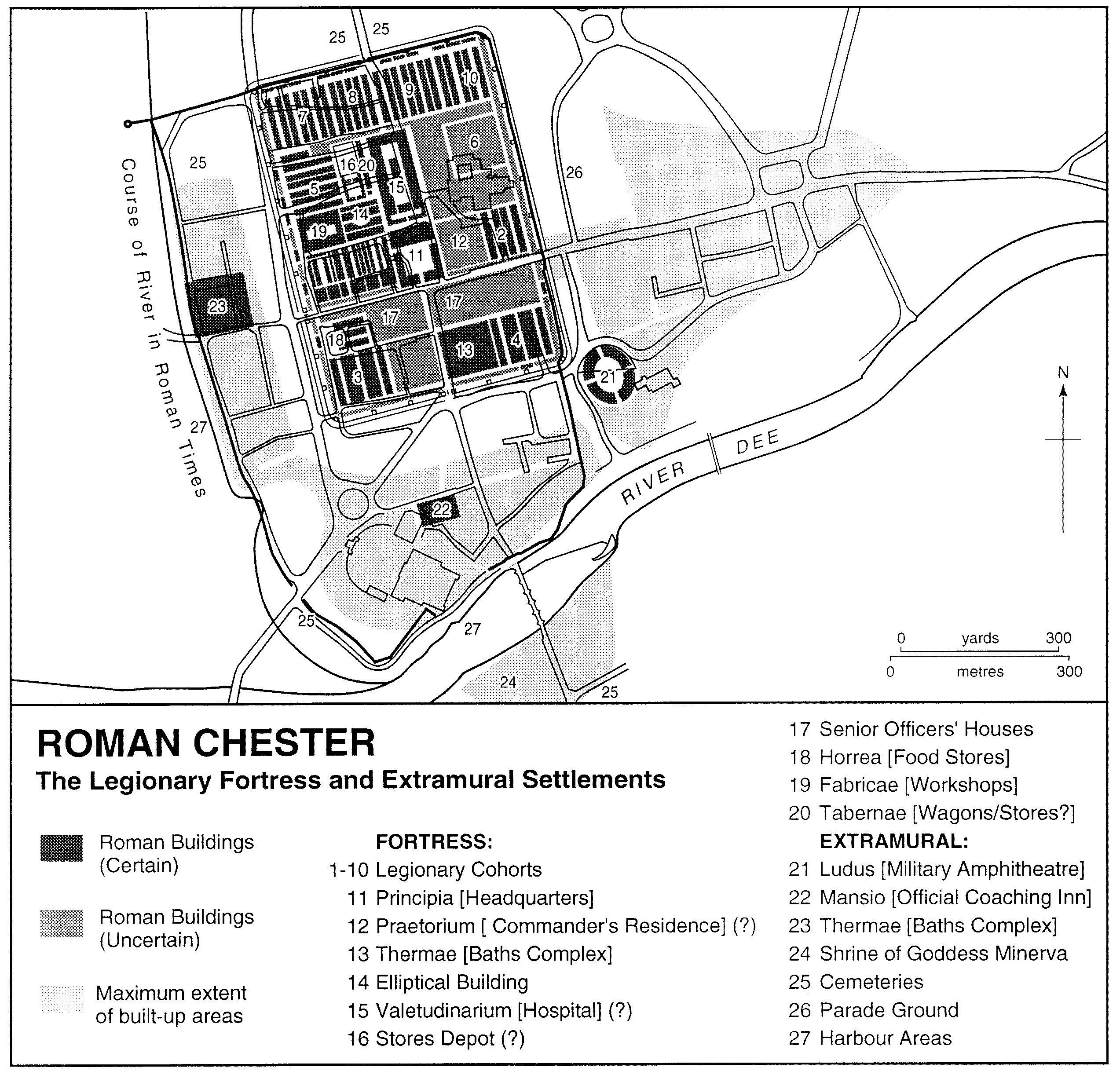
Roman Chester with modern roads superimposed (click to enlarge). Source: British History Online

The area around the fortress was under military control and the location of the cemeteries was decided by the Praefectus castorum (camp prefect), who decided where civilian quarters and various facilities were to be located.  Roman law was very strict on the matter of refusing burial with in urban and residential areas.  Roman cemeteries were built outside towns and cities, and depending on the size of the urban centre there might be a number of them.  The earliest tombstones and altars were erected along the sides of roads, but more formal cemeteries would have been established over time.   These will have been destroyed as Chester spread out in all directions during subsequent centuries.  Most of the stones in the museum, sculpted or inscribed, or both, had therefore originally come from one or more Roman cemeteries, and were probably dumped somewhere together to make space for urban spread.

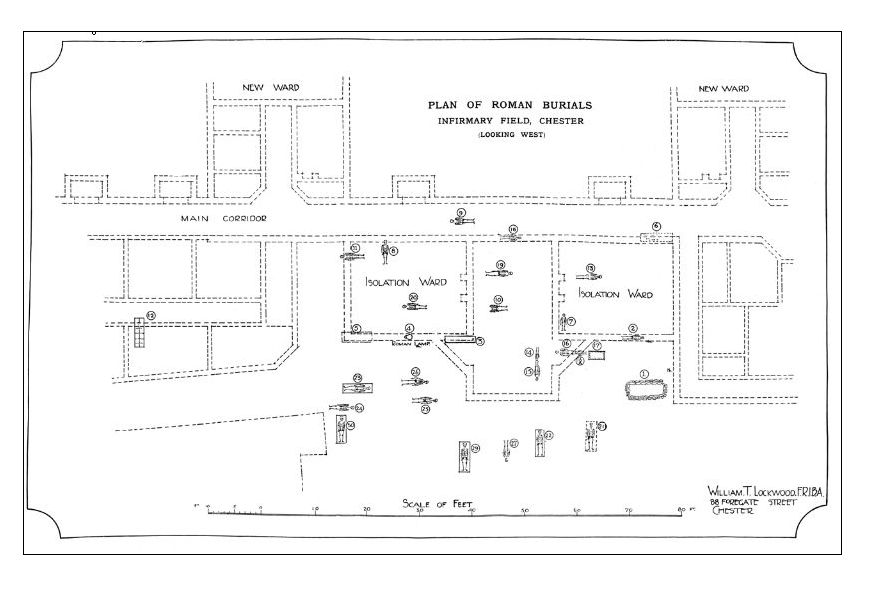
Plan of part of the Infirmary Field excavation. Source: Chester ShoutWiki

One cemetery was revealed during rescue excavations carried out between 1912 and 1917 by Professor Robert Newstead.  It was located at Infirmary Field to the west of the fortress, the site of a planned new wing for Chester Royal Infirmary.  The presence of a possible cemetery  had been known since the mid 19th century due to the discovery of burials adjacent to the Infirmary in 1858 and 1863.  During his excavations Newstead found that the cemetery contained men, women and children who, judging from the objects in graves, were both military and civilian.   

The tombstones in the walls

Section of the Chester City walls thought to be Roman, sitting on bedrock above the canal.

The high sandstone walls that surround the city of Chester were originally established in the Roman period, but were built upon in subsequent periods to repair damage and to raise the overall height of the walls.   There are only a few places where Roman phases can be clearly identified with confidence, such as that shown on the right.  The repair of the walls over time incorporated both newly quarried stone, and whatever stone was lying around from earlier collapses.

Although tombstones and altars are known from various locations around Chester, most of the Chester tomb stones in the Grosvenor display are from a cache found incorporated into the Chester city walls, completely divorced from their original funerary context, but would once have come from one or more cemeteries. The re-use of ancient building materials is common the world over.  In ancient Egypt, the Pharaoh Horemheb re-used painted blocks from palace buildings of the heretic Pharaoh Akhenaten as rubble fill to create the thick walls of his monumental gateway at the temple of Karnak on the Nile.   In both the Chester and Karnak cases, these items used as building materials have enormous historical value to us today as information about the past, but were simply unwanted rubbish when they were employed as building materials.

Plate A from Cox’s publication of his excavations in 1891

In 1883 the Chester City Surveyor Mr Matthew Jones was overseeing repairs to a section of the lower courses of stonework in the walls and the fill behind them near to Morgan’s Mount.  As they prepared the site for the work he realized that he was looking at pieces of Roman stonework and that one was clearly part of a tomb stone, and he retrieved what he could see.  Although no further investigations were carried out in1883, further repair work was required in 1887 between Northgate and the King Charles Tower, this time rather more extensive, and more Roman funerary pieces were found.  Again, they had been used to repair the lower courses of the wall.  So many were found this time that it was decided to extend the work and locate more of Chester’s Roman heritage.  The Chester Archaeological Society, founded in 1849 (and still going strong today), was brought in to supervise the investigation of the wall to the west of the Northgate between 1890 and 1892.  Taking all the finds from 1883, 1887 and the 1890-92 excavations, more than 150 stones were found, of which the Grosvenor exhibit is a tiny sample showing some of the best of the examples.

Key features of tombstones

Tombstone of Flavius Callimorphus and Serapion. RIB 558

The earliest tombstones and altars known from Chester date to the 1st century.  For example, the tombstone of Flavius Callimorphus showing him with his son or nephew Serapion (aged 42 and 3 ½ years old respectively) was discovered at the Roodee in 1874, in situ over a grave, and was erected by Flavius’s brother Thesaeus (RIB 558).  These are Greek names which may indicate that they were freedman and/or traders who had settled in Chester.  Flavius is shown reclining on a funeral couch, and the elaborate nature of the decoration indicates that this was a wealthy family.  Within the grave were two skeletons accompanied by a gold ring and a coin of the emperor Domition, dating to the latter half of the 1st Century A.D.  Callimorphus and Serapion, the former lying on a couch with the latter in his arms, shown in the photograph to the left.  On a small table in the foreground is a bird, which is a metaphor for the journey into the afterlife.  Next to the table is an amphora that may or may not suggest that Callimorphus was an importer of wine.  Although it is speculation that he was a wine importer, the family names indicate that they were of eastern Mediterranean origin, where Greek was preferred to Latin, and could well have been traders who settled locally.  The name Serapion is of particular interest, as it refers to the god Serapis, who was venerated during the Ptolemaic (Greek) and subsequent Roman occupation of ancient Egypt.

Altar from Watergate Street. RIB 445. Source: British Museum BM 1836,0805.1.

Amongst other Roman finds, a 2nd Century A.D. stone altar was found in lower Watergate Street when Georgian terraces were built in 1778.  It was dedicated to Fortuna Redux (Fortune, who brings travellers home safely, including soldiers and traders) and gods of healing and health Aesculapius and Salus.  It was raised by freedmen and slaves of a Roman imperial legate, perhaps a provincial governor, who has the longest recorded name in Roman Britain:  Titus Pomponius Mamilianus Rufus Antistianus Funisulanus Vettonianus.  This is the only example shown here not on display in the Grosvenor Museum. It is now in the British Museum (BM 1836,0805.1; RIB 445)

Nearly all the memorials on display in the Grosvenor are made of red sandstone.  The quality of the stone chosen was important, both for engraving scenes and text, and for durability.  The raw material selected was not the most locally available sandstone, but according to Wilding was sourced some 8 miles away where better quality red sandstone was available.

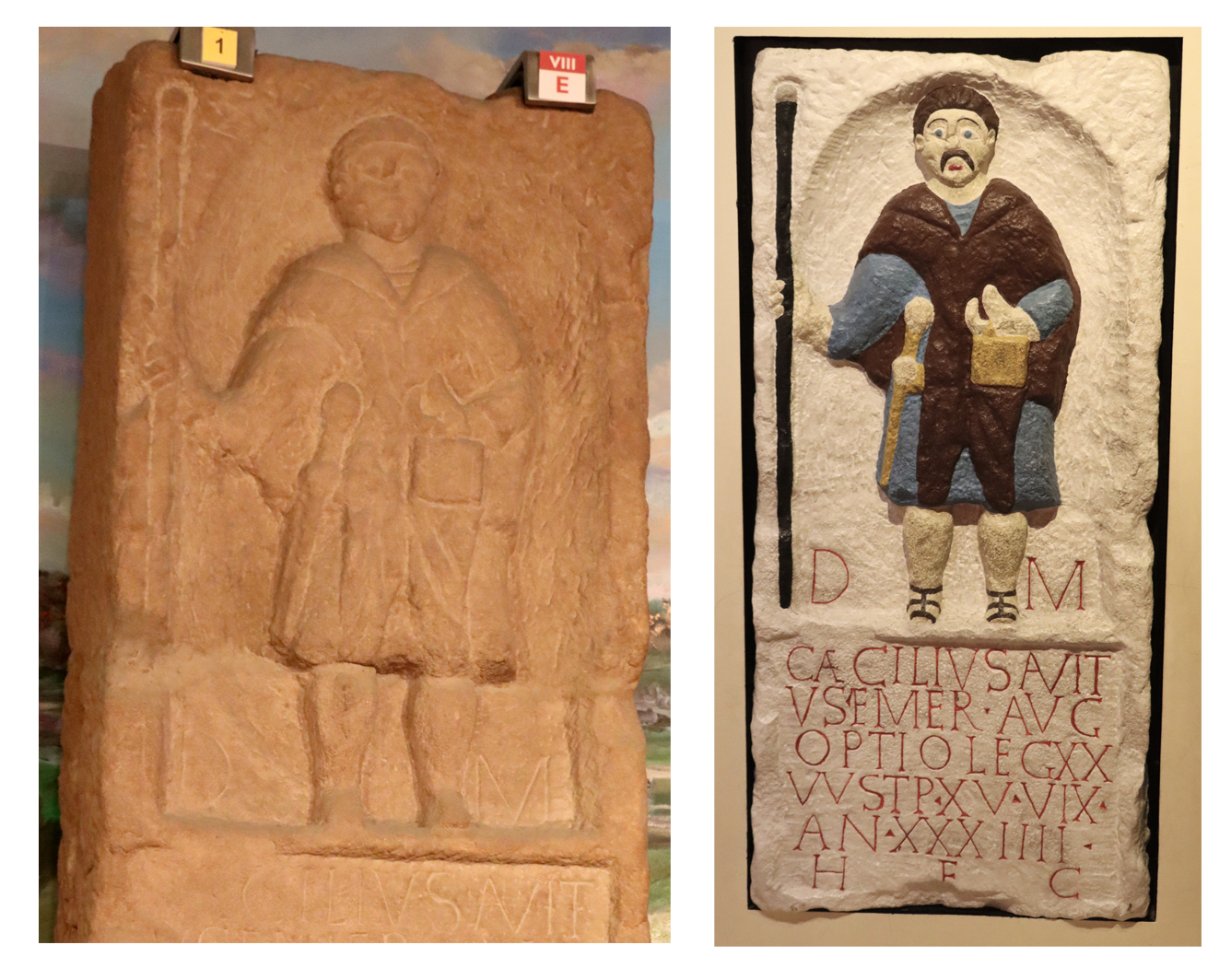
The tombstone of Caecilius Avitus, RIB 492. On the left is the original as it was found. On the right is the replica with its bright paint, both on display in the museum.

The stones would originally have been brightly painted, which is a strange thought.  A cemetery would have been a colourful place, new memorials brighter than older ones, creating a dazzling visual spectacle.  At the entrance to the Grosvenor Museum exhibit there is a facsimile of one of the Chester grave stones showing how it might have looked in full colour, and when compared with the original unpainted version that is also on display, it is a completely different entity.  It shows an optio (junior officer who was an accountant-adminstrator, second in command to a centurion) called Caecilius Avitus, wearing a cloak, a staff of office, a legionary sword and  a writing tablet (RIB 492).  It is like seeing the Lady Chapel in Chester Cathedral, painted to show how it would have looked in the Medieval period, or the glorious 17th century decoration of Rug Chapel at Corwen, near Llangollen, both of which are similar eye-openers, revising how we look at past objects and architecture.  To modern eyes, so accustomed to seeing the past in subtle monochrome, the bright paintwork of Caecilius’s tombstone is almost shocking, but Roman life was anything but dull, either at work or at play, and the colours of the stones reflected this multi-hued existence.

Between the moment of death and the burial itself there were ceremonies, rituals and processions that marked the transition from this world to the next.  For the very rich, this could be ostentatious and elaborate, involving music and theatrical performances, but for the poor it was a much more mundane affair.  Often a Roman might provide for their funeral in his or her will, but if not the responsibility fell to the person who inherited the rest of the property of the deceased.  When the deceased was buried, graves could be visited by the living, and at the end of February during the Feralia festival offerings were made to dead ancestors at their graves.

Tombstone of Curatia Dinysia. RIB 562, described below

Popular themes on the Chester tombstones are dedications to certain deities, symbolism surrounding the afterlife and depictions of the deceased lying along a banqueting couch.  Reclining on a couch was a popular eating position used by wealthy Romans, and the couch represents a banquet in the afterlife, indicating eternal wellbeing.  Some objects in scenes may hint at the profession of the deceased.  Where an inscription is included, in Latin, the names can give an indication of the origins of the individual.

Text on tombstones is always highly abbreviated, which would not have been a problem for literate contemporaries (or for researchers today) because the abbreviations were standardized and the texts were highly formulaic.  Many of the inscriptions begin DM, standing for Dis Manibus (To the spirits of the departed), and finish HFC, standing for Heres Faciendum Curavit (the heir had the stone made). The heir often adds his or her name and relationship to the deceased.  Between these topping and tailing devices there may be additional information about who died including, for example, the name of the deceased, the age at which they died, who erected the stone in their honour, the place from which the person originated, the role that the person performed, a legion or auxiliary unit in which a soldier served and the number of years for which he served.

The Grosvenor Museum tombstones

Showing some of these features is a woman reclining on a couch, framed within two columns and an arch. She is shown in the photograph immediately above.  Her name is Curatia Dinysia (perhaps a mason’s error for the name Dionysia), holding a drinking cup, with a three-legged table in the foreground (RIB 562).  Sadly the head and face are damaged. She sits between two garlands or swags of ivy leaves, sacred to the deity Bacchus, each of which supports a dove, signifying the release of the soul.  Above this scene, incorporated into the architecture of the arch, are two tritons (half men, half fish, like male mermaids, but sometimes shown with horse forelegs) blowing trumpets, representing the journey to the Isles of the Blessed where Bacchus resided.  The drinking cup, probably filled with wine, may also reference Bacchus.  As with Calimporphus and Serapion, the name Dinysia/Dionysia is  thought to be Greek.   The inscription reads, in translation, “To the spirits of the departed, Curatia Dinysia lived 40 years; her heir had this erected.”

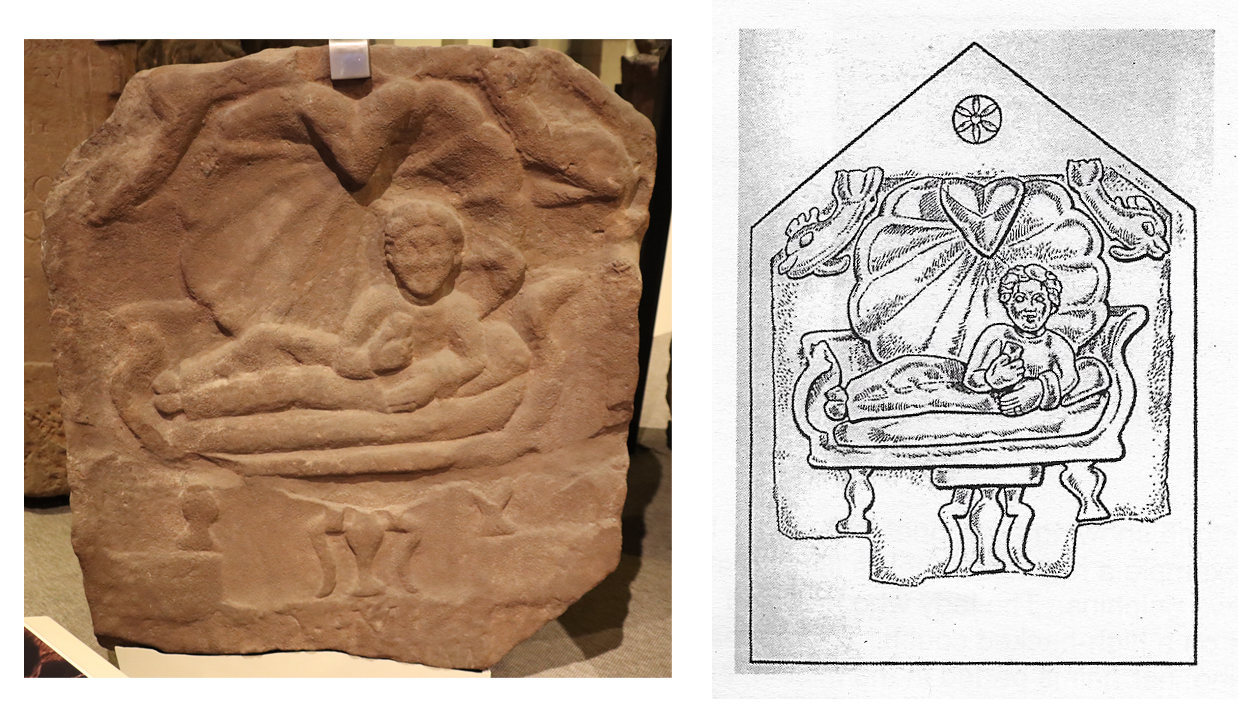
The illustration on the right is by Dai Owen (Grosvenor Museum 2010)

Another woman is shown on a very worn tombstone, also cleverly recreated by illustrator Dai Owen (RIB 568).  The woman’s name is damaged, but ends “-mina”  She reclines on the banqueting couch with the familiar three-legged table in the foreground, a drinking cup in hand and a ring on the little finger of her left hand.  Most remarkably, behind her, on the the high-backed couch, is a giant sea shell flanked by dolphins, again a reference to her journey to the Isles of the Blessed.  Only part of the inscription has survived, with the DM of Dis Manibus (to the spirits of the departed) legend just beneath the three-legged table, and the end of the lady’s name just below that at far right.

Tombstones featuring women are usually found in this sort of military context, where many were wives, (more rarely mothers or daughters) of soldiers, and could communicate their own status alongside their husband’s, making statements about their own identity.  It is good to have these as they are a distinct minority. Allason-Jones, for example, estimates that inscriptions dedicated to women make up only around 10% of the total inscriptions found in Roman Britain.  These represent only the middle and upper echelons of those living in Roman areas.  As with low status men, those women who could not afford any form of memorial have been lost.

The auxiliary cavalryman (equitis) Aurelius Lucius, who has a Latin name, but was probably not of pure Roman origins is an interesting case (RIB 552).  Aurelius is shown with a moustache, beard and big hair.  Again, he is reclining on a couch, and like Curatia Dionysia, he holds a drinking cup in one hand, whilst in the other he holds a scroll of paper that represents his will.  Behind his legs are his plumed helmet and the top of his sword, and in the foreground is a small three-legged table and a boy holding a detached head.  Auxiliaries were often recruited from conquered lands and were not Roman citizens.  After 25 years in service they could apply for Roman citizenship. The uncharacteristic hair and the severed head, perhaps a war trophy, may refer to a background from one of these conquered regions, but Aurelius also chose to depict himself in a traditional Roman pose, with a traditional Latin inscription.  Perhaps he had become a citizen, incorporating his career as a foreign cavalryman but opting for a Roman afterlife.

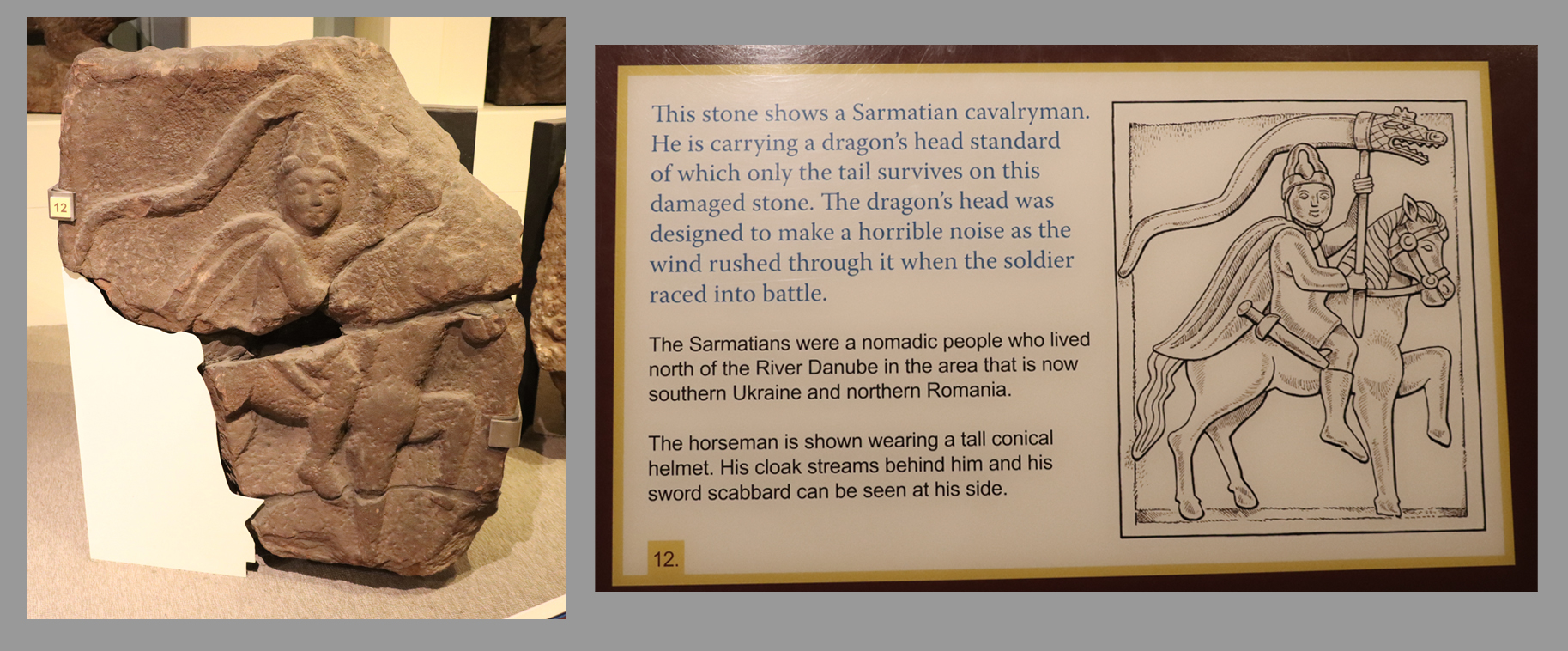
One of the most remarkable of the Grosvenor’s tombstones is this rider on a horse carrying a flying standard.  It is thought to represent a a Sarmatian from an area now occupied by southern Ukraine and northern Romania.  The Sarmatians were nomadic hunters and pastoralists, excellent horse breeders and riders and formidable warriors.  No inscription survives, but he was almost certainly an auxiliary, as the Sarmatians were conquered in AD 175, and some are known to have been present in Britain.  Although none are known from Chester, there were Sarmatians in a regiment deployed at Ribchester in Lancashire, and it is not unlikely that a detachment of that regiment was present in Chester when this individual died.  The tall helmet is distinctive, and he holds a standard which he holds in both hands.  If he was indeed Sarmatian, this would have been topped with a fearsome dragon’s head with brightly coloured fabric flying to its rear.  When wind ran through the dragon’s jaws at speed, it made a terrifying noise to put fear into the hearts of the enemy.  His sword is in its scabbard at his side.

Another cavalryman is depicted on a scene that has lost its inscription, other than the letters DM (Dis Manibus) (RIB 550).  It is very worn, and the top of the head and the hand (and whatever it is holding) are missing but the scene is full of energy.  The horse, with its bridle and a blanket serving as a saddle clearly visible, is galloping with its mane blown back, and the rider’s legs hold tightly to its flanks.  The rider’s right arm is raised above his head, probably holding a spear, whilst his left hand, hidden from view, holds the rein or the bridle.  Trodden beneath the hooves of the horse is a naked victim who lies gripping a six-sided shield that has demonstrably failed to protect him.

Marcus Aurelius Nepos and his wife. RIB 491

A rather more domestic scene is provided by Marcus Aurelius Nepos and his wife.  The stone is right at the rear of the exhibit, and the inscription is difficult to see (it was not particularly clearly engraved in the first place) and is confined to the left, beneath the figure of Marcus Aurelius, centurion of the XXth Legion Valera Victrix, who died aged 50 years old.  There is a space beneath the figure of his wife for an inscription, but for reasons unknown this was never added.  As it was she who commissioned the stone, she was clearly still alive when the carving was made and may have left the space for an inscription of her own when she herself died, but perhaps she died elsewhere.  Marcus Aurelius is bearded, carrying a staff and has a prominent belt, a cloak over his shoulders with a small brooch attached.  His wife is holding a cup, and lefts the hem of her dress with one hand to reveal the skirt beneath.  Not visible in the photograph is an engraving on the side that shows a mason’s hammer and set square and the words SVB ASCIA D[edicatum], meaning “dedicated under the axe,” perhaps a formula to deter vandals. The tombstone dates to the 3rd century AD.

RIB 560. Tombstone of the child slaves Atilianus, Antiatilianus and Protus

The tombstones with elaborate or contained scenes are plentiful, but are still a minority in the context of British funerary memorials, representing only the most wealthy purchasers. Some tombstones merely showed a little decorative work to accompany the text.  This example (RIB 560), although still very fine, was provided with ornamental features but no elaborate scene.  It was dedicated by a master to three young slaves.  It reads, in translation, “To the spirits of the departed, Atilianus and Antiatilianus, 10 years old; and Protus, 12 years old.  Pompeius Optatus their master had this made.”  It is possible that the 10 year olds were twins. Although the thought of slavery always sits uncomfortably in today’s world, it should not be forgotten that in a period when slavery was the norm, it was by no means uncommon for masters and slaves to develop relationships of mutual affection and respect.  Perhaps that is what we are seeing here.

sdffsa

Final Comments

Architectural detail showing a male gorgon, with four snakes emanating from each side of his head.

The tombstones described above represent only a a small sample of the total number of engraved stones preserved from Chester.  Of those that were not tombstones, some were pieces of altars and others were fragments of bigger pieces of architecture, many of which also came out the 19th century excavations in the Chester walls, some showing Roman deities.  They are out of the scope of this post but, do watch out for those too in the display if you visit the museum.

The tombstones are particularly evocative and hopefully the small sample provided here gives an idea of what sort of themes were common, and how people like to have themselves depicted.  Death in the Roman empire was an integral part of a soldier’s life, and in the military life of Chester, death had its own role and its own places, with its own objects and iconography.  Most of the individuals represented here were of relatively high status, except for the slaves of their master Pompeius Optatus, but they came from a variety of backgrounds, all either stationed here or drawn here for commercial reasons by the military stronghold, and it is good to be able to see some of the variety that made up Deva society.

19th century illustrations from Chester Archaeological Society reports of the tombstones and other engraved stones excavated from the walls (click image to enlarge). Sources, left to right: de Gray Birch 1887, Watkin 1887, de Gray Birch 1888, Jones 1887, all in the Journal of the Chester Archaeological Society volume 2 (references below).

fdfsdfsd
For those who are interested in seeing something of Rome under foot in Chester, to supplement what can be found in museums, there are a number of guided tours available (some lead by Roman Centurions!).  If you prefer a self-guided tour, the Royal Geographic Society’s “Discovering Britain” website provides one, which can be downloaded as a a PDF or as an app for your mobile device: https://www.discoveringbritain.org/activities/north-west-england/trails/chester-trail.html.


Sources:

Those that were of particular use for this post are shown in bold

Books and papers

Allason-Jones, L. 2012.  Chapter 34, Women in Roman Britain. In (eds.) James, S.L. and Dillon, S. A Companion to Women in the Ancient World. Wiley

Bell, C.E. 2020. Investigating the Autonomy of Power: Epigraphy of Women in Roman Britain. Dissertation Submitted for the Master’s Degree in Archaeology, University of Liverpool
https://www.academia.edu/44879704/Investigating_the_Autonomy_of_Power_Epigraphy_of_Women_in_Roman_Britain

Brock, E. P Loftus. 1888) The age of the walls of Chester, with references to recent discussions; The discussion on the above paper; Mr Brock’s reply to the various speakers. Journal of the Chester Archaeological Society 2. Vol 2, p. 40-97.
https://archaeologydataservice.ac.uk/archiveDS/archiveDownload?t=arch-2910-1/dissemination/pdf/JCAS_ns_002/JCAS_ns_002_040-097.pdf

Cox, E.W. 1891. Notes on the sculptures of the Roman monuments recently found in Chester. The Historic Society of Lancashire and Cheshire, vols.43044, 1891-92, p.91-102

Eckardt, H. 2014. Objects and Identities. Roman Britain and the North-Western Provinces.  Oxford University Press

de Gray Birch, W. 1888. Notes on a sculptured stone recently found in the North Wall of the city of Chester. Journal of the Chester Archaeological Society 2. Vol 2, p. 25-39.
https://archaeologydataservice.ac.uk/archiveDS/archiveDownload?t=arch-2910-1/dissemination/pdf/JCAS_ns_002/JCAS_ns_002_025-039.pdf

de Grey Birch, W. 1888. The inscribed Roman stones recently found at Chester, during the second series of repairs to the North Wall.  Journal of the Chester Archaeological Society, vol.2, p. 98-131.
https://archaeologydataservice.ac.uk/archiveDS/archiveDownload?t=arch-2910-1/dissemination/pdf/JCAS_ns_002/JCAS_ns_002_098-131.pdf

Grosvenor Museum 2010. A Guide to Roman Stones at the Grosvenor Museum Chester. Illustrations by Dai Owen.

Henig, M. 2002.  Tales from the Tomb. In (ed.) Carrington, P.  Deva Victrix; Roman Chester Re-Assessed  papers from a weekend conference held at Chester College 3-5 September 1999.  Chester Archaeology
https://archaeologydataservice.ac.uk/archiveDS/archiveDownload?t=arch-2910-1/dissemination/pdf/CAS_DevaVictrix/CAS_DevaVictrix_075-078.pdf

Jones, I. Matthews. 1888. Official report on the discoveries of Roman remains at Chester, during the first repairs to the North Wall, in 1887. Journal of the Chester Archaeological Society 2. Vol 2, p. 1-10.
https://archaeologydataservice.ac.uk/archiveDS/archiveDownload?t=arch-2910-1/dissemination/pdf/JCAS_ns_002/JCAS_ns_002_001-010.pdf

Mason, D.J.P. 2007 (2nd edition). Roman Chester. City of the Eagles. Tempus

Thompson Watkin, W. T. 1888. The Roman inscriptions discovered at Chester, during the first repairs to the North Wall, in 1887. Journal of the Chester Archaeological Society 2. Vol 2, p.11-24.
https://archaeologydataservice.ac.uk/archiveDS/archiveDownload?t=arch-2910-1/dissemination/pdf/JCAS_ns_002/JCAS_ns_002_011-024.pdf

Wilding, R. 2006. Graham Webster Gallery of Roman Stones at the Grosvenor Museum, Chester: Explore the Hidden Mysteries of the ‘lost’ Roman Gravestones.


Websites

Roman Inscriptions of Britain (RIB)
https://romaninscriptionsofbritain.org/

Chester Archaeological Society
Professor Robert Newstead F. R. S. Lecture given to Chester Archaeological Society, 5th December 2009.  By Elizabeth Royles, Keeper of Early History, Grosvenor Museum
http://chesterarchaeolsoc.org.uk/wp-content/uploads/2016/11/LRoyles-NewsteadLecture_05-12-09.pdf

Roman Baths
You can decode tombstones at the Roman Baths, Bath
https://www.romanbaths.co.uk/sites/roman_baths/files/heritage/SECONDARY%20SCHOOL%20Decoding%20Roman%20tombstone%20leaflet_0.pdf

Encylopedia Britannica
“Sarmatian.” The Editors of Encyclopaedia, 29 Mar. 2018. https://www.britannica.com/topic/Sarmatian

Eaton Hall Gardens Charity Open Days 2022

My father and I booked for the open day on Sunday 26th June.  All tickets have to be booked in advance, both for the gardens and for the train a narrow gauge railway.  We skipped the train option so I don’t know what that experience was like (lots of children, I would imagine) but the gardens were superb, and in some ways unexpected.  Brief comments on practicalities for those considering July or August visits, in terms of parking, suitability for those with mobility issues etc, are at the end of this post.

The Eaton Hall Gardens are open to the public three times this year, the last Sunday in June, July and August, all in aid of three different charities.  If you are intending to go, but have not yet booked a ticket, I suggest you book immediately via EventBrite, as it sells out every year. I missed the chance last year.  The benefiting charities for the 2022 events are Cheshire Young Carers, Cheshire Wildlife Trust and Kidsbank.

We entered via the Belvedere gate just north of the Grosvenor Garden Centre on the old Chester to Wrexham road (the B5445).  It is an ostentatiously long approach to the property.  Just in front of a gigantic obelisk is a checkpoint where you show your tickets.

Young RAF Air Cadets were on hand everywhere to direct traffic and answer questions, and did an absolutely splendid job of keeping the traffic moving.  Once we had followed their directions and parked in a field (but see my notes on disabled access at the end), and walked up towards the estate buildings, you pass through a gate where your tickets are checked again.  Here you are handed a leaflet about the charity being supported, and another highlighting garden features that you might want to visit by head gardener Jan Lomas, with an excellent map on the back showing the locations those features, with  recommended routes between them, which is absolutely necessary if you are not going to miss anything.  You can download my battered copy of the map here if you want to plan your visit in advance.

We were lucky with the weather, because although it was overcast, with only short burst of occasional sunshine, it remained dry, and it was warm.  You can click on any of the photos to see a bigger version.

The description of the gardens on the EventBrite website gives some idea of the treats in store:

Eaton Hall Gardens extend to 88 acres and have been developed over many years by prominent designers, most recently by Lady Arabella Lennox-Boyd. The gardens have a wide variety of planting, including four formal colour-themed rose gardens and grand colour-themed herbaceous borders. There is a newly completed hot border design and a stunning bedding scheme in the Dragon Garden which is not to be missed. Visitors can also enjoy the walled Kitchen Garden, as well as the wildflower garden and the lake walk, where you can take in fabulous views of the Hall and grounds. Finally, the Tea House is filled with roses and herbs and sits perfectly at the end of a short walk past the lake area.

We found all the gardens except the wildflower garden (up a flight of stairs out of the Dragon Garden), and we didn’t do the lake walk simply because it was getting rather late, but looks like a brilliant venue for the picnics that were being carried by more organized visitors.

The first place that we visited was the camellia walk, a long, slender glass corridor lined with camellia bushes.  Although none of the camellias were in flower (they are a spring flowering species), the conservatory building itself was a thing of real beauty, and the sense that it goes on and on without visible end is wonderful.

Nearby are the sheds and the platform for the narrow gauge railway (with open-sided carriages pulled by a steam engine, which used to connect to a Chester-Shropshire railway line siding some 3 miles away).  We walked along a track round the walled kitchen garden towards the courtyard entrance, which is an intriguing little walk, as there is a lovely tree-lined walk towards the kitchen garden, and a couple of quirky buildings, but no signs that it is in use for anything.

The first port of call for most people is the former stable block surrounding a courtyard.  The stable courtyard is open to the public, and there is a horse-drawn carriage display in the light-filled atrium that gives access to it.

The open courtyard itself is laid out with tables and chairs, and is one of the places where refreshments are served in aid of charity (for cash only), and was very congested, but the surrounding buildings were not at all busy.

The former stables themselves, built by Alfred Waterhouse in around 1869, are open.  The saddle horses and harness horses were stabled separately, and there was a harness room and a carriage house too.  There is some information about the horses stabled there and a reconstruction of the stud manager’s office, as well as the family history and exhibition rooms.  You can also, from the stable courtyard, access the bizarre shell grotto and the 1870 Eaton Chapel from the courtyard (stained-glass windows by Frederic James Shields).  Live organ concerts were being played in the chapel, majoring on Johann Sebastian Bach, a lovely, intimate sound in that small space.   

After visiting the courtyard, which is the first place that everyone seems to filter into first, the nearest of the gardens to visit is the walled kitchen garden.

Along one of the walls is a broad border filled with brightly coloured flowers, many of which grow on a massive, upwardly skyrocketing scale.  Within the walls, the beds are divided into squares and rectangles by multiple pathways, many of which are provided with colourful arches.  Some of the beds are defined some defined by short hedges of interlaced apples.  Some of the flowers are exotic and gaudy, others are more humble and subtle, and there is a lively mix of floral displays and vegetables, with lots to see.  The overall impact is one of careful husbandry with a real eye for colour, scale and shape.

asfsdfs
dafdsfs

From there we walked down to the Parrot House, a little round building looking rather like a Graeco-Roman temple, but designed to keep tropical birds.  It was built in the 1880s by Alfred Waterhouse and was fitted with heating to create suitable conditions for such birds, but apparently never housed anything more tropical than some budgies.  There were hay bales outside for visitors to sit and watch the band.

From here it was a short walk to the rose gardens, which sit in front of the Eaton Hall house, offering the first real glimpse of the house and the great clock tower of the neighbouring chapel.  The Country Seat website offers the following very useful potted history of Eaton Hall (not open to the public, but an unavoidable presence).

A Victorian Gothic iteration of Eaton Hall in the late 19th Century. Source: Lost Heritage

The first notable Eaton Hall was designed by William Samwell and built in 1664 but was replaced by a vast Gothic creation by William Porden in 1803, which was then enlarged by William Burn in 1845. This was then replaced by the Victorian Gothic of Alfred Waterhouse in 1870, before the whole edifice was swept away in 1961 as the trustees of the then young Duke couldn’t imagine anyone living in such splendour again. Faced with being a Duke with no seat in his 11,500-acre estate in Cheshire, in 1971 the 5th Duke commissioned a starkly white modernist country house from John Dennys, (who also happened to be the Dukes’ brother-in-law) which was as striking as it was controversial. This was then given a vaguely ‘chateau’ style makeover in 1989 for the 6th Duke, to designs by the Percy Thomas Partnership. So of the five major houses which have been graced with the name Eaton Hall, the current one, though impressive, still doesn’t quite have the gravitas of the others. Perhaps, in time, a future Duke may decide to replace it again.

The current house is an ugly great block of a thing looking not unlike Faengslet prison. I daresay it has more going on in its favour on the inside.  Next to it, rather more endearing in a uniquely Victorian way, is the Eaton Hall chapel clock tower and the chapel itself, behind which is the the stable courtyard.  Although the history of the house is of interest, the visit is all about the gardens, which are excellent.

The gardens are dotted throughout a park that sits above a lake and extends to the east.  Instead of being clustered around the house, as in most houses and estates of this type, the different gardens are dotted around, approached both via metalled surfaces and grass paths mowed through stretches that have been allowed to run wild.

The rose gardens are probably the highlight of the gardens at this time of year, with climbing roses climbing up trellis obelisks and running along heavy rope links.  The twin gardens flank a long rectangular ornamental pond that runs towards the house.  The pond is often shown with fountains, but they were not operating when we visited.

The rose gardens, supplemented by other species to complement the colours of different sections, form part of a remarkable of a set of terraces.  The top terrace, not accessible to the public, is on the level of the house.  The rose gardens are next down, and below this is the lioness and kudu pond, which in turn overlooks the slope down to the lake, which is fed by the River Dee.

The rose gardens and the pond are flanked by wooden arches connected with thick ropes, and both the arches and the connecting ropes support white and palest pink roses.

On each side of the pond are two square rose gardens, separated by yew hedges, cleverly offset so that one garden cannot be seen from the next, giving the impression of being the entrance to a maze.  Each of these rose gardens has a central focal point, a circular path, and four beds, each with a massive obelisk in its corner.  Each of the gardens is colour-themed.  One, for example, is blue and yellow, whilst another is pure white.  The roses are certainly the dominant flower, but they are supported by penstemons, clematis, geraniums and various other species that help to create a mass of different textures and shapes.

asfsfdfsd
The Dragon Garden is named for the dragon sculpture in the centre of the garden.  A formal geometric garden, planted with small species  of blues, purples, lilacs and mauves, this is a delightful sight, highly structured and precise.  There is a statue of a figure on each corner of the garden, possibly former family members.

After a pause to enjoy the view at the end of the terrace, and to look down over the lioness and kudu sculpture (a truly bizarre thing) we went towards the Dutch Tea House and the accompanying Tea Garden.  Outside this garden, and elsewhere on the estate, several of the vast oaks are wrapped in fine mesh.  I had seen this on a previous visit to the Aldford Iron Bridge on the other side of the estate, and had wondered what it was all about.  A helpful sign explained that it was an experimental measure taken against acute decline disease, thought to be caused by a parasitic boring beetle.  The mesh restricts the movement of the beetles and prevents them spreading.  At the same time, the roots of the tree, under soil compacted over the decades, prevents water and nutrients reaching the tree, so a programme of mulching has been undertaken to help retain water and help the transfer of nutrients and water via the roots into the trees.

The Tea House is a little ornamental building, approached via a path that leads through the pet cemetery, and look out for a delectable little wooden Wendy house on the other side of a low hedge.   If you have a pushchair or wheelchair / buggy, there is a side entrance to the garden that avoids the steps down from the Tea House.  Giant fennel plants give a wonderful bitter-sweet scent on approach to the garden.  The garden has a statue of Mercury at its centre (standing on a personification of the wind).  The garden is beautiful in a less formal way than the rose gardens, with a more unaffected feel, with lovely block-paved paths and beds filled with flowers and highly aromatic herbs that deliver a gloriously chaotic range of different aromatic scents that follow you around.  On a hot day I imagine that it would be even better as the aromas heat through.  

From here there was a choice of walking down to the lake, or taking one of the grass paths to another little temple-like building, referred to as a loggia.  We opted for the walk to the loggia, rectangular this time, which was flanked by two genuine Roman columns and housed a genuine Roman altar, the latter found to the east of Chester between the Tarvin and Huntington roundabouts, about 320 metres east of Boughton Cross, and 1.8 km due east of The Cross, Chester.  Given how much Roman architecture has been lost from Chester, it was probably a kindness to remove and preserve them, although the public only rarely have access.

The altar is today known officially as RIB 460.  On two sides it reads “Nymphis et Fontibus
leg(io) XX V(aleria) V(ictrix),” translated as “To the Nymphs and Fountains the Twentieth Legion Valeria Victrix (set this up).”  It was rediscovered first in 1821.

There is a grass avenue from here back to the Parrot House via the terrace with the lioness and kudu pond.  The band’s little white marquee is stationed in front of the Parrot House so you don’t really get a sense of the connection between the two buildings, but it is a nice arrangement.  As you walk onto the pond terrace, you pass through a grass path flanked with two borders filled with lavender.  We paused to run fingers through it and release the splendid scent.  The wall that runs below the upper terrace where the rose gardens were located is covered in white hydrangea petiolaris, a form of hydrangea that climbs. The pond itself has a vast greened sculpture in the middle showing a lioness about to leap on and kill a kudu (a deer-like animal).  As you walk up behind it, the change of perspective gives a strange sense that the lioness is in motion. It is absolutely not my cup of coco, and I would have it moved somewhere a lot less conspicuous, but it is certainly attention-grabbing.

From the Parrot House it was a short walk along the bottom edge of the walled garden to the field where we were parked.  We found the Air Cadets who were stationed around all the entrances and exits very helpful in sorting out somewhere where I could easily pick up my father.

Later, whilst my father was masterminding a fabulous culinary extravaganza in his kitchen, I read the leaflet about the Cheshire Young Carers charity that the day’s takings were to support.  It was something of an eye-opener to learn how many children care for their parents or their siblings, unsupported by any official mechanisms.  I was so pleased that our tickets had gone towards helping this excellent organization, which not only helps with practical support but organizes away days for children, activities that allow them to escape their responsibilities for a short time.
sdfsfas

Visiting Practicalities

The parking arrangements were very well managed with plenty of Air Cadets and other personnel at the ready to give directions and advice.  The car park was a field.  The field surface was dry buy very uneven.  A brief conversation with one of the parking officials enabled me to drop my father off on the hardstanding that led up to the gardens, and park nearby, where some spaces had been kept free, but if you have a disability badge, there are is special parking right by the entrance to the gardens.

There is a disability stand where disability scooters and other aids can be collected, and the gardens as a whole are generally easy for those with mobility issues, as well as for wheelchair and pushchair users. The gardens are connected with the lake by metalled paths leading between gardens, and within some of the gardens and in the park between them, there are level grass surfaces and light slopes throughout, which (at least on a dry day) are suitable for wheelchairs and pushchairs.  There are not many benches or seats around, and none between the gardens.

It was only moderately busy.  The car parks seemed to be stuffed full of cars, but the park and gardens seemed to swallow visitors very easily.  Only in the places where people tend to convene, like refreshment areas and places where there was live music, was there a sense that it might become crowded.  The gardens themselves gave no sense at all of there being too many people for the space.

Full details of the event, plus booking information, are on the Eventbrite website at:
https://www.eventbrite.co.uk/e/eaton-hall-gardens-charity-open-day-tickets-308591705097

sdfd
Sources:

EventBrite
Eaton Hall Gardens Charity Open Days 2022
https://www.eventbrite.co.uk/e/eaton-hall-gardens-charity-open-day-tickets-308591705097

Historic England
Eaton Hall Park and Garden
https://historicengland.org.uk/listing/the-list/list-entry/1000127?section=official-list-entry

Lost Heritage
Eaton Hall
http://www.lostheritage.org.uk/houses/lh_cheshire_eatonhall_info_gallery.html

Roman Inscriptions of Britain
RIB 460
https://romaninscriptionsofbritain.org/inscriptions/460

The Country Seat
Country houses of the 2014 Rich List – Top 10
https://thecountryseat.org.uk/tag/eaton-hall/

Heritage Festival Tour: Chester Cathedral’s Medieval Architecture by Nick Fry

The Grade 1 listed Chester Cathedral. .

As part of Chester Heritage Festival, this tour of Chester Cathedral lead by tour guide and cathedral expert Nick Fry took us through the architecture of what was the Benedictine abbey (then known as St Werburgh’s) from 1092, when it was founded by Earl of Chester Hugh d’Avranches (known as Hugh Lupus), until 1539, when it was closed by Henry VIII.  The abbey was saved from most of the indignities inflicted on other suppressed abbeys by its conversion to a cathedral in 1541, when the wide-ranging architectural changes being implemented by the abbey’s Benedictine inhabitants were brought to a close.  This tour was the story of the abbey, rather than the later cathedral that underwent its own changes and was particularly fiddled around with in the Victorian period.

Viewed through a later gothic arch, the Romanesque arches just beneath the former roof level, with re-used Roman columns, look very attractive but archaic

Nick talked us through how, between 1092 and 1539, the abbey underwent a number of architectural innovations, from its Romanesque origins, through the innovations of gothic design, to its final days as a monastery. Key Romanesque features are rounded arches, and columns that instead of being incorporated into the arches stand slightly apart from them.  The gothic was innovated in France, specifically notable at Saint Denis in Paris, but spread rapidly to Britain, and its influence is visible in the the increasingly formal, elaborate and technologically more efficient pointed arches, rib vaulting and decorative window tracery.  

The talk was wrapped up with master mason Tom in the abbey garth, the central square garden around which the abbey cloisters were arranged.  Tom was an excellent speaker and talked us through the tools of the trade and the key characteristics of the raw materials used for different parts of the building, demonstrating the use the tools, and his skills, on a piece of ornamental sandstone on which he was working.  Both the tour by Nick Fry and the masonry demonstration by Tom Livingstone were excellent.  

The Romanesque is distinguished by its curves and its monumental solidity.  There are only pieces of it remaining from the former abbey, before the monks started to modernise, but enough to give an idea of the different architectural paradigm of the period.  The north transept is remarkable not merely for its Romanesque arches and windows, but the re-use of Roman columns in their manufacture.  This portion of the cathedral looks the most instinctively old, and gives the best idea of what the rest of the abbey must have looked like, with a footprint not that much different from the cathedral’s.  The small windows were typical of the Romanesque, as bigger windows would have undermined the strength of the walls that was required to support the big arches. Another section that preserves the Romanesque is the cellar (above ground; undercrofts were under ground) that is now used as the ticket office and reception, with great, stumpy pillars with scalloped decoration supporting vast ribs over which many layers of material provided the vaulted ceiling.  Other Romanesque features have been incorporated into the later gothic architecture, primarily doorway arches, in some cases seamlessly, in other cases rather peculiarly.  See Buildwas Abbey in Shropshire for an idea of what St Werburgh’s Abbey may have looked like in its Romanesque phase.  There is also an excellent 3D artist’s reconstruction of a typical Romanesque Church, which is very reminiscent of the north transept at Chester Cathedral, on the Historiographies On the Evolution of Art website.  

Romanesque arches in Chester Cathedral

Looking in particular at the rounded arches of the north transept one can understand why the Romanesque must have seemed suddenly old fashioned and under specified when the senior members of the monastery saw the new gothic features, enabling slender, seamless columns, soaring arches and vast windows with complex tracery.  The photograph to the right shows one of the earliest experiments with the gothic arch, a slight point at the top of the streamlined arch over a more ornate decorative arch below.

One of the earliest gothic arches in the abbey with a curving profile but a pointed tip, sitting over an elaborate decorative feature. The slender columns, however, stand proud of the stonework, a very Romanesque trait.

Nick emphasised that because abbeys were designed as homes not primarily for monks but for God, they had to be the biggest and best that the available money could buy.  The possibilities of the gothic, allowing the light of God to enter the cathedral, and elaborate decorative features to be added, were all in the interest of this celebration of the divine. This is quite different from the Romanesque conceptualization where the darkness of the church, forced by the small windows that could be no bigger due to the strong walls required by the arches, added to the mystery and unknowable nature of the divine.  I suspect that the new gothic designs were probably also in the interests of the incumbent abbots and the abbey, as a place of prestige, pilgrimage and conspicuous display.  The redesign started at the east end and worked towards the west.

The advantages of the gothic were not merely dictated by fashion, devotion and prestige, but were technologically superior as well, meaning that they offered significant improvements over the Romanesque for the master masons who both designed and built ecclesiastical buildings, vaulted spaces using multiple supporting ribs requiring less raw materials to make the magnificent ceilings of, for example, the slype, the vestibule, the chapter house and the Lady Chapel.

The Early English gothic Lady Chapel, painted during the 1960s in the colours that would have adorned it when it was built c.1270

There are three main periods of British gothic architecture – Early English (roughly 1190-1260), Decorated (c.1260 – 1360, itself sometime subdivided into the Geometrical and the Curvilinear) and Perpendicular (c.1350 – 1500s).  Nick made it clear that although they are traditionally assigned to certain date spans, there are really no clear divisions between them. Although the Early English is broadly earlier than the Decorated, which was itself followed by the Perpendicular, there were overlaps, with older styles sometimes maintained in the face of new fashions and innovations.  There are examples of all of these in the cathedral, although the perpendicular is confined to one window; the fashion-conscious plans for St Werburgh’s Abbey were cut off in their prime by Henry VIII.

The Early English is exemplified by the Lady Chapel, where a daily mass was held in honour of the Virgin Mary at a period when her cult was particularly popular.

The Decorated is most evident in the quire stalls, each one unique, made of thousands of pieces of beautifully carved oak, which took twenty master craftsmen a mere two years to complete in situ. The craftsmen were probably also responsible for the quire stalls in Lincoln Cathedral, to which they are very similar.  There are also windows in the south transept chapels and the south wall of the nave that feature elaborate tracery from this phase.  The glass is all modern, the Medieval stained glass having been destroyed, but the finely worked tracery reflects the taste for increasing decorative complexity.

The Perpendicular is confined to the big stained glass window at the west end of the cathedral, with mullions (upright stone dividers) that extend all the way from the base of the window to its top, the emphasis on long, tall shapes that soar heavenwards.

A window in the Decorated style at right (south wall) and Perpendicular style (west end, over main entrance)

The abbey was designed and built by master masons, who had at their disposal a repertoire of ideas and visualizations that they could build into stone.  There are portraits of two of them high in the quire, one of them bearded with his plans folded in his lap.  Abbeys on this scale take decades to build, and as fashions change are almost always under reconstruction, with older sections being replaced and new sections added.  Matters were complicated during the gothic period of the abbey by Edward I, who had his own priorities.  Although Edward was conscious of the role of abbeys in Medieval society, compensating Welsh abbeys for the damage inflicted during the conquest of Wales, this respect did not prevent him raiding the master masons of Chester Cathedral for his castle building projects in the late 13th century.  Similarities between the abbey architecture and that of Caernarfon castle considered to be indicative of the presence of the same master masons at both.  This discontinuity of design and build shows in a number of  flaws and oddities in the cathedral today, which give the building real personality.

The arches on the right (south) were built in around 1360, 130 years earlier than those on the left (north).

One of the remarkable features of the cathedral today is to be found in the abbey nave, where the two parallel lines of arches flanking the main body of the nave, which at first glance appear to mirror one another, were in fact built 130 years apart.  The interruption between them was thanks to the Black Death of the mid 14th century, which plunged the nation into both humanitarian and economic crisis.  Only 130 years after the first set was built on the south side could the project be completed on the north side, which says something about the attitude of the abbot.  The abbot and master mason between them, as Nick pointed out, could have decided to implement an entirely new design in order to put their own personality on the nave, but they decided to emulate the original design, with only some of the decorative flourishes on the capitals showing major differences.   The earlier decorative details on the south side are simpler and more subtle, those on the north side more elaborate.

We finished the tour in the garth (the garden at the heart of the abbey complex), where mast mason Tom Livingstone gave us an excellent lecture on how the Medieval masons designed the stonework in the abbey, and how this work was then implemented.  The range of tools, including chisels and mallets, was remarkably small given how sophisticated the carving needs to be.  Tom said that the essential skill in a mason’s armoury was being able to chisel perfectly straight lines.  The question of whether a circle is a curve or a million straight lines is not one a mason needs to worry about – the answer is always a million straight lines.  Tom showed us how different methods of quarrying created different marks on the stone, and why different grain types were more suitable for certain architectural roles.  Tom’s own kit contains chisels reinforced by tungsten carbide and nylon as well as pear wood mallets, because without a blacksmith to hand, the original tools, blunting constantly, would require frequent repairs that would be very inconvenient.  I would really like to see more of the team’s work in action.  You can follow Tom and the members of the team on Twitter at https://twitter.com/chesterworks

If you get the chance to go on one of Nick Fry’s guided tours, I recommend him.  There is nothing dry about his talks, which are both informative and humorous and stuffed full of fascinating details about architectural quirks and unusual features.

Thanks too to Green Badge Guide Katie Crowther, who let me know that this tour was being organized.

My previous post about Chester Cathedral, under Katie’s guidance in March 2022, takes in the Anglo-Saxon origins, the Benedictine abbey years and the cathedral years.


A walk from Telford’s Horseshoe Falls to the outskirts of Llangollen

Photograph taken from the top of the path leading from the car park, looking down at the Horseshoe Falls

The Horseshoe Falls are just outside Llangollen, a remarkable and lovely feature developed by Thomas Telford as part of his solution for supplying the Llangollen canal with water.  As the name suggests, it is a semi-circle of falling water, actually a man-made weir, which combines human symmetry with the natural beauty of water.  It looked spectacular in the sun, more art than engineering.

I usually make my comments about accessibility for people with uncooperative legs at the end, but in case the above photo makes you think I have lost my mind to categorize it as suitable , this is because there are other ways to approach the falls than from the top of the hill, approaches that are completely on the flat along the canal towpath.  Bear with me; clarity will emerge 🙂

Map of the Horse Falls area. Source: Pontcysyllte Aqueduct website

I had not set out to do this walk yesterday (Friday), and was actually on my way back from Valle Crucis (open once again to the public, but closed Tuesday and Wednesday each week), and was not ready to go home, so decided to drive down the road to the car park for the Falls, which is clearly signposted, and do a short walk to find out what it was like with a view to returning for a longer walk on another day.  The car park is pay-and-display but it is only a pound for the entire day, payable by cash or by swiping your debit card.  There are also public toilets.  I imagine that it gets quite busy at the weekends.

It is a short walk from there up a very slight slope along a metalled path to the top of the hill, from which the valley unfolds below.  There is an information sign here too.

I covered the basics of the building of the canal on earlier my post about the fabulous Pontcysyllte aqueduct, which you can find here, so won’t repeat that on this post, but the Horseshoe Falls deserve an explanation in its own right.  To secure water from the Dee, which ultimately comes from Lake Tegid at Bala, Telford gained permission from the owner of the lake to take off water  from the Dee for the new canal. The water had to be diverted from the Dee into the Llangollen canal by means of a feeder channel, some 1.8 miles long.  The distinctively shaped weir helps create a pool of water that can be pumped into the feeder channel. 

This link between the river and the canal required the installation of a pumping station by the side of the pool below the weir.  It was replaced by a new  Meter House or “valve house” in 1947, which still stands.  A massive pipe, 20ft long and 3ft in diameter runs 8ft below the ground to supply the Dee water to the Llangollen canal feeder.  This flow is released and slowed by means of guillotine valves which are controlled from the valve house.  By using the water of the Dee as it fell from Snowndonia via Lake Tegid, over 11 million gallons of Dee water a day, is fed into the Llangollen canal, eventually emptying into Hurleston reservoir, just north of Nantwich, where the Llangollen Canal meets the Shropshire Union Canal and contributing to the greater canal network. It was completed in 1808.

asfafas
It is a short and not particularly steep walk down to the falls from the car park, and the hillside is, at the moment a sheer delight, with the slopes covered in giant buttercups, purple thistles and daisies, with a few blue speedwells dotted in amongst them.  Once down at the falls, you are at the source of the Llangollen canal, a remarkable thought.   The valve house for the canal is at your left, and the footpath runs both left (east) and right (west).

I cannot yet comment on the footpath heading west, but if you head left, towards Llangollen, you find yourself immediately on a wide, level path, the towpath, which runs deliciously between the canal on your left and the Dee on the right.  The canal is very narrow at this stage, just a feeder, and not navigable.  The Dee too changes character, from a wide, deep run of uninterrupted river to fast, impressive rapids channelling itself through large slabs of natural rock.  Although the towpath runs above the level of the Dee, there are paths down to the river, and people were sunbathing on the huge slabs and paddling in the water.

The sound of the river coursing over the rocks is glorious, and a fabulous contrast to the peaceful, mirror-surfaced channel of canal that runs along the base of a solid wall of local rock, infiltrated by all sorts of rock-loving plant species and overhung by trees.  The canal widens as it goes, but remains un-navigable because, even where the canal is sufficiently wide and deep, there is no winding point (an indent where narrow-boats can turn around.  Long, sinuous weeds signal the direction of flow in the apparently motionless water, and fish, swimming against the current, hold a stationary position.  With the sun on it, when not mirroring the vegetation and sky above, it appears gold and velvet brown.  There are bridges all the way along, some modern and metal, but there are also traditional stone canal bridges, clearly numbered, with ramps for horses.  There is also an impressively substantial bridge spanning both the canal and the river.

One bridge is a delightful exception, and very unexpected.  The Chain Bridge Hotel contains within its Dee frontage, access to a small but perfect suspension bridge that provides access from the tow path to the railway station on the other side of the river, and some height above.   There is a small car park at the hotel, which can be used by the public.  I didn’t stop for a for a drink or a bite to eat, but the views from the terrace, over the bridge and the Dee rapids, are excellent.  This would probably be a good place to start and end your walk (particularly if the food is any good) if your legs like things simple, because the whole walk is on the flat.

I didn’t go much further because it was already getting rather late and I had other things to do.  I suppose I must have walked for about half an hour, with breaks to take photos, and then turned and walked back. Another way of tackling the walk would be to start in Llangollen and walk out towards the Horseshoe Falls.  This would be a much longer walk, and one for another day,  and again on the flat all the way along the towpath.  I am looking forward to it.

I went some way past the Motor Museum, which was to the right and below the level of the towpath.  The walk was particularly good on a day like yesterday, with hot sun and a light breeze.  At this time of year, with leaves on the trees, the towpath is in dappled shade, perfectly warm but not too hot.

Here are the rest of the photos:
dafsdfds

Exhibition: “Tales from Terracottapolis” at Tŷ Pawb gallery, Wrexham

Tŷ Pawb, meaning “Everyone’s House,” is a small but well thought out community and arts hub in the heart of Wrexham.  I had never been to Tŷ Pawb before, simply because I didn’t know of its existence.  Although I have been permanently installed in Churton for over a year now, I am still finding my way around.  The photographs below are my own unless otherwise stated in the caption.

Ty Pawb in Wrexham. Source: Wrexham Leader

For those who have never encountered Tŷ Pawb, it was formerly a covered market with a car park on top.  Apparently the market was hanging on to life by a thread before it was closed and as usual with this sort of change, the plans unsurprisingly met with some resistance. Often, the words “arts” and “community” when put together in the same sentence are enough to set any number of warning bells ringing, but in this particular case, there has been a strong dose of common sense and a real feel for the town thrown into the mix. The car park and the open space occupied by the market are still there, but the exterior and the former market space have been given a very smart and modern facelift.  Small retail units and a food hall and modern benches and chairs making it an an excellent place to meet and grab a bite.  It is an impressive initiative, and looking at it today, it seems to be working very well.

Source: Ty Pawb

The  gallery fits in very nicely into this arrangement.  The market space with its creatively designed modern signage and bright frontages and furnishings give the whole place a contemporary edge, which segues nicely with the inclusion of the gallery, which is so well blended into the space that at first we couldn’t see it.

We were there to see Tales from Terracottapolis.  It is on until 4th June (open Monday to Saturday, 10-4, free of charge), and I recommend it wholeheartedly.  It is a small exhibit, a single gallery, but makes brilliant use of the space with its excellent light.  Using objects from the Wrexham Museum and elsewhere, together with art works from a number of local artists, it combines 19th Century with 21st Century ideas to explore the local production of architectural flourishes and glazed tiles that formed the character of an older, more confident and prosperous Wrexham.  Some of the decorative twiddles, like capitals, finials and long decorative panels, could be ordered from catalogues, but others were custom made.

There is an excellent video that provides the background to the industry, and explains how the terracotta was made, from kneading the clay by hand via being formed into moulds before firing, a highly skilled process from beginning to end.  It would have been really great to be able to re-see the video online.
asfsdfsdfsd

The front part of the gallery, where you walk in, is dominated by the modern pieces, many of which are very striking and engaging, and which aim to complement the story of Wrexham’s brick, tile and terracotta industry by offering new responses to it.

The first thing that draws the eye is The Brick Man by Antony Gormley, best known for his Angel of the North. It is (or would have been) one of his most tactile pieces, and a true celebration of brick.  This is a scale model of a piece that was originally planned as a 120ft (36.5m) monument in the run down Holbrook area of Leeds, near the Leeds City Station.  There was some public outcry against it, which is such a shame, as it resulted in the planning application being rejected by city planners.  As well as the scale model, itself a solidly impressive celebration of brickwork, there is an archive of documentation following the sources of the statue, from the original proposal to the official rejection of the the proposal.

There is a fascinating letter from the Partnership Manager of the British Railways Board, who supported the idea of the project, to a disgruntled objector, which really hits the nail on the head for me.  You can click on the image to see a legible version.  I am often amongst the first to grumble about inappropriate and poorly thought out modern sculpture installed in urban or rural locations as some form of random art statement, because such initiatives can actually alienate people from art and frequently undermine the impact of the heritage in which they are being installed.  By contrast, The Brick Man actually had real merit (originally, I typed “legs”), not only as an art work, but as a way of contributing to urban regeneration, both by drawing attention to the monument and the area, and by attracting visitors.  It is also a good piece of art, which is important.  I was previously unaware of The Brick Man, and it was a really good opportunity to see the scale model and some of Gormley’s original plans.

Display of pottery sherds by Paul Eastwood

Immediately on the right as you walk in to the gallery is a section of wall covered by rows of ceramic sherds that the artist, Paul Eastwood, had collected from riverside locations during lockdown.  It was so familiar, looking eerily like some of the stuff I have been collecting from my garden, and posing exactly the same sort of questions.  Eastwood, based in Wales, specializes in capturing how memory is created through objects and language and, in this case, what abandoned sherds tell us about the people who discarded them and the places they were found.  There were other pieces of his work on the same wall.

A set of large stand-alone pieces in the main space of the gallery, hanging panels and tall curving sections, captured the images of walls and arches, surface-traced like brass-rubbings from the derelict walls of buildings that had produced the bricks, moulded works and tiles.  I had not worked my way round to these Lesley James pieces when I was welcomed to the exhibit by one of the curators, who pointed them out to me, and I was glad she had as I would certainly have missed their textural connection with the 19th century manufacturers:

Lesley James surfaces traces

At the far end of the gallery is a floor-to-ceiling map showing the location of all the major brickworks.  It is an excellent way of showing just how important the area was for the production of bricks, tiles and terracotta.

In this section of the gallery, the focus shifts from present to past, and some of the marvellous tiles and moulded terracotta pieces are located here, together with the video.  This is where the exhibition makes a slight gear change from modern art gallery to beautifully displayed items of heritage.  Both flanking the map and at its foot, are examples of locally made bricks, each one marked with the name of the works that produced it, with a key to identify which name related to which manufacturing works.  In Farndon, on Brewery Lane, there is a Llay Hall brick more or less randomly incorporated into the left side of the road, all on its own, face up.  I have no idea what it is doing there, but it was great to see two of its relatives on display, from Llay Hall Brickworks in Sydallt.

sdfsadfasdf

J.C. Edwards ceramic tiles, rescued from a condemned property on the Air Products factory site in 1989, and restored and reconstructed in 1993.

The main manufacturers represented at the exhibition are Dennis Ruabon Ltd and  J.C. Edwards of Ruabon, both important local producers of bricks, tiles and terracotta.

J.C. Edwards tiles were particularly valued and were installed locally at Liverpool’s Pier Head, and at the Lever Brothers village Port Sunlight on the Wirral, and were bought from as far away as Singapore, Egypt, Panama and India.  Edwards also provided the floor tiles for the kitchens on the Titanic. There is at least one of his tiles in the British Museum, designed by Lewis Foreman Day.

Examples of Dennis Ruabon Ltd terracotta work can be seen locally in Chester at the Westminster Motor Car and Coach Works and the Central Arcade in Hope Street, Wrexham.  Further afield, the Grand Metropole Hotel in Blackpool and Wellington House, at Buckingham Gate in London are high profile examples of  Dennis Ruabon Ltd work.  Whilst Edwards specialized in brickworks based on the Etruria Marl unique to the area, Dennis had interests in a variety of industries, including  quarries, coal pits, waterworks, brickworks and a tramway.

Tiles by J.C. Edwards

Tiles by J.C. Edwards, Henry Dennis, Monk and Newell and the Pant Works

The use of clay pressed into moulds was an excellent way of enlivening buildings, giving them celebratory flourishes without all the costs involved in stone masonry.  The use of moulds that could be re-used many times, enabled manufacturers to produce catalogues for architects, from which their customers could choose appropriate features, which not only made decorative flourishes affordable, but resulted in their proliferation, particularly on roofs.  Once you have seen the items on display, as well as those more elaborate versions shown in the video, it encourages you to look up in places like Wrexham and surrounding villages to spot the terracotta work that gave many local towns a real sense of pride.

Dennis Ruabon Ltd chimney

The layout of the works was elegant and well thought out, with each item widely spaced from the next, allowing it to be appreciated without distraction.  The combination of modern art works and 19th century heritage objects worked beautifully.

All the signage was in Welsh and English, and there was a  handout introducing the modern artists whose works were on display, together with  the 19th century manufacturers J.C. Edwards and Dennis Ruabon Ltd.  I picked up the Welsh version, assuming that it was bilingual; presumably there was an English version as well, so if you don’t read Welsh, look out for it.  I was rescued by Google Translate 🙂

The friendly and helpful curator of the exhibition, whose name I failed to catch, told me that over 2000 people had visited since the exhibition opened in March, with a number of them either former workers or their families sharing experiences.  Certainly, from my own perspective of things I have found in my garden, the Llay Hall brick randomly set into the side of a lane in Farndon, and my enormous affection for 19th century tiles in general and the Westminster Car and Coachworks (now the public library) in Chester in particular, it was very easy to relate to this exhibition.  The modern art pieces also work really well, balancing the older pieces and offering a new way of looking at this type of heritage, as well as engaging the visitor in their own right with thoughts about how heritage can be remembered, explored and, when necessary, lamented.

There was a school party arriving as we left, and on the table by the door I noticed that there was a pile of A4 sheets showing illustrations of three different statues, with an empty space for children to add their ideas for a monumental work.  We flipped through the completed sheets, and they were brilliantly inventive.  They made me remember what it was like to be a child with all that flying, chaotic, no-holds-barred imagination.  I particularly liked the giant robin with a big mouth in its side were its wing should be, complete with a healthy set of teeth.  The giant jelly fish statue was also rather terrific, but they all had something to offer.  Some were surprisingly very abstract.  It was a marvellous idea.

The gallery is a welcoming place, completely unintimidating. I both admired and enjoyed the entire feel of the place.  My only actual grumble about  it is that apart from seating for watching the video there was no seating in the gallery for those who have less than perfectly functioning legs, or who just want to sit and soak up the exhibits.

Practicalities:

The gallery is open 10-4, Monday to Saturday and the exhibition is free to visit.  We didn’t investigate what else the gallery has to offer, so it would be worth checking what else is available and whether there is a ticket charge if you want to visit anything other than the exhibition space (Gallery 1).  Full details for visitors and future exhibits are at https://www.typawb.wales/plan-your-visit.  You can also follow them on Twitter at https://twitter.com/TyPawb

We parked in the multi-storey carpark on Market Street, which has lifts down to the ground floor where the gallery and the food /retail space are located.  It was easy to find, and unlike some multi-storeys, the spaces were generous.  Do not leave your carpark ticket in the car – the pay station is on the ground floor outside the doors to the elevators, and access to the elevators requires you to put your car park ticket into a ticket reader by the side of the door.

Tŷ Pawb has been shortlisted for Art Fund Museum of the Year, the winner of which will be announced in July 2022.  Here’s hoping!
afadfs

Source: Ty Pawb

Sources:

Ty Pawb
Exhibition: Tales from Terracottapolis
www.typawb.wales/tales-from-terracottapolis

Exhibition handout in Welsh:  Chwedlau o Terracottapolis 19/03/22 – 11/06/22


More re Wrexham’s brick, tile and terracotta manufacturing history:

Wrexham Leader
There was gold in the red of Dennis Ruabon
https://www.leaderlive.co.uk/news/20131331.gold-red-dennis-ruabon/

Old Bricks – History at your feet
Ruabon Area
https://www.brocross.com/Bricks/Penmorfa/Pages/ruabon1.htm

Coflein
Hafod Red Brick Works; Dennis Ruabon Brickworks, Rhosllanerchrugog
https://coflein.gov.uk/en/site/40776/

Wrexham History
Henry Dyke Dennis and the Red Works, by John Davies
https://www.wrexham-history.com/henry-dyke-dennis-red-works/

Pontcysyllte
Brickworks
https://www.pontcysyllte-aqueduct.co.uk/object/brickworks/

Hansard 1803 – 2005
Brick and Tile Industry, Wrexham Area: Motion made, and Question proposed, That this House do now adjourn.—[Colonel J. H. Harrison.] – Mr. J. Idwal Jones (Wrexham)
https://api.parliament.uk/historic-hansard/commons/1958/jun/10/brick-and-tile-industry-wrexham-area


More on Ty Pawb:

Ty Pawb
“About” page
https://www.typawb.wales/about/

The Guardian
Tŷ Pawb review – an art gallery that truly is everybody’s house. By Rowan Moore
https://www.theguardian.com/artanddesign/2018/sep/01/ty-pawb-review-art-gallery-everybodys-house-wrexham-market

Architect’s Journal
Something for everybody: Ty Pawb art gallery by Featherstone Young
https://www.architectsjournal.co.uk/buildings/something-for-everybody-ty-pawb-art-gallery-by-featherstone-young

Wrexham Leader
Ty Pawb, Wrexham, shortlisted for Art Fund museum of the year
https://www.leaderlive.co.uk/news/20126804.ty-pawb-shortlisted-museum-year/


More on artists in the exhibition mentioned in this post

Paul Eastwood
https://www.paul-eastwood.net/

Lesley James
https://www.lesley-james.com/

Antony Gormley
https://www.antonygormley.com/