Category Archives: Heritage

Mike Royden’s history of the White Horse pub in Churton

The White Horse public house in Churton, some 20 minutes south of Chester and a few minutes north of Farndon and Holt has been closed since the pandemic, but has been the source of some heavy-duty activity over the last few months, thanks to the efforts of its new owner Gary Usher and his crowd-funding business model.

Mike Royden, whose massive and seriously impressive website about Farndon and its environs, Royden History, is one of the best of the region’s history resources, has added a history of the White Horse to his site, with terrific images and explanatory text, tracing not just the history of the building but its various incumbents too.  Buildings are far easier to trace than the people associated with them, and this really is a great piece of work using primary sources.  Marvellous detective work and a very good read.  Whether you are interested in Churton’s history or just the White Horse itself, Mike’s history of the White Horse can be found at the following page:

http://www.roydenhistory.co.uk/farndon/buildings/pubs/whitehorse_churton/whitehorse_churton.htm

It was a real eye-opener to see the 1895 photo of the pub’s thatched predecessor, as well as the completely bizarre photograph of the Red Lion, a former Churton pub, in one of its previous incarnations.  Thank you Mike!

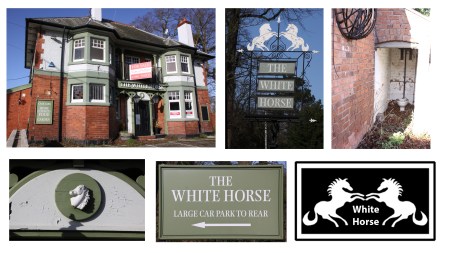
I took the pics below in February 2022, when the future of the White Horse was very much up in the air.  It is great to see it all looking so trim and tidy.

White Horse images from February 2022

The latest chapter in the pub’s history begins when it opens on 3rd March 2023, and I am very much looking forward to taking it for a test drive.  Here’s a copy of their sample menu (also snaffled, with sincere thanks, from Mike’s page above).

For more details about the White Horse and its menu, the website is at thewhitehorsechurton.co.uk, which also has links to their Instagram, Facebook and X (formerly Twitter) accounts.


A 6th-7th Century Egyptian Pilgrim Flask found at Meols, Wirral

Introduction to the Meols pilgrim flask

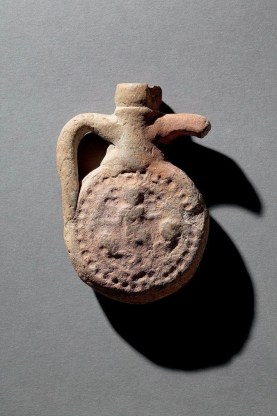
The Meols Pilgrim Flask, now in the Grosvenor Museum, Chester (GM 43. M.56). Source of photograph: Pilgrims and Posies blog

Flipping through Peter Carrington’s book Chester when it arrived on my doorstep a year or so ago, I was surprised to see a black and white photograph of something both very familiar and exceedingly unexpected: an Egyptian pilgrim flask originally from the shrine of the Coptic Christian St Menas in Egypt.  Only 98mm tall, it was manufactured during the 6th-7th century in northern Egypt. It was almost certainly purchased at the desert shrine of St Mena, 45km to the southwest of Alexandria.

It was found on the Wirral at Meols (pronounced mells) by a local man digging for lugworms in 1955, in a peat layer 61cm (2ft) below the sand 274m (300 yards) off Dove Point.  For those unfamiliar with the local geography, there’s a map at the end of the post.  The flask was donated to the Grosvenor Museum in Chester.  Although the location site consists of nothing but sand dunes today, it was formerly inhabited.  Griffiths and his colleagues, in their 2007 monograph on Meols, describe the 19th century investigations of this strip of land:

The eroding sand-dunes not only produced an enormous body of small finds, but also
traces of buildings (the records of which are now unfortunately lost) and stumps of trees from the old ground surface. The numerous artefacts include, as well as many mundane objects, exotic pieces of high quality.

Today, the same team interpret early Meols (from the Norse meaning sand-hills) as a possible “beach market or port.”

Unsurprisingly, given the time that the pilgrim flask must have spent in the sand, the surface of the flask it is badly abraded and is slightly damaged.  In the photograph on the left it looks as though it has a handle and spout, but in fact the “spout” was a twin handle, by which the vessel could be held in two hands, or threaded through a belt or chord for carrying.  There is also some slight damage to the body of the vessel itself.  It was not the most skilfully manufactured item, and was probably one of the less expensive examples on offer to the purchaser, but given its find-site is remarkably well preserved.

Although difficult to make out, the front of the vessel shows a scene consisting of the Roman-Egyptian St Menas flanked by two camels, about which more in a moment.  There are photos of better preserved versions of the same scene below.  I haven’t found a diagram or photograph of the reverse of the flask, but Griffiths et al describe it as follows: “The righthand part of the circular field has short radiating spokes from the frame. The design is very abraded and unclear, but appears to have a long curving design.” 

Thompson’s figure 3, showing a sketch of the Meols flask at the time of its discovery. Source: Journal of the Chester Archaeological Society, volume 53, 1956

Material of the same period (6th-7th century AD) is found in the general area, confined to a short stretch at the top of the Wirral peninsula, producing over 100 artefacts, from both Roman and post-Roman objects, including Late Saxon and Anglo-Scandinavian material.  Following its discovery in 1955 the find was reported very briefly by F.H. Thompson in the Miscellanea section of the Journal of the Chester Archaeological Society in 1956, accompanied by a sketch, and a description of the context in which it was found:

Although the coastal site of Meols, near Hoylake, is not now so prolific of antiquities as in the days when the Rev. A. Hume could devote a whole book to cataloguing the Romano-British, Saxon and mediaeval finds made there, single specimens are occasionally recovered.

The pilgrim flask is a well known form of vessel, and examples are found all over Egypt, and in Nubia.  Fewer numbers have been found outside Egypt, most of them in the eastern Mediterranean.  They are characterized by a lentoid (lens-shaped) body, narrow neck and twin handles, connecting the neck of the vessel to the main body. They seem to have been fitted with stoppers made from mud and other materials.  The Meols example is 98mm high from lip to base.  The body is 65mm wide, and the neck 35mmwide. The thickness of the pottery never exceeds 18mm.  The neck and arms were added to the body after the manufacture of the vessel’s body, and there was not a great deal of skill demonstrated in its production.  Much finer examples survive.

St Menas pilgrim flask from Preston on the Hill, Cheshire, now in Norton Priory Museum. Source: Griffiths et al 2007

The Meols pilgrim flask is not unique in England.  Norton Priory Museum, near Warrington, has a collection of pilgrim tokens, one of which is a pilgrim flask from the shrine of St Menas, which was found in the Norton Priory area at Preston-on-the-Hill, shown left.  It is missing its handles and neck. When the neck and handles are added on afterwards, the joints are a common point of failure.  The Preston-on-the-Hill flask has a much clearer image of Menas and the camels and is framed with text, which is a blessing of St Menas.  It was found during construction work for a new housing estate, and it is by no means clear how it got there.  Other examples with a comparable date have been found elsewhere in England, including Durham, York, Derby, Baldock in Hertfordshire, Faversham and Canterbury.  Although they are not unique, they are certainly not common.  None, for example, have yet been found in Wales, Ireland or Scotland, although other contemporary Mediterranean objects have.

Who was St Menas?

St Menas was an early Christian saint dating to the Roman period who died in around the year 300AD.  Christianity was introduced into Egypt, traditionally by St Mark, and became well established during the 2nd and early 3rd centuries in the multi-ethnic city of Alexandria on the Mediterranean coast.  During the 541 Council of Chalcedon differences about theological understanding of the nature of Christ caused the Coptic Church of Egypt to split from Rome, and to establish its own clerical administration with its own pope, which it retains today.  St Menas is part o the Coptic Christian tradition.

Pilgrim flask of St Menas at the British Museum, findspot unknown. BM1875,1012.16. Source: British Museum

There are a number of versions of the story of St Menas, and it is likely that the stories of St Menas and St Gordius were conflated into a single story.  Probably the most popular  version is that Menas was martyred in Phrygia, possibly during the reign of Diocletian in the 3rd Century for wishing to give up service in the Roman army to become a hermit in the service of God.  Egypt had a tradition of eremitical worship in the desert, most famously represented by St Paul of Thebes (died c.345) and his follower St Antony (died c.356).  The soldiers who killed Menas tried to burn his body but it remained unharmed.  Pope Athanasius of Alexandria was visited by an angel who told him to take Menas into the desert for burial. Menas was carried on either one or two camels, and when the camel/s suddenly stopped and refused to go further, it was taken as a sign that he should be buried at the spot. A spring erupted into life where he was buried.  The grave was forgotten until the 4th century.  The story is that it was rediscovered by a shepherd when a wounded sheep submerged itself in the spring and was cured.  As the shepherd continued to heal his sheep in the spring, the story began to spread.  According to the legend Constantine the Great sent his daughter, afflicted with leprosy, to be cured.  Her recovery endowed the site with even greater acclaim. Not long afterwards the saint’s grave was discovered, and a church was erected at the site in the Mareotis area, now known as Abu Mena, located around 45km southwest of Alexandria.  The saint’s remains were transferred to the crypt.  It soon became a place of pilgrimage with a settlement around it catering to the expanding number pilgrims from both inside Egypt and beyond as news of the shrine continued to spread.  The site became renowned for its responsiveness to prayers, including the delivery of miraculous cures, becoming the largest pilgrimage destination in the eastern Mediterranean, and was considered to be a patron of desert caravans and merchants.

The Arab-Muslim Conquest of Egypt between 639-646AD caused considerable difficulty for the Coptic religion, and the site seems to have been destroyed at this time.  It was partially restored in the 8th century but underwent various reversals and seems to have gone out of fashion after the 10th century.  Excavations in the early 20th century, and then from the 1960s have uncovered the foundations of the church and the associated monastery.

Pyxis showing St Mena. British Museum 1879,1220.1. Source: British Museum

The saint was often shown on the pilgrim flasks flanked by camels wearing a short long-sleeved tunic, with a wide belt, military cloak, laced boots and raised arms in the “orans” posture, which is a gesture used by the clergy when praying with or on behalf of the congregation.  The British Museum has a flask (shown above) that is much less eroded than the Meols example, and depicts the same scene of the saint flanked by two camels.  It is more obviously similar to the Preston-on-the-Hill example, but lacks the inscription.  Most have a different scene on the reverse side, sometimes another saint, but often a more geometric pattern consisting of motifs, as in the Meols example, . 

Just for comparison, the ivory pyxis (cylindrical box) above left, dating to the 6th century, made in Egypt and found in Italy,  shows a much clearer and far more elaborate version of the scene.  On this side of the box St Menas is shown standing beneath an arch, representing a shrine, with his hands raised, flanked by two recumbent camels, and approached by worshippers. The reverse side shows his martyrdom. 

What were the pilgrim flasks used for?

The ruins of the early religious complex at Abu Mena. It included, amongst other things, two churches, a basilica, courts, hostels, baths, a baptistry and colonnades. Photo source: Wikipedia

Above all the Egyptian pilgrim flask was a personal expression of pilgrimage for the purchaser, serving a) as means of carrying a part of the divine with him or her, b) as the memento of a personally important and perhaps very remarkable journey and c) as a mechanism for advertising that the pilgrimage was undertaken.

Pilgrimage is a personal voyage, for reasons known only to the person making the journey.  Motivations can vary from an illness or disability afflicting the person making the pilgrimage, or afflicting someone else on whose behalf the pilgrimage is made, to a general need to demonstrate penitence, piety or fulfil another inner need. These little mementos contain more than hope – they contain something precious and beloved, a bridge between a person and his or her God, often  via the intercession of a benevolent saint to whom it was perhaps easier to relate.   Finds in Alexandria indicate that St Menas had a popular local following, and those further afield attest to his wider importance.  A long distance pilgrimage was an investment not only of financial cost, time and energy, but also time away from family, home and the means of making an income, so it involved sacrifice, without which perhaps the pilgrimage was probably much less significant.

The similarity between  the flasks, whether poorly- or well made indicates that they were mass-produced.  They were not special to the producer, except as a means of making income, but they were immensely special to the pilgrim.  Because the flasks were very small, between c.9 and 20cm tall, they were highly portable, and could be carried home even over very long distances without difficulty.  Pilgrimage sites today still sell little objects for visitors to take home.  Lourdes and Santiago de Compostella are two obvious examples, but at a visit to St Winifred’s well in Holywell, north Wales, I found that it too has a gift shop where you can purchase religiously-themed memorabilia.

Piers Baker-Bates of the Open University talks about the value of his own pilgrimage memento, helping to clarify the personal connection that people have with pilgrimage objects.  This is part of the transcript from a short video, which at the time of writing you can find on the OU site here:

This is the pilgrimage medal I had after I went to Santiago [de Compostela] in 1995. It’s just the ordinary cheap, lead model they sell in the tourist shops there, nothing special at all, but it was simply, if you like, my memento mori of the expedition.
It’s a scallop shell. The scallop shell has traditionally been the symbol of St James because it is a native of Galicia, which is the region of Spain where Santiago de Compostela is, and supposedly, according to legend, when his body was found it was surrounded by scallop shells, and this is therefore ever since been the symbol of the saint.  So you will not just see the scallop as an individual symbol, but if you look at churches, if you look at hospices, if you look at other buildings connected with St James, they all have somewhere on them the scallop shell because it is the symbol of the saint.

If the chain wasn’t broken I’d still wear it round my neck all the time and it serves to remind me of something I did and I would like to do again eventually.  If I was a medieval pilgrim, I’d have worn it in my hat, and you would have seen a wonderful selection of people who’d been to all the major shrines, who had a selection of these in their hats, so you’d have Jerusalem, Santiago de Compostela, Rome – they all had their own symbols. . .

Even though there are millions of these in the world, it still has meaning because it has meaning for me in particular, because it is particular to me, but also if someone else has one of their own, it will mean something to them. But at the same time, as a symbol, it means something to everyone, so when anyone looks at one of these they will recognise the symbol and understand what it means.

The vessel could contain the holy water of the well, the sand surrounding the shrine or liturgical oils.  Some vessels were more elaborate than others.  The Meols example, even though highly abraded, was probably never a very sophisticated piece of craftwork, meaning that the pilgrim who bought it probably had little spare money to spend.  In Egypt, nearly all the complete examples were found in funerary contexts, indicating that they were sufficiently significant to the living that they wished to meet the afterlife with their pilgrim flasks at their sides.

Precursors of the the pilgrim flask

Clay vessel dating to the New Kingdom, painted with concentric rings, now in the Petrie Museum of Egyptian Archaeology (UC66492). Source: Petrie Museum of Egyptian Archaeology

The Coptic era pilgrim flasks were not an innovative form of pottery. The form emerged in the earlier New Kingdom (1550-1069BC).  These were in their turn were based on vessels imported from the Levant in the 18th Dynasty (1550-1295BC).  The form was soon taken up and copied by Egyptian potters who produced them for local demand.  They were usually manufactured in clay, like the later pilgrim flasks, and sometimes other materials including glass, faience, stone and even metal.  The early clay examples were frequently provided with a coloured slip and decoration that emulated the Near Eastern examples with concentric circles on each face. Kilroe suggests that the concentric circles were equivalent to branding, and that they were indicative of the contents of the flasks.  They grew in popularity in the 19th Dynasty (1295-1186BC), and became part of the potter’s repertoire from that point forward.  Their function was probably somewhat different from the later pilgrim flasks. One suggestion is that they were used for carrying valuable perfumed oils.

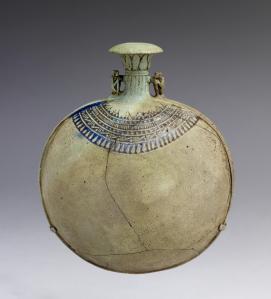
New Year flask from Egypt, now in the Walter’s Museum (48.419)

These were followed by so-called New Year’s flasks, which have the same basic shape, but with handles so small that they are merely decorative rather than functional.  The New Year’s flasks are often ornate and are usually made of faience, an expensive material exclusive to the elite.  New Year was one of the most important dates in the Egyptian calendar, marking the beginning of the Nile flood, which replenished the soil with fertile silts and saturated the land ready for germinating the seeds retained from the previous year’s harvest. Coinciding with the appearance in the night sky of the star Sirius, and closely associated with it, the new agricultural year was celebrated in an annual New Year festival called wep renpet meaning “opening of the year.”  During the Saite 26th Dynasty (c.664-535BC) New Year flasks became a particularly popular celebratory item.  They are found both in Egypt and abroad and are often decorated with papyrus and lily capitals.  The lug handles on the shoulders are often in the form of the deity Thoth, represented as a baboon, responsible for knowledge, wisdom and the calculation of time.  Nands of decoration around the body of the vessels and down the sides are also common. Many have hieroglyphs, often mentioning the wep renpet, together with favoured deities.

How did the Meols flask arrive in England?

Coins found in the northwest, including examples from the Wirral. Source: Philpott 2020, Journal of the Chester Archaeological Society, table V.1, p.53

F.H. Thompson discusses whether the Meols flask had been acquired at the St Menas shrine when it was brought to England or whether it was brought to the area at a much later date.  There is no reason to doubt that it was manufactured in the 6th or 7th centuries, and there are arguments in favour of it having been brought to England at that time.  As Thompson says, “finds of the late Saxon period from Meols are sufficiently common to suggest that this flask may well be contemporary.”  The presence of three mid to late 6th century Byzantine coins in the Meols area are consistent with connections to the southeast Mediterranean at that time.  This view is supported by William Anderson  who believes that the flask may be associated with other evidence of long-distant contact, “namely amphorae and imported fine wares found at Tintagel in Cornwall, and other sites in Ireland, Wales, England and Scotland,” possibly representing direct trading contacts between the Mediterranean and and the west of Britain. Robert Philpott’s examination of early Byzantine coins from the northwest also supports  a Mediterranean connection:  “Although we lack diagnostic material to identify the elite with whom Mediterranean trade was conducted, the finds indicate an entry point at the port of Meols.”  The Wirral coins, from Leasowe, Moreton,, Seacombe and Landican were issued over a period between 518 – 541 AD.

Susanne Bangert suggests two primary routes by which objects from Alexandria may have reached Britain.  The first is an overland route across Europe, along the Rhine corridor or through Italy and via the  Alps. Her other proposed route, by ship, would have passed through the Straits of Gibraltar and north up the Atlantic coast, putting into ports along the west cost of Britain, including Cornwall, Wales and perhaps Meols.

Beautiful photograph of Hilbre Island. Source: hilbreisland.info

It is a possibility that the pilgrim flask was connected with early Christian pilgrimage at Hilbre Island, just off the Wirral as part of a global pilgrimage circuit to Christian monasteries and shrines.  As unlikely as this sounds, it is not beyond the bounds of probability, as some of the Egyptian pilgrim flasks in England are found in the rough vicinity of former monastic sites (Canterbury, Derby, Durham, Norton, Runcorn and York).  Christianity arrived in England during the Roman occupation in the 4th century, after which it existed alongside pagan religions of the Anglo-Saxons until the arrival of Irish Christianity on the one hand, and the arrival of St Augustine’s mission to England from Rome in 597. Monasteries were established in both traditions, but many were destroyed by Viking raids during the 9th century. Only those of the Roman tradition were restored in the 10th century.  Pilgrimage was a popular activity in Britain from the early Christian period until the end of the medieval period, and it is possible that the Meols flask was deposited or lost during a pilgrim’s visit to the tidal Hilbre Island.  Although a monastic cell was established in the late 11th century by St Werburgh’s Benedictine Abbey in Chester, there was apparently a much earlier shrine to the obscure St Hildeberga, which the St Werburgh charters appear to confirm.

An example from Baldock, Herts., in the Letchworth Museum, no.7421. Source: Fitzpatrick-Matthews 2010

Another possibility is that although originally purchased at the Menas shrine, the Meols (and other English flask finds) were brought not directly from the site, but during near-contemporary or slightly later periods from Alexandria, locations in the Levant and elsewhere in the eastern Mediterranean, where many more Menas flasks have been found.  A generation or two on from the original pilgrims who purchased them, they may have entered local markets as devotional curios, sold by their families to contemporary travellers to raise cash. Then too, at a much later date, it could have been acquired as an antiquity by a collector, or as a travel memento by someone on military service in the Near East, or making the Grand Tour.  Philpott, in his analysis of coins from northwest England argues against this: “If the coins were modern losses by tourists or soldiers who served in eastern Europe, the Middle East or north Africa, as has often been asserted, the material recovered by metal detectorists should range more widely through the Byzantine era to embrace, for example, the common anonymous bronze issues of the late tenth to eleventh centuries, as well as other coins of Turkish, north African or Near Eastern origin.”

On balance, the available evidence seems to point a to a connection between the port of Meols and the eastern Mediterranean until the 7th century, and it seems likely that the Meols flask was introduced, along with other objects like the coins described by Philpott, at that time.

Final comments

There are four distinct phases that we know of in the life of the Meols pilgrim flask.  The first is its production.  Raw material sources were acquired, and the flask was manufactured.  The raw material was clay, very easy to source in the Nile Delta, and the manufacturing process was mundane. Hundreds of pilgrim flasks have survived, and this is one of the less elaborate examples, produced quickly and without flourishes.  The fact that the Menas pilgrim flask left the site of Abu Menas strongly suggests that it was purchased by a pilgrim, who bought one of the less expensive examples, and was probably not particularly well off.

The site of Abu Mena today. Source: Wikimedia Commons

Next, we find the pilgrim flask in Meols, so we know that it travelled.  There are a number of possible explanations for how it left the eastern Mediterranean and arrived in Meols, all of them viable.  Found in sand dunes, which cover the site of a small port, with a market, the object could have been hidden in a building that decayed, or may have been lost by its owner in or around the settlement.

The discovery of the flask in 1955, another stepping stone in its history, resulted in it being donated to its next port of call, the Grosvenor Museum, in 1956.  The museum deemed it of sufficient curiosity value to have replicas made, which were sold in the museum’s shop.

Subsequently, a number of academic papers were written about it.  Peter Carrington published a photograph of it in his book on Chester in 1994 (as mentioned at the beginning of this article, bringing us full circle), and it was described in some detail in a monograph about Meols in 2007.  This little object has had quite an interesting life.

Although this is the story of an object, its real value lies in its part of a much bigger story – that of early Christian pilgrimage.  When considered in the light of other pilgrim sites, and other objects that have travelled from the eastern Mediterranean to other parts of the world, it becomes much more than an object, and part of a fascinating narrative about people, movements and the way in which Christianity was understood and expressed in the 6th and early 7th centuries.  The St Menas pilgrim flasks also offer the chance to explore the relationship between Christianity and Egypt’s pagan past, via the survival of some of PHaraonic Egypt’s ideas and traditions in object form.  Finally, the presence of the pilgrim flask at Meols raises questions about the development of trade and transport on the Wirral and in Chester in the post-Roman period.

If anyone has anything to add to the story of the Meols pilgrim flask, do get in touch.

——-

The Wirral, showing Meols and Chester. Source: Google Maps

—-
Sources:

Books and papers:

Anderson, W. 2004. An archaeology of late antique pilgrim flasks. Anatolian Studies 54, p.79-93.
https://www.jstor.org/stable/3643040

Anderson, W. 2007. Menas flasks in the West: pilgrimage and trade at the end of antiquity.  Ancient West and East 6, p.221-43

Bagnall, R.S. 2001. Archaeological Work on Hellenistic and Roman Egypt, 1995–2000. American Journal of Archaeology. Archaeological Institute of America, 105 (2), p.227–243

Bangert, S. 2007 Menas ampullae: a case study of long-distance contacts.  In A. Harris (ed) Incipient Globalization? Long-distance contacts in the sixth century.  British Archaeological Reports International Series 1644 / Reading Medieval Studies 32. p.27-33.
https://centaur.reading.ac.uk/84537/1/RMS-2006-04_S._Bangert,_Menas_ampullae,_a_case_study_of_long-distance_contacts.pdf

Bourriau, J. 2004. The beginning of amphora production in Egypt, in J. Bourriau and J. Phillips (eds.), Invention and Innovation. The Social Context of Technological Change 2. Egypt, the Aegean and the Near East, 1650-1150 BC, Oxford, 78-95

Brooks Hedstrom, D.L. 2019. Archaeology of Early Christianity in Egypt. In Pettegrew, D.K., Caraher,  W.R. and Davis, T.D (eds).  The Oxford Handbook of Early Christian Archaeology, Oxford  Handbooks, Oxford Academic.

Carrington, P. 1994.  Chester. Batsford / English Heritage (flask mentioned on page 54, and shown on page 56, figure 33)

Craggs, J.D. 1982. Hilbre: The Cheshire Island: Its History and Natural HistoryLiverpool University Press

Farmer, David. 2011 (5th edition, revised). The Oxford Dictionary of Saints.  Oxford University Press.

Fitzpatrick-Matthews, K.J. 2016. Defining Fifth-century Ceramics in North Hertfordshire. Internet Archaeology, vol. 41.
https://intarch.ac.uk/journal/issue41/4/toc.html

Griffiths, D. and Bangert, S. 2007. Ceramic: The St Menas Ampulla.  In Griffiths, D., Philpott, R.A. and Egan, G. 2007 (see below), p.58-9

Griffiths, D., Philpott, R.A. and Egan, G. 2007. Meols. The Archaeology of the North Wirral Coast. Discoveries and observations in the 19th and 20th centuries, with a catalogue of collections. Oxford University School of Archaeology Monograph 68, Institute of Archaeology, University of Oxford
https://archaeologydataservice.ac.uk/archiveDS/archiveDownload?t=arch-966-1/dissemination/pdf/Meols_text_2020_complete-lo.pdf

Grossmann, P. 1998. The Pilgrimage Center of Abû Mînâ. in D. Frankfurter (ed.), Pilgrimage & Holy Space in Late Antique Egypt. Leiden-Boston-Köln, Brill. p.282

Harris, A. 2003 Byzantium, Britain and the West: the archaeology of cultural identity AD 400-650. Tempus.

O’Ferrall, R.S.M. 1951. A Pilgrim’s Flask found in Derby. Journal of Derbyshire Archaeology and Natural History Society 71, p.78-9.

Philpott, R.A. 2020. Early Byzantine Copper Coins from Lowland North-West England.  New Finds from Wirral, Cheshire and West Lancashire. Journal of the Chester Archaeological Society, volume 90, 2020, p.51-70

Richards, J.D., Naylor, J. and Holas-Clark, C.  Anglo-Saxon Landscape and Economy: using portable antiquities to study Anglo-Saxon and Viking Age England.  4.4.5. Meols, Cheshire. Internet Archaeology
https://intarch.ac.uk/journal/issue25/2/4.4.35.html

Stevenson, A. 2015. The Petrie Museum of Egyptian Archaeology: Characters and Collections. Petrie Museum of Egyptian Archaeology, p.35

Thompson F.H. 1956. Pilgrim’s flask from Meols. Journal of the Chester Archaeological Society 43, p.48-9

Wyn Griffiths, D. 1991. Anglo-Saxon England and the Irish Sea Region AD 800 – 1100. An Archaeological Study of the Lower Dee and Mersey as a Border Area. A Thesis presented for the degree of Doctor of Philosophy. Department of Archaeology, the University of Durham
http://etheses.dur.ac.uk/1488/1/1488.pdf

Websites:

Gallorini, C. Innovating through Interactions: A Tale of Three Flasks.
https://www.researchgate.net/publication/260495223_Innovation_Through_Interactions_A_Tale_of_Three_’Pilgrim_Flasks’

Kilroe, L. 2014. Biography of an Egyptian Pilgrim Vessel. UCL 28th February 2014
UCL Culture Blog
https://bit.ly/3kBc65O

Medieval London. Ampulla
Fordham University
https://medievallondon.ace.fordham.edu/collections/show/90

St George Orthodox Ministry. The Coptic Pilgrims of the Wirral, 4th November 2020
http://www.stgeorgeministry.com/the-coptic-pilgrims-of-the-wirral/


A visit to St Deiniol’s Parish Church, Worthenbury

The approach to St Deiniol’s from the road.

Worthenbury, a small village on the border between England and Wales seems an unlikely location for a really superb Grade-1 listed Georgian church built on such an ambitious scale, but the two fit very well together.  The village is picturesque, the scenery peaceful and the church stunning.  It was built between between 1735 and 1739 by Richard Trubshaw, financed by the local Puleston family of Emral Hall, and the church was consecrated, with all due ceremony, by the Bishop of Chester on Palm Sunday 1739.  It is thought to be one of the most impressive Georgian churches in Wales, if not the best.  It has been beautifully maintained by its Worthenbury custodians.

The church is dedicated to St Deiniol (pronounced day-nee-ol, the Welsh form of Daniel, died c.584).  The saint has a certain local interest, although the details are far from clear.  It is generally agreed that he was the son of St Dunawd, who may or may not have been the first abbot of a monastery at Bangor on Dee known today as Bangor Monachorum, meaning “Bangor of the Monks.”  The origins of the monastery are buried in a cloud of myth, and it is by no means clear whether a monastery was actually built there.  According to the Clwyd and Powys Archaeological Trust (CPAT) the name Bangor Monachorum actually appears in documents no earlier than 1607.   Popular history has it that the current church of St Dunawd was built on its remains but I have seen no documentary or archaeological data to support this, meaning that there either isn’t any, or that it is doing a good job of hiding. 

Rather than looking for solid data, here’s a brief version of the usual story of St Deiniol, paraphrased from the lengthy entries in the The Dictionary of Welsh Biography and the Oxford Dictionary of Saints.  One version has it that St Dunawd joined forces with his three sons, one of whom was Deiniol, to found a monastery of on the banks of the Dee, at Bangor on Dee, becoming its first abbot.  Another version suggests that Deiniol was the first abbot, having first established a parent monastery in Bangor in northwest Wales. Whatever the case, St Deiniol is best known for being a monk and bishop, who is credited by Bede for having established a monastery with over 2000 monks, the most famous in Britain at the time, nearly half of whom were slaughtered by the Anglo-Saxons.  It is not entirely clear why he was canonized.   

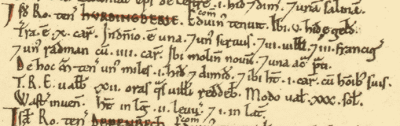
Domesday’s record of Hurdingberie (the Anglo-Saxon name for Worthenbury), highlighted in red. Source: Open Domesday

Worthenbury sits on the Anglo-Welsh border that lies around 10km southeast of Wrexham, and is 3km west of Bangor on Dee.   The Worthenbury Brook runs a short distance to the south of the church.  The village is surrounded by undulating fields.  Probably a small nucleated settlement in the 10th century, it was apparently little bigger by the time of Domesday, when  it appears under the name “Hurdingberie,” a name of Anglo-Saxon origin, and came under the tenancy of one “Robert, son of Hugh,” the Norman baron Robert FitzHugh, who held it from the crown, amongst many other properties. At the time of Domesday, 1086, its inhabitants consisted of 3 villagers, 1 slave and 4 “other” (information sourced from the Open Domesday project).  Its holdings included 10 ploughlands,  2 lord’s plough teams, 4 men’s plough teams, a meadow of 1 acre and a mill.   There are some beautiful medieval ridge-and-furrow fields in the vicinity, shown in the photograph below.

Worthenbury village. The church is at bottom left and ridge-and-furrow fields are at top right. Source: CPAT – photo 04-c-0049

It is thought that the first religious house on the site was a chapel, first mentioned in 1388, perhaps attached to the elusive  monastery of Bangor Monachorum.   In 1277 century  Edward I (ruled 1272-1307), in the throes of his territorial disputes with Llywelyn ap Gruffyd,  dispossessed the owner of Emral Hall, Emma Audley, who had married a Welsh prince, and moved her back to her family home in Shropshire.  Worthenbury was at that time in Maelor Saesenag, and found itself shifting between English and Welsh ownership, depending on who was in the ascendancy.  Edward gave Emral instead Sir Roger Puleston.  The Pulestons came from near Newport in Shropshire, where they had settled during the reign of Henry III (ruled 1216-1272).   They had Norman roots, had proven themselves in battle, and could be relied upon to stand up against Welsh hostilities in the frontier position in which Worthenbury found itself.  Emral Hall remained in the Puleston family for over 700 years.  The architect Robert Trubshaw was hired to remodel Emral Hall for the Puleston family, but even afterwards it retained many earlier features.

Richard Trubshaw obviously did a good job for the Puleston family,  because he was hired to build today’s church between 1735 and 1739 at a cost of £955.00.  It is always difficult to know what a sum of money actually means in the past, but fortunately the National Archives has a currency convertor provides equivalents.  In today’s money, £955 equates to £112,897.  Alternatively, it was equivalent to the price of 139 horses or 205 head of cattle.  The gothic architectural ideal had dominated British architecture for such a long time, that the Georgian aesthetic, when done this well, comes as a breath of fresh air.  St Deiniol’s is a superb example of refined Georgian ideas.

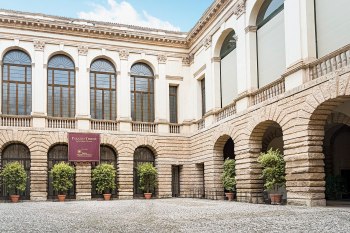
Palazzo Thiene, Vicenza, Italy 1542–1558.  Source: Wikipedia

Georgian architecture is named for four kings named George who reigned in succession, from the accession of George I in 1714 to 1830, when George IV (“Prinny”) died.  Georgian architectural principles, employed for domestic, institutional and ecclesiastical architecture, were typified by attractive symmetry, space and light, the latter requiring many large windows.  Georgian architects were greatly influenced by the Renaissance architect Andrea Palladio (1508-1580), whose governmental palace, Palazzo Thiene, was characterized by vast, symmetrically aligned windows with semi-circular tops and is a clear antecedent of Georgian aesthetics.

The 3-storey church tower, showing the dramatic contrast of the creamy-coloured sandstone and the deep red brick

Trubshaw’s new church was established on the site of at least two pre-existing churches, one of wattle and daub in 544AD and another, in 1557, built of brick and timber, both belonging to the Bangor on Dee parish.  Worthenbury only became the centre of its own parish in 1689 when Sir Roger Puleston succeeded in separating it from Bangor.  Its rectory, at the opposite end of the village, had been built in 1657 by Judge Puleston for the minister to Worthenbury who was also tutor to the judge’s two sons.  Whilst the new church was being built, the congregation worshipped at Emral Hall’s private chapel.

The footprint is that of a traditional church, with an east-west orientation.  It includes the usual components of a bell tower, a nave for the public, and a chancel for the clergy with an altar, all beautifully preserved.  The Georgian style simply yells a new type of self-confidence and a pride in the here-and-now. The semi-circular chancel, a revival of the Romanesque, is a particularly nice touch, softening the angles and giving the church a real air of distinction.

The brickwork of the church was arranged in header-and-stretcher or Flemish bond (alternating long and short), and it was provided with a slated roof.  The sandstone is from the Cefn Mawr quarries in north Wales, which produces yellow sandstone, varying in both colour and quality.  The sandstone at St Deiniol’s is a very fine-grained creamy colour that contrasts beautifully with the warm red of the brick.  The urn finials on the corners at the top of the tower are replicas of those at the main entrance to Emral Park, which are apparently now at Eccleston Church, on the Duke of Westminster’s estate.  They support weather vanes. The finials mid-way along the balustrade are topped with crucifixes.  The tower also has arched windows at top and bottom, and circular windows at centre, with radiating keystones.  It was also fitted with blue-faced clock with golden numerals, made by Joyce’s of Whitchurch.

Georgian churches, being so much newer than medieval predecessors, stand some hope of surviving changes of fashion and fortunately, the interior of St Deiniol’s church has been infinitely better respected than many of its predecessors.  Many medieval churches have been disfigured on the inside, barely reconcilable with the original conception.Later  architectural embellishments and the addition of inappropriate funerary monuments may disguise original beautiful lines, and the installation of modern paraphernalia can be ruinous to a church’s interior. Westminster Abbey, for example, retains much of its essential dignity on the exterior, but has been battered into often vulgar submission inside.  St Deiniol’s retains its fine lines.  It has a fabulous interior, retaining its extraordinary and lovely box-pews, which I have never seen before, each with a family crest painted on the side.  These provide a sense of what it must have been like to form one of the congregation, all together in one space, but physically divided by family and status.  Rather than the seating being lined up in rows, the boxes give a sense both of intimacy and social division.  The box-pews of the Pulestons, the most important family, were those nearest the altar, and were furnished with chairs rather than pews, and hearths.  One of these currently contains a small display showing the history of the church.  The minister was allocated the pew below the three-tier pulpit.  Less important families sat in the boxes behind these positions, and the church wardens were confined to the rear of the church.  Some of the pews for the lower orders were not installed until 1810, and were sourced from Gresford parish church. 

A gallery was added in 1830 to accommodate musicians and an organ, and displays the royal coat of arms.  It is full-width, with tiered seating for the choir.  It is supported on slender cast iron columns, and its panelled front displays the royal coat of arms.  

——–
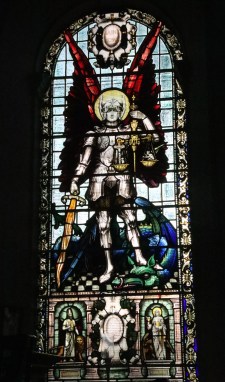
There are four stained glass windows.  That in the south of the nave shows St Michael and is in memory of Captain Summers who died in the First World War and lived at Emral.  To the south of the chancel is a window given by Catherine Theodosia Puleston, in memory of her parents and sisters.  The origin of the east window is a somewhat muddled story.  When Emma Corbet married Richard Puleston and moved into Emral, she recorded finding a collection of stained glass fragments and when she died in 1797, her will asked that the pieces should be made up into a new window at Worthenbury.  Quite where the glass came from, or why the pieces were kept at Emral, is uncertain, although it is speculated that it may have come from from a 14th century window in Westminster College, or from the demolished Emral Hall chapel.  Interestingly, the new window was built inside the original plain window.  The small circular window was installed in 1913 in memory of Violet Parry, another connection with the Puleston family.

Don’t forget to look up.  The plaster ceiling has been given some really fine baroque – rococo decorative features.  As well as some attractive ornamentation it features a gilded dove and sunburst, and small grey clouds.  My photograph makes it look rather brash, but from ground level, it looks charming.


Of the smaller fixtures and fittings, the vestry doors and small collecting boxes inscribed with “Remember the Poor” were made from wood that was rescued from the previous church.   The font dates to around 1745, and above it is a shelf, which was designed to receive bread for the poor.  This tradition survived up until 1939, when soup, cloth and coal were still distributed to those in need.  The bells were cast in 1746, and were recast and hung in 1958.  The rather battered cross in the chancel is the Emral Cross, formerly in the chapel in Emral Park, which was demolished in 1775.  The two-tiered chandelier was installed in 1816, and the single-tiered chandelier was installed in 1898.  there are numerous funerary memorials, mainly to members of the Puleston family, but other local families are also represented.  Family connections to the church are also preserved in the three Puleston funerary hatchments set up along the west end of the church. Hatchments are diamond-shaped, made of wood, and contain the components of the coat of arms that has been earned by the deceased, and which he is entitled to display. There is modern lighting and heating, but it is very well done.

Large scale repairs were undertaken in 1851, which included re-roofing the building due to damage by deathwatch beetle.  

Within the church, the earliest burial known is that of Mrs Anne Puleston, wife of John Puleston, dating to 1742.  John Puleston was buried in 1746.  The earliest of the churchyard’s graves cluster around the apse, made of yellow sandstone.  The inscriptions are badly eroded and many are illegible, but a chest tomb of 1768 is the earliest of those that can be deciphered.  There are a number of different styles of grave markers, including chests, table tombs and tablets, and they continue into the 19th century, indicating that people from surrounding villages were also buried there.

Emral Hall was sadly demolished in 1936, although the magnificent Jacobean ceiling of the banqueting hall, together with the mullion windows, were purchased by Sir William Clough-Ellis and installed in the town hall of of Portmeirion, where they remain preserved.  Today Emral Park serves as a horse stud, dairy farm and caravan park.

The church no longer holds congregations, but this is of very recent date.  It is anticipated that the church will be transferred to the jurisdiction of the Friends of Friendless Churches, who do such an excellent job of caring for churches without owners, amongst whom are those like St Deiniol’s, which are no longer in a position to pay the Anglican authorities for their services, but retain real value as heritage.

My sincere thanks to Catherine Starkey for arranging access during very icy weather, when the church would usually have been closed.
—-

East window

___

—–
Visiting:

The church is no longer in active service for congregations, and at the time of writing it is expected that the Friends of Friendless Churches will take it over.  This means that its opening times are uncertain at the moment, but these may be forthcoming.  Local people have done a great job of keeping it open for visitors, and they very kindly opened it for me (with my sincere thanks) just before Christmas when, although it was usually open during the day, it had been temporarily closed due to the abysmal weather conditions.

It is easy to find.  There is one road through Worthenbury, and the church is clearly visible heading north to south, on the right, and if you are heading south to north, it is at left on the right-hand corner past the bridge.

Thinking of it in terms of those with mobility issues, there are two steps leading up from the road through the gate into the churchyard, with a rail on the left as you face the church, and there are a small number of steps in the church itself.

Sources:

Books and papers:

Farmer, David. 2011 (5th edition, revised). The Oxford Dictionary of Saints.  Oxford University Press.

Pamphlets:

Anon, n.d. The Parish Church of St Deiniol, Worthenbury. A Guide for Visitors.

Harrison, Sunter. 1990.  Worthenbury Church, Emral Chapel and the Pulestons. Published privately.

Websites:

British Listed Buildings
Parish Church of St Deiniol
https://britishlistedbuildings.co.uk/300001705-parish-church-of-st-deiniol-willington-worthenbury#.Y8xxkHbP3IU

Clywd and Powys Archaeological Trust (CPAT).  Historic Landscape Characterization, Maelor Saesneg.  Wrexham County Borough
https://www.wrexham.gov.uk/sites/default/files/2020-09/worthenbury-cons-area-assessment.pdf

Clwyd and Powys Archaeological Trust (CPAT). Worthenbury: Historic Settlement Survey.  Wrexham County Borough
https://cpat.org.uk/ycom/wrexham/worthenbury.pdf

Coflein
St Deiniol’s Church, Worthenbury
https://coflein.gov.uk/en/site/307972/

Dictionary of Welsh Biography
Dunawd
https://biography.wales/article/s-DUNA-BWR-0505
Deiniol
https://biography.wales/article/s-DEIN-IOL-0584

Open Domesday: Worthenbury
(by Powell-Smith, Anna)
https://opendomesday.org/place/SJ4246/worthenbury/

Puleston family, Emral, Flintshire
National Library of Wales
https://archives.library.wales/index.php/puleston-family-emral-flintshire

Worthenbury Conservation Area Assessment and Management Plan
Wrexham County Borough Council 2009
https://www.wrexham.gov.uk/sites/default/files/2020-09/worthenbury-cons-area-assessment.pdf

A great day out at Greenfield Valley Park, Holywell

On visit to Basingwerk Abbey a few months ago, we noticed signage indicating that the abbey was at the south end of the Greenfield Valley Park, the north end of which is Holywell just to the south of Holywell town centre.  The Greenfield Valley Park had been on my to-do list for ages, but it was my friend Katie’s suggestion that we go today, and she brought David Berry’s guide book with her, which included a map that we followed to make the most of the park (details below).

Map from Greenfield Valley Visitor Centre

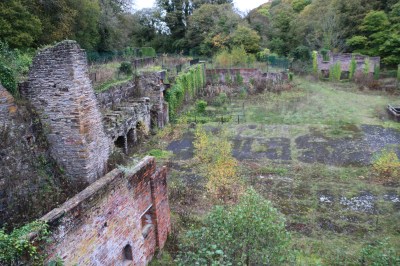
The park, which includes the ruined abbey and St Winifred / Winefrede’s Well follows both the line of the Holywell Stream that erupts in bubbles at St Winifred’s Well, as well as the line of a former railway track that ran from Holywell to Greenfield Dock.  It is one and a half miles as the crow flies from north to south, but covers 70 acres and consists of a network of metalled paths (marked on the map) and tracks, beautifully maintained, connecting some remarkably preserved industrial heritage.  Each one of these buildings was accompanied by large tracts of water that were used to power water wheels that were built in the late 18th century and continued to be used well into the 19th century.

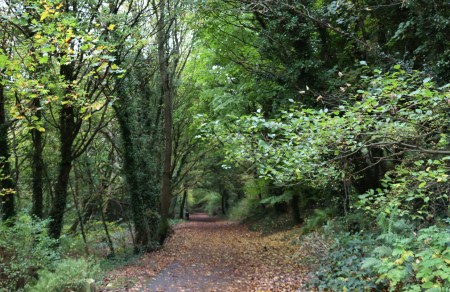
As well as being fascinating, the tree-filled park is a lovely place to walk, particularly appealing in its multi-coloured autumnal garb.  In the summer there are birds and butterflies, and even at this time of year there was the occasional woodland flower.  There is also the little Bakehouse café in Basingwerk House at the  south end of the park, next to Basingwerk  Abbey, which serves good coffee, cake and a small, imaginative menu of nicely presented and very enjoyable food.

This post is confined to the really gripping industrial heritage.  I’ll talk about Basingwerk Abbey on another post, and St Winifred’s well, both of which we visited on the same day, will also be dealt with separately.  The following highlights of the walk start in the north and head south ending at Greenfield Dock.  The numbers in the text refer to the map above.
sdafasdfas

The Holywell Rail Line and bridge

The wide metalled footpath that links Holywell in the north with the A548 to the south follows the line of a standard gauge railway built in 1868.  Its purpose was to carry minerals from the Greenfield Wharf, now known as Greenfield Dock, and to ship products made at Greenfield Valley to Liverpool for sending further afield. In 1912 it was converted to carry passengers, and became known as the Little Train.   It claims to have been the steepest conventional passenger railway line in Britain, with a 1:27 gradient.  At the top of the path, near Holywell, there is a massively constructed railway bridge (10) with two wide arches.  Today, charmingly, it is a footpath, leading from Tesco to a housing estate.
asfasdfsd

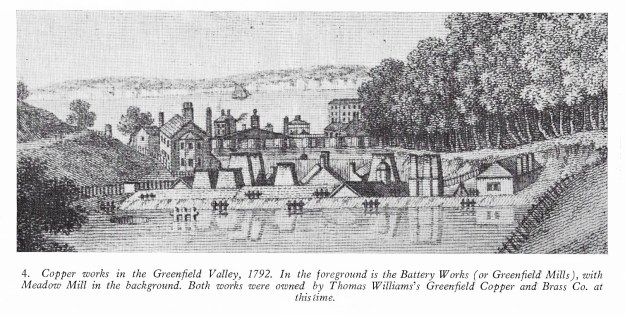
Greenfield Valley 1792. Source: Davies and Williams 1986

Battery Works

Established in 1776, the Battery Works (8), also known as Greenfield Mills, was built to manufacture pots and pans from brass sheets.  Davies and Williams describe the process (p.28-9):  Each of the four copper and brass battery mills “consisted of large hammers raised by a cog on a rotating beam.  The beam extended from the axle of the waterwheel so that each waterwheel worked up to six hammers.  Once the cog had passed, the hammer fell, striking an anvil.  Workmen would hold sheets of plates of metal on the anvils and as the hammer hit them, shape them into pans, bowls and other articles.”

fdfdsfsd
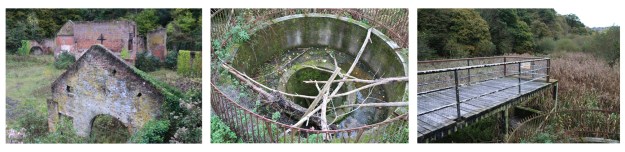
The troughs that held the water to turn the wheels can still be seen.  One of the pits where the waterwheel turned can still be seen in the photograph below, together with a section of wall with a circular hole where the wheel once turned. Like all the main industrial operations along the river, it was backed with a large body of water at its northern (upriver) side.  The water is now full of bull rushes.  Even though it is impossible, just by looking at the ruined remains, to see exactly how all the different elements fitted together, this is a massively impressive piece of the Greenfield site.  The finished products were shipped to  Africa via Liverpool and exchanged for West African slaves.  

Meadow Mill

In 1787, eleven years after the Battery Works, a new mill (7) was built by the Greenfield Copper and Brass Company to produce rolled copper sheets, and to make copper rollers for printing patterns on to cloth.  The main building was a sizeable affair, 86 x 69ft (26 x 21m), with two pillars 11.5ft (3.5m) apart supporting a roof made of copper sheet.  It was  fitted with three cast iron wheels, each 20ft (6m) in diameter.  Copper ingots were melted and moulded into plates 3 (0.9m) x 4ft (1.2m) and about 1/2 inch (1.27cm) thick, which were cut into strips, that were in turn fed between pairs of rollers to create sheets of various thicknesses.   These could be turned into wire or other products.  When this work came to a close, the site was used by a number of other smaller-scale industries, including a tin plate works.

Meadow Mill  is backed by a basin of water that fed the water wheel that powered the mill.  It is now marshy and full of algae, making life rather interesting for the moorhens, and the surrounding foliage is now home to several species of butterfly. On the other side of the water wheel, the water was taken down to the next level of the valley down a purpose-built run-off.  

In the 1850s it was taken over by Newton Keates as a lead works.  This was followed by a tinplate works, then a brass rolling and wire works, and in 1890 was leased to William Eyre for rubber grinding and processing.

Lower Cotton Mill

There were a number of cotton mills along the Greenfield Valley, built for the manufacture of cotton textiles, all water-powered, in a period when cotton was one of Britain’s primary exports. John Smalley, one of the backers of Richard’s Arkwright’s ground-breaking spinning frame, established a mill with his colleague John Chambers. Their company was the Cotton Twist Company.  The earliest mill was built from stones taken from the nearby Basingwerk Abbey, and was called the Yellow Mill.  The business was declared bankrupt in 1780 and Smalley died in 1782, but Smalley’s window Elizabeth was able to find partners to push the business forward, and the business went from strength to strength.  Upper Mill was built inn 1983, Lower Mill (6) In 1785 (in just 10 weeks) and Crescent Mill in 1790.  All were fitted with Arkwright’s spinning frames and were worked by many local people, including young children.  The six-storey mill that survives today is the Lower Cotton Mill, its spinning frame once powered by a waterwheel 18ft high (5.5m) and 7ft (2.1m) wide with a 16ft (4.8m)  fall of water.  You can see the culverts that were built to carry the water beneath the buildings and feed them further down the valley.

From where we were walking, on the upper path, we could look down into the ruined warehouse’s, which was impressive.   In the 1850s it was taken over by a flour merchang and renamed the Victorian Corn Mill; the water basin is still called the Flour Mill Pond. Later it was the premises of a wheelwright and a brickworks.

If you were on the lower path, one of the buildings (which we did not know about) has apparently been restored and now houses a steam bottling plant, a railway museum and an exhibition on the industries of the Valley.  It was something of an omission that we missed this!  A good excuse to go back.  At the time of writing, admission is free.

Abbey Wire Mill

The Abbey Wire Mill overshot waterwheel in pit. Source: Chris Allen, Geograph

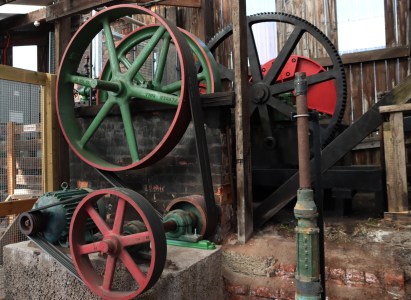
The site of the former copper and brass wire factory (5), the main output of which was  pins and bolts, has little to see.  It originally covered about an acre, and was the site of the wire mills of the Parys Mine Company, where rods of copper and brass were pulled through a series of holdes of decreasing size and then heated and cooled until wire was produced.  The site does contain an original waterwheel pit in which a waterwheel is still located, now renovated and capable of producing electricity for the museum.

In 1856, Newton Keates and Co leased the site and raised the level of the dam to create a larger pool.  This was a mistake.  Water broke through and flooded in 1857 and 1858, so the height of the water behind the dam had to be lowered.  The works closed in 1894 and the machinery was auctioned off.

Apparently, at a later date in the early 20th century, a small soap-works was built on the site which produced, presumably amongst other themes, soap imprinted with images of St Winifred, the first batch of which were sent to the Pope.  The mind boggles.  Today there is a small bandstand at its edge.

Further down the path, and the Bakehouse Café is located in Basingwerk House, a fine 1930s building.   We had a very good lunch there.  Beyond that is Basingwerk Abbey (about which more on another post) and beyond that is a car park and the A458, which you need to cross to reach Greenfield Dock, which is off the above map.

Greenfield Dock

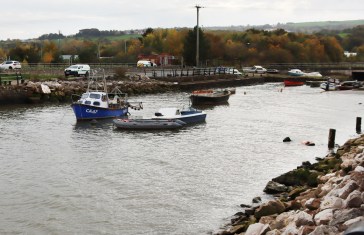
Greenfield Dock is beyond the Green Valley Park, but is only a short walk away, reached by going through the car park beneath the abbey, crossing the main road, heading left for a short distance and taking the first on the right.  This is Dock Lane, which takes you to Greenfield Dock and the Wales Coast Path.  There’s not a lot to see, just a couple of tiny fishing boats in an inlet, and views (on a less grey day) across to the Wirral, but the dock was an important contributor to the Green Valley industries, linking with the Holywell Rail Line.

The Wales Coast Path, however, looks excellent in both directions, and a great destination for a sunny day.  It starts in Chester, and can be followed continuously around the entire Welsh coastline, but can be done in short chunks.  From here, for example, one could head upriver to Flint along the Path, and visit Flint Castle (which I have written about here), which is a walk of 4.3 miles (6.9 km) from Greenfield Dock to Flint Castle, but don’t forget the return journey.
——-

Wales Coast Path: Flint to Holywell. Source: Wales Coast Path

Visitor Information:

This is an excellent place to visit, with stacks to see.  If you are interested in industrial archaeology, wildlife on land and water, and woodland walks, you will not be disappointed.

To give some idea of how long it took us, we started out from Churton (about 15 minutes drive south of Chester) at 1030, arriving in Holywell at about 1115, having taken the most direct route along the A55, and we left at 1530, with a short stop for coffee and a snack in the park.  This is a dry-day walk, because there is nowhere to shelter.

In the Greenfield Valley everything is open and free to see other than the Green Valley Park Museum and St Winifred’s Well and Chapel.  We didn’t visit the museum, which is behind the visitor centre but details are available here.  Details for St Winifred’s Well can be found here.  The museum and visitor centre are closed from the end of October onwards.  There are also details about children’s activities on the Greenland Valley website here.

From a mobility point of view, a number of tracks, including the one that follows the line of the old railway are wide and metalled, but there is a distinct downhill gradient from Holywell to the abbey, and of course there’s the uphill gradient on the return journey.

Sources:

Berry, David, 2012. Walks around Chester and the Dee Estuary.  Kittiwake Books

Davies, K. and Williams, C.J., 1986. The Greenfield Valley. An Introduction to the History and Industrial Archaeology of the Greenfield Valley, Holywell, North Wales.  Holywell Town Centre

Greenfield Valley visitor’s Guide and Map (A3 fold-out)

The Industrial Heritage of Greenfield Valley. KS2 and KS3 Teaching Resource
cadw.gov.wales/sites/default/files/2022-02/Industrial%20Heritage%20-%20Greenfield%20valley%20resource%20-%20English.pdf

Greenfield Valley Park:  www.greenfieldvalley.com

A terrific visit to the Lion Salt Works in Northwich

The Pump House

What a brilliant place! The Lion Salt Works in Northwich is not only the last open-pan salt works in Cheshire but one of only four remaining in the world.  I had really very little idea of what to expect, but of all the places I have visited, this one most resembles an industrial time capsule.  It is as though things were left just as they were when the Works closed, which is more or less what happened.  The biggest market for Lion Works salt was West Africa, but when the Nigerian Civil War broke out in the late 1960s, and the political situation that followed it failed to improve matters, the Lion Salt Works struggled to survive, and the business closed in 1986.  The decision was made to convert the Works into a museum of salt working, and what a good decision that was.  There are lots of information boards, models and sound effects, all excellent, but what really grips is the sense that this could all start up again tomorrow.

Roman and Medieval salt pans

Another extraordinary aspect to the place is how for just under a century, between 1894 and 1986, the method of making salt from brine hardly changed.  In fact, the method used was pretty much the same as that employed by the Romans in the same area.  Open-pan salt manufacturing is just what it says – the salt-carrying water, brine, was pumped up from two levels of rock-bearing beds from below the surface and then fed into huge rectangular iron pans, which were heated from below to drive off the water, and then dragged to the side of the pan to help them drain

Salt beds beneath the Lion Salt Works

The Cheshire salt was once suspended in sea water.  In the Triassic Period, c.220 million years go, the Cheshire Basin was a tropical lagoon in which seawater became trapped.  As the water evaporated from the lagoon, it left behind a rock salt known as halite (Sodium Chloride).  Two bands of of salt lie under Northwich and were tapped by the Lion Salt Works.  The first is 40m (131ft) down and is 20m thick (65ft), then there is a 10m (33ft) layer of marlstone and then a second, 30m (90ft) layer of salt.  When rainfall entered the water table and washed over the salt layers, it dissolved the salt again, and created subterranean streams of highly salted water known as brine.  Natural forces pushed these salty streams to the surface in the form of natural springs, but the streams themselves could be tapped by drilling down to them and pumping the brine out at the pump house.

Inside the Pump House

The pump house is a good place to start your visit on the way from the car park to buy your ticket in the former Stove House, now containing a brightly modern shop and café.  The brine, once extracted from the borehole,  was stored first in a tank and from there it was distributed to the salt pans for processing.  A steam engine powered the pump, and both the engine and its boiler are still visible in the pump house.  The pump was known as the “nodding donkey” due to the motion of the overhead beam as it rose and fell.

Once beyond the ticket office, you follow the signs to enjoy a self-guided tour.  There are plenty of disabled elevators for the leg-challenged and for wheelchair users, which you can operate yourself.

The first building that you come to is a former terraced house, the Red Lion Inn.  The original Red Lion Hotel was knocked down in order to expand the mining operation, so two terraced houses were purchased in order to give the workers somewhere to relax after the heavy labour in the stove and pan houses.  This building is now used to show Roman and Medieval versions of the pans (just smaller, not actually any different in how they were used) and to show a reconstruction of the works office, complete with clocking-in machine, and the Red Lion bar.

Indoor salt pan on the first floor

It is difficult to get one’s head around the salt pans.  The concept is childishly simple, but the sheer hands-on labour involved even as late as the 1980s is truly remarkable.  There are displays showing the role of each of the workers.  The Lion Works was set up and run by six generations of the Thompson family, and the workers were all local people.   At first both men and women were employed in the heavy duty work of the Works, but later women were confined to the less strenuous work of packing up the salt and carrying out administrative tasks.

The two main initial tasks were to rake up the salt in the pans once the water had been evaporated off (creating steam-heavy rooms), and to feed the fires in the stove houses.  Here’s a somewhat eye-popping excerpt from the guide book:

Salt-making was a ‘dark art’ and the salt workers would add all sorts of things to make the salt crystals form.  These included strong ale, bullock’s blood and eggs, but these were replaced by soft soap and glue

First floor stove room

Workers known as wallers worked in the outdoor pans, pulling the salt along the edges of the pan to form large walls to drain it.  Inside, lumpers worked on smaller (but still huge) pans to rake the salt to the sides where it drained, before pacing it into blocks or lumps. The lumps were taken on barrows to the stove rooms to dry out.  From here they went through a crushing mill, a splendid piece machinery that was steam-powered until the 1950s when it was converted to electricity.  The resulting salt grains were graded from fine to coarse before being packed up in bags or small plastic packs.

The salt that was processed outside was inferior to that made inside, not due to the original brine or the work of the crushing machine, but due to the temperature at which it was heated in the pans.  This is because of the multiple uses of salt, from fine-dining to packing fish caught at sea.  The Trent and Mersey Canal runs alongside the works.  Coal to power the engines and to heat the pans was delivered by narrowboat and the packaged salt was also sent out by narrowboat.  The canal network was huge, and even though canal travel was slow compared to the railways that eventually replaced them, was well equipped for transporting heavy, bulk products reliably to towns, cities and ports.

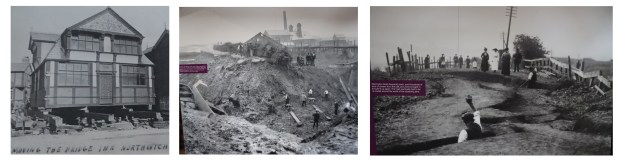
The mining works had a dramatic knock-on effect on the structural stability of the town of Northwich.  The story of the subsidence caused by the mining is another aspect to the story that is truly compelling.  On the approach to the Lion Works, one of the mines subsided so thoroughly in 1928 that two flashes now flank the road.   The subsidence had a truly transformative impact on buildings and infrastructure, and not in a good way.  Buildings shifted, some tilting backwards or forwards, others dividing slowly into two, the brickwork forming great fissures as the subsiding and pulled them in opposite directions.  The solution was to go back to Medieval domestic building traditions, creating light-weight frames and building in jacks points into which levers could be inserted, in order to persuade buildings back into position.  Other buildings, like the Bridge Inn, could simply be moved in their entirety.  This gives the town today a half-timbered look.  It is an astonishing idea that to respond to the conditions, buildings became just as shiftable as furniture. Roads too subsided, and one collapse caused a major breach in the neighbouring canal.

Left: The Bridge Inn in Northwich on the move, giving new meaning to nomadic settlement strategies. Middle: The Marston Hall mine collapse caused part of the canal to subside in 1907. Right: Warrington Road frequently sank and 1000s of tons of salt pan cinders were used to build it up again.

There is lots more to find out at the museum, and I recommend it for anyone interested in industrial heritage.  As well as the Works themselves, there are plenty of really excellent information boards, some interactive displays aimed mainly at children, and some absolutely splendid photographs.

Visiting

We piled out to Northwich along the M56, and it was easy to find the Lion Alt Works by leaving at Junction 10, but we had intended to return via the A51, taking in the Anderton Boat Lift on our way back.  In our dreams.  At the time of writing (September 2022) Northwich is up in extensive roadworks, and the diversion signs must lead somewhere, but heaven knows where.  A sign half-buried in an overgrown verge directed wannabe Boat Lift visitors to follow the diversion signs, which was hysterically funny as the diversion signs were, as stated,completely unfathomable.  We just about found our way to the A51 to Chester (although not by following the diversion signs), but we never did find the Boat Lift, in spite of several attempts, both with and without the SatNav.

At the museum there is a car park, café and shop.  A free map is given out, but a really useful guide is available for purchase too.  The opening times on the website state that the museum is closed on Mondays except bank holidays, and there is an entrance fee.  For up to date information check out their website.
https://lionsaltworks.westcheshiremuseums.co.uk/

The smithy

The staff at the museum were friendly and helpful.  We were chatting to one of them at the end of our visit when we were sitting in the café.  His knowledge was immense, and he knew the answers to all the questions that we fired at him.  I failed to catch his name, but my sincere thanks.

The coffee came from a push-button machine, but was absolutely fine, and the tea was served in a lovely little pot.  The coffee was a particularly nice surprise after the undrinkable swill that was being served with breakfast in the Novotel in Greenwich (London), where I was staying recently!

For disabled and mobility-challenged visitors, there are wheel-chair friendly lifts to the upper floors, and you can operate these yourself.   The whole museum is intended to be disabled friendly, and at least to my eyes, looked very well thought out.

Feeding the ovens beneath salt pan 3

I wanted to see if there was any edible (as opposed to ornamental) local salt for sale, but forgot.  I am real salt enthusiast and always have several types at home for both cooking and seasoning at the table, so I am a tad miffed that I forgot to look!  If you go, do let me know if they were selling any.  There were blocks of ornamental salt for sale, in beautiful shades of pink, but I have no idea if it was edible too.

Manager’s house

Northwich town itself looks as though it will be well worth visiting after all the roadworks have come to a close, particularly if you are a fan of inland waterways and the architecture and civil engineering that goes with them (which I am).  Make sure that the Anderton Boat Lift is open if you want to see it, as its opening times seem to be something of a movable feast.


The crushing mill

Interior of the smithy


The Dominican Friary at Rhuddlan

Introduction

Rhuddlan Friary by Samuel and Nathaniel Buck 1742.  Click to see the larger image. Source: Coflein

Prior to visiting Edward I’s 1277 Rhuddlan Castle (upcoming) I was having a look on the Ordnance Survey map of Rhuddlan, and saw that a little way downriver from Edward I’s castle, and beyond the earlier motte-and-bailey castle of Twthill, there is a site marked as “remains of a friary.”  I was unaware of anything there, so I had a look through my books and on the Coflein website.  Sure enough, there was a substantial Dominican friary there, established in 1258 by Llywelyn ap Grufudd (Llywelyn the Last), 19 years prior to Edward I’s castleIt went the way of the greater percentage of monastic establishments, and was dissolved by Henry VIII in 1538.  In some texts it is referred to as a priory, but the friaries were originally quite different from abbeys and priories.
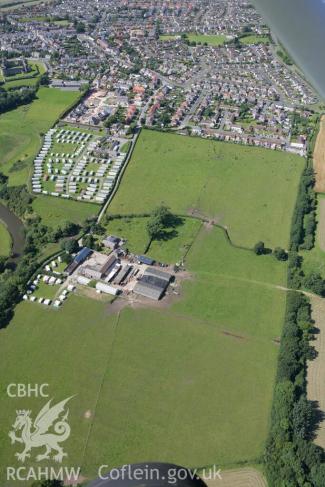
The site of the Rhuddlan Dominican Friary today. The farm in the foreground lies over the site, and some of the buildings incorporate elements from the Medieval building. Source: Coflein

Today there is almost no sign that it ever existed.  This is by no means an isolated case of a monastic or mendicant building being erased from the landscape.  Of around 270 friaries of the different orders, only 15 in England and Wales have survived well enough to determine their layout and appearance.  Some are known only from their archaeological remains and others have yet to be investigated archaeologically and therefore appear, for all intents and purposes, to have vanished.  In the case of Rhuddlan Friary, there are details of its past that can be recovered even without any ruins to examine, although it has been a jigsaw assembled by many people and published in different places.  The earliest useful account, by Harry Longueville Jones in 1847, worked hard to pull together the various tenuous threads, as its author describes:  “The unsatisfactory complaint, of fewness of materials for the history of Religious Houses in Wales, applies with peculiar force to that of the Priory of Rhuddlan; and the utmost that can, at present, be attempted, towards an account of it must consist in the stringing together of various brief uncorrected relics, scattered up and down in various books and a few manuscripts.”  It still feels a bit like that, but it is work like that of Jones that paved the way for people like me.

Over the site where it once stood there is now a working farm and caravan park, formerly Plas Newydd and currently called Abbey Farm.  It does, however, incorporate some stonework from the former friary, and parts of it are therefore of considerable interest.  The farm is private property and not open to visits from the general public, although a public footpath skirts it.  Fortunately, there are various accounts and photographs available of the surviving masonry and tomb slabs.  In addition, much of the friary church was still standing in the middle of the 18th century, when a drawing of it was made by Buck (above) showing a simple but substantial layout with gothic styling, with Rhuddlan Castle in the background, and this has allowed assessment of what was there at the time of the dissolution.  It has also been mentioned in a number of Medieval documents.

Rhuddlan. The map on the left shows the location of Rhuddlan (source: Google Maps). The map on the right shows the location of Rhuddlan Priory in relation to the 11th century Twthill motte-and-bailey castle and Edward I’s 1277 stone castle (source: Ordnance Survey Explorer 264 – Vale of Clwyd)———–

The Dominicans

Saint Dominic (c.1170–1221), portrayed in the Perugia Altarpiece by Fra Angelico. Galleria Nazionale dell’Umbria, Perugia. Source: Wikipedia

The Order of Preachers (Ordinis Praedicatorum), better known as the Dominicans, Black Friars or Preaching Friars were founded in Toulouse, France, in the early 13th century by Spanish priest Dominic of Caleruega.  Attwater describes a Dominican friar as “one who combines elements of the earlier monasticism – its dedicatory vows, its communal life, its daily round of praise of God in church – with the manifold works of the pastoral ministry.”  In a pre-plague era where overpopulation was a serious problem, and the poor and uneducated were clustered into many  towns, the role of the mendicant orders was conspicuous and often impressive.

The order of St Dominic (c.1170-1221) was officially recognised by the papacy in 1216.  Like the other monastic and mendicant orders they had strict rules, but unlike the majority of other British monastic establishments, they based themselves not on the rules of St Benedict but on the Rule of St Augustine.  They were therefore much closer in their practises and values to the Austins, Franciscans and Carmelites, also mendicants, than any of the orders based on the Rule of St Benedict that dotted the British rural landscape.  The three main focal points of the Dominicans were:

  1. Scholarship and intellectual integrity were seen as essential to salvation for heretics and the poor, whose ignorance led them astray.  Dominicans recruited amongst graduates and clerics. Robust theological training was given to all new Dominican friars, and education was essential to their ethos
  2. A vow of corporate as well as personal poverty was also integral, meaning that, at least in the first century of their activities, they could not engage in commercial activities and were dependent on charity for their survival, and would accept land and houses with which to establish themselves, or money with which to purchase them (unlike the Franciscans who rejected the ownership of property)
  3. A mission to both preach to and lend aid to the poor, weeding out heresy was fundamental to their ideas, following the example of the apostles to evangelize, leading the misguided and disadvantaged to salvation

St Dominic’s house, Maison Seilha,n at Place du Parlement Chapelle, Toulouse, France. Source: Wikipedia

The Dominicans organized themselves with a system of centralized government, an elected body that resembled the General Chapter of the Cistercian order (an annual conference to administer and rule the order).  The Dominican friaries were divided into provinces, each of which was headed by an elected provincial prior.  These answered to a master-general who was himself elected.  Each friary had a prior at its head who was elected by the chapter, and not only attended the annual chapter but was also accompanied by another member of the same priory whose role was, somewhat disconcertingly, to report on the prior’s performance.  This type of performance review and downward as well as upward accountability is very modern in concept.  It was this organization and accountability that turned the Dominicans from wandering clerics into a force to be reckoned with, which became important as the different mendicant orders found themselves increasingly in competition for donations, both with each other and the older institutions.

The Dominicans arrived in England in around 1221, and were known as the Black Friars or Friars Preacher.  They spread first to Ireland and then, in 1230, to Scotland. There were five Dominican houses in Wales, two of which, Bangor and Rhuddlan, were in north Wales.  By 1260 the Dominicans had persuaded both wealthy and poor that there was much to recommend them.  They had around thirty six houses in England, nine in Scotland and the five in Wales, and by the end of the 13th century there were around 60 in total.

The earliest preaching took place in public places like market squares where a sizeable audience could be gathered.  As they became established and increasingly popular, and were able to use donations to found churches to which audiences could be attracted, they began to preach on their own premises.  They tailored their preaching to their audience, and presented themselves as men of the people, sharing their poverty, quite distinct from both the upper echelons of society and the more established Benedictine monasteries.  At the same time they also appealed to the new commercial classes in the urban centres that they favoured.

Dominicans believed that ignorance was at the heart of heresy and defection from God, and that education would provide the ignorant and the poor with the tools to achieve salvation.  Throughout Europe the teaching of theology and logic continued to be of importance to the Dominicans, and each Dominican priory was responsible for setting up its own school to teach the basics, while they also set up regional schools for the further education of those friars who were academically promising. Leading Dominicans increasingly contributed to the development of Medieval universities.  Their mission to educate the laity was given an extra relevance by the decision of the Fourth Lateran Council of 1215, which required that every person should make confession to a priest at least once a year.  This required the general public to understand exactly what was required for a blameless life, and what steps were required in order to make a valid confession.

The extensive ruins of the massive Fountains Cistercian Abbey in Yorkshire. Source: Wikipedia, photograph by Mike Peel

Whereas Benedictine monks renounced all personal possessions and properties, the monastic houses in which they lived and worshipped could be very wealthy indeed, and were often fairly massive and elaborate structures.  Fountains Abbey (Benedictine, Yorkshire), Glastonbury (Benedictine, Somerset) and Lewes Priory (Cluniac, Sussex) are good examples.  The mendicants, by contrast, were permitted only to acquire enough resources to survive, via begging for alms or through charitable donations and bequests.  Even so, the friars of different orders were so popular, amongst the wealthy as well as the poor, that churches grew from simple places of worship to much grander affairs.  As J. Patrick Greene puts it “the more successfully the friars gave enabled the wealthy to gain spiritual grace through the vicarious experience of poverty, the less it became a reality for the friars themselves.”  This can be seen at the Franciscan friary in Oxford and the Dominican friary in Chester. Hinnebusch expands on this, and suggests that in the 13th century the Dominicans were also able to generate income of their own:  “Most houses had gardens, orchards, groves, and sometimes vineyards and fish ponds. Undoubtedly some houses were able to sell part of the produce from these sources and thus supplement the alms of the people.”  At least in the early years of their mission, their properties were not rented out, certainly as this was in direct violation of Dominican rules, which were strictly enforced.  There is more on this in connection with Rhuddlan Friary, below.  In the later Medieval period, however, matters changed as Hinnebusch explains:

Pope Gregory X. Source: Wikipedia

In 1261, a papal bull allowed the Order to accept revenues for the purchase of ecclesiastical ornaments, vestments, and books. In 1266 friars were allowed to accept inheritances which would have come to them if they had remained in the world. These could be held or converted into money for the maintenance of the community. In 1274 after the attack on the mendicant orders at the Council of Lyons, Gregory X declared that the friars could “accept properties with a safe conscience.” The bull Supra Cathedram of Boniface VIII, 1299, in obliging the friars to give a fourth of all legacies, bequests, funeral charges, and other donations to the parish church struck a death blow to mendicant poverty. Under these conditions the quest and voluntary gifts were no longer sufficient, and the Order was obliged to seek for fixed sources of income.

Inevitably the mendicants stepped on the toes of the secular clergy, those bishops and parish priests whose congregations and incomes were under threat by the arrival of the mendicants, particularly as the mendicant churches grew and incorporated larger congregations.  Papal intervention was sought on several occasions, but the tensions continued.

——–

The Dominican Friary at Rhuddlan

The foundation of the friary

The Dominican Friary at Rhuddlan was established by Llywelyn ap Gruffud (Llywelyn the Last) in 1258, 19 years before work began on Edward I’s castle nearby.  He is also thought to have founded the priory at Bangor in the mid-13th century.  It was a tradition amongst the Welsh princes to found monasteries.  Although Cistercian monasteries were particularly prestigious amongst the princes, with one in each of the main cantrefs, Llywelyn was not a lavish spender on elaborate monastic projects, although he occasionally made financial gifts to those houses established by his ancestors.  He became a benefactor of the very small Cistercian monastery at Cymer near Dolgellau that had been established by Gruffudd ap Cynan of Gwynedd in 1198, as well as of Beddgelert Augustinian Priory near Bangor, thought to have been established by one or more of the lords of Gwynedd in 1200.  He made a loan to an abbot of Valle Crucis Cistercian Abbey near Llangollen, which had been founded by Madog ap Gruffydd Maelor, ruler of Powys (north), in 1201.  Perhaps when it came to founding his own houses, he preferred the ideologies and practices of the Dominicans; it is also possible that they represented a rather less eye-watering investment.  It should be noted that Samuel Lewis, in his 1849 Topographical History of Wales, believed that it had been established in 1197 by Ranulf III of Chester, but he gives no explanation for his thinking.  

Rhuddlan Friary was established on the River Clwyd, 4.8km (3 miles) to the sea on the cost of North Wales, set above the floodplain, with a short cliff separating it from the valley below.  A town had been here since the Anglo-Saxon period, taking advantage of the best pace to ford the river.  William the Conqueror is thought to have ordered the building of the Twthill motte-and-bailey castle which was built in the 11th century and was probably still maintained for defensive purposes when the Dominicans set up their friary.
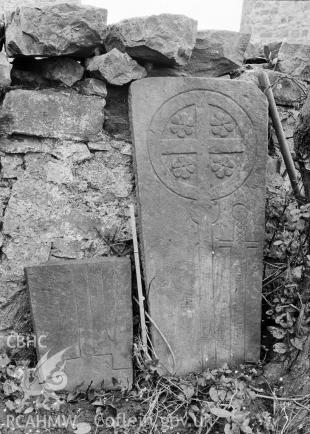
Inscribed tomb slab. Source: Coflein

There were only two Dominican houses in north Wales, the other being in Bangor, established in 1251, seven years earlier than Rhuddlan, again probably by Llywelyn ap Gruffud.  Wales was not strong on mendicant orders in general, primarily because they favoured urban areas, and Wales in the 13th century lacked the busy towns that were growing up in England.  There was only one Franciscan house in north Wales, on Anglesey, and a single Carmelite house, at Denbigh.  Given that there were so few mendicant orders represented in north Wales it would be interesting to understand why Rhuddlan, of all the possible towns in Wales, was selected as an attractive site for the Dominicans.  Although it may have had something to do with Llywelyn himself, it is also possible that the founding friar may have had input, and may have had a connection to Rhuddlan.

Whether parish church, abbey, priory or friary, all religious establishments came under the wing of a regional ecclesiastical body, a diocese, headed by a bishop.  By 1291 Rhuddlan Friary came under the diocese of St Asaph (in English), Llanelwy (in Welsh), together with other ecclesiastical deaneries (groups of parishes) like Aberconwy Cistercian Abbey, Strata Marcella Cistercian Abbey near Conwy, Valle Crucis Cistercian Abbey near Llangollen and Basingwerk Cistercian Abbey near Holywell.  Rhuddlan Friary, Valle Crucis Abbey and Aberconwy Abbey all provided St Asaph with bishops.  Rhuddlan’s Prior Anian II (or Einion II) became the bishop of St Asaph in 1268.

It is not known where the friars came from.  Dominican scholarship was an important component of their ethos, and the Rhuddlan friars would have received training when they joined the order, although Latin would have formed a common language, and a common bond.  Rhuddlan had passed between the English and Welsh through its history, but because friars mingled with communities, it is probable that at least some of the friars must have been Welsh speakers.  Attwater points to the dozen Dominican bishops that he knows of with English names, but says that the impression they give is misleading, and that Welsh friars predominantly had Welsh names.  Potential sources for friars to populate a new friary could have included the other Welsh friaries, but also reasonably nearby was Chester, where a Dominican friary had been established in 1236 and was doing very well.

The friary architecture

Although there is almost nothing left of the Dominican friary at Rhuddlan, it will have been built on the lines of other Dominican communal establishments.  Like the more numerous Benedictine monasteries and priories, a Dominican friary consisted of a church, which made up one side of a complex of buildings that were arranged in  square or rectangle around a garden, the garth.  The church would usually be on the north, and the domestic and administrative buildings were incorporated into the other buildings over one or two storeys.  The image below shows the layout of the mainly 14th century Dominican friary at Norwich, as an example, in this case fairly elaborate but, like most Dominican friaries, the church had no side transepts which makes them look significantly different from Benedictine-style abbeys and priories.

Ground plan of Norwich Friary. Source: Giraud, E.J. and Linde, .J.C. 2021 – via Google Books

The drawing by Buck shown at the top of the page and shown again below has been invaluable to architectural experts who have been able to clarify the main features.  The following is taken from Clapham, published in 1927, who has done an excellent job of deconstructing the image and reconstructing the friary, and concludes that the friary was built on a “much more ambitious scale than was usual among lesser friaries.”
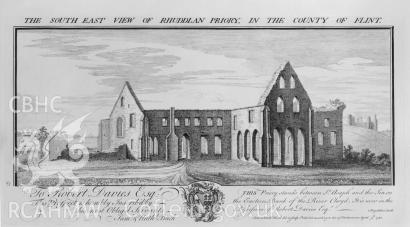
Rhuddlan Friary by Buck. Source: Coflein

The whole length of the building shown was no doubt occupied by the dorter [dormitory] on the first floor and at its north end is some indication of the junction with the church, though even then this building had been entirely destroyed. Projecting eastwards from the range is a gabled structure, with three lancet-windows in the east end and three in the south return wall; this was undoubtedly the chapter-house with a room above it. Further south, in the main range, is the archway of a passage from the cloister, and still further south a chimney-stack, probably that of the fireplace in the warming-house.
At the south end of the range is a large doorway, at the dorter-level, evidently that leading to the rere-dorter [latrines], the ruins of which, with its connecting bridge, are also shown. Of the southern range of the cloister court, the eastern part of the inner or north wall is still standing and contains four small square-headed windows of red Chester stone, set high in the wall, above a string-course which probably marked the level of the cloister-roof. The rest of the range seems to have been rebuilt, but the south side of it is shown in
steep perspective in Buck’s view. The only other ancient portion of the existing buildings is the northern portion of the outer wall of an outbuilding on the west of the yard.
It appears to have projected westward from the original western range, as there is a return angle at the south end. It contains two pointed windows, probably of the fourteenth century, and blocked with ashlar. The rest of this range contains other pointed windows, but they appear not to be original and the walls themselves to be of post-suppression date.
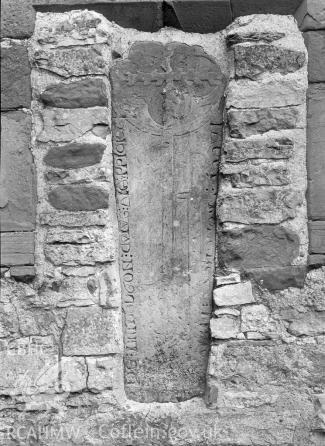
Inscribed stones in vicarage wall at the Friary near Rhuddlan Church, taken by Leonard Monroe. Source: Coflein

At Abbey Farm today, the farmyard is thought to occupy the site of the cloister garth and part of the south cloister range, with the farmhouse occupying the site of the church, and the southern range perhaps incorporated into another farm building where blocked windows probably date to the 14th century.  Modern buildings have obscured what was probably the cloister, c.26-28m square.  Medieval building materials have been identified and in one of the farm buildings at the east of the farm complex, with some sepulchral slab fragments  incorporated into the walls, as well as a niche with a heavily eroded 14th century effigy still visible in it, shown below.  Clapham picks out details that were incorporated into the farm buildings that sit over the site, including bits of architectural and sepulchral masonry (tomb slabs).  Some of the tomb slabs are shown on this page, thanks to a digitization programme by Coflein, but with no attempt to put them in any particular order.  See captions for credits and links.

Built into the garden-wall, to the north of the yard, are portions of a moulded and cusped arch of early fourteenth-century date and probably part of a tomb recess. Of the various funeral monuments built into the walls of the buildings round the yard . . . .

Engraving incorporated into a wall.  Photograph taken by Leonard Monroe. Source: Coflein

On the east side of the yard: (a) effigy in high relief of a civilian in hood with flap, belt with skirt of gown tucked into it and holding in both hands a baton, or possibly a mace, probably fourteenth-century; (b) part of a coffin-lid with inscription.

On south side of yard: (a) incised slab with figure of an archbishop1 in mass-vestments with cross-staff and marginal inscription to William Freney, archbishop of Rages, c. 1290.
This slab has now been removed to the parish church; (b) slab with raguly cross in relief, head in a quatrefoil, sword at side and inscription to Robert, son of Robert de Bridelton, early fourteenth-century.

On west side of yard: coffin-lid with elaborately enriched cross on stem inscribed ‘Hie jacet [here lies] Snaisii,’ the rest of the inscription destroyed, thirteenth-century. The inventory of goods taken at the suppression mentions the quire with a table of alabaster on the altar and new stalls, two bells in the steeple and the kitchen.

There are references to the friary church having a particularly magnificent rood screen, which attracted pilgrims, about which more below.  In 1849, Samuel Lewis writes that “near it [the friary] is a fine spring, from which the priory derived water, conveyed to it by leaden pipes, that were taken up not many years ago: from this spring the town of Rhuddlan is now supplied during seasons of drought”

Unlike the better known Cistercian monasteries of north Wales, which were built in areas where the monks could worship in isolation, as separate from the world beyond the cloister as possible, the Dominicans always intended to be part of the local community and their friaries were built either on the edge of towns, like Rhuddlan, or within them, like Chester’s Dominican friary.  The friars’ lives were a balance between the communal living and worship that too place within their monastic premises and the preaching that they carried out in neighbouring communities.  They built their friaries in or near towns and the friars would have been familiar figures around the town of Rhuddlan where they would have mingling with townspeople and recruiting support in their missionary roles.

How the friary sustained itself

Inscribed stones in vicarage wall at the Friary near Rhuddlan Church, taken by Leonard Monroe. Source: Coflein

The friary appears to have been well provided for throughout the 13th century, and must have had significant status locally.  By 1283 there were 23 friars at Rhuddlan, a very healthy number.  In Cardiff and Haverfordwest, both Dominican friaries, numbers are recorded in 1285 as 30 and 39 respectively, but Rhuddlan was rather more remote.  In 1268 Rhuddlan Friary’s prior “Anian (Einion) of Nanneu” became Bishop of St Asaph, a significant honour.  It is unlikely that such an appointment would have been made from a minor establishment, a suggestion supported by other appointments to the position from the big Cistercian abbeys of Aberconwy and Valle Crucis in north Wales.  Records of payments to the monastery also give a sense of its importance, including a payment in 1281/1282 at the time of the birth of the princess Elizabeth at Rhuddlan, Edward and Eleanor’s 5th child, of 7s 8d to the friars of Rhuddlan and 1s 1d for the brethren of the hospital of Rhuddlan (about which more below); a bequest in the will of Bishop Gervase de Castro in 1370 of 60 shillings and another bequest, this time of 20 shillings, from Llewelyn ap Madoc, bishop of St Asaph, in 1373. 

The friary also appears to have been taking steps, beyond accepting alms and bequests, to care of itself.  Hinnebusch comments “At Rhuddlan in 1534, the prior leased several gardens and an apple orchard ; two years later a second apple orchard was leased. When the house was sup pressed, the sale of the effects of the priory included kine and pigs.”  Kine were a type of cattle.

Map showing Rhuddlan on the Welsh pilgrim routes, which link north and south Wales. See the following link for the full UK map. Source: The British Pilgrimage Trust

The excellently researched academic Monastic Wales Project website states that “Pilgrims flocked to visit the rood at Rhuddlan,” but does not expand on the comment.  The rood is the screen that divides the nave (where the public worship) from the chancel (the sanctuary at the eastern end of the church that was confined to the friars).  It is usually ornate, and made of open tracery in wood or stone (more likely wood at a Dominican friary like Rhuddlan, as it was much less expensive).  It was usually topped with a beam that held the rood (a depiction of the crucifixion), often accompanied by other key figures from the Christian story.  At Bangor, part of the rood survives, and symbols of the evangelists, the ox, eagle, lion and man, accompanied Christ.  Some rood screens attracted pilgrims either because of their particular design or because of associated miracles, In her PhD thesis, Lisa Garland says that many depictions of Christ became objects of pilgrimage, particularly in the 15th century, many gilded.  In north Wales, both Rhuddlan and Bangor had rood screens that attracted pilgrims, were celebrated in Welsh bardic poetry, and and were located on Welsh pilgrim routes, as shown on the map above right.  Pilgrims might be depended upon for offerings to a religious institution, helping to support them.  The rood at Rhuddlan was celebrated by the poet Gruffudd ab Ieuan ap Llywelyn Fychan, which would probably have been good PR for the friary.

The Impact of Rhuddlan Castle

Edward I saw himself as a devout Christian.  He had been on crusade, and he had made a vow to build a Cistercian monastery, which he founded in east Cheshire at Vale Royal in c.1270.  Edward I’s military activities often dragged monastic establishments in Wales into the conflict.  Being devout, or at least concerned about his status in the eyes of God, Edward compensated a number of monastic establishments in north Wales, both big and small, with significant sums of money and other gifts.  These included Basingwerk (near Flint Castle), Valle Crucis (near Llangollen), Aberconwy (near Conwy), and Cymer (near Dolgellau).

Inscribed tomb slab incorporated into the wall above a doorway. Source: Coflein

There is no surviving record of Rhuddlan Friary suffering damage to building or losing resources such as grain or livestock, but Llywelyn surrendered at Rhuddlan Castle in November 1277 and it seems improbable that the friary escaped entirely unscathed during the conflict.  The friars of Rhuddlan are credited with having organized the care of the wounded at that time, so were clearly in the thick of it.  Whether from guilt about harm inflicted or from appreciation of the Dominicans, Edward continued to finance the friary after Llywelyn’s death in 1282.  This is not particularly surprising, as both Edward’s father Henry III and Edward I himself were supporters of the mendicants in England, providing them with the much-valued stamp of royal approval.  In addition, Edward had a policy of compensating religious houses for damage inflicted during his conflicts with Llywelyn in Wales. By way of thanks for royal support, Rhuddlan Friary supplied Queen Eleanor with honey from its own hives. Queen Eleanor died in 1291, Rhuddlan Friary was a beneficiary from her will, which included a grant of 100 shillings each to the Dominican houses of Wales and England.  Rhuddlan Friary was also allocated 2 and 1/2 acres of land.

The community of Rhuddlan friary

The Danse Macabre or Dance of Death (1493) by Michael Wolgemut, from the Nuremberg Chronicle of Hartmann Schedel. Source: Wikipedia

Very little is known about the individuals who lived within the community of Rhuddlan Friary or any of the activities that were carried out, including their preaching.  Rhuddlan is considered to be a probable source of a version of the danse macabre (dance of death, also known as the dance of Paul’s). Several of the mendicant orders used the danse in their sermons, and the Dominicans were particularly enthusiastic about its terrifying imagery, often featuring death as a cadaver coming to claim the living, which was a warning of perils to come, and a reminder of the need to prepare one’s soul for the inevitable.  Here’s a flavour from a paper by Gray and Hale, translated from the Welsh, by poet Dafydd Ddu Hiraddug:

The corpse that was full of excess in a dirty closed place
As food for insects without worthy blessing …
The beautiful eyes now rounded holes
Full of maggots, in truth;
The comely mouth, which was so playful,
And was haughty, sad its form
A sardonic black hole, unlikely to be loved,
Black sorrowful nape, pathetic loneliness:
And the white teeth like old pegs
Dirty grey putrid bones
The long arms and the beautiful legs
Are sticks with gristle: offensive and putrid!

Enough to put the fear of God into anyone.

Only one of the community members is known for certain, and that is because he achieved prominence outside the friary’s walls as Bishop of St Asaph.  I have included his biographical details below because it is some indication of the level of seniority that the friary could attract.

Effigy of Anian in St Asaph Cathedral. Source: Wikipedia

Anian, the Rhuddlan prior who  became Bishop of St Asaph in 1268, was often a chosen intermediary between Llywelyn ap Gruffudd and both Henry III and Edward I, but he became alienated from Llywelyn as the relationship between the prince and Edward I deteriorated.  Towards the end of 1273 Anian he wrote to Pope Gregory X to make charges against the prince.  This put him in confict with the Cistercian order in Wales, whose abbots in turn wrote to the pope, on 7 March 1274 in defence of Llywelyn. His loyalties remained with the king and he continued to represent Edward’s interests against Llywelyn.  When Edward was defeated in 1277, Anian’s diocese, St Asaph passed to the control of the English Crown.  In 1281 Anian was given support from Edward in his bid to the papacy to move bishopric from St Asaph to the new royal castle and its accompanying town at Rhuddlan, a far higher status location, but this came to nothing.   During the resumption of hostilities between Wales and England in 1282, the cathedral of St Asaph was burned, infuriating Anian, who refused to lend the king further support and excommunicated the soldiers who attacked the cathedral.  The king seized his goods and denied him the diocese.  The rift was repaired in 1284 with the intercession of the Archbishop of Canterbury, Pecham.  Anian was granted the advowson (vacant ecclesiastical appointment) of Rhuddlan in return for a good will gesture of 500 marks.  Throughout this period he fell out with many other secular and religious dignitaries.  He died on 5th February 1293.

In 1284 some indication of the status of the friary is provided by the appointment of the prior of Rhuddlan by Archbishop Pecham to the commission of inquiry tasked with assessing the need for rebuilding and repair of churches damaged during the Edwardian wars in Wales.  This was not Anian, who was by now the bishop of St Asaph, but I have not yet tracked down his name.

St Mary’s Church on the River Clwyd, Rhuddlan, which now houses the tomb of William de Freney.  Edward I’s Rhuddlan Castle is shown in the bacground.  Source: photograph by Mike Searle on Geograph.

There would have been  cemetery at Rhuddlan Friary, where the inmates would have been buried.  There are various pieces of tombstone incorporated into stone walls at Rhuddlan, re-used as building materials.  Only one of the burials has been identified for sure, dating to c.1290: when William de Freney, archbishop of Edessa (Upper Mesopotamia), was buried at Rhuddlan.  His tomb was saved because it was removed to St Mary’s Church in the town, where it remains.  If this was done at the dissolution it is something of a puzzle why none of the other tombs were moved at the same time.  William de Freney was a Dominican monk, but although he was buried at Rhuddlan, his career unfolded far from north Wales, and although it is possible that he ended his days at the friary it is by no means certain.  He was a diplomat and skilled orator and linguist.  It is possible that when Edward went on crusade in 1270, de Freney went with him, but his movements are unclear until his death at Rhuddlan.  Edward I spent a lot of time in the 1270s and 1280s in Rhuddlan, and the presence of de Freney at Rhuddlan was almost certainly connected with Edward’s own movements.  The tomb slab is inscribed with a legend in Norman French:PRIEZ PVR LALME FRERE WILLIAM DE FRENEY ERCHEVESHE DE RAGES (Pray for the soul of Brother William de Freney Archbishop of Rages).  The name Rages appears to have been identified with Edessa.

The friary and the town

There are no records about interactions between the friary and the town, although they must have been frequent and various.  The friars must have been impacted just as much as the townspeople by the famine and then the plague, both of which swept through England and Wales in the first half of the 14th century.

Rhuddlan Castle. Source: Mike Searle, Geograph

Where Edward built castles in Wales, he changed the entire character of each of those areas. Oddly, the friary was not included in the new borough established by Edward in 1278, which went against usual practice.  I have read nothing to explain this.  Perhaps the exclusion was at the request of the friary itself, to maintain its independence, or for other reasons of its own.  The town that the friars attended before the arrival of Edward I in 1277 was a very different place from the one that Edward built for English immigrants, a Gascon-inspired planned town called a bastide, and the friary presumably extended its reach to the English newcomers, although it is very probable that the majority of the Dominican friars were in fact Welsh.  This could of course have changed over the decades as the town changed and new members were accepted in to the friary.

When Edward’s engineers and labourers had finished straightening out and deepening 2 miles of the River Clwyd to enable seagoing ships to reach the castle, the friars may have benefitted.  As soldiers and sailors arrived by ship, the friars would certainly have had new audiences for their preaching might, which might very well have been welcome as they contemplated war with Llywelyn, the privations of the terrain and the weather and their own mortality.

Unsurprisingly, given the order’s pastoral mission, during the Black Death of the 14th century, the order was very nearly wiped out as the friars throughout Europe mixed with their communities, attempting to bring support, and placing themselves at the highest possible risk.  Figures are highly elusive for Wales, but one estimate suggests that by the end of the 14th century the population of Wales had been reduced from a total of around 300,000 to under 200,000, a reduction of some 100,000 people. Although an earlier famine had some part to play in that figure, successive resurgences of the plague were the main cause.  Most of these would have been in the minority of lowland urban centres like Rhuddlan, rather than in the upland areas where the population was more dispersed, but its impact was still ferocious.

It is not known exactly how the Black Death impacted Rhuddlan, but enough of the population survived to enable both town and friary to survive. Under 100 years later, the senior occupants of the burgess and their land are recorded in a document dated 1428.  Most of the survivors noted are English names, probably those descended from Edward I’s settlers.  As well as recording that a community of burgesses had formed a landholding corporation, and that St Mary’s itself had land holdings.  No mention is made of the friary, but this was excluded from Edward’s new borough.

A public footpath connects the friary to the still-surviving motte of the 1073 Twthill motte-and-bailey castle, and Edward I’s 1277 stone castle beyond.   This part of the valley must have been quite a sight in the 13th and 14th centuries, with the canalized river running at the foot of friary and the cliff below both castles, new and old, with ships moored against the river.

The dissolution

The opening page of the Valor Ecclesiasticus, showing Henry VIII presiding over the valuation of the religious houses prior to their dissolution. Source: Wikipedia

The friary was dissolved in 1538, when six friars signed the Act of Surrender.  The surviving details of the abbey, as meagre as they are, have been discussed above.  The process of dividing the assets for sequestration and sale was overseen by Richard Ingworth, Bishop of Dover, who was ironically Dominican.  He recorded that he sold “cows and pigs for 22./-; paid for servants, and carried off a little chalice.”  The chalice would have contributed to the treasure trove being amalgamated from the dissolution by Henry VIII.  The premises additional to the church and cemetery are recorded at that time as a hall with three chambers, two other chambers, a kitchen and a stable.
——–

A monastic hospital?

Rhuddlan Castle in 1749 by John Boydell. Source: National Library of Wales via Wikipedia

There is considerable confusion about the presence of a hospital during the 13th century, when the friary was founded.  There are two references to it in documentation associated with Edward I, but it is by no means certain that it belonged to the Dominican friary.

In 1848 Harry Longueville Jones, in the second part of his piece on Rhuddlan Priory, gives a description of the hospital’s location, although he still gives no further idea of why he thought that a hospital was located here:  “The Hospital stood about a quarter of a mile to the NE of the priory on the southern side of the road leading to Diserth;  an old building, although perhaps not original, was standing here until within a few years.  It is now replaced by an ordinary cottage, in which all features of antiquity are disappeared.  Leaden pipes and conduits, leading from the hospital to the priory, have been dug up in the fields near that latter building” (p.48),  He goes on to suggest that it was “not improbable” that it could have been a “Lazarhouse” (a hospice for lepers), but this seems simply to be speculation.

Effigy in a wall at Abbey Farm. Source: Jones 1847

One of Edward I’s edicts states that the burial ground at the church of Rhuddlan had become inadequate, and that another site near the hospital should therefore be made available, suggesting at the very least that a hospital was in the vicinity.  One possibility is that references to a hospital refer not to a permanent facility, but to the work that the Dominicans are recorded as having carried out during the 1277 war, tending the wounded on a temporary basis.  The friars must have been involved again in Dafydd’s rebellion of 1282, and there is reference to money being granted to a hospital in the same listing where a much larger sum was also granted to the priory.  The friars were probably spared the violence in the national uprising led by Madog ap Llywelyn (in the north) and Morgan ap Marededd (in the south) in 1294-5 when English troops were garrisoned at Rhuddlan, but the castle was not one of those that was attacked by the rebels.

One idea, repeated by Harry Longueville Jones in July 1847, is that there might have been a Templar hospital at the site, perhaps adopted by the Dominicans after the closure of the Templar order.  A piece of data discussed in this context is the presence of a farmhouse near the friary that was called Spittal or Ysbythy, although the word Ysbyty (hospital) can simply identify land that belonged to the Knights Hospitallers or Templars, and does not always indicate the presence of an actual hospital. 

Excavations carried out to the east of the castle in 1978 as well as beyond Edward’s borough defences found no traces of a hospital, and so far remains have not showed up on aerial photographs.   It was presumably completely robbed out for building materials. 


Final Comments

It is easy to see why the mendicants, who combined secluded worship and pious austerity with community involvement the religious education and salvation of the poor would be attractive to the wealthy, their offering far more visible and easier to relate to than the older, more remote orders.

The remnant of a lovely tomb slab at the Abbey Farm (also shown above in black and white). Source: Geograph, by Mike Searle

The stories of Rhuddlan and former Rhuddlan friar Anian, who became Bishop of St Asaph, show how religion and politics are inevitably intertwined.  The Dominicans had no way of Knowing, when they established their new friary in Rhuddlan, that Edward I would follow a decade later, and the new royal castle and town would have changed the entire profile of the area, introducing not only a garrison but English settlers, and drawing a target on the town for the wars of 1277 and 1282, although it appears to have escaped attack in the uprising of 1294.  This would have raised the importance of the Dominican friars as a source of Christian values and salvation within a war zone, but in times of peace, a perhaps even more important role was attempting to help cement the different elements of the royal town and the local Welsh interests.

At the moment, there are many more questions than answers about the Rhuddlan Friary, but answers may lie under the surface.  Further excavations around Rhuddlan may clarify the remains of the friary, help to date of some of the fortifications, and clarify what other buildings may have existed during the Medieval period.

The surrounding former abbey precinct that once extended across the surrounding fields has suffered the same indignity as Valle Crucis Abby in Llangollen, being used a caravan and chalet park.  The friars would probably have been turning in their graves, had their graves survived.

Rhuddlan Abbey Farm. Over the lintel of the blue door on the far left the above tomb slab has been incorporated into the stonework of the wall.  Source: Geograph, by Mike Searle

There are no visitor details on this post, because the remains of the friary are on private land, and are not open to the general public, so I was unable to visit.  There is a footpath that runs around the outside of the farm. 

I have not yet visited Rhuddlan for well over a decade, and am looking forward to a visit to the castles.  The friary is a real insight into how much one can learn from published and online resources without visiting the site.  A big hats-off to those early illustrators and writers who have captured so much that later writers have used to recreate past buildings and landscapes.  I wrote this entire piece without leaving my house, and that’s a massive reflection on how much work others have done.


Sources

The sources that I have used are listed below.  For a full bibliography for Rhuddlan Friary, see the Monastic Wales Project website at
https://www.monasticwales.org/browsedb.php?func=showsite&siteID=61

Books and papers

Attwater, D. 1949.  The Black Friars in Wales.  Blackfriars, Vol. 30, No. 354 (September 1949), p.421-424 https://www.jstor.org/stable/43812856

Burton, J. 1994. Monastic and Religious Orders in Britain, 1000-1300. Cambridge Medieval Textbooks. Cambridge University Press

Clapham, A. W. 1927.  The architectural remains of the mendicant orders in Wales. Archaeological Journal, 84 (1927), p.96-7
https://archaeologydataservice.ac.uk/archives/view/archjournal/contents.cfm?vol=84&CFID=3f7f06e0-94cc-44a1-8b8d-c7796029e9c7&CFTOKEN=0

Clwyd Powys Archaeological Trust 2014.  Rhuddlan.  Historic Settlement Survey – Denbighshire – 2014. CPAT
https://cpat.org.uk/ycom/denbigh/rhuddlan.pdf

Cule, J. 1977. Early hospital development in Wales.  National Library of Wales journal. 1977, Winter Volume XX/2.
“Extracted onto the pages of GENUKI with the kind permission of the National Library of Wales. This is a complete extract of this article (Gareth Hicks May 2003):”
https://www.genuki.org.uk/big/wal/Archives/NLWjournals/EarlyHospitals.

Davies, J. 2007 (3rd edition).  A History of Wales.  Penguin.

Garland, L.M.2005.  Aspects of Welsh Saints’ Cults and Pilgrimage c.1066-1530.  Unpublished PhD Thesis, Kings College London
https://kclpure.kcl.ac.uk/portal/files/2935809/420753.pdf

Giraud, E.J.  and Linde, J.C. 2021.  A Companion to the English Dominican Province: From Its Beginnings to the Reformation.  Brill
Sample:  https://books.google.co.uk/books?id=8BkgEAAAQBAJ&printsec=frontcover&source=gbs_atb#v=onepage&q&f=false

Gray, M. and Hale, D. 2021. Dancing and Dicing with Death: literary evidence for some lost wall paintings in Wales. Ancient Monuments Society Transactions Volume 65 (2021), p.7-19

Greene, J.P. 1992. Medieval Monasteries. Leicester University Press

Gumbley, W. 1915. The Dominican Priory of Rhuddlan. Flintshire Historical Publications 5 (1915), p.34-35
https://journals.library.wales/view/1256711/1257147/46#?xywh=-936%2C-227%2C4106%2C4136

Gumbley, W. 1915. The Dominican Bishops of St Asaph. Flintshire Historical Publications 5 (1915), p.31-33
https://journals.library.wales/view/1256711/1257147/46#?xywh=-936%2C-227%2C4106%2C4136

Gumbley, W. 1915. The Dominican Friary of Rhuddlan. Flintshire Historical Publications 5 (1915), p.43-44
https://journals.library.wales/view/1256711/1257147/46#?xywh=-936%2C-227%2C4106%2C4136

Hayman, R. 2018. Rood Screens. Shire Library

Hinnebusch, W.A. 1944.  The Domestic Economy of the Early English Dominicans.  The Catholic Historical Review , Oct., 1944, Vol. 30, No. 3 (Oct., 1944), p. 247-270

Jackson, P. 2005. Freney, William (fl. 1263–1286). Oxford Dictionary of National Biography (Online [2014] ed.). Oxford University Press.
https://www.oxforddnb.com/view/10.1093/ref:odnb/9780198614128.001.0001/odnb-9780198614128-e-92436;jsessionid=11E5391F2DD975CD06FDDFAA92E58B14

Jones, H.L. 1847.  Priory of Dominican Friars, Rhuddlan, Flintshire. Archaeologia Cambrensis, July 1847, p.250-259
https://journals.library.wales/browse/2919943

Jones, H.L. 1848.  Rhuddlan Priory, No.II.  Archaeologia Cambrensis, January 1848, p.46-49
https://journals.library.wales/browse/2919943

Lewis, B.J. Gray, M., Jones, D.C. and Morgan, D.D. 2022.  A History of Christianity in Wales.  University of Wales Press

Lloyd, J.E. 1959.  Anian II (died 1293), bishop of St Asaph.  Dictionary of Welsh Biography.

Morris, M. 2008.  A Great and Terrible King.  Edward I and the Forging of Britain.  Penguin.

Platt, C. 1995 (2nd edition).  The Medieval Abbeys and Priories of Medieval England.  Chancellor Press

Taylor, A. 2004.  Rhuddlan Castle (abridged from a text by Arnold Taylor). Cadw

Walker, D. 1990.  Medieval Wales.  Cambridge University Press

Websites

Abbey Farm Caravan and Camping Park
History
https://abbeyfarmrhuddlan.co.uk/portfolio-item/history/#top

Based In Churton
Valle Crucis abbey (ongoing series of posts about the abbey). By Andie Byrnes
https://basedinchurton.co.uk/category/valley-crucis-abbey/

British History Online
A Topographical Dictionary of Wales. Originally published by S Lewis, London, 1849.
https://www.british-history.ac.uk/topographical-dict/wales/pp345-356

Cadw
Rhuddlan Castle
https://cadw.gov.wales/visit/places-to-visit/rhuddlan-castle
Rhuddlan, Norman Borough
https://coflein.gov.uk/en/site/303586

Coflein
Rhuddlan Friary (Dominican); Abbey Farm
https://coflein.gov.uk/en/site/157155/

Monastic Wales
Rhuddlan Friary
https://www.monasticwales.org/site/61


Day trip: Flint Castle – Edward I’s first permanent Welsh foothold

Northwest “garrison” tower at far left, with the big detached southeast “Great” tower in the middle and the northeast “Eagle” tower at far right.  Out of sight, opposite the Great Tower, is the southwest “Prison” tower

A visit to Flint Castle is not really a day trip if your starting point is the Chester-Wrexham area because it’s only about half an hour away, but because we started out quite late, and decided to combine it with a visit to Basingwerk Abbey in Holywell (a 10 minute drive from Flint), and had a long, lazy coffee in the sun, it did turn into something of a day trip.  If you are into fascinating ruins, I recommend both Flint Castle and Basingwerk, particularly as they are such a short distance from one another and overlap chronologically.  Basingwerk Abbey was founded in 1132 and closed in 1535, so its inhabitants would have seen the first construction of Flint Castle.  I’ll be talking about Basingwerk on another occasion.

As Edward began his castle building extravaganza, Llywelyn at last paid homage to the king of England, sitting to the left of the king’s throne, with Alexander of Scotland at the king’s right.

I have already posted the background story to Edward I’s castle building programme in northeast Wales, describing how different generations of Llywelyn the Great’s descendants clashed with England and the Marcher lords in a fight for territory and prestige in Wales.  I have not repeated any of that here, so if you would like the background information, do have a look at my earlier post.

Flint Castle is right on edge of the river Dee estuary, with beautiful  views across to the Wirral, and even though it is on the edge of a busy town with somewhat chaotic traffic, the castle itself is set back from a quiet housing area and stands apart even from that.  Although the river has silted up in front of the castle today, when it was built, the river flowed up to the castle itself.  It has a sense of isolation and peace about it and is a lovely place to visit, and can be combined with sections of the Wales Coast Path.  See my notes about visiting the castle at the end of the post, together with maps.

The Who, When and Why of Flint Castle

Artist reconstruction of the southeast and northeast towers of Flint Castle by A. Hook. Source: Ancient and Medieval Architecture

When Henry III died in 1272, Edward was on his way home from an underwhelming crusade, having narrowly survived an assassination attempt, and he took his time to return to England.  He was not crowned until 1274.

Henry III and Edward had been troubled throughout Henry’s reign with rebellions in Wales, masterminded by Llywelyn ap Gruffud, known as Llywelyn the Last.  Several treaties had failed to achieve long term peace, and although the Treaty of Montgomery of 1267 looked as though it might hold, Llywelyn ap Gruffud was labelled an outlaw in 1276, and war was declared in 1277.  A peace was brokered, but although Edward had every reason to believe that the treaty might secure peace between England and Wales, he began to build a series of castles in northeast Wales, beginning at Flint in 1277 and rolling out along the coastlines throughout the next two decades.

Why here? The location of Flint Castle

Strategic importance of the castle

View down the Dee estuary towards Chester showing Flint Castle in the foreground. The build-up of marshland is a recent phenomenon. In the 13th century, the castle was right on the edge of the river, accessible by boat.  Source: Coflein

The unoccupied site for Flint Castle was chosen for its excellent views for miles around, and the slab of bedrock on the edge of the estuary, on which the castle would be built.  Although the castle was sited on a floodplain rather than on a more traditional hill, its location on the Dee floodplain still provided clear lines of sight in all directions.  It would be impossible to sneak up on Flint Castle unless it was foggy.  With tall towers on all four corners, any approach by land or water would be easy to spot, and the town that Edward had planned from the beginning sat on the landward side of the castle, preventing any large-scale onslaught from going unnoticed.

Map of the Welsh Cantrefi showing the location of Flint Castle. Source: Wikipedia.

Although Flint was in English hands in the heart of Llywelyn’s former territory, it was only a day’s march from Chester, one of the great earldoms along the Welsh border.  The castle could be supplied with food and other essentials from Chester by boat, and the estuary provided a potential, although not terribly reliable route of escape, should it be needed.  In addition, a small garrison was maintained at Ness on the Wirral, opposite the site of Flint Castle. When the tide was out, the river between Flint and Ness could be forded.  Most importantly, Flint Castle was a stepping stone into Wales, allowing Edward to build his series of castles one day’s march from one another.  This simple linear network, which could be supported by the sea, began to enclose Gwynedd, particularly as Edward and his magnates began to repair or rebuild Welsh castles that they had defeated.

Castles under siege were always at risk from running out of supplies, but the potential of being restocked from the sea was one form of additional security, and the castle had two wells, one in the centre of the inner ward, and one in the detached southeast tower.

Economic potential of the area

Flint Castle northwest corner

Although Flint Castle was a military installation, Edward intended for it to have a town accompanying it, to take advantage of the area’s natural resources.  A new town would need to attract inhabitants, and as well as incentives, the land itself would need to be able to support the town.

Although there was no settlement at Flint, which was named by either Edward or one of his entourage, it would be wrong to think of the land along the estuary as deserted when the castle was first thought up in 1277.  As far back as the Domseday survey of 1086 the nearby hamlet Atis Cross had a church, a corn mill and a a hide of land, something in the range of 120 acres, belonging to Hugh Lupus of Chester, and there was a lead smelting works here.  Nearby Coleshill (Cwynsyllt) was also mentioned in the Domesday book, and Hen Blâs motte and bailey castle at Bagillt, just over a mile away, which lies within the township of Coleshill Fawr, may have served as the llys (court) for the commote of Coleshill.  Archaeological excavations in the mid 1950s concluded that the castle was replaced by a fortified manor house in the early 13th century, which was in turn abandoned in the late 14th century.  In 1132 the abbey of Basingwerk was built here, and in the 13th century it had water mills and a nearby windmill.  This was potentially a prime area for water mills, as water dropped at speed from the hills towards the Dee, ideal for turning water wheels for processing grain or sheep’s wool.  The area was also suitable for agrarian development, sharing with Anglesey a lowland, fertile location that could be cleared for fields and farmed.

The designer and the design 

1919 plan of the castle grounds that were passed into state care, showing all four towers, the inner keep, the well and the remains of the connecting walls.  Only part of the outer keep is preserved.  The same area  remains under Cadw guardianship today. Source: Coflein

Although much of the castle was deliberately torn down following the civil war in the 16th century to prevent re-use, many of the key features are still visible on the ground.  Castle architecture has some basic requirements that are shared by all castles, but Flint itself showed a number of innovations that make it stand out today. Most of Edward I’s castles in Wales were designed primarily by Master James of St George, but Flint Castle was the brainchild of Richard L’Engenour (d.1315), a wealthy resident of Chester, an architect, master mason and military engineer, the owner of three farms in the Chester area, who in 1304 became Mayor of Chester.  It is probable that Edward’s input is reflected in features of the castle that resemble the castle of Aigues-Mort from which Edward left on crusade in 1270.

The wide open site placed few constraints on its designers and builders.  The castle has a number of notable features, including a double moat and the massive offset donjon, that were innovations in British castle building.  Although Flint began with the castle, a town was always part of Edward’s plan for Flint, so the layout of castle and town were conceived of together.

The castle comprised an inner ward (or bailey) and an outer ward, separated by a moat and drawbridge.  The outer ward protected the main gate into the castle and acted as an interface between the inner ward and the outside world.  It was shaped rather like a funnel, allowing access via a single gatehouse into what was effectively a holding area, narrowing into a path that connected it to a gate into the inner ward, which was overseen by the battlements and by the southwest and southeast towers.  It would have had buildings to house and feed troops stationed there, together with stables for horses and a gaol for holding prisoners.

The rectangular inner ward was made up of round towers built into the walls on three corners, and a detached round tower on the south-eastern corner.  Sturdy curtain walling connected all four towers, with the detached tower joined to the inner keep by a footbridge.  Some foundations remain within the inner ward, plus the all-important well.  On the day that I visited in mid June, the water of the well in the inner ward was clearly visible at about 5ft (152cm) below the ground surface.  Buildings within the inner keep would have included a bakehouse, brewhouse, kitchen, chapel and a hall.  Both wells, the one in the inner ward and the one in the donjon, were fed by the freshwater Swinchiard Brook.  Uniquely, the castle had two moats.  An inner moat protected the main castle and an outer moat protecting access from the town.

The southwest tower and a stretch of the curtain wall.

Each of the towers was different.  Although all had spiral staircases leading to battlements for defence, each had its own function.  The southwest tower is, according to Vicky Perfect, recorded in the payroll as the Prison Tower, so may have served as a gaol before a more formal building was added to the outer ward.  It originally had three storeys.  The basement, where prisoners were presumably held, had no steps, which would certainly have frustrated attempts at escape.  The northwest tower, also known as the Garrison Tower, had four points of access, which was useful for deploying troops to the battlements in a hurry, and its basement was probably the store for weaponry.  The northeast, Eagle Tower, was three storeys high, with a basement that was accessed via a trapdoor.  Guests and servants were housed here, and there was a fireplace on the second floor with a chimney up on to the battlements.  A spiral staircase ran up one side.  The potentially standalone southeast Great Tower (also known as the castle keep or donjon), is of particular interest.  Its isolation from the rest of the castle was an additional form of security against any successful incursion, accessible only via a drawbridge, now replaced by a permanent bridge. Sitting within its own portion of moat, it is unique in Britain.  It is a truly massive piece of architecture, about 20ms in diameter, was accessible only on the drawbridge, and contained a central space some 6m diameter.  It was several storeys high.

Southeast Great Tower, donjon or keep.  In the centre and on the right, images sourced from Coflein

The donjon or southeast Great Tower

On an everyday basis the Great Tower was the home of the Constable, but also housed the king’s chamber, which was completed in 1286.  The walls of the keep were 7 meters thick at ground floor level, but were still 5 meters thick at upper levels.  To add to its independence from the rest of the castle, and to provide the king with some privacy when he was in residence, it was provided by its own well.  Holes in the floors above it allowed water to be drawn rather than carried, and a wooden wheel was fitted to raise and lower the pail.  It was also provided with garderobes (toilets) and its own chapel.  Its basement, shown right, had a barrel-vaulted ceiling, limewashed to provide reflective light, but also illuminated by torches.  At times of siege, livestock could be moved into the tower to provide supplies on the hoof.

A watergate was built into the north wall, with steps down to the river frontage.   This was for loading and unloading boats directly into the castle.  A smaller watergate was also built into the donjon, again reflecting its design as a standalone unit.

Building the castle 

The first stage in the construction of the castle was to clear an overland route to Chester.  Although the castle could be supplied by boat, there was no road to Flint from Chester. The tidal character of the river meant that the castle could only be reached at high tides, so an overland route was vital.  More immediately Edward was unwilling to run the risk of penetrating the alien countryside where he could be attacked by those with superior local knowledge.  The road allowed him to travel with realistic protection to his new castle, and to enable his army advance unhindered along the Welsh coastline. A road was carved out of the densely vegetated coastal landscape.  It took 10 days to clear the route to Flint, and from there the castle was linked with routes to Rhuddlan, Degannwy and eventually to Conwy.

The next step was to dig a deep ditch around the chosen site at Flint to protect builders and visitors alike, which took three weeks.  The castle was to be built on bedrock, which gave it a solid base on the otherwise soft floodplain.

View from Flint Castle across the estuary and the River Dee to the Wirral

Wood for scaffolding, lifting equipment and for the defences that would surround the planned town was sourced mainly from the Forest of Toxteth (now part of Liverpool).  The fill of the walls of the castle was built mainly of yellow sandstone, much of which Vicky Prefect says was sourced from Ness on the Wirral, opposite, across the estuary, and other locations on the edge of the Wirral.  Ness could be reached over the sands when the tide was out by fording the river, but stone could also be brought in by boat.  Edward kept a small garrison at Ness.  Other sandstone was available locally, along with other natural resources including lead ore, lime for mortar and white limewash for walls (both lead and lime available from Halkyn Mountain).  Although yellow sandstone dominated, red sandstones were employed for some parts of the outer and inner walls, some of which came from Burton Point, a bit upriver from Ness, with the inner space between them filled with mixed rubble, including stones from the beach and broken building materials.

Many of the original payrolls for the construction of the castle have survived, meaning that details of names, home towns, job roles, and salaries of the workers who built the castle have survived.  Just as the king could demand that his noble subjects should provide men for his armies, he could assemble workforces of specialist craftsmen from across England, whether they wanted to go or not.  The building site and the craftsmen were protected by armed forces. This formula worked so well at Flint that the same model, and many of the same craftsmen, were used at the subsequent castles.  Here’s Vicky Perfect’s description of the first weeks of work in the summer of 1277:

The workforces were placed under the control of various knights, and split into groups under their twenty men (foremen). . . . In week one of the the build a total of 1858 men were involved in the first stage of the building of the castle.  Most were dykers who were required to help prevent the water from filling in the newly dug foundations.  The first order of 10,000 sandstone blocks was placed at the quarry of Ness prior to 25th July 1277.  Large numbers of carpenters and wood cutters were employed, some working in the forest s at Toxteth cutting the timber and building the 250 rafts needed to transport the stone across the water.  Many others were working on site, constructing the stockade required to keep the men safe and making the lifting machinery to move the sandstone blocks into place.  There were also numerous masons, working the stones delivered from Ness Quarry.  Smiths were employed to make and mend the metal tools required for the project.

By week two, the workforce had increased dramatically to 2,911, indicating the urgency of making the site safe.  More specialist workers were brought to the site, such as Carbonarii (miners) to mine the coal to fuel the smith’s fires.  The number of dykers working on the site doubled, including a group from Holland.

The well in the Great Tower.

The rest of that chapter is worth reading in its entirety, providing some fascinating facts and figures including lists of some of the workers, their trade, the number of them employed and how much they were paid.  For example, in the first two weeks, the castle employed dykers, smiths, carpenters, masons, woodcutters, miners, cinder carriers, masons and constables, paid from 2d to 8d a day, the latter reserved for the specialist Dutch dykers.  Other specialists were brought in as work progressed.  John le Blund, for example, was brought from London and paid 19 shillings for dressing stones for the well in the Great Tower.

The castle was not completed until the mid 1280s, by which time it had been painted with  white limewash, and the towers, which had been provided with temporary roofs of thatch, were now provided with lead roofing.  In 1302, following storm damage, lime was brought to repair the castle walls.  In 1304, wood from Ewloe produced 60 boards, 12,000 pieces of wood for tiling, 1000 lathes and four louvres for repairs so kitchen and stabling.

The town

John Speed early 17th century map of Flint. Source: Coflein. Click to enlarge.

An accompanying town, (or “implanted bastide”) was part of Edward’s original plan for the castle.  The idea of establishing defended new towns around castles in hostile territory came from Gascony, where Edward had already founded a number of new defended towns.  Pioneer settlers were granted considerable commercial privileges as incentives, and were expected to help defend the town should it come under attack.  These new towns reinforced the network of castles with economic as well as military foundations, and the enclaves of English commerce also introduced English urban traditions within rural Wales.  Flint and Rhuddlan were two of the earliest examples. 

Writing in 1924, Patrick Abercrombie commented that “There is no town in this country that is of greater interest to the student of Town Planning than Flint. Laid out by Edward I, in 1277 as an appendage to his mighty castle, it has preserved its mediaeval plan almost intact. Like most artificially planted communities, there was no fundamental human need in this place for a town, which accordingly grown in the past little beyond its original size.”  It is a fascinating idea that new towns, built from scratch, arrived with the Normans.  According to Francis Pryor, a total of 172 of these towns are known in England and 84 in Wales, and Edward was the “last great instigator” of the new towns.  As well as the layout of the towns, functional considerations were also important, and Edward believed that to support markets, good road links were vital.  Communications became one of his mantras, vital for a peripatetic king and court, but also for the movement of troops and the commercial viability of new settlements. 

Excavations in 2015 explored what are thought to be part of the town’s defences. Source: BBC News

An indication that the beginnings of the town, which  were already established by early in 1278, was a proclamation of a weekly market each Thursday and an annual fair.  Edward decreed that the burgesses of Flint should hold a market on Thursday of each week, and an annual week-long fair at the time of the Pentecost (50 days after Easter Sunday).  The castle constable was to serve as mayor, one of Edward’s own brothers was installed as chaplain at the castle, and agents were appointed to rent out plots of land to any pioneering English inhabitants who were prepared to chance their luck even though the defences were incomplete.  To encourage take-up, in 1282 these agents offered plots in the town free of rental for ten years, followed by a reduced rate in subsequent years, and residents came under English, rather than Welsh jurisdiction.  Burgesses (property-owning merchants) were exempt from the payment of tolls. In 1284 the town received its first royal charter, which conferred full English-style free borough privileges.  The settlers had their own guild and courts.  Conveyances of property suggest that many of the settlers were from Cheshire, who took advantage of the provision of land in the royal demesne and forests.  Others probably came from Shropshire.  A town mill was constructed, and permission was granted for another, which incurred an annual rate of ten pounds. Even with these benefits, it was obviously an uphill struggle to attract residents at first, in spite of the fact that by 1300 much available land in England was in use and the expansion of population during the 13th century meant that it was becoming increasingly difficult to find land.   By 1292, however, the town had taken off and there were 74 burgesses registered for tax in Flint.

The main source of information for the town’s layout is John Speed’s sketch of 1610, shown above.  The Norman new towns were built as grids.  The maps show that Flint still preserved its Medieval layout, and that it was one of the most symmetrical known, with a very precise underlying geometry.  Four parallel roads ran perpendicular to the river, whilst Edward’s coastal road passed through the middle of the town parallel to the river.  Whether the dog-leg was original or developed between the 1280s and Speed’s map of 1610 is unknown.  One of the four parallel roads, along the route of modern Church Street, connects the entrance to the town with the entrance to the outer ward, passing in front of the Church of St Mary’s and the town square.

Tithe map of Flint area, showing the original Medieval field systems. Flint castle is handily under the left-hand red blotch, and the grid layout of the town is easily seen, as are the neatly arranged fields.  Source: People’s Collection Wales

The economy of most of north Wales was based on livestock herding. Nearby Basingwerk Abbey depended for some of its locally derived income on its 53 heads of cattle and its 2000-strong herd sheep.  However, some lowland areas could be developed for mixed farming.  Anglesey was “the bread basket of Wales,” and the river lowlands at Flint were potentially ideal for agrarian land use.  In order for agriculture to underpin the activities of the settlers at Flint, clearance of neighbouring land took place to create new fields, the outlines of which survive, remarkably, on the 1839  tithe map, shown above.  This shows Flint town’s four parallel roads immediately in front of the castle, but extended on either side beyond the bissecting coast road.   The surrounding land is similarly divided up on a grid pattern of long, thin fields.  Although residential, commercial and industrial growth have obliterated much of this, some of it still survives to the south of Flint town.

Access from the outer ward into the inner ward

Writing about the design of Flint Castle’s town, Caroline Shillaber concludes that “Viewed in historical perspective, Edward I appears as the forerunner of British planners who regard the creation of new towns as a function of national government, who locate and plan the towns to serve an overall administrative policy, who lay out the towns  in accordance with the needs of the people, and who devise economic conditions conducive to their growth and development.”  Some areas were riskier than others, however, as the settlers in Flint discovered in 1294 when renewed hostilities between England and Wales resulted in the town being burned to the ground.  Even though residents received compensation and the town was rebuilt, it must have been a daunting thought to stay in a town where its supposed protectors were willing to burn it down if the need presented itself.

A tax assessment of the town had been made in 1293, naming residents like Adam the carter, Benedict the miner, Godfrey the carpenter and Nicholas the smith.  The assessment recorded 76 households.  Only five of those named were Welsh, like Madog ap Iorwerth and Einion Cragh, indicating that even in an English enfranchisement Welsh people held property.  Things changed after the town was burned down after 1294, perhaps due to bad feeling about the devastation of the town thanks to Welsh hostilities.  This is reflected in a petition of 1297, written when the town was still being rebuilt.  The English burgesses of Flint complained that in an English town, Welsh individuals had “bought land in the town and bake and brew, contrary to their charter and custom,” although there was actually nothing in the 1284 town charter to restrict the nationality of residents. 

Matthew Stevens gives an account of an Englishman named Richard Slepe who had been in Flint town from its inception, and had remained after the town had been burned down.  His daughter Agnes had married a Welsh man, Adda ap Einion.  When Richard died in 1327, Agnes and her husband inherited Richard’s properties, but because Adda was Welsh, they were confiscated by local officials.  They appealed the decision but were turned down.  Enfranchised Welsh towns, occupied by the English, made no concessions to a mixed-nationality marriage, a situation that continued until the 1536 Act of Union giving Welsh nationals equal rights to English.  

The castle under attack during the reign of Edward I

In March 1282 Llywelyn’s brother Daffyd launched a ferocious assault on Hawarden Castle, and this was followed by further attacks on Flint and Rhuddland castles, in which Llywelyn appears to have participated.  Attempts by Archbishop Pecham to negotiate a peace failed, and Edward through everything he had at the brothers, as described on my previous post.  Llywelyn was killed in battle in December 1282, and Dafydd was captured and put to death the following year.  The Flint area, including Basingwerk Abbey, was trampled underfoot, but Basingwerk was given significant compensation and Flint Castle was repaired and construction work completed by 1284.

As mentioned above, in September 1294, those who had been lured to settle in Flint met the dangers of living in the shadow of a strategic military facility head-on when the constable of the castle, William de la Leye, ordered that the town be set on fire to prevent forces led by Madog ap Llywelyn from using it as a protective screen.  Madog ap Llywelyn, one of Llywelyn the Last’s more remote cousins, considered himself to be a successor of Llywelyn and made a bid for power, supported by other Welsh landowners.  Some of them joined Madog on an opportunistic basis, with territorial claims in mind, but all of those who retaliated at this time acted in response to a massive tax demand, and a culling of Welsh men to supply troops for his activities in Gascony. Attacks were co-ordinated and took place at castles both built and appropriated by Edward, at Aberystwyth, Builth, Castell-y-Bere, Denbigh, Criccieth, Harlech, Caernarfon, Morlais, Flint and Rhuddlan.  It was a serious rebellion, and it demanded a serious response.  Edward immediately diverted the troops waiting to ship out to Gascony, sending them instead to Wales, where they advanced from three bases. Madog’s revolt was put down after some delay in March 1295, with Madog surrendering in July.  Edward compensated seventy five burgesses with £521.00, and the buildings were all re-built, but life next to a strategic outpost of an invading nation cannot have been particularly reassuring.  

View along the Dee towards the west from the inner ward

Edward I died in July 1307 at the age of 68 and was succeeded by his son Edward II (April 1284 – September 1327), who had been declared Prince of Wales in 1301.  Edward’s reign was colossally unpopular and he was forced to abdicate in January 1327 in favour of his 14-year-old son, Edward III. Following the quashing of the rebellion of Madog, North  Wales remained more or less at peace until the rebellion of Owain Glyndŵr under the reign of Henry IV in 1400.  Flint Castle continued to be strategically important, and retained a garrison.  The town, protected by the castle, was a financial and administrative centre during the 14th and 15th centuries, meaning that even in times of peace the castle retained its importance and was accordingly well maintained.  Future archaeological excavations may provide information about the original town, both before and after the fire.

Back in the wars after Edward I

Richard II 

Richard II at his coronation. Source: Wikipedia

In terms of great events after Edward, Flint Castle’s next claim to fame was as the venue for the abdication of Richard II (1367-1400) in favour of Henry Bolingbroke, who became Henry IV.  Richard II was the grandson of Edward III, and on the death of his own father, Edward the Black Prince, became heir to the throne, succeeding in 1377 at the age of 10.  He was deposed in 1399.  Flint Castle itself had had nothing to do with Richard II’s career up until that point.  Richard’s regency was managed by a number of councils.  One of his most important advisors was his uncle John of Gaunt. 

The regency councils saw England through the continuing eruptions of the Hundred Years War and the Peasants’ Revolt of 1381, and Richard himself was forced to deal with a number of substantial disruptions, including the threat of invasion from France.  As he came into his own power, Richard’s mistrust for the aristocracy lead him to select both his friends and personal guard with care, causing discontent amongst the powerful aristocracy.  When a group of them took control of the government in 1387, refereed to as the Lords Appellant, Richard was able to reinstate himself, but punished the conspirators with exile or execution.  One of the exiled was his cousin Henry Bolingbroke, son of his advisor John of Gaunt. 

The coronation of Henry IV, from a 15th-century manuscript of Jean Froissart’s Chronicles. Source: Wikipedia

On the death of John of Gaunt, Richard denied Henry Bolingbroke his inheritance, and this was enough to push Henry to open rebellion, landing in Yorkshire in June 1399. Richard II seems to have been very unpopular, and it does not appear to have taken Henry a substantial amount of effort to depose his cousin.  While Richard was in Ireland, Henry moved south.  Richard landed in Wales in July 1399 and entered negotiations with the Earl of Northumberland before surrendering to Henry on 19th August at Flint Castle.  Shakespeare puts these words into Richard’s mouth (Act 3, scene 3):

Cousin, I am too young to be your father,
Though you are old enough to be my heir.
What you will have, I’ll give, and willing too;
For do we must what force will have us do.

Henry Bolingbroke, in Shakespeare’s version, shows all due reverence and offers the king dignity and reverence, but the reality is that Richard was forced to resign in exchange for his life and was forced follow behind Henry to London, where he was incarcerated in the Tower of London.


Owain Glydwr 

Northwest tower

In 1400, a wealthy and London-educated Welsh nobleman was the source of the final great rebellion.  Owain Glyndŵr was the descendent of Llywelyn the Great and the princes of Powys, Owain Glyndŵr (c.1359–c.1415), and had served as a soldier under Richard II revolted against King Henry IV of England, using guerrilla tactics and his knowledge of the terrain to inflict damage on English forces. As with Madog in 1294, his primary grievances were unfair taxation, land disputes, and systematic neglect by the English government.  Owain’s first move was to attack key English castles, including Flint, placing it under siege in 1403.  The burgesses retreated into the castle whilst the town was plundered, inflicting damage that again took substantial time to repair.  Owain inflicted a number of defeats on the English forces with the aid of foreign assistance, and for a few years controlled most of Wales.  He called a parliament in Machynlleth in mid Wales, which was also attended by foreign dignitaries, where he named himself Prince of Wales, presented his plans for an independent Wales, which included building two national universities and the reintroduction of the traditional Welsh legal system.  In the long term, however, even with foreign military aid Owain was unable to compete with England’s superior forces and the king began to regain control of Wales.  Owain Glyndŵr continued to be a thorn in England’s side until 1412, when he disappeared after escaping a siege at Harlech.  He became something of a folk hero and a powerful symbol of Welsh nationalism and heritage.


The English Civil War (1642-1651)

Colonel Roger Mostyn (c.1623-90)

When Charles I acceded to the throne in March 1625, he came into conflict with Parliament from very early in his reign.  Like Henry III, he believed that the king ruled by divine right, and this in turn meant that he was answerable only to God, and not to any earthly authority.  His marriage to a Catholic did not help his popularity.  Constant bickering over religion and funds for Charles’s various projects, none of which Parliament was willing to fund to the king’s satisfaction led to the deterioration of the relationship, and in 1642 the country was torn in two, when civil war broke out.

By this time Flint Castle had been abandoned and was in very poor condition.  It was still, however, located in an excellent strategic position and local landowner Roger Mostyn made the decision to repair the castle and install a garrison as a contribution the Royalist cause.  A useful store for supplies for Chester, the castle changed hands several times during the conflict.  Back under Roger Mostyn, Flint found itself under Parliamentarian siege on 1st June 1646 and held out for nearly three months until all supplies had been exhausted and the garrison under Roger Mostyn surrendered rather than starve.  Although the Parliamentarians allowed them to leave unharmed, they were taking no chances regarding the castle, which was immediately slighted (rendered unusable).

The king was defeated at Rowton Heath, south of Chester, on September 24th 1645.  John Taylor in A Short Relation of a Long Journey, which he wrote in the summer of 1652, painted a thoroughly gloomy picture:.

Surely war hath made it miserable; the sometimes famous castle… is now almost buried in its own ruins, and the town so spoiled that it may truly be said of it, that they never had any  market (in the memory of man). They have no sadler, taylor, weaver, brewer, baker, botcher, or button maker; they have not so much as a signe of an alehouse . . . and this (me thinks) is a pitiful description of a shire town.

Future archaeological excavations may provide information about the original town, both before and after the 1294 fire.

An object of artistic interest

J.M.W.Turner’s painting of Flint Castle. Source: williamturner.org

Although it’s life was over as a military installation, Flint Castle joined other nearby ruined castles and abbeys, like Beeston Castle in West Cheshire and Valle Crucis Abbey near Llangollen, as popular tourist destinations, which were also popular with artists.  The best known of these was J.W.W. Turner (1775-1851), who painted both of the previously mentioned sites, and created a typically atmospheric view of Flint Castle too.  It is fairly typical of Turner’s paintings of this period, produced in the 1830s.  It shows the main subject of Turner’s interest in the background, with contemporary activities in the foreground.  Rather than place his ruins centre stage, Turner usually placed them where they eye was drawn to them, but in much less detail than the activities taking place in his foregrounds.  The man on the right looks towards the castle.  The sun rises at the castle’s side.  A line of blue-grey along the horizon draws the eye from left to right, tying the composition together.  The castle’s silhouette contrasts spectacularly with the yellows, reds, oranges and golds of the rest of the composition.  Everything in the painting draws the eye away from the more detailed and busy foreground to the static silhouette of the the castle’s profile.  Both beautiful and clever.  This was not Turner’s only study of Flint Castle, but it is my favourite.

View of Flint Castle by Richard Reeve 1812. Source:

I also very much like Richard Reeve’s earlier, far more prosaic and much less virtuoso portrait of Flint Castle.  Painted in 1801, instead of Turner’s juxtaposition of past and present, it blends the two, showing everyday life in in harmony with the ruins.  In Reeve’s view, the castle, the the beached boats drawn up on the shore alongside, the cottages in the foreground and the horse and cart driving away all occupy the same time zone without difficulty.  The men pulling in the nets are so accustomed to the castle’s looming presence that it is a mere backdrop to their activities.

Although no-one of Turner’s luminary talent has been drawn to the castle since the 19th Century, probably because of its urban and industrial surroundings, plenty of artists and photographers continue to find inspiration from Flint Castle.

Flint Castle today

Today the castle is a tourist attraction managed by Cadw.  It is beautifully maintained and money has been lavished on creating staircases that give safe access to and within the towers.  The views from both the inner ward and the towers are superb.

There is not much in the way of explanatory signage.  If you want to be informed, it is best to do the reading in advance.  There is a Cadw guidebook that takes in Ewloe castle as well, but it is out of print and difficult to get hold of.  Former mayor of Flint Vicky Perfect has dedicated a small but excellent book to Flint Castle, which is very well researched and written, and includes photographs, illustrations and maps (details of both books are in Sources at the end).

Visiting

Map showing the location of Flint Castle relative to Chester and Holywell (Basingwerk Abbey, marked as “Abbey” at the top left of this map, on the coast at Holywell, can be combined with Flint Castle for a visit). Source: streetmap.co.uk

You have to watch carefully for the road signs directing you to the castle (little Celtic cross symbols) because they are easy to miss.  Alternatively, as we did, check it on the map first to get an idea of the location and then just rely on GPS (I use the free Google Maps app on my iPhone, which works a treat).  There is a good car park overlooking the castle and estuary, with picnic benches on the grass below.

Short walk taking in Flint Castle, and suitable for those with mobility issues, although accessing towers within the castle requires the ability to tackle staircases.  Even without entering the towers, the sense of the castle from within the inner keep is excellent, and the views from the inner keep across the estuary towards the Wirral are lovely.  Source: Flintshire County Council

Flint Castle itself is a bit of a mixed blessing for those with unreliable legs.  One of the best things about Flint Castle is that it is possible to walk up staircases (both original stone ones and bright, modern metal ones), some of which are quite steep.  Although access is on the flat into the outer and inner wards, and the views from the inner ward are lovely, it is difficult to really experience all the components of the castle unless you tackle some stairs.  On the other hand, the walk shown here (from the Flintshire County Council website) shows a walk that includes that castle but could easily be done for those with unwilling legs.

Access to the castle is free, but check the Flint Castle pages on the Cadw website to check if it is closed for certain seasons or specific dates.  The car park is also free of charge.  There was a mobile café van whilst we were there, but there are no other café type facilities on the site.  There is a nice café at Basingwerk Abbey in Holywell if you are combining the two on a single visit to the area.

A section of the Wales Coast, marked with green diamonds, heading west from Flint Castle (marked at left with a white cross on a blue background). Source: Wales Coast Path interactive map

If you like walking, the castle is handily located on the Wales Coast Path, and although the Welsh side of the Dee is characterized by light industry, the views from the Wales Coast Path are across the estuary towards the Wirral.  We’ve not yet done any of the Wales Coast Path in that part of Wales, but the views from the castle argues that it has lots of potential, and I am hoping for sea and marsh birds too.  I cannot state whether or not it is suitable for those with unwilling legs, but it does seem plausible, because it is all on the flat.
asdfasdfa

1726 print of Flint Castle.  Source: Coflein

Sources

Books and papers

As usual, the main sources used are shown in bold.

Note:  Vicky Perfect’s book on the castle (listed below) is great guide to Flint Castle in one convenient publication, with excellent illustrations.  In particular, Chapter 3 “The Building of Flint Castle” makes excellent use of primary sources to provide a fascinating insight into the resources required, the techniques used and the men involved in the construction work (including details of some of their roles and daily pay).

Abercrombie, P. 1924.  Flint.  The Town Planning Review, Vol. 10, No. 4 (Feb., 1924), p.241-244
https://www.jstor.org/stable/40101411

Butlin, R.A. 1978. The Late Middle Ages, c.1350-1500.  In Dodgshon, R.A. and Butlin, R.A. (ed.) An Historical Geography of England and Wales.  Academic Press, p.119-150

Davies, J. 2007 (3rd edition). A History of Wales. Penguin

Dyer, C. 2002.  Making a living in the Middle Ages.  The People of Britain 850-1520.  Yale University Press

Jack, R.I. 1988. H. Wales and the Marches. In Chapter 4, Farming Techniques in Hallam, H.E. (ed.) The Agrarian History of England and Wales, Volume II, 1042-1350. Cambridge University Press, p.412-496

Jenkins, G.H. 2007. A Concise History of Wales. Cambridge University Press

Hume, P. 2020. The Welsh Marcher Lordships. I: Central and North. Logaston Press

Morris, M. 2008. A Great and Terrible King. Edward I and the Forging of Britain. Penguin

Perfect, V. 2012. Flint Castle. The story of Edward I’s first Welsh castle. Alyn Books

Pryor, F.  2010. The Making of the British Landscape.  How we have transformed the land, from prehistory to today.  Allen Lane

Renn, D.F. and Avent, R. 2001 (2nd edition). Flint Castle – Ewloe Castle. Cadw

Rowley, T. 1986. The High Middle Ages, 1200-1500. Routledge and Kegan Paul

Saul, N. 1997. The Oxford Illustrated History of Medieval England. Oxford University Press

Shillaber, C. 1947. Edward I, Builder of Towns. Speculum, Vol. 22, No. 3 (Jul., 1947), p.297-309
https://www.jstor.org/stable/2856866

Stephenson, W. 2019. Medieval Wales c.1050-1332. Centuries of Ambiguity. University of Wales Press

Vening, T. 2012. The Kings and Queens of Wales. Amberley

Walker, D. 1990. Medieval Wales. Cambridge Medieval Textbooks


Websites

Ancient and Medieval Architecture
Flint – Castle (particularly useful for images) (Janusz Michalew)
https://medievalheritage.eu/en/main-page/heritage/wales/flint-castle/

BBC News
Historic Flint Castle defences found under block of flats. June 7th, 2015
https://www.bbc.com/news/uk-wales-north-east-wales-33032562
Flint Castle: History behind castle chosen for sculpture. By Matthew Frank Stevens (Senior Lecturer in History, Swansea University). 1st November 2019
https://www.bbc.co.uk/news/uk-wales-50260758

Cadw
Flint Castle
https://cadw.gov.wales/visit/places-to-visit/flint-castle
Flint.  Understanding Urban Character.
https://www.flintshire.gov.uk/en/PDFFiles/SHARP/Flint-Understanding-Urban-Character-(Cadw-2009).pdf

Clwyd Powys Archaeological Trust
Historic Settlement Survey – Flintshire
https://cpat.org.uk/ycom/flints/flint.pdf

Coflein
Site Record: Flint Castle (with some excellent image and plans)
https://coflein.gov.uk/en/site/94448/

Curious Clwyd
https://www.mythslegendsodditiesnorth-east-wales.co.uk/

Halkyn Mountain
https://www.halkynmountain.co.uk/

Wales Coast Path
Home page
https://www.walescoastpath.gov.uk/?lang=en
Interactive Coast Path Map
https://www.walescoastpath.gov.uk/plan-your-visit/interactive-coast-path-map/?lang=en#


The historical background to Edward 1’s castles in northeast Wales

The southeast tower of Edward I’s 1277 Flint Castle on the Dee estuary, complete with modern viewing platform at the top, reached by a modern spiral staircase. My photo.

This post started off as a modest little piece about Flint Castle accompanied by some nice photos (now posted here), with the intention of following up with other posts about Rhuddlan and Hawarden castles (all three started by Edward I in 1277). It quickly became clear that the background history that lead up to the establishment of Edward I’s castles in northeast Wales in such quick succession was far too complicated (and interesting) to condense into a couple of paragraphs.  All three castles deserve context, so before posting about each castle in turn, this post looks at the complicated relationship between England and Wales that led to Edward’s ambitious and enduring Welsh castle-building programme.  This is inevitably a wildly simplified story, focusing on only the key players and either ignoring or fuzzing over those details of English and Welsh history that have no or little bearing on the story of  Llywelyn ap Gruffudd’s ambitions, Edward I’s debts and the resulting construction of Edward’s castles in Wales.

On the English side of the story, the royal succession of Henry III and Edward I is very straight forward, although marriages and changing aristocratic loyalties during this period are often a cat’s cradle of shifting allegiances.  On the Welsh side, there are an awful lot of Llywelyns, Grufydds and Dafydds, particularly in the next few paragraphs, not only because sons were often named for their fathers and other male relations, but because their last names were the first names of their fathers.  Hence, Llywelyn ap Grufydd means Llywelyn son of Grufydd and Grufydd ap Llywelyn means Grufydd sone of Llywelyn.  Hopefully the family tree below will help with the potential confusion of similar Welsh names, and will also indicate which English and Welsh generations are contemporary. In purple is the Welsh male line at the heart of political dispute. In grey is the English line of royal inheritance. Other colours are used to show others who are connected to these lines.

Ancestry of Llywelyn ap Grufydd, also known as Llywelyn the Last (shown at centre, lowest level). Key players in the Edward I’s castle expansion into Wales are outlined in red.  I have missed off Henry III’s wife (and Edward I’s mother), who was a French noblewoman, Eleanor of Provence (d.1291).

Henry III at his coronation. Source: Wikipedia

In the next few paragraphs I have also colour coded the generations of the Welsh players in the text immediately below to indicate generations. Llywelyn ap Iowerth (Llywelyn the Great) the Great is purple, the next generation is green and their children, including Llywelyn ap Grufydd (Llywelyn the Last or II), are orange

Between 1218 and 1240 peaceful relations had been established and were maintained between Llywelyn ap Iowerth (Llywelyn the Great) and Henry III, but the situation deteriorated after Llywelyn the Great’s death.  Llywelyn the Great died in April 1240 of natural causes, leaving two sons, his legitimate son Daffydd ap Llywelyn by his English wife Joan and his illegitimate son Gruffud ap Llywelyn by Tangwystyl.  Llywelyn the Great had disinherited Gruffud ap Llywelyn in 1220 to ensure that Daffydd ap Llywelyn would succeed him, an arrangement that was rubber-stamped by the Pope, thanks to the intercedence of Henry III.  When Dafydd ab Llywelyn inherited his father’s seat, Henry re-organized. 

Llywelyn the Great on his deathbed, with his sons Gruffydd and Dafydd in attendance. By Matthew Paris, in or before 1259. Source: Wikipedia

Dafydd’s disinherited half brother Grufydd ap Llywelyn was handed over to Henry III for imprisonment in the Tower of London, together with his son Owain, to prevent any attempt to oust Dafydd and destabilize Gwynedd, and Dafydd’s own rights were severely curtailed. Grufydd died at the Tower in an escape attempt in 1244. 

Frustrated by his lack of freedom, Dafydd formed an alliance with other Welsh leaders against Henry III.  In 1245 Dafydd died of natural causes in 1246, but his sons continued the dispute until 1247 when the Treaty of Woodstock re-established peace.  Dafydd had died without an heir, and Grufydd’s four sons inherited Gwynedd, all that was left of Llywelyn the Great’s legacy.  This fragmentation of power suited Henry III perfectly.  Under Welsh law, the land could have been divided four ways between the sons, and inevitably became the source of ongoing dispute.  In the short term most of Gwynedd was divided between two of Grufydd’s sons:  Llywelyn ap Grufydd (Llywelyn the Last or Llywelyn II) and Owain. A third brother, Dafydd, was also a minor beneficiary.  

The Treaty of Woodstock came with a price to Gwynedd, which was required to make a provision of knights and foot soldiers to England and, most wounding, to relinquish the vast area of northeast Wales known as the Perfeddwlad (the Four Cantrefs), which lay between the Dee and Conwy rivers.   Henry must have hoped that this would provide him with a permanent foothold in Wales.  He passed the Perfeddwlad to his son Edward, and built two new castles to protect his territory at Dyserth (northeast of Rhuddlan) and Deganwy (just north of Conway).  The remainder of Gwynedd was divided between Llywelyn the Last and Owain ap Gruffudd, with a promise to re-divide Gwynedd when Dafydd ap Gruffudd came of age.

Map showing north Wales immediately after 1247. Click to enlarge or see on the following page. Source: Wikipedia

Drawing of a stained glass window in Chartres Cathedral showing Simon de Montfort. Source: Wikipedia

At the same time Henry III’s interests in what is now France were under review, and brought Simon de Montfort, who later had an important role in Welsh history, into the picture.  Simon de Montfort, earl of Leicester had been appointed guardian of Henry’s duchy of Gascony in what is now France in 1248, a position of enormous trust and responsibility.  de  Montfort was married to King John’s daughter, Henry III’s sister Eleanor, reportedly a love match.  Unfortunately, Simon de Montfort was ill-suited for a task in which diplomacy rather than brute force was required, and when conflict broke out in Gascony, covertly supported  by Alfonso X of Castlile (now part of Spain), de Montfort responded not with negotiation but with military might.  The way out of a rapidly escalating situation was to come to reach a diplomatic compromise with Alfonso X.  In return for Alfonso X abandoning any claim on Gascony, a marriage was arranged between Alfonso’s half sister Eleanor and Henry’s son Edward, a condition of which was that Henry would endow Edward with lands worth £10,000 annually.  Edward and Eleanor were married in November 1254 and Edward found himself master of Gascony, all royal lands in Ireland, the earldom of Chester, Bristol Castle, manors in the Midlands and, significantly for this story, all the royal lands in Wales.  Edward, continually finding his independence squashed by Henry, was still subject to the king’s will in these territories, but they gave him a sense of purpose.
——–

The rise of Llywelyn the Last

Edward I, from Westminster Cathedral. He was known as “Longshanks” and when his body was exhumed in modern times for research purposes, it was confirmed that he was 6ft 2″ (1.8m) tall. Source: Wikipedia

Wales remained subjugated and relatively unproblematic for the English until the three brothers who had inherited Gwynedd, came into conflict with each other.  Llywelyn ap Grufydd (Lywelyn the Last / Llywelyn II) emerged triumphant and proceeded to take over the entire of Gwynedd.  His success appears to have given him him confidence to sent up to Henry III.  In November 1256 Llywelyn advanced on and took the Perfeddwlad (the Four Cantrefs), besieging Henry’s castles at Deganwy and Dyserth.  Financial constraints prevented Edward from assembling an army immediately, while Llywelyn was gathering supporters by returning lands to the dispossessed.  Now at full steam, he headed south on a land grab from the powerful Marcher lordships that straddled the English-Welsh borders and had taken over much of south Wales.  Edward, with castles in Carmarthen and Cardigan, now sent an army, which Llywelyn eliminated with ease in June 1257.  A second army was sent by Henry and Edward, which met the Welsh in north Wales in August 1257.  Initial English successes were reversed by the failure of supplies to arrive to sustain the English, and Henry retreated, taking the army with him.  Llywelyn had won the latest fight for control in Wales, and Edward was yet again frustrated by his father’s lack of support, a recurring theme in the relationship between the king and his son.

By March 1258, Llywelyn’s triumphs had earned him great popularity in Wales and gave him the confidence to style himself Prince of Wales.  His triumph over some of the Marcher territories, however, pushed those aggrieved earls to align with Edward’s interests, and whilst Llywelyn was still congratulating himself, trouble was brewing at his new borders.   Edward, in the meantime, was raising money by mortgaging some of his properties to the wealthy Marcher lords, and in doing so gained some independence from his father.  Both Edward and Llywelyn were able to take a breather and reinforce their positions whilst Henry III was again struggling with his brother-in-law, the clever and slippery Simon de Montfort, this time accompanied by some of his most powerful peers.  Initially, this was handled diplomatically, and the outcome was the remarkable Provisions of Oxford of 1258, a form of bloodless coup that created a council of 15 to mitigate the power of the king, reinstating some of the principles of the Magna Carta.  Whenever the king’s seal of authority was used, it was only when the council of 15, or parliament, had agreed.  At the same time, Henry was engaged in establishing long term peace in France, negotiating the Treaty of Paris, in which he withdrew his claims to Normandy, Anjou, Poitou and Maine, whilst securing Gascony.

Seal of Henry III. Source: Wikipedia

Edward, eternally frustrated by his father’s refusal to share his ambitions, found something of a kindred spirit in Simon de Montfort, not least in their joint opposition to the Treaty of Paris.  The treaty was dependent on the agreement of Henry’s sister, de Montford’s wife, and this was withheld until December 1259, when de Montfort eventually relented.  Whilst Henry was safely away in France, Edward and de Montfort attempted to hijack the annual council, in spite of Henry’s specific instructions that the council should await his return.  It looked as though war might break out, prevented only by Henry’s return to England.  Edward’s authority was stripped from him by his father, and de Montfort was imprisoned pending trial.

Attention was soon focused elsewhere however, when in 1260 Llywelyn, impatient of the delays and determined to gain English recognition and promises of security for his position, attacked the royal castle at Builth in Powys and annihilated it.  It was a very risky strategy, and could have led to English invasion.  Indeed, Edward was poised with an army in Chester for precisely this task. Llywelyn was lucky.  Henry III called off the attack, and a two year ceasefire was put in place.  Edward was furious and drew closer to Simon de Montfort.  Together, they approached the earl of Gloucester and in the October of 1260, they mounted a bloodless coup against Henry III and took over the parliament.  When peace was re-established, however tensely, Edward departed for France, apparently to recruit followers.  Henry III, meanwhile had been scheming and in 1261 received a letter from the pope that allowed him to dissolve the Provisions of Oxford, and with it the council.  All the much-needed reforms that had been introduced were swept aside.

Arms of the lords of Gwynedd. Source: Wikipedia

Whilst English politics were continuing to unravel, Llywelyn was on the simmer again, frustrated that the two year truce had been not been replaced by a permanent peace and recognition of his position.  In particular, he was nursing a sense of betrayal that lands in south Wales granted to him in the truce were being attacked by the Marcher lords.  In 1262 Llywelyn was on the march, and was soon claiming new territories in the far south.  It is difficult to imagine what Llywelyn thought he could possibly achieve by antagonizing some of the most powerful and independent lords in the land, but author Marc Morris suggests that he may have seen a copy of a letter written by Henry III that stated that the truce was a mistake and that lands ceded to Llywelyn, at least for the duration of the truce, should be recovered by the Crown.  The letter exists, could have been shown to Llywelyn to make mischief, and would certainly provide a plausible explanation for Llywelyn’s offensive.

The death of Simon de Montfort. Source: English Heritage

By the time that Edward returned, accompanied by French knights, the Marcher lords and those disaffected by Henry III’s cancellation of years of reform had reached breaking point.  Henry was unrealistic if he thought that the nation would sit by and watch him restore his unfettered and unpopular rule.  The Marcher Lords turned to Simon de Montfort who was in exile, but returned in April 1262 to lead them. They gathered in Oxford to renew their commitment to the 1258 Provisions, warning that anyone who failed to follow suit would be in the line of fire.  This message was directly primarily at Henry III.  They were refused and, fully prepared, now launched into open armed rebellion.  The royal family were defeated and submitted in London in July 1262.  Unfortunately, Simon de Montfort was better at leading rebellions than running a country, and in spite of the council being reinstated, political and social chaos followed.  The king of France was brought in as an arbitrator, and ruled in favour of Henry III, determining that the Provisions should again be set aside, but this failed to satisfy the rebels, and resulted in outright war.  It was by no means a foregone conclusion who would win, and in 1264 it looked as though de Montfort was teetering on the edge of triumph after the Battle of Lewes.  In 1265, however, at the Battle of Evesham the royalists overcame de Montfort’s armies, and de Montfort himself was killed.

Wales after the Treaty of Montgomery in 1267. Source: Wikipedia

Llywelyn took advantage of the chaos to resume hostilities in support of his own ambition, retaking the Four Cantrefs in 1263, and in the process destroying Henry III’s castles of Deganwy and Dysterth.   Amongst many other mistakes made by de Montfort was the formation an alliance with Llywelyn, formalized in the Treaty of Pipton in June 1265.  Although Simon de Montfort was defeated and killed in battle only weeks after the treaty was signed, Henry III was advised to honour the Pipton agreement in the Treaty of Montgomeryshire in 1267.  This not merely achieved peace, but also secured a significant financial contribution from Llywelyn for the privilege.  With the principality of Wales now formed, Llywelyn the Last was officially recognized as Prince of Wales, with the right to homage of all the Welsh lords, and became a vasal of the king.  It was the first time an English king had recognized a Welsh prince as Prince of Wales, but the cost to Llywelyn’s estates was a massive 25,000 marks (£16,666.00) payable in instalments. The National Archives Currency Convertor estimates that this figure is equivalent to £12,000,000 in today’s money.  He was also required to settle land on his brother Dafydd. 

Unsurprisingly, although Llywelyn had made his peace with Henry, the Marcher lords were not so sanguine about the land that they had lost in the negotiations.  In particular the powerful Marcher lord and earl of Gloucester, Gilbert de Clare, was angered by the loss of land in Glamorgan, and in 1268 went into what were now Llywelyn’s territories and began to build a castle.  Concerned that this blatant act of defiance would undermine the Treaty of Montgomery, Edward returned to the negotiating table, and ruled in Llywelyn’s favour.  It would have been difficult to have done anything else, given the terms of the treaty.

Edward left on crusade in 1270, leaving Wales in the care of trusted caretakers, visiting the formidable French castle Aigues-Mort, which made a considerable impression on him.  Back in Wales, with the treaty backing his position, Llywelyn entered Glamorgan in 1271 and destroyed de Clare’s castle, reclaiming his land.  He reckoned without de Clare who, in spite of the ruling, took advantage of Edward’s absence and responded in kind, retaking the land and making a new start on the great castle of Caerphilly.  Other Marcher lords, who must have been watching with interest, began to snatch bits of their own former territories back from Llywelyn, matters made easier by Edward’s absence on crusade and in Gascony until 1274 and Henry III’s apparent apathy on the matter.  Edward’s English magnate caretakers were far more sympathetic to the Marcher lords than they were to Llywelyn, and stood by whilst the Treaty of Montgomery was violated.
————–

The ascent of Edward I and the decline of Llywelyn

Edward’s two year absence in a somewhat abortive crusade took place only after he had raised the finance for the expedition, with great difficulty.  Henry III died on 16th November 1272 at the age of 65.  Having narrowly survived an assassination attempt, Edward returned without haste, pausing to resolve issues in his Gascon estates, arriving in England on the 4th August 1274.  His coronation took place on the 9th August 1274.

Coronation Throne of Edward I. Source: Westminster Abbey

One might have thought that with Edward’s return, Llywelyn would have had half a chance of arguing for the enforcement of the Treaty of Montgomery and the restitution of lands that had been awarded to him under that treaty.  Instead, Llywelyn’s response to Edward’s return led not to resumption of the status quo but to renewed conflict between the two.  Author Marc Morris puts this down to the state of the finances of both parties.  Llywelyn had paid 5000 marks of his debt of 25,000 marks (£16,666) from the Treaty of Montgomery, and the rest was payable in annual instalments of £3000 a year, which was far more than the Welsh economy could generate, even without Llywelyn’s own costs as ruler of Wales.  He had stopped paying in 1271, in violation of the treaty, and was three years in arrears by the time of Edward’s coronation.  Letters to Llywelyn in 1272 demanding a resumption of payments failed to achieve this objective.  As a matter of pride, he said that the stoppage in payments was for political reasons, rather than poverty, and he may indeed have felt some justification due to the violations of the treaty by the Marcher lords.  Attending the coronation would have put himself in the position of having to answer directly to Edward for the outstanding money, and Llywelyn clearly decided not to run the risk.  He did not attend the coronation.

Edward had his own pressing financial problems.  He needed the money owed by Llywelyn to pay off his own debts, incurred mainly during his crusade.  When Edward called Llywelyn to court to pay homage to him as the vassal of a newly appointed, and Llywelyn declined to appear, he realized that this source of income was in jeopardy, and that the peace with Wales might also be under threat.  Although Edward could muster an army, it would have been costly, and such an outlay was something he must have been keen to avoid, particularly as it would have been difficult to enforce the repayment of the debt.  A diplomatic solution was more attractive, and might see the resumption of payments, even if the sum was lower than had been originally agreed.

A planned meeting between the two in Shrewsbury had to be cancelled when Edward became ill.  No-one will ever know for sure if Llywelyn would have turned up, but in the light of later events it seems unlikely.  At the same time, Llywelyn’s popularity within Wales was on the wane, and he discovered that he had become the target of a well organized plot to remove him from power.  It was led by his brother Dafydd, with particular support from Grufydd ap Gwenwynwyn, lord of Powys.  Dafydd was a permanent source of simmering resentment against his brother’s rise to power at his own expense.  The lands allocated to him in the Four Cantrefs had clearly not satisfied him.  It was not the first time that Dafydd had switched sides, and it would not be the last.  Realizing that Llywelyn had discovered the plot, both Grufydd and Dafydd fled to England, where requests for their return to meet Welsh justice were rejected.  In 1275, Edward again made arrangements to meet Llywelyn, this time in Chester, where Llywelyn could make the required homage and discussions could begin.   Again, he chose a border town that would have been easy for Llywelyn to reach.  Llywelyn was near the border when he wrote to refuse the meeting, saying that he felt unsafe in England, which now housed those who had plotted against him.  A week later Edward left Chester, angry both at the slight and the waste of his valuable time, but was still reluctant to force the issue and put peace in jeopardy.

Eleanor de Montfort, daughter of Simon de Montfort and, from 1278, Princess of Wales. Source: Wikipedia

It was Llywelyn who tipped the balance.  Single, and aged 50 years old, with no son, and with the treacherous Dafydd as his heir, he decided in 1275 to get married.  He had left it late, but he might have had the choice of the best Welsh families for a bride.  Instead, he chose an English one, and his choice seems reckless in the extreme, as it was certain to upset and infuriate Edward.  It did.  Llywelyn’s chosen bride was none other than Simon de Montfort’s daughter Eleanor.  The earl of Leicester, Simon de Montfort, once Edward’s friend, had become his enemy prior to his death at the Battle of Evesham.  Perhaps Eleanor’s connection to the English royal family as the niece of Henry III, by marriage, gave Llywelyn dynastic pretensions.  Whatever the reasons for the marriage, Eleanor, living in exile in France, was en route to marry Llywelyn when agents captured the ship in which she was travelling, and took her to Edward who kept her captive in Windsor for three years.  Llywelyn’s lack of judgment is difficult to explain.  Edward lifted restrictions on the Marcher lords regarding the lands taken by Llywelyn in the Treaty of Montgomery and gave Llywelyn one final chance to pay homage in Westminster, at the annual parliament.  Llywelyn, for the third time, failed to appear.  In spite of Llywelyn’s offers and demands, peace was at an end, and war was inevitable.

In 1276 Llywelyn was declared a rebel and early in 1277 Edward’s war machine had started up and was on the move, spreading from Carmarthen in the south and Chester in the north. To undermine Welsh resistance, permission was given to the Marcher Lords to reclaim territories that they had lost.  Edward himself, arriving in the frontier town of Chester in July 1277, complete with 800 mounted knights, ships carrying 700 sailors and over 3000 foot soldiers, prepared for war against the prince.  Chester, loyal to Edward, provided a convenient launch-pad for the invasion, With very little delay, Edward took his army into Gwynedd.  At Rhuddlan, his infantry was joined by another 12,000 soldiers, although by August, possibly because they were dismissed due to supply chain issues, only half remained. 

Map of the Welsh Cantrefi. Source: Wikipedia.

During the campaign, Edward initiated his  castle building programme, starting at Flint in June 1277, with Rhuddlan and Hawarden following soon afterwards. During previous encounters, Edward had found that his main bases of influence, from which military action could be initiated, were insufficiently close to the Welsh border.  These included, from north to south, Chester, Shrewsbury, Montgomery and Hereford.  Whenever the armies of Henry III or Edward I marched, they found themselves isolated from their home bases.  Part of Edward’s strategy was to build bases on the edge of Welsh territory, and the within it, and to ensure that there were good lines of communication between these bases, all the way back to the English centres of power.  Edward’s vision was that castles were only as strong as the network that connected them, and that these castles should serve him not merely during times of war, but at all times.  Of the first of the new ring of castles, only Builth could not be reached by sea.

The priority at Flint in its initial phase was to create a road from Chester to the site, and surround the site with enormous ditches that could be defended.  Although the castle was accessible by water, from both Chester and the coast, and at a push by foot across the tidal sands from the Wirral, Edward wanted to be able to access his new castle without unnecessary risk on horse and foot, and accordingly ordered the construction of a wide road from Chester to Flint.  Flint was to be Edward’s first permanent foothold in north Wales, and there were to be no difficulties with either access or communication.  Castles at Rhuddlan and Hawarden soon followed, and the Flint road was extended in to reach them.  My post looking at Flint Castle in more detail is here.

Llywelyn, with perhaps 300 mounted men, and nothing in the way of a naval fleet, was vastly outnumbered.  After losing the Four Cantrefs, he retreated to the mountains of Snowdonia, intent on using the terrain and guerrilla tactics to counter Edward’s advances.  But Edward had learned from his previous experience in Wales in 1257.  Llywelyn slowed Edward down, but he could not turn him back, particularly when Edward’s ships cut off the island of Anglesey, and with it Llywelyn’s primary source of grain.  The grain not only denied Llywelyn his primary source of feeding his troops, but also provided Edward with the resources he needed to feed his own army. 

Llywelyn at last paid homage to Edward, and here is shown sitting to the left of the king’s throne, with Alexander of Scotland at the king’s right.

Llywelyn submitted in November 1277 and Edward left the field and returned to Rhuddlan (shown below) where his second new castle was being built, also started earlier in 1277.  The Treaty of Aberconwy of that year swept away Llywelyn the Last’s principality, leaving him with Gwynedd and his now somewhat meaningless title of Prince of Wales.  Daffyd was rewarded for his loyalty to Edward with a small territory comprising Rhufoniog and Dyffryn Clwyd, two inland cantrefs of Perfeddwlad (the Four Cantrefs), which he considered to be small recompense given his ambitions to take over at least part of his brother Llywelyn’s principality.  Edward retained the other two of the Perfeddwlad cantrefs, Rhos and Tegeingl, both on the coast.  Flint, Rhuddlan and Hawarden castles together would protect the invaded territories in northeast Wales, replacing Henry III’s castles of Deganwy and Dyserth, destroyed by Llywelyn in 1263.  On Christmas Day in Westminster Llywelyn at last made homage to Edward.  It must have been a bitter pill.

Plan of Flint Castle. Source: Coflein

The castle building project continued unabated, whilst Flint and Rhuddlan castles became both administrative hubs and new royal towns (bastides), as well as military outposts, providing a much-needed link between Chester and the more distant outposts that were next on Edward’s ambitious agenda.  At a recent tour of St Werburgh’s Cathedral in Chester, cathedral expert Nick Fry explained that at least some of the stone masons had been removed from work on the St Werburgh’s (at that time a Benedictine monastery) to work on Edward’s castles, delaying modifications to the cathedral for a considerable period.

The idea of establishing towns around castles, allocated considerable commercial privileges as incentives to English traders, was an idea adopted from Gascony, where Edward had already founded a number of new defended towns, known as bastides.  These reinforced the network of castles with economic as well as military foundations, and established enclaves of English commerce and tradition within Wales.  Flint and Rhuddlan were two of the earliest examples.

Edward was sufficiently convinced by Llywelyn’s apparently passive response to the Treaty of Aberconwy to release Eleanor in 1278, to permit the marriage to go ahead, and to pay for the marriage feast in Worcester.  In spite of these promising signs, matters deteriorated between the two.  In particular, Llywelyn’s claims over a territory, Arwystli, currently lying within the territory of his rival Gruffudd ap Gwenwynwyn were, during 1280 and 1281, brought under Edward’s jurisdiction, and remained unresolved for at least four years, whilst severe repression was carried out in the rest of Wales, parts of it once Llywelyn’s realm.  Llywelyn’s brother Daffyd appears to have had less specific but more regular causes for complaint.  One of the most grinding and ongoing wounds of all Welsh lords was being subjected to significant portions of English law, which was felt to undermine both Welsh rights and national identity.  
asdfdsfs

Renewed hostilities between Llywelyn and Edward 1282-3

Rhuddlan Castle. Photograph by Julie Anne Workman. Source: Wikipedia

In 1282 it was neither Llywelyn nor Edward that was the instigator of the dispute that followed, in spite of ongoing tensions between the two.  In March 1282 Llywelyn’s brother Dafydd ap Gruffudd, feeling that his contributions had been insufficiently rewarded by Edward, and seriously aggrieved by his treatment both at the hands of his neighbours on royal land and by the authorities in Chester, decided to take action.  Dafydd once again switched sides and, not messing around this time, attacked the English castles and towns of Hawarden, Flint and Rhuddlan, supported by a number of Welsh lords who acted in their own right.  Llywelyn was not among Dafydd’s initial supporters, but he joined forces with his brother later in the same year.  If I had found myself in Llywelyn’s situation I’d have thought twice about sticking any fingers into a pie of Dafydd’s making.  Perhaps Llywelyn felt he had to choose either to engage or be swept aside in the event of Dafydd’s victory.  He had very recently lost his wife in childbirth, and with no male heir, and now 60 years old he may well have thought he had very little to lose.  Whatever his thinking, it was a mistake.  In spite of the  arrival of the Archbishop of Canterbury, John Pecham, who attempted to negotiate for peace, no compromise could be reached.  Edward’s subsequent suppression of the uprising came at a high cost for Edward’s own treasuries, his armies, and included the personal loss of friends and collaborators.  Under such circumstances it was inevitable that when Edward prevailed, the results would be uncompromising.

Aerial view of Denbigh Castle, a Welsh castle which was rebuilt by the English in 1282. Source: Cadw, via Wikipedia

Llywelyn was killed in battle on 11th December in 1282 and Dafydd assumed the title Prince of Wales, but by early 1283 Edward I’s vast English army had the Welsh heartland hemmed in and troops were being supplied by ship from Ireland.  Dafydd based himself at Dolwyddelan Castle in southwest Conwy whilst the English took Bangor, Caer-yn-Arfon and Harlech.  Castell-y-Bere in Gwynedd, not far from the west coast, was the last of the Welsh strongholds to withstand Edward’s armies, falling in April 1283.   Dafydd was captured in June 1283.  Whilst other lives were spared by Edward, Dafydd’s betrayal rankled.  He was tried for treason, tortured and put to a spectacularly grizzly death in Shrewsbury in October 1283, whilst Edward’s programme of castle building continued uninterrupted.  In 1284, Edward returned to Wales in march to inaugurate his statue on how royal lands in Wales, including Llywelyn’s Snowdonia, would be managed and how law should be administered.  He took no revenge against the Welsh people, but there was now no doubt that future transgressions would not be permitted and that the harshest reprisals would greet anyone who attempted to resist.
——-

After Llywelyn

Hawarden Castle in 1742 by Samuel Buck

More and much greater castles than Flint, Rhuddlan, and Hawarden were built in north Wales.  Aberystwyth, the southernmost in the arc of coastal forts was started in late 1277.  Denbigh and Harlech  were started in 1282, Caernarfon and Conwy in 1283, and both Chirk in northeast Wales and Beaumaris on Anglesey were  started in 1295.  The castles were eye-wateringly expensive to build, and Edward was able to extend his network only with the assistance of  loans from the Ricciardi Bank of Lucca in Tuscany, supplemented by magnates loyal to Edward who invested in castles in their own right.  The castles were connected not only by purpose and personnel, but by a growing network of roads, and were not merely a visual message to the potential insurgents of north Wales, nor simply used as operating as bases from which to launch potential counter-offensives, but a valuable communication network. One of their most important functions, just a day’s ride apart from one another, was to strengthen England’s ability to move freely between England and Wales, as well as keeping England informed, via Chester, about what was happening in Wales.  

Castell y Bere in the Dysynni valley, southwest Gwynedd.  Aerial photograph with my annotations showing key components of the castle (Source of photograph: Coflein website)

During the advance of Edward’s armies, control was reinforced throughout north Wales.  Welsh castles were either destroyed by Edward’s forces, or rebuilt and garrisoned for Edward’s own purposes, establishing additional military presence at relatively low cost.  An example is Castell y Bere in Gwynedd, which was built in 1221 by Llywelyn ab Iorwerth (also known as Llywelyn Fawr, or the Great, c.1173-1240).  It was the site of Dafydd’s last stand.  The castle having survived the assault, it was reinforced by Edward. My write-up of Castell y Bere is here.

With Llywelyn dead, and Edward with no distractions elsewhere, Wales had lost its momentum as a Welsh principality once and for all.  Wales belonged to Edward and the Marcher lords.  All other landholders held their lands in sufferance, and now knew to keep their heads down.

With Llywelyn dead in battle in 1282, and Dafydd captured, tortured and killed in 1283, there was no Prince of Wales, and there no serious opposition to Edward.  Llywelyn had died without a male heir, and his baby daughter was sent to a convent in England.  Dafydd’s daughters were also sent English to convents and his sons were incarcerated in Bristol Castle, where they died.  Their brothers Owain and Rhordri survived, but Rhodri had sold his claims to the crown to the English and lived out his life in comfort.   Owain, who had once been in dispute with Llywelyn for a share of Gwynedd, had been imprisoned by his brother.  When he was released in 1277 he made no attempts to join forces with either brother against Edward, and died in around 1282.  Rhodri’s grandson Owain Lawgoch had been brought up in England, and had a successful career as a mercenary, but a downturn in his fortunes lead him to contemplate pressing his own claims in Wales, but he was assassinated before he could take any action in 1378.

The sad remains of Builth Castle, Powys. Source: Photograph by Jeremy Bolwell, Geograph

A last-ditch rebellion by another would-be Prince of Wales, Madog al Llywelyn in 1294, a distant relative of Llywelyn the Last’s, took a year for Edward’s armies to suppress.  Edward I gave the title Prince of Wales to his own son, Edward of Caernarfon, who was invested on 7 February 1301, at the age of 16.  Although another, albeit short uprising had to be put down by Edward II in 1316, it was not until the early 15th century, when Owain Glyndŵr led a new rebellion, that serious conflict once again arose between Wales and England.
dafsdfs

Final comments

Map of Edward I’s campaigns in Wales. Source: History Matters at the University of Sheffield

Henry III had been both a weak and unpopular king, whose poor leadership led to the 1258 Provisions of Oxford, whereby a council of 15 men acted as a filter for all of Henry’s decisions, denying him what he saw as his divine right to sole and unfettered rule.  In 1254, Henry III’s eldest son Edward had been married to King Alfonso X’s daughter Eleanor of Castile.  To fulfil the terms of the marriage contract, Henry had granted Edward lands in Britain, including the royal estates in Wales, that made him the second biggest landholder in Britain.  Although his father was still in overall control, Edward had a new sense of himself as a leader and protector of the lordships within those territories.  It was not long before Edward began to get the measure of Llywelyn, but with Henry III still making the decisions, Llywelyn probably had little idea of the differences between father and son.  Although Edward had been involved in a number of armed conflicts, and schemed against his father, he only seems to have gained real independence when on crusade.

Edward returned after his father had died, to take possession of a land in which the only really active thorn in his side was Llywelyn.  Henry III, after failed attempts to engage Llywelyn with military might, had resorted to the lower cost and less demanding diplomatic approach to conflict with Wales.  When Edward went to war in anger against Llywelyn in 1277 and 1284, Llywelyn was defeated.  Edward on this occasion was magnanimous, and paid for Llywelyn’s wedding to the daughter of Simon de Montfort in Worcester.  Had matters ended there, Llywelyn might have lived out the rest of his life dissatisfied but with nothing more than internal disputes to tackle, but when his brother Dafydd, with support from other important Welsh leaders, attacked Edward’s castles, Llywelyn joined him.  Edward gave no quarter.  When he went to war in Wales, he did not have it all his own way, and had he not had the Cinque Port ships to blockade Anglesey, he might not have prevailed, but when he did prevail he took no chances.  He neutralized male heirs, mainly with imprisonment, and he placed Welsh daughters into English convents, where they could not produce sons who might grow up with a sense of injustice that could lead to thoughts of rebellion.  He and his own son, Edward II, fought off two other rebellions, but it was not until Owain Glyndŵr in the early 15th century that another serious Welsh uprising was attempted.

Flint Castle, southwest tower and curtain wall

Whilst writing this, I frequently wondered what it must have felt like to be Edward I, the descendant of kings who ruled in England and, thanks to their Norman ancestry, over swathes of what is now France.  He had all the strength, confidence and strategic insight that both his grandfather King John and his father Henry III lacked, and he had plenty of ambition, but King John had lost much of England’s continental territories, and thanks to the Treaty of Paris, in which Henry III gave up even more, in 1274 Edward inherited a much smaller kingdom than his own father had inherited.  Ironically, as a personality Edward probably had more in common with Llewelyn the Last than he did with his father.  Both were experienced military leaders, well organized and ambitious men who believed in themselves. They were born into worlds where conflict was the norm and territory could be seized.  They were also both sovereigns in their own lands, and believed absolutely in their right to rule and extend their rule.  These very similarities might suggest that war rather than diplomacy was the most likely outcome when Edward turned his focus to Wales, but in fact diplomacy punctuated military engagements up until 1282.  Neither brother survived this encounter with Edward, and Edward took advantage of the power vacuum in Wales to squash Welsh ambition for good, bringing Wales firmly under the English crown.  Key to this strategy was his castle building programme.
——–

Sources

The most usual sources have been highlighted in bold

Books and papers

Davies, J. 2007 (3rd edition). A History of Wales. Penguin

Jenkins, G.H. 2007. A Concise History of Wales. Cambridge University Press

Morris, M. 2008. A Great and Terrible King. Edward I and the Forging of Britain. Penguin

Rowley, T. 1986. The High Middle Ages 1200-1550.  Routledge and Kegan Paul

Saul, N. 1997. The Oxford Illustrated History of Medieval England. Oxford University Press

Vening, T. 2012. The Kings and Queens of Wales. Amberley

Walker, D. 1990. Medieval Wales. Cambridge Medieval Textbooks

Websites

Aberdovey Londoner 
Castell-y-Bere (1221-1295) in the Dysynni Valley, west Wales (Andie Byrnes)
https://aberdoveylondoner.com/2018/10/31/a-visit-to-castell-y-bere-1221-1295-in-the-dysynni-valley/

Exhibition: “The Tailor’s Tale” at Tŷ Pawb gallery, Wrexham

Image source: Tŷ Pawb website, with original image © Amgueddfa Cymru (National Museum Wales). The giraffe is sublime, but the panther is bliss.

The Tailor’s Quilt, by James Williams. Click to see the larger, clearer image. Image source: Tŷ Pawb website, with original image © Amgueddfa Cymru (National Museum Wales).

The Tailor’s Tale exhibition, at the Tŷ Pawb gallery in Wrexham, is on until September 24th 2022.  It is a rare opportunity to see the mid-19th century “Tailor’s Quilt” without having to go to south Wales to see it in its usual home.  The exhibition is showing at the same time as the exhibition Blanket Coverage, in the same gallery, about which I have already written here.

The Tailor’s Quilt was made by master military tailor James Williams of Wrexham (c.1818 – 1895). It is on loan from the St Fagan’s National Museum of History in Cardiff.  The museum bought it in 1935 from Williams’s grandson during the economic depression, where it joined a national folk art collection, which now has over 200 examples of Welsh quilting and patchworks.   

As well as the quilt itself, which is a complete joy, the exhibition features modern art works, including designer clothing and accessories by Sarah Burton (fashion house Alexander McQueen) and fashion designer Adam Jones;  a range of items  by Mark Herald, based on the quilt and commissioned by Tate Britain; and a set of four small pieces by Quilter’s Guild of the British Isles members Judy Fairless, Anne Gosling, Barbara Harrison and Helen Lloyd.  It is one of the pleasures of The Tailor’s Tale, that 19th and 21st century approaches to patchwork and quilting by local textile specialists can be seen side by side, with all the implications of social and economic change that each implies.
afdasfsd

The Tailor’s Quilt

First, a bit of terminology.  A quilt is generally defined as at least two layers of fabric with padding, called wadding, between them, all stitched together either with straight lines crossing each other to form squares or diamonds, or in more elaborate designs.  A patchwork consists of pieces of fabric sewn together.  A patchwork quilt is a patchwork that has been provided with a wadding and backing, and has been sewn together at multiple places across the surface to connect all three levels, to form a patchwork quilt.  The Tailor’s Quilt, technically, is a patchwork, because it is made up of different fabrics sewn together but is not sewn over to join all the layers together.  It is made using the intarsia method, as described by Dr Clare Rose of the V&A:  “This technique, also known as ‘cloth intarsia’, ‘mosaic needlework’, ‘inlaid patchwork’, ‘inlay patchwork’ and ‘stitched inlay’, involves cutting motifs out of wool cloth and stitching them directly to each other with no seam allowances and no backing fabric.”  Features like the panther’s very smug smile, are picked out in silk thread.

James Williams, Draper, located opposite another draper and a boot maker at the gates to the church. Source: @Tiffypox on Twitter

As modern as it looks, and as imaginative as it is, the Tailor’s Quilt was crafted by James Williams in his downtime over a period of 10 years between 1842 and 1852, using leftover fabrics from the suits and military outfits that he made, as well as from textile sample books that were no longer of use.  It is truly astounding for its scale, imagination and the splendid combination of representational scenes and abstract designs.  The quilt is surprisingly huge, and framed behind glass it is a real presence.

It is thought that Williams was born in 1818.  His name is listed in trade directories between 1850 and the year of his death in 1895.  A photograph survives of his shop sign with the church in the background, which is supposed to show a shopfront on 8 College St., Wrexham.  I went to have a look to see if the original building is still there.  The view shown left, which shows a sign with the legend “J. Williams Draper,” cannot possibly be College Street, which approaches at a very awkward side angle to the church tower.  This is without question Church Street.  Perhaps Williams moved from one premises to another at some point in his business life.

A view down Church Street today.

The Tailor’s Quilt measures 2.34m high by 2m wide (7.6 x 6.5ft) and contains over 4,525 pieces of material.  It is far bigger than I was expecting, even knowing the measurements.  It uses a fairly limited but perfectly harmonized palette of colours, drawn from what Williams had to hand.  It shows scenes from the Bible such as Adam naming the animals, Noah’s Ark,  Jonah and the whale (fabulously, with only the legs showing out of the whale’s mouth), and Cain and Abel, with the sky filled with lightning.  It also features motifs symbolizing Wales (a leek), England (a rose), Scotland (a thistle), and Ireland (a shamrock).  Giving the composite scene a really modern twist, the Menai Suspension Bridge and Cefn Viaduct (with a steam engine and two carriages passing over it) are also prominently featured.  The significance of the Chinese pagoda seems to escape most commentators, but perhaps (speculating recklessly) it was inspired by Chinese ceramics, which had become mainstream in 19th century Britain at the time. Part of the fun of the piece, with a huge, self-satisfied black panther dominating the composition, is looking for the vignettes and enjoying the details in each one.

Image source: Tŷ Pawb website, with original image © Amgueddfa Cymru (National Museum Wales).


The combination of abstract, symbolic and representational takes time to absorb, and it works perfectly both on the level of the detailed vignettes and as a complex composition that instantly creates an attractive and appealing impression.  It is difficult to imagine how, over a 10 year period, Williams was able to keep hold of the compositional elements to create something so beautifully balanced and proportioned. 
As the Tŷ Pawb website puts it, “The quilt is now widely regarded as one of the best surviving examples of Welsh folk art.”

It was exhibited at the Art Treasures Exhibition of North Wales in 1876 and the National Eisteddfod in 1933, both held in Wrexham, and in the British Empire Exhibition in Wembley in 1925.  Although its travels were put on hold for conservation work, it is now fit for travel once again, and was displayed in the Victoria and Albert Museum’s Quilts 1700-2010 exhibition in 2010, and was loaned to the Wrexham Museum for a temporary exhibition in 2017.  Its return to Wrexham at Tŷ Pawb in 2022 is very welcome.

Modern Responses to the Tailor’s Quilt

One of the reasons that this exhibition is so appealing is that it explores how The Tailor’s Quilt influenced and inspired other artists working in the same medium. It offers an opportunity not merely to see a sublime example of the genre, but to see how modern textile artists have incorporated design elements of the quilt in their own work.

The most original of the contributions is that made by fashion designer Adam Jones, who was commissioned by Tŷ Pawb to make a quilt of his own to be displayed adjacent to the Tailor’s Quilt.  It works superbly, because Adam Jones has a style that is quite unlike that of James Williams.  His bright, often garish clothes are attention-grabbing and regularly make use of clashing colours, textual elements and pub-themed motifs to make often loud, sometimes kitschy and frequently humorous statements.  Adam Jones is from Froncysyllte near Wrexham, but is now based in London.   Although there are garments from Adam’s collection in the exhibition, to demonstrate some of his creative range, his quilt is particularly interesting in this context.  It combines the inspiration of the Tailor’s Quilt with a unique vision of Wrexham, its football team and pubs, and has its own intense personality.  The composition is set against a bright, shiny red background (Wrexham FC’s dominant colour), and is full of references to Wrexham, and in particular Wrexham Lager.  Contrasting textures, like lace and towelling, and everyday objects like a butcher’s apron and a pair of gloves are intertwined with abstract geometric shapes inspired by the Tailor’s Quilt.  Instead of all four nations, Wales is given pride of place with the dragon at its base.  Flanking Jones’s quilt are huge photographs of the quilt with local people, one man sitting on it, another draping it around her shoulders, removing textile art from the clean walls of the gallery and taking it back to its spiritual home.  Great fun.

fasdfs
Painter and printmaker Mark Herald was commissioned by Tate Britain to create some pieces based on the Tailor’s Quilt for the Tate’s shop.  Mark’s sketchbook is displayed here, together with some of the items that he created for Tate Britain (some of which are currently for sale in the Wrexham Museum, a short walk away).  His pieces include pictures, mugs, plates and bags.  He takes motifs and themes from the Tailor’s Quilt, gives them a bright hit of colour, and arranges them in harmony on the new surfaces.  They work superbly, echoing the Quilt, the motifs unmistakeably lifted from its progenitor, but given a bright, modern twist on the surface of everyday objects.  Although none of his other works are shown in the exhibition, a quick web search shows why Tate Britain chose him.  His own artworks are similarly full of light, often referencing the animal world, full of bright colours and dynamic shapes.


The name that pops up repeatedly when you do a search on the Tailor’s Quilt is clothes Sarah Burton, Creative Director of the fashion house Alexander McQueen.  Sarah Burton was inspired by the Tailor’s Quilt on a visit to St Fagan’s Museum, and incorporated its themes into her Autumn/Winter 2020 collection.

Her work provides yet another contrast.  Just as the Tailor’s Quilt is the product of a professional tailor working in Wrexham, and Adam Jones’s quilt and clothing specifically reference the small town environment of the 70s and 80s that were part of his upbringing, Sarah Burton’s clothing is self-consciously aimed at the catwalk and is the product of the couture design world.  Angular shapes and big panels of fabric are imprinted with motifs lifted directly from the Tailor’s Quilt, but given a new colour palette and an entirely new feel.
Four small pieces exhibited together are by Judy Fairless, Anne Gosling, Barbara Harrison and Helen Lloyd, who each made a piece as a response to the Tailor’s Quilt for the Llangollen Quiltfest in 2017.

From top left, clockwise: Ann Gosling “What a busy life I lead;” Helen Lloyd. “Jump,” Barbara Harrison, “The world around me,” and Judy Fairless, “All Stitched Up”

Although every exhibition has a curator and a team of skilled assistants, the general public does not often hear much about them.  This exhibition was the brainchild of the late Ruth Caswell, to whom the exhibition is dedicated.  She was a very remarkable and award-winning costumier, designer, artist and teacher, as well as a skilled curator of exhibitions, of which this was her last.  The Tŷ Pawb website explains how she started out:

Ruth moved to London in the 1960s, when she met and married her husband actor Eddie Caswell. Ruth said: “When we married and moved to London, we had only £12.50 to our name so I made clothes in my back bedroom and sold them in Kensington Market on a stall next to Freddie Mercury’s. I delivered them on the 73 bus each Friday and they sold instantly.”  Ruth’s clothes were photographed for Vogue and worn by model Jean Shrimpton.

There is a video in the exhibition showing Ruth talking at fascinating length about textile design, and her enthusiasm, eloquence and generosity of spirit are very evident.
rewrwe

Final Comments

Quilting and patchwork, as craft activities, have a long tradition in domestic contexts, either for daily use or to mark special occasions from the Medieval period onwards.  The Tailor’s Quilt, imagined and hand-stitched by a professional tailor, was very much the product of a professional skill, but was also created within a domestic context.  The exhibition makes it clear how craft activities are now gaining traction in the fields of design and textile arts, featuring on catwalks and in art galleries.  The liminal position held by textile arts for at least a century, is slowly being eroded, and textile is coming of age in a number of commercial contexts where they are recognized as both design and art.

It was a particular stroke of genius to organize The Tailor’s Tale and Blanket Coverage at the same time, and provide them with a single space to share.  Whilst quite different in their content and their style of display, both raise questions about how textiles are regarded today, and what they bring to the world of art.  Both of the exhibitions, the one exploring the impact of a single magnificent piece (the patchwork quilt) and the other exploring the multiple facets of a single genre (blanket weaving), work beautifully both in isolation and together.

With this new exhibition, the Tŷ Pawb gallery has again provided the perfect venue for bringing together modern art and local history, whilst also exploring more universal themes.  The exhibitions The Tailor’s Tale and Blanket Coverage run at Tŷ Pawb until September 24th 2022 between 10am and 4pm Monday to SaturdayEntry is free of charge.


Sources:

Books and papers

Jones, J. 2016. Welsh Quilts. Seren

Rose, C. 2011. A patchwork panel ‘shown at the Great Exhibition.  V&A Online Journal, Issue No. 3 Spring 2011
http://www.vam.ac.uk/content/journals/research-journal/issue-03/a-patchwork-panel-shown-at-the-great-exhibition/#:~:text=This%20technique%2C%20also%20known%20as,allowances%20and%20no%20backing%20fabric.

Ty Pawb handouts, 2022.
– Artist Biographies
– Ruth Caswell

Websites

175 Heroes
Ruth Caswell
https://175heroes.bradfordcollege.ac.uk/ruth_caswell.html

Build Hollywood
Your Space or Mine: Adam Jones
https://www.buildhollywood.co.uk/work/adam-jones/

National Museum of Wales
Patchwork Bedcover
https://museum.wales/collections/online/object/4ce80b8d-182e-3822-8038-54080af6b0b8/Patchwork-bedcover/

Tŷ Pawb
https://www.typawb.wales
The Tailor’s Tale / Blanket Coverage at Tŷ Pawb 02/07/22 – 24/09/22
https://www.typawb.wales/exhibitions/the-tailors-tale-blanket-coverage/

Based in Churton
Exhibition write-up: The luxuriant “Blanket Coverage” at Tŷ Pawb gallery, Wrexham. By Andie Byrnes
https://wp.me/pcZwQK-2F8

Exhibition: The luxuriant “Blanket Coverage” at Tŷ Pawb gallery, Wrexham

Wallace Sewell

Blanket Coverage, the exhibition currently showing at Tŷ Pawb Gallery in Wrexham, is an exploration of sumptuous and subtle modern woven blanket textiles.  If you have never really considered blankets as an art form, or have never had the chance to experience them at first hand, this is a real opportunity to get up close to some examples of the most creative and skilled examples of modern British textile art.  Some of the artists included in the exhibition are very well known, with established businesses and works hanging in galleries, whilst others are just starting out.  Both individual artists and commercial mills are represented, and there is a good mixture of textures, colours and ideas on show.  It is a small exhibition, but full of rich content.

The curators of Tŷ Pawb have inventively and successfully combined the Blanket Coverage touring exhibition from Llantarmon Grange in south Wales with their own exhibition, The Tailor’s Tale, sharing the same gallery space.  The two small exhibitions, both specializing in textiles, work beautifully together, each complementing the other and offering contrast in terms of themes, styles, textures and colours.  I am talking about each on separate posts, because there is so much to say about each of them separately.   I have started with Blanket Coverage (just because I finished it first) and the post about The Tailor’s Tale will follow shortly.

Detail of Margo Selby’s “Kazo Throw” showing the subtlety of the colouring and the softness of the texture (click to enlarge and see the details).

Blanket Coverage has been curated by designer, weaver and curator Laura Thomas, and features works by a diverse collection of contributors who, at Tŷ Pawb, included (in alphabetical order) Llio James, Beatrice Larkin, Angie Parker, Sioni Rhys Handweavers, Margo Selby, Maria Sigma, Wallace Sewell, Meghan Spielman and Melin Tregwynt, as well as curator Laura Thomas.  All are available to purchase.  Both exhibitions opened on July 2nd and are running until September 24th 2022, between 10am and 4pm, Monday to Saturday.  Entry to the exhibition is free of charge.  There is plenty of parking above the gallery and public space, and it is a super, friendly place, so feel free to ask questions. Check the Tŷ Pawb website for any updates.  I have talked about the exhibition space and Tŷ Pawb itself in my previous post about the fabulous Tales of Terracottapolis.
fdsfsdf


The exhibition

Handwoven blanket by Llio James. 100% lambswool. 137×178 (upper) and 137×168 (lower)

Blanket Coverage is all about woven large scale blankets (weighty and warm) and throws (lighter weight and fluid).  The format of the blanket, which is big and rectangular, offers an opportunity to develop ideas on a large scale.  The blanket provides a flat, symmetrical area that can be filled with compelling patterns, colour combinations, and textures in combinations that display skill, creativity and often luminous imagination.  Perhaps more than any other medium, the woven work is produced within the constraint of the technology that defines it.  The loom, whether manual or mechanized, is both a restricting factor, confining the weaver to the format of the physical structure of the mechanism, and an appeal to the imagination of the artist to create magic within that confinement.   Just as a concert pianist is confined to wherever the grand piano happens to be, a weaver must build a relationship with the loom within its environment.  Before the sketched design can be translated into a woven textile, the loom must be threaded with the warp, the structural component of the weave into which the rest of the yarns, the weft, are woven.

Within those restrictions are a multitude of options that enable the weaver to express ideas and develop new forms of connection with the person who picks up the resulting textile, handles it and is lucky enough to luxuriate in it.  Some are lightweight throws that are full of movement; others are heavier, traditional blankets with more physical mass.  Mixing lighter and thicker yarns creates alternative fabric weights and textures, extending the repertoire.

Meghan Spielman “Interchange” showing the use if ikat dyes

Dyes too, varying in subtlety and complexity, give infinite possibilities for design.  Whilst some of them reference the environment in which they are made, with muted colours of the landscape, others are brightly independent of any particular context and celebrate the yarns, colours and textures with which they are created.  Others are splendidly monochrome or used a limited, pastel palette, focusing attention on the shapes and patterns that create an energy through the sense of rhythm, repetition and reinforcement.  The ikat dye technique, of which I was previously unaware, works by blanking off parts of the yarn and dying others, so that the dye leaches and creates the effect of colours bleeding into one another, and looks as though the surface has a liquid quality.  Just as a sculptor tests the limit of his or her chosen material, weavers are experts on how to make the most of their material resources.  

Laura Thomas. “Home blanket.” 100% lambswool. 150x200cm

As well as being visually stunning, each piece has a phenomenal tactile appeal that makes it difficult not to reach out and touch.  A lady with two children who was visiting when I was there was hissing “no, don’t touch!” every few minutes, and I felt total empathy with the children, because it is almost impossible not to reach out to sample the feel of the weaves.  The tactile temptation of textiles like this is different from nearly all other forms of art.  Just as luxurious fabrics like the soft warmth of a cashmere jumper and the cool, liquid smoothness of a silk scarf are just as attractive to the touch as they are to the eye, the finely woven blankets in the exhibition have their own special properties and personalities in which their very physical texture is important both to their functional role and their aesthetic appeal.

Left: Margo Selby. Right: Angie Parker.

The exhibition presents an excellent mix of hand-woven and mill-produced textiles.  Hand-woven pieces consume time, and are more expensive.  Those produced in a mill are less expensive,  and means that copies can be made, but most of them were first woven by hand and were then produced by the mill, building authenticity and originality into the process.  Mills, with their own economic challenges, have become increasingly flexible and adaptive, and work with individual designers and design companies to provide short runs, enabling the mills to develop new opportunities, and the designers to lower prices and reach a wider customer base.  The mills too have their own designers, some of them computerized, which add a new dimension to their works.  The relationship between artist and mill is probably the key not merely to the survival of weaving as an art, but of its development.


The exhibitors

Beatrice Larkin. Cut Throw. 148x195cm. &0% Merino lambswool and 10% cotton

The exhibitors in Blanket Coverage at Ty Pawb introduced below in alphabetical order.  One of the great things about the exhibition is that it combines some well known names like Wallace Sewell with relative newcomers like Beatrice Larkin.

Beatrice Larkin works first in pencil and ink to create her monochrome designs, and works with commercial mills to produce textile runs that capture the hand-drawn quality of her works.  Her patterns repeat over the surface of the blanket, and the way in which the designs are put together often creates a sense of motion.  Her blanket weaves are both eye-catching and attractive. I particularly like the way in which most of those in the exhibition have a rhythmic feel to them, which gives even repeat patterns a sense of being natural and spontaneous.  A good example is the double-sided “Cut Throw,” a monochrome twill weave blanket that looks as though a pattern of slashes has been reproduced across the surface.  It was inspired by West African mud cloth block designs.  Although she lives in Kent, Beatrice Larkin’s weaves are all produced in the north of England, and this example was woven on a jacquard mill in Yorkshire. The jacquard mill, patented in 1804 was an ingenious invention that used punched cards to speed up production and produce increasingly complex patterns, a bit like an early computer, and other weavers in the exhibition also have their designs made up on short runs on this type of loom.  

Margo Selby. “Kazo Throw.” 100% lambswool. 140x190cm.

Margo Selby specializes in hand woven bright colours and geometric designs.  Often inspired by graphic design and Japanese art, she examines the interplay between colours, exploring the relationship between the boundaries where colours collide.  Like some of the other designers in the exhibition she makes hand-woven objects and then works with a mill to produce her designs on a jacquard loom.  Her company makes both large- and small-scale pieces, the latter being particularly well suited to blanket design.  The pieces within the exhibition are not typical of her usual riotous colour palette, and instead focus on the interplay of blacks, whites and greys, creating an interplay between the mainly monochrome shades and textures.  Although her company specializes in handweaving they also collaborate with commercial mills.  As well as blankets and framed pieces, the studio produces rugs, fabrics for upholstery, soft furnishings, apparel, cushions, towels and scarves.

Wallace Sewell “Feilden.” 100% lambswool. 170x250cm

Wallace Sewell (established by established by Harriet Wallace-Jones and Emma Sewell) is a textile design company that produces items both to hang and to use, including scarves, cushions and throws, as well as art prints of some of their designs.  Their weaves are first created on a hand loom before going into production, and all are made using natural yarns.  They work closely with Mitchell Interflex, a mill that straddles the Lancashire-Yorkshire border.  The Mitchell family has been producing woven textiles since 1907, when they first acquired the mill.  Wallace Sewell are noted for the bright colour abstract combinations of their designs, which are fresh and full of light.  Although not on display in the exhibition, if you have hopped on a Victoria Line tube train in London and admired the lovely seating upholstery capturing famous London landmarks, this was one of their commissions, and a measure of both the company’s success and its creativity.

Left: Llio James. “Phaedra V2.” Pure new undyed British alpaca and dyed lambswool. 170x130cm. Right: “Acallis V2” baby blanket. Left: Phaedra V2. Pure new undyed British alpaca and dyed lambswool. 170x130cm

Maria Sigma is a Greek weaver trained in Britain and working in London and Athens.  She uses naturally coloured yarns, including alpaca, to produce hand-woven textiles with subtle and complex patterns and textures, and some surprising details like the blue edging of the ones in the exhibition, which contrast with the muted, natural colours of the yarns.   Her use of yarns that are only minimally processes gives each blanket a unique finish, where the texture is as much a part of the fabric, and of Maria Sigma’s ethical approach, as the design itself.

Llio James, a Welsh weaver who grew up in a village that supported two mills, specializes in using a palette of ecru, black, charcoal and reds to produce modern designs building on the tradition of Welsh weaving that is so familiar to her.  Those at the exhibition are hand-woven, but she also works with a mill for short production runs.  Most of her patterns don’t repeat, but use the rectangular blanket format as a canvas to develop abstract designs, which are best seen in full format rather than folded.  She starts the design process on paper before moving on to a loom to experiment with colours, patterns and yarns, before finalizing the designs, which are produced in a traditional Welsh mill, the Melin Teifi.  The photo of her two contributions to the exhibition are at the top of this section.

Melin Tregwynt. “St David’s Cross.”  100% lambswool.  240x250cm

Melin Tregwynt in Pembrokeshire is one of the best known Welsh weaving mills, which has been in the hands of the same family for over 100 years, and there has been a mill on the site since the 17th century.  The company has a huge archive of Welsh designs, and colours chosen often reflect the local landscape with its valley and moorland palettes.  As well as in-house and guest designers, they also make use of a computer programme called ScotWeave to develop new and complex patterns.   Their versatile product range includes Welsh woollen blankets and throws, woollen cushions, upholstery, items of clothing, accessories and bags.  Although most Welsh wool is too coarse for most weaves, the Cambrian Wool Initiative has been established to introduce softer fleeces back into Wales, and as partners in this project, Melin Tregwynt now have a source of Cambrian soft wools to use in their weaves. Have a look at their website to see a series of videos on the production process: https://melintregwynt.co.uk/watch-weaving.

Sioni Rhys Handweavers

The popular Sioni Rhys Handweavers, established by designer Dennis Mulcahy and weaver Stuart Neale, specializes in the production of traditional Welsh cartheni, patterned bed covers that are used as throws and blankets, frequently using the distinctive twill weave shown right.  Although they often reference the surrounding landscape of Brecon in their colour choices, other examples are bright and full of energy.  Their aim is to combine traditional techniques with modern ideas, and the four examples at Blanket Coverage show the versatility of their carthen range.

Detail of blanket by Angie Parker

Although Angie Parker specializes in woven rugs, she began making blankets during lockdown, inspired by the colours of some the painted buildings that she was walking past in her Bristol neighbourhood.  She specializes in complex combinations of bright, light colours, and this translates well into her blanket weaves, combining colours in very appealing geometrical arrangements that draw on her designs for rug weaves and costume design.  There was only one blanket in the exhibition, but it was well chosen for its visual impact and firm but fine texture.  It was made up by the Bristol Weaving Mill.  There is a photograph of it at the end of the previous section.

Meghan Spielman, “Interchange.”

Meghan Spielman trained in London and now lives in New York.  “Interchange” is a wall hanging rather than a blanket or throw, but uses the same format as the blanket, enabling the design to be worked over a large area.  Spielman works in a variety of materials,  often in combination, which give each of her pieces a distinctive quality.  The piece in the exhibition is a double cloth that uses the ikat dye technique to give parts of it something of the appearance of a watercolour, with colours bleeding into one another, whilst other blocks are far more linear, with clean edges, providing an attractive contrast to the more fluid areas of the surface.  The limited palette of colours, which work so well together, put the composition at centre stage.  It is composed of two sections, stitched down the centre.
fasdfafads

Laura Thomas. “Verdant blanket.” 100% lambswool.

Laura Thomas, the curator of the exhibition, is a well known and popular weaver, and has two of her own blankets on display, one a uniform colour in two shades of green with a pattern built into the weave itself, creating oval spaces evenly distributed across the surface.  A second piece, monochrome with a repeat pattern defined by a raised texture, was particularly successful as a design concept on Instragram, and was sent to Melin Tregwynt for production for a short run.  At the mill it was made of Cambrian Welsh wool, and creates a real sense of motion, like water, as you follow the design across the surface.  As well as designing individual pieces like these, she also works with graphic designers on commercial works, and has contributed to public art projects, which sometimes blend with architecture to create unusual spaces.  Like others in the exhibition, she has a real feel for bright, striking colours and experimental textures.

fdsafas

sdfsdfs

A fading tradition?

Melyn Tregwynt

In its introduction to Blanket Coverage, the Llantarmon Grange website comments “With traditional skills such as weaving in danger of being lost, the makers in the exhibition are ensuring that traditional crafts continue to not only survive but thrive, both celebrating and innovating the rich tradition of woollen blanket production.”

Weaving is rarely taught in schools, meaning that most children are simply not exposed to it. Those who go on to study art at college may have the opportunity to experience weaving and other textile arts, but they represent a select few, most of whom will not have been exposed to weaving before.

Developing a career or a business based on weaving also presents a challenge.  A fully hand-woven item is extremely time-consuming to make, and this translates into a much higher cost than an item produced on a commercial scale.  Although some of the weavers represented in the exhibition only weave by hand, others have chosen to build relationships with commercial mills that can produce their designs on a more commercially viable basis, which helps to lower costs and potentially find additional potential purchasers.  Perhaps one of the most difficult tasks is to find ways in which to market these products, and to locate suitable places to display them, where they will find these potential purchasers.

Wallace Sewell’s “Dorothy.” 100% lambswool. 105x165cm.

Some help comes from collaborative projects that support craft and design combine resources to help support practitioners and promote their interests.  A good example is Design Nation, which arranged the interview with exhibition curator Laura Thomas, shown below.  At the same time, galleries like Tŷ Pawb and Llantarmon Grange are important for showing us not only what skills remain but what traditions we should continue to support.

Blanket Coverage and The Tailor’s Tale, and similar exhibitions are at the heart of raising the profile of textile arts, and help to involve the visitor in challenging their own ideas about the importance of traditional skills and products in the modern world.  By combining the two exhibitions in a single space, one about quilting, patchwork and costume, the other about blanket weaving, the curators of Tŷ Pawb have given local people access to a world of colour and texture that, one hopes, will continue to grow and to find new purchasers who will find great pleasure in experiencing objects of real beauty on a daily basis.

Final Comments

Beatrice Larkin

The blanket makers in this exhibition are ensuring that traditional crafts continue to not only survive but thrive, both celebrating and innovating the rich tradition of woollen blanket production. The skills, traditions and symbolism wrapped up in blankets make them a prized procession in every home, providers of comfort and warmth, both physical and psychological, which are passed from generation to generation.

By combining its own exhibition, The Taylor’s Tale, with Llantarmon Grange’s Blanket Coverage, Tŷ Pawb has elegantly combined two textile genres to bring artists working in this medium into the public eye.  I loved it.

Both exhibitions opened on July 2nd and are running until September 24th 2022, between 10am and 4pm, Monday to Saturday. Entry is free.

There is an informative interview with curator Laura Thomas, who is talking to Design Nation‘s Development Manager Liz Cooper about the Blanket Coverage exhibition (55 minutes).

asfafasd


Sources and further reading:

Melin Tregwynt. “Knot Garden.” 100% lambswool.

Designers’ websites

In alphabetical order

Other Websites

Arts Council of Wales
Blanket Coverage goes on Tour
https://arts.wales/news-jobs-opportunities/blanket-coverage-goes-on-tour

Design Nation
http://designnation.co.uk/about-us/

Design Pool
Ikat: Definition, History & Design
https://www.designpoolpatterns.com/ikat-definition-history-design/

Llantarmon Grange
Touring:  Blanket Coverage
https://llantarnamgrange.com/blanket-coverage-at-shetland-art/
Blanket Coverage catalogue on Issuu
https://issuu.com/lgac/docs/blanketcoverage_eng
Interview by Design-Nation with curator Laura Thomas
https://vimeo.com/492333129

Margo Selby
Blanket Coverage
https://www.margoselby.com/blogs/stories/blanket-coverage

Melin Tregwynt

Series of videos on the their weaving production process
https://melintregwynt.co.uk/watch-weaving.

Tŷ Pawb
https://www.typawb.wales
The Tailor’s Tale / Blanket Coverage at Tŷ Pawb 02/07/22 – 24/09/22
https://www.typawb.wales/exhibitions/the-tailors-tale-blanket-coverage/

Detail of Beatrice Larkin’s “Cut Throw”