Category Archives: Crewe-by-Farndon

St Chad’s Church, Farndon, originally medieval but largely rebuilt in 1658 due to war damage

Not for the first time I am writing about somewhere that I really ought to have talked about a long time ago because it is so near to me, in this case the Grade II* listed St Chad’s Church just down the road in Farndon. It is a lovely church, with a rather unexpected history, surrounded by a churchyard and enclosed by an irregularly shaped curving wall.  Apart from the tower, there is very little of the medieval church remaining, having been almost completely rebuilt in 1658 following the damage inflicted during the Civil War, but it followed a broadly gothic template and is charming in its own right with a number of nice features, some influenced by the gothic, and others departing in interesting directions.  It is particularly well known for the Civil War window installed by William Barnston.

St Chad's Farndon

St Chad’s Farndon

The congregation traditionally included those who were on the English side of the river, with burials from Churton-by-Farndon and Churton-by-Aldford, Crewe-by-Farndon, Barton, Leche, and Caldecott, and other nearby villages and farms.  After 1866 residents of Churton-by-Aldford were often buried in at the Church of St John in Aldford.

During the summer I posted an account of St Chad’s Church in Holt, opposite Farndon on the other side of the river Dee, with its medieval links to Holt Castle and the Lordship of Bromfield and Yale.  It is larger and more elaborate than St Chad’s in Farndon, and the two churches each has its own distinctive character with a lot to offer the visitor.  Both churches were involved in the Civil War, due to the importance of the crossing here, and both bear musket ball damage as a result, but Farndon’s St Chad’s came off much worse than St Chad’s in Holt.
xxxxxx

Saint Chad, 1st Bishop of Lichfield

Early Medieval Mercia

Early Medieval Mercia. Source: medievalists.net

According to Bede (writing in the 8th century) St Chad was one of four brothers who entered the church in the 7th century, and started his training at Lindisfarne Monastery under St Aiden.  He was ordained in Ireland and became a leading light in the Anglo-Saxon church, rising through the ecclesiastical ranks on the kingdoms of Northumbria and Mercia and under King Wulfhere, one of the earliest Christian kings. He was appointed Bishop of Northumbria, including York, and became the first Bishop of Lichfield in the new diocese of Lichfield, at the heart of Mercia. Mercia was one of seven British kingdoms of 7th century Britain and occupied most of central England. Chad died in AD c.672 and was buried in Lichfield Monastery, now Lichfield Cathedral.  Regarded as a pioneer who helped to spread Christian teaching in and beyond Mercia, he became a popular icon during the Middle Ages in the Midlands and its borders.
xxx

The Medieval Church

It is remarkable to think that the Civil War obliterated so much of the medieval church in 1643 that most of it had to be rebuilt in the 17th century.  The Domesday book records a village priest, as well as two other priests locally, strongly suggesting the presence here of an earlier church, probably wood-built.

Today’s church has a nave and tower that are thought to have followed the original medieval footprint dating to the14th century building.  All that obviously remains of the 14th century is the tower, of which three storeys date to around 1343.  Everything else appended to this basic structure on north, east and south sides are later in date.  Although you enter the church through an 18th century yellow sandstone porch, the thick wooden door itself is actually medieval, a quite astonishing survival.

Lines of the old roof of St Chad's in Farndon marked in white

Lines of the old roof of St Chad’s in Farndon marked on this photograph in white.

Inside, looking towards the tower from the nave, you can see the converging lines at which the old church roof met the tower, considerably lower down than the current roof, and terminating further down than the current arch.  This suggests that the medieval church was both shorter and darker.  Within the tower there are three chambers with one each for bell-ringers, another for the clock-works and the belfry itself, containing the bells, originally three, at the top.

In the north aisle in the interior of the church is a 14th century funerary effigy showing a knight in armour holding a shield carved with a Latin inscription reading “Here lies Patrick of Barton. Pray for Him.”  Sir Patrick holds a sword in his other hand, and has some form of animal at his feet, now too badly worn to be identified with any certainty.  This effigy is one of three that was found, but the other two were ground down to make white sand.  Although Sir Patrick survived this particular indignity, he was used as a step into the belfry in in the 1900s, which accounts for the wear and tear to his face and the animal.  Latham says that one of the other effigies was inscribed with the word “Madocusdaur” and a third was inscribed with a wolf.

xxx

John Speed, Tailor and Mapmaker

John Speed's 1610 Map of Cheshire

John Speed’s 1610 map of Cheshire. Source: Wikimedia Commons

John speed was the Farndon tailor’s son and was baptised in St Chad’s in 1552.  There’s a good biography of him on the New World Cartographic website explaining how Speed followed his father into tailoring at a time when fashion was of growing importance, doing very well in the business, whilst at the same time pursuing his interests in history, geography, cartography, antiquities and genealogies.  It was not until he moved to London that he gained a patron and was able to abandon tailoring and launch a new career.  His map of the County of the Palatine of Chester was completed in 1610-11, and was used by both sides during the Civil War.  He died in 1629 and is buried in London.
xxx

The Civil War

Musket ball and cannon ball marks in the walls of the medieval tower.

The tower in Farndon’s church shows musket-ball and cannon shot damage to the exterior, to the right of the main porch, but the fact that the rest of the church had to be rebuilt in 1658 makes it clear that it experienced a much worse time of it than its counterpart in Holt.  In 1643 the commander of the Cheshire and Lancashire Parliamentarian troops used Farndon and its church as a headquarters and barracks, assembling a force of around 2000 to force their way across the bridge, through Royalist defences. The subsequent fighting entered the churchyards at both Holt and Farndon.  During the fighting in Farndon churchyard the roof was somehow set alight.  In spite of the damage to the roof, the Parliamentarians reoccupied the church until they were ousted in winter 1645.
xxx

The 17th Century Rebuild

Apart from the tower at the west end, the current red sandstone church with its slate-tiled roof is largely the result of the post-Civil War rebuild in 1658, presumably re-using some of the original medieval stonework.  The main body of the church consists of a nave with clerestories (a run of windows above the nave below roof level to allow in light) and two aisles, terminating in the chancel at the east end. The 5-bay arcade separating the nave from the aisles consists of round piers (columns) with simple capitals and pointed arches.  Over 40 different mason marks are dotted throughout the church, each one identifying a separate mason, giving a hint of the scale of the workforce required to rebuild St Chad’s.  There used to be a musician’s gallery at the tower end, but this was removed in the 19th century.

Mason’s mark on the arch between the nave and the tower


The nave, looking towards the chancel, of the 1658 nave

The nave of the 1658 nave, arcade and overhead clerestory. The entrance to the Barnston chapel is shown at lower far right.

The new church was taller than the old one, with the clerestory and the large Gothic-style lancet windows letting in much more light.  The  tower was provided with a new top section at this time.

Adding to the footprint of the old church, the Barnston family, major landowners in the area, built a small chapel off the chancel end of the south aisle, for their private use and to bury and commemorate family members.  According to the church’s history booklet, there are records mentioning Barnstons in Churton during the reign of Henry VI in the 15th century.  In the 17th century William Barnston was a major contributor to the rebuild of the church, and requested that he be buried under a gravestone in the south aisle of the church that has already been placed ready.  His 1663 will left a substantial bequest to the church for its upkeep. He died in 1664.

The Civil War window, St Chad’s, Farndon

An adviser to Charles I at the Siege of Chester, William Barnston was responsible for the famous Civil War window in the chapel.  What surprises most people who see it for the first time is how small it is, but it is full of details that show Royalist participants, including Barnston himself, and a variety of items of contemporary clothing and equipment used in the Siege of Chester. Pevsner and Hubbard say that the technique is “decidedly Dutch” and Latham adds that “Its artist took his design for the armour from a military work by Thomas Cookson (1591-1636) and for the bottom border from prints by Abraham Bosse (1632).”  My photo, left, is very poor due to the lack of light, but have a look at the Visit Stained Glass website for a much better image and a close-up of the depiction of William Barnston.

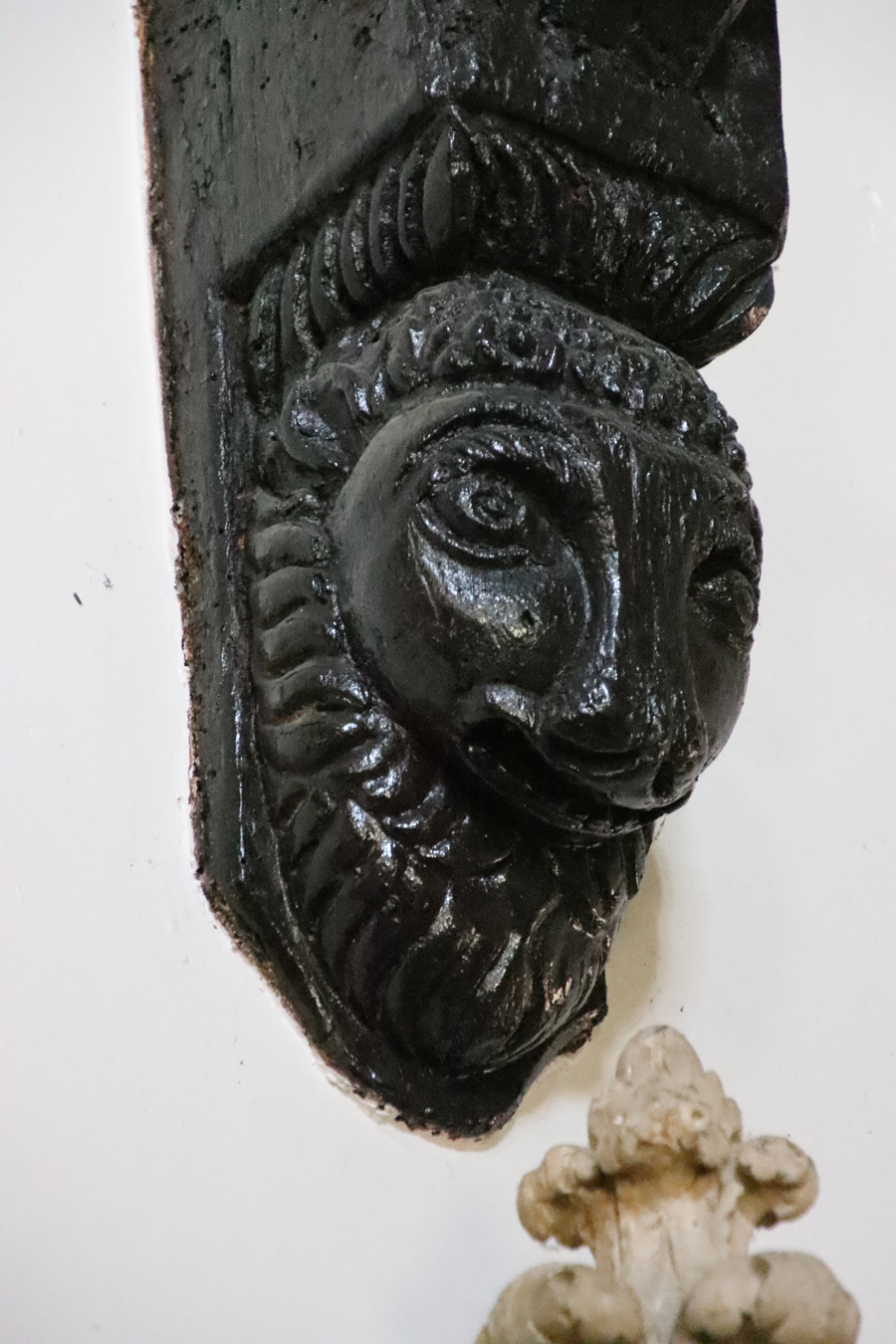
There are many features of interest to look out for in the 17th century church.  In the south aisle there is a rather fine sculpted wooden beam support.  The church’s booklet questions whether it is a human or an animal but it looks very like the lions with curly manes that are familiar from Tudor and Jacobean carvings.  It is surprising that it is on its own.  The damaged medieval font was repaired by Samuel Woolley of Churton but the current octagonal font is thought to date to 1662, replacing the repaired one.
XXXxxx
18th, 19th and early 20th century alterations

Georgian style porch, St Chad’s

According to Frank Latham, by 1735 “St. Chad was surrounded by green fields and the houses were few and far between,” and the Massie family seems to have been important to the congregation at this time, with six pews allocated to Richard Massie Esq., and his family.  He adds that the east wall was demolished in the 18th century and shifted 10ft (c.3m) further to the east, providing a much larger chancel.  Towards the end of the century repairs to the roof were made between 1793 and 1798.  Today the red sandstone church is entered via a Georgian-style porch built in yellow sandstone, although I have seen no mention of a precise date for this, and inside there is a large 18th century oak chest that housed the church plate and the parish records.

Memorial to Francis Fletcher 1782

The eastern end of the church was remodelled to include today’s chancel in 1853, not by the Barnstons this time but by the Marquess of Westminster.  The carved reredos behind the altar shows the Last Supper and was installed in 1910, with the carvings on the pulpit were added in 1911, showing St Chad accompanied by the usual pulpit team of Saints Matthew, Mark, Luke and John, represented by their emblems.  In 1927 the original three bells were joined by another five.  The church booklet says that they were rung to mark nationally important occasions, including the defeat of Napoleon in Egypt in 1799, and his defeat at Trafalgar in 1805.

Of the various memorials, one that may be of interest to those familiar with the Barnston obelisk just outside Farndon, is the marble memorial to the Major Roger Barnston (died 1847) in the Barnston chapel.  The obelisk in the field on Churton Road, now a natural burial ground, is also a memorial to Major Barnston (died 1847) discussed on the blog here,

The north aisle, like nearly all churches in this area, used to have a clear run to the end of the nave, but the presence of an organ since the 19th century regrettably meant that a gallery just in front of the tower’s arch, where musicians located, became redundant and was removed.  The present organ dates to 1949.

St Werburgh and St Chad stained glass in the chancel

St Werburgh and St Chad stained glass in the chancel

The windows are often round-topped, set within rectangular frames that give the exterior an unusual appearance.  Exceptions are the large east window behind the altar, installed in 1858 and showing the Sermon on the Mount, installed in memory of church benefactors William and Anne Plumpton, and the south window in the Barnston chapel, both gothic-style.

Most of the stained glass is interesting for the contrasting styles.  Following the Trena Cox: Relections 100 exhibition in Chester last year I have become quite interested in 19th century stained glass.  On the north side of the chancel, to the left as you face the altar, is a window showing St Chad and St Werburgh (to whom Chester Cathedral was dedicated when it was a Benedictine monastery), by Trena Cox.  A look at Aleta Doran’s website devoted to Trena Cox confirmed that this was one of hers, from the 1950s (1953 to be exact).  Those windows immediately opposite are similar in style but were clearly crafted by a different artist and show St David (patron saint of Wales) and St Cecilia.  Most of the other stained glass was added in the 19th century, with many of the larger window openings being decorated with romantic takes on the gothic, whilst smaller ones are more minimalist.  It was a little sad not to be able to learn something about the makers of the glass either at the church or after a hunt through my books and around the Internet.

Window dedicated to the memory of Harry Barnston installed by his sisters after he died in 1929

Window dedicated to the memory of Harry Barnston installed by his sisters after he died in 1929, in somewhat Pre-Raphaelite style
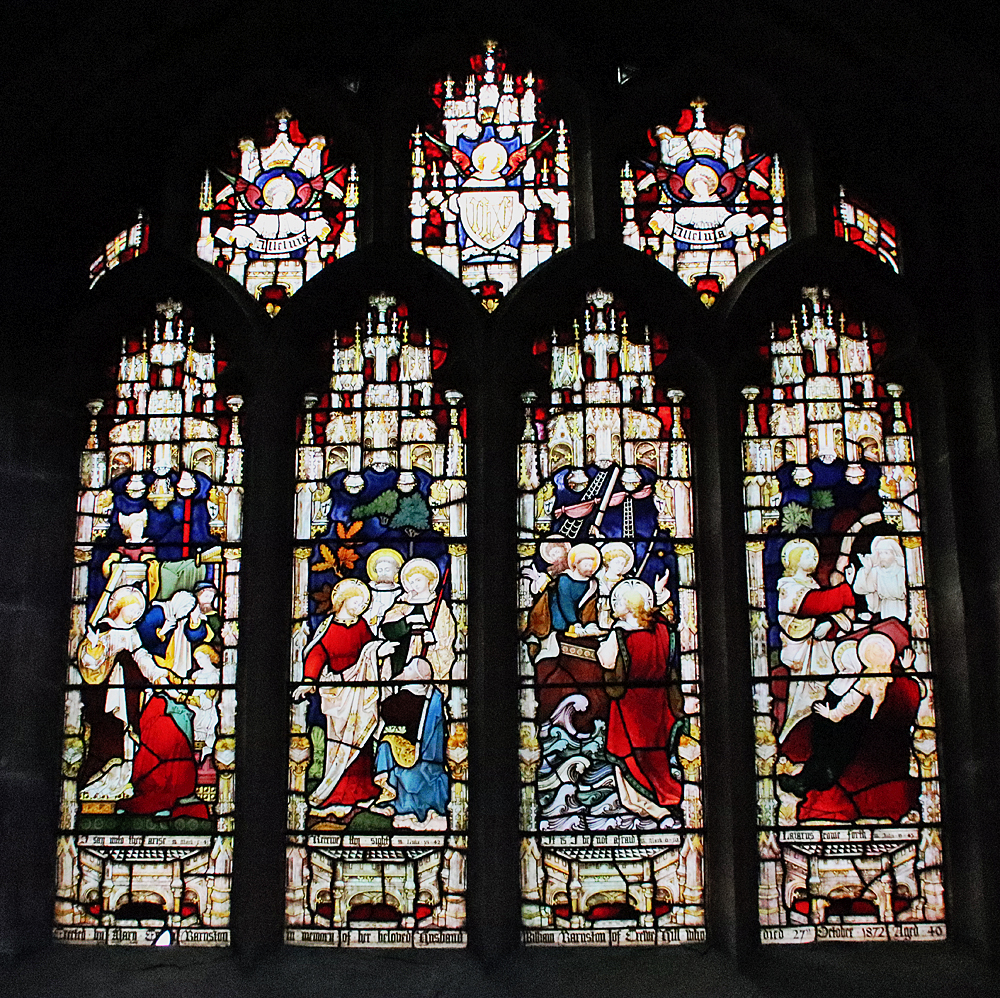
Stained glass in the Barnston chapel, emulating gothic tracery and themes

At the rear (south side) of the building you can see a substantial addition at the west end (near the tower) and I assume that this was a 20th or 21st century add-on, presumably acting as a vestry and storage.
xxx

The Churchyard

The churchyard includes a mixture of different types of grave, including chest, table and ledger tombs and vertical headstones, some accompanied by kerbs, mainly of good quality yellow sandstone.  A particularly fine example is a Grade II listed double-chest grave made of yellow sandstone and dating to the early 18th century :
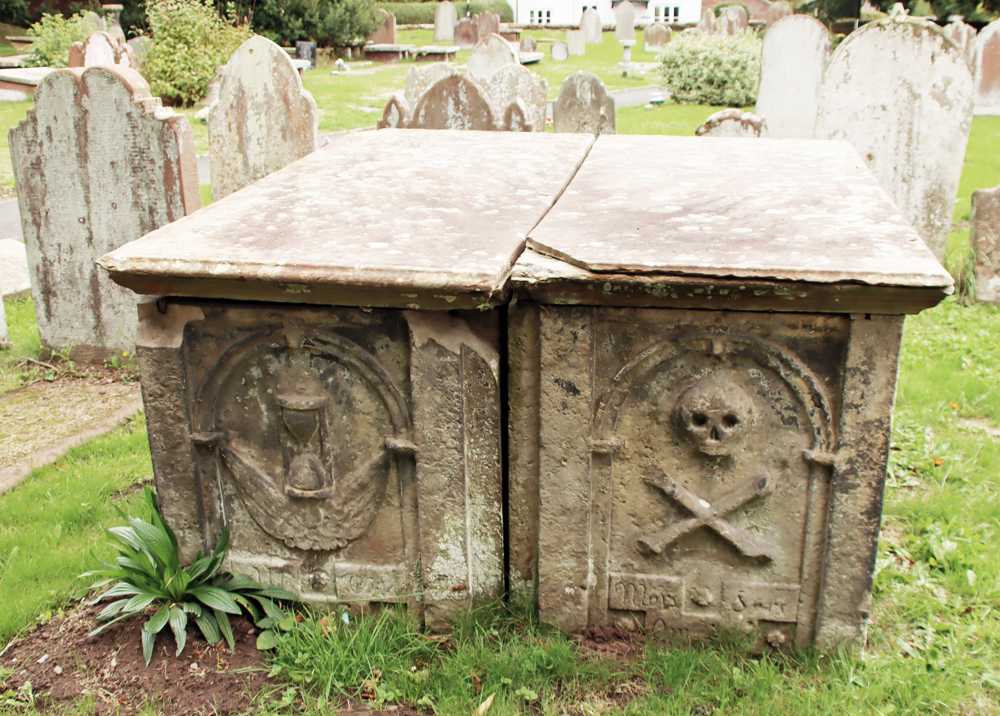
West ends of tombs have recessed round-headed panels; that to north contains an hourglass, that to south a skull and crossbones above an inscription Mors S… Omnium [i.e. Mors Sola Omnia,” meaning Death Conquers All]. North side of north tomb has a square central panel containing an encircled quatrefoil in a lozenge with a vertical panel right and a decayed panel left. The east end of each tomb has a fielded panel; south side of south tomb has 3 fielded panels in bolection moulded borders (Historic England – list entry number 1228746)

It was sobering to notice just how many of the chest grave inscriptions commemorate infants and children.  I always spend an hour or so reading grave inscriptions and don’t remember seeing so many very young children commemorated, often from the same family in the same generation.   As you would expect, the earlier graves  are nearest to the church, although unusually many of these are on the north side, which is normally the last to be filled.

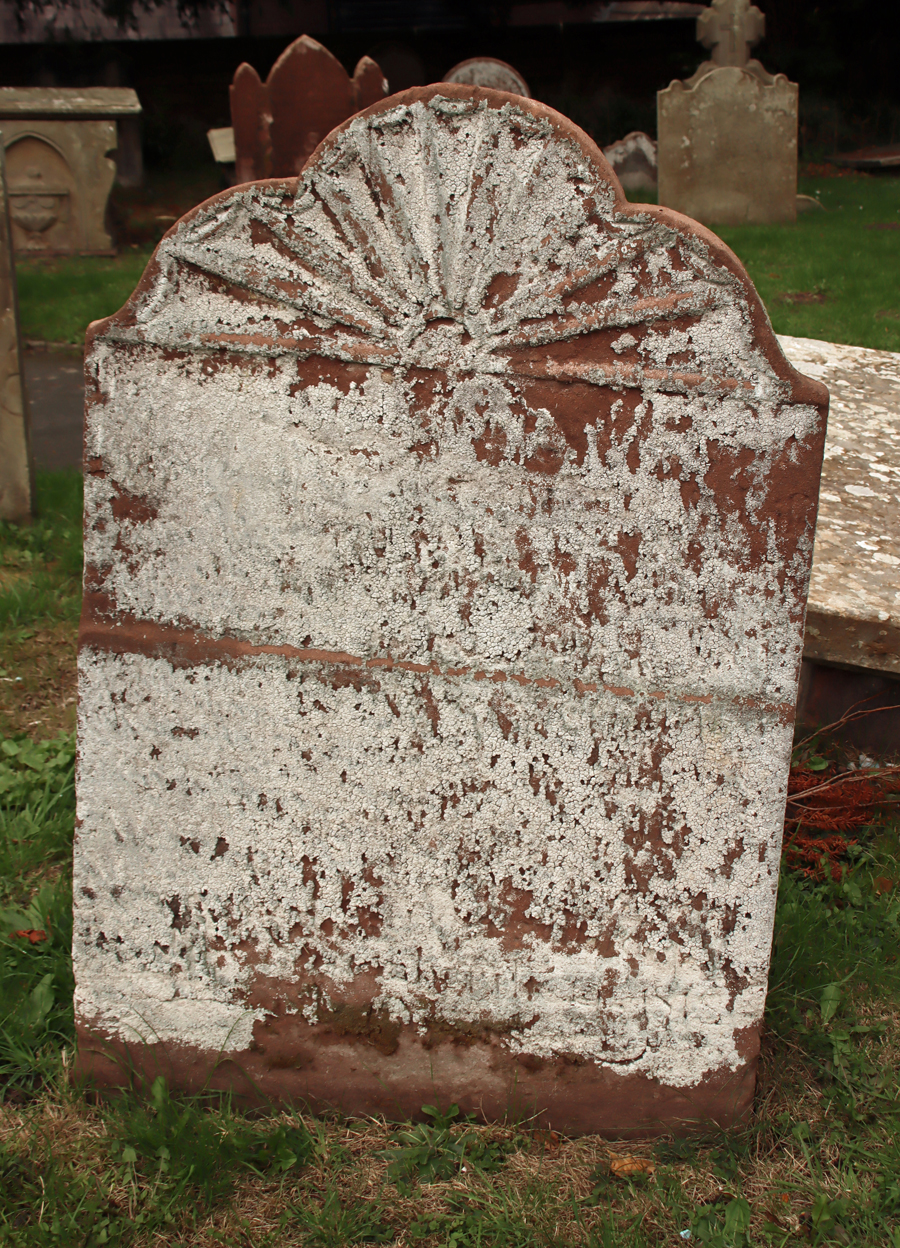
Red sandstone gravestone covered in yew berries


Moving away from the immediate area surrounding church building, to its south, the traditional upright gravestones of the later 19th century begin to dominate, with many examples of 19th century funerary symbolism on the headstones.  Although many of the headstones are lancet-shaped and much of a muchness in terms of size, there was clearly a lot of choice available in terms of the symbolic motifs that decorated the tops of the graves.

Art deco style headstone
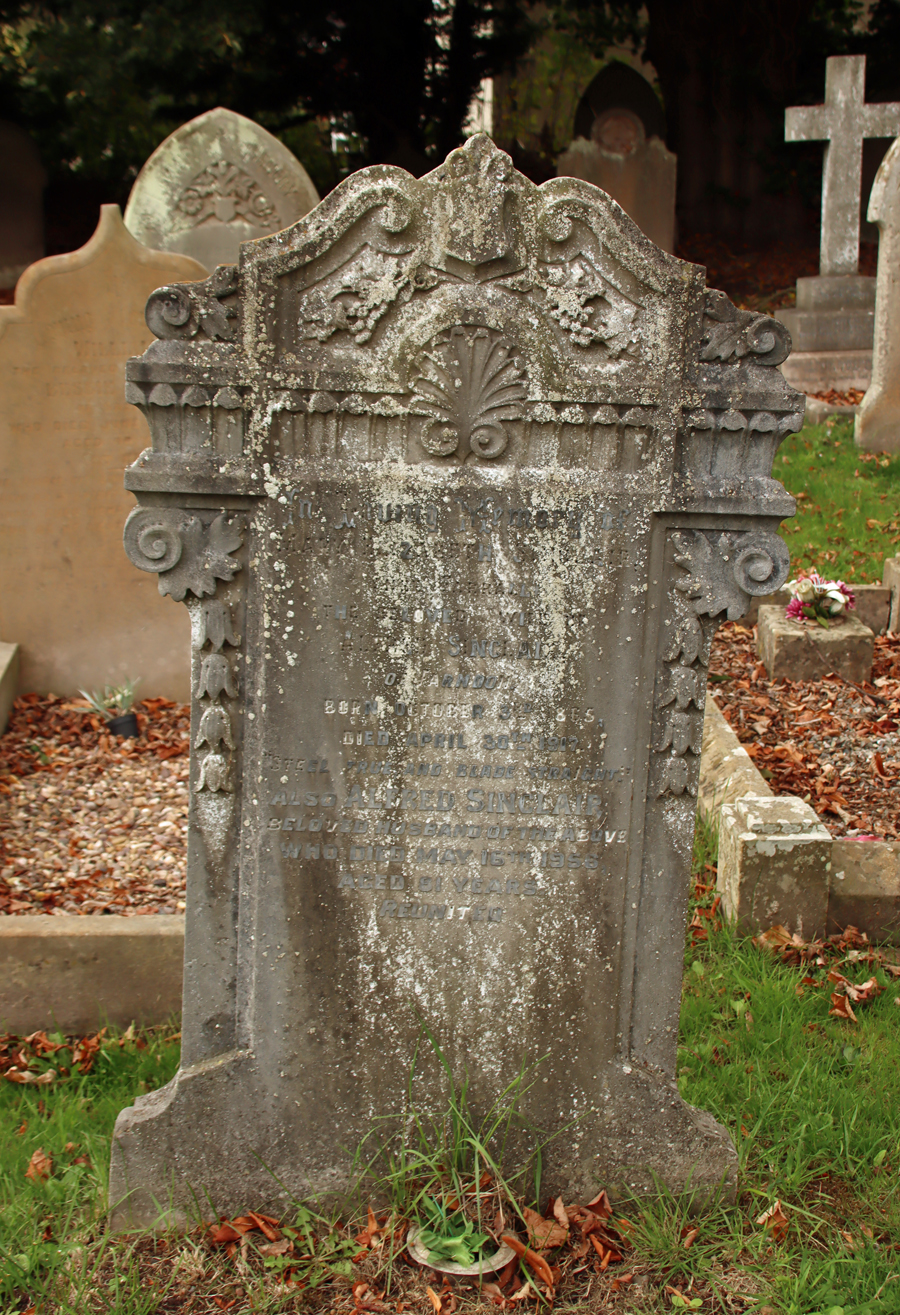
Art deco style headstone

Through a small gate beyond the headstones, the churchyard has been extended for modern use.  The 1922 War Memorial in the form of a stone cross commemorates eighteen men killed in the First World War and four in the Second World War.
xxx

Final Comments
This medieval church, almost completely rebuilt in the 17th century, has a character of its own, reflecting various periods of restoration and intended improvement, with a strong gothic influence throughout.  There are many more features than those described above, including benefaction boards, a list of incumbents, and memorials, and the church booklet produced by Cheshire County Council in 1989 is a good guide.

The church website contains no information about visiting, and the Facebook page hasn’t been updated since 2019, but at the moment the church has an open door policy.  On my two recent visits (October 2025) I was able to walk in.  There is a contact page on the site, so if you are coming from any distance it might be worth double-checking.

It is splendid to have two really impressive churches, one either side of the river connected by a splendid 14th century bridge, with very different personalities and features, and both very well cared for and open to visit.


Sources:

Books and papers

Cheshire County Council 1989. The Parish church of St Chad, Farndon. (10-page booklet available for purchase at the church)

Latham, Frank 1981. Farndon. Local History Group

Pevsner, Nikolaus and Edward Hubbard 1971. The Buildings of England: Cheshire. Penguin Books

Websites

Based In Churton
Medieval ambition and Civil War musket ball holes at the Church of St Chad’s in Holt (Grade 1 listed)
https://basedinchurton.co.uk/2025/05/31/medieval-ambition-and-musket-ball-holes-at-the-church-of-st-chads-in-holt-grade-1-listed/
Exhibition in Chester Cathedral: “Trena Cox: Reflections 100”
https://basedinchurton.co.uk/2024/10/19/exhibition-in-chester-cathedral-trena-cox-reflections-100/

Historic England
Pair of Adjacent Table Tombs in Churchyard
https://historicengland.org.uk/listing/the-list/list-entry/1228746?section=official-list-entry

New World Cartographic
Map Maker Biography: John Speed (1552 – 1629)
https://nwcartographic.com/blogs/essays-articles/map-maker-biography-john-speed-1542-1629

St Chad’s Farndon
https://www.stchadschurchfarndon.org.uk/index.php

The Trena Cox Project
https://www.aletadoran.co.uk/

Visit Stained Glass
St Chad’s Farndon (just the Civil War window)
https://www.visitstainedglass.uk/location/church-of-st-chad-farndon-cheshire


Ancient Churchyards of Cheshire – St Chad’s Church Farndon
Tvpresenter4history (James Balme)

The Roman Villa at Rossett #2 – Some background to the excavation

It is difficult to imagine this field as a beating heart of a villa complex life in northeast Wales, but here it is.

This short series focusing on the Rossett Roman Villa began yesterday with Part 1  – What is a Roman Villa? , which was an overview of Roman villas in general, looking at how they are defined, their key features, what is known about who lived in them, how they changed over time and how they are dated.

Today’s post, part 2, looks at the background to the decision to start excavating at the site, information assembled from press releases, the villa project’s Twitter releases (impressive!) and the information imparted by Stephen Grenter, Heritage Services Manager at the Wrexham Museum on the Open Day.  Part 3 describes the excellent Archaeological Open Day that took us through what was happening in the three big trenches opened in the last two weeks, as well as plans for the future.  Again, I just want to say huge thank-you for such a great tour of the site and the sheer amount of knowledge imparted in such a relaxed but professional way.  I have included some of the information communicated on the day in this post, and much of the rest is taken from Caroline Pudney’s posts on Archaeology Chester, with thanks to both of them for being so generous with the information, but of course any errors are my own.

The Rossett villa before excavation.  Source: Archaeology Chester

The strategically important legionary fortress at Chester means that a Roman presence in the surrounding area was almost inevitable, and it has been known for a long time that there was a civilian settlement south of Chester at Heronbridge, Roman industrial activity in Holt (a brickworks and tileworks) to the east and at Halkyn Mountain to the west.  Also in the west, Ffrith has produced Roman remains, but it lies under the village so not much is known about it.  Up until now, however, nothing concrete was known about Roman activity in the Rossett-Burton area.

The Rossett site is located to the west of Burton and is the first villa known from northeast Wales, making it of particular importance.  Prior to any major discoveries, the existence of a Roman presence of some description in the area had already been inferred by archaeologists who had found Roman objects in local ploughed fields.  Ploughed fields are excellent for field walking, as the action of ploughing draws artefacts from lower down up to the surface of the field, and they are often clearly visible against the dark soil.  When the field is recently ploughed, there are no distractions like crop stubble or weeds.

A site plan taken from the geophysical survey of Rossett villa. Source: Archaeology Chester

Confirmation that from the 1st Century onwards Romans had at least passed through the Rossett-Burton area came with a discovery made by a responsible metal detectorist who reported an important find:  an inscribed lead pig that turned out to date to the 1st century AD, the century in which the Romans first arrived.   All of a sudden, the Burton area was in the archaeological spotlight.  A survey and excavation of the ingot site followed, funded partly with a grant from the Roman Research Trust and carried out by archaeologists from Wrexham Museum, the University of Chester and Archaeological Survey West.  There was sufficient time and funding remaining after the ingot investigations had been completed for further geophysical survey work to be carried out in a nearby field and this revealed a beautifully delineated buried structure with the typical layout of a Roman villa, staggeringly clear on the survey image shown below.  Additional structures were evident, but not so easy to interpret, and some of those too are now under excavation.


Background

The Rossett Ingot

The first indication of a site near Rossett was the discovery of a lead ingot or pig.  A pig is a roughly rectangular bar of mined metal that is shaped to be convenient for transportation to a location where it can be processed.  Its discovery by detectorist Rob Jones, who reported the find to the archaeological authorities, was reported on the Archaeology Chester (University of Chester) blog:

Lead pig in situ. Portable Antiquities Service ID WREX-8D3982. Source: Archaeology Chester.

Our story begins in September 2019 when a lead pig (ingot) marked with the name of Trebellius Maximus, the Governor of Roman Britain from AD 63 to 69 was found near Rossett, Wrexham County Borough, Wales. A responsible, skilled, and knowledgeable local metal detectorist found an impressive metal signature while out detecting. He immediately contacted the local Finds Liaison Officer based at Wrexham Museum and the object was subsequently excavated with the help of staff at Wrexham Museum and the Clwyd-Powys Archaeological Trust.

The find generated a lot of interest in academic circles and was widely reported in the media, because this is the first inscription known in Britain that mentions Marcus Trebellius Maximus, who was the governor of the province of Britannia between AD 63 and 69 during the reign of the Emperor Nero, one of Britain’s first governors after the AD 43 invasion.   An administrator rather than a soldier, he made no push to gain more territory, placing emphasis on consolidation and economic growth.  He was unable to secure the respect of the military and in AD 69, after the death of Nero and a period of instability in Rome, a mutiny in Britain forced him to flee.  He was replaced by Marcus Vettius Bolanus who had the twin assets of being both a Roman Senator and a soldier.

One of Julian Baum’s stunning impressions of Deva, showing the
beginning of Watling Street West (Margary 6a) and the Dee
crossing linking to roads south and west. Source: Julian Baum, Take27 Ltd.

Although as a legionary fortress Chester was an important Roman centre, with roads radiating out of it towards other Roman sites in all directions,  northeast Wales itself has not provided much data to support the idea of a significant Roman interest in the area, so the find raised two important questions that led to the decision to carry out further surveys and excavations in the area.  The first question raised by the pig itself was about the extent to which the Romans were exploiting local mineral resources from early on during their occupation of Britain.  The second concerned how a major new Roman find might shed light on the Roman occupation of northeast Wales, data for which is extremely thin on the ground to the northwest of Wrexham and southwest of Chester.

Not the most ideal conditions for excavating the ingot site!  Source: Archaeology Chester

The initial fieldwork, phase 1 of the project, took part during partial lockdown with atrocious weather conditions during September and October 2020, with financial support from the Roman Research Trust, the University of Chester and Wrexham Museum.   Although the surveys suggested some promising features, excavation by a small 6-person team, battling with rapidly flooding trenches only revealed remains from mainly much later periods.  The absence of Roman period finds during the excavations was, however, informative:

The absence of Roman archaeology and confirmation of alluvial deposits highlighted the likely watery or marsh-like setting that existed during the Roman and later periods. In turn this tells us that the ingot is reflective (perhaps) of a stray loss since no evidence of deliberate deposition or lead processing could be found nearby. [Pudnesy 2021]

The conclusion is that the lead was mined elsewhere and was lost in transit on its way to its intended destination.  The analysis of the lead at Liverpool University, which hopes to narrow down a source, is still ongoing but initial work suggests that it may have been mined from elsewhere in northeast Wales, perhaps at somewhere like Ffrith, where Roman remains have been found, including indications of lead mining, or Minera:

That the Romans mined lead at Minera has long been inferred; the mineral veins would have been easily discovered at outcrop, a Roman road passes close by, and residues of lead smelting have been recorded in a Roman context only three miles distant. Proof
remains elusive though ancient working is inferred by the discovery of a stone mortar. [Peter Appleton]

No further archaeological remains were discovered at the site during excavation.

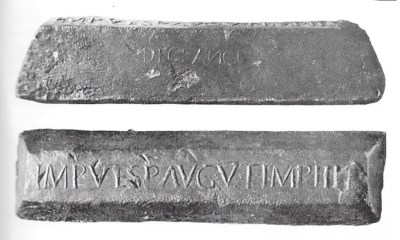
Lead ingot from a river jetty site at the edge of Chester racecourse dating to 74AD.  Source:  David Mason’s book Roman Chester, p.45.

Other pigs have been found in the Chester area.  David Mason shows one in his book Roman Chester, excavated with the remains of a timber jetty at the Roodee (Chester racecourse on the side of the river Dee) in 1886 dating to AD74.  The text is abbreviated but reads “[Cast] while the Emperor Vespasian Augustus was consul for the fifth time and Titus, acclaimed Imperator, consul for the third time.  On the side is another inscription that reads “Deceangl” meaning that it was mined on Deceangli territory.  The Decaengli territory of northeast Wales ran along the borders of the Cornovii territory that occupied what is now West Cheshire, and probably extended up the Wirral.

Wales in AD47. To the east of the Deceangli, in what is now Cheshire, was the tribal area of the Cornovii, who were based at Wroxeter.  Source: Emerson Kent

Britain’s mineral resources were amongs the properties of Britain that was extremely attractive to Rome, and the territory of the Deceangli had numerous stone and metal resources including lead. Lead was used in building projects, but some of it was also a source of silver when subjected to a process called cupellation.  Lead mines at Prestatyn were established in c.75AD.  Others have been found at Meliden, Pentre-Oakenholt, Halkyn and Ffrith. Clwyd and Powys Archaeological Trust describes an ore vein that runs east to west at Halkyn.   A Roman ‘pig’ or ingot of lead was found in 1950 inscribed with the letters C NIPI ASCANI, the abbreviated name of a private lead producer, C. Nipius Ascanius, the lead thought to have been mined and smelted on Halkyn Mountain.  Excavations in the Pentre Oakenholt area of Flint have provided evidence of lead smelting, presumably from ores from Halkyn Mountain. Roman domestic buildings at Pentre Farm, Flint may have been the home of a mine supervisor.

Magnetometry results at Rossett Villa. Source: Archaeology Chester

There was sufficient funding from the Roman Research Trust grant left over for additional geophysical survey.  Stephen Grenter had visited the field in which the villa was found at an earlier date because pottery sherds and other small finds had been made there, and found additional objects that suggested that it would be worth carrying out additional fieldwalking and geophysical survey, so this was carried out.

The field walking recovered a total of 181 artefacts from the ploughsoil. A large proportion of artefacts were ceramic, including brick and tile (CBM).  A total of 76 sherds of pottery, 23 fragments of worked stone, 4 metal objects, 5 fragments of glass and one fragment of animal bone were also retrieved. Together with fragments of painted plaster and opus signinum, the assemblage reflected the likely presence of a Roman building, but potentially of higher status than we’d initially suspected. [Pudney 2021]

Geophysical survey (magnetometry) followed.  Geophysical survey results can be remarkably difficult to interpret, but the amazing scan of the villa’s foundations, was phenomenally clear, showing the perfect layout of a wing and corridor villa with rooms behind.  Other features suggested by the geophysical survey were not nearly as clear, and some of those are now under excavation.

The Rossett Villa

To the west of Burton Green, the villa is described as  Rossett Villa.  Clear evidence of Roman occupation in the immediate area had been indicated by objects produced in the process of agricultural ploughing as well as metal detecting.  These items included pieces of samian ware (terra sigillata, a Roman luxury ceramic), box tiles,  fragments of mortaria (food preparation mortars) and quern stones.   Other Roman objects  found in the general vicinity had been registered with the Portable Antiquities Scheme including Roman brooches and coins.  The presence of a villa had not been suspected as they are extremely rare in the northeast Wales/Cheshire areas.

Primary areas of villa occupation in Roman Britain. Source: Rowe, J.E. 2015.  Roman Villas of Wales.  M.A. Thesis, University of Regina, Saskatchewan

The Rossett villa is unusual in that its location is outside the main distribution area of villa sites.  The densest concentration of known villas is in the south of England.   Rossett is only one of two villas known in the area that potentially fell under the influence of the Chester legionary fortress, the other being located at Eaton-by Tarporley.  The discovery of signs of a hypocaust at Crewe-by-Farndon have led to suggestions that there may have been another a third one in that area (mentioned in the the Farndon Archaeological Assessment).  The nearest villa in Wales is at a substantial distance from Rossett, in a remote part of Ceredigion, near to Trawsgoed Roman Fort.

Some of the sites in the Chester area are connected to one another by the Roman road network, but it is not yet fully understood how northeast Wales was reached from Chester and how it was connected to west Wales, including the sites at Ffrith and Halkyn.

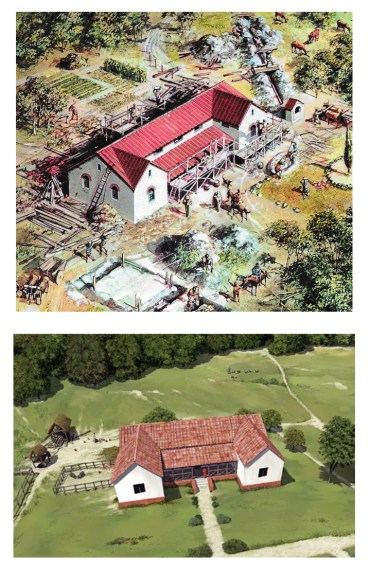
The wing and corridor villas at Sparsholt (top) and Lullingstone. These artists’ impressions are intended to provide an idea of what a villa might have looked like above the level of the foundations.  Source of Sparsholt image: Johnston, D.J. 1991 (cover photo).  Source of Lullingstone image:  English Heritage Lullingstone website)

The Rossett villa is located just off the proposed route of a potential Roman road from Chester. It has been suggested that the road may have run south from the fortress, across the bridge shown in Baum’s reconstruction of Chester above, before turning southwest and passing through Ffrith, where there is plenty of evidence both for Roman settlement remains and a stretch of Roman road, before proceeding via Bala to the fortlet at Brithdir to the south of Dolgellau.  This presumably also connected with the Cefn Caer fortlet at Pennal (about which I posted on another blog here), which guarded a crossing over the river Dyfi, connecting north and south Wales.  It is hoped that future LiDAR research will clarify the location of the road.  It worked a treat with clarifying Roman road 6A (also known as Watling Street West) that runs south from Chester via Aldford and Malpas to Whitchurch and beyond to Wroxeter (about which I have posted here).

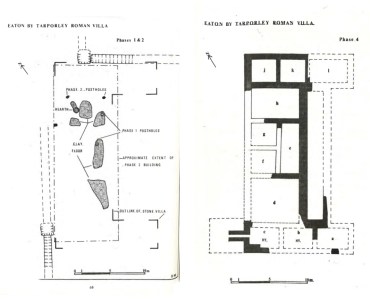
The nearest villa to Rossett, as the crow flies, was actually at Eaton by Tarporley in Cheshire, excavated 1980-81 and again in 1982.  As far as I know, it remains Cheshire’s only known Roman villa, as reported by Morris in 1982 and 1983, and summarized  on the Heritage Gateway website.  The summary is copied here because it provides a useful illustration of the often multi-period character of villas:

Excavations of Eaton-by-Tarporley Villa. Source: Morris 1982 and 1983

During the laying of the Lake Vyrnwy-Liverpool water main in 1886, Roman tiles, mortar and a coin of Marcus Aurelius were found on the western fringe of Eaton-by-Tarporley (a). A field-walking programme in 1980 to investigate the context of these finds, led to the discovery at SJ 57176341 of a Roman winged-corridor villa, the first villa to be identified in Cheshire. Excavations were conducted on the site from 1980-82. These revealed 4 Roman phases.
Phase 1. Only two post-holes were found relating to the primary occupation of the site, perhaps beginning c. AD 150. The building was probably short-lived, quickly succeeded by the phase 2 construction on a different alignment.
Phase 2. A timber building was erected delimited to W and N by ditches perhaps serving to convey water to the site from a nearby spring rather than for drainage. Again the building seems to have been short-lived, this time destroyed by fire.
Phase 3. About the last quarter of the 2nd century, the first stone-built villa was constructed, of winged-corridor plan and of a single storey only. The S wing formed a baths suite. All rooms in the main range were decorated with painted wall-plaster and had floors of opus signium or mortared pebbles. One room here was heated, plus two in the N wing.
Phase 4. c.AD 350 the villa underwent thorough reconstruction. The colonnade was demolished and the living space extended out to this line. Thickening of the walls indicates a second storey was added at this time. No evidence survived for the destruction/abandonment of the villa due to Medieval stone-robbing and PM ploughing.
Medieval. Large numbers of pottery wasters were recovered from the villa, and excavation SW of it located a complex of 14th century pottery kilns. At some later date but still within this period, a building of unknown function was erected out of re-used Roman materials over the SW corner of the villa.  

The villa included a bath suite including a calidarium and tepidarium sitting over hypocausts (raised floors on short pillars, the spaces created heated with fires), and a frigidarium for cooling off.

Two different ideas about the appearance of Abermagwr in Ceredigion, a small villa dating to c.AD 230, both views drawn by one of its excavators, Toby Driver.  This demonstrates that although foundations may look much the same from one villa to the next, the actual appearance may differ considerably.  The two interpretations also usefully suggests that the survival of inorganic building materials, particularly wood, may potentially offer an alternative interpretation. Sources: RCHAMW (top) and Wales Online (bottom)

In Wales itself, the only other villa site known north of south Wales is in Ceredigion, less than a mile from Trawsgoed Roman Fort, and in a very remote area.  Abermagwr villa was first identified from aerial photographs taken during the drought of 2006, was subjected to geophysical survey in 2009 and was partially excavated in 2010 by by Jeffrey Davies and Toby Driver.  Described by its excavators as “a comparatively modest late third- to early fourth-century AD house,” was established around 230AD, which is interestingly around a century after the Trawsgoed fort was abandoned, and it is suggested that building material from the fort’s bathhouse was used to build the villa.  It had a very fine slate roof, and finds included pieces of a remarkable glass bowl that was made in Germany’s Rhineland. The villa burned down in c.330AD, and was abandoned.

This is a very poor showing for villas in northeast, northwest and mid Wales, and for Cheshire as well.  The scarcity of villas in this area seems to require an explanation, particularly as Chester was such an important fort, there was a civil Roman settlement at Heronbridge just to the south of Chester near Ecclestone, a tile and pottery manufacturing base was located immediately to the north of Holt and there was another pottery production centre at Plas Coch on the outskirts of Wrexham.  This was an area of prime agricultural land that one would have thought would be ideal for the establishment of one or more potentially profitable estates.  There are two primary reasons why sites do not occur on distribution maps. The first is because they were simply not built in certain areas, and the second is that they have not yet been found.  There are more reasons too, such as sites that have been completely destroyed, or those that whose building materials were robbed for the building of other buildings, but a complete absence of evidence in an area tends to fall into one or other of the first two categories.  In practical terms, this means that a gap on a distribution map is a question mark, not a sign that nothing was build there.  This is perfectly demonstrated by the Eaton-by-Tarporley, Abermagwr and Rossett villas, all of which turned up in places that were empty patches on villa distribution maps.   With more grants for future research, a lot more field work and a bit of luck thrown in, the Rossett and Burton areas may reveal more previously unrecognized archaeology, including that from both previous and later periods. Indeed, Toby Driver has recorded cropmarks at Rossett similar to those at Roman villas in other parts of Wales (noted on the Coflein website).  However, with the discovery of the Rossett villa, it seems likely that others will now turn up.


Conclusions

Findspot at the Rossett Roman villa excavation.

Even before I went to the Open Day, the team had made it clear in their reports that the Rossett and Burton Green finds are exciting hints of a greater Roman presence to the southwest of Chester than had previously been suspected.  Both the original discoveries and the work that has since taken place will hopefully form a platform for the launch of future survey and excavation work that will help to clarify how northeast Wales fits into the bigger Roman and Romano-British picture.  The team is hoping to reconvene next year for a six week dig, assuming that funding is forthcoming.

The last words today go to Dr Caroline Pudney:

Both the lead pig and the villa whisper to us of great potential. The prospect that this villa complex does not exist in isolation is very real. There are not many Roman villas known across north Wales. North east Wales specifically, was until now, yet to reveal one buried beneath its soils. Who knows how many more lurk beneath the surface? There are also a surprisingly low number known further west and south into Cheshire and Shropshire. This is strange considering the presence of a whacking great Roman fortress (Deva Victrix) and the civitas capital at Viriconium (Wroxeter). One would surely expect a richer character of rural settlement in this area than is presented in the known archaeological record to date.  [Pudney 2021] 


Follow the Roman Villa excavations, their post-excavation findings and their news about future work on Twitter using the hashtag #rossettvilla.  

You may also be interested in my two posts about the Roman Road
that once ran east of Churton and Holt


Sources:

The main source of information about the Rossett discoveries is Dr Caroline Pudney’s report on the Archaeology Chester (University of Chester) website, which has been quoted extensively above:  The highs and lows of archaeology: In the footsteps of Trebellius Maximus. By Dr Caroline Pudney, 16th Apr 2021
https://archaeologychester.wordpress.com/2021/04/16/the-highs-and-lows-of-archaeology-in-the-footsteps-of-trebellius-maximus/

Additional background information as well as some notes about the villas in Cheshire and Ceredigion have been sourced as follows:

Books and Papers:

Clark, J. 2003.  Cheshire Historic Towns Survey.  Farndon. Archaeological Assessment.  Environmental Planning, Cheshire County Council
www.cheshirearchaeology.org.uk/wp-content/uploads/2013/06/HTS_Arch_Assess_Farndon.pdf 

Clark, J. 2003.  Cheshire Historic Towns Survey. Tarporley. Archaeological Assessment.  Environmental Planning, Cheshire County Council
http://www.cheshirearchaeology.org.uk/wp-content/uploads/2013/06/HTS_Arch_Assess_Tarporley.pdf

Greene, K. 1986.  The Archaeology of the Roman Economy.  Batsford

Johnston, D.E. 1994.  Roman Villas.  Shire Archaeology

Mason, D.J.P. 2007 (2nd edition). Roman Chester. City of the Eagles. Tempus

Morris, M.G. 1982.  Eaton By Tarporley, SJ57176341. Cheshire Archaeological Bulletin 8, p.49-52
http://www.cheshirearchaeology.org.uk/wp-content/uploads/CAB-Vol-8.pdf

Morris, M.G. 1983.  Eaton By Tarporley, Roman Villa. Cheshire Archaeological Bulletin 9, p.67-73
http://www.cheshirearchaeology.org.uk/wp-content/uploads/CAB-Vol-9.pdf

North, F.J. 1962. Mining for Metals in Wales. National Museum of Wales
https://www.aditnow.co.uk/documents/personal-album-128/Mining-for-metals-in-Wales.pdf

Pudney, C. 2021.  The highs and lows of archaeology: In the footsteps of Trebellius Maximus.  Archaeology Chester, 16th Apr 2021
https://archaeologychester.wordpress.com/2021/04/16/the-highs-and-lows-of-archaeology-in-the-footsteps-of-trebellius-maximus/

Rowe, J.E. 2015.  Roman Villas of Wales.  M.A. Thesis, University of Regina, Saskatchewan
https://ourspace.uregina.ca/bitstream/handle/10294/5853/Rowe_Jennifer_200205672_MA_HIST_Spring2015.pdf?sequence=1


Websites:

Aberdovey Londoner
Cefn Caer, the Roman auxiliary fort at Pennal.  By Andie Byrnes. 3rd February 2019
https://aberdoveylondoner.com/2019/02/03/cefn-caer-roman-auxiliary-fort-pennal/

Based in Churton
A touch of Rome just east of Churton #1 – Background to the Roman Road. By Andie Byrnes. 3rd April 2021
https://basedinchurton.co.uk/2021/04/13/a-touch-of-rome-just-east-of-churton-1-background/

Coflein
The Abermagwr Roman Villa, Cerdigion
https://coflein.gov.uk/en/site/405315/
Lane Farm Cropmarks, Rossett
http://www.coflein.gov.uk/en/site/409231/details.html

CPAT Regional Sites & Monuments Record
PRN 100020 – Ffrith Roman site (multiple site). Scheduled Ancient Monument FL164(FLT)
https://www.cpat.org.uk/ycom/ffrith/100020.htm
PRN 86912 – Ffrith, Roman Road
https://www.cpat.org.uk/ycom/ffrith/86912.htm
Holywell Common and Halkyn Mountain
https://www.cpat.org.uk/projects/longer/histland/holywell/hoindust.htm

Heritage Gateway
Historic England Research Records – Monument Number 71430 (Eaton by Tarporley villa)
https://www.heritagegateway.org.uk/Gateway/Results_Single.aspx?uid=71430&resourceID=19191

Royal Commission on the Ancient and Historic Monuments of Wales
The Roman villa that made history: Abermagwr Villa, Ceredigion. By Toby Driver, 24th July 2020
https://rcahmw.gov.uk/the-roman-villa-that-made-history-abermagwr-villa-ceredigion/

U3A Ruthin and District
Mineralisation and Mining at Minera, North Wales.  By Peter Appleton.  Date unknown.
https://u3asites.org.uk/files/r/ruthin/docs/mineralisationandminingatminera.pdf 

Wrexam.COM
Rossett Roman villa dig underway in ‘history-changing project. 6th September 2021
https://www.wrexham.com/news/rossett-roman-villa-dig-underway-in-history-changing-project-208603.html

Wrexham County Borough Museum and Archives
The Rossett Lead Pig
www.wrexhamheritage.wales/explore/#rossettpig


Milepost to the north of Crewe-by-Farndon

Someone has been tidying up the verges and hedges that flank the road that passes through Crewe-by-Farndon towards Worthenbury, and they have done such a good job that one of the mileposts that I went hunting for when I was writing the post about the Chester to Worthenbury turnpike (toll road) has been revealed.  And here it is!   It is in the grass verge on the west side of the road, just before Caldecott Farm.

If you want to know more about these 1898 mileposts, have a look at my post about them here.  They post-date the turnpike, which went out of service in 1877.  Turnpikes were all supposed to have mileposts, so it is probable that when Cheshire County Council was first established was formed on 1st January 1889, and when all of the local turnpikes eventually came under council control, they replaced the original ones, which were probably rather dilapidated by then, with nice shiny new ones.

Not so shiny and new now, but still hanging on in there!  It is located just short of a farm on the left heading south (the east), and is on the west side of the road about two or so metres to the right of a telegraph pole.  I will go back and get an exact What Three Words location for it next time I’m in that area, but for the time being it is roughly at ///rainfall.duplicity.proofs.


Shocklach motte and bailey castle(s) at Castletown

Two sites with one name

Shocklach East is on private land, but its north side can be viewed from the north over a short fence. The image has been stitched together from three photographs, hence the slightly odd appearance.

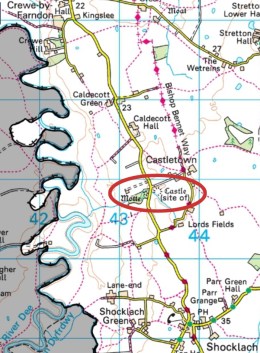
The name Castletown seems rather glamourous for what today is a wholly rural, agricultural landscape.  Castletown is located south of Crewe-by-Farndon and north of the village of Shocklach and west of the Castletown Farm on a peaceful country road.  On the Ordnance Survey map, which I was studying when working on the post about the 1854 Chester to Worthenbury toll road, there are some interesting details that merited further investigation.  Where the small Castletown bridge crosses a small stream, that eventually flows into the Dee, there are two fairly large sites shown flanking the road.  Collectively, even though they are near to Castletown, they are known as Shocklach Castle, although they actually make up two separate castle sites.

Map showing the sites at Shocklach either side of the Crewe-by-Farndon road as it crosses Castletown Bridge. Source: Public Map Viewer

A visit to the two-part site marked on the map means looking from the side of the road.  The site is not on a public footpath but is very close to the road, and some of the earthworks are clearly visible. As you can see on the above map, the site to the west can be seen from the Crewe to Shocklach road, whereas the one on the other side of the road is best seen from the lane that heads west to Castletown Farm.  For the purposes of this post, I have referred to these sites as Shocklach East and Shocklach West.

Click to see a bigger image.  The location of the Castletown / Shocklach mottes, south of Crewe by Farndon and to the north of Shocklach. Source: Public Map Viewer

The Shocklach site is a scheduled monument, which means that it is protected by the state.  It is recorded as Shocklach Motte and Bailey Castle by the government quango responsible for scheduled archaeological and historic monuments, Historic England.  Its listing code is 1012620, and it was first scheduled in November 1926.  The listing covers both Shocklach East and West.  It is well worth repeating Historic England‘s “Reasons for Designation:”

Shocklach Castle is of particular importance as one of a group of early post-Conquest (c.1100) mottes forming a defensive system aimed at curbing constant Welsh raids on the rich farming areas of south Cheshire. Additionally the site lies within an area containing the most important concentration of medieval monuments in Cheshire. These monuments include two shrunken medieval hamlets, a defended green lane, a Norman chapel, well preserved ridge and furrow, a ford across the River Dee, and a complex of communally owned watermeadows.  The monument is situated in a dingle thought to have been one of the ancient trackways utilised by the Welsh in their frequent raids into southern Cheshire.

It is difficult to imagine this sleepy road and its flanking fields having a strong military presence.  From the early 12th century onwards, however, the motte and bailey site sat on the edge of a settlement whose people were centred on successful economic activities including cultivation and probably livestock management, albeit fearful of attack from Wales.

Archaeological investigation at Shocklach West during the 1980s by the University of Chester (in those days called University College Chester) revealed a lot more than can be seen today.  As above, the site consists of two sets of earthworks, one to the west of the road, covered in trees, and one to the east, which is free of vegetation.  The two sites are scheduled together under one registration number, but it should not be forgotten that they are two separate entities, each of which needs to be understood in its own right.  Rachel Swallow, who excavated the site, talks about the confusion caused by the presence of two separate entities, one each side of the road:

There is a general, and historic, confusion about the function and purpose of the two monuments at Castletown.  The Ordnance Survey (OS) 25 inch maps of 1879 and 1911 clearly mark the monument to the east as a ‘castle’ and ‘moat’, with that to the west of Castletown Bridge as a ‘moat’. The survey of 1964 reinterprets the mound to the west as a ‘motte’, with the earthworks 30 metres to the east marked as a ‘moat’, but not as the site of a castle. In the early nineteenth century, Ormerod stated that the earthworks to the east appear unconnected with those he seemed to believe were of the Norman fortress to the west.

In the discussion below, the two will be dealt with separately first, before looking at how they might related to one another, but first a little look at what motte and bailey castles actually are.

Background – what is a motte and bailey castle?

Miniature from illuminated Chronicle of Matthew Paris (1236-1259), from BL MS Cotton Claudius D. vi, f.9, showing Henry I of England enthroned. Held and digitised by the British Library. Source: Wikipedia

Motte castles are medieval fortifications introduced into Britain by the Normans, made up of a defensive structure built on an artificial mound.  The bailey was a small group of buildings fenced and sometimes moated, attached to and protected by the motte castle. By the time that the Shocklach motte and bailey castle was built, either towards the end of the reign of William the Conqueror or at the beginning of the reign of Henry I, there were political and territorial disputes, particularly within Wales and along the Welsh-English borders.  One of the manifestations of this ongoing disruption was frequent cross-border raids to secure territories and resources.  

Armed dispute over territory and resources has a long heritage in Britain.  From the mid 4thmillennium BC there are the first signs of violence related to competition for resources, and it is likely that livestock raiding was an ongoing problem from that point forward.  It has been suggested, for example, that protection of livestock and  of grain, as well as of people, could have been a primary role of fortified Iron Age hillforts.  

When William the Conqueror arrived in 1066, he began to replace the existing aristocracy with those that he had brought with him, men that he could trust to support him to take control and enforce peace.  English names were quickly replaced by Norman ones in records and by Domesday, merely 20 years after the conquest, only 8 percent of landholdings were held in English names.  The Normans built castles to help them to govern and to demonstrate their power.  Castles, initially turf and timber, sprang up everywhere, later replaced by bigger stone structures.   As Crane observes:  “early Norman castles had more in common with Roman marching forts than with tribal hillforts.  They could be built with astonishing speed, they were virtually impregnable and their construction had more to di with military expediency than with cultural bonding.”

Dorling Kindersley reconstruction of a small motte and bailey castle showing the main features. Fortifications could be very small. Source: Dorling Kindersley Find Out website.

In a motte and bailey arrangement a fortification sits on a natural or artificial mound with an accompanying settlement in a walled/fenced area at its foot, sometimes surrounded by a moat or ditch.  Where the mound was specially built, it could be made of earth, rubble, or both.  A palisade, or fortified fence, surrounded the apex of the mound, on which some sort of tall fortified structure was built, providing views over the surrounding countryside to watch for any oncoming attack.  Most are now covered in grass and sometimes trees.   Where a bailey is also present a palisaded enclosure at the base of the motte, and connected to it, often contained buildings for people, livestock, and grain and water storage, and may surrounded by a bank as well.  These have often vanished from sight today.  Where water was locally available, these defences could also include moats (which in the soggy Cheshire area, might have doubled up as useful drainage ditches).  

Cardiff Castle’s shell keep. Source: Wikipedia

Motte and bailey castles are found in all areas where human population is found, including towns, villages and rural areas.  Although they are generally characterized as being located on high ground, in good strategic positions that are highly visible from the surrounding area, this is more difficult to arrange on the flat expanses and floodplains of Cheshire.  Historic England says that there are over 600 motte castles and motte-and-bailey castles are recorded in England, of which around 100-150 are motte castles without accompany baileys.

Although the best known examples were multi-purpose bases combining the functions of elite residences, administrative centres, strongholds for the protection of economic resources and the material objects that made up personal wealth, and, when needed, a garrison for military activity, there are many much smaller versions, particularly in rural areas, that worked as secondary support to bigger castles and served mainly as watch-posts with small garrisons attached.  Ruined sites and modern artistic reconstructions based on excavations indicate that these might be very modest affairs, with a motte might support a fortification that was little more than an elaborate, defendable shed overlooking a small enclosed gathering of buildings into which people and livestock could retreat, as the excellent reconstruction above from the Dorling Kindersley Find Out website suggests.  They became more elaborate as time went on, evolving into the shell keep, the successor to the the motte and bailey castle.  An example is the shell keep on a motte at Cardiff Castle, shown above the left, which shows how truly impressive they could become.


The Castle Sites

Aerial view of Shocklach East in the early 1980s the shadows highlighting some of the earthworks, together with ridge and furrow fields. Source: Williams, R. 1983, plate 2, page 60

The earliest motte and bailey site at Castletown, known as the Shocklach castle, is thought to have been originally built by the Barons of Malpas sometime around 1100, the year in which Henry I acceded to the English throne, in a co-ordinated effort initiated by William the Conqueror and built on by William Rufus to demonstrate English power and to protect the region from frequent Welsh raids.  In the early Medieval period, Malpas, Shocklach and Castletown lay in Anglo-Saxon Mercia, but after the Conquest they quickly came under the control of Norman Chester.

The names and lives of the individual barons at this time are by no means clear, and the line of succession is particularly confusing.  Cotgreave’s 2008 research has ruled out a number of earlier proposals, but in spite of his efforts he has been unable to provide a definitive story of the 12th-13th Century Barons of Malpas.  The barony of Malpas had covered a huge chunk of southern Cheshire at Domesday in 1086, when it was under the lordship of Robert fitzHugh, and consisted of some 43 townships, but it was divided into two halves (moieties) at some point after Domesday, possibly due to the lack of descendent in the direct line.  Part of the barony was apparently granted to Gruffydd ab Owain at around the time that Shocklach was built, potentially “one of the Welshmen on whom Henry I lavished grants in 1102 as bribes for support against the early of Shrewsbury.”  Redistribution of baronial lands was common when kings rewarded loyalty with property.  However, the land seems to have then passed into the hands of two other families, the Patrics and the Belwards.  For anyone wanting to follow the story further, see Cotgreave’s paper (in Sources, below). 

Distribution of castle sites under the control of Chester. Source: Swallow 2013-14.

Although Shocklach was held by the Malpas manor, it was occupied by families, who owed service to Malpas.  Rachel Swallow, who excavated Shocklach West, describes how between 1208 and 1229,  it was granted to David de Malpas (1185-1252) whose daughter was married to Rhodri ap Gruffudd of Gwynedd (c.1230-1315), probably a diplomatic alliance to reduce hostilities between Cheshire and Gwynedd.  He apparently had no right to his wife’s lands and Shocklach passed to new families (Sutton and St Pierre) as moieties (i.e. the land was halved for sharing).

Whichever family built the first Shocklach motte-and-bailey castle, it was one of a number built along either side of the river Dee to protect English farms and resources against the Welsh.   Shocklach was only one location in a string of defensive sites.  Looking at the local Ordnance Survey maps, there are motte and bailey castles and, often separately, moats all around this area.   The map above, from Rachel Swallow’s excavation report, shows the distribution of all the local ones, forming, depending on how you look at it, either two very rough lines north to south (running either side of the River Dee) or one zig-zagging line that spans and incorporates the Dee.

Whatever else we take away from the artists’ motte-and-bailey reconstructions, like the Dorling Kindersley one above, when we consider the sheer volume of these structures on OS maps of the area, the overall impression is that defence of even small settlements was an everyday component of life, made particularly important by proximity to the Anglo-Welsh border.

Shocklach East

Shocklach East. Source: Swallow 2013-14

Shocklach East is most clearly visible from the lane that leads to Castletown Farm.  It consists of a D-shaped moat or ditch (which is now filled with trees and shrubs) that protected a motte, which remains free of tree cover.  The motte-and-bailey earthworks to the east at Shocklach are heavily eroded but are nontheless better preserved than those to the west, on the other hand, are larger and lower than those to the west,

The motte is in the southeast ern section of the site and is today c.4-5m high (measured from the base of the ditch).  This is not visible from the road. It is oval-shaped, and surrounded by a low bank.

The ditch is on three sides, occasionally referred to as a moat, with a causeway that gives access to the main enclosure on the northeastern side.

Swallow says that the D-shaped bailey to the south is typical of the area, with kidney-shaped bailey and similar to that of Pulford castle. It measures c. 70 x 78m internally, and it too is surrounded partially by a ditch to the north a by a stream valley to the south.  Suring the survey, it was recorded that the ditch was up to 2.7m deep.  Although now dry, the ditch would have been joined to the stream to form a small moat.  

This motte and bailey castle was not physically attached to the Shocklach West site, which is a full 30m away.

Shocklach West

Behind this dense hedge is Shocklach West. I did my best to lean through the mass, but absolutely nothing was visible through the wilderness of vegetation.

The Shocklach West motte has not been excavated and, indeed, it would be difficult to see how it could be done efficiently.  It is completely hidden from view by trees that have been established over large section of the land, and the roots will be playing havoc with the underlying contexts, rearranging any structural remains and moving around objects.  I did my absolute best to get some sort of view through the shrubs, but there is nothing at all visible at the time of writing (mid-September) due to the dense tangle of shrubs and weeds around the trees.  A return visit in winter after the leaves have fallen and the weeds have died down may reveal more of the outline of the motte.

This view, taken from near to Shocklach West, shows the sort of view that the structure on the top of the motte would have had.

Like most rural motte and bailey castles, only the most labour-intensive features have survived.  The motte is around 5-6m high, which is quite sizeable after centuries of erosive forces, and there are remains of a silted ditch on south, southwest and eastern sides, beyond which there is an outer bank.  On the north and west sides, the bend in the stream forms another line of defence.  The size is consistent with other motte and bailey sites in the Welsh Marshes dating from the 11th and 12th centuries, spanning both Saxon and Norman periods.

The site is located on a hill with superb views over the Dee valley to the west with the Welsh foothills in the distance, and across fields to the east.

Another view taken from near to Shocklach West, showing the sort of view that the structure on the top of the motte would have had, across the surrounding woodland towards the Welsh foothills.

Two Castles, two stories? 

Both castles benefitted from a potable water source provided by the stream, and may have been positioned partly in relation to the road that passed between them.  Both were located on good agricultural land, indicating that they had something to protect, and were fairly evenly spaced from other castles that dotted the Dee valley.  Medieval hamlets in the Castletown area may have been served by one or both of the castles.

View from Castletown to the east

Swallow offers a number of suggestions for why two castles were required so close together, which take into account that no excavations have taken place at one site, and little dating material was found at the other, making it uncertain if the two sites were precisely contemporaneous or if one preceded the other.  Here are some of the options that she discusses:

  1. The castles could have been used together to protect the road that passed between them, a major route between north and south along the border.
  2. After the paired mottes were built contemporaneously, a bailey might have been added to the east later, in a lower position that was strategically less valuable than the motte to the west.  Some objects found at the site lend support to this interpretation, as does the fact that the eastern bailey seems to post-date some medieval ridge and furrow fields. 
  3. The pair has similarities to another pair of mottes in East Chelborough, Dorset, where a second motte replaces the first.
  4. Documentary sources refer to dual lordship and moieties, and it is possible that the monuments were held by different interests, perhaps representing Caldecott and Shocklach.  Swallow suggests, for example, that the motte to the west could like within Church Shocklach township, rather than Caldecott or Castletown. 
  5. A toll gate recorded in the route between the two sites suggests that this was a popular route for travellers and traders.  Twin castles, or an earlier and later castle may have been established to ensure that territories on either side of the road both benefited from toll income.  Although the site may have been established initially for military purposes, commercial interests may have become important too.  

See Swallow’s paper, which is available online, for more details.

Contemporary sites at Castletown

There are other sites in the Castletown area near Shocklach East and West, which are also scheduled.

The first consists of the remains of a village or large hamlet, some farm buildings and a ridge and furrow field system. Like the two castles, these have been included under one listing by Historic England, with the identification number 1016588.  These include at least six tofts (house platforms) and crofts (small farming enclosures) that make up the remains of hamlets to the north and south of Castletown Farm.  As well as the surviving components of buildings there are visible remains of ridge and furrow cultivation that lie to the east of the hamlets.  Although these remains are divided, this is only because the later Castletown Farm was built over other parts of the former settlement.  


Later history of Castletown

Swallow mentions that Castletown Bridge, which carries the road across the stream between the two castles, “was probably the site of the medieval toll gate, catching people and animals entering Cheshire from Wales to the south and west, as Shocklach castle guarded the only road into Cheshire at this point.”  Documentation suggests that a toll gate was present there
from at least 1290.  Swallow suggests that Shocklach castle had a defensive function until at least the latter part of the fourteenth century and probably became the site of a fortified manor house, mentioned in 1499, when the notorious judge Lord Dudley claimed rights to Shocklach, “and to have a toll for himself and William Brereton.”   Passing into the hands of the the Breretons, it then passed to the Hills and the Drakes.


Conclusion

Although today Shocklach sits in a peaceful area that consists mainly of farms and large fields divided by hedgerows, it is clear that from the early 12th Century, the twin mottes at Shocklach were important components in a wide line motte-and-bailey castles that made up much of the defence of the border between England and Wales.  Then too there were small hamlets and farms.  Although these lay on territory that was under dispute and where livestock and stored cereals may have been seen as easy pickings, they were supported by the presence of the castles.  Other nearby sites that are relevant are a Medieval field system at Castletown Farm and the local Shocklach Church, which retains a Norman arch.  The latter will be discussed on another post when I can gain access to the interior.  Between them these and other Medieval sites along the Dee valley the Castletown sites preserve part of the story of life along the Welsh-Cheshire border at this time.

Visiting: 
You can pull over on the edge of the relatively quiet road (pull well over in case of agricultural vehicles), but the site, on both sides of the road, is on private property so you cannot actually walk on or around the site.  You can only view it from the roads.  Before leaf-fall, Shocklach West is completely hidden by vegetation, but the north side of Shocklach East can be seen over a short fence.  I wouldn’t recommend it for a walk, because it is not on a public footpath, there is no pavement, the verges, where available, are narrow and uneven and the road is very bendy and rather narrow, not ideal for avoiding any traffic, most of which travels at some speed.


Sources:

Books and papers:

Cotgreave, P. 2008.  The Barony of Malpas in the twelfth century.  Transactions of the Historic Society of Lancashire and Cheshire (2008), 157, (1), 1–32.
www.hslc.org.uk/wp-content/uploads/2019/01/157-2-Cotgreave.pdf 

Reynolds, S. and White, G. 1997-98.  A Survey of Pulford Castle.  Chester History XXXVII, p.23-25

Pryor, F. 2010.  The Making of the British Landscape.   How We Have Transformed the Land, from Prehistory to Today.  Allen Lane

Swallow, R. 2013-14. Two For One:  the Archaeological Survey of Shocklach, Castle, Cheshire. Cheshire History Journal, No.53, 2013-4
https://www.academia.edu/4577267/Two_for_One_The_Archaeological_Survey_of_Shocklach_Castle_Cheshire_in_Cheshire_History_Journal_No_53_2013_4_Cheshire_Local_History_Association_2013_

Williams, R. 1983. Church Shocklach, Castletown:  the “moated” site. Cheshire Archaeological Bulletin 9, p.59–60
http://www.cheshirearchaeology.org.uk/wp-content/uploads/CAB-Vol-9.pdf 

Williams, R. 1983. Castletown.  A Deserted Hamlet? Cheshire Archaeological Bulletin 9, p.61
http://www.cheshirearchaeology.org.uk/wp-content/uploads/CAB-Vol-9.pdf


Websites:

Ancient and Scheduled Monuments

https://ancientmonuments.uk/114798-medieval-settlement-and-part-of-field-system-at-castletown-farm-shocklach-oviatt-and-district

Historic England
Shocklach motte and bailey castle, list entry 1012620
https://historicengland.org.uk/listing/the-list/list-entry/1012620
Medieval settlement and part of field system at Castletown Farm
https://historicengland.org.uk/listing/the-list/list-entry/1016588
Church of St Edith
https://historicengland.org.uk/listing/the-list/list-entry/1228322

Archaeology and Metal Detecting Magazine
Shocklach: Its History and Archaeology. By Dave Sadler 5th September 2021
https://archmdmag.com/shocklach-its-history-and-archaeology-by-dave-sadler/