Fragment at a bisque ware doll head with painted lips
One of the eeriest pieces that we have dug out of the garden is this fragment of a doll’s head. It was no ordinary child’s doll, but an expensively crafted item, its head and limbs made of bisque porcelain. It would have been dressed in opulent, often period-themed clothes, and its eyes may have opened and closed, via hinged eyelids, as it was tilted.
For anyone new to this occasional series on objects extracted from my garden during everyday gardening activities, see the History in Garden Finds page. These are not objects used in the garden, but objects, usually fragments, lost or disposed of in the garden and found during digging, troweling and planting.
Bisque ware dolls either appeal to you or don’t, and in my case they sit with clowns and golliwogs in the category of the downright unpleasant. We found a piece of china showing a golliwog in the garden too. The bisque ware dolls are collectors items today, and you can usually find a few examples on eBay. Bisque ware or biscuit porcelain is made in a mould, and fired but left unglazed, giving its surface a matte finish. When skilfully painted, it can look from a distance like human skin. Each colour is painted on to the surface and fired separately, building up the layers to create the skin-like effect. The head and limbs of the doll were formed in moulds. The unseen body of the doll, hidden by clothes, could be made of much less expensive materials. Limbs were sometimes articulated, so that they bent at elbows, hips and/or knees.
A doll head that gives some idea of what the rest of the garden fragment doll may have looked like. “Floradora” by Armand Marseille of Germany. Source: What The Victorians Threw Away
The bisque dolls were made from around 1860 to around 1915, although similar dolls were made from other materials before that date. The earliest were intended to represent fashionable women, and the child dolls only came in later, after around 1880. Their popularity spread initially in France during the 1880s, but the German market soon competed, making dolls that looked just as expensive but were far more reasonably priced. By 1900, Germany was dominating in the bisque doll market. Names like J.D. Kestner, Armand Marseille and the Heubach brothers are still popular in the collector market. The best known producers marked their dolls where they would not normally be seen, now of great value for collectors, but a head fragment like this would not have been marked.
There is an example of an elaborately kitted out Kestner doll at the end of the post, but to the right is the equally eerie head of another broken doll, from the What The Victorians Threw Away website, showing what the rest of the head of the fragment in my garden may have looked like. Although some dolls had mouths that moved when the doll was tilted, this one did not, and it does not looks at though the garden fragment did either. It has eyelashes like the ones on the one from my garden, but shorter.
There is little to say about the piece from the garden, other than it was made of a thin porcelain, carefully shaped in a mould. It was very skilfully painted, the cheeks a gentle rosy colour, the thin, bow-shaped lips a bright scarlet, with the ends of long dark eyelashes at top right. The clump of grey substance on the reverse side suggests that someone had made an attempt to repair the doll, presumably following a previous breakage. It seems to have been a very unlucky individual.
The fragment is at top left of this photo, shown with a few of the other garden fragments in an old printer’s tray, hung on a wall.
Looking at it, I cannot help but wonder what on earth happened to the rest of the doll and why this bit of it was isolated from the rest of its head and its body? It was found to the rear of a wide flower bed that was completely dug out, its soil disposed of and replaced due to a particularly virulent and un-killable form of grass, before being replanted. If the rest of the doll had been there, we would have found it, but there was no sign of anything remotely like it. Perhaps it was dropped, broke on the spot, and this fragment was lost at the time, with the rest of the doll picked up and disposed of elsewhere. Who knows :-). It is one of the few hints of any high quality pieces owned by previous householders that we have dug out of the garden. Most of those items are of domestic use, and very commonplace, although each has its own history as a representative of a certain type of object fashionable at the time of its production.
J.D. Kestner bisque doll with accessories (for sale at over $1000.00). Source: eBay
A large group of jackdaws is currently reigning supreme in my garden. They are here every late morning when they spread out across my lawn and forage in the grass and occasionally the flower beds, usually in harmony with one another, but occasionally with minor internal disputes. Their relationships with other wildlife in the garden are rather less amiable, but on the whole mutual caution seems to be the rule. The most I counted in one go was 16 jackdaws, but there are rarely less than 10 when they arrive en masse. A group of this sort is known as a train or clattering. One or two individuals sometimes return in the afternoon, but the jackdaws only visit my lawn en masse in the late morning.
The jackdaw is, at first glance, a large, and undistinguished black bird much like a crow, but when observed more closely is a rather beautiful thing. It has remarkable silver eyes that stand out against the black pupils. The head and beak are black, but the hood, nape and neck are silvery-charcoal, like a mane, which becomes pure silver in bright sunlight. They have a self-important rocking-horse motion, but walk one leg at a time, rather than bouncing along on both legs like smaller birds. Their skinny-looking legs are well able to support their large bodies during periods of extensive walking over the expanse of the lawn. They use their wings to supplement their legs to pick up speed when seeing off transgressors or moving a safe distance away from their more aggressive family members. Young jackdaws have brown irises that only become silver grey as they become more mature.
Jackdaws (Corvus monedula) are part of the same 120-species corvid family as crows, ravens, rooks, magpies, and jays, and are the smallest member of that family in the UK, at about 34cm long. Carl Linnaeus provided the name “monedula,” deriving from the Latin word for money, and chosen for the brightness of the things that the jackdaw, like the magpie, is fond of collecting. Every creature on the planet, in the western scientific world, owes its two-part Latin formal name to Carl Linnaeus (1707-1778). Biologists have since elaborated this system, and now rely on DNA to establish relationships, but Linnaeus provided them with the basics of the taxonomy that we continue to use.
Sometimes all one can see is the bird’s rear end, because the head is so deeply and busily buried in the grass. Like other members of the corvid family, jackdaws are omnivores. Whatever they are plucking out of my lawn and flower beds is probably insect life, like leather jackets, worms, beetles, caterpillars and ants. They are also partial to slugs and small snails, and supplement their diet with fruit and seeds. Jackdaws also steal the eggs and offspring of smaller birds and, like all corvids, will eat carrion when they find it. The diversity of their diet has helped their numbers to rise in Britain.
Many insect eaters can derive most of their water requirement from this food, and I have only seen them (and the magpies) drink from any of the bird baths in the garden which the other bird species use frequently during periods of drought. During normal conditions they may, of course, be sourcing their liquids from outside the garden.
They don’t sing; they squawk and chatter. It is often a rather disharmonious sound, unappealing to the human ear, nothing like the blissful melodies of the blackbird or thrush. You can hear a sample on the British Birdsong website here, or the RSPB website here.
Birds that form lifelong monogamous relationships often have the largest brains relative to their body size, and they are certainly smart, regularly defeating my small-birds-only weight-detecting winter bird feeder, using every form of trickery at their disposal, including flapping wings madly, like gigantic humming birds, to hold position whilst poking their heads through the hole to reach the bird seed. In the days when milkmen left bottles with foil caps by front doors, jackdaws were notorious for pecking through the foil to get to the creamy milk within, thereby rendering themselves seriously unpopular by contaminating and ruining the milk.
There is no externally visible difference between the male and female. Jackdaws breed between April and June, raising one brood each year. Their nests are untidy. They simply fill a hole or recess with sticks, and line it with wool, hair, string or grass and weeds. A 2021 research paper found that although a pair will behave similarly and generally cooperate to build their nests, their roles are not identical. Females contribute more to the build of the nest, and call more frequently, but the males are more assiduous guardians of the nest once it is built. The eggs are blue-grey with dark speckles. Once the eggs are laid in separate batches, usually up to a maximum of six or seven per nest, more usually four or five, they are incubated for up to 20 days. They hatch at different times, with the oldest having a much better chance of survival than the youngest. The female tends the nest whilst the male sources food and brings it to the female and the chicks. The chicks remain in the nest for up to five weeks, before leaving the nest and learning to fly and feed for themselves.
Jackdaws on chimneys in Cornwall. Source: Hudson 1908
As far as I can tell, as of 2025 five generations of the family have been born in one of my chimney pots. One of the colloquial names for the jackdaw is the “chimney bird” due to their affinity for this particular type of home, which are becoming less available to them year by year, due to chimney caps and central heating. Fortunately, as well as chimneys and holes in roofs, they also like rock shelves, cliff faces, tree holes and the abandoned nests of bigger birds. Some will even nest in abandoned rabbit burrows.
The chimney at the front of my house, together with that section of the slate-tiled roof, formed the hub of their activities when the nest was still occupied, but they still use it as a home base, where they can sit and bicker and gather their energies for the next foray into my garden or, in the afternoons, into the surrounding fields. Right now, in mid June, a cacophony of noise in the chimney is confined to mornings and early evenings, meaning that the youngsters are fully fledged and that the family are out all day.
Jackdaws move seasonally. Family units will focus on a breeding site in the spring and summer, often returning to it in subsequent years, but in the winter they will leave and join communities of several hundred other corvids, not just jackdaws but also rooks and carrion crows, roosting high in trees. These winter roosts are rarely too far from their breeding grounds. Communal roosting is both sociable and solitary. Although the birds gather together in the trees, they are well spaced from one another, not huddled together. Research into corvid intelligence and communication suggests that roosts provide a context for learning and for the exchange of information. What this means in bird terms is obviously very different from what it means to human groups, but there is little doubt that the calls made are a form of communication and signalling. Larger roosts attract predators, and although a few losses might be seen as a sacrifice worth making for the benefit of the group as a whole, it is an easy and vulnerable target for multiple predators. Still, those perched in the inner sections of the greater group are likely to be protected, and the better positions in the roost are, like other aspects of corvid life, dictated by hierarchy and status.
Research into jackdaw behaviour builds on the foundational 1930s work by Konrad Lorenz. The jackdaw population might have been flattered had it known that Lorenz, a renowned Austrian ornithologist, is also credited today with being the Nobel Prize-winning founder of modern ethology(the biological study of behaviour), and observed the jackdaw with a view to understanding innate behaviour in animal and human communities. Lorenz was the first to observe that jackdaw groups operated within a strict social hierarchy based on sex, breeding status and seniority.
All wild jackdaw couples are monogamous, paired for life. In a social order where the male chooses the female, and where breeding pairs have a higher status than unpaired individuals, it is inevitable that a single female will be lower in status than a paired female or a single male. This means that females without partners are at the bottom of the social heap. This has consequences. If a female is unpaired, she will often find herself disadvantaged, particularly when times are hard. She is the last to eat, the first to be denied shelter in the nest at times of stress, will be pushed to the risky outside edges of a communal roost, and is not permitted to retaliate when picked on by other members of the community, who may peck at her to reinforce their own status. Matters change when a female is selected by a male as his mate for life. Her status is equal to that of her mate, and she then has the authority to treat junior members of the community in the same way that she was herself treated.
More complex relations occur amongst males, as a 2014 research project discovered, concluding that larger male jackdaws attained higher ranks and that social rank increased with age. It also found that high-ranked individuals had a shorter lifespan suggesting that maintaining or achieving high rank and associated benefits comes at a cost. The project also found that social rank declined substantially in the last year an individual was observed in the colony, because of deterioration in performance related to age, which reversed the former benefits of seniority, knowledge and experience.
Jackdaws often come up in the context of “social behaviour” research. Instead of focusing on which bird is likely to be the most dominant in a particular hierarchy, the focus in this type of research is on how the entire group acts as a decision-making unit. For example, when big groups roost overnight in huge numbers and then split up into smaller groups during the day to feed in various locations, there is a question about how the decision is taken to take flight. Research in Cornwall, recording the sounds of bird calls before, during and after they have taken flight is key to understanding this process. The calls reach an intensity immediately before the birds take to the wing, as though they are declaring a level of confidence that reaches a peak, a threshold that indicates that the group is ready to take to the skies. A major evolutionary advantage would equate to herbivore herd behaviour, creating a block of fast and confusing movement to deter predators, which would otherwise pick off lone individuals with comparative ease.
At least some of this behaviour can be observed in the garden. There is plenty of antagonism when one jackdaw ranges too close to another, presumably a senior making it clear to a junior or unpaired female that there are boundaries to be observed. Sometimes a few of them will walk in line, like schoolchildren following a teacher. For the most part, they are evenly spread across the lawn and only occasionally do a small number bunch in close proximity.
They are perfectly happy to share my lawn with the robins and blackbirds that also forage in the lawn at the same time, as long as they don’t come too close. On the other hand, war breaks out when a squirrel emerges, quivering all over, its tail tightly curled, pausing to strategize before taking up the offensive and chasing off the jackdaws. When the magpies arrive, a wary stand-off is practised on both sides. When the magpies, singly or in a pair, stay at a very safe distance all is well, but if the magpies infringe too far on the area occupied by the jackdwas, hostilities are quick to erupt. The magpies will often dive-bomb the jackdaws at such times. Even though the jackdaws should be able to win the numbers game, they usually take to the wing, but so do the magpies. It’s a lose-lose scenario.
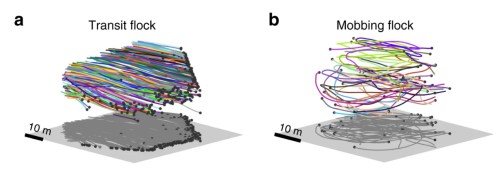
Transit and mobbing flock patterns. Source: Nature
Jackdaws, like starlings, occasionally form flocks. Recent research has shown that there are two different types of flocking behaviour: those flying to their winter roosts and those joining forces to scare off potential predators. In the first case, transit flocking, there is an element of predictability because the size of the winter roost flocks is fixed, and the jackdaws organize themselves in relation to one another in an orderly manner. In the second case, referred to as mobbing, the sudden gathering to scare off predators is a far more chaotic and unplanned event until the flock has achieved a certain number, when the jackdaws start to behave more like a roosting flock, with their motion through the sky co-ordinated and spatially organized. Jackdaws flocking before roosting offer some of the most spectacular aerial displays.
The jackdaw has only a faint footprint in myth and history suggesting that whilst an occasional nuisance it has not been sufficiently systematic as a pest to make its mark in folklore and superstition. Henry VIII, never one to pull his punches, added jackdaws, rooks and crows to the Vermin Act of 1532 in response to poor grain harvests that were blamed, in part, on foraging corvids. Elizabeth I echoed this in 1566 with another act intended to preserve the nation’s grain production against scavenging birds. Perhaps this reputation for pillaging grain accounts for why they were sometimes considered to be bad luck. Although a jackdaw on a roof might once have been taken to signify a new arrival, it might just as well have been an ill omen, sometimes a portent of death. Several decades later, in May 1604, Members of Parliament in the London Houses of Parliament were debating the third reading a bill when a young jackdaw flew into the chamber, upsetting a number of those present who interpreted it as a bad omen for the bill. Jackdaws had long been associated with ill fortune. Although there had ben confidence that the bill would pass, it went on to be defeated by 118 votes to 99. The clerk of the Commons was sufficiently impressed by the incident that he recorded it in the Commons Journal.
In the 19th Century, the jackdaws of Bodmin Jail on Bodmin Moor in southwest England were thought to be on the cusp of fulfilling a curse. It is said that a spinster living in woods on the edge of Bodmin, shunned as a witch, depended on jackdaws to bring her trinkets, and trained them to steal items of value, enabling her to survive. When she was found guilty of the jackdaw thefts, she was incarcerated in Bodmin Jail, where she died, cursing her jailers, the jail, and the town of Bodmin, whose inhabitants had rejected her so cruelly. The jackdaws, having followed her to the jail, remained, and the curse stated that “should the last Jackdaw be born at Bodmin Gaol, so the spirits of the condemned shall rise and bring misfortune and chaos to all that reside within.”
The Vain Jackdaw by Harrison Weir in 1881
In literature, a Greek and Roman adage that “the swans will speak when the Jackdaws are silent” (in Latin, tunc canent cygni, cum tacebunt graculi) advises that the wise should speak only when the foolish have finished their chatter. The jackdaw puts in an appearance in a version of Aesop’s Fables, representing unwise behaviour including vanity and greed. In The Bird with the Borrowed Feathers, the jackdaw borrows the peacock’s feathers to become one of this superior enclave, but on being recognized as a fraud has the borrowed feathers stripped from him and is so badly mauled that his own species do not recognize him, and reject him. It is a moral against social climbing.
In the 18th century, A poem by William Cowper (1731-1800) is dedicated to the jackdaw:
There is a bird who, by his coat
And by the hoarseness of his note,
Might be supposed a crow;
A great frequenter of the church,
Where, bishop-like, he finds a perch,
And dormitory too.
Above the steeple shines a plate,
That turns and turns, to indicate
From what point blows the weather.
Look up — your brains begin to swim,
‘Tis in the clouds — that pleases him,
He chooses it the rather.
Fond of the speculative height,
Thither he wings his airy flight,
And thence securely sees
The bustle and the rareeshow,
That occupy mankind below,
Secure and at his ease.
You think, no doubt, he sits and muses
On future broken bones and bruises,
If he should chance to fall.
No; not a single thought like that
Employs his philosophic pate,
Or troubles it at all.
He sees that this great roundabout,
The world, with all its motley rout,
Church, army, physic, law,
Its customs and its businesses,
Is no concern at all of his,
And says — what says he? — Caw.
Thrice happy bird! I too have seen
Much of the vanities of men;
And, sick of having seen ’em,
Would cheerfully these limbs resign
For such a pair of wings as thine
And such a head between ’em.
Perhaps a better known poem about jackdaws is the 19th century The Jackdaw of Rheims by Richard Harris Barham (who used the pen-name Thomas Ingoldsby, 1788 – 1845). It’s a lengthy affair, so I haven’t reproduced it here, but you can find it on the All Poetry website here. It is another humourous poem that tells how a jackdaw stole the cardinal’s ring, but wound up being made a saint.
Because jackdaws often favour steeples and holes in roofs of church buildings, the Jackdaw can be valued as a holy bird, shunned by the Devil because of its pious choice of residence, a tradition that was particularly prevalent in Wales. I suspect that those responsible for the care of the churches concerned might have a less charitable view on the subject.
On the whole, history has judged the jackdaw without overt hostility, but it still comes under suspicion. They are are still legally classified as vermin in the Wildlife and Countryside Act of 1981, and numerous pest control companies offer the removal of jackdaws as one of their services. This is partly because of the noise and disruption of their chimney, roof and church occupancies (and I can vouch for the fact that they are seriously noisy) but also because of their perceived threat to the conservation of smaller bird populations and the ongoing damage that they can inflict on cereals crops.
As of 2022 there are some 1,400,000 breeding pairs in Britain and in the region of 30 million across Europe. In 1984, they were first identified in north America. The Big Garden Birdwatch, organized annually by the RSPB, found that jackdaws were ranked 15th in birds observed in English gardens in 2022, and 11th in Welsh gardens. In both cases most of the birds higher up in the ranking were small varieties, but they also came in behind magpies and wood pigeons.
When the jackdaws first appeared in 2022, which is when I first wrote this post, whenever I walked out of the back door the jackdaws would take to the air without hesitation. Unlike the blackbirds and the robins that take a look at me, hop a short distance away and then ignore me, or the sparrows and tits that take instant flight, but only as far as the nearest tree from which they can monitor my activities, the jackdaws glimpsed one hint of movement and were gone. Now, updating this in spring 2025, the jackdaws and I share the garden in much closer proximity. They regard my presence as a fact of life. If I walk up the garden when they are in the middle, they will sometimes move a couple of bounces away from me but often they will simply pause and keep an eye on my activities, and resume their own activities when I am at a safe distance. If I am seated quietly with a book when they touch down, they note my presence and get on with life, often coming very close but never too close.
I feed them at the top end of the garden in the winter, well away from the small birds on the patio. When the frosts have ended in late spring I leave them to their own devices, along with all the other birds. It was my mother’s philosophy that birds should be sustained during the months of hardship but should not be encouraged to stuff peanuts down their chicks’ necks (which can kill them) and should be teaching their offspring to forage naturally rather than to rely on bird feeders. That has always seemed liked a sound policy and I follow it.
Although the jackdaws and I share the garden in independent harmony, we all take care not to get too close. There have, however, been numerous examples of jackdaws having a very close affinity with particular humans. Usually this is after the bird has been injured and cared for by the person with whom the relationship is formed (broken wings seem to be the most common example), but not always. There’s a great video of a man feeding a jackdaw with a grape at Rhuddlan Castle below, which shows that formidable beak in action (I would be seriously worried for my fingers, but the jackdaw never misses its target):
Sources:
Books
Bruun, B. 1970. The Hamlyn Guide to the Birds of Britain and Europe. Hamlyn Publishing
Couzens, D.2004. The Secret Lives of Garden Birds. RSPB
Nathan J. Emery, Amanda M. Seed, Auguste M. P. von Bayern and Nicola S. Clayton, 2007. Cognitive adaptations of social bonding in birds. Philosophical Transactions of the Royal Society B (2007) 362, 489–505
Ira G. Federspiel, M. Boeckle, A. M. P. von Bayern and N. J. Emery 2019. Exploring individual and social learning in jackdaws (Corvus monedula). Learning & Behavior volume 47, pages 258–270 https://link.springer.com/article/10.3758/s13420-019-00383-8
Alison L. Greggor, Guillam E. McIvor, Nicola S. Clayton and Alex Thornton 2016. Contagious risk taking: social information and context influence wild jackdaws’ responses to novelty and risk.
Scientific Reports volume 6, Article number: 27764 (2016) https://www.nature.com/articles/srep27764
Hangjian Ling, Guillam E. Mclvor, Joseph Westley, Kasper van der Vaart, Richard T. Vaughan, Alex Thornton & Nicholas T. Ouellette 2019. Behavioural plasticity and the transition to order in jackdaw flocks. Nature Communications volume 10, Article number: 5174 https://www.nature.com/articles/s41467-019-13281-4
Simon Verhulst, Moniek Geerdink, H. Martijn Salomons, and Jelle J. Boonekamp 2014 . Social life histories: jackdaw dominance increases with age, terminally declines and shortens lifespan. Proceedings of Biological Science, September 22nd 2014; 281(1791): 20141045. https://www.ncbi.nlm.nih.gov/pmc/articles/PMC4132676/
Lies Zandberg, Jolle W. Jolles, Neeltje J. Boogert, Alex Thornton 2014. Jackdaw nestlings can discriminate between conspecific calls but do not beg specifically to their parents. Behavioral Ecology, Volume 25, Issue 3, May-June 2014, pp.565–573 https://academic.oup.com/beheco/article/25/3/565/513806
This satisfyingly chunky piece of glazed earthenware, featuring a roughly beaded rim, was once a fairly large, open vessel, probably a pot or a tall-sided bowl. Mocha ware, produced between the mid 1700s and the early 1900s, was relatively cheap and cheerful, pottery for using rather than admiring. Its defining features include its colouring, the linear decoration (usually combined with panels of colour or white background) and the “dendritic” design. “Dendritric” means “branching,” and in mochaware refers to a pattern consisting of a feathery fern-like tendrils, usually emanating from a main stem, typically coloured either black or blue. Vessels without the dendritic design are usually referred to simply as banded creamware or annular (ring-like) ware, in both cases due to the encircling bands of colour. It is only those vessels with the dendritic design that are supposed to be referred to as mochaware. We have found both in the garden, but the piece of mochaware is the most impressive, both in terms of solidity and distinctiveness.
The name mocha derives from an imported stone known as moss agate, which was also known as mocha stone due to its export from the port of Mocha (al Mukha) in Yemen, on the southwestern end of the Arabian peninsula. The stone is not actually found in that part of the world, and was imported from India and some parts of central Europe. Many of the first examples to find their way into western Europe were brought back by the East India Companies of Britain and the Netherlands. Although the appearance suggested to its European admirers that plant remains had been preserved in the stone, moss agate consists of quarts with mineral inclusions, usually manganese and iron oxides. It is not actually an agate at all.
In the 18th century the belief that the stone preserved plant remains indefinitely suggested that it had special health-preserving properties, providing good luck to the wearer. Many were accordingly turned into jewellery, particularly as polishing techniques improved, and they were often accompanied by gemstones in settings. The ability to cut the stone into thin sheets that could be polished encouraged its incorporation into various decorative objects. The Royal Collection Trust has in its collection a piece of sliced moss agate formed into the lid of a box, by Fabergé, which shows clearly how the pottery emulates the stone, and how it might be used in luxury goods. There are many similar examples.
The Greengates Works in Tunstall during the 1780s. Source: thepotteries.org
It is thought that the comparatively humble mochaware pottery was first made by William Adams of the Greengates factory, Tunstall, England (1745-1805). Production moved to the factory of his cousin, also William Adams, at Brickhouse, Burselm and later at Cobridge Hall in Cobridge. Many English factories were soon turning out large quantities of mocha, mainly in Staffordshire into the early years of the 20th Century. Other factories were set up in Bristol, Hull, Leeds, Glasgow, Swansea and Llanelly.
Annular and mochaware vessels usually combine a limited repertoire of colours. The concentric rings include yellow, yellow ochre, blue, black and and beige. More rarely some feature terracotta, orange and green bands. The background is usually cream or white, and the dendritic design is usually blue or black. In some cases the mochaware decoration remained purely abstract, but on some vessels the acidic solution is controlled to create images representing trees. Some examples of both abstract and more representational uses of the style are shown below.
Being so inexpensive, and at the same time so attractive, it became extremely widespread. It was often used to make pint mugs for pubs, marked with an imperial symbol confirming the correct volume, and ordinary domestic items like cups, mugs jugs, jars, lidded pots and mixing bowls, and even chamber pots. It was almost never used for flat items like dishes, plates or platters. Because the patterns made could be influenced but not precisely determined, each piece was unique. Mocha and banded creamware were exported in large amounts to the United States, which was soon manufacturing its own mochaware.
On the pottery, the tendril effect of the moss agate is achieved by dripping a dark acidic colouring (which could include urine, tobacco juice, lemon juice, ground iron scale, hops or vinegar) onto the alkaline slip (mixture of water and clay) of the pot, whilst still wet. The alkaline liquid splits, and the result was thought to resemble the moss agate. Here’s a description of the technique from the University of Toronto’s Physics department:
The original recipe involves a “tea” made by boiling tobacco, which is then colored with e.g. Iron oxide. The piece is first coated with a wet “slip” (very runny clay/water mixture). Then the tea mixture is touched onto the wet surface. The acidic tea reacts with the alkaline slip and the dendrites grow quickly from the point of contact. The dendritic pattern is clearly the result of a dynamic process in which the contact line between the two liquids, tea and slip, becomes unstable. The surface tension of the tea is less than that of the slip. The instability is probably driven by a combination of capillary and Marangoni (surface tension gradient) stresses, coupled somehow to the acid/base chemical reaction. Similar looking instabilities are known in surfactant driven flows.
A decisive contributor to the production of both mochaware and annular ware was the rose-and-crown engine-turning lathe, developed by Josiah Wedgwood. There was a hefty up-front cost, but it allowed a mechanized approach to the otherwise hand-applied concentric rings of coloured slip.
Experiments described by The Ceramic Arts Network website, explain how the techniques have been used to make modern mochaware in modern experiments:
Pint tankard with an imperial stamp. Source: 1stDibs
The mixture that is used to form the patterns is called “mocha tea.” It was originally made by boiling tobacco leaves and forming a thick sludge that was then thinned with water and mixed with colorant. However, nicotine solutions are only one form of mild acid; many others will work, such as citric acid, lemon juice, urine, coffee or vinegar, particularly natural apple-cider vinegar. One of these would be mixed with colorant. Most colorants work quite well, although carbonates and stains are usually better than oxides, since they are typically a physically lighter precipitate than oxides. Heavy materials such as black copper oxide, black cobalt oxide and black iron oxide do not work well, because the acid can’t adequately hold them in suspension. A ratio of about one heaping teaspoon of colorant to a quarter cup of mild acid is usually a good starting point. However, a good deal of individual testing has to be done to get the two liquids to work together to create significant dendritic formations or diffusions.
The Copeland (formerly Spode) pottery works in 1834. Source: Spode Museum Trust
The Colonial Sense website tells how Charles Dickens visited the Copeland Pottery Works at Stoke on Trent in the Potteries:
I am well persuaded that you bear in mind how those particular jugs and mugs were once set upon a lathe and put in motion, and how a man blew the brown color (having a strong natural affinity with the material in that condition) on them from a blow pipe as they twirled; and how his daughter, with a common brush, dropped blotches of blue upon them in the right places; tilting the blotches upside down, she made them run into rude images of trees.
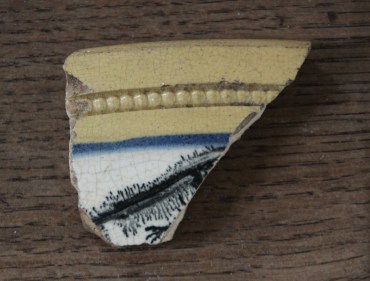
Mochaware sherd from the garden
The sherd from my garden shows a band of yellow ochre on and beneath the rim with a beaded or rouletted design impressed into the surface below the rim, produced by using an embossed rouletting wheel. The beading was achieved by a simple cylinder attached to a handle and rolled onto the surface of the ceramic. It took a very steady hand. Some rouletting is very subtle and complex, but this is clearly not. Still, it is another decorative aspect to the vessel. A segment of black dendritic patterning is visible on a cream background, separated from the wide band of yellow ochre by a thin band of blue. It is a solid, utilitarian piece of earthenware, almost 1cm (a third of an inch) thick at the rim, narrowing into the body of the vessel. The vessel originally had a diameter of 25.5cm (10 ins), which makes it a fairly substantial object. Its walls show very little vertical curvature, unlike most mixing bowls, so it may have been a large pot of some description.
Yellow ochre reverse side (interior) and section of the sherd showing the fabric and glaze
Today,whole and undamaged items of mochaware attracts collectors on both sides of the Atlantic. My sherd, though part of a fascinating story, is of course worthless. As usual, apart from trying to find out information about the odds and ends in the garden, together these objects are combining to form a sense of who lived here before and what sort of livings they may have had.
There’s a truly illuminating video of dendritic mochaware being produced by a modern artisan on YouTube, showing how the acid reacts when it meets the alkaline, as follows:
For anyone new to this occasional series on objects extracted from my garden during everyday gardening activities, see the History in Garden Finds page. These are not objects used in the garden, but objects, usually fragments, lost or disposed of in the garden and found during digging, troweling and planting.
Sources:
Books and papers
Wright, K.F. 2021. Artifacts. In Loske, A. (ed.) A Cultural History of Color in the Age of Industry. Bloomsbury Academic.
The tree in early April 2021, still rather bare of leaves.
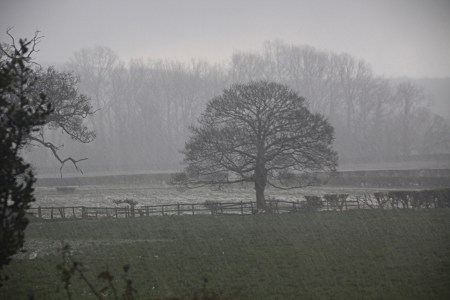
Just for fun, since April 2021 I have been photographing the deciduous tree that I can see from the window in my home office. It stands in the middle of a rather untidy fence, completely dwarfing it, but finds itself in arboreal isolation, between two fields that belong to the Churton Hall / Barnston Estate dairy farm. On the far, eastern side of the hedge, the field was eventually ploughed.
On the western side, cows grazed all summer during the day, vanishing at speed from time to time, presumably for milking and feeding. Most of the time the cows ignored the tree, but on hot sunny days often gravitated towards it, even though it is not very large, and never offers much shade.
The same tree a few weeks later in mid-June 2021
The cows have surprised me. Not dull, static, plodding things but always on the move, pushing one another out of the way for that special patch of grass, often cantering around together, and frequently departing back to their barn at a serious gallop, presumably for food. The fresh air certainly seemed to agree with them. The cattle vanished at some point during the late summer or autumn and the field remained empty of livestock, but reappeared in early April, making me smile when I saw them first exploring their fresh environment, rushing around and bumping into each other in something resembling excitement.
The tree, the backdrop to all this bovine activity, was ever-changing. The time between bare branches in April and richly new light green leaves in June, a complete metamorphosis, was a mere six weeks. Extraordinary.
This post is simply a set of photos of bits of a year in the tree’s life. One or two of the photographs look as though the colours have been messed with in Photoshop to make them more interesting, but there would have been no fun in that.
I am too far away to know for sure what specie it may be. I suspect from the shape that it is an oak, but I need to see the leaves, and the longest lens on my camera cannot get me close enough. fdfasdf
An amazing sunset on 16th March 2022, when even my house, which is painted white, was peach-coloured. No Photoshop employed.
Snow on the 31st March 2022
Early April 2022, with the cows returned to the field
Mid April 2022, with leaves arriving on branches and a doom-laden sky in the background
It never occurred to me that I would find any politically incorrect objects in the garden, but this is certainly a contender. I dug it out of one of the flower beds when doing some planting last summer, and for a moment couldn’t figure out what it was I was looking at, partly because I was holding it upside down, but partly because it was so unexpected.
I remember that Robertson marmalade and other Robertson products were everywhere, with the distinctive Golliwog logo on their labels, with its bright clothing and crudely caricatured face. ln spite of the Golliwog’s big red smile, or perhaps because of it, I found it threatening. For others, however, it was (and still is) a cheerful and entertaining character, rather absurd but benign.
The Golliwogg as it first appeared in Florence Kate Upton’s “The Adventures of Two Dutch Dolls” of 1895. Source: Wikipedia
The name “Golliwogg” (with the double g at the end) was invented by Florence Kate Upton, whose parents had emigrated from England to New York in 1870, and who had a black minstrel soft toy as a child, which was at the heart of many childhood games. When the family returned to England in the late 1880s, Upton began to illustrate children’s books to raise money to attend art school, with verses for the books written by her mother Bertha. The Golliwogg was introduced in their 1895 book The Adventures of Two Dutch Dolls, complete with the shaggy hair, clown-like grin, bright clothes and bow tie. This was the first of fourteen very popular books that featured Golliwogg as a central character, a jolly, benevolent, and good-natured friend who embarked on international adventures.
The name and character invented by the Uptons were not copyrighted, and the character was incorporated into works by other authors. It became a popular home-made rag doll, but it soon went into production as a soft toy, mainly in Germany and Britain, marketed as a “Golliwog” (without the final g). The German Steiff Company became the first to mass produce them in 1908, going on to produce a female version of the doll.
Robertson’s Golden Shred Golly Badge, Pre-War Issue dating from 1937 commemorating the coronation of King George VI. Source: Portable Antiquities Scheme via Wikipedia
In the 1910 James Robertson and Sons (based in Droylsden in Greater Manchester) first adopted the “Golly” on its branding after James’s son John had seen them being played with on a trip to the U.S., and by the early 1920s had been rolled out to many of their products. In 1928, the company began to offer Golly brooches in return for tokens printed on product labels as a marketing gimmick. The first were a series of Gollies engaged in different sporting activities and the Golly became a runaway success for Robertson’s.
It was only in the 1960s when increasing issues surrounding attitudes to race and the growth of racism became dominant that the role and significance of the Golly became questionable, and began to seem like very bad taste, offensive to many, potentially encouraging unconscious bias in children. In some countries today the word, either in its entirety or split into “golly” or “wog” is categorized as a racial slur, and the image of the Golliwog has been banned from some of them. At the same time, Golliwog-themed items, particularly vintage ones, have become collectable. Indeed, the Robertson’s Golly was not actually retired until 2001. The BBC reported that it was to be replaced by characters from Roald Dahl books, illustrated by Quentin Blake. Robertson’s Brand Director Ginny Knox commented on the changeover:
We sell 45 million jars of jam and marmalade each year and they have pretty much all got Golly on them. We also sell 250,000 Golly badges to collectors and only get 10 letters a year from people who don’t like the Golly. Whereas we are concerned about those people and it’s not our intention to be offensive with the Golly, we have to look at what our research says and what the sales say. The feedback has consistently been that for the vast majority of people, the Golly is a positive thing that they like.
One wonders what, in particular, people said that they liked about the Golly.
The very battered sherd from my garden was probably part of a child’s teacup or similar. The fabric is just over 2mm thick, and the diameter is probably something a little in excess of 7cm diameter. This would be more accurate if this as a rim piece, which can be measured by laying the rim on a simple map of concentric circles, (a rim chart or radius chart) but even though this is just a body sherd, the curvature is obvious and it is unlikely that it will have been much wider at the top.
The head of the Gollywog is typical, with the big round eyes, spiky hair and wide red mouth. The bow tie is yellow and the waistcoat or jacket is blue, fastened with a big white button. Just visible across the base of the waistcoat/jacket is a splash of red, which could either be a jacket buttoned across the base of a waistcoat or the top of the trousers.
The eyes look slightly down to its left, which was a standard feature of the Robertson’s Golly. The most familiar Robertson’s Golly was usually shown with a bright yellow waistcoat, red bow tie, blue jacket and red trousers but there variants. In spite of making myself substantially uncomfortable by paging through dozens of images on specialist websites, as well as paging through Google Images, I have not found one that looks like the piece from the garden.
The paragraphs looking at the history of the Golliwog on this post were based on Dr. David Pilgrim’s detailed article The Golliwog Caricature on the Ferris State University / Jim Crow Museum website (dated November 2000, edited 2012), which includes a full bibliography. For the really fascinating, if often disturbing full story, with a useful discussion of the racism issue, see the link below. Dr Pilgrim is Professor of Sociology at the Ferris State University. https://www.ferris.edu/HTMLS/news/jimcrow/golliwog/homepage.htm
The above-mentioned story about the end of the Golly as a Robertson’s brand in 2001 is on the BBC website.
Updated 13th April 2023, Thursday: The Guardian newspaper reported that toy Golligwogs were being banned from eBay and Etsy “amid new evidence that more people now regard the toys as racist.” I’m amazed that it took so long:
safdfas
For anyone new to this occasional series on objects extracted from my garden during everyday gardening activities, see the History in Garden Finds page. These are not objects used in the garden, but objects, usually fragments, lost or disposed of in the garden and found during digging, troweling and planting.
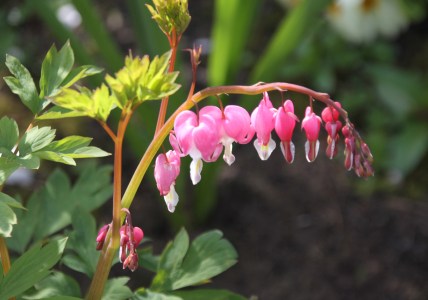
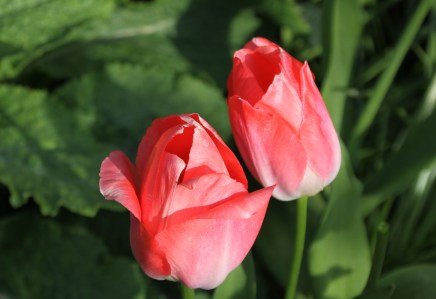
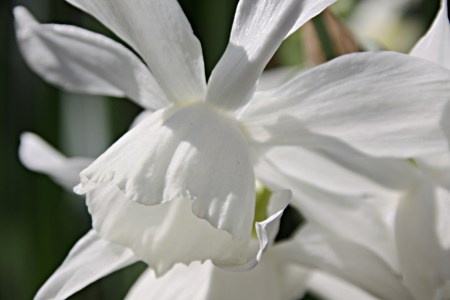
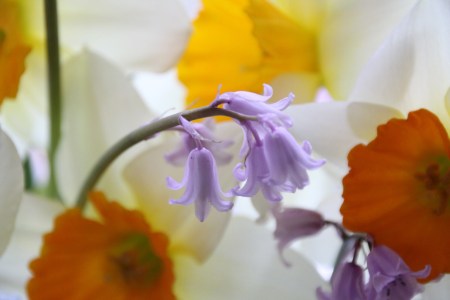
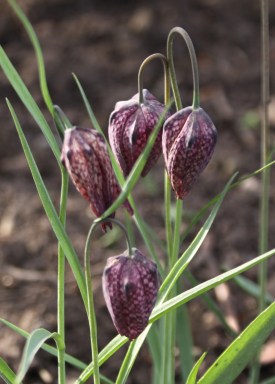
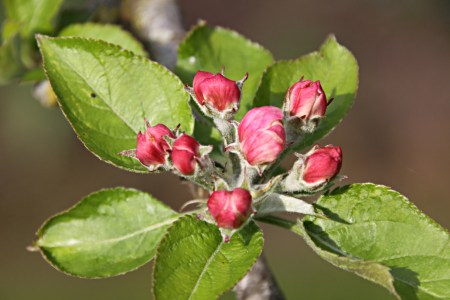
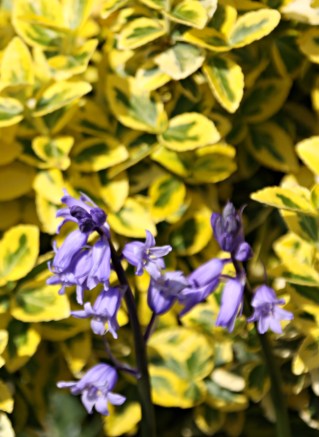
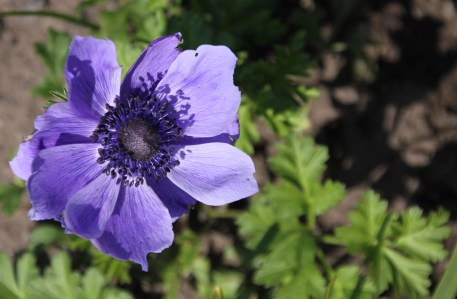
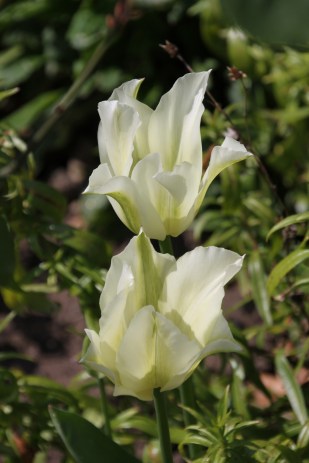
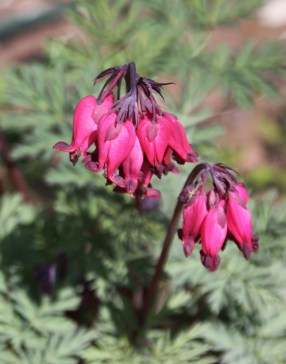
Lovely to see spring all around us at the moment, transitioning from late-flowering daffodils, bleeding hearts, camellia, snake’s head fritillary and tulips to bluebells, blossom, dark red beech leaves and the first summer buds. Everything in the garden looks stunning in the sun.
As the glossy chocolate Easter eggs line up on the supermarket shelves, replacing the eternally dubious Valentine’s Day gifts, I have gone into Churton egg mode, with a Ukrainian slant.
I have an Eastern European recipe book, which is absolutely excellent, and has a few Ukrainian recipes in it. One of them is a stuffed egg recipe фаршировані яйця – farshyrovani yaytsya (or stuffed eggs). Better and inferior versions of this are recognizable over most of Europe, and in 1970s Britain was a particular (very dubious) favourite as a starter, with the mayo mixture sprinkled with paprika and crossed with two salted anchovies.
In the Ukrainian version, the chopped egg yolk is mixed with mayonnaise (my mayo recipe is here), sour cream, as well as finely chopped chives or spring onions. I put my sour cream into the mayonnaise as I was making it I used chives, but I also added cress, and the result was excellent. This mixture not merely stuffs the little yolk cavities but overflows to provide a really good dollop of the mayo mix. Crucially, the egg is topped with caviar (please note – inexpensive Danish caviar). Caviar is salty, which I love, and is delicious.
As I was eating the finished article, I wondered whether the salted anchovy fillets that usually sat on a 1970s British mayonnaise-stuffed egg were attempting to replicated the caviar experience, fishy and salty at the same time. I am not denigrating the 70s version, which might well be worth revisiting
Photographs online show various different ways of presenting the Ukrainian фаршировані яйця. Mine is topped with two chives pointing out at angles, emulating many of the pictures online, and some cress over the top of the caviar, which is nothing like the traditional pictures, but which I liked. I have mine sitting on a fan of wild garlic leaves. If you have the time in your life to stuff an egg, this is a really nice way of doing it 🙂
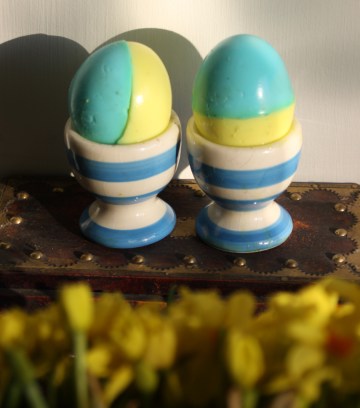
I have never used food dye before, but just for fun here’s a Ukrainian flag theme, using hard boiled eggs, halved. I simply left hard boiled eggs, halved, with a few drops of dye in cold water in a glass bowl, and left in the fridge for a few hours, checking them occasionally to see what depth of colour had emerged. The yolk didn’t survive intact, disintegrating slowly during submersion, so the result is rather more decorative than edible.
The above is light-hearted, but of course the situation in Ukraine is absolutely no joke. It is peculiar how one’s mind turns to different ways of expressing any possible form of solidarity.
In an authentic assessment of Ukrainian Easter eggs, here’s an excellent link showing how Ukrainian eggs are not merely given a bit of a paint job at Easter, but are provided with remarkable and beautiful designs: https://ukrainian-recipes.com/easter-eggs-discovering-symbolism-of-colors-in-ukraine.html. I really wish that my artistic skills were up to it, but they are not.
Today I was able to take a photograph of the 1898 Sibbersfield Lane milepost, just on the way out of Churton as the road heads towards Crewe-by-Farndon (which is on the other side of the bypass). I have been taking photographs of the mileposts since I first became interested in the turnpike.
The turnpike (or tollroad) that ran from Chester to Worthenbury was marked with mileposts. All of those surviving date to 1898, when the council was obliged to take over the turnpike. They presumably replaced earlier ones. I have been collecting them, digitally, for over a year now. So many of them were completely encased in foliage and shrubs that it was impossible to verify their existence until the winter, when all the leafage died back. I have posted about the turnpike in two parts. The first looks at turnpikes in general, and the second looks at the Chester to Worthenbury turnpike in particular. Another post includes photographs of the mileposts as I have located them.
Sibbersfield Lane is a very fast road, and it is not at all safe to stop, get out and take photographs, and as much as I would have liked to get some good shots, it was clearly unwise to get out of the car to risk life and limb, so these are two shots taken from the car, with my handbag camera. I didn’t have the professional camera that I usually use, so they are a bit blurred. The camera was, however, perfectly level, and this can be seen by the line of road and hedge. It is the poor, sad milepost that is at a perilous angle, slowly subsiding into a ditch. It seems, otherwise, to be in reasonable condition. I will alert Chester West and Cheshire Council, but it seems unlikely that it will be high on their list of priorities.
With Pancake Day (Shrove Tuesday) coming up on March 1st, here is a recipe of my mother’s. It always feels good to do some of the recipes that I associate exclusively with her, even when I have the devil’s own job reproducing them. I’m not very keen on sweet stuff, so on Pancake Day savoury pancakes are excellent.
Eggs are used in the recipe both in the pancake batter (beaten) and into the pancake filling (hard-boiled and chopped). The chopped egg makes a real difference to both the flavour and the texture of the filling. This is an immensely filling dish. I make one small pancake and serve a light salad to accompany it. It is a great dish for making use of leftover roast chicken, but of course you can grill or fry some chicken (thigh has great flavour) specially.
You may want to pre-heat your grill if it is electric.
Although most of my recipes are gung-ho, pancakes are simply not a suck-it-and-see item. The relative proportions are important. Hence, for two people:
100g plain flour,
190ml milk,
1 large egg, lightly beaten,
1/2 tbsp vegetable oil
a pinch of salt
tablespoon of oil or butter for the frying/omelette pan
The eggs and milk are whisked together with the oil, then poured into the flour and whisked lightly, ignoring small lumps. After a couple of failures on the pancake front, when I first had a go at this, I was told that being careful not to over-whisk the batter was important, and that leaving the batter in the fridge for a couple of hours, giving it a final stir before using, would increase the likelihood of success. This seems to work for me.
Heat the oil or butter in the pan and pour in the batter. Before flipping, it needs to be set well on one side, and I always take a sneak peak to make sure that it is going golden on the underside before flipping with a big wooden spatula.
To make the filling, which I do in advance, and heat through whilst making the pancakes, toss the following in hot oil and/or butter
two large handfuls of mushrooms (they shrink in volume when cooked)
two handfuls leftover roast chicken, thickly sliced or in chunks (or slice up and grill/fry a large chicken thigh)
crushed garlic, to taste (optional)
bay leaf (optional – and remember to fish out before stuffing the pancake)
When the mushrooms begin brown and give off a wonderful aroma, the following are mixed together and thrown in, and stirred just until everything is warmed through:
one or two hard boiled eggs, chopped
fresh tarragon, sage or oregano/marjoram to taste
a big handful of parsley
chopped spring onions or chives, to taste
seasoning to taste (I used salt, ground black pepper, ground fennel seeds and a few chilli flakes)
Next add the following, and stir gently until the spinach begins to wilt and everything is again warmed through:
some chicken or vegetable stock
cream (traditionally double cream, but I usually use crème fraîche, and sour cream also works a treat)
a really big handful of spinach
The filling is added to the pancake, heaped in a line up the middle. The pancake is folded to cover the filling and overlap, and then turned onto a baking tray (which is how I did it for the photo on the right this time last year) or oven-proof dish (the one at the top of the page, which I did most recently) so that the edges are secured underneath. I find that pancakes are so filling that instead of making two, I put additional filling down the edges of one small pancake in an oven-proof dish. Cheese is grated over the top (for my most recent version it was a mixture of Cheddar and Emmental with chilli flakes sprinkled on top) and it all goes under the grill until the cheese starts to melt and go golden-brown. In the summer I scatter over some fresh marjoram leaves from a pot on the patio to provide an aromatic edge. On this occasion I served it with a light side salad drizzled with a mustard vinaigrette.
Notes and alternatives:
I have to take real care not to pour too much batter into the pan, which makes the pancake too thick. A thick pancake results in something really stodgy, quite hard to roll and unpleasant to eat. It needs to be thin and light. Part of the trick is to make sure that the pan is hot enough to melt the butter or heat through the oil, but not so hot that the moment the pancake batter hits the pan it starts to set. It needs time to flow out to the sides of the pan and spread properly before the heat is turned up to allow it to set.
The previous time I did this I noted that the filling needed to be rather oozier than the one I made, because of course the pancake itself is dry, and requires a bit of liquid to balance it. So I was careful not to simmer off too much of the stock and cream, and although it looked a bit too liquid, it actually provided a really good oozy sauce. An alternative would be to make a sauce to pour over it, like parsley and chive, or chervil sauce.
If you don’t have time to fiddle around making pancake batter, or if it always comes out more like pizza than pancake, you can always use pre-made soft tortilla flat-breads instead, which are sold in all supermarkets these days. I’ve had a go, and they work well if they are heated and softened gently in a dry non-stick frying pan just before adding the filling.
Whether using either pancakes or tortillas, if you are using a baking tray and serving on a plate, anything that has fallen out of the pancake during the perilous transfer from grill pan to plate can be served to the side of the pancake. To avoid having to move the pancake from the oven dish or baking tray to the oven, a good alternative is to serve it in individual oven dishes straight to the table, with side dishes on the side.
Alternatives or additions to the chicken in the filling could include pancetta or chopped bacon, sausage-meat balls, or chunks of ham hock, the latter going well with leeks added to the fill. Dijon mustard is a great addition to the sauce for all these.
The basic recipe is easy to convert to a vegetarian recipe by adding extra hard boiled egg and replacing the chicken with loads of wild mushrooms, or/as well as leeks, asparagus, courgettes and/or fennel bulb, and using mustard and cheese to add more flavour to the sauce. A very nice seafood version made with king prawns makes a great alternative by leaving out mushrooms and instead adding fennel, asparagus and/or leeks, and making the sauce super-cheesy. This combination works well with ham hock as well.
Leftover filling can be used on toast for lunch, or served deliciously on a baked potato, with cheese or fresh parsley sprinkled over the top. I often make more than I need deliberately to use in this way, and this is my plan for Shrove Tuesday. I have a wood burning stove, and a maris piper spud wrapped in foil and chucked in for 45 minutes works wonderfully. Even with the foil, the smoked wood flavour penetrates and is wonderful.
I only started doing the Big Garden Birdwatch when I moved out of London, but it has become a real pleasure since then. This is my fourth go at it, but my first in Churton, done on 30th January. At this time of year with the unpredictable weather, it can be a bit hit or miss, particularly as we now experience so many more storms. Luckily, in spite of Storm Malik, in which one of my bird feeders vanished completely in spite of my efforts to locate it, there have been long dry periods and the birds have been out and about, stocking up with calories whilst the going is good. Because it has been so dry, I had to refill the bird bath, and they were soon drinking from it.
Of the birds that paraded themselves for one hour this year, there was nothing rare, but that’s not what it’s all about. Any and all Birdwatch observations contribute importantly to the statistics that have been collected by the RSPB for over 40 years and help to chart trends in bird populations. In 2021 over a million people took part.
Just a selection of my visitors on the day. My kitchen windows seriously need cleaning 🙂
I was in the kitchen, looking out of the window due to the cold, so I was mainly watching the bird feeders on the Japanese maple about 10ft away. The robin that fights for the patio territory with ferocity was there, scooping everything that the almost ubiquitous blue tits and great tits drop so untidily on the floor. Male and female house sparrows have mastered the bird feeders, some even performing the rudimentary forms of gymnastics that the tits perform so sublimely. Male and female blackbirds bounced around the ground, scattering the smaller birds. I was so pleased to have three chaffinches, a male and two females, for the first time ever, and they arrived very handily in the hour that I was doing my official watch. They scurried around underneath the bird feeders in the shade of the shrubs, and I couldn’t capture them with the camera. Another time. Missing from the usual suspects were the collared doves and the sole dunnock that often visits.
My garden is quite long so I could not see what else was dashing around in the trees and shrubs in the rest of the garden, but splendid magpies, raucous crows and enormous waddling pigeons were all visible in a patch of fugitive sunshine at the end of the garden, as were two squirrels competing for territory in the beech tree.
One of my recent visitors
Over the last few weeks, I’ve had some more unusual visitors recently. A week ago I saw a spotted woodpecker who was sitting in the big Japanese maple on my patio, trying to work out whether or not the bird feeders were at all feasible (not). On the same day I walked downstairs to find a pheasant standing at my back door looking in. I assume that someone else is feeding him from their back door, because he looked so expectant. In my last house, in Aberdovey (west Wales) I had a community of pheasants daily in my garden during the winter, which I used to feed on peanuts, but although pheasants roam the fields around here, I’ve never before seen one in the garden. Once in a while I hear and then see a thrush, but so far none have established a territory here. I have been trying to encourage goldfinches into the garden with nyjer seeds, because I had a community of them at my last house and they are enchanting, but so far they are resistant to all my efforts, although I saw some splashing in a pool of water in Pump Lane last year. ——


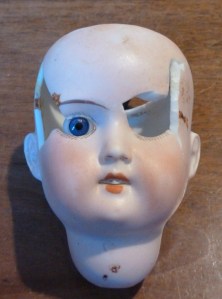
 There is little to say about the piece from the garden, other than it was made of a thin porcelain, carefully shaped in a mould. It was very skilfully painted, the cheeks a gentle rosy colour, the thin, bow-shaped lips a bright scarlet, with the ends of long dark eyelashes at top right. The clump of grey substance on the reverse side suggests that someone had made an attempt to repair the doll, presumably following a previous breakage. It seems to have been a very unlucky individual.
























 Based in Churton

.jpg)