Working in the garden on an unexpectedly sunny October weekend, I found myself surrounded by bees and butterflies, and perfectly delightful it was too. All of the photos in this post were taken this weekend. Last year my flower planting strategy had failed to produce a sufficiently colourful and insect-supporting display during autumn, so right at the beginning of spring, with a lot on my plate at the time, I used every small gap in my days to plant autumn-flowering species. The great dollops of colour and the endless flow of butterflies and bees, assisted by a mild October, feel like a very generous reward for lugging around bags of compost and for feeding them my dad’s “magic mix” of three parts bonemeal to one part Q4 mycorrhizal. Now, when the summer species and particularly the buddleias have gone over, there is plenty to keep the flying insects fully sustained.
The autumn-flowering aster (also known as Michaelmass) daisies and Purpletop vervain (Verbena bonariensis) have been the real successes, growing fast and densely, bright domes of colour all over the garden, attracting huge numbers of bees and butterflies. The multi-coloured dahlias, yellow-petalled rudebeckias, purple-blue tradescantias and tall, elegant pink windflowers (Japanese anemones) are all still doing well. Ivy flowers, clusters of pale yellow pom-poms, are also popular with butterflies, bees and ladybirds. This cheerful floral mix is supplemented by lingering lupins, phlox and roses, which have done their fair share too. The succulent-leaved Hylotelephium, which we used to call ice plants when I was a child, are still in flower, but although they were smothered with butterflies and bees only a couple of weeks ago, they are now being ignored. —
Comma on Verbena bonariensis
I spotted two bright commas (Polygonia c-album), with their deeply indented lace-edged wings, a few fluttering large whites (Pieris brassicae, also known as cabbage whites), a small white (Pieris rapae) , and a luminous yellow brimstone (Gonepteryx rhamni, which has been quite rare in the garden this year), and a single painted lady, but otherwise the butterfly scene was dominated by an astonishing number of red admirals (Vanessa atalanta) and small tortoisehells (Aglais urticae). Apart from the red admiral, the above-mentioned are native species. The red admirals were clustered mainly on the aster daisies, whilst the tortoiseshells were staying mainly on the Purpletop vervain (Verbena bonerensis).
Large white on Verbena bonariensis
—
Brimstone, cunningly disguised as a yellow leaf, on a very late surviving phlox
—
Red admiral on aster daisy
The red admiral (Vanessa atalanta) is one of a number of butterfly species that breed twice in a year. They are visitors to the British Isles, arriving in spring and throughout the summer. They breed here in the summer. They lay their eggs on young stinging nettles, the leaves of which provide sustenance for the caterpillar before it becomes a chrysalis and emerges, with damp wings that need spreading to dry, into a British summer. The caterpillar emerges from the egg on the upper side of the leaf, and binds its edges together with silk, consuming it from the inside out, before moving on to a fresh leaf. The butterfly can emerge at any time from May to October. I lost control of part of the garden earlier this year, under a bramley right at the back, and had a patch of stinging nettles that were taller than me, which is also shared with an unusual type of aster plant with stems that are also taller than me. I took up the nettles some weeks ago, but this is where the red admirals are clustering right now. Although I didn’t see any red admirals on fallen apples, these are usually very popular with the species, so it is a good idea to leave some if you have red admirals in your garden.
Small tortoiseshell on a barely visible Verbena bonariensis
The tortoiseshell is a native hibernating species that is also known from all over and further afield. Like the red admiral, the caterpillar is happy on stinging nettles, where the eggs are laid on the underside of leaves. They breed twice a year, emerging as early as March and again in August. They can usually be seen until October. This weekend Verbena bonarensis was the only plant in which they were showing any interest. It is not everyone’s idea of a good garden plant because a small purple head grows on a very tall stem, but I love it. It is easy to grow, and spreads itself like crazy, so you never really know where it is going to turn up next, although shaking a seed head in a general area usually works. Fortunately, they pull out very easily if they turn up where you don’t want them, and don’t mind being replanted elsewhere if you do it immediately and provide lots of water.
The bees, less discriminating than the butterflies, were taking advantage of any flower that showed its face, but were particularly in love with the aster daisies. I have never got to grips with the different types of bees, but there was an impressive mixture of the streamlined and the furry. The many hardy fuchsias, the Himalayan honeysuckle and the delicate salvia “hot-lips” are doing a great job providing colour and supporting the bees, but do not provide an accessible platform for the butterflies. Fuchsias, from south and central America were traditionally pollinated by hummingbirds, and we are a bit short of those around here, but the bees do a great job. There were a small handful of hover flies but the only wasp I saw was the submarine-sized monster trying to find somewhere to over-winter in my living room.
Bee upside down on Himalayan honeysuckle
Bumble bee on an aster daisy
As I was tidying up the patio plants, I noticed that there was an army of caterpillars eating their way through my nasturtium leaves (just a little annoying, because apart from ruining the aesthetics, I use the leaves in salad). They turn out to be from the Large White butterfly, and are apparently notorious for targetting nasturtium leaves, as well as cabbages. A tough time of year for them to be starting new lives. They spend the winter in chrysalis form, ready to emerge in the spring. Large whites are native, but their numbers can be supplemented by migrants from Europe.
October always has the feeling of impending doom about it, with the run-up to the clocks going back, the garden flowers dying off, and the arrival of dark mornings, dark evenings and cold, wet, windy winters with damp leaves rotting underfoot. I was truly not designed for a British winter. It has therefore been particularly uplifting to see the life still fizzing in the garden so late in the year, like a reprieve, with butterflies and bees adding movement and sound to complement the late season colour.
Red admiral on a tradescantia bloom
In this era of global warming, a British summer is a moveable feast and it will be interesting to see how butterfly species adapt either by tolerating new conditions or moving to new areas. The Butterfly Conservation organization has a number of programmes dedicated to the collection of such data from the general public in the hope of tracking some of these responses to environmental change. Red admirals, like other migrant species die in the winter. Traditionally Britain has simply been too cold for them to survive the winter frosts, but that may change, and we may see some news species heading northwards, but let’s hope that we don’t suffer too many losses.
For planting for flying insects, and extending seasons for their use at the beginning and end of the year, see Seabrook’s The Insect Garden (see Sources below for full details).
Red admiral, comma and ladybirds, all sharing the spoils of ivy flowers
Painted lady
Sources:
Books and papers
Carter, D. 1982. Butterflies and Moths in Britain and Europe. Pan Books in association with the British Museum
Holden, P. and Abbott, G. 2017 (2nd edition). RSPB Handbook of Garden Wildlife. Bloomsbury Publishing
Mansell, E. and Newman, L.H. 1968. The Complete British Butterflies in Colour. Ebury Press and Michael Joseph
Seabrook, M.J. 2020. The Insect Garden. The Best Plants for Bees and Bumblebees, Butterflies, Hoverflies and Other Insects. Northern Bee Books
This is the last in a 4-part series about the Late Neolithic – Early Bronze Age in northeast Wales, with special reference to Bryn y Ffynnon, Brymbo (where Brymbo Man and a very fine Beaker were located) and Bryn yr Ellyllon, Mold (where the gold Mold Cape/s and accompanying artefacts of bronze, copper and amber were found). The Introduction and an overview of how the two sites were found are in Part 1. Discussions of Bryn y Ffynnon and Bryn yr Ellyllon are in Part 2 and Part 3 respectively.
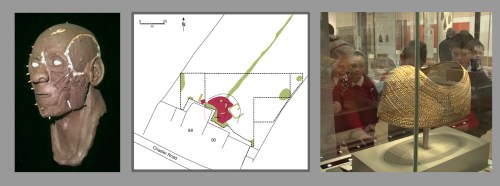
Left to right: The process of the reconstruction of the face of Brymbo Man from the Bryn y Ffynnon grave. Source: Wrexham Borough Museum. One of the geophysical surveys from the field in which Bryn yr Ellyllon was found. Source: Tim Young 2013. Screen-grab from British Museum video showing school children looking at the Mold cape. Source: British Museum video at the end of this post
This final part, Part 4, takes a closer look at some of the themes touched on in the previous discussions. I have not attempted to provide a summary of the Early Bronze Age, which is done very well in numerous books, a number of which are recommended in Final Comments, the rest listed in the Sources in Part 1. Here I have cherry-picked key issues that are relevant to discussions about the Early Bronze Age in northeast Wales.
Introduction to Part 4
Other types of site
The arrival of the Beaker phenomenon
Negotiating the role of the dead in the world of the living
Copper and gold in northeast Wales
Lost Data, Missing Data
Why do these sites and their associated ideas matter?
The Late Neolithic and Early Bronze Age, c.2900-1400BC, are usually discussed together due to their similarities. The Bryn yr Fynnon site that was found in Brymbo, and the Bryn yr Ellyllon site found near Mold both belong to this period, but each represents different approaches to the same tradition of burying the dead with or without barrows or cairns and in stone cists with grave goods. In northeast Wales the archaeological remnants that define aspects of Late Neolithic and Early Bronze Age life are largely funerary, with very little in the way of settlement data, which provides a distinctly lop-sided view of livelihoods. There are only a small number of other site types in northeast Wales and these are very rare.
Other types of site
As explained in Part 1, so much data about the Late Neolithic – Early Bronze Age of northeast Wales comes from round barrows and cairns. Although they are easily dominant, they are not the only types of sites belonging to the period. A wide variety of site types are found in other parts of Britain, although funerary data dominates everywhere. There are isolated examples of some of these other types of site in northeast Wales.
Penbedw stone circle to the northwest of Mold, off the A541. Not open to the public. Source: Coflein
Stone circles are dotted throughout north Wales, but are concentrated mainly in the northwest and are rare in northeast Wales. Timber circles are now being recognized throughout Britain, but they are rare in Wales and none have so far been identified in northeast Wales. Timber rots in our damp climate, so stone circles are better represented but it is becoming clear that timber circles were just as prevalent, if not more so, in areas where wood was readily available. Dating of stone and timber circles is uncertain but they were built somewhere in the 3000-2000BC range, may be large or small and are thought to have served a ceremonial role.
Henges are rare throughout Wales. They consist of circular spaces contained by outer banks and inner ditches with entrances, and were sometimes used to enclose earlier sites like stone and timber circles. Dating is uncertain here too, but they span the period of somewhere around 2600-1750BC.
Settlements are only rarely identified and are usually very ephemeral, usually consisting of little more than scatters of domestic debris including pottery sherds, stone tools, small pits and some signs of hearths. Only very occasionally does an excavation produce signs of a structure, which are often circular or broadly oval.
Stone cists (stone-line graves) without round barrows or cairns are by no means unknown. Although in some cases the barrows and cairns have been removed in modern times, there is some evidence to suggest that in some cases the cist was never provided with a mound. Brymbo could fall into either category.
Round barrows without burials are also found. This implies that although the two sites discussed here have a funerary component, the barrow might have an important role of its own too, perhaps indicating territory, ancestral links with the landscape or an affinity with a broad set of ideas connected with how humans lived in and used the landscape, and built up relationships with the landscape and environment.
Cremation is the dominant funerary tradition in the latter part of the Early Bronze Age, from around 1850 to around 1500BC. Secondary depositions in earlier round barrows, such as the one in Bryn yr Ellyllon are common, but cremations may be unassociated with any enduring monument.
There are several other types of site in Britain during this period but so far none of them have been identified in northeast Wales.
The arrival and spread of the Beaker phenomenon
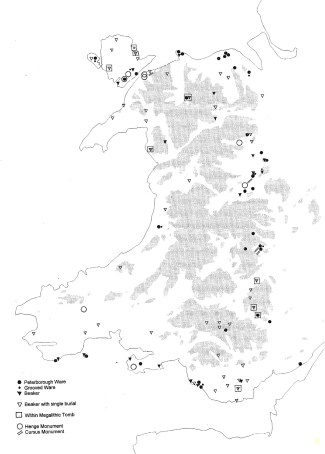
Map of findspots of, amongst other things, Beaker burials, showing how they were largely confined to lowland positions in northeast Wales. Source: Lynch 2000, fig. 3.2, p.86
The skeleton found in the Bryn y Ffynnon burial in Brymbo was interred with two objects. One was an undistinguished flint tool, lightly worked on both sides. The other object was a very fine Beaker, a style of pottery that was introduced from Europe and began to spread throughout Britain as part of a new tradition that initially included not merely a single burials under round barrows, but also came with distinctive, new types of grave good. This new funerary convention clearly represented very different ideas to those in the previous periods. The Brymbo Beaker itself was discussed in Part 2. The entire Beaker period is sometimes referred to as the Chalcolithic (copper-stone age).
As Frances Lynch’s 2020 map (right) demonstrates, Beaker sites cluster along the borders and coastal areas, but do not penetrate the inner areas of Wales, although Wales is smothered with round barrows and cairns, as shown on one of the maps in Part 1.
The earliest European Beakers and associated objects appeared in Britain during the Late Neolithic – Early Bronze Age and were very distinctively shaped and last between around 2500 and 2200BC. It is now generally agreed that Beakers mark the arrival of people from various parts of western Europe, who brought their own distinctive traditions with them. This European origin for the Beaker tradition has been researched by a number of multidisciplinary groups including the Beaker People Project and the Beakers and Bodies Project. These research projects have used conventional analysis supplemented by radiocarbon dating and by strontium and oxygen isotope analysis on human bones, the latter discussed briefly in Part 2, to help investigate the origins and spread of the Beaker phenomenon.
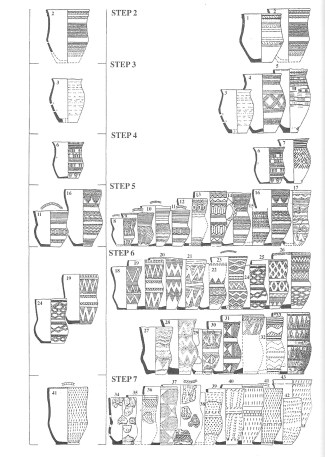
All known Beakers in Wales in 2000. The Brymbo Beaker is number 14 (Step 5). Source: Lynch 2000, fig.3.13, p.116-7, based on a 1972 scheme by Lanting and Van der Waals.
Why did these European visitors or migrants come to Britain? There are two popular arguments, which are not mutually exclusive. The first is that already peripatetic individuals, perhaps traders, were attracted by the news of the ceremonial centres of Wessex, such as Avebury and Stonehenge, which have no exact parallels in western Europe. On the other hand, it is possible that these vast monuments were a response to the incursion, rather than a reason for it. A second is that individuals came either to sell copper objects to indigenous groups, impressing them with the sharpness of blades and the durability of tools that could be recast when exhausted, or to search for new sources of copper.
Whatever motivated people to venture from Europe into Britain, bringing new burial approaches and ideas with them, the consensus is that the Beaker phenomenon spread through Britain after what archaeologist Stuart Needham refers to as the “Fission Horizon” at 2200BC. Perhaps these early metal users impressed indigenous people with both the utility and magic of early metalwork and different ways of conceptualizing life and death, and the transition from one to the other. The widespread dissemination through Britain produced geographical clusters such as those in northeast England and Scotland, but the new burial tradition became ubiquitous everywhere. As Beaker style burials found their way into new areas, communities demonstrated their own interpretations, cherry-picking what they wanted from the European tradition until it had become something adapted for local needs, preferences and beliefs.
The spread of the tradition is usually, although not exclusively, thought to have been by emulation rather than ongoing immigration. The reasons for the adoption and spread of these novel approaches to funerary practice and the ideas that produced them, is still poorly understood, but may have much to do with personal identity and how it is received by the dead, and conferred by the living. In northeast Wales burials were usually isolated or in pairs, rather than in the clusters that can be found elsewhere.
Negotiating the role of the dead in the world of the living
As prehistorian Richard Bradley points out, using a handful of remarkable graves containing exceptional artefacts cannot be taken as representative of the greater majority of sites that have either more modest grave goods or no objects at all, but although they are untypical, the burials at Brymbo and Mold illustrate a point about all funerary sites of the period, which is that no two round barrow burials is the same. Although there are recognizable similarities between most sites (such as round barrows or cairns, central stone-built cists, crouched skeletons, grave-goods and secondary burials), the objects accompanying the dead represent multiple ideas and choices. The perception of objects as mediators of human activity is well attested in all areas of modern, historical and prehistoric lives, and the selection of objects, or the absence of them, represents choices being made within broader funerary traditions. When a living person dies, they still have a presence and a role until they have undergone some sort of transformation process, to mark the change of status. A family, group or community may find itself trying to redefine itself in relation to the loss, even if they believe that the deceased is headed for an afterlife, and the objects deposited with the dead may have been part of that process.
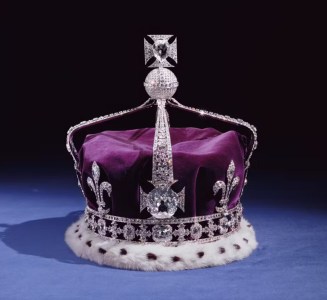
Because of our own hierarchical society it is easy but not always wise to assume that the burial of a single person in a marked grave reflects a clearly delineated social role, such as king, queen, chieftain or priest. When a grave is accompanied by something as rich as the Mold cape, that can be a challenging idea, because it feels instinctively as though the cape and the person belong together, the one conferring status on the other, both reflecting the dead person’s position in life. On the other hand, what would it say about our own society if the Queen had been buried with the Crown Jewels? It would certainly suggest that something startling was happening within the royal family, the monarchy and the nation.
Tutankhamen. Photo by Jon Bodworth.
In Part 3, Bryn yr Ellyllon and the Mold cape were compared to the burial of the Egyptian pharaoh Tutankhamen, as an analogy. The burial of valuable objects may sometimes be more about disposing of earlier ideas than celebrating the them. The Tutankhamen burial illustrates how it is the living who bury the dead, and the living may have firm views on what aspects of the living world should be disposed of at the same time. A burial may reflect a lot of complicated ideas that may therefore have very little to do with an individual’s status in life, and the role of someone in death may be very different from the position or status, if any, that they held in life.
There are many different models of appropriate funerary behaviour. In the Medieval period, for example, Jewish communities often adhered to the Old Testament’s view that “the rich and poor meet together in death,” indicating that material goods were only valuable to the living, often resulting in few if any grave goods and minimalist grave markers.
In the case of the Late Neolithic – Early Bronze Age, although a specific burial rite and the objects interred with the dead represent conscious choice based on the meaning of that object both in terms of a living community and in terms of how that community re-positions itself after a death, it is very difficult to know whether it is the identity of the living or the dead or the relationship between the two that is being worked through.
None of this directly addresses the questions of what the Beaker meant in one grave, or why such a remarkable collection of items was buried in another, but it does suggest there are many ways of understanding what objects are doing in graves in prehistory. Whatever the value and meaning of the objects chosen to accompany the dead, both resided not in the material alone but in how the material had been modified and objectified to become embedded with ideas that were connected to the identity of the dead, or to the object’s role as a link between the living and the dead, and to the ideas of physical and spiritual transformation.
Copper, bronze and gold in northeast Wales
The Moel Arthur axehead hoard. Source: Frances Lynch, The Later Neolithic and Earlier Bronze Age in Prehistoric Wales, p. 101, figure 3.7
Because the copper mines of the Great Orme were referred to with reference to Bryn yr Ellyllon, and because the cape was made of gold, and other objects of copper and bronze were present in the grave, a brief overview of how metals were acquired in northeast Wales seems pertinent. The earliest known worked source of copper within easy reach of Wales is in southwest Ireland at Ross Island at around 2400BC, associated with European Beaker pottery, and possibly the result of one group’s prospecting activities. The earliest Bronze Age (often referred to as the Chalcolithic) is represented in northeast Wales mainly by finds of thick-butted flat axe heads with high copper content in non-funerary contexts, including those from Halkyn, Moel Arthur, Iscoed Park and Caerwys, dating to between 2500 and 2300BC some of which, such as the Moel Arthur hoard, were probably from Ireland. Later examples were made locally.
In northwest Wales the most important copper mine was Parys Mountain on Anglesey, which is better known for being worked extensively in the 18th and 19th centuries. On the western edge of northeast Wales, on the coast just west of Llandudno, were the Great Orme opencast and underground mines, radiocarbon dated to between 1700 and c.900BC, still operating several centuries after other copper mines in Britain had closed. There is an overlap here between the earliest phases of the Great Orme mine and Bryn yr Ellyllon, Mold. The opencast mines, where the copper was clearly identifiable green seams of the mineral malachite and relatively easy to access. The doleritized limestone and shales, surrounding the ore were soft and easily removed with bone tools. More resistant stone could be detached from outcrops by setting fires against the stone, causing it to crack it into manageable chunks. The fire-setting would have required large quantities of wood, and may have had an impact on the local environment.
Opencast mining was followed later by underground tunnelling of galleries for more difficult to reach seams, with galleries so narrow and low (some of which were no larger than 0.3m wide and 0.7m high) that it is thought that only child labour could have been used to work them. Tools from the Great Orme mines included hammer-stones and cattle bone tools (leg and rib bones used as pickaxes and shoulder blades as shovels) were found in their thousands, together with bronze fragments. The tunnelling probably coincided with advances in bronze, dependent on the knowledge of how tin could strengthen tools when added to copper (ideally with 10% tin to 90% copper). The tin was presumably sourced from Cornwall, although evidence remains elusive.
At the Great Orme there are no traces of a settlement or even a domestic refuse site, meaning that there are no clues available about how the mining activities fitted into other livelihood activities. It is not known, for example, whether specialized teams worked the early mines, or if all suitable members the community were leveraged. Nor is it known if this was, at least early on, a seasonal activity that was fitted in around other economic pursuits, or whether even when mining first began it was a year-round occupation. Later, as the mines went underground, the tunnelling alone would have been very labour-intensive, implying full-time operating, but at the time of the Bryn yr Ellyllon site, matters remain opaque.
Gold was not adopted until a requirement emerged for objects of beauty and prestige rather than everyday functionality. Gold is too soft to be of any practical use. Only stray items survive, presumably because terminally damaged items were melted down and worked into new objects. Several early examples are from Ireland and southwest England. Examples of Bronze Age goldwork from northeast Wales include the Mold cape(s), the Caergwrle bowl, and an object from Ysceifiog described as a waist tore. Gold could be found in mid and north Wales, and could be sourced from local streams in northeast Wales, with a possible source for the Mold cape gold mentioned in Part 3.
Lost Data, Missing Data
In the case of Bryn yr Ellyllon, by virtue of the fact that it was plundered rather than excavated, the site stands out as a one of Britain’s most hair-raising examples of how important formal, systematic excavation really is. The gold cape is lovely, but it is only part of a story that has so many missing components, including both skeletal remains and textiles that were mentioned in the contemporary correspondence but were not retained. It is agony to know that prior to 1833 the site was undisturbed and could have imparted so much valuable information about the Early Bronze Age in northeast Wales.
This issue is as relevant today as it was in 1833. Metal detectorists and archaeologists have been working much more efficiently together over the last two decades, and the Portable Antiquities Scheme works with the public to help map object findspots and identify potential sites, but damage to a site to locate objects may be irreversible. As the British Museum’s Neil MacGregor says
It’s why archaeologists get so agitated about illicit excavations today. For although precious finds will usually survive, the context which explains them will be lost, and it’s the context of the material -often financially worthless- that turns treasure into history.
It is even worse when formal excavations are not published. Even the most professionally conducted excavation is an act of destruction, and the precise recording of the site and subsequent publication are the only means by which the site can contribute to research. The site of Llong near Bryn yr Ellyllon, which produced a jet bead necklace, was the subject of an official excavation in the 1950s but was never published. This represents an unforgivable archaeological failing. it was left to Frances Lynch, some 30 years later in the 1980s, to try to pull together the essentials, but even given her excellent attempt to reconstruct the findings, the gaps are sad.
The Whitehorse Hill burial bracelet made of cattle hair and studded with tin. Source: Dartmoor National Park
Data is also lost thanks to the British climate and its destructive effects on perishable items, referred to by archaeologist Linda Hurcome as “the missing majority” on the grounds that by far the greater number of structures and objects in prehistory would have been made of perishable materials that decayed centuries ago. The textile at Bryn yr Ellyllon is one example, but a more vivid illustration is a burial on Dartmoor in Devon called Whitehorse Hill. At that site burnt bones were wrapped in a bear pelt and were accompanied by remnants of textile attached to calf skin, a basket, a cattle hair arm band and wooden studs.
Why do these sites and their associated ideas matter?
I started off asking why the burials containing Brymbo Man and the Mold Cape and their Early Bronze Age neighbours might matter. There are many answers to that question, and you may have a few of your own to add.
Recreating the past: adding to the bigger picture
Our knowledge of prehistory is fluid. The idea that the past is static is challenged every time a new site or object is found and explored in detail, and our understanding grows as new sites and objects contribute to the picture, and new research programmes examine whatever remains poorly understood and under-investigated. Sites and objects only really start to matter when they are put together with other sites dating to the same period to get to grips with the contemporary social and economic context, which can in turn be compared and contrasted with those of different periods to enable a better understanding of how change happens.
Neal Johnson’s useful visual timeline of the Early Metal Age, showing how bringing together excavated data can help archaeologists to understand when and how technological, economic and social changes occurred. Source: Neal Johnson 2017, p.7, fig.2 (in Sources at the end of Part 1). Click to enlarge and read clearly.
Change is one of the special domains of prehistoric archaeology, because prehistoric research deals in multiple decades and centuries rather than months and years. Archaeological research into livelihood management and change helps to offer ideas about what drives people to make changes in economic dimensions of their lives, and how this happens. It also helps us to understand how economic changes and the adoption of ideas, whether local innovations or arrivals from Ireland and Europe, can impact cultural changes (changes in the material record), which in turn reflect how people think, how they translate ideas and beliefs into new actions, monuments and objects. How these differ from one area to another, and across different topographical landscapes, is another line of inquiry, helping archaeologists to piece together regional identities.
Getting to know people who were rather like us
The separation of Britain from Europe at the end of the last Ice Age. Source: Richard Bradley 2019, p.10. fig1.5
Now that chronological frameworks for different regions in Britain are being refined it is possible to take up the challenge of learning how people lived their lives and expressed their ideas. Fully modern people, Homo sapiens sapiens, arrived in Europe some 40,000 years ago. When the ice melted following the last Ice Age completely severed Britain from the European mainland at around 6,500 BC. Although initially characterized by livelihoods based on hunting, foraging and fishing, with different phases marked by new tool technologies, the introduction of cereals and livestock that had originally been domesticated in the Near East provided British communities with additional means for differentiating themselves from their European neighbours. Even so, it is clear that by the Late Neolithic, cross-channel connections had been established and continued to be maintained throughout the Bronze Age and later prehistory.
Everyday lives during the Late Neolithic and Early Bronze Age were confronted with hurdles far more difficult than ours to overcome with the unsophisticated technologies available, and people had very little in the way of medicinal resources to treat injuries and health problems. Lifespans were shorter, options more limited, and ideologies and beliefs were different, but families and communities had the same problem-solving abilities, tackled daunting decisions about risks and opportunities, and had their own traditions about how to behave under any given circumstances. The objects that they made and modified might be simple tools for specific tasks but they might also have important roles a heirlooms, in creating identity, building up memories and negotiating the difficulties of rites of passage, including death. The people who buried the individuals in Brymbo and Mold and their contemporaries are recognizable versions of ourselves, and they have left a rich legacy of their past presence both on and under the landscape.
Almost wherever you go in northeast Wales, you are sharing the landscape with the prehistoric people who worked the land, engaged in long-distance trade, designed and manufactured both beautiful and utilitarian objects and built round barrows and other monuments, a surprising number of which have withstood the ever expanding agricultural and urban dimensions of modern life. The round barrows are very easy to find, even in Wrexham itself. This makes for a rich experience, with round barrows providing a real sense of how Bronze Age family groups or communities put their stamp ubiquitously on the uplands and lowlands of northeast Wales. Sharing the past in the present is an opportunity to hear and respect the many hundreds of prehistoric voices can be heard if we take the time to listen. The fact that the past requires quite a lot of unravelling is just part of the ongoing enjoyment.
Connecting with the interested public
Brymbo’s Bryn y Ffynnon and its occupant have become more important than the sum of their parts by helping to explain prehistory to the public in the Wrexham County Borough Museum. Both adults and children may be interested in prehistory but find it very difficult to find a way of approaching it. By reconstructing the tomb in the museum itself, and by giving the partial skeleton a moniker, “Brymbo Man,” and commissioning a specialist to give him a face based on what remains of his cranium, the museum has used the grave to form a bridge between the present visitor and the past world of Beaker burials. Videos and information boards, and exhibits with contemporary objects help to bring the Early Bronze Age of northeast Wales to life. It really is terribly well done.
Screengrab from a British Museum video about the Mold Cape, shown at the end of this post.
The Mold Cape is also great PR for the Early Bronze Age in Wales. It is a huge draw for tourists worldwide in the British Museum, and the source of fascination for British school children, as shown in the video at the end of this post. A single piece of truly remarkable bling is not representative of this or any other period, but if it draws attention and results in questions to be asked, and children wanting to know more, it is doing a very good job for raising an awareness of prehistory and its complexities in the here and now.
Final Comments
Frances Lynch, writing in 2004, commented: “It is difficult to clothe the bones of prehistory in flesh and blood, to provide people with a picture of society to which they can relate,” and this is clearly the case here. By choosing two remarkable sites, a Beaker burial that is right on the edge of northeast Wales and the Mold cape assemblage, I have picked two sites that are anything but typical. However, I hope that these two sites, each containing different levels of data preservation and each exemplifying different archaeological problems, have gone some way to explaining how fascinating prehistoric sites can be, both individually and as representatives of a bigger picture.
Two palstave axehead moulds found by a metal detectorist on Conwy Mountain near the Great Orme, and declared Treasure. Now in the collection of the National Museum of Wales. Source: National Museum of Wales, via the BBC News website
Prehistory often feels elusive, intangible, and really quite difficult to grasp, but as archaeologists employ increasingly sophisticated survey, excavation and post-excavation methodologies and approaches, and bring more scientific techniques to bear, prehistoric livelihoods and worldviews become infinitely more accessible. Well-presented museum displays, television productions and publications aimed at wide audiences help to support the public, of all ages, as they begin to discover not only what remarkable objects survive from prehistory, but to understand how they may help to tell us about the surprising complexities incorporated into prehistoric livelihoods. These exist in a past that is distant, but in which people are still easy to recognize, and whose livelihoods, interests, hopes, concerns and losses may be readily identified with today.
Further reading
The full set of sources (books, academic papers and websites) that I have used for all four parts are listed at the end of Part 1. If you are interested in learning more about the Late Neolithic – Early Bronze Age in Wales, Frances Lynch’s chapter The Later Neolithic and Earlier Bronze Age in the 2000 book Prehistoric Wales by Frances Lynch, Stephen Aldhouse-Green and Jeffrey L. Davies is a very useful introduction. Steve Burrow’s 2011 book Shadowland, Wales 3000 – 1500BC about Welsh prehistory published by the National Museum of Wales includes good digestible accounts of the period. Neal Johnson’s 2017 academic monograph Early Bronze Age Round Barrows of the Anglo-Welsh Border has some very good background information but focuses on round barrow clusters that are rarely found in northeast Wales. For a comprehensive academic overview on Britain’s prehistory, Richard Bradley’s 2019 wide-ranging The Prehistory of Britain and Ireland provides an excellent foundation course. All can be found in Sources at the end of Part 1.
Visiting
Both sites have been destroyed, so neither can be visited in the field, which underlines the importance of publishing what remains of known sites. We are fortunate that in both cases the objects from the site were preserved and can be visited in museums.
The Brymbo cist and capstone, the skeleton found within the cist and the objects that accompanied the dead are preserved at the Wrexham County Borough Museum. The Mold cape and associated objects are now held in the British Museum in London, and the cape has a prominent position in Gallery 51. Details of both museums are as follows:
Wrexham County Borough Museum
The excellent Brymbo Man display in the Wrexham County Borough Museum is free of charge to visit, as is the rest of the permanent museum display. The display includes some really good videos and information about the reconstruction of the Brymbo Man head and face, together with a holographic representation of the head. There is plenty of parking in Wrexham, and the museum is a short walk from the bus station. Hot and cold drinks, and some great cakes, snacks and lunches are available in the museum’s very attractive conservatory café. See the Wrexham County Borough Museum website for visiting details: https://www.wrexhamheritage.wales
British Museum, London
The Mold Cape is in Gallery 51. The British Museum’s permanent galleries are free to enter. Parking is well nigh impossible. The nearest Underground station is a 10-15 minute walk away, but there are plenty of buses that go past the front and back doors, and in London there are always taxis. Within the museum, coffees and lunches are available in the cafés and the upstairs Great Court Restaurant (expensive but good, often with exhibition-themed special menus), and there are plenty of pubs, cafés and restaurants nearby. The further afield you go from the tourist hot-spots, of course, the lower the prices become 🙂 For visiting details see the British Museum website for more information. https://www.britishmuseum.org/
For anyone new to this occasional series on objects extracted from my garden during everyday gardening activities, see the History in Garden Finds page. These are not objects used in the garden, but objects, usually fragments, lost or disposed of in the garden and found during digging, troweling and planting.
This maker’s mark, crossing all three sherds, was a happy find for me, because although we have dug up tons of broken china from the garden (which is in Churton, a few miles south of Chester), all of it interesting in its own way, few of the manufacturers can be identified. This piece, with a company trademark on one side and part of the pattern on the other, contains the name both of the manufacturer and the design.
Re-assembled, the original sherd is 9cm long and 3.5cm wide. The potter’s mark is split over three broken pieces. The clean breaks and pure what fabric that divided the sherd into three means that it was broken when one of us found it whilst gardening, with spade or pick-axe, straight through the middle. Fitting the three pieces together to form a single piece leaves the much grubbier original break around the former edges. The spidery cracks in the glaze, called crazing, have also allowed the garden earth to seep into the fabric.
Flip it over, and there are parts of the floral pattern on the reverse, a deliberately blurred design referred to as “flow blue,” about which more below. Interestingly, the other images I have seen of this particular design, “Forget Me Not,” are not in flow, but are very clearly delineated, as shown in the example further below, where the design is in green.
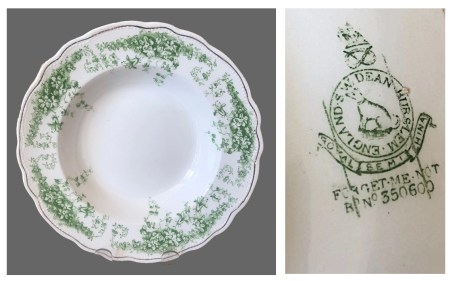
What are we looking at in the manufacturer’s mark? Starting at the top is a crown sitting over the top of a Staffordshire Knot. This knot is a traditional symbol of Staffordshire and the town of Stafford, first used by the Stafford family in the 15th century. The words within the circle read “England’s S.W. Dean Burslem,” which encircle a seated greyhound, part of the company’s trademark, and damaged with dark scratches in this piece. In the banner (or swag) below this, and illegible here, this clearly reads on other examples “Royal Semi China” and beneath that is the design name “FORGET-ME-NOT” and the manufacturer’s registration number: RºNº350600. This mark is much clearer in the example shown below, which shows the same design applied using a different technique.
Green version of the S.W. Dean Forget-Me-Not pattern and trademark. Photos by Letsgoexplorin64 Source: Etsy.
S.W. Dean of the Newport Pottery, Burslem, in Staffordshire was the manufacturer. Samuel Webster Dean had been the chairman of ceramics manufacturer in Edge, Malkin & Co., which started life as Cork and Edge in Burslem, making teapots and operated from 1846 to 60) before going through various changes in partnership. When it closed in 1906, Dean declared an interest, and eventually took over the company in 1909, renaming it S.W. Dean. The greyhound at the heart of the maker’s mark was carried over from Edge & Malkin & Co, which had used it between 1873 and 1903. The new company still operated out of Burselm at the Newport Works, and its products were probably sold in a number of retail outlets. The company also appointed agents to sell its products at sales events in hotels in major cities, probably for bulk sales into retail and export. In the advert below an event at the Holborn Viaduct Hotel in London as announced. There are examples of the type of products that the company produced on the A-Z of Stoke on Trent Potters website. S.W. Dean ran into financial problems very quickly, and Samuel Dean was declared bankrupt in June 1910. Although the advert below mentions an export market, it seems unlikely that there was sufficient time for this to get fully underway before the company closed.
Later in 1910, S.W. Dean was in turn purchased, and a new company was registered by J.D. Kerr. Kerr clearly thought that the Dean name had enough brand recognition amongst potential purchasers of the ceramics to retain the name, because the new company became Deans (1910) Ltd. A greyhound was retained in the log, but was on all fours, instead of seated, and was shown standing on an open crown.
The pattern side, showing the Forget-Me-Not design
The style and technique used on this pottery is called flow blue, and is a form of transferware. Transferware is a very swift way of transferring a design to the surface of an object. A copperplate engraved with the required design was inked, in this case with deep blue cobalt oxide, and pressed on to paper that, while still wet, was in turn pressed on to a ceramic surface. The design left on the piece of pottery is the transfer. With a complete object, the overlap between the transfers is usually visible as a seam, but this piece is too small to show this. The process speeded up the process of decorating ceramics, making them much less expensive to produce than hand-painted wares, permitting mass production, and creating cost-savings that were passed on to the customer.
The particular characteristic of flow blue is the appearance of blurred edges, giving them a soft and blousy look, quite unlike the precision of the green example of the same design above. When the pot was ready for a second firing, after the transfer design had been fixed into place, a flow-powder was added to the kiln. A typical mixture was 22% salt, 40% white lead, 30% calcium carbonate, and 8% borax, but there were variants. This gave off a chlorine gas which caused the cobalt in the transfer to diffuse into the glaze, creating the flow effect and the intense blue glow.
The Newport Works in Burslem, Staffordshire, where S.W. Dean’s pottery production was based. Source: A-Z of Stoke On Trent Potters
Flow blue appears from about 1830. Whether the effect was originally accidental or deliberate, it soon became very popular, first in the U.S., exported from Staffordshire factories, and later in Britain’s own households. During the Napoleonic Wars of 1803-15, the U.S. had become Britain’s most important export market until the onset of the American Civil War in 1860. The Registration of Design Act of 1842, which prevented factories from copying each others patterns without permission, resulted in new patterns, and sometimes specialization in particular types of design. By the mid 1800s British manufacturers were producing a variety of different genres, including more traditionally Victorian rural, garden and specifically floral designs, many of them very romanticized. The forget-me-not is a good example of a flower chosen because of its popularity in Victorian gardens and poems.
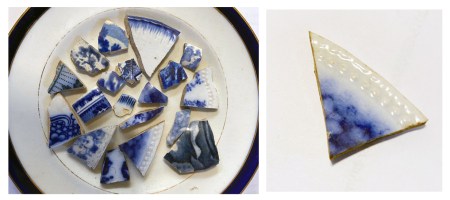
Flow blue from the garden, with the forget-me-not sherd both centre bottom on the plate, and on its own on the right
A lot of flow blue has come out of the garden, but nearly all of it in very small pieces. A sort through them has only found one piece that is consistent with the Forget-Me-Knot design, a very thin rim piece, much thinner than the pieces shown above. It may or may not come from the same item, perhaps thinning towards the edge, but it could also be a sherd from a different part of the same set. Some of the other pieces of flow blue display a characteristic feathering along the rims of ceramics, none of these gilded, although many feathered edges were. Those shown here are a selection of the bits pulled out of the garden, including the Forget-Me-Not rim piece.
The White Horse public house in Churton, some 20 minutes south of Chester and a few minutes north of Farndon and Holt, had been closed since the pandemic, but was the source of some heavy-duty activity over the several months, thanks to the efforts of its new owner Gary Usher and his crowd-funding business model.
Mike Royden, whose massive and seriously impressive website about Farndon and its environs, Royden History, is one of the best of the region’s history resources, has added a history of the White Horse to his site, with terrific images and explanatory text, tracing not just the history of the building but its various incumbents too. Buildings are far easier to trace than the people associated with them, and this really is a great piece of work using primary sources. Marvellous detective work and a very good read. Whether you are interested in Churton’s history or just the White Horse itself, Mike’s history of the White Horse can be found at the following page:
It was a real eye-opener to see the 1895 photo of the pub’s thatched predecessor, as well as the completely bizarre photograph of the Red Lion, a former Churton pub, in one of its previous incarnations. Thank you Mike!
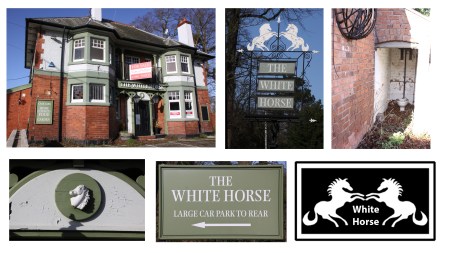
I took the pics below in February 2022, when the future of the White Horse was very much up in the air. It is great to see it all looking so trim and tidy.
White Horse images from February 2022
The latest chapter in the pub’s history began when it opened on 3rd March 2023. For more details about the White Horse and its menu, the website is at thewhitehorsechurton.co.uk.
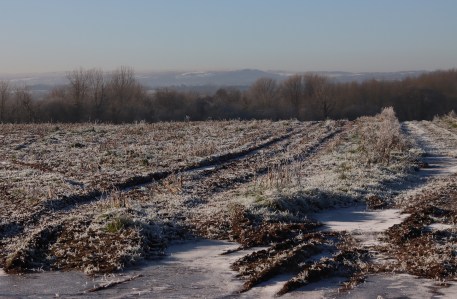
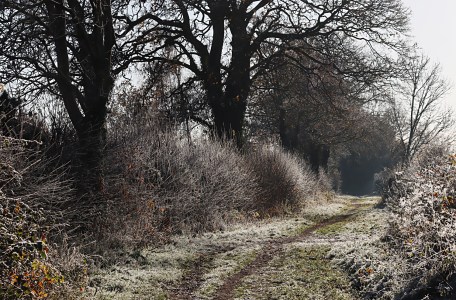
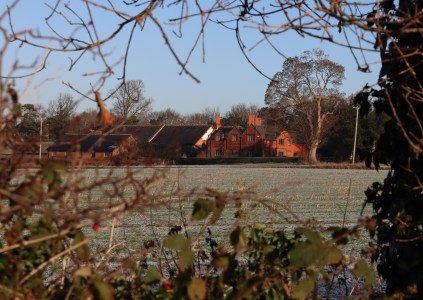
The walk through the fields from Churton to Farndon and back again is always enjoyable, taking about an hour for the full circuit, or less if you don’t pause for photos. It always varies enormously by season, but was quite spectacularly distinctive yesterday, glazed in frost under a bright blue sunny sky. Where the tractors had been out, during wet weather the deep tracks along some of the footpaths had filled with rainwater and frozen solid, but the ridges between were ice-free. Literally freezing in the shade, it was actually quite warm in the sun. A splendid walk, all colour and light.
The route taken from Churton to Farndon along official footpaths (in bright pink). The return route takes the pink footpath that starts in Brewery Lane. The red blobs are the approximate locations of two possible prehistoric sites, now ploughed out. Source of map: The Public Map Viewer.
A beautiful day all day yesterday, and it was lovely today too, right up until the skies opened. Fortunately, by that time the chilli con carne was in the slow cooker and the log fire was doing its stuff most effectively.
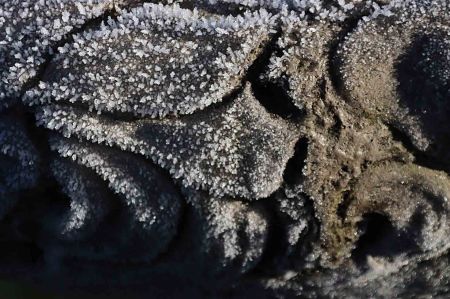
Just a few snaps from the garden, capturing some of that crisp contrast between the white lace of the frost, with all its snowflake complexity, and the autumnal shades and shapes, framed, captured and transformed.
As soon as the sun crept around the corner of the house, the frost started to melt, its drips capturing a myriad of colours. For the first time since I put them out a couple of weeks ago, the bird feeders were a hub of activity, a reflection of just how hard the ground is.
After attending the latest exhibition at the Tŷ Pawb art gallery in Wrexham, which has a handy car park overhead, we popped in to the Polish supermarket just outside the Market Street entrance to Tŷ Pawb. From the outside looks it looks somewhat unprepossessing, resembling an abandoned 1960s post office pasted with advertising flyers, but don’t be put off because inside it is bright and fresh, and as neat as a pin. As well as a range of Polish goodies, I came away with two enormous fresh king oyster mushrooms.
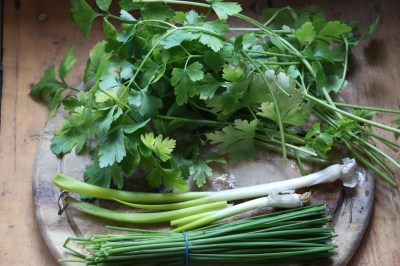
The mushrooms and some excellent bacon that I already had at home cried out to be made into a spaghetti carbonara, with the addition of some fresh parsley from the garden. This is an excellent dish if you are in a rush, because it takes about 15 minutes to cook in total, and the magical thing about carbonara is that the sauce tastes superbly creamy without a hint of dairy approaching it, achieved by mixing egg yolks with some of the starchy pasta water. It is one of my favourite dishes. Simply leaving out the bacon turns it into a vegetarian dish.
My recipe differs from a traditional carbonara in that it adds mushrooms, occasionally uses chunks of ham or bacon instead of pancetta, has a lot of parsley stirred in along with the egg mixture (and often chives and baby spinach leaves or wild garlic leaves too), and has slices of red chilli (raw or cooked) and spring onion discs sprinkled over the top. The chillies are partly for a tiny touch of heat, but also to lend some colour to an otherwise rather bland-looking dish. The pallid colouring is, of course, one of a carbonara’s key characteristics, as is the subtlety of the flavouring, so you may want to leave out the chillies.
If you want a simple, authentic and excellent carbonara recipe, I would suggest you go to the one by Jamie Oliver, which is based on a recipe that he learned from Gennaro Contaldo (so it has a good pedigree). You can find it here on Jamie Oliver’s website.
If you want my version, here it is (for one person, which makes it easy to scale up). For the mushrooms, bacon/pancetta, parsley, spinach etc I don’t use precise quantities, I just chuck in what I feel like on the day, depending on how hungry I am:
As much spaghetti (fresh or dry) as required, but I use about 40g, (which works well with two egg yolks)
Oil, preferably garlic oil. If you are using pancetta, which is fatty but renders down nicely, you can fry the pancetta without oil.
A clove of garlic if there’s no garlic in the oil or if you are not using oil (just to add a touch of flavour, not enough to dominate)
A couple of tablespoons of thick, diced ham, bacon chunks or pancetta cubes
A couple of tablespoons of chopped mushrooms, of the sort that won’t disintegrate when cooked, like king oysters, chestnut or supermarket button mushrooms. I used one whole king oyster mushroom for one person.
An egg yolk per person, or two if you are feeling like a silkier, more indulgent sauce
Parsley, chopped
Spring onions, chopped
Optionally, some softer wild mushrooms for additional flavour, particularly if you are making a vegetarian version
Optionally, parsley, spring onions (chopped), chives (chopped) and/or spinach leaves or wild garlic (ramsons) to stir in
Optionally, red chillies, as hot or mild as you like to top finished dish
If you want to add some interest to a vegetarian mushroom carbonara, some diced or spiralized courgette works wonderfully for texture, and as mentioned above, I like to chuck in a handful of baby spinach leaves and add spring onion and/or chives. Ramsons (wild garlic leaves) are terrific in spring.
With mushrooms, spring onions and chilli
If using dried spaghetti, put this on now. Your packaging will tell you the exact timing, but it’s usually 12-15 minutes from when the water comes to the boil. Fresh pasta only takes around 2 minutes from boiling point, so leave that til you are very nearly ready to plate up. Remember to retain some of the water in which you boil the pasta.
Heat the oil if using and put in your mushrooms.
If using pancetta, cook separately until the fat has rendered down into oil. If using ham or bacon bits, add to the mushrooms to heat through. Stir in crushed garlic, if using
Separate your eggs and mix the yolks together with a tablespoon of grated parmesan cheese, some black pepper and a teaspoon of cold water to loosen the mixture
Add spinach, if using, to the pancetta/bacon with a bit of water to help the spinach wilt
When the spaghetti is ready, add it to the bacon and spinach and stir.
Remove from the heat, Add in the egg-parmesan mix and stir quickly, together with the parsley and chives if using. Sprinkle grated parmesan, spring onions and chilli over the top and serve with a black pepper mill to hand.
The same dish cooked and consumed this very day: minus mushrooms and with bacon lardons instead of rashers, and with wilted baby spinach leaves stirred in.
I contributed to The Big Butterfly Count for the first time last year which was a real insight into what was visiting my garden. In walks afterwards I also started to notice species that had not visited my garden, and which clearly preferred hedgerows and fields.
The Count is UK-wide survey that assesses not only the state of butterflies, but also important changes in the environment. It was launched in 2010, and in 2010 over 107,000 people submitted 152,039 butterfly and day-flying moth counts.
The main event of the Big Butterfly Count 2022 main event is between 15th July and 7th August. Simply count butterflies for 15 minutes during bright (preferably sunny) weather during this period, which is when most butterflies are at the adult stage of their lifecycle and are most likely to be out and about, as instructed on The Big Butterfly Count website:
If you are counting from a fixed position in your garden, count the maximum number of each species that you can see at a single time. For example, if you see three Red Admirals together on a buddleia bush then record it as 3, but if you only see one at a time then record it as 1 (even if you saw one on several occasions) – this is so that you don’t count the same butterfly more than once.
If you are doing your count on a walk, then simply total up the number of each butterfly species that you see during the 15 minutes.
You can do as many counts as you want to: You can submit separate records for different dates at the same place, and for different places that you visit. And your count is useful even if you do not see any butterflies or moths.
You don’t have to have a garden. If you do have a garden you don’t have to confine yourself to it. Parks, fields, forests, footpaths, anywhere in the UK will help.
Only those on the target butterfly and day-flying moth list need to be counted. Download the handy identification chart to help you work out which butterflies you have seen. This helps to minimise counting errors and provide a clearer view of butterfly numbers. If you have spotted species which are not on the target species list these can be submitted using the iRecord Butterflies App. As participants submit their counts, they can all be viewed on the website’s interactive map. It is also important to note if you have not seen any butterflies because this may indicate a serious problem in particular areas.
A French omelette that I made in late Spring, stuffed with a cheese and wild garlic (ramson) béchamel and diced tomatoes with a sprig of ramson flower for decoration. My omelettes are usually browner than this, but this is how I would serve them for anyone else.
I haven’t been doing many Churton egg recipes recently, because I never seem to be passing when the Churton honesty egg stall is out, but I was lucky this week. Like many of my egg recipes, this is dead simple, but none the less enjoyable for that.
A French omelette is a simple fold-it-over affair done in a small frying pan (or omelette pan if you have one), preferably non-stick. It’s much like a pizza made of scrambled eggs, but without as much stirring of the eggs, and folded over to form a holder for the contents (looking a bit like calzone, if we’re remaining with the pizza analogy). The main tweak here is a béchamel sauce that goes in the centre to accompany the other more traditional ingredients. It takes about 15 minutes from start to serving.
The ingredients for this particular version:
2 or 3 eggs
Black pepper
Flour
Butter
Milk
Finely chopped herbs (see below for suggestions)
Cheese of your preference. I used cheddar but it works brilliantly with other hard cheeses like Emmental, and with soft brie types too
Chicken or herb/vegetable sock (optional)
A spoon of crème fraîche or cream (optional)
Ground fennel seeds (optional)
Chopped ham and/or finely sliced butter-fried mushrooms
The cheese béchamel is the first to do (butter, flour, milk and stock). Mine is not a pure béchamel as I always use a chicken or herb stock as well as the milk, meaning that it is part velouté. I also lob in a dessert spoon or two of crème fraîche to give it a velvety texture. Here’s the method: Equal parts of butter and flour are heated on a low heat and stirred together until they are completely mixed into a good, cohesive blob. Keep the heat low. Stock and/or milk are instantly added to the mixture quite slowly to break down the blob and create a paste that eventually becomes a thick sauce, on a low heat. If things seem to be getting a little hot, lift the pan off the heat and keep going with the liquid, reheating when it seems to have cooled down a little. If you want a bit of an edge to the sauce, you can also add white wine, but add a little at a time and ensure that you keep tasting to ensure that the flavour remains balanced, and keep stirring continuously.
Keep the heat low to stop it sticking or cooking too fast, and keep stirring. You can add cheese to make it a cheese and herb sauce, but don’t forget that cheese will be added to the omelette as well, on top of the sauce. The herbs are added when the sauce is thick but still flowing. They need to be compatible with cheese. I used finely chopped chervil, but any herb or combination of herbs that match well with cheese will be perfect, including thyme, oregano, ramson, lovage, marjoram, parsley, fennel or dill. It does need to be well chopped. I ground in some fennel seeds, as they complemented the chervil beautifully.
My omelette was a two-egg, but there is no reason why you shouldn’t do a three-egg. Do take into account that this is insanely filling. I like the omelette itself to be formed of a simple egg and black pepper mix, with just a slosh of milk or a spoonful of crème fraiche, cream or sour cream. This is whisked lightly in a bowl and then poured into bubbling butter in the frying pan. The trick is to leave the egg until the base is just beginning to set and then to move it gently, pulling the edges in, so that the liquid egg flows into the gaps that you have just made. This incorporates the egg mixture quickly and produces a gorgeously textured underside that, when you put it on the plate and fold it over, becomes the exterior.
When the base is just solid enough to add things to the surface, with the top still liquid, the contents can be layered on top, as one would with pizza. Do remember that it is going to be folded, so don’t over-stuff it. In my case I started off with sliced ham (but just-fried sliced mushrooms are also an excellent option), poured the warm béchamel over the top, and then added grated cheese to the top of that. The omelette then needs to heat through, slowly.
I always lift the edges of the omelette with a wooden fish slice to take a peak underneath and check on the colour, as I like mine well done on the outside (a treacly brown colour) but most people like theirs rather less coloured, as in the photo at the top of the post. If the bottom is cooking faster than the top is heating through, you can always hold it under the grill for a minute or two, but be careful if your pan’s handle is not metal. The grated cheese does not need to be fully melted, as it will melt when the omelette’s two halves come together.
Once you have the right colour (the colour you prefer) and the contents are heated through to your satisfaction, simply slide the pan towards the plate, allowing half to rest on the plate before flipping the second half over the top. Alternatively just slip the whole omelette face-up on the plate and use a fish slice to turn one half over the top of the other. The béchamel or béchamel-velouté sauce starts to ooze out of the omelette the moment it hits the plate, and is absolutely gorgeous.
Serve with a salad and/or slices of French bread (or in my father’s case chips) and enjoy.


 The autumn-flowering aster (also known as Michaelmass) daisies and Purpletop vervain (Verbena bonariensis) have been the real successes, growing fast and densely, bright domes of colour all over the garden, attracting huge numbers of bees and butterflies. The multi-coloured dahlias, yellow-petalled rudebeckias, purple-blue tradescantias and tall, elegant pink windflowers (Japanese anemones) are all still doing well. Ivy flowers, clusters of pale yellow pom-poms, are also popular with butterflies, bees and ladybirds. This cheerful floral mix is supplemented by lingering lupins, phlox and roses, which have done their fair share too. The succulent-leaved Hylotelephium, which we used to call ice plants when I was a child, are still in flower, but although they were smothered with butterflies and bees only a couple of weeks ago, they are now being ignored.


 The bees, less discriminating than the butterflies, were taking advantage of any flower that showed its face, but were particularly in love with the aster daisies. I have never got to grips with the different types of bees, but there was an impressive mixture of the streamlined and the furry. The many hardy fuchsias, the Himalayan honeysuckle and the delicate salvia “hot-lips” are doing a great job providing colour and supporting the bees, but do not provide an accessible platform for the butterflies. Fuchsias, from south and central America were traditionally pollinated by hummingbirds, and we are a bit short of those around here, but the bees do a great job. There were a small handful of hover flies but the only wasp I saw was the submarine-sized monster trying to find somewhere to over-winter in my living room.

 As I was tidying up the patio plants, I noticed that there was an army of caterpillars eating their way through my nasturtium leaves (just a little annoying, because apart from ruining the aesthetics, I use the leaves in salad). They turn out to be from the Large White butterfly, and are apparently notorious for targetting nasturtium leaves, as well as cabbages. A tough time of year for them to be starting new lives. They spend the winter in chrysalis form, ready to emerge in the spring. Large whites are native, but their numbers can be supplemented by migrants from Europe.


 Carter, D. 1982. Butterflies and Moths in Britain and Europe. Pan Books in association with the British Museum