Category Archives: Churton

An autumnal stroll from Churton to Aldford, pausing for lunch at The Grosvenor

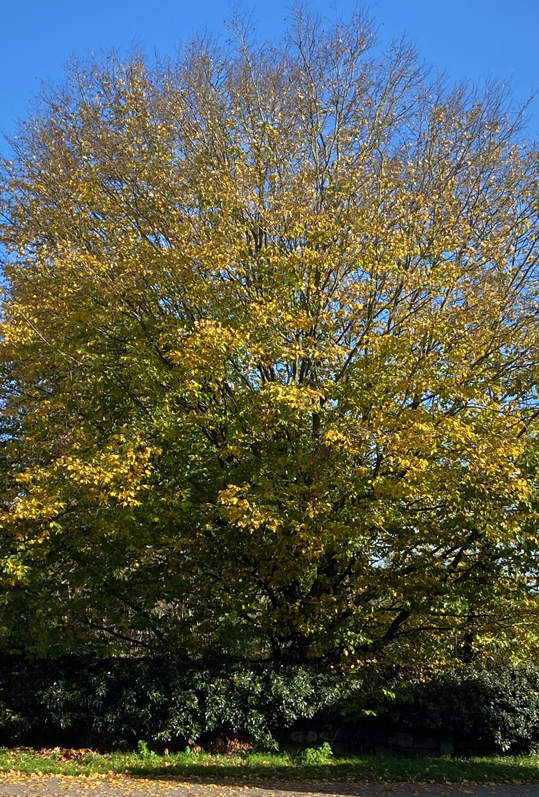
Autumn sun and brightly coloured leaves are always a joy at this time of year, right up until the point that they drop in huge numbers and need clearing off the garden lawn 🙂

Because it was so warm, my destination was The Grosvenor pub, a self-indulgent extension to my terrific short break in the Ironbridge area of Shropshire last week.  It is always such a treat to be able to sit outdoors at this time of year.

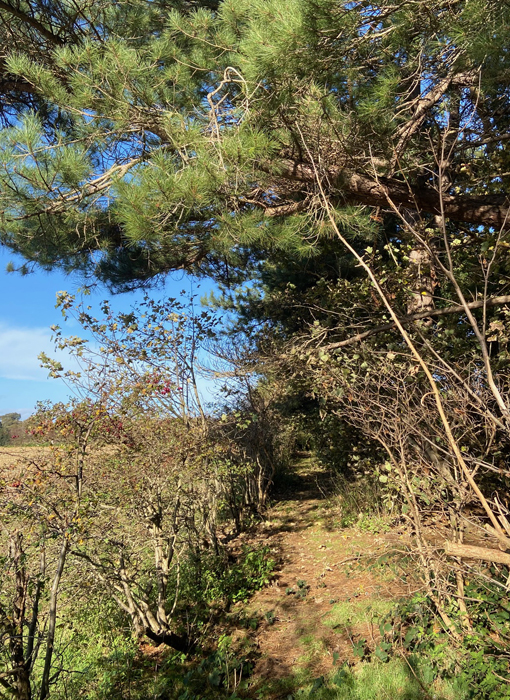
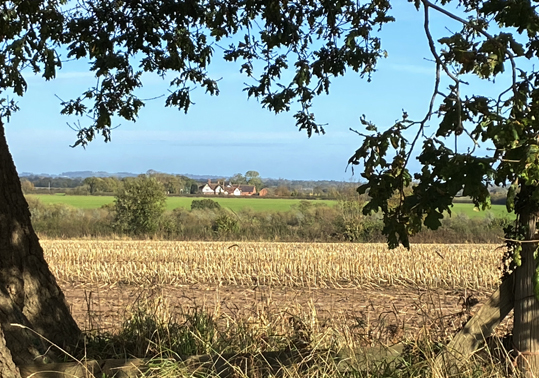
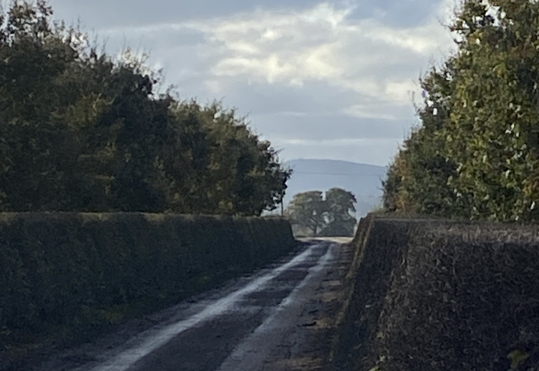
The map of this walk is at the end of the post, and is a very simple one.  It takes around 40 – 45 minutes to walk through the fields to Aldford from Churton, so it is a short walk, and always a good fall-back when I don’t want to be bothered with the car.  The harvested fields, mainly used for growing corn, can be very soggy at this time of year with nothing but wet earth under foot, but it is always an easy and attractive option on a sunny day when the leaves are changing colour.  It was fine on the field edges, although distinctly squelchy underfoot crossing diagonally from footpath FP7 to FP6.  Half of the route is the metalled B-road Lower Lane, which gave the hiking boots a bit of a break from the sludge.

Irritatingly, I did not have my camera with me, so these were taken on my iPhone and many don’t bear close scrutiny.
===

=====================

======

===

===

After a very enjoyable lunch in the sun at the Grosvenor Arms, I had a wander around the village and returned back to Churton using the same route.  Normally I go back via the well-signposted FP8 footpath, but having investigated on my way to Aldford, deemed it far too muddy and waterlogged to make the attempt in anything other than wellies.  In the dry, this is a nice return route and takes in a chunk of the Roman road that once ran east of Churton (about which I posted here).

===

===

===

===

===

===

===

===

Cheshire West and Chester Public Map Viewer, annotated


Field-walking and prehistory in Churton fields in 2006

Fieldwalking in Churton, supervised by Phllip Miles in 2006.

With many thanks to my friend Helen, who is shown second from the left in the very blurred image at the top of this 2006 article, for sending me a copy of this.  Phillip Miles , for the Chester Archaeological Society, supervised a field-walking expedition to two of the fields behind Churton, just north of Farndon, and made some very significant discoveries.

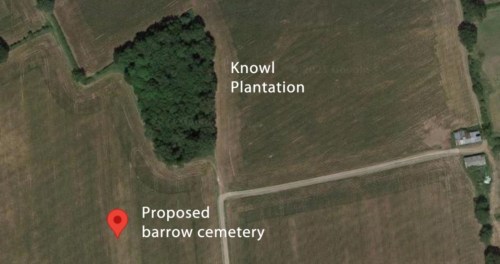
Aerial survey and metal detecting had already identified some interesting features in the fields above and to the east of the River Dee (see photos below), thought to belong to Neolithic, Bronze Age and Romano-British periods.  The fieldwork, carried out with permission from the landowner, confirmed that the land has a lot more prehistoric data to offer.

Although the Late Neolithic and Early Bronze Age in northeast Wales and the borders along the Dee are most noticeably represented in the landscape by burial and ceremonial monuments, the narrative of everyday working life in prehistory is embedded in the surface scatters of stone tools that remain in fields and on hillsides. These were the tools that people used every day in their subsistence strategies, and are the intimate toolkits of their livelihoods.

The analysis of the findings was underway at the time of the article, so no findings were reported, and it will be interesting to follow up on this to see what was concluded (if the analysis was published).  It was also suggested in the article that there could be scope for future work in Churton, although it is unclear at the moment if this took place.

Possible Neolithic enclosure in the fields behind Churton

Possible barrow cemetery near Knowl Plantation to the west of Churton


The River Dee in Llangollen today – noisy, fast and beautiful!

I was in Llangollen today with the Chester Archaeological Society to visit the Church of St Collen, which is undergoing a major project of reinvention.  More about that later.  For now, here’s a video of the River Dee as it churned its way ferociously through Llangollen today.  Truly impressive!  By the time I returned home, crossing the Dee at Farndon-Holt, it had lost some of its energy, but was still an impressive sight.


What came first – the bunny or the egg? A bit of history trivia for Easter

Decorated ostrich egg, rebuilt from pieces from a grave in Naqada, Egypt. c.3600BC. Source: Ashmolean Museum, Oxford

Just for fun, I thought I’d sketch a very brief history of Easter eggs, their relationship to the Easter Bunny, and throw in a few Easter-themed culinary ideas at the same time.

In Britain we eat over 12 billion eggs annually, mainly the standardized brown hen’s variety (and standardization, of course, means that our eggs are graded and priced accordingly), but we also have the opportunity to enjoy those special breed varieties that produce smaller eggs with coloured, speckled shells.  We also enjoy the much bigger and richer white-shelled duck eggs and the much smaller and more delicate quail eggs.  We are a very eggy nation.  So why did such an everyday item become such a fixture of a religious holiday?

The earliest known eggs were laid by dinosaurs.  Today ostriches are the layers of the largest eggs. In the prehistoric savannahs of the eastern Sahara, before the deserts claimed the land at around 4500BC, ostrich eggs were valued for the dietary value, with high protein and fat content, and their shells were used to make beautiful bead bracelets and necklaces.  A friend of mine was given one by his friends when his Sahara archaeology PhD was awarded.  I have no idea how he cooked it!

A hen posing on the grass, 1447. Bibliothèque d’Amiens Métropole (Bibliothèque Louis Aragon), Ms. 399 (Livre des propriétés des choses), folio 145r.  Source: The Medieval Bestiary.

Eggs were only seasonally available, laying during long periods of sunlight.  Today artificial light permits year-round farming, but prior to modern farming methods, hens laid eggs between spring and late autumn.  Winter was largely egg-free.  The first eggs of spring were something to celebrate.  Before the arrival of intensive farming with artificial lighting all year round, eggs were still prized rather than being taken pretty much for granted as we do in Britain today. Both chickens and hen eggs were much smaller. English chickens started increasing in size from the late Middle Ages and continued to do so throughout the post-medieval period.  In the earlier Middle Ages, when payment could be made in products rather than coinage, eggs were an important contributor to livelihoods, supplementing purchase prices, salaries, taxes and loan repayments, and serving as offerings and gifts.  For a wonderfully exotic Medieval stuffed eggs from the Mediterranean (with saffron, herbs and spices and curd cheese) see the recipe on the Lavender and Lovage blog.

1899 German postcard showing an osterhase couple carrying eggs. Source: The German Way

Although chicks are now associated with Easter, in the 1600s the Easter egg was connected not with chickens, ducks or quails, but with hares.  The first recorded discussion of the egg-producing hare is in a medical essay by Johannes Richier published in Germany in 1682. The Osterhase, or Easter Hare, was a mythological hare from the Alsace region, producing and hiding colourful eggs for children to find.  One might wonder why an egg-laying hare myth might emerge, and one interesting theory connects to the fact that the hare’s ability to conceive whilst pregnant (called “superfetation”).  This was sometimes believed to be evidence of self-impregnation, which morphed into an association with the Virgin birth and was associated ideas of purity.  Quite how this translates into the Easter egg tradition is probably anyone’s guess, but a plausible theory is recounted by the St Neot’s Museum:  simple nests that hares make on open ground were confused with nests made by ground-nesting birds, leading to the belief that hares laid eggs.  However the story initially emerged, it spread throughout Germany and in the 1700s made the hop to America with German migrants.

White House egg roll race in 1929. Source: Wikipedia

Visually similar in appearance to hares, rabbits are smaller, more prolific and more familiar.  Breeding on a legendary scale, they were an obvious symbol of fertility.  The spring egg and the German Osterhase eventually merged together to become the Easter Bunny, a rabbit whose role is to provide decorative eggs to children as symbols of renewal in spring.

In spite of superfetation an egg-laying Easter bunny did not dovetail particularly neatly into serious-minded Christian doctrine, but some traditions were difficult to ignore and more acceptable alternatives emerged, not least the association of the egg with the resurrection of Jesus. In this Christian legitimization of eggy celebrations, the shell of the egg is the tomb of Jesus and the chick within is Jesus awaiting resurrection.

It might seem a bit of a stretch to see how the religious interpretation could be translated into Easter egg hunts, in which eggs, sometimes painted in bright colours and sometimes wrapped in colourful paper, were hidden on a trail for children to find, but this was all part of a community celebration of Christ’s resurrection.  In some parts of England the “pace egg” (from Paschal, another term for Easter) were hard-boiled eggs that could be given as gifts and used in games, such as Preston’s annual egg-rolling event, which is echoed in Washington DC where an White House annual egg roll is an unexpected side to presidential living.  Closely related is the pace egg play, again still performed annually at some places in England.

Cadbury’s Easter Egg advert in 1925. Source: St Neot’s Museum

I suppose that from egg rolling and pace egg plays it was a relatively small step in the new age of industrial advances and experimentation to replace an actual egg with a sweet pseudo-egg, and in Britain it was the Frys and Cadbury’s brands that led the charge, producing the first moulded chocolate eggs in the mid 1870s.  The tradition of enclosing chocolate eggs in ribbons and decorative wrappings became a sure-fire winner on a national scale.  Decorative and shiny foil was both ornamental and helped to keep the chocolate fresh, whilst glossy cardboard packaging propped up the awkward shape.  Prototypes of the Cadbury’s Creme Egg began to appear in the 1960s, but the branded success story was first launched in 1971, one of those Marmite love-or-hate moments (hate, in my case – far too icky sweet!).

Polish Easter eggs. By Praktyczny Przewodnik. Source: Wikimedia Commons CC BY 2.0

In central and eastern Europe, real hard-boiled eggs continue to be an important part of the celebration, usually painted with traditional decorative themes, like the ones right.  At the outbreak of the Russian war on Ukraine I wrote a short post about a traditional Ukrainian egg recipe (divine – фаршировані яйця). The egg cavity was stuffed with the yolk mashed up with mayonnaise, sour cream, as well as finely chopped chives or spring onions, and the whole lot was topped with a low-cost version of caviar and served on a bed of ramsons (wild garlic leaves), which you can find here.

Not being at all skilled at either confectionery or dessert cookery, and with few artistic skills at my fingertips, my own celebration of Easter below, using Churton honesty eggs, is a rather more mundane and sugar-depleted affair for Good Friday.

Eggs marbled by boiling, then randomly cracking the egg shell and then adding food dye to the water to create the marbled effect.

My egg doodles on hard-boiled hen eggs, below, were modeled not on eastern European examples, to which they bear a surprising if faint resemblance, but on the elaborate doodles that I have been producing since childhood.  It’s so much more difficult to do this sort of thing on the rather slippery surface  of a hen’s egg, and let’s face it, I’m no Grayson Perry.  I assumed that the trick with the hand-painted egg would be to find some way of holding it still whilst I drew on it.  I first tried to use a cocktail stick poked firmly into the end of the hard-boiled egg, and then jammed into a ball of blue-tack (plasticine and variants thereof would work well too). The blue-tack was on a saucer so that I could turn the egg without getting my hands covered in still-wet ink. It was a monumental failure for the sort of detail that I was attempting so I gave up and picked up, the egg holding it in one hand and drawing with the other (and getting covered in indelible ink in the process). Here are my very crudely rendered attempts, but although they are pretty poor it was a lot of fun, even if a rather time-wasting pursuit  🙂

Seriously more successful are the shortbread biscuits that my friend Helen Anderson made with her grandchildren, using bright piped icing to create the decorative features. Love them!  Really pretty, really bright and very celebratory.  And I bet they were delicious too.

Lovely home-made Easter biscuits, courtesy of Helen Anderson who both made them and sent me the photos of the biscuits and the icing. Copyright Helen Anderson

Happy Easter!

Watercolour by Helen Anderson, painted from one she found, and used with permission. Gorgeous. Copyright Helen Anderson.


Beautifully coloured and speckled eggs of common garden birds . By Henrik Grönvold, from ‘British Birds’ by Kirkman & Jourdain, 1966. With thanks to Helen Anderson not only for sending me the image but for tracking down the source.


New Local Plan impacts Sibbersfield Lane, Churton

Thanks to Paul Roberts for his continued updates via the Focus newsletter (LibDems).  Sincere apologies that this is a very battered copy, but hopefully it is still legible.  Paul’s March 2024 newsletter draws attention to the proposal for a new housing site on Sibbersfield Lane, which would accommodate 287 houses. This would seriously increase the traffic and pollution along Sibbersfield Lane and Chester Road, and cause further risk on the junction with the A534. Paul raises other concerns too.  You have until 16th March to comment.

Paul draws attention to various concerns with the proposal and provides the link for commenting on the plan. In case my dreadful copy makes this difficult to read, here’s the link:
https://app.maptionnaire.com/q/9pn72k8ibb8a
In terms of usability, this online interface is really rather horrible.  You first have to find the development on the interactive map, then zoom in on it and then click on it. Only then can you add a comment.


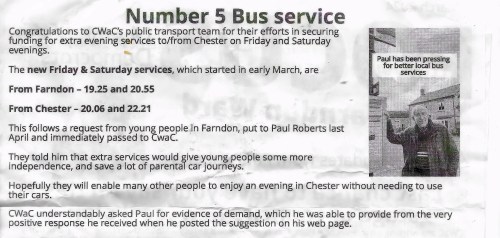
No.5 Bus extra evening services

Thanks to the March 2024 Focus LibDem newsletter from Paul Roberts for the information that the operating hours of the no.5 bus service between Chester and Wrexham via Churton, Farndon and Holt have been extended.  This is very welcome news.

Planning application for Churton Hall Farm, Pump Lane, Churton

Copied from Farndon Ward Focus, the newsletter produced by Paul Roberts, Liberal Democrats:

I’ve had a look at the Chester and Cheshire West’s online planning portal, and the planning application number is 23/02584/LBC, for the “subdivision of existing dwelling to form one additional dwelling with associated internal and external works.”  There is a general description on the Details tab, 20 documents on the Documents tab, and no feedback yet on the Comments tab. You can find the application at: https://pa.cheshirewestandchester.gov.uk/online-applications/applicationDetails.do?activeTab=summary&keyVal=RZHG4VTEI5Y00


A very autumnal walk taking in Churton fields, Townfield Lane, the speedy Dee – and a cormorant.

After all the rain last night, which was truly torrential, I was somewhat surprised to wake up to bright sunshine and a topaz sky this morning.  A treat for mid November. Planning to walk through the fields behind Churton towards Farndon, before turning right down Townfield Lane to the Dee, I decided that it was a moment for seriously waterproof footwear.  Not walking boots but welly boots.  It was a good instinct.  The fields were sodden and marshy, the tracks muddy and mired due to tractors, and the picturesque but unadopted Townfield Lane was a series of lane-wide pools.  The short section of footpath leading north from the lane along the river bank to the field next to the river was only just clear of the flood waters, which were moving fast and forming fascinating eddies.

I always like the Churton-to-Farndon fields following harvest, because of the linear stubble that draws the eye into the distance and focuses attention on individual trees that, at this time of year, are full of bright warm colours.  The deep chestnut brown of the fields provides a beautiful foil for the silvery stubble, the blue skies and the autumnal leaves.  The mirror-like reflections in the standing water were a pleasure in their own right.  Today really was a water walk.

The biggest surprise was spotting a cormorant (or is it a shag?) at the very top of a tall tree by the side of the river (see photo at end of post).  Cormorants and shags are right at home on the coastal estuaries of mid-Wales, and are frequent visitors to the Thames and its former docks in London, both places where I used to live, but I never did learn to tell the difference between them, and I have never seen one this far inland.  It seemed right at home.
……..
………

……..
—–

View from the Dee at the end of Townfield Lane across the fields to the Barnston Memorial.

It would have been good to turn this into a circular walk by continuing north along the side of the Dee and taking the footpath from the Dee straight through the plantation onto the track extending directly from Hob Lane in Churton, but the footpath back to Hob Lane through the plantation of trees is usually bad news in even averagely showery weather, with seriously thick, sometimes impassable mud, so I simply retraced my steps on this occasion.  The circular walk is very much a summer activity after a period of very dry weather.

If you don’t like squelching through wet mud and soggy grass, or paddling through big areas of standing water, this is not a good walk following heavy rainfall, even on a beautiful day.  On the other hand, it cast a very familiar local walk in an entirely new light.  After heavy rainfall I would advise that this is not a walk for those with unwilling legs, although my father (he of a notably unwilling leg) had no problems with it in dry periods in the spring and summer.  Today it was far too slippery and sludgy.


Loving the autumn butterflies and bees

A red admiral, strikingly posed on a dahlia

Working in the garden on an unexpectedly sunny October weekend, I found myself surrounded by bees and butterflies, and perfectly delightful it was too.  All of the photos in this post were taken this weekend.  Last year my flower planting strategy had failed to produce a sufficiently colourful and insect-supporting display during autumn, so right at the beginning of spring, with a lot on my plate at the time, I used every small gap in my days to plant autumn-flowering species.  The great dollops of colour and the endless flow of butterflies and bees, assisted by a mild October, feel like a very generous reward for lugging around bags of compost and for feeding them my dad’s “magic mix” of three parts bonemeal to one part Q4 mycorrhizal.  Now, when the summer species and particularly the buddleias have gone over, there is plenty to keep the flying insects fully sustained.

The autumn-flowering aster (also known as Michaelmass) daisies and Purpletop vervain (Verbena bonariensis) have been the real successes, growing fast and densely, bright domes of colour all over the garden, attracting huge numbers of bees and butterflies.  The multi-coloured dahlias, yellow-petalled rudebeckias, purple-blue tradescantias and tall, elegant pink windflowers (Japanese anemones) are all still doing well.  Ivy flowers, clusters of pale yellow pom-poms, are also popular with butterflies, bees and ladybirds.  This cheerful floral mix is supplemented by lingering lupins, phlox and roses, which have done their fair share too.  The succulent-leaved Hylotelephium, which we used to call ice plants when I was a child, are still in flower, but although they were smothered with butterflies and bees only a couple of weeks ago, they are now being ignored.

Comma on Verbena bonariensis

I spotted two bright commas (Polygonia c-album), with their deeply indented lace-edged wings, a few fluttering large whites (Pieris brassicae, also known as cabbage whites), a small white (Pieris rapae) , and a  luminous yellow brimstone (Gonepteryx rhamni, which has been quite rare in the garden this year), and a single painted lady, but otherwise the butterfly scene was dominated by an astonishing number of red admirals (Vanessa atalanta) and small tortoisehells (Aglais urticae).  Apart from the red admiral, the above-mentioned are native species.  The red admirals were clustered mainly on the aster daisies, whilst the tortoiseshells were staying mainly on the Purpletop vervain (Verbena bonerensis).

Large white on Verbena bonariensis

Brimstone, cunningly disguised as a yellow leaf, on a very late surviving phlox

Red admiral on aster daisy

The red admiral (Vanessa atalanta) is one of a number of butterfly species that breed twice in a year.  They are visitors to the British Isles, arriving in spring and throughout the summer.  They breed here in the summer.  They lay their eggs on young stinging nettles, the leaves of which provide sustenance for the caterpillar before it becomes a chrysalis and emerges, with damp wings that need spreading to dry, into a British summer.  The caterpillar emerges from the egg on the upper side of the leaf, and binds its edges together with silk, consuming it from the inside out, before moving on to a fresh leaf.  The butterfly can emerge at any time from May to October. I lost control of part of the garden earlier this year, under a bramley right at the back, and had a patch of stinging nettles that were taller than me, which is also shared with an unusual type of aster plant with stems that are also taller than me.  I took up the nettles some weeks ago, but this is where the red admirals are clustering right now.  Although I didn’t see any red admirals on fallen apples, these are usually very popular with the species, so it is a good idea to leave some if you have red admirals in your garden.

Small tortoiseshell on a barely visible Verbena bonariensis

The tortoiseshell is a native hibernating species that is also known from all over and further afield.  Like the red admiral, the caterpillar is happy on stinging nettles, where the eggs are laid on the underside of leaves.  They breed twice a year, emerging as early as March and again in August.  They can usually be seen until October.  This weekend Verbena bonarensis was the only plant in which they were showing any interest.  It is not everyone’s idea of a good garden plant because a small purple head grows on a very tall stem, but I love it.  It is easy to grow, and spreads itself like crazy, so you never really know where it is going to turn up next, although shaking a seed head in a general area usually works.  Fortunately, they pull out very easily if they turn up where you don’t want them, and don’t mind being replanted elsewhere if you do it immediately and provide lots of water.

The bees, less discriminating than the butterflies, were taking advantage of any flower that showed its face, but were particularly in love with the aster daisies.  I have never got to grips with the different types of bees, but there was an impressive mixture of the streamlined and the furry.  The many hardy fuchsias, the Himalayan honeysuckle and the delicate salvia “hot-lips” are doing a great job providing colour and supporting the bees, but do not provide an accessible platform for the butterflies.  Fuchsias, from south and central America were traditionally pollinated by hummingbirds, and we are a bit short of those around here, but the bees do a great job.  There were a small handful of hover flies but the only wasp I saw was the submarine-sized monster trying to find somewhere to over-winter in my living room.

Bee upside down on Himalayan honeysuckle

Bumble bee on an aster daisy

As I was tidying up the patio plants, I noticed that there was an army of caterpillars eating their way through my nasturtium leaves (just a little annoying, because apart from ruining the aesthetics, I use the leaves in salad).  They turn out to be from the Large White butterfly, and are apparently notorious for targetting nasturtium leaves, as well as cabbages.  A tough time of year for them to be starting new lives.  They spend the winter in chrysalis form, ready to emerge in the spring.  Large whites are native, but their numbers can be supplemented by migrants from Europe.

October always has the feeling of impending doom about it, with the run-up to the clocks going back, the garden flowers dying off, and the arrival of dark mornings, dark evenings and cold, wet, windy winters with damp leaves rotting underfoot.  I was truly not designed for a British winter.  It has therefore been particularly uplifting to see the life still fizzing in the garden so late in the year, like a reprieve, with butterflies and bees adding movement and sound to complement the late season colour.

Red admiral on a tradescantia bloom

In this era of global warming, a British summer is a moveable feast and it will be interesting to see how butterfly species adapt either by tolerating new conditions or moving to new areas.  The Butterfly Conservation organization has a number of programmes dedicated to the collection of such data from the general public in the hope of tracking some of these responses to environmental change.  Red admirals, like other migrant species die in the winter.  Traditionally Britain has simply been too cold for them to survive the winter frosts, but that may change, and we may see some news species heading northwards, but let’s hope that we don’t suffer too many losses.

For planting for flying insects, and extending seasons for their use at the beginning and end of the year, see Seabrook’s The Insect Garden (see Sources below for full details).

Red admiral, comma and ladybirds, all sharing the spoils of ivy flowers

Painted lady


Sources:

Books and papers

Carter, D. 1982. Butterflies and Moths in Britain and Europe. Pan Books in association with the British Museum

Holden, P. and Abbott, G. 2017 (2nd edition).  RSPB Handbook of Garden Wildlife. Bloomsbury Publishing

Mansell, E. and Newman, L.H. 1968. The Complete British Butterflies in Colour.  Ebury Press and Michael Joseph

Seabrook, M.J. 2020. The Insect Garden. The Best Plants for Bees and Bumblebees, Butterflies, Hoverflies and Other Insects.  Northern Bee Books


Websites

Butterfly Conservation
https://butterfly-conservation.org/

UK Butterflies
https://www.ukbutterflies.co.uk/index.php