Category Archives: Churton
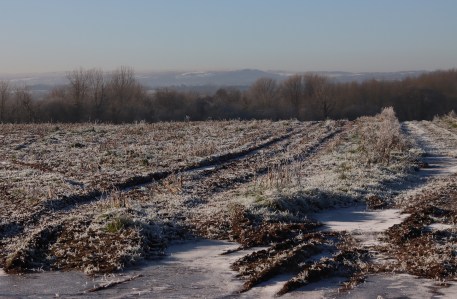
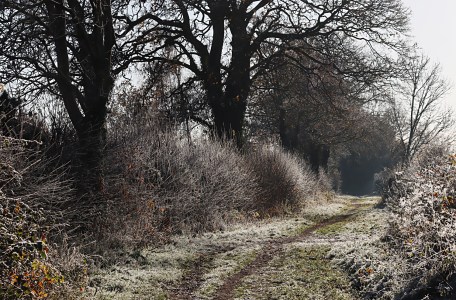
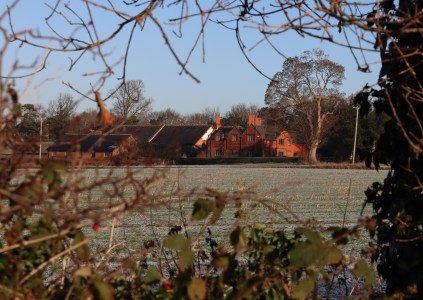
December frost in Churton
A beautiful day all day yesterday, and it was lovely today too, right up until the skies opened. Fortunately, by that time the chilli con carne was in the slow cooker and the log fire was doing its stuff most effectively.
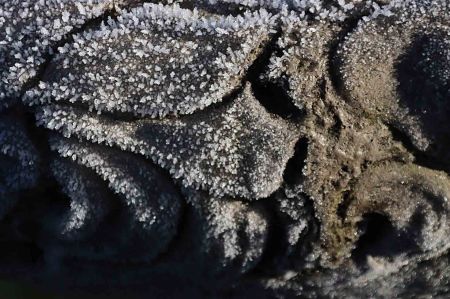
Just a few snaps from the garden, capturing some of that crisp contrast between the white lace of the frost, with all its snowflake complexity, and the autumnal shades and shapes, framed, captured and transformed.
As soon as the sun crept around the corner of the house, the frost started to melt, its drips capturing a myriad of colours. For the first time since I put them out a couple of weeks ago, the bird feeders were a hub of activity, a reflection of just how hard the ground is.
Adventures with Churton Honesty Eggs: A twist on spaghetti carbonara
After attending the latest exhibition at the Tŷ Pawb art gallery in Wrexham, which has a handy car park overhead, we popped in to the Polish supermarket just outside the Market Street entrance to Tŷ Pawb. From the outside looks it looks somewhat unprepossessing, resembling an abandoned 1960s post office pasted with advertising flyers, but don’t be put off because inside it is bright and fresh, and as neat as a pin. As well as a range of Polish goodies, I came away with two enormous fresh king oyster mushrooms.
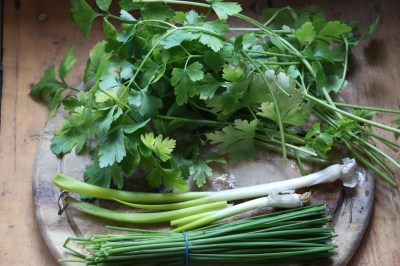
The mushrooms and some excellent bacon that I already had at home cried out to be made into a spaghetti carbonara, with the addition of some fresh parsley from the garden. This is an excellent dish if you are in a rush, because it takes about 15 minutes to cook in total, and the magical thing about carbonara is that the sauce tastes superbly creamy without a hint of dairy approaching it, achieved by mixing egg yolks with some of the starchy pasta water. It is one of my favourite dishes. Simply leaving out the bacon turns it into a vegetarian dish.
My recipe differs from a traditional carbonara in that it adds mushrooms, occasionally uses chunks of ham or bacon instead of pancetta, has a lot of parsley stirred in along with the egg mixture (and often chives and baby spinach leaves or wild garlic leaves too), and has slices of red chilli (raw or cooked) and spring onion discs sprinkled over the top. The chillies are partly for a tiny touch of heat, but also to lend some colour to an otherwise rather bland-looking dish. The pallid colouring is, of course, one of a carbonara’s key characteristics, as is the subtlety of the flavouring, so you may want to leave out the chillies.
If you want a simple, authentic and excellent carbonara recipe, I would suggest you go to the one by Jamie Oliver, which is based on a recipe that he learned from Gennaro Contaldo (so it has a good pedigree). You can find it here on Jamie Oliver’s website.
If you want my version, here it is (for one person, which makes it easy to scale up). For the mushrooms, bacon/pancetta, parsley, spinach etc I don’t use precise quantities, I just chuck in what I feel like on the day, depending on how hungry I am:
As much spaghetti (fresh or dry) as required, but I use about 40g, (which works well with two egg yolks)- Oil, preferably garlic oil. If you are using pancetta, which is fatty but renders down nicely, you can fry the pancetta without oil.
- A clove of garlic if there’s no garlic in the oil or if you are not using oil (just to add a touch of flavour, not enough to dominate)
- A couple of tablespoons of thick, diced ham, bacon chunks or pancetta cubes
- A couple of tablespoons of chopped mushrooms, of the sort that won’t disintegrate when cooked, like king oysters, chestnut or supermarket button mushrooms. I used one whole king oyster mushroom for one person.
- An egg yolk per person, or two if you are feeling like a silkier, more indulgent sauce
- Parsley, chopped
- Spring onions, chopped
- Optionally, some softer wild mushrooms for additional flavour, particularly if you are making a vegetarian version
- Optionally, parsley, spring onions (chopped), chives (chopped) and/or spinach leaves or wild garlic (ramsons) to stir in
- Optionally, red chillies, as hot or mild as you like to top finished dish
If you want to add some interest to a vegetarian mushroom carbonara, some diced or spiralized courgette works wonderfully for texture, and as mentioned above, I like to chuck in a handful of baby spinach leaves and add spring onion and/or chives. Ramsons (wild garlic leaves) are terrific in spring.
-

With mushrooms, spring onions and chilli
If using dried spaghetti, put this on now. Your packaging will tell you the exact timing, but it’s usually 12-15 minutes from when the water comes to the boil. Fresh pasta only takes around 2 minutes from boiling point, so leave that til you are very nearly ready to plate up. Remember to retain some of the water in which you boil the pasta.
- Heat the oil if using and put in your mushrooms.
- If using pancetta, cook separately until the fat has rendered down into oil. If using ham or bacon bits, add to the mushrooms to heat through. Stir in crushed garlic, if using
- Separate your eggs and mix the yolks together with a tablespoon of grated parmesan cheese, some black pepper and a teaspoon of cold water to loosen the mixture
- Add spinach, if using, to the pancetta/bacon with a bit of water to help the spinach wilt
- When the spaghetti is ready, add it to the bacon and spinach and stir.
- Remove from the heat, Add in the egg-parmesan mix and stir quickly, together with the parsley and chives if using. Sprinkle grated parmesan, spring onions and chilli over the top and serve with a black pepper mill to hand.

The same dish cooked and consumed this very day: minus mushrooms and with bacon lardons instead of rashers, and with wilted baby spinach leaves stirred in.
For other eggy recipes on this blog:
https://basedinchurton.co.uk/category/churton-eggs/
Big Butterfly Count 2022 begins today, until 7th August
I contributed to The Big Butterfly Count for the first time last year which was a real insight into what was visiting my garden. In walks afterwards I also started to notice species that had not visited my garden, and which clearly preferred hedgerows and fields.
The Count is UK-wide survey that assesses not only the state of butterflies, but also important changes in the environment. It was launched in 2010, and in 2010 over 107,000 people submitted 152,039 butterfly and day-flying moth counts.
The main event of the Big Butterfly Count 2022 main event is between 15th July and 7th August. Simply count butterflies for 15 minutes during bright (preferably sunny) weather during this period, which is when most butterflies are at the adult stage of their lifecycle and are most likely to be out and about, as instructed on The Big Butterfly Count website:
If you are counting from a fixed position in your garden, count the maximum number of each species that you can see at a single time. For example, if you see three Red Admirals together on a buddleia bush then record it as 3, but if you only see one at a time then record it as 1 (even if you saw one on several occasions) – this is so that you don’t count the same butterfly more than once.
If you are doing your count on a walk, then simply total up the number of each butterfly species that you see during the 15 minutes.
You can do as many counts as you want to: You can submit separate records for different dates at the same place, and for different places that you visit. And your count is useful even if you do not see any butterflies or moths.
You don’t have to have a garden. If you do have a garden you don’t have to confine yourself to it. Parks, fields, forests, footpaths, anywhere in the UK will help.
Only those on the target butterfly and day-flying moth list need to be counted. Download the handy identification chart to help you work out which butterflies you have seen. This helps to minimise counting errors and provide a clearer view of butterfly numbers. If you have spotted species which are not on the target species list these can be submitted using the iRecord Butterflies App. As participants submit their counts, they can all be viewed on the website’s interactive map. It is also important to note if you have not seen any butterflies because this may indicate a serious problem in particular areas.
You will be able to submit records throughout July and August using the form at the following address: https://bigbutterflycount.butterfly-conservation.org/map
asfdsfsa
fdfsdfa
Adventures with Churton Honesty Eggs: French omelette with a herb béchamel filling

A French omelette that I made in late Spring, stuffed with a cheese and wild garlic (ramson) béchamel and diced tomatoes with a sprig of ramson flower for decoration. My omelettes are usually browner than this, but this is how I would serve them for anyone else.
I haven’t been doing many Churton egg recipes recently, because I never seem to be passing when the Churton honesty egg stall is out, but I was lucky this week. Like many of my egg recipes, this is dead simple, but none the less enjoyable for that.
A French omelette is a simple fold-it-over affair done in a small frying pan (or omelette pan if you have one), preferably non-stick. It’s much like a pizza made of scrambled eggs, but without as much stirring of the eggs, and folded over to form a holder for the contents (looking a bit like calzone, if we’re remaining with the pizza analogy). The main tweak here is a béchamel sauce that goes in the centre to accompany the other more traditional ingredients. It takes about 15 minutes from start to serving.
The ingredients for this particular version:
- 2 or 3 eggs
- Black pepper
- Flour
- Butter
- Milk
- Finely chopped herbs (see below for suggestions)
- Cheese of your preference. I used cheddar but it works brilliantly with other hard cheeses like Emmental, and with soft brie types too
- Chicken or herb/vegetable sock (optional)
- A spoon of crème fraîche or cream (optional)
- Ground fennel seeds (optional)
- Chopped ham and/or finely sliced butter-fried mushrooms
The cheese béchamel is the first to do (butter, flour, milk and stock). Mine is not a pure béchamel as I always use a chicken or herb stock as well as the milk, meaning that it is part velouté. I also lob in a dessert spoon or two of crème fraîche to give it a velvety texture. Here’s the method: Equal parts of butter and flour are heated on a low heat and stirred together until they are completely mixed into a good, cohesive blob. Keep the heat low. Stock and/or milk are instantly added to the mixture quite slowly to break down the blob and create a paste that eventually becomes a thick sauce, on a low heat. If things seem to be getting a little hot, lift the pan off the heat and keep going with the liquid, reheating when it seems to have cooled down a little. If you want a bit of an edge to the sauce, you can also add white wine, but add a little at a time and ensure that you keep tasting to ensure that the flavour remains balanced, and keep stirring continuously.
Keep the heat low to stop it sticking or cooking too fast, and keep stirring. You can add cheese to make it a cheese and herb sauce, but don’t forget that cheese will be added to the omelette as well, on top of the sauce. The herbs are added when the sauce is thick but still flowing. They need to be compatible with cheese. I used finely chopped chervil, but any herb or combination of herbs that match well with cheese will be perfect, including thyme, oregano, ramson, lovage, marjoram, parsley, fennel or dill. It does need to be well chopped. I ground in some fennel seeds, as they complemented the chervil beautifully.
My omelette was a two-egg, but there is no reason why you shouldn’t do a three-egg. Do take into account that this is insanely filling. I like the omelette itself to be formed of a simple egg and black pepper mix, with just a slosh of milk or a spoonful of crème fraiche, cream or sour cream. This is whisked lightly in a bowl and then poured into bubbling butter in the frying pan. The trick is to leave the egg until the base is just beginning to set and then to move it gently, pulling the edges in, so that the liquid egg flows into the gaps that you have just made. This incorporates the egg mixture quickly and produces a gorgeously textured underside that, when you put it on the plate and fold it over, becomes the exterior.
W
hen the base is just solid enough to add things to the surface, with the top still liquid, the contents can be layered on top, as one would with pizza. Do remember that it is going to be folded, so don’t over-stuff it. In my case I started off with sliced ham (but just-fried sliced mushrooms are also an excellent option), poured the warm béchamel over the top, and then added grated cheese to the top of that. The omelette then needs to heat through, slowly.
I always lift the edges of the omelette with a wooden fish slice to take a peak underneath and check on the colour, as I like mine well done on the outside (a treacly brown colour) but most people like theirs rather less coloured, as in the photo at the top of the post. If the bottom is cooking faster than the top is heating through, you can always hold it under the grill for a minute or two, but be careful if your pan’s handle is not metal. The grated cheese does not need to be fully melted, as it will melt when the omelette’s two halves come together.
Once you have the right colour (the colour you prefer) and the contents are heated through to your satisfaction, simply slide the pan towards the plate, allowing half to rest on the plate before flipping the second half over the top. Alternatively just slip the whole omelette face-up on the plate and use a fish slice to turn one half over the top of the other. The béchamel or béchamel-velouté sauce starts to ooze out of the omelette the moment it hits the plate, and is absolutely gorgeous.
Serve with a salad and/or slices of French bread (or in my father’s case chips) and enjoy.
Informal ecology at the Barnston Monument Natural Burial Ground in Farndon
This time last year I was singing the praises of the glorious floral colour extravaganza of the newly established Monument Meadow Natural Burial Ground on the outskirts of Farndon, where I was taking additional photographs for a post about the Barnston Memorial. The blues and reds (cornflowers and poppies) were brilliant against the white mayflowers and chamomiles and all the sunny yellows. It was the best fantasy wildflower garden that I could imagine (more photos of how it looked last year here). But that’s essentially the trouble with wildflower gardens. The fantasy is easily replaced by a rather different reality. You can seed them as much as you like, and in the first year you might have the perfect, cottage garden look, but wild means wild, and a field full of seeds will do its own thing, whether those seeds were scattered by human hand, blow in by the wind or deposited by birds on high. Last year, I was standing amongst the poppies and the cornflowers. dubiously wondering how many years this idyllic vision would last.

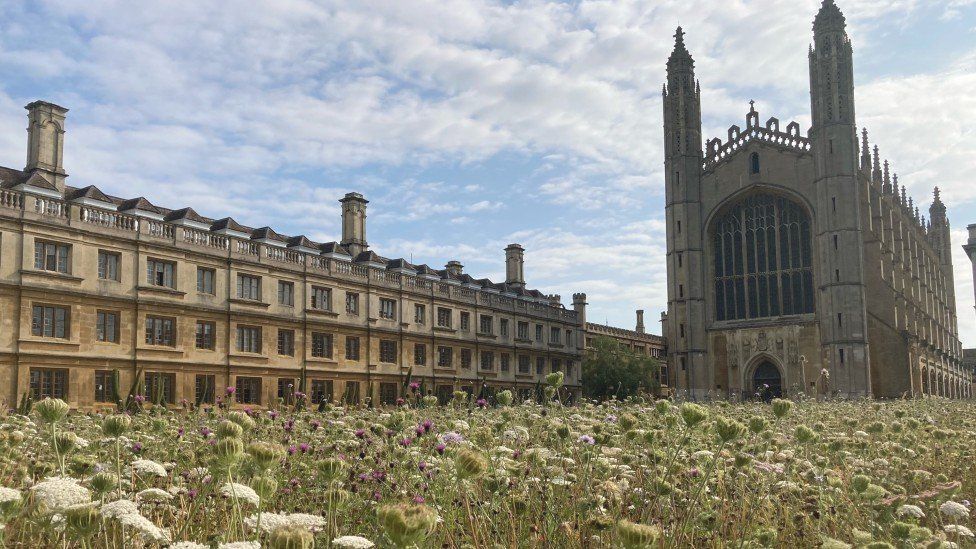
Year 2 at Cambridge Kings College Chapel. Source: BBC News
My doubts were largely due to a television report a couple of years ago, about research based on a study at Cambridge University, which took place on what had been a formal lawn behind King’s College Chapel. When it first flowered it looked like the Barnston Memorial field above, full of poppies, mayflowers and cornflowers. What happened in its second year of flowering is that most of the colourful species were replaced by cow parsley and other great leggy white-flowered umbellifera weeds of British verges, as well as thistles, as you can see in the photograph of the Cambridge wildflower field just before being harvested (using shire horses).
I have been driving past the Barnston Memorial field for the last few weeks keeping a look out for the poppies and cornflowers, but could see nothing but white. When I pulled over on Tuesday 5th July to take a closer look at this, its second year, it became clear that it had gone the way of the Cambridge experiment. Large swathes of cow parsley and a few thistles and white chamomiles are accompanied by a patches of yellow vetch, one or two fugitive cornflowers well below the level of the cow parsley, a lot of yellow ragwort (poisonous to horses and cattle) and some pinkish, blousy mallow. Mallow, or lavatera, is a chronic escape artist from domestic gardens, which seeds itself wherever it can; I suspect that the lavatera in the field is just such a domestic escapee. There are multiple species of grass and a few cereal crops that have escaped from the neighbouring field. There is not a poppy in sight. That is not to say that the field is unattractive, but it is a very different proposition from last year, and the loss of the blue cornflowers and red poppies makes it a much less idyllic prospect.
The wildflower field was not planted as an ecological experiment, and it is not being monitored by any specialists, but it will be interesting to see what happens next year.
sfssdf
Sources:
BBC News
Cambridge University’s King’s College meadow harvested with horses
https://www.bbc.com/news/uk-england-cambridgeshire-58057800
New Chester Walking Tour: Women of Chester

Chester Visitor Information Centre. Source: Experience Chester
On the Chester Heritage Week’s tour of the Medieval features of Chester Cathedral by Nick Fry, Green Badge tour guide Katie Crowther was in attendance and mentioned that she was leading a new weekly tour themed around Cestrian women, “Women of Chester”, bookable in person in the Chester Visitor Information Centre. So on Sunday 3rd July at 1130, I presented myself punctually to join the hour-long walking tour outside the Visitor Information Centre, geared up for sun, cold, and/or rain. Although slightly cool, it stayed dry and it was a very good day for an outdoor walk.
The Green Badge is only awarded to Chester tour guides after a lengthy course and a tough practical exam, so is a good indication that you’re in safe hands. Katie is one of life’s natural communicators, avoiding any temptation to swamp visitors with paralyzing volumes of data, and instead delivering an information-packed and enjoyable tour in an entirely digestible and memorable way.
The introductory talk took place midway between the Visitor Information Centre (itself incorporated into the 19th Century Town Hall), behind St Werburgh’s Cathedral, with a randomly placed Roman column in view. It was a well-mixed architectural locale for the enormously helpful potted history of Chester, providing the key chronological framework onto which the rest of Katie’s narrative was neatly hooked.
This is not a tour about famous women married to famous men at the top of Cestrian society. Nor is it a feminist agenda. Instead, it is part ancient history, part social history, delving into how political, cultural and economic life shaped the lives of women who, in turn, responded to the drivers of Chester life in different ways. In short, the tour has tentacles that reach into most parts of Chester’s rich and varied past. As well as looking at women who, in sometimes surprising circumstances, have performed conspicuous and/or leading roles in Chester life, the tour also looks at those who fell foul of religion, convention and tradition, and suffered for it.
Roman women are the earliest to be recorded in any detail in Chester, and are particularly visible on Roman tombstones, representing the upper echelons of Chester’s Roman society, those who experienced the most comfortable contemporary life. By contrast, a horribly unfortunate woman accused of witchcraft in the 17th century suffered terrible conditions in the local prison whilst others were burnt at the stake.

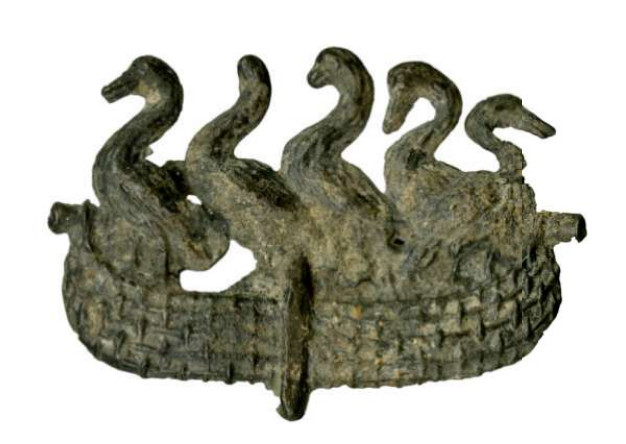
St Werburgh pilgrim’s badge. Source: British Museum
Two of the earliest women who are known to have played a pivotal role in Chester’s history, were Anglo-Saxon. It is remarkable that the revolutionary diplomat and strategist Aethelflaed (c.870-918), daughter of Alfred the Great and wife of Aethelred, Lord of Mercia, is so unrecognized in Chester that almost no mention of her is made. She came came to Chester during the illness of her husband to take on a critical role in the defence of Mercia against the Vikings here, and was remarkably successful. The second Anglo-Saxon name that is intimately tied to Chester is St Werburgh, who died in about 699. Her remains were brought to Chester Hanbury in Staffordshire at some time between 875 and 907 by the aforementioned Aaethelfaed, raising the profile of Chester as an important Christian centre and destination for pilgrimage. Chester Cathedral is still dedicated to her.

Sylvia Brown. Source: CheshireLive
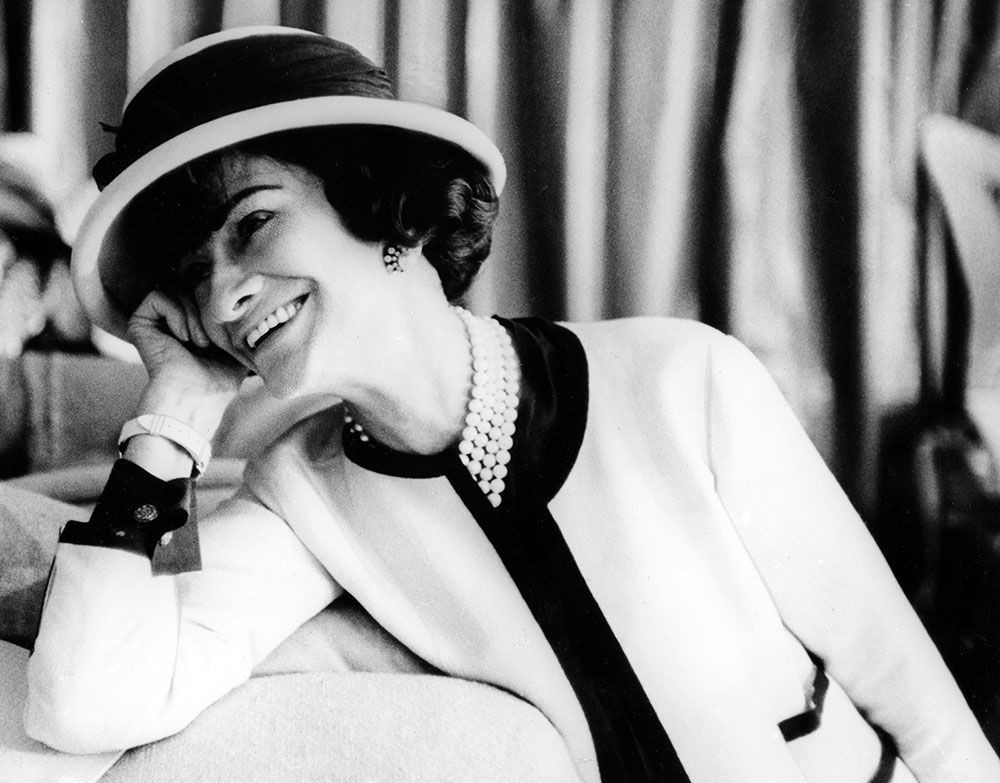
Amongst some of the many other women of Chester with great stories was one who kept an evocative record of what it was like to be under siege within the walls during the civil war; an 18th century pioneering commercial and retail entrepreneur; a mayor; a sheriff and two women who lost, respectively, three and four sons in the Second World War. Of course, Queen Victoria visited, and a famous Chester landmark is dedicated to her, although there is kink in the tail of this story that raises a smile. Suffrage and music hall provide equal, if more than slightly contrasting examples, both of women’s attitudes and of attitudes to women. Coco Chanel adds more than a touch of glamour to Chester’s story. Sculptress Annette Yarrow’s life-size female elephant calf called Janya is a fun way of highlighting the connection between the city and Chester Zoo and is a great presence. For those of us living in Churton, there is even a link to Churton Lodge! I won’t repeat any of the specifics, partly because I couldn’t possibly do justice to all the information imparted (particularly some of the funnier stories), but also because it would spoil the experience.
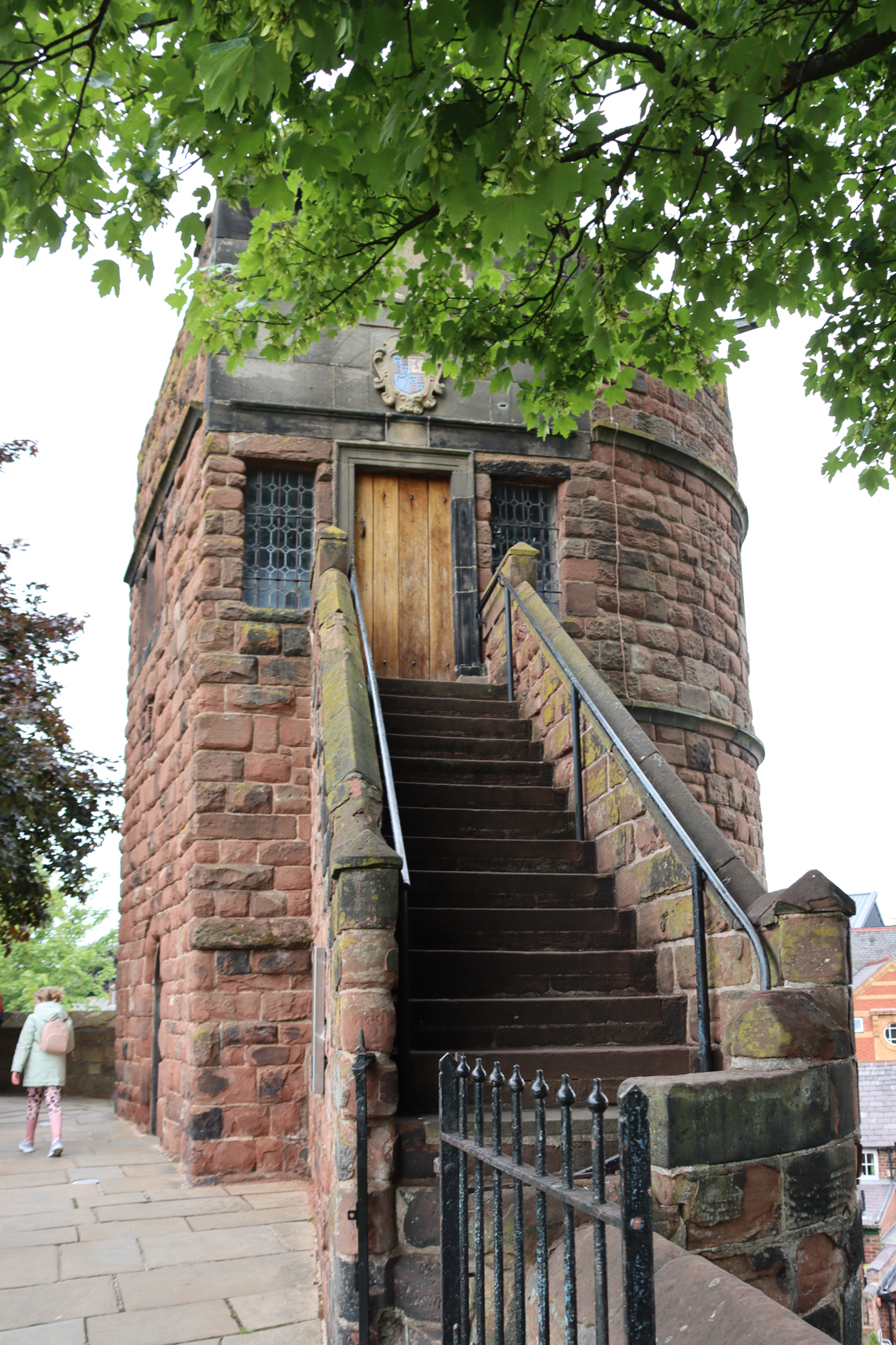
The walking tour ranges freely around Chester within the city walls, going up on to the walls for a chunk of the talk, and taking in a number of both famous and lesser known sites along the way. We also walked through the town, which retains the original Roman plan and in turn gave definition to the Medieval and modern town. As well as describing women in terms of Chester, and Chester in terms of the women who, though often invisible, helped to define it, the tour gives an excellent sense of the variety of architectural styles, old and new, and the use of space within the walls. Again, I won’t spoil the experience by saying which sites we visited or why, but there is something for everyone in the tour.
In terms of accessibility for those with unwilling legs or with wheel chairs or push chairs, there are disabled and wheeled options that avoid stairs. If your legs are fairly co-operative but hesitant, the number of staircases you have to tackle is minimal, with a couple of short flights of stairs up to and down from the city walls and the rows, all with good banisters to hold on to. If in doubt, ask on the day, and the guide will sort out either wheel-friendly or leg-friendly options. Apart from some slightly uneven pavements and the cobbled abbey square, there is nothing more challenging to tackle.

Coco Chanel. Source: medium.com
The “Women of Chester” walking tour is well worth an hour on a nice quiet Sunday, with lots of other places to visit afterwards to turn it into a day out. The tour offers a different slant on Chester’s history and it takes you to some interesting and sometimes unexpected parts of Chester’s heritage. The entire group of us, leaning perilously over a section of city wall to achieve a good view of a section of the wall immediately below us that had been rebuilt using Roman tomb stones, must have been a most peculiar sight! Some of those wonderful carved tomb stones, rescued in the 19th century, are now in an excellent display in the Grosvenor Museum.
It was a good outing, with a lot to make us smile.
The “Women of Chester” walking tour has been developed by three of the Green Badge guides, shown in the photograph to the right, and they take turns to guide this tour, so that each of them usually only delivers it once in every three weeks, ensuring that for each of them the material remains fresh. As new information is discovered it will be incorporated into the tour, meaning that it will be updated over time. At the same time, women who made a mark on Chester are being incorporated into a new database that it is hoped will provide a foundation for future research projects.
You can follow the Green Badge tour guides on Twitter at @visitchester and you can ask for more details about the Women of Chester tours on Twitter at https://twitter.com/WomenofChester
Object histories from my garden #11 – Fragment of a bisque porcelain doll
One of the eeriest pieces that we have dug out of the garden is this fragment of a doll’s head. It was no ordinary child’s doll, but an expensively crafted item, its head and limbs made of bisque porcelain. It would have been dressed in opulent, often period-themed clothes, and its eyes may have opened and closed, via hinged eyelids, as it was tilted.
For anyone new to this occasional series on objects extracted from my garden during everyday gardening activities, see the History in Garden Finds page. These are not objects used in the garden, but objects, usually fragments, lost or disposed of in the garden and found during digging, troweling and planting.
Bisque ware dolls either appeal to you or don’t, and in my case they sit with clowns and golliwogs in the category of the downright unpleasant. We found a piece of china showing a golliwog in the garden too. The bisque ware dolls are collectors items today, and you can usually find a few examples on eBay. Bisque ware or biscuit porcelain is made in a mould, and fired but left unglazed, giving its surface a matte finish. When skilfully painted, it can look from a distance like human skin. Each colour is painted on to the surface and fired separately, building up the layers to create the skin-like effect. The head and limbs of the doll were formed in moulds. The unseen body of the doll, hidden by clothes, could be made of much less expensive materials. Limbs were sometimes articulated, so that they bent at elbows, hips and/or knees.

A doll head that gives some idea of what the rest of the garden fragment doll may have looked like. “Floradora” by Armand Marseille of Germany. Source: What The Victorians Threw Away
The bisque dolls were made from around 1860 to around 1915, although similar dolls were made from other materials before that date. The earliest were intended to represent fashionable women, and the child dolls only came in later, after around 1880. Their popularity spread initially in France during the 1880s, but the German market soon competed, making dolls that looked just as expensive but were far more reasonably priced. By 1900, Germany was dominating in the bisque doll market. Names like J.D. Kestner, Armand Marseille and the Heubach brothers are still popular in the collector market. The best known producers marked their dolls where they would not normally be seen, now of great value for collectors, but a head fragment like this would not have been marked.
There is an example of an elaborately kitted out Kestner doll at the end of the post, but to the right is the equally eerie head of another broken doll, from the What The Victorians Threw Away website, showing what the rest of the head of the fragment in my garden may have looked like. Although some dolls had mouths that moved when the doll was tilted, this one did not, and it does not looks at though the garden fragment did either. It has eyelashes like the ones on the one from my garden, but shorter.
There is little to say about the piece from the garden, other than it was made of a thin porcelain, carefully shaped in a mould. It was very skilfully painted, the cheeks a gentle rosy colour, the thin, bow-shaped lips a bright scarlet, with the ends of long dark eyelashes at top right. The clump of grey substance on the reverse side suggests that someone had made an attempt to repair the doll, presumably following a previous breakage. It seems to have been a very unlucky individual.

The fragment is at top left of this photo, shown with a few of the other garden fragments in an old printer’s tray, hung on a wall.
Looking at it, I cannot help but wonder what on earth happened to the rest of the doll and why this bit of it was isolated from the rest of its head and its body? It was found to the rear of a wide flower bed that was completely dug out, its soil disposed of and replaced due to a particularly virulent and un-killable form of grass, before being replanted. If the rest of the doll had been there, we would have found it, but there was no sign of anything remotely like it. Perhaps it was dropped, broke on the spot, and this fragment was lost at the time, with the rest of the doll picked up and disposed of elsewhere. Who knows :-). It is one of the few hints of any high quality pieces owned by previous householders that we have dug out of the garden. Most of those items are of domestic use, and very commonplace, although each has its own history as a representative of a certain type of object fashionable at the time of its production.
For other objects in the series,
please see the History in Garden Objects page
Sources:
History of Dolls
History of Porcelain Dolls
http://www.historyofdolls.com/doll-history/history-of-porcelain-dolls/
Houston Texas University
Bisque Dolls 1890-1915
https://hbu.edu/museums/museum-of-american-architecture-and-decorative-arts/theo-redwood-blank-doll-collection/bisque-dolls-1890-1915/
The Spruce Crafts
Top 5 German Antique Doll Brands (by Denise van Patten)
https://www.thesprucecrafts.com/top-german-antique-doll-brands-774906
The realm of the jackdaw in my garden
A large group of jackdaws is currently reigning supreme in my garden. They are here every late morning when they spread out across my lawn and forage in the grass and occasionally the flower beds, usually in harmony with one another, but occasionally with minor internal disputes. Their relationships with other wildlife in the garden are rather less amiable, but on the whole mutual caution seems to be the rule. The most I counted in one go was 16 jackdaws, but there are rarely less than 10 when they arrive en masse. A group of this sort is known as a train or clattering. One or two individuals sometimes return in the afternoon, but the jackdaws only visit my lawn en masse in the late morning.
The jackdaw is, at first glance, a large, and undistinguished black bird much like a crow, but when observed more closely is a rather beautiful thing. It has remarkable silver eyes that stand out against the black pupils. The head and beak are black, but the hood, nape and neck are silvery-charcoal, like a mane, which becomes pure silver in bright sunlight. They have a self-important rocking-horse motion, but walk one leg at a time, rather than bouncing along on both legs like smaller birds. Their skinny-looking legs are well able to support their large bodies during periods of extensive walking over the expanse of the lawn. They use their wings to supplement their legs to pick up speed when seeing off transgressors or moving a safe distance away from their more aggressive family members. Young jackdaws have brown irises that only become silver grey as they become more mature.
Jackdaws (Corvus monedula) are part of the same 120-species corvid family as crows, ravens, rooks, magpies, and jays, and are the smallest member of that family in the UK, at about 34cm long. Carl Linnaeus provided the name “monedula,” deriving from the Latin word for money, and chosen for the brightness of the things that the jackdaw, like the magpie, is fond of collecting. Every creature on the planet, in the western scientific world, owes its two-part Latin formal name to Carl Linnaeus (1707-1778). Biologists have since elaborated this system, and now rely on DNA to establish relationships, but Linnaeus provided them with the basics of the taxonomy that we continue to use.
Sometimes all one can see is the bird’s rear end, because the head is so deeply and busily buried in the grass. Like other members of the corvid family, jackdaws are omnivores. Whatever they are plucking out of my lawn and flower beds is probably insect life, like leather jackets, worms, beetles, caterpillars and ants. They are also partial to slugs and small snails, and supplement their diet with fruit and seeds. Jackdaws also steal the eggs and offspring of smaller birds and, like all corvids, will eat carrion when they find it. The diversity of their diet has helped their numbers to rise in Britain.
Many insect eaters can derive most of their water requirement from this food, and I have only seen them (and the magpies) drink from any of the bird baths in the garden which the other bird species use frequently during periods of drought. During normal conditions they may, of course, be sourcing their liquids from outside the garden.
They don’t sing; they squawk and chatter. It is often a rather disharmonious sound, unappealing to the human ear, nothing like the blissful melodies of the blackbird or thrush. You can hear a sample on the British Birdsong website here, or the RSPB website here.
Birds that form lifelong monogamous relationships often have the largest brains relative to their body size, and they are certainly smart, regularly defeating my small-birds-only weight-detecting winter bird feeder, using every form of trickery at their disposal, including flapping wings madly, like gigantic humming birds, to hold position whilst poking their heads through the hole to reach the bird seed. In the days when milkmen left bottles with foil caps by front doors, jackdaws were notorious for pecking through the foil to get to the creamy milk within, thereby rendering themselves seriously unpopular by contaminating and ruining the milk.

Jackdaw eggs in nest. Source: East Norfolk Ringing Group blog
There is no externally visible difference between the male and female. Jackdaws breed between April and June, raising one brood each year. Their nests are untidy. They simply fill a hole or recess with sticks, and line it with wool, hair, string or grass and weeds. A 2021 research paper found that although a pair will behave similarly and generally cooperate to build their nests, their roles are not identical. Females contribute more to the build of the nest, and call more frequently, but the males are more assiduous guardians of the nest once it is built. The eggs are blue-grey with dark speckles. Once the eggs are laid in separate batches, usually up to a maximum of six or seven per nest, more usually four or five, they are incubated for up to 20 days. They hatch at different times, with the oldest having a much better chance of survival than the youngest. The female tends the nest whilst the male sources food and brings it to the female and the chicks. The chicks remain in the nest for up to five weeks, before leaving the nest and learning to fly and feed for themselves.

Jackdaws on chimneys in Cornwall. Source: Hudson 1908
As far as I can tell, as of 2025 five generations of the family have been born in one of my chimney pots. One of the colloquial names for the jackdaw is the “chimney bird” due to their affinity for this particular type of home, which are becoming less available to them year by year, due to chimney caps and central heating. Fortunately, as well as chimneys and holes in roofs, they also like rock shelves, cliff faces, tree holes and the abandoned nests of bigger birds. Some will even nest in abandoned rabbit burrows.
The chimney at the front of my house, together with that section of the slate-tiled roof, formed the hub of their activities when the nest was still occupied, but they still use it as a home base, where they can sit and bicker and gather their energies for the next foray into my garden or, in the afternoons, into the surrounding fields. Right now, in mid June, a cacophony of noise in the chimney is confined to mornings and early evenings, meaning that the youngsters are fully fledged and that the family are out all day.
Jackdaws move seasonally. Family units will focus on a breeding site in the spring and summer, often returning to it in subsequent years, but in the winter they will leave and join communities of several hundred other corvids, not just jackdaws but also rooks and carrion crows, roosting high in trees. These winter roosts are rarely too far from their breeding grounds. Communal roosting is both sociable and solitary. Although the birds gather together in the trees, they are well spaced from one another, not huddled together. Research into corvid intelligence and communication suggests that roosts provide a context for learning and for the exchange of information. What this means in bird terms is obviously very different from what it means to human groups, but there is little doubt that the calls made are a form of communication and signalling. Larger roosts attract predators, and although a few losses might be seen as a sacrifice worth making for the benefit of the group as a whole, it is an easy and vulnerable target for multiple predators. Still, those perched in the inner sections of the greater group are likely to be protected, and the better positions in the roost are, like other aspects of corvid life, dictated by hierarchy and status.

Konrad Lorenz. Source: Famous Psychologists
Research into jackdaw behaviour builds on the foundational 1930s work by Konrad Lorenz. The jackdaw population might have been flattered had it known that Lorenz, a renowned Austrian ornithologist, is also credited today with being the Nobel Prize-winning founder of modern ethology (the biological study of behaviour), and observed the jackdaw with a view to understanding innate behaviour in animal and human communities. Lorenz was the first to observe that jackdaw groups operated within a strict social hierarchy based on sex, breeding status and seniority.
All wild jackdaw couples are monogamous, paired for life. In a social order where the male chooses the female, and where breeding pairs have a higher status than unpaired individuals, it is inevitable that a single female will be lower in status than a paired female or a single male. This means that females without partners are at the bottom of the social heap. This has consequences. If a female is unpaired, she will often find herself disadvantaged, particularly when times are hard. She is the last to eat, the first to be denied shelter in the nest at times of stress, will be pushed to the risky outside edges of a communal roost, and is not permitted to retaliate when picked on by other members of the community, who may peck at her to reinforce their own status. Matters change when a female is selected by a male as his mate for life. Her status is equal to that of her mate, and she then has the authority to treat junior members of the community in the same way that she was herself treated.
More complex relations occur amongst males, as a 2014 research project discovered, concluding that larger male jackdaws attained higher ranks and that social rank increased with age. It also found that high-ranked individuals had a shorter lifespan suggesting that maintaining or achieving high rank and associated benefits comes at a cost. The project also found that social rank declined substantially in the last year an individual was observed in the colony, because of deterioration in performance related to age, which reversed the former benefits of seniority, knowledge and experience.
Jackdaws often come up in the context of “social behaviour” research. Instead of focusing on which bird is likely to be the most dominant in a particular hierarchy, the focus in this type of research is on how the entire group acts as a decision-making unit. For example, when big groups roost overnight in huge numbers and then split up into smaller groups during the day to feed in various locations, there is a question about how the decision is taken to take flight. Research in Cornwall, recording the sounds of bird calls before, during and after they have taken flight is key to understanding this process. The calls reach an intensity immediately before the birds take to the wing, as though they are declaring a level of confidence that reaches a peak, a threshold that indicates that the group is ready to take to the skies. A major evolutionary advantage would equate to herbivore herd behaviour, creating a block of fast and confusing movement to deter predators, which would otherwise pick off lone individuals with comparative ease.
At least some of this behaviour can be observed in the garden. There is plenty of antagonism when one jackdaw ranges too close to another, presumably a senior making it clear to a junior or unpaired female that there are boundaries to be observed. Sometimes a few of them will walk in line, like schoolchildren following a teacher. For the most part, they are evenly spread across the lawn and only occasionally do a small number bunch in close proximity.
They are perfectly happy to share my lawn with the robins and blackbirds that also forage in the lawn at the same time, as long as they don’t come too close. On the other hand, war breaks out when a squirrel emerges, quivering all over, its tail tightly curled, pausing to strategize before taking up the offensive and chasing off the jackdaws. When the magpies arrive, a wary stand-off is practised on both sides. When the magpies, singly or in a pair, stay at a very safe distance all is well, but if the magpies infringe too far on the area occupied by the jackdwas, hostilities are quick to erupt. The magpies will often dive-bomb the jackdaws at such times. Even though the jackdaws should be able to win the numbers game, they usually take to the wing, but so do the magpies. It’s a lose-lose scenario.

Transit and mobbing flock patterns. Source: Nature
Jackdaws, like starlings, occasionally form flocks. Recent research has shown that there are two different types of flocking behaviour: those flying to their winter roosts and those joining forces to scare off potential predators. In the first case, transit flocking, there is an element of predictability because the size of the winter roost flocks is fixed, and the jackdaws organize themselves in relation to one another in an orderly manner. In the second case, referred to as mobbing, the sudden gathering to scare off predators is a far more chaotic and unplanned event until the flock has achieved a certain number, when the jackdaws start to behave more like a roosting flock, with their motion through the sky co-ordinated and spatially organized. Jackdaws flocking before roosting offer some of the most spectacular aerial displays.
The jackdaw has only a faint footprint in myth and history suggesting that whilst an occasional nuisance it has not been sufficiently systematic as a pest to make its mark in folklore and superstition. Henry VIII, never one to pull his punches, added jackdaws, rooks and crows to the Vermin Act of 1532 in response to poor grain harvests that were blamed, in part, on foraging corvids. Elizabeth I echoed this in 1566 with another act intended to preserve the nation’s grain production against scavenging birds. Perhaps this reputation for pillaging grain accounts for why they were sometimes considered to be bad luck. Although a jackdaw on a roof might once have been taken to signify a new arrival, it might just as well have been an ill omen, sometimes a portent of death. Several decades later, in May 1604, Members of Parliament in the London Houses of Parliament were debating the third reading a bill when a young jackdaw flew into the chamber, upsetting a number of those present who interpreted it as a bad omen for the bill. Jackdaws had long been associated with ill fortune. Although there had ben confidence that the bill would pass, it went on to be defeated by 118 votes to 99. The clerk of the Commons was sufficiently impressed by the incident that he recorded it in the Commons Journal.

Bodmin Jail. Source: Cornwall Live
In the 19th Century, the jackdaws of Bodmin Jail on Bodmin Moor in southwest England were thought to be on the cusp of fulfilling a curse. It is said that a spinster living in woods on the edge of Bodmin, shunned as a witch, depended on jackdaws to bring her trinkets, and trained them to steal items of value, enabling her to survive. When she was found guilty of the jackdaw thefts, she was incarcerated in Bodmin Jail, where she died, cursing her jailers, the jail, and the town of Bodmin, whose inhabitants had rejected her so cruelly. The jackdaws, having followed her to the jail, remained, and the curse stated that “should the last Jackdaw be born at Bodmin Gaol, so the spirits of the condemned shall rise and bring misfortune and chaos to all that reside within.”
In literature, a Greek and Roman adage that “the swans will speak when the Jackdaws are silent” (in Latin, tunc canent cygni, cum tacebunt graculi) advises that the wise should speak only when the foolish have finished their chatter. The jackdaw puts in an appearance in a version of Aesop’s Fables, representing unwise behaviour including vanity and greed. In The Bird with the Borrowed Feathers, the jackdaw borrows the peacock’s feathers to become one of this superior enclave, but on being recognized as a fraud has the borrowed feathers stripped from him and is so badly mauled that his own species do not recognize him, and reject him. It is a moral against social climbing.
In the 18th century, A poem by William Cowper (1731-1800) is dedicated to the jackdaw:
There is a bird who, by his coat
And by the hoarseness of his note,
Might be supposed a crow;
A great frequenter of the church,
Where, bishop-like, he finds a perch,
And dormitory too.
Above the steeple shines a plate,
That turns and turns, to indicate
From what point blows the weather.
Look up — your brains begin to swim,
‘Tis in the clouds — that pleases him,
He chooses it the rather.
Fond of the speculative height,
Thither he wings his airy flight,
And thence securely sees
The bustle and the rareeshow,
That occupy mankind below,
Secure and at his ease.
You think, no doubt, he sits and muses
On future broken bones and bruises,
If he should chance to fall.
No; not a single thought like that
Employs his philosophic pate,
Or troubles it at all.
He sees that this great roundabout,
The world, with all its motley rout,
Church, army, physic, law,
Its customs and its businesses,
Is no concern at all of his,
And says — what says he? — Caw.
Thrice happy bird! I too have seen
Much of the vanities of men;
And, sick of having seen ’em,
Would cheerfully these limbs resign
For such a pair of wings as thine
And such a head between ’em.
Perhaps a better known poem about jackdaws is the 19th century The Jackdaw of Rheims by Richard Harris Barham (who used the pen-name Thomas Ingoldsby, 1788 – 1845). It’s a lengthy affair, so I haven’t reproduced it here, but you can find it on the All Poetry website here. It is another humourous poem that tells how a jackdaw stole the cardinal’s ring, but wound up being made a saint.
Because jackdaws often favour steeples and holes in roofs of church buildings, the Jackdaw can be valued as a holy bird, shunned by the Devil because of its pious choice of residence, a tradition that was particularly prevalent in Wales. I suspect that those responsible for the care of the churches concerned might have a less charitable view on the subject.
On the whole, history has judged the jackdaw without overt hostility, but it still comes under suspicion. They are are still legally classified as vermin in the Wildlife and Countryside Act of 1981, and numerous pest control companies offer the removal of jackdaws as one of their services. This is partly because of the noise and disruption of their chimney, roof and church occupancies (and I can vouch for the fact that they are seriously noisy) but also because of their perceived threat to the conservation of smaller bird populations and the ongoing damage that they can inflict on cereals crops.
As of 2022 there are some 1,400,000 breeding pairs in Britain and in the region of 30 million across Europe. In 1984, they were first identified in north America. The Big Garden Birdwatch, organized annually by the RSPB, found that jackdaws were ranked 15th in birds observed in English gardens in 2022, and 11th in Welsh gardens. In both cases most of the birds higher up in the ranking were small varieties, but they also came in behind magpies and wood pigeons.
When the jackdaws first appeared in 2022, which is when I first wrote this post, whenever I walked out of the back door the jackdaws would take to the air without hesitation. Unlike the blackbirds and the robins that take a look at me, hop a short distance away and then ignore me, or the sparrows and tits that take instant flight, but only as far as the nearest tree from which they can monitor my activities, the jackdaws glimpsed one hint of movement and were gone. Now, updating this in spring 2025, the jackdaws and I share the garden in much closer proximity. They regard my presence as a fact of life. If I walk up the garden when they are in the middle, they will sometimes move a couple of bounces away from me but often they will simply pause and keep an eye on my activities, and resume their own activities when I am at a safe distance. If I am seated quietly with a book when they touch down, they note my presence and get on with life, often coming very close but never too close.
I feed them at the top end of the garden in the winter, well away from the small birds on the patio. When the frosts have ended in late spring I leave them to their own devices, along with all the other birds. It was my mother’s philosophy that birds should be sustained during the months of hardship but should not be encouraged to stuff peanuts down their chicks’ necks (which can kill them) and should be teaching their offspring to forage naturally rather than to rely on bird feeders. That has always seemed liked a sound policy and I follow it.
Although the jackdaws and I share the garden in independent harmony, we all take care not to get too close. There have, however, been numerous examples of jackdaws having a very close affinity with particular humans. Usually this is after the bird has been injured and cared for by the person with whom the relationship is formed (broken wings seem to be the most common example), but not always. There’s a great video of a man feeding a jackdaw with a grape at Rhuddlan Castle below, which shows that formidable beak in action (I would be seriously worried for my fingers, but the jackdaw never misses its target):
Sources:
Books
Bruun, B. 1970. The Hamlyn Guide to the Birds of Britain and Europe. Hamlyn Publishing
Couzens, D.2004. The Secret Lives of Garden Birds. RSPB
Hudson W. H. 1908. The Land’s End. A Naturalist’s Impressions In West Cornwall, Illustrated. D. Appleton And Company.
Available on Project Gutenberg:
https://www.gutenberg.org/files/47990/47990-h/47990-h.htm
Moss, S. 2003. Understanding Bird Behaviour. A Birdwatcher’s Guide. The Wildlife Trusts
Reader’s Digest Nature Lover’s Library 1981. Field Guide to the Birds of Britain. Reader’s Digest
Papers
Nicola S. Clayton and Nathan J. Emery 2007. The social life of corvids. Current Biology, Vol.17 No.16.
https://www.cell.com/current-biology/pdf/S0960-9822(07)01494-7.pdf
https://www.academia.edu/23657956/The_social_life_of_corvids
Alex J. Dibnah, James E. Herbert-Read, Neeltje J. Boogert, Guillam E. McIvor, Jolle W. Jolles, Alex Thornton 2022. Vocally mediated consensus decisions govern mass departures from jackdaw roosts. Current Biology, 2022; 32 (10)
https://www.cell.com/current-biology/fulltext/S0960-9822(22)00601-7?_returnURL=https%3A%2F%2Flinkinghub.elsevier.com%2Fretrieve%2Fpii%2FS0960982222006017%3Fshowall%3Dtrue
Nathan J. Emery, Amanda M. Seed, Auguste M. P. von Bayern and Nicola S. Clayton, 2007. Cognitive adaptations of social bonding in birds. Philosophical Transactions of the Royal Society B (2007) 362, 489–505
Ira G. Federspiel, M. Boeckle, A. M. P. von Bayern and N. J. Emery 2019. Exploring individual and social learning in jackdaws (Corvus monedula). Learning & Behavior volume 47, pages 258–270
https://link.springer.com/article/10.3758/s13420-019-00383-8
Alison L. Greggor, Guillam E. McIvor, Nicola S. Clayton and Alex Thornton 2016. Contagious risk taking: social information and context influence wild jackdaws’ responses to novelty and risk.
Scientific Reports volume 6, Article number: 27764 (2016)
https://www.nature.com/articles/srep27764
Luca G. Hahn, Rebecca Hooper, Guillam E. McIvor and Alex Thornton 2021. Cooperative nest building in wild jackdaw pairs. Animal Behaviour, Volume 178, August 2021, pp.149-163
https://www.sciencedirect.com/science/article/abs/pii/S0003347221001731
Hangjian Ling, Guillam E. Mclvor, Joseph Westley, Kasper van der Vaart, Richard T. Vaughan, Alex Thornton & Nicholas T. Ouellette 2019. Behavioural plasticity and the transition to order in jackdaw flocks. Nature Communications volume 10, Article number: 5174
https://www.nature.com/articles/s41467-019-13281-4
Mioduszewska, B., Schleuning, X., Brunon, A., O’Hara, M., Auersperg, A. M. I., Federspiel, I. G., and von Bayern, A. M. P. 2020. Task aspects triggering observational learning in jackdaws (Corvus monedula). Animal Behavior and Cognition, 7(4), pp.567-588
https://www.animalbehaviorandcognition.org/uploads/journals/29/AB_C_Vol7(4)_Mioduszewska_et_%20al.pdf
P.William Smith, 1985. Jackdaws reach the New World. The first specimen record for North America, with notes concerning the birds’ probable origin. American Birds, Fall 1985, vol.39, no.3
https://sora.unm.edu/sites/default/files/journals/nab/v039n03/p00255-p00258.pdf
Matthew Sparkes 2022. Flocks of jackdaws ‘democratically’ decide when to take flight at once. New Scientist 23rd May 2022.
https://www.newscientist.com/article/2320585-flocks-of-jackdaws-democratically-decide-when-to-take-flight-at-once/
Simon Verhulst, Moniek Geerdink, H. Martijn Salomons, and Jelle J. Boonekamp 2014 . Social life histories: jackdaw dominance increases with age, terminally declines and shortens lifespan. Proceedings of Biological Science, September 22nd 2014; 281(1791): 20141045.
https://www.ncbi.nlm.nih.gov/pmc/articles/PMC4132676/
Lies Zandberg, Jolle W. Jolles, Neeltje J. Boogert, Alex Thornton 2014. Jackdaw nestlings can discriminate between conspecific calls but do not beg specifically to their parents. Behavioral Ecology, Volume 25, Issue 3, May-June 2014, pp.565–573
https://academic.oup.com/beheco/article/25/3/565/513806
Websites
10 Things Wrong with Environmental Thinking (blog)
Spat out of Nature by Nature: Konrad Lorenz and the Rise and Fall of Ethology
http://10thingswrongwithenvironmentalthought.blogspot.com/2012/07/spat-out-of-nature-by-nature-konrad.html
Birds in Cheshire and Wirral
Jackdaw (Corvus monedula)
http://www.cheshireandwirralbirdatlas.org/species/jackdaw-wintering.htm
Bodmin Jail
The Jackdaws of Bodmin Jail
https://www.bodminjail.org/blog/historical-tales/the-jackdaws-of-bodmin-jail/
British Garden Birds
(Eurasian) Jackdaw
https://www.garden-birds.co.uk/birds/jackdaw.html
Country Life
11 Things you never knew about the jackdaw
https://www.countrylife.co.uk/nature/jackdaw-bird-just-loves-people-178185
The History of Parliament
Parliament and Superstition: A Jackdaw in the House of Commons, 1604
https://thehistoryofparliament.wordpress.com/2019/05/09/parliament-and-superstition-a-jackdaw-in-the-house-of-commons-1604/
The Nobel Prize
Konrad Lorenz – Facts (Sat. 18 Jun 2022)
https://www.nobelprize.org/prizes/medicine/1973/lorenz/facts/
RSPB
Jackdaw
https://www.rspb.org.uk/birds-and-wildlife/wildlife-guides/bird-a-z/jackdaw/
Big Garden Birdwatch
https://www.rspb.org.uk/get-involved/activities/birdwatch/
Wildlife Trust
Jackdaw
https://www.wildlifetrusts.org/wildlife-explorer/birds/crows-
World Birds
Jackdaw symbolism and meaning
https://worldbirds.com/jackdaw-symbolism/

Objects histories from my garden #10 – 19th century mocha and annular ware sherds
This satisfyingly chunky piece of glazed earthenware, featuring a roughly beaded rim, was once a fairly large, open vessel, probably a pot or a tall-sided bowl. Mocha ware, produced between the mid 1700s and the early 1900s, was relatively cheap and cheerful, pottery for using rather than admiring. Its defining features include its colouring, the linear decoration (usually combined with panels of colour or white background) and the “dendritic” design. “Dendritric” means “branching,” and in mochaware refers to a pattern consisting of a feathery fern-like tendrils, usually emanating from a main stem, typically coloured either black or blue. Vessels without the dendritic design are usually referred to simply as banded creamware or annular (ring-like) ware, in both cases due to the encircling bands of colour. It is only those vessels with the dendritic design that are supposed to be referred to as mochaware. We have found both in the garden, but the piece of mochaware is the most impressive, both in terms of solidity and distinctiveness.

Polished moss agate pebble. Source: Wikipedia
The name mocha derives from an imported stone known as moss agate, which was also known as mocha stone due to its export from the port of Mocha (al Mukha) in Yemen, on the southwestern end of the Arabian peninsula. The stone is not actually found in that part of the world, and was imported from India and some parts of central Europe. Many of the first examples to find their way into western Europe were brought back by the East India Companies of Britain and the Netherlands. Although the appearance suggested to its European admirers that plant remains had been preserved in the stone, moss agate consists of quarts with mineral inclusions, usually manganese and iron oxides. It is not actually an agate at all.

Fabergé box with moss agate lid. Source: Royal Collection Trust
In the 18th century the belief that the stone preserved plant remains indefinitely suggested that it had special health-preserving properties, providing good luck to the wearer. Many were accordingly turned into jewellery, particularly as polishing techniques improved, and they were often accompanied by gemstones in settings. The ability to cut the stone into thin sheets that could be polished encouraged its incorporation into various decorative objects. The Royal Collection Trust has in its collection a piece of sliced moss agate formed into the lid of a box, by Fabergé, which shows clearly how the pottery emulates the stone, and how it might be used in luxury goods. There are many similar examples.

The Greengates Works in Tunstall during the 1780s. Source: thepotteries.org
It is thought that the comparatively humble mochaware pottery was first made by William Adams of the Greengates factory, Tunstall, England (1745-1805). Production moved to the factory of his cousin, also William Adams, at Brickhouse, Burselm and later at Cobridge Hall in Cobridge. Many English factories were soon turning out large quantities of mocha, mainly in Staffordshire into the early years of the 20th Century. Other factories were set up in Bristol, Hull, Leeds, Glasgow, Swansea and Llanelly.

Banded Creamware. Source: Lot-Art
Annular and mochaware vessels usually combine a limited repertoire of colours. The concentric rings include yellow, yellow ochre, blue, black and and beige. More rarely some feature terracotta, orange and green bands. The background is usually cream or white, and the dendritic design is usually blue or black. In some cases the mochaware decoration remained purely abstract, but on some vessels the acidic solution is controlled to create images representing trees. Some examples of both abstract and more representational uses of the style are shown below.
Being so inexpensive, and at the same time so attractive, it became extremely widespread. It was often used to make pint mugs for pubs, marked with an imperial symbol confirming the correct volume, and ordinary domestic items like cups, mugs jugs, jars, lidded pots and mixing bowls, and even chamber pots. It was almost never used for flat items like dishes, plates or platters. Because the patterns made could be influenced but not precisely determined, each piece was unique. Mocha and banded creamware were exported in large amounts to the United States, which was soon manufacturing its own mochaware.

Mochaware mixing bowl. Source: 1stDibs
On the pottery, the tendril effect of the moss agate is achieved by dripping a dark acidic colouring (which could include urine, tobacco juice, lemon juice, ground iron scale, hops or vinegar) onto the alkaline slip (mixture of water and clay) of the pot, whilst still wet. The alkaline liquid splits, and the result was thought to resemble the moss agate. Here’s a description of the technique from the University of Toronto’s Physics department:
The original recipe involves a “tea” made by boiling tobacco, which is then colored with e.g. Iron oxide. The piece is first coated with a wet “slip” (very runny clay/water mixture). Then the tea mixture is touched onto the wet surface. The acidic tea reacts with the alkaline slip and the dendrites grow quickly from the point of contact. The dendritic pattern is clearly the result of a dynamic process in which the contact line between the two liquids, tea and slip, becomes unstable. The surface tension of the tea is less than that of the slip. The instability is probably driven by a combination of capillary and Marangoni (surface tension gradient) stresses, coupled somehow to the acid/base chemical reaction. Similar looking instabilities are known in surfactant driven flows.
A decisive contributor to the production of both mochaware and annular ware was the rose-and-crown engine-turning lathe, developed by Josiah Wedgwood. There was a hefty up-front cost, but it allowed a mechanized approach to the otherwise hand-applied concentric rings of coloured slip.
Experiments described by The Ceramic Arts Network website, explain how the techniques have been used to make modern mochaware in modern experiments:

Pint tankard with an imperial stamp. Source: 1stDibs
The mixture that is used to form the patterns is called “mocha tea.” It was originally made by boiling tobacco leaves and forming a thick sludge that was then thinned with water and mixed with colorant. However, nicotine solutions are only one form of mild acid; many others will work, such as citric acid, lemon juice, urine, coffee or vinegar, particularly natural apple-cider vinegar. One of these would be mixed with colorant. Most colorants work quite well, although carbonates and stains are usually better than oxides, since they are typically a physically lighter precipitate than oxides. Heavy materials such as black copper oxide, black cobalt oxide and black iron oxide do not work well, because the acid can’t adequately hold them in suspension. A ratio of about one heaping teaspoon of colorant to a quarter cup of mild acid is usually a good starting point. However, a good deal of individual testing has to be done to get the two liquids to work together to create significant dendritic formations or diffusions.

The Copeland (formerly Spode) pottery works in 1834. Source: Spode Museum Trust
The Colonial Sense website tells how Charles Dickens visited the Copeland Pottery Works at Stoke on Trent in the Potteries:
I am well persuaded that you bear in mind how those particular jugs and mugs were once set upon a lathe and put in motion, and how a man blew the brown color (having a strong natural affinity with the material in that condition) on them from a blow pipe as they twirled; and how his daughter, with a common brush, dropped blotches of blue upon them in the right places; tilting the blotches upside down, she made them run into rude images of trees.
The sherd from my garden shows a band of yellow ochre on and beneath the rim with a beaded or rouletted design impressed into the surface below the rim, produced by using an embossed rouletting wheel. The beading was achieved by a simple cylinder attached to a handle and rolled onto the surface of the ceramic. It took a very steady hand. Some rouletting is very subtle and complex, but this is clearly not. Still, it is another decorative aspect to the vessel. A segment of black dendritic patterning is visible on a cream background, separated from the wide band of yellow ochre by a thin band of blue. It is a solid, utilitarian piece of earthenware, almost 1cm (a third of an inch) thick at the rim, narrowing into the body of the vessel. The vessel originally had a diameter of 25.5cm (10 ins), which makes it a fairly substantial object. Its walls show very little vertical curvature, unlike most mixing bowls, so it may have been a large pot of some description.
Today,whole and undamaged items of mochaware attracts collectors on both sides of the Atlantic. My sherd, though part of a fascinating story, is of course worthless. As usual, apart from trying to find out information about the odds and ends in the garden, together these objects are combining to form a sense of who lived here before and what sort of livings they may have had.
There’s a truly illuminating video of dendritic mochaware being produced by a modern artisan on YouTube, showing how the acid reacts when it meets the alkaline, as follows:
For anyone new to this occasional series on objects extracted from my garden during everyday gardening activities, see the History in Garden Finds page. These are not objects used in the garden, but objects, usually fragments, lost or disposed of in the garden and found during digging, troweling and planting.
Sources:
Books and papers
Wright, K.F. 2021. Artifacts. In Loske, A. (ed.) A Cultural History of Color in the Age of Industry. Bloomsbury Academic.
Websites
Ceramic Arts Network
Mocha Diffusion Acid/Color Mixture
https://ceramicartsnetwork.org/daily/article/Slipware-Decoration-Mocha-Diffusion-and-Slip-Dotting-Pottery
Colonial Sense website
Mochaware – The Hidden Utiitarian Gem. By Bryan Wright
http://www.colonialsense.com/Antiques/Other_Antiques/Mochaware.php
The Potteries
Greengates Pottery, Tunstall
http://www.thepotteries.org/potworks_wk/027.htm
Regency Redingote
Moss agates: pictures and power. By Kathryn Kane
https://regencyredingote.wordpress.com/2018/02/09/moss-agates-pictures-and-power/
Ceramic – Pottery Dictionary
Roulette wheel
http://ceramicdictionary.com/en/r/513/roulette-wheel-roller+tools
Royal Collection Trust
Box with moss agate panel 1903-08
https://www.rct.uk/collection/40155/box-with-moss-agate-panel
St Mary’s University
Mocha Ware
https://www.smu.ca/academics/departments/anthropology-mocha-ware.html
University of Toronto, Physics Department
Dendritic patterns on mochaware pottery
https://www.physics.utoronto.ca/~smorris/edl/mochaware/mochaware.html