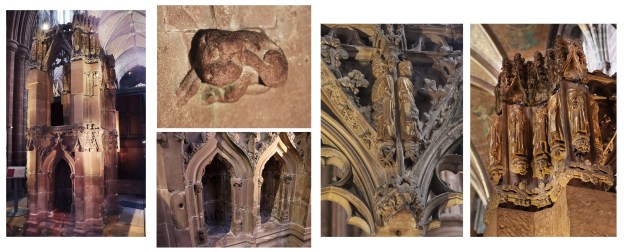
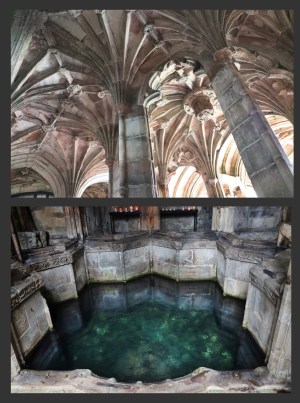
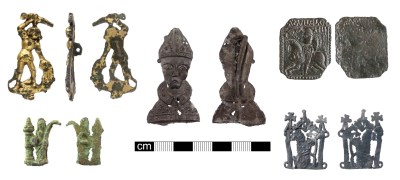
Category Archives: Chester

Miracles, myths, demons and the occasional grin: Misericords in the Chester-Wrexham area #1

Introduction

I first encountered the fabulously inventive misericords, an integral part of some church choir stalls, in Chester Cathedral, founded as St Werburgh’s Abbey.  At the abbey they were installed in the late 14th century, and in all cases, from the late 12th to the early 16th century the choir stalls were located in the holiest section of a church, where sacred liturgies and rituals were performed.

Two choir stalls from St Andrew’s Bebington. On the left the hinged seat is in the down position, hiding the misericord beneath. On the right, the seat is tipped up, leaning on the seat back, and reveals the carved misericord on the underside of the seat (my photo Creative Commons licence CC BY-NC-ND 4.0)

Misericords are hinged wooden seats set into the choir stalls.  When folded down to provide seating, the seat has a plain, flat surface, but when folded up to rest against the seat back, a small platform on the underside of the seat allows the standing chorister to rest his rear end.  The word misericord derives from the Latin misericordia (mercy or pity) and for the tired or aged monk or chorister looking for some respite for weary and arthritic legs, it probably was mercifully welcome.

The central theme of this misericord is a two-bodied monster with a single head. The supporters are also rather wonderful monsters, the one on the right also a double-bodied creature, the one on the left possibly a wyvern (Chester Cathedral, my photo Creative Commons licence CC BY-NC-ND 4.0)

In some cases, these misericords were decorated with elaborate carvings.  They are flamboyant, skilfully carved and conceptually clever, covering a variety of themes, with individual scenes capturing a seemingly bottomless pit of information about medieval ideas, anxieties, beliefs and even humour.  They consist of a central scene and two “supporters.”  The central scene is the main subject matter, and the supporters may relate to it, but may simply perform the job of ornamental complements.  Although many western European countries also display misericords, the supporters are a British feature.  The earliest misericords known in Britain date to the 13th century, with the most complete examples being at Exeter and Salisbury.

The themes of misericords may be religious, mythological, fantastical, domestic, seasonal, humorous, crude and even scatological.  Unlike gargoyles, and the figures on arm rests and bench ends, which are individual sculptures, the misericords often make up quite complex scenes, and may be have a narrative component.  Particularly skilled carvers produced sophisticated forms and structures which not only engage the viewer but stand out as works of art in their own right.  Whilst some were evidently intended to amuse or surprise, others were layered with meaning, creating galleries of real character and adventure.

Canopies above the choir stalls in Chester Cathedral (my photo Creative Commons licence CC BY-NC-ND 4.0)

Misericords, just one component of the choir stalls, are usually accompanied by carved arm rests and often magnificent bench-ends, and in the wealthier establishments sit beneath elaborate canopies, as at Chester Cathedral, making up a fascinating ensemble of images, ideas and aesthetics.  Arm rests sit between each of the choir stalls, often running partially up the side of the stall too, creating the sense that each choir stall was an individual unit, and are often carved, usually into human, animal and imaginary figures.  Bench ends are panels at the ends of each row of choir stalls, and desks, in front of choir stalls, for holding books and music were also decorated.  Panels were carved with scenes and they were topped with little carved sculptural elements called finials.  Other sculptural features complemented and supported them.

The bigger, most prosperous establishments could afford more ambitious creations, in terms of both the quantity and quality of the misericords, but smaller establishments with suitably generous patrons often have some excellent and surprising examples to offer.  One of the features of British misericords that is not often seen in Europe is the addition of secondary carvings called supporters.  These are sometimes purely decorative, and sometimes contribute to the central subject matter.

The u-shaped choir at All Saints’ Gresford with choir stalls and misericords at north, south and, with a gap to allow access from the nave, the west (my sketch Creative Commons licence CC BY-NC-ND 4.0).

Rows of choir stalls with misericords, each with a row of narrow desks in front of them for holding music and manuscripts, face one another across the choir, as at Chester Cathedral.  In some cases there may be a third set of choir stalls at the west end, up against the screen that separates choir from nave to form a squared U-shaped choir, as at All Saints’ in Gresford.

Inevitably some establishments had misericords which have now been lost.  Peterborough Cathedral retains only three of what must have been an impressive collection of misericords rivalling other great ecclesiastical establishments.
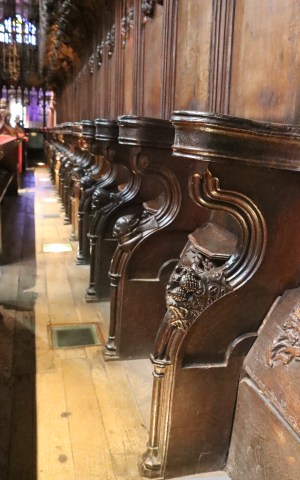
Choir stalls at Chester Cathedral (my photo Creative Commons licence CC BY-NC-ND 4.0)

Part 1 introduces misericords and explains what they are.  Examples from Chester Cathedral are discussed.  Part 2 looks at the examples from Gresford All Saints’, Malpas St Oswald’s and Bebington St Andrew’s.  Part 3 looks at who chose the themes on misericords, where the ideas came from, who paid for them, and why some often profane images were housed in such sacred places.  Also in part 3, some final comments are followed by visitor details and a full list of the references used for all three parts.

All three parts are already written.  Part 2 has now been posted on the blog  and Part 3 will be posted shortly.  If you would like to see the list of references before part 3 is posted, please get in touch and I will email them.

On these posts, some of the photographs are mine, but others, particularly for Chester Cathedral where I didn’t use flash, have been taken from Dominic Strange’s remarkable World of Misericords website, with Dominic’s permission and my sincere thanks.  His copyright statement is here.  Please see the captions for the correct attributions.  I have included some images from all the churches discussed, but to see the complete medieval corpus of each, do visit Dominic’s site, which has complete images from all the churches mentioned in this post, plus a great many other monastic churches, cathedrals and churches in Britain and Europe. This is the type of ever-growing online resource that makes the most of the web as a platform for building  shared resources from which both professionals and enthusiasts can benefit and to which they can contribute.
xxxxxxxxxxxx

Chester, Gresford, Malpas and Bebington

St Werburgh’s Abbey in Chester was the first of these four medieval churches to have misericords installed along with their choir stalls.  Chester, being an abbey with massive financial resources, had 48 misericords of which 43 survive.  All Saints’ in Gresford had 14, St Oswald’s in Malpas 12, and it is unknown how many there were at St Andrew’s in Bebington.  A summary of the vital statistics is shown below.

Basic data about the misericords at the four churches

Chester
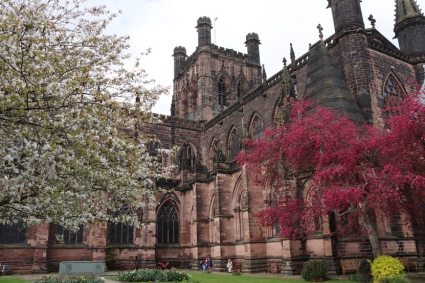
Chester Cathedral. (my photo Creative Commons licence CC BY-NC-ND 4.0)

Chester Cathedral was founded as St Werburgh’s Benedictine Abbey by Hugh Lupus in c.1092 but the choir stalls and their misericords were not installed until the 14th century, in about 1380.  The delicately crafted choir (or quire) was the exclusive domain of the monks and their daily rituals, visited only rarely perhaps by the most generous of the abbey’s patrons.  The monks were called to the choir seven times a day and once at night.  The object of the exercise was to honour and worship the glory of God.  This makes the choir the spiritual heart of a monastery.  And yet it is here that profane and irreverent images of many misericords were also resident, as fully integrated components of the monks’ devotional and liturgical lives.

The timing of the new choir stalls is particularly interesting as it follows a period of enormous national hardship, beginning with crop failure and famine, and climaxing with the Black Death.  The abbey clearly had funds at its disposal, even during such a difficult period, because the choir represents an enormous investment.  With its choir stalls, desks, benches and elaborate canopies, all carved in oak, the choir’s components were not merely functional.  Today the choir and its many flourishes are valued not only for the considerable skill demonstrated by its carvers and for its considerable aesthetic merit, but for the symbolic character of many of its representational carvings.

The layout of the choir stalls and description of their misericords. Source: Stephen Smalley 1996 (see “Sources” at end).  Click to enlarge.

Although Chester Cathedral appears at first glance to have a complete set of medieval misericords, 5 out of the 48 were, as mentioned above, replaced by Victorian restorers either to replace damaged ones or to replace those that were considered to have inappropriate themes, such as nudity or poor taste.  It is not known what happened to the missing misericords, but they were probably destroyed at the time.  Given that the Puritan soldiers of the English Civil War defaced many features of Chester Cathedral in 1645 it is astonishing that the 48 survived so long.

The St Werburgh’s Abbey examples are justifiably famous, very similar to the examples at Lincoln Cathedral, built a decade earlier, which probably provided some templates for Chester, and with which they may have shared a workforce.  Shown to the right is the layout of the misericords and the topic of each one, copied from a small and invaluable booklet that used to be sold in the cathedral shop.  It is now presumably out of print and has become very difficult to source (thanks for the loan Katie!).  Note that those misericords shown in italics are Victorian replacements.

The themes present at Chester’s St Werburgh Abbey are a phenomenal mix, so only a few can be picked out to represent some of the ideas on show.
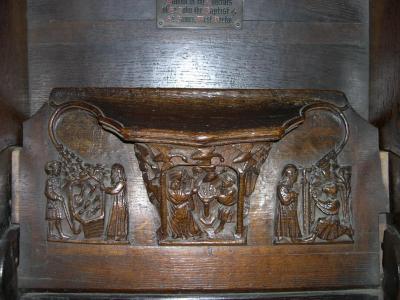
Scene of St Werburgh’s miracles. Source: Dominic Strange, World of Misericords

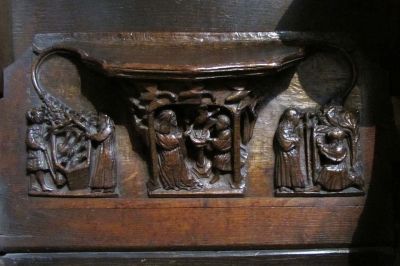
Obviously religious themes and personalities are often in a minority on misericords, but where a monastery or church is named for a particular saint,  a misericord may be dedicated to that saint.  The Anglo-Saxon saint Werburgh was an 8th century nun and abbess from the Midlands.  One of the misericords focuses on St Werburgh’s miracle.  There are various versions of the story but all agree that geese were damaging the convent fields. Werburgh ordered them to be gathered up before commanding them to leave.  The convent steward, Hugh, was angry with the geese for devastating his field of corn.  One version says that whilst Werburgh was away Hugh captured and cooked one of the geese, and when she returned the remaining geese had refused to leave, forming a delegation to inform her of the event and ask for her help.  Werbugh ordered that the bones and feathers of the carcass should be gathered up, and the missing goose was reborn.  The supporter to the left shows Hugh and Werburgh rounding up the geese.  In the centre Werburgh resurrects the goose, which flies away with its companions.  On the right supporter Hugh is on his knees, repentant, and is forgiven by Werburgh.

Coronation of the Virgin in Chester. Source: Dominic Strange, World of Misericords

The infrequency of religious topics is perhaps due to a general feeling that it as unsuitable to a) hide them away and b) sit on them.  However they do occur and at Chester another obviously religious topic that requires no interpretation is the Coronation of the Virgin.  The Chester example is not the carved equivalent of a delicate Fra Angelico, being a rather chunky rendition, but it has real charm and the supporters, cittern-playing winged angels, are lovely.   The Virgin and Child is the subject of another misericord.  St George and the Dragon is another popular religious topic for misericords, an action scene that shows an uncompromising approach to demonic danger, but the one at Chester is Victorian.

The rear end of Yvain’s horse captured in the portcullis in Chester. Source: Dominic Strange, World of Misericords

Popular romance stories provide the theme for some misericords, such as the 12th century Arthurian story “The Knight of the Lion” by Chrétien de Troyes about Sir Yvain.  A snapshot from the story is captured on a really entertaining vignette.  The central scene shows a walled town with its entrance arch flanked by two slender towers.  Look closely, and you see that the rear end of a horse faces you.  As Yvain chased his opponent into the gatehouse, the portcullis was activated by a secret device as Yvain’s horse stepped on it.  The portcullis dropped, narrowly missing Yvain and chopped the horse in two.  The portcullis at the other end of the gatehouse also dropped, trapping Yvain.  All of this, and the rest of the story, would have been immediately recognizable, without showing Yvain himself, from the image of the half-horse on the outer side of the portcullis.  The horse’s arse approach to a story that had plenty of other events from which to select probably raised many smiles as well as evoking the rest of the story.  The supporters show another aspect of the tale involving two men-at-arms.

Alexander in Flight in Chester. My photo Creative Commons licence CC BY-NC-ND 4.0

Alexander the Great, very small part history and a much greater part legend and fiction, was a very popular character in the Middle Ages.  At Chester a misericord captures the notorious “flight” of Alexander.  The great leader, having reached the edge of the world, wished to explore the unknown beyond, rising both to the heights and to the depths. Perched on what looks like a piece of wood in this misericord is his throne, supported on ropes held by two griffins.  Fully equipped to take flight, he was carried over the edge of the known world to explore the unknown.

Alexander in Flight shown in the mid-15th century Talbot Shrewsbury Book, officially known as Royal MS 15 E VI (folio 20v). Source: British Library.

Having acquainted himself with the unknown world, and finding nothing left for him to conquer, Alexander returned to the known world.  Alexander’s flight to the unknown may be more favourite story than morality tale, although it can also be taken to represent the folly of all-encompassing ambition.  Alexander goes on to conquer Babylon and build himself a massive golden throne. In Babylon, he dies.  As David Williams says “Alexander is both the force that battles the monsters as he attempts to extend civilization to the ends of the earth, and he is the monster itself, demolisher of cities, reviser of history.”  The misericord’s supporters also show griffins.  Griffins are discussed further with reference to a splendid example at Gresford in Part 2.

Angry woman berating a cowering man in Chester. Source: Dominic Strange, World of Misericords

Scenes of domestic life on British misericords include some startling vignettes of women attacking men, presumably their husbands.  The marvellous example at Chester involves a woman with a dress resembling a tornado, sweeping her much smaller, cowering husband aside with a wooden implement, apparently in a garden or rural setting.  The Chester Cathedral Quire Misericords booklet describes this as “fighting couple,” which seems like something of an understatement for a scene showing a whirlwind of fury breaking loose.  Some of these many British and European woman-abusing-man misericords have been interpreted as depicting the physical, carnal and uncontrolled aspect of women.  It has also been suggested that some of them may represent male anxiety in the face of increasing female emancipation.  Perhaps, in the male-only environment of the choir, a humorous subtext was that the monastery is a much safer place for a man than a marital home.  The supporters, which appear at first glance to be floral, have angry faces at their centres, reinforcing the message of conflict and hostility.

A page from the 13th century MS Bodley 764, showing the tigress with the mirror at the top (see below). Source: Bodleian Library, Oxford

Real world animals, fish and birds shown on misericords, either local or exotic, are frequently very beautiful, but often have symbolic roles as well.  “Bestiaries” were encyclopaedia type books produced in the middle ages that not only produced information about animals (some of them mythological or imaginary)  but also put them into religious context.  An example is the fascinating bestiary now known as manuscript MS Bodley 764 available to view on the Bodleian Library website or available in print, translated by Richard Barber (see Sources at the end of Part 3).  This describes characteristics of familiar, exotic and mythological animals, many of which appear on misericords.  There is also the splendid Medieval Bestiary website, an excellent resource that lists animals (again, real, exotic and mythological) and examines medieval perspectives on each, including their symbolic value.

Herons with sinuous necks. Source: Dominic Strange, World of Misericords

The MS Bodley 764 bestiary says that a familiar British bird, the heron, symbolizes “the soul of saints or the elect, who, scorning the turbulence of this world, lest they should become ensnared in the traps of the devil, raise their minds above things to the serenity of heaven where they could see God face to face.”  A Chester misericord shows two fabulous herons, their necks sinuously curved and their heads facing upwards as though feeding off the underside of the misericord.  They are flanked by supporters that are less easy to interpret, but possibly representing demonic influences: a winged dragon with claws on one side, and on the other side a man-headed dragon with beard and an elaborate hat, scaled body and hooves.

Herons and supporters. Source: Dominic Strange, World of Misericords

The knight stealing a cub and deceiving the tigress with a mirror. My photo Creative Commons licence CC BY-NC-ND 4.0

An exotic animal displayed on a misericord was the tiger, something impossible for most people to experience, much like a unicorn, but known to be the living product of distant lands.  In this particular narrative it is at the heart of a morality tale, which is described in the bestiary.  A knight lies flat on his horse’s back, holding a stolen tiger cub in his left hand.  From this apparently perilous position he reaches to the ground and drops a mirror in the path of the tigress that pursues her stolen cub.  The tigress stops when she sees the mirror, believing that her own reflection is the stolen cub.  Together, the knight and the mirror represent demonic trickery and deceit, whilst the inclusion of the tiger provides an exotic flavour to the scene.  Admittedly the tiger doesn’t look like a tiger (no stripes either on the misericord or on the blue creature in the bestiary, shown in MS Bodley 764 above) but this was a well known scene that would have been familiar to educated medieval onlookers. 
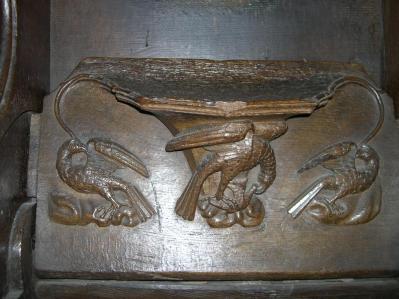
The Pelican in her Piety. Source: Dominic Strange, World of Misericords

Some animals have specifically religious associations.  The “Pelican in her Piety” is a recurring theme and is shown on one of the misericords at Chester, as well as one of the associated carvings, representing the sacrifice of Christ to redeem humanity.  The pelican, attacked by her hungry children (representing ungrateful humanity), retaliates and accidentally kills them.  Remorsefully, she pecks her own breast until she bleeds, and this revives her chicks (representing Christ’s sacrifice for humanity).

The unicorn, his head cradled in the lap of a virgin whilst killed by a knight. My photo Creative Commons licence CC BY-NC-ND 4.0

Mythological animals on the Chester misericords also often have specific ideas associated with them, which may sometimes be an odd blending of imaginary animals with Christian ideas.  For example, there is a carving of a really lovely unicorn with a curly mane, its head in the lap of a woman (above).  Even as it lies there it is attacked and killed by a man in armour with a sword.  The woman is a virgin, and the voluntary submission of the unicorn symbolizes its respect for her pure condition, like the Virgin Mary, whilst the killing of the unicorn represents Christ’s sacrifice and the martyrdom of the innocent.  The supporters show a wyvern with scaled wings, and one with bat wings, probably demonic characters representing the eternal threat of evil.   This scene is a popular one, not confined to misericords.  Below it is an illustration in a manuscript, showing exactly the same components.
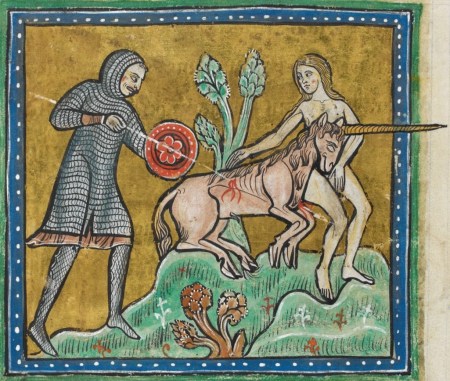
The 13th century Rochester Bestiary: British Library, Royal 12f. XIII, fol.10v. Source: Wikpedia
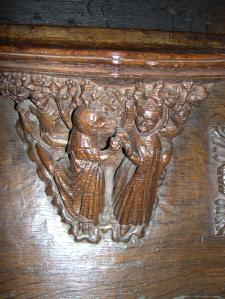
A friar-fox preaching to a woman. Source: Dominic Strange, World of Misericords

Animals mimicking human actions normally incorporate a particular comment on the human world, often derisive or satirical.  In St Werburgh’s Abbey, the wily fox in a friar’s habit, preaching to a woman, possibly a nun, probably represented the new mendicant friars preaching to the gullible general public.  The orders of friars in Chester were Franciscans, Dominicans and Carmelites.  These were the new kids on the block in the 13th century who, unlike the established Benedictine monks, were preaching in the streets, and mingling with people where they lived and worked, diverting donations to their own establishments and raising questions about the value of monks who were hidden away.  These scenes at several churches demonstrate Benedictine contempt for the mendicants, putting a clever and often amusing spin on their activities (the friar-foxes are often shown preaching to geese and cockerels), but almost certainly demonstrate a certain amount of anxiety about how their popularity would impact the conventional, secluded monks in their cloisters.  Another, closely related interpretation is that the fox represents the anti-establishment Lollards, deeply troubling to the church in the 14th century.

Wildman and lion. Source: Dominic Strange, World of Misericords

Mythological people also have a place on misericords.  Wildmen are a popular subject, of which there are three examples at Chester, each dealing with a slightly different theme. A Wildman (or wodehouse) is distinguished from other men by being covered from head to foot with a curly or shaggy pelt.  Only the bearded upper face, hands and feet are fur-free.  Wildmen were nearer to nature than to civilization, and accordingly had powers over the natural world.  One of the examples, known from a number of sites, shows a lion (often God) fighting a dragon (often Satan) with the supporters showing Wildmen riding, and thereby controlling, dragons.  A second example, shown here, shows a Wildman (with head damaged) riding a lion, holding its chain in one hand.  The pair are flanked by two different types of dragon or monster.  Wildmen riding dragons and lions represent nature tamed, but may also suggest the taming of passions like love and lust.
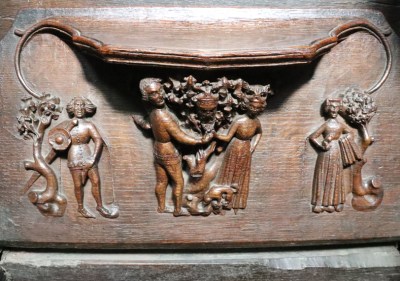
Scene from the romance of Tristan and Isolde. My photo Creative Commons licence CC BY-NC-ND 4.0

Finally, some churches have scenes that are unique or found only rarely.  Chester has a misericord showing a scene from the early 13th century Arthurian romance of Tristan and Isolde (or Iseult), which it shares only with Lincoln Cathedral.  The misericord at Chester shows the lovers in front of a tree with a dog at their feet.  In or behind the tree is Isolde’s justifiably suspicious husband King Mark, spying on the lovers.  Tristan’s dog at the feet of the lovers represents loyalty and love in most versions of the tale, but in one version of the story it is revealed that blind loyalty can be dangerous, when the dog betrays the disguised Tristan by recognizing him.  One of the difficulties of deciphering a scene like this is that there may be several versions of a popular story that include the same lead characters and supporting roles, but with different narrative twists and outcomes.

Sow and piglets. Source: Dominic Strange, World of Misericords

The misericords at Chester help to demonstrate the variety of themes and ideas that were in play in the Middle Ages, and successfully demonstrate the imagination, creativity and skill that went into the misericords in a prestigious religious institution.  They do not capture the complete range of  typical subject matters that might be found on misericords throughout Britain.  Five of them are, of course, missing, either because of damage or, perhaps more likely, because the Victorian restorers considered their themes to be inappropriate.  Even so, the massive variety of misericord subjects chosen across the many ecclesiastical institutions in Britain point to different interests and ideas in the many places in which they appear.

All of the Chester misericords are shown on the World of Misericords website at https://www.misericords.co.uk/chester.html, with short descriptions at https://www.misericords.co.uk/chester_des.html

Next

Emulating their more prestigious cousins much smaller churches could also follow ecclesiastical fashion and demonstrate, on a more modest scale, their ability to produce fine misericords and other sculptural elements of their own.  In Part 2 the twelve of fourteen misericords at Gresford, and the remaining examples at Malpas (three of twelve) and Bebington (five of twelve) are discussed.

 

The 1991 discovery of an important Roman inscription in Holt

By Andie Byrnes and Helen Anderson, August 4th 2023

The discovery in 1991

The Holt inscribed fragment, now in the Grosvenor Museum. Photograph by Dr Roger Tomlin, University of Oxford, with many thanks for allowing Helen to use it.

In 1991 artist and archaeology enthusiast Helen Anderson was driving over the Farndon-Holt bridge, about 11 miles (c.18km) south of Chester, when she noticed some activity and bare soil surfaces in the normally grassy nearby field associated with the Roman tile-works and its ancillary buildings overlooking the Dee.   She had recently started to focus on Roman archaeology and to visit Roman sites, and although she had spent her childhood locally in Churton, she had only recently been reading about the Holt tileworks site for the first time.  She had been intending to go and look at the site but hadn’t yet done so, and thought this might be an interesting opportunity to go and see it. She received permission from the landowner to walk over the newly-stripped surface of the field.

On the  recently exposed soil surface that day, as well as sundry fragments of imbrex and tegula (roofing tiles), two of which were marked with cat and dog paw-prints and one with a finger print, she found the wonderful piece of inscribed brick shown in the photograph above right. Here is Helen talking about discovering the piece:

As I was walking through the field, which had been stripped for turf that was still being rolled and loaded, I saw a large piece of orange tile lying on the muddy surface, picked it up, turned it over and found what appeared to be writing on the underside.  I could hardly believe my eyes – it was an extraordinary and quite eerie moment!  My immediate thought was who I should tell about it.  Later, gently cleaning it in the kitchen sink, the excitement of the incised letters appearing clearly as the soil washed out of them was something I will never forget. It felt a bit like time travel.

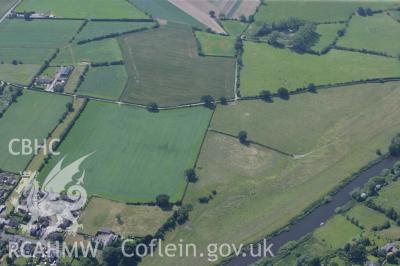
Aerial view of the farmland at Holt next to the River Dee where the tile-works were located

The piece was clearly broken, with a bit of the inscription missing.  Helen returned to Holt a few days later, to show it the to the farmer and to see if the rest of the fragment was lying about in the field, but by then it had all been rotovated – if she hadn’t picked up the brick it probably would have been further damaged. She reckons the gods must have been with her that day!

This was six years before the establishment of the Portable Antiquities Scheme, so after after showing the find to the landowner, who gave Helen permission to keep the object, Helen sent photographs to the British Museum.  The resulting correspondence offers a terrific insight into how an understanding of the significance of the object was reached. It emerged that the fragment of Helen’s brick on which the inscription was made was re-used as a form of notepad to make a quick record.  At first it was thought that the fragment was a tile, but it is more likely to be a piece of lydion or sesquipedalis; these look rather like tiles because they are very thin compared with modern brickwork.  Some of the letters have been sliced off at the far right, but what we are looking at is part of a coherent piece of text, a list with signatures.  It was a small-sized record, containing only a few details.  It measures 32cms, by 30cms, and is around 6mm thick.

Helen hard at work at the Rossett Roman Villa excavation in 2021. Photograph courtesy of Dr Caroline Pudney, University of Chester

The inscription is now recorded in various books and papers contributing to knowledge about Roman activities and everyday life in the Chester area.  Although Holt is just over the Welsh border, the tiles and bricks were created for the Roman occupation in Chester.

Following very fine lunches at Pant Yr Ochain near Gresford and the White Horse in Churton, where we pored over both the artefacts and documents that Helen has assembled, including her original correspondence with Catherine John and Roger Tomlin, we decided to write a post about the inscribed fragment.  Helen has now been investigating the Romans in the Chester area for three decades, and as her knowledge has grown she has excavated as a volunteer at Chester amphitheatre, the Heronbridge Roman settlement, and most recently the Rossett villa.  All the documentation cited here has been provided by Helen.

First, a quick look at the Holt tile-works, which produced the inscribed brick.

The early 20th century discovery of the Holt Tile-works

The Holt brick and tile works site was recognized in the early 1600s when landowner Thomas Crue of Holt Hill suffered repeated damage to his plough and was forced to investigate.  He discovered that his plough was encountering a series of fifty 2ft-tall posts, and his finding found its way into the book Roman Cheshire by W. Thompson Watkins (1886).  This was noted by retired chemist and keen amateur historian Alfred Neobard Palmer who, in 1905, decided to hunt for the remains that Crue had found, accompanied by local vicar Jenkyn Jones, having sought permission from the landowner.  A series of field-walking expeditions followed, uncovering plentiful fragments of Roman brick, roof tile and pottery over an area of some 20 acres.

Fold-out plan of the kilns at Holt, published by Grimes in 1930. (Scanned from my copy of “Holt, Denbighshire”)

Palmer was not an archaeologist, and the task of excavating the site was taken on by Wrexham solicitor and amateur archaeologist Arthur Acton.  Work began in 1907 and continued until 1915.  Although he delivered numerous lectures about the site, Acton never published his work.  Fortunately a portion of his records survived, and he sold the excavation finds to the National Museum of Wales, where William F. Grimes used the data to compile a comprehensive report, complete with site plans, photographs and object illustrations.  Work did not stop there, and during the 1970s Geoffrey Bevan conducted both field walking activities and an excavation, finding Roman material that filled dozens of boxes, which were donated, this time, to the Grosvenor Museum in Chester.  Helen’s field-walking in 1991 added the inscription to the list of important finds, and in 2018 Holt Local History Society commissioned Archaeological Survey West to carry out a geophysical survey of the site, to fix the positions of the known buildings and, with luck, to identify any unexcavated and previously unknown structures.  This demonstrated that the Holt complex was even bigger and more complex than Grimes, via Acton, had been able to determine.  There is, of course, the potential for future field research, and recent work in Farndon, summarized on local historian Mike Royden’s website is beginning to expand the story over to the other side of the Dee.

What was the Holt tile-works like?

Site plan of the Roman tile and pottery work displayed in the Hidden Holt exhibition. Also in the excellent booklet accompanying the exhibition, full details in Sources below. The features shown in blue are unrecorded / unexcavated.  Those in dark brown are the building locations fixed in 2018, and those in paler brown those estimated by Grimes based on Acton’s work.  Click to see a bigger version with fully legible text.  Source: Wrexham Heritage Service, 2021

The 20th Legion, Valeria Victrix, of the Roman army, was stationed at Chester, Roman Deva, from AD87, and the Holt works appears to have been established shortly afterwards to supply the fort and settlement at the legionary fortress.  Holt’s industrial activities reaching their peak output at around AD135, and began falling out of use in the mid 3rd Century.  The site was clearly a fully integrated operation combining industrial, public and domestic components.

A senior manager had his own house, complete with hypocaust (under-floor central heating), there was a public bath house, a series of kilns for the manufacture of tiles, bricks and pottery, and a barracks that may have housed workers, or alternatively a detachment of the Roman army based at Chester at this time.

The hypocaust below the drying shed. Source: National Museum of Wales

The main kiln plant at Holt, published by William Grimes in 1930.

The kilns formed two main units, a larger (139ft / 52m long, consisting of a row of six kilns) and smaller twin-kiln built on the natural bed-rock.  Each kiln was rectangular and tile-lined with an arched stoke-hole for access.  A round pottery kiln was also located on the edge of the main kiln complex.  The oven floor consisted of a raised floor of tiles plastered with clay that were pierced with holes that acted as vents.  The drying shed was provided with a hypocaust, of the same sort used in villas and bath houses.  These, like the kilns, were stoked and kept hot to ensure that the tiles, pottery and bricks were dried through after firing.

Map marked by Helen to show the approximate findspot of the inscribed fragment

All of the output manufactured at the works was sent by boat downriver to Chester on the river Dee.  It provided direct access to Chester, 12 miles / 19km away, passing the civic settlement at Heronbridge.  The generally flat environment meant that building of roads, where needed, was not exceptionally laborious.
—–

Corresponding about the tile in 1991

The imposing facade of the British Museum. Source: Wikimedia Commons by Paasikivi

Helen wrote to the British Museum in April 1991 describing how she had found the fragment, and enclosing a high resolution photo in which the inscription could be seen clearly.  The first person to reply to Helen’s letter to the British Museum was Catherine Johns F.S.A., at the time Curator of Roman Britain in the Department of Prehistoric and Romano-British Antiquities in the British Museum in London.  In a letter dated 18th June 1991, Catherine Johns begins “Thank you for your letter and the excellent photographs and drawing of the inscribed tile from Holt in your possession.  This is an interesting and important find.”  She goes on to explain that the inscription is in cursive Latin, “that it is to say, it is handwriting rather than formal lettering.”  She was unable to translate the text, which is a specialist task, and sent it to Dr Roger Tomlin of Wolfson College, University of Oxford.  She warned Helen that the fragmentary nature of the text might impede translation.  She finished by suggesting that Helen might consider presenting the piece to the National Museum of Wales, where most of the Holt material excavated in the early 20th century is held.

Helen then received a letter dated 25th June 1991, only a week after the letter written by Catherine Johns, from Dr Roger Tomlin.  Dr Tomlin explained that it was by no means straightforward to decipher and transcribe the fragment, partly because of the several examples of handwriting inscribed, and the fact that it was clearly incomplete.  He suggested that this was a record of expenses, with the star symbol indicating the unit of payment in denarii, and that several individuals were involved. He referred to the inscribed brick as “a welcome addition” to the corpus of Roman inscriptions in Britain. In a later letter, dated 1st July 1991, he thanked Helen for offering to take the the object to him in Oxford, for translation, whilst on a family break, and expressed the hope to meet up with Helen to discuss it.  He suggested that the fragment was probably part of a lydion (or sesquipedalis), rather than a tile, a brick used for bonding-courses.  When Helen met Dr Tomlin for coffee, he departed on his bicycle, in typical Oxford style, with the inscription propped up in the bicycle’s basket.  ———

The inscription

The same photo of the inscribed tile found by Helen Anderson in Holt in 1996 as above, shown again so that you can review the cursive text Copyright Helen Anderson

The brick was inscribed in the still-soft surface of the wet clay before firing.  The translation of the inscription by Dr Tomlin is a great example of the sort of scholarship and academic detective work that go into understanding a single object.  The inscription was abbreviated, typical for this sort of note, where space was limited and standardized abbreviations were recognizable to all.  As already noted, the slab was broken, possibly by ploughing, so parts of the inscription are missing, but this apparently presented few problems for Dr Roger Tomlin.

Just by looking at it, you can see that there is more than one person’s handwriting, and that’s because each person wrote his own signature.  All three were men, named  1) Junius, 2) Maternus and 3) Bellettus.  The final s is missing in each case due to the break.  In the official transcription below, Tomlin has completed words where he knows them.  The slab is a record of expenses they had incurred, but does not say how they were incurred.  Junius was paid at least 4 denarii, probably more, but the break carried the other details away.

Notes about the inscription on the left, on the back of the photo above, followed ultimately by the publication of the inscription in Tomlin 2018, p.290

Front cover of Tomlin’s 2018 “Britannia Romana. Roman Inscriptions and Roman Britain.” Oxbow Books (see Sources below)

Dr Tomlin wrote about the inscription in the journal Britannia, vol.26, 1995, p.387, where it is numbered no.28 (and Helen’s role in the discovery is referenced in the footnotes).  It was later included in Tomlin’s comprehensive Britannia Romana, published in 2018, which lists over 400 epigraphic inscriptions from Roman Britain.  The inscription is listed on page 290 as number 11.14.  Dr Tomlin observed that the three men listed were probably legionaries (although he does not rule out in the 1995 publication that they may have been auxiliaries).  He says that two of the three names were commonplace Roman names, and the third, Bellettus, may have been a variant on the name Bellicus, which he describes as “popular in Celtic-speaking provinces.”  All three signed their own names, meaning that they were literate.

Tomlin is particularly interested in the word sumtuaria, which is missing its p, and is the plural of the noun sumptuarium.  The word is very rare, with the only example known by Tomlin appearing on a legionary pay-sheet in Masada, Israel, where it refers to food expenses.  Tomlin speculates that this was a record of expenses that were to be reimbursed by headquarters at a later date, but he does question how this was supposed to work when the record took the form of a brick (which, after all, could not be divided between the three men!)

Roman soldier’s payslip from Masada, Israel. Source: Arkeonews.net

This find, recording something of the lives of three men who lived in Roman Holt, has something of the air of the Vindolanda tablets.  The thin leaves of wood used at Vindolanda on Hadrian’s Wall recorded many aspects of everyday life, also written in cursive.  A selection of them are on display in London’s British Museum.  One of them had a similar content to the Holt example, showing a list of people who owe money.  Although it is incomplete and undated, it was possible to identify Vitalis the balniator or bath house keeper and Tagomas, one of a number of cavalrymen from northern Spain who appear on the list (also mentioning the latter’s contubernalis, or unofficial wife).

Text from vindolanda showing a list of people who owe money. Source: Vindolanda.com

————–

Publications mentioning the brick

The inscription became something of an emblem of local Roman social history, being referred to not only in academic publication, but also heritage newsletters and leaflets in Chester.  Dr Tomlin suggested that it be included on the Roman Inscriptions of Britain website, and it has very recently been added to the site here, where it has been given the identifier Brit.26.28.

Here are two examples of publications aimed at the general public, collected by Helen, that mention the find and give a good idea of how it was regarded:

Source: Revealing Cheshire’s Past series: From Farms to Fortress leaflet, page 6 Industrial Activity. Cheshire County Council

Connecting with the past

The inscribed brick in the Grosvenor Museum, Chester. Copyright Helen Anderson

You can see the inscribed fragment today in the Grosvenor Museum in Chester, where it is on display in the ground floor Newstead Roman gallery, thanks to Helen requesting that it be displayed locally rather than in the National Museum of Wales in Cardiff.  Not only would it have been difficult for local people to visit it easily in Cardiff, but the tile-works were directly connected with the legionary fortress in Chester, so this seemed like the perfect home for the inscription.  Generations of local schoolchildren can have their imaginations fired by seeing the handwriting of several different Romans who lived here nearly 2000 years ago.

Helen explains that her own children were so excited and proud of her discovery of this piece of heritage that they somehow persuaded her that it should be on loan to the museum rather than donated, but she has since donated it outright, rightly deciding that it’s a piece of history that belongs to everyone.

If anyone wants to chat with Helen about the find, you can contact her via Twitter: @Helenus_.  You can also contact Andie on the Contacts Page, via Twitter @BasedInChurton, or leave a comment (the Leave a Reply link is immediately under the title of the post).

Other posts on this blog about Roman Chester and Holt can be found here.
———-

Final Comments

The object that Helen found in a field in Holt, during a short window between when turf was removed and new grass sown, has multiple identities.  Archaeologically and historically, it is one of a number of records of Roman Britain that together provide insights into Roman settlement and industry and particularly contribute to the narrative about the Holt tile-works.  At another level it is both a clue about record keeping in Roman Holt, and an ephemeral glimpse into the everyday life of three literate Roman men who were working at the tile-works and were claiming expenses.  Today, as well being a significant part of the Roman display in the Grosvenor Museum in Chester, it has made a claim for a position in Helen’s own family history.  Not a bad set of achievements for one inscribed object found lost in a field.  One wonders if the three soldiers ever did receive their expenses?———————

Sources:

Letters (in the private archive of Helen Anderson)

From Catherine Johns, Curator, Department of Prehistoric and Romano-British Antiquities, British Museum. To Helen Anderson, dated 18th June 1991

From Dr Roger Tomlin, Wolfson College, University of Oxford.  To Helen Anderson, dated 25th June 1991

From Dr Roger Tomlin, Wolfson College, University of Oxford.  To Helen Anderson, dated 10th July 1991

Books and papers:

Grimes, W.F. 1930.  Holt, Denbighshire:  Twentieth Legion at Castle Lyons.  Y Cymmrodor.  Society of Cymmrodorion.

Tomlin, R.S.O. 1995. 11.14 Holt (? Bovium), in (eds.) B. C. Burnham, L. J. F. Keppie, A. S. Esmonde Cleary, M. W. C. Hassall, and R. S. O. Tomlin Roman Britain in 1994. Britannia, Vol. 26 (1995), p. 325-390

Tomlin, R.S.O. 2018.  Britannia Romana. Roman Inscriptions and Roman Britain. Oxbow Books (Chapter 11, no.14, p.290-1)

Leaflets and newsletters:

The Past Uncovered, Autumn 1996
http://www.cheshirearchaeology.org.uk/wp-content/uploads/The-Past-Uncovered-Autumn-1996.pdf

Revealing Cheshire’s Past series: From Farms to Fortress leaflet, page 6 Industrial Activity.  Cheshire County Council

Holt: Legacy of the Legions, available from the museum, or can be downloaded.
http://old.wrexham.gov.uk/assets/pdfs/heritage/holt_castle/holt_legacy.pdf

Websites:

Coflein
Holt Roman Site NPRN 307201
https://coflein.gov.uk/en/site/307201?term=holt&pg=2

National Museum of Wales
Request for Information – Freedom of Information Request Relating to Collections – Reference 17-002, 14th February 2017
amgueddfa.cymru/media/41203/response-web-17-002.pdf

Roman Inscriptions of Britain Online
https://romaninscriptionsofbritain.org/
The Holt inscribed brick now has its own page at:
https://romaninscriptionsofbritain.org/inscriptions/Brit.26.28

Vindolanda Charitable Trust
Writing Tablets
https://www.vindolanda.com/blog/fact-file-writing-tablets

Vindolanda Tablets Online
http://vindolanda.csad.ox.ac.uk/


A roof boss in Chester Cathedral: the murder of Thomas Becket

The Thomas Becket ceiling boss in the Lady Chapel, Chester Cathedral. Photograph by Andie Byrnes

  • Introduction
  • Who was Thomas Becket?
  • The Becket Boss in the Lady Chapel of St Werburgh’s Abbey
  • Final Comments
  • Sources

Introduction

Chester Cathedral plan (annotated). Source: Wikipedia

In the 13th century, Abbot Simon de Whitchurch (1265-1291) began the construction of Lady Chapel in St Werburgh’s Abbey (which is today Chester Cathedral, and about which I have posted here, with visiting information including accessibility).  It was dedicated to the Virgin Mary. In the ceiling, where the vaulting ribs meet, three round ceiling bosses high above the floor show religious themes.  One shows the Holy Trinity and the second shows the Virgin Mary and the baby Jesus.  The third, shown above, shows shows the murder of Thomas Becket, Archbishop of Canterbury, by four knights loyal to Henry II on 29th December 1170 in Christ Church Cathedral in Canterbury.  It is one of only two Becket ceiling bosses known to survive in Britain; the other is at Exeter Cathedral (shown below left).

Exeter Cathedral’s Thomas Becket ceiling boss. Source: Feasts, Fasts, Saints and the Medieval Church blog

What these two busy little scenes in Chester and Exeter depict was a brutal and savage act of great violence.  The murder of Becket was a violation one of England’s holiest precincts, a modern martyrdom, and an affront not only to the ecclesiastical hierarchy in England but to the papacy itself.  All eyes turned towards Henry II.  This was not the sort of attention that Henry wanted, and he spent the rest of his reign attempting to distance himself from the event.

The news of the murder spread swiftly and was deeply shocking to 12th century English and European society.  The terrible events were captured by eye witness accounts, not least that of the clerk Edward Grim who attempted to intervene and protect Becket. Almost immediately miracles were attributed to Becket, and only three years later he was canonized by the pope, becoming St Thomas.  His story was told in biographies of the saint, and his scenes of his life, martyrdom and miracles were rendered in wood, stone and paint, whilst relics were assiduously collected and displayed. In a world where martyrs and their deeds were factual events but remote, the real-time martyrdom of the head of the English church by representatives of the king was religious persecution in action, fresh and alarming in a way that past events might not be.  It was unthinkable.

Document dating to around 1180, around a decade after the event, showing the murder of Becket, from an eye-witness account by John of Salisbury (Cotton MS Claudius BII f.341r). Source: British Library.

From the moment of his murder, people were attracted to Christ Church cathedral to commemorate Becket.  His canonization made Christ Church Cathedral a formal and very desirable pilgrim destination.  The shrine itself, completed 50 years after Becket’s death, became one of Europe’s top pilgrim sites.

The saint was still attracting pilgrims in the 16th century when Henry VIII, identifying the cult of Becket as a challenge to his absolute control over religious as well as secular matters, ordered that every image of the martyr should be destroyed.  The systematic annihilation of Becket shrines and images contributed to the demise of Becket’s legacy, which was reinforced by further systematic defacements of Catholic artistic and architectural themes during the Reformation, including various monuments in Chester Cathedral, including the St Werburgh shrine.

Who was Thomas Becket?

Becket’s early career

Map of Medieval Cheapside, Medieval London in the 1560s. Source: Medieval London, Fordham University

Thomas Becket was the son of a Norman merchant who moved from Normandy (northwest France) to take up opportunities in London following the invasion of William I in 1066.  Gilbert and his wife Matilda lived in commercial area of London called Cheapside.  Gilbert rose to the position of sheriff, climbing several rungs on the social and political ladder.  It is thought that Thomas Becket was born around 1118-1120.

Becket was was born into the period of civil war between King Stephen and the Empress Matilda (mother of Henry II).  He received a good formal education, first at Merton Priory (now in southwest London), and later at a school in London.  In his late teenage years he went to Paris to study, in a Parisian heyday of scholarship and artistic endeavour.  His studies included some of the most popular scholastic topics, including grammar, rhetoric and canon (church) law, which were essential tools for anyone wanting to make their mark on the world, but did not include any formal religious education.  He returned to England in the early 1140s under the reign of Henry II, who was crowned as monarch on the death of Stephen in December 1154.

Seals of Archbishop Theobald and of Christ Church, Canterbury. Source: “Theobald. Archbishop of Canterbury” by Avrom Saltman via the Internet Archive

In the mid 1140s Becket was recommended to the Archbishop of Canterbury Theobold of Bec (c.1090-1116) and obtained a role as a clerk in the cathedral, a mainly administrative position which, however, offered opportunities for advancement. A cathedral is both the principal church of the diocese and the seat of the bishop and, as at Christ Church, often included a monastic establishment.  Becket’s Paris education was probably attractive to Theobold, who had a number of similarly educated young men in his employ.  Like most incumbents of the Canterbury archbishopric, Theobold was both a cleric and a diplomat, closely involved in crown matters, but had twice been exiled by King Stephen due to his intervention in political matters.  He sent Becket to Auxerre in France and Bologna in Italy to study law.  Law, divided into Church (canon) law and state law, was rapidly becoming an important topic in Medieval England.

Becket’s rise to power

The 12th-century Topographica Hiberniae (Topology of Ireland) by Gerald of Wales shows a rare contemporary image of the king. Source: Wikipedia

In 1154 Becket was promoted to the role of Archdeacon of Canterbury. As well as the financial rewards that enabled him to satisfy his love of luxury, his new position was sufficiently prestigious for Theobold to recommend Becket to the 21-year old Henry II as the new royal chancellor.  Henry’s coronation at Westminster Abbey, following the death of Stephen, had taken place in the same year.  Their professional relationship evolved into a friendship over a period of eight years as Becket flourished in a position of enormous responsibility.  It was a mark of Becket’s success in this role that on the death of Theobold in 1161 Henry moved to appoint him Archbishop of Canterbury, to hold both positions simultaneously.  Becket had no religious ambitions, had received no clerical training and consequently had never been ordained into the priesthood.  In spite of these drawbacks, Becket was elected to the role by the monks of Canterbury and the bishops of southern England.  Ordination was rushed through, and Becket was consecrated as Archbishop on 3rd June 1162.  His appointment was confirmed by Pope, who sent him a pallium, a vestment that symbolized his new office and status.

Needless to say, the appointment was not universally celebrated.  Quite apart from the fact that Becket had made enemies on his rise to power, decisions such as the appointment of an archbishop was one of the areas of conflict between Crown and Church.  The Church thought that it should have complete autonomy over its own affairs, answerable only to the papacy and  to God; but the Crown, conscious of the power and wealth wielded by the ecclesiastical institutions, wanted to exercise its own authority over the activities of the most important institutions, including Canterbury.  The right to appoint the most senior ecclesiastical personnel, was only one bone of contention.  The right of the Church to operate under its own canon law was another.

King Henry II and Thomas Becket arguing. Peter of Langtoft’s Chronicle, Royal 20 A II, f.7v. Source: British Library

There was no reason to think that Thomas Becket would not continue to remain completely committed and loyal to the Crown.  It was therefore a very unpleasant surprise to Henry II when Becket began to take his new role seriously, resigning his position as chancellor to focus on promoting the rights of the Church and representing the authority of the papacy.  From this point forward, Becket and Henry had opposing interests.  Becket’s training in law put him in an excellent position for arguing that the Church, rather than the Crown, should be in charge of ecclesiastical justice, in which Church clerics who committed even violent crime would be judged not by secular courts but by the far more lenient ecclesiastical courts.  There were many other disputes between the two, when Becket took a stand not only where ecclesiastical interests were involved, but in matters of state as well.  Henry attempted to resolve the situation by imposing a set of “customs,” or rules adhered to in the era of Henry I, Henry II’s grandfather, assembled in the Constitutions of Clarendon to which he commanded that Becket and all the bishops defer.  Although Becket at first refused to ratify the document, he and the bishops eventually submitted to pressure and signed.  However, Henry was seriously annoyed and began to investigate Becket, finding grounds for ordering him to court to address a number of charges.  When Becket refused first to accept the charges against him and then to reject the resulting sentence, he made the decision to flee to France.

The Abbey Church of the monastery of Pontigny. Photo by Mediocrity. Source: Wikipedia

Becket lived in exile at the Cistercian monastery of Pontigny in France from November 1164 until 1170.  In exile he attempted to drum up support, but alienated Henry still further by excommunicating a number of his advisers. Pope Alexander sent papal legates to try to resolve the dispute instructing Becket to refrain from taking any more actions against the king and his court, but in April 1169 Becket excommunicated another ten royal officials.  In 1170 Henry’s son Henry was crowned as the Young King, in a secondary role to Henry II order to settle any potential succession disputes.  The coronation was presided over by the Archbishop of York, Roger de Pont L’Évêque.  It was the right of the Archbishop of Canterbury to preside over coronations, and Becket responded to this insult by laying an interdict on England, with the pope’s permission.  This forced Henry back to the negotiating table, and he came to terms with Becket on 22nd July 1170.  Becket returned to England in the December of that year. One might have thought that Becket would count his blessings, but before he arrived he could not resist excommunicating the three individuals most closely associated with the coronation of the Young King, one of whom was the Archbishop of York.  The three appealed to the king, who was in his Normandy territory, and it was at this point that Henry, in a rage, expressed his frustrations about Becket’s latest act of rebellion.  What Henry II actually said is not recorded, but it spurred four of his knights to set off for Canterbury from Normandy.
———-

Murder in the cathedral

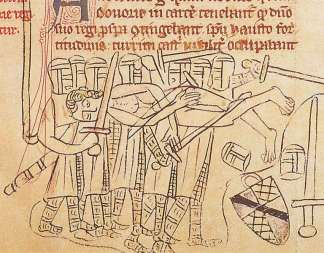
One of the earliest known representations of the murder of Becket (c.1175–1225). British Library Harley MS 5102, f.32. Source: Wikipedia

The knights rode from London to Canterbury.  They left their armour and weapons outside the cathedral precinct, intending to arrest Becket and return him to London for trial.  Becket was having none of it.  Eye-witness accounts state unambiguously that Becket’s behaviour was that of a very angry man under serious threat, confronting the knights on the steps of the cathedral.  Goaded by Becket’s verbal retaliation and refusal to back down, they retreated to put on their armour and retrieve their weapons, returning to slaughter the unarmed archbishop in rage.  Blows of the sword to his head killed him relatively swiftly, producing an alarming amount of gore that spilled onto the floor around him.  One of the swords struck him so powerfully that the sheer momentum carried it to the ground, snapping the end off the blade.  Edward Grim, who attempted to intervene, was badly injured.

His murderers were Reginald FitzUrse, William de Tracy, Richard Brito (or le Breton) and Hugh de Morville.  FitzUrse, whose name means “son of bear,” is often marked out on images of the murder with the image of a bear’s head on his shield.  He is shown on both the Chester and Exeter bosses.   Having committed the crime, the knights headed for Yorkshire where they remained for a year.  Curiously, Henry made no move against them, but in 1171 Pope Alexander III excommunicated them, and 1172 they headed for Rome to seek absolution from the pope.  It is thought that they were probably sent on crusade, and either died on their way, or in battle, although there are a number of unsubstantiated traditions about their ultimate fates.

The Christ Church was closed for nearly a year so that Pope Alexander III could be consulted on how to proceed so that the cathedral could be re-consecrated and returned to normal use, rejuvenated as a destination for pilgrims.

Miracles and legacy

Detail of the Canterbury Christ Church Cathedral miracle window, which shows some of Becket’s miracles. Source: Reverend Mark R Collins blog

Until his death, Becket had been a political creature, and a representative of ecclesiastical interests.  He did not position himself as a man of the people, but as a newly inspired champion of the rights of the Church.  This did not prevent the place of his death becoming a destination for pilgrims of all social scales, even before he was officially canonized.  Curiously, Becket was not merely an emblem of devotion to the Church and a promoter of its rights in the face of opposition from the Crown, but a saint who produced miracles for the everyday person, becoming an unlikely saint to act on behalf of the general populace.

A reconstruction of the Thomas Becket shrine in Canterbury Cathedral. Source: Smithsonian Magazine

The first miracles reported following the death of Becket took place at his tomb.  Hundreds of others soon followed, 703 being reported within the first 10 years, many recorded by Benedict of Peterborough.  Within twenty years of the murder, no less than twenty biographies had been written about the saint including contemporary accounts including, for example, those by John of Salisbury, Edward Grim and Benedict of Peterborough, the latter listing many of his miracles.  Images of him in various media appeared all over Europe, and his relics spread just as far.  As the Oxford History of Saints comments laconically, “His faults were forgotten and he was hailed as a martyr for the cause of Christ and the liberty of the Church.”  In short, Becket and the miracles associated with him went viral.

Thomas Becket pilgrim badge. Source: Museum of London

Fifty years after his death, a new shrine was opened with great ceremony, and St Thomas was moved into a new tomb within the shrine.  It was a spectacle of gold and precious gems, and was surrounded by stained glass windows telling the story of his life and miraculous works. At the height of its popularity, it attracted over 100,000 pilgrims a year. In the Jubilee year of 1420 the shrine earned £360 for Canterbury Cathedral, which equates today to around £231,483, which could have purchased 83 horses or 620 cows (data from the National Archive’s Currency Convertor) or could have been used to build a new section of cathedral.  Images and symbols of St Thomas were moulded into ampullae and badges for the hundreds of pilgrims who visited his Canterbury shrine.  The shrine no longer survives; it was destroyed in 1538  under the orders of Henry VIII.
——–

The Becket boss at St Werburgh’s Abbey

The Lady Chapel

The Lady Chapel, Chester Cathedral

St Werburgh’s Abbey featured many architectural-sculptural elements which embellish the core structure of the building, providing focal points, colour and a hint of glamour.   The Lady Chapel was built under Abbot Simon de Whitchurch (1265-1291).  In Burne’s words, “He was evidently an outstanding character and under him the abbey flourished exceedingly.”  It was a period of great prosperity for the abbey, with an income derived from, amongst other things, church pensions (a sort of tax), appropriated church tithes, gifts of houses and lands, and possibly pilgrimage to the reliquary-shrine of St Werburgh, although the new shrine  to the saint was not built until the 14th century, and it is unclear how important it was as a pilgrim destination before then.

Although the earliest known Lady Chapel predates the Norman invasion, the Lady Chapel became particularly important in the 13th century when the Virgin Mary was undergoing a resurgence of devotion.  The elegant, vaulted Lady Chapel St Werburgh’s was built in the 13th century.  Like most Lady Chapels it was built to the east of the High Altar, projecting from the main building.  Here clerics performed daily services to the Virgin Mary. It is easy to forget that most architectural elements would have been brightly painted, but the Lady Chapel in Chester Cathedral, restored to a typical colour scheme of green, blue, red and gold in the 1960s, provides an excellent example of how these components would have looked.  The lancet windows at the end of the chapel date to 1869, when Gilbert Scott removed the later Perpendicular window to be more faithful to the 13th century vision.

The Holy Trinity, with God holding the arms of the crucifix in his hands

Some Lady Chapels are large and ornate, but in some cases they form smaller, more private and tranquil spaces than other chapels within a monastery or cathedral.  The Chester example is delectable, its small footprint and relative height giving a sense of both intimacy and space.  The reconstructed shrine of St Werburgh, a victim of the Reformation’s hostility to reliquaries and idolatry, is located at its east end, but according to Jessica Hodge was probably originally at the east end of the quire.

The ceiling bosses form a row across the centre of the chapel, from east to west.  The east end was symbolically the most sacred, and it is at the east end of the chapel that the ceiling boss showing the Holy Trinity is located.  In the centre is, the Virgin Mary is depicted, and at the west end is the Becket boss.  The chapel was created during a period of great religious significance during the reign of Henry III, who had been crowned for the second time in 1220, the same year in which Becket’s remains were moved to a custom-built shrine on July 7th 1220, reinvigorating the already vibrant cult. The spectacular event was used by both the Archbishop of Canterbury, Stephen Langton, and the king to help to heal the ongoing rift between the Church and the king.  In 1225 Henry ratified the Magna Carta, granting the freedom of the Church.  This was a momentous decade in the Church’s history and religious houses throughout Medieval England rode the crest of this remarkable period during the rest of the century with new architectural projects, rebuilding, expanding and celebrating.  By 1260-1280 when the Chester Lady Chapel was built, it was the centenary of Becket’s death.  It is possible that the Becket boss was installed to commemorate this event following an ecclesiastically bright start to the century.

The St Thomas ceiling boss

Ceiling bosses are both architectural and sculptural elements, usually circular or sub-circular, positioned in the ceiling where the vaulting ribs that form arches meets, either to hide the join, or acting as keystones to add structural integrity to the complex set of tensions and stresses. There can be much more to them than first glance suggests, and behind the decorated end, an undecorated portion of the boss may be inserted into the join.  Examples on the floor of the cloisters provide a good idea of this, showing the decorated section that would face down, and the plain stump that would be inserted into the join.

Three relatively large stone vaulting bosses were provided at the point where seven or eight stone ribs of the slender vaulting meets, each carved and painted with a different aspect of Christian iconography.  Smaller bosses were also added to at vault joins, where three or four ribs meet, sculpted into beautiful foliage, and gilded.  Corbels, where the vaulting ribs begin, are also decorated with foliage.  These carved stone features would all have been carved and painted prior to installation.  The white painted ceiling and walls between the brightly coloured features are the perfect foil for them, providing them with reflected light and emphasizing the  rich colours.

The Becket scene offers a sanitized version of the traumatic event on 29th December 1170, recycling a scene that bears only a passing resemblance to the terrible violence of reality, one version of a standardized formula for representing this event, an overstuffed and static little scene that looks rather like a posed portrait, with all of the protagonists shown full face, as though looking towards a camera. The composition is curious.  Three knights dominate the scene.  Sir Reginald FitzUrse is identifiable, as he is in the Exeter ceiling boss of this scene, by the bear’s head on his shield.  One knight at the front strikes at Becket’s head.  At the back of the group is clerk Edward Grim holding a cross and appears to preside over the scene.  Becket is squashed into the lower right hand section of the scene, kneeling behind an altar, his hands held, palms outwards, in front of him.  Behind him, even more squashed and barely visible, is the fourth knight, striking at Becket’s head, his sword converging with the sword of the knight in the foreground.  In spite of all four swords, the most dynamic element of the scene is the way in which Becket’s hands are raised in front of him, either in prayer, supplication or in a gesture of surrender.

Exeter Cathedral ceiling boss. Source: Feasts, Fasts, Saints and the Medieval Church blog

By contrast, the Exeter ceiling boss, which Burne says is about a century later, makes rather more compositional sense, placing Becket at the centre of the scene, looking out at the viewer with his hands raised, whilst the knights crowd in on him, intent on their deadly purpose while Grim does his best to ward them off.  It has far more dramatic impact, and is easier to understand as a narrative.  Both bosses share the same formulaic approach to the event.

When the chapel was built between c.1260 and 1280, over a century had passed since the martyrdom of Becket, and the detail of the real event had become less important than its symbolism and the theological narrative built around it.  Becket shown praying in front of an altar conveyed the sense of Becket’s purity and holiness far more efficiently than the actual scene of anger, shouting and resistance that preceded the murder. Similarly, the Grim was not a cross-bearer clerk.  However, there is an obvious dramatic advantage to showing him holding the cross as he confronted the knights in support of Becket.  It remains a peculiarity of the scene that the knights and Grim are the central characters, whilst Becket is squeezed to the side.

Who was the intended audience?

Lady Chapel, Chester Cathedral

In the 13th century the eastern end of the abbey church was the exclusive domain of the abbey monks, and it is unlikely that the Lady Chapel was seen by anyone else.  By the 14th century, the pilgrim status of Chester, with the miraculous holy rood in St John’s, and nearby pilgrim destinations at Holywell and St Asaph, lead to a reinvigorated interest in the Anglo-Saxon St Werburgh.  A new shrine to St Werburgh was built in the 1300s and according to Jessica Hodge, was situated at the east end of the quire, presumably accessed via the nave and the north aisle.  Pilgrims to the shrine would therefore have been granted access to the usually private east end, and they may have been shown the neighbouring Lady Chapel and the Becket boss as part of their pilgrimage.  Some of them may have included a visit to the Nunnery of St Mary in their travels, which possessed a relic in the form of the girdle of Thomas Becket.

Lady Chapel corbel

When they were new, the monks would have been well aware of the subject matter of the ceiling bosses.  As time went by they may have been repainted and repaired, but there will have been periods when they receded into the background.  Even today, people don’t always look up, and even when they do, they are not always sure what they are looking at.  Even if access had been generally available, the ceiling bosses are so high up that it is difficult to see the detail without either a telephoto lens or a ladder.  When I was last there, I pointed the Becket boss out to a lady who asked what I was photographing, and the only way that she could make it out, even with her distance glasses on, was to see the enlarged image on the screen of my digital camera.  Similarly, I only really got to grips with the subject matter on the other two bosses by photographing them and bringing them up on my computer screen later.

If one factors in the available lighting in the Middle Ages, which was confined to any light that passed through the stained glass windows, supplemented by candles, it is unlikely that these bosses were generally very visible from the ground.  Compare them with those in the enclosed walkway (cloister), which are much closer to the ground and therefore much easier to appreciate.

Why were images of Becket purged during the 16th century?

The Becket boss prior to restoration. Source: Godfrey W. Matthews, The Becket Boss in the Lady Chapel, Chester Cathedral

Chester became a cathedral after the Benedictine monastery of St Werburgh was dissolved by Henry VIII.    In spite of this lucky escape, it is possible that the ceiling boss was deliberately defaced at this time. Godfrey W Matthews, writing in 1934, described it as follows:  “It is very badly worn, which is curious, as the two bosses to the east of it are in a good state of reservation.  It is possible that some attempt had been made to deface it, for the figures suggest chipping.” Henry VIII imposed a policy of extreme prejudice against Becket, ordering all images of him to be destroyed.  The tomb and pilgrim shrine in Canterbury were removed in 1538 and Becket’s mortal remains disposed of.  Images throughout the country were removed.

Chester Cathedral also came under fairly savage review during the Reformation, when various architectural features and monuments were maimed or destroyed to remove overtly Catholic themes.   Most of the survivors are in high places that were difficult to reach.

Are ceiling bosses works of art, or mere architectural flourishes?

Stonemason, artist and researcher Alex Woodcock, whose PhD focuses on Exeter stone sculptures, highlights how the bright colours and dark shadows at Exeter were contrasted to give reveal a sense of depth and to emphasise the three dimensional character of the bosses and corbels.  This can be seen at Chester as well, where the depth of the three dimensional aspect of the sculpted forms provides a sense of theatre and allows simple shapes to be very skilfully highlighted.  Woodcock points out that architectural sculpture “is often assumed to be secondary to free-standing sculpture, possibly because of its very architectural function” and that because the boss would have been there anyway, the images are seen less as art than mere decoration.  As he points out, however, “in terms of the hours needed to complete the carving using hand tools, their production would appear almost prohibitive in terms of expense today.”  Not all ceiling bosses and corbels are good art, but many of them are tremendous and well worth the time taken to appreciate them as stand-alone works.

Final Comments

The Lady Chapel in the 1870s. Source: Blomfield 1879

Most of us learned a version of the “turbulent priest” story at school.  This was a man who stirred up hornets’ nests in his role as Archbishop of Canterbury, both within the royal court and within the cathedral.  He divided opinion in his own lifetime, finding friends and making enemies.  His immediate legacy was to generate a healthy income for Canterbury Cathedral, as pilgrims flocked to share in the wonders of the miracle-worker.  Politically, he became an ongoing reminder of the conflict between royalty and the Church, a symbol not merely of spiritual martyrdom, but carried with him a morality tale about the dangers of the crown having absolute power over both the church and the people.

On a vaulting boss in Chester Cathedral, accompanied by the Virgin Mary and the Holy Trinity, Becket and his murderers look down on the visitor.  Representing a scene of appalling violence, Becket, Grim and the errant knights are a reminder that throughout the early Middle Ages, the Church and the King were equally powerful, and serious conflicts ran the risk of monstrous outcomes.

After nearly 400 years of popularity, Becket and his legacy were terminally undermined by Henry VIII and the Reformation, destroying his images in cathedral, church, monastery and private residence.  Queen Mary briefly restored both Catholicism and Becket’s status, but Elizabeth I followed her father’s lead.  Although Becket is remembered today, the split from the papacy and the tidal wave of the Reformation swept away his significance and his popularity in Britain.  Having said that, the lady I was chatting to in the Lady Chapel in Chester Cathedral told me that in the congregation of her Liverpool Anglo-Catholic church they follow the missal, and continue to commemorate the date of Becket’s murder.  Although he survives mainly as a historical figure, Thomas Becket has not vanished from view.

Sources:

Books and papers

Bartlett, R. 2013. Why Can the Dead Do Such Great Things? Saints and Worshippers from the Martyrs to the Reformation.  Princeton University Press

de Beer, Lloyd, and Speakman, Naomi 2021. Thomas Becket,  Murder and the Making of a Saint.  The Trustees of the British Museum

Blomfield, Reverend Canon 1859. On the Lady Chapel in Chester Cathedral. Courant Office. Digitized by Project Gutenberg
https://www.gutenberg.org/files/61922/61922-h/61922-h.htm

Burne, R.V.H. 1962. The Monks of Chester. The History of St Werburgh’s Abbey. SPCK.

Crouch, D. 2017. Medieval Britain, c.1000-1500. Cambridge University Press

Farmer, D. 2011 (5th edition). The Oxford Dictionary of Saints. Oxford University Press

Guy, J. 2013. Thomas Becket. Warrior, Priest, Rebel, Victim.  A 900-Year-Old Story Retold.  Penguin

de Hamel, C. 2020.  The Book in the Cathedral. The Last Relic of Thomas Becket. Allen Lane

Hamilton, B. 2003.  Religion in the Medieval West.  Arnold.

Hamilton, S. 2021. Responding to Violence: Liturgy, Authority and Sacred Places c.900-c.1150.  Transactions of the Royal Historical Society 2021, 31 (202), p.23-47.

Hodge, Jessica 2017.  Chester Cathedral. Scala Arts and Heritage

Jenkins, J. 2023. Who Put the ‘a’ in ‘Thomas a Becket? The History of a Name from the Angevins to the Victorians, Open Library of Humanities 9(1) https://olh.openlibhums.org/article/id/9353/

Luxford, Julian 2005. The Art and Architecture of English Benedictine Monasteries, 1300-1540.  A Patronage History. The Boydell Press p.21-27

Matthews, G.W. The Becket Boss in the Lady Chapel, Chester.  Historic Society of Lancaster and Cheshire 86, 1934, p.41-46

Orme, N. 2017. The History of England’s Cathedrals. Impress

Schmoelz, M. 2017. Pilgrimage in medieval East Anglia.  A regional survey of the shrines and pilgrimages of Norfolk, Suffolk, volume 1.  Unpublished PhD thesis, University of East Anglia, June 2017

Webster, P. 2016. Introduction. The Cult of St Thomas Becket: An Historiographical Pilgrimage.  In Gelin, M and Webster P. (eds.) The Cult of St Thomas Becket in the Plantagenet World, c.1170-1220.  Boydell and Brewer.

Williams, Godfrey W. 1934.  The Becket Boss in the Lady Chapel, Chester.  Historic Society of Lancaster and Cheshire 86, 1934, p.41-46

Woodcock, A. 2018 (2nd edition). Of Sirens and Centaurs.  Medieval Sculpture at Exeter Cathedral. Impress Books

Websites

British Museum
A Timeline of Thomas Becket’s Life and Legacy
https://www.britishmuseum.org/exhibitions/thomas-becket-murder-and-making-saint/timeline-thomas-beckets-life-and-legacy
Who Killed Thomas Becket? (by curators Lloyd de Beer and Naomi Speakman)
https://www.britishmuseum.org/blog/who-killed-thomas-becket

Museum of London
Thomas Becket: a life and death in badges. By Kirstin Barnard.  13th February 2020
https://www.museumoflondon.org.uk/discover/thomas-becket-life-and-death-badges#/

Smithsonian Magazine
Researchers Digitally Reconstruct Thomas Becket’s Razed Canterbury Cathedral Shrine. By Meilan Solly.  9th July 2020.
https://www.smithsonianmag.com/smart-news/researchers-digitally-reconstruct-thomas-beckets-lost-canterbury-cathedral-shrine-180975280/

St Werburgh, Queen Æthelflæd, pilgrim badges and the shrine in Chester Cathedral

St Werburgh pilgrim badge, possibly 14th century, cast in lead alloy, purchased by the British Museum from a London dealer in curiosities, medals and coins. British Museum 1836,0610.73

Had you been a pilgrim in the middle ages, undertaking a journey to Chester to visit the miracle-performing shrine of St Werburgh, you might have been tempted to buy yourself a pilgrim’s badge to commemorate a job well done and to communicate your achievement to others. Most importantly, however, you would have had the opportunity to touch that badge to the saint’s shrine in order to absorb some of the saint’s divine power into the badge itself.  That’s what you are looking at on the left – a pilgrim’s badge associated with the Abbey of St Werburgh, which would have been sold to pilgrims either as they arrived, or as they left via the gift shop.  Badges like this were associated with many of the major shrines and could be added to an existing personal collection, representing the piety implied by many pilgrimages.

When I first came to live in the Chester area, just a couple of years ago, I knew the name St Werburgh and recognized that it was Anglo-Saxon, but it was a surprise to realize that she was a female saint, and that there was a pilgrim shrine dedicated to her in the former abbey (now the cathedral).  Nor did I know that the pilgrims who came to visit the abbey might purchase a badge as a token of their visit, a pious badge of honour, sometimes the signal of  the many discomforts or difficulties that had been overcome to enable a pilgrimage to be successfully completed.

Chester Cathedral, formerly St Werburgh’s Benedictine Abbey, from the east. Photograph by Stephen Hamilton.

What I particularly like about pilgrim badges is that there are so many threads to the story. An anonymous pilgrim once owned the above token of his or her journey to the shrine, now in the British Museum (albeit not on display). The British Museum purchased it in 1836 from a dealer in medals and coins called Harry Cureton.  The story of this particular badge between the time of its manufacture to its purchase by a dealer before being accessioned into the British Museum’s collections is lost, but its story is embedded in other, much older histories, including the actions of the Anglo-Saxon queen who moved that saint from Staffordshire to Chester in the 10th century, and the subsequent centuries of pilgrim visits to the abbey to experience St Werburgh for themselves.

So who was the  Anglo-Saxon saint, where was she from, why did she become central to Benedictine worship in Chester after her death, what is the geese-in-a-basket pilgrim badge all about, and what role did the shrine of St Werburgh play in the economic life of Chester’s abbey?

  • St Werburgh and her family
  • St Werburgh’s posthumous arrival in Chester
  • St Werburgh in the Benedictine monastery of 1093
  • The miracles of St Werburgh at the monastery
  • The 14th century shrine
  • Pilgrims to the shrine in the later Middle Ages – a nice little earner
  • How pilgrim badges were made, sold, worn and used
  • The Dissolution and subsequent events
  • The shrine in the 19th century
  • From Harry Cureton to the British Museum
  • Final Comments
  • Videos
  • Sources

St Werburgh and her family

Werburgh was born a Mercian princess in around AD650.  Her father was Wulfhere, king of Mercia and her mother Ermengild, who became a nun on the death of Wulfhere, first at Minster-in-Sheppey and then at Ely, where she succeeded her mother Seaxburgh as abbess.  Werburgh was educated at home by Chad, who became Bishop of Lichfield.  Although St Werburgh is depicted in a couple of the stained glass windows in the cathedral, these are modern, romanticized visualizations.  There are no contemporary depictions, and apart from having an idea of what she may have worn, her appearance is unknown.  Medieval accounts of her life probably incorporate older material, and almost certainly include quite a bit of myth and conjecture. 

Saint Æthelreda of Ely from the 10th century Benedictional of St. Æthelwold, illuminated manuscript in the British Library. Source: Wikipedia

On the death of her father, Werburgh went as a nun to the convent of Ely founded by her great aunt Æthereda (also known as Æthelthryth), who became its abbess.  St Æthelreda was the daughter of Anna, king of East Anglia, sister of Seaxburgh and the virgin wife of Egfrith, the king of Northumbria.  Werburgh’s father was succeeded by his brother Æthelred, Werburgh’s uncle, who eventually asked Werburgh to take charge of and organize nunneries in the Midlands, including Weedon in Northamptonshire, Hanbury in Staffordshire and Threckingham in Lincolnshire (or alternatively Trentham in Staffordshire).  She was so pure and good that she could hang her veil on a sunbeam.  She died at Threckingham / Trentham in around 700, and was buried at Hanbury, at her own request.  Unfortunately, the nuns at Threckingham were unwilling to release the remains, and a delegation was sent from Hanbury to retrieve her.

Saints were not canonized by the papacy until the 12th century, but had to be verified by bishops.  The miracle that caused Werburgh to be recognized as a saint was an unusual one.  Although there are a number of versions of the story, the differences are minor.  One version says that St Werburgh had enjoyed watching a visiting flock of geese in a neighbouring meadow of the convent in which she was staying.  One of them was particularly large and had a black ring of feathers around his neck.  She became fond of him and called him Grayking.  The convent steward, Hugh, had also noticed Grayking but his interest had little to do with aesthetically pleasing plumage.  Angry with the geese for devastating his field of corn, Hugh soon had Grayking in the pot.  One version says that Werburgh was away when this happened, and when she returned the remaining geese formed a delegation to inform her of the event and ask for her help.  Werbugh acted immediately, ordering that the bones and feathers of the carcass should be gathered up. When she commanded the bones of the dead goose to rise again, they assembled themselves and Grayking was reborn.

Late 14th century misericord in Chester Cathedral showing St Werburgh performing miracles. Photo by Stephen Hamilton. Source: Wikipedia

Dr Thomas Pickles (Senior Lecturer, Medieval History) recounts a slightly different version of the story in the video at the end of the post.  He goes on to discuss why other similar stories in across Europe may have developed in response to sacrifices at the time of harvests, which may have became Christianized via labourers who worked the land belonging to religious organizations, giving the St Werburgh miracle story wider relevance.

Nine years after her burial, St Werburgh’s nephew Coelred, now King of Mercia, decided to move the saint to a less modest tomb in Hanbury. When she was removed from her coffin she was found to be “in whole and perfect form,” a certain mark of sainthood.

St Werburgh’s posthumous arrival in Chester

A 13th century imaginative representation of Æthelflæd. Source: Medieval Manuscripts blog

St Werburgh never visited Chester during her lifetime, and her arrival in the Anglo-Saxon burh (fortified settlement) in around 907, over 200 years after her death, requires another thread of history that starts, for the practical purposes of this post, with Alfred the Great, King of Wessex (848 – 899AD).  Alfred’s daughter was the princess Æthelflæd who, at the age of around 15, was married for political reasons to Æthelred, king of Mercia. Æthelflæd grew up in a time of disruption and war, during the Viking incursions, and the associated competition for territory.  She was also familiar with the arts of diplomacy and negotiation.  She was well suited for the role of queen of Mercia.  Although subordinate to her husband, with duties and responsibilities, she also had rights, privileges and a position of respect that she clearly built on, being recognized as partner to her husband in many of their joint enterprises, including the establishment of new burghs at Worcester and Gloucester, whilst improving existing towns such as Hereford and Winchcombe. 

Æthelflæd’s father, Alfred the Great, died on 26th October 899, and was succeeded as King of Wessex by his eldest son, Edward the Elder, brother of Æthelflæd.  Edward was forced to fight off a counter claim from his cousin Æthelwold.  He was triumphant but was forced to address the situation again in 902 when Æthelwold unsuccessfully mounted another campaign against Edward. In the same year Æthelflæd’s mother died, probably in St Mary’s Abbey in Winchester, which she had founded, and a threat was made to the northwestern territory of Mercia at Chester.  It was only now, when the vulnerability of the old town threatened the security of the kingdom of Mercia that it drew attention from Æthelred and his Æthelflæd.   In the last decade of his life Æthelred suffered a recurring illness, and he had succumbed to a bout of this affliction when Chester came under threat. Æthelflæd assumed authority during the crisis.

Kingdoms in England in AD878, by Hel-hama. Source: Wikipedia

In the 890s Chester was described in the Anglo-Saxon Charters as “a deserted city in Wirral.”  It still had much of its Roman walls, but the interior was in ruins.  Mercia had been a much larger and more powerful kingdom in its past, but the Viking (Scandinavian) invasions had taken control of the eastern reaches of the former kingdom.  In the south, Wessex was the most powerful kingdom, whilst in the northeast the king of Northumbria still held land on the east half of the island, extending well into present-day Scotland.  The Dane-controlled land ran down much of the east coast south of Northumbria, and there was a significant Scandinavian presence in Ireland.

It was from Ireland that the threat to Chester emerged.  In 902 the Irish kings formed an alliance to rid themselves of the Vikings, capturing Norse Dublin and forcing many to leave as groups of refugees in need of new lands to colonize.  One of these refugees was Ingimund, who lead one of these ousted groups onto Anglesey.  Forcibly ejected by the Welsh, they followed the Dee inland towards Chester.  According to one source, they requested a meeting with the Mercian royalty.  With Æthelred still sick, Æthelflæd met with Ingimund who proposed a peaceful solution to the dilemma.  Æthelflæd was pragmatically willing to negotiate a home for them on the north of the Wirral peninsula, perhaps believing that they might provide a protective buffer against other Viking interests seeking to find new territory to colonize.  Here they could have lived in peace by farming and trading via the sea routes, but they had been settled for only a few years when Ingimund broke faith with Æthelflæd and began to amass troops.  Hearing of the threat, Æthelflæd assembled forces of her ow within the Chester walls.  The town was besieged but the Mercians emerged triumphant.

Æthelflaed’s name (spelled Æþelflæd), in the B-text of the Anglo-Saxon Chronicle: Cotton MS Tiberius A VI, f. 30r. Source: Medieval Manuscripts Blog

In 907 the Anglo-Saxon Charter says that Chester was “restored,” the work usually credited to Æthelflæd.  With Æthelred temporarily restored to health, they couple established Chester as a new burgh within the 5m (16ft) tall walls encompassing an area of 26 hectares (65 acres).  It was far bigger than their previous burhs, and represented a significant investment in the border town.  At the same time, Æthelflæd took the decision to move the relics of St Werburgh from Hanbury to Chester.  The timing was probably driven by the threat to the relics of St Werburgh at Hanbury by advancing Danish forces. This echoes Æthelflæd’s decision to move the relics of St Oswald from lands under Danish occupation, which took place under similar circumstances.  The decision to move St Werburgh to Chester may have been motivated by the need to give Chester an authentic, stabilizing Christian focus with links back to a noble Mercian past.  The creation of a prominent settlement in a vulnerable borderline position needed to attract people with the same features familiar from other towns.

According to St Weburgh monk Henry Bradshaw, writing in c.1513, but probably referencing much earlier sources, when the saint was removed to Chester, her body was found to be ‘resolued unto powder’, which was seen not in terms of decay or corruption of the remains, but as a divine miracle performed to protect the saint’s holy remains:

Lest the cruell gentils / and wiked myscreantes
With pollute handes full of corrupcion
Shulde touche her body / by indignation

Excerpt from Henry Bradshaw’s “The Life of St Wereburge of Chester,” originally 1513, re-edited and published 1887

Although there is no incontrovertible data to support the presence of a church on the site of St Werburgh’s Abbey, there is a tradition that a wooden church dedicated to Saints Peter and Paul had been founded there by Æthelflæd’s father Wulfhere, King of Mercia, which would have housed her remains.  This church would have been rededicated to St Werburgh when the saint became resident.  Archaeological excavations produced pre-Norman building materials, but it is not possible to assign an early 10th century date to them.  Wherever the church was located, the patronage of the queen ensured the initial success, and it received additional grants throughout the 10th century, including one from King Edgar in 958.  In the 1086 Domesday survey records the monastery and its possessions, indicating that the Anglo-Saxon St Werburgh’s was upgraded from church to monastery sometime before that date.

In 911 Æthelred died of unknown causes probably related to his recurring illness.  He was buried in Gloucester.  Many previous royal widows of the period had retired to a convent to live out the rest of their lives.  There was plenty of precedent in Æthelflæd’s own family for monastic service.  One great aunt was the founder of Ely Abbey, another was the founder of Minster-in Sheppey abbey, and Æthelflæd’s own mother had retired on the death of Wulfhere to a nunnery, eventually becoming abbess of Ely.  Æthelflæd, however, took the reigns of the Mercian government into her own hands, ruling as myrcna hlæfdige, Lady of the Mercians.  The church-monastery of St Werburgh continued to house the saint’s remains, and seems to have survived the military action that took place in and around Chester following the Conquest.

St Werburgh in the Benedictine monastery of 1093

Coat of arms of Hugh d’Avranche. Source: Wikipedia

In 1093, only 27 years after the Norman Conquest, the abbey was refounded as an Anglo-Norman Benedictine abbey by the notorious knight and magnate Hugh d’Avranches, also known as Hugh Lupus.  Hugh and been granted Chester as Earl by William I, and was one of the most powerful men in England.  His appointment followed William I’s vengeful retaliation against Chester for two rebellions, which had left the city in disarray.  Hugh’s task was to ensure that the city remained docile after William departed, serving the crown as the northenmost marcher town, a buffer zone between Wales and England, and an increasingly important commercial port.

There were many possible reasons for landowners to found monastic establishments, including convention (it was often seen as the duty of the nobility to promote religious houses), political maneovering, simple piety, and fear of the ever-approaching perils of the afterlife.  Hugh’s decision to refound the abbey was probably  two-fold.  Whilst making a conspicuous contribution to a deeply resentful city for which he was now responsible, and in which he needed to maintain the peace, he was also looking after his own spiritual interests.  He managed to secure one of the most high status bishops in the country, Anselm to come and supervise the project, and Anselm left his clerk Richard to become the first abbot.  Hugh endowed his shiny new monastery with rich and prosperous lands to ensure its self-sufficiency.  These were not merely charitable acts.  Hugh Lupus, for example, was heading perilously towards the end of a far from virtuous life.  John Hicklin, writing in 1852, gives an evocative summary of the situation

Hugh Lupus, following the example of most of his predecessors, lived a life of the wildest luxury and rapine.  At length, falling sick from the consequence of his excesses, and age and disease coming on, the old hardened soldier was struck with remorse; and—an expiation common enough in those days—the great Hugh Lupus took the cowl, retired in the last state of disease into the monastery, and in three days was no more.

By founding a monastery and committing himself to a brief period as a monk at the last possible moment, Hugh attempted to provide himself with some after-life insurance.  The logic of this is somewhat difficult to compute today.

The curvilinear Romanesque remains of the abbey financed by Hugh Lupus, seen through a later gothic arch.

Monks were considered to be closer to Heaven than any other human on earth, and their prayers were thought to be heard with undiluted clarity by God.  The idea of pleasing God by founding a monastery, and then reaching closer to Heaven by being buried within the monastic cloister seems suspiciously like inducement today, and one would have thought that God would have been wise to such manoeuvring.  Given the sheer number of wealthy men and women founding abbeys and priories, however, this aspect of the matter does not appear to have occurred to them.  Matters had became much more contractual during the 11th, when the idea of purgatory was taught in the church.  This intermediate area between heaven and hell allowed redeemable sinners to suffer a hell-like experience to work off their crimes against Christianity before eventually entering Heaven.   From this time onward, substantial efforts were made to negotiate for reduced time spent in purgatory, including the buying of “indulgences,” and gifts from the lower echelons to monasteries.

After the original endowment, the abbey continued to receive many properties over the centuries from wealthy local landowners, and smaller gifts in the wills of those who were not quite as well positioned, all attempting to win the good will of the monks, and through them, the divine.  Those with less purchasing power would not anticipate having the same negotiating power, but every contribution might help.  In the process of all this human fear and negotiations to minimize the inevitable punishments after death, monasteries became substantially wealthy, some of the richest landowners in the kingdom.  Land was not, however, their only form of income.  Not all monasteries were lucky enough to secure the bones, blood or hair of a saint that might attract pilgrims, but the abbey of St Werburgh still retained the bones of St Werburgh after its rebuild in 1093.

The miracles of St Werburgh at the abbey in Chester

Neither Goscelin de St-Bertin writing in the late 11th century, nor William of Malmesbury, writing in the 12th century were able to provide many details about the earlier miracles that St Werburgh was supposed to have performed at Chester, but William of Malmesbury has the following to say:  “The merits of this virgin are proclaimed at Chester and her miracles extolled.  Although she is promptly favourable to the petitions of all, she is especially quick to give heed to the prayers of women and children.”  Her girdle, held by the abbey, was apparently particularly popular with pregnant women.

Basingwerk Abbey today

In 1500 a monk at St Werburgh’s Abbey wrote a life of St Werburgh in which he credits her with a miracle on behalf of Richard, Earl of Chester in around 1120.  Richard made a pilgrimage to St Winifrede’s Well at Holywell in around 1120 but attacked by hostile Welsh men, he was forced to shelter at nearby Basingwerk Abbey.  Before William, Constable of Chester, set forth to search for the earl, he prayed to St Werburgh, who parted the river Dee because no boat was available, permitting William and his men to walk across the river bed and rescue the earl.  In another story, St Werburgh intervened during an unexpected Welsh attack on Chester.  She blinded the attackers, forcing them to retreat.  This military aspect to the saint is underlined by the tradition of taking the shrine on procession around the city when it was considered to be under threat, setting her down briefly on parts of the city walls.

In the 15th century the Welsh poets Maredudd ap Rhys and Guto’r Glyn called there, the one to pray to ease the pains in his legs, which was apparently a successful visit, and the other to pray for the alleviation of the ills of a friend.

The 14th century shrine

The reconstructed shrine of St Werburgh at the west end of the Lady Chapel in St Werburgh’s Cathedral, Chester.  It was reassembled in the 19th Century from broken -up parts, and it is impossible to say how closely it resembles the original 14th century shrine.  The warm lighting is as it would have been seen by candle-light.

Nearly 250 years after Hugh’s foundation, in around 1340 (just before the Black Death) a new red sandstone shrine was built for the saint, an elaborate gothic affair around 7ft (2.1m) tall, built to look like a chapel.  The new shrine, on two levels, contained whatever remained of the relics in the upper layer, whilst the lower half was provided with niches into which pilgrims could fold themselves to get even closer to the spirituality of the saint.  The top was decorated with statuettes for former Anglo-Saxon monarchs, most of whom are missing their heads today.  Little carved animals formed a line around the middle, images of the natural world that were as much part of God’s creation as people.  Today, the only one of these natural world carvings left is a tiny dog, scratching his ear with a hind leg.  The shrine was also, in all likelihood, bedecked with elaborate precious stones, its architectural details finished in gold.

Although today it is located in the 13th century Lady Chapel, it was originally located in the easternmost bay of the presbytery, behind the high altar.  The relics of the saint were encased very safely within the very top of the shrine, but the spiritual power of the bones themselves emanated from the relics, permeating the stone, so that touching the shrine was equivalent to touching the saint’s essence.  This was a powerful concept, and a vibrant presence in the monastery.   This substantial monument was a permanent fixture.  There would be no carrying the shrine through the town in times of threat or stress.

St Werburgh’s shrine showing the niches, the dog scratching it’s ear and gilded statuettes, some without their heads, of Anglo-Saxon kings. Click to enlarge

Pilgrims to the shrine in the later Middle Ages – a nice little earner

Mid 14th century coins. Source: Medieval Britain

Monks needed to make a living.  Monastic communities became more expensive as the centuries rolled forward, as the trappings of seclusion and self-denial fell away towards the 16th century.  Guests, who were not expected to pay for their upkeep, were always a drain on popular monastic establishments, and alms to the poor still had to be paid.  Expenses too accrued from the management of extensive estates, including wages for bailiffs and labourers, repairs to buildings and boundaries, and the costs involved in agricultural production.  Churches appropriated by the monastery for their incomes still involved costs, including the provision of an incumbent priest.  St Werburgh’s was often involved in legal disputes with Chester citizens, and this too was costly.  After the stricter earlier middle ages, standards began to slip in Benedictine monasteries.  Abbots rolled out ambitious extension plans for the monastic church, and required larger and more luxurious  quarters, which included spaces where VIP guests could be lavishly entertained, costly vanity projects that formed part of their legacy.  Provisions became more luxurious and more expensive.  The upkeep of a vast monastic architectural complex could be eye-watering, even without the occasional devastating fire or flood.  Balancing the books was a constant headache for monastic establishments.

Cripples collecting healing oil at the shrine of St William of York, York Minster, North Choir Transept. Early 15th century. Source: The Becket Story (© Dean & Chapter York).

By the later middle ages, when imaginative ways of generating income were increasingly critical to monastic wellbeing, pilgrims were a great way of generating income.  Pilgrimages were usually journeys of meaning, sometimes deeply spiritual and personal, characterized by any number of aspirations including cures for illnesses and defects, expressions of penitence, a wish to feel the presence of something holy, and the urge to give thanks for a prayer answered;  but pilgrimages could also be timed to enjoy feasts, fairs and markets, and as such were not merely pious and spiritual, but could be a sociable and enjoyable liberation from the mundane.  When pilgrims visited shrines, tombs and reliquaries to satisfy personal needs, the monastery expected pilgrims to show their gratitude to the saint and to Heaven by gifting a contribution to the monastic coffers in the form of “altarage.”  This was usually money, but sometimes it took the form of valuable gifts.  

Clusters of shrines were good news for everyone.  Pilgrims to a particular shrine would frequently do the rounds of all the other major religious sites and shrines in the immediate area, as well as those further afield in the region, soaking up all the divinity available.  In Chester itself, St Werburgh’s shrine was in competition with the miracle-performing Holy Rood (a sculpture of Christ on the cross) in St John’s the Baptist’s Church (next to the amphitheatre), which was reputed to  include a piece of the true cross, reputed to have been found by Helen, the mother of the Emperor Constantine.  It was installed in around 1250.  Although St Werburgh became a secondary attraction after this date, the rood at St John’s was far better known and carried more weight because the power of the crucifix of Christ himself was rather more compelling to pilgrims than an Anglo-Saxon saint.  It was to the Holy Rood of St John’s that Edward I took the nobility of Gwynedd men to swear fealty before himself and God. 

The glorious 15th century vaulting above the clear water of the inner reservoir of St Winifrede’s Well, Holywell.

Some shrines were more revered than others and had great pulling power, which could generate satisfying levels of income.  The ownership of St Winifrede’s Well in Holywell (northeast Wales), for example, alternated between St Werburgh’s Abbey and Basingwerk Abbey just down the hill from the well, depending on whether the English or Welsh were in control of the area, and this represented a useful form of income for whichever abbey was in command of its resources.  It is also probable that many of the pilgrims visiting Chester were en route to the Cathedral of St Asaph (Llanelwy), which contained the 6th century relics of the eponymous saint, renowned for his healing miracles, and St Winifrede’s sacred Well, enclosed by some superb gothic architecture.  These were located 28 (45km) and 14 miles (22km) away from Chester respectively, and 16 miles (26km) from each other.  The east-west pilgrim route between Holywell and St Asaph was well known by the later medieval period, making use of the Deva-Varis-Canovium-Segontium (Chester to Caernarfon) Roman road, which was crossed by Offa’s Dyke and took in the beautifully carved late 10th century Maen Achyfan cross, which still stands today.  At St Winefrede’s Well, the nearby Cistercian monks of Basingwerk Abbey provided all the facilities that the pilgrims might need to make the most of the experience.  The 7th century saint’s remains had actually been removed to Shrewsbury Abbey in 1138, but Holywell was the site of the miracle in which she died by beheading and was brought back to life, and was imbued with miraculous potency.  

A selection of Medieval and post-Medieval pilgrim badges. Source: British Museum

Because pilgrims travelled to specific shrines, it is easy to think of pilgrimages exclusively in terms of destinations, but the act of making a pilgrimage was as much about the journey as the destination, and pilgrim routes could be both sociable experiences shared with like-minded individuals, and essential to the spiritual character of the undertaking.  As pilgrim routes became fixed in the religious round, they became special places in the landscape, with identities of their own, and features that singled them out as part of the greater network of pilgrim experience.

Although St Werburgh’s Abbey  would undoubtedly have preferred to be the most important of the local shrines, and would have done its best to attract pilgrims, it certainly benefited from the proximity of more fashionable and perhaps more relatable pilgrim destinations nearby, and the network of routes that connected them.  The 14th century shrine was almost certainly built to jump on the bandwagon of pilgrim visits to Chester, and to provide a more impressive and inclusive experience for pilgrims, without losing the connection with the Anglo-Saxon past. 

St Thomas Becket pilgrim badge. Source: Museum of London

There are no records surviving from St Werburgh’s to indicate what sort of income the monastery derived from pilgrims, but nearby  St John the Baptist’s Holy Rood was the second most important source of three primary sources of income for the church, amounting to in excess of £50.00 per annum in the 14th century (the National Archives Currency Convertor equates this, for 1350, to £29,361 in modern money or, for example, 72 horses or 135 cows.  This is half the value of the nationally important Ethelreda’s shrine at Ely, which in 1408/9 earned £19 9s 10d, and is a drop in the ocean to what St Thomas Becket’s shrines could attract from both British and western European pilgrims:  £120 in 1411 and a staggering £360 in the Jubilee year of 1420, which equates to day to around £231,483, which could have purchased 83 horses or 620 cows. St Winifrede’s Well earned an annual revenue by the time of the Reformation of £157 15s 2d, which probably included the sale of indulgences.

Altarage was also payable on saints feast days by anyone attending the celebration.  For St Werburgh, this day was 3rd February.  Again, we have no records for St Werburgh, but at Selby Abbey in Yorkshire, which held a shrine of St Germain, the festival of the Burial of St German on the 1st October in 1446-1447 earned the abbey 16s.8d., and the offerings for the festival of the Death of the saint on 31st July earned 6s.  The money-box (stipite) of St Germain accumulated £9. 14s 10d for the year.  Again, these were useful contributions to an abbey’s financial resources, amounting to £6790 in modern money, which would purchase 14 horses or 27 cows.

St Werburgh’s would have been a long way down the pilgrimage and altarage income scale, but the earnings would still have been valuable.

How pilgrim badges were made, sold, worn and used

St Werburgh’s pilgrim badges being made in stone moulds. Photograph by Colin Torode of Lionheart Replicas, with my thanks to Colin for sending it to me.

Before badges were available, pilgrims might collect earth from around a shrine, or chip of small pieces off the shrine itself.  Small vessels could be used to carry holy water or oils.  Low-cost badges were a far more satisfying and permanent memento of a pilgrimage successfully undertaken, and first appear during the 12th century.  Decorated metal ampullae too, were manufactured to hold liquids, but in smaller numbers.  Wealthier pilgrims might order a custom-made item, which might be made of a more expensive material, but the less expensive materials are by far the most frequently represented in museum and personal collections.  By the 15th century they might cost as little as a penny for twelve.  One of the appealing aspects of the pilgrim badges is that the majority that survive today were clearly made for those who did not have much surplus cash to spend on souvenirs.

A selection of pilgrim badges. Source: The Digital Pilgrim website.

The badges were cast in moulds, which would have required careful crafting.  The mould was usually made of stone, preferably limestone.  A liquid alloy was poured into it to set, usually comingling lead with either pewter or tin.  Lead was locally available, and the other ores were inexpensive and could be imported.  Once solidified, the object was removed from its mould, trimmed, polished and was then ready to sell.  The photograph above  shows one of Colin Torode’s stone moulds, in use for making St Werburgh pilgrim badges for Lionheart Historical Pewter Replicas, which sells many replica pilgrim badges (I have their lovely St Werburgh geese-in-the-basket).  See the brief video by the Digital Pilgrims Project at the end of the post to see how some of these objects were made.

The pilgrim badges were sold at the abbey gates, or in stalls in town markets.  If purchased before a visit to the shrine, the pilgrim badge could be touched to the shrine, so that it would permeate the badge itself with its spiritual energy.  It could then be dipped into a liquid to be swallowed as a health cure or rubbed onto a wound as a salve.  Given its portability, it could also be carried back to someone who was unfit to make the pilgrimage so that they could benefit from the power of the shrine.

The pilgrim badges were usually worn with great pride, sewn on to items of outer clothing like hats or coats, or on bags.  Over time, as they became familiar and were transferred from old to new clothing, they probably became apotropaic lucky talismans, as well as items of religious meaning.  Sometimes they were pinned to walls of homes.

The Dissolution and subsequent events

The opening page of the Valor Ecclesiasticus, the beginning of the Dissolution of the monasteries, showing Henry VIII presiding over the nation’s extaordinary religious shake-up. Source: Wikipedia

Although Henry VIII ordered the dissolution of the abbey in 1536, its conversion into a cathedral saved it from wholescale destruction.  Although it retained most of its key components, some features fell victim to reformers.  Henry VIII’s withdrawal from the Catholic church was only realistically viable because of a movement in Europe that challenged what it saw as the papal hierarchy’s abuse of the core ideals of Christianity.  In 1517, nearly 20 years before the Dissolution, Martin Luther at the University of Wittenberg in Germany, disgusted by the financial corruption of the papacy and the clergy, began to  promote the emergence of a more honest, less moderated religion in which men and women could worship in their homes as well as in their churches and build a more direct relationship with Christ and God.  The existence of Purgatory was rejected, the appeal to saints for their intercession was deemed idolatrous, religious images that had been the focal points of worship were condemned, and the role of the clergy as a bridge between people and God was challenged.

In England the reform movement was politically and socially necessary both  to usher in Henry’s new era and to avoid the new religious house being labelled heretical.  Using Martin Luther’s reforming as a launch pad, an older, purer version of religion was sought.  As part of the process, effigies and saints were to be removed with extreme prejudice.  Targets of this reforming zeal included emblems of the later Anglo-Saxon period as well as those of the medieval period.  The 14th century shrine of St Werburgh really did not stand a chance.  The shrine was dismantled and parts were used to build a tomb for the first bishop.  Later, in 1635, elements were incorporated into an episcopal throne.

St Werburgh’s shrine in the 19th century

Sir Arthur William Blomfield at his drawing board. Source: Falklandsbiographies.org

When some pieces of the shrine were rediscovered in the 19th century, Sir Arthur Blomfield attempted a reconstruction, which is what stands in the Lady Chapel today.  The small statues of the Saxon kings do survive, but their heads are missing;  of the little figures that adorned it, only a dog scratching its ear with a hind leg now survives.  It was reassembled in the Lady Chapel.

Although St Werburgh no longer attracts pilgrims, the well of St Winefrede at Holywell, near Basingwerk Abbey on the north Wales coast, still does.  Although more usual in Catholic parts of Europe than in Anglican Britain, pilgrimage continues to offer the option of a spiritual journey today, and pilgrim badges continue to be collected by those who make the journey.  The gift shop at St Winifrede’s well contains a wide and colourful selection of religious memorabilia. See the Encountering a Pilgrim’s Medal video at the end of the post for comments on a modern pilgrim badge.

From Harry Cureton to the British Museum

There’s one last thread to the story.  According to the British Museum’s records, in 1836 it purchased the badge at the top of this post from one Henry (Harry) Osborne Cureton who conducted his trade in London variously as a curiosity dealer, a medallist and coin dealer.   In the February 1851 edition of the Athenaeum an advert was placed, announcing that Cureton’s entire stock was being sold off due to his retirement. The British Museum’s web page about Harry Cureton suggests that that after this he may have been employ in some capacity at the Museum.  If the British Museum was one of the buyers of the collection advertised in the Athenaeum, Cureton may have been hired to catalogue the objects, of which the St Werburgh pilgrim badge may have been one.

Athenaeum no.1215, February 8th 1851 advert by Messrs S. Leigh Sotheby and John Wilkinson for the sale at auction of Harry Osborn Cureton’s stock of coins, medals and antiquities. Source:  Google Books

The badge is not on display at the British Museum, which is a shame but not terribly surprising.  As the British Museum’s Fact Sheet explains, it’s collection totals at least 8 million objects, of which roughly roughly 80,000 (1%) are on public display at any one time, the rest remaining in storage.

Just as one expects pilgrims to travel, one expects pilgrim badges to travel.  Margery Kempe, early 14th century wife, mother of fourteen children, visionary and pilgrim, managed to fit in pilgrimages to the Holy Land via Italy, to Santiago de Compostela in Spain, and to Danzig in Prussia.  We have no idea where the owner of the St Werburgh badge might have worn it on his or her travels, but it is not at all surprising to find that it ended its travels in London.

Final Comments

1916 window in St Werburgh’s in the refectory, showing an imaginative, romantic view of the saint. Photograph by Wolfgang Sauber. Source: Wikipedia

This post started with an image of geese in a basket, an emblem of St Werburgh that was cast and sold to pilgrims as a totem of their enterprising pilgrimage to the shrine of a Mercian princess, St Werburgh, within the abbey at Chester. By exploring the connection between a 7th century saint who was buried in Staffordshire and a 10th century Mercian queen who translated (transferred) the remains of the saint to Chester, we encounter the Viking colonisation of Britain.  The new shrine containing the saint’s relics in Chester was a powerful new emblem of Christian faith, using affinity to the earlier Anglo-Saxon past to provide meaning and reassurance in the very turbulent present.

In 1093, when Hugh Lupus, first Earl of Chester decided to put his stamp on Chester and, at the same time, pave his way to a comfortable afterlife by founding an impressive Benedictine monastery, the saint was provided with a new home, echoing Æthelflæd’s own intentions.  St Werburgh’s original Anglo-Saxon shrine was built to evoke both the past and the present, using history to provide a sense of continuity and stability as Chester entered a new era.  Some of this sense of the present being reinforced by the past was carried forward into the 14th century shrine as well.  St Werburgh went on to generate income for the monastery throughout the middle ages.    

Pilgrims on the road to Canterbury. John Lydgate’s Prologue of the Siege of Thebes c. 1457–1460: Royal MS 18 D II, f. 148r.Few pilgrimages would have been so comfortably and elegantly undertaken.  Source:  British Library

A pilgrim badge, even if it was mass-produced and relatively inexpensive, was an attractive symbol, and one to wear with pride, but was not merely an inanimate souvenir.  By touching it to the shrine, it became a conduit of spirituality, transmitting the essence, goodness and potentially curative powers of the saint within.  In an era in which Christ was universally accepted as being embedded in the Eucharist via transubstantiation, a Church-given reality, the idea of objects like pilgrim badges as agents of transformation was not a theoretical matter but another everyday Christian reality.  Intrinsically the badge had an active, multi-functional role as a medium of the shrine’s essence, and as a symbol of hope, piety, charity, perseverance and / or status. The medieval period offered pilgrims a fluid, multi-layered religious existence in which, if they were deserving, the secular and spiritual could mingle in certain places under certain conditions.  In a sense, whilst the shrine cannot be divided and shared, the pilgrim badge, the emblem of the shrine and sometimes the vessel holding the essence of the shrine, is a way of dividing the shrine infinitely amongst those who invested it with their beliefs and hopes.

Detail of St Werburgh’s shrine

The static 14th century shrine and the multiple, travelling pilgrim badges were firmly linked.  The shrine, unmoving, connected to a long-lost Anglo-Saxon past, was rooted to its particular spot. The pilgrim badges, by contrast, were all about the here and now, both for the craftsmen who made them and for the visiting pilgrims who purchased them.  The shrine would have existed without the pilgrim badges, but the badges were dependent on both the shrine and the pilgrims.  Whilst the memory was alive, the badge containing the memory remained a connected to the shrine via the pilgrim.  The shrine, acting as the anchor for such experiences, stayed firmly put, but its tendrils extended into the secular world via the tales told by the pilgrims who had visited, encouraging others to replicate the experience. 

At some point, the pilgrim badge was parted from the pilgrim.  Perhaps the pilgrim died and it was inherited by one of his or her children.  Later in its history it encountered another point of departure and re-entered into the world of commercial transactions.  Eventually, it found its way into the ownership of a dealer in portable objects, like medals and coins, and in the 1860s was accessioned into the collection of the British Museum, where it is now buried in storage.  Perhaps one day it will emerge to perform a role as a piece of valued heritage, but for the time being, it is divorced from any of the realities that it once served. 

St Werburgh’s replica pilgrim badge made by Lionheart Historical Pewter Replicas (photograph from their website)

Quite apart from looking great on my favourite black coat, my own replica St Werburgh’s badge (shown right) can be seen as an aspect of the St Werburgh shrine’s new identity.  Today the shrine finds itself as part of the discussion about modern contexts, including conservation, tourism, academic research and local history, where current perspectives reinvent churches, cathedrals and shrines in many different, novel ways, and contribute to ongoing narratives.  My newly purchased badge has become part of that ongoing story.  It’s a nice thought.  The reassembled shrine in the Lady Chapel does not contain St Werburgh’s relics, but the saint remains irrefutably embedded into the fabric of the cathedral and is central to its identity.

—–_______—


Videos:

Why did St Werburgh of Chester Resurrect a Goose?

By Dr Thomas Pickles, University of Chester

—-
Video: Metal Casting – Pilgrim Badge

By the Digital Pilgrims Project


Video
modern pilgrim token from Pilgrim Flask page

Piers Baker-Bates of the Open University talks about the value of his own pilgrimage memento

Click to play. Source: Open University

Staffordshire Moments: St Werburgh’s story

A tongue-in-cheek but remarkably effective version of St Werburgh’s story.


Sources:

Books and papers

Blair, J. 2005. The Church in Anglo-Saxon Society. Oxford University Press

Bond, J. 2010.  Monastic Landscapes. The History Press

Bradshaw, H. 1513 (edited and republished by Horstmann, C. 1887).  The Life of St Werberge of Chester. The Early English Text Society
https://ia800208.us.archive.org/23/items/lifeofsaintwerbu00braduoft/lifeofsaintwerbu00braduoft.pdf

Burne, R.V.H. 1962.  The Monks of Chester. The History of St Werburgh’s Abbey. SPCK

Clarke, C.  2011.  Remembering Anglo-Saxon Mercia in late medieval and early modern Chester. In Clarke, C. (ed.) Mapping Medieval Chester: place and identity in an English borderland city c.1200-1500, p.201-218

Varnam, L. 2013. Sanctity and the City. Sacred Space in Henry Bradshaw,’s Life of St Werburge. In Clarke, C. (ed.) Mapping Medieval Chester: place and identity in an English borderland city c.1200-1500, p.114-130

Claassen, C. 2011.  Waning pilgrimage paths and modern roadscapes: moving through  landscape in northern Guerrero, Mexico. World Archaeology, vol.43, iss.3, p.493-504

Clarkson, T. 2018. Æthelflæd. The Lady of the Mercians. John Donald

Hahn, H.P. and Weiss, H. 2013. Introduction:  Biographies, travels and itineraries of things.  In Hahn, H.P and Weiss, H. (eds.) Mobility, Meaning and Transformations of Things.  Shifting contexts of material culture through time and space. Oxbow Books

Hicklin, J. 1852.  A History of Chester Cathedral with biographical notices of the Bishops and Deans. George Prichard

Jones, D. 1957. The Church in Chester 1300-1540. Chetham Society

Garland, L.M. 2005. Aspects of Welsh Saints’ Cults and Pilgrimage c.1066-1530.  Unpublished PhD, Kings College London

Gilchrist, R. 2013. The materiality of medieval heirlooms:  From biographical to sacred objects.  In Hahn, H.P and Weiss, H. (eds.) Mobility, Meaning and Transformations of Things.  Shifting contexts of material culture through time and space. Oxbow Books

Goscelin de St-Bertin 1974 (N. J. Munday, translator). The Life of St. Werburg by Goscelin.  Friends of Chester Cathedral

Kempe, M. (translated with introduction by Windeatt, B. 1985) The Book of Margery Kempe.  Penguin Classics

Locker, M.D. 2015.  Landscapes of Pilgrimage in Medieval Britain.  Archaeopress

Lynch, J.H. 1992. The Medieval Church. A Brief History. Longman.

Mason, D. 2007.  Chester AD400-1066. From Roman Fortress to English Town. Tempus

Moreland, J. 2010.  Archaeology, Theory and the Middle Ages.  Understanding the Early Medieval Past.  Duckworth.

Schmoelz, M. 2017. Pilgrimage in medieval East Anglia. A regional survey of the shrines and pilgrimages of Norfolk and Suffolk. Unpublished PhD, University of East Anglia

Tillotson, J.H. 1988.  Monastery and Society in the Late Middle Ages.  Selected Account Rolls from Selby Abbey, Yorkshire 1398-1537. The Boydell Press

Turner Camp, C. 2011. Inventing the Past in Henry Bradshaw’s ‘Life of St Werburge’, Exemplaria, vol.23, iss.3, p244-267

Webb, D. 2000.  Pilgrimage in Medieval England. Hambledon and London

Whitehead, A. 2020.  Mercia. The Rise and Fall of a Kingdom. Amberley

Websites

The Becket Story
Medieval pilgrimage
https://thebecketstory.org.uk/

British Library – Medieval Manuscripts Blog
Pilgrimages: Medieval Summer Holidays?  By Chantry Westwell 29th July 2018
https://blogs.bl.uk/digitisedmanuscripts/2018/07/pilgrimages-medieval-summer-holidays.html

British Museum
St Werburgh Pilgrim Badge 1836,061.73
https://www.britishmuseum.org/collection/object/H_1836-0610-73
Fact Sheet: British Museum Collection
https://www.britishmuseum.org/sites/default/files/2019-10/fact_sheet_bm_collection.pdf
Harry Osborn Cureton
https://www.britishmuseum.org/collection/term/BIOG67986

The Electronic Sawyer
Online Catalogue of Anglo-Saxon Charters
https://esawyer.lib.cam.ac.uk/about/index.html

Kemble – The Anglo-Saxon Charters Website
Chester
http://dk.robinson.cam.ac.uk/node/25

Mapping Medieval Chester
Henry Bradshaw, Life of St Werburge by Catherine Clarke 2008
https://www.medievalchester.ac.uk/texts/introbradshaw.html

Medieval London
Pilgrim Badge
https://medievallondon.ace.fordham.edu/collections/show/28

Museum of London
Medieval pilgrim souvenirs
https://collections.museumoflondon.org.uk/online/group/19998.html

Paul Mellon Centre
The Digital Pilgrim Project
https://www.paul-mellon-centre.ac.uk/whats-on/forthcoming/digital-pilgrim-project
and sketchfab.com/britishmuseum/collections/digital-pilgrim

The Pilgrims Guide
Thomas Becket Badges: Developments and Interpretations of His Cult since the Twelfth Century
thepilgrimsguide.com/projects/thomas-becket-badges-developments-and-interpretations-of-his-cult-since-the-twelfth-century/

University of London. Department of History of Art
The Digital Pilgrim Project
https://www.hoart.cam.ac.uk/research/past-projects/the-digital-pilgrim-project


A super visit to Blue Planet Aquarium on the Wirral

This was a completely off-the-cuff visit, as we were planning to go somewhere else but found that it was temporarily closed.  I am so glad that we were forced to change our plans, because we absolutely loved the aquarium.  Located in the Ellesmere Port area, it was opened in 1998, but it has been so well cared for that it looks brand new.

The fish are fabulous – everything from sharks bigger than me to tiny fast-moving flashes of spectacular colour and light.  the myriad of shapes, sizes, colours and types of movement is a massive eye-opener.  Nature went to town on the aquatic spectrum of possibilities.  There are also timeless tortoises, sinuous snakes, iridescent frogs and a remarkable chameleon, whose projecting, rotating eyes are an evolutionary marvel.  One of the most attractive features of the aquarium is the profusion of richly flourishing plant life.  Oh that my indoor plants would look like that!

The underwater tunnel, which passes through the aquarium, is a sensational experience, with an incredible array of fish, including sharks and stingrays, flowing around you and overhead and conger eels peering out at you from rocky enclaves.  It is the nearest that any non-divers are ever going to get to a first-hand sense of experiencing the enchantment of the aquatic universe.  Rather than carrying on with the superlatives, here are the  rest of the pics.  Visiting details (including disabled access) are at the end, as usual.


Where else could you possibly find yourself looking up into the intimidatingly toothy mouth of a shark overhead, or glory in the soft, pure-white underbelly of a stingray, elegance on the wing, as it glides effortlessly just inches from your eyes?  Magic.


Visiting

Blue Planet was easy to find, clearly signposted with brown signs from the M53.  When you reach it, you find yourself confronted with a series of car dealerships, and cars parked all along the approach road, but the aquarium is the big silver building on the left at the end of the approach road, with its own big car park, including disabled parking.  For SatNav users, the postcode is CH65 9LF.  Bus and other transport info is on the website’s Getting Her page.

See the website for the opening times and entry and parking charges.  We visited on a Wednesday at around midday, and although there were other people there, it was very quiet, and ideal for us.  A couple of school trips were in progress, but were easy to avoid as the kids were well managed and herded together.

For those with leg issues and for wheelchair users (both were there having a great time) there is a disabled lift (just ask if you cannot find it).  The aquarium ranges over two floors, and each is on the flat.  Some of the rooms are quite dark, and that may be a problem for people with balance problems.  You can find more on the disability page on the website.  There are plenty of places to sit down.

Outside, on the other side of the shop, there is the pelican enclosure (with real, live pelicans),  a picnic area, a kid’s play area, and a small wildlife reserve.  There are daily talks and events, and you can book special visits, all details available on the website.

The shop is stocked with loads of truly fun soft toys, aquatically themed.  I managed not to buy a giant fluffy stingray or octopus, but it was touch and go (had I been alone it might have been a different story 🙂 ).  There is a large café.  We didn’t try it, but it was well used.

———–

A 6th-7th Century Egyptian Pilgrim Flask found at Meols, Wirral

Introduction to the Meols pilgrim flask

The Meols Pilgrim Flask, now in the Grosvenor Museum, Chester (GM 43. M.56). Source of photograph: Pilgrims and Posies blog

Flipping through Peter Carrington’s book Chester when it arrived on my doorstep a year or so ago, I was surprised to see a black and white photograph of something both very familiar and exceedingly unexpected: an Egyptian pilgrim flask originally from the shrine of the Coptic Christian St Menas in Egypt.  Only 98mm tall, it was manufactured during the 6th-7th century in northern Egypt. It was almost certainly purchased at the desert shrine of St Mena, 45km to the southwest of Alexandria.

It was found on the Wirral at Meols (pronounced mells) by a local man digging for lugworms in 1955, in a peat layer 61cm (2ft) below the sand 274m (300 yards) off Dove Point.  For those unfamiliar with the local geography, there’s a map at the end of the post.  The flask was donated to the Grosvenor Museum in Chester.  Although the location site consists of nothing but sand dunes today, it was formerly inhabited.  Griffiths and his colleagues, in their 2007 monograph on Meols, describe the 19th century investigations of this strip of land:

The eroding sand-dunes not only produced an enormous body of small finds, but also
traces of buildings (the records of which are now unfortunately lost) and stumps of trees from the old ground surface. The numerous artefacts include, as well as many mundane objects, exotic pieces of high quality.

Today, the same team interpret early Meols (from the Norse meaning sand-hills) as a possible “beach market or port.”

Unsurprisingly, given the time that the pilgrim flask must have spent in the sand, the surface of the flask it is badly abraded and is slightly damaged.  In the photograph on the left it looks as though it has a handle and spout, but in fact the “spout” was a twin handle, by which the vessel could be held in two hands, or threaded through a belt or chord for carrying.  There is also some slight damage to the body of the vessel itself.  It was not the most skilfully manufactured item, and was probably one of the less expensive examples on offer to the purchaser, but given its find-site is remarkably well preserved.

Although difficult to make out, the front of the vessel shows a scene consisting of the Roman-Egyptian St Menas flanked by two camels, about which more in a moment.  There are photos of better preserved versions of the same scene below.  I haven’t found a diagram or photograph of the reverse of the flask, but Griffiths et al describe it as follows: “The righthand part of the circular field has short radiating spokes from the frame. The design is very abraded and unclear, but appears to have a long curving design.” 

Thompson’s figure 3, showing a sketch of the Meols flask at the time of its discovery. Source: Journal of the Chester Archaeological Society, volume 53, 1956

Material of the same period (6th-7th century AD) is found in the general area, confined to a short stretch at the top of the Wirral peninsula, producing over 100 artefacts, from both Roman and post-Roman objects, including Late Saxon and Anglo-Scandinavian material.  Following its discovery in 1955 the find was reported very briefly by F.H. Thompson in the Miscellanea section of the Journal of the Chester Archaeological Society in 1956, accompanied by a sketch, and a description of the context in which it was found:

Although the coastal site of Meols, near Hoylake, is not now so prolific of antiquities as in the days when the Rev. A. Hume could devote a whole book to cataloguing the Romano-British, Saxon and mediaeval finds made there, single specimens are occasionally recovered.

The pilgrim flask is a well known form of vessel, and examples are found all over Egypt, and in Nubia.  Fewer numbers have been found outside Egypt, most of them in the eastern Mediterranean.  They are characterized by a lentoid (lens-shaped) body, narrow neck and twin handles, connecting the neck of the vessel to the main body. They seem to have been fitted with stoppers made from mud and other materials.  The Meols example is 98mm high from lip to base.  The body is 65mm wide, and the neck 35mmwide. The thickness of the pottery never exceeds 18mm.  The neck and arms were added to the body after the manufacture of the vessel’s body, and there was not a great deal of skill demonstrated in its production.  Much finer examples survive.

St Menas pilgrim flask from Preston on the Hill, Cheshire, now in Norton Priory Museum. Source: Griffiths et al 2007

The Meols pilgrim flask is not unique in England.  Norton Priory Museum, near Warrington, has a collection of pilgrim tokens, one of which is a pilgrim flask from the shrine of St Menas, which was found in the Norton Priory area at Preston-on-the-Hill, shown left.  It is missing its handles and neck. When the neck and handles are added on afterwards, the joints are a common point of failure.  The Preston-on-the-Hill flask has a much clearer image of Menas and the camels and is framed with text, which is a blessing of St Menas.  It was found during construction work for a new housing estate, and it is by no means clear how it got there.  Other examples with a comparable date have been found elsewhere in England, including Durham, York, Derby, Baldock in Hertfordshire, Faversham and Canterbury.  Although they are not unique, they are certainly not common.  None, for example, have yet been found in Wales, Ireland or Scotland, although other contemporary Mediterranean objects have.

Who was St Menas?

St Menas was an early Christian saint dating to the Roman period who died in around the year 300AD.  Christianity was introduced into Egypt, traditionally by St Mark, and became well established during the 2nd and early 3rd centuries in the multi-ethnic city of Alexandria on the Mediterranean coast.  During the 541 Council of Chalcedon differences about theological understanding of the nature of Christ caused the Coptic Church of Egypt to split from Rome, and to establish its own clerical administration with its own pope, which it retains today.  St Menas is part o the Coptic Christian tradition.

Pilgrim flask of St Menas at the British Museum, findspot unknown. BM1875,1012.16. Source: British Museum

There are a number of versions of the story of St Menas, and it is likely that the stories of St Menas and St Gordius were conflated into a single story.  Probably the most popular  version is that Menas was martyred in Phrygia, possibly during the reign of Diocletian in the 3rd Century for wishing to give up service in the Roman army to become a hermit in the service of God.  Egypt had a tradition of eremitical worship in the desert, most famously represented by St Paul of Thebes (died c.345) and his follower St Antony (died c.356).  The soldiers who killed Menas tried to burn his body but it remained unharmed.  Pope Athanasius of Alexandria was visited by an angel who told him to take Menas into the desert for burial. Menas was carried on either one or two camels, and when the camel/s suddenly stopped and refused to go further, it was taken as a sign that he should be buried at the spot. A spring erupted into life where he was buried.  The grave was forgotten until the 4th century.  The story is that it was rediscovered by a shepherd when a wounded sheep submerged itself in the spring and was cured.  As the shepherd continued to heal his sheep in the spring, the story began to spread.  According to the legend Constantine the Great sent his daughter, afflicted with leprosy, to be cured.  Her recovery endowed the site with even greater acclaim. Not long afterwards the saint’s grave was discovered, and a church was erected at the site in the Mareotis area, now known as Abu Mena, located around 45km southwest of Alexandria.  The saint’s remains were transferred to the crypt.  It soon became a place of pilgrimage with a settlement around it catering to the expanding number pilgrims from both inside Egypt and beyond as news of the shrine continued to spread.  The site became renowned for its responsiveness to prayers, including the delivery of miraculous cures, becoming the largest pilgrimage destination in the eastern Mediterranean, and was considered to be a patron of desert caravans and merchants.

The Arab-Muslim Conquest of Egypt between 639-646AD caused considerable difficulty for the Coptic religion, and the site seems to have been destroyed at this time.  It was partially restored in the 8th century but underwent various reversals and seems to have gone out of fashion after the 10th century.  Excavations in the early 20th century, and then from the 1960s have uncovered the foundations of the church and the associated monastery.

Pyxis showing St Mena. British Museum 1879,1220.1. Source: British Museum

The saint was often shown on the pilgrim flasks flanked by camels wearing a short long-sleeved tunic, with a wide belt, military cloak, laced boots and raised arms in the “orans” posture, which is a gesture used by the clergy when praying with or on behalf of the congregation.  The British Museum has a flask (shown above) that is much less eroded than the Meols example, and depicts the same scene of the saint flanked by two camels.  It is more obviously similar to the Preston-on-the-Hill example, but lacks the inscription.  Most have a different scene on the reverse side, sometimes another saint, but often a more geometric pattern consisting of motifs, as in the Meols example, . 

Just for comparison, the ivory pyxis (cylindrical box) above left, dating to the 6th century, made in Egypt and found in Italy,  shows a much clearer and far more elaborate version of the scene.  On this side of the box St Menas is shown standing beneath an arch, representing a shrine, with his hands raised, flanked by two recumbent camels, and approached by worshippers. The reverse side shows his martyrdom. 

What were the pilgrim flasks used for?

The ruins of the early religious complex at Abu Mena. It included, amongst other things, two churches, a basilica, courts, hostels, baths, a baptistry and colonnades. Photo source: Wikipedia

Above all the Egyptian pilgrim flask was a personal expression of pilgrimage for the purchaser, serving a) as means of carrying a part of the divine with him or her, b) as the memento of a personally important and perhaps very remarkable journey and c) as a mechanism for advertising that the pilgrimage was undertaken.

Pilgrimage is a personal voyage, for reasons known only to the person making the journey.  Motivations can vary from an illness or disability afflicting the person making the pilgrimage, or afflicting someone else on whose behalf the pilgrimage is made, to a general need to demonstrate penitence, piety or fulfil another inner need. These little mementos contain more than hope – they contain something precious and beloved, a bridge between a person and his or her God, often  via the intercession of a benevolent saint to whom it was perhaps easier to relate.   Finds in Alexandria indicate that St Menas had a popular local following, and those further afield attest to his wider importance.  A long distance pilgrimage was an investment not only of financial cost, time and energy, but also time away from family, home and the means of making an income, so it involved sacrifice, without which perhaps the pilgrimage was probably much less significant.

The similarity between  the flasks, whether poorly- or well made indicates that they were mass-produced.  They were not special to the producer, except as a means of making income, but they were immensely special to the pilgrim.  Because the flasks were very small, between c.9 and 20cm tall, they were highly portable, and could be carried home even over very long distances without difficulty.  Pilgrimage sites today still sell little objects for visitors to take home.  Lourdes and Santiago de Compostella are two obvious examples, but at a visit to St Winifred’s well in Holywell, north Wales, I found that it too has a gift shop where you can purchase religiously-themed memorabilia.

Piers Baker-Bates of the Open University talks about the value of his own pilgrimage memento, helping to clarify the personal connection that people have with pilgrimage objects.  This is part of the transcript from a short video, which at the time of writing you can find on the OU site here:

This is the pilgrimage medal I had after I went to Santiago [de Compostela] in 1995. It’s just the ordinary cheap, lead model they sell in the tourist shops there, nothing special at all, but it was simply, if you like, my memento mori of the expedition.
It’s a scallop shell. The scallop shell has traditionally been the symbol of St James because it is a native of Galicia, which is the region of Spain where Santiago de Compostela is, and supposedly, according to legend, when his body was found it was surrounded by scallop shells, and this is therefore ever since been the symbol of the saint.  So you will not just see the scallop as an individual symbol, but if you look at churches, if you look at hospices, if you look at other buildings connected with St James, they all have somewhere on them the scallop shell because it is the symbol of the saint.

If the chain wasn’t broken I’d still wear it round my neck all the time and it serves to remind me of something I did and I would like to do again eventually.  If I was a medieval pilgrim, I’d have worn it in my hat, and you would have seen a wonderful selection of people who’d been to all the major shrines, who had a selection of these in their hats, so you’d have Jerusalem, Santiago de Compostela, Rome – they all had their own symbols. . .

Even though there are millions of these in the world, it still has meaning because it has meaning for me in particular, because it is particular to me, but also if someone else has one of their own, it will mean something to them. But at the same time, as a symbol, it means something to everyone, so when anyone looks at one of these they will recognise the symbol and understand what it means.

The vessel could contain the holy water of the well, the sand surrounding the shrine or liturgical oils.  Some vessels were more elaborate than others.  The Meols example, even though highly abraded, was probably never a very sophisticated piece of craftwork, meaning that the pilgrim who bought it probably had little spare money to spend.  In Egypt, nearly all the complete examples were found in funerary contexts, indicating that they were sufficiently significant to the living that they wished to meet the afterlife with their pilgrim flasks at their sides.

Precursors of the the pilgrim flask

Clay vessel dating to the New Kingdom, painted with concentric rings, now in the Petrie Museum of Egyptian Archaeology (UC66492). Source: Petrie Museum of Egyptian Archaeology

The Coptic era pilgrim flasks were not an innovative form of pottery. The form emerged in the earlier New Kingdom (1550-1069BC).  These were in their turn were based on vessels imported from the Levant in the 18th Dynasty (1550-1295BC).  The form was soon taken up and copied by Egyptian potters who produced them for local demand.  They were usually manufactured in clay, like the later pilgrim flasks, and sometimes other materials including glass, faience, stone and even metal.  The early clay examples were frequently provided with a coloured slip and decoration that emulated the Near Eastern examples with concentric circles on each face. Kilroe suggests that the concentric circles were equivalent to branding, and that they were indicative of the contents of the flasks.  They grew in popularity in the 19th Dynasty (1295-1186BC), and became part of the potter’s repertoire from that point forward.  Their function was probably somewhat different from the later pilgrim flasks. One suggestion is that they were used for carrying valuable perfumed oils.

New Year flask from Egypt, now in the Walter’s Museum (48.419)

These were followed by so-called New Year’s flasks, which have the same basic shape, but with handles so small that they are merely decorative rather than functional.  The New Year’s flasks are often ornate and are usually made of faience, an expensive material exclusive to the elite.  New Year was one of the most important dates in the Egyptian calendar, marking the beginning of the Nile flood, which replenished the soil with fertile silts and saturated the land ready for germinating the seeds retained from the previous year’s harvest. Coinciding with the appearance in the night sky of the star Sirius, and closely associated with it, the new agricultural year was celebrated in an annual New Year festival called wep renpet meaning “opening of the year.”  During the Saite 26th Dynasty (c.664-535BC) New Year flasks became a particularly popular celebratory item.  They are found both in Egypt and abroad and are often decorated with papyrus and lily capitals.  The lug handles on the shoulders are often in the form of the deity Thoth, represented as a baboon, responsible for knowledge, wisdom and the calculation of time.  Nands of decoration around the body of the vessels and down the sides are also common. Many have hieroglyphs, often mentioning the wep renpet, together with favoured deities.

How did the Meols flask arrive in England?

Coins found in the northwest, including examples from the Wirral. Source: Philpott 2020, Journal of the Chester Archaeological Society, table V.1, p.53

F.H. Thompson discusses whether the Meols flask had been acquired at the St Menas shrine when it was brought to England or whether it was brought to the area at a much later date.  There is no reason to doubt that it was manufactured in the 6th or 7th centuries, and there are arguments in favour of it having been brought to England at that time.  As Thompson says, “finds of the late Saxon period from Meols are sufficiently common to suggest that this flask may well be contemporary.”  The presence of three mid to late 6th century Byzantine coins in the Meols area are consistent with connections to the southeast Mediterranean at that time.  This view is supported by William Anderson  who believes that the flask may be associated with other evidence of long-distant contact, “namely amphorae and imported fine wares found at Tintagel in Cornwall, and other sites in Ireland, Wales, England and Scotland,” possibly representing direct trading contacts between the Mediterranean and and the west of Britain. Robert Philpott’s examination of early Byzantine coins from the northwest also supports  a Mediterranean connection:  “Although we lack diagnostic material to identify the elite with whom Mediterranean trade was conducted, the finds indicate an entry point at the port of Meols.”  The Wirral coins, from Leasowe, Moreton,, Seacombe and Landican were issued over a period between 518 – 541 AD.

Susanne Bangert suggests two primary routes by which objects from Alexandria may have reached Britain.  The first is an overland route across Europe, along the Rhine corridor or through Italy and via the  Alps. Her other proposed route, by ship, would have passed through the Straits of Gibraltar and north up the Atlantic coast, putting into ports along the west cost of Britain, including Cornwall, Wales and perhaps Meols.

Beautiful photograph of Hilbre Island. Source: hilbreisland.info

It is a possibility that the pilgrim flask was connected with early Christian pilgrimage at Hilbre Island, just off the Wirral as part of a global pilgrimage circuit to Christian monasteries and shrines.  As unlikely as this sounds, it is not beyond the bounds of probability, as some of the Egyptian pilgrim flasks in England are found in the rough vicinity of former monastic sites (Canterbury, Derby, Durham, Norton, Runcorn and York).  Christianity arrived in England during the Roman occupation in the 4th century, after which it existed alongside pagan religions of the Anglo-Saxons until the arrival of Irish Christianity on the one hand, and the arrival of St Augustine’s mission to England from Rome in 597. Monasteries were established in both traditions, but many were destroyed by Viking raids during the 9th century. Only those of the Roman tradition were restored in the 10th century.  Pilgrimage was a popular activity in Britain from the early Christian period until the end of the medieval period, and it is possible that the Meols flask was deposited or lost during a pilgrim’s visit to the tidal Hilbre Island.  Although a monastic cell was established in the late 11th century by St Werburgh’s Benedictine Abbey in Chester, there was apparently a much earlier shrine to the obscure St Hildeberga, which the St Werburgh charters appear to confirm.

An example from Baldock, Herts., in the Letchworth Museum, no.7421. Source: Fitzpatrick-Matthews 2010

Another possibility is that although originally purchased at the Menas shrine, the Meols (and other English flask finds) were brought not directly from the site, but during near-contemporary or slightly later periods from Alexandria, locations in the Levant and elsewhere in the eastern Mediterranean, where many more Menas flasks have been found.  A generation or two on from the original pilgrims who purchased them, they may have entered local markets as devotional curios, sold by their families to contemporary travellers to raise cash. Then too, at a much later date, it could have been acquired as an antiquity by a collector, or as a travel memento by someone on military service in the Near East, or making the Grand Tour.  Philpott, in his analysis of coins from northwest England argues against this: “If the coins were modern losses by tourists or soldiers who served in eastern Europe, the Middle East or north Africa, as has often been asserted, the material recovered by metal detectorists should range more widely through the Byzantine era to embrace, for example, the common anonymous bronze issues of the late tenth to eleventh centuries, as well as other coins of Turkish, north African or Near Eastern origin.”

On balance, the available evidence seems to point a to a connection between the port of Meols and the eastern Mediterranean until the 7th century, and it seems likely that the Meols flask was introduced, along with other objects like the coins described by Philpott, at that time.

Final comments

There are four distinct phases that we know of in the life of the Meols pilgrim flask.  The first is its production.  Raw material sources were acquired, and the flask was manufactured.  The raw material was clay, very easy to source in the Nile Delta, and the manufacturing process was mundane. Hundreds of pilgrim flasks have survived, and this is one of the less elaborate examples, produced quickly and without flourishes.  The fact that the Menas pilgrim flask left the site of Abu Menas strongly suggests that it was purchased by a pilgrim, who bought one of the less expensive examples, and was probably not particularly well off.

The site of Abu Mena today. Source: Wikimedia Commons

Next, we find the pilgrim flask in Meols, so we know that it travelled.  There are a number of possible explanations for how it left the eastern Mediterranean and arrived in Meols, all of them viable.  Found in sand dunes, which cover the site of a small port, with a market, the object could have been hidden in a building that decayed, or may have been lost by its owner in or around the settlement.

The discovery of the flask in 1955, another stepping stone in its history, resulted in it being donated to its next port of call, the Grosvenor Museum, in 1956.  The museum deemed it of sufficient curiosity value to have replicas made, which were sold in the museum’s shop.

Subsequently, a number of academic papers were written about it.  Peter Carrington published a photograph of it in his book on Chester in 1994 (as mentioned at the beginning of this article, bringing us full circle), and it was described in some detail in a monograph about Meols in 2007.  This little object has had quite an interesting life.

Although this is the story of an object, its real value lies in its part of a much bigger story – that of early Christian pilgrimage.  When considered in the light of other pilgrim sites, and other objects that have travelled from the eastern Mediterranean to other parts of the world, it becomes much more than an object, and part of a fascinating narrative about people, movements and the way in which Christianity was understood and expressed in the 6th and early 7th centuries.  The St Menas pilgrim flasks also offer the chance to explore the relationship between Christianity and Egypt’s pagan past, via the survival of some of PHaraonic Egypt’s ideas and traditions in object form.  Finally, the presence of the pilgrim flask at Meols raises questions about the development of trade and transport on the Wirral and in Chester in the post-Roman period.

If anyone has anything to add to the story of the Meols pilgrim flask, do get in touch.

——-

The Wirral, showing Meols and Chester. Source: Google Maps

—-
Sources:

Books and papers:

Anderson, W. 2004. An archaeology of late antique pilgrim flasks. Anatolian Studies 54, p.79-93.
https://www.jstor.org/stable/3643040

Anderson, W. 2007. Menas flasks in the West: pilgrimage and trade at the end of antiquity.  Ancient West and East 6, p.221-43

Bagnall, R.S. 2001. Archaeological Work on Hellenistic and Roman Egypt, 1995–2000. American Journal of Archaeology. Archaeological Institute of America, 105 (2), p.227–243

Bangert, S. 2007 Menas ampullae: a case study of long-distance contacts.  In A. Harris (ed) Incipient Globalization? Long-distance contacts in the sixth century.  British Archaeological Reports International Series 1644 / Reading Medieval Studies 32. p.27-33.
https://centaur.reading.ac.uk/84537/1/RMS-2006-04_S._Bangert,_Menas_ampullae,_a_case_study_of_long-distance_contacts.pdf

Bourriau, J. 2004. The beginning of amphora production in Egypt, in J. Bourriau and J. Phillips (eds.), Invention and Innovation. The Social Context of Technological Change 2. Egypt, the Aegean and the Near East, 1650-1150 BC, Oxford, 78-95

Brooks Hedstrom, D.L. 2019. Archaeology of Early Christianity in Egypt. In Pettegrew, D.K., Caraher,  W.R. and Davis, T.D (eds).  The Oxford Handbook of Early Christian Archaeology, Oxford  Handbooks, Oxford Academic.

Carrington, P. 1994.  Chester. Batsford / English Heritage (flask mentioned on page 54, and shown on page 56, figure 33)

Craggs, J.D. 1982. Hilbre: The Cheshire Island: Its History and Natural HistoryLiverpool University Press

Farmer, David. 2011 (5th edition, revised). The Oxford Dictionary of Saints.  Oxford University Press.

Fitzpatrick-Matthews, K.J. 2016. Defining Fifth-century Ceramics in North Hertfordshire. Internet Archaeology, vol. 41.
https://intarch.ac.uk/journal/issue41/4/toc.html

Griffiths, D. and Bangert, S. 2007. Ceramic: The St Menas Ampulla.  In Griffiths, D., Philpott, R.A. and Egan, G. 2007 (see below), p.58-9

Griffiths, D., Philpott, R.A. and Egan, G. 2007. Meols. The Archaeology of the North Wirral Coast. Discoveries and observations in the 19th and 20th centuries, with a catalogue of collections. Oxford University School of Archaeology Monograph 68, Institute of Archaeology, University of Oxford
https://archaeologydataservice.ac.uk/archiveDS/archiveDownload?t=arch-966-1/dissemination/pdf/Meols_text_2020_complete-lo.pdf

Grossmann, P. 1998. The Pilgrimage Center of Abû Mînâ. in D. Frankfurter (ed.), Pilgrimage & Holy Space in Late Antique Egypt. Leiden-Boston-Köln, Brill. p.282

Harris, A. 2003 Byzantium, Britain and the West: the archaeology of cultural identity AD 400-650. Tempus.

O’Ferrall, R.S.M. 1951. A Pilgrim’s Flask found in Derby. Journal of Derbyshire Archaeology and Natural History Society 71, p.78-9.

Philpott, R.A. 2020. Early Byzantine Copper Coins from Lowland North-West England.  New Finds from Wirral, Cheshire and West Lancashire. Journal of the Chester Archaeological Society, volume 90, 2020, p.51-70

Richards, J.D., Naylor, J. and Holas-Clark, C.  Anglo-Saxon Landscape and Economy: using portable antiquities to study Anglo-Saxon and Viking Age England.  4.4.5. Meols, Cheshire. Internet Archaeology
https://intarch.ac.uk/journal/issue25/2/4.4.35.html

Stevenson, A. 2015. The Petrie Museum of Egyptian Archaeology: Characters and Collections. Petrie Museum of Egyptian Archaeology, p.35

Thompson F.H. 1956. Pilgrim’s flask from Meols. Journal of the Chester Archaeological Society 43, p.48-9

Wyn Griffiths, D. 1991. Anglo-Saxon England and the Irish Sea Region AD 800 – 1100. An Archaeological Study of the Lower Dee and Mersey as a Border Area. A Thesis presented for the degree of Doctor of Philosophy. Department of Archaeology, the University of Durham
http://etheses.dur.ac.uk/1488/1/1488.pdf

Websites:

Gallorini, C. Innovating through Interactions: A Tale of Three Flasks.
https://www.researchgate.net/publication/260495223_Innovation_Through_Interactions_A_Tale_of_Three_’Pilgrim_Flasks’

Kilroe, L. 2014. Biography of an Egyptian Pilgrim Vessel. UCL 28th February 2014
UCL Culture Blog
https://bit.ly/3kBc65O

Medieval London. Ampulla
Fordham University
https://medievallondon.ace.fordham.edu/collections/show/90

St George Orthodox Ministry. The Coptic Pilgrims of the Wirral, 4th November 2020
http://www.stgeorgeministry.com/the-coptic-pilgrims-of-the-wirral/


Day trip: Flint Castle – Edward I’s first permanent Welsh foothold

Northwest “garrison” tower at far left, with the big detached southeast “Great” tower in the middle and the northeast “Eagle” tower at far right.  Out of sight, opposite the Great Tower, is the southwest “Prison” tower

A visit to Flint Castle is not really a day trip if your starting point is the Chester-Wrexham area because it’s only about half an hour away, but because we started out quite late, and decided to combine it with a visit to Basingwerk Abbey in Holywell (a 10 minute drive from Flint), and had a long, lazy coffee in the sun, it did turn into something of a day trip.  If you are into fascinating ruins, I recommend both Flint Castle and Basingwerk, particularly as they are such a short distance from one another and overlap chronologically.  Basingwerk Abbey was founded in 1132 and closed in 1535, so its inhabitants would have seen the first construction of Flint Castle.  I’ll be talking about Basingwerk on another occasion.

As Edward began his castle building extravaganza, Llywelyn at last paid homage to the king of England, sitting to the left of the king’s throne, with Alexander of Scotland at the king’s right.

I have already posted the background story to Edward I’s castle building programme in northeast Wales, describing how different generations of Llywelyn the Great’s descendants clashed with England and the Marcher lords in a fight for territory and prestige in Wales.  I have not repeated any of that here, so if you would like the background information, do have a look at my earlier post.

Flint Castle is right on edge of the river Dee estuary, with beautiful  views across to the Wirral, and even though it is on the edge of a busy town with somewhat chaotic traffic, the castle itself is set back from a quiet housing area and stands apart even from that.  Although the river has silted up in front of the castle today, when it was built, the river flowed up to the castle itself.  It has a sense of isolation and peace about it and is a lovely place to visit, and can be combined with sections of the Wales Coast Path.  See my notes about visiting the castle at the end of the post, together with maps.

The Who, When and Why of Flint Castle

Artist reconstruction of the southeast and northeast towers of Flint Castle by A. Hook. Source: Ancient and Medieval Architecture

When Henry III died in 1272, Edward was on his way home from an underwhelming crusade, having narrowly survived an assassination attempt, and he took his time to return to England.  He was not crowned until 1274.

Henry III and Edward had been troubled throughout Henry’s reign with rebellions in Wales, masterminded by Llywelyn ap Gruffud, known as Llywelyn the Last.  Several treaties had failed to achieve long term peace, and although the Treaty of Montgomery of 1267 looked as though it might hold, Llywelyn ap Gruffud was labelled an outlaw in 1276, and war was declared in 1277.  A peace was brokered, but although Edward had every reason to believe that the treaty might secure peace between England and Wales, he began to build a series of castles in northeast Wales, beginning at Flint in 1277 and rolling out along the coastlines throughout the next two decades.

Why here? The location of Flint Castle

Strategic importance of the castle

View down the Dee estuary towards Chester showing Flint Castle in the foreground. The build-up of marshland is a recent phenomenon. In the 13th century, the castle was right on the edge of the river, accessible by boat.  Source: Coflein

The unoccupied site for Flint Castle was chosen for its excellent views for miles around, and the slab of bedrock on the edge of the estuary, on which the castle would be built.  Although the castle was sited on a floodplain rather than on a more traditional hill, its location on the Dee floodplain still provided clear lines of sight in all directions.  It would be impossible to sneak up on Flint Castle unless it was foggy.  With tall towers on all four corners, any approach by land or water would be easy to spot, and the town that Edward had planned from the beginning sat on the landward side of the castle, preventing any large-scale onslaught from going unnoticed.

Map of the Welsh Cantrefi showing the location of Flint Castle. Source: Wikipedia.

Although Flint was in English hands in the heart of Llywelyn’s former territory, it was only a day’s march from Chester, one of the great earldoms along the Welsh border.  The castle could be supplied with food and other essentials from Chester by boat, and the estuary provided a potential, although not terribly reliable route of escape, should it be needed.  In addition, a small garrison was maintained at Ness on the Wirral, opposite the site of Flint Castle. When the tide was out, the river between Flint and Ness could be forded.  Most importantly, Flint Castle was a stepping stone into Wales, allowing Edward to build his series of castles one day’s march from one another.  This simple linear network, which could be supported by the sea, began to enclose Gwynedd, particularly as Edward and his magnates began to repair or rebuild Welsh castles that they had defeated.

Castles under siege were always at risk from running out of supplies, but the potential of being restocked from the sea was one form of additional security, and the castle had two wells, one in the centre of the inner ward, and one in the detached southeast tower.

Economic potential of the area

Flint Castle northwest corner

Although Flint Castle was a military installation, Edward intended for it to have a town accompanying it, to take advantage of the area’s natural resources.  A new town would need to attract inhabitants, and as well as incentives, the land itself would need to be able to support the town.

Although there was no settlement at Flint, which was named by either Edward or one of his entourage, it would be wrong to think of the land along the estuary as deserted when the castle was first thought up in 1277.  As far back as the Domseday survey of 1086 the nearby hamlet Atis Cross had a church, a corn mill and a a hide of land, something in the range of 120 acres, belonging to Hugh Lupus of Chester, and there was a lead smelting works here.  Nearby Coleshill (Cwynsyllt) was also mentioned in the Domesday book, and Hen Blâs motte and bailey castle at Bagillt, just over a mile away, which lies within the township of Coleshill Fawr, may have served as the llys (court) for the commote of Coleshill.  Archaeological excavations in the mid 1950s concluded that the castle was replaced by a fortified manor house in the early 13th century, which was in turn abandoned in the late 14th century.  In 1132 the abbey of Basingwerk was built here, and in the 13th century it had water mills and a nearby windmill.  This was potentially a prime area for water mills, as water dropped at speed from the hills towards the Dee, ideal for turning water wheels for processing grain or sheep’s wool.  The area was also suitable for agrarian development, sharing with Anglesey a lowland, fertile location that could be cleared for fields and farmed.

The designer and the design 

1919 plan of the castle grounds that were passed into state care, showing all four towers, the inner keep, the well and the remains of the connecting walls.  Only part of the outer keep is preserved.  The same area  remains under Cadw guardianship today. Source: Coflein

Although much of the castle was deliberately torn down following the civil war in the 16th century to prevent re-use, many of the key features are still visible on the ground.  Castle architecture has some basic requirements that are shared by all castles, but Flint itself showed a number of innovations that make it stand out today. Most of Edward I’s castles in Wales were designed primarily by Master James of St George, but Flint Castle was the brainchild of Richard L’Engenour (d.1315), a wealthy resident of Chester, an architect, master mason and military engineer, the owner of three farms in the Chester area, who in 1304 became Mayor of Chester.  It is probable that Edward’s input is reflected in features of the castle that resemble the castle of Aigues-Mort from which Edward left on crusade in 1270.

The wide open site placed few constraints on its designers and builders.  The castle has a number of notable features, including a double moat and the massive offset donjon, that were innovations in British castle building.  Although Flint began with the castle, a town was always part of Edward’s plan for Flint, so the layout of castle and town were conceived of together.

The castle comprised an inner ward (or bailey) and an outer ward, separated by a moat and drawbridge.  The outer ward protected the main gate into the castle and acted as an interface between the inner ward and the outside world.  It was shaped rather like a funnel, allowing access via a single gatehouse into what was effectively a holding area, narrowing into a path that connected it to a gate into the inner ward, which was overseen by the battlements and by the southwest and southeast towers.  It would have had buildings to house and feed troops stationed there, together with stables for horses and a gaol for holding prisoners.

The rectangular inner ward was made up of round towers built into the walls on three corners, and a detached round tower on the south-eastern corner.  Sturdy curtain walling connected all four towers, with the detached tower joined to the inner keep by a footbridge.  Some foundations remain within the inner ward, plus the all-important well.  On the day that I visited in mid June, the water of the well in the inner ward was clearly visible at about 5ft (152cm) below the ground surface.  Buildings within the inner keep would have included a bakehouse, brewhouse, kitchen, chapel and a hall.  Both wells, the one in the inner ward and the one in the donjon, were fed by the freshwater Swinchiard Brook.  Uniquely, the castle had two moats.  An inner moat protected the main castle and an outer moat protecting access from the town.

The southwest tower and a stretch of the curtain wall.

Each of the towers was different.  Although all had spiral staircases leading to battlements for defence, each had its own function.  The southwest tower is, according to Vicky Perfect, recorded in the payroll as the Prison Tower, so may have served as a gaol before a more formal building was added to the outer ward.  It originally had three storeys.  The basement, where prisoners were presumably held, had no steps, which would certainly have frustrated attempts at escape.  The northwest tower, also known as the Garrison Tower, had four points of access, which was useful for deploying troops to the battlements in a hurry, and its basement was probably the store for weaponry.  The northeast, Eagle Tower, was three storeys high, with a basement that was accessed via a trapdoor.  Guests and servants were housed here, and there was a fireplace on the second floor with a chimney up on to the battlements.  A spiral staircase ran up one side.  The potentially standalone southeast Great Tower (also known as the castle keep or donjon), is of particular interest.  Its isolation from the rest of the castle was an additional form of security against any successful incursion, accessible only via a drawbridge, now replaced by a permanent bridge. Sitting within its own portion of moat, it is unique in Britain.  It is a truly massive piece of architecture, about 20ms in diameter, was accessible only on the drawbridge, and contained a central space some 6m diameter.  It was several storeys high.

Southeast Great Tower, donjon or keep.  In the centre and on the right, images sourced from Coflein

The donjon or southeast Great Tower

On an everyday basis the Great Tower was the home of the Constable, but also housed the king’s chamber, which was completed in 1286.  The walls of the keep were 7 meters thick at ground floor level, but were still 5 meters thick at upper levels.  To add to its independence from the rest of the castle, and to provide the king with some privacy when he was in residence, it was provided by its own well.  Holes in the floors above it allowed water to be drawn rather than carried, and a wooden wheel was fitted to raise and lower the pail.  It was also provided with garderobes (toilets) and its own chapel.  Its basement, shown right, had a barrel-vaulted ceiling, limewashed to provide reflective light, but also illuminated by torches.  At times of siege, livestock could be moved into the tower to provide supplies on the hoof.

A watergate was built into the north wall, with steps down to the river frontage.   This was for loading and unloading boats directly into the castle.  A smaller watergate was also built into the donjon, again reflecting its design as a standalone unit.

Building the castle 

The first stage in the construction of the castle was to clear an overland route to Chester.  Although the castle could be supplied by boat, there was no road to Flint from Chester. The tidal character of the river meant that the castle could only be reached at high tides, so an overland route was vital.  More immediately Edward was unwilling to run the risk of penetrating the alien countryside where he could be attacked by those with superior local knowledge.  The road allowed him to travel with realistic protection to his new castle, and to enable his army advance unhindered along the Welsh coastline. A road was carved out of the densely vegetated coastal landscape.  It took 10 days to clear the route to Flint, and from there the castle was linked with routes to Rhuddlan, Degannwy and eventually to Conwy.

The next step was to dig a deep ditch around the chosen site at Flint to protect builders and visitors alike, which took three weeks.  The castle was to be built on bedrock, which gave it a solid base on the otherwise soft floodplain.

View from Flint Castle across the estuary and the River Dee to the Wirral

Wood for scaffolding, lifting equipment and for the defences that would surround the planned town was sourced mainly from the Forest of Toxteth (now part of Liverpool).  The fill of the walls of the castle was built mainly of yellow sandstone, much of which Vicky Prefect says was sourced from Ness on the Wirral, opposite, across the estuary, and other locations on the edge of the Wirral.  Ness could be reached over the sands when the tide was out by fording the river, but stone could also be brought in by boat.  Edward kept a small garrison at Ness.  Other sandstone was available locally, along with other natural resources including lead ore, lime for mortar and white limewash for walls (both lead and lime available from Halkyn Mountain).  Although yellow sandstone dominated, red sandstones were employed for some parts of the outer and inner walls, some of which came from Burton Point, a bit upriver from Ness, with the inner space between them filled with mixed rubble, including stones from the beach and broken building materials.

Many of the original payrolls for the construction of the castle have survived, meaning that details of names, home towns, job roles, and salaries of the workers who built the castle have survived.  Just as the king could demand that his noble subjects should provide men for his armies, he could assemble workforces of specialist craftsmen from across England, whether they wanted to go or not.  The building site and the craftsmen were protected by armed forces. This formula worked so well at Flint that the same model, and many of the same craftsmen, were used at the subsequent castles.  Here’s Vicky Perfect’s description of the first weeks of work in the summer of 1277:

The workforces were placed under the control of various knights, and split into groups under their twenty men (foremen). . . . In week one of the the build a total of 1858 men were involved in the first stage of the building of the castle.  Most were dykers who were required to help prevent the water from filling in the newly dug foundations.  The first order of 10,000 sandstone blocks was placed at the quarry of Ness prior to 25th July 1277.  Large numbers of carpenters and wood cutters were employed, some working in the forest s at Toxteth cutting the timber and building the 250 rafts needed to transport the stone across the water.  Many others were working on site, constructing the stockade required to keep the men safe and making the lifting machinery to move the sandstone blocks into place.  There were also numerous masons, working the stones delivered from Ness Quarry.  Smiths were employed to make and mend the metal tools required for the project.

By week two, the workforce had increased dramatically to 2,911, indicating the urgency of making the site safe.  More specialist workers were brought to the site, such as Carbonarii (miners) to mine the coal to fuel the smith’s fires.  The number of dykers working on the site doubled, including a group from Holland.

The well in the Great Tower.

The rest of that chapter is worth reading in its entirety, providing some fascinating facts and figures including lists of some of the workers, their trade, the number of them employed and how much they were paid.  For example, in the first two weeks, the castle employed dykers, smiths, carpenters, masons, woodcutters, miners, cinder carriers, masons and constables, paid from 2d to 8d a day, the latter reserved for the specialist Dutch dykers.  Other specialists were brought in as work progressed.  John le Blund, for example, was brought from London and paid 19 shillings for dressing stones for the well in the Great Tower.

The castle was not completed until the mid 1280s, by which time it had been painted with  white limewash, and the towers, which had been provided with temporary roofs of thatch, were now provided with lead roofing.  In 1302, following storm damage, lime was brought to repair the castle walls.  In 1304, wood from Ewloe produced 60 boards, 12,000 pieces of wood for tiling, 1000 lathes and four louvres for repairs so kitchen and stabling.

The town

John Speed early 17th century map of Flint. Source: Coflein. Click to enlarge.

An accompanying town, (or “implanted bastide”) was part of Edward’s original plan for the castle.  The idea of establishing defended new towns around castles in hostile territory came from Gascony, where Edward had already founded a number of new defended towns.  Pioneer settlers were granted considerable commercial privileges as incentives, and were expected to help defend the town should it come under attack.  These new towns reinforced the network of castles with economic as well as military foundations, and the enclaves of English commerce also introduced English urban traditions within rural Wales.  Flint and Rhuddlan were two of the earliest examples. 

Writing in 1924, Patrick Abercrombie commented that “There is no town in this country that is of greater interest to the student of Town Planning than Flint. Laid out by Edward I, in 1277 as an appendage to his mighty castle, it has preserved its mediaeval plan almost intact. Like most artificially planted communities, there was no fundamental human need in this place for a town, which accordingly grown in the past little beyond its original size.”  It is a fascinating idea that new towns, built from scratch, arrived with the Normans.  According to Francis Pryor, a total of 172 of these towns are known in England and 84 in Wales, and Edward was the “last great instigator” of the new towns.  As well as the layout of the towns, functional considerations were also important, and Edward believed that to support markets, good road links were vital.  Communications became one of his mantras, vital for a peripatetic king and court, but also for the movement of troops and the commercial viability of new settlements. 

Excavations in 2015 explored what are thought to be part of the town’s defences. Source: BBC News

An indication that the beginnings of the town, which  were already established by early in 1278, was a proclamation of a weekly market each Thursday and an annual fair.  Edward decreed that the burgesses of Flint should hold a market on Thursday of each week, and an annual week-long fair at the time of the Pentecost (50 days after Easter Sunday).  The castle constable was to serve as mayor, one of Edward’s own brothers was installed as chaplain at the castle, and agents were appointed to rent out plots of land to any pioneering English inhabitants who were prepared to chance their luck even though the defences were incomplete.  To encourage take-up, in 1282 these agents offered plots in the town free of rental for ten years, followed by a reduced rate in subsequent years, and residents came under English, rather than Welsh jurisdiction.  Burgesses (property-owning merchants) were exempt from the payment of tolls. In 1284 the town received its first royal charter, which conferred full English-style free borough privileges.  The settlers had their own guild and courts.  Conveyances of property suggest that many of the settlers were from Cheshire, who took advantage of the provision of land in the royal demesne and forests.  Others probably came from Shropshire.  A town mill was constructed, and permission was granted for another, which incurred an annual rate of ten pounds. Even with these benefits, it was obviously an uphill struggle to attract residents at first, in spite of the fact that by 1300 much available land in England was in use and the expansion of population during the 13th century meant that it was becoming increasingly difficult to find land.   By 1292, however, the town had taken off and there were 74 burgesses registered for tax in Flint.

The main source of information for the town’s layout is John Speed’s sketch of 1610, shown above.  The Norman new towns were built as grids.  The maps show that Flint still preserved its Medieval layout, and that it was one of the most symmetrical known, with a very precise underlying geometry.  Four parallel roads ran perpendicular to the river, whilst Edward’s coastal road passed through the middle of the town parallel to the river.  Whether the dog-leg was original or developed between the 1280s and Speed’s map of 1610 is unknown.  One of the four parallel roads, along the route of modern Church Street, connects the entrance to the town with the entrance to the outer ward, passing in front of the Church of St Mary’s and the town square.

Tithe map of Flint area, showing the original Medieval field systems. Flint castle is handily under the left-hand red blotch, and the grid layout of the town is easily seen, as are the neatly arranged fields.  Source: People’s Collection Wales

The economy of most of north Wales was based on livestock herding. Nearby Basingwerk Abbey depended for some of its locally derived income on its 53 heads of cattle and its 2000-strong herd sheep.  However, some lowland areas could be developed for mixed farming.  Anglesey was “the bread basket of Wales,” and the river lowlands at Flint were potentially ideal for agrarian land use.  In order for agriculture to underpin the activities of the settlers at Flint, clearance of neighbouring land took place to create new fields, the outlines of which survive, remarkably, on the 1839  tithe map, shown above.  This shows Flint town’s four parallel roads immediately in front of the castle, but extended on either side beyond the bissecting coast road.   The surrounding land is similarly divided up on a grid pattern of long, thin fields.  Although residential, commercial and industrial growth have obliterated much of this, some of it still survives to the south of Flint town.

Access from the outer ward into the inner ward

Writing about the design of Flint Castle’s town, Caroline Shillaber concludes that “Viewed in historical perspective, Edward I appears as the forerunner of British planners who regard the creation of new towns as a function of national government, who locate and plan the towns to serve an overall administrative policy, who lay out the towns  in accordance with the needs of the people, and who devise economic conditions conducive to their growth and development.”  Some areas were riskier than others, however, as the settlers in Flint discovered in 1294 when renewed hostilities between England and Wales resulted in the town being burned to the ground.  Even though residents received compensation and the town was rebuilt, it must have been a daunting thought to stay in a town where its supposed protectors were willing to burn it down if the need presented itself.

A tax assessment of the town had been made in 1293, naming residents like Adam the carter, Benedict the miner, Godfrey the carpenter and Nicholas the smith.  The assessment recorded 76 households.  Only five of those named were Welsh, like Madog ap Iorwerth and Einion Cragh, indicating that even in an English enfranchisement Welsh people held property.  Things changed after the town was burned down after 1294, perhaps due to bad feeling about the devastation of the town thanks to Welsh hostilities.  This is reflected in a petition of 1297, written when the town was still being rebuilt.  The English burgesses of Flint complained that in an English town, Welsh individuals had “bought land in the town and bake and brew, contrary to their charter and custom,” although there was actually nothing in the 1284 town charter to restrict the nationality of residents. 

Matthew Stevens gives an account of an Englishman named Richard Slepe who had been in Flint town from its inception, and had remained after the town had been burned down.  His daughter Agnes had married a Welsh man, Adda ap Einion.  When Richard died in 1327, Agnes and her husband inherited Richard’s properties, but because Adda was Welsh, they were confiscated by local officials.  They appealed the decision but were turned down.  Enfranchised Welsh towns, occupied by the English, made no concessions to a mixed-nationality marriage, a situation that continued until the 1536 Act of Union giving Welsh nationals equal rights to English.  

The castle under attack during the reign of Edward I

In March 1282 Llywelyn’s brother Daffyd launched a ferocious assault on Hawarden Castle, and this was followed by further attacks on Flint and Rhuddland castles, in which Llywelyn appears to have participated.  Attempts by Archbishop Pecham to negotiate a peace failed, and Edward through everything he had at the brothers, as described on my previous post.  Llywelyn was killed in battle in December 1282, and Dafydd was captured and put to death the following year.  The Flint area, including Basingwerk Abbey, was trampled underfoot, but Basingwerk was given significant compensation and Flint Castle was repaired and construction work completed by 1284.

As mentioned above, in September 1294, those who had been lured to settle in Flint met the dangers of living in the shadow of a strategic military facility head-on when the constable of the castle, William de la Leye, ordered that the town be set on fire to prevent forces led by Madog ap Llywelyn from using it as a protective screen.  Madog ap Llywelyn, one of Llywelyn the Last’s more remote cousins, considered himself to be a successor of Llywelyn and made a bid for power, supported by other Welsh landowners.  Some of them joined Madog on an opportunistic basis, with territorial claims in mind, but all of those who retaliated at this time acted in response to a massive tax demand, and a culling of Welsh men to supply troops for his activities in Gascony. Attacks were co-ordinated and took place at castles both built and appropriated by Edward, at Aberystwyth, Builth, Castell-y-Bere, Denbigh, Criccieth, Harlech, Caernarfon, Morlais, Flint and Rhuddlan.  It was a serious rebellion, and it demanded a serious response.  Edward immediately diverted the troops waiting to ship out to Gascony, sending them instead to Wales, where they advanced from three bases. Madog’s revolt was put down after some delay in March 1295, with Madog surrendering in July.  Edward compensated seventy five burgesses with £521.00, and the buildings were all re-built, but life next to a strategic outpost of an invading nation cannot have been particularly reassuring.  

View along the Dee towards the west from the inner ward

Edward I died in July 1307 at the age of 68 and was succeeded by his son Edward II (April 1284 – September 1327), who had been declared Prince of Wales in 1301.  Edward’s reign was colossally unpopular and he was forced to abdicate in January 1327 in favour of his 14-year-old son, Edward III. Following the quashing of the rebellion of Madog, North  Wales remained more or less at peace until the rebellion of Owain Glyndŵr under the reign of Henry IV in 1400.  Flint Castle continued to be strategically important, and retained a garrison.  The town, protected by the castle, was a financial and administrative centre during the 14th and 15th centuries, meaning that even in times of peace the castle retained its importance and was accordingly well maintained.  Future archaeological excavations may provide information about the original town, both before and after the fire.

Back in the wars after Edward I

Richard II 

Richard II at his coronation. Source: Wikipedia

In terms of great events after Edward, Flint Castle’s next claim to fame was as the venue for the abdication of Richard II (1367-1400) in favour of Henry Bolingbroke, who became Henry IV.  Richard II was the grandson of Edward III, and on the death of his own father, Edward the Black Prince, became heir to the throne, succeeding in 1377 at the age of 10.  He was deposed in 1399.  Flint Castle itself had had nothing to do with Richard II’s career up until that point.  Richard’s regency was managed by a number of councils.  One of his most important advisors was his uncle John of Gaunt. 

The regency councils saw England through the continuing eruptions of the Hundred Years War and the Peasants’ Revolt of 1381, and Richard himself was forced to deal with a number of substantial disruptions, including the threat of invasion from France.  As he came into his own power, Richard’s mistrust for the aristocracy lead him to select both his friends and personal guard with care, causing discontent amongst the powerful aristocracy.  When a group of them took control of the government in 1387, refereed to as the Lords Appellant, Richard was able to reinstate himself, but punished the conspirators with exile or execution.  One of the exiled was his cousin Henry Bolingbroke, son of his advisor John of Gaunt. 

The coronation of Henry IV, from a 15th-century manuscript of Jean Froissart’s Chronicles. Source: Wikipedia

On the death of John of Gaunt, Richard denied Henry Bolingbroke his inheritance, and this was enough to push Henry to open rebellion, landing in Yorkshire in June 1399. Richard II seems to have been very unpopular, and it does not appear to have taken Henry a substantial amount of effort to depose his cousin.  While Richard was in Ireland, Henry moved south.  Richard landed in Wales in July 1399 and entered negotiations with the Earl of Northumberland before surrendering to Henry on 19th August at Flint Castle.  Shakespeare puts these words into Richard’s mouth (Act 3, scene 3):

Cousin, I am too young to be your father,
Though you are old enough to be my heir.
What you will have, I’ll give, and willing too;
For do we must what force will have us do.

Henry Bolingbroke, in Shakespeare’s version, shows all due reverence and offers the king dignity and reverence, but the reality is that Richard was forced to resign in exchange for his life and was forced follow behind Henry to London, where he was incarcerated in the Tower of London.


Owain Glydwr 

Northwest tower

In 1400, a wealthy and London-educated Welsh nobleman was the source of the final great rebellion.  Owain Glyndŵr was the descendent of Llywelyn the Great and the princes of Powys, Owain Glyndŵr (c.1359–c.1415), and had served as a soldier under Richard II revolted against King Henry IV of England, using guerrilla tactics and his knowledge of the terrain to inflict damage on English forces. As with Madog in 1294, his primary grievances were unfair taxation, land disputes, and systematic neglect by the English government.  Owain’s first move was to attack key English castles, including Flint, placing it under siege in 1403.  The burgesses retreated into the castle whilst the town was plundered, inflicting damage that again took substantial time to repair.  Owain inflicted a number of defeats on the English forces with the aid of foreign assistance, and for a few years controlled most of Wales.  He called a parliament in Machynlleth in mid Wales, which was also attended by foreign dignitaries, where he named himself Prince of Wales, presented his plans for an independent Wales, which included building two national universities and the reintroduction of the traditional Welsh legal system.  In the long term, however, even with foreign military aid Owain was unable to compete with England’s superior forces and the king began to regain control of Wales.  Owain Glyndŵr continued to be a thorn in England’s side until 1412, when he disappeared after escaping a siege at Harlech.  He became something of a folk hero and a powerful symbol of Welsh nationalism and heritage.


The English Civil War (1642-1651)

Colonel Roger Mostyn (c.1623-90)

When Charles I acceded to the throne in March 1625, he came into conflict with Parliament from very early in his reign.  Like Henry III, he believed that the king ruled by divine right, and this in turn meant that he was answerable only to God, and not to any earthly authority.  His marriage to a Catholic did not help his popularity.  Constant bickering over religion and funds for Charles’s various projects, none of which Parliament was willing to fund to the king’s satisfaction led to the deterioration of the relationship, and in 1642 the country was torn in two, when civil war broke out.

By this time Flint Castle had been abandoned and was in very poor condition.  It was still, however, located in an excellent strategic position and local landowner Roger Mostyn made the decision to repair the castle and install a garrison as a contribution the Royalist cause.  A useful store for supplies for Chester, the castle changed hands several times during the conflict.  Back under Roger Mostyn, Flint found itself under Parliamentarian siege on 1st June 1646 and held out for nearly three months until all supplies had been exhausted and the garrison under Roger Mostyn surrendered rather than starve.  Although the Parliamentarians allowed them to leave unharmed, they were taking no chances regarding the castle, which was immediately slighted (rendered unusable).

The king was defeated at Rowton Heath, south of Chester, on September 24th 1645.  John Taylor in A Short Relation of a Long Journey, which he wrote in the summer of 1652, painted a thoroughly gloomy picture:.

Surely war hath made it miserable; the sometimes famous castle… is now almost buried in its own ruins, and the town so spoiled that it may truly be said of it, that they never had any  market (in the memory of man). They have no sadler, taylor, weaver, brewer, baker, botcher, or button maker; they have not so much as a signe of an alehouse . . . and this (me thinks) is a pitiful description of a shire town.

Future archaeological excavations may provide information about the original town, both before and after the 1294 fire.

An object of artistic interest

J.M.W.Turner’s painting of Flint Castle. Source: williamturner.org

Although it’s life was over as a military installation, Flint Castle joined other nearby ruined castles and abbeys, like Beeston Castle in West Cheshire and Valle Crucis Abbey near Llangollen, as popular tourist destinations, which were also popular with artists.  The best known of these was J.W.W. Turner (1775-1851), who painted both of the previously mentioned sites, and created a typically atmospheric view of Flint Castle too.  It is fairly typical of Turner’s paintings of this period, produced in the 1830s.  It shows the main subject of Turner’s interest in the background, with contemporary activities in the foreground.  Rather than place his ruins centre stage, Turner usually placed them where they eye was drawn to them, but in much less detail than the activities taking place in his foregrounds.  The man on the right looks towards the castle.  The sun rises at the castle’s side.  A line of blue-grey along the horizon draws the eye from left to right, tying the composition together.  The castle’s silhouette contrasts spectacularly with the yellows, reds, oranges and golds of the rest of the composition.  Everything in the painting draws the eye away from the more detailed and busy foreground to the static silhouette of the the castle’s profile.  Both beautiful and clever.  This was not Turner’s only study of Flint Castle, but it is my favourite.

View of Flint Castle by Richard Reeve 1812. Source:

I also very much like Richard Reeve’s earlier, far more prosaic and much less virtuoso portrait of Flint Castle.  Painted in 1801, instead of Turner’s juxtaposition of past and present, it blends the two, showing everyday life in in harmony with the ruins.  In Reeve’s view, the castle, the the beached boats drawn up on the shore alongside, the cottages in the foreground and the horse and cart driving away all occupy the same time zone without difficulty.  The men pulling in the nets are so accustomed to the castle’s looming presence that it is a mere backdrop to their activities.

Although no-one of Turner’s luminary talent has been drawn to the castle since the 19th Century, probably because of its urban and industrial surroundings, plenty of artists and photographers continue to find inspiration from Flint Castle.

Flint Castle today

Today the castle is a tourist attraction managed by Cadw.  It is beautifully maintained and money has been lavished on creating staircases that give safe access to and within the towers.  The views from both the inner ward and the towers are superb.

There is not much in the way of explanatory signage.  If you want to be informed, it is best to do the reading in advance.  There is a Cadw guidebook that takes in Ewloe castle as well, but it is out of print and difficult to get hold of.  Former mayor of Flint Vicky Perfect has dedicated a small but excellent book to Flint Castle, which is very well researched and written, and includes photographs, illustrations and maps (details of both books are in Sources at the end).

Visiting

Map showing the location of Flint Castle relative to Chester and Holywell (Basingwerk Abbey, marked as “Abbey” at the top left of this map, on the coast at Holywell, can be combined with Flint Castle for a visit). Source: streetmap.co.uk

You have to watch carefully for the road signs directing you to the castle (little Celtic cross symbols) because they are easy to miss.  Alternatively, as we did, check it on the map first to get an idea of the location and then just rely on GPS (I use the free Google Maps app on my iPhone, which works a treat).  There is a good car park overlooking the castle and estuary, with picnic benches on the grass below.

Short walk taking in Flint Castle, and suitable for those with mobility issues, although accessing towers within the castle requires the ability to tackle staircases.  Even without entering the towers, the sense of the castle from within the inner keep is excellent, and the views from the inner keep across the estuary towards the Wirral are lovely.  Source: Flintshire County Council

Flint Castle itself is a bit of a mixed blessing for those with unreliable legs.  One of the best things about Flint Castle is that it is possible to walk up staircases (both original stone ones and bright, modern metal ones), some of which are quite steep.  Although access is on the flat into the outer and inner wards, and the views from the inner ward are lovely, it is difficult to really experience all the components of the castle unless you tackle some stairs.  On the other hand, the walk shown here (from the Flintshire County Council website) shows a walk that includes that castle but could easily be done for those with unwilling legs.

Access to the castle is free, but check the Flint Castle pages on the Cadw website to check if it is closed for certain seasons or specific dates.  The car park is also free of charge.  There was a mobile café van whilst we were there, but there are no other café type facilities on the site.  There is a nice café at Basingwerk Abbey in Holywell if you are combining the two on a single visit to the area.

A section of the Wales Coast, marked with green diamonds, heading west from Flint Castle (marked at left with a white cross on a blue background). Source: Wales Coast Path interactive map

If you like walking, the castle is handily located on the Wales Coast Path, and although the Welsh side of the Dee is characterized by light industry, the views from the Wales Coast Path are across the estuary towards the Wirral.  We’ve not yet done any of the Wales Coast Path in that part of Wales, but the views from the castle argues that it has lots of potential, and I am hoping for sea and marsh birds too.  I cannot state whether or not it is suitable for those with unwilling legs, but it does seem plausible, because it is all on the flat.
asdfasdfa

1726 print of Flint Castle.  Source: Coflein

Sources

Books and papers

As usual, the main sources used are shown in bold.

Note:  Vicky Perfect’s book on the castle (listed below) is great guide to Flint Castle in one convenient publication, with excellent illustrations.  In particular, Chapter 3 “The Building of Flint Castle” makes excellent use of primary sources to provide a fascinating insight into the resources required, the techniques used and the men involved in the construction work (including details of some of their roles and daily pay).

Abercrombie, P. 1924.  Flint.  The Town Planning Review, Vol. 10, No. 4 (Feb., 1924), p.241-244
https://www.jstor.org/stable/40101411

Butlin, R.A. 1978. The Late Middle Ages, c.1350-1500.  In Dodgshon, R.A. and Butlin, R.A. (ed.) An Historical Geography of England and Wales.  Academic Press, p.119-150

Davies, J. 2007 (3rd edition). A History of Wales. Penguin

Dyer, C. 2002.  Making a living in the Middle Ages.  The People of Britain 850-1520.  Yale University Press

Jack, R.I. 1988. H. Wales and the Marches. In Chapter 4, Farming Techniques in Hallam, H.E. (ed.) The Agrarian History of England and Wales, Volume II, 1042-1350. Cambridge University Press, p.412-496

Jenkins, G.H. 2007. A Concise History of Wales. Cambridge University Press

Hume, P. 2020. The Welsh Marcher Lordships. I: Central and North. Logaston Press

Morris, M. 2008. A Great and Terrible King. Edward I and the Forging of Britain. Penguin

Perfect, V. 2012. Flint Castle. The story of Edward I’s first Welsh castle. Alyn Books

Pryor, F.  2010. The Making of the British Landscape.  How we have transformed the land, from prehistory to today.  Allen Lane

Renn, D.F. and Avent, R. 2001 (2nd edition). Flint Castle – Ewloe Castle. Cadw

Rowley, T. 1986. The High Middle Ages, 1200-1500. Routledge and Kegan Paul

Saul, N. 1997. The Oxford Illustrated History of Medieval England. Oxford University Press

Shillaber, C. 1947. Edward I, Builder of Towns. Speculum, Vol. 22, No. 3 (Jul., 1947), p.297-309
https://www.jstor.org/stable/2856866

Stephenson, W. 2019. Medieval Wales c.1050-1332. Centuries of Ambiguity. University of Wales Press

Vening, T. 2012. The Kings and Queens of Wales. Amberley

Walker, D. 1990. Medieval Wales. Cambridge Medieval Textbooks


Websites

Ancient and Medieval Architecture
Flint – Castle (particularly useful for images) (Janusz Michalew)
https://medievalheritage.eu/en/main-page/heritage/wales/flint-castle/

BBC News
Historic Flint Castle defences found under block of flats. June 7th, 2015
https://www.bbc.com/news/uk-wales-north-east-wales-33032562
Flint Castle: History behind castle chosen for sculpture. By Matthew Frank Stevens (Senior Lecturer in History, Swansea University). 1st November 2019
https://www.bbc.co.uk/news/uk-wales-50260758

Cadw
Flint Castle
https://cadw.gov.wales/visit/places-to-visit/flint-castle
Flint.  Understanding Urban Character.
https://www.flintshire.gov.uk/en/PDFFiles/SHARP/Flint-Understanding-Urban-Character-(Cadw-2009).pdf

Clwyd Powys Archaeological Trust
Historic Settlement Survey – Flintshire
https://cpat.org.uk/ycom/flints/flint.pdf

Coflein
Site Record: Flint Castle (with some excellent image and plans)
https://coflein.gov.uk/en/site/94448/

Curious Clwyd
https://www.mythslegendsodditiesnorth-east-wales.co.uk/

Halkyn Mountain
https://www.halkynmountain.co.uk/

Wales Coast Path
Home page
https://www.walescoastpath.gov.uk/?lang=en
Interactive Coast Path Map
https://www.walescoastpath.gov.uk/plan-your-visit/interactive-coast-path-map/?lang=en#


The historical background to Edward 1’s castles in northeast Wales

The southeast tower of Edward I’s 1277 Flint Castle on the Dee estuary, complete with modern viewing platform at the top, reached by a modern spiral staircase. My photo.

This post started off as a modest little piece about Flint Castle accompanied by some nice photos (now posted here), with the intention of following up with other posts about Rhuddlan and Hawarden castles (all three started by Edward I in 1277). It quickly became clear that the background history that lead up to the establishment of Edward I’s castles in northeast Wales in such quick succession was far too complicated (and interesting) to condense into a couple of paragraphs.  All three castles deserve context, so before posting about each castle in turn, this post looks at the complicated relationship between England and Wales that led to Edward’s ambitious and enduring Welsh castle-building programme.  This is inevitably a wildly simplified story, focusing on only the key players and either ignoring or fuzzing over those details of English and Welsh history that have no or little bearing on the story of  Llywelyn ap Gruffudd’s ambitions, Edward I’s debts and the resulting construction of Edward’s castles in Wales.

On the English side of the story, the royal succession of Henry III and Edward I is very straight forward, although marriages and changing aristocratic loyalties during this period are often a cat’s cradle of shifting allegiances.  On the Welsh side, there are an awful lot of Llywelyns, Grufydds and Dafydds, particularly in the next few paragraphs, not only because sons were often named for their fathers and other male relations, but because their last names were the first names of their fathers.  Hence, Llywelyn ap Grufydd means Llywelyn son of Grufydd and Grufydd ap Llywelyn means Grufydd sone of Llywelyn.  Hopefully the family tree below will help with the potential confusion of similar Welsh names, and will also indicate which English and Welsh generations are contemporary. In purple is the Welsh male line at the heart of political dispute. In grey is the English line of royal inheritance. Other colours are used to show others who are connected to these lines.

Ancestry of Llywelyn ap Grufydd, also known as Llywelyn the Last (shown at centre, lowest level). Key players in the Edward I’s castle expansion into Wales are outlined in red.  I have missed off Henry III’s wife (and Edward I’s mother), who was a French noblewoman, Eleanor of Provence (d.1291).

Henry III at his coronation. Source: Wikipedia

In the next few paragraphs I have also colour coded the generations of the Welsh players in the text immediately below to indicate generations. Llywelyn ap Iowerth (Llywelyn the Great) the Great is purple, the next generation is green and their children, including Llywelyn ap Grufydd (Llywelyn the Last or II), are orange

Between 1218 and 1240 peaceful relations had been established and were maintained between Llywelyn ap Iowerth (Llywelyn the Great) and Henry III, but the situation deteriorated after Llywelyn the Great’s death.  Llywelyn the Great died in April 1240 of natural causes, leaving two sons, his legitimate son Daffydd ap Llywelyn by his English wife Joan and his illegitimate son Gruffud ap Llywelyn by Tangwystyl.  Llywelyn the Great had disinherited Gruffud ap Llywelyn in 1220 to ensure that Daffydd ap Llywelyn would succeed him, an arrangement that was rubber-stamped by the Pope, thanks to the intercedence of Henry III.  When Dafydd ab Llywelyn inherited his father’s seat, Henry re-organized. 

Llywelyn the Great on his deathbed, with his sons Gruffydd and Dafydd in attendance. By Matthew Paris, in or before 1259. Source: Wikipedia

Dafydd’s disinherited half brother Grufydd ap Llywelyn was handed over to Henry III for imprisonment in the Tower of London, together with his son Owain, to prevent any attempt to oust Dafydd and destabilize Gwynedd, and Dafydd’s own rights were severely curtailed. Grufydd died at the Tower in an escape attempt in 1244. 

Frustrated by his lack of freedom, Dafydd formed an alliance with other Welsh leaders against Henry III.  In 1245 Dafydd died of natural causes in 1246, but his sons continued the dispute until 1247 when the Treaty of Woodstock re-established peace.  Dafydd had died without an heir, and Grufydd’s four sons inherited Gwynedd, all that was left of Llywelyn the Great’s legacy.  This fragmentation of power suited Henry III perfectly.  Under Welsh law, the land could have been divided four ways between the sons, and inevitably became the source of ongoing dispute.  In the short term most of Gwynedd was divided between two of Grufydd’s sons:  Llywelyn ap Grufydd (Llywelyn the Last or Llywelyn II) and Owain. A third brother, Dafydd, was also a minor beneficiary.  

The Treaty of Woodstock came with a price to Gwynedd, which was required to make a provision of knights and foot soldiers to England and, most wounding, to relinquish the vast area of northeast Wales known as the Perfeddwlad (the Four Cantrefs), which lay between the Dee and Conwy rivers.   Henry must have hoped that this would provide him with a permanent foothold in Wales.  He passed the Perfeddwlad to his son Edward, and built two new castles to protect his territory at Dyserth (northeast of Rhuddlan) and Deganwy (just north of Conway).  The remainder of Gwynedd was divided between Llywelyn the Last and Owain ap Gruffudd, with a promise to re-divide Gwynedd when Dafydd ap Gruffudd came of age.

Map showing north Wales immediately after 1247. Click to enlarge or see on the following page. Source: Wikipedia

Drawing of a stained glass window in Chartres Cathedral showing Simon de Montfort. Source: Wikipedia

At the same time Henry III’s interests in what is now France were under review, and brought Simon de Montfort, who later had an important role in Welsh history, into the picture.  Simon de Montfort, earl of Leicester had been appointed guardian of Henry’s duchy of Gascony in what is now France in 1248, a position of enormous trust and responsibility.  de  Montfort was married to King John’s daughter, Henry III’s sister Eleanor, reportedly a love match.  Unfortunately, Simon de Montfort was ill-suited for a task in which diplomacy rather than brute force was required, and when conflict broke out in Gascony, covertly supported  by Alfonso X of Castlile (now part of Spain), de Montfort responded not with negotiation but with military might.  The way out of a rapidly escalating situation was to come to reach a diplomatic compromise with Alfonso X.  In return for Alfonso X abandoning any claim on Gascony, a marriage was arranged between Alfonso’s half sister Eleanor and Henry’s son Edward, a condition of which was that Henry would endow Edward with lands worth £10,000 annually.  Edward and Eleanor were married in November 1254 and Edward found himself master of Gascony, all royal lands in Ireland, the earldom of Chester, Bristol Castle, manors in the Midlands and, significantly for this story, all the royal lands in Wales.  Edward, continually finding his independence squashed by Henry, was still subject to the king’s will in these territories, but they gave him a sense of purpose.
——–

The rise of Llywelyn the Last

Edward I, from Westminster Cathedral. He was known as “Longshanks” and when his body was exhumed in modern times for research purposes, it was confirmed that he was 6ft 2″ (1.8m) tall. Source: Wikipedia

Wales remained subjugated and relatively unproblematic for the English until the three brothers who had inherited Gwynedd, came into conflict with each other.  Llywelyn ap Grufydd (Lywelyn the Last / Llywelyn II) emerged triumphant and proceeded to take over the entire of Gwynedd.  His success appears to have given him him confidence to sent up to Henry III.  In November 1256 Llywelyn advanced on and took the Perfeddwlad (the Four Cantrefs), besieging Henry’s castles at Deganwy and Dyserth.  Financial constraints prevented Edward from assembling an army immediately, while Llywelyn was gathering supporters by returning lands to the dispossessed.  Now at full steam, he headed south on a land grab from the powerful Marcher lordships that straddled the English-Welsh borders and had taken over much of south Wales.  Edward, with castles in Carmarthen and Cardigan, now sent an army, which Llywelyn eliminated with ease in June 1257.  A second army was sent by Henry and Edward, which met the Welsh in north Wales in August 1257.  Initial English successes were reversed by the failure of supplies to arrive to sustain the English, and Henry retreated, taking the army with him.  Llywelyn had won the latest fight for control in Wales, and Edward was yet again frustrated by his father’s lack of support, a recurring theme in the relationship between the king and his son.

By March 1258, Llywelyn’s triumphs had earned him great popularity in Wales and gave him the confidence to style himself Prince of Wales.  His triumph over some of the Marcher territories, however, pushed those aggrieved earls to align with Edward’s interests, and whilst Llywelyn was still congratulating himself, trouble was brewing at his new borders.   Edward, in the meantime, was raising money by mortgaging some of his properties to the wealthy Marcher lords, and in doing so gained some independence from his father.  Both Edward and Llywelyn were able to take a breather and reinforce their positions whilst Henry III was again struggling with his brother-in-law, the clever and slippery Simon de Montfort, this time accompanied by some of his most powerful peers.  Initially, this was handled diplomatically, and the outcome was the remarkable Provisions of Oxford of 1258, a form of bloodless coup that created a council of 15 to mitigate the power of the king, reinstating some of the principles of the Magna Carta.  Whenever the king’s seal of authority was used, it was only when the council of 15, or parliament, had agreed.  At the same time, Henry was engaged in establishing long term peace in France, negotiating the Treaty of Paris, in which he withdrew his claims to Normandy, Anjou, Poitou and Maine, whilst securing Gascony.

Seal of Henry III. Source: Wikipedia

Edward, eternally frustrated by his father’s refusal to share his ambitions, found something of a kindred spirit in Simon de Montfort, not least in their joint opposition to the Treaty of Paris.  The treaty was dependent on the agreement of Henry’s sister, de Montford’s wife, and this was withheld until December 1259, when de Montfort eventually relented.  Whilst Henry was safely away in France, Edward and de Montfort attempted to hijack the annual council, in spite of Henry’s specific instructions that the council should await his return.  It looked as though war might break out, prevented only by Henry’s return to England.  Edward’s authority was stripped from him by his father, and de Montfort was imprisoned pending trial.

Attention was soon focused elsewhere however, when in 1260 Llywelyn, impatient of the delays and determined to gain English recognition and promises of security for his position, attacked the royal castle at Builth in Powys and annihilated it.  It was a very risky strategy, and could have led to English invasion.  Indeed, Edward was poised with an army in Chester for precisely this task. Llywelyn was lucky.  Henry III called off the attack, and a two year ceasefire was put in place.  Edward was furious and drew closer to Simon de Montfort.  Together, they approached the earl of Gloucester and in the October of 1260, they mounted a bloodless coup against Henry III and took over the parliament.  When peace was re-established, however tensely, Edward departed for France, apparently to recruit followers.  Henry III, meanwhile had been scheming and in 1261 received a letter from the pope that allowed him to dissolve the Provisions of Oxford, and with it the council.  All the much-needed reforms that had been introduced were swept aside.

Arms of the lords of Gwynedd. Source: Wikipedia

Whilst English politics were continuing to unravel, Llywelyn was on the simmer again, frustrated that the two year truce had been not been replaced by a permanent peace and recognition of his position.  In particular, he was nursing a sense of betrayal that lands in south Wales granted to him in the truce were being attacked by the Marcher lords.  In 1262 Llywelyn was on the march, and was soon claiming new territories in the far south.  It is difficult to imagine what Llywelyn thought he could possibly achieve by antagonizing some of the most powerful and independent lords in the land, but author Marc Morris suggests that he may have seen a copy of a letter written by Henry III that stated that the truce was a mistake and that lands ceded to Llywelyn, at least for the duration of the truce, should be recovered by the Crown.  The letter exists, could have been shown to Llywelyn to make mischief, and would certainly provide a plausible explanation for Llywelyn’s offensive.

The death of Simon de Montfort. Source: English Heritage

By the time that Edward returned, accompanied by French knights, the Marcher lords and those disaffected by Henry III’s cancellation of years of reform had reached breaking point.  Henry was unrealistic if he thought that the nation would sit by and watch him restore his unfettered and unpopular rule.  The Marcher Lords turned to Simon de Montfort who was in exile, but returned in April 1262 to lead them. They gathered in Oxford to renew their commitment to the 1258 Provisions, warning that anyone who failed to follow suit would be in the line of fire.  This message was directly primarily at Henry III.  They were refused and, fully prepared, now launched into open armed rebellion.  The royal family were defeated and submitted in London in July 1262.  Unfortunately, Simon de Montfort was better at leading rebellions than running a country, and in spite of the council being reinstated, political and social chaos followed.  The king of France was brought in as an arbitrator, and ruled in favour of Henry III, determining that the Provisions should again be set aside, but this failed to satisfy the rebels, and resulted in outright war.  It was by no means a foregone conclusion who would win, and in 1264 it looked as though de Montfort was teetering on the edge of triumph after the Battle of Lewes.  In 1265, however, at the Battle of Evesham the royalists overcame de Montfort’s armies, and de Montfort himself was killed.

Wales after the Treaty of Montgomery in 1267. Source: Wikipedia

Llywelyn took advantage of the chaos to resume hostilities in support of his own ambition, retaking the Four Cantrefs in 1263, and in the process destroying Henry III’s castles of Deganwy and Dysterth.   Amongst many other mistakes made by de Montfort was the formation an alliance with Llywelyn, formalized in the Treaty of Pipton in June 1265.  Although Simon de Montfort was defeated and killed in battle only weeks after the treaty was signed, Henry III was advised to honour the Pipton agreement in the Treaty of Montgomeryshire in 1267.  This not merely achieved peace, but also secured a significant financial contribution from Llywelyn for the privilege.  With the principality of Wales now formed, Llywelyn the Last was officially recognized as Prince of Wales, with the right to homage of all the Welsh lords, and became a vasal of the king.  It was the first time an English king had recognized a Welsh prince as Prince of Wales, but the cost to Llywelyn’s estates was a massive 25,000 marks (£16,666.00) payable in instalments. The National Archives Currency Convertor estimates that this figure is equivalent to £12,000,000 in today’s money.  He was also required to settle land on his brother Dafydd. 

Unsurprisingly, although Llywelyn had made his peace with Henry, the Marcher lords were not so sanguine about the land that they had lost in the negotiations.  In particular the powerful Marcher lord and earl of Gloucester, Gilbert de Clare, was angered by the loss of land in Glamorgan, and in 1268 went into what were now Llywelyn’s territories and began to build a castle.  Concerned that this blatant act of defiance would undermine the Treaty of Montgomery, Edward returned to the negotiating table, and ruled in Llywelyn’s favour.  It would have been difficult to have done anything else, given the terms of the treaty.

Edward left on crusade in 1270, leaving Wales in the care of trusted caretakers, visiting the formidable French castle Aigues-Mort, which made a considerable impression on him.  Back in Wales, with the treaty backing his position, Llywelyn entered Glamorgan in 1271 and destroyed de Clare’s castle, reclaiming his land.  He reckoned without de Clare who, in spite of the ruling, took advantage of Edward’s absence and responded in kind, retaking the land and making a new start on the great castle of Caerphilly.  Other Marcher lords, who must have been watching with interest, began to snatch bits of their own former territories back from Llywelyn, matters made easier by Edward’s absence on crusade and in Gascony until 1274 and Henry III’s apparent apathy on the matter.  Edward’s English magnate caretakers were far more sympathetic to the Marcher lords than they were to Llywelyn, and stood by whilst the Treaty of Montgomery was violated.
————–

The ascent of Edward I and the decline of Llywelyn

Edward’s two year absence in a somewhat abortive crusade took place only after he had raised the finance for the expedition, with great difficulty.  Henry III died on 16th November 1272 at the age of 65.  Having narrowly survived an assassination attempt, Edward returned without haste, pausing to resolve issues in his Gascon estates, arriving in England on the 4th August 1274.  His coronation took place on the 9th August 1274.

Coronation Throne of Edward I. Source: Westminster Abbey

One might have thought that with Edward’s return, Llywelyn would have had half a chance of arguing for the enforcement of the Treaty of Montgomery and the restitution of lands that had been awarded to him under that treaty.  Instead, Llywelyn’s response to Edward’s return led not to resumption of the status quo but to renewed conflict between the two.  Author Marc Morris puts this down to the state of the finances of both parties.  Llywelyn had paid 5000 marks of his debt of 25,000 marks (£16,666) from the Treaty of Montgomery, and the rest was payable in annual instalments of £3000 a year, which was far more than the Welsh economy could generate, even without Llywelyn’s own costs as ruler of Wales.  He had stopped paying in 1271, in violation of the treaty, and was three years in arrears by the time of Edward’s coronation.  Letters to Llywelyn in 1272 demanding a resumption of payments failed to achieve this objective.  As a matter of pride, he said that the stoppage in payments was for political reasons, rather than poverty, and he may indeed have felt some justification due to the violations of the treaty by the Marcher lords.  Attending the coronation would have put himself in the position of having to answer directly to Edward for the outstanding money, and Llywelyn clearly decided not to run the risk.  He did not attend the coronation.

Edward had his own pressing financial problems.  He needed the money owed by Llywelyn to pay off his own debts, incurred mainly during his crusade.  When Edward called Llywelyn to court to pay homage to him as the vassal of a newly appointed, and Llywelyn declined to appear, he realized that this source of income was in jeopardy, and that the peace with Wales might also be under threat.  Although Edward could muster an army, it would have been costly, and such an outlay was something he must have been keen to avoid, particularly as it would have been difficult to enforce the repayment of the debt.  A diplomatic solution was more attractive, and might see the resumption of payments, even if the sum was lower than had been originally agreed.

A planned meeting between the two in Shrewsbury had to be cancelled when Edward became ill.  No-one will ever know for sure if Llywelyn would have turned up, but in the light of later events it seems unlikely.  At the same time, Llywelyn’s popularity within Wales was on the wane, and he discovered that he had become the target of a well organized plot to remove him from power.  It was led by his brother Dafydd, with particular support from Grufydd ap Gwenwynwyn, lord of Powys.  Dafydd was a permanent source of simmering resentment against his brother’s rise to power at his own expense.  The lands allocated to him in the Four Cantrefs had clearly not satisfied him.  It was not the first time that Dafydd had switched sides, and it would not be the last.  Realizing that Llywelyn had discovered the plot, both Grufydd and Dafydd fled to England, where requests for their return to meet Welsh justice were rejected.  In 1275, Edward again made arrangements to meet Llywelyn, this time in Chester, where Llywelyn could make the required homage and discussions could begin.   Again, he chose a border town that would have been easy for Llywelyn to reach.  Llywelyn was near the border when he wrote to refuse the meeting, saying that he felt unsafe in England, which now housed those who had plotted against him.  A week later Edward left Chester, angry both at the slight and the waste of his valuable time, but was still reluctant to force the issue and put peace in jeopardy.

Eleanor de Montfort, daughter of Simon de Montfort and, from 1278, Princess of Wales. Source: Wikipedia

It was Llywelyn who tipped the balance.  Single, and aged 50 years old, with no son, and with the treacherous Dafydd as his heir, he decided in 1275 to get married.  He had left it late, but he might have had the choice of the best Welsh families for a bride.  Instead, he chose an English one, and his choice seems reckless in the extreme, as it was certain to upset and infuriate Edward.  It did.  Llywelyn’s chosen bride was none other than Simon de Montfort’s daughter Eleanor.  The earl of Leicester, Simon de Montfort, once Edward’s friend, had become his enemy prior to his death at the Battle of Evesham.  Perhaps Eleanor’s connection to the English royal family as the niece of Henry III, by marriage, gave Llywelyn dynastic pretensions.  Whatever the reasons for the marriage, Eleanor, living in exile in France, was en route to marry Llywelyn when agents captured the ship in which she was travelling, and took her to Edward who kept her captive in Windsor for three years.  Llywelyn’s lack of judgment is difficult to explain.  Edward lifted restrictions on the Marcher lords regarding the lands taken by Llywelyn in the Treaty of Montgomery and gave Llywelyn one final chance to pay homage in Westminster, at the annual parliament.  Llywelyn, for the third time, failed to appear.  In spite of Llywelyn’s offers and demands, peace was at an end, and war was inevitable.

In 1276 Llywelyn was declared a rebel and early in 1277 Edward’s war machine had started up and was on the move, spreading from Carmarthen in the south and Chester in the north. To undermine Welsh resistance, permission was given to the Marcher Lords to reclaim territories that they had lost.  Edward himself, arriving in the frontier town of Chester in July 1277, complete with 800 mounted knights, ships carrying 700 sailors and over 3000 foot soldiers, prepared for war against the prince.  Chester, loyal to Edward, provided a convenient launch-pad for the invasion, With very little delay, Edward took his army into Gwynedd.  At Rhuddlan, his infantry was joined by another 12,000 soldiers, although by August, possibly because they were dismissed due to supply chain issues, only half remained. 

Map of the Welsh Cantrefi. Source: Wikipedia.

During the campaign, Edward initiated his  castle building programme, starting at Flint in June 1277, with Rhuddlan and Hawarden following soon afterwards. During previous encounters, Edward had found that his main bases of influence, from which military action could be initiated, were insufficiently close to the Welsh border.  These included, from north to south, Chester, Shrewsbury, Montgomery and Hereford.  Whenever the armies of Henry III or Edward I marched, they found themselves isolated from their home bases.  Part of Edward’s strategy was to build bases on the edge of Welsh territory, and the within it, and to ensure that there were good lines of communication between these bases, all the way back to the English centres of power.  Edward’s vision was that castles were only as strong as the network that connected them, and that these castles should serve him not merely during times of war, but at all times.  Of the first of the new ring of castles, only Builth could not be reached by sea.

The priority at Flint in its initial phase was to create a road from Chester to the site, and surround the site with enormous ditches that could be defended.  Although the castle was accessible by water, from both Chester and the coast, and at a push by foot across the tidal sands from the Wirral, Edward wanted to be able to access his new castle without unnecessary risk on horse and foot, and accordingly ordered the construction of a wide road from Chester to Flint.  Flint was to be Edward’s first permanent foothold in north Wales, and there were to be no difficulties with either access or communication.  Castles at Rhuddlan and Hawarden soon followed, and the Flint road was extended in to reach them.  My post looking at Flint Castle in more detail is here.

Llywelyn, with perhaps 300 mounted men, and nothing in the way of a naval fleet, was vastly outnumbered.  After losing the Four Cantrefs, he retreated to the mountains of Snowdonia, intent on using the terrain and guerrilla tactics to counter Edward’s advances.  But Edward had learned from his previous experience in Wales in 1257.  Llywelyn slowed Edward down, but he could not turn him back, particularly when Edward’s ships cut off the island of Anglesey, and with it Llywelyn’s primary source of grain.  The grain not only denied Llywelyn his primary source of feeding his troops, but also provided Edward with the resources he needed to feed his own army. 

Llywelyn at last paid homage to Edward, and here is shown sitting to the left of the king’s throne, with Alexander of Scotland at the king’s right.

Llywelyn submitted in November 1277 and Edward left the field and returned to Rhuddlan (shown below) where his second new castle was being built, also started earlier in 1277.  The Treaty of Aberconwy of that year swept away Llywelyn the Last’s principality, leaving him with Gwynedd and his now somewhat meaningless title of Prince of Wales.  Daffyd was rewarded for his loyalty to Edward with a small territory comprising Rhufoniog and Dyffryn Clwyd, two inland cantrefs of Perfeddwlad (the Four Cantrefs), which he considered to be small recompense given his ambitions to take over at least part of his brother Llywelyn’s principality.  Edward retained the other two of the Perfeddwlad cantrefs, Rhos and Tegeingl, both on the coast.  Flint, Rhuddlan and Hawarden castles together would protect the invaded territories in northeast Wales, replacing Henry III’s castles of Deganwy and Dyserth, destroyed by Llywelyn in 1263.  On Christmas Day in Westminster Llywelyn at last made homage to Edward.  It must have been a bitter pill.

Plan of Flint Castle. Source: Coflein

The castle building project continued unabated, whilst Flint and Rhuddlan castles became both administrative hubs and new royal towns (bastides), as well as military outposts, providing a much-needed link between Chester and the more distant outposts that were next on Edward’s ambitious agenda.  At a recent tour of St Werburgh’s Cathedral in Chester, cathedral expert Nick Fry explained that at least some of the stone masons had been removed from work on the St Werburgh’s (at that time a Benedictine monastery) to work on Edward’s castles, delaying modifications to the cathedral for a considerable period.

The idea of establishing towns around castles, allocated considerable commercial privileges as incentives to English traders, was an idea adopted from Gascony, where Edward had already founded a number of new defended towns, known as bastides.  These reinforced the network of castles with economic as well as military foundations, and established enclaves of English commerce and tradition within Wales.  Flint and Rhuddlan were two of the earliest examples.

Edward was sufficiently convinced by Llywelyn’s apparently passive response to the Treaty of Aberconwy to release Eleanor in 1278, to permit the marriage to go ahead, and to pay for the marriage feast in Worcester.  In spite of these promising signs, matters deteriorated between the two.  In particular, Llywelyn’s claims over a territory, Arwystli, currently lying within the territory of his rival Gruffudd ap Gwenwynwyn were, during 1280 and 1281, brought under Edward’s jurisdiction, and remained unresolved for at least four years, whilst severe repression was carried out in the rest of Wales, parts of it once Llywelyn’s realm.  Llywelyn’s brother Daffyd appears to have had less specific but more regular causes for complaint.  One of the most grinding and ongoing wounds of all Welsh lords was being subjected to significant portions of English law, which was felt to undermine both Welsh rights and national identity.  
asdfdsfs

Renewed hostilities between Llywelyn and Edward 1282-3

Rhuddlan Castle. Photograph by Julie Anne Workman. Source: Wikipedia

In 1282 it was neither Llywelyn nor Edward that was the instigator of the dispute that followed, in spite of ongoing tensions between the two.  In March 1282 Llywelyn’s brother Dafydd ap Gruffudd, feeling that his contributions had been insufficiently rewarded by Edward, and seriously aggrieved by his treatment both at the hands of his neighbours on royal land and by the authorities in Chester, decided to take action.  Dafydd once again switched sides and, not messing around this time, attacked the English castles and towns of Hawarden, Flint and Rhuddlan, supported by a number of Welsh lords who acted in their own right.  Llywelyn was not among Dafydd’s initial supporters, but he joined forces with his brother later in the same year.  If I had found myself in Llywelyn’s situation I’d have thought twice about sticking any fingers into a pie of Dafydd’s making.  Perhaps Llywelyn felt he had to choose either to engage or be swept aside in the event of Dafydd’s victory.  He had very recently lost his wife in childbirth, and with no male heir, and now 60 years old he may well have thought he had very little to lose.  Whatever his thinking, it was a mistake.  In spite of the  arrival of the Archbishop of Canterbury, John Pecham, who attempted to negotiate for peace, no compromise could be reached.  Edward’s subsequent suppression of the uprising came at a high cost for Edward’s own treasuries, his armies, and included the personal loss of friends and collaborators.  Under such circumstances it was inevitable that when Edward prevailed, the results would be uncompromising.

Aerial view of Denbigh Castle, a Welsh castle which was rebuilt by the English in 1282. Source: Cadw, via Wikipedia

Llywelyn was killed in battle on 11th December in 1282 and Dafydd assumed the title Prince of Wales, but by early 1283 Edward I’s vast English army had the Welsh heartland hemmed in and troops were being supplied by ship from Ireland.  Dafydd based himself at Dolwyddelan Castle in southwest Conwy whilst the English took Bangor, Caer-yn-Arfon and Harlech.  Castell-y-Bere in Gwynedd, not far from the west coast, was the last of the Welsh strongholds to withstand Edward’s armies, falling in April 1283.   Dafydd was captured in June 1283.  Whilst other lives were spared by Edward, Dafydd’s betrayal rankled.  He was tried for treason, tortured and put to a spectacularly grizzly death in Shrewsbury in October 1283, whilst Edward’s programme of castle building continued uninterrupted.  In 1284, Edward returned to Wales in march to inaugurate his statue on how royal lands in Wales, including Llywelyn’s Snowdonia, would be managed and how law should be administered.  He took no revenge against the Welsh people, but there was now no doubt that future transgressions would not be permitted and that the harshest reprisals would greet anyone who attempted to resist.
——-

After Llywelyn

Hawarden Castle in 1742 by Samuel Buck

More and much greater castles than Flint, Rhuddlan, and Hawarden were built in north Wales.  Aberystwyth, the southernmost in the arc of coastal forts was started in late 1277.  Denbigh and Harlech  were started in 1282, Caernarfon and Conwy in 1283, and both Chirk in northeast Wales and Beaumaris on Anglesey were  started in 1295.  The castles were eye-wateringly expensive to build, and Edward was able to extend his network only with the assistance of  loans from the Ricciardi Bank of Lucca in Tuscany, supplemented by magnates loyal to Edward who invested in castles in their own right.  The castles were connected not only by purpose and personnel, but by a growing network of roads, and were not merely a visual message to the potential insurgents of north Wales, nor simply used as operating as bases from which to launch potential counter-offensives, but a valuable communication network. One of their most important functions, just a day’s ride apart from one another, was to strengthen England’s ability to move freely between England and Wales, as well as keeping England informed, via Chester, about what was happening in Wales.  

Castell y Bere in the Dysynni valley, southwest Gwynedd.  Aerial photograph with my annotations showing key components of the castle (Source of photograph: Coflein website)

During the advance of Edward’s armies, control was reinforced throughout north Wales.  Welsh castles were either destroyed by Edward’s forces, or rebuilt and garrisoned for Edward’s own purposes, establishing additional military presence at relatively low cost.  An example is Castell y Bere in Gwynedd, which was built in 1221 by Llywelyn ab Iorwerth (also known as Llywelyn Fawr, or the Great, c.1173-1240).  It was the site of Dafydd’s last stand.  The castle having survived the assault, it was reinforced by Edward. My write-up of Castell y Bere is here.

With Llywelyn dead, and Edward with no distractions elsewhere, Wales had lost its momentum as a Welsh principality once and for all.  Wales belonged to Edward and the Marcher lords.  All other landholders held their lands in sufferance, and now knew to keep their heads down.

With Llywelyn dead in battle in 1282, and Dafydd captured, tortured and killed in 1283, there was no Prince of Wales, and there no serious opposition to Edward.  Llywelyn had died without a male heir, and his baby daughter was sent to a convent in England.  Dafydd’s daughters were also sent English to convents and his sons were incarcerated in Bristol Castle, where they died.  Their brothers Owain and Rhordri survived, but Rhodri had sold his claims to the crown to the English and lived out his life in comfort.   Owain, who had once been in dispute with Llywelyn for a share of Gwynedd, had been imprisoned by his brother.  When he was released in 1277 he made no attempts to join forces with either brother against Edward, and died in around 1282.  Rhodri’s grandson Owain Lawgoch had been brought up in England, and had a successful career as a mercenary, but a downturn in his fortunes lead him to contemplate pressing his own claims in Wales, but he was assassinated before he could take any action in 1378.

The sad remains of Builth Castle, Powys. Source: Photograph by Jeremy Bolwell, Geograph

A last-ditch rebellion by another would-be Prince of Wales, Madog al Llywelyn in 1294, a distant relative of Llywelyn the Last’s, took a year for Edward’s armies to suppress.  Edward I gave the title Prince of Wales to his own son, Edward of Caernarfon, who was invested on 7 February 1301, at the age of 16.  Although another, albeit short uprising had to be put down by Edward II in 1316, it was not until the early 15th century, when Owain Glyndŵr led a new rebellion, that serious conflict once again arose between Wales and England.
dafsdfs

Final comments

Map of Edward I’s campaigns in Wales. Source: History Matters at the University of Sheffield

Henry III had been both a weak and unpopular king, whose poor leadership led to the 1258 Provisions of Oxford, whereby a council of 15 men acted as a filter for all of Henry’s decisions, denying him what he saw as his divine right to sole and unfettered rule.  In 1254, Henry III’s eldest son Edward had been married to King Alfonso X’s daughter Eleanor of Castile.  To fulfil the terms of the marriage contract, Henry had granted Edward lands in Britain, including the royal estates in Wales, that made him the second biggest landholder in Britain.  Although his father was still in overall control, Edward had a new sense of himself as a leader and protector of the lordships within those territories.  It was not long before Edward began to get the measure of Llywelyn, but with Henry III still making the decisions, Llywelyn probably had little idea of the differences between father and son.  Although Edward had been involved in a number of armed conflicts, and schemed against his father, he only seems to have gained real independence when on crusade.

Edward returned after his father had died, to take possession of a land in which the only really active thorn in his side was Llywelyn.  Henry III, after failed attempts to engage Llywelyn with military might, had resorted to the lower cost and less demanding diplomatic approach to conflict with Wales.  When Edward went to war in anger against Llywelyn in 1277 and 1284, Llywelyn was defeated.  Edward on this occasion was magnanimous, and paid for Llywelyn’s wedding to the daughter of Simon de Montfort in Worcester.  Had matters ended there, Llywelyn might have lived out the rest of his life dissatisfied but with nothing more than internal disputes to tackle, but when his brother Dafydd, with support from other important Welsh leaders, attacked Edward’s castles, Llywelyn joined him.  Edward gave no quarter.  When he went to war in Wales, he did not have it all his own way, and had he not had the Cinque Port ships to blockade Anglesey, he might not have prevailed, but when he did prevail he took no chances.  He neutralized male heirs, mainly with imprisonment, and he placed Welsh daughters into English convents, where they could not produce sons who might grow up with a sense of injustice that could lead to thoughts of rebellion.  He and his own son, Edward II, fought off two other rebellions, but it was not until Owain Glyndŵr in the early 15th century that another serious Welsh uprising was attempted.

Flint Castle, southwest tower and curtain wall

Whilst writing this, I frequently wondered what it must have felt like to be Edward I, the descendant of kings who ruled in England and, thanks to their Norman ancestry, over swathes of what is now France.  He had all the strength, confidence and strategic insight that both his grandfather King John and his father Henry III lacked, and he had plenty of ambition, but King John had lost much of England’s continental territories, and thanks to the Treaty of Paris, in which Henry III gave up even more, in 1274 Edward inherited a much smaller kingdom than his own father had inherited.  Ironically, as a personality Edward probably had more in common with Llewelyn the Last than he did with his father.  Both were experienced military leaders, well organized and ambitious men who believed in themselves. They were born into worlds where conflict was the norm and territory could be seized.  They were also both sovereigns in their own lands, and believed absolutely in their right to rule and extend their rule.  These very similarities might suggest that war rather than diplomacy was the most likely outcome when Edward turned his focus to Wales, but in fact diplomacy punctuated military engagements up until 1282.  Neither brother survived this encounter with Edward, and Edward took advantage of the power vacuum in Wales to squash Welsh ambition for good, bringing Wales firmly under the English crown.  Key to this strategy was his castle building programme.
——–

Sources

The most usual sources have been highlighted in bold

Books and papers

Davies, J. 2007 (3rd edition). A History of Wales. Penguin

Jenkins, G.H. 2007. A Concise History of Wales. Cambridge University Press

Morris, M. 2008. A Great and Terrible King. Edward I and the Forging of Britain. Penguin

Rowley, T. 1986. The High Middle Ages 1200-1550.  Routledge and Kegan Paul

Saul, N. 1997. The Oxford Illustrated History of Medieval England. Oxford University Press

Vening, T. 2012. The Kings and Queens of Wales. Amberley

Walker, D. 1990. Medieval Wales. Cambridge Medieval Textbooks

Websites

Aberdovey Londoner 
Castell-y-Bere (1221-1295) in the Dysynni Valley, west Wales (Andie Byrnes)
https://aberdoveylondoner.com/2018/10/31/a-visit-to-castell-y-bere-1221-1295-in-the-dysynni-valley/

New Chester Walking Tour: Women of Chester

Chester Visitor Information Centre. Source: Experience Chester

On the Chester Heritage Week’s tour of the Medieval features of Chester Cathedral by Nick Fry, Green Badge tour guide Katie Crowther was in attendance and mentioned that she was leading a new weekly tour themed around Cestrian women, “Women of Chester”, bookable in person in the Chester Visitor Information Centre.  So on Sunday 3rd July at 1130, I presented myself punctually to join the hour-long walking tour outside the Visitor Information Centre, geared up for sun, cold, and/or rain.  Although slightly cool, it stayed dry and it was a very good day for an outdoor walk.

The Green Badge is only awarded to Chester tour guides after a lengthy course and a tough practical exam, so is a good indication that you’re in safe hands.  Katie is one of life’s natural communicators, avoiding any temptation to swamp visitors with paralyzing volumes of data, and instead delivering an information-packed and enjoyable tour in an entirely digestible and memorable way.

The introductory talk took place midway between the Visitor Information Centre  (itself incorporated into the 19th Century Town Hall), behind St Werburgh’s Cathedral, with a randomly placed Roman column in view.  It was a well-mixed architectural locale for the enormously helpful potted history of Chester, providing the key chronological framework onto which the rest of Katie’s narrative was neatly hooked.

Tombstone of Curatia Dionysia

This is not a tour about famous women married to famous men at the top of Cestrian society.  Nor is it a feminist agenda.  Instead, it is part ancient history, part social history, delving into how political, cultural and economic life shaped the lives of women who, in turn, responded to the drivers of Chester life in different ways.  In short, the tour has tentacles that reach into most parts of Chester’s rich and varied past.  As well as looking at women who, in sometimes surprising circumstances, have performed conspicuous and/or leading roles in Chester life, the tour also looks at those who fell foul of religion, convention and tradition, and suffered for it.  

Roman women are the earliest to be recorded in any detail in Chester, and are particularly visible on Roman tombstones, representing the upper echelons of Chester’s Roman society, those who experienced the most comfortable contemporary life.  By contrast, a horribly unfortunate woman accused of witchcraft in the 17th century suffered terrible conditions in the local prison whilst others were burnt at the stake. 

St Werburgh pilgrim’s badge. Source: British Museum

Two of the earliest women who are known to have played a pivotal role in Chester’s history, were Anglo-Saxon.  It is remarkable that the revolutionary diplomat and strategist Aethelflaed (c.870-918), daughter of Alfred the Great and wife of Aethelred, Lord of Mercia, is so unrecognized in Chester that almost no mention of her is made.  She came came to Chester during the illness of her husband to take on a critical role in the defence of Mercia against the Vikings here, and was remarkably successful.  The second Anglo-Saxon name that is intimately tied to Chester is St Werburgh, who died in about 699.  Her remains were brought to Chester Hanbury in Staffordshire at some time between 875 and 907 by the aforementioned Aaethelfaed, raising the profile of Chester as an important Christian centre and destination for pilgrimage.  Chester Cathedral is still dedicated to her.

Sylvia Brown. Source: CheshireLive

Amongst some of the many other women of Chester with great stories was one who kept an evocative record of what it was like to be under siege within the walls during the civil war; an 18th century pioneering commercial and retail entrepreneur; a mayor; a sheriff and two women who lost, respectively, three and four sons in the Second World War.  Of course, Queen Victoria visited, and a famous Chester landmark is dedicated to her, although there is kink in the tail of this story that raises a smile.  Suffrage and music hall provide equal, if more than slightly contrasting examples, both of women’s attitudes and of attitudes to women. Coco Chanel adds more than a touch of glamour to Chester’s story.  Sculptress Annette Yarrow’s life-size female elephant calf called Janya is a fun way of highlighting the connection between the city and Chester Zoo and is a great presence.  For those of us living in Churton, there is even a link to Churton Lodge!  I won’t repeat any of the specifics, partly because I couldn’t possibly do justice to all the information imparted (particularly some of the funnier stories), but also because it would spoil the experience.

The walking tour ranges freely around Chester within the city walls, going up on to the walls for a chunk of the talk, and taking in a number of both famous and lesser known sites along the way.  We also walked through the town, which retains the original Roman plan and in turn gave definition to the Medieval and modern town.  As well as describing women in terms of Chester, and Chester in terms of the women who, though often invisible, helped to define it, the tour gives an excellent sense of the variety of architectural styles, old and new, and the use of space within the walls.  Again, I won’t spoil the experience by saying which sites we visited or why, but there is something for everyone in the tour.

In terms of accessibility for those with unwilling legs or with wheel chairs or push chairs, there are disabled and wheeled options that avoid stairs.  If your legs are fairly co-operative but hesitant, the number of staircases you have to tackle is minimal, with a couple of short flights of stairs up to and down from the city walls and the rows, all with good banisters to hold on to.   If in doubt, ask on the day, and the guide will sort out either wheel-friendly or leg-friendly options.  Apart from some slightly uneven pavements and the cobbled abbey square, there is nothing more challenging to tackle.

Coco Chanel. Source: medium.com

The “Women of Chester” walking tour is well worth an hour on a nice quiet Sunday, with lots of other places to visit afterwards to turn it into a day out.  The tour offers a different slant on Chester’s history and it takes you to some interesting and sometimes unexpected parts of Chester’s heritage.  The entire group of us, leaning perilously over a section of city wall to achieve a good view of a section of the wall immediately below us that had been rebuilt using Roman tomb stones, must have been a most peculiar sight!  Some of those wonderful carved tomb stones, rescued in the 19th century, are now in an excellent display in the Grosvenor Museum.

It was a good outing, with a lot to make us smile.  

The “Women of Chester” walking tour has been  developed by three of the Green Badge guides, shown in the photograph to the right, and they take turns to guide this tour, so that each of them usually only delivers it once in every three weeks, ensuring that for each of them the material remains fresh.  As new information is discovered it will be incorporated into the tour, meaning that it will be updated over time.  At the same time, women who made a mark on Chester are being incorporated into a new database that it is hoped will provide a foundation for future research projects.

You can follow the Green Badge tour guides on Twitter at @visitchester and you can ask for more details about the Women of Chester tours on Twitter at  https://twitter.com/WomenofChester


An impressive exhibit of decorated Roman tombstones in Chester’s Grosvenor Museum

Introduction

Chester’s role as an important Roman military headquarters surrounded by a growing settlement, known as Deva, is very well understood, but there is not a great deal to see on the ground.  This means that Chester’s Roman legacy is largely preserved in excavated archaeological remains, some of which are on display in local museum spaces.  There is a small gallery of Roman objects in the Grosvenor Museum in Chester showing a wide variety of artefact types, from elite pottery to drainage pipes, but to display some of the large number of Chester tombstones, a special exhibition space was was created for them in a dedicated room in the museum, showing them off to great effect.

The display opens with a Roman style couch under a canopy, setting the scene for a walk down a path between the tombstones, emulating one of the Roman roads heading out of Deva.  The walls behind the tombstones capture the sense of the surrounding landscape, part military installation, part civilian settlement, and part rural vistas.  The tombstones are organized either side of the “road,” each one facing out towards the visitor.  Low level information boards, great for wheelchair users and children, show useful illustrations of key examples, together with translations of the texts.

In the discussion of tombstones below, each example is accompanied by an RIB (Roman Inscriptions of Britain) number.  Each inscription in Britain has been given a unique number.  When I was at university studying the Antonine Wall, the Roman Inscriptions In Britain were recorded in print, but this was obviously the sort of content that was best suited to a database, and one of the best online resources for Roman Britain is Roman Inscriptions in Britain online.  As a resource it has been developed and expanded, and the user interface is excellent.  If you want to know more about any of the tomb stones mentioned below, this is a great place to start, with translations, illustrations and further references all available.

Burials and memorials

Altar RIB 3149, found at the Chester amphitheatre

The Romans disposed of their dead in a variety of ways that included both inhumation (deposition in the ground) and cremation.  Wealthier Roman inhumation burials in Britain were traditionally accompanied by this sort of memorial, and might include tomb stones and commemorative slabs.  In terms of how they were used, tombstones are much like the grave stones and chest-like tombs found in Christian churchyard cemeteries today, but dedicated to different deities and with far more elaborate scenes depicting the owners of the graves engaged in activities that showed them in activities that they enjoyed, or which highlighted particular qualities.

Collectively, these memorials are a useful source of information about Roman life and death in Britain, but individual memorials also have the potential to tell their own stories about the owners, the way in which the owners wanted to be remembered and the ideas with which they wanted to be associated.  Although the Grosvenor Museum’s display primarily features tombstones, there are some altars too.  Altars could be found in similar contexts, but might also be found in homes, public buildings and at religious sites.  The above example from the museum’s exhibit, RIB 3149, was found in a room behind the amphitheatre arena’s wall during excavations in 1966, and reads, in translation, “To the goddess Nemesis, (from) Sextius Marcianus, centurion, in consequence of a vision.”

Roman cemeteries

Roman Chester with modern roads superimposed (click to enlarge). Source: British History Online

The area around the fortress was under military control and the location of the cemeteries was decided by the Praefectus castorum (camp prefect), who decided where civilian quarters and various facilities were to be located.  Roman law was very strict on the matter of refusing burial with in urban and residential areas.  Roman cemeteries were built outside towns and cities, and depending on the size of the urban centre there might be a number of them.  The earliest tombstones and altars were erected along the sides of roads, but more formal cemeteries would have been established over time.   These will have been destroyed as Chester spread out in all directions during subsequent centuries.  Most of the stones in the museum, sculpted or inscribed, or both, had therefore originally come from one or more Roman cemeteries, and were probably dumped somewhere together to make space for urban spread.

Plan of part of the Infirmary Field excavation. Source: Chester ShoutWiki

One cemetery was revealed during rescue excavations carried out between 1912 and 1917 by Professor Robert Newstead.  It was located at Infirmary Field to the west of the fortress, the site of a planned new wing for Chester Royal Infirmary.  The presence of a possible cemetery  had been known since the mid 19th century due to the discovery of burials adjacent to the Infirmary in 1858 and 1863.  During his excavations Newstead found that the cemetery contained men, women and children who, judging from the objects in graves, were both military and civilian.   

The tombstones in the walls

Section of the Chester City walls thought to be Roman, sitting on bedrock above the canal.

The high sandstone walls that surround the city of Chester were originally established in the Roman period, but were built upon in subsequent periods to repair damage and to raise the overall height of the walls.   There are only a few places where Roman phases can be clearly identified with confidence, such as that shown on the right.  The repair of the walls over time incorporated both newly quarried stone, and whatever stone was lying around from earlier collapses.

Although tombstones and altars are known from various locations around Chester, most of the Chester tomb stones in the Grosvenor display are from a cache found incorporated into the Chester city walls, completely divorced from their original funerary context, but would once have come from one or more cemeteries. The re-use of ancient building materials is common the world over.  In ancient Egypt, the Pharaoh Horemheb re-used painted blocks from palace buildings of the heretic Pharaoh Akhenaten as rubble fill to create the thick walls of his monumental gateway at the temple of Karnak on the Nile.   In both the Chester and Karnak cases, these items used as building materials have enormous historical value to us today as information about the past, but were simply unwanted rubbish when they were employed as building materials.

Plate A from Cox’s publication of his excavations in 1891

In 1883 the Chester City Surveyor Mr Matthew Jones was overseeing repairs to a section of the lower courses of stonework in the walls and the fill behind them near to Morgan’s Mount.  As they prepared the site for the work he realized that he was looking at pieces of Roman stonework and that one was clearly part of a tomb stone, and he retrieved what he could see.  Although no further investigations were carried out in1883, further repair work was required in 1887 between Northgate and the King Charles Tower, this time rather more extensive, and more Roman funerary pieces were found.  Again, they had been used to repair the lower courses of the wall.  So many were found this time that it was decided to extend the work and locate more of Chester’s Roman heritage.  The Chester Archaeological Society, founded in 1849 (and still going strong today), was brought in to supervise the investigation of the wall to the west of the Northgate between 1890 and 1892.  Taking all the finds from 1883, 1887 and the 1890-92 excavations, more than 150 stones were found, of which the Grosvenor exhibit is a tiny sample showing some of the best of the examples.

Key features of tombstones

Tombstone of Flavius Callimorphus and Serapion. RIB 558

The earliest tombstones and altars known from Chester date to the 1st century.  For example, the tombstone of Flavius Callimorphus showing him with his son or nephew Serapion (aged 42 and 3 ½ years old respectively) was discovered at the Roodee in 1874, in situ over a grave, and was erected by Flavius’s brother Thesaeus (RIB 558).  These are Greek names which may indicate that they were freedman and/or traders who had settled in Chester.  Flavius is shown reclining on a funeral couch, and the elaborate nature of the decoration indicates that this was a wealthy family.  Within the grave were two skeletons accompanied by a gold ring and a coin of the emperor Domition, dating to the latter half of the 1st Century A.D.  Callimorphus and Serapion, the former lying on a couch with the latter in his arms, shown in the photograph to the left.  On a small table in the foreground is a bird, which is a metaphor for the journey into the afterlife.  Next to the table is an amphora that may or may not suggest that Callimorphus was an importer of wine.  Although it is speculation that he was a wine importer, the family names indicate that they were of eastern Mediterranean origin, where Greek was preferred to Latin, and could well have been traders who settled locally.  The name Serapion is of particular interest, as it refers to the god Serapis, who was venerated during the Ptolemaic (Greek) and subsequent Roman occupation of ancient Egypt.

Altar from Watergate Street. RIB 445. Source: British Museum BM 1836,0805.1.

Amongst other Roman finds, a 2nd Century A.D. stone altar was found in lower Watergate Street when Georgian terraces were built in 1778.  It was dedicated to Fortuna Redux (Fortune, who brings travellers home safely, including soldiers and traders) and gods of healing and health Aesculapius and Salus.  It was raised by freedmen and slaves of a Roman imperial legate, perhaps a provincial governor, who has the longest recorded name in Roman Britain:  Titus Pomponius Mamilianus Rufus Antistianus Funisulanus Vettonianus.  This is the only example shown here not on display in the Grosvenor Museum. It is now in the British Museum (BM 1836,0805.1; RIB 445)

Nearly all the memorials on display in the Grosvenor are made of red sandstone.  The quality of the stone chosen was important, both for engraving scenes and text, and for durability.  The raw material selected was not the most locally available sandstone, but according to Wilding was sourced some 8 miles away where better quality red sandstone was available.

The tombstone of Caecilius Avitus, RIB 492. On the left is the original as it was found. On the right is the replica with its bright paint, both on display in the museum.

The stones would originally have been brightly painted, which is a strange thought.  A cemetery would have been a colourful place, new memorials brighter than older ones, creating a dazzling visual spectacle.  At the entrance to the Grosvenor Museum exhibit there is a facsimile of one of the Chester grave stones showing how it might have looked in full colour, and when compared with the original unpainted version that is also on display, it is a completely different entity.  It shows an optio (junior officer who was an accountant-adminstrator, second in command to a centurion) called Caecilius Avitus, wearing a cloak, a staff of office, a legionary sword and  a writing tablet (RIB 492).  It is like seeing the Lady Chapel in Chester Cathedral, painted to show how it would have looked in the Medieval period, or the glorious 17th century decoration of Rug Chapel at Corwen, near Llangollen, both of which are similar eye-openers, revising how we look at past objects and architecture.  To modern eyes, so accustomed to seeing the past in subtle monochrome, the bright paintwork of Caecilius’s tombstone is almost shocking, but Roman life was anything but dull, either at work or at play, and the colours of the stones reflected this multi-hued existence.

Between the moment of death and the burial itself there were ceremonies, rituals and processions that marked the transition from this world to the next.  For the very rich, this could be ostentatious and elaborate, involving music and theatrical performances, but for the poor it was a much more mundane affair.  Often a Roman might provide for their funeral in his or her will, but if not the responsibility fell to the person who inherited the rest of the property of the deceased.  When the deceased was buried, graves could be visited by the living, and at the end of February during the Feralia festival offerings were made to dead ancestors at their graves.

Tombstone of Curatia Dinysia. RIB 562, described below

Popular themes on the Chester tombstones are dedications to certain deities, symbolism surrounding the afterlife and depictions of the deceased lying along a banqueting couch.  Reclining on a couch was a popular eating position used by wealthy Romans, and the couch represents a banquet in the afterlife, indicating eternal wellbeing.  Some objects in scenes may hint at the profession of the deceased.  Where an inscription is included, in Latin, the names can give an indication of the origins of the individual.

Text on tombstones is always highly abbreviated, which would not have been a problem for literate contemporaries (or for researchers today) because the abbreviations were standardized and the texts were highly formulaic.  Many of the inscriptions begin DM, standing for Dis Manibus (To the spirits of the departed), and finish HFC, standing for Heres Faciendum Curavit (the heir had the stone made). The heir often adds his or her name and relationship to the deceased.  Between these topping and tailing devices there may be additional information about who died including, for example, the name of the deceased, the age at which they died, who erected the stone in their honour, the place from which the person originated, the role that the person performed, a legion or auxiliary unit in which a soldier served and the number of years for which he served.

The Grosvenor Museum tombstones

Showing some of these features is a woman reclining on a couch, framed within two columns and an arch. She is shown in the photograph immediately above.  Her name is Curatia Dinysia (perhaps a mason’s error for the name Dionysia), holding a drinking cup, with a three-legged table in the foreground (RIB 562).  Sadly the head and face are damaged. She sits between two garlands or swags of ivy leaves, sacred to the deity Bacchus, each of which supports a dove, signifying the release of the soul.  Above this scene, incorporated into the architecture of the arch, are two tritons (half men, half fish, like male mermaids, but sometimes shown with horse forelegs) blowing trumpets, representing the journey to the Isles of the Blessed where Bacchus resided.  The drinking cup, probably filled with wine, may also reference Bacchus.  As with Calimporphus and Serapion, the name Dinysia/Dionysia is  thought to be Greek.   The inscription reads, in translation, “To the spirits of the departed, Curatia Dinysia lived 40 years; her heir had this erected.”

The illustration on the right is by Dai Owen (Grosvenor Museum 2010)

Another woman is shown on a very worn tombstone, also cleverly recreated by illustrator Dai Owen (RIB 568).  The woman’s name is damaged, but ends “-mina”  She reclines on the banqueting couch with the familiar three-legged table in the foreground, a drinking cup in hand and a ring on the little finger of her left hand.  Most remarkably, behind her, on the the high-backed couch, is a giant sea shell flanked by dolphins, again a reference to her journey to the Isles of the Blessed.  Only part of the inscription has survived, with the DM of Dis Manibus (to the spirits of the departed) legend just beneath the three-legged table, and the end of the lady’s name just below that at far right.

Tombstones featuring women are usually found in this sort of military context, where many were wives, (more rarely mothers or daughters) of soldiers, and could communicate their own status alongside their husband’s, making statements about their own identity.  It is good to have these as they are a distinct minority. Allason-Jones, for example, estimates that inscriptions dedicated to women make up only around 10% of the total inscriptions found in Roman Britain.  These represent only the middle and upper echelons of those living in Roman areas.  As with low status men, those women who could not afford any form of memorial have been lost.

The auxiliary cavalryman (equitis) Aurelius Lucius, who has a Latin name, but was probably not of pure Roman origins is an interesting case (RIB 552).  Aurelius is shown with a moustache, beard and big hair.  Again, he is reclining on a couch, and like Curatia Dionysia, he holds a drinking cup in one hand, whilst in the other he holds a scroll of paper that represents his will.  Behind his legs are his plumed helmet and the top of his sword, and in the foreground is a small three-legged table and a boy holding a detached head.  Auxiliaries were often recruited from conquered lands and were not Roman citizens.  After 25 years in service they could apply for Roman citizenship. The uncharacteristic hair and the severed head, perhaps a war trophy, may refer to a background from one of these conquered regions, but Aurelius also chose to depict himself in a traditional Roman pose, with a traditional Latin inscription.  Perhaps he had become a citizen, incorporating his career as a foreign cavalryman but opting for a Roman afterlife.

One of the most remarkable of the Grosvenor’s tombstones is this rider on a horse carrying a flying standard.  It is thought to represent a a Sarmatian from an area now occupied by southern Ukraine and northern Romania.  The Sarmatians were nomadic hunters and pastoralists, excellent horse breeders and riders and formidable warriors.  No inscription survives, but he was almost certainly an auxiliary, as the Sarmatians were conquered in AD 175, and some are known to have been present in Britain.  Although none are known from Chester, there were Sarmatians in a regiment deployed at Ribchester in Lancashire, and it is not unlikely that a detachment of that regiment was present in Chester when this individual died.  The tall helmet is distinctive, and he holds a standard which he holds in both hands.  If he was indeed Sarmatian, this would have been topped with a fearsome dragon’s head with brightly coloured fabric flying to its rear.  When wind ran through the dragon’s jaws at speed, it made a terrifying noise to put fear into the hearts of the enemy.  His sword is in its scabbard at his side.
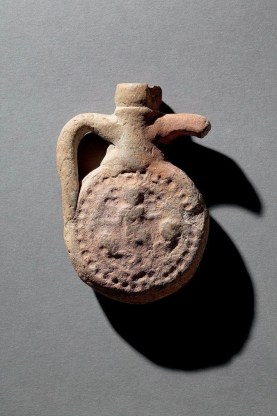
Another cavalryman is depicted on a scene that has lost its inscription, other than the letters DM (Dis Manibus) (RIB 550).  It is very worn, and the top of the head and the hand (and whatever it is holding) are missing but the scene is full of energy.  The horse, with its bridle and a blanket serving as a saddle clearly visible, is galloping with its mane blown back, and the rider’s legs hold tightly to its flanks.  The rider’s right arm is raised above his head, probably holding a spear, whilst his left hand, hidden from view, holds the rein or the bridle.  Trodden beneath the hooves of the horse is a naked victim who lies gripping a six-sided shield that has demonstrably failed to protect him.

Marcus Aurelius Nepos and his wife. RIB 491

A rather more domestic scene is provided by Marcus Aurelius Nepos and his wife.  The stone is right at the rear of the exhibit, and the inscription is difficult to see (it was not particularly clearly engraved in the first place) and is confined to the left, beneath the figure of Marcus Aurelius, centurion of the XXth Legion Valera Victrix, who died aged 50 years old.  There is a space beneath the figure of his wife for an inscription, but for reasons unknown this was never added.  As it was she who commissioned the stone, she was clearly still alive when the carving was made and may have left the space for an inscription of her own when she herself died, but perhaps she died elsewhere.  Marcus Aurelius is bearded, carrying a staff and has a prominent belt, a cloak over his shoulders with a small brooch attached.  His wife is holding a cup, and lefts the hem of her dress with one hand to reveal the skirt beneath.  Not visible in the photograph is an engraving on the side that shows a mason’s hammer and set square and the words SVB ASCIA D[edicatum], meaning “dedicated under the axe,” perhaps a formula to deter vandals. The tombstone dates to the 3rd century AD.

RIB 560. Tombstone of the child slaves Atilianus, Antiatilianus and Protus

The tombstones with elaborate or contained scenes are plentiful, but are still a minority in the context of British funerary memorials, representing only the most wealthy purchasers. Some tombstones merely showed a little decorative work to accompany the text.  This example (RIB 560), although still very fine, was provided with ornamental features but no elaborate scene.  It was dedicated by a master to three young slaves.  It reads, in translation, “To the spirits of the departed, Atilianus and Antiatilianus, 10 years old; and Protus, 12 years old.  Pompeius Optatus their master had this made.”  It is possible that the 10 year olds were twins. Although the thought of slavery always sits uncomfortably in today’s world, it should not be forgotten that in a period when slavery was the norm, it was by no means uncommon for masters and slaves to develop relationships of mutual affection and respect.  Perhaps that is what we are seeing here.

sdffsa

Final Comments

Architectural detail showing a male gorgon, with four snakes emanating from each side of his head.

The tombstones described above represent only a a small sample of the total number of engraved stones preserved from Chester.  Of those that were not tombstones, some were pieces of altars and others were fragments of bigger pieces of architecture, many of which also came out the 19th century excavations in the Chester walls, some showing Roman deities.  They are out of the scope of this post but, do watch out for those too in the display if you visit the museum.

The tombstones are particularly evocative and hopefully the small sample provided here gives an idea of what sort of themes were common, and how people like to have themselves depicted.  Death in the Roman empire was an integral part of a soldier’s life, and in the military life of Chester, death had its own role and its own places, with its own objects and iconography.  Most of the individuals represented here were of relatively high status, except for the slaves of their master Pompeius Optatus, but they came from a variety of backgrounds, all either stationed here or drawn here for commercial reasons by the military stronghold, and it is good to be able to see some of the variety that made up Deva society.

19th century illustrations from Chester Archaeological Society reports of the tombstones and other engraved stones excavated from the walls (click image to enlarge). Sources, left to right: de Gray Birch 1887, Watkin 1887, de Gray Birch 1888, Jones 1887, all in the Journal of the Chester Archaeological Society volume 2 (references below).

fdfsdfsd
For those who are interested in seeing something of Rome under foot in Chester, to supplement what can be found in museums, there are a number of guided tours available (some lead by Roman Centurions!).  If you prefer a self-guided tour, the Royal Geographic Society’s “Discovering Britain” website provides one, which can be downloaded as a a PDF or as an app for your mobile device: https://www.discoveringbritain.org/activities/north-west-england/trails/chester-trail.html.


Sources:

Those that were of particular use for this post are shown in bold

Books and papers

Allason-Jones, L. 2012.  Chapter 34, Women in Roman Britain. In (eds.) James, S.L. and Dillon, S. A Companion to Women in the Ancient World. Wiley

Bell, C.E. 2020. Investigating the Autonomy of Power: Epigraphy of Women in Roman Britain. Dissertation Submitted for the Master’s Degree in Archaeology, University of Liverpool
https://www.academia.edu/44879704/Investigating_the_Autonomy_of_Power_Epigraphy_of_Women_in_Roman_Britain

Brock, E. P Loftus. 1888) The age of the walls of Chester, with references to recent discussions; The discussion on the above paper; Mr Brock’s reply to the various speakers. Journal of the Chester Archaeological Society 2. Vol 2, p. 40-97.
https://archaeologydataservice.ac.uk/archiveDS/archiveDownload?t=arch-2910-1/dissemination/pdf/JCAS_ns_002/JCAS_ns_002_040-097.pdf

Cox, E.W. 1891. Notes on the sculptures of the Roman monuments recently found in Chester. The Historic Society of Lancashire and Cheshire, vols.43044, 1891-92, p.91-102

Eckardt, H. 2014. Objects and Identities. Roman Britain and the North-Western Provinces.  Oxford University Press

de Gray Birch, W. 1888. Notes on a sculptured stone recently found in the North Wall of the city of Chester. Journal of the Chester Archaeological Society 2. Vol 2, p. 25-39.
https://archaeologydataservice.ac.uk/archiveDS/archiveDownload?t=arch-2910-1/dissemination/pdf/JCAS_ns_002/JCAS_ns_002_025-039.pdf

de Grey Birch, W. 1888. The inscribed Roman stones recently found at Chester, during the second series of repairs to the North Wall.  Journal of the Chester Archaeological Society, vol.2, p. 98-131.
https://archaeologydataservice.ac.uk/archiveDS/archiveDownload?t=arch-2910-1/dissemination/pdf/JCAS_ns_002/JCAS_ns_002_098-131.pdf

Grosvenor Museum 2010. A Guide to Roman Stones at the Grosvenor Museum Chester. Illustrations by Dai Owen.

Henig, M. 2002.  Tales from the Tomb. In (ed.) Carrington, P.  Deva Victrix; Roman Chester Re-Assessed  papers from a weekend conference held at Chester College 3-5 September 1999.  Chester Archaeology
https://archaeologydataservice.ac.uk/archiveDS/archiveDownload?t=arch-2910-1/dissemination/pdf/CAS_DevaVictrix/CAS_DevaVictrix_075-078.pdf

Jones, I. Matthews. 1888. Official report on the discoveries of Roman remains at Chester, during the first repairs to the North Wall, in 1887. Journal of the Chester Archaeological Society 2. Vol 2, p. 1-10.
https://archaeologydataservice.ac.uk/archiveDS/archiveDownload?t=arch-2910-1/dissemination/pdf/JCAS_ns_002/JCAS_ns_002_001-010.pdf

Mason, D.J.P. 2007 (2nd edition). Roman Chester. City of the Eagles. Tempus

Thompson Watkin, W. T. 1888. The Roman inscriptions discovered at Chester, during the first repairs to the North Wall, in 1887. Journal of the Chester Archaeological Society 2. Vol 2, p.11-24.
https://archaeologydataservice.ac.uk/archiveDS/archiveDownload?t=arch-2910-1/dissemination/pdf/JCAS_ns_002/JCAS_ns_002_011-024.pdf

Wilding, R. 2006. Graham Webster Gallery of Roman Stones at the Grosvenor Museum, Chester: Explore the Hidden Mysteries of the ‘lost’ Roman Gravestones.


Websites

Roman Inscriptions of Britain (RIB)
https://romaninscriptionsofbritain.org/

Chester Archaeological Society
Professor Robert Newstead F. R. S. Lecture given to Chester Archaeological Society, 5th December 2009.  By Elizabeth Royles, Keeper of Early History, Grosvenor Museum
http://chesterarchaeolsoc.org.uk/wp-content/uploads/2016/11/LRoyles-NewsteadLecture_05-12-09.pdf

Roman Baths
You can decode tombstones at the Roman Baths, Bath
https://www.romanbaths.co.uk/sites/roman_baths/files/heritage/SECONDARY%20SCHOOL%20Decoding%20Roman%20tombstone%20leaflet_0.pdf

Encylopedia Britannica
“Sarmatian.” The Editors of Encyclopaedia, 29 Mar. 2018. https://www.britannica.com/topic/Sarmatian