Category Archives: Chester

Chester in art in two exhibitions at the Grosvenor Museum: George Cuitt and Louise Rayner


Two versions of Bishop Lloyd’s Palace on Watergate Street. On the left George Cuitt and on the right Louise Rayner


Lower Bridge Street looking south. Louise Rayner

There are two exhibitions running concurrently in the Grosvenor Museum in Chester, both showing highly individual interpretations of Chester’s architecture.  The first, The Romance of Ruins – the Etchings of George Cuitt (Gallery 1 on the ground floor, accessible to wheelchair users) runs until 12 January 2025.  The second, Louise Rayner: Victorian Watercolours (Gallery 2, upstairs with no lift) runs until 9 February 2025. Both came from artistic families.  Cuitt (1779-1854) was the only son of painter George Cuit the Elder, becoming an art teacher in Chester, and Rayner’s (1832-1924) parents and several of her siblings were also artists. Cuitt added a second “t” to his surname to distinguish himself from his father.  If you visit both exhibitions at the same time, the most obvious contrast is that George Cuitt’s etchings are monochrome, whereas Louse Rayner’s watercolours are characterized by vivid colours, but in spite of the time differences between their work, and the chronological distance between them, there are a lot of similarities in their perceptions of Chester.  Both artists focus on detail, and both lean towards a picturesque and somewhat romanticized view of Chester, populated not merely by buildings but by a myriad of people and livestock.  Cuitt’s work is by its nature more linear and less impressionistic than Rayner’s, but both highlight key details of individual buildings, capturing much of the minutiae that makes Chester’s architecture so engaging, and the skills demonstrated by both are well-honed.  Rayner makes particularly good use of perspective to draw her viewers into her paintings.  Although this was not always a feature of Cuitt’s work, a particularly nice view of the cathedral cloister uses the same technique.

The Cloisters, Chester Cathedral, 1811. George Cuitt

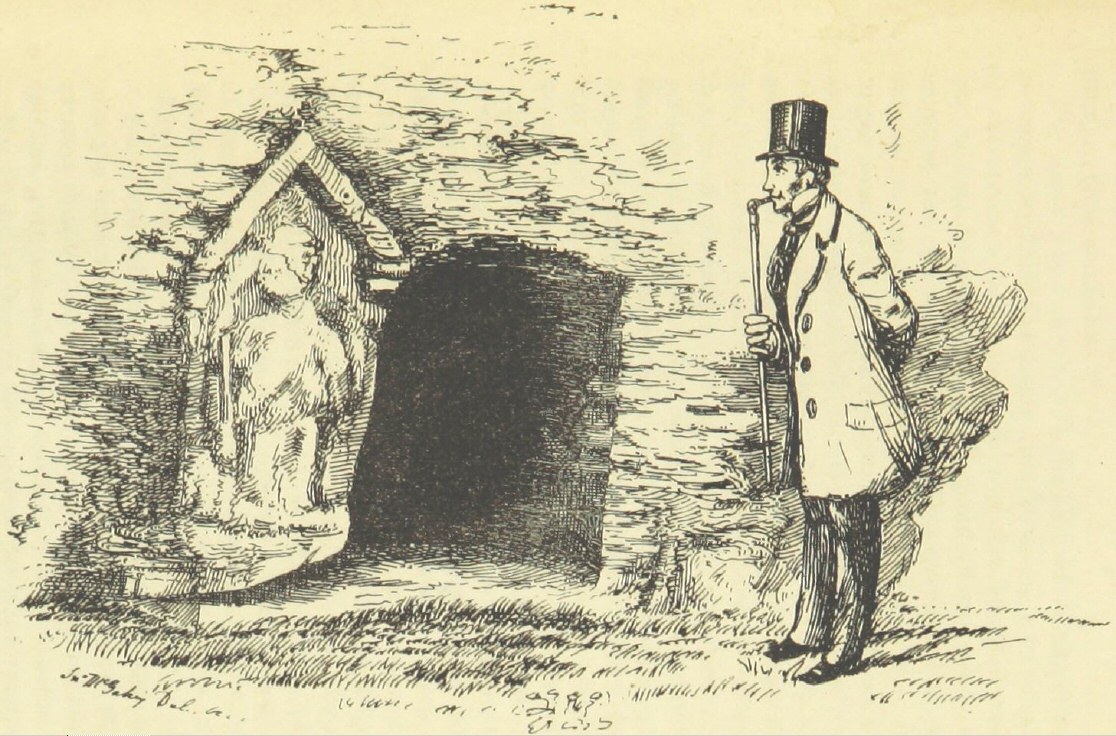
Quite apart from their value as artistic interpretations of Chester, both the Cuitt and Rayner exhibitions provide insights into architectural details that no longer survive, lending themselves to historical research as well as art appreciation.  From Cuitt’s portfolio, an 1827 view through a ruined arch towards Chester Castle captures a surviving in situ feature of the medieval St Mary’s Benedictine Nunnery.  It is entitled “Chester Castle from the Nun’s Gardens,” (shown below)  It is also a nice juxtaposition of two contrasting architectural styles, and two equally contrasting states of preservation.  The arch has been moved to Grosvenor Park, where it is accompanied by other orphaned pieces of gothic architecture.  Another of his etchings shows the cloisters before the windows were added.  Louise Rayner’s corpus has provide a great many examples of buildings that are no longer standing, but I found the one showing St Werburgh’s Mount of particular interest, shown below, where St Werburgh Row, is now located.  Her painting of Lower Bridge Street is an eye opener, shown above, looking towards the Dee with some lovely buildings now demolished and replaced by a 1960s monstrosity, and the Harvie’s almshouses, also below, must have been a very attractive feature.

St Werburgh’s Mount, c.1873. Louise Rayner

Both exhibitions provide full information about both artists, providing insights into the influences acting on their work and how their careers developed.  The pictures displayed have been chosen to highlight not only how they each interpreted Chester but how their skills have been applied to such a rich subject matter.

Find details about opening hours and other visiting details on the Grosvenor Museum website.

View from St Mary’s Nunnery arch to Chester Castle, 1827. George Cuitt

Harvie’s Almshouses, Duke Street. Built 1692, demolished 1892

St Michael’s Church Porch, 1809. George Cuitt

The King Charles Tower and the Shropshire Union Canal. Louise Rayner


Exhibition in Chester Cathedral: “Trena Cox: Reflections 100”

Introduction

The new exhibition at Chester Cathedral, Trena Cox: Reflections 100, which is on until the 8th November 2024, a scarily short window of opportunity for visitors, has pulled out all the stops to create a really imaginative  and absorbing examination of stained glass artist Trena Cox and an exploration of her legacy in more recent art works.

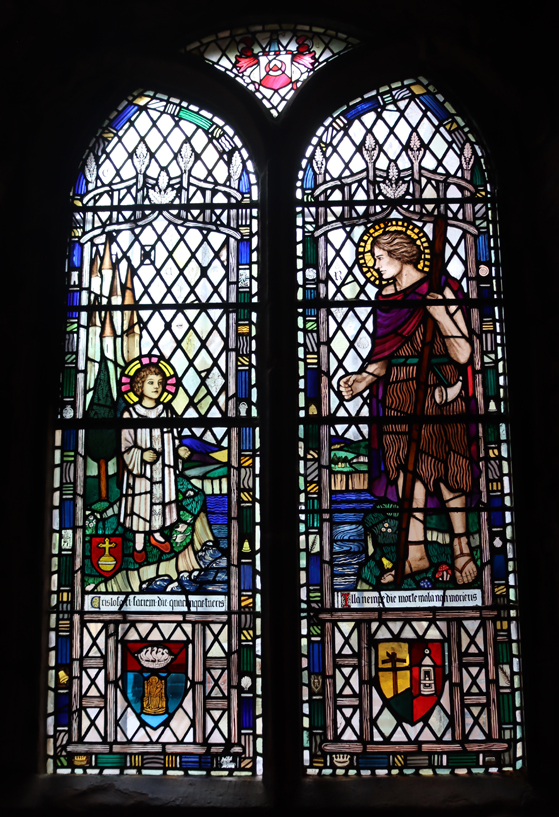
First, it was a new opportunity to learn more about an important local stained glass artist, a woman engaged in a form of art-craft that was usually the preserve of men.  She is, for example, one of only two female stained glass artists represented in the cathedral, and she has nine windows, one large (the St Christopher window in the slype shown below) and eight small ones in the cloisters (four of which are shown further down).
To appeal to different preferences for experiencing exhibitions, there are downloadable audio guides, online information sources via QR codes and real-world interactive screens, as well as beautifully designed and displayed posters and original works of art employing diverse materials in multiple styles.

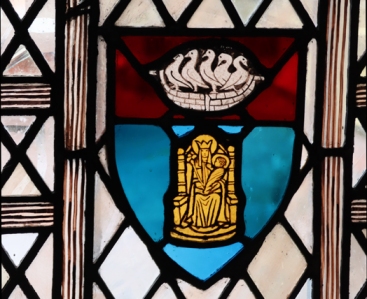
Detail of Emily Lawler’s “Flock of Five Geese.” The entire composition, referencing the story of St Werburgh and her miracle, is shown below.

Second, it was terrific to see how the four different parts of the exhibition explored different aspects of Trena Cox’s legacy, because this is as much about the art and ideas that Trena inspired as it is about her own work.  In addition to  well known artists in different types of medium, the pre-exhibition project headed out into the community to involved different groups, including school children.  The sheer diversity of responses to Trena’s work is remarkable, many of them picking up not on the main themes of her work, but on the tiny details that make her work unique.

Third, it was fascinating to discover how the entire cathedral was employed in displaying the works on display, drawing visitors into different areas of the cathedral to experience new ideas in a medieval context.  The abbey has small, intimate spaces as well as large lofty ones, and the trail makes good use of the architecture.  By using the entire cathedral space, the art works could be separated, giving each one the opportunity to create its own impact.

The St Christopher window following restoration. Photograph by Helen Anderson (and copyright Helen Anderson)

Next, it was splendid to experience at first hand how beautifully the St Christopher window has been restored by Recclesia.  I attended a Chester Archaeological Society visit, lead by Artist in Residence Aleta Doran who is also the exhibition’s curator, and although thought it was stunning then, it has since been restored and it was fabulous to see not only how it has been repaired and restored, but how new details have been revealed.  This can be seen in the window itself, but is also the subject of a splendid video in the cloister that captures the work carried out.

Finally, I was with artist Helen Anderson, and we were given an informal tour of the exhibition by its curator, Artist in Residence Aleta Doran, who is always a joy for her knowledge and enthusiasm, which provided us with a terrific insight into how the entire exhibition came into being, a real learning curve into what it takes to pull together an exhibition that has so many aspects to it.  A real logistical tour de force, as well as a visual treat.
===

Finding your way

The exhibition is grouped into four different sections, each exploring a different aspect of Trena’s legacy.  As you enter the cloisters from the reception area (free of charge at this time of year), there is an information board that points you to the left, but pause to investigate as it also has QR codes, one of which is a map of the route that you can download to your phone, another an audio guide that relates to the numbered posters and exhibits.

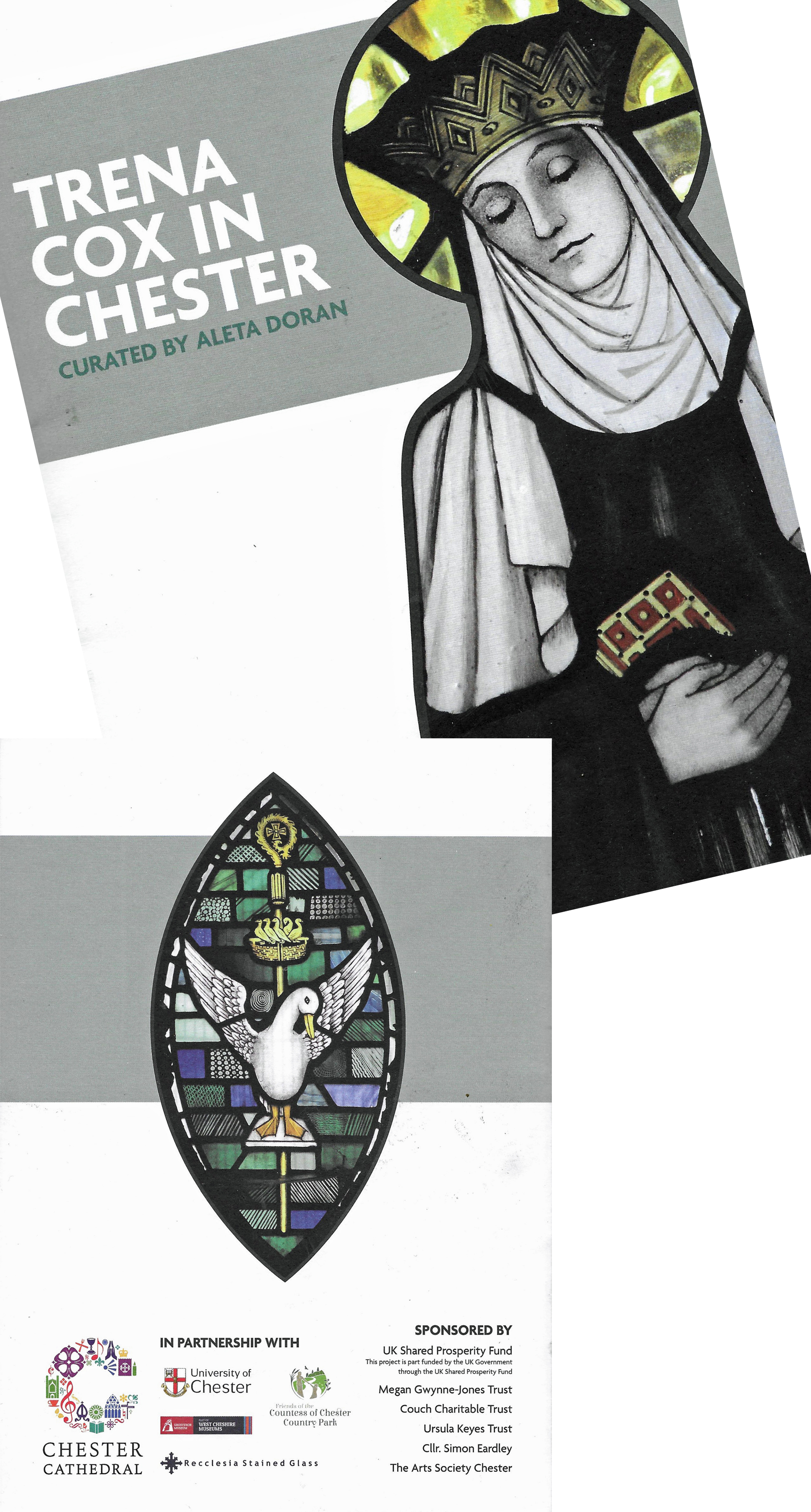
Don’t forget to pick up the booklet, the cover of which is shown at the top of the post, from the reception area.  There is some very useful information about the exhibition, its contributors and its partners and sponsors, as well as QR codes to more information online.

Learning about Trena Cox

The first part of the exhibition introduces the visitor to Trena Cox (1895-1980) using, depending on whether you downloaded the audio introduction, either posters or a combination of posters and Aleta’s audio tour.   The posters are beautifully designed, framed in slender black frames that emulate the leaded frames of stained glass, showing photographs of Trena Cox glass from many locations, accompanied by isolated motifs taken from her glass works. The only known photograph of her was taken when she was a young teenager and shows a direct gaze and a certain fearlessness.

Born on the Wirral, Trena Cox trained at the Laird School of Art in Birkenhead, receiving a traditional introduction to a broad range of techniques and skills before switching to stained glass. There are over 150 stained glass pieces known, but others may remain to be found.  Working mainly in the Cheshire and northeast Wales areas, her works are, however, in other areas, and most of them are in churches.  Trena’s story, which has sometimes been a challenge for Aleta to discover, emerges from both the posters and the audio track and demonstrates not only Trena’s talent but her willingness to modify her style to suit the times.

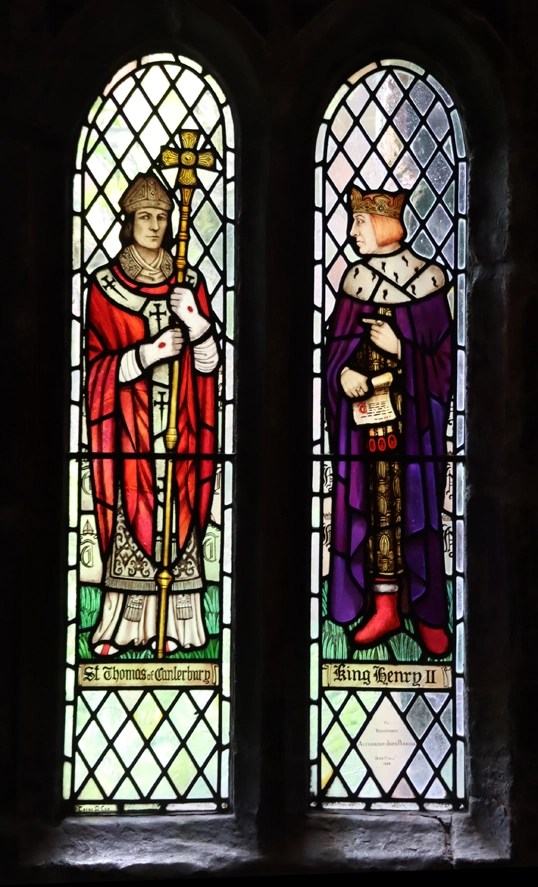
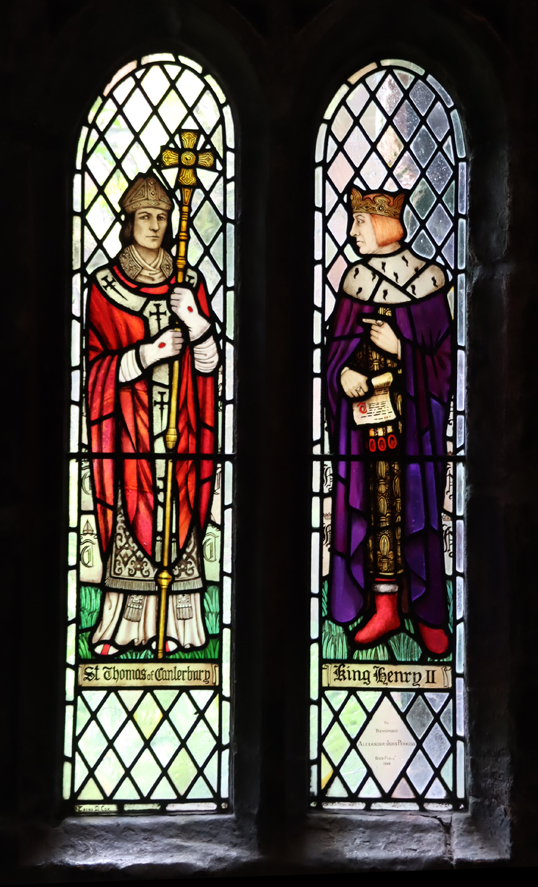
Trena Cox windows showing King Henry II on the right looking somewhat balefully toward Thomas Becket on the left

Trena Cox’s cathedral windows are an important part of the the exhibition and the route takes you first to those in the cloister (the walkway around the garden).  The cloister was windowless until the arrival at the cathedral of Dean Frank Bennett, whose energy and enthusiasm created the stained glass sensation that we see today.  Eight of Trena’s windows are small lights each side of a corner, in each case two above and two below.  My favourites are the paired Henry II and Thomas Becket of Canterbury.  There are other connections to St Thomas Becket within the cathedral, but what I particularly like about these two windows is the way that Henry looks out of his window towards Becket in his window, recreating something of the narrative of this impossibly difficult relationship, which resulted in the martyrdom of Becket, and a period of political difficulty for Henry II.  You can almost hear Henry thinking “Will no-one rid me of this meddlesome priest?” (almost certainly apocryphal). There is a QR code on one of the information boards for finding out more about all of the cloister windows on the Chester Cathedral website.

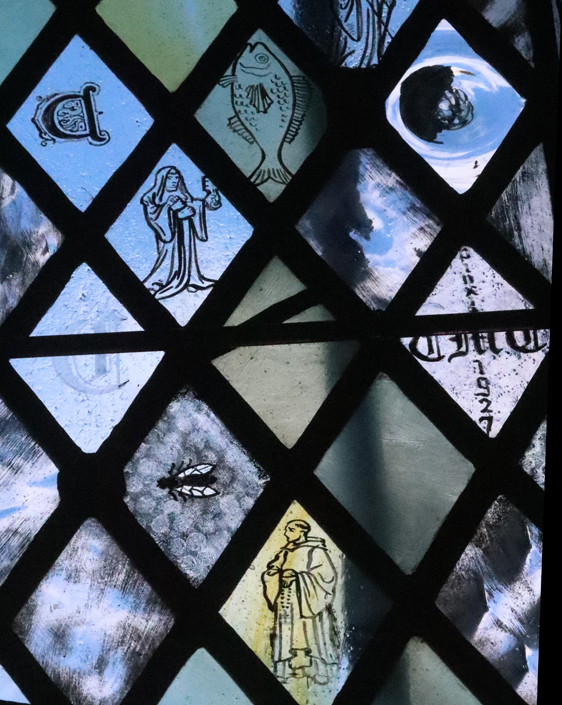
Detail of the St Christopher window shown at the end of the post, with Trena Cox’s signature and the bee surrounded by a pattern made of her fingerprints.

The recent restoration and professional cleaning of the main Trena Cox window in the cathedral, the St Christopher window in the slype, has returned from Recclesia with a glowing, incandescent and luminescent quality that is quite extraordinary.  Whether or not this is your sort of aesthetic, this is an extraordinary piece with charming details full of symbolism.  Minutiae that were not previously visible are now bright and sharp, and the richness of the entire composition can now be appreciated as Trena Cox first designed it.  I particularly melted at how Trena’s fingerprints were incorporated into a pattern around the bee in the window.  It was also revealed that the lead was used to create texture and relief at certain points, with St Christopher’s remarkable hair not merely painted on, but highlighted with sections of lead.  There is an interactive display in the slype (corridor) next to the window which allows you to explore the imagery and symbolism of the window, which are extensive, and this really helps to open up the secondary stories.

Video showing the skilled work carried out on the St Christopher window by Recclesia Stained Glass

A video in the cloisters describes how the restoration work was carried out.  It shows footage of the team at work, including the absolutely nail-biting process of putting the window back into its arches after restoration.  Aleta says that it was just as bad watching it being taken out, but somehow the sense of being at the finishing line after all that hard work was horribly tense even on a video!  But of course these people are experts and everything was fine.  Microscope analysis of the stained glass shows how in one section of the glass, which had become damaged simply due to its age, the edges of some of the painted text had begun to deteriorate, so the restoration work was incredibly timely.

Trena Cox in today’s Community

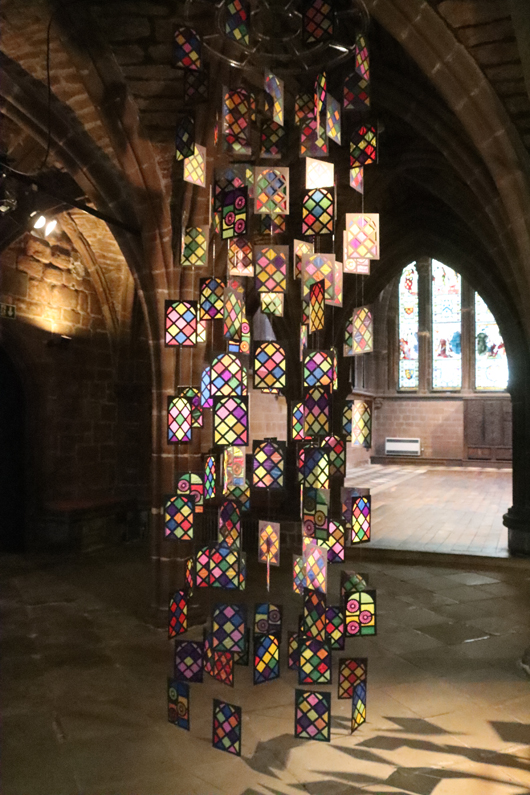
One of the really creative parts of the exhibition, and an admirable requirement for a part of the funding for the exhibition, was that the local community should be given the opportunity to respond to Trena Cox’s stained glass art with art works of its own.  I knew about this when I visited the Trena Cox windows with the Chester Archaeological Society, lead by Aleta, but was not at all clear about how this part of the project would manifest itself.  What a super surprise to see the inventiveness and imagination produced by local community groups and schools!  Here are some examples:

St Werburgh’s and St Columba’s Primary School

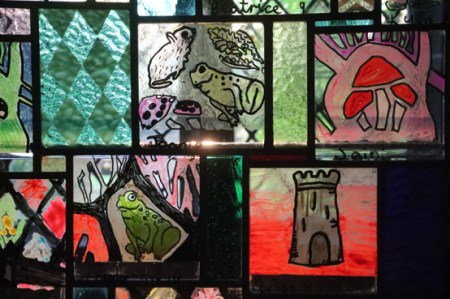
Heritage Engagement Window. During the 2024 Chester Heritage Festival in June, children as young as two years old painted panels that were incorporated into this splendid leaded panel, all based on the St Christopher window

Detail of the above Heritage Engagement Window.

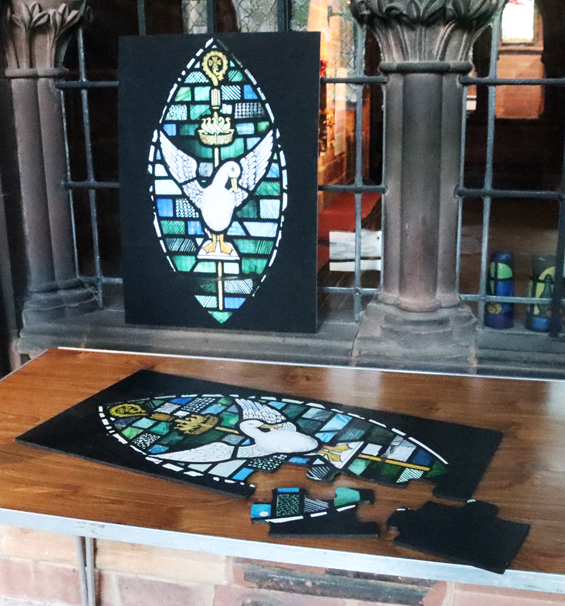
Jigsaw, a community artwork based on a Trena Cox window in St Werburgh’s Church, by 15 women of Chester

The Story of Stained Glass

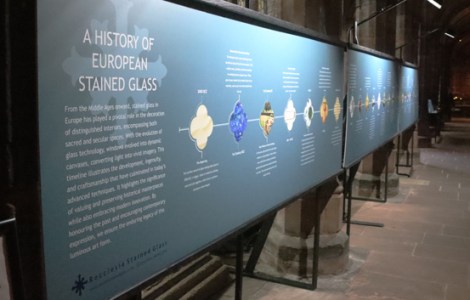
The creation of stained glass is probably one of the most poorly understood areas of art, craft and design.  Although it is widespread, and not only in religious buildings, its history and the processes of manufacture and repair are something of a mystery for most of us.  The process of demystification has been very much assisted by an enormous but easily digested set of information boards that lead down one part of the cloister, charting the chronological history of the artistic and technical advances in stained glass development. It’s a real revelation and is beautifully written and designed.

Artistic responses to Trena Cox

In Our Hands by April Pebble Owens.

How current artists have responded to Trena Cox is one of the innovative aspects of the exhibition, not only helping to highlight some of the unique features of the original stained glass creations, but also inspiring and forging new creations.  These new works of art, some in glass, others in paint and fabric, others engraved, some in mosaic, some in print, certainly demonstrate a wide range of skills but more importantly showcase the diversity of creative and empathetic responses to Trena Cox’s enormous catalogue of artistic expression.  I have copied a few of these below, chosen simply to show some of the range of different ideas and interpretations that emerged.  In the exhibition accompanying labels explain some of the ideas behind these works, one of which is shown below.

Tamsin Abbot. The Wolf Shall Dwell with the Lamb

Label explaining ideas behind the above panel by Tamsin Abbott. Each of the pieces on display in the exhibition is accompanied by a similar piece of explanatory text

By the River of Swirling Eddies by Linda Edwards, reminiscent of medieval bestiaries

Flock of Five Geese, by Emily Lawlor

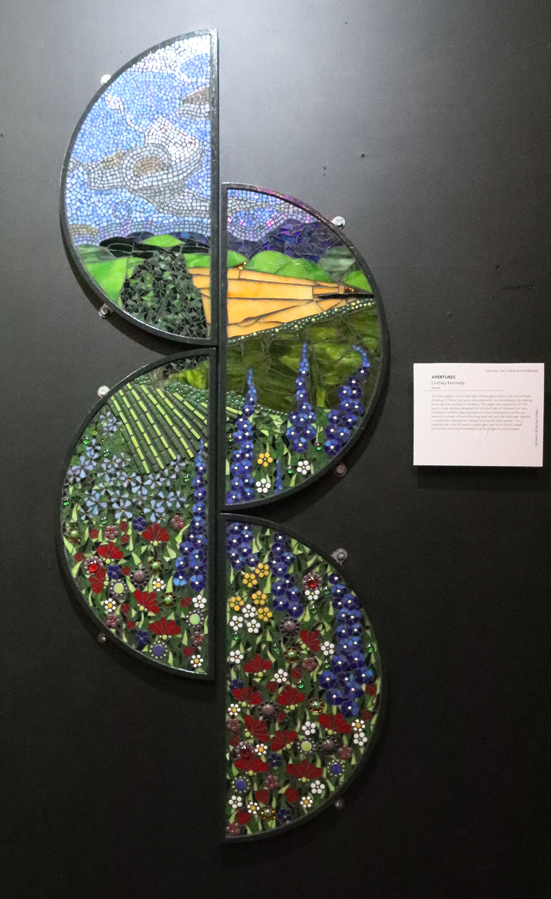
Apertures, by Lindsey Kennedy

Birds Without Borders by Gillian Curry

Final Thoughts

Detail of the St Christopher window

The idea for the exhibition was born around four years ago.  Work has been concentrated in the last two years.  There are so many different aspects to it that there it is difficult to do justice to it, but as a celebration of Trena Cox, of stained glass, and of how communities as well as individual artists can respond to an artist’s output, this was a revelation.   Even more than the work of Trena Cox herself, I found the whole conceptualization of the exhibition with its multiple strands of knowledge transfer, and its outreach to the local community and other artists, truly engaging.

The exhibition works, and it works brilliantly.  This was demonstrated perhaps more than anything else by the two elderly ladies who walked around it, arm in arm, discussing in depth all the modern responses to Trena Cox’s work.  Neither knew much about art, but both were fully absorbed with the narrative of the exhibition, from Trena Cox herself to the evidence of her legacy.  Splendid.

Detail of the newly restored St Christopher Window

Find out more

Detail of the Heritage Engagement Window

There is a “Trena Cox:Reflections 100” symposium, which has been arranged to coincide with the exhibition, on 25th October 2024:

“Using the life and legacy of Trena Cox as the focal point, attendees will hear from a variety of respected speakers from across the stained glass, heritage conservation, and art sectors. This evening keynote will conclude the day, looking at the past and future of women in stained glass.”

You can find details for the symposium on the Chester Cathedral website at:
https://chestercathedral.com/events/event/21607

You can follow Aleta Doran on Twitter (@StargazingAleta), or via her blog at https://www.aletadoran.co.uk/. 

For those wishing to investigate further afield, Green Badge Guide Katie Crowther is leading a “Trena Cox:Reflections 100” walking tour of Chester on 3rd November to complement the exhibition:

This walk will be a chance to get out onto the streets of the city where Trena lived and worked from 1924 until her death in 1980. We’ll take a look at some of the buildings where her distinctive work can be seen today and learn more of their history.  Trena was a passionate advocate for the preservation of her adopted home’s history and heritage. Along the walk, we’ll consider several of the streetscapes that changed quite dramatically during Trena’s time in Chester.
https://www.eventbrite.co.uk/e/trena-cox-reflections-100-chester-sunday-netwalk-tickets-1013497697897?utm-campaign=social&utm-content=attendeeshare&utm-medium=discovery&utm-term=listing&utm-source=wsa&aff=ebdsshwebmobile

The free booklet provided at the reception area also provides the following QR codes for those who want to find out more:

===

Websites with more information:

Chester Cathedral
Trena Cox: Reflections 100
https://chestercathedral.com/events/event/15207

The Trena Cox Project
By Aleta Doran, ongoing
https://www.aletadoran.co.uk/thetrenacoxproject

Recclesia Ltd
https://recclesia.com/
https://recclesiastainedglass.co.uk/

Chester Archaeological Society
An Interview with Chester Cathedral Artist in Residence Aleta Doran. For CAS, by Andie Byrnes, 7th July 2024
https://chesterarchaeolsociety.blog/2024/07/07/an-interview-with-chester-cathedral-artist-in-residence-aleta-doran/
Chester Archaeological Society visit to Chester Cathedral with Aleta Doran to learn about stained glass artist Trena Cox. For CAS, by Andie Byrnes June 13th 2024
https://chesterarchaeolsociety.blog/2024/06/13/our-visit-to-chester-cathedral-with-aleta-doran-to-learn-about-stained-glass-artist-trena-cox/

Based In Churton
A roof boss in Chester Cathedral: The Murder of Thomas Becket
https://basedinchurton.co.uk/2023/07/14/a-ceiling-boss-in-chester-cathedral-the-murder-of-thomas-becket/

Overleigh Cemetery Self-Guided Geodiversity Tour

Many, many thanks to Paul Woods (Chester Green Badge Guide who leads the cemetery tour Stories in Stone) for sending me the scans of this leaflet by Cheshire RIGS and the Northwest Geodiversity Partnership, apparently published in 2012.  It looks at the most common types of stone used, gives some geological details about it, and discusses how some of it responds to environmental conditions.  I’ve shared the JPEGs below but I have also turned it into a PDF that you can download by clicking here.  I cannot wait to take it for a test drive!

Overleigh Cemetery, Chester #2 – The living, the dead and the visitor

In part 1 of this series on Overleigh Cemetery the economic background to Overleigh Old Cemetery was introduced briefly, and details of the reasons and execution of the foundation of Overleigh Old and New Cemeteries were discussed.  Here, in part 2, both Overleigh Old and New Cemeteries are explored in a little more depth.  There are a great many components that contribute to how a gravestone looks, what it says, and what it meant to the bereaved.  Between the sculptural forms, the symbols used on headstones and the inscriptions, as well as the design of the the cemetery itself and the ways in which it evolved and was used and perceived at different times in the past, Overleigh has a lot to contribute to how we think about Chester and its occupants.

Eliza Margaret Wall, died 1899, aged 30. Other family members were added in future years up to 1936

As a starting point, it is useful to look at who the main users of the cemetery were and are, both living and deceased, before moving on to a general guide to what to look out for if you are a visitor interested in learning about what the cemetery has to offer.

As in part 1, where I have included a photograph of a grave and there is information about it on the Find A Grave website, I have added a link.  For anyone using the database for their own investigations, note that Find A Grave treats Overleigh Old and New cemeteries as two different entities and you have to search under the correct one.

I have stuffed this full of photographs to help explain some of my points, so Part 2 looks bigger than it actually is.  You can click on any of the images to see a bigger version.

With many thanks again to Christine Kemp (Friends of Overleigh Cemetery) for her much-appreciated ongoing help.
====

People

Graves represent people, the living and the dead, both entangled in the complexities of funerary rites.

The bereaved

A funeral at Overleigh Old Cemetery. Detail of 19th century engraving of Overleigh Cemetery. Source: Wikipedia

Although this post is about a burial ground and its graves, funerary traditions and practices are all as much, if not infinitely more, about the living.  The need to recognize and commemorate loss, not merely at the funeral but prior to it and after it are essential to people, even today when the traumas associated with death tend to be handled in more internalized ways than in the pre-war periods.

Gravestone of Geoffrey Mascie Taylor, died 1879. If anyone has any idea what the symbol represents at the top of the gravestone, please let me know.

During the Victorian period there was an elaborate process of marking a death, a tradition of precise convention and ritual, expressed both within the family and communally.  When someone dies the living are left behind to handle a loss as best they can, and cemeteries and memorials are only one one part of that process.   The end to end process from death to mourning is all a part of the Victorian experience of bereavement.  Visiting and tending the grave, bringing flowers for the deceased, was part of this process, in which women had a key role, and demonstrating bereavement in public essentially brought the grave into the domestic sphere.  Several of the books listed in the references, go into some detail about the Victorian expressions of mourning, and books by James Stevens Curl in 1972 and Judith Flanders in her recent overview provide great insights, but if you want a much shorter book with a still very comprehensive and well written overview, Helen Frisby’s Traditions of Death and Burial offers an excellent overview of Victorian and later bereavement ceremonies.

John Owens JP, died 1853, age 72.  “A Merciful Man Whose /
Righteousness Shall / Not Be Forgotten.” There are no additional inscriptions on this impressive headstone

In the Victorian period it has been argued that the lead-up to a funeral, the funeral itself and its aftermath were all components of an intention to promote social status, wealth and the knowledge of and participation in deeply embedded social conventions that specified in detail how death should be handled and how mourning should take place.  The Industrial Revolution had created a new type of middle class, many of whom were making livings based on manufacturing and commerce, as well as roles in the growing legal, medical, administrative, banking, and similar sectors. Even though there were more opportunities for social mobility, and the ability for individuals to define themselves in new terms, the aristocracy still provided a model for those with social ambitions.  Conspicuous displays of personal and family identity and wealth had become fundamentally important in this need to establish a dignified and self-important identity at a location between the upper and working classes. It was also important for the lower middle classes to distinguish themselves from those who were less financially robust, doing what was perceived as more menial work, defining themselves as socially distinct from the working class. Hierarchy, with all its subtleties during the Victorian period, was important, deeply-felt, and complex, and much of this is reflected in funerary rituals.
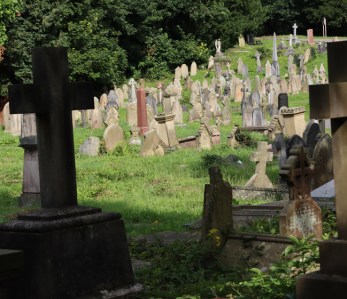
More recently it has also been recognized that elaborate Victorian and early Edwardian funerary ceremonies were not merely social devices but reflected the great trauma associated with loss in a world where medicine was in its infancy and where where the middle class was defining itself within often smaller families than previously.  Sickness and death could be both frequent by comparison to today, and was often profoundly distressing.  At the same time, sanitation and health were slowly improving in the second half of the century, meaning that once childbirth and infancy had been survived, people physically lasted longer than they had done in the past, building relationships but more frequently succumbing to old-age problems, becoming invalids who were cared for within the home.  National and community diseases were frequent, some of them long-lasting, and the role of women in nursing their relatives became increasingly important where professional standards of nursing were, just as much as the professionalization of medicine, in their earliest incarnation.  Middle class family ties, and the Victorian and Edwardian sense of moral responsibility to relatives, ensured that sickness was a very frequent component of family life.

TThe monumental grave shrine of Henry Raikes, died 1854, aged 72, Chancellor of the Chester Diocese and one of the founders of the Chester “Ragged Schools.” Overleigh Old Cemetery..

Relatively recent research has also suggested that working class people felt no less strongly about the loss of their partners, siblings and children.  Many working class families were crowded into insanitary areas all over in Britain, and notable areas have been identified in Chester, forcing people into much closer proximity, and this promoted the transmission of sickness and disease with a consequent cost in terms of poor health. Sickness was handled within families, which caused many problems in household management, where women frequently worked for a living, often in domestic capacities.  This resulted in the occasional recourse to a new breed of hospitals as well as a frequently dubious type of pre-professional paid nursing care. The ease of disease transmission meant that those living so close together and in such insanitary conditions were most at risk of epidemics, and the mortality rate was much higher than in middle class households. There were clubs into which people could pay a subscription to save up for funerals, just as there were clubs to save up for Christmas, and there are several pauper graves at Overleigh. But for some the costs were too high, so many graves were unmarked, and the grief of some families was never recorded meaning that these losses are not captured.
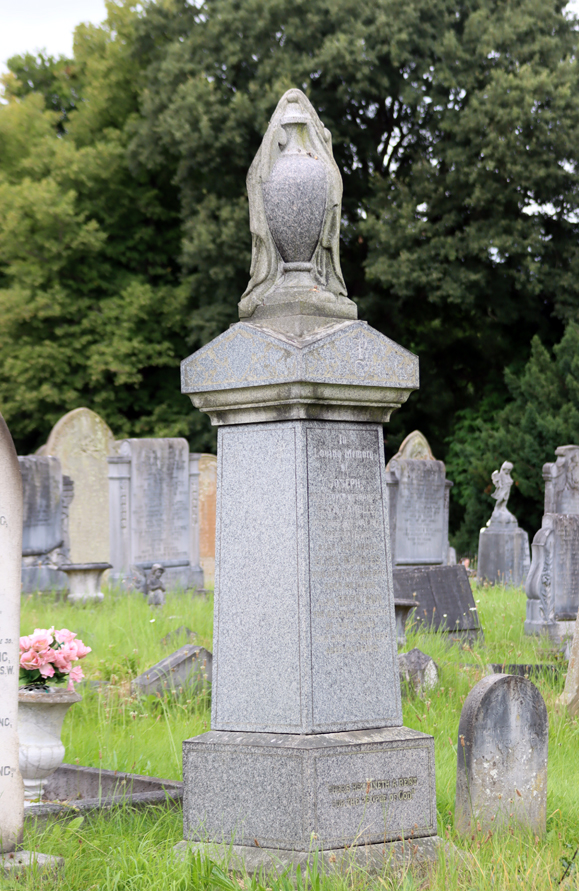
The monument for Joseph Randles, died 1917, aged 65-66. Note the partially veiled urn, which will be mentioned later.

It is easy to forget that until the NHS was established in 1948, most people still died at home rather than in hospitals, hospices or nursing homes, and that families housed the deceased, until burial, within their homes, and those deceased, laid out in front parlours in their coffins, were visited by friends and families.  The introduction of the funerary Chapel of Rest in the later Victorian period helped to reduce the time when the deceased remained in the house, but it was still a common part of a death that the dead remained amongst the living until the funeral well into the 20th century.

The focus on ceremony and ritual altered over time, with a considerable change of direction from the elaborate ceremonies of the Victorians to the minimalist approaches taken today. This does not mean a growth of indifference to death, but it does indicate changes within society. The beginnings of this are to be found in the Edwardian period, particularly during and after the First World War, when the nation’s horses that traditionally pulled hearses were required for the war effort. Funerals became even less demonstrative after World War 2.  This will be discussed a little more in Part 3.

On this Armstrong family cenotaph and headstone in the Overleigh New Cemetery, three sons predeceased their parents aged 32 in 1917, 22 in 1918, and 39 in 1927, the first two of them at war, all of which must have been a shocking loss.  Their parents are commemorated here too.

In the cemetery itself, the most obvious incorporation of gravestones into the world of the living is the highly visible custom of flowers and other gifts having been left in front of a headstone.  Fresh flowers in particular give the sense of a grave being regularly tended but artificial flowers and other items also serve to mark the continued attention to a grave by those who wish to indicate their recognition and care.  My father, who was born in 1936 and grew up on the Wirral, says that when he was a small boy he was taken regularly to the graves of his relatives in Liverpool, where there was a flower shop outside the gates, and flowers were purchased, a visit was made to family graves, and a picnic was enjoyed nearby.  It was a visit of celebration, continuity and memory, a positive occasion.

The other most obvious indication of a gravestone continuing to have a role is the presence of multiple inscriptions on many memorials, as individual family members are lost and the living are compelled to update the inscriptions.  Many of these gravestones capture this passage of time and accumulated loss very effectively, telling long narratives of family loss, sometimes covering several decades, and suggesting multi-generational involvement with funerary activities and commemoration, the sense of a continuum between the past, the present and the potential future.

The Deceased

The deceased may seem to be passive and inanimate, but they have voices in at least three ways.  First, they may have had input into their own graves, including its location, its design and its use as a single plot or a family plot.   In this sense they are very much agents of their own burials.  Second, the very process of memorialization, whether by family or friends, gives the departed an enduring presence that lasts into the modern world, a very material presence.  Some of those who died may also have obituaries to be found in newspaper archives, and accounts of inquests into their deaths, filling out a much richer picture of former lives, and those who were in positions of influence will have had much more information captured in official documents and even preserved journals.  In this way they can contribute very significantly to modern research projects, as much as that may have surprised them.  Third, they occupy the living landscape of cemeteries, spaces that occupy often new places in modern life and that are valued today.  At Overleigh I have seen people walking from one end to the other pause to read an inscription, and dog walkers wandering around, pausing to take note of a particular grave.  The dead area still amongst the living, even when they are not even slightly connected today with their ancestors.  Those who care for their graves, and tours that bring visitors, all do their essential bit to keep the deceased amongst the living.
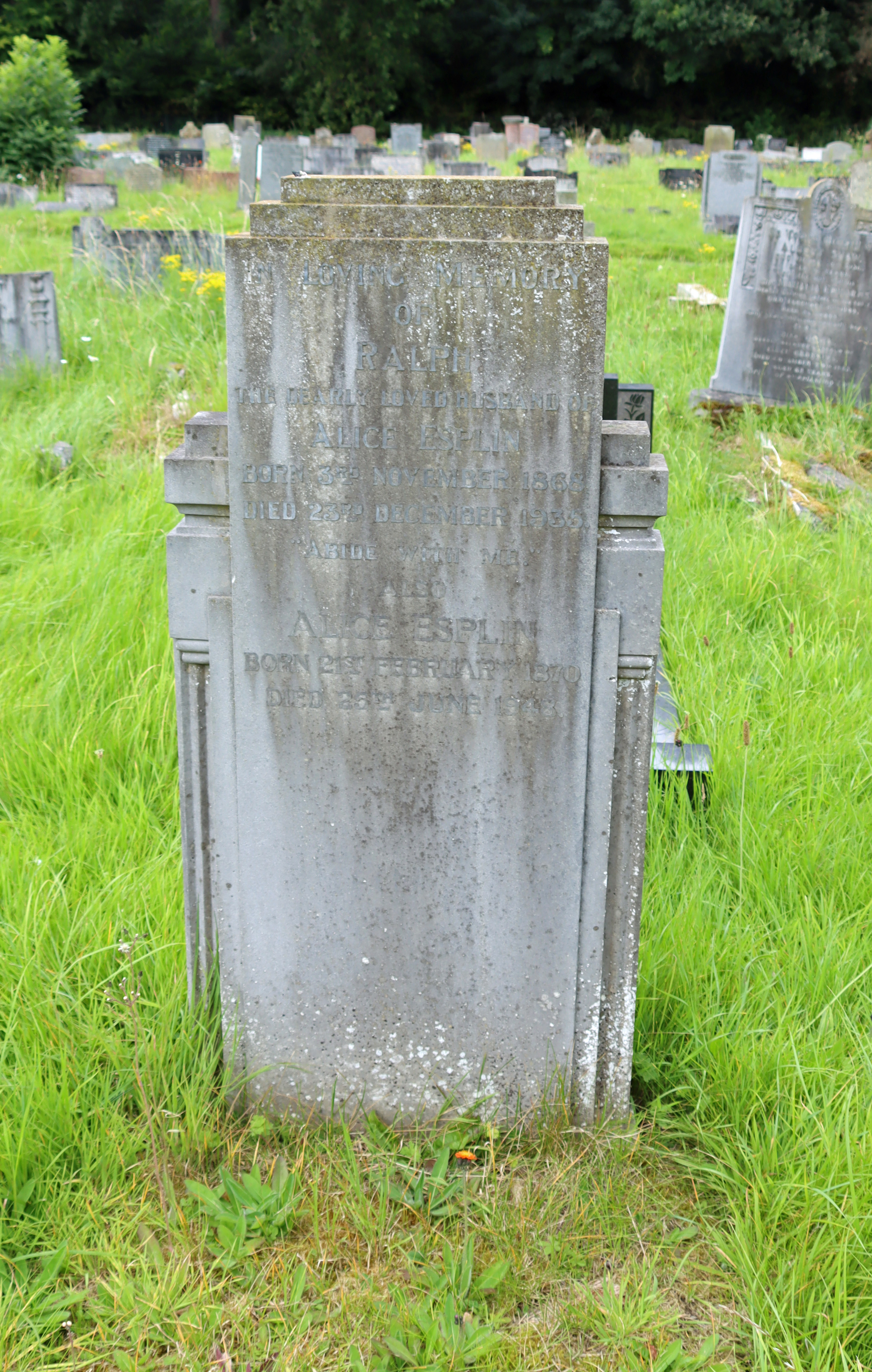
Art Deco style headstone of Ralph Esplin, died 1935, aged 67

It has been the experience of cemeteries since the beginning of the 17th century in Britain that graves are tended for perhaps three generations after which they fall out of use, as families move away or simply move on.  Genealogy makes some of them  briefly relevant, but the funerary landscape is a strange mixture of the abandoned and the perpetuated.  Local authorities and Friends societies contribute to the task of caring for abandoned graves, but this is a very different relationship from those that are still visited by family members.  In Victorian cemeteries, there is always a rather strange dynamic between the historical sections and those that are still the essence of loss, bereavement and and ongoing engagement.

The deceased in the early periods of the cemetery capture something of Chester’s evolving social, economic and cultural endeavors, as it attempted to secure its future and create a stable and prosperous community.  Those who are represented in the cemetery are largely those who were either already successful in establishing themselves within this community or were making the attempt to improve themselves and gain status; the unmarked pauper and cholera graves are amongst the hidden histories of Overleigh and of Chester itself.  There is time-depth here too, as we can track changes from 1848, when the Old cemetery was established, through the Edwardian period and both World Wars, and the changes during the post-war period up until the present day.  I have been learning how much work it takes to see beyond the sea of graves and to read history captured in the cemetery landscape and monuments, and it is all there to be found, the world of the dead contributing to an understanding of the transforming past and how society’s views on death and commemoration changed.  Parts 3 and 4 will go into this in more detail.
===

Visiting Overleigh for the first time – what to look out for

The central monument, in rose granite, is a truncated obelisk, indicating a life cut short and usually associated with the loss of younger people, although not invariably. In this case, Harry MacCabe who died aged 26.

I have started here with the most obvious way of getting to grips with a cemetery – how things look when you walk through for the first time.  This is about shapes, materials and the visual cues that you can pick up at first glance to give an indication of what the casual visitor may want to focus on during a first visit.

The majority of monuments at Overleigh are vertical, unlike the variety seen in local churchyards that include a variety of other horizontal and chest-type forms, as discussed in connection with the churchyard at Gresford, some 10 miles south of Chester.  The example below shows one of the  horizontal representations, which are less numerous, although of course by being less visible are more likely to be overlooked.

Although I discuss Overleigh as a site that helps us to connect with history, it is important to remember that both Old and New parts of Overleigh are still in use for new interments and cremation memorials, and that families and friends are still regular visitors to visit their departed and tend their plots.  All visits by those of us who are not connected with family or friends interred in the cemetery need to explore with respect and care for those other visitors who are at the cemetery for the purpose of connecting with the departed.

The horizontal gravestone of Major Richard Cecil Davies is one of the relatively few gravestones that are not vertical. Some, of course, have fallen over and are now just as horizontal as this one, but this was always intended to lie over the grave and face upwards.  These are always vulnerable to being taken over by grass and weeds, and need an eye kept on them.

Themes and symbols

Author James Curl (1975) found this advert in an 1860s guide to Highgate Cemetery in London, showing a range of grave monuments available for purchase. Most of these have equivalents at Overleigh.

How were headstones and monuments chosen?  From the 1830s onward stonemasons had catalogues from which headstones could be chosen, just as there are today.  Today there are also catalogues from which to choose, many of them online and offering a wide range of alternatives.  At the same time, some families might prefer a grave that is similar to that of other family members, and some might want to emulate styles admired in a local cemetery.  The imagery on the graves during the Victorian and Edwardian periods formed a rich language of meaning that is understood by all, including the illiterate.  Sometimes the imagery used on a gravestone may say as much if not more about the emotional relationship between the living and the deceased than the text inscription, including the hopes that the living had for their dearly departed.

Headstone of George Henry, with a lily, the symbol of mourning, purity and peace

When you are walking around, you will notice that certain themes are recurring in the designs of the gravestones in both halves of the cemetery.  These represent specific choices that people have made and the ideas that they wish to communicate.  These can either be sculptural memorials or more modest headstones that incorporate carved imagery.  Sometimes headstones just include text, and sometimes there is just a kerb with no headstone which usually lacks imagery, but the symbolic medium is often an important part of the message that a gravestone communicates, imparting a different type of information from the text, often rather more subtle and conceptual than what is written, sometimes capturing emotions and ideas rather more effectively than words.  There is a usually a minimalist formality in what is written, but this does not extend to imagery and symbols, which can be far more expressive.  The themes and symbols mentioned below are just examples that I have found in Overleigh Cemetery.

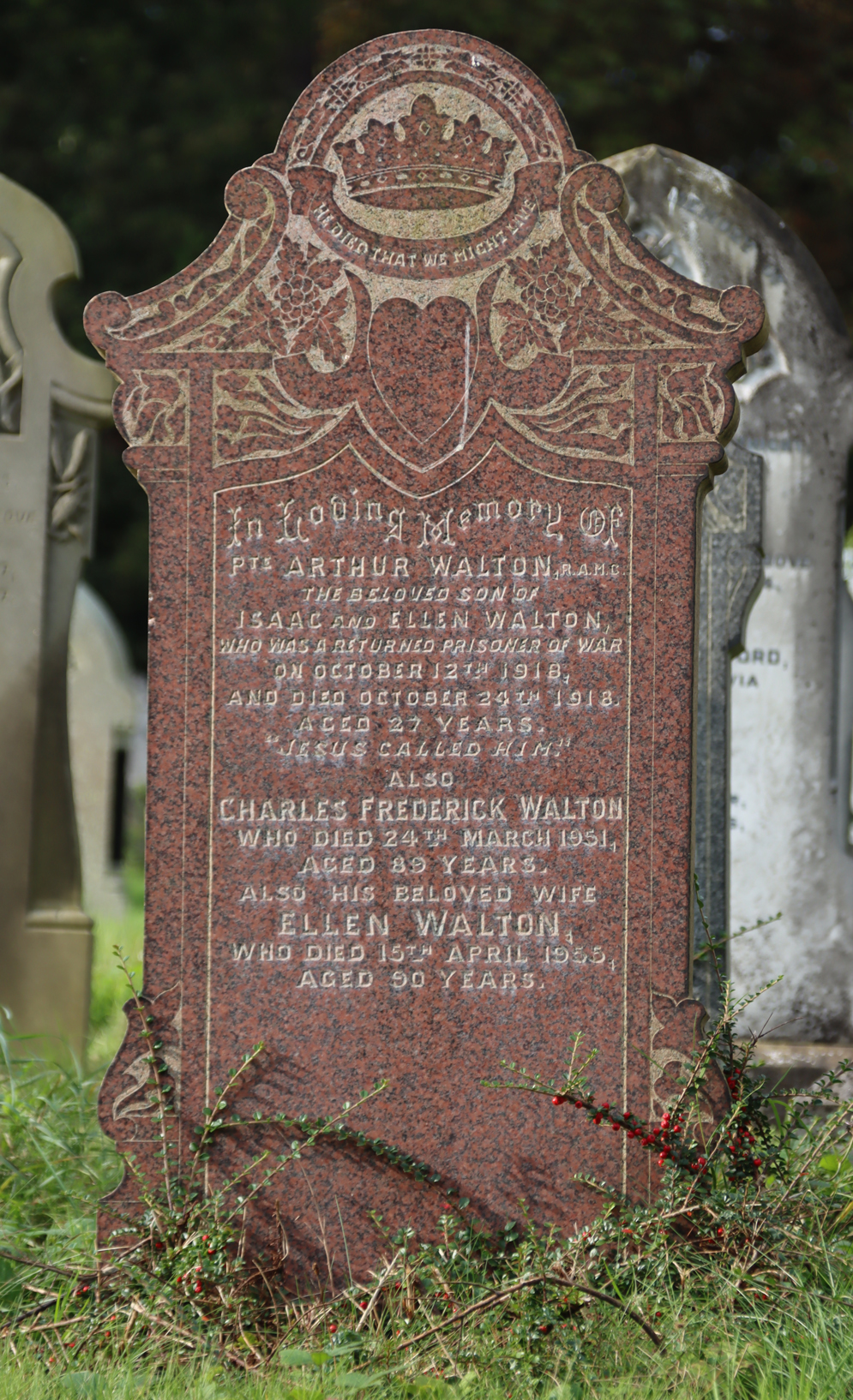
The memorial to Private Arthur Walton, died 1918 aged 27.

In the memorial to Private Arthur Walton shown left, the overall language of the iconography, seems to reflect the concepts of Christianity and the life of Jesus in response to the loss of a much-loved son in the First World War.  The crown can symbolize victory but is also the emblem of Jesus and Christian immortality. Beneath it, the Biblical quote “He died that we might live” refers to Jesus, but might also refer to the sacrifice of Arthur Walton himself.  The heart is a symbol of everlasting love of Christ and also of the charity espoused by St Paul, but also captures personal love. The grapes and vine-leaves are usually related to themes connected with Jesus including the blood of Christ, the Last Supper and the Holy Sacrament. Overall the iconography of the grave is probably one of personal sacrifice and its association with Christian values and the sacrifice of Christ himself, whilst at the same time demonstrating very deep personal loss.  As well as being very moving, this is a good example of how the imagery can contribute to the overall narrative of a headstone or memorial.

Hester Ann Clemence, died 1914, aged 62, with other members of the family commemorated on the pedestal  steps beneath the floral Celtic style cross. The steps often represent the steps representing Christ’s climb to Calvary.  All of the creativity and suggestion of emotion in the monument is in the design; the inscription is minimalist.  Although the encircled cross was originally associated with Irish graves, it became popular throughout Britain during the 19th century.

Of the overtly Christian-themed grave markers the dominant shapes are the crosses that re-appear for the first time since the Reformation during the 19th century, symbols both of Christ’s sacrifice and of resurrection, and proliferate at Overleigh, from the very simple to the seriously elaborate.  Crosses carved with decorated themes are widespread through the cemetery.  Although there had been very few crosses before the Victorian period, due to fear of association with papism.  A popular choice at Overleigh was the so-called Celtic cross, with Celtic-style designs covering the surface.  A popular variant has the top of the cross contained within a stone circle.  Although originally associated with Irish and Scottish graves, after 1890s in particular, when a Celtic cross was chosen by the celebrated art critic John Ruskin for his own memorial in Coniston, it became popular for burials of all religious persuasion.   A cross on a set of steps is often intended to represent the steps the Christ climbed to Calvary, but they might also simply be chosen for their monumental impact.  Flowers on a cross are indicative of immortality.  There are quite a few angels, messengers of God and the guardians of the dead who also transport the soul to heaven. The letters IHS often occur on graves in both urban and rural cemeteries and represent a Christogram, the three letters of the name of Jesus in Greek (iota, eta, sigma).

The truncated obelisk erected in memory of Francis Aylmer Frost. This photograph was taken by Christine Kemp when this area was not the overgrown jungle that it is now (you can see another photograph of this column, as it is today just below. Copyright Christine Kemp.

Many emblems are appropriated from earlier periods.  Pagan themes include the many Egyptian-style obelisks (more about which you can read on my post about the Barnston memorial in Farndon).  A splendid fluted truncated Doric column, a not uncommon cemetery icon but in this particular case perhaps a nod to Chester’s Roman past, is located just inside the River Lane gate to the Old Cemetery, its truncation indicating a life cut short, and generally indicating someone who died young, although in this case Francis Aylmer Frost was 68; another truncated column was dedicated to Harry MacCabe who was 26.  It is not the only one in the Old and New cemeteries, but it is by far the most impressive, shown at far left in the image below.  Its base is so badly overgrown with viciously thorny brambles that I couldn’t begin to find an engraving without losing half my hands and arms, and so remain ignorant as to who it commemorated.  I need some garden shears next time!

Truncated column; weeping woman; angel; Celtic crosses, temple-style gravestone. Click to enlarge


Floral themes on the grave of Thomas George Crocombe, died 1913 aged 20, the eldest of 9 children. Overleigh Old Cemetery.

Flowers are a popular carved theme on headstones.  Some have specific associations, such as the lily, standing for purity and a return to innocence; the rose, which indicates love (different coloured roses mean slightly different things), lilies of the valley, with connotations of innocence and renewal; daffodils that, flowering in spring, represent rebirth; and daisies, which symbolize innocence and were a popular choice for child graves.  A sprig of wheat often indicated someone who had lived to a good age.  Ivy, ironically, is representative of life everlasting and due to its enduring character. It is often show winding its way around cross headstones; today rampant ivy is one of the greatest causes of damage to graves in cemeteries and churchyards.  The most popular of birds shown on graves were doves, symbolizing either the Holy Spirit guiding the deceased to heaven, or general values of spirituality, hope and peace.  There are several at Overleigh.

Detail of the headstone of Harriett Garner and other family members with clasped hand motif. in this case it perhaps suggests father and daughter.  Harriett’s father, who gave evidence at the inquest into her suicide, was certainly very distressed by the loss of his daughter.  They are usually quite common in cemeteries, I have noticed only a few at Overleigh.

An urn is a very well represented motif, quite often topping a headstone as a sculptural component, and indicating the soul of the deceased; when draped with a veil they may indicate the soul departing or represent grief of mourners.  Angels are popular sculptural elements at Overleigh, indicating the soul of the deceased being accompanied to heaven.  Much less frequently shown than angels, but popular in many cemeteries, are images is that of a weeping woman, representing the loss of a person and the mourning of the bereaved.  Small statues of children often indicate the grave of a young child.  Clasped hands, common at some cemeteries but apparently not as well represented at Overleigh, indicate unity and may suggest the bonds of husband and wife, or of friendship or the hope to be reunited with loved ones; some have been carved to show the clothing and character of the hands as distinctly male or female.  An anchor may show that the deceased was professionally connected with the sea, but may also represent hope; a variation is the anchor with a woman, the embodiment of hope, although I have not seen an example of the latter at Overleigh.  Books may have many meanings – sometimes they are associated with the Bible of the clergy or the work of scholars, whilst others may mean knowledge or wisdom, or may simply represent chapters in life.
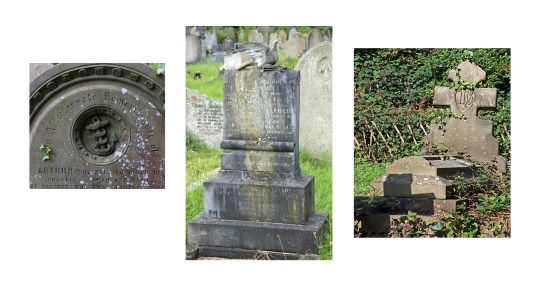
On the left, the headstone of Arthur Davies. The text wrapped around the anchor reads “Hope is the Anchor of the Soul.” The inscription contains other commemorations.  The headstone of Florence Taylor Battersby and other family members in the middle, topped with a dove.  The grave at far right shows the Christogram IHS, an abbreviation of the name of Jesus in Greek and Latin.  Click to enlarge

===

The child grave of Violet Patterson, died 1929, as well as other members of her family, one of whom, Edward Andrew Patterson, who died and was cremated in 2007, is inscribed on one page of the book. This is one of the longer enduring of the graves at Overleigh, in use for 78 years.

A book included on a gravestone may indicate any of a number of ideas.  Prosaically, the grave’s owner might be  involved in the printing, publishing or book-selling trades.  Alternatively they might be a scholar or, if the book is intended to be a Bible, a cleric or someone particularly devout.  In cemeteries one side of an open book often has the name of the husband or wife, whilst the other side remains blank until the other partner has also died, when the blank page can be completed. Sometimes the blank page is left incomplete, possibly because the former partner has remarried or moved out of the area, or has left no provision for the disposal of his or her remains.

There are also more modern emblems and themes that people have incorporated into grave carvings. In the Overleigh New Cemetery in particular there are Art Deco, Arts and Crafts and Art Nouveau themes.  Although often contained within crosses, the Art Nouveau decorations seem otherwise celebratory of life.  The combination of Christian crosses with modern themes perhaps positions religion within a modern context where there is no need to refer back to much older historical values in order legitimize Christian beliefs.  One of them, dedicated to Anna Maria Meredith, has a Biblical quote on it (fourth from the left, a most unusual headstone, although there is a second example in the cemetery).  The memorial to Frederick Coplestone, third from left, shows St Francis of Assisi.  It will be discussed further in Part 4.

Click to enlarge


Memorial in the cremation Garden of Reflection showing a locomotive. Roy Douggie, died 2010 aged 77, and his wife Beryl, died 2016, aged 79. That sycamore is going to need weeding out if it is not going to do permanent damage!

As can be seen on more modern gravestones and memorials, most of which can be seen in the Garden of Reflection in Overleigh Old Cemetery and at the very far end of Overleigh New Cemetery and even more dramatically at the post-war cemetery at Blacon, gravestone types and materials have become standardized, and the rich visual language of symbols and icons employed became much less varied over time, and are now often eliminated entirely, although secular themes are sometimes chosen instead.  In modern cemeteries, regulations about the nature of grave markers limit potential for developing new monumental statements, but the decline in religious involvement in everyday life is also a part of this trend.  The language of religious imagery to convey complex values (semiotics) now takes a back seat, even where commemoration is required, with modern secular images often chosen instead of Christian ones.  There are exceptions, and Roman Catholic memorials can still be quite elaborate.  Today modern gravestones and memorials can be less about choosing the perfect message for eternity than creating an appropriate personal message and style for the here and now, which is an attractive feature of many modern memorials.
====

There are many more symbols and themes on gravestones than those covered in my brief overview above, some quite common at cemeteries, some unique, and it is worth looking out for some interesting examples.
===

Inscriptions

Alice Maud Gwynne, died 1921 at the age of 42 which bears the inscription “There’s no pain in the homeland,” the monument topped with an urn

Inscriptions can be presented using various different fonts, sizes and colours all on the same monument, which creates a sense of texture.  Inscriptions are often filled with colour to make the text stand out from the background stone and make it easier to read.  Lead lettering was occasionally inset into stone to achieve the same impact.  The different styles of text create a great deal of variety in the visual impact of the cemetery.

Headstones in Overleigh tend to be fairly minimalist in terms of the information they provide, many simply naming family members and providing a date of birth and death, perhaps a note about the role of the deceased, particularly where this was a high status position. Most contain some sort of affectionate phrase or such as “In loving memory of,” “in affectionate remembrance of,” “beloved wife,” “dear husband,” etc. Others may contain a little more information.  Some may state the town or village name of the village, or even the property, where the deceased was resident.

The commemoration to 9 year old Walter Crocombe, his mother Sarah, 68, her husband George, 88, and their 4 year old grandson Eric.

Multiple dedications following the initial interment help to give a sense of the family context of both the first and and subsequent family members, and the longer they were in use, the more resonance they had for the family as successive generations interacted with the monument not merely to a single person but to a family commitment and tradition.  The child grave of Violet Patterson, died 1929, includes dedications to other members of her family, and was in use for 78 years, with the latest  inscription dedicated to a family member who died and was cremated in 2007.

Only war graves tend to give details of how death happened, such as “killed in action” or “killed in flying accident,” although there are never any details.  A great many refer to the deceased having fallen asleep, a euphemism for having died that skirts around and sometimes deliberately disguises how the death occurred.  Occasionally a grave will refer to the suffering of an individual, although I have seen fewer at Overleigh than in churchyards.  The commemoration of Sarah Crocombe at Overleigh reads “Her pain was great / She murmured not / But hung on to / Our Saviour’s cross.”  The monument to Alice Maud Gwynne comments “There’s no pain in the homeland,” which implies that she may have experienced some suffering towards the end of her life.

The memorial to Josephine Enid Whitlow in Overleigh New Cemetery (thanks Chris!) who died in 1938.

For obvious reasons, child graves can be more expressive than others about personal feelings of grief and loss.  The grave of 2-3 year old Josephine Enid Whitlow in Overleigh New Cemetery, for example, shown towards the top of this post, has a statue of a small child labled “JOSIE” (Josephine Enid Whitlow) accompanied by the the inscription “Jesus Walked Down The Path One Day / And Glanced At Josie On His Way / Come With Me He Softly Said / And On His Bosom Laid Her Head.”  She died in an isolation hospital in 1938.  The grave of the Crocombe family shown above records the loss of 9 year old Walter: “Little Walter was our darling / Pride of all the hearts at home / But the breezes floating lightly / Came and whispered Walter come.”

A few graves have Latin inscriptions. Latin is often used on Roman Catholic graves, and the letters RIP often indicate a Catholic grave, standing for the words “requiescat in pace,” meaning “rest in peace”, part of a prayer for the dead.  A nice little gravestone commemorating Thomas Hutchins, near the entrance on Overleigh Road has the legend “stabat mater dolorosa” inscribed along the line of the arch, meaning “the sorrowful mother was standing,” a reference to the Virgin Mary’s vigil during the crucifixion.  It is one of a number that ask the reader to pray for the soul of the deceased.
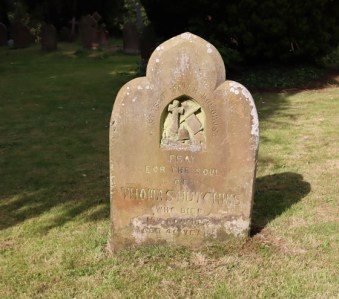
The small, relatively isolated gravestone of Thomas Hutchins, died 1879, aged 39–40

Perhaps the most minimalist of all the inscriptions, in terms of information imparted, is this curious woodland-style headstone topped with a downward-facing dove, shown below: “With Sweet Thoughts of Phyllis from Mother and Father and Aubrey.”  Given the lack of any useful information it is not surprising that there is no information on the entry for it on the Find A Grave website, but the headstone has charm, and the lack of data is really intriguing, because this was not an inexpensive monument.  Chris tells me that her last name was Elias.  There must have been a story here, but how to find it would need some extensive research that would require access to the original stonemason’s records.

“With Sweet Thoughts of Phyllis from Mother and Father and Aubrey,” Overleigh New Cemetery

Although it might be expected that headstones would give a wealth of information, this is rarely the case at Overleigh, although names, dates of birth and death and place names are a good place to begin with additional research.

There are several books and websites that list some of the most common cemetery themes and symbols, which are very helpful for decoding some gravestones and memorials.
===

Visually personalized headstones

Memorial to Richard Price, Dee salmon fisher, who died in 1960 aged 59. Overleigh Old Cemetery

Personally commissioned scenes, where they are shown, are very specific.  One of the most evocative is the gravestone that has a white marble section showing the Grosvenor Bridge, flanking trees on the river banks and a solitary, empty rowing boat moored in the middle of the river. It is dedicated to Richard Price, salmon fisherman, who died in 1960 aged 59.  Salmon fishing on the Dee has its own history, well worth exploring, and Richard Price was one of the last to make a living from it.  With Art Deco style wings either side, and an urn within the kerb, which could have been added at any time but appears to be in the same stone as the rest of the monument, it is an attractive and very personal dedication, becoming a little overgrown.  Richard’s wife Rose, who died in 1987 aged 81, is also commemorated on the stone.

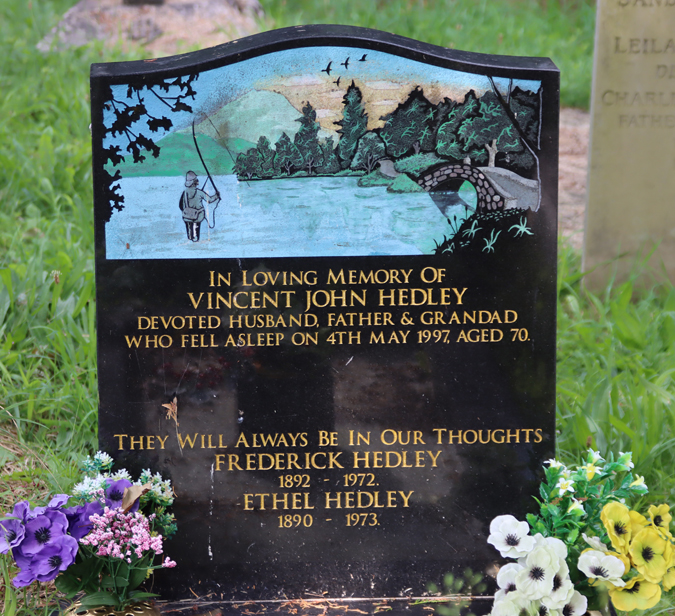
One of the more startling graves when seen from a distance, but completely charming and evocative when seen up close, is the full-colour section of a headstone to Vincent John Hedley, with a scene showing a fly-fisherman in a river or estuary with a rural scene, a rustic bridge, flying geese, an evergreen woodland, a bare hillside and a sunset or sunrise. It seems probable that Vincent John Hedley was a keen fly fisherman.

Vincent John Hedley, died 1997, aged 70. Overleigh Old Cemetery

Small section of an elaborate grave to Annie Myfanwy Roberts, died 1986, aged 73-74, showing photographs of family members.

A very well-tended grave in Overleigh New Cemetery is extremely monumental in its scope and intention, and includes photographs of the deceased, far more elaborate than the Anglican tradition but in keeping with the idea of the personalized scenes above that include visual as well as textual references to the personal.  Whereas the two headstones above show evocative and nuanced scenes that suggest how lives were lived, the photographs of lost people show nothing of the lives that the people lived but are instant reminders of the faces of the departed, instantly emotive for the living, indicating a different way of thinking about and representing those who have been lost and are grieved for.

Materials

Although the most obvious thing about a grave is its shape, together with its ornamental elements, the choice of materials is also an essential part of the design of a monument, and helps to determine its appearance.  As Historic England pointed out in their report Paradise Preserved, “the rich variety of stone within cemeteries represents a valued resource for the understanding and appreciation of geology.”  The good news is that in 2012 Cheshire RIGS and the Northwest Geodiversity Partnership produced a five-page leaflet, Walking Through the Past: Overleigh Cemetery Geodiversity that describes some of the geological background to stone types used on gravestones at Overleigh Old Cemetery, which you can download as a PDF by clicking here.

Some of the many different stone types at Overleigh

Local red sandstone was a popular choice, the same material used to build Chester Cathedral.  Yellow sandstone, presumably much of which came from the Cefn quarries in northeast Wales, is finer-grained and often easier to sculpt, but is very vulnerable to pollution and, as a result, de-lamination.  Pale limestone and granite are available from British sources, and are scattered throughout the cemetery.  Limestone is a sedimentary stone like the sandstones, and relatively soft and easy to sculpt, whereas granite is an igneous rock, very hard and enduring, often with a very attractive flecked texture, but far more difficult to shape.  Imports from overseas include marble and various exotic granites, which are higher-status materials with smooth surfaces that lend themselves well to sculptural memorials.  Rose granite, so beloved of the ancient Egyptians, is well represented, usually polished to a high gloss.  The majority of modern headstones are in highly polished black granite.  Local schools would probably welcome a geology trail through the cemetery.

Cross made of a composite of two different materials, with pieces of stone inserted rather coarsely into what looks like concrete and was probably a low-cost solution to a burial memorial.

As the 19th century rolled into the 20th century and transportation costs declined, imported stones became more common, particularly marbles and coloured granites.  Closer to home,  reconstituted (powdered and reformed) stone became a lower cost alternative to real stone, a common type of which was called coade stone.  At first this resulted in an increased diversity of materials, forms and styles, but as the 20th century advanced, the whole business of burials became far more standardized.  This is not a reflection of falling standards, but it is an indication of cultural change in general, where Anglican Christianity in particular is of less importance in Britain and where society tends to internalize loss rather than expressing it.

The only grave marker that I have spotted so far that is neither stone nor pseudo-stone is a single metal cross in Overleigh New Cemetery, shown just below, although I am sure that there must be others.

Lead lettering on the fallen headstone of Harriet Benson, died 1909 aged 63

Some graves have inscriptions formed of lead letters, which makes them stand out to ensure that they are easy to read, but they have a very poor survival rate, with letters falling out, and only the pin-holes where they were affixed surviving.  This can be sufficient to work out the original inscription, but makes some of the the headstones look rather derelict.  In the example shown left, the lettering under the missing lead can still be made out, but this is rarely the case.

Combined, these different materials, with their very contrasting textures and colours, offer a far more diverse visual fare than the modern cemetery areas in both Overleigh and elsewhere, which are usually glossy black granite.  They help to contribute to the sense of individuality and personal expression in the cemetery.

Black-painted metal memorial to Frederick, aged 66-77, and Alice Wynne, John Meacock and Robert and Alice Taylor.

Memorabilia and gifts

Bird on a plinth at the foot of Harriett Garner‘s grave

A gravestone was a fixed point, although not invulnerable, whilst gift of flowers, immortelles and other objects are the ore transient but personal markers of ongoing memories or the establishment of new connections between people and graves.  As well as demonstrating a personal connection between the living and the dead, the offerings of all types help to keep the sense that the cemetery is still a place of relevance, where narratives continue to be written and rewritten, sometimes only in people’s individual minds, and sometimes shared amongst families and even amongst sections of specific communities.

In the next section, below, is a photograph of Mabel Francis Ireland-Blackburn, showing a three year old child lying in a bed.  It is surrounded by modern memorabilia, including flowers (fresh and everlasting) and a variety of toys and other items.

Although it does not attract the same devotion as Mabel, the grave of the suicide Harriett Garner features a charming little bird, probably a robin, on a thoughtful makeshift stand accompanying the grave.  It gives the grave a personal touch, something more intimate than the headstone itself, suggesting a sense of ongoing empathy and regret.

War grave of Marjorie Anne Tucker, Women’s Royal Air Force, died 1918 aged 32, with a textile  wreath placed by the members of Handbridge Women’s Institute

In the baby cemetery area and the cremation Garden of Reflection in Overleigh Old Cemetery and in the area of recent graves in Overleigh New Cemetery there are many graves with personal memorabilia and gifts from the living to the departed, and these speak to the realities of grief and the importance of reinforcing memory through small gifts and commemorations.


Examples that are cared for by today’s cemetery regulars

Not all graves are appreciated exclusively by their families and descendants.  Others have become interesting or even important to people who otherwise have no connections to the deceased. Some graves have attained something of a celebrity status, either because of their visual appeal or because of the reputation or story of their owners, and are particularly cared for by local people as well as by the Friends of Overleigh Cemetery.  These graves form a sense of how modern minds can connect on a personal and private level with graves with which they have no familial connection.

Grimsby News, September 11th 1908, reporting the coffin of William Biddulph Cross (The British Newspaper Archive)

The nicely shaped but otherwise unremarkable headstone of electrical engineer William Biddulph Cross, who died in 1908, conceals an amusing story of a coffin made entirely of matchboxes, thousands of them, by William himself over a ten year period, a fact mentioned on the gravestone: “WILLIAM BIDDULPH CROSS / Who Passed Away September 5th 1908 / Aged 85 Years / Known By His Galvanic Cures / And The Maker Of His Own Coffin.”  The “galvanic cures” refer to a somewhat scary electrical therapy device thought to be a cure-all for numerous ailments.  You can read more about the device and the theory behind it on the National Archives website. The coffin became something of a local tourist attraction in its own right before William was laid to rest, and was widely reported in newspapers all over Britain.  The newspaper paragraph to the right, for example, was reported in the Grimsby News.  It has been suggested that the electrical fittings were for lighting, but interment before death was a fear throughout the entire Victorian period, and there are some examples of coffins being fitted with devices to allow those who had been mistakenly certified dead to be given a means of raising the alarm, and perhaps this is an alternative explanation. The grave also commemorates six other members of the family who died between 1870 and 1904.  It is something of a puzzle to me as to why William BIddulph Cross was the first of these to be named but the last to die. 

Mabel Francis Ireland-Blackburn, died 1869. Overleigh Old Cemetery

A particularly notable example is “chewing-gum girl,” which is a rather frightful name for a clearly much-loved grave, explained in Part 4. The grave is a very good example of a modern phenomenon where people feel a strong connection to a grave in the past and demonstrate their sense of affinity and empathy by visiting the grave and leaving items to keep the deceased company.  The three year old girl, Mabel Francis Ireland-Blackburn, is represented in stone as a child lying in a bed, and is today surrounded by flowers (cut and artificial), small stone statuettes, toys, a teddy bear by her head, and other small gifts.  She died of whooping cough, but was reputed to have suffocated on chewing-gum, becoming a warning anecdote told by parents to their children, in the form of a poem, of the dangers of following in her footsteps.  Child grave memorials are discussed more in Part 4.  The visual impact of this grave, with the sleeping or dead girl lying in her small bed, propped up on a pillow, is clearly the impetus for the gifts, demonstrating the power of the sculptural funerary image, but also the connection that adults feel for deceased children.

Whilst some graves attract particular attention and are well cared for, The Friends of Overleigh Cemetery are trying to look after the cemetery as a whole, tackling individual problems as they identify them and attempting to rescue stones that can be freed from vegetation without doing them damage.


Cemeteries and the bereaved today
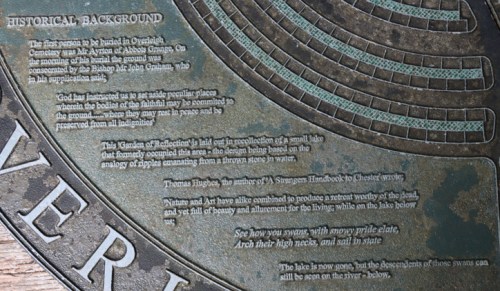
The only new interments in the Old Cemetery are baby burials, segregated with respect and sorrow in a separate garden of their own, or where rights are retained to be interred in a family plot.  The attractive cremation Garden of Reflection, with its hedges emulating ripples on the former lake, is also still in use, and it is possible that it will be extended.  Both are clearly distinguished from the majority of graves of the previous two centuries by virtue of the fresh flowers and other gifts that are regularly provided.  In the New Cemetery, the buildings are no longer in use for funerary activities, and the older part of the cemetery to a great extent resembles many parts of the Old Cemetery, but walk beyond these features and you will find yourself in a far more modern cemetery area, which is clearly frequently visited by family and friends.  This is the newer style lawn cemetery where a compromise has been sought between the needs of relatives and the problems of maintenance.  This will be discussed in Part 3.

Modern cemeteries issue rules and guidelines about the size and type of grave and grave marking permitted, in order to ensure that cemeteries are as easy to maintain as possible, whilst at the same time providing the bereaved with a place to visit and connect with their lost loved ones.  This is a very difficult balance to strike, and local authorities who find themselves with the costly task of maintaining old cemeteries as well as modern ones, have the unenviable task of finding cost-effective ways of caring for these important sites of both past and present commemoration and memorialization.  This is discussed further in Part 5.


Part 2 Final Thoughts

Yellow sandstone headstone of George Hamilton, son of Alexander and Mary, suffering from rather surrealistic de-lamination that looks like melting ice-cream, as well as a colonization of lichen. (Overleigh New Cemetery)

A graveyard is less about a place of the dead than a place of commemoration, the formation of individual, family and collective memories and the ongoing reinvention of ideas about how to deal with death. Those who have gone before us are still part of our lives, still form part of our physical landscape and can contribute to our inner ideas about mortality and the future. It is possible to get to know the dead than it is the living via their gravestones, their epitaphs and their stories.  Individually these are interesting but collectively they combine with other buildings and institutions to contribute to our understanding of the Victorian period and changing funerary traditions thereafter.  These changing fashions in funerary practice from the mid-19th century to the present day will be discussed in part 3.

Cemeteries have visitors who come to see particular graves, either due to regular tending of the grave and communion with the deceased, or to find a grave as part of genealogical research, or as for general or more formal interest into social history, art history and archaeological interest in death and memory.

Many of these graves, suffering from de-laminating or eroded inscriptions, and the invasion of ivy, as well as fallen headstones, highlight the importance not only of maintenance activities but of recording as many of the details on gravestones as possible in online, freely available databases.

Gothic style memorial to Thomas Ernest Hales, died 1906 aged 69. In the background are obelisks in rose granite, made popular when the antiquities of Egypt were first published

Cemeteries are fascinating places, and although modern sections are certainly rather understated and somber because of the signs of recent loss and sadness, older sections are very positive keepers of social history and human endeavor, reflecting choices and decisions by both the living and the deceased, in a wonderful arboretum of multiple tree species.  These grave monuments lend themselves to close inspection and appreciation not just of the materials, shapes and symbols, but of the stories that they capture about past lives and how we learn about a city’s past through both the material and conceptual cues that cemeteries retain.  The information on headstones can be a good place to start with an investigation in archives.  This type of information gives a sense both of the communal identity of a provincial town, and the individual identities that make up that community.  Of course, those who could not afford graves or were buried in communal graves that were the result of epidemics, are lost from this commemoration of the individual.

As before, my many thanks to Christine Kemp (Friends of Overleigh Cemetery) for all her practical help, her encyclopedic knowledge, and for checking over my facts.  Any/all mistakes are my own.  Do give me a yell if you find any.

I have quadruple-checked for typos etc, but some always get past me, for which my apologies.

References for all five parts are on a separate page on the blog here.

A short comment on the missing past of St Mary’s Nunnery, Chester

I have been trying to find a publication of the excavations that took place when the profoundly ugly Chester HQ office development was built on the site of St Mary’s Nunnery and its cemetery. This lead me to the article by Professor Howard Williams below.  Outside the Chester HQ buildings is a very odd permanent display area made of red sandstone displaying bits and pieces of random archaeology.  I’ve thought it was peculiar for a very long time, one of these token gestures, neither fish nor fowl, that are usually funded by developers when they build over the top of heritage sites.  It has no cohesive message, no coherent linkage between any of the objects, and is anyway missed by most passers-by.  This excerpt from a very nicely written article by Professor Williams (University of Chester), posted in 2017, really gets to the nub of the matter.

https://howardwilliamsblog.wordpress.com/2017/03/22/unethical-medieval-nuns-on-display/:

I see the vision but I can’t really get my head around the reality in a sympathetic way. Rather than evoking a history of place, reporting on the contexts discovered and the rich and varied social, economic, political and religious history of the city and this site’s place within it, instead we get a transtemporal pastiche. This is little more than a banal and context-free open-air cabinet of curiosities that shamelessly aggrandises the corporate architecture of the 21st century and its construction facilitated by the rifling of past times.

He goes on to discuss the display of one particular object, a truly lovely medieval stone grave cover with a fabulous decorative theme that represented the Tree of Life.  It would have been laid horizontally over the grave, covering the deceased, but here is displayed vertically.  This is really well worth a read if you are interested in heritage management, respect towards funerary monuments and contexts, the activities of developers with respect to the heritage they impact and the role of object histories.  Loving the phrase ” transtemporal pastiche,” which gets it in one.  Professor Williams never disappoints.

Back on the subject of the archaeological excavations, it was also interesting to note that in a 2013 article Professor Williams notes the following:

Archaeologist Mike Morris of Cheshire West and Chester Council was forced to announce that the developer – Liberty Properties – was in breach of their agreement [Cheshire Live] by not funding post-excavation adequately following the excavations at the HQ building revealing graves from Chester’s Benedictine nunnery. The website of Earthworks Archaeology – the commercial archaeologists who excavated the remains associated with the Benedictine Nunnery – says that post-excavation is ‘under way’.

The Cheshire Live article says that not only were there remains of 100 individuals from the cemetery at the nunnery site, but “foundations for at least one large Roman town house were discovered including an undisturbed mosaic floor – the first to be found in Chester since 1909.”  The Earthworks Archaeology site announces:  “The practice is currently on sabbatical.”  There is no additional content and the website says nothing at all now.  If anyone has any information about the excavations I would be grateful?  But I suspect that it’s a horribly lost cause.

The last remaining structural feature of St Mary’s Nunnery – a 15th century archway that now stands in the Grosvenor Park.

Excavation without publication is an archaeological evil.  If the remains carefully troweled out of the ground are not professionally published, the information is lost forever, the data never contributing to knowledge about the city as a whole and about the nunnery’s history in particular.  It is the responsibility of an excavation not merely to extract data from the ground, but to share it. Anything else is an abdication of responsibility, and the loss of an important story.  If the excavation results are never published, how will we ever understand what there was to know about St Mary’s?  Where contracts are granted for this sort of work, surely the conditions of those contracts should be enforced.

The Chester HQ building where the nunnery once stood

A splendid introduction to stained glass artist Trena Cox by Aleta Doran

Many thanks to Aleta Doran, Artist in Residence at Chester Cathedral for today’s introduction to stained glass artist Trena Cox, who was based in Chester for most of her long career.  Aleta is a brilliant and engaging presenter, currently working hard on the upcoming Trena Cox exhibition, which she is curating.  Although this was organized specially for Chester Archaeological Society, Aleta is doing more presentations during the Heritage Festival and if you get the chance to attend, do go.  It will give you a completely new insight into the world of 20th Century stained glass, as well as introducing you to a really creative part of the cathedral’s history.  I’ll keep this relatively short so as not to spoil the event for those of you who have tickets.

Trena Cox, apparently the least photographed artist in modern history, was born on the Wirral and trained at Birkenhead’s Laird School of art, learning her skills in traditional media before switching to stained glass.  She has created over 150 stained glass pieces that are known, but there are probably many more to be identified.  She worked mainly in the Cheshire and northeast Wales areas but her works are found further afield.  There are many in Chester itself, mainly in churches.  There are nine Trena Cox windows in the cathedral, one in the slype (a corridor) and the others arranged in groups of four, two at the top, two at the bottom, in adjacent aisles in the cloister (the walkway around the central garth or garden).

The big window in the slype shows the child Christ on one river bank, and St Christopher on the other.  This is very unconventional, as Christ is usually depicted being carried across the water on the shoulders of St Christopher.  Aleta described how this window clearly demonstrates many of the features of Trena Cox’s work, with the beautifully executed details of both figures, the surrounding landscape and the flowers, birds and animals that sit at the feet of the two figures.  Also typical are the portrait-style faces, which seem incredibly life-like.  The colouring of the glass, as in all her work, is vibrantly jewel-like and the background semi-opaque glass concentrates the eye on colours whilst allowing in light.  There are many emblems of international pilgrimage, known from badges purchased from the Middle Ages by pilgrims to commemorate their achievements.  As well as many others, these include St Thomas of Canterbury, St James of Santiago de Compostella, and of course Chester Cathedral’s own St Werburgh herself, her symbol being five geese in a basket. It is a rich and symbol-laden piece that rewards time taken to appreciate it.

The cloister used to open out onto the garth, with a stone arcade forming a corridor with the buildings that surround the cloister.  In 1920 Dean Frank Bennet was appointed as the new head of the cathedral, and decided to take measures to improve the cathedral’s fortunes.  In order to glaze the arcade that surrounded the garth, the dean decided to raise public funds.  It is thought that some funds were raised by allowing donors for the cloister glass to add commemorations to loved ones in panes withing the windows, which survive today.  Each window represents a saint, religious festival or holy day.  Trena Cox contributed eight panels in two adjacent sections of the cloister, showing eight different saints.  In one set of four, the two at the top are Hugh Lupus who founded the abbey and St Werburgh’s mother St Ermengild  In the lower section are St Thomas Becket and King Henry II.  In the other set, the two figures at the top are Abbot Witchurch and Ralph Higden and the two below King Alfred and St Piegmund.  Aleta talked us through the significance of each of these saints, and why there were chosen.  These are much smaller and therefore much simpler compositions, but again the colours are vibrant, and the faces resemble portraiture.

Aleta wrapped up by telling us something about Trena Cox and her influence on Chester life, not only as an artist but as something of an activist for the protection of local heritage.  It seems remarkable that she is not better known, at least in Chester where she lived nearly all her life.  Hopefully, the upcoming the exhibition “Trena Cox: Reflections 100”, which begins on the 7th October, will bring this under-sung local personality and talented, prolific artist to much wider public attention.  Do take advantage of a tour of the glass with Aleta Doran if you have the opportunity.  As an artist herself, she offers a unique insight into the work of Trena Cox.

You can follow Aleta Doran on Twitter (@StargazingAleta), or via her blog at https://www.aletadoran.co.uk/

“Excavations at Heronbridge 2002-5, Part 1: The Roman Settlement,”

Great to arrive home from our trip to our CAS introduction to Wirral-born stained glass artist Trena Cox by Aleta Doran (about which more later) and find the Heronbridge report on the doorstep. The report, “Excavations at Heronbridge 2002-5, Part 1: The Roman Settlement,” is a satisfyingly chunky 207 pages with maps, illustrations and photographs. It describes Chester Archaeological Society’s excavations between 2002 and 2005 at the Roman settlement at Heronbridge, about 2.5km south of Chester City Centre. With numerous contributors, headed by David J.P. Mason, it is edited by Peter Carrington with Rowan Patel and Alison Smithson (Chester 2024).

For those who wish to know a bit more about this publication, here are the cover details, the Table of Contents and the list of contributors.  You can click to expand any of the images:

Lecture: Rosemary’s Baby: Adventures and Insights from Contributing to the Corpus of Anglo-Saxon Stone Sculpture in England

Rosemary’s Baby: Adventures and Insights from Contributing to the Corpus of Anglo-Saxon Stone Sculpture in England

Paul Everson, Keele University

Tom Pickles, Chair of Chester Archaeological Society, introducing Paul Everson

On Saturday 4th May, in the last in-person Chester Archaeological Society lecture of the 2023/24 spring season in the Grosvenor Museum’s elegant lecture theatre, archaeologist and landscape historian Paul Everson introduced members and guests to the “Corpus of Anglo-Saxon Stone Sculpture (CASSS)”  project inaugurated in 1977 by Professor Dame Rosemary Cramp (https://corpus.awh.durham.ac.uk/).  With his long-time collaborator David Stocker, Mr Everson has published three volumes of the CASSS, and in this lecture explained how the decades-long project has not only provided us with a definitive catalogue of decorated stonework of the period but also stimulated new avenues of thought.

Professor Dame Rosemary Cramp’s name is synonymous with Early Medieval sculpture, combining her expertise in Old and Middle English with archaeological research, beginning her own excavations at Monkwearmouth in 1957.  Having identified an opportunity to create a corpus of early stone sculpture after working on examples in Durham Cathedral and the Wearmouth and Jarrow monastic sites, she developed a standardized format for the publication of the CASSS, and a “grammar” of Anglo-Saxon ornament (also used for knitting!). This enables each volume of the corpus to be used in the same way and, where required, directly compared, making the series invaluable as a cohesive research tool.  The first volume to be published was County Durham and Northumberland in 1984, and the last two, currently being compiled, are volumes 15, Leicester, Notrh Rutland and Soke Peterborough and volume 16, Norfolk and Suffolk.

Some examples of the types of Anglo-Saxon sculpture included in the Corpus (slide from Paul Everson’s presentation)

The corpus of Anglo-Saxon carvings, dating from the 7th to the 11th centuries and much of it previously unpublished, includes crosses, grave markers and grave covers, architectural detailing and inscriptions, both in original locations and in relocated positions. The compilation of the Corpus required the establishment of procedures for locating and recording both known and previously unidentified carvings. A mixture of archaeological, field survey and historical approaches are employed.  All churches in a Corpus volume area are inspected, inside and out.  Sketches, photographs, measurements and notes ensure that full details were recorded.  Lost items have been rediscovered by tracing records in publications produced by antiquarian and early scholars.  Antiquarian and early scholarship are always described and credited in the first chapter of each volume, reflecting their value.

As with most archaeological data, Anglo-Saxon sculptures often exist only in fragments and this requires virtual reconstruction work so that these too can be understood as whole pieces and included in the corpus.  It was interesting to note that, like Roman tombstones, the ornament was picked out in bright paints, exemplified by a replica from Neston which has been rendered in full colour, shown on the above slide.

Bringing to together substantial data across each area has led to an exploration distribution patterns, with some specific types distributed widely across a county and others being more localized, leading to a search for explanations  An example is Raunds Furnells where a small cluster of 10th century stone monuments may help to explain similar finds in east England, perhaps representing the founding families of churches, which in turn may represent the first stages of the development of the parochial system.  “Exceptional collections” also occur, where large numbers of sculptural stones are found in a particular location, and it has been found that these tend to be near river sites where markets were held, and where merchant communities with disposable incomes concentrated, such as Chester where an impressive collection is retained at St John’s Church, and at Neston on the Wirral.

The Hedda Stone, Peterborough Abbey

A surprising finding was that there may have been very little pre-Viking quarrying of new stone.  Instead, earlier stone masonry in church architecture and graves was often recycled and has become a much-debated topic.  Some of these re-uses are pragmatic and practical, making use of usefully shaped pieces.  The re-use of Roman masonry could explain, for example, some puzzling holes in the famous early Medieval Hedda Stone at Peterborough Cathedral.  Another form of recycling is described as “iconic,” where earlier scenes are appropriated and re-positioned in a new cultural context.  Interpretation of specific instances of recycling differ, and the resulting debates, although usually amicable, may be very animated! Discourse provided by differing perspectives, specialisms and sub-disciplines and by a new generation of researchers ensure that research into Anglo-Saxon sculpture continues to be a lively field.

At the other end of the chronological scale, studies of post-Conquest sculpture have helped to elucidate the continuity of earlier medieval traditions, and this too is an important research vector for understanding the period when Saxon and Norman interests vied for supremacy.

Making use of database technologies, an important leg of future work will include the Arts and Humanities Research Council (AHRC)-funded “Worked in Stone” project which will re-digitize all the volumes to make them into a fully searchable database, an important new initiative that will be hosted by the Archaeological Data Service (ADS) and will be free to access.).

The challenges of interpreting different syncretic and iconic schemes. (slide from Paul Everson’s presentation)

An enthusiastic round of applause marked the end of the lecture.  There was the opportunity for questions, and the audience took full advantage.  The topic of recycled Roman stonework lead to some discussion about how identity and meaning may have been syncretized or replaced.  Another question concerned how future discoveries might be incorporated into the corpus, and although nothing formal yet exists, the topic is obviously on the minds of those looking to the future of this research area.  At the end of the questions the audience again applauded loudly in appreciation.

By the end of the lecture, it had become clear that the loss of Dame Rosemary last year at the age of 93, and the publication of the final two volumes of CASSS will not draw any sort of line under the research into Anglo-Saxon sculpture.  The Corpus continues to be provide an invaluable resource.  The digitization of the corpus will make it readily available to support a new generation of researchers as they develop new ideas and perspectives and explore new directions. It is clear that in spite of her passing away last year, this project remains very much “Rosemary’s Baby.”

The first twelve volumes of the CASSS are available online at https://corpus.awh.durham.ac.uk/.  For Anglo-Saxon stone sculpture in Cheshire see volume IX. For a paper produced as an offshoot of the corpus work, see the study of the social background of the St John’s (Chester) crosses in the Members Area of the CAS website (https://chesterarchaeolsoc.org.uk/members-area/): P Everson & D Stocker. Transactions on the Dee: the ‘exceptional’ collection of early sculpture from St John’s, Chester
In: Cambridge, E & Hawkes, J eds. Crossing boundaries: interdisciplinary approaches to the art, material culture, language and literature of the early medieval world. Essays presented to Professor Emeritus Richard N. Bailey, OBE, in honour of his eightieth birthday. Oxford: Oxbow Books, 2017, 160–78.

Finally, the international ‘Worked in Stone: Early Medieval Sculpture in its International Context’ conference  takes place next year in Durham (https://corpus.awh.durham.ac.uk/wis.php).

Many thanks to Paul Everson for such am engaging and enlightening lecture.

Paul Everson in the Grosvenor Museum lecture theatre

Part 3: Misericords in the Chester-Wrexham area – Miracles, myths, demons, and the occasional grin

Creature wheeling two women in a barrow towards a hellmouth. All Saints’s Gresford

Apologies that it has taken a couple of weeks for part 3 to appear.  The subject is so massive and it seems impossible to do it justice in a blog post but eventually that big, accusing Publish button just has to be clicked 🙂

Part 1 introduced misericords and described some of the themes captured in the choir of St Werburgh’s Abbey (Chester Cathedral).  Part 2 described the misericords at Gresford, Malpas and Bebington.  This 3rd and final part addresses who might have been responsible for the themes chosen, who may have paid for the misericords, why they were contained within the most sacred part of the church and how they might be understood.  Finally I have added some visiting details for the cathedral and the three churchs, plus a list of references for all three parts.

Selecting the misericords

How were the topics selected and by whom; who carved them; and who paid for them?

How themes were selected

Scene showing in both the main scene and the supporters St Werburgh’s miracles. Source: Dominic Strange, World of Misericords

Each misericord showed a different subject matter, and whether there were 48 (as at Chester) or 14 (as at Gresford) there could be great diversity in the themes selected.  The patron saint of an abbey or church might dictate the subject matter in a single misericord, like the miracle of St Werburgh at Chester, but this accounts for only one misericord of any one corpus.  Some themes are commonly found throughout misericord collections and are evidently part of a popular repertoire or corpus of themes.  As Anderson says in his survey of gothic art, “The subjects of misericords did not have to be consistent, so any good design, from whatever source it came from, could be used on them,” but particular themes and ideas were probably favoured in each different establishment, leading to a different character and ambience from one set to another.  The enthusiasm for certain themes will have changed over time, reflecting both popular and intellectual fashions, but all were chosen from similar types of source material.

Folio 49v from the Smithfield Decretal showing a fox, with mitre and crozier, preaching to a flock of birds. Source: British Library

Manuscripts were an obvious source of ideas.  Bestiaries such as the beautiful MS Bodley 764, referred to in parts 1 and 2, provided a wealth of ideas, as did travelogues. Both Old and New Testaments, missals and hagiographies (biographies of saints, often at least partly fictional) were also alternative sources.  The Golden Legend by Jacobus de Voragine in the 13th century was a particularly popular account of the lives of saints, which even today is a good read.  The marginal scenes shown on various religious illuminated manuscripts including psalters (books of psalms) and books have hours (personal books for private worship) probably supplied others, which included so-called drolleries and grotesques.  The Luttrel Psalter and the Smithfield Decretals are good examples.  Contemporary chivalric romances, popular narratives and collections of stories like the 14th century French Cy Nous Dit (which contained versions of the tales of Tristan and Isolde, Alexander carried over the edge and the exploitsof the knight Yvain – all of which are at Chester) were good sources of stories with a moral thread. Towards the end of the Middle Ages it has been demonstrated that some themes were inspired by woodcut images that were circulating in Europe following the success of the printing press in the mid-15th century.

Image and supporters copied from earlier examples. The model for the central image was first carved at Lincoln in the 1370s (top), then reproduced with much more gusto and exuberance at St Werburgh’s Chester in the 1380s (middle) and finally, with much less energy than either, at St Mary’s Nantwich in the 1390s (bottom). All sourced from Christina Grössinger, The World Upside-Down, p.47 (see Sources at end)

Carvers almost certainly brought ideas with them from other abbeys, cathedrals and churches, which they could share with their new employers.  Some topics are clearly copied from one ecclesiastical establishment to another, probably introduced by carvers who moved to new building projects as they became available.  Sixteen designs in Chester were based on those from Lincoln, and six in the the impressive parish of St Mary’s church in Nantwich, were copied from Chester.  The herons on a misericord in St Werburgh’s, for example, were very nearly clones of a misericord at Lincoln Cathedral, although the supporters are different.  An even more striking example is a crowned head with wild hair and beard, flanked by two heads in profile. This appears first in Lincoln Cathedral, then at St Werburgh’s Abbey in Chester.

Although St Werburgh’s may have been expected, by virtue of its proximity, to have provided the inspiration and basic model for the later examples at Gresford, Malpas and Bebington, none of the misericords are copies of surviving Chester examples.  There are indeed shared themes, but there are no attempts at replication.  This suggests that in each case the choices made drew on other sources for their ideas, perhaps reflecting the time gap between the Chester and later misericords, or otherwise reflecting local choices or preferences.

———
———–
Who would have been involved in the choice of themes?

Abbot with staff and book. MS. Ludwig IX 6 (83.ML.102), fol. 222v. Source: Getty Museum

It is not known exactly how the topics depicted on individual misericords were chosen, but there are a number of possibilities.  At an abbey or independent priory, the superior (abbot or prior) and the senior personnel may have dominated the decisions, but individual monks from the larger monastic community may have contributed to the selection process too.  External patrons, whose financial input would have been necessary for a project on the scale of the Chester quire are likely to have wanted to contribute to their own favoured themes.  In a parish church both the senior clergy and the bishop would probably have dominated the decision process, but external, private financial contributors such as local landowners may also have had a vested interest in the selection of themes.  Multiple sources of finance, each perhaps buying a vote in the selection process, would help to explain the diversity of the subject matters chosen both within a single choir, and the differences from one church to another.

It is sometimes suggested that misericords were the brainchildren of the craftsmen who carved them, indulging themselves with creative and sometimes (to the Victorian mind) off-colour designs without any direct input from the clergy.  Being confined to the choir in the most sacred part of the church, however, it seems unlikely that anything could have been selected and installed without the permission of a head cleric, such as the abbot in the abbey, or a parish priest (or his bishop) in a church.  It also seems implausible that an abbot or bishop would sit back and allow expenditure to be used unchecked on fantastic frivolities that would have to be accounted for to both superiors and inferiors alike.  Although carvers probably suggested certain popular themes based on their own experience, the misericords and their themes must have been sanctioned at the highest levels.

Who carved the misericords?

Stained glass portrait, thought to be Master Carpenter Hugh Herland. Source: Upchurch Matters

Remarkably little is known about the wood carvers who created these remarkable vignettes.  For prestigious projects carvers seem to have moved from building to building.  Christina Grössinger identifies a single London workshop as having been responsible not only for the Chester and Lincoln wood-carvings, but also for those that at St Katherine’s in Stepney (London) and the former Carmelite friary in Coventry.  John Harvey had formerly identified the hand of famous Master Carpenter Hugh Herland, who worked on a number of royal and prestigious college projects in the 14th century, at Lincoln and particularly Chester, but Grössinger rejects this suggestion, and a quick look at Herland’s list of responsibilities for the decades in which the Lincoln and Chester misericords were made (1370s and 1380s respectively), suggests that he was probably far too busy on prestigious works elsewhere to oversee these two projects as well.  Present in Chester between 1377 and 1411, however, was William Newell the king’s chief carpenter who was probably involved with the work on the choir, at the very least in an advisory capacity.  For a Benedictine monastery like St Werburgh’s it was important not merely to raise the status of the individual abbey, but to contribute to the prestige of the Benedictine order as a whole, particularly in a period when monastic orders were becoming much less influential in society and politics.  Whoever was responsible for overseeing the project, many carpenters will have contributed to the misericords and canopies, and both the designs and the work are certainly exquisite.

St Andrew’s, Bebington

The preference for the most prestigious carvers available in the country suggests that where prestige was important and the finance available, only the best carvers would do and could be hired from places at considerable distance from the institution concerned.  The impressive churches of Malpas, Gresford and Bebington would not have had the same scale of financial resources, nor the same ambitions for national prestige reached for by the abbot Chester abbey, but quality was still important.  Carvers were more likely to have been sourced closer to home, but even so the skills required may still have required importing specialists to oversee and ensure high quality. In his paper on the carvers of the Oxford colleges, Gee says that during the 14th century the pay for a Master Carpenter, was around 4d monthly.  For a nationally recognized and prestigious Master Carpenter of whom the above-mentioned Herland is an example, this rose to around 1s. There was therefore a wide scale of pay for different levels of skill and creativity.  work.

Who paid for them?

Canopies above the choir stalls in Chester Cathedral

Elaborate choir stalls with misericords were luxury items for a church, raising the prestige of the incumbent clergy and the establishment as a whole either nationally for an abbey or cathedral, or regionally for a collegiate or parish church.  They were, in functional terms, unnecessary but for some monasteries and churches, the investment may have been important for institutional and social reasons, reinforcing the position of the church in the wider community at a time when ecclesiastical influence was in decline.  Status and vanity projects always come with a substantial bottom line, and the funds would have been acquired from a number of different income streams and one-off sources.

A monastic establishment like St Werburgh’s might have any number of income streams. The Benedictines, the longest established monastic order of the Catholic tradition in Britain, had been endowed with enormous estates and resources.  Monasteries were amongst Britain’s greatest landowners, owning huge swathes of the rural landscape.  This level of royal and significant magnate  investment had trailed off by the early 1300s, so monastic establishments were forced to make the most of the property they already owned and attempt to secure smaller but still significant bequests and investments, and one-off donations for special projects.  Ongoing sources of funding included tithes (funds appropriated from churches that it adopted), the often impressive output of produce sold from a network of monastic farms, private bequests in wills, and contributions by living benefactors.  Appropriating churches, and securing their income, was increasingly important throughout the later medieval period.  Chantries were also an excellent source of income for urban monasteries.  These were financial foundations set up by individuals to pay for an ordained monk, or several monks, to recite multiple prayers for himself/herself after death, as well as for his or her family and ancestors;  These were invaluable income-generators for monasteries.  Pilgrim shrines could also be very lucrative for monasteries with appropriate relics, particularly if they were reputed to perform miracles.

Probable burial places of some of  the medieval abbots in the cloister at St Werburgh’s, Chester

The abbot and monks themselves, might contribute to prestigious projects.  Although the earliest Benedictine monastic orders had been based on vows of poverty, and the reforming orders of the late 11th and early 12th centuries renewed these vows and intentions, by the late 14th century the Benedictine monks had lost their ambition for poverty, and were  rarely self-effacing.  Although it was a particular thorn in the side of Henry V in the early 15th century, abbots and their monks might well be considerably wealthy in their own right.  This was in spite of St Benedict’s proscription against the ownership of private property in the Rule on which the Benedictines were supposed to base their monastic lives.  An abbot’s subordinates too might have access to personal wealth. To ensure his own personal legacy an abbot of an important urban monastery might invest in a prestigious project that, in the case of St Werburgh’s included not only the choir stalls but the elaborate and intricate canopies above.  The abbot would probably be able to secure contributions from his community of brethren as well, and would certainly attempt to secure donations from beyond the cloister.  For those both within the community and those outside it, there was the hope that by contributing their mite to the glorification of God, they might serve less time paying for their sins in purgatory.  Even where in-house monastic funding was available, the gifts of patronage might be important to  elaborate monastic improvement, and for a project as immense as the St Werburgh’s quire, significant investment would have been welcome.

In an urban environment although there might be additional opportunities for securing funds, there might be competition with other establishments.  For example, St Werburgh’s charged for burials within its cemetery, and was in competition with other ecclesiastical establishments in Chester to secure those payments.  However, there was a particular prestige to being buried in a monastic context, and more importantly the possibility of being as close as possible to the divine.  Any wealthy Chester resident who wanted to be buried within the of the abbey precinct, and particularly the abbey church itself, would have to pay a very steep price for the privilege.

Elaborate and costly wood carving on the screen at the entrance to the choir at All Saints’ Gresford.

Perhaps more intriguing are the sources of the investment for the three parish churches.  These might also include tithes, which were a type of tax due from every household to fund the parish church (in the form of produce for much of the Middle Ages), if there was any surplus remaining after the clergy had been paid and church costs defrayed.  Another form of income were chantries that were set up in parish churches as well as monasteries, particularly the more prestigious parish churches.  These too might provide an income from which a surplus could be saved for special projects.  A more promising source of sufficient funds for a  was likely to be bequests and donations made by a number of particularly wealthy benefactors and patrons, either individuals, families or organizations.  For parish, collegiate and cathedral churches crowd-funding by the congregation might have been a possibility. Although most of the congregation was excluded from the chancel, (within which the choir was located), Nicholas Orme makes it clear that wealthy and influential parishioners, as well as choristers, might be given access.  These more privileged members of the congregation would have access to any work within the chancel to which they contributed either large one-off gifts or piecemeal funding, even if they were not primary benefactors or members of founding families.  It is also possible that access to the chancel was an incentive for anyone who had the money to invest in ecclesiastical projects.  Access to the chancel, and burial within its confines, were highly desirable as this was the closest that most people would come to the divine prior to death.  If the parish priest was independently wealthy, he too much contribute to the costs, as might the bishop.

Little of the abbey church survives at Basingwerk

A different possibility is the purchase, wholesale or piecemeal, of the misericords from another building.  If an abbey or priory church went out of use, a set of choir-stalls might become available for purchase at a fraction of the price of commissioning a new set from scratch.  A parish church with wealth of its own, or with patrons who wished to make a mark, might benefit from the unexpected windfall.  The Dissolution of the Monasteries under the reign of Henry VIII from 1535 to around 1540 liberated many church furnishings for purchase by less exalted establishments.  In Lancashire, for example, choir stalls from Whalley Abbey found their way into a local parish church, whilst in Lancaster itself the misericords may have come from a nearby Premonstratensian establishment.  There has been a suggestion that the Gresford misericords might have been sourced from Basingwerk Abbey at Holywell following its 1535/1536 dissolution.  However, the impressive Monastic Wales research portal states that the choir stalls from Basingwerk actually went to St Mary’s on the Hill in Chester, presumably complete with misericords, a claim echoed in the ChesterWiki page for the church (but unsupported by any citation) as part of a general refurbishment. I have not seen the original sources and their arguments for either proposal.  If the stalls were once at St Mary’s on the Hill they are not there now.  Gresford All Saints’ seems, anyway, to have had both the ambition and the funds if it wished to comission its own choir stalls during the 15th century when the church was substantially remodelled.
———

The role of misericords

A sense of meaning

All Saints’, Gresford

In spite of the genuinely fascinating and academically impressive work carried out on the subject, there are no definitive answers about how a corpus of misericords is best understood.  There is so much variety and as Gombrich observes, for some of these images “[t]here are no names in our language, or categories in our thought, to come to grips with this elusive dream-imagery in which ‘all things are mixed’. . .  It outrages both our ‘sense of order’ and our search for meaning.”  The overtly religious themes on some misericords are accompanied by far less obviously appropriate scenes including on the one hand horror, myth, fantasy and the monstrous and, on the other hand, humour, farce, ribaldry, Colish’s “red thread” of satire and, perhaps, some very early forerunners of schadenfreude and even burlesque.  Misericords are one of the few ecclesiastical contexts in which the lower echelons of society can be observed. The acrobats at Gresford have already been mentioned in Part 2, and entertainers and sports of various sorts are common.

St Werburgh’s Abbey, Chester

In spite of the difficulties it is irresistible to try to address some of the questions.  For example, why was highly irreligious imagery, some of it very funny, included in the most sacred of ecclesiastical spaces? Why were naked human private parts, women beating men, foxes lecturing geese, upright cats, writhing dragons, strange beasts, wildmen and ugly monsters shown side by side with, on the one hand, lowly peasants and jesters and, on the other hand, saints, angels, kings and heraldic symbols of the nobility?

Whilst parts 1 and 2 demonstrated how individual misericords can successfully communicate certain stories and convey specific ideas, an entire corpus of misericords is rather more interesting as a sum of the various parts, presumably containing somewhere within it the religious, ideological and cultural motivations, the very heart of why these carvings existed in the first place.

A framework for living

Alchemic approach to four humours in relation to the four elements and zodiacal signs. Book illustration in “Quinta Essentia” by Leonhart Thurneisser zum Thurn (gen. Leonhard Thurneysser). Source: Wikipedia

From today’s perspective, the world of the Middle Ages encompassed a very different set of experiences, and this has to be factored into any attempt to understand medieval imagery.  These many challenges of the Middle Ages were understood within a descriptive and explanatory framework that helped to give a sense of order.  As well as the overarching structure provided by Christianity, there was a framework for neatly organizing existence into manageable chunks.  The natural world was divided into four primary elements: air, fire, earth and water, with air opposite earth and water opposite fire.  The human body was divided into four “humours,” and the human condition was divided into four “states.”  All were characterized in terms of heat and moisture, and were influenced by both the four seasons and the 12 astrological points of the zodiac.  In Christian terms, the presence of the devil and his demons, the reality of purgatory and hell, and even the performance of saintly miracles were all aspects of a world that for most people, were a reality in which the supernatural was entwined with the everyday.  Structuring the world in this complex way formed a model for understanding it and operating within it.

There were also less structured but equally useful mechanisms for coping with a life in which more nebulous anxieties and worries did not fit neatly within the conventional framework.  The supernatural had its own role, which did not always dovetail smoothly with other explanatory models.  Superstition, the rumblings of magic and divination and the presence of evil in the dark corners of the supernatural all had a role to play.

The realities of medieval life

The central theme of this misericord is a two-bodied monster with a single head. The supporters are also monsters, their tails connecting them to the misericord.

Everyday life in the later Middle Ages, and the 14th century in particular (the century in which the Chester misericords were carved) was hard. The 14th century was not merely a matter of political change and social unrest, but incorporated the Great Famine of 1315-17 the arrival of the terrible Black Death of 1348-1350, and the recurrence of plague outbreaks in 1361-2, 1369, 1374-9 and 1390-3 during which thousands of people died and entire villages were permanently abandoned, and following which economic challenges inevitably occurred.  Other notable events included the relocation of papal power from Rome to Avignon in 1309; the Ordinances of 1311, which imposed limits on Edward II’s power;  Robert de Bruce’s defeat of Edward II at Bannockburn in 1314; a period of political and military turmoil followed by Edward II’s forced abdication and probable murder in 1327; Scottish independence in 1328; the beginning of the 100 Years War in 1337 under Edward III, which brought with it periods of purveyance and heavy taxation; the 1341 parliamentary crisis; the 1351 Statue of Labourers (Edward III’s attempt at wage-fixing); the death of Edward III in 1377;  the Papal Schism of 1378; John Wycliffe’s anti-Catholic writing (inspiring his Lollard followers) and his vernacular English editions of the Bible in the mid to late 14th century; the Peasants’ Revolt of 1381; and the removal of Richard II from the throne in 1399.  For Cheshire and northeast Wales, the appointment of Edward III’s son the Black Prince as Earl of Chester in 1333 and Prince of Wales in 1343 were also particularly relevant.  A great many more dates could be added to this brief and selective list, but this is probably sufficient to highlight the social and political turbulence of these decades.  The late 14th century misericords in British monasteries and churches, with their often threatening and subversive themes may say as much about social anxiety as spiritual fervour.

Lion fighting a dragon flanked on each side by a wildman (wodehouse), one riding a wyvern and the other killing some form of dragon-like creature. St Werburgh’s Abbey, Chester

Writing about the monsters, hybrids, wildmen and grotesques populating the margins of the Luttrell Psalter (dating to the 1320s-30s), Michelle P. Brown could also be commenting on the 14th century misericords when she says:  “They reflect the neuroses of a society in flux, one rightly concerned in the face of political corruption, international warfare, civil war, famine and demographic decline.”  Some of these anxieties and concerns are translated into analogous images on the misericords, which became vehicles for representing the extreme aspects of both familiar realities and potential realities that link life as it is lived and the “other.”  Here the familiar meets the unfamiliar in the liminal, teetering right on the edge of the unknown beyond where mermaids, dragons, wyverns, unicorns, strange humanoid beings and the unknown lurked.  These territories on the edges and margins of observable reality are places of high risk, where strange beings and actions are not only possible but plausible.

This was obviously not a simple matter of juxtaposing conventionally opposing ideas like saints-and-angels versus devils-and-demons.   In the medieval period the there was a recognition of the border spaces between the sacred and the profane, the religious and the domestic, a blameless life and a misspent one, good and evil, life and death, death and rebirth.  This in-between existence is space that is neither hell nor purgatory and might act as a reminder that between this world and that occupied by the divine, there was significant uncertainty.

Bearded man at St Andrew’s, Bebington. Source: Dominic Strange, World of Misericords

Although the unusual, the mythical and the allegorical stand out, ordinary people may also be represented.  They do not feature prominently at either St Werburgh’s or Gresford’s St Oswalds, where most of the original misericords are present, but ordinary people occur on misericords outside the Chester area.  The obviously religious themes interlock with scenes of everyday life, some allegorical, some empirical, some scurrilous. Michael Camille suggests that misericords are like the Mystery plays in that they allow “anecdotal details and the depiction of social manners” including folk stories and fables and scenes of domesticity and seasonal activities.  The inclusion of peasants engaged in hard work, such as those shown in the Labours of the Months, (the most complete example of which is at a church in Ripple, Worcestershire, shifted there from Whalley Abbey after the Dissolution) may represent a dependence on the annual cycle, but may equally capture the nature of the social order itself, with saints at the top and serfs at the bottom, all equally important at least in God’s eyes.

Woman as a tornado of anger with cowering man, flanked by two very cross characters. Chester St Werburgh’s

As Grössinger says, however, most of the everyday people shown on misericords are engaged not in the domestic realm or in serious pursuits, but in “a subversive view of everyday events that can both entertain and teach.”  These depictions include acrobats, contortionists, hunting, wrestling, feasting, brawling, bear-baiting and music making.  When ordinary people begin to behave in a challenging way, there may have been a great deal of unease about the reality of God’s creations humans being less than perfect specimens who were unable or unwilling to use free will for good.  Misericords depicting women beating men, foxes preaching to geese,  gymnasts displaying their private parts, may well represent the use of derision and humour to mediate the uncomfortable realities of everyday social discord, another aspect of the subversion of an idealized view of life.  This was perhaps just as true of medieval creative thinking as it is of today’s, and ties in with an explanatory framework in which both monsters and monstrous behaviours were part of God’s creation, and should be included in any understanding of reality as it is perceived and the liminal areas beyond our immediate vision or geographic location.

The lovers Tristan and Isolde. St Werburgh’s, Chester

Heroic, chivalric and romantic tales bear testimony to the rewards of idealized behaviour in the face of such challenges, but clearly comment too on the risks confronted by good people who encounter evil, temptation and other dangers.  These narratives offer approaches to handling danger and mechanisms for defeating fear and the fearsome.

Interestingly, the misericords do not tend to focus on the image of death itself and only rarely give death a voice, unless it is to remind the onlooker of Christ’s sacrifice for humanity.  Demons, hell and people being delivered to the hellmouth are certainly represented, but these are more a threat to the living, teetering on the edge of the abyss, than a characterization of death itself.  Depictions of skeletons, the personifications of death,  fairly unusual, even in the 15th century when the Danse Macabre (and John Lydgate’s derivative Dance of Death) and cadaver monuments, and in particular transi tombs, became popular.

Fox preaching to cockerel and geese. All Saints’, Gresford

Finally, there is always the matter of tradition.  Whilst the 14th century misericords at places like Lincoln, Chester and Nantwich may have been a response to the difficulties of the times, it is quite likely that much later misericords were seen more in the light of a connection with the historical integrity of the church, the honouring of an ecclesiastical tradition and a form of validation of more modern works, as well as a resistance to ecclesiastical change, by reference to the past.

Why were carved misericords incorporated into sacred spaces?

View of the choir from steps to the central altar, Gresford All Saints’. The carved screen divides the sacred space of the choir, the choir-stalls and the misericords from the public nave beyond.

In a church the choir is divided from the long nave, where the congregation gather, by a screen.  Perhaps the dangerous and threatening was best contained and restricted within the choir, where religious rituals were concentrated, and where the clergy and monks could contemplate and learn from the disruptive and unsettling scenes before (and under) them.  It must have been accepted at some point that the inclusion of irreverence and crudity sitting alongside religious themes had a useful role and would not, most importantly, be offensive to God.  If the themes were essentially a coping strategy consisting of fashionable morality tales and derisive warnings against bad behaviour, such forms of expression probably needed to be safely contained, segregated from those who might misinterpret them and retained for the benefit of those who could contemplate them and understand their role.  Acknowledging risk and conceptualizing it in the form of margins and misericords was a way of bringing a wit and energy to the unknown world of the “other” that sat beyond the edges of medieval life, but it was not suitable for everyday consumption.

One of the Victorian replacements at Chester St Werburgh’s showing one of Aesop’s fables, the fox and the stork.

It is worth remembering that at least in the context of monastic establishments and collegiate churches, and probably in the greater majority of the parish chancels, the choir was the domain of men alone.  It is all too likely that the more risqué of these themes were considered far too warm and witty for delicate female sensibilities and, in the majority of cases, for their inferior intellects too.  Confining such scenes to the choir would normally guarantee an exclusively male audience.

Context:  Themes that reflect the misericords in other forms

Delightfully grotesque creature, one of many clinging to the walls of All Saint’s, Gresford. Its beautifully chosen red sandstone skin against the pale yellow masonry makes it particularly ghastly!

Very briefly, where misericords are found, it is worth having a look around to see what other types of similar imagery may exist both within the church and on the exterior.  The subject of architectural gargoyles and related grotesques has already arisen on this blog in connection with Gresford All Saints’ church, where the twisted, deformed, ugly and bizarre look down on gathering congregations and passers by, marching in sequence along the string-course, spewing out water, or apparently poised to pounce from window corbels and string courses. There was no limit to medieval imagination, and the exteriors of many medieval churches display some of the most extraordinary and creative monsters anywhere in the late medieval world.

Pilgrim and bench end, St Werburgh’s Abbey, Chester

Interior imagery includes choir-stall arm rests, bench-ends and bench-end carvings and sculptural components such as corbel supports. In some big ecclesiastical establishments the ceiling bosses and vaulted arch corbels are also used to capture the mythological, the fantastic and the entertaining.  Camber bream ceilings may be accessorized with sculptural components in wood or stone where the ceiling beams meet the walls.  Baptismal fonts sometimes display elaborate imagery, and where original medieval floor tiles remain, these too often display images and symbols.  Medieval stained glass, where it survives, although better known for its display of the great and the good sometimes captures subjects from the margins.  These may or may not be contemporary with misericords, but add to the story that successive generations of clergy and congregations could read in their place of worship.

Together, all these carved forms, whether in wood or stone, formed a complex ecclesiastical world in which miracles, judgement, purgatory and the apocalypse were the stuff of fact, and in which saintly shrines channelled divine power, and where the unregulated performance of domestic solutions were probably manifestations of harmful superstition and demonic magic inspired by the devil.  The messages of risk and uncertainty, coped with by following Christ’s example and ameliorated by belief in the love of God, were carried throughout the church, inside and out.
xxxxxxx

Final Comments

Over the three posts in this small series I have barely touched the surface of what misericords meant to churches and their clergy and why they merited their cost.  That is partly because the topic is so rich and the corpus in Britain alone so massive.  There have been many attempts to get to the root of what the misericords, in each corpus, are intended to do, what role they are designed to perform.   It is possible in each place to pick out key themes in misericords, including religious and miraculous scenes; domestic, seasonal and everyday activities; kingly and knightly pursuits and adventures, many of them referencing popular chivalric romance and courtly love; the fantastic, monstrous, mythical and legendary; and the seriously crude and scatological.  The medieval interest in the “other” is very conspicuous.

All Saints’, Gresford

Misericords did not shy away from even the most bawdy elements of human existence, challenging the binary, recognizing the complexities of Christian lives.  Rather than simple black and white contrasts of good versus evil, the misericord vignettes capture an entire kaleidoscope of social and cultural perception and commentary.  It does not matter in which order the overall message is read, but it does matter that it incorporates a deeply felt form of reality beyond the immediately observable, which may offer both opportunity and risk.  Whether amusing, tender or shocking, misericords have the ability to tell a moral tale, carrying real impact in their didactic role, encouraging introspection and self-awareness.

Arm rest. St Andrew’s, Bebington

Between life as it was lived every day, the the supernatural as it was imagined, and those strange foreign lands and invisible realities with with strange monstrous beings, there was plenty to worry medieval people.  These are sources of potential anxiety and stress that paid no respect to social standing.  Misericords represent the diversity and unending variability of living things and their experiences, both natural and supernatural along the entire continuum of human and divine life.   Although sometime based on stories captured in manuscripts, and sometimes loose copies of paintings and prints from northwest Europe, the misericords have a voice of their own.  Approaching them as embodiments of layered meaning can add depth and richness to each individual piece, but they are equally appealing for their visual splendour, and can be appreciated simply for their beauty, mischief, boldness and charm.

Visiting (as of December 2023)

The layout of the choir stalls and description of their misericords. Source: Stephen Smalley 1996 (see “Sources” at end)

On my multiple visits to Chester Cathedral in 2022 and 2023  the misericords have usually been available to view.  Although they are sometimes roped off, particularly when an event is upcoming, you can usually go between the lower choir benches to lean over and see some of the misericords, and there are usually cathedral staff around to ask if you can get a little closer.  On my visits to Gresford and Malpas, the misericords were accessible to view when the church was open to visitors and not being used for services and events.  St Andrew’s in Bebington can only be visited by appointment (see below) but again the three misericords are on unrestricted display.

None of the locations have obligatory entry fees, but Chester always has someone at its reception requesting a voluntary donation into a big perspex box (or by swiping a debit/credit card).  There is also a gift shop and very good café in the former abbey refectory, which is a wonderful space in its own right.

Swordplay. St Oswald’s, Malpas

Gresford, Malpas and Bebington do not have reception staff, but as village churches they are even more in need of voluntary donations.  Given how beautifully these churches are maintained, it is well worth giving them support.

Gresford All Saints’ and Malpas St Oswald’s are still open for services, weddings and funerals, as well as community activities, but are generally also open daily for visitors. You can park outside All Saints’ on the road.  At St Oswald’s it is better to find the car park, just five minutes away, and walk.

Bebington St Andrew’s is only open for Sunday services and other formal events, and visiting is by appointment only.  My thanks to the office for making arrangements for me to visit.  I’ll be writing up the entire church on another occasion.  There is plenty of parking on the road when the church is not in use for services, weddings etc.

I have included the What3Words location for those with the app installed (it works beautifully with the free Google satnav).  Check the individual websites for services, opening times and other details:


Sources

My thanks again to Dominic Strange and his World of Misericords website for allowing me to use so many of his images. He is an absolute star, and his website is a fabulous resource, one of the best examples of how websites can really contribute to research projects.

Each of the three posts in this short series was originally a lot longer, and some of the references below relate to those chunks that I cut out, but in case the full bibliography is of interest, I’ve left it unaltered.  I have not managed to track down all the references that I might have found of use, so there are gaps.  If you are looking into misericords and want the references that I have noted down for future reference but have not used here, just let me know and I will email them over.

Books, booklets and papers

Anderson, M.D. 1954. Misericords. Medieval Life in English Woodcarving.  Penguin

Anderson, M.D. 1971. History and Imagery in British Churches. John Murray.

Asma, Steven T. 2009. On Monsters. An Unnatural History of Our Worst Fears. Oxford University Press

Avilés, Alejandro García 2019.  The Visual Culture of Magic in the Middle Ages.  In (eds.) Sophie Page and Catherine Rider. The Routledge History of Medieval Magic. Routledge, p.402-431

Barber, Richard. 1992. Bestiary. MS Bodley 64. The Boydell Press

Baxter, Ron. 1998. Bestiaries and their Users in the Middle Ages. Sutton Publishing
https://www.researchgate.net/publication/340870845_Bestiaries_and_their_Users_in_the_Middle_Ages_Sutton_Publishing_1998_ISBN_0_7509_1853_5

Bench end “poppy head,” Gresford All Saints’

Beal, Timothy K. 2002. Religion and Its Monsters. Routledge

Bennett, Carol. 2015. Lincoln Cathedral Misericords and Stalls in St Hugh’s Choir.  Lincoln Cathedral.

Bildhauer, Bettina. 2003. Blood, Jews and Monsters in Medieval Culture. In Bildhauer, Bettina and Mills, Robert (eds.), The Monstrous Middle Ages.  University of Wales Press.

Bildhauer, Bettina and Mills, Robert. 2003. Introduction: Conceptualizing the Monstrous. In Bildhauer, Bettina and Mills, Robert (eds.), The Monstrous Middle Ages.  University of Wales Press

Broughton, Lynne. 1996. Interpreting Lincoln Cathedral: The Medieval Imagery. Lincoln Cathedral Publications

Brown, Michelle, P. 2006. The World of the Luttrell Psalter. The British Library

Burne, R.V.H. 1962. The Monks of Chester. The History of St Werburgh’s Abbey. SPCK.

Camille, Michael. 1992. Image on the Edge. The Margins of Medieval Art. Reaktion Books

Chunko Betsy L. 2011. Vernacular Imagery on English Misericords:  Framing Interpretation. St Andrew’s Journal of Art History and Museum Studies, 2011, vol.15, p.5-12
https://ojs.st-andrews.ac.uk/index.php/nsr/article/download/255/264/

Clifton-Taylor, Alec. 1974. English Parish Churches as Works of Art.  B.T. Batsford Ltd.

Colish, Marcia L. 1997. Medieval Foundations of the Western Intellectual Tradition 400-1400. Yale University Press

Davies, Owen. 2012. Magic. A Very Short Introduction. Oxford University Press

Dickinson, John. 2008. Misericords of North West England.  Their Nature and Significance. Centre for North-West Regional Studies, University of Lancaster.

Fry, Nick. 2009.  Chester Cathedral.  Scala

Fudgé, Thomas. 2016.  Medieval Religion and its Anxieties.  History and Mystery in the Other Middle Ages.  Palgrave Macmillan

Gee, E.A. 1953. Oxford Carpenters 1370-1530. Oxoniensia, vol 17-18, 1952-3, p.112-184

Gombrich, E.H. 1979, 1984. The Sense of Order. A Study in the Psychology of Decorative Art. Phaidon Press Ltd.

Green, Richard Lancelyn (revised by Roberts, Alan) 2018. St Andrew’s Bebington. St Andrew’s Heritage Committee

Greene, J.Patrick. 1992.  Medieval Monasteries. Leicester University Press

Grössinger, Christa. 2007.  The World Upside-Down. English Misericords.  Harvey Miller Publishers

Hardwick, Paul. 2011. English Medieval Misericords. The Margins of Meaning. The Boydell Press, Woodbridge

Hardwick, Paul. 2017. Chaucer’s Friar John and the Place of the Cat. The Chaucer Review, 52(2), p. 237-252

Harte, Jeremy 2003. Hell on Earth: Encountering Devils in the Medieval Landscape. In Bildhauer, Bettina and Mills, Robert (eds.), The Monstrous Middle Ages.  University of Wales Press

Harvey, John. 1947. Gothic England. A Survey of National Culture 1300-1550. B.T. Batsford

Hiatt, C. 1898. The Cathedral Church of Chester.  A Description of the Fabric and A Brief History of the Episcopal See.  George Bell and Sons. Available on the Internet Archive

Jones, Bethan. 1997. All Saints Church Gresford. ‘The Finest Parish Church in Wales’. The Friends of the Parish Church of All Saints Gresford.

Jones, Malcolm Haydn. 1991. The Misericords of Beverley Minster: A Corpus of Folkloric Imagery and its Cultural Milieu, with Special Reference to the Influence of Northern European Iconography on Late Medieval and Early Modern English Woodwork. Unpublished PhD thesis.
https://pure.plymouth.ac.uk/ws/portalfiles/portal/38446601/303331.pdf

Laird, Marshall. 1996.  English Misericords. John Murray

Luxford, Julian. 2005. The Art and Architecture of English Benedictine Monasteries, 1300-1540. A Patronage History. Studies in the History of medieval Religion Volume XXV. The Boydell Press

Orme, Nicholas. 2021. Going to Church in Medieval England. Yale University Press

Page, Sophie. 2017. Medieval Magic. In: Davies, O, (ed.) The Oxford Illustrated History of Witchcraft and Magic, Oxford University Press, p.29-64

Riches, Samantha J.E. 2003. Encountering the Monstrous. Saints and Dragons in Medieval Thought. In Bildhauer, Bettina and Mills, Robert (eds.), The Monstrous Middle Ages.  University of Wales Press.

Rider, Catherine. 2012. Magic and Religion in Medieval England. Reaktion Books.

Roberts, Alan. 2018. St Andrew’s Bebington. Church and Churchyard Tours. St Andrew’s Heritage Committee

Ryands, T.M. (no date). An Illustrated History of St Oswald’s Malpas.

Smalley, S. (with additional research, Fry, S.) 1996. Chester Cathedral Quire Misericords. The Pitkin Guide. Chester Cathedral

White, Carolinne. 2008. The Rule of Benedict. Penguin.

Williams, David. 1996.  Deformed Discourse. The Function of the Monster in Medieval Thought and Literature. Liverpool University Press.

Woodcock, Alex. 2018 (2nd edition). Of Sirens and Centaurs.  Medieval Sculpture at Exeter Cathedral. Impress Books

Websites

All Saints’ Church, Gresford
https://www.allsaintschurchgresford.org.uk/about-us/our-history/

Bodleian Library
MS Bodley 964 (Bestiary)
https://digital.bodleian.ox.ac.uk/objects/e6ad6426-6ff5-4c33-a078-ca518b36ca49/

British History Online
Chester Cathedral – A History of the County of Chester: Volume 3. Originally published by Victoria County History, London 1980, pages 188-195
https://www.british-history.ac.uk/vch/ches/vol3/pp188-195

The Camelot Project, University of Rochester (New York)
The Legend of Yvain.  By Dongdong Han, 2010
https://d.lib.rochester.edu/camelot/text/han-the-legend-of-yvain

Clwyd and Powys Archaeological Trust
Church of All Saints, Gresford (although note that this has no mention at all of the misericords)
https://cpat.org.uk/Archive/churches/wrexham/16785.htm

Internet Archive
Liber monstrorum. A translation of the Old English text. By Andy Orchard, taken from Pride and Prodigies: Studies in the Monsters of the Beowulf Manuscript, University of Toronto Press; 2nd ed. edition (19 April 2003)
https://web.archive.org/web/20050118082548/http://members.shaw.ca/sylviavolk/Beowulf3.htm

The Medieval Bestiary. Animals in the Middle Ages
https://bestiary.ca/

The National and University Library Slovenia
The Elaborate Details in a Medieval Manuscript. Treasures of the National and University Library of Slovenia
https://artsandculture.google.com/story/the-elaborate-details-in-a-medieval-manuscript-national-and-university-library-of-slovenia/aAXhCkz6RxgiIw?hl=en

San Francisco State University
Ywain and Gawain. (Editors: George W. Tuma, Professor Emeritus of English, and Dinah Hazell, Independent Scholar, hosted by the English Department, San Francisco State University)
https://www.sfsu.edu/~medieval/romances/ywain_gawain_rev.html

St Oswald’s Church, Malpas
https://www.malpaschurch.co.uk/st-oswalds-malpas/

Princeton University
The Elaine C. Block Database of Misericords
https://ima.princeton.edu/digital-image-collections/collection/block/intro

World of Misericords
https://www.misericords.co.uk/ by Dominic Strange

Misericords in situ within choir stalls at St Werburgh’s Abbey (Chester Cathedral)

Part 2: Miracles, myths, demons and the occasional grin: Misericords in the Chester-Wrexham area

Gresford All Saints’

In Part 1 of this 3-part series, the subject of misericords in choir stalls was introduced, the four churches covered in this three-parter were identified, and the St Werburgh’s Abbey (Chester Cathedral) misericords were discussed.  Part 2 takes a look at the misericords in the smaller churches of Gresford All Saints’, Malpas St Oswald’s and Bebington St Andrew’s.  References for all three parts can be found at the end of Part 3.

——–
Chester, Gresford, Malpas and Bebington (continued)

Basic data about the misericords at the four churches

The misericords carved for St Werburgh’s Abbey (Chester Cathedral) were discussed in Part 1.  All Saints’ church in Gresford, St Oswald’s at Malpas and St Andrew’s in Bebington were considerably more modest in scale than St Werburgh’s Abbey, but all were impressive when measured against other parish churches in the region, and obviously had access to relatively substantial funding.  The table above was also posted in part 1 and provides some of the vital statistics of all four sets of misericords.

All Saints’, Gresford

All Saints’ Church in Gresford

All Saints’ Church in Gresford is unexpectedly big for such a small and unimposing village.  The stone church was founded in the 13th century and underwent a major revamp in the 15th century, and is still busy today. I have written about All Saints’ on two previous posts, one about the history of the church in general, and the other about the 15th century gargoyles and grotesques that inhabit its exterior.  It has been suggested that the misericords were sourced from Basingwerk Abbey at Holywell in north Wales and added to All Saints’s after the abbey was dissolved in the early 1500s, but although this remains a possibility, it is also probable that All Saints’ was sufficiently well provided for to pay for its own misericord carvings.

Choir stalls at Gresford All Saints’

Neither the All Saints’ guidebook nor the CPAT survey suggest a date for the misericords, and the church’s web page does not mention them.  Based on the presence of a preaching fox, a theme thought to represent mendicant friars who were only present from the 14th century, they must have carved after the late 14th century.  It is also very probable that they post-date those at St Werburgh’s (1390) as there was nothing else nearby to provide a model.  Although the Gresford misericords could plausibly have been associated with the major rebuild of the church in the 15th century, when two new aisles were added and many other changes were made, Dominic Strange’s misericord timeline places the misericords in the late 15th or early 16th century, over 100 years after the Chester misericords.  If correct, it demonstrates the durability of themes that were popular in earlier periods.

Sketch plan of the Gresford misericords.

The choir stalls provide a good example of a three-sided arrangement in a squared U-shape.  In total there were originally fourteen misericords, four on the north, four on the south and two lots of three on the west.  The latter flanked the entrance from the nave to the choir.  Today two are blank, either because they were never completed, or because they were removed due to inappropriate content or severe damage (I can find nothing to help determine which).  Some are quite badly damaged, but the entire group indicate great skill and include some varied topics.

The choir, Gresford All Saints’

The misericords are separated by arm rests that curl up the sides of the chairs and along the backs, each one featuring a small human figure at the front of the arm rest.  Exceptions are at the corners between the north and west rows and the west and south rows, which feature fantastic beasts.

As in St Werburgh’s, a fox is dressed as a friar but this time he is in a pulpit preaching to chickens and geese, demonstrating that this theme was of interest not merely to monastic establishments but to churches as well.  The allegedly venal of some elements of the mendicant cause may be the theme here. The earliest mendicant friars were poor and itinerant, begging for alms.  By the later middle ages they were comfortably established in friaries of their own, the recipients of patronage, gifts and wills. The apparent hypocrisy was a source of grievance for the clergy beyond the seclusion of the cloister.  The parish priest may also have felt threatened by the powerful public sermons and the more evocative style of engagement with the general public delivered by the friars.  In the parish church, as well as in the heart of the monastery, friars might be seen as a threat to the role of the conventional clergy, to be satirized, derided and, if possible, undermined.

One of the more puzzling themes that occasionally appears on misericords (but is missing from Chester, possibly due to removal in the Victorian period) is the revealing of male nether regions. At Gresford this is given a context.  The misericord shows an acrobat hanging over a pole held by two men, ostentatiously exposing his undercarriage, apparently during a performance, possibly a form of slap-stick entertainment.  Quite what these were doing on misericords is uncertain, although there is a lot of speculation on the subject.  Whilst there may have been a warning against lewdness and impurity, it is difficult to deny that at least some of these depictions were intended to include a degree of crude humour.

A badly damaged misericord shows two cats, both standing on their hind legs in front of something that is now missing but appears to show a mouse hole at the base, with a tiny mouse with pointed ears to its right.  The cats are holding hands, with one apparently leading the other.  The leading cat seems to have been holding something in its outstretched paw.  Perhaps the upright stance reflects the cat’s commanding, self-possessed and often self-satisfied view of its position within its own universe.  An alternative interpretation is that when animals are shown adopting human behaviour, it is a reminder of human failings.  Similarly standing on their hind legs are the cats in MS. Bodley 764 (folio 50r), which also shows cats on the hunt.

Cats from MS Bodley 764, folio 50r. Source: Medieval Bestiary

Wheelbarrows feature quite frequently in misericords, and one of the Gresford misericords shows two women seated side by side in a wheelbarrow being pushed towards the open jaws of a monster’s head by a creature with staring eyes and a forked tail.  The cavalcade is followed by a man.  All the participants in the scene stare out at the onlooker.  The open jaws of the monster represent the gateway to hell.  This is a much simpler version of a well-known example at St George’s Chapel, Windsor Castle, which shows two monks being wheeled towards the hellmouth by either a demon or the devil himself, leading to the suggestion that the two wimpled women on the Gresford misericord may be nuns (but bearing in mind that wimples were not exclusive to nuns).  The supporters appear to be small rodents, but it is difficult to see how they might relate to the central narrative.

A splendid winged griffin, facing left, is positioned between two delicate unicorns, one of which is missing its head. The griffin has the head and wings of an eagle, the body of a Lion and is four-legged.  Like the lion, which can exert its power for either good or evil, depending on the context.  When Alexander the Great encounters the enclave of griffins in his voyage to the end of the world, the creature is a true monster, ugly, frightening and vicious.  On the other hand it is a pair of griffins that carried Alexander over the edge of the world.  The griffin is often used to represent rival ideas and can, in different contexts, represent such opposing individuals as Satan and Christ.  The griffin also represents the combination of the opposing elemental forces of air (eagle) and earth (lion).  It is difficult to know what, in this context, the griffin is intended to convey.  The presence of unicorns, which are often associated with Christ, may either be supportive companions, opposing forces, or hapless victims, and there is nothing to help determine which. The supporters are decorative flowers.

Another misericord, also quite unlike its companions, seems to refer to the gargoyles and grotesques so strongly featured on the exterior of the building.  It may have had no specific symbolic meaning.  It is a monster’s face with vaulting emanating from its head.  The vaulting may be intended to evoke the magnificent screen that separates choir from nave at All Saints’, although the flowers at the intersections on the misericord are not present on the screen. Perhaps it is intended to bring indoors the collective message that the gargoyles and grotesques were communicating from the exterior of the church (discussed briefly in an earlier post).

Some of the All Saints’ misericords are very badly damaged, leaving the core subject matter very difficult to identify.  A particularly frustrating example is the misericord whose central subject matter is completely missing.  Flanking it there is a wonderful winged angel on the left and, on the right, a lady in an elaborate dress kneeling before a personal altar with the soft folds of her dress flowing behind her on the floor.  Perhaps this was either the Annunciation or the Coronation of the Virgin, particularly as there are no other overtly religious stories included in the All Saints’ corpus.

Another badly damaged misericord shows a woman on a four-legged animal, the head of which is missing and is therefore unidentifiable.  It is short, has particularly bandy legs and ill-defined feet, none of which suggest a horse.  Two carvings, one in front of the woman and animal, and one behind, are lost.  The one behind is almost certainly another figure in a long garment, but the one in front may or may not be.

Some of the misericords contain no narrative or obviously symbolic component.  One misericord has no central subject matter and no obvious sign of damage, with just two images as supporters, right on the edge of the underside of the seat.  These are two three-quarter partial heads, almost sketches, looking towards one another.  The meaning of this, if there was any, is lost.  If there was a central carving, there is not even a shape left to suggest a subject matter.  It is possible that it was carved at a much later date to replace one of the original misericords that might have been damaged or whose subject matter was considered inappropriate.  These lost stories are very frustrating.

All of the misericords at Gresford are shown on the World of Misericords website at https://www.misericords.co.uk/gresford.html, with short descriptions at https://www.misericords.co.uk/gresford_des.html.

St Oswald’s, Malpas

St Oswald’s Church in Malpas. Photograph by Alan Marsh. Source: Historic England

St Oswald’s Church in the village of Malpas was founded in the late 1300s.  The church underwent a similar modernization in the 15th century to that at Gresford, including a similar camber beam roof.  It has a great many features that continue to impress, particularly the spectacular tomb effigies of the 15th and early 16th centuries, but its remaining misericords are disappointingly confined to three choir stalls.

There is a set of three choir stalls with three misericords, in a single row, still displayed in the choir area in St Oswald’s.  The visitor guide to the church says that there were “at least twelve” 15th century choir stalls with misericords, with only nine surviving and six “much restored.”  Given that there are only three on display, it is something of a puzzle as to what happened to the remaining six of the nine surviving.  There are no descriptions of any of the misericords, and nor does the booklet say where the surviving misericords (other than the three still in the choir at Malpas) are located today.

The remaining row of choir stalls at St Oswald’s with the misericords hidden beneath the seats.

The choir stalls have carved armrests, although they less elaborate than those at Gresford, and have no carved bench ends.  This may suggest that carved choir stalls were never a very important component of the chancel at St Oswald’s, or that the funds required for a more ambitious project were not available.  All three remaining misericords are described here, with the disclaimer that they represent only a very small sample of the original corpus.  Two of the three are damaged.

I particularly like the mermaid.  Mermaids appear on many misericords in Britain.  Mermaids resembled Greek sirens, representing both the temptation and lust that men might find hard to resist on the one hand, and the dangers represented by the deformation of the human image in the form of a hybrid creature on the other.  They were usually shown, as at Malpas, with bared breasts, with a comb in one hand and a mirror in the other, warnings not merely of seduction but of the vice of vanity.  The Malpas mermaid looks down and seems to be moving gently to her right.  Her tail has been lightly carved to suggest fish scales. Her bare chest is distinctly flat and smooth, unlike most misericord mermaids, perhaps to avoid encouraging carnal thoughts amongst the Malpas choristers.  She holds the comb  in her left hand, which rests on her thigh (separated from her upper arm by breakage), and the mirror in the other, overlapping one of the supporters.  Both supporters are three-lobed leaves.

A winged monster has one head, shown facing outward, but two bodies that are shown in profile either side of the head.  This is probably the simplest and least worked of all three, with minimal details carved into the image, although there are shallow markings to suggest the scaled nature of the wings, and clawed feet.  The face is shown in more detail, with three protrusions from the head, which may or may not depict serpents.  It is clearly a monster with affinities like the wings, tails and claws that are shared with dragons. Dragons, wyverns and related monsters may represent paganism, power, uncontrolled violence or lust, the Devil himself and unspecified evil and sin that must be confronted and neutralized, or at the very least rationalized.  As such creatures are usually associated with remote, often hostile landscapes, they may also represent fear of the unknown.  It may also offer a shifting geographical component, so that the dragon may be feared in the remote landscape but is only confronted when it threatens human habitation and safety. The three-lobed leaf supporters are nicely done, with clearly defined edges.  A much more elaborate version of a single-headed and double-bodied monster is shown in the Luttrell Psalter (folio 195v), but is evidently part of the same family of images familiar and available to medieval illuminators, carvers and sculptors.

Single-headed two-bodied monster from the Luttrell Psalter (Add MS 42130 f.195.v). Source: Groteskology

Finally, two knights are shown engaged in an athletic, almost balletic fight with swords. Of the three this is by far the most complex, compositionally.  At first glance it is very difficult to see exactly what is going on, and whose limbs belong to whom, vividly capturing movement.  The pointed shoes, generally confined to the well-to-do, emphasize the mobility and athleticism of the figures.  Perhaps it refers to a scene from a chivalric romance, such a the Chester examples that show scenes from stories of Yvain and Tristan and Isolde. Again, the supporters are foliage.

St Andrew’s, Bebington

St Andrew’s, Bebington

As I was just about ready to hit the Publish button on this post I had a whizz through Dominic Strange’s Timeline and Gazetteer, which revealed that St Andrew’s in Bebington on the Wirral possesses misericords in three choir stalls, plus two that have survived being separated from their choir stalls, now serving as corbels.  Although the church is not open except for Sunday services, weddings etc., Karen from the church office very kindly arranged for me to visit when volunteers were working there.

Choir stalls in St Andrew’s, Bebington

It is particularly nice to have found these misericords because, as with St Oswald’s in Malpas, the misericords at St Andrew’s rarely appears in books about misericords, always overshadowed by Chester Cathedral and Gresford All Saints’.  It is clear that they should be included here not only because they are local and under-sung but because they show some themes that are not shown in the misericords at the other locations discussed in these posts.

The pelican in her piety

Dominic Strange places all five misericords in the 15th century.  The guidebook to the church, by Richard Lancelyn Green, says that there were originally twelve of them, with six surviving until 1847 when they were split up due to damp and dry rot.  Presumably the other six were discarded.  Initially, in 1871, they were split into pairs and then, in 1897, three of them were reassembled into the row that survives today in the chancel, just to the side of the main altar. Two of them have been removed from their original choir stalls and are deployed as corbels but there is no mention of the sixth 1847 survivor.

At the far left of the choir stall is the pelican in her piety plucking her breast (shown above), already described in connection with Chester in part 1, but flanked here with foliage.

Bearded man. Source: Dominic Strange, World of Misericords

The head of a man with beard and hat or other form of head covering may or may not be a portrait.  Many misericords show human faces, some characterized by particular expressions or actions, but many contain no clues about the significance.  The supporters feature pomegranates.  Pomegranates are associated with numerous ideas from antiquity onwards.  The symbolism attached to them ranges from fertility, regeneration and good luck to representing the shedding of the blood of Christ and as a symbol of the church and its congregation.  Without knowing quite what the man’s head represents it is difficult to interpret the entire message of the misericord.

The third in the row is a splendid dolphin flanked by equally splendid seahorses, presumably designed by someone who had seen neither dolphin or seahorse. The dolphin is a rather terrifying looking creature, but there seem to be no negative narratives associated with it. The bestiary in MS Bodley 764 includes the dolphin, but attaches no special meaning to it, stating that “they follow men’s voices, or gather in shoals when music is played . . . if they go in front of the ship, leaping in the waves, they appear to foretell bad weather.”  The only other misericord dolphins that I’ve seen in my online travels are at Norwich Cathedral and St Laurence’s Church in Ludlow.

The remaining two misericords, now used as corbels, show what may be a bull’s head, and a sow with a litter.  You can see them on the World of Misericords website.  The sow with a litter is a theme also featured on one of the St Werburgh misericords.  MS Bodley 764 is quite clear on the negative connotations:  “The sow that was washed and returns to her wallowing in the mire is filthier than before; and he who weeps for his admitted sins, but does not desist from them, earns a graver punishment, condemned by his own misdeeds which he could have prevented by repentance; and he descends as if into murky waters because he removes the cleanness of his life by such tears, which are tainted before the eyes of God.”  Sows represent unclean spirits and are often associated with gluttony and, more disturbingly, heresy.  And in the medieval mind, where heresy lurks, paganism may be lurking nearby.

Contributors to knowledge

Even in such small numbers, the churches at Malpas and Bebington contribute to the body of information about Medieval misericords, helping to build up a database of knowledge about the themes that were of interest to those who commissioned them for the most sacred parts of their monasteries and parish churches.  Unless an early report describing or illustrating some of the other misericords emerges, the legacy of those who commissioned, funded and carved the misericords at Malpas and Bebington are confined to just these three and five examples respectively.  Although the themes were represented elsewhere, none of the topics shown replicate any of those surviving at St Werburgh’s.

Other churches in the region with misericords

Grapevine misericord at Nantwich St Mary’s. Source: Dominic Strange, World of Misericords

The above are the only churches with misericords in the Wrexham-Chester area, but there are others in the general region.  For example, there is a set of fourteen dating to the late 14th century in St Mary’s Nantwich to the east, in the town centre.  There are 20 dating to the late 15th century in St Asaph’s Cathedral to the west in north Wales. Another set of sixteen dating to the late 15th century can be found in St Bartholemew’s in the village of Tong to the southeast (where the A41 meets the M54).  Finally, there are two fine sets of 15th century misericords (the first of sixteen in 1425 the second of twelve in 1447) in St Laurence’s church in Ludlow.

The distinctive Nantwich examples can be seen on Dominic’s World of Misericords, as can those at St Asaph’s, but the Tong ones have yet to be added to the site, and I cannot find images of more than one or two of them elsewhere.  There is a section of the Ludlow Palmers website dedicated to the St Laurence’s misericords in Ludlow, and you can see sixteen of them on World of Misericords.

Next

Part 3 wraps up the series, looking at who was involved in the creation of misericords, how they were paid for, and why they featured so frequently in the most sacred part of a church, often hidden from view but containing a mixture of messages that in each case contributed to the sense of a church’s identity.  Visitor details and references are also added at the end of part 3.