Category Archives: Castles

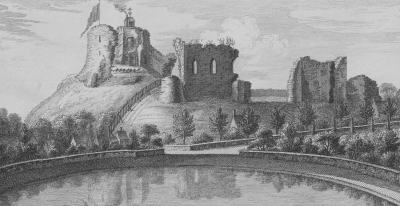
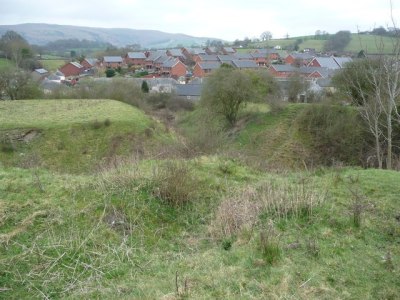
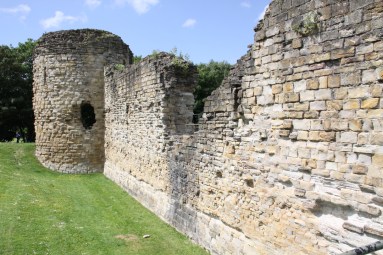
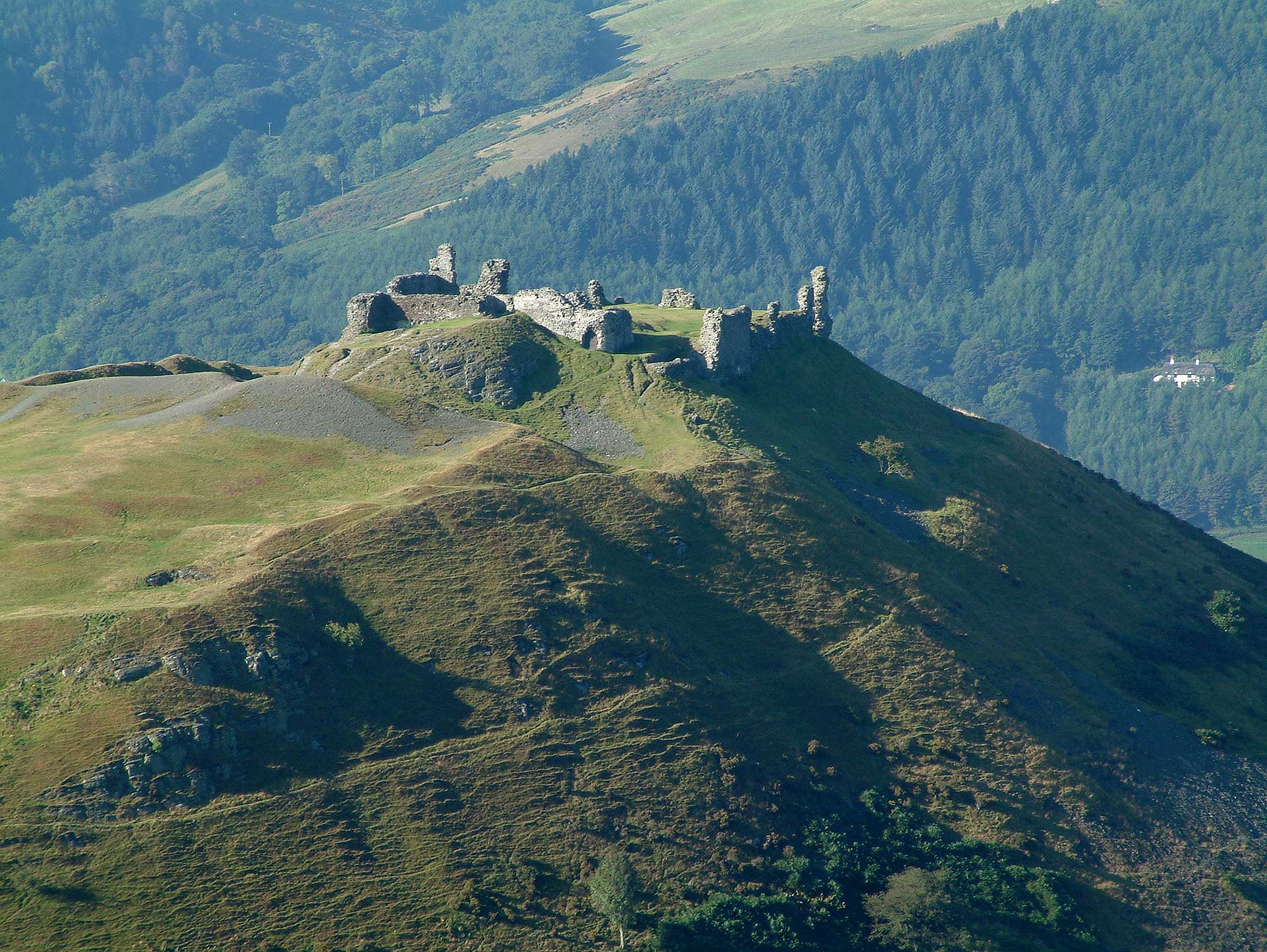
Castell Dinas Brân, Castle of Crows above Llangollen – Medieval ruins and stunning views

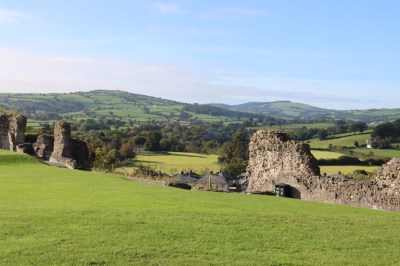
I have been visiting Dinas Brân on and off for decades, but have never got around to writing it up.  It was one of my favourite walks with the family dog in the 1980s when my parents lived hereabouts.  Much later, a regular return trip between Aberdovey and Rossett gave me the opportunity to see the castle from various different angles in all sorts of weather, the conical hill on which it sits soaring from the Dee valley providing a commanding, impressive position that dominates the landscape.  I recently drove into Llangollen to go up to the castle on a hot day, prepared for a moderately steep walk from the canal bridge, correctly anticipating a slightly breathless arrival at the ruins.

This is a splendid walk.  It is only about 2km (1.3 miles) from the Eisteddfod Pavilion, where I parked, although uphill all the way from the Wern Road canal bridge, so it feels longer, and the views towards the castle and back over the valley are splendid.  The views from the castle itself are of course stupendous, both aesthetically and geologically.  The geology and geomorphology are mentioned in brief below.  More about parking, the different routes and conditions underfoot are towards the end of the post in Visiting.


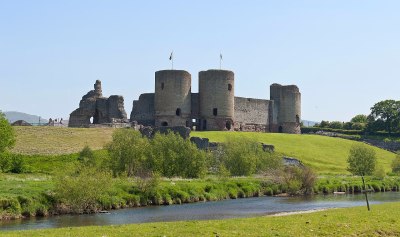
Dinas Bran ruins

Castell Dinas Brân, a Scheduled Monument, is the story of two fortifications, one dating to the Iron Age, at around 600BC, the other a medieval castle dating to the 13th Century.  It is far from unusual to find Medieval castles built within the circumference of an Iron Age hillfort, because both were making use of the same strategic features:  a good view of the surrounding countryside, a defensible position, often above cultivable land, and access to water.  This post is about the Medieval castle.

xxx

History of Castle of the Crows

The medieval castle

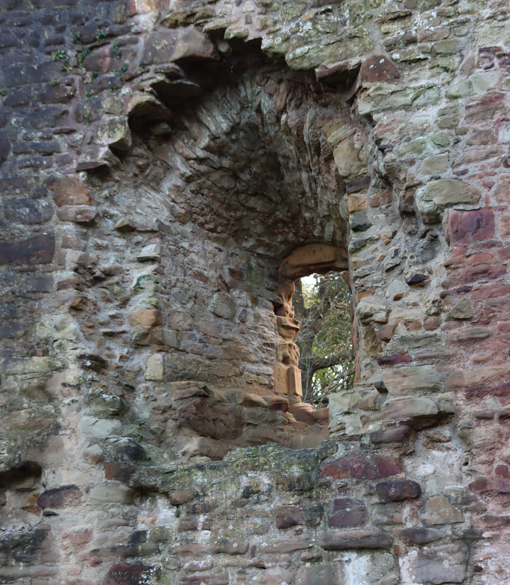
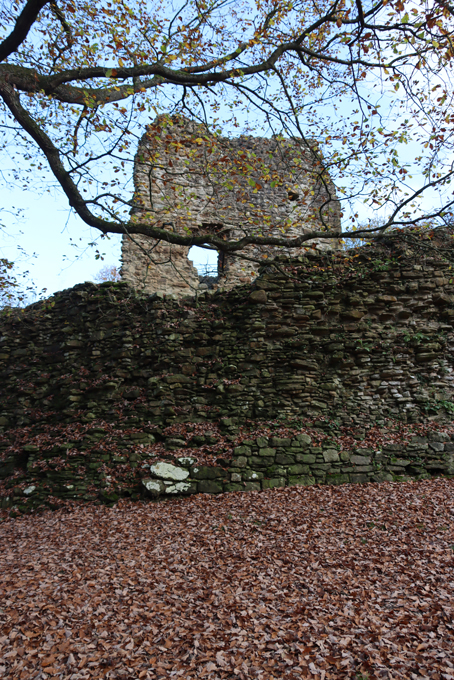
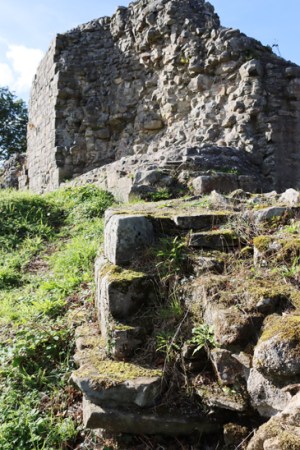
Window of what was possibly the Great Hall of Dinas Bran

Window of what was possibly the Great Hall of Dinas Bran

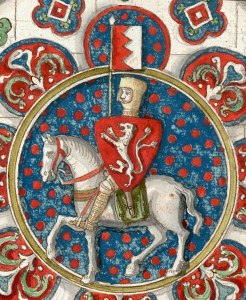
It is not certain which of the Powys Fadog rulers built Dinas Brân.  The most common suggestion is that the castle was built by Prince Gruffudd ap Madoc (c.1220-c.1270), beginning in the 1260s, but there is an argument discussed by Paul R Davies that it may have been built by his father Prince Madoc ap Gruffudd Maelor.

Valle Crucis Cistecian Abbey, founded 1201

From c.1190 Prince Madoc was ruler of Powys Fadog, the northern section of Powys, which had been split into two on the death of Madoc ap Maredudd in 1160.  He founded the nearby Cistercian abbey in 1201, and although his territory was comparatively small, he clearly had ambitions to establish his name and ensure his legacy, A castle would have been consistent with that intention, and as Davis points out, materials and workers could have been shared between the two sites.  Prince Madoc died in 1236 leaving four sons, of whom Prince Gruffudd was the only one to survive.  Whether Madoc started work on the castle or not, it is clear that Prince Gruffudd continued it, completing it well before the war of 1277.

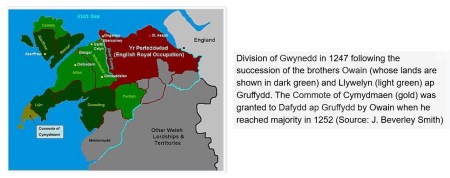
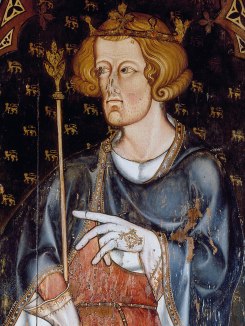
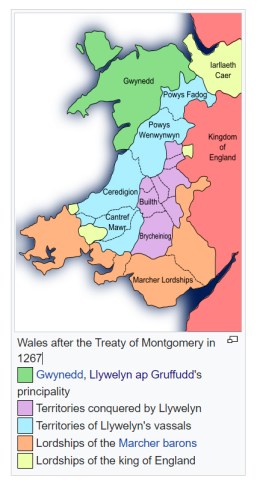
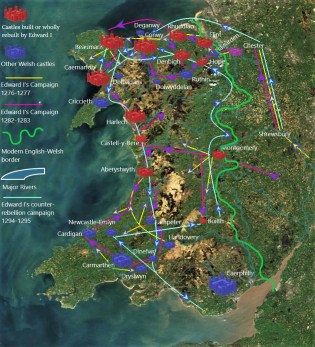
Together with Powys Wenwynwyn to the south, Powys Fadog was sandwiched between the much larger territory of Llywelyn ap Gruffudd’s Meirionydd in the west of Wales and England to the east.  Llywelyn (c.1223 – 11th December 1282, also known as Llywelyn the last, grandson of Llywelyn the Great) and his brother Dafydd (1238 – 3rd October 1283) had been in a long-term power struggle with Henry III that erupted once again under Henry’s son Edward I.  Whilst the northeast territories provided a buffer zone between the two warring factions, their rulers were inevitably dragged into the question of where to bestow their loyalties.  There was never any certainty that the members of a single family would throw in their lot with the same side, and some, like Llywelyn’s brother Dafydd, switched sides at least once.

Wales following the 1267 Treaty of Montgomery showing Powys Fadog sandwiched between Gwynedd and England. Source: Turvey 2002, p.xxvii map 8

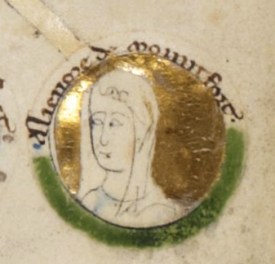
Prince Gruffudd was married to an English wife, presumably for diplomatic reasons, providing a nod of friendship to the English.  With Lady Emma Audely he had four sons, the eldest named Madoc, and one daughter.  Presumably seen as fair game by Llywelyn, Powys Fadog was attacked.  When Henry III was appealed to for help but did not come to Powys Fadog’s aid Gruffudd seems to have thrown in his lot with Llywelyn, arranging for peace between Meirionydd (Gwynedd) and the return of his territories by agreeing to the marriage of his eldest son Madoc to Llywelyn’s sister Margaret.  Dinas Brân was apparently built in support of the interests of Llywelyn the self-styled Prince of Wales, borrowing certain elements of architectural styling from Llywelyn’s castles, including the D-shaped tower at its southern side.

Gruffudd apparently died in around 1270, because it was in this year that his sons signed a grant to provide Lady Emma with lands of Maelor Saesneg to secure her future.  At this time ownership of the castle would have been split four ways between his sons, because primogeniture was the English but not the Welsh system of inheritance.  Instead of one son or daughter inheriting an estate, on the death of a father all property was divided between the remaining sons, with provision usually made for wives and daughters.  Each of Prince Gruffudd’s sons had his own decision to make in November 1276 when war broke out again between England and Wales.  However they started the war, Gruffydd’s eldest sons eventually submitted to Edward, but in May 1277 an English force sent to take possession of the castle found it in engulfed in flames and it was evident that the garrison left behind had remained loyal to Llywelyn.  The decision to burn and abandon the castle rather than defend or surrender it did not, however, completely destroy the castle.

After the Treaty of Aberconwy in 1277 Llywelyn paid homage to Edward, sitting to the left of the king’s throne, with Alexander of Scotland at the king’s right. The peace did not last.

After the Treaty of Aberconwy in 1277, Llywelyn’s power was confined to northwest Wales.  The English inspection of Dinas Brân to assess the damage caused by the fire found that although considerable superficial damage had been inflicted, the well-built castle was structurally sound and still of strategic value.  Henry de Lacy, Earl of Lincoln, wrote to Edward I recommending that the castle be repaired and garrisoned with English troops.

Following Edward’s triumph, Powys Fadog was abolished as a territory.  Edward gave ownership of the castle and all its lands to John de Warenne, the early of Surrey.  The castle, however, was no longer relevant as a symbolic stronghold of the former territory and now stood at the borderland of the new friendly lordships of Chirk, held by Roger Mortimer, and Bromfield and Yale by John de Warenne.  Instead of devoting any attention to Dinas Brân, de Warenne became busy building his new castle at the eastern end of Bromfield and Yale on the Dee crossing at Holt near Chester.

Ruins of Dinas Bran

Ruins of Dinas Bran

There is no record of the role performed by Dinas Brân, if any, during the final great conflict between Llywelyn and Edward of 1282, when the English were triumphant.  Llywelyn died on the battlefield that year, and Dafydd was captured and put to death in 1283.  As Holt Castle grew, Dinas Brân was abandoned.

A completely unsubstantiated legend concerns the fate of the two underage sons of Prince Madoc, Gruffudd’s eldest son.  Walter Tregellas in 1864 tells the story, in which Edward I conferred guardianship of the two boys on Roger Mortimer and John de Warenne:  “it is stated that the two children were soon afterwards drowned under Holt Bridge . . . This is said to have happened in 1281.”  He goes on to recount an even better version of the conspiracy, however: “it is uncertain whether the king himself did not cause the children to be put to death.”  There is no evidence whatsoever about what became of the two younger children of the prince of Powys Fadog.
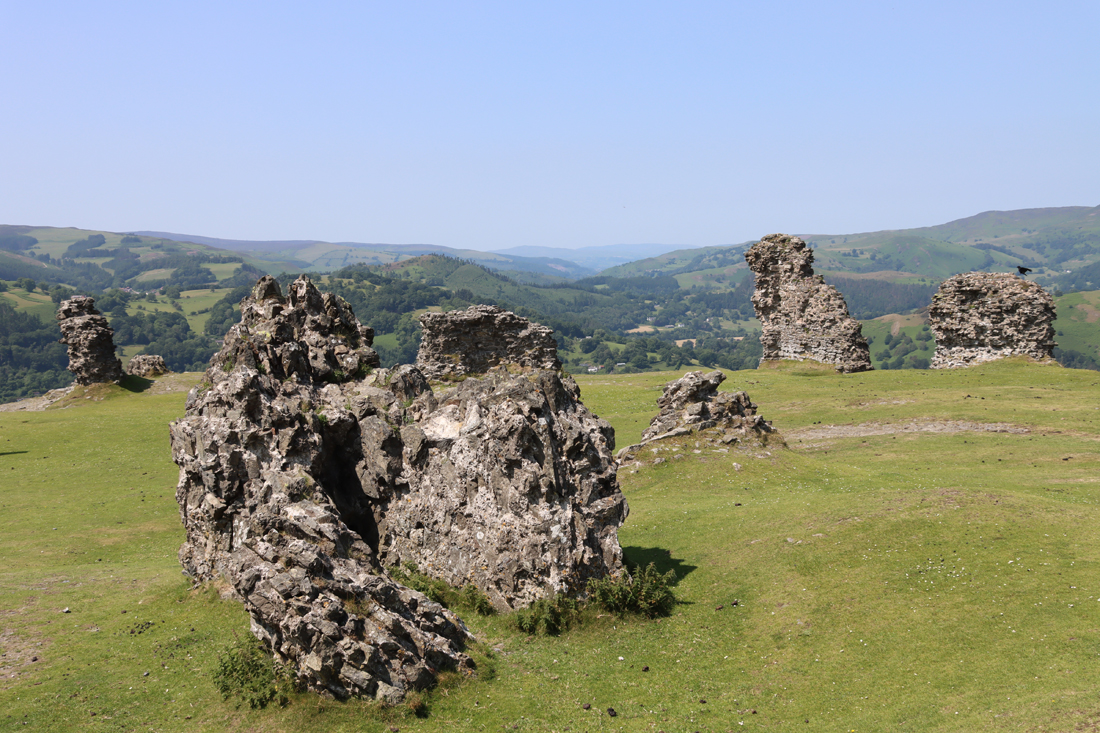
Dinas Bran and the wonderful scenery beyond

Dinas Bran and the wonderful scenery beyond

The only hint that they castle buildings may have been re-used is a poem by Hywel ab Einion Llygliw Myfanwy Fychan in the 14th century, in which he claimed to have been rejected by the beautiful girl who lived there.  There is no evidence to support this later domestic occupation, but neither is there anything to deny it.  John Leland, visiting in 1536, found it in ruins.


The Victorians

Dinas Brân Castle by Alphonse Dousseau, c.1850. Source: The National Library of Wales, via WikiData.

When ruins became desirable romantic destinations, Dinas Brân was an obvious lure for painters (many of whom chose to paint safely from below) and more adventurous tourists.  The Holyhead road was the major route through north Wales, with Telford’s great route, now the A5, opening in 1826, and the railway was opened in 1864.  A local entrepreneur, demonstrating great faith in the spirit of adventure demonstrated by the new tourists, decided to make the most of the popular site and the first visitor provision was supplied in 1820, with a cottage added in the 1880s as a tea room together with an octagonal camera obscura, which was still in situ by the start of the Second World War.

Walking up the hill not far from the summit I found a piece of slender white clay pipe, about an inch long, on a piece of well-worn hillside.  This almost certainly belonged to the period of Victorian interest in the castle.

Victorian cottage built for serving teas to visitors on Dinas Brân. Source: People’s Collection Wales


The castle as it stands today

Fieldwork

Plan of Dinas Brân, both prehistoric and medieval, following the geophysical survey of 2017

There has been very little fieldwork at Dinas Brân, and even the antiquarian investigators who explored other sites seem to have felt that this was one challenge too many.  The only exception appears to be alocal treasure hunter who is mentioned in a journal entry by Lady Eleanor Butler of Plas Newydd, whose home was in full view of the castle, and who commented that their landlord had informed them that a smith from Dimbraneth “has been dreaming of more than a year past of treasure at Dinas Brân. Hew has within this week begun to dig.”  There is no report of any discoveries.

In 2017 a geophysical survey was carried out and this was quite comprehensive, addressing both the medieval castle and the prehistoric hillfort.  Although nothing conclusive was discovered, magnetic readings did suggest that a fire had scoured the ramparts, perhaps tying in with contemporary reports that the sons of Prince Gruffudd had set fire to the entire structure rather than surrender it to the English.

In 2020 a survey was carried out by the Clwyd Powys Archaeological Trust (CPAT) to assess the condition of the site, both the castle and the prehistoric hillfort, making recommendations to make it safer and more approachable for visitors and to manage archaeological impact.  Earthworks were noted beyond the hillfort but were not included in the survey.

CPAT excavation at Dinas Brân in 2021. Source: Heneb

It was not until August 2021 that the first archaeological investigation was carried out at the site, organized by CPAT.  It was a small exploratory dig, with four trial trenches both within and outside the castle walls.  The main aim of the project was less investigation of the history and more about assessment of the condition of the building’s foundations.  Although the excavations did no more than reveal the medieval floor surface, one sherd of medieval pottery was recovered and a “ledge/kerb was discovered projecting from the gatehouse wall, with a portcullis slot in it near the east end, and a fine masonry carved pillar base at the western end.”  In 2021 the Heneb report said that the excavation report was “awaiting a second phase of work in 2022,” but I have been able to find nothing about a 2022 excavation and no further reports.

Modern conservation work was carried out by Recclesia, who surveyed the site and inserted stabilizing rods into the south wall of the castle to ensure that it stays upright now and in the future.

The surviving architecture

Detail of an old interpretation board

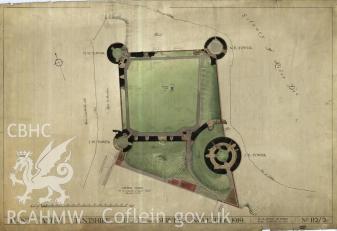
The plan drawn by Tregellas in 1864. with annotations

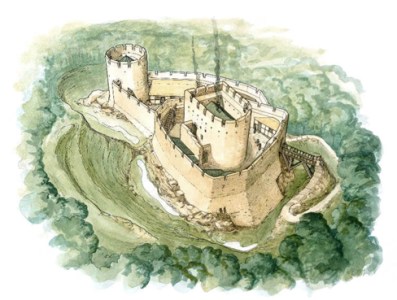
The castle was very fine in its day, with imposing fortified walls and stone and timber buildings.  There are hints that there were decorative features.  I have annotated the plan drawn in 1864 by Walter Tregellas to make this easier to follow.  If you have walked up from Llangollen, and climbed the east-facing slope of the hill, you will have entered opposite the original entrance.  I had had a long wander around before tackling how the ruins relate to the original layout but when I got stuck into the site plan, I started at the entrance.
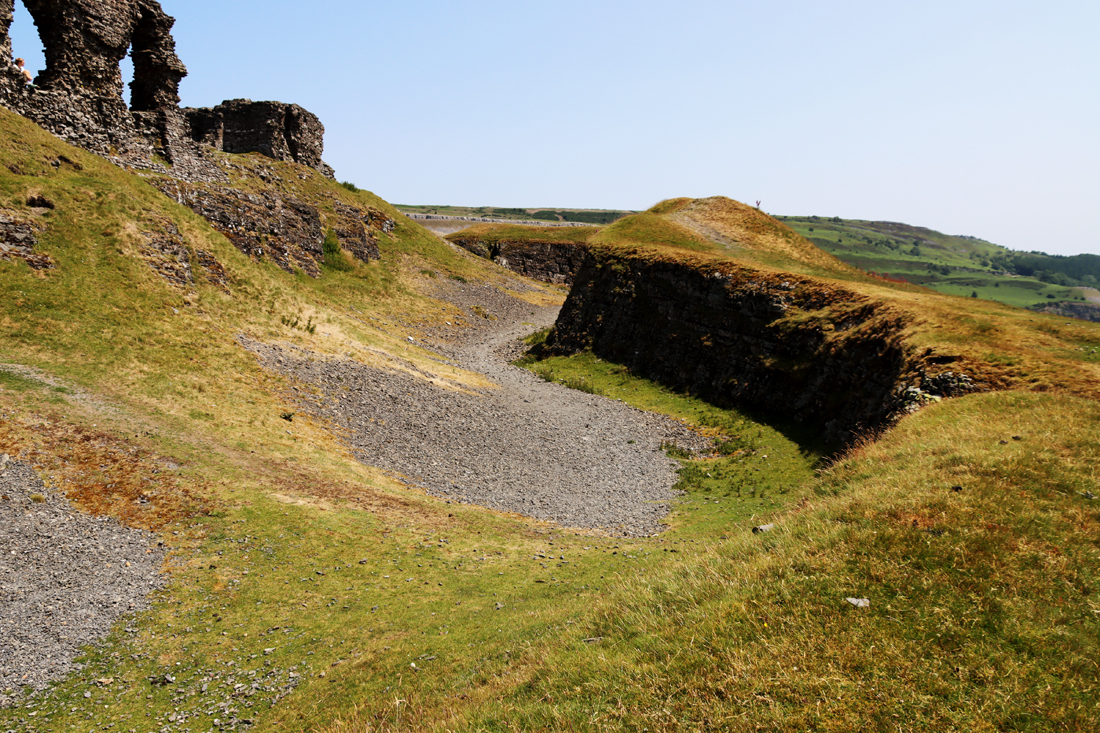
The ditch surrounding the castle

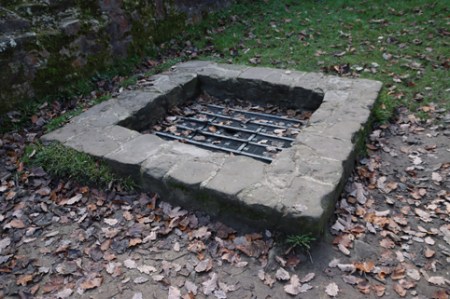
The site consists of a rectangular court orientated east-west, c.82m  by 35m, surrounded by a ditch dug out of the bedrock, which provided the material from which the castle was built.  As well as building materials available within the immediate vicinity, it was found that there was sandstone facing in certain parts of the castle, which would have provided it with both refinement and prestige.  It is not clear where this came from, but it is likely that it was sourced from the same location as the Valle Crucis ashlar.  The ditch surrounding the castle was an impressively deep and wide feature, running around three sides, the northern side of the castle being positioned directly over a steep drop.  At the southwestern corner of the ditch was once a well, the location of which is now very difficult to see.

An artist’s impression of how the gatehouse (right) and the keep (left) as they may have looked when it was first built. Source: Clwydian Range and Dee Valley

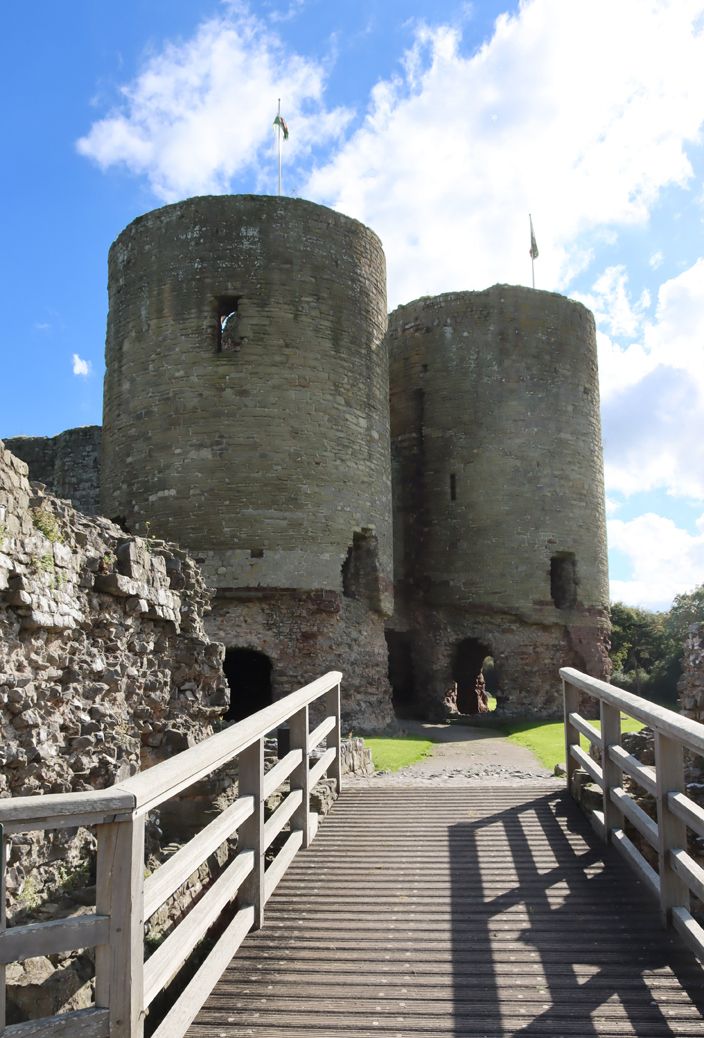
The original entrance was marked by a gatehouse that, being one of the points of weakness of the castle, was built so that it could be well defended, with twin English-style towers forming a gatehouse, each with hollow basements and, remarkably, appears to have been furnished with highly ornate rib-mouldings.  This is unprecedented in Welsh castle design and may have been copied from an English example.  One of the two gate towers still has the underfloor barrel-vaulted arch that was accessible from the courtyard; although it is now open to the outside, this would have been closed in the 13th century and is probably the enlargement of an arrow slit.  The vaulted room is closed to the public except on special open days.  The gatehouse was supplied with latrines on its northern side, that emptied down the walls into the ditch.

The vaulted undercroft in the gatehouse


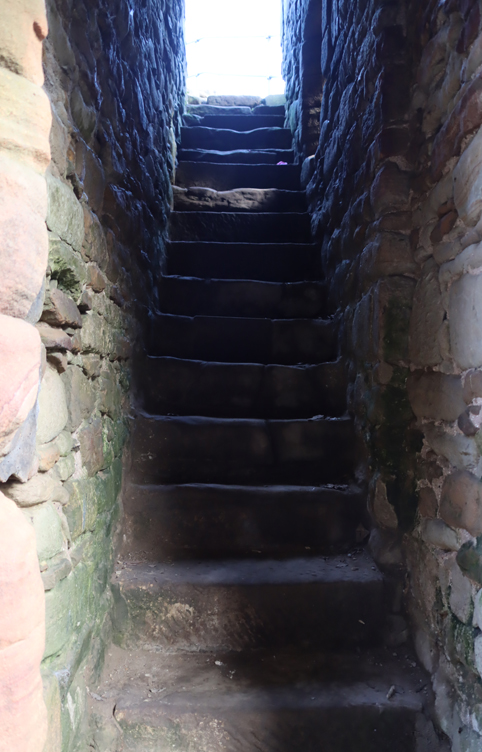
The stairwell that lead up to the first floor of the keep

Heading clockwise from here, you encounter the square keep.  This was once an impressive building that helped offer protection for the gatehouse as well as the most vulnerable eastern approach.  It will also have provided a home for the main family members and a final retreat at a time of siege.  It was equipped with latrine which, like the gatehouse, emptied into the ditch.  Additional security was provided for the keep.  It could only be entered via a first floor door reached by stairs from a walled passage, and was separated from the rest of the castle interior by its own ditch, which would have been crossed by a liftable bridge.

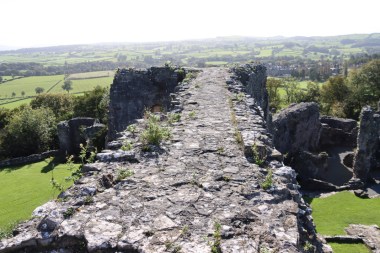
Continue around to the right to follow what was once the long south curtain wall.  The section of wall with two giant openings in it was either the site of the castle’s Hall, where dining and socializing would have taken place, or its chapel. The two openings, providing plenty of light for interior, would have been about 1.8m (6ft) wide at their maximum width.  They would have had shutters to protect the castle from the elements, but no window glass.

At the far end of the Hall a doorway opened into a D-shaped tower that extended beyond the line of the curtain wall.  The D-shaped section has gone, but this tower was a major feature of the castle, rising to two if not three floors.  A good surviving example can be seen at the well known Ewloe Castle (about which I have posted here).  Again, this was a defensive measure providing archers good views over the ditch and the flanking walls. The ruins of the inners walls give a sense of the size of this half of the room. It is likely that part of this was used for the castle kitchens, which gives weight to the argument that the adjoining apartment was the dining hall rather than the chapel.

Further along this stretch and you will find yourself looking out between two sections of wall, a gap that represents the remains of the postern gateway.  As well as providing a useful secondary pedestrian entrance on the opposite side of the castle from the main gatehouse, this could also be used as a “sally port” that would allow foot soldiers to mount a surprise attack from an unexpected position.

A rectangular building at the west end may have been either the hall or the chapel or served another purpose.  This area is likely to be highly disturbed, archaeologically, due to the Victorian building works in this area. The rest of the interior would have been filled with timber-built buildings, including accommodation for servants, storage, stables and workshops.


The landscape  

xxx

British Geological Survey geological timeline.

Standing on the peak of the hill, you are 305m (c.1000ft) above seal level.  Geologically, Llangollen is divided into two main formations.  At the top of Dinas Brân you are standing on one and looking at the other.

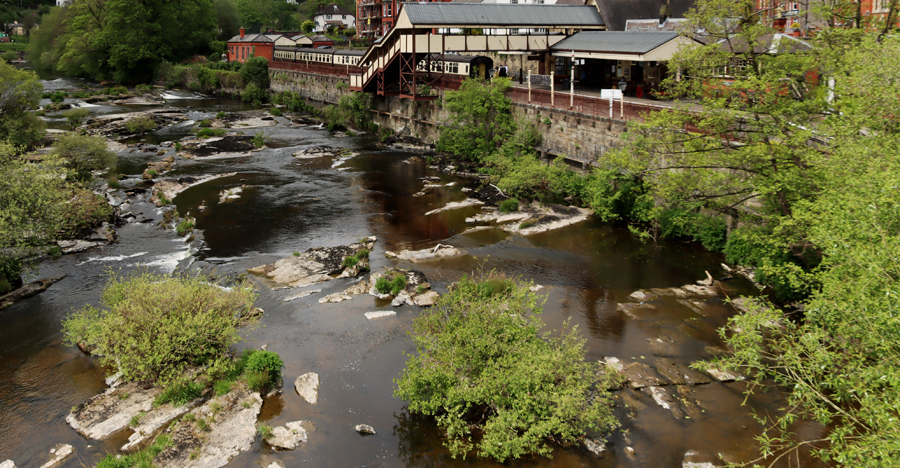
Beneath your feet the rock formations are dark grey Silurian shales and silstones, which were laid down as deep sea sediments and then subjected to metamorphic processes.  These are the same rocks that you see in the Dee river bed from the Llangollen bridge, with the rapids flowing over them.  The stone quarried from the ditches of this Silurian hillside were used to build the castle, and are uncleaved, around 30-40cm thick.
Above this layer in Llangollen is the heavily layered Carboniferous limestone escarpment that so dramatically forms a backdrop to Llangollen and Dinas Brân, laid down when the sea was warm and shallow.  The Devonian, which theoretically should have sat between these two geological periods, is missing, presumably because it was not under water in this area at that time, and did not form the rich, deep layers usually laid down in marine contexts.

The solid geology of Clwyd showing rock types. Jenkins 1991, p.14

Geomorphologically, the Vale of Llangollen is a typical U-shaped valley carved by the advancing ice and associated debris of the Welsh Ice Sheet as it advanced east.  The river Dee wends its way through this flat base, and former river beds are visible in the landscape, the former routes of the river blocked by the ice sheet, forcing water to find a new passage.

The  plant life that has settled into place on this isolated outpost is typical species that are capable of surviving on highly exposed rock with very little topsoil.  Drought-resistant annuals like foxgloves and swathes of rock-hugging perennial succulents like sedum anglicum are dominant at this time of year.


xxx


Visiting

Map of the footpaths to Dinas Brân Castle (Kightly 2003, Denbighshire County Council)

The castle is on the open hilltop and is free of charge to access.  There are no facilities at all.  You will need to take water and any snacks with you, although there are plenty of facilities down in Llangollen itself.

There are two main approaches to the castle for walkers arriving by car from the east.  One is a longer walk from the valley bottom, and the other is a much shorter but slightly steeper walk from the other side, approached along the narrow road now marked on the map as the Offa’s Dyke Path (even though Offa’s Dyke does not actually follow this exact path).  A map taken from the bilingual booklet Castell Dinas Brân Llangollen (in their Enjoy Medieval Denbighsire series) shows two alternative routes, with variations. 

The easiest place to park if you are heading up from the valley is the International Eisteddfod Pavilion (marked as the Royal International Pavilion on the map), which offers a really lovely walk along the canal to arrive at the canal bridge where you cross to begin the walk.  The second approach is much shorter and takes you from the Offa’s Dyke Path, a single-track road that follows the line of the hill, and has spectacular views; there is no official parking here, although there is space to pull over and park for about 4-5 cars (being careful to leave passing spaces) and this gets full very quickly on fine days.  

Both routes require sensible footwear, whatever the weather.  I was wearing some excellent lightweight hiking trainers with heavy tread, perfect for a hot day, but in damper seasons I would go for hiking boots.  Although the path starts off metalled in Llangollen itself, mainly because it is one access point to the local school, it becomes much more uneven underfoot as the path goes on, with patches of coarse bedrock and scatterings of loose scree.
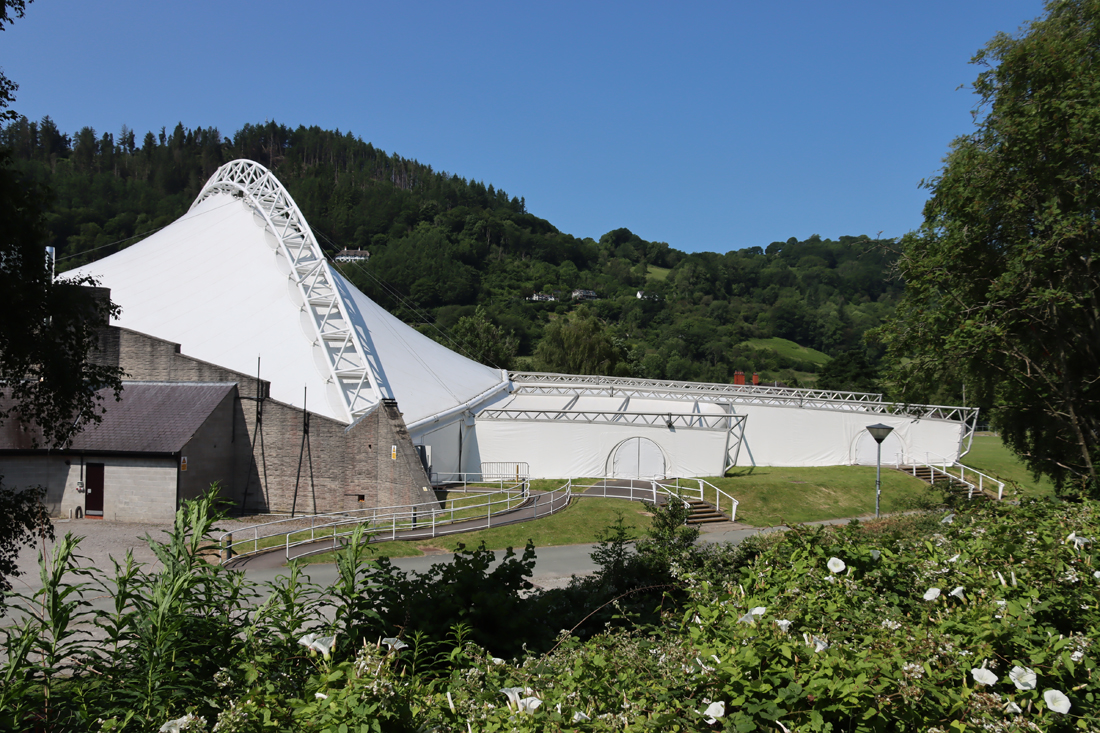
The Eisteddfod Pavilion is on the A539 on the way out of Llangollen towards Valle Crucis and the Horseshoe Pass.  The car park is big, with a pay and display system.  From here, go up out of the car park towards the canal bridge, and go down on to the towpath to the left of the bridge, turning to the right under the bridge to head east in the direction of Llangollen.  This is a lovely stretch of canal, passing the marina on your left.

When you reach the next canal bridge, with a cafe on the right, walk up on to the bridge.  Directly in front of you, heading straight up a short flight of stairs, is the public footpath.

From here on it is easy to find your way.  Just keep going straight up.  You first pass the school on the left, and a field on the right, with a gate at the top of this first stretch.  Go through the gate, cross the lane, and keep going up the other side.

You will pass various attractive buildings along the way, the largest of which is the Grade II listed Dinbren Hall, built with conviction but without a great deal of imagination in a very lovely location in 1793.

Soon you will reach another gate.  This has signage on the other side of it warning to inform you that you have now arrived at the foot of the hill, and to keep dogs on a lead (there are sheep all the way along this walk).

It is less even underfoot from here, with a very short uneven patch, but you will find that just over the other side the path opens out onto the hillside, with a clear view of the path ahead.

A very short uneven section of path, but it evens out just on the other side


Beyond this, along the steepest part of the route, the ziz-zag path marked on the map is beautifully maintained at the time of writing, with occasional stretches provided with a hand rail and long shallow steps where required.

This brings you out at the the west end of the castle, where the Victorian camera obscura and teashop used to be located.  If you are approaching from the other side, via the Offa’s Dyke Path, you will find a similar zig-zag arrangement to provide a less strenuous way up the hill than heading straight up the side.

Eastern approach to the castle

You can easily turn this into a circular walk from the Eisteddfod pavilion. For the quickest of the two easiest routes, come down from the castle onto the lane under the limestone escarpment and head downhill along the Wern Road, which takes you back to the canal bridge.  For a longer but really attractive route, continue along Offa’s Dyke Path, past Wern Road, which eventually heads downhill and comes out at the Sun Trevor on the A542; cross the road, cross the canal bridge, turn right and walk back along the towpath into Llangollen.  Although this is a much longer way back, it is all metalled lane and nicely maintained towpath, so is very easy underfoot.

Sources

Ordnance Survey Explorer no.256: Wrexham/Wrecsam and Llangollen.  Particularly useful if you want to make this into a circular walk, or to visit other local sites like the Horseshoe Falls and Valle Crucis Cistercian abbey.

If you are particularly interested in medieval architecture in the Denbighshire area, do download their bi-lingual PDF booklet Enjoy Medieval Denbighshire.

Map showing sites featured in the “Enjoy Medieval Denbighshire” PDF

Books and papers

Berry, D. 2016 (4th edition). Walks around Llangollen and the Dee Valley.  Kittiwake Books

Davies, John 2007 (3rd edition). A History of Wales. Penguin.

Davis, Paul R. 2021. Towers of Defiance. The Castles and Fortifications of the Princes of Wales. Y Lolfa

Kightly, Charles 2003.  Castell Dinas Brân Llangollen.  Denbighshire County Council (bilingual booklet with excellent illustrations, artist reconstructions, photographs and information)

Jenkins, David A. 1991.  The Environment: Past and Present. In (eds.) John Manley, Stephen Grenter and Fiona Gale. The Archaeology of Clwyd. Clwyd Archaeology Service, p.13-25

Jones, N. W., 2020. Castell Dinas Brân, Llangollen, Denbighshire: Condition Survey. Unpublished report. CPAT Report No. 1739
https://coflein.gov.uk/media/366/634/cpatp_144_001.pdf

Roserveare, M. J., 2017. Castell Dinas Bran, Llangollen, Denbighshire: geophysical survey
report. TigerGeo Project DBL161.

Tregellas, Walter 1864. Castell Dinas Bran Near Llangollen, Denbighshire. The Archaeological Journal, 21, p.114–120
https://archaeologydataservice.ac.uk/archiveDS/archiveDownload?t=arch-1132-1/dissemination/pdf/021/021_114_120.pdf

Turvey, Roger 2002. The Welsh Princes. The Native Rules of Wales 1063-1283. Pearson Education

Venning, Timothy 2012. The Kings and Queens of Wales. Amberley


Websites

Coflein
Castell Dinas Bran
https://coflein.gov.uk/en/site/307064/

Clwydian Range and Dee Valley
Dinas Brân
www.clwydianrangeanddeevalleyaonb.org.uk/projects/dinas-bran/

CPAT
Historic Landscape Characterization: The Making of the Vale of Llangollen and Eglwyseg Historic Environment
https://heneb.org.uk/archive/cpat/projects/longer/histland/llangoll/vlenvi.htm

Heneb
Castell Dinas Brân, Llangollen
https://heneb.org.uk/cy/project/castell-dinas-bran-llangollen/
Dinas Brân, Llangollen Community, Denbighshire (HLCA 1150)
https://heneb.org.uk/hcla/vale-of-llangollen-and-eglwyseg/dinas-bran-llangollen-community-denbighshirehlca-1150/

Recclesia
Castell Dinas Bran
https://recclesia.com/our-work/castell-dinas-bran

Scottish Geology Trust GeoGuide
Dinas Brân
https://geoguide.scottishgeologytrust.org/p/gcr/gcr19/gcr19_dinasbran


You can explore the castle from afar via this Sketchfab 3D model by Mark Walters.


A video showing the two main stages of occupation of the Dinas Bran hill, on the Clwydian Range and Dee Valley website, beginning with the hillfort and moving on to the medieval castle.

xxx

Beyond the Walls: Chester circular river walk

xxx

The dotted green line is the only way on to the footbridge avoiding steps.

sdfsdf

For those with unwilling legs please note that in [squared brackets, and highlighted in bold], are alternative routes that avoid steps and any other observed challenges.  On the above maps the dotted line in green, is the only way of getting on to the Queen’s Park footbridge avoiding steps.

As well as the numbered sites, turquoise stars show other sites nearby that may be of interest.  Each of the numbered and starred features deserves a post in its own right rather than the short burst of text allowed for each, but hopefully there is enough to make the walk informative as well as enjoyable, and in some cases I have hyperlinked to sites with more useful details.

You can download the text of the walk, including the maps, as a PDF here (but without the introduction, the list of sources and without ink-hogging images).


The dotted green line is the only way on to the footbridge avoiding steps

xxx

Introduction

View through the chancel arch of St Mary’s Nunnery through to the Ship Gate. Grosvenor Park.

Together with the city walls, this is my favourite walk in Chester, incorporating some lovely riverside footpaths and green spaces beginning at the Little Roodee car park on Castle Drive.  The entire walk is on metalled surfaces, and is therefore very suitable for all seasons.  It starts with the Grosvenor Bridge, turning in to Overleigh Victorian Cemetery and taking it from there along the River Walk.

There is plenty to enjoy along the south bank of the Dee, with lovely and peaceful riverside walks separating points of interest such as Minerva’s shrine, Handbridge with the Old Dee Bridge and Weir, and the Queen’s Park footbridge. The Groves is the northern counterpart to the River Walk, with its Victorian grandstand and array of cafes, ice cream parlours and the southern stretches of the Roman-Medieval walls.  Back past the Old Dee Bridge, the walk takes in the former old Dee mills, the Gothic Revival hydroelectric station, the remains of the former prison’s outer wall, the Wheeler Building that houses the Riverside Museum and the Royal Infirmary stained glass, and then returns along the river bank to the Little Roodee.

Ice Cream parlour on The Groves

The walk takes in several periods of Chester’s architectural history, from the Roman, through medieval periods, skipping the early Stuart and Civil War years. The Bear and Billet public house on Lower Bridge Street represents the later 17th century, but most of the remaining architectural history on the walk resumes with the Georgian architecture of the 18th century, plunging headlong into ambitious Victorian expansion and alteration.  From a distance, seen from the Grosvenor Bridge, is the Art Deco water tower, which is a nice addition to the mix.  Two examples of the less fortunate periods of 1960s and 70s architecture that afflict Chester like a bad rash also appear, but although one of them is particularly bad (the “Salmon Leap” apartments on the Handbridge side of the Old Dee Bridge) the other is somewhat less objectionable (the ex-Cheshire County County building, now the University of Chester’s Wheeler Building).  A very modern building, nicely done on a budget, is the cafe in the Little Roodee car park with its environmentally friendly “green” roof.


The Walk

1) Roodee carpark, toilets and café

The Little Roodee Cafe

The walk starts from the Little Roodee car park on Castle Drive, which lies along the northern edge of the River Dee.  There are plenty of other places in Chester to park, and there is also the very reliable Park and Ride, but this is a useful place to start the walk, including a very nice café with excellent coffee and good snacks, with public toilets within the café (there are other public toilets on The Groves, opposite the bandstand, shown below).  The bottom of the car park provides a good viewing point for no.2, the Grosvenor Bridge.

For those wanting to explore the river walk to the east, circling the edge of the Roodee and over to the west of Chester, this is also an excellent starting point.

The postcode for the carpark is CH1 1SL or the exact location for the entrance to the car park is What3Words ///swung.statue.limp), which can be used in most SatNavs.  If you are coming in by Park and Ride, ask the driver tell you when the stop is approaching for Adobe (big black glass building) on the Grosvenor Road.  The return bus stop is opposite Adobe on the castle side of the road.

2) Grosvenor Bridge

The Grosvenor Bridge

For the best view of the bridge, head downhill in the car park towards the river and turn right towards the bridge, crossing under one of its vast arches.  Look back to see a great view of the the entire span.  For centuries the only bridge across the Dee at Chester was where the late Medieval Old Dee Bridge is now located, following the line established by the Roman bridge at the end of what is now Lower Bridge Street.  This was becoming seriously congested by the 18th century, when both the population and the economy were growing at a considerable pace, and a new bridge was an urgent requirement.  Local architect Thomas Harrison won the contract with his daring proposal for a 200ft (61m) single span that would not interrupt tall-masted river traffic.  It was not merely a new artery for Chester, but a statement of civic pride.  A plaque in the side of the bridge records that work began after an Act of Parliament was passed in 1825, and was paid for by a public loan of £50,000.  It was opened by Princess Victoria on 17th October 1832 (5 years before she became Queen), and was paid for by tolls on both the Grosvenor and Old Dee bridges until 1885, when the tolls were abolished.  The bridge remains a monumental and impressive sight today.

The Grosvenor Bridge shortly after construction. Source: Wikipedia

Retrace your steps and head back up the car park, passing in front of the cafe, and up the flight of steps to the Grosvenor Road, cross at the pedestrian lights, and turn left to walk over the bridge.  [If you want to avoid the steps, head to the other end where the car entrance is, turn left and walk up the road, Castle Drive, to the head of the steps on the corner, and cross at the pedestrian lights and turn left across the bridge].  

From the top of the bridge you can look right (or west) over the Roodee racecourse on the north bank of the river, and the impressive houses that formed the new middle class suburbs of Curzon Park which was developed in the 1840s to accommodate wealthy residents who wished to escape the narrower confines of the increasingly busy and commercial city. Some of the bigger of these buildings have been converted into apartments today.  Look left (east) and you can see the spire of St Mary’s Without The Walls, as well as the Handbridge water tower, a local landmark that is visible from various points in the Chester area, and was influenced by Art Deco designs.

Curzon Park

3) and 4) Three memorials in Overleigh Victorian Cemetery

After crossing the bridge, walk for perhaps 30 seconds and you will see a gateway on your left with wrought iron gates, one of which is open to provide access for pedestrians into the Victorian cemetery.  If you are on the opposite side of the road, there is a traffic island almost opposite to make it easier to cross.  Walk towards the information board and the bench, and pause.  The walk will continue downhill to the right, but we are briefly detouring to the left to see two of the most interesting of the memorials in the cemetery, one of which is a puzzle until you see it on the early 1850s engraving of the cemetery.

Entrance to Overleigh Cemetery

xxx

Overleigh Cemetery in the early 1850s. Source: Wikipedia

Overleigh cemetery was given the go-ahead by the Chester Cemetery Act in 1848.  The land was acquired from the Marquis of Westminster, who exchanged it for a shareholding in the company.  Work was forced to stop for seven months when the money raised was spent, and was not completed until new shareholders could be found.  The cemetery opened in 1850.  Like the Grosvenor Bridge, Overleigh Cemetery, was not merely the result of a Victorian efficiency drive and the desire to return a profit, but also a matter of improving the city in ways that demonstrated a profound interest in the character and status of the expanding city.  Although the cemetery was a pragmatic response to the inability of churchyards to meet demand, the layout and planting of the cemetery reflect country house garden and leisure park designs, with curvilinear drives, gothic revival architecture, a lake, plenty of of trees of different types and a rustic bridge.  Sadly, the only survivors of the architectural features from the 1850 design shown on the above engraving are the tall thin monument at far left, discussed below, and the rustic bridge at far right.  You can read more about the cemetery and its fashionable and elegant design on the blog here.

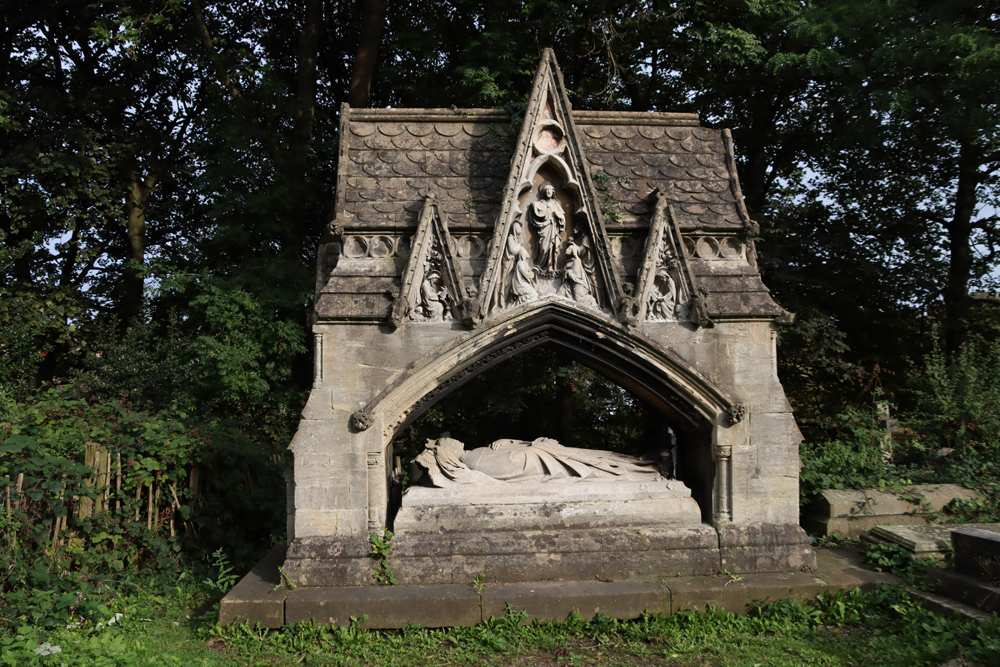
Now head left past the bench and stop a few seconds away in front of a nicely executed faux Grade II listed Gothic shrine featuring an effigy beneath tan elaborate canopy. It puzzled me that there was no inscription on the shrine, but the actual grave ledger lies flat in front of the shrine over the top of the actual grave, complete with the elusive inscription.  The shrine belongs to the Reverend Henry Raikes, who died in 1854, aged 72. The shrine was designed by architect Thomas Penson, who was the landscape architect for the entire cemetery and who built several buildings in Chester.  It was erected in 1858, funded by public subscription, the progress of which was frequently reported in the local newspapers.  As well as the former Chancellor of the Chester, Diocese Raikes was a philanthropist, a trustee and governor of the Blue Coat Hospital and one of the founders of the Chester “Ragged Schools” that provided education for pauper children.

The ruins of the Robert Turner memorial

Immediately to the right of the Raikes shrines, the second monument of note is the grave marker for Robert Turner (1790-1852), a Chester brewer and wine merchant who, in 1848 was Sheriff of Chester, a largely administrative but important function with the responsibility of keeping the peace, closely linked in to the work of the courts and the prison.  The memorial as it stands today looks very peculiar, a bit like a three-tier cake on space-rocket jet nozzles.  The clues to its original appearance actually still lie at its feet.  Three stone columns lie horizontally, when not semi-concealed by undergrowth.  Look at the engraving above and find the building at top right that looks like a little Classical temple.  This is how the Turner grave marker originally looked. It collapsed at some time in the past, and the tiered roof and although it has been considerably tidied up, reconstruction is no longer possible, and this strangely truncated form is all that is left standing of the memorial monument.

Retrace your steps past the bench and head down the hill until you reach a tall monument (4) in a triangular intersection of the cemetery drives and pause to have a look at it. 

This is not a burial monument but a memorial to William Makepeace Thackeray, 1790-1849, (uncle of the famous novelist) who moved from Denbigh to Chester to practice, and became a great success as a physician, and was renowned for his philanthropic and charitable works. He was buried in Chester Cathedral, but this memorial and its inscriptions celebrate his achievements, including “His attention to their charitable institutions / His consideration for the sick and needy / His kindness to the schoolboy and the orphan.” The memorial also serves as a useful anchor for the cemetery, a suitably impressive focal point that helps to give this part of the cemetery a sense of cohesion.  This is also a very good position to pause and take in the wonderful selection of mature trees, most of which were planted when the cemetery was first laid out.  There is a variety of species, and they were an essential part of the parks-and gardens style layout that was very popular in the Victorian period.

Head to the left. You will see the gateway pillars straight ahead of you.  This opens on to River Lane.  Turn left on to River Lane and turn right when you reach the end, heading east along the lovely River Walk.  The walk from Overleigh to Edgar’s Field is a nice one, consisting of a metalled road flanked by trees and shrubs, with fields to the south and views of the river, depending on the time of year, to the north.

You will emerge from the path onto a short residential road, Greenway Street, and opposite is another gateway, this time into Edgar’s Field. 

5) Edgar’s Field

The entrance to Edgar’s Field

Go through the gate into Edgar’s Field

Edgar’s Field is an open green space given to Handbridge by the first Duke of Westminster in 1892.  The name Edgar, so the story goes, refers to the early medieval King Edgar, great-grandson of Alfred the Great, who was crowned King of England in both Bath and Chester.  His Chester coronation was said to have followed a meeting near the field in AD 973, with leaders (either six or eight) from other regions  after which he was rowed by members of the visiting delegation to St John’s Church, just a little further upriver.  How much of this is legend and how much reality is anyone’s guess.

6) The sandstone outcrop 

Straight ahead there is a choice of going uphill to the right or sticking to the river walk on the left.

You will go right, but pause to look at the amazing sandstone outcrop.  This is a particularly nice piece of bedrock, formed of sedimentary layers laid down, during the Triassic period, 252 to 201 million years ago, when the landscape consisted of Sahara-like desert and abraided rivers.  This is also the period when the dinosaurs Pseuduchium Archosaur (ancestral to modern crocodiles and alligators) and Chirotherium are found, survivors of the Permian extinction (in which 95%) of dinosaurs were wiped out, and of which fossilized footprints have been found in the Triassic sandstones on Hilbre Island at the top of the Wirral.

Sandstone formations on Edgar’s Field

The various lines and colours visible in the Edgar’s Field rock represent the different layers of sediment (bedding) that were laid down by rivers and floods that were laid down as muds and have built up over time.  Nice features include both cross-bedding and slumping, geological features exclusive to sedimentary rocks.  Differences in colour reflect differences in the chemical composition of the sediments as they were laid down, a dramatic example of which is shown in the above photograph of the outcrop.  See more about the Cheshire sandstone in this PDF on the Sandstone Ridge Trust website.

Walk along the path to the right of the outcrop.  A second outcrop appears on your right, and on the face that looks over the big open green is the Minerva shrine, so leave the path and walk up the green slope.

7) Edgar’s Field and the Minerva Shrine

When you are standing in front of the shrine, you will find it very water-eroded.  It is carved directly into outcrop, one of only two known to be still in situ in Britain, and is a Grade II listed Scheduled Monument (1.45m high and 0.73m wide).  The sandstone surround is Victorian in date, added in the hope of preventing further erosion.

The Roman 20th Legion, the Valeria Victrix, arrived in Chester (Deva) in AD76, and in one form or another the Romans remained in Deva until around 380.  Although outside the Roman city walls, Handbridge was an important location because it was the quarry for the Roman town and its walls, the source of its red sandstone building blocks.  Further along the path on an interpretation board is a reconstruction of what the shrine would have looked like, originally with an owl on Minerva’s left shoulder, possibly holding a shield in her left hand, and a spear in her right hand.  Minerva was an interesting choice.  Although better known goddess of wisdom and knowledge, she also served as a protector for those engaged in defensive war, a subtle distinction from aggressive war that might well be attractive to those building protective walls.  The little cave to the right of the shrine was probably carved out to hold votive offerings.  The area around the shrine was excavated in the early 1920s, revealing both that the quarry was in use at around AD100 and that subsequently soil was imported to cover the quarry floor in the late-second century. Roman occupation remains dating from that time on were found on the site. The site was again used as a quarry during the Middle Ages, when Historic England speculates that the Minerva carving may have been re-interpreted in Christian terms and re-used as a Christian shrine.

It is worth walking down to the edge of the river, through the line of magnificent lime trees, to enjoy the excellent views over the medieval Old Dee Bridge bridge.  From there, follow the path for a short distance to the gates out of the park.  You now have the Old Dee Bridge on your left and Handbridge on your right.

8) Handbridge

Handbridge

Handbridge has always has an extra-mural personality of its own.  From the mid 12th century there were mills and quays at Handbridge, when parts of the district were owned by St Mary’s Benedictine nunnery, which seems to have taken over the entire manor by the 13th century.  In the late 14th century industrial activity seems to have been represented by the production of glass, and by the 15th century it is thought to have been a popular area of Welsh migrant settlement.  Welsh residents in the 16th century included a high percentage of the city’s brewers and ale sellers. In the Victorian era it became known as one of the poorer areas, with a high proportion of industrial worker.  Today Handbridge has gone upmarket and is now an attractive residential location with a villagey-atmosphere, with some excellent cafés and pubs for those looking to take a break at this point.  Both Spoilt for Choice and Brown Sugar cafés are great brunch/lunch stops, and the Old Ship Inn is a very fine pub.

Nathaniel Buck’s view of Handbridge in 1928. Source: MutualArt

9) The Old Dee Bridge 

Do not cross the bridge, because the walk continues on the same side of the river, but if you want to stand in the middle and admire the weir, discussed next, it’s an excellent place for getting a good view. 

The Old Dee Bridge

The oldest known bridge to cross the river at this point was Roman, carrying the Via Praetoria from the south gate over the river to link up with the Roman road network, with roads leading directly from Chester to the southeast via Whitchurch to Wroxeter (Vicronium) and the south to London (Londinium) and Caerleon (Isca), and along the north Wales coast to Holyhead (Segontium).  It must have been rebuilt several times over the 300 years of Roman occupation.  The current late Medieval bridge replaces an early Norman bridge, but apparently fell down during the floods of 1227 and had to be replaced.  The construction is interesting.  It is built of the usual local red sandstone, but for reasons unknown, instead of being evenly distributed along the length of the bridge, the arches are each of a different width, giving it a splendidly individual appearance.

The Bridgegate on the opposite side of the river is discussed below.

10)  The Weir

Staying on the same side of the river, cross the road and follow the line of the river for a few steps until you get a good view of the weir.
xxx

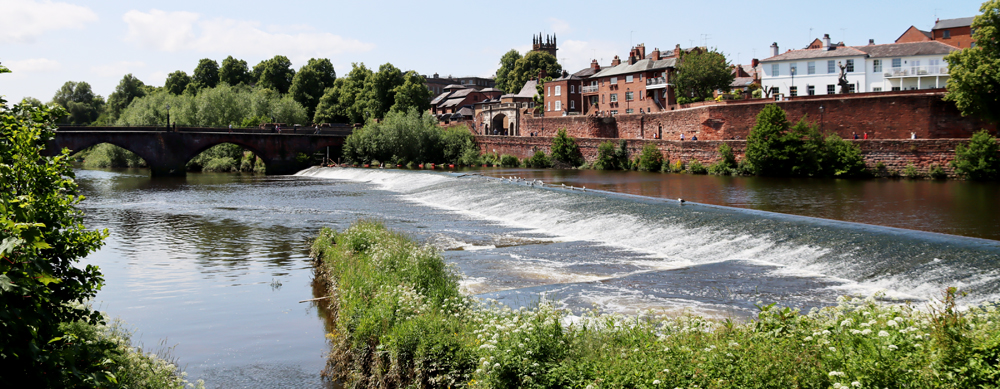
Very little is known about the weir itself.  It is generally agreed that it was at least Norman in date, but whether it was actually the elaboration of a Roman innovation is open to debate.  The Romans certainly built weirs, some of them very substantial, but at the moment there is insufficient information to determine the earliest date for it.  Walk a little further down by the side of the river and you will see that on the near side of the weir there are a series of very wide water steps, forming what looks a little like a stepped waterfall; this is a salmon leap, built to enable the fish to navigate their way upstream for spawning.  On an open day at the monitoring station last year I saw one of the salmon being caught for weighing and it looked huge!

The Salmon Leap

11) River monitoring station and ornamental water wheel

Probably the least attractive feature of the Chester riverside is a row of 1960s apartments that you will see from the north side of the river.  You now pass under the concrete overhang of these apartments. There are lovely views over Chester on your left, and you  will reach a small island with a building on it.  

River monitoring station

Water wheel reconstructed in 1988 by the Chester Civic Trust

This is the river monitoring station, where various tests are carried out on the water quality and the condition of the fish themselves.  I was lucky enough to be there on an open day last year when  an enormous salmon was pulled out for weighing before being returned to its journey upstream.  In front of it is a small water wheel, which was installed in the 1980s as a reminder of the former Dee mills that used to be a dominant feature of the medieval riverside and an all-important feature of Chester’s economy in the Middle Ages.  Beyond it is a small sluice that once regulated water into the narrow channel that forms the island.

Carry on walking along the Riverside Walk, enjoying the greenery, until you reach the footbridge, which passes above the path, but has a flight of shallow steps running up either side of it so that you can reach the bridge from the path. [The alternative approach to the bridge, avoiding the steps from the river walk up to the bridge, is a rather long way round and is shown on the above maps as a dotted green line that takes you along Queens Park Road and around Victoria Crescent].


12) The lovely Queen’s Park footbridge

In 1851 it was decided that Chester needed a second suburb, in addition to Curzon Park, to be named Queen’s Park, and this was developed throughout the 1850s.  This was also built on the south bank of the river, this time opposite The Groves.

In 1852 a suspension footbridge was built to connect Queen’s Park with Chester, becoming the Queen’s Park Bridge.  The predecessor of the current Queen’s Park footbridge was built in 1852. In 1922 this was taken down, and work began on a new suspension bridge that opened, with some ceremony, in April 1923.  For more information about the opening of the bridge and its contemporary conditions of use, see the entry on the Cheshire Archives and Local Studies blog.

Conceptually, the bridge is the polar opposite of the vast solidity and monumentality of the later 1832 stone Grosvenor Bridge. The 1923 bridge is superbly elegant with delicate lattice metalwork. This latticing and the suspension cables supply a light, airy feeling, which is something to do with the sense of it hanging freely rather than being solidly rooted in the riverbed.  It is a perfect partner for the light-hearted promenade known as The Groves, with its lovely buildings and the similarly elegant bandstand, which is still used today, and the little ice-cream turrets.  Pride in the achievement, common to so many Victorian enterprises, is declared in the panels at the top of the suspension towers, which give the name of the bridge and the date of its construction.  Just as on the Grosvenor Park Lodge, the bridge’s towers feature the shields of Chester’s Norman earls.

13) The Grosvenor Park

The understated river-side entrance to the Grosvenor Park at the end of the footbridge

Walking off the bridge on the Chester side you will see a flight of steps straight ahead of you.  Just before the steps, on your right, is the understated gateway into the Grosvenor Park. 

I have included the park partly because it surprises me how many residents and visitors seem to bypass it, and it is lovely on a sunny day.  The Grosvenor Park was the brainchild of Richard, the second the Marquis of Westminster, following the example of similar projects elsewhere.  Like many wealthy Victorians, he undertook a number of philanthropic projects, and in 1867 the park opened for the benefit of local Chester inhabitants.  Unlike many town and city parks this one was not paid for partly by subscription; it was, in its entirety, a gift to the city from the Marquis, who chose the designer of the successful Birkenhead Park, landscape architect Edward Kemp (1817-1891), to lay out his new public space.

Today it is a beautifully maintained space with a miniature railway operating in the summer, a rose garden, a couple of vantage points from which to inspect the views over the river and some lovely wide open spaces, together with the shade of trees for those who prefer a bit of cover, in which to relax.  Although this is not a formal park, in terms of the big municipal floral plantings that characterize some English parks, there are colourful beds dotted around and at the top left corner of the park there is a charming wheel-shaped rose garden that is lovely in the summer months, with a variety of colours, and some lovely scented species, with benches around its edges.  As in the cemetery, which had opened 17 years previously, the trees were seen as a major feature of park and there are some splendid specimens.  The pond may once have been ornamental, but is now surrounded by tall reeds, providing a splendid refuge for wildlife.  I have seen the rails for the miniature railway but not the train –  I really must find out when it runs!  There is plenty of seating throughout the park, and as well as permanent sculptural pieces, there are often temporary modern art installations dotted throughout, which may or may not be your cup of tea, but are always genuinely interesting, and usually reference the natural world.  Look out for information panels dotted throughout the park.  The lodge, discussed next, serves as a coffee shop during the summer.  It’s not on the map because it is closed in the winter.


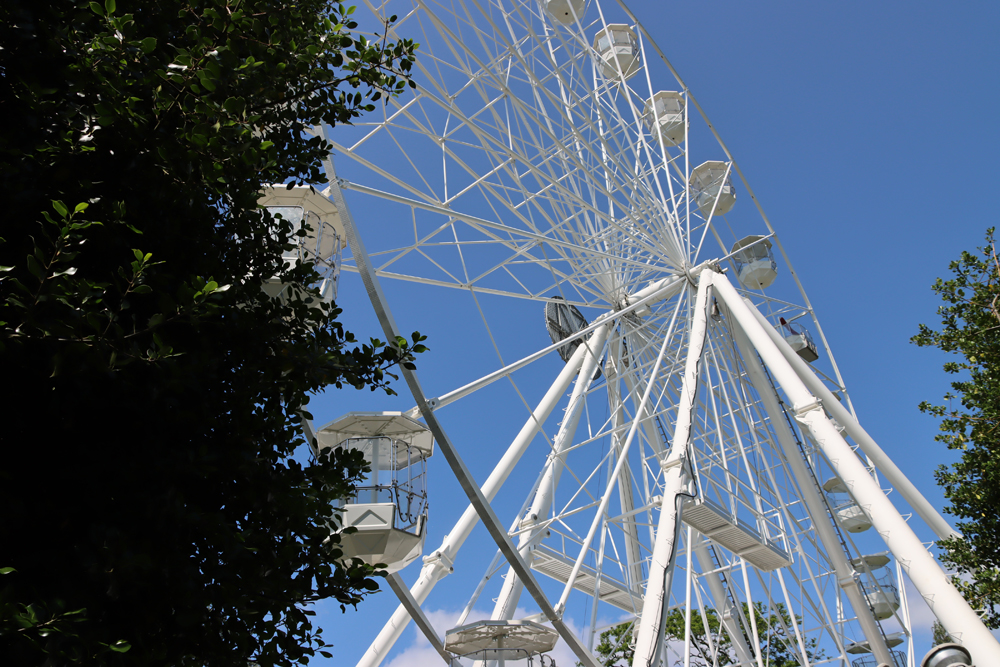
Ferris wheel in the Grosvenor Park


14) Four Medieval monuments

The arch from St Michael’s Church

As you walk into the park along a metalled path, you will soon come to a set of three clearly medieval (as opposed to mock-gothic) monuments set back from the main path, with a little side path of its own.  These were all moved here from elsewhere in Chester, and serves as a miniature outdoor museum.  The first one that you encounter is a gothic arch from St Michael’s Church, which is still standing but was largely rebuilt in the 1840s by James Harrison, and it is possible that the gateway was removed at that time.

Next, following the side path is the little Jacob’s Well, originally installed on The Groves as a drinking fountain and at its base a water dish for dogs.  The keystone inscription is from the New Testament and reads “Whosoever drinketh of this water shall thirst again.”  Finally, and most impressive of the three, is the arch and flanking niches that once linked the nave of St Mary’s monastic church to its chancel, a sad reminder of the absolute total loss of St Mary’s medieval nunnery.  The photograph of it is below under no.27, where the nunnery is discussed.
xxx
Keep walking across the intersection, bearing right, and you will immediately come across the Ship Gate, which once sat to the west of the Bridgegate at the end of Lower Bridge Street providing pedestrian access  from the riverside to the city.  This was moved three times, first in 1831 to a private garden in the Abbey Square, next in 1897  to the Groves and finally in 1923 to its present location in Grosvenor Park.

The Ship Gate, looking back towards the St Mary’s chancel arch

Between the St Mary’s arch and the Ship Gate there is a path going uphill to the main park, with handrails, shown in the photograph above.  Walk up the slope to the main drive towards the statue at the end.

15) Viewing platform over the Dee

If you follow the main drive to the statue of Richard, the second the Marquis of Westminster, you will see, slightly to your right, a large viewing platform with seating around its circuit.  The view over Chester meadows towards Boughton was probably a bit better in the late 1800s, but is still good today.

16) Grosvenor Park Lodge

When the park was opened in 1867, it had a lodge at the main gate and this remains today, used as a café in the summer months.  It was designed by successful local architect John Douglas who is best known for the Eastgate Clock, but who built a great many buildings in different styles in Chester.  It was built in the popular half-timbered revival style over red sandstone.  The brightly coloured statuettes on black timbers on the lodge show King William I, who appointed Hugh d’Avranches, better known as Hugh Lupus as the first Earl of Chester from 1071 until his death in 1101.  Hugh is shown, together with the successive Earls of Chester, ending with John de Scot (from 1232 to 1237), who died without heirs, after which the earldom reverted to the Crown.  Various family shields show locally relevant themes including the golden sheaf of the Grosvenor family, the portcullis of Westminster and the Chester city coat of arms.

17) The Grosvenor Park Archaeological Excavation

Grosvenor Park Excavations in 2024

Near to the rose garden, to its east, and for several weeks every year since 2007, an archaeological excavation takes place using students of the University of Chester to investigate the complex historical narrative of this area.  The project was initiated to provide information about the Church of St John the Baptist, and the later use of the area, including a house documented to have been built in the late 1500s by Sir Hugh Cholmondeley which was later destroyed in the English Civil War.  At the same time, given the proximity of the Roman amphitheatre on the other side of St John’s, it was hoped that some information pertaining to  extra-mural activities under the Romans might emerge, and how the position and ruins of the amphitheatre, as well as the influence of the church, impacted on the later use and development of the surrounding area.  In 2025 the excavation took place between during May.  Visitors can see the excavation taking place, and the site directors and supervisors are very happy to answer any questions from the public.  An excavation Open Day is always organized towards the end of the excavation too.

18) The ruins of the east end of St John’s Church

Ruins at the east end of St John the Baptist’s

Leaving the park at the west, where the exit puts you on the path that leads back down to the footbridge, you find yourself at the east end of St John the Baptist’s Church.

St John the Baptist’s Church, marked with a green star next to the number 18, has a long and fascinating history, which is far too complicated to deal with here.  The current church was established in the 11th century outside the city walls and was the original Chester Cathedral and a collegiate church.  Its architecture is splendidly dominated by the Romanesque, featuring vast columns and gloriously rounded arches, has a wonderful if faint painted fresco, and contains a fine collection of early medieval stone funerary memorials.  Its monumental sense of indestructibility is somewhat misleading, however, as its tower came down in its entirety on Good Friday in 1881.

Without going into the church, however, you can wander around the ruins at the east end of the church.  There are plenty of information boards to explain what is going on, but the short version is that in the mid-1500s the church was too large for the congregation and the decision was made to truncate it by sealing off the eastern end which, deprived of its roof, rapidly deteriorated into ruins.  These ruins contain a splendid Norman arch, which once gave access to the chancel, as well as the usual gothic lancet (pointed) arches, shown in George Cuitt’s engraving below.  One of the other of the many features is the puzzling inclusion of an oak coffin at the top of one of the gothic arches, facing outward, shown above left.

The ruins of St John’s in the first half of the 19th century, showing a splendid Norman Romanesque arch in the foreground, which still stands, and a gothic lancet arch in the background.  By George Cuitt

19) The Anchorite Cell / Hermitage

The Anchorite cell in the grounds of St John the Baptist’s Church

Just downhill from St John’s, at the base of the steps [or thread your way back through the east end of the park by taking left turns, back to the entrance at the bridge], look over the fence on your right to see the lovely so-called anchorite cell, Grade II listed.

The lovely little building sits on an outcrop of red sandstone bedrock.  An anchorite is a religious recluse, someone who decides to retreat from all form of society, even monastic, to pursue a life of prayer and devotion. The building seems to correspond to a number of  references to an anchorite chapel and cell dedicated to St James in the cemetery of St John the Baptist’s church, opposite the south door.

The earliest story, unsubstantiated (and generally discredited), comes from the priest-historian Gerald of Wales (d.1223), who records that King Harold II was not killed at the Battle of Hastings, but was wounded and fled to Chester, where he lived at the cell (or hermitage) for the rest of his life.  British History Online says that this was the only such building that seems to have had a degree of permanence: “In the mid 14th century it held monks of Vale Royal (1342) and Norton (1356) and a Dominican friar (1363), and in 1565 a lease of property formerly belonging to St. John’s College included the ‘anker’s chapel’.”  The Freemen and Guilds of The City of Chester website mentions that at some point the building was used by the cordwainer guild (shoemakers) as a weekly meeting place “until they sold it in due course to a Mr Orange, and spent the proceeds on a party,” but provides no date.  It was expanded in the late 19th century, when the porch of the recently demolished St Martin’s Church, which was being demolished, was moved to form a new north entrance.  It was renovated in the early 1970s, but I can find no mention of how it is being used today.

20) and 21) The Groves

The Groves are a Victorian invention. The earliest section is The Groves East, which has some very attractive residential buildings facing the river, including an Italianate terrace, a Georgian-style terrace built in the early Victorian period and the revival half-timber rowing club boathouse, as well as cafés and pubs.  There are some good views over the riverside buildings on the edge of Queen’s Park, opposite.  Between 1880 and 1881 the western section that is most obviously a promenade area was laid out by Alderman Charles Brown.

As well as the lovely Grade II listed bandstand and delightful little octagonal ice cream huts, the city walls are particularly impressive here, towering above the river with some big chunks of bedrock at their base.  From here you can also enter the Roman Gardens (shown on the map with a green star), by following the line of the wall into a corridor between the wall and a restaurant.  Just about where the no.21 is marked on the above map is a flight of steps leading up to the walls.  These are known as the Recorder’s Steps, built in around 1720, linking the walls and the fashionable promenade to provide ease of access.  If you want to continue your walk by doing a circuit of the walls, this is a very good place to start, particularly as there is a map of the walls at the bottom of the steps.  The walls either side of the stairs are an interesting mix of different periods of construction, with one or two puzzling features.

The most attractive of all the public toilet buildings in Chester! The Groves West, opposite the bandstand.

As you walk towards the Old Dee Bridge, look over the river to see the concrete apartments under which you you walked earlier.  These, in the so-called Brutalist style, are the “Salmon Leap” buildings and  were built starting in the late 1960s until the mid 1970s, which look rather like a bar code.  In the interests of naming and shaming, they were designed by Liverpool architects Gilling Dod and Partners from Liverpool.  I recall that when I was visiting my parents once, many years ago, they were painted pink (salmon pink??), which was indescribably bad.

22) The Bridgegate

Nathaniel Buck’s Old Dee Bridge, showing the Bridgegate with the massive 1600 water tower as it was in 1728. Source: MutualArt

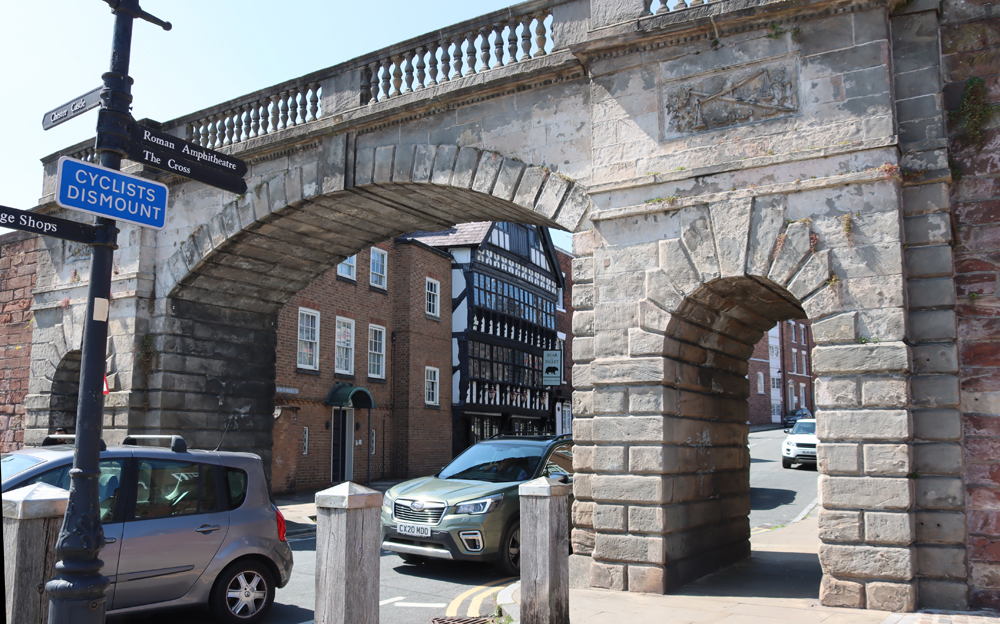
Today’s Georgian gateway, carrying the walls over Lower Bridge Street, is the latest iteration of the first gate built here by the Romans to defend access to the Via Praetoria.  By the Middle Ages all the bridge’s predecessors had been replaced by a medieval gateway that had a central pointed arch, which carried the walkway, and was flanked by two round towers.  This was quite an understated affair, but became considerably more noticeable when a tall, slender water tower was added to the west tower in 1600 to pump water from the river into the city (shown on the above image).  It was destroyed during the Civil War, but is recorded in earlier engravings.  The medieval Ship Gate, one of the architectural features preserved in Grosvenor Park, was a pedestrian archway giving access to the city Just to the west of the Bridgegate (towards the car park), which has already been mentioned in connection with the Grosvenor Park, where it was moved in the 1830s.

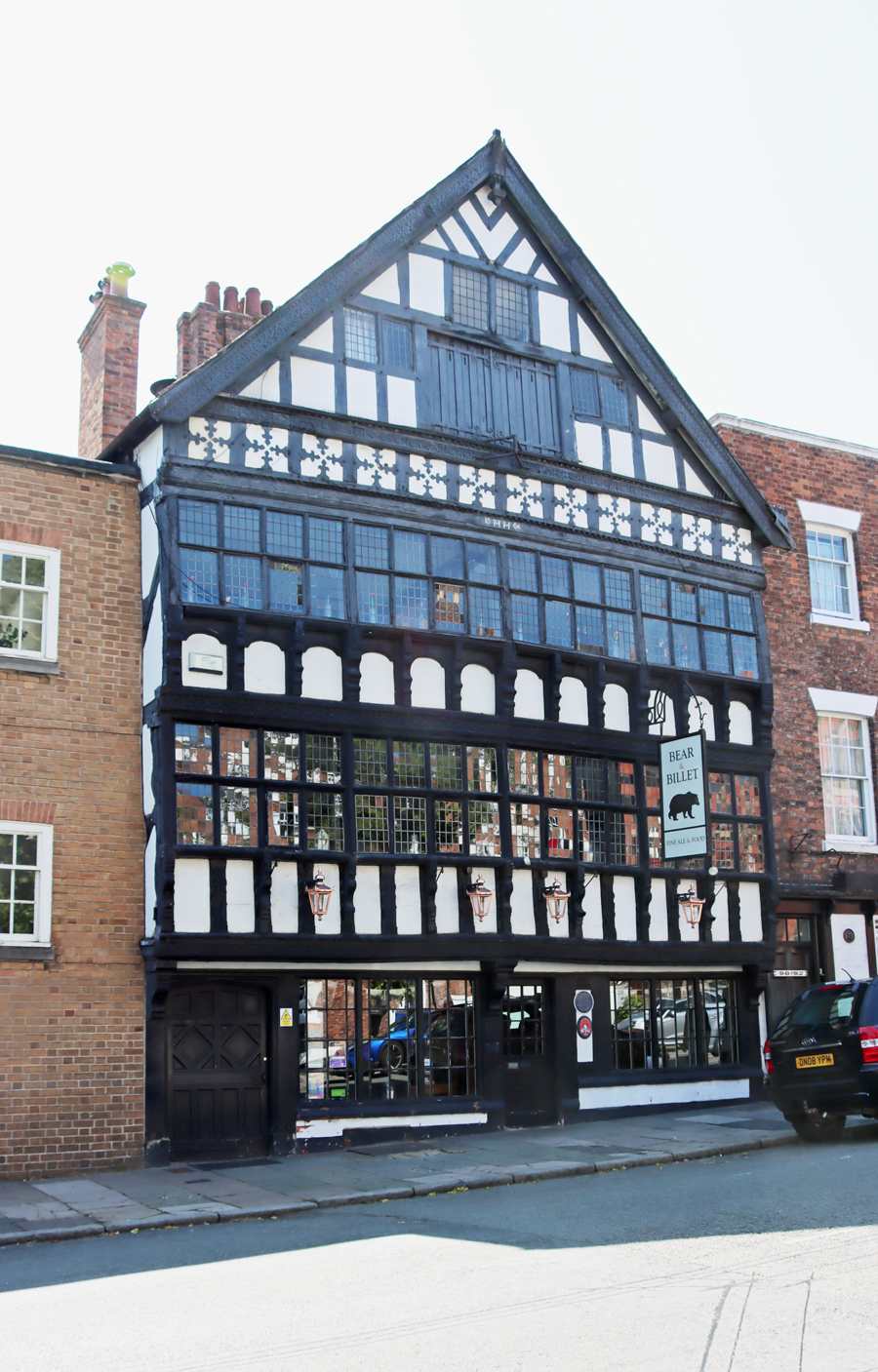
The Bridgegate, with the Bear and Billet on the other side of the gate

On the city side of the Bridgegate, on your left as you look uphill, is the Bear and Billet public house, which looks like one of the original half-timbered buildings but is in fact part of the revival of timber-framed buildings after the Civil War, in which multiple buildings were destroyed, and was built in 1664 for the Earl of Shrewsbury. See the picture near the end of the post in Sources.

As Chester’s population expanded during the 1700s, the increasing size of vehicles and the need for two-way traffic to pass into and out of the area defined by the walls resulted in the destruction and replacement of the medieval bridge.  The yellow sandstone Georgian arch that survives today was built in 1782 to a design by Joseph Turner (c.1729–1807), a successful local architect.  It supports a walkway that connects the two parts of the city walls that flank Lower Bridge Street.  Although not particularly imaginative, it is elegant in a typically Georgian way.

23) The Dee Mills and the hydroelectric station 

The Old Dee Mills in the 19th Century, with the Bridge Gate to its right and the Old Dee Bridge at its side. Source: Chesterwiki

The area around the Old Dee Bridge was busy from the Roman period onwards.  In the Middle Ages this part of the river was the site of several water mills, and mills continued to be built here until the last one burned down in 1895 and was knocked down in 1910.  In 1913 the site was used to establish a hydroelectric station, part of which survives in the form of the gothic-style building that sits below the bridge in the corner with the north bank, but this went out of use in 1951 and is currently vacant.  You can still see the hydroelectric station in situ on the walk, and the Ship Gate is still visible in the Grosvenor park (photograph further up the page at no.14), but the mill is only preserved in pictures.

The former hydroelectric station

24)  Prison wall

The remains of the west side of the river wall of the former prison, with its distinctive arches, next to the Wheeler Building.

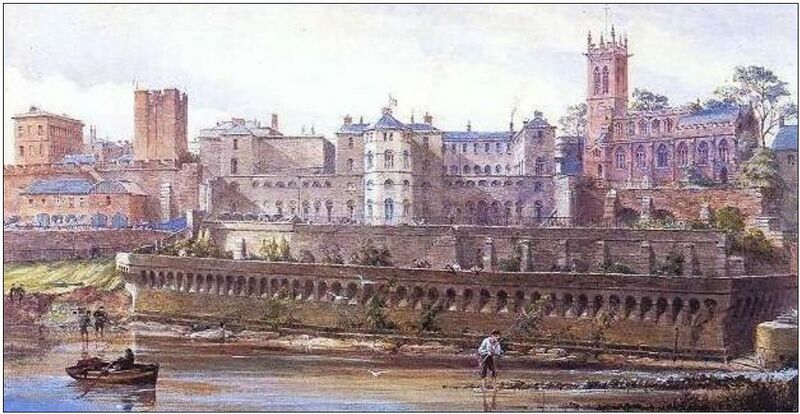
Although it is captured in paintings and engravings, there’s almost nothing left of the former prison, although it was a very substantial building in its day.  Both the prison and the river wall with its inset arches can be seen on this painting below by prolific local artist Louise Rayner (1832-1934).  All that remains is the former river wall with its inset arches, and even this is a matter of noticing that it is there, rather than actually seeing it, even from the opposite side of the river, as it is hidden by extensive tree growth.  It is marked by the fact that it projects slightly into the river.  There are two places where the inset arches are visible, first by the railings opposite the Wheeler Building, where you can lean over and look back, and rather more accessibly there is small a section to the side of the Wheeler Building, which carries the path back up on to the walls, shown here.  Up until 1785 the prison was based in the Chester Castle dungeons, but by the mid-18th century it was very clear that this was no longer fit for purpose, and when it was decided to build a new prison, architects were invited to submit designs to a competition.  Thomas Harrison, who is mentioned below in connection with the revitalization of the castle, won the contract, and new riverside prison opened in 1793.  Less than a century later, in 1865, it was unable to cope with demand, and it was rebuilt, opening again in 1869.  It was demolished in 1902.

The Chester prison by Louise Rayner, showing the river wall along which we still walk today


25) The Wheeler Building, housing Royal Infirmary Stained Glass and the Riverside Museum

Objects from the collection of the Riverside Museum in the Wheeler Building

The University of Chester’s Wheeler Building, a vast block of a thing on your right as you head towards the Little Roodee car park, was built in 1857 as the former Cheshire County Council headquarters.  Although there is not much to say about it as a piece of architectural heritage, it does contain two really valuable items of local heritage interest.  On the first floor of Wheeler Building you can find the stained glass that was once installed in the Victorian Royal Infirmary (opened in 1761, closed in 1994 was converted for residential use in 1998), and about which you can read more on the Chester Archaeological Society blog here.  The Riverside Museum, which usually opens only once a month, is a permanent collection of curiosities from the world of medicine, nursing, midwifery and social work, in addition to an original letter written by Florence Nightingale from Balaclava.

Just past the Wheeler Building, you can walk up the path that follows a slope up the old prison walls onto the city walls for the last stretch of the walk. If you take the opportunity, you get some views over the river, and the best angle to see this side of the castle. [There are no steps upto and off this stretch of the walls, but if you have a wheelchair or buggy, there is a dogleg turn that may be difficult to negotiate]

26) The Castle

The Agricola tower

Chester Castle today is a bizarre and not terribly attractive mixture of Neoclassical and medieval when seen from the front.  The original castle following the Conquest of 1066 was a timber-built motte-and-bailey castle, but this was replaced by the medieval stone castle in the late 12th century.  The Neoclassical bolt-on was architect Thomas Harrison’s solution to the dilapidated state of the building in the Georgian period.

From the walkway along the walls you can see the square Agricola Tower, which dates from around 1190-1200, and this and the Flag Tower are the only survivors of this early stone-built castle.  The tower is opened at least once a year for visitors to see around the vaulted chapel and 13th century wall paintings that are thought to have been ordered by Edward I for his use of the castle as a base during his negotiations with the Welsh princes.  That’s high on my to-do list.

Leaving the walls, you can walk up to the entrance to the castle if you want to see the view from the entrance.  Otherwise, cross the road at the pedestrian lights, taking note of the big black modern building squatting on your right as you cross the road and go a short distance to the covered viewing point, where there are interpretation boards, and have a look over the Roodee.

Nathaniel Buck’s 1728 engraving of the castle. Source: chesterwalls.info


27) The Roodee and the site of St Mary’s Nunnery

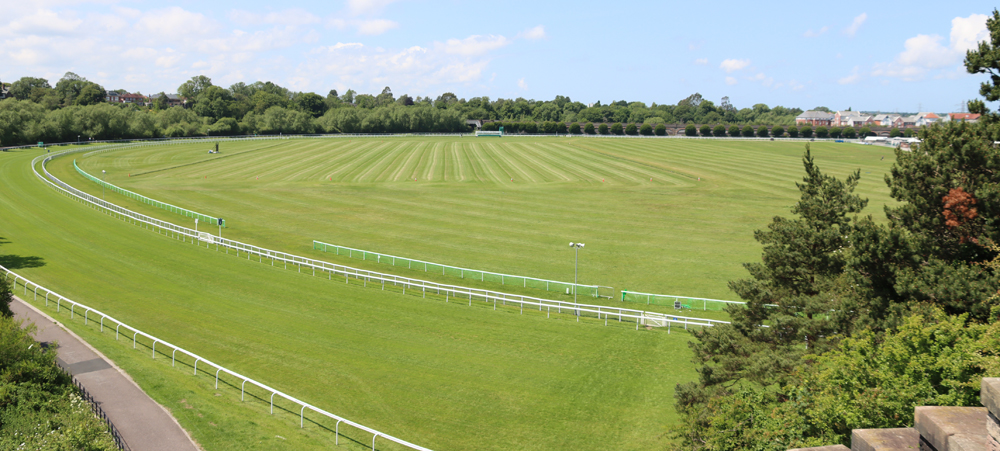
The race course on the Roodee

Nathaniel Buck’s Prospect of the City of Chester 1728 showing The Roodee. Source: chesterwalls.info

The Roodee is now home to the Chester racecourse, with the earliest race here held in 1539, but it also formed the edge of a river port second in size to Bristol on the western coast of Britain, supporting a successful trade along the coast and across to Ireland, as well as a thriving shipbuilding industry.  The commercial value of the river began to decline at the end of the 18th century as the river began to silt up, and did not survive the 19th century.  However, the archaeology of the river at the Roodee dates back to at least the Roman period when there was a harbour at the river and excavations in 1885 revealed the remains of a jetty near the railway viaduct.  The above engraving by Nathaniel Buck shows the medieval tower, connected to the walls by a fortified walkway, which was once at the water’s edge, demonstrating how silting was impacting the port of Chester even at this stage.

Turn so that your back is to the Roodee.  Over the road was the site of St Mary’s Benedictine Nunnery. 

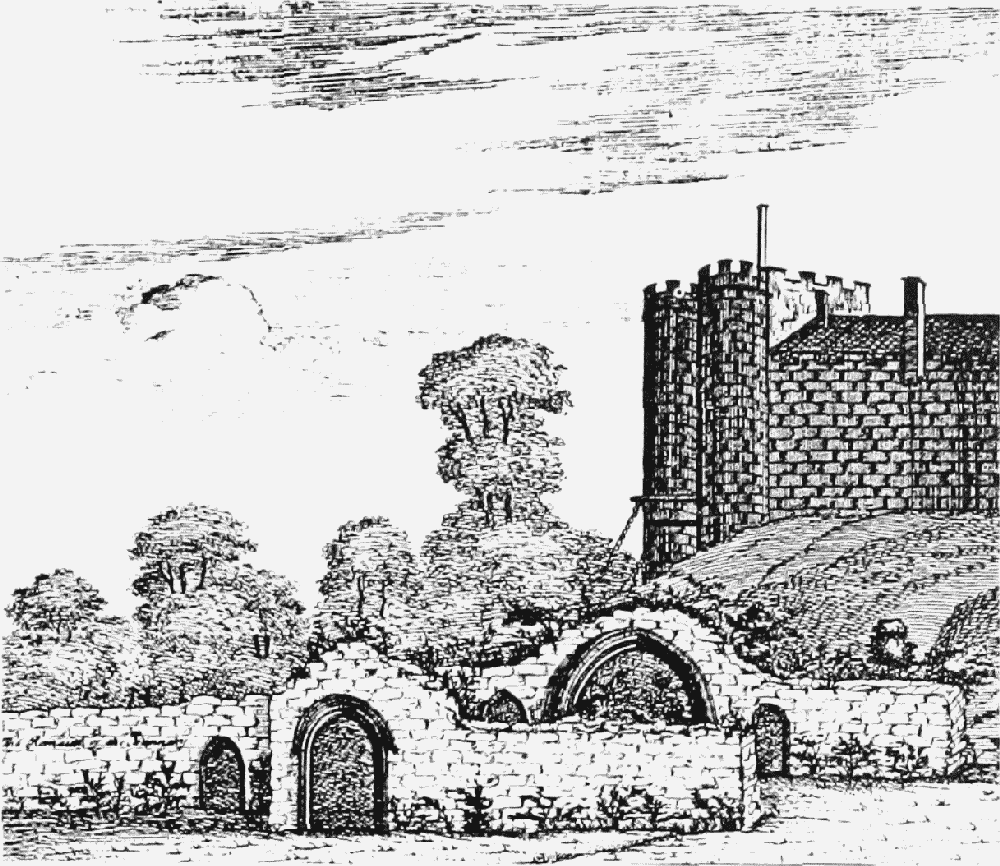
St Mary’s Convent was founded in 1140 and survived until the Dissolution in 1535,on the north side of today’s Nun’s Lane, which is the small road that runs along the top of the Roodee and the race course.  It was built just inside the city walls, a little to the west of the castle. This became quite a large monastic establishment with a relatively compact cloister around which were the usual domestic and administrative buildings along three sides, with the monastic church on the fourth side, and a larger separate courtyard with more buildings arranged around it. A double-cloister arrangement was not at all unusual in wealthy monastic establishments, but the nunnery was notable for its financial difficulties even though it owned and rented out several properties in Chester, and from the 13th century owned the manor of Handbridge.  The last surviving piece of architecture from the nunnery survives in Grosvenor Park, which preserves the red sandstone arch and flanking niches that once separated the church’s nave from its chancel.

Archway and flanking niches from the former St Mary’s Nunnery, looking through to the Ship Gate

The black glass and red sandstone building on the other side of Nun’s Lane, Abode (built in 2010), replaces the former police headquarters, which was an eyesore of a very different type, and between the police building being knocked down and Adobe being built, an archaeological excavation took place.  As well as what are thought to have been significant Roman discoveries, the remains of the nunnery were excavated, producing both architectural and funerary remains, as well as discarded objects.  Quite who was responsible for seeing that the excavation records were published I don’t know, but one of the great tragedies of Chester heritage was that the small company responsible for the excavations never did publish, and no-one seems to know where the excavation reports and any preserved materials might be located.

The remains of St Mary’s Nunnery in 1727. Source: British History Online

After the 1536 Dissolution, when the nuns dispersed, the land and buildings were granted to a member of the Brereton family, in whose hands it remained until the 17th century.  Its best known resident was Sir William Brereton, who was the Cheshire commander of the Parliamentary forces during the Civil War, when the buildings came under fire, were badly damaged and were never repaired.  As ruins on valuable land within the city walls they were soon replaced.  At the west end of the former site, architect Thomas Harrison, who has been mentioned several times above, built St Martin’s Lodge for his own use, now sympathetically converted into the gastro pub The Architect.

The walk is over!  Retrace your steps back over the Grosvenor Road into the car park, either via the steps on the corner, or down Castle Drive and into the main entrance, which avoids steps.
xxx

Final comments

I particularly like this walk because of the sheer amount of diversity that it introduces to the experience of Chester, beyond what you can find on a walk around the walls or a stroll around the main streets and the rows.  This is a slightly different slant on Chester, one that takes place nearly entirely beyond the walls, where there is space for promenades, open green spaces, a massive race course, a Victorian cemetery, river walks and of course some marvellous bridges and views over the surrounding area.  Neither urban nor suburban, this walk focuses on the in-between borderland of the riverside.

The shortlink for this post is: https://wp.me/pcZwQK-7BG

Braun’s Map of Chester, 1571 showing the RooDee with a grazing cow at left,  Handrbidge at the bottom, and the Old Dee Bridge connecting Handbridge with the Bridgegate. Source: chesterwalls.info


Sources

Books and Papers

The Bear and Billet

Boughton, Peter 1997. Picturesque Chester.  Phillimore

Carrington, Peter 1994. Chester. English Heritage

Cheshire West and Chester Council 2012.  Explore the Walls. A circular walk around Chester’s historic City Walls.  Cheshire West and Chester Council

Clarke, Catherine A.M. 2011. Mapping the Medieval City. Space, Place and Identity in Chester c.1200-1600.  University of Wales

Herson, John 1996. Victorian History: A City of Change and Ambiguity. In (ed.) Roger Swift. Victorian Chester.  Liverpool University Press

King, Michael J. and David B. Thompson 2000.  Triassic vertebrate footprints from the Sherwood Sandstone Group, Hilbre, Wirral, northwest England. Proceedings of the Geologists’ Association,
Volume 111, Issue 2, 2000, p.111-132

Langtree, Stephen and Alan Comyns (eds.) 2001. 2000 Years of Building: Chester’s Architectural LegacyChester Civic Trust

Laughton, Jane 2008.  Life in a Late Medieval City. Chester 1275-1520. Oxbow

Martin, Richard 2018. Ships of the Chester River. Bridge Books

Mason, D.J.P. 2001, 2007. Roman Chester. City of the Eagles. Tempus

Mason, D.J.P. 2007. Chester AD 400-1066. From Roman Fortress to English Town. Tempus.

Ward, Simon 2009, 2013. Chester. A History. The History Press


Websites

Based in Churton
Overleigh Cemetery in Chester, Parts 1 and 2 by Andie Byrnes
https://basedinchurton.co.uk/category/overleigh-cemetery/

British History Online
Religious houses: Introduction
https://www.british-history.ac.uk/vch/ches/vol3/pp124-127

The Cheshire Sandstone Ridge
The geology of the mid Cheshire Sandstone Ridge: Our landscape story
https://www.sandstoneridge.org.uk/lib/F715451.pdf

Chester Characterisation Study
St John’s Character Area Assessment
https://www.cheshirewestandchester.gov.uk/asset-library/planning-policy/chester-characterisation-study/e-chestercharacterisationstudystjohns.pdf

Chester Heritage Festival YouTube Channel
Four Minute Wonder:  The Sandstone Outcrop by Paul Hyde, 2024
https://www.youtube.com/watch?v=fxgoKh_4FXk
Four Minute Wonder: The Grosvenor Park Lodge by Paul Hyde, 2024
https://www.youtube.com/watch?v=Td67domdAWQ

Chesterwiki
River Dee Geology
https://chester.shoutwiki.com/wiki/River_Dee_Geology

Curiouser and Curioser: Tales from Cheshire Archives and Local Studies
A Grand Day Out in Chester: celebrating 100 years of the new Queens Park Suspension Bridge
https://cheshirero.blogspot.com/2023/04/a-grand-day-out-in-chester-celebrating.html

The Freemen and Guilds of the City of Chester
Cordwainers
https://chesterfreemenandguilds.org.uk/about/

Heritage Gateway
Post Dissolution Use of Former Benedictine Nunnery
https://www.heritagegateway.org.uk/Gateway/Results_Single.aspx?uid=MCH18993&resourceID=1004

Historic England
Roman quarry including Edgar’s Cave and the rock-cut figure of Minerva on Edgar’s Field, 150m south west of Dee Bridge
https://historicengland.org.uk/listing/the-list/list-entry/1014718
The Hermitage, The Groves
https://historicengland.org.uk/listing/the-list/list-entry/1375947

The Spoonster Sprouts
Brutalist Architecture in Chester: A Guide. By Tom Spooner, 15th July 2024
https://thespoonsterspouts.com/brutalism/chester-brutalist-architecture/

A Virtual Stroll Around the Walls of Chester
Old Maps and Aerial Photographs of Chester – Nathaniel Buck
https://chesterwalls.info/gallery/oldmaps/prospect.html

Wikipedia
Henry Raikes
https://en.wikipedia.org/wiki/Henry_Raikes


Upcoming

The Historic Towns Trust map for Chester should be a great aid to anyone planning their own heritage walk.  Although I have one on order it hasn’t arrived yet. You can find details on the Trust’s website where you can also order a copy:
https://www.historictownstrust.uk/maps/an-historical-map-of-chester


View of the City of Chester by an unknown artist, mid 1700s. Source: Victoria and Albert Museum, accession number 29635:57


Nathaniel Buck’s South West Prospect of the City of Chester, 1728. Source: Mutual Art

View from the East Groves to Queen’s Park

Ewloe Castle in Wepre Park, near Connah’s Quay

Artist’s reconstruction of Ewloe Castle. Source: Renn and Avent 2001

The ruins of the 13th century Ewloe Castle, one of Llywelyn ap Gruffudd’s more puzzling constructions, is located in the public Wepre Park, near Connah’s Quay and not far from Chester.

Visiting details are at the end of the post, including information about car parking, the visitor centre, an excellent downloadable guide to the routes through the park and its key features, as well as where to find out more information about the castle.
==


==

Wepre Park

Wepre Park map in the Explore Wepre Park PDF by Denbigh County Council online.  The Main Trail leads from the car park all the way to the foot of Eweloe Castle.  The Boardwalk is also reached from the car park, and is shown at bottom left.

Wepre Park is a woodland valley, largely deciduous, that flanks the Wepre Brook, and is very popular with dog walkers, joggers, and families. According to the park’s literature, it is a remnant of the great hunting forest of Ewloe.  More recently it was the site of Wepre Hall.  On a sunny day in the autumn, with the light filtering through the trees, this should be a wonderful display of illuminated colour.  The autumnal display was very fine, with the light filtering through the multi-coloured leaves and the woodland floors carpeted with bright yellows and oranges.  The woodland contains a wide mixture of different trees, shrubs and vegetation and is home to varied wildlife, including aquatic species, insects, birds, bats, badgers and a lot of very busy squirrels.  There is also a small wildlife meadow, although there is not much to see at this time of year.
==

The valley was owned in the 11th century by St Werburgh’s Abbey in Chester.  In the mid 12th century it was the site of a major confrontation between Henry II and the forces of Owain ap Gruffydd, ruler of Gwynedd in west Wales, during Owain’s campaign to extend his territories to the east. In 1157 Henry II took an army into northeast Wales to subdue Owain, but was ambushed by Owain in the Ewloe valley.  Although Henry escaped, and defeated Owain at Rhuddlan, Owain later regained much of the lost territory.

Wepre Hall, first built in 1788. Source: RCHAMW

A house is recorded at the site from at least the late Middle Ages.  During the Civil War a house at Wepre belonged to Royalist supporters who, in 1645, supposedly hid in the cellars a Royalist sympathiser who was a participant in the the Battle of Rowton Moor.  It was rebuilt as a 2-storey Georgian house in 1788 by Edward Jones, the owner of a local lead mine, with outbuildings and later extensions.  It was demolished in 1960.  There is nothing remaining of Wepre Hall except for the cellars.  The visitor centre sits on part of the Wepre Hall site, and the gardens here and nearby are designed to echo the formal gardens of the Hall.

There are a number of routes through the park.  From the car park, the Main Trail is a wide metalled track that leads from the car park past the visitor centre nearly as far as the castle (after which there are wooden steps leading up to the castle).  It follows the line of the brook, which drifts in and out of sight and is constantly audible.  The most notable feature on the Main Trail, apart from the lovely woodland, are the outcrops of Hollin Rock, a 320 million year old red sandstone, popular as a building material.  Towards the end of the trail is a small and attractive bridge, Pont Aber, that was once located further upstream but was moved here in 1800 to improve access to Wepre Hall.  There is a delightful small waterfall on the other side, which used to be the location of the Castle Hill Brewery that used the water from a natural spring.
==

The second significant route is a boardwalk, which leads from the car park along the brook and connects to the Main Trail about half way way along.  The main feature of the Boardwalk route is the waterfall, actually built as a weir to power a small hydroelectric plant, but it is a very attractive feature.  The plant used to provide electricity to the Hall before mains electricity arrived in the area in 1925.  There is a variety of aquatic vegetation flanking the boardwalk, and information boards indicate the different wildlife, including birds, that can be spotted on a walk.  The boardwalk follows the brook closely until it slopes up slightly to meet the Main Trail, and the “bubbling brook” phrase never seemed more apt.  This is a very audio-visual walk.
==

Some of the other footpaths are just well-worn tracks, very muddy at this time of year, but follow lovely winding routes through the woodland.  I tried the track from the bridge to the Devil’s Basin, supposed to be a short set of very pretty falls, but after five minutes or so the deeply churned mud made it completely impassable in ordinary hiking boots. It would have required wellies.

Near the visitor centre there is a small lake called the Rosie Pool that was created in the late 19th century for fishing and is now managed by the local angling club.  Immediately behind the visitor centre is a small but very attractive formal garden with a small pond, a nod to the former hall.  Even at this time of year, fuchsia, hydrangea and sedum still have some flowers.  There is a small pet cemetery located at its edge.  For more about the park download the Explore Wepre Park guide (in Sources at the end of this post).

Ewloe Castle

Ewloe Castle from the air. RCHAMW 6463845. Source: RCHAMW

There is some discussion about who built the castle. It was certainly either built or rebuilt in c.1257 by Llywelyn ap Gruffudd (also known as Llywelyn the Last), but he may have been restoring a castle originally built by Llywelyn ap Iorwerth (Llywelyn the Great).  The D-shaped keep has been seen as characteristic of Llywelyn the Great, and differences in the stonework of the upper and lower wards have been used to argue for a two-phase construction.  If this was indeed the case, it is argued that the upper ward would have been contemporary with the keep built by Llywelyn the Great and the lower ward built by his grandson Llywelyn the Last.  On the other hand, there is an early 14th century document that states that the entire was built by Llywelyn the Last.  The question remains unresolved, but it is not doubted that whoever built the castle, Llywelyn the Last certainly carried out extensive building work here.

Plan of the castle. Source: Lloyd 1928

Although it is built to a fairly standard Welsh plan, it is something of an oddity in strategic terms, not being built high on a hill but on the edge of a small valley.  Although the sides slope steeply away from the castle on three sides, it was actually overlooked from the south, so required quite extensive outer defences on that side, consisting of a ditch, the digging out of which would have provided a bank.
==

The keep sits within a small upper ward.  A larger lower ward was added, possibly at a later date, with a tower at its furthest extent from the upper ward and both were provided with curtain walls, some of which remain.  The D-shaped (or apsidal) keep has a small footprint with its semi-circular end overlooking the defences, whilst the tower in the lower keep overlooks both the southern aspect and the valley below.  The lower ward would have been provided with timber buildings for domestic functions and storage.

On the former ground floor of the keep, to which the steps at the back of the upper ward lead, the former hearth is still visible, and there are windows set in the thick walls.  Looking at the keep today, the lowest layer was a basement with no lighting.  The keep had an outer stone staircase at its south, and this is still in use for accessing the inner staircase that leads up inside the walls of the keep to a viewing platform at the top of what remains of the keep’s walls.

Two entrances, one into the upper ward and one into the lower ward would have been approached by bridges over the defences.  The lower ward’s tower was probably accessed from the curtain walls of the lower ward.

In 1257, when the castle was either built or rebuilt, Llywelyn ap Gruffudd was on the offensive, attempting to retake Perfeddwlad, otherwise known as the “Four Cantrefs,” which incorporated the cantrefs of Rhos, Rhufoniog, Dyffryn Clwyd and Tegeingl, a constant bone of contention between the Welsh princes and the English crown.

The problem of the poor strategic location could be explained by suggesting a different intention for the castle as more of a political statement than a fully functional military outpost.  Its location on the edges of disputed territory, not far from older English castles and the site of Owain Gwynedd’s defeat of Henry II may simply have been a statement of a Welsh return to land that they claimed as their own, and a useful staging point for any future negotiations, given its proximity to the Anglo-Welsh border.  This is supported by its probable use first in November 1259 and again in December 1260 when English ambassadors were sent to meet with Llywelyn at a place identified as Wepre, which must have been the castle.  There is no record of the castle’s involvement in 1276 and 1277, when war between England and Wales reignited, which may give added weight to this castle being a political gesture rather than a strictly military base, but could also reflect the necessity of Welsh retreat to safer ground.

Ewloe Castle by Moses Griffith (1747-1819) NMW A13529. Source: National Museum of Wales

Edward I does not appear to have felt that Ewloe Castle was worthy of his interest.  Although he restored other castles for his own use, this was probably too small, too badly sited and too difficult to defend.  Instead, in 1277 Edward began to build at Flint (posted about on the blog here), Rhuddlan (posted about here) and Denbigh (posted about here).  Owain Glyndwr’s rebellion in 1400 found no use for it either.
==

Visiting

Access to the castle, managed by Cadw, is free of charge and open all year round, as is the entire park, but you will need to be confident with stairs, as they are the only way in and out of the castle.  There are new metal stair cases with handrails, and original stone ones, including a small flight in a stairwell in the keep leading up to a viewing platform at the top.  None of the stone staircases have handrails.

Parking is straight forward for both castle and park.  If you only want to see the castle there is a lay-by on the side of the B5125 that looks as though it will take about 8 cars, maybe a couple more.  I didn’t try the route from there to the castle so have no idea what the footpath is like underfoot, but the What3Words address for the lay-by parking is ///follow.beauty.mistaking.  The official car park is a large one near the visitor centre on Wepre Drive. Ewloe Castle is about a mile away from this car park along a very easy and attractive trail. The What3Words address is for the main car park is  ///contrived.writing.mailers

A circular walk taking in the boardwalk and returning to the car park via the Main Trail would be suitable for unwilling legs, as would a walk along the boardwalk to the bridge and then back along the main route.  The castle is not suitable for those who cannot manage steps and stairs, as this is the only way of getting into the castle, from whatever direction you approach.

The visitor centre is closed at this time of year (November) but its cafe was open on my visit.  The public toilets are also open nearby.  There’s a substantial play area on the edge of the car park.  There are a small number of good information boards throughout the park, including one at the castle, but the Cadw official guide to Flint Castle also has a section on Ewloe Castle.  Other sources are listed below, including castle information and an excellent guide to the park, together with a footpath map.


Sources:

Wepre Park

Flintshire County Council
Parks and Countryside
https://www.flintshire.gov.uk/en/LeisureAndTourism/Countryside-and-Coast/Parks-and-countryside.aspx
Discover Wepre Park Booklet
https://www.flintshire.gov.uk/en/PDFFiles/Countryside–Coast/Discover-Wepre-EnglishWEB.pdf

A different map that may be slightly easier to follow is on the following link:
Potty Adventures
Wepre Park
https://pottyadventures.wordpress.com/2016/07/16/wepre-park-our-local-8th-wonder-of-world/

=
Ewloe Castle

Books and papers

Davis, Paul R. 2021.  Towers of Defiance.  The Castles and Fortifications of the Princes of Wales. Y Lolfa

Lloyd, J.E. 1928.  Ewloe.  Y Cymmrodor, vol.39 (unnumbered)

Renn, D.F. and Avent, R. 2001 (2nd edition). Flint Castle – Ewloe Castle. Cadw

Websites

BBC News
13th century castle to be sold (18th November 2009)
http://news.bbc.co.uk/1/hi/wales/north_east/8364611.stm

Cadw
Castell Ewloe
https://cadw.gov.wales/visit/places-to-visit/castell-ewloe

Coflein
Ewloe Castle
https://coflein.gov.uk/en/site/94447/
Wepre Hall
https://coflein.gov.uk/en/site/36307/

Wales Online
Ewloe Castle has sold to farmer at auction (9th December 2009)
https://www.dailypost.co.uk/news/local-news/ewloe-castle-sold-farmer-auction-2770922
==

Rhuddlan Castle and the Statute of Wales

Rhuddlan Castle from the air. Source: People’s Collection Wales.

The magnificent Rhuddlan Castle, and its predecessor Twthill motte-and-bailey castle (the latter now just a mound), are located just over 3 miles south of the point on the North Wales coast where the river Clwyd, which Edward I diverted to pass the foot of Rhuddlan, empties into the sea at Rhyl. Like all of Edward I’s newly built English castles in Wales, this has some features in common with its brethren, but is at the same time a unique entity, each with a highly distinctive, unmistakable appearance in its own right, building on previous creativity to create even more innovative defensive measures.

I visited Rhuddlan last week for the first time, taking spur-of-the-moment advantage of a cold but gloriously sunny morning to make the most of Rhuddlan’s striking looks and lovely location.  The castle is an impressive sight, particularly as it is bounded on its northeastern side by fairly dense village housing and one gets the sense of emerging abruptly from the bustling present into a peaceful and finely fossilized landscape of the past.

This is the third post in an occasional series about the history of Edward I’s earliest castles in northeast Wales.  The background history to Edward’s sudden launch into castle building in Wales from 1277 is the first part, and can be found here. It looks at the disputes between Edward I’s father Henry III, king of England, and his subsequent and far more personally felt disputes with Llywelyn ap Gruffud, Llywelyn the Last of Wales.  The second post in the series looked at Flint Castle, the first of Edward’s castles in Wales started in July 1277, with its accompanying new town.  Rhuddlan Castle was started in September 1277, and is covered below.  Denbigh built in 1282 is posted about here.

St Mary’s Rhuddlan

I combined Rhuddlan Castle with a look at the last surviving chunk of Edwardian defensive ditch that originally surrounded the town, and a wander around the exterior of the nearby St Mary’s Church (its opening times to visitors are limited to the summer months), which was built sometime after the granting of the town charter in 1278, both of which are mentioned below. I then skirted the castle and followed the track and footpath down to Twthill. The story of life at Rhuddlan before Edward I, both pre- and post-Norman, will be covered on another post, and will include the background to and history of Twthill.

St Asaph’s Cathedral

After Rhuddlan I drove the few miles south to visit St Asaph Cathedral, which has connections to both Rhuddlan Friary, originally located near the castle, and Valle Crucis Abbey, near Llangollen.  Valle Crucis is the subject of an ongoing series of posts on this blog.  Rhuddlan Friary has been discussed on the blog here, and St Asaph Cathedral will be discussed on a separate post at a later date.

To make it an official day-trip, the day not being warm enough for an ice cream, I stopped for a very self-indulgent glass in The Hare in Farndon on the way home, which was the cherry on top of a very good day!

Visitor information for Rhuddlan Castle is at the end of the post.

Rhuddlan during the reign of Henry III

Henry III (reigned 1216-1272), father of Edward I, had ongoing problems with self-styled Prince of Wales Llywelyn ap Gruffudd, also known as Llywelyn the Last, a grandson of Llywelyn ap Iorwerth (Llywelyn the Great).  Llywelyn was based in Gwynedd, his home territory, but had managed to establish some degree of unity within his own family (particularly his brothers Dafydd and Owain) and throughout Wales, historically a fragmented and constantly shifting set of territories.  The powerful Marcher lordships along the Welsh border formed an aggressive barrier between Wales and the rest of England, and trouble had rumbled continuously along the border during the reigns of previous kings, causing the official border between the two countries to move regularly.  The crown held territories within modern Wales, and these came under attack by Llywelyn the Last. This is all covered in the post that describes the background to the disputes between Edward and Llywellyn, complete with a family tree of the relevant participants.

A Dominican priory, described on the blog here, was founded by Llywelyn ap Gruffudd in 1258 during the reign of Henry III, and is discussed.  The building does not survive, but some of its materials were visibly incorporated into the farm that now sits on the original site of the priory.  It is quite likely that during the 13th century played host to Llywelyn ap Grufudd, and later to both Henry III and Edward I during their visits.  As with most monastic institutions, the Dominicans were obliged to show hospitality to guests, irrespective of their political allegiance, and it would have been in their interests to stay in the good graces of both Welsh and English leaders.  Edward had probably taken advantage of hospitality at Basingwerk Abbey during the construction of Flint Castle.

Edward I’s Rhuddlan Castle

Expanding the the “Ring of Iron”

Map of Edward I’s campaigns in Wales. Source: History Matters at the University of Wales

Edward was granted the royal lands in Wales by Henry III on the occasion of his marriage to Eleanor of Castille, and took an active interest in the Welsh situation until his departure on crusade, during which his father died.  Edward inherited the dispute with Llywelyn, but was already very familiar with the the Welsh prince and his ambitions, and was also familiar with the Welsh landscape.  The expenses incurred during his crusade had left him with serious debts, and the terms of the agreement that Llywelyn had reached with Henry III involved a substantial annual payment by the Welsh prince to the Crown treasury, but there were problems.  Llywelyn was already three years in arrears, and was now refusing to pay homage to the new king.  Several treaties under Henry III had failed to achieve long term peace, and although the Treaty of Montgomery of 1267 had looked as though it might hold, Llywelyn ap Gruffud’s behaviour was intolerable to Edward who labelled Llywelyn an outlaw in 1276, and war was declared in 1277. A peace was brokered, but although Edward had every reason to believe that the treaty might secure peace between England and Wales, he began to build a series of castles in northeast Wales, eventually extending into northwest Wales, beginning at Flint in the July of 1277 and rolling out along the coastlines throughout the next two decades.  This was followed almost immediately by the foundation of Rhuddlan in the same year.

Artist’s impression of the Twthill motte-and-bailey castle by Terry Ball.  All that survives today is the motte. Source: Wikipedia

When Edward started building his castle at Rhuddlan in September 1277, Flint Castle and town were still under construction.  Flint had been virgin territory, and consisted of both a stone castle and a new defended town, an “implanted bastide.”  Although the site of Edward’s castle itself had not been occupied, Rhuddlan had been long-established, from the pre-Conquest period into the 13th century.  The existing wooden Twthill motte-and-bailey castle, a short distance from Rhuddlan probably served as a useful base from which to manage building works and campaigns as the new stone castle was built and the new town laid out and provided with perimeter defences.

Llywelyn, realizing that his cause was lost, surrendered  later in 1277 at Rhuddlan, several years before Edward’s castle was finished, and for a while it looked as though the resulting Treaty of Aberconwy would provide the basis for long-term peace.  Llywelyn had been granted the entire region of what is now known as Gwynedd, permitted to retain the title Prince of Wales, and his difficult brother Dafyddd was allocated territories in mid-north Wales whilst Owain was given control of the Llŷn peninsula.   Edward, however, was not taking any chances, and he continued with his castle building programme, unambiguously reinforcing his message that Wales was under English control, with Rhuddlan performing the role as the administrative headquarters for the region.  Should any attempts at rebellion be attempted in the future, Edward and his supporters would be ready.

Why Rhuddlan?

What were the strategic advantages that made Edward I choose Rhuddlan as the location for his third castle, his new administrative headquarters for north Wales?

First, the castle is right on the edge of the River Clywd, a fairly narrow but very attractive ribbon of blue threading its way between the fields, all the more impressive when you know that the river actually ran along a slightly different course until Edward canalized it and had it dredged to provide a deep-water channel for connecting the castle to the coast and the Dee Estuary. The River Clywd become un-navigable not far south of Rhuddlan.  The link to the estuary connected Rhuddlan both to Flint Castle and Chester to its east and then, later, to Edward’s castles at Conwy and Caernarvon in the west.

Photograph of Rhuddlan Castle in the context of the River Clwyd floodplain and the coast to the north. Rhuddlan Castle is at bottom left, near the rear foot of the RCAHMW dragon logo.  Source: Coflein, archive number 6356180 / AP_2007_2032

The castle itself sits above a very wide, low floodplain, on an area of raised land.  Standing on the battlements, reached by modern spiral staircases, the views over the surrounding landscape are remarkable, providing an excellent impression of how well the castle was positioned for sighting oncoming threats.  Economically, the wide floodplain was ideal for the development of a new town, with potential for raising livestock and agriculture.

Until Conwy was built, Rhuddlan was conveniently located as a regional HQ just on the edge of Llywelyn’s territory, and it was his most important base in Wales.  By the time Conwy Castle was up and running, Rhuddlan had become secondary in importance, but was still garrisoned and was very important in Edward’s chain of defences.

The Designers and the Design

The outer curtain wall, which only survives in very small sections, followed the perimeter of the revetted dry moat, and enabled archers in the battlements of the castle to fire over the heads of those protecting the outer defences.

Rhuddlan has a very distinctive look and feel to it, containing some innovative features that were carried through to other castles in the northeast.  The first architect to work on Rhuddlan, who was probably responsible for its layout and some of its initial design elements, was king’s engineer Master Bertram, who had been employed by Henry III is Gascony, and who brought with him Gascon design principles.  He was replaced after six months by Master James of St George, whose work Edward had seen in France at the castle of St Georges d’Esperanche, and who went on to build Edward’s great castles at Conwy, Caernarvon, Harlech and Beaumaris.

The most obvious novel feature of the design, when compared to Flint, was the use of both an inner and a very short outer curtain wall, shown in the photograph above, a concentric arrangement of defences that formed the template for Edward’s later castles, including nearby Denbigh, built in 1282.  The lower outer curtain wall, which at Rhuddlan was installed along the inner perimeter of a revetted dry moat, itself impressively lined with stone, enabled archers on the battlements of the main castle to aim beyond those defending the outer curtain wall without endangering them, whilst providing two lines of defence for the castle and its defenders.

Nice to see part of the original gateway in this 19th century watercolour by David Cox. Source: Victoria and Albert Museum

Originally a formal gateway granted access across the moat and the short outer curtain wall into the riverside entrance between the first pair of distinctive twinned towers.  Diagonally across the inner ward a second pair of twinned towers gave access via a secondary entrance. On the other two corners of the main castle were another two towers, each single.  All the towers, including the river tower, were 4 storeys high, including a subterranean basement in each.

Building the castle

The first task was to build defensive ditches, which which would offer protection for the construction camp as the castle was built, and would later become the dry moat.  At Flint Castle 1800 ditchers, known as fossatores, were employed for thus task, as well as the digging of the ditch and banks for the town defences, and it is probable that a similar number was employed at Rhuddlan, sourced from all over England, some of whom were forced labour.  It is possible that a proportion of the fossatores who had been employed at Flint were now deployed at Rhuddlan.

As the castle began to take shape, skilled craftsmen were also imported, including carpenters and masons. Carpenters would have been vital for the build, as they were responsible for the scaffolding as well as various buildings in both inner and outer wards, and other architectural features.  Masons used a mixture of stone types for the construction, all available locally, including yellow and red sandstones, the latter more vulnerable to erosion over the centuries than the yellow, and the grey limestone.   Extensive robbing from the lower levels of the castle after it was slighted (damaged to prevent re-use) after the English Civil War in the 17th Century gives the impression of a serious attack of delamination, but as peculiar as it looks helpfully reveals the underlying construction, showing that the the more enduring limestone covered more vulnerable sandstones.

View of Rhuddlan from the west showing what it may have looked like by the beginning of the 14th century. Illustration by Terry Ball. Source: Taylor / Cadw 2004, p.3

In 1278 sufficient progress had been made for the king and queen to stay at the castle, and in 1280 the towers were roofed in lead and in 1281 the king’s hall was roofed with shingles.  A well was sunk into the centre of the inner ward, 50ft deep.

Whilst work on the castle proceeded, one of the most impressive of the civil engineering feats at Rhuddlan was completed simultaneously.  The river Clwyd was diverted from its natural course, and canalized for two miles (3.5km), the work of 968 workers who were imported to Rhuddlan for the task in 1277, providing the castle with deep channel access to the coast, suitable for sea-going vessels, avoiding the need for trans-shipping.  This met Edward’s requirement for a fluid and seamless communications network.

There was space by the riverside tower, known today as Gillot’s Tower, for a single vessel to put in to dock at high tide, and a river gate alongside the tower, improving efficiencies for loading and unloading.  As Rhuddlan always had a garrison, and was on a number of occasions the base from which forces departed towards Snowdonia, it was often provisioned from Ireland with livestock and grain.  A military cemetery was established at the castle, a clear indication that Edward was expecting casualties in his dealings with Wales.

Work was suspended during renewed hostilities in 1282, when Llywelyn’s brother Dafydd instigated another rebellion against Edward I.  Dafydd attacked Hawarden Castle on 21st March, Palm Sunday.  His action encouraged other Welsh landholders to retaliate in kind, but it was not until June that Llywelyn took the decision to join his brother’s rebellion.  Although the Welsh rebellion seemed to gain ground for a while, the English assembled a substantial force at Rhuddlan, consisting of around 9000 men, which advanced into Wales taking several Welsh castles as they proceeded.  The castle was re-provisioned by ship from Ireland with livestock and cereals.  This time there was no peace treaty, and Llywelyn was killed on the battle field in the same year, whilst Dafydd was eventually caught in June 1283 and held at Rhuddlan Castle before being put on trial in Shrewsbury for treason, after which he was tortured and executed.  The cost was massive, some £120,000 (£83,288,423.43 in today’s money, according to the National Archives Currency Converter) with £50,000 having been raised by a tax on English residents.  There was also a huge cost in terms of English life;  the military cemetery established at Rhuddlan had run out of space by October 1282.

Work had resumed on Rhuddlan following the conflict and although there are no records of damage to the castle at that time, records of repairs do survive and these suggest that Rhuddlan had come under attack.  A record survives for the payment of 64 shillings to “Adam the tailor” for red silk to make pennons and royal standards for Rhuddlan.  As if the massive castle itself was not a sufficient statement of English power in the region, it was to be adorned with the rich and brightly coloured symbols of English monarchy.

The 50ft / 15m well in the inner ward

Today it is difficult to conceive of a royal court that was constantly on the move, but in the Medieval period, royal authority was reinforced by the movement of the monarch to properties around his kingdom, both his own and those of favoured aristocrats.  After the execution of Dafydd, Edward took his court on a tour of various provincial areas, whilst work continued at Rhuddlan.  He was back at Rhuddlan for Christmas.  Between 1283 and 1286 further investment was made on the royal apartments and chapel, both of which would have been in the wooden buildings in the inner ward, together with the kitchens.  Beam holes in the walls of the castle’s interior show where the roof beams were installed.  A well was sunk in the centre of the inner ward.  The outer ward would also have been filled with buildings, of a more utilitarian variety, including at least one granary, a forge, stables and storage facilities.

Arnold Taylor quotes a figure of £9613 2s 8 3/4d for the building of Rhuddlan between 1277 and 1282.  According to the National Archives Currency Converter, this would be some £6,672,184.58 in today’s money (or 11,209 horses or 21,362 cows or 961,313 days of a skilled tradesman’s labour).

Edward’s new borough and town

Plan of Rhuddlan. Source: Arnold Taylor/Cadw 2004, p.9

As at Flint a new borough was created and provided with defences and English settlers were incentivized to live and work there.  The new town, known as an “implanted bastide” after prototypes in Gascony, was built to the northwest of the the old town and was granted its charter in 1278.  This new-town bastide concept and its management are discussed in more detail on the post about Flint Castle.  Today’s town follows the original layout of the new town, its streets originally dividing the town into five sections leading down to a bridge across the river, with the High Street, Church Street, Castle Street, Parliament Street and Gwindy street being the key survivors.

The town was defended on three sides by a ditch with flanking banks, possibly topped with a timber palisade, a section of which survives off Gwindy Street, shown in the illustration and photograph below.  In the 1960s the complete length of the ditch survived north of the town, but by 1970 only the Gwindy Street section remained. Excavation of part of the defences, known as Plot 0, was undertaken when the land was due to be sold for development, but due to the heavily eroded state of the banks was unable to confirm if there were timber defensive features.  The fourth side of the defences was made up by a cliff running down to the river.

Source: Quinnell and Blockley 1994

====

What remains of the double banks and ditch that surrounded the new town of Rhuddlan

Although it might have seemed like an unattractive proposition to be an immigrant English population living in a defended town in ostensibly hostile territory, there was a huge demand for land in England at that time, and the new towns in Wales represented great opportunity as well as risk, particularly as charters offered far more favourable conditions for the English than their Welsh neighbours.  Marc Morris refers to them as “those enclaves of English privilege, where the Welsh were obliged to trade but could not live and where the legal discrimination between the two peoples was a fact of every day existence.”  The risk for these settlers was very real, and it was the towns rather than the castles that were targeted by Dafydd in 1282, in Aberystwyth, Denbigh and Rhuddlan.
===

The Statute of Rhuddlan of March 1284

Peniarth MS 41 a 15th century copy of the Statute of Rhuddlan. Source: National Library of Wales, via Wikipedia

In 1284 Edward I formalized how Wales to was to be governed and ruled after the deaths of Llywelyn in 1282 and Dafydd in 1283 during Dafydd’s ill-conceived rebellion of 1282.  The document that captured his requirements was the Statute of Rhuddlan or Statue of Wales, which was issued by Edward I from Rhuddlan whilst he was in residence. Although Edward had been sufficiently diplomatic to recognize different interests and hierarchical claims within Wales after 1277 for the sake of peace, in 1282 his aim was to bring the entire of Wales into a single administrative system controlled by England.

The Statue of Rhuddlan, part territorial administration and part legal treatise, handled Wales as a single homogenous unit, an extension of England and her criminal legal system.  Wales was divided into new English-style shires:  Flint, Merioneth, Caernarvon, Anglesey, Cardigan and Carmarthen, a structure that endured until 1536 when the Act of Union was passed.  An English administrative hierarchy was put into place with officials and administrators answering to a new justiciar based in northwest Wales. Legally, the Statue was an interesting mixture of English law with some concessions to Welsh traditions.  Criminal law was English, but the Statute allowed for Welsh traditions of civil law to be maintained for matters like contracts, inheritance, land deals and debt handling.

Edward’s castle building continued unabated even as the statute was being written up in Rhuddlan, announced and enforced.  It is thought that it was at Rhuddlan that Edward declared that the title and role of prince of Wales would pass to his own son and to the future sons of English kings.  Edward’s first child, who became Edward II, was born at Caernarfon in April 1284, in the month following the statute, and was officially granted the title of Prince of Wales in 1301.   The title has been handed down from reigning monarch to eldest son ever since that date, most recently on the death of Queen Elizabeth II when, the former Prince of Wales, Charles, having acceded to the throne on 10th September 2022, the title passed to his eldest son, Prince William.

Rhuddlan Castle after Edward I

Rebellion of October 1294

Resentment in Wales continued to fester, and in October 1294 Madog ap Llywelyn, a relation of Llyweln the Great, and Morgan ap Maredudd, both important land owners in northwest Wales laid siege to Edward’s castles at Criccieth, Conwy and Harlech.  This followed particularly harsh taxes imposed by Edward, that discriminated against the Welsh, and also Edward’s demand for men to fight in Gascony.  Rhuddlan served as a jumping-off point for Edward’s response to this uprising in March 1295, but Conwy was by now at the heart of the action, and Edward’s new headquarters whilst Caernarfon Castle was still being built (and which was damaged during the attack).  By June 1295 the uprising had been put down and order was restored.

Owain Glyn Dŵr, 1400-c.1410

In 1400, during the reign of Henry IV, Owain Glyn Dŵr, having been declared Prince of Wales by a group of his followers met at Glyndyfrdwy, lead a new rebellion in response to harsh conditions imposed by the English crown, and Rhuddlan was one of the castles and towns that came under attack. Rhuddlan Castle held out against the assault, but the town itself was brutalized, and there are indications such as the failure to properly repair town defences that the borough never recovered.

The English Civil War, c.1642-51

In the Civil War of 1642-48, the castle was held by the king’s forces but although it initially held out, it was surrendered to the parliamentarian commander-in-chief Major-General Thomas Mytton, and a decision was made in the House of Commons to slight the castle (render it unusable), which was actioned in May 1648. This was the fate of several medieval castles that were employed during the Civil War.

Rhuddlan Castle in 18th and 19th century art

John Boydell (1720-1804). “A North West View of Rhuddlan Castle in Flintshire,” in 1749. Source: People’s Collection Wales

In my posts about Flint and Denbigh I had a look at some of the art works that were produced in the 18th and 19th centuries when medieval buildings with their air of romance and mystery found an enthusiastic audience amongst painters of all skill levels.  There are so many art works of Rhuddlan that it is almost impossible to pick and choose, so I have selected views that show different aspects of the castle, and have added a link at the end of Sources to some more examples.

John Boydell was a publisher, talented engraver and promoter of art, as well as doing a stint as Lord Mayor of London. His 1749 image above not only captures the castle but the attached village and the distinctive bridge and that captures something of village life, with men fishing, a barge pulled up at the river edge, and people approaching on horseback and foot.  The strongly featured bridge is typical of his work – in 1747 he published The Bridge Book, featuring six landscapes all of which showcased distinctive bridges.  He did a rather nice one of Denbigh Castle too.

From the 1781 edition of “A tour In Wales” by Thomas Pennant (1726-1798) Source: Wikipedia via the National Library of Wales

Thomas Pennant was born in Flintshire and is best known for his remarkable A Tour In Wales, which eventuallyran to eight illustrated volumes, capturing three journeys that he made in Wales between 1773 and 1776. The National Library of Wales says that one of his greates gifts was “his ability to foster friendships. His appreciation of people was very well-known and because of this he always received sensible and full answers to all his enquiries for information.”  He was a great collector, but his interest was always in the subject matter and the details captured, rather than particular artistic merit.  The painting of Rhuddlan below was in the 1781 edition, capturing something of the sense of the isolation of the castle in a wide landscape, a contrasting and more delicate approach to Boydell’s bright and lively image.

Rhuddlan Castle as captured by artist George Pickering (1794-1857) and engraved by George Hawkins the Younger (1819-1852). See the National Library of Wales catalogue for a bigger image in which details can be clearly seen.

A completely different approach was taken by lithographer George Pickering the Younger, who got up close and personal with the castle, sacrificing the general form of the castle in favour of picking out particular features.  He artist looks out over the river and the floodplain beyond, the sun low in the sky, with village buildings shown in the background, including St Mary’s Church.  The ivy clinging to the towers is also shown on Peter Ghent’s painting below.  Cattle are shown grazing on the foreshore, a small sailing vessel is pulled up on the other side of the bridge, and there are other visitors inspecting the site.

Rhuddlan Castle c.1885 by Peter Ghent (1857–1911). Williamson Art Gallery and Museum.  Source: ArtUK

The oil on canvas painting of Rhuddlan Castle by Peter Ghent, now at the Williamson Art Gallery and Museum in Birkenhead, is a rather more impressionistic view of the castle, showing the ivy and the surrounding trees, and cattle cooling themselves in the river.   The riverside tower is not shown, although part of the river wall is shown.  The russet and green palette is characteristic of Ghent’s work.  Ghent was born in Birkenhead and attended Birkenhead School of Art.  He moved to Conwy, which he used as a base for exploring Welsh landscapes in both oil and watercolour.
===

Rhuddlan Castle Today

The castle was given into state care in 1944 and conservation work began in 1947.  It was transferred from the Department of the Environment to the newly created Cadw, the Welsh Government’s historic environment service, in 1984.  It is beautifully cared for, without a single blade of grass out of place.  The ivy that once ran riot over its walls has been completely eliminated which given how invasive ivy is was a considerable task.  The castle continues to undergo conservation work as needed to prevent deterioration and to ensure that it remains safe.

The castle was deliberately slighted (i.e. partly demolished) at the end of the English Civil War in the 16th century so that it could not be reused in any future offensives, which accounts for its ruined state. This does not impede an understanding of the castle and its features, many of which remain.  Some of the damage is more recent.  The lower courses of stone have been extensively robbed since the 16th century for local construction projects, revealing the inner filling of the walls, and leaving it looking very denuded and rather peculiar at its ground floor level, but allowing the inner construction of the thick walls to be seen.

Although there are no floors left in the towers and inner walls, there are fireplaces and beam slots (the beams supporting the floors at each level) that show where each of the storeys was located.  Some of the fireplaces, like the one on the left, retain black burn marks, a really evocative link to the past.  Many of the fireplaces were quite huge and, given the diameter of the towers, must have provided substantial heat for the castle guardians and administrators who were based there even in the coldest Welsh winters, even if the space was a little cramped.

A number of modern excavations have been carried out at Rhuddlan, between 1973 and 1988 helping to clarify some details about the medieval history of Rhuddlan as well as information about earlier phases, particularly during the Norman and prehistoric periods (Neolithic, Bronze Age and Iron Age, including some particularly fine lithics and decorated pebbles dating to the Mesolithic).  These are summarized by Quinnell and Blockley in their 1994 publication, which can be downloaded from the Archaeology Data Service website.

Excavated Areas in Rhuddlan between 1969 to 1973. Click to expand.  Source: Quinnell and Blockley 1994, p4

Excavated object from Rhuddlan. Source: Quinnell and Blockley 1994, p.184


St Mary’s Church, Rhuddlan

St Mary’s, only a five minute walk from the castle, was closed when I visited, so I am going to cover it on another post next summer when it re-opens to visitors, but it is certainly worth mentioning here, as it looks as though it is a splendid piece of later medieval heritage.  An earlier Norman church was built to the east of the castle, but St Mary’s was first built in 1284 and was enlarged in the 15th century.  It has undergone changes over the years, and perennial multi-tasker Sir George Gilbert Scott had a go at it during his restoration of St Asaph’s Cathedral in the 1900s, but by all accounts the restoration appears to have been quite sympathetic. The gilbertscott.org website reports that “Scott treated the old building gently, lowering the floor in the nave and raising it in the chancel, providing some new windows, seating, a vestry and rebuilding the south porch.  He also provided a vestry screen, pulpit, an eagle lectern, altar rail and chancel seats.”  However, Quinnell and Blockley say that the church contains much of the original 13th century architecture in the nave and chancel.  They add that fragments from two different crosses, found during the demolition of a wall near the Vicarage in 1936, are now kept in the church.  Both have inter-laced decoration and have been dated stylistically to the late 10th or early 11th centuries.

If you are there when it is open, it should be well worth visiting at the same time as a trip to the castle (unfortunately the St Mary’s website does not currently show the times when it is open to visitors, but there is an email address).  Even though it was closed, I very much enjoyed a walk around the building and a poke around the churchyard.  Gravestones and their symbolism are eternally fascinating and there are some very good examples of churchyard monuments.

Final Comments

Rhuddlan is visually stunning, and retains plenty of its newly innovated  features to capture interest, demonstrating significant improvements in medieval castle design.  The canalized river showcases both Edward’s obsession with good communication links and the civil engineering skills that were available to him.  As a visitor attraction it is beautifully maintained by Cadw, which is particularly noticeable when comparing it with earlier images of the castle covered in ivy.  Rhuddlan attracted a serious amount of artistic interest, providing views of how it looked in the 18th and 19th centuries and, at the same time, demonstrating the fascination that artists had for medieval ruins. This is a site that really rewards a visit, particularly on a bright sunny day, when the red and yellow sandstones absolutely glow against a blue sky.


Visiting Rhuddlan Castle

Map of the Rhuddlan town trail from the North East Wales website

Rhuddlan is operated by Cadw, and is subject to an entry fee.  Details of opening times and entry charges are on the Cadw website.  There is a free car park, which also has a map of the main features of the town and the route down to Twthill, just five minutes away from the castle.  Beyond Twthill, the footpath passes the Abbey Farm and caravan park, the site of the former Rhuddlan Friary, which is on private land and cannot be visited.

As usual with Cadw venues, there is not much information about the history of Rhuddlan on the Cadw website, but there are plenty of online resources and there is an excellent short (9-page) Cadw guide book available from the ticket office, or from online book retailers, with a 3-D reconstruction and a site plan, as well as a history of the site and a numbered tour of the key features, each with a descriptive paragraph explaining what you’re looking at – well worth the £2.50 that it cost me in the Rhuddlan Castle gift shop.  You are also given a site plan as part of the ticket price, with 7 features picked out and described briefly (bi-lingual English and Welsh).

My battered copy of the Cadw leaflet that is provided with your ticket, showing some of the key features of the castle.  The reverse side shows the same details in Welsh.

===

The approach to the castle is on the flat, as is the interior and the walk around the castle, so this is suitable for those with unwilling legs.  As with Flint Castle, the towers are fitted with modern spiral staircases, which will probably not be suitable for unwilling legs, but there is plenty to see without scaling the heights, including excellent views over the floodplain.

The ticket office also has toilets and a small gift shop.  There are no coffee facilities but there is a freezer with ice-creams and a fridge with cold drinks, and there are some tables and chairs outside for a sit down.

It’s a seriously attractive site, and well worth a visit.

Sources

Books and papers

Davis, Paul R. 2021. Towers of Defiance.  The Castles of Fortifications of the Princes of Wales. Y Lolfa

Davies, John 2007 (3rd edition). A History of Wales. Penguin

Dean, Josh and Catherine Jones 2020. Archaeological Watching Brief report for Plas Llewelyn, Rhuddlan. Project code: A0209.1, report no. 0203. Aeon Archaeology
https://coflein.gov.uk/en/site/92914

Morris, M. 2008. A Great and Terrible King. Edward I and the Forging of Britain. Penguin

Quinnell, Henrietta and Marion R. Blockley with Peter Berridge 1994.  Excavations at Rhuddlan, Clwyd 1969-73. Mesolithic to Medieval. CBA Research Report No 95 (1994)
https://archaeologydataservice.ac.uk/archiveDS/archiveDownload?t=arch-281-1/dissemination/pdf/cba_rr_095.pdf

Rowley, T. 1986.  The High Middle Ages, 1200-1550.  Routledge and Kegan Paul

Shillaber, C. 1947. Edward I, Builder of Towns. Speculum, Vol. 22, No. 3 (Jul., 1947), p.297-309
https://www.jstor.org/stable/2856866

Spencer, Dan 2018. The Castle At War in Medieval England and Wales. Amberley Publishing

Stevens, Matthew Frank 2019. The Economy of Medieval Wales 1067 – 1536. University of Wales Press

Taylor, Arnold. 2004.  Rhuddlan Castle.  Abridged from a text by Arnold Taylor. Cadw

Websites

Abbey Farm Caravan and Camping Park
History
https://abbeyfarmrhuddlan.co.uk/portfolio-item/history/#top

Balfour Beatty
Balvac repaired this 13th century castle in North Wales
https://www.balfourbeatty.com/what-we-do/projects/rhuddlan-castle/

Cadw
Rhuddlan Castle
https://cadw.gov.wales/visit/places-to-visit/rhuddlan-castle
Rhuddlan, Norman Borough
https://coflein.gov.uk/en/site/303586

Coflein
Rhuddlan Castle
https://coflein.gov.uk/en/site/92914

Ecclesiastical and Heritage World
Rhuddlan Castle: Conservation of Castle River Dock
https://www.ecclesiasticalandheritageworld.co.uk/news/1038-rhuddlan-castle-conservation-of-castle-river-dock

Goldin Fine Art
John Boydell: The Enlightenment Man
https://www.goldinfineart.com/blogs/blog/john-boydell?srsltid=AfmBOop6p7_0_WrJ2Sx_WA4FEs0lZW09ZdoRzqo61Hc6WFokRC3aLG9h

National Library of Wales
A Tour In Wales. Thomas Pennant (eight digitized volumes)
https://www.library.wales/discover-learn/digital-exhibitions/pictures/a-tour-in-wales

Sulis Fine Art
Peter Ghent RCA (1857-1911)
https://www.sulisfineart.com/peter-ghent-rca-1857-1911-late-19th-century-watercolour-cottage-by-a-stream-qo859.html

Rhuddlan Castle in Art

Meisterdrucke
Rhuddlan Castle and Marshes, 1898, unknown artist
https://www.meisterdrucke.ie/fine-art-prints/Unbekannt/785633/Rhuddlan-Castle-and-Marshes.html

ArtUK
Rhuddlan Castle by John Lawson 1868 – 1909. Glasgow Museums Resource Centre
https://artuk.org/discover/artworks/rhuddlan-castle-84929

Darnely Fine Art
Rhuddlan Castle by Norman Wilkinson 1878-1971.
https://darnleyfineart.com/artwork/rhuddlan-castle/

Government Art Collection
Rhuddlan Castle by David Gentleman 1930 –
artcollection.dcms.gov.uk/artwork/17005/

Rhuddlan Castle in Art
Various examples – a good mix
https://jenikirbyhistory.getarchive.net/topics/rhuddlan+castle+in+art

Archaeology of North Wales and Marches – Videos from the Darganfod-Discovery Conference 2021

Whilst looking for something else, I stumbled across the following page on the Cambrian Archaeological Association website, which has some impressive videos from the Darganfod-Discovery Conference 2021, some of which are relevant to North Wales and the Marches.
https://cambrians.org.uk/talks/darganfod-discovery-2021-talks/

Presentations from Darganfod-Discovery 2021 – a day dedicated to fascinating recent work on the archaeology of Wales and the Marches, held in conjunction with Cardiff University on 10th April 2021. This online conference is the first of a new series that showcases work supported by the Cambrian Archaeological Association Research Fund as well as providing an opportunity for early career academic and independent researchers to present research on Wales and the Marches.

Lectures on the above page include:

  • Prof Gary Lock of Kellogg College, Oxfor
    • ‘Moel y Gaer, Bodfari, a small hillfort in the Clwydians, Denbighshire’. (CAA Research Fund project)
  • Eirini Konstantinidi, PhD researcher at Cardiff University
    • ‘If the dead could talk: a taphonomic approach to Neolithic mortuary treatment in the caves of Wales’.
  • Adelle Bricking, PhD researcher at Cardiff University
    • ‘Life and death in Iron Age Wales: preliminary results from histological and stable isotope analysis from Dinorben and RAF St Athan’. (CAA Research Fund project)
  • Dr Rachel Swallow, Honorary Research Fellow at University of Liverpool
    • ‘A square peg in a round hole: new interpretations for the eleventh-century northern Anglo-Welsh border, as told by the misfit Dodleston Castle in Cheshire’.

There are other great lectures too, but those listed above are specific to north Wales and Cheshire.

A visit to Dafydd ap Gruffydd’s 1278 castle at Caergwrle in northeast Wales

Caergwrle Castle. Source: RCAHMW

On the top of a small hill formed of sandstone and grit, with good surrounding views, and relying partly on steep drops for its primary defence, Caergwrle Castle is ruined but contains the remains of well-built stone walls and a defensive ditch that is still quite deep in spite of the build-up of both castle and natural debris.

Caergwrle Castle, also known as Hope Castle and Queen’s Hope, was started in 1278 by Dafydd ap Gruffydd with support from Edward I.  Dafydd was the brother of the better known Llywellyn ap Gruffydd (or Llywellyn the Last) who was the last native Prince of Wales to be recognized by the English crown.  Both Llywellyn and Dafydd were grandsons of Llywelyn the Great. For a description of the ongoing conflicts between the Welsh factions represented by Llywelyn the Great, his children and grandchildren on the one hand, and the English crown under Henry III and Edward I on the other, see the post on this blog, in which I have made a stab at summarizing the complex background history.

Caergwrle Castle, c.1795 by John Ingleby showing the natural defences provided by steep drops at the west and south. Source: National Library of Wales, via Wikipedia

Today the main visible  features of the site consist of an outer double ditch and some surviving sections of curtain wall and towers.  The loss of masonry was partly due to the slighting of the site in 1282 when Dafydd abandoned it, but it was also severely damaged by accidental fire in August 1283.  Although it passed through various hands thereafter, no attempts to restore it were made, and much later it was subjected to extensive stone robbing for building projects in the valley below.  Given the indignities imposed on the castle in the past, what remains today is really quite impressive.  The main source for this post is John Manley’s 1994 Excavations at Caergwrle Castle, Clwyd, North Wales: 1988-1990 (full details and a link to the PDF in Sources at the end of the post).

Dafydd ap Gruffydd, Edward I and Caergwrle Castle

North Tower

The fortifications enclose an area some 110m x 120m.  The scale of the castle is entirely consistent with its Welsh-built siblings of the 12th and 13th centuries. When compared with Edward I’s contemporary and enduring monsters at Flint, Rhuddlan and Denbigh, Caergwrle Castle looks very modest.  The castle was started in 1278, just one year after the foundation of Edward’s first castles in Wales at Flint and Rhuddlan.  Welsh political power under Llywelyn ap Gruffudd had been pushed back to Gwynedd in the west, and although Llywelyn was still permitted to hold the title Prince of Wales, with Edward’s consent, this title was nominal, a mere consolation prize, and Llywelyn’s territory, power and status had been terminally undermined after his defeat in 1276, agreed in the Treaty of Aberconwy.

Daffydd had been a wildcard in the Anglo-Welsh conflict.  Embittered by being denied his rightful inheritance by his brother Llywelyn ap Gruffydd, in 1263 Daffyd sided with Edward’s father Henry III against Llywelyn.  Welsh law of the period demanded that when a landholder died, his property should be divided between his heirs, but when Gruffydd ap Llywelyn died, Llywelyn seized control over land that should have been divided between all four brothers, and it is not surprising that Dafydd felt betrayed and infuriated by Llywelyn’s usurpation of his birthright.

Northeast Wales, showing the cantrefi of Rhwfoniog and Dyffryn Clwyd

Following his support of Edward, and in the aftermath of the Treaty of Aberconwy, Dafydd was rewarded by Edward with lands in northeast Wales (specifically the cantrefi of Rhwfoniog and Dyffryn Clwyd), but he was aggrieved that the treaty failed to grant him his ancestral lands in Gwynedd. Llywelyn was permitted to retain all of western Gwynedd, which Dafydd felt again denied him the territory that he should have inherited from their father.  John Manley suggests that this was deliberate, encouraging a perpetual conflict between the two men, creating a psychological barrier that would discourage any attempt at an alliance between them against Edward, as well as a geographical buffer between Llywelyn’s Gwynedd and England.  Edward contributed token funds to the construction of Caergwrle Castle, and may have loaned Dafydd architectural advisors to assist with the design.  Manley draws a number of parallels between Edward’s castles and that of Caergwrle, including  corner towers, D-shaped towers, and the massive walls.

Curtain wall between the north tower and the east tower

Any real hopes that Edward’s might have had that these measures might help to seal the peace were frustrated.  Edward’s castles and the accompanying towns, all of which were being populated by English migrants, reinforced Edward’s foothold, and he must have known that the resentment generated by his annexation of Welsh land was a real risk.  Although Caergwrle Castle was built with Edward’s blessing and aid, ostensibly to defend Dafydd’s newly acquired territories against potential hostilities from native aggressors, slippery Dafydd turned against Edward in 1282.  Dafydd’s uprising must have taken Edward by surprise in a way that an uprising from Llywelyn or any of the other Welsh landholders might not have done. 

The well

Confronted with his brother Dafydd’s rebellion, Llywelyn ap Gruffydd, stuck between a rock and a hard place, threw in his lot with his brother rather than honouring the peace treaty with Edward. He was killed in battle on 11th December in 1282.  Dafydd adopted the title Prince of Wales but by early 1283, Edward I’s vast English army had hemmed in the Welsh heartland and Dafydd’s ambitions were clearly doomed.

In the event, Caergwrle escaped involvement in the rebellion.  Although Edward sent a detachment to secure it, the castle had already been abandoned by Dafydd and “slighted ” (i.e. deliberately damaged to prevent easy re-use). Dafydd shifted first to Dolwyddelan Castle in southwest Conwy whilst the English took Bangor, Caer-yn-Arfon and Harlech.  Castell-y-Bere, near the coast in mid-west Wales, was the last of the Welsh strongholds to withstand Edward’s armies, falling in April 1283.  Faced with such a comprehensive annihilation, Dafydd fled.  He was captured later that year and was tortured and put to death.  The grizzly design of Dafydd’s death is some measure of how personally Edward had taken this new revolt.  Llywelyn’s battlefield death was probably a lucky escape.

Never one to waste a resource, Edward ordered repairs to be carried out to Caergwrle Castle, as he did at a number of the other Welsh-built castles that he conquered.  This policy improved his grip on Wales at a cost that was minimal when compared to the eye-watering expense of his newly founded state-of-the-art castles.  Manley gives details of the accounts kept by John of Lincoln at the castle between June and November 1282, recording payments to men working on the castle.  Amongst the personnel receiving payments were officials, knights, archers, crossbowmen, carpenters, masons, diggers and sundry workmen. As with Edward’s newly established castles in Wales, Caergwrle’s restoration was to be accompanied by a new town and populated by English migrants.  The road layout was established, and when the castle was gifted by Edward to his wife, Queen Eleanor, a licence to hold a market was granted, but the plans for an English migrant settlement at the foot of a newly fortified Welsh-built castle were never completed.

In 1283 a fire broke out at the castle whilst Edward and Queen Eleanor were in residence, and even though excavations failed to produce evidence of a catastrophic fire, the castle was so badly damaged that it was apparently decided that additional resources should not be invested in extensive repairs.  Even when Madog ap Llywelyn rebelled in 1294 the castle was not refortified. Madog, a distant cousin of Llywelyn, apparently undeterred by Edward’s uncompromising treatment of Dafydd, decided to test the king in one final 13th century uprising.  The rebellion was suppressed.  Nearly a century later the castle was ignored by both sides during the rebellion of Owain Glyndŵr in the early 1400s.  During the 17th Century Civil War it was not one of the Welsh castles refortified for housing garrisons and storing supplies.  In all these cases, it was probably decided that the castle was too ruinous, too small or in an unsuitable location – or a combination of all three.

Features of the 13th century castle

Caergwrle Castle. Plan showing the excavations 1988-1990 shaded in grey, the standing remains in black, and the outer enclosure to the east. Source: Manley 1994, Fig. 3, p.87

The main source of information about the castle is the 1994 report of the three-season excavation that took place between1988 and 1990 (see Sources at the end of the post).  This detailed account by John Manley and contributors clarified the relationship between many of the visible and hidden remains to build up a partial picture of how the castle was designed and developed and what sort of diet the workers and inhabitants enjoyed.  

The castle is strategically well positioned on a hilltop with near-vertical drops to the west and southwest. It sits above the river Alyn, and would have had excellent views over the surrounding area.   Today the views are partially hidden by woodland. The river is not visible from the castle today, but runs along the base of the hill to its east, providing a readily available source of potable water during times of peace.

A suggested reconstruction of Caergwrle Castle from the east, showing the vulnerable aspect of the castle, defended with the help of a deep ditch. Source: Manley 1994, fig.23, p.129

As you approach the castle along the footpath from the road below, you find yourself confronted by a wooden stair-stile that crosses a ditch, as shown in the reconstruction on the left and on the plan below.  This was once a double ditch, the outer one much shallower and less easy to see today. The ditches were an important component of the castle fortifications, providing protection on the side of the castle that was not protected by the steep drop.

The red dot shows the usual visitor entry to the castle, via the footpath that begins next to the war memorial. The yellow dot shows the usual exit, which allows you to walk back down via a footpath through the wooded area.

Having crossed the ditch, you enter with castle with the North Tower on your right, with a tiny section of curtain wall beyond; and the east-facing curtain wall on your left, with the round stone top of the well clearly visible at the foot of the wall.  The wall is linked to the East Tower via the remains of an archway.  Another small section of wall connects the East Tower to the South Tower.  Opposite you, the original western curtain wall is missing in its entirety.  Even given the ruinous nature of the castle, it is easy to see how solidly it was built, with thick, tall walls and impressively big towers, showing the influence of Edward’s architects and civil engineers.

Manley identifies six different styles of wall construction at Caergwrle.  Masonry that could be most finely worked was used in prestigious areas and for specific architectural features, whereas internal walls, which would have been plastered anyway, were far less refined.  Between the inner and outer wall faces, the interior was filled with rubble.  A large quarry was identified to the northwest of the castle, and part of the hilltop itself was probably used during work to level the surfaces.

The North Tower, once D-shaped, is thought to have included a staircase and latrines.  Below ground level was a storage basement or dungeon.  Above, on the first floor, is evidence for a large fireplace.  This is linked to the East Tower by a section of curtain wall terminating in an arch.  The sandstone-faced well is clearly visible today, and right up against it excavations revealed that a lean-to building once stood against the wall.  The once D-shaped East Tower, right on the edge of a steep slope down to the valley, was , and is also thought to have housed a latrine, as well as other chambers.  The South Tower was a substantial round structure, although this is difficult to see from what remains today.  Where the East Tower meets the section of curtain wall leading to the South Tower was a bread oven made of local sandstone, a common feature in medieval castles, its internal diameter around 3m.  It is uncertain whether this belonged to Dafydd’s castle, or to Edward’s rebuild.  The excavation discovery of mortar mixing and metal working areas as well as the very basic nature of the internal structures “make it difficult to imagine that the interior of Caergwrle castle looked like anything other than a building site between 1278 and 1283.”

Metal objects found at the site. Source: Manley 1994, fig15, p.113

Finds from the castle, found during the excavations included a small amount of  medieval pottery, all hand coiled (none of it wheel-thrown), representing jugs, jars, pots and bowls.  Comparisons with assemblages from Beeston Castle suggest a 13th century date, consistent with work carried out at Caergwrle by both Dafydd and Edward.  Iron objects were few and far between but interesting, including construction materials, tools and weapons, and there were a few items of copper alloy.  Five coins were found, including three from the reign of Edward I.  Animal remains include cattle, sheep/goat (being difficult to distinguish archaeologically) and pig as well as wild species such as fish, bird and roe deer, suggesting a fairly broad range of meat dishes.

Combining all the data from the architecture and excavation, Manley conclude that Caergwrle was intended to be defended by spear “thrust or thrown” rather than by crossbow or longbow.

Visiting

Caergwrle Castle is free of charge to access and is open all year round. It is a popular destination for local dog-walkers, families and children, in spite of a moderately steep route up from road level.  There is no information about the castle at the site.  The surviving display frames, probably erected following the excavations in the late 1990s, are still standing but are empty.

Although the surrounding region is rural, the castle sits within woodland above a very built-up extended ribbon development of shops and housing along the busy Wrexham Road, and is easy to miss in the car.  I used my Google SatNav to let me know when I was passing, which notified me just in time for me to spot a sign on the right (I was heading south to north) marking the way up.  This way up is next to a conspicuous war memorial on the side of the road, just short of a Spar corner shop. You can find the pathway up on What3Words in your SatNav at ///fencing.chariots.prom.  I parked on a nearby road, but I later noticed, when driving past it after my visit, that there was a car park for the High Street further along.

The walk from the road up to the castle is trouble-free, but moderately steep, starting with a metalled ramp and then wood-boxed steps. although it only took me about 10 minutes, if that, to walk from bottom to top.  It is probably slippery in wet weather.  The top is grassy and the track to the castle is quite muddy at this time of year, and there is a stepped stile to climb into the castle.  If taking unwilling legs into account, the steepness and stile might be deterrents,  There is a seat half way up that may help if not already occupied.

I combined this short visit with a walk at the lovely Waun y Llyn country park, approximately 15 minutes away by car, providing some splendid views over the surrounding lowland hills on a fine day.

Sources

Books and papers

Davies, J. 2007 (3rd edition). A History of Wales. Penguin

Davis, Paul R. 2021. Towers of Defiance. The Castles and Fortifications o the Princes of Wales. Y Lolfa

King, D. J. Cathcart. 1974. Two Castles in Northern Powys: Dinas Bran and Caergwrle. Archaeologia Cambrensis 123.
https://journals.library.wales/view/4718179/4746669/152

Manley, John. 1994.  Excavations at Caergwrle Castle, Clywd, North Wales: 1988-1990. Medieval Archaeology, 38
https://archaeologydataservice.ac.uk/archiveDS/archiveDownload?t=arch-769-1/dissemination/pdf/vol38/38_083_133.pdf

Websites

Aberdovey Londoner
Castell-y-Bere (1221-1295) in the Dysynni Valley. By Andie Byrnes, October 31st 2018
https://aberdoveylondoner.com/2018/10/31/a-visit-to-castell-y-bere-1221-1295-in-the-dysynni-valley/

Ancient and Medieval Architecture
Caergwrle – Castle.  By Janusz Michalew.
https://medievalheritage.eu/en/main-page/heritage/wales/caergwrle-castle/

Cadw
Caergwrle Castle
https://cadw.gov.wales/visit/places-to-visit/caergwrle-castle

Coflein
Caergwrle Castle
https://coflein.gov.uk/en/site/95099/


Day trip: Edward I’s 1282 Denbigh Castle and Town Walls

Introduction

Aerial view of Denbigh Castle. Source: Coflein

The substantial remains of Denbigh Castle and its walls represent an important slice of Anglo-Welsh history, and are truly beautiful to visit on a sunny day when the castle walls and the surrounding landscape are bathed in bright, lovely light. It is thought, partly because of the original name Dinbych meaning ‘little fort’, that a previous castle, along much more modest lines, had been on the site at least from the 12th century.  The new castle at Denbigh was built by Edward I (1239-1307, reigning from 1272).  It was started in 1282, and given to Henry de Lacy to complete and defend in the same year.  It survived the 1294 rebellion by Madog ap Llywelyn, the rebellion of Owain Glyndwr in 1400 and held out under siege for six months during the Civil War in 1646, before being slighted at the end of that war in 1659.  The ruins attracted a number of painters, examples of whose work are shown towards the end of the post.  On a visit to the town, and making it a good day out, there are also impressive heritage sites to see in Denbigh, some of which I have included in the Visitor details at the end of the post.

Llywelyn the Last paying homage to Edward, sitting on Edward’s left.

It is probably impossible to fully understand Edward I’s castles in Wales without getting to grips with the longstanding conflict between the English Crown and the Welsh princes in the 13th century.  I did my best to summarize the background in a post on this blog in which, as well as discussing the conflicts, I have tried very hard to distinguish the different generations of Welsh princes from one another coherently, which is something of a challenge due to their repetitive naming conventions.  Apart from a short introduction in the next paragraph, all my comments on Edward’s military strategy, and the reasons for it, are on that post, and are not covered here.

Map of Wales showing Edward I’s new castles in Wales. Source: By Eggishorn on Wikipedia

Denbigh Castle was Edward I’s sixth castle in Wales as he headed relentlessly west to subdue Wales.  His castles at Flint, Hawarden, Rhuddlan and Builth (unfinished) in the northeast, and Aberystwyth in mid-west Wales were already underway, all started in 1277. Henry III and Edward had been troubled throughout Henry’s reign by rebellions in Wales, masterminded by Llywelyn ap Gruffud, known as Llywelyn the Last (not to be confused with Llywelyn the Great, his grandfather).  Several treaties had failed to achieve long term peace, and although the Treaty of Montgomery of 1267 looked as though it might hold, Llywelyn ap Gruffud was labelled an outlaw in 1276, and war was declared in 1277. A peace was brokered, marked by the Treaty of Aberconwy of November 1277, but although Edward had every reason to believe that the new treaty might secure peace between England and Wales, he was taking no chances and began to build a series of castles in northeast Wales, beginning at Flint in 1277, with Rhuddlan Castle started later in the same year.  These costly and invasive measures were vindicated in 1282 when war broke out again, instigated by Dafydd ap Gruffyd, Llywelyn’s brother, whom Llywelyn joined in the new uprising.  Both were killed during the war, and peace lasted until 1294 when a distant cousin of Llywelyn’s, Madog ap Gruffud, again took up arms against Edward, marking the last of the 13th century attempts to regain both lost territory and lost dignity.

Why here? The location of Denbigh Castle

Strategic importance of the castle

Denbigh in the Vale of Clwyd with the River Conwy to the west and the Clwydian range and the Dee estuary to the east.  Source:  Google Maps

Denbigh Castle was built on a Carboniferous limestone outcrop overlooking the flat plain of the Vale of Clwyd and the lowlands of the Clwydian Range of hills, rising to 468ft (142m) above sea level.  There may have been an earlier castle on the same spot.  From the point of view of visibility of the surrounding landscape it is an excellent site for a castle.  The Dee estuary lies over the hills to the northeast, and the River Conwy to the west.  The Conwy marked a natural border between east and west Wales, a border that was a frequent bone of contention between the Welsh princes of Gwynedd and the English crown, as the Welsh attempted to push west in the face of the determination of the English crown to hold them safely contained in the west.   

The Four Cantrefi. Source: Wikipedia

Denbigh lies in what was Rhufoniog, one of the so-called Four Cantrefi, four areas of north Wales that Henry III wrested from Wales and were allocated under the Treaty of Woodstock in 1247.  Following grievances with the English governorship of the Four Cantrefi, Llywelyn the Last took up the cause against Edward I. Following Llywelyn’s surrender, Rhufoniog had been granted under the 1267 Treaty of Montgomery to Llywelyn’s treacherous brother Dafydd ap Gruffudd, together with Dyffryn Clwyd, but Dafydd rebelled against Edward.  Llywelyn threw in his lot with his brother, and was killed in battle in 1282.  Dafydd was captured and then tortured and killed in 1283, after which the cantrefi reverted to the English crown, a source of bitter resentment for the Welsh. 

Edward granted land in Wales to favoured supporters, and allocated Denbigh to Henry de Lacy, Earl of Lincoln, together with the cantrefi of Rhos and Dinmael, the latter having been wrested from the rulers of northern Powys.  These three regions were combined to become Denbigh, a massive English footprint in northeast Wales.  Henry de Lacy certainly set out to make the most of his new possession, evocatively expressed by R.R. Davies:

The seal of Henry de Lacy, Earl of Lincoln

Henry Lacy, earl of Lincoln: in his new, vast lordship of Denbigh not only did he create a brand new manor (with a brand new name) for himself from forfeited and other lands, grant out sizable estates for his followers and servants (including his chamberlain and his cook), establish two studs for his horses, and carve out parks for his pleasure and stock them with deer from Cheshire; but he also declared majestically that the new land measurement to be used in Denbigh was to be a perch of twenty-one feet as gauged by the length of his own foot.

Edward’s chain of castles, the so-called ring of iron, consisted of both both fortifications and a communication network.  It was put to the test not only during the Middle Ages but in subsequent the early 1400s and the 17th century, highlighting the strategic importance of each castle. 

Economic potential of the area

View from the castle’s main gate house

Edward’s castles were not standalone constructions.  Communication networks were vital for a peripatetic king and court, but also for the movement of troops and the commercial viability of new settlements.  Each castle connected to Edward’s growing network of roads and was accompanied by a new town. Areas in which castles and their towns were located had to be economically viable to attract English settlers to potentially volatile locations.  Additional benefits were low rentals, exemption from tolls, and, in the case of Denbigh and some other towns, Edward granted the town a monopoly.  The towns were monetized, using coinage for purchases, rather than the traditional Welsh system of exchange.  Edward established mints at Rhuddlan and elsewhere to enable the urbanization of Wales.

View over fields beyond the castle walls today

Denbigh was one of the few castles built by Edward that was not a port, and did not have river access to a port.  However the land was suitable for agricultural activities and livestock rearing.  Cattle prefer good quality grazing, but sheep, which are less fussy about their food source, could be converted not merely into meat and dairy, but sheared for the thriving 14th century trade in wool and inexpensive cloth centred in nearby Ruthin.  Stevens says that the in the Denbighshire lordship of Dyffryn Clwyd, “the lord’s demesne [productive land attached to the manor] flock numbered 2,000 – 3,000 and the aggregated tenant flocks nearly as many, with several private flocks numbering between 100 and 240.”  In Dyffryn Clwyd it is known that weaving on a piecemeal basis in farmsteads supplemented other income.

The design

Burgess Gate, from the castle side

It is thought that the castle was designed and its build overseen by James of St George, who was responsible for Edward’s most spectacular castles in Wales.  It was built mainly of local limestone, with some components built in local yellow and Triassic red sandstone.  For the Green Chambers, the two-storey building with chambers over a wine cellar and meat store, a different type of sandstone was sourced from a site 16 miles (25km) north of the castle.

Today, as in Edward’s day, the castle was approached primarily via the Burgess Gate, which sits along the town walls, north of the castle.  This is a thoroughly substantial piece of architecture with the power to intimidate and impress as well as to defend.  Its original portcullis has long gone but when you stand beneath the arch you can see the carefully cared square holes in the masonry above you, which shows where the portcullis was raised.  The mechanism that operated it was on the first floor.

St Hilary’s Tower with the remnants of the church still attached to its eastern side.

Passing through the gate and heading uphill brings you to the castle, with St Hilary’s tower on your left.  St Hilary’s was a chapel with a tower at its west end dating to the early 14th century, only two decades after the castle was founded, and was altered a number of times, but the church itself was taken down in 1923.  The chapel had fallen out of use when a new church was built in the town beyond the walls in 1874.  The tower with its contemporary west doorway and its 15th century battlements are all that remains to commemorate the church.

The castle is still fairly awe-inspiring, but must have been magnificent when towering over the valley, particularly when compared to the smaller and less solidly built Welsh castles.  L.A.S Butler describes three main phases of construction work.  Initially what are now the outer defences on the south and west were built to provide a defensible enclosure within which the main building activity could be carried out.  Once the outer defences were completed, the castle was built on rather more massive lines.  The curtain walls are taller and thicker, and were interrupted by hexagonal and octagonal towers, the postern gate almost opposite the main gate and a hidden passage called the sally port allowing pedestrian movements during times of siege.

A CGI impression of the three towers that make up the gate house, showing some of the internal passageways and the locations of the three portcullis gates. Source: Castle Studies Group Journal 2015

The entrance to the castle proper is an extraordinary construction consisting of three octagonal towers, on a triangular plan, with internal passages and staircases. It was protected by a portcullis over a ditch, and contains a statue in a niche above, which may be a later addition depicting Edward II (1307-1327).  Following the attack of 1294 additional protective walls were added, with semi-circular towers at weak points.  The areas between these outer walls and the later inner walls are referred to as mantlets and offered additional protection to the completed castle. Construction work continued after the attack, both to undertake repairs and to complete most of the original design.

Today the castle walls surround a large green area along the edge of which are the foundations and partial ruins of a number of structures essential to the castle, including two wells, a great hall, apartments, a kitchen with two splendid 16ft (5m) wide fireplaces, a combined treasury and muniments tower, and a pigeon house.  The open area of green grass, the ward or bailey, was once the place where troops could muster and train, and might be used for storage.  Interestingly, Neaverson comments that the well sunk into the Carboniferous limestone would have been unreliable, with the many joints in the rock allowing water to escape, and notes that there were medieval records describing this problem.

For information about the building process involved in Edward’s early castles in Wales, see my post on Flint Castle, which quotes former mayoress Vicky Perfect’s excellent research on the subject.


The town and the walls

The town

Photograph of a wall poster from the Denbigh Castle shop, showing what the castle may have looked like in the 14th century.  Also shown in the Cadw guide book.

Like his first Welsh castle and town in Flint in 1277, the new castle-town at Denbigh,  was Edward I’s replication of a French “bastide” of the sort he had already built in Gascony, in which both the castle and the town were planned as a single entity, each supporting the other.  These new English castle-town arrangements were deeply unpopular in Wales because the land appropriated from the Welsh for the town and associated land-use was reserved for the English, part of Edward’s plan to undermine the Welsh occupation and domination of key strategic places.  Pioneer settlers were expected to help defend the town should it come under attack, but were granted commercial privileges as incentives in these troubled areas, and might attract those who were unable to generate similar opportunities in more peaceful places.  

Artefacts on display in the visitor shop at Denbigh Castle.

One of the primary activities of the new settlers was agriculture. The Welsh inhabitants were ousted and English settlers were given the most productive land.  Other settlers would have been traders and middlemen, sourcing luxury goods and other desirable produce and goods from elsewhere for sale both to the castle and townspeople.  Service industries will also have grown up, like grain mills, blacksmith forges and tanners, as well as food outlets such as butchers, bakeries and breweries and would all have been vital to a successful town.  A church and courthouse would have been essential, and would have required their own officials.

John Speed’s map of 1610. Source: Cadw

Once the land within the town walls had filled to capacity with homes and businesses, other buildings grew around the exterior of the walls, forming a very large settlement site.  Butler says that the original layout of the town in c.1282 incorporated 63 burgesses (a free citizen of the borough) each with its own burgage plot (property and attached land held by ownership or tenure).  By 1305 only 52 houses were within the walls and up to 183 were outside, the latter taking advantage of the flatter land and the easier access to water.  By 1476 there were 276 burgages beyond the walls.  A tile kiln dating to the 14th or 15th-century was found during the 1930s during building work.  15th century records refer to town routes including High Street, Beacon’s Hill, Pepper Lane and Sowter Lane, and during both late 15th and 16th centuries craftsmen included a draper, glovers, shoe-makers, mercers and weavers.  Leland, writing in the 1530s, comments that the walled town was largely abandoned in favour of lower land beyond the walls where water could be accessed and “maany welles” had been established.

The battered remains of the Carmelite Friary on the edge of the medieval town. Source: Coflein

All that remains of the medieval town within the walls is the tower of St Hilary’s Chapel, started in the early 1300s.   Beyond the castle walls, the CPAT survey dates the cruck-framed Friesland Hall House (later the Old Castle Arms and now Bryn Awelon) to the 14th century.  The same survey states that The Plough in Bridge Street was originally an L-shaped timber-framed building with a medieval rock cut cellar below.  An outlier in the medieval town was the Carmelite friary dating to c.1289.  In the current town all the other ordinary wood-built buildings will have been replaced many times over, although some of the stone cellars may date to the late-15th century during the War of the Roses, when townspeople may have decamped from within the town walls after Jasper Tudor burned the town in 1468 (about which more below).

Robert Dudley’s courthouse, now the library

In 1536 the Act of Union promoted Denbigh to one of four administrative capitals in Wales. Surviving buildings from the reign of Elizabeth I in the 16th century are the courthouse of 1571 and the incomplete church of 1578, both built by Robert Dudley, earl of Leicester, who was granted the lordship of Denbigh in 1563.   The courthouse was built in the lower town, whilst the new church took advantage of the empty spaces within the town walls.  Dudley appears to have done very little to restore the castle.  A 1610 map of Denbigh by John Speed shows only a handful of building, including the two churches, within the town walls, and a sprawling town beyond, with the 1289 Carmelite friary (the only one in Wales, and marked on the map as “The Abbey”) on the outskirts.

The walls

Walking the town walls of Denbigh

The walls were built to contain the new town and were started at the same time as the castle.  Unlike Flint’s long-gone rectangular town walls, Denbigh’s loop around in an irregular sub-circular shape, enclosing enclosing c.9.5 acres (3.8 ha), again supplied with defensive towers, offering good views over the surrounding area.  Access into the town was via two main gates in the walls, the Burgess Gate mentioned above to the north and the Exchequer Gate to the west.  You can walk a section of the walls, but you need to pick up a key to the gate from either the library or the castle shop.

The castle under attack during the reign of Edward I

Tombstone of Madog ap Llywelyn in Gresford All Saints’s Church

In September 1294 a distant cousin of Llywelyn the Last and Dafydd ap Gruffudd, named Madog ap Llywelyn, made one last- ditch attempt to repel the English before Owain Glyndŵr’s attempt over a century later.  His reasons were not simply territorial but had much to do with the English tax burden of 1/15th imposed on the region.  Madog successfully captured a number of castles, including Denbigh, forcing their defenders to retreat, but only three months later Madog was forced out of the castle, and by April 1295 the castles had been restored to the hands of their English lords.  The plan might have worked had Edward, who had mustered an army on the coast for action in Gascony, and should have been absent when the revolt took place; unfortunately for the rebels, bad weather delayed departure and Edward temporarily abandoned his campaign in Gascony and headed for Wales.  Madog was taken to London where he was held in captivity, probably until his death in around 1312.  For those in the Wrexham-Chester area, Madog was buried in Gresford All Saints’ Church (described on this blog here), where his tomb, showing an effigy of him in armour with his shield, can still be visited.  Gresford Church is very well worth a visit in its own right.

Tombstone of Madog ap Llywelyn in Gresford All Saints’s Church


Back in the wars after Edward I

Owain Glyndŵr’s Rebellion (1400 – c.1410)

Banner of Owain Glyndwr. Source: Wikipedia

By 1400 the castle had passed through a number of hands under the reigns of Edward II (reigned 1307 to 1327), Edward III (reigned 1327 to 1377) and Richard II (reigned 1377 to 1399).  In 1399 Henry Bolingbroke became Henry IV and ruled until 1413, and one of the earliest challenges of his reign was the rebellion of Owain Glyndŵr in 1400.  Glyndŵr was the last Welsh national to claim the title Prince of Wales, which had actually been conferred on Edward I by his father Henry III.  By this time the lordship of Denbigh had passed into the hands of the Mortimer family, but Roger Mortimer died in battle when his son Edmund Mortimer was a minor.  Henry IV therefore appointed Henry Percy to take charge of Denbigh, together with other administrative responsibilities in the area.  In 1400 Glyndŵr attacked the town of Denbigh, although apparently did not attempt to take the castle.  Percy, popularly known as Hotspur, planned a rebellion of his own and was interested in forming an alliance with Glyndŵr.  Fortunately for the king, Hotspur died in battle in 1403.  The preservation of the castle was possibly due to a strategic marriage between Sir Edmund Mortimer (young Edmund’s uncle) and Glyndŵr’s daughter Catrin in November 1402.  As Denbigh was part of young Edmund’s inheritance, the agreement to preserve of Denbigh’s castle from destruction might have been part of the marriage negotiation.

The War of the Roses (1455 – 1485)

Still in the hands of the Mortimer family, who supported the Yorkist cause, Denbigh Castle became the target of Jasper Tudor, who had been granted the role of constable (high official) of Denbigh, but was unable to fulfil the role until he gained access to the castle.  He made his attempt first in 1460, when he successfully took the castle for a number of months before being ousted, and again in 1468 when he failed to take the castle, but breached the town walls and set fire to the town.  The castle was again repaired after the end of the war, and as mentioned above, it appears that the area within the town walls was abandoned rather than rebuilt.

The English Civil War (1642 – 1651)

Charles I. Source: Royal Museums Greenwich

The slow decay of the castle under the earl of Leicester continued unchecked until the castle suddenly resumed strategic importance during the English Civil War, beginning in 1642, when it had to be made fit to garrison 500 royalist soldiers.  This task was allocated to Colonel William Salesbury of Rhug near Corwen (whose colourfully decorated Rhug chapel is now one of the real gems of north Wales).  Butler says that although off the beaten track in terms of the main centres of fighting, Wales was nevertheless under threat.  Its relative proximity to Chester proved useful in 1645 when Charles I’s royalist siege of Chester was unsuccessful, and the king headed to Denbigh, staying for three nights, as a royalist force assembled at the castle prior to making another attempt on Chester.  Charles and the additional royalist force were attacked by Sir William Brereton and Sir Thomas Mytton, and were defeated in the land around the Carmelite friary on the outskirts of the Denbigh town.  Within the castle, Colonel Salesbury remained under siege with 500 men from April to October 1646, only surrendering when he received a written command to do so from Charles I.  Following a brief royalist reoccupation in 1659 the castle was slighted (demolished) by the parliamentarians to prevent it being of any further value to the royalists.  It instantly became a source of very useful building material, and no attempt was made to restore it under Charles II when the crown was restored to the throne in 1660.

Denbigh Castle in Art

Denbigh Castle by Edward Dayes 1715. Source: Art Fund

All of the artworks here were painted in the 18th century, a period when an interest in the Classical ruins of the Mediterranean had also turned British artistic eyes towards ruins on the doorstep. Each  of the paintings has its own very distinctive personality, but all are part of a tradition that responded to the ruins of grand buildings, particularly castles and abbeys, as symbols of a lost grandeur, fallen kingdoms and abandoned dreams.  The Romantic fascination with aesthetically-pleasing icons of loss and decay also highlighted the inevitability of entropy as something sympathetic and pitiable.  Although unimpeded by the facts and figures behind these vast structures, there is a sense that the artists of the 18th century were finding their own way of grappling with the past.  The result was often poignant, usually striking, evoking magnificence and beauty blended with regret, redefining castles in their 18th century setting as something not merely benign but infused with a certain special value conferred upon them by their very antiquity.


Click to expand.  Denbigh by John Boydell 1750 showing the castle, the Burgess gate, some of the city walls, St Hilary’s Chapel and the Earl of Leicester’s incomplete Protestant church. Source: Peoples Collection Wales

A View of Denbigh Castle by Francis Towne, 1777. Source: francistowne.ac.uk

The Gatehouse of Denbigh Castle: Colour Study 1799-1800 by J.M.W. Turner 1775-1851. Source: The Tate Research Publications

Final Comments

Denbigh Castle ticks all the boxes as a part of the story of Anglo-Welsh conflicts in the 13th century, as an excellent example of James of St George’s architectural imagination, and as an imposing and impressive component of Edward I’s chain of castles in north Wales.  There are sufficient structural remains still visible within the castle walls to understand some of the key features regarded as necessary to the running of a castle in times of both peace and war.  Denbigh Castle also demonstrates how medieval castles could be adapted for use during the English Civil War.  As a ruin it inspired a number of 18th century artists who appreciated it more for its sense of the romantic than its military past.  As a visitor destination it offers lovely views over the surrounding landscape, and provides the opportunity to explore a small multi-period market town which has a great deal to offer in terms of its architecture and its personality. There is even an annual plum festival in autumn, which this year was held on 7th October, and which we only just missed.  At the castle, don’t miss the stairs in one of the gate towers up to the upper walkway, which gives you a birds-eye view over the interior of the castle and down into the town, across the valley and into the hills.  

Visiting

First you need to check the opening times on the Cadw website. Particularly in autumn and winter, the site is only open on certain days.  There is an entry fee unless you are a member of Cadw or an affiliated organization (again, check the Cadw website for up to date information).  If you want to walk the town walls you will need to collect the key, available with a refundable deposit from either the library in the town or in the castle ticket office and shop. The library is currently shut on Thursdays at time of writing (October 2023).

If you want to park at the castle, it has a dedicated car park that you can find by following the occasional signage, and the access to which is at What3Words address ///craftsman.obstinate.explain.  Instead of going straight to the castle we followed a leaflet, available to download from the Northeast Wales website, which took us around all of the key sites of Denbigh town (some of which are mentioned at the start of this post), so we parked behind the High Street and walked up to the castle after visiting other sites.  There are lots of other parking options that are well signposted.  A great and detailed source of information about the town is the official Cadw analysis of the town’s heritage, Denbigh: Understanding Urban Character, available for download as a PDF.  At the castle there is information signage, but if you want detailed information it is best to do the reading in advance.  There is a comprehensive Cadw guide book by L.A.S Butler dedicated to the castle, which is stuffed full of information with some really excellent maps and illustrations and is available from the castle shop, or from the usual online retailers.

There is plenty to see in the town itself.  As well as the castle and walls, medieval sites include the Burgess Gate (once the main gateway through the town walls), St Hilary’s Chapel tower (the remnant of the early 14th century church), and the ruins of the Carmelite friary dating to c.1289.  The CPAT survey dates the cruck-framed Friesland Hall House, otherwise known as Bryn Awelon with a 14th-century doorway in its southern side to the medieval period, as well as The Plough in Bridge Street, which was originally an L-shaped timber-framed building with a medieval rock cut cellar below.  Elizabethan buildings from the 16th century include the Earl of Leicester’s courthouse (now the library) and his ambitious but incomplete 10-bay church, and there are other survivors of the 16th and 17th centuries in the town.  The attractive town has plenty of substantial and Georgian homes and Victorian civic and residential projects that bring to life the wealth and confidence of the former market town.  Be sure not to miss the fabulous statue of Dr Evan Pierce on his 72ft (22m) Tuscan column.  

For those with unwilling legs:  Please note that there are pros and cons with the castle and the walls.  For the castle, I would suggest that you will miss getting up close and personal with some of the castle’s key features because many of them require going up or down slippery stone steps.  On the other hand, if you confine yourself to the grass you can still see down into most of the features and up to others, and you will still get an excellent sense of the castle’s perimeter and personality, and the views over the surrounding landscape are simply spectacular in good weather.  The upper rampart walk, reached via an original stone staircase, could be a potential difficulty, although there is a solid metal banister to grip.  The town walls are also risky when there has been even a little rain due to the unavoidable shiny stone-work underfoot and the very real potential of slipping.  I would say it is well worth the visit even if you cannot do it all.

Sources

Books and papers

Butler, L.A.S. 1990, 2007 (2nd edition). Denbigh Castle. Cadw

Davies, J. 2007 (3rd edition). A History of Wales. Penguin

Davies R. R. 2000. The First English Empire: Power and Identities in the British Isles 1093-1343. Oxford University Press (https://academic.oup.com/book/7027 requires institute access)

Morris, M. 2008. A Great and Terrible King. Edward I and the Forging of Britain. Penguin

Neaverson, E. 1947.  Mediaeval Castles in North Wales. A Study of Sites, Water Supply and Building Stones.  the University Press of Liverpool, Hodder and Stoughton Ltd.

Stephenson, W. 2019. Medieval Wales c.1050-1332. Centuries of Ambiguity. University of Wales Press

Stevens, M.F. 2019. The Economy of Medieval Wales 1067-1536. University of Wales Press

Walker, D. 1990. Medieval Wales. Cambridge Medieval Textbooks

Websites

Cadw
Denbigh Castle
https://cadw.gov.wales/visit/places-to-visit/denbigh-castle
Denbigh Town Walls
https://cadw.gov.wales/visit/places-to-visit/denbigh-town-walls
Denbigh: Understanding Urban Character (PDF)
https://cadw.gov.wales/sites/default/files/2019-05/Denbigh-%20Understanding%20Urban%20Character_0.pdf

Castle Studies Group
CSG Annual Conference Proceedings, Wrexham 2015, Individual Site Summaries. CSG29 2015 Wrexham Conference.  Castles of North East Wales – Denbigh.  Journal no.29 2015-2016.
http://www.castlestudiesgroup.org.uk/page153.html
http://www.castlestudiesgroup.org.uk/CSGJournal2015-16X8-pp1-120Final-Denbigh-58-89-low-res.pdf

Clwyd Powys Archaeological Trust
Denbighshire Historic Settlements (index)
https://cpat.org.uk/ycom/denbigh/denbigh.htm
Denbigh

https://cpat.org.uk/ycom/denbigh/denbigh.pdf

Ancient and Medieval Architecture
Denbigh – Castle

https://medievalheritage.eu/en/main-page/heritage/wales/denbigh-castle/

Enjoy Medieval Denbighshire (PDF) leaflet
https://www.northeastwales.wales/wp-content/uploads/2022/03/medieval-denbighshire.pdf


Day trip: Flint Castle – Edward I’s first permanent Welsh foothold

Northwest “garrison” tower at far left, with the big detached southeast “Great” tower in the middle and the northeast “Eagle” tower at far right.  Out of sight, opposite the Great Tower, is the southwest “Prison” tower

A visit to Flint Castle is not really a day trip if your starting point is the Chester-Wrexham area because it’s only about half an hour away, but because we started out quite late, and decided to combine it with a visit to Basingwerk Abbey in Holywell (a 10 minute drive from Flint), and had a long, lazy coffee in the sun, it did turn into something of a day trip.  If you are into fascinating ruins, I recommend both Flint Castle and Basingwerk, particularly as they are such a short distance from one another and overlap chronologically.  Basingwerk Abbey was founded in 1132 and closed in 1535, so its inhabitants would have seen the first construction of Flint Castle.  I’ll be talking about Basingwerk on another occasion.

As Edward began his castle building extravaganza, Llywelyn at last paid homage to the king of England, sitting to the left of the king’s throne, with Alexander of Scotland at the king’s right.

I have already posted the background story to Edward I’s castle building programme in northeast Wales, describing how different generations of Llywelyn the Great’s descendants clashed with England and the Marcher lords in a fight for territory and prestige in Wales.  I have not repeated any of that here, so if you would like the background information, do have a look at my earlier post.

Flint Castle is right on edge of the river Dee estuary, with beautiful  views across to the Wirral, and even though it is on the edge of a busy town with somewhat chaotic traffic, the castle itself is set back from a quiet housing area and stands apart even from that.  Although the river has silted up in front of the castle today, when it was built, the river flowed up to the castle itself.  It has a sense of isolation and peace about it and is a lovely place to visit, and can be combined with sections of the Wales Coast Path.  See my notes about visiting the castle at the end of the post, together with maps.

The Who, When and Why of Flint Castle

Artist reconstruction of the southeast and northeast towers of Flint Castle by A. Hook. Source: Ancient and Medieval Architecture

When Henry III died in 1272, Edward was on his way home from an underwhelming crusade, having narrowly survived an assassination attempt, and he took his time to return to England.  He was not crowned until 1274.

Henry III and Edward had been troubled throughout Henry’s reign with rebellions in Wales, masterminded by Llywelyn ap Gruffud, known as Llywelyn the Last.  Several treaties had failed to achieve long term peace, and although the Treaty of Montgomery of 1267 looked as though it might hold, Llywelyn ap Gruffud was labelled an outlaw in 1276, and war was declared in 1277.  A peace was brokered, but although Edward had every reason to believe that the treaty might secure peace between England and Wales, he began to build a series of castles in northeast Wales, beginning at Flint in 1277 and rolling out along the coastlines throughout the next two decades.

Why here? The location of Flint Castle

Strategic importance of the castle

View down the Dee estuary towards Chester showing Flint Castle in the foreground. The build-up of marshland is a recent phenomenon. In the 13th century, the castle was right on the edge of the river, accessible by boat.  Source: Coflein

The unoccupied site for Flint Castle was chosen for its excellent views for miles around, and the slab of bedrock on the edge of the estuary, on which the castle would be built.  Although the castle was sited on a floodplain rather than on a more traditional hill, its location on the Dee floodplain still provided clear lines of sight in all directions.  It would be impossible to sneak up on Flint Castle unless it was foggy.  With tall towers on all four corners, any approach by land or water would be easy to spot, and the town that Edward had planned from the beginning sat on the landward side of the castle, preventing any large-scale onslaught from going unnoticed.

Map of the Welsh Cantrefi showing the location of Flint Castle. Source: Wikipedia.

Although Flint was in English hands in the heart of Llywelyn’s former territory, it was only a day’s march from Chester, one of the great earldoms along the Welsh border.  The castle could be supplied with food and other essentials from Chester by boat, and the estuary provided a potential, although not terribly reliable route of escape, should it be needed.  In addition, a small garrison was maintained at Ness on the Wirral, opposite the site of Flint Castle. When the tide was out, the river between Flint and Ness could be forded.  Most importantly, Flint Castle was a stepping stone into Wales, allowing Edward to build his series of castles one day’s march from one another.  This simple linear network, which could be supported by the sea, began to enclose Gwynedd, particularly as Edward and his magnates began to repair or rebuild Welsh castles that they had defeated.

Castles under siege were always at risk from running out of supplies, but the potential of being restocked from the sea was one form of additional security, and the castle had two wells, one in the centre of the inner ward, and one in the detached southeast tower.

Economic potential of the area

Flint Castle northwest corner

Although Flint Castle was a military installation, Edward intended for it to have a town accompanying it, to take advantage of the area’s natural resources.  A new town would need to attract inhabitants, and as well as incentives, the land itself would need to be able to support the town.

Although there was no settlement at Flint, which was named by either Edward or one of his entourage, it would be wrong to think of the land along the estuary as deserted when the castle was first thought up in 1277.  As far back as the Domseday survey of 1086 the nearby hamlet Atis Cross had a church, a corn mill and a a hide of land, something in the range of 120 acres, belonging to Hugh Lupus of Chester, and there was a lead smelting works here.  Nearby Coleshill (Cwynsyllt) was also mentioned in the Domesday book, and Hen Blâs motte and bailey castle at Bagillt, just over a mile away, which lies within the township of Coleshill Fawr, may have served as the llys (court) for the commote of Coleshill.  Archaeological excavations in the mid 1950s concluded that the castle was replaced by a fortified manor house in the early 13th century, which was in turn abandoned in the late 14th century.  In 1132 the abbey of Basingwerk was built here, and in the 13th century it had water mills and a nearby windmill.  This was potentially a prime area for water mills, as water dropped at speed from the hills towards the Dee, ideal for turning water wheels for processing grain or sheep’s wool.  The area was also suitable for agrarian development, sharing with Anglesey a lowland, fertile location that could be cleared for fields and farmed.

The designer and the design 

1919 plan of the castle grounds that were passed into state care, showing all four towers, the inner keep, the well and the remains of the connecting walls.  Only part of the outer keep is preserved.  The same area  remains under Cadw guardianship today. Source: Coflein

Although much of the castle was deliberately torn down following the civil war in the 16th century to prevent re-use, many of the key features are still visible on the ground.  Castle architecture has some basic requirements that are shared by all castles, but Flint itself showed a number of innovations that make it stand out today. Most of Edward I’s castles in Wales were designed primarily by Master James of St George, but Flint Castle was the brainchild of Richard L’Engenour (d.1315), a wealthy resident of Chester, an architect, master mason and military engineer, the owner of three farms in the Chester area, who in 1304 became Mayor of Chester.  It is probable that Edward’s input is reflected in features of the castle that resemble the castle of Aigues-Mort from which Edward left on crusade in 1270.

The wide open site placed few constraints on its designers and builders.  The castle has a number of notable features, including a double moat and the massive offset donjon, that were innovations in British castle building.  Although Flint began with the castle, a town was always part of Edward’s plan for Flint, so the layout of castle and town were conceived of together.

The castle comprised an inner ward (or bailey) and an outer ward, separated by a moat and drawbridge.  The outer ward protected the main gate into the castle and acted as an interface between the inner ward and the outside world.  It was shaped rather like a funnel, allowing access via a single gatehouse into what was effectively a holding area, narrowing into a path that connected it to a gate into the inner ward, which was overseen by the battlements and by the southwest and southeast towers.  It would have had buildings to house and feed troops stationed there, together with stables for horses and a gaol for holding prisoners.

The rectangular inner ward was made up of round towers built into the walls on three corners, and a detached round tower on the south-eastern corner.  Sturdy curtain walling connected all four towers, with the detached tower joined to the inner keep by a footbridge.  Some foundations remain within the inner ward, plus the all-important well.  On the day that I visited in mid June, the water of the well in the inner ward was clearly visible at about 5ft (152cm) below the ground surface.  Buildings within the inner keep would have included a bakehouse, brewhouse, kitchen, chapel and a hall.  Both wells, the one in the inner ward and the one in the donjon, were fed by the freshwater Swinchiard Brook.  Uniquely, the castle had two moats.  An inner moat protected the main castle and an outer moat protecting access from the town.

The southwest tower and a stretch of the curtain wall.

Each of the towers was different.  Although all had spiral staircases leading to battlements for defence, each had its own function.  The southwest tower is, according to Vicky Perfect, recorded in the payroll as the Prison Tower, so may have served as a gaol before a more formal building was added to the outer ward.  It originally had three storeys.  The basement, where prisoners were presumably held, had no steps, which would certainly have frustrated attempts at escape.  The northwest tower, also known as the Garrison Tower, had four points of access, which was useful for deploying troops to the battlements in a hurry, and its basement was probably the store for weaponry.  The northeast, Eagle Tower, was three storeys high, with a basement that was accessed via a trapdoor.  Guests and servants were housed here, and there was a fireplace on the second floor with a chimney up on to the battlements.  A spiral staircase ran up one side.  The potentially standalone southeast Great Tower (also known as the castle keep or donjon), is of particular interest.  Its isolation from the rest of the castle was an additional form of security against any successful incursion, accessible only via a drawbridge, now replaced by a permanent bridge. Sitting within its own portion of moat, it is unique in Britain.  It is a truly massive piece of architecture, about 20ms in diameter, was accessible only on the drawbridge, and contained a central space some 6m diameter.  It was several storeys high.

Southeast Great Tower, donjon or keep.  In the centre and on the right, images sourced from Coflein

The donjon or southeast Great Tower

On an everyday basis the Great Tower was the home of the Constable, but also housed the king’s chamber, which was completed in 1286.  The walls of the keep were 7 meters thick at ground floor level, but were still 5 meters thick at upper levels.  To add to its independence from the rest of the castle, and to provide the king with some privacy when he was in residence, it was provided by its own well.  Holes in the floors above it allowed water to be drawn rather than carried, and a wooden wheel was fitted to raise and lower the pail.  It was also provided with garderobes (toilets) and its own chapel.  Its basement, shown right, had a barrel-vaulted ceiling, limewashed to provide reflective light, but also illuminated by torches.  At times of siege, livestock could be moved into the tower to provide supplies on the hoof.

A watergate was built into the north wall, with steps down to the river frontage.   This was for loading and unloading boats directly into the castle.  A smaller watergate was also built into the donjon, again reflecting its design as a standalone unit.

Building the castle 

The first stage in the construction of the castle was to clear an overland route to Chester.  Although the castle could be supplied by boat, there was no road to Flint from Chester. The tidal character of the river meant that the castle could only be reached at high tides, so an overland route was vital.  More immediately Edward was unwilling to run the risk of penetrating the alien countryside where he could be attacked by those with superior local knowledge.  The road allowed him to travel with realistic protection to his new castle, and to enable his army advance unhindered along the Welsh coastline. A road was carved out of the densely vegetated coastal landscape.  It took 10 days to clear the route to Flint, and from there the castle was linked with routes to Rhuddlan, Degannwy and eventually to Conwy.

The next step was to dig a deep ditch around the chosen site at Flint to protect builders and visitors alike, which took three weeks.  The castle was to be built on bedrock, which gave it a solid base on the otherwise soft floodplain.

View from Flint Castle across the estuary and the River Dee to the Wirral

Wood for scaffolding, lifting equipment and for the defences that would surround the planned town was sourced mainly from the Forest of Toxteth (now part of Liverpool).  The fill of the walls of the castle was built mainly of yellow sandstone, much of which Vicky Prefect says was sourced from Ness on the Wirral, opposite, across the estuary, and other locations on the edge of the Wirral.  Ness could be reached over the sands when the tide was out by fording the river, but stone could also be brought in by boat.  Edward kept a small garrison at Ness.  Other sandstone was available locally, along with other natural resources including lead ore, lime for mortar and white limewash for walls (both lead and lime available from Halkyn Mountain).  Although yellow sandstone dominated, red sandstones were employed for some parts of the outer and inner walls, some of which came from Burton Point, a bit upriver from Ness, with the inner space between them filled with mixed rubble, including stones from the beach and broken building materials.

Many of the original payrolls for the construction of the castle have survived, meaning that details of names, home towns, job roles, and salaries of the workers who built the castle have survived.  Just as the king could demand that his noble subjects should provide men for his armies, he could assemble workforces of specialist craftsmen from across England, whether they wanted to go or not.  The building site and the craftsmen were protected by armed forces. This formula worked so well at Flint that the same model, and many of the same craftsmen, were used at the subsequent castles.  Here’s Vicky Perfect’s description of the first weeks of work in the summer of 1277:

The workforces were placed under the control of various knights, and split into groups under their twenty men (foremen). . . . In week one of the the build a total of 1858 men were involved in the first stage of the building of the castle.  Most were dykers who were required to help prevent the water from filling in the newly dug foundations.  The first order of 10,000 sandstone blocks was placed at the quarry of Ness prior to 25th July 1277.  Large numbers of carpenters and wood cutters were employed, some working in the forest s at Toxteth cutting the timber and building the 250 rafts needed to transport the stone across the water.  Many others were working on site, constructing the stockade required to keep the men safe and making the lifting machinery to move the sandstone blocks into place.  There were also numerous masons, working the stones delivered from Ness Quarry.  Smiths were employed to make and mend the metal tools required for the project.

By week two, the workforce had increased dramatically to 2,911, indicating the urgency of making the site safe.  More specialist workers were brought to the site, such as Carbonarii (miners) to mine the coal to fuel the smith’s fires.  The number of dykers working on the site doubled, including a group from Holland.

The well in the Great Tower.

The rest of that chapter is worth reading in its entirety, providing some fascinating facts and figures including lists of some of the workers, their trade, the number of them employed and how much they were paid.  For example, in the first two weeks, the castle employed dykers, smiths, carpenters, masons, woodcutters, miners, cinder carriers, masons and constables, paid from 2d to 8d a day, the latter reserved for the specialist Dutch dykers.  Other specialists were brought in as work progressed.  John le Blund, for example, was brought from London and paid 19 shillings for dressing stones for the well in the Great Tower.

The castle was not completed until the mid 1280s, by which time it had been painted with  white limewash, and the towers, which had been provided with temporary roofs of thatch, were now provided with lead roofing.  In 1302, following storm damage, lime was brought to repair the castle walls.  In 1304, wood from Ewloe produced 60 boards, 12,000 pieces of wood for tiling, 1000 lathes and four louvres for repairs so kitchen and stabling.

The town

John Speed early 17th century map of Flint. Source: Coflein. Click to enlarge.

An accompanying town, (or “implanted bastide”) was part of Edward’s original plan for the castle.  The idea of establishing defended new towns around castles in hostile territory came from Gascony, where Edward had already founded a number of new defended towns.  Pioneer settlers were granted considerable commercial privileges as incentives, and were expected to help defend the town should it come under attack.  These new towns reinforced the network of castles with economic as well as military foundations, and the enclaves of English commerce also introduced English urban traditions within rural Wales.  Flint and Rhuddlan were two of the earliest examples. 

Writing in 1924, Patrick Abercrombie commented that “There is no town in this country that is of greater interest to the student of Town Planning than Flint. Laid out by Edward I, in 1277 as an appendage to his mighty castle, it has preserved its mediaeval plan almost intact. Like most artificially planted communities, there was no fundamental human need in this place for a town, which accordingly grown in the past little beyond its original size.”  It is a fascinating idea that new towns, built from scratch, arrived with the Normans.  According to Francis Pryor, a total of 172 of these towns are known in England and 84 in Wales, and Edward was the “last great instigator” of the new towns.  As well as the layout of the towns, functional considerations were also important, and Edward believed that to support markets, good road links were vital.  Communications became one of his mantras, vital for a peripatetic king and court, but also for the movement of troops and the commercial viability of new settlements. 

Excavations in 2015 explored what are thought to be part of the town’s defences. Source: BBC News

An indication that the beginnings of the town, which  were already established by early in 1278, was a proclamation of a weekly market each Thursday and an annual fair.  Edward decreed that the burgesses of Flint should hold a market on Thursday of each week, and an annual week-long fair at the time of the Pentecost (50 days after Easter Sunday).  The castle constable was to serve as mayor, one of Edward’s own brothers was installed as chaplain at the castle, and agents were appointed to rent out plots of land to any pioneering English inhabitants who were prepared to chance their luck even though the defences were incomplete.  To encourage take-up, in 1282 these agents offered plots in the town free of rental for ten years, followed by a reduced rate in subsequent years, and residents came under English, rather than Welsh jurisdiction.  Burgesses (property-owning merchants) were exempt from the payment of tolls. In 1284 the town received its first royal charter, which conferred full English-style free borough privileges.  The settlers had their own guild and courts.  Conveyances of property suggest that many of the settlers were from Cheshire, who took advantage of the provision of land in the royal demesne and forests.  Others probably came from Shropshire.  A town mill was constructed, and permission was granted for another, which incurred an annual rate of ten pounds. Even with these benefits, it was obviously an uphill struggle to attract residents at first, in spite of the fact that by 1300 much available land in England was in use and the expansion of population during the 13th century meant that it was becoming increasingly difficult to find land.   By 1292, however, the town had taken off and there were 74 burgesses registered for tax in Flint.

The main source of information for the town’s layout is John Speed’s sketch of 1610, shown above.  The Norman new towns were built as grids.  The maps show that Flint still preserved its Medieval layout, and that it was one of the most symmetrical known, with a very precise underlying geometry.  Four parallel roads ran perpendicular to the river, whilst Edward’s coastal road passed through the middle of the town parallel to the river.  Whether the dog-leg was original or developed between the 1280s and Speed’s map of 1610 is unknown.  One of the four parallel roads, along the route of modern Church Street, connects the entrance to the town with the entrance to the outer ward, passing in front of the Church of St Mary’s and the town square.

Tithe map of Flint area, showing the original Medieval field systems. Flint castle is handily under the left-hand red blotch, and the grid layout of the town is easily seen, as are the neatly arranged fields.  Source: People’s Collection Wales

The economy of most of north Wales was based on livestock herding. Nearby Basingwerk Abbey depended for some of its locally derived income on its 53 heads of cattle and its 2000-strong herd sheep.  However, some lowland areas could be developed for mixed farming.  Anglesey was “the bread basket of Wales,” and the river lowlands at Flint were potentially ideal for agrarian land use.  In order for agriculture to underpin the activities of the settlers at Flint, clearance of neighbouring land took place to create new fields, the outlines of which survive, remarkably, on the 1839  tithe map, shown above.  This shows Flint town’s four parallel roads immediately in front of the castle, but extended on either side beyond the bissecting coast road.   The surrounding land is similarly divided up on a grid pattern of long, thin fields.  Although residential, commercial and industrial growth have obliterated much of this, some of it still survives to the south of Flint town.

Access from the outer ward into the inner ward

Writing about the design of Flint Castle’s town, Caroline Shillaber concludes that “Viewed in historical perspective, Edward I appears as the forerunner of British planners who regard the creation of new towns as a function of national government, who locate and plan the towns to serve an overall administrative policy, who lay out the towns  in accordance with the needs of the people, and who devise economic conditions conducive to their growth and development.”  Some areas were riskier than others, however, as the settlers in Flint discovered in 1294 when renewed hostilities between England and Wales resulted in the town being burned to the ground.  Even though residents received compensation and the town was rebuilt, it must have been a daunting thought to stay in a town where its supposed protectors were willing to burn it down if the need presented itself.

A tax assessment of the town had been made in 1293, naming residents like Adam the carter, Benedict the miner, Godfrey the carpenter and Nicholas the smith.  The assessment recorded 76 households.  Only five of those named were Welsh, like Madog ap Iorwerth and Einion Cragh, indicating that even in an English enfranchisement Welsh people held property.  Things changed after the town was burned down after 1294, perhaps due to bad feeling about the devastation of the town thanks to Welsh hostilities.  This is reflected in a petition of 1297, written when the town was still being rebuilt.  The English burgesses of Flint complained that in an English town, Welsh individuals had “bought land in the town and bake and brew, contrary to their charter and custom,” although there was actually nothing in the 1284 town charter to restrict the nationality of residents. 

Matthew Stevens gives an account of an Englishman named Richard Slepe who had been in Flint town from its inception, and had remained after the town had been burned down.  His daughter Agnes had married a Welsh man, Adda ap Einion.  When Richard died in 1327, Agnes and her husband inherited Richard’s properties, but because Adda was Welsh, they were confiscated by local officials.  They appealed the decision but were turned down.  Enfranchised Welsh towns, occupied by the English, made no concessions to a mixed-nationality marriage, a situation that continued until the 1536 Act of Union giving Welsh nationals equal rights to English.  

The castle under attack during the reign of Edward I

In March 1282 Llywelyn’s brother Daffyd launched a ferocious assault on Hawarden Castle, and this was followed by further attacks on Flint and Rhuddland castles, in which Llywelyn appears to have participated.  Attempts by Archbishop Pecham to negotiate a peace failed, and Edward through everything he had at the brothers, as described on my previous post.  Llywelyn was killed in battle in December 1282, and Dafydd was captured and put to death the following year.  The Flint area, including Basingwerk Abbey, was trampled underfoot, but Basingwerk was given significant compensation and Flint Castle was repaired and construction work completed by 1284.

As mentioned above, in September 1294, those who had been lured to settle in Flint met the dangers of living in the shadow of a strategic military facility head-on when the constable of the castle, William de la Leye, ordered that the town be set on fire to prevent forces led by Madog ap Llywelyn from using it as a protective screen.  Madog ap Llywelyn, one of Llywelyn the Last’s more remote cousins, considered himself to be a successor of Llywelyn and made a bid for power, supported by other Welsh landowners.  Some of them joined Madog on an opportunistic basis, with territorial claims in mind, but all of those who retaliated at this time acted in response to a massive tax demand, and a culling of Welsh men to supply troops for his activities in Gascony. Attacks were co-ordinated and took place at castles both built and appropriated by Edward, at Aberystwyth, Builth, Castell-y-Bere, Denbigh, Criccieth, Harlech, Caernarfon, Morlais, Flint and Rhuddlan.  It was a serious rebellion, and it demanded a serious response.  Edward immediately diverted the troops waiting to ship out to Gascony, sending them instead to Wales, where they advanced from three bases. Madog’s revolt was put down after some delay in March 1295, with Madog surrendering in July.  Edward compensated seventy five burgesses with £521.00, and the buildings were all re-built, but life next to a strategic outpost of an invading nation cannot have been particularly reassuring.  

View along the Dee towards the west from the inner ward

Edward I died in July 1307 at the age of 68 and was succeeded by his son Edward II (April 1284 – September 1327), who had been declared Prince of Wales in 1301.  Edward’s reign was colossally unpopular and he was forced to abdicate in January 1327 in favour of his 14-year-old son, Edward III. Following the quashing of the rebellion of Madog, North  Wales remained more or less at peace until the rebellion of Owain Glyndŵr under the reign of Henry IV in 1400.  Flint Castle continued to be strategically important, and retained a garrison.  The town, protected by the castle, was a financial and administrative centre during the 14th and 15th centuries, meaning that even in times of peace the castle retained its importance and was accordingly well maintained.  Future archaeological excavations may provide information about the original town, both before and after the fire.

Back in the wars after Edward I

Richard II 

Richard II at his coronation. Source: Wikipedia

In terms of great events after Edward, Flint Castle’s next claim to fame was as the venue for the abdication of Richard II (1367-1400) in favour of Henry Bolingbroke, who became Henry IV.  Richard II was the grandson of Edward III, and on the death of his own father, Edward the Black Prince, became heir to the throne, succeeding in 1377 at the age of 10.  He was deposed in 1399.  Flint Castle itself had had nothing to do with Richard II’s career up until that point.  Richard’s regency was managed by a number of councils.  One of his most important advisors was his uncle John of Gaunt. 

The regency councils saw England through the continuing eruptions of the Hundred Years War and the Peasants’ Revolt of 1381, and Richard himself was forced to deal with a number of substantial disruptions, including the threat of invasion from France.  As he came into his own power, Richard’s mistrust for the aristocracy lead him to select both his friends and personal guard with care, causing discontent amongst the powerful aristocracy.  When a group of them took control of the government in 1387, refereed to as the Lords Appellant, Richard was able to reinstate himself, but punished the conspirators with exile or execution.  One of the exiled was his cousin Henry Bolingbroke, son of his advisor John of Gaunt. 

The coronation of Henry IV, from a 15th-century manuscript of Jean Froissart’s Chronicles. Source: Wikipedia

On the death of John of Gaunt, Richard denied Henry Bolingbroke his inheritance, and this was enough to push Henry to open rebellion, landing in Yorkshire in June 1399. Richard II seems to have been very unpopular, and it does not appear to have taken Henry a substantial amount of effort to depose his cousin.  While Richard was in Ireland, Henry moved south.  Richard landed in Wales in July 1399 and entered negotiations with the Earl of Northumberland before surrendering to Henry on 19th August at Flint Castle.  Shakespeare puts these words into Richard’s mouth (Act 3, scene 3):

Cousin, I am too young to be your father,
Though you are old enough to be my heir.
What you will have, I’ll give, and willing too;
For do we must what force will have us do.

Henry Bolingbroke, in Shakespeare’s version, shows all due reverence and offers the king dignity and reverence, but the reality is that Richard was forced to resign in exchange for his life and was forced follow behind Henry to London, where he was incarcerated in the Tower of London.


Owain Glydwr 

Northwest tower

In 1400, a wealthy and London-educated Welsh nobleman was the source of the final great rebellion.  Owain Glyndŵr was the descendent of Llywelyn the Great and the princes of Powys, Owain Glyndŵr (c.1359–c.1415), and had served as a soldier under Richard II revolted against King Henry IV of England, using guerrilla tactics and his knowledge of the terrain to inflict damage on English forces. As with Madog in 1294, his primary grievances were unfair taxation, land disputes, and systematic neglect by the English government.  Owain’s first move was to attack key English castles, including Flint, placing it under siege in 1403.  The burgesses retreated into the castle whilst the town was plundered, inflicting damage that again took substantial time to repair.  Owain inflicted a number of defeats on the English forces with the aid of foreign assistance, and for a few years controlled most of Wales.  He called a parliament in Machynlleth in mid Wales, which was also attended by foreign dignitaries, where he named himself Prince of Wales, presented his plans for an independent Wales, which included building two national universities and the reintroduction of the traditional Welsh legal system.  In the long term, however, even with foreign military aid Owain was unable to compete with England’s superior forces and the king began to regain control of Wales.  Owain Glyndŵr continued to be a thorn in England’s side until 1412, when he disappeared after escaping a siege at Harlech.  He became something of a folk hero and a powerful symbol of Welsh nationalism and heritage.


The English Civil War (1642-1651)

Colonel Roger Mostyn (c.1623-90)

When Charles I acceded to the throne in March 1625, he came into conflict with Parliament from very early in his reign.  Like Henry III, he believed that the king ruled by divine right, and this in turn meant that he was answerable only to God, and not to any earthly authority.  His marriage to a Catholic did not help his popularity.  Constant bickering over religion and funds for Charles’s various projects, none of which Parliament was willing to fund to the king’s satisfaction led to the deterioration of the relationship, and in 1642 the country was torn in two, when civil war broke out.

By this time Flint Castle had been abandoned and was in very poor condition.  It was still, however, located in an excellent strategic position and local landowner Roger Mostyn made the decision to repair the castle and install a garrison as a contribution the Royalist cause.  A useful store for supplies for Chester, the castle changed hands several times during the conflict.  Back under Roger Mostyn, Flint found itself under Parliamentarian siege on 1st June 1646 and held out for nearly three months until all supplies had been exhausted and the garrison under Roger Mostyn surrendered rather than starve.  Although the Parliamentarians allowed them to leave unharmed, they were taking no chances regarding the castle, which was immediately slighted (rendered unusable).

The king was defeated at Rowton Heath, south of Chester, on September 24th 1645.  John Taylor in A Short Relation of a Long Journey, which he wrote in the summer of 1652, painted a thoroughly gloomy picture:.

Surely war hath made it miserable; the sometimes famous castle… is now almost buried in its own ruins, and the town so spoiled that it may truly be said of it, that they never had any  market (in the memory of man). They have no sadler, taylor, weaver, brewer, baker, botcher, or button maker; they have not so much as a signe of an alehouse . . . and this (me thinks) is a pitiful description of a shire town.

Future archaeological excavations may provide information about the original town, both before and after the 1294 fire.

An object of artistic interest

J.M.W.Turner’s painting of Flint Castle. Source: williamturner.org

Although it’s life was over as a military installation, Flint Castle joined other nearby ruined castles and abbeys, like Beeston Castle in West Cheshire and Valle Crucis Abbey near Llangollen, as popular tourist destinations, which were also popular with artists.  The best known of these was J.W.W. Turner (1775-1851), who painted both of the previously mentioned sites, and created a typically atmospheric view of Flint Castle too.  It is fairly typical of Turner’s paintings of this period, produced in the 1830s.  It shows the main subject of Turner’s interest in the background, with contemporary activities in the foreground.  Rather than place his ruins centre stage, Turner usually placed them where they eye was drawn to them, but in much less detail than the activities taking place in his foregrounds.  The man on the right looks towards the castle.  The sun rises at the castle’s side.  A line of blue-grey along the horizon draws the eye from left to right, tying the composition together.  The castle’s silhouette contrasts spectacularly with the yellows, reds, oranges and golds of the rest of the composition.  Everything in the painting draws the eye away from the more detailed and busy foreground to the static silhouette of the the castle’s profile.  Both beautiful and clever.  This was not Turner’s only study of Flint Castle, but it is my favourite.

View of Flint Castle by Richard Reeve 1812. Source:

I also very much like Richard Reeve’s earlier, far more prosaic and much less virtuoso portrait of Flint Castle.  Painted in 1801, instead of Turner’s juxtaposition of past and present, it blends the two, showing everyday life in in harmony with the ruins.  In Reeve’s view, the castle, the the beached boats drawn up on the shore alongside, the cottages in the foreground and the horse and cart driving away all occupy the same time zone without difficulty.  The men pulling in the nets are so accustomed to the castle’s looming presence that it is a mere backdrop to their activities.

Although no-one of Turner’s luminary talent has been drawn to the castle since the 19th Century, probably because of its urban and industrial surroundings, plenty of artists and photographers continue to find inspiration from Flint Castle.

Flint Castle today

Today the castle is a tourist attraction managed by Cadw.  It is beautifully maintained and money has been lavished on creating staircases that give safe access to and within the towers.  The views from both the inner ward and the towers are superb.

There is not much in the way of explanatory signage.  If you want to be informed, it is best to do the reading in advance.  There is a Cadw guidebook that takes in Ewloe castle as well, but it is out of print and difficult to get hold of.  Former mayor of Flint Vicky Perfect has dedicated a small but excellent book to Flint Castle, which is very well researched and written, and includes photographs, illustrations and maps (details of both books are in Sources at the end).

Visiting

Map showing the location of Flint Castle relative to Chester and Holywell (Basingwerk Abbey, marked as “Abbey” at the top left of this map, on the coast at Holywell, can be combined with Flint Castle for a visit). Source: streetmap.co.uk

You have to watch carefully for the road signs directing you to the castle (little Celtic cross symbols) because they are easy to miss.  Alternatively, as we did, check it on the map first to get an idea of the location and then just rely on GPS (I use the free Google Maps app on my iPhone, which works a treat).  There is a good car park overlooking the castle and estuary, with picnic benches on the grass below.

Short walk taking in Flint Castle, and suitable for those with mobility issues, although accessing towers within the castle requires the ability to tackle staircases.  Even without entering the towers, the sense of the castle from within the inner keep is excellent, and the views from the inner keep across the estuary towards the Wirral are lovely.  Source: Flintshire County Council

Flint Castle itself is a bit of a mixed blessing for those with unreliable legs.  One of the best things about Flint Castle is that it is possible to walk up staircases (both original stone ones and bright, modern metal ones), some of which are quite steep.  Although access is on the flat into the outer and inner wards, and the views from the inner ward are lovely, it is difficult to really experience all the components of the castle unless you tackle some stairs.  On the other hand, the walk shown here (from the Flintshire County Council website) shows a walk that includes that castle but could easily be done for those with unwilling legs.

Access to the castle is free, but check the Flint Castle pages on the Cadw website to check if it is closed for certain seasons or specific dates.  The car park is also free of charge.  There was a mobile café van whilst we were there, but there are no other café type facilities on the site.  There is a nice café at Basingwerk Abbey in Holywell if you are combining the two on a single visit to the area.

A section of the Wales Coast, marked with green diamonds, heading west from Flint Castle (marked at left with a white cross on a blue background). Source: Wales Coast Path interactive map

If you like walking, the castle is handily located on the Wales Coast Path, and although the Welsh side of the Dee is characterized by light industry, the views from the Wales Coast Path are across the estuary towards the Wirral.  We’ve not yet done any of the Wales Coast Path in that part of Wales, but the views from the castle argues that it has lots of potential, and I am hoping for sea and marsh birds too.  I cannot state whether or not it is suitable for those with unwilling legs, but it does seem plausible, because it is all on the flat.
asdfasdfa

1726 print of Flint Castle.  Source: Coflein

Sources

Books and papers

As usual, the main sources used are shown in bold.

Note:  Vicky Perfect’s book on the castle (listed below) is great guide to Flint Castle in one convenient publication, with excellent illustrations.  In particular, Chapter 3 “The Building of Flint Castle” makes excellent use of primary sources to provide a fascinating insight into the resources required, the techniques used and the men involved in the construction work (including details of some of their roles and daily pay).

Abercrombie, P. 1924.  Flint.  The Town Planning Review, Vol. 10, No. 4 (Feb., 1924), p.241-244
https://www.jstor.org/stable/40101411

Butlin, R.A. 1978. The Late Middle Ages, c.1350-1500.  In Dodgshon, R.A. and Butlin, R.A. (ed.) An Historical Geography of England and Wales.  Academic Press, p.119-150

Davies, J. 2007 (3rd edition). A History of Wales. Penguin

Dyer, C. 2002.  Making a living in the Middle Ages.  The People of Britain 850-1520.  Yale University Press

Jack, R.I. 1988. H. Wales and the Marches. In Chapter 4, Farming Techniques in Hallam, H.E. (ed.) The Agrarian History of England and Wales, Volume II, 1042-1350. Cambridge University Press, p.412-496

Jenkins, G.H. 2007. A Concise History of Wales. Cambridge University Press

Hume, P. 2020. The Welsh Marcher Lordships. I: Central and North. Logaston Press

Morris, M. 2008. A Great and Terrible King. Edward I and the Forging of Britain. Penguin

Perfect, V. 2012. Flint Castle. The story of Edward I’s first Welsh castle. Alyn Books

Pryor, F.  2010. The Making of the British Landscape.  How we have transformed the land, from prehistory to today.  Allen Lane

Renn, D.F. and Avent, R. 2001 (2nd edition). Flint Castle – Ewloe Castle. Cadw

Rowley, T. 1986. The High Middle Ages, 1200-1500. Routledge and Kegan Paul

Saul, N. 1997. The Oxford Illustrated History of Medieval England. Oxford University Press

Shillaber, C. 1947. Edward I, Builder of Towns. Speculum, Vol. 22, No. 3 (Jul., 1947), p.297-309
https://www.jstor.org/stable/2856866

Stephenson, W. 2019. Medieval Wales c.1050-1332. Centuries of Ambiguity. University of Wales Press

Vening, T. 2012. The Kings and Queens of Wales. Amberley

Walker, D. 1990. Medieval Wales. Cambridge Medieval Textbooks


Websites

Ancient and Medieval Architecture
Flint – Castle (particularly useful for images) (Janusz Michalew)
https://medievalheritage.eu/en/main-page/heritage/wales/flint-castle/

BBC News
Historic Flint Castle defences found under block of flats. June 7th, 2015
https://www.bbc.com/news/uk-wales-north-east-wales-33032562
Flint Castle: History behind castle chosen for sculpture. By Matthew Frank Stevens (Senior Lecturer in History, Swansea University). 1st November 2019
https://www.bbc.co.uk/news/uk-wales-50260758

Cadw
Flint Castle
https://cadw.gov.wales/visit/places-to-visit/flint-castle
Flint.  Understanding Urban Character.
https://www.flintshire.gov.uk/en/PDFFiles/SHARP/Flint-Understanding-Urban-Character-(Cadw-2009).pdf

Clwyd Powys Archaeological Trust
Historic Settlement Survey – Flintshire
https://cpat.org.uk/ycom/flints/flint.pdf

Coflein
Site Record: Flint Castle (with some excellent image and plans)
https://coflein.gov.uk/en/site/94448/

Curious Clwyd
https://www.mythslegendsodditiesnorth-east-wales.co.uk/

Halkyn Mountain
https://www.halkynmountain.co.uk/

Wales Coast Path
Home page
https://www.walescoastpath.gov.uk/?lang=en
Interactive Coast Path Map
https://www.walescoastpath.gov.uk/plan-your-visit/interactive-coast-path-map/?lang=en#


The historical background to Edward 1’s castles in northeast Wales

The southeast tower of Edward I’s 1277 Flint Castle on the Dee estuary, complete with modern viewing platform at the top, reached by a modern spiral staircase. My photo.

This post started off as a modest little piece about Flint Castle accompanied by some nice photos (now posted here), with the intention of following up with other posts about Rhuddlan and Hawarden castles (all three started by Edward I in 1277). It quickly became clear that the background history that lead up to the establishment of Edward I’s castles in northeast Wales in such quick succession was far too complicated (and interesting) to condense into a couple of paragraphs.  All three castles deserve context, so before posting about each castle in turn, this post looks at the complicated relationship between England and Wales that led to Edward’s ambitious and enduring Welsh castle-building programme.  This is inevitably a wildly simplified story, focusing on only the key players and either ignoring or fuzzing over those details of English and Welsh history that have no or little bearing on the story of  Llywelyn ap Gruffudd’s ambitions, Edward I’s debts and the resulting construction of Edward’s castles in Wales.

On the English side of the story, the royal succession of Henry III and Edward I is very straight forward, although marriages and changing aristocratic loyalties during this period are often a cat’s cradle of shifting allegiances.  On the Welsh side, there are an awful lot of Llywelyns, Grufydds and Dafydds, particularly in the next few paragraphs, not only because sons were often named for their fathers and other male relations, but because their last names were the first names of their fathers.  Hence, Llywelyn ap Grufydd means Llywelyn son of Grufydd and Grufydd ap Llywelyn means Grufydd sone of Llywelyn.  Hopefully the family tree below will help with the potential confusion of similar Welsh names, and will also indicate which English and Welsh generations are contemporary. In purple is the Welsh male line at the heart of political dispute. In grey is the English line of royal inheritance. Other colours are used to show others who are connected to these lines.

Ancestry of Llywelyn ap Grufydd, also known as Llywelyn the Last (shown at centre, lowest level). Key players in the Edward I’s castle expansion into Wales are outlined in red.  I have missed off Henry III’s wife (and Edward I’s mother), who was a French noblewoman, Eleanor of Provence (d.1291).

Henry III at his coronation. Source: Wikipedia

In the next few paragraphs I have also colour coded the generations of the Welsh players in the text immediately below to indicate generations. Llywelyn ap Iowerth (Llywelyn the Great) the Great is purple, the next generation is green and their children, including Llywelyn ap Grufydd (Llywelyn the Last or II), are orange

Between 1218 and 1240 peaceful relations had been established and were maintained between Llywelyn ap Iowerth (Llywelyn the Great) and Henry III, but the situation deteriorated after Llywelyn the Great’s death.  Llywelyn the Great died in April 1240 of natural causes, leaving two sons, his legitimate son Daffydd ap Llywelyn by his English wife Joan and his illegitimate son Gruffud ap Llywelyn by Tangwystyl.  Llywelyn the Great had disinherited Gruffud ap Llywelyn in 1220 to ensure that Daffydd ap Llywelyn would succeed him, an arrangement that was rubber-stamped by the Pope, thanks to the intercedence of Henry III.  When Dafydd ab Llywelyn inherited his father’s seat, Henry re-organized. 

Llywelyn the Great on his deathbed, with his sons Gruffydd and Dafydd in attendance. By Matthew Paris, in or before 1259. Source: Wikipedia

Dafydd’s disinherited half brother Grufydd ap Llywelyn was handed over to Henry III for imprisonment in the Tower of London, together with his son Owain, to prevent any attempt to oust Dafydd and destabilize Gwynedd, and Dafydd’s own rights were severely curtailed. Grufydd died at the Tower in an escape attempt in 1244. 

Frustrated by his lack of freedom, Dafydd formed an alliance with other Welsh leaders against Henry III.  In 1245 Dafydd died of natural causes in 1246, but his sons continued the dispute until 1247 when the Treaty of Woodstock re-established peace.  Dafydd had died without an heir, and Grufydd’s four sons inherited Gwynedd, all that was left of Llywelyn the Great’s legacy.  This fragmentation of power suited Henry III perfectly.  Under Welsh law, the land could have been divided four ways between the sons, and inevitably became the source of ongoing dispute.  In the short term most of Gwynedd was divided between two of Grufydd’s sons:  Llywelyn ap Grufydd (Llywelyn the Last or Llywelyn II) and Owain. A third brother, Dafydd, was also a minor beneficiary.  

The Treaty of Woodstock came with a price to Gwynedd, which was required to make a provision of knights and foot soldiers to England and, most wounding, to relinquish the vast area of northeast Wales known as the Perfeddwlad (the Four Cantrefs), which lay between the Dee and Conwy rivers.   Henry must have hoped that this would provide him with a permanent foothold in Wales.  He passed the Perfeddwlad to his son Edward, and built two new castles to protect his territory at Dyserth (northeast of Rhuddlan) and Deganwy (just north of Conway).  The remainder of Gwynedd was divided between Llywelyn the Last and Owain ap Gruffudd, with a promise to re-divide Gwynedd when Dafydd ap Gruffudd came of age.

Map showing north Wales immediately after 1247. Click to enlarge or see on the following page. Source: Wikipedia

Drawing of a stained glass window in Chartres Cathedral showing Simon de Montfort. Source: Wikipedia

At the same time Henry III’s interests in what is now France were under review, and brought Simon de Montfort, who later had an important role in Welsh history, into the picture.  Simon de Montfort, earl of Leicester had been appointed guardian of Henry’s duchy of Gascony in what is now France in 1248, a position of enormous trust and responsibility.  de  Montfort was married to King John’s daughter, Henry III’s sister Eleanor, reportedly a love match.  Unfortunately, Simon de Montfort was ill-suited for a task in which diplomacy rather than brute force was required, and when conflict broke out in Gascony, covertly supported  by Alfonso X of Castlile (now part of Spain), de Montfort responded not with negotiation but with military might.  The way out of a rapidly escalating situation was to come to reach a diplomatic compromise with Alfonso X.  In return for Alfonso X abandoning any claim on Gascony, a marriage was arranged between Alfonso’s half sister Eleanor and Henry’s son Edward, a condition of which was that Henry would endow Edward with lands worth £10,000 annually.  Edward and Eleanor were married in November 1254 and Edward found himself master of Gascony, all royal lands in Ireland, the earldom of Chester, Bristol Castle, manors in the Midlands and, significantly for this story, all the royal lands in Wales.  Edward, continually finding his independence squashed by Henry, was still subject to the king’s will in these territories, but they gave him a sense of purpose.
——–

The rise of Llywelyn the Last

Edward I, from Westminster Cathedral. He was known as “Longshanks” and when his body was exhumed in modern times for research purposes, it was confirmed that he was 6ft 2″ (1.8m) tall. Source: Wikipedia

Wales remained subjugated and relatively unproblematic for the English until the three brothers who had inherited Gwynedd, came into conflict with each other.  Llywelyn ap Grufydd (Lywelyn the Last / Llywelyn II) emerged triumphant and proceeded to take over the entire of Gwynedd.  His success appears to have given him him confidence to sent up to Henry III.  In November 1256 Llywelyn advanced on and took the Perfeddwlad (the Four Cantrefs), besieging Henry’s castles at Deganwy and Dyserth.  Financial constraints prevented Edward from assembling an army immediately, while Llywelyn was gathering supporters by returning lands to the dispossessed.  Now at full steam, he headed south on a land grab from the powerful Marcher lordships that straddled the English-Welsh borders and had taken over much of south Wales.  Edward, with castles in Carmarthen and Cardigan, now sent an army, which Llywelyn eliminated with ease in June 1257.  A second army was sent by Henry and Edward, which met the Welsh in north Wales in August 1257.  Initial English successes were reversed by the failure of supplies to arrive to sustain the English, and Henry retreated, taking the army with him.  Llywelyn had won the latest fight for control in Wales, and Edward was yet again frustrated by his father’s lack of support, a recurring theme in the relationship between the king and his son.

By March 1258, Llywelyn’s triumphs had earned him great popularity in Wales and gave him the confidence to style himself Prince of Wales.  His triumph over some of the Marcher territories, however, pushed those aggrieved earls to align with Edward’s interests, and whilst Llywelyn was still congratulating himself, trouble was brewing at his new borders.   Edward, in the meantime, was raising money by mortgaging some of his properties to the wealthy Marcher lords, and in doing so gained some independence from his father.  Both Edward and Llywelyn were able to take a breather and reinforce their positions whilst Henry III was again struggling with his brother-in-law, the clever and slippery Simon de Montfort, this time accompanied by some of his most powerful peers.  Initially, this was handled diplomatically, and the outcome was the remarkable Provisions of Oxford of 1258, a form of bloodless coup that created a council of 15 to mitigate the power of the king, reinstating some of the principles of the Magna Carta.  Whenever the king’s seal of authority was used, it was only when the council of 15, or parliament, had agreed.  At the same time, Henry was engaged in establishing long term peace in France, negotiating the Treaty of Paris, in which he withdrew his claims to Normandy, Anjou, Poitou and Maine, whilst securing Gascony.

Seal of Henry III. Source: Wikipedia

Edward, eternally frustrated by his father’s refusal to share his ambitions, found something of a kindred spirit in Simon de Montfort, not least in their joint opposition to the Treaty of Paris.  The treaty was dependent on the agreement of Henry’s sister, de Montford’s wife, and this was withheld until December 1259, when de Montfort eventually relented.  Whilst Henry was safely away in France, Edward and de Montfort attempted to hijack the annual council, in spite of Henry’s specific instructions that the council should await his return.  It looked as though war might break out, prevented only by Henry’s return to England.  Edward’s authority was stripped from him by his father, and de Montfort was imprisoned pending trial.

Attention was soon focused elsewhere however, when in 1260 Llywelyn, impatient of the delays and determined to gain English recognition and promises of security for his position, attacked the royal castle at Builth in Powys and annihilated it.  It was a very risky strategy, and could have led to English invasion.  Indeed, Edward was poised with an army in Chester for precisely this task. Llywelyn was lucky.  Henry III called off the attack, and a two year ceasefire was put in place.  Edward was furious and drew closer to Simon de Montfort.  Together, they approached the earl of Gloucester and in the October of 1260, they mounted a bloodless coup against Henry III and took over the parliament.  When peace was re-established, however tensely, Edward departed for France, apparently to recruit followers.  Henry III, meanwhile had been scheming and in 1261 received a letter from the pope that allowed him to dissolve the Provisions of Oxford, and with it the council.  All the much-needed reforms that had been introduced were swept aside.

Arms of the lords of Gwynedd. Source: Wikipedia

Whilst English politics were continuing to unravel, Llywelyn was on the simmer again, frustrated that the two year truce had been not been replaced by a permanent peace and recognition of his position.  In particular, he was nursing a sense of betrayal that lands in south Wales granted to him in the truce were being attacked by the Marcher lords.  In 1262 Llywelyn was on the march, and was soon claiming new territories in the far south.  It is difficult to imagine what Llywelyn thought he could possibly achieve by antagonizing some of the most powerful and independent lords in the land, but author Marc Morris suggests that he may have seen a copy of a letter written by Henry III that stated that the truce was a mistake and that lands ceded to Llywelyn, at least for the duration of the truce, should be recovered by the Crown.  The letter exists, could have been shown to Llywelyn to make mischief, and would certainly provide a plausible explanation for Llywelyn’s offensive.

The death of Simon de Montfort. Source: English Heritage

By the time that Edward returned, accompanied by French knights, the Marcher lords and those disaffected by Henry III’s cancellation of years of reform had reached breaking point.  Henry was unrealistic if he thought that the nation would sit by and watch him restore his unfettered and unpopular rule.  The Marcher Lords turned to Simon de Montfort who was in exile, but returned in April 1262 to lead them. They gathered in Oxford to renew their commitment to the 1258 Provisions, warning that anyone who failed to follow suit would be in the line of fire.  This message was directly primarily at Henry III.  They were refused and, fully prepared, now launched into open armed rebellion.  The royal family were defeated and submitted in London in July 1262.  Unfortunately, Simon de Montfort was better at leading rebellions than running a country, and in spite of the council being reinstated, political and social chaos followed.  The king of France was brought in as an arbitrator, and ruled in favour of Henry III, determining that the Provisions should again be set aside, but this failed to satisfy the rebels, and resulted in outright war.  It was by no means a foregone conclusion who would win, and in 1264 it looked as though de Montfort was teetering on the edge of triumph after the Battle of Lewes.  In 1265, however, at the Battle of Evesham the royalists overcame de Montfort’s armies, and de Montfort himself was killed.

Wales after the Treaty of Montgomery in 1267. Source: Wikipedia

Llywelyn took advantage of the chaos to resume hostilities in support of his own ambition, retaking the Four Cantrefs in 1263, and in the process destroying Henry III’s castles of Deganwy and Dysterth.   Amongst many other mistakes made by de Montfort was the formation an alliance with Llywelyn, formalized in the Treaty of Pipton in June 1265.  Although Simon de Montfort was defeated and killed in battle only weeks after the treaty was signed, Henry III was advised to honour the Pipton agreement in the Treaty of Montgomeryshire in 1267.  This not merely achieved peace, but also secured a significant financial contribution from Llywelyn for the privilege.  With the principality of Wales now formed, Llywelyn the Last was officially recognized as Prince of Wales, with the right to homage of all the Welsh lords, and became a vasal of the king.  It was the first time an English king had recognized a Welsh prince as Prince of Wales, but the cost to Llywelyn’s estates was a massive 25,000 marks (£16,666.00) payable in instalments. The National Archives Currency Convertor estimates that this figure is equivalent to £12,000,000 in today’s money.  He was also required to settle land on his brother Dafydd. 

Unsurprisingly, although Llywelyn had made his peace with Henry, the Marcher lords were not so sanguine about the land that they had lost in the negotiations.  In particular the powerful Marcher lord and earl of Gloucester, Gilbert de Clare, was angered by the loss of land in Glamorgan, and in 1268 went into what were now Llywelyn’s territories and began to build a castle.  Concerned that this blatant act of defiance would undermine the Treaty of Montgomery, Edward returned to the negotiating table, and ruled in Llywelyn’s favour.  It would have been difficult to have done anything else, given the terms of the treaty.

Edward left on crusade in 1270, leaving Wales in the care of trusted caretakers, visiting the formidable French castle Aigues-Mort, which made a considerable impression on him.  Back in Wales, with the treaty backing his position, Llywelyn entered Glamorgan in 1271 and destroyed de Clare’s castle, reclaiming his land.  He reckoned without de Clare who, in spite of the ruling, took advantage of Edward’s absence and responded in kind, retaking the land and making a new start on the great castle of Caerphilly.  Other Marcher lords, who must have been watching with interest, began to snatch bits of their own former territories back from Llywelyn, matters made easier by Edward’s absence on crusade and in Gascony until 1274 and Henry III’s apparent apathy on the matter.  Edward’s English magnate caretakers were far more sympathetic to the Marcher lords than they were to Llywelyn, and stood by whilst the Treaty of Montgomery was violated.
————–

The ascent of Edward I and the decline of Llywelyn

Edward’s two year absence in a somewhat abortive crusade took place only after he had raised the finance for the expedition, with great difficulty.  Henry III died on 16th November 1272 at the age of 65.  Having narrowly survived an assassination attempt, Edward returned without haste, pausing to resolve issues in his Gascon estates, arriving in England on the 4th August 1274.  His coronation took place on the 9th August 1274.

Coronation Throne of Edward I. Source: Westminster Abbey

One might have thought that with Edward’s return, Llywelyn would have had half a chance of arguing for the enforcement of the Treaty of Montgomery and the restitution of lands that had been awarded to him under that treaty.  Instead, Llywelyn’s response to Edward’s return led not to resumption of the status quo but to renewed conflict between the two.  Author Marc Morris puts this down to the state of the finances of both parties.  Llywelyn had paid 5000 marks of his debt of 25,000 marks (£16,666) from the Treaty of Montgomery, and the rest was payable in annual instalments of £3000 a year, which was far more than the Welsh economy could generate, even without Llywelyn’s own costs as ruler of Wales.  He had stopped paying in 1271, in violation of the treaty, and was three years in arrears by the time of Edward’s coronation.  Letters to Llywelyn in 1272 demanding a resumption of payments failed to achieve this objective.  As a matter of pride, he said that the stoppage in payments was for political reasons, rather than poverty, and he may indeed have felt some justification due to the violations of the treaty by the Marcher lords.  Attending the coronation would have put himself in the position of having to answer directly to Edward for the outstanding money, and Llywelyn clearly decided not to run the risk.  He did not attend the coronation.

Edward had his own pressing financial problems.  He needed the money owed by Llywelyn to pay off his own debts, incurred mainly during his crusade.  When Edward called Llywelyn to court to pay homage to him as the vassal of a newly appointed, and Llywelyn declined to appear, he realized that this source of income was in jeopardy, and that the peace with Wales might also be under threat.  Although Edward could muster an army, it would have been costly, and such an outlay was something he must have been keen to avoid, particularly as it would have been difficult to enforce the repayment of the debt.  A diplomatic solution was more attractive, and might see the resumption of payments, even if the sum was lower than had been originally agreed.

A planned meeting between the two in Shrewsbury had to be cancelled when Edward became ill.  No-one will ever know for sure if Llywelyn would have turned up, but in the light of later events it seems unlikely.  At the same time, Llywelyn’s popularity within Wales was on the wane, and he discovered that he had become the target of a well organized plot to remove him from power.  It was led by his brother Dafydd, with particular support from Grufydd ap Gwenwynwyn, lord of Powys.  Dafydd was a permanent source of simmering resentment against his brother’s rise to power at his own expense.  The lands allocated to him in the Four Cantrefs had clearly not satisfied him.  It was not the first time that Dafydd had switched sides, and it would not be the last.  Realizing that Llywelyn had discovered the plot, both Grufydd and Dafydd fled to England, where requests for their return to meet Welsh justice were rejected.  In 1275, Edward again made arrangements to meet Llywelyn, this time in Chester, where Llywelyn could make the required homage and discussions could begin.   Again, he chose a border town that would have been easy for Llywelyn to reach.  Llywelyn was near the border when he wrote to refuse the meeting, saying that he felt unsafe in England, which now housed those who had plotted against him.  A week later Edward left Chester, angry both at the slight and the waste of his valuable time, but was still reluctant to force the issue and put peace in jeopardy.

Eleanor de Montfort, daughter of Simon de Montfort and, from 1278, Princess of Wales. Source: Wikipedia

It was Llywelyn who tipped the balance.  Single, and aged 50 years old, with no son, and with the treacherous Dafydd as his heir, he decided in 1275 to get married.  He had left it late, but he might have had the choice of the best Welsh families for a bride.  Instead, he chose an English one, and his choice seems reckless in the extreme, as it was certain to upset and infuriate Edward.  It did.  Llywelyn’s chosen bride was none other than Simon de Montfort’s daughter Eleanor.  The earl of Leicester, Simon de Montfort, once Edward’s friend, had become his enemy prior to his death at the Battle of Evesham.  Perhaps Eleanor’s connection to the English royal family as the niece of Henry III, by marriage, gave Llywelyn dynastic pretensions.  Whatever the reasons for the marriage, Eleanor, living in exile in France, was en route to marry Llywelyn when agents captured the ship in which she was travelling, and took her to Edward who kept her captive in Windsor for three years.  Llywelyn’s lack of judgment is difficult to explain.  Edward lifted restrictions on the Marcher lords regarding the lands taken by Llywelyn in the Treaty of Montgomery and gave Llywelyn one final chance to pay homage in Westminster, at the annual parliament.  Llywelyn, for the third time, failed to appear.  In spite of Llywelyn’s offers and demands, peace was at an end, and war was inevitable.

In 1276 Llywelyn was declared a rebel and early in 1277 Edward’s war machine had started up and was on the move, spreading from Carmarthen in the south and Chester in the north. To undermine Welsh resistance, permission was given to the Marcher Lords to reclaim territories that they had lost.  Edward himself, arriving in the frontier town of Chester in July 1277, complete with 800 mounted knights, ships carrying 700 sailors and over 3000 foot soldiers, prepared for war against the prince.  Chester, loyal to Edward, provided a convenient launch-pad for the invasion, With very little delay, Edward took his army into Gwynedd.  At Rhuddlan, his infantry was joined by another 12,000 soldiers, although by August, possibly because they were dismissed due to supply chain issues, only half remained. 

Map of the Welsh Cantrefi. Source: Wikipedia.

During the campaign, Edward initiated his  castle building programme, starting at Flint in June 1277, with Rhuddlan and Hawarden following soon afterwards. During previous encounters, Edward had found that his main bases of influence, from which military action could be initiated, were insufficiently close to the Welsh border.  These included, from north to south, Chester, Shrewsbury, Montgomery and Hereford.  Whenever the armies of Henry III or Edward I marched, they found themselves isolated from their home bases.  Part of Edward’s strategy was to build bases on the edge of Welsh territory, and the within it, and to ensure that there were good lines of communication between these bases, all the way back to the English centres of power.  Edward’s vision was that castles were only as strong as the network that connected them, and that these castles should serve him not merely during times of war, but at all times.  Of the first of the new ring of castles, only Builth could not be reached by sea.

The priority at Flint in its initial phase was to create a road from Chester to the site, and surround the site with enormous ditches that could be defended.  Although the castle was accessible by water, from both Chester and the coast, and at a push by foot across the tidal sands from the Wirral, Edward wanted to be able to access his new castle without unnecessary risk on horse and foot, and accordingly ordered the construction of a wide road from Chester to Flint.  Flint was to be Edward’s first permanent foothold in north Wales, and there were to be no difficulties with either access or communication.  Castles at Rhuddlan and Hawarden soon followed, and the Flint road was extended in to reach them.  My post looking at Flint Castle in more detail is here.

Llywelyn, with perhaps 300 mounted men, and nothing in the way of a naval fleet, was vastly outnumbered.  After losing the Four Cantrefs, he retreated to the mountains of Snowdonia, intent on using the terrain and guerrilla tactics to counter Edward’s advances.  But Edward had learned from his previous experience in Wales in 1257.  Llywelyn slowed Edward down, but he could not turn him back, particularly when Edward’s ships cut off the island of Anglesey, and with it Llywelyn’s primary source of grain.  The grain not only denied Llywelyn his primary source of feeding his troops, but also provided Edward with the resources he needed to feed his own army. 

Llywelyn at last paid homage to Edward, and here is shown sitting to the left of the king’s throne, with Alexander of Scotland at the king’s right.

Llywelyn submitted in November 1277 and Edward left the field and returned to Rhuddlan (shown below) where his second new castle was being built, also started earlier in 1277.  The Treaty of Aberconwy of that year swept away Llywelyn the Last’s principality, leaving him with Gwynedd and his now somewhat meaningless title of Prince of Wales.  Daffyd was rewarded for his loyalty to Edward with a small territory comprising Rhufoniog and Dyffryn Clwyd, two inland cantrefs of Perfeddwlad (the Four Cantrefs), which he considered to be small recompense given his ambitions to take over at least part of his brother Llywelyn’s principality.  Edward retained the other two of the Perfeddwlad cantrefs, Rhos and Tegeingl, both on the coast.  Flint, Rhuddlan and Hawarden castles together would protect the invaded territories in northeast Wales, replacing Henry III’s castles of Deganwy and Dyserth, destroyed by Llywelyn in 1263.  On Christmas Day in Westminster Llywelyn at last made homage to Edward.  It must have been a bitter pill.

Plan of Flint Castle. Source: Coflein

The castle building project continued unabated, whilst Flint and Rhuddlan castles became both administrative hubs and new royal towns (bastides), as well as military outposts, providing a much-needed link between Chester and the more distant outposts that were next on Edward’s ambitious agenda.  At a recent tour of St Werburgh’s Cathedral in Chester, cathedral expert Nick Fry explained that at least some of the stone masons had been removed from work on the St Werburgh’s (at that time a Benedictine monastery) to work on Edward’s castles, delaying modifications to the cathedral for a considerable period.

The idea of establishing towns around castles, allocated considerable commercial privileges as incentives to English traders, was an idea adopted from Gascony, where Edward had already founded a number of new defended towns, known as bastides.  These reinforced the network of castles with economic as well as military foundations, and established enclaves of English commerce and tradition within Wales.  Flint and Rhuddlan were two of the earliest examples.

Edward was sufficiently convinced by Llywelyn’s apparently passive response to the Treaty of Aberconwy to release Eleanor in 1278, to permit the marriage to go ahead, and to pay for the marriage feast in Worcester.  In spite of these promising signs, matters deteriorated between the two.  In particular, Llywelyn’s claims over a territory, Arwystli, currently lying within the territory of his rival Gruffudd ap Gwenwynwyn were, during 1280 and 1281, brought under Edward’s jurisdiction, and remained unresolved for at least four years, whilst severe repression was carried out in the rest of Wales, parts of it once Llywelyn’s realm.  Llywelyn’s brother Daffyd appears to have had less specific but more regular causes for complaint.  One of the most grinding and ongoing wounds of all Welsh lords was being subjected to significant portions of English law, which was felt to undermine both Welsh rights and national identity.  
asdfdsfs

Renewed hostilities between Llywelyn and Edward 1282-3

Rhuddlan Castle. Photograph by Julie Anne Workman. Source: Wikipedia

In 1282 it was neither Llywelyn nor Edward that was the instigator of the dispute that followed, in spite of ongoing tensions between the two.  In March 1282 Llywelyn’s brother Dafydd ap Gruffudd, feeling that his contributions had been insufficiently rewarded by Edward, and seriously aggrieved by his treatment both at the hands of his neighbours on royal land and by the authorities in Chester, decided to take action.  Dafydd once again switched sides and, not messing around this time, attacked the English castles and towns of Hawarden, Flint and Rhuddlan, supported by a number of Welsh lords who acted in their own right.  Llywelyn was not among Dafydd’s initial supporters, but he joined forces with his brother later in the same year.  If I had found myself in Llywelyn’s situation I’d have thought twice about sticking any fingers into a pie of Dafydd’s making.  Perhaps Llywelyn felt he had to choose either to engage or be swept aside in the event of Dafydd’s victory.  He had very recently lost his wife in childbirth, and with no male heir, and now 60 years old he may well have thought he had very little to lose.  Whatever his thinking, it was a mistake.  In spite of the  arrival of the Archbishop of Canterbury, John Pecham, who attempted to negotiate for peace, no compromise could be reached.  Edward’s subsequent suppression of the uprising came at a high cost for Edward’s own treasuries, his armies, and included the personal loss of friends and collaborators.  Under such circumstances it was inevitable that when Edward prevailed, the results would be uncompromising.

Aerial view of Denbigh Castle, a Welsh castle which was rebuilt by the English in 1282. Source: Cadw, via Wikipedia

Llywelyn was killed in battle on 11th December in 1282 and Dafydd assumed the title Prince of Wales, but by early 1283 Edward I’s vast English army had the Welsh heartland hemmed in and troops were being supplied by ship from Ireland.  Dafydd based himself at Dolwyddelan Castle in southwest Conwy whilst the English took Bangor, Caer-yn-Arfon and Harlech.  Castell-y-Bere in Gwynedd, not far from the west coast, was the last of the Welsh strongholds to withstand Edward’s armies, falling in April 1283.   Dafydd was captured in June 1283.  Whilst other lives were spared by Edward, Dafydd’s betrayal rankled.  He was tried for treason, tortured and put to a spectacularly grizzly death in Shrewsbury in October 1283, whilst Edward’s programme of castle building continued uninterrupted.  In 1284, Edward returned to Wales in march to inaugurate his statue on how royal lands in Wales, including Llywelyn’s Snowdonia, would be managed and how law should be administered.  He took no revenge against the Welsh people, but there was now no doubt that future transgressions would not be permitted and that the harshest reprisals would greet anyone who attempted to resist.
——-

After Llywelyn

Hawarden Castle in 1742 by Samuel Buck

More and much greater castles than Flint, Rhuddlan, and Hawarden were built in north Wales.  Aberystwyth, the southernmost in the arc of coastal forts was started in late 1277.  Denbigh and Harlech  were started in 1282, Caernarfon and Conwy in 1283, and both Chirk in northeast Wales and Beaumaris on Anglesey were  started in 1295.  The castles were eye-wateringly expensive to build, and Edward was able to extend his network only with the assistance of  loans from the Ricciardi Bank of Lucca in Tuscany, supplemented by magnates loyal to Edward who invested in castles in their own right.  The castles were connected not only by purpose and personnel, but by a growing network of roads, and were not merely a visual message to the potential insurgents of north Wales, nor simply used as operating as bases from which to launch potential counter-offensives, but a valuable communication network. One of their most important functions, just a day’s ride apart from one another, was to strengthen England’s ability to move freely between England and Wales, as well as keeping England informed, via Chester, about what was happening in Wales.  

Castell y Bere in the Dysynni valley, southwest Gwynedd.  Aerial photograph with my annotations showing key components of the castle (Source of photograph: Coflein website)

During the advance of Edward’s armies, control was reinforced throughout north Wales.  Welsh castles were either destroyed by Edward’s forces, or rebuilt and garrisoned for Edward’s own purposes, establishing additional military presence at relatively low cost.  An example is Castell y Bere in Gwynedd, which was built in 1221 by Llywelyn ab Iorwerth (also known as Llywelyn Fawr, or the Great, c.1173-1240).  It was the site of Dafydd’s last stand.  The castle having survived the assault, it was reinforced by Edward. My write-up of Castell y Bere is here.

With Llywelyn dead, and Edward with no distractions elsewhere, Wales had lost its momentum as a Welsh principality once and for all.  Wales belonged to Edward and the Marcher lords.  All other landholders held their lands in sufferance, and now knew to keep their heads down.

With Llywelyn dead in battle in 1282, and Dafydd captured, tortured and killed in 1283, there was no Prince of Wales, and there no serious opposition to Edward.  Llywelyn had died without a male heir, and his baby daughter was sent to a convent in England.  Dafydd’s daughters were also sent English to convents and his sons were incarcerated in Bristol Castle, where they died.  Their brothers Owain and Rhordri survived, but Rhodri had sold his claims to the crown to the English and lived out his life in comfort.   Owain, who had once been in dispute with Llywelyn for a share of Gwynedd, had been imprisoned by his brother.  When he was released in 1277 he made no attempts to join forces with either brother against Edward, and died in around 1282.  Rhodri’s grandson Owain Lawgoch had been brought up in England, and had a successful career as a mercenary, but a downturn in his fortunes lead him to contemplate pressing his own claims in Wales, but he was assassinated before he could take any action in 1378.

The sad remains of Builth Castle, Powys. Source: Photograph by Jeremy Bolwell, Geograph

A last-ditch rebellion by another would-be Prince of Wales, Madog al Llywelyn in 1294, a distant relative of Llywelyn the Last’s, took a year for Edward’s armies to suppress.  Edward I gave the title Prince of Wales to his own son, Edward of Caernarfon, who was invested on 7 February 1301, at the age of 16.  Although another, albeit short uprising had to be put down by Edward II in 1316, it was not until the early 15th century, when Owain Glyndŵr led a new rebellion, that serious conflict once again arose between Wales and England.
dafsdfs

Final comments

Map of Edward I’s campaigns in Wales. Source: History Matters at the University of Sheffield

Henry III had been both a weak and unpopular king, whose poor leadership led to the 1258 Provisions of Oxford, whereby a council of 15 men acted as a filter for all of Henry’s decisions, denying him what he saw as his divine right to sole and unfettered rule.  In 1254, Henry III’s eldest son Edward had been married to King Alfonso X’s daughter Eleanor of Castile.  To fulfil the terms of the marriage contract, Henry had granted Edward lands in Britain, including the royal estates in Wales, that made him the second biggest landholder in Britain.  Although his father was still in overall control, Edward had a new sense of himself as a leader and protector of the lordships within those territories.  It was not long before Edward began to get the measure of Llywelyn, but with Henry III still making the decisions, Llywelyn probably had little idea of the differences between father and son.  Although Edward had been involved in a number of armed conflicts, and schemed against his father, he only seems to have gained real independence when on crusade.

Edward returned after his father had died, to take possession of a land in which the only really active thorn in his side was Llywelyn.  Henry III, after failed attempts to engage Llywelyn with military might, had resorted to the lower cost and less demanding diplomatic approach to conflict with Wales.  When Edward went to war in anger against Llywelyn in 1277 and 1284, Llywelyn was defeated.  Edward on this occasion was magnanimous, and paid for Llywelyn’s wedding to the daughter of Simon de Montfort in Worcester.  Had matters ended there, Llywelyn might have lived out the rest of his life dissatisfied but with nothing more than internal disputes to tackle, but when his brother Dafydd, with support from other important Welsh leaders, attacked Edward’s castles, Llywelyn joined him.  Edward gave no quarter.  When he went to war in Wales, he did not have it all his own way, and had he not had the Cinque Port ships to blockade Anglesey, he might not have prevailed, but when he did prevail he took no chances.  He neutralized male heirs, mainly with imprisonment, and he placed Welsh daughters into English convents, where they could not produce sons who might grow up with a sense of injustice that could lead to thoughts of rebellion.  He and his own son, Edward II, fought off two other rebellions, but it was not until Owain Glyndŵr in the early 15th century that another serious Welsh uprising was attempted.

Flint Castle, southwest tower and curtain wall

Whilst writing this, I frequently wondered what it must have felt like to be Edward I, the descendant of kings who ruled in England and, thanks to their Norman ancestry, over swathes of what is now France.  He had all the strength, confidence and strategic insight that both his grandfather King John and his father Henry III lacked, and he had plenty of ambition, but King John had lost much of England’s continental territories, and thanks to the Treaty of Paris, in which Henry III gave up even more, in 1274 Edward inherited a much smaller kingdom than his own father had inherited.  Ironically, as a personality Edward probably had more in common with Llewelyn the Last than he did with his father.  Both were experienced military leaders, well organized and ambitious men who believed in themselves. They were born into worlds where conflict was the norm and territory could be seized.  They were also both sovereigns in their own lands, and believed absolutely in their right to rule and extend their rule.  These very similarities might suggest that war rather than diplomacy was the most likely outcome when Edward turned his focus to Wales, but in fact diplomacy punctuated military engagements up until 1282.  Neither brother survived this encounter with Edward, and Edward took advantage of the power vacuum in Wales to squash Welsh ambition for good, bringing Wales firmly under the English crown.  Key to this strategy was his castle building programme.
——–

Sources

The most usual sources have been highlighted in bold

Books and papers

Davies, J. 2007 (3rd edition). A History of Wales. Penguin

Jenkins, G.H. 2007. A Concise History of Wales. Cambridge University Press

Morris, M. 2008. A Great and Terrible King. Edward I and the Forging of Britain. Penguin

Rowley, T. 1986. The High Middle Ages 1200-1550.  Routledge and Kegan Paul

Saul, N. 1997. The Oxford Illustrated History of Medieval England. Oxford University Press

Vening, T. 2012. The Kings and Queens of Wales. Amberley

Walker, D. 1990. Medieval Wales. Cambridge Medieval Textbooks

Websites

Aberdovey Londoner 
Castell-y-Bere (1221-1295) in the Dysynni Valley, west Wales (Andie Byrnes)
https://aberdoveylondoner.com/2018/10/31/a-visit-to-castell-y-bere-1221-1295-in-the-dysynni-valley/

A Visit to Cholmondley Castle Gardens

On a bright, sunny day that turned out to be seriously hot, we decided to go to Cholmondeley Castle Gardens.  It’s a great place to go on a hot day because there are lots of open areas if you like the sun, but a lot of leafy shade beneath the trees to keep you cool.  I had no idea that it was so near to the Chester-Wrexham area, just to the east of Bickerton.  I had never been there before, although it was a favourite of my parents.  The castle is not open to the public, but the gardens are, albeit only a few days a week (so do check before you go), and are very impressive.

We parked at the far left of the car park field (see map at end) and entered through the gate at the corner of the field and the drive, which allows you to enter on the flat.  Along the front of the field there are other points of access too, one of which leads straight up a long slope towards the castle and offers a great view.

Cholmondeley Castle itself is the brainchild of a vivid imagination, a hotchpotch of ideas assembled in 1801-02 and added to later in the 19th century.  The castle is not open to the public, but the gardens, which are open several days a week, reach right up to the edge of the castle’s own private garden area, giving a great view of the exterior.  According to the website, the Cholmondeley family have occupied the site since the Norman period, but the current castle replaces an earlier hall, a decision by George James, 4th Earl of Cholmondeley.  It was designed by local architect William Turner of Whitchurch, and was extended in 1817–1819.  In 1828 turrets designed by Sir Robert Smirke were added, and the castle has not been much changed since.  It was occupied by the current earl’s mother Lavinia until her death in 2015, and is not now permanently inhabited.

The garden consists of naturalistic water features, formal gardens, a 19th century celebration of classical ruins, all set within an arboretum.  It has an awful lot going for it.

The large ponds are not neat and formal rectangles, but look natural, whether or not they are, with large colonies of water lilies on the water, and water-loving plants along their edges.  They feature small mock-temples, some of them on artificial islands, which are clearly not authentic but are a lot of fun, typical of a lot of 19th century and earlier celebrations of classical architecture.  The first of these that you reach from the car park is the Temple Garden Pond.


The formal border, called the Lavinia Walk, leading from the Temple Pond via a rose garden to a small circular domed pavilion, is sensational, with a glorious mix of penstemon, alstromeria, roses, phlox, eremerus, rudbeckia, crocosmia, salvia, delphiniums, dahlias and lots of other brightly coloured species, some of them climbing parallel rows of round-topped obelisks that flank the path.

The second pond, the Folly Garden Pond and surrounding garden, is another aquatic treat, connected to the Temple Pond.  As well as some magnificent hostas, apparently untroubled by slugs, and a lovely cornus kousa in a shade of deep rose pink, is a walnut grove and some wonderfully scented, heady meadowsweet.  Slender, brilliant electric blue damsel flies were a wonderful, shimmering, endlessly shifting light show.

As well as these main areas of focus, there are some fun architectural and structural features between the main run of gardens, some excellent walks in the wooded and grass areas that sit between the main footpaths, and some superb flowering shrubs dotted everywhere.  This is the sort of garden that has a central focus in the form of a formal garden, but also provides considerable rewards in return for wandering around to get a full sense of the place.

The trees, which in a traditional estate garden would be a narrow range of species dotted around parkland, such as at Chirk Castle, are far more closely spaced and include many varieties, and are an essential part of the garden landscape at Cholmondeley, a proper arboretum.  Dotted around are some enormous and gorgeous hydrangeas, and in one meadow, tellingly named Orchid Meadow, we spotted beautiful wild orchids (shown left).  In spring, the Tower Hill Woodlands contain a bluebell walk and plentiful rhododendrons, there’s a laburnum grove to the east of the Lavinia Walk and running along the line of the Ha Ha is a daffodil walk.

One visitor that we met said that he was disappointed that the once manicured grass on slopes and borders surrounding the main area was no longer being cut, and was being allowed to run wild.  He speculated that this was due to the rise fuel costs.  At the same time, it looked as though some areas were being redeveloped.  Like all managed gardens, whether big or small, they all undergo change as new ideas are incorporated or new needs have to be accommodated.

There are details of some of the species to see on the Cholmondeley Castle Gardens website on The Gardens page.  Something that looked like giant rhubarb (and I do mean giant, shown on one of the above photos around the lake) with thorny stems turns out to be Brazilian giant-rhubarb or, more formally, Gunnera manicata.  I was particularly pleased to find that the row of trees that flanked the drive just as we approached the car park were identified on the website: Tibetan Whitebeam, or more formally Sorbus thibetica ‘John Mitchell’ (which has an RHS Award of Garden Merit).  It is quite sensational with large oval leaves, light green on one side and almost white and slightly furry on the other.  We missed both its flower (spring) and fruit (autumn) but even without either they were still very eye-catching.

As you drive in to park up, you pass a sizeable lake, and there are additionally lakeside walks, as well as a picnic are and children’s play area, all accessible from the main car parking area.  From the tearoom, the drive continues behind the castle, and a 20 minute walk away is the St Nicholas Chapel.


Visitor Information

The opening times and ticket prices are updated on the Cholmondeley Castle Gardens on the Your visit page.  It is not particularly well sign-posted so I would suggest that you either prepare in advance or use GPS.

We were handed a very useful map on arrival, shown left,  which ensured that we did not miss anything of the gardens, and which also shows potential disabled access.  My creased copy is shown left, but you can download a pristine copy from the Cholmondeley Castle Gardens website here.

Parking is at a field on the approach to the castle.  Disabled parking is at the tea room, which can be reached by continuing past the main parking zone, along the lane and through the stunning white gates to the tea room and the disabled parking is behind the tea room.

The tea room itself was  overwhelmed with visitors when we were there, and was unimpressive.  It was a hot day and as well as being airless and steaming inside the tea room, the girl on the ice cream counter could not take payment, so customers had to take their rapidly melting ice creams and stand at the end of the queue for drinks and meals to pay for them, which took some time.  It was all a bit of a sticky, disorganized mess.  On the other hand, the outside seating, on the usual wooden tables with attached benches, located in both sun and shade, with views over the garden and towards the ornate gate, was very pleasant.

If the weather is nice, I’d opt for a picnic on a groundsheet under the garden’s trees, which several people were doing, overlooking the water.  It all looked like a very mellow option.

I am not sure how friendly the gardens are to wheelchair users and those who have any difficulty walking. The map shows metalled lanes and gravel parks that are in theory friendly to both, but if you want to see the main attractions of the gardens there are some gradients and stairs that might pose problems or, should you be looking for ways round, may be difficult to circumnavigate.