Author Archives: Andie

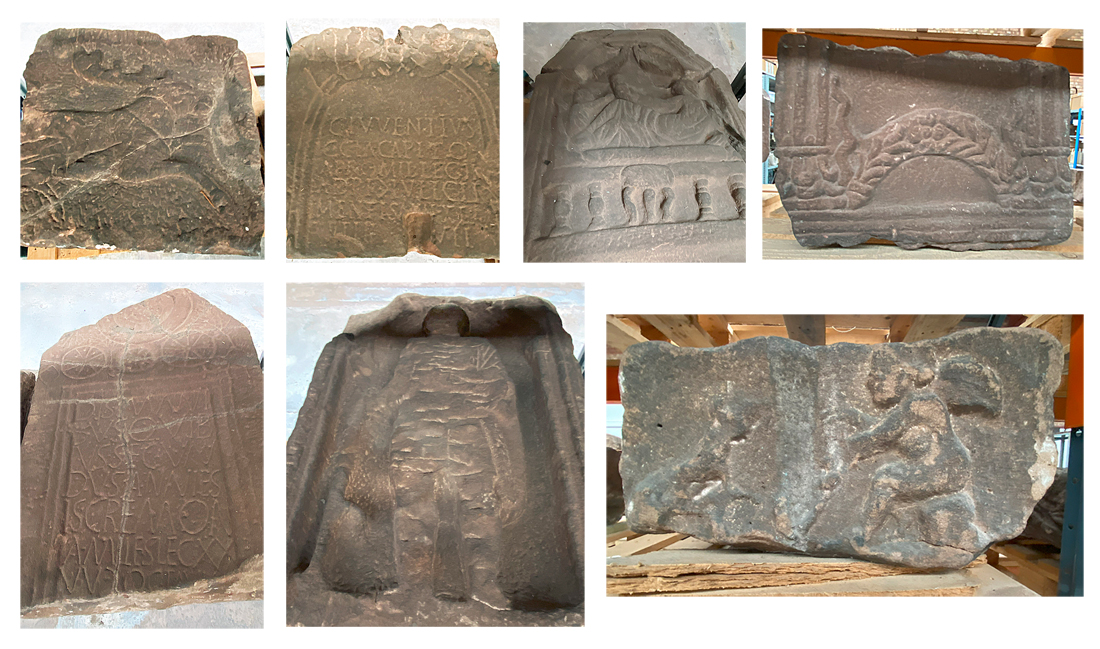
Sun and Fire – Life and death at the dawn of history. Shrewsbury Museum and Art Gallery, 2/11/24 – 30/04/25

This looks like a must-see exhibition at the Shrewsbury Museum & Art Gallery. On my to-do list:

Sat 2 Nov, 2024 – Wed 30 Apr, 2025

From the museum’s website:

Experience life in Shropshire between 4500 and 2000 years ago. That’s roughly the time from 2500 BCE until the Romans invaded Britain in 43 CE.

Before the Romans came, people in Britain didn’t use writing. That means there’s a lot we don’t know about them. But they left many objects and other traces in the Shropshire landscape and by examining these closely, we can try to work out what their lives were like. Come and see how we can tell that heat was vital to them. Find out how they used fire to make beautiful and useful objects, to cook and to cremate their dead.

Explore our interactive exhibition and learn how we once celebrated the sun with huge stone circles and bright gold objects. We can’t be sure why they did some of these things. We can only guess what they thought and believed. But we do know that in lots of ways these people were like us, with bodies and senses like ours. They felt the heat of flames on their skin and the sun’s warmth on their faces. Their lives were full of sensations, sights, sounds and scents.

Full details, including opening times and ticket prices on the Museum’s website at:
https://www.shropshiremuseums.org.uk/event/sun-fire-life-and-death-at-the-dawn-of-history/

Day trip: The Jackfield Tile Museum, near Ironbridge, Shropshire

 Introduction

Craven Dunnill and Co

At the top of my to-do list for my short break to Shropshire in October was the Jackfield Tile Museum.  I wanted to see all the Ironbridge area museums themed around the Industrial Revolution, and managed to do so, but I have a great love of tiles, and since I moved up to this area have been dying to visit the museum in the village of Jackfield, next to the river Severn.  It was even better than I had expected.  To get the most out of this museum, you have to really love Victorian and Edwardian design, because this is a celebration of the tiles produced during the late 18th, 19th and early 20th centuries, but if you do, it is a superb experience.

The museum is beautifully thought out, very well lit, and the tiles are presented in a way that allows them to be appreciated and understood not only as designs, but as the products of specific manufacturing processes, as the result of industrial innovation and as the output of very proficient commercial drive.  It is amazing what went in to making tiles and mosaics and turning them into a commercially viable product for both private homes and public buildings.

Craven Dunnill and Co

As well as original display cases and tile arrangements that show how the tiles were arranged to show to potential buyers, there are rooms showing development in artistic and craft styles (the Style Gallery) and reconstructions of entire rooms that used tiles as the major component of their decorative schemes.  There are also reminders that the tile-works also made plates, vases and other decorative items.  The museum also holds the John Scott Collection of tiles.

The impressively long 1872 building, the original Craven Dunnill and Co tile-works, is occupied partly by the museum and partly by a working tile-works.  Today’s Craven Dunnill is a successful commercial venture building on the successes of its 19th century predecessors, a very nice link between the building’s heritage and its present manufacturing activities.

Craven Dunnill and Co

Apologies for some of the photographs.  There is excellent lighting in the museum, but this sometimes makes it difficult to photograph without reflections, and many of the photographs have big patches of bright light on them.  Some of the angles are a bit odd too, as I tried to lean away from the reflections.  It didn’t help that I was in a bright fuchsia-pink coat, which reflected in the display cabinet glass!

Visiting details (with links to opening times, ticket prices, and parking details etc) are at the end of the post, as usual.

The length of the building reflects the way in which tiles were produced via a series of stages from east to west, from preparation of the clay to the finished product

The museum is arranged into different themed areas, which explain both different aspects of the Jackfield tile-works itself and the development in the 19th century of tiles and how they were marketed and sold, and what sort domestic, commercial and public locations they adorned.

Entrance, showing replica of one of the Craven, Dunnill and Co commissions


Introductory Gallery

One of the original 19th century floors of the Craven Dunnill and Co tile-works, where prospective customers entered to view tiles in the trade showroom.

The self-guided tour starts with information boards describing the background to the tile industry and its commercial development from the 17th century, when the area was famous for its clay tobacco pipe manufacturing works at Broseley.  By the 1720s there were several small potteries in Jackfield, taking advantage of locally available raw materials and the proximity of the river for power and transportation.  There had been a pottery on the Craven and Dunnill site since 1728.  The railway arrived in the valley in 1862, with a siding for Jackfield and stops at Coalport and Ironbridge, improving connections and the speed with which products could be shifted to market.  The expansion of local industries followed, and two of the largest Victorian tile factories in the world were built next to the railway:  Craven, Dunnill and Co in 1875 and Maw and Co in 1883.  Tiles were valued not only for their decorative value but, in a period that was just getting to grips with the importance of hygiene, were easy to clean.  By 1881 Craven Dunnill and Co had 94 workers including 53 men, 15 women and 25 youths.

Craven Dunnill and Co

Mosaics on the stairway up to the the trade showroom, displaying the skills of the tile-works

Craven Dunnill and Co

Craven Dunnill and Co

The Trade Showroom

The first gallery, The Trade Showroom, is the display area of the Craven Dunnill and Co. tile-works, where architects, interior decorators and their customers could view catalogues, but could also see samples of the company’s tiles wherever they looked.  Today’s layout preserves one of the company’s original display cabinets, and the tiles on the walls, including floor and wall tiles, are based on images of this room as it was in the 19th century.  Display cabinets in the middle of the room show other aspects of the company’s operations.  On this floor there are also reconstructions of the offices that would have existed in the building in the Victorian period, with recordings that you can listen to, capturing accounts of personal memories of the tile-works in the past.

On of the original display cabinets


A design book by Owen Gibbons from 1881. Gibbons and his brother taught at the Coalbrookdale School of Art, producing many tile designs

Mosaic cutter


Style Gallery

The Style Gallery offers a eye-dazzling view of the sheer number of fashions in tile design that trended during the Victorian period.  It is a reflection not only of how the Victorians were interested both in referring to and interpreting the familiar past, and reinventing the present but of how some of these styles employed imagery from the Far East and and the Middle East.

Both companies used well-known designers for some of their output, but much of the design work was done by in-house designers, some of whom were secured from the Coalbrookdale School of Art.  This was a rare opportunity for women to enter industry as skilled artisans.


William de Morgan

Examples from a series of 7 Art Pottery vases by Walter Crane for Maw and Co, 1889


Tiles in Everyday Spaces

This area of the museum is superb, recreating some of the real-world contexts in which tiles manufactured were employed.  It was great to see the Covent Garden tube station recreation, because that was my tube station for several years when I worked for a company on Long Acre.  And if I could have had a glass or two at that wonderful tiled bar, what a great destination that would have been!

Butcher’s shop, Ripon by Alfred Potter for Maw and Co

Washstand by Maw and Co., c.1883

Long Gallery

The Long Gallery is elegantly displayed and beautifully designed, showing both sides of individual tiles, and demonstrating the variety of methods and techniques as well as styles and designs manufactured locally.  Each of the displays shows a different decorating technique accompanied by tiles, with both front and back display, that illustrate that particular technique or method.


From the Long Gallery to the John Scott Gallery

Between the Long Gallery and the John Scott Gallery is a corridor with views into the historic mould store, and a panel on the corridor wall consisting of more historic moulds.  These all have relief patterns that were drawn on and then hand-carved.  To make the tile, the clay was pressed or poured into the mould, and then fired.  Once it had cooled it could be glazed, before being fired again.  The ones stored here are part of the commercial and industrial heritage of Maw and Co and Dunnill Craven and Co.


John Scott Gallery

Part of a six-tile panel showing a peony design, attributed to Kate Faulkner, Morris and Co., 1880s

Slightly anomalous, because this is a collection that does not relate specifically to the Ironbridge area, this gallery displays the collection of John Scott, who began collecting tiles in 1968 and continued until he died in 2020.  His collection, gifted to the museum in 2013, includes over 1700 pieces, of which an elegant portion are displayed here.  I really liked his statement, shown on one of the information panels, that he collected only what he both liked and could afford.  He was collecting for his own pleasure, not to build an illustrious collection.  By the time he died, his collection had become a remarkable reflection of the history of tile design and manufacturing.
===

Uroboros, sometimes signifying eternity. By C.F.A Voysey. Pilkington


William de Morgan


One of six panels designed for Membland Hall, Devon. William Morris and William de Morgan 1876

Fish and water lilies. Relief-moulded tile panel design by C.F.A. Voysey, Pilkington

Art Nouveau tile panel by John Wadsworth. Minton Works c.1910. The repeat is achieved with just one tile.

Exterior buildings

Once you leave the museum, you will walk out through some of the original buildings that supported the works, including the massive kilns and storage facilities.  From here, you can re-enter the museum to visit the gift shop and the cafe before leaving.


When you leave, the church next to the tile-works is well worth a look, with a partially tiled interior.

Final Comments

All of the museums in the immediate Ironbridge area are well thought out and beautifully presented, and I enjoyed them all enormously.  The Jackfield Tile Museum was the one that most closely demonstrated domestic and commercial artistic tastes throughout England.

The museum offers an impressively detailed insight into multiple aesthetic tastes captured by Victorian tiles and mosaics, showing dozens of them to ensure that visitors are able to appreciate the sheer versatility and exuberance of Victorian taste.  Seeing the tiles built into pieces of furniture, and used to create entire spaces like churches, bars, bathrooms and the Covent Garden tube station brought the tiles to life, showing them both as aesthetic decisions and practical architectural applications. 

Even though the visual impact of the tiles was always going to steal the show, the museum does not neglect explanations of the really fascinating history of the local tile-works, the development of the manufacturing technologies that went into creating tiles and mosaics, and details about the commercial challenges involved in the marketing and sale of both.

I really loved it.


Visiting

Be careful with the opening days, because when I visited it was closed on Monday and Tuesday, but these days, and the times, change depending on the time of year. If you are intending to visit other museums too, it is worth checking out if they are open at the time of year of your visit.  The Broseley clay tobacco pipe works, for example, was closed for the autumn-winter season, which was disappointing.  You can find prices and opening times on the museum website here, and if you want to see other museums too there is a page with all the opening times in the related museums here.

If you are a member of English Heritage be sure to hand over your card, whether asked for it or not, to obtain a 15% discount.

There’s no guide book, which is a shame.

Jackfield Museum has a car park, which is chargeable via some sort of online arrangement that is loosely described on the website here.  I was staying nearby so walked down to the museum and didn’t need to get to grips with the parking system, but I suggest asking at the ticket desk if you have trouble with it.

Nearby there’s an excellent pub called the Black Swan with tables overlooking the Severn outside, and a cosy, friendly interior with excellent pub food.  It has a really super, mellow atmosphere and is a two-minute drive away, with plenty of free parking.  It has no website but it has a Facebook page and if you Google it, the phone number will come up.  It is quite small, so best to book by phone or in person.

==


Day Trip: The RAF Museum Midlands at Cosford, near Telford

Sopwith 1 1/2 Strutter (replica) in Hangar 2

Even if aircraft and aviation history are not really the first things that spring to your mind when you are looking for a museum to visit on a day out in the general area, the RAF Museum at Cosford offers a thoroughly absorbing experience.  Aeronautical development has progressed so rapidly since the early 20th century that the first engineers and pilots might well find all the new innovations, capabilities and capacities that are on display at the museum fairly miraculous, and these have been significantly surpassed by much newer models.

This was my third visit.  The first visit was with my father who as a school boy at Calday Grammar on the Wirral had loved being in the Air Cadets, and went on to do his National Service in the RAF.  The second was with a friend whose father had served as a  Flight Engineer from before his 20th birthday during the Second World War, working and flying on Avro Lancasters.  Both my father and my friend brought away very personal experiences of the museum, but even without  these intimate connections, the RAF museum at Cosford is a rich journey into aeronautical history.  There is splendid innovation, superb technology, surprisingly aesthetic appeal and, in some cases, the sheer immensity of some of these vast monsters.  The full-life biographies of the aircraft themselves are themselves compelling, but the museum also tells dozens of stories about the people whose lives were embedded in the RAF, as well as in commercial travel, both in times of war and peace.===
===

===
===

Hangar 4. Mikoyan-Guevich “MiG” 15bis.  Single seater jet intercept fighter, Russian-designed and notable for its use in Korea where its superior performance came as a shock to American pilots.  Maximum speed 688 mph. 1949-1970s

The aircraft are not exclusively British. There are American, German and Russian planes, as well as those built as joint enterprises.  The information boards compare and contrast them with contemporary British aircraft that they came up against, in terms of maneuverability, speed and technical specifications.  As well as planes there are also a couple of helicopters, staggeringly massive things that don’t seem even remotely aerodynamic, as well as some supporting ground vehicles including tanks, cars and aircraft tugs.  Although less obviously comprehensible, the range of aircraft engines on display also contributes to the story of aviation and its development, with information panels explaining how the engines improved the viability of aircraft.

Hangar 4. Hawker Siddley Vulcan in the foreground. A fabulous-looking long-range medium delta-wing bomber that was eventually converted for use as an air-to-air refuelling tanker

The focus on aircraft is not exclusively military.  Although there are a lot of those, several of the planes on display were commercial airliners of different sizes, built for carrying passengers, and the history of some of these early pioneers is well explained.

The museum is immense, taking up four gigantic hangars, each one with its own particular themes.  Although each of the Hangars is themed, there are some aircraft that don’t fit neatly into the themes, allowing for the inclusion of a lot of variety throughout all the hangars.

Bristol Britannia 312 turboprop aircraft known as The Whispering Giant due to is comparatively quiet engines. It first flew in August 1952. Due problems with the turbine engine less than 90 were made and sold to both civilian airlines, like the now defunct BOAC passenger carrier, and the RAF.

The Hangars

It is worth taking some time before you start your tour to have a look at the wall maps in the reception area, which provide details of how the different hangars connect. The numbering of the hangars is a little counter intuitive, because the first of the four that you visit is Hangar 2 (H2), then Hangar 3 (H3), then Hangar 4 (H4) and the last hangar that you visit is Hangar 1 (H1). The maps are dotted throughout the hangars but in order not to miss anything it is a good idea to sort it all out in your head in advance.  It is easy, for example, to completely miss the second hangar on your visit, because it is connected to the first hangar that you reach via two small doors that are relatively unobtrusive.  There is a guide book that has a copy of this map, copied below.  More visiting details are at the end as usual.

The site map from the Souvenir Guide (2024, Royal Air Force Museum), page 72

Hangars 2 and 3

The first hangar that you visit is Hangar 2, or H2.  To reach Hangar 2 the route takes visitors outside, passing between three magnificent aircraft, each with information boards, before passing a fourth, the innovative, versatile and very successful PBY Catalina flying boat and amphibious aircraft, at the entrance into Hangar 2.

On the other side of the door is a gallery dedicated to stories about RAF experiences between 1918 and 2018, before you pass into the hangar itself.

1940 wooden emergency exit hatch from the cockpit of Hawker Hurricane P2798 showing the cartoon cat Figaro, the personal marking of Wing Commander Ian Gleed, pilot and Second World War fighter ace

The function of the RAF, the world’s first independent air farce, remains unchanged across a hundred years: its mission is to defend the UK, to attack if required, to support in times of humanitarian crisis and to move people and equipment quickly across the world.

Like the other small galleries in the four hangars, this displays information about the immense variety of men and women who have served and continue to serve, with the vast range of skills that are required to make this military machine function. They also display the objects that related to those people, both formal and very personal.  This is an excellent way of using objects to connect people to their personal biographies and their official careers and the honours they were awarded.  Be sure to enter H3 from one door and return to H2 via the other so that you visit both galleries.

Page from the Souvenir Guide (Royal Air Force Museum 2024, p.32) talking about some of the highly personal measures that RAF personnel took to help them face the tasks before them.  Objects like these are just as much a part of RAF history as the aircraft in the museum

The main hangars in H2 and H3 focus on War in the Air and Test Flight, a mix of wartime and post-war aircraft.  Some of those on display are such icons that it is almost impossible not to reach out and touch.  In the First and Second World Wars, many planes were employed before it was possible to put them through their paces before they were needed in combat, and they were essentially put to the test in active service.

==

The iconic Spitfire MK1, the oldest surviving example


The Boulton Paul Defiant was vulnerable to Luftwaffe fighters. Instead of being withdrawn from service, these were painted black and moved to night operations, although they were eventually withdrawn altogether.


TheGerman Junkers JU-88R-I

Although it is  not possible to convey the sheer immensity of the Avro Lincoln, it is an absolute giant of a thing.  Its design was based on the Lancaster, but although it was too late for a combat role in the Second World War, it served the RAF until 1963, long after the first jet engines had come into use.  Cosford doesn’t have a Lancaster, but this is an imposing creation in its own right.

An Avro Lincoln, giving no impression in this photograph of how massive it truly is

After the Second World War significant investment was made in developing technologies to provide specialized requirements, and testing became increasingly important.  Whilst some aircraft took on important roles in the RAF, others either failed to make it into production or were significantly modified before they were adopted.  The history of aircraft is as much about those that failed, or were not entirely successful, as it is about those that became either fundamental icons or invaluable workhorses of aviation history.  It is this mixture of aircraft biographies and narratives that define Hangars 2 and 3.


British Aircraft Corporation TSR2, Combat Prototype

Details of the British Aircraft Corporation TSR2, Combat Prototype

BAe Experimental Aircraft Project


Hangar 4

H4 is next, a soaring modern building themed around The Cold War.  It is a truly spectacular building in its own right, both outside and in, a functional and striking space for displaying a huge number of aircraft to best advantage.  This is all about a new generation of fighter and surveillance aircraft, missiles and drones, as well as support vehicles.  Entered from H2 at ground level, you find yourself confronting aircraft overhead, on the same level and below, with lifts as well as stairs to get down to the the lower level.  One of the novelties, apart from the aircraft overhead, is being able to walk along the gallery and view some of the vast machines that are sitting on the lower level face to face.

It is a magnificent visual display but as in the other hangars also has plenty of information about why each type of aircraft was built, and what makes them unique, plus information about the men and women who worked in these different contexts.  At the same time, it addresses the important and often vexed subject of conflicting ideologies and why such ideologies erupt into military action, making military assets a necessary aspect of modern life.  The focus is, as the name of the hangar indicates, the Cold War, and the opposing ideologies that resulted not merely in defensive strategies but also in both armed conflict and, in an attempt to reduce the likelihood of war, such initiatives as the North Atlantic Treaty Organization (NATO).
===
===

The Vickers Valiant of 1955, designed for nuclear strikes, and withdrawn form service in 1965. Group Captain Ken Hubbard, caption if Vickers Valiant XD818 remembers its first drop of a British thermonuclear bomb with the resulting mushroom cloud “a sight of such majesty and grotesque beauty that it defies description.”

==

Douglas Dakota

The Lightning, the first RAF fighter capable of flying at twice the speed of sound, but with short operational range

Details of a personalized Handley Page Victor, which entered service in 1958

Sikorsky MH53 Pave Low long range combat, search and rescue helicopter

Sikorsky MH53 Pave Low interior

==

Scottish Aviation Twin Pioneer light transport


Hangar 1

The last of the hangars, H1, is themed along the lines of Transport and Training.  Transport of equipment, personnel and supplies is a major element of airforce logistics, and aircraft designed specifically for these tasks may be either passenger carriers or sometimes gigantic warehouses on wings designed to carry whole platoons or heavy armoured vehicles and armaments.  Training aircraft may be tiny by comparison with some of the vast aircraft in tis hangar, used for acclimatizing trainee pilots and building up the skills of both trainee pilots and other air and ground crew, including engineers.  This hangar also has an excellent display of engines, which also required the training of aircraft engineers, giving insights into the anatomy of these power houses propel aircraft off the ground and keep them in the air.

Fairchild Argus II light transport, which entered service in 1932

Hawker Siddeley Andover E.3A. Originally designed as a transport aircraft, it was converted to carry out calibration duties on radar and radio navigation aids

Percival Pembroke, which entered service in 1953 for light transport and communications and was withdrawn only in 1988

Hawker Siddeley Harrier GR.3

If the size of the Lincoln was the first of the aircraft to blow my mind, the Armstrong Whitworth Argosy is seriously humongous.  It is impossible to convey its scale, with its twin tails and its enormous wing span. It entered service in 1962 and could carry up to 69 troops or 13,000kg of equipment including armoured vehicles. It is two storeys tall from ground level to the cockpit.  The lens on my camera couldn’t fit anything like the whole thing in, and gives no sense of what this aircraft actually looks like, so see the image below the one in the museum of one of these crazy-looking things in flight.

Armstrong Whitworth Argosy

===

Armstrong Whitworth AW660 Argosy C1 XP445 in RAF Near East markings from the BAE Systems website.


Rolls Royce RB211 22C engine used in the Lockheed Tristar, and the Boeing 747 and 767. Compare with the size of the edge of the doorway immediately to its right. Huge!

Vickers VC10 C1K long range transport

Final Comments

My father in typically mellow mode after he chose the RAF for his National Service, looking awfully youthful.

Anyone who visits will take something different away from Cosford, depending on their interests and their personal connections with aircraft.  We left the UK when I was a child, returning in late 1979, and part of my experience of living overseas was flying to and from Britain to visit family, first as an “unaccompanied minor” and then on my own, making it a routine form of travel.  Once, flying from Heathrow to Liverpool with my father in a propeller plane, he warned me about coming in to land and the noise and vibration that I, having only flown in jets, would probably find startling.  I did, but what fun! Years later, in a passenger plane taxiing down a Heathrow runway, the captain told those of us on the right side of the plane to look out of the window to see a Harrier jump-jet do a vertical take-off.  Fantastic.  Twenty or so years ago I saw a Vulcan flying at the Farnborough Air Show and have never forgotten it, and at the same show saw a vast commercial passenger plane being put through extraordinarily acrobatic paces, and that too remains in my mind as a very different but remarkable sight.  Two years ago I was at RAF Duxford with my father, and was lucky enough to be there just as a whole series of vintage biplanes were taxiing down the field and taking to the sky. Magical.  Aircraft do have their own special sorts of aura, some darker and some brighter than others.

The aircraft at Cosford are beautifully displayed, and while you can just stand and admire the sheer magnificence of these astonishing beasts, the signage is all thoroughly educational without in any way talking down to the visitor.  The sheer amount of information delivered in a digestible way is genuinely impressive.

Visiting

The museum is free of charge, but parking is charged (at the time of writing) at £7.50.  You can check for updates on charges and opening times on the museum’s website here.  The museum hosts a number of events throughout the year, including an air show and corporate events, so do make sure that the entire museum is open on the day you want to go, and that none of the hangars are closed for any reason.

The car park is huge, and payment of the set fee is via machines that are dotted around.  There is a really nice cafe in the reception area, which offers drinks, snacks and lunches, and everything is bright, clean and modern.  You will need to stop at what looks like a ticket stand to confirm that you have paid for parking, and so that you can be counted, because the museum’s funding depends on the volume of footfall.

The museum’s shop is in the third hangar, with some fun stuff for sale, but you can buy a souvenir guide in the reception area.  I did buy this, with some considerable doubt in my mind because anything that refers to itself as a souvenir doesn’t inspire confidence, but this 73-page booklet, full of great photos and information, was really enjoyable and when I arrived home I read it cover to cover.  Just like the museum itself, this mixes stories of planes and people, and the result is admirable.

The museum recommends that you allow four hours to get around all four hangars, including walking around the outside aeroplanes.  Not being an expert, and not stopping to listen to the many audio recordings or watch the video displays, I did it in a leisurely two and a half hours, stopping to read a lot of the excellent signage and to take photographs.  I took an additional half hour afterwards to consume a heavenly coffee and a bite to eat.  So for me, including my snack break, it was a three hour visit, which I enjoyed phenomenally.

Lockheed Hurcules C Mk 3P medium-range tactical transport aircraft that could operate from short runways.

If it looks like rain take a brolly or a raincoat with a hood, because you will have to walk from the reception area outside to the first hangar, and there are aeroplanes to see in the grounds as well.  The first two hangars, 2 and 3, are physically linked, but it is easy to miss that there are doors letting you through.  From there, it is a matter of going outside again, into Hangar 4, and again across a small access road into Hangar 1.  If you want a coffee or something to eat afterwards, it’s few minutes to walk back to the reception area via another two outdoor planes.

There is disabled access throughout, including H3’s viewing gallery, lower level and shop.  Signage is all at a level that can be read by wheelchair users.

Museum Ground Crew

Only one of the aircraft, at least on my three visits, allows visitor access, and this was a guided tour for a fee at restricted times, so experiencing the planes is a matter of viewing either from the floor or, in the third hangar, from both floor level and via a viewing gallery.

If you don’t want to be inundated with children, avoid weekends and school holidays.  School trips mean that they are not completely avoidable, but you stand half a chance.

Every time I have been there, especially last month (October) when I turned up at opening time, there were volunteers everywhere who are there to offer knowledge and help you with any visiting information.  They are a hugely knowledgeable and friendly bunch.

If you have even a marginal interest in aircraft or the history of technology, this makes for a very rewarding day out.

Hawker Cygnet, 1924-29


Chester in art in two exhibitions at the Grosvenor Museum: George Cuitt and Louise Rayner


Two versions of Bishop Lloyd’s Palace on Watergate Street. On the left George Cuitt and on the right Louise Rayner


Lower Bridge Street looking south. Louise Rayner

There are two exhibitions running concurrently in the Grosvenor Museum in Chester, both showing highly individual interpretations of Chester’s architecture.  The first, The Romance of Ruins – the Etchings of George Cuitt (Gallery 1 on the ground floor, accessible to wheelchair users) runs until 12 January 2025.  The second, Louise Rayner: Victorian Watercolours (Gallery 2, upstairs with no lift) runs until 9 February 2025. Both came from artistic families.  Cuitt (1779-1854) was the only son of painter George Cuit the Elder, becoming an art teacher in Chester, and Rayner’s (1832-1924) parents and several of her siblings were also artists. Cuitt added a second “t” to his surname to distinguish himself from his father.  If you visit both exhibitions at the same time, the most obvious contrast is that George Cuitt’s etchings are monochrome, whereas Louse Rayner’s watercolours are characterized by vivid colours, but in spite of the time differences between their work, and the chronological distance between them, there are a lot of similarities in their perceptions of Chester.  Both artists focus on detail, and both lean towards a picturesque and somewhat romanticized view of Chester, populated not merely by buildings but by a myriad of people and livestock.  Cuitt’s work is by its nature more linear and less impressionistic than Rayner’s, but both highlight key details of individual buildings, capturing much of the minutiae that makes Chester’s architecture so engaging, and the skills demonstrated by both are well-honed.  Rayner makes particularly good use of perspective to draw her viewers into her paintings.  Although this was not always a feature of Cuitt’s work, a particularly nice view of the cathedral cloister uses the same technique.

The Cloisters, Chester Cathedral, 1811. George Cuitt

Quite apart from their value as artistic interpretations of Chester, both the Cuitt and Rayner exhibitions provide insights into architectural details that no longer survive, lending themselves to historical research as well as art appreciation.  From Cuitt’s portfolio, an 1827 view through a ruined arch towards Chester Castle captures a surviving in situ feature of the medieval St Mary’s Benedictine Nunnery.  It is entitled “Chester Castle from the Nun’s Gardens,” (shown below)  It is also a nice juxtaposition of two contrasting architectural styles, and two equally contrasting states of preservation.  The arch has been moved to Grosvenor Park, where it is accompanied by other orphaned pieces of gothic architecture.  Another of his etchings shows the cloisters before the windows were added.  Louise Rayner’s corpus has provide a great many examples of buildings that are no longer standing, but I found the one showing St Werburgh’s Mount of particular interest, shown below, where St Werburgh Row, is now located.  Her painting of Lower Bridge Street is an eye opener, shown above, looking towards the Dee with some lovely buildings now demolished and replaced by a 1960s monstrosity, and the Harvie’s almshouses, also below, must have been a very attractive feature.

St Werburgh’s Mount, c.1873. Louise Rayner

Both exhibitions provide full information about both artists, providing insights into the influences acting on their work and how their careers developed.  The pictures displayed have been chosen to highlight not only how they each interpreted Chester but how their skills have been applied to such a rich subject matter.

Find details about opening hours and other visiting details on the Grosvenor Museum website.

View from St Mary’s Nunnery arch to Chester Castle, 1827. George Cuitt

Harvie’s Almshouses, Duke Street. Built 1692, demolished 1892

St Michael’s Church Porch, 1809. George Cuitt

The King Charles Tower and the Shropshire Union Canal. Louise Rayner


Ewloe Castle in Wepre Park, near Connah’s Quay

Artist’s reconstruction of Ewloe Castle. Source: Renn and Avent 2001

The ruins of the 13th century Ewloe Castle, one of Llywelyn ap Gruffudd’s more puzzling constructions, is located in the public Wepre Park, near Connah’s Quay and not far from Chester.

Visiting details are at the end of the post, including information about car parking, the visitor centre, an excellent downloadable guide to the routes through the park and its key features, as well as where to find out more information about the castle.
==


==

Wepre Park

Wepre Park map in the Explore Wepre Park PDF by Denbigh County Council online.  The Main Trail leads from the car park all the way to the foot of Eweloe Castle.  The Boardwalk is also reached from the car park, and is shown at bottom left.

Wepre Park is a woodland valley, largely deciduous, that flanks the Wepre Brook, and is very popular with dog walkers, joggers, and families. According to the park’s literature, it is a remnant of the great hunting forest of Ewloe.  More recently it was the site of Wepre Hall.  On a sunny day in the autumn, with the light filtering through the trees, this should be a wonderful display of illuminated colour.  The autumnal display was very fine, with the light filtering through the multi-coloured leaves and the woodland floors carpeted with bright yellows and oranges.  The woodland contains a wide mixture of different trees, shrubs and vegetation and is home to varied wildlife, including aquatic species, insects, birds, bats, badgers and a lot of very busy squirrels.  There is also a small wildlife meadow, although there is not much to see at this time of year.
==

The valley was owned in the 11th century by St Werburgh’s Abbey in Chester.  In the mid 12th century it was the site of a major confrontation between Henry II and the forces of Owain ap Gruffydd, ruler of Gwynedd in west Wales, during Owain’s campaign to extend his territories to the east. In 1157 Henry II took an army into northeast Wales to subdue Owain, but was ambushed by Owain in the Ewloe valley.  Although Henry escaped, and defeated Owain at Rhuddlan, Owain later regained much of the lost territory.

Wepre Hall, first built in 1788. Source: RCHAMW

A house is recorded at the site from at least the late Middle Ages.  During the Civil War a house at Wepre belonged to Royalist supporters who, in 1645, supposedly hid in the cellars a Royalist sympathiser who was a participant in the the Battle of Rowton Moor.  It was rebuilt as a 2-storey Georgian house in 1788 by Edward Jones, the owner of a local lead mine, with outbuildings and later extensions.  It was demolished in 1960.  There is nothing remaining of Wepre Hall except for the cellars.  The visitor centre sits on part of the Wepre Hall site, and the gardens here and nearby are designed to echo the formal gardens of the Hall.

There are a number of routes through the park.  From the car park, the Main Trail is a wide metalled track that leads from the car park past the visitor centre nearly as far as the castle (after which there are wooden steps leading up to the castle).  It follows the line of the brook, which drifts in and out of sight and is constantly audible.  The most notable feature on the Main Trail, apart from the lovely woodland, are the outcrops of Hollin Rock, a 320 million year old red sandstone, popular as a building material.  Towards the end of the trail is a small and attractive bridge, Pont Aber, that was once located further upstream but was moved here in 1800 to improve access to Wepre Hall.  There is a delightful small waterfall on the other side, which used to be the location of the Castle Hill Brewery that used the water from a natural spring.
==

The second significant route is a boardwalk, which leads from the car park along the brook and connects to the Main Trail about half way way along.  The main feature of the Boardwalk route is the waterfall, actually built as a weir to power a small hydroelectric plant, but it is a very attractive feature.  The plant used to provide electricity to the Hall before mains electricity arrived in the area in 1925.  There is a variety of aquatic vegetation flanking the boardwalk, and information boards indicate the different wildlife, including birds, that can be spotted on a walk.  The boardwalk follows the brook closely until it slopes up slightly to meet the Main Trail, and the “bubbling brook” phrase never seemed more apt.  This is a very audio-visual walk.
==

Some of the other footpaths are just well-worn tracks, very muddy at this time of year, but follow lovely winding routes through the woodland.  I tried the track from the bridge to the Devil’s Basin, supposed to be a short set of very pretty falls, but after five minutes or so the deeply churned mud made it completely impassable in ordinary hiking boots. It would have required wellies.

Near the visitor centre there is a small lake called the Rosie Pool that was created in the late 19th century for fishing and is now managed by the local angling club.  Immediately behind the visitor centre is a small but very attractive formal garden with a small pond, a nod to the former hall.  Even at this time of year, fuchsia, hydrangea and sedum still have some flowers.  There is a small pet cemetery located at its edge.  For more about the park download the Explore Wepre Park guide (in Sources at the end of this post).

Ewloe Castle

Ewloe Castle from the air. RCHAMW 6463845. Source: RCHAMW

There is some discussion about who built the castle. It was certainly either built or rebuilt in c.1257 by Llywelyn ap Gruffudd (also known as Llywelyn the Last), but he may have been restoring a castle originally built by Llywelyn ap Iorwerth (Llywelyn the Great).  The D-shaped keep has been seen as characteristic of Llywelyn the Great, and differences in the stonework of the upper and lower wards have been used to argue for a two-phase construction.  If this was indeed the case, it is argued that the upper ward would have been contemporary with the keep built by Llywelyn the Great and the lower ward built by his grandson Llywelyn the Last.  On the other hand, there is an early 14th century document that states that the entire was built by Llywelyn the Last.  The question remains unresolved, but it is not doubted that whoever built the castle, Llywelyn the Last certainly carried out extensive building work here.

Plan of the castle. Source: Lloyd 1928

Although it is built to a fairly standard Welsh plan, it is something of an oddity in strategic terms, not being built high on a hill but on the edge of a small valley.  Although the sides slope steeply away from the castle on three sides, it was actually overlooked from the south, so required quite extensive outer defences on that side, consisting of a ditch, the digging out of which would have provided a bank.
==

The keep sits within a small upper ward.  A larger lower ward was added, possibly at a later date, with a tower at its furthest extent from the upper ward and both were provided with curtain walls, some of which remain.  The D-shaped (or apsidal) keep has a small footprint with its semi-circular end overlooking the defences, whilst the tower in the lower keep overlooks both the southern aspect and the valley below.  The lower ward would have been provided with timber buildings for domestic functions and storage.

On the former ground floor of the keep, to which the steps at the back of the upper ward lead, the former hearth is still visible, and there are windows set in the thick walls.  Looking at the keep today, the lowest layer was a basement with no lighting.  The keep had an outer stone staircase at its south, and this is still in use for accessing the inner staircase that leads up inside the walls of the keep to a viewing platform at the top of what remains of the keep’s walls.

Two entrances, one into the upper ward and one into the lower ward would have been approached by bridges over the defences.  The lower ward’s tower was probably accessed from the curtain walls of the lower ward.

In 1257, when the castle was either built or rebuilt, Llywelyn ap Gruffudd was on the offensive, attempting to retake Perfeddwlad, otherwise known as the “Four Cantrefs,” which incorporated the cantrefs of Rhos, Rhufoniog, Dyffryn Clwyd and Tegeingl, a constant bone of contention between the Welsh princes and the English crown.

The problem of the poor strategic location could be explained by suggesting a different intention for the castle as more of a political statement than a fully functional military outpost.  Its location on the edges of disputed territory, not far from older English castles and the site of Owain Gwynedd’s defeat of Henry II may simply have been a statement of a Welsh return to land that they claimed as their own, and a useful staging point for any future negotiations, given its proximity to the Anglo-Welsh border.  This is supported by its probable use first in November 1259 and again in December 1260 when English ambassadors were sent to meet with Llywelyn at a place identified as Wepre, which must have been the castle.  There is no record of the castle’s involvement in 1276 and 1277, when war between England and Wales reignited, which may give added weight to this castle being a political gesture rather than a strictly military base, but could also reflect the necessity of Welsh retreat to safer ground.

Ewloe Castle by Moses Griffith (1747-1819) NMW A13529. Source: National Museum of Wales

Edward I does not appear to have felt that Ewloe Castle was worthy of his interest.  Although he restored other castles for his own use, this was probably too small, too badly sited and too difficult to defend.  Instead, in 1277 Edward began to build at Flint (posted about on the blog here), Rhuddlan (posted about here) and Denbigh (posted about here).  Owain Glyndwr’s rebellion in 1400 found no use for it either.
==

Visiting

Access to the castle, managed by Cadw, is free of charge and open all year round, as is the entire park, but you will need to be confident with stairs, as they are the only way in and out of the castle.  There are new metal stair cases with handrails, and original stone ones, including a small flight in a stairwell in the keep leading up to a viewing platform at the top.  None of the stone staircases have handrails.

Parking is straight forward for both castle and park.  If you only want to see the castle there is a lay-by on the side of the B5125 that looks as though it will take about 8 cars, maybe a couple more.  I didn’t try the route from there to the castle so have no idea what the footpath is like underfoot, but the What3Words address for the lay-by parking is ///follow.beauty.mistaking.  The official car park is a large one near the visitor centre on Wepre Drive. Ewloe Castle is about a mile away from this car park along a very easy and attractive trail. The What3Words address is for the main car park is  ///contrived.writing.mailers

A circular walk taking in the boardwalk and returning to the car park via the Main Trail would be suitable for unwilling legs, as would a walk along the boardwalk to the bridge and then back along the main route.  The castle is not suitable for those who cannot manage steps and stairs, as this is the only way of getting into the castle, from whatever direction you approach.

The visitor centre is closed at this time of year (November) but its cafe was open on my visit.  The public toilets are also open nearby.  There’s a substantial play area on the edge of the car park.  There are a small number of good information boards throughout the park, including one at the castle, but the Cadw official guide to Flint Castle also has a section on Ewloe Castle.  Other sources are listed below, including castle information and an excellent guide to the park, together with a footpath map.


Sources:

Wepre Park

Flintshire County Council
Parks and Countryside
https://www.flintshire.gov.uk/en/LeisureAndTourism/Countryside-and-Coast/Parks-and-countryside.aspx
Discover Wepre Park Booklet
https://www.flintshire.gov.uk/en/PDFFiles/Countryside–Coast/Discover-Wepre-EnglishWEB.pdf

A different map that may be slightly easier to follow is on the following link:
Potty Adventures
Wepre Park
https://pottyadventures.wordpress.com/2016/07/16/wepre-park-our-local-8th-wonder-of-world/

=
Ewloe Castle

Books and papers

Davis, Paul R. 2021.  Towers of Defiance.  The Castles and Fortifications of the Princes of Wales. Y Lolfa

Lloyd, J.E. 1928.  Ewloe.  Y Cymmrodor, vol.39 (unnumbered)

Renn, D.F. and Avent, R. 2001 (2nd edition). Flint Castle – Ewloe Castle. Cadw

Websites

BBC News
13th century castle to be sold (18th November 2009)
http://news.bbc.co.uk/1/hi/wales/north_east/8364611.stm

Cadw
Castell Ewloe
https://cadw.gov.wales/visit/places-to-visit/castell-ewloe

Coflein
Ewloe Castle
https://coflein.gov.uk/en/site/94447/
Wepre Hall
https://coflein.gov.uk/en/site/36307/

Wales Online
Ewloe Castle has sold to farmer at auction (9th December 2009)
https://www.dailypost.co.uk/news/local-news/ewloe-castle-sold-farmer-auction-2770922
==

Day Trip: Wroxeter Roman City, near Shrewsbury

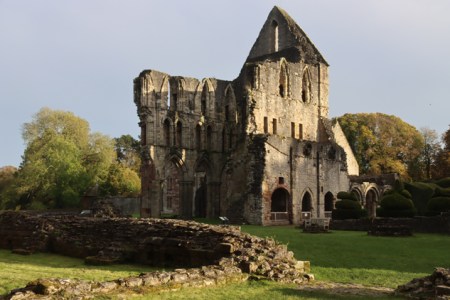
Hypocaust in the foreground with, in the background, the wall known as the Old Work, making one side of the former basilica.

Founded in the mid-1st century AD next to the point of the river Severn where it could be forded, Wroxeter (Viriconium) was built on land farmed by the Iron Age Cornovii.  It became a legionary fortress with the capacity to hold 5500 men in the 50s, becoming an urban centre towards the end of the 1st century, eventually becoming Britain’s fourth largest town, four times larger than the the legionary fortress.  The remains of the site lie in a rural landscape to the east of Shrewsbury and is managed by Historic England.  There is an imaginary reconstruction of a Roman villa.  Indoors there is a very nicely presented Visitor Centre with exhibits and displays, as well as a small shop.  Visiting details are at the end of this post.

Display in the Visitor Centre

There is little point repeating everything that the fact-filled guide book has to say about Wroxeter and its history, so this is just a short summary of what you can expect to see on a visit.

What remains of the site is a very small section of the original 192 acre (78 hectare) city, consisting of the lowest courses and foundations of the bath-house, part of a market-place and a row of column bases that marks one site of the forum.  The road that carries visitors into the town follows the line of the Roman road, Watling Street.  The city was surrounded by a 3-mile long circuit of ditches and banks originally topped with a timber palisade, now on farm land and not accessible to the public, but still visible on aerial photographs.

Information board in the Visitor Centre at Wroxeter

Unlike Chester, York, London and many other Roman urban developments that survived the departure of Rome, Viriconium was one of the Roman towns that were completely abandoned, beginning in the mid-3rd century.  Looking out over the surrounding fields towards the Wrekin, after which Viriconium may have been named, it is difficult to imagine a thriving urban mass of public and private buildings connected by a maze of roadways and alleys. A series of archaeological excavations, however, have provided insights into what used to be here, and the visitor centre and guide book do a good job of explaining it.

The town was divided by the mighty Watling Street that connected it to London in the south, and to Whitchurch to the north, where the road forked with one branch going to Chester and the other towards the northeast, York and beyond.

Artistic reconstruction of the basilica on an outdoor information board

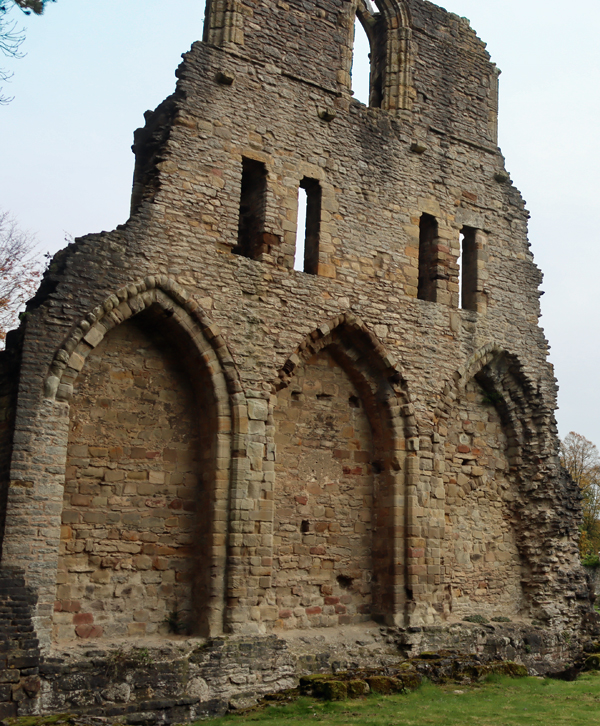
The most conspicuous feature of the site is the single piece of surviving wall, known as the Old Work, shown at the top of this post, which is what remains of what was one of the walls of the basilica, which was shared with the rest of the bath-house.  The big opening in the wall marks where there were once double doors.  The layers of brick-like stone blocks and tile work were covered in pink plaster, some of which would have been painted with decorative scenes.

Information board showing the main architectural features at the site with the basilica shaded in blue, the shops and marketplace side by side in the foreground and the bath-house taking up the rest of the space.

Changing rooms at the end of the basilica

The bath-house, which has been excavated in its entirety, is the most complete part of the site, with remains of one wall, sections of the the hypocaust (raised heated floor) and the footprint of the baths’ basilica, giving a clear indication of the scale of the original complex.  Bath-houses were an important part of Roman life, a component of civilized living and a good place to socialize and network. Even the small industrial base at Prestatyn had a tiny bath-house (posted about here).  The Roman visitor to a big bath complex would usually begin in the basilica, a long thin space flanked by columns, where exercise and sports could be carried out in the central area, whilst the side aisles could have been used for personal care activities like massages and hair dressing.  At the end of the basilica were two changing rooms.

The outdoor plunge pool

Then bathers moved through the baths in a sequence from an outdoor cold water plunge pool (heaven help them in this climate!) to an indoor cold water pool (natatio), an unheated room (frigidarium), a  warm room (tepidarium), and a number of both wet and dry hot rooms (an alveus, caldarium, and sudatorium).  Heat was provided in the warm and hot rooms via a hypocaust, consisting of regularly placed pillars of tiles that once supported a raised floor about 1 metre high, through which hot air was directed from three furnaces.  Hollow box-like flue tiles were used to capture the hot air as it rose from below.  A piece of decorated ceiling plaster from the hot room has been reconstructed, and copies are kept in both the Visitor Centre and the Shrewsbury Museum and Art Gallery.

Hot room

Reconstruction of ceiling plaster of the frigidarium in the Visitor Centre

Part of the western extension of the baths

Water from the baths was drained away beneath the bath-house and was used to flush out the latrines, the lower courses of which survive.

One of the shops that fronted onto Watling Street

Although the rest of the remains today lack the impact of the basilica wall section, mainly consisting of no more than two or three courses of stonework, these too were important parts of the civic quarter of the city, and there are explanatory information boards all over the site that explain what you are looking at and showing helpful artists’ reconstructions of how buildings may have been experienced by the Roman inhabitants.

Part of an information board showing the market place used by wealthy residents

Next to the bath-house is what remains of a market hall, with two storeys surrounding a central courtyard, containing shops that sold high quality food goods to the wealthy.  This building survived into the fifth century AD.  Nearby were other shops with open fronts overlooking Watling Street, which may have included food and drink for those using the baths, like modern take-away outlets or bars.

One of the ground floor shops in the marketplace

Colonnade of the forum, facing Watling Street

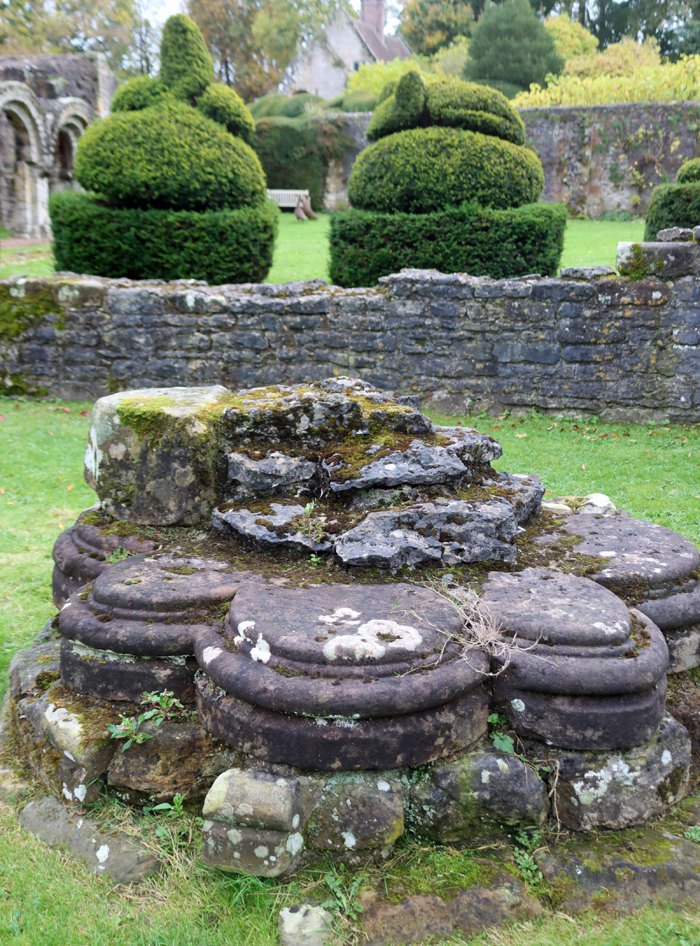
Over the road there is a line of column bases that are the remains of what must have been a very impressive forum, which was once covered 2.5 acres (1 hectare) and measured 80m x 120m (262 x 393ft).  This consisted of covered buildings arranged in a square around an open courtyard. The buildings served administrative, legal and mercantile functions, and the ruins represent a colonnade that faced onto Watling Street.  The central area was for an open market where stalls could be rented by local traders.

The reconstructed Roman house, a simplified version of excavated building “Site 6,” had a shop facing onto the street with accommodation at the rear.   It was built in 2010 for a television programme and provides a good way of visualizing what Watling Street and other areas of Viriconium may have looked like.

The forum

The reconstructed Roman house

A room in the villa

Next to the house, but not open to the public, is the model farm built in the mid 19th century by Lord Barnard, and incorporates considerable amounts of Roman stonework in its construction.  The farm is no longer in use but is maintained by Historic England.

The visitor centre and the lavishly illustrated guide book provide an excellent overview of the entire city’s history and what was found in archaeological excavations, with more information provided in the Shrewsbury Museum and Art Gallery.

Visiting

Prices and opening times can be found on the English Heritage website here.  There is plenty of parking.  The visit begins at the visitor centre, where tickets are purchased and you are given the option of taking an audio guide. I didn’t take one, but plenty of people were using them.  There is a small shop where you can purchase a detailed guide book, and although it is impractical to read this as you go around the site, there is a site plan and an aerial photograph with all key features marked, both of which great to have as you walk around.  The Visitor Centre is small but excellent, with plenty of helpful information boards and attractive displays of objects found at the site.  There is no cafe but there is a picnic area with a few benches.

1st century harness mount showing Bacchus

The site itself is mostly on the flat, with pathways between all the main buildings and information boards explaining what you are looking at.  There was a coach-load of children there at the time I visited and it is clear that for children, the villa was easier to get to grips with than the ruins themselves.

Nearby is St Andrew’s Church, which I very annoyingly missed but is widely recommended with some attractive and unusual features, some dating back to the Norman period. Both the church and the model farm, the latter not open to the public, are described in English Heritage’s Wroxeter guide book.

St Bartholemew’s, Tong

If you are driving via the A41, both Lilleshall Abbey and Tong’s St Bartholemew’s Church are well worth the visit.  Tong is right on the A41, very convenient for a visit en route.

Near to Wroxeter is the 18th century National Trust Attingham Park property. Shrewsbury is not far, and has a really excellent museum and art gallery with a super Roman gallery with finds from Wroxeter. Shrewsbury itself is a lovely and apparently thriving town with a good mixture of architectural styles from the Medieval period onwards, including the vast church of the former Shrewsbury Abbey, some lovely half-timbered buildings and some fine Georgian architecture, as well as some great places to find lunch!

Sources

White, Roger H. 2023. Wroxeter Roman City. English Heritage (also includes St Andrew’s Church, the Victorian model farm and the reconstructed house)

Information displayed in the Wroxeter Visitor Centre

Information displayed in the Shrewsbury Museum and Art Gallery (Roman gallery)

Discovering Shropshire’s History (website)
Roman Shropshire – (AD 43 – AD 410)
http://www.shropshirehistory.org.uk/html/search/verb/GetRecord/theme:20061122101531


An autumnal stroll from Churton to Aldford, pausing for lunch at The Grosvenor

Autumn sun and brightly coloured leaves are always a joy at this time of year, right up until the point that they drop in huge numbers and need clearing off the garden lawn 🙂

Because it was so warm, my destination was The Grosvenor pub, a self-indulgent extension to my terrific short break in the Ironbridge area of Shropshire last week.  It is always such a treat to be able to sit outdoors at this time of year.

The map of this walk is at the end of the post, and is a very simple one.  It takes around 40 – 45 minutes to walk through the fields to Aldford from Churton, so it is a short walk, and always a good fall-back when I don’t want to be bothered with the car.  The harvested fields, mainly used for growing corn, can be very soggy at this time of year with nothing but wet earth under foot, but it is always an easy and attractive option on a sunny day when the leaves are changing colour.  It was fine on the field edges, although distinctly squelchy underfoot crossing diagonally from footpath FP7 to FP6.  Half of the route is the metalled B-road Lower Lane, which gave the hiking boots a bit of a break from the sludge.

Irritatingly, I did not have my camera with me, so these were taken on my iPhone and many don’t bear close scrutiny.
===

=====================

======

===

===

After a very enjoyable lunch in the sun at the Grosvenor Arms, I had a wander around the village and returned back to Churton using the same route.  Normally I go back via the well-signposted FP8 footpath, but having investigated on my way to Aldford, deemed it far too muddy and waterlogged to make the attempt in anything other than wellies.  In the dry, this is a nice return route and takes in a chunk of the Roman road that once ran east of Churton (about which I posted here).

===

===

===

===

===

===

===

===

Cheshire West and Chester Public Map Viewer, annotated


A walk from Waverton along the Shropshire Union Canal

I have driven over the canal bridge on Eggbridge Lane in Waverton so many times thinking that I really must take advantage of the little car park just before the bridge to go and take a stroll down the towpath.  Having woken up early on a sunny morning I decided to investigate. Waverton is just off the A41, so very easy to reach. The car park is quite small, but it was not full even on a bright and warm morning.  The What3Words address for the car park is ///fingertip.snored.deals

Victoria Mill, Waverton

Immediately opposite the car park, as you walk to the towpath, is a very attractive canal building, the Grade 2 listed, a mid-19th century Victoria Mill, a former steam-powered canal-side corn mill, with bays for loading and unloading narrowboats, and now converted for modern use. The Historic England description is here.  This is part of the heritage of the Shropshire Union Canal, which if you keep walking north eventually ends up at Ellesmere Port.  To the south, it eventually connects up with the rest of the main canal network at Hurleston Junction.  The Shropshire Union has quite a complicated history, as does Chester’s canal heritage as a whole, and was not completed until 1835.

As with most canal walks, there’s always a choice to turn right or left, and as I had no idea what to expect from either direction I decided to head north, leaving the walk south for another occasion. Out of the car park I turned left under the unprepossessing bridge no.119 and headed up the towpath.  This section is metalled, so it avoided the mud and sludge that I had been half expecting.

If you take this route you find yourself walking along a short row of houses with canal gardens along a metalled pathway.  Canal-side gardens are always fascinating.  I used to live on a narrow boat many years ago, and it is always a lot of fun to see how different minds have dealt with a garden that opens directly on to a canal.  These are always hugely individualistic and personal.  There is always much to see in the way of garden furniture, garden ornaments (someone will always have gnomes, and there is usually at least one example of traditional canal painting), sheds in various states of repair, a wide range of summer houses, varieties of approaches to terracing, often some very interesting specimen trees and shrubs, and different attitudes to garden seclusion, along a spectrum from solid barriers of hedging or fencing to a complete lack of interest in any form of privacy.  A real cultural treat.

After just a minute or so the towpath enters a more rural section, and in the late season sun it was a real pleasure to take in all the autumnal colours on trees and shrubs that flank the canal.  I’ve posted some of the photos below. It’s a well-used section of towpath, with joggers, cyclists and plenty of dog walkers, but everyone is very civilized about moving over to make passing easy.  There was not much in the way of canal traffic, with just two narrowboats on the move, but I expect that it is much busier in summer.

Keep an eye out on your left as you leave the housing on your right and reach the more rural section.  Partly concealed by the grass next to the towpath, there is a short inscribed red sandstone Parish Boundary Marker. This section of the canal passes through the parish of Rowton, famous for the Civil War Battle of Rowton Heath (see the Wikipedia entry on the subject and a more detailed analysis by Historic England).  King Charles I is said to have watched his army lose that battle from the Phoenix Tower that still stands on Chester’s city walls. The stone marks the boundary between the parishes of Christleton (CP on the stone) and Rowton (RT).  The date commemorates the date of the battle in 1645 and, below the level of the grass, 1995, the 250th anniversary of the battle.
===

After this more countrified section there are more houses, all interesting, with some lovely weeping willows and other water-loving species, and a very attractive hump-backed bridge, that I have since discovered carries Rowton Bridge Road into Christleton.  I walked up as far as The Cheshire Cat, which sensibly has a gate onto the towpath, and carried on just a short way beyond it, but at that point the canal converges closely with the A41 (Whitchurch Road) and it becomes quite a noisy experience with the unremitting traffic, especially during the week.

Checking the map later (for example see the plotaroute.com website), I note that by coming off the towpath at Rowton Bridge it is possible to walk into the attractive village of Christleton, with its marvellous pond, and I would have done this had I realized.  Another time.  had to be somewhere else in the afternoon, so it was a short walk, probably an hour and a bit there and back at strolling pace, with pauses to let bicycles pass, and to take photographs.

For those with unwilling legs (see the blog’s Introduction for details about what this refers to), the towpath heading north from Waverton is metalled, but quite uneven.  No problem for most people, I would have thought but do keep an eye on it.  There are places where the edges of the surface are particularly uneven, but this just means that if you are with someone else you need to go in single file for short sections.  Otherwise, it’s on the flat and very enjoyable.

On the way back I followed the towpath beyond the car park for a few minutes to see how far the housing that backs onto the canal extended.  This part of the towpath is not metalled, was muddy and is single-track.  These houses and gardens are another interesting mixture – each of the sections of housing and gardens has its own personality, presumably reflecting both when it was built and the pricing.  These look as though the garden-canal margins were all designed with narrowboats or other canal vessels in mind. There was indeed one narrowboat moored up at a garden.  The housing stops after a couple of minutes and the towpath reverts to a far more rural appearance.  I’ll investigate further on another day.

Exhibition in Chester Cathedral: “Trena Cox: Reflections 100”

Introduction

The new exhibition at Chester Cathedral, Trena Cox: Reflections 100, which is on until the 8th November 2024, a scarily short window of opportunity for visitors, has pulled out all the stops to create a really imaginative  and absorbing examination of stained glass artist Trena Cox and an exploration of her legacy in more recent art works.

First, it was a new opportunity to learn more about an important local stained glass artist, a woman engaged in a form of art-craft that was usually the preserve of men.  She is, for example, one of only two female stained glass artists represented in the cathedral, and she has nine windows, one large (the St Christopher window in the slype shown below) and eight small ones in the cloisters (four of which are shown further down).
To appeal to different preferences for experiencing exhibitions, there are downloadable audio guides, online information sources via QR codes and real-world interactive screens, as well as beautifully designed and displayed posters and original works of art employing diverse materials in multiple styles.

Detail of Emily Lawler’s “Flock of Five Geese.” The entire composition, referencing the story of St Werburgh and her miracle, is shown below.

Second, it was terrific to see how the four different parts of the exhibition explored different aspects of Trena Cox’s legacy, because this is as much about the art and ideas that Trena inspired as it is about her own work.  In addition to  well known artists in different types of medium, the pre-exhibition project headed out into the community to involved different groups, including school children.  The sheer diversity of responses to Trena’s work is remarkable, many of them picking up not on the main themes of her work, but on the tiny details that make her work unique.

Third, it was fascinating to discover how the entire cathedral was employed in displaying the works on display, drawing visitors into different areas of the cathedral to experience new ideas in a medieval context.  The abbey has small, intimate spaces as well as large lofty ones, and the trail makes good use of the architecture.  By using the entire cathedral space, the art works could be separated, giving each one the opportunity to create its own impact.

The St Christopher window following restoration. Photograph by Helen Anderson (and copyright Helen Anderson)

Next, it was splendid to experience at first hand how beautifully the St Christopher window has been restored by Recclesia.  I attended a Chester Archaeological Society visit, lead by Artist in Residence Aleta Doran who is also the exhibition’s curator, and although thought it was stunning then, it has since been restored and it was fabulous to see not only how it has been repaired and restored, but how new details have been revealed.  This can be seen in the window itself, but is also the subject of a splendid video in the cloister that captures the work carried out.

Finally, I was with artist Helen Anderson, and we were given an informal tour of the exhibition by its curator, Artist in Residence Aleta Doran, who is always a joy for her knowledge and enthusiasm, which provided us with a terrific insight into how the entire exhibition came into being, a real learning curve into what it takes to pull together an exhibition that has so many aspects to it.  A real logistical tour de force, as well as a visual treat.
===

Finding your way

The exhibition is grouped into four different sections, each exploring a different aspect of Trena’s legacy.  As you enter the cloisters from the reception area (free of charge at this time of year), there is an information board that points you to the left, but pause to investigate as it also has QR codes, one of which is a map of the route that you can download to your phone, another an audio guide that relates to the numbered posters and exhibits.

Don’t forget to pick up the booklet, the cover of which is shown at the top of the post, from the reception area.  There is some very useful information about the exhibition, its contributors and its partners and sponsors, as well as QR codes to more information online.

Learning about Trena Cox

The first part of the exhibition introduces the visitor to Trena Cox (1895-1980) using, depending on whether you downloaded the audio introduction, either posters or a combination of posters and Aleta’s audio tour.   The posters are beautifully designed, framed in slender black frames that emulate the leaded frames of stained glass, showing photographs of Trena Cox glass from many locations, accompanied by isolated motifs taken from her glass works. The only known photograph of her was taken when she was a young teenager and shows a direct gaze and a certain fearlessness.

Born on the Wirral, Trena Cox trained at the Laird School of Art in Birkenhead, receiving a traditional introduction to a broad range of techniques and skills before switching to stained glass. There are over 150 stained glass pieces known, but others may remain to be found.  Working mainly in the Cheshire and northeast Wales areas, her works are, however, in other areas, and most of them are in churches.  Trena’s story, which has sometimes been a challenge for Aleta to discover, emerges from both the posters and the audio track and demonstrates not only Trena’s talent but her willingness to modify her style to suit the times.

Trena Cox windows showing King Henry II on the right looking somewhat balefully toward Thomas Becket on the left

Trena Cox’s cathedral windows are an important part of the the exhibition and the route takes you first to those in the cloister (the walkway around the garden).  The cloister was windowless until the arrival at the cathedral of Dean Frank Bennett, whose energy and enthusiasm created the stained glass sensation that we see today.  Eight of Trena’s windows are small lights each side of a corner, in each case two above and two below.  My favourites are the paired Henry II and Thomas Becket of Canterbury.  There are other connections to St Thomas Becket within the cathedral, but what I particularly like about these two windows is the way that Henry looks out of his window towards Becket in his window, recreating something of the narrative of this impossibly difficult relationship, which resulted in the martyrdom of Becket, and a period of political difficulty for Henry II.  You can almost hear Henry thinking “Will no-one rid me of this meddlesome priest?” (almost certainly apocryphal). There is a QR code on one of the information boards for finding out more about all of the cloister windows on the Chester Cathedral website.

Detail of the St Christopher window shown at the end of the post, with Trena Cox’s signature and the bee surrounded by a pattern made of her fingerprints.

The recent restoration and professional cleaning of the main Trena Cox window in the cathedral, the St Christopher window in the slype, has returned from Recclesia with a glowing, incandescent and luminescent quality that is quite extraordinary.  Whether or not this is your sort of aesthetic, this is an extraordinary piece with charming details full of symbolism.  Minutiae that were not previously visible are now bright and sharp, and the richness of the entire composition can now be appreciated as Trena Cox first designed it.  I particularly melted at how Trena’s fingerprints were incorporated into a pattern around the bee in the window.  It was also revealed that the lead was used to create texture and relief at certain points, with St Christopher’s remarkable hair not merely painted on, but highlighted with sections of lead.  There is an interactive display in the slype (corridor) next to the window which allows you to explore the imagery and symbolism of the window, which are extensive, and this really helps to open up the secondary stories.

Video showing the skilled work carried out on the St Christopher window by Recclesia Stained Glass

A video in the cloisters describes how the restoration work was carried out.  It shows footage of the team at work, including the absolutely nail-biting process of putting the window back into its arches after restoration.  Aleta says that it was just as bad watching it being taken out, but somehow the sense of being at the finishing line after all that hard work was horribly tense even on a video!  But of course these people are experts and everything was fine.  Microscope analysis of the stained glass shows how in one section of the glass, which had become damaged simply due to its age, the edges of some of the painted text had begun to deteriorate, so the restoration work was incredibly timely.

Trena Cox in today’s Community

One of the really creative parts of the exhibition, and an admirable requirement for a part of the funding for the exhibition, was that the local community should be given the opportunity to respond to Trena Cox’s stained glass art with art works of its own.  I knew about this when I visited the Trena Cox windows with the Chester Archaeological Society, lead by Aleta, but was not at all clear about how this part of the project would manifest itself.  What a super surprise to see the inventiveness and imagination produced by local community groups and schools!  Here are some examples:

St Werburgh’s and St Columba’s Primary School

Heritage Engagement Window. During the 2024 Chester Heritage Festival in June, children as young as two years old painted panels that were incorporated into this splendid leaded panel, all based on the St Christopher window

Detail of the above Heritage Engagement Window.

Jigsaw, a community artwork based on a Trena Cox window in St Werburgh’s Church, by 15 women of Chester

The Story of Stained Glass

The creation of stained glass is probably one of the most poorly understood areas of art, craft and design.  Although it is widespread, and not only in religious buildings, its history and the processes of manufacture and repair are something of a mystery for most of us.  The process of demystification has been very much assisted by an enormous but easily digested set of information boards that lead down one part of the cloister, charting the chronological history of the artistic and technical advances in stained glass development. It’s a real revelation and is beautifully written and designed.

Artistic responses to Trena Cox

In Our Hands by April Pebble Owens.

How current artists have responded to Trena Cox is one of the innovative aspects of the exhibition, not only helping to highlight some of the unique features of the original stained glass creations, but also inspiring and forging new creations.  These new works of art, some in glass, others in paint and fabric, others engraved, some in mosaic, some in print, certainly demonstrate a wide range of skills but more importantly showcase the diversity of creative and empathetic responses to Trena Cox’s enormous catalogue of artistic expression.  I have copied a few of these below, chosen simply to show some of the range of different ideas and interpretations that emerged.  In the exhibition accompanying labels explain some of the ideas behind these works, one of which is shown below.

Tamsin Abbot. The Wolf Shall Dwell with the Lamb

Label explaining ideas behind the above panel by Tamsin Abbott. Each of the pieces on display in the exhibition is accompanied by a similar piece of explanatory text

By the River of Swirling Eddies by Linda Edwards, reminiscent of medieval bestiaries

Flock of Five Geese, by Emily Lawlor

Apertures, by Lindsey Kennedy

Birds Without Borders by Gillian Curry

Final Thoughts

Detail of the St Christopher window

The idea for the exhibition was born around four years ago.  Work has been concentrated in the last two years.  There are so many different aspects to it that there it is difficult to do justice to it, but as a celebration of Trena Cox, of stained glass, and of how communities as well as individual artists can respond to an artist’s output, this was a revelation.   Even more than the work of Trena Cox herself, I found the whole conceptualization of the exhibition with its multiple strands of knowledge transfer, and its outreach to the local community and other artists, truly engaging.

The exhibition works, and it works brilliantly.  This was demonstrated perhaps more than anything else by the two elderly ladies who walked around it, arm in arm, discussing in depth all the modern responses to Trena Cox’s work.  Neither knew much about art, but both were fully absorbed with the narrative of the exhibition, from Trena Cox herself to the evidence of her legacy.  Splendid.

Detail of the newly restored St Christopher Window

Find out more

Detail of the Heritage Engagement Window

There is a “Trena Cox:Reflections 100” symposium, which has been arranged to coincide with the exhibition, on 25th October 2024:

“Using the life and legacy of Trena Cox as the focal point, attendees will hear from a variety of respected speakers from across the stained glass, heritage conservation, and art sectors. This evening keynote will conclude the day, looking at the past and future of women in stained glass.”

You can find details for the symposium on the Chester Cathedral website at:
https://chestercathedral.com/events/event/21607

You can follow Aleta Doran on Twitter (@StargazingAleta), or via her blog at https://www.aletadoran.co.uk/. 

For those wishing to investigate further afield, Green Badge Guide Katie Crowther is leading a “Trena Cox:Reflections 100” walking tour of Chester on 3rd November to complement the exhibition:

This walk will be a chance to get out onto the streets of the city where Trena lived and worked from 1924 until her death in 1980. We’ll take a look at some of the buildings where her distinctive work can be seen today and learn more of their history.  Trena was a passionate advocate for the preservation of her adopted home’s history and heritage. Along the walk, we’ll consider several of the streetscapes that changed quite dramatically during Trena’s time in Chester.
https://www.eventbrite.co.uk/e/trena-cox-reflections-100-chester-sunday-netwalk-tickets-1013497697897?utm-campaign=social&utm-content=attendeeshare&utm-medium=discovery&utm-term=listing&utm-source=wsa&aff=ebdsshwebmobile

The free booklet provided at the reception area also provides the following QR codes for those who want to find out more:

===

Websites with more information:

Chester Cathedral
Trena Cox: Reflections 100
https://chestercathedral.com/events/event/15207

The Trena Cox Project
By Aleta Doran, ongoing
https://www.aletadoran.co.uk/thetrenacoxproject

Recclesia Ltd
https://recclesia.com/
https://recclesiastainedglass.co.uk/

Chester Archaeological Society
An Interview with Chester Cathedral Artist in Residence Aleta Doran. For CAS, by Andie Byrnes, 7th July 2024
https://chesterarchaeolsociety.blog/2024/07/07/an-interview-with-chester-cathedral-artist-in-residence-aleta-doran/
Chester Archaeological Society visit to Chester Cathedral with Aleta Doran to learn about stained glass artist Trena Cox. For CAS, by Andie Byrnes June 13th 2024
https://chesterarchaeolsociety.blog/2024/06/13/our-visit-to-chester-cathedral-with-aleta-doran-to-learn-about-stained-glass-artist-trena-cox/

Based In Churton
A roof boss in Chester Cathedral: The Murder of Thomas Becket
https://basedinchurton.co.uk/2023/07/14/a-ceiling-boss-in-chester-cathedral-the-murder-of-thomas-becket/

Rhuddlan Castle and the Statute of Wales

Rhuddlan Castle from the air. Source: People’s Collection Wales.

The magnificent Rhuddlan Castle, and its predecessor Twthill motte-and-bailey castle (the latter now just a mound), are located just over 3 miles south of the point on the North Wales coast where the river Clwyd, which Edward I diverted to pass the foot of Rhuddlan, empties into the sea at Rhyl. Like all of Edward I’s newly built English castles in Wales, this has some features in common with its brethren, but is at the same time a unique entity, each with a highly distinctive, unmistakable appearance in its own right, building on previous creativity to create even more innovative defensive measures.

I visited Rhuddlan last week for the first time, taking spur-of-the-moment advantage of a cold but gloriously sunny morning to make the most of Rhuddlan’s striking looks and lovely location.  The castle is an impressive sight, particularly as it is bounded on its northeastern side by fairly dense village housing and one gets the sense of emerging abruptly from the bustling present into a peaceful and finely fossilized landscape of the past.

This is the third post in an occasional series about the history of Edward I’s earliest castles in northeast Wales.  The background history to Edward’s sudden launch into castle building in Wales from 1277 is the first part, and can be found here. It looks at the disputes between Edward I’s father Henry III, king of England, and his subsequent and far more personally felt disputes with Llywelyn ap Gruffud, Llywelyn the Last of Wales.  The second post in the series looked at Flint Castle, the first of Edward’s castles in Wales started in July 1277, with its accompanying new town.  Rhuddlan Castle was started in September 1277, and is covered below.  Denbigh built in 1282 is posted about here.

St Mary’s Rhuddlan

I combined Rhuddlan Castle with a look at the last surviving chunk of Edwardian defensive ditch that originally surrounded the town, and a wander around the exterior of the nearby St Mary’s Church (its opening times to visitors are limited to the summer months), which was built sometime after the granting of the town charter in 1278, both of which are mentioned below. I then skirted the castle and followed the track and footpath down to Twthill. The story of life at Rhuddlan before Edward I, both pre- and post-Norman, will be covered on another post, and will include the background to and history of Twthill.

St Asaph’s Cathedral

After Rhuddlan I drove the few miles south to visit St Asaph Cathedral, which has connections to both Rhuddlan Friary, originally located near the castle, and Valle Crucis Abbey, near Llangollen.  Valle Crucis is the subject of an ongoing series of posts on this blog.  Rhuddlan Friary has been discussed on the blog here, and St Asaph Cathedral will be discussed on a separate post at a later date.

To make it an official day-trip, the day not being warm enough for an ice cream, I stopped for a very self-indulgent glass in The Hare in Farndon on the way home, which was the cherry on top of a very good day!

Visitor information for Rhuddlan Castle is at the end of the post.

Rhuddlan during the reign of Henry III

Henry III (reigned 1216-1272), father of Edward I, had ongoing problems with self-styled Prince of Wales Llywelyn ap Gruffudd, also known as Llywelyn the Last, a grandson of Llywelyn ap Iorwerth (Llywelyn the Great).  Llywelyn was based in Gwynedd, his home territory, but had managed to establish some degree of unity within his own family (particularly his brothers Dafydd and Owain) and throughout Wales, historically a fragmented and constantly shifting set of territories.  The powerful Marcher lordships along the Welsh border formed an aggressive barrier between Wales and the rest of England, and trouble had rumbled continuously along the border during the reigns of previous kings, causing the official border between the two countries to move regularly.  The crown held territories within modern Wales, and these came under attack by Llywelyn the Last. This is all covered in the post that describes the background to the disputes between Edward and Llywellyn, complete with a family tree of the relevant participants.

A Dominican priory, described on the blog here, was founded by Llywelyn ap Gruffudd in 1258 during the reign of Henry III, and is discussed.  The building does not survive, but some of its materials were visibly incorporated into the farm that now sits on the original site of the priory.  It is quite likely that during the 13th century played host to Llywelyn ap Grufudd, and later to both Henry III and Edward I during their visits.  As with most monastic institutions, the Dominicans were obliged to show hospitality to guests, irrespective of their political allegiance, and it would have been in their interests to stay in the good graces of both Welsh and English leaders.  Edward had probably taken advantage of hospitality at Basingwerk Abbey during the construction of Flint Castle.

Edward I’s Rhuddlan Castle

Expanding the the “Ring of Iron”

Map of Edward I’s campaigns in Wales. Source: History Matters at the University of Wales

Edward was granted the royal lands in Wales by Henry III on the occasion of his marriage to Eleanor of Castille, and took an active interest in the Welsh situation until his departure on crusade, during which his father died.  Edward inherited the dispute with Llywelyn, but was already very familiar with the the Welsh prince and his ambitions, and was also familiar with the Welsh landscape.  The expenses incurred during his crusade had left him with serious debts, and the terms of the agreement that Llywelyn had reached with Henry III involved a substantial annual payment by the Welsh prince to the Crown treasury, but there were problems.  Llywelyn was already three years in arrears, and was now refusing to pay homage to the new king.  Several treaties under Henry III had failed to achieve long term peace, and although the Treaty of Montgomery of 1267 had looked as though it might hold, Llywelyn ap Gruffud’s behaviour was intolerable to Edward who labelled Llywelyn an outlaw in 1276, and war was declared in 1277. A peace was brokered, but although Edward had every reason to believe that the treaty might secure peace between England and Wales, he began to build a series of castles in northeast Wales, eventually extending into northwest Wales, beginning at Flint in the July of 1277 and rolling out along the coastlines throughout the next two decades.  This was followed almost immediately by the foundation of Rhuddlan in the same year.

Artist’s impression of the Twthill motte-and-bailey castle by Terry Ball.  All that survives today is the motte. Source: Wikipedia

When Edward started building his castle at Rhuddlan in September 1277, Flint Castle and town were still under construction.  Flint had been virgin territory, and consisted of both a stone castle and a new defended town, an “implanted bastide.”  Although the site of Edward’s castle itself had not been occupied, Rhuddlan had been long-established, from the pre-Conquest period into the 13th century.  The existing wooden Twthill motte-and-bailey castle, a short distance from Rhuddlan probably served as a useful base from which to manage building works and campaigns as the new stone castle was built and the new town laid out and provided with perimeter defences.

Llywelyn, realizing that his cause was lost, surrendered  later in 1277 at Rhuddlan, several years before Edward’s castle was finished, and for a while it looked as though the resulting Treaty of Aberconwy would provide the basis for long-term peace.  Llywelyn had been granted the entire region of what is now known as Gwynedd, permitted to retain the title Prince of Wales, and his difficult brother Dafyddd was allocated territories in mid-north Wales whilst Owain was given control of the Llŷn peninsula.   Edward, however, was not taking any chances, and he continued with his castle building programme, unambiguously reinforcing his message that Wales was under English control, with Rhuddlan performing the role as the administrative headquarters for the region.  Should any attempts at rebellion be attempted in the future, Edward and his supporters would be ready.

Why Rhuddlan?

What were the strategic advantages that made Edward I choose Rhuddlan as the location for his third castle, his new administrative headquarters for north Wales?

First, the castle is right on the edge of the River Clywd, a fairly narrow but very attractive ribbon of blue threading its way between the fields, all the more impressive when you know that the river actually ran along a slightly different course until Edward canalized it and had it dredged to provide a deep-water channel for connecting the castle to the coast and the Dee Estuary. The River Clywd become un-navigable not far south of Rhuddlan.  The link to the estuary connected Rhuddlan both to Flint Castle and Chester to its east and then, later, to Edward’s castles at Conwy and Caernarvon in the west.

Photograph of Rhuddlan Castle in the context of the River Clwyd floodplain and the coast to the north. Rhuddlan Castle is at bottom left, near the rear foot of the RCAHMW dragon logo.  Source: Coflein, archive number 6356180 / AP_2007_2032

The castle itself sits above a very wide, low floodplain, on an area of raised land.  Standing on the battlements, reached by modern spiral staircases, the views over the surrounding landscape are remarkable, providing an excellent impression of how well the castle was positioned for sighting oncoming threats.  Economically, the wide floodplain was ideal for the development of a new town, with potential for raising livestock and agriculture.

Until Conwy was built, Rhuddlan was conveniently located as a regional HQ just on the edge of Llywelyn’s territory, and it was his most important base in Wales.  By the time Conwy Castle was up and running, Rhuddlan had become secondary in importance, but was still garrisoned and was very important in Edward’s chain of defences.

The Designers and the Design

The outer curtain wall, which only survives in very small sections, followed the perimeter of the revetted dry moat, and enabled archers in the battlements of the castle to fire over the heads of those protecting the outer defences.

Rhuddlan has a very distinctive look and feel to it, containing some innovative features that were carried through to other castles in the northeast.  The first architect to work on Rhuddlan, who was probably responsible for its layout and some of its initial design elements, was king’s engineer Master Bertram, who had been employed by Henry III is Gascony, and who brought with him Gascon design principles.  He was replaced after six months by Master James of St George, whose work Edward had seen in France at the castle of St Georges d’Esperanche, and who went on to build Edward’s great castles at Conwy, Caernarvon, Harlech and Beaumaris.

The most obvious novel feature of the design, when compared to Flint, was the use of both an inner and a very short outer curtain wall, shown in the photograph above, a concentric arrangement of defences that formed the template for Edward’s later castles, including nearby Denbigh, built in 1282.  The lower outer curtain wall, which at Rhuddlan was installed along the inner perimeter of a revetted dry moat, itself impressively lined with stone, enabled archers on the battlements of the main castle to aim beyond those defending the outer curtain wall without endangering them, whilst providing two lines of defence for the castle and its defenders.

Nice to see part of the original gateway in this 19th century watercolour by David Cox. Source: Victoria and Albert Museum

Originally a formal gateway granted access across the moat and the short outer curtain wall into the riverside entrance between the first pair of distinctive twinned towers.  Diagonally across the inner ward a second pair of twinned towers gave access via a secondary entrance. On the other two corners of the main castle were another two towers, each single.  All the towers, including the river tower, were 4 storeys high, including a subterranean basement in each.

Building the castle

The first task was to build defensive ditches, which which would offer protection for the construction camp as the castle was built, and would later become the dry moat.  At Flint Castle 1800 ditchers, known as fossatores, were employed for thus task, as well as the digging of the ditch and banks for the town defences, and it is probable that a similar number was employed at Rhuddlan, sourced from all over England, some of whom were forced labour.  It is possible that a proportion of the fossatores who had been employed at Flint were now deployed at Rhuddlan.

As the castle began to take shape, skilled craftsmen were also imported, including carpenters and masons. Carpenters would have been vital for the build, as they were responsible for the scaffolding as well as various buildings in both inner and outer wards, and other architectural features.  Masons used a mixture of stone types for the construction, all available locally, including yellow and red sandstones, the latter more vulnerable to erosion over the centuries than the yellow, and the grey limestone.   Extensive robbing from the lower levels of the castle after it was slighted (damaged to prevent re-use) after the English Civil War in the 17th Century gives the impression of a serious attack of delamination, but as peculiar as it looks helpfully reveals the underlying construction, showing that the the more enduring limestone covered more vulnerable sandstones.

View of Rhuddlan from the west showing what it may have looked like by the beginning of the 14th century. Illustration by Terry Ball. Source: Taylor / Cadw 2004, p.3

In 1278 sufficient progress had been made for the king and queen to stay at the castle, and in 1280 the towers were roofed in lead and in 1281 the king’s hall was roofed with shingles.  A well was sunk into the centre of the inner ward, 50ft deep.

Whilst work on the castle proceeded, one of the most impressive of the civil engineering feats at Rhuddlan was completed simultaneously.  The river Clwyd was diverted from its natural course, and canalized for two miles (3.5km), the work of 968 workers who were imported to Rhuddlan for the task in 1277, providing the castle with deep channel access to the coast, suitable for sea-going vessels, avoiding the need for trans-shipping.  This met Edward’s requirement for a fluid and seamless communications network.

There was space by the riverside tower, known today as Gillot’s Tower, for a single vessel to put in to dock at high tide, and a river gate alongside the tower, improving efficiencies for loading and unloading.  As Rhuddlan always had a garrison, and was on a number of occasions the base from which forces departed towards Snowdonia, it was often provisioned from Ireland with livestock and grain.  A military cemetery was established at the castle, a clear indication that Edward was expecting casualties in his dealings with Wales.

Work was suspended during renewed hostilities in 1282, when Llywelyn’s brother Dafydd instigated another rebellion against Edward I.  Dafydd attacked Hawarden Castle on 21st March, Palm Sunday.  His action encouraged other Welsh landholders to retaliate in kind, but it was not until June that Llywelyn took the decision to join his brother’s rebellion.  Although the Welsh rebellion seemed to gain ground for a while, the English assembled a substantial force at Rhuddlan, consisting of around 9000 men, which advanced into Wales taking several Welsh castles as they proceeded.  The castle was re-provisioned by ship from Ireland with livestock and cereals.  This time there was no peace treaty, and Llywelyn was killed on the battle field in the same year, whilst Dafydd was eventually caught in June 1283 and held at Rhuddlan Castle before being put on trial in Shrewsbury for treason, after which he was tortured and executed.  The cost was massive, some £120,000 (£83,288,423.43 in today’s money, according to the National Archives Currency Converter) with £50,000 having been raised by a tax on English residents.  There was also a huge cost in terms of English life;  the military cemetery established at Rhuddlan had run out of space by October 1282.

Work had resumed on Rhuddlan following the conflict and although there are no records of damage to the castle at that time, records of repairs do survive and these suggest that Rhuddlan had come under attack.  A record survives for the payment of 64 shillings to “Adam the tailor” for red silk to make pennons and royal standards for Rhuddlan.  As if the massive castle itself was not a sufficient statement of English power in the region, it was to be adorned with the rich and brightly coloured symbols of English monarchy.

The 50ft / 15m well in the inner ward

Today it is difficult to conceive of a royal court that was constantly on the move, but in the Medieval period, royal authority was reinforced by the movement of the monarch to properties around his kingdom, both his own and those of favoured aristocrats.  After the execution of Dafydd, Edward took his court on a tour of various provincial areas, whilst work continued at Rhuddlan.  He was back at Rhuddlan for Christmas.  Between 1283 and 1286 further investment was made on the royal apartments and chapel, both of which would have been in the wooden buildings in the inner ward, together with the kitchens.  Beam holes in the walls of the castle’s interior show where the roof beams were installed.  A well was sunk in the centre of the inner ward.  The outer ward would also have been filled with buildings, of a more utilitarian variety, including at least one granary, a forge, stables and storage facilities.

Arnold Taylor quotes a figure of £9613 2s 8 3/4d for the building of Rhuddlan between 1277 and 1282.  According to the National Archives Currency Converter, this would be some £6,672,184.58 in today’s money (or 11,209 horses or 21,362 cows or 961,313 days of a skilled tradesman’s labour).

Edward’s new borough and town

Plan of Rhuddlan. Source: Arnold Taylor/Cadw 2004, p.9

As at Flint a new borough was created and provided with defences and English settlers were incentivized to live and work there.  The new town, known as an “implanted bastide” after prototypes in Gascony, was built to the northwest of the the old town and was granted its charter in 1278.  This new-town bastide concept and its management are discussed in more detail on the post about Flint Castle.  Today’s town follows the original layout of the new town, its streets originally dividing the town into five sections leading down to a bridge across the river, with the High Street, Church Street, Castle Street, Parliament Street and Gwindy street being the key survivors.

The town was defended on three sides by a ditch with flanking banks, possibly topped with a timber palisade, a section of which survives off Gwindy Street, shown in the illustration and photograph below.  In the 1960s the complete length of the ditch survived north of the town, but by 1970 only the Gwindy Street section remained. Excavation of part of the defences, known as Plot 0, was undertaken when the land was due to be sold for development, but due to the heavily eroded state of the banks was unable to confirm if there were timber defensive features.  The fourth side of the defences was made up by a cliff running down to the river.

Source: Quinnell and Blockley 1994

====

What remains of the double banks and ditch that surrounded the new town of Rhuddlan

Although it might have seemed like an unattractive proposition to be an immigrant English population living in a defended town in ostensibly hostile territory, there was a huge demand for land in England at that time, and the new towns in Wales represented great opportunity as well as risk, particularly as charters offered far more favourable conditions for the English than their Welsh neighbours.  Marc Morris refers to them as “those enclaves of English privilege, where the Welsh were obliged to trade but could not live and where the legal discrimination between the two peoples was a fact of every day existence.”  The risk for these settlers was very real, and it was the towns rather than the castles that were targeted by Dafydd in 1282, in Aberystwyth, Denbigh and Rhuddlan.
===

The Statute of Rhuddlan of March 1284

Peniarth MS 41 a 15th century copy of the Statute of Rhuddlan. Source: National Library of Wales, via Wikipedia

In 1284 Edward I formalized how Wales to was to be governed and ruled after the deaths of Llywelyn in 1282 and Dafydd in 1283 during Dafydd’s ill-conceived rebellion of 1282.  The document that captured his requirements was the Statute of Rhuddlan or Statue of Wales, which was issued by Edward I from Rhuddlan whilst he was in residence. Although Edward had been sufficiently diplomatic to recognize different interests and hierarchical claims within Wales after 1277 for the sake of peace, in 1282 his aim was to bring the entire of Wales into a single administrative system controlled by England.

The Statue of Rhuddlan, part territorial administration and part legal treatise, handled Wales as a single homogenous unit, an extension of England and her criminal legal system.  Wales was divided into new English-style shires:  Flint, Merioneth, Caernarvon, Anglesey, Cardigan and Carmarthen, a structure that endured until 1536 when the Act of Union was passed.  An English administrative hierarchy was put into place with officials and administrators answering to a new justiciar based in northwest Wales. Legally, the Statue was an interesting mixture of English law with some concessions to Welsh traditions.  Criminal law was English, but the Statute allowed for Welsh traditions of civil law to be maintained for matters like contracts, inheritance, land deals and debt handling.

Edward’s castle building continued unabated even as the statute was being written up in Rhuddlan, announced and enforced.  It is thought that it was at Rhuddlan that Edward declared that the title and role of prince of Wales would pass to his own son and to the future sons of English kings.  Edward’s first child, who became Edward II, was born at Caernarfon in April 1284, in the month following the statute, and was officially granted the title of Prince of Wales in 1301.   The title has been handed down from reigning monarch to eldest son ever since that date, most recently on the death of Queen Elizabeth II when, the former Prince of Wales, Charles, having acceded to the throne on 10th September 2022, the title passed to his eldest son, Prince William.

Rhuddlan Castle after Edward I

Rebellion of October 1294

Resentment in Wales continued to fester, and in October 1294 Madog ap Llywelyn, a relation of Llyweln the Great, and Morgan ap Maredudd, both important land owners in northwest Wales laid siege to Edward’s castles at Criccieth, Conwy and Harlech.  This followed particularly harsh taxes imposed by Edward, that discriminated against the Welsh, and also Edward’s demand for men to fight in Gascony.  Rhuddlan served as a jumping-off point for Edward’s response to this uprising in March 1295, but Conwy was by now at the heart of the action, and Edward’s new headquarters whilst Caernarfon Castle was still being built (and which was damaged during the attack).  By June 1295 the uprising had been put down and order was restored.

Owain Glyn Dŵr, 1400-c.1410

In 1400, during the reign of Henry IV, Owain Glyn Dŵr, having been declared Prince of Wales by a group of his followers met at Glyndyfrdwy, lead a new rebellion in response to harsh conditions imposed by the English crown, and Rhuddlan was one of the castles and towns that came under attack. Rhuddlan Castle held out against the assault, but the town itself was brutalized, and there are indications such as the failure to properly repair town defences that the borough never recovered.

The English Civil War, c.1642-51

In the Civil War of 1642-48, the castle was held by the king’s forces but although it initially held out, it was surrendered to the parliamentarian commander-in-chief Major-General Thomas Mytton, and a decision was made in the House of Commons to slight the castle (render it unusable), which was actioned in May 1648. This was the fate of several medieval castles that were employed during the Civil War.

Rhuddlan Castle in 18th and 19th century art

John Boydell (1720-1804). “A North West View of Rhuddlan Castle in Flintshire,” in 1749. Source: People’s Collection Wales

In my posts about Flint and Denbigh I had a look at some of the art works that were produced in the 18th and 19th centuries when medieval buildings with their air of romance and mystery found an enthusiastic audience amongst painters of all skill levels.  There are so many art works of Rhuddlan that it is almost impossible to pick and choose, so I have selected views that show different aspects of the castle, and have added a link at the end of Sources to some more examples.

John Boydell was a publisher, talented engraver and promoter of art, as well as doing a stint as Lord Mayor of London. His 1749 image above not only captures the castle but the attached village and the distinctive bridge and that captures something of village life, with men fishing, a barge pulled up at the river edge, and people approaching on horseback and foot.  The strongly featured bridge is typical of his work – in 1747 he published The Bridge Book, featuring six landscapes all of which showcased distinctive bridges.  He did a rather nice one of Denbigh Castle too.

From the 1781 edition of “A tour In Wales” by Thomas Pennant (1726-1798) Source: Wikipedia via the National Library of Wales

Thomas Pennant was born in Flintshire and is best known for his remarkable A Tour In Wales, which eventuallyran to eight illustrated volumes, capturing three journeys that he made in Wales between 1773 and 1776. The National Library of Wales says that one of his greates gifts was “his ability to foster friendships. His appreciation of people was very well-known and because of this he always received sensible and full answers to all his enquiries for information.”  He was a great collector, but his interest was always in the subject matter and the details captured, rather than particular artistic merit.  The painting of Rhuddlan below was in the 1781 edition, capturing something of the sense of the isolation of the castle in a wide landscape, a contrasting and more delicate approach to Boydell’s bright and lively image.

Rhuddlan Castle as captured by artist George Pickering (1794-1857) and engraved by George Hawkins the Younger (1819-1852). See the National Library of Wales catalogue for a bigger image in which details can be clearly seen.

A completely different approach was taken by lithographer George Pickering the Younger, who got up close and personal with the castle, sacrificing the general form of the castle in favour of picking out particular features.  He artist looks out over the river and the floodplain beyond, the sun low in the sky, with village buildings shown in the background, including St Mary’s Church.  The ivy clinging to the towers is also shown on Peter Ghent’s painting below.  Cattle are shown grazing on the foreshore, a small sailing vessel is pulled up on the other side of the bridge, and there are other visitors inspecting the site.

Rhuddlan Castle c.1885 by Peter Ghent (1857–1911). Williamson Art Gallery and Museum.  Source: ArtUK

The oil on canvas painting of Rhuddlan Castle by Peter Ghent, now at the Williamson Art Gallery and Museum in Birkenhead, is a rather more impressionistic view of the castle, showing the ivy and the surrounding trees, and cattle cooling themselves in the river.   The riverside tower is not shown, although part of the river wall is shown.  The russet and green palette is characteristic of Ghent’s work.  Ghent was born in Birkenhead and attended Birkenhead School of Art.  He moved to Conwy, which he used as a base for exploring Welsh landscapes in both oil and watercolour.
===

Rhuddlan Castle Today

The castle was given into state care in 1944 and conservation work began in 1947.  It was transferred from the Department of the Environment to the newly created Cadw, the Welsh Government’s historic environment service, in 1984.  It is beautifully cared for, without a single blade of grass out of place.  The ivy that once ran riot over its walls has been completely eliminated which given how invasive ivy is was a considerable task.  The castle continues to undergo conservation work as needed to prevent deterioration and to ensure that it remains safe.

The castle was deliberately slighted (i.e. partly demolished) at the end of the English Civil War in the 16th century so that it could not be reused in any future offensives, which accounts for its ruined state. This does not impede an understanding of the castle and its features, many of which remain.  Some of the damage is more recent.  The lower courses of stone have been extensively robbed since the 16th century for local construction projects, revealing the inner filling of the walls, and leaving it looking very denuded and rather peculiar at its ground floor level, but allowing the inner construction of the thick walls to be seen.

Although there are no floors left in the towers and inner walls, there are fireplaces and beam slots (the beams supporting the floors at each level) that show where each of the storeys was located.  Some of the fireplaces, like the one on the left, retain black burn marks, a really evocative link to the past.  Many of the fireplaces were quite huge and, given the diameter of the towers, must have provided substantial heat for the castle guardians and administrators who were based there even in the coldest Welsh winters, even if the space was a little cramped.

A number of modern excavations have been carried out at Rhuddlan, between 1973 and 1988 helping to clarify some details about the medieval history of Rhuddlan as well as information about earlier phases, particularly during the Norman and prehistoric periods (Neolithic, Bronze Age and Iron Age, including some particularly fine lithics and decorated pebbles dating to the Mesolithic).  These are summarized by Quinnell and Blockley in their 1994 publication, which can be downloaded from the Archaeology Data Service website.

Excavated Areas in Rhuddlan between 1969 to 1973. Click to expand.  Source: Quinnell and Blockley 1994, p4

Excavated object from Rhuddlan. Source: Quinnell and Blockley 1994, p.184


St Mary’s Church, Rhuddlan

St Mary’s, only a five minute walk from the castle, was closed when I visited, so I am going to cover it on another post next summer when it re-opens to visitors, but it is certainly worth mentioning here, as it looks as though it is a splendid piece of later medieval heritage.  An earlier Norman church was built to the east of the castle, but St Mary’s was first built in 1284 and was enlarged in the 15th century.  It has undergone changes over the years, and perennial multi-tasker Sir George Gilbert Scott had a go at it during his restoration of St Asaph’s Cathedral in the 1900s, but by all accounts the restoration appears to have been quite sympathetic. The gilbertscott.org website reports that “Scott treated the old building gently, lowering the floor in the nave and raising it in the chancel, providing some new windows, seating, a vestry and rebuilding the south porch.  He also provided a vestry screen, pulpit, an eagle lectern, altar rail and chancel seats.”  However, Quinnell and Blockley say that the church contains much of the original 13th century architecture in the nave and chancel.  They add that fragments from two different crosses, found during the demolition of a wall near the Vicarage in 1936, are now kept in the church.  Both have inter-laced decoration and have been dated stylistically to the late 10th or early 11th centuries.

If you are there when it is open, it should be well worth visiting at the same time as a trip to the castle (unfortunately the St Mary’s website does not currently show the times when it is open to visitors, but there is an email address).  Even though it was closed, I very much enjoyed a walk around the building and a poke around the churchyard.  Gravestones and their symbolism are eternally fascinating and there are some very good examples of churchyard monuments.

Final Comments

Rhuddlan is visually stunning, and retains plenty of its newly innovated  features to capture interest, demonstrating significant improvements in medieval castle design.  The canalized river showcases both Edward’s obsession with good communication links and the civil engineering skills that were available to him.  As a visitor attraction it is beautifully maintained by Cadw, which is particularly noticeable when comparing it with earlier images of the castle covered in ivy.  Rhuddlan attracted a serious amount of artistic interest, providing views of how it looked in the 18th and 19th centuries and, at the same time, demonstrating the fascination that artists had for medieval ruins. This is a site that really rewards a visit, particularly on a bright sunny day, when the red and yellow sandstones absolutely glow against a blue sky.


Visiting Rhuddlan Castle

Map of the Rhuddlan town trail from the North East Wales website

Rhuddlan is operated by Cadw, and is subject to an entry fee.  Details of opening times and entry charges are on the Cadw website.  There is a free car park, which also has a map of the main features of the town and the route down to Twthill, just five minutes away from the castle.  Beyond Twthill, the footpath passes the Abbey Farm and caravan park, the site of the former Rhuddlan Friary, which is on private land and cannot be visited.

As usual with Cadw venues, there is not much information about the history of Rhuddlan on the Cadw website, but there are plenty of online resources and there is an excellent short (9-page) Cadw guide book available from the ticket office, or from online book retailers, with a 3-D reconstruction and a site plan, as well as a history of the site and a numbered tour of the key features, each with a descriptive paragraph explaining what you’re looking at – well worth the £2.50 that it cost me in the Rhuddlan Castle gift shop.  You are also given a site plan as part of the ticket price, with 7 features picked out and described briefly (bi-lingual English and Welsh).

My battered copy of the Cadw leaflet that is provided with your ticket, showing some of the key features of the castle.  The reverse side shows the same details in Welsh.

===

The approach to the castle is on the flat, as is the interior and the walk around the castle, so this is suitable for those with unwilling legs.  As with Flint Castle, the towers are fitted with modern spiral staircases, which will probably not be suitable for unwilling legs, but there is plenty to see without scaling the heights, including excellent views over the floodplain.

The ticket office also has toilets and a small gift shop.  There are no coffee facilities but there is a freezer with ice-creams and a fridge with cold drinks, and there are some tables and chairs outside for a sit down.

It’s a seriously attractive site, and well worth a visit.

Sources

Books and papers

Davis, Paul R. 2021. Towers of Defiance.  The Castles of Fortifications of the Princes of Wales. Y Lolfa

Davies, John 2007 (3rd edition). A History of Wales. Penguin

Dean, Josh and Catherine Jones 2020. Archaeological Watching Brief report for Plas Llewelyn, Rhuddlan. Project code: A0209.1, report no. 0203. Aeon Archaeology
https://coflein.gov.uk/en/site/92914

Morris, M. 2008. A Great and Terrible King. Edward I and the Forging of Britain. Penguin

Quinnell, Henrietta and Marion R. Blockley with Peter Berridge 1994.  Excavations at Rhuddlan, Clwyd 1969-73. Mesolithic to Medieval. CBA Research Report No 95 (1994)
https://archaeologydataservice.ac.uk/archiveDS/archiveDownload?t=arch-281-1/dissemination/pdf/cba_rr_095.pdf

Rowley, T. 1986.  The High Middle Ages, 1200-1550.  Routledge and Kegan Paul

Shillaber, C. 1947. Edward I, Builder of Towns. Speculum, Vol. 22, No. 3 (Jul., 1947), p.297-309
https://www.jstor.org/stable/2856866

Spencer, Dan 2018. The Castle At War in Medieval England and Wales. Amberley Publishing

Stevens, Matthew Frank 2019. The Economy of Medieval Wales 1067 – 1536. University of Wales Press

Taylor, Arnold. 2004.  Rhuddlan Castle.  Abridged from a text by Arnold Taylor. Cadw

Websites

Abbey Farm Caravan and Camping Park
History
https://abbeyfarmrhuddlan.co.uk/portfolio-item/history/#top

Balfour Beatty
Balvac repaired this 13th century castle in North Wales
https://www.balfourbeatty.com/what-we-do/projects/rhuddlan-castle/

Cadw
Rhuddlan Castle
https://cadw.gov.wales/visit/places-to-visit/rhuddlan-castle
Rhuddlan, Norman Borough
https://coflein.gov.uk/en/site/303586

Coflein
Rhuddlan Castle
https://coflein.gov.uk/en/site/92914

Ecclesiastical and Heritage World
Rhuddlan Castle: Conservation of Castle River Dock
https://www.ecclesiasticalandheritageworld.co.uk/news/1038-rhuddlan-castle-conservation-of-castle-river-dock

Goldin Fine Art
John Boydell: The Enlightenment Man
https://www.goldinfineart.com/blogs/blog/john-boydell?srsltid=AfmBOop6p7_0_WrJ2Sx_WA4FEs0lZW09ZdoRzqo61Hc6WFokRC3aLG9h

National Library of Wales
A Tour In Wales. Thomas Pennant (eight digitized volumes)
https://www.library.wales/discover-learn/digital-exhibitions/pictures/a-tour-in-wales

Sulis Fine Art
Peter Ghent RCA (1857-1911)
https://www.sulisfineart.com/peter-ghent-rca-1857-1911-late-19th-century-watercolour-cottage-by-a-stream-qo859.html

Rhuddlan Castle in Art

Meisterdrucke
Rhuddlan Castle and Marshes, 1898, unknown artist
https://www.meisterdrucke.ie/fine-art-prints/Unbekannt/785633/Rhuddlan-Castle-and-Marshes.html

ArtUK
Rhuddlan Castle by John Lawson 1868 – 1909. Glasgow Museums Resource Centre
https://artuk.org/discover/artworks/rhuddlan-castle-84929

Darnely Fine Art
Rhuddlan Castle by Norman Wilkinson 1878-1971.
https://darnleyfineart.com/artwork/rhuddlan-castle/

Government Art Collection
Rhuddlan Castle by David Gentleman 1930 –
artcollection.dcms.gov.uk/artwork/17005/

Rhuddlan Castle in Art
Various examples – a good mix
https://jenikirbyhistory.getarchive.net/topics/rhuddlan+castle+in+art