Author Archives: Andie

The Big Butterfly Count 2021

The Big Butterfly Count runs i Britain between 16th July to the 8th August, so we are just in time to join in.  Every year I do the Big Garden Birdwatch, counting birds that land in the garden in a given hour.  It ran this year in January 2021, before I moved to Churton, but I’ll be talking about that next year when it comes around again.

I had not, however, heard of the Big Butterfly Count.  It was reported in the latest edition of the magazine New Scientist, so I fired up my web browser to get the details.

The Big Butterfly Count “is a UK-wide survey aimed at helping us assess the health of our environment simply by counting the amount and type of butterflies (and some day-flying moths) we see.”  The idea is to sit in a promising spot (for example, in your garden, in a park or along a footpath) for 15 minutes and take note of everything you see in that time.

You will need to register for an account, which is free, after which you can download and print off a butterfly identification chart (which also lists the species in which they are interested), and then send in your results.  You can do this via a free smartphone app or via your web browser (computer, tablet, etc).

I am going to spend my 15 minutes in front of my Black Knight buddleia, which is a great butterfly attractor.  A tremendously good excuse for abandoning the weeding and mellowing out with the wildlife 🙂  I had to chase out a peacock butterfly from the living room only this morning.  On a recent walk there were many types in the hedges flanking the footpath section of Knowl Lane at its western end as it approaches the Dee, and I suspect that I will find that the species that prefer those hedges and the ones gracing my garden will be very different.

Find out the details on the Big Butterfly Count website.


Early morning mist over my favourite tree

My favourite tree is over the road, usually visible from the room I use as a home office, often list up in full golden sun, sometimes pink in the sunrise or sunset, but occasionally shrouded in mist.  The mist always fascinates me because sometimes it forms in thin bands hanging bizarrely over the fields, but at other times it forms dense sheets.  First thing on Wednesday morning I watched the tree and the neighbouring field, complete with recumbent cows, drifting in and out of bands and sheets of mist that continually changed along a narrow colour continuum between pure white and pale grey that included faint shades of pink and olive green.  At about 5.30am the tree became almost invisible behind a discrete, almost impenetrable mantle.  Eventually a silver sun slowly lifted the pale, gentle veil and the monochrome scene was gradually transformed into its everyday guise.


Courgettes grown by 9-year-old Harry at the Aldford Village Store

Chatwin’s bread bought from the Aldford Village Store, and a sandwich made with warm home-made tarragon mayonnaise.  The tarragon mayonnaise is warmed by stirring freshly boiled and chopped eggs into it.  For the basic mayonnaise recipe see my earlier post

The managers of the Aldford Village Store, Emma and Will Jones, opened the Aldford Village Store in 2018.  Most Sundays I go up to the store to collect a loaf of brown bread.  It is by far the best brown bread in the area, rich, malty and slightly sweet and so fresh-tasting that it is almost moist, but with more than enough texture for the bread knife to go through it without a fight.  Utterly delicious and a wonderful compliment for egg mayonnaise (made with Churton honesty eggs of course).  The brand is Chatwins, a company based in Nantwich, established in 1913 and at that time their deliveries were made with horse and cart.  It’s not locally-made bread, but it tastes great.

One cannot quibble in any way about how local the store’s courgettes are.  Last Sunday, a basket in the shop had a great crop of green-striped globes and long banana-shaped yellow courgettes, and a label attached to the basket proclaimed them to be “Harry’s.”  I instantly formed a stereotypical vision of an elderly but upright smiling fellow with a deep sun tan, battered broad-brimmed hat, dungarees and probably a pitchfork (I grew up amongst Americans), who had been lovingly tending his courgettes for the last six or more decades.  Nope.  When I asked the friendly girl on the till who Harry might be, it turns out that he is the 9-year old son of the managers, Emma and Will.  Brilliant.

According to his Dad, who I was speaking to a couple of days later when I popped in with my father, Harry is saving up for a Lamborghini, not because his is interested in the brand’s celebrity status, or is impressed by the price tag, but because it is the epitome of fine engineering, and that is what fascinates him.  At a pound per courgette, that’s at least 160,000 courgette sales for a basic Lambo Huracan, 240,000 courgettes for the Spyder version and a horrifically substantial number more courgettes for the insurance, tax and ongoing servicing, and that’s without factoring in the start-up costs of seeds, compost, and his time 🙂   I love courgettes, but I’m not sure that I can eat that many, although we do have until his 17th birthday to try.

To honour Harry, here’s the first of three posts about what I cooked with Harry’s courgettes.  This first one is based on my Mum’s recipe, and has been one of my favourites forever.  Mum’s recipe was for stuffed marrow, but it translates beautifully for Harry’s stunning globe courgettes.

Stuffed Globe Courgette, with thanks to Harry Jones

Oh that globe courgette! What an absolute beauty.  Harry had grown various sizes that were for sale in the store, and this one was about the size of a small galia melon.  I sliced it in half and removed the soft centre, together with the seeds, using a spoon.  I chopped this ready to put it in the sauce that I was just about to cook.

Next, the stuffing and the sauce are both done in the same pan, because the stuffing is also the base of the accompanying sauce.  This is a two-part process.  The first part is simply sausage-meat (or sausages removed from their skins), a finely chopped onion onion, a little finely chopped garlic, the scooped out middle of the courgette, and a lot of sage (fresh or dry) gently all fried in olive oil.  A little liquid is added to prevent it drying out, either hot chicken stock or a mix of chicken stock and white wine.  I also add fennel seeds, just because I love them.  On this occasion I also had lovage growing in the garden and the diced remains of a fennel bulb from the Bellis farm shop in Holt, which always has them, so these went in too.

This rather wet stuffing is used to stuff the marrow, and you will have a lot left over.  The stuffing dries a little when cooking, particularly as 5 minutes before the end of the cooking time you grill it to let it brown slightly.  After heating this stuffing through, I spooned it carefully into the scooped-out reservoir in the courgette half.

To cook the courgette, it is placed in an oven-proof dish full of hot (just off the boil) chicken stock, which is then placed in an oven, either with either a proper lid or a foil tent.   I used an ancient oval Pyrex bowl and covered it in foil and put the whole thing in a baking tray in case the the stuffing leaked.  I take the foil off and grill the whole thing five minutes before serving.  A little butter stroked over the top helps it to brown and crisp, but is not actually necessary.  Normally I do this recipe with marrow rings, which takes about half an hour once the marrow rings are in the oven.  Cooking an entire half globe was always going to take longer, and it took an hour on 220C (static, not fan), plus the five minutes for grilling.

Lovage

The second part of the saucepan process is the sauce that is served alongside the stuffed courgette.  This is done by adding peeled tomatoes and, if you like a bit of heat, chillis to the stuffing.  The chillis can be either fresh or dried.  I find supermarket tomatoes almost completely tasteless, so I use the ripest vine tomatoes that I can find, add a squirt of tomato paste and then a good glug of Big Tom (a spiced tomato drink).  If you don’t mind tinned tomatoes, those would work but I gave up using them a long time ago as they are far too sweet for me.  I also add more hot stock or stock + white wine to the mix, because this is the sauce and needs to be rather more fluid than the stuffing.

Sage

As to quantities, I’m dreadful at writing out recipes, but I used a whole 450g pack of Waitrose sausagemeat as I wanted to make sufficient to freeze down for future meals.  For that amount of sausagemeat, I used a medium-large onion, two cloves of garlic, and added the herbs and liquid to taste.  The first part of the sauce doesn’t want to be too liquid,  as you are going to use it as stuffing, so the trick is to add it in increments and just stop it sticking.  When you start adding stock and tomato to the sauce, it becomes much more liquid, and that’s just a matter of taste.  Again, just add the tomato and stock incrementally until it looks the way you want it to.

The idea of separating out the stuffing and the sauce is to give the stuffing a mild, distinctive flavour all of its own based on the sausagemeat and sage.  In the second part, the addition of tomatoes, chillis and other herbs provides a lovely bold Mediterranean contrast when both are on the plate. You could grate Parmesan cheese over the top, or (before grilling) breadcrumbs for crunch.  I find it sufficiently filling in its own right, but Mum liked it served with a salad and my father likes it with plain white rice to soak up the juices.

It is not an elegant dish.  At least, I’ve never found a way of making it look particularly presentable on the plate, but the flavours rock.  If you are wondering why the stuffing and the sauce look the same in my photographs (congratulations on spotting the far from deliberate mistake), it is because I screwed up.  On this occasion, I forgot to separate the process into two parts and ended up putting the various tomato combinations into the sauce before I had stuffed the courgette with the basic mix, so found myself stuffing it with the tomato-enriched sauce.  That is because I often serve the part 2 version of the sauce over pasta and was working on auto-pilot.  I was more than a little miffed with myself, because it is much better if the two-part process is followed.

The outer peel or rind on the globe courgette is chewy but edible, but on another occasion I would peel it before cooking it.  To serve it, I halved the half-globe.  Short of eating it with a spoon, I wasn’t sure how else to tackle it!  But however it looks, it still tasted terrific, and the Mediterranean feel made it summery.

If you have any sauce left over, it freezes brilliantly, and goes wonderfully over tortellini.  If you have been defeated by the amount of courgette or marrow that emerged from the oven, this can be finely chopped into the sauce before freezing.

I rubbed lemon into the other half of the globe to stop the surface browning, and wrapped it in foil.  It is now in the cold draw in my fridge, awaiting another bout of courgette creativity.

Thank you Harry!

Ferrucio Lamborghini

Sources:

Aldford Village Store
(No website, but they do have a Facebook page):
https://www.facebook.com/aldfordvillagestore

Chatwin’s
https://www.chatwins.co.uk/

Cheshire Live
New village store at Aldford will sell day to day groceries and much more
https://www.cheshire-live.co.uk/news/chester-cheshire-news/new-village-store-aldford-sell-14786194


Lovely footpaths through the fields between Churton and Farndon – Part 1

I have been meaning to do this walk every since I moved here in February, but there is so much to do in the garden that I feel guilty abandoning it on nice days when I really should be working at it.  The stickiness of the otherwise delectable heat-wave meant that digging holes for plants and weeding on an industrial scale was becoming seriously unpleasant, so today I abandoned ship and walked the footpaths to the west of Churton, through the fields to Farndon. It was idyllic.

The route taken from Churton to Farndon. The red blobs are the approximate locations of (top) the proposed prehistoric barrow cemetery and (below) the proposed Neolithic long barrow.  Source of map:  The Public Map Viewer, rather untidily stitched together by me.

This is part one of the walk (Churton to Farndon).   The slightly different return leg of the walk (Farndon to Churton) is described in Part 2.

In both directions, this is going to be an incredibly useful way of avoiding Chester Road to walk into Farndon.  I did once walk in to Farndon along Chester Road and it felt incredibly unsafe as the pavement is so narrow, it was very overgrown and the traffic moves so fast.  On that occasion I cut my losses and took the bus back.

This route through the fields is a perfectly viable alternative with lots to see and some lovely views, although it will be interesting to see how soggy it becomes underfoot in autumn and winter.  A track called Knowl Lane extends from Hob Lane and eventually turns into a footpath that heads through a plantation and reaches the Dee.  There are two footpaths off it to the left (south towards Farndon).

I went into Farndon via one and came back on the other.  The route is shown on the map above, thanks to the Public Map Viewer.  A Barnston Estate signboard next to the first turn shows the route of the footpath and has some of the details about the wildlife to be seen.  This footpath is shown on the Public Map Viewer as a track, and it is indeed used by tractors to move from field to field, which means you may find yourself flattening yourself into a hedge to let one or more pass.  Other than a tractor on the way out, and two on the way back, I saw no-one.  Perfect peace.  I took far too many photographs.


Once out in the fields, there were lots of wild flowers, three of which I had never encountered before, all described in Part 2, and there were butterflies and bees were everywhere, as well as great carpets of wind-transported furry seed fluff that was new to me.  The views towards the Welsh foothills were gorgeous.  The fields were full of young sweetcorn, displaying every shade of green that one could possibly imagine, wonderful in the sun, occasionally swaying in the slightest of breezes.


One field was planted with wheat, a great sweep of palest gold, each ear so beautifully and precisely structured that it looked almost artificial, the whole field organizing itself like a military review.  It was a superb contrast to the floppy sweetcorn plants that, no matter how regularly spaced, still managed to look rakish, jaunty and determinedly laid back.

Proposed barrow cemetery at Knowl Plantation. Source: Google Maps (location marked by the Megalithic Portal)

In theory, this route passes two prehistoric sites, which I was keen to track down.  Both sites are known only from aerial photographs, having been completely ploughed out, but sites are not just about physical presence but context within the landscape, and that’s something one can only get a real feel for by going to the location.  The Knowl Plantation site is described on the Megalithic Portal as a “nucleated Bronze Age barrow cemetery consisting of four ring ditches.”   I’ve had a look at various aerial photographs (see above, for example), but it’s not terribly promising so far.  If it is indeed a site, it is on a fertile slope that runs down to the Dee with views over the Welsh foothills.

A proposed Neolithic long barrow next to the radio mast at Bowling Alley Plantation is rather more convincing, with a lot of other interesting pits and ditches visible from the air in the surrounding field.  It too was always going to be invisible from the footpath.  Still, when I rounded the corner to the field in which it is supposed to be located I laughed out loud: the corn was growing so tall that I couldn’t actually see anything of either the field or the view, in spite of climbing a gate.  It must overlook a very similar view to the Knowl Plantation site.  Winter will be more informative.  The Google Maps aerial view of the site is to the left, and today’s view of the field in which it is located is below.  I really need a drone to be my eyes with some of these sites!  I will be writing soon about the area’s prehistory, some of it verified (by survey and excavation) and some speculative (like the aerial photograph shown here), and will talk about what one might make of it all.

Field in which the possible remains of a Neolithic barrow are located

Happy, but a bit heat-weary, I stopped for a fizzy water and a divine flat white in Lewis’s, sitting outside on the terrace and watching the world go by.  I was updating some notes as my coffee cooled down, but I am like a truffle hound where clotted cream is concerned and looked up to see that the chap at the next table was being served a scone with strawberry jam and, of course, clotted cream.  It looked utterly irresistible.  I am so relieved that I didn’t see it on the blackboard when I went it, or I would have been there for a lot longer, and progress back to Churton would have been a great deal slower.  Next time.  Nice to see the progress being made opposite at The Raven. 

Suitably revived following my coffee, I secured some of the Farndon butcher’s (Griffiths) truly excellent pork and apple sausages (second only in my estimation to his pork and leek sausages) before wandering down to look at the Dee and then returning back up the hill to head back through the fields.  My return course followed a slightly different route, using some other footpaths, which I will post about soon.  Just as super.  In all, it is a superb walk that will be an excellent route into Farndon, at least in drier phases, and will provide a very nice insight into the changing seasons.


Himalayan balsam ((Impatiens glandulifera), a relative of the busy Lizzie but over head height, and a pernicious weed in the wrong place.

Sources:

Megalithic Portal

Churton Long Barrow
https://www.megalithic.co.uk/article.php/mapserve/mapserve/asbmap.php?sid=5584&desktop=true

Knowl Plantation
https://www.megalithic.co.uk/article.php?sid=40380


Who was Bishop Bennet and why do we travel his Way?

The official 10-page Bishop Bennet Way leaflet can be downloaded at the end of this post

Threading its way all around the immediate area is the Bishop Bennet Way.  It is completely unavoidable on maps of the area, picked out in the lines of green horizontal triangles that mark a “Recreational Route” on the OS map, or the pink diamonds on the Public Map Viewer.

The Bishop Bennet Way follows a most circuitous route incorporating both roads and footpaths, and has been established mainly for the benefit of horse riders and mountain bike riders, but is very also popular with walkers.

Section of the Bishop Bennet Way near Churton. Cheshire West and Chester Public Map Viewer.

I first noticed it when walking down Pump Lane in Churton.  Where the road takes an abrupt turn to the north, there are small brown signposts pointing north, along Edgerley Lane and east along Marsh Lane to something called the Bishop Bennet Way.  Whichever of the two options it takes, it loops and switches in all sorts of crazy directions, a diabolically inefficient way of getting from A to B, and eventually it falls off the edges of my OS map, still going.  Once you’ve noticed the little brown Bishop Bennet Way signposts, they seem to pop up all over the area.  So who was Bishop Bennet, where does the Bishop Bennet Way go and why, for that matter, has that route been so carefully preserved in maps and on signposts?

A signed letter from Bishop Bennet to his friend the Reverend Maurice

The first thing to establish was whether Bishop Bennet was a real person rather than a fictional character, and indeed he was.  William Bennet was a “prelate of high character and estimation.”  He was born, according to the Dictionary of National Biography, in the Tower of London on 4th March 1745. Clergymen were usually very well educated with a good academic knowledge of both Classical and British history, and many doubled up as antiquarians, explorers of all things ancient.  Although some of their excavations were distressingly destructive, their surveys often provided invaluable foundations for future work.  Bishop Bennet conformed to this model.  He was educated at Harrow School and then went on to study at Emanuel College, Cambridge, where he later became a fellow and tutor and “distinguished himself by his compositions in Latin, as well as in English, in which he discovered not only great fluency , but a lofty taste, both in prose and verse.”

Episcopal Palace, Cloyne in Cork, Ireland. Photograph by colin.boyle4.
Source: Flickr Photos.

One of his students, in whom he took a particular interest, was John Fane, the 10th Earl of Westmoreland.  The Earl went on to become Viceroy of Ireland and remembered his former mentor by appointing him first as chaplain, then promoted him to Bishop of Cork and Ross from 1790–1794 and finally Bishop of Cloyne from 1794–1820, resident in the Episcopal Palace of Cloyne.  The episcopal see (jurisdiction) of Cloyne eventually became united with that of Cork and Ross in 1835, after which the Palace was leased to a private tenant.

Bishop Bennet was a member of the House of Lords, was elected Fellow of the Society of Antiquaries in 1790 and married the daughter of a  fellow clergyman in 1791.  He died in London in 1820.  In his lovely, deeply affectionate and appreciative eulogy, his friend Dr Parr commented on this career path:  “From the retirement of a college he stepped at once in the circle of a court;  but has not been dazzled by its glory nor tainted by its corruptions.”

One of Bishop Bennet’s contributions to Magna Britannia, volume 2, part 2.

None of this, of course, explains what the Bishop Bennet Way was all about.  After some hunting around, I found that Bishop Bennet was a very early driving force behind the investigation and publication of some of England’s Roman roads, something that became his own personal mission, all carried out in his summer vacations.  He contributed valuable work on the subject to published histories, of various areas including those of Lincolnshire and Cornwall.  He also contributed to the multi-volume work produced by the Lysons brothers, Magna Britannia, in which they set out to explore most of England’s counties in a series of dedicated volumes.  In West Cheshire, one of the roads that he had surveyed was the path now taken by the A41, from Chester (Roman Deva) to Whitchurch (Roman Mediolanum), and his investigations were incorporated into the Roman section of the history of the Palatine City of Chester published in Magna Britannia volume 2, part 2, 1810.

Map from the official 10-page Bishop Bennet Way leaflet that can be downloaded at the end of this post

The Bishop Bennet Way was officially opened in May 1998 incorporating restored byways and bridleways, and includes sections of country roads.  It is  of course very popular with walkers too.  Cheshire Live says that it was the inspiration of Bernadette Harden who was working on a temporary basis at Beeston Castle and began to take an interest in Bishop Bennet and his exploration of the area. It took her the best part of twenty years to campaign for the restoration of bridle paths and byways, but the Bishop Bennet Way is a very suitable reward for all her hard work.

The Way starts near Beeston Castle and finishes near Wirswall on the Cheshire–Shropshire border, just to the north of Whitchurch, although it might be extended in the future.  The route covers 55km/34 miles, and 27km of that route are on minor roads, only some of which have pavements and verges.  If you are a walker trying to avoid traffic, it is worth checking the Ordnance Survey map for public footpaths along the route that bypass road.  There is often another route possible for those of us on two legs rather than four, albeit rather more circuitous.  The official route crosses some seriously busy roads, like the A41 at Milton Green, and anyone planning to do the whole route is advised to plot their track on OS Map Explorer 257.  In 2006 Bishop Bennet Way was linked to Jack Mytton Way in Shropshire, between them creating a 125km/78 mile route.

The official 10-page Bishop Bennet Way leaflet can be downloaded by clicking here (but do check for updates on the Visit Cheshire website if you are reading this after summer 2021, in case a new edition is issued). 

Section of the Bishop Bennet Way as it heads north along the edge of Middle Beachin Farm, part way between Churton and Coddington.

Sources:

Books and Papers:

The Annual Biography and Obituary for the Year 1821
No.XVI. The Right Reverend Father in God, William Bennett, D.D. MRIA. Lord Bishop of Cloyne. , Volume V, p.263-266.  Longman, Hurst, Rees, Orme and Brown
tinyurl.com/3vr2y4fh

Codrington, C. 1919.  Roman Roads in Britain. Society for Promoting Christian Knowledge.

Lysons, D., and Lysons, S. (eds.) 1810.  Cambridgeshire and the County Palatine of Chester.
Magna Britannia, being a concise topographical account of several counties of Britain, Vol 2, Part 2.
https://archive.org/details/magnabrittanicab02lyso/page/n3/mode/2up?view=theater
https://ia802608.us.archive.org/27/items/magnabrittanicab02lyso/magnabrittanicab02lyso.pdf

Websites:

Cheshire Live
Walker turns trail-blazer in route revamp
https://www.cheshire-live.co.uk/news/chester-cheshire-news/walker-turns-trail-blazer-route-revamp-5246941

Dictionary of National Biography
William Bennet
https://en.wikisource.org/wiki/Dictionary_of_National_Biography,_1885-1900/Bennet,_William_(1746-1820)

Fastest Known Time
Bishop Bennet Way
https://fastestknowntime.com/route/bishop-bennet-way-united-kingdom

Historical Autographs
William Bennet, Bishop of Cloyne
https://www.historicalautographs.co.uk/autographs/bennet-william-bishop-of-cloyne-17093/

North Wales Live
Campaign uncovers long lost bridleway
https://www.dailypost.co.uk/news/local-news/campaign-uncovers-long-lost-bridleway-2898100

Visit Cheshire
Bishop Bennet Way
https://www.visitcheshire.com/things-to-do/bishop-bennet-way-p176521


Adventures with Churton Honesty Eggs: A 3.5 minute soft-boiled egg

Not really an adventure on this occasion, just lunch, but the last time I cooked a soft-boiled egg is lost in the mists of time.  It must have been years ago.  So during a sunny interval after days of changeable weather, with a nice collection of Churton eggs on hand, I indulged.  I almost never have lunch, but the eggs were there, the sun was there, the egg cups were recently rediscovered following the move, and the moment was just perfect.

The egg cups were bought by my mother, because they were such fun, and we had them in the family holiday house for years.  Mum may never have seen the famous Egyptian Predynastic bowl shown below, also adorned with feet and complete with toes, but I would guess that whoever designed the egg cups probably had.

I like my eggs boiled for three and a half minutes, which just sets the egg whites and leaves the contents thoroughly runny.  Absolutely perfect for the dipping of toasted, buttered soldiers.  I remember exchanging animated views with a group of friends years ago about whether the top of the egg should be removed in a clean swipe with a knife,  tapped around the circumference with a spoon, or dismantled with a specialist scissor-like device with metal teeth.  I used a teaspoon to bash a line around the top before scooping it off.  I like a mixed mound of freshly ground sea salt and aromatic black pepper on the side, ready to stir in to the yolk.  Having forgotten the virtues of a  silky, liquid, daffodil-yellow soft-boiled egg, not having had one for such a long time, I really enjoyed the novelty value and it was utterly delicious.

Predynastic pottery sequence by Sir William Flinders Petrie, based on his 1898 – 1899 work in Egypt at the site of Hu (also known as Diospolis Parva)

The Egyptian Predynastic bowl takes a few more lines to explain.  The Predynastic period of Egypt is divided into three main phases, Naqada I, II and III and lasts from c.3690-3238BC.  The Predynastic is distinguished from the earlier prehistoric period by virtue of the fact that the subsistence economy is agricultural (domesticated cereals and livestock), as opposed to merely pastoral (livestock and wild plant resources).  It is the period during which Egypt made the transition from a series of loosely connected ephemeral sites experimenting with the first low-level mixed agriculture to a number of centres of power that eventually coalesced, by fair means or foul, into a single nation headed by a king.  This particular bowl, now in the New York Metropolitan Museum of Art, is unprovenanced (its origins are unknown because it was bought from a dealer in 1910) but stylistically it belongs to late Naqada I or Naqada II.  It is not the only bowl with feet from the Predynastic, but vessels with feet are very rare and this particular vessel’s form is unique.  If it was used for storing items, these were not preserved.  Very little work has been done on pot residues in Egypt, and most items in museums have been thoroughly cleaned anyway, so what it was used for remains unknown.  There’s more about the bowl on the Met’s website.  

As I have no idea where Mum bought the egg cups, those too are strictly speaking unprovenanced, but they have been with us for a very long time.  The eggs, however, are very precisely provenanced to a small army of hens just up the road 🙂

Churton honesty eggs

Object histories in my garden #5: Fragment of a Codd-neck bottle

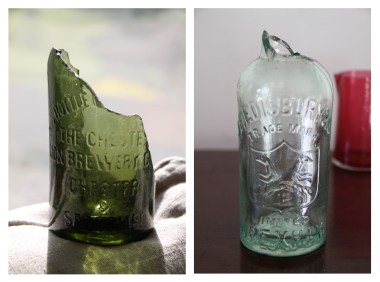
The things we find in the garden, digging out new beds and extending old ones, have added to my knowledge of all sorts of random things.  Until Joe found the Edisbury bottle in the garden (Edisbury was a 19th century Wrexham pharmacist), I had no idea that during the 19th century, when sparkling carbonated water was a new concept, special bottles had to be designed to keep in the fizz.  The Edisbury bottle that we found was not for sparkling water, but a fragment of a bottle that we found a few weeks ago, which was a complete puzzle, turns out to be part of the new carbonated water revolution.  It was stopped with a marble that was held in place in the neck by the pressure of the gas from below.  Fantastic.

It doesn’t look like much, and has to be seen in the context of complete examples for it to make any sense at all.  Sorting out books from my move in February (it is still taking forever to organize my books), I found a long-forgotten Shire Publications book entitled Bottles and Bottle Collecting, which I bought during my Thames mudlarking phase.  Just flipping through it before deciding where it should go, and noting that it covers stoneware as well as glass bottles, I spotted a photograph on page 12 showing three Codd bottles, and it was perfectly obvious that my fragment matched the neck of the one on the far right.  So what on earth is a Codd bottle?

Photograph on page 12 of “Bottles and Bottle Collecting” (Hedges 1988), annotated to show the section of a similar bottle found in the garden

In 1772 Joseph Priestley began to manufacture carbonized waters, which fizzed.  Stoneware was the traditional vessel for mineral-based drinks and tonics, but the gas leached out through the fabric.  Cork-stopped glass was the obvious solution, but the gas could built up to the point where the cork blew out, which both wasted the valuable product and created a considerable mess in the process.  One solution was the torpedo- or amphora-shaped bottle with a pointed base that had to be stored on its side, keeping the cork and the fluid in contact, which kept the cork moist, preventing shrinkage, which kept the cork in situ.  These were considerably unpopular, as storage was always a problem.  Wired-on corks were one solution, also unpopular, and in 1875 Hiram Codd came up with an entirely novel way of solving the problem that became very popular.

Hiram Codd. Source: Findagrave.com

Hiram Codd was very much a man of his era.  His father had been a carpenter, but by his early 20s, Codd was establishing himself as a mechanical engineer and went to work for the British and Foreign Cork Company, working to improve the cork production process.  As a specialist in bottle closures he realized that corks had certain limitations, and began to look at alternatives, carrying out experiments in a small mineral water works in Islington.  In 1872 he secured backing by Richard Barrett, whose two sons owned the Malvern Mineral Water Co. in Camberwell.  With this investment, he was able to develop his globe-stopper.

Banta bottle from Kerala, India. Source: Wikipedia

Codd’s innovation used a thick-walled bottle, a cleverly shaped neck with lugs, and a glass marble-sized globe as a stopper, which was forced towards the opening of the bottle by the gases, where it was stopped by a rubber ring.  In order for this to work, the bottle had to be filled upside down so that the marble could rise to the top to seal.  Two lugs were designed into the bottle, as shown in the fragment, and to pour the drink the marble had to be pushed down to the flanking lugs, where it became trapped, enabling the drink to be poured.  He patented many different versions of the basic scheme in order to try and find the perfect and definitive solution.

In spite of other innovations for stopping bottles, the design was still in common use throughout the 1920s, going out of use in the UK by the end of the 1930s. Dad says that he can remember them during the Second World War.  Superbly, the Codd bottle is still in popular use in India, popular for a drink called Banta.  One of the staggering things of the years of the Industrial Revolution until the late 19th Century was the tidal wave of innovation and the thousands of inventions that emerged, many of them small but fascinating like this one, and all devised to solve specific problems that arose as new products and new ideas emerged.

The survival rate of Codd bottles is poor, as many were deliberately broken by children trying to get at the marbles they contained.  It is has been suggested that the term codswallop (meaning nonsense, something that makes no sense) is derived from Hiram Codd’s bottles.  I’m absolutely not convinced, but you can Google it.

Photograph showing the neck of a Codd bottle with a marble in situ. The pale blue marbles were much in demand by small boys 🙂 Source: Drinking Cup

For anyone new to this occasional series on objects extracted from my garden during everyday gardening activities, see the History in Garden Finds page.  These are not objects used in the garden, but objects, usually fragments, lost or disposed of in the garden and found during digging, troweling and planting.

Sources:

Books and papers:

Hedges, A. A. C. 1988.  Bottles and Bottle Collecting.  Shire Album 6.

Munsey, C. 2010. Codd (Marble-In-The-Neck) Soda-Water Bottles, Then and Now!
https://sha.org/bottle/pdffiles/coddarticleMunsey.pdf

Websites:

Banta
Wikipedia
https://en.wikipedia.org/wiki/Banta

Codswallop
Phrases.org
https://web.archive.org/web/20080913063340/http://www.phrases.org.uk/meanings/235250.html

Drinking Cup
The invention of soda water
http://www.drinkingcup.net/1767-from-volcanos-to-soda-pop/

Hiram Codd
Findagrave.com
https://www.findagrave.com/memorial/24680991/hiram-codd


Cheshire Proverbs 3: “To grin like a Cheshire cat chewing green gravel”

“To Grin Like a Cheshire Cat Chewing Green Gravel”


J.C. Bridge no. 342, p.125


John tenniel’s illustration of the Cheshire Cat, for Lewis Carroll’s Alice’s Adventures in Wonderland, (published 1865).  Source of photograph:  Wikipedia

Bridge’s version of this proverb is the one that I always knew, quite simply stating “To grin like a Cheshire cat.”   Bridge adds that variants of the proverb regarding the familiar grinning cat involved it chewing gravel or green gravel, which is the version that I’ve included in the header, merely for its novelty value, although Bridge is dubious regarding the authenticity of either variant.

Lewis Carroll (1832 – 1898), who lived in Daresbury in east Cheshire, was responsible for the popularity of this particular proverb, and it was made famous by John Tenniel’s illustrations in Carroll’s 1865 book Alice in Wonderland.  Carroll, however, did not invent the grinning Cheshire cat proverb.

During my short time looking at proverbs, I have learned that although their meanings sometimes survive, in many other cases the origins of the proverbs are long-lost in the quagmire of oral history, itself a tale of Chinese whispers.  Proverbs fascinate people not merely because they are striking, but because they are multi-layered.  As well as meaning, they have history, and as well as history, they capture a tone of the oral vernacular past that has been largely lost. Carroll’s entertaining appropriation of the Cheshire cat in 1865 presumably had very little to do with the proverb itself, but acquired an energy and life all of its own.  As time passes and Alice in Wonderland fades from the reading lists of current and future generations, Carroll’s reinvention of the Cheshire cat may also fade, much like the cat itself, which slowly vanishes to leave behind nothing but the grin itself.  That would be a shame.

Bridge is rather severe about the proverb.  He says that it is must be made clear that it is not an old saying “and no old writer or old collection of Proverb gives it” (Bridge’s italics).  He says that the oldest example is in the works of Peter Pindar dating to c.1794/1801:  “Lo! like a Cheshire cat our court will grin.”  He points out that it is not “and never has been” a very common saying in the Cheshire county.  Finally, he says that to date (and his date was 1917) none of the numerous attempts to elucidate it had been successful.

Bridge devotes another two and a half pages to this lack of success.  He begins with the unsubstantiated story of an unskilled sign-painter whose attempt to depict a lion-rampant looked more like a grinning cat, and the rest runs along similar lines.  It is a highly entertaining discourse between different writers on the possible origins of the proverb, but none of it is, as Bridge points out, verifiable or even plausible.  I particularly like the idea posed in 1850 that some Cheshire cheeses were sold in the form of a cat with bristles inserted to represent whiskers.  An indignant Bridge comments “I feel sure that the writer was mistaken.  Good Cheshire Cheese could not be made, and certainly never was made in the shape of Cats, or it would have ceased to be high class and to command the market.”  In the end Bridge thinks that a theory put forward by one Egerton Leigh is most likely to represent the reality:  “one need not go far to account for a Cheshire cat grinning.  A cat’s paradise must naturally be placed in a County like Cheshire, flowing with milk.”

Heat sensitive Cheshire cat-themed mug. Source: Amazon.

Carroll’s imaginative revival of the proverb has been incorporated into many popular contexts.  My family lived in Nantwich for a couple of years, and there was a very famous pub there called The Cheshire Cat, a half-timbered building that was originally built in the 17th Century. It had gone out of business when I was last there a few years ago, but there’s a website that indicates that it is back up and running, which is good news.

I was amused to see that the concept of the Cheshire cat has infiltrated itself into scientific lore.  Wikipedia has a list of examples, and a nice one from quantum mechanics has a phenomenon named “The Cheshire Cat,” in which a particle and its property behave as if they are separated.  Just as much fun, although infinitely less sophisticated, is the heat-sensitive mug that I found on Amazon, where the John Tenniel illustration of the cat vanishes as the mug warms through, leaving just the grin behind.

For more about J.C. Bridge and this Cheshire Proverbs series, see Cheshire Proverbs 1.

Sources:

Carroll, L. 1865. Alice’s Adventures in Wonderland.

Wikipedia: Cheshire Cat
https://en.wikipedia.org/wiki/Cheshire_Cat


The 1854 turnpike from Chester to Worthenbury via Churton, with a branch to Farndon – Part 2: The Turnpike

View west from the turnpike.

This is part 2 of the story about the Chester to Worthenbury turnpike, a rural toll road that ran peacefully through Huntington, Aldford, Churton (with a branch to Farndon), Crewe-by-Farndon, and Shocklach before terminating at lovely Worthenbury.   Part 1, posted the day before yesterday, looked at the background to turnpikes (toll roads) in the 17th to 19th Centuries, and their roles in everyday life as a setting for the Chester to Worthenbury turnpike.  Part 2 looks at the turnpike itself.  As I said in Part 1, the reason for splitting the post into two is that it turned out to be a fairly mammoth topic.  If you prefer to read it as a PDF or print it, you download the PDF by clicking here.

Most former turnpikes are still busy.  For example, when you wait patiently at Milton Green to turn on to the A41 that runs from Chester to Whitchurch, the thundering HGVs that happily ignore the “please drive carefully through our village” signs make it is difficult to imagine it populated with quietly plodding horses and carts.  It is a different story once you have driven from Crewe-By-Farndon via Shocklach to Worthenbury, because an entirely different leap of the imagination is required.  This time, it’s a case of wondering why such a quiet and rural stretch of road could ever have been sufficiently busy to require turnpiking.  Churton, Shocklach and Worthenbury are all well-defined villages, but other places marked on the map, such as Crewe-by-Farndon, Castletown and Caldecott Green are little more than a single big house and/or farm with a couple of associated buildings.

Scenery flanking the road that was turnpiked in 1854.


The route of the Chester to Worthenbury turnpike

In many areas, the presence of a Roman road dictated the line of Medieval and later roads, but the Roman road that once ran from Chester through Aldford fell out of use.  As you head south from Aldford, a small lane to the left, Lower Lane, indicates where the path of the Roman road splits from the B5130 and thereafter becomes a series of farm tracks and footpaths, its route sitting in between today’s A41 (Chester to Whitchurch) and A483 (Chester to Wrexham).  This Roman road, known today as Watling Street West (or more prosaically 6A), passed through Ecclestone, Heronbridge and Aldford then veered to the east of Churton, bypassing both Churton and Farndon  (I have written about the Roman road in an earlier post, here).  

The bending course of the road that was turnpiked in 1854. My photograph CC BY-NC-ND 4.0

Later, however, the establishment of Farndon as an important crossing to Holt and the rest of north and mid Wales meant that the path of the Roman road southeast of Aldford, was abandoned during the Middle Ages, and the line of the road shifted instead west towards the Dee, passing through what is now Churton before reaching Farndon.  This route was established at least during the reign of Edward I, (reigned 1272-1307), who followed it on one of his peripatetic Royal Itineraries, heading south from Chester through Ecclestone and Malpas.  Rachel Swallow says that a toll gate was documented at Shocklach at around 1291, all traces now vanished. 

The Chester to Worthenbury turnpike followed a path from Chester through Huntington, Aldford and Churton before heading down what is now Sibbersfield Lane and across the modern bypass before vanishing down the quiet, wending country B-road to Worthenbury.  As with every turnpike, an Act of Parliament was required before Trustees could be appointed, and this was the Chester, Farndon and Worthenbury Turnpike Road Act 1854, “An Act for making a Turnpike Road from Chester, by Farndon, to Worthenbury, with a Branch therefrom to the Village of Farndon,” which passed into law on 3rd July of that year.  The exact wording of the first part of the Act is shown below the bibliography, Sources, right at the end of this post.  It was the last road in Cheshire to be turnpiked.  Here is the description of the route from the 1854 Act:

A Turnpike Road to commence in Boughton in the Parishes of Saint Oswald and Saint John the Baptist, or One of them, within the Parliamentary Borough of Chester, by a Junction with the Road leading from the City of Chester to Whitchurch opposite and near to a Public House called the “Jolly Gardener,” and to terminate in the Township and Parish of Worthenbury in the County of Flint by Two Junctions with the Whitchurch and Marchwiel Turnpike Road, one thereof at or near to a certain Farm House called “Broughton Lodge,” and the other thereof at or near the Finger Post at the Junction of the present Highway from Shocklach with the Whitchurch and Marchwiel Turnpike Road : A- Branch Turnpike Road to commence from and out of the said intended Turnpike Road in the Township of Churton, by Farndon and Parish of Farndon, at or near the Point where the existing Highways leading from Churton to Farndon and from Churton by Crewe and Shocklach to Worthenbury respectively diverge, and to terminate in the Village, Township, and Parish of Farndon by a Junction with the Turnpike Road leading from Wrexham to Barnhill near to the Raven Inn, all in the County of Chester.

A court case that followed the demise of the turnpike is useful for describing the state of the road before it was turnpiked

“Before and until the passing of the Chester, Farndon and Worthenbury Turnpike Road act of 1854, it consisted of an ordinary fenced road, varying in width from about 20-30ft, of which nine feet wide only was paved with stones along the centre;  the sides not being metalled were of grass or earth.  The stone of which the pavement was formed was got in the township from the lands alleged in the indictment . . . . The road, which was an ordinary carriage highway was at that time repaired by John Brock Wood, the owner of the said lands.”

The stones of the old pavement were used in the construction and macadam was brought from Penmaenmawr to lay along its surface.  The width was not expanded beyond the original fences that flanked it.

The Chester to Worthenbury turnpike trust

The sheer number of trustees appointed in the 1854 Act staggered me, as I had been imagining something in the region of ten or twenty responsible dignitaries.  There were 66 (give or take – I may have lost one or two in the process of counting).  After including “All Her Majesty’s Justices of the Peace for the Time being acting for the County of Chester, for the County of the City of Chester, and for the County of Flint respectively” the Act goes on to name individual trustees, and here they all are:

Sir Richard Puleston of Emral Hall. Source: Puleston Ancestry.

The Honourable Hugh Lupus Grosvenor commonly called Earl Grosvenor, the Honourable Richard de Aquila Grosvenor commonly called Lord Richard de Aquila Grosvenor, the Honourable Henry Cholmondeley commonly called Lord Henry Cholmondeley, Sir Robert Henry Cunlife Baronet, Robert Ellis Cunliffe, Sir Watkin Williams Wynn Baronet, Sir Philip de Malpas Grey Egerton Baronet, Philip Le Bel- ward Egerton, Samuel Aldersey, Thomas Aldersey, the Rector of Aldford for the Time being, Roger Barnston, Harry Barnston, Thomas Boyden Clerk, Richard Barker, Francis Henry Barker, Thomas Chorlton Glutton, Charles Colley, Hugh Colley, Henry Crane, Tanat Wynne Denton, Thomas Dixon, Thomas Dixon the younger, James Dixon, the Minister of Farndon for the Time being, William Wynne Ffoulkes, Edward Francis French, Alexander Price French, Philip Stapleton Humberston, Thomas Cowper Hincks, Thomas Cowper Hincks the younger, Thomas Hignett, John Hignett, Robert Broadhurst Hill, the Minister of Holt for the Time being, Robert Howard, Francis James Hughes, Townsend Ince, Thomas Jones, John Hurleston Leche, Sir William Lloyd, Richard Massie, John Finchett Maddock, Thomas Finchett Maddock, Townshend Mainwaring, Henry Water Meredith, Robert Buckley Orton, Sir Richard Puleston Baronet, Francis Richard Puleston, Theophilus Puleston, Charles Potts, Henry Potts, Charles William Potts, William Parker, John Parker, Richard Powdrell, William Rowe, Samuel Rowe, John Rogers, Thomas Vernon Royle; Joseph Sparkes, John Townshend, Charles Townshend, John Williams, Edward Tilston, John Brock Wood, William Henry Wood, the Rector of Worthenbuiy

Pratt’s 1912 study offered the following comment on the sheer number of trustees that could be in charge of a turnpike:

One result of the excessive localisation of the turnpike system was that trusts of absurdly large proportions were created to look after absurdly small stretches of road. “The fundamental principle,” says a writer in the “Edinburgh Review” for October, 1819, “is always to vest the whole management in the hands of the country gentlemen; and, as they act gratuitously, it has been the policy of the law to appoint in each act a prodigious number of commissioners—frequently from one hundred to two hundred, for the care of ten or fifteen miles of road; and thus a business of art and science is committed to a promiscuous mob of peers, squires, farmers and shopkeepers, who are chosen, not for their fitness to discharge the duties of commissioners, but from the sole qualification of residence within a short distance from the road to be made or repaired. . . .

The whole time of the meetings of turnpike trusts was “occupied in tumultuous and unprofitable discussions, and in resolving on things at one meeting which run a good chance of being reversed at the next; that the well informed and civilized commissioners become very soon disgusted with the disorderly uproar, or the want of sense, temper or honesty of some of their companions; and that the management finally falls into the hands of a few busy, bustling, interested persons of low condition, who attend the meetings with no idea of performing a public duty, but for the purpose of turning their powers, by some device or other, to the profit of themselves or of their friends or relations.

Scenery flanking the road that was turnpiked in 1854. My photograph CC BY-NC-ND 4.0

Local landowners could invest their own funds to improve a road, but generally loans were taken out to meet the initial set-up costs, with the interest theoretically being paid back from the income derived from tolls, or at least that left over after paying salaried staff and carrying out frequent repairs.  Even where the accounts tallied, which they often did not, huge debts were accrued.  The Select Committee on Turnpike Trusts in 1839 reported that eighty four trusts had paid no interest in years, and that the total estimated debt of English and Welsh turnpike trusts together exceeded £9,000,000, a staggering sum in those days. It seems remarkable, under these conditions, that a new turnpike Act was passed in favour of the Chester to Worthenbury turnpike so late in the turnpike era.

The reasoning behind the creation of the turnpike

One of the many farms that lines the turnpike’s route. My photograph CC BY-NC-ND 4.0

The Chester to Worthenbury road wended its bendy way at its own leisure through agricultural land, connecting a number of villages, including Churton, Crewe-by-Farndon and Shocklach.  A drive down that section of the road south of Sibbersfield Lane confirms it as a winding, rural road with a few farm buildings along its routes, the few villages very small and quiet.  A branch ran from Churton into Farndon.   Worthenbury, a rural village that has changed very little since the 19th Century, was not an obvious destination for traders, merchants, carriers or passenger vehicles, traditionally the main users of turnpikes.   The destructive impact of the transportation of heavy loads of cheese was given as a primary reason for the creation of a turnpike between Chester and Whitchurch.  The production of Cheshire cheese was certainly of great importance to the county, as Defoe explains in 1725:

This county, however remote from London, is one of those which contributes most to its support, as well as to several other parts of England, and that is by its excellent cheese, which they make here in such quantities, and so exceeding good, that as I am told from very good authority, the city of London only take off 14000 ton every year; besides 8000 ton which they say goes every year down the Rivers Severn and Trent, the former to Bristol, and the latter to York; including all the towns on both these large rivers: And besides the quantity ship’d both here, and at Leverpool [Liverpool], to go to Ireland, and Scotland. So that the quantity of cheese made in this country, must be prodigious great. Indeed, the whole county is employ’d in it, and part of its neighbourhood too.

However, this situation was over a century before the Chester to Worthenbury turnpike was mooted and there’s no indication either in contemporary newspapers or in the Act itself whether the carriage of Cheshire cheese or any other particular problem was a reason why the Chester to Worthenbury turnpike was deemed worth the cost and effort.  The Act merely says that the turnpike “would be of great public value,” which is somewhat unhelpful.  Crosby suggests “the rather remote possibility of abstracting traffic from the Chester-Wrexham and Chester-Wrexham roads,” but the encyclopaedic New Historical Atlas of Cheshire (2002) is silent on the subject, as is Latham’s Farndon

Scan of map showing turnpike roads in Cheshire, from the New Atlas of Cheshire (Phillips and Phillips 2002, p.77).  The Chester to Worthenbury turnpike is shown in green at the far left, crossing the Broxton to Wrexham Turnpike (in yellow).

Perhaps the object of the exercise was to improve the quality of the road network in this part of West Cheshire. This area was rather isolated.  The canal network bypassed the Dee, south of Chester, with the 1772 Chester Canal (now part of the Shropshire Union) heading southeast from Chester via Beeston to Nantwich to Birmingham, linking into other parts of the canal and turnpike networks as it went, and the Dee itself was only navigable by very light traffic. By the end of the 18th Century there were already serviceable turnpikes between Chester and Whitchurch and Chester and Wrexham, which accounted for most of the market-bound and commercial traffic.   

The turnpike  linked up with Whitchurch after passing through Worthenbury, but it was a very rambling route, and the Chester to Whitchurch turnpike would have been a much better option unless you were starting from somewhere like Churton, Farndon or Holt.  The New Atlas shows an intersection with the Wrexham to Broxton turnpike (now the A534), which was opened in the period 1760-1789, linking the Chester to Wrexham and Chester to Whitchurch roads.  There was a turnpike between Bangor On Dee and Malpas, which opened in 1767.  Although the road between Worthenbury and Bangor on Dee (the B5069) does not appear to have been turnpiked, it was a short stretch and would have been easy enough to maintain in good condition if there was sufficient motivation.

Emral Hall, Worthenbury.  The lower photo shows the ballroom, now preserved (thank goodness) in the Town Hall at Portmeirion.  Source: Wrexham Online.

A number of large estates and prosperous farms were located along the route of the turnpike.  The largest of these were Crewe Hill in Crewe-by-Farndon, Boughton Hall near Threapwood and the magnificent Emral Hall just to the south of Worthenbury.  Crewe Hill was the principal home of the Barnston family, and the base of their wide-ranging and profitable estate that included land in and around Farndon and extending north to the middle of Churton.  The lovely half-timbered Broughton Hall was sadly demolished in 1961, but at the time was the home of the Howards.  Emral Hall also tragically demolished in the 1930s, was the home and estate of the Pulestons throughout the 18th and 19th Centuries.  Others along the route, from north to south, are Aldford Hall, Churton Hall, Sibbersfield Hall, Crewe Hall, Shocklach Hall,  Kingslee and Caldecott Hall.  Trustees included community members from all areas through which the turnpike passed, so members of the family present on the trustees list does not prove that they were driving forces behind the turnpike, but it is still interesting to see (where these family names can be traced) which estates provided family members as trustees.  

  • Broughton Hall, demolished 1961. Source: Threapwood History Group.

    • Aldford Hall:  The Earl of Westminster and Lord Richard de Aquila Grosvenor
    • Churton Hall:  Roger Barnston and Harry Barnston
    • Sibbersfield Hall:  William Rowe and Samuel Rowe
    • Crewe Hill:  Roger Barnston and Harry Barnston
    • Caldecott Hall:  Philip Stapleton Humberston
    • Broughton Hall:  Robert Howard
    • Emral Hall: Sir Richard Puleston (baronet), Francis Richard Puleston, and Theophilus Puleston


Sibbersfield Hall, just outside Churton. Ordnance Survey 1888-1913.  Source: National Library of Scotland

Other trustees on the above list with a vested interest in being able to get around were the Rectors of Aldford and Worthenbury and the Ministers of Farndon and Holt.  Trustees Samuel Aldersey and Thomas Aldersey of Aldersey Hall, would also have benefitted from the tunrpike road, to which the road on which Aldersey Hall was located was linked.  And so it goes on.

There are apparently some omissions and question marks too.  Although a large building is shown on the site of Churton Lodge, no details are available on the Tithe map.  Shocklach Hall was only built in the 1850s, so was perhaps itself under construction at the time, or built partly because the turnpike was there.  In the 1840s tithe maps the land on which it as located was owned by Emral Hall.  Crewe Hall (as opposed to Crewe Hill) was owned and occupied by the Bennion family when the 1838 tithe map was published, but they do not appear as trustees.  

Crewe Hill from the garden. Source: Landed Families of Britain and Ireland website

Some of the very few buildings along the turnpike route at Crewe-by-Farndon and Shocklach.  From left: Crewe Hall, one of the buildings in the village of Shocklach, the Bull in Shocklach and Kingslee.  My photograph CC BY-NC-ND 4.0

Toll cottages along the route

The tollgate was usually accompanied by a toll cottage.  The Grade-2 listed, two-storey brick-built Cross Cottage in Churton is built across the junction between Chester Road and Pump Lane and, by virtue of the fact that it was built to serve the turnpike, must have been built at around 1854.  It is strategically located just to the north of where the road splits into two, one road going into Farndon and the other proceeding via Stannage Lane, to Crewe-by-Farndon and on to Worthenbury.  Both roads were part of the turnpike, with the Farndon section a branch of the main turnpike to Worthenbury.  The attractive recessed arch, which is at both front and rear, was once centred in the middle of the building, and was provided with a slender band of sandstone between the upper and lower floors.  An extension of uncertain date, possibly the 1930s, breaks down this symmetry, although it was done sympathetically using almost identical bricks to the originals but does not repeat the sandstone band.

The rear view of Cross Cottage. Source: mylisting365.

The roof is currently hipped (converging in from four sides onto a central ridge), but before the addition of the extension, the roof was probably pyramidal, converging from four sides onto a single point.  The original roof was probably also made of slate, as today.  There are two chimneys today, but there will only have been the one in the 19th Century, with a central flue.  Although it was Grade II listed in 1984, there are no details on the Historic England website about the interior, and whether any of the 19th Century interior survives in tact.

The listing details are as follows:

  • NGR 4180856444
  • List number 1228714
  • First listed 28th December 1984

Toll collectors could improve their wellbeing by keeping livestock and growing fruit and vegetables in the confines of their properties, and some toll cottages were provided with a small amount of land that could be used for either the keeping of livestock or the development of small horticultural plots.   Cross Cottage was provided with a large garden that could have been used for either.

The bridge at Worthenbury. My photograph CC BY-NC-ND 4.0

I went looking for any other toll cottages that might have been built along the road.  On some turnpikes additional toll gates were added as a way of trusts earning more revenue, but there was nothing that looked remotely like a toll cottage.  There should have been one at Worthenbury, the end of the turnpike.  In cases where a river crossing was present, toll gates were often set up against a bridge, making it more difficult to evade, but although there is a beautiful old bridge in Worthenbury, the western side of it is open fields, and the eastern side is now the site of a modern home, part of a housing estate.  The bridge replaces one that was damaged by floods in 1872, and was built in 1872-3.  This was the period when the Chester-Worthenbury turnpike was amalgamated with the Chester-Whitchurch.  Still, tolls would have required ongoing collection, and if there was a toll gate here, there’s no sign of it now.

The toll collectors

There is a toll-house at Churton so it of course follows that there must have been at least one toll collector, possibly accompanied by his family.  Regrettably, I have not yet worked out who he/they might have been, because the commercial directories available online don’t mention a Churton toll collector during this period (the1857 Post Office Directory of Cheshire and the 1864 Morris & Co.’s Directory of Cheshire).  Whilst the Delta variant of Covid is still at large, it’s probably not a good idea to start hitting the record offices, but perhaps someone who has checked into the available resources can illuminate me.  Speculating, this absence from the directories may be because although early turnpikes were manned by manor employees and then by specially hired toll collectors, the appointment of later collectors was given into the hands of specialist contractors, who would bid for the lease at auction.  It may be that under such conditions, the toll collectors were deemed to be transient members of the community.

Toll collectors had an ambivalent position in local society.  Because toll charges were lengthy and complex, incorporating a large number of variables, a toll collector needed to be both literate and numerate, and hopefully (but not always) trustworthy. As people of responsibility, often living in custom-built homes with their families, toll collectors might be people of high status within a community.  Although in many ways, toll collectors were about as popular as tax collectors are today, they provided a vital role.  A toll house could bring prestige to an otherwise fairly nondescript community, even attracting the building of inns where passengers could purchase refreshments and where carriage horses could be rested or changed, meaning that gentry and clergy could be regular visitors, raising the status of an entire village.  

The 1898 mile post at Shocklach. My photograph CC BY-NC-ND 4.0

The toll charges for Chester-Worthenbury are probably described in the 1854 Act, but this too is not available without tramping the real-world archive trail, and I will update this post when I have the chance to check this out, as a copy is apparently available locally.  Each turnpike Act set out the maximum toll chargeable for each animal and category and size of vehicle, and all the multiple variables of each.

As I said in Part 1, the mile posts that dot the western verges of the former turnpike post-date the end of the Cheshire turnpikes.  Disturnpiked in the 1870s, there must have been mile posts because they were a legal requirement, but when Chester County Council was created on 1st January 1889 and was given the job of maintaining highways, it presumably replaced the original milestones with its own iron ones, all dating to 1898.  I have found some of these, marked on the Ordnance Survey map, but not others.  The one shown in Part 1 is in Churton and the one shown above is in Shocklach.

The final days of the Chester to Worthenbury turnpike

The lovely Georgian St Deiniol’s Church in Worthenbury. My photograph CC BY-NC-ND 4.0

The Chester-Worthenbury turnpike was never much of a success and was amalgamated with the Whitchurch Trust in 1871.  The joint body expired in 1877.  Presumably, and not very surprisingly, the Worthenbury turnpike failed to justify its costs, and the Whitchurch turnpike was probably put out of business by the London and North Western Railway.  The railway’s important route to London via Crewe had opened by 1840, and the branch that ran from Chester to Whitchurch opened between 1870 and 1879.

An indictment concerning repairs to the road following the lapse of the Act

Rural landscape to the east of the once-turnpiked stretch of road that passes through Churton. My photograph CC BY-NC-ND 4.0

The most interesting part of the turnpike’s history, or at least the most interesting bit to survive, refers to what happened when the Act for the Chester to Worthenbury section had been disturnpiked, and a question arose over responsibility for its ongoing care arose.  In 1890 an indictment was raised in Crown Court for failure to repair a highway.  The issue was by no means straightforward.  The law stated that responsibility for repair of a road that had formerly come under a turnpike trust would revert to common law liability on the lapse of the trust, but only if “the highway remains similar in character to what it was up to the time of the passing of the Turnpike Act.”  For those roads that were significantly altered, “as to destroy what was the old highway, the common law liability is put to an end by operation of the law.”  In addition, there were ambiguities about the responsibilities for occupiers versus mere owners, where roads were concerned.

The indictment covered several stretches of road that had become “miry, deep, broken and in great decay,” due to “such want of due reparation and amendment.”   This included the stretch from Huntington to Farndon.  The same allegation was made against stretch from Chester to Saighton.  The text from the court case is damning.

“The liege subjects of the Queen could not and still could not go, return, pass, repass, ride or labour on foot with their horses, coaches, carts and other carriages in, through, and along the said public highway aforesaid as they ought and were wont and accustomed to do, without great danger and common nuisance of all the liege subjects of our said Lady the Queen, her crown and dignity, and that the defendant, by reason of his tenure of certain lands and tenements situate in the said township of Huntington, ought to repair and mend the same.”

It goes on:

“As to the road mentioned in the first count [Saighton was the second] it was proved that before and until the passing of the Chester, Farndon and Worthenbury Turnpike Road Act of 1854, it consisted of an ordinary fenced road.”

The individual who had taken responsibility for repairing the road before it was converted to a turnpike was John Brock Wood, who is recorded in the list of trustees for the turnpike.  The record of the indictment states that there was no evidence that he had contributed to its maintenance during the continuance of the Act, but on its expiry in 1876 he resumed repair work, continuing to do so until his death in 1888.  The person who inherited John Brock Wood’s responsibilities “the devisee in trust of the said lands” continued to repair the road in the belief that he was legally liable.  He provided proof that he had expended £155, £224 and £206 in 1887, 1888 and 1889 respectively.

View from the former turnpike over the fields to Worthenbury

The prosecution (Tatham and Proctor for Carrington and Baker, Chester) claimed that as John Brock Wood had accepted responsibility before the establishment of the Trust, it was now the devisee in trust’s responsibility following the expiry of the Act.  However, the law stated that if significant alternation had taken place during the conversion of a road to a turnpike, the original owner was no longer responsible for maintenance.  In fact, Chester County Council had been approached with a view to taking on responsibility for the road, but they had refused to do so under Section 97 of the Local Government Act 1888.   The estimated costs were in excess of £400 and may have been as much as 1000.

The defense (the company Cunliffe and Dawn for Churton, Chester) claimed that the alternations to the road when it was converted to  a turnpike were so extensive as to destroy any liability that either he, or for that matter John Brock Wood, should have had.  In response, the prosecution argued that by repairing the road, the defendant had acknowledged the liability and could be indicted for non-repair.

The judge overseeing the proceedings, Lord Coleridge C.J. ruled in favour of the defendant.  In his view, citing Rolle’s Abridgement from the reign of Charles I, the occupier and not the owner is the person responsible for repairs, and the defendant was the owner but not the occupier.   In addition, he found that the road had been significantly altered, and therefore liability for the repairs should not fall on the original owner or occupier.  The indictment was quashed.  The judge was concerned that under these circumstances, the “graver question” was if any person was actually liable to repair the road.  He does not, however, come to any conclusion about how to resolve the problem.

In the end, Chester County Council must have adopted the road, but this may have been at a much later date.  Section 97, “Saving as to liability for main roads,” which they used to avoid the responsibility, falls within Sections 92-98 “Savings.”  It reads “Nothing in this Act with respect to main roads shall alter the liability of any person or body of persons, corporate or unincoprorate, not being a highway authority, to maintain and repair any road or part of a road.”

As always, please let me know if you have any questions
or have some more information to contribute


Sources for parts 1 and 2:

Books and papers:

An Act for making a Turnpike Road from Chester, by Farndon, to Worthenbury, with a Branch therefrom to the Village of Farndon, 1854

Benford, M. 2002. Milestones.  Shire Publications

Crane, N. 2016.  The Making of the British Landscape.  From Ice Age to the Present.  Weidenfeld and Nicholson

Crosby, A.G. 2012.  New Roads for Old. Cheshire Turnpikes in the Landscape 1700-1850.  In (eds.) Varey, S.M. and White, G.J. Landscape History Discoveries in the North West.  University of Chester Press, p.190-223.

Cunningham Glen, R. 1895. Indictment presented before Lord Coleridge, C.J.  Reg. vs. Barker.  Reports of Cases in Criminal Law argued and determined in the courts of England and Ireland, vol.XVII, 1890-1895. Reported by R. Cunnigham Glen Esq., Barrister at Law. Horace Cox

Defoe, D. 1724–1726 (Rogers, P. ed.). A Tour Through the Whole Island of Great Britain Penguin (particularly, Volume II, 1725, and its appendix).

Harvie, C. and Matthew, H.C.G.  1984, 2000.  Nineteenth Century Britain. Oxford University Press

Hindle, P. 1998 (3rd edition).  Medieval Roads and Tracks.  Shire Publications Ltd

Keys, D. 2016. Discovery of huge Bronze Age wheel sheds light on transport in prehistoric Britain.  The Independent, Friday 19th February 2016
https://www.independent.co.uk/news/science/archaeology/prehistoric-britain-discovery-bronze-age-wheel-archaeology-a6882671.html

Langford, P. 1984, 2000. Eighteenth Century Britain.  Oxford University Press

Latham, F.A. 1981.  Farndon. The History of a Cheshire Village.  Local History Group.

Local Government Act 1888 (51 and 52 Vict. c.41). Section 97, Saving as to liability for main roads.

OS Landranger map 117 2016.  Chester and Wrexham.  Ordnance Survey

Phillips, A.D.M. and Phillips, C.B. 2002.  A New Historical Atlas of Cheshire. Cheshire County Council and Cheshire Community Council Publications Trust.

Pratt, E.A. 1912.  A History of Inland Transport and Communication in England. Kegan Paul, Trench, Trübner and Co Ltd.
Project Gutenburg: https://www.gutenberg.org/files/52087/52087-h/52087-h.htm

Pryor, F. 2010.  The Making of the British Landscape.  How We Have Transformed the Land from Prehistory to Today.  Allen Lane

Swallow, R. 2013-14. Two For One:  the Archaeological Survey of Shocklach, Castle, Cheshire. Cheshire History Journal, No.53, 2013-4
https://www.academia.edu/4577267/Two_for_One_The_Archaeological_Survey_of_Shocklach_Castle_Cheshire_in_Cheshire_History_Journal_No_53_2013_4_Cheshire_Local_History_Association_2013_

Wright, G. N. 1992. Turnpike Roads. Shire Publications Ltd.

Websites

A Collection of Directories for Cheshire
Cheshire County Council
http://cheshiredirectories.manuscripteye.com/index.htm

British Listed Buildings
Cross Cottage, Churton
https://britishlistedbuildings.co.uk/101228714-cross-cottage-churton

Broughton Hall, Threapwood
Threapwood History Group
http://www.threapwoodhistory.org/broughtonhall.html

Cheshire Tithe Maps Online
Cheshire Archives and Local Studies
https://maps.cheshireeast.gov.uk/tithemaps/

Emral Hall, Worthenbury
Wrexham Online
https://www.wrexham-history.com/emral-hall-worthenbury/ 

Historic England
Cross Cottage, Churton
https://historicengland.org.uk/listing/the-list/list-entry/1228714

Dig Diary 19: Discovering Britain’s Oldest, Complete Wheel
February 29, 2016
Must Farm Dig Diaries
http://www.mustfarm.com/progress/site-diary-19-discovering-britains-oldest-complete-wheel/

National Archives
Chester and Whitchurch Turnpikes Trust
https://discovery.nationalarchives.gov.uk/details/r/11e8a8d6-43c5-4704-a93b-58fe6d0444a6

National Library of Scotland Mapfinder
OS 6-inch map, 1888-1913
https://maps.nls.uk/geo/explore/#zoom=15&lat=53.09734&lon=-2.86868&layers=6&b=1

Peterborough Archaeology
Must Farm Bronze Age Settlement
https://peterborougharchaeology.org/peterborough-archaeological-sites/must-farm/

Turnpike Roads in England and Wales
Turnpikes.org.uk
http://www.turnpikes.org.uk/Tollhouse%20design.htm

The 1854 Act (excerpt)

Most of the Act is in big undifferentiated chunks, so the paragraphs in the following excerpt are mine, simply to aid with digestion.  The URL of the source of this excerpt is at the end, but if you want to see the entire Act, paid subscription is required.

[3rd July 1854]
Chester, Farndon and Worthenbury Turnpike Road Act 1854
(17 & 18 Vict.) c. lxxxvi
An Act for making a Turnpike Road from Chester, by Farndon, to Worthenbury, with a Branch therefrom to the Village of Farndon.

ANNO DECIMO SEPTIMO & DECIMO OCTAVO VICTORIA REGINA. ********.*****************.********************* Cap. lxxxvi. An Act for making a Turnpike Road from Chester, by Farndon, to Worthenbury, with a Branch therefrom to the Village of Farndon. [3d July 1854.]

WHEREAS the Formation and Maintenance of a Turnpike Road from Chester, by Farndon in the County of Chester, to Worthenbury in the County of Flint, with a Branch therefrom to the Village of Farndon in the said County of Chester, would be of great public Advantage: And whereas certain of the Highways in the Line of the said intended Road and Branch, or Portions thereof, might advantageously be made available for the Purposes of such Road and Branch ; but the same cannot be effected without the Aid and Authority of Parliament : May it therefore please Your Majesty that it may be enacted ; and be it enacted by the Queen’s most Excellent Majesty, by and with the Advice and Consent of the Lords Spiritual and Temporal, and Commons, in this present Parliament assembled, and by the Authority of the same.

That in citing this Act for any Purpose whatsoever it shall be Short Title. sufficient to use the Expression ” The Chester, Farndon, and Worthenbury Turnpike Road Act, 1854.” H. That in this Act the following Words and Expressions shall Interpreta have the several Meanings hereby assigned to them, unless there be tion of [Local.] 15 D something Terms. 1302 Appointment of Trustees. Power to appoint additional Trustees. 17 & 18 VICTORUE, Cap.lxxxvi. 171e Chester, Farndon, and Worthenbury Turnpike Road Act,1854. Something in the Subject or Context repugnant to such Construction ; (that is to say,) The Expression ” the Trustees,” or ” the said Trustees,” shall respectively mean the Trustees for the Time being acting in the Execution of this Act : The Word Lands ” shall include Messuages, Tenements, and Hereditaments of any Tenure : The Expression ” Toll Gate ” or ” Toll Gates” shall respectively include Turnpikes, Bars, and Chains. III.

That all Her Majesty’s Justices of the Peace for the Time being acting for the County of Chester, for the County of the City of Chester, and for the County of Flint respectively, together with the Honourable Hugh Lupus Grosvenor commonly called Earl Grosvenor, the Honourable Richard de Aquila Grosvenor commonly called Lord Richard de Aquila Grosvenor, the Honourable Henry Cholmondeley commonly called Lord Henry Cholmondeley, Sir Robert Henry Cunlife Baronet, Robert Ellis Cunliffe, Sir Watkin Williams Wynn Baronet, Sir Philip de Malpas Grey Egerton Baronet, Philip Le Bel- ward Egerton, Samuel Aldersey, Thomas Aldersey, the Rector of Aldford for the Time being, Roger Barnston, Harry Barnston, Thomas Boyden Clerk, Richard Barker, Francis Henry Barker, Thomas Chorlton Glutton, Charles Colley, Hugh Colley, Henry Crane, Tanat Wynne Denton, Thomas Dixon, Thomas Dixon the younger, James Dixon, the Minister of Farndon for the Time being, William Wynne Ffoulkes, Edward Francis French, Alexander Price French, Philip Stapleton Humberston, Thomas Cowper Hincks, Thomas Cowper Hincks the younger, Thomas Hignett, John Hignett, Robert Broadhurst Hill, the Minister of Holt for the Time being, Robert Howard, Francis James Hughes, Townsend Ince, Thomas Jones, John Hurleston Leche, Sir William Lloyd, Richard Massie, John Finchett Maddock, Thomas Finchett Maddock, Townshend Mainwaring, Henry Water Meredith, Robert Buckley Orton, Sir Richard Puleston Baronet, Francis Richard Puleston, Tlieophilus Puleston, Charles Potts, Henry Potts, Charles William Potts, William Parker, John Parker, Richard Powdrell, William Rowe, Samuel Rowe, John Rogers, Thomas Vernon Royle; Joseph Sparkes, John Townshend, Charles Townshend, John Williams, Edward Tilston, John Brock Wood, William Henry Wood, the Rector of Worthenbuiy for the Time being, and their Successors, being duly qualified to act as Trustees of Turnpike Roads in England, shall be Trustees for putting this Act into execution.

That it shall be lawful for the said Trustees, at any Meeting under this Act, to elect any Number of Persons, duly qualified to act as Trustees of Turnpike Roads in England, not exceeding Three in the whole, to be Trustees for, the Purposes of this Act, in addition to the 17 & 18 VICTORIAE, Cap.lxxxvi. 1303 The Chester, Farndon, and Worthenbury Turnpike Road Act, 1854. the Trustees hereby nominated, and such Trustees so elected shall have the same Powers and Authorities for executing this Act as if they had been hereby appointed. V. That the said Trustees shall meet together on the Twenty-first Meetings of Day after the passing of this Act, or as soon after as conveniently Trustees. may be, at the Exchange in the City of Chester aforesaid, or at some other convenient Place in Chester, and shall then and from Time to Time afterwards adjourn to and meet at such Times, and at such Places on or near to the said Roads, as they shall think proper. VI.

That the said Trustees may appoint Committees out of their Power to take the Care and Management of any particular Part point Committees. of the Roads, or to execute any of the other Purposes of this Act, according to such Instructions and Regulations as shall be laid down by the said Trustees at any General or Special Meeting ; and the said Committees and their Officers may proceed and act according to such Appointment, but subject always to the Authority and Control of the said Trustees. VII. That this Act shall be put into execution for the Purpose of Roads to making and maintaining, according to the Provisions of this Act, the which Act is applicable. Turnpike Road and Branch herein-after mentioned ; (that is to say,) A Turnpike Road to commence in Boughton in the Parishes of Saint Oswald and Saint John the Baptist, or One of them, within the Parliamentary Borough of Chester, by a Junction with the Road leading from the City of Chester to Whitchurch opposite and near to a Public House called the “Jolly Gardener,” and to terminate in the Township and Parish of Worthenbury in the County of Flint by Two Junctions with the Whitchurch and Marchwiel Turnpike Road, one thereof at or near to a certain Farm House called “Broughton Lodge,” and the other thereof at or near the Finger Post at the Junction of the present Highway from Shocklach with the Whitchurch and Marchwiel Turnpike Road : A- Branch Turnpike Road to commence from and out of the said intended Turnpike Road in the Township of Churton, by Farndon and Parish of Farndon, at or near the Point where the existing Highways leading from Churton to Farndon and from Churton by Crewe and Shocklach to Worthenbury respectively diverge, and to terminate in the Village, Township, and Parish of Farndon by a Junction with the Turnpike Road leading from Wrexham to Barnhill near to the Raven Inn, all in the County of Chester. VIII. And whereas Plans and Sections describing the Lines and Power to Levels of the said intended Roads, and the Lands through which the make Roads &c. according to deposited Plan, &c. Power to deviate from Plan to a certain Extent. 17 & 18 VICTORIAE, Cap.lxxxvi.

The Chester, Farndon, and Worthenbury Turnpike Road Act, 1854. Same are to be carried, together with Books of Reference containing the Names of the Owners or reputed Owners, Lessees or reputed Lessees, and Occupiers of such Lands, have been deposited with the Clerk of the Peace for the County of Chester, with the Clerk of the Peace for the County of the City of Chester, and with the Clerk of the Peace for the County of Flint respectively : Be it therefore enacted, That it shall be lawful for the Trustees to make and maintain the intended Turnpike Roads.

https://vlex.co.uk/vid/chester-farndon-and-worthenbury-808261441

The 1854 turnpike from Chester to Worthenbury via Churton, with a branch to Farndon – Part 1, Background

Every now and again one of my posts turns into something that needs to be split into  two or more parts.  This is one of them.  I found the subject so gripping that the post acquired a momentum all of its own and has grown into something of a monster, more diplodocus than tyrannosaurus, but still a bit of a beast.  I have therefore divided it into two.

Former toll cottage, Cross Cottage, on the corner of Pump Lane and Chester Road (my photograph, CC BY-NC-ND 4.0)

This first part looks  at turnpikes (toll roads) in general, as a background to the Chester to Worthenbury turnpike.  If you wish to save or print this as a PDF, please click here.

The second part looks at the turnpike itself, which ran from Chester through Huntington, Aldford, Churton, Crewe By Farndon and south through the villages along that road to Worthenbury, with a branch that ran from Churton to Farndon.

Anyone pausing to look at Cross Cottage on the corner of Chester Road and Pump Lane in Churton might wonder why it was located with its façade facing diagonally across the corner of these two roads.  This diagonal aspect is typical of many toll-houses, some of which were hexagonal in other parts of the country, in order to provide the toll collector with the best view of the approaching traffic.  The rest of the building does not immediately suggest its role as a toll-house to anyone more familiar with the single-storey Welsh ones, which are generally tiny, charming and fairly easy to spot.  Cross Cottage is brick-built, has two storeys, and is a substantial albeit rather bijou structure (more about it below).  It was built on the turnpike (or toll road) that was established by an 1854 Act of Parliament to run between Chester and Worthenbury, via Aldford, Churton and Shocklach, with a branch to Farndon.

Turnpikes and tolls from the 17th to 19th Centuries

Although the wheel had been known from around 1000 BC during the later Bronze Age, for much of British prehistory and early history the easiest means of transporting goods was by water, either coastal or riverine.  Travel over land was much more challenging until at least the 16th Century, even though the Romans, with their superior planning and engineering, may appear to give lie to that statement.  Prior to Roman roads and once again following the withdrawal of Rome in the 5th Century, the condition of tracks and roads was fairly grim.

From Tudor and Stuart times the responsibility for roads had fallen on the parish or township.  The Highways Act of 1555 set this down in law.  Members of the parish were obliged to contribute labour and equipment for repairs, in batches of consecutive days.  For parishes in rural areas with no major byways this was not necessarily a problem, but parishes that hosted major routes were victim to very unfair financial burdens and the condition of roads from one parish to another became very inconsistent. During the 16th  and 17th Centuries matters deteriorated as oxen- and horse-drawn waggons and carts replaced packhorses, and carriages capable of travelling longer distances became more common.  In the first half of the 16th century the long wheelbase waggon had been introduced, which allowed much heavier cargoes to be carried.  The Highways Act of 1662 included measures to try to reduce the damage to major highways by prohibiting the use of more than 7 horse teams to pull vehicles, and by banning the use of wagons with wheel widths that were in excess of 4 inches.

The London to Birmingham Stage Coach by John Cordrey, 1801. Source: Birmingham in the 18th Century

Carriages and coaches were a particular phenomenon of the late 18th and early 19th Centuries, when improvements in design, particularly improving ride by use of spring-loaded, shock-absorbing suspension and much better reliability via improved wheel design meant that both public and private transportation was much more common, faster, and could be pulled by more horses, all of which inflicted damage on roads.  Post, mail coaches and stage coaches began to offer a network of passenger travel across Britain.  Pratt gives the following statistics:

Over 3000 coaches were then on the road, and half of these began or ended their journeys in London. Some 150,000 horses were employed in running them, and there were about 30,000 coachmen, guards, horse-keepers and hostlers, while many hundreds of taverns, in town or country, prospered on the patronage the coaches brought them. From one London tavern alone there went every day over eighty coaches to destinations in the north. From another there went fifty-three coaches and fifty-one waggons, chiefly to the west of England. Altogether coaches or waggons were going from over one hundred taverns in the City or in the Borough.

The development of the turnpike network from 1741 to 1770. Source: Langford 2000, p.34-5

The state of roads in England and Wales became so poor that some were almost impassable in the winter.  Connections between villages and market towns were threatened, some becoming virtually cut off in bad weather.  Collection of rents became difficult and long distance trade was always in jeopardy in some regions.  This situation was aggravated during the 18th Century as the population expanded, and the demand for goods and produce increased.  As the Industrial Revolution gained momentum and coal, building materials, textiles and more food began to be needed all over the country as well as for export markets, cargoes were moved both locally to town markets, and then on to river and canal wharves and coastal ports and for transport over long distances and people travelled far more widely on business.

To take control of important routes, and place the cost of maintenance on the users rather than the parish through which they passed, turnpike trusts were set up to manage the rebuilding of existing bits of the road network and to construct new linking sections of road.  An initial experiment was set up in Lincolnshire in 1663, and in 1706 an Act of Parliament established a turnpike along a stretch of the A5, that became a model for future turnpikes.  The first of these turnpikes, or toll roads, were rolled out during the 18th and early 19th centuries, peaking in the early 1800s.  The Acts of Parliament that were required to establish a turnpike endured for a fixed period, initially of 21 years.  When this period expired, the Act could be renewed or permitted to lapse (“disturnpiked”).  In 1741 new legislation gave trustees the right to install weigh-bridges, and any load over 3 tons carried a surcharge.

The Rebecca Riots. Illustrated London News 1843

Tolls were payable by users of the turnpikes to foot the bill for them in the long term, with toll rates based on usage of the road.  This meant that the cost of maintaining the road fell on those who used it, much like modern road tax, rather than on the often landless and impoverished members of the parish.  A single person on horseback would pay much less than someone taking animals or a cart of goods for sale at market.  Again, it’s a bit like modern road tax where a four-wheel-drive or a van is charged at a higher rate than a small runabout.  Some people were exempt from tolls, including those attending church on a Sunday, clergymen, voters attending elections, mail coaches and funerals.  Local gentry were not exempt, and nor was farm traffic.  Although often very unpopular, penalties for damaging turnpikes began as whippings and up to three months imprisonment but were escalated, as protests increased, to include the possibility of deportation.  This did not prevent a number of protests and even riots being organized, mostly by farmers.  The best known of these are the Welsh Rebecca Riots of 1839-1843, when farmers dressed up as women to avoid identification, but there had been many earlier examples too. Most everyday personal protests took the form of attempting to cheat the toll or evade it entirely, rather than inflicting any physical damage.  Toll cheating was a favourite pastime.

Others, however, were much more enthusiastic.  Daniel Defoe, writing in 1725, was a fan.  Travelling around Britain and writing his “A Tour Through the Whole Island of Great Britain” he described one section along Watling Street in ecstatic terms:  “The bottom is not only repaired, but the narrow places are widened, hills levelled, bottoms raised and the ascents and descents made easy.”

Each new turnpike trust was authorized by an individual Act of Parliament, which initially lasted for 21 years, after which they could be renewed until the decision was made after the first half of the 19th Century to allow all turnpikes Acts to expire.   The turnpike trusts were composed of local landowners and dignitaries, including clergy and the new class of professional men that included ambitious local merchants and manufacturers.  Although the trustees were not paid, it was absolutely in their interests to improve the economic infrastructure of their particular areas.

The trustees in turn appointed salaried officers, such as solicitors and bankers, to do the actual work of building and maintaining the road and managing the collection of tolls.  Turnpikes helped to establish reliable timetables and improved the dependability of the mail.  Ribbon developments grew up along them, particularly as they headed out of a town, or passed through a major intersection, and new coaching inns were established to meet the needs of passengers, horses and carriage crew.   In 1745 it had taken a fortnight to reach Edinburgh from London, but by 1796 this had been reduced to two and a half days, and by 1830 just 36 hours.  By the end of 1750 there were 166 turnpike trusts covering 3400 miles / 5500km.  By the 1870s turnpikes covered 19,000 road miles (30,000km).

Most turnpikes simply repaired existing roads and others reinvented existing roads in terms of their construction, sometimes rerouting them.  Only occasionally were entirely new roads were built.  The Chester to Worthenbury stretch was somewhere between the first two of these, improving the road surface and drainage whilst maintaining the original width and route of the old road.

The main activities required for the establishment of a turnpike were hard-surfacing and draining as well as signposting.  The surfacing was required to prevent animals and cart and carriage wheels from carving up the roads, and drainage, as the Romans had discovered, was required to maintain the surface and prevent it reverting to deeply indented mud.  Edwin Pratt’s 1912 study of inland transport (an invaluable source of information for this post), was most unflattering about the quality of the turnpikes before Thomas Telford and particularly John Loudon MacAdam began to standardize a better, reliable way of surfacing roads:

Although a vast amount of road-making or road-repairing was going on, at the very considerable expense of the road users, and to the advantage of a small army of attorneys, officials and labourers, it was not road-making of a scientific kind, but merely amateur work, done at excessive cost, either with unintelligent zeal or in slovenly style, and yielding results which mostly failed to give the country the type of road it required for the ever-increasing traffic to which expanding trade, greater travel, and heavier and more numerous waggons and coaches were leading. Before the adoption of scientific road-making, the usual way of forming a new road was, first to lay along it a collection of large stones, and then to heap up thereon small stones and road dirt in such a way that the road assumed the shape of the upper half of an orange, the convexity often being so pronounced that vehicles kept along the summit of the eminence because it was dangerous for them, especially in rainy weather, to go along the slope on either side.

John McAdam. Engraving by Charles Turner. Courtesy of the Trustees of the British Museum

This was probably not true of all turnpikes, but was clearly valid in a daunting number of cases.  In the early 19th Century McAdam’s first insight was that road surfaces needed to be impermeable so that water did not pass through to the soil beneath and begin to run away, collapse and otherwise undermine the road above.  His second insight was that stones laid as road surfaces should be  broken and angular, not rounded, so that when subjected to the weight of traffic they would consolidate, compact and bear weight.  He ran successful experiments to test his ideas.  This was the first strategic and standardized approach to road building in Britain since the Romans left.

Signage, much like the M6 Toll today, advertized the presence of a turnpike, and promoted its use, but also showed routes to villages along roads with which it intersected.  A gate was set up and a toll cottage or at the very least a hut was usually built.

Milestones

1898 milepost, just to the north of Churton (my photo, CC BY-NC-ND 4.0)

Milestones or mileposts were set from the first half of the 17th Century onwards, starting in southeast England, mainly for the benefit of mail coaches and other passenger vehicles.  Turnpikes were encouraged to install them from the 1740s and in 1766 became obligatory when it was found that as well as being useful for coachmen and passengers, it enabled accurate measuring of distances for the pricing of different routes.  It also helped to improve improved the reliability of timetables, something to which the turnpikes themselves, had enabled, particularly relevant in bad weather.

There are some very fine milestones dotted along the road along the line of the old Chester to Worthenbury turnpike, but all are dated to 1898, two decades after the expiration date of the 1854 Act.  They were erected by Chester County Council after it had accepted responsibility for the road.  A forthcoming post will talk about the milestones.  Sadly, if there were original milestones belonging to the 1854-1876 Chestser to Worthenbury turnpike, which in theory there should have been, none remain.  They may have been removed when the 1898 ones were put in place.  Looking around online for earlier mileposts in Cheshire, they were all made of stone, some of sandstone, engraved with the mileage details, and some are badly eroded.  Perhaps some fallen and lost ones will eventually turn up.

I am keeping a record of all the surviving 1898 mileposts, as I find them, and the condition that they are in on another post, here.

The end of the turnpikes

Arguments that turnpikes were an impediment to free trade were also beginning to be heard, and national infrastructure was gradually coming under more active government control.  The Local Government Act of 1888 put responsibility of roads into the hands of local councils, at which point many of the turnpikes became redundant, although sections 92-98 of the 1888 Act provided for some exclusions.

Railways of England and Wales 1825-1914. Source: Harvie and Matthew 2000

According to Crosby, by the mid 19th Century the network of turnpikes in Cheshire covered around 590 miles.  As the the railways began to cover more parts of the country, far more efficient at transporting both people and cargoes, including livestock, turnpikes were no longer as important.  In the 1840s, as railways took off, income from tolls fell dramatically.  From this time forward, and particularly from the 1860s, as turnpikes came up for renewal most were allowed to lapse, and the government decided to referred to as “disturnpiked.” In 1895 the last of the turnpikes closed down.

Some villages that had been bypassed by a major turnpike, suddenly became economically prosperous when railways were run through them.  For example, Aberdovey, a small but important port for the coastal trade in mid-West Wales (known to many of today’s West Cheshire residents for its golf course), was bypassed when an east-west turnpike was built following the Merioneth Turnpike Act of 1775, but when the railway arrived in the middle of the 19th Century it became an increasingly important port for the transportation of Irish livestock, and became a popular destination for tourists.  Rail fares began to undercut stagecoaches and were faster, and the stagecoaches rapidly went out of business as the reach of the railway network grew.  Most of the last turnpike survivors had become feeders to the railways.

However, one of the major reasons for turnpikes being disturnpiked was that they were always something of a headache.  Construction methods were not standardized until very late (and then only if the trust chose to go down that particular path), and care was highly variable.  Pratt puts this down in part to the way in which labour was sourced:

Managed or directed by trustees and surveyors . . .  the actual work on the turnpike roads was mainly carried out by statute labour, pauper labour or labour paid for out of the tolls, out of the receipts from the composition for statute duty, or, as a last resource, at the direct cost of the ratepayers, who were thus made responsible for the turnpike as well as for the parish roads.  Statute labour was a positive burlesque of English local government. Archdeacon Plymley says in his “General View of the Agriculture of Shropshire” (1803): “There is no trick, evasion or idleness that shall be deemed too mean to avoid working on the road: sometimes the worst horses are sent; at others a broken cart, or a boy, or an old man past labour, to fill: they are sometimes sent an hour or two too late in the morning, or they leave off much sooner than the proper time, unless the surveyor watch the whole day.
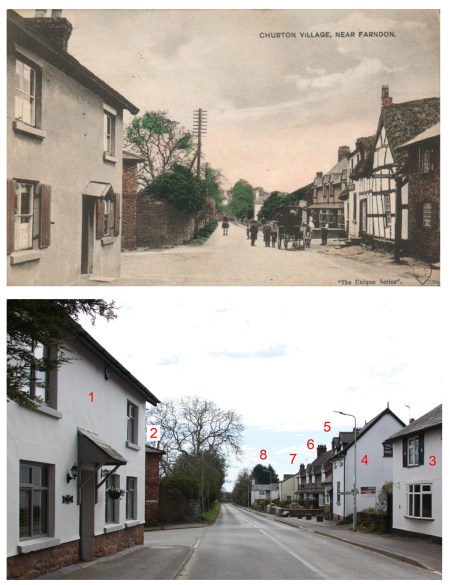
The milestone outside Glebe Farm, part way between Churton and Aldford

The piecemeal organization of the turnpikes meant that they served local interests but only sometimes contributed to long-distance travel and communication.  Even on a region by region basis, there were big gaps in good quality road infrastructure because a county as a whole was not of much interest to local trusts.  This significant failing in centralized strategy for inland communications was something that the government knew it needed to address, particularly as manufacturing became increasingly industrialized, demand grew and merchants wanted better access to a much wider geographical choice of markets.  In a period of expanding opportunities and spending power, turnpikes had helped to improve conditions for the economy and for passengers, but they had simply never been able to meet the needs imposed on them by the late 19th Century.
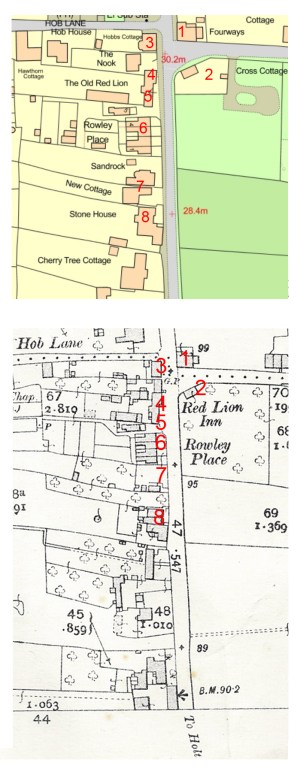
For two centuries turnpikes had been essential to the support of local links and longer distant trade and travel.  The toll houses established were usually added at each end of a turnpike and  sometimes in between, and some of those remain dotted around this and neighbouring counties.  Some of the mileposts and signposts also continue to be dotted around the modern rural landscape.  When Cheshire County Council was formed on 1st January 1889, it inherited an excellent network of roads linking all its key towns and villages, most of which had been turnpikes and soon began to position its own mileposts on major highways, many of them former turnpikes.

As always, please let me know if you have any questions
or if you have additional information to contribute

Part 2 can be found here

Sources for Parts 1 and 2:

Books and papers:

An Act for making a Turnpike Road from Chester, by Farndon, to Worthenbury, with a Branch therefrom to the Village of Farndon, 1854

Benford, M. 2002. Milestones.  Shire Publications

Crane, N. 2016.  The Making of the British Landscape.  From Ice Age to the Present.  Weidenfeld and Nicholson

Crosby, A.G. 2012.  New Roads for Old. Cheshire Turnpikes in the Landscape 1700-1850.  In (eds.) Varey, S.M. and White, G.J. Landscape History Discoveries in the North West.  University of Chester Press, p.190-223.

Cunningham Glen, R. 1895. Indictment presented before Lord Coleridge, C.J.  Reg. vs. Barker.  Reports of Cases in Criminal Law argued and determined in the courts of England and Ireland, vol.XVII, 1890-1895. Reported by R. Cunnigham Glen Esq., Barrister at Law. Horace Cox

Defoe, D. 1724–1726 (Rogers, P. ed.). A Tour Through the Whole Island of Great Britain Penguin (particularly, Volume II, 1725, and its appendix).

Harvie, C. and Matthew, H.C.G.  1984, 2000.  Nineteenth Century Britain. Oxford University Press

Hindle, P. 1998 (3rd edition).  Medieval Roads and Tracks.  Shire Publications Ltd

Keys, D. 2016. Discovery of huge Bronze Age wheel sheds light on transport in prehistoric Britain.  The Independent, Friday 19th February 2016
https://www.independent.co.uk/news/science/archaeology/prehistoric-britain-discovery-bronze-age-wheel-archaeology-a6882671.html

Langford, P. 1984, 2000. Eighteenth Century Britain.  Oxford University Press

Latham, F.A. 1981.  Farndon. The History of a Cheshire Village.  Local History Group.

Local Government Act 1888 (51 and 52 Vict. c.41). Section 97, Saving as to liability for main roads.

OS Landranger map 117 2016.  Chester and Wrexham.  Ordnance Survey

Phillips, A.D.M. and Phillips, C.B. 2002.  A New Historical Atlas of Cheshire. Cheshire County Council and Cheshire Community Council Publications Trust.

Pratt, E.A. 1912.  A History of Inland Transport and Communication in England. Kegan Paul, Trench, Trübner and Co Ltd.
Project Gutenburg: https://www.gutenberg.org/files/52087/52087-h/52087-h.htm

Pryor, F. 2010.  The Making of the British Landscape.  How We Have Transformed the Land from Prehistory to Today.  Allen Lane

Wright, G. N. 1992. Turnpike Roads. Shire Publications Ltd.

Websites

A Collection of Directories for Cheshire
Cheshire County Council
http://cheshiredirectories.manuscripteye.com/index.htm

British Listed Buildings
Cross Cottage, Churton
https://britishlistedbuildings.co.uk/101228714-cross-cottage-churton

Broughton Hall, Threapwood
Threapwood History Group
http://www.threapwoodhistory.org/broughtonhall.html

Cheshire Tithe Maps Online
Cheshire Archives and Local Studies
https://maps.cheshireeast.gov.uk/tithemaps/

Emral Hall, Worthenbury
Wrexham Online
https://www.wrexham-history.com/emral-hall-worthenbury/ 

Historic England
Cross Cottage, Churton
https://historicengland.org.uk/listing/the-list/list-entry/1228714

Dig Diary 19: Discovering Britain’s Oldest, Complete Wheel
February 29, 2016
Must Farm Dig Diaries
http://www.mustfarm.com/progress/site-diary-19-discovering-britains-oldest-complete-wheel/

National Archives
Chester and Whitchurch Turnpikes Trust
https://discovery.nationalarchives.gov.uk/details/r/11e8a8d6-43c5-4704-a93b-58fe6d0444a6

National Library of Scotland Mapfinder
OS 6-inch map, 1888-1913
https://maps.nls.uk/geo/explore/#zoom=15&lat=53.09734&lon=-2.86868&layers=6&b=1

Peterborough Archaeology
Must Farm Bronze Age Settlement
https://peterborougharchaeology.org/peterborough-archaeological-sites/must-farm/

Turnpike Roads in England and Wales
Turnpikes.org.uk
http://www.turnpikes.org.uk/Tollhouse%20design.htm