Author Archives: Andie

Eaton Hall Gardens Charity Open Days 2022

My father and I booked for the open day on Sunday 26th June.  All tickets have to be booked in advance, both for the gardens and for the train a narrow gauge railway.  We skipped the train option so I don’t know what that experience was like (lots of children, I would imagine) but the gardens were superb, and in some ways unexpected.  Brief comments on practicalities for those considering July or August visits, in terms of parking, suitability for those with mobility issues etc, are at the end of this post.

The Eaton Hall Gardens are open to the public three times this year, the last Sunday in June, July and August, all in aid of three different charities.  If you are intending to go, but have not yet booked a ticket, I suggest you book immediately via EventBrite, as it sells out every year. I missed the chance last year.  The benefiting charities for the 2022 events are Cheshire Young Carers, Cheshire Wildlife Trust and Kidsbank.

We entered via the Belvedere gate just north of the Grosvenor Garden Centre on the old Chester to Wrexham road (the B5445).  It is an ostentatiously long approach to the property.  Just in front of a gigantic obelisk is a checkpoint where you show your tickets.

Young RAF Air Cadets were on hand everywhere to direct traffic and answer questions, and did an absolutely splendid job of keeping the traffic moving.  Once we had followed their directions and parked in a field (but see my notes on disabled access at the end), and walked up towards the estate buildings, you pass through a gate where your tickets are checked again.  Here you are handed a leaflet about the charity being supported, and another highlighting garden features that you might want to visit by head gardener Jan Lomas, with an excellent map on the back showing the locations those features, with  recommended routes between them, which is absolutely necessary if you are not going to miss anything.  You can download my battered copy of the map here if you want to plan your visit in advance.

We were lucky with the weather, because although it was overcast, with only short burst of occasional sunshine, it remained dry, and it was warm.  You can click on any of the photos to see a bigger version.

The description of the gardens on the EventBrite website gives some idea of the treats in store:

Eaton Hall Gardens extend to 88 acres and have been developed over many years by prominent designers, most recently by Lady Arabella Lennox-Boyd. The gardens have a wide variety of planting, including four formal colour-themed rose gardens and grand colour-themed herbaceous borders. There is a newly completed hot border design and a stunning bedding scheme in the Dragon Garden which is not to be missed. Visitors can also enjoy the walled Kitchen Garden, as well as the wildflower garden and the lake walk, where you can take in fabulous views of the Hall and grounds. Finally, the Tea House is filled with roses and herbs and sits perfectly at the end of a short walk past the lake area.

We found all the gardens except the wildflower garden (up a flight of stairs out of the Dragon Garden), and we didn’t do the lake walk simply because it was getting rather late, but looks like a brilliant venue for the picnics that were being carried by more organized visitors.

The first place that we visited was the camellia walk, a long, slender glass corridor lined with camellia bushes.  Although none of the camellias were in flower (they are a spring flowering species), the conservatory building itself was a thing of real beauty, and the sense that it goes on and on without visible end is wonderful.

Nearby are the sheds and the platform for the narrow gauge railway (with open-sided carriages pulled by a steam engine, which used to connect to a Chester-Shropshire railway line siding some 3 miles away).  We walked along a track round the walled kitchen garden towards the courtyard entrance, which is an intriguing little walk, as there is a lovely tree-lined walk towards the kitchen garden, and a couple of quirky buildings, but no signs that it is in use for anything.

The first port of call for most people is the former stable block surrounding a courtyard.  The stable courtyard is open to the public, and there is a horse-drawn carriage display in the light-filled atrium that gives access to it.

The open courtyard itself is laid out with tables and chairs, and is one of the places where refreshments are served in aid of charity (for cash only), and was very congested, but the surrounding buildings were not at all busy.

The former stables themselves, built by Alfred Waterhouse in around 1869, are open.  The saddle horses and harness horses were stabled separately, and there was a harness room and a carriage house too.  There is some information about the horses stabled there and a reconstruction of the stud manager’s office, as well as the family history and exhibition rooms.  You can also, from the stable courtyard, access the bizarre shell grotto and the 1870 Eaton Chapel from the courtyard (stained-glass windows by Frederic James Shields).  Live organ concerts were being played in the chapel, majoring on Johann Sebastian Bach, a lovely, intimate sound in that small space.   

After visiting the courtyard, which is the first place that everyone seems to filter into first, the nearest of the gardens to visit is the walled kitchen garden.

Along one of the walls is a broad border filled with brightly coloured flowers, many of which grow on a massive, upwardly skyrocketing scale.  Within the walls, the beds are divided into squares and rectangles by multiple pathways, many of which are provided with colourful arches.  Some of the beds are defined some defined by short hedges of interlaced apples.  Some of the flowers are exotic and gaudy, others are more humble and subtle, and there is a lively mix of floral displays and vegetables, with lots to see.  The overall impact is one of careful husbandry with a real eye for colour, scale and shape.

asfsdfs
dafdsfs

From there we walked down to the Parrot House, a little round building looking rather like a Graeco-Roman temple, but designed to keep tropical birds.  It was built in the 1880s by Alfred Waterhouse and was fitted with heating to create suitable conditions for such birds, but apparently never housed anything more tropical than some budgies.  There were hay bales outside for visitors to sit and watch the band.

From here it was a short walk to the rose gardens, which sit in front of the Eaton Hall house, offering the first real glimpse of the house and the great clock tower of the neighbouring chapel.  The Country Seat website offers the following very useful potted history of Eaton Hall (not open to the public, but an unavoidable presence).

A Victorian Gothic iteration of Eaton Hall in the late 19th Century. Source: Lost Heritage

The first notable Eaton Hall was designed by William Samwell and built in 1664 but was replaced by a vast Gothic creation by William Porden in 1803, which was then enlarged by William Burn in 1845. This was then replaced by the Victorian Gothic of Alfred Waterhouse in 1870, before the whole edifice was swept away in 1961 as the trustees of the then young Duke couldn’t imagine anyone living in such splendour again. Faced with being a Duke with no seat in his 11,500-acre estate in Cheshire, in 1971 the 5th Duke commissioned a starkly white modernist country house from John Dennys, (who also happened to be the Dukes’ brother-in-law) which was as striking as it was controversial. This was then given a vaguely ‘chateau’ style makeover in 1989 for the 6th Duke, to designs by the Percy Thomas Partnership. So of the five major houses which have been graced with the name Eaton Hall, the current one, though impressive, still doesn’t quite have the gravitas of the others. Perhaps, in time, a future Duke may decide to replace it again.

The current house is an ugly great block of a thing looking not unlike Faengslet prison. I daresay it has more going on in its favour on the inside.  Next to it, rather more endearing in a uniquely Victorian way, is the Eaton Hall chapel clock tower and the chapel itself, behind which is the the stable courtyard.  Although the history of the house is of interest, the visit is all about the gardens, which are excellent.

The gardens are dotted throughout a park that sits above a lake and extends to the east.  Instead of being clustered around the house, as in most houses and estates of this type, the different gardens are dotted around, approached both via metalled surfaces and grass paths mowed through stretches that have been allowed to run wild.

The rose gardens are probably the highlight of the gardens at this time of year, with climbing roses climbing up trellis obelisks and running along heavy rope links.  The twin gardens flank a long rectangular ornamental pond that runs towards the house.  The pond is often shown with fountains, but they were not operating when we visited.

The rose gardens, supplemented by other species to complement the colours of different sections, form part of a remarkable of a set of terraces.  The top terrace, not accessible to the public, is on the level of the house.  The rose gardens are next down, and below this is the lioness and kudu pond, which in turn overlooks the slope down to the lake, which is fed by the River Dee.

The rose gardens and the pond are flanked by wooden arches connected with thick ropes, and both the arches and the connecting ropes support white and palest pink roses.

On each side of the pond are two square rose gardens, separated by yew hedges, cleverly offset so that one garden cannot be seen from the next, giving the impression of being the entrance to a maze.  Each of these rose gardens has a central focal point, a circular path, and four beds, each with a massive obelisk in its corner.  Each of the gardens is colour-themed.  One, for example, is blue and yellow, whilst another is pure white.  The roses are certainly the dominant flower, but they are supported by penstemons, clematis, geraniums and various other species that help to create a mass of different textures and shapes.

asfsfdfsd
The Dragon Garden is named for the dragon sculpture in the centre of the garden.  A formal geometric garden, planted with small species  of blues, purples, lilacs and mauves, this is a delightful sight, highly structured and precise.  There is a statue of a figure on each corner of the garden, possibly former family members.

After a pause to enjoy the view at the end of the terrace, and to look down over the lioness and kudu sculpture (a truly bizarre thing) we went towards the Dutch Tea House and the accompanying Tea Garden.  Outside this garden, and elsewhere on the estate, several of the vast oaks are wrapped in fine mesh.  I had seen this on a previous visit to the Aldford Iron Bridge on the other side of the estate, and had wondered what it was all about.  A helpful sign explained that it was an experimental measure taken against acute decline disease, thought to be caused by a parasitic boring beetle.  The mesh restricts the movement of the beetles and prevents them spreading.  At the same time, the roots of the tree, under soil compacted over the decades, prevents water and nutrients reaching the tree, so a programme of mulching has been undertaken to help retain water and help the transfer of nutrients and water via the roots into the trees.

The Tea House is a little ornamental building, approached via a path that leads through the pet cemetery, and look out for a delectable little wooden Wendy house on the other side of a low hedge.   If you have a pushchair or wheelchair / buggy, there is a side entrance to the garden that avoids the steps down from the Tea House.  Giant fennel plants give a wonderful bitter-sweet scent on approach to the garden.  The garden has a statue of Mercury at its centre (standing on a personification of the wind).  The garden is beautiful in a less formal way than the rose gardens, with a more unaffected feel, with lovely block-paved paths and beds filled with flowers and highly aromatic herbs that deliver a gloriously chaotic range of different aromatic scents that follow you around.  On a hot day I imagine that it would be even better as the aromas heat through.  

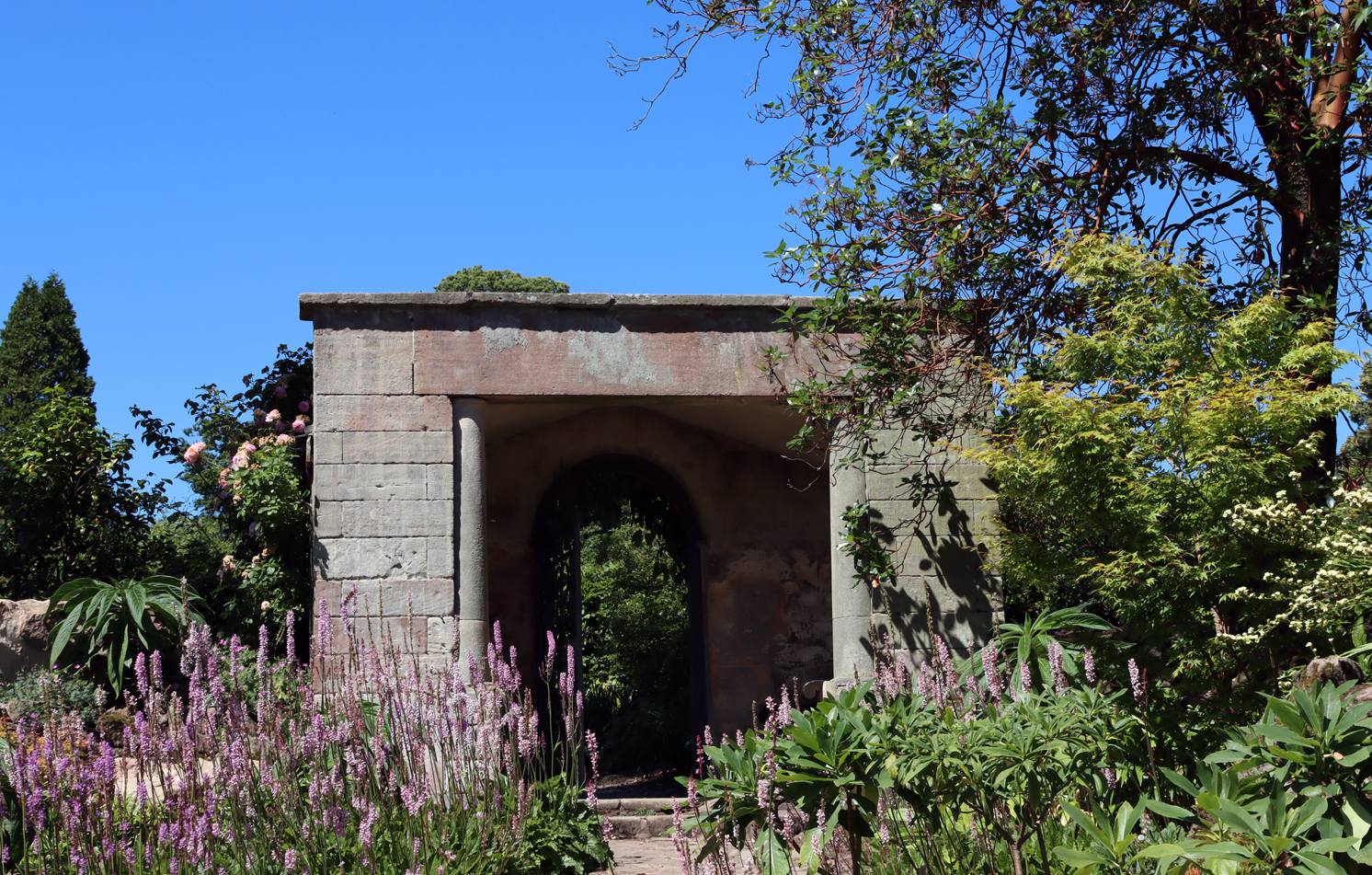
From here there was a choice of walking down to the lake, or taking one of the grass paths to another little temple-like building, referred to as a loggia.  We opted for the walk to the loggia, rectangular this time, which was flanked by two genuine Roman columns and housed a genuine Roman altar, the latter found to the east of Chester between the Tarvin and Huntington roundabouts, about 320 metres east of Boughton Cross, and 1.8 km due east of The Cross, Chester.  Given how much Roman architecture has been lost from Chester, it was probably a kindness to remove and preserve them, although the public only rarely have access.

The altar is today known officially as RIB 460.  On two sides it reads “Nymphis et Fontibus
leg(io) XX V(aleria) V(ictrix),” translated as “To the Nymphs and Fountains the Twentieth Legion Valeria Victrix (set this up).”  It was rediscovered first in 1821.

There is a grass avenue from here back to the Parrot House via the terrace with the lioness and kudu pond.  The band’s little white marquee is stationed in front of the Parrot House so you don’t really get a sense of the connection between the two buildings, but it is a nice arrangement.  As you walk onto the pond terrace, you pass through a grass path flanked with two borders filled with lavender.  We paused to run fingers through it and release the splendid scent.  The wall that runs below the upper terrace where the rose gardens were located is covered in white hydrangea petiolaris, a form of hydrangea that climbs. The pond itself has a vast greened sculpture in the middle showing a lioness about to leap on and kill a kudu (a deer-like animal).  As you walk up behind it, the change of perspective gives a strange sense that the lioness is in motion. It is absolutely not my cup of coco, and I would have it moved somewhere a lot less conspicuous, but it is certainly attention-grabbing.

From the Parrot House it was a short walk along the bottom edge of the walled garden to the field where we were parked.  We found the Air Cadets who were stationed around all the entrances and exits very helpful in sorting out somewhere where I could easily pick up my father.

Later, whilst my father was masterminding a fabulous culinary extravaganza in his kitchen, I read the leaflet about the Cheshire Young Carers charity that the day’s takings were to support.  It was something of an eye-opener to learn how many children care for their parents or their siblings, unsupported by any official mechanisms.  I was so pleased that our tickets had gone towards helping this excellent organization, which not only helps with practical support but organizes away days for children, activities that allow them to escape their responsibilities for a short time.
sdfsfas

Visiting Practicalities

The parking arrangements were very well managed with plenty of Air Cadets and other personnel at the ready to give directions and advice.  The car park was a field.  The field surface was dry buy very uneven.  A brief conversation with one of the parking officials enabled me to drop my father off on the hardstanding that led up to the gardens, and park nearby, where some spaces had been kept free, but if you have a disability badge, there are is special parking right by the entrance to the gardens.

There is a disability stand where disability scooters and other aids can be collected, and the gardens as a whole are generally easy for those with mobility issues, as well as for wheelchair and pushchair users. The gardens are connected with the lake by metalled paths leading between gardens, and within some of the gardens and in the park between them, there are level grass surfaces and light slopes throughout, which (at least on a dry day) are suitable for wheelchairs and pushchairs.  There are not many benches or seats around, and none between the gardens.

It was only moderately busy.  The car parks seemed to be stuffed full of cars, but the park and gardens seemed to swallow visitors very easily.  Only in the places where people tend to convene, like refreshment areas and places where there was live music, was there a sense that it might become crowded.  The gardens themselves gave no sense at all of there being too many people for the space.

Full details of the event, plus booking information, are on the Eventbrite website at:
https://www.eventbrite.co.uk/e/eaton-hall-gardens-charity-open-day-tickets-308591705097

sdfd
Sources:

EventBrite
Eaton Hall Gardens Charity Open Days 2022
https://www.eventbrite.co.uk/e/eaton-hall-gardens-charity-open-day-tickets-308591705097

Historic England
Eaton Hall Park and Garden
https://historicengland.org.uk/listing/the-list/list-entry/1000127?section=official-list-entry

Lost Heritage
Eaton Hall
http://www.lostheritage.org.uk/houses/lh_cheshire_eatonhall_info_gallery.html

Roman Inscriptions of Britain
RIB 460
https://romaninscriptionsofbritain.org/inscriptions/460

The Country Seat
Country houses of the 2014 Rich List – Top 10
https://thecountryseat.org.uk/tag/eaton-hall/

Heritage Festival Tour: Chester Cathedral’s Medieval Architecture by Nick Fry

The Grade 1 listed Chester Cathedral. .

As part of Chester Heritage Festival, this tour of Chester Cathedral lead by tour guide and cathedral expert Nick Fry took us through the architecture of what was the Benedictine abbey (then known as St Werburgh’s) from 1092, when it was founded by Earl of Chester Hugh d’Avranches (known as Hugh Lupus), until 1539, when it was closed by Henry VIII.  The abbey was saved from most of the indignities inflicted on other suppressed abbeys by its conversion to a cathedral in 1541, when the wide-ranging architectural changes being implemented by the abbey’s Benedictine inhabitants were brought to a close.  This tour was the story of the abbey, rather than the later cathedral that underwent its own changes and was particularly fiddled around with in the Victorian period.

Viewed through a later gothic arch, the Romanesque arches just beneath the former roof level, with re-used Roman columns, look very attractive but archaic

Nick talked us through how, between 1092 and 1539, the abbey underwent a number of architectural innovations, from its Romanesque origins, through the innovations of gothic design, to its final days as a monastery. Key Romanesque features are rounded arches, and columns that instead of being incorporated into the arches stand slightly apart from them.  The gothic was innovated in France, specifically notable at Saint Denis in Paris, but spread rapidly to Britain, and its influence is visible in the the increasingly formal, elaborate and technologically more efficient pointed arches, rib vaulting and decorative window tracery.  

The talk was wrapped up with master mason Tom in the abbey garth, the central square garden around which the abbey cloisters were arranged.  Tom was an excellent speaker and talked us through the tools of the trade and the key characteristics of the raw materials used for different parts of the building, demonstrating the use the tools, and his skills, on a piece of ornamental sandstone on which he was working.  Both the tour by Nick Fry and the masonry demonstration by Tom Livingstone were excellent.  

The Romanesque is distinguished by its curves and its monumental solidity.  There are only pieces of it remaining from the former abbey, before the monks started to modernise, but enough to give an idea of the different architectural paradigm of the period.  The north transept is remarkable not merely for its Romanesque arches and windows, but the re-use of Roman columns in their manufacture.  This portion of the cathedral looks the most instinctively old, and gives the best idea of what the rest of the abbey must have looked like, with a footprint not that much different from the cathedral’s.  The small windows were typical of the Romanesque, as bigger windows would have undermined the strength of the walls that was required to support the big arches. Another section that preserves the Romanesque is the cellar (above ground; undercrofts were under ground) that is now used as the ticket office and reception, with great, stumpy pillars with scalloped decoration supporting vast ribs over which many layers of material provided the vaulted ceiling.  Other Romanesque features have been incorporated into the later gothic architecture, primarily doorway arches, in some cases seamlessly, in other cases rather peculiarly.  See Buildwas Abbey in Shropshire for an idea of what St Werburgh’s Abbey may have looked like in its Romanesque phase.  There is also an excellent 3D artist’s reconstruction of a typical Romanesque Church, which is very reminiscent of the north transept at Chester Cathedral, on the Historiographies On the Evolution of Art website.  

Romanesque arches in Chester Cathedral

Looking in particular at the rounded arches of the north transept one can understand why the Romanesque must have seemed suddenly old fashioned and under specified when the senior members of the monastery saw the new gothic features, enabling slender, seamless columns, soaring arches and vast windows with complex tracery.  The photograph to the right shows one of the earliest experiments with the gothic arch, a slight point at the top of the streamlined arch over a more ornate decorative arch below.

One of the earliest gothic arches in the abbey with a curving profile but a pointed tip, sitting over an elaborate decorative feature. The slender columns, however, stand proud of the stonework, a very Romanesque trait.

Nick emphasised that because abbeys were designed as homes not primarily for monks but for God, they had to be the biggest and best that the available money could buy.  The possibilities of the gothic, allowing the light of God to enter the cathedral, and elaborate decorative features to be added, were all in the interest of this celebration of the divine. This is quite different from the Romanesque conceptualization where the darkness of the church, forced by the small windows that could be no bigger due to the strong walls required by the arches, added to the mystery and unknowable nature of the divine.  I suspect that the new gothic designs were probably also in the interests of the incumbent abbots and the abbey, as a place of prestige, pilgrimage and conspicuous display.  The redesign started at the east end and worked towards the west.

The advantages of the gothic were not merely dictated by fashion, devotion and prestige, but were technologically superior as well, meaning that they offered significant improvements over the Romanesque for the master masons who both designed and built ecclesiastical buildings, vaulted spaces using multiple supporting ribs requiring less raw materials to make the magnificent ceilings of, for example, the slype, the vestibule, the chapter house and the Lady Chapel.

The Early English gothic Lady Chapel, painted during the 1960s in the colours that would have adorned it when it was built c.1270

There are three main periods of British gothic architecture – Early English (roughly 1190-1260), Decorated (c.1260 – 1360, itself sometime subdivided into the Geometrical and the Curvilinear) and Perpendicular (c.1350 – 1500s).  Nick made it clear that although they are traditionally assigned to certain date spans, there are really no clear divisions between them. Although the Early English is broadly earlier than the Decorated, which was itself followed by the Perpendicular, there were overlaps, with older styles sometimes maintained in the face of new fashions and innovations.  There are examples of all of these in the cathedral, although the perpendicular is confined to one window; the fashion-conscious plans for St Werburgh’s Abbey were cut off in their prime by Henry VIII.

The Early English is exemplified by the Lady Chapel, where a daily mass was held in honour of the Virgin Mary at a period when her cult was particularly popular.

The Decorated is most evident in the quire stalls, each one unique, made of thousands of pieces of beautifully carved oak, which took twenty master craftsmen a mere two years to complete in situ. The craftsmen were probably also responsible for the quire stalls in Lincoln Cathedral, to which they are very similar.  There are also windows in the south transept chapels and the south wall of the nave that feature elaborate tracery from this phase.  The glass is all modern, the Medieval stained glass having been destroyed, but the finely worked tracery reflects the taste for increasing decorative complexity.

The Perpendicular is confined to the big stained glass window at the west end of the cathedral, with mullions (upright stone dividers) that extend all the way from the base of the window to its top, the emphasis on long, tall shapes that soar heavenwards.

A window in the Decorated style at right (south wall) and Perpendicular style (west end, over main entrance)

The abbey was designed and built by master masons, who had at their disposal a repertoire of ideas and visualizations that they could build into stone.  There are portraits of two of them high in the quire, one of them bearded with his plans folded in his lap.  Abbeys on this scale take decades to build, and as fashions change are almost always under reconstruction, with older sections being replaced and new sections added.  Matters were complicated during the gothic period of the abbey by Edward I, who had his own priorities.  Although Edward was conscious of the role of abbeys in Medieval society, compensating Welsh abbeys for the damage inflicted during the conquest of Wales, this respect did not prevent him raiding the master masons of Chester Cathedral for his castle building projects in the late 13th century.  Similarities between the abbey architecture and that of Caernarfon castle considered to be indicative of the presence of the same master masons at both.  This discontinuity of design and build shows in a number of  flaws and oddities in the cathedral today, which give the building real personality.

The arches on the right (south) were built in around 1360, 130 years earlier than those on the left (north).

One of the remarkable features of the cathedral today is to be found in the abbey nave, where the two parallel lines of arches flanking the main body of the nave, which at first glance appear to mirror one another, were in fact built 130 years apart.  The interruption between them was thanks to the Black Death of the mid 14th century, which plunged the nation into both humanitarian and economic crisis.  Only 130 years after the first set was built on the south side could the project be completed on the north side, which says something about the attitude of the abbot.  The abbot and master mason between them, as Nick pointed out, could have decided to implement an entirely new design in order to put their own personality on the nave, but they decided to emulate the original design, with only some of the decorative flourishes on the capitals showing major differences.   The earlier decorative details on the south side are simpler and more subtle, those on the north side more elaborate.

We finished the tour in the garth (the garden at the heart of the abbey complex), where mast mason Tom Livingstone gave us an excellent lecture on how the Medieval masons designed the stonework in the abbey, and how this work was then implemented.  The range of tools, including chisels and mallets, was remarkably small given how sophisticated the carving needs to be.  Tom said that the essential skill in a mason’s armoury was being able to chisel perfectly straight lines.  The question of whether a circle is a curve or a million straight lines is not one a mason needs to worry about – the answer is always a million straight lines.  Tom showed us how different methods of quarrying created different marks on the stone, and why different grain types were more suitable for certain architectural roles.  Tom’s own kit contains chisels reinforced by tungsten carbide and nylon as well as pear wood mallets, because without a blacksmith to hand, the original tools, blunting constantly, would require frequent repairs that would be very inconvenient.  I would really like to see more of the team’s work in action.  You can follow Tom and the members of the team on Twitter at https://twitter.com/chesterworks

If you get the chance to go on one of Nick Fry’s guided tours, I recommend him.  There is nothing dry about his talks, which are both informative and humorous and stuffed full of fascinating details about architectural quirks and unusual features.

Thanks too to Green Badge Guide Katie Crowther, who let me know that this tour was being organized.

My previous post about Chester Cathedral, under Katie’s guidance in March 2022, takes in the Anglo-Saxon origins, the Benedictine abbey years and the cathedral years.


Object histories from my garden #11 – Fragment of a bisque porcelain doll

Fragment at a bisque ware doll head with painted lips

One of the eeriest pieces that we have dug out of the garden is this fragment of a doll’s head.  It was no ordinary child’s doll, but an expensively crafted item, its head and limbs made of bisque porcelain.  It would have been dressed in opulent, often period-themed clothes, and its eyes may have opened and closed, via hinged eyelids, as it was tilted. 

For anyone new to this occasional series on objects extracted from my garden during everyday gardening activities, see the History in Garden Finds page.  These are not objects used in the garden, but objects, usually fragments, lost or disposed of in the garden and found during digging, troweling and planting.

Bisque ware dolls either appeal to you or don’t, and in my case they sit with clowns and golliwogs in the category of the downright unpleasant. We found a piece of china showing a golliwog  in the garden too.  The bisque ware dolls are collectors items today, and you can usually find a few examples on eBay.  Bisque ware or biscuit porcelain is made in a mould, and fired but left unglazed, giving its surface a matte finish.  When skilfully painted, it can look from a distance like human skin.  Each colour is painted on to the surface and fired separately, building up the layers to create the skin-like effect.  The head and limbs of the doll were formed in moulds.  The unseen body of the doll, hidden by clothes, could be made of much less expensive materials.  Limbs were sometimes articulated, so that they bent at elbows, hips and/or knees.  

A doll head that gives some idea of what the rest of the garden fragment doll may have looked like. “Floradora” by Armand Marseille of Germany. Source: What The Victorians Threw Away

The bisque dolls were made from around 1860 to around 1915, although similar dolls were made from other materials before that date. The earliest were intended to represent fashionable women, and the child dolls only came in later, after around 1880.  Their popularity spread initially in France during the 1880s, but the German market soon competed, making dolls that looked just as expensive but were far more reasonably priced.  By 1900, Germany was dominating in the bisque doll market.  Names like J.D. Kestner, Armand Marseille and the Heubach brothers are still popular in the collector market.   The best known producers marked their dolls where they would not normally be seen, now of great value for collectors, but a head fragment like this would not have been marked.

There is an example of an elaborately kitted out Kestner doll at the end of the post, but to the right is the equally eerie head of another broken doll, from the What The Victorians Threw Away website, showing what the rest of the head of the fragment in my garden may have looked like.  Although some dolls had mouths that moved when the doll was tilted, this one did not, and it does not looks at though the garden fragment did either.  It has eyelashes  like the ones on the one from my garden, but shorter.

There is little to say about the piece from the garden, other than it was made of a thin porcelain, carefully shaped in a mould.  It was very skilfully painted, the cheeks a gentle rosy colour, the thin, bow-shaped lips a bright scarlet, with the ends of long dark eyelashes at top right.  The clump of grey substance on the reverse side suggests that someone had made an attempt to repair the doll, presumably following a previous breakage.  It seems to have been a very unlucky individual.

The fragment is at top left of this photo, shown with a few of the other garden fragments in an old printer’s tray, hung on a wall.

Looking at it, I cannot help but wonder what on earth happened to the rest of the doll and why this bit of it was isolated from the rest of its head and its body?  It was found to the rear of a wide flower bed that was completely dug out, its soil disposed of and replaced due to a particularly virulent and un-killable form of grass, before being replanted. If the rest of the doll had been there, we would have found it, but there was no sign of anything remotely like it.  Perhaps it was dropped, broke on the spot, and this fragment was lost at the time, with the rest of the doll picked up and disposed of elsewhere.  Who knows :-).  It is one of the few hints of any high quality pieces owned by previous householders that we have dug out of the garden.  Most of those items are of domestic use, and very commonplace, although each has its own history as a representative of a certain type of object fashionable at the time of its production.

J.D. Kestner bisque doll with accessories (for sale at over $1000.00). Source: eBay

For other objects in the series,
please see the History in Garden Objects page


Sources:

History of Dolls
History of Porcelain Dolls
http://www.historyofdolls.com/doll-history/history-of-porcelain-dolls/

Houston Texas University
Bisque Dolls 1890-1915
https://hbu.edu/museums/museum-of-american-architecture-and-decorative-arts/theo-redwood-blank-doll-collection/bisque-dolls-1890-1915/

The Spruce Crafts
Top 5 German Antique Doll Brands (by Denise van Patten)
https://www.thesprucecrafts.com/top-german-antique-doll-brands-774906


The realm of the jackdaw in my garden

A large group of jackdaws is currently reigning supreme in my garden.  They are here every late morning when they spread out across my lawn and forage in the grass and occasionally the flower beds, usually in harmony with one another, but occasionally with minor internal disputes.  Their relationships with other wildlife in the garden are rather less amiable, but on the whole mutual caution seems to be the rule.  The most I counted in one go was 16 jackdaws, but there are rarely less than 10 when they arrive en masse.  A group of this sort is known as a train or clattering.  One or two individuals sometimes return in the afternoon, but the jackdaws only visit my lawn en masse in the late morning.

The jackdaw is, at first glance, a large, and undistinguished black bird much like a crow, but when observed more closely is a rather beautiful thing.  It has remarkable silver eyes that stand out against the black pupils.  The head and beak are black, but the hood, nape and neck are silvery-charcoal, like a mane, which becomes pure silver in bright sunlight.  They have a self-important rocking-horse motion, but walk one leg at a time, rather than bouncing along on both legs like smaller birds.  Their skinny-looking legs are well able to support their large bodies during periods of extensive walking over the expanse of the lawn.  They use their wings to supplement their legs to pick up speed when seeing off transgressors or moving a safe distance away from their more aggressive family members.  Young jackdaws have brown irises that only become silver grey as they become more mature.

Jackdaws (Corvus monedula) are part of the same 120-species corvid family as crows, ravens, rooks, magpies, and jays, and are the smallest member of that family in the UK, at about 34cm long.  Carl Linnaeus provided the name “monedula,” deriving from the Latin word for money, and chosen for the brightness of the things that the jackdaw, like the magpie, is fond of collecting.  Every creature on the planet, in the western scientific world, owes its two-part Latin formal name to Carl Linnaeus (1707-1778).  Biologists have since elaborated this system, and now rely on DNA to establish relationships, but Linnaeus provided them with the basics of the taxonomy that we continue to use.

Sometimes all one can see is the bird’s rear end, because the head is so deeply and busily buried in the grass. Like other members of the corvid family, jackdaws are omnivores.  Whatever they are plucking out of my lawn and flower beds is probably insect life, like leather jackets, worms, beetles, caterpillars and ants.  They are also partial to slugs and small snails, and supplement their diet with fruit and seeds.  Jackdaws also steal the eggs and offspring of smaller birds and, like all corvids, will eat carrion when they find it.  The diversity of their diet has helped their numbers to rise in Britain.  

Many insect eaters can derive most of their water requirement from this food, and I have only seen them (and the magpies) drink from any of the bird baths in the garden which the other bird species use frequently during periods of drought.   During normal conditions they may, of course, be sourcing their liquids from outside the garden.

They don’t sing; they squawk and chatter.  It is often a rather disharmonious sound, unappealing to the human ear, nothing like the blissful melodies of the blackbird or thrush.  You can hear a sample on the British Birdsong website here, or the RSPB website here.

Birds that form lifelong monogamous relationships often have the largest brains relative to their body size, and they are certainly smart, regularly defeating my small-birds-only weight-detecting  winter bird feeder, using every form of trickery at their disposal, including flapping wings madly, like gigantic humming birds, to hold position whilst poking their heads through the hole to reach the bird seed.  In the days when milkmen left bottles with foil caps by front doors, jackdaws were notorious for pecking through the foil to get to the creamy milk within, thereby rendering themselves seriously unpopular by contaminating and ruining the milk.

Jackdaw eggs in nest. Source: East Norfolk Ringing Group blog

There is no externally visible difference between the male and female.  Jackdaws breed between April and June, raising one brood each year.  Their nests are untidy.  They simply fill a hole or recess with sticks, and line it with wool, hair, string or grass and weeds.  A 2021 research paper found that although a pair will behave similarly and generally cooperate to build their nests, their roles are not identical.  Females contribute more to the build of the nest, and call more frequently, but the males are more assiduous guardians of the nest once it is built.  The eggs are blue-grey with dark speckles.  Once the eggs are laid in separate batches, usually up to a maximum of six or seven per nest, more usually four or five, they are incubated for up to 20 days.  They hatch at different times, with the oldest having a much better chance of survival than the youngest.   The female tends the nest whilst the male sources food and brings it to the female and the chicks.  The chicks remain in the nest for up to five weeks, before leaving the nest and learning to fly and feed for themselves.

Jackdaws on chimneys in Cornwall. Source: Hudson 1908

As far as I can tell, as of 2025 five generations of the family have been born in one of my chimney pots.  One of the colloquial names for the jackdaw is the “chimney bird” due to their affinity for this particular type of home, which are becoming less available to them year by year, due to chimney caps and central heating.  Fortunately, as well as chimneys and holes in roofs, they also like rock shelves, cliff faces, tree holes and the abandoned nests of bigger birds.  Some will even nest in abandoned rabbit burrows. 

The chimney at the front of my house, together with that section of the slate-tiled roof, formed the hub of their activities when the nest was still occupied, but they still use it as a home base, where they  can sit and bicker and gather their energies for the next foray into my garden or, in the afternoons, into the surrounding fields. Right now, in mid June, a cacophony of noise in the chimney is confined to mornings and early evenings, meaning that the youngsters are fully fledged and that the family are out all day.

Jackdaws move seasonally.  Family units will focus on a breeding site in the spring and summer, often returning to it in subsequent years, but in the winter they will leave and join communities of several hundred other corvids, not just jackdaws but also rooks and carrion crows, roosting high in trees.  These winter roosts are rarely too far from their breeding grounds.  Communal roosting is both sociable and solitary.  Although the birds gather together in the trees, they are well spaced from one another, not huddled together.  Research into corvid intelligence and communication suggests that roosts provide a context for learning and for the exchange of information.  What this means in bird terms is obviously very different from what it means to human groups, but there is little doubt that the calls made are a form of communication and signalling.  Larger roosts attract predators, and although a few losses might be seen as a sacrifice worth making for the benefit of the group as a whole, it is an easy and vulnerable target for multiple predators.  Still, those perched in the inner sections of the greater group are likely to be protected, and the better positions in the roost are, like other aspects of corvid life, dictated by hierarchy and status.

Konrad Lorenz.  Source: Famous Psychologists

Research into jackdaw behaviour builds on the foundational 1930s work by Konrad Lorenz.  The jackdaw population might have been flattered had it known that Lorenz, a renowned Austrian ornithologist, is also credited today with being the Nobel Prize-winning founder of modern ethology (the biological study of behaviour), and observed the jackdaw with a view to understanding innate behaviour in animal and human communities.  Lorenz was the first to observe that jackdaw groups operated within a strict social hierarchy based on sex, breeding status and seniority.  

All wild jackdaw couples are monogamous, paired for life.  In a social order where the male chooses the female, and where breeding pairs have a higher status than unpaired individuals, it is inevitable that a single female will be lower in status than a paired female or a single male.   This means that females without partners are at the bottom of the social heap.  This has consequences.  If a female is unpaired, she will often find herself disadvantaged, particularly when times are hard.  She is the last to eat, the first to be denied shelter in the nest at times of stress, will be pushed to the risky outside edges of a communal roost, and is not permitted to retaliate when picked on by other members of the community, who may peck at her to reinforce their own status.  Matters change when a female is selected by a male as his mate for life.  Her status is equal to that of her mate, and she then has the authority to treat junior members of the community in the same way that she was herself treated.  

More complex relations occur amongst males, as a 2014 research project discovered, concluding that larger male jackdaws attained higher ranks and that social rank increased with age.  It also found that high-ranked individuals had a shorter lifespan suggesting that maintaining or achieving high rank and associated benefits comes at a cost.  The project  also found that social rank declined substantially in the last year an individual was observed in the colony, because of deterioration in performance related to age, which reversed the former benefits of seniority, knowledge and experience.

Jackdaws often come up in the context of “social behaviour” research.  Instead of focusing on which bird is likely to be the most dominant in a particular hierarchy, the focus in this type of research is on how the entire group acts as a decision-making unit.  For example, when big groups roost overnight in huge numbers and then split up into smaller groups during the day to feed in various locations, there is a question about how the decision is taken to take flight.  Research in Cornwall, recording the sounds of bird calls before, during and after they have taken flight is key to understanding this process.  The calls reach an intensity immediately before the birds take to the wing, as though they are declaring a level of confidence that reaches a peak, a threshold that indicates that the group is ready to take to the skies. A major evolutionary advantage would equate to herbivore herd behaviour, creating a block of fast and confusing movement to deter predators, which would otherwise pick off lone individuals with comparative ease.

At least some of this  behaviour can be observed in the garden.  There is plenty of antagonism when one jackdaw ranges too close to another, presumably a senior making it clear to a junior or unpaired female that there are boundaries to be observed.  Sometimes a few of them will walk in line, like schoolchildren following a teacher.  For the most part, they are evenly spread across the lawn and only occasionally do a small number bunch in close proximity.

They are perfectly happy to share my lawn with the robins and blackbirds that also forage in the lawn at the same time,  as long as they don’t come too close. On the other hand, war breaks out when a squirrel emerges, quivering all over, its tail tightly curled, pausing to strategize before taking up the offensive and chasing off the jackdaws.  When the magpies arrive, a wary stand-off is practised on both sides.  When the magpies, singly or in a pair, stay at a very safe distance all is well, but if the magpies infringe too far on the area occupied by the jackdwas, hostilities are quick to erupt.  The magpies will often dive-bomb the jackdaws at such times.  Even though the jackdaws should be able to win the numbers game, they usually take to the wing, but so do the magpies.  It’s a lose-lose scenario.

Transit and mobbing flock patterns. Source: Nature

Jackdaws, like starlings, occasionally form flocks.  Recent research has shown that there are two different types of flocking behaviour: those flying to their winter roosts and those joining forces to scare off potential predators.  In the first case, transit flocking, there is an element of predictability because the size of the winter roost flocks is fixed, and the jackdaws organize themselves in relation to one another in an orderly manner.  In the second case, referred to as mobbing, the sudden gathering to scare off predators is a far more chaotic and unplanned event until the flock has achieved a certain number, when the jackdaws start to behave more like a roosting flock, with their motion through the sky co-ordinated and spatially organized.  Jackdaws flocking before roosting offer some of the most spectacular aerial displays.

The jackdaw has only a faint footprint in myth and history suggesting that whilst an occasional nuisance it has not been sufficiently systematic as a pest to make its mark in folklore and superstition.  Henry VIII, never one to pull his punches, added jackdaws, rooks and crows to the Vermin Act of 1532 in response to poor grain harvests that were blamed, in part, on foraging corvids.  Elizabeth I echoed this in 1566 with another act intended to preserve the nation’s grain production against scavenging birds.  Perhaps this reputation for pillaging grain accounts for why they were sometimes considered to be bad luck. Although a jackdaw on a roof might once have been taken to signify a new arrival, it might just as well have been an ill omen, sometimes a portent of death.  Several decades later, in May 1604, Members of Parliament in the London Houses of Parliament were debating the third reading a bill when a young jackdaw flew into the chamber, upsetting a number of those present who interpreted it as a bad omen for the bill. Jackdaws had long been associated with ill fortune.  Although there had ben confidence that the bill would pass, it went on to be defeated by 118 votes to 99. The clerk of the Commons was sufficiently impressed by the incident that he recorded it in the Commons Journal. 

Bodmin Jail. Source: Cornwall Live

In the 19th Century, the jackdaws of Bodmin Jail on Bodmin Moor in southwest England were thought to be on the cusp of fulfilling a curse.  It is said that a spinster living in woods on the edge of Bodmin, shunned as a witch, depended on jackdaws to bring her trinkets, and trained them to steal items of value, enabling her to survive.  When she was found guilty of the jackdaw thefts, she was incarcerated in Bodmin Jail, where she died, cursing her jailers, the jail, and the town of Bodmin, whose inhabitants had rejected her so cruelly.  The jackdaws, having followed her to the jail, remained, and the curse stated that “should the last Jackdaw be born at Bodmin Gaol, so the spirits of the condemned shall rise and bring misfortune and chaos to all that reside within.”

The Vain Jackdaw by Harrison Weir in 1881

In literature, a Greek and Roman adage that “the swans will speak when the Jackdaws are silent” (in Latin, tunc canent cygni, cum tacebunt graculi) advises that the wise should speak only when the foolish have finished their chatter.  The jackdaw puts in an appearance in a version of Aesop’s Fables, representing unwise behaviour including vanity and greed.  In The Bird with the Borrowed Feathers, the jackdaw borrows the peacock’s feathers to become one of this superior enclave, but on being recognized as a fraud has the borrowed feathers stripped from him and is so badly mauled that his own species do not recognize him, and reject him.  It is a moral against social climbing.

In the 18th century, A poem by William Cowper (1731-1800) is dedicated to the jackdaw:

There is a bird who, by his coat
And by the hoarseness of his note,
Might be supposed a crow;
A great frequenter of the church,
Where, bishop-like, he finds a perch,
And dormitory too.

Above the steeple shines a plate,
That turns and turns, to indicate
From what point blows the weather.
Look up — your brains begin to swim,
‘Tis in the clouds — that pleases him,
He chooses it the rather.

Fond of the speculative height,
Thither he wings his airy flight,
And thence securely sees
The bustle and the rareeshow,
That occupy mankind below,
Secure and at his ease.

You think, no doubt, he sits and muses
On future broken bones and bruises,
If he should chance to fall.
No; not a single thought like that
Employs his philosophic pate,
Or troubles it at all.

He sees that this great roundabout,
The world, with all its motley rout,
Church, army, physic, law,
Its customs and its businesses,
Is no concern at all of his,
And says — what says he? — Caw.

Thrice happy bird! I too have seen
Much of the vanities of men;
And, sick of having seen ’em,
Would cheerfully these limbs resign
For such a pair of wings as thine
And such a head between ’em.

Perhaps a better known poem about jackdaws is the 19th century The Jackdaw of Rheims by Richard Harris Barham (who used the pen-name Thomas Ingoldsby, 1788 – 1845).  It’s a lengthy affair, so I haven’t reproduced it here, but you can find it on the All Poetry website here.  It is another humourous poem that tells how a jackdaw stole the cardinal’s ring, but wound up being made a saint.

Because jackdaws often favour steeples and holes in roofs of church buildings, the Jackdaw can be valued as a holy bird, shunned by the Devil because of its pious choice of residence, a tradition that was particularly prevalent in Wales.  I suspect that those responsible for the care of the churches concerned might have a less charitable view on the subject.

On the whole, history has judged the jackdaw without overt hostility, but it still comes under suspicion.  They are are still legally classified as vermin in the Wildlife and Countryside Act of 1981, and numerous pest control companies offer the removal of jackdaws as one of their services.  This is partly because of the noise and disruption of their chimney, roof and church occupancies (and I can vouch for the fact that they are seriously noisy) but also because of their perceived threat to the conservation of smaller bird populations and the ongoing damage that they can inflict on cereals crops.

As of 2022 there are some 1,400,000 breeding pairs in Britain and in the region of 30 million across Europe.  In 1984, they were first identified in north America. The Big Garden Birdwatch, organized annually by the RSPB, found that jackdaws were ranked 15th in birds observed in English gardens in 2022, and 11th in Welsh gardens.  In both cases most of the birds higher up in the ranking were small varieties, but they also came in behind magpies and wood pigeons.

When the jackdaws first appeared in 2022, which is when I first wrote this post, whenever I walked out of the back door the jackdaws would take to the air without hesitation.  Unlike the blackbirds and the robins that take a look at me, hop a short distance away and then ignore me, or the sparrows and tits that take instant flight, but only as far as the nearest tree from which they can monitor my activities, the jackdaws glimpsed one hint of movement and were gone.  Now, updating this in spring 2025, the jackdaws and I share the garden in much closer proximity.  They regard my presence as a fact of life.  If I walk up the garden when they are in the middle, they will sometimes move a couple of bounces away from me but often they will simply pause and keep an eye on my activities, and resume their own activities when I am at a safe distance.  If I am seated quietly with a book when they touch down, they note my presence and get on with life, often coming very close but never too close.

I feed them at the top end of the garden in the winter, well away from the small birds on the patio. When the frosts have ended in late spring I leave them to their own devices, along with all the other birds. It was my mother’s philosophy that birds should be sustained during the months of hardship but should not be encouraged to stuff peanuts down their chicks’ necks (which can kill them) and should be teaching their offspring to forage naturally rather than to rely on bird feeders.  That has always seemed liked a sound policy and I follow it.

Although the jackdaws and I share the garden in independent harmony, we all take care  not to get too close.  There have, however, been numerous examples of jackdaws having a very close affinity with particular humans.  Usually this is after the bird has been injured and cared for by the person with whom the relationship is formed (broken wings seem to be the most common example), but not always.  There’s a great video of a man feeding a jackdaw with a grape at Rhuddlan Castle below, which shows that formidable beak in action (I would be seriously worried for my fingers, but the jackdaw never misses its target):


Sources:

Books

Bruun, B. 1970. The Hamlyn Guide to the Birds of Britain and Europe.  Hamlyn Publishing

Couzens, D.2004.  The Secret Lives of Garden Birds.  RSPB

Hudson W. H. 1908. The Land’s End. A Naturalist’s Impressions In West Cornwall, Illustrated. D. Appleton And Company.
Available on Project Gutenberg:
https://www.gutenberg.org/files/47990/47990-h/47990-h.htm

Moss, S. 2003. Understanding Bird Behaviour. A Birdwatcher’s Guide.  The Wildlife Trusts

Reader’s Digest Nature Lover’s Library 1981.  Field Guide to the Birds of Britain. Reader’s Digest

Papers

Nicola S. Clayton and Nathan J. Emery 2007. The social life of corvids. Current Biology, Vol.17 No.16.
https://www.cell.com/current-biology/pdf/S0960-9822(07)01494-7.pdf
https://www.academia.edu/23657956/The_social_life_of_corvids

Alex J. Dibnah, James E. Herbert-Read, Neeltje J. Boogert, Guillam E. McIvor, Jolle W. Jolles, Alex Thornton 2022. Vocally mediated consensus decisions govern mass departures from jackdaw roosts. Current Biology, 2022; 32 (10)
https://www.cell.com/current-biology/fulltext/S0960-9822(22)00601-7?_returnURL=https%3A%2F%2Flinkinghub.elsevier.com%2Fretrieve%2Fpii%2FS0960982222006017%3Fshowall%3Dtrue

Nathan J. Emery, Amanda M. Seed, Auguste M. P. von Bayern and Nicola S. Clayton, 2007. Cognitive adaptations of social bonding in birds.  Philosophical Transactions of the Royal Society B (2007) 362, 489–505

Ira G. Federspiel, M. Boeckle, A. M. P. von Bayern and N. J. Emery 2019. Exploring individual and social learning in jackdaws (Corvus monedula). Learning & Behavior volume 47, pages 258–270
https://link.springer.com/article/10.3758/s13420-019-00383-8

Alison L. Greggor, Guillam E. McIvor, Nicola S. Clayton and Alex Thornton 2016.  Contagious risk taking: social information and context influence wild jackdaws’ responses to novelty and risk.
Scientific Reports volume 6, Article number: 27764 (2016)
https://www.nature.com/articles/srep27764

Luca G. Hahn, Rebecca Hooper, Guillam E. McIvor and Alex Thornton 2021. Cooperative nest building in wild jackdaw pairs. Animal Behaviour, Volume 178, August 2021, pp.149-163
https://www.sciencedirect.com/science/article/abs/pii/S0003347221001731

Hangjian Ling, Guillam E. Mclvor, Joseph Westley, Kasper van der Vaart, Richard T. Vaughan, Alex Thornton & Nicholas T. Ouellette 2019.  Behavioural plasticity and the transition to order in jackdaw flocks.  Nature Communications volume 10, Article number: 5174
https://www.nature.com/articles/s41467-019-13281-4

Mioduszewska, B., Schleuning, X., Brunon, A., O’Hara, M., Auersperg, A. M. I., Federspiel, I. G., and von Bayern, A. M. P. 2020. Task aspects triggering observational learning in jackdaws (Corvus monedula). Animal Behavior and Cognition, 7(4), pp.567-588
https://www.animalbehaviorandcognition.org/uploads/journals/29/AB_C_Vol7(4)_Mioduszewska_et_%20al.pdf

P.William Smith, 1985. Jackdaws reach the New World. The first specimen record for North America, with notes concerning the birds’ probable origin. American Birds, Fall 1985, vol.39, no.3
https://sora.unm.edu/sites/default/files/journals/nab/v039n03/p00255-p00258.pdf

Matthew Sparkes 2022. Flocks of jackdaws ‘democratically’ decide when to take flight at once. New Scientist 23rd May 2022.
https://www.newscientist.com/article/2320585-flocks-of-jackdaws-democratically-decide-when-to-take-flight-at-once/

Simon Verhulst, Moniek Geerdink, H. Martijn Salomons, and Jelle J. Boonekamp 2014 . Social life histories: jackdaw dominance increases with age, terminally declines and shortens lifespan. Proceedings of Biological Science, September 22nd 2014; 281(1791): 20141045.
https://www.ncbi.nlm.nih.gov/pmc/articles/PMC4132676/ 

Lies Zandberg, Jolle W. Jolles, Neeltje J. Boogert, Alex Thornton 2014. Jackdaw nestlings can discriminate between conspecific calls but do not beg specifically to their parents. Behavioral Ecology, Volume 25, Issue 3, May-June 2014, pp.565–573
https://academic.oup.com/beheco/article/25/3/565/513806

Websites

10 Things Wrong with Environmental Thinking (blog)
Spat out of Nature by Nature: Konrad Lorenz and the Rise and Fall of Ethology
http://10thingswrongwithenvironmentalthought.blogspot.com/2012/07/spat-out-of-nature-by-nature-konrad.html

Birds in Cheshire and Wirral
Jackdaw (Corvus monedula)
http://www.cheshireandwirralbirdatlas.org/species/jackdaw-wintering.htm

Bodmin Jail
The Jackdaws of Bodmin Jail
https://www.bodminjail.org/blog/historical-tales/the-jackdaws-of-bodmin-jail/

British Garden Birds
(Eurasian) Jackdaw
https://www.garden-birds.co.uk/birds/jackdaw.html

Country Life
11 Things you never knew about the jackdaw
https://www.countrylife.co.uk/nature/jackdaw-bird-just-loves-people-178185

The History of Parliament
Parliament and Superstition: A Jackdaw in the House of Commons, 1604
https://thehistoryofparliament.wordpress.com/2019/05/09/parliament-and-superstition-a-jackdaw-in-the-house-of-commons-1604/

The Nobel Prize
Konrad Lorenz – Facts (Sat. 18 Jun 2022)
https://www.nobelprize.org/prizes/medicine/1973/lorenz/facts/

RSPB
Jackdaw
https://www.rspb.org.uk/birds-and-wildlife/wildlife-guides/bird-a-z/jackdaw/
Big Garden Birdwatch
https://www.rspb.org.uk/get-involved/activities/birdwatch/

Wildlife Trust
Jackdaw
https://www.wildlifetrusts.org/wildlife-explorer/birds/crows-

and-shrikes/jackdaw

World Birds
Jackdaw symbolism and meaning
https://worldbirds.com/jackdaw-symbolism/


A walk from Telford’s Horseshoe Falls to the outskirts of Llangollen

Photograph taken from the top of the path leading from the car park, looking down at the Horseshoe Falls

The Horseshoe Falls are just outside Llangollen, a remarkable and lovely feature developed by Thomas Telford as part of his solution for supplying the Llangollen canal with water.  As the name suggests, it is a semi-circle of falling water, actually a man-made weir, which combines human symmetry with the natural beauty of water.  It looked spectacular in the sun, more art than engineering.

I usually make my comments about accessibility for people with uncooperative legs at the end, but in case the above photo makes you think I have lost my mind to categorize it as suitable , this is because there are other ways to approach the falls than from the top of the hill, approaches that are completely on the flat along the canal towpath.  Bear with me; clarity will emerge 🙂

Map of the Horse Falls area. Source: Pontcysyllte Aqueduct website

I had not set out to do this walk yesterday (Friday), and was actually on my way back from Valle Crucis (open once again to the public, but closed Tuesday and Wednesday each week), and was not ready to go home, so decided to drive down the road to the car park for the Falls, which is clearly signposted, and do a short walk to find out what it was like with a view to returning for a longer walk on another day.  The car park is pay-and-display but it is only a pound for the entire day, payable by cash or by swiping your debit card.  There are also public toilets.  I imagine that it gets quite busy at the weekends.

It is a short walk from there up a very slight slope along a metalled path to the top of the hill, from which the valley unfolds below.  There is an information sign here too.

I covered the basics of the building of the canal on earlier my post about the fabulous Pontcysyllte aqueduct, which you can find here, so won’t repeat that on this post, but the Horseshoe Falls deserve an explanation in its own right.  To secure water from the Dee, which ultimately comes from Lake Tegid at Bala, Telford gained permission from the owner of the lake to take off water  from the Dee for the new canal. The water had to be diverted from the Dee into the Llangollen canal by means of a feeder channel, some 1.8 miles long.  The distinctively shaped weir helps create a pool of water that can be pumped into the feeder channel. 

This link between the river and the canal required the installation of a pumping station by the side of the pool below the weir.  It was replaced by a new  Meter House or “valve house” in 1947, which still stands.  A massive pipe, 20ft long and 3ft in diameter runs 8ft below the ground to supply the Dee water to the Llangollen canal feeder.  This flow is released and slowed by means of guillotine valves which are controlled from the valve house.  By using the water of the Dee as it fell from Snowndonia via Lake Tegid, over 11 million gallons of Dee water a day, is fed into the Llangollen canal, eventually emptying into Hurleston reservoir, just north of Nantwich, where the Llangollen Canal meets the Shropshire Union Canal and contributing to the greater canal network. It was completed in 1808.

asfafas
It is a short and not particularly steep walk down to the falls from the car park, and the hillside is, at the moment a sheer delight, with the slopes covered in giant buttercups, purple thistles and daisies, with a few blue speedwells dotted in amongst them.  Once down at the falls, you are at the source of the Llangollen canal, a remarkable thought.   The valve house for the canal is at your left, and the footpath runs both left (east) and right (west).

I cannot yet comment on the footpath heading west, but if you head left, towards Llangollen, you find yourself immediately on a wide, level path, the towpath, which runs deliciously between the canal on your left and the Dee on the right.  The canal is very narrow at this stage, just a feeder, and not navigable.  The Dee too changes character, from a wide, deep run of uninterrupted river to fast, impressive rapids channelling itself through large slabs of natural rock.  Although the towpath runs above the level of the Dee, there are paths down to the river, and people were sunbathing on the huge slabs and paddling in the water.

The sound of the river coursing over the rocks is glorious, and a fabulous contrast to the peaceful, mirror-surfaced channel of canal that runs along the base of a solid wall of local rock, infiltrated by all sorts of rock-loving plant species and overhung by trees.  The canal widens as it goes, but remains un-navigable because, even where the canal is sufficiently wide and deep, there is no winding point (an indent where narrow-boats can turn around.  Long, sinuous weeds signal the direction of flow in the apparently motionless water, and fish, swimming against the current, hold a stationary position.  With the sun on it, when not mirroring the vegetation and sky above, it appears gold and velvet brown.  There are bridges all the way along, some modern and metal, but there are also traditional stone canal bridges, clearly numbered, with ramps for horses.  There is also an impressively substantial bridge spanning both the canal and the river.

One bridge is a delightful exception, and very unexpected.  The Chain Bridge Hotel contains within its Dee frontage, access to a small but perfect suspension bridge that provides access from the tow path to the railway station on the other side of the river, and some height above.   There is a small car park at the hotel, which can be used by the public.  I didn’t stop for a for a drink or a bite to eat, but the views from the terrace, over the bridge and the Dee rapids, are excellent.  This would probably be a good place to start and end your walk (particularly if the food is any good) if your legs like things simple, because the whole walk is on the flat.

I didn’t go much further because it was already getting rather late and I had other things to do.  I suppose I must have walked for about half an hour, with breaks to take photos, and then turned and walked back. Another way of tackling the walk would be to start in Llangollen and walk out towards the Horseshoe Falls.  This would be a much longer walk, and one for another day,  and again on the flat all the way along the towpath.  I am looking forward to it.

I went some way past the Motor Museum, which was to the right and below the level of the towpath.  The walk was particularly good on a day like yesterday, with hot sun and a light breeze.  At this time of year, with leaves on the trees, the towpath is in dappled shade, perfectly warm but not too hot.

Here are the rest of the photos:
dafsdfds

Exhibition: “Tales from Terracottapolis” at Tŷ Pawb gallery, Wrexham

Tŷ Pawb, meaning “Everyone’s House,” is a small but well thought out community and arts hub in the heart of Wrexham.  I had never been to Tŷ Pawb before, simply because I didn’t know of its existence.  Although I have been permanently installed in Churton for over a year now, I am still finding my way around.  The photographs below are my own unless otherwise stated in the caption.

Ty Pawb in Wrexham. Source: Wrexham Leader

For those who have never encountered Tŷ Pawb, it was formerly a covered market with a car park on top.  Apparently the market was hanging on to life by a thread before it was closed and as usual with this sort of change, the plans unsurprisingly met with some resistance. Often, the words “arts” and “community” when put together in the same sentence are enough to set any number of warning bells ringing, but in this particular case, there has been a strong dose of common sense and a real feel for the town thrown into the mix. The car park and the open space occupied by the market are still there, but the exterior and the former market space have been given a very smart and modern facelift.  Small retail units and a food hall and modern benches and chairs making it an an excellent place to meet and grab a bite.  It is an impressive initiative, and looking at it today, it seems to be working very well.

Source: Ty Pawb

The  gallery fits in very nicely into this arrangement.  The market space with its creatively designed modern signage and bright frontages and furnishings give the whole place a contemporary edge, which segues nicely with the inclusion of the gallery, which is so well blended into the space that at first we couldn’t see it.

We were there to see Tales from Terracottapolis.  It is on until 4th June (open Monday to Saturday, 10-4, free of charge), and I recommend it wholeheartedly.  It is a small exhibit, a single gallery, but makes brilliant use of the space with its excellent light.  Using objects from the Wrexham Museum and elsewhere, together with art works from a number of local artists, it combines 19th Century with 21st Century ideas to explore the local production of architectural flourishes and glazed tiles that formed the character of an older, more confident and prosperous Wrexham.  Some of the decorative twiddles, like capitals, finials and long decorative panels, could be ordered from catalogues, but others were custom made.

There is an excellent video that provides the background to the industry, and explains how the terracotta was made, from kneading the clay by hand via being formed into moulds before firing, a highly skilled process from beginning to end.  It would have been really great to be able to re-see the video online.
asfsdfsdfsd

The front part of the gallery, where you walk in, is dominated by the modern pieces, many of which are very striking and engaging, and which aim to complement the story of Wrexham’s brick, tile and terracotta industry by offering new responses to it.

The first thing that draws the eye is The Brick Man by Antony Gormley, best known for his Angel of the North. It is (or would have been) one of his most tactile pieces, and a true celebration of brick.  This is a scale model of a piece that was originally planned as a 120ft (36.5m) monument in the run down Holbrook area of Leeds, near the Leeds City Station.  There was some public outcry against it, which is such a shame, as it resulted in the planning application being rejected by city planners.  As well as the scale model, itself a solidly impressive celebration of brickwork, there is an archive of documentation following the sources of the statue, from the original proposal to the official rejection of the the proposal.

There is a fascinating letter from the Partnership Manager of the British Railways Board, who supported the idea of the project, to a disgruntled objector, which really hits the nail on the head for me.  You can click on the image to see a legible version.  I am often amongst the first to grumble about inappropriate and poorly thought out modern sculpture installed in urban or rural locations as some form of random art statement, because such initiatives can actually alienate people from art and frequently undermine the impact of the heritage in which they are being installed.  By contrast, The Brick Man actually had real merit (originally, I typed “legs”), not only as an art work, but as a way of contributing to urban regeneration, both by drawing attention to the monument and the area, and by attracting visitors.  It is also a good piece of art, which is important.  I was previously unaware of The Brick Man, and it was a really good opportunity to see the scale model and some of Gormley’s original plans.

Display of pottery sherds by Paul Eastwood

Immediately on the right as you walk in to the gallery is a section of wall covered by rows of ceramic sherds that the artist, Paul Eastwood, had collected from riverside locations during lockdown.  It was so familiar, looking eerily like some of the stuff I have been collecting from my garden, and posing exactly the same sort of questions.  Eastwood, based in Wales, specializes in capturing how memory is created through objects and language and, in this case, what abandoned sherds tell us about the people who discarded them and the places they were found.  There were other pieces of his work on the same wall.

A set of large stand-alone pieces in the main space of the gallery, hanging panels and tall curving sections, captured the images of walls and arches, surface-traced like brass-rubbings from the derelict walls of buildings that had produced the bricks, moulded works and tiles.  I had not worked my way round to these Lesley James pieces when I was welcomed to the exhibit by one of the curators, who pointed them out to me, and I was glad she had as I would certainly have missed their textural connection with the 19th century manufacturers:

Lesley James surfaces traces

At the far end of the gallery is a floor-to-ceiling map showing the location of all the major brickworks.  It is an excellent way of showing just how important the area was for the production of bricks, tiles and terracotta.

In this section of the gallery, the focus shifts from present to past, and some of the marvellous tiles and moulded terracotta pieces are located here, together with the video.  This is where the exhibition makes a slight gear change from modern art gallery to beautifully displayed items of heritage.  Both flanking the map and at its foot, are examples of locally made bricks, each one marked with the name of the works that produced it, with a key to identify which name related to which manufacturing works.  In Farndon, on Brewery Lane, there is a Llay Hall brick more or less randomly incorporated into the left side of the road, all on its own, face up.  I have no idea what it is doing there, but it was great to see two of its relatives on display, from Llay Hall Brickworks in Sydallt.

sdfsadfasdf

J.C. Edwards ceramic tiles, rescued from a condemned property on the Air Products factory site in 1989, and restored and reconstructed in 1993.

The main manufacturers represented at the exhibition are Dennis Ruabon Ltd and  J.C. Edwards of Ruabon, both important local producers of bricks, tiles and terracotta.

J.C. Edwards tiles were particularly valued and were installed locally at Liverpool’s Pier Head, and at the Lever Brothers village Port Sunlight on the Wirral, and were bought from as far away as Singapore, Egypt, Panama and India.  Edwards also provided the floor tiles for the kitchens on the Titanic. There is at least one of his tiles in the British Museum, designed by Lewis Foreman Day.

Examples of Dennis Ruabon Ltd terracotta work can be seen locally in Chester at the Westminster Motor Car and Coach Works and the Central Arcade in Hope Street, Wrexham.  Further afield, the Grand Metropole Hotel in Blackpool and Wellington House, at Buckingham Gate in London are high profile examples of  Dennis Ruabon Ltd work.  Whilst Edwards specialized in brickworks based on the Etruria Marl unique to the area, Dennis had interests in a variety of industries, including  quarries, coal pits, waterworks, brickworks and a tramway.

Tiles by J.C. Edwards

Tiles by J.C. Edwards, Henry Dennis, Monk and Newell and the Pant Works

The use of clay pressed into moulds was an excellent way of enlivening buildings, giving them celebratory flourishes without all the costs involved in stone masonry.  The use of moulds that could be re-used many times, enabled manufacturers to produce catalogues for architects, from which their customers could choose appropriate features, which not only made decorative flourishes affordable, but resulted in their proliferation, particularly on roofs.  Once you have seen the items on display, as well as those more elaborate versions shown in the video, it encourages you to look up in places like Wrexham and surrounding villages to spot the terracotta work that gave many local towns a real sense of pride.

Dennis Ruabon Ltd chimney

The layout of the works was elegant and well thought out, with each item widely spaced from the next, allowing it to be appreciated without distraction.  The combination of modern art works and 19th century heritage objects worked beautifully.

All the signage was in Welsh and English, and there was a  handout introducing the modern artists whose works were on display, together with  the 19th century manufacturers J.C. Edwards and Dennis Ruabon Ltd.  I picked up the Welsh version, assuming that it was bilingual; presumably there was an English version as well, so if you don’t read Welsh, look out for it.  I was rescued by Google Translate 🙂

The friendly and helpful curator of the exhibition, whose name I failed to catch, told me that over 2000 people had visited since the exhibition opened in March, with a number of them either former workers or their families sharing experiences.  Certainly, from my own perspective of things I have found in my garden, the Llay Hall brick randomly set into the side of a lane in Farndon, and my enormous affection for 19th century tiles in general and the Westminster Car and Coachworks (now the public library) in Chester in particular, it was very easy to relate to this exhibition.  The modern art pieces also work really well, balancing the older pieces and offering a new way of looking at this type of heritage, as well as engaging the visitor in their own right with thoughts about how heritage can be remembered, explored and, when necessary, lamented.

There was a school party arriving as we left, and on the table by the door I noticed that there was a pile of A4 sheets showing illustrations of three different statues, with an empty space for children to add their ideas for a monumental work.  We flipped through the completed sheets, and they were brilliantly inventive.  They made me remember what it was like to be a child with all that flying, chaotic, no-holds-barred imagination.  I particularly liked the giant robin with a big mouth in its side were its wing should be, complete with a healthy set of teeth.  The giant jelly fish statue was also rather terrific, but they all had something to offer.  Some were surprisingly very abstract.  It was a marvellous idea.

The gallery is a welcoming place, completely unintimidating. I both admired and enjoyed the entire feel of the place.  My only actual grumble about  it is that apart from seating for watching the video there was no seating in the gallery for those who have less than perfectly functioning legs, or who just want to sit and soak up the exhibits.

Practicalities:

The gallery is open 10-4, Monday to Saturday and the exhibition is free to visit.  We didn’t investigate what else the gallery has to offer, so it would be worth checking what else is available and whether there is a ticket charge if you want to visit anything other than the exhibition space (Gallery 1).  Full details for visitors and future exhibits are at https://www.typawb.wales/plan-your-visit.  You can also follow them on Twitter at https://twitter.com/TyPawb

We parked in the multi-storey carpark on Market Street, which has lifts down to the ground floor where the gallery and the food /retail space are located.  It was easy to find, and unlike some multi-storeys, the spaces were generous.  Do not leave your carpark ticket in the car – the pay station is on the ground floor outside the doors to the elevators, and access to the elevators requires you to put your car park ticket into a ticket reader by the side of the door.

Tŷ Pawb has been shortlisted for Art Fund Museum of the Year, the winner of which will be announced in July 2022.  Here’s hoping!
afadfs

Source: Ty Pawb

Sources:

Ty Pawb
Exhibition: Tales from Terracottapolis
www.typawb.wales/tales-from-terracottapolis

Exhibition handout in Welsh:  Chwedlau o Terracottapolis 19/03/22 – 11/06/22


More re Wrexham’s brick, tile and terracotta manufacturing history:

Wrexham Leader
There was gold in the red of Dennis Ruabon
https://www.leaderlive.co.uk/news/20131331.gold-red-dennis-ruabon/

Old Bricks – History at your feet
Ruabon Area
https://www.brocross.com/Bricks/Penmorfa/Pages/ruabon1.htm

Coflein
Hafod Red Brick Works; Dennis Ruabon Brickworks, Rhosllanerchrugog
https://coflein.gov.uk/en/site/40776/

Wrexham History
Henry Dyke Dennis and the Red Works, by John Davies
https://www.wrexham-history.com/henry-dyke-dennis-red-works/

Pontcysyllte
Brickworks
https://www.pontcysyllte-aqueduct.co.uk/object/brickworks/

Hansard 1803 – 2005
Brick and Tile Industry, Wrexham Area: Motion made, and Question proposed, That this House do now adjourn.—[Colonel J. H. Harrison.] – Mr. J. Idwal Jones (Wrexham)
https://api.parliament.uk/historic-hansard/commons/1958/jun/10/brick-and-tile-industry-wrexham-area


More on Ty Pawb:

Ty Pawb
“About” page
https://www.typawb.wales/about/

The Guardian
Tŷ Pawb review – an art gallery that truly is everybody’s house. By Rowan Moore
https://www.theguardian.com/artanddesign/2018/sep/01/ty-pawb-review-art-gallery-everybodys-house-wrexham-market

Architect’s Journal
Something for everybody: Ty Pawb art gallery by Featherstone Young
https://www.architectsjournal.co.uk/buildings/something-for-everybody-ty-pawb-art-gallery-by-featherstone-young

Wrexham Leader
Ty Pawb, Wrexham, shortlisted for Art Fund museum of the year
https://www.leaderlive.co.uk/news/20126804.ty-pawb-shortlisted-museum-year/


More on artists in the exhibition mentioned in this post

Paul Eastwood
https://www.paul-eastwood.net/

Lesley James
https://www.lesley-james.com/

Antony Gormley
https://www.antonygormley.com/


Valle Crucis Abbey #5 – The monastic community

This follows on directly from Part 4, which looked at what is known about the patrons, abbots and priors at the Cistercian Valle Crucis Abbey near Llangollen.  Parts 4, 5 and 6 were originally written as a single piece, but grew to excessive proportions and had to be split into three (the third part, looking at how life was lived on a daily basis, will be Part 6).  At the same time, this post looks a little different from its predecessors.  When I was writing this Valle Crucis remained closed.  As I have been unable to take any new photographs to accompany this post,  I have mainly used artists’ reconstructions, showing visual interpretations of various monastic sites, all similar to Valle Crucis in terms of basic operations.

Introduction

Modern view of Valle Crucis by J.Banbury. Source: Medieval Heritage website

Because patrons and abbots were important people, not merely locally but sometimes with wide-ranging national and international duties, historical records often mention them.  For Valle Crucis details can be pieced together to create a narrative, admittedly fragmentary, about those individuals and their roles both within the abbey and beyond its walls.  This was attempted in part 4.  For the wider monastic community, however, matters are rather more difficult to piece together.  It is probably a measure of the success of a monastery that a community was sufficiently stable not to draw attention to itself.  When nothing happened, there was nothing to report.  When trouble occurred, records might be preserved.  For example, under Abbot Robert of Lancaster there were clearly ructions within the Valle Crucis community, because a papal letter to the abbey stressed that the monks must obey the abbot.  It can also be inferred that under the disastrous Abbot Robert Salusbury there was profound discontent, as over half of the remaining community abandoned Valle Crucis in favour of other monasteries.  A good illustration of a Cistercian community that came to light rather too often for the Order’s comfort was Hailes Abbey near Cheltenham, where many misdemeanours were recorded.

In spite of the limitations of surviving records from Valle Crucis, the rules governing life in Cistercian abbeys, which were enforced throughout the Cistercian network, indicate how life should have been lived. During an annual meeting at Cîteaux (the General Chapter), which most of the Cistercian abbots attended, some existing rules were reinforced, others were changed as the world in which the Cistercian Order existed changed, and the outcomes were recorded.  These documents, combined with the telling architectural changes to the abbey itself, help to capture some of the details about how life would have been lived at Valle Crucis by the greater part of the community.

Valle Crucis in 1800. Source: Wikipedia

Although the founder, patrons, and the abbot and prior were ultimately the drivers of financial security and good management, it was the role of the monastic community as a whole that enabled monastic orders to flourish and proliferate.  The spread of monastic houses throughout Britain provided an ecclesiastical footprint that was itself a measure of the importance of prayer to the secular community.  The prayers of monks were the key to secular salvation.  In a sin-obsessed world, one way of mitigating the unenviable outcomes of personal sin in the afterlife was to invest in prayer.   Richard Southern sums up the situation beautifully:

Founders and benefactors saw in the ‘cowled champions’ of the monasteries the spiritual equivalent of secular soldiers.  The monks fought battles quite as real, and more important, than the battles of the natural world; they fought to cleanse the land from supernatural enemies.  To say that they prayed for the well-being of the king and kingdom is to put the matter altogether too feebly.  They fought as a disciplined elite, and the safety of the kingdom depended on their efforts. (R.W. Southern, Western Society and the Church in the Middle Ages, 1970)

This provides the essence of monastic value to the living.  Even though the Valle Crucis monks were isolated within their cloisters, and only certain of its community interacted with the outside world for practical reasons, their prayers were an essential part of the profit and loss equations of spiritual life.  Cistercian houses, once founded, might benefit from donations, gifts and sources of regular income from those who wished to purchase a better quality life after death, but essentially they were committed to maintaining themselves by economic endeavour, and this meant that the monastery was part of an economic network of production, markets and re-investment of revenue that defined much of life in the Middle ages.

Choir monks

Cloister and lavatorium of Tintern Abbey in south Wales. Reconstruction by Terry Ball. Source: Medieval History website

The main body of the monastic establishment was made up of choir monks, who were supervised by the abbot and the prior.  St Benedict’s Rule required an initial twelve monks for the founding of a new abbey, equating to the number of Christ’s apostles, and these monks and the abbot were provided from Strata Marcella. All the monks in Valle Crucis appear to have been of Welsh origin at this time, and probably were for most of its duration.

The main body of the monastic establishment was made up of choir monks, who were supervised by the abbot and the prior.  St Benedict’s Rule required an initial twelve monks for the founding of a new abbey, equating to the number of Christ’s apostles, and these monks and the abbot were provided from Strata Marcella. All the monks in Valle Crucis appear to have been of Welsh origin at this time, and probably were for most of its duration.

Cymer Abbey. Source: Cadw signage at Cymer

Politically and culturally, if not linguistically, it would have been difficult to incorporate English monks into a Welsh community.  In so far as language was concerned, Latin, required for membership of the Cistercian Order, could have been used as a lingua franca, but politically and culturally matters might have been rather more difficult.  Before the conquest of Edward I, the Welsh monasteries had a strong sense of Welsh identity and at different times Valle Crucis contributed to contemporary Welsh histories and hosted Welsh poets. Politically, even though the Cistercians as an Order had provided Edward I with financial support, and even though Welsh monastic patrons changed sides from time to time, at least in the 13th century the Welsh Cistercian monasteries of mid and North Wales were solidly behind Llywelyn ap Gruffudd  of Gwynedd (c.1223 – 1282).  In a letter to the pope in 1275, the Cistercian abbeys Aberconwy, Whitland, Strata Florida, Cwmhir, Strata Marcella, Cymer and Valle Crucis all supported Llywelyn against charges made by the Bishop of St Asaph.  This emphasis on Welsh personnel may, from time to time, have resulted in recruitment difficulties, particularly after the succession of plagues that followed the arrival of the Black Death in the mid 14th Century.  Even following Edward I’s conquest of Wales, the close association of Valle Crucis with Welsh poets in the 14th and 15th centuries argues that a Welsh outlook was never fully diluted at Valle Crucis.

14th century psalter (book of psalms) of Sir Geoffrey Luttrel.  Sou8rce: British Library, Catalogue of Illuminated Manuscripts, MS Additional 42130, via Wikipedia

The Cistercians did not accept children as novices into their community, a practice that had once been common in the Benedictine order where children were accepted as “oblates” (offerings) by their parents at least until the practice was abolished by the 4th Lateran Council of 1215 of Pope Innocent III in Rome.  The term can be confusing today because it survives in the Benedictine order, but now refers to laity who, outside a monastic house, are affiliated to it and supportive of it.  St Benedictine himself had supported the practice of accepting child oblates, but the Cistercians believed that choice was an essential factor in the moral standing and ongoing stability of the Order.  New entrants had to be at least 15 years of age, with a year’s novitiate before making their vows at the age of 16.  After the Black Death of the 14th century, when many brethren had been lost and new recruits were harder to find, the minimum age was dropped to 14 years by the General Chapter of 1349, and the year’s novitiate could be shortened providing that the novice could recite the psalms by heart.

Although in theory the monks all had equal status, reflected in shared dormitories and communal refectories, and all were subject to the same rules and disciplinary action, there were inevitably complex layers of experience and interaction within the abbey walls, based on  age, seniority, skills, experiences, roles and personality.  Although some of a monastery’s monks may have entered as novices, others much later in life either in response to a calling, or as a form of retirement.  Senior monks might act as guides to novices and younger brethren, whilst patrolling the cloister to maintain silence, and minimize social contact.

Manual work beyond the cloister might include working with crops in the fields, or with livestock, employment in crafts, gardening, and general DIY, essential to the maintenance of abbey and abbey precinct buildings and fittings.  This work took place once or twice a day depending on the time of year, and was envisaged by St Benedict not merely as a good discipline, but an aspect of daily living that would prevent boredom.  During the harvest it was all hands on deck, and many of the monks were excused at least some of the offices in order to participate.

Cistercian monks gathered daily in the chapter house, as an artist’s reconstruction shows here at Shap Abbey. Source: English Heritage

Life within the cloister was by no means a uniform, undifferentiated existence, and it was by no means unknown for disagreements and conflicts, which the senior monks, the prior and the abbot were required to resolve.  Daily meetings in the chapter house were part of the system of maintaining harmony and discipline within the monastery, at which time disciplinary issues were discussed and punishments for any infringements were handed out.

There are very few details about the monks at Valle Crucis.  What few references to them suggest that at various times, if not always, the community of monks was Welsh.  During the tenure of Abbot Robert Lancaster in the early 15th century papal correspondence to the monastery reminded the monks of their vows of obedience to the abbot, implying that there were difficulties within the Valle Crucis community, perhaps because the abbot was dividing his attentions between the abbacy and the bishopric of St Asaph, which he held simultaneously.

Although Cistercians were only supposed to leave the monastery on important business, and only abbots ever travelled very far afield, very few monks ventured far afield.  They were not permitted to go on pilgrimage or seek cures at holy shrines, but there is one record of a monk from Valle Crucis called Richard Bromley arriving in Rome in 1504, towards the end of the abbey’s life, as a pilgrim.

Obedientiaries

Although no two abbeys were exactly alike, and a lot depended upon the financial resources available to the community, as well as the individual talents of the abbot and the brethren, there is a commonality of community organization between them, including the allocation of roles, obediences, to individual monks, called obedientiaries.  This was a Benedictine tradition, not unique to the Cistercians, but which was formalized within the Cistercian’s own rules.

Benedictine monks in the cellar at Dunfermline. Source: Historic Environment Scotland

Obedientiaries were monks within the abbey who were allocated particular roles in order to assist with the smooth running of the community.  Although some tasks were rotated amongst the brethren, it made sense for the abbot to ensure that some continuity was adhered to for important tasks, particularly in positions where contact with the outside world might be required, and particularly high standards of self-discipline might be depended upon.  The use of obedientiaries was not a Cistercian invention, and although there were differences from order to order, many of the same functions inevitably overlapped, and they changed over time as the demands of individual abbeys changed.  Some of the key positions are as follows:

  • Cellarer  A key official who was responsible for the community’s centralized stores, both food and drink.  Of all the obedientiaries, this individual is likely to have had regular contact with the lay brethren and, when they were no longer employed, the outside world.  the cellarer was also responsible for interacting with the abbey granges, the farms that supplied the monastery with its food for consumption and its surplus.  It is notable that in 1212, when the Cisterican Order asked for senior staff to be exempt from outside obligations to the Pope Innocent III’s crusades and missionary activities, the cellarer was singled out amongst the senior staff, together with priors and sub-priors, that the Cistercians wished to retain
  • Precentor.  In charge of church services, the hymns, chants, prayers and antiphons (the latter song alternating between two parts of the choir). He might be supported by an assistant, the succentor
  • Sacrist, responsible for the church, its maintenance, as well as the care of the vessels and implements used in the liturgies and the vestments that were kept in the sacristy.  He was also responsible for time-keeping, using a bell or tabula (the latter a wooden board) to mark the offices and draw the monks to the abbey church.  As mechanical clocks were not invented until the late 13th century, and were even then very expensive, monastic time-keeping relied mainly on the sun, stars, and occasionally water clocks.
  • Guestmaster, responsible for welcoming and taking care of any guests, from dignitaries to pilgrims.  Hospitality was an important part of the Benedictine vision, and separate quarters were usually provided within the abbey precinct but beyond the cloister until the 14th century, when VIPs might be accommodated within special apartments within the east range of the cloister.
  • Infirmerer.  Where an infirmary was one of the monastic buildings, the infirmerer was in charge, overseeing the care of unwell and ailing monks.  Although they were standard components of Cistercian abbey complexes, there is some question about whether Valle Crucis included one or not.
  • Novicemaster.  The brother who oversaw the induction, ongoing care and overall wellbeing of the novices who entered the abbey, prior to taking their vows.
  • Refectorer. The brother in charge of the refectory, or dining hall, responsible for laying and clearing the tables, usually assisted by other brethren.
  • Kitchener. The brother who oversaw the kitchen, working closely with the refectorer and the cellarer to ensure that the monastery was fed according either to Cistercian guidelines or the abbot’s preferences.  Meals prepared for the abbot’s table, guests, the choir and lay brethren and for the infirm might be rather different for one another. There was also a safety element, as all meals were cooked over a fire, and it is thought distinctly possible that the mid 13th century fire at Valle Crucis originated in the monastic kitchen in the south range
  • Porter, who managed the gatehouse, responsible for permitting or barring entry to the monastic precinct.  The porter would also have been the first point of interaction with the monastic precinct for visitors, before they were handed over to the guest-master.  In the Benedictine Order there was also an almoner, who was responsible for allocating alms to the poor, but in Cistercian establishments, the porter doubled up as almoner. Quite how many visitors of this type would have been in the neighbourhood of Valle Crucis is yet to be determined.

Peter Dunn reconstruction of a kitchen in full swing at Rievaulx. Source: English Heritage

There is an assumption in the above that sufficient monks would have been required to complete all the daily tasks, and also that there were sufficient brethren available to fulfil these and other roles when required.  In the case of Valle Crucis, which may never have exceeded 12 choir monks,  life would have been less complex even when working together with the lay brethren; after the 14th century, when the lay brethren had vanished and the abbey leased out rather than working its lands, life was probably even less complicated.

Although the abbey was essentially silent whenever possible, the interaction required between these different roles would have sat outside that guideline, meaning that realistically, different levels of negotiation, conversation and silence would have been the daily norm, with strict silence only practised at certain times in specific places.

A chunk of the abbey’s budget was traditionally divided between each the obedientiaries to cover the costs of their activities, each given what was deemed to be an appropriate amount to manage their monastic duties.  It is not known  if all of these roles would have been fulfilled at Valle Crucis.  Although it is assumed that there was probably a gatehouse, nothing of it survives.  Similarly, if there was an infirmary at the abbey, no trace of it has been found.

Stairs built into the relocated pulpitum, perhaps once leading to an organ loft. Source: RCHAMW

The governing body of the Cistercians resisted musical instruments until 1486, when the General Chapter at Cîteaux decided that the organ was an acceptable adjunct to an abbey church.  It is thought that there was an organ loft late in the abbey’s history in the vicinity of the pulpitum, so an organist would evidently have been a member of the community, answerable to the precentor.

Even without a full-sized organ, beautiful musical accompaniment could be achieved by a portable “portative” organ, which is one of a number of instruments that could be used when an abbey could not afford an organ.  A portative organ can be seen in use by virtuosa Catalina Vicens in the YouTube video at the end of this post, producing the most unexpectedly rich, and enchanting sound, truly fabulous, slightly raw.  I’ve never heard anything quite like it.

Some monks were also given particular roles of responsibility within the monastery, known as obediences, each representing an aspect of monastic life, discussed below.

What is interesting is the degree to which the monastic organization formalizes functions, with both internal and external interactions formalized just as job descriptions are today.  Knowing what someone should be doing and how they should be doing it would have helped the abbot to monitor both the performance of the monastery as a whole and the effectiveness of the individual monks that contributed to its smooth running.   By ensuring that those with particular skillsets were put into suitable roles, the abbot could allocate his resources efficiently.  The founding monks were presumably chosen from the mother abbey with a view to fulfilling at least some of these roles from day one.  Young novice monks would have learned from their elders, and those who entered the community later in life might have brought other relevant experience and skills with them.  Balancing the books must have been a constant headache for the abbot, his prior and the cellarer.

Ordained priest-monks

Artist’s impression of one of the chapel pairs at Valle Crucis, based on the existing architecture, in the north and south transepts. By C. Jones-Jenkins

The two pairs of chapels in the Valle Crucis transepts were completed in the late 13th century, and were for the performance of mass by ordained priests.  The trend in abbey life for monks began to be ordained as priests met the specific need of conducting masses for the dead.  Although this was originally strictly forbidden by the early Cistercians, it became one of the important income streams of abbeys.  Donation of funds were made by those wishing to have masses said for themselves and their families in perpetuity.  Masses could only be conducted by those who had been trained and received the sacrament of Holy Orders, ordained by a bishop.  As masses were usually held daily, separate chapels became increasingly important within the abbey church to prevent interruption of other monastic activities, and were at first usually located in the transepts.  Valle Crucis only ever had four, but other monasteries might extend their abbey churches to add more.

Lay brothers (conversi)

Hailes Abbey showing the nave of the abbey church with conversi (lay brethren) divided from the more rarefied area occupied by choir monks.  By Peter Urmston. Source: English Heritage

The Cistercians were faced with a dilemma when the order was established.  Although the reforming order wanted to engage in both work and prayer (ora et labora) in good balance they also knew how much physical work was required to work the lands required to support a monastic house.   An early Cistercian document (Exordium Parvum XV, translated in Waddell’s Narrative and Legislative Texts, p. 435) expresses this dilemma very clearly:

Having spurned this world’s riches, behold! The new soldiers of Christ, poor with the poor Christ, began discussing by what planning, by what device, by what management they would be able to support themselves in this life, as well as their guests who came, both rich and poor, whom the Rule commands to welcome as Christ. It was then that they enacted a definition to receive, with their bishop’s permission, bearded lay-brothers, and to treat them as themselves in life and death – except that they might not become monks – and also hired hands; for without the assistance of these they did not understand how they could fully observe the precepts of the Rule day and night.

The lay brethren, conversi, were given a year, as novices, to make up their minds before they took the vows that bound them to the abbey and its estates.  The coversi were were not literate and were therefore not qualified to enter the abbey as fully fledged choir monks, but were an essential part of the Cistercian vision of economic self-sufficiency, and lived in a dormitory opposite that of the choir monks on the first floor of the west range.  They were not tonsured (the top of the head shaved), and were usually bearded.  They usually outnumbered the choir monks, particularly in abbeys with large land-holdings.  This model, based on the traditional manorial management of land, allowed the choir monks to remain within the monastic precinct, whilst the lay members of the community farmed and otherwise worked the monastic estates, and undertook general repairs of the monastery itself as well as related buildings and granges.  Of great importance, some of them were also the interface between the cloister and the outside world for matters concerning grange management, the replenishment of the monastery’s stores and the sale of any surplus at market.  Both choir and lay brethren were considered to be integral to Cistercian monasticism.

Artist’s impression of conversi in their refectory, showing lack of tonsure and beards. Source: Cistercians in Yorkshire

The conversi were apparently attracted by a number of features that were preferable to the alternative of working for a secular manor.  For one thing, they were members of a community that not only valued them, fed them and clothed them, but looked to their spiritual well-being.  For hard-working farming labourers who had little time to worry about such matters, this may have been a real draw.  In addition, in the face of poverty, the monastery provided security and stability.  Although their commitment to the abbey was directed towards sustaining it physically and economically rather than spiritually, the commitment of the lay brethren to the monastery’s lands was fundamental to the spiritual well-being of the monastery.

The use of conversi as farmers and herdsmen had gone into decline by the end of the 13th century.  There is some debate as to why this should have occurred.  The usual view is that the Black Death of 1349 largely wiped out the lay brethren, and this may well have been the case, but there is also an argument that lay brethren were becoming increasingly dissatisfied with their lot, and that some of the abbeys were already moving towards leasing out their lands  by the mid 14th century, meaning that it was possible that the role of the conversi was already being undermined before the arrival of the plague.

Corrodians 

Corrodians seem like something of an anomaly in terms of the general running of a Cistercian establishment.  In return for a financial contribution or property, including land, a man might  buy a corrody, a type of pension, and retire within the monastic community.  They were common within the Benedictine order, a convention adopted by the Cistercians.  In return for corrodies, the corrodian would receive specified amounts of food, drink and clothing. It was not a glamorous way to see out life, but it offered safety, stability, some degree of company, the care of the monks during illness, and, immediately to hand, the provision of the last rites.  Proximity to all that monastic activity was also, as death approached, a step closer to salvation, as was burial within the monastic precinct. 

An example from 1530 is one John Howe who, in return for £20.00 (in modern terms £8,825.54 /4 horses /16 cows, according to the National Archives Currency Convertor) was entitled to a bed chamber, candles, food and drink twice daily, and items of clothing which were laundered at the monastery.  Given the date, only six years before Henry VIII suppressed the monasteries in 1536, if John Howe was still alive at the time, he must have felt seriously aggrieved and may not have had the funds to find himself a new care home, unless he was able to persuade the authorities to compensate him.  Even then, it is unclear where he could have gone.

Final Comments on Parts 4 and 5

Monks in procession through Rievaulx Abbey in the 14th century (artist’s impression). Source: English Heritage

The religious life in an early Cistercian abbey was a combination of church services (liturgical offices and masses for the souls of the dead), scholarly activity and some manual labour.  Monks were generally not allowed to leave the monastic precinct, and unless they left to form a new monastery, might spend their entire lives in the company of their brethren.  It was important, therefore, that life in a Cistercian abbey was highly regulated, because rules and routines held the community together and allowed for transgressions and disputes to be resolved, usually by a mixture of encouragement, punishment and an awful lot of prayer.  In spite of attempts to maintain the standards of the Cistercian Order, there was a slow erosion of standards.

Although Valle Crucis was designed as a closed unit, like other Cistercian monasteries, there were limits to the extent to which this could be achieved.  Abbots and their seconds-in-command, priors, had rather more freedom because they were required to venture into the outside world on abbey business.  At least two abbots at Valle Crucis combined the job with the bishopric of St Asaph, a strange division between the cloistered life of the monastery and the more public life of the diocese.  This must have had an impact on the community as a whole, which must have been more dependent on the prior than was usual.  In so far as the rest of the community was concerned, individual monks might be thoroughly cloistered within the abbey, but others would have to interact with the outside world in order to maintain the abbey’s economic self-sufficiency. 

The combination of being withdrawn from the world, but simultaneously enmeshed in its political, economic and social complexities required dedicated interfaces between the monastery and the world beyond, not always a comfortable idea for monastic houses.  This apparent conflict between a mandate for seclusion and necessary connections with the world beyond the cloister was a defining feature of Cistercian abbeys.  Initially resolved by the incorporation of conversi into the monastic community, difficulties were presented when the conversi were no longer available.
fasfsadf

Next 

Part 6 will take a look at everyday activities at the monastery, to give an idea of how the monks lived their lives from day to day and year to year.

All parts of this Valle Crucis series of posts are available, as they are written by clicking on the following link: https://basedinchurton.co.uk/category/valley-crucis-abbey/.

Sources for all parts

The bibliography for all of the Valle Crucis posts are in Part 1.
adsfsdfsd


Day trip: Bodnant Gardens in Conwy are looking fabulous

Bodnant Gardens are currently stunning.  Bodnant is always stunning, and it gets better every year.  This time of year is one of its particularly shining moments, with the laburnum walk and the last of the azaleas, the rhododendrons in full bloom, the wisteria flowing like water, fabulous guelder rose (actually a viburnum), a few glossy camellias still in flower, some charming early roses, and enormous pieris shrubs the size of trees blooming with flowers that look like lily of the valley.  These are complemented at ground level with some brightly coloured arrays of perennial flowers, glossy and eye-catching, even in the deep shade, where careful choices have produced fabulous results.  The formal ponds were dignified and peaceful, whilst the bubbling brook at the bottom of the valley was utterly stunning, with birdsong and water over stones combining to create an audio-visual sense of peace and harmony that was really rather magical.  Even the views are wonderful from the formal terraces, looking out over the river Conwy across to the hills that lie between Bodnant and the Menai Strait.  I have  run out of superlatives, but Bodnant merits it.

Visiting notes, including notes for those with unwilling legs, are at the end.


Visiting notes

Although we had set out for Valle Crucis Abbey, just outside Llangollen, it was closed.  I did not bang my head helplessly against the nearest wall, in spite of all the emails I have sent down the black hole of Cadw‘s multiple “contact” email addresses to find out when it would be open again.  Instead we took out the road atlas and considered our options and Bodnant looked like a distinctly uplifting improvement on the day to date, particularly as we were planning to go next week anyway.  The weather was a bit dodgy, but what the heck; we decided that the A5 was just down the road, and with a swift right turn onto the A470 at Betws y Coed we could be at Bodnant Gardens in no time – which is to say about 45 minutes from Llangollen.  It was only noon, which gave us plenty of time to get there and spend the rest of the day wandering, especially if we returned to Dad’s in Rossett via the A55 dual carriageway and had a pub meal afterwards to avoid the need to cook (which we did).  The weather improved all the time and by 4pm it was sunny, blue-skied, hot and perfectly gorgeous.  In spite of a false start to the day, it became a marvellous day.

As you would expect with a National Trust property, there is loads of parking.  As Bodnant is on a hill, the car park is quite steep and if you have anyone with leg issues, there is a drop off point (and a pick up point opposite) with some benches considerately provided.  It was impressive that a new pedestrian underpass has been built.  It was always a bit of a take-your-life-in-your-hands moment to cross the road from the car park to the ticket office, but the new walkway, flanked with some lovely plants (including the biggest euphorbias I have ever seen), is a major contribution to the experience.

One of the truly admirable things about Bodnant is that so much thought has gone into making it friendly not only for those with unwilling legs, but for wheels, which includes wheelchairs, push chairs and wheeled support frames, all of which were being used when we were there.  The map above was downloaded from the National Trust website, but on the map that they hand you in the ticket office, there are two routes marked, one in red (step-free) and one in blue (suggested route with wheels).   Wheel-friendly paths are not only marked on the map, but are signposted.  Other tracks and pathways are also shown, allowing people without leg issues additional freedom to explore. Those trails not picked out in blue or red are, when appropriate, marked with triple chevrons to show where there is a steep gradient.  The whole thing is really well thought out.

Exiting through the gift shop, the eternal formula for visits these days, is given a slightly different twist to it, as not only is there a garden centre with some very healthy plants that were being snapped up by visitors, but a series of small Welsh craft shops.  Within the garden centre there is a rather tatty coffee shop (although it did a good latte).  There is also an official National Trust gift shop as you reach the exit.  When you return to the car park via the new underpass, a much more upmarket café is available, which was well attended.

For official visiting information, including opening times and prices, see the Bodnant pages on the National Trust website at: https://www.nationaltrust.org.uk/bodnant-garden

When I read that Storm Arwen had taken down some trees that were over 100 years old, I felt a sense of real loss on their behalf.  Sincere credit is due to the design strategists at Bodnant, because you really wouldn’t guess that 50 trees (fifty!) had come down, including some enormous redwoods.  The impact of the existing trees is just as good as it ever was, and if there are one or two gaps, they are being speedily filled with replacements.  Only one tree remains prone, its roots encased in earth, its footprint so enormous that it looks like something geological or vastly palaeontological, and completely anachronistic.  It was planted in 1897, and now lies like a bitter accusation against Storm Arwen, itself a symptom of climate change.  I didn’t have the heart to take a picture of it, but you can read more about it, with a picture of some of the damage on the Bodnant Gardens website.


Objects histories from my garden #10 – 19th century mocha and annular ware sherds

Mochaware sherd from the garden

This satisfyingly chunky piece of glazed earthenware, featuring a roughly beaded rim, was once a fairly large, open vessel, probably a pot or a tall-sided bowl.  Mocha ware, produced between the mid 1700s and the early 1900s, was relatively cheap and cheerful, pottery for using rather than admiring.  Its defining features include its colouring, the linear decoration (usually combined with panels of colour or white background) and the “dendritic” design. “Dendritric” means “branching,” and in mochaware refers to a pattern consisting of a feathery fern-like tendrils, usually emanating from a main stem, typically coloured either black or blue.  Vessels without the dendritic design are usually referred to simply as banded creamware or annular (ring-like) ware, in both cases due to the encircling bands of colour.  It is only those vessels with the dendritic design that are supposed to be referred to as mochaware.   We have found both in the garden, but the piece of mochaware is the most impressive, both in terms of solidity and distinctiveness.

Polished moss agate pebble. Source: Wikipedia

The name mocha derives from an imported stone known as moss agate, which was also known as mocha stone due to its export from the port of Mocha (al Mukha) in Yemen, on the southwestern end of the Arabian peninsula.  The stone is not actually found in that part of the world, and was imported from India and some parts of central Europe. Many of the first examples to find their way into western Europe were brought back by the East India Companies of Britain and the Netherlands.  Although the appearance suggested to its European admirers that plant remains had been preserved in the stone, moss agate consists of quarts with mineral inclusions, usually manganese and iron oxides.  It is not actually an agate at all.  

Fabergé box with moss agate lid. Source: Royal Collection Trust

In the 18th century the belief that the stone preserved plant remains indefinitely suggested that it had special health-preserving properties, providing good luck to the wearer.  Many were accordingly turned into jewellery, particularly as polishing techniques improved, and they were often accompanied by gemstones in settings.  The ability to cut the stone into thin sheets that could be polished encouraged its incorporation into various decorative objects.  The Royal Collection Trust has in its collection a piece of sliced moss agate formed into the lid of a box, by Fabergé, which shows clearly how the pottery emulates the stone, and how it might be used in luxury goods.  There are many similar examples.

The Greengates Works in Tunstall during the 1780s. Source: thepotteries.org

It is thought that the comparatively humble mochaware pottery was first made by William Adams of the Greengates factory, Tunstall, England (1745-1805).  Production moved to the factory of his cousin, also William Adams, at Brickhouse, Burselm and later at Cobridge Hall in Cobridge.  Many English factories were soon turning out large quantities of mocha, mainly in Staffordshire into the early years of the 20th Century.  Other factories were set up in Bristol, Hull, Leeds, Glasgow, Swansea and Llanelly.

Banded Creamware. Source: Lot-Art

Annular and mochaware vessels usually combine a limited repertoire of colours.  The concentric rings include yellow,  yellow ochre, blue, black and and beige.  More rarely some feature terracotta, orange and green bands.  The background is usually cream or white, and the dendritic design is usually blue or black. In some cases the mochaware decoration remained purely abstract, but on some vessels the acidic solution is controlled to create images representing trees.  Some examples of both abstract and more representational uses of the style are shown below.

Being so inexpensive, and at the same time so attractive, it became extremely widespread.  It was often used to make pint mugs for pubs, marked with an imperial symbol confirming the correct volume, and ordinary domestic items like cups, mugs jugs, jars, lidded pots and mixing bowls, and even chamber pots.   It was almost never used for flat items like dishes, plates or platters.  Because the patterns made could be influenced but not precisely determined, each piece was unique. Mocha and banded creamware were exported in large amounts to the United States, which was soon manufacturing its own mochaware.

Mochaware mixing bowl. Source: 1stDibs

On the pottery, the tendril effect of the moss agate is achieved by dripping a dark acidic colouring (which could include urine, tobacco juice, lemon juice, ground iron scale, hops or vinegar) onto the alkaline slip (mixture of water and clay) of the pot, whilst still wet.  The alkaline liquid splits, and the result was thought to resemble the moss agate.  Here’s a description of the technique from the University of Toronto’s Physics department:

The original recipe involves a “tea” made by boiling tobacco, which is then colored with e.g. Iron oxide. The piece is first coated with a wet “slip” (very runny clay/water mixture). Then the tea mixture is touched onto the wet surface. The acidic tea reacts with the alkaline slip and the dendrites grow quickly from the point of contact.  The dendritic pattern is clearly the result of a dynamic process in which the contact line between the two liquids, tea and slip, becomes unstable. The surface tension of the tea is less than that of the slip. The instability is probably driven by a combination of capillary and Marangoni (surface tension gradient) stresses, coupled somehow to the acid/base chemical reaction. Similar looking instabilities are known in surfactant driven flows.

A decisive contributor to the production of both mochaware and annular ware was the rose-and-crown engine-turning lathe, developed by Josiah Wedgwood.  There was a hefty up-front cost, but it allowed a mechanized approach to the otherwise hand-applied concentric rings of coloured slip.

Experiments described by The Ceramic Arts Network website, explain how the techniques have been used to make modern mochaware in modern experiments:

Pint tankard with an imperial stamp. Source: 1stDibs

The mixture that is used to form the patterns is called “mocha tea.” It was originally made by boiling tobacco leaves and forming a thick sludge that was then thinned with water and mixed with colorant. However, nicotine solutions are only one form of mild acid; many others will work, such as citric acid, lemon juice, urine, coffee or vinegar, particularly natural apple-cider vinegar. One of these would be mixed with colorant. Most colorants work quite well, although carbonates and stains are usually better than oxides, since they are typically a physically lighter precipitate than oxides. Heavy materials such as black copper oxide, black cobalt oxide and black iron oxide do not work well, because the acid can’t adequately hold them in suspension. A ratio of about one heaping teaspoon of colorant to a quarter cup of mild acid is usually a good starting point. However, a good deal of individual testing has to be done to get the two liquids to work together to create significant dendritic formations or diffusions. 

The Copeland (formerly Spode) pottery works in 1834. Source: Spode Museum Trust

The Colonial Sense website tells how Charles Dickens visited the Copeland Pottery Works at Stoke on Trent in the Potteries:

I am well persuaded that you bear in mind how those particular jugs and mugs were once set upon a lathe and put in motion, and how a man blew the brown color (having a strong natural affinity with the material in that condition) on them from a blow pipe as they twirled; and how his daughter, with a common brush, dropped blotches of blue upon them in the right places; tilting the blotches upside down, she made them run into rude images of trees.

Mochaware sherd from the garden

The sherd from my garden shows a band of yellow ochre on and beneath the rim with a beaded or rouletted design impressed into the surface below the rim, produced by using an embossed rouletting wheel.  The beading was achieved by a simple cylinder attached to a handle and rolled onto the surface of the ceramic.  It took a very steady hand.  Some rouletting is very subtle and complex, but this is clearly not.  Still, it is another decorative aspect to the vessel.   A segment of black dendritic patterning is visible on a cream background, separated from the wide band of yellow ochre by a thin band of blue.  It is a solid, utilitarian piece of earthenware, almost 1cm (a third of an inch) thick at the rim, narrowing into the body of the vessel.  The vessel originally had a diameter of 25.5cm (10 ins), which makes it a fairly substantial object.  Its walls show very little vertical curvature, unlike most mixing bowls, so it may have been a large pot of some description.

Yellow ochre reverse side (interior) and section of the sherd showing the fabric and glaze

Today,whole and undamaged items of  mochaware attracts collectors on both sides of the Atlantic.  My sherd, though part of a fascinating story, is of course worthless.  As usual, apart from trying to find out information about the odds and ends in the garden, together these objects are combining to form a sense of who lived here before and what sort of livings they may have had.

There’s a truly illuminating video of dendritic mochaware being produced by a modern artisan on YouTube, showing how the acid reacts when it meets the alkaline, as follows:


For anyone new to this occasional series on objects extracted from my garden during everyday gardening activities, see the History in Garden Finds page.  These are not objects used in the garden, but objects, usually fragments, lost or disposed of in the garden and found during digging, troweling and planting.


Sources:

Books and papers

Wright, K.F. 2021. Artifacts.  In Loske, A. (ed.) A Cultural History of Color in the Age of Industry.  Bloomsbury Academic.

Websites

Ceramic Arts Network
Mocha Diffusion Acid/Color Mixture
https://ceramicartsnetwork.org/daily/article/Slipware-Decoration-Mocha-Diffusion-and-Slip-Dotting-Pottery

Colonial Sense website
Mochaware – The Hidden Utiitarian Gem. By Bryan Wright
http://www.colonialsense.com/Antiques/Other_Antiques/Mochaware.php

The Potteries
Greengates Pottery, Tunstall
http://www.thepotteries.org/potworks_wk/027.htm

Regency Redingote
Moss agates: pictures and power. By Kathryn Kane
https://regencyredingote.wordpress.com/2018/02/09/moss-agates-pictures-and-power/

Ceramic – Pottery Dictionary
Roulette wheel
http://ceramicdictionary.com/en/r/513/roulette-wheel-roller+tools

Royal Collection Trust
Box with moss agate panel 1903-08
https://www.rct.uk/collection/40155/box-with-moss-agate-panel

St Mary’s University
Mocha Ware
https://www.smu.ca/academics/departments/anthropology-mocha-ware.html

University of Toronto, Physics Department
Dendritic patterns on mochaware pottery
https://www.physics.utoronto.ca/~smorris/edl/mochaware/mochaware.html


A year in the life of a single tree in Churton

The tree in early April 2021, still rather bare of leaves.

Just for fun, since April 2021 I have been photographing the deciduous tree that I can see from the window in my home office.  It stands in the middle of a rather untidy fence, completely dwarfing it, but finds itself in arboreal isolation, between two fields that belong to the Churton Hall / Barnston Estate dairy farm.  On the far, eastern side of the hedge, the field was eventually ploughed.

On the western side, cows grazed all summer during the day, vanishing at speed from time to time, presumably for milking and feeding.  Most of the time the cows ignored the tree, but on hot sunny days often gravitated towards it, even though it is not very large, and never offers much shade.

The same tree a few weeks later in mid-June 2021

The cows have surprised me.  Not dull, static, plodding things but always on the move, pushing one another out of the way for that special patch of grass, often cantering around together, and frequently departing back to their barn at a serious gallop, presumably for food.  The fresh air certainly seemed to agree with them.  The cattle vanished at some point during the late summer or autumn and the field remained empty of livestock, but reappeared in early April, making me smile when I saw them first exploring their fresh environment, rushing around and bumping into each other in something resembling excitement.


The tree, the backdrop to all this bovine activity, was ever-changing.  The time between bare branches in April and richly new light green leaves in June, a complete metamorphosis, was a mere six weeks.  Extraordinary.

This post is simply a set of photos of bits of a year in the tree’s life.  One or two of the photographs look as though the colours have been messed with in Photoshop to make them more interesting, but there would have been no fun in that.

I am too far away to know for sure what specie it may be.  I suspect from the shape that it is an oak, but I need to see the leaves, and the longest lens on my camera cannot get me close enough.
fdfasdf


An amazing sunset on 16th March 2022, when even my house, which is painted white, was peach-coloured. No Photoshop employed.

Snow on the 31st March 2022

Early April 2022, with the cows returned to the field

Mid April 2022, with leaves arriving on branches and a doom-laden sky in the background