

On 17th June 1860 the fabulous S.S Great Eastern left Liverpool and set sail on her maiden voyage for New York. She arrived there this day, 28th June. Her designer and architect was Isambard Kingdom Brunel whose pet name for the ship during construction was “Great Babe.”
There is a nice nod to Great Eastern on the Chester City Walls, where the length of the ship (692ft) was carved quite deeply into one of the coping stones at Kaleyard, near the pigeon coop, preceded by an engraved anchor. It is also the measurement between that point and the King Charles Tower, also known as the Phoenix Tower. You can see a photograph of it at the end of this post.
I have written previously about the Great Eastern and her relationship with the Mersey, and above is a splendid engraving from the 21st July 1860 Supplement of the Illustrated London News showing her June arrival in New York.
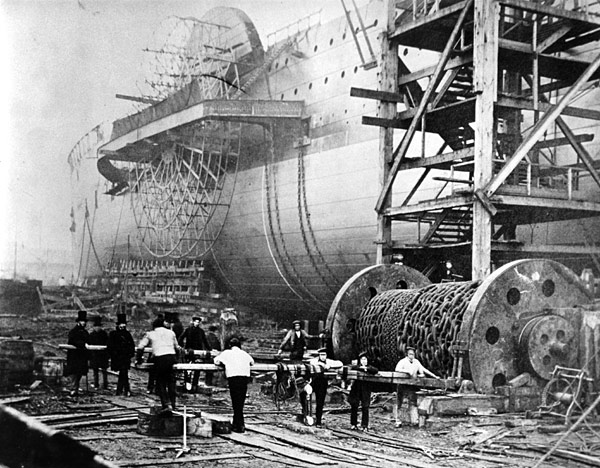
Great Eastern shortly before launch in 1858 by Robert Howlett. Source: Wikimedia
With a capacity for 4000 passengers, she left Liverpool on her maiden voyage with only 35 passengers and 8 company overseers, both of which were far exceeded by a crew of 418. She was equipped to run under sail or steam, via paddles or propeller, had four decks, and could carry 15,000 tons of coal. Sadly she was never given the opportunity to meet the long-distance goals of India, China and Australia intended for her by Brunel and her builders and investors and was never competitive on the busy cross-Atlantic passenger service to which she was initially confined.
The fortunes of Brunel’s astonishing S.S. Great Eastern swung between greatness and near-disaster like an enormous, record-breaking pendulum. She was all too often something of a gigantic white elephant, but she became an invaluable resource for laying cables across the Atlantic, and was always a great public attraction.
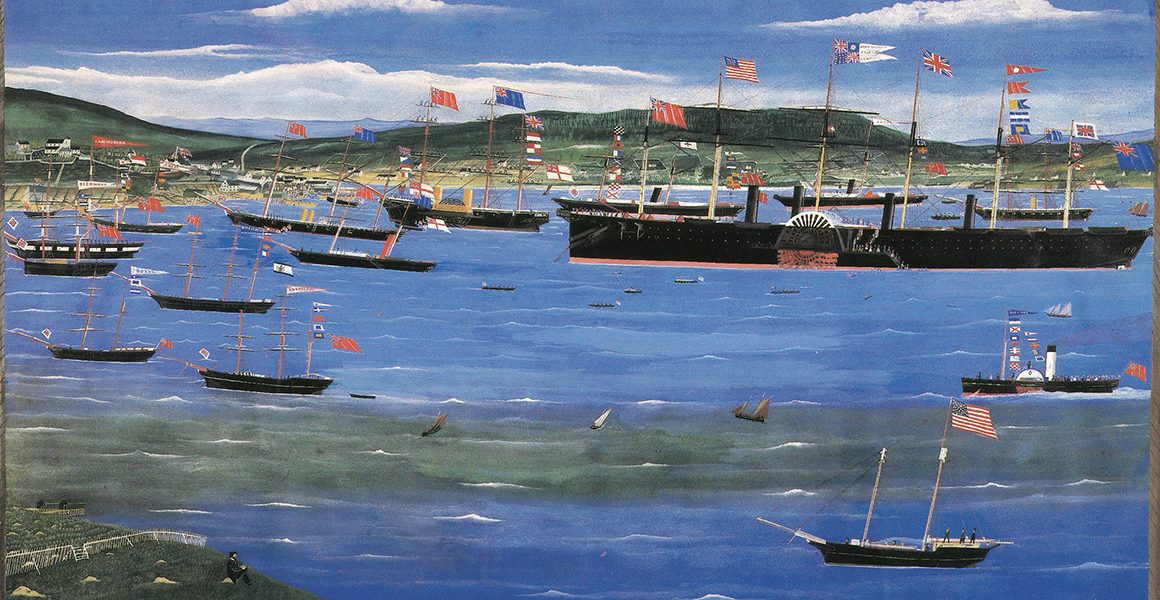
Painting by Charles James Lewis of the Atlantic Telegraph Expedition landing of the cable in Hearts Content Cable Station in Newfoundland, Canada, on July 27 1866, which he witnessed. Source: PK Porthcurno
After a traumatic roller-coaster of a career, the enormous ship was sold to be broken up in 1889, the work to take place on the Mersey.

Great Eastern, beached in advance of being broken up on the Mersey in late 1888, Wirral side. Source: Liverpool Echo
Throughout her history, Great Eastern was the subject of curiosity and fascination, and people lined up to buy souvenir pieces of the ship before the breaking work began on 1st January 1889. The photograph above shows her beached on the Mersey, ready to be broken up, and she continued to challenge even after the breaking work began. Not only was it a very sad episode for posterity but also, as it turned out, for the ship breaker. The company directors had estimated that it would take 200 men to break up the ship in a year, but she was so well built that it took nearly two years, requiring the costs of ongoing labour and additional machinery, including much more substantial wrecking balls, to finish the job. Substantial profits had been anticipated from her scrap value, but she was broken up at a considerable loss. Brunel had built her to last.

One of Robert Howlett’s famous photographs of Brunel with Great Eastern in 1857 prior to launch. Source: Wikimedia
Brunel had died in 1859 whilst the ship was still undergoing sea trials and had suffered an engineering accident during which five stokers died, and although the consensus is that the emotional stress of the ship’s construction and the difficulties of her launch undoubtedly contributed to his death, he was already suffering from a debilitating kidney disease.
It is perhaps thankful that he did not live to witness this drawn-out demise of his grandly imagined, fabulously realized and much-loved “Great Babe.”
Great Eastern was such a colossal, record-breaking chunk of maritime, industrial and national heritage that I find it more than slightly difficult to forgive the universe for allowing her to be broken up.

Infographic comparing ship sizes, in chronological order from left to right. Click to expand. Source: JF Ptak Science Books.
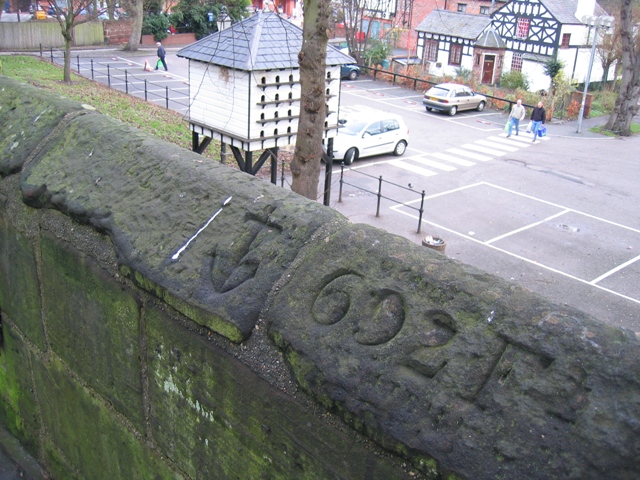
The length of Great Eastern carved into the City walls in the 19th century. Source: Geograph. By John Turner, CC BY-SA 2.0
The watercolour of Great Eastern, shows her beached on the Wirral side of the Mersey for repairs, although the painting is very sadly not on display. It was painted three years after the illustration at the top of the post, in 1863, by William Gawin Herdman (1805-1882).
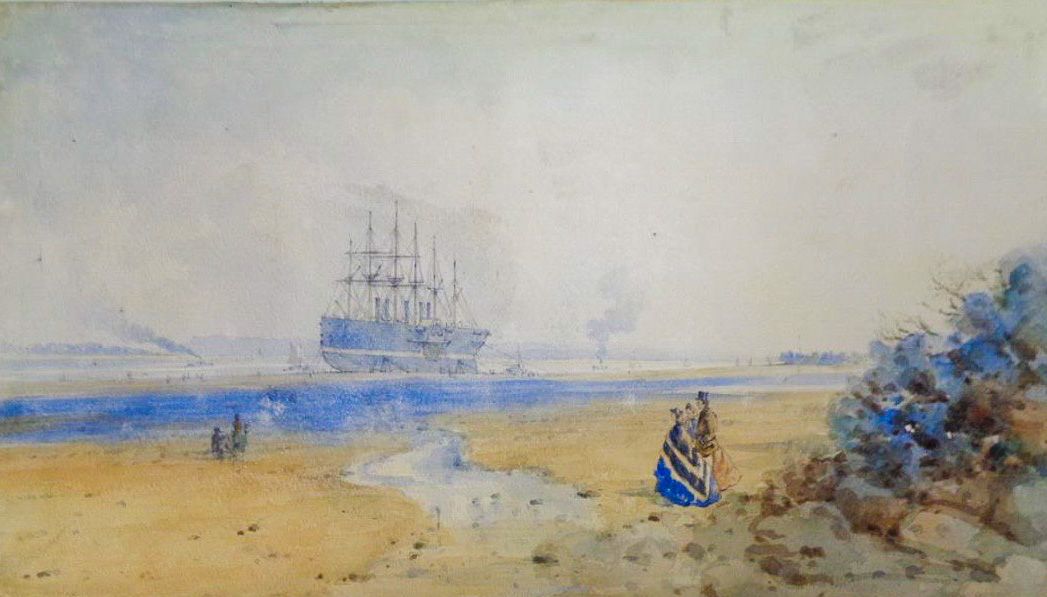
Great Eastern watercolour showing the ship on the gridiron for repairs just off the Wirral on the Mersey in 1863. By W.G. Herdman (in the collection of the Williamson Art Gallery, not currently on display). Source: Williamson Art Gallery Collection at Birkenhead.


